SB 1149: Public employees’ retirement: defined contribution program.
- Session Year: 2017-2018
- House: Senate
- Latest Version Date: 2018-04-10
The Public Employees Retirement Law (PERL) creates the Public Employees Retirement System (PERS), which provides a defined benefit to members of the system, based on final compensation, credited service, and age at retirement, subject to certain variations. PERL vests management and control of PERS in the Board of Administration. Under PERL, membership in PERS is compulsory for specified public employees and optional for other public employees.
The California Public Employees Pension Reform Act of 2013 (PEPRA) generally requires a public retirement system, as defined, to modify its plan or plans to comply with the act. PEPRA authorizes a public employer to provide a contribution to a defined contribution plan for compensation in excess of certain federal compensation limits applicable to qualified pension trusts, if the plan and contribution meet the requirements set forth in federal law. PEPRA prohibits any of those employer contributions to an employee defined contribution plan from exceeding the employers contribution rate, as a percentage of pay, required to fund the defined benefit plan.
Existing law establishes an alternate retirement program and provides that certain state employees, as defined, who become new members of PERS during their first 24 months of employment, do not make contributions to PERS or receive service credit for their service. Under existing law, these members are instead required to contribute either 5% or 6% of their monthly compensation, as specified, to the alternate retirement program.
This bill would create a new optional defined contribution plan for new state employees who are eligible to become members of PERS and who choose not to make contributions into the defined benefit program under PERL. first begin employment in a miscellaneous or industrial classification on or after January 1, 2020, and who were not members of any public retirement system prior to that date. The bill would require state employees who are subject to the bills provisions, within 30 days of beginning employment, to choose either to contribute to the defined contribution plan or to become a member of PERS. The bill would require, if an employee fails to make this decision within the above timeframe, that the employee automatically be placed in PERS. The bill would require state employees who opt to participate in this alternate system to contribute the same percent of compensation as similarly situated employees who contribute to the defined pension program, subject to applicable limits of federal law. The bill would authorize an employee in the defined contribution program, after 5 years, to have the right to continue in the program or switch to the defined benefit plan, subject to certain terms and conditions. The bill would require the Department of Human Resources to administer the defined contribution retirement program established by the bill.
The Public Employees Retirement Law (PERL) creates the Public Employees Retirement System (PERS), which provides a defined benefit to members of the system, based on final compensation, credited service, and age at retirement, subject to certain variations. PERL vests management and control of PERS in the Board of Administration.
The California Public Employees Pension Reform Act of 2013 (PEPRA) generally requires a public retirement system, as defined, to modify its plan or plans to comply with the act. PEPRA authorizes a public employer to provide a contribution to a defined contribution plan for compensation in excess of certain federal compensation limits applicable to qualified pension trusts, if the plan and contribution meet the requirements set forth in federal law. PEPRA prohibits any of those employer contributions to an employee defined contribution plan from exceeding the employers contribution rate, as a percentage of pay, required to fund the defined benefit plan.
Existing law establishes an alternate retirement program and provides that certain state employees, as defined, who become new members of PERS during their first 24 months of employment, do not make contributions to PERS or receive service credit for their service. Under existing law, these members are instead required to contribute either 5% or 6% of their monthly compensation, as specified, to the alternate retirement program.
This bill would create a new optional defined contribution plan for new state employees who are eligible to become members of PERS and who choose not to make contributions into the defined benefit program under PERL. The bill would require state employees who opt to participate in this alternate system to contribute the same percent of compensation as similarly situated employees who contribute to the defined pension program, subject to applicable limits of federal law. The bill would authorize an employee in the defined contribution program, after 5 years, to have the right to continue in the program or switch to the defined benefit plan, subject to certain terms and conditions. The bill would require the Department of Human Resources to administer the defined contribution retirement program established by the bill.
(a)(1)The Legislature finds and declares that this chapter is intended to provide a defined contribution pension program for new state employees who are eligible to be members of the Public Employees Retirement System pursuant to Section 20281.5 and who choose not to make contributions into the defined benefit retirement program.
(2)Notwithstanding Section 7522.04, a state employee, for purposes of this section, is an individual who first begins employment in a miscellaneous or industrial classification on or after January 1, 2020, and who was not a member of any public retirement system prior to that date.
(b)(1)The Legislature hereby authorizes the development of a defined contribution retirement program under a deferred compensation plan, a tax-deferred savings plan, or any other acceptable defined contribution plan.
(2)The plan is intended to constitute a governmental plan as defined by Section 414(d) of the Internal Revenue Code (26 U.S.C. Sec. 414(d)) and as such, the plan and all benefits payable thereunder are intended to satisfy all requirements of Section 401(a) of the Internal Revenue Code.
(c)The state employees described in subdivision (a) who are employed in positions that are subject to the federal system, as defined in Section 20033, and who opt to participate pursuant to this chapter shall contribute to the retirement program the same percent of compensation, as set forth in Part 3 (commencing with Section 20000 of Division 5 of Title 2), as similarly situated employees who contribute to the defined pension program.
(d)Subject to applicable limits established by federal law, a new state employee who makes an election to become subject to this section shall make the contributions required by this section in the same amount as contributions made by employees in the same employment classifications and state bargaining units who are members subject to Part 3 (commencing with Section 20000) of Division 5 of Title 2.
(e)(1)State employee, as used in this section, includes employees, as defined in Section 19815.
(2)This section shall not apply to employees of the California State University, the University of California, or the legislative or judicial branch.
(f)Notwithstanding any other law, a state employee who is subject to this chapter shall, within 30 days of beginning employment, choose either to become a member of the Public Employees Retirement System or to contribute to the defined contribution plan created pursuant to this chapter. If an employee fails to make this decision during the 30-day period, then the employee shall be placed into the Public Employees Retirement System and shall be subject to the Public Employees Retirement Law.
(f)(g)(1)For each employee who opts to contribute to the defined contribution plan, the Department of Human Resources shall deposit into an account on behalf of that employee an employer contribution in the same amount as the state would have contributed for the normal costs of a defined benefit pension for that employee, with the same limit on pension-eligible compensation.
(2)Nothing in this section shall change the amount the state is otherwise required to contribute to the defined benefit plan for any unfunded liability in that plan.
(g)(h)An employee who opts to contribute to the defined contribution plan may contribute more than the amount required pursuant to subdivision (c), subject to applicable limits of federal law.
(h)(i)The employer contributions made on each employees behalf and the investment income accrued to those contributions shall be vested to the employee in the amount of 20 percent after one year of employment, 40 percent after two years of employment, 60 percent after three years of employment and 80 percent after four years of employment. After five years of employment, the employee shall be fully vested in the contributions made on that employees behalf and the investment income accrued to those contributions.
(i)(j)An employee shall be fully vested at all times in the contributions made from that employees compensation and the investment income accrued to those contributions.
(j)(k)After five years of employment, an employee in the defined contribution plan shall have the right to continue in that plan or switch to the defined benefit plan within 90 days of the completion of five years of employment. This change shall come at no cost to the employee if the balance in the employees defined contribution account equals or exceeds the amount that would have been accrued to that employee under the defined benefit plan. If the balance in the employees account is less than the amount that would have been accrued to that employee under the defined benefit plan, the employee shall have the opportunity to join the defined benefit plan provided the employee deposits additional funds into the defined benefit plan in the amount needed to equalize the two amounts. The employee shall then enter the defined benefit plan with the same amount of service credit that would have been earned had they enrolled from the start of their service.
(k)(l)An employee who has participated in the defined contribution plan and leaves state employment after five years or more may leave the balance in that employees account in the defined contribution program or transfer all of those funds to another savings program or account qualified to accept deferred compensation funds under state and federal law.
19999.36.The Department of Human Resources shall administer the defined contribution retirement program established by this chapter. The department shall provide the method by which benefit payments shall be made to eligible recipients. The department shall establish the program, the transfer of contributions to the Public Employees Retirement System upon qualification and election by the member, continued participation in the program, and other provisions necessary for the implementation of the retirement program. The department may charge each state agency a fee not to exceed the reasonable regulatory costs to the department for the administration of this program.
(a)The Legislature finds and declares that this chapter is intended to provide a defined contribution pension program for new state employees who are eligible to be members of the Public Employees Retirement System pursuant to Section 20281.5 and who choose not to make contributions into the defined benefit retirement program.
(b)(1)The Legislature hereby authorizes the development of a defined contribution retirement program under a deferred compensation plan, a tax-deferred savings plan, or any other acceptable defined contribution plan.
(2)The plan is intended to constitute a governmental plan as defined by Section 414(d) of the Internal Revenue Code (26 U.S.C. Sec. 414(d)) and as such, the plan and all benefits payable thereunder are intended to satisfy all requirements of Section 401(a) of the Internal Revenue Code.
(c)The state employees described in subdivision (a) who are employed in positions that are subject to the federal system, as defined in Section 20033, and who opt to participate pursuant to this chapter shall contribute to the retirement program the same percent of compensation, as set forth in Part 3 (commencing with Section 20000 of Division 5 of Title 2), as similarly situated employees who contribute to the defined pension program.
(d)Subject to applicable limits established by federal law, a new state employee who makes an election to become subject to this section shall make the contributions required by this section in the same amount as contributions made by employees in the same employment classifications and state bargaining units who are members subject to Part 3 (commencing with Section 20000) of Division 5 of Title 2.
(e)(1)State employee, as used in this section, includes employees, as defined in Section 19815.
(2)This section shall not apply to employees of the California State University, the University of California, or the legislative or judicial branch.
(f)For each employee who opts to contribute to the defined contribution plan, the Department of Human Resources shall deposit into an account on behalf of that employee an employer contribution in the same amount as the state would have contributed for the normal costs of a defined benefit pension for that employee, with the same limit on pension-eligible compensation.
(g)An employee who opts to contribute to the defined contribution plan may contribute more than the amount required pursuant to subdivision (c), subject to applicable limits of federal law.
(h)The employer contributions made on each employees behalf and the investment income accrued to those contributions shall be vested to the employee in the amount of 20 percent after one year of employment, 40 percent after two years of employment, 60 percent after three years of employment and 80 percent after four years of employment. After five years of employment, the employee shall be fully vested in the contributions made on that employees behalf and the investment income accrued to those contributions.
(i)An employee shall be fully vested at all times in the contributions made from that employees compensation and the investment income accrued to those contributions.
(j)After five years of employment, an employee in the defined contribution plan shall have the right to continue in that plan or switch to the defined benefit plan within 90 days of the completion of five years of employment. This change shall come at no cost to the employee if the balance in the employees defined contribution account equals or exceeds the amount that would have been accrued to that employee under the defined benefit plan. If the balance in the employees account is less than the amount that would have been accrued to that employee under the defined benefit plan, the employee shall have the opportunity to join the defined benefit plan provided the employee deposits additional funds into the defined benefit plan in the amount needed to equalize the two amounts. The employee shall then enter the defined benefit plan with the same amount of service credit that would have been earned had they enrolled from the start of their service.
(k)An employee who has participated in the defined contribution plan and leaves state employment after five years or more may leave the balance in that employees account in the defined contribution program or transfer all of those funds to another savings program or account qualified to accept deferred compensation funds under state and federal law.
19999.36.The Department of Human Resources shall administer the defined contribution retirement program established by this chapter. The department shall provide the method by which benefit payments shall be made to eligible recipients. The department shall establish the program, the transfer of contributions to the Public Employees Retirement System upon qualification and election by the member, continued participation in the program, and other provisions necessary for the implementation of the retirement program. The department may charge each state agency a fee not to exceed the reasonable regulatory costs to the department for the administration of this program.
|
Date
|
Status
|
|---|---|
| Apr 24, 2018 | April 23 set for second hearing. Failed passage in committee. (Ayes 1. Noes 3.) Reconsideration granted. |
| Apr 10, 2018 | From committee with author's amendments. Read second time and amended. Re-referred to Com. on P.E. & R. |
| Apr 4, 2018 | Set for hearing April 23. |
| Apr 2, 2018 | April 9 set for first hearing canceled at the request of author. |
| Mar 15, 2018 | Set for hearing April 9. |
| Feb 22, 2018 | Referred to Com. on P.E. & R. |
| Feb 15, 2018 | From printer. May be acted upon on or after March 17. |
| Feb 14, 2018 | Introduced. Read first time. To Com. on RLS. for assignment. To print. |
|
Date
|
Description
|
Location
|
Votes
|
|
|---|---|---|---|---|
| Apr 23, 2018 | [Second] hearing set for [04-23-2018]: Failed passage in Committee. Reconsideration granted | Senate Standing Committee on Public Employment and Retirement |
Passed |
|
| Apr 23, 2018 | Do pass, but first be re-referred to the Committee on [Appropriations] | Senate Standing Committee on Public Employment and Retirement |
Failed |
This list shows positions taken on this bill by organizations on the date displayed, which is linked to the original source.
Positions by individuals are not included.
|
Organization
|
Position
|
Date
|
|---|---|---|
| American Federation of State, County and Municipal Employees | ** Against | Apr 18, 2018 |
| Association of California Cities-Orange County | ** Support | Apr 18, 2018 |
| California Association Of Professional Scientists | ** Against | Apr 18, 2018 |
| California Association Of Psychiatric Technicians | * Against | Apr 23, 2018 |
| California Conference Board Of The Amalgamated Transit Union | ** Against | Apr 18, 2018 |
| California Conference Of Machinists | ** Against | Apr 18, 2018 |
| California Faculty Associaiton | * Against | Apr 23, 2018 |
| California Federation of Teachers, AFT, AFL-CIO | ** Against | Apr 18, 2018 |
| California Labor Federation | * Against | Apr 23, 2018 |
| California Professional Fire Firefighters | * Against | Apr 23, 2018 |
| California School Employees Association | * Against | Apr 23, 2018 |
| California State Council Of Service Employees | ** Against | Apr 18, 2018 |
| California Teachers Association | ** Against | Apr 18, 2018 |
| California Teamsters Public Affairs Council | ** Against | Apr 18, 2018 |
| Howard Jarvis Taxpayers Association | * Support | Apr 23, 2018 |
| International Longshore & Warehouse Union | ** Against | Apr 18, 2018 |
| Local 5810 | ** Against | Apr 18, 2018 |
| Los Angeles County Professional Peace Officers Association | ** Against | Apr 18, 2018 |
| Orange County Employees Association | * Against | Apr 23, 2018 |
| Organization Of Smud Employees | ** Against | Apr 18, 2018 |
| Peace Officers Research Association Of California | ** Against | Apr 18, 2018 |
| Professional and Technical Engineers, IFPTE Local 21, AFL-CIO | ** Against | Apr 18, 2018 |
| Professional Engineers In California Government | * Against | Apr 23, 2018 |
| Retired Public Employees Association | ** Against | Apr 18, 2018 |
| Riverside Sheriff's Association | * Against | Apr 23, 2018 |
| San Diego County Court Employees Association | ** Against | Apr 18, 2018 |
| Service Employees International Union, California | ** Against | Apr 18, 2018 |
| Service Employees International Union, Local 1000 | ** Against | Apr 18, 2018 |
| United Public Employees | ** Against | Apr 18, 2018 |
SENATE COMMITTEE ON
PUBLIC EMPLOYMENT AND RETIREMENT
Dr. Richard Pan, Chair
2017 - 2018 Regular
Bill No: SB 1149 Hearing Date: 4/23/18
Author: | Glazer | ||
Version: | 4/10/18 As amended | ||
Urgency: | No | Fiscal: | Yes |
Consultant: | Glenn Miles | ||
Subject: Public employees’ retirement: Pension Opt Out for New State Employees
SOURCE: Author
DIGEST: This bill would allow new state employees, as specified, to opt out of the existing California Public Employees’ Retirement System (CalPERS) defined benefit (DB) pension plan within 30 days of starting employment and instead divert the employee and employer contributions that would otherwise be made on their behalf for the DB plan’s normal cost to a new defined contribution (DC) retirement savings account developed and administered by the state employer’s labor representative, California Department of Human Resources (CalHR).
After completing 5 years of employment, an employee who opted out of the pension plan would have 90 days to reverse the decision and opt in by depositing with CalPERS the total sum necessary to fund what would have accrued to the employee under the CalPERS pension plan over the 5 years. After the 90 days, the employee would be permanently excluded from CalPERS membership.
ANALYSIS:
Existing law:
- Provides a federal tax-qualified, defined benefit pension plan to state employees through the Public Employees’ Retirement Law (PERL) which is administered by the California Public Employees’ Retirement System (CalPERS) and pre-funded over the course of the employee’s career through employee and employer contributions. Contributions are held in trust in the Public Employees’ Retirement Fund (PERF) and invested by CalPERS through its Asset Liability Management process which helps determine an optimum asset allocation and risk profile for the fund. Return on investments help offset employer contributions and lower the costs to provide member benefits.
The plan provides a lifetime retirement allowance for members who become annuitants and for their beneficiaries and survivors based on the member’s highest one or three years of final compensation, years of service, and retirement formula on the date of retirement. It also includes death, disability, and survivor benefits. Employees who leave eligible service prior to retirement may withdraw their employee contributions plus interest, as specified, or may leave their funds on deposit with CalPERS and receive their retirement allowance upon meeting their respective retirement eligibility criteria.
- Provides state employees with health care benefits through the Public Employees' Medical and Hospital Care Act (PEMHCA), which is also administered by CalPERS. Under the program, CalPERS serves as a health care purchaser that negotiates with health care insurance companies and providers over a desired plan of coverage to provide a choice of health care plan options to state employees at optimal costs. Under PEMHCA, retired state employees who become CalPERS annuitants are eligible for continued group health care coverage in retirement and for a contribution by the state toward healthcare premiums. Employees who do not receive a lifetime annuity from CalPERS are not eligible for these healthcare benefits in retirement.
- Offers state employees a voluntary defined contribution retirement savings program through the Savings Plus program which is administered by the California Department of Human Resources (CalHR). Under the Savings Plus DC plan, state employees can make tax-deferred and Roth after-tax payroll contributions to a 401(k) Plan and/or a 457(b) Plan.
- Provides that state employees hired between August 11, 2004, and June 30, 2013, are subject to the Alternative Retirement Plan (ARP), which is administered by CalHR. Under ARP, subject employees became members of CalPERS but instead of immediately beginning to earn service credit in the CalPERS defined benefit plan, they were automatically enrolled into the Savings Plus defined contribution 401(a) plan for their first two years of CalPERS covered , state employment and their contributions were invested in the Short Term Investment Fund, a diversified portfolio of fixed income securities including securities issued by the U.S. Government, U.S. Agencies, corporate bonds, residential and commercial mortgage-backed securities and asset-backed securities. After 2 years, subject employees start earning CalPERS service credit. After 4 years, the employees must choose among three options: transfer the ARP funds to CalPERS for repurchase their first year of service credit; take a distribution; or transfer the funds to a Savings Plus 401(k) account. ARP was closed to new employees as of July 1, 2013.
- Requires part-time, seasonal, and temporary state employees to participate in the Part-Time, Seasonal, and Temporary Employees Retirement Program (PST), a Savings Plus defined contribution retirement savings program administered by CalHR, in order to comply with federal tax law that state employees who are not CalPERS members be covered by social security, or, in the alternative, be provided benefits through a qualified pension or annuity program. Employees covered by PST are required to contribute 7.5 percent of wages to their PST account.
- Provides the state and its employees, through the Ralph C. Dills Act (Dills Act), a reasonable method of resolving disputes regarding wages, hours, and other terms and conditions of employment between the state and public employee organizations through employee representation and collective bargaining thereby avoiding historical labor strife that interfered with the public welfare.
- Defines “State employer,” or “employer,” for the purposes of bargaining or meeting and conferring in good faith with employees’ exclusive representatives to mean the Governor or his or her designated representatives, which is CalHR.
This bill:
- Authorizes a defined contribution pension program (DC) for new state employees, as specified, who choose not to make contributions into the existing CalPERS defined benefit retirement program (DB).
- Defines “state employee” for purposes of this bill as an individual who first begins employment in a miscellaneous or industrial classification on or after January 1, 2020, and who was not a member of any public retirement system prior to that date. However, also later defines “state employee” to include employees subject to the Dills Act, supervisory employees, managerial employees, confidential employees, employees of the Legislative Counsel Bureau, employees of the Bureau of State Audits, employees of the office of the Inspector General, employees of the Public Employment Relations Board, conciliators employed by the California State Mediation and Conciliation Service, employees of CalHR, professional employees of the Department of Finance engaged in technical or analytical state budget preparation other than audit staff, intermittent athletic inspectors who are employees of the State Athletic Commission, professional employees in the Personnel/Payroll Services Division of the Controller’s office, and all employees of the executive branch of government who are not elected to office.
- Excludes employees of the California State University, the University of California, the legislative, and the judicial branch.
- Authorizes the DC plan as a deferred compensation plan, a tax-deferred savings plan, or any other acceptable defined contribution plan.
- States that the DC plan is intended to constitute a qualified trust, governmental pension plan as defined by federal tax law.
- Requires new state employees, as specified, who are also subject to Social Security and who opt to participate in the DC plan to contribute to their DC account the same percent of compensation as similarly situated employees who contribute to the DB plan.
- Requires a new state employee who opts into the DC plan to make mandatory contributions, subject to applicable limits established by federal law, to the employee’s DC account in the same amount as contributions made by employees in the same employment classifications and state bargaining units who are CalPERS members.
- Requires a state employee who is subject the bill’s provisions to choose within 30 days of beginning employment either to become a member of CalPERS or to contribute to the DC plan created pursuant to this bill. If an employee fails to make this decision during the 30-day period, then the employee shall be placed into CalPERS and shall be subject to the Public Employees’ Retirement Law.
- Requires CalHR to deposit into a DC account on behalf of each participating employee an “employer contribution” in the same amount as the state would have contributed for the normal costs of a DB pension for that employee, with the same limit on pension-eligible compensation.
- States that nothing in the bill shall change the amount the state is otherwise required to contribute to the DB plan for any unfunded liability in the CalPERS DB plan.
- Allows an employee who opts to contribute to the DC plan to contribute more than the mandatory employee contribution amount, subject to applicable limits of federal law.
- Establishes a schedule under which the employee will become vested in the DC employer contributions made on the employee’s behalf and the investment income accrued to those contributions. The employee vests in 20 percent of the employer contribution and accrued investment income for each year of employment completed until after five years of employment, the employee will be fully vested in the employer contributions made into the DC plan on that employee’s behalf and the investment income accrued to those contributions.
- Fully vests the employee at all times in the contributions made from that employee’s compensation (i.e., the employee contribution) and the investment income accrued to those contributions.
- Provides that after five years of employment, an employee in the DC plan shall have the right to continue in that plan or switch to the DB plan within 90 days of the completion of five years of employment. This change shall come at no cost to the employee if the balance in the employee’s DC account equals or exceeds the amount that would have been accrued to that employee under the DB plan. If the balance in the employee’s DC account is less than the amount that would have been accrued to that employee under the DB plan, the employee shall have the opportunity to join the DB plan provided the employee deposits additional funds into the DB plan in the amount needed to equalize the two amounts. The employee shall then enter the CalPERS DB plan with the same amount of service credit that would have been earned had the employee enrolled from the start of the employee’s service.
- Authorizes an employee who has participated in the DC plan and leaves state employment after five years or more to leave the balance in that employee’s DC account in the DC program or transfer all of those funds to another savings program or account qualified to accept deferred compensation funds under state and federal law.
- Requires CalHR to administer the DC plan and provide the method by which benefit payments shall be made to eligible recipients. CalHR shall establish the program, the transfer of contributions to CalPERS upon qualification and election by the member, continued participation in the program, and other provisions necessary for the implementation of the DC plan.
Background
Committee Concerns:
- State Employee Definition
This bill provides two definitions for “state employees” for purposes of the bill’s provisions. It is unclear whether the ability to opt out of the CalPERS DB pension applies only to new employees pursuant to the first definition or “includes” all employees, as specified, under the second definition. The committee assumes that the bill is intended only to permit new state employees to opt out of the DB plan and the second definition is intended to identify the categories of state employees from which new employees may be covered under this bill. However, the committee recommends consolidating and clarifying the two definitions into one definition. Otherwise, certain provisions of the bill may apply to more than just new state employees. If that occurred, there would be significant difficulties related to conflicting provisions with respect to CalPERS membership status, vested rights, mixed DB/ DC service, et al.
- Lost Health Benefits, Post- Retirement Health Coverage, Disability Benefits, Death and Survivor Benefits, Reciprocity, and COLAs
This bill raises significant questions regarding how an employee who opts out of the DB plan and chooses the DC plan will be covered for the state’s active member health benefits, disability benefits, death and survivor benefits, and post-retirement health coverage, which are all dependent on CalPERS membership. The bill makes no provisions for replacing these programs for an employee who opts out of CalPERS. The bill would also defease the employee of the right to reciprocity with other public agencies, as well as COLAs on the employee’s retirement allowance.
- Collective Bargaining
Under the Dills Act and related statutes governing labor relations between the state and state employees, changes in compensation, including deferred compensation, are matters subject to collective bargaining. The establishment of a right to opt out of CalPERS and participate in a new, employer sponsored DC plan has not been collectively bargained.
- Employee Recruitment and Retention
The existing CalPERS DB pension plan is a strong tool in recruiting a highly skilled workforce because it attracts already highly skilled employees seeking protection from market risk and the guarantee of a lifetime allowance upon retirement. These employees are willing to forgo higher salary from the state’s private sector or public agency competitors for the security inherent in the state’s DB plan. However, this bill creates a type of adverse selection that may weaken the DB plan because by offering the ability to opt out of the DB together with the ability to opt in after completing 5 years of employment, new employees with little intention or certainty of staying long term will by default opt out of the DB plan knowing that if they do end up staying long term they have another chance to join CalPERS and if they do not, they can take a portion or all of the employer contribution with them depending on when they leave. Currently, if an employee leaves before retiring and chooses to withdraw his or her employee contributions, the employer contributions stay in the PERF to help reduce costs to providing pensions to employees who remain and complete their career with the state.
Also, since employees who have substantial state service are generally reluctant to lose the employer contribution to seek other employment outside CalPERS membership, this element of the DB plan helps serve as a retention incentive. Lastly, employees who do leave state employment are often enticed to return after obtaining additional skills and experience in the private sector or at other public agencies to take advantage of the DB plan and bring needed innovation and expertise.
The proposed DC plan may significantly undercut both the incentive to remain in state service and raise the cost of providing pensions for career employees.
In addition, this bill may result in increased recruitment and retention costs as the state expends resources to train new employees who upon attaining skill and experience transfer to the state’s private sector and public agency competitors that typically offer higher salaries because the employee would no longer need to weigh the competitor’s higher salary offer against the loss of the state’s employer contribution and access to a DB plan. Thus, this bill could result in pressures to increase state salaries to maintain competiveness.
- Transferred Risk to Employees
This bill will transfer market risk to new employees who opt out of the DB plan and into the DC plan by exchanging a right to a guaranteed lifetime allowance for an account whose final balance at retirement will depend on the vagaries of the stock market and may be subject to depletion during periods of unemployment or financial difficulties. Employees who arrive at retirement age with no substantial funds for support often end up creating increased demands on other public services.
- Short Period for Employee to Make Key Decision With Long Term Consequences
New employees would have 30 days from beginning employment to decide whether to opt out of the DC plan which may not be sufficient time to understand the long range consequences of exchanging a DB pension plan membership for a DC contribution plan. This raises question about how much education and information will be available to new employees and how much attention they can give to make an informed decision when they are dealing with the demands and adjustments of starting a new job.
- State Employees Already Have Access to a DC plan
This bill is unnecessary because state employees can already save deferred compensation in a DC plan through the Savings Plus plan.
- Contributions and Optional Re-Entry into CalPERS
The bill raises several questions related to the required contributions for the DC plan and the right to opt back into CalPERS membership after completing 5 years of service. Under PEPRA, new state employees in the DB plan pay one-half the normal cost and the state pays one-half the normal cost of the employee’s actuarial calculated accumulated benefit. The bill requires a DC participant to receive the same contribution, both as a percentage of payroll and as an amount. However, under the DB plan, if actuarial assumptions are not realized, an unfunded actuarial liability (UAL) results. A UAL is funded by adjustments to the employer’s contribution resulting in increased employer contributions to the PERF. Yet, these adjustments are separate from the normal cost and thus, there would be no comparable adjustment to the employer contribution to the DC plan participant pursuant to the bill’s provisions which references only normal costs.
The difference in employer contribution becomes more significant if the DC participant seeks to opt in to the DB plan in year 5. The bill states that nothing in the legislation “shall change the amount the state is required to contribute to the defined benefit plan for any unfunded liability in that plan.” This language is unclear. Does it mean that the state is responsible for any UAL that may have developed in years 1 -5 for the value of 5 years of service credit which the DC participant will receive upon opting in to CalPERS? Or does it mean that the UAL for that service will not be allocated to the state? If it’s not allocated to the state, is it allocated to the DC participant upon opting into CalPERS? If not, who pays for it?
- Possible Fiduciary Conflict between CalHR and CalPERS and Conflict of Interest Between CalHR and Employees
The bill vests authority in CalHR for deciding how much would need to transfer from the DC plan to the DB plan if the employee opts in CalPERS in year 5. If CalPERS and CalHR disagree on the amount needed to fund 5 years of service credit, there would a conflict with CalPERS fiduciary duty to ensure the stability of the fund by determining the actuarial amount required to cover the cost.
- Potential Conflict of Interest Between CalHR and State Employees
Since CalHR is the designated employer representative for collective bargaining between the state and its employees, it faces an inherent conflict of interest in administering and recommending a DC deferred compensation plan with an employer match. Whereas the employer’s interest may be better served in terms of mitigating deferred compensation costs and transferring risk onto the employees, employees interest are more likely or typically better served by access to the DB plan and a guaranteed lifetime allowance in retirement where market risk stays with the employer.
Related/Prior Legislation
SB 32 (Moorlach, 2017), Died in the Senate Public Employment and Retirement Committee, would have required, among several other things, that CalPERS develop and submit to the Legislature for approval a hybrid plan on or before January 1, 2019, that would consist of a defined benefit component utilizing low-risk investments and a defined contribution component under which an employee’s contributions would be matched by employer contributions up to an unspecified percent.
SB 1297 (Pan, 2016), Died in the Senate Public Employment and Retirement Committee, would have created a framework for public employers and employees, through the collective bargaining process, to negotiate automatic enrollment and escalation of employee contributions into supplemental retirement savings plans.
SB 520 (Walters, 2011), Died in the Senate Public Employment and Retirement Committee, would have required CalPERS to create a hybrid retirement plan, as specified, for public employee members of CalPERS who became members on and after January 1, 2012.
FISCAL EFFECT: Appropriation: No Fiscal Com.: Yes Local: No
SUPPORT:
Association of California Cities-Orange County
OPPOSITION:
American Federation of State, County and Municipal Employees
California Association of Professional Scientists
California Conference Board of the Amalgamated Transit Union
California Conference of Machinists
California Faculty Association
California Federation of Teachers, AFT, AFL-CIO
California Labor Federation, AFL-CIO
California Professional Firefighters
California School Employees Association, AFL-CIO
California State Council of Service Employees
California Teachers Association
California Teamsters Public Affairs Council
International Longshore & Warehouse Union
Los Angeles County Professional Peace Officers Association
Orange County Employees Association
Organization of SMUD Employees
Peace Officers Research Association of California
Professional Engineers in California Government
Professional and Technical Engineers, IFPTE Local 21, AFL-CIO
Retired Public Employees Association
San Diego County Court Employees Association
Service Employees International Union, California
Service Employees International Union, Local 1000
United Automobile, Aerospace and Agricultural Implement Workers of America,
Local 5810
United Public Employees
ARGUMENTS IN SUPPORT:
According to the author, the CalPERS DB plan is only 68 percent funded, has a $138 billion unfunded liability, and although on a long path toward becoming fully funded, “could be thrown off by another deep recession or stock market decline.”
Additionally, the author states that younger employees “do not intend to work for the state their entire lives, and they would be better served by a portable, defined contribution plan that they could take with them if they leave before retirement.”
ARGUMENTS IN OPPOSITION:
According to Service Employees International Union, California,
Virtually every study that compares DC and DB plans concludes that defined contribution plans are as much as 40 % less efficient and more costly that a defined benefit plan in providing the same benefit. If the same amount is contributed to both plan designs, those in a defined contribution plan would receive a significantly lower retirement benefit.
According to the California Labor Federation,
The current defined benefit system guarantees employees a specified retirement formula, while SB 1149 would provide absolutely no guarantee. Employees covered by PEPRA are required to pay 50% of the normal cost, thereby sharing risk with the employer. SB 1149 would shift all the risk on to workers meaning an employee could lose most or even all their retirement saving due to a market crash or bad investments decisions.
According to the Los Angeles County Professional Peace Officers Association,
Research shows that institutional investors like CalPERS and CalSTRS lose less in economic downturns and gain more in economic upturns than individual investors, while doing it at a lower overall cost. SB 1149 exposes employees who choose the DC option to volatile markets, unspecified fees, and are not guaranteed professional training or advice.
Discussed in Hearing
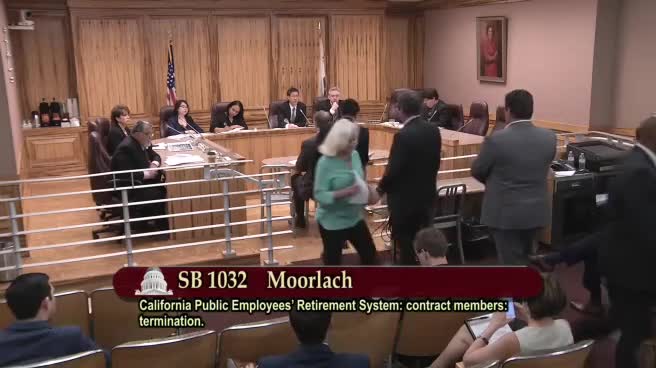 35MIN
Senate Standing Committee on Public Employment and Retirement
Bill Author