SB 1188: Domestic workers: overtime: sleep hours.
- Session Year: 2017-2018
- House: Senate
- Latest Version Date: 2018-02-15
Existing law regulates the wages, hours, and working conditions of any man, woman, and minor employed in any occupation, trade, or industry, whether compensation is measured by time, piece, or otherwise, except as specified. Existing law makes violations of certain of these provisions a misdemeanor.
Existing law, the Domestic Worker Bill of Rights, prohibits a domestic worker from being employed more than 9 hours in any workday or more than 45 hours in any workweek unless the employee receives one and one-half times the employees regular rate of pay for all hours worked over 9 hours in any workday and for all hours worked more than 45 hours in the workweek.
This bill would authorize that a domestic work employee who is a live-in employee or is required to be on duty for 24 or more consecutive hours, to enter into a written agreement with his or her employer to exclude a sleeping period, as described, of not more than 8 hours from the employees working hours, provided that certain conditions are met. In the absence of an agreement, the bill would require the regularly scheduled sleeping period to count as hours worked. The bill would prohibit an employer from terminating a domestic work employee for failing to enter into such an agreement and would provide that these provisions do not apply to a domestic work employee who works fewer than 24 consecutive hours.
Because the violation of certain wage and overtime provisions are a crime, this bill would impose a state-mandated local program.
The California Constitution requires the state to reimburse local agencies and school districts for certain costs mandated by the state. Statutory provisions establish procedures for making that reimbursement.
This bill would provide that no reimbursement is required by this act for a specified reason.
(a)A domestic work employee who is a personal attendant shall not be employed more than nine hours in any workday or more than 45 hours in any workweek unless the employee receives one and one-half times the employees regular rate of pay for all hours worked over nine hours in any workday and for all hours worked more than 45 hours in the workweek.
(b)(1)If a domestic work employee is a live-in employee or is required to be on duty for 24 or more consecutive hours, the domestic work employer and the domestic work employee may agree, in writing, to exclude from hours worked a regularly scheduled sleeping period of not more than eight hours, provided adequate sleeping facilities are provided and the employee can enjoy an uninterrupted nights sleep.
(2)For the purposes of this section, an uninterrupted nights sleep consists of at least five hours of sleep during the regularly scheduled sleeping period. If the sleeping period is interrupted by a call to duty, the interruption period shall be counted as hours worked. If the interruption is such that the domestic work employee cannot obtain at least five hours of sleep, the entire regularly scheduled sleeping period shall be counted as hours worked.
(3)If the domestic work employer and the domestic work employee do not agree, in writing, to exclude from hours worked a regularly scheduled sleeping period, the regularly scheduled sleeping period shall be counted as hours worked.
(4)The domestic work employer shall not terminate or otherwise relieve the domestic work employee of his of her duty for failing to agree in writing to exclude from hours worked a regularly scheduled sleeping period.
(5)A domestic work employee who is on duty for less than 24 consecutive hours is not eligible to have any regularly scheduled sleeping periods deducted from his or her hours worked.
SEC. 2.No reimbursement is required by this act pursuant to Section 6 of Article XIIIB of the California Constitution because the only costs that may be incurred by a local agency or school district will be incurred because this act creates a new crime or infraction, eliminates a crime or infraction, or changes the penalty for a crime or infraction, within the meaning of Section 17556 of the Government Code, or changes the definition of a crime within the meaning of Section 6 of Article XIIIB of the California Constitution.
|
Date
|
Status
|
|---|---|
| Apr 11, 2018 | April 11 set for first hearing. Failed passage in committee. (Ayes 1. Noes 2. Page 3726.) Reconsideration granted. |
| Mar 16, 2018 | Set for hearing April 11. |
| Mar 1, 2018 | Referred to Com. on L. & I.R. |
| Feb 16, 2018 | From printer. May be acted upon on or after March 18. |
| Feb 15, 2018 | Introduced. Read first time. To Com. on RLS. for assignment. To print. |
|
Date
|
Description
|
Location
|
Votes
|
|
|---|---|---|---|---|
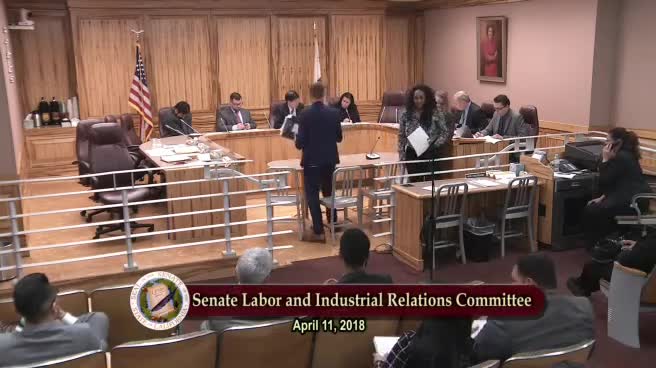
| Apr 11, 2018 | [First] hearing set for [04-11-2018]: Failed passage in Committee. Reconsideration granted | Senate Standing Committee on Labor and Industrial Relations |
Passed |
|
| Apr 11, 2018 | Do pass, but first be re-referred to the Committee on [Appropriations] | Senate Standing Committee on Labor and Industrial Relations |
Failed |
This list shows positions taken on this bill by organizations on the date displayed, which is linked to the original source.
Positions by individuals are not included.
|
Organization
|
Position
|
Date
|
|---|---|---|
| 5-Individuoals | ** Support | Apr 10, 2018 |
| ACLU California | * Against | Apr 11, 2018 |
| Attentive Home Care | ** Support | Apr 10, 2018 |
| Broad and Gusman | ** Against | Apr 11, 2018 |
| California Association of Health Services at Home | * Support | Apr 11, 2018 |
| California Domestic Workers Coalition | * Against | Apr 11, 2018 |
| California Employment Lawyers Association | * Against | Apr 11, 2018 |
| California Immigrant Policy Center | * Against | Apr 11, 2018 |
| California Labor Federation | * Against | Apr 11, 2018 |
| California Teamsters | ** Against | Apr 11, 2018 |
| Caring Companions at Home | ** Support | Apr 10, 2018 |
| Consumer Attorneys Of California | * Against | Apr 11, 2018 |
| Craig Cares | ** Support | Apr 10, 2018 |
| Equal Rights Advocates | * Against | Apr 11, 2018 |
| Family Inhome Caregiving Of Monterey | ** Support | Apr 10, 2018 |
| Filipino Advocates for Justice | * Against | Apr 11, 2018 |
| Filipino Worker Center from Los Angeles | * Against | Apr 11, 2018 |
| Filipino Workers Center | * Against | Apr 11, 2018 |
| Golden Gate University School of Law | * Against | Apr 11, 2018 |
| Hands To Help Seniors | ** Support | Apr 10, 2018 |
| Heritage Senior Care, Inc. | ** Support | Apr 10, 2018 |
| Home Care Association Of America | * Support | Apr 11, 2018 |
| Homestead Senior Care | ** Support | Apr 10, 2018 |
| National Employment Law Project | ** Against | Apr 10, 2018 |
| None | * Support | Apr 11, 2018 |
| San Francisco Women's Collective | * Against | Apr 11, 2018 |
| Stronger California Advocates Network | * Against | Apr 11, 2018 |
| UDW | * Against | Apr 11, 2018 |
| Windward Life Care | ** Support | Apr 10, 2018 |
SENATE COMMITTEE ON LABOR AND INDUSTRIAL RELATIONS
Senator Richard Pan, Chair
2017 - 2018 Regular
Bill No: SB 1188 Hearing Date: April 11, 2018
Author: | Stone | ||
Version: | February 15, 2018 | ||
Urgency: | No | Fiscal: | Yes |
Consultant: | Jake Ferrera | ||
Subject: Domestic workers: overtime: sleep hours
KEY ISSUE
Should live-in domestic workers be able to enter into a written agreement with their employer to deduct a regularly scheduled sleep period from their hours worked?
ANALYSIS
Existing law
- Defines “Employee” to mean every person in the service of an employer under any appointment or contract of hire or apprenticeship, expressed or implied, oral or written, whether employed lawfully or unlawfully for the purposes of worker’s compensation.
(Labor Code §3351)
- Defines “Domestic work” to mean services related to the care of persons in private households or maintenance of private households or their premises. This includes childcare providers, caregivers of people with disabilities, sick, convalescing, or elderly persons, house cleaners, housekeepers, maids, and other household occupations. (Labor Code §1451)
- Stipulates that a domestic work employee who is a personal attendant shall not be employed more than nine hours in any workday or more than 45 hours in any workweek unless the employee receives one and one-half times the employee’s regular rate of pay for all additional hours worked. (Labor Code §1454)
- Requires wages to be paid for “hours worked” defined in IWC Wage Order No. 15 for household occupations, including domestic workers, as the time during which an employee is subject to the control of an employer, and all the time the employee is suffered or permitted to work, whether or not required to do so (IWC Wage Order No. 15, §2[H]).
Existing federal law
- Permits under the federal Fair Labor Standards Act (FLSA), that an employer and employee may agree to deduct a bona fide regularly-scheduled sleeping period of not more than 8 hours from hours worked, provided adequate sleeping facilities are furnished by the employer and the employee can usually enjoy an uninterrupted night’s sleep
(Title 29, Part 785 of the Code of Federal Regulations, §785.22 [a]).
- Requires that if the sleeping period is interrupted by a call to duty, the interruption must be counted as hours worked. If interruptions prevent the employee from getting a reasonable night’s sleep, which is considered to be five uninterrupted hours, the entire period must be counted. (Title 29, Part 785 of the Code of Federal Regulations, §785.22 [b])
This Bill
- This bill would allow domestic work employees who are live-in or who are required to be on duty for 24 consecutive hours or more to enter into a mutual written agreement with their employer to exclude a regularly scheduled sleeping period from hours worked for the purposes of determining pay.
- The bill further requires that the sleep period not exceed 8 hours, that adequate sleeping facilities be provided and that the employee be able to enjoy an uninterrupted night’s sleep.
- Defines “Uninterrupted” to mean at least 5 hours out of the regularly scheduled sleep period. Stipulates that an employee be paid for any periods of interruption during the sleep period and that the entire sleep period must be counted towards hours worked if the interruptions result in an employee being unable to sleep for at least 5 hours.
COMMENTS
1. Need for this bill?
A recent California Supreme Court ruling in the case of Mendiola v. CPS Security Solutions, Inc., S212704 (2015) denied federal sleep time deductions for employees that fall under Federal Wage Order No. 4 which shares similarities with Wage Order No. 15. The court determined that the federal sleep time deduction was not valid in this case because it is not specifically cited in the wage order itself. Proponents of SB 1188 contend that the ruling in the Mendiola case has created great uncertainty for home care agencies with employees who fall under Wage Order No. 15, which like Wage Order 4 does not cite the federal sleep time deduction.
2. Staff Comments
As was brought up in Mendiola vs CPS Security Solutions, there is concern about sleep period exemption in a job where the employee is effectively on-call and unable to return home, even during supposed sleep hours. A domestic worker, like the security guards in the Mendiola case, is expected to respond at any time to potentially emergency situations and often multiple times a night. SB 1188 does not guarantee that an “uninterrupted” sleep period as defined by the bill would actually result in an adequate night’s sleep. While it is important to keep the cost of home care in mind, this SB 1188 has the potential to significantly cut the wages of domestic workers while leaving the amount of hours worked unchanged.
3. Proponent Arguments:
Proponents argue that seniors depend on private home care services to stay healthy in their own homes and to avoid institutionalization. Their specific and unique needs require flexibility in how a home care provider can best provide care. Proponents stress that this has been accomplished through exemptions in labor law, like the one being proposed in SB 1188, which keeps the cost of care affordable.
4. Opponent Arguments:
Opponents argue that currently there are no protections for workers that are woken up multiple times a night. In this case the worker technically sleeps for the 5 hour minimum, but has been woken up every hour, resulting in no actual continuous sleep. This diminishes the ability of domestic workers to respond quickly and appropriately to the demands of their jobs. Opponents further contend that this bill essentially amounts to a significant pay cut for domestic workers with nothing in return, as they are still in essence on duty for no pay.
5. Prior Legislation:
Substantially similar legislation was proposed in the past by the same author.
SB 482 (Stone) 2017 failed passage in the Senate Labor Committee
SB 1344 (Stone) 2016 failed passage in the Senate Labor Committee
SUPPORT
California Association for Health Services at Home (Sponsor)
Attentive Home Care
Caring Companions at Home
Craig Cares
Family inHome Caregiving of Monterey
Hands to Help Seniors
Heritage Senior Care, Inc.
Homestead Senior Care
Windward Life Care
5-individuoals
OPPOSITION
ACLU-California Center for Advocacy and policy
American Federation of State, County and Municipal Employees, AFL-CIO
California Employment Lawyers Association
California Labor Federation, AFL-CIO
Consumer Attorneys of California
National Employment Law Project
The Women’s Employment Rights Clinic of Golden Gate University School of Law
United Domestic Workers of America-AFSCME Local 3930
-- END --
Discussed in Hearing
 40MIN
Senate Standing Committee on Labor and Industrial Relations
Bill Author

Bill Co-Author(s):