SB 1190: Eugenics Sterilization Compensation Program.
- Session Year: 2017-2018
- House: Senate
- Latest Version Date: 2018-08-06
(1)Existing law prohibits sterilization of a person with developmental disabilities without his or her consent, if he or she has the ability to consent to sterilization, as defined, unless a limited conservator authorized to consent to the sterilization of an adult with a developmental disability is appointed and obtains court authorization to consent to the sterilization, as specified. Existing law prohibits sterilization for the purpose of birth control in county jails and state prison facilities, as specified.
Existing law provides for the compensation of victims and derivative victims of specified types of crimes by the California Victim Compensation and Government Claims Board from the Restitution Fund, a continuously appropriated fund consisting of General Fund moneys, for specified losses suffered as a result of those crimes. Existing law sets forth eligibility requirements and specified limits on the amount of compensation the board may award, and requires applications for compensation to be verified under penalty of perjury. Under existing law, certain property is exempt from enforcement of money judgments, including benefits from a disability or health insurance policy or program.
This bill would establish the Eugenics Sterilization Compensation Program, to be implemented by the California Victim Compensation Board for the purpose of providing victim compensation to any survivor of state-sponsored sterilization conducted pursuant to eugenics laws that existed in the State of California between 1909 and 1979. The bill would require the board, in consultation with community-based organizations, to conduct outreach to locate any qualified recipient, as defined, notify that person of the process to apply for victim compensation, and review and verify all applications for victim compensation, as specified. The bill would require the board to keep confidential and not disclose to the public any record pertaining to an individuals application for victim compensation or the boards verification of the application. The bill would exempt victim compensation payments from, among other things, being considered taxable income for state tax purposes or being subject to enforcement of a money judgment, as specified. The bill would provide that its provisions shall become operative only upon an appropriation to the board expressly identified for the purposes of these provisions. board, the State Department of State Hospitals, and the State Department of Developmental Services for the purpose of implementing the program. The bill would also require the board and departments to post a notice on its Internet Web site once the appropriation described above is made to inform the public of the operative date of the program.
(2)Existing law provides that information and records obtained in the course of providing specified mental health and developmental services are confidential, but allows the disclosure of the information and records under specified circumstances.
This bill would additionally authorize the State Department of Developmental Services and the State Department of State Hospitals to disclose the above-described information and records to authorized employees of the board for the purposes of verifying the identity and eligibility of individuals claiming compensation under the Eugenics Sterilization Compensation Program. The bill would require the board to maintain the confidentiality of the information and records received from the departments.
Existing(3)Existing constitutional provisions require that a statute that limits the right of access to the meetings of public bodies or the writings of public officials and agencies be adopted with findings demonstrating the interest protected by the limitation and the need for protecting that interest.
This bill would make legislative findings to that effect.
Existing law prohibits sterilization of a person with developmental disabilities without his or her consent, if he or she has the ability to consent to sterilization, as defined, unless a limited conservator authorized to consent to the sterilization of an adult with a developmental disability is appointed and obtains court authorization to consent to the sterilization, as specified. Existing law prohibits sterilization for the purpose of birth control in county jails and state prison facilities, as specified.
Existing law provides for the compensation of victims and derivative victims of specified types of crimes by the California Victim Compensation and Government Claims Board from the Restitution Fund, a continuously appropriated fund consisting of General Fund moneys, for specified losses suffered as a result of those crimes. Existing law sets forth eligibility requirements and specified limits on the amount of compensation the board may award, and requires applications for compensation to be verified under penalty of perjury. Under existing law, certain property is exempt from enforcement of money judgments, including benefits from a disability or health insurance policy or program.
This bill would establish the Eugenics Sterilization Compensation Program, to be implemented by the California Victim Compensation Board for the purpose of providing victim compensation to any survivor of state-sponsored sterilization conducted pursuant to eugenics laws that existed in the State of California between 1909 and 1979. The bill would require the board, in consultation with community-based organizations, to conduct outreach to locate any qualified recipient, as defined, notify that person of the process to apply for victim compensation, and review and verify all applications for victim compensation, as specified. The bill would require the board to keep confidential and not disclose to the public any record pertaining to an individuals application for victim compensation or the boards verification of the application. The bill would appropriate an unspecified amount from the General Fund to the board for the purposes of paying victim compensation to qualified recipients and administering and implementing the program, as specified. The bill would exempt victim compensation payments from, among other things, being considered taxable income for state tax purposes or being subject to enforcement of a money judgment, as specified. The bill would provide that its provisions shall become operative only upon an appropriation to the board expressly identified for the purposes of these provisions.
The bill would require the State Department of State Hospitals and the State Department of Developmental Services, in consultation with stakeholders, to establish markers or plaques at designated sites that acknowledge the compulsory sterilization of thousands of people. The bill would also require the board, in consultation with stakeholders, to develop a traveling historical exhibit and other educational opportunities about eugenics laws that existed in the State of California between 1909 and 1979 and the far-reaching impact they had on California residents.Existing constitutional provisions require that a statute that limits the right of access to the meetings of public bodies or the writings of public officials and agencies be adopted with findings demonstrating the interest protected by the limitation and the need for protecting that interest.
This bill would make legislative findings to that effect.
Existing law prohibits sterilization of a person with developmental disabilities without his or her consent, if he or she has the ability to consent to sterilization, as defined, unless a limited conservator authorized to consent to the sterilization of an adult with a developmental disability is appointed and obtains court authorization to consent to the sterilization, as specified. Existing law prohibits sterilization for the purpose of birth control in county jails and state prison facilities, as specified.
Existing law provides for the compensation of victims and derivative victims of specified types of crimes by the California Victim Compensation and Government Claims Board from the Restitution Fund, a continuously appropriated fund consisting of General Fund moneys, for specified losses suffered as a result of those crimes. Existing law sets forth eligibility requirements and specified limits on the amount of compensation the board may award, and requires applications for compensation to be verified under penalty of perjury. Under existing law, certain property is exempt from enforcement of money judgments, including benefits from a disability or health insurance policy or program.
This bill would establish the Eugenics Sterilization Compensation Program, to be implemented by an unspecified state department, for the California Victim Compensation Board for the purpose of providing victim compensation to any survivor of state-sponsored sterilization conducted pursuant to eugenics laws that existed in the State of California between 1909 and 1979. The bill would require the department, board, in consultation with community-based organizations, to conduct outreach to locate any qualified recipient, as defined, notify him or her that person of the process to apply for victim compensation, and review and verify all applications for victim compensation, as specified. The bill would require the department board to keep confidential and not disclose to the public any record pertaining to an individuals application for victim compensation and any record pertaining to the departments or the boards verification of the application. The bill would appropriate an unspecified amount from the General Fund to the department board for the purposes of paying victim compensation to qualified recipients and administering and implementing the program, as specified. The bill would exempt victim compensation payments from, among other things, being considered taxable income for state tax purposes or being subject to enforcement of a money judgment, as specified.
The bill would require the State Department of State Hospitals and the State Department of Developmental Services, in consultation with stakeholders, to establish markers or plaques at designated sites that acknowledge the compulsory sterilization of thousands of people. The bill would also require the unspecified state department, board, in consultation with stakeholders, to develop a traveling historical exhibit and other educational opportunities about eugenics laws that existed in the State of California between 1909 and 1979 and the far-reaching impact they had on California residents.
Existing constitutional provisions require that a statute that limits the right of access to the meetings of public bodies or the writings of public officials and agencies be adopted with findings demonstrating the interest protected by the limitation and the need for protecting that interest.
This bill would make legislative findings to that effect.
Existing law prohibits sterilization of a person with developmental disabilities without his or her consent, if he or she has the ability to consent to sterilization, as defined, unless a limited conservator authorized to consent to the sterilization of an adult with a developmental disability is appointed and obtains court authorization to consent to the sterilization, as specified. Existing law prohibits sterilization for the purpose of birth control in county jails and state prison facilities, as specified.
Existing law provides for the compensation of victims and derivative victims of specified types of crimes by the California Victim Compensation and Government Claims Board from the Restitution Fund, a continuously appropriated fund consisting of General Fund moneys, for specified losses suffered as a result of those crimes. Existing law sets forth eligibility requirements and specified limits on the amount of compensation the board may award, and requires applications for compensation to be verified under penalty of perjury. Under existing law, certain property is exempt from enforcement of money judgments, including benefits from a disability or health insurance policy or program.
This bill would establish the Eugenics Sterilization Compensation Program, to be implemented by an unspecified state department, for the purpose of providing victim compensation to any survivor of state-sponsored sterilization conducted pursuant to eugenics laws that existed in the State of California between 1909 and 1979. The bill would require the department, in consultation with community-based organizations, to conduct outreach to locate any qualified recipient, as defined, notify him or her of the process to apply for victim compensation, and review and verify all applications for victim compensation, as specified. The bill would require the department to keep confidential and not disclose to the public any record pertaining to an individuals application for victim compensation and any record pertaining to the departments verification of the application. The bill would appropriate an unspecified amount from the General Fund to the department for the purposes of paying victim compensation to qualified recipients and administering and implementing the program, as specified. The bill would exempt victim compensation payments from, among other things, being considered taxable income for state tax purposes or being subject to enforcement of a money judgment, as specified.
The bill would require the State Department of State Hospitals and the State Department of Developmental Services, in consultation with stakeholders, to establish markers or plaques at designated sites that acknowledge the compulsory sterilization of thousands of people. The bill would also require the unspecified state department, in consultation with stakeholders, to develop a traveling historical exhibit and other educational opportunities about eugenics laws that existed in the State of California between 1909 and 1979 and the far-reaching impact they had on California residents.
Existing constitutional provisions require that a statute that limits the right of access to the meetings of public bodies or the writings of public officials and agencies be adopted with findings demonstrating the interest protected by the limitation and the need for protecting that interest.
This bill would make legislative findings to that effect.
The Legislature hereby finds and declares all of the following:
(a)In 1909, California passed the nations third sterilization law (Chapter 720 of the Statutes of 1909). Between 1909 and 1979, more than 20,000 Californians were sterilized, which made up more than one-third of the 60,000 men and women sterilized nationwide in 32 states during that era and more than the amount of people sterilized in the next top four states combined.
(b)Californias eugenics laws, which were revised in 1913 (Chapter 363 of the Statutes of 1913) and 1917 (Chapters 489 and 776 of the Statutes of 1917), authorized medical superintendents in state homes and state hospitals to perform asexualization on patients (vasectomies for men and salpingectomies for women) identified as afflicted with mental disease which may have been inherited and is likely to be transmitted to descendants, the various grades of feeblemindedness, those suffering from perversion or marked departures from normal mentality or from disease of a syphilitic nature.
(c)California maintained 12 state homes and state hospitals that housed thousands of patients who were committed by the courts, family members, and medical authorities. Although many families, patients, and court officials signed consent forms for sterilization, that action would not meet todays criteria for consent because in some institutions sterilization was a precondition for release, and true voluntariness and autonomy was not possible in the context in which the consent forms were signed.
(d)There was little to no oversight of Californias sterilization program, which was implemented during a time in United States history when many reformers believed that sterilization was an important instrument of public health protection that would reduce the number of defectives in society, result in cost savings for welfare programs, and only allow fit people to become parents. The authority granted both to state agencies and medical experts during this era meant that sterilization proceeded with little contestation or pushback from the health establishment or legal system.
(e)While the law did not target specific racial or ethnic groups, in practice, labels of mental deficiency and feeblemindedness were applied disproportionately to racial and ethnic minorities, people with actual and perceived disabilities, poor people, and women. During the height of the program, between 1919 and 1952, women and girls were 14 percent more likely to be sterilized than men and boys. Male Latino patients were 23 percent more likely to be sterilized than non-Latino male patients, and female Latina patients were 59 percent more likely to be sterilized than non-Latina female patients.
(f)On March 11, 2003, Governor Gray Davis apologized for Californias eugenic sterilization program. Attorney General Bill Lockyer issued an apology on the same day.
(g)On June 30, 2003, the Senate of the State of California passed a resolution expressing profound regret over the states past role in the eugenics movement and the injustice done to thousands of California men and women, addressing past bigotry and intolerance against the persons with disabilities and others who were viewed as genetically unfit by the eugenics movement, recognizing that all individuals must honor human rights and treat others with respect regardless of race, ethnicity, religious belief, economic status, disability, or illness, and urging every citizen of the state to become familiar with the history of the eugenics movement, in the hope that a more educated and tolerant populace will reject any similar abhorrent pseudoscientific movement should it arise in the future.
(h)While not eligible for victim compensation under the Eugenics Sterilization Compensation Program, the State of California recognizes that further involuntary and systematic sterilization abuse occurred during the following periods:
(1)Between 1965 and 1975, at least 240 women who delivered babies at the LA County University of Southern California Medical Center were subjected to nonconsensual postpartum tubal ligations. These procedures were carried out overwhelmingly on Mexican-origin mothers who were not informed that they were being sterilized, were coerced into signing sterilization forms, or were misled into giving their signatures.
(2)Between 2006 and 2010, 144 female inmates in the California state prison were sterilized without proper authorization. A state audit found that the women had been sterilized without adherence to required protocol and that deficiencies in the informed consent process had occurred in 39 of these cases. As a response to this, Senate Bill 1135 (Chapter 558 of the Statutes of 2014) was signed into law in 2014, prohibiting sterilizations in the California state prison.
SEC. 2.Chapter 1.5 (commencing with Section 24200) is added to Division 20 of the Health and Safety Code, to read:1.5.Eugenics Sterilization Compensation Program24200.(a)There is hereby established the Eugenics Sterilization Compensation Program, to be administered by the California Victim Compensation Board.
(b)The purpose of the program is to provide victim compensation to any survivor of state-sponsored sterilization conducted pursuant to eugenics laws that existed in the State of California between 1909 and 1979.
(c)For purposes of this chapter, the following definitions apply:
(1)Board means the California Victim Compensation Board.
(2)Program means the Eugenics Sterilization Compensation Program.
(3)Start date of the program means the date the program becomes operative pursuant to Section 24202.
(3)(4)Qualified recipient means an individual who is eligible for victim compensation pursuant to this chapter by meeting all of the following requirements:
(A)The individual was sterilized pursuant to eugenics laws that existed in the State of California between 1909 and 1979.
(B)The individual was sterilized while he or she was a patient at any facility under the control of the State Department of State Hospitals or the State Department of Developmental Services, including any of the following institutions:
(i)Agnews State Hospital.(i)Agnews Developmental Center, formerly known as Agnews State Mental Hospital.
(ii)Atascadero State Hospital.
(iii)Camarillo State Hospital. Hospital and Developmental Center.
(iv)DeWitt State Hospital.
(v)Fairview Developmental Center, formerly known as Fairview State Hospital.
(v)(vi)Mendocino State Hospital.
(vi)(vii)Modesto State Hospital.
(vii)Napa State Hospital.(viii)Norwalk State Hospital.(ix)Pacific Colony.(x)Patton State Hospital.(xi)Sonoma State Home.(xii)Stockton State Hospital.(viii)Napa State Hospital, formerly known as Napa State Asylum for the Insane.
(ix)Metropolitan State Hospital, formerly known as Norwalk State Hospital.
(x)Frank D. Lanterman State Hospital and Developmental Center, formerly known as Pacific State Hospital or Pacific Colony.
(xi)Patton State Hospital, formerly known as Southern California State Asylum for the Insane and Inebriates.
(xii)Porterville Developmental Center, formerly known as Porterville State Hospital.
(xiii)Sonoma Developmental Center, formerly known as Sonoma State Hospital, Sonoma State Home, or California Home for the Care and Training of the Feeble Minded.
(xiv)Stockton Developmental Center, formerly known as Stockton State Hospital.
(C)The individual is alive as of January 1, 2019. the start date of the program.
24201.(a)The board, in consultation with community-based organizations, board shall do all of the following to implement the program:
(1)Conduct In consultation with community-based organizations, conduct outreach to locate any qualified recipient and notify him or her of the process to apply for victim compensation. The board may use various methods to conduct outreach, including, but not limited to, modalities such as radio announcements, social media posts, and flyers to libraries, social service agencies, long-term care facilities, group homes, supported living organizations, and regional centers.
(2)Review and verify all applications for victim compensation.
(A)The board shall consult the HIPAA-compliant eugenic sterilization database developed by the Sterilization and Social Justice Lab at the University of Michigan and may consult records of the State Archives to verify the identity of any individual claiming he or she was sterilized during the period of 1919 to 1952, inclusive.
(B)The board shall consult the records of the State Department of State Hospitals and the State Department of Developmental Services to verify the identity of any individual claiming he or she was sterilized during the period of 1953 to 1979, inclusive. The State Department of State Hospitals and the State Department of Developmental Services shall make every effort possible reasonable effort to locate and share with the board any data pertaining to individuals sterilized in state institutions from 1953 to 1979, inclusive. records that will help the board verify claims of individuals sterilized in state institutions from 1953 to 1979, inclusive. This information shall be provided to the board pursuant to the authorizations described in subdivision (z) of Section 4514 of the Welfare and Institutions Code and paragraph (26) of subdivision (a) of Section 5328 of the Welfare and Institutions Code. The information may include, but is not limited to, documentation of the individuals sterilization, sterilization recommendation, surgical consent forms, relevant court or institutional records, or a sworn statement by the survivor or another individual with personal knowledge of the sterilization. This data may be contained in documents such as institutional reports, annual reports, extant patient records, superintendents files, and administrative records. The board shall maintain the confidentiality of any information received from the State Department of State Hospitals and the State Department of Developmental Services in accordance with Part 160 (commencing with Section 160.101) and Part 164 (commencing with Section 164.102) of Subchapter C of Subtitle A of Title 45 of the Code of Federal Regulations and Sections 4514 and 5328 of the Welfare and Institutions Code.
(C)The board shall allow a claimant to submit evidence that proves that he or she was sterilized during the period of 1919 to 1979, inclusive. The board shall evaluate this evidence by a preponderance of the evidence standard to determine whether it is more likely than not that the claimant is a qualified recipient. The claimants submission of evidence does not relieve the board of its responsibility to verify an individuals identity by consulting the resources described in subparagraphs (A) and (B).
(D)The board shall include an area on the application for a claimant to voluntarily report demographic information about gender, race, ethnicity, disability, sexual orientation, and gender identity.
(E)The board does not have the discretion to deny compensation to any claimant who is a qualified recipient.
(3)Oversee the appeal process.
(b)(1)The board shall annually submit a report to the Legislature including the number of applications submitted, the number of applications approved, the number of applications denied, the number of claimants paid, the number of appeals submitted, the result of those appeals, and the total amount paid in compensation.
(2)The report shall also include data on claimants demographic information, including gender, race, ethnicity, disability, sexual orientation, and gender identity, as voluntarily provided on a claimants application form. The report shall also include data about the age a claimant was sterilized and the hospital where sterilization occurred, as verified by the department. All demographic information shall be reported in aggregate and the names of individual claimants shall be kept confidential.
(3)The report shall also include data on outreach methods or processes used by the board to reach potential claimants.
(4)The report shall be submitted in compliance with Section 9795 of the Government Code.
(c)(1)The board shall develop and implement procedures to receive and process applications for victim compensation under this program no later than June 30, 2019. six months after the start date of the program.
(2)The board shall implement the outreach plan described in paragraph (1) of subdivision (b) beginning on July 1, 2019. six months after the start date of the program.
24202.(a)(1)The provisions of this chapter shall become operative only upon an appropriation to the board expressly identified for the purposes of this chapter. board, the State Department of State Hospitals, and the State Department of Developmental Services for the purposes of implementing this chapter. Upon appropriation, the board and departments shall each post a notice on its Internet Web site informing the public of the date on which the program became operative.
(2)(b)The board shall hold any funds appropriated as described in paragraph (1) to it for the purposes of this chapter in a separate account, and only those funds shall be used only for the program. the purpose of implementing the program.
(b)Any funds appropriated as described in paragraph (1) of subdivision (a) shall be used as follows:(1)At least 90 percent of the amount shall be used for the purpose of paying victim compensation to qualified recipients pursuant to Section 24203.(2)Up to 10 percent of the amount may be used for the purpose of administering and implementing the program.24203.(a)(1)An individual seeking victim compensation pursuant to the program shall submit an application to the board beginning on July 1, 2019, and no later than July 1, 2021 six months after the start date of the program and no later than two years and six months after the start date of the program.
(2)The board shall screen the application and accompanying documentation for completeness. If the board determines that an application is incomplete, it shall notify the claimant or his or her lawfully authorized representative that the application is not complete in writing by certified mail no later than 30 calendar days following the screening of the application. The notification shall specify the additional documentation required to complete the application. If the application is incomplete, the claimant shall have 60 calendar days from the receipt of the notification to submit the required documentation. If the required documentation is not received within 60 calendar days, the application will be closed and the claimant shall submit a new application if he or she seeks victim compensation pursuant to the program.
(3)The board shall not consider an application or otherwise act on it until the board determines the application is complete with all required documentation.
(4)If a claimant receives an adverse claim decision, the claimant may file an appeal to the board within 30 days of the notice of decision. After receiving the appeal, the board shall again attempt to verify the claimants identity pursuant to paragraph (2) of subdivision (a) of Section 24201. If the claimants identity cannot be verified, then the claimant shall produce sufficient evidence to establish, by a preponderance of the evidence, that it is more likely than not that he or she is a qualified recipient. This evidence may include, but is not limited to, documentation of the individuals sterilization, sterilization recommendation, surgical consent forms, or relevant court or institutional records. records, or a sworn statement by the survivor or another individual with personal knowledge of the sterilization. The board shall make a determination on the appeal within 30 days of the date of the appeal and notify the claimant of the decision. A claimant who is successful in his or her appeal shall receive compensation in accordance with subdivision (b).
(b)The board shall award victim compensation to a qualified recipient pursuant to the following payment schedule:
(1)A claimant who is determined to be a qualified recipient by the board shall receive an initial payment within 60 days of the boards determination. This initial payment shall be calculated by dividing the funds described in paragraph (1) of subdivision (b) of Section 24202 for victim compensation payments by the anticipated number of qualified recipients as determined by the board, and then dividing that dollar amount in half.
(2)After exhaustion of all appeals arising from the denial of an individuals application, but by no later than October 1, 2021, two years and nine months after the start date of the program, the board shall send a final payment to all qualified recipients. This final payment shall be calculated by dividing the remaining balance of funds described in paragraph (1) of subdivision (b) of Section 24202 for victim compensation payments by the total number of qualified recipients.
24204.(a)A qualified recipient may assign his or her victim compensation to a trust established for his or her benefit.
(b)(1)The board shall include a provision on the application for victim compensation under this program that a claimant is authorized to designate a beneficiary for his or her victim compensation.
(2)If the claimant dies during the pendency of his or her application, or after the board determines that he or she is a qualified recipient, the board shall award the victim compensation to the named beneficiary. If the claimant did not name a beneficiary, then the victim compensation shall remain with the board for expenditure in accordance with subdivision (b) of Section 24203.
(c)An application may be made by an individuals legally authorized representative if the individual satisfies the criteria for a qualified recipient, as specified in subdivision (c) of Section 24200.
24205.The board shall keep confidential and not disclose to the public any record pertaining to either an individuals application for victim compensation or the boards verification of the application, including, but not limited to, claimant names and demographic information submitted on the application.
24206.(a)Notwithstanding any other law, the payment made to a qualified recipient pursuant to this program shall not be considered any of the following:
(1)Taxable income for state tax purposes.
(2)Income or resources for purposes of determining the eligibility for, or amount of, any benefits or assistance under any state or local means-tested program.
(3)Income or resources in determining the eligibility for, or the amount of, any federal public benefits as provided by the Treatment of Certain Payments in Eugenics Compensation Act (42 U.S.C. Sec. 18501).
(4)Community property for the purpose of determining property rights under the Family Code and Probate Code.
(b)Notwithstanding any other law, the payment made to a qualified recipient pursuant to this program shall not be subject to either of the following:
(1)Enforcement of a money judgment under state law.
(2)A money judgment in favor of the State Department of Health Care Services for any period of time in which federal law or guidance has not been issued by the federal Centers for Medicare and Medicaid Services requiring the department to recover funds from the payments pursuant to this chapter for reimbursement of qualifying Medi-Cal expenditures. Following the death of a qualified recipient, both of the following shall apply as long as the federal law or guidance has not been issued:
(A)The state shall not seek recovery pursuant to Section 14009.5 of the Welfare and Institutions Code of any amount of the payment under the states Medicaid plan established under Title XIX of the Social Security Act.
(B)The state shall not file a claim for the payment under Section 529A(f) of the Internal Revenue Code.
SEC. 3.Section 4514 of the Welfare and Institutions Code is amended to read:4514.All information and records obtained in the course of providing intake, assessment, and services under Division 4.1 (commencing with Section 4400), Division 4.5 (commencing with Section 4500), Division 6 (commencing with Section 6000), or Division 7 (commencing with Section 7100) to persons with developmental disabilities shall be confidential. Information and records obtained in the course of providing similar services to either voluntary or involuntary recipients prior to 1969 shall also be confidential. Information and records shall be disclosed only in any of the following cases:
(a)In communications between qualified professional persons, whether employed by a regional center or state developmental center, or not, in the provision of intake, assessment, and services or appropriate referrals. The consent of the person with a developmental disability, or his or her guardian or conservator, shall be obtained before information or records may be disclosed by regional center or state developmental center personnel to a professional not employed by the regional center or state developmental center, or a program not vendored by a regional center or state developmental center.
(b)When the person with a developmental disability, who has the capacity to give informed consent, designates individuals to whom information or records may be released. This chapter does not compel a physician and surgeon, psychologist, social worker, marriage and family therapist, professional clinical counselor, nurse, attorney, or other professional to reveal information that has been given to him or her in confidence by a family member of the person unless a valid release has been executed by that family member.
(c)To the extent necessary for a claim, or for a claim or application to be made on behalf of a person with a developmental disability for aid, insurance, government benefit, or medical assistance to which he or she may be entitled.
(d)If the person with a developmental disability is a minor, dependent ward, or conservatee, and his or her parent, guardian, conservator, limited conservator with access to confidential records, or authorized representative, designates, in writing, persons to whom records or information may be disclosed. This chapter does not compel a physician and surgeon, psychologist, social worker, marriage and family therapist, professional clinical counselor, nurse, attorney, or other professional to reveal information that has been given to him or her in confidence by a family member of the person unless a valid release has been executed by that family member.
(e)For research, if the Director of Developmental Services designates, by regulation, rules for the conduct of research and requires the research to be first reviewed by the appropriate institutional review board or boards. These rules shall include, but need not be limited to, the requirement that all researchers shall sign an oath of confidentiality as follows:
Date |
As a condition of doing research concerning persons with developmental disabilities who have received services from ____ (fill in the facility, agency, or person), I, ____, agree to obtain the prior informed consent of persons who have received services to the maximum degree possible as determined by the appropriate institutional review board or boards for protection of human subjects reviewing my research, or the persons parent, guardian, or conservator, and I further agree not to divulge any information obtained in the course of the research to unauthorized persons, and not to publish or otherwise make public any information regarding persons who have received services so those persons who received services are identifiable.
I recognize that the unauthorized release of confidential information may make me subject to a civil action under provisions of the Welfare and Institutions Code.
Signed |
(f)To the courts, as necessary to the administration of justice.
(g)To governmental law enforcement agencies as needed for the protection of federal and state elective constitutional officers and their families.
(h)To the Senate Committee on Rules or the Assembly Committee on Rules for the purposes of legislative investigation authorized by the committee.
(i)To the courts and designated parties as part of a regional center report or assessment in compliance with a statutory or regulatory requirement, including, but not limited to, Section 1827.5 of the Probate Code, Sections 1001.22 and 1370.1 of the Penal Code, and Section 6502 of this code.
(j)To the attorney for the person with a developmental disability in any and all proceedings upon presentation of a release of information signed by the person, except that when the person lacks the capacity to give informed consent, the regional center or state developmental center director or designee, upon satisfying himself or herself of the identity of the attorney, and of the fact that the attorney represents the person, shall release all information and records relating to the person. This article does not compel a physician and surgeon, psychologist, social worker, marriage and family therapist, professional clinical counselor, nurse, attorney, or other professional to reveal information that has been given to him or her in confidence by a family member of the person unless a valid release has been executed by that family member.
(k)Upon written consent by a person with a developmental disability previously or presently receiving services from a regional center or state developmental center, the director of the regional center or state developmental center, or his or her designee, may release any information, except information that has been given in confidence by members of the family of the person with a developmental disability, requested by a probation officer charged with the evaluation of the person after his or her conviction of a crime if the regional center or state developmental center director or designee determines that the information is relevant to the evaluation. The consent shall only be operative until sentence is passed on the crime for which the person was convicted. The confidential information released pursuant to this subdivision shall be transmitted to the court separately from the probation report and shall not be placed in the probation report. The confidential information shall remain confidential except for purposes of sentencing. After sentencing, the confidential information shall be sealed.
(l)Between persons who are trained and qualified to serve on multidisciplinary personnel teams, as defined in subdivision (d) of Section 18951. The information and records sought to be disclosed shall be relevant to the prevention, identification, management, or treatment of an abused child and his or her parents pursuant to Chapter 11 (commencing with Section 18950) of Part 6 of Division 9.
(m)When a person with a developmental disability dies from any cause, natural or otherwise, while hospitalized in a state developmental center, the State Department of Developmental Services, the physician and surgeon in charge of the client, or the professional in charge of the facility or his or her designee, shall release the patients medical record to a medical examiner, forensic pathologist, or coroner, upon request. Except for the purposes included in paragraph (8) of subdivision (b) of Section 56.10 of the Civil Code, a medical examiner, forensic pathologist, or coroner shall not disclose any information contained in the medical record obtained pursuant to this subdivision without a court order or authorization pursuant to paragraph (4) of subdivision (c) of Section 56.11 of the Civil Code.
(n)To authorized licensing personnel who are employed by, or who are authorized representatives of, the State Department of Public Health, and who are licensed or registered health professionals, and to authorized legal staff or special investigators who are peace officers who are employed by, or who are authorized representatives of, the State Department of Social Services, as necessary to the performance of their duties to inspect, license, and investigate health facilities and community care facilities, and to ensure that the standards of care and services provided in these facilities are adequate and appropriate and to ascertain compliance with the rules and regulations to which the facility is subject. The confidential information shall remain confidential except for purposes of inspection, licensing, or investigation pursuant to Chapter 2 (commencing with Section 1250) and Chapter 3 (commencing with Section 1500) of Division 2 of the Health and Safety Code, or a criminal, civil, or administrative proceeding in relation thereto. The confidential information may be used by the State Department of Public Health or the State Department of Social Services in a criminal, civil, or administrative proceeding. The confidential information shall be available only to the judge or hearing officer and to the parties to the case. Names that are confidential shall be listed in attachments separate to the general pleadings. The confidential information shall be sealed after the conclusion of the criminal, civil, or administrative hearings, and shall not subsequently be released except in accordance with this subdivision. If the confidential information does not result in a criminal, civil, or administrative proceeding, it shall be sealed after the State Department of Public Health or the State Department of Social Services decides that no further action will be taken in the matter of suspected licensing violations. Except as otherwise provided in this subdivision, confidential information in the possession of the State Department of Public Health or the State Department of Social Services shall not contain the name of the person with a developmental disability.
(o)To a board that licenses and certifies professionals in the fields of mental health and developmental disabilities pursuant to state law, when the Director of Developmental Services has reasonable cause to believe that there has occurred a violation of a law subject to the jurisdiction of a board and the records are relevant to the violation. The information shall be sealed after a decision is reached in the matter of the suspected violation, and shall not subsequently be released except in accordance with this subdivision. Confidential information in the possession of the board shall not contain the name of the person with a developmental disability.
(p)(1)To governmental law enforcement agencies by the director of a regional center or state developmental center, or his or her designee, when (1) the person with a developmental disability has been reported lost or missing or (2) there is probable cause to believe that a person with a developmental disability has committed, or has been the victim of, murder, manslaughter, mayhem, aggravated mayhem, kidnapping, robbery, carjacking, assault with the intent to commit a felony, arson, extortion, rape, forcible sodomy, forcible oral copulation, assault or battery, or unlawful possession of a weapon, as provided in any provision listed in Section 16590 of the Penal Code.
(2)This subdivision shall be limited solely to information directly relating to the factual circumstances of the commission of the enumerated offenses and shall not include information relating to the mental state of the patient or the circumstances of his or her treatment unless relevant to the crime involved.
(3)This subdivision is not an exception to, and does not in any other way affect, the provisions of Article 7 (commencing with Section 1010) of Chapter 4 of Division 8 of the Evidence Code, or Chapter 11 (commencing with Section 15600) and Chapter 13 (commencing with Section 15750) of Part 3 of Division 9.
(q)To the Division of Juvenile Facilities and Department of Corrections and Rehabilitation or any component thereof, as necessary to the administration of justice.
(r)To an agency mandated to investigate a report of abuse filed pursuant to either Section 11164 of the Penal Code or Section 15630 of this code for the purposes of either a mandated or voluntary report or when those agencies request information in the course of conducting their investigation.
(s)When a person with a developmental disability, or the parent, guardian, or conservator of a person with a developmental disability who lacks capacity to consent, fails to grant or deny a request by a regional center or state developmental center to release information or records relating to the person with a developmental disability within a reasonable period of time, the director of the regional or developmental center, or his or her designee, may release information or records on behalf of that person if both of the following conditions are met:
(1)Release of the information or records is deemed necessary to protect the persons health, safety, or welfare.
(2)The person, or the persons parent, guardian, or conservator, has been advised annually in writing of the policy of the regional center or state developmental center for release of confidential client information or records when the person with developmental disabilities, or the persons parent, guardian, or conservator, fails to respond to a request for release of the information or records within a reasonable period of time. A statement of policy contained in the clients individual program plan shall be deemed to comply with the notice requirement of this paragraph.
(t)(1)When an employee is served with a notice of adverse action, as defined in Section 19570 of the Government Code, the following information and records may be released:
(A)All information and records that the appointing authority relied upon in issuing the notice of adverse action.
(B)All other information and records that are relevant to the adverse action, or that would constitute relevant evidence as defined in Section 210 of the Evidence Code.
(C)The information described in subparagraphs (A) and (B) may be released only if both of the following conditions are met:
(i)The appointing authority has provided written notice to the consumer and the consumers legal representative or, if the consumer has no legal representative or if the legal representative is a state agency, to the clients rights advocate, and the consumer, the consumers legal representative, or the clients rights advocate has not objected in writing to the appointing authority within five business days of receipt of the notice, or the appointing authority, upon review of the objection has determined that the circumstances on which the adverse action is based are egregious or threaten the health, safety, or life of the consumer or other consumers and without the information the adverse action could not be taken.
(ii)The appointing authority, the person against whom the adverse action has been taken, and the persons representative, if any, have entered into a stipulation that does all of the following:
(I)Prohibits the parties from disclosing or using the information or records for any purpose other than the proceedings for which the information or records were requested or provided.
(II)Requires the employee and the employees legal representative to return to the appointing authority all records provided to them under this subdivision, including, but not limited to, all records and documents or copies thereof that are no longer in the possession of the employee or the employees legal representative because they were from a source containing confidential information protected by this section, and all copies of those records and documents, within 10 days of the date that the adverse action becomes final, except for the actual records and documents submitted to the administrative tribunal as a component of an appeal from the adverse action.
(III)Requires the parties to submit the stipulation to the administrative tribunal with jurisdiction over the adverse action at the earliest possible opportunity.
(2)For the purposes of this subdivision, the State Personnel Board may, prior to an appeal from adverse action being filed with it, issue a protective order, upon application by the appointing authority, for the limited purpose of prohibiting the parties from disclosing or using information or records for any purpose other than the proceeding for which the information or records were requested or provided, and to require the employee or the employees legal representative to return to the appointing authority all records provided to them under this subdivision, including, but not limited to, all records and documents from any source containing confidential information protected by this section, and all copies of those records and documents, within 10 days of the date that the adverse action becomes final, except for the actual records and documents that are no longer in the possession of the employee or the employees legal representatives because they were submitted to the administrative tribunal as a component of an appeal from the adverse action.
(3)Individual identifiers, including, but not limited to, names, social security numbers, and hospital numbers, that are not necessary for the prosecution or defense of the adverse action, shall not be disclosed.
(4)All records, documents, or other materials containing confidential information protected by this section that have been submitted or otherwise disclosed to the administrative agency or other person as a component of an appeal from an adverse action shall, upon proper motion by the appointing authority to the administrative tribunal, be placed under administrative seal and shall not, thereafter, be subject to disclosure to any person or entity except upon the issuance of an order of a court of competent jurisdiction.
(5)For purposes of this subdivision, an adverse action becomes final when the employee fails to answer within the time specified in Section 19575 of the Government Code, or, after filing an answer, withdraws the appeal, or, upon exhaustion of the administrative appeal or of the judicial review remedies as otherwise provided by law.
(u)To the person appointed as the developmental services decisionmaker for a minor, dependent, or ward pursuant to Section 319, 361, or 726.
(v)To a protection and advocacy agency established pursuant to Section 4901, to the extent that the information is incorporated within any of the following:
(1)An unredacted facility evaluation report form or an unredacted complaint investigation report form of the State Department of Social Services. This information shall remain confidential and subject to the confidentiality requirements of subdivision (f) of Section 4903.
(2)An unredacted citation report, unredacted licensing report, unredacted survey report, unredacted plan of correction, or unredacted statement of deficiency of the State Department of Public Health, prepared by authorized licensing personnel or authorized representatives described in subdivision (n). This information shall remain confidential and subject to the confidentiality requirements of subdivision (f) of Section 4903.
(w)To the regional center clients rights advocate who provides service pursuant to Section 4433, unless the consumer objects on his or her own behalf, for the purpose of providing authorized clients rights advocacy services pursuant to Section 4418.25 or 4418.7, subparagraph (B) or (C) of paragraph (9) of subdivision (a) of Section 4648, Sections 4684.80 to 4684.87, inclusive, or Section 4698 or 7502.5 of this code, or Section 1267.75 or 1531.15 of the Health and Safety Code.
(x)For purposes of this section, a reference to a medical examiner, forensic pathologist, or coroner means a coroner or deputy coroner, as described in subdivision (c) of Section 830.35 of the Penal Code, or a licensed physician who currently performs official autopsies on behalf of a county coroners office or a medical examiners office, whether as a government employee or under contract to that office.
(y)To authorized personnel who are employed by the Employment Development Department as necessary to enable the Employment Development Department to provide the information required to be disclosed to the State Department of Developmental Services pursuant to subdivision (ak) of Section 1095 of the Unemployment Insurance Code. The Employment Development Department shall maintain the confidentiality of information provided to it by the Department of Developmental Services to the same extent as if the Employment Development Department had acquired the information directly.
(z)To authorized personnel who are employed by the California Victim Compensation Board for the purposes of verifying the identity and eligibility of individuals claiming compensation pursuant to the Eugenics Sterilization Compensation Program described in Chapter 1.5 (commencing with Section 24200) of Division 20 of the Health and Safety Code. The board shall maintain the confidentiality of any information or records received from the department in accordance with Part 160 (commencing with Section 160.101) and Part 164 (commencing with Section 164.102) of Subchapter C of Subtitle A of Title 45 of the Code of Federal Regulations and this section.
SEC. 4.Section 5328 of the Welfare and Institutions Code is amended to read:5328.(a)All information and records obtained in the course of providing services under Division 4 (commencing with Section 4000), Division 4.1 (commencing with Section 4400), Division 4.5 (commencing with Section 4500), Division 5 (commencing with Section 5000), Division 6 (commencing with Section 6000), or Division 7 (commencing with Section 7100), to either voluntary or involuntary recipients of services shall be confidential. Information and records obtained in the course of providing similar services to either voluntary or involuntary recipients prior to 1969 shall also be confidential. Information and records shall be disclosed only in any of the following cases:
(1)In communications between qualified professional persons in the provision of services or appropriate referrals, or in the course of conservatorship proceedings. The consent of the patient, or his or her guardian or conservator, shall be obtained before information or records may be disclosed by a professional person employed by a facility to a professional person not employed by the facility who does not have the medical or psychological responsibility for the patients care.
(2)When the patient, with the approval of the physician and surgeon, licensed psychologist, social worker with a masters degree in social work, licensed marriage and family therapist, or licensed professional clinical counselor, who is in charge of the patient, designates persons to whom information or records may be released, except that this article does not compel a physician and surgeon, licensed psychologist, social worker with a masters degree in social work, licensed marriage and family therapist, licensed professional clinical counselor, nurse, attorney, or other professional person to reveal information that has been given to him or her in confidence by members of a patients family. This paragraph does not authorize a licensed marriage and family therapist or licensed professional clinical counselor to provide services or to be in charge of a patients care beyond his or her lawful scope of practice.
(3)To the extent necessary for a recipient to make a claim, or for a claim to be made on behalf of a recipient for aid, insurance, or medical assistance to which he or she may be entitled.
(4)If the recipient of services is a minor, ward, dependent, or conservatee, and his or her parent, guardian, guardian ad litem, conservator, or authorized representative designates, in writing, persons to whom records or information may be disclosed, except that this article does not compel a physician and surgeon, licensed psychologist, social worker with a masters degree in social work, licensed marriage and family therapist, licensed professional clinical counselor, nurse, attorney, or other professional person to reveal information that has been given to him or her in confidence by members of a patients family.
(5)For research, provided that the Director of Health Care Services, the Director of State Hospitals, the Director of Social Services, or the Director of Developmental Services designates by regulation, rules for the conduct of research and requires the research to be first reviewed by the appropriate institutional review board or boards. The rules shall include, but need not be limited to, the requirement that all researchers shall sign an oath of confidentiality as follows:
Date |
As a condition of doing research concerning persons who have received services from ____ (fill in the facility, agency or person), I, ____, agree to obtain the prior informed consent of such persons who have received services to the maximum degree possible as determined by the appropriate institutional review board or boards for protection of human subjects reviewing my research, and I further agree not to divulge any information obtained in the course of such research to unauthorized persons, and not to publish or otherwise make public any information regarding persons who have received services such that the person who received services is identifiable.
I recognize that the unauthorized release of confidential information may make me subject to a civil action under provisions of the Welfare and Institutions Code.
(6)To the courts, as necessary to the administration of justice.
(7)To governmental law enforcement agencies as needed for the protection of federal and state elective constitutional officers and their families.
(8)To the Senate Committee on Rules or the Assembly Committee on Rules for the purposes of legislative investigation authorized by the committee.
(9)If the recipient of services who applies for life or disability insurance designates in writing the insurer to which records or information may be disclosed.
(10)To the attorney for the patient in any and all proceedings upon presentation of a release of information signed by the patient, except that when the patient is unable to sign the release, the staff of the facility, upon satisfying itself of the identity of the attorney, and of the fact that the attorney does represent the interests of the patient, may release all information and records relating to the patient except that this article does not compel a physician and surgeon, licensed psychologist, social worker with a masters degree in social work, licensed marriage and family therapist, licensed professional clinical counselor, nurse, attorney, or other professional person to reveal information that has been given to him or her in confidence by members of a patients family.
(11)Upon written agreement by a person previously confined in or otherwise treated by a facility, the professional person in charge of the facility or his or her designee may release any information, except information that has been given in confidence by members of the persons family, requested by a probation officer charged with the evaluation of the person after his or her conviction of a crime if the professional person in charge of the facility determines that the information is relevant to the evaluation. The agreement shall only be operative until sentence is passed on the crime of which the person was convicted. The confidential information released pursuant to this paragraph shall be transmitted to the court separately from the probation report and shall not be placed in the probation report. The confidential information shall remain confidential except for purposes of sentencing. After sentencing, the confidential information shall be sealed.
(12)(A)Between persons who are trained and qualified to serve on multidisciplinary personnel teams pursuant to subdivision (d) of Section 18951. The information and records sought to be disclosed shall be relevant to the provision of child welfare services or the investigation, prevention, identification, management, or treatment of child abuse or neglect pursuant to Chapter 11 (commencing with Section 18950) of Part 6 of Division 9. Information obtained pursuant to this paragraph shall not be used in any criminal or delinquency proceeding. This paragraph does not prohibit evidence identical to that contained within the records from being admissible in a criminal or delinquency proceeding, if the evidence is derived solely from means other than this paragraph, as permitted by law.
(B)As used in this paragraph, child welfare services means those services that are directed at preventing child abuse or neglect.
(13)To county patients rights advocates who have been given knowing voluntary authorization by a client or a guardian ad litem. The client or guardian ad litem, whoever entered into the agreement, may revoke the authorization at any time, either in writing or by oral declaration to an approved advocate.
(14)To a committee established in compliance with Section 14725.
(15)In providing information as described in Section 7325.5. This paragraph does not permit the release of any information other than that described in Section 7325.5.
(16)To the county behavioral health director or the directors designee, or to a law enforcement officer, or to the person designated by a law enforcement agency, pursuant to Sections 5152.1 and 5250.1.
(17)If the patient gives his or her consent, information specifically pertaining to the existence of genetically handicapping conditions, as defined in Section 125135 of the Health and Safety Code, may be released to qualified professional persons for purposes of genetic counseling for blood relatives upon request of the blood relative. For purposes of this paragraph, qualified professional persons means those persons with the qualifications necessary to carry out the genetic counseling duties under this paragraph as determined by the genetic disease unit established in the State Department of Health Care Services under Section 125000 of the Health and Safety Code. If the patient does not respond or cannot respond to a request for permission to release information pursuant to this paragraph after reasonable attempts have been made over a two-week period to get a response, the information may be released upon request of the blood relative.
(18)When the patient, in the opinion of his or her psychotherapist, presents a serious danger of violence to a reasonably foreseeable victim or victims, then any of the information or records specified in this section may be released to that person or persons and to law enforcement agencies and county child welfare agencies as the psychotherapist determines is needed for the protection of that person or persons. For purposes of this paragraph, psychotherapist has the same meaning as provided in Section 1010 of the Evidence Code.
(19)(A)To the designated officer of an emergency response employee, and from that designated officer to an emergency response employee regarding possible exposure to HIV or AIDS, but only to the extent necessary to comply with the federal Ryan White Comprehensive AIDS Resources Emergency Act of 1990 (Public Law 101-381; 42 U.S.C. Sec. 201).
(B)For purposes of this paragraph, designated officer and emergency response employee have the same meaning as these terms are used in the federal Ryan White Comprehensive AIDS Resources Emergency Act of 1990 (Public Law 101-381; 42 U.S.C. Sec. 201).
(C)The designated officer shall be subject to the confidentiality requirements specified in Section 120980, and may be personally liable for unauthorized release of any identifying information about the HIV results. Further, the designated officer shall inform the exposed emergency response employee that the employee is also subject to the confidentiality requirements specified in Section 120980, and may be personally liable for unauthorized release of any identifying information about the HIV test results.
(20)(A)To a law enforcement officer who personally lodges with a facility, as defined in subparagraph (B), a warrant of arrest or an abstract of a warrant showing that the person sought is wanted for a serious felony, as defined in Section 1192.7 of the Penal Code, or a violent felony, as defined in Section 667.5 of the Penal Code. The information sought and released shall be limited to whether or not the person named in the arrest warrant is presently confined in the facility. This subparagraph shall be implemented with minimum disruption to health facility operations and patients, in accordance with Section 5212. If the law enforcement officer is informed that the person named in the warrant is confined in the facility, the officer may not enter the facility to arrest the person without obtaining a valid search warrant or the permission of staff of the facility.
(B)For purposes of subparagraph (A), a facility means all of the following:
(i)A state hospital, as defined in Section 4001.
(ii)A general acute care hospital, as defined in subdivision (a) of Section 1250 of the Health and Safety Code, solely with regard to information pertaining to a person with mental illness subject to this section.
(iii)An acute psychiatric hospital, as defined in subdivision (b) of Section 1250 of the Health and Safety Code.
(iv)A psychiatric health facility, as described in Section 1250.2 of the Health and Safety Code.
(v)A mental health rehabilitation center, as described in Section 5675.
(vi)A skilled nursing facility with a special treatment program for individuals with mental illness, as described in Sections 51335 and 72445 to 72475, inclusive, of Title 22 of the California Code of Regulations.
(21)Between persons who are trained and qualified to serve on multidisciplinary personnel teams pursuant to Section 15610.55, 15753.5, or 15761. The information and records sought to be disclosed shall be relevant to the prevention, identification, management, or treatment of an abused elder or dependent adult pursuant to Chapter 13 (commencing with Section 15750) of Part 3 of Division 9.
(22)(A)When an employee is served with a notice of adverse action, as defined in Section 19570 of the Government Code, all of the following information and records may be released:
(i)All information and records that the appointing authority relied upon in issuing the notice of adverse action.
(ii)All other information and records that are relevant to the adverse action, or that would constitute relevant evidence as defined in Section 210 of the Evidence Code.
(iii)The information described in clauses (i) and (ii) may be released only if both of the following conditions are met:
(I)The appointing authority has provided written notice to the consumer and the consumers legal representative or, if the consumer has no legal representative or if the legal representative is a state agency, to the clients rights advocate, and the consumer, the consumers legal representative, or the clients rights advocate has not objected in writing to the appointing authority within five business days of receipt of the notice, or the appointing authority, upon review of the objection has determined that the circumstances on which the adverse action is based are egregious or threaten the health, safety, or life of the consumer or other consumers and without the information the adverse action could not be taken.
(II)The appointing authority, the person against whom the adverse action has been taken, and the persons representative, if any, have entered into a stipulation that does all of the following:
(ia)Prohibits the parties from disclosing or using the information or records for any purpose other than the proceedings for which the information or records were requested or provided.
(ib)Requires the employee and the employees legal representative to return to the appointing authority all records provided to them under this paragraph, including, but not limited to, all records and documents from any source containing confidential information protected by this section, and all copies of those records and documents, within 10 days of the date that the adverse action becomes final except for the actual records and documents or copies thereof that are no longer in the possession of the employee or the employees legal representative because they were submitted to the administrative tribunal as a component of an appeal from the adverse action.
(ic)Requires the parties to submit the stipulation to the administrative tribunal with jurisdiction over the adverse action at the earliest possible opportunity.
(B)For the purposes of this paragraph, the State Personnel Board may, prior to any appeal from adverse action being filed with it, issue a protective order, upon application by the appointing authority, for the limited purpose of prohibiting the parties from disclosing or using information or records for any purpose other than the proceeding for which the information or records were requested or provided, and to require the employee or the employees legal representative to return to the appointing authority all records provided to them under this paragraph, including, but not limited to, all records and documents from any source containing confidential information protected by this section, and all copies of those records and documents, within 10 days of the date that the adverse action becomes final, except for the actual records and documents or copies thereof that are no longer in the possession of the employee or the employees legal representatives because they were submitted to the administrative tribunal as a component of an appeal from the adverse action.
(C)Individual identifiers, including, but not limited to, names, social security numbers, and hospital numbers, that are not necessary for the prosecution or defense of the adverse action, shall not be disclosed.
(D)All records, documents, or other materials containing confidential information protected by this section that have been submitted or otherwise disclosed to the administrative agency or other person as a component of an appeal from an adverse action shall, upon proper motion by the appointing authority to the administrative tribunal, be placed under administrative seal and shall not, thereafter, be subject to disclosure to any person or entity except upon the issuance of an order of a court of competent jurisdiction.
(E)For purposes of this paragraph, an adverse action becomes final when the employee fails to answer within the time specified in Section 19575 of the Government Code, or, after filing an answer, withdraws the appeal, or, upon exhaustion of the administrative appeal or of the judicial review remedies as otherwise provided by law.
(23)To the person appointed as the developmental services decisionmaker for a minor, dependent, or ward pursuant to Section 319, 361, or 726.
(24)During the provision of emergency services and care, as defined in Section 1317.1 of the Health and Safety Code, the communication of patient information between a physician and surgeon, licensed psychologist, social worker with a masters degree in social work, licensed marriage and family therapist, licensed professional clinical counselor, nurse, emergency medical personnel at the scene of an emergency or in an emergency medical transport vehicle, or other professional person or emergency medical personnel at a health facility licensed pursuant to Chapter 2 (commencing with Section 1250) of Division 2 of the Health and Safety Code.
(25)To a business associate or for health care operations purposes, in accordance with Part 160 (commencing with Section 160.101) and Part 164 (commencing with Section 164.102) of Subchapter C of Subtitle A of Title 45 of the Code of Federal Regulations.
(26)To authorized personnel who are employed by the California Victim Compensation Board for the purposes of verifying the identity and eligibility of individuals claiming compensation pursuant to the Eugenics Sterilization Compensation Program described in Chapter 1.5 (commencing with Section 24200) of Division 20 of the Health and Safety Code. The board shall maintain the confidentiality of any information or records received from the department in accordance with Part 160 (commencing with Section 160.101) and Part 164 (commencing with Section 164.102) of Subchapter C of Subtitle A of Title 45 of the Code of Federal Regulations and this section.
(b)The amendment of paragraph (4) of subdivision (a) enacted at the 1970 Regular Session of the Legislature does not constitute a change in, but is declaratory of, the preexisting law.
(c)This section is not limited by Section 5150.05 or 5332.
SEC. 3.SEC. 5.The Legislature finds and declares that Section 2 of this act, which adds Section 24205 to the Health and Safety Code, imposes a limitation on the publics right of access to the meetings of public bodies or the writings of public officials and agencies within the meaning of Section 3 of Article I of the California Constitution. Pursuant to that constitutional provision, the Legislature makes the following findings to demonstrate the interest protected by this limitation and the need for protecting that interest:
This act strikes an appropriate balance between the publics right to access information and the need to protect personal information of survivors of state-sponsored sterilization conducted pursuant to eugenics laws that existed in the State of California between 1909 and 1979.
The Legislature hereby finds and declares all of the following:
(a)In 1909, California passed the nations third sterilization law (Chapter 720 of the Statutes of 1909). Between 1909 and 1979, more than 20,000 Californians were sterilized, which made up more than one-third of the 60,000 men and women sterilized nationwide in 32 states during that era and more than the amount of people sterilized in the next top four states combined.
(b)Californias eugenics laws, which were revised in 1913 (Chapter 363 of the Statutes of 1913) and 1917 (Chapters 489 and 776 of the Statutes of 1917), authorized medical superintendents in state homes and state hospitals to perform asexualization on patients (vasectomies for men and salpingectomies for women) identified as afflicted with mental disease which may have been inherited and is likely to be transmitted to descendants, the various grades of feeble-mindedness, feeblemindedness, those suffering from perversion or marked departures from normal mentality or from disease of a syphilitic nature.
(c)California maintained 12 state homes and state hospitals that housed thousands of patients who were committed by the courts, family members, and medical authorities. Although many families, patients, and court officials signed consent forms for sterilization, that action would not meet todays criteria for consent because in some institutions sterilization was a precondition for release, and true voluntariness and autonomy was not possible in the context in which the consent forms were signed.
(d)There was little to no oversight of Californias sterilization program, which was implemented during a time in United States history when many reformers believed that sterilization was an important instrument of public health protection that would reduce the number of defectives in society, result in cost savings for welfare programs, and only allow fit people to become parents. The authority granted both to state agencies and medical experts during this era meant that sterilization proceeded with little contestation or pushback from the health establishment or legal system.
(e)While the law did not target specific racial or ethnic groups, in practice, labels of mental deficiency and feeblemindedness were applied disproportionately to racial and ethnic minorities, people with actual and perceived disabilities, poor people, and women. During the height of the program, between 1919 and 1952, women and girls were 14 percent more likely to be sterilized than men and boys. Male Latino patients were 23 percent more likely to be sterilized than non-Latino male patients, and female Latina patients were 59 percent more likely to be sterilized than non-Latina female patients.
(f)On March 11, 2003, Governor Gray Davis apologized for Californias eugenic sterilization program. Attorney General Bill Lockyer issued an apology on the same day.
(g)On June 30, 2003, the Senate of the State of California passed a resolution expressing profound regret over the states past role in the eugenics movement and the injustice done to thousands of California men and women, addressing past bigotry and intolerance against the persons with disabilities and others who were viewed as genetically unfit by the eugenics movement, recognizing that all individuals must honor human rights and treat others with respect regardless of race, ethnicity, religious belief, economic status, disability, or illness, and urging every citizen of the state to become familiar with the history of the eugenics movement, in the hope that a more educated and tolerant populace will reject any similar abhorrent pseudoscientific movement should it arise in the future.
(h)While not eligible for victim compensation under the Eugenics Sterilization Compensation Program, the State of California recognizes that further involuntary and systematic sterilization abuse occurred during the following periods:
(1)Between 1965 and 1975, at least 240 women who delivered babies at the LA County University of Southern California Medical Center were subjected to nonconsensual postpartum tubal ligations. These procedures were carried out overwhelmingly on Mexican-origin mothers who were not informed that they were being sterilized, were coerced into signing sterilization forms, or were misled into giving their signatures.
(2)Between 2006 and 2010, 144 female inmates in the California state prison were sterilized without proper authorization. A state audit found that the women had been sterilized without adherence to required protocol and that deficiencies in the informed consent process had occurred in 39 of these cases. As a response to this, Senate Bill 1135 (Chapter 558 of the Statutes of 2014) was signed into law in 2014, prohibiting sterilizations in the California state prison.
SEC. 2.Chapter 1.5 (commencing with Section 24200) is added to Division 20 of the Health and Safety Code, to read:1.5.Eugenics Sterilization Compensation Program24200.(a)There is hereby established the Eugenics Sterilization Compensation Program, to be administered by the California Victim Compensation Board.
(b)The purpose of the program is to provide victim compensation to any survivor of state-sponsored sterilization conducted pursuant to eugenics laws that existed in the State of California between 1909 and 1979.
(c)For purposes of this chapter, the following definitions apply:
(1)Board means the California Victim Compensation Board.
(2)Program means the Eugenics Sterilization Compensation Program.
(3)Qualified recipient means an individual who is eligible for victim compensation pursuant to this chapter by meeting all of the following requirements. requirements:
(A)The individual was sterilized pursuant to eugenics laws that existed in the State of California between 1909 and 1979.
(B)The individual was sterilized while he or she was a patient at any of the following institutions:
(i)Agnews State Hospital.
(ii)Atascadero State Hospital.
(iii)Camarillo State Hospital.
(iv)DeWitt State Hospital.
(v)Mendocino State Hospital.
(vi)Modesto State Hospital.
(vii)Napa State Hospital.
(viii)Norwalk State Hospital.
(ix)Pacific Colony.
(x)Patton State Hospital.
(xi)Sonoma State Home.
(xii)Stockton State Hospital.
(C)The individual is alive as of January 1, 2019.
24201.(a)The board, in consultation with community-based organizations, shall do all of the following to implement the program:
(1)Conduct outreach to locate any qualified recipient and notify him or her of the process to apply for victim compensation. The board may use various methods to conduct outreach, including, but not limited to, modalities such as radio announcements, social media posts, and flyers to libraries, social service agencies, long-term care facilities, group homes, supported living organizations, and regional centers.
(2)Review and verify all applications for victim compensation.
(A)The board shall consult the records of the State Archives HIPAA-compliant eugenic sterilization database developed by the Sterilization and Social Justice Lab at the University of Michigan to verify the identity of any individual claiming he or she was sterilized during the period of 1919 to 1952. 1952, inclusive.
(B)The board shall consult the records of the State Department of State Hospitals and the State Department of Developmental Services to verify the identity of any individual claiming he or she was sterilized during the period of 1953 to 1979. 1979, inclusive. The State Department of State Hospitals and the State Department of Developmental Services shall make every effort possible to locate and share with the board any data pertaining to individuals sterilized in state institutions from 1953 to 1979, inclusive. This data may be contained in documents such as institutional reports, annual reports, extant patient records, superintendents files, and administrative records.
(C)The board shall allow a claimant to submit evidence that proves that he or she was sterilized during the period of 1919 to 1979, inclusive. The board shall evaluate this evidence by a preponderance of the evidence standard to determine whether it is more likely than not that the claimant is a qualified recipient. The claimants submission of evidence does not relieve the board of its responsibility to verify an individuals identity by consulting the resources described in subparagraphs (A) and (B).
(C)(D)The board shall include an area on the application for a claimant to voluntarily report demographic information about gender, race, ethnicity, disability, sexual orientation, and gender identity.
(E)The board does not have the discretion to deny compensation to any claimant who is a qualified recipient.
(3)Oversee the appeal process.
(b)(1)The board shall annually submit a report to the Legislature including the number of applications submitted, the number of applications approved, the number of applications denied, and the number of claimants paid, the number of appeals submitted and submitted, the result of those appeals, and the total amount paid in compensation.
(2)The report shall also include data on claimants demographic information, including gender, race, ethnicity, disability, sexual orientation, and gender identity, as voluntarily provided on a claimants application form. The report shall also include data about the age a claimant was sterilized and the hospital where sterilization occurred, as verified by the department. All demographic information shall be reported in aggregate and the names of individual claimants shall be kept confidential.
(3)The report shall also include data on outreach methods or processes used by the board to reach potential claimants.
(4)The report shall be submitted in compliance with Section 9795 of the Government Code.
(c)(1)The board shall develop and implement procedures to receive and process applications for victim compensation under this program no later than June 30, 2019.
(2)The board shall implement the outreach plan described in paragraph (1) of subdivision (b) beginning on July 1, 2019.
24202.The sum of ____ dollars ($____) is hereby appropriated from the General Fund to the board and shall be made available for expenditure by the board without regard to fiscal year, as follows:24202.(a)(1)The provisions of this chapter shall become operative only upon an appropriation to the board expressly identified for the purposes of this chapter.
(2)The board shall hold any funds appropriated as described in paragraph (1) in a separate account, and those funds shall be used only for the program.
(b)Any funds appropriated as described in paragraph (1) of subdivision (a) shall be used as follows:
(a)(1)At least 90 percent of the amount shall be used for the purpose of paying victim compensation to qualified recipients pursuant to Section 24203.
(b)(2)Up to 10 percent of the amount may be used for the purpose of administering and implementing the program.
24203.(a)(1)An individual seeking victim compensation pursuant to the program shall submit an application to the board beginning on July 1, 2019, and no later than July 1, 2021.
(2)The board shall screen the application and accompanying documentation for completeness. If the board determines that an application is incomplete, it shall notify the claimant or his or her lawfully authorized representative that the application is not complete in writing by certified mail no later than seven 30 calendar days following the screening of the application. The notification shall specify the additional documentation required to complete the application. If the application is incomplete, the claimant shall have 60 calendar days from the receipt of the notification to submit the required documentation. If the required documentation is not received within 60 calendar days, the application will be closed and the claimant shall submit a new application if he or she seeks victim compensation pursuant to the program.
(3)The board shall not consider an application or otherwise act on it until the board determines the application is complete with all required documentation.
(4)If a claimant receives an adverse claim decision, the claimant may file an appeal to the board within 30 days of the notice of decision. After receiving the appeal, the board shall again attempt to verify the claimants identity pursuant to paragraph (2) of subdivision (a) of Section 24201. If the claimants identity cannot be verified, then the claimant shall produce sufficient evidence to establish, by a preponderance of the evidence, that it is more likely than not that he or she is a qualified recipient. This evidence may include, but is not limited to, documentation of the individuals sterilization, sterilization recommendation, surgical consent forms, or relevant court or institutional records. The board shall make a determination on the appeal within 30 days of the date of the appeal and notify the claimant of the decision. A claimant who is successful in his or her appeal shall receive compensation in accordance with subdivision (b).
(b)The board shall award victim compensation to a qualified recipient pursuant to the following payment schedule:
(1)A claimant who is determined to be a qualified recipient by the board shall receive an initial payment within 60 days of the boards determination. This initial payment shall be calculated by dividing the funds appropriated in subdivision (a) described in paragraph (1) of subdivision (b) of Section 24202 by the anticipated number of qualified recipients as determined by the board, and then dividing that dollar amount in half.
(2)After exhaustion of all appeals arising from the denial of an individuals application, but by no later than October 1, 2021, the board shall send a final payment to all qualified recipients. This final payment shall be calculated by dividing the remaining balance of funds appropriated in subdivision (a) described in paragraph (1) of subdivision (b) of Section 24202 by the total number of qualified recipients.
24204.(a)A qualified recipient may assign his or her victim compensation to a trust established for his or her benefit.
(b)(1)The board shall include a provision on the application for victim compensation under this program that a claimant is authorized to designate a beneficiary for his or her victim compensation.
(2)If the claimant dies during the pendency of his or her application, or after the board determines that he or she is a qualified recipient, the board shall award the victim compensation to the named beneficiary. If the claimant did not name a beneficiary, then the victim compensation shall remain with the board for expenditure in accordance with subdivision (b) of Section 24203.
(3)If the claimant did not name a beneficiary, the victim compensation shall remain with the board for expenditure in accordance with subdivision (b) of Section 24203.(c)An application may be made by an individuals legally authorized representative if the individual satisfies the criteria for a qualified recipient recipient, as specified in subdivision (c) of Section 24200.
24205.The State Department of State Hospitals and the State Department of Developmental Services, in consultation with stakeholders, shall establish markers or plaques at designated sites that acknowledge the compulsory sterilization of thousands of people.24206.The board shall develop, in consultation with stakeholders, a traveling historical exhibit and other educational opportunities about eugenics laws that existed in the State of California between 1909 and 1979 and the far-reaching impact they had on California residents.24207.24205.The board shall keep confidential and not disclose to the public any record pertaining to either an individuals application for victim compensation or the boards verification of the application, including, but not limited to, claimant names and demographic information submitted on the application.
24208.24206.(a)Notwithstanding any other law, the payment made to a qualified recipient pursuant to this program shall not be considered any of the following:
(1)Taxable income for state tax purposes.
(2)Income or resources for purposes of determining the eligibility for, or amount of, any benefits or assistance under any state or local means-tested program.
(3)Income or resources in determining the eligibility for, or the amount of, any federal public benefits as provided by the Treatment of Certain Payments in Eugenics Compensation Act (42 U.S.C. Sec. 18501).
(4)Community property for the purpose of determining property rights under the Family Code and Probate Code.
(b)Notwithstanding any other law, the payment made to a qualified recipient pursuant to this program shall not be subject to either of the following:
(1)Enforcement of a money judgment under state law.
(2)A money judgment in favor of the State Department of Health Care Services for any period of time in which federal law or guidance has not been issued by the federal Centers for Medicare and Medicaid Services requiring the department to recover funds from the payments pursuant to this chapter for reimbursement of qualifying Medi-Cal expenditures. Following the death of a qualified recipient, both of the following shall apply as long as the federal law or guidance has not been issued:
(A)The state shall not seek recovery pursuant to Section 14009.5 of the Welfare and Institutions Code of any amount of the payment under the states Medicaid plan established under Title XIX of the Social Security Act.
(B)The state shall not file a claim for the payment under Section 529A(f) of the Internal Revenue Code.
SEC. 3.The Legislature finds and declares that Section 2 of this act, which adds Section 24207 24205 to the Health and Safety Code, imposes a limitation on the publics right of access to the meetings of public bodies or the writings of public officials and agencies within the meaning of Section 3 of Article I of the California Constitution. Pursuant to that constitutional provision, the Legislature makes the following findings to demonstrate the interest protected by this limitation and the need for protecting that interest:
This act strikes an appropriate balance between the publics right to access information and the need to protect personal information of survivors of state-sponsored sterilization conducted pursuant to eugenics laws that existed in the State of California between 1909 and 1979.
The Legislature hereby finds and declares all of the following:
(a)In 1909, California passed the nations third sterilization law (Chapter 720 of the Statutes of 1909). Between 1909 and 1979, more than 20,000 Californians were sterilized, which made up more than one-third of the 60,000 men and women sterilized nationwide in 32 states during that era and more than the amount of people sterilized in the next top four states combined.
(b)Californias eugenics laws, which were revised in 1913 (Chapter 363 of the Statutes of 1913) and 1917 (Chapters 489 and 776 of the Statutes of 1917), authorized medical superintendents in state homes and state hospitals to perform asexualization on patients (vasectomies for men and salpingectomies for women) identified as afflicted with mental disease which may have been inherited and is likely to be transmitted to descendants, the various grades of feeble-mindedness, those suffering from perversion or marked departures from normal mentality or from disease of a syphilitic nature.
(c)California maintained 12 state homes and state hospitals that housed thousands of patients who were committed by the courts, family members, and medical authorities. Although many families, patients, and court officials signed consent forms for sterilization, that action would not meet todays criteria for consent because in some institutions sterilization was a precondition for release, and true voluntariness and autonomy was not possible in the context in which the consent forms were signed.
(d)There was little to no oversight of Californias sterilization program, which was implemented during a time in United States history when many reformers believed that sterilization was an important instrument of public health protection that would reduce the number of defectives in society, result in cost savings for welfare programs, and only allow fit people to become parents. The authority granted both to state agencies and medical experts during this era meant that sterilization proceeded with little contestation or pushback from the health establishment or legal system.
(e)While the law did not target specific racial or ethnic groups, in practice, labels of mental deficiency and feeblemindedness were applied disproportionately to racial and ethnic minorities, people with actual and perceived disabilities, poor people, and women. During the height of the program, between 1919 and 1952, women and girls were 14 percent more likely to be sterilized than their male counterparts, male men and boys. Male Latino patients were sterilized at 2.2 times the rate of non-Latino male institutional patients, 23 percent more likely to be sterilized than non-Latino male patients, and female Latino Latina patients were sterilized at 4.2 times the rate of non-Latino female patients. 59 percent more likely to be sterilized than non-Latina female patients.
(f)On March 11, 2003, Governor Gray Davis apologized for Californias eugenic sterilization program. Attorney General Bill Lockyer issued an apology on the same day.
(g)On June 30, 2003, the Senate of the State of California passed a resolution expressing profound regret over the states past role in the eugenics movement and the injustice done to thousands of California men and women, addressing past bigotry and intolerance against the persons with disabilities and others who were viewed as genetically unfit by the eugenics movement, recognizing that all individuals must honor human rights and treat others with respect regardless of race, ethnicity, religious belief, economic status, disability, or illness, and urging every citizen of the state to become familiar with the history of the eugenics movement, in the hope that a more educated and tolerant populace will reject any similar abhorrent pseudoscientific movement should it arise in the future.
(h)While not eligible for victim compensation under the Eugenics Sterilization Compensation Program, the State of California recognizes that further involuntary and systematic sterilization abuse occurred during the following periods:
(1)Between 1965 and 1975, at least 240 women who delivered babies at the LA County University of Southern California Medical Center were subjected to nonconsensual postpartum tubal ligations. These procedures were carried out overwhelmingly on Mexican-origin mothers who were not informed that they were being sterilized, were coerced into signing sterilization forms, or were misled into giving their signatures.
(2)Between 2006 and 2010, 144 female inmates in the California state prison were sterilized without proper authorization. A state audit found that the women had been sterilized without adherence to required protocol and that deficiencies in the informed consent process had occurred in 39 of these cases. As a response to this, Senate Bill 1135 (Chapter 558 of the Statutes of 2014) was signed into law in 2014, prohibiting sterilizations in the California state prison.
SEC. 2.Chapter 1.5 (commencing with Section 24200) is added to Division 20 of the Health and Safety Code, to read:1.5.Eugenics Sterilization Compensation Program24200.(a)There is hereby established the Eugenics Sterilization Compensation Program. Program, to be administered by the California Victim Compensation Board.
(b)The purpose of the program is to provide victim compensation to any survivor of state-sponsored sterilization conducted pursuant to eugenics laws that existed in the State of California between 1909 and 1979.
(c)For purposes of this chapter, an individual is a qualified recipient for victim compensation if all of the following the following definitions apply:
(1)Board means the California Victim Compensation Board.
(2)Program means the Eugenics Sterilization Compensation Program.
(3)Qualified recipient means an individual who is eligible for victim compensation pursuant to this chapter by meeting all of the following requirements.
(1)(A)The individual was sterilized pursuant to eugenics laws that existed in the State of California between 1909 and 1979.
(2)(B)The individual was sterilized while he or she was a patient at any of the following institutions:
(A)(i)Agnews State Hospital.
(B)(ii)Atascadero State Hospital.
(C)(iii)Camarillo State Hospital.
(D)(iv)DeWitt State Hospital.
(E)(v)Mendocino State Hospital.
(F)(vi)Modesto State Hospital.
(G)(vii)Napa State Hospital.
(H)(viii)Norwalk State Hospital.
(I)(ix)Pacific Colony.
(J)(x)Patton State Hospital.
(K)(xi)Sonoma State Home.
(L)(xii)Stockton State Hospital.
(3)(C)The individual is alive as of January 1, 2019.
24201.(a)An unspecified state department shall implement the program.(b)The department, 24201.(a)The board, in consultation with community-based organizations, shall do all of the following to implement the program:
(1)Conduct outreach to locate any qualified recipient and notify him or her of the process to apply for victim compensation. The department board may use various methods to conduct outreach, including, but not limited to, radio announcements, social media posts, and flyers to libraries, social service agencies, long-term care facilities, group homes, supported living organizations, and regional centers.
(2)Review and verify all applications for victim compensation.
(A)The department board shall consult the records of the State Archives to verify the identity of any individual claiming he or she was sterilized during the period of 1919 to 1952.
(B)The department board shall consult the records of the State Department of State Hospitals and the State Department of Developmental Services to verify the identity of any individual claiming he or she was sterilized during the period of 1953 to 1979.
(C)The department board shall include an area on the application for a claimant to voluntarily report demographic information about gender, race, ethnicity, disability, sexual orientation, and gender identity.
(3)Oversee the appeal process.
(c)(b)(1)The department board shall annually submit a report to the Legislature including the number of applications submitted, the number of applications approved, the number of applications denied, and the number of claimants paid, the number of appeals submitted and the result of those appeals, and the total amount paid in compensation.
(2)The report shall also include data on claimants demographic information, including gender, race, ethnicity, disability, sexual orientation, and gender identity, as voluntarily provided on a claimants application form. The report shall also include data about the age a claimant was sterilized and the hospital where sterilization occurred, as verified by the department. All demographic information shall be reported in aggregate and the names of individual claimants shall be kept confidential.
(3)The report shall also include data on outreach methods or processes used by the department board to reach potential claimants.
(4)The report shall be submitted in compliance with Section 9795 of the Government Code.
(d)(c)(1)The department board shall develop and implement procedures to receive and process applications for victim compensation under this program no later than June 30, 2019.
(2)The department board shall implement the outreach plan described in paragraph (1) of subdivision (b) beginning on July 1, 2019.
24202.The sum of ____ dollars ($____) is hereby appropriated from the General Fund to the department, board and shall be made available for expenditure by the department, board without regard to fiscal year, as follows:
(a)At least 90 percent of the amount shall be used for the purpose of paying victim compensation to qualified recipients pursuant to Section 24203.
(b)Up to 10 percent of the amount may be used for the purpose of administering and implementing the program.
24203.(a)(1)An individual seeking victim compensation pursuant to the program shall submit an application to the department board beginning on July 1, 2019, and no later than July 1, 2021.
(2)The department board shall screen the application and accompanying documentation for completeness. If the department board determines that an application is incomplete, it shall notify the claimant or his or her lawfully authorized representative that the application is not complete in writing by certified mail no later than seven calendar days following the screening of the application. The notification shall specify the additional documentation required to complete the application. If the application is incomplete, the claimant shall have 60 calendar days from the receipt of the notification to submit the required documentation. If the required documentation is not received within 60 calendar days, the application will be closed and the claimant shall submit a new application if he or she seeks victim compensation pursuant to the program.
(3)The department board shall not consider an application or otherwise act on it until the department board determines the application is complete with all required documentation.
(4)If a claimant receives an adverse claim decision, the claimant may file an appeal to the department board within 30 days of the notice of decision. The department board shall make a determination on the appeal within 30 days of the date of the appeal and notify the claimant of the decision. A claimant who is successful in his or her appeal shall receive compensation in accordance with subdivision (b).
(b)The department board shall award victim compensation to a qualified recipient pursuant to the following payment schedule:
(1)A claimant who is determined to be a qualified recipient by the department board shall receive an initial payment within 60 days of the departments boards determination. This initial payment shall be calculated by dividing the funds appropriated in subdivision (a) of Section 24202 by the anticipated number of qualified recipients as determined by the department, board, and then dividing that dollar amount in half.
(2)After exhaustion of all appeals arising from the denial of an individuals application, but by no later than October 1, 2021, the department board shall send a final payment to all qualified recipients. This final payment shall be calculated by dividing the remaining balance of funds appropriated in subdivision (a) of Section 24202 by the total number of qualified recipients.
(c)The department and the Controller shall collaborate to ensure the victim compensation is provided to qualified recipients as soon as practicable.24204.(a)A qualified recipient may assign his or her victim compensation to a trust established for his or her benefit.
(b)(1)The department board shall include a provision on the application for victim compensation under this program that a claimant is authorized to designate a beneficiary for his or her victim compensation.
(2)If the claimant dies during the pendency of his or her application, or after the department board determines that he or she is a qualified recipient, the department board shall award the victim compensation to the named beneficiary.
(3)If the claimant did not name a beneficiary, the victim compensation shall remain with the department board for expenditure in accordance with subdivision (b) of Section 24203.
(c)An application may be made by an individuals legally authorized representative if the individual satisfies the criteria for a qualified recipient as specified in subdivision (c) of Section 24200.
24205.The State Department of State Hospitals and the State Department of Developmental Services, in consultation with stakeholders, shall establish markers or plaques at designated sites that acknowledge the compulsory sterilization of thousands of people.
24206.The department board shall develop, in consultation with stakeholders, a traveling historical exhibit and other educational opportunities about eugenics laws that existed in the State of California between 1909 and 1979 and the far-reaching impact they had on California residents.
24207.The department board shall keep confidential and not disclose to the public any record pertaining to either an individuals application for victim compensation and any record pertaining to the departments or the boards verification of the application, including, but not limited to, claimant names and demographic information submitted on the application.
24208.(a)Notwithstanding any other law, the payment made to a qualified recipient pursuant to this program shall not be considered any of the following:
(1)Taxable income for state tax purposes.
(2)Income or resources for purposes of determining the eligibility for, or amount of, any benefits or assistance under any state or local means-tested program.
(3)Income or resources in determining the eligibility for, or the amount of, any federal public benefits as provided by the Treatment of Certain Payments in Eugenics Compensation Act (42 U.S.C. Sec. 18501).
(4)Community property for the purpose of determining property rights under the Family Code and Probate Code.
(b)Notwithstanding any other law, the payment made to a qualified recipient pursuant to this program shall not be subject to either of the following:
(1)Enforcement of a money judgment under state law.
(2)A money judgment in favor of the State Department of Health Care Services for any period of time in which federal law or guidance has not been issued by the federal Centers for Medicare and Medicaid Services requiring the department to recover funds from the payments pursuant to this chapter for reimbursement of qualifying Medi-Cal expenditures. Following the death of a qualified recipient, both of the following shall apply as long as the federal law or guidance has not been issued:
(A)The state shall not seek recovery pursuant to Section 14009.5 of the Welfare and Institutions Code of any amount of the payment under the states Medicaid plan established under Title XIX of the Social Security Act.
(B)The state shall not file a claim for the payment under Section 529A(f) of the Internal Revenue Code.
SEC. 3.The Legislature finds and declares that Section 2 of this act, which adds Section 24207 to the Health and Safety Code, imposes a limitation on the publics right of access to the meetings of public bodies or the writings of public officials and agencies within the meaning of Section 3 of Article I of the California Constitution. Pursuant to that constitutional provision, the Legislature makes the following findings to demonstrate the interest protected by this limitation and the need for protecting that interest:
This act strikes an appropriate balance between the publics right to access information and the need to protect personal information of survivors of state-sponsored sterilization conducted pursuant to eugenics laws that existed in the State of California between 1909 and 1979.
The Legislature hereby finds and declares all of the following:
(a)In 1909, California passed the nations third sterilization law (Chapter 720 of the Statutes of 1909). Between 1909 and 1979, more than 20,000 Californians were sterilized, which made up more than one-third of the 60,000 men and women sterilized nationwide in 32 states during that era and more than the amount of people sterilized in the next top four states combined.
(b)Californias eugenics laws, which were revised in 1913 (Chapter 363 of the Statutes of 1913) and 1917 (Chapters 489 and 776 of the Statutes of 1917), authorized medical superintendents in state homes and state hospitals to perform asexualization on patients (vasectomies for men and salpingectomies for women) identified as afflicted with mental disease which may have been inherited and is likely to be transmitted to descendants, the various grades of feeble-mindedness, those suffering from perversion or marked departures from normal mentality or from disease of a syphilitic nature.
(c)California maintained 12 state homes and state hospitals that housed thousands of patients who were committed by the courts, family members, and medical authorities. Although many families, patients, and court officials signed consent forms for sterilization, that action would not meet todays criteria for consent because in some institutions sterilization was a precondition for release, and true voluntariness and autonomy was not possible in the context in which the consent forms were signed.
(d)There was little to no oversight of Californias sterilization program, which was implemented during a time in United States history when many reformers believed that sterilization was an important instrument of public health protection that would reduce the number of defectives in society, result in cost savings for welfare programs, and only allow fit people to become parents. The authority granted both to state agencies and medical experts during this era meant that sterilization proceeded with little contestation or pushback from the health establishment or legal system.
(e)While the law did not target specific racial or ethnic groups, in practice, labels of mental deficiency and feeblemindedness were applied disproportionately to racial and ethnic minorities, people with actual and perceived disabilities, poor people, and women. During the height of the program, between 1919 and 1952, women and girls were 14 percent more likely to be sterilized than their male counterparts, male Latino patients were sterilized at 2.2 times the rate of non-Latino male institutional patients, and female Latino patients were sterilized at 4.2 times the rate of non-Latino female patients.
(f)On March 11, 2003, Governor Gray Davis apologized for Californias eugenic sterilization program. Attorney General Bill Lockyer issued an apology on the same day.
(g)On June 30, 2003, the Senate of the State of California passed a resolution expressing profound regret over the states past role in the eugenics movement and the injustice done to thousands of California men and women, addressing past bigotry and intolerance against the persons with disabilities and others who were viewed as genetically unfit by the eugenics movement, recognizing that all individuals must honor human rights and treat others with respect regardless of race, ethnicity, religious belief, economic status, disability, or illness, and urging every citizen of the state to become familiar with the history of the eugenics movement, in the hope that a more educated and tolerant populace will reject any similar abhorrent pseudoscientific movement should it arise in the future.
(h)While not eligible for victim compensation under the Eugenics Sterilization Compensation Program, the State of California recognizes that further involuntary and systematic sterilization abuse occurred during the following periods:
(1)Between 1965 and 1975, at least 240 women who delivered babies at the LA County University of Southern California Medical Center were subjected to nonconsensual postpartum tubal ligations. These procedures were carried out overwhelmingly on Mexican-origin mothers who were not informed that they were being sterilized, were coerced into signing sterilization forms, or were misled into giving their signatures.
(2)Between 2006 and 2010, 144 female inmates in the California state prison were sterilized without proper authorization. A state audit found that the women had been sterilized without adherence to required protocol and that deficiencies in the informed consent process had occurred in 39 of these cases. As a response to this, Senate Bill 1135 (Chapter 558 of the Statutes of 2014) was signed into law in 2014, prohibiting sterilizations in the California state prison.
SEC. 2.Chapter 1.5 (commencing with Section 24200) is added to Division 20 of the Health and Safety Code, to read:1.5.Eugenics Sterilization Compensation Program24200.(a)There is hereby established the Eugenics Sterilization Compensation Program.
(b)The purpose of the program is to provide victim compensation to any survivor of state-sponsored sterilization conducted pursuant to eugenics laws that existed in the State of California between 1909 and 1979.
(c)For purposes of this chapter, an individual is a qualified recipient for victim compensation if all of the following apply:
(1)The individual was sterilized pursuant to eugenics laws that existed in the State of California between 1909 and 1979.
(2)The individual was sterilized while he or she was a patient at any of the following institutions:
(A)Agnews State Hospital.
(B)Atascadero State Hospital.
(C)Camarillo State Hospital.
(D)DeWitt State Hospital.
(E)Mendocino State Hospital.
(F)Modesto State Hospital.
(G)Napa State Hospital.
(H)Norwalk State Hospital.
(I)Pacific Colony.
(J)Patton State Hospital.
(K)Sonoma State Home.
(L)Stockton State Hospital.
(3)The individual is alive as of January 1, 2019.
24201.(a)An unspecified state department shall implement the program.
(b)The department, in consultation with community-based organizations, shall do all of the following to implement the program:
(1)Conduct outreach to locate any qualified recipient and notify him or her of the process to apply for victim compensation. The department may use various methods to conduct outreach, including, but not limited to, radio announcements, social media posts, and flyers to libraries, social service agencies, long-term care facilities, group homes, supported living organizations, and regional centers.
(2)Review and verify all applications for victim compensation.
(A)The department shall consult the records of the State Archives to verify the identity of any individual claiming he or she was sterilized during the period of 1919 to 1952.
(B)The department shall consult the records of the State Department of State Hospitals and the State Department of Developmental Services to verify the identity of any individual claiming he or she was sterilized during the period of 1953 to 1979.
(C)The department shall include an area on the application for a claimant to voluntarily report demographic information about gender, race, ethnicity, disability, sexual orientation, and gender identity.
(3)Oversee the appeal process.
(c)(1)The department shall annually submit a report to the Legislature including the number of applications submitted, the number of applications approved, the number of applications denied, and the number of claimants paid, the number of appeals submitted and the result of those appeals, and the total amount paid in compensation.
(2)The report shall also include data on claimants demographic information, including gender, race, ethnicity, disability, sexual orientation, and gender identity, as voluntarily provided on a claimants application form. The report shall also include data about the age a claimant was sterilized and the hospital where sterilization occurred, as verified by the department. All demographic information shall be reported in aggregate and the names of individual claimants shall be kept confidential.
(3)The report shall also include data on outreach methods or processes used by the department to reach potential claimants.
(4)The report shall be submitted in compliance with Section 9795 of the Government Code.
(d)(1)The department shall develop and implement procedures to receive and process applications for victim compensation under this program no later than June 30, 2019.
(2)The department shall implement the outreach plan described in paragraph (1) of subdivision (b) beginning on July 1, 2019.
24202.The sum of ____ dollars ($____) is hereby appropriated from the General Fund to the department, and shall be made available for expenditure by the department, without regard to fiscal year, as follows:
(a)At least 90 percent of the amount shall be used for the purpose of paying victim compensation to qualified recipients pursuant to Section 24203.
(b)Up to 10 percent of the amount may be used for the purpose of administering and implementing the program.
24203.(a)(1)An individual seeking victim compensation pursuant to the program shall submit an application to the department beginning on July 1, 2019, and no later than July 1, 2021.
(2)The department shall screen the application and accompanying documentation for completeness. If the department determines that an application is incomplete, it shall notify the claimant or his or her lawfully authorized representative that the application is not complete in writing by certified mail no later than seven calendar days following the screening of the application. The notification shall specify the additional documentation required to complete the application. If the application is incomplete, the claimant shall have 60 calendar days from the receipt of the notification to submit the required documentation. If the required documentation is not received within 60 calendar days, the application will be closed and the claimant shall submit a new application if he or she seeks victim compensation pursuant to the program.
(3)The department shall not consider an application or otherwise act on it until the department determines the application is complete with all required documentation.
(4)If a claimant receives an adverse claim decision, the claimant may file an appeal to the department within 30 days of the notice of decision. The department shall make a determination on the appeal within 30 days of the date of the appeal and notify the claimant of the decision. A claimant who is successful in his or her appeal shall receive compensation in accordance with subdivision (b).
(b)The department shall award victim compensation to a qualified recipient pursuant to the following payment schedule:
(1)A claimant who is determined to be a qualified recipient by the department shall receive an initial payment within 60 days of the departments determination. This initial payment shall be calculated by dividing the funds appropriated in subdivision (a) of Section 24202 by the anticipated number of qualified recipients as determined by the department, and then dividing that dollar amount in half.
(2)After exhaustion of all appeals arising from the denial of an individuals application, but by no later than October 1, 2021, the department shall send a final payment to all qualified recipients. This final payment shall be calculated by dividing the remaining balance of funds appropriated in subdivision (a) of Section 24202 by the total number of qualified recipients.
(c)The department and the Controller shall collaborate to ensure the victim compensation is provided to qualified recipients as soon as practicable.
24204.(a)A qualified recipient may assign his or her victim compensation to a trust established for his or her benefit.
(b)(1)The department shall include a provision on the application for victim compensation under this program that a claimant is authorized to designate a beneficiary for his or her victim compensation.
(2)If the claimant dies during the pendency of his or her application, or after the department determines that he or she is a qualified recipient, the department shall award the victim compensation to the named beneficiary.
(3)If the claimant did not name a beneficiary, the victim compensation shall remain with the department for expenditure in accordance with subdivision (b) of Section 24203.
(c)An application may be made by an individuals legally authorized representative if the individual satisfies the criteria for a qualified recipient as specified in subdivision (c) of Section 24200.
24205.The State Department of State Hospitals and the State Department of Developmental Services, in consultation with stakeholders, shall establish markers or plaques at designated sites that acknowledge the compulsory sterilization of thousands of people.
24206.The department shall develop, in consultation with stakeholders, a traveling historical exhibit and other educational opportunities about eugenics laws that existed in the State of California between 1909 and 1979 and the far-reaching impact they had on California residents.
24207.The department shall keep confidential and not disclose to the public any record pertaining to an individuals application for victim compensation and any record pertaining to the departments verification of the application.
24208.(a)Notwithstanding any other law, the payment made to a qualified recipient pursuant to this program shall not be considered any of the following:
(1)Taxable income for state tax purposes.
(2)Income or resources for purposes of determining the eligibility for, or amount of, any benefits or assistance under any state or local means-tested program.
(3)Income or resources in determining the eligibility for, or the amount of, any federal public benefits as provided by the Treatment of Certain Payments in Eugenics Compensation Act (42 U.S.C. Sec. 18501).
(b)Notwithstanding any other law, the payment made to a qualified recipient pursuant to this program shall not be subject to either of the following:
(1)Enforcement of a money judgment under state law.
(2)A money judgment in favor of the State Department of Health Care Services for any period of time in which federal law or guidance has not been issued by the federal Centers for Medicare and Medicaid Services requiring the department to recover funds from the payments pursuant to this chapter for reimbursement of qualifying Medi-Cal expenditures. Following the death of a qualified recipient, both of the following shall apply as long as the federal law or guidance has not been issued:
(A)The state shall not seek recovery pursuant to Section 14009.5 of the Welfare and Institutions Code of any amount of the payment under the states Medicaid plan established under Title XIX of the Social Security Act.
(B)The state shall not file a claim for the payment under Section 529A(f) of the Internal Revenue Code.
SEC. 3.The Legislature finds and declares that Section 2 of this act, which adds Section 24207 to the Health and Safety Code, imposes a limitation on the publics right of access to the meetings of public bodies or the writings of public officials and agencies within the meaning of Section 3 of Article I of the California Constitution. Pursuant to that constitutional provision, the Legislature makes the following findings to demonstrate the interest protected by this limitation and the need for protecting that interest:
This act strikes an appropriate balance between the publics right to access information and the need to protect personal information of survivors of state-sponsored sterilization conducted pursuant to eugenics laws that existed in the State of California between 1909 and 1979.
|
Date
|
Status
|
|---|---|
| Aug 16, 2018 | August 16 hearing: Held in committee and under submission. |
| Aug 8, 2018 | August 8 set for first hearing. Placed on suspense file. |
| Aug 6, 2018 | From committee with author's amendments. Read second time and amended. Re-referred to Com. on APPR. |
| Jun 26, 2018 | From committee: Do pass and re-refer to Com. on APPR. (Ayes 7. Noes 0.) (June 26). Re-referred to Com. on APPR. |
| Jun 11, 2018 | Referred to Com. on PUB. S. |
| May 31, 2018 | In Assembly. Read first time. Held at Desk. |
| May 30, 2018 | Read third time. Passed. (Ayes 37. Noes 0.) Ordered to the Assembly. |
| May 29, 2018 | Read second time. Ordered to third reading. |
| May 25, 2018 | From committee: Do pass as amended. (Ayes 7. Noes 0.) (May 25). |
| May 18, 2018 | Set for hearing May 25. |
| Apr 30, 2018 | April 30 hearing: Placed on APPR. suspense file. |
| Apr 20, 2018 | Set for hearing April 30. |
| Apr 17, 2018 | From committee: Do pass and re-refer to Com. on APPR. with recommendation: To consent calendar. (Ayes 7. Noes 0.) (April 17). Re-referred to Com. on APPR. |
| Apr 12, 2018 | Re-referred to Com. on PUB. S. |
| Apr 12, 2018 | Set for hearing April 17. |
| Apr 4, 2018 | Withdrawn from committee. |
| Apr 3, 2018 | From committee with author's amendments. Read second time and amended. Re-referred to Com. on HEALTH. |
| Apr 2, 2018 | April 11 set for first hearing canceled at the request of author. |
| Mar 20, 2018 | Set for hearing April 11. |
| Mar 1, 2018 | Referred to Coms. on HEALTH and JUD. |
| Feb 16, 2018 | From printer. May be acted upon on or after March 18. |
| Feb 15, 2018 | Introduced. Read first time. To Com. on RLS. for assignment. To print. |
|
Date
|
Description
|
Location
|
Votes
|
|
|---|---|---|---|---|
| Jun 26, 2018 | Do pass and be re-referred to the Committee on [Appropriations] | Assembly Standing Committee on Public Safety |
Passed |
|
| May 30, 2018 | Senate 3rd Reading SB1190 Skinner et al. | Senate Floor |
Passed |
|
| May 25, 2018 | Do pass as amended | Senate Standing Committee on Appropriations |
Passed |
|
| Apr 30, 2018 | Placed on suspense file | Senate Standing Committee on Appropriations |
Passed |
|
| Apr 17, 2018 | Do pass, but first be re-referred to the Committee on [Appropriations] with the recommendation: To Consent Calendar | Senate Standing Committee on Public Safety |
Passed |
This list shows positions taken on this bill by organizations on the date displayed, which is linked to the original source.
Positions by individuals are not included.
|
Organization
|
Position
|
Date
|
|---|---|---|
| Access Women's Health Justice | ** Support | Jun 25, 2018 |
| Advocate for Justice | * Support | Jun 26, 2018 |
| Advocates for Justice | * Support | Jun 26, 2018 |
| Alliance for Humane Biotechnology | ** Support | Jun 25, 2018 |
| American Civil Liberties Union of California | ** Support | Jun 25, 2018 |
| American Public Health Association | ** Support | Jun 25, 2018 |
| Anti-Recidivism Coalition | * Support | Jun 26, 2018 |
| Asian Law Alliance | ** Support | Jun 25, 2018 |
| black women for wellness | ** Support | Jun 25, 2018 |
| California Coalition for Women Prisoners | ** Support | Jun 25, 2018 |
| California Immigrant Policy Center | ** Support | Jun 25, 2018 |
| California Latinas for Reproductive Justice | * Support | Jun 26, 2018 |
| California Nurse-Midwives Association | ** Support | Jun 25, 2018 |
| California Public Defender's Association | * Support | Jun 26, 2018 |
| California Voices for Progress | ** Support | Jun 25, 2018 |
| Californians United for a Responsible Budget | ** Support | Jun 25, 2018 |
| Center for Genetics and Society | ** Support | Jun 25, 2018 |
| Center For Reproductive Rights | ** Support | Jun 25, 2018 |
| Central Valley Immigrant Integration Collaborative | ** Support | May 29, 2018 |
| Citizens for Choice | ** Support | Jun 25, 2018 |
| Deborah Ortiz, Retired California State Senator | ** Support | Jun 25, 2018 |
| Disability Rights California | ** Support | Jun 25, 2018 |
| Disability Rights Education And Defense Fund (Dredf) | * Support | Jun 26, 2018 |
| Do No Harm Coalition | ** Support | May 29, 2018 |
| Feminist Majority | * Support | Jun 26, 2018 |
| Having Our Say Coalition | ** Support | Jun 25, 2018 |
| Hispanic Association Of Colleges And Universities | ** Support | Jun 25, 2018 |
| Ibis Reproductive Health | ** Support | Jun 25, 2018 |
| Justice in Aging | ** Support | Jun 25, 2018 |
| Legal Voice | ** Support | Jun 25, 2018 |
| Los Angeles Center for Law and Justice | ** Support | Jun 25, 2018 |
| Mi Familia Vota | ** Support | Jun 25, 2018 |
| NARAL Pro-Choice California | ** Support | Jun 25, 2018 |
| National Association of Social Workers | ** Support | Jun 25, 2018 |
| National Health Law Program | ** Support | Jun 25, 2018 |
| National Organization for Women - Hollywood Chapter | ** Support | May 29, 2018 |
| National Organization for Women, Hollywood Chapter | ** Support | Jun 25, 2018 |
| National Women's Health Network | ** Support | Jun 25, 2018 |
| Nevada County Citizens for Choice | ** Support | Jun 25, 2018 |
| Opening Doors | ** Support | Jun 25, 2018 |
| Our Bodies Ourselves | ** Support | Jun 25, 2018 |
| PACT: People Acting in Community Together | * Support | Jun 26, 2018 |
| Physicians for Reproductive Health | ** Support | Jun 25, 2018 |
| PICO Statewide | * Support | Jun 26, 2018 |
| Pro-Choice Alliance for Responsible Research | ** Support | Jun 25, 2018 |
| Public Health Justice Collective | ** Support | Jun 25, 2018 |
| San Francisco Public Defenders Office | * Support | Jun 26, 2018 |
| Schools Not Prisons | * Support | Jun 26, 2018 |
| Services, Immigrant Rights, and Education Network | ** Support | Jun 25, 2018 |
| The Western Center on Law and Poverty | * Support | Jun 26, 2018 |
| The Women's Foundation of California | ** Support | Jun 25, 2018 |
| When | ** Support | Jun 25, 2018 |
| World Institute on Disability | ** Support | Jun 25, 2018 |
| YJC | * Support | Jun 26, 2018 |
| Youth Justice Coalition | * Support | Jun 26, 2018 |
Date of Hearing: August 8, 2018
ASSEMBLY COMMITTEE ON APPROPRIATIONS
Lorena Gonzalez Fletcher, Chair
SBPCA Bill Id:SB 1190
Author:(Skinner) – As Amended Ver:August 6, 2018
Policy Committee: | Public Safety | Vote: | 7 - 0 |
|
| ||
|
|
Urgency: No State Mandated Local Program: No Reimbursable: No
SUMMARY:
This bill establishes the Eugenics Sterilization Compensation Program to provide compensation for those who were forcibly sterilized under California’s eugenic laws while in a state hospital or developmental center.
FISCAL EFFECT:
- GF cost pressure in the millions of dollars to provide compensation for victims. For example, according to one research group, there may be about 630 eligible victims. If one-quarter of these victims receive $25,000 each, the total cost for compensation will be just under $4 million.
- One-time administrative GF costs to the California Victim Compensation Board (CalVCB) of $957,000 for staffing and $300,000 for direct outreach to administer the program.
- GF costs of $194,000 for the Department of State Hospitals to hire one two-year limited term position to provide records at the request of CalVCB.
- GF costs of $279,000 for the Department of Developmental Services to hire one additional position for a little more than two years.
COMMENTS:
Background and purpose. From 1909 to 1979, California had one of the most active sterilization programs in this nation’s history. During these times, state law allowed the sterilization of people who had a “mental disease.” As a result some people in state hospitals, developmental centers and state prisons were forcibly sterilized to prevent them from having children. This bill would provide compensation for people who were sterilized under these prior laws. According to the author:
In 1909, California state legislators passed a bill authorizing medical superintendents of state homes and hospitals to sterilize patients they deemed “unfit for reproduction.” California then began to administer the most active eugenic sterilization program in the nation, sterilizing more than 20,000 people (one-third of those sterilized under state eugenics laws nationally during that period).
Analysis Prepared by: Jessica Peters / APPR. / (916) 319-2081
Date of Hearing: June 26, 2018
Counsel: Liah Burnley
ASSEMBLY COMMITTEE ON PUBLIC SAFETY
Reginald Byron Jones-Sawyer, Sr., Chair
SBPCA Bill Id:SB 1190
Author:(Skinner) – As Amended Ver:May 25, 2018
SUMMARY: Establishes the Eugenics Sterilization Compensation Program to provide compensation for those who were forcibly sterilized under California’s eugenic laws. Specifically, this bill:
- Establishes the Eugenics Sterilization Compensation Program to be administered by the California Victims Compensation Board (the Board).
- States that the purpose of the program is to provide compensation to any survivor of state-sponsored sterilization conducted pursuant to eugenic laws that existed in the State of California between 1909 and 1979.
- Includes the following definitions:
- “Board” as “California Victim Compensation Board.”
- “Program” as “the Eugenics Sterilization Compensation Program.”
- “Qualified recipient” as “an individual who is eligible for compensation by meeting all of the requirements including that the individual was sterilized pursuant to eugenics laws that existed in the State of California between 1909 and 1979; the individual was sterilized while he or she was a patient at a specified state institution; and the individual is alive as of January 1, 2019.”
- “Board” as “California Victim Compensation Board.”
- Requires the Board, beginning on July 1, 2019, in consultation with community-based organizations, to conduct outreach to locate any qualified recipient and notify him or her of the process to apply for compensation, in order to implement the Eugenics Sterilization Compensation Program.
- Mandates the Board develop and implement procedures to receive and process applications for the Eugenics Sterilization Compensation Program no later than June 30, 2019.
- Provides that individuals seeking compensation shall submit an application to the Board beginning on July 1, 2019, and no later than July 1, 2021.
- Allows applicants who receive an adverse claim decision, to file an appeal to the Board within 30 days of the notice of decision.
- States that the Board shall review and verify all applications for compensation and oversee the appeals process.
- Provides that the Board shall consult the records of the State Archives HIPAA-compliant Eugenic Sterilization Database developed by the Sterilization and Social Justice Lab at the University of Michigan to verify the identity of any individual claiming he or she was sterilized during the period of 1919 to 1952 and consult the records of the Department of State Hospitals (DSH) and the Department of Developmental Services (DDS) to verify the identity of any individual claiming he or she was sterilized during the period of 1953 to 1979.
- Requires DSH and DDS to make every effort possible to locate and share with the Board data pertaining to individuals sterilized in state institutions from 1953 to 1979.
- Allows applicants to submit evidence that proves that he or she was sterilized during the period of 1919 to 1979 and requires the Board use a preponderance of the evidence standard to determine whether it is more likely than not that the applicant is a qualified recipient.
- States that the Board does not have the discretion to deny compensation to any claimant who is a qualified recipient.
- Allows a recipient to assign his or her compensation to a trust established for his or her benefit and to designate a beneficiary for his or her compensation.
- Provides that the Board shall annually submit a report to the Legislature that includes the number of applications submitted, the number of applications approved, the number of applications denied, and the number of claimants paid, the number of appeals submitted the result of those appeals, and the total amount paid in compensation.
- Requires the Board to keep confidential and not disclose to the public any record pertaining to an individual’s application for compensation or the Board’s verification of the application, including, but not limited to, the names and demographic information submitted on the application.
- States that these provisions will only become operative upon an appropriation to the Board for the purpose of the Eugenics Sterilization Compensation Program and, if funds are appropriated, requires at least 90 percent of the amount to be used for the purpose of paying compensation to qualified recipients and up to10 percent of the amount may be used for the purpose of administering and implementing the program.
- Makes Legislative findings and declarations about California’s eugenics laws and sterilization program.
EXISTING LAW:
- Establishes the California Victims Compensation Board (the Board) to operate the California Victim Compensation Program (CalVCP). (Gov. Code, § 13950 et. seq.)
- Authorizes the Board to reimburse for pecuniary loss for the following:
- Medical or medical-related expenses incurred by the victim for services provided by a licensed medical provider;
- Out-patient psychiatric, psychological or other mental health counseling-related expenses incurred by the victim or derivative victim, including peer counseling services provided by a rape crisis center;
- Compensation equal to the loss of income or loss of support, or both, that a victim or derivative victim incurs as a direct result of the victim’s injury or the victim’s death;
- Cash payment to, or on behalf of, the victim for job retraining or similar employment-oriented services;
- The expense of installing or increasing residential security, not to exceed $1,000;
- The expense of renovating or retrofitting a victim’s residence or a vehicle to make them accessible or operational, if it is medically necessary;
- Relocation expenses up to $2,000 if the expenses are determined by law enforcement to be necessary for the victim's personal safety, or by a mental health treatment provider to be necessary for the emotional well-being of the victim;
- Funeral or burial expenses;
- Costs related to clean the scene of the crime; and,
- Veterinary services. (Gov. Code, § 13957, subd. (a).)
- Limits the total award to or on behalf of each victim to $35,000, except that this amount may be increased up to $70,000 if federal funds for that increase are available. (Gov. Code, § 13957, subd. (b).)
- Provides than an application for compensation shall be filed with the Board in the manner determined by the Board. (Gov. Code, § 13952, subd. (a).)
- Provides that any person who, having been convicted of any crime against the state amounting to a felony and imprisoned in the state prison for that conviction, is granted a pardon by the Governor for the reason that the crime with which he or she was charged was either not committed at all or, if committed, was not committed by him or her, or who, being innocent of the crime with which he or she was charged for either of the foregoing reasons, shall have served the term or any part thereof for which he or she was imprisoned, may, as specified, present a claim against the state to the Board for the pecuniary injury sustained by him or her through the erroneous conviction and imprisonment. (Pen. Code, § 4900.)
- Prohibits sterilization for the purpose of birth control of an individual under the control of the California Department of Corrections and Rehabilitation (CDCR) or a county correctional facility, except as specified. (Pen. Code, § 3440.)
FISCAL EFFECT: Unknown.
COMMENTS:
- Author’s Statement: According to the author, “In 1909, California state legislators passed a bill authorizing medical superintendents of state homes and hospitals to sterilize patients they deemed ‘unfit for reproduction.’ California then began to administer the most active eugenic sterilization program in the nation, sterilizing more than 20,000 people (one-third of those sterilized under state eugenics laws nationally during that period). People with disabilities, Latina/os, and poor people were most targeted and harmed by eugenic sterilization. The average age of sterilization was 17 years old. This law was not repealed until 1979. As many as 631 sterilization victims may still be alive in 2019, when the legislation would go into effect, and monetary compensation could make a profound difference in their lives.”
- Need for the Bill: California had one of the most active sterilization programs in this nation’s history. From 1909 to 1979, state law allowed the sterilization of people who had a “mental disease.” In an NPR interview, University of Michigan professor Alex Stern stated:
“It’s very important to take that terminology with many historic grains of salt. If we go back in time and look at what the terms meant, it often meant people who were not conforming to societal norms, people who were poor, people who lacked education, perhaps didn't speak sufficient English to make it through school, and so on.
“But what it meant for those who were enacting the law were people who were determined to have poor IQs, people with certain psychiatric disorders. But generally, often the way it was used was much more as a catch-all category — so people who just didn't fit, kind of like the misfits of society, so to speak. That's the way they looked at them.
“Looking back on it, I would say that those who were institutionalized — because many more people where institutionalized than actually sterilized — was because maybe they had a psychiatric condition and they were sent to an institution as was the policy at the time in the mid-20th century. ...
“But for the most part, this program of eugenics ... the idea of sterilization was to eradicate certain genes from the population.” (NPR (2016) On A ‘Eugenics Registry,’ A Record of California’s Thousands of Sterilizations.)
In recognition of this historic injustice, this bill would create an opportunity for California to compensate those who were subject to state sponsored sterilization. As of 2016, there are an estimated 831 individuals who could qualify for compensation under the program created by this bill. (Stern A., California’s Sterilization Survivors: An Estimate and Call for Redress, American Journal of Public Health (Dec. 2016) https://ajph.aphapublications.org/doi/10.2105/AJPH.2016.303489.)
- Argument in Support: According to the American Public Health Association, “This bill will be the first effort to provide redress to people involuntarily sterilized under state eugenics laws. While the state acknowledged this historical wrong in 2003 through Governor Davis’ and Attorney General Lockyer’s apologies and a Senate resolution, this bill will provide a material acknowledgement of this injustice by compensating sterilization survivors.
“SB 1190 will also raise public awareness about this chapter in California’s history through markers or plaques at designated sites and educational activities about California’s eugenics laws. These elements will help people understand the far reaching impact the laws had on state residents and, in particular, people classified as having disabilities and members of historically marginalized racial and ethnic groups. This law disproportionately affected women and Latina/os.
“With SB 1190, California will become the third state in the nation to compensate survivors of coerced sterilizations under state eugenics laws, following North Carolina (2013) and Virginia (2015). Given California’s history as the state that sterilized the largest number of people under such laws (20,000 of 60,000 people nationally), enacting this bill is a vital acknowledgement of the harm inflicted on a large population.
“We believe this bill plays an important role in advancing disability justice and reproductive justice. It recognizes the human right of each individual to control their reproductive capacity without state or other interference. It affirms that all people should be treated with respect and dignity regarding their lives and reproduction, including those who have historically been disenfranchised: disabled people, women, people of color, LGBTQ people, and poor people.”
- Prior Legislation: SB 1135 (Jackson), Chapter 558, Statutes of 2014, prohibited sterilization for the purpose of birth control of an individual under the control of the Department of Corrections and Rehabilitation or a county correctional facility and prohibited any means of sterilization of an inmate, except when required for the immediate preservation of life in an emergency medical situation or when medically necessary, as determined by contemporary standards of evidence-based medicine, to treat a diagnosed condition and certain requirements are satisfied, including that patient consent is obtained.
REGISTERED SUPPORT / OPPOSITION:
Support
California Latinas for Reproductive Justice (Co-Sponsor)
Disability Rights Education and Defense Fund (Co-Sponsor)
ACCESS Women’s Health Justice
Alliance for Humane Biotechnology
American Civil Liberties Union of California
American Public Health Association
Asian Law Alliance
Black Women for Wellness
California Coalition for Women Prisoners
California Immigrant Policy Center
California Nurse-Midwives Association
California Public Defenders Association
California Voices for Progress
Californians United for a Responsible Budget
Center for Genetics and Society
Center for Reproductive Rights
Citizens for Choice
The Center for Reproductive Rights and Justice at Berkeley Law
Disability Rights California
Having Our Say Coalition
Hispanic Association of Colleges and Universities
Ibis Reproductive Health
If/When/How
Justice in Aging
Legal Voice
Los Angeles Center for Law and Justice
Mi Familia Vota
NARAL Pro-Choice California
National Association of Social Workers
National Health Law Program
National Organization for Women, Hollywood Chapter
National Women’s Health Network
Nevada County Citizens for Choice
Opening Doors
Our Bodies Ourselves
Physicians for Reproductive Health
Pro-Choice Alliance for Responsible Research
Public Health Justice Collective
Services, Immigrant Rights, and Education Network
The Women’s Foundation of California
World Institute on Disability
Deborah Ortiz, retired California State Senator
Fifteen Private Individuals
Opposition
None
Analysis Prepared by: Liah Burnley / PUB. S. / (916) 319-3744
Office of Senate Floor Analyses (916) 651-1520 Fax: (916) 327-4478 | SB |
THIRD READING
Bill No: SB 1190
:
SENATE PUBLIC SAFETY COMMITTEE: 7-0, 4/17/18
AYES: Skinner, Anderson, Bradford, Jackson, Mitchell, Stone, Wiener
SENATE APPROPRIATIONS COMMITTEE: 7-0, 5/25/18
AYES: Lara, Bates, Beall, Bradford, Hill, Nielsen, Wiener
SOURCE: California Latinas for Reproductive Justice
Disability Rights
DIGEST:
This bill establishes the Eugenics Sterilization Compensation Program to be implemented by the Victims Compensation Board for the purpose of providing victim compensation to any survivor of state-sponsored sterilization conducted pursuant to eugenics laws that existed in the State of California between 1909 and 1979.
Existing law:
- Establishes the California Victims Compensation Claims Board (Board) to operate the California Victim Compensation Program (CalVCP). (Gov. Code, § 13950 et. seq.)
- Limits the total CalVCP award to or on behalf of each victim to $35,000, except that this amount may be increased up to $70,000 if federal funds for that increase are available. (Gov. Code, § 13957, subd. (b).)
- Provides than an application for compensation shall be filed with the board in the manner determined by the Board. (Gov. Code, § 13952, subd. (a).)
- Provides that any person who, having been convicted of any crime against the state amounting to a felony and imprisoned in the state prison for that conviction, is granted a pardon by the Governor for the reason that the crime with which he or she was charged was either not committed at all or, if committed, was not committed by him or her, or who, being innocent of the crime with which he or she was charged for either of the foregoing reasons, shall have served the term or any part thereof for which he or she was imprisoned, may, as specified, present a claim against the state to the board for the pecuniary injury sustained by him or her through the erroneous conviction and imprisonment. (Pen. Code, § 4900.)
- Prohibits sterilization for the purpose of birth control of an individual under the control of the Department of Corrections and Rehabilitation or a county correctional facility, except as specified. (Pen. Code, § 3440.)
This bill:
- Establishes the Eugenics Sterilization Compensation Program, to be implemented by the Board for the purpose of providing victim compensation to any survivor of state-sponsored sterilization conducted pursuant to eugenics laws that existed in California between 1909 and 1979.
- Defines “qualified recipient” to mean an individual who is eligible for victim compensation by meeting all of the following requirements:
- The individual was sterilized pursuant to eugenics laws that existed in California between 1909 and 1979;
- The individual was sterilized while he or she was a patient at any of the following institutions: Agnews State Hospital, Atascadero State Hospital, Camarillo State Hospital, DeWitt State Hospital, Mendocino State Hospital, Modesto State Hospital, Napa State Hospital, Norwalk State Hospital, Pacific Colony, Patton State Hospital, Sonoma State Home, Stockton State Hospital; and,
- The individual is alive as of January 1, 2019.
- Requires the Board, in consultation with community-based organizations, to do all of the following to implement the program:
- Conduct outreach to locate any qualified recipient and notify him or her of the process to apply for victim compensation, as specified;
- Review and verify applications for victim compensation and specifies the following:
- The Board shall consult the HIPAA-compliant eugenic sterilization database developed by the Sterilization and Social Justice Lab at the University of Michigan to verify the identity of any individual claiming he or she was sterilized during the between the period of 1919 to 1952, inclusive;
- The Board shall consult the records of the State Department of State Hospitals (DSH) and the State Department of Developmental Services (DDS) to verify the identity of any individual claiming he or she was sterilized during the period of 1953 to 1979, inclusive. DSH and DDS shall make every effort possible to locate and share with the Board any data pertaining to individuals sterilized in state institutions from 1953 to 1979, inclusive. This data may be contained in documents such as institutional reports, annual reports, extant patient records, superintendents’ files, and administrative records;
- The Board shall allow a claimant to submit evidence that proves that he or she was sterilized during the period of 1919 to 1979, inclusive. The board shall evaluate this evidence by a preponderance of the evidence standard to determine whether it is more likely than not that the claimant is a qualified recipient. The claimant’s submission of evidence does not relieve the Board of its responsibility to verify an individual’s identity.
- The Board shall include an area on the application for a claimant to voluntarily report demographic information about gender, race, ethnicity, disability, sexual orientation, and gender identity; and,
- The Board does not have the discretion to deny compensation to any claimant who is a qualified recipient.
- Oversee the appeal process.
- Requires the Board to annually submit a report to the Legislature including the number of applications submitted, the number of applications approved, the number of applications denied, the number of claimants paid, the number of appeals submitted, the result of those appeals, and the total amount paid in compensation.
- States that the report shall also include specified data on claimants’ demographic information, as voluntarily provided on the claimant’s application form, in aggregated form, as well as data about the age a claimant was sterilized and the hospital where sterilization occurred, as verified by the DSH or DDS.
- Requires the report to include data on outreach methods or processes used by the Board to reach potential claimants.
- Requires the Board to develop and implement procedures to receive and process applications for victim compensation under this program no later than June 30, 2019, and requires the Board to implement the required outreach plan beginning on July 1, 2019.
- Provides that the provisions of this bill shall become operative only upon an appropriation to the Board expressly identified for the purposes of this program and states that the Board shall hold any funds appropriated for the program in a separate account, and that those funds shall be used only for the program.
- Specifies that any funds appropriated for the program shall be used as follows:
- At least 90 percent of the amount shall be used for the purpose of paying victim compensation to qualified recipients; and,
- Up to 10 percent of the amount may be used for the purpose of administering and implementing the program.
- States that all applications seeking victim compensation pursuant to the Eugenics Sterilization Compensation Program must be submitted between July 1, 2019 and July 1, 2021.
- Requires the Board to screen the application and accompanying documentation for completeness and notify the claimant that the application is not complete and what additional documentation is needed. The claimant shall have 60 calendar days from the receipt of the notification to submit the required documentation. If the required documentation is not received within 60 calendar days, the application will be closed and the claimant may submit a new application.
- Specifies that the Board shall not consider an application or otherwise act on it until the application is complete with all required documentation.
- Provides that a claimant may file an appeal with the Board within 30 days of an adverse claim decision. After receiving the appeal, the Board shall again attempt to verify the claimant’s identity as specified. The Board is required to make a determination within 30 days of the date of appeal and notify the claimant of the decision.
- Sets up the following payment schedule for awarding victim compensation:
- An initial payment must be received by a qualified recipient within 60 days of the Board’s determination; and,
- After exhaustion of all appeals arising from the denial of an individual’s application, but by no later than October 1, 2021, the Board shall send a final payment to all qualified recipients.
- Provides that the initial payment shall be calculated by dividing the funds appropriated by the anticipated number of qualified recipients as determined by the Board and then dividing that dollar amount in half, and the final payment shall be calculated by dividing the remaining balance of funds appropriated by the total number of qualified recipients.
- States that a qualified recipient may assign his or her victim compensation to a trust established for his or her benefit and requires the Board to include a provision on the application that a claimant is authorized to designate a beneficiary for his or her victim compensation.
- Provides that if the claimant did not name a beneficiary, then the victim compensation shall remain with the Board for payment of claims under the program created by this bill.
- States that an application may be made by an individual’s legally authorized representative if the individual satisfies the criteria for a qualified recipient.
- Requires the Board to keep confidential and not disclose to the public any record pertaining to either an individual’s application for victim compensation the board’s verification of the application, including, but not limited to, claimant names and demographic information submitted on the application.
- States that, notwithstanding any law, the payment made to a qualified recipient pursuant to the provisions of this bill shall not be considered taxable income for state tax purposes, income or resources as specified, or community property.
- States that, notwithstanding any other law, the payment made to a qualified recipient pursuant to the provisions of this bill shall not be subject to enforcement of a money judgment under state law or a money judgment in favor of the State Department of Health Care Services as specified.
FISCAL EFFECT: Appropriation: No Fiscal Com.: Local:
According to the Senate Appropriations Committee:
The Board estimates that it would incur one-time costs of $300,000 for outreach and temporary workload costs of approximately $340,000 annually fully through the 2020-21 fiscal year and partially for the 2021-22 fiscal year. The board anticipates it would need 1.0 Associate Governmental Program Analyst and 2.0 Staff Services Analysts from January 1, 2019 to September 20, 2021 to fulfill the requirements imposed by SB 1190, for a total personnel cost of $957,000. (General Fund)
The Department of Developmental Services (DDS) anticipates that it would need to hire 1.0 Associate Governmental Program Analyst temporarily at a cost of $124,000 annually to coordinate activities with the Board and the developmental centers in researching records and performing other administrative functions. The department anticipates that the need for this additional staff would run from July 1, 2019 through October 1, 2021, a total of 2.25 fiscal years, for a total cost of $279,000. (General Fund)
Unknown costs for the Department of State Hospitals (DSH) to assist the Board.
California Latinas for Reproductive Justice (co-source)
Disability Rights Education and Defense Fund (co-source)
ACCESS Women’s Health Justice
Alliance for Humane Biotechnology
American Civil Liberties Union of California
American Public Health Association – Sexual and Reproductive Health Section
Black Women for Wellness
California Immigrant Policy Center
California Nurse-Midwives Association
California Voices for Progress
Center for Genetics and Society
Center for Reproductive Rights
Center on Reproductive Rights and Justice at Berkeley Law
Central Valley Immigrant Integration Collaborative
Disability Rights California
Do No Harm Coalition
Having Our Say Coalition
Ibis Reproductive Health
If/When/How
Los Angeles Center for Law and Justice
National Health Law Program
National Organization for Women – Hollywood Chapter
National Women’s Health Network
Nevada County Citizens for Choice
Our Bodies Ourselves
Physicians for Reproductive Health
Pro-Choice Alliance for Responsible Research
Public Health Justice Collective
World Institute on Disability
Numerous private individuals
OPPOSITION: (Verified 5/25/18)
None received
Prepared by: Stella Choe / PUB. S. /
5/29/18 19:10:36
**** END ****
SENATE COMMITTEE ON APPROPRIATIONS
Senator Ricardo Lara, Chair
2017 - 2018 Regular Session
SB 1190 (Skinner) - Eugenics Sterilization Compensation Program
Version: April 3, 2018 | Policy Vote: PUB. S. 7 - 0 |
Urgency: No | Mandate: No |
Hearing Date: May 25, 2018 | Consultant: Shaun Naidu |
*********** ANALYSIS ADDENDUM – SUSPENSE FILE ***********
The following information is revised to reflect amendments
adopted by the committee on May 25, 2018
Bill Summary:
SB 1190 would establish a program to provide compensation to survivors of state-sponsored sterilization that was conducted pursuant to previous state eugenics law, as specified.
Fiscal Impact:
- The California Victim Compensation Board (VCB) estimates that it would incur one-time costs of $300,000 for outreach and temporary workload costs of approximately $340,000 annually fully through the 2020-21 fiscal year and partially for the 2021-22 fiscal year. The board anticipates it would need 1.0 Associate Governmental Program Analyst and 2.0 Staff Services Analysts from January 1, 2019 to September 20, 2021 to fulfill the requirements imposed by SB 1190, for a total personnel cost of $957,000. (General Fund)
- The Department of Developmental Services (DDS) anticipates that it would need to hire 1.0 Associate Governmental Program Analyst temporarily at a cost of $124,000 annually to coordinate activities with VCB and the developmental centers in researching records and performing other administrative functions. The department anticipates that the need for this additional staff would run from July 1, 2019 through October 1, 2021, a total of 2.25 fiscal years, for a total cost of $279,000. (General Fund)
- Unknown costs for the Department of State Hospitals (DSH) to assist VCB.
Author Amendments:
Delete the unspecified appropriation from the General Fund and provide that the provisions of this bill would become operative only upon appropriation for the purposes of the bill’s provisions; require VCB to consult with a database developed by the University of Michigan instead of State Archives records; require DDS and DSH to make every effort possible in assisting VCB, as specified; delete the requirement of establishing markers and plaques and for a traveling exhibit; and make other specified changes.
-- END --
SENATE COMMITTEE ON APPROPRIATIONS
Senator Ricardo Lara, Chair
2017 - 2018 Regular Session
SB 1190 (Skinner) - Eugenics Sterilization Compensation Program
Version: April 3, 2018 | Policy Vote: PUB. S. 7 - 0 |
Urgency: No | Mandate: No |
Hearing Date: April 30, 2018 | Consultant: Shaun Naidu |
This bill meets the criteria for referral to the Suspense File.
Bill Summary:
SB 1190 would establish a program to provide compensation to survivors of state-sponsored sterilization that was conducted pursuant to previous state eugenics law, as specified.
Fiscal Impact:
- The California Victim Compensation Board (VCB) estimates that it would incur one-time costs of $300,000 for outreach and temporary workload costs of approximately $340,000 annually fully through the 2020-21 fiscal year and partially for the 2021-22 fiscal year. The board anticipates it would need 1.0 Associate Governmental Program Analyst and 2.0 Staff Services Analysts from January 1, 2019 to September 20, 2021 to fulfill the requirements imposed by SB 1190, for a total personnel cost of $957,000. (General Fund)
These cost estimates do not include the costs of the memorial plaques that are to be established by other departments or the travelling historical exhibit.
- The Department of Developmental Services anticipates that it would need to hire 1.0 Associate Governmental Program Analyst temporarily at a cost of $124,000 annually to coordinate activities with VCB and the developmental centers in researching records and performing other administrative functions. The department anticipates that the need for this additional staff would run from July 1, 2019 through October 1, 2021, a total of 2.25 fiscal years, for a total cost of $279,000. (General Fund)
- Unknown costs for the Department of State Hospitals (DSH) to assist VCB.
- The Department of State Hospitals estimates costs associated with the markers at around $10,000 to $20,000 for each of its current four state hospitals where procedures occurred, resulting in a one-time cost of between $40,000 to $80,000. (General Fund)
Background:
According to information posted by an associate professor of sociology at the University of Vermont about the history of eugenics in California:
The first state sterilization law in California was enacted on April 26, 1909 and remained largely unopposed for the next 70 years. This was the first of three laws passed in California and it targeted patients in state hospitals and institutions for the mentally retarded, as well as prison inmates. Of the prison inmates, those labeled sex offenders were the most commonly targeted. At the time of the passage of this law, the approval of the superintendent of the institutions, the superintendent of the state hospitals and the secretary of the State Board of Health were consulted. If two out of three of them approved, the sterilization could be carried out.
A second law was passed on June 13, 1913. This law repealed the first law and established different guidelines. It allowed for a wider range of people to be sterilized. Anyone who was “afflicted with hereditary insanity or incurable chronic mania or dementia” could be sterilized. This law also established the State Lunacy Commission, which had the power to order sterilizations. However, this law did call for parental consent in the case of the sterilization of minors.
The third law, enacted at the end of July, 1917, created modifications to the 1913 sterilization law by expanding the scope of who could be sterilized. Two amendments were made to the 1913 law which included specific references to the Sonoma State Home and the Pacific Colony. The law established the Pacific Colony and allowed the Board of Trustees of this institution to grant permission for sterilizations of those living there.
The sterilization laws were significant largely for their overt language, effectively applying to anyone who we deemed abnormal, as well as for the omission in terms of patient rights. There was no legal mechanism for patients to challenge the sterilization order, no written notification required to be sent to the patient of [sic] family, and no opportunity for a hearing that the institutional level.[1]
In 1979, the Legislature repealed the provision of law that allowed for the sterilization of a person who was committed to a state hospital or home under the jurisdiction of what is now the departments of Developmental Services and of State Hospitals.
Proposed Law:
This bill would establish the Eugenics Sterilization Compensation Program. Specifically, it would:
- Required VCB to implement the program for the purpose of providing victim compensation to any survivor of state-sponsored sterilization conducted pursuant to state eugenics laws that existed between 1909 and 1979.
- Require the board, in consultation with community-based organizations, to conduct outreach to locate any qualified recipient, as defined, notify that person of the process to apply for victim compensation, and review and verify all applications for victim compensation, as specified.
- Require the board to keep confidential and not disclose to the public any record pertaining to an individual’s application for victim compensation or the board’s verification of the application.
- Appropriate an unspecified amount from the General Fund to VCB for the purposes of paying victim compensation to qualified recipients and administering and implementing the program, as specified.
- Exempt victim compensation payments from, among other things, being considered taxable income for state tax purposes or being subject to enforcement of a money judgment, as specified.
- Require DSH and DSS, in consultation with stakeholders, to establish markers or plaques at designated sites that acknowledge the compulsory sterilization of thousands of people.
- Require VCB, in consultation with stakeholders, to develop a traveling historical exhibit and other educational opportunities about eugenics laws that existed in California between 1909 and 1979 and the far-reaching impact they had on California residents.
- Make legislative findings and declarations.
Related Legislation:
SB 1135 (Jackson, Ch. 558, Stats. 2014) prohibited sterilization for the purpose of birth control of an individual under the control of the Department of Corrections and Rehabilitation. It also required the department to publish data related to the number of sterilizations performed, as specified.
SCR 47 (Alpert, enrolled 2003) expressed the profound regret of the Legislature over the state’s past role in the eugenics movement and urged every citizen of the state to become familiar with the history of the eugenics movement in the hope that a more educated and tolerant populace will reject any similar abhorrent pseudoscientific movement should one arise in the future.
SR 20 (Alpert, enrolled 2003), among other things, expressed the profound regret of the Senate over the state’s past role in the eugenics movement and the injustice done to thousands of California men and women.
AB 1204 (Torres, Ch. 552, Stats. 1979) repealed the law that allowed from the sterilization of a person committed to a state hospital or home.
Staff Comments:
According to data published in the American Journal of Public Health, there were an estimated 831 people still alive in 2016 out of the approximately 20,000 individuals who were sterilized pursuant to the state’s eugenics law from 1919 to 1952.[2] If these people are still alive as of January 1, 2019, they would be eligible for compensation under the program established by SB 1190.
-- END --
Kaelber, California Eugenics <http://www.uvm.edu/~lkaelber/eugenics/CA/CA.html> (as of Apr. 24, 2018). ↑
Stern, California’s Sterilization Survivors: An Estimate and Call for Redress (Dec. 2016) American Journal of Public Health <https://ajph.aphapublications.org/doi/10.2105/AJPH.2016.303489> (as of Apr. 24, 2018). ↑
SENATE COMMITTEE ON PUBLIC SAFETY
Senator Nancy Skinner, Chair
2017 - 2018 Regular
Bill No: SB 1190 Hearing Date: April 17, 2018
Author: | Skinner | ||
Version: | April 3, 2018 | ||
Urgency: | No | Fiscal: | Yes |
Consultant: | SC | ||
Subject: Eugenics Sterilization Compensation Program
HISTORY
Source: California Latinas for Reproductive Justice
Disability Rights Education and Defense Fund
Prior Legislation: SB 1135 (Jackson), Ch. 558, Stats. 2014
SR 20 (Alpert), enrolled 2003
SB 881 (Butler), Ch. 363, Stats. 1913
Ch. 720, Stats. 1909
Support: ACCESS Women’s Health Justice; Alliance for Humane Biotechnology; American Civil Liberties Union of California; American Public Health Association – Sexual and Reproductive Health Section; Black Women for Wellness; California Immigrant Policy Center; California Nurse-Midwives Association; California Voices for Progress; Center for Genetics and Society; Center for Reproductive Rights; Center on Reproductive Rights and Justice at Berkeley Law; Central Valley Immigrant Integration Collaborative; Do No Harm Coalition; Giffords Law Center to Prevent Gun Violence; Having Our Say Coalition; Ibis Reproductive Health; If/When/How; Los Angeles Center for Law and Justice; National Health Law Program; National Organization for Women – Hollywood Chapter; National Women’s Health Network; Nevada County Citizens for Choice; Our Bodies Ourselves; Physicians for Reproductive Health; Pro-Choice Alliance for Responsible Research; Public Health Justice Collective; World Institute on Disability; former Senator Deborah Ortiz; numerous private individuals
Opposition: None known
PURPOSE
The purpose of this bill is to establish the Eugenics Sterilization Compensation Program to be implemented by the Victims Compensation Board for the purpose of providing victim compensation to any survivor of state-sponsored sterilization conducted pursuant to eugenics laws that existed in the State of California between 1909 and 1979.
Existing law establishes the California Victims Compensation Claims Board (board) to operate the California Victim Compensation Program (CalVCP). (Gov. Code, § 13950 et. seq.)
Existing law authorizes the board to reimburse for pecuniary loss for the following types of losses pursuant to specified limits:
- Medical or medical-related expenses incurred by the victim for services provided by a licensed medical provider;
- Out-patient psychiatric, psychological or other mental health counseling-related expenses incurred by the victim or derivative victim, including peer counseling services provided by a rape crisis center;
- Compensation equal to the loss of income or loss of support, or both, that a victim or derivative victim incurs as a direct result of the victim’s injury or the victim’s death;
- Cash payment to, or on behalf of, the victim for job retraining or similar employment-oriented services;
- The expense of installing or increasing residential security, not to exceed $1,000;
- The expense of renovating or retrofitting a victim’s residence or a vehicle to make them accessible or operational, if it is medically necessary;
- Relocation expenses up to $2,000 if the expenses are determined by law enforcement to be necessary for the victim's personal safety, or by a mental health treatment provider to be necessary for the emotional well-being of the victim;
- Funeral or burial expenses;
- Costs related to clean the scene of the crime; and,
- Veterinary services. (Gov. Code, § 13957, subd. (a).)
Existing law limits the total award to or on behalf of each victim to $35,000, except that this amount may be increased up to $70,000 if federal funds for that increase are available. (Gov. Code, § 13957, subd. (b).)
Existing law provides than an application for compensation shall be filed with the board in the manner determined by the board. (Gov. Code, § 13952, subd. (a).)
Existing law provides that any person who, having been convicted of any crime against the state amounting to a felony and imprisoned in the state prison for that conviction, is granted a pardon by the Governor for the reason that the crime with which he or she was charged was either not committed at all or, if committed, was not committed by him or her, or who, being innocent of the crime with which he or she was charged for either of the foregoing reasons, shall have served the term or any part thereof for which he or she was imprisoned, may, as specified, present a claim against the state to the board for the pecuniary injury sustained by him or her through the erroneous conviction and imprisonment. (Pen. Code, § 4900.)
Existing law prohibits sterilization for the purpose of birth control of an individual under the control of the Department of Corrections and Rehabilitation or a county correctional facility, except as specified. (Pen. Code, § 3440.)
Existing law something about developmentally disabled consent
This bill establishes the Eugenics Sterilization Compensation Program, to be implemented by the California Victim Compensation Board (Board) for the purpose of providing victim compensation to any survivor of state-sponsored sterilization conducted pursuant to eugenics laws that existed in California between 1909 and 1979.
This bill defines “qualified recipient” to mean an individual who is eligible for victim compensation by meeting all of the following requirements:
- The individual was sterilized pursuant to eugenics laws that existed in California between 1909 and 1979;
- The individual was sterilized while he or she was a patient at any of the following institutions: Agnews State Hospital, Atascadero State Hospital, Camarillo State Hospital, DeWitt State Hospital, Mendocino State Hospital, Modesto State Hospital, Napa State Hospital, Norwalk State Hospital, Pacific Colony, Patton State Hospital, Sonoma State Home, Stockton State Hospital; and,
- The individual is alive as of January 1, 2019.
This bill requires the Board, in consultation with community-based organizations, to do all of the following to implement the program:
- Conduct outreach to locate any qualified recipient and notify him or her of the process to apply for victim compensation, as specified;
- Review and verify applications for victim compensation;
- Consult records of the State Archives to verify the identity of any individual claiming he or she was sterilized during the between the period of 1919 to 1952;
- Consult the records of the State Department of State Hospitals (DSH) and the State Department of Developmental Services (DDS) to verify the identity of any individual claiming he or she was sterilized during the period of 1953 to 1979;
- Include an area on the application for a claimant to voluntarily report demographic information about gender, race, ethnicity, disability, sexual orientation, and gender identity; and,
- Oversee the appeal process.
This bill requires the Board to annually submit a report to the Legislature including the number of applications submitted, the number of applications approved, the number of applications denied, and the number of claimants paid, the number of appeals submitted and the result of those appeals, and the total amount paid in compensation.
This bill states that the report shall also include specified data on claimants’ demographic information, as voluntarily provided on the claimant’s application form, in aggregated form, as well as data about the age a claimant was sterilized and the hospital where sterilization occurred, as verified by the DSH or DDS.
This bill requires the report to include data on outreach methods or processes used by the Board to reach potential claimants.
This bill requires the Board to develop and implement procedures to receive and process applications for victim compensation under this program no later than June 30, 2019.
This bill appropriates an unspecified amount from the General Fund to the Board for the purposes of paying victim compensation to qualified recipients as defined by the provisions of this bill as follows:
- At least 90 percent of the amount shall be used for the purpose of paying victim compensation to qualified recipients; and,
- Up to 10 percent of the amount may be used for the purpose of administering and implementing the program.
This bill states that all applications seeking victim compensation pursuant to the Eugenics Sterilization Compensation Program must be submitted between July 1, 2019 and July 1, 2021.
This bill requires the Board to screen the application and accompanying documentation for completeness and notify the claimant that the application is not complete and what additional documentation is needed. The claimant shall have 60 calendar days from the receipt of the notification to submit the required documentation. If the required documentation is not received within 60 calendar days, the application will be closed and the claimant may submit a new application.
This bill specifies that the Board shall not consider an application or otherwise act on it until the application is complete with all required documentation.
This bill provides that a claimant may file an appeal with the Board within 30 days of an adverse claim decision and requires the Board to make a determination within 30 days of the date of appeal and notify the claimant of the decision.
This bill sets up the following payment schedule for awarding victim compensation:
- An initial payment must be received by a qualified recipient within 60 days of the Board’s determination; and,
- After exhaustion of all appeals arising from the denial of an individual’s application, but by no later than October 1, 2021, the Board shall send a final payment to all qualified recipients.
This bill provides that the initial payment shall be calculated by dividing the funds appropriated by the anticipated number of qualified recipients as determined by the Board and then dividing that dollar amount in half.
This bill provides that the final payment shall be calculated by dividing the remaining balance of funds appropriated by the total number of qualified recipients.
This bill states that a qualified recipient may assign his or her victim compensation to a trust established for his or her benefit.
This bill requires the Board to include a provision on the application that a claimant is authorized to designate a beneficiary for his or her victim compensation.
This bill states that if the claimant did not name a beneficiary, the victim compensation shall remain with the Board for expenditure as authorized.
This bill states that an application may be made by an individual’s legally authorized representative if the individual satisfies the criteria for a qualified recipient.
This bill requires DSH and DDS, in consultation with stakeholders, to establish markers or plaques at designated sites that acknowledge the compulsory sterilization of thousands of people.
This bill requires the Board develop, in consultation with stakeholders, a traveling historical exhibit and other educational opportunities about eugenics laws that existed in the State of California between 1909 and 1979 and the far-reaching impact they had on California residents.
This bill requires the Board to keep confidential and not disclose to the public any record pertaining to either an individual’s application for victim compensation the board’s verification of the application, including, but not limited to, claimant names and demographic information submitted on the application.
This bill states that, notwithstanding any law, the payment made to a qualified recipient pursuant to the provisions of this bill shall not be considered any of the following:
- Taxable income for state tax purposes;
- Income or resources for purposes of determining the eligibility for, or amount of, any benefits or assistance under any state or local means-tested program;
- Income or resources in determining the eligibility for, or the amount of, any federal public benefits as provided by the Treatment of Certain Payments in Eugenics Compensation Act (42 U.S.C. Sec. 18501); and,
- Community property for the purpose of determining property rights under the Family Code and Probate Code.
This bill states that, notwithstanding any other law, the payment made to a qualified recipient pursuant to the provisions of this bill shall not be subject to the following:
- Enforcement of a money judgment under state law; or,
- A money judgment in favor of the State Department of Health Care Services for any period of time in which federal law or guidance has not been issued by the federal Centers for Medicare and Medicaid Services requiring the department to recover funds from the payments pursuant to this chapter for reimbursement of qualifying Medi-Cal expenditures, as specified.
This bill makes various Legislative findings and declarations related to California’s Eugenics Sterilization laws.
COMMENTS
1. Need for This Bill
According to the author of this bill:
Eugenic sterilization programs are now recognized as a major human rights abuse. In 2003, Governor Davis, Attorney General Lockyer and the State Senate separately apologized for California’s eugenic sterilization program. Their apologies, however, were not accompanied by any redress. This bill would provide monetary compensation to remaining survivors who were sterilized involuntarily by the State of California. Although compensation cannot adequately address the harm suffered by sterilization survivors, it is a material acknowledgement of the wrong done to them by the state.
2. Purpose and History of CalVCP
The victim compensation program was created in 1965, the first such program in the country. The board provides compensation for victims of violent crime. It reimburses eligible victims for many crime-related expenses, such as counseling and medical fees. Funding for the board comes from restitution fines and penalty assessments paid by criminal offenders, as well as federal matching funds. (See the California Victim Compensation Board’s website <http://www.vcgcb.ca.gov/board/> [as of Apr. 4, 2018].)
This bill would establish the Eugenics Sterilization Compensation Program to be administered by the California Victim Compensation Board to provide victim compensation to any survivor of state-sponsored sterilization conducted pursuant to eugenics laws that existed in the State of California between 1909 and 1979. The bill defines who is a qualified recipient and requires that all applications must be submitted between July 1, 2019 and July 1, 2021. Funding for the program would be provided as an appropriation from the General Fund.
Several other states, as well as Congress, have also established compensation programs for victims of forced sterilization. (http://www.pbs.org/independentlens/blog/unwanted-sterilization-and-eugenics-programs-in-the-united-states/ [as of Apr. 4, 2018].)
3. History of California Eugenic Sterilization Program
California was the second state to pass eugenics laws in 1909; the first was Indiana making it legal to sterilize the “feeble-minded.” (Abate, State's little-known history of shameful science / California's role in Nazis' goal of 'purification', SF Gate (Mar. 10, 2003) <https://www.sfgate.com/business/article/State-s-little-known-history-of-shameful-science-2663925.php> [as of Apr. 4, 2018].) California’s eugenics law was repealed in 1979.
In an SF Gate article from 2003, University of Virginia bioethicist Paul Lombardo, who testified before the Senate Select Committee on Genetics on March 11, 2003, gave the following background on California’s Eugenic Sterilization Program:
Eugenicists thought they could improve the human species through selective breeding, which meant preventing habitual criminals, inmates of insane asylums and sexual deviants from having kids.
. . . .
As he explained it, it was around the turn of the last century when scientific thinkers, notably Sir Francis Galton, cousin of evolutionist Charles Darwin, began arguing that allowing the unfit to have children might weaken the human herd and should be controlled by law.
After Indiana passed a pioneering statute allowing state officials to sterilize those deemed unfit to breed, California enacted an even stricter eugenics law. California made it legal for state officials to asexualize those considered feeble-minded, prisoners exhibiting sexual or moral perversions, and anyone with more than three criminal convictions.
As Lombardo explained, by using the term "asexualization" instead of "sterilization," California's law went beyond ordering vasectomies in men or tubal ligations in women. California made it legal to castrate a man or remove the ovaries from a woman, permanently preventing reproduction.
Lombardo said California's asexualization statute passed unanimously in the state Assembly, drew only one dissenting vote in the state Senate and was signed into law by Gov. James M. Gillett in 1909.
It was amended at least twice, in 1913 and 1917, to shift the focus of California's eugenics program away from the castration of prisoners and toward the sterilization of insane asylum inmates.
"If you look at the numbers of people from 1909 through 1950 sterilized in California, it's something on the order of 19,000, evenly split between men and women," Lombardo said. "My guess would be most of those were not castration but were vasectomies or tubal ligations, which are a lot cheaper, faster and safer."
Abate, State's little-known history of shameful science / California's role in Nazis' goal of 'purification', SF Gate (Mar. 10, 2003) <https://www.sfgate.com/business/article/State-s-little-known-history-of-shameful-science-2663925.php> [as of Apr. 4, 2018].)
According to data collected by Alexandra Stern, Ph.D., as of 2016, there were an estimated 831 individuals who could qualify for compensation under the program created by this bill. (Stern, California’s Sterilization Survivors: An Estimate and Call for Redress, American Journal of Public Health (Dec. 2016) <https://ajph.aphapublications.org/doi/10.2105/AJPH.2016.303489> [as of Apr. 5, 2018].)
4. Argument in Support
The National Women’s Health Network writes in support:
This bill will be the first effort to provide redress to people involuntarily sterilized under state eugenics laws. While the state acknowledged this historical wrong in 2003 through Governor Davis’ and Attorney General Lockyer’s apologies and a Senate Resolution, this bill will provide a material acknowledgment of this injustice by compensating sterilization survivors.
SB 1190 will also raise public awareness about this chapter in California’s history through markers or plaques at designated sites and educational activities about California’s eugenics laws. These elements will help people understand the far-reaching impact the laws had on state residents, and, in particular, people classified as having disabilities and members of historically marginalize racial and ethnic groups. This law disproportionately affected women and Latinas.
With SB 1190, California will become the third state in the nation to compensate survivors of coerced sterilizations under state eugenics laws, following North Carolina (2013) and Virginia (2015). Given California’s history as the state that sterilized the largest number of people under such laws (20,000 to 60,000 people nationally), enacting this bill is a vital acknowledgment of the harm inflicted on a large population.
-- END –
Discussed in Hearing
 1H
Assembly Standing Committee on Appropriations
 13MIN
Assembly Standing Committee on Public Safety
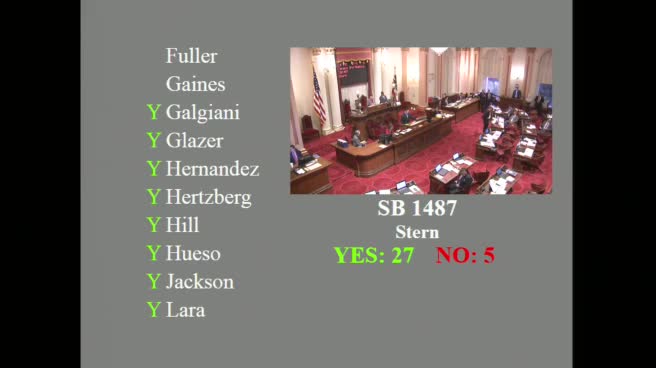 2MIN
Senate Floor
Bill Author


