SB 1224: Statewide longitudinal education and workforce data system.
- Session Year: 2017-2018
- House: Senate
- Latest Version Date: 2018-04-18
Existing law establishes the California Longitudinal Pupil Achievement Data System, commonly known as CALPADS, which is required to be used, among other ways, to provide a better means of evaluating educational progress and investments over time, to provide local educational agencies information that can be used to improve pupil achievement, and to provide an efficient, flexible, and secure means of maintaining longitudinal statewide pupil level data.
This bill would establish a statewide longitudinal education and workforce data system to include data on California students from enrollment in kindergarten to their entry into the workforce. The bill would require the State Department of Education, the Chancellor of the California Community Colleges, and the California State University, and would request the University of California, to set up a data collection system to track student data for these purposes, and would require the Labor and Workforce Development Agency to provide wage record and workforce program data for those students recently entering the workforce. who recently entered the workforce after graduation, completion, or otherwise ending their attendance of school or the public postsecondary education system. The bill would require any research or report developed with the use of the data system to be accessible to the public, and would require the development and maintenance of the data system to comply with applicable state and federal privacy laws.
Existing law establishes the California Longitudinal Pupil Achievement Data System, commonly known as CALPADS, which is required to be used, among other ways, to provide a better means of evaluating educational progress and investments over time, to provide local educational agencies information that can be used to improve pupil achievement, and to provide an efficient, flexible, and secure means of maintaining longitudinal statewide pupil level data.
This bill would express the intent of the Legislature to enact legislation that would create a statewide longitudinal database to track individual pupils from kindergarten and grades 1 to 12, inclusive, through postsecondary educational institutions.This bill would establish a statewide longitudinal education and workforce data system to include data on California students from enrollment in kindergarten to their entry into the workforce. The bill would require the State Department of Education, the Chancellor of the California Community Colleges, and the California State University, and would request the University of California, to set up a data collection system to track student data for these purposes, and would require the Labor and Workforce Development Agency to provide wage record and workforce program data for those students recently entering the workforce. The bill would require any research or report developed with the use of the data system to be accessible to the public, and would require the development and maintenance of the data system to comply with applicable state and federal privacy laws.
Existing law establishes the California Longitudinal Pupil Achievement Data System, commonly known as CALPADS, which is required to be used, among other ways, to provide a better means of evaluating educational progress and investments over time, to provide local educational agencies information that can be used to improve pupil achievement, and to provide an efficient, flexible, and secure means of maintaining longitudinal statewide pupil level data.
This bill would express the intent of the Legislature to enact legislation that would create a statewide longitudinal database to track individual pupils from kindergarten and grades 1 to 12, inclusive, through postsecondary educational institutions.
It is the intent of the Legislature, in order to assist in identifying the most viable pathways for individuals in achieving successful outcomes in education and work, to provide policymakers, education and workforce leaders, researchers, and members of the public with data, research, and reports to help expand reporting on educational outcomes, evaluate the effectiveness of educational and workforce programs, and evaluate the relationship between education and workforce outcomes.
10851.(a)There is hereby established a statewide longitudinal education and workforce data system to inform public policy and decisionmaking. The data system shall include data on California students from enrollment in kindergarten to their entry into the workforce.
(b)(1)The department, the Chancellor of the California Community Colleges, and the California State University shall, and the University of California is requested to, set up a data collection system to ensure student data is tracked from kindergarten and grades 1 to 12, inclusive, through the public postsecondary education educational system and into the workforce.
(2)The Labor and Workforce Development Agency shall provide wage record and workforce program data for purposes of this section for those students recently entering the workforce. who recently entered the workforce after graduation, completion, or otherwise ending their attendance of school or the public postsecondary educational system.
(c)The department, the Chancellor of the California Community Colleges, the California State University, and the Labor and Workforce Development Agency shall, and the University of California is requested to, provide new data every six months annually for purposes of this section.
(d)The department, the Chancellor of the California Community Colleges, the California State University, and the Labor and Workforce Development Agency shall, and the University of California is requested to, collaborate to develop a custom-built algorithm that matches records based on available personally identifiable information, including an individuals full name, date of birth, social security number, and pupil identification number.
(e)Any research or report developed with the use of data from the statewide longitudinal education and workforce data system shall be accessible to the public and disaggregated by demographics, organization, and geography, as applicable.
(f)(1)Personally identifiable information shall not be disclosed or otherwise made accessible to the public in the course of developing or using the statewide longitudinal education and workforce data system established by this section.
(2)The development and maintenance of the statewide longitudinal education and workforce data system pursuant to this section shall comply with the Information Practices Act of 1977 (Chapter 1 (commencing with Section 1798) of Title 1.8 of Part 4 of Division 3 of the Civil Code), the federal Family Educational Rights and Privacy Act of 1974 (20 U.S.C. Sec. 1232g), Section 1232h of Title 20 of the United States Code, and any other applicable state or federal privacy laws.
It is the intent of the Legislature, in order to assist in identifying the most viable pathways for individuals in achieving successful outcomes in education and work, to provide policymakers, education and workforce leaders, researchers, and members of the public with data, research, and reports to help expand reporting on educational outcomes, evaluate the effectiveness of educational and workforce programs, and evaluate the relationship between education and workforce outcomes.
10851.(a)There is hereby established a statewide longitudinal education and workforce data system to inform public policy and decisionmaking. The data system shall include data on California students from enrollment in kindergarten to their entry into the workforce.
(b)(1)The department, the Chancellor of the California Community Colleges, and the California State University shall, and the University of California is requested to, set up a data collection system to ensure student data is tracked from kindergarten and grades 1 to 12, inclusive, through the public postsecondary education system and into the workforce.
(2)The Labor and Workforce Development Agency shall provide wage record and workforce program data for purposes of this section for those students recently entering the workforce.
(c)The department, the Chancellor of the California Community Colleges, the California State University, and the Labor and Workforce Development Agency shall, and the University of California is requested to, provide new data every six months for purposes of this section.
(d)The department, the Chancellor of the California Community Colleges, the California State University, and the Labor and Workforce Development Agency shall, and the University of California is requested to, collaborate to develop a custom-built algorithm that matches records based on available personally identifiable information, including an individuals full name, date of birth, social security number, and pupil identification number.
(e)Any research or report developed with the use of data from the statewide longitudinal education and workforce data system shall be accessible to the public and disaggregated by demographics, organization, and geography, as applicable.
(f)(1)Personally identifiable information shall not be disclosed or otherwise made accessible to the public in the course of developing or using the statewide longitudinal education and workforce data system established by this section.
(2)The development and maintenance of the statewide longitudinal education and workforce data system pursuant to this section shall comply with the Information Practices Act of 1977 (Chapter 1 (commencing with Section 1798) of Title 1.8 of Part 4 of Division 3 of the Civil Code), the federal Family Educational Rights and Privacy Act of 1974 (20 U.S.C. Sec. 1232g), Section 1232h of Title 20 of the United States Code, and any other applicable state or federal privacy laws.
SECTION 1.It is the intent of the Legislature to enact legislation that would create a statewide longitudinal database to track individual pupils from kindergarten and grades 1 to 12, inclusive, through postsecondary educational institutions.It is the intent of the Legislature to enact legislation that would create a statewide longitudinal database to track individual pupils from kindergarten and grades 1 to 12, inclusive, through postsecondary educational institutions.
|
Date
|
Status
|
|---|---|
| May 25, 2018 | May 25 hearing: Held in committee and under submission. |
| May 18, 2018 | Set for hearing May 25. |
| Apr 30, 2018 | April 30 hearing: Placed on APPR. suspense file. |
| Apr 20, 2018 | Set for hearing April 30. |
| Apr 18, 2018 | Read second time and amended. Re-referred to Com. on APPR. |
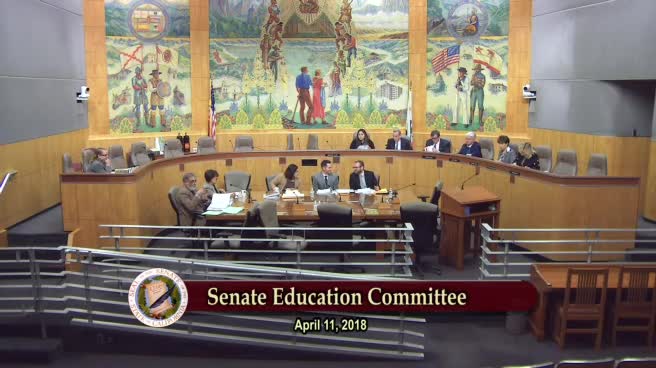
| Apr 17, 2018 | From committee: Do pass as amended and re-refer to Com. on APPR. (Ayes 6. Noes 0.) (April 11). |
| Apr 6, 2018 | Set for hearing April 11. |
| Apr 4, 2018 | Re-referred to Com. on ED. |
| Mar 19, 2018 | From committee with author's amendments. Read second time and amended. Re-referred to Com. on RLS. |
| Mar 1, 2018 | Referred to Com. on RLS. |
| Feb 16, 2018 | From printer. May be acted upon on or after March 18. |
| Feb 15, 2018 | Introduced. Read first time. To Com. on RLS. for assignment. To print. |
|
Date
|
Description
|
Location
|
Votes
|
|
|---|---|---|---|---|
| Apr 30, 2018 | Placed on suspense file | Senate Standing Committee on Appropriations |
Passed |
|
| Apr 11, 2018 | Do pass as amended, but first amend, and re-refer to the Committee on [Appropriations] | Senate Standing Committee on Education |
Passed |
This list shows positions taken on this bill by organizations on the date displayed, which is linked to the original source.
Positions by individuals are not included.
|
Organization
|
Position
|
Date
|
|---|---|---|
| California Community College Chancellor's Office | * Neutral | Apr 11, 2018 |
| Children Now | * Support | Apr 11, 2018 |
| Education Insight Center | * Indeterminate | Apr 11, 2018 |
| Education Trust West | * Support | Apr 11, 2018 |
| Public Policy Institute of California | * Indeterminate | Apr 11, 2018 |
SENATE COMMITTEE ON
Senator Ricardo Lara, Chair
2017 - 2018 Regular Session
SB 1224 (Glazer) - Statewide longitudinal education and workforce data system
Version: | Policy Vote: |
Urgency: | Mandate: |
Hearing Date: | Consultant: |
This bill meets the criteria for referral to the Suspense File.
Bill Summary:
This bill requires the California Department of Education, Chancellor of the California Community Colleges (CCC), and the California State University (CSU), and requests the University of California (UC), to establish a data collection system to ensure student data is tracked from K-12 through public postsecondary education and into the workforce.
Fiscal Impact:
- This bill requires the establishment of a new data tracking system, but raises several notable implementation issues which could have significant cost implications. For example, the bill does not specify the type of data elements that are to be collected nor does it specify which entity would be responsible for housing and managing the data system. Other variables include the amount of data, frequency of data, the method being used to transmit the data among the various entities, and whether existing systems or infrastructure would be utilized. The answers to these questions could lead to significant fluctuations in cost. However, using the cost of more modest data systems that have been developed such as the California Longitudinal Pupil Achievement Data System (CalPADS), the cost to establish and maintain the system proposed by this measure could be in the tens of millions (General Fund), potentially higher.
- The CSU estimates at least one half-time position and between $65,000 to $130,000 in General Fund costs to develop datasets, manage the data and conduct annual updates. This cost could increase significantly depending on the data CSU would be required to collect and whether it is outside of their current scope. There would also be unknown costs pertaining to data governance conversations and the development of a custom-built algorithm.
- UC indicates it would require a nine person team to complete the development of the project over a two-year period estimated at $2.2 million. Ongoing operational costs thereafter would be $398,000 annually. (General Fund)
- The CDE, Chancellor’s Office and the Employment Development Department (EDD) would also incur additional, unknown costs to comply with this measure. EDD anticipates it would be responsible for providing wage record and workforce program data for the new system. (General Fund)
Background:
Existing state law establishes CalPADS to provide a better means of evaluating educational progress and investments over time, and provide local educational agencies (LEAs) information that can be used to improve student achievement, among other things. Existing law requires LEAs to maintain a unique student identification number, as specified.
Existing law stablishes the Education Data and Information Act of 2008 which, among other things, requires the CCCs, CSU, and UC to establish a process by which campuses within those segments issue, maintain, and report information using unique statewide student identifiers. It requires the State Chief Information Officer to convene a working group representing, at a minimum, the State Board of Education, Superintendent of Public Instruction, CCCs, CSU, and UC for the purpose of creating a strategic plan to link education data systems from all segments and to accomplish specified tasks (such as providing a structural design, and protocols and procedures in the collection, storage and sharing of data).
Existing law also authorizes the California Department of Education (CDE), CCCs, CSU, UC, the Commission on Teacher Credentialing, Employment Development Department and California Student Identification System to enter into interagency agreements to facilitate the implementation of a comprehensive longitudinal P-20 statewide data system, transfer of data from one educational segment to another, and transfer of workforce data to the educational segments.
The California Postsecondary Education Commission (CPEC) was established in 1974 to coordinate public, independent, and private postsecondary education in California as well as provide independent policy analyses and recommendations to the Legislature and the Governor on postsecondary education issues. CPEC served as the State's planning and coordinating body for higher education. Its predecessor, the Coordinating Council for Higher Education, was established as part of the 1960 Master Plan for Higher Education. CPEC’s primary responsibilities included ensuring quality of education and cooperation among the segments of public postsecondary education system and eliminating duplication and waste of resources. Additional duties included the creation and maintenance of collection databases capable of documenting performance of postsecondary education institutions, administration of federally funded education programs, acting as the state's clearinghouse on postsecondary education information and as the primary advisor on postsecondary education issues to the Legislature, Governor, and other governmental offices and institutions. CPEC was dissolved in November 2011, following the line item veto of its funding by Governor Brown.
The records that were held by CPEC (1961-2011) are currently being held by the Corporation for Education Network Initiatives in California (CENIC). The data held by CENIC is static (no new data is being added) and there is no authority for CENIC to do anything with the data other than maintain it. Since the closure of CPEC, there is no statewide entity that serves as the State's planning and coordinating body for higher education or that houses postsecondary education data.
Proposed Law:
This bill requires the CDE, Chancellor’s Office, and the CSU, and requests the UC, to establish a data collection system to ensure student data is tracked from K-12 through public postsecondary education and into the workforce.
This bill:
- Establishes a statewide longitudinal education and workforce data system to inform public policy and decision making.
- Requires the data system to include data on California students from enrollment in kindergarten to their entry into the workforce.
- Requires the Labor and Workforce Development Agency to provide wage record and workforce program data for students who recently entered the workforce after graduation, completion, or otherwise ending their attendance of school or the public postsecondary educational system.
- Requires the CDE, Chancellor’s Office, CSU and the Labor and Workforce Development Agency, and requests the UC, to provide new data annually.
- Requires the CDE, Chancellor’s Office, CSU, and the Labor and Workforce Development Agency, and requests the UC, to collaborate to develop a custom-built algorithm that matches records based on available personally identifiable information, including an individual’s full name, date of birth, social security number, and student identification number.
- Requires that any research or report developed with the use of data from the statewide longitudinal education and workforce data system to be accessible to the public, and disaggregated by demographics, organization, and geography, as applicable.
- Prohibits personally identifiable information from being disclosed or otherwise made accessible to the public in the course of developing or using the statewide longitudinal education and workforce data system.
- Requires the development and maintenance of the statewide longitudinal education and workforce data system to comply with the Information Practices Act and the federal Family Educational Rights and Privacy Act.
Related Legislation:
SB 885 (Simitian, 2011) would have authorized the CDE, UC, CSU, Chancellor’s Office, the Commission on Teacher Credentialing, the State Board of Education, the Employment Development Department and the California School Information Services to enter into a joint powers agreement to facilitate the implementation of a comprehensive longitudinal P-20 statewide data system, as well as the transfer of educational and workforce data. SB 885 was vetoed by the Governor, whose veto message read:
This bill is unnecessary because the majority of the entities impacted by this measure have already established an interagency agreement.
Should these entities choose to form a joint powers agreement in the future, they do not need additional statutory authority to do so. Whether they should or not given the current fiscal constraints -- I have my doubts.
AB 1837 (Low, 2016) would have established the Office of Higher Education Performance and Accountability as the statewide postsecondary coordination and planning entity; outlined its responsibilities, functions and authorities; and established an advisory board to the office. AB 1837 was held in the Senate Appropriations Committee.
SB 42 (Liu, 2016) was nearly identical to AB 1837. SB 42 was vetoed by the Governor, whose veto message read:
The call to improve postsecondary educational outcomes is laudable. The goals established by SB 195 in 2013 - improving access and success, aligning degrees and credentials with the state's economic, workforce and civic needs, and ensuring the effective and efficient use of resources - are still important measures that should guide us in developing higher education policies for the state.
While there is much work to be done to improve higher education, I am not convinced we need a new office and an advisory board, especially of the kind this bill proposes, to get the job done.
Staff Comments:
This bill raises several questions which left unanswered, have significant cost implications. While the bill requires the establishment of a data collection system, it does not specify the type of data elements that are to be collected and reported nor does it specify which entity would be responsible for housing and managing the data system. Presumably, this would be left up to the designers of the data system. As previously mentioned, there is no state-level coordinating body for higher education, one that oversees cross-system issues, or that is authorized to utilize cross-system data. Other variables include the amount of data, frequency of data, the method being used to transmit the data among the various entities, and whether existing systems or infrastructure would be utilized. Further, the bill does not specify whether an entity would be responsible for analyzing the quality of the data and ensuring that “clean” data is used for the new data system.
The answers to these questions and how they are addressed could lead to significant cost fluctuations. Based on the costs of more modest data systems that have been developed such as CalPADS and the California Longitudinal Teacher Integrated Data Education System, the cost to establish and maintain the system proposed by this measure could be in the tens of millions, potentially higher. To the extent that the establishment of a state-level coordinating body is required, the cost to create an entity similar to the CPEC would be about $2 million General Fund.
-- END --
SENATE COMMITTEE ON EDUCATION
Senator Benjamin Allen, Chair
2017 - 2018 Regular
Bill No: Hearing Date: April 11, 2018
Author: | Glazer | ||
Version: |
| ||
Urgency: | Fiscal: | ||
Consultant: | |||
Subject:
SUMMARY
This bill requires the California Department of Education, Chancellor of the California Community Colleges (CCC), and the California State University (CSU), and request the University of California (UC), to establish a data collection system to ensure student data is tracked from K-12 through public postsecondary education and into the workforce.
BACKGROUND
Existing federal law, the Family Educational Rights and Privacy Act (FERPA):
- Requires, generally, schools to have written permission from the parent or eligible student in order to release any information from a student’s education record. However, FERPA allows schools to disclose those records, without consent, to specified parties or under specified conditions.
- Authorizes schools to disclose, without consent, “directory” information such as a student’s name, address, telephone number, and date and place of birth. Existing law requires schools to notify parents and eligible students about directory information and allow them a reasonable amount of time to request that the school not disclose such information. Existing law requires schools to also notify parents and eligible students annually of their rights under FERPA. (United States Code, Title 20, § 1232(g), and Code of Federal Regulations, Title 34, Part 99)
Existing state law:
- Establishes the California Longitudinal Pupil Achievement Data System (CalPADS) to provide a better means of evaluating educational progress and investments over time, and provide local educational agencies (LEAs) information that can be used to improve student achievement, among other things. Existing law requires LEAs to maintain a unique student identification number, as specified. (Education Code § 60900)
- Establishes the Education Data and Information Act of 2008 which, among other things:
- Requires the California Community Colleges (CCC), California State University (CSU), and University of California (UC) to establish a process by which campuses within those segments issue, maintain, and report information using unique statewide student identifiers.
- Requires the State Chief Information Officer to convene a working group representing, at a minimum, the State Board of Education, Superintendent of Public Instruction, CCC, CSU, and UC for the purpose of creating a strategic plan to link education data systems from all segments and to accomplish specified tasks (such as providing a structural design, and protocols and procedures in the collection, storage and sharing of data).
- Authorizes the California Department of Education (CDE), CCC, CSU, UC, the Commission on Teacher Credentialing, Employment Development Department and California Student Identification System to enter into interagency agreements to facilitate the implementation of a comprehensive longitudinal P-20 statewide data system, transfer of data from one educational segment to another, and transfer of workforce data to the educational segments. (Education Code § 10800-10807).
- Requires the California Community Colleges (CCC), California State University (CSU), and University of California (UC) to establish a process by which campuses within those segments issue, maintain, and report information using unique statewide student identifiers.
ANALYSIS
This bill:
- This bill requires the CDE, Chancellor of the CCCs, and the CSU, and request the UC, to establish a data collection system to ensure student data is tracked from K-12 through public postsecondary education and into the workforce.
- Establishes a statewide longitudinal education and workforce data system to inform public policy and decision making.
- Requires the data system to include data on California students from enrollment in kindergarten to their entry into the workforce.
- Requires the Labor and Workforce Development Agency to provide wage record and workforce program data for students who recently entered the workforce.
- Requires the CDE, Chancellor of the CCCs, CSU and the Labor and Workforce Development Agency, and requests the UC, to provide new data every six months.
- Requires the CDE, Chancellor of the CCCs, CSU, and the Labor and Workforce Development Agency, and requests the UC, to collaborate to develop a custom-built algorithm that matches records based on available personally identifiable information, including an individual’s full name, date of birth, social security number, and student identification number.
- Requires that any research or report developed with the use of data from the statewide longitudinal education and workforce data system to be accessible to the public, and disaggregated by demographics, organization, and geography, as applicable.
- Prohibits personally identifiable information from being disclosed or otherwise made accessible to the public in the course of developing or using the statewide longitudinal education and workforce data system.
- Requires the development and maintenance of the statewide longitudinal education and workforce data system to comply with the Information Practices Act and the federal Family Educational Rights and Privacy Act.
STAFF COMMENTS
- Need for the bill. According to the author, “California collects a massive amount of data about students in its public K-12 and higher education systems – data that could meet the information needs of state policymakers and educators. According to a report by Education Insights Center, the data are collected and maintained in systems that are not connected, were designed for different purposes, are subject to different regulations, and often use different data definitions. As a result of these disconnects, important information about student progress is often impossible to access, share, and use. A significant weakness is that California’s current approach leaves the state and its institutions unable to answer important questions about student progress and outcomes”
- California Postsecondary Education Commission (CPEC). CPEC was established in 1974 to coordinate public, independent, and private postsecondary education in California as well as provide independent policy analyses and recommendations to the Legislature and the Governor on postsecondary education issues. CPEC served as the State's planning and coordinating body for higher education. Its predecessor, the Coordinating Council for Higher Education, was established as part of the 1960 Master Plan for Higher Education. CPEC’s primary responsibilities included ensuring quality of education and cooperation among the segments of public postsecondary education system and eliminating duplication and waste of resources. Additional duties included the creation and maintenance of collection databases capable of documenting performance of postsecondary education institutions, administration of federally funded education programs, acting as the state's clearinghouse on postsecondary education information and as the primary advisor on postsecondary education issues to the Legislature, Governor, and other governmental offices and institutions. CPEC was dissolved in November 2011, following the line item veto of its funding by Governor Brown.
The records that were held by CPEC (1961-2011) are currently being held by the Corporation for Education Network Initiatives in California (CENIC). The data held by CENIC is static (no new data is being added) and there is no authority for CENIC to do anything with the data other than maintain it. Since the closure of CPEC, there is no statewide entity that serves as the State's planning and coordinating body for higher education or that houses postsecondary education data. There have been numerous unsuccessful attempts to reestablish such a body (see Comment #8). - Sharing of data across segments and systems. Existing law requires the California Community Colleges (CCC), California State University (CSU) and the University of California (UC) to issue a unique statewide student identifier to each student, and authorizes these segments, along with the California Department of Education (CDE), the Commission on Teacher Credentialing and the Employment Development Department, to enter into interagency agreements to facilitate the implementation of a comprehensive longitudinal P-20 statewide data system, transfer of data from one educational segment to another, and transfer of workforce data to the educational segments. While unique student identifiers have been assigned by public K-12 schools and are being assigned by the public postsecondary segments, and are being utilized to some degree, they are not yet being utilized to broadly share data across segments or systems.
Existing law requires the CCC, CSU and UC to annually provide a progress report with a detailed timeline for the implementation, maintenance, and use of the unique statewide student identifiers. According to the 2016 progress report from the CSU, “No progress was made in 2015-16. The CSU remains committed and interested in achieving a common identifier (SSID). CSU student data systems are ready to incorporate the SSID. In the absence of a common Identifier (or a reliable SSN available in the datasets of other segment partners) the CSU has relied on the use of a combination of student specific variables common across the segments to uniquely identify and match records.” According to the 2016 progress report from the UC, “The SSID has already been incorporated into UC student data systems and acquisition can now be tracked over time. Usefulness of the SSID is limited until the data are more accurately reported by K-12 schools and more readily available in electronic form. UC is participating in efforts to facilitate the sharing of student data between the three public segments of higher education and K-12 institutions. Attaining this goal continues to be dependent on getting SSID included on all student high school transcripts, and provision of a comprehensive dataset of valid SSID’s matched with student name and high school from CDE (so data received can be validated).”
The CDE, CCC, CSU and UC have been authorized to enter into interagency agreements to facilitate the implementation of a comprehensive longitudinal P-20 statewide data system since 2010, but haven’t yet achieved the goal of creating and utilizing a shared statewide student data system. Rather than authorizing an interagency agreement, this bill requires these entities to establish a data collection system. Has enough work been completed relative to the unique student identifiers to allow for the implementation of this bill? Could this bill resolve the issues that have prevented a statewide longitudinal data system from being established? - What type of data? This bill requires the establishment of a data collection system to ensure student data is tracked from K-12 through public postsecondary education and into the workforce, but does not specify what type of data is to be collected and reported. However, this bill appears to imply that, at least in regard to K-12 data, the data is already being collected and reported to the CDE. The author wishes to leave decisions relative to the specific data elements up to the designers of the data system.
This bill requires segments and systems to collaborate to develop a custom-built algorithm that matches records based on available personally identifiable information, including an individual’s full name, date of birth, social security number, and student identification number. This bill does not require the collection or sharing of social security numbers. Existing law prohibits K-12 schools from collecting or soliciting social security numbers or the last four digits of social security numbers from students or their parents. - Where will the data be housed? This bill does not specify which entity will house the data system. There is no state-level coordinating body for higher education, one that oversees cross-system issues, or that is authorized to utilize cross-system data. Is it appropriate for one segment or system to maintain and manage student data that “belongs” to another segment or system? Should the bill require the data to be maintained and managed by an unspecified public agency that has clear rules about how to use and access the data (in addition to being able to follow existing state and federal privacy laws)? Is the California Department of Technology an appropriate entity to house this data system?
- Frequency of submitting data. This bill requires the California Department of Education (CDE), Chancellor of the California Community Colleges (CCCs), California State University (CSU) and the Labor and Workforce Development Agency, and requests the University of California (UC), to provide new data every six months. Staff recommends an amendment to instead require new data to be submitted annually, thereby capturing students who graduate, complete their educational program, or otherwise cease attending school or college.
- Technical amendments. This bill requires the Labor and Workforce Development Agency to provide wage record and workforce program data for students recently entering the workforce. Staff recommends an amendment to clarify that the data is for students who recently entered the workforce upon graduation, completion, or once the student no longer attends school or college.
- Prior legislation. SB 885 (Simitian, 2011) would have authorized the CDE, UC, CSU, Chancellor of the CCCs, the Commission on Teacher Credentialing, the State Board of Education, the Employment Development Department and the California School Information Services to enter into a joint powers agreement to facilitate the implementation of a comprehensive longitudinal P-20 statewide data system, as well as the transfer of educational and workforce data. SB 885 was vetoed by the Governor, whose veto message read:
This bill is unnecessary because the majority of the entities impacted by this measure have already established an interagency agreement.
Should these entities choose to form a joint powers agreement in the future, they do not need additional statutory authority to do so. Whether they should or not given the current fiscal constraints -- I have my doubts.
AB 1837 (Low, 2016) would have established the Office of Higher Education Performance and Accountability as the statewide postsecondary coordination and planning entity; outlined its responsibilities, functions and authorities; and established an advisory board to the office. AB 1837 was held in the Senate Appropriations Committee.
SB 42 (Liu, 2016) was nearly identical to AB 1837. SB 42 was vetoed by the Governor, whose veto message read:
The call to improve postsecondary educational outcomes is laudable. The goals established by SB 195 in 2013 - improving access and success, aligning degrees and credentials with the state's economic, workforce and civic needs, and ensuring the effective and efficient use of resources - are still important measures that should guide us in developing higher education policies for the state.
While there is much work to be done to improve higher education, I am not convinced we need a new office and an advisory board, especially of the kind this bill proposes, to get the job done.
AB 1348 (John Pérez, 2014) would have established the California Higher Education Authority, its governing board and its responsibilities, including acting as a clearinghouse for postsecondary education information and maintaining a comprehensive database. AB 1348 was held in the Senate Appropriations Committee.
AB 2190 (John Pérez, 2012) would have established a state oversight and coordinating body for higher education. AB 2190 was held in the Assembly Appropriations Committee.
SB 1138 (Liu, 2011) would have established a central data management system for higher education. SB 1138 was held in the Senate Appropriations Committee.
SUPPORT
Children Now
OPPOSITION
None received
-- END --



Bill Co-Author(s):