SB 1251: California Training Benefits Program.
- Session Year: 2017-2018
- House: Senate
- Latest Version Date: 2018-09-14
Existing law, until January 1, 2019, establishes the California Training Benefits Program, which authorizes an unemployed individual who files a claim for unemployment compensation benefits or extended duration benefits to apply to the Employment Development Department for a determination of potential eligibility for benefits during a period of training or retraining. Existing law prohibits the payment of benefits under the program during a period of training or retraining for any week or part of any week that an individual receives training or retraining benefits, allowances, or stipends, as defined, from sources other than the program, as specified. Existing law provides for the payment of unemployment benefits from the Unemployment Fund, which is continuously appropriated for this purpose.
This bill would delete the repeal of the California Training Benefits Program, thereby providing for its operation in perpetuity. The bill would also delete the prohibition on the payment of benefits when an individual receives training or retraining benefits, allowances, or stipends from other sources, as described above. By establishing the program in perpetuity, and by broadening the number of individuals potentially eligible for benefit payments during training and retraining, the bill would result in the payment of additional amounts from the Unemployment Fund, thereby making an appropriation.
Existing law, the Planning and Zoning Law, requires a city or county to adopt a comprehensive, long-term general plan for the physical development of the city or the county and of any land outside its boundaries that bears relation to its planning. Existing law requires the planning agency of a city or county, before the adoption of any substantial amendment of a general plan, to review and consider, among other things, an adoption of, or update to, a groundwater sustainability plan or groundwater management plan or groundwater management court order, judgment, or decree. Existing law authorizes a groundwater sustainability agency to submit an alternative to a groundwater sustainability plan to the Department of Water Resources for approval, as specified.This bill would additionally require the planning agency to consider an alternative approved by the Department of Water Resources, as specified.Existing law, the Planning and Zoning Law, requires a city or county to adopt a comprehensive, long-term general plan for the physical development of the city or the county and of any land outside its boundaries that bears relation to its planning. Existing law requires the planning agency of a city or county, before the adoption of any substantial amendment of a general plan, to review and consider, among other things, an adoption of, or update to, a groundwater sustainability plan or groundwater management plan or groundwater management court order, judgment, or decree. Existing law authorizes a groundwater sustainability agency to submit an alternative to a groundwater sustainability plan to the Department of Water Resources for approval, as specified.
This bill would additionally require the planning agency to consider an alternative approved by the Department of Water Resources, as specified.
Existing law requires the Office of Planning and Research to notify a city or county if a general plan, which includes various elements, including a housing element, has not been revised within 8 years and to notify the Attorney General if a general plan of a city or county is not revised within 10 years.This bill would delete these requirements and require the office to notify a city or county and the Attorney General when the housing element of that city or county has not been revised in accordance with a specified housing element revision schedule established in existing law.Existing law requires the Office of Planning and Research to notify a city or county if a general plan, which includes various elements, including a housing element, has not been revised within 8 years and to notify the Attorney General if a general plan of a city or county is not revised within 10 years.
This bill would delete these requirements and require the office to notify a city or county and the Attorney General when the housing element of that city or county has not been revised in accordance with a specified housing element revision schedule established in existing law.
Before the adoption or any substantial amendment of a citys or countys general plan, the planning agency shall review and consider all of the following:
(a)An adoption of, or update to, a groundwater sustainability plan or groundwater management plan pursuant to Part 2.74 (commencing with Section 10720) or Part 2.75 (commencing with Section 10750) of Division 6 of the Water Code or groundwater management court order, judgment, or decree.
(b)An adjudication of water rights.
(c)An order or interim plan by the State Water Resources Control Board pursuant to Chapter 11 (commencing with Section 10735) of Part 2.74 of Division 6 of the Water Code.
(d)An alternative approved by the Department of Water Resources pursuant to Section 10733.6 of the Water Code.
SECTION 1.Section 65040.5 of the Government Code is amended to read:65040.5.The office shall notify a city or county and the Attorney General when the housing element of that city or county has not been revised in accordance with the schedule described in subdivision (e) of Section 65588.(a)The office shall notify a city or county with a general plan that has not been revised within eight years.
(b)The office shall notify and the Attorney General if a general plan of a city or county has not been revised within ten years. when the housing element of that city or county has not been revised in accordance with the schedule described in subdivision (e) of Section 65588.
|
Date
|
Status
|
|---|---|
| Sep 14, 2018 | Chaptered by Secretary of State. Chapter 418, Statutes of 2018. |
| Sep 14, 2018 | Approved by the Governor. |
| Sep 6, 2018 | Enrolled and presented to the Governor at 4 p.m. |
| Aug 28, 2018 | Assembly amendments concurred in. (Ayes 32. Noes 5.) Ordered to engrossing and enrolling. |
| Aug 27, 2018 | From committee: That the Assembly amendments be concurred in. (Ayes 4. Noes 0.) |
| Aug 24, 2018 | From committee: Be re-referred to Com. on L. & I.R. pursuant to Senate Rule 29.10(d). (Ayes 5. Noes 0.) Re-referred to Com. on L. & I.R. |
| Aug 24, 2018 | Re-referred to Com. on RLS. pursuant to Senate Rule 29.10(d). |
| Aug 23, 2018 | In Senate. Concurrence in Assembly amendments pending. |
| Aug 23, 2018 | Read third time. Passed. Ordered to the Senate. |
| Aug 16, 2018 | Read second time. Ordered to third reading. |
| Aug 15, 2018 | From committee: Do pass. (Ayes 12. Noes 5.) (August 15). |
| Jun 20, 2018 | From committee: Do pass and re-refer to Com. on APPR. (Ayes 10. Noes 1.) (June 20). Re-referred to Com. on APPR. |
| Jun 14, 2018 | From committee: Be re-referred to Com. on INS. (Ayes 7. Noes 0.) (June 14). Re-referred to Com. on INS. |
| Jun 4, 2018 | Re-referred to Com. on RLS. pursuant to Assembly Rule 96. |
| May 31, 2018 | From committee with author's amendments. Read second time and amended. Re-referred to Com. on L. GOV. |
| May 25, 2018 | Referred to Com. on L. GOV. |
| May 17, 2018 | In Assembly. Read first time. Held at Desk. |
| May 17, 2018 | Read third time. Passed. (Ayes 37. Noes 0.) Ordered to the Assembly. |
| May 10, 2018 | Read second time. Ordered to consent calendar. |
| May 9, 2018 | From committee: Do pass. Ordered to consent calendar. (Ayes 6. Noes 0.) (May 9). |
| May 3, 2018 | From committee with author's amendments. Read second time and amended. Re-referred to Com. on GOV. & F. |
| May 2, 2018 | Set for hearing May 9. |
| Mar 1, 2018 | Referred to Com. on GOV. & F. |
| Feb 16, 2018 | From printer. May be acted upon on or after March 18. |
| Feb 15, 2018 | Introduced. Read first time. To Com. on RLS. for assignment. To print. |
|
Date
|
Description
|
Location
|
Votes
|
|
|---|---|---|---|---|
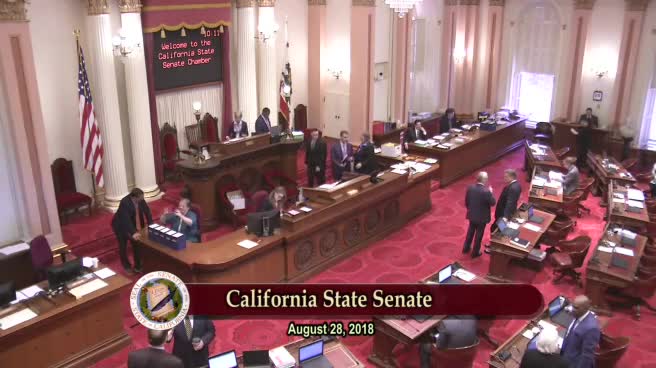
| Aug 28, 2018 | Unfinished Business SB1251 McGuire Concurrence | Senate Floor |
Passed |
|
| Aug 27, 2018 | That the Assembly amendments be concurred in | Senate Standing Committee on Labor and Industrial Relations |
Passed |
|
| Aug 23, 2018 | SB 1251 McGuire Senate Third Reading By DALY | Assembly Floor |
Passed |
|
| Aug 15, 2018 | Do pass. | Assembly Standing Committee on Appropriations |
Passed |
|
| Jun 20, 2018 | Do pass and be re-referred to the Committee on [Appropriations] | Assembly Standing Committee on Insurance |
Passed |
|
| Jun 14, 2018 | Be re-referred to the Committee on [Insurance] | Assembly Standing Committee on Rules |
Passed |
|
| May 17, 2018 | Consent Calendar SB1251 | Senate Floor |
Passed |
|
| May 9, 2018 | Do pass and be ordered to the Consent Calendar | Senate Standing Committee on Governance and Finance |
Passed |
This list shows positions taken on this bill by organizations on the date displayed, which is linked to the original source.
Positions by individuals are not included.
|
Organization
|
Position
|
Date
|
|---|---|---|
| Department Of Finance | ** Support | Aug 27, 2018 |
| Employment Development Department | ** Support | Aug 27, 2018 |
| Unknown. | ** Against | May 4, 2018 |
| Unknown. | ** Support | May 4, 2018 |
SENATE COMMITTEE ON LABOR AND INDUSTRIAL RELATIONS
Senator Ricardo Lara, Chair
2017 - 2018 Regular
Bill No: SB 1251 Hearing Date: August 27, 2018
Author: | McGuire | ||
Version: | May 31, 2018 | ||
Urgency: | No | Fiscal: | Yes |
Consultant: | Jake Ferrera | ||
Subject: California Training Benefits Program.
KEY ISSUE
Should the Legislature allow workers to receive unemployment insurance benefits while they are in an eligible training or retraining program by making the California Training Benefits Program permanent?
Should the Legislature authorize individuals receiving discretionary use payments as part of their training or retraining to be eligible for unemployment insurance benefits under the California Training Benefits Program?
ANALYSIS
Existing Federal Law:
- Establishes within the Treasury of the United States the Unemployment Trust Fund. The Secretary of the Treasury is authorized and directed to receive and hold in the Fund all moneys deposited by a State agency from a State unemployment fund or otherwise deposited in or credited to the Fund. (42 U.S. Code §1104)
- Prohibits a State from denying Unemployment Compensation to an individual for failure to be available for work during a week if the individual is in training with the approval of a State agency. (20 U.S. Code §604.5)
Existing law:
- Defines “Unemployed” to mean an individual who, in any week, meets any of the following conditions:
- Any week during which he or she performs no services and with respect to which no wages are payable to him or her.
- Any week of less than full-time work, if the wages payable to him or her with respect to the week, when reduced by twenty-five dollars ($25) or 25 percent of the wages payable, whichever is greater, do not equal or exceed his or her weekly benefit amount.
- Any week during which he or she performs full-time work for five days as a juror, or as a witness under subpoena.
- If an individual becomes unable to work due to a physical or mental illness or injury for one or more days during such week, they shall be paid unemployment compensation benefits at the rate of one-seventh the weekly benefit amount payable for that week for each day which they are available for work and able to work.
(Unemployment Insurance Code §1252, 1253.5)
- Provides eligible workers with unemployment compensation benefits from the Unemployment Fund. (Unemployment Insurance Code §1251)
- Establishes the California Training Benefits Program (CTB), which allows an individual in an eligible training or retraining program or an applicant to any such week in training or retraining of any law of this state relating to availability for work, active search for work, refusal to accept work, or for leaving his or her most recent work, if continuing the most recent work would require the individual to terminate his or her training or retraining course of instruction. (Unemployment Insurance Code §1266, 1267)
- Establishes automatic eligibility for benefits under this article to an unemployed individual if the director finds that any of the following apply:
- The training is authorized by the federal Workforce Innovation and Opportunity Act (Public Law 113-128) or by the Employment Training Panel, as specified.
- The training is authorized by the federal Trade Act of 1974 (19 U.S.C. Sec. 2101 et seq.), as amended, pursuant to a certified petition.
- The individual is a participant in the California Work Opportunity and Responsibility to Kids (CalWORKs) program and has entered into a contract with the county welfare department to participate in an education or training program.
- The individual is a participant in training with a provider that is certified and on the state’s Eligible Training Provider List (ETPL), as authorized by the federal Workforce Innovation and Opportunity Act (Public Law 113-128), or the individual is a permanent or probationary public school teacher who is a participant in a credential preparation program or training program approved or accredited by the Commission on Teacher Credentialing for additional certification in math, science, or special education, for kindergarten and grades 1 to 12, inclusive, and was laid off.
- The individual is a journey level member of a union or trade association, or is a participant in training sponsored by an employer, and the training or retraining course of instruction is industry-related training necessary due to changes in technology, or industry demands, or is necessary to retain employment or to become more competitive in obtaining employment, or the individual is a participant in a state or federally approved apprenticeship program. (Unemployment Insurance Code §1269)
- Prohibits the payment of benefits during a period of training or retraining to any individual that receives discretionary use, cash in-hand payments available to the individual to be used as they see fit. Direct and indirect compensation for training costs, such as tuition, books, and supplies, is excluded as a condition of approval. (Unemployment Insurance Code §1273)
- Establishes a sunset date of January 1, 2019 for the CTB.
(Unemployment Insurance Code §1274.1)
This Bill:
- Removes the sunset date of January 1st, 2019, making the California Training Benefits program permanent.
- Removes a stipulation from existing law that prevents individuals who receive discretionary-use payments outside of the cost of training or retraining from eligibility under the California Training Benefits Program.
COMMENTS
1. Need for this bill?
According to the Employment Development Department:
“This critical program supports Unemployment Insurance (UI) claimants becoming more competitive in the California labor market by allowing them to receive UI benefits while attending a state-approved training or retraining program. Well-trained workers enjoy stable employment and are less reliant on UI benefits.
This bill would also ensure that the state remains in compliance with federal law, which requires that every state’s UI law to have such provisions for workers in training. Lack of compliance with these federal requirements could result in a loss of $5 billion in tax credits for California’s employers and California’s administrative grant funding. The bill would also make a minor amendment to remove reference to a rare type of payment that is often erroneously reported.”
2. Proponent Arguments:
According to the author:
“If the CTB program were to sunset at the end of this year, California would fall out of compliance with Federal law and risk losing more than $350 million in annual federal Unemployment Insurance administrative grants and federal employer tax credits. This would equate to an increase of approximately $5.1 billion in federal UI contributions paid by California’s employers. This loss in funding would prevent eligible California workers from continuing to receive UI benefits as financial support during their attendance in an EDD-approved training or retraining, in order to remain competitive in the California labor market
In addition to the program expiring, current law prohibits participants from receiving CTB funds if they receive discretionary income from other sources. Claimants and training providers often confusingly and incorrectly report Pell Grants, GI Bill funds, or a variety of other payments that are not considered discretionary. Subsequently, preventing otherwise eligible participants form receiving funds from the program.”
3. Opponent Arguments:
None received
4. Prior Legislation:
SB 1291 (Evans) Chaptered by Secretary of State. Chapter 278, Statutes of 2012: Permits teachers participating in credential preparation programs in math, science, and special education to automatically qualify for the California Training Benefits Program (CTB) and extended the sunset date for the CTB until January 1, 2019.
SUPPORT
Employment Development Department
Department of Finance
OPPOSITION
None Received
-- END --
Office of Senate Floor Analyses (916) 651-1520 Fax: (916) 327-4478 | SB |
UNFINISHED BUSINESS
Bill No: SB 1251
:
PRIOR VOTES NOT RELEVANT
SENATE LABOR & IND. REL. COMMITTEE: 4-0, 8/27/18 (Pursuant to Senate Rule 29.10)
AYES: Lara, Stone, Jackson, Wieckowski
NO VOTE RECORDED: Mitchell
ASSEMBLY FLOOR: 63-15, 8/23/18 - See last page for vote
DIGEST:
This bill allows workers to receive unemployment insurance benefits while they are in an eligible training or retraining program by making the California Training Benefits Program (CTB) permanent and authorizes individuals receiving discretionary use payments as part of their training or retraining to be eligible for unemployment insurance benefits under the CTB.
Assembly Amendments
remove the original contents of the bill and insert the removal of the sunset date of the California Training Benefits Program and the repeal of the prohibition of workers who receive discretionary-use payments from participation in the CTB.
Existing federal law:
- Establishes within the Treasury of the United States the Unemployment Trust Fund. The Secretary of the Treasury is authorized and directed to receive and hold in the Fund all moneys deposited by a State agency from a State unemployment fund or otherwise deposited in or credited to the Fund. (42 U.S. Code §1104)
- Prohibits a State from denying Unemployment Compensation to an individual for failure to be available for work during a week if the individual is in training with the approval of a State agency. (20 U.S. Code §604.5)
Existing state law:
- Defines “Unemployed” to mean an individual who, in any week, meets any of the following conditions:
- Any week during which he or she performs no services and with respect to which no wages are payable to him or her.
- Any week of less than full-time work, if the wages payable to him or her with respect to the week, when reduced by twenty-five dollars ($25) or 25 percent of the wages payable, whichever is greater, do not equal or exceed his or her weekly benefit amount.
- Any week during which he or she performs full-time work for five days as a juror, or as a witness under subpoena.
- If an individual becomes unable to work due to a physical or mental illness or injury for one or more days during such week, they shall be paid unemployment compensation benefits at the rate of one-seventh the weekly benefit amount payable for that week for each day which they are available for work and able to work. (Unemployment Insurance Code §1252, 1253.5)
- Provides eligible workers with unemployment compensation benefits from the Unemployment Fund. (Unemployment Insurance Code §1251)
- Establishes the California Training Benefits Program (CTB), which allows an individual in an eligible training or retraining program or an applicant to any such week in training or retraining of any law of this state relating to availability for work, active search for work, refusal to accept work, or for leaving his or her most recent work, if continuing the most recent work would require the individual to terminate his or her training or retraining course of instruction. (Unemployment Insurance Code §1266, 1267)
- Establishes automatic eligibility for benefits under this article to an unemployed individual if the director finds that any of the following apply:
- The training is authorized by the federal Workforce Innovation and Opportunity Act (Public Law 113-128) or by the Employment Training Panel, as specified.
- The training is authorized by the federal Trade Act of 1974 (19 U.S.C. Sec. 2101 et seq.), as amended, pursuant to a certified petition.
- The individual is a participant in the California Work Opportunity and Responsibility to Kids (CalWORKs) program and has entered into a contract with the county welfare department to participate in an education or training program.
- The individual is a participant in training with a provider that is certified and on the state’s Eligible Training Provider List (ETPL), as authorized by the federal Workforce Innovation and Opportunity Act (Public Law 113-128), or the individual is a permanent or probationary public school teacher who is a participant in a credential preparation program or training program approved or accredited by the Commission on Teacher Credentialing for additional certification in math, science, or special education, for kindergarten and grades 1 to 12, inclusive, and was laid off.
- The individual is a journey level member of a union or trade association, or is a participant in training sponsored by an employer, and the training or retraining course of instruction is industry-related training necessary due to changes in technology, or industry demands, or is necessary to retain employment or to become more competitive in obtaining employment, or the individual is a participant in a state or federally approved apprenticeship program. (Unemployment Insurance Code §1269)
- Prohibits the payment of benefits during a period of training or retraining to any individual that receives discretionary use, cash in-hand payments available to the individual to be used as they see fit. Direct and indirect compensation for training costs, such as tuition, books, and supplies, is excluded as a condition of approval. (Unemployment Insurance Code §1273)
- Establishes a sunset date of January 1, 2019 for the CTB. (Unemployment Insurance Code §1274.1)
This bill:
- Removes the sunset date of January 1st, 2019, making the California Training Benefits program permanent.
- Removes a stipulation from existing law that prevents individuals who receive discretionary-use payments outside of the cost of training or retraining from eligibility under the California Training Benefits Program.
Comments
Need for this bill?
According to the Employment Development Department:
This critical program supports Unemployment Insurance (UI) claimants becoming more competitive in the California labor market by allowing them to receive UI benefits while attending a state-approved training or retraining program. Well-trained workers enjoy stable employment and are less reliant on UI benefits.
This bill would also ensure that the state remains in compliance with federal law, which requires that every state’s UI law to have such provisions for workers in training. Lack of compliance with these federal requirements could result in a loss of $5 billion in tax credits for California’s employers and California’s administrative grant funding. The bill would also make a minor amendment to remove reference to a rare type of payment that is often erroneously reported.
FISCAL EFFECT: Appropriation: Fiscal Com.: Local:
According to the Assembly Appropriations committee, the fiscal impact of this bill would be “Negligible.”
Employment Development Department
Department of Finance
None received
ARGUMENTS IN SUPPORT: According to the author:
“If the CTB program were to sunset at the end of this year, California would fall out of compliance with Federal law and risk losing more than $350 million in annual federal Unemployment Insurance administrative grants and federal employer tax credits. This would equate to an increase of approximately $5.1 billion in federal UI contributions paid by California’s employers. This loss in funding would prevent eligible California workers from continuing to receive UI benefits as financial support during their attendance in an EDD-approved training or retraining, in order to remain competitive in the California labor market
In addition to the program expiring, current law prohibits participants from receiving CTB funds if they receive discretionary income from other sources. Claimants and training providers often confusingly and incorrectly report Pell Grants, GI Bill funds, or a variety of other payments that are not considered discretionary. Subsequently, preventing otherwise eligible participants form receiving funds from the program.”
ASSEMBLY FLOOR: 63-15, 8/23/18
AYES: Acosta, Aguiar-Curry, Arambula, Baker, Berman, Bloom, Bonta, Burke, Caballero, Calderon, Carrillo, Cervantes, Chau, Chávez, Chiu, Chu, Cooley, Cooper, Cunningham, Daly, Eggman, Frazier, Friedman, Gabriel, Cristina Garcia, Eduardo Garcia, Gipson, Gloria, Gonzalez Fletcher, Gray, Grayson, Holden, Irwin, Jones-Sawyer, Kalra, Kamlager-Dove, Kiley, Lackey, Levine, Limón, Low, Maienschein, McCarty, Medina, Mullin, Muratsuchi, Nazarian, O'Donnell, Quirk, Quirk-Silva, Reyes, Rivas, Rodriguez, Rubio, Salas, Santiago, Mark Stone, Thurmond, Ting, Waldron, Weber, Wood, Rendon
NOES: Bigelow, Brough, Chen, Choi, Dahle, Fong, Gallagher, Harper, Mathis, Mayes, Melendez, Obernolte, Patterson, Steinorth, Voepel
NO VOTE RECORDED: Travis Allen, Flora
8/27/18 19:26:53
**** END ****
SENATE THIRD READING
STR Bill Id:SB 1251
Author:(McGuire)
As Amended Ver:May 31, 2018
Majority vote
SENATE VOTE: 38-0
Committee | Votes | Ayes | Noes |
Rules | 7-0 | Cooley, Cunningham, Carrillo, Cervantes, Gallagher, Nazarian, Salas | |
Insurance | 10-1 | Daly, Mayes, Calderon, Chen, Chu, Cooley, Cooper, Frazier, Gipson, Grayson | Harper |
Appropriations | 12-5 | Gonzalez Fletcher, Bloom, Bonta, Calderon, Carrillo, Chau, Eggman, Friedman, Eduardo Garcia, Nazarian, Quirk, Reyes | Bigelow, Brough, Fong, Gallagher, Obernolte |
SUMMARY: Makes the California Training Benefits Program (CTB) permanent. Specifically, this bill:
- Repeals the January 1, 2019 sunset date on the CTB.
- Repeals an existing prohibition on CTB participants receiving discretionary use payments.
EXISTING LAW:
- Establishes the CTB which exempts unemployment insurance (UI) claimants from some eligibility requirements while participating in an approved training program.
- Sunsets the CTB on January 1, 2019.
- Prohibits the receipt of discretionary use payments by a CTB claimant.
FISCAL EFFECT: The Assembly Appropriations Committee found this bill to have negligible fiscal effect.
COMMENTS:
- Purpose. This bill is sponsored by the Employment Development Department (EDD) to maintain conformity with federal law by continuing the CTB and to repeal an unneeded prohibition on CTB participants receiving discretionary payments.
- CTB. The CTB program enables eligible UI claimants in an approved school or training program to collect UI benefits without the usual requirements that they look for work, be available for work, or accept offers of suitable work. Claimants may continue to receive UI benefits as financial support during their attendance in an EDD-approved training or retraining program, in order to remain competitive in the California labor market. The CTB program also ensures that California's UI law remains in conformity with federal law, which requires state UI laws to include a provision allowing claimants to receive benefits while attending an approved training or retraining program. The CTB program has served to meet this requirement since 1984.
- Discretionary Use Payments. According to EDD, current law prohibits CTB program eligibility for claimants who receive "training or retraining benefits, allowances, or stipends," which are payments available to the individual to be used as he or she sees fit. Discretionary use payments are relatively infrequent and the majority of school or training programs provide payments to students for specific items such as tuition, books, or housing, which are excluded for CTB purposes. Out of the 27,867 CTB determinations completed in 2016, the EDD issued only 42 decisions, or less than 1% of all CTB decisions, that involved a claimant who received discretionary funds.
The EDD relies on claimants or training providers to report the receipt of discretionary funds. However, receipt of discretionary use payments is relatively rare and claimants and training providers often erroneously report Pell Grants, GI Bill funds, or a variety of other payments that are not considered discretionary. In these cases, the EDD must complete the proper fact-finding to determine the claimant's eligibility under Section 1273, which results in a suspension of UI benefits and additional administrative work pending the results of the CTB eligibility decision.
Although discretionary use payments are rare, claimants who do receive these payments should not be disqualified from participating in the CTB program if a school or training program determines these claimants need the supplemental funding to successfully complete their program.
Analysis Prepared by: Paul Riches / INS. / (916) 319-2086 FN: 0004031
Date of Hearing: August 15, 2018
ASSEMBLY COMMITTEE ON APPROPRIATIONS
Lorena Gonzalez Fletcher, Chair
SBPCA Bill Id:SB 1251
Author:(McGuire) – As Amended Ver:May 31, 2018
Policy Committee: | Insurance | Vote: | 10 - 1 |
Urgency: No State Mandated Local Program: No Reimbursable: No
SUMMARY:
This bill makes the California Training Benefits Program (CTB) permanent by removing the sunset date, and repeals an existing prohibition on CTB participants receiving discretionary use payments.
FISCAL EFFECT:
Negligible.
COMMENTS:
- Purpose. This bill is sponsored by the Employment Development Department (EDD) to maintain conformity with federal law by continuing the CTB program and to repeal an unneeded prohibition on CTB participants receiving discretionary payments (benefits for training or retraining programs).
- CTB. The CTB program enables eligible unemployment insurance (UI) claimants in an approved school or training program to collect UI benefits without the usual requirements that they look for work, be available for work, or accept offers of suitable work. Claimants may continue to receive UI benefits as financial support during their attendance in an EDD-approved training or retraining program, in order to remain competitive in the California labor market. The CTB program also ensures that California’s UI law remains in conformity with federal law, which requires state UI laws to include a provision allowing claimants to receive benefits while attending an approved training or retraining program. The CTB program has served to meet this requirement since 1984.
Discretionary use payments are relatively infrequent and the majority of school or training programs provide payments to students for specific items such as tuition, books, or housing, which are excluded for CTB purposes. The author argues that although discretionary use payments are rare, claimants who do receive these payments should not be disqualified from participating in the CTB program if a school or training program determines these claimants need the supplemental funding to successfully complete their program. Repealing the prohibition on discretionary use payments has no significant fiscal or programmatic impact.
Analysis Prepared by: Lisa Murawski / APPR. / (916) 319-2081
Date of Hearing: June 20, 2018
ASSEMBLY COMMITTEE ON INSURANCE
Tom Daly, Chair
SBPCA Bill Id:SB 1251
Author:(McGuire) – As Amended Ver:May 31, 2018
SENATE VOTE: 38-0
SUBJECT: California Training Benefits Program.
SUMMARY: Makes the California Training Benefits Program (CTB) permanent. Specifically, this bill:
- Repeals the January 1, 2019 sunset date on the CTB.
- Repeals an existing prohibition on CTB participants receiving discretionary use payments.
EXISTING LAW:
- Establishes the CTB which exempts unemployment insurance (UI) claimants from some eligibility requirements while participating in an approved training program.
- Sunsets the CTB on January 1, 2019.
- Prohibits the receipt of discretionary use payments by a CTB claimant.
FISCAL EFFECT: Undetermined
COMMENTS:
- Purpose. This bill is sponsored by the Employment Development Department (EDD) to maintain conformity with federal law by continuing the CTB and to repeal an unneeded prohibition on CTB participants receiving discretionary payments.
- CTB. The CTB program enables eligible UI claimants in an approved school or training program to collect UI benefits without the usual requirements that they look for work, be available for work, or accept offers of suitable work. Claimants may continue to receive UI benefits as financial support during their attendance in an EDD-approved training or retraining program, in order to remain competitive in the California labor market. The CTB program also ensures that California’s UI law remains in conformity with federal law, which requires state UI laws to include a provision allowing claimants to receive benefits while attending an approved training or retraining program. The CTB program has served to meet this requirement since 1984.
- Discretionary Use Payments. According to EDD, current law prohibits CTB program eligibility for claimants who receive “training or retraining benefits, allowances, or stipends," which are payments available to the individual to be used as he or she sees fit. Discretionary use payments are relatively infrequent and the majority of school or training programs provide payments to students for specific items such as tuition, books, or housing, which are excluded for CTB purposes. Out of the 27,867 CTB determinations completed in 2016, the EDD issued only 42 decisions, or less than one percent of all CTB decisions, that involved a claimant who received discretionary funds.
The EDD relies on claimants or training providers to report the receipt of discretionary funds. However, receipt of discretionary use payments is relatively rare and claimants and training providers often erroneously report Pell Grants, GI Bill funds, or a variety of other payments that are not considered discretionary. In these cases, the EDD must complete the proper fact-finding to determine the claimant’s eligibility under Section 1273, which results in a suspension of UI benefits and additional administrative work pending the results of the CTB eligibility decision.
Although discretionary use payments are rare, claimants who do receive these payments should not be disqualified from participating in the CTB program if a school or training program determines these claimants need the supplemental funding to successfully complete their program.
REGISTERED SUPPORT / OPPOSITION:
Support
Employment Development Department (EDD)
Opposition
None received.
Analysis Prepared by: Paul Riches / INS. / (916) 319-2086
Office of Senate Floor Analyses (916) 651-1520 Fax: (916) 327-4478 | SB |
CONSENT
Bill No: SB 1251
:
SENATE GOVERNANCE & FIN. COMMITTEE: 6-0, 5/9/18
AYES: McGuire, Nguyen, Beall, Hertzberg, Lara, Moorlach
NO VOTE RECORDED: Hernandez
DIGEST:
This bill requires local planning agencies to consider approved alternatives under the Sustainable Groundwater Management Act.
Existing law:
- Allows a city to "make and enforce within its limits, all local, police, sanitary and other ordinances and regulations not in conflict with general laws."
- Requires every county and city to adopt a general plan that sets out planned uses for all of the area covered by the plan.
- Requires cities’ and counties’ major land use decisions—including most zoning ordinances and other aspects of development permitting—to be consistent with their general plans.
- Establishes a planning agency in each city and county, which may be a separate planning commission, administrative body, or the legislative body of the city or county itself.
- Establishes the Sustainable Groundwater Management Act (SGWA), which, among other provisions:
- Directs the Department of Water Resources (DWR) to categorize the state’s groundwater basins into high, medium, low, and very low priorities, based on factors such as the population overlying the basin, number of wells in the basin, and overlying irrigated acreage.
- Requires DWR to identify basins subject to critical overdraft.
- Requires basins designated as high or medium priority to be managed by a groundwater sustainability agency, which must develop a groundwater sustainability plan (GSP) to ensure that by 2040, the basin is in a sustainable condition, meaning there can be no undesirable results (such as subsidence) from use of the basin.
- Specifically exempts some adjudicated basins that are managed pursuant to a court order from complying with SGMA.
- Allows a local agency to submit specified alternatives to DWR in place of a GSP if the local agency believes that the alternative satisfies the objectives of SGMA, including:
- A court order for management of the basin.
- A groundwater management plan developed under laws that predate SGMA.
- An analysis of basin conditions that demonstrates that the basin has operated within its sustainable yield over a period of at least 10 years.
- Allows the State Water Resources Control Board (SWRCB) to designate a basin as “probationary” if it does not have a groundwater sustainability agency, or the agency fails to adopt or implement a GSP or approved alternative, in which case SWRCB can develop a plan to achieve sustainability for the basin.
- Requires a city or county to review and consider, before updating its general plan, the relevant GSP, court adjudication, or SWRCB order or plan for the basin that it overlies.
This bill requires the planning agency of a city or county to review and consider an alternative approved by DWR pursuant to SGMA prior to adopting or substantially updating its general plan.
Background
SGMA took steps to integrate local land use planning and groundwater management efforts in a couple of ways. A city or county that is proposing to amend its general plan must refer the proposed amendment to the relevant groundwater sustainability agency for comment, and a GSP must take into account the most recent planning assumptions contained in the general plans of cities and counties overlying the basin. In addition, the GSP must be provided to the legislative body of those cities and counties. If the basin is managed pursuant to a court order, SWRCB order, or SWRCB plan for a probationary basin, that order must be provided instead of the GSP. Finally, before a city or county can update its general plan, it must review and consider the relevant GSP, court adjudication, or SWRCB order or plan for the basin that it overlies. The author wants to make sure that cities and counties consider all relevant documents in cases where a local agency has submitted an alternative to a GSP to meet the requirements of SGMA. To date, 24 alternatives to GSPs have been submitted to DWR for approval (4 have been withdrawn).
Comments
Purpose of the bill. In 2014, California became the last western state to comprehensively regulate groundwater with the passage of SGMA. That legislation ensures that the state’s basins will be brought into balance by 2040, avoiding harmful effects such as dry wells, migration of contaminated groundwater, and subsidence that endangers infrastructure critical to the state’s economy, such as water facilities, roads, and railroads. SGMA also incorporated groundwater information into the planning efforts of local agencies to advance sustainable growth that is based on the realities of water availability. But in any complex legislation, some pieces get lost in the shuffle. SGMA only requires consideration of GSPs, court orders, and SWRCB orders and plans—but not alternatives to those that have been approved by DWR. SB 1251 is a clean-up bill that ensures that local planning agencies also consider alternatives to GSPs. SB 1251 prevents confusion over what documents must be considered and provides certainty that local planning agencies have the most complete information about groundwater available when they update their general plans.
SB 606 (McGuire, 2017) was identical to SB 1251. SB 606 was subsequently amended for another purpose.
FISCAL EFFECT: Appropriation: No Fiscal Com.: No Local: No
None received
OPPOSITION: (Verified 5/11/18)
None received
5/11/18 12:41:49
**** END ****
SENATE COMMITTEE ON GOVERNANCE AND FINANCE
Senator Mike McGuire, Chair
2017 - 2018 Regular
Bill No: | SB 1251 | Hearing Date: | 5/9/18 |
Author: | McGuire | Tax Levy: | No |
Version: | 5/3/18 Amended | Fiscal: | No |
Consultant: | Favorini-Csorba | ||
Local government: general plans
Requires local planning agencies to consider approved alternatives under the Sustainable Groundwater Management Act.
Background
Land Use Planning and Permitting. The California Constitution allows a city to "make and enforce within its limits, all local, police, sanitary and other ordinances and regulations not in conflict with general laws." It is from this fundamental power (commonly called the police power) that local governments derive their authority to regulate behavior to preserve the health, safety, and welfare of the public—including land use authority.
Local governments use their police power to enact zoning ordinances that shape development, including setting maximum densities for housing units, minimum numbers of required parking spaces, and setbacks to preserve privacy. These ordinances can also include conditions on development to address aesthetics, community impacts, or other particular site-specific considerations.
The Planning and Zoning Law requires every county and city to adopt a general plan that sets out planned uses for all of the area covered by the plan. A general plan must include seven mandatory elements, including a land use element that establishes the locations and intensities of various uses, such as residential, commercial, and industrial. Cities’ and counties’ major land use decisions—including most zoning ordinances and other aspects of development permitting—must be consistent with their general plans. In this way, the general plan is a blueprint for future development. The Planning and Zoning Law also establishes a planning agency in each city and county, which may be a separate planning commission, administrative body, or the legislative body of the city or county itself.
Sustainable Groundwater Management Act. In response to a multi-year drought, the Legislature enacted the Sustainable Groundwater Management Act (SGMA) in 2014. Composed of three bills—AB 1739 (Dickinson), SB 1168 (Pavley) and SB 1319 (Pavley)—SGMA comprehensively reformed California’s groundwater laws. Among other provisions, the Act directs the Department of Water Resources (DWR) to categorize the state’s groundwater basins into high, medium, low, and very low priorities, based on factors such as the population overlying the basin, number of wells in the basin, and overlying irrigated acreage. DWR must also identify basins subject to critical overdraft.
Under SGMA, basins designated as high or medium priority must be managed by a groundwater sustainability agency. That agency must develop a groundwater sustainability plan (GSP) to ensure that by 2040, the basin is in a sustainable condition—there can be no undesirable results (such as subsidence) from use of the basin.
However, not all high or medium basins must develop GSPs. Specifically, SGMA exempts basins where courts have adjudicated groundwater rights. In addition, a local agency may also submit specified alternatives to DWR in place of a GSP if the local agency believes that the alternative satisfies the objectives of SGMA. These alternatives can be a court order for management of the basin, a groundwater management plan developed under laws that predate SGMA, or an analysis of basin conditions that demonstrates that the basin has operated within its sustainable yield over a period of at least 10 years. To date, 24 alternatives to GSPs have been submitted to DWR for approval.
If a basin does not have a groundwater sustainability agency, or the agency fails to adopt or implement a GSP or approved alternative, the State Water Resources Control Board (SWRCB) may designate the basin as “probationary” and can develop a plan to achieve sustainability for the basin.
SGMA also took steps to integrate groundwater considerations into local planning. A city or county that is proposing to amend its general plan must refer the proposed amendment to the relevant groundwater sustainability agency for comment, and a GSP must take into account the most recent planning assumptions contained in the general plans of cities and counties overlying the basin. In addition, the GSP must be provided to the legislative body of those cities and counties. If the basin is managed pursuant to a court order, SWRCB order, or SWRCB plan for a probationary basin, that order must be provided instead of the GSP. Finally, before a city or county can update its general plan, it must review and consider the relevant GSP, court adjudication, or SWRCB order or plan for the basin that it overlies. The author wants to make sure that cities and counties consider all relevant documents in cases where a local agency has submitted an alternative to a GSP to meet the requirements of SGMA.
Proposed Law
Senate Bill 1251 requires the planning agency of a city or county to review and consider an alternative approved by DWR pursuant to SGMA prior to adopting or substantially updating its general plan.
State Revenue Impact
No estimate.
Comments
1. Purpose of the bill. In 2014, California became the last western state to comprehensively regulate groundwater with the passage of SGMA. That legislation ensures that the state’s basins will be brought into balance by 2040, avoiding harmful effects such as dry wells, migration of contaminated groundwater, and subsidence that endangers infrastructure critical to the state’s economy, such as water facilities, roads, and railroads. SGMA also incorporated groundwater information into the planning efforts of local agencies to advance sustainable growth that is based on the realities of water availability. But in any complex legislation, some pieces get lost in the shuffle. SGMA only requires consideration of groundwater sustainability plans, court orders, and SWRCB orders and plans—but not alternatives to those that have been approved by DWR. SB 1251 is a clean-up bill that ensures that local planning agencies also consider alternatives to groundwater sustainability plans. SB 1251 prevents confusion over what documents must be considered and provides certainty that local planning agencies have the most complete information about groundwater available when they update their general plans.
2. Have we met? SB 1251 is identical to an earlier version of SB 606 (McGuire, 2017). SB 606 passed the Senate Governance and Finance Committee with a 6-0 vote, but was subsequently amended for another purpose.
Support and Opposition
(5/3/18)
Support: Unknown.
Opposition: Unknown.
-- END --
Discussed in Hearing
 2MIN
Senate Floor
 4MIN
Senate Standing Committee on Labor and Industrial Relations
 1MIN
Assembly Floor
 53SEC
Assembly Standing Committee on Appropriations
Bill Author

Bill Co-Author(s):