SB 1285: Health care coverage: advanced practice pharmacist.
- Session Year: 2017-2018
- House: Senate
- Latest Version Date: 2018-02-16
Existing law, the Knox-Keene Health Care Service Plan Act of 1975, provides for the licensure and regulation of health care service plans by the Department of Managed Health Care and makes a willful violation of the act a crime. Existing law provides for the regulation of health insurers by the Department of Insurance. Existing law establishes the Medi-Cal program, which is administered by the State Department of Health Care Services and under which qualified low-income individuals receive health care services. The Medi-Cal program is, in part, governed and funded by federal Medicaid Program provisions. Under existing law, one of the methods by which Medi-Cal services are provided is pursuant to contracts with various types of managed care plans.
This bill would require coverage for services provided by an advanced practice pharmacist, as defined, performed within the scope of his or her practice, including, but not limited to, comprehensive medication management (CMM) services, as defined, in a health care service plan contract and health insurance policy, and, to the extent that federal financial participation is available, in a Medi-Cal managed care plan. Because a willful violation of that provision by a health care service plan would be a crime, the bill would impose a state-mandated local program.
The California Constitution requires the state to reimburse local agencies and school districts for certain costs mandated by the state. Statutory provisions establish procedures for making that reimbursement.
This bill would provide that no reimbursement is required by this act for a specified reason.
(a)Every health care service plan contract that is issued, amended, or renewed on or after January 1, 2019, shall provide coverage for services provided by an advanced practice pharmacist, as defined in Section 4016.5 of the Business and Professions Code, performed within the scope of his or her practice, including, but not limited to, comprehensive medication management (CMM) services.
(b)For purposes of this section, comprehensive medication management means the process of care that ensures each beneficiarys medications, whether they are prescription drugs and biologics, over-the-counter medication, or nutritional supplements, are individually assessed to determine that each medication is appropriate for the beneficiary, effective for the medical condition, and safe given the comorbidities and other medications being taken, and that all medications are able to be taken by the patient as intended.
(c)This section does not apply to a contract with a pharmacy benefit management company or a direct contract for only prescription dispensing or related services.
SEC. 2.Section 10123.204 is added to the Insurance Code, to read:10123.204.(a)Every health insurance policy that is issued, amended, or renewed on or after January 1, 2019, shall provide coverage for services provided by an advanced practice pharmacist, as defined in Section 4016.5 of the Business and Professions Code, performed within the scope of his or her practice, including, but not limited to, comprehensive medication management (CMM) services.
(b)For purposes of this section, comprehensive medication management means the process of care that ensures each beneficiarys medications, whether they are prescription drugs and biologics, over-the-counter medication, or nutritional supplements, are individually assessed to determine that each medication is appropriate for the beneficiary, effective for the medical condition, and safe given the comorbidities and other medications being taken, and that all medications are able to be taken by the patient as intended.
(c)This section does not apply to a contract with a pharmacy benefit management company or a direct contract for only prescription dispensing or related services.
SEC. 3.Section 14132.09 is added to the Welfare and Institutions Code, to read:14132.09.(a)Services provided by an advanced practice pharmacist, as defined in Section 4016.5 of the Business and Professions Code, performed within the scope of his or her practice, including, but not limited to, comprehensive medication management (CMM) services, shall be a covered benefit in a Medi-Cal managed care plan.
(b)For purposes of this section, comprehensive medication management means the process of care that ensures each beneficiarys medications, whether they are prescription drugs and biologics, over-the-counter medication, or nutritional supplements, are individually assessed to determine that each medication is appropriate for the beneficiary, effective for the medical condition, and safe given the comorbidities and other medications being taken, and that all medications are able to be taken by the patient as intended.
(c)This section does not apply to a contract with pharmacy benefit management companies or a direct contract for only prescription dispensing or related services.
(d)This section shall be implemented only to the extent that federal financial participation is available.
SEC. 4.No reimbursement is required by this act pursuant to Section 6 of Article XIIIB of the California Constitution because the only costs that may be incurred by a local agency or school district will be incurred because this act creates a new crime or infraction, eliminates a crime or infraction, or changes the penalty for a crime or infraction, within the meaning of Section 17556 of the Government Code, or changes the definition of a crime within the meaning of Section 6 of Article XIIIB of the California Constitution.
|
Date
|
Status
|
|---|---|
| Apr 25, 2018 | April 25 set for first hearing. Failed passage in committee. (Ayes 1. Noes 6.) Reconsideration granted. |
| Mar 12, 2018 | Set for hearing April 25. |
| Mar 1, 2018 | Referred to Com. on HEALTH. |
| Feb 20, 2018 | From printer. May be acted upon on or after March 22. |
| Feb 16, 2018 | Introduced. Read first time. To Com. on RLS. for assignment. To print. |
|
Date
|
Description
|
Location
|
Votes
|
|
|---|---|---|---|---|
| Apr 25, 2018 | Do pass, but first be re-referred to the Committee on [Appropriations] | Senate Standing Committee on Health |
Failed |
|
| Apr 25, 2018 | [First] hearing set for [04-25-2018]: Failed passage in Committee. Reconsideration granted | Senate Standing Committee on Health |
Failed |
This list shows positions taken on this bill by organizations on the date displayed, which is linked to the original source.
Positions by individuals are not included.
|
Organization
|
Position
|
Date
|
|---|---|---|
| AHIP - America's Health Insurance Plans | * Against | Apr 25, 2018 |
| Association Of California Life And Health Insurance Companies | * Against | Apr 25, 2018 |
| California Association Of Health Plans | * Against | Apr 25, 2018 |
| California Pharmacist Association | * Support | Apr 25, 2018 |
| Desert Oasis Healthcare | * Support | Apr 25, 2018 |
| Over Twelve Individuals | ** Support | Apr 23, 2018 |
SENATE COMMITTEE ON HEALTH
Senator Ed Hernandez, O.D., Chair
BILL NO: SB 1285
AUTHOR: | Stone | ||
VERSION: | February 16, 2018 | ||
HEARING DATE: | April 25, 2018 | ||
CONSULTANT: | Scott Bain | ||
SUBJECT: Health care coverage: advanced practice pharmacist
SUMMARY:
Requires health plans, health insurers and Medi-Cal managed care plans to provide coverage for services provided by an advanced practice pharmacist performed within the scope of his or her practice, including, but not limited to, comprehensive medication management services, as defined.
Existing law:
- Establishes the Department of Managed Health Care (DMHC) to regulate health plans and the California Department of Insurance (CDI) to regulate health insurance (issuers). [HSC §1340 et seq. and IC §106 et seq.]
- Establishes as California's essential health benefits (EHBs) benchmark the Kaiser Small Group Health Maintenance Organization, existing California mandates, and ten Affordable Care Act (ACA) mandated benefits. [HSC §1367.005 and IC §10112.27]
- Establishes the Medi-Cal program, administered by the Department of Health Care Services (DHCS), under which qualified low-income persons receive health care services. [WIC §14000 et seq.]
- Establishes a schedule of benefits under the Medi-Cal program, which includes specified pharmacist services, subject to approval by the federal Centers for Medicare and Medicaid Services (CMS). [WIC §14132.968]
- Requires the following services are Medi-Cal covered pharmacist services that may be provided to a Medi-Cal beneficiary:
- Furnishing travel medications;
- Furnishing naloxone hydrochloride;
- Furnishing self-administered hormonal contraception;
- Initiating and administering immunizations; and,
- Providing tobacco cessation counseling and furnishing nicotine replacement. [WIC §14132.968]
- Requires DHCS to establish a fee schedule for the list of pharmacist services, and requires the reimbursement rate for pharmacist services to be 85% of the physician fee schedule under the Medi-Cal program. [WIC §14132.968]
- Permits DHCS to implement, interpret, or make specific the pharmacist services Medi-Cal provisions, and any applicable federal waivers and state plan amendments, by means of all-county letters, plan letters, plan or provider bulletins, or similar instructions, without taking regulatory action. Requires DHCS, by July 1, 2021, to adopt regulations to implement these provisions. [WIC §14132.968]
- Defines an “advance practice pharmacist” (APP) as a licensed pharmacist who has been recognized as an APP by the Board of Pharmacy (Board), and entitles a Board-recognized APP to practice advanced practice pharmacy, as described below, within or outside of a licensed pharmacy. [BPC §4016.5]
- Permits a pharmacist recognized by the Board as an APP to do all of the following:
- Perform patient assessments;
- Order and interpret drug therapy-related tests;
- Refer patients to other health care providers;
- Participate in the evaluation and management of diseases and health conditions in collaboration with other health care providers; and,
- Initiate, adjust, or discontinue drug therapy pursuant to a specific written order or authorization made by the individual’s treating prescriber, and in accordance with the policies, procedures or protocols of the health care facility, home health agency, licensed clinic, health plan or physician. [BPC §4052.6]
This bill:
- Requires health plans, health insurers, and Medi-Cal managed care plans to provide coverage for services provided by an APP performed within the scope of his or her practice, including, but not limited to, comprehensive medication management (CMM) services.
- Defines “comprehensive medication management” as the process of care that ensures each beneficiary’s medications, whether they are prescription drugs and biologics, over-the-counter medication, or nutritional supplements, are individually assessed to determine that each medication is appropriate for the beneficiary, effective for the medical condition, and safe given the comorbidities and other medications being taken, and that all medications are able to be taken by the patient as intended.
- Exempts from the provisions of this bill a contract with a pharmacy benefit management (PBM), or a direct contract for only prescription dispensing or related services.
- Implements the Medi-Cal managed care plans requirements of this bill only to the extent that federal financial participation is available.
FISCAL EFFECT:
This bill has not been analyzed by a fiscal committee
COMMENTS:
- Author’s statement. According to the author, this bill recognizes the valuable role APP play in health care by requiring every health plan contract and health insurance policy after January 1, 2019 to provide coverage for services provided by an APP. In addition, the bill would require APPs performing within the scope of their practice, i.e. CMM services, to be a covered benefit in a Medi-Cal managed care plan. Utilizing these pharmacists will help meet the high demand for patients with multiple complicated chronic conditions that take more time to maintain and care, through these specific services. These services will help lower overall health care costs by enhancing clinical oversight over their conditions and medication regimens; which will improve patient outcomes and ultimately will improve patient quality of life.
- Background. SB 493 (Hernandez, Chapter 469, Statutes of 2013) and AB 1535 (Bloom, Chapter 326, Statutes of 2014) expanded the scope of practice of pharmacists. Among other provisions, SB 493 also created in statute a recognized category known as an APP. An APP must hold an active license to practice pharmacy that is in good standing and satisfy any two of the following criteria:
- Earn certification in a relevant area of practice, including, but not limited to, ambulatory care, critical care, geriatric pharmacy, nuclear pharmacy, nutrition support pharmacy, oncology pharmacy, pediatric pharmacy, pharmacotherapy, or psychiatric pharmacy, from an organization recognized by the Accreditation Council for Pharmacy Education or another entity recognized by the Board;
- Complete a postgraduate residency through an accredited postgraduate institution where at least 50% of the experience includes the provision of direct patient care services with interdisciplinary teams; and,
- Have provided clinical services to patients for at least one year under a collaborative practice agreement or protocol with a physician, APP, pharmacist practicing collaborative drug therapy management, or health system.
An APP must file an application with the Board for recognition as an APP, and pay the applicable fee to the Board. APP recognition is valid for two years, coterminous with the certificate holder’s license to practice pharmacy.
A pharmacist recognized by the Board as an APP to perform patient assessments, order and interpret drug therapy-related tests, refer patients to other health care providers, participate in the evaluation and management of diseases and health conditions in collaboration with other health care providers, and initiate, adjust, or discontinue drug therapy pursuant to a specific written order or authorization made by the individual’s treating prescriber, and in accordance with the policies, procedures or protocols of the health care facility, home health agency, licensed clinic, health plan or physician. According to the California Health Benefits Review Program (CHBRP) analysis of this bill, as of April 2018, there are 279 APAs recognized in California (less than one percent of all California’s pharmacists).
3) CHBRP analysis. AB 1996 (Thomson, Chapter 795, Statutes of 2002) requests the University of California to assess legislation proposing a mandated benefit or service and prepare a written analysis with relevant data on the medical, economic, and public health impacts of proposed health plan and health insurance benefit mandate legislation. CHBRP was created in response to AB 1996, and reviewed this bill.
- CHBRP estimates that, in 2019, 100% of the 23.4 million Californians enrolled in state-regulated health insurance, as well as the 1.8 million Medi-Cal beneficiaries enrolled in County Operated Health System (COHS) managed care will have insurance subject to SB 1285;
- Benefit coverage. SB 1285 would require coverage for services delivered by APP;
- Utilization & expenditures. Due to the limited number of APP (less than one percent of all California pharmacists) and the varied possibilities for reimbursing covered services (reimbursement, salary, etc.), the impact of SB 1285 on utilization and expenditures is unknown;
- Medical effectiveness. CHBRP found limited evidence that medication adherence does not differ between persons who receive care from APPs or pharmacists with collaborative practice agreements and persons who receive usual care. There is inconclusive evidence as to whether APPs and pharmacists with collaborative practice agreements increase use of antihypertensive medications among persons with uncontrolled hypertension. With regard to clinical outcomes, there is a preponderance of evidence that receiving care from APPs or pharmacists with collaborative practice agreements is associated with better blood pressure control than persons who receive usual care. Findings for effects on control of diabetes and cholesterol are inconclusive; some studies find no difference between persons who receive care from APPs or pharmacists with collaborative practice agreements and persons who receive usual care, whereas others find that receipt of services from APPs or pharmacists with collaborative practice agreements is associated with better control of diabetes or cholesterol. Findings regarding effects on numbers of outpatient visits are inconclusive. Findings from studies that examined rates of ED visits and hospitalizations suggest that rates of ED visits and hospitalizations among persons who receive services from an APP or a pharmacist with a collaborative practice agreement are similar to the rates of ED visits and hospitalizations among persons who received usual care. The only study that examined adverse events found no difference between persons who received services from pharmacists with collaborative practice agreements and persons who received usual care;
- Public health. The short-term or long-term public health impacts are unknown.
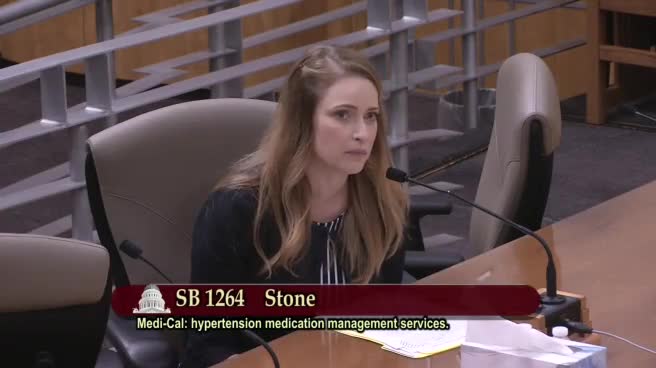
- Related legislation. SB 1264 (Stone) requires Medi-Cal to provide coverage for hypertension medication management services provided by a pharmacist or an APP pursuant to specified provisions of their scope of practice. SB 1264 is set for hearing in the Senate Health Committee on April 25, 2018.
SB 1322 (Stone) requires comprehensive medication management services, as defined, to be covered under the Medi-Cal program. Requires CMM services to be offered to a beneficiary who has been identified as high risk for poor health outcomes associated with medications, or as high risk for medication-related problems, and who has one or more chronic diseases. Requires DHCS to evaluate the effectiveness of CMM on quality of care, patient outcomes, and total program costs. SB 1322 is set for hearing in the Senate Health Committee on April 25, 2018.
- Prior legislation. AB 2084 (Wood of 2016) would have provided Medi-Cal coverage for comprehensive medication management, is defined as the process of care that ensures each beneficiary’s medications are appropriate, safe, and effective, and are being used as intended. AB 2084 would have defined beneficiaries, goals, and related requirements, and requires DHCS to study the effectiveness and costs. AB 2084 was held on the Assembly Appropriations Committee suspense file.
AB 1535 authorized a pharmacist to furnish naloxone hydrochloride in accordance with standardized procedures or protocols developed and approved by both the Board and the Medical Board of California, in consultation with specified entities.
AB 1114 (Eggman, Chapter 602, Statutes of 2016) added to the schedule of Medi-Cal benefits specified pharmacist services, subject to CMS approval and DHCS protocols and utilization controls.
- Support. Over twelve individual pharmacists write in support that California is in the midst of a primary care shortage, increasing health insurance coverage, an aging population, an increase in chronic diseases, and an increase in the number of prescriptions. Supporters state medications compromise 80% of all treatments, and lack of medication adherence is a growing public health concern that increases overall health care costs as patients become sicker faster and require more costly interventions. Supporters argue a solution to this problem is to authorize eligible pharmacists to receive payment for providing CMM services under private health plan, health insurance and Medi-Cal managed care. Supporters argue trained pharmacists can provide much-needed CMM services, and this bill will significantly improve chronic disease management and free physicians and nurses to focus on more complex health concerns.
- Opposition. This bill is opposed by the California Association of Health Plans (CAHP), the Association of California Life, and Health Insurance Companies (ACLHIC), and America’s Health Insurance Plans (AHIP), which argue this bill and five others benefit mandate bills will increase costs, harm affordability, reduce choice and competition, and further incent some employers and individuals to avoid state regulation by seeking alternative coverage options such as self-insuring. Opponents argue state benefit mandates increase the costs of coverage, especially for families who buy coverage on their own without subsidies, small business owners who cannot or do not wish to self-insure, and California taxpayers who may have to foot the bill for the state’s share of any subsidies attributable to those mandates. Opponents further argue that families and businesses benefit from a robust health insurance marketplace that fosters, rather than inhibits, competition and choice, and benefit mandates impose a one-size-fits-all approach to medical care and benefit design driven by the Legislature, rather than consumer choice. Finally, opponents argue benefit mandates stifle the use of innovative, evidence-based medicine, and state-mandated benefits and services prevent benefits packages from adapting to evolving medical literature and clinical guidelines to provide the most up-to-date and cost-effective product to consumers.
- Policy comment. Is this bill premature? The APP category was only recently created in 2013 and Board recognition began in 2017. Per the CHBRP analysis, there were 279 APA licenses in California as of April 2018. CHBRP’s analysis states this bill will have an unknown impact on utilization and expenditures, there is limited or inconclusive evidence of effectiveness of services provided by APPs or other pharmacists working under a collaborative practice agreement with a physician, and this bill is estimated to have an unknown short-term or long-term public health impacts. Given the findings of the CHBRP analysis, should health plans, insurers and Medi-Cal managed care plans be required to cover the services of an APP?
SUPPORT AND OPPOSITION:
Support: Over twelve individuals
Oppose: America’s Health Insurance Plans
Association of California Life and Health Insurance Companies
California Association of Health Plans
-- END --
Bill Author

Bill Co-Author(s):