SB 1305: Emergency medical services providers: dogs and cats.
- Session Year: 2017-2018
- House: Senate
- Latest Version Date: 2018-09-28
Existing law, the Emergency Medical Services System and the Prehospital Emergency Medical Care Personnel Act (the act), establishes the Emergency Medical Services Authority to coordinate and integrate all state activities concerning emergency medical services, including, among other duties, establishing training standards for specified emergency services personnel. The act provides a qualified immunity for public entities and emergency rescue personnel providing emergency services. The act provides other exemptions from liability for specified professionals rendering emergency medical services.
Existing law, the Veterinary Medicine Practice Act, governs the practice of veterinary medicine in this state and makes it unlawful for any person to practice veterinary medicine in this state without a valid license issued pursuant to the act. For purposes of the act, the practice of veterinary medicine includes, among other things, administering a drug, appliance, or treatment for the cure or relief of a wound, fracture, or bodily injury of an animal.
This bill would authorize an emergency responder, as defined, to provide basic first aid to dogs and cats, as defined, to the extent that the provision of that care is not prohibited by the responders employer. The bill would limit civil liability for specified individuals who provide care to a pet or other domesticated animal during an emergency by applying existing provisions of state law. The definition of basic first aid to dogs and cats for purposes of these provisions would specifically include, among other acts, administering oxygen and bandaging for the purpose of stopping bleeding.
Existing law, the Emergency Medical Services System and the Prehospital Emergency Medical Care Personnel Act (the act), establishes the Emergency Medical Services Authority to coordinate and integrate all state activities concerning emergency medical services, including, among other duties, establishing training standards for specified emergency services personnel. The act provides a qualified immunity for public entities and emergency rescue personnel providing emergency services. The act provides other exemptions from liability for specified professionals rendering emergency medical services.
Existing law, the Veterinary Medicine Practice Act, governs the practice of veterinary medicine in this state and makes it unlawful for any person to practice veterinary medicine in this state without a valid license issued pursuant to the act. For purposes of the act, the practice of veterinary medicine includes, among other things, administering a drug, appliance, or treatment for the cure or relief of a wound, fracture, or bodily injury of an animal.
This bill would authorize an emergency medical services provider, responder, as defined, to provide basic first aid to dogs and cats, as defined, to the extent that the provision of that care is not prohibited by the providers responders employer. The bill would limit civil liability for specified individuals who provide care to a pet or other domesticated animal during an emergency by applying existing provisions of state law. The definition of basic first aid to dogs and cats for purposes of these provisions would specifically include, among other acts, administering oxygen and bandaging for the purpose of stopping bleeding.
Existing law, the Emergency Medical Services System and the Prehospital Emergency Medical Care Personnel Act (the act), establishes the Emergency Medical Services Authority to coordinate and integrate all state activities concerning emergency medical services, including, among other duties, establishing training standards for specified emergency services personnel. The act provides a qualified immunity for public entities and emergency rescue personnel providing emergency services. The act provides other exemptions from liability for specified professionals rendering emergency medical services.
Existing law, the Veterinary Medicine Practice Act, governs the practice of veterinary medicine in this state and makes it unlawful for any person to practice veterinary medicine in this state without a valid license issued pursuant to the act. For purposes of the act, the practice of veterinary medicine includes, among other things, administering a drug, appliance, or treatment for the cure or relief of a wound, fracture, or bodily injury of an animal.
This bill would authorize an emergency medical services provider, as defined, to provide basic first aid to dogs and cats, as defined, to the extent that the provision of that care is not prohibited by the providers employer. The bill would exempt that provider and his or her employer from liability for civil damages, and would exempt the provider from other disciplinary action, for providing that care, except as specified. limit civil liability for specified individuals who provide care to a pet or other domesticated animal during an emergency by applying existing provisions of state law. The definition of basic first aid to dogs and cats for purposes of these provisions would specifically include, among other acts, administering oxygen and bandaging for the purpose of stopping bleeding.
Existing law, the Emergency Medical Services System and the Prehospital Emergency Medical Care Personnel Act (the act), establishes the Emergency Medical Services Authority to coordinate and integrate all state activities concerning emergency medical services, including, among other duties, establishing training standards for specified emergency services personnel. The act provides a qualified immunity for public entities and emergency rescue personnel providing emergency services. The act provides other exemptions from liability for specified professionals rendering emergency medical services.
Existing law, the Veterinary Medicine Practice Act, governs the practice of veterinary medicine in this state and makes it unlawful for any person to practice veterinary medicine in this state without a valid license issued pursuant to the act. For purposes of the act, the practice of veterinary medicine includes, among other things, administering a drug, appliance, or treatment for the cure or relief of a wound, fracture, or bodily injury of an animal.
This bill would enact the Sutter Brown Act, which would authorize an emergency medical services provider, as defined, to provide basic first aid to dogs and cats, as defined, to the extent the provider is authorized by the employer to provide that care. that the provision of that care is not prohibited by the providers employer. The bill would exempt that provider and his or her employer from liability for civil damages, and would exempt the provider from other disciplinary action, for providing that care, except as specified. The definition of basic first aid to dogs and cats for purposes of these provisions would specifically include, among other acts, administering oxygen and bandaging for the purpose of stopping bleeding.
Existing law, the Emergency Medical Services System and the Prehospital Emergency Medical Care Personnel Act (the act), establishes the Emergency Medical Services Authority to coordinate and integrate all state activities concerning emergency medical services, including, among other duties, establishing training standards for specified emergency services personnel. The act provides a qualified immunity for public entities and emergency rescue personnel providing emergency services. The act provides other exemptions from liability for specified professionals rendering emergency medical services.
Existing law, the Veterinary Medicine Practice Act, governs the practice of veterinary medicine in this state and makes it unlawful for any person to practice veterinary medicine in this state without a valid license issued pursuant to the act. For purposes of the act, the practice of veterinary medicine includes, among other things, administering a drug, appliance, or treatment for the cure or relief of a wound, fracture, or bodily injury of an animal.
This bill would enact the Sutter Brown Act, which would authorize an emergency medical services provider, as defined, to provide basic first aid to dogs and cats, as defined, to the extent the provider is authorized by the employer to provide that care. The bill would exempt that provider and his or her employer from liability for civil damages, and would exempt the provider from other disciplinary action, for providing that care, except as specified. The definition of basic first aid for to dogs and cats for purposes of these provisions would specifically include, among other acts, administering oxygen and bandaging for the purpose of stopping bleeding.
Existing law, the Emergency Medical Services System and the Prehospital Emergency Medical Care Personnel Act (the act), establishes the Emergency Medical Services Authority to coordinate and integrate all state activities concerning emergency medical services, including, among other duties, establishing training standards for specified emergency services personnel. The act provides a qualified immunity for public entities and emergency rescue personnel providing emergency services. The act provides other exemptions from liability for specified professionals rendering emergency medical services.
Existing law, the Veterinary Medicine Practice Act, governs the practice of veterinary medicine in this state and makes it unlawful for any person to practice veterinary medicine in this state without a valid license issued pursuant to the act. For purposes of the act, the practice of veterinary medicine includes, among other things, administering a drug, appliance, or treatment for the cure or relief of a wound, fracture, or bodily injury of an animal.
This bill would authorize an emergency medical services provider, as defined, to provide basic first aid to dogs and cats, as defined, to the extent the provider is authorized by the employer to provide that care. The bill would exempt that provider and his or her employer from liability for civil damages, and would exempt the provider from other disciplinary action, for providing that care, except as specified. The definition of basic first aid for dogs and cats for purposes of these provisions would specifically include, among other acts, administering oxygen, immobilizing fractures, and bandaging. oxygen and bandaging for the purpose of stopping bleeding.
Existing law, the Emergency Medical Services System and the Prehospital Emergency Medical Care Personnel Act (the act), establishes the Emergency Medical Services Authority to coordinate and integrate all state activities concerning emergency medical services, including, among other duties, establishing training standards for specified emergency services personnel. The act provides a qualified immunity for public entities and emergency rescue personnel providing emergency services. The act provides other exemptions from liability for specified professionals rendering emergency medical services.
Existing law, the Veterinary Medicine Practice Act, governs the practice of veterinary medicine in this state and makes it unlawful for any person to practice veterinary medicine in this state without a valid license issued pursuant to the act. For purposes of the act, the practice of veterinary medicine includes, among other things, administering a drug, appliance, or treatment for the cure or relief of a wound, fracture, or bodily injury of an animal.
This bill would authorize an emergency medical services provider, as defined, to provide preveterinary emergency care, as defined, to a dog or cat, basic first aid to dogs and cats, as defined, to the extent the provider has received commensurate training and is authorized by the employer to provide that care. The bill would exempt that provider and his or her employer from liability for civil damages, and would exempt the provider from other disciplinary action, for providing that care, except as specified. The definition of preveterinary emergency care basic first aid for dogs and cats for purposes of these provisions would specifically include, among other acts, administering oxygen, immobilizing fractures, and bandaging. The bill would also exempt a licensed veterinarian who acts in good faith from liability for an act or omission authorized by the bill, as specified.
Existing law, the Emergency Medical Services System and the Prehospital Emergency Medical Care Personnel Act (the act), establishes the Emergency Medical Services Authority to coordinate and integrate all state activities concerning emergency medical services, including, among other duties, establishing training standards for specified emergency services personnel. The act provides a qualified immunity for public entities and emergency rescue personnel providing emergency services. The act provides other exemptions from liability for specified professionals rendering emergency medical services.
Existing law, the Veterinary Medicine Practice Act, governs the practice of veterinary medicine in this state and makes it unlawful for any person to practice veterinary medicine in this state without a valid license issued pursuant to the act. For purposes of the act, the practice of veterinary medicine includes, among other things, administering a drug, appliance, or treatment for the cure or relief of a wound, fracture, or bodily injury of an animal.
This bill would authorize an emergency medical services provider, as defined, to provide preveterinary emergency care, as defined, to a dog or cat, to the extent the provider has received commensurate training and is authorized by the employer to provide that care. The bill would exempt that provider and his or her employer from liability for civil damages, and would exempt the provider from other disciplinary action, for providing that care, except as specified. The definition of preveterinary emergency care for purposes of these provisions would specifically include, among other acts, administering oxygen, immobilizing fractures, and bandaging. The bill would also exempt a licensed veterinarian who acts in good faith from liability for an act or omission authorized by the bill, as specified.
(a)The Legislature finds and declares all of the following:
(1)California residents receive comfort and unconditional love on a daily basis from their household pets, particularly dogs and cats.
(2)California residents benefit from the special support, comfort, guidance, companionship, and therapy provided by dogs and cats.
(3)Pets provide critical support to many California residents with disabilities.
(4)Pets provide assistance and aid in the official duties of military personnel, peace officers, law enforcement agencies, fire departments, and search-and-rescue agencies.
(5)Personnel of some fire districts and other first responder agencies currently provide stabilizing, life-saving emergency care to dogs and cats, which violates the Veterinary Medicine Practice Act.
(6)In enacting this section, it is the intent of the Legislature to authorize emergency responders to provide, on a voluntary basis, basic first aid to dogs and cats without exposure to criminal prosecution or professional discipline for the unlawful practice of veterinary medicine.
(b)Notwithstanding the Veterinary Medicine Practice Act, as set forth in Chapter 11 (commencing with Section 4800) of Division 2 of the Business and Professions Code, an emergency responder may provide basic first aid to dogs and cats to the extent that the provision of that care is not prohibited by the responders employer, and the responder shall not be subject to criminal prosecution for a violation of Section 4831 of the Business and Professions Code.
(c)Civil liability for a person who provides care to a pet or other domesticated animal during an emergency is governed by the following:
(1)Section 4826.1 of the Business and Professions Code governs care provided by a veterinarian.
(2)Subdivision (a) of Section 1799.102 governs care provided by an emergency responder, or law enforcement and emergency personnel specified in this chapter.
(3)Subdivision (b) of Section 1799.102 governs care provided by any person other than an individual described in paragraph (1) or (2).
(d)Notwithstanding any other law, this section does not impose a duty or obligation upon an emergency responder or any other person to transport or provide care to an injured pet or other domesticated animal during an emergency.
(e)For purposes of this section, the following definitions apply:
(1)Cat means a small domesticated feline animal that is kept as a pet. Cat does not include nondomesticated wild animals.
(2)Dog means a domesticated canine animal owned for companionship, service, therapeutic, or assistance purposes.
(3)Emergency responder means a person who is certified or licensed to provide emergency medical services.
(4)Employer means an entity or organization that employs or enlists the services of an emergency responder.
(5)Basic first aid to dogs and cats means providing immediate medical care to a dog or cat by an emergency responder, in an emergency situation to which the emergency responder is responding, that is intended to stabilize the dog or cat so that the dog or cat can be transported by the owner as soon as practical to a veterinarian for treatment and which is provided through the following means:
(A)Administering oxygen.
(B)Managing ventilation by mask.
(C)Manually clearing the upper airway, not including tracheal intubation or surgical procedures.
(D)Controlling hemorrhage with direct pressure.
(E)Bandaging for the purpose of stopping bleeding.
(f)This section does not require or authorize the provision of emergency services to dogs or cats in response to a telephone call to the 911 emergency system and is not a basis for liability for the failure to provide emergency services to dogs or cats in response to a telephone call to the 911 emergency system.
(a)The Legislature finds and declares all of the following:
(1)California residents receive comfort and unconditional love on a daily basis from their household pets, particularly dogs and cats.
(2)California residents benefit from the special support, comfort, guidance, companionship, and therapy provided by dogs and cats.
(3)Pets provide critical support to many California residents with disabilities.
(4)Pets provide assistance and aid in the official duties of military personnel, peace officers, law enforcement agencies, fire departments, and search-and-rescue agencies.
(5)Personnel of some fire districts and other first responder agencies currently provide stabilizing, life-saving emergency care to dogs and cats, which violates the Veterinary Medicine Practice Act.
(6)In enacting this section, it is the intent of the Legislature to authorize emergency medical service providers responders to provide, on a voluntary basis, basic first aid to dogs and cats without exposure to criminal prosecution or professional discipline for the unlawful practice of veterinary medicine.
(b)Notwithstanding the Veterinary Medicine Practice Act, as set forth in Chapter 11 (commencing with Section 4800) of Division 2 of the Business and Professions Code, an emergency medical services provider responder may provide basic first aid to dogs and cats to the extent that the provision of that care is not prohibited by the providers responders employer, and the provider responder shall not be subject to criminal prosecution for a violation of Section 4831 of the Business and Professions Code.
(c)Civil liability for a person who provides care to a pet or other domesticated animal during an emergency is governed by the following provisions of law: following:
(1)Section 4826.1 of the Business and Professions Code governs care provided by a veterinarian.
(2)Subdivision (a) of Section 1799.102 governs care provided by an emergency medical services provider, responder, or law enforcement and emergency personnel specified in this chapter.
(3)Subdivision (b) of Section 1799.102 governs care provided by any person other than an individual described in paragraph (1) or (2).
(d)Notwithstanding any other law, this section does not impose a duty or obligation upon an emergency medical services provider responder or any other person to transport or provide care to an injured pet or other domesticated animal during an emergency.
(e)For purposes of this section, the following definitions apply:
(1)Cat means a small domesticated feline animal that is kept as a pet. Cat does not include nondomesticated wild animals.
(2)Dog means a domesticated canine animal owned for companionship, service, therapeutic, or assistance purposes.
(3)Emergency medical services provider responder means a person who is certified or licensed to provide emergency medical services.
(4)Employer means an entity or organization that employs or enlists the services of an emergency medical services provider. responder.
(5)(A)Basic first aid to dogs and cats means providing immediate medical care to a dog or cat by an emergency medical services provider, responder, in an emergency situation to which the emergency medical services provider responder is responding, that is intended to stabilize the dog or cat so that the dog or cat can be transported by the owner as soon as practical to a veterinarian for treatment and which is provided through the following means:
(i)(A)Administering oxygen.
(ii)(B)Managing ventilation by mask.
(iii)(C)Manually clearing the upper airway, not including tracheal intubation or surgical procedures.
(iv)Giving mouth-to-mouth ventilation, including with the use of a barrier.(v)(D)Controlling hemorrhage with direct pressure.
(vi)(E)Bandaging for the purpose of stopping bleeding.
(B)Basic first aid to dogs and cats is intended to enable the dog or cat to be transported as soon as practical to a veterinarian for treatment. Basic first aid to dogs and cats does not include care provided in response to an emergency call made solely for the purpose of tending to an injured dog or cat, unless a persons life could be placed in danger attempting to save the life of the dog or cat.(f)This section does not require or authorize the provision of emergency services to dogs or cats in response to a telephone call to the 911 emergency system and is not a basis for liability for the failure to provide emergency services to dogs or cats in response to a telephone call to the 911 emergency system.
(a)The Legislature finds and declares all of the following:
(1)California residents receive comfort and unconditional love on a daily basis from their household pets, particularly dogs and cats.
(2)California residents benefit from the special support, comfort, guidance, companionship, and therapy provided by dogs and cats.
(3)Pets provide critical support to many California residents with disabilities.
(4)Pets provide assistance and aid in the official duties of military personnel, peace officers, law enforcement agencies, fire departments, and search-and-rescue agencies.
(5)Personnel of some fire districts and other first responder agencies currently provide stabilizing, life-saving emergency care to dogs and cats, which violates the Veterinary Medicine Practice Act.
(6)In enacting this section, it is the intent of the Legislature to authorize emergency medical service providers to provide, on a voluntary basis, basic first aid to dogs and cats. cats without exposure to criminal prosecution or professional discipline for the unlawful practice of veterinary medicine.
(b)Notwithstanding the Veterinary Medicine Practice Act, as set forth in Chapter 11 (commencing with Section 4800) of Division 2 of the Business and Professions Code, an emergency medical services provider may provide basic first aid to dogs and cats to the extent that the provision of that care is not prohibited by the providers employer. employer, and the provider shall not be subject to criminal prosecution for a violation of Section 4831 of the Business and Professions Code.
(c)An emergency medical services provider and his or her employer are not liable for civil damages, and an emergency medical services provider is not subject to criminal prosecution or professional disciplinary action, for an act or omission resulting from the provision of basic first aid to dogs and cats pursuant to this section, unless the act or omission constitutes willful or wanton misconduct.(c)Civil liability for a person who provides care to a pet or other domesticated animal during an emergency is governed by the following provisions of law:
(1)Section 4826.1 of the Business and Professions Code governs care provided by a veterinarian.
(2)Subdivision (a) of Section 1799.102 governs care provided by an emergency medical services provider, or law enforcement and emergency personnel specified in this chapter.
(3)Subdivision (b) of Section 1799.102 governs care provided by any person other than an individual described in paragraph (1) or (2).
(d)Notwithstanding any other law, this section does not impose a duty or obligation upon an emergency medical services provider or any other person to provide care to a dog or cat. an injured pet or other domesticated animal during an emergency.
(e)For purposes of this section, the following definitions apply:
(1)Cat means a small domesticated feline animal that is kept as a pet. Cat does not include nondomesticated wild animals.
(2)Dog means a domesticated canine animal owned for companionship, service, therapeutic, or assistance purposes.
(3)Emergency medical services provider means a person who is certified or licensed to provide emergency medical services.
(4)Employer means an entity or organization that employs or enlists the services of an emergency medical services provider.
(5)(A)Basic first aid to dogs and cats means providing immediate medical care to a dog or cat by an emergency medical services provider, in an emergency situation to which the emergency medical services provider is responding, through the following means:
(i)Administering oxygen.
(ii)Managing ventilation by mask.
(iii)Manually clearing the upper airway, not including tracheal intubation or surgical procedures.
(iv)Giving mouth-to-snout or mouth-to-barrier ventilation. mouth-to-mouth ventilation, including with the use of a barrier.
(v)Controlling hemorrhage with direct pressure.
(vi)Bandaging for the purpose of stopping bleeding.
(B)Basic first aid to dogs and cats is intended to enable the dog or cat to be transported as soon as practical to a veterinarian for treatment. Basic first aid to dogs and cats does not include care provided in response to an emergency call made solely for the purpose of tending to an injured dog or cat, unless a persons life could be placed in danger attempting to save the life of the dog or cat.
(a)(1)The Legislature finds and declares all of the following:
(A)(1)California residents receive comfort and unconditional love on a daily basis from their household pets, particularly dogs and cats.
(B)(2)California residents benefit from the special support, comfort, guidance, companionship, and therapy provided by dogs and cats.
(C)(3)Pets provide critical support to many California residents with disabilities.
(D)(4)Pets provide assistance and aid in the official duties of military personnel, peace officers, law enforcement agencies, fire departments, and search-and-rescue agencies.
(E)(5)Personnel of some fire districts and other first responder agencies currently provide stabilizing, life-saving emergency care to dogs and cats, which violates the Veterinary Medicine Practice Act.
(F)(6)In enacting this section, it is the intent of the Legislature to authorize emergency medical service providers to provide, on a voluntary basis, basic first aid to dogs and cats in accordance with policies and procedures designed and implemented by the employers of those emergency medical services providers. cats.
(2)This section shall be known and may be cited as the Sutter Brown Act.(b)Notwithstanding the Veterinary Medicine Practice Act, as set forth in Chapter 11 (commencing with Section 4800) of Division 2 of the Business and Professions Code, an emergency medical services provider may provide basic first aid to dogs and cats to the extent the provider is authorized by the employer to provide the care. Requirements governing the circumstances under which emergency medical services providers may provide basic first aid to dogs and cats may be specified in the employers policies governing the provision of care. that the provision of that care is not prohibited by the providers employer.
(c)An emergency medical services provider and his or her employer are not liable for civil damages, and an emergency medical services provider is not subject to criminal prosecution or professional disciplinary action, for an act or omission resulting from the provision of basic first aid to dogs and cats pursuant to this section, unless the act or omission constitutes willful or wanton misconduct.
(d)Notwithstanding any other law, this section does not impose a duty or obligation upon an emergency medical services provider to provide care to a dog or cat.
(e)For purposes of this section, the following definitions apply:
(1)Cat means a small domesticated feline animal that is kept as a pet. Cat does not include nondomesticated wild animals.
(2)Dog means a domesticated canine animal owned for companionship, service, therapeutic, or assistance purposes.
(3)Emergency medical services provider means a person who is certified or licensed to provide emergency medical services.
(4)Employer means an entity or organization that employs or enlists the services of an emergency medical services provider.
(5)(A)Basic first aid to dogs and cats means providing immediate medical care to a dog or cat by an emergency medical services provider, in an emergency situation to which the emergency medical services provider is responding, through the following means:
(i)Administering oxygen.
(ii)Managing ventilation by mask.
(iii)Manually clearing the upper airway, not including tracheal intubation or surgical procedures.
(iv)Giving mouth-to-snout or mouth-to-barrier ventilation.
(v)Controlling hemorrhage with direct pressure.
(vi)Bandaging for the purpose of stopping bleeding.
(B)Basic first aid to dogs and cats is intended to enable the dog or cat to be transported as soon as practical to a veterinarian for treatment. Basic first aid to dogs and cats does not include care provided in response to an emergency call made solely for the purpose of tending to an injured dog or cat, unless a persons life could be placed in danger attempting to save the life of the dog or cat.
This act shall be known and may be cited as the Sutter Brown Act.
SECTION 1.SEC. 2.Section 1799.109 is added to the Health and Safety Code, to read:1799.109.(a)(1)The Legislature finds and declares all of the following:
(1)(A)California residents receive comfort and unconditional love on a daily basis from their household pets, particularly dogs and cats.
(2)(B)California residents benefit from the special support, comfort, guidance, companionship, and therapy provided by dogs and cats.
(3)(C)Pets provide critical support to many California residents with disabilities.
(4)(D)Pets provide assistance and aid in the official duties of military personnel, peace officers, law enforcement agencies, fire departments, and search-and-rescue agencies.
(5)(E)Personnel of some fire districts and other first responder agencies currently provide stabilizing, life-saving emergency care to dogs and cats, which violates the Veterinary Medicine Practice Act.
(6)(F)In enacting this section, it is the intent of the Legislature to authorize emergency medical service providers to provide, on a voluntary basis, basic first aid for to dogs and cats in accordance with policies and procedures designed and implemented by the employers of those emergency medical services providers.
(2)This section shall be known and may be cited as the Sutter Brown Act.
(b)Notwithstanding the Veterinary Medicine Practice Act, as set forth in Chapter 11 (commencing with Section 4800) of Division 2 of the Business and Professions Code, an emergency medical services provider may provide basic first aid to dogs and cats to the extent the provider is authorized by the employer to provide the care. Requirements governing the circumstances under which emergency medical services providers may provide basic first aid to dogs and cats may be specified in the employers policies governing the provision of care.
(c)An emergency medical services provider and his or her employer are not liable for civil damages, and an emergency medical services provider is not subject to criminal prosecution or professional disciplinary action, for an act or omission resulting from the provision of basic first aid to dogs and cats pursuant to this section, unless the act or omission constitutes willful or wanton misconduct.
(d)Notwithstanding any other law, this section does not impose a duty or obligation upon an emergency medical services provider to provide care to a dog or cat.
(e)For purposes of this section, the following definitions apply:
(1)Cat means a small domesticated feline animal that is kept as a pet. Cat does not include nondomesticated wild animals.
(2)Dog means a domesticated canine animal owned for companionship, service, therapeutic, or assistance purposes.
(3)Emergency medical services provider means a person who is certified or licensed to provide emergency medical services.
(4)Employer means an entity or organization that employs or enlists the services of an emergency medical services provider.
(5)(A)Basic first aid to dogs and cats means providing immediate medical care to a dog or cat by an emergency medical services provider, in an emergency situation to which the emergency medical services provider is responding, through the following means:
(i)Administering oxygen.
(ii)Managing ventilation by mask.
(iii)Manually clearing the upper airway, not including tracheal intubation or surgical procedures.
(iv)Giving mouth-to-snout or mouth-to-barrier ventilation.
(v)Controlling hemorrhage with direct pressure.
(vi)Bandaging for the purpose of stopping bleeding.
(B)Basic first aid to dogs and cats is intended to enable the dog or cat to be transported as soon as practical to a veterinarian for treatment. Basic first aid to dogs and cats does not include care provided in response to an emergency call made solely for the purpose of tending to an injured dog or cat, unless a persons life could be placed in danger attempting to save the life of the dog or cat.
(a)The Legislature finds and declares all of the following:
(1)California residents receive comfort and unconditional love on a daily basis from their household pets, particularly dogs and cats.
(2)California residents benefit from the special support, comfort, guidance, companionship, and therapy provided by dogs and cats.
(3)Pets provide critical support to many California residents with disabilities.
(4)Pets provide assistance and aid in the official duties of military personnel, peace officers, law enforcement agencies, fire departments, and search-and-rescue agencies.
(5)Personnel of some fire districts and other first responder agencies currently provide stabilizing, life-saving emergency care to dogs and cats, which violates the Veterinary Medicine Practice Act.
(6)In enacting this section, it is the intent of the Legislature to authorize emergency medical service providers to provide, on a voluntary basis, basic first aid for dogs and cats in accordance with policies and procedures designed and implemented by the employers of those emergency medical services providers.
(b)Notwithstanding the Veterinary Medicine Practice Act, as set forth in Chapter 11 (commencing with Section 4800) of Division 2 of the Business and Professions Code, an emergency medical services provider may provide basic first aid to dogs and cats to the extent the provider is authorized by the employer to provide the care. Requirements governing the circumstances under which emergency medical services providers may provide basic first aid to dogs and cats may be specified in the employers policies governing the provision of care.
(c)An emergency medical services provider and his or her employer are not liable for civil damages, and an emergency medical services provider is not subject to criminal prosecution or professional disciplinary action, for an act or omission resulting from the provision of basic first aid to dogs and cats pursuant to this section, unless the act or omission constitutes willful or wanton misconduct.
(d)Notwithstanding any other law, this section does not impose a duty or obligation upon an emergency medical services provider to provide care to a dog or cat.
(e)For purposes of this section, the following definitions apply:
(1)Cat means a small domesticated feline animal that is kept as a pet. Cat does not include nondomesticated wild animals.
(2)Dog means a domesticated canine animal owned for companionship, service, therapeutic, or assistance purposes.
(3)Emergency medical services provider means a person who is certified or licensed to provide emergency medical services.
(4)Employer means an entity or organization that employs or enlists the services of an emergency medical services provider.
(5)(A)Basic first aid to dogs and cats means providing immediate medical care to a dog or cat by an emergency medical services provider, in an emergency situation to which the emergency medical services provider is responding, through means that include all of the following: the following means:
(i)Administering oxygen.
(ii)Opening and manually maintaining an airway.(ii)Managing ventilation by mask.
(iii)Manually clearing the upper airway, not including tracheal intubation or surgical procedures.
(iii)(iv)Giving mouth-to-snout or mouth-to-barrier ventilation.
(iv)Managing ventilation by mask.(v)Controlling hemorrhage with direct pressure.
(vi)Immobilizing fractures.(vii)Bandaging.(vi)Bandaging for the purpose of stopping bleeding.
(B)Basic first aid to dogs and cats is intended to enable the dog or cat to be transported as soon as practical to a veterinarian for treatment. Basic first aid to dogs and cats does not include care provided in response to an emergency call made solely for the purpose of tending to an injured dog or cat, unless a persons life could be placed in danger attempting to save the life of the dog or cat.
(a)The Legislature finds and declares all of the following:
(1)California residents receive comfort and unconditional love on a daily basis from their household pets, particularly dogs and cats.
(2)California residents benefit from the special support, comfort, guidance, companionship, and therapy provided by dogs and cats.
(3)Pets provide critical support to many California residents with disabilities.
(4)Pets provide assistance and aid in the official duties of military personnel, peace officers, law enforcement agencies, fire departments, and search-and-rescue agencies.
(5)Personnel of some fire districts and other first responder agencies currently provide stabilizing, life-saving emergency care to dogs and cats, which violates the Veterinary Medicine Practice Act.
(6)In enacting this section, it is the intent of the Legislature to authorize emergency medical service providers to provide, on a voluntary basis, emergency preveterinary care basic first aid for dogs and cats in accordance with policies and procedures designed and implemented by the employers of those emergency medical services providers.
(b)Notwithstanding any other law, including the Veterinary Medicine Practice Act, as set forth in Chapter 11 (commencing with Section 4800) of Division 2 of the Business and Professions Code, an emergency medical services provider may provide preveterinary emergency care basic first aid to dogs and cats to the extent the provider has received commensurate training and is authorized by the employer to provide the care. Requirements governing the circumstances under which emergency medical services providers may provide preveterinary emergency care basic first aid to dogs and cats may be specified in the employers policies governing the provision of care.
(c)(1)An emergency medical services provider and his or her employer are not liable for civil damages, and an emergency medical services provider is not subject to criminal prosecution or professional disciplinary action, for an act or omission resulting from the provision of preveterinary emergency care basic first aid to dogs and cats pursuant to this section, unless the act or omission constitutes willful or wanton misconduct.
(2)A licensed veterinarian who acts in good faith in accordance with this section is not liable for damages, and is not subject to a civil action, criminal prosecution, or professional disciplinary action, for an act or omission that is authorized by this section.(d)Notwithstanding any other law, this section does not impose a duty or obligation upon an emergency medical services provider to provide care to a dog or cat.
(e)For purposes of this section, the following definitions apply:
(1)Cat means a small domesticated feline animal that is kept as a pet. Cat does not include nondomesticated wild animals.
(2)Dog means a domesticated canine animal owned for companionship, service, therapeutic, or assistance purposes.
(3)Emergency medical services provider means a person who is certified or licensed to provide emergency medical services.
(4)Employer means an entity or organization that employs or enlists the services of an emergency medical services provider.
(5)(A)Preveterinary emergency care means the Basic first aid to dogs and cats means providing immediate medical stabilization of care to a dog or cat by an emergency medical services provider, in an emergency situation to which the emergency medical services provider is responding, through means that include, but are not limited to, include all of the following:
(i)Administering oxygen.
(ii)Opening and manually maintaining an airway.
(iii)Giving mouth-to-snout or mouth-to-barrier ventilation.
(iv)Managing ventilation by mask.
(v)Controlling hemorrhage with direct pressure.
(vi)Immobilizing fractures.
(vii)Bandaging.
(viii)Administering naloxone hydrochloride, if administering the drug is either in accordance with a written protocol established and provided by, or pursuant to a consultation with, a veterinarian licensed in this state.(B)Preveterinary emergency care Basic first aid to dogs and cats is intended to enable the dog or cat to be transported as soon as practical to a veterinarian for treatment. Preveterinary emergency care Basic first aid to dogs and cats does not include care provided in response to an emergency call made solely for the purpose of tending to an injured dog or cat, unless a persons life could be placed in danger attempting to save the life of the dog or cat.
(a)The Legislature finds and declares all of the following:
(1)California residents receive comfort and unconditional love on a daily basis from their household pets, particularly dogs and cats.
(2)California residents benefit from the special support, comfort, guidance, companionship, and therapy provided by dogs and cats.
(3)Pets provide critical support to many California residents with disabilities.
(4)Pets provide assistance and aid in the official duties of military personnel, peace officers, law enforcement agencies, fire departments, and search-and-rescue agencies.
(5)Personnel of some fire districts and other first responder agencies currently provide stabilizing, life-saving emergency care to dogs and cats, which violates the Veterinary Medicine Practice Act.
(6)In enacting this section, it is the intent of the Legislature to authorize emergency medical service providers to provide, on a voluntary basis, emergency preveterinary care for dogs and cats in accordance with policies and procedures designed and implemented by the employers of those emergency medical services providers.
(b)Notwithstanding any other law, including the Veterinary Medicine Practice Act, as set forth in Chapter 11 (commencing with Section 4800) of Division 2 of the Business and Professions Code, an emergency medical services provider may provide preveterinary emergency care to the extent the provider has received commensurate training and is authorized by the employer to provide the care. Requirements governing the circumstances under which emergency medical services providers may provide preveterinary emergency care to dogs and cats may be specified in the employers policies governing the provision of care.
(c)(1)An emergency medical services provider and his or her employer are not liable for civil damages, and an emergency medical services provider is not subject to criminal prosecution or professional disciplinary action, for an act or omission resulting from the provision of preveterinary emergency care pursuant to this section, unless the act or omission constitutes willful or wanton misconduct.
(2)A licensed veterinarian who acts in good faith in accordance with this section is not liable for damages, and is not subject to a civil action, criminal prosecution, or professional disciplinary action, for an act or omission that is authorized by this section.
(d)Notwithstanding any other law, this section does not impose a duty or obligation upon an emergency medical services provider to provide care to a dog or cat.
(e)For purposes of this section, the following definitions apply:
(1)Cat means a small domesticated feline animal that is kept as a pet. Cat does not include nondomesticated wild animals.
(2)Dog means a domesticated canine animal owned for companionship, service, therapeutic, or assistance purposes.
(3)Emergency medical services provider means a person who is certified or licensed to provide emergency medical services.
(4)Employer means an entity or organization that employs or enlists the services of an emergency medical services provider.
(5)(A)Preveterinary emergency care means the immediate medical stabilization of a dog or cat by an emergency medical services provider, in an emergency situation to which the emergency medical services provider is responding, through means that include, but are not limited to, all of the following:
(i)Administering oxygen.
(ii)Opening and manually maintaining an airway.
(iii)Giving mouth-to-snout or mouth-to-barrier ventilation.
(iv)Managing ventilation by mask.
(v)Controlling hemorrhage with direct pressure.
(vi)Immobilizing fractures.
(vii)Bandaging.
(viii)Administering naloxone hydrochloride, if administering the drug is either in accordance with a written protocol established and provided by, or pursuant to a consultation with, a veterinarian licensed in this state.
(B)Preveterinary emergency care is intended to enable the dog or cat to be transported as soon as practical to a veterinarian for treatment. Preveterinary emergency care does not include care provided in response to an emergency call made solely for the purpose of tending to an injured dog or cat, unless a persons life could be placed in danger attempting to save the life of the dog or cat.
|
Date
|
Status
|
|---|---|
| Sep 28, 2018 | Chaptered by Secretary of State. Chapter 900, Statutes of 2018. |
| Sep 28, 2018 | Approved by the Governor. |
| Sep 12, 2018 | Enrolled and presented to the Governor at 5 p.m. |
| Aug 31, 2018 | Assembly amendments concurred in. (Ayes 39. Noes 0.) Ordered to engrossing and enrolling. |
| Aug 31, 2018 | Ordered to special consent calendar. |
| Aug 30, 2018 | In Senate. Concurrence in Assembly amendments pending. |
| Aug 30, 2018 | Read third time. Passed. Ordered to the Senate. |
| Aug 23, 2018 | Read third time and amended. |
| Aug 23, 2018 | From consent calendar. |
| Aug 16, 2018 | Read second time. Ordered to consent calendar. |
| Aug 15, 2018 | From committee: Do pass. Ordered to consent calendar. (Ayes 17. Noes 0.) (August 15). |
| Jun 27, 2018 | Read second time and amended. Re-referred to Com. on APPR. |
| Jun 26, 2018 | From committee: Do pass as amended and re-refer to Com. on APPR. (Ayes 10. Noes 0.) (June 26). |
| Jun 20, 2018 | Read second time and amended. Re-referred to Com. on JUD. |
| Jun 19, 2018 | From committee: Do pass as amended and re-refer to Com. on JUD. (Ayes 17. Noes 0.) (June 19). |
| Jun 11, 2018 | Referred to Coms. on B. & P. and JUD. |
| May 31, 2018 | In Assembly. Read first time. Held at Desk. |
| May 31, 2018 | Read third time. Passed. (Ayes 36. Noes 0.) Ordered to the Assembly. |
| May 29, 2018 | Read second time. Ordered to third reading. |
| May 25, 2018 | Read third time and amended. |
| May 15, 2018 | Read second time. Ordered to third reading. |
| May 14, 2018 | From committee: Be ordered to second reading pursuant to Senate Rule 28.8. |
| May 9, 2018 | Set for hearing May 14. |
| Apr 26, 2018 | Read second time and amended. Re-referred to Com. on APPR. |
| Apr 25, 2018 | From committee: Do pass as amended and re-refer to Com. on APPR. with recommendation: To consent calendar. (Ayes 7. Noes 0.) (April 24). |
| Apr 18, 2018 | Set for hearing April 24. |
| Apr 17, 2018 | From committee: Do pass and re-refer to Com. on JUD. (Ayes 9. Noes 0.) (April 16). Re-referred to Com. on JUD. |
| Apr 9, 2018 | From committee with author's amendments. Read second time and amended. Re-referred to Com. on B., P. & E.D. |
| Apr 5, 2018 | From committee: Do pass and re-refer to Com. on B., P. & E.D. (Ayes 9. Noes 0.) (April 4). Re-referred to Com. on B., P. & E.D. |
| Mar 20, 2018 | Set for hearing April 16. |
| Mar 12, 2018 | Set for hearing April 4. |
| Mar 1, 2018 | Referred to Coms. on HEALTH, B., P. & E.D., and JUD. |
| Feb 20, 2018 | From printer. May be acted upon on or after March 22. |
| Feb 16, 2018 | Introduced. Read first time. To Com. on RLS. for assignment. To print. |
|
Date
|
Description
|
Location
|
Votes
|
|
|---|---|---|---|---|
| Aug 31, 2018 | Unfinished Business SB1305 Glazer et al. Concurrence | Senate Floor |
Passed |
|
| Aug 30, 2018 | SB 1305 Glazer Senate Third Reading By BAKER | Assembly Floor |
Passed |
|
| Aug 15, 2018 | Do pass. To Consent Calendar. | Assembly Standing Committee on Appropriations |
Passed |
|
| Jun 26, 2018 | Do pass as amended and be re-referred to the Committee on [Appropriations] | Assembly Standing Committee on Judiciary |
Passed |
|
| Jun 19, 2018 | Do pass as amended and be re-referred to the Committee on [Judiciary] | Assembly Standing Committee on Business and Professions |
Passed |
|
| May 31, 2018 | Senate 3rd Reading SB1305 Glazer et al. | Senate Floor |
Passed |
|
| Apr 24, 2018 | Do pass as amended, but first amend, and re-refer to the Committee on [Appropriations] with the recommendation: To Consent Calendar | Senate Standing Committee on Judiciary |
Passed |
|
| Apr 16, 2018 | Do pass, but first be re-referred to the Committee on [Judiciary] | Senate Standing Committee on Business, Professions and Economic Development |
Passed |
|
| Apr 4, 2018 | Do pass, but first be re-referred to the Committee on [Business, Professions and Economic Development] | Senate Standing Committee on Health |
Passed |
This list shows positions taken on this bill by organizations on the date displayed, which is linked to the original source.
Positions by individuals are not included.
|
Organization
|
Position
|
Date
|
|---|---|---|
| California Ambulance Association | * Support | Apr 16, 2018 |
| California Fire Chiefs Association | ** Support | Aug 30, 2018 |
| California Veterinary Medical Association | ** Support | Aug 30, 2018 |
| Fire Districts Association Of California | ** Support | Aug 30, 2018 |
| Lighthouse Public Affairs | * Support | Jun 19, 2018 |
| San Diego Humane Society | ** Support | Aug 30, 2018 |
| San Francisco Spca | ** Support | Aug 30, 2018 |
| UC Davis Fire Department | * Support | Apr 4, 2018 |
| UC Davis Fire Department | * Support | Apr 16, 2018 |
| UC Davis Fire Department | * Support | Jun 19, 2018 |
Office of Senate Floor Analyses (916) 651-1520 Fax: (916) 327-4478 | SB |
UNFINISHED BUSINESS
Bill No: SB 1305
:
SENATE HEALTH COMMITTEE: 9-0, 4/4/18
AYES: Hernandez, Nguyen, Leyva, Mitchell, Monning, Newman, Nielsen, Pan, Roth
SENATE BUS., PROF. & ECON. DEV. COMMITTEE: 9-0, 4/16/18
AYES: Hill, Fuller, Dodd, Galgiani, Glazer, Hernandez, Newman, Pan, Wilk
SENATE JUDICIARY COMMITTEE: 7-0, 4/24/18
AYES: Jackson, Moorlach, Anderson, Hertzberg, Monning, Stern, Wieckowski
SENATE APPROPRIATIONS COMMITTEE: Senate Rule 28.8
SENATE FLOOR: 39-0, 5/31/18
AYES: Allen, Anderson, Atkins, Bates, Beall, Berryhill, Bradford, Cannella, De León, Dodd, Fuller, Gaines, Galgiani, Glazer, Hernandez, Hertzberg, Hill, Hueso, Jackson, Lara, Leyva, McGuire, Mitchell, Monning, Moorlach, Morrell, Newman, Nguyen, Nielsen, Pan, Portantino, Roth, Skinner, Stern, Stone, Vidak, Wieckowski, Wiener, Wilk
ASSEMBLY FLOOR: 80-0, 8/30/18 - See last page for vote
SUBJECT: Emergency medical services providers: dogs and cats
DIGEST:
This bill permits an emergency responder to provide basic first aid, as specified, to a dog or a cat, without being in violation of the Veterinary Medicine Practice Act.
Assembly Amendments
(1) delete naming the bill the Sutter Brown Act; (2) delete mouth-to-snout or mouth-to-barrier ventilation from the definition of “basic first aid to dogs and cats”; (3) delete the new civil liability immunity provision from the bill, and instead cross-reference immunity provisions in existing law that would apply to the provisions of this bill; (4) clarify that the basic first aid is intended to stabilize the dog or cat so that the dog or cat can be transported by the owner to a veterinarian for further treatment; and (5) make other technical and clarifying changes.
Existing law:
- Establishes the Emergency Medical Services Authority (EMSA) within the California Health and Human Services Agency, and requires EMSA, among other things, to develop planning and implementation guidelines for EMS systems which address specified components, including manpower and training, communications, transportation, system organization and management, data collection and evaluation, and disaster response. [HSC §1797.100 et. seq.]
- Establishes the EMS Commission within the California Health and Human Services Agency, and requires the EMS Commission to review and approve regulations, standards and guidelines to be developed by EMSA for implementation of the EMS System and the Prehospital Emergency Medical Care Personnel Act. [HSC §1799 et. seq.]
- Defines “Emergency Medical Technician-I” or “EMT-I” as an individual trained in all facets of basic life support, as specified. Defines an “Emergency Medical Technician-II,” “EMT-II,” “Advanced Emergency Medical Technician,” or “Advanced EMT” as an EMT-I with additional training in limited advanced life support according to specified standards. Both EMT-Is and EMT-IIs are certified at the local level. [HSC §1797.170 and 1797.171]
- Defines “Emergency Medical Technician-Paramedic,” “EMT-P,” “paramedic” or “mobile intensive care paramedic” as an individual whose scope of practice includes the ability to provide advanced life support, as specified, including administering specified medications. EMT-Ps are licensed and regulated at the state level through EMSA. [HSC §1797.172]
- Limits the civil liability for any act or omission, other than an act or omission constituting gross negligence or willful or wanton misconduct, of any person who, in good faith and not for compensation, renders emergency medical or nonmedical care or assistance at the scene of an emergency (known as the Good Samaritan Law). [HSC §1799.102]
- Limits the civil liability of various types of professionals who render EMS at the scene of an emergency, including EMS providers, law enforcement officers, firefighters, and registered nurses, so that these professionals are only liable for acts or omissions performed in a grossly negligent manner or for acts or omissions not performed in good faith. Specifies that a public agency employing these personnel are not liable for civil damages if the person providing the EMS is not liable. [HSC §1799.106]
- Establishes the Veterinary Medicine Practice Act, and prohibits any person from practicing veterinary medicine unless the person holds a valid, unexpired, and unrevoked license as a veterinarian, or is the bona fide owner of the animal. [BPC §4811 and 4825]
- Defines the practice of veterinary medicine as including, among other things, administering a drug, medicine, appliance, application, or treatment of whatever nature for the prevention, cure, or relief of a wound, fracture, bodily injury, or disease of animals. [BPC §4826]
- Establishes that a violation of the Veterinary Medicine Practice Act is a misdemeanor, and is punishable by a fine of between $500 and $2,000, or by imprisonment in a county jail for up to one year, or both. [BPC §4831]
This bill:
- Permits an emergency responder, notwithstanding the Veterinary Medicine Practice Act, to provide basic first aid to dogs and cats to the extent the provision of that care is not prohibited by the responder’s employer, and prohibits the responder from being subject to criminal prosecution for violation the Veterinary Medicine Practice Act.
- Specifies that civil liability for a person who provides care to a pet or other domesticated animal during an emergency is governed by existing provisions of law, including provisions of law exempting emergency personnel who administer emergency assistance at the scene of an emergency from civil liability as long as the scene of the emergency is not an emergency department or other location where medical care is usually offered.
- Defines, for purposes of this bill, a “cat” as a small domesticated feline animal that is kept as a pet, and excludes from this definition nondomesticated wild animals, and defines “dog” as a domesticated canine animal owned for companionship, service, therapeutic, or assistance purposes.
- Defines “emergency responder” as a person who is certified or licensed to provide emergency medical services, and defines “employer” as an entity or organization that employs or enlists the services of an emergency responder.
- Defines “basic first aid to dogs and cats” to mean providing immediate medical care to a dog or cat by an emergency responder, in an emergency situation to which the emergency responder is responding, that is intended to stabilize the dog or cat so that the dog or cat can be transported by the owner as soon as practical to a veterinarian for treatment and which is provided through the following means:
- Administering oxygen;
- Managing ventilation by mask;
- Manually clearing the upper airway, not including tracheal intubation or surgical procedures;
- Controlling hemorrhage with direct pressure; and
- Bandaging for purposes of stopping bleeding.
- Prohibits this bill from requiring or authorizing the provision of emergency services to dogs or cats in response to a telephone call to the 911 emergency system, and is not a basis for liability for the failure to provide emergency services to dogs or cats in response to a telephone call to the 911 emergency system.
- Prohibits this bill, notwithstanding any other provision of law, from imposing a duty or obligation upon an EMS provider or any other person to transport or provide care to an injured pet or other domesticated animal during an emergency.
- Makes various legislative findings and declarations, including that personnel of some fire districts and other first responder agencies currently provide stabilizing, life-saving emergency care to dogs and cats, which violates the Veterinary Medicine Practice Act, and that it is the intent of the Legislature to authorize emergency responders to provide, on a voluntary basis, emergency basic first aid for dogs and cats without exposure to criminal prosecution or professional discipline.
Comments
- Author’s statement. According to the author, current law does not allow personnel of fire districts and other first responder agencies to provide stabilizing, life-saving emergency care to dogs and cats. As a result, some first responders are hesitant to provide assistance due to liability for civil damages, criminal prosecution, or professional disciplinary action. The Veterinary Medicine Practice Act of the Business and Professions Code makes it unlawful for any person to practice veterinary medicine in California unless they are a licensed veterinarian. Any person who violates this Act is guilty of a misdemeanor punishable by a fine of $500 to $2,000, or by imprisonment in a county jail for up to one year, or by both a fine and imprisonment. This bill allows first responders to provide pre-veterinary care for dogs and cats in accordance with policies and procedures designed and implemented by the employers of those first responders. Further, this bill protects first responders by making explicit that an EMS provider and his or her employer are not liable for civil damages, and an EMS provider is not subject to criminal prosecution or professional disciplinary action for administering pre-veterinary emergency care.
- Article on EMS treatment of dogs and cats involved in fires. The Journal of Emergency Medical Services published an article in November of 2016, entitled “EMS Assessment and Treatment of Dogs and Cats Involved in Fires.” According to this article, given the high numbers of domesticated animals in the U.S. and the speed at which today’s structure fires develop, the chance of encountering an injured pet on scene is very real. According to this article, any dog or cat exposed to smoke in a structure fire should receive oxygen therapy as soon as possible, and that many departments carry special oxygen masks on their EMS or fire apparatus that can be used on pets. This article notes that animals are unpredictable, and even a seemingly friendly animal will defend itself when it feels threatened or is injured, and that the go-to defense mechanism in dogs and cats is to bite. With regard to legal considerations, an attorney and EMT/firefighter from Pennsylvania was quoted in the article saying that there has been “little to no litigation in the area of treating a pet in an emergency situation. It’s important to understand the specific laws of your state and to have a policy in place that was drafted with these laws in mind.”
- Similar law recently enacted in Ohio. In 2016, Ohio enacted legislation that is very similar to this bill. The Ohio statute has the same list of medical interventions as proposed by this bill, and the immunity provisions are very similar. While the Ohio statute permits a veterinarian to establish written protocols with first responders, the only requirement to perform the listed interventions is that the EMS provider must be authorized to provide the corresponding form of the service on human patients.
FISCAL EFFECT: Appropriation: Fiscal Com.: Local:
According to the Assembly Appropriations Committee, negligible state costs.
American Society for the Prevention of Cruelty to Animals
California Fire Chiefs Association
California Veterinary Medical Association
Fire Districts Association of California
San Diego Humane Society
San Francisco SPCA
OPPOSITION: (Verified 8/30/18)
None received
ARGUMENTS IN SUPPORT: The American Society for the Prevention of Cruelty to Animals (ASPCA) states in support that a guiding principle of ASPCA is that animals deserve freedom from pain, injury and disease by prevention or rapid diagnosis and treatment. Therefore, ASPCA supports this bill to alleviate or prevent unnecessary suffering of dogs and cats injured in emergency situations. The San Diego Humane Society (SDHS) and the San Francisco SPCA state in support that veterinarians are not among the personnel who respond to calls for emergencies like home fires, even though more California households include dogs and cats than children. The San Francisco SPCA and SDHS state that in San Francisco alone, of the more than 120,000 calls that the San Francisco Fire Department responds to each year, thousands of those calls involve firefighters rescuing animals trapped in burning structures. The San Francisco SPCA states that it led a fundraiser that led to outfitting by donation 70 fire department ambulances with lifesaving masks for dogs and cats. The California Fire Chiefs Association and the Fire Districts Association of California write in support that this bill is needed to allow first responders to provide preveterinary care if they choose to in accordance with policies and procedures designed by their employers.
ASSEMBLY FLOOR: 80-0, 8/30/18
AYES: Acosta, Aguiar-Curry, Travis Allen, Arambula, Baker, Berman, Bigelow, Bloom, Bonta, Brough, Burke, Caballero, Calderon, Carrillo, Cervantes, Chau, Chávez, Chen, Chiu, Choi, Chu, Cooley, Cooper, Cunningham, Dahle, Daly, Eggman, Flora, Fong, Frazier, Friedman, Gabriel, Gallagher, Cristina Garcia, Eduardo Garcia, Gipson, Gloria, Gonzalez Fletcher, Gray, Grayson, Harper, Holden, Irwin, Jones-Sawyer, Kalra, Kamlager-Dove, Kiley, Lackey, Levine, Limón, Low, Maienschein, Mathis, Mayes, McCarty, Medina, Melendez, Mullin, Muratsuchi, Nazarian, Obernolte, O'Donnell, Patterson, Quirk, Quirk-Silva, Reyes, Rivas, Rodriguez, Rubio, Salas, Santiago, Steinorth, Mark Stone, Thurmond, Ting, Voepel, Waldron, Weber, Wood, Rendon
8/30/18 20:54:27
**** END ****
SENATE THIRD READING
STR Bill Id:SB 1305
Author:(Glazer)
As Amended Ver:August 23, 2018
Majority vote
SENATE VOTE: 39-0
Committee | Votes | Ayes | Noes |
Business & Professions | 17-0 | Low, Brough, Baker, Bloom, Chen, Chiu, Cunningham, Eggman, Fong, Gipson, Grayson, Irwin, McCarty, Medina, Mullin, Obernolte, Ting |
|
Judiciary | 10-0 | Mark Stone, Cunningham, Chau, Chiu, Holden, Kalra, Kiley, Maienschein, Reyes, Gabriel |
|
Appropriations | 17-0 | Gonzalez Fletcher, Bigelow, Bloom, Bonta, Brough, Calderon, Carrillo, Chau, Eggman, Fong, Friedman, Gallagher, Eduardo Garcia, Nazarian, Obernolte, Quirk, Reyes |
|
SUMMARY: Authorizes an emergency medical services provider to provide basic first aid to dogs and cats as long as the employer authorizes that care and would exempt the provider and their employer from civil damages. Specifically, this bill:
- Permits an EMS provider to provide basic first aid to dogs and cats, as defined, to the extent the provider is authorized by the employer to provide the care.
- Provides that the employer may determine the circumstances under which EMS providers may provide basic first aid to dogs and cats.
- Defines, for purposes of this bill, a "cat" as "a small domesticated feline animal that is kept as a pet," and excludes from this definition nondomesticated wild animals, and defines "dog" as "a domesticated canine animal owned for companionship, service, therapeutic, or assistance purpose."
- Defines "Emergency medical services provider" as a person who is certified or licensed to provide EMS and defines "employer" as an entity or organization that employs or enlists the services of an EMS provider.
- Defines "basic first aid to dogs and cats" to mean the immediate medical care to a dog or cat by an EMS provider, in an emergency situation to which the EMS provider is responding, through means that include all of the following:
- Administering oxygen;
- Manually clearing an airway;
- Giving mouth-to-snout or mouth-to-barrier ventilation;
- Managing ventilation by mask;
- Controlling hemorrhage with direct pressure; and,
- Bandaging for purpose of stopping bleeding.
- Specifies that "basic first aid to dogs and cats is intended to enable the dog or cat to be transported as soon as practical to a veterinarian for treatment."
- Provides that basic first aid to dogs and cats does not include care provided in response to an emergency call made solely for the purpose of tending to an injured dog or cat, unless a person's life could be placed in danger attempting to save the life of the dog or cat.
- Exempts an EMS provider and his or her employer from liability for civil damages and specifies an EMS provider is not subject to criminal prosecution or professional disciplinary action, for an act or omission resulting from the provision of basic first aid to dogs and cats pursuant to this bill, unless the act or omission constitutes willful or wanton misconduct.
- Specifies that this bill, notwithstanding any other provision of law, does not impose a duty or obligation upon an EMS provider to provide care to a dog or cat.
- Makes various legislative findings and declarations, including that personnel of some fire districts and other first responder agencies currently provide stabilizing, life-saving emergency care to dogs and cats, which violates the Veterinary Medicine Practice Act, and that it is the intent of the Legislature to authorize EMS providers to provide, on a voluntary basis, basic first aid for dogs and cats in accordance with policies and procedures designed and implemented by the employers of those EMS providers.
- Limits liability for EMS provider that provides care to a pet or other domesticated animal during an emergency.
- Clarifies mouth-to-mouth ventilation rather than "mouth-to-snout"
FISCAL EFFECT: According to the Senate Committee on Appropriations, negligible state costs, pursuant to Senate Rule 28.8.
COMMENTS:
Purpose. This bill is sponsored by the author. According to the author, "While most first responders will administer emergency medical care to animals, it is technically not legal for them to do so in California. Current law does not allow personnel of fire districts and other first responder agencies to provide stabilizing, life-saving emergency care to dogs and cats. SB 1305, the Sutter Brown Act, authorizes first responders to provide basic first aid for dogs and cats in need in accordance with policies and procedures designed and implemented by the employers of the first responders. Furthermore, the bill protects first responders from being held liable for civil damages and criminal prosecution for administering aid to these animals."
Background.
Current Expectations. There is a tension in current law between Good Samaritan laws, the Veterinary Medicine Practice Act, and current practice by EMS providers. EMS providers commonly treat animals in emergency situations yet lack protections against potential liability. Good Samaritan laws may not apply in animal care cases and the Veterinary Medicine Practice Act explicitly prohibits medical care of animals without an active veterinary license. In such instances, the EMS provider may be subject to a fine of up to $2,000 and/or imprisonment up to one year. In this potentially murky environment, this bill seeks to provide clarity for EMS providers.
EMS Treatment of Dogs and Cats Involved in Fires. The Journal of Emergency Medical Services published an article in November of 2016, entitled "EMS Assessment and Treatment of Dogs and Cats Involved in Fires." According to this article, given the high numbers of domesticated animals in the U.S. and the speed at which today's structure fires develop, the chance of encountering an injured pet on scene is very real. According to this article, any dog or cat exposed to smoke in a structure fire should receive oxygen therapy as soon as possible, and that many departments carry special oxygen masks on their EMS or fire apparatus that can be used on pets. This article notes that animals are unpredictable, and even a seemingly friendly animal will defend itself when it feels threatened or is injured, and that the go-to defense mechanism in dogs and cats is to bite. With regard to legal considerations, an attorney and EMT/firefighter from Pennsylvania was quoted in the article saying that there has been "little to no litigation in the area of treating a pet in an emergency situation. It's important to understand the specific laws of your state and to have a policy in place that was drafted with these laws in mind."
Analysis Prepared by: Jimmy Fremgen / B. & P. / (916) 319-3301 FN: 0004687
Date of Hearing: August 15, 2018
ASSEMBLY COMMITTEE ON APPROPRIATIONS
Lorena Gonzalez Fletcher, Chair
SBPCA Bill Id:SB 1305
Author:(Glazer) – As Amended Ver:June 27, 2018
Policy Committee: | Business and Professions | Vote: | 17 - 0 |
Judiciary | 10 - 0 | ||
|
|
Urgency: No State Mandated Local Program: No Reimbursable: No
SUMMARY:
This bill authorizes emergency medical services providers to provide basic first aid to dogs and cats without being subject to criminal prosecution or professional discipline for the unlawful practice of veterinary medicine and clarifies that existing Good Samaritan laws apply to persons who provide care to pets and domesticated animals in an emergency.
FISCAL EFFECT:
Negligible state costs.
COMMENTS:
- Purpose. This bill is intended to encourage providers of emergency services, as well as Good Samaritans, to provide care to pets who suffer serious injuries and trauma in incidents such as wildfires.
- Background. California's Good Samaritan statute grants qualified immunity to any “person who in good faith, and not for compensation, renders medical or nonmedical care or assistance at the scene of an emergency,” so long as that person's act or omission does not constitute “gross negligence or willful or wanton misconduct.” Although the case law regarding this qualified immunity involves persons who voluntarily provide emergency care to other persons, nothing in either case law or current statutory law appears to preclude the application to a circumstance where a person voluntarily provides emergency care to an animal, as long as the care is provided “at the scene of an emergency” and in accordance with other conditions (i.e. in good faith and not for compensation).
- Related Legislation. AB 1776 (Steinorth), of this legislative session, authorizes the County of San Bernardino to work with its local emergency medical services agency to conduct a pilot project, commencing January 1, 2019, to allow emergency medical technicians to provide emergency medical transportation for a police dog, as defined, injured in the line of duty to a facility capable of providing veterinary medical services if there is not a human requiring medical attention or transportation at the time. That bill is pending on the Senate Floor.
Analysis Prepared by: Lisa Murawski / APPR. / (916) 319-2081
Date of Hearing: June 26, 2018
ASSEMBLY COMMITTEE ON JUDICIARY
Mark Stone, Chair
SBPCA Bill Id:SB 1305
Author:(Glazer) – As Amended Ver:June 20, 2018
As Proposed to be Amended
SENATE VOTE: 39-0
SUBJECT: EMERGENCY MEDICAL SERVICES PROVIDERS AND GOOD SAMARITANS: DOGS, CATS, AND OTHER PETS: IMMUNITY
KEY ISSUES:
- SHOULD STATE LAW allow EMERGENCY MEDICAL SERVICES PROVIDERS to PROVIDe BASIC FIRST AID TO A DOG OR CAT without being subject to criminal prosecution or professional discipline for the unlawful practice of veterinary medicine?
- should state law clarify that existing good samaritan laws, which generally provide rescuers who provide medical or non-medical care in an emergency with IMMUNITY FROM civil LIABILITY, unless their actions are wilLful or wanton, also apply to persons who provide MEDICAL OR NON-MEDICAL care to pets and other domesticated animals in an emergency?
SYNOPSIS
This author-sponsored bill, which was recently approved by the Assembly Business & Professions Committee by a vote of 17-0, is intended to encourage providers of emergency services, as well as Good Samaritans, to provide care to pets who suffer serious injuries and trauma in incidents such as wildfires. California's Good Samaritan statute (Section 1799.102 of the Health and Safety Code) grants qualified immunity to any “person who in good faith, and not for compensation, renders medical or nonmedical care or assistance at the scene of an emergency,” so long as that person's act or omission does not constitute “gross negligence or willful or wanton misconduct.” Although the case law regarding Section 1799.102 involves persons who voluntarily provide emergency care to other persons, nothing in either case law or current statutory law appears to preclude the application of Section 1799.102 to a circumstance where a person voluntarily provides emergency care to an animal, as long as the care is provided “at the scene of an emergency” and in accordance with Section 1799.102’s other conditions (i.e. in good faith and not for compensation).
The analysis explains that, for several reasons, a new statutory civil immunity provision granting emergency health care providers with immunity from liability for their actions to provide first aid to a dog or cat in an emergency may not be necessary. First, it is highly unlikely that a good faith rescuer would ever be held liable for causing injuries to a pet they attempted to assist in an emergency. Evidence that such rescuers have ever been sued is virtually non-existent. Second, Committee staff has been unable to identify any court case analyzing the issue of whether emergency medical care providers—or lay persons for that matter—could be found liable for a pet’s injuries caused by the person’s good faith effort to assist or rescue the pet. Third, state law (Section 1799.102) may already provide immunity from civil liability for persons who render emergency care, whether medical or nonmedical, to injured pets. Therefore, in the unlikely event that a rescuer were sued after acting in good faith and without compensation to rescue an injured pet, the rescuer could apparently rely upon Section 1799.102 to dismiss the claim on the basis that the rescuer is immune from liability.
The analysis also explains that the immunity provision in the bill in print is both very broad and very narrow. It is very broad because, unlike most other immunity provisions, it provides not only immunity from civil liability, but also protection against criminal prosecution, apparently for all crimes, as well as professional disciplinary action. It is extremely narrow in that it only applies to certain persons (those who are certified or licensed to provide emergency medical services) who perform certain acts (those defined by the bill as “basic first aid”) on certain animals (cats and dogs). And while the bill’s provision to authorize just those with training or certification as emergency medical service providers to perform basic first aid without violating the Veterinary Medicine Act may be a modest and sensible expansion of existing law, the bill in print’s civil immunity provisions could inadvertently undermine California’s long history of encouraging lay rescuers and off-duty professionals to help others in medical and non-medical emergencies.
In an effort to accommodate both the spirit and intent of the Good Samaritan law and the need to ensure that persons without medical or veterinary training are not necessarily authorized by law to perform procedures that require at least some level of emergency medical training or access to special equipment, the author has agreed to amendments that (1) limit the bill’s protection from criminal prosecution to only Section 4831 of the Business and Professions Code, and (2) clarify that civil liability for a person who provides care to a pet or other domesticated animal during an emergency is governed by existing law. The California Veterinary Medicine Association has indicated to the Committee that it will continue its “support” position on the bill as the author has agreed to amend it. Whether the author’s amendments will affect the position of the numerous other supporters of the bill in print—the ASPCA, California Fire Chiefs Association, Fire Districts Association of California, San Diego Humane Society, and San Francisco SPCA— is unknown.
SUMMARY: Authorizes emergency medical services providers to provide basic first aid to dogs and cats without being subject to criminal prosecution or professional discipline for the unlawful practice of veterinary medicine and clarifies that existing Good Samaritan laws apply to persons who provide care to pets and domesticated animals in an emergency. Specifically, this bill:
- Provides that, notwithstanding the Veterinary Medicine Practice Act, an emergency medical services provider may provide basic first aid to dogs and cats and is not subject to criminal prosecution for a violation of Section 4831 of the Business and Professions Code or, to the extent that the provision of care is not prohibited by the provider’s employer, is not subject to professional disciplinary action for any act or omission resulting from the provision of basic first aid to dogs and cats pursuant to this section, unless the act or omission constitutes willful or wanton misconduct.
- Provides that civil liability for a person who provides care to a pet or other domesticated animal during an emergency is governed by the following:
- For a veterinarian: Section 4826.1 of the Business and Professions Code.
- For any emergency medical services provider, or law enforcement and emergency personnel specified in Chapter 9: subdivision (a) of Section 1799.102.
- For any other person: subdivision (b) of Section 1799.102.
- Provides that notwithstanding any other law, the bill does not impose a duty or obligation upon an emergency medical services provider or any other person to provide care to an injured pet or other domesticated animal during an emergency.
- Defines the following terms to have the following meanings:
- “Cat” means a small domesticated feline animal that is kept as a pet. “Cat” does not include nondomesticated wild animals.
- “Dog” means a domesticated canine animal owned for companionship, service, therapeutic, or assistance purposes.
- “Emergency medical services provider” means a person who is certified or licensed to provide emergency medical services.
- “Employer” means an entity or organization that employs or enlists the services of an emergency medical services provider.
- “Basic first aid to dogs and cats” means providing immediate medical care to a dog or cat by an emergency medical services provider, in an emergency situation to which the emergency medical services provider is responding, through the following means:
- Administering oxygen.
- Managing ventilation by mask.
- Manually clearing the upper airway, not including tracheal intubation or surgical procedures.
- Giving mouth-to-mouth ventilation, including with the use of a barrier.
- Controlling hemorrhage with direct pressure.
- Bandaging for the purpose of stopping bleeding.
- Clarifies that basic first aid to dogs and cats is intended to enable the dog or cat to be transported as soon as practical to a veterinarian for treatment and does not include care provided in response to an emergency call made solely for the purpose of tending to an injured dog or cat, unless a person’s life could be placed in danger attempting to save the life of the dog or cat.
EXISTING LAW:
- Pursuant to the Veterinary Medicine Practice Act, makes it unlawful for any person to practice veterinary medicine or any branch thereof in this State unless at the time of so doing, such person holds a valid, unexpired, and unrevoked license issued pursuant to the Act. (Bus. & Prof. Code Section 4825.)
- Provides that 1), above, does not prohibit a person from practicing veterinary medicine as a bona fide owner of one’s own animals. (Bus. & Prof. Code Section 4827 (a).)
- Provides that a person practices veterinary medicine, surgery, and dentistry, and the various branches thereof, when the person does any one of a number of specific acts, including the acts of (a) diagnosing or prescribing a drug, medicine, appliance, application, or treatment of whatever nature for the prevention, cure, or relief of a wound, fracture, bodily injury, or disease of animals; and (b) administering a drug, medicine, appliance, application, or treatment of whatever nature for the prevention, cure, or relief of a wound, fracture, bodily injury, or disease of animals. (Bus. & Prof. Code Section 4826.)
- Provides that a veterinarian who on their own initiative, at the request of an owner, or at the request of someone other than the owner, renders emergency treatment to a sick or injured animal at the scene of an accident shall not be liable in damages to the owner of that animal in the absence of gross negligence. (Bus. & Prof. Code Section 4826.1.)
- Provides that any person, who violates or aids or abets in violating the above provisions, including by practicing veterinary medicine without a license, is guilty of a misdemeanor and upon conviction thereof shall be punished by a fine of not less than $500, nor more than $2,000, or by imprisonment in a county jail for not less than 30 days nor more than one year, or by both the fine and imprisonment. (Bus. & Prof. Code Section 4831.)
- Pursuant to the Emergency Medical Services System and the Prehospital Emergency Medical Care Personnel Act, defines “emergency medical services” as the services utilized in responding to a medical emergency. (Health & Safety Code Section 1797.72. All further statutory references are to this code, unless otherwise indicated.)
- Provides that no person who in good faith, and not for compensation, renders emergency medical or nonmedical care at the scene of an emergency shall be liable for any civil damages resulting from any act or omission. The scene of an emergency shall not include emergency departments and other places where medical care is usually offered. This applies only to the medical, law enforcement, and emergency personnel specified in this chapter. All others rendering such care are immune from civil damages resulting from any act or omission other than acts or omissions constituting gross negligence or willful or wanton misconduct. (Section 1799.102.)
- Provides that a firefighter, police officer or other law enforcement officer, EMT-I, EMT-II, EMT-P, or registered nurse who renders emergency medical services at the scene of an emergency or during an emergency air or ground ambulance transport shall only be liable in civil damages for acts or omissions performed in a grossly negligent manner or acts or omissions not performed in good faith. (Section 1799.106.)
- Provides that a physician or nurse, who in good faith gives emergency instructions to an EMT-II or mobile intensive care paramedic at the scene of an emergency, shall not be liable for any civil damages as a result of issuing the instructions. (Section 1799.104.)
- Provides that no EMT-II or mobile intensive care paramedic rendering care within the scope of his duties who, in good faith and in a nonnegligent manner, follows such instructions of a physician or nurse shall be liable for any civil damages as a result of following such instructions. (Ibid.)
- Provides that neither a public entity nor emergency rescue personnel shall be liable for any injury caused by an action taken by emergency rescue personnel acting within the scope of their employment to provide emergency services, unless the action taken was performed in bad faith or in a grossly negligent manner. (Section 1799.107.)
FISCAL EFFECT: As currently in print the bill is keyed fiscal.
COMMENTS: According to the author, this bill is intended to encourage providers of emergency services (defined by the bill to mean a person who is certified or licensed to provide emergency medical services) to provide emergency medical care to dogs and cats who suffer serious injuries and trauma in incidents such as wildfires:
While most first responders will administer emergency medical care to animals, it is technically not legal for them to do so in California. Current law does not allow personnel of fire districts and other first responder agencies to provide stabilizing, life-saving emergency care to dogs and cats. SB 1305 . . . authorizes first responders to provide basic first aid for dogs and cats in need in accordance with policies and procedures designed and implemented by the employers of the first responders. Furthermore, the bill protects first responders from being held liable for civil damages and criminal prosecution for administering aid to these animals.
According to the author, a number of states already have similar laws in place. For example, the author reports that Ohio law authorizes specified emergency medical services providers to provide specific first aid services to a dog or cat prior to the dog or cat being transferred to a veterinarian for further treatment:
• administering oxygen;
• opening and manually maintaining an airway;
• giving mouth-to-snout or mouth-to-barrier ventilation;
• managing ventilation by mask;
• controlling hemorrhage with direct pressure;
• immobilizing fractures;
• bandaging; and
• administering naloxone hydrochloride, as specified. (Ohio Rev. Code Ann. 4765.52.)
The Ohio statute gives providers immunity from civil liability for doing so, unless their conduct constitutes willful or wanton misconduct. The civil liability provisions of this bill, as currently in print, seem to mirror the Ohio statute.
The "Good Samaritan" Law and its Statutory Progeny. Under common, a person who voluntarily comes to the aid of another person suffering a medical emergency is immune from liability for injuries and even death, so long as that person acts in a reasonably prudent manner under the circumstances. In 2009, California adopted a so-called "Good Samaritan" statute. (The term refers to the parable in the Gospel of Luke about the "lowly" Samaritan who came to the aid of a stranger left for dead while supposedly more upstanding citizens ignored the cries of the dying man.) California's Good Samaritan statute (Section 1799.102) grants qualified immunity to any “person who in good faith, and not for compensation, renders medical or nonmedical care or assistance at the scene of an emergency,” so long as that person's act or omission does not constitute “gross negligence or willful or wanton misconduct.”
In recent years this Committee has heard, and the Legislature has enacted, bills seeking express immunity from liability for lay people, as well as off-duty professionals, who voluntarily render specific types of medical aid in specific emergency situations, such as administering cardiopulmonary resuscitation (CPR) or applying an automated external defibrillator (AED) to a person in sudden cardiac arrest, giving an opioid antidote to a person experiencing an opioid overdose, or administering an epinephrine auto-injector to a person in anaphylactic shock. These provisions may be unnecessary given that any of these methods of administering medical or non-medical care by a lay rescuer at the scene of an emergency would most certainly qualify as rendering medical aid in an emergency by a Good Samaritan, regardless of the mechanism by which the care is administered, pursuant to Section 1799.102. Nevertheless, the Legislature has adopted many such measures in an effort to encourage lay and off-duty professional rescuers to come to the rescue of a person in medical distress whose life may be in danger without fear of civil liability, professional discipline, or criminal sanctions.
It is noteworthy, and relevant for purposes of this bill, that although all case law regarding Section 1799.102 involves persons who voluntarily provide emergency care to other persons, nothing in either case law or current statutory law appears to preclude the application of Section 1799.102 to a circumstance where a person voluntarily provides emergency care to an animal, as long as the care is provided “at the scene of an emergency” and in accordance with Section 1799.102’s other conditions (i.e. in good faith and not for compensation).
Civil Immunity for Good Faith Rescuers of Animals. Neither common law, nor existing statutory law, seems to anticipate the issue of whether persons (other than veterinarians) who provide medical or non-medical care to pets in an emergency are immune from civil liability for their actions. While current law provides that a licensed veterinarian who renders emergency treatment to a sick or injured animal at the scene of an accident is not liable in damages to the owner of that animal in the absence of gross negligence (Business and Professions Code Section 4826.1), no specific statute applies to would-be rescuers of animals other than veterinarians. But it does not necessarily follow that such a law is needed. For several reasons, a new statutory civil immunity provision may not be necessary.
First, it is highly unlikely that a good faith rescuer would ever be held liable for causing injuries to a pet they attempted to assist in an emergency. Evidence that such rescuers have ever been sued is virtually non-existent. The Journal of Emergency Medical Services published an article in November of 2016, entitled “EMS Assessment and Treatment of Dogs and Cats Involved in Fires.” According to this article, given the high numbers of domesticated animals in the U.S. and the speed at which today’s structure fires develop, the chance of a fire fighter encountering an injured pet on scene is very real. According to the article, any dog or cat exposed to smoke in a structure fire should receive oxygen therapy as soon as possible, and that many departments carry special oxygen masks on their EMS or fire apparatus that can be used on pets. The article notes that animals are unpredictable, and even a seemingly friendly animal will defend itself when it feels threatened or is injured, and that the go-to defense mechanism in dogs and cats is to bite. With regard to legal considerations, an attorney and EMT/firefighter from Pennsylvania was quoted in the article saying that there has been “little to no litigation in the area of treating a pet in an emergency situation. It’s important to understand the specific laws of your state and to have a policy in place that was drafted with these laws in mind.”
Second, Committee staff has been unable to identify any court case analyzing the issue of whether emergency medical care providers—or lay persons for that matter—could be found liable for a pet’s injuries caused by the person’s good faith effort to assist or rescue the pet. It could very well be the case that no person has ever been held liable for attempting in good faith to care for a pet that was in medical distress, but inadvertently inflicting injury upon the pet in the process. In the case of a true emergency where a pet’s life is in danger, it is hard to foresee how evidence could ever establish that a lay rescuer caused the injury suffered by the pet (because the pet likely would die without the rescuer’s attemped help).
Third, as explained above, state law (Section 1799.102) may already provide immunity from civil liability to persons who render care, whether medical or nonmedical, to pets in an emergency. Therefore, in the unlikely event that a rescuer were sued after acting in good faith and without compensation to rescue an injured pet, the rescuer likely could rely upon Section 1799.102 to dismiss the claim.
The immunity provision of the bill in print is both very broad and very narrow. The immunity provision is very broad because, unlike most other immunity provisions, it provides not only immunity from civil liability, but also protection against criminal prosecution, apparently for all crimes, as well as professional disciplinary action. At the same time, the bill in print is extremely narrow in that it applies only to certain persons (those who are certified or licensed to provide emergency medical services) who perform certain acts (those defined by the bill as “basic first aid”) for certain animals (cats and dogs).
Regarding the criminal immunity provision, it seems inappropriate to provide rescuers, whether certified as emergency medical care providers or not, with immunity from liability for all criminal liability when the only relevant criminal statute for which the rescuer would appear to need legal protection for administering first aid to a dog or cat is Section 4831 of the Business and Professions Code, which makes it a misdemeanor (punishable by a fine of not less than $500 and up to $2,000, or by imprisonment in a county jail for not less than 30 days nor more than one year, or by both the fine and imprisonment) to practice veterinary medicine without a license.
Regarding the bill’s limitations in terms of the types of rescuers, types of aid, and types of pets, it could be argued that these limitations are important for the protection of pets (and their owners, who could potentially suffer both financially and emotionally if their pets were injured by the negligent practice of veterinary medicine). On the other hand, it could also be argued that the limitations are at least somewhat arbitrary and irrational. For example, why shouldn’t a well-meaning lay rescuer who, in good faith, and not for compensation, rendered emergency first aid to a pet in an emergency have the same immunity from civil liability that such a person would have if they rendered similar care to a person in an emergency? And why shouldn’t a law enforcement official (such as a CHP officer, for example, or a firefighter who is not an EMT) who encountered an animal needing assistance in an emergency have the same immunity for providing care that a certified or licensed provider of emergency medical services would have? And why shouldn’t an emergency medical care provider who administered basic first aid to a rabbit, hamster, or guinea pig in an emergency have the same immunity from liability that the provider would have if the first aid had been provided to a dog or cat? While the lay rescuer or law enforcement official (or rescuer of a rabbit, hamster, or guinea pig) could argue that Section 1799.102 offered immunity from civil liability in such a case, the fact that this bill provides immunity to only licensed and certified rescuers would likely undercut such an argument, implying that the Legislature did not intend for anyone other than a certified or licensed provider of emergency medical services to have such protection from liability. Therefore, the bill in print could inadvertently undermine California’s long history of encouraging lay rescuers and off-duty professionals to help others in medical and non-medical emergencies.
At the same time, given the prohibition in existing law against anyone other than a veterinarian (or a bona fide owner of an animal who treats that animal) practicing veterinary medicine, the bill’s current limit on the specific types of veterinary medicine which emergency medical providers are authorized to perform, notwithstanding that prohibition, seems to make sense. Therefore, the bill’s provision to authorize a limited group of individuals (those with training or certification as emergency medical service providers) to perform a number of specific acts (those meeting the bill’s definition of basic first aid) seems to be a modest and sensible expansion of existing law.
Author’s Amendments. In an effort to accommodate both the spirit and intent of the general Good Samaritan law (Section 1799.102) and the need to ensure that persons without medical or veterinary training are not necessarily authorized by law to perform procedures that require at least some level of emergency medical training or access to special equipment (i.e. administration of oxygen), the author has agreed to amendments that do the following:
- Limit the bill’s protection from criminal prosecution to only Section 4831 of the Business and Professions Code.
- Clarify that civil liability for a person who provides care to a pet or other domesticated animal during an emergency is governed by the following:
(1) For a veterinarian: Section 4826.1 of the Business and Professions Code.
(2) For any emergency medical services provider, or law enforcement and emergency personnel specified in Chapter 9: subdivision (a) of Section 1799.102.
(3) For any other person: subdivision (b) of Section 1799.102.
- Make other minor clarifying and conforming changes.
The California Veterinary Medical Association has indicated to the Committee that it will continue its “support” position on the bill as the author has agreed to amend it. Whether the author’s amendments will affect the position of the other supporters of the bill in print is unknown.
Other Related Legislation: AB 1776 (Steinorth, 2018) would authorize the County of San Bernardino to work with its local emergency medical services agency to conduct a pilot project, commencing January 1, 2019, that would allow emergency medical technicians to provide emergency medical transportation for a police dog, as defined, injured in the line of duty to a facility capable of providing veterinary medical services if there is not a human requiring medical attention or transportation at the time. In its original form, the bill would have authorized such transportation services on a statewide basis and provided immunity from civil damages resulting from an act or omission of an EMT relating to the transport of the police dog, but those provisions were removed from the bill prior to it being heard by this Committee. AB 1776 was recently approved on consent by the Senate Health Committee and referred to the Senate Appropriations Committee.
REGISTERED SUPPORT / OPPOSITION:
Support (to the bill as proposed to be amended)
California Veterinary Medical Association
Support (to the bill in print)
American Society for the Prevention of Cruelty to Animals
California Fire Chiefs Association
Fire Districts Association of California
San Diego Humane Society
San Francisco SPCA
Opposition
None on file
Analysis Prepared by: Alison Merrilees / JUD. / (916) 319-2334
Date of Hearing: June 19, 2018
ASSEMBLY COMMITTEE ON BUSINESS AND PROFESSIONS
Evan Low, Chair
SBPCA Bill Id:
Author:() – As Ver:
SENATE VOTE:
SUBJECT:
SUMMARY: Authorizes an emergency medical services provider to provide basic first aid to dogs and cats as long as the employer authorizes that care and would exempt the provider and their employer from civil damages.
EXISTING LAW:
- Establishes the Emergency Medical Services Authority (EMSA) within the California Health and Human Services Agency, and requires EMSA, among other things, to develop planning and implementation guidelines for emergency medical services systems which address specified components, including manpower and training, communications, transportation, system organization and management, data collection and evaluation, and disaster response. (Health and Safety Code (HSC) Section 1797.100 et. seq.)
- Establishes the EMS Commission within the California Health and Human Services Agency, and requires the EMS Commission to review and approve regulations, standards and guidelines to be developed by EMSA for implementation of the EMS System and the Prehospital Emergency Medical Care Personnel Act. (HSC Section 1799 et. seq.)
- Defines "Emergency Medical Technician-I" or "EMT-I" as an individual trained in all facets of basic life support, as specified. Defines an "Emergency Medical Technician-II," "EMT-II," "Advanced Emergency Medical Technician," or "Advanced EMT" as an EMT-I with additional training in limited advanced life support according to specified standards. Both EMT-Is and EMT-IIs are certified at the local level. (HSC Section 1797.82, 1797.80, 1797.170 and 1797.171)
- Defines "Emergency Medical Technician-Paramedic," "EMT-P," "paramedic" or "mobile intensive care paramedic" as an individual whose scope of practice includes the ability to provide advanced life support, as specified, including administering specified medications. EMT-Ps are licensed and regulated at the state level through EMSA. (HSC Section 1797.84 and 1797.172)
- Limits the civil liability for any act or omission, other than an act or omission constituting gross negligence or willful or wanton misconduct, of any person who, in good faith and not for compensation, renders emergency medical or nonmedical care or assistance at the scene of an emergency (known as the Good Samaritan Law). (HSC Section 1799.102)
- Limits the civil liability of various types of professionals who render emergency medical services at the scene of an emergency, including EMS providers, law enforcement officers, firefighters, and registered nurses, so that these professionals are only liable for acts or omissions performed in a grossly negligent manner or for acts or omissions not performed in good faith. Specifies that a public agency employing these personnel is not liable for civil damages, if the person providing the emergency medical services is not liable. (HSC Section 1799.106)
- Provides for the licensing and regulation of veterinarians and registered veterinary technicians by the Veterinary Medical Board within the Department of Consumer Affairs. (Business and Professions Code (BPC) Section 4800 et seq.)
- Establishes the Veterinary Medicine Practice Act, and prohibits any person from practicing veterinary medicine unless the person holds a valid, unexpired, and unrevoked license as a veterinarian, or is the bona fide owner of the animal.
(BPC Section 4811 and 4825) - Defines the practice of veterinary medicine as including, among other things, administering a drug, medicine, appliance, application, or treatment of whatever nature for the prevention, cure, or relief of a wound, fracture, bodily injury, or disease of animals. (BPC Section 4826)
- Establishes that a violation of the Act is a misdemeanor, and is punishable by a fine of between $500 and $2,000, or by imprisonment in a county jail for up to one year, or both. (BPC Section 4831)
- Specifies that any veterinarian or registered veterinary technician who renders services during any state of war emergency, a state of emergency, or a local emergency at the express or implied request of any responsible state or local official or agency shall have no liability for any injury sustained by any animal by reason of those services, regardless of how or under what circumstances or by what cause those injuries are sustained; provided, however, that the immunity herein granted shall not apply in the event of a willful act or omission. (Government Code Section 8659)
THIS BILL:
- Permits an EMS provider to provide basic first aid to dogs and cats, as defined, to the extent the provider is authorized by the employer to provide the care.
- Provides that the employer may determine the circumstances under which EMS providers may provide basic first aid to dogs and cats.
- Defines, for purposes of this bill, a “cat” as “a small domesticated feline animal that is kept as a pet,” and excludes from this definition nondomesticated wild animals, and defines “dog” as “a domesticated canine animal owned for companionship, service, therapeutic, or assistance purpose.”
- Defines “Emergency medical services provider” as a person who is certified or licensed to provide EMS and defines “employer” as an entity or organization that employs or enlists the services of an EMS provider.
- Defines “basic first aid to dogs and cats” to mean the immediate medical care to a dog or cat by an EMS provider, in an emergency situation to which the EMS provider is responding, through means that include all of the following:
- Administering oxygen;
- Manually clearing an airway;
- Giving mouth-to-snout or mouth-to-barrier ventilation;
- Managing ventilation by mask;
- Controlling hemorrhage with direct pressure; and,
- Bandaging for purpose of stopping bleeding.
- Specifies that “basic first aid to dogs and cats is intended to enable the dog or cat to be transported as soon as practical to a veterinarian for treatment.”
- Provides that basic first aid to dogs and cats does not include care provided in response to an emergency call made solely for the purpose of tending to an injured dog or cat, unless a person’s life could be placed in danger attempting to save the life of the dog or cat.
- Exempts an EMS provider and his or her employer from liability for civil damages and specifies an EMS provider is not subject to criminal prosecution or professional disciplinary action, for an act or omission resulting from the provision of basic first aid to dogs and cats pursuant to this bill, unless the act or omission constitutes willful or wanton misconduct.
- Specifies that this bill, notwithstanding any other provision of law, does not impose a duty or obligation upon an EMS provider to provide care to a dog or cat.
- Makes various legislative findings and declarations, including that personnel of some fire districts and other first responder agencies currently provide stabilizing, life-saving emergency care to dogs and cats, which violates the Veterinary Medicine Practice Act, and that it is the intent of the Legislature to authorize EMS providers to provide, on a voluntary basis, basic first aid for dogs and cats in accordance with policies and procedures designed and implemented by the employers of those EMS providers.
FISCAL EFFECT: According to the Senate Committee on Appropriations, negligible state costs, pursuant to Senate Rule 28.8.
COMMENTS:
Purpose. This bill is sponsored by the author. According to the author, “While most first responders will administer emergency medical care to animals, it is technically not legal for them to do so in California. Current law does not allow personnel of fire districts and other first responder agencies to provide stabilizing, life-saving emergency care to dogs and cats. SB 1305, the Sutter Brown Act, authorizes first responders to provide basic first aid for dogs and cats in need in accordance with policies and procedures designed and implemented by the employers of the first responders. Furthermore, the bill protects first responders from being held liable for civil damages and criminal prosecution for administering aid to these animals.”
Background.
Current Expectations. There is a tension in current law between Good Samaritan laws, the Veterinary Medicine Practice Act, and current practice by EMS providers. EMS providers commonly treat animals in emergency situations yet lack protections against potential liability. Good Samaritan laws may not apply in animal care cases and the Veterinary Medicine Practice Act explicitly prohibits medical care of animals without an active veterinary license. In such instances, the EMS provider may be subject to a fine of up to $2,000 and/or imprisonment up to one year. In this potentially murky environment, this bill seeks to provide clarity for EMS providers.
EMS Treatment of Dogs and Cats Involved in Fires. The Journal of Emergency Medical Services published an article in November of 2016, entitled “EMS Assessment and Treatment of Dogs and Cats Involved in Fires.” According to this article, given the high numbers of domesticated animals in the U.S. and the speed at which today’s structure fires develop, the chance of encountering an injured pet on scene is very real. According to this article, any dog or cat exposed to smoke in a structure fire should receive oxygen therapy as soon as possible, and that many departments carry special oxygen masks on their EMS or fire apparatus that can be used on pets. This article notes that animals are unpredictable, and even a seemingly friendly animal will defend itself when it feels threatened or is injured, and that the go-to defense mechanism in dogs and cats is to bite. With regard to legal considerations, an attorney and EMT/firefighter from Pennsylvania was quoted in the article saying that there has been “little to no litigation in the area of treating a pet in an emergency situation. It’s important to understand the specific laws of your state and to have a policy in place that was drafted with these laws in mind.”
Current Related Legislation. AB 1776 (Steinorth) authorizes EMTs to provide emergency medical transportation for a police dog, as defined, injured in the line of duty to a facility that is capable of providing veterinary medical services if there is not a person requiring medical attention or medical transportation at the time. Provides immunity for civil damages resulting from an act or omission relating to an EMT’s transport of a police dog. (Status: This measure is pending in the Senate Health Committee.)
ARGUMENTS IN SUPPORT:
The California Fire Chiefs Association and the Fire Districts Association of California, write in support, “SB 1305 would permit emergency medical service professionals to provide pre-veterinary emergency care, on a voluntary basis to an injured dog or cat at the scene of an emergency prior to transportation to a veterinary care facility.”
The San Diego Humane Society and the San Francisco SPCA write in support, “we are writing to express our support for your Senate Bill 1305 to ensure that neither first responders nor their employers are liable for civil damages or criminal prosecution if they provide pre-veterinary emergency care to an injured dog or cat at the scene of an emergency. Thank you for introducing this bill.”
The American Society for the Prevention of Cruelty to Animals writes in support, “SB 1305 proposes a commonsense and sensible solution to ensure that California pets can receive the medical care they need and deserve. For these reasons, the ASPCA strongly supports SB 1305. We respectfully request your support for the bill.”
The California Veterinary Medical Association writes in support, “The bill now marries the compassionate purpose of the bill in three critical ways: 1) by allowing first responders to administer aid to an animal in an emergency, 2) by ensuring that the practice of veterinary medicine remains with licensed veterinary professionals, and 3) by endeavoring to protect the safety of the emergency responders that perform these tasks.”
POLICY ISSUES
It is unclear if this bill is necessary as existing Good Samaritan laws may already be construed to protect EMS providers from liability. However, as this bill is double referred to Judiciary Committee, it is for that committee to determine if this is indeed the case.
AMENDMENTS
The committee recommends that the author accept the following amendments to clarify that employers are not required to adopt policies to allow EMS providers to care for animals in emergency situations and to ensure that the subject of the bill is germane to its contents. These amendments do not preclude employers from prohibiting care of animals.
Amendment 1
Strike Section 1. Renumber accordingly
Amendment 2
Section 2.
Strike 1799.109(a)(2)
Amendment 3
(F) In enacting this section, it is the intent of the Legislature to authorize emergency medical service providers to provide, on a voluntary basis, basic first aid for to dogs and cats in accordance with policies and procedures designed and implemented by the employers of those emergency medical services providers.
Amendment 4
(b) Notwithstanding the Veterinary Medicine Practice Act, as set forth in Chapter 11 (commencing with Section 4800) of Division 2 of the Business and Professions Code, an emergency medical services provider may provide basic first aid to dogs and cats to the extent the provider is authorized by the employer to provide the care that the provision of such care is not prohibited by the provider’s employer. Requirements governing the circumstances under which emergency medical services providers may provide basic first aid to dogs and cats may be specified in the employer’s policies governing the provision of care.
ARGUMENTS IN OPPOSITION:
None on file
REGISTERED SUPPORT:
California Fire Chiefs Association
Fire Districts Association of California
San Diego Humane Society
American Society for the Prevention of Cruelty to Animals
California Veterinary Medical Association
REGISTERED OPPOSITION:
None on file
Analysis Prepared by: Jimmy Fremgen / B. & P. / (916) 319-3301
Office of Senate Floor Analyses (916) 651-1520 Fax: (916) 327-4478 | SB 1305 |
THIRD READING
Bill No: SB 1305
Amended: 5/25/18
SENATE HEALTH COMMITTEE: 9-0, 4/4/18
AYES: Hernandez, Nguyen, Leyva, Mitchell, Monning, Newman, Nielsen, Pan, Roth
SENATE BUS., PROF. & ECON. DEV. COMMITTEE: 9-0, 4/16/18
AYES: Hill, Fuller, Dodd, Galgiani, Glazer, Hernandez, Newman, Pan, Wilk
SENATE JUDICIARY COMMITTEE: 7-0, 4/24/18
AYES: Jackson, Moorlach, Anderson, Hertzberg, Monning, Stern, Wieckowski
SENATE APPROPRIATIONS COMMITTEE: Senate Rule 28.8
SUBJECT: Sutter Brown Act: emergency medical services providers: dogs and cats
DIGEST:
This bill enacts the Sutter Brown Act to permit an emergency medical services (EMS) provider to provide basic first aid, as specified, to a dog or a cat to the extent the provider is authorized by the employer to provide the care.
Senate Floor Amendments of 5/25/18 title the bill the Sutter Brown Act.
Existing law:
- Establishes the Emergency Medical Services Authority (EMSA) within the California Health and Human Services Agency, and requires EMSA, among other things, to develop planning and implementation guidelines for EMS systems which address specified components, including manpower and training, communications, transportation, system organization and management, data collection and evaluation, and disaster response. [HSC §1797.100 et. seq.]
- Establishes the EMS Commission within the California Health and Human Services Agency, and requires the EMS Commission to review and approve regulations, standards and guidelines to be developed by EMSA for implementation of the EMS System and the Prehospital Emergency Medical Care Personnel Act. [HSC §1799 et. seq.]
- Defines “Emergency Medical Technician-I” or “EMT-I” as an individual trained in all facets of basic life support, as specified. Defines an “Emergency Medical Technician-II,” “EMT-II,” “Advanced Emergency Medical Technician,” or “Advanced EMT” as an EMT-I with additional training in limited advanced life support according to specified standards. Both EMT-Is and EMT-IIs are certified at the local level. [HSC §1797.170 and 1797.171]
- Defines “Emergency Medical Technician-Paramedic,” “EMT-P,” “paramedic” or “mobile intensive care paramedic” as an individual whose scope of practice includes the ability to provide advanced life support, as specified, including administering specified medications. EMT-Ps are licensed and regulated at the state level through EMSA. [HSC §1797.172]
- Limits the civil liability for any act or omission, other than an act or omission constituting gross negligence or willful or wanton misconduct, of any person who, in good faith and not for compensation, renders emergency medical or nonmedical care or assistance at the scene of an emergency (known as the Good Samaritan Law). [HSC §1799.102]
- Limits the civil liability of various types of professionals who render EMS at the scene of an emergency, including EMS providers, law enforcement officers, firefighters, and registered nurses, so that these professionals are only liable for acts or omissions performed in a grossly negligent manner or for acts or omissions not performed in good faith. Specifies that a public agency employing these personnel are not liable for civil damages if the person providing the EMS is not liable. [HSC §1799.106]
- Establishes the Veterinary Medicine Practice Act, and prohibits any person from practicing veterinary medicine unless the person holds a valid, unexpired, and unrevoked license as a veterinarian, or is the bona fide owner of the animal. [BPC §4811 and 4825]
- Defines the practice of veterinary medicine as including, among other things, administering a drug, medicine, appliance, application, or treatment of whatever nature for the prevention, cure, or relief of a wound, fracture, bodily injury, or disease of animals. [BPC §4826]
- Establishes that a violation of the Veterinary Medicine Practice Act is a misdemeanor, and is punishable by a fine of between $500 and $2,000, or by imprisonment in a county jail for up to one year, or both. [BPC §4831]
This bill:
- Enacts the Sutter Brown Act, which permits an EMS provider, notwithstanding the Veterinary Medicine Practice Act, to provide basic first aid to dogs and cats to the extent the provider is authorized by the employer to provide the care.
- Defines, for purposes of this bill, a “cat” as a small domesticated feline animal that is kept as a pet, and excludes from this definition nondomesticated wild animals, and defines “dog” as a domesticated canine animal.
- Defines “EMS provider” as a person who is certified or licensed to provide EMS, and defines “employer” as an entity or organization that employs or enlists the services of an EMS provider.
- Defines “basic first aid to dogs and cats” to mean providing immediate medical care to a dog or cat by an EMS provider, in an emergency situation to which the EMS provider is responding, through the following means:
- Administering oxygen;
- Managing ventilation by mask;
- Manually clearing the upper airway, not including tracheal intubation or surgical procedures;
- Giving mouth-to-snout or mouth-to-barrier ventilation;
- Controlling hemorrhage with direct pressure; and
- Bandaging for purposes of stopping bleeding.
- Specifies that “basic first aid to dogs and cats” is intended to enable the dog or cat to be transported as soon as practical to a veterinarian for treatment. Prohibits “basic first aid to dogs and cats” from including care provided in response to an emergency call made solely for the purpose of tending to an injured dog or cat, unless a person’s life could be placed in danger attempting to save the life of the dog or cat.
- Exempts an EMS provider and his or her employer from liability for civil damages, and specifies an EMS provider is not subject to criminal prosecution or professional disciplinary action, for an act or omission resulting from the provision of basic first aid to dogs and cats pursuant to this bill, unless the act or omission constitutes willful or wanton misconduct.
- Specifies that this bill, notwithstanding any other provision of law, does not impose a duty or obligation upon an EMS provider to provide care to a dog or cat.
- Permits the employer’s policies governing the provision of care to specify requirements governing the circumstances under which EMS providers are permitted to provide basic first aid to dogs and cats.
- Makes various legislative findings and declarations, including that personnel of some fire districts and other first responder agencies currently provide stabilizing, life-saving emergency care to dogs and cats, which violates the Veterinary Medicine Practice Act, and that it is the intent of the Legislature to authorize EMS providers to provide, on a voluntary basis, emergency basic first aid for dogs and cats in accordance with policies and procedures designed and implemented by the employers of those EMS providers.
Comments
- Author’s statement. According to the author, current law does not allow personnel of fire districts and other first responder agencies to provide stabilizing, life-saving emergency care to dogs and cats. As a result, some first responders are hesitant to provide assistance due to liability for civil damages, criminal prosecution, or professional disciplinary action. The Veterinary Medicine Practice Act of the Business and Professions Code makes it unlawful for any person to practice veterinary medicine in California unless they are a licensed veterinarian. Any person who violates this Act is guilty of a misdemeanor punishable by a fine of $500 to $2,000, or by imprisonment in a county jail for up to one year, or by both a fine and imprisonment. This bill allows first responders to provide pre-veterinary care for dogs and cats in accordance with policies and procedures designed and implemented by the employers of those first responders. Further, this bill protects first responders by making explicit that an EMS provider and his or her employer are not liable for civil damages, and an EMS provider is not subject to criminal prosecution or professional disciplinary action for administering pre-veterinary emergency care.
- Article on EMS treatment of dogs and cats involved in fires. The Journal of Emergency Medical Services published an article in November of 2016, entitled “EMS Assessment and Treatment of Dogs and Cats Involved in Fires.” According to this article, given the high numbers of domesticated animals in the U.S. and the speed at which today’s structure fires develop, the chance of encountering an injured pet on scene is very real. According to this article, any dog or cat exposed to smoke in a structure fire should receive oxygen therapy as soon as possible, and that many departments carry special oxygen masks on their EMS or fire apparatus that can be used on pets. This article notes that animals are unpredictable, and even a seemingly friendly animal will defend itself when it feels threatened or is injured, and that the go-to defense mechanism in dogs and cats is to bite. With regard to legal considerations, an attorney and EMT/firefighter from Pennsylvania was quoted in the article saying that there has been “little to no litigation in the area of treating a pet in an emergency situation. It’s important to understand the specific laws of your state and to have a policy in place that was drafted with these laws in mind.”
- Similar law recently enacted in Ohio. In 2016, Ohio enacted legislation that is very similar to this bill. The Ohio statute has the same list of medical interventions as proposed by this bill, and the immunity provisions are very similar. While the Ohio statute permits a veterinarian to establish written protocols with first responders, the only requirement to perform the listed interventions is that the EMS provider must be authorized to provide the corresponding form of the service on human patients.
FISCAL EFFECT: Appropriation: No Fiscal Com.: Yes Local: No
American Society for the Prevention of Cruelty to Animals
California Fire Chiefs Association
California Veterinary Medical Association
Fire Districts Association of California
San Diego Humane Society
San Francisco SPCA
OPPOSITION: (Verified 5/15/18)
None received
ARGUMENTS IN SUPPORT: The American Society for the Prevention of Cruelty to Animals (ASPCA) states in support that a guiding principle of ASPCA is that animals deserve freedom from pain, injury and disease by prevention or rapid diagnosis and treatment. Therefore, ASPCA supports this bill to alleviate or prevent unnecessary suffering of dogs and cats injured in emergency situations. The San Diego Humane Society (SDHS) and the San Francisco SPCA state in support that veterinarians are not among the personnel who respond to calls for emergencies like home fires, even though more California households include dogs and cats than children. The San Francisco SPCA and SDHS state that in San Francisco alone, of the more than 120,000 calls that the San Francisco Fire Department responds to each year, thousands of those calls involve firefighters rescuing animals trapped in burning structures. The San Francisco SPCA states that it led a fundraiser that led to outfitting by donation 70 fire department ambulances with lifesaving masks for dogs and cats. The California Fire Chiefs Association and the Fire Districts Association of California write in support that this bill is needed to allow first responders to provide preveterinary care if they choose to in accordance with policies and procedures designed by their employers.
5/29/18 11:42:48
**** END ****
Office of Senate Floor Analyses (916) 651-1520 Fax: (916) 327-4478 | SB 1305 |
THIRD READING
Bill No: SB 1305
Amended: 4/26/18
SENATE HEALTH COMMITTEE: 9-0, 4/4/18
AYES: Hernandez, Nguyen, Leyva, Mitchell, Monning, Newman, Nielsen, Pan, Roth
SENATE BUS., PROF. & ECON. DEV. COMMITTEE: 9-0, 4/16/18
AYES: Hill, Fuller, Dodd, Galgiani, Glazer, Hernandez, Newman, Pan, Wilk
SENATE JUDICIARY COMMITTEE: 7-0, 4/24/18
AYES: Jackson, Moorlach, Anderson, Hertzberg, Monning, Stern, Wieckowski
SENATE APPROPRIATIONS COMMITTEE: Senate Rule 28.8
SUBJECT: Emergency medical services providers: dogs and cats: immunity
DIGEST:
This bill permits an emergency medical services (EMS) provider to provide basic first aid, as specified, to a dog or a cat to the extent the provider is authorized by the employer to provide the care.
Existing law:
- Establishes the Emergency Medical Services Authority (EMSA) within the California Health and Human Services Agency, and requires EMSA, among other things, to develop planning and implementation guidelines for EMS systems which address specified components, including manpower and training, communications, transportation, system organization and management, data collection and evaluation, and disaster response. [HSC §1797.100 et. seq.]
- Establishes the EMS Commission within the California Health and Human Services Agency, and requires the EMS Commission to review and approve regulations, standards and guidelines to be developed by EMSA for implementation of the EMS System and the Prehospital Emergency Medical Care Personnel Act. [HSC §1799 et. seq.]
- Defines "Emergency Medical Technician-I" or "EMT-I" as an individual trained in all facets of basic life support, as specified. Defines an "Emergency Medical Technician-II," "EMT-II," "Advanced Emergency Medical Technician," or "Advanced EMT" as an EMT-I with additional training in limited advanced life support according to specified standards. Both EMT-Is and EMT-IIs are certified at the local level. [HSC §1797.170 and 1797.171]
- Defines "Emergency Medical Technician-Paramedic," "EMT-P," "paramedic" or "mobile intensive care paramedic" as an individual whose scope of practice includes the ability to provide advanced life support, as specified, including administering specified medications. EMT-Ps are licensed and regulated at the state level through EMSA. [HSC §1797.172]
- Limits the civil liability for any act or omission, other than an act or omission constituting gross negligence or willful or wanton misconduct, of any person who, in good faith and not for compensation, renders emergency medical or nonmedical care or assistance at the scene of an emergency (known as the Good Samaritan Law). [HSC §1799.102]
- Limits the civil liability of various types of professionals who render EMS at the scene of an emergency, including EMS providers, law enforcement officers, firefighters, and registered nurses, so that these professionals are only liable for acts or omissions performed in a grossly negligent manner or for acts or omissions not performed in good faith. Specifies that a public agency employing these personnel are not liable for civil damages if the person providing the EMS is not liable. [HSC §1799.106]
- Establishes the Veterinary Medicine Practice Act, and prohibits any person from practicing veterinary medicine unless the person holds a valid, unexpired, and unrevoked license as a veterinarian, or is the bona fide owner of the animal. [BPC §4811 and 4825]
- Defines the practice of veterinary medicine as including, among other things, administering a drug, medicine, appliance, application, or treatment of whatever nature for the prevention, cure, or relief of a wound, fracture, bodily injury, or disease of animals. [BPC §4826]
- Establishes that a violation of the Veterinary Medicine Practice Act is a misdemeanor, and is punishable by a fine of between $500 and $2,000, or by imprisonment in a county jail for up to one year, or both. [BPC §4831]
This bill:
- Permits an EMS provider, notwithstanding the Veterinary Medicine Practice Act, to provide basic first aid to dogs and cats to the extent the provider is authorized by the employer to provide the care.
- Defines, for purposes of this bill, a “cat” as a small domesticated feline animal that is kept as a pet, and excludes from this definition nondomesticated wild animals, and defines “dog” as a domesticated canine animal.
- Defines “EMS provider” as a person who is certified or licensed to provide EMS, and defines “employer” as an entity or organization that employs or enlists the services of an EMS provider.
- Defines “basic first aid to dogs and cats” to mean providing immediate medical care to a dog or cat by an EMS provider, in an emergency situation to which the EMS provider is responding, through the following means:
- Administering oxygen;
- Managing ventilation by mask;
- Manually clearing the upper airway, not including tracheal intubation or surgical procedures;
- Giving mouth-to-snout or mouth-to-barrier ventilation;
- Controlling hemorrhage with direct pressure; and
- Bandaging for purposes of stopping bleeding.
- Specifies that “basic first aid to dogs and cats” is intended to enable the dog or cat to be transported as soon as practical to a veterinarian for treatment. Prohibits “basic first aid to dogs and cats” from including care provided in response to an emergency call made solely for the purpose of tending to an injured dog or cat, unless a person’s life could be placed in danger attempting to save the life of the dog or cat.
- Exempts an EMS provider and his or her employer from liability for civil damages, and specifies an EMS provider is not subject to criminal prosecution or professional disciplinary action, for an act or omission resulting from the provision of basic first aid to dogs and cats pursuant to this bill, unless the act or omission constitutes willful or wanton misconduct.
- Specifies that this bill, notwithstanding any other provision of law, does not impose a duty or obligation upon an EMS provider to provide care to a dog or cat.
- Permits the employer’s policies governing the provision of care to specify requirements governing the circumstances under which EMS providers are permitted to provide basic first aid to dogs and cats.
- Makes various legislative findings and declarations, including that personnel of some fire districts and other first responder agencies currently provide stabilizing, life-saving emergency care to dogs and cats, which violates the Veterinary Medicine Practice Act, and that it is the intent of the Legislature to authorize EMS providers to provide, on a voluntary basis, emergency basic first aid for dogs and cats in accordance with policies and procedures designed and implemented by the employers of those EMS providers.
Comments
- Author’s statement. According to the author, current law does not allow personnel of fire districts and other first responder agencies to provide stabilizing, life-saving emergency care to dogs and cats. As a result, some first responders are hesitant to provide assistance due to liability for civil damages, criminal prosecution, or professional disciplinary action. The Veterinary Medicine Practice Act of the Business and Professions Code makes it unlawful for any person to practice veterinary medicine in California unless they are a licensed veterinarian. Any person who violates this Act is guilty of a misdemeanor punishable by a fine of $500 to $2,000, or by imprisonment in a county jail for up to one year, or by both a fine and imprisonment. This bill allows first responders to provide pre-veterinary care for dogs and cats in accordance with policies and procedures designed and implemented by the employers of those first responders. Further, this bill protects first responders by making explicit that an EMS provider and his or her employer are not liable for civil damages, and an EMS provider is not subject to criminal prosecution or professional disciplinary action for administering pre-veterinary emergency care.
- Article on EMS treatment of dogs and cats involved in fires. The Journal of Emergency Medical Services published an article in November of 2016, entitled “EMS Assessment and Treatment of Dogs and Cats Involved in Fires.” According to this article, given the high numbers of domesticated animals in the U.S. and the speed at which today’s structure fires develop, the chance of encountering an injured pet on scene is very real. According to this article, any dog or cat exposed to smoke in a structure fire should receive oxygen therapy as soon as possible, and that many departments carry special oxygen masks on their EMS or fire apparatus that can be used on pets. This article notes that animals are unpredictable, and even a seemingly friendly animal will defend itself when it feels threatened or is injured, and that the go-to defense mechanism in dogs and cats is to bite. With regard to legal considerations, an attorney and EMT/firefighter from Pennsylvania was quoted in the article saying that there has been “little to no litigation in the area of treating a pet in an emergency situation. It’s important to understand the specific laws of your state and to have a policy in place that was drafted with these laws in mind.”
- Similar law recently enacted in Ohio. In 2016, Ohio enacted legislation that is very similar to this bill. The Ohio statute has the same list of medical interventions as proposed by this bill, and the immunity provisions are very similar. While the Ohio statute permits a veterinarian to establish written protocols with first responders, the only requirement to perform the listed interventions is that the EMS provider must be authorized to provide the corresponding form of the service on human patients.
FISCAL EFFECT: Appropriation: No Fiscal Com.: Yes Local: No
American Society for the Prevention of Cruelty to Animals
California Fire Chiefs Association
California Veterinary Medical Association
Fire Districts Association of California
San Diego Humane Society
San Francisco SPCA
OPPOSITION: (Verified 5/15/18)
None received
ARGUMENTS IN SUPPORT: The American Society for the Prevention of Cruelty to Animals (ASPCA) states in support that a guiding principle of ASPCA is that animals deserve freedom from pain, injury and disease by prevention or rapid diagnosis and treatment. Therefore, ASPCA supports this bill to alleviate or prevent unnecessary suffering of dogs and cats injured in emergency situations. The San Diego Humane Society (SDHS) and the San Francisco SPCA state in support that veterinarians are not among the personnel who respond to calls for emergencies like home fires, even though more California households include dogs and cats than children. The San Francisco SPCA and SDHS state that in San Francisco alone, of the more than 120,000 calls that the San Francisco Fire Department responds to each year, thousands of those calls involve firefighters rescuing animals trapped in burning structures. The San Francisco SPCA states that it led a fundraiser that led to outfitting by donation 70 fire department ambulances with lifesaving masks for dogs and cats. The California Fire Chiefs Association and the Fire Districts Association of California write in support that this bill is needed to allow first responders to provide preveterinary care if they choose to in accordance with policies and procedures designed by their employers.
5/16/18 15:52:19
**** END ****
Senator Hannah-Beth Jackson, Chair
2017-2018 Regular Session
Bill No: SB 1305 (Author:Glazer)
Version: April 9, 2018
Hearing Date: April 24, 2018
Fiscal: Yes
Urgency: No
Consultant: CK
SUBJECT
Emergency preveterinary services: immunity
DESCRIPTION
This bill would provide that an emergency medical services provider, as defined, may voluntarily provide basic first aid to dogs and cats, as defined, to the extent authorized by their employer. This bill would immunize emergency medical services providers, and their employers, from civil liability for providing such aid, unless the provider’s actions constitute willful or wanton misconduct.
BACKGROUND
The Veterinary Medicine Practice Act makes it unlawful for any person to practice veterinary medicine, or any branch thereof, in this State unless at the time of so doing, such person holds a valid, unexpired, and unrevoked license. This includes the administering of a drug, medicine, appliance, application, or treatment of whatever nature for the prevention, cure, or relief of a wound, fracture, bodily injury, or disease of animals. Anyone violating these laws is guilty of a misdemeanor and must be punished by a fine of not less than $500, nor more than $2,000, or by imprisonment in a county jail for not less than 30 days nor more than one year, or by both the fine and imprisonment.
The Veterinary Medicine Practice Act therefore makes it unlawful for an emergency first responder to provide medical treatment to injured animals when responding to emergencies in the course of their duties. This bill would provide that a person who is certified or licensed to provide emergency medical services may voluntarily provide basic first aid to dogs and cats to the extent authorized by their employer. This bill would immunize the emergency medical services provider from civil liability for providing such aid, unless the person’s actions constitute willful or wanton misconduct.
The bill passed out of the Senate Business, Professions, and Economic Development and Senate Health Committees, both on a 9-0 vote.
CHANGES TO EXISTING LAW
Existing law, the Veterinary Medicine Practice Act, makes it unlawful for any person to practice veterinary medicine or any branch thereof in this State unless at the time of so doing, such person holds a valid, unexpired, and unrevoked license as provided. (Bus. & Prof. Code Sec. 4825.)
Existing law provides that a person practices veterinary medicine, surgery, and dentistry, and the various branches thereof, when the person does any one of the following:
- represents themselves as engaged in the practice of veterinary medicine, veterinary surgery, or veterinary dentistry in any of its branches;
- diagnoses or prescribes a drug, medicine, appliance, application, or treatment of whatever nature for the prevention, cure, or relief of a wound, fracture, bodily injury, or disease of animals;
- administers a drug, medicine, appliance, application, or treatment of whatever nature for the prevention, cure, or relief of a wound, fracture, bodily injury, or disease of animals, except where the medicine, appliance, application, or treatment is administered by a registered veterinary technician or a veterinary assistant, as specified. However, no person, other than a licensed veterinarian, may induce anesthesia unless authorized by regulation of the board;
- performs a surgical or dental operation upon an animal;
- performs any manual procedure for the diagnosis of pregnancy, sterility, or infertility upon livestock or Equidae; or
- uses any words, letters, or titles in such connection or under such circumstances as to induce the belief that the person using them is engaged in the practice of veterinary medicine, veterinary surgery, or veterinary dentistry. This use shall be prima facie evidence of the intention to represent the person as engaged in the practice of veterinary medicine, veterinary surgery, or veterinary dentistry. (Bus. & Prof. Code Sec. 4826.)
Existing law provides that a veterinarian who on their own initiative, at the request of an owner, or at the request of someone other than the owner, renders emergency treatment to a sick or injured animal at the scene of an accident shall not be liable in damages to the owner of that animal in the absence of gross negligence. (Bus. & Prof. Code Sec. 4826.1.)
Existing law provides that whenever any licensee has reasonable cause to believe an animal under its care has been a victim of animal abuse or cruelty, as prescribed, it shall be the duty of the licensee to promptly report it to the appropriate law enforcement authorities of the county, city, or city and county in which it occurred. No licensee shall incur any civil liability as a result of making any such report. (Bus. & Prof. Code Sec. 4830.7.)
Existing law provides that any person, who violates or aids or abets in violating the above provisions, is guilty of a misdemeanor and upon conviction thereof shall be punished by a fine of not less than $500, nor more than $2,000, or by imprisonment in a county jail for not less than 30 days nor more than one year, or by both the fine and imprisonment. (Bus. & Prof. Code Sec. 4831.)
Existing law, Emergency Medical Services System and the Prehospital Emergency Medical Care Personnel Act, establishes the Emergency Medical Services Authority in the Health and Welfare Agency, authorizes the authority to adopt reasonably necessary rules and regulations, and tasks such authority with developing planning and implementation guidelines for emergency medical services systems. (Health & Saf. Code Sec. 1797.100 et seq.)
Existing law authorizes the Director of the Emergency Medical Services Authority to develop, or prescribe standards for and approve, an emergency medical technician training and testing program for the Department of the California Highway Patrol, Department of Forestry and Fire Protection, California Fire Fighter Joint Apprenticeship Committee, and other public safety agency personnel, upon the request of, and as deemed appropriate by, the director for the particular agency. (Health & Saf. Code Sec. 1797.109.)
Existing law establishes the Commission on Emergency Medical Services in the Health and Human Services Agency and authorizes the Commission to review and approve regulations, standards, and guidelines to be developed by the authority for implementation of the Emergency Medical Services System and the Prehospital Emergency Medical Care Personnel Act. (Health & Saf. Code Sec. 1799 et seq.) Based upon evaluations of the EMS systems in the state and their coordination, the commission shall make recommendations for further development and future directions of the emergency medical services in the state. (Health & Saf. Code Sec. 1799.55.)
Existing law, Emergency Medical Services System and the Prehospital Emergency Medical Care Personnel Act, defines “emergency medical services” as the services utilized in responding to a medical emergency. (Health & Saf. Code Sec. 1797.72.)
Existing law provides that no person who in good faith, and not for compensation, renders emergency medical or nonmedical care at the scene of an emergency shall be liable for any civil damages resulting from any act or omission. The scene of an emergency shall not include emergency departments and other places where medical care is usually offered. This applies only to the medical, law enforcement, and emergency personnel specified in this chapter. All others rendering such care are immune from civil damages resulting from any act or omission other than acts or omissions constituting gross negligence or willful or wanton misconduct. (Health & Saf. Code Sec. 1799.102.)
Existing law provides that a firefighter, police officer or other law enforcement officer, EMT-I, EMT-II, EMT-P, or registered nurse who renders emergency medical services at the scene of an emergency or during an emergency air or ground ambulance transport shall only be liable in civil damages for acts or omissions performed in a grossly negligent manner or acts or omissions not performed in good faith. A public agency employing such a firefighter, police officer or other law enforcement officer, EMT-I, EMT-II, EMT-P, or registered nurse shall not be liable for civil damages if the firefighter, police officer or other law enforcement officer, EMT-I, EMT-II, EMT-P, or registered nurse is not liable. (Health & Saf. Code Sec. 1799.106.)
Existing law provides that a physician or nurse, who in good faith gives emergency instructions to an EMT-II or mobile intensive care paramedic at the scene of an emergency, shall not be liable for any civil damages as a result of issuing the instructions. In addition, no EMT-II or mobile intensive care paramedic rendering care within the scope of his duties who, in good faith and in a nonnegligent manner, follows such instructions of a physician or nurse shall be liable for any civil damages as a result of following such instructions. (Health & Saf. Code Sec. 1799.104.)
Existing law provides that neither a public entity nor emergency rescue personnel shall be liable for any injury caused by an action taken by the emergency rescue personnel acting within the scope of their employment to provide emergency services, unless the action taken was performed in bad faith or in a grossly negligent manner. (Health & Saf. Code Sec. 1799.107.)
This bill would provide that, notwithstanding the Veterinary Medicine Practice Act, an emergency medical services provider may provide basic first aid to dogs and cats to the extent the provider is authorized by the employer to provide the care. Requirements governing the circumstances under which such care can be provided could be specified in the employer’s policies governing the provision of care. However, no duty would be imposed on such providers to provide care to a dog or cat.
This bill would provide that an emergency medical services provider and the provider’s employer are not liable for civil damages, and an emergency medical services provider is not subject to criminal prosecution or professional disciplinary action, for an act or omission resulting from the provision of basic first aid to dogs and cats pursuant hereto, unless the act or omission constitutes willful or wanton misconduct.
This bill would provide the following definitions:
- “cat” means a small domesticated feline animal that is kept as a pet. “Cat” does not include nondomesticated wild animals;
- “dog” means a domesticated canine animal owned for companionship, service, therapeutic, or assistance purposes;
- “emergency medical services provider” means a person who is certified or licensed to provide emergency medical services;
- “employer” means an entity or organization that employs or enlists the services of an emergency medical services provider;
- “basic first aid to dogs and cats” means providing immediate medical care to a dog or cat by an emergency medical services provider, in an emergency situation to which the emergency medical services provider is responding, through specified means.
This bill would provide that basic first aid includes the following acts:
- administering oxygen;
- opening and manually maintaining an airway;
- giving mouth-to-snout or mouth-to-barrier ventilation;
- managing ventilation by mask;
- controlling hemorrhage with direct pressure;
- immobilizing fractures; and
- bandaging.
This bill would provide that basic first aid to dogs and cats is intended to enable the dog or cat to be transported as soon as practical to a veterinarian for treatment and does not include care provided in response to an emergency call made solely for the purpose of tending to an injured dog or cat, unless a person’s life could be placed in danger attempting to save the life of the dog or cat.
COMMENT
1. Stated need for the bill
According to the author:
Current law does not allow personnel of fire districts and other first responder agencies to provide stabilizing, life-saving emergency care to dogs and cats. As a result, some first responders are hesitant to provide assistance due to liability for civil damages, criminal prosecution, or professional disciplinary action.
The Veterinary Medicine Practice Act of the Business and Professions Code makes it unlawful for any person to practice veterinary medicine in California unless they are a licensed veterinarian. Any person who violates this Act is guilty of a misdemeanor punishable by a fine of $500 to $2,000, or by imprisonment in a county jail for up to one year, or by both a fine and imprisonment. This bill would allow first responders to provide pre-veterinary care for dogs and cats in accordance with policies and procedures designed and implemented by the employers of those first responders.
Further, this bill protects first responders by making explicit that an emergency medicine services provider (EMS) and his or her employer are not liable for civil damages, and an EMS provider is not subject to criminal prosecution or professional disciplinary action for administering pre-veterinary emergency care.
Writing in support, the American Society for the Prevention of Cruelty to Animals states that this bill “proposes a commonsense and sensible solution to ensure that California pets can receive the medical care they need and deserve.”
2. Providing immunity
As a general rule, California law provides that persons are responsible, not only for the result of their willful acts, but also for an injury occasioned to another by their want of ordinary care or skill in the management of their property or person, except so far as the latter has, willfully or by want of ordinary care, brought the injury upon themselves. (Civ. Code Sec. 1714(a).) Although immunity provisions are rarely preferable, the Legislature has in limited scenarios approved measured immunity from liability (as opposed to blanket immunities) to promote other policy goals that could benefit the public.
As a matter of policy, the Legislature has generally been reluctant to further immunize the acts of public employees and public agencies except in narrow circumstances. Immunity from liability disincentivizes careful planning and acting on the part of governmental actors. When an agency enjoys immunity from civil liability, it is relieved of the responsibility to act with due regard and an appropriate level of care in the conduct of its activities. Immunity provisions are also disfavored because they, by their nature, preclude parties from recovering when they are injured, and force injured parties to absorb losses for which they are not responsible. Liability acts not only to allow a victim to be made whole, but to encourage appropriate compliance with legal requirements.
Immunities are generally afforded when needed to incentivize certain conduct, such as the provision of life-saving or other critical services. Examples include protections for use of CPR, Civil Code Section 1714.2; use of an automated external defibrillator, Civil Code Section 1714.21; use of opiate overdose treatment, Civil Code Section 1714.22; providing emergency care at the scene of an emergency, Health and Safety Code Sections 1799.102, 1799.106; and performing emergency rescue services, Health and Safety Code Section 1799.107. However, as indicated above, rarely is immunity absolute, and these immunities generally do not cover grossly negligent conduct or intentional misconduct.
This bill would provide this form of limited immunity to the provision of basic first aid to dogs and cats. These protections would address any hesitance on the part of emergency medical services providers to provide basic care to dogs and cats encountered in emergency situations. Although immunity is generally disfavored, ensuring these services are provided is in the public’s interest.
For example, there is evidence that 40,000 pets die in house fires in this country each year and approximately 500,000 pets are affected by these tragedies. (G. Christopher Griesser, EMS Assessment and Treatment of Dogs and Cats Involved in Fires (Nov. 28, 2016) Journal of Emergency Medical Services <http://www.jems.com/articles/print/ volume-41/issue-12/features/ems-assessment-and-treatment-of-dogs-and-cats-involved-in-fires.html?c=1> [as of Apr. 9, 2018].) The major cause of death is smoke inhalation. When a dog or cat is involved in a fire, it is recommended that they should receive oxygen therapy as soon as possible. This bill would allow emergency medical services providers to provide such aid to a dog or cat when responding to such an emergency.
A number of states already provide these protections to emergency services personnel. For instance, Ohio law authorizes specified emergency medical services providers to provide the following emergency medical services to a dog or cat prior to the dog or cat being transferred to a veterinarian for further treatment:
- administering oxygen;
- opening and manually maintaining an airway;
- giving mouth-to-snout or mouth-to-barrier ventilation;
- managing ventilation by mask;
- controlling hemorrhage with direct pressure;
- immobilizing fractures;
- bandaging; and
- administering naloxone hydrochloride, as specified.
(Ohio Rev. Code Ann. 4765.52.) Such providers are granted immunity from civil liability, unless their conduct constitutes willful or wanton misconduct. The provisions of this bill seem to mirror this Ohio statute.
This bill would ensure that only persons who are certified or licensed to provide emergency medical services would be covered, limits the application to only cats and dogs, and extends to only basic first aid. The latter is an important limitation as there are certain services that are appropriately left to trained veterinarians. To this point, the bill currently provides a list of services that are included within the definition of “basic first aid to dogs and cats.” This list should be exclusive to ensure that a finite array of services are covered, rather than allowing for more invasive practices that may not be appropriate for emergency medical services providers to perform. In addition, the California Veterinary Medical Association has expressed concerns with certain items on the list. In response to these issues, the author has agreed to take the following amendment:
Amendment:
In Section 1799.109(e)(5)(A), delete “through means that include all of the following:” and insert “through the following means:”
Delete Section 1799.109(e)(5)(A)(ii) and insert “Manually clearing the upper airway not including tracheal intubation or surgical procedures.”
Delete Section 1799.109(e)(5)(A)(vi)
Replace Section 1799.109(e)(5)(A)(vii) with “Bandaging for the purpose of stopping bleeding.”
Support: American Society for the Prevention of Cruelty to Animals; California Fire Chiefs Association; Fire Districts Association of California; San Diego Humane Society; San Francisco SPCA
Opposition: None Known
HISTORY
Source: Jay Kerr
Related Pending Legislation: AB 1776 (Steinorth, 2018) would allow emergency medical technicians to provide emergency medical transportation for a police dog, as defined, injured in the line of duty to a facility capable of providing veterinary medical services if there is not a human requiring medical attention or transportation at the time. The bill would provide immunity from civil damages resulting from an act or omission of an EMT relating to the transport of the police dog, unless such conduct constitutes gross negligence or is performed in bad faith. This bill is currently in the Assembly Judiciary Committee.
Prior Legislation: None Known
Prior Vote:
Senate Health Committee (Ayes 9, Noes 0)
Senate Business and Profession Committee (Ayes 9, Noes 0)
**************
SENATE COMMITTEE ON
BUSINESS, PROFESSIONS AND ECONOMIC DEVELOPMENT
Senator Jerry Hill, Chair
2017 - 2018 Regular
Bill No: Hearing Date: April 16, 2018
Author: | |||
Version: | April 9, 2018 | ||
Urgency: | No | Fiscal: | Yes |
Consultant: | Bill Gage | ||
Subject:
SUMMARY:
Authorizes an emergency medical services provider (EMS provider), as defined, to provide basic first aid to dogs and cats in an emergency situation to the extent authorized by the employer, as specified.
NOTE:
This measure was considered by the Senate Committee on Health on April 4, 2018 and passed out of that Committee on a 9-0 vote, and if passed by this Committee will next be referred to the Senate Committee of Judiciary.
Existing law:
- Establishes the Emergency Medical Services Authority (EMSA) within the California Health and Human Services Agency, and requires EMSA, among other things, to develop planning and implementation guidelines for emergency medical services systems which address specified components, including manpower and training, communications, transportation, system organization and management, data collection and evaluation, and disaster response. (Health and Safety Code (HSC) § 1797.100 et. seq.)
- Establishes the EMS Commission within the California Health and Human Services Agency, and requires the EMS Commission to review and approve regulations, standards and guidelines to be developed by EMSA for implementation of the EMS System and the Prehospital Emergency Medical Care Personnel Act.
(HSC § 1799 et. seq.) - Defines "Emergency Medical Technician-I" or "EMT-I" as an individual trained in all facets of basic life support, as specified. Defines an "Emergency Medical Technician-II," "EMT-II," "Advanced Emergency Medical Technician," or "Advanced EMT" as an EMT-I with additional training in limited advanced life support according to specified standards. Both EMT-Is and EMT-IIs are certified at the local level. (HSC §§ 1797.82, 1797.80, 1797.170 and 1797.171)
- Defines "Emergency Medical Technician-Paramedic," "EMT-P," "paramedic" or "mobile intensive care paramedic" as an individual whose scope of practice includes the ability to provide advanced life support, as specified, including administering specified medications. EMT-Ps are licensed and regulated at the state level through EMSA. (HSC §§ 1797.84 and 1797.172)
- Limits the civil liability for any act or omission, other than an act or omission constituting gross negligence or willful or wanton misconduct, of any person who, in good faith and not for compensation, renders emergency medical or nonmedical care or assistance at the scene of an emergency (known as the Good Samaritan Law). (HSC §1799.102)
- Limits the civil liability of various types of professionals who render emergency medical services at the scene of an emergency, including EMS providers, law enforcement officers, firefighters, and registered nurses, so that these professionals are only liable for acts or omissions performed in a grossly negligent manner or for acts or omissions not performed in good faith. Specifies that a public agency employing these personnel is not liable for civil damages, if the person providing the emergency medical services is not liable. (HSC §1799.106)
- Provides for the licensing and regulation of veterinarians and registered veterinary technicians by the Veterinary Medical Board within the Department of Consumer Affairs. (Business and Professions Code (BPC) § 4800 et seq.)
- Establishes the Veterinary Medicine Practice Act (Act), and prohibits any person from practicing veterinary medicine unless the person holds a valid, unexpired, and unrevoked license as a veterinarian, or is the bona fide owner of the animal.
(BPC §§ 4811 and 4825) - Defines the practice of veterinary medicine as including, among other things, administering a drug, medicine, appliance, application, or treatment of whatever nature for the prevention, cure, or relief of a wound, fracture, bodily injury, or disease of animals. (BPC § 4826)
- Establishes that a violation of the Act is a misdemeanor, and is punishable by a fine of between $500 and $2,000, or by imprisonment in a county jail for up to one year, or both. (BPC § 4831)
- Specifies that any veterinarian or registered veterinary technician who renders services during any state of war emergency, a state of emergency, or a local emergency at the express or implied request of any responsible state or local official or agency shall have no liability for any injury sustained by any animal by reason of those services, regardless of how or under what circumstances or by what cause those injuries are sustained; provided, however, that the immunity herein granted shall not apply in the event of a willful act or omission. (Government Code § 8659)
This bill:
- Permits an EMS provider, as defined, to provide basic first aid to dogs and cats, as defined, to the extent the provider is authorized by the employer to provide the care.
- Provides that the requirements governing the circumstances under which EMS providers may provide basic first aid to dogs and cats may be specified in the employer’s policies governing the provision of care.
- Defines, for purposes of this bill, a “cat” as a small domesticated feline animal that is kept as a pet, and excludes from this definition nondomesticated wild animals, and defines “dog” as a domesticated canine animal owned for companionship, service, therapeutic, or assistance purpose.
- Defines “EMS provider” as a person who is certified or licensed to provide EMS, and defines “employer” as an entity or organization that employs or enlists the services of an EMS provider.
- Defines “basic first aid to dogs and cats” to mean the immediate medical care to a dog or cat by an EMS provider, in an emergency situation to which the EMS provider is responding, through means that include all of the following:
- Administering oxygen;
- Opening and manually maintaining an airway;
- Giving mouth-to-snout or mouth-to-barrier ventilation;
- Managing ventilation by mask;
- Controlling hemorrhage with direct pressure;
- Immobilizing fractures; and,
- Bandaging.
- Specifies that “basic first aid to dogs and cats is intended to enable the dog or cat to be transported as soon as practical to a veterinarian for treatment.
- Provides that basic first aid to dogs and cats does not include care provided in response to an emergency call made solely for the purpose of tending to an injured dog or cat, unless a person’s life could be placed in danger attempting to save the life of the dog or cat.
- Exempts an EMS provider and his or her employer from liability for civil damages, and specifies an EMS provider is not subject to criminal prosecution or professional disciplinary action, for an act or omission resulting from the provision of basic first aid to dogs and cats pursuant to this bill, unless the act or omission constitutes willful or wanton misconduct.
- Specifies that this bill, notwithstanding any other provision of law, does not impose a duty or obligation upon an EMS provider to provide care to a dog or cat.
- Makes various legislative findings and declarations, including that personnel of some fire districts and other first responder agencies currently provide stabilizing, life-saving emergency care to dogs and cats, which violates the Veterinary Medicine Practice Act, and that it is the intent of the Legislature to authorize EMS providers to provide, on a voluntary basis, basic first aid for dogs and cats in accordance with policies and procedures designed and implemented by the employers of those EMS providers.
FISCAL EFFECT: Unknown. This bill has been keyed “fiscal” by Legislative Counsel.
COMMENTS:
- Purpose. This measure is sponsored by the Author. According to the Author, current law does not allow personnel of fire districts and other first responder agencies to provide stabilizing, life-saving emergency care to dogs and cats. As a result, some first responders are hesitant to provide assistance due to liability for civil damages, criminal prosecution, or professional disciplinary action. The Veterinary Medicine Practice Act of the Business and Professions Code makes it unlawful for any person to practice veterinary medicine in California unless they are a licensed veterinarian. Any person who violates this Act is guilty of a misdemeanor punishable by a fine of $500 to $2,000, or by imprisonment in a county jail for up to one year, or by both a fine and imprisonment. This bill would allow first responders to provide pre-veterinary care for dogs and cats in accordance with policies and procedures designed and implemented by the employers of those first responders. Further, this bill protects first responders by making explicit that an EMS provider and his or her employer are not liable for civil damages, and an EMS provider is not subject to criminal prosecution or professional disciplinary action for administering pre-veterinary emergency care.
- Background.
EMS Treatment of Dogs and Cats Involved in Fires. The Journal of Emergency Medical Services published an article in November of 2016, entitled “EMS Assessment and Treatment of Dogs and Cats Involved in Fires.” According to this article, given the high numbers of domesticated animals in the U.S. and the speed at which today’s structure fires develop, the chance of encountering an injured pet on scene is very real. According to this article, any dog or cat exposed to smoke in a structure fire should receive oxygen therapy as soon as possible, and that many departments carry special oxygen masks on their EMS or fire apparatus that can be used on pets. This article notes that animals are unpredictable, and even a seemingly friendly animal will defend itself when it feels threatened or is injured, and that the go-to defense mechanism in dogs and cats is to bite. With regard to legal considerations, an attorney and EMT/firefighter from Pennsylvania was quoted in the article saying that there has been “little to no litigation in the area of treating a pet in an emergency situation. It’s important to understand the specific laws of your state and to have a policy in place that was drafted with these laws in mind.”
Similar Law Recently Enacted in Ohio. In 2016, Ohio enacted legislation that is very similar to this bill. The Ohio statute has the same list of medical interventions as proposed by this bill, and the immunity provisions are very similar. While the Ohio statute permits a veterinarian to establish written protocols with first responders, the only requirement to perform the listed interventions is that the EMS provider must be authorized to provide the corresponding form of the service on human patients. - Related Legislation This Year. AB 1776 (Steinorth) authorizes EMTs to provide emergency medical transportation for a police dog, as defined, injured in the line of duty to a facility that is capable of providing veterinary medical services if there is not a person requiring medical attention or medical transportation at the time. Provides immunity for civil damages resulting from an act or omission relating to an EMT’s transport of a police dog. (Status: This measure is pending in Assembly Health Committee.)
- Arguments in Support. The American Society for the Prevention of Cruelty to Animals (ASPCA) states in support that a guiding principle of ASPCA is that animals deserve freedom from pain, injury, and disease by prevention or rapid diagnosis and treatment. Therefore, ASPCA supports this bill to alleviate or prevent unnecessary suffering of dogs and cats injured in emergency situations. The San Diego Humane Society (SDHS) and the San Francisco SPCA state in support that veterinarians are not among the personnel who respond to calls for emergencies like home fires, even though more California households include dogs and cats than children. The San Francisco SPCA and SDHS state that in San Francisco alone, of the more than 120,000 calls that the San Francisco Fire Department responds to each year, thousands of those calls involve firefighters rescuing animals trapped in burning structures. The San Francisco SPCA states that it led a fundraiser that led to outfitting by donation 70 fire department ambulances with lifesaving masks for dogs and cats. The California Fire Chiefs Association and the Fire Districts Association of California write in support that this bill is needed to allow first responders to provide pre-veterinary care if they choose to in accordance with policies and procedures designed by their employers.
- Recent Amendments Attempt to Address Concerns of the “Support if Amended” Position of CVMA. The California Veterinary Medical Association (CVMA) requested several amendments to ensure that the practice of veterinary medicine remains with licensed veterinary professionals, while also endeavoring to protect the safety of emergency responders, the public, and most importantly injured animals. CVMA stated that it supports allowing first responders to administer oxygen to the cat or dog, and to control hemorrhage with direct pressure. According to CVMA, these tasks are more in line with “good Samaritan” first aid for animals, while the remainder of the tasks pose greater risk to the animal and the first responder and require extensive education and training beyond what can be provided in a certification course. CVMA states, for example, that setting/immobilizing a fractured bone or opening and manually maintaining an airway are challenging tasks that should only be performed by a veterinary professional. CVMA states that veterinarians will attest that some of the worst bites and scratches they have received during their years in practice occur in the act of administering emergency care to animals, as the animals are frightened and react with a “fight or flight” behavior. CVMA also requested that the phrase “preveterinary emergency care” be replaced with a phrase such as “basic first aid,” as a “preveterinary” is not a term that is recognized in the Veterinary Medicine Practice Act, and does not believe it is acceptable to create a new category of care in the Act. Finally, CVMA was concerned with provisions of the bill that permits EMS providers to act “notwithstanding any other law.” According to CVMA, this appears to exonerate EMS providers from any portion of the Veterinary Medicine Practice Act, which is not acceptable to CVMA.
Recent amendments changed the language “preventerinary emergency care” to “basic first aid to dogs and cats.” Also, it no longer authorizes an EMS provider to administer naloxone hydrochloride. However, some of the other tasks in providing
first aid to a dog or cat and which CVMA was concerned about are still included in the measure. - Some of the policy concerns of Health Committee appear to be addressed by the recent amendments.
- Training requirements for EMS providers was unclear. This bill permitted an EMS provider to provide emergency care to dogs and cats “to the extent the provider has received commensurate training” and is authorized by the employer to provide the care. However, the bill did not define what is meant by “commensurate training,” nor did the bill specify which entity is to develop the training standards or provide the training. The existing training standards for EMS providers is generally developed by the EMS Commission and EMSA, but it was unclear if the Author intended for this new training to be developed in the same manner. Further, the concept of establishing training standards to provide “preveterinary emergency care” suggested a new level of certification or license, and it is unclear if this was the Author’s intent. If the goal is simply to provide “Good Samaritan” style immunity protection for EMS providers to voluntarily provide basic first aid to dogs and cats, then establishing training standards might not be necessary or appropriate.
The “commensurate training” requirements were removed from the bill in the recent set of amendments. - Are the listed interventions appropriate for non-veterinarians? As noted by CVMA, some of the tasks listed in this bill, such as immobilizing a fractured bone or opening and maintaining an airway can be challenging, and CVMA suggests that the tasks allowed to be performed be limited to more basic first aid tasks. This bill also specifically permits administering naloxone in accordance with a written protocol or consultation with a veterinarian. Naloxone is used to address drug overdoses, and this provision appears to be intended to assist dogs trained to detect drugs and other substances that overdose through inhaling narcotics. However, police officers and other trained handlers of these detection dogs are increasingly carrying naloxone that has been prescribed for their specific dog, and it is unclear whether this provision is necessary or appropriate.
As indicated, the ability for an EMS provider to administer naloxone hydrochloride has been removed from the bill, but other first aid tasks which are allowed to be performed by an EMS provider, such as immobilizing fractures or opening and maintaining an airway, remain in the bill.
- Training requirements for EMS providers was unclear. This bill permitted an EMS provider to provide emergency care to dogs and cats “to the extent the provider has received commensurate training” and is authorized by the employer to provide the care. However, the bill did not define what is meant by “commensurate training,” nor did the bill specify which entity is to develop the training standards or provide the training. The existing training standards for EMS providers is generally developed by the EMS Commission and EMSA, but it was unclear if the Author intended for this new training to be developed in the same manner. Further, the concept of establishing training standards to provide “preveterinary emergency care” suggested a new level of certification or license, and it is unclear if this was the Author’s intent. If the goal is simply to provide “Good Samaritan” style immunity protection for EMS providers to voluntarily provide basic first aid to dogs and cats, then establishing training standards might not be necessary or appropriate.
SUPPORT AND OPPOSITION:
Support:
American Society for the Prevention of Cruelty to Animals
California Fire Chiefs Association
Fire Districts Association of California
San Diego Humane Society
San Francisco SPCA
Support if Amended:
California Veterinary Medical Association
Opposition:
None on file as of April 10, 2018.
-- END --
SENATE COMMITTEE ON HEALTH
Senator Ed Hernandez, O.D., Chair
BILL NO: SB 1305
AUTHOR: | Glazer | ||
VERSION: | February 16, 2018 | ||
HEARING DATE: | April 4, 2018 | ||
CONSULTANT: | Vincent D. Marchand | ||
SUBJECT: Emergency preveterinary services: immunity
SUMMARY:
Permits an emergency medical services provider to provide preveterinary emergency care, as specified, to a dog or a cat to the extent the provider has received commensurate training and is authorized by the employer to provide the care.
Existing law:
- Establishes the Emergency Medical Services Authority (EMSA) within the California Health and Human Services Agency, and requires EMSA, among other things, to develop planning and implementation guidelines for emergency medical services systems which address specified components, including manpower and training, communications, transportation, system organization and management, data collection and evaluation, and disaster response. [HSC §1797.100 et. seq.]
- Establishes the EMS Commission within the California Health and Human Services Agency, and requires the EMS Commission to review and approve regulations, standards and guidelines to be developed by EMSA for implementation of the EMS System and the Prehospital Emergency Medical Care Personnel Act. [HSC §1799 et. seq.]
- Defines "Emergency Medical Technician-I" or "EMT-I" as an individual trained in all facets of basic life support, as specified. Defines an "Emergency Medical Technician-II," "EMT-II," "Advanced Emergency Medical Technician," or "Advanced EMT" as an EMT-I with additional training in limited advanced life support according to specified standards. Both EMT-Is and EMT-IIs are certified at the local level. [HSC §1797.170 and 1797.171]
- Defines "Emergency Medical Technician-Paramedic," "EMT-P," "paramedic" or "mobile intensive care paramedic" as an individual whose scope of practice includes the ability to provide advanced life support, as specified, including administering specified medications. EMT-Ps are licensed and regulated at the state level through EMSA. [HSC §1797.172]
- Limits the civil liability for any act or omission, other than an act or omission constituting gross negligence or willful or wanton misconduct, of any person who, in good faith and not for compensation, renders emergency medical or nonmedical care or assistance at the scene of an emergency (known as the Good Samaritan Law). [HSC §1799.102]
- Limits the civil liability of various types of professionals who render emergency medical services at the scene of an emergency, including EMS providers, law enforcement officers, firefighters, and registered nurses, so that these professionals are only liable for acts or omissions performed in a grossly negligent manner or for acts or omissions not performed in good faith. Specifies that a public agency employing these personnel are not liable for civil damages if the person providing the emergency medical services is not liable. [HSC §1799.106]
- Establishes the Veterinary Medicine Practice Act, and prohibits any person from practicing veterinary medicine unless the person holds a valid, unexpired, and unrevoked license as a veterinarian, or is the bona fide owner of the animal. [BPC §4811 and 4825]
- Defines the practice of veterinary medicine as including, among other things, administering a drug, medicine, appliance, application, or treatment of whatever nature for the prevention, cure, or relief of a wound, fracture, bodily injury, or disease of animals. [BPC §4826]
- Establishes that a violation of the Veterinary Medicine Practice Act is a misdemeanor, and is punishable by a fine of between $500 and $2,000, or by imprisonment in a county jail for up to one year, or both. [BPC §4831]
This bill:
- Permits an EMS provider, notwithstanding any other law including the Veterinary Medicine Practice Act, to provide preveterinary emergency care to the extent the provider has received commensurate training and is authorized by the employer to provide the care.
- Defines, for purposes of this bill, a “cat” as a small domesticated feline animal that is kept as a pet, and excludes from this definition nondomesticated wild animals, and defines “dog” as a domesticated canine animal.
- Defines “EMS provider” as a person who is certified or licensed to provide EMS, and defines “employer” as an entity or organization that employs or enlists the services of an EMS provider.
- Defines “preveterinary emergency care” to mean the immediate medical stabilization of a dog or cat by an EMS provider, in an emergency situation to which the EMS provider is responding, through means that include, but are not limited to, all of the following:
- Administering oxygen;
- Opening and manually maintaining an airway;
- Giving mouth-to-snout or mouth-to-barrier ventilation;
- Managing ventilation by mask;
- Controlling hemorrhage with direct pressure;
- Immobilizing fractures;
- Bandaging; and,
- Administering naloxone hydrochloride, if administering the drug is either in accordance with a written protocol established and provided by, or pursuant to a consultation with, a veterinarian licensed in this state.
- Specifies that “preveterinary emergency care” is intended to enable the dog or cat to be transported as soon as practical to a veterinarian for treatment. Prohibits “preveterinary emergency care” from including care provided in response to an emergency call made solely for the purpose of tending to an injured dog or cat, unless a person’s life could be placed in danger attempting to save the life of the dog or cat.
- Exempts an EMS provider and his or her employer from liability for civil damages, and specifies an EMS provider is not subject to criminal prosecution or professional disciplinary action, for an act or omission resulting from the provision of preveterinary care pursuant to this bill, unless the act or omission constitutes willful or wanton misconduct.
- Exempts a licensed veterinarian who acts in good faith in accordance with this bill from liability for damages, and from any civil action, criminal prosecution, or professional disciplinary action, for an act or omission authorized by this bill.
- Specifies that this bill, notwithstanding any other provision of law, does not impose a duty or obligation upon an EMS provider to provide care to a dog or cat.
- Permits the employer’s policies governing the provision of care to specify requirements governing the circumstances under which EMS providers are permitted to provide preveterinary emergency care to dogs and cats.
- Makes various legislative findings and declarations, including that personnel of some fire districts and other first responder agencies currently provide stabilizing, life-saving emergency care to dogs and cats, which violates the Veterinary Medicine Practice Act, and that it is the intent of the Legislature to authorize EMS providers to provide, on a voluntary basis, emergency preveterinary care for dogs and cats in accordance with policies and procedures designed and implemented by the employers of those EMS providers.
FISCAL EFFECT:
This bill has not been analyzed by a fiscal committee.
COMMENTS:
- Author’s statement. According to the author, current law does not allow personnel of fire districts and other first responder agencies to provide stabilizing, life-saving emergency care to dogs and cats. As a result, some first responders are hesitant to provide assistance due to liability for civil damages, criminal prosecution, or professional disciplinary action. The Veterinary Medicine Practice Act of the Business and Professions Code makes it unlawful for any person to practice veterinary medicine in California unless they are a licensed veterinarian. Any person who violates this Act is guilty of a misdemeanor punishable by a fine of $500 to $2,000, or by imprisonment in a county jail for up to one year, or by both a fine and imprisonment. This bill would allow first responders to provide pre-veterinary care for dogs and cats in accordance with policies and procedures designed and implemented by the employers of those first responders. Further, this bill protects first responders by making explicit that an EMS provider and his or her employer are not liable for civil damages, and an EMS provider is not subject to criminal prosecution or professional disciplinary action for administering pre-veterinary emergency care.
- Article on EMS treatment of dogs and cats involved in fires. The Journal of Emergency Medical Services published an article in November of 2016, entitled “EMS Assessment and Treatment of Dogs and Cats Involved in Fires.” According to this article, given the high numbers of domesticated animals in the U.S. and the speed at which today’s structure fires develop, the chance of encountering an injured pet on scene is very real. According to this article, any dog or cat exposed to smoke in a structure fire should receive oxygen therapy as soon as possible, and that many departments carry special oxygen masks on their EMS or fire apparatus that can be used on pets. This article notes that animals are unpredictable, and even a seemingly friendly animal will defend itself when it feels threatened or is injured, and that the go-to defense mechanism in dogs and cats is to bite. With regard to legal considerations, an attorney and EMT/firefighter from Pennsylvania was quoted in the article saying that there has been “little to no litigation in the area of treating a pet in an emergency situation. It’s important to understand the specific laws of your state and to have a policy in place that was drafted with these laws in mind.”
- Similar law recently enacted in Ohio. In 2016, Ohio enacted legislation that is very similar to this bill. The Ohio statute has the same list of medical interventions as proposed by this bill, and the immunity provisions are very similar. While the Ohio statute permits a veterinarian to establish written protocols with first responders, the only requirement to perform the listed interventions is that the EMS provider must be authorized to provide the corresponding form of the service on human patients.
- Triple referral. This bill has been triple referred to the Committees on Health, Business, Professions and Economic Development, and Judiciary. Should it pass out of this Committee, it will be heard in the Senate Business, Professions and Economic Development Committee next.
- Related legislation. AB 1776 (Steinorth) authorizes EMTs to provide emergency medical transportation for a police dog, as defined, injured in the line of duty to a facility capable of providing veterinary medical services if there is not a person requiring medical attention or medical transportation at the time. Provides immunity for civil damages resulting from an act or omission relating to an EMT’s transport of a police dog. AB 1776 is pending in Assembly Health Committee.
- Support. The American Society for the Prevention of Cruelty to Animals (ASPCA) states in support that a guiding principle of ASPCA is that animals deserve freedom from pain, injury and disease by prevention or rapid diagnosis and treatment. Therefore, ASPCA supports this bill to alleviate or prevent unnecessary suffering of dogs and cats injured in emergency situations. The San Diego Humane Society (SDHS) and the San Francisco SPCA state in support that veterinarians are not among the personnel who respond to calls for emergencies like home fires, even though more California households include dogs and cats than children. The San Francisco SPCA and SDHS state that in San Francisco alone, of the more than 120,000 calls that the San Francisco Fire Department responds to each year, thousands of those calls involve firefighters rescuing animals trapped in burning structures. The San Francisco SPCA states that it led a fundraiser that led to outfitting by donation 70 fire department ambulances with lifesaving masks for dogs and cats. The California Fire Chiefs Association and the Fire Districts Association of California write in support that this bill is needed to allow first responders to provide preveterinary care if they choose to in accordance with policies and procedures designed by their employers.
- Support if amended. The California Veterinary Medical Association (CVMA) is requesting several amendments that will ensure that the practice of veterinary medicine remains with licensed veterinary professionals, while also endeavoring to protect the safety of emergency responders, the public, and most importantly injured animals. CVMA states that it supports allowing first responders to administer oxygen to the cat or dog, and to control hemorrhage with direct pressure. According to CVMA, these tasks are more in line with “good Samaritan” first aid for animals, while the remainder of the tasks pose greater risk to the animal and the first responder and require extensive education and training beyond what can be provided in a certification course. CVMA states, for example, that setting/immobilizing a fractured bone or opening and manually maintaining an airway are challenging tasks that should only be performed by a veterinary professional. CVMA states that veterinarians will attest that some of the worst bites and scratches they have received during their years in practice occur in the act of administering emergency care to animals, as the animals are frightened and react with a “fight or flight” behavior. CVMA also is requesting that the phrase “preveterinary emergency care” be replaced with a phrase such as “basic first aid,” as a “preveterinary” is not a term that is recognized in the Veterinary Medicine Practice Act, and does not believe it is acceptable to create a new category of care in the Act. Finally, CVMA points to provisions of the bill that permits EMS providers to act “notwithstanding any other law.” According to CVMA, this appears to exonerate EMS providers from any portion of the Veterinary Medicine Practice Act, which is not acceptable to CVMA.
- Policy comments.
- Training requirements unclear. This bill permits an EMS provider to provide emergency care to dogs and cats “to the extent the provider has received commensurate training” and is authorized by the employer to provide the care. However, the bill does not define what is meant by “commensurate training,” nor does the bill specify which entity is to develop the training standards or provide the training. The existing training standards for EMS providers is generally developed by the EMS Commission and EMSA, but it is unclear if the author intends for this new training to be developed in the same manner. Further, the concept of establishing training standards to provide “preveterinary emergency care” suggests a new level of certification or license, and it is unclear if this is the author’s intent. If the goal is simply to provide “Good Samaritan” style immunity protection for EMS providers to voluntarily provide basic first aid to dogs and cats, then establishing training standards might not be necessary or appropriate.
- Are the listed interventions appropriate for nonveterinarians? As noted by CVMA, some of the tasks listed in this bill, such as immobilizing a fractured bone or opening and maintaining an airway can be challenging, and CVMA suggests that the tasks allowed to be performed be limited to more basic first aid tasks. This bill also specifically permits administering naloxone in accordance with a written protocol or consultation with a veterinarian. Naloxone is used to address drug overdoses, and this provision appears to be intended to assist dogs trained to detect drugs and other substances who overdose through inhaling narcotics. However, police officers and other trained handlers of these detection dogs are increasingly carrying naloxone that has been prescribed for their specific dog, and it is unclear whether this provision is necessary or appropriate.
SUPPORT AND OPPOSITION:
Support: American Society for the Prevention of Cruelty to Animals
California Fire Chiefs Association
Fire Districts Association of California
San Diego Humane Society
San Francisco SPCA
Oppose: None received
-- END --
Discussed in Hearing
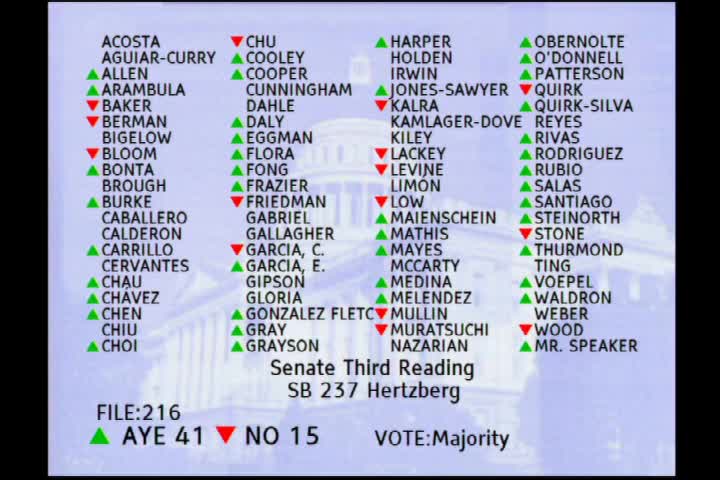 1MIN
Assembly Floor
 10MIN
Assembly Standing Committee on Business and Professions
 4MIN
Senate Floor
 9MIN
Senate Standing Committee on Business, Professions and Economic Development
 8MIN
Senate Standing Committee on Health
Bill Author





