SB 1316: Off-highway vehicular recreation: Carnegie State Vehicular Recreation Area: Alameda-Tesla Expansion Area.
- Session Year: 2017-2018
- House: Senate
- Latest Version Date: 2018-08-06
The Off-Highway Motor Vehicle Recreation Act of 2003 creates the Division of Off-Highway Motor Vehicle Recreation within the Department of Parks and Recreation. The act gives the division certain duties and responsibilities, including the planning, acquisition, development, conservation, and restoration of lands in state vehicular recreation areas. Existing law establishes the Off-Highway Vehicle Trust Fund to be the repository of certain moneys, including fees received by the department for the use of state vehicular recreation areas. Existing law requires the revenues in the fund to be available, upon appropriation, for grants and cooperative agreements, as specified, the support of the division, and the planning, acquisition, development, mitigation, construction, maintenance, administration, operation, restoration, and conservation of lands in state vehicular recreation areas and certain other areas.
This bill would authorize the department to dispose of the portion of the Carnegie State Vehicular Recreation Area known as the Alameda-Tesla Expansion Area to permanently preserve that land for conservation purposes, as specified, if the department determines that disposing of the land is in the public interest. The bill would authorize the Director of General Services to transfer the land to a local agency or nonprofit organization for less than fair market value if the local agency or nonprofit organization agrees to use the land as a park or for another open-space purpose. The bill would require any revenue from the disposition of the land to be deposited in the fund for the purchase of land for off-highway vehicle recreation by the department. require that the land only be sold to a local agency or nonprofit organization for use as a park or another open space purpose, as specified. The bill would require any revenue from the disposition of the land to be deposited in the Off-Highway Vehicle Trust Fund for the purchase, by the department, of land for off-highway vehicle recreation.
The Off-Highway Motor Vehicle Recreation Act of 2003 creates the Division of Off-Highway Motor Vehicle Recreation within the Department of Parks and Recreation. The act gives the division certain duties and responsibilities, including the planning, acquisition, development, conservation, and restoration of lands in state vehicular recreation areas. Existing law establishes the Off-Highway Vehicle Trust Fund to be the repository of certain moneys, including fees received by the department for the use of state vehicular recreation areas. Existing law requires the revenues in the fund to be available, upon appropriation, for grants and cooperative agreements, as specified, the support of the division, and the planning, acquisition, development, mitigation, construction, maintenance, administration, operation, restoration, and conservation of lands in state vehicular recreation areas and certain other areas.
This bill would authorize the department to dispose of the portion of the Carnegie State Vehicular Recreation Area known as the Alameda-Tesla Expansion Area to permanently preserve that land for conservation purposes, as specified, if the department determines that disposing of the land is in the public interest. The bill would authorize the Director of General Services to transfer the land to a local agency or nonprofit organization for less than fair market value if the local agency or nonprofit organization agrees to use the land as a park or for another open-space purpose and would require the property interest to revert from the local agency to the state if the land is used for a different purpose during the 25 years after the transfer date. purpose. The bill would require any revenue from the disposition of the land to be deposited in the fund for the purchase of land for off-highway vehicle recreation by the department.
The Off-Highway Motor Vehicle Recreation Act of 2003 creates the Division of Off-Highway Motor Vehicle Recreation within the Department of Parks and Recreation. The act gives the division certain duties and responsibilities, including the planning, acquisition, development, conservation, and restoration of lands in state vehicular recreation areas. Existing law establishes the Off-Highway Vehicle Trust Fund to be the repository of certain moneys, including fees received by the department for the use of state vehicular recreation areas. Existing law requires the revenues in the fund to be available, upon appropriation, for grants and cooperative agreements, as specified, the support of the division, and the planning, acquisition, development, mitigation, construction, maintenance, administration, operation, restoration, and conservation of lands in state vehicular recreation areas and certain other areas.
This bill would authorize the department to dispose of the portion of the Carnegie State Vehicular Recreation Area known as the Alameda-Tesla Expansion Area to permanently preserve that land for conservation purposes, as specified, if the department determines that disposing of the land is in the public interest. The bill would authorize the Director of General Services to transfer the land to a local agency for less than fair market value if the local agency agrees to use the land as a park or for another open-space purpose and would require the property interest to revert from the local agency to the state if the land is used for a different purpose during the 25 years after the transfer date. The bill would require any revenue from the disposition of the land to be deposited in the fund for the purchase of land for off-highway vehicle recreation by the department.
(a)Notwithstanding Sections 11011 and 11011.1 of the Government Code, the department may dispose of the portion of the Carnegie State Vehicular Recreation Area known as the Alameda-Tesla Expansion Area, which encompasses approximately 3,100 acres in the County of Alameda, to permanently preserve that land for conservation purposes by sale of a perpetual recorded conservation easement deed restriction or fee title, if the department, after holding public hearings on the matter and in consultation with stakeholders, determines that disposing of the land is in the public interest.
(b)(1)If the department determines that disposing of the land is in the public interest, the Department of General Services may sell the land or otherwise dispose of the land pursuant to this authorization upon any terms and conditions and subject to any reservations and exceptions that the Department of General Services deems to be in the best interests of the state.
(2)The Director of General Services may transfer shall sell the land only to a local agency or nonprofit organization for less than fair market value if the local agency or nonprofit organization agrees to use the land as a park or for another open-space purpose. for use as a park or another open-space purpose. The land shall be sold for not less than the fair market value as appraised by the Department of General Services for use as dedicated open space.
(3)The Department of General Services shall sell the land only if the sale of the land and any related transactions will result in at least nine million dollars ($9,000,000) being deposited into the fund.
(3)(4)For purposes of this subdivision, open-space purpose means a use of the lands natural resources that is consistent with a conservation purpose, including preservation of native biological diversity, wildlife habitats, and cultural resources, enjoyment of scenic beauty, and nonmotorized public recreation.
(c)Any revenue from the disposition of the land shall be deposited in the fund for the purchase, by the department, of land for off-highway vehicle recreation.
(a)Notwithstanding Sections 11011 and 11011.1 of the Government Code, the department may dispose of the portion of the Carnegie State Vehicular Recreation Area known as the Alameda-Tesla Expansion Area, which encompasses approximately 3,100 acres in the County of Alameda, to permanently preserve that land for conservation purposes by sale of a perpetual recorded conservation easement deed restriction or fee title, if the department, after holding public hearings on the matter and in consultation with stakeholders, determines that disposing of the land is in the public interest.
(b)(1)If the department determines that disposing of the land is in the public interest, the Department of General Services may sell the land or otherwise dispose of the land pursuant to this authorization upon any terms and conditions and subject to any reservations and exceptions that the Department of General Services deems to be in the best interests of the state.
(2)The Director of General Services may transfer the land to a local agency or nonprofit organization for less than fair market value if the local agency or nonprofit organization agrees to use the land as a park or for another open-space purpose, in which case the deed or other instrument of transfer shall provide that the property interest would revert from the local agency to the state if the land is used for a purpose other than as a park or another open-space purpose during the 25 years after the transfer date. purpose.
(3)For purposes of this subdivision, open-space purpose means a use of the lands natural resources that is consistent with a conservation purpose, including preservation of native biological diversity, wildlife habitats, and cultural resources, enjoyment of scenic beauty, and nonmotorized public recreation.
(c)Any revenue from the disposition of the land shall be deposited in the fund for the purchase, by the department, of land for off-highway vehicle recreation.
(a)Notwithstanding Sections 11011 and 11011.1 of the Government Code, the department may dispose of the portion of the Carnegie State Vehicular Recreation Area known as the Alameda-Tesla Expansion Area, which encompasses approximately 3,100 acres in the County of Alameda, to permanently preserve that land for conservation purposes by sale of a perpetual recorded conservation easement deed restriction or fee title, if the department, after holding public hearings on the matter and in consultation with stakeholders, determines that disposing of the land is in the public interest.
(b)(1)If the department determines that disposing of the land is in the public interest, the Department of General Services may sell the land or otherwise dispose of the land pursuant to this authorization upon any terms and conditions and subject to any reservations and exceptions that the Department of General Services deems to be in the best interests of the state.
(2)The Director of General Services may transfer the land to a local agency for less than fair market value if the local agency agrees to use the land as a park or for another open-space purpose, in which case the deed or other instrument of transfer shall provide that the property interest would revert from the local agency to the state if the land is used for a purpose other than as a park or another open-space purpose during the 25 years after the transfer date.
(3)For purposes of this subdivision, open-space purpose means a use of the lands natural resources that is consistent with a conservation purpose, including preservation of native biological diversity, wildlife habitats, and cultural resources, enjoyment of scenic beauty, and nonmotorized public recreation.
(c)Any revenue from the disposition of the land shall be deposited in the fund for the purchase, by the department, of land for off-highway vehicle recreation.
|
Date
|
Status
|
|---|---|
| Aug 16, 2018 | August 16 hearing: Held in committee and under submission. |
| Aug 8, 2018 | August 8 set for first hearing. Placed on suspense file. |
| Aug 6, 2018 | From committee with author's amendments. Read second time and amended. Re-referred to Com. on APPR. |
| Jun 27, 2018 | From committee: Do pass and re-refer to Com. on APPR. (Ayes 5. Noes 2.) (June 27). Re-referred to Com. on APPR. |
| Jun 26, 2018 | From committee: Do pass and re-refer to Com. on A. & A.R. (Ayes 8. Noes 6.) (June 26). Re-referred to Com. on A. & A.R. |
| Jun 18, 2018 | Assembly Rule 56 suspended. |
| Jun 14, 2018 | Referred to Coms. on W.,P., & W. and A. & A.R. |
| May 31, 2018 | In Assembly. Read first time. Held at Desk. |
| May 30, 2018 | Read third time. Passed. (Ayes 22. Noes 13.) Ordered to the Assembly. |
| May 25, 2018 | From committee: Do pass. (Ayes 5. Noes 2.) (May 25). |
| May 23, 2018 | Set for hearing May 25. |
| May 22, 2018 | May 22 hearing: Placed on APPR. suspense file. |
| May 15, 2018 | Set for hearing May 22. |
| May 14, 2018 | May 14 hearing postponed by committee. |
| May 4, 2018 | Set for hearing May 14. |
| Apr 30, 2018 | Read second time and amended. Re-referred to Com. on APPR. |
| Apr 26, 2018 | From committee: Do pass as amended and re-refer to Com. on APPR. (Ayes 7. Noes 4.) (April 24). |
| Apr 18, 2018 | Set for hearing April 24. |
| Apr 17, 2018 | From committee: Do pass and re-refer to Com. on G.O. (Ayes 6. Noes 2.) (April 16). Re-referred to Com. on G.O. |
| Mar 20, 2018 | Set for hearing April 24. |
| Mar 14, 2018 | Set for hearing April 16. |
| Mar 1, 2018 | Referred to Coms. on N.R. & W. and G.O. |
| Feb 20, 2018 | From printer. May be acted upon on or after March 22. |
| Feb 16, 2018 | Introduced. Read first time. To Com. on RLS. for assignment. To print. |
|
Date
|
Description
|
Location
|
Votes
|
|
|---|---|---|---|---|
| Jun 27, 2018 | Do pass and be re-referred to the Committee on [Appropriations] | Assembly Standing Committee on Accountability and Administrative Review |
Passed |
|
| Jun 26, 2018 | Do pass and be re-referred to the Committee on [Accountability and Administrative Review] | Assembly Standing Committee on Water, Parks, and Wildlife |
Passed |
|
| May 30, 2018 | Senate 3rd Reading SB1316 Glazer et al. | Senate Floor |
Passed |
|
| May 25, 2018 | Do pass | Senate Standing Committee on Appropriations |
Passed |
|
| May 22, 2018 | Placed on suspense file | Senate Standing Committee on Appropriations |
Passed |
|
| Apr 24, 2018 | Do pass as amended, but first amend, and re-refer to the Committee on [Appropriations] | Senate Standing Committee on Governmental Organization |
Passed |
|
| Apr 16, 2018 | Do pass, but first be re-referred to the Committee on [Governmental Organization] | Senate Standing Committee on Natural Resources and Water |
Passed |
This list shows positions taken on this bill by organizations on the date displayed, which is linked to the original source.
Positions by individuals are not included.
|
Organization
|
Position
|
Date
|
|---|---|---|
| Alameda County Board of Supervisors | ** Support | Jun 25, 2018 |
| Alameda County Community Development Agency | ** Support | Apr 23, 2018 |
| Alameda County Resource Conservation District | ** Support | Jun 25, 2018 |
| Alameda Creek Alliance | ** Support | Jun 25, 2018 |
| Altamont Landfill Open Space Committee | ** Support | Jun 25, 2018 |
| American Brotherhood Aimed Towards Education of California | ** Against | Jun 25, 2018 |
| American Motorcyclist Association | ** Against | Apr 23, 2018 |
| American Motorcyclist Association | ** Against | Jun 25, 2018 |
| Audobon California | * Support | Apr 16, 2018 |
| California Academy Of Sciences | * Support | Apr 24, 2018 |
| California Four Wheel Drive Association | * Against | Apr 16, 2018 |
| California Native Plant Society | ** Support | Jun 25, 2018 |
| California Native Plants Society East Bay Chapter | * Support | Apr 24, 2018 |
| California Off Road Vehicle Association | * Against | Apr 16, 2018 |
| California Releaf | ** Support | Jun 25, 2018 |
| california wildlife foundation | ** Support | Jun 25, 2018 |
| Center For Biological Diversity | ** Support | Jun 25, 2018 |
| Citizens Committee to Complete the Refuge | ** Support | Jun 25, 2018 |
| City Of Livermore | ** Support | Jun 25, 2018 |
| District 36 Motorcycle Sports Committee | * Against | Apr 16, 2018 |
| District 36 Motorcycle Sports Committee, Inc. | ** Against | Jun 25, 2018 |
| East Alameda County Ranchers | ** Support | Jun 25, 2018 |
| East Bay Regional Park District | ** Support | Jun 25, 2018 |
| Friends Of Livermore | ** Support | Jun 25, 2018 |
| Friends of Ocotillo Wells | * Against | Apr 16, 2018 |
| Friends of Tesla Park | ** Support | Jun 25, 2018 |
| Friends of the Arroyos | ** Support | Jun 25, 2018 |
| Friends of the Vineyards | * Support | Apr 24, 2018 |
| Friends Of The Vineyards | ** Support | Jun 25, 2018 |
| Garcia and Associates | ** Support | Jun 25, 2018 |
| Granada High School | * Support | Apr 24, 2018 |
| Greenbelt Alliance | ** Support | Jun 25, 2018 |
| Hill Hikers of Livermore | ** Support | Jun 25, 2018 |
| Hill Hikers Of Livermore Organization | ** Support | Jun 22, 2018 |
| Imperial Sand Dunes Advisory Council | * Against | Apr 16, 2018 |
| Las Positas College | * Support | Apr 24, 2018 |
| Livermore Area Recreation And Park District | ** Support | Jun 25, 2018 |
| Livermore Heritage Guild | ** Support | Jun 25, 2018 |
| Mount Diablo Audubon Society | ** Support | Jun 25, 2018 |
| Mt. Diablo Audubon Society | ** Support | May 26, 2018 |
| National Audubon Society - Mount Diablo Chapter | ** Support | Jun 22, 2018 |
| National Audubon Society - San Joaquin Chapter | ** Support | Jun 22, 2018 |
| Nature Conservancy | ** Support | Jun 25, 2018 |
| Nototomne Cultural Preservation | ** Support | Jun 25, 2018 |
| Off Road Vehicle Legislative Coalition | ** Against | Jun 25, 2018 |
| Ohlone Audubon Society | ** Support | Jun 25, 2018 |
| Racers Under the Son | * Against | Apr 16, 2018 |
| Regional Parks Association | ** Support | Jun 25, 2018 |
| San Diego Off Road Coalition | * Against | Apr 16, 2018 |
| San Joaquin Audubon Society | ** Support | Jun 25, 2018 |
| San Joaquin Chapter Of National Audubon Society | ** Support | Apr 23, 2018 |
| Save Mount Diablo | ** Support | Jun 25, 2018 |
| Save The Frogs | ** Support | May 26, 2018 |
| Save the Frogs! | ** Support | Jun 25, 2018 |
| Sierra Club California | ** Support | Jun 25, 2018 |
| Society of American Indians | ** Support | Jun 22, 2018 |
| Society of American Indians | * Support | Apr 24, 2018 |
| Society Of American Indians, Livermore | ** Support | Jun 25, 2018 |
| SPRAWLDEF | ** Support | Jun 25, 2018 |
| Sustainability, Parks, Recycling and Wildlife Legal Defense Fund | * Support | Apr 16, 2018 |
| Tesla Road Residents Alliance | ** Support | Jun 25, 2018 |
| The Hill Hikers Of Livermore | ** Support | May 26, 2018 |
| Tri-Valley Conservancy | ** Support | Jun 25, 2018 |
| Tri-Valley Trailblazers | * Support | Apr 24, 2018 |
| Tri-Valley Trailblazers | ** Support | Jun 25, 2018 |
| Tri-Valley Trailblazers Club | ** Support | Apr 23, 2018 |
| Tri-Valley Trailblazers Club, Inc. | ** Support | Jun 22, 2018 |
| Trust for Public Land | ** Support | Jun 25, 2018 |
| Two individuals | ** Support | May 26, 2018 |
| United Four Wheel Drive Associations | * Against | Apr 16, 2018 |
Date of Hearing: August 8, 2018
ASSEMBLY COMMITTEE ON APPROPRIATIONS
Lorena Gonzalez Fletcher, Chair
SBPCA Bill Id:SB 1316
Author:(Glazer) – As Amended Ver:August 6, 2018
Policy Committee: | Water, Parks and Wildlife | Vote: | 8 - 6 |
Accountability and Administrative Review | 5 - 2 | ||
|
|
Urgency: No State Mandated Local Program: No Reimbursable: No
SUMMARY:
This bill authorizes the Department of Parks and Recreation (DPR) to dispose of the Alameda-Tesla Expansion Area (expansion area) of the Carnegie State Vehicular Recreation Area (SVRA). Specifically, this bill:
- Allows DPR to dispose of the 3,100-acres known as the expansion area to permanently preserve the land for conservation purposes, if DPR determines that disposing of it is in the public interest, after holding public meetings and consulting with stakeholders.
- Authorizes the Department of General Services (DGS), if DPR makes the public interest determination required above, to sell the expansion area or otherwise dispose of the land upon any terms and conditions and subject to any reservations and exceptions DGS deems to be in the best interests of the state.
- Requires DGS to sell the expansion area only to a local agency or nonprofit organization for use as a park or another open space purpose, as defined.
- Requires the expansion area to be sold for not less than fair market value as appraised by DGS for use as dedicated open space.
- Requires DGS to sell the expansion area only if the sale of the land and any related transactions results in at least $9 million being deposited in the Off-Highway Vehicle Trust Fund (OHV Fund).
- Requires any revenue from the disposition of the expansion area to be deposited in the OHV fund for the purchase of land for OHV recreation.
FISCAL EFFECT:
- Unknown, potentially significant foregone revenues from the sale of the property resulting from the difference between fair market value and the sale price of $9 million or more (OHV Fund).
- One-time DPR costs of approximately $40,000 to conduct up to four public hearings to consider whether disposing of the property is in the public interest. (OHV Fund)
- Unknown, potentially significant costs for DPR to amend the SVRA general plan to reflect the sale of the expansion area (OHV Fund).
- One-time DGS costs of approximately $50,000 to $60,000 for staff time related to the sale of the property. These costs would be passed on to DPR. (OHV Fund)
COMMENTS:
- Purpose. According to the author:
Not only is the Alameda-Tesla Expansion Area rich with biological and cultural resources, but this planned expansion has been litigated for almost 20 years. My bill, SB 1316 would simply allow State Parks to sell the portion of the Carnegie SVRA known as the Alameda Tesla Expansion for conversation purposes, if State Parks determines that disposing of that land is in the public interest.
- Background. Carnegie SVRA became a state SVRA in 1980 with approximately 1,500 acres available for OHV recreation. Between 1996 and 2000, DPR executed seven acquisitions of approximately 3,100 acres of land adjacent to the Carnegie SVRA with the intention of expanding the park for OHV purposes. The total cost of the seven acquisitions is approximately $9 million, expended out of the OHV Fund.
This planned expansion is highly contentious. The development of the property has been litigated for almost 20 years, with three cases currently pending. The current litigations challenge the adoption of the SVRA’s 2016 General Plan and associated environmental impact report (EIR), which found 70% of the land within the expansion area to be developable for OHV purposes. The plaintiff’s argue that the property contains sensitive and natural resources that must be protected. Recent mediation with the three opposing parties was unsuccessful, and DPR notes a judgement is anticipated sometime in 2019.
Last year, 16 legislators from the Bay Area petitioned DPR to consider disposing of the property. In response to a letter from the author, the Director of DPR noted that disposal of this property does not comply with current statutory criteria regarding disposal of surplus land.
This bill was introduced to provide DPR with a mechanism to lawfully dispose of this property if doing so is deemed in the public interest.
- Recent Amendments. After passing the Water, Parks and Wildlife and Accountability and Administrative Review committees, this bill was amended to address concerns raised by several committee members. Specifically, this bill now prohibits DGS from selling the property if proceeds from the sale are less than the price DPR paid for the expansion area ($9 million). The current version of the bill ensures the OHV fund will be paid back the same amount spent. However, because the property was purchased between 1996 and 2000, with property value increases and inflation, it is unclear if the OHV fund is truly being kept whole with this amendment.
Analysis Prepared by: Jennifer Galehouse / APPR. / (916) 319-2081
Date of Hearing: June 27, 2018
ASSEMBLY COMMITTEE ON ACCOUNTABILITY AND ADMINISTRATIVE REVIEW
Susan Talamantes Eggman, Chair
SBPCA Bill Id:SB 1316
Author:(Glazer) – As Amended Ver:April 30, 2018
SENATE VOTE: 24-13
SUBJECT: Off-highway vehicular recreation: Carnegie State Vehicular Recreation Area: Alameda-Tesla Expansion Area
SUMMARY: Permits the Department of Parks and Recreation (DPR) to dispose of a portion of the Carnegie State Vehicular Recreation Area (SVRA) known as the Alameda-Tesla Expansion Area (Expansion Area), if specified conditions are met. Specifically, this bill:
- Allows DPR to dispose of the 3,100-acres known as the Expansion Area and to permanently preserve the land for conservation purposes, if DPR determines that disposing of it is in the public interest, as specified.
- Provides that DPR may dispose of the Expansion Area without following requirements in existing law that apply to the sale of state-owned surplus property.
- Permits the Department of General Services (DGS), if DPR makes the public interest determination required above, to sell the Expansion Area or otherwise dispose of the land upon any terms and conditions and subject to any reservations and exceptions DGS deems to be in the best interests of the state.
- Authorizes DGS to transfer the Expansion Area to a local agency or nonprofit organization for less than fair market value if the entity agrees to use the land as a park or for another open-space purpose.
- Defines "open-space" for purposes of this bill.
- Requires any revenue from the disposition of the Expansion Area to be deposited in the Off-Highway Vehicle Trust Fund (OHV Fund) for the purchase, by DPR, of land for OHV recreation.
EXISTING LAW:
- Creates the Division of Off-Highway Motor Vehicle Recreation within DPR to provide planning, acquisition, development, conservation, and restoration of lands in SVRAs.
- Establishes the OHV Fund to be the repository of certain moneys, including fees received by DPR for the use of OHV recreation in SVRAs.
- Establishes a process administered by DGS for the disposal of state-owned property that has been declared surplus to an agency's needs.
FISCAL EFFECT: According to the Senate Appropriations Committee:
- One-time costs to DGS of approximately $50,000 to $60,000 for staff time related to the sale of the property. These costs would be passed on to DPR. (OHV Fund)
- One-time costs to DPR of approximately $40,000 to conduct up to four public hearings to consider whether disposing of the property is in the public interest. (OHV Fund)
- Unknown, potentially significant foregone revenues related to the sale of the Expansion Area portion of the Carnegie SVRA, to the extent the property is sold for less than fair market value for use as a permanent land conservation purpose, as specified. In addition, while the bill requires proceeds of the sale to be deposited into the OHV Fund, it is unclear whether the property would be sold at a price that would fully repay the fund for the original purchase price. (OHV Fund)
COMMENTS: This bill authorizes, but does not require, DPR to dispose of the 3,100-acre Expansion Area in the Carnegie SVRA and to permanently preserve the land for conservation purposes. The Carnegie SVRA is located in both San Joaquin and Alameda counties. The 3,100 acres that are the subject of this bill lie entirely in Alameda County.
This bill allows DPR to dispose of the Expansion Area if certain conditions are met. Specifically, DPR must determine that the sale of the Expansion Area is in the public interest after holding public hearings and consulting with stakeholders, and DGS must deem it to be in the best interests of the state. DGS would then be authorized to transfer the property to a local agency or nonprofit organization at below fair market value if the entity agrees to use it as a park or for another open-space purpose.
DPR reports that, to date, none of the Expansion Area is, or ever has been, open to the public for any purpose. In October 2016, the Department approved the General Plan (GP) for the entire Carnegie SVRA after a comprehensive public input process that began in February 2012. The GP includes DPR's current and proposed uses for the Expansion Area. It states that DPR has used comprehensive mapping criteria to determine that 2,000 acres of the Expansion Area are appropriate for OHV use while the remaining 1,100 acres have been identified by DPR as unsuitable for OHV recreation due to the presence of sensitive cultural and natural resources. DPR's uses for the Expansion Area as described in the GP appear to conflict with the approach that would be allowed under this bill.
Although permissive in nature, this bill creates an alternative process for disposing of state-owned land for a specific purpose when the affected agency identifies an existing use for it. Current law generally provides for the disposal of state-owned property when the affected agency declares it surplus to the agency's needs. Under current law, the property is then transferred to DGS, which is required to determine if the property is needed by any other state agency. If it does not have state agency re-use, the property must then be offered to local agencies, then to nonprofit affordable housing sponsors, prior to being offered for sale to private entities or individuals. A similar vetting process does not exist in this bill and it could establish a potentially troubling precedent for disposing of state-owned land that agencies currently utilize for existing program needs.
DPR purchased the Expansion Area using money from the OHV Fund. According to existing law in the Public Resources Code, the money from this fund is required to be used to support DPR in carrying out its OHV program and for activities that support conserving and restoring land in the SVRA system. If all of the conditions in this bill are met, the entire 3,100 acres of the property would be designated for open-space and parks purposes unrelated to OHV recreation.
DOUBLE-REFERRAL: This bill is double-referred. It is scheduled to be heard first in the Assembly Water, Parks, and Wildlife Committee on June 26, 2018.
REGISTERED SUPPORT / OPPOSITION:
Support
Alameda County Board of Supervisors
Alameda County Resource Conservation District
Alameda Creek Alliance
Altamont Landfill Open Space Committee
California ReLeaf
California Native Plant Society
California Wildlife Foundation
Center for Biological Diversity
Citizens Committee to Complete the Refuge
City of Livermore
East Alameda County Ranchers
East Bay Regional Park District
Friends of Livermore
Friends of Tesla Park
Friends of the Arroyos
Friends of the Vineyards
Garcia and Associates
Greenbelt Alliance
Hill Hikers of Livermore
Livermore Area Recreation and Park District
Livermore Heritage Guild
Mount Diablo Audubon Society
Nature Conservancy
Nototomne Cultural Preservation
Ohlone Audubon Society
Regional Parks Association
San Joaquin Audubon Society
Save Mount Diablo
Save the Frogs!
Sierra Club California
Society of American Indians, Livermore
SPRAWLDEF
Tesla Road Residents Alliance
Tri-Valley Conservancy
Tri-Valley Trailblazers
Trust for Public Land
Opposition
American Brotherhood Aimed Towards Education of California
American Motorcyclist Association
District 36 Motorcycle Sports Committee, Inc.
Off Road Vehicle Legislative Coalition
Analysis Prepared by: Cassie Royce / A. & A.R. / (916) 319-3600
Date of Hearing: June 26, 2018
ASSEMBLY COMMITTEE ON WATER, PARKS, AND WILDLIFE
Eduardo Garcia, Chair
SBPCA Bill Id:SB 1316
Author:(Glazer) – As Amended Ver:April 30, 2018
SENATE VOTE: 24-13
SUBJECT: Off-highway vehicular recreation: Carnegie State Vehicular Recreation Area: Alameda-Tesla Expansion Area
SUMMARY: This bill would authorize, but not require, the sale of a state property should it be determined to be in the public interest. Specifically, this bill:
- Authorizes the Department of Parks and Recreation (State Parks) to dispose of the portion of the Carnegie State Vehicular Recreation Area (SVRA) known as the “Alameda-Tesla Expansion Area,” to permanently preserve that land for conservation purposes, if State Parks, after holding public hearings and consultations with stakeholders, determines that disposing of the land is in the public interest.
- Authorizes the Department of General Services (DGS), if State Parks determines that disposing of the land is in the public interest, to sell the land or otherwise dispose of the land upon any terms and conditions and subject to any reservations and exceptions DGS deems to be in the best interests of the state.
- Authorizes DGS to transfer the land to a local agency for less than fair market value if the local agency agrees to use the land as a park or for another open-space purpose, as specified.
- Defines “open space” to mean use of the land’s natural resources that is consistent with a conservation purpose, including preservation of native biological diversity, wildlife habitats, and cultural resources, enjoyment of scenic beauty, and non-motorized public recreation.
- Requires any revenue from the disposition of the land to be deposited in the Off-Highwya Vehicle (OHV) Fund for the purchase, by State Parks, of land for off-highway vehicle recreation.
EXISTING LAW:
- Creates, through the Off-Highway Motor Vehicle Recreation Act of 2003 (Act), the Division of Off-Highway Motor Vehicle Recreation (division) within State Parks. The division plans and acquires lands in state vehicular recreation areas (SVRA) which are units within the state park system.
- Creates the Off-Highway Vehicle Trust Fund (Fund) as a repository for certain transportation related revenues, which includes revenues for various purposes related to off-highway vehicles. The Fund is also used to support the division and to conduct its other activities including the acquisition, development, conservation and restoration of lands within state vehicular recreation areas (SVRA).
- Declares public safety, the appropriate use of lands, and the conservation of lands as the highest priorities for management of SVRAs.
- Provides a mechanism in the Government Code (beginning at Sec. 11011) for the disposal of surplus lands that are administered by the Department of General Services (DGS), including any surplus lands owned by State Parks.
FISCAL EFFECT: Unknown
COMMENTS: This bill would authorize, but not require, the sale of a state property should it be determined to be in the public interest.
Author’s Statement:
Not only is the Alameda-Tesla Expansion Area rich with biological and cultural resources, but this planned expansion has been litigated for almost 20 years. My bill, SB 1316 would simply allow State Parks to sell the portion of the Carnegie SVRA known as the Alameda Tesla Expansion for conversation purposes, if State Parks determines that disposing of that land is in the public interest.
Background: In 1971, the Off-Highway Motor Vehicle Recreation Program was established to manage off-highway vehicle recreation in a manner that ensures the public has access to this form of recreation while also protecting California’s natural and cultural resources. The program is administered as a division (OHV division) within State Parks. The OHV division manages 9 State Vehicle Recreation Areas (SVRAs) and provides state funding support for non-state off-highway vehicle (OHV) facilities through a grants program. The OHV division is aided in implementing the program by a nine member Off-Highway Motor Vehicle Recreation Commission, which is appointed jointly by the Governor, the Senate and the Assembly.
The program is funded by fees collected from users of SVRAs, vehicle registration fees, and fuel taxes associated with off-highway motor vehicle recreation. These funds are deposited into the Off-Highway Vehicle Trust Fund. Upon appropriation by the Legislature, up to 50% of the fund may be used for a grants program and the remaining is generally available to the division for implementing the program and managing SVRAs.
History of the Property. Carnegie SVRA was added to the State Park system as an SVRA in July 1980. The park is named for the former town of Carnegie which was a mining and brick-making town at the turn of the 20th century. The site was operated as a private motorcycle park from 1970 until 1979, before the department purchased it using OHV Trust Funds. Legislative action (PRC Section 5006.48) authorized the State Parks to plan, acquire, and develop the site for OHV use. From 1996 to 1998, State Parks used OHV Funds to acquire an additional 3,100 acres of adjacent property in Alameda County to provide additional OHV recreation opportunities. This additional acreage is known as the “Alameda-Tesla Expansion Area.” The expansion was classified as SVRA lands and added to Carnegie SVRA. An acquisition Environmental Impact Report (EIR) was not conducted prior to the purchase of the Alameda-Tesla Expansion Area.
Acquiring the Expansion and Updating the General Plan. The OHV division has traditionally approved the statutorily-required general plans that guide the management of state properties. In 2016, after two prior EIRs, the commission approved a General Plan and certified the EIR which incorporated the Alameda-Tesla Expansion Area into the Carnegie SVRA General Plan.
Several issues were raised during the General Plan for which State Parks issued statements of overriding consideration. These included air quality issues, traffic, historic sites, tribal issues and others. Several lawsuits have been filed against the expansion including from the County of Alameda challenging the CEQA approvals. These have not been resolved.
Legislators Request State Parks Consider Sale. On July 20, 2017, a coalition of 16 local legislators (Senate and Assembly) wrote to the Director of State Parks encouraging the department to work with local stakeholders to explore the option of selling the land set aside for expansion. The letter discusses the “protracted and expensive process, with more than $9 million in acquisition costs—plus the expense of the EIR. With four lawsuits challenging the EIR, additional legal costs will likely add hundreds of thousands of dollars to this bill.”
The letter acknowledged that circumstances may have changed in the 20 years since the purchase and that a greater understanding of the historic and preservation values of the land may be now known. They list a number of reasons to recapture the project costs of the acquisition (by negotiating with a willing seller to acquire the property for conservation), most of which were outlined in the acquisition EIR including that scientific studies have long documented the rare ecological value of the area which contains an abundance of highly sensitive natural resources, including native biological diversity, a critical linkage habitat corridor, unique vegetation assemblages and wildlife habitats. The area also holds important cultural resources from the historic Tesla town site and mine complex to exceptional historic Californian features.
The Director of State Parks responded to this letter stating, “the Expansion Area at Carnegie SVRA does not meet the statutory criteria to be considered surplus property and therefore transferred to the Department of General Services.” The letter discusses the process for development of the General Plan and EIR for Carnegie SVRA, and the public process used to get to this point. However, the State Parks director states, “While the General Plan and EIR are important milestones for Carnegie SVRA, they are not the final planning documents for the park. There will be additional opportunities for public comment as the Department complies with the CEQA process to develop road and trail plans for this property.”
In her response, the State Parks director specifically references Government Code §11011 which articulates the circumstances under which a state agency may request divestiture of state surplus property and the process the agency must follow when making this request. Significant criteria are as follows:
1) Land not currently being utilized, or currently being underutilized, by the state agency for any existing or ongoing state program.
2) Land for which the state agency has not identified any specific utilization relative to future programmatic needs.
3) Land not identified by a state agency within its master plans for facility development.
Local Government Opposition to Expansion. In addition to communication from the legislators regarding the expansion, the County of Alameda Board of Supervisors voted in 2015 unanimously to oppose the expansion of Carnegie. They cite a conflict with the county’s policies relative to environment and natural habitats. The board is one of several groups suing to stop the expansion of the park.
Necessity of the Bill. Does this Bill Require the Sale of Carnegie? This bill would allow (not mandate) the sale of the Alameda-Tesla expansion for conservation purposes if State Parks determines that disposing of the land is in the public interest.
Prior and Related Legislation: SB 249 (Allen) Chapter 459, Statutes of 2017, extended, indefinitely, the OHV Program and made various other changes to the Off-Highway Motor Vehicle Recreation Act.
Double Referral: Various laws have authorized the DGS to dispose of specified surplus state property. These will be discussed in greater detail upon referral to the Assembly Accountability and Administrative Review Committee.
Arguments in Support: Those in support of the bill argue that this is a local measure affecting highly sensitive natural and cultural resources located in Alameda County (where the expansion area is located). They argue that local opposition has been strong for nearly 20 years, in which time scientific studies have long documented a variety of ecological and cultural resources that would not be conducive to OHV use. In addition to the local agencies supporting the bill, other local agencies note the availability of funds from a local open space committee for the purchase of the property.
Arguments in Opposition: Those in opposition argue that this area of the state is long overdue for increased motorized recreation opportunities and that the purchase of this land using OHV funds necessitates its use as a motorized park. Others argue that this property should be managed at the state level regardless of local considerations.
REGISTERED SUPPORT / OPPOSITION:
Support
Alameda County Board of Supervisors
Alameda County Resource Conservation District
Alameda Creek Alliance
Altamont Landfill Open Space Committee
California Native Plant Society
California Wildlife Foundation
Center for Biological Diversity
Citizens Committee to Complete the Refuge
City of Livermore
East Alameda County Ranchers
East Bay Regional Park District
Friends of Livermore
Friends of Tesla Park
Friends of the Arroyos
Friends of the Vineyards
Greenbelt Alliance
Hill Hikers of Livermore Organization
Livermore Area Recreation and Park District
Livermore Heritage Guild
National Audubon Society - Mount Diablo Chapter
National Audubon Society - San Joaquin Chapter
Nature Conservancy, The
Nototomne Cultural Preservation
Ohlone Audubon Society, Inc.
Regional Parks Association
Save Mount Diablo
SAVE THE FROGS!
Sierra Club California
Society of American Indians
Tesla Road Residents Alliance
Tri-Valley Conservancy
Tri-Valley Trailblazers Club, Inc.
Opposition
ABATE of California, Inc.
American Motorcyclist Association
District 36 Motorcycle Sports Committee, Inc.
Off Road Vehicle Legislative Coalition
Analysis Prepared by: Catherine Freeman / W., P., & W. / (916) 319-2096
Office of Senate Floor Analyses (916) 651-1520 Fax: (916) 327-4478 | SB |
THIRD READING
Bill No: SB 1316
:
SENATE NATURAL RES. & WATER COMMITTEE: 6-2, 4/16/18
AYES: Hertzberg, Allen, Jackson, McGuire, Monning, Stern
NOES: Stone, Vidak
NO VOTE RECORDED: Hueso
SENATE GOVERNMENTAL ORG. COMMITTEE: 7-4, 4/24/18
AYES: Dodd, Bradford, Galgiani, Glazer, Hill, Lara, Portantino
NOES: Wilk, Cannella, Gaines, Vidak
NO VOTE RECORDED: Hueso
SENATE APPROPRIATIONS COMMITTEE: 5-2, 5/25/18
AYES: Lara, Beall, Bradford, Hill, Wiener
NOES: Bates, Nielsen
DIGEST:
This bill establishes a process for the sale of land to a public agency or nonprofit group that was purchased by the Department of Parks (DPR) to expand an off-highway vehicle area in Alameda County.
Existing law:
- Creates the Off Highway Motor Vehicle Division (OHMVD) within DPR.
- Requires the OHMVD to provide for planning, management, law enforcement, and environmental compliance at state vehicular recreation areas (SVRA). The OHMVD has traditionally approved the statutorily-required general plans that guide the management of state vehicular recreation areas.
- Recognizes the Carnegie Off Highway State Vehicular Recreation Area in Alameda County with more than 1500 acres available for off highway recreation. The park is named for the former town of Carnegie which was a mining and brick-making town at the turn of the 20th century. Mining remnants remain at this location. Carnegie State Vehicular Recreation Area (CSVRA) became a state SVRA in 1980.
- Recognizes, that over the course of several years, DPR purchased 3100 acres in 7 acquisitions adjacent to the Carnegie State Vehicular Recreation Area in Alameda County, potentially tripling the size of the SVRA. These are known as the Tesla Expansion area. The total price for these acquisitions totaled $8,963,000.00. The money came from the OHMVD funds.
- Recognizes the approval on 10/21/16 of the general plan for the expansion of the CSVRA in Alameda County.
- Recognizes ongoing litigation (three cases from local governments and conservation groups) challenging various aspects of the approval of the general plan that is in its early stages with an unclear timeline for resolution.
- Provides a mechanism in the Government Code (beginning at Sec. 11011) for the disposal of surplus lands that are administered by the Department of General Services (DGS), including any surplus lands owned by DPR.
This bill:
- Authorizes but does not require DPR, using the Department of General Services procedures, to sell the Alameda-Tesla Expansion Area that was purchased to expand Carnegie Off-Highway State Vehicular Recreation Area in Alameda County.
- Permits DGS to transfer the land for less than fair market value provided the land is used as a park or for open space, and defines “open space purpose.”
- Funds from a sale of the land would be deposited in the Off Highway Recreational Vehicle Fund for purposes of obtaining other suitable land for off-highway vehicle recreation.
FISCAL EFFECT: Appropriation: Fiscal Com.: Local:
According to the Senate Appropriations Committee, one-time costs to the Department of General Services (DGS) of approximately $50,000 to $60,000 for staff time related to the sale of the property. These costs would be passed on to DPR. (Off-Highway Vehicle Trust Fund). One-time costs to DPR of approximately $40,000 to conduct up to four public hearings to consider whether disposing of the property is in the public interest. (Off-Highway Vehicle Trust Fund) Unknown, potentially significant foregone revenues related to the sale of the Alameda-Tesla Expansion Area portion of the Carnegie SVRA, to the extent the property is sold for less than fair market value for use as a permanent land conservation purpose, as specified. In addition, while the bill requires proceeds of the sale to be deposited into the OHV Fund, it is unclear whether the property would be sold at a price that would fully repay the fund for the original purchase price. (Off-Highway Vehicle Trust Fund)
Alameda County Board of Supervisors
Alameda County Resource Conservation District
Alameda Creek Alliance
Altamont Landfill Open Space Committee
California Native Plant Society
California Wildlife Foundation
Center for Biological Diversity
Citizens Committee to Complete the Refuge
City of Livermore
East Alameda County Ranchers
East Bay Regional Park District
Friends of Livermore
Friends of Tesla Park
Friends of the Arroyos
Friends of the Vineyards
Greenbelt Alliance
Livermore Area Recreation and Park District
Livermore Heritage Guild
Mt. Diablo Audubon Society
National Audubon Society – San Joaquin Chapter
Nototomne Cultural Preservation
Ohlone Audubon Society, Inc.
Regional Parks Association
Save Mount Diablo
Save the Frogs
Sierra Club California
Society of American Indians
Tesla Road Residents Alliance
The Hill Hikers of Livermore
The Nature Conservancy
Tri-Valley Trailblazers Club, Inc.
Two individuals
OPPOSITION: (Verified 5/25/18)
Off-Road Vehicle Legislative Coalition
ARGUMENTS IN SUPPORT: The author and the supporters of the bill share the following points:
- They contend that a purchase of the property for a conservation purpose would end the litigation brought by those opposed to the expansion of the OHV park.
- Conservation and Native American groups argue that the site contains important and irreplaceable biological and cultural resources. On this point, they are supported by a letter from nearly 30 scientists who indicate that this particular location is a biological hotspot with rare ecological value. Their letter says there are 42 special status wildlife species including 8 federal or state species listed as endangered or threatened, 28 locally rare plant species, designated critical habitat for the California red-legged frog and Alameda whipsnake, an East Bay priority protection area of the California Native Plant Society, as well as a historic town and mining site (Tesla), and Native Californian sites of archeological and ceremonial importance.
- Many supporters oppose this form of recreation in a sensitive environment with its attendant noise, soil erosion, and other adverse environmental impacts.
ARGUMENTS IN OPPOSITION: The Off-Road Vehicle Legislative Coalition opposes the measure and makes several points including that the bill would deny opportunities for motorized recreation, that the land was purchased using funds from the Off Highway Vehicle Trust Fund, that there was no opposition to the purchase, and that the land has been ably managed by the OHMVD. This group also noted that legislation last year (SB 249, Allen) imposed additional environmental criteria on the operations of state OHV parks that exceed those required by any local government who may obtain this property under the bill. It states that the park will be accessible by a wide variety of people and if the park is sold that widespread public access may not be provided.
5/26/18 16:50:25
**** END ****
SENATE COMMITTEE ON APPROPRIATIONS
Senator Ricardo Lara, Chair
2017 - 2018 Regular Session
SB 1316 (Glazer) - Off-highway vehicular recreation: Carnegie State Vehicular Recreation Area: Alameda-Tesla Expansion Area
Version: April 30, 2018 | Policy Vote: N.R. & W. 6 - 2, G.O. 7 - 4 |
Urgency: No | Mandate: No |
Hearing Date: May 22, 2018 | Consultant: Mark McKenzie |
This bill meets the criteria for referral to the Suspense File.
Bill Summary:
SB 1316 would authorize the Department of Parks and Recreation (DPR) to dispose of a specified portion of the Carnegie State Vehicular Recreation Area (SVRA) to permanently preserve the land for conservation purposes. The sale of the property must be found to be in the public interest, and deemed to be in the best interests of the state, as specified, and the property may be transferred to a local agency or nonprofit organization at less than fair market value if the land is used as a park or other open-space purpose.
Fiscal Impact:
- One-time costs to the Department of General Services (DGS) of approximately $50,000 to $60,000 for staff time related to the sale of the property. These costs would be passed on to DPR. (Off-Highway Vehicle Trust Fund)
- One-time costs to DPR of approximately $40,000 to conduct up to four public hearings to consider whether disposing of the property is in the public interest. (Off-Highway Vehicle Trust Fund)
- Unknown, potentially significant foregone revenues related to the sale of the Alameda-Tesla Expansion Area portion of the Carnegie SVRA, to the extent the property is sold for less than fair market value for use as a permanent land conservation purpose, as specified. In addition, while the bill requires proceeds of the sale to be deposited into the OHV Fund, it is unclear whether the property would be sold at a price that would fully repay the fund for the original purchase price. (Off-Highway Vehicle Trust Fund)
Background:
Existing law authorizes DGS to dispose of state real property declared surplus by the Legislature by sale, lease, exchange, or any other manner, and upon terms deemed to be in the state’s best interests. If surplus property is not needed by any other state agency, it must first be offered to local agencies, then to nonprofit affordable housing sponsors, prior to being offered for sale to private entities or individuals. DGS is generally required to sell surplus property at fair market value, except in specified circumstances for affordable housing or parks and open-space purposes. If surplus state property is transferred to a local agency for less than fair market value for parks or open-space purposes, existing law requires the property revert to the state if the property use changes to a non-park or open space purpose within a 25 year period following the property transfer.
Existing law establishes the Division of Off-Highway Motor Vehicle Recreation (OHMVR) within DPR. The OHMVR Division is required to provide planning, acquisition, development, conservation, and restoration of lands in state vehicular recreation areas. Existing law establishes the Off-Highway Vehicle Trust Fund (OHV Fund). Monies deposited into the OHV Fund are generated by user fees associated with OHV recreation, including: fuel taxes from gasoline consumed during off-highway recreation on public lands, OHV registration fees, entrance fees generated at the SVRAs, and interest and miscellaneous income. Revenues in the OHV Fund are available, upon appropriation, for grants and cooperative agreements, as specified.
The Carnegie SVRA is located in Alameda and San Joaquin Counties approximately 60 miles southeast of San Francisco, 12 miles East of Livermore, and 12 miles southwest of Tracy. The Carnegie SVRA became a unit of the State park system in July 1980. The original 1,575 acre site, which had been used by off-highway vehicles (OHVs) since the 1940s, was operated as a private motorcycle park from 1970-1979 before being purchased by DPR using OHV funds.
Legislative Action authorized DPR to plan, acquire, and develop the site for OHV use. Over the course of several years, DPR purchased 3,100 acres adjacent to the Carnegie SVRA in Alameda County in seven acquisitions for $8,963,000 using money from the OHV Fund. The additional land was classified as SVRA lands and added to Carnegie SVRA. This additional land is known as the “Alameda-Tesla Expansion Area.”
This expansion has been controversial and opposed by both the local government and conservation groups, but supported by OHV users. It has received considerable input from OHV user groups, adjacent landowners and a variety of regulatory agencies. The expansion property also contains sensitive cultural and natural resources. As such, it took the OHMVR Division nearly three attempts and almost 20 years to finally certify its EIR and adopt a general plan by October of 2016. This action has been challenged in three separate lawsuits that have yet to be decided.
Proposed Law:
SB 1316 would authorize DPR to dispose of the Alameda-Tesla Expansion area to permanently preserve the land for conservation purposes, if it determines that disposing of the land is in the public interest, and DGS specifies terms and conditions that are deemed to be in the best interests of the state. Specifically, this bill would:
- Authorize DPR to dispose of the property without following procedures and requirements in existing law that apply to the sale of state-owned surplus property.
- Authorize DPR to permanently preserve the land for conservation purposes by sale of a perpetual recorded conservation easement deed restriction or fee title, if it determines that disposing of the land is in the public interest after holding public hearings and consulting with stakeholders.
- Authorize DGS, if DPR determines that disposing of the land is in the public interest, to sell the land or otherwise dispose of the land upon any terms and conditions and subject to any reservations and exceptions DGS deems to be in the best interests of the state.
- Authorize DGS to transfer the land to a local agency or nonprofit organization for less than fair market value if the entity agrees to use the land as a park or for another open-space purpose, as specified.
- Define “open space purpose” as use of the land’s natural resources that is consistent with a conservation purpose, including preservation of native biological diversity, wildlife habitats, and cultural resources, enjoyment of scenic beauty, and nonmotorized public recreation.
- Require any revenue from the disposition of the land to be deposited in the OHV Fund for the purchase, by DPR, of land for off-highway vehicle recreation.
Staff Comments:
This bill authorizes the sale of the Alameda-Tesla Expansion Area property at less than fair market value if it is transferred to a local agency or nonprofit organization and the land is used as a park or other open-space purpose. The current fair market value is unknown, but to the extent the property is sold for a lower price than would otherwise have been paid through the process specified in existing law for disposing of surplus property, this bill would result in a forgone revenue loss. The magnitude of potential losses is unknown, but likely significant. As noted above, the property acquisition cost was approximately $9 million over 20 years ago. The bill does not require that the property be sold at a cost that would at least make the OHV Fund whole by providing full reimbursement for the initial purchase.
The analysis from the Senate Natural Resources and Water Committee’s notes the following:
In an interesting (but similarly contentious) chapter of Alameda County history, litigation over expansion of the Altamont landfill resulted in a settlement in which a percentage of the tipping fee is allocated as mitigation funds with open space preservation as one defined and eligible option for the use of these funds. The case was settled after the expansion was cut in half and the tipping fees were imposed. Under the settlement, 60 percent of the tipping fees are for open space preservation with another 20 percent for recycling programs, and 20 percent for other community amenities.
The settlement established an entity composed of the county, the cities of Livermore and Pleasanton, and the Sierra Club all of whom were plaintiffs in the case against the landfill. This entity is called the Altamont Landfill Open Space Committee (ALSOC). The percentage of the tipping fee is allocated on an 80%-20% basis between eastern and western Alameda County respectively. The fund for eastern Alameda County (where the SVRA is located) currently contains about $12 million which could be available for the bill’s purposes. ALSOC has voted to support this legislation.
Absent the bill, the state would likely incur additional ongoing litigation costs related to the final disposition of the Alameda-Tesla Expansion Area.
-- END --
SENATE COMMITTEE ON GOVERNMENTAL ORGANIZATION
Senator Bill Dodd
Chair
2017 - 2018 Regular
Bill No: SB Hearing Date: 4/24/18
Author: | Glazer, et al. | ||
Version: | Introduced | ||
Urgency: | Fiscal: | ||
Consultant: | |||
SUBJECT:
DIGEST: This bill authorizes the Department of Parks and Recreation (DPR) to dispose of the Carnegie State Vehicular Recreation Area (SVRA) known as the “Alameda-Tesla Expansion Area,” to permanently preserve the land for conservation purposes, if DPR determines that disposing of the land is in the public interest. Additionally, the bill would authorize the Department of General Services (DGS) to transfer the land to a local agency for less than fair market value if the local agency agrees to use the land as a park or for another open-space purpose, as defined.
ANALYSIS:
Existing law:
- Creates the Division of Off-Highway Motor Vehicle Recreation (OHMVR Division) within DPR.
- Requires the OHMVR Division to provide planning, acquisition, development, conservation, and restoration of lands in state vehicular recreation areas.
- Establishes the Off-Highway Vehicle Trust Fund (OHV Fund) to be the repository of certain moneys, including fees received by DPR for the use of state vehicular recreation areas.
- Requires revenues in the OHV Fund to be available, upon appropriation, for grants and cooperative agreements, as specified.
This bill:
- Authorizes DPR to dispose of the portion of the Carnegie SVRA known as the “Alameda-Tesla Expansion Area,” to permanently preserve that land for conservation purposes, if DPR, after holding public hearings and consultations with stakeholders, determines that disposing of the land is in the public interest.
- Authorizes DGS, if DPR determines that disposing of the land is in the public interest, to sell the land or otherwise dispose of the land upon any terms and conditions and subject to any reservations and exceptions DGS deems to be in the best interests of the State.
- Authorizes DGS to transfer the land to a local agency for less than fair market value if the local agency agrees to use the land as a park or for another open-space purpose, as specified.
- Defines “open space” to mean use of the land’s natural resources that is consistent with a conservation purpose, including preservation of native biological diversity, wildlife habitats, and cultural resources, enjoyment of scenic beauty, and nonmotorized public recreation.
- Requires any revenue from the disposition of the land to be deposited in the OHV Fund for the purchase, by DPR, of land for off-highway vehicle recreation.
Background
Purpose of the bill. According to the author’s office, “not only is the Alameda-Tesla Expansion Area rich with biological and cultural resources, but this planned expansion has been litigated for almost 20 years. My bill, SB 1316 would simply allow DPR to sell the portion of the Carnegie SVRA known as the Alameda Tesla Expansion for conversation purposes, if DPR determines that disposing of that land is in the public interest.”
Carnegie State Vehicular Recreation Area. The Carnegie SVRA is located in Alameda and San Joaquin Counties approximately 60 miles southeast of San Francisco, 12 miles East of Livermore, and 12 miles southwest of Tracy. The Carnegie SVRA became a unit of the State park system in July 1980. The original 1,575 acre site, which had been used by off-highway vehicles (OHVs) since the 1940s, was operated as a private motorcycle park from 1970-1979 before being purchased by DPR using OHV funds.
Legislative Action authorized DPR to plan, acquire, and develop the site for OHV use. Over the course of several years, DPR purchased 3,100 acres adjacent to the Carnegie SVRA in Alameda County for approximately $9 million using money from the OHV Fund. The additional land was classified as SVRA lands and added to Carnegie SVRA. This additional land is known as the “Alameda-Tesla Expansion Area.”
This expansion has been controversial as both the local government and public have opposed the expansion. It has received considerable input from OHV user groups, adjacent landowners and a variety of regulatory agencies. The expansion property also contains sensitive cultural and natural resources. As such, it took the Division nearly three attempts and almost 20 years to finally certify its EIR and adopt a general plan. This action has been challenged in three separate lawsuits that have yet to be decided.
Last year, 16 Bay Area legislators wrote a letter to DPR asking the Director of DPR to consider disposing of the property. The Director replied that such a sale does not comply with the statutory criteria under current law. The Director also commented that the approval of the general plan and the environmental document are necessary steps to expanding the park but that additional project specific planning documents would be required over time, all of which would provide opportunities for public comment.
This bill was then introduced to allow the sale notwithstanding the existing provisions in the Government Code pertaining to the sale of surplus property.
Off-Highway Vehicle Fund. The OHMV Program receives no direct support from the state’s General Fund; all funding comes from the Fund. Monies deposited into the Fund are generated by user fees associated with OHV recreation, including: fuel taxes from gasoline consumed during off-highway recreation on public lands, OHV registration fees, entrance fees generated at the SVRAs, and interest and miscellaneous income.
The funding model for the OHMV Program is based around users funding the program primarily through gas taxes and registration fees, rather than relying on SVRA entrance fees. Entrance fees collected at the SVRAs are kept at a reasonable level to promote OHV enthusiasts use of the managed recreation opportunities, and not create a barrier for low-income visitors.
Author’s amendments. The Author agreed to take the following amendments in committee:
- Add Senate members Galgiani, Hill, Wieckowski, and Wiener as co-authors.
- Add Assembly members Berman, Bonta, Grayson, Kansen Chu, Grayson, Levine, Quirk, and Ting as co-authors.
- On page 2, line 20, add “or nonprofit organization” after “local agency.”
- On page 2, line 21, add period after “purpose” and delete lines 22-25.
These were amendments that were agreed upon in the Senate Committee on Natural Resources and Water. However, due to deadlines, the Author agreed to take them in this committee.
Prior/Related Legislation
SB 922 (Nguyen, 2018) would authorize, until January 1, 2029, DGS to dispose of surplus state property located within two miles of a campus of the University of California (UC), California State University (CSU), or California Community Colleges (CCC) by first offering the property to a local agency or a nonprofit organization for the development of affordable student housing. (Pending in the Senate Governmental Organization Committee)
SB 249 (Allen, Chapter 459, Statutes of 2017) extended, indefinitely, the OHV Program and made various other changes to the Off-Highway Motor Vehicle Recreation Act.
AB 1709 (Veterans Affairs, Chapter 304, Statutes of 2017) required that an armory be offered for sale to a local agency, as defined, prior to being offered for sale to private entities or individuals.
SB 814 (Governmental Organization, Chapter 815, Statutes of 2017) authorized DGS to dispose of a specified parcel of state property, consisting of approximately 65 acres, known as a a portion of the Department of Corrections and Rehabilitation’s Preston Youth Correctional Facility in Amador County.
SB 1057 (Weber, Chapter 147, Statutes of 2017) required the Director of DGS, with the approval of the Adjutant General, to offer an option to purchase a portion of the California Military Department’s San Diego Armory, as specified, to the San Diego Center for Children, a nonprofit organization. (Pending in Senate Veterans Affairs Committee)
AB 2247 (Williams, Chapter 382, Statutes of 2016) required the Director of DGS, with the approval of the Adjutant General, to grant specified cities and school districts an option to purchase the Santa Barbara Armory, Brawley Armory, Indio Armory, Lynwood Armory, and Ponoma Armory, as defined.
SB 273 (Hueso, Chapter 233, Statutes of 2015) authorized DGS to dispose of two surplus state properties, a Department of Conservation field office in Fresno County and a Department of Forestry conservation camp in Shasta County.
SB 536 (Roth, Chapter 355, Statutes of 2015) authorized DGS, with the approval of the Adjutant General, to sell seven specified state armory properties that are no longer considered needed by the California Military Department.
AB 2174 (Committee on Accountability and Administrative Review, Chapter 337, Statutes of 2014) authorized DGS to dispose of certain state surplus property, subject to specified conditions.
SB 1167 (Cogdill, Chapter 324, Statutes of 2010) authorized DGS to dispose of all or any portion of two specified properties.
SB 1481 (Governmental Organization, Chapter 528, Statutes of 2010) required that the proceeds from the sale of armories must be deposited in the Armory Fund and are not required to be used to retire bond debt resulting from the 2004 Economic Recovery Bond Act.
SB 136 (Huff, Chapter 166, Statutes of 2009) authorized DGS to dispose of all or any portion of three parcels of real property.
AB 600 (Hall, 2009) would have authorized DGS to lease the Compton Armory to the City of Compton at fair market value for a period not to exceed five years, with an option to extend the lease to 25 years. (Vetoed by Governor Schwarzenegger)
SB 901 (Governmental Organization, Chapter 610, Statues of 2001) added various parcels, including approximately five acres of the San Diego Armory, to the list of surplus properties included for sale, exchange, or lease by the Director of DGS, as specified.
FISCAL EFFECT: Appropriation: No Fiscal Com.: Yes Local: No
SUPPORT:
Alameda Creek Alliance
Alameda County Board of Supervisors
Alameda County Community Development Agency
Alameda County Resource Conservation District
California Wildlife Foundation
California Native Plant Society
Center for Biological Diversity
City of Livermore
East Alameda County Ranchers
East Bay Regional Park District
Friends of Livermore
Friends of Tesla Park
Friends of the Vineyards
Greenbelt Alliance
Hill Hikers of Livermore Organization
Livermore Heritage Guild
Mount Diablo Audubon Society
Nototomne Cultural Preservation
Ohlone Audubon Society
Regional Parks Association
San Joaquin Chapter of National Audubon Society
Save Mount Diablo
SAVE THE FROGS!
Sierra Club California
Society of American Indians
Tesla Road Residents Alliance
The Nature Conservancy
Tri-Valley Trailblazers Club
OPPOSITION:
American Motorcyclist Association
Off Road Vehicle Legislative Coalition
ARGUMENTS IN SUPPORT: Supporters argue that the SVRA proposal to open the Alameda-Tesla Expansion Area to OHV recreation use has been highly controversial with strong broad-based local opposition for nearly 20 years. Local agencies and community organizations in Alameda County and the East Bay want to work together to purchase the land from DPR for conservation purposes with sales proceeds to be return to the Division. Rather than continuing the controversy and litigation, SB 1316 would provide a mechanism to resolve the long standing local controversy in a manner that is wise and fair.
ARGUMENTS IN OPPOSITION: According to the Off Road Vehicle Legislative Coalition, “the land in question was purchased using funds from the Off Highway Vehicle Trust Fund, with an agreement as to the ultimate purpose of the land signed by all adjacent landowners. As prices for real estate have increased in areas surrounding the Bay Area, adjacent landowners realized they would profit more from the eventual sale of their holding should they be successful in removing the existing state park. SB 1316 would set a dangerous precedent by encouraging local landowners who object to the location of any state park, preserve, or beach legislation to privatize that specific location. State parks should remain for the benefit of all Californians, not just a select few.”
DUAL REFERRAL: Senate Committee on Natural Resources and water 6-2.
SENATE COMMITTEE ON NATURAL RESOURCES AND WATER
Senator Robert Hertzberg, Chair
2017 - 2018 Regular
Bill No: SB 1316 Hearing Date: April 16, 2018
Author: | |||
Version: |
| ||
Urgency: | Fiscal: | ||
Consultant: | |||
Subject: Off-highway vehicular recreation: Carnegie State Vehicular Recreation Area: Alameda-Tesla Expansion Area
BACKGROUND AND EXISTING LAW
- Creates the Off Highway Motor Vehicle Division (OHMVD) within the California Department of Parks and Recreation (DPR).
- Requires the OHMVD to provide for planning, management, law enforcement, and environmental compliance at state vehicular recreation areas (SVRA). The OHMVD has traditionally approved the statutorily-required general plans that guide the management of state vehicular recreation areas.
- Recognizes the Carnegie Off Highway State Vehicular Recreation Area in Alameda County with more than 1500 acres available for off highway recreation. The park is named for the former town of Carnegie which was a mining and brick-making town at the turn of the 20th century. Mining remnants remain at this location. Carnegie State Vehicular Recreation Area (CSVRA) became a state SVRA in 1980.
- Over the course of several years, DPR purchased 3100 acres in 7 acquisitions adjacent to the Carnegie State Vehicular Recreation Area in Alameda County, potentially tripling the size of the SVRA. These are known as the Tesla Expansion area. The total price for these acquisitions totaled $8,963,000.00. The money came from the OHMVD funds.
- Recognizes the approval on 10/21/16 of the general plan for the expansion of the CSVRA in Alameda County.
- Recognizes ongoing litigation (three cases from local governments and conservation groups) challenging various aspects of the approval of the general plan that is in its early stages with an unclear timeline for resolution.
- Provides a mechanism in the Government Code (beginning at Sec. 11011) for the disposal of surplus lands that are administered by the Department of General Services (DGS), including any surplus lands owned by DPR.
PROPOSED LAW
This bill:
- Provides that notwithstanding state law regarding the disposal of surplus lands, that DPR may (but is not required to) sell the Tesla property or permanently protect it through a conservation easement, following a public process.
- Provides that if DPR concludes that selling or disposing of the Tesla property is in the public interest, then DGS may impose any and all conditions on that transaction that it deems to be in the best interest of the state.
- Authorizes DGS to transfer the land to a local agency at less than fair market value provided that the land is used as a park or for another open-space purpose. In such circumstances, the land would revert to the state if the land is used for other purposes at any time extending to 25 years after the transfer date.
- Defines “open space purpose” as use of the land consistent with a conservation purpose that includes preservation of native biological diversity, wildlife habitats, and cultural resources, enjoyment of scenic beauty, and nonmotorized public recreation.
- Provides that any revenue from the disposition of the Tesla property shall be deposited in the Off Highway Vehicle Trust Fund for the purpose of acquisition of other land for off-highway vehicle recreation.
ARGUMENTS IN SUPPORT
Supporters of the bill share the following points:
- They contend that a purchase of the property for a conservation purpose would end the litigation.
- Conservation and Native American groups argue that the site contains important and irreplaceable biological and cultural resources. On this point, they are supported by a letter from nearly 30 scientists who indicate that this particular location is a biological hotspot with rare ecological value. Their letter says there are 42 special status wildlife species including 8 federal or state species listed as endangered or threatened, 28 locally rare plant species, designated critical habitat for the California red-legged frog and Alameda whipsnake, an East Bay priority protection area of the California Native Plant Society, as well as a historic town and mining site (Tesla), and Native Californian sites of archeological and ceremonial importance.
- Many supporters oppose this form of recreation in a sensitive environment with its attendant noise, soil erosion, and other adverse environmental impacts.
ARGUMENTS IN OPPOSITION
The Off-Road Vehicle Legislative Coalition opposes the measure and makes several points including that the bill would deny opportunities for motorized recreation, that the land was purchased using funds from the Off Highway Vehicle Trust Fund, that there was no opposition to the purchase, and that the land has been ably managed by the OHMVD. This group also noted that legislation last year (SB 249, Allen) imposed additional environmental criteria on the operations of state OHV parks that exceed those required by any local government who may obtain this property under the bill. It states that the park will be accessible by a wide variety of people and if the park is sold that widespread public access may not be provided.
COMMENTS
As with most OHV activities in California, the expansion of Carnegie has been controversial. Because of local government and public opposition, it took the OHMVD three attempts and nearly 20 years to finally certify its EIR and adopt a general plan. That action has been challenged in three lawsuits. One is brought by the County of Alameda, another by a coalition of three community and conservation groups, and a third by a private property owner. The lawsuits are in the early stages and have not been consolidated although several of the claims overlap including challenges based on the California Environmental Quality Act.
Last year, 16 Bay Area legislators wrote the department asking it to consider disposing of the property.
In an interesting (but similarly contentious) chapter of Alameda County history, litigation over expansion of the Altamont landfill resulted in a settlement in which a percentage of the tipping fee is allocated as mitigation funds with open space preservation as one defined and eligible option for the use of these funds. The case was settled after the expansion was cut in half and the tipping fees were imposed. Under the settlement, 60 percent of the tipping fees are for open space preservation with another 20 percent for recycling programs, and 20 percent for other community amenities.
The settlement established an entity composed of the county, the cities of Livermore and Pleasanton, and the Sierra Club all of whom were plaintiffs in the case against the landfill. This entity is called the Altamont Landfill Open Space Committee (ALSOC). The percentage of the tipping fee is allocated on an 80%-20% basis between eastern and western Alameda County respectively. The fund for eastern Alameda County (where the SVRA is located) currently contains about $12 million which could be available for the bill’s purposes. ALSOC has voted to support this legislation.
Senator Glazer and Alameda County Supervisor Scott Haggerty wrote the director of the California Department of Parks and specifically asked that the department consider a sale. The director replied that such a sale does not comply with the statutory criteria of the Government Code mentioned above. The director also commented that the approval of the general plan the environmental document are necessary steps to expanding the park but that additional project specific planning documents would be required over time, all of which will provide opportunities for public comment.
This bill was then introduced to allow the sale notwithstanding the existing provisions in the Government Code pertaining to the sale of surplus property.
During the course of the 20 years prior to the approval of the general plan, OHV groups consistently supported the expansion as a way to address what they argued were the unmet needs of their members in the Bay Area.
Double-referral The Rules Committee referred this bill to both the Committee on Natural Resources and Water and to the Committee on Governmental Organization. Therefore, if this bill passes this committee, it will be referred to the Committee on Governmental Organization, which will consider the issues within their jurisdiction.
The suggested amendments add co-authors, broaden eligible transferees of the property to include non-profit organizations, and delete the provision that reversion to the state occurs if the land is used for a non-park purpose from after 25 years following the transfer.
SUGGESTED AMENDMENTS
AMENDMENT 1
Add Assemblymembers Ting, Chu, Berman, and Levine and Senators Galgiani, Hill, and Wieckowski as co-authors.
AMENDMENT 2
Page 2, line 20. Add “or nonprofit organization” after “local agency.”
AMENDMENT 3
Page 2, line 21. Put a period after “purpose” and delete lines 22-25.
SUPPORT
Alameda County Resource Conservation District
Alameda County Resource Conservation District
Alameda Creek Alliance
Altamont Landfill Open Space Committee
California Wildlife Foundation
Center for Biological Diversity
Citizens Committee to Complete the Refuge
East Alameda County Ranchers
East Bay Regional Park District
Friends of Livermore
Friends of Tesla Park
Friends of the Arroyos
Friends of the Vineyards
Mt. Diablo Audubon Society
National Audubon Society – San Joaquin Chapter
Nototomne Cultural Preservation
Ohlone Audubon Society, Inc.
Regional Parks Association
Save Mount Diablo
Save the Frogs
Sierra Club California
Society of American Indians
Tesla Road Residents Alliance
The Hill Hikers of Livermore
The Nature Conservancy
Tri-Valley Trailblazers Club, Inc.
2 Individuals
OPPOSITION
Off Road Vehicle Legislative Coalition
-- END --
Discussed in Hearing
 1H
Assembly Standing Committee on Appropriations
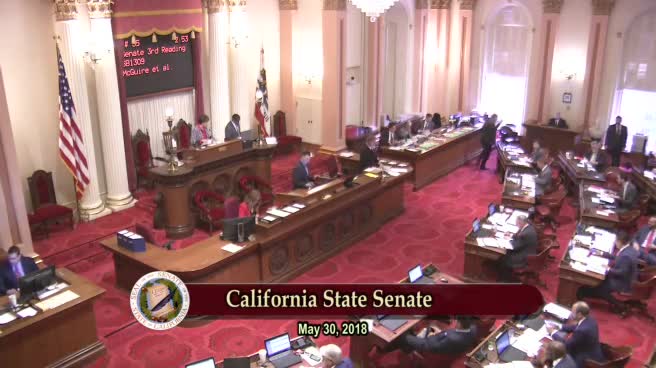 11MIN
Senate Floor
 1MIN
Senate Standing Committee on Appropriations
 13MIN
Senate Standing Committee on Governmental Organization
 34MIN
Senate Standing Committee on Natural Resources and Water
Bill Author











