SB 1321: School finance: necessary small schools.
- Session Year: 2017-2018
- House: Senate
- Latest Version Date: 2018-09-21
(1)Existing law, for specified purposes, provides that a necessary small school is an elementary school with an average daily attendance of less than 97 pupils, excluding pupils attending the 7th and 8th grades of a junior high school, maintained by a school district to which any of certain conditions apply, including specified distance requirements.
This bill would include in the definition of necessary small school an elementary school with an average daily attendance of less than 97 pupils, excluding pupils attending the 7th and 8th grades of a junior high school, maintained by a school district with more than 2,500 and fewer than 5,001 units of 2nd principal apportionment average daily attendance in which as many as 15 pupils residing in the school district and attending kindergarten and grades 1 to 8, inclusive, excluding pupils attending the 7th and 8th grades of a junior high school, in the elementary school with an average daily attendance of less than 97 pupils would be required to travel more than 30 miles one way from a point on a well-traveled road nearest their home to the nearest other public elementary school.
(2)Existing law requires the Superintendent of Public Instruction to make specified computations for each school district with fewer than 2,501 units of 2nd principal apportionment average daily attendance, on account of each necessary small school.
This bill would require the Superintendent to make those specified computations also for each school district on account of each necessary small school meeting the added definition described above under paragraph (1).
(1)Existing law, for specified purposes, provides that a necessary small school is an elementary school with an average daily attendance of less than 97 pupils, excluding pupils attending the 7th and 8th grades of a junior high school, maintained by a school district to which any of certain conditions apply, including specified distance requirements. Existing law authorizes the governing board of a school district, if topographical or other conditions exist in the school district that would impose unusual hardships if the specified number of miles were required to be traveled, or if during the fiscal year the roads that would be traveled have been impassable for more than an average of 2 weeks per year for the preceding 5 years, to request the Superintendent of Public Instruction, in writing, for an exemption from these requirements or for a reduction in the miles required, as specified. Existing law requires the request to be accompanied by a statement of the conditions upon which the request is based, giving the information in a form required by the Superintendent.
This bill would require the request to also be accompanied by evidence of the conditions upon which the request is based. include in the definition of necessary small school an elementary school with an average daily attendance of less than 97 pupils, excluding pupils attending the 7th and 8th grades of a junior high school, maintained by a school district with more than 2,500 and fewer than 5,001 units of second principal apportionment average daily attendance in which as many as 15 pupils residing in the school district and attending kindergarten and grades 1 to 8, inclusive, excluding pupils attending the 7th and 8th grades of a junior high school, in the elementary school with an average daily attendance of less than 97 pupils would be required to travel more than 30 miles one way from a point on a well-traveled road nearest their home to the nearest other public elementary school.
(2)Existing law requires the Superintendent of Public Instruction to make specified computations for each school district with fewer than 2,501 units of second principal apportionment average daily attendance, on account of each necessary small school.
This bill would require the Superintendent to make those specified computations also for each school district on account of each necessary small school meeting the added definition described above under paragraph (1).
Existing law, for specified purposes, provides that a necessary small school is an elementary school with an average daily attendance of less than 97 pupils, excluding pupils attending the 7th and 8th grades of a junior high school, maintained by a school district to which any of certain conditions apply, including specified distance requirements. Existing law authorizes the governing board of a school district, if topographical or other conditions exist in the school district that would impose unusual hardships if the specified number of miles were required to be traveled, or if during the fiscal year the roads that would be traveled have been impassable for more than an average of 2 weeks per year for the preceding 5 years, to request the Superintendent of Public Instruction, in writing, for an exemption from these requirements or for a reduction in the miles required, as specified. Existing law requires the request to be accompanied by a statement of the conditions upon which the request is based, giving the information in a form required by the Superintendent.
This bill would require the request to also be accompanied by evidence of the conditions upon which the request is based.
(a)For each school district, on account of each necessary small school, as defined in Section 42283, the Superintendent shall make the following computations:
(1)For each necessary small school that has an average daily attendance during the fiscal year of less than 25, excluding pupils attending the 7th and 8th grades of a junior high school, and for which school at least one teacher was hired full time, the Superintendent shall compute for the school district fifty-two thousand nine hundred twenty-five dollars ($52,925).
(2)For each necessary small school that has an average daily attendance during the fiscal year of 25 or more and less than 49, excluding pupils attending the 7th and 8th grades of a junior high school, and for which school at least two teachers were hired full time for more than one-half of the days schools were maintained, the Superintendent shall compute for the school district one hundred five thousand eight hundred fifty dollars ($105,850).
(3)For each necessary small school that has an average daily attendance during the fiscal year of 49 or more, but less than 73, excluding pupils attending the 7th and 8th grades of a junior high school, and for which school three teachers were hired full time for more than one-half of the days schools were maintained, the Superintendent shall compute for the school district one hundred fifty-eight thousand seven hundred seventy-five dollars ($158,775).
(4)For each necessary small school that has an average daily attendance during the fiscal year of 73 or more and less than 97, excluding pupils attending the 7th and 8th grades of a junior high school, and for which school four teachers were hired full time for more than one-half of the days schools were maintained, the Superintendent shall compute for the school district two hundred eleven thousand seven hundred dollars ($211,700).
(b)A school district that continues to satisfy the criteria specified in Section 42283 may use the funding calculation in subdivision (a) until the local control funding formula grade span adjusted base grant calculated pursuant to subdivision (d) of Section 42238.02 produces state aid equal to the small school funding formula.
SEC. 2.Section 42283 of the Education Code is amended to read:42283.(a)For purposes of Section 42282, a necessary small school is an elementary school with an average daily attendance of less than 97 pupils, excluding pupils attending the 7th and 8th grades of a junior high school, maintained by a school district to which any of the following conditions apply:
(1)If as many as five pupils residing in a school district with fewer than 2,501 units of second principal apportionment average daily attendance and attending kindergarten and grades 1 to 8, inclusive, excluding pupils attending the 7th and 8th grades of a junior high school, in the elementary school with an average daily attendance of less than 97 pupils would be required to travel more than 10 miles one way from a point on a well-traveled road nearest their home to the nearest other public elementary school.
(2)If as many as 15 pupils residing in a school district with fewer than 2,501 units of second principal apportionment average daily attendance and attending kindergarten and grades 1 to 8, inclusive, excluding pupils attending the 7th and 8th grades of a junior high school, in the elementary school with an average daily attendance of less than 97 pupils would be required to travel more than five miles one way from a point on a well-traveled road nearest their home to the nearest other public elementary school.
(3)If as many as 15 pupils residing in a school district with more than 2,500 and fewer than 5,001 units of second principal apportionment average daily attendance and attending kindergarten and grades 1 to 8, inclusive, excluding pupils attending the 7th and 8th grades of a junior high school, in the elementary school with an average daily attendance of less than 97 pupils would be required to travel more than 30 miles one way from a point on a well-traveled road nearest their home to the nearest other public elementary school.
(b)If topographical or other conditions exist in a school district that would impose unusual hardships if the number of miles specified in paragraph (1) or (2) of subdivision (a) were required to be traveled, or if during the fiscal year the roads that would be traveled have been impassable for more than an average of two weeks per year for the preceding five years, the governing board of the school district may, on or before April 1, request the Superintendent, in writing, for an exemption from these requirements or for a reduction in the miles required. The request shall be accompanied by a statement of the conditions upon which the request is based, giving the information in a form required by the Superintendent. The Superintendent shall cause an investigation to be made, and shall either grant the request to the extent he or she deems necessary, or deny the request.
(c)For purposes of this section, other public elementary school is a public school, including a charter school, that serves kindergarten or any of grades 1 to 8, inclusive, excluding grades 7 and 8 of a junior high school.
(a)For each district with fewer than 2,501 units of second principal apportionment average daily attendance, school district, on account of each necessary small school, as defined in Section 42283, the Superintendent shall make the following computations:
(a)(1)For each necessary small school which that has an average daily attendance during the fiscal year of less than 25, exclusive of excluding pupils attending the 7th and 8th grades of a junior high school, and for which school at least one teacher was hired full time, the Superintendent shall compute for the school district fifty-two thousand nine hundred twenty-five dollars ($52,925).
(b)(2)For each necessary small school which that has an average daily attendance during the fiscal year of 25 or more and less than 49, exclusive of excluding pupils attending the 7th and 8th grades of a junior high school, and for which school at least two teachers were hired full time for more than one-half of the days schools were maintained, the Superintendent shall compute for the school district one hundred five thousand eight hundred fifty dollars ($105,850).
(c)(3)For each necessary small school which that has an average daily attendance during the fiscal year of 49 or more, but less than 73, exclusive of excluding pupils attending the 7th and 8th grades of a junior high school, and for which school three teachers were hired full time for more than one-half of the days schools were maintained, the Superintendent shall compute for the school district one hundred fifty-eight thousand seven hundred seventy-five dollars ($158,775).
(d)(4)For each necessary small school which that has an average daily attendance during the fiscal year of 73 or more and less than 97, exclusive of excluding pupils attending the 7th and 8th grades of a junior high school, and for which school four teachers were hired full time for more than one-half of the days schools were maintained, the Superintendent shall compute for the school district two hundred eleven thousand seven hundred dollars ($211,700).
(e)(b)A school district that continues to satisfy the criteria specified in Section 42283 may use this the funding calculation in subdivision (a) until the local control funding formula grade span adjusted base grant calculated pursuant to subdivision (d) of Section 42238.02 produces state aid equal to the small school funding formula.
SECTION 1.SEC. 2.Section 42283 of the Education Code is amended to read:42283.(a)For purposes of Section 42282, a necessary small school is an elementary school with an average daily attendance of less than 97 pupils, excluding pupils attending the seventh and eighth 7th and 8th grades of a junior high school, maintained by a school district to which any of the following conditions apply:
(1)If as many as five pupils residing in the a school district with fewer than 2,501 units of second principal apportionment average daily attendance and attending kindergarten and grades 1 to 8, inclusive, excluding pupils attending the seventh and eighth 7th and 8th grades of a junior high school, in the elementary school with an average daily attendance of less than 97 pupils would be required to travel more than 10 miles one way from a point on a well-traveled road nearest their home to the nearest other public elementary school.
(2)If as many as 15 pupils residing in the a school district with fewer than 2,501 units of second principal apportionment average daily attendance and attending kindergarten and grades 1 to 8, inclusive, excluding pupils attending the seventh and eighth 7th and 8th grades of a junior high school, in the elementary school with an average daily attendance of less than 97 pupils would be required to travel more than five miles one way from a point on a well-traveled road nearest their home to the nearest other public elementary school.
(3)If as many as 15 pupils residing in a school district with more than 2,500 and fewer than 5,001 units of second principal apportionment average daily attendance and attending kindergarten and grades 1 to 8, inclusive, excluding pupils attending the 7th and 8th grades of a junior high school, in the elementary school with an average daily attendance of less than 97 pupils would be required to travel more than 30 miles one way from a point on a well-traveled road nearest their home to the nearest other public elementary school.
(3)(b)If topographical or other conditions exist in a school district that would impose unusual hardships if the number of miles specified in paragraph (1) or (2) of subdivision (a) were required to be traveled, or if during the fiscal year the roads that would be traveled have been impassable for more than an average of two weeks per year for the preceding five years, the governing board of the school district may, on or before April 1, request the Superintendent, in writing, for an exemption from these requirements or for a reduction in the miles required. The request shall be accompanied by a statement of the conditions upon which the request is based and evidence of those conditions based, giving the information in a form required by the Superintendent. The Superintendent shall cause an investigation to be made, and shall either grant the request to the extent he or she deems necessary, or deny the request.
(b)(c)For purposes of this section, other public elementary school is a public school, including a charter school, that serves kindergarten or any of grades 1 to 8, inclusive, excluding grades 7 and 8 of a junior high school.
(a)For purposes of Section 42282, a necessary small school is an elementary school with an average daily attendance of less than 97 pupils, excluding pupils attending the seventh and eighth grades of a junior high school, maintained by a school district to which any of the following conditions apply:
(1)If as many as five pupils residing in the school district and attending kindergarten and grades 1 to 8, inclusive, excluding pupils attending the seventh and eighth grades of a junior high school, in the elementary school with an average daily attendance of less than 97 pupils would be required to travel more than 10 miles one way from a point on a well-traveled road nearest their home to the nearest other public elementary school.
(2)If as many as 15 pupils residing in the school district and attending kindergarten and grades 1 to 8, inclusive, excluding pupils attending the seventh and eighth grades of a junior high school, in the elementary school with an average daily attendance of less than 97 pupils would be required to travel more than five miles one way from a point on a well-traveled road nearest their home to the nearest other public elementary school.
(3)If topographical or other conditions exist in a school district that would impose unusual hardships if the number of miles specified in paragraph (1) or (2) were required to be traveled, or if during the fiscal year the roads that would be traveled have been impassable for more than an average of two weeks per year for the preceding five years, the governing board of the school district may, on or before April 1, request the Superintendent, in writing, for an exemption from these requirements or for a reduction in the miles required. The request shall be accompanied by a statement of the conditions upon which the request is based, based and evidence of those conditions, giving the information in a form required by the Superintendent. The Superintendent shall cause an investigation to be made, and shall either grant the request to the extent he or she deems necessary, or deny the request.
(b)For purposes of this section, other public elementary school is a public school, including a charter school, that serves kindergarten or any of grades 1 to 8, inclusive, excluding grades 7 and 8 of a junior high school.
|
Date
|
Status
|
|---|---|
| Sep 21, 2018 | Chaptered by Secretary of State. Chapter 664, Statutes of 2018. |
| Sep 21, 2018 | Approved by the Governor. |
| Sep 12, 2018 | Enrolled and presented to the Governor at 5 p.m. |
| Aug 30, 2018 | In Senate. Ordered to engrossing and enrolling. |
| Aug 30, 2018 | Read third time. Passed. Ordered to the Senate. |
| Aug 20, 2018 | Read second time. Ordered to third reading. |
| Aug 16, 2018 | From committee: Do pass. (Ayes 17. Noes 0.) (August 16). |
| Aug 8, 2018 | August 8 set for first hearing. Placed on suspense file. |
| Jun 28, 2018 | From committee: Do pass and re-refer to Com. on APPR. with recommendation: To consent calendar. (Ayes 7. Noes 0.) (June 27). Re-referred to Com. on APPR. |
| Jun 11, 2018 | Referred to Com. on ED. |
| May 31, 2018 | In Assembly. Read first time. Held at Desk. |
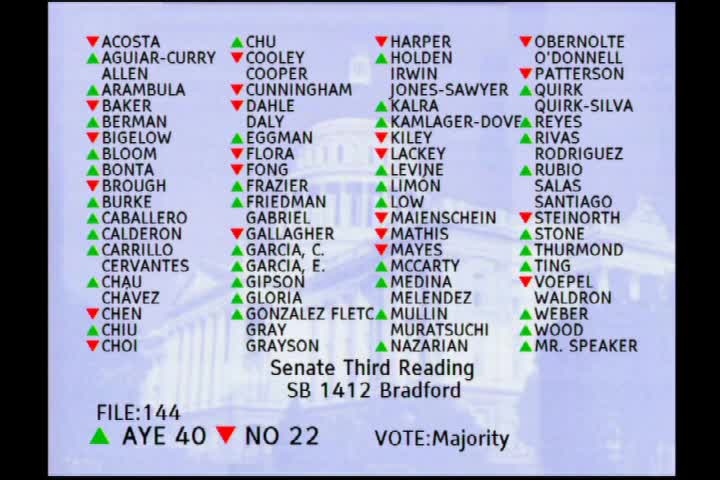
| May 31, 2018 | Read third time. Passed. (Ayes 39. Noes 0.) Ordered to the Assembly. |
| May 29, 2018 | Ordered to special consent calendar. |
| May 25, 2018 | From committee: Do pass. (Ayes 7. Noes 0.) (May 25). |
| May 18, 2018 | Set for hearing May 25. |
| Apr 16, 2018 | April 16 hearing: Placed on APPR. suspense file. |
| Apr 9, 2018 | Set for hearing April 16. |
| Apr 4, 2018 | From committee: Do pass and re-refer to Com. on APPR. with recommendation: To consent calendar. (Ayes 6. Noes 0.) (April 4). Re-referred to Com. on APPR. |
| Mar 22, 2018 | From committee with author's amendments. Read second time and amended. Re-referred to Com. on ED. |
| Mar 6, 2018 | Set for hearing April 4. |
| Mar 1, 2018 | Referred to Com. on ED. |
| Feb 20, 2018 | From printer. May be acted upon on or after March 22. |
| Feb 16, 2018 | Introduced. Read first time. To Com. on RLS. for assignment. To print. |
|
Date
|
Description
|
Location
|
Votes
|
|
|---|---|---|---|---|
| Aug 30, 2018 | SB 1321 Monning Senate Third Reading By CUNNINGHAM | Assembly Floor |
Passed |
|
| Aug 16, 2018 | Do pass. | Assembly Standing Committee on Appropriations |
Passed |
|
| Jun 27, 2018 | Do pass and be re-referred to the Committee on [Appropriations] with recommendation: To Consent Calendar | Assembly Standing Committee on Education |
Passed |
|
| May 31, 2018 | Special Consent SB1321 | Senate Floor |
Passed |
|
| May 25, 2018 | Do pass | Senate Standing Committee on Appropriations |
Passed |
|
| Apr 16, 2018 | Placed on suspense file | Senate Standing Committee on Appropriations |
Passed |
|
| Apr 4, 2018 | Do pass, but first be re-referred to the Committee on [Appropriations] with the recommendation: To Consent Calendar | Senate Standing Committee on Education |
Passed |
This list shows positions taken on this bill by organizations on the date displayed, which is linked to the original source.
Positions by individuals are not included.
|
Organization
|
Position
|
Date
|
|---|---|---|
| Atascadero Unified School District | ** Support | Jun 25, 2018 |
| San Luis Obispo County Office Of Education | ** Support | Jun 25, 2018 |
| San Luis Obispo County Superintendent Of Schools | ** Support | May 26, 2018 |
SENATE THIRD READING
STR Bill Id:SB 1321
Author:(Monning)
As Amended Ver:March 22, 2018
Majority vote
SENATE VOTE: 39-0
Committee | Votes | Ayes | Noes |
Education | 7-0 | O'Donnell, Kiley, Kalra, McCarty, Steinorth, Thurmond, Weber | |
Appropriations | 17-0 | Gonzalez Fletcher, Bigelow, Bloom, Bonta, Brough, Calderon, Carrillo, Chau, Eggman, Fong, Friedman, Gallagher, Eduardo Garcia, Nazarian, Obernolte, Quirk, Reyes |
|
SUMMARY: Expands eligibility for the necessary small schools funding allowance to include specified schools in districts with average daily attendance (ADA) of up to 5,000. Specifically, this bill:
- Expands eligibility for the necessary small schools funding allowance to include schools in districts with an Average Daily Attendance (ADA) of more than 2,500 and fewer than 5,001 if as many as 15 pupils residing in the school district and attending kindergarten and grades 1 to 8, inclusive, excluding pupils attending the seventh and eighth grades of a junior high school, in the elementary school with an ADA of less than 97 pupils would be required to travel more than 30 miles one way from a point on a well-traveled road nearest their home to the nearest other public elementary school.
- Makes additional technical, nonsubstantive changes.
EXISTING LAW:
- Defines a "necessary small school" as an elementary school with an ADA of less than 97 pupils, excluding pupils in grades seven and eight, in a school district to which any of the following applies:
- If as many as five pupils in grades kindergarten to eight, excluding pupils attending a junior high school, in the elementary school with an ADA of less than 97 pupils would be required to travel more than 10 miles one way from a point on a well-traveled road nearest their home to the nearest other public elementary school.
- If as many as 15 pupils in grades kindergarten to eight, excluding pupils attending a junior high school, in the elementary school with an ADA of less than 97 pupils would be required to travel more than five miles one way from a point on a well-traveled road nearest their home to the nearest other public elementary school.
- If topographical or other conditions exist in a school district that would impose unusual hardships if the number of miles specified above were required to be traveled, or if during the fiscal year the roads that would be traveled have been impassable for more than an average of two weeks per year for the preceding five years, the governing board of the school district may, on or before April 1, request the Superintendent, in writing, for an exemption from these requirements or for a reduction in the miles required. The request shall be accompanied by a statement of the conditions upon which the request is based, giving the information in a form required by the Superintendent of Public Instruction (SPI). The SPI shall cause an investigation to be made, and shall either grant the request to the extent he or she deems necessary or deny the request.
- Establishes a funding allowance for school districts with fewer than 2,501 units of average daily attendance (ADA) for each necessary small school. The funding allowance is based on a combination of ADA and the number of full-time teachers for the elementary schools and is in lieu of the per-pupil base grant amount that the school would otherwise generate from the Local Control Funding Formula.
FISCAL EFFECT: According to the Assembly Appropriations Committee, potential Proposition 98 General Fund cost pressures in the low hundreds-of-thousands of dollars annually for increased funding provided to the Atascadero Unified School District for a necessary small schools funding allowance. Although it is unlikely other schools would qualify for this increased funding in the near term, costs could be higher if other school districts meet the bill's eligibility requirements in the future or if schools pursue NSS status as a result of the expanded eligibility (for example, split up existing school sites to create smaller schools or set up new small schools).
COMMENTS:
Reason for the bill. According to the author:
"The existing eligibility requirements for the NSS [Necessary Small School] grant mandate that a school fall within specified distance requirements, and additionally limits grant-eligibility to schools residing in districts with less than 2,500 ADA.
The statute additionally allows for a district to apply for a waiver from these eligibility requirements through the SPI. However, because the language defining the waiver process is vague and focuses primarily on distances to the school, it is unclear if a district can seek a waiver from the SPI for the ADA requirement.
Atascadero Unified School District (AUSD) is an example of a school district that has a large and urban geographic center which results in a student population over 2,500 ADA but its district boundaries cover a large swath of rural San Luis Obispo County.
AUSD provides education to the rural Carissa Plains Elementary School, which is more than 50 miles away from the nearest large city in the school district. AUSD and Carissa Plains should, by all accounts, qualify for a waiver from the eligibility requirements of the NSS grant due to its unique topographical circumstances, but because of the vagueness of the waiver language it is unclear if AUSD would qualify."
No Immediate Funding Advantage for Atascadero Unified. As the author states, Atascadero Unified School District (AUSD) is an example of a school district that covers a large and rural area, but has an average daily attendance that exceeds 2,500. Therefore, even though Carissa Plains Elementary appears to be a school that is both necessary and small—the school serves 23 students that travel 6 miles on average, but would otherwise travel 32 miles on average to the next closest public school—the school does not generate the necessary small school funding allowance because AUSD exceeds the 2,500 student cap.
However, even if the necessary small school funding allowance was applied to AUSD for the 23 students attending Carissa Plains Elementary, the district would not receive any additional funding. This is because in 2017-18, AUSD's LCFF base grant for these 23 students totals about $175,000, whereas the necessary small school funding allowance would only provide $153,050. The necessary small school funding allowance would only increase AUSD's revenues if enrollment at Carissa Plains Elementary increased by two or more students (and one additional full-time teacher was hired). For example, if Carissa Plains elementary's enrollment was 25 students, their LCFF base grant would total about $190,000 and their necessary small school funding allowance would total $306,100. Even for this example, however, the additional $116,100 of revenue from the necessary small school funding allowance would be offset by the additional cost for AUSD to hire an additional full-time teacher.
Even though this bill would not result in an immediate increase in funding, AUSD states that qualifying for the necessary small school funding allowance means the district "will have a floor of NSS funding to protect them if their ADA continues to drop."
Analysis Prepared by: Rick Pratt / ED. / (916) 319-2087 FN: 0004152
Date of Hearing: August 8, 2018
ASSEMBLY COMMITTEE ON APPROPRIATIONS
Lorena Gonzalez Fletcher, Chair
SBPCA Bill Id:SB 1321
Author:(Monning) – As Amended Ver:March 22, 2018
Policy Committee: | Education | Vote: | 7 - 0 |
|
| ||
|
|
Urgency: No State Mandated Local Program: No Reimbursable: No
SUMMARY:
This bill expands eligibility for the necessary small schools (NSS) funding allowance. Specifically, it allows schools in districts with average daily attendance (ADA) of up to 5,000 pupils to receive the NSS funding allowance if as many as 15 pupils residing in the school district and attending any of grades kindergarten to eight at an elementary school with an ADA of less than 97 pupils would be required to travel more than 30 miles one way to attend the nearest other public elementary school.
FISCAL EFFECT:
Potential Proposition 98 General Fund cost pressures in the low hundreds-of-thousands of dollars annually for increased funding provided to the Atascadero Unified School District for a necessary small schools funding allowance. Although it is unlikely other schools would qualify for this increased funding in the near term, costs could be higher if other school districts meet the bill’s eligibility requirements in the future or if schools pursue NSS status as a result of the expanded eligibility (for example, split up existing school sites to create smaller schools or set up new small schools).
COMMENTS:
- Necessary Small School Funding and Eligibility. School districts typically are funded on a per-pupil basis using the Local Control Funding Formula (LCFF). The LCFF provides about $7,600 per pupil annually, with additional funding for disadvantaged pupils. Certain schools within school districts, however, are designated as “necessary small schools” (NSS) and may receive funding through an alternate formula. Specifically, schools with ADA between one and 24 students receive total annual funding of $153,050; between 25 and 48 ADA receive $306,100; between 49 and 72 ADA receive $459,150; and between 73 and 96 ADA receive $612,200.
The state provides NSS funding because certain schools are so small and remote that losing a few students could affect their ability to operate and if they were to shut students could not reasonably attend another school.
Whether a school receives NSS funding or LCFF depends on which formula provides more funding to the school. As of the second apportionment period of the 2017-18 school year, 109 schools received NSS funding. (The state has about 10,000 schools.)
To qualify as NSS under current law, schools must meet certain criteria. Specifically, a school must be located in a school district with ADA under 2,501 and have (a) at least 15 pupils residing in the school district attending any of grades kindergarten to grade eight in the elementary school with an ADA of less than 97 pupils that would be required to travel more than five miles one way to attend the nearest other public elementary school, or (b) at least five pupils residing in the school district attending any of grades kindergarten to grade eight in the elementary school with an ADA of less than 97 pupils that would be required to travel more than 10 miles one way to attend the nearest other public elementary school.
- Schools Qualifying Under This Bill. Carissa Plains Elementary School in Atascadero Unified School District (AUSD) would most likely benefit from the provisions of this bill in the near term. While AUSD has a student population over 2,500, its district boundaries cover a large portion of rural San Luis Obispo County. Carissa Plains Elementary School is more than 50 miles away from the nearest large city in the school district. The school currently serves 23 students that travel six miles on average, but would otherwise travel 32 miles on average to the next closest public school. Because the school is located in a district with a student population above the 2,500 cap, it does not qualify for NSS.
Attendance has been relatively stable at about 25 students per year at Carissa Plains Elementary School. In the 2017-18 school year, the school population dropped to 23 students. In 2018-19, the school likely will generate LCFF base grants totaling about $200,000. If the population were to increase to 25 in a future year, the school would receive $306,100 in NSS.
Eleven additional schools could qualify for NSS under this bill. However, in an analysis of other schools that would meet the NSS criteria of this bill, none would benefit from the NSS in the short-term. That is, LCFF provides them with more funding than they would receive from NSS, and the schools would need to lose a significant portion of their enrollment to benefit from NSS.
- Waiver Process. The California Department of Education (CDE) may grant NSS waivers for certain schools that do not meet all NSS criteria. For example, if a school does not meet distance requirements but the terrain makes transportation to another school difficult. CDE indicates the waiver option is not available to Carissa Plains Elementary school because it only grants waivers to schools with ADA of less than 2,501.
Analysis Prepared by: Natasha Collins / APPR. / (916) 319-2081
Date of Hearing: June 27, 2018
ASSEMBLY COMMITTEE ON EDUCATION
Patrick O'Donnell, Chair
SBPCA Bill Id:SB 1321
Author:(Monning) – As Amended Ver:March 22, 2018
SENATE VOTE: 39-0
SUBJECT: School finance: necessary small schools
SUMMARY: Expands eligibility for the necessary small schools funding allowance to include specified schools in districts with average daily attendance (ADA) of up to 5,000. Specifically, this bill:
- Expands eligibility for the necessary small schools funding allowance to include schools in districts with an Average Daily Attendance (ADA) of more than 2,500 and fewer than 5,001 if as many as 15 pupils residing in the school district and attending kindergarten and grades 1 to 8, inclusive, excluding pupils attending the seventh and eighth grades of a junior high school, in the elementary school with an ADA of less than 97 pupils would be required to travel more than 30 miles one way from a point on a well-traveled road nearest their home to the nearest other public elementary school.
- Makes additional technical, nonsubstantive changes.
EXISTING LAW:
- Defines a “necessary small school” as an elementary school with an ADA of less than 97 pupils, excluding pupils in grades seven and eight, in a school district to which any of the following applies:
- If as many as five pupils in grades kindergarten to eight, excluding pupils attending a junior high school, in the elementary school with an ADA of less than 97 pupils would be required to travel more than 10 miles one way from a point on a well-traveled road nearest their home to the nearest other public elementary school.
- If as many as 15 pupils in grades kindergarten to eight, excluding pupils attending a junior high school, in the elementary school with an ADA of less than 97 pupils would be required to travel more than five miles one way from a point on a well-traveled road nearest their home to the nearest other public elementary school.
- If topographical or other conditions exist in a school district that would impose unusual hardships if the number of miles specified above were required to be traveled, or if during the fiscal year the roads that would be traveled have been impassable for more than an average of two weeks per year for the preceding five years, the governing board of the school district may, on or before April 1, request the Superintendent, in writing, for an exemption from these requirements or for a reduction in the miles required. The request shall be accompanied by a statement of the conditions upon which the request is based, giving the information in a form required by the Superintendent of Public Instruction (SPI). The SPI shall cause an investigation to be made, and shall either grant the request to the extent he or she deems necessary or deny the request.
- Establishes a funding allowance for school districts with fewer than 2,501 units of average daily attendance (ADA) for each necessary small school. The funding allowance is based on a combination of ADA and the number of full-time teachers for the elementary schools and is in lieu of the per-pupil base grant amount that the school would otherwise generate from the Local Control Funding Formula.
FISCAL EFFECT: According to the Senate Appropriations Committee: "This bill could result in additional Proposition 98 General Fund costs in the low hundreds of thousands of dollars each year for increased funding provided to the Atascadero Unified School District for a necessary small schools funding allowance. Depending on whether other school districts meet the bill’s eligibility requirements, this amount could be higher."
COMMENTS:
Reason for the bill. According to the author:
“The existing eligibility requirements for the NSS [Necessary Small School] grant mandate that a school fall within specified distance requirements, and additionally limits grant-eligibility to schools residing in districts with less than 2,500 ADA.
The statute additionally allows for a district to apply for a waiver from these eligibility requirements through the SPI. However, because the language defining the waiver process is vague and focuses primarily on distances to the school, it is unclear if a district can seek a waiver from the SPI for the ADA requirement.
Atascadero Unified School District (AUSD) is an example of a school district that has a large and urban geographic center which results in a student population over 2,500 ADA but its district boundaries cover a large swath of rural San Luis Obispo County.
AUSD provides education to the rural Carissa Plains Elementary School, which is more than 50 miles away from the nearest large city in the school district. AUSD and Carissa Plains should, by all accounts, qualify for a waiver from the eligibility requirements of the NSS grant due to its unique topographical circumstances, but because of the vagueness of the waiver language it is unclear if AUSD would qualify.”
Necessary Small School Funding and Eligibility. The funding calculations for necessary small schools under the Local Control Funding Formula (LCFF) are similar to calculations under previously existing law, with school districts having the option of selecting either the necessary small school funding or the LCFF base grant, whichever generates more funding. As demonstrated by the tables below, comparing the necessary small school allowances to the LCFF base grants in 2017-18 results in most elementary schools receiving more total funding from the LCFF base grant, with limited exceptions.
The necessary small elementary school funding targets for 2017-18 are:
Number of Teacher(s) | Avg. Daily Attendance | 2017-18 Funding |
1 | 1 to 24 | $153,050 |
2 | 25 to 48 | $306,100 |
3 | 49 to 72 | $459,150 |
4 | 73 to 96 | $612,200 |
The Local Control Funding Formula (LCFF) elementary school base grant targets for 2017-18 are:
Grade Span | 2017-18 Funding (per-pupil) |
Kindergarten to Grade 3 | $7,942 |
Grade 4 to Grade 6 | $7,301 |
Kindergarten to Grade 6 (avg.) | $7,622 |
No Immediate Funding Advantage for Atascadero Unified. As the author states, Atascadero Unified School District (AUSD) is an example of a school district that covers a large and rural area, but has an average daily attendance that exceeds 2,500. Therefore, even though Carissa Plains Elementary appears to be a school that is both necessary and small—the school serves 23 students that travel 6 miles on average, but would otherwise travel 32 miles on average to the next closest public school—the school does not generate the necessary small school funding allowance because AUSD exceeds the 2,500 student cap.
However, even if the necessary small school funding allowance was applied to AUSD for the 23 students attending Carissa Plains Elementary, the district would not receive any additional funding. This is because in 2017-18, AUSD’s LCFF base grant for these 23 students totals about $175,000, whereas the necessary small school funding allowance would only provide $153,050. The necessary small school funding allowance would only increase AUSD’s revenues if enrollment at Carissa Plains Elementary increased by two or more students (and one additional full-time teacher was hired). For example, if Carissa Plains elementary’s enrollment was 25 students, their LCFF base grant would total about $190,000 and their necessary small school funding allowance would total $306,100. Even for this example, however, the additional $116,100 of revenue from the necessary small school funding allowance would be offset by the additional cost for AUSD to hire an additional full-time teacher.
Even though this bill would not result in an immediate increase in funding, AUSD states that qualifying for the necessary small school funding allowance means the district “will have a floor of NSS funding to protect them if their ADA continues to drop.”
REGISTERED SUPPORT / OPPOSITION:
Support
Atascadero Unified School District
San Luis Obispo County Office of Education
Opposition
None received
Analysis Prepared by: Rick Pratt / ED. / (916) 319-2087
Office of Senate Floor Analyses (916) 651-1520 Fax: (916) 327-4478 | SB |
THIRD READING
Bill No: SB 1321
:
SENATE EDUCATION COMMITTEE: 6-0, 4/4/18
AYES: Allen, Wilk, Galgiani, Leyva, Pan, Vidak
SENATE APPROPRIATIONS COMMITTEE: 7-0, 5/25/18
AYES: Lara, Bates, Beall, Bradford, Hill, Nielsen, Wiener
SOURCE: Atascadero Unified School District
DIGEST:
This bill expands eligibility for the necessary small schools (NSSs) funding allowance to include specified schools in districts with average daily attendance (ADA) of up to 5,000.
Existing law:
- Defines a “necessary small school” as an elementary school with an ADA of less than 97 pupils, excluding pupils in grades 7 and 8, in a school district to which any of the following applies:
- If as many as five pupils in grades kindergarten to 8, excluding pupils attending a junior high school, in the elementary school with an ADA of less than 97 pupils would be required to travel more than 10 miles one way from a point on a well-traveled road nearest their home to the nearest other public elementary school.
- If as many as 15 pupils in grades kindergarten to 8, excluding pupils attending a junior high school, in the elementary school with an ADA of less than 97 pupils would be required to travel more than five miles one way from a point on a well-traveled road nearest their home to the nearest other public elementary school.
- If topographical or other conditions exist in a school district that would impose unusual hardships if the number of miles specified above were required to be traveled, or if during the fiscal year the roads that would be traveled have been impassable for more than an average of two weeks per year for the preceding five years, the governing board of the school district may, on or before April 1, request the Superintendent of Public Instruction (SPI), in writing, for an exemption from these requirements or for a reduction in the miles required. The request shall be accompanied by a statement of the conditions upon which the request is based, giving the information in a form required by the SPI. The SPI shall cause an investigation to be made, and shall either grant the request to the extent he or she deems necessary or deny the request.
- Establishes a funding allowance for school districts with fewer than 2,501 units of ADA for each NSS. The funding allowance is based on a combination of ADA and the number of full-time teachers for the elementary schools and is in lieu of the per-pupil base grant amount that the school would otherwise generate from the Local Control Funding Formula (LCFF).
This bill expands eligibility for the NSSs funding allowance to include schools in districts with ADA of more than 2,500 and fewer than 5,001 if as many as 15 pupils residing in the school district and attending kindergarten and grades 1 to 8, inclusive, excluding pupils attending the 7th and 8th grades of a junior high school, in the elementary school with an ADA of less than 97 pupils would be required to travel more than 30 miles one way from a point on a well-traveled road nearest their home to the nearest other public elementary school.
Comments
- Need for the bill. According to the author, “The existing eligibility requirements for the NSS grant mandate that a school fall within specified distance requirements, and additionally limits grant-eligibility to schools residing in districts with less than 2,500 ADA.
“The statute additionally allows for a district to apply for a waiver from these eligibility requirements through the SPI. However, because the language defining the waiver process is vague and focuses primarily on distances to the school, it is unclear if a district can seek a waiver from the SPI for the ADA requirement.
“Atascadero Unified School District (AUSD) is an example of a school district that has a large and urban geographic center which results in a student population over 2,500 ADA but its district boundaries cover a large swath of rural San Luis Obispo County.
“AUSD provides education to the rural Carissa Plains Elementary School, which is more than 50 miles away from the nearest large city in the school district. AUSD and Carissa Plains should, by all accounts, qualify for a waiver from the eligibility requirements of the NSS grant due to its unique topographical circumstances, but because of the vagueness of the waiver language it is unclear if AUSD would qualify.”
- Legislative Analyst’s Office report. In May 2011, the Legislative Analyst's Office (LAO) released a report on small school districts entitled, "How Small Is Too Small: An Analysis of School District Consolidation."
The LAO report concluded "small districts still tend not to pursue consolidation. In large part, this is because the state provides both fiscal incentives for districts to remain small and certain disincentives for districts to consolidate. Specifically, the state encourages districts (and schools) to remain small by providing them substantial funding advantages. These benefits are especially evident in very small school districts, which on average receive more than twice as much funding per pupil compared to midsize and large districts. "
Furthermore, the LAO indicates “…presumably, the goal of the NSS supplement is to enable exceptionally small schools to operate in remote areas of the state so that children do not have to spend excessive time in transit. These funds, however, also are subsidizing very small schools that qualify not because they are geographically isolated, but simply because the local community has chosen to maintain a small single-school district."
- Exemption requests to the SPI. According to the Department of Education, to date, the Department has received two requests for exemption to the NSS requirements. One was granted to a small school operated at a hospital facility based on the inability of students to travel to the nearest other public school. The other request was denied based on the school’s failure to show that travel to the nearest other public school would impose unusual hardship.
Necessary small high school funding statutes have parallel provisions to those applying to elementary schools. All seven of the exemption requests from small high schools have been approved. These requests have been related to topographical conditions that result in frequent road closures due to snow or result in roads that are considered highly dangerous based on the number of fatal accidents.
Typically, applicants (a school district with approval of the county office of education) submits maps, route descriptions, California Highway Patrol records of road closures, or traffic incidents for prior years as evidence of hardships of traveling to the nearest other public school. The department investigation includes review of documentation submitted by the school district.
- NSS funding and eligibility. The funding calculations for NSSs under LCFF are similar to calculations under previously existing law, with school districts having the option of selecting either the NSS funding or the LCFF base grant, whichever generates more funding. As demonstrated by the tables below, comparing the NSS allowances to the LCFF base grants in 2017-18 results in most elementary schools receiving more total funding from the LCFF base grant, with limited exceptions.
The necessary small elementary school funding targets for 2017-18 are:
Number of Teacher(s) | Avg. Daily Attendance | 2017-18 Funding |
1 | 1 to 24 | $153,050 |
2 | 25 to 48 | $306,100 |
3 | 49 to 72 | $459,150 |
4 | 73 to 96 | $612,200 |
The LCFF elementary school base grant targets for 2017-18 are:
Grade Span | 2017-18 Funding (per-pupil) |
Kindergarten to Grade 3 | $7,942 |
Grade 4 to Grade 6 | $7,301 |
Kindergarten to Grade 6 (avg.) | $7,622 |
- No immediate funding advantage for Atascadero Unified. As the author states, AUSD is an example of a school district that covers a large and rural area, but has an average daily attendance that exceeds 2,500. Therefore, even though Carissa Plains Elementary appears to be a school that is both necessary and small—the school serves 23 students that travel six miles on average, but would otherwise travel 32 miles on average to the next closest public school—the school does not generate the NSS funding allowance because AUSD exceeds the 2,500 student cap.
However, even if the NSS funding allowance was applied to AUSD for the 23 students attending Carissa Plains Elementary, the District would not receive any additional funding. This is because in 2017-18, AUSD’s LCFF base grant for these 23 students totals about $175,000, whereas the NSS funding allowance would only provide $153,050. The NSS funding allowance would only increase AUSD’s revenues if enrollment at Carissa Plains Elementary increased by two or more students (and one additional full-time teacher was hired). For example, if Carissa Plains elementary’s enrollment was 25 students, their LCFF base grant would total about $190,000 and their NSS funding allowance would total $306,100. Even for this example, however, the additional $116,100 of revenue from the NSS funding allowance would be offset by the additional cost for AUSD to hire an additional full-time teacher.
Even though this bill will not result in an immediate increase in funding, AUSD states that qualifying for the NSS funding allowance means the District “will have a floor of NSS funding to protect them if their ADA continues to drop.”
FISCAL EFFECT: Appropriation: Fiscal Com.: Local:
According to the Senate Appropriations Committee, this bill could result in additional Proposition 98 General Fund costs in the low hundreds of thousands of dollars each year for increased funding provided to the AUSD for a NSSs funding allowance. Depending on whether other school districts meet this bill’s eligibility requirements, this amount could be higher.
Atascadero Unified School District (source)
San Luis Obispo County Superintendent of Schools
OPPOSITION: (Verified 5/25/18)
None received
5/26/18 15:14:41
**** END ****
SENATE COMMITTEE ON
Senator Ricardo Lara, Chair
2017 - 2018 Regular Session
SB 1321 (Monning) - School finance: necessary small schools
Version: | Policy Vote: |
Urgency: | Mandate: |
Hearing Date: | Consultant: |
This bill meets the criteria for referral to the Suspense File.
Bill Summary:
This bill expands eligibility for the necessary small schools funding allowance to include specified schools in districts with average daily attendance (ADA) of up to 5,000.
Fiscal Impact:
This bill could result in additional Proposition 98 General Fund costs in the low hundreds of thousands of dollars each year for increased funding provided to the Atascadero Unified School District for a necessary small schools funding allowance. Depending on whether other school districts meet the bill’s eligibility requirements, this amount could be higher.
Background:
Existing law defines a “necessary small school” as an elementary school with an ADA of less than 97 pupils, excluding pupils in grades seven and eight, in a school district to which any of the following applies:
- If as many as five pupils in grades kindergarten to eight, excluding pupils attending a junior high school, in the elementary school with an ADA of less than 97 pupils would be required to travel more than 10 miles one way from a point on a well-traveled road nearest their home to the nearest other public elementary school.
- If as many as 15 pupils in grades kindergarten to eight, excluding pupils attending a junior high school, in the elementary school with an ADA of less than 97 pupils would be required to travel more than five miles one way from a point on a well-traveled road nearest their home to the nearest other public elementary school.
- If topographical or other conditions exist in a school district that would impose unusual hardships if the number of miles specified above were required to be traveled, or if during the fiscal year the roads that would be traveled have been impassable for more than an average of two weeks per year for the preceding five years, the governing board of the school district may, on or before April 1, request the Superintendent, in writing, for an exemption from these requirements or for a reduction in the miles required. The request shall be accompanied by a statement of the conditions upon which the request is based, giving the information in a form required by the Superintendent of Public Instruction (SPI). The SPI shall cause an investigation to be made, and shall either grant the request to the extent he or she deems necessary or deny the request.
Existing law establishes a funding allowance for school districts with fewer than 2,501 units of ADA for each necessary small school. The funding allowance is based on a combination of ADA and the number of full-time teachers for the elementary schools and is in lieu of the per-pupil base grant amount that the school would otherwise generate from the Local Control Funding Formula.
Proposed Law:
This bill expands eligibility for the necessary small schools funding allowance to include schools in districts with ADA of more than 2,500 and fewer than 5,001 if as many as 15 pupils residing in the school district and attending kindergarten and grades 1 to 8, inclusive, excluding pupils attending the seventh and eighth grades of a junior high school, in the elementary school with an ADA of less than 97 pupils would be required to travel more than 30 miles one way from a point on a well-traveled road nearest their home to the nearest other public elementary school.
Staff Comments:
Existing eligibility requirements for the necessary small schools allowance require that a school fall within specified distance requirements, and additionally limits eligibility to schools residing in districts with less than 2,500 ADA.
While the Atascadero Unified School District (AUSD) has a large and urban geographic center which results in a student population over 2,500 ADA, its district boundaries cover a large portion of rural San Luis Obispo County. Specifically, the district includes the rural Carissa Plains Elementary School, which is more than 50 miles away from the nearest large city in the school district. The school currently serves 23 students that travel 6 miles on average, but would otherwise travel 32 miles on average to the next closest public school. However, the school does not generate the necessary small school funding allowance because AUSD exceeds the 2,500 ADA cap.
It appears that even if the necessary small school funding allowance was applied to AUSD for the 23 students attending Carissa Plains Elementary as a result of this measure, the district would not receive any additional funding. The district’s 2017-18 Local Control Funding Formula (LCFF) base grant for these 23 students was about $175,000, whereas the necessary small school funding allowance would have only provided $153,050. However, if enrollment at Carissa Plains Elementary school were to increase by two or more students (and one additional full-time teacher was hired), then that would trigger eligibility for the necessary small school funding allowance and increase the district’s revenues. For example, if the school’s enrollment was 25 students, their LCFF base grant would total about $190,000 but it would trigger a necessary small school funding allowance totaling $306,100.
While the California Department of Education (CDE) does not have sufficient data on which school districts, if any, meet the criteria prescribed by this bill, it indicates there are 129 school districts with 11 elementary schools with enrollment between 15 and 105 students. Of these schools, it is unclear how many have students that actually meet the bill’s distance requirements (must travel more than 30 miles one way from a point on a well-traveled road nearest their home to the nearest other public elementary school). Assuming they all meet the distance requirements (which is not likely), the CDE estimates that the 2017-18 equivalent of additional funding that the schools would receive as a result of the necessary small schools funding allowance is approximately $1.37 million.
-- END --
SENATE COMMITTEE ON EDUCATION
Senator Benjamin Allen, Chair
2017 - 2018 Regular
Bill No: SB 1321 Hearing Date: April 4, 2018
Author: | |||
Version: |
| ||
Urgency: | No | Fiscal: | Yes |
Consultant: | Ian Johnson | ||
Subject: School finance: necessary small schools
SUMMARY
This bill expands eligibility for the necessary small schools funding allowance to include specified schools in districts with average daily attendance (ADA) of up to 5,000.
BACKGROUND
Existing law:
- Defines a “necessary small school” as an elementary school with an ADA of less than 97 pupils, excluding pupils in grades seven and eight, in a school district to which any of the following applies:
- If as many as five pupils in grades kindergarten to eight, excluding pupils attending a junior high school, in the elementary school with an ADA of less than 97 pupils would be required to travel more than 10 miles one way from a point on a well-traveled road nearest their home to the nearest other public elementary school.
- If as many as 15 pupils in grades kindergarten to eight, excluding pupils attending a junior high school, in the elementary school with an ADA of less than 97 pupils would be required to travel more than five miles one way from a point on a well-traveled road nearest their home to the nearest other public elementary school.
- If topographical or other conditions exist in a school district that would impose unusual hardships if the number of miles specified above were required to be traveled, or if during the fiscal year the roads that would be traveled have been impassable for more than an average of two weeks per year for the preceding five years, the governing board of the school district may, on or before April 1, request the Superintendent, in writing, for an exemption from these requirements or for a reduction in the miles required. The request shall be accompanied by a statement of the conditions upon which the request is based, giving the information in a form required by the Superintendent of Public Instruction (SPI). The SPI shall cause an investigation to be made, and shall either grant the request to the extent he or she deems necessary or deny the request.
- Establishes a funding allowance for school districts with fewer than 2,501 units of average daily attendance (ADA) for each necessary small school. The funding allowance is based on a combination of ADA and the number of full-time teachers for the elementary schools and is in lieu of the per-pupil base grant amount that the school would otherwise generate from the Local Control Funding Formula.
ANALYSIS
This bill expands eligibility for the necessary small schools funding allowance to include schools in districts with ADA of more than 2,500 and fewer than 5,001 if as many as 15 pupils residing in the school district and attending kindergarten and grades 1 to 8, inclusive, excluding pupils attending the seventh and eighth grades of a junior high school, in the elementary school with an ADA of less than 97 pupils would be required to travel more than 30 miles one way from a point on a well-traveled road nearest their home to the nearest other public elementary school.
STAFF COMMENTS
- Need for the bill. According to the author, “The existing eligibility requirements for the NSS grant mandate that a school fall within specified distance requirements, and additionally limits grant-eligibility to schools residing in districts with less than 2,500 ADA.
The statute additionally allows for a district to apply for a waiver from these eligibility requirements through the SPI. However, because the language defining the waiver process is vague and focuses primarily on distances to the school, it is unclear if a district can seek a waiver from the SPI for the ADA requirement.
Atascadero Unified School District (AUSD) is an example of a school district that has a large and urban geographic center which results in a student population over 2,500 ADA but its district boundaries cover a large swath of rural San Luis Obispo County.
AUSD provides education to the rural Carissa Plains Elementary School, which is more than 50 miles away from the nearest large city in the school district. AUSD and Carissa Plains should, by all accounts, qualify for a waiver from the eligibility requirements of the NSS grant due to its unique topographical circumstances, but because of the vagueness of the waiver language it is unclear if AUSD would qualify.”
- Legislative Analyst’s Office Report. In May 2011, the Legislative Analyst's Office (LAO) released a report on small school districts entitled, "How Small Is Too Small: An Analysis of School District Consolidation."
The LAO report concluded "small districts still tend not to pursue consolidation. In large part, this is because the state provides both fiscal incentives for districts to remain small and certain disincentives for districts to consolidate. Specifically, the state encourages districts (and schools) to remain small by providing them substantial funding advantages. These benefits are especially evident in very small school districts, which on average receive more than twice as much funding per pupil compared to midsize and large districts. "
Furthermore, the Legislative Analyst's Office indicates “…presumably, the goal of the NSS supplement is to enable exceptionally small schools to operate in remote areas of the state so that children do not have to spend excessive time in transit. These funds, however, also are subsidizing very small schools that qualify not because they are geographically isolated, but simply because the local community has chosen to maintain a small single-school district."
- Exemption Requests to the Superintend of Public Instruction. According to the Department of Education, to date, the department has received two requests for exemption to the necessary small school requirements. One was granted to a small school operated at a hospital facility based on the inability of students to travel to the nearest other public school. The other request was denied based on the school’s failure to show that travel to the nearest other public school would impose unusual hardship.
Necessary small high school funding statutes have parallel provisions to those applying to elementary schools. All seven of the exemption requests from small high schools have been approved. These requests have been related to topographical conditions that result in frequent road closures due to snow or result in roads that are considered highly dangerous based on the number of fatal accidents.
Typically, applicants (a school district with approval of the county office of education) submits maps, route descriptions, California Highway Patrol records of road closures, or traffic incidents for prior years as evidence of hardships of traveling to the nearest other public school. The department investigation includes review of documentation submitted by the school district.
- Necessary Small School Funding and Eligibility. The funding calculations for necessary small schools under the Local Control Funding Formula (LCFF) are similar to calculations under previously existing law, with school districts having the option of selecting either the necessary small school funding or the LCFF base grant, whichever generates more funding. As demonstrated by the tables below, comparing the necessary small school allowances to the LCFF base grants in 2017-18 results in most elementary schools receiving more total funding from the LCFF base grant, with limited exceptions.
The necessary small elementary school funding targets for 2017-18 are:
Number of Teacher(s) | Avg. Daily Attendance | 2017-18 Funding |
1 | 1 to 24 | $153,050 |
2 | 25 to 48 | $306,100 |
3 | 49 to 72 | $459,150 |
4 | 73 to 96 | $612,200 |
The Local Control Funding Formula (LCFF) elementary school base grant targets for 2017-18 are:
Grade Span | 2017-18 Funding (per-pupil) |
Kindergarten to Grade 3 | $7,942 |
Grade 4 to Grade 6 | $7,301 |
Kindergarten to Grade 6 (avg.) | $7,622 |
- No Immediate Funding Advantage for Atascadero Unified. As the author states, Atascadero Unified School District (AUSD) is an example of a school district that covers a large and rural area, but has an average daily attendance that exceeds 2,500. Therefore, even though Carissa Plains Elementary appears to be a school that is both necessary and small—the school serves 23 students that travel 6 miles on average, but would otherwise travel 32 miles on average to the next closest public school—the school does not generate the necessary small school funding allowance because AUSD exceeds the 2,500 student cap.
However, even if the necessary small school funding allowance was applied to AUSD for the 23 students attending Carissa Plains Elementary, the district would not receive any additional funding. This is because in 2017-18, AUSD’s LCFF base grant for these 23 students totals about $175,000, whereas the necessary small school funding allowance would only provide $153,050. The necessary small school funding allowance would only increase AUSD’s revenues if enrollment at Carissa Plains Elementary increased by two or more students (and one additional full-time teacher was hired). For example, if Carissa Plains elementary’s enrollment was 25 students, their LCFF base grant would total about $190,000 and their necessary small school funding allowance would total $306,100. Even for this example, however, the additional $116,100 of revenue from the necessary small school funding allowance would be offset by the additional cost for AUSD to hire an additional full-time teacher.
Even though this bill would not result in an immediate increase in funding, AUSD states that qualifying for the necessary small school funding allowance means the district “will have a floor of NSS funding to protect them if their ADA continues to drop.”
SUPPORT
Atascadero Unified School District (sponsor)
San Luis Obispo County Superintendent of Schools
OPPOSITION
None received
-- END --
Discussed in Hearing
 1MIN
Assembly Floor
 1H
Assembly Standing Committee on Appropriations
 2MIN
Senate Standing Committee on Appropriations
Bill Author

Bill Co-Author(s):
