SB 173: Real estate: Bureau of Real Estate.
- Session Year: 2017-2018
- House: Senate
- Latest Version Date: 2017-10-15
Existing law establishes in state government the Business, Consumer Services, and Housing Agency, which is comprised of various departments including the Department of Consumer Affairs. Existing law establishes the Bureau of Real Estate within the Department of Consumer Affairs to license and regulate real estate brokers and real estate salespersons.
This bill would, as of July 1, 2018, remove the bureau from the Department of Consumer Affairs and instead make it a department within the Business, Consumer Services, and Housing Agency and rename the bureau to the Department of Real Estate. The bill would also make other conforming and technical changes.
This bill would incorporate additional changes to Section 30 of the Business and Professions Code proposed by SB 244 to be operative only if this bill and SB 244 are enacted, as specified.
Existing law establishes in state government the Business, Consumer Services, and Housing Agency, which is comprised of various departments including the Department of Consumer Affairs. Existing law establishes the Bureau of Real Estate within the Department of Consumer Affairs to license and regulate real estate brokers and real estate salespersons.
This bill would would, as of July 1, 2018, remove the bureau from the Department of Consumer Affairs and instead make it a department within the Business, Consumer Services, and Housing Agency and rename the bureau to the Department of Real Estate. The bill would also make other conforming and technical changes.
Existing law establishes in state government the Business, Consumer Services, and Housing Agency, which is comprised of various departments including the Department of Consumer Affairs. Existing law establishes the Bureau of Real Estate within the Department of Consumer Affairs to license and regulate real estate brokers and real estate salespersons.
This bill would remove the bureau from the Department of Consumer Affairs and instead make it a department within the Business, Consumer Services, and Housing Agency and rename the bureau to the Department of Real Estate. The bill would also make other conforming changes.
(a)(1)Notwithstanding any other law, any board, as defined in Section 22, and the State Bar and the Bureau of Real Estate shall, at the time of issuance of the license, require that the applicant provide its federal employer identification number, if the applicant is a partnership, or the applicants social security number for all other applicants.
(2)No later than January 1, 2016, in accordance with Section 135.5, a board, as defined in Section 22, and the State Bar and the Bureau of Real Estate shall require either the individual taxpayer identification number or social security number if the applicant is an individual for purposes of this subdivision.
(b)A licensee failing to provide the federal employer identification number, or the individual taxpayer identification number or social security number shall be reported by the licensing board to the Franchise Tax Board. If the licensee fails to provide that information after notification pursuant to paragraph (1) of subdivision (b) of Section 19528 of the Revenue and Taxation Code, the licensee shall be subject to the penalty provided in paragraph (2) of subdivision (b) of Section 19528 of the Revenue and Taxation Code.
(c)In addition to the penalty specified in subdivision (b), a licensing board shall not process an application for an initial license unless the applicant provides its federal employer identification number, or individual taxpayer identification number or social security number where requested on the application.
(d)A licensing board shall, upon request of the Franchise Tax Board or the Employment Development Department, furnish to the board or the department, as applicable, the following information with respect to every licensee:
(1)Name.
(2)Address or addresses of record.
(3)Federal employer identification number if the licensee is a partnership, or the licensees individual taxpayer identification number or social security number for all other licensees.
(4)Type of license.
(5)Effective date of license or a renewal.
(6)Expiration date of license.
(7)Whether license is active or inactive, if known.
(8)Whether license is new or a renewal.
(e)For the purposes of this section:
(1)Licensee means a person or entity, other than a corporation, authorized by a license, certificate, registration, or other means to engage in a business or profession regulated by this code or referred to in Section 1000 or 3600.
(2)License includes a certificate, registration, or any other authorization needed to engage in a business or profession regulated by this code or referred to in Section 1000 or 3600.
(3)Licensing board means any board, as defined in Section 22, the State Bar, and the Bureau of Real Estate.
(f)The reports required under this section shall be filed on magnetic media or in other machine-readable form, according to standards furnished by the Franchise Tax Board or the Employment Development Department, as applicable.
(g)Licensing boards shall provide to the Franchise Tax Board or the Employment Development Department the information required by this section at a time that the board or the department, as applicable, may require.
(h)Notwithstanding Chapter 3.5 (commencing with Section 6250) of Division 7 of Title 1 of the Government Code, a federal employer identification number, individual taxpayer identification number, or social security number furnished pursuant to this section shall not be deemed to be a public record and shall not be open to the public for inspection.
(i)A deputy, agent, clerk, officer, or employee of a licensing board described in subdivision (a), or any former officer or employee or other individual who, in the course of his or her employment or duty, has or has had access to the information required to be furnished under this section, shall not disclose or make known in any manner that information, except as provided pursuant to this section to the Franchise Tax Board, the Employment Development Department, or the Office of the Chancellor of the California Community Colleges, or as provided in subdivision (k).
(j)It is the intent of the Legislature in enacting this section to utilize the federal employer identification number, individual taxpayer identification number, or social security number for the purpose of establishing the identification of persons affected by state tax laws, for purposes of compliance with Section 17520 of the Family Code, and for purposes of measuring employment outcomes of students who participate in career technical education programs offered by the California Community Colleges and, to that end, the information furnished pursuant to this section shall be used exclusively for those purposes.
(k)If the board utilizes a national examination to issue a license, and if a reciprocity agreement or comity exists between the State of California and the state requesting release of the individual taxpayer identification number or social security number, any deputy, agent, clerk, officer, or employee of any licensing board described in subdivision (a) may release an individual taxpayer identification number or social security number to an examination or licensing entity, only for the purpose of verification of licensure or examination status.
(l)For the purposes of enforcement of Section 17520 of the Family Code, and notwithstanding any other law, a board, as defined in Section 22, and the State Bar and the Bureau of Real Estate shall at the time of issuance of the license require that each licensee provide the individual taxpayer identification number or social security number of each individual listed on the license and any person who qualifies for the license. For the purposes of this subdivision, licensee means an entity that is issued a license by any board, as defined in Section 22, the State Bar, the Bureau of Real Estate, and the Department of Motor Vehicles.
(m)The department shall, upon request by the Office of the Chancellor of the California Community Colleges, furnish to the chancellors office, as applicable, the following information with respect to every licensee:
(1)Name.
(2)Federal employer identification number if the licensee is a partnership, or the licensees individual taxpayer identification number or social security number for all other licensees.
(3)Date of birth.
(4)Type of license.
(5)Effective date of license or a renewal.
(6)Expiration date of license.
(n)The department shall make available information pursuant to subdivision (m) only to allow the chancellors office to measure employment outcomes of students who participate in career technical education programs offered by the California Community Colleges and recommend how these programs may be improved. Licensure information made available by the department pursuant to this section shall not be used for any other purpose.
(o)The department may make available information pursuant to subdivision (m) only to the extent that making the information available complies with state and federal privacy laws.
(p)The department may, by agreement, condition or limit the availability of licensure information pursuant to subdivision (m) in order to ensure the security of the information and to protect the privacy rights of the individuals to whom the information pertains.
(q)All of the following apply to the licensure information made available pursuant to subdivision (m):
(1)It shall be limited to only the information necessary to accomplish the purpose authorized in subdivision (n).
(2)It shall not be used in a manner that permits third parties to personally identify the individual or individuals to whom the information pertains.
(3)Except as provided in subdivision (n), it shall not be shared with or transmitted to any other party or entity without the consent of the individual or individuals to whom the information pertains.
(4)It shall be protected by reasonable security procedures and practices appropriate to the nature of the information to protect that information from unauthorized access, destruction, use, modification, or disclosure.
(5)It shall be immediately and securely destroyed when no longer needed for the purpose authorized in subdivision (n).
(r)The department or the chancellors office may share licensure information with a third party who contracts to perform the function described in subdivision (n), if the third party is required by contract to follow the requirements of this section.
(s)This section shall remain in effect only until July 1, 2018, and as of that date is repealed.
SEC. 1.5.Section 30 of the Business and Professions Code is amended to read:30.(a)(1)Notwithstanding any other law, any board, as defined in Section 22, and the State Bar and the Bureau of Real Estate shall, at the time of issuance of the license, require that the applicant provide its federal employer identification number, if the applicant is a partnership, or the applicants social security number for all other applicants.
(2)No later than January 1, 2016, in accordance with Section 135.5, a board, as defined in Section 22, and the State Bar and the Bureau of Real Estate shall require either the individual taxpayer identification number or social security number if the applicant is an individual for purposes of this subdivision.
(b)A licensee failing to provide the federal employer identification number, or the individual taxpayer identification number or social security number shall be reported by the licensing board to the Franchise Tax Board. If the licensee fails to provide that information after notification pursuant to paragraph (1) of subdivision (b) of Section 19528 of the Revenue and Taxation Code, the licensee shall be subject to the penalty provided in paragraph (2) of subdivision (b) of Section 19528 of the Revenue and Taxation Code.
(c)In addition to the penalty specified in subdivision (b), a licensing board shall not process an application for an initial license unless the applicant provides its federal employer identification number, or individual taxpayer identification number or social security number where requested on the application.
(d)A licensing board shall, upon request of the Franchise Tax Board or the Employment Development Department, furnish to the board or the department, as applicable, the following information with respect to every licensee:
(1)Name.
(2)Address or addresses of record.
(3)Federal employer identification number if the licensee is a partnership, or the licensees individual taxpayer identification number or social security number for all other licensees.
(4)Type of license.
(5)Effective date of license or a renewal.
(6)Expiration date of license.
(7)Whether license is active or inactive, if known.
(8)Whether license is new or a renewal.
(e)For the purposes of this section:
(1)Licensee means a person or entity, other than a corporation, authorized by a license, certificate, registration, or other means to engage in a business or profession regulated by this code or referred to in Section 1000 or 3600.
(2)License includes a certificate, registration, or any other authorization needed to engage in a business or profession regulated by this code or referred to in Section 1000 or 3600.
(3)Licensing board means any board, as defined in Section 22, the State Bar, and the Bureau of Real Estate.
(f)The reports required under this section shall be filed on magnetic media or in other machine-readable form, according to standards furnished by the Franchise Tax Board or the Employment Development Department, as applicable.
(g)Licensing boards shall provide to the Franchise Tax Board or the Employment Development Department the information required by this section at a time that the board or the department, as applicable, may require.
(h)Notwithstanding Chapter 3.5 (commencing with Section 6250) of Division 7 of Title 1 of the Government Code, a federal employer identification number, individual taxpayer identification number, or social security number furnished pursuant to this section shall not be open to the public for inspection, is confidential, and shall not be disclosed except as required to administer the licensing program, the requirements of this section, or as otherwise required by California law or a state or federal court order. This subdivision does not prohibit the disclosure of aggregate data that does not reveal personally identifying information.
(i)A deputy, agent, clerk, officer, or employee of a licensing board described in subdivision (a), or any former officer or employee or other individual who, in the course of his or her employment or duty, has or has had access to the information required to be furnished under this section, shall not disclose or make known in any manner that information, except as provided pursuant to this section to the Franchise Tax Board, the Employment Development Department, or the Office of the Chancellor of the California Community Colleges, or as provided in subdivision (k).
(j)It is the intent of the Legislature in enacting this section to utilize the federal employer identification number, individual taxpayer identification number, or social security number for the purpose of establishing the identification of persons affected by state tax laws, for purposes of compliance with Section 17520 of the Family Code, and for purposes of measuring employment outcomes of students who participate in career technical education programs offered by the California Community Colleges and, to that end, the information furnished pursuant to this section shall be used exclusively for those purposes.
(k)If the board utilizes a national examination to issue a license, and if a reciprocity agreement or comity exists between the State of California and the state requesting release of the individual taxpayer identification number or social security number, any deputy, agent, clerk, officer, or employee of any licensing board described in subdivision (a) may release an individual taxpayer identification number or social security number to an examination or licensing entity, only for the purpose of verification of licensure or examination status.
(l)For the purposes of enforcement of Section 17520 of the Family Code, and notwithstanding any other law, a board, as defined in Section 22, and the State Bar and the Bureau of Real Estate shall at the time of issuance of the license require that each licensee provide the individual taxpayer identification number or social security number of each individual listed on the license and any person who qualifies for the license. For the purposes of this subdivision, licensee means an entity that is issued a license by any board, as defined in Section 22, the State Bar, the Bureau of Real Estate, and the Department of Motor Vehicles.
(m)The department shall, upon request by the Office of the Chancellor of the California Community Colleges, furnish to the chancellors office, as applicable, the following information with respect to every licensee:
(1)Name.
(2)Federal employer identification number if the licensee is a partnership, or the licensees individual taxpayer identification number or social security number for all other licensees.
(3)Date of birth.
(4)Type of license.
(5)Effective date of license or a renewal.
(6)Expiration date of license.
(n)The department shall make available information pursuant to subdivision (m) only to allow the chancellors office to measure employment outcomes of students who participate in career technical education programs offered by the California Community Colleges and recommend how these programs may be improved. Licensure information made available by the department pursuant to this section shall not be used for any other purpose.
(o)The department may make available information pursuant to subdivision (m) only to the extent that making the information available complies with state and federal privacy laws.
(p)The department may, by agreement, condition or limit the availability of licensure information pursuant to subdivision (m) in order to ensure the security of the information and to protect the privacy rights of the individuals to whom the information pertains.
(q)All of the following apply to the licensure information made available pursuant to subdivision (m):
(1)It shall be limited to only the information necessary to accomplish the purpose authorized in subdivision (n).
(2)It shall not be used in a manner that permits third parties to personally identify the individual or individuals to whom the information pertains.
(3)Except as provided in subdivision (n), it shall not be shared with or transmitted to any other party or entity without the consent of the individual or individuals to whom the information pertains.
(4)It shall be protected by reasonable security procedures and practices appropriate to the nature of the information to protect that information from unauthorized access, destruction, use, modification, or disclosure.
(5)It shall be immediately and securely destroyed when no longer needed for the purpose authorized in subdivision (n).
(r)The department or the chancellors office may share licensure information with a third party who contracts to perform the function described in subdivision (n), if the third party is required by contract to follow the requirements of this section.
(s)This section shall remain in effect only until July 1, 2018, and as of that date is repealed.
SEC. 2.Section 30 is added to the Business and Professions Code, to read:30.(a)(1)Notwithstanding any other law, any board, as defined in Section 22, and the State Bar and the Department of Real Estate shall, at the time of issuance of the license, require that the applicant provide its federal employer identification number, if the applicant is a partnership, or the applicants social security number for all other applicants.
(2)No later than January 1, 2016, in accordance with Section 135.5, a board, as defined in Section 22, and the State Bar and the Department of Real Estate shall require either the individual taxpayer identification number or social security number if the applicant is an individual for purposes of this subdivision.
(b)A licensee failing to provide the federal employer identification number, or the individual taxpayer identification number or social security number shall be reported by the licensing board to the Franchise Tax Board. If the licensee fails to provide that information after notification pursuant to paragraph (1) of subdivision (b) of Section 19528 of the Revenue and Taxation Code, the licensee shall be subject to the penalty provided in paragraph (2) of subdivision (b) of Section 19528 of the Revenue and Taxation Code.
(c)In addition to the penalty specified in subdivision (b), a licensing board shall not process an application for an initial license unless the applicant provides its federal employer identification number, or individual taxpayer identification number or social security number where requested on the application.
(d)A licensing board shall, upon request of the Franchise Tax Board or the Employment Development Department, furnish to the board or the department, as applicable, the following information with respect to every licensee:
(1)Name.
(2)Address or addresses of record.
(3)Federal employer identification number if the licensee is a partnership, or the licensees individual taxpayer identification number or social security number for all other licensees.
(4)Type of license.
(5)Effective date of license or a renewal.
(6)Expiration date of license.
(7)Whether license is active or inactive, if known.
(8)Whether license is new or a renewal.
(e)For the purposes of this section:
(1)Licensee means a person or entity, other than a corporation, authorized by a license, certificate, registration, or other means to engage in a business or profession regulated by this code or referred to in Section 1000 or 3600.
(2)License includes a certificate, registration, or any other authorization needed to engage in a business or profession regulated by this code or referred to in Section 1000 or 3600.
(3)Licensing board means any board, as defined in Section 22, the State Bar, and the Department of Real Estate.
(f)The reports required under this section shall be filed on magnetic media or in other machine-readable form, according to standards furnished by the Franchise Tax Board or the Employment Development Department, as applicable.
(g)Licensing boards shall provide to the Franchise Tax Board or the Employment Development Department the information required by this section at a time that the board or the department, as applicable, may require.
(h)Notwithstanding Chapter 3.5 (commencing with Section 6250) of Division 7 of Title 1 of the Government Code, a federal employer identification number, individual taxpayer identification number, or social security number furnished pursuant to this section shall not be deemed to be a public record and shall not be open to the public for inspection.
(i)A deputy, agent, clerk, officer, or employee of a licensing board described in subdivision (a), or any former officer or employee or other individual who, in the course of his or her employment or duty, has or has had access to the information required to be furnished under this section, shall not disclose or make known in any manner that information, except as provided pursuant to this section to the Franchise Tax Board, the Employment Development Department, or the Office of the Chancellor of the California Community Colleges, or as provided in subdivision (k).
(j)It is the intent of the Legislature in enacting this section to utilize the federal employer identification number, individual taxpayer identification number, or social security number for the purpose of establishing the identification of persons affected by state tax laws, for purposes of compliance with Section 17520 of the Family Code, and for purposes of measuring employment outcomes of students who participate in career technical education programs offered by the California Community Colleges and, to that end, the information furnished pursuant to this section shall be used exclusively for those purposes.
(k)If the board utilizes a national examination to issue a license, and if a reciprocity agreement or comity exists between the State of California and the state requesting release of the individual taxpayer identification number or social security number, any deputy, agent, clerk, officer, or employee of any licensing board described in subdivision (a) may release an individual taxpayer identification number or social security number to an examination or licensing entity, only for the purpose of verification of licensure or examination status.
(l)For the purposes of enforcement of Section 17520 of the Family Code, and notwithstanding any other law, a board, as defined in Section 22, and the State Bar and the Department of Real Estate shall at the time of issuance of the license require that each licensee provide the individual taxpayer identification number or social security number of each individual listed on the license and any person who qualifies for the license. For the purposes of this subdivision, licensee means an entity that is issued a license by any board, as defined in Section 22, the State Bar, the Department of Real Estate, and the Department of Motor Vehicles.
(m)The department shall, upon request by the Office of the Chancellor of the California Community Colleges, furnish to the chancellors office, as applicable, the following information with respect to every licensee:
(1)Name.
(2)Federal employer identification number if the licensee is a partnership, or the licensees individual taxpayer identification number or social security number for all other licensees.
(3)Date of birth.
(4)Type of license.
(5)Effective date of license or a renewal.
(6)Expiration date of license.
(n)The department shall make available information pursuant to subdivision (m) only to allow the chancellors office to measure employment outcomes of students who participate in career technical education programs offered by the California Community Colleges and recommend how these programs may be improved. Licensure information made available by the department pursuant to this section shall not be used for any other purpose.
(o)The department may make available information pursuant to subdivision (m) only to the extent that making the information available complies with state and federal privacy laws.
(p)The department may, by agreement, condition or limit the availability of licensure information pursuant to subdivision (m) in order to ensure the security of the information and to protect the privacy rights of the individuals to whom the information pertains.
(q)All of the following apply to the licensure information made available pursuant to subdivision (m):
(1)It shall be limited to only the information necessary to accomplish the purpose authorized in subdivision (n).
(2)It shall not be used in a manner that permits third parties to personally identify the individual or individuals to whom the information pertains.
(3)Except as provided in subdivision (n), it shall not be shared with or transmitted to any other party or entity without the consent of the individual or individuals to whom the information pertains.
(4)It shall be protected by reasonable security procedures and practices appropriate to the nature of the information to protect that information from unauthorized access, destruction, use, modification, or disclosure.
(5)It shall be immediately and securely destroyed when no longer needed for the purpose authorized in subdivision (n).
(r)The department or the chancellors office may share licensure information with a third party who contracts to perform the function described in subdivision (n), if the third party is required by contract to follow the requirements of this section.
(s)This section shall become operative on July 1, 2018.
SEC. 2.5.Section 30 is added to the Business and Professions Code, to read:30.(a)(1) Notwithstanding any other law, any board, as defined in Section 22, and the State Bar and the Department of Real Estate shall, at the time of issuance of the license, require that the applicant provide its federal employer identification number, if the applicant is a partnership, or the applicants social security number for all other applicants.
(2)No later than January 1, 2016, in accordance with Section 135.5, a board, as defined in Section 22, and the State Bar and the Department of Real Estate shall require either the individual taxpayer identification number or social security number if the applicant is an individual for purposes of this subdivision.
(b)A licensee failing to provide the federal employer identification number, or the individual taxpayer identification number or social security number shall be reported by the licensing board to the Franchise Tax Board. If the licensee fails to provide that information after notification pursuant to paragraph (1) of subdivision (b) of Section 19528 of the Revenue and Taxation Code, the licensee shall be subject to the penalty provided in paragraph (2) of subdivision (b) of Section 19528 of the Revenue and Taxation Code.
(c)In addition to the penalty specified in subdivision (b), a licensing board shall not process an application for an initial license unless the applicant provides its federal employer identification number, or individual taxpayer identification number or social security number where requested on the application.
(d)A licensing board shall, upon request of the Franchise Tax Board or the Employment Development Department, furnish to the board or the department, as applicable, the following information with respect to every licensee:
(1)Name.
(2)Address or addresses of record.
(3)Federal employer identification number if the licensee is a partnership, or the licensees individual taxpayer identification number or social security number for all other licensees.
(4)Type of license.
(5)Effective date of license or a renewal.
(6)Expiration date of license.
(7)Whether license is active or inactive, if known.
(8)Whether license is new or a renewal.
(e)For the purposes of this section:
(1)Licensee means a person or entity, other than a corporation, authorized by a license, certificate, registration, or other means to engage in a business or profession regulated by this code or referred to in Section 1000 or 3600.
(2)License includes a certificate, registration, or any other authorization needed to engage in a business or profession regulated by this code or referred to in Section 1000 or 3600.
(3)Licensing board means any board, as defined in Section 22, the State Bar, and the Department of Real Estate.
(f)The reports required under this section shall be filed on magnetic media or in other machine-readable form, according to standards furnished by the Franchise Tax Board or the Employment Development Department, as applicable.
(g)Licensing boards shall provide to the Franchise Tax Board or the Employment Development Department the information required by this section at a time that the board or the department, as applicable, may require.
(h)Notwithstanding Chapter 3.5 (commencing with Section 6250) of Division 7 of Title 1 of the Government Code, a federal employer identification number, individual taxpayer identification number, or social security number furnished pursuant to this section shall not be open to the public for inspection, is confidential, and shall not be disclosed except as required to administer the licensing program, the requirements of this section, or as otherwise required by California law or a state or federal court order. This subdivision does not prohibit the disclosure of aggregate data that does not reveal personally identifying information.
(i)A deputy, agent, clerk, officer, or employee of a licensing board described in subdivision (a), or any former officer or employee or other individual who, in the course of his or her employment or duty, has or has had access to the information required to be furnished under this section, shall not disclose or make known in any manner that information, except as provided pursuant to this section to the Franchise Tax Board, the Employment Development Department, or the Office of the Chancellor of the California Community Colleges, or as provided in subdivision (k).
(j)It is the intent of the Legislature in enacting this section to utilize the federal employer identification number, individual taxpayer identification number, or social security number for the purpose of establishing the identification of persons affected by state tax laws, for purposes of compliance with Section 17520 of the Family Code, and for purposes of measuring employment outcomes of students who participate in career technical education programs offered by the California Community Colleges and, to that end, the information furnished pursuant to this section shall be used exclusively for those purposes.
(k)If the board utilizes a national examination to issue a license, and if a reciprocity agreement or comity exists between the State of California and the state requesting release of the individual taxpayer identification number or social security number, any deputy, agent, clerk, officer, or employee of any licensing board described in subdivision (a) may release an individual taxpayer identification number or social security number to an examination or licensing entity, only for the purpose of verification of licensure or examination status.
(l)For the purposes of enforcement of Section 17520 of the Family Code, and notwithstanding any other law, a board, as defined in Section 22, and the State Bar and the Department of Real Estate shall at the time of issuance of the license require that each licensee provide the individual taxpayer identification number or social security number of each individual listed on the license and any person who qualifies for the license. For the purposes of this subdivision, licensee means an entity that is issued a license by any board, as defined in Section 22, the State Bar, the Department of Real Estate, and the Department of Motor Vehicles.
(m)The department shall, upon request by the Office of the Chancellor of the California Community Colleges, furnish to the chancellors office, as applicable, the following information with respect to every licensee:
(1)Name.
(2)Federal employer identification number if the licensee is a partnership, or the licensees individual taxpayer identification number or social security number for all other licensees.
(3)Date of birth.
(4)Type of license.
(5)Effective date of license or a renewal.
(6)Expiration date of license.
(n)The department shall make available information pursuant to subdivision (m) only to allow the chancellors office to measure employment outcomes of students who participate in career technical education programs offered by the California Community Colleges and recommend how these programs may be improved. Licensure information made available by the department pursuant to this section shall not be used for any other purpose.
(o)The department may make available information pursuant to subdivision (m) only to the extent that making the information available complies with state and federal privacy laws.
(p)The department may, by agreement, condition or limit the availability of licensure information pursuant to subdivision (m) in order to ensure the security of the information and to protect the privacy rights of the individuals to whom the information pertains.
(q)All of the following apply to the licensure information made available pursuant to subdivision (m):
(1)It shall be limited to only the information necessary to accomplish the purpose authorized in subdivision (n).
(2)It shall not be used in a manner that permits third parties to personally identify the individual or individuals to whom the information pertains.
(3)Except as provided in subdivision (n), it shall not be shared with or transmitted to any other party or entity without the consent of the individual or individuals to whom the information pertains.
(4)It shall be protected by reasonable security procedures and practices appropriate to the nature of the information to protect that information from unauthorized access, destruction, use, modification, or disclosure.
(5)It shall be immediately and securely destroyed when no longer needed for the purpose authorized in subdivision (n).
(r)The department or the chancellors office may share licensure information with a third party who contracts to perform the function described in subdivision (n), if the third party is required by contract to follow the requirements of this section.
(s)This section shall become operative on July 1, 2018.
SEC. 3.Section 101 of the Business and Professions Code is amended to read:101.The department is comprised of the following:
(a)The Dental Board of California.
(b)The Medical Board of California.
(c)The State Board of Optometry.
(d)The California State Board of Pharmacy.
(e)The Veterinary Medical Board.
(f)The California Board of Accountancy.
(g)The California Architects Board.
(h)The Bureau of Barbering and Cosmetology.
(i)The Board for Professional Engineers, Land Surveyors, and Geologists.
(j)The Contractors State License Board.
(k)The Bureau for Private Postsecondary Education.
(l)The Bureau of Electronic and Appliance Repair, Home Furnishings, and Thermal Insulation.
(m)The Board of Registered Nursing.
(n)The Board of Behavioral Sciences.
(o)The State Athletic Commission.
(p)The Cemetery and Funeral Bureau.
(q)The State Board of Guide Dogs for the Blind.
(r)The Bureau of Security and Investigative Services.
(s)The Court Reporters Board of California.
(t)The Board of Vocational Nursing and Psychiatric Technicians.
(u)The Landscape Architects Technical Committee.
(v)The Division of Investigation.
(w)The Bureau of Automotive Repair.
(x)The Respiratory Care Board of California.
(y)The Acupuncture Board.
(z)The Board of Psychology.
(aa)The California Board of Podiatric Medicine.
(ab)The Physical Therapy Board of California.
(ac)The Arbitration Review Program.
(ad)The Physician Assistant Committee.
(ae)The Speech-Language Pathology and Audiology and Hearing Aid Dispensers Board.
(af)The California Board of Occupational Therapy.
(ag)The Osteopathic Medical Board of California.
(ah)The Naturopathic Medicine Committee.
(ai)The Dental Hygiene Committee of California.
(aj)The Professional Fiduciaries Bureau.
(ak)The State Board of Chiropractic Examiners.
(al)The Bureau of Real Estate.
(am)The Bureau of Real Estate Appraisers.
(an)The Structural Pest Control Board.
(ao)The Bureau of Medical Cannabis Regulation.
(ap)Any other boards, offices, or officers subject to its jurisdiction by law.
(aq)This section shall remain in effect only until July 1, 2018, and as of that date is repealed.
SEC. 4.Section 101 is added to the Business and Professions Code, to read:101.The department is comprised of the following:
(a)The Dental Board of California.
(b)The Medical Board of California.
(c)The State Board of Optometry.
(d)The California State Board of Pharmacy.
(e)The Veterinary Medical Board.
(f)The California Board of Accountancy.
(g)The California Architects Board.
(h)The Bureau of Barbering and Cosmetology.
(i)The Board for Professional Engineers, Land Surveyors, and Geologists.
(j)The Contractors State License Board.
(k)The Bureau for Private Postsecondary Education.
(l)The Bureau of Electronic and Appliance Repair, Home Furnishings, and Thermal Insulation.
(m)The Board of Registered Nursing.
(n)The Board of Behavioral Sciences.
(o)The State Athletic Commission.
(p)The Cemetery and Funeral Bureau.
(q)The State Board of Guide Dogs for the Blind.
(r)The Bureau of Security and Investigative Services.
(s)The Court Reporters Board of California.
(t)The Board of Vocational Nursing and Psychiatric Technicians.
(u)The Landscape Architects Technical Committee.
(v)The Division of Investigation.
(w)The Bureau of Automotive Repair.
(x)The Respiratory Care Board of California.
(y)The Acupuncture Board.
(z)The Board of Psychology.
(aa)The California Board of Podiatric Medicine.
(ab)The Physical Therapy Board of California.
(ac)The Arbitration Review Program.
(ad)The Physician Assistant Committee.
(ae)The Speech-Language Pathology and Audiology and Hearing Aid Dispensers Board.
(af)The California Board of Occupational Therapy.
(ag)The Osteopathic Medical Board of California.
(ah)The Naturopathic Medicine Committee.
(ai)The Dental Hygiene Committee of California.
(aj)The Professional Fiduciaries Bureau.
(ak)The State Board of Chiropractic Examiners.
(al)The Bureau of Real Estate Appraisers.
(am)The Structural Pest Control Board.
(an)The Bureau of Medical Cannabis Regulation.
(ao)Any other boards, offices, or officers subject to its jurisdiction by law.
(ap)This section shall become operative on July 1, 2018.
SEC. 5.Section 10004 of the Business and Professions Code is amended to read:10004.(a)Bureau means the Bureau of Real Estate in the Department of Consumer Affairs.
(b)This section shall remain in effect only until July 1, 2018, and as of that date is repealed.
SEC. 6.Section 10004 is added to the Business and Professions Code, to read:10004.(a)Department means the Department of Real Estate in the Business, Consumer Services, and Housing Agency.
(b)This section shall become operative on July 1, 2018.
SEC. 7.Section 10005 of the Business and Professions Code is amended to read:10005.(a)Whenever the terms bureau, division, department, Department of Real Estate, State Real Estate Division, or Real Estate Division are used in this division, they mean the Bureau of Real Estate.
(b)Whenever the terms Department of Real Estate, State Real Estate Division, or Real Estate Division are used in any other law, they mean the Bureau of Real Estate.
(c)This section shall remain in effect only until July 1, 2018, and as of that date is repealed.
SEC. 8.Section 10005 is added to the Business and Professions Code, to read:10005.(a)Whenever the terms bureau, division, Bureau of Real Estate, State Real Estate Division, or Real Estate Division are used in this division, they mean the Department of Real Estate.
(b)Whenever the terms Bureau of Real Estate, State Real Estate Division, or Real Estate Division are used in any other law, they mean the Department of Real Estate.
(c)This section shall become operative on July 1, 2018.
SEC. 9.Section 10050 of the Business and Professions Code is amended to read:10050.(a)(1)There is in the Department of Consumer Affairs a Bureau of Real Estate, the chief officer of which bureau is named the Real Estate Commissioner.
(2)Notwithstanding any other law, the powers and duties of the bureau, as set forth in this part and Chapter 1 (commencing with Section 11000) of Part 2, shall be subject to review by the appropriate policy committees of the Legislature. The review shall be performed as if this part and that chapter were scheduled to be repealed as of January 1, 2021.
(b)It shall be the principal responsibility of the commissioner to enforce all laws in this part and Chapter 1 (commencing with Section 11000) of Part 2 in a manner that achieves the maximum protection for the purchasers of real property and those persons dealing with real estate licensees.
(c)Wherever the term commissioner is used in this division, it means the Real Estate Commissioner.
(d)This section shall remain in effect only until July 1, 2018, and as of that date is repealed.
SEC. 10.Section 10050 is added to the Business and Professions Code, to read:10050.(a)(1)There is in the Business, Consumer Services, and Housing Agency a Department of Real Estate, the chief officer of which department is named the Real Estate Commissioner.
(2)Notwithstanding any other law, the powers and duties of the department, as set forth in this part and Chapter 1 (commencing with Section 11000) of Part 2, shall be subject to review by the appropriate policy committees of the Legislature. The review shall be performed as if this part and that chapter were scheduled to be repealed as of January 1, 2021.
(b)It shall be the principal responsibility of the commissioner to enforce all laws in this part and Chapter 1 (commencing with Section 11000) of Part 2 in a manner that achieves the maximum protection for the purchasers of real property and those persons dealing with real estate licensees.
(c)Wherever the term commissioner is used in this division, it means the Real Estate Commissioner.
(d)This section shall become operative on July 1, 2018.
SEC. 11.Section 12804 of the Government Code is amended to read:12804.(a)There is in the state government the Business, Consumer Services, and Housing Agency.
(b)The Business, Consumer Services, and Housing Agency shall consist of the following: the Department of Consumer Affairs, the Department of Housing and Community Development, the Department of Fair Employment and Housing, the Department of Business Oversight, the Department of Alcoholic Beverage Control, the Alcoholic Beverage Control Appeals Board, the California Horse Racing Board, and the Alfred E. Alquist Seismic Safety Commission.
(c)This section shall remain in effect only until July 1, 2018, and as of that date is repealed.
SEC. 12.Section 12804 is added to the Government Code, to read:12804.(a)There is in the state government the Business, Consumer Services, and Housing Agency.
(b)The Business, Consumer Services, and Housing Agency shall consist of the following: the Department of Consumer Affairs, the Department of Real Estate, the Department of Housing and Community Development, the Department of Fair Employment and Housing, the Department of Business Oversight, the Department of Alcoholic Beverage Control, the Alcoholic Beverage Control Appeals Board, the California Horse Racing Board, and the Alfred E. Alquist Seismic Safety Commission.
(c)This section shall become operative on July 1, 2018.
SEC. 13.(a)Section 1.5 of this bill incorporates amendments to Section 30 of the Business and Professions Code proposed by both this bill and Senate Bill 244. That section of this bill shall only become operative if (1) both bills are enacted and become effective on or before January 1, 2018, (2) each bill amends Section 30 of the Business and Professions Code, and (3) this bill is enacted after Senate Bill 244, in which case Section 1 of this bill shall not become operative.
(b)Section 2.5 of this bill incorporates changes made to Section 30 of the Business and Professions Code proposed by both this bill and Senate Bill 244. That section of this bill shall only become operative if both bills are enacted, without regard to the order of enactment, and become effective on or before January 1, 2018, and each bill amends Section 30 of the Business and Professions Code and this bill adds Section 30 of the Business and Professions Code, in which case Section 2 of this bill shall not become operative.
(a)(1)Notwithstanding any other law, any board, as defined in Section 22, and the State Bar and the Bureau of Real Estate shall, at the time of issuance of the license, require that the applicant provide its federal employer identification number, if the applicant is a partnership, or the applicants social security number for all other applicants.
(2)No later than January 1, 2016, in accordance with Section 135.5, a board, as defined in Section 22, and the State Bar and the Bureau of Real Estate shall require either the individual taxpayer identification number or social security number if the applicant is an individual for purposes of this subdivision.
(b)A licensee failing to provide the federal employer identification number, or the individual taxpayer identification number or social security number shall be reported by the licensing board to the Franchise Tax Board. If the licensee fails to provide that information after notification pursuant to paragraph (1) of subdivision (b) of Section 19528 of the Revenue and Taxation Code, the licensee shall be subject to the penalty provided in paragraph (2) of subdivision (b) of Section 19528 of the Revenue and Taxation Code.
(c)In addition to the penalty specified in subdivision (b), a licensing board shall not process an application for an initial license unless the applicant provides its federal employer identification number, or individual taxpayer identification number or social security number where requested on the application.
(d)A licensing board shall, upon request of the Franchise Tax Board or the Employment Development Department, furnish to the board or the department, as applicable, the following information with respect to every licensee:
(1)Name.
(2)Address or addresses of record.
(3)Federal employer identification number if the licensee is a partnership, or the licensees individual taxpayer identification number or social security number for all other licensees.
(4)Type of license.
(5)Effective date of license or a renewal.
(6)Expiration date of license.
(7)Whether license is active or inactive, if known.
(8)Whether license is new or a renewal.
(e)For the purposes of this section:
(1)Licensee means a person or entity, other than a corporation, authorized by a license, certificate, registration, or other means to engage in a business or profession regulated by this code or referred to in Section 1000 or 3600.
(2)License includes a certificate, registration, or any other authorization needed to engage in a business or profession regulated by this code or referred to in Section 1000 or 3600.
(3)Licensing board means any board, as defined in Section 22, the State Bar, and the Bureau of Real Estate.
(f)The reports required under this section shall be filed on magnetic media or in other machine-readable form, according to standards furnished by the Franchise Tax Board or the Employment Development Department, as applicable.
(g)Licensing boards shall provide to the Franchise Tax Board or the Employment Development Department the information required by this section at a time that the board or the department, as applicable, may require.
(h)Notwithstanding Chapter 3.5 (commencing with Section 6250) of Division 7 of Title 1 of the Government Code, a federal employer identification number, individual taxpayer identification number, or social security number furnished pursuant to this section shall not be deemed to be a public record and shall not be open to the public for inspection.
(i)A deputy, agent, clerk, officer, or employee of a licensing board described in subdivision (a), or any former officer or employee or other individual who, in the course of his or her employment or duty, has or has had access to the information required to be furnished under this section, shall not disclose or make known in any manner that information, except as provided pursuant to this section to the Franchise Tax Board, the Employment Development Department, or the Office of the Chancellor of the California Community Colleges, or as provided in subdivision (k).
(j)It is the intent of the Legislature in enacting this section to utilize the federal employer identification number, individual taxpayer identification number, or social security number for the purpose of establishing the identification of persons affected by state tax laws, for purposes of compliance with Section 17520 of the Family Code, and for purposes of measuring employment outcomes of students who participate in career technical education programs offered by the California Community Colleges and, to that end, the information furnished pursuant to this section shall be used exclusively for those purposes.
(k)If the board utilizes a national examination to issue a license, and if a reciprocity agreement or comity exists between the State of California and the state requesting release of the individual taxpayer identification number or social security number, any deputy, agent, clerk, officer, or employee of any licensing board described in subdivision (a) may release an individual taxpayer identification number or social security number to an examination or licensing entity, only for the purpose of verification of licensure or examination status.
(l)For the purposes of enforcement of Section 17520 of the Family Code, and notwithstanding any other law, a board, as defined in Section 22, and the State Bar and the Bureau of Real Estate shall at the time of issuance of the license require that each licensee provide the individual taxpayer identification number or social security number of each individual listed on the license and any person who qualifies for the license. For the purposes of this subdivision, licensee means an entity that is issued a license by any board, as defined in Section 22, the State Bar, the Bureau of Real Estate, and the Department of Motor Vehicles.
(m)The department shall, upon request by the Office of the Chancellor of the California Community Colleges, furnish to the chancellors office, as applicable, the following information with respect to every licensee:
(1)Name.
(2)Federal employer identification number if the licensee is a partnership, or the licensees individual taxpayer identification number or social security number for all other licensees.
(3)Date of birth.
(4)Type of license.
(5)Effective date of license or a renewal.
(6)Expiration date of license.
(n)The department shall make available information pursuant to subdivision (m) only to allow the chancellors office to measure employment outcomes of students who participate in career technical education programs offered by the California Community Colleges and recommend how these programs may be improved. Licensure information made available by the department pursuant to this section shall not be used for any other purpose.
(o)The department may make available information pursuant to subdivision (m) only to the extent that making the information available complies with state and federal privacy laws.
(p)The department may, by agreement, condition or limit the availability of licensure information pursuant to subdivision (m) in order to ensure the security of the information and to protect the privacy rights of the individuals to whom the information pertains.
(q)All of the following apply to the licensure information made available pursuant to subdivision (m):
(1)It shall be limited to only the information necessary to accomplish the purpose authorized in subdivision (n).
(2)It shall not be used in a manner that permits third parties to personally identify the individual or individuals to whom the information pertains.
(3)Except as provided in subdivision (n), it shall not be shared with or transmitted to any other party or entity without the consent of the individual or individuals to whom the information pertains.
(4)It shall be protected by reasonable security procedures and practices appropriate to the nature of the information to protect that information from unauthorized access, destruction, use, modification, or disclosure.
(5)It shall be immediately and securely destroyed when no longer needed for the purpose authorized in subdivision (n).
(r)The department or the chancellors office may share licensure information with a third party who contracts to perform the function described in subdivision (n), if the third party is required by contract to follow the requirements of this section.
(s)This section shall remain in effect only until July 1, 2018, and as of that date is repealed.
SEC. 1.5.Section 30 of the Business and Professions Code is amended to read:30.(a)(1)Notwithstanding any other law, any board, as defined in Section 22, and the State Bar and the Bureau of Real Estate shall, at the time of issuance of the license, require that the applicant provide its federal employer identification number, if the applicant is a partnership, or the applicants social security number for all other applicants.
(2)No later than January 1, 2016, in accordance with Section 135.5, a board, as defined in Section 22, and the State Bar and the Bureau of Real Estate shall require either the individual taxpayer identification number or social security number if the applicant is an individual for purposes of this subdivision.
(b)A licensee failing to provide the federal employer identification number, or the individual taxpayer identification number or social security number shall be reported by the licensing board to the Franchise Tax Board. If the licensee fails to provide that information after notification pursuant to paragraph (1) of subdivision (b) of Section 19528 of the Revenue and Taxation Code, the licensee shall be subject to the penalty provided in paragraph (2) of subdivision (b) of Section 19528 of the Revenue and Taxation Code.
(c)In addition to the penalty specified in subdivision (b), a licensing board shall not process an application for an initial license unless the applicant provides its federal employer identification number, or individual taxpayer identification number or social security number where requested on the application.
(d)A licensing board shall, upon request of the Franchise Tax Board or the Employment Development Department, furnish to the board or the department, as applicable, the following information with respect to every licensee:
(1)Name.
(2)Address or addresses of record.
(3)Federal employer identification number if the licensee is a partnership, or the licensees individual taxpayer identification number or social security number for all other licensees.
(4)Type of license.
(5)Effective date of license or a renewal.
(6)Expiration date of license.
(7)Whether license is active or inactive, if known.
(8)Whether license is new or a renewal.
(e)For the purposes of this section:
(1)Licensee means a person or entity, other than a corporation, authorized by a license, certificate, registration, or other means to engage in a business or profession regulated by this code or referred to in Section 1000 or 3600.
(2)License includes a certificate, registration, or any other authorization needed to engage in a business or profession regulated by this code or referred to in Section 1000 or 3600.
(3)Licensing board means any board, as defined in Section 22, the State Bar, and the Bureau of Real Estate.
(f)The reports required under this section shall be filed on magnetic media or in other machine-readable form, according to standards furnished by the Franchise Tax Board or the Employment Development Department, as applicable.
(g)Licensing boards shall provide to the Franchise Tax Board or the Employment Development Department the information required by this section at a time that the board or the department, as applicable, may require.
(h)Notwithstanding Chapter 3.5 (commencing with Section 6250) of Division 7 of Title 1 of the Government Code, a federal employer identification number, individual taxpayer identification number, or social security number furnished pursuant to this section shall not be deemed to be a public record open to the public for inspection, is confidential, and shall not be open to the public for inspection. disclosed except as required to administer the licensing program, the requirements of this section, or as otherwise required by California law or a state or federal court order. This subdivision does not prohibit the disclosure of aggregate data that does not reveal personally identifying information.
(i)A deputy, agent, clerk, officer, or employee of a licensing board described in subdivision (a), or any former officer or employee or other individual who, in the course of his or her employment or duty, has or has had access to the information required to be furnished under this section, shall not disclose or make known in any manner that information, except as provided pursuant to this section to the Franchise Tax Board, the Employment Development Department, or the Office of the Chancellor of the California Community Colleges, or as provided in subdivision (k).
(j)It is the intent of the Legislature in enacting this section to utilize the federal employer identification number, individual taxpayer identification number, or social security number for the purpose of establishing the identification of persons affected by state tax laws, for purposes of compliance with Section 17520 of the Family Code, and for purposes of measuring employment outcomes of students who participate in career technical education programs offered by the California Community Colleges and, to that end, the information furnished pursuant to this section shall be used exclusively for those purposes.
(k)If the board utilizes a national examination to issue a license, and if a reciprocity agreement or comity exists between the State of California and the state requesting release of the individual taxpayer identification number or social security number, any deputy, agent, clerk, officer, or employee of any licensing board described in subdivision (a) may release an individual taxpayer identification number or social security number to an examination or licensing entity, only for the purpose of verification of licensure or examination status.
(l)For the purposes of enforcement of Section 17520 of the Family Code, and notwithstanding any other law, a board, as defined in Section 22, and the State Bar and the Bureau of Real Estate shall at the time of issuance of the license require that each licensee provide the individual taxpayer identification number or social security number of each individual listed on the license and any person who qualifies for the license. For the purposes of this subdivision, licensee means an entity that is issued a license by any board, as defined in Section 22, the State Bar, the Bureau of Real Estate, and the Department of Motor Vehicles.
(m)The department shall, upon request by the Office of the Chancellor of the California Community Colleges, furnish to the chancellors office, as applicable, the following information with respect to every licensee:
(1)Name.
(2)Federal employer identification number if the licensee is a partnership, or the licensees individual taxpayer identification number or social security number for all other licensees.
(3)Date of birth.
(4)Type of license.
(5)Effective date of license or a renewal.
(6)Expiration date of license.
(n)The department shall make available information pursuant to subdivision (m) only to allow the chancellors office to measure employment outcomes of students who participate in career technical education programs offered by the California Community Colleges and recommend how these programs may be improved. Licensure information made available by the department pursuant to this section shall not be used for any other purpose.
(o)The department may make available information pursuant to subdivision (m) only to the extent that making the information available complies with state and federal privacy laws.
(p)The department may, by agreement, condition or limit the availability of licensure information pursuant to subdivision (m) in order to ensure the security of the information and to protect the privacy rights of the individuals to whom the information pertains.
(q)All of the following apply to the licensure information made available pursuant to subdivision (m):
(1)It shall be limited to only the information necessary to accomplish the purpose authorized in subdivision (n).
(2)It shall not be used in a manner that permits third parties to personally identify the individual or individuals to whom the information pertains.
(3)Except as provided in subdivision (n), it shall not be shared with or transmitted to any other party or entity without the consent of the individual or individuals to whom the information pertains.
(4)It shall be protected by reasonable security procedures and practices appropriate to the nature of the information to protect that information from unauthorized access, destruction, use, modification, or disclosure.
(5)It shall be immediately and securely destroyed when no longer needed for the purpose authorized in subdivision (n).
(r)The department or the chancellors office may share licensure information with a third party who contracts to perform the function described in subdivision (n), if the third party is required by contract to follow the requirements of this section.
(s)This section shall remain in effect only until July 1, 2018, and as of that date is repealed.
SEC. 2.Section 30 is added to the Business and Professions Code, to read:30.(a)(1)Notwithstanding any other law, any board, as defined in Section 22, and the State Bar and the Department of Real Estate shall, at the time of issuance of the license, require that the applicant provide its federal employer identification number, if the applicant is a partnership, or the applicants social security number for all other applicants.
(2)No later than January 1, 2016, in accordance with Section 135.5, a board, as defined in Section 22, and the State Bar and the Department of Real Estate shall require either the individual taxpayer identification number or social security number if the applicant is an individual for purposes of this subdivision.
(b)A licensee failing to provide the federal employer identification number, or the individual taxpayer identification number or social security number shall be reported by the licensing board to the Franchise Tax Board. If the licensee fails to provide that information after notification pursuant to paragraph (1) of subdivision (b) of Section 19528 of the Revenue and Taxation Code, the licensee shall be subject to the penalty provided in paragraph (2) of subdivision (b) of Section 19528 of the Revenue and Taxation Code.
(c)In addition to the penalty specified in subdivision (b), a licensing board shall not process an application for an initial license unless the applicant provides its federal employer identification number, or individual taxpayer identification number or social security number where requested on the application.
(d)A licensing board shall, upon request of the Franchise Tax Board or the Employment Development Department, furnish to the board or the department, as applicable, the following information with respect to every licensee:
(1)Name.
(2)Address or addresses of record.
(3)Federal employer identification number if the licensee is a partnership, or the licensees individual taxpayer identification number or social security number for all other licensees.
(4)Type of license.
(5)Effective date of license or a renewal.
(6)Expiration date of license.
(7)Whether license is active or inactive, if known.
(8)Whether license is new or a renewal.
(e)For the purposes of this section:
(1)Licensee means a person or entity, other than a corporation, authorized by a license, certificate, registration, or other means to engage in a business or profession regulated by this code or referred to in Section 1000 or 3600.
(2)License includes a certificate, registration, or any other authorization needed to engage in a business or profession regulated by this code or referred to in Section 1000 or 3600.
(3)Licensing board means any board, as defined in Section 22, the State Bar, and the Department of Real Estate.
(f)The reports required under this section shall be filed on magnetic media or in other machine-readable form, according to standards furnished by the Franchise Tax Board or the Employment Development Department, as applicable.
(g)Licensing boards shall provide to the Franchise Tax Board or the Employment Development Department the information required by this section at a time that the board or the department, as applicable, may require.
(h)Notwithstanding Chapter 3.5 (commencing with Section 6250) of Division 7 of Title 1 of the Government Code, a federal employer identification number, individual taxpayer identification number, or social security number furnished pursuant to this section shall not be deemed to be a public record and shall not be open to the public for inspection.
(i)A deputy, agent, clerk, officer, or employee of a licensing board described in subdivision (a), or any former officer or employee or other individual who, in the course of his or her employment or duty, has or has had access to the information required to be furnished under this section, shall not disclose or make known in any manner that information, except as provided pursuant to this section to the Franchise Tax Board, the Employment Development Department, or the Office of the Chancellor of the California Community Colleges, or as provided in subdivision (k).
(j)It is the intent of the Legislature in enacting this section to utilize the federal employer identification number, individual taxpayer identification number, or social security number for the purpose of establishing the identification of persons affected by state tax laws, for purposes of compliance with Section 17520 of the Family Code, and for purposes of measuring employment outcomes of students who participate in career technical education programs offered by the California Community Colleges and, to that end, the information furnished pursuant to this section shall be used exclusively for those purposes.
(k)If the board utilizes a national examination to issue a license, and if a reciprocity agreement or comity exists between the State of California and the state requesting release of the individual taxpayer identification number or social security number, any deputy, agent, clerk, officer, or employee of any licensing board described in subdivision (a) may release an individual taxpayer identification number or social security number to an examination or licensing entity, only for the purpose of verification of licensure or examination status.
(l)For the purposes of enforcement of Section 17520 of the Family Code, and notwithstanding any other law, a board, as defined in Section 22, and the State Bar and the Department of Real Estate shall at the time of issuance of the license require that each licensee provide the individual taxpayer identification number or social security number of each individual listed on the license and any person who qualifies for the license. For the purposes of this subdivision, licensee means an entity that is issued a license by any board, as defined in Section 22, the State Bar, the Department of Real Estate, and the Department of Motor Vehicles.
(m)The department shall, upon request by the Office of the Chancellor of the California Community Colleges, furnish to the chancellors office, as applicable, the following information with respect to every licensee:
(1)Name.
(2)Federal employer identification number if the licensee is a partnership, or the licensees individual taxpayer identification number or social security number for all other licensees.
(3)Date of birth.
(4)Type of license.
(5)Effective date of license or a renewal.
(6)Expiration date of license.
(n)The department shall make available information pursuant to subdivision (m) only to allow the chancellors office to measure employment outcomes of students who participate in career technical education programs offered by the California Community Colleges and recommend how these programs may be improved. Licensure information made available by the department pursuant to this section shall not be used for any other purpose.
(o)The department may make available information pursuant to subdivision (m) only to the extent that making the information available complies with state and federal privacy laws.
(p)The department may, by agreement, condition or limit the availability of licensure information pursuant to subdivision (m) in order to ensure the security of the information and to protect the privacy rights of the individuals to whom the information pertains.
(q)All of the following apply to the licensure information made available pursuant to subdivision (m):
(1)It shall be limited to only the information necessary to accomplish the purpose authorized in subdivision (n).
(2)It shall not be used in a manner that permits third parties to personally identify the individual or individuals to whom the information pertains.
(3)Except as provided in subdivision (n), it shall not be shared with or transmitted to any other party or entity without the consent of the individual or individuals to whom the information pertains.
(4)It shall be protected by reasonable security procedures and practices appropriate to the nature of the information to protect that information from unauthorized access, destruction, use, modification, or disclosure.
(5)It shall be immediately and securely destroyed when no longer needed for the purpose authorized in subdivision (n).
(r)The department or the chancellors office may share licensure information with a third party who contracts to perform the function described in subdivision (n), if the third party is required by contract to follow the requirements of this section.
(s)This section shall become operative on July 1, 2018.
SEC. 2.5.Section 30 is added to the Business and Professions Code, to read:30.(a)(1) Notwithstanding any other law, any board, as defined in Section 22, and the State Bar and the Department of Real Estate shall, at the time of issuance of the license, require that the applicant provide its federal employer identification number, if the applicant is a partnership, or the applicants social security number for all other applicants.
(2)No later than January 1, 2016, in accordance with Section 135.5, a board, as defined in Section 22, and the State Bar and the Department of Real Estate shall require either the individual taxpayer identification number or social security number if the applicant is an individual for purposes of this subdivision.
(b)A licensee failing to provide the federal employer identification number, or the individual taxpayer identification number or social security number shall be reported by the licensing board to the Franchise Tax Board. If the licensee fails to provide that information after notification pursuant to paragraph (1) of subdivision (b) of Section 19528 of the Revenue and Taxation Code, the licensee shall be subject to the penalty provided in paragraph (2) of subdivision (b) of Section 19528 of the Revenue and Taxation Code.
(c)In addition to the penalty specified in subdivision (b), a licensing board shall not process an application for an initial license unless the applicant provides its federal employer identification number, or individual taxpayer identification number or social security number where requested on the application.
(d)A licensing board shall, upon request of the Franchise Tax Board or the Employment Development Department, furnish to the board or the department, as applicable, the following information with respect to every licensee:
(1)Name.
(2)Address or addresses of record.
(3)Federal employer identification number if the licensee is a partnership, or the licensees individual taxpayer identification number or social security number for all other licensees.
(4)Type of license.
(5)Effective date of license or a renewal.
(6)Expiration date of license.
(7)Whether license is active or inactive, if known.
(8)Whether license is new or a renewal.
(e)For the purposes of this section:
(1)Licensee means a person or entity, other than a corporation, authorized by a license, certificate, registration, or other means to engage in a business or profession regulated by this code or referred to in Section 1000 or 3600.
(2)License includes a certificate, registration, or any other authorization needed to engage in a business or profession regulated by this code or referred to in Section 1000 or 3600.
(3)Licensing board means any board, as defined in Section 22, the State Bar, and the Department of Real Estate.
(f)The reports required under this section shall be filed on magnetic media or in other machine-readable form, according to standards furnished by the Franchise Tax Board or the Employment Development Department, as applicable.
(g)Licensing boards shall provide to the Franchise Tax Board or the Employment Development Department the information required by this section at a time that the board or the department, as applicable, may require.
(h)Notwithstanding Chapter 3.5 (commencing with Section 6250) of Division 7 of Title 1 of the Government Code, a federal employer identification number, individual taxpayer identification number, or social security number furnished pursuant to this section shall not be open to the public for inspection, is confidential, and shall not be disclosed except as required to administer the licensing program, the requirements of this section, or as otherwise required by California law or a state or federal court order. This subdivision does not prohibit the disclosure of aggregate data that does not reveal personally identifying information.
(i)A deputy, agent, clerk, officer, or employee of a licensing board described in subdivision (a), or any former officer or employee or other individual who, in the course of his or her employment or duty, has or has had access to the information required to be furnished under this section, shall not disclose or make known in any manner that information, except as provided pursuant to this section to the Franchise Tax Board, the Employment Development Department, or the Office of the Chancellor of the California Community Colleges, or as provided in subdivision (k).
(j)It is the intent of the Legislature in enacting this section to utilize the federal employer identification number, individual taxpayer identification number, or social security number for the purpose of establishing the identification of persons affected by state tax laws, for purposes of compliance with Section 17520 of the Family Code, and for purposes of measuring employment outcomes of students who participate in career technical education programs offered by the California Community Colleges and, to that end, the information furnished pursuant to this section shall be used exclusively for those purposes.
(k)If the board utilizes a national examination to issue a license, and if a reciprocity agreement or comity exists between the State of California and the state requesting release of the individual taxpayer identification number or social security number, any deputy, agent, clerk, officer, or employee of any licensing board described in subdivision (a) may release an individual taxpayer identification number or social security number to an examination or licensing entity, only for the purpose of verification of licensure or examination status.
(l)For the purposes of enforcement of Section 17520 of the Family Code, and notwithstanding any other law, a board, as defined in Section 22, and the State Bar and the Department of Real Estate shall at the time of issuance of the license require that each licensee provide the individual taxpayer identification number or social security number of each individual listed on the license and any person who qualifies for the license. For the purposes of this subdivision, licensee means an entity that is issued a license by any board, as defined in Section 22, the State Bar, the Department of Real Estate, and the Department of Motor Vehicles.
(m)The department shall, upon request by the Office of the Chancellor of the California Community Colleges, furnish to the chancellors office, as applicable, the following information with respect to every licensee:
(1)Name.
(2)Federal employer identification number if the licensee is a partnership, or the licensees individual taxpayer identification number or social security number for all other licensees.
(3)Date of birth.
(4)Type of license.
(5)Effective date of license or a renewal.
(6)Expiration date of license.
(n)The department shall make available information pursuant to subdivision (m) only to allow the chancellors office to measure employment outcomes of students who participate in career technical education programs offered by the California Community Colleges and recommend how these programs may be improved. Licensure information made available by the department pursuant to this section shall not be used for any other purpose.
(o)The department may make available information pursuant to subdivision (m) only to the extent that making the information available complies with state and federal privacy laws.
(p)The department may, by agreement, condition or limit the availability of licensure information pursuant to subdivision (m) in order to ensure the security of the information and to protect the privacy rights of the individuals to whom the information pertains.
(q)All of the following apply to the licensure information made available pursuant to subdivision (m):
(1)It shall be limited to only the information necessary to accomplish the purpose authorized in subdivision (n).
(2)It shall not be used in a manner that permits third parties to personally identify the individual or individuals to whom the information pertains.
(3)Except as provided in subdivision (n), it shall not be shared with or transmitted to any other party or entity without the consent of the individual or individuals to whom the information pertains.
(4)It shall be protected by reasonable security procedures and practices appropriate to the nature of the information to protect that information from unauthorized access, destruction, use, modification, or disclosure.
(5)It shall be immediately and securely destroyed when no longer needed for the purpose authorized in subdivision (n).
(r)The department or the chancellors office may share licensure information with a third party who contracts to perform the function described in subdivision (n), if the third party is required by contract to follow the requirements of this section.
(s)This section shall become operative on July 1, 2018.
SEC. 3.Section 101 of the Business and Professions Code is amended to read:101.The department is comprised of the following:
(a)The Dental Board of California.
(b)The Medical Board of California.
(c)The State Board of Optometry.
(d)The California State Board of Pharmacy.
(e)The Veterinary Medical Board.
(f)The California Board of Accountancy.
(g)The California Architects Board.
(h)The Bureau of Barbering and Cosmetology.
(i)The Board for Professional Engineers, Land Surveyors, and Geologists.
(j)The Contractors State License Board.
(k)The Bureau for Private Postsecondary Education.
(l)The Bureau of Electronic and Appliance Repair, Home Furnishings, and Thermal Insulation.
(m)The Board of Registered Nursing.
(n)The Board of Behavioral Sciences.
(o)The State Athletic Commission.
(p)The Cemetery and Funeral Bureau.
(q)The State Board of Guide Dogs for the Blind.
(r)The Bureau of Security and Investigative Services.
(s)The Court Reporters Board of California.
(t)The Board of Vocational Nursing and Psychiatric Technicians.
(u)The Landscape Architects Technical Committee.
(v)The Division of Investigation.
(w)The Bureau of Automotive Repair.
(x)The Respiratory Care Board of California.
(y)The Acupuncture Board.
(z)The Board of Psychology.
(aa)The California Board of Podiatric Medicine.
(ab)The Physical Therapy Board of California.
(ac)The Arbitration Review Program.
(ad)The Physician Assistant Committee.
(ae)The Speech-Language Pathology and Audiology and Hearing Aid Dispensers Board.
(af)The California Board of Occupational Therapy.
(ag)The Osteopathic Medical Board of California.
(ah)The Naturopathic Medicine Committee.
(ai)The Dental Hygiene Committee of California.
(aj)The Professional Fiduciaries Bureau.
(ak)The State Board of Chiropractic Examiners.
(al)The Bureau of Real Estate.
(am)The Bureau of Real Estate Appraisers.
(an)The Structural Pest Control Board.
(ao)The Bureau of Medical Cannabis Regulation.
(ap)Any other boards, offices, or officers subject to its jurisdiction by law.
(aq)This section shall remain in effect only until July 1, 2018, and as of that date is repealed.
SEC. 4.Section 101 is added to the Business and Professions Code, to read:101.The department is comprised of the following:
(a)The Dental Board of California.
(b)The Medical Board of California.
(c)The State Board of Optometry.
(d)The California State Board of Pharmacy.
(e)The Veterinary Medical Board.
(f)The California Board of Accountancy.
(g)The California Architects Board.
(h)The Bureau of Barbering and Cosmetology.
(i)The Board for Professional Engineers, Land Surveyors, and Geologists.
(j)The Contractors State License Board.
(k)The Bureau for Private Postsecondary Education.
(l)The Bureau of Electronic and Appliance Repair, Home Furnishings, and Thermal Insulation.
(m)The Board of Registered Nursing.
(n)The Board of Behavioral Sciences.
(o)The State Athletic Commission.
(p)The Cemetery and Funeral Bureau.
(q)The State Board of Guide Dogs for the Blind.
(r)The Bureau of Security and Investigative Services.
(s)The Court Reporters Board of California.
(t)The Board of Vocational Nursing and Psychiatric Technicians.
(u)The Landscape Architects Technical Committee.
(v)The Division of Investigation.
(w)The Bureau of Automotive Repair.
(x)The Respiratory Care Board of California.
(y)The Acupuncture Board.
(z)The Board of Psychology.
(aa)The California Board of Podiatric Medicine.
(ab)The Physical Therapy Board of California.
(ac)The Arbitration Review Program.
(ad)The Physician Assistant Committee.
(ae)The Speech-Language Pathology and Audiology and Hearing Aid Dispensers Board.
(af)The California Board of Occupational Therapy.
(ag)The Osteopathic Medical Board of California.
(ah)The Naturopathic Medicine Committee.
(ai)The Dental Hygiene Committee of California.
(aj)The Professional Fiduciaries Bureau.
(ak)The State Board of Chiropractic Examiners.
(al)The Bureau of Real Estate Appraisers.
(am)The Structural Pest Control Board.
(an)The Bureau of Medical Cannabis Regulation.
(ao)Any other boards, offices, or officers subject to its jurisdiction by law.
(ap)This section shall become operative on July 1, 2018.
SEC. 5.Section 10004 of the Business and Professions Code is amended to read:10004.(a)Bureau means the Bureau of Real Estate in the Department of Consumer Affairs.
(b)This section shall remain in effect only until July 1, 2018, and as of that date is repealed.
SEC. 6.Section 10004 is added to the Business and Professions Code, to read:10004.(a)Department means the Department of Real Estate in the Business, Consumer Services, and Housing Agency.
(b)This section shall become operative on July 1, 2018.
SEC. 7.Section 10005 of the Business and Professions Code is amended to read:10005.(a)Whenever the terms bureau, division, department, Department of Real Estate, State Real Estate Division, or Real Estate Division are used in this division, they mean the Bureau of Real Estate.
(b)Whenever the terms Department of Real Estate, State Real Estate Division, or Real Estate Division are used in any other law, they mean the Bureau of Real Estate.
(c)This section shall remain in effect only until July 1, 2018, and as of that date is repealed.
SEC. 8.Section 10005 is added to the Business and Professions Code, to read:10005.(a)Whenever the terms bureau, division, Bureau of Real Estate, State Real Estate Division, or Real Estate Division are used in this division, they mean the Department of Real Estate.
(b)Whenever the terms Bureau of Real Estate, State Real Estate Division, or Real Estate Division are used in any other law, they mean the Department of Real Estate.
(c)This section shall become operative on July 1, 2018.
SEC. 9.Section 10050 of the Business and Professions Code is amended to read:10050.(a)(1)There is in the Department of Consumer Affairs a Bureau of Real Estate, the chief officer of which bureau is named the Real Estate Commissioner.
(2)Notwithstanding any other law, the powers and duties of the bureau, as set forth in this part and Chapter 1 (commencing with Section 11000) of Part 2, shall be subject to review by the appropriate policy committees of the Legislature. The review shall be performed as if this part and that chapter were scheduled to be repealed as of January 1, 2021.
(b)It shall be the principal responsibility of the commissioner to enforce all laws in this part and Chapter 1 (commencing with Section 11000) of Part 2 in a manner that achieves the maximum protection for the purchasers of real property and those persons dealing with real estate licensees.
(c)Wherever the term commissioner is used in this division, it means the Real Estate Commissioner.
(d)This section shall remain in effect only until July 1, 2018, and as of that date is repealed.
SEC. 10.Section 10050 is added to the Business and Professions Code, to read:10050.(a)(1)There is in the Business, Consumer Services, and Housing Agency a Department of Real Estate, the chief officer of which department is named the Real Estate Commissioner.
(2)Notwithstanding any other law, the powers and duties of the department, as set forth in this part and Chapter 1 (commencing with Section 11000) of Part 2, shall be subject to review by the appropriate policy committees of the Legislature. The review shall be performed as if this part and that chapter were scheduled to be repealed as of January 1, 2021.
(b)It shall be the principal responsibility of the commissioner to enforce all laws in this part and Chapter 1 (commencing with Section 11000) of Part 2 in a manner that achieves the maximum protection for the purchasers of real property and those persons dealing with real estate licensees.
(c)Wherever the term commissioner is used in this division, it means the Real Estate Commissioner.
(d)This section shall become operative on July 1, 2018.
SEC. 11.Section 12804 of the Government Code is amended to read:12804.(a)There is in the state government the Business, Consumer Services, and Housing Agency.
(b)The Business, Consumer Services, and Housing Agency shall consist of the following: the Department of Consumer Affairs, the Department of Housing and Community Development, the Department of Fair Employment and Housing, the Department of Business Oversight, the Department of Alcoholic Beverage Control, the Alcoholic Beverage Control Appeals Board, the California Horse Racing Board, and the Alfred E. Alquist Seismic Safety Commission.
(c)This section shall remain in effect only until July 1, 2018, and as of that date is repealed.
SEC. 12.Section 12804 is added to the Government Code, to read:12804.(a)There is in the state government the Business, Consumer Services, and Housing Agency.
(b)The Business, Consumer Services, and Housing Agency shall consist of the following: the Department of Consumer Affairs, the Department of Real Estate, the Department of Housing and Community Development, the Department of Fair Employment and Housing, the Department of Business Oversight, the Department of Alcoholic Beverage Control, the Alcoholic Beverage Control Appeals Board, the California Horse Racing Board, and the Alfred E. Alquist Seismic Safety Commission.
(c)This section shall become operative on July 1, 2018.
SEC. 13.(a)Section 1.5 of this bill incorporates amendments to Section 30 of the Business and Professions Code proposed by both this bill and Senate Bill 244. That section of this bill shall only become operative if (1) both bills are enacted and become effective on or before January 1, 2018, (2) each bill amends Section 30 of the Business and Professions Code, and (3) this bill is enacted after Senate Bill 244, in which case Section 1 of this bill shall not become operative.
(b)Section 2.5 of this bill incorporates changes made to Section 30 of the Business and Professions Code proposed by both this bill and Senate Bill 244. That section of this bill shall only become operative if both bills are enacted, without regard to the order of enactment, and become effective on or before January 1, 2018, and each bill amends Section 30 of the Business and Professions Code and this bill adds Section 30 of the Business and Professions Code, in which case Section 2 of this bill shall not become operative.
(a)(1)Notwithstanding any other law, any board, as defined in Section 22, and the State Bar and the Bureau of Real Estate shall, at the time of issuance of the license, require that the applicant provide its federal employer identification number, if the applicant is a partnership, or the applicants social security number for all other applicants.
(2)No later than January 1, 2016, in accordance with Section 135.5, a board, as defined in Section 22, and the State Bar and the Bureau of Real Estate shall require either the individual taxpayer identification number or social security number if the applicant is an individual for purposes of this subdivision.
(b)A licensee failing to provide the federal employer identification number, or the individual taxpayer identification number or social security number shall be reported by the licensing board to the Franchise Tax Board. If the licensee fails to provide that information after notification pursuant to paragraph (1) of subdivision (b) of Section 19528 of the Revenue and Taxation Code, the licensee shall be subject to the penalty provided in paragraph (2) of subdivision (b) of Section 19528 of the Revenue and Taxation Code.
(c)In addition to the penalty specified in subdivision (b), a licensing board shall not process an application for an initial license unless the applicant provides its federal employer identification number, or individual taxpayer identification number or social security number where requested on the application.
(d)A licensing board shall, upon request of the Franchise Tax Board or the Employment Development Department, furnish to the board or the department, as applicable, the following information with respect to every licensee:
(1)Name.
(2)Address or addresses of record.
(3)Federal employer identification number if the licensee is a partnership, or the licensees individual taxpayer identification number or social security number for all other licensees.
(4)Type of license.
(5)Effective date of license or a renewal.
(6)Expiration date of license.
(7)Whether license is active or inactive, if known.
(8)Whether license is new or a renewal.
(e)For the purposes of this section:
(1)Licensee means a person or entity, other than a corporation, authorized by a license, certificate, registration, or other means to engage in a business or profession regulated by this code or referred to in Section 1000 or 3600.
(2)License includes a certificate, registration, or any other authorization needed to engage in a business or profession regulated by this code or referred to in Section 1000 or 3600.
(3)Licensing board means any board, as defined in Section 22, the State Bar, and the Bureau of Real Estate.
(f)The reports required under this section shall be filed on magnetic media or in other machine-readable form, according to standards furnished by the Franchise Tax Board or the Employment Development Department, as applicable.
(g)Licensing boards shall provide to the Franchise Tax Board or the Employment Development Department the information required by this section at a time that the board or the department, as applicable, may require.
(h)Notwithstanding Chapter 3.5 (commencing with Section 6250) of Division 7 of Title 1 of the Government Code, a federal employer identification number, individual taxpayer identification number, or social security number furnished pursuant to this section shall not be deemed to be a public record and shall not be open to the public for inspection.
(i)A deputy, agent, clerk, officer, or employee of a licensing board described in subdivision (a), or any former officer or employee or other individual who, in the course of his or her employment or duty, has or has had access to the information required to be furnished under this section, shall not disclose or make known in any manner that information, except as provided pursuant to this section to the Franchise Tax Board, the Employment Development Department, or the Office of the Chancellor of the California Community Colleges, or as provided in subdivision (k).
(j)It is the intent of the Legislature in enacting this section to utilize the federal employer identification number, individual taxpayer identification number, or social security number for the purpose of establishing the identification of persons affected by state tax laws, for purposes of compliance with Section 17520 of the Family Code, and for purposes of measuring employment outcomes of students who participate in career technical education programs offered by the California Community Colleges and, to that end, the information furnished pursuant to this section shall be used exclusively for those purposes.
(k)If the board utilizes a national examination to issue a license, and if a reciprocity agreement or comity exists between the State of California and the state requesting release of the individual taxpayer identification number or social security number, any deputy, agent, clerk, officer, or employee of any licensing board described in subdivision (a) may release an individual taxpayer identification number or social security number to an examination or licensing entity, only for the purpose of verification of licensure or examination status.
(l)For the purposes of enforcement of Section 17520 of the Family Code, and notwithstanding any other law, a board, as defined in Section 22, and the State Bar and the Bureau of Real Estate shall at the time of issuance of the license require that each licensee provide the individual taxpayer identification number or social security number of each individual listed on the license and any person who qualifies for the license. For the purposes of this subdivision, licensee means an entity that is issued a license by any board, as defined in Section 22, the State Bar, the Bureau of Real Estate, and the Department of Motor Vehicles.
(m)The department shall, upon request by the Office of the Chancellor of the California Community Colleges, furnish to the chancellors office, as applicable, the following information with respect to every licensee:
(1)Name.
(2)Federal employer identification number if the licensee is a partnership, or the licensees individual taxpayer identification number or social security number for all other licensees.
(3)Date of birth.
(4)Type of license.
(5)Effective date of license or a renewal.
(6)Expiration date of license.
(n)The department shall make available information pursuant to subdivision (m) only to allow the chancellors office to measure employment outcomes of students who participate in career technical education programs offered by the California Community Colleges and recommend how these programs may be improved. Licensure information made available by the department pursuant to this section shall not be used for any other purpose.
(o)The department may make available information pursuant to subdivision (m) only to the extent that making the information available complies with state and federal privacy laws.
(p)The department may, by agreement, condition or limit the availability of licensure information pursuant to subdivision (m) in order to ensure the security of the information and to protect the privacy rights of the individuals to whom the information pertains.
(q)All of the following apply to the licensure information made available pursuant to subdivision (m):
(1)It shall be limited to only the information necessary to accomplish the purpose authorized in subdivision (n).
(2)It shall not be used in a manner that permits third parties to personally identify the individual or individuals to whom the information pertains.
(3)Except as provided in subdivision (n), it shall not be shared with or transmitted to any other party or entity without the consent of the individual or individuals to whom the information pertains.
(4)It shall be protected by reasonable security procedures and practices appropriate to the nature of the information to protect that information from unauthorized access, destruction, use, modification, or disclosure.
(5)It shall be immediately and securely destroyed when no longer needed for the purpose authorized in subdivision (n).
(r)The department or the chancellors office may share licensure information with a third party who contracts to perform the function described in subdivision (n), if the third party is required by contract to follow the requirements of this section.
(s)This section shall remain in effect only until July 1, 2018, and as of that date is repealed.
SEC. 2.Section 30 is added to the Business and Professions Code, to read:30.(a)(1)Notwithstanding any other law, any board, as defined in Section 22, and the State Bar and the Department of Real Estate shall, at the time of issuance of the license, require that the applicant provide its federal employer identification number, if the applicant is a partnership, or the applicants social security number for all other applicants.
(2)No later than January 1, 2016, in accordance with Section 135.5, a board, as defined in Section 22, and the State Bar and the Department of Real Estate shall require either the individual taxpayer identification number or social security number if the applicant is an individual for purposes of this subdivision.
(b)A licensee failing to provide the federal employer identification number, or the individual taxpayer identification number or social security number shall be reported by the licensing board to the Franchise Tax Board. If the licensee fails to provide that information after notification pursuant to paragraph (1) of subdivision (b) of Section 19528 of the Revenue and Taxation Code, the licensee shall be subject to the penalty provided in paragraph (2) of subdivision (b) of Section 19528 of the Revenue and Taxation Code.
(c)In addition to the penalty specified in subdivision (b), a licensing board shall not process an application for an initial license unless the applicant provides its federal employer identification number, or individual taxpayer identification number or social security number where requested on the application.
(d)A licensing board shall, upon request of the Franchise Tax Board or the Employment Development Department, furnish to the board or the department, as applicable, the following information with respect to every licensee:
(1)Name.
(2)Address or addresses of record.
(3)Federal employer identification number if the licensee is a partnership, or the licensees individual taxpayer identification number or social security number for all other licensees.
(4)Type of license.
(5)Effective date of license or a renewal.
(6)Expiration date of license.
(7)Whether license is active or inactive, if known.
(8)Whether license is new or a renewal.
(e)For the purposes of this section:
(1)Licensee means a person or entity, other than a corporation, authorized by a license, certificate, registration, or other means to engage in a business or profession regulated by this code or referred to in Section 1000 or 3600.
(2)License includes a certificate, registration, or any other authorization needed to engage in a business or profession regulated by this code or referred to in Section 1000 or 3600.
(3)Licensing board means any board, as defined in Section 22, the State Bar, and the Department of Real Estate.
(f)The reports required under this section shall be filed on magnetic media or in other machine-readable form, according to standards furnished by the Franchise Tax Board or the Employment Development Department, as applicable.
(g)Licensing boards shall provide to the Franchise Tax Board or the Employment Development Department the information required by this section at a time that the board or the department, as applicable, may require.
(h)Notwithstanding Chapter 3.5 (commencing with Section 6250) of Division 7 of Title 1 of the Government Code, a federal employer identification number, individual taxpayer identification number, or social security number furnished pursuant to this section shall not be deemed to be a public record and shall not be open to the public for inspection.
(i)A deputy, agent, clerk, officer, or employee of a licensing board described in subdivision (a), or any former officer or employee or other individual who, in the course of his or her employment or duty, has or has had access to the information required to be furnished under this section, shall not disclose or make known in any manner that information, except as provided pursuant to this section to the Franchise Tax Board, the Employment Development Department, or the Office of the Chancellor of the California Community Colleges, or as provided in subdivision (k).
(j)It is the intent of the Legislature in enacting this section to utilize the federal employer identification number, individual taxpayer identification number, or social security number for the purpose of establishing the identification of persons affected by state tax laws, for purposes of compliance with Section 17520 of the Family Code, and for purposes of measuring employment outcomes of students who participate in career technical education programs offered by the California Community Colleges and, to that end, the information furnished pursuant to this section shall be used exclusively for those purposes.
(k)If the board utilizes a national examination to issue a license, and if a reciprocity agreement or comity exists between the State of California and the state requesting release of the individual taxpayer identification number or social security number, any deputy, agent, clerk, officer, or employee of any licensing board described in subdivision (a) may release an individual taxpayer identification number or social security number to an examination or licensing entity, only for the purpose of verification of licensure or examination status.
(l)For the purposes of enforcement of Section 17520 of the Family Code, and notwithstanding any other law, a board, as defined in Section 22, and the State Bar and the Department of Real Estate shall at the time of issuance of the license require that each licensee provide the individual taxpayer identification number or social security number of each individual listed on the license and any person who qualifies for the license. For the purposes of this subdivision, licensee means an entity that is issued a license by any board, as defined in Section 22, the State Bar, the Department of Real Estate, and the Department of Motor Vehicles.
(m)The department shall, upon request by the Office of the Chancellor of the California Community Colleges, furnish to the chancellors office, as applicable, the following information with respect to every licensee:
(1)Name.
(2)Federal employer identification number if the licensee is a partnership, or the licensees individual taxpayer identification number or social security number for all other licensees.
(3)Date of birth.
(4)Type of license.
(5)Effective date of license or a renewal.
(6)Expiration date of license.
(n)The department shall make available information pursuant to subdivision (m) only to allow the chancellors office to measure employment outcomes of students who participate in career technical education programs offered by the California Community Colleges and recommend how these programs may be improved. Licensure information made available by the department pursuant to this section shall not be used for any other purpose.
(o)The department may make available information pursuant to subdivision (m) only to the extent that making the information available complies with state and federal privacy laws.
(p)The department may, by agreement, condition or limit the availability of licensure information pursuant to subdivision (m) in order to ensure the security of the information and to protect the privacy rights of the individuals to whom the information pertains.
(q)All of the following apply to the licensure information made available pursuant to subdivision (m):
(1)It shall be limited to only the information necessary to accomplish the purpose authorized in subdivision (n).
(2)It shall not be used in a manner that permits third parties to personally identify the individual or individuals to whom the information pertains.
(3)Except as provided in subdivision (n), it shall not be shared with or transmitted to any other party or entity without the consent of the individual or individuals to whom the information pertains.
(4)It shall be protected by reasonable security procedures and practices appropriate to the nature of the information to protect that information from unauthorized access, destruction, use, modification, or disclosure.
(5)It shall be immediately and securely destroyed when no longer needed for the purpose authorized in subdivision (n).
(r)The department or the chancellors office may share licensure information with a third party who contracts to perform the function described in subdivision (n), if the third party is required by contract to follow the requirements of this section.
(s)This section shall become operative on July 1, 2018.
(Amended by Stats. 2016, Ch. 770, Sec. 2. (SB 66) Effective January 1, 2017.)
SEC. 3.Section 101 of the Business and Professions Code is amended to read:101.The department is comprised of the following:
(a)The Dental Board of California.
(b)The Medical Board of California.
(c)The State Board of Optometry.
(d)The California State Board of Pharmacy.
(e)The Veterinary Medical Board.
(f)The California Board of Accountancy.
(g)The California Architects Board.
(h)The Bureau of Barbering and Cosmetology.
(i)The Board for Professional Engineers and Land Surveyors. Engineers, Land Surveyors, and Geologists.
(j)The Contractors State License Board.
(k)The Bureau for Private Postsecondary Education.
(l)The Bureau of Electronic and Appliance Repair, Home Furnishings, and Thermal Insulation.
(m)The Board of Registered Nursing.
(n)The Board of Behavioral Sciences.
(o)The State Athletic Commission.
(p)The Cemetery and Funeral Bureau.
(q)The State Board of Guide Dogs for the Blind.
(r)The Bureau of Security and Investigative Services.
(s)The Court Reporters Board of California.
(t)The Board of Vocational Nursing and Psychiatric Technicians.
(u)The Landscape Architects Technical Committee.
(v)The Division of Investigation.
(w)The Bureau of Automotive Repair.
(x)The Respiratory Care Board of California.
(y)The Acupuncture Board.
(z)The Board of Psychology.
(aa)The California Board of Podiatric Medicine.
(ab)The Physical Therapy Board of California.
(ac)The Arbitration Review Program.
(ad)The Physician Assistant Committee.
(ae)The Speech-Language Pathology and Audiology and Hearing Aid Dispensers Board.
(af)The California Board of Occupational Therapy.
(ag)The Osteopathic Medical Board of California.
(ah)The Naturopathic Medicine Committee.
(ai)The Dental Hygiene Committee of California.
(aj)The Professional Fiduciaries Bureau.
(ak)The State Board of Chiropractic Examiners.
(al)The Bureau of Real Estate.
(am)The Bureau of Real Estate Appraisers.
(an)The Structural Pest Control Board.
(ao)The Bureau of Medical Cannabis Regulation.
(ap)Any other boards, offices, or officers subject to its jurisdiction by law.
(aq)This section shall remain in effect only until July 1, 2018, and as of that date is repealed.
SEC. 4.Section 101 is added to the Business and Professions Code, to read:101.The department is comprised of the following:
(a)The Dental Board of California.
(b)The Medical Board of California.
(c)The State Board of Optometry.
(d)The California State Board of Pharmacy.
(e)The Veterinary Medical Board.
(f)The California Board of Accountancy.
(g)The California Architects Board.
(h)The Bureau of Barbering and Cosmetology.
(i)The Board for Professional Engineers, Land Surveyors, and Geologists.
(j)The Contractors State License Board.
(k)The Bureau for Private Postsecondary Education.
(l)The Bureau of Electronic and Appliance Repair, Home Furnishings, and Thermal Insulation.
(m)The Board of Registered Nursing.
(n)The Board of Behavioral Sciences.
(o)The State Athletic Commission.
(p)The Cemetery and Funeral Bureau.
(q)The State Board of Guide Dogs for the Blind.
(r)The Bureau of Security and Investigative Services.
(s)The Court Reporters Board of California.
(t)The Board of Vocational Nursing and Psychiatric Technicians.
(u)The Landscape Architects Technical Committee.
(v)The Division of Investigation.
(w)The Bureau of Automotive Repair.
(x)The Respiratory Care Board of California.
(y)The Acupuncture Board.
(z)The Board of Psychology.
(aa)The California Board of Podiatric Medicine.
(ab)The Physical Therapy Board of California.
(ac)The Arbitration Review Program.
(ad)The Physician Assistant Committee.
(ae)The Speech-Language Pathology and Audiology and Hearing Aid Dispensers Board.
(af)The California Board of Occupational Therapy.
(ag)The Osteopathic Medical Board of California.
(ah)The Naturopathic Medicine Committee.
(ai)The Dental Hygiene Committee of California.
(aj)The Professional Fiduciaries Bureau.
(ak)The State Board of Chiropractic Examiners.
(al)The Bureau of Real Estate Appraisers.
(am)The Structural Pest Control Board.
(an)The Bureau of Medical Cannabis Regulation.
(ao)Any other boards, offices, or officers subject to its jurisdiction by law.
(ap)This section shall become operative on July 1, 2018.
(Amended by Stats. 2016, Ch. 32, Sec. 2. (SB 837) Effective June 27, 2016.)
SEC. 5.Section 10004 of the Business and Professions Code is amended to read:10004.(a)Bureau means the Bureau of Real Estate in the Department of Consumer Affairs.
(b)This section shall remain in effect only until July 1, 2018, and as of that date is repealed.
SEC. 6.Section 10004 is added to the Business and Professions Code, to read:10004.(a)Department means the Department of Real Estate in the Business, Consumer Services, and Housing Agency.
(b)This section shall become operative on July 1, 2018.
SEC. 7.Section 10005 of the Business and Professions Code is amended to read:10005.(a)Whenever the terms bureau, division, department, Department of Real Estate, State Real Estate Division, or Real Estate Division are used in this division, they mean the Bureau of Real Estate.
Whenever(b)Whenever the terms Department of Real Estate, State State Real Estate Division, or Real Real Estate Division are used in any other law, they mean the Bureau of Real Estate.
(c)This section shall remain in effect only until July 1, 2018, and as of that date is repealed.
SEC. 8.Section 10005 is added to the Business and Professions Code, to read:10005.(a)Whenever the terms bureau, division, Bureau of Real Estate, State Real Estate Division, or Real Estate Division are used in this division, they mean the Department of Real Estate.
(b)Whenever the terms Bureau of Real Estate, State Real Estate Division, or Real Estate Division are used in any other law, they mean the Department of Real Estate.
(c)This section shall become operative on July 1, 2018.
SEC. 9.Section 10050 of the Business and Professions Code is amended to read:10050.(a)(1)There is in the Department of Consumer Affairs a Bureau of Real Estate, the chief officer of which bureau is named the Real Estate Commissioner.
(2)Notwithstanding any other law, the powers and duties of the bureau, as set forth in this part and Chapter 1 (commencing with Section 11000) of Part 2, shall be subject to review by the appropriate policy committees of the Legislature. The review shall be performed as if this part and that chapter were scheduled to be repealed as of January 1, 2021.
(b)It shall be the principal responsibility of the commissioner to enforce all laws in this part and Chapter 1 (commencing with Section 11000) of Part 2 in a manner that achieves the maximum protection for the purchasers of real property and those persons dealing with real estate licensees.
(c)Wherever the term commissioner is used in this division, it means the Real Estate Commissioner.
(d)This section shall remain in effect only until July 1, 2018, and as of that date is repealed.
SEC. 10.Section 10050 is added to the Business and Professions Code, to read:10050.(a)(1)There is in the Business, Consumer Services, and Housing Agency a Department of Real Estate, the chief officer of which department is named the Real Estate Commissioner.
(2)Notwithstanding any other law, the powers and duties of the department, as set forth in this part and Chapter 1 (commencing with Section 11000) of Part 2, shall be subject to review by the appropriate policy committees of the Legislature. The review shall be performed as if this part and that chapter were scheduled to be repealed as of January 1, 2021.
(b)It shall be the principal responsibility of the commissioner to enforce all laws in this part and Chapter 1 (commencing with Section 11000) of Part 2 in a manner that achieves the maximum protection for the purchasers of real property and those persons dealing with real estate licensees.
(c)Wherever the term commissioner is used in this division, it means the Real Estate Commissioner.
(d)This section shall become operative on July 1, 2018.
SEC. 11.Section 12804 of the Government Code is amended to read:12804.(a)There is in the state government the Business, Consumer Services, and Housing Agency.
(b)The Business, Consumer Services, and Housing Agency shall consist of the following: the Department of Consumer Affairs, the Department of Housing and Community Development, the Department of Fair Employment and Housing, the Department of Business Oversight, the Department of Alcoholic Beverage Control, the Alcoholic Beverage Control Appeals Board, the California Horse Racing Board, and the Alfred E. Alquist Seismic Safety Commission.
(c)This section shall remain in effect only until July 1, 2018, and as of that date is repealed.
SEC. 12.Section 12804 is added to the Government Code, to read:12804.(a)There is in the state government the Business, Consumer Services, and Housing Agency.
(b)The Business, Consumer Services, and Housing Agency shall consist of the following: the Department of Consumer Affairs, the Department of Real Estate, the Department of Housing and Community Development, the Department of Fair Employment and Housing, the Department of Business Oversight, the Department of Alcoholic Beverage Control, the Alcoholic Beverage Control Appeals Board, the California Horse Racing Board, and the Alfred E. Alquist Seismic Safety Commission.
(c)This section shall become operative on July 1, 2018.
SECTION 1.Section 30 of the Business and Professions Code is amended to read:30.(a)(1)Notwithstanding any other law, any board, as defined in Section 22, and the State Bar and the Department of Real Estate shall, at the time of issuance of the license, require that the applicant provide its federal employer identification number, if the applicant is a partnership, or the applicants social security number for all other applicants.(2)No later than January 1, 2016, in accordance with Section 135.5, a board, as defined in Section 22, and the State Bar and the Department of Real Estate shall require either the individual taxpayer identification number or social security number if the applicant is an individual for purposes of this subdivision.(b)A licensee failing to provide the federal employer identification number, or the individual taxpayer identification number or social security number shall be reported by the licensing board to the Franchise Tax Board. If the licensee fails to provide that information after notification pursuant to paragraph (1) of subdivision (b) of Section 19528 of the Revenue and Taxation Code, the licensee shall be subject to the penalty provided in paragraph (2) of subdivision (b) of Section 19528 of the Revenue and Taxation Code.(c)In addition to the penalty specified in subdivision (b), a licensing board shall not process an application for an initial license unless the applicant provides its federal employer identification number, or individual taxpayer identification number or social security number where requested on the application.(d)A licensing board shall, upon request of the Franchise Tax Board or the Employment Development Department, furnish to the board or the department, as applicable, the following information with respect to every licensee:(1)Name.(2)Address or addresses of record.(3)Federal employer identification number if the licensee is a partnership, or the licensees individual taxpayer identification number or social security number for all other licensees.(4)Type of license.(5)Effective date of license or a renewal.(6)Expiration date of license.(7)Whether license is active or inactive, if known.(8)Whether license is new or a renewal.(e)For the purposes of this section:(1)Licensee means a person or entity, other than a corporation, authorized by a license, certificate, registration, or other means to engage in a business or profession regulated by this code or referred to in Section 1000 or 3600.(2)License includes a certificate, registration, or any other authorization needed to engage in a business or profession regulated by this code or referred to in Section 1000 or 3600.(3)Licensing board means any board, as defined in Section 22, the State Bar, and the Department of Real Estate.(f)The reports required under this section shall be filed on magnetic media or in other machine-readable form, according to standards furnished by the Franchise Tax Board or the Employment Development Department, as applicable.(g)Licensing boards shall provide to the Franchise Tax Board or the Employment Development Department the information required by this section at a time that the board or the department, as applicable, may require.(h)Notwithstanding Chapter 3.5 (commencing with Section 6250) of Division 7 of Title 1 of the Government Code, a federal employer identification number, individual taxpayer identification number, or social security number furnished pursuant to this section shall not be deemed to be a public record and shall not be open to the public for inspection.(i)A deputy, agent, clerk, officer, or employee of a licensing board described in subdivision (a), or any former officer or employee or other individual who, in the course of his or her employment or duty, has or has had access to the information required to be furnished under this section, shall not disclose or make known in any manner that information, except as provided pursuant to this section to the Franchise Tax Board, the Employment Development Department, or the Office of the Chancellor of the California Community Colleges, or as provided in subdivision (k).(j)It is the intent of the Legislature in enacting this section to utilize the federal employer identification number, individual taxpayer identification number, or social security number for the purpose of establishing the identification of persons affected by state tax laws, for purposes of compliance with Section 17520 of the Family Code, and for purposes of measuring employment outcomes of students who participate in career technical education programs offered by the California Community Colleges and, to that end, the information furnished pursuant to this section shall be used exclusively for those purposes.(k)If the board utilizes a national examination to issue a license, and if a reciprocity agreement or comity exists between the State of California and the state requesting release of the individual taxpayer identification number or social security number, any deputy, agent, clerk, officer, or employee of any licensing board described in subdivision (a) may release an individual taxpayer identification number or social security number to an examination or licensing entity, only for the purpose of verification of licensure or examination status.(l)For the purposes of enforcement of Section 17520 of the Family Code, and notwithstanding any other law, a board, as defined in Section 22, and the State Bar and the Department of Real Estate shall at the time of issuance of the license require that each licensee provide the individual taxpayer identification number or social security number of each individual listed on the license and any person who qualifies for the license. For the purposes of this subdivision, licensee means an entity that is issued a license by any board, as defined in Section 22, the State Bar, the Department of Real Estate, and the Department of Motor Vehicles.(m)The department shall, upon request by the Office of the Chancellor of the California Community Colleges, furnish to the chancellors office, as applicable, the following information with respect to every licensee:(1)Name.(2)Federal employer identification number if the licensee is a partnership, or the licensees individual taxpayer identification number or social security number for all other licensees.(3)Date of birth.(4)Type of license.(5)Effective date of license or a renewal.(6)Expiration date of license.(n)The department shall make available information pursuant to subdivision (m) only to allow the chancellors office to measure employment outcomes of students who participate in career technical education programs offered by the California Community Colleges and recommend how these programs may be improved. Licensure information made available by the department pursuant to this section shall not be used for any other purpose.(o)The department may make available information pursuant to subdivision (m) only to the extent that making the information available complies with state and federal privacy laws.(p)The department may, by agreement, condition or limit the availability of licensure information pursuant to subdivision (m) in order to ensure the security of the information and to protect the privacy rights of the individuals to whom the information pertains.(q)All of the following apply to the licensure information made available pursuant to subdivision (m):(1)It shall be limited to only the information necessary to accomplish the purpose authorized in subdivision (n).(2)It shall not be used in a manner that permits third parties to personally identify the individual or individuals to whom the information pertains.(3)Except as provided in subdivision (n), it shall not be shared with or transmitted to any other party or entity without the consent of the individual or individuals to whom the information pertains.(4)It shall be protected by reasonable security procedures and practices appropriate to the nature of the information to protect that information from unauthorized access, destruction, use, modification, or disclosure.(5)It shall be immediately and securely destroyed when no longer needed for the purpose authorized in subdivision (n).(r)The department or the chancellors office may share licensure information with a third party who contracts to perform the function described in subdivision (n), if the third party is required by contract to follow the requirements of this section.SEC. 2.Section 101 of the Business and Professions Code is amended to read:101.The department is comprised of the following:(a)The Dental Board of California.(b)The Medical Board of California.(c)The State Board of Optometry.(d)The California State Board of Pharmacy.(e)The Veterinary Medical Board.(f)The California Board of Accountancy.(g)The California Architects Board.(h)The Bureau of Barbering and Cosmetology.(i)The Board for Professional Engineers, Land Surveyors, and Geologists.(j)The Contractors State License Board.(k)The Bureau for Private Postsecondary Education.(l)The Bureau of Electronic and Appliance Repair, Home Furnishings, and Thermal Insulation.(m)The Board of Registered Nursing.(n)The Board of Behavioral Sciences.(o)The State Athletic Commission.(p)The Cemetery and Funeral Bureau.(q)The State Board of Guide Dogs for the Blind.(r)The Bureau of Security and Investigative Services.(s)The Court Reporters Board of California.(t)The Board of Vocational Nursing and Psychiatric Technicians.(u)The Landscape Architects Technical Committee.(v)The Division of Investigation.(w)The Bureau of Automotive Repair.(x)The Respiratory Care Board of California.(y)The Acupuncture Board.(z)The Board of Psychology.(aa)The California Board of Podiatric Medicine.(ab)The Physical Therapy Board of California.(ac)The Arbitration Review Program.(ad)The Physician Assistant Committee.(ae)The Speech-Language Pathology and Audiology and Hearing Aid Dispensers Board.(af)The California Board of Occupational Therapy.(ag)The Osteopathic Medical Board of California.(ah)The Naturopathic Medicine Committee.(ai)The Dental Hygiene Committee of California.(aj)The Professional Fiduciaries Bureau.(ak)The State Board of Chiropractic Examiners.(al)The Bureau of Real Estate Appraisers.(am)The Structural Pest Control Board.(an)The Bureau of Medical Cannabis Regulation.(ao)Any other boards, offices, or officers subject to its jurisdiction by law.SEC. 3.Section 10004 of the Business and Professions Code is amended to read:10004.Department means the Department of Real Estate in the Business, Consumer Services, and Housing Agency.SEC. 4.Section 10005 of the Business and Professions Code is amended to read:10005.Whenever the terms bureau, division, Bureau of Real Estate, State Real Estate Division, or Real Estate Division are used in this division, they mean the Department of Real Estate.Whenever the terms Bureau of Real Estate, State Real Estate Division, or Real Estate Division are used in any other law, they mean the Department of Real Estate.SEC. 5.Section 10050 of the Business and Professions Code is amended to read:10050.(a)(1)There is in the Business, Consumer Services, and Housing Agency a Department of Real Estate, the chief officer of which is named the Real Estate Commissioner.(2)Notwithstanding any other law, the powers and duties of the department, as set forth in this part and Chapter 1 (commencing with Section 11000) of Part 2, shall be subject to review by the appropriate policy committees of the Legislature. The review shall be performed as if this part and that chapter were scheduled to be repealed as of January 1, 2021.(b)It shall be the principal responsibility of the commissioner to enforce all laws in this part and Chapter 1 (commencing with Section 11000) of Part 2 in a manner that achieves the maximum protection for the purchasers of real property and those persons dealing with real estate licensees.(c)Wherever the term commissioner is used in this division, it means the Real Estate Commissioner.SEC. 6.Section 12804 of the Government Code is amended to read:12804.(a)There is in the state government the Business, Consumer Services, and Housing Agency.(b)The Business, Consumer Services, and Housing Agency shall consist of the following: the Department of Consumer Affairs, the Department of Real Estate, the Department of Housing and Community Development, the Department of Fair Employment and Housing, the Department of Business Oversight, the Department of Alcoholic Beverage Control, the Alcoholic Beverage Control Appeals Board, the California Horse Racing Board, and the Alfred E. Alquist Seismic Safety Commission.(a)(1)Notwithstanding any other law, any board, as defined in Section 22, and the State Bar and the Bureau Department of Real Estate shall, at the time of issuance of the license, require that the applicant provide its federal employer identification number, if the applicant is a partnership, or the applicants social security number for all other applicants.
(2)No later than January 1, 2016, in accordance with Section 135.5, a board, as defined in Section 22, and the State Bar and the Bureau Department of Real Estate shall require either the individual taxpayer identification number or social security number if the applicant is an individual for purposes of this subdivision.
(b)A licensee failing to provide the federal employer identification number, or the individual taxpayer identification number or social security number shall be reported by the licensing board to the Franchise Tax Board. If the licensee fails to provide that information after notification pursuant to paragraph (1) of subdivision (b) of Section 19528 of the Revenue and Taxation Code, the licensee shall be subject to the penalty provided in paragraph (2) of subdivision (b) of Section 19528 of the Revenue and Taxation Code.
(c)In addition to the penalty specified in subdivision (b), a licensing board shall not process an application for an initial license unless the applicant provides its federal employer identification number, or individual taxpayer identification number or social security number where requested on the application.
(d)A licensing board shall, upon request of the Franchise Tax Board or the Employment Development Department, furnish to the board or the department, as applicable, the following information with respect to every licensee:
(1)Name.
(2)Address or addresses of record.
(3)Federal employer identification number if the licensee is a partnership, or the licensees individual taxpayer identification number or social security number for all other licensees.
(4)Type of license.
(5)Effective date of license or a renewal.
(6)Expiration date of license.
(7)Whether license is active or inactive, if known.
(8)Whether license is new or a renewal.
(e)For the purposes of this section:
(1)Licensee means a person or entity, other than a corporation, authorized by a license, certificate, registration, or other means to engage in a business or profession regulated by this code or referred to in Section 1000 or 3600.
(2)License includes a certificate, registration, or any other authorization needed to engage in a business or profession regulated by this code or referred to in Section 1000 or 3600.
(3)Licensing board means any board, as defined in Section 22, the State Bar, and the Bureau Department of Real Estate.
(f)The reports required under this section shall be filed on magnetic media or in other machine-readable form, according to standards furnished by the Franchise Tax Board or the Employment Development Department, as applicable.
(g)Licensing boards shall provide to the Franchise Tax Board or the Employment Development Department the information required by this section at a time that the board or the department, as applicable, may require.
(h)Notwithstanding Chapter 3.5 (commencing with Section 6250) of Division 7 of Title 1 of the Government Code, a federal employer identification number, individual taxpayer identification number, or social security number furnished pursuant to this section shall not be deemed to be a public record and shall not be open to the public for inspection.
(i)A deputy, agent, clerk, officer, or employee of a licensing board described in subdivision (a), or any former officer or employee or other individual who, in the course of his or her employment or duty, has or has had access to the information required to be furnished under this section, shall not disclose or make known in any manner that information, except as provided pursuant to this section to the Franchise Tax Board, the Employment Development Department, or the Office of the Chancellor of the California Community Colleges, or as provided in subdivision (k).
(j)It is the intent of the Legislature in enacting this section to utilize the federal employer identification number, individual taxpayer identification number, or social security number for the purpose of establishing the identification of persons affected by state tax laws, for purposes of compliance with Section 17520 of the Family Code, and for purposes of measuring employment outcomes of students who participate in career technical education programs offered by the California Community Colleges and, to that end, the information furnished pursuant to this section shall be used exclusively for those purposes.
(k)If the board utilizes a national examination to issue a license, and if a reciprocity agreement or comity exists between the State of California and the state requesting release of the individual taxpayer identification number or social security number, any deputy, agent, clerk, officer, or employee of any licensing board described in subdivision (a) may release an individual taxpayer identification number or social security number to an examination or licensing entity, only for the purpose of verification of licensure or examination status.
(l)For the purposes of enforcement of Section 17520 of the Family Code, and notwithstanding any other law, a board, as defined in Section 22, and the State Bar and the Bureau Department of Real Estate shall at the time of issuance of the license require that each licensee provide the individual taxpayer identification number or social security number of each individual listed on the license and any person who qualifies for the license. For the purposes of this subdivision, licensee means an entity that is issued a license by any board, as defined in Section 22, the State Bar, the Bureau Department of Real Estate, and the Department of Motor Vehicles.
(m)The department shall, upon request by the Office of the Chancellor of the California Community Colleges, furnish to the chancellors office, as applicable, the following information with respect to every licensee:
(1)Name.
(2)Federal employer identification number if the licensee is a partnership, or the licensees individual taxpayer identification number or social security number for all other licensees.
(3)Date of birth.
(4)Type of license.
(5)Effective date of license or a renewal.
(6)Expiration date of license.
(n)The department shall make available information pursuant to subdivision (m) only to allow the chancellors office to measure employment outcomes of students who participate in career technical education programs offered by the California Community Colleges and recommend how these programs may be improved. Licensure information made available by the department pursuant to this section shall not be used for any other purpose.
(o)The department may make available information pursuant to subdivision (m) only to the extent that making the information available complies with state and federal privacy laws.
(p)The department may, by agreement, condition or limit the availability of licensure information pursuant to subdivision (m) in order to ensure the security of the information and to protect the privacy rights of the individuals to whom the information pertains.
(q)All of the following apply to the licensure information made available pursuant to subdivision (m):
(1)It shall be limited to only the information necessary to accomplish the purpose authorized in subdivision (n).
(2)It shall not be used in a manner that permits third parties to personally identify the individual or individuals to whom the information pertains.
(3)Except as provided in subdivision (n), it shall not be shared with or transmitted to any other party or entity without the consent of the individual or individuals to whom the information pertains.
(4)It shall be protected by reasonable security procedures and practices appropriate to the nature of the information to protect that information from unauthorized access, destruction, use, modification, or disclosure.
(5)It shall be immediately and securely destroyed when no longer needed for the purpose authorized in subdivision (n).
(r)The department or the chancellors office may share licensure information with a third party who contracts to perform the function described in subdivision (n), if the third party is required by contract to follow the requirements of this section.
SECTION 1.SEC. 2.Section 101 of the Business and Professions Code is amended to read:101.The department is comprised of the following:
(a)The Dental Board of California.
(b)The Medical Board of California.
(c)The State Board of Optometry.
(d)The California State Board of Pharmacy.
(e)The Veterinary Medical Board.
(f)The California Board of Accountancy.
(g)The California Architects Board.
(h)The Bureau of Barbering and Cosmetology.
(i)The Board for Professional Engineers and Land Surveyors. Engineers, Land Surveyors, and Geologists.
(j)The Contractors State License Board.
(k)The Bureau for Private Postsecondary Education.
(l)The Bureau of Electronic and Appliance Repair, Home Furnishings, and Thermal Insulation.
(m)The Board of Registered Nursing.
(n)The Board of Behavioral Sciences.
(o)The State Athletic Commission.
(p)The Cemetery and Funeral Bureau.
(q)The State Board of Guide Dogs for the Blind.
(r)The Bureau of Security and Investigative Services.
(s)The Court Reporters Board of California.
(t)The Board of Vocational Nursing and Psychiatric Technicians.
(u)The Landscape Architects Technical Committee.
(v)The Division of Investigation.
(w)The Bureau of Automotive Repair.
(x)The Respiratory Care Board of California.
(y)The Acupuncture Board.
(z)The Board of Psychology.
(aa)The California Board of Podiatric Medicine.
(ab)The Physical Therapy Board of California.
(ac)The Arbitration Review Program.
(ad)The Physician Assistant Committee.
(ae)The Speech-Language Pathology and Audiology and Hearing Aid Dispensers Board.
(af)The California Board of Occupational Therapy.
(ag)The Osteopathic Medical Board of California.
(ah)The Naturopathic Medicine Committee.
(ai)The Dental Hygiene Committee of California.
(aj)The Professional Fiduciaries Bureau.
(ak)The State Board of Chiropractic Examiners.
(al)The Bureau of Real Estate Appraisers.
(am)The Structural Pest Control Board.
(an)The Bureau of Medical Cannabis Regulation.
(ao)Any other boards, offices, or officers subject to its jurisdiction by law.
SEC. 2.SEC. 3.Section 10004 of the Business and Professions Code is amended to read:10004.Department means the Department of Real Estate in the Business, Consumer Services, and Housing Agency.
SEC. 3.SEC. 4.Section 10005 of the Business and Professions Code is amended to read:10005.Whenever the terms bureau, division, Bureau of Real Estate, State Real Estate Division, or Real Estate Division are used in this division, they mean the Department of Real Estate.
Whenever the terms Bureau of Real Estate, State Real Estate Division, or Real Estate Division are used in any other law, they mean the Department of Real Estate.
SEC. 4.SEC. 5.Section 10050 of the Business and Professions Code is amended to read:10050.(a)(1)There is in the Business, Consumer Services, and Housing Agency a Department of Real Estate, the chief officer of which is named the Real Estate Commissioner.
(2)Notwithstanding any other law, the powers and duties of the department, as set forth in this part and Chapter 1 (commencing with Section 11000) of Part 2, shall be subject to review by the appropriate policy committees of the Legislature. The review shall be performed as if this part and that chapter were scheduled to be repealed as of January 1, 2021.
(b)It shall be the principal responsibility of the commissioner to enforce all laws in this part and Chapter 1 (commencing with Section 11000) of Part 2 in a manner that achieves the maximum protection for the purchasers of real property and those persons dealing with real estate licensees.
(c)Wherever the term commissioner is used in this division, it means the Real Estate Commissioner.
SEC. 5.SEC. 6.Section 12804 of the Government Code is amended to read:12804.(a)There is in the state government the Business, Consumer Services, and Housing Agency.
(b)The Business, Consumer Services, and Housing Agency shall consist of the following: the Department of Consumer Affairs, the Department of Real Estate, the Department of Housing and Community Development, the Department of Fair Employment and Housing, the Department of Business Oversight, the Department of Alcoholic Beverage Control, the Alcoholic Beverage Control Appeals Board, the California Horse Racing Board, and the Alfred E. Alquist Seismic Safety Commission.
The department is comprised of the following:
(a)The Dental Board of California.
(b)The Medical Board of California.
(c)The State Board of Optometry.
(d)The California State Board of Pharmacy.
(e)The Veterinary Medical Board.
(f)The California Board of Accountancy.
(g)The California Architects Board.
(h)The Bureau of Barbering and Cosmetology.
(i)The Board for Professional Engineers and Land Surveyors.
(j)The Contractors State License Board.
(k)The Bureau for Private Postsecondary Education.
(l)The Bureau of Electronic and Appliance Repair, Home Furnishings, and Thermal Insulation.
(m)The Board of Registered Nursing.
(n)The Board of Behavioral Sciences.
(o)The State Athletic Commission.
(p)The Cemetery and Funeral Bureau.
(q)The State Board of Guide Dogs for the Blind.
(r)The Bureau of Security and Investigative Services.
(s)The Court Reporters Board of California.
(t)The Board of Vocational Nursing and Psychiatric Technicians.
(u)The Landscape Architects Technical Committee.
(v)The Division of Investigation.
(w)The Bureau of Automotive Repair.
(x)The Respiratory Care Board of California.
(y)The Acupuncture Board.
(z)The Board of Psychology.
(aa)The California Board of Podiatric Medicine.
(ab)The Physical Therapy Board of California.
(ac)The Arbitration Review Program.
(ad)The Physician Assistant Committee.
(ae)The Speech-Language Pathology and Audiology Board.
(af)The California Board of Occupational Therapy.
(ag)The Osteopathic Medical Board of California.
(ah)The Naturopathic Medicine Committee.
(ai)The Dental Hygiene Committee of California.
(aj)The Professional Fiduciaries Bureau.
(ak)The State Board of Chiropractic Examiners.
(al)The Bureau of Real Estate.(am)(al)The Bureau of Real Estate Appraisers.
(an)(am)The Structural Pest Control Board.
(ao)(an)The Bureau of Medical Cannabis Regulation.
(ap)(ao)Any other boards, offices, or officers subject to its jurisdiction by law.
SEC. 2.Section 10004 of the Business and Professions Code is amended to read:10004.Bureau Department means the Bureau Department of Real Estate in the Department of Consumer Affairs. Business, Consumer Services, and Housing Agency.
SEC. 3.Section 10005 of the Business and Professions Code is amended to read:10005.Whenever the terms bureau, division, department, Department Bureau of Real Estate, State Real Estate Division, or Real Estate Division are used in this division, they mean the Bureau Department of Real Estate.
Whenever the terms Department Bureau of Real Estate, State Real Estate Division, or Real Estate Division are used in any other law, they mean the Bureau Department of Real Estate.
SEC. 4.Section 10050 of the Business and Professions Code is amended to read:10050.(a)(1)There is in the Department of Consumer Affairs Business, Consumer Services, and Housing Agency a Bureau Department of Real Estate, the chief officer of which bureau is named the Real Estate Commissioner.
(2)Notwithstanding any other law, the powers and duties of the bureau, department, as set forth in this part and Chapter 1 (commencing with Section 11000) of Part 2, shall be subject to review by the appropriate policy committees of the Legislature. The review shall be performed as if this part and that chapter were scheduled to be repealed as of January 1, 2021.
(b)It shall be the principal responsibility of the commissioner to enforce all laws in this part and Chapter 1 (commencing with Section 11000) of Part 2 in a manner that achieves the maximum protection for the purchasers of real property and those persons dealing with real estate licensees.
(c)Wherever the term commissioner is used in this division, it means the Real Estate Commissioner.
SEC. 5.Section 12804 of the Government Code is amended to read:12804.(a)There is in the state government the Business, Consumer Services, and Housing Agency.
(b)The Business, Consumer Services, and Housing Agency shall consist of the following: the Department of Consumer Affairs, the Department of Real Estate, the Department of Housing and Community Development, the Department of Fair Employment and Housing, the Department of Business Oversight, the Department of Alcoholic Beverage Control, the Alcoholic Beverage Control Appeals Board, the California Horse Racing Board, and the Alfred E. Alquist Seismic Safety Commission.
|
Date
|
Status
|
|---|---|
| Oct 15, 2017 | Chaptered by Secretary of State. Chapter 828, Statutes of 2017. |
| Oct 15, 2017 | Approved by the Governor. |
| Sep 22, 2017 | Enrolled and presented to the Governor at 3 p.m. |
| Sep 15, 2017 | Assembly amendments concurred in. (Ayes 38. Noes 0.) Ordered to engrossing and enrolling. |
| Sep 15, 2017 | In Senate. Concurrence in Assembly amendments pending. |
| Sep 14, 2017 | Read third time. Passed. Ordered to the Senate. |
| Sep 8, 2017 | Read third time and amended. |
| Sep 5, 2017 | Read second time. Ordered to third reading. |
| Sep 1, 2017 | From committee: Do pass. (Ayes 16. Noes 0.) (September 1). |
| Jul 19, 2017 | July 19 set for first hearing. Placed on APPR. suspense file. |
| Jul 10, 2017 | From committee with author's amendments. Read second time and amended. Re-referred to Com. on APPR. |
| Jul 7, 2017 | From committee with author's amendments. Read second time and amended. Re-referred to Com. on APPR. |
| Jun 28, 2017 | From committee: Do pass and re-refer to Com. on APPR. (Ayes 7. Noes 0.) (June 28). Re-referred to Com. on APPR. |
| Jun 12, 2017 | Referred to Com. on A. & A.R. |
| Jun 1, 2017 | In Assembly. Read first time. Held at Desk. |
| May 31, 2017 | Read third time. Passed. (Ayes 39. Noes 0. Page 1314.) Ordered to the Assembly. |
| May 26, 2017 | Read second time and amended. Ordered to third reading. |
| May 25, 2017 | From committee: Do pass as amended. (Ayes 7. Noes 0. Page 1178.) (May 25). |
| May 19, 2017 | Set for hearing May 25. |
| Apr 17, 2017 | April 17 hearing: Placed on APPR. suspense file. |
| Apr 5, 2017 | Set for hearing April 17. |
| Mar 28, 2017 | From committee: Do pass and re-refer to Com. on APPR. (Ayes 11. Noes 0.) (March 28). Re-referred to Com. on APPR. |
| Mar 3, 2017 | Set for hearing March 28. |
| Feb 2, 2017 | Referred to Com. on G.O. |
| Jan 24, 2017 | From printer. May be acted upon on or after February 23. |
| Jan 23, 2017 | Introduced. Read first time. To Com. on RLS. for assignment. To print. |
|
Date
|
Description
|
Location
|
Votes
|
|
|---|---|---|---|---|
| Sep 15, 2017 | Unfinished Business SB173 Dodd Concurrence | Senate Floor |
Passed |
|
| Sep 14, 2017 | SB 173 Dodd Senate Third Reading By MULLIN | Assembly Floor |
Passed |
|
| Sep 1, 2017 | Do pass. | Assembly Standing Committee on Appropriations |
Passed |
|
| Jun 28, 2017 | Do pass and be re-referred to the Committee on [Appropriations] | Assembly Standing Committee on Accountability and Administrative Review |
Passed |
|
| May 31, 2017 | Senate 3rd Reading SB173 Dodd | Senate Floor |
Passed |
|
| May 25, 2017 | Do pass as amended | Senate Standing Committee on Appropriations |
Passed |
|
| Apr 17, 2017 | Placed on suspense file | Senate Standing Committee on Appropriations |
Passed |
|
| Mar 28, 2017 | Do pass, but first be re-referred to the Committee on [Appropriations] | Senate Standing Committee on Governmental Organization |
Passed |
This list shows positions taken on this bill by organizations on the date displayed, which is linked to the original source.
Positions by individuals are not included.
|
Organization
|
Position
|
Date
|
|---|---|---|
| American Baptist Homes of the West | ** Support | Jun 26, 2017 |
| American Resort Development Association | ** Support | Sep 15, 2017 |
| Be.group | ** Support | Sep 15, 2017 |
| California Apartment Association | ** Support | Sep 15, 2017 |
| California Association Of Community Managers | ** Support | Sep 15, 2017 |
| California Association of Mortgage Professionals | ** Support | Sep 15, 2017 |
| California Association Of Realtors | ** Support | Sep 15, 2017 |
| California Building Industry Association | ** Support | Sep 15, 2017 |
| California Mortgage Association | ** Support | Sep 15, 2017 |
| Department Of Business Oversight | ** Against | Sep 15, 2017 |
| Department of Consumer Affairs | ** Against | Sep 15, 2017 |
| Department Of Finance | ** Against | Sep 15, 2017 |
| Escrow Institute Of California | ** Support | Sep 15, 2017 |
| LeadingAge California | ** Support | Sep 15, 2017 |
| PEP Housing | ** Support | Sep 15, 2017 |
| Retirement Housing Foundation | ** Support | Sep 15, 2017 |
Office of Senate Floor Analyses (916) 651-1520 Fax: (916) 327-4478 | SB |
UNFINISHED BUSINESS
Bill No: SB 173
:
SENATE GOVERNMENTAL ORG. COMMITTEE: 11-0, 3/28/17
AYES: Glazer, Bradford, Cannella, Dodd, Gaines, Galgiani, Hill, Hueso, Lara, Mendoza, Vidak
NO VOTE RECORDED: Berryhill, Portantino
SENATE APPROPRIATIONS COMMITTEE: 7-0, 5/25/17
AYES: Lara, Bates, Beall, Bradford, Hill, Nielsen, Wiener
SENATE FLOOR: 39-0, 5/31/17
AYES: Allen, Anderson, Atkins, Bates, Beall, Berryhill, Bradford, Cannella, De León, Dodd, Fuller, Gaines, Galgiani, Glazer, Hernandez, Hertzberg, Hill, Hueso, Jackson, Lara, Leyva, McGuire, Mendoza, Mitchell, Monning, Moorlach, Morrell, Newman, Nguyen, Nielsen, Pan, Roth, Skinner, Stern, Stone, Vidak, Wieckowski, Wiener, Wilk
NO VOTE RECORDED: Portantino
ASSEMBLY FLOOR: 78-0, 9/14/17 - See last page for vote
SOURCE: California Association of Realtors
DIGEST:
This bill removes, as of July 1, 2018, the California Bureau of Real Estate (CalBRE) from the Department of Consumer Affairs (DCA) and instead renames the Bureau the Department of Real Estate (DRE) and places it within the Business, Consumer Services, and Housing Agency (BCSH).
Assembly Amendments
delay the implementation of the bill until July 1, 2018, and add chaptering out language.
ANALYSIS:
Existing law:
- Establishes in state government the BCSH, which is comprised of various departments including the DCA.
- Establishes the CalBRE within the DCA to license and regulate real estate brokers and real estate salespersons.
This bill:
- Removes, as of July 1, 2018, the CalBRE from the DCA and instead renames the Bureau the DRE and places it within the BCSH.
- Includes chaptering out language to Section 30 of the Business and Professions Code proposed by SB 244 (Lara, 2017) to be operative only if both bills are enacted, as specified.
Background
Purpose of the bill. According to the author, “the Governor’s Reorganization Plan No. 2 (GRP2) was intended to save the state money, improve operational efficiencies, and promote consumer protection. Although many elements of the GRP2 have worked as intended, the abolition of the DRE and concurrent establishment of the CalBRE have not. Since the CalBRE was moved under the DCA, the cost to administer the Real Estate and Subdivided Lands Laws has increased by several million dollars annually. The Bureau’s responsiveness to the public and to its licensees has continued but at the cost of greater resource commitments and burdens on staff and administrators.”
In addition, the author argues that, “if pro rata costs continue to increase as they have each year since the DRE became the CalBRE, money to cover these costs will need to be redirected away from licensing, enforcement, and the issuance of public reports; license fees and public reports fees will need to be raised; and/or the fees that the CalBRE charges stakeholders for services other than licensing and public reports will need to increase.”
This bill has a July 1, 2018, operative date to ensure that the reorganization can be more readily accommodated within the state budget.
Bureau of Real Estate. In 2012, Governor Brown submitted the GRP2 to the Legislature with the intended goal to improve efficiencies within state government. As a result, on July 1, 2013, the then independent DRE became a bureau within the DCA and was renamed the CalBRE.
The CalBRE is the entity responsible for the enforcement of Real Estate Law, the Subdivided Lands Act, and the Vacation Ownership and Time-Share Act of 2004. To facilitate the administration and enforcement of the Real Estate Law and the Subdivided Lands Law, the Commissioner of the CalBRE is empowered to issue regulations known as the Regulations of the Real Estate Commissioner; these have the force and effect of law.
The CalBRE is statutorily mandated to license and regulate mortgage loan originators, real estate, and prepaid listing service licensees, reviewing and approving time share offerings, and approving the continuing education and pre-license courses.
The CalBRE licenses over 400,000 persons in California. In Fiscal Year (FY) 2014-15, the CalBRE issued over 25,000 new licenses and renewed over 79,000 licenses. Real estate licenses are issued for a period of four years. In addition to the four-year license term, licensees are provided two years past their expiration date to renew a license on a late basis. The last fee change occurred in 2009 when license fees were increased to the statutory maximum.
Issues with CalBRE. On March 9, 2016, the Senate Committee on Business, Professions, and Economic Development and the Assembly Committee on Business and Professions, as part of their sunset review hearing, discussed various issues with the CalBRE.
According to the hearing background paper, since the GRP2, the CalBRE appears to be lacking in the receipt of some key services like human resources support and management direction. In addition, the CalBRE noted that purchase orders, IT orders, contract payments, employee reimbursement, and miscellaneous human resources requests have been skipped or have not been processed since the DRE became the CalBRE.
In addition, the hearing found that DCA had failed to provide consistent, on-time payment for utility bills. This led a San Diego utility provider to shut off electricity at a license examination center on January 15, 2015.
Moreover, information shared by DCA, in connection with the sunset review hearing, shows that the cost to operate the CalBRE increased by about $3.6 million annually, from about $6.7 million in FY 2011-12 to $10.3 million in FY 2016-17.
The sunset review hearing also found that since FY 2013-14 the pro rata charges that the CalBRE pays to DCA has more than doubled, even though the CalBRE functions primarily as an independent entity. In FY 2013-14 the pro-rata charges that the CalBRE paid to DCA was approximately $1.83 million. In FY 2016-17 it is estimated that CalBRE will pay roughly $5.20 million to DCA.
Related/Prior Legislation
AB 1545 (Irwin, 2015), among other things, would have established the Housing Agency and reconstituted the CalBRE as DRE under the new created Housing Agency. (Held at the Assembly Desk)
AB 1317 (Frazier, Chapter 352, Statutes of 2013) enacted the statutory changes necessary to reflect the changes in law made by the GRP2, including moving the former DRE from under the jurisdiction of the former Business, Transportation, and Housing Agency to become the CalBRE under the DCA within the BCSH.
FISCAL EFFECT: Appropriation: Fiscal Com.: Local:
According to the Assembly Appropriations Committee, minor one-time costs to CalBRE to facilitate the reorganization. Prior to 2013, CalBRE was a separate department. Because CalBRE continues to maintain its own information technology system and did not move office locations, it is not likely that the new DRE would incur significant costs to make the transition back to being a department.
In addition, increased administrative costs of $1.84 million per year in 2018-19 and ongoing for administrative support within the new DRE. The new DRE would return to performing all administrative tasks in-house, as was the case prior to 2013.
Also, reduced administrative expenditures of $1.01 million per year in 2018-19 and ongoing by DCA, because they will no longer be providing administrative support to the new DRE (Real Estate Fund).
Finally, ongoing costs of $4.40 million per year in administrative costs incurred by DCA that will be charged to the remaining boards and bureaus within DCA.
California Association of Realtors (source)
American Resort Development Association
be.group
California Apartment Association
California Association of Community Managers
California Association of Mortgage Professionals
California Building Industry Association
California Mortgage Association
Escrow Institute of California
LeadingAge California
PEP Housing
Retirement Housing Foundation
OPPOSITION: (Verified 9/13/17)
Department of Business Oversight
Department of Consumer Affairs
Department of Finance
ARGUMENTS IN SUPPORT: According to LeadingAge California, “while many aspects of the reorganization have worked well, the abolition of the DRE and replacement with the CalBRE has not. Since the reorganization, the cost to administer the Real Estate and Subdivided Land Laws has increased by several million dollars annually and the turnaround times for regulatory actions have increased significantly. The CalBRE’s responsiveness to the public and its licensees has continued but at a great cost of resources and staff.”
In addition, the California Association of Realtors states that “unfortunately, nearly ten percent of CalBRE’s budget is diverted through a so-called pro rata assessment to maintain other unspecified operations of the DCA. This transfer of license monies is, in essence, an off-budget diversion of licensees’ fees that ought better be used to serve the licensees that pay them. Last year’s Business and Professions Committee Joint Hearing suggests that as much as three or four million dollars could be saved by restoration of the DRE status.”
ARGUMENTS IN OPPOSITION: According to opponents of the bill, SB 173 reverses a change made by Governor Brown in GRP2, undermining the plan’s effort to streamline state agency operations and decrease state costs. CalBRE “is self-sufficient and funded through fees charged for licenses, reports, and permits. By removing the BRE from within DCA, SB 173 would thwart the reorganization’s objectives and disrupt already established shared administrative functions.”
ASSEMBLY FLOOR: 78-0, 9/14/17
AYES: Acosta, Aguiar-Curry, Travis Allen, Arambula, Baker, Berman, Bigelow, Bloom, Bocanegra, Bonta, Brough, Burke, Caballero, Calderon, Cervantes, Chau, Chávez, Chen, Chiu, Choi, Chu, Cooley, Cooper, Cunningham, Dababneh, Dahle, Daly, Eggman, Flora, Fong, Frazier, Friedman, Gallagher, Cristina Garcia, Eduardo Garcia, Gipson, Gloria, Gonzalez Fletcher, Gray, Grayson, Harper, Holden, Irwin, Jones-Sawyer, Kalra, Kiley, Lackey, Levine, Limón, Maienschein, Mathis, Mayes, McCarty, Medina, Melendez, Mullin, Muratsuchi, Nazarian, Obernolte, O'Donnell, Patterson, Quirk, Quirk-Silva, Reyes, Ridley-Thomas, Rodriguez, Rubio, Salas, Santiago, Steinorth, Mark Stone, Thurmond, Ting, Voepel, Waldron, Weber, Wood, Rendon
NO VOTE RECORDED: Low
9/15/17 9:20:38
**** END ****
SENATE THIRD READING
STR Bill Id:SB 173
Author:(Dodd)
As Amended Ver:September 8, 2017
Majority vote
SENATE VOTE: 39-0
Committee | Votes | Ayes | Noes |
Accountability | 7-0 | Eggman, Lackey, Gipson, Flora, Frazier, Medina, Quirk-Silva |
|
Appropriations | 16-0 | Gonzalez Fletcher, Bigelow, Bloom, Bocanegra, Bonta, Brough, Calderon, Chau, Eggman, Fong, Friedman, Gallagher, Eduardo Garcia, Jones-Sawyer, Obernolte, Reyes |
|
SUMMARY: Changes the location within state government of the California Bureau of Real Estate (Bureau) and renames it the Department of Real Estate (DRE). Specifically, this bill:
- Removes the Bureau from the Department of Consumer Affairs (DCA).
- Establishes the DRE as a department under the Business, Consumer Services, and Housing Agency (BCSH).
- Delays the provisions in this bill to July 1, 2018, which is the beginning of the next state fiscal year.
- Makes conforming and other technical, non-substantive changes.
EXISTING LAW:
- Establishes in state government the BCSH, which is comprised of various departments including the DCA.
- Establishes the Bureau within the DCA to license and regulate real estate brokers and real estate salespersons.
FISCAL EFFECT: According to the Assembly Appropriations Committee:
- Minor one-time costs to the Bureau to facilitate the reorganization. Prior to 2013, the Bureau was a separate department. Because the Bureau continues to maintain its own information technology system and did not move office locations, it is not likely that the new Department would incur significant costs to make the transition back to being a department.
- Increased administrative costs of $1.84 million per year in 2018-19 and ongoing for administrative support within the new DRE (Real Estate Fund). The new DRE would return to performing all administrative tasks in-house, as was the case prior to 2013.
- Reduced administrative expenditures of $1.01 million per year in 2018-19 and ongoing by DCA, because they will no longer be providing administrative support to the new DRE (Real Estate Fund).
- Ongoing costs of $4.40 million per year in administrative costs incurred by DCA that will be charged to the remaining boards and bureaus within DCA (various special funds).
Staff Notes: In theory, the pro rata charges from DCA should be roughly proportional to the services provided to the boards and bureaus (with some additional charges to pay for overall Department overhead). If that were the case, then moving the Bureau out of DCA should result in both a revenue reduction and a reduction in necessary expenditures by DCA. However, the DCA indicates that, under this bill, they would reduce expenditures by about $1 million, but would apportion the remaining $4.4 million in costs currently charged to the Bureau to the remaining boards and bureaus within DCA. It is not clear what administrative services are being provided with that $4.4 million or why any other board or bureau within DCA should have to pay for those costs.
COMMENTS: This bill removes the Bureau from DCA and makes it a department within BCSH. Prior to 2013, the DRE was an independent department within the Business, Transportation, and Housing Agency. Renaming the department and changing its position within state government was part of the 2013 reorganization of the Executive Branch of state government, known as the Governor's Reorganization Plan 2, or GRP 2.
GRP 2 had the stated goals of improving organizational relationships, increasing efficiency, and making government more accessible. The plan created the BCSH agency, which oversees the DCA and other departments. An aim of GRP 2 was to bring entities that regulate or license industries, business activities, or professionals under one agency.
According to a letter from the Governor about the plan, consolidating under the agency "will improve service, consistency, and efficiency by facilitating shared administrative functions and expertise in areas such as automated systems, investigative practices, and licensing and legal processes. It will also help the public more easily know where to get information about entities regulating the businesses and professionals that they have direct contact with."
The author states that the structural change in this bill is necessary since the DCA has not adequately met the needs of the Bureau and its costs have been increasing. While the Bureau maintained most of its responsibilities after the transition from the former DRE, DCA began providing business services/budgeting, human resources, and legislative analysis services to the Bureau. The Bureau pays DCA for these services, which have increased in the last few years.
According to the author, "although many elements of GRP 2 have worked as intended, the abolition of DRE and concurrent establishment of [the Bureau] have not. Since [the Bureau] was moved under DCA, the cost to administer the Real Estate and Subdivided Lands Laws has increased by several million dollars annually. The Bureau's responsiveness to the public and to its licensees has continued, but at the cost of greater resource commitments and burdens on staff and administrators."
On March 9, 2016, the Senate Committee on Business, Professions, and Economic Development and the Assembly Committee on Business and Professions, as part of their sunset review hearing, discussed various issues with the Bureau. The hearing background paper states that since GRP 2, key services like human resources support and management direction seem to be lacking and that the Bureau noted that purchase orders, information technology orders, contract payments, employee reimbursement, and miscellaneous human resources requests have been skipped or have not been processed since the DRE became the Bureau. The background notes that the Bureau explained that it informed DCA about issues, but does not always receive timely responses.
The California Association of REALTORS, which is sponsoring this bill, states that it will increase efficiency and remove unnecessary bureaucratic layers.
After this bill passed this committee, DCA issued a letter opposing this bill, stating that it is not needed and would thwart the objectives of GRP2.
Analysis Prepared by: Scott Herbstman / A. & A.R. / (916) 319-3600 FN: 0002075
SENATE THIRD READING
STR Bill Id:SB 173
Author:(Dodd)
As Amended Ver:July 10, 2017
Majority vote
SENATE VOTE: 39-0
Committee | Votes | Ayes | Noes |
Accountability | 7-0 | Eggman, Lackey, Gipson, Flora, Frazier, Medina, Quirk-Silva | |
Appropriations | 16-0 | Gonzalez Fletcher, Bigelow, Bloom, Bocanegra, Bonta, Brough, Calderon, Chau, Eggman, Fong, Friedman, Gallagher, Eduardo Garcia, Jones-Sawyer, Obernolte, Reyes |
|
SUMMARY: Changes the location within state government of the California Bureau of Real Estate (Bureau) and renames it the Department of Real Estate (DRE). Specifically, this bill:
- Removes the Bureau from the Department of Consumer Affairs (DCA).
- Establishes the DRE as a department under the Business, Consumer Services, and Housing Agency (BCSH).
- Delays the provisions in this bill to July 1, 2018, which is the beginning of the next state fiscal year.
- Makes conforming and technical changes.
EXISTING LAW:
- Establishes in state government the BCSH, which is comprised of various departments including the DCA.
- Establishes the Bureau within the DCA to license and regulate real estate brokers and real estate salespersons.
FISCAL EFFECT: According to the Assembly Appropriations Committee:
- Minor one-time costs to the Bureau to facilitate the reorganization. Prior to 2013, the Bureau was a separate department. Because the Bureau continues to maintain its own information technology system and did not move office locations, it is not likely that the new Department would incur significant costs to make the transition back to being a department.
- Increased administrative costs of $1.84 million per year in 2018-19 and ongoing for administrative support within the new DRE (Real Estate Fund). The new DRE would return to performing all administrative tasks in-house, as was the case prior to 2013.
- Reduced administrative expenditures of $1.01 million per year in 2018-19 and ongoing by DCA, because they will no longer be providing administrative support to the new DRE (Real Estate Fund).
- Ongoing costs of $4.40 million per year in administrative costs incurred by DCA that will be charged to the remaining boards and bureaus within DCA (various special funds).
Staff Notes: In theory, the pro rata charges from DCA should be roughly proportional to the services provided to the boards and bureaus (with some additional charges to pay for overall Department overhead). If that were the case, then moving the Bureau out of DCA should result in both a revenue reduction and a reduction in necessary expenditures by DCA. However, the DCA indicates that, under this bill, they would reduce expenditures by about $1 million, but would apportion the remaining $4.4 million in costs currently charged to the Bureau to the remaining boards and bureaus within DCA. It is not clear what administrative services are being provided with that $4.4 million or why any other board or bureau within DCA should have to pay for those costs.
COMMENTS: This bill removes the Bureau from DCA and makes it a department within BCSH. Prior to 2013, the DRE was an independent department within the Business, Transportation, and Housing Agency. Renaming the department and changing its position within state government was part of the 2013 reorganization of the Executive Branch of state government, known as the Governor's Reorganization Plan 2, or GRP 2.
GRP 2 had the stated goals of improving organizational relationships, increasing efficiency, and making government more accessible. The plan created the BCSH agency, which oversees the DCA and other departments. An aim of GRP 2 was to bring entities that regulate or license industries, business activities, or professionals under one agency.
According to a letter from the Governor about the plan, consolidating under the agency "will improve service, consistency, and efficiency by facilitating shared administrative functions and expertise in areas such as automated systems, investigative practices, and licensing and legal processes. It will also help the public more easily know where to get information about entities regulating the businesses and professionals that they have direct contact with."
The author states that the structural change in this bill is necessary since the DCA has not adequately met the needs of the Bureau and its costs have been increasing. While the Bureau maintained most of its responsibilities after the transition from the former DRE, DCA began providing business services/budgeting, human resources, and legislative analysis services to the Bureau. The Bureau pays DCA for these services, which have increased in the last few years.
According to the author, "although many elements of GRP 2 have worked as intended, the abolition of DRE and concurrent establishment of [the Bureau] have not. Since [the Bureau] was moved under DCA, the cost to administer the Real Estate and Subdivided Lands Laws has increased by several million dollars annually. The Bureau's responsiveness to the public and to its licensees has continued, but at the cost of greater resource commitments and burdens on staff and administrators."
On March 9, 2016, the Senate Committee on Business, Professions, and Economic Development and the Assembly Committee on Business and Professions, as part of their sunset review hearing, discussed various issues with the Bureau. The hearing background paper states that since GRP 2, key services like human resources support and management direction seem to be lacking and that the Bureau noted that purchase orders, information technology orders, contract payments, employee reimbursement, and miscellaneous human resources requests have been skipped or have not been processed since the DRE became the Bureau. The background notes that the Bureau explained that it informed DCA about issues, but does not always receive timely responses.
The California Association of REALTORS, which is sponsoring this bill, states that it will increase efficiency and remove unnecessary bureaucratic layers.
After this bill passed this committee, DCA issued a letter opposing this bill, stating that it is not needed and would thwart the objectives of GRP2.
Analysis Prepared by: Scott Herbstman / A. & A.R. / (916) 319-3600 FN: 0001677
Date of Hearing: July 19, 2017
ASSEMBLY COMMITTEE ON APPROPRIATIONS
Lorena Gonzalez Fletcher, Chair
SBPCA Bill Id:SB 173
Author:(Dodd) – As Amended Ver:July 10, 2017
Policy Committee: | Accountability and Administrative Review | Vote: | 7 - 0 |
|
| ||
|
|
Urgency: No State Mandated Local Program: No Reimbursable: No
SUMMARY:
This bill, effective July 1, 2018, removes the Bureau of Real Estate (Bureau) from the Department of Consumer Affairs (DCA) and reestablishes it as the Department of Real Estate (DRE) under the Business, Consumer Services, and Housing Agency.
FISCAL EFFECT:
- Minor one-time costs to the Bureau to facilitate the reorganization. Prior to 2013, the Bureau was a separate department. Because the Bureau continues to maintain its own information technology system and did not move office locations, it is not likely that the new Department would incur significant costs to make the transition back to being a department.
- Increased administrative costs of $1.84 million per year in 2018-19 and ongoing for administrative support within the new DRE (Real Estate Fund). The new DRE would return to performing all administrative tasks in-house, as was the case prior to 2013.
- Reduced administrative expenditures of $1.01 million per year in 2018-19 and ongoing by DCA, because they will no longer be providing administrative support to the new DRE (Real Estate Fund).
- Ongoing costs of $4.40 million per year in administrative costs incurred by DCA that will be charged to the remaining boards and bureaus within DCA (various special funds).
Staff Notes: In theory, the pro rata charges from DCA should be roughly proportional to the services provided to the boards and bureaus (with some additional charges to pay for overall Department overhead). If that were the case, then moving the Bureau out of DCA should result in both a revenue reduction and a reduction in necessary expenditures by DCA. However, the DCA indicates that, under this bill, they would reduce expenditures by about $1 million, but would apportion the remaining $4.4 million in costs currently charged to the Bureau to the remaining boards and bureaus within DCA. It is not clear what administrative services are being provided with that $4.4 million or why any other board or bureau within DCA should have to pay for those costs.
COMMENTS:
- Purpose. The author states that the structural change in this bill is necessary because DCA has not adequately met the needs of the Bureau and its costs have been increasing.
According to the author, "although many elements of the Governor's Reorganization Plan 2 (GRP 2) have worked as intended, the abolition of DRE and concurrent establishment of [the Bureau] have not. Since [the Bureau] was moved under DCA, the cost to administer the Real Estate and Subdivided Lands Laws has increased by several million dollars annually. The Bureau’s responsiveness to the public and to its licensees has continued, but at the cost of greater resource commitments and burdens on staff and administrators."
- Background. The Bureau of Real Estate licenses and regulates real estate professionals, including salespersons and brokers. The Bureau licenses over 400,000 individuals.
In 2012, as part of Governor Brown’s GRP 2, DRE was reorganized as a bureau within DCA. At that time, the administrative staff within the Bureau was reduced by 19 positions, of which 11 positions were transferred to DCA to provide administrative support to the Bureau (the remaining 8 positions were eliminated).
Like all boards and bureaus within DCA, the Bureau of Real Estate pays a “pro rata” charge to DCA each year to pay for administrative functions provided to the Bureau and for general operation of DCA. The pro rata charges that are charged by DCA to its boards and bureaus have increased substantially in recent years. In part, this is due to the costs of implementing a new licensing information technology system (BreEze) that is in use by many boards and bureaus. However, several boards and bureaus, including the Bureau of Real Estate, do not use the BreEze system and may never do so. The pro rata charge to the Bureau has grown from $1.8 million in 2013-14 to a projected $5.6 million in 2017-18.
- Prior Legislation.
AB 1545 (Irwin) of the 2015-16 Legislative Session, would have established a new Housing Agency and would have reconstituted the Bureau of Real Estate as a department within that new agency. That bill was never heard in a policy committee.
AB 1317 (Frazier), Chapter 352, Statutes of 2013, enacted the statutory changes necessary to implement GRP 2, including moving the former DRE to become the Bureau under DCA.
Analysis Prepared by: Jennifer Swenson / APPR. / (916) 319-2081
Date of Hearing: June 28, 2017
ASSEMBLY COMMITTEE ON ACCOUNTABILITY AND ADMINISTRATIVE REVIEW
Susan Talamantes Eggman, Chair
SBPCA Bill Id:SB 173
Author:(Dodd) – As Amended Ver:May 26, 2017
SENATE VOTE: 39-0
SUBJECT: Real estate: Bureau of Real Estate
SUMMARY: Changes the location within state government of the California Bureau of Real Estate (Bureau) and renames it the Department of Real Estate (DRE). Specifically, this bill:
- Removes the Bureau from the Department of Consumer Affairs (DCA).
- Establishes the DRE as a department under the Business, Consumer Services, and Housing Agency (BCSH).
EXISTING LAW:
- Establishes in state government the BCSH, which is comprised of various departments including the DCA.
- Establishes the Bureau within the DCA to license and regulate real estate brokers and real estate salespersons.
FISCAL EFFECT: According to the Senate Appropriations Committee:
- No significant one-time costs are anticipated by the Bureau to facilitate the reorganization. Prior to 2013, the Bureau was a separate department. Because the Bureau continues to maintain its own information technology system and did not move office locations, it is not likely that the new department would incur significant costs to make the transition back to being a department.
- Increased administrative costs of $1.98 million in 2017-18 and $1.84 million per year in 2018-19 and ongoing for administrative support within the new DRE (Real Estate Fund). The new DRE would return to performing all administrative tasks in-house, as was the case prior to 2013.
- Reduced administrative expenditures of $1.10 million in 2017-18 and $1.01 million per year in 2018-19 and ongoing by the DCA, because it will no longer be providing administrative support to the new DRE (Real Estate Fund).
- Ongoing costs of $4.40 million per year in administrative costs incurred by the DRE that will be charged to the remaining boards and bureaus within the DCA (various special funds).
COMMENTS: This bill removes the Bureau from DCA and makes it a department within BCSH. Prior to 2013, the DRE was an independent department within the Business, Transportation, and Housing Agency. Renaming the department and changing its position within state government was part of the 2013 reorganization of the Executive Branch of state government, known as the Governor's Reorganization Plan 2, or GRP 2.
GRP 2 had the stated goals of improving organizational relationships, increasing efficiency, and making government more accessible. The plan created the BCSH agency, which oversees the DCA and other departments. An aim of GRP 2 was to bring entities that regulate or license industries, business activities, or professionals under one agency.
According to a letter from the Governor about the plan, consolidating under the agency "will improve service, consistency, and efficiency by facilitating shared administrative functions and expertise in areas such as automated systems, investigative practices, and licensing and legal processes. It will also help the public more easily know where to get information about entities regulating the businesses and professionals that they have direct contact with."
The author states that the structural change in this bill is necessary since the DCA has not adequately met the needs of the Bureau and its costs have been increasing. While the Bureau maintained most of its responsibilities after the transition from the former DRE, DCA began providing business services/budgeting, human resources, and legislative analysis services to the Bureau. The Bureau pays DCA for these services, which have increased in the last few years.
According to the author, "although many elements of GRP 2 have worked as intended, the abolition of DRE and concurrent establishment of [the Bureau] have not. Since [the Bureau] was moved under DCA, the cost to administer the Real Estate and Subdivided Lands Laws has increased by several million dollars annually. The Bureau’s responsiveness to the public and to its licensees has continued, but at the cost of greater resource commitments and burdens on staff and administrators."
On March 9, 2016, the Senate Committee on Business, Professions, and Economic Development and the Assembly Committee on Business and Professions, as part of their sunset review hearing, discussed various issues with the Bureau. The hearing background paper states that since GRP 2, key services like human resources support and management direction seem to be lacking and that the Bureau noted that purchase orders, information technology orders, contract payments, employee reimbursement, and miscellaneous human resources requests have been skipped or have not been processed since the DRE became the Bureau. The background notes that the Bureau explained that it informed DCA about issues, but does not always receive timely responses.
The California Association of REALTORS, which is sponsoring this bill, states that it will increase efficiency and remove unnecessary bureaucratic layers. There is no opposition on file.
PRIOR LEGISLATION:
AB 1317 (Frazier, Chapter 352, Statutes of 2013) enacted the statutory changes necessary to reflect the changes made by the GRP 2, including moving the former DRE to become the Bureau under DCA within the BCSH.
REGISTERED SUPPORT / OPPOSITION:
Support
California Association of REALTORS (sponsor)
American Baptist Homes of the West
American Resort Development Association
California Apartment Association
California Association of Community Managers
California Association of Mortgage Professionals
California Building Industry Association
California Mortgage Association
Escrow Institute of California
LeadingAge California
Pep Housing
Retirement Housing Foundation
Opposition
None on file
Analysis Prepared by: Scott Herbstman / A. & A.R. / (916) 319-3600
Office of Senate Floor Analyses (916) 651-1520 Fax: (916) 327-4478 | SB |
THIRD READING
Bill No: SB 173
:
SENATE GOVERNMENTAL ORG. COMMITTEE: 11-0, 3/28/17
AYES: Glazer, Bradford, Cannella, Dodd, Gaines, Galgiani, Hill, Hueso, Lara, Mendoza, Vidak
NO VOTE RECORDED: Berryhill, Portantino
SENATE APPROPRIATIONS COMMITTEE: 7-0, 5/25/17
AYES: Lara, Bates, Beall, Bradford, Hill, Nielsen, Wiener
SOURCE: California Association of Realtors
DIGEST: This bill removes the California Bureau of Real Estate (CalBRE) from the Department of Consumer Affairs (DCA) and instead renames the Bureau the Department of Real Estate (DRE) and places it within the Business, Consumer Services, and Housing Agency (BCSH).
ANALYSIS:
Existing law:
- Establishes in state government the BCSH, which is comprised of various departments including the DCA.
- Establishes the CalBRE within the DCA to license and regulate real estate brokers and real estate salespersons.
This bill removes the CalBRE from the DCA and instead renames the Bureau the DRE and places it within the BCSH.
Background
Purpose of the bill. According to the author, “the Governor’s Reorganization Plan No. 2 (GRP2) was intended to save the state money, improve operational efficiencies, and promote consumer protection. Although many elements of the GRP2 have worked as intended, the abolition of the DRE and concurrent establishment of the CalBRE have not. Since the CalBRE was moved under the DCA, the cost to administer the Real Estate and Subdivided Lands Laws has increased by several million dollars annually. The Bureau’s responsiveness to the public and to its licensees has continued but at the cost of greater resource commitments and burdens on staff and administrators.”
In addition, the author argues that, “if pro rata costs continue to increase as they have each year since the DRE became the CalBRE, money to cover these costs will need to be redirected away from licensing, enforcement, and the issuance of public reports; license fees and public reports fees will need to be raised; and/or the fees that the CalBRE charges stakeholders for services other than licensing and public reports will need to increase.”
Bureau of Real Estate. In 2012, Governor Brown submitted the GRP2 to the Legislature with the intended goal to improve efficiencies within state government. As a result, on July 1, 2013, the then independent DRE became a bureau within the DCA and was renamed the CalBRE.
The CalBRE is the entity responsible for the enforcement of Real Estate Law, the Subdivided Lands Act, and the Vacation Ownership and Time-Share Act of 2004. To facilitate the administration and enforcement of the Real Estate Law and the Subdivided Lands Law, the Commissioner of the CalBRE is empowered to issue regulations known as the Regulations of the Real Estate Commissioner; these have the force and effect of law.
The CalBRE is statutorily mandated to license and regulate mortgage loan originators, real estate, and prepaid listing service licensees, reviewing and approving time share offerings, and approving the continuing education and pre-license courses.
The CalBRE licenses over 400,000 persons in California. In Fiscal Year (FY) 2014-15, the CalBRE issued over 25,000 new licenses and renewed over 79,000 licenses. Real estate licenses are issued for a period of four years. In addition to the four-year license term, licensees are provided two years past their expiration date to renew a license on a late basis. The last fee change occurred in 2009 when license fees were increased to the statutory maximum.
Issues with CalBRE. On March 9, 2016, the Senate Committee on Business, Professions, and Economic Development and the Assembly Committee on Business and Professions, as part of their sunset review hearing, discussed various issues with the CalBRE.
According to the hearing background paper, since the GRP2, the CalBRE appears to be lacking in the receipt of some key services like human resources support and management direction. In addition, the CalBRE noted that purchase orders, IT orders, contract payments, employee reimbursement, and miscellaneous human resources requests have been skipped or have not been processed since the DRE became the CalBRE.
In addition, the hearing found that DCA had failed to provide consistent, on-time payment for utility bills. This led a San Diego utility provider to shut off electricity at a license examination center on January 15, 2015.
Moreover, information shared by DCA, in connection with the sunset review hearing, shows that the cost to operate the CalBRE increased by about $3.6 million annually, from about $6.7 million in FY 2011-12 to $10.3 million in FY 2016-17.
The sunset review hearing also found that since FY 2013-14 the pro rata charges that the CalBRE pays to DCA has more than doubled, even though the CalBRE functions primarily as an independent entity. In FY 2013-14 the pro-rata charges that the CalBRE paid to DCA was approximately $1.83 million. In FY 2016-17 it is estimated that CalBRE will pay roughly $5.20 million to DCA.
Related/Prior Legislation
AB 1545 (Irwin, 2015), among other things, would have established the Housing Agency and reconstituted the CalBRE as DRE under the new created Housing Agency. (Held at the Assembly Desk)
AB 1317 (Frazier, Chapter 352, Statutes of 2013) enacted the statutory changes necessary to reflect the changes in law made by the GRP2, including moving the former DRE from under the jurisdiction of the former Business, Transportation, and Housing Agency to become the CalBRE under the DCA within the BCSH.
FISCAL EFFECT: Appropriation: Fiscal Com.: Local:
According to Senate Appropriations Committee, no significant one-time costs are anticipated by CalBRE to facilitate the reorganization. Prior to 2013, the CalBRE was a separate department. The CalBRE continues to maintain its own information technology system and did not move office locations, it is not likely that the new DRE would incur significant costs to make the transition back to being a department.
In addition, increased administrative costs of $1.98 million in 2017-18 and $1.84 million per year in 2018-19 and ongoing for administrative support within the new DRE. The new DRE would return to performing all administrative tasks in-house, which was the case prior to 2013.
Also, reduced administrative expenditures of $1.10 million in 2017-18 and $1.01 million per year in 2018-19 and ongoing by DCA, because the department will no longer be providing administrative support to the new DRE.
Finally, ongoing costs of $4.40 million per year in administrative costs incurred by DCA that will be charged to the remaining boards and bureaus within the department.
California Association of Realtors (source)
American Resort Development Association
be.group
California Apartment Association
California Association of Community Managers
California Association of Mortgage Professionals
California Building Industry Association
California Mortgage Association
Escrow Institute of California
LeadingAge California
PEP Housing
Retirement Housing Foundation
OPPOSITION: (Verified 5/26/17)
None received
ARGUMENTS IN SUPPORT: According to LeadingAge California, “while many aspects of the reorganization have worked well, the abolition of the DRE and replacement with the CalBRE has not. Since the reorganization, the cost to administer the Real Estate and Subdivided Land Laws has increased by several million dollars annually and the turnaround times for regulatory actions have increased significantly. The CalBRE’s responsiveness to the public and its licensees has continued but at a great cost of resources and staff.”
In addition, the California Association of Realtors states that “unfortunately, nearly ten percent of CalBRE’s budget is diverted through a so-called pro rata assessment to maintain other unspecified operations of the DCA. This transfer of license monies is in essence an off-budget diversion of licensees’ fees that ought better be used to serve the licensees that pay them. Last year’s Business and Professions Committee Joint Hearing suggests that as much as three or four million dollars could be saved by restoration of the DRE status.”
5/27/17 17:47:48
**** END ****
SENATE COMMITTEE ON
Senator Ricardo Lara, Chair
2017 - 2018 Regular Session
SB 173 (Dodd) - Real estate: Bureau of Real Estate
Version: | Policy Vote: |
Urgency: | Mandate: |
Hearing Date: | Consultant: |
*********** ANALYSIS ADDENDUM – SUSPENSE FILE ***********
The following information is revised to reflect amendments
adopted by the committee on May 25, 2017
Bill Summary:
SB 173 would move the Bureau of Real Estate out of the Department of Consumer Affairs and would make it a department within the Business, Consumer Services, and Housing Agency.
Fiscal Impact:
- No significant one-time costs are anticipated by the Bureau to facilitate the reorganization. Prior to 2013, the Bureau was a separate department. Because the Bureau continues to maintain its own information technology system and did not move office locations, it is not likely that the new Department would incur significant costs to make the transition back to being a department.
- Increased administrative costs of $1.98 million in 2017-18 and $1.84 million per year in 2018-19 and ongoing for administrative support within the new Department of Real Estate (Real Estate Fund). The new Department of Real Estate would return to performing all administrative tasks in-house, as was the case prior to 2013.
- Reduced administrative expenditures of $1.10 million in 2017-18 and $1.01 million per year in 2018-19 and ongoing by the Department of Consumer Affairs, because the Department will no longer be providing administrative support to the new Department of Real Estate (Real Estate Fund).
- Ongoing costs of $4.40 million per year in administrative costs incurred by the Department of Consumer Affairs that will be charged to the remaining boards and bureaus within the Department (various special funds). See staff comments below.
Committee Amendments:
Clarify that applicants for licensure can still use an individual taxpayer identification number.
-- END --
SENATE COMMITTEE ON APPROPRIATIONS
Senator Ricardo Lara, Chair
2017 - 2018 Regular Session
SB 173 (Dodd) - Real estate: Bureau of Real Estate
Version: January 23, 2017 | Policy Vote: G.O. 11 - 0 |
Urgency: No | Mandate: No |
Hearing Date: April 17, 2017 | Consultant: Brendan McCarthy |
This bill meets the criteria for referral to the Suspense File.
Bill Summary:
SB 173 would move the Bureau of Real Estate out of the Department of Consumer Affairs and would make it a department within the Business, Consumer Services, and Housing Agency.
Fiscal Impact:
- No significant one-time costs are anticipated by the Bureau to facilitate the reorganization. Prior to 2013, the Bureau was a separate department. Because the Bureau continues to maintain its own information technology system and did not move office locations, it is not likely that the new Department would incur significant costs to make the transition back to being a department.
- Increased administrative costs of $1.98 million in 2017-18 and $1.84 million per year in 2018-19 and ongoing for administrative support within the new Department of Real Estate (Real Estate Fund). The new Department of Real Estate would return to performing all administrative tasks in-house, as was the case prior to 2013.
- Reduced administrative expenditures of $1.10 million in 2017-18 and $1.01 million per year in 2018-19 and ongoing by the Department of Consumer Affairs, because the Department will no longer be providing administrative support to the new Department of Real Estate (Real Estate Fund).
- Ongoing costs of $4.40 million per year in administrative costs incurred by the Department of Consumer Affairs that will be charged to the remaining boards and bureaus within the Department (various special funds). See staff comments below.
Background:
The Bureau of Real Estate licenses and regulates real estate professionals, including salespersons and brokers. The Bureau licenses over 400,000 individuals.
In 2012, as part of Governor Brown’s Government Reorganization Plan #2, the Department of Real Estate was reorganized as a bureau within the Department of Consumer Affairs. At that time, the administrative staff within the Bureau was reduced by 19 positions, of which 11 positions were transferred to the Department of Consumer Affairs to provide administrative support to the Bureau (the remaining 8 positions were eliminated). Like all boards and bureaus within the Department of Consumer Affairs, the Bureau of Real Estate pays a “pro rata” charge to the Department each year to pay for administrative functions provided to the Bureau and for general operation of the Department. The pro rata charges that are charged by the Department to its boards and bureaus have increased substantially in recent years. In part, this is due to the costs of implementing a new licensing information technology system (BreEze) that is in use by many boards and bureaus. However, several boards and bureaus, including the Bureau of Real Estate, do not use the BreEze system and may never do so. The pro rata charge to the Bureau of Real Estate has grown from $1.8 million in 2013-14 to a projected $5.6 million in 2017-18.
Proposed Law:
SB 173 would move the Bureau of Real Estate out of the Department of Consumer Affairs and would make it a department within the Business, Consumer Services, and Housing Agency.
Related Legislation:
AB 1545 (Irwin, 2015) would have established a new Housing Agency and would have reconstituted the Bureau of Real Estate as a department within that new agency. That bill was never heard in a policy committee.
Staff Comments:
In theory, the pro rata charges from the Department of Consumer Affairs should be roughly proportional to the services provided to the boards and bureaus (with some additional charges to pay for overall Department overhead). If that were the case, then moving the Bureau of Real Estate (or any other board or bureau) out of the Department, should result in both a revenue reduction and a reduction in necessary expenditures by the Department. However, the Department of Consumer Affairs indicates that, under this bill, the Department would reduce expenditures by about $1 million, but would apportion the remaining $4.4 million in costs currently charged to the Bureau of Real Estate to the remaining boards and bureaus within the Department. It is not clear what administrative services are being provided with that $4.4 million or why any other board or bureau within the Department should have to pay for those costs.
-- END --
SENATE COMMITTEE ON GOVERNMENTAL ORGANIZATION
Senator Steven Glazer
Chair
2017 - 2018 Regular
Bill No: SB Hearing Date: 3/28/2017
Author: | Dodd | ||
Version: | Introduced | ||
Urgency: | Fiscal: | ||
Consultant: | |||
SUBJECT:
DIGEST: This bill removes the California Bureau of Real Estate (CalBRE) from the Department of Consumer Affairs (DCA) and instead renames the bureau the Department of Real Estate (DRE) and places it within the Business, Consumer Services, and Housing Agency (BCSH).
ANALYSIS:
Existing law:
- Establishes in state government the BCSH, which is comprised of various departments including the DCA.
- Establishes the CalBRE within the DCA to license and regulate real estate brokers and real estate salespersons.
This bill removes the CalBRE from the DCA and instead renames the bureau the DRE and places it within the BCSH.
Background
Purpose of the bill. According to the author, “the Governor’s Reorganization Plan No. 2 (GRP 2) was intended to save the state money, improve operational efficiencies, and promote consumer protection. Although many elements of the GRP2 have worked as intended, the abolition of the DRE and concurrent establishment of the CalBRE have not. Since the CalBRE was moved under the DCA, the cost to administer the Real Estate and Subdivided Lands Laws has increased by several million dollars annually. The Bureau’s responsiveness to the public and to its licensees has continued but at the cost of greater resource commitments and burdens on staff and administrators.”
In addition, the author argues that, “if pro rata costs continue to increase as they have each year since the DRE became the CalBRE, money to cover these costs will need to be redirected away from licensing, enforcement, and the issuance of public reports; license fees and public reports fees will need to be raised; and/or the fees that the CalBRE charges stakeholders for services other than licensing and public reports will need to increase.”
Bureau of Real Estate. In 2012, Governor Brown submitted the GRP2 to the Legislature with the intended goal to improve efficiencies within state government. As a result, on July 1, 2013, the then independent DRE became a bureau within the CDA and was renamed the CalBRE.
The CalBRE is the entity responsible for the enforcement of Real Estate Law, the Subdivided Lands Act, and the Vacation Ownership and Time-Share Act of 2004. To facilitate the administration and enforcement of the Real Estate Law and the Subdivided Lands Law, the Commissioner of the CalBRE is empowered to issue regulations known as the Regulations of the Real Estate Commissioner; these have the force and effect of law.
The CalBRE is statutorily mandated to license and regulate mortgage loan originators, real estate, and prepaid listing service licensees, reviewing and approving time share offerings, and approving the continuing education and pre-license courses.
The CalBRE licenses over 400,000 persons in California. In Fiscal Year (FY) 2014-15, the CalBRE issued over 25,000 new licenses and renewed over 79,000 licenses. Real estate licenses are issued for a period of four years. In addition to the four-year license term, licensees are provided two years past their expiration date to renew a license on a late basis. The last fee change occurred in 2009 when license fees were increased to the statutory maximum.
Issues with the Bureau of Real Estate. On March 9, 2016, the Senate Committee on Business, Professions, and Economic Development and the Assembly Committee on Business and Professions, as part of their sunset review hearing, discussed various issues with the CalBRE.
According to the hearing background paper, since the GRP2, the CalBRE appears to be lacking in the receipt of some key services like human resources support and management direction. In addition, the CalBRE noted that purchase orders, IT orders, contract payments, employee reimbursement, and miscellaneous human resources requests have been skipped or have not been processed since the DRE became the CalBRE.
In addition, the hearing found that DCA had failed to provide consistent, on-time payment for utility bills. This led a San Diego utility provider to shut off electricity at a license examination center on January 15, 2015.
Moreover, information shared by DCA, in connection with the sunset review hearing, shows that the cost to operate the CalBRE increased by about $3.6 million annually, from about $6.7 million in FY 2011-12 to $10.3 million in FY 2016-17.
The sunset review hearing also found that since FY 2013-14 the pro rata charges that the CalBRE pays to DCA has more than doubled, even though the CalBRE functions primarily as an independent entity. In FY 2013-14 the pro-rata charges that the CalBRE paid to DCA was approximately $1.83 million. In FY 2016-17 it is estimated that CalBRE will pay roughly $5.20 million to DCA.
Prior/Related Legislation
AB 1545 (Irwin, 2015) among other things, would have established the Housing Agency and reconstituted the CalBRE as DRE under the new created Housing Agency. (Held at Desk)
AB 1317 (Frazier, Chapter 352, Statutes of 2013) enacted the statutory changes necessary to reflect the changes in law made by the GRP2, including moving the former DRE from under the jurisdiction of the former Business, Transportation, and Housing Agency to become the CalBRE under the DCA within the BCHS.
FISCAL EFFECT: Appropriation: No Fiscal Com.: Yes Local: No
SUPPORT:
California Association of Realtors (Source)
American Resort Development Association
be.group
California Apartment Association
California Building Industry Association
Escrow Institute of California
LeadingAge California
PEP Housing
Retirement Housing Foundation
OPPOSITION:
None received
ARGUMENTS IN SUPPORT: According to LeadingAge California, “while many aspects of the reorganization have worked well, the abolition of the DRE and replacement with the CalBRE has not. Since the reorganization, the cost to administer the Real Estate and Subdivided Land Laws has increased by several million dollars annually and the turnaround times for regulatory actions have increased significantly. The CalBRE’s responsiveness to the public and its licensees has continued but at a great cost of resources and staff.”
In addition, the California Association of Realtors states that “unfortunately, nearly ten percent of CalBRE’s budget is diverted through a so-called pro rata assessment to maintain other unspecified operations of the DCA. This transfer of license monies is in essence an off-budget diversion of licensees’ fees that ought better be used to serve the licensees that pay them. Last year’s Business and Professions Committee Joint Hearing suggests that as much as three or four million dollars could be saved by restoration of the DRE status.”
Discussed in Hearing
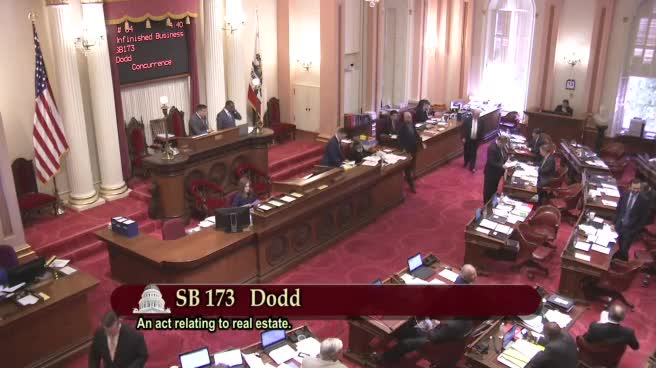 1MIN
Senate Floor
 1MIN
Assembly Floor
 38SEC
Assembly Floor
 1H
Assembly Standing Committee on Appropriations
 4MIN
Assembly Standing Committee on Accountability and Administrative Review
 3MIN
Senate Floor
 48MIN
Senate Standing Committee on Appropriations
 35SEC
Senate Standing Committee on Appropriations
Bill Author

Bill Co-Author(s):