SB 222: Inmates: health care enrollment.
- Session Year: 2017-2018
- House: Senate
- Latest Version Date: 2017-02-02
Existing law provides for the Medi-Cal program, which is administered by the State Department of Health Care Services, under which qualified low-income individuals receive health care services. The Medi-Cal program is, in part, governed and funded by federal Medicaid program provisions. Existing law requires Medi-Cal benefits to an individual who is an inmate of a public institution to be suspended effective the date he or she becomes an inmate of a public institution. Existing law requires the suspension to end on the date that he or she is no longer an inmate of a public institution or one year from the date he or she becomes an inmate of a public institution, whichever is sooner.
This bill instead would require the suspension of Medi-Cal benefits to end on the date he or she is no longer an inmate of a public institution or is no longer otherwise eligible for benefits under the Medi-Cal program. The bill would require the department, in consultation with specified stakeholders, to develop and implement a simplified annual renewal process for individuals in a suspended eligibility status, and would require the department to seek any necessary federal approvals or waivers to implement this provision.
(a)Except as provided in Sections 14053.7 and 14053.8, benefits provided under this chapter to an individual who is an inmate of a public institution shall be suspended in accordance with Section 1396d(a)(29)(A) of Title 42 of the United States Code as provided in subdivision (c).
(b)County welfare departments shall notify the department within 10 days of receiving information that an individual on Medi-Cal in the county is or will be an inmate of a public institution.
(c)If an individual is a Medi-Cal beneficiary on the date he or she becomes an inmate of a public institution, his or her benefits under this chapter and under Chapter 8 (commencing with Section 14200) shall be suspended effective the date he or she becomes an inmate of a public institution. The suspension shall end on the date he or she is no longer an inmate of a public institution or one year from the date he or she becomes an inmate of a public institution, is no longer otherwise eligible for benefits under the Medi-Cal program, whichever is sooner.
(d)The department, in consultation with stakeholders, including the County Welfare Directors Association and advocates, shall develop and implement a simplified annual renewal process for individuals who are in a suspended eligibility status under this section. The department shall seek any necessary federal approvals or waivers to implement this subdivision.
(d)(e)This section does not create a state-funded benefit or program. Health care services under this chapter and Chapter 8 (commencing with Section 14200) shall not be available to inmates of public institutions whose Medi-Cal benefits have been suspended under this section.
(e)(f)This section shall be implemented only if and to the extent allowed by federal law. This section shall be implemented only to the extent that any necessary federal approval of state plan amendments or other federal approvals are obtained.
(f)(g)If any part of this section is in conflict with or does not comply with federal law, this entire section shall be become inoperative.
(g)(h)This section shall be implemented on January 1, 2010, or the date when all necessary federal approvals are obtained, whichever is later.
(h)(i)By January 1, 2010, or the date when all necessary federal approvals are obtained, whichever is later, the department, in consultation with the Chief Probation Officers of California and the County Welfare Directors Association, shall establish the protocols and procedures necessary to implement this section, including any needed changes to the protocols and procedures previously established to implement Section 14029.5.
(i)(j)The department shall determine whether federal financial participation will be jeopardized by implementing this section and shall implement this section only if and to the extent that federal financial participation is not jeopardized.
(j)(k)Notwithstanding Chapter 3.5 (commencing with Section 11340) of Part 1 of Division 3 of Title 2 of the Government Code, the department shall implement this section by means of all-county letters or similar instructions without taking regulatory action. Thereafter, the department shall adopt regulations in accordance with the requirements of Chapter 3.5 (commencing with Section 11340) of Part 1 of Division 3 of Title 2 of the Government Code.
|
Date
|
Status
|
|---|---|
| Feb 1, 2018 | Returned to Secretary of Senate pursuant to Joint Rule 56. |
| May 25, 2017 | May 25 hearing: Held in committee and under submission. |
| May 19, 2017 | Set for hearing May 25. |
| May 15, 2017 | May 15 hearing: Placed on APPR. suspense file. |
| May 4, 2017 | Set for hearing May 15. |
| May 3, 2017 | May 8 hearing postponed by committee. |
| May 1, 2017 | Set for hearing May 8. |
| Apr 17, 2017 | Withdrawn from committee. |
| Apr 5, 2017 | From committee: Do pass and re-refer to Com. on PUB. S. (Ayes 7. Noes 1. Page 624.) (April 5). Re-referred to Com. on PUB. S. |
| Mar 10, 2017 | Set for hearing April 5. |
| Feb 16, 2017 | Referred to Coms. on HEALTH and PUB. S. |
| Feb 3, 2017 | From printer. May be acted upon on or after March 5. |
| Feb 2, 2017 | Introduced. Read first time. To Com. on RLS. for assignment. To print. |
|
Date
|
Description
|
Location
|
Votes
|
|
|---|---|---|---|---|
| May 15, 2017 | Placed on suspense file | Senate Standing Committee on Appropriations |
Passed |
|
| Apr 5, 2017 | Do pass, but first be re-referred to the Committee on [Public Safety] | Senate Standing Committee on Health |
Passed |
This list shows positions taken on this bill by organizations on the date displayed, which is linked to the original source.
Positions by individuals are not included.
|
Organization
|
Position
|
Date
|
|---|---|---|
| Alliance for Boys and Men of Color | ** Support | Apr 3, 2017 |
| American Civil Liberties Union of California | ** Support | Apr 3, 2017 |
| Butte County Employment & Social Services | ** Support | Apr 3, 2017 |
| California Access Coalition | ** Support | Apr 3, 2017 |
| California Catholic Conference | * Support | Apr 5, 2017 |
| California Health Access | * Support | Apr 5, 2017 |
| California Pan-Ethnic Health Network | * Support | Apr 5, 2017 |
| California Psychiatric Association | ** Support | Apr 3, 2017 |
| California State Association Of Counties | * Support | Apr 5, 2017 |
| California State Sheriff's Association | * Support | Apr 5, 2017 |
| California Welfare Directors Association | ** Support | Apr 3, 2017 |
| Californians for Safety & Justice | * Support | Apr 5, 2017 |
| Community Clinic Association of Los Angeles County | ** Support | Apr 3, 2017 |
| County Health Executives Association Of California | * Support | Apr 5, 2017 |
| County of Santa Cruz Human Services Department | ** Support | Apr 3, 2017 |
| County of Yolo Board of Supervisors | ** Support | Apr 3, 2017 |
| Disability Rights California | ** Support | Apr 3, 2017 |
| Inter Council for Mothers of Murdered Children | ** Support | Apr 3, 2017 |
| L.A. Care Health Plan | ** Support | Apr 3, 2017 |
| Modoc County Department of Social Services | ** Support | Apr 3, 2017 |
| Monterey County Board of Supervisors | ** Support | Apr 3, 2017 |
| National Association of Social Work | * Support | Apr 5, 2017 |
| Numerous individuals | ** Support | Apr 3, 2017 |
| Project Inform | ** Support | Apr 3, 2017 |
| Riverside County Department of Public Social Services | ** Support | Apr 3, 2017 |
| Root & Rebound | ** Support | Apr 3, 2017 |
| Rural County Representatives of California | ** Support | Apr 3, 2017 |
| San Francisco Human Services Agency | ** Support | Apr 3, 2017 |
| San Gabriel Valley Conservation Corps | ** Support | Apr 3, 2017 |
| Solano County Department of Health & Social Services | ** Support | Apr 3, 2017 |
| Sonoma County Human Services Department | ** Support | Apr 3, 2017 |
| Western Center On Law And Poverty Inc. | * Support | Apr 5, 2017 |
| Youth Law Center | ** Support | Apr 3, 2017 |
SENATE COMMITTEE ON
Senator Ricardo Lara, Chair
2017 - 2018 Regular Session
SB 222 (Hernandez) - Inmates: health care enrollment
Version: | Policy Vote: |
Urgency: | Mandate: |
Hearing Date: | Consultant: |
This bill meets the criteria for referral to the Suspense File.
Bill Summary:
SB 222 would require the Department of Health Care Services to extend the suspension of Medi-Cal benefits for incarcerated enrollees for the entire duration of incarceration.
Fiscal Impact:
- Likely one-time costs in the hundreds of thousands to develop the simplified annual renewal process, get federal approval, and make any necessary system changes (General Fund and federal funds).
- Projected annual costs of about $4 million per year to perform additional annual redeterminations that would otherwise not occur (General Fund and federal funds). Under the bill, counties would continue to perform annual redeterminations for inmates (rather than disenrolling then after one year). There would be administrative costs to counties to perform the annual redeterminations after the first year of incarceration. Based on the current inmate population, the share of incoming inmates estimated to have Medi-Cal eligibility upon incarceration, and historic costs for performing redeterminations, the Department estimates annual costs of about $4 million per year.
- Potential increased Medi-Cal costs in the low millions due to higher Medi-Cal enrollment under the bill (General Fund and federal funds). By extending the suspended eligibility for inmates, the bill is likely to result in increased Medi-Cal enrollment. It is administratively easier to unsuspend an existing Medi-Cal enrollee than it is to perform a completely new eligibility determination for someone who has been disenrolled. The reduced administrative burden is likely to result in quicker reinstatement of benefits, which will lead to the state paying for benefits sooner (such as capitated payments to managed care plans). This effect is likely only to apply to county jail inmates. Assuming that the bill results in one extra month of eligibility for county jail inmates incarcerated for a felony charge (and therefore likely to have spent more than one year in jail), the annual cost for additional eligibility would be about $3 million per year. Because a large proportion of the jail inmate population is likely to be eligible for Medi-Cal under the Affordable Care Act expansion for childless adults, most of the additional benefit costs will be paid for with federal funds.
Background:
Under state and federal law, the Department of Health Care Services operates the Medi-Cal program, which provides health care coverage to low income individuals, families, and children. Medi-Cal provides coverage to childless adults and parents with household incomes up to 138% of the federal poverty level and to children with household incomes up to 266% of the federal poverty level. The federal government provides matching funds that vary from 50% to 90% of expenditures depending on the category of beneficiary.
Federal law requires the state to redetermine an enrollee’s eligibility for Medi-Cal annually. Changes made to the Medi-Cal program as part of implementation of the Affordable Care Act simplified the application and redetermination process for Medi-Cal, including using existing federal and state data sources to verify income, generally eliminating asset tests for eligibility, and allowing counties to renew eligibility without requiring an enrollee to complete any forms, if existing data sources indicate continuing eligibility.
Federal law prohibits the use of Medicaid funding for incarcerated individuals (there is an exception for incarcerated individuals who have been moved to an outside medical facility for treatment).
Under current state law, when an adult Medi-Cal enrollee becomes incarcerated, the Department of Health Care Services suspends the inmate’s Medi-Cal eligibility until the date of the inmate’s release or one year from the date of incarceration, whichever is sooner. At that point, the inmate is disenrolled from Medi-Cal if the inmate is still incarcerated. For juvenile inmates, Medi-Cal eligibility is suspended for the length of incarceration.
Proposed Law:
SB 222 would require the Department of Health Care Services to extend the suspension of Medi-Cal benefits for incarcerated enrollees for the entire duration of incarceration or until the inmate is no longer eligible for Medi-Cal.
The bill would require the Department to develop a simplified annual renewal process for individuals with suspended eligibility and require the Department to seek federal approval to implement the bill.
Related Legislation:
SB 480 (Yee, 2014) would have required the Department of Health Care Services to suspend the Medi-Cal eligibility for inmates over 21 years of age for the duration of incarceration. That bill was held in the Senate Human Services Committee.
Staff Comments:
Under current law, counties are authorized to assist county jail inmates in applying for Medi-Cal during their incarceration. The extent to which counties are providing such service is unknown.
Under current practice, the Department of Corrections and Rehabilitation provides assistance to inmates pending release, including assisting inmates with applying for Medi-Cal coverage. According to the Department, in 2015-16, the Department provided such assistance to nearly 100% of inmates set for release. From this population of inmates, 27,000 Medi-Cal applications were submitted. Of those applications, 70% were approved, 29% were still pending at the time of release, and 1% were rejected. Under the bill, those inmates would have their Medi-Cal eligibility reinstated, rather than requiring a new eligibility determination to be made. Because of the comprehensive system in place for assisting inmates with applying for Medi-Cal, it is not likely that this bill will significantly increase enrollment in Medi-Cal for this population.
Because federal law requires the state to annually redetermine Medi-Cal eligibility for enrolled individuals, the counties would be required to go through the annual redetermination process for any incarcerated adult Medi-Cal beneficiary every year of their incarceration. This will impose administrative costs on the counties to perform those annual redeterminations. Under current practice, the state pays counties to administer eligibility determinations for Medi-Cal, so those costs would ultimately be borne by the state.
Under current practice, when a county performs an annual eligibility redetermination, the county first attempts to verify continued eligibility using electronic sources (such as federal income information). If those existing data sources indicate that the individual is still eligible for Medi-Cal, then the county renews eligibility automatically. It is only if there is missing information or information that indicates an individual is no longer eligible that the counties send a renewal packet to the beneficiary to verify the missing or incompatible information. Under this bill, it should be simple for the counties to perform the electronic verification checks for inmates, and in most cases there should not be any information that indicates the individual is no longer Medi-Cal eligible. However, in cases where the county cannot renew eligibility using those existing data sources, it may become administratively difficult to continue the renewal process. It is likely to be time consuming for a county to actually locate an inmate (particularly for state prison inmates) and have that person complete and return the renewal packet.
In theory, making it easier for former inmates to access health care services, including mental health and substance abuse services, should improve their health status and may impact future recidivism. Whether that would actually occur under the bill is unknown. Under current practice, the process for establishing Medi-Cal eligibility has been greatly simplified and many health care providers have processes to assist patients in applying for Medi-Cal (such as county-operated mental health providers). Therefore, it is difficult to determine the extent to which the bill will result in increased utilization of those services in a timely way by former inmates.
-- END --
SENATE COMMITTEE ON HEALTH
Senator Ed Hernandez, O.D., Chair
BILL NO: SB 222
AUTHOR: | Hernandez | ||
VERSION: | February 2, 2017 | ||
HEARING DATE: | April 5, 2017 | ||
CONSULTANT: | Bao Nguyen | ||
SUBJECT: Inmates: health care enrollment
SUMMARY:
Requires the Department of Health Care Services to extend the suspension of Medi-Cal benefits of incarcerated persons from one year to the entire duration of his or her incarceration.
Existing law:
- Requires the Department of Health Care Services (DHCS) to suspend a juvenile’s Medi-Cal benefits who is an inmate of a public institution.
- Requires the DHCS to suspend an individual’s Medi-Cal benefits effective the date he or she becomes an inmate of a public institution until he or she is no longer an inmate of a public institution or one year from the date of incarceration, whichever is sooner.
This bill:
- Requires the DHCS to suspend an individual’s Medi-Cal benefits effective the date he or she becomes an inmate of a public institution until he or she is no longer otherwise eligible for benefits or gets released, whichever comes sooner.
- Requires the DHCS to develop and implement a simplified annual renewal process for inmates with suspended Medi-Cal benefits.
FISCAL EFFECT:
This bill has not been analyzed by a fiscal committee.
COMMENTS:
- Author’s statement. According to the author, many individuals entering California correctional facilities have long, untreated physical and behavioral health needs that require access to intensive health care services. Compared to other individuals in the community, incarcerated individuals are more likely to have chronic physical and mental conditions. For example, they have higher rates of tuberculosis, HIV, Hepatitis B and C, and diabetes. Additionally, they are two to four times more likely to suffer from a serious mental illness and more than 50% have a diagnosable substance abuse disorder. It is vital that access to health care benefits provided prior to and during incarceration is also available immediately upon release to allow for uninterrupted services. Studies have shown that interruption in access to care increases the risk of lapse in medication intake, which could lead to greater chance of recidivism and readmission. SB 222 will suspend Medicaid coverage during incarceration, so that once released from correctional facilities, individuals will not be forced to undergo the lengthy and cumbersome re-application process that could potentially delay their access to health care. Proper health care has the potential to make a significant difference in the lives of this already vulnerable population by providing critical community services, avoiding crises and unnecessary institutionalization. Assuring continuity of care will reduce the demand for intensive, costly health care services down the road, which will not only help ensure better health in this population, but will ultimately save the system money.
- Federal guidance. Existing federal law prevents Medicaid benefits from being paid for incarcerated individuals except when the inmate is a patient in a medical institution. While incarceration excludes inmates from Medicaid payments, federal law does not make them ineligible for Medicaid. The Centers for Medicare and Medicaid Services (CMS) published a letter of guidance in 2016 stating that incarceration does not preclude an inmate from being determined Medicaid eligible. In addition, to promote continuity of care, CMS encourages states to place the inmate in suspended eligibility status during the period of incarceration, or to implement a claims processing edit to ensure that services are limited to only inpatient services.
- Medi-Cal for incarcerated persons. Under current state law, Medi-Cal beneficiaries who become incarcerated have their benefits suspended for one year or until they are released, whichever comes first. For those incarcerated for less than one year, coverage is reinstated by DHCS upon release. Anyone over the age of 18 who is incarcerated for longer than one year has their Medi-Cal coverage terminated. Individuals who lose coverage due to longer-term incarceration need to reapply for coverage. Some jails, and all state prisons, provide varying degrees of assistance to help individuals apply for Medi-Cal prior to release. These processes start between 14 to 120 days before inmates leave jail or prison and range from one-on-one counseling sessions to determine eligibility to submitting health care enrollement applications. According to the California Department of Corrections and Rehabilitation (CDCR), after submission of a new application, new eligibility determination can take between 45 to 90 days under federal guidelines.
- Suspension versus termination. Suspension of Medi-Cal coverage is effective the date an individual becomes an inmate of a public institution, allowing an inmate to retain eligibility status for Medi-Cal but prohibiting receipt of benefits during incarceration. Termination removes an individual from the state’s Medi-Cal database and requires submission of a new application after release from jail or prison. According to the National Association of Counties (NACo), terminating benefits prior to release, rather than leaving individuals in a suspended status, increases the gap in health care services, which are critical in the first weeks and months post-incarceration. The Kaiser Family Foundation release a report stating that improved access to services and better management of health conditions immediately after release from jail or prison has shown to reduce rates of recidivism, particularly among individuals with mental health and substance abuse disorders. Studies published by the American Psychiatric Association show that inmates who were enrolled in Medicaid at the time of release had 16% fewer incidents of recidivism compared to those not enrolled at the time of release.
- Other states. According to FamiliesUSA, as of June 2016, 17 states including Washington, D.C. suspend Medicaid for the entire duration of incarceration; 15 states suspend Medicaid for a specific amount of time, ranging from 30 days to one year; and 19 states terminate Medicaid coverage as soon as a person enters a public institution. Most recently, Hawaii and Washington have passed legislation to move from termination or limited suspension to extended suspension until release.
- Double referral. This bill is double referred. Should it pass out of this committee, it will be referred to the Senate Committee on Public Safety.
- Prior legislation. SB 1147 (Calderon, Chapter 546, Statutes of 2008) requires DHCS to develop procedures to ensure that the Medi-Cal eligibility of minors is not terminated when they are incarcerated. Requires Medi-Cal benefits provided to an individual under 21 years of age who is an inmate of a public institution (a state or federal prison, correctional facility, county/city jail, or detention center) to be suspended in according with provisions of federal law.
AB 720 (Skinner, Chapter 646, Statutes of 2013) requires the board of supervisors in each county to designate an entity to assist certain jail inmates to apply for a health insurance affordability program, as defined. Prohibits county jail inmates who are currently enrolled in the Medi-Cal from being terminated from the program due to their detention, unless required by federal law or they become otherwise ineligible, as specified. Deletes the age restriction relating to Medi-Cal benefits provided to inmates of the public institution.
SB 480 (Yee of 2014) would have required the DHCS to suspend Medi-Cal benefits for inmates over the age of twenty one for the duration of his or her stay in a public institution or one year, whichever is less. SB 480 died in Senate Committee on Human Services.
- Support. Supporters of this bill state that indefinitely suspending Medi-Cal benefits of incarcerated persons ensures that individuals have immediate access to benefits that are essential for their basic needs upon release, rather than requiring them to re-apply for benefits and potentially not have access to care during re-entry. Additionally, streamlining their access to coverage greatly reduces the risks of recidivism and provides continuity in mental health care, physical treatment and prescription medication between the period of incarceration and reintegration into their community. Ensuring all incarcerated persons return home without gaps in health care improves community safety, protects public health and reduces the likelihood of recidivism by ensuring people with medical care needs have immediate access to critical health supports they need.
SUPPORT AND OPPOSITION:
Support: Alliance for Boys and Men of Color
American Civil Liberties Union (ACLU) of California
Butte County Employment & Social Services
California Access Coalition
California Catholic Conference
Californians for Safety and Justice (sponsor)
California Pan-Ethnic Health Network
California Psychiatric Association
California State Association of Counties
California State Sheriff’s Association
California Welfare Directors Association (sponsor)
Community Clinic Association of Los Angeles County
County of Del Norte Department of Health and Human Services
County Health Executives Association of California
County of Santa Cruz Human Services Department
County of Yolo Board of Supervisors
Disability Rights California
Health Access California
Inter Council for Mothers of Murdered Children
L.A. Care Health Plan
Modoc County Department of Social Services
Monterey County Board of Supervisors
Project Inform
Riverside County Department of Public Social Services
Root & Rebound
Rural County Representatives of California
San Francisco Human Services Agency
San Gabriel Valley Conservation Corps
Solano County Department of Health & Social Services
Sonoma County Human Services Department
Western Center on Law and Poverty
Youth Law Center
Numerous individuals
Oppose: None received
-- END --
Discussed in Hearing
 48MIN
Senate Standing Committee on Appropriations
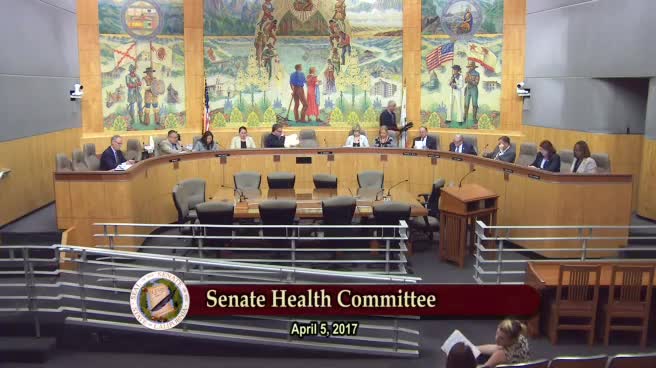 4MIN
Senate Standing Committee on Health
Bill Author

Bill Co-Author(s):