SB 234: Fishing: local regulation: report.
- Session Year: 2017-2018
- House: Senate
- Latest Version Date: 2017-03-21
The California Constitution provides for the delegation to the Fish and Game Commission of powers relating to the protection and propagation of fish and game. Existing statutory law delegates to the commission the power to regulate the taking or possession of birds, mammals, fish, amphibians, and reptiles in accordance with prescribed laws. Under existing law, the Department of Fish and Wildlife exercises various functions with regard to the taking of fish and game. Under existing law, a city or county has no authority to regulate fish and game except that a city or county may adopt an ordinance that incidentally affects fishing and hunting for the protection of public health and safety.
This bill would prohibit a local agency from adopting or enforcing an ordinance to regulate fishing and would provide that this provision is declaratory of existing law. The bill would authorize any person to bring an action against a local agency for a violation of this prohibition. The bill would require the court to award attorneys fees to a party who prevails in an action and would authorize a court to award damages, including punitive damages for a knowing violation, to an aggrieved party. require the Fish and Game Commission to undertake a survey and evaluation of local ordinances that regulate fishing and to submit the survey and evaluation to the Legislature in a report by December 31, 2018.
The California Constitution provides for the delegation to the Fish and Game Commission of powers relating to the protection and propagation of fish and game. Existing statutory law delegates to the commission the power to regulate the taking or possession of birds, mammals, fish, amphibians, and reptiles in accordance with prescribed laws. Under existing law, the Department of Fish and Wildlife exercises various functions with regard to the taking of fish and game. Under existing law, a city or county has no authority to regulate fish and game except that a city or county may adopt an ordinance that incidentally affects fishing and hunting for the protection of public health and safety.
This bill would prohibit a local agency from adopting or enforcing an ordinance to regulate fishing and would provide that this provision is declaratory of existing law. The bill would authorize any person to bring an action against a local agency for a violation of this prohibition. The bill would require the court to award attorneys fees to a party who prevails in an action and would authorize a court to award damages, including punitive damages for a knowing violation, to an aggrieved party.
(a)The Fish and Game Commission shall undertake a survey and evaluation of local ordinances that regulate fishing. In the survey and evaluation, the commission shall identify and catalog these ordinances, evaluate whether these ordinances are within or outside of the scope of the holding of People v. Mueller (1970) 8 Cal.App.3d. 949 or within or outside the scope of local police powers generally, and recommend to the Legislature a course of action with regard to ordinances that the commission determines to be unlawful.
(b)The commission shall submit the survey and evaluation to the Legislature in a report by December 31, 2018.
(c)The report submitted pursuant to this section shall be submitted in compliance with Section 9795 of the Government Code.
SECTION 1.Section 5504 is added to the Fish and Game Code, to read:5504.(a)A local agency shall not adopt or enforce an ordinance to regulate fishing. (b)Notwithstanding Section 818.2 of the Government Code, any person may bring an action, including for declaratory or injunctive relief, against a local agency for a violation of subdivision (a).(c)The court shall award reasonable attorneys fees to a party who prevails in an action brought pursuant to subdivision (b). In addition, the court may award damages and, notwithstanding Section 818 of the Government Code, punitive damages for a knowing violation of subdivision (a), to an aggrieved party.(d)For purposes of this section, local agency means a county, city, whether general law or chartered, special district, authority, agency, any other municipal public corporation or district, or other political subdivision of the state. (e)Subdivision (a) is declaratory of existing law.(a)A local agency shall not adopt or enforce an ordinance to regulate fishing.
(b)Notwithstanding Section 818.2 of the Government Code, any person may bring an action, including for declaratory or injunctive relief, against a local agency for a violation of subdivision (a).
(c)The court shall award reasonable attorneys fees to a party who prevails in an action brought pursuant to subdivision (b). In addition, the court may award damages and, notwithstanding Section 818 of the Government Code, punitive damages for a knowing violation of subdivision (a), to an aggrieved party.
(d)For purposes of this section, local agency means a county, city, whether general law or chartered, special district, authority, agency, any other municipal public corporation or district, or other political subdivision of the state.
(e)Subdivision (a) is declaratory of existing law.
|
Date
|
Status
|
|---|---|
| Sep 1, 2017 | September 1 hearing: Held in committee and under submission. |
| Jul 19, 2017 | July 19 set for first hearing. Placed on APPR. suspense file. |
| Jun 27, 2017 | From committee: Do pass and re-refer to Com. on APPR. (Ayes 15. Noes 0.) (June 27). Re-referred to Com. on APPR. |
| Jun 8, 2017 | Referred to Com. on W.,P., & W. |
| May 16, 2017 | In Assembly. Read first time. Held at Desk. |
| May 15, 2017 | Read third time. Passed. (Ayes 39. Noes 0. Page 1061.) Ordered to the Assembly. |
| Apr 4, 2017 | Read second time. Ordered to third reading. |
| Apr 3, 2017 | From committee: Do pass. (Ayes 7. Noes 0. Page 585.) (April 3). |
| Mar 24, 2017 | Set for hearing April 3. |
| Mar 22, 2017 | Withdrawn from committee. |
| Mar 21, 2017 | Read second time and amended. Re-referred to Com. on JUD. |
| Mar 20, 2017 | From committee: Do pass as amended and re-refer to Com. on JUD. with recommendation: To consent calendar. (Ayes 8. Noes 0. Page 364.) (March 14). |
| Feb 18, 2017 | Set for hearing March 14. |
| Feb 16, 2017 | Referred to Coms. on N.R. & W. and JUD. |
| Feb 7, 2017 | From printer. May be acted upon on or after March 9. |
| Feb 6, 2017 | Introduced. Read first time. To Com. on RLS. for assignment. To print. |
|
Date
|
Description
|
Location
|
Votes
|
|
|---|---|---|---|---|
| Jun 27, 2017 | Do pass and be re-referred to the Committee on [Appropriations] | Assembly Standing Committee on Water, Parks, and Wildlife |
Passed |
|
| May 15, 2017 | Senate 3rd Reading SB234 Berryhill | Senate Floor |
Passed |
|
| Apr 3, 2017 | Do pass | Senate Standing Committee on Appropriations |
Passed |
|
| Mar 14, 2017 | Do pass as amended, but first amend, and re-refer to the Committee on [Judiciary] with the recommendation: To Consent Calendar | Senate Standing Committee on Natural Resources and Water |
Passed |
This list shows positions taken on this bill by organizations on the date displayed, which is linked to the original source.
Positions by individuals are not included.
|
Organization
|
Position
|
Date
|
|---|---|---|
| California Association Of Harbor Masters And Port Captains | ** Support | Apr 28, 2017 |
| California Sportfishing League | ** Support | Jun 23, 2017 |
| California Sportsman's Lobby | ** Support | Jun 23, 2017 |
| Outdoor Sportsmen'S Coalition Of California | ** Support | Jun 23, 2017 |
| Safari Club International | ** Support | Jun 23, 2017 |
| Safari Club International Foundation | ** Support | Jun 23, 2017 |
Date of Hearing: July 19, 2017
ASSEMBLY COMMITTEE ON APPROPRIATIONS
Lorena Gonzalez Fletcher, Chair
SBPCA Bill Id:SB 234
Author:(Berryhill) – As Amended Ver:March 21, 2017
Policy Committee: | Water, Parks and Wildlife | Vote: | 15 - 0 |
|
| ||
|
|
Urgency: No State Mandated Local Program: No Reimbursable: No
SUMMARY:
This bill requires the Fish and Game Commission (Commission) to undertake a survey and evaluation of all local ordinances that regulate fishing. Specifically, this bill requires the Commission to:
- Identify and catalogue the ordinances;
- Evaluate whether the ordinances are within or outside the scope of the holding in of People v. Mueller (1970) or local police powers generally.
- Recommend a course of action with regard to ordinances determined to be unlawful.
- Submit the survey and evaluation to the Legislature in a report by December 31, 2018.
FISCAL EFFECT:
Unknown one-time costs, likely less than $100,000 (Fish and Game Preservation Fund) for staff to research local ordinances, assess legality, and develop the report for the Legislature.
The cost will depend on the number of local ordinances that must undergo legal review and the difficulty in obtaining this information. While it is unknown how many local ordinances impact fishing in the State, recent research indicates that it is likely a relatively small number. As such, this fiscal analysis assumes a relatively small number of local ordinances will need to undergo legal review. It also assumes that implementation will result in the redirection of one existing staff position for up to one year.
COMMENTS:
- Purpose. According to the author, some local agencies have enacted local ordinances restricting fishing without proper authority and many of these local agencies continue to maintain illegal fishing restrictions even after it has been brought to their attention. This bill would help resolve this issue by requiring the Fish and Game Commission to evaluate local fishing ordinances and submit a report to the Legislature.
- Background. Under existing law, the Commission has regulatory authority over hunting and fishing in the State. Existing law also guarantees the right to fish on the public lands and waters of the State, and prohibits laws that impede access to these lands and waters for the purpose of fishing.
The State Constitution authorizes local governments to make and enforce local ordinances and regulations that do not conflict with general law. Courts have held that a city or county may adopt an ordinance that impacts hunting and fishing in the State if the primary purpose of the ordinance is the protection of public health and safety, and it only incidentally impacts hunting or fishing in the State.
- Legal Authority Over Fishing. Local ordinances are invalid if they attempt to impose requirements in a field that is preempted by state law. Local ordinances may be preempted where the Legislature adopts a general scheme for regulation that indicates intent, expressly or implied, by the state to occupy a particular field to the exclusion of local laws.
The California Constitution, Article XI, Section 7, gives local governments broad police powers. The California Constitution, as amended in 1902, also provides that the Legislature may provide for the division of the state into fish and game districts and may enact such laws for the protection of fish and game as it deems appropriate. The California Supreme Court in In re Makings (1927) 200 Cal. 174 held that the purpose of this amendment was to take from local authorities the right to regulate fish and game and to invest such power exclusively in the state.
In a 1986 opinion, the Attorney General analyzed both of these constitutional provisions and opined that a county may by ordinance adopt laws regulating certain methods of hunting within its jurisdiction where such action is necessary to protect public health and safety, and where the local ordinance only incidentally affects the field of hunting. The particular ordinance in question banned steel-jawed leg hold traps. Attorney General opinions are persuasive authority but not binding on courts. The 1986 Attorney General opinion relied in part on the reasoning of the Court of Appeal in People v. Mueller (1970) 8 Cal.App.3d 949. The court in that case found a local ordinance regulating fishing to be valid, and held that if the primary purpose of the ordinance is the protection of public health and safety, and the ordinance affects hunting and fishing only incidentally, the ordinance is a valid exercise of the local police power.
- Prior Legislation. AB 665 (Frazier) of the 2015-2016 Legislative Session would have declared that the state fully occupied the fields of hunting and fishing, and would also have prohibited local ordinances regulating hunting or fishing unless they were specifically authorized by the Fish and Game Code. This bill died on concurrence in the Assembly Appropriations Committee.
AB 979 (Berryhill) of the 2009-2010 Legislative Session would have provided that the state fully occupies the fields of hunting and fishing, and would have prohibited a city or county from adopting an ordinance or regulation that affects hunting or fishing, unless the ordinance or regulation is both necessary to protect public health and safety and has only an incidental impact on the fields of hunting and fishing preempted by state law. The bill was vetoed by the Governor.
Analysis Prepared by: Jennifer Galehouse / APPR. / (916) 319-2081
Date of Hearing: June 27, 2017
ASSEMBLY COMMITTEE ON WATER, PARKS, AND WILDLIFE
Eduardo Garcia, Chair
SBPCA Bill Id:SB 234
Author:(Berryhill) – As Amended Ver:March 21, 2017
SENATE VOTE: 39-0
SUBJECT: Fishing: local regulation: report
SUMMARY: Requires the Fish and Game Commission (FGC) to undertake a survey of all local ordinances that regulate fishing and evaluate whether each ordinance is consistent with People v. Mueller (1970) or local police powers generally. Specifically, this bill:
Requires the FGC to develop and submit a report to the Legislature, by December 31, 2018, that includes recommendations for addressing ordinances that the FGC determines to be unlawful.
EXISTING LAW:
- Authorizes the Legislature, in the California Constitution, to delegate to the FGC powers relating to the protection and propagation of fish and game. The Legislature, by statute, has delegated to the FGC the power to regulate the taking or possession of fish and game, in accordance with state fish and game laws. The California Constitution also guarantees the right to fish on the public lands and waters of the state and prohibits laws that impede access to these lands and waters for the purpose of fishing.
- Gives local governments authority, under the California Constitution, to make and enforce within their limits all local, police, sanitary and other ordinances and regulations not in conflict with general law. Courts have held that a city or county may adopt an ordinance that only incidentally affects fishing and hunting if the primary purpose of the ordinance is for the protection of public health and safety.
FISCAL EFFECT: Unknown.
COMMENTS: Requires the FGC undertake a survey of all local fishing ordinances. The FGC will evaluate and make recommendations to address unlawful ordinances.
Author’s Statement:
Current law authorizes the California Fish and Game Commission to oversee and regulate fishing in our state. Furthermore, cities and counties are only allowed to impose fishing regulations on an incidental basis and to protect public health and safety. However, some local agencies have enacted local ordinances restricting fishing without proper authority. Many of these local agencies continue to maintain illegal fishing restrictions even after it has been brought to their attention. This bill would help resolve this issue by requiring the Fish and Game Commission to evaluate local fishing ordinances and submit a report to the Legislature. The bill represents a good first step toward equal protections for all Californians wishing to participate in a great form of recreation in our state.
Background: Legal Authority Over Fishing. Local ordinances are invalid if they attempt to impose requirements in a field that is preempted by state law. Local ordinances may be preempted where the Legislature adopts a general scheme for regulation that indicates intent, expressly or implied, by the state to occupy a particular field to the exclusion of local laws. [See In re Lane, 58 Cal.2d. 99, Pipoly v. Benson (1942) 20 Cal.2d. 366, and Sherwin-Williams Co. v. City of Los Angeles (1993) 4. Cal.4th 893.] The California Constitution, Article XI, Section 7, gives local governments broad police powers. The California Constitution, as amended in 1902, also provides that the Legislature may provide for the division of the state into fish and game districts and may enact such laws for the protection of fish and game as it deems appropriate. The California Supreme Court in In re Makings (1927) 200 Cal. 174 held that the purpose of this amendment was to take from local authorities the right to regulate fish and game and to invest such power exclusively in the state.
In a 1986 opinion, the Attorney General analyzed both of these constitutional provisions and opined that a county may by ordinance adopt laws regulating certain methods of hunting within its jurisdiction where such action is necessary to protect public health and safety, and where the local ordinance only incidentally affects the field of hunting. The particular ordinance in question banned steel-jawed leg hold traps. Attorney General opinions are persuasive authority but not binding on courts.
The 1986 Attorney General opinion relied in part on the reasoning of the Court of Appeal in People v. Mueller (1970) 8 Cal.App.3d 949. The court in that case found a local ordinance regulating fishing to be valid, and held that if the primary purpose of the ordinance is the protection of public health and safety, and the ordinance affects hunting and fishing only incidentally, the ordinance is a valid exercise of the local police power.
On-Going Debate Over Local Role. This bill marks the fifth legislative attempt in the last decade to redefine the role of local ordinances on hunting and fishing. This bill differs from previous efforts in that it would not impact local ordinances, but would instead require the FGC to evaluate current fishing ordinances and report with recommendations to the Legislature.
It is not known the extent to which local governments adopt fishing ordinances. Existing law allows local ordinances if they have an “incidental affect”. Most fishing regulations are established by the FGC. This bill would assign the FGC to make an initial evaluation of the lawfulness of local ordinances.
Prior and Related Legislation:
AB 665 (Frazier), 2015, would have declared that the state fully occupied the fields of hunting and fishing, and would also have prohibited local ordinances regulating hunting or fishing unless they were specifically authorized by the Fish and Game Code. The bill died on concurrence in the Assembly Appropriations Committee.
AB 979 (Berryhill), 2010, would have provided that the state fully occupies the fields of hunting and fishing, and would have prohibited a city or county from adopting an ordinance or regulation that affects hunting or fishing, unless the ordinance or regulation is both necessary to protect public health and safety and has only an incidental impact on the fields of hunting and fishing preempted by state law. The bill was vetoed by the Governor.
AB 815 (Berryhill), 2008, would have made findings regarding the Legislature’s jurisdiction over fish and game matters that cite case law, Attorney General opinions, and the state constitution. The bill was vetoed by the Governor.
AB 2146 (Canciamilla), 2006, would have prohibited a city or county from adopting an ordinance or regulation dealing with fish and game matters except under specific conditions. The bill was held by the author in Senate Natural Resources and Water Committee.
Supporting Arguments: Limited access to fishing is one of the major contributors to declining recreational fishing participation rates in California. Regulations are often difficult for anglers to navigate, and they become even more challenging when local ordinances that restrict fishing are imposed illegally. Under existing law, a city or county, or local public agency, has no authority to regulate fish and game except that a city or county may adopt an ordinance that only incidentally affects fishing and hunting for the protection of public health and safety. This bill would help protect the state preemption laws by identifying local government excesses in exercising their authority in this area under existing state law.
REGISTERED SUPPORT / OPPOSITION:
Support
California Sportfishing League (Sponsor)
California Sportsman’s Lobby
Outdoor Sportsmen’s Coalition of California
Safari Club International
Safari Club International Foundation
Opposition
None on file
Analysis Prepared by: Ryan Ojakian / W., P., & W. /
Office of Senate Floor Analyses (916) 651-1520 Fax: (916) 327-4478 | SB |
THIRD READING
Bill No: SB 234
:
SENATE NATURAL RES. & WATER COMMITTEE: 8-0, 3/14/17
AYES: Hertzberg, Allen, Atkins, Hueso, Jackson, Monning, Stern, Vidak
NO VOTE RECORDED: Stone
SENATE APPROPRIATIONS COMMITTEE: 7-0, 4/3/17
AYES: Lara, Bates, Beall, Bradford, Hill, Nielsen, Wiener
DIGEST: This bill requires the California Fish and Game Commission (Commission) to undertake a survey and evaluation of local ordinances that regulate fishing and to evaluate whether each ordinance is consistent with People v. Mueller (1970) or local police powers generally. Requires the Commission to develop and submit a report to the Legislature by December 31, 2018, that includes recommendations for addressing ordinances that the Commission determines to be unlawful.
Existing law:
- Authorizes the Legislature, in the California Constitution, to delegate to the Commission powers relating to the protection and propagation of fish and game. The Legislature, by statute, has delegated to the Commission the power to regulate the taking or possession of fish and game, in accordance with state fish and game laws. The California Constitution also guarantees the right to fish on the public lands and waters of the state and prohibits laws that impede access to these lands and waters for the purpose of fishing.
- Gives local governments authority, under the California Constitution, to make and enforce within their boundaries all local, police, sanitary, and other ordinances not in conflict with general law. Courts have held that a city or county may adopt an ordinance that only incidentally affects fishing and hunting if the primary purpose of the ordinance is for the protection of public health and safety.
This bill requires the Commission to undertake a survey and evaluation of local ordinances that regulate fishing and to evaluate whether each ordinance is consistent with People v. Mueller (1970) or local police powers generally. Requires the Commission to develop and submit a report to the Legislature by December 31, 2018, that includes recommendations for addressing ordinances that the Commission determines to be unlawful.
Comments
As introduced, the bill would have pre-empted local fishing ordinances, and it was in that form that generated the listed supporters.
Because the policy committee was concerned that existing law may or may not pre-empt local ordinances, the bill was modified into its current form requiring an evaluation of local ordinances in light of a court holding that allows those ordinances with an “incidental affect” on fishing, even though most fishing regulations are established by the Commission. The amendment therefore appropriately assigns to the Commission the responsibility for making an initial evaluation of the lawfulness of local ordinances that it catalogs. The amendment is supported by the author and supporters.
In one form or another, this issue has been before the Legislature since 2006 and it is hoped that the Commission’s evaluation will help bring this issue to a final resolution.
FISCAL EFFECT: Appropriation: Fiscal Com.: Local:
According to the Senate Appropriations Committee, the fiscal impact is unknown, but likely less than $100,000.
California Association of Harbor Masters and Port Captains
California Sportfishing League
Outdoor Sportsmen Coalition of California
Safari Club International
None received
ARGUMENTS IN SUPPORT: According to the author and supporters, some local jurisdictions have fishing ordinances that should be pre-empted by state law and they believe that fishing regulations should be set by the state in part to avoid confusion to anglers.
4/28/17 12:58:14
**** END ****
SENATE COMMITTEE ON
Senator Ricardo Lara, Chair
2017 - 2018 Regular Session
SB 234 (Berryhill) - Fishing: local regulation: report
Version: | Policy Vote: |
Urgency: | Mandate: |
Hearing Date: | Consultant: |
This bill does not meet the criteria for referral to the Suspense File.
Bill Summary:
SB 234 requires the Fish and Game Commission (Commission) to undertake a survey of all local ordinances that regulate fishing; evaluate whether each ordinance is consistent with People v. Mueller (1970) or local police powers generally; and develop and submit a report to the Legislature, by December 31, 2018, that includes recommendations for addressing ordinances that the Commission determines to be unlawful.
Fiscal Impact:
Unknown, likely less than $100,000 (Fish and Game Preservation Fund) for staff to research local ordinances, assess legality, and develop the report for the Legislature. (See staff comments)
Background:
- Under existing law, the Commission has regulatory authority over hunting and fishing in the State. Existing law also guarantees the right to fish on the public lands and waters of the State, and prohibits laws that impede access to these lands and waters for the purpose of fishing.
The State Constitution authorizes local governments to make and enforce local ordinances and regulations that do not conflict with general law. Courts have held that a city or county may adopt an ordinance that impacts hunting and fishing in the State if the primary purpose of the ordinance is the protection of public health and safety, and it only incidentally impacts hunting or fishing in the State.
Proposed Law:
This bill requires the Commission to:
- Undertake a survey of all local ordinances that regulate fishing;
- Evaluate whether each ordinance is consistent with People v. Mueller (1970) or local police powers generally; and
- Develop and submit, by December 31, 2018, a report to the Legislature that includes the aforementioned information and recommendations for addressing ordinances that the Commission determines to be unlawful.
Related Legislation:
AB 665 (Frazier, 2015) would have declared that the State fully occupied the fields of hunting and fishing, and would also have prohibited local ordinances regulating hunting or fishing unless they were specifically authorized by the Fish and Game Code. The bill died on concurrence in the Assembly Appropriations Committee.
AB 979 (Berryhill, 2010) would have provided that the State fully occupies the fields of hunting and fishing, and would have prohibited a city or county from adopting an ordinance or regulation that affects hunting or fishing, unless the ordinance or regulation is both necessary to protect public health and safety and has only an incidental impact on the fields of hunting and fishing preempted by State law. The bill was vetoed.
AB 815 (Berryhill, 2008) would have made findings regarding the Legislature’s jurisdiction over fish and game matters that cite case law, Attorney General opinions, and the State constitution. The bill was vetoed as part of Governor Schwarzenegger’s blanket vetoes of 2008.
AB 2146 (Canciamilla, 2006) would have prohibited a city or county from adopting an ordinance or regulation dealing with fish and game matters except under specific conditions. The bill was held by the author in Senate Natural Resources and Water Committee.
Staff Comments:
The cost of this bill depends upon the number of local ordinances that must undergo legal review and the difficulty in obtaining this information. While it is unknown how many local ordinances impact hunting and fishing in the State, recent research indicates that it is likely a relatively small number. As such, this fiscal analysis assumes a relatively small number of local ordinances will need to undergo legal review. It also assumes that implementation will result in the redirection of one existing staff position for up to one year.
Staff notes that the Commission is funded through the Fish and Game Preservation Fund (FGPF), the General Fund, and, for the past two years, the Environmental License Plate Fund (ELPF). As such, in the unlikely scenario that a position is funded for implementation of this bill, funding could appropriately come from any of those sources. Both the FGPF and ELPF are in structural deficit, making the General Fund a likely funding source. Use of FGPF or ELPF would further exacerbate their respective deficits.
-- END --
SENATE COMMITTEE ON NATURAL RESOURCES AND WATER
Senator Robert Hertzberg, Chair
2017 - 2018 Regular
Bill No: SB Hearing Date: March 14, 2017
Author: | Berryhill | ||
Version: | February 6, 2017 | ||
Urgency: | No | Fiscal: | No |
Consultant: | William Craven | ||
Subject: Fishing: local regulation: prohibition
BACKGROUND AND EXISTING LAW
- Authorizes the Legislature, in the California Constitution, to delegate to the Fish and Game Commission (FGC) powers relating to the protection and propagation of fish and game. The Legislature, by statute, has delegated to the FGC the power to regulate the taking or possession of fish and game, in accordance with state fish and game laws. The California Constitution also guarantees the right to fish on the public lands and waters of the state and prohibits laws that impede access to these lands and waters for the purpose of fishing.
- Gives local governments authority, under the California Constitution, to make and enforce within their boundaries all local, police, sanitary and other ordinances and regulations not in conflict with general law. Courts have held that a city or county may adopt an ordinance that only incidentally affects fishing and hunting if the primary purpose of the ordinance is for the protection of public health and safety.
PROPOSED LAW
This bill:
- Prohibits local government entities from adopting or enforcing ordinances related to fishing;
- Authorizes a private right of action, including declaratory and injunctive relief, against local agencies for a violation of the proposed prohibition;
- Requires an award of attorney’s fees to a prevailing party;
- Authorizes punitive damages;
- Defines “local agency” as county, city (whether general law or chartered), special district, authority, agency, any other municipal public corporation or district, or other political subdivision of the state.
- Asserts that the provision in 1), above, is declaratory of existing law.
ARGUMENTS IN SUPPORT
According to the author, some localities in California have enacted ordinances that restrict fishing without any underlying authority for those ordinances. The author observes that pier and jetty anglers are predominately subsistence fishers hoping to catch their next meal. The author asserts that these individuals have no access to attorneys when they are shut out of certain high-income areas that have fishing piers, especially along the southern California coast. The author further states that the bill allows parties to such discrimination to engage legal counsel which would otherwise be denied on the basis of financial capacity.
The fishing and hunting groups in support believe that local ordinances should be preempted, both those that regulate fishing as well as hunting. They argue that their members believe that hunting and fishing regulations are set by the state, not local governments, and they are concerned about confusion and any resulting violations or penalties.
ARGUMENTS IN OPPOSITION
None received.
COMMENTS
- The issue of whether local ordinances that regulate fishing are or are not preempted has been kicking around the Legislature for many years. This is the first such bill that contends that local fishing ordinances are discriminatory against subsistence fishermen and the first such bill that authorizes a private right of action that could include punitive damages.
- Previous bills on this topic were unsuccessful but not completely identical to this bill. Many also included local ordinances that prevented hunting within certain distances of homes in cities.
- Previous bills include:
a) AB 2146 (Canciamilla) in 2006 was held in the Senate.
- AB 815 (Berryhill) in 2008 that was vetoed by the Governor.
- AB 979 (Berryhill) in 2010 was also vetoed. Interestingly, it included language not in the current bill providing that a city or county may not adopt an ordinance or regulation that affects hunting or fishing unless the ordinance or regulation is both necessary to protect public health and safety and has only an incidental impact on the fields of hunting and fishing preempted by state law. This bill, on the other hand, is intended to fully pre-empt local ordinances without regard to the exceptions mentioned above.
- In 2015, AB 665 (Frazier) was unsuccessful as well. It would have declared that the state fully occupied the fields of hunting and fishing, and it would also have prohibited local ordinances unless they were specifically authorized by the Fish and Game Code.
Local Ordinances.
It is not really known how frequently local governments adopt fishing ordinances.
As stated above, existing law, to the frustration of this bill’s supporters, allows such ordinances provided their effect on hunting and fishing is “incidental.” To the bill’s supporters, these ordinances with “incidental effects” on hunting make knowledge of lawful hunting and fishing activities difficult to learn and makes for helter-skelter enforcement. At the time the Frazier bill was discussed in 2015, staff conducted research uncovering several local hunting ordinances but virtually no local fishing ordinances.
- The only example of a local fishing ordinance was a proposed ordinance from Hermosa Beach. There, following a 2014 incident at the pier at which a juvenile white shark was hooked and bit a fisherman, the city considered further restrictions on fishing more restrictive than state law. However, the amendments to the ordinance were never adopted.
- The committee analysis of the Frazier bill lists discusses several local hunting ordinances, but they are not included here because this bill applies only to local fishing ordinances.
- Local ordinances are invalid if they attempt to impose requirements in a field that is preempted by state law. Local ordinances may be preempted where the Legislature adopts a general scheme for regulation that indicates intent, expressly or implied, by the state to occupy a particular field to the exclusion of local laws. (See In re Lane, 58 Cal.2d. 99, Pipoly v. Benson (1942) 20 Cal.2d. 366, and Sherwin-Williams Co. v. City of Los Angeles (1993) 4. Cal.4th 893.) The California Constitution, Article XI, Section 7, gives local governments broad police powers. The California Constitution, as amended in 1902, also provides that the Legislature may provide for the division of the state into fish and game districts and may enact such laws for the protection of fish and game as it deems appropriate. The California Supreme Court in In re Makings (1927) 200 Cal. 174 held that the purpose of this amendment was to take from local authorities the right to regulate fish and game and to invest such power exclusively in the state.
In a 1986 opinion, the Attorney General analyzed both of these constitutional provisions and opined that a county may by ordinance adopt laws regulating certain methods of hunting within its jurisdiction where such action is necessary to protect public health and safety, and where the local ordinance only incidentally affects the field of hunting. The particular ordinance in question banned steel-jawed leg hold traps. Attorney General opinions are persuasive authority but not binding on courts.
Of particular importance to this bill, the 1986 Attorney General opinion relied in part on the reasoning of the Court of Appeal in People v. Mueller (1970) 8 Cal.App.3d 949. The court in that case found a local ordinance regulating fishing to be valid, and held that if the primary purpose of the ordinance is the protection of public health and safety, and the ordinance affects hunting and fishing only incidentally, the ordinance is a valid exercise of the local police power. - It’s also important to note that the Fish and Game Code and other provisions of law contain references to local ordinances that would also be nullified by this bill since this bill does not recognize local ordinances authorized by the Fish and Game Code. These include local ordinances regarding the take of wild pigs, and the disposition of frogs and turtles in the live animal market. There are undoubtedly others.
- While researching the Frazier bill, noted earlier, staff located multiple references to local ordinances in other contexts on the Department of Fish and Wildlife (DFW) website. For example, DFW website explaining sport fishing regulations notes that “cities, counties, and other local land management authorities may require permits and impose other access/trespass restrictions in addition to the restrictions in the sport fishing regulations. It is the responsibility of the angler to be aware of and comply with these local rules.” It is not clear how ordinances referenced in this website will be treated under this bill, but staff’s assumption is that such ordinances would be pre-empted.
- Another interesting example from the DFW website explains that its “Fishing in the City” program is subject to all state regulations, local and park ordinances, and that daily catch limits may be lower than state limits. Those ordinances would also likely be pre-empted.
Double-referral The Rules Committee referred this bill to both the Committee on Natural Resources and Water and to the Committee on Judiciary. Therefore, if this bill passes this committee, it will be referred to the Committee on Judiciary, which will consider the issues within their jurisdiction.
SUGGESTED AMENDMENTS
There are aspects of this bill that will likely doom its success either in this committee or at future hearings.
That said, the bill does raise a question that has been addressed unsuccessfully in several previous bills, and it may be that the Committee wishes to take a step forward in resolving this issue. If so, staff’s suggestion is that the bill be amended to direct the Fish and Game Commission to undertake a survey and evaluation of local fishing ordinances. This analysis would identify and catalog the local fishing ordinances, evaluate whether they are within or outside the scope of either the “incidentally affect” holding in People v. Mueller, or within or outside the scope of local police powers generally, and to make a recommendation to the Legislature on disposing of those ordinances that may not be lawful for whatever reason.
The rationale for this suggestion is simple: The commission is the entity charged with regulating fish and game in California and is therefore the appropriate entity to undertake this review. The Legislature is probably not the entity that the protagonists on either side would want to make the initial decisions on this question, but the Legislature would be in a much better position to undertake any necessary follow-up after formal recommendations from the commission.
AMENDMENT 1
Delete the contents of the bill and add language consistent with the suggested amendments.
SUPPORT
California Sportfishing League
California Sportmen’s Lobby
Outdoor Sportsmen Coalition of California
Safari Club International
OPPOSITION
None Received
-- END --
Discussed in Hearing
View Older Hearings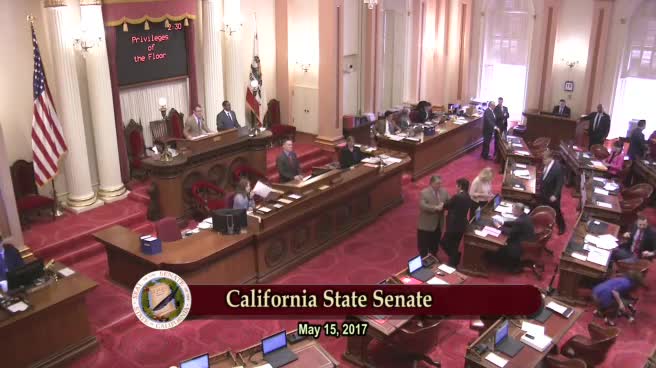
Bill Author

Bill Co-Author(s):