SB 32: California Public Employees' Pension Reform Act of 2018.
- Session Year: 2017-2018
- House: Senate
- Latest Version Date: 2017-03-02
(1)The Public Employees Retirement Law creates the Public Employees Retirement System (PERS), and the Teachers Retirement Law creates the State Teachers Retirement System (STRS), for the provision of service, disability, and other benefits to members. Existing law vests the Teachers Retirement Board, which administers STRS, and the Board of Administration of PERS with fiduciary responsibility over the assets of their respective retirement systems and requires the boards to, among other things, employ public accountants who are not in public employment to audit the financial statements of the systems, as specified.
This bill would create the Citizens Pension Oversight Committee to serve in an advisory role to the Teachers Retirement Board and the Board of Administration of PERS. The bill would require the committee, on or before January 1, 2019, and annually thereafter, to review the actual pension costs and obligations of PERS and STRS and report on these costs and obligations to the public and would require reports of audits of STRS and PERS conducted by the public accountants described above to be filed with the committee for this purpose.
(2)Under the Public Employees Retirement Law, benefits provided by PERS are funded by employer and employee contributions and investment returns. Existing law requires the Board of Administration of PERS to set and adjust employer contribution rates in relation to the systems actuarial liability and provides for the deposit of employer contributions into the Public Employees Retirement Fund, a continuously appropriated fund. Existing law authorizes the board to adopt a funding period of 30 years to amortize unfunded accrued actuarial obligations for current and prior service for the purpose of determining employer contribution rates for contracting agencies and school employers and to adopt an amortization period of 40 years for any unfunded actuarial liability for the benefits applicable to all state miscellaneous members and all state peace officer/firefighter members.
This bill would require the board to determine what the level of the unfunded liability of PERS was in 1980 and would further require the board to reduce the unfunded liability of PERS to that level, to be achieved by 2030, with the goal of fully funding PERS. The bill, in any year in which the unfunded actuarial liability of PERS is greater than zero, would require the board to increase the employer contribution rate otherwise provided by law for the state, contracting agencies, and school employers by 10 percent. By increasing deposits into a continuously appropriated fund, the bill would make an appropriation.
(3)Existing law prescribes different benefit formulas for members of PERS depending on a members classification and date of entry into the system, among other factors.
This bill would require the Board of Administration of PERS, on or before January 1, 2019, to develop and submit to the Legislature for approval a hybrid plan consisting of defined benefit and defined contribution components, as specified, and would require the plan to be applied to members who elect to be subject to the plan or who are first employed by the state, a contracting agency, or a school employer and become members of the system on or after the approval of the plan by the Legislature. The bill would further require the board, on or before January 1, 2019, to review the duties of officers and employees in positions included in the safety member classification pursuant to certain provisions of the Public Employees Retirement Law and reclassify the positions according to specified criteria. The bill would apply this reclassification to persons who are first employed by the state and become state members of PERS on or after January 1, 2018.
(4)The California Public Employees Pension Reform Act of 2013 (PEPRA), on and after January 1, 2013, requires a public retirement system, as defined, to modify its plan or plans to comply with the act and, among other provisions, provides that the pensionable compensation of a new member of the system is the normal monthly rate of pay or base pay of the member paid in cash to similarly situated members, as specified. PEPRA also requires the final compensation used to determine a retirement benefit to be paid to the new member to be the highest average annual pensionable compensation earned by the member during a period of at least 36 consecutive months, or at least 3 consecutive school years if applicable, as specified.
This bill would prohibit a public retirement board from deeming certain forms of pay to be pensionable compensation and would make related legislative findings and declarations.
This bill would enact the California Public Employees Pension Reform Act of 2018 (PEPRA 2018). The bill, for an individual who becomes a member of any public retirement system, as defined, for the first time on or after January 1, 2018, and who was not a member of any other public retirement system prior to that date, would require the final compensation used to determine the members retirement benefits to be the highest annual pensionable compensation earned by the member during a period of at least 60 consecutive months, or at least 5 consecutive school years if applicable, as specified. The bill would also provide that if the member leaves the employment of a public employer participating in a public retirement system for other employment, as specified, and is subsequently reemployed by the public employer at least one year later, the member will be subject to the same benefits, contributions, and other terms and conditions applicable to an individual who becomes a member of the public retirement system for the first time on the date of the members return, for service rendered on or after that date.
(5)Existing law provides for the application of cost of living adjustments to allowances paid to persons retired under, or survivors or beneficiaries of members or persons retired under, various public retirement systems.
The bill, as part of PEPRA 2018, would prohibit a public retirement system from making a cost of living adjustment to any allowance payable to, or on behalf of, a person retired under the system, or to any survivor or beneficiary of a member or person retired under the system, for any year beginning on or after January 1, 2018, in which PERS or STRS is not fully funded.
The California Public Employees Pension Reform Act of 2013, on and after January 1, 2013, established various limits on retirement benefits generally applicable to a public employee retirement system in the state, with specified exceptions.This bill would state the intent of the Legislature to enact legislation to resume the public employee pension reform begun in the California Public Employees Pension Reform Act of 2013.The California Public Employees Pension Reform Act of 2013, on and after January 1, 2013, established various limits on retirement benefits generally applicable to a public employee retirement system in the state, with specified exceptions.
This bill would state the intent of the Legislature to enact legislation to resume the public employee pension reform begun in the California Public Employees Pension Reform Act of 2013.
(a)The board shall employ a certified public accountant or public accountant, who is not in public employment, to audit the financial statements of the system. The costs of the audit shall be paid from the income of the retirement fund. The audit shall be made annually and the audit report shall be incorporated into the annual report filed with the Governor and the Legislature pursuant to Section 22324. A copy of the audit report shall also be filed with the Citizens Pension Oversight Committee created by Section 7512.5 of the Government Code.
(b)These audits shall not be duplicated by the Department of Finance or the State Auditor. The system shall be exempt from a pro rata general administrative charge for auditing.
SEC. 2.Section 7512.5 is added to the Government Code, to read:7512.5.(a)The Citizens Pension Oversight Committee is hereby created. The committee shall serve in an advisory role to the Board of Administration of the Public Employees Retirement System and the Teachers Retirement Board. The committee shall consist of no more than nine members, and no less than five members, jointly appointed by the Board of Administration of the Public Employees Retirement System and the Teachers Retirement Board from persons with experience in fiduciary matters who do not receive benefits from the Public Employees Retirement System or the State Teachers Retirement System.
(b)On or before January 1, 2019, and annually thereafter, the committee shall review the actual pension costs and obligations of the Public Employees Retirement System and the State Teachers Retirement System and report on these costs and obligations to the public. As part of this review, the committee shall review the audit reports filed with the committee pursuant to Section 22217 of the Education Code and Section 20228 of this code.
SEC. 3.Section 7522.34 of the Government Code is amended to read:7522.34.(a)Pensionable compensation of a new member of any public retirement system means the normal monthly rate of pay or base pay of the member paid in cash to similarly situated members of the same group or class of employment for services rendered on a full-time basis during normal working hours, pursuant to publicly available pay schedules, subject to the limitations of subdivision (c).
(b)Compensation that has been deferred shall be deemed pensionable compensation when earned rather than when paid.
(c)Notwithstanding any other law, pensionable compensation of a new member does not include the following:
(1)Any compensation determined by the board to have been paid to increase a members retirement benefit under that system.
(2)Compensation that had previously been provided in kind to the member by the employer or paid directly by the employer to a third party other than the retirement system for the benefit of the member and which was converted to and received by the member in the form of a cash payment.
(3)Any one-time or ad hoc payments made to a member.
(4)Severance or any other payment that is granted or awarded to a member in connection with or in anticipation of a separation from employment, but is received by the member while employed.
(5)Payments for unused vacation, annual leave, personal leave, sick leave, or compensatory time off, however denominated, whether paid in a lump sum or otherwise, regardless of when reported or paid.
(6)Payments for additional services rendered outside of normal working hours, whether paid in a lump sum or otherwise.
(7)Any employer-provided allowance, reimbursement, or payment, including, but not limited to, one made for housing, vehicle, or uniforms.
(8)Compensation for overtime work, other than as defined in Section 207(k) of Title 29 of the United States Code.
(9)Employer contributions to deferred compensation or defined contribution plans.
(10)Any bonus paid in addition to the compensation described in subdivision (a).
(11)Any other form of compensation a public retirement board determines is inconsistent with the requirements of subdivision (a).
(12)Any other form of compensation a public retirement board determines should not be pensionable compensation.
(13)(A)Any form of compensation identified that has been agreed to be nonpensionable pursuant to a memorandum of understanding for state employees bound by the memorandum of understanding. The state employer subject to the memorandum of understanding shall inform the retirement system of the excluded compensation and provide a copy of the memorandum of understanding.
(B)The state employer may determine if excluded compensation identified in subparagraph (A) shall apply to nonrepresented state employees who are aligned with state employees subject to the memorandum of understanding described in subparagraph (A). The state employer shall inform the retirement system of the exclusion of this compensation and provide a copy of the public pay schedule detailing the exclusion.
(d)(1)The Legislature finds and declares that normal monthly rate of pay or base pay, as used in subdivision (a), does not include, and was not intended to include, incentive pay, educational pay, premium pay, special assignment pay, or holiday pay.
(2)Pursuant to paragraph (1), a public retirement board shall not deem incentive pay, educational pay, premium pay, special assignment pay, or holiday pay to be a form of compensation consistent with subdivision (a).
SEC. 4.Article 5 (commencing with Section 7523) is added to Chapter 21 of Division 7 of Title 1 of the Government Code, to read:5.California Public Employees Pension Reform Act of 20187523.This article shall be known, and may be cited, as the California Public Employees Pension Reform Act of 2018.
7523.05.For the purposes of this article:
(a)Member means a public employee who is a member of a public retirement system.
(b)New member as of January 1, 2018, means an individual who becomes a member of any public retirement system for the first time on or after January 1, 2018, and who was not a member of any other public retirement system prior to that date.
(c)Public employee means an officer, including one who is elected or appointed, or an employee of a public employer.
(d)(1)Public employer includes:
(A)The state and every state entity, including, but not limited to, the Legislature, the judicial branch, including judicial officers, and the California State University.
(B)Any political subdivision of the state, or agency or instrumentality of the state or subdivision of the state, including, but not limited to, a city, county, city and county, school district, community college district, joint powers authority, joint powers agency, and any public agency, authority, board, commission, or district.
(C)Any charter school that elects or is required to participate in a public retirement system.
(2)Notwithstanding paragraph (1), public employer does not include an entity described in Section 9 of Article IX of, or Section 4 or 5 of Article XI of, the California Constitution, except to the extent that the entity elects to make this article, or any section thereof, applicable to the entity.
(e)(1)Public retirement system means the Public Employees Retirement System, the State Teachers Retirement System, the Legislators Retirement System, the Judges Retirement System, the Judges Retirement System II, county and district retirement systems created pursuant to the County Employees Retirement Law of 1937 (Chapter 3 (commencing with Section 31450) of Part 3 of Division 4 of Title 3), independent public retirement systems, and to individual retirement plans offered by public employers.
(2)Notwithstanding paragraph (1), public retirement system does not include a retirement system created by an entity described in Section 9 of Article IX of, or Section 4 or 5 of Article XI of, the California Constitution, except to the extent that the entity elects to make this article, or any section thereof, applicable to the entity.
7523.10.Notwithstanding Section 7522.32 or any other law, for the purposes of determining a retirement benefit to be paid to a new member as of January 1, 2018, of a public retirement system, final compensation shall mean the highest average annual pensionable compensation earned by the member during a period of at least 60 consecutive months, or at least five consecutive school years if applicable, immediately preceding his or her retirement or last separation from service if earlier, or during any other period of at least 60 consecutive months, or at least five consecutive school years if applicable, during the members applicable service that the member designates on the application for retirement.
7523.20.Notwithstanding any other law, except as otherwise required by Section 9 of Article I of the California Constitution, a public retirement system shall not make a cost of living adjustment to any allowance payable to, or on behalf of, a person retired under the system, or to any survivor or beneficiary of a member or person retired under the system, for any year beginning on or after January 1, 2018, in which either of the following is true:
(a)The unfunded actuarial liability of the State Teachers Retirement System, as determined by the Teachers Retirement Board, is greater than zero.
(b)The unfunded actuarial liability of the Public Employees Retirement System, as determined by the Board of Administration of the Public Employees Retirement System, is greater than zero.
7523.30.Notwithstanding any other law, a new member as of January 1, 2018, of a public retirement system who, on or after January 1, 2018, leaves the employment of a public employer participating in the public retirement system for employment with an employer that does not participate in the public retirement system and who is subsequently reemployed by the same public employer at least one year after he or she left, shall, upon the date of his or her reemployment, be subject to the same benefits, contributions, and other terms and conditions applicable to an individual who becomes a member of the public retirement system for the first time on that date, for service rendered on or after that date.
SEC. 5.Section 20140 is added to the Government Code, to read:20140.(a)On or before January 1, 2019, the board shall develop and submit to the Legislature for approval a hybrid plan that consists of the following:
(1)A defined benefit component that utilizes low-risk investments.
(2)A defined contribution component under which an employees contributions will be matched by employer contributions up to a certain percent.
(b)Notwithstanding any other law, a member who is first employed by the state, a contracting agency, or a school employer and becomes a member of the system on or after the approval of the hybrid plan by the Legislature shall participate in the hybrid plan.
(c)A member not described in subdivision (b) may elect to participate in the hybrid plan.
SEC. 6.Section 20141 is added to the Government Code, to read:20141.The board shall determine what the level of the unfunded liability of the system was in 1980 and shall reduce the unfunded liability of the system to that level, to be achieved by 2030, with the goal of fully funding the system.
SEC. 7.Section 20228 of the Government Code is amended to read:20228.The board shall annually employ a certified public accountant, who is not in public employment, to audit the financial statements of this system. The costs of the audit shall be paid from the income of the retirement fund. The audit shall be made annually. The board shall file a copy of the audit report with the Governor, the Secretary of the Senate, and the Chief Clerk of the Assembly. Assembly, and the Citizens Pension Oversight Committee.
The board, for purposes of Section 7504, may file internally prepared financial statements with the Controller within six months of the end of the fiscal year, and shall file independently audited financial statements as soon as they are available.
The annual audits of the financial statements of the system shall not be duplicated by the Department of Finance or the State Auditor.
This section does not affect the ability of the State Auditor or the Department of Finance to conduct other types of audits of the system as otherwise authorized by statute. This system shall be exempt from a pro rata general administrative charge for auditing.
SEC. 8.Section 20418 is added to the Government Code, to read:20418.(a)On or before January 1, 2019, the board shall review the duties of officers and employees in positions included in the safety member classification pursuant to this article and shall reclassify the positions, for the purposes of the system, as follows:
(1)Patrol member, state peace officer/firefighter member or state safety member, for positions with principal duties that place the employee or officer in the position in harms way. The board shall not reclassify a position as patrol member, state peace officer/firefighter member, or state safety member on the sole basis that the position involves law enforcement.
(2)State miscellaneous member or state industrial member for positions not described in paragraph (1).
(b)Notwithstanding this article or any other law, the reclassification of positions pursuant to subdivision (a) shall apply to any person who is first employed by the state and becomes a state member of the system on or after January 1, 2018.
SEC. 9.Section 20818 is added to the Government Code, to read:20818.Notwithstanding any other law, in any year in which the unfunded actuarial liability of the system is greater than zero, the board shall increase the employer contribution rate otherwise provided by law for the state, contracting agencies, and school employers by 10 percent.
SECTION 1.It is the intent of the Legislature to enact legislation to resume the public employee pension reform begun in the California Public Employees Pension Reform Act of 2013.It is the intent of the Legislature to enact legislation to resume the public employee pension reform begun in the California Public Employees Pension Reform Act of 2013.
|
Date
|
Status
|
|---|---|
| Feb 1, 2018 | Returned to Secretary of Senate pursuant to Joint Rule 56. |
| Apr 25, 2017 | April 24 set for first hearing. Failed passage in committee. (Ayes 2. Noes 3. Page 829.) Reconsideration granted. |
| Mar 17, 2017 | Set for hearing April 24. |
| Mar 8, 2017 | Re-referred to Com. on P.E. & R. |
| Mar 2, 2017 | From committee with author's amendments. Read second time and amended. Re-referred to Com. on RLS. |
| Jan 12, 2017 | Referred to Com. on RLS. |
| Dec 6, 2016 | From printer. May be acted upon on or after January 5. |
| Dec 5, 2016 | Introduced. Read first time. To Com. on RLS. for assignment. To print. |
|
Date
|
Description
|
Location
|
Votes
|
|
|---|---|---|---|---|
| Apr 24, 2017 | [First] hearing set for [04-24-2017]: Failed passage in Committee. Reconsideration granted | Senate Standing Committee on Public Employment and Retirement |
Passed |
|
| Apr 24, 2017 | Do pass, but first be re-referred to the Committee on [Appropriations] | Senate Standing Committee on Public Employment and Retirement |
Failed |
This list shows positions taken on this bill by organizations on the date displayed, which is linked to the original source.
Positions by individuals are not included.
|
Organization
|
Position
|
Date
|
|---|---|---|
| Association For Los Angeles Deputy Sheriffs | ** Against | Apr 24, 2017 |
| Association of Deputy District Attorneys | ** Against | Apr 24, 2017 |
| Cal Fire Local 2881 | ** Against | Apr 24, 2017 |
| California Association Of Highway Patrolmen | ** Against | Apr 24, 2017 |
| California Association of Professional Employees | ** Against | Apr 24, 2017 |
| California Association Of Professional Scientists | ** Against | Apr 24, 2017 |
| California Association Of Psychiatric Technicians | ** Against | Apr 24, 2017 |
| California Federation Of Teachers | ** Against | Apr 24, 2017 |
| California Nurses Association | ** Against | Apr 24, 2017 |
| California Professional Firefighters | ** Against | Apr 24, 2017 |
| California School Employees Association | ** Against | Apr 24, 2017 |
| california state teachers' retirement system | ** Against | Apr 24, 2017 |
| California Teachers Association | ** Against | Apr 24, 2017 |
| City of Costa Mesa | ** Support | Apr 24, 2017 |
| Los Angeles Police Protective League | ** Against | Apr 24, 2017 |
| Orange County Employees Association | ** Against | Apr 24, 2017 |
| Peace Officers Research Association Of California | ** Against | Apr 24, 2017 |
| Professional Engineers In California Government | ** Against | Apr 24, 2017 |
| Retired Public Employees Association | ** Against | Apr 24, 2017 |
| Riverside Sheriffs' Association | ** Against | Apr 24, 2017 |
| Rossmoor-Los Alamitos Republican Women Federated | ** Support | Apr 24, 2017 |
| Safety Employees Benefit Association | ** Against | Apr 24, 2017 |
| Service Employees International Union, Local 1000 | ** Against | Apr 24, 2017 |
SENATE COMMITTEE ON
PUBLIC EMPLOYMENT AND RETIREMENT
Dr. Richard Pan, Chair
2017 - 2018 Regular
Bill No: SB 32 Hearing Date: 4/24/17
Author: | Moorlach | ||
Version: | 3/2/17 As amended | ||
Urgency: | No | Fiscal: | Yes |
Consultant: | Glenn Miles | ||
Subject: California Public Employees’ Pension Reform Act of 2018
SOURCE: Author
DIGEST: This bill mandates several changes to California public pension plans (except those of the University of California, Charter Counties, and Charter Cities, for which the bill’s changes would be optional at the election of the respective entity). The bill also creates an oversight committee (OC) appointed jointly by the California Public Employees’ Retirement System (CalPERS) and the California State Teachers’ Retirement System (CalSTRS) to review and report on CalPERS’ and CalSTRS’ pension costs and obligations.
Additionally, SB 32 requires CalPERS to reclassify some positions from the safety member classification to the state miscellaneous or state industrial classifications and to increase employer contribution rates by 10 percent any year in which CalPERS has an unfunded liability.
ANALYSIS:
Existing law:
- Makes comprehensive reforms to public employee pension plans through the enactment of the California Public Employees’ Pension Reform Act of 2013 (PEPRA) that apply to all public employers and public pension plans on and after January 1, 2013, excluding the University of California and charter cities and counties that do not participate in a retirement system governed by state statute.
- Establishes, through PEPRA, the retirement benefit plans that are offered to new public employees, including:
- Uniform retirement formulas, including a 2 percent at age 62 formula for non-safety workers, which caps out at 2.5 percent at age 67;
- A three-year final compensation period for determining a pension;
- Employee member contributions equal to 50 percent of the normal cost of the employee's benefit plan;
- A cap on the amount of compensation that can count toward a pension; and
- A restriction on pay items that may be included in pensionable compensation.
- Specifies, with some exceptions, that the PEPRA requirements are applicable to new retirement plan members who first become members on and after January 1, 2013.
- Authorizes an employer, upon approval of the Legislature, to adopt a new, different retirement benefit plan or formula on or after January 1, 2013, if that formula or plan is determined and certified by the retirement system's chief actuary and the retirement board to have no greater risk and no greater cost to the employer than the PEPRA formula or plan.
- Establishes the California Actuarial Advisory Panel (CAAP) to provide impartial and independent information on pensions, other postemployment benefits, and best practices to public agencies and report thereon to the Legislature annually.
This bill:
- Creates the Citizens’ Pension Oversight Committee (OC) to serve in an advisory role to CalPERS and CalSTRS. Requires that the OC consist of 5 to 9 members jointly appointed by CalPERS and CalSTRS from persons with experience in fiduciary matters who do not receive benefits from the two systems.
- Requires the OC to review on or before January 1, 2019, and annually thereafter, the two systems’ actual pension costs and obligations and report thereon to the public.
- Requires CalSTRS and CalPERS to file a copy of their respective independent audit reports with the OC.
- Finds and declares that the “normal monthly rate of pay or base pay” for purposes of determining pensionable compensation does not include nor was intended to include incentive pay, educational pay, premium pay, special assignment pay, or holiday pay and prohibits a public retirement board under PEPRA from deeming those pay categories from being a form of pensionable compensation.
- Creates the California Public Employees’ Pension Reform Act of 2018 (PenRA[1]), which does the following:
- Definitions – Defines the following terms for purposes of PenRA:
- “Member” means a public employee who is a member of a public retirement system.
“New Member as of January 1, 2018” means an individual who becomes a member of any public retirement system for the first time on or after January 1, 2018, and who was not a member of any other public retirement system prior to that date.
“Public employee” means an officer, including one who is elected or appointed, or an employee of a public employer.
“Public employer” includes:
The state and every state entity, including, but not limited to, the Legislature, the judicial branch, including judicial officers, and the California State University.
Any political subdivision of the state, or agency or instrumentality of the state or subdivision of the state, including, but not limited to, a city, county, city and county, school district, community college district, joint powers authority, joint powers agency, and any public agency, authority, board, commission, or district.
Any charter school that elects or is required to participate in a public retirement system.
“Public employer” does not include the University of California, Charter Counties, or Charter Cities except to the extent that the entity elects to make PenRA, or any section thereof, applicable to the entity.
“Public retirement system” means the Public Employees’ Retirement System, the State Teachers’ Retirement System, the Legislators’ Retirement System, the Judges’ Retirement System, the Judges’ Retirement System II, county and district retirement systems created pursuant to the County Employees Retirement Law of 1937 (37 Act), independent public retirement systems, and to individual retirement plans offered by public employers.
However, “public retirement system” does not include a retirement system created by the University of California, Charter Counties, or Charter Cities except to the extent that the entity elects to make this article, or any section thereof, applicable to the entity.
- Five Year Final Compensation - Provides that final compensation, for the purposes of determining a retirement benefit to be paid to a new member as of January 1, 2018, shall mean the highest average annual pensionable compensation earned by the member during a period of at least 60 consecutive months, or at least five consecutive school years if applicable, immediately preceding his or her retirement or last separation from service if earlier, or during any other period of at least 60 consecutive months, or at least five consecutive school years if applicable, during the member’s applicable service that the member designates on the application.
- Cost of Living Adjustments - Prohibits (except as otherwise required by state constitutional provisions prohibiting a law impairing the obligation of contracts, et al.) a public retirement system from making a cost of living adjustment (COLA) to any allowance payable to, or on behalf of, a person retired under the system, or to any survivor or beneficiary of a member or person retired under the system, for any year beginning on or after January 1, 2018, in which CalSTRS or CalPERS has an unfunded actuarial liability
- Membership Transmutation and Reciprocity upon Subsequent Re-employment - Provides that a new member as of January 1, 2018, who, on or after January 1, 2018, leaves the employment of a public employer participating in the public retirement system for employment with an employer that does not participate in the public retirement system and who is subsequently reemployed by the same public employer at least one year after he or she left, shall be subject upon the date of his or her reemployment to the same benefits, contributions, and other terms and conditions applicable to an individual who becomes a member of the public retirement system for the first time on that date, for service rendered on or after that date.
- Hybrid Plan - Requires CalPERS to develop and submit to the Legislature for approval a hybrid plan on or before January 1, 2019, that consists of a defined benefit component that utilizes low-risk investments and a defined contribution component under which an employee’s contributions will be matched by employer contributions up to an unspecified percent.
- Requires a member who is first employed by the state, a contracting agency, or a school employer, and who becomes a CalPERS member on or after the approval of the hybrid plan by the Legislature, to participate in the hybrid plan and authorizes all other CalPERS members to elect to participate in the hybrid plan.
- Requires CalPERS to determine what the level of the unfunded liability of the system was in 1980 and to reduce the system’s unfunded liability to that level, to be achieved by 2030, with the goal of fully funding the system.
- Requires CalPERS on or before January 1, 2019, to review the duties of officers and employees in positions included in the CalPERS safety member classification and to reclassify the positions as the following: 1) “patrol member,” “state peace officer/firefighter member” or “state safety member,” for those positions whose principal duties “place the employee or officer in in harm’s way,” or 2) “state miscellaneous member” or “state industrial member,” for those position not described in the first category.
- Prohibits CalPERS from reclassifying a position as “patrol member,” “state peace officer/firefighter member,” or “state safety member” on the sole basis that the position involves law enforcement.
- Provides that the reclassification of “patrol member,” “state peace officer/firefighter member” or “state safety member” positions shall apply to any person who is first employed by the state and becomes a state member of the system on or after January 1, 2018.
- Requires CalPERS to increase employer contribution rates by 10 percent any year in which CalPERS has an unfunded liability.
Background
Existing law, through PEPRA, requires, as of January 1, 2013, comprehensive and statewide reform for the state’s public pension systems and plans. PEPRA requires new public employees in California first hired after January 1, 2013, to pay 50 percent of the actuarial normal costs of their pension plans as member contributions to the retirement systems and includes specific caps and limits on pensionable compensation, anti-spiking measures, and revised benefit formulas for new members, as specified.
Issues and Concerns
- Hybrid Plan - SB 32 requires CalPERS to develop a hybrid plan composed of a low-risk defined benefit component and an unspecified employee match defined contribution component by January 1, 2019, and upon Legislative approval, requires a member first employed after the Legislature approves the plan to participate in the hybrid plan. Other members could elect to participate in the plan. This mandate presents several issues, including the following:
- The bill unnecessarily complicates the existing Classic and PEPRA plans by revising them with the PenRA plan for new members starting in January 1, 2018, only to implement a new, required Hybrid plan in 2019.
- It is unclear whether Classic, PEPRA, and PenRA plan members who elect to participate in the Hybrid plan retain any rights to their original plan.
- It is unclear whether public agencies that contract with CalPERS for pension benefits would all have to offer the same employer contribution match in the Hybrid plan or if they could offer different employer matches. Different match options could lead to escalating costs as public agencies compete with one another for employees.
Alternatively, a system-wide match could lock in compensation disparities between high and low wage areas of the state; prevent wealthier agencies from offering attractive benefits to compete with their region’s private sector if the match was set too low; or create financial difficulties for agencies with fewer resources if the match was set too high.
- Artificial Acceleration of Costs and Usurpation of Actuarial Function – SB 32 contains provisions that appear to accelerate future costs into the present and may artificially inflate the expense of the existing Classic and PEPRA plans.
By requiring CalPERS to increase contribution rates 10 percent any year in which it has an unfunded liability - irrespective of the CalPERS’ actuary’s recommendations and the board’s determination of the appropriate level of funding - the bill may seek to impermissibly transfer the actuarial function from the board to the Legislature in contravention of the state constitution. This issue is compounded by the mandate on CalPERS to determine the system’s unfunded actuarial liability in 1980 and to reduce the unfunded liability to that level by 2030.
- Safety Member Reclassification and Vested Rights – It is unclear which of the following bill intends: 1) to shift some current members in the patrol member, state peace officer/firefighter member, and state safety member classifications to the state miscellaneous or state industrial member classifications upon completion of the mandated review and reclassification of the positions; or 2) to affect only new members by the reclassification. The former position would implicate current members’ vested rights. Also, the requirement that CalPERS base its reclassification on determining that a position’s principal duties place the employee in “harm’s way” is vague and overbroad.
- Normal Monthly Rate of Pay or Base Pay – The bill would limit the definition of “normal monthly rate of pay or base pay” for purposes of determining pensionable compensation. The revised definition would apply to all California public pension systems and have retroactive effect. The change would supersede any determinations or regulations by pension boards regarding the composition of normal monthly rate of pay and base pay. Since the change would affect members and employers who have already relied on those determinations and regulations in exercising retirement decisions or making decisions in bargaining negotiations, this provision would likely result in substantial litigation. Additionally, the new definition could affect ongoing litigation involving those determinations and regulations.
- COLA - The bill’s provisions prohibiting any public retirement system from making a COLA to any retirement allowance after January 1, 2018, are unclear. The specified condition for the COLA prohibition is whether either state system has an unfunded liability. Thus, an independent local system that is super-funded could not provide a COLA to its retirees if either CalSTRS or CalPERS has an unfunded liability. The prohibition is further confused by the exception for any COLA that, if prohibited, would be found to be an impairment of contract under the state constitution. The language, vague in its application, would invite ongoing litigation to define which COLAs were permissible and which were not.
- Oversight Committee - The establishment of an oversight committee is redundant because the pension boards already provide comprehensive information on funding status to the Legislature and the public through publicly noticed meetings, required reports to the Legislature, and publication of their Comprehensive Annual Financial Reports (CAFRs). In addition, the California Actuarial Advisory Panel provides independent and impartial information on pensions and related issues to the Legislature each year. Also, the bill does not address whether or how OC committee members would be compensated, how the committee would be staffed, or how the activities and reporting mandates of the committee would be funded.
- Administrative Costs - According to CalSTRS, SB 32 would result in approximate administrative “costs of $1 to 10 million with a one- to two-year effort to make the needed system changes to CalSTRS current pension administration system.” The bill “constitutes a very large change of additional unknown cost to the Pension Solution Project that is currently underway. Extensive resources would be needed to update publications, training and educational materials and train staff.” While CalPERS has not yet provided cost information on this bill, it seems reasonable to assume that it would face similar or greater costs given that the bill places more mandates on CalPERS than CalSTRS.
Related/Prior Legislation
AB 340 (Furutani, Chapter 296, Statutes of 2012), implemented the 2012 Conference Committee Report on Public Pension Benefits and established PEPRA which required substantial reforms to California public pension systems.
SB 520 (Walters, 2011), which would have required CalPERS to create a hybrid retirement plan, as specified, for public employee members of CalPERS who become members on and after January 1, 2012, was returned to the Secretary of Senate pursuant to Joint Rule 56.
FISCAL EFFECT: Appropriation: Yes Fiscal Com.: Yes Local: No
SUPPORT:
City of Costa Mesa
Rossmoor-Los Alamitos Republican Women Federated
OPPOSITION:
American Federation of State, County and Municipal Employees, AFL-CIO
Association of Deputy District Attorneys
Association for Los Angeles Deputy Sheriffs
CAL FIRE Local 2881
California Association of Highway Patrolmen
California Association of Professional Employees
California Association of Professional Scientists
California Association of Psychiatric Technicians
California Federation of Teachers
California Nurses Association
California Professional Firefighters
California School Employees Association
California State Teachers’ Retirement System
California Teachers Association
Los Angeles County Deputy Probation Officers’ Union, AFSCME, Local 685
Los Angeles Police Protective League
Orange County Employees Association
Peace Officers Research Association of California
Professional Engineers in California Government
Retired Public Employees Association
Riverside Sheriffs’ Association
Safety Employees Benefit Association
Service Employees International Union, Local 1000
ARGUMENTS IN SUPPORT: According to the author, “The original PEPRA law had several weaknesses. Unfortunately, the reform legislation has had a negligible impact to truly reduce – or even constrain – public pension costs and limit further unfunded liabilities. SB 32 seeks to continue fixing the problem, consistent with Governor Brown’s original plan.”
ARGUMENTS IN OPPOSITION: According to the California Association of Highway Patrolmen, the Peace Officers Research Association of California, and CAL FIRE Local 2881, “The reforms enacted in 2012 were designed to bolster the long-term health of California’s public pension systems, and they are doing exactly that. Their effects will be measured over the lifetime of thousands of police officers, firefighters, engineers, scientists, teachers, bus drivers, and others whose labor provides the public services upon which California relies.”
According to the California School Employees Association, “In more than 400 jurisdictions across the state since 2012, public employees are making sacrifices at the bargaining table to help our communities deal with pension costs. These changes includ increasing employee contributions and reducing pension formulas, which have already cut state costs by hundreds of millions of dollars.”
The California Teachers Association, “believes this measure would further erode the teacher shortage that is causing a crisis in our educational system and would eliminate the retirement security that educators currently have. California’s teachers do not enter the profession to be rich, but they do count on a modest retirement. This measure would eliminate the limited security our teachers count on in their retirement years.”
Service Employees International Union Local 1000 adds, “In addition to PEPRA, CalPERS has taken several steps to ensure the sustainability of the Fund for decades to come. In September 2016, CalPERS shifted from riskier assets to lower risk assets to lessen the impact of another financial downturn. CalPERS also lowered its discount rate from 7.5% to 7.0%, and adopted a lower threshold on their risk mitigation policy to ensure the Fund is funded at the appropriate level”.
According to the American Federation of State, County and Municipal Employees, “these reforms are unnecessary given recent reforms that have already begun to change the public pension landscape.” PEPRA related changes are “projected to reduce collective retirement benefits to public workers by $85 billion over time, though a recent study shows that these savings are accumulating even faster than expected.”
We use the acronym PenRA rather than PEPRA II or PEPRA 2018 for clarity in distinguishing between this bill’s proposed reform and the original PEPRA reform law and for brevity. ↑
Discussed in Hearing
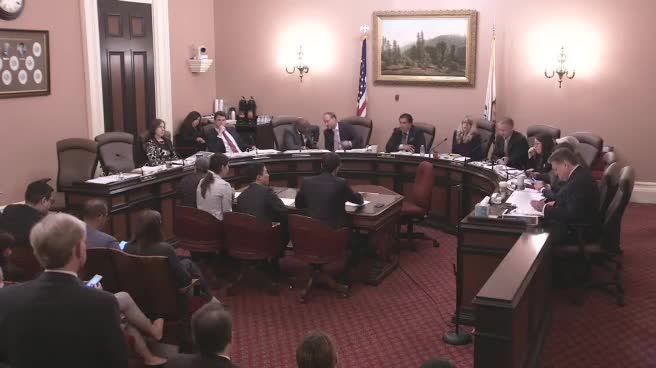 16MIN
Senate Standing Committee on Energy, Utilities and Communications
Bill Author

Bill Co-Author(s):