SB 396: Employment: gender identity, gender expression, and sexual orientation.
- Session Year: 2017-2018
- House: Senate
- Latest Version Date: 2017-10-15
The California Fair Employment and Housing Act (FEHA) makes specified employment practices unlawful, including the harassment of an employee directly by the employer or indirectly by agents of the employer with the employers knowledge. FEHA requires employers with 50 or more employees to provide at least 2 hours of prescribed training and education regarding sexual harassment to all supervisory employees within 6 months of their assumption of a supervisory position and once every 2 years, as specified.
This bill would additionally require employers with 50 or more employees to include, as a component of that prescribed training and education for supervisors, training inclusive of harassment based on gender identity, gender expression, and sexual orientation.
FEHA requires each employer to post a poster on discrimination in employment, which includes information relating to the illegality of sexual harassment, in a prominent and accessible location in the workplace.
The bill would also require each employer to post a poster developed by the Department of Fair Employment and Housing regarding transgender rights in a prominent and accessible location in the workplace.
The California Workforce Innovation and Opportunity Act makes programs and services available to individuals with employment barriers and creates a board, composed of the Governor and Governor-appointed members who represent specified interests, including representatives of the state workforce, to carry out specified functions in furtherance of that act.
This bill would expand the definition of an individual with employment barriers to include transgender and gender nonconforming individuals. The bill also would authorize the appointments to the board representing the state workforce to include representatives of community-based organizations that serve transgender and gender nonconforming individuals.
This bill would incorporate additional changes to Section 14012 of the Unemployment Insurance Code proposed by AB 957 to be operative only if this bill and AB 957 are enacted and this bill is enacted last.
The California Fair Employment and Housing Act (FEHA) makes specified employment practices unlawful, including the harassment of an employee directly by the employer or indirectly by agents of the employer with the employers knowledge. FEHA requires employers with 50 or more employees to provide at least 2 hours of prescribed training and education regarding sexual harassment to all supervisory employees within 6 months of their assumption of a supervisory position and once every 2 years, as specified.
This bill would additionally require employers with 50 or more employees to include, as a component of that prescribed training and education for supervisors, training inclusive of harassment based on gender identity, gender expression, and sexual orientation. The bill would also require an employer with 50 or more employees who contracts with the state to provide at least 2 hours of training and education regarding harassment based on gender identity, gender expression, and sexual orientation.
FEHA requires each employer to post a poster on discrimination in employment, which includes information relating to the illegality of sexual harassment, in a prominent and accessible location in the workplace.
The bill would also require each employer to post a poster developed by the Department of Fair Employment and Housing regarding transgender rights in a prominent and accessible location in the workplace.
The California Workforce Innovation and Opportunity Act makes programs and services available to individuals with employment barriers and creates a board, composed of the Governor and Governor-appointed members who represent specified interests, including representatives of the state workforce, to carry out specified functions in furtherance of that act.
This bill would expand the definition of an individual with employment barriers to include transgender and gender nonconforming individuals. The bill also would authorize the appointments to the board representing the state workforce to include representatives of community-based organizations that serve transgender and gender nonconforming individuals.
The California Fair Employment and Housing Act (FEHA) makes specified employment practices unlawful, including the harassment of an employee directly by the employer or indirectly by agents of the employer with the employers knowledge. FEHA requires employers with 50 or more employees to provide at least 2 hours of prescribed training and education regarding sexual harassment to all supervisory employees within 6 months of their assumption of a supervisory position and once every 2 years, as specified.
This bill would additionally require employers with 50 or more employees to include, as a component of that prescribed training and education for supervisors, training inclusive of harassment based on gender identity, gender expression, and sexual orientation. The bill would also require an employer with 50 or more employees who contracts with the state to provide at least 2 hours of training and education regarding harassment based on gender identity, gender expression, and sexual orientation.
FEHA requires each employer to post a poster on discrimination in employment, which includes information relating to the illegality of sexual harassment, in a prominent and accessible location in the workplace.
The bill would also require each employer to post a poster developed by the Department of Fair Employment and Housing regarding transgender rights in a prominent and accessible location in the workplace.
Existing law, known as the Medical Practice Act, provides for licensing and regulation of physicians and surgeons by the Medical Board of California, and imposes various requirements in that regard. Existing law requires an applicant for a license as a physician and surgeon to successfully complete a specified medical curriculum, a clinical instruction program, and a training program. Existing law provides that nothing in the Medical Practice Act shall be construed to prohibit a foreign medical graduate from engaging in the practice of medicine whenever and wherever required as part of a clinical service program, subject to certain conditions.Existing law prohibits a student, including a person without lawful immigration status, a person who is exempt from nonresident tuition pursuant to a specified statute, or a person who fits into both of those categories, who meets the requirements for admission to a medical degree program at any public or private postsecondary educational institution that offers such a program from being denied admission to that program based on his or her citizenship status or immigration status. Existing law also prohibits such a student from being denied admission, based on his or her citizenship status or immigration status, to a healing arts residency training program whose participants are not paid.This bill would request the Regents of the University of California to, on or before July 31, 2018, develop and implement a California Medical Residency Training Pilot Program for students interested in medical training in California who meet requirements adopted by the regents for receiving an exemption from paying nonresident tuition, as specified. The bill would encourage the regents to ensure that the program includes specified components. The bill would establish the California Medical Residency Training Program Fund in the State Treasury and would make moneys deposited into the fund available upon appropriation by the Legislature for the purposes of the pilot program. The bill would establish that personal information of a student collected or obtained for the pilot program is not a public record for purposes of the California Public Records Act and shall only be collected, used, and retained to administer the program, and would prohibit disclosure of that personal information to any other person, except as provided.The California Constitution requires local agencies, for the purpose of ensuring public access to the meetings of public bodies and the writings of public officials and agencies, to comply with a statutory enactment that amends or enacts laws relating to public records or open meetings and contains findings demonstrating that the enactment furthers the constitutional requirements relating to this purpose.This bill would make legislative findings to that effect.Existing constitutional provisions require that a statute that limits the right of access to the meetings of public bodies or the writings of public officials and agencies be adopted with findings demonstrating the interest protected by the limitation and the need for protecting that interest.This bill would make legislative findings to that effect.Existing law, known as the Medical Practice Act, provides for licensing and regulation of physicians and surgeons by the Medical Board of California, and imposes various requirements in that regard. Existing law requires an applicant for a license as a physician and surgeon to successfully complete a specified medical curriculum, a clinical instruction program, and a training program. Existing law provides that nothing in the Medical Practice Act shall be construed to prohibit a foreign medical graduate from engaging in the practice of medicine whenever and wherever required as part of a clinical service program, subject to certain conditions.
Existing law prohibits a student, including a person without lawful immigration status, a person who is exempt from nonresident tuition pursuant to a specified statute, or a person who fits into both of those categories, who meets the requirements for admission to a medical degree program at any public or private postsecondary educational institution that offers such a program from being denied admission to that program based on his or her citizenship status or immigration status. Existing law also prohibits such a student from being denied admission, based on his or her citizenship status or immigration status, to a healing arts residency training program whose participants are not paid.
This bill would request the Regents of the University of California to, on or before July 31, 2018, develop and implement a California Medical Residency Training Pilot Program for students interested in medical training in California who meet requirements adopted by the regents for receiving an exemption from paying nonresident tuition, as specified. The bill would encourage the regents to ensure that the program includes specified components. The bill would establish the California Medical Residency Training Program Fund in the State Treasury and would make moneys deposited into the fund available upon appropriation by the Legislature for the purposes of the pilot program. The bill would establish that personal information of a student collected or obtained for the pilot program is not a public record for purposes of the California Public Records Act and shall only be collected, used, and retained to administer the program, and would prohibit disclosure of that personal information to any other person, except as provided.
The California Constitution requires local agencies, for the purpose of ensuring public access to the meetings of public bodies and the writings of public officials and agencies, to comply with a statutory enactment that amends or enacts laws relating to public records or open meetings and contains findings demonstrating that the enactment furthers the constitutional requirements relating to this purpose.
This bill would make legislative findings to that effect.
Existing constitutional provisions require that a statute that limits the right of access to the meetings of public bodies or the writings of public officials and agencies be adopted with findings demonstrating the interest protected by the limitation and the need for protecting that interest.
This bill would make legislative findings to that effect.
Existing law, known as the Medical Practice Act, provides for licensing and regulation of physicians and surgeons by the Medical Board of California, and imposes various requirements in that regard. Existing law requires an applicant for a license as a physician and surgeon to successfully complete a specified medical curriculum, a clinical instruction program, and a training program. Existing law provides that nothing in the Medical Practice Act shall be construed to prohibit a foreign medical graduate from engaging in the practice of medicine whenever and wherever required as part of a clinical service program, subject to certain conditions.Existing law prohibits a student, including a person without lawful immigration status, a person who is exempt from nonresident tuition pursuant to a specified statute, or a person who fits into both of those categories, who meets the requirements for admission to a medical degree program at any public or private postsecondary educational institution that offers such a program from being denied admission to that program based on his or her citizenship status or immigration status. Existing law also prohibits such a student from being denied admission, based on his or her citizenship status or immigration status, to a healing arts residency training program whose participants are not paid.This bill expresses findings and declarations of the Legislature relating to undocumented medical students. The bill also expresses the intent of the Legislature to enact legislation to remove barriers for undocumented medical students to apply for, and participate in, medical residency programs in California.Existing law, known as the Medical Practice Act, provides for licensing and regulation of physicians and surgeons by the Medical Board of California, and imposes various requirements in that regard. Existing law requires an applicant for a license as a physician and surgeon to successfully complete a specified medical curriculum, a clinical instruction program, and a training program. Existing law provides that nothing in the Medical Practice Act shall be construed to prohibit a foreign medical graduate from engaging in the practice of medicine whenever and wherever required as part of a clinical service program, subject to certain conditions.
Existing law prohibits a student, including a person without lawful immigration status, a person who is exempt from nonresident tuition pursuant to a specified statute, or a person who fits into both of those categories, who meets the requirements for admission to a medical degree program at any public or private postsecondary educational institution that offers such a program from being denied admission to that program based on his or her citizenship status or immigration status. Existing law also prohibits such a student from being denied admission, based on his or her citizenship status or immigration status, to a healing arts residency training program whose participants are not paid.
This bill expresses findings and declarations of the Legislature relating to undocumented medical students. The bill also expresses the intent of the Legislature to enact legislation to remove barriers for undocumented medical students to apply for, and participate in, medical residency programs in California.
In addition to employer responsibilities set forth in subdivisions (j) and (k) of Section 12940 and in rules adopted by the department and the council, every employer shall act to ensure a workplace free of sexual harassment by implementing the following minimum requirements:
(a)(1) The department shall amend its current poster on discrimination in employment to include information relating to the illegality of sexual harassment. This amended poster shall be distributed to employers when the supply of the current poster is exhausted. One copy of the amended poster shall be provided by the department to an employer upon request. The amended poster shall be available at each office of the department, and shall be mailed if the request includes a self-addressed envelope with postage affixed. Multiple copies of the amended poster shall be made available online by the Department of Fair Employment and Housing. Each employer shall post the amended poster in a prominent and accessible location in the workplace.
(2)Post a poster developed by the department regarding transgender rights in a prominent and accessible location in the workplace.
(b)Each employer shall obtain from the department its information sheet on sexual harassment, which the department shall make available to employers for reproduction and distribution to employees. One copy of the information sheet shall be provided by the department to an employer upon request. The information sheets shall be available at each office of the department, and shall be mailed if the request includes a self-addressed envelope with postage affixed. Multiple copies of the information sheet shall be made available online by the Department of Fair Employment and Housing. Each employer shall distribute this information sheet to its employees, unless the employer provides equivalent information to its employees that contains, at a minimum, components on the following:
(1)The illegality of sexual harassment.
(2)The definition of sexual harassment under applicable state and federal law.
(3)A description of sexual harassment, utilizing examples.
(4)The internal complaint process of the employer available to the employee.
(5)The legal remedies and complaint process available through the department.
(6)Directions on how to contact the department.
(7)The protection against retaliation provided by Title 2 of the California Code of Regulations for opposing the practices prohibited by this article or for filing a complaint with, or otherwise participating in an investigation, proceeding, or hearing conducted by, the department or the council.
(c)The information sheet or information required to be distributed to employees pursuant to subdivision (b) shall be delivered in a manner that ensures distribution to each employee, such as including the information sheet or information with an employees pay.
(d)Notwithstanding subdivisions (j) and (k) of Section 12940, a claim that the information sheet or information required to be distributed pursuant to this section did not reach a particular individual or individuals shall not in and of itself result in the liability of any employer to any present or former employee or applicant in any action alleging sexual harassment. Conversely, an employers compliance with this section does not insulate the employer from liability for sexual harassment of any current or former employee or applicant.
(e)If an employer violates the requirements of this section, the department may seek an order requiring the employer to comply with these requirements.
SEC. 2.Section 12950.1 of the Government Code is amended to read:12950.1.(a) An employer having 50 or more employees shall provide at least two hours of classroom or other effective interactive training and education regarding sexual harassment to all supervisory employees in California within six months of their assumption of a supervisory position. An employer covered by this section shall provide sexual harassment training and education to each supervisory employee in California once every two years. The training and education required by this section shall include information and practical guidance regarding the federal and state statutory provisions concerning the prohibition against and the prevention and correction of sexual harassment and the remedies available to victims of sexual harassment in employment. The training and education shall also include practical examples aimed at instructing supervisors in the prevention of harassment, discrimination, and retaliation, and shall be presented by trainers or educators with knowledge and expertise in the prevention of harassment, discrimination, and retaliation.
(b)An employer shall also include prevention of abusive conduct as a component of the training and education specified in subdivision (a).
(c)An employer shall also provide training inclusive of harassment based on gender identity, gender expression, and sexual orientation as a component of the training and education specified in subdivision (a). The training and education shall include practical examples inclusive of harassment based on gender identity, gender expression, and sexual orientation, and shall be presented by trainers or educators with knowledge and expertise in those areas.
(d)The state shall incorporate the training required by subdivisions (a) to (c), inclusive, into the 80 hours of training provided to all new supervisory employees pursuant to subdivision (b) of Section 19995.4, using existing resources.
(e)Notwithstanding subdivisions (j) and (k) of Section 12940, a claim that the training and education required by this section did not reach a particular individual or individuals shall not in and of itself result in the liability of any employer to any present or former employee or applicant in any action alleging sexual harassment. Conversely, an employers compliance with this section does not insulate the employer from liability for sexual harassment of any current or former employee or applicant.
(f)If an employer violates this section, the department may seek an order requiring the employer to comply with these requirements.
(g)The training and education required by this section is intended to establish a minimum threshold and should not discourage or relieve any employer from providing for longer, more frequent, or more elaborate training and education regarding workplace harassment or other forms of unlawful discrimination in order to meet its obligations to take all reasonable steps necessary to prevent and correct harassment and discrimination.
(h)(1)For purposes of this section only, employer means any person regularly employing 50 or more persons or regularly receiving the services of 50 or more persons providing services pursuant to a contract, or any person acting as an agent of an employer, directly or indirectly, the state, or any political or civil subdivision of the state, and cities.
(2)For purposes of this section, abusive conduct means conduct of an employer or employee in the workplace, with malice, that a reasonable person would find hostile, offensive, and unrelated to an employers legitimate business interests. Abusive conduct may include repeated infliction of verbal abuse, such as the use of derogatory remarks, insults, and epithets, verbal or physical conduct that a reasonable person would find threatening, intimidating, or humiliating, or the gratuitous sabotage or undermining of a persons work performance. A single act shall not constitute abusive conduct, unless especially severe and egregious.
SEC. 3.Section 14005 of the Unemployment Insurance Code is amended to read:14005.For purposes of this division:
(a)Board means the California Workforce Development Board.
(b)Agency means the Labor and Workforce Development Agency.
(c)Career pathways, career ladders, or career lattices are an identified series of positions, work experiences, or educational benchmarks or credentials with multiple access points that offer occupational and financial advancement within a specified career field or related fields over time. Career pathways, career ladders, and career lattices offer combined programs of rigorous and high-quality education, training, and other services that do all of the following:
(1)Align with the skill needs of industries in the economy of the state or regional economy involved.
(2)Prepare an individual to be successful in any of a full range of secondary or postsecondary education options, including apprenticeships registered under the National Apprenticeship Act of 1937 (29 U.S.C. Sec. 50 et seq.), except as in Section 3226 of Title 29 of the United States Code.
(3)Include counseling to support an individual in achieving the individuals education and career goals.
(4)Include, as appropriate, education offered concurrently with and in the same context as workforce preparation activities and training for a specific occupation or occupational cluster.
(5)Organize education, training, and other services to meet the particular needs of an individual in a manner that accelerates the educational and career advancement of the individual to the extent practicable.
(6)Enable an individual to attain a secondary school diploma or its recognized equivalent, and at least one recognized postsecondary credential.
(7)Help an individual enter or advance within a specific occupation or occupational cluster.
(d)Cluster-based sector strategies mean methods of focusing workforce and economic development on those sectors that have demonstrated a capacity for economic growth and job creation in a particular geographic area.
(e)Data driven means a process of making decisions about investments and policies based on systematic analysis of data, which may include data pertaining to labor markets.
(f)Economic security means, with respect to a worker, earning a wage sufficient to support a family adequately, and, over time, to save for emergency expenses and adequate retirement income, based on factors such as household size, the cost of living in the workers community, and other factors that may vary by region.
(g)Evidence-based means making use of policy research as a basis for determining best policy practices. Evidence-based policymakers adopt policies that research has shown to produce positive outcomes, in a variety of settings, for a variety of populations over time. Successful, evidence-based programs deliver quantifiable and sustainable results. Evidence-based practices differ from approaches that are based on tradition, belief, convention, or anecdotal evidence.
(h)High-priority occupations mean occupations that have a significant presence in a targeted industry sector or industry cluster, are in demand, or projected to be in demand, by employers, and pay or lead to payment of a wage that provides economic security.
(i)(1)In-demand industry sector or occupation means either of the following:
(A)An industry sector that has a substantial current or potential impact, including through jobs that lead to economic self-sufficiency and opportunities for advancement, on the state, regional, or local economy, as appropriate, and that contributes to the growth or stability of other supporting businesses, or the growth of other industry sectors.
(B)An occupation that currently has or is projected to have a number of positions, including positions that lead to economic self-sufficiency and opportunities for advancement, in an industry sector so as to have a significant impact on the state, regional, or local economy, as appropriate.
(2)The determination of whether an industry sector or occupation is in-demand under this subdivision shall be made by the board or local board, or through the regional planning process in which local boards participate under the Workforce Innovation and Opportunity Act, as appropriate, using state and regional business and labor market projections, including the use of labor market information.
(j)Individual with employment barriers means an individual with any characteristic that substantially limits an individuals ability to obtain employment, including indicators of poor work history, lack of work experience, or access to employment in nontraditional occupations, long-term unemployment, lack of educational or occupational skills attainment, dislocation from high-wage and high-benefit employment, low levels of literacy or English proficiency, disability status, or welfare dependency, including members of all of the following groups:
(1)Displaced homemakers.
(2)Low-income individuals.
(3)Indians, Alaska Natives, and Native Hawaiians, as those terms are defined in Section 3221 of Title 29 of the United States Code.
(4)Individuals with disabilities, including youths who are individuals with disabilities.
(5)Older individuals.
(6)Ex-offenders.
(7)Homeless individuals, as defined in Section 14043e-2(6) of Title 42 of the United States Code, or homeless children and youths, as defined in Section 11434a(2) of Title 42 of the United States Code.
(8)Youth who are in, or have aged out of, the foster care system.
(9)Individuals who are English language learners, individuals who have low levels of literacy, and individuals facing substantial cultural barriers.
(10)Eligible migrant and seasonal farmworkers, as defined in Section 3322(i) of Title 29 of the United States Code.
(11)Individuals within two years of exhausting lifetime eligibility under Part A of Title IV of the Social Security Act (42 U.S.C. Sec. 601 et seq.).
(12)Single parents, including single, pregnant women.
(13)Long-term unemployed individuals.
(14)Transgender and gender nonconforming individuals.
(15)Any other groups as the Governor determines to have barriers to employment.
(k)Industry cluster means a geographic concentration or emerging concentration of interdependent industries with direct service, supplier, and research relationships, or independent industries that share common resources in a given regional economy or labor market. An industry cluster is a group of employers closely linked by common product or services, workforce needs, similar technologies, and supply chains in a given regional economy or labor market.
(l)Industry or sector partnership means a workforce collaborative, convened or acting in partnership with the board or a local board, that does the following:
(1)Organizes key stakeholders in an industry cluster into a working group that focuses on the shared goals and human resources needs of the industry cluster and that includes, at the appropriate stages of development of the partnership:
(A)Representatives of multiple businesses or other employers in the industry cluster, including small and medium-sized employers when practicable.
(B)One or more representatives of a recognized state labor organization or central labor council, or another labor representative, as appropriate.
(C)One or more representatives of an institution of higher education with, or another provider of, education or training programs that support the industry cluster.
(2)The workforce collaborative may include representatives of any of the following:
(A)State or local government.
(B)State or local economic development agencies.
(C)State boards or local boards, as appropriate.
(D)A state workforce agency or entity providing employment services.
(E)Other state or local agencies.
(F)Business or trade associations.
(G)Economic development organizations.
(H)Nonprofit organizations, community-based organizations, or intermediaries.
(I)Philanthropic associations.
(J)Industry associations.
(K)Other organizations, as determined to be necessary by the members comprising the industry sector or partnership.
(m)Industry sector means those firms that produce similar products or provide similar services using somewhat similar business processes, and are closely linked by workforce needs, within a regional labor market.
(n)Local labor federation means a central labor council that is an organization of local unions affiliated with the California Labor Federation or a local building and construction trades council affiliated with the State Building and Construction Trades Council of California.
(o)Sector strategies means methods of prioritizing investments in competitive and emerging industry sectors and industry clusters on the basis of labor market and other economic data indicating strategic growth potential, especially with regard to jobs and income, and exhibit the following characteristics:
(1)Focus workforce investment in education and workforce training programs that are likely to lead to jobs providing economic security or to an entry-level job with a well-articulated career pathway into a job providing economic security.
(2)Effectively boost labor productivity or reduce business barriers to growth and expansion stemming from workforce supply problems, including skills gaps and occupational shortages by directing resources and making investments to plug skills gaps and provide education and training programs for high-priority occupations.
(3)May be implemented using articulated career pathways or lattices and a system of stackable credentials.
(4)May target underserved communities, disconnected youths, incumbent workers, and recently separated military veterans.
(5)Frequently are implemented using industry or sector partnerships.
(6)Typically are implemented at the regional level where sector firms, those employers described in subdivisions (j) and (l), often share a common labor market and supply chains. However, sector strategies may also be implemented at the state or local level depending on sector needs and labor market conditions.
(p)Workforce Innovation and Opportunity Act of 2014 means the federal act enacted as Public Law 113-128.
(q)(1)Earn and learn includes, but is not limited to, a program that does either of the following:
(A)Combines applied learning in a workplace setting with compensation allowing workers or students to gain work experience and secure a wage as they develop skills and competencies directly relevant to the occupation or career for which they are preparing.
(B)Brings together classroom instruction with on-the-job training to combine both formal instruction and actual paid work experience.
(2)Earn and learn programs include, but are not limited to, all of the following:
(A)Apprenticeships.
(B)Preapprenticeships.
(C)Incumbent worker training.
(D)Transitional and subsidized employment, particularly for individuals with barriers to employment.
(E)Paid internships and externships.
(F)Project-based compensated learning.
SEC. 4.Section 14012 of the Unemployment Insurance Code is amended to read:14012.The board shall be appointed by the Governor to assist in the development of the State Plan and to carry out other functions, as described in Section 14103. The board shall be comprised of the Governor and representatives from the following categories:
(a)Two members of each house of the Legislature, appointed by the appropriate presiding officer of each house.
(b)A majority of board members shall be representatives of business who:
(1)Are owners of businesses, chief executives or operating officers of businesses, and other business executives or employers with optimum policymaking or hiring authority, who, in addition, may be members of a local board described in Section 3122(b)(2)(A)(i) of Title 29 of the United States Code.
(2)Represent businesses, including small businesses, or organizations representing businesses that include high-quality, work-relevant training and development in in-demand industry sectors or occupations in the state.
(3)Are appointed from a group of individuals nominated by state business organizations and business trade associations.
(c)(1)Not less than 20 percent of board members shall be representatives of the workforce within the state, including representatives of labor organizations nominated by state labor federations, who shall not be less than 15 percent of the board membership and who shall include at least one representative that is a member of a labor organization or a training director, from a joint labor-management apprenticeship program, or if no such joint program exists in the state, such a representative of an apprenticeship program in the state.
(2)Representatives appointed pursuant to this subdivision may include:
(A)Representatives of community-based organizations that have demonstrated experience and expertise in addressing the employment, training, or education needs of individuals with barriers to employment, including organizations that serve veterans, organizations that provide or support competitive, integrated employment for individuals with disabilities, and organizations that serve transgender and gender nonconforming individuals.
(B)Representatives of organizations that have demonstrated experience and expertise in addressing the employment, training, or education needs of eligible youth, including representatives of organizations that serve out-of-school youth.
(d)The balance of board members:
(1)Shall include representatives of government that are lead state officials with primary responsibility for the core programs and shall include chief elected officials, collectively representing cities, counties, and cities and counties where appropriate.
(2)May include other representatives and officials as the Governor may designate, like any of the following:
(A)State agency officials from agencies that are one-stop partners, not specified in paragraph (1), including additional one-stop partners whose programs are covered by the State Plan, if any.
(B)State agency officials responsible for economic development or juvenile justice programs in the state.
(C)Individuals who represent an Indian tribe or tribal organization, as those terms are defined in Section 3221(b) of Title 29 of the United States Code.
(D)State agency officials responsible for education programs in the state, including chief executive officers of community colleges and other institutions of higher education.
(e)Other requirements of board membership shall include:
(1)The Governor shall select a chairperson for the board from among the representatives described in subdivision (b).
(2)The members of the board shall represent diverse geographic areas of the state, including urban, rural, and suburban areas.
SEC. 4.5.Section 14012 of the Unemployment Insurance Code is amended to read:14012.The board shall be appointed by the Governor to assist in the development of the State Plan and to carry out other functions, as described in Section 14103. The board shall be comprised of the Governor and representatives from the following categories:
(a)Two members of each house of the Legislature, appointed by the appropriate presiding officer of each house.
(b)A majority of board members shall be representatives of business who:
(1)Are owners of businesses, chief executives or operating officers of businesses, and other business executives or employers with optimum policymaking or hiring authority, who, in addition, may be members of a local board described in Section 3122(b)(2)(A)(i) of Title 29 of the United States Code.
(2)Represent businesses, including small businesses, or organizations representing businesses that include high-quality, work-relevant training and development in in-demand industry sectors or occupations in the state.
(3)Are appointed from a group of individuals nominated by state business organizations and business trade associations.
(c)(1)Not less than 20 percent of board members shall be representatives of the workforce within the state, including representatives of labor organizations nominated by state labor federations, who shall not be less than 15 percent of the board membership and who shall include at least one representative that is a member of a labor organization or a training director, from a joint labor-management apprenticeship program, or if no such joint program exists in the state, such a representative of an apprenticeship program in the state.
(2)Representatives appointed pursuant to this subdivision may include:
(A)Representatives of community-based organizations that have demonstrated experience and expertise in addressing the employment, training, or education needs of individuals with barriers to employment, including organizations that serve veterans, organizations that provide or support competitive, integrated employment for individuals with disabilities, and organizations that serve transgender and gender nonconforming individuals.
(B)Representatives of organizations that have demonstrated experience and expertise in addressing the employment, training, or education needs of eligible youth, including representatives of organizations that serve out-of-school youth.
(d)The balance of board members:
(1)Shall include representatives of government that are lead state officials with primary responsibility for the core programs and shall include chief elected officials, collectively representing cities, counties, and cities and counties where appropriate.
(2)May include other representatives and officials as the Governor may designate, like any of the following:
(A)State agency officials from agencies that are one-stop partners, not specified in paragraph (1), including additional one-stop partners whose programs are covered by the State Plan, if any.
(B)State agency officials responsible for economic development or juvenile justice programs in the state.
(C)Individuals who represent an Indian tribe or tribal organization, as those terms are defined in Section 3221(b) of Title 29 of the United States Code.
(D)State agency officials responsible for education programs in the state, including chief executive officers, or their designees, of institutions of higher education, including, but not limited to, the California Community College system, the California State University system, the University of California system, and their respective individual campuses.
(e)Other requirements of board membership shall include:
(1)The Governor shall select a chairperson for the board from among the representatives described in subdivision (b).
(2)The members of the board shall represent diverse geographic areas of the state, including urban, rural, and suburban areas.
SEC. 5.Section 4.5 of this bill incorporates amendments to Section 14012 of the Unemployment Insurance Code proposed by both this bill and Assembly Bill 957. That section shall only become operative if (1) both bills are enacted and become effective on or before January 1, 2018, (2) each bill amends Section 14012 of the Unemployment Insurance Code, and (3) this bill is enacted after Assembly Bill 957, in which case Section 4 of this bill shall not become operative.
In addition to employer responsibilities set forth in subdivisions (j) and (k) of Section 12940 and in rules adopted by the department and the council, every employer shall act to ensure a workplace free of sexual harassment by implementing the following minimum requirements:
(a)(1) The department shall amend its current poster on discrimination in employment to include information relating to the illegality of sexual harassment. This amended poster shall be distributed to employers when the supply of the current poster is exhausted. One copy of the amended poster shall be provided by the department to an employer upon request. The amended poster shall be available at each office of the department, and shall be mailed if the request includes a self-addressed envelope with postage affixed. Multiple copies of the amended poster shall be made available online by the Department of Fair Employment and Housing. Each employer shall post the amended poster in a prominent and accessible location in the workplace.
(2)Post a poster developed by the department regarding transgender rights in a prominent and accessible location in the workplace.
(b)Each employer shall obtain from the department its information sheet on sexual harassment, which the department shall make available to employers for reproduction and distribution to employees. One copy of the information sheet shall be provided by the department to an employer upon request. The information sheets shall be available at each office of the department, and shall be mailed if the request includes a self-addressed envelope with postage affixed. Multiple copies of the information sheet shall be made available online by the Department of Fair Employment and Housing. Each employer shall distribute this information sheet to its employees, unless the employer provides equivalent information to its employees that contains, at a minimum, components on the following:
(1)The illegality of sexual harassment.
(2)The definition of sexual harassment under applicable state and federal law.
(3)A description of sexual harassment, utilizing examples.
(4)The internal complaint process of the employer available to the employee.
(5)The legal remedies and complaint process available through the department.
(6)Directions on how to contact the department.
(7)The protection against retaliation provided by Title 2 of the California Code of Regulations for opposing the practices prohibited by this article or for filing a complaint with, or otherwise participating in an investigation, proceeding, or hearing conducted by, the department or the council.
(c)The information sheet or information required to be distributed to employees pursuant to subdivision (b) shall be delivered in a manner that ensures distribution to each employee, such as including the information sheet or information with an employees pay.
(d)Notwithstanding subdivisions (j) and (k) of Section 12940, a claim that the information sheet or information required to be distributed pursuant to this section did not reach a particular individual or individuals shall not in and of itself result in the liability of any employer to any present or former employee or applicant in any action alleging sexual harassment. Conversely, an employers compliance with this section does not insulate the employer from liability for sexual harassment of any current or former employee or applicant.
(e)If an employer violates the requirements of this section, the department may seek an order requiring the employer to comply with these requirements.
SEC. 2.Section 12950.1 of the Government Code is amended to read:12950.1.(a) An employer having 50 or more employees shall provide at least two hours of classroom or other effective interactive training and education regarding sexual harassment to all supervisory employees in California within six months of their assumption of a supervisory position. An employer covered by this section shall provide sexual harassment training and education to each supervisory employee in California once every two years. The training and education required by this section shall include information and practical guidance regarding the federal and state statutory provisions concerning the prohibition against and the prevention and correction of sexual harassment and the remedies available to victims of sexual harassment in employment. The training and education shall also include practical examples aimed at instructing supervisors in the prevention of harassment, discrimination, and retaliation, and shall be presented by trainers or educators with knowledge and expertise in the prevention of harassment, discrimination, and retaliation.
(b)An employer shall also include prevention of abusive conduct as a component of the training and education specified in subdivision (a).
(c)An employer shall also provide training inclusive of harassment based on gender identity, gender expression, and sexual orientation as a component of the training and education specified in subdivision (a). The training and education shall include practical examples inclusive of harassment based on gender identity, gender expression, and sexual orientation, and shall be presented by trainers or educators with knowledge and expertise in those areas.
(d)The state shall incorporate the training required by subdivisions (a) to (c), inclusive, into the 80 hours of training provided to all new supervisory employees pursuant to subdivision (b) of Section 19995.4, using existing resources.
(e)Notwithstanding subdivisions (j) and (k) of Section 12940, a claim that the training and education required by this section did not reach a particular individual or individuals shall not in and of itself result in the liability of any employer to any present or former employee or applicant in any action alleging sexual harassment. Conversely, an employers compliance with this section does not insulate the employer from liability for sexual harassment of any current or former employee or applicant.
(f)If an employer violates this section, the department may seek an order requiring the employer to comply with these requirements.
(g)The training and education required by this section is intended to establish a minimum threshold and should not discourage or relieve any employer from providing for longer, more frequent, or more elaborate training and education regarding workplace harassment or other forms of unlawful discrimination in order to meet its obligations to take all reasonable steps necessary to prevent and correct harassment and discrimination.
(h)(1)For purposes of this section only, employer means any person regularly employing 50 or more persons or regularly receiving the services of 50 or more persons providing services pursuant to a contract, or any person acting as an agent of an employer, directly or indirectly, the state, or any political or civil subdivision of the state, and cities.
(2)For purposes of this section, abusive conduct means conduct of an employer or employee in the workplace, with malice, that a reasonable person would find hostile, offensive, and unrelated to an employers legitimate business interests. Abusive conduct may include repeated infliction of verbal abuse, such as the use of derogatory remarks, insults, and epithets, verbal or physical conduct that a reasonable person would find threatening, intimidating, or humiliating, or the gratuitous sabotage or undermining of a persons work performance. A single act shall not constitute abusive conduct, unless especially severe and egregious.
SEC. 3.Section 14005 of the Unemployment Insurance Code is amended to read:14005.For purposes of this division:
(a)Board means the California Workforce Development Board.
(b)Agency means the Labor and Workforce Development Agency.
(c)Career pathways, career ladders, or career lattices are an identified series of positions, work experiences, or educational benchmarks or credentials with multiple access points that offer occupational and financial advancement within a specified career field or related fields over time. Career pathways, career ladders, and career lattices offer combined programs of rigorous and high-quality education, training, and other services that do all of the following:
(1)Align with the skill needs of industries in the economy of the state or regional economy involved.
(2)Prepare an individual to be successful in any of a full range of secondary or postsecondary education options, including apprenticeships registered under the National Apprenticeship Act of 1937 (29 U.S.C. Sec. 50 et seq.), except as in Section 3226 of Title 29 of the United States Code.
(3)Include counseling to support an individual in achieving the individuals education and career goals.
(4)Include, as appropriate, education offered concurrently with and in the same context as workforce preparation activities and training for a specific occupation or occupational cluster.
(5)Organize education, training, and other services to meet the particular needs of an individual in a manner that accelerates the educational and career advancement of the individual to the extent practicable.
(6)Enable an individual to attain a secondary school diploma or its recognized equivalent, and at least one recognized postsecondary credential.
(7)Help an individual enter or advance within a specific occupation or occupational cluster.
(d)Cluster-based sector strategies mean methods of focusing workforce and economic development on those sectors that have demonstrated a capacity for economic growth and job creation in a particular geographic area.
(e)Data driven means a process of making decisions about investments and policies based on systematic analysis of data, which may include data pertaining to labor markets.
(f)Economic security means, with respect to a worker, earning a wage sufficient to support a family adequately, and, over time, to save for emergency expenses and adequate retirement income, based on factors such as household size, the cost of living in the workers community, and other factors that may vary by region.
(g)Evidence-based means making use of policy research as a basis for determining best policy practices. Evidence-based policymakers adopt policies that research has shown to produce positive outcomes, in a variety of settings, for a variety of populations over time. Successful, evidence-based programs deliver quantifiable and sustainable results. Evidence-based practices differ from approaches that are based on tradition, belief, convention, or anecdotal evidence.
(h)High-priority occupations mean occupations that have a significant presence in a targeted industry sector or industry cluster, are in demand, or projected to be in demand, by employers, and pay or lead to payment of a wage that provides economic security.
(i)(1)In-demand industry sector or occupation means either of the following:
(A)An industry sector that has a substantial current or potential impact, including through jobs that lead to economic self-sufficiency and opportunities for advancement, on the state, regional, or local economy, as appropriate, and that contributes to the growth or stability of other supporting businesses, or the growth of other industry sectors.
(B)An occupation that currently has or is projected to have a number of positions, including positions that lead to economic self-sufficiency and opportunities for advancement, in an industry sector so as to have a significant impact on the state, regional, or local economy, as appropriate.
(2)The determination of whether an industry sector or occupation is in-demand under this subdivision shall be made by the board or local board, or through the regional planning process in which local boards participate under the Workforce Innovation and Opportunity Act, as appropriate, using state and regional business and labor market projections, including the use of labor market information.
(j)Individual with employment barriers means an individual with any characteristic that substantially limits an individuals ability to obtain employment, including indicators of poor work history, lack of work experience, or access to employment in nontraditional occupations, long-term unemployment, lack of educational or occupational skills attainment, dislocation from high-wage and high-benefit employment, low levels of literacy or English proficiency, disability status, or welfare dependency, including members of all of the following groups:
(1)Displaced homemakers.
(2)Low-income individuals.
(3)Indians, Alaska Natives, and Native Hawaiians, as those terms are defined in Section 3221 of Title 29 of the United States Code.
(4)Individuals with disabilities, including youths who are individuals with disabilities.
(5)Older individuals.
(6)Ex-offenders.
(7)Homeless individuals, as defined in Section 14043e-2(6) of Title 42 of the United States Code, or homeless children and youths, as defined in Section 11434a(2) of Title 42 of the United States Code.
(8)Youth who are in, or have aged out of, the foster care system.
(9)Individuals who are English language learners, individuals who have low levels of literacy, and individuals facing substantial cultural barriers.
(10)Eligible migrant and seasonal farmworkers, as defined in Section 3322(i) of Title 29 of the United States Code.
(11)Individuals within two years of exhausting lifetime eligibility under Part A of Title IV of the Social Security Act (42 U.S.C. Sec. 601 et seq.).
(12)Single parents, including single, pregnant women.
(13)Long-term unemployed individuals.
(14)Transgender and gender nonconforming individuals.
(15)Any other groups as the Governor determines to have barriers to employment.
(k)Industry cluster means a geographic concentration or emerging concentration of interdependent industries with direct service, supplier, and research relationships, or independent industries that share common resources in a given regional economy or labor market. An industry cluster is a group of employers closely linked by common product or services, workforce needs, similar technologies, and supply chains in a given regional economy or labor market.
(l)Industry or sector partnership means a workforce collaborative, convened or acting in partnership with the board or a local board, that does the following:
(1)Organizes key stakeholders in an industry cluster into a working group that focuses on the shared goals and human resources needs of the industry cluster and that includes, at the appropriate stages of development of the partnership:
(A)Representatives of multiple businesses or other employers in the industry cluster, including small and medium-sized employers when practicable.
(B)One or more representatives of a recognized state labor organization or central labor council, or another labor representative, as appropriate.
(C)One or more representatives of an institution of higher education with, or another provider of, education or training programs that support the industry cluster.
(2)The workforce collaborative may include representatives of any of the following:
(A)State or local government.
(B)State or local economic development agencies.
(C)State boards or local boards, as appropriate.
(D)A state workforce agency or entity providing employment services.
(E)Other state or local agencies.
(F)Business or trade associations.
(G)Economic development organizations.
(H)Nonprofit organizations, community-based organizations, or intermediaries.
(I)Philanthropic associations.
(J)Industry associations.
(K)Other organizations, as determined to be necessary by the members comprising the industry sector or partnership.
(m)Industry sector means those firms that produce similar products or provide similar services using somewhat similar business processes, and are closely linked by workforce needs, within a regional labor market.
(n)Local labor federation means a central labor council that is an organization of local unions affiliated with the California Labor Federation or a local building and construction trades council affiliated with the State Building and Construction Trades Council of California.
(o)Sector strategies means methods of prioritizing investments in competitive and emerging industry sectors and industry clusters on the basis of labor market and other economic data indicating strategic growth potential, especially with regard to jobs and income, and exhibit the following characteristics:
(1)Focus workforce investment in education and workforce training programs that are likely to lead to jobs providing economic security or to an entry-level job with a well-articulated career pathway into a job providing economic security.
(2)Effectively boost labor productivity or reduce business barriers to growth and expansion stemming from workforce supply problems, including skills gaps and occupational shortages by directing resources and making investments to plug skills gaps and provide education and training programs for high-priority occupations.
(3)May be implemented using articulated career pathways or lattices and a system of stackable credentials.
(4)May target underserved communities, disconnected youths, incumbent workers, and recently separated military veterans.
(5)Frequently are implemented using industry or sector partnerships.
(6)Typically are implemented at the regional level where sector firms, those employers described in subdivisions (j) and (l), often share a common labor market and supply chains. However, sector strategies may also be implemented at the state or local level depending on sector needs and labor market conditions.
(p)Workforce Innovation and Opportunity Act of 2014 means the federal act enacted as Public Law 113-128.
(q)(1)Earn and learn includes, but is not limited to, a program that does either of the following:
(A)Combines applied learning in a workplace setting with compensation allowing workers or students to gain work experience and secure a wage as they develop skills and competencies directly relevant to the occupation or career for which they are preparing.
(B)Brings together classroom instruction with on-the-job training to combine both formal instruction and actual paid work experience.
(2)Earn and learn programs include, but are not limited to, all of the following:
(A)Apprenticeships.
(B)Preapprenticeships.
(C)Incumbent worker training.
(D)Transitional and subsidized employment, particularly for individuals with barriers to employment.
(E)Paid internships and externships.
(F)Project-based compensated learning.
SEC. 4.Section 14012 of the Unemployment Insurance Code is amended to read:14012.The board shall be appointed by the Governor to assist in the development of the State Plan and to carry out other functions, as described in Section 14103. The board shall be comprised of the Governor and representatives from the following categories:
(a)Two members of each house of the Legislature, appointed by the appropriate presiding officer of each house.
(b)A majority of board members shall be representatives of business who:
(1)Are owners of businesses, chief executives or operating officers of businesses, and other business executives or employers with optimum policymaking or hiring authority, who, in addition, may be members of a local board described in Section 3122(b)(2)(A)(i) of Title 29 of the United States Code.
(2)Represent businesses, including small businesses, or organizations representing businesses that include high-quality, work-relevant training and development in in-demand industry sectors or occupations in the state.
(3)Are appointed from a group of individuals nominated by state business organizations and business trade associations.
(c)(1)Not less than 20 percent of board members shall be representatives of the workforce within the state, including representatives of labor organizations nominated by state labor federations, who shall not be less than 15 percent of the board membership and who shall include at least one representative that is a member of a labor organization or a training director, from a joint labor-management apprenticeship program, or if no such joint program exists in the state, such a representative of an apprenticeship program in the state.
(2)Representatives appointed pursuant to this subdivision may include:
(A)Representatives of community-based organizations that have demonstrated experience and expertise in addressing the employment, training, or education needs of individuals with barriers to employment, including organizations that serve veterans, organizations that provide or support competitive, integrated employment for individuals with disabilities, and organizations that serve transgender and gender nonconforming individuals.
(B)Representatives of organizations that have demonstrated experience and expertise in addressing the employment, training, or education needs of eligible youth, including representatives of organizations that serve out-of-school youth.
(d)The balance of board members:
(1)Shall include representatives of government that are lead state officials with primary responsibility for the core programs and shall include chief elected officials, collectively representing cities, counties, and cities and counties where appropriate.
(2)May include other representatives and officials as the Governor may designate, like any of the following:
(A)State agency officials from agencies that are one-stop partners, not specified in paragraph (1), including additional one-stop partners whose programs are covered by the State Plan, if any.
(B)State agency officials responsible for economic development or juvenile justice programs in the state.
(C)Individuals who represent an Indian tribe or tribal organization, as those terms are defined in Section 3221(b) of Title 29 of the United States Code.
(D)State agency officials responsible for education programs in the state, including chief executive officers of community colleges and other institutions of higher education.
(e)Other requirements of board membership shall include:
(1)The Governor shall select a chairperson for the board from among the representatives described in subdivision (b).
(2)The members of the board shall represent diverse geographic areas of the state, including urban, rural, and suburban areas.
SEC. 4.5.Section 14012 of the Unemployment Insurance Code is amended to read:14012.The board shall be appointed by the Governor to assist in the development of the State Plan and to carry out other functions, as described in Section 14103. The board shall be comprised of the Governor and representatives from the following categories:
(a)Two members of each house of the Legislature, appointed by the appropriate presiding officer of each house.
(b)A majority of board members shall be representatives of business who:
(1)Are owners of businesses, chief executives or operating officers of businesses, and other business executives or employers with optimum policymaking or hiring authority, who, in addition, may be members of a local board described in Section 3122(b)(2)(A)(i) of Title 29 of the United States Code.
(2)Represent businesses, including small businesses, or organizations representing businesses that include high-quality, work-relevant training and development in in-demand industry sectors or occupations in the state.
(3)Are appointed from a group of individuals nominated by state business organizations and business trade associations.
(c)(1)Not less than 20 percent of board members shall be representatives of the workforce within the state, including representatives of labor organizations nominated by state labor federations, who shall not be less than 15 percent of the board membership and who shall include at least one representative that is a member of a labor organization or a training director, from a joint labor-management apprenticeship program, or if no such joint program exists in the state, such a representative of an apprenticeship program in the state.
(2)Representatives appointed pursuant to this subdivision may include:
(A)Representatives of community-based organizations that have demonstrated experience and expertise in addressing the employment, training, or education needs of individuals with barriers to employment, including organizations that serve veterans or veterans, organizations that provide or support competitive, integrated employment for individuals with disabilities. disabilities, and organizations that serve transgender and gender nonconforming individuals.
(B)Representatives of organizations that have demonstrated experience and expertise in addressing the employment, training, or education needs of eligible youth, including representatives of organizations that serve out-of-school youth.
(d)The balance of board members:
(1)Shall include representatives of government that are lead state officials with primary responsibility for the core programs and shall include chief elected officials, collectively representing cities, counties, and cities and counties where appropriate.
(2)May include other representatives and officials as the Governor may designate, like any of the following:
(A)State agency officials from agencies that are one-stop partners, not specified in paragraph (1), including additional one-stop partners whose programs are covered by the State Plan, if any.
(B)State agency officials responsible for economic development or juvenile justice programs in the state.
(C)Individuals who represent an Indian tribe or tribal organization, as those terms are defined in Section 3221(b) of Title 29 of the United States Code.
(D)State agency officials responsible for education programs in the state, including chief executive officers of community colleges and other officers, or their designees, of institutions of higher education. education, including, but not limited to, the California Community College system, the California State University system, the University of California system, and their respective individual campuses.
(e)Other requirements of board membership shall include:
(1)The Governor shall select a chairperson for the board from among the representatives described in subdivision (b).
(2)The members of the board shall represent diverse geographic areas of the state, including urban, rural, and suburban areas.
SEC. 5.Section 4.5 of this bill incorporates amendments to Section 14012 of the Unemployment Insurance Code proposed by both this bill and Assembly Bill 957. That section shall only become operative if (1) both bills are enacted and become effective on or before January 1, 2018, (2) each bill amends Section 14012 of the Unemployment Insurance Code, and (3) this bill is enacted after Assembly Bill 957, in which case Section 4 of this bill shall not become operative.
In addition to employer responsibilities set forth in subdivisions (j) and (k) of Section 12940 and in rules adopted by the department and the council, every employer shall act to ensure a workplace free of sexual harassment by implementing the following minimum requirements:
(a)(1) The department shall amend its current poster on discrimination in employment to include information relating to the illegality of sexual harassment. This amended poster shall be distributed to employers when the supply of the current poster is exhausted. One copy of the amended poster shall be provided by the department to an employer upon request. The amended poster shall be available at each office of the department, and shall be mailed if the request includes a self-addressed envelope with postage affixed. Multiple copies of the amended poster shall be made available online by the Department of Fair Employment and Housing. Each employer shall post the amended poster in a prominent and accessible location in the workplace.
(2)Post a poster developed by the department regarding transgender rights in a prominent and accessible location in the workplace.
(b)Each employer shall obtain from the department its information sheet on sexual harassment, which the department shall make available to employers for reproduction and distribution to employees. One copy of the information sheet shall be provided by the department to an employer upon request. The information sheets shall be available at each office of the department, and shall be mailed if the request includes a self-addressed envelope with postage affixed. Multiple copies of the information sheet shall be made available online by the Department of Fair Employment and Housing. Each employer shall distribute this information sheet to its employees, unless the employer provides equivalent information to its employees that contains, at a minimum, components on the following:
(1)The illegality of sexual harassment.
(2)The definition of sexual harassment under applicable state and federal law.
(3)A description of sexual harassment, utilizing examples.
(4)The internal complaint process of the employer available to the employee.
(5)The legal remedies and complaint process available through the department.
(6)Directions on how to contact the department.
(7)The protection against retaliation provided by Title 2 of the California Code of Regulations for opposing the practices prohibited by this article or for filing a complaint with, or otherwise participating in an investigation, proceeding, or hearing conducted by, the department or the council.
(c)The information sheet or information required to be distributed to employees pursuant to subdivision (b) shall be delivered in a manner that ensures distribution to each employee, such as including the information sheet or information with an employees pay.
(d)Notwithstanding subdivisions (j) and (k) of Section 12940, a claim that the information sheet or information required to be distributed pursuant to this section did not reach a particular individual or individuals shall not in and of itself result in the liability of any employer to any present or former employee or applicant in any action alleging sexual harassment. Conversely, an employers compliance with this section does not insulate the employer from liability for sexual harassment of any current or former employee or applicant.
(e)If an employer violates the requirements of this section, the department may seek an order requiring the employer to comply with these requirements.
SEC. 2.Section 12950.1 of the Government Code is amended to read:12950.1.(a) An employer having 50 or more employees shall provide at least two hours of classroom or other effective interactive training and education regarding sexual harassment to all supervisory employees in California within six months of their assumption of a supervisory position. An employer covered by this section shall provide sexual harassment training and education to each supervisory employee in California once every two years. The training and education required by this section shall include information and practical guidance regarding the federal and state statutory provisions concerning the prohibition against and the prevention and correction of sexual harassment and the remedies available to victims of sexual harassment in employment. The training and education shall also include practical examples aimed at instructing supervisors in the prevention of harassment, discrimination, and retaliation, and shall be presented by trainers or educators with knowledge and expertise in the prevention of harassment, discrimination, and retaliation.
(b)An employer shall also include prevention of abusive conduct as a component of the training and education specified in subdivision (a).
(c)An employer shall also provide training inclusive of harassment based on gender identity, gender expression, and sexual orientation as a component of the training and education specified in subdivision (a). The training and education shall include practical examples inclusive of harassment based on gender identity, gender expression, and sexual orientation, and shall be presented by trainers or educators with knowledge and expertise in those areas.
(d)The state shall incorporate the training required by subdivisions (a) to (c), inclusive, into the 80 hours of training provided to all new supervisory employees pursuant to subdivision (b) of Section 19995.4, using existing resources.
(e)Notwithstanding subdivisions (j) and (k) of Section 12940, a claim that the training and education required by this section did not reach a particular individual or individuals shall not in and of itself result in the liability of any employer to any present or former employee or applicant in any action alleging sexual harassment. Conversely, an employers compliance with this section does not insulate the employer from liability for sexual harassment of any current or former employee or applicant.
(f)If an employer violates this section, the department may seek an order requiring the employer to comply with these requirements.
(g)The training and education required by this section is intended to establish a minimum threshold and should not discourage or relieve any employer from providing for longer, more frequent, or more elaborate training and education regarding workplace harassment or other forms of unlawful discrimination in order to meet its obligations to take all reasonable steps necessary to prevent and correct harassment and discrimination.
(h)(1)For purposes of this section only, employer means any person regularly employing 50 or more persons or regularly receiving the services of 50 or more persons providing services pursuant to a contract, or any person acting as an agent of an employer, directly or indirectly, the state, or any political or civil subdivision of the state, and cities.
(2)For purposes of this section, abusive conduct means conduct of an employer or employee in the workplace, with malice, that a reasonable person would find hostile, offensive, and unrelated to an employers legitimate business interests. Abusive conduct may include repeated infliction of verbal abuse, such as the use of derogatory remarks, insults, and epithets, verbal or physical conduct that a reasonable person would find threatening, intimidating, or humiliating, or the gratuitous sabotage or undermining of a persons work performance. A single act shall not constitute abusive conduct, unless especially severe and egregious.
SEC. 3.Section 12950.3 is added to the Government Code, to read:12950.3.(a)For purposes of this section, employer means any person regularly employing 50 or more persons or regularly receiving the services of 50 or more persons providing services pursuant to a contract, or any person acting as an agent of an employer, directly or indirectly, the state, or any political or civil subdivision of the state, and cities.(b)An employer who contracts with the state shall provide at least two hours of classroom or other effective interactive training and education specified in subdivisions (a) and (c) of Section 12950.1.(c)If an employer violates this section, the department may seek an order requiring the employer to comply with these requirements.SEC. 3.Section 14005 of the Unemployment Insurance Code is amended to read:14005.For purposes of this division:
(a)Board means the California Workforce Development Board.
(b)Agency means the Labor and Workforce Development Agency.
(c)Career pathways, career ladders, or career lattices are an identified series of positions, work experiences, or educational benchmarks or credentials with multiple access points that offer occupational and financial advancement within a specified career field or related fields over time. Career pathways, career ladders, and career lattices offer combined programs of rigorous and high-quality education, training, and other services that do all of the following:
(1)Align with the skill needs of industries in the economy of the state or regional economy involved.
(2)Prepare an individual to be successful in any of a full range of secondary or postsecondary education options, including apprenticeships registered under the National Apprenticeship Act of 1937 (29 U.S.C. Sec. 50 et seq.), except as in Section 3226 of Title 29 of the United States Code.
(3)Include counseling to support an individual in achieving the individuals education and career goals.
(4)Include, as appropriate, education offered concurrently with and in the same context as workforce preparation activities and training for a specific occupation or occupational cluster.
(5)Organize education, training, and other services to meet the particular needs of an individual in a manner that accelerates the educational and career advancement of the individual to the extent practicable.
(6)Enable an individual to attain a secondary school diploma or its recognized equivalent, and at least one recognized postsecondary credential.
(7)Help an individual enter or advance within a specific occupation or occupational cluster.
(d)Cluster-based sector strategies mean methods of focusing workforce and economic development on those sectors that have demonstrated a capacity for economic growth and job creation in a particular geographic area.
(e)Data driven means a process of making decisions about investments and policies based on systematic analysis of data, which may include data pertaining to labor markets.
(f)Economic security means, with respect to a worker, earning a wage sufficient to support a family adequately, and, over time, to save for emergency expenses and adequate retirement income, based on factors such as household size, the cost of living in the workers community, and other factors that may vary by region.
(g)Evidence-based means making use of policy research as a basis for determining best policy practices. Evidence-based policymakers adopt policies that research has shown to produce positive outcomes, in a variety of settings, for a variety of populations over time. Successful, evidence-based programs deliver quantifiable and sustainable results. Evidence-based practices differ from approaches that are based on tradition, belief, convention, or anecdotal evidence.
(h)High-priority occupations mean occupations that have a significant presence in a targeted industry sector or industry cluster, are in demand, or projected to be in demand, by employers, and pay or lead to payment of a wage that provides economic security.
(i)(1)In-demand industry sector or occupation means either of the following:
(A)An industry sector that has a substantial current or potential impact, including through jobs that lead to economic self-sufficiency and opportunities for advancement, on the state, regional, or local economy, as appropriate, and that contributes to the growth or stability of other supporting businesses, or the growth of other industry sectors.
(B)An occupation that currently has or is projected to have a number of positions, including positions that lead to economic self-sufficiency and opportunities for advancement, in an industry sector so as to have a significant impact on the state, regional, or local economy, as appropriate.
(2)The determination of whether an industry sector or occupation is in-demand under this subdivision shall be made by the board or local board, or through the regional planning process in which local boards participate under the Workforce Innovation and Opportunity Act, as appropriate, using state and regional business and labor market projections, including the use of labor market information.
(j)Individual with employment barriers means an individual with any characteristic that substantially limits an individuals ability to obtain employment, including indicators of poor work history, lack of work experience, or access to employment in nontraditional occupations, long-term unemployment, lack of educational or occupational skills attainment, dislocation from high-wage and high-benefit employment, low levels of literacy or English proficiency, disability status, or welfare dependency, including members of all of the following groups:
(1)Displaced homemakers.
(2)Low-income individuals.
(3)Indians, Alaska Natives, and Native Hawaiians, as those terms are defined in Section 3221 of Title 29 of the United States Code.
(4)Individuals with disabilities, including youths who are individuals with disabilities.
(5)Older individuals.
(6)Ex-offenders.
(7)Homeless individuals, as defined in Section 14043e-2(6) of Title 42 of the United States Code, or homeless children and youths, as defined in Section 11434a(2) of Title 42 of the United States Code.
(8)Youth who are in, or have aged out of, the foster care system.
(9)Individuals who are English language learners, individuals who have low levels of literacy, and individuals facing substantial cultural barriers.
(10)Eligible migrant and seasonal farmworkers, as defined in Section 3322(i) of Title 29 of the United States Code.
(11)Individuals within two years of exhausting lifetime eligibility under Part A of Title IV of the Social Security Act (42 U.S.C. Sec. 601 et seq.).
(12)Single parents, including single, pregnant women.
(13)Long-term unemployed individuals.
(14)Transgender and gender nonconforming individuals.
(14)(15)Any other groups as the Governor determines to have barriers to employment.
(k)Industry cluster means a geographic concentration or emerging concentration of interdependent industries with direct service, supplier, and research relationships, or independent industries that share common resources in a given regional economy or labor market. An industry cluster is a group of employers closely linked by common product or services, workforce needs, similar technologies, and supply chains in a given regional economy or labor market.
(l)Industry or sector partnership means a workforce collaborative, convened or acting in partnership with the board or a local board, that does the following:
(1)Organizes key stakeholders in an industry cluster into a working group that focuses on the shared goals and human resources needs of the industry cluster and that includes, at the appropriate stages of development of the partnership:
(A)Representatives of multiple businesses or other employers in the industry cluster, including small and medium-sized employers when practicable.
(B)One or more representatives of a recognized state labor organization or central labor council, or another labor representative, as appropriate.
(C)One or more representatives of an institution of higher education with, or another provider of, education or training programs that support the industry cluster.
(2)The workforce collaborative may include representatives of any of the following:
(A)State or local government.
(B)State or local economic development agencies.
(C)State boards or local boards, as appropriate.
(D)A state workforce agency or entity providing employment services.
(E)Other state or local agencies.
(F)Business or trade associations.
(G)Economic development organizations.
(H)Nonprofit organizations, community-based organizations, or intermediaries.
(I)Philanthropic associations.
(J)Industry associations.
(K)Other organizations, as determined to be necessary by the members comprising the industry sector or partnership.
(m)Industry sector means those firms that produce similar products or provide similar services using somewhat similar business processes, and are closely linked by workforce needs, within a regional labor market.
(n)Local labor federation means a central labor council that is an organization of local unions affiliated with the California Labor Federation or a local building and construction trades council affiliated with the State Building and Construction Trades Council of California.
(o)Sector strategies means methods of prioritizing investments in competitive and emerging industry sectors and industry clusters on the basis of labor market and other economic data indicating strategic growth potential, especially with regard to jobs and income, and exhibit the following characteristics:
(1)Focus workforce investment in education and workforce training programs that are likely to lead to jobs providing economic security or to an entry-level job with a well-articulated career pathway into a job providing economic security.
(2)Effectively boost labor productivity or reduce business barriers to growth and expansion stemming from workforce supply problems, including skills gaps and occupational shortages by directing resources and making investments to plug skills gaps and provide education and training programs for high-priority occupations.
(3)May be implemented using articulated career pathways or lattices and a system of stackable credentials.
(4)May target underserved communities, disconnected youths, incumbent workers, and recently separated military veterans.
(5)Frequently are implemented using industry or sector partnerships.
(6)Typically are implemented at the regional level where sector firms, those employers described in subdivisions (j) and (l), often share a common labor market and supply chains. However, sector strategies may also be implemented at the state or local level depending on sector needs and labor market conditions.
(p)Workforce Innovation and Opportunity Act of 2014 means the federal act enacted as Public Law 113-128.
(q)(1)Earn and learn includes, but is not limited to, a program that does either of the following:
(A)Combines applied learning in a workplace setting with compensation allowing workers or students to gain work experience and secure a wage as they develop skills and competencies directly relevant to the occupation or career for which they are preparing.
(B)Brings together classroom instruction with on-the-job training to combine both formal instruction and actual paid work experience.
(2)Earn and learn programs include, but are not limited to, all of the following:
(A)Apprenticeships.
(B)Preapprenticeships.
(C)Incumbent worker training.
(D)Transitional and subsidized employment, particularly for individuals with barriers to employment.
(E)Paid internships and externships.
(F)Project-based compensated learning.
SEC. 4.Section 14012 of the Unemployment Insurance Code is amended to read:14012.The board shall be appointed by the Governor to assist in the development of the State Plan and to carry out other functions, as described in Section 14103. The board shall be comprised of the Governor and representatives from the following categories:
(a)Two members of each house of the Legislature, appointed by the appropriate presiding officer of each house.
(b)A majority of board members shall be representatives of business who:
(1)Are owners of businesses, chief executives or operating officers of businesses, and other business executives or employers with optimum policymaking or hiring authority, who, in addition, may be members of a local board described in Section 3122(b)(2)(A)(i) of Title 29 of the United States Code.
(2)Represent businesses, including small businesses, or organizations representing businesses that include high-quality, work-relevant training and development in in-demand industry sectors or occupations in the state.
(3)Are appointed from a group of individuals nominated by state business organizations and business trade associations.
(c)(1)Not less than 20 percent of board members shall be representatives of the workforce within the state, including representatives of labor organizations nominated by state labor federations, who shall not be less than 15 percent of the board membership and who shall include at least one representative that is a member of a labor organization or a training director, from a joint labor-management apprenticeship program, or if no such joint program exists in the state, such a representative of an apprenticeship program in the state.
(2)Representatives appointed pursuant to this subdivision may include:
(A)Representatives of community-based organizations that have demonstrated experience and expertise in addressing the employment, training, or education needs of individuals with barriers to employment, including organizations that serve veterans or veterans, organizations that provide or support competitive, integrated employment for individuals with disabilities. disabilities, and organizations that serve transgender and gender nonconforming individuals.
(B)Representatives of organizations that have demonstrated experience and expertise in addressing the employment, training, or education needs of eligible youth, including representatives of organizations that serve out-of-school youth.
(d)The balance of board members:
(1)Shall include representatives of government that are lead state officials with primary responsibility for the core programs and shall include chief elected officials, collectively representing cities, counties, and cities and counties where appropriate.
(2)May include other representatives and officials as the Governor may designate, like any of the following:
(A)State agency officials from agencies that are one-stop partners, not specified in paragraph (1), including additional one-stop partners whose programs are covered by the State Plan, if any.
(B)State agency officials responsible for economic development or juvenile justice programs in the state.
(C)Individuals who represent an Indian tribe or tribal organization, as those terms are defined in Section 3221(b) of Title 29 of the United States Code.
(D)State agency officials responsible for education programs in the state, including chief executive officers of community colleges and other institutions of higher education.
(e)Other requirements of board membership shall include:
(1)The Governor shall select a chairperson for the board from among the representatives described in subdivision (b).
(2)The members of the board shall represent diverse geographic areas of the state, including urban, rural, and suburban areas.
In addition to employer responsibilities set forth in subdivisions (j) and (k) of Section 12940 and in rules adopted by the department and the council, every employer shall act to ensure a workplace free of sexual harassment by implementing the following minimum requirements:
(a)(1) The department shall amend its current poster on discrimination in employment to include information relating to the illegality of sexual harassment. This amended poster shall be distributed to employers when the supply of the current poster is exhausted. One copy of the amended poster shall be provided by the department to an employer upon request. The amended poster shall be available at each office of the department, and shall be mailed if the request includes a self-addressed envelope with postage affixed. Multiple copies of the amended poster shall be made available online by the Department of Fair Employment and Housing. Each employer shall post the amended poster in a prominent and accessible location in the workplace.
(2)Post a poster developed by the department regarding transgender rights in a prominent and accessible location in the workplace.
(b)Each employer shall obtain from the department its information sheet on sexual harassment, which the department shall make available to employers for reproduction and distribution to employees. One copy of the information sheet shall be provided by the department to an employer upon request. The information sheets shall be available at each office of the department, and shall be mailed if the request includes a self-addressed envelope with postage affixed. Multiple copies of the information sheet shall be made available online by the Department of Fair Employment and Housing. Each employer shall distribute this information sheet to its employees, unless the employer provides equivalent information to its employees that contains, at a minimum, components on the following:
(1)The illegality of sexual harassment.
(2)The definition of sexual harassment under applicable state and federal law.
(3)A description of sexual harassment, utilizing examples.
(4)The internal complaint process of the employer available to the employee.
(5)The legal remedies and complaint process available through the department.
(6)Directions on how to contact the department.
(7)The protection against retaliation provided by Title 2 of the California Code of Regulations for opposing the practices prohibited by this article or for filing a complaint with, or otherwise participating in an investigation, proceeding, or hearing conducted by, the department or the council.
(c)The information sheet or information required to be distributed to employees pursuant to subdivision (b) shall be delivered in a manner that ensures distribution to each employee, such as including the information sheet or information with an employees pay.
(d)Notwithstanding subdivisions (j) and (k) of Section 12940, a claim that the information sheet or information required to be distributed pursuant to this section did not reach a particular individual or individuals shall not in and of itself result in the liability of any employer to any present or former employee or applicant in any action alleging sexual harassment. Conversely, an employers compliance with this section does not insulate the employer from liability for sexual harassment of any current or former employee or applicant.
(e)If an employer violates the requirements of this section, the department may seek an order requiring the employer to comply with these requirements.
SEC. 2.Section 12950.1 of the Government Code is amended to read:12950.1.(a) An employer having 50 or more employees shall provide at least two hours of classroom or other effective interactive training and education regarding sexual harassment to all supervisory employees in California within six months of their assumption of a supervisory position. An employer covered by this section shall provide sexual harassment training and education to each supervisory employee in California once every two years. The training and education required by this section shall include information and practical guidance regarding the federal and state statutory provisions concerning the prohibition against and the prevention and correction of sexual harassment and the remedies available to victims of sexual harassment in employment. The training and education shall also include practical examples aimed at instructing supervisors in the prevention of harassment, discrimination, and retaliation, and shall be presented by trainers or educators with knowledge and expertise in the prevention of harassment, discrimination, and retaliation.
(b)An employer shall also include prevention of abusive conduct as a component of the training and education specified in subdivision (a).
(c)An employer shall also provide training inclusive of harassment based on gender identity, gender expression, and sexual orientation as a component of the training and education specified in subdivision (a). The training and education shall include practical examples inclusive of harassment based on gender identity, gender expression, and sexual orientation, and shall be presented by trainers or educators with knowledge and expertise in those areas.
(c)(d)The state shall incorporate the training required by subdivision (a) subdivisions (a) to (c), inclusive, into the 80 hours of training provided to all new supervisory employees pursuant to subdivision (b) of Section 19995.4, using existing resources.
(d)(e)Notwithstanding subdivisions (j) and (k) of Section 12940, a claim that the training and education required by this section did not reach a particular individual or individuals shall not in and of itself result in the liability of any employer to any present or former employee or applicant in any action alleging sexual harassment. Conversely, an employers compliance with this section does not insulate the employer from liability for sexual harassment of any current or former employee or applicant.
(e)(f)If an employer violates this section, the department may seek an order requiring the employer to comply with these requirements.
(f)(g)The training and education required by this section is intended to establish a minimum threshold and should not discourage or relieve any employer from providing for longer, more frequent, or more elaborate training and education regarding workplace harassment or other forms of unlawful discrimination in order to meet its obligations to take all reasonable steps necessary to prevent and correct harassment and discrimination.
(g)(h)(1)For purposes of this section only, employer means any person regularly employing 50 or more persons or regularly receiving the services of 50 or more persons providing services pursuant to a contract, or any person acting as an agent of an employer, directly or indirectly, the state, or any political or civil subdivision of the state, and cities.
(2)For purposes of this section, abusive conduct means conduct of an employer or employee in the workplace, with malice, that a reasonable person would find hostile, offensive, and unrelated to an employers legitimate business interests. Abusive conduct may include repeated infliction of verbal abuse, such as the use of derogatory remarks, insults, and epithets, verbal or physical conduct that a reasonable person would find threatening, intimidating, or humiliating, or the gratuitous sabotage or undermining of a persons work performance. A single act shall not constitute abusive conduct, unless especially severe and egregious.
SEC. 3.Section 12950.3 is added to the Government Code, to read:12950.3.(a)For purposes of this section, employer means any person regularly employing 50 or more persons or regularly receiving the services of 50 or more persons providing services pursuant to a contract, or any person acting as an agent of an employer, directly or indirectly, the state, or any political or civil subdivision of the state, and cities.
(b)An employer who contracts with the state shall provide at least two hours of classroom or other effective interactive training and education specified in subdivisions (a) and (c) of Section 12950.1.
(c)If an employer violates this section, the department may seek an order requiring the employer to comply with these requirements.
SECTION 1.Article 7.9 (commencing with Section 92685) is added to Chapter 6 of Part 57 of Division 9 of Title 3 of the Education Code, to read:7.9.California Medical Residency Training Pilot Program92685.This article shall be known, and may be cited, as the California Medical Residency Training Pilot Program.92685.1.(a)The Legislature finds and declares all of the following:(1)Many immigrants come to the United States as children, and attend California public elementary and secondary schools, as well as California public and private colleges and universities.(2)Despite the high cost of higher education and limited resources, with hard work, a strong spirit of determination, and the assistance of state laws that provide access to nonresident tuition exemptions, state financial aid, and graduate school admissions tests, these students are now able to attend, participate in, and graduate from, California colleges and universities.(3)For our health care Dreamers, our state has also worked to ensure that undocumented students have access to advanced degrees and professional licenses.(4)Under Senate Bill 1159 of the 201314 Regular Session (Chapter 752 of the Statutes of 2014), beginning in 2016, individuals who have met all requirements for licensure in a profession regulated by the Department of Consumer Affairs can apply to a health professional board for a professional license, regardless of immigration status, with an individual taxpayer identification number (ITIN). Expanded access to licensure helps California meet the cultural and linguistic needs of its diverse, newly insured, and medically underserved populations. Undocumented providers are uniquely positioned to serve these diverse and underserved communities.(5)Senate Bill 1139 of the 201516 Regular Session (Chapter 786 of the Statutes of 2016), which took effect on January 1, 2017, also authorizes the use of the ITIN, which removes additional barriers for undocumented students pursuing medical degrees who work in medically underserved areas. In addition, the measure clarifies that undocumented students are eligible to participate in medical degree programs.(6)Over the past 15 years, our state has understood the importance of a continued investment in immigrant children. However, barriers still exist. Today, some of our brightest and most dedicated students are not able to advance their educations enough to apply for a medical license, because they are unable to attend medical residency training programs. Despite that progress, our work is not done. The natural next step is to ensure that these young people can complete their professional training.(7)Under the federal Patient Protection and Affordable Care Act, more Californians than ever are insured, many of whom have specific cultural and linguistic barriers to receiving care. In addition, many regions of the state continue to face service shortages of primary care providers. Specifically, there are currently 168 designated medically underserved areas in California, located across all 58 counties, and many are located in communities where a majority of patients are low income.(8)Patients in medically underserved areas face significant challenges in attempting to access health care services. The limited resources and lack of specialty services in these communities lead to longer waiting times and longer journeys to appointments. Given the opportunity, health care Dreamers would be uniquely positioned to serve these diverse and underserved communities.(b)The intent of this article is to enable undocumented medical students to apply for, and participate in, a medical residency program at the University of California.92685.2.On or before July 31, 2018, the Regents of the University of California are requested to develop and implement a California Medical Residency Training Pilot Program for students interested in training in California who meet requirements, adopted by the regents, that are equivalent to the exemption from paying nonresident tuition requirements in Section 68130.5. Except for students granted status pursuant to Section 1101(a)(15)(T) or (U) of Title 8 of the United States Code, this article shall not apply to a nonimmigrant alien within the meaning of paragraph (15) of subdivision (a) of Section 1101 of Title 8 of the United States Code, as that paragraph read on January 1, 2017.92685.3.(a)The regents are encouraged to ensure that the pilot program established pursuant to this article has, at minimum, all of the following components:(1)Serves to identify eligible students to match with University of California medical institutions that are equipped to provide medical residency training.(2)Establishes a process for admitted participants to receive grants, scholarships, and stipends while participating in the program.(3)Adheres to existing state and national medical residency accreditation program standards.(4)Provides medical residents the same quality and rigorous medical residency program available under the federal match program, including faculty supervision, training, and assessment.(5)Provides participants comparable benefits provided to residents in the federal match program, including, but not limited to, medical insurance during their participation in the program.(6)Prioritizes applicants who demonstrate an interest in serving medically underserved areas in California.(7)Prioritizes applicants who are bilingual or multilingual.(8)Ensures that all students described in Section 92685.2 may apply for, and participate in, the pilot program regardless of their immigration status and without violating Section 1324a of Title 8 of the United States Code.(9)Requires, when mandatory disclosure of a social security number is required from an applicant to participate in the program, the applicant to provide his or her social security number, if one has been issued, or his or her individual tax identification number.(b)The regents are encouraged to establish admissions and eligibility criteria, and procedures and forms that enable eligible students to apply for, and participate in, the pilot program.92685.4.Notwithstanding Chapter 3.5 (commencing with 6250) of Division 7 of Title 1 of the Government Code, information provided by the applicant for, or by the recipients of, a pilot program established pursuant to this article is not a public record and shall be used only to administer the grants, scholarships, fee waivers, or reimbursements, or as otherwise required by California law or state or federal court order. This provision does not prohibit the disclosure of aggregate data that does not reveal personal identifying information about the student.92685.5.(a)The California Medical Residency Training Program Fund is hereby created in the State Treasury. Moneys in the fund shall be used for any purpose authorized by this article upon appropriation by the Legislature.(b)The California Medical Residency Training Program Fund may be funded by both private and public funds. Cash donations received pursuant to this subdivision shall be deposited into the fund and shall be made available immediately upon deposit and appropriation by the Legislature for any purpose authorized by this article.(c)For the purpose of securing funding for the California Medical Residency Pilot Training Program, the regents may apply to receive funding from the Song-Brown Health Care Workforce Training Act established pursuant to Article 1 (commencing with Section 128200) of Chapter 4 of Part 3 of Division 107 of the Health and Safety Code, among other state funding programs.SEC. 2.The Legislature finds and declares that Section 1 of this act, which adds Article 7.9 (commencing with Section 92685) to Chapter 6 of Part 57 of Division 9 of Title 3 of the Education Code, furthers, within the meaning of paragraph (7) of subdivision (b) of Section 3 of Article I of the California Constitution, the purposes of that constitutional section as it relates to the right of public access to the meetings of local public bodies or the writings of local public officials and local agencies. Pursuant to paragraph (7) of subdivision (b) of Section 3 of Article I of the California Constitution, the Legislature makes the following findings:This act strikes the appropriate balance between the publics right to access information about the conduct of their governmental agencies and the need to protect the personal information of private individuals who participate in a pilot program established by the Regents of the University of California pursuant to Article 7.9 (commencing with Section 92685) to Chapter 6 of Part 57 of Division 9 of Title 3 of the Education Code. SEC. 3.The Legislature finds and declares that Section 1 of this act, which adds Article 7.9 (commencing with Section 92685) to Chapter 6 of Part 57 of Division 9 of Title 3 of the Education Code, imposes a limitation on the publics right of access to the meetings of public bodies or the writings of public officials and agencies within the meaning of Section 3 of Article I of the California Constitution. Pursuant to that constitutional provision, the Legislature makes the following findings to demonstrate the interest protected by this limitation and the need for protecting that interest:This act strikes the appropriate balance between the publics right to access information about the conduct of their governmental agencies and the need to protect the personal information of private individuals who participate in a pilot program established by the Regents of the University of California pursuant to Article 7.9 (commencing with Section 92685) to Chapter 6 of Part 57 of Division 9 of Title 3 of the Education Code.This article shall be known, and may be cited, as the California Medical Residency Training Pilot Program.
92685.1.(a)The Legislature finds and declares all of the following:
(1)Many immigrants come to the United States as children, and attend California public elementary and secondary schools, as well as California public and private colleges and universities.
(2)Despite the high cost of higher education and limited resources, with hard work, a strong spirit of determination, and the assistance of state laws that provide access to nonresident tuition exemptions, state financial aid, and graduate school admissions tests, these students are now able to attend, participate in, and graduate from, California colleges and universities.
(3)For our health care Dreamers, our state has also worked to ensure that undocumented students have access to advanced degrees and professional licenses.
(4)Under Senate Bill 1159 of the 201314 Regular Session (Chapter 752 of the Statutes of 2014), beginning in 2016, individuals who have met all requirements for licensure in a profession regulated by the Department of Consumer Affairs can apply to a health professional board for a professional license, regardless of immigration status, with an individual taxpayer identification number (ITIN). Expanded access to licensure helps California meet the cultural and linguistic needs of its diverse, newly insured, and medically underserved populations. Undocumented providers are uniquely positioned to serve these diverse and underserved communities.
(5)Senate Bill 1139 of the 201516 Regular Session (Chapter 786 of the Statutes of 2016), which took effect on January 1, 2017, also authorizes the use of the ITIN, which removes additional barriers for undocumented students pursuing medical degrees who work in medically underserved areas. In addition, the measure clarifies that undocumented students are eligible to participate in medical degree programs.
(6)Over the past 15 years, our state has understood the importance of a continued investment in immigrant children. However, barriers still exist. Today, some of our brightest and most dedicated students are not able to advance their educations enough to apply for a medical license, because they are unable to attend medical residency training programs. Despite that progress, our work is not done. The natural next step is to ensure that these young people can complete their professional training.
(7)Under the federal Patient Protection and Affordable Care Act, more Californians than ever are insured, many of whom have specific cultural and linguistic barriers to receiving care. In addition, many regions of the state continue to face service shortages of primary care providers. Specifically, there are currently 168 designated medically underserved areas in California, located across all 58 counties, and many are located in communities where a majority of patients are low income.
(8)Patients in medically underserved areas face significant challenges in attempting to access health care services. The limited resources and lack of specialty services in these communities lead to longer waiting times and longer journeys to appointments. Given the opportunity, health care Dreamers would be uniquely positioned to serve these diverse and underserved communities.
(b)The intent of this article is to enable undocumented medical students to apply for, and participate in, a medical residency program at the University of California.
92685.2.On or before July 31, 2018, the Regents of the University of California are requested to develop and implement a California Medical Residency Training Pilot Program for students interested in training in California who meet requirements, adopted by the regents, that are equivalent to the exemption from paying nonresident tuition requirements in Section 68130.5. Except for students granted status pursuant to Section 1101(a)(15)(T) or (U) of Title 8 of the United States Code, this article shall not apply to a nonimmigrant alien within the meaning of paragraph (15) of subdivision (a) of Section 1101 of Title 8 of the United States Code, as that paragraph read on January 1, 2017.
92685.3.(a)The regents are encouraged to ensure that the pilot program established pursuant to this article has, at minimum, all of the following components:
(1)Serves to identify eligible students to match with University of California medical institutions that are equipped to provide medical residency training.
(2)Establishes a process for admitted participants to receive grants, scholarships, and stipends while participating in the program.
(3)Adheres to existing state and national medical residency accreditation program standards.
(4)Provides medical residents the same quality and rigorous medical residency program available under the federal match program, including faculty supervision, training, and assessment.
(5)Provides participants comparable benefits provided to residents in the federal match program, including, but not limited to, medical insurance during their participation in the program.
(6)Prioritizes applicants who demonstrate an interest in serving medically underserved areas in California.
(7)Prioritizes applicants who are bilingual or multilingual.
(8)Ensures that all students described in Section 92685.2 may apply for, and participate in, the pilot program regardless of their immigration status and without violating Section 1324a of Title 8 of the United States Code.
(9)Requires, when mandatory disclosure of a social security number is required from an applicant to participate in the program, the applicant to provide his or her social security number, if one has been issued, or his or her individual tax identification number.
(b)The regents are encouraged to establish admissions and eligibility criteria, and procedures and forms that enable eligible students to apply for, and participate in, the pilot program.
92685.4.Notwithstanding Chapter 3.5 (commencing with 6250) of Division 7 of Title 1 of the Government Code, information provided by the applicant for, or by the recipients of, a pilot program established pursuant to this article is not a public record and shall be used only to administer the grants, scholarships, fee waivers, or reimbursements, or as otherwise required by California law or state or federal court order. This provision does not prohibit the disclosure of aggregate data that does not reveal personal identifying information about the student.
92685.5.(a)The California Medical Residency Training Program Fund is hereby created in the State Treasury. Moneys in the fund shall be used for any purpose authorized by this article upon appropriation by the Legislature.
(b)The California Medical Residency Training Program Fund may be funded by both private and public funds. Cash donations received pursuant to this subdivision shall be deposited into the fund and shall be made available immediately upon deposit and appropriation by the Legislature for any purpose authorized by this article.
(c)For the purpose of securing funding for the California Medical Residency Pilot Training Program, the regents may apply to receive funding from the Song-Brown Health Care Workforce Training Act established pursuant to Article 1 (commencing with Section 128200) of Chapter 4 of Part 3 of Division 107 of the Health and Safety Code, among other state funding programs.
SEC. 2.The Legislature finds and declares that Section 1 of this act, which adds Article 7.9 (commencing with Section 92685) to Chapter 6 of Part 57 of Division 9 of Title 3 of the Education Code, furthers, within the meaning of paragraph (7) of subdivision (b) of Section 3 of Article I of the California Constitution, the purposes of that constitutional section as it relates to the right of public access to the meetings of local public bodies or the writings of local public officials and local agencies. Pursuant to paragraph (7) of subdivision (b) of Section 3 of Article I of the California Constitution, the Legislature makes the following findings:
This act strikes the appropriate balance between the publics right to access information about the conduct of their governmental agencies and the need to protect the personal information of private individuals who participate in a pilot program established by the Regents of the University of California pursuant to Article 7.9 (commencing with Section 92685) to Chapter 6 of Part 57 of Division 9 of Title 3 of the Education Code.
SEC. 3.The Legislature finds and declares that Section 1 of this act, which adds Article 7.9 (commencing with Section 92685) to Chapter 6 of Part 57 of Division 9 of Title 3 of the Education Code, imposes a limitation on the publics right of access to the meetings of public bodies or the writings of public officials and agencies within the meaning of Section 3 of Article I of the California Constitution. Pursuant to that constitutional provision, the Legislature makes the following findings to demonstrate the interest protected by this limitation and the need for protecting that interest:
This act strikes the appropriate balance between the publics right to access information about the conduct of their governmental agencies and the need to protect the personal information of private individuals who participate in a pilot program established by the Regents of the University of California pursuant to Article 7.9 (commencing with Section 92685) to Chapter 6 of Part 57 of Division 9 of Title 3 of the Education Code.
SECTION 1.(a)The Legislature finds and declares all of the following:(1)Many immigrants come to the United States as children, and attend California public elementary and secondary schools, as well as California public and private colleges and universities.(2)Despite the high cost of higher education and limited resources, with hard work, a strong spirit of determination, and the assistance of state laws that provide access to nonresident tuition exemptions, state financial aid, and graduate school admissions tests, these students are now able to attend, participate in, and graduate from, California colleges and universities.(3)For our health care Dreamers, our state has also worked to ensure that undocumented students have access to advanced degrees and professional licenses.(4)Under Senate Bill 1159 of the 201314 Regular Session (Chapter 752 of the Statutes of 2014), beginning in 2016, individuals who have met all requirements for licensure in a profession regulated by the Department of Consumer Affairs can apply to a health professional board for a professional license, regardless of immigration status, with an individual taxpayer identification number (ITIN). Expanded access to licensure helps California meet the cultural and linguistic needs of its diverse, newly insured, and medically underserved populations. Undocumented providers are uniquely positioned to serve these diverse and underserved communities.(5)Senate Bill 1139 of the 201516 Regular Session (Chapter 786 of the Statutes of 2016), which took effect on January 1, 2017, also authorizes the use of the ITIN, which removes additional barriers for undocumented students pursuing medical degrees who work in medically underserved areas. In addition, the measure clarifies that undocumented students are eligible to participate in medical degree programs.(6)Over the past 15 years, our state has understood the importance of a continued investment in immigrant children. However, barriers still exist. Today, some of our brightest and most dedicated students are not able to advance their educations enough to apply for a medical license, because they are unable to attend medical residency training programs. Despite that progress, our work is not done. The natural next step is to ensure that these young people can complete their professional training.(7)Under the federal Patient Protection and Affordable Care Act, more Californians than ever are insured, many of whom have specific cultural and linguistic barriers to receiving care. In addition, many regions of the state continue to face service shortages of primary care providers. Specifically, there are currently 168 designated medically underserved areas in California, located across all 58 counties, and many are located in communities where a majority of patients are low income.(8)Patients in medically underserved areas face significant challenges in attempting to access health care services. The limited resources and lack of specialty services in these communities lead to longer waiting times and longer journeys to appointments. Given the opportunity, health care Dreamers would be uniquely positioned to serve these diverse and underserved communities.(b)It is the intent of the Legislature to enact legislation to remove barriers for undocumented medical students to apply for, and participate in, medical residency programs in California.(a)The Legislature finds and declares all of the following:
(1)Many immigrants come to the United States as children, and attend California public elementary and secondary schools, as well as California public and private colleges and universities.
(2)Despite the high cost of higher education and limited resources, with hard work, a strong spirit of determination, and the assistance of state laws that provide access to nonresident tuition exemptions, state financial aid, and graduate school admissions tests, these students are now able to attend, participate in, and graduate from, California colleges and universities.
(3)For our health care Dreamers, our state has also worked to ensure that undocumented students have access to advanced degrees and professional licenses.
(4)Under Senate Bill 1159 of the 201314 Regular Session (Chapter 752 of the Statutes of 2014), beginning in 2016, individuals who have met all requirements for licensure in a profession regulated by the Department of Consumer Affairs can apply to a health professional board for a professional license, regardless of immigration status, with an individual taxpayer identification number (ITIN). Expanded access to licensure helps California meet the cultural and linguistic needs of its diverse, newly insured, and medically underserved populations. Undocumented providers are uniquely positioned to serve these diverse and underserved communities.
(5)Senate Bill 1139 of the 201516 Regular Session (Chapter 786 of the Statutes of 2016), which took effect on January 1, 2017, also authorizes the use of the ITIN, which removes additional barriers for undocumented students pursuing medical degrees who work in medically underserved areas. In addition, the measure clarifies that undocumented students are eligible to participate in medical degree programs.
(6)Over the past 15 years, our state has understood the importance of a continued investment in immigrant children. However, barriers still exist. Today, some of our brightest and most dedicated students are not able to advance their educations enough to apply for a medical license, because they are unable to attend medical residency training programs. Despite that progress, our work is not done. The natural next step is to ensure that these young people can complete their professional training.
(7)Under the federal Patient Protection and Affordable Care Act, more Californians than ever are insured, many of whom have specific cultural and linguistic barriers to receiving care. In addition, many regions of the state continue to face service shortages of primary care providers. Specifically, there are currently 168 designated medically underserved areas in California, located across all 58 counties, and many are located in communities where a majority of patients are low income.
(8)Patients in medically underserved areas face significant challenges in attempting to access health care services. The limited resources and lack of specialty services in these communities lead to longer waiting times and longer journeys to appointments. Given the opportunity, health care Dreamers would be uniquely positioned to serve these diverse and underserved communities.
(b)It is the intent of the Legislature to enact legislation to remove barriers for undocumented medical students to apply for, and participate in, medical residency programs in California.
|
Date
|
Status
|
|---|---|
| Oct 15, 2017 | Chaptered by Secretary of State. Chapter 858, Statutes of 2017. |
| Oct 15, 2017 | Approved by the Governor. |
| Sep 22, 2017 | Enrolled and presented to the Governor at 3 p.m. |
| Sep 15, 2017 | Assembly amendments concurred in. (Ayes 28. Noes 8.) Ordered to engrossing and enrolling. |
| Sep 15, 2017 | From committee: That the Assembly amendments be concurred in. (Ayes 4. Noes 1.) |
| Sep 15, 2017 | Re-referred to Com. on RLS. pursuant to Senate Rule 29.10(d). |
| Sep 15, 2017 | In Senate. Concurrence in Assembly amendments pending. |
| Sep 14, 2017 | Read third time. Passed. Ordered to the Senate. |
| Sep 7, 2017 | Read third time and amended. |
| Aug 31, 2017 | Read third time and amended. |
| Aug 24, 2017 | Read second time. Ordered to third reading. |
| Aug 23, 2017 | From committee: Do pass. (Ayes 10. Noes 5.) (August 23). |
| Jul 5, 2017 | Coauthors revised. |
| Jul 3, 2017 | From committee: Be re-referred to Com. on L. & E. (Ayes 11. Noes 0.) (July 3). Re-referred to Com. on L. & E. |
| Jul 3, 2017 | Joint Rule 62(a) suspended. |
| Jun 29, 2017 | Re-referred to Com. on RLS. pursuant to Assembly Rule 96. |
| Jun 28, 2017 | From committee with author's amendments. Read second time and amended. Re-referred to Com. on HIGHER ED. |
| Jun 20, 2017 | June 20 set for first hearing canceled at the request of author. |
| Jun 8, 2017 | Referred to Coms. on HIGHER ED. and HEALTH. |
| May 31, 2017 | In Assembly. Read first time. Held at Desk. |
| May 30, 2017 | Read third time. Passed. (Ayes 29. Noes 10. Page 1277.) Ordered to the Assembly. |
| May 26, 2017 | Read second time. Ordered to third reading. |
| May 25, 2017 | From committee: Do pass. (Ayes 5. Noes 2. Page 1184.) (May 25). |
| May 19, 2017 | Set for hearing May 25. |
| May 15, 2017 | May 15 hearing: Placed on APPR. suspense file. |
| May 4, 2017 | Set for hearing May 15. |
| May 3, 2017 | May 8 hearing postponed by committee. |
| May 1, 2017 | Set for hearing May 8. |
| Apr 27, 2017 | From committee: Do pass and re-refer to Com. on APPR. (Ayes 7. Noes 1. Page 886.) (April 26). Re-referred to Com. on APPR. |
| Apr 20, 2017 | From committee: Do pass and re-refer to Com. on HEALTH. (Ayes 6. Noes 1. Page 782.) (April 19). Re-referred to Com. on HEALTH. |
| Apr 18, 2017 | Set for hearing April 26. |
| Apr 7, 2017 | Set for hearing April 19. |
| Apr 6, 2017 | Re-referred to Coms. on ED. and HEALTH. |
| Apr 4, 2017 | From committee with author's amendments. Read second time and amended. Re-referred to Com. on RLS. |
| Feb 23, 2017 | Referred to Com. on RLS. |
| Feb 16, 2017 | From printer. May be acted upon on or after March 18. |
| Feb 15, 2017 | Introduced. Read first time. To Com. on RLS. for assignment. To print. |
|
Date
|
Description
|
Location
|
Votes
|
|
|---|---|---|---|---|
| Sep 15, 2017 | Unfinished Business SB396 Lara et al. Concurrence | Senate Floor |
Passed |
|
| Sep 15, 2017 | That the Assembly amendments be concurred in | Senate Standing Committee on Labor and Industrial Relations |
Passed |
|
| Sep 14, 2017 | SB 396 Lara Senate Third Reading By THURMOND | Assembly Floor |
Passed |
|
| Aug 31, 2017 | SB 396 Lara Senate Third Reading By THURMOND Amend By THURMOND Set #1 | Assembly Floor |
Passed |
|
| Aug 23, 2017 | Do pass. | Assembly Standing Committee on Appropriations |
Passed |
|
| Jul 5, 2017 | Do pass and be re-referred to the Committee on [Appropriations] | Assembly Standing Committee on Labor and Employment |
Passed |
|
| Jul 3, 2017 | Be re-referred to the Committee on [Labor and Employment] | Assembly Standing Committee on Rules |
Passed |
|
| May 30, 2017 | Senate 3rd Reading SB396 Lara | Senate Floor |
Passed |
|
| May 25, 2017 | Do pass | Senate Standing Committee on Appropriations |
Passed |
|
| May 15, 2017 | Placed on suspense file | Senate Standing Committee on Appropriations |
Passed |
|
| Apr 26, 2017 | Do pass, but first be re-referred to the Committee on [Appropriations] | Senate Standing Committee on Health |
Passed |
|
| Apr 19, 2017 | Do pass, but first be re-referred to the Committee on [Health] | Senate Standing Committee on Education |
Passed |
This list shows positions taken on this bill by organizations on the date displayed, which is linked to the original source.
Positions by individuals are not included.
|
Organization
|
Position
|
Date
|
|---|---|---|
| ACLU of California | ** Support | Sep 15, 2017 |
| Bay Area Legal Aid | ** Support | Sep 15, 2017 |
| California Chapters of the American College of Physicians | * Support | Apr 26, 2017 |
| California Dream Network | ** Support | Apr 24, 2017 |
| California Immigrant Policy Center | ** Support | May 30, 2017 |
| California Pan-Ethnic Health Network | ** Support | May 30, 2017 |
| California Policy Center | * Support | Apr 19, 2017 |
| CaliforniaHealth+ Advocates | ** Support | Apr 24, 2017 |
| City Of West Hollywood Mayor John Heilman | ** Support | Sep 15, 2017 |
| Coalition for Humane Immigrant Rights | ** Support | May 30, 2017 |
| Committee Of Interns and Residents | * Support | Apr 26, 2017 |
| Community Clinic Association of Los Angeles County | ** Support | May 30, 2017 |
| Courage Campaign | ** Support | May 30, 2017 |
| Diversity in Health Training Institute | ** Support | Apr 24, 2017 |
| Doctors for America | ** Support | May 30, 2017 |
| Equality California | * Support | Sep 15, 2017 |
| hollett-billingsley consulting | ** Support | Sep 15, 2017 |
| Jamison Green And Associates | ** Support | Sep 15, 2017 |
| La Trans Con, Inc. | ** Support | Sep 15, 2017 |
| Legal Aid At Work | ** Support | Sep 15, 2017 |
| Long Beach Lgbtq Center | ** Support | Sep 15, 2017 |
| Long Beach Mayor Robert Garcia | ** Support | Sep 15, 2017 |
| Los Angeles Gay And Lesbian Chamber Of Commerce | ** Support | Sep 15, 2017 |
| mayor robert garcia, city of long beach | ** Support | Jul 3, 2017 |
| National Lgbtq Task Force | ** Support | Sep 15, 2017 |
| national lgbtq task force action fund | ** Support | Jul 3, 2017 |
| Our Family Coalition | ** Support | Sep 15, 2017 |
| Public Counsel | ** Support | Sep 15, 2017 |
| Riverside Transgender Coalition | ** Support | Sep 15, 2017 |
| Sacramento LGBT Community Center | ** Support | Sep 15, 2017 |
| San Diego LGBT Community Center | ** Support | Sep 15, 2017 |
| San Francisco Lgbt Center | ** Support | Sep 15, 2017 |
| Signal Hill City Council | ** Support | Sep 14, 2017 |
| Signal Hill City Council Member Larry Forester | ** Support | Sep 15, 2017 |
| Southern California Edison | ** Support | Sep 15, 2017 |
| st. john's well child and family center | ** Support | Sep 15, 2017 |
| State Council of the Service Employees International Union | ** Support | May 30, 2017 |
| Sunrun | ** Support | Sep 15, 2017 |
| Tech Net | ** Support | Sep 15, 2017 |
| The Brotherhood Crusade | ** Support | Sep 15, 2017 |
| the lgbtq center of long beach | ** Support | Jul 3, 2017 |
| The Trevor Project | * Support | Jul 5, 2017 |
| Trans Can Work | ** Support | Sep 15, 2017 |
| TransCanWork | * Support | Sep 15, 2017 |
| Transgender American Veterans Association | ** Support | Sep 15, 2017 |
| Transgender Law Center | ** Support | Sep 15, 2017 |
| Transgender Legal Defense And Education Fund | ** Support | Sep 15, 2017 |
| Transgender Service Provider Network | ** Support | Sep 15, 2017 |
| Transhavenla | ** Support | Sep 15, 2017 |
| Translatin@ Coalition | ** Support | Sep 15, 2017 |
| Tranz Central Coast | ** Support | Sep 15, 2017 |
| trevor project | ** Support | Sep 15, 2017 |
| United Farm Workers | ** Support | May 30, 2017 |
| University of California | * Indeterminate | Apr 19, 2017 |
| University of California Davis | * Support | Apr 19, 2017 |
| University of California Health System | * Neutral | Apr 26, 2017 |
| University of California, Davis | * Indeterminate | Apr 19, 2017 |
| University of California, Davis | * Support | Apr 19, 2017 |
| West Hollywood City Council | ** Support | Sep 14, 2017 |
| Western Center On Law And Poverty Inc. | * Support | Apr 26, 2017 |
| Williams Institute | ** Support | Sep 15, 2017 |
| Willy Wilkinson | ** Support | Sep 14, 2017 |
Office of Senate Floor Analyses (916) 651-1520 Fax: (916) 327-4478 | SB |
UNFINISHED BUSINESS
Bill No: SB 396
:
PRIOR SENATE VOTES NOT RELEVANT
SENATE LABOR AND IND. REL. COMMITTEE: 4-1, 9/15/17 (Pursuant to Senate Rule 29.10)
AYES: Bradford, Atkins, Jackson, Mitchell
NOES: Stone
ASSEMBLY FLOOR: 58-16, 9/14/17 - See last page for vote
DIGEST:
This bill requires that employers with 50 more employees include, as a part of the existing sexual harassment training, training on harassment based on gender identity and adds transgender and gender nonconforming to the list of individuals facing employment barriers for the purposes of workforce investment training.
Assembly Amendments
gut the bill and insert the current language.
Existing law:
- Prohibits an employer, because of the race, religious creed, color, national origin, ancestry, physical disability, mental disability, medical condition, genetic information, marital status, sex, gender, gender identity, gender expression, age, sexual orientation, or military and veteran status of any person, to refuse to hire, discriminate against, or harass the person. (Government Code §12940)
- Requires each employer to post a poster on discirmination in employment, which includes information relation to the illegality of sexual harassment, in a prominent and accessible location in the workplace. (Government Code §12950)
- Requires employers with 50 or more employees to provide at least two hours of prescribed training and education regarding sexual harassment to all supervisory employees within six months of assuming supervisorial duties and once every two years. (Government Code §12950.1)
- Defines, for the purposes of prioritizing workforce investment funds, an “individual with employment barriers” as an individual with any characteristic that substantially limits an individual’s ability to obtain employment, and explicitly includes low-income individuals, individuals with disabilities, ex-offenders, homeless individuals, and single parents, among others, as individuals with employment barriers. (Unemployment Insurance Code §14005)
This bill:
- Requires employers with 50 or more employees to include, as a component of the existing prescribed sexual harassment training and education for supervisors, training inclusive of harassment based on gender identity, gender expression and sexual orientation.
- Requires each employer to post a poster developed by the Department of Fair Employment and Housing (DFEH) regarding transgender rights in a prominent and accessible location in the workplace.
- Adds “transgender and gender nonconforming” to the list of individuals with employment barriers for the purposes of prioritizing workforce investment funds, and encourages the selection of organizations which serve transgender and gender nonconforming individuals to workforce investment boards.
Background
LGBT harassment. According to the Williams Institute, at the UCLA School of Law, California is home to over 1.3 million lesbian, gay, bisexual and transgender (LGBT) adults, including over 100,000 transgender adults, who live in communities throughout the state and are employed across a range of industries by government and private sector employers.
Unfortunately, LGBT people, and transgender people in particular, continue to experience discrimination and harassment in the workplace. For example, a 2013 national survey conducted by Pew Research Center found that 21% of LGBT respondents reported having been treated unfairly by an employer in hiring, pay, or promotions. Additionally, the 2015 U.S. Transgender Survey, the largest survey of transgender and gender non-conforming people in the U.S. to date, found that 27% of respondents reported being fired, denied a promotion, or not being hired for a job they applied for in the prior year because of their gender identity, and 15% reported being verbally, physically, or sexually harassed at work in the prior year prior to the survey because of their gender identity.
DFEH transgender workplace rights. In January 2017, DFEH released an informational poster titled Transgender Rights in the Workplace. Then in May 2017, the Fair Employment and Housing Council issued updated regulations, effective July 1, 2017, related to gender identity and gender expression discrimination in the workplace. These regulations provide updates to the definitions of “gender expression,” “gender identity,” “sex,” “sex stereotype,” and “transgender,” and also offer a definition of “transitioning.” These regulations address key topics such as the rights of employees to use restrooms, locker rooms, and other similar facilities corresponding to their gender identity; to dress in accord with their gender identity and expression; and to be addressed by their preferred name and gender pronoun. They also provide additional clarity regarding the circumstances under which employers are permitted to collect information about employees’ genders, and/or use such information.
Related/Prior Legislation
AB 2053 (Gonzalez, Chapter 306, Statutes of 2014) expanded existing law related to sexual harassment training for supervisory employees to also include training on the prevention of “abusive conduct.”
AB 887 (Atkins, Chapter 719, Statutes of 2011) clarified the definition of gender under the Fair Employment and Housing Act and the Unruh Civil Rights Act as well as other anti-discrimination laws. AB 887 expressly included the terms “gender identity” and “gender expression” wherever the term “gender” currently appears and would prohibit employers, schools, and housing authorities from discriminating based on a person’s gender identity or gender expression. AB 887 expressly specified that “gender” means sex, and include a person’s gender identity and gender expression. AB 887 also specified that “gender expression” means “a person’s gender-related appearance and behavior whether or not stereotypically associated with the person’s assigned sex at birth.”
AB 1825 (Reyes, Chapter 933, Statutes of 2004) required employers of 50 or more employees to provide training on sexual harassment to supervisors once every two years, and the state to provide the same within existing resources.
FISCAL EFFECT: Appropriation: Fiscal Com.: Local:
According to the Assembly Appropriations Committee, SB 396 will have minor and absorbable costs to DFEH to implement the provisions related to employee training and notification. To the extent this bill requires DFEH to develop regulations and educate employers, this can be done through DFEH’s normal procedures.
ACLU of California
Bay Area Legal Aid
City of West Hollywood Mayor John Heilman
Equality California
Hollett-Billingsley Consulting
Jamison Green and Associates
LA Trans Con, Inc.
Legal Aid at Work
Long Beach LGBTQ Center
Long Beach Mayor Robert Garcia
Los Angeles Gay and Lesbian Chamber of Commerce
Los Angeles LGBT Center
National Association of Social Workers – California Chapter
National LGBTQ Task Force
Our Family Coalition
Public Counsel
Riverside Transgender Coalition
Sacramento LGBT Community Center
San Diego LGBT Community Center
San Francisco LGBT Center
Signal Hill City Council Member Larry Forester
Southern California Edison
St. John’s Well Child and Family Center
Sunrun
Tech Net
The Brotherhood Crusade
Trans Can Work
Transgender American Veterans Association
Transgender Law Center
Transgender Legal Defense and Education Fund
Transgender Service Provider Network
TransHavenLA
TransLatin@ Coalition
Tranz Central Coast
Trevor Project
Williams Institute
OPPOSITION: (Verified 9/14/17)
None received
ARGUMENTS IN SUPPORT: According to Equality California, “Transgender and gender nonconforming employees in California not only face violence and discrimination in their places of worship, schools, and communities, but also face significant discrimination in the workplace, as they attempt to support themselves and their families. Transgender and gender nonconforming workers disproportionately experience negative employment actions, such as the failure to hire or promote, demotions, terminations, restrictions on their gender expression, and hostile workplace environments resulting from bias. Moreover, studies indicate that transgender people are the most economically marginalized, with twice the poverty rate of the general population and an unemployment rate of 70 percent. In addition, a staggering 90 percent report harassment, mistreatment, and discrimination on the job according to the Williams Institute at UCLA School of Law.”
ASSEMBLY FLOOR: 58-16, 9/14/17
AYES: Aguiar-Curry, Arambula, Baker, Berman, Bloom, Bocanegra, Bonta, Burke, Caballero, Calderon, Cervantes, Chau, Chiu, Chu, Cooley, Cooper, Dababneh, Daly, Eggman, Frazier, Friedman, Cristina Garcia, Eduardo Garcia, Gipson, Gloria, Gonzalez Fletcher, Gray, Grayson, Holden, Irwin, Jones-Sawyer, Kalra, Lackey, Levine, Limón, Low, Maienschein, Mayes, McCarty, Medina, Mullin, Muratsuchi, Nazarian, O'Donnell, Quirk, Quirk-Silva, Reyes, Ridley-Thomas, Rodriguez, Rubio, Salas, Santiago, Mark Stone, Thurmond, Ting, Weber, Wood, Rendon
NOES: Acosta, Bigelow, Brough, Choi, Cunningham, Dahle, Flora, Fong, Gallagher, Harper, Kiley, Mathis, Melendez, Obernolte, Patterson, Steinorth
NO VOTE RECORDED: Travis Allen, Chávez, Chen, Voepel, Waldron
9/15/17 14:39:28
**** END ****
SENATE COMMITTEE ON LABOR AND INDUSTRIAL RELATIONS
Senator Steven Bradford, Chair
2017 - 2018 Regular
Bill No: SB 396 Hearing Date: 9/14/2017
Author: | Lara | ||
Version: | September 7, 2017 | ||
Urgency: | No | Fiscal: | Yes |
Consultant: | Gideon Baum | ||
Subject: Employment: gender identity, gender expression, and sexual orientation
KEY ISSUE
Should the Legislature require that employers with 50 more employees include, as a part of the existing sexual harassment training, training on harassment based on gender identity, gender expression and sexual orientation?
Should the Legislature add transgender and gender nonconforming to the list of individuals facing employment barriers for the purposes of workforce investment training?
ANALYSIS
Existing law:
- Prohibits an employer, because of the race, religious creed, color, national origin, ancestry, physical disability, mental disability, medical condition, genetic information, marital status, sex, gender, gender identity, gender expression, age, sexual orientation, or military and veteran status of any person, to refuse to hire, discriminate against, or harass the person. (Government Code §12940)
- Requires each employer to post a poster on discirmination in employment, which includes information relation to the illegality of sexual harassment, in a prominent and accessible location in the workplace. (Government Code §12950)
- Requires employers with 50 or more employees to provide at least 2 hours of prescribed training and education regarding sexual harassment to all supervisory employees within 6 months of assuming supervisorial duties and once every 2 years.
(Government Code §12950.1) - Defines, for the purposes of prioritizing workforce investment funds, an “individual with employment barriers” as an individual with any characteristic that substantially limits an individual’s ability to obtain employment, and explicitly includes low-income individuals, individuals with disabilities, ex-offenders, homeless individuals, and single parents, among others, as individuals with employment barriers.
(Unemployment Insurance Code §14005)
This Bill:
- Requires employers with 50 or more employees to include, as a component of the existing prescribed sexual harassment training and education for supervisors, training inclusive of harassment based on gender identity, gender expression and sexual orientation.
- Requires each employer to post a poster developed by the Department of Fair Employment and Housing (DFEH) regarding transgender rights in a prominent and accessible location in the workplace.
- Adds “transgender and gender nonconforming” to the list of individuals with employment barriers for the purposes of prioritizing workforce investment funds, and encourages the selection of organizations which serve transgender and gender nonconforming individuals to workforce investment boards.
COMMENTS
1. Background on LGBT Harassment:
According to the Williams Institute, at the UCLA School of Law, California is home to over 1.3 million LGBT adults, including over 100,000 transgender adults, who live in communities throughout the state and are employed across a range of industries by government and private sector employers.
Unfortunately, lesbian, gay, bisexual and transgender people, and transgender people in particular, continue to experience discrimination and harassment in the workplace. For example, a 2013 national survey conducted by Pew Research Center found that 21% of LGBT respondents reported having been treated unfairly by an employer in hiring, pay, or promotions. Additionally, the 2015 U.S. Transgender Survey, the largest survey of transgender and gender non-conforming people in the U.S. to date, found that 27% of respondents reported being fired, denied a promotion, or not being hired for a job they applied for in the prior year because of their gender identity, and 15% reported being verbally, physically, or sexually harassed at work in the prior year prior to the survey because of their gender identity.
2. Background on DFEH Transgender Workplace Rights
In January 2017, DFEH released an informational poster titled Transgender Rights in the Workplace. Then in May 2017, the Fair Employment and Housing Council issued updated regulations, effective July 1, 2017, related to gender identity and gender expression discrimination in the workplace. These regulations provide updates to the definitions of “gender expression,” “gender identity,” “sex,” “sex stereotype,” and “transgender,” and also offer a definition of “transitioning.” These regulations address key topics such as the rights of employees to use restrooms, locker rooms, and other similar facilities corresponding to their gender identity; to dress in accord with their gender identity and expression; and to be addressed by their preferred name and gender pronoun. They also provide additional clarity regarding the circumstances under which employers are permitted to collect information about employees’ genders, and/or use such information.
3. Proponent Arguments:
According the Equality California, “Transgender and gender nonconforming employees in California not only face violence and discrimination in their places of worship, schools, and communities, but also face significant discrimination in the workplace, as they attempt to support themselves and their families. Transgender and gender nonconforming workers disproportionately experience negative employment actions, such as the failure to hire or promote, demotions, terminations, restrictions on their gender expression, and hostile workplace environments resulting from bias. Moreover, studies indicate that transgender people are the most economically marginalized, with twice the poverty rate of the general population and an unemployment rate of 70 percent. In addition, a staggering 90 percent report harassment, mistreatment, and discrimination on the job according to the Williams Institute at UCLA School of Law.”
4. Opponent Arguments:
None on file.
5. Prior Legislation:
AB 2053 (Gonzalez), Chapter 306, Statutes of 2014. Expanded existing law related to sexual harassment training for supervisory employees to also include training on the prevention of “abusive conduct.”
AB 887 (Atkins), Chapter 719, Statutes of 2011. Clarified the definition of gender under FEHA and the Unruh Civil Rights Act as well as other anti-discrimination laws. AB 887 expressly included the terms “gender identity” and “gender expression” wherever the term “gender” currently appears and would prohibit employers, schools, and housing authorities from discriminating based on a person’s gender identity or gender expression. AB 887 expressly specified that “gender” means sex, and include a person’s gender identity and gender expression. AB 887 also specified that “gender expression” means “a person’s gender-related appearance and behavior whether or not stereotypically associated with the person’s assigned sex at birth.”
AB 1825 (Reyes), Chapter 933, Statutes of 2004. Required employers of 50 or more employees to provide training on sexual harassment to supervisors once every two years, and the state to provide the same within existing resources.
SUPPORT
ACLU of California
Bay Area Legal Aid
Equality California
Hollett-Billingsley Consulting
Jamison Green and Associates
Long Beach LGBTQ Center
Legal Aid at Work
Long Beach Mayor Robert Garcia
LA Trans Con, Inc.
Los Angeles Gay and Lesbian Chamber of Commerce
Los Angeles LGBT Center
National Association of Social Workers – California Chapter
National LGBTQ Task Force
Our Family Coalition
Public Counsel
Riverside Transgender Coalition
Sacramento LGBT Community Center
San Diego LGBT Community Center
San Francisco LGBT Center
Signal Hill City Council (Council Member Larry Forester)
Southern California Edison
St. John’s Well Child and Family Center
Sunrun
Tech Net
The Brotherhood Crusade
Trans Can Work
Transgender American Veterans Association
Transgender Law Center
Transgender Legal Defense and Education Fund
Transgender Service Provider Network
TransHavenLA
TransLatin@ Coalition
Tranz Central Coast
Trevor Project
West Hollywood City Council (Mayor John Heilman)
Williams Institute
Willy Wilkinson
OPPOSITION
None on file.
-- END --
SENATE THIRD READING
STR Bill Id:SB 396
Author:(Lara)
As Amended Ver:September 7, 2017
Majority vote
SENATE VOTE: 29-10
Committee | Votes | Ayes | Noes |
Rules | 11-0 | Cooley, Brough, Cervantes, Chen, Fong, Friedman, Grayson, Levine, Nazarian, Salas, Waldron |
|
Labor | 6-1 | Thurmond, Flora, Gonzalez Fletcher, Jones-Sawyer, Kalra, McCarty | Harper |
Appropriations | 10-5 | Gonzalez Fletcher, Bocanegra, Bonta, Calderon, Chau, Eggman, Friedman, Gray, Jones-Sawyer, Reyes | Bigelow, Brough, Fong, Gallagher, Obernolte |
SUMMARY: Requires employers with 50 or more employees to include, as a component of the existing prescribed sexual harassment training and education for supervisors, training inclusive of harassment based on gender identity, gender expression and sexual orientation.
- Requires each employer to post a poster developed by the Department of Fair Employment and Housing (DFEH) regarding transgender rights in a prominent and accessible location in the workplace.
- Expands the definition of "individuals with employment barriers" to include transgender and gender nonconforming individuals, under the California Workforce Innovation and Opportunity Act (WIOA), and authorizes the appointment of representatives from community-based organizations that serve transgender and gender nonconforming individuals to the California Workforce Development Board (Board).
EXISTING LAW:
- Prohibits harassment of an employee, pursuant to Fair Employment and Housing Act (FEHA), directly by the employer or indirectly by agents of the employer with the employer's knowledge.
- Requires each employer to post a poster on discirmination in employment, which includes information relation to the illegality of sexual harassment, in a prominent and accessible location in the workplace.
- Requires employers with 50 or more employees to provide at least two hours of prescribed training and education regarding sexual harassment to all supervisory employees within six months of their assumption of a supervisory position and once every two years, as specified.
- Makes, under WIOA, programs and services available to individuals with employment barriers and creates a Board composed of the Governor and Governor-appointed members who represent specified interest, including representatives of the state workforce to carry out specified functions under WIOA.
FISCAL EFFECT: According to the Assembly Appropriations Committee, minor and absorbable costs to DFEH to implement the provisions related to employee training and notification. To the extent this bill requires DFEH to develop regulations and educate employers this can be done through DFEH's normal procedures.
COMMENTS: According to the author, although California has the most comprehensive set of lesbian, gay, bisexual and transgender (LGBT) non-discrimination civil rights protections of any state in America, transgender employees continue to face significant employment discrimination in California, including negative employment actions, failure to hire or promote, demotions, terminations, restrictions on a person's gender expression, and hostile workplace environments resulting from bias[1]. Discrimination continues to be a major contributor to high rates of unemployment."
Prevalence of Anti-LGBT Harassment and Discrimination in Work Place
According to the Williams Institute, at the University of California Los Angeles (UCLA) School of Law, California is home to over 1.3 million LGBT adults[2], including over 100,000 transgender adults[3], who live in communities throughout the state and are employed across a range of industries by government and private sector employers. [4]
Unfortunately, lesbian, gay, bisexual and transgender people, and transgender people in particular, continue to experience discrimination and harassment in the workplace. For example, a 2013 national survey conducted by Pew Research Center found that 21% of LGBT respondents reported having been treated unfairly by an employer in hiring, pay, or promotions.[5] Additionally, the 2015 United States (U.S.) Transgender Survey, the largest survey of transgender and gender non-conforming people in the U.S. to date, found that 27% of respondents reported being fired, denied a promotion, or not being hired for a job they applied for in the prior year because of their gender identity, and 15% reported being verbally, physically, or sexually harassed at work in the prior year prior to the survey because of their gender identity.[6]
Recent DFEH Guidance on Transgender Workplace Rights
In January 2017, DFEH released an informational poster titled Transgender Rights in the Workplace[7]. Then in May 2017, the Fair Employment and Housing Council issued updated regulations, effective July 1, 2017, related to gender identity and gender expression discrimination in the workplace. These regulations provide updates to the definitions of "gender expression," "gender identity," "sex," "sex stereotype," and "transgender," and also offer a definition of "transitioning." These regulations address key topics such as the rights of employees to use restrooms, locker rooms, and other similar facilities corresponding to their gender identity; to dress in accord with their gender identity and expression; and to be addressed by their preferred name and gender pronoun. They also provide additional clarity regarding the circumstances under which employers are permitted to collect information about employees' genders, and/or use such information.
Arguments in Support
According to Equality California, "Transgender and gender nonconforming employees in California not only face violence and discrimination in their places of worship, schools, and communities, but also face significant discrimination in the workplace, as they attempt to support themselves and their families. Transgender and gender nonconforming workers disproportionately experience negative employment actions, such as the failure to hire or promote, demotions, terminations, restrictions on their gender expression, and hostile workplace environments resulting from bias. Moreover, studies indicate that transgender people are the most economically marginalized, with twice the poverty rate of the general population and an unemployment rate of 70%. In addition, a staggering 90% report harassment, mistreatment, and discrimination on the job according to the Williams Institute at UCLA School of Law."
No known opposition on file.
Analysis Prepared by: Lorie Alvarez/ Jennifer Richard / L. & E. / (916) 319-2091 FN: 0002003
The Williams Institute. "California – Sexual Orientation and Gender Identity Law and Documentation of Discrimination Memorandum." September 2009. http://williamsinstitute.law.ucla.edu/wp-content/uploads/California.pdf. ↑
Angeliki Kastanis, Williams Institute, The LGBT Divide in California: A look at the Socioeconomic Well-Being of LGBT People in California (2016) INST., http://williamsinstitute.law.ucla.edu/wp-content/uploads/California-LGBT-Divide-Jan-2016.pdf . ↑
Andrew R. Flores, Jody L Herman, Gary J. Gates & Taylor N.T. Brown, Williams Institute, How Many Adults Identify as Transgender in the United States? (2016), http://williamsinstitute.law.ucla.edu/wp-content/uploads/How-Many-Adults-Identify-as-Transgender-in-the-United-States.pdf. . ↑
Sears, Brad, Hunter, Nan D., Mallory, Christy. "Documenting Discrimination on the Basis of Sexual Orientation and Gender Identity in State Employment." The Williams Institute. UCLA School of Law. September 2009. https://williamsinstitute.law.ucla.edu/research/discrimination/documenting-discrimination-on-the-basis-of-sexual-orientation-and-gender-identity-in-state-employment/. ↑
A Survey of LGBT Americans: Attitudes, Experiences and Values in Changing Times, Pew Research Center (June 13, 2013), http://www.pewsocialtrends.org/2013/06/13/a-survey-of-lgbt-americans/ . ↑
Sandy James et al, The Report of the 2015 US Transgender Survey12 (2016) http://www.transequality.org/sites/default/files/docs/USTS-Full-Report-FINAL.PDF . ↑
https://www.dfeh.ca.gov/wp-content/uploads/sites/32/2017/06/DFEH-E04P-Eng2017Jan.pdf ↑
SENATE THIRD READING
STR Bill Id:SB 396
Author:(Lara)
As Amended Ver:August 31, 2017
Majority vote
SENATE VOTE: 29-10
Committee | Votes | Ayes | Noes |
Labor | 6-1 | Thurmond, Flora, Gonzalez Fletcher, Jones-Sawyer, Kalra, McCarty | Harper |
Appropriations | 10-5 | Gonzalez Fletcher, Bocanegra, Bonta, Calderon, Chau, Eggman, Friedman, Gray, Jones-Sawyer, Reyes | Bigelow, Brough, Fong, Gallagher, Obernolte |
Appropriations | 10-5 | Gonzalez Fletcher, Bocanegra, Bonta, Calderon, Chau, Eggman, Friedman, Gray, Jones-Sawyer, Reyes | Bigelow, Brough, Fong, Gallagher, Obernolte |
SUMMARY:
- Requires employers with 50 or more employees to include, as a component of the existing prescribed sexual harassment training and education for supervisors, training inclusive of harassment based on gender identity, gender expression and sexual orientation.
- Requires each employer to post a poster developed by the Department of Fair Employment and Housing (DFEH) regarding transgender rights in a prominent and accessible location in the workplace.
- Expands the definition of "individuals with employment barriers" to include transgender and gender nonconforming individuals, under the California Workforce Innovation and Opportunity Act (WIOA), and authorizes the appointment of representatives from community-based organizations that serve transgender and gender nonconforming individuals to the California Workforce Development Board (Board).
EXISTING LAW:
- Prohibits harassment of an employee, pursuant to Fair Employment and Housing Act (FEHA), directly by the employer or indirectly by agents of the employer with the employer's knowledge.
- Requires each employer to post a poster on discirmination in employment, which includes information relation to the illegality of sexual harassment, in a prominent and accessible location in the workplace.
- Requires employers with 50 or more employees to provide at least two hours of prescribed training and education regarding sexual harassment to all supervisory employees within six months of their assumption of a supervisory position and once every two years, as specified.
- Makes, under WIOA, programs and services available to individuals with employment barriers and creates a Board composed of the Governor and Governor-appointed members who represent specified interest, including representatives of the state workforce to carry out specified functions under WIOA.
FISCAL EFFECT: According to the Assembly Appropriations Committee minor and absorbable costs to DFEH to implement the provisions related to employee training and notification. To the extent this bill requires DFEH to develop regulations and educate employers this can be done through DFEH's normal procedures.
COMMENTS: According to the author, although California has the most comprehensive set of lesbian, gay, bisexual and transgender (LGBT) non-discrimination civil rights protections of any state in America, transgender employees continue to face significant employment discrimination in California, including negative employment actions, failure to hire or promote, demotions, terminations, restrictions on a person's gender expression, and hostile workplace environments resulting from bias[1]. Discrimination continues to be a major contributor to high rates of unemployment."
Prevalence of Anti-LGBT Harassment and Discrimination in Work Place
According to the Williams Institute, at the University of California Los Angeles (UCLA) School of Law, California is home to over 1.3 million LGBT adults[2], including over 100,000 transgender adults[3], who live in communities throughout the state and are employed across a range of industries by government and private sector employers. [4]
Unfortunately, lesbian, gay, bisexual and transgender people, and transgender people in particular, continue to experience discrimination and harassment in the workplace. For example, a 2013 national survey conducted by Pew Research Center found that 21% of LGBT respondents reported having been treated unfairly by an employer in hiring, pay, or promotions.[5] Additionally, the 2015 United States (U.S.) Transgender Survey, the largest survey of transgender and gender non-conforming people in the U.S. to date, found that 27% of respondents reported being fired, denied a promotion, or not being hired for a job they applied for in the prior year because of their gender identity, and 15% reported being verbally, physically, or sexually harassed at work in the prior year prior to the survey because of their gender identity.[6]
Recent DFEH Guidance on Transgender Workplace Rights
In January 2017, DFEH released an informational poster titled Transgender Rights in the Workplace[7]. Then in May 2017, the Fair Employment and Housing Council issued updated regulations, effective July 1, 2017, related to gender identity and gender expression discrimination in the workplace. These regulations provide updates to the definitions of "gender expression," "gender identity," "sex," "sex stereotype," and "transgender," and also offer a definition of "transitioning." These regulations address key topics such as the rights of employees to use restrooms, locker rooms, and other similar facilities corresponding to their gender identity; to dress in accord with their gender identity and expression; and to be addressed by their preferred name and gender pronoun. They also provide additional clarity regarding the circumstances under which employers are permitted to collect information about employees' genders, and/or use such information.
Arguments in Support
According to Equality California, "Transgender and gender nonconforming employees in California not only face violence and discrimination in their places of worship, schools, and communities, but also face significant discrimination in the workplace, as they attempt to support themselves and their families. Transgender and gender nonconforming workers disproportionately experience negative employment actions, such as the failure to hire or promote, demotions, terminations, restrictions on their gender expression, and hostile workplace environments resulting from bias. Moreover, studies indicate that transgender people are the most economically marginalized, with twice the poverty rate of the general population and an unemployment rate of 70%. In addition, a staggering 90% report harassment, mistreatment, and discrimination on the job according to the Williams Institute at UCLA School of Law."
No known opposition on file.
Analysis Prepared by: Lorie Alvarez / L. & E. / (916) 319-2091 FN: 0001407
The Williams Institute. "California – Sexual Orientation and Gender Identity Law and Documentation of Discrimination Memorandum." September 2009. http://williamsinstitute.law.ucla.edu/wp-content/uploads/California.pdf. ↑
Angeliki Kastanis, Williams Institute, The LGBT Divide in California: A look at the Socioeconomic Well-Being of LGBT People in California (2016) INST., http://williamsinstitute.law.ucla.edu/wp-content/uploads/California-LGBT-Divide-Jan-2016.pdf . ↑
Andrew R. Flores, Jody L Herman, Gary J. Gates & Taylor N.T. Brown, Williams Institute, How Many Adults Identify as Transgender in the United States? (2016), http://williamsinstitute.law.ucla.edu/wp-content/uploads/How-Many-Adults-Identify-as-Transgender-in-the-United-States.pdf. . ↑
Sears, Brad, Hunter, Nan D., Mallory, Christy. "Documenting Discrimination on the Basis of Sexual Orientation and Gender Identity in State Employment." The Williams Institute. UCLA School of Law. September 2009. https://williamsinstitute.law.ucla.edu/research/discrimination/documenting-discrimination-on-the-basis-of-sexual-orientation-and-gender-identity-in-state-employment/. ↑
A Survey of LGBT Americans: Attitudes, Experiences and Values in Changing Times, Pew Research Center (June 13, 2013), http://www.pewsocialtrends.org/2013/06/13/a-survey-of-lgbt-americans/ . ↑
Sandy James et al, The Report of the 2015 US Transgender Survey12 (2016) http://www.transequality.org/sites/default/files/docs/USTS-Full-Report-FINAL.PDF . ↑
https://www.dfeh.ca.gov/wp-content/uploads/sites/32/2017/06/DFEH-E04P-Eng2017Jan.pdf ↑
SENATE THIRD READING
STR Bill Id:SB 396
Author:(Lara)
As Amended Ver:June 28, 2017
Majority vote
SENATE VOTE: 29-10
Committee | Votes | Ayes | Noes |
Rules | 11-0 | Cooley, Brough, Cervantes, Chen, Fong, Friedman, Grayson, Levine, Nazarian, Salas, Waldron | |
Labor | 6-1 | Thurmond, Flora, Gonzalez Fletcher, Jones-Sawyer, Kalra, McCarty | Harper |
Appropriations | 10-5 | Gonzalez Fletcher, Bocanegra, Bonta, Calderon, Chau, Eggman, Friedman, Gray, Jones-Sawyer, Reyes | Bigelow, Brough, Fong, Gallagher, Obernolte |
SUMMARY:
- Requires employers with 50 or more employees to include, as a component of the existing prescribed sexual harassment training and education for supervisors, training inclusive of harassment based on gender identity, gender expression and sexual orientation.
- Requires employers who contract with the state and have 50 or more employees to provide at least two hours of training and education regarding harassment based on gender identity, gender expression and sexual orientation.
- Requires each employer to post a poster developed by the Department of Fair Employment and Housing (DFEH) regarding transgender rights in a prominent and accessible location in the workplace.
EXISTING LAW:
- Prohibits harassment of an employee, pursuant to Fair Employment and Housing Act (FEHA), directly by the employer or indirectly by agents of the employer with the employer's knowledge.
- Requires each employer to post a poster on discirmination in employment, which includes information relation to the illegality of sexual harassment, in a prominent and accessible location in the workplace.
- Requires employers with 50 or more employees to provide at least two hours of prescribed training and education regarding sexual harassment to all supervisory employees within six months of their assumption of a supervisory position and once every two years, as specified.
FISCAL EFFECT: According to the Assembly Appropriations Committee minor and absorbable costs to DFEH to implement the provisions related to employee training and notification. To the extent this bill requires DFEH to develop regulations and educate employers this can be done through DFEH's normal procedures.
COMMENTS: According to the author, although California has the most comprehensive set of lesbian, gay, bisexual and transgender (LGBT) non-discrimination civil rights protections of any state in America, transgender employees continue to face significant employment discrimination in California, including negative employment actions, failure to hire or promote, demotions, terminations, restrictions on a person's gender expression, and hostile workplace environments resulting from bias[1]. Discrimination continues to be a major contributor to high rates of unemployment."
Prevalence of Anti-LGBT Harassment and Discrimination in Work Place
According to the Williams Institute, at the UCLA School of Law, California is home to over 1.3 million LGBT adults[2], including over 100,000 transgender adults[3], who live in communities throughout the state and are employed across a range of industries by government and private sector employers. [4]
Unfortunately, lesbian, gay, bisexual and transgender people, and transgender people in particular, continue to experience discrimination and harassment in the workplace. For example, a 2013 national survey conducted by Pew Research Center found that 21% of LGBT respondents reported having been treated unfairly by an employer in hiring, pay, or promotions.[5] Additionally, the 2015 U.S. Transgender Survey, the largest survey of transgender and gender non-conforming people in the U.S. to date, found that 27% of respondents reported being fired, denied a promotion, or not being hired for a job they applied for in the prior year because of their gender identity, and 15% reported being verbally, physically, or sexually harassed at work in the prior year prior to the survey because of their gender identity.[6]
Recent DFEH Guidance on Transgender Workplace Rights
In January 2017, DFEH released an informational poster titled Transgender Rights in the Workplace[7]. Then in May 2017, the Fair Employment and Housing Council issued updated regulations, effective July 1, 2017, related to gender identity and gender expression discrimination in the workplace. These regulations provide updates to the definitions of "gender expression," "gender identity," "sex," "sex stereotype," and "transgender," and also offer a definition of "transitioning." These regulations address key topics such as the rights of employees to use restrooms, locker rooms, and other similar facilities corresponding to their gender identity; to dress in accord with their gender identity and expression; and to be addressed by their preferred name and gender pronoun. They also provide additional clarity regarding the circumstances under which employers are permitted to collect information about employees' genders, and/or use such information.
Arguments in Support
According the Equality California, "Transgender and gender nonconforming employees in California not only face violence and discrimination in their places of worship, schools, and communities, but also face significant discrimination in the workplace, as they attempt to support themselves and their families. Transgender and gender nonconforming workers disproportionately experience negative employment actions, such as the failure to hire or promote, demotions, terminations, restrictions on their gender expression, and hostile workplace environments resulting from bias. Moreover, studies indicate that transgender people are the most economically marginalized, with twice the poverty rate of the general population and an unemployment rate of 70%. In addition, a staggering 90% report harassment, mistreatment, and discrimination on the job according to the Williams Institute at UCLA School of Law."
Arguments in Opposition
None on file.
Analysis Prepared by: Taylor Jackson/ Jennifer Richard / L. & E. / (916) 319-2091 FN: 0001358
The Williams Institute. "California – Sexual Orientation and Gender Identity Law and Documentation of Discrimination Memorandum." September 2009. http://williamsinstitute.law.ucla.edu/wp-content/uploads/California.pdf. ↑
Angeliki Kastanis, Williams Institute, The LGBT Divide in California: A look at the Socioeconomic Well-Being of LGBT People in California (2016) INST., http://williamsinstitute.law.ucla.edu/wp-content/uploads/California-LGBT-Divide-Jan-2016.pdf . ↑
Andrew R. Flores, Jody L Herman, Gary J. Gates & Taylor N.T. Brown, Williams Institute, How Many Adults Identify as Transgender in the United States? (2016), http://williamsinstitute.law.ucla.edu/wp-content/uploads/How-Many-Adults-Identify-as-Transgender-in-the-United-States.pdf. . ↑
Sears, Brad, Hunter, Nan D., Mallory, Christy. "Documenting Discrimination on the Basis of Sexual Orientation and Gender Identity in State Employment." The Williams Institute. UCLA School of Law. September 2009. https://williamsinstitute.law.ucla.edu/research/discrimination/documenting-discrimination-on-the-basis-of-sexual-orientation-and-gender-identity-in-state-employment/. ↑
A Survey of LGBT Americans: Attitudes, Experiences and Values in Changing Times, Pew Research Center (June 13, 2013), http://www.pewsocialtrends.org/2013/06/13/a-survey-of-lgbt-americans/ . ↑
Sandy James et al, The Report of the 2015 US Transgender Survey12 (2016) http://www.transequality.org/sites/default/files/docs/USTS-Full-Report-FINAL.PDF . ↑
https://www.dfeh.ca.gov/wp-content/uploads/sites/32/2017/06/DFEH-E04P-Eng2017Jan.pdf ↑
Date of Hearing: August 23, 2017
ASSEMBLY COMMITTEE ON APPROPRIATIONS
Lorena Gonzalez Fletcher, Chair
SBPCA Bill Id:SB 396
Author:(Lara) – As Amended Ver:June 28, 2017
Policy Committee: | Labor and Employment | Vote: | 6 - 1 |
Urgency: No State Mandated Local Program: No Reimbursable: No
SUMMARY:
This bill adds requirements for specified employers around workplace education on issues involving transgender rights and gender identity. Specifically, this bill:
- Requires every employer to post a poster developed by the Department of Fair Employment and Housing (DFEH) regarding transgender rights.
- Requires employers with at least 50 employees to include, as a component of existing sexual harassment training and education requirements for supervisors, training inclusive of harassment based on gender identity, gender expression, and sexual harassment. Employers who contract with the state and have 50 or more employees must provide at least 2 hours of training on these forms of harassment.
FISCAL EFFECT:
Minor and absorbable costs to DFEH to implement the provisions related to employee training and notification. To the extent this bill requires DFEH to develop regulations and educate employers, this can be done through DFEH’s normal procedures.
COMMENTS:
- Workplace poster requirements. Under current law, California employers may be required to post up to 3 posters related to discrimination and harassment, but those requirements depend on employer size. All California employers, regardless of their size, must display a poster on California laws prohibiting workplace discrimination and harassment. That poster currently includes the prohibition of discrimination and harassment on the basis of gender identity, gender expression and sexual orientation along with the other prohibited bases of discrimination. Additionally, employers with at least 5 employees must display a poster on pregnant employees’ rights and obligations, and employers with at least 50 employees must display a poster on Family Care and Medical Leave and Pregnancy Disability Leave. While DFEH recently published an informational poster on transgender rights at work, current law does not require that document to be posted.
- Sexual harassment training requirements. Under existing law and regulations, employers of 50 or more employees must train supervisors in the prevention of all forms of sexual harassment, including the sexual harassment on the basis of gender identity, gender expression, and sexual orientation.
- Purpose. According to the author, SB 396 will help address discrimination faced by transgender employees. While California has the most comprehensive set of lesbian, gay, bisexual, and transgender (LGBT) non-discrimination protections of any state, the author argues that discrimination continues to be a major contributor of high rates unemployment among transgender employees.
Analysis Prepared by: Luke Reidenbach / APPR. / (916) 319-2081
Date of Hearing: July 5, 2017
ASSEMBLY COMMITTEE ON LABOR AND EMPLOYMENT
Tony Thurmond, Chair
SBPCA Bill Id:SB 396
Author:(Lara) – As Amended Ver:June 28, 2017
SENATE VOTE: 29-10
SUBJECT: Employment: training and education: harassment: gender identity, gender expression, and sexual orientation
SUMMARY:
- Requires employers with 50 or more employees to include, as a component of the existing prescribed sexual harassment training and education for supervisors, training inclusive of harassment based on gender identity, gender expression and sexual orientation.
- Requires employers who contract with the state and have 50 or more employees to provide at least 2 hours of training and education regarding harassment based on gender identity, gender expression and sexual orientation.
- Requires each employer to post a poster developed by the Department of Fair Employment and Housing (DFEH) regarding transgender rights in a prominent and accessible location in the workplace.
EXISTING LAW:
- Prohibits harassment of an employee, pursuant to Fair Employment and Housing Act (FEHA), directly by the employer or indirectly by agents of the employer with the employer’s knowledge.
- Requires each employer to post a poster on discirmination in employment, which includes information relation to the illegality of sexual harassment, in a prominent and accessible location in the workplace.
- Requires employers with 50 or more employees to provide at least 2 hours of prescribed training and education regarding sexual harassment to all supervisory employees wihtin 6 months of their assumption of a supervisory position and once every 2 years, as specified.
FISCAL EFFECT: unknown
COMMENTS:
According to the author, although California has the most comprehensive set of lesbian, gay, bisexual and transgender (LGBT) non-discrimination civil rights protections of any state in America, transgender employees continue to face significant employment discrimination in California, including negative employment actions, failure to hire or promote, demotions, terminations, restrictions on a person’s gender expression, and hostile workplace environments resulting from bias[1]. Discrimination continues to be a major contributor to high rates of unemployment.”
Prevalence of Anti-LGBT Harassment and Discrimination in Work Place
According to the Williams Institute, at the UCLA School of Law, California is home to over 1.3 million LGBT adults[2], including over 100,000 transgender adults[3], who live in communities throughout the state and are employed across a range of industries by government and private sector employers. [4]
Unfortunately, lesbian, gay, bisexual and transgender people, and transgender people in particular, continue to experience discrimination and harassment in the workplace. For example, a 2013 national survey conducted by Pew Research Center found that 21% of LGBT respondents reported having been treated unfairly by an employer in hiring, pay, or promotions.[5] Additionally, the 2015 U.S. Transgender Survey, the largest survey of transgender and gender non-conforming people in the U.S. to date, found that 27% of respondents reported being fired, denied a promotion, or not being hired for a job they applied for in the prior year because of their gender identity, and 15% reported being verbally, physically, or sexually harassed at work in the prior year prior to the survey because of their gender identity.[6]
Recent DFEH Workplace Harassment Guidance
In May 2017, DFEH released a guide for California employers[7] regarding their obligation to take reasonable steps to prevent and correct workplace harassment. Developed in conjunction with the California Sexual Harassment Task Force, the guide is aimed at helping employers develop an effective anti-harassment program; know what to do and how to investigate reports of harassment; and understand what remedial measures they might pursue. The guide is relevant to addressing all forms of workplace harassment, including harassment based on sex.
With this new guidance on workplace harassment, DFEH also issued a revised poster[8] and brochure[9] detailing California’s legal protections against sexual harassment in particular and the steps all California employers must take to prevent and correct harassment. The poster and the brochure meet the requirements for distribution to employees contained in Government Code Section 12950 and describe the facts about sexual harassment; discus the types of harassment prohibited by California law; provide examples of behaviors that may constitute sexual harassment; and specifies the procedures and policies California employers must develop and follow to prevent and correct sexual harassment. The poster and brochure also discuss remedies available in sexual harassment cases, including in cases of retaliation for complaining about harassment or rejecting advances. Both the poster and the brochure explicitly states that sexual harassment is a form of discrimination based on sex/gender (including pregnancy, childbirth and related medical conditions), gender identity, gender expression or sexual orientation.
Recent DFEH Guidance on Transgender Workplace Rights
In January 2017, DFEH released an informational poster titled Transgender Rights in the Workplace[10]. Then in May 2017, the Fair Employment and Housing Council issued updated regulations, effective July 1, 2017, related to gender identity and gender expression discrimination in the workplace. These regulations provide updates to the definitions of “gender expression,” “gender identity,” “sex,” “sex stereotype,” and “transgender,” and also offer a definition of “transitioning.” These regulations address key topics such as the rights of employees to use restrooms, locker rooms, and other similar facilities corresponding to their gender identity; to dress in accord with their gender identity and expression; and to be addressed by their preferred name and gender pronoun. They also provide additional clarity regarding the circumstances under which employers are permitted to collect information about employees’ genders, and/or use such information.
Including Anti-LGBT Harassment in Supervisor Sexual Harassment Training
Existing law and regulatory guidance already require employers of 50 or more to train supervisors in the prevention of all forms of sexual harassment, which includes sexual harassment on the basis of gender identity, gender expression and sexual orientation,
SB 396 places specific emphasis on harassment on the basis of gender identity, gender expression and sexual orientation, by explicitly referencing these forms of discrimination in the section of the law that mandates supervisor sexual harassment training. It also requires these trainings to include practical examples of harassment on these bases, to ensure more attention to this topic in the trainings.
Defining Qualified Sexual Harassment Trainer
SB 396 mandates that the trainers used for purposes of meeting the supervisor sexual harassment training requirement have knowledge and expertise in anti-LGBT harassment.
Existing FEHA regulations set for who may be considered a qualified sexual harassment trainer for purposes of meeting the supervisor sexual harassment training requirement. Specifically, the regulations state trainers shall be one of the following:
- “Attorneys” admitted for two or more years to the bar of any state in the United States and whose practice includes employment law under the Fair Employment and Housing Act and/or Title VII of the federal Civil Rights Act of 1964, or
- “Human resource professionals” or “harassment prevention consultants” working as employees or independent contractors with a minimum of two or more years of practical experience in one or more of the following:
- designing or conducting discrimination, retaliation and sexual harassment prevention training;
- responding to sexual harassment complaints or other discrimination complaints;
- conducting investigations of sexual harassment complaints; or
- advising employers or employees regarding discrimination, retaliation and sexual harassment prevention, or
- “Professors or instructors” in law schools, colleges or universities who have a post-graduate degree or California teaching credential and either 20 instruction hours or two or more years of experience in a law school, college or university teaching about employment law under the Fair Employment and Housing Act and/or Title VII of the federal Civil Rights Act of 1964.
Individuals who do not meet the qualifications of a trainer as an attorney, human resource professional, harassment prevention consultant, professor or instructor because they lack the requisite years of experience may team teach with a trainer, in accordance with qualified trainers in classroom or webinar trainings provided that the trainer supervises these individuals and the trainer is available throughout the training to answer questions from training attendees.
SB 396 will add to these requirements for trainers “knowledge and expertise” in the prevention of harassment based on gender identity, gender expression, and sexual orientation. DFEH will likely need to provide regulatory guidance on what constitutes knowledge and expertise in this subject area.
Definition of Covered Employer
SB 396 defines, covered “employer” to mean any person regularly employing 50 or more persons or regularly receiving the services of 50 or more persons providing services pursuant to a contract, or any person acting as an agent of an employer, directly or indirectly, the state, or any political or civil subdivision of the state, and cities. Additionally, SB 396 requires a covered employer who contracts with the state to provide this training to their supervisors.
Under current regulations, for purposes of required supervisor sexual harassment training the following definitions of employer apply:
- “Employer” means any of the following:
- any person engaged in any business or enterprise in California, who employs 50 or more employees to perform services for a wage or salary or contractors or any person acting as an agent of an employer, directly or indirectly.
- the state of California, counties, and any other political or civil subdivision of the state and cities, regardless of the number of employees. For the purposes of this section, governmental and quasi-governmental entities such as boards, commissions, local agencies and special districts are considered “political subdivisions of the state.”
- “Having 50 or more employees” means employing or engaging 50 or more employees or contractors for each working day in any 20 consecutive weeks in the current calendar year or preceding calendar year. There is no requirement that the 50 employees or contractors work at the same location or all work or reside in California.
The definition of employer contained in SB 396 largely reflects what is required by existing regulation. However, the provision of SB 396 related to employers who contract with the state appears to be redundant. As currently drafted, contractors would only be required to meet this obligation, if they were already considered an employer under the mandate. Though added for emphasis by the author this provision may cause confusion with statutory interpretation. For this reason, the author may wish to consider striking or further clarifying this provision.
Transgender Workplace Rights Poster
Finally, SB 396 requires employers of 50 or more to place a poster developed by DFEH regarding transgender rights in a prominent and accessible location in the workplace. As mentioned earlier in this analysis, DFEH recently published an informational poster on transgender rights at work; however posting of that document is not required by current law.
Currently all California employers are required to display a poster on California laws prohibiting workplace discrimination and harassment[11]. That poster currently includes the prohibition of discrimination and harassment on the basis of gender identity, gender expression and sexual orientation along with the other prohibited bases of discrimination under California law. Additionally, current law requires employer of 5 or more to display a poster on your rights and obligations as a pregnant employee[12] and businesses with 50 or more employees must display a poster on Family Care and Medical Leave and Pregnancy Disability Leave.[13] SB 396 adds to these three required posters, a poster on transgender rights.
In 2016, DFEH received 15,832 FEHA employment discrimination complaints.[14] The largest basis for complaint was retaliation at 21% (1,688) of all employment complaints, followed by complaints of disability discrimination at 16% (1,276) of all employment complaints. Sexual harassment complaints, which were not broken down by type of sexual harassment, comprised 7% (554 complaints) of all claims. Sex/gender discrimination complaints accounted for 10% of all complaints (826 complaints). Of the sex/gender discrimination complaints received, only 55 (less than 1% of all employment discrimination complaints) were for discrimination on the basis of gender identity or gender expression. Sexual orientation discrimination complaints represented 1.5% of all claims (136 complaints).
While the number of claims of discrimination on the basis of gender identity and expression filed with DFEH may be relatively small, it can be argued that this reflects the relatively small number of transgender individuals in the general population (some estimate that .6% of all adults are transgender[15]) and it is not a reflection of the severity of harassment and discrimination that transgender people face in the workplace. Proponents argue that the severity of harassment and discrimination suffered by transgender employees merits the creation and mandated posting of a transgender rights poster by employers of 50 or more.
Arguments in Support
According the Equality California, “Transgender and gender nonconforming employees in California not only face violence and discrimination in their places of worship, schools, and communities, but also face significant discrimination in the workplace, as they attempt to support themselves and their families. Transgender and gender nonconforming workers disproportionately experience negative employment actions, such as the failure to hire or promote, demotions, terminations, restrictions on their gender expression, and hostile workplace environments resulting from bias. Moreover, studies indicate that transgender people are the most economically marginalized, with twice the poverty rate of the general population and an unemployment rate of 70 percent. In addition, a staggering 90 percent report harassment, mistreatment, and discrimination on the job according to the Williams Institute at UCLA School of Law.”
Arguments in Opposition
None at this time.
Previous Legislation
AB 2053 (Gonzalez), Chapter 306, Statutes of 2014. Expanded existing law related to sexual harassment training for supervisory employees to also include training on the prevention of “abusive conduct.”
AB 887 (Atkins), Chapter 719, Statutes of 2011. Clarified the definition of gender under FEHA and the Unruh Civil Rights Act as well as other anti-discrimination laws. AB 887 expressly included the terms “gender identity” and “gender expression” wherever the term “gender” currently appears and would prohibit employers, schools, and housing authorities from discriminating based on a person’s gender identity or gender expression. AB 887 expressly specified that “gender” means sex, and include a person’s gender identity and gender expression. AB 887 also specified that “gender expression” means “a person’s gender-related appearance and behavior whether or not stereotypically associated with the person’s assigned sex at birth.”
AB 1825 (Reyes), Chapter 933, Statutes of 2004. Required employers of 50 or more employees to provide training on sexual harassment to supervisors once every two years, and the state to provide the same within existing resources.
AB 196 (Leno), Chapter 164, Statutes of 2003. Imported the definition of gender from hate crimes statues that prohibit violence against any person on the grounds of gender or perceived gender into FEHA, thereby extending the FEHA prohibition against discrimination to that based on perceptions of an individual’s gender, regardless of whether the perceived gender characteristics are different from those traditionally associated with the individual’s sex at birth.
AB 1001 (Villaraigosa), Chapter 592, Statutes of 1999. Moved the provisions prohibiting employment discrimination on the basis of sexual orientation from the Labor Code to the Fair Employment and Housing Act (FEHA).
AB 2601 (Friedman), Chapter 915, Statutes of 1992. Prohibited sexual orientation discrimination in employment under the Labor Code.
REGISTERED SUPPORT / OPPOSITION:
Support
Equality California
Hollett-Billingsley Consulting
Mayor Robert Garcia, City of Long Beach
National LGBTQ Task Force Action Fund
Public Counsel
The LGBTQ Center of Long Beach
The Trevor Project
Opposition
None on file.
Analysis Prepared by: Jennifer Richard / L. & E. /
The Williams Institute. “California – Sexual Orientation and Gender Identity Law and Documentation of Discrimination Memorandum.” September 2009. http://williamsinstitute.law.ucla.edu/wp-content/uploads/California.pdf. ↑
Angeliki Kastanis, Williams Institute, The LGBT Divide in California: A look at the Socioeconomic Well-Being of LGBT People in California (2016) INST., http://williamsinstitute.law.ucla.edu/wp-content/uploads/California-LGBT-Divide-Jan-2016.pdf . ↑
Andrew R. Flores, Jody L Herman, Gary J. Gates & Taylor N.T. Brown, Williams Institute, How Many Adults Identify as Transgender in the United States? (2016), http://williamsinstitute.law.ucla.edu/wp-content/uploads/How-Many-Adults-Identify-as-Transgender-in-the-United-States.pdf. . ↑
Sears, Brad, Hunter, Nan D., Mallory, Christy. “Documenting Discrimination on the Basis of Sexual Orientation and Gender Identity in State Employment.” The Williams Institute. UCLA School of Law. September 2009. https://williamsinstitute.law.ucla.edu/research/discrimination/documenting-discrimination-on-the-basis-of-sexual-orientation-and-gender-identity-in-state-employment/. ↑
A Survey of LGBT Americans: Attitudes, Experiences and Values in Changing Times, Pew Research Center (June 13, 2013), http://www.pewsocialtrends.org/2013/06/13/a-survey-of-lgbt-americans/ . ↑
Sandy James et al, The Report of the 2015 US Transgender Survey12 (2016) http://www.transequality.org/sites/default/files/docs/USTS-Full-Report-FINAL.PDF . ↑
https://www.dfeh.ca.gov/wp-content/uploads/sites/32/2017/06/DFEH-Workplace-Harassment-Guide-1.pdf ↑
https://www.dfeh.ca.gov/wp-content/uploads/sites/32/2017/06/DFEH-185P-ENG.pdf ↑
https://www.dfeh.ca.gov/wp-content/uploads/sites/32/2017/06/DFEH-185-ENG.pdf ↑
https://www.dfeh.ca.gov/wp-content/uploads/sites/32/2017/06/DFEH-E04P-Eng2017Jan.pdf ↑
https://www.dfeh.ca.gov/wp-content/uploads/sites/32/2017/06/DFEH_WorkPlaceDiscriminationHarassmentPoster-1.pdf ↑
https://www.dfeh.ca.gov/wp-content/uploads/sites/32/2017/06/DFEH-100-20rv201604.pdf ↑
https://www.dfeh.ca.gov/wp-content/uploads/sites/32/2017/06/CFRA_PregnancyLeave_English.pdf ↑
https://www.dfeh.ca.gov/wp-content/uploads/sites/32/2016/09/Department-of-Fair-Employment-and-Housing-2016-Annual-Report.pdf ↑
http://williamsinstitute.law.ucla.edu/wp-content/uploads/How-Many-Adults-Identify-as-Transgender-in-the-United-States.pdf ↑
Office of Senate Floor Analyses (916) 651-1520 Fax: (916) 327-4478 | SB |
THIRD READING
Bill No: SB 396
:
SENATE EDUCATION COMMITTEE: 6-1, 4/19/17
AYES: Allen, Galgiani, Leyva, Mendoza, Pan, Vidak
NOES: Wilk
SENATE HEALTH COMMITTEE: 7-1, 4/26/17
AYES: Hernandez, Atkins, Leyva, Mitchell, Monning, Newman, Roth
NOES: Nguyen
NO VOTE RECORDED: Nielsen
SENATE APPROPRIATIONS COMMITTEE: 5-2, 5/25/17
AYES: Lara, Beall, Bradford, Hill, Wiener
NOES: Bates, Nielsen
DIGEST:
This bill requests the Regents of the University of California (UC), by July 31, 2018, to develop and implement a California Medical Residency Training Pilot program for students who meet the requirements adopted by the UC Regents for receiving an exemption from paying non-resident tuition that are equivalent to the provision established by AB 540 (Firebaugh, Chapter 814, Statutes of 2001).
Existing law:
- Establishes, under the California Constitution, the UC, a public trust to be administered by the Regents of the UC and grants the Regents full powers of organization and government, subject only to such legislative control as may be necessary to insure security of its funds, compliance with the terms of its endowments, statutory requirements around competitive bidding and contracts, sales of property and the purchase of materials, goods and services. (Article IX, § (9)(a) of the California Constitution)
- Exempts, pursuant to AB 540, (Firebaugh, Chapter 814, Statutes of 2001) specified California nonresidents from paying nonresident tuition at the UC, California State University (CSU), and the California Community Colleges (CCC) if they meet all of the following:
- Satisfaction of either of the following:
- High school attendance in California for three or more years.
- Attainment of credits earned in California for three or more years high school equivalent to three or more years of full-time high school coursework and a total of three or more years of attendance in California elementary schools, California secondary schools or a combination of those schools.
- Graduated from a California high school or attained an equivalent degree.
- Registered or attended an accredited California higher education institution, not before fall of the 2001-02 academic year.
- Filed an affidavit, if an alien without lawful immigration status, stating that the student has filed an application to legalize their immigration status or will file such an application as soon as they are eligible to so do. (Education Code § 68130.5)
- Satisfaction of either of the following:
- Requires the Trustees CSU and the Board of Governors of the CCC, and request the UC Regents, to establish procedures and forms that enable AB 540 students to apply for, and participate in, all student aid programs administered by these segments to the full extent permitted by federal law. (EC § 66021.6)
- Prohibits licensing boards under the Department of Consumer Affairs from denying licensure to an applicant based on his or her citizenship or immigration status. (Business and Professions Code § 30)
- Clarifies that a person without lawful immigration status, and/or a person who is exempt from nonresident tuition who meets requirements to attend medical school at any public or private intuition may attend and be eligible for certain grant programs associated with the health care field. (Business and Professions Code § 2064.3)
This bill:
- Request the Regents of the UC, by July 31, 2018, to develop and implement a California Medical Residency Training Pilot Program (pilot program) for students interested in training in California who meet requirements for receiving an exemption from paying nonresident tuition established by AB 540.
- Encourages the UC Regents to ensure that the pilot program has, at a minimum, all of the following components:
- Serves to identify eligible students to match with UC medical institutions that are equipped to provide medical residency training.
- Establishes a process for admitted participants to receive grants scholarships, and stipends while participating in the program.
- Adheres to existing state and national medical residency accreditation program standards.
- Provides medical residents the same quality and rigorous medical residency program available under the federal match program, including faculty supervision, training, and assessment.
- Provides participants comparable benefits provided to residents in the federal match program, including but not limited to, medical insurance during their participation in the program.
- Prioritizes applicants who demonstrate an interest in serving medically underserved areas in California.
- Prioritizes applicants who are bilingual or multilingual.
- Ensures that all students interested in training in California who are exempt from paying nonresident tuition, as specified, apply for and participate in, the pilot program regardless of their immigration status and without violating federal law.
- Requires, when mandatory disclosure of a social security number is required from an applicant to participate in the program, the applicant to provide his or her social security number, if one has been issued, or his or her individual tax identification number.
- Encourages the UC Regents to establish admissions and eligibility criteria and procedures and forms that enable eligible students to apply for, and participate in, the pilot program.
- Establishes the California Medical Residency Training Program Fund in the State Treasury and provides that moneys in the fund are available for the administration of the program and upon appropriation by the Legislature.
- Authorizes the California Medical Residency Training Program Fund to be funded by both private and public funds, as specified.
- Authorizes, for purposes of securing funding for the pilot program, the UC Regents to apply to receive funding from the Song-Brown Health Care Workforce Training Act, among other state funding programs.
- Establishes that personal information of a student collected or obtained for the pilot program is not a public record for purposes of the California Public Records Act and can only be collected, used and retained to administer the program and prohibits disclosure of the personal information to any other person, except as provided. This bill allows disclosure of aggregated data that does not reveal personal identifying information about the student.
- States legislative findings and declarations demonstrating that the interest protected by the limitation described in 7) above and the need for protecting that interest.
- States legislative findings and declarations related to the state’s continued support and investment in immigrant children and the barrier that still exist for students pursuing professional training in the medical field.
Comments
- Need for the bill. According to the author, the state has demonstrated a willingness to invest in undocumented students by qualifying them state aid programs and opening doors in other areas of medical training. However, these students are unable to access residency programs because medical residents are placed through a federally-administered match program. Allowing the National resident Matching Program to place undocumented students to participate would require changes in federal law. The author asserts, while the UC currently admits residents who qualify for the Deferred Action for Childhood Arrivals (DACA) program, it does not benefit all undocumented students and uncertainty about the future of the DACA program current residents could lose their temporary status and some current residents may choose not to renew their application.
This bill seeks to establish a pathway for participation in medical residency training programs for students who meet the criteria established by AB 540. - Related activity at UC. UC operates six schools of medicine, which are located in Davis, Irvine, Los Angeles, Riverside, San Diego, and San Francisco. In 2014-15, total enrollment in these programs was approximately 3,000 medical students and more than 5,000 medical residents. Nearly 50 percent of medical students and medical residents in California are trained by the UC.
- Residency programs. Medical students enter residency programs after they have completed medical school. A person who enrolls in a residency program is no longer considered a traditional student but a physician in training and thus an employee of the participating hospital. As such, residency programs present a barrier for undocumented students who are not authorized to work. According to the author’s office, it appears that the UC has explored the establishment of an alternative path for these students that does not conflict with federal law but have yet to find a solution. This bill seeks to offer a framework for that path of which the UC is encouraged to consider.
- Difference between DACA and AB 540 students? According to a report issued by Pre-Health Dreamers, those with DACA status with work authorization are eligible for employment and able to participate in residency program. As noted by in comment #1, not all AB 540 students are eligible for DACA status. State law established by AB 540, exempts certain students who meet the eligibility requirements, as noted in the background of this analysis, from paying nonresident tuition, regardless of their immigration status. Students who meet the exemption requirements may apply for state-administered financial aid such as grants and fee waivers. In contrast DACA is a federal process that defers removal action of an individual for a specified numbers year. Specifically, it allows people who came to the United States as children and meet several guidelines to request consideration of deferred action for a period of two years, subject to renewal. It also allows those who are eligible to have work authorization. A person can be eligible for both the exemption established by AB 540 and DACA status or just either one (i.e. AB 540 students with DACA status, AB 540 only or DACA only). Participation in the proposed medical residency program, is contingent on AB 540 eligibility and it appears that an AB 540 student with or without DACA status may participate.
FISCAL EFFECT: Appropriation: Fiscal Com.: Local:
According to the Senate Appropriations Committee:
- Likely one-time costs in the hundreds of thousands to low millions for the development of one or more new medical residency programs by the UC (General Fund). Based on current laws and regulations regarding medical residency programs, the UC would need to create one or more new medical residency programs, and have such programs separately accredited, to comply with the request in the bill. Creating new medical residency programs is likely to require significant upfront administrative costs to the University.
- Unknown costs to the UC to operate new medical residency programs created under the bill (General Fund). Under current law and practice, medical residency slots are subsidized by Medicare. The current estimated subsidy cost per medical residency slot is about $150,000 per year. The cost to the UC to operate the program requested in this bill will depend on the number and size of any new residency programs created by the UC. For example, a new primary care residency program with 10 new medical residents per year would likely cost the UC about $5 million per year.
ACLU of California
California Immigrant Policy Center
California Pan-Ethnic Health Network
Coalition for Humane Immigrant Rights
Community Clinic Association of Los Angeles County
Courage Campaign
Doctors for America
State Council of the Service Employees International Union
United Farm Workers
OPPOSITION: (Verified 5/25/17)
None received
5/30/17 10:16:38
**** END ****
SENATE COMMITTEE ON APPROPRIATIONS
Senator Ricardo Lara, Chair
2017 - 2018 Regular Session
SB 396 (Lara) - University of California: California Medical Residency Training Pilot Program
Version: April 4, 2017 | Policy Vote: ED. 6 - 1, HEALTH 7 - 1 |
Urgency: No | Mandate: Yes |
Hearing Date: May 15, 2017 | Consultant: Brendan McCarthy |
This bill meets the criteria for referral to the Suspense File.
Bill Summary:
SB 396 would request the University of California to create a medical residency training pilot program for California residents who do not have legal immigration status.
Fiscal Impact:
- Likely one-time costs in the hundreds of thousands to low millions for the development of one or more new medical residency programs by the University of California (General Fund). Based on current laws and regulations regarding medical residency programs, the University would need to create one or more new medical residency programs, and have such programs separately accredited, to comply with the request in the bill. Creating new medical residency programs is likely to require significant upfront administrative costs to the University.
- Unknown costs to the University to operate new medical residency programs created under the bill (General Fund). Under current law and practice, medical residency slots are subsidized by Medicare. The current estimated subsidy cost per medical residency slot is about $150,000 per year. The cost to the University to operate the program requested in this bill will depend on the number and size of any new residency programs created by the University. For example, a new primary care residency program with 10 new medical residents per year would likely cost the University about $5 million per year.
Background:
Under current law and practice, an individual who wishes to practice medicine must attend a four year medical school and then participate in a medical residency program in his or her medical specialty. Medical residency programs vary in length from three to seven years depending on the level of specialization. Medical residents are essentially practicing physicians with supervision from other medical residents and attending physicians. Under current law, in order to be licensed as a physician, and individual must have completed medical school and one year of post graduate training; California licensing requirements do not actually require a physician to have completed a residency program or be board certified in a medical specialty. However, in practice almost all practicing physicians must complete a medical residency program and be board certified to practice medicine (in order to receive insurance reimbursements, to participate in medical practices, to receive referrals from other physicians and/or to have admitting privileges at hospitals).
The University of California trains roughly half of the physicians in the state. The University operates six medical schools (and one small physician training program at UC Berkeley). The University has about 3,000 medical students enrolled at its medical schools. University medical centers employs about 5,000 medical residents at hospitals and health facilities. Medical residents are employed by their sponsoring university or hospital. As such, they must be legally authorized to work in the United States and have a social security number (under federal law). Medical residency placements are mostly funded by the federal Medicaid program, which does not allow federal funding to go to undocumented immigrants.
Proposed Law:
SB 396 would request the University of California to create a medical residency training pilot program for California residents who do not have legal immigration status.
Specific provisions of the bill would:
- Request the regents of the University of California to establish a California Medical Residency Training Pilot Program for students who meet the requirements established by the regents related to AB 540 or students who have legal status pursuant to the Deferred Action for Childhood Arrivals program;
- Encourage the regents to ensure that the Program contain specified elements, such as establishing a process for residents to receive financial aid, adherence to residency accreditation requirements, providing benefits to residents such as health insurance, prioritizing applicants who demonstrate an interest in practicing medicine in medically underserved areas, and other elements;
- Create a new special fund, subject to legislative appropriation, to support the program;
- Authorize the regents to apply for funding for the residency programs from existing programs that support medical residency programs.
Related Legislation:
SB 1139 (Lara, Statutes of 2016) prohibits applicants to medical schools or healing arts residency programs (whose participants are unpaid) from being denied admission based on the applicant’s immigration status.
Staff Comments:
Under current law (AB 540, 2001) specified California residents are exempted from paying nonresident tuition at the University of California, California State University, and community colleges. In order to qualify for AB 540 status, an individual must generally have attended California high schools for three or more years, graduated from a California high school, and have declared that he or she intends to legalize his or her immigration status as soon as eligible to do so (if the individual does not have legal immigration status). Eligibility for AB 540 is not limited to undocumented immigrants, though in practice most participants are undocumented immigrants.
The federal Deferred Action for Childhood Arrivals (DACA) program provides temporary permission to reside in the United States for individuals without legal immigration status who meet the program’s criteria. Participation in the DACA program does not confer full legal immigration status, but it does remove the threat of deportation and authorizes participating individuals to work legally in the United States. Participation in DACA requires renewal every two years.
Under current practice, medical residency programs are subsidized by the federal Medicare program. Training medical residents is costly for medical institutions, because residents require training and oversight from more senior residents and attending physicians. Medical residents are salaried employees with health insurance and other benefits. According to recent research, the net cost to medical institutions to train medical residents is about $150,000 per resident per year. (The net cost reflects the costs of paying residents and the costs to provide oversight and training, less the revenue derived from billing insurers and other payers for medical services provided by residents.)
There is a United States Supreme Court Case (Mayo Foundation for Medical Education Research v. United States) in which the court ruled that medical residents are employees. This ruling, in combination with federal law prohibiting the employment of undocumented immigrants, prohibits medical residency programs from employing undocumented residents.
In order to comply with the requests in this bill, the University will need to create one or more new residency programs that do not use an employment model for medical residents. To the extent that the University did so, it is not clear whether the University or other state programs could provide any level of financial aid to participating medical residents without falling afoul of the existing Supreme Court ruling.
-- END --
SENATE COMMITTEE ON HEALTH
Senator Ed Hernandez, O.D., Chair
BILL NO: SB 396
AUTHOR: | Lara | ||
VERSION: | April 4, 2017 | ||
HEARING DATE: | April 26, 2017 | ||
CONSULTANT: | Melanie Moreno | ||
SUBJECT: University of California: California Medical Residency Training Pilot Program
SUMMARY:
Requests the UC Regents, on or before July 31, 2018, to develop and implement a California Medical Residency Training Pilot Program for students interested in training in California who meet requirements, adopted by the UC Regents, which are equivalent to the requirements under which students who attended California high schools but do not have legal immigration status are exempt from paying nonresident tuition at California public colleges and universities.
Existing law:
- Under the Medical Practice Act, provides for licensing and regulation of physicians and surgeons by the Medical Board of California, and imposes various requirements in that regard. Requires an applicant for a license as a physician to successfully complete a specified medical curriculum, a clinical instruction program, and a training program.
- Prohibits a student, including a person without lawful immigration status, a person who is exempt from nonresident tuition pursuant to a specified statute, or a person who fits into both of those categories, who meets the requirements for admission to a medical degree program at any public or private postsecondary educational institution that offers such a program from being denied admission to that program based on his or her citizenship status or immigration status. Prohibits such a student from being denied admission, based on his or her citizenship status or immigration status, to a healing arts residency training program whose participants are not paid.
- Under AB 540, (Firebaugh, Chapter 814, Statutes of 2001), exempts specified California nonresidents from paying nonresident tuition at the University of California (UC), California State University (CSU), and the California Community Colleges (CCC) (referred to as AB 540 students) if they meet all of the following:
- Satisfaction of either high school attendance in California for three or more years; or, attainment of credits earned in California for three or more years high school equivalent to three or more years of full-time high school coursework and a total of three or more years of attendance in California elementary schools, California secondary schools;
- Graduation from a California high school or attained an equivalent degree;
- Registration or attendance at an accredited California higher education institution, not before fall of the 2001-02 academic year; and,
- Has filed an affidavit, if an alien without lawful immigration status, stating that the student has filed an application to legalize their immigration status or will file such an application as soon as they are eligible to so do.
- Establishes the Song-Brown Health Care Workforce Training Act to provide for a program designed primarily to increase the number of students and residents receiving quality education and training in the primary care specialties of family medicine, internal medicine, obstetrics and gynecology, and pediatrics and as primary care physician’s assistants, primary care nurse practitioners, and registered nurses and to maximize the delivery of primary care family physician services to specific areas of California where there is a recognized unmet priority need.
This bill:
- Requests the UC Regents, on or before July 31, 2018, to develop and implement a California Medical Residency Training Pilot Program for students interested in training in California who meet requirements, adopted by the UC Regents, which are equivalent to the exemption from paying nonresident tuition requirements for AB 540 students.
- Encourages the UC Regents to ensure that the pilot program has, at minimum, all of the following components:
- Serves to identify eligible students to match with UC medical institutions that are equipped to provide medical residency training;
- Establishes a process for admitted participants to receive grants, scholarships, and stipends while participating in the program;
- Adheres to existing state and national medical residency accreditation program standards;
- Provides medical residents the same quality and rigorous medical residency program available under the federal match program, including faculty supervision, training, and assessment;
- Provides participants comparable benefits provided to residents in the federal match program, including, but not limited to, medical insurance during their participation in the program;
- Prioritizes applicants who demonstrate an interest in serving medically underserved areas in California;
- Prioritizes applicants who are bilingual or multilingual;
- Ensures that all students described in 1) above may apply for, and participate in, the pilot program regardless of their immigration status , as specified; and,
- Requires, when mandatory disclosure of a social security number is required from an applicant to participate in the program, the applicant to provide his or her social security number, if one has been issued, or his or her individual tax identification number.
- Encourages the UC Regents to establish admissions and eligibility criteria, and procedures and forms that enable eligible students to apply for, and participate in, the pilot program.
- Specifies that information provided by the applicant for, or by the recipients of, a pilot program is not a public record and shall be used only to administer the grants, scholarships, fee waivers, or reimbursements, or as otherwise required by California law or state or federal court order. Specifies that this bill does not prohibit the disclosure of aggregate data that does not reveal personal identifying information about the student.
- Creates the California Medical Residency Training Program Fund (Fund) in the State Treasury and requires moneys to be used for any purpose authorized by this bill upon appropriation by the Legislature. Permits the Fund to be funded by both private and public funds. Requires cash donations received to be deposited into the Fund and to be made available immediately upon deposit and appropriation by the Legislature for any purpose authorized by this bill.
- Permits the UC Regents to apply to receive funding from the Song-Brown Health Care Workforce Training Act among other state funding programs for the purpose of securing funding for the pilot program.
- Makes a number of other findings and declarations related to California’s investment in immigrant children, the need for continued progress in that area, the shortage of primary care providers in California, and that health care Dreamers are uniquely positioned to serve diverse and underserved communities. States that the intent of this bill is to enable undocumented medical students to apply for, and participate in, a medical residency program at the UC.
FISCAL EFFECT:
This bill has not been analyzed by a fiscal committee.
COMMENTS:
- Author’s statement. According to the author, California is home to 168 federally designated medically underserved areas, located across all 58 counties. Patients in these areas face a lack of access to health care services, including primary care physicians who can provide culturally and linguistically appropriate care. The California Legislature has recognized the need to support at least since 1973, with the passage of the Song-Brown Health Care Workforce Training Act. Today California has an acute need for physicians in underserved areas. The state’s embrace of the Affordable Care Act (ACA) and passage of Health for All Children have brought the uninsured rate to a historic low and extended Medi-Cal coverage to up to 185,000 undocumented children. Yet many regions of the state continue to face service shortages of primary care providers. California has passed numerous bills to open healthcare fields to all qualified students. Medical residency is the last step in training for those hoping to become a licensed physician, yet the door still remains closed to undocumented students. The University of California has invested in students’ medical school training, and our students and our state deserve to benefit from that investment and their talents. Other California healthcare professions now provide a path to license qualified practitioners regardless of their immigration status.
- Background. Statewide shortages of health care providers currently exist in several major health professions. Recent health care workforce research indicates that health professional shortage, distribution, and diversity issues impact access to primary, allied, mental, and dental health care in California today. The demand for these health care professions is also forecasted to grow faster than professions in other industries. Additionally, health care workforce needs are projected to increase dramatically due to population aging, growth, and diversity. This existing shortage is expected intensify as over five million more Californians have gained access to health insurance as a result of the implementation of the ACA. Inability to meet health care workforce needs will have serious adverse consequences on health access, quality, and cost.
- Deferred Action for Childhood Arrivals (DACA) vs. AB 540 students. AB 540 exempts certain students who meet the eligibility requirements from paying nonresident tuition, regardless of their immigration status. Students who meet the exemption requirements may apply for state-administered financial aid such as grants and fee waivers. In 2014, President Obama expanded the DACA program for youth who came to the United States as children. Under a directive from the secretary of the Department of Homeland Security (DHS), these parents and youth may be granted a type of temporary permission to stay in the U.S. called “deferred action.” Deferred action is a form of administrative relief from deportation whereby DHS authorizes a noncitizen to remain in the U.S. temporarily. These individuals may also apply for an employment authorization document (a work permit) during the deferred action period. A grant of deferred action is temporary and does not grant citizenship or permanent lawful status. However, a person granted deferred action is considered by the federal government to be lawfully present for as long as the grant of deferred action status. A person can be eligible for both the exemption established by AB 540 and DACA status.
- Residency programs and residents as employees. According to UC, residency training, or graduate medical education (GME), is required for medical licensure. This supervised training prepares doctors for independent practice in a recognized medical or surgical specialty. Following a four-year medical school education, resident physicians typically spend three to seven years in GME training. The Accreditation Council for Graduate Medical Education (ACGME) is responsible for the accreditation of medical residency programs in the U.S. There are 881 ACGME-accredited residency programs in California which train nearly 11,000 medical residents and fellows. These programs are run by 82 different sponsoring institutions, which are the organizations responsible for the academic and financial well-being of residency programs. Roughly 5,000 residents are enrolled in UC-sponsored residency and affiliated family medicine programs. UC operates six schools of medicine, which are located in Davis, Irvine, Los Angeles, Riverside, San Diego, and San Francisco. In 2014-15, total enrollment in these programs was approximately 3,000 medical students and more than 5,000 medical residents. Nearly 50 percent of medical students and medical residents in California are trained by the UC. In 2011, under Mayo Foundation for Medical Education and Research, et al. v. United States, the U.S. ruled unanimously that medical students who have become doctors-in-training as residents are not students under federal tax law, and thus are subject to federal taxes to cover Social Security and Medicare (so-called FICA taxes). Therefore AB 540 students cannot be medical residents under the existing GME structure. UC has explored options for undocumented students participating in medical residency programs that do not conflict with federal law but have yet to find a solution.
- Song-Brown Program. The Song-Brown Program was established in 1973 to increase the number of family physicians in the state and increase the number of family medicine residency programs. Currently, Song-Brown provides financial support to family medicine and primary care residency (Internal Medicine, OB/GYN and Pediatric) programs, family nurse practitioner programs, primary care physician assistant training programs, and registered nurse education programs. Funding is provided to institutions that provide clinical training and education in underserved areas, and healthcare to the state’s underserved population.
- Double referral. This bill was heard in the Senate Education Committee on April 19, 2017, and passed with a 6-1 vote.
- Prior legislation. AB 540 (Firebaugh, Chapter 814, Statues of 2001) qualified long-term California residents who met requirements, regardless of citizenship status, for in-state resident fee payments at UC, CSU, or CCC campuses.
AB 131 (Cedillo, Chapter 604, Statutes of 2011) enacted the California Dream Act to allow undocumented students who meet the AB 540 criteria for in-state tuition at California public colleges and universities to apply for financial aid.
SB 1210 (Lara, Chapter 754, Statutes of 2014) established the California DREAM Loan Program and authorized UC and CSU to extend loans to students who meet the requirements established by AB 540 and have financial need.
SB 1139 (Lara, Chapter 786, Statutes of 2016) prohibits a student, including a person without lawful immigration status, and/or a person who is exempt from nonresident tuition, who meets the requirements for admission to a medical degree program at any public or private postsecondary educational institution that offers such a program, or who meets the requirements for admission to a healing arts residency training program whose participants are not paid, from being denied admission based on his or her citizenship or immigration status. Prohibits specified grant and loan repayment and forgiveness programs from denying an application based on an applicant’s citizenship or immigration status.
SB 1159 (Lara, Chapter 752, Statutes of 2014) prohibits licensing boards under the Department of Consumer Affairs from denying licensure to an applicant based on his/her citizenship or immigration status, and requires a licensing board and the State Bar of California to require, by January 1, 2016, that an applicant for licensure provide his/her individual taxpayer identification number or a social security number for an initial or renewal license.
- Support. A number of supporters write that California is home to 168 federally designated medically underserved areas, located across all 58 counties. The state’s embrace of the ACA, a shrinking primary care workforce, and an aging population have created an acute shortage of physicians in these areas. The University of California can help meet our residents’ health needs through the California Medical Residency Training Pilot Program. The program would prioritize applicants who demonstrate an interest in serving medically underserved areas in California and who are bilingual or multilingual. The American Civil Liberties Union (ACLU) of California states that because medical residents are placed in residency programs in this country through a federally-administered matching program, highly-qualified medical students who lack residency status are blocked from using this system.
SUPPORT AND OPPOSITION:
Support: American Civil Liberties Union of California
California Dream Network
CaliforniaHealth+ Advocates
California Immigrant Policy Center
California Pan-Ethnic Health Network
Coalition for Humane Immigrant Rights
Courage Campaign
Diversity in Health Training Institute
Doctors for America
SEIU California
United Farm Workers
Western Center on Law and Poverty
Oppose: None received
-- END --
SENATE COMMITTEE ON EDUCATION
Senator Benjamin Allen, Chair
2017 - 2018 Regular
Bill No: Hearing Date: April 19, 2017
Author: | Lara | ||
Version: |
| ||
Urgency: | Fiscal: | ||
Consultant: | |||
Subject:
NOTE: This bill has been referred to the Committees on Education and Health. A "do pass" motion should include referral to the Committee on Health.
SUMMARY
This bill requests the Regents of the University of California (UC), by July 31, 2018, to develop and implement a California Medical Residency Training Pilot program for students who meet the requirements adopted by the UC Regents for receiving an exemption from paying non-resident tuition that are equivalent to the provision established by AB 540 (Firebaugh, Chapter 814, Statutes of 2001).
BACKGROUND
Existing law:
- Under the California Constitution establishes the UC, a public trust to be administered by the Regents of the UC and grants the Regents full powers of organization and government, subject only to such legislative control as may be necessary to insure security of its funds, compliance with the terms of its endowments, statutory requirements around competitive bidding and contracts, sales of property and the purchase of materials, goods and services. (Article IX, § (9)(a) of the California Constitution)
- Established by AB 540, (Firebaugh, Chapter 814, Statutes of 2001) exempts specified California nonresidents from paying nonresident tuition at the University of California (UC), California State University (CSU), and the California Community Colleges (CCC) if they meet all of the following:
- Satisfaction of either of the following:
- High school attendance in California for three or more years.
- Attainment of credits earned in California for three or more years high school equivalent to three or more years of full-time high school coursework and a total of three or more years of attendance in California elementary schools, California secondary schools or a combination of those schools.
- Graduated from a California high school or attained an equivalent degree.
- Registered or attended an accredited California higher education institution, not before fall of the 2001-02 academic year.
- Filed an affidavit, if an alien without lawful immigration status, stating that the student has filed an application to legalize their immigration status or will file such an application as soon as they are eligible to so do. (Education Code § 68130.5)
- Satisfaction of either of the following:
- Requires the Trustees of the California State University (CSU) and the Board of Governors of the California Community College (CCC), and request the University of California (UC) Regents, to establish procedures and forms that enable AB 540 students to apply for, and participate in, all student aid programs administered by these segments to the full extent permitted by federal law. (EC § 66021.6)
- Prohibits licensing boards under the Department of Consumer Affairs from denying licensure to an applicant based on his or her citizenship or immigration status. (Business and Professions Code § 30)
- Clarifies that a person without lawful immigration status, and/or a person who is exempt from nonresident tuition who meets requirements to attend medical school at any public or private intuition may attend and be eligible for certain grant programs associated with the health care field. (Business and Professions Code § 2064.3)
ANALYSIS
This bill:
- Request the Regents of the UC to, by July 31, 2018, to develop and implement a California Medical Residency Training Pilot Program for students interested in training in California who meet requirements for receiving an exemption from paying nonresident tuition established by AB 540 (Firebaugh, Chapter 814, Statutes of 2001).
- Encourages the UC Regents to ensure that the pilot program has, at a minimum, all of the following components:
- Serves to identify eligible students to match with UC medical institutions
that are equipped to provide medical residency training.
- Establishes a process for admitted participants to receive grants
scholarships, and stipends while participating in the program.
- Adheres to existing state and national medical residency accreditation
program standards.
- Provides medical residents the same quality and rigorous medical
residency program available under the federal match program, including faculty supervision, training, and assessment.
- Provides participants comparable benefits provided to residents in the
federal match program, including but not limited to, medical insurance during their participation in the program.
- Prioritizes applicants who demonstrate an interest in serving medically
underserved areas in California.
- Prioritizes applicants who are bilingual or multilingual.
- Ensures that all students interested in training in California who are
exempt from paying nonresident tuition, as specified, apply for and participate in, the pilot program regardless of their immigration status and without violating federal law.
- Requires, when mandatory disclosure of a social security number is
required from an applicant to participate in the program, the applicant to provide his or her social security number, if one has been issued, or his or her individual tax identification number.
- Encourages the University of California (UC) Regents to establish admissions and eligibility criteria and procedures and forms that enable eligible students to apply for, and participate in, the pilot program.
- Establishes the California Medical Residency Training Program Fund in the State Treasury and provides that moneys in the fund are available for the administration of the program and upon appropriation by the Legislature.
- Authorizes the California Medical Residency Training Program Fund to be funded by both private and public funds, as specified.
- For purposes of securing funding for the pilot program, authorizes the UC Regents to apply to receive funding from the Song-Brown Health Care Workforce Training Act, among other state funding programs.
- Establishes that personal information of a student collected or obtained for the pilot program is not a public record for purposes of the California Public Records Act and can only be collected, used and retained to administer the program and prohibits disclosure of the personal information to any other person, except as provided. This bill allows disclosure of aggregated data that does not reveal personal identifying information about the student.
- States legislative findings and declarations demonstrating that the interest protected by the limitation described in 7) above and the need for protecting that interest.
- State legislative findings and declarations related to the state’s continued support and investment in immigrant children and the barrier that still exist for students pursuing professional training in the medical field.
STAFF COMMENTS
- Need for the bill. According to the author, the state has demonstrated a willingness to invest in undocumented students by qualifying them state aid programs and opening doors in other areas of medical training. However, these students are unable to access residency programs because medical residents are placed through a federally-administered match program. Allowing the National resident Matching Program to place undocumented students to participate would require changes in federal law. The author asserts, while the University of California (UC) currently admits residents who qualify for the Deferred Action for Childhood Arrivals (DACA) program, it does not benefit all undocumented students and uncertainty about the future of the DACA program current residents could lose their temporary status and some current residents may choose not to renew their application.
This bill seeks to establish a pathway for participation in medical residency training programs for students who meet the criteria established by AB 540 (Firebaugh, Chapter 814, Statutes of 2001).
- Is a bill necessary? Aside from the multiple benefits, an initiative like a California Medical Residency Training Program may offer relative to meeting the state’s need for physicians in underserved areas, it would seem that legislation is unnecessary to encourage that the UC establish a program given the UC’s constitutional autonomy as noted in the background of this analysis. According to the author, the state is positioned to benefit from this type of program and it is incumbent upon the Legislature to issue guidance, draw attention to and encourage action on issues it deems important.
- Related activity at UC. UC operates six schools of medicine, which are located in Davis, Irvine, Los Angeles, Riverside, San Diego, and San Francisco. In 2014-15, total enrollment in these programs was approximately 3,000 medical students and more than 5,000 medical residents. Nearly 50 percent of medical students and medical residents in California are trained by the UC.
- Residency programs. Medical students enter residency programs after they have completed medical school. A person who enrolls in a residency program is no longer considered a traditional student but a physician in training and thus an employee of the participating hospital. As such, residency programs present a barrier for undocumented students who are not authorized to work. According to the author’s office, it appears that the UC has explored the establishment of an alternative path for these students that does not conflict with federal law but have yet to find a solution. This bill seeks to offer a framework for that path of which the UC is encouraged to consider.
- Difference between DACA and AB 540 students? According to a report issued by Pre-Health Dreamers, those with DACA status with work authorization are eligible for employment and able to participate in residency program. As noted by in comment #1, not all AB 540 students are eligible for Deferred Action for Childhood Arrivals (DACA) status. State law established by AB 540 (Firebaugh, Chapter 814, Statutes of 2001), exempts certain students who meet the eligibility requirements, as noted in the background of this analysis, from paying nonresident tuition, regardless of their immigration status. Students who meet the exemption requirements may apply for state-administered financial aid such as grants and fee waivers. In contrast DACA is a federal process that defers removal action of an individual for a specified numbers year. Specifically, it allows people who came to the United States as children and meet several guidelines to request consideration of deferred action for a period of two years, subject to renewal. It also allows those who are eligible to have work authorization. A person can be eligible for both the exemption established by AB 540 and DACA status or just either one (i.e. AB 540 students with DACA status, AB 540 only or DACA only). Participation in the proposed medical residency program, is contingent on AB 540 eligibility and it appears that an AB 540 student with or without DACA status may participate.
SUPPORT
ACLU of California
California Immigrant Policy Center
California Pan-Ethnic Health Network
Coalition for Humane Immigrant Rights
Community Clinic Association of Los Angeles County
Courage Campaign
Doctors for America
State Council of the Service Employees International Union (SEIU)
United Farm Workers
OPPOSITION
None received.
-- END --
Discussed in Hearing
 8MIN
Senate Standing Committee on Labor and Industrial Relations
 2MIN
Senate Floor
 2MIN
Assembly Floor
 48SEC
Assembly Floor
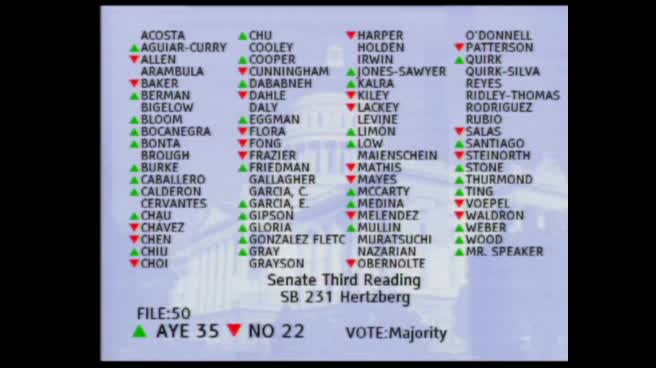 1MIN
Assembly Floor
 2MIN
Assembly Standing Committee on Appropriations
 10MIN
Assembly Standing Committee on Labor and Employment
 2MIN
Senate Floor
Bill Author

Bill Co-Author(s):
