SB 415: High-speed rail: rights-of-way.
- Session Year: 2017-2018
- House: Senate
- Latest Version Date: 2017-02-15
Existing law creates the High-Speed Rail Authority with specified powers and duties relative to development and implementation of a high-speed train system, including the acquisition of property necessary for rights-of-way and the disposal of acquired property no longer necessary for that purpose.
This bill would require the authority to make a good faith effort to sell or exchange real property or an interest in real property acquired by the state for high-speed rail purposes on or after January 1, 2018, within 3 years from the date of acquisition if the authority has not begun construction on the property or interest in the property within that 3-year period. For real property or an interest in real property acquired before January 1, 2018, the bill would require the authority to dispose of the property on or before January 1, 2021, or, for property subject to a lease as of January 1, 2018, within 3 years of the expiration of the lease, if the authority has not begun construction during those 3-year periods.
(a)The authority shall make a good faith effort to sell or exchange real property or an interest in real property acquired by the state on or after January 1, 2018, for high-speed rail purposes in the manner set forth in this chapter within three years from the date of acquisition if the authority has not begun construction on the property or interest in the property within that three-year period.
(b)(1)Except as provided in paragraph (2), the authority shall make a good faith effort to sell or exchange real property or an interest in real property acquired by the state before January 1, 2018, for high-speed rail purposes in the manner set forth in this chapter on or before January 1, 2021, if the authority has not begun construction on the property or interest in the property on or before January 1, 2021.
(2)If the authority leased, before January 1, 2018, real property or an interest in real property acquired by the state for high-speed rail purposes and that lease is in effect as of January 1, 2018, the authority shall make a good faith effort to sell or exchange the real property or interest in real property in the manner set forth in this chapter within three years from the date of the expiration of the lease if the authority has not begun construction on the property or interest in the property within that three-year period.
SEC. 2.Section 185044 of the Public Utilities Code is amended to read:185044.The Except as provided in Section 185040.5, the authority may lease to public agencies or private entities or individuals for any term not to exceed 99 years the use of areas above or below operating rights-of-way and portions of property not currently being used as operating rights-of-way, subject to any reservations, restrictions, and conditions that it deems necessary to ensure adequate protection of the safety and adequacy of high-speed rail facilities and of abutting or adjacent land uses. Prior to entering into any lease, the authority shall determine that the proposed use is not in conflict with the zoning regulations of the local government concerned. The leases shall be made in accordance with procedures to be prescribed by the authority, except that, in the cases of leases with private entities or individuals, the leases shall be made only after competitive bidding. The possibilities of entering into the leases, and the consequent benefits to be derived therefrom, may be considered by the authority in designing and constructing the high-speed rail system. Revenues from the leases shall be deposited in the High-Speed Rail Property Fund created pursuant to Section 185045.
|
Date
|
Status
|
|---|---|
| Feb 1, 2018 | Returned to Secretary of Senate pursuant to Joint Rule 56. |
| Apr 5, 2017 | April 4 set for first hearing. Failed passage in committee. (Ayes 4. Noes 7. Page 627.) Reconsideration granted. |
| Mar 23, 2017 | Set for hearing April 4. |
| Feb 23, 2017 | Referred to Com. on T. & H. |
| Feb 16, 2017 | From printer. May be acted upon on or after March 18. |
| Feb 15, 2017 | Introduced. Read first time. To Com. on RLS. for assignment. To print. |
|
Date
|
Description
|
Location
|
Votes
|
|
|---|---|---|---|---|
| Apr 4, 2017 | [First] hearing set for [04-05-2017]: Failed passage in Committee. Reconsideration granted | Senate Standing Committee on Transportation and Housing |
Passed |
|
| Apr 4, 2017 | Do pass, but first be re-referred to the Committee on [Appropriations] | Senate Standing Committee on Transportation and Housing |
Failed |
This list shows positions taken on this bill by organizations on the date displayed, which is linked to the original source.
Positions by individuals are not included.
|
Organization
|
Position
|
Date
|
|---|---|---|
| Citizens for California High-Speed Rail Accountability | ** Support | Mar 30, 2017 |
| Community Coalition on High Speed Rail | * Support | Apr 4, 2017 |
| Community Coalition on High-Speed Rail | ** Support | Mar 30, 2017 |
| DERAIL | ** Support | Mar 30, 2017 |
| Harry Gervais Taxpayers Association | * Support | Apr 4, 2017 |
| Howard Jarvis Taxpayers Association | ** Support | Mar 30, 2017 |
| Tos Farms Inc. | ** Support | Mar 30, 2017 |
SENATE COMMITTEE ON TRANSPORTATION AND HOUSING
Senator Jim Beall, Chair
2017 - 2018 Regular
Bill No: SB 415 Hearing Date: 4/4/2017
Author: | Vidak | ||
Version: | 2/15/2017 | ||
Urgency: | No | Fiscal: | Yes |
Consultant: | Manny Leon | ||
SUBJECT: High-speed rail: rights-of-way
DIGEST: This bill requires the High-Speed Rail Authority (HSRA) to sell real property within three years from the date of acquisition if HSRA has not commenced construction on that property within a three year period, as specified.
ANALYSIS:
The California High-Speed Rail Authority (HSRA) was established by legislation in 1996 (SB 1420, Kopp, Chapter 796) to direct the development and implementation of intercity high-speed rail service that is fully coordinated with other public transportation services. In 2008, California voters approved Proposition 1A, the Safe, Reliable High-Speed Passenger Train Bond Act for the 21st Century (Prop. 1A), which authorized $9 billion in general obligation bonds for the high-speed rail project. Prop. 1A included a number of requirements the state must meet to access the bond funding for capital construction, including the identification of matching funds, the completion of a funding plan, and approval of required environmental clearance documents.
Existing law:
- Establishes the HSRA and vests with it the responsibility to develop and implement a high-speed rail system in California.
- Authorizes the sale of $9.95 billion in general obligation bonds for the development and construction of California's high-speed rail system, including the acquisition of real property and rights-of-way.
- Authorizes the HSRA to sell or exchange real property determined to be no longer necessary for high-speed rail purposes and establishes a process for selling the real property.
- Allows the proceeds from any property sold to be appropriated for use in the development, improvement, and maintenance of the high-speed rail system.
- Requires HSRA, prior to selling previous acquired real property and interest therein, to send notification by certified mail to the last known owner of the property, at his or her last known address, to advise him or her that the property will be offered for sale.
- Prohibits the HSRA from selling the property until at least 30 days after the notification has been sent.
This bill:
- Requires HSRA to make a good faith effort to sell or exchange real property or an interest in real property acquired on or after January 1, 2018 within three years if construction on the property has not commenced within that three year period.
- Requires HSRA to dispose of any real property acquired before January 1, 2018 on or before January 1, 2021 if construction has not commenced within that three year period.
- Further specifies the abovementioned requirements also apply to property leased by HSRA as of January 1, 2018.
COMMENTS:
- Author’s statement. According to the author, “when the High-Speed Rail Authority was created in 1996, it was given similar rights-of-way as Caltrans. Unfortunately, as we saw in a 2012 State Auditor report, Caltrans wasted millions of dollars every year mismanaging properties it acquired long ago for the State Route 710 expansion project, which was never finished. As you drive through the Central Valley, you can see the same thing: properties claimed for the High-Speed Rail project sitting abandoned and unused. The High-Speed Rail Authority shouldn’t be allowed to waste tens of millions of taxpayer dollars on land it will never use. This bill gives the Authority a three-year timeframe to either use it or lose it.”
- Existing process. Like other governmental agencies, HSRA attempts to purchase any necessary property related to project construction by offering the appraised fair market value of that property to the owner. If the transaction is unable to proceed in this way, the State Public Works Board (PWB), on behalf of HSRA, may use the state’s eminent domain authority to acquire the property. Property acquisition processes, including eminent domain proceedings, generally result in a settlement transferring the ownership of private property to a governmental entity for public use, typically at a justified and documented price based on sound business practices. Moreover, if at some point, after design and/or construction on each property has been completed, some portion of the property is determined to be no longer necessary for the project, existing law already provides HSRA the ability to release the unneeded part of the property or interest through sale, exchange or other means of transfer, ensuring that the property remains in productive use.
- A more costly process? While the author aims to minimize wasting taxpayer dollars by requiring HSRA to sell its acquired property if not used within a specified timeframe, this proposal may ultimately be more costly for taxpayers. For example, acquiring major blocks of property for various parts of the project can be a complicated process and take several years to obtain. Thus, the arbitrary deadline established in this bill would require HSRA to sell acquired properties while potentially still in the process of purchasing surrounding properties. If this was to occur, HSRA would be forced to repurchase the property; in turn increasing cost to taxpayers through potentially higher property values and state employees performing the same work twice. Furthermore, in other instances, a property owner may hold out on selling the property to leverage a final price above fair market value understanding that HSRA is subject to selling surrounding properties if construction fails to commence within the timeline designated by this proposal. The committee may wish to inquire how this proposal will be less costly to taxpayers when HSRA currently has the mechanisms to dispose of any excess or unnecessary property.
FISCAL EFFECT: Appropriation: Fiscal Com.: Local:
POSITIONS: (Communicated to the committee before noon on Wednesday,
March 29, 2017.)
SUPPORT:
Citizens for California High-Speed Rail Accountability
Community Coalition on High-Speed Rail
DERAIL
Howard Jarvis Taxpayers Association
Tos Farms Inc.
One individual
OPPOSITION:
None received.
Discussed in Hearing
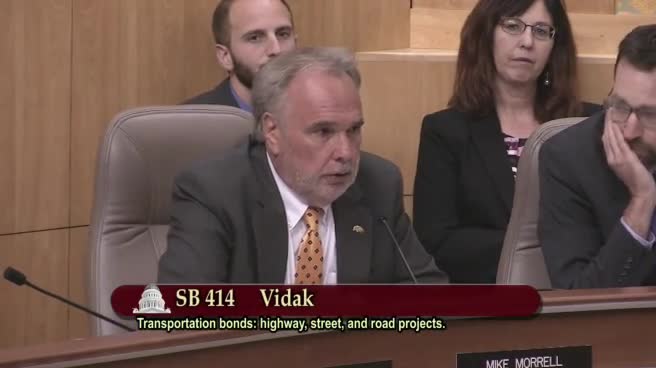 17MIN
Senate Standing Committee on Transportation and Housing
Bill Author

Bill Co-Author(s):