SB 494: Language arts: reading: grant program.
- Session Year: 2017-2018
- House: Senate
- Latest Version Date: 2017-09-15
The Comprehensive Reading Leadership Program Act of 1996 authorizes county offices of education to apply to the State Board of Education to design a reading leadership program and develop materials that focus on reading skills, including phonics.
This bill would establish the Golden State Reading Guarantee grant program, which would be administered by the State Department of Education. The bill would require a local educational agency that chooses to apply for a grant to submit an application that contains certain minimum information to the department, in a format and by a date determined by the department. The bill would provide requirements for eligibility for a grant and for spending grant funds. The bill would require that implementation of the grant program be contingent upon the appropriation of funds for purposes of the grant program in the annual Budget Act or other statute. The bill would require the department to establish a process to provide professional development training to local educational agencies on, among other things, the existing diagnostic, formative, and interim assessment tools that are available from the state, including those that are appropriate for pupils who are English learners.
The Comprehensive Reading Leadership Program Act of 1996 authorizes county offices of education to apply to the State Board of Education to design a reading leadership program and develop materials that focus on reading skills, including phonics.
This bill would establish the Golden State Reading Guarantee grant program, which would be administered by the State Department of Education. The bill would require a local educational agency that chooses to apply for a grant to submit an application that contains certain minimum information to the department, in a format and by a date determined by the department. The bill would provide requirements for eligibility for a grant and for spending grant funds. The bill would require that implementation of the grant program be contingent upon the appropriation of funds for purposes of the grant program in the annual Budget Act or other statute. The bill would require the department to establish a process to provide professional development training to local educational agencies on, among other things, the existing diagnostic, formative, and interim assessment tools that are available from the state, including those that are appropriate for pupils who are English learners. The bill would require the Legislative Analysts Office to conduct an evaluation of reading intervention strategies to identify successful strategies and best practices, and to report the results to the appropriate policy committees of the Legislature and the Governor on or before December 31, 2018.
The Comprehensive Reading Leadership Program Act of 1996 authorizes county offices of education to apply to the State Board of Education to design a reading leadership program and develop materials that focus on reading skills, including phonics.
This bill would require the state board, on or before December 31, 2018, to identify formative reading diagnostic tools that can be used by the public schools to assess pupils developmental levels of reading proficiency in grades 1 to 3, inclusive, in their ability to read proficiently by the end of grade 3 and to post a list of those diagnostic tools on the departments Internet Web site. The bill would require, on or before the beginning of the 201920 school year, public schools that enroll pupils in grades 1 to 4, inclusive, and at which less than 50% of 4th grade pupils demonstrate proficiency on English language arts standards on the statewide assessment administered the previous school year, to ensure that each pupils reading proficiency is measured using at least one of the formative reading diagnostic tools identified above. The bill would require any pupil who does not have an appropriate developmental reading level, as provided, to have a reading plan to be created in collaboration with the pupils parent and teacher. The bill would require the reading plan to have certain elements to be reviewed at least annually by the school and updated or revised as appropriate. By expanding the duties of a public school, the bill would create a state-mandated local program.The California Constitution requires the state to reimburse local agencies and school districts for certain costs mandated by the state. Statutory provisions establish procedures for making that reimbursement.This bill would provide that, if the Commission on State Mandates determines that the bill contains costs mandated by the state, reimbursement for those costs shall be made pursuant to the statutory provisions noted above.This bill would establish the Golden State Reading Guarantee grant program, which would be administered by the State Department of Education. The bill would require a local educational agency that chooses to apply for a grant to submit an application that contains certain minimum information to the department, in a format and by a date determined by the department. The bill would provide requirements for eligibility for a grant and for spending grant funds. The bill would require the department to establish a process to provide professional development training to local educational agencies on, among other things, the existing diagnostic, formative, and interim assessment tools that are available from the state, including those that are appropriate for pupils who are English learners. The bill would require the Legislative Analysts Office to conduct an evaluation of reading intervention strategies to identify successful strategies and best practices, and to report the results to the appropriate policy committees of the Legislature and the Governor on or before December 31, 2018.
The Comprehensive Reading Leadership Program Act of 1996 authorizes county offices of education to apply to the State Board of Education to design a reading leadership program and develop materials that focus on reading skills, including phonics.
This bill would require the state board, on or before December 31, 2018, to identify formative reading diagnostic tools that can be used by the public schools to assess pupils developmental levels of reading proficiency in grades 1 to 3, inclusive, in their ability to read proficiently by the end of grade 3 and to post a list of those diagnostic tools on the departments Internet Web site. The bill would require, on or before the beginning of the 201920 school year, public schools that enroll pupils in grades 1 to 4, inclusive, and at which less than 50% of 4th grade pupils demonstrate proficiency on English language arts standards on the statewide assessment administered the previous school year, to ensure that each pupils reading proficiency is measured using at least one of the formative reading diagnostic tools identified above. The bill would require any pupil who does not have an appropriate developmental reading level, as provided, to have a reading plan to be created in collaboration with the pupils parent and teacher. The bill would require the reading plan to have certain elements to be reviewed at least annually by the school and updated or revised as appropriate. By expanding the duties of a public school, the bill would create a state-mandated local program.
The California Constitution requires the state to reimburse local agencies and school districts for certain costs mandated by the state. Statutory provisions establish procedures for making that reimbursement.
This bill would provide that, if the Commission on State Mandates determines that the bill contains costs mandated by the state, reimbursement for those costs shall be made pursuant to the statutory provisions noted above.
(a)The Legislature finds and declares all of the following:
(1)Reading proficiently by the end of grade 3 can be a make-or-break benchmark in a childs educational development. Up until the end of grade 3, most children are learning to read. Beginning in grade 4, however, they are reading to learn, using their skills to gain more information in such subjects as mathematics and science.
(2)Californias long-term economic strength depends on having an educated workforce, and grade-level reading proficiency is the key. By dramatically getting more California children on track as proficient readers, California can also dramatically stop the cycle of intergenerational poverty and boost the individual earning potential, global competitiveness, and overall quality of life for all Californians.
(3)An important partnership between a parent and child begins before the child enters kindergarten, when the parent helps the child develop rich linguistic experiences, including listening comprehension and speaking, that help form the foundation for reading and writing, which are the main vehicles for content acquisition.
(b)It is therefore the intent of the Legislature that all California public schools that enroll pupils in grades 1 to 3, inclusive, will work closely with the parents and teachers of these pupils to provide them the instructional programming, intervention instruction, and support necessary to ensure that pupils, by the completion of grade 3, can demonstrate a level of proficiency in reading skills that is necessary to support them in achieving the academic standards and expectations applicable to the grade 4 curriculum.
53008.1.The Golden State Reading Guarantee grant program is hereby established for the purpose of assisting local educational agencies in ensuring that all pupils meet reading standards and language progressive skills by the end of grade 3. The department shall administer the grant program and establish a process to provide professional development training to local educational agencies pursuant to Section 53008.5.
53008.2.A local educational agency that chooses to apply for a grant pursuant to this chapter shall submit an application to the department in a format and by a date determined by the department. An application submitted to the department by a local educational agency pursuant to this section shall include, at a minimum, all of the following:
(a)Information about the pupil and school needs within the local educational agency.
(b)The activities the local educational agency will undertake with the grant funding.
(c)How the local educational agency will address the literacy needs of English learners, including English learners who are enrolled in bilingual, language immersion, and dual language immersion programs.
(d)How the local educational agency will measure outcomes associated with the activities undertaken with the grant funding.
53008.3.A local educational agency is eligible for a grant pursuant to this chapter if it enrolls pupils in grades 1 to 4, inclusive, and less than 50 percent of pupils in grade 4 score at Level 3 or 4 in the prior school year on the reading standards within the English language arts standards developed pursuant to Section 60605.8.
53008.4.A local educational agency that receives a grant pursuant to this chapter shall use the grant funds for specialists and activities that address the needs of pupils related to meeting reading standards and acquiring language progressive skills, including, but not limited to, any of the following:
(a)Literacy coaches.
(b)Reading specialists.
(c)Reading tutors.
(d)Coordinators to facilitate reading programs.
(e)Collaboration with parents and guardians to increase participation of parents and guardians and their ability to support their childrens literacy development.
(f)For grants intended to include activities to address the literacy needs of pupils enrolled in bilingual, language immersion, or dual language immersion programs, certificated employees who hold bilingual authorizations or who have demonstrated experience and expertise in serving pupils enrolled in those programs.
53008.5.The department shall establish a process to provide professional development training to local educational agencies on all of the following:
(a)The existing diagnostic, formative, and interim assessment tools that are available from the state, including those that are appropriate for pupils who are English learners.
(b)How to evaluate the data from, and adjust instruction based on, the results of the assessments described in subdivision (a), and create a system of continuous improvement.(c)How to administer and score the assessments described in subdivision (a).(d)The appropriate use of assessments in the language of instruction in reading and language arts for pupils instructed in bilingual, language immersion, and dual language immersion programs.
53008.6Implementation of the grant program established pursuant to Section 53008.1 shall be contingent upon the appropriation of funds for purposes of the grant program in the annual Budget Act or other statute.
(a)The Legislature finds and declares all of the following:
(1)Reading proficiently by the end of grade 3 can be a make-or-break benchmark in a childs educational development. Up until the end of grade 3, most children are learning to read. Beginning in grade 4, however, they are reading to learn, using their skills to gain more information in such subjects as mathematics and science.
(2)Californias long-term economic strength depends on having an educated workforce, and grade-level reading proficiency is the key. By dramatically getting more California children on track as proficient readers, California can also dramatically stop the cycle of intergenerational poverty and boost the individual earning potential, global competitiveness, and overall quality of life for all Californians.
(3)An important partnership between a parent and child begins before the child enters kindergarten, when the parent helps the child develop rich linguistic experiences, including listening comprehension and speaking, that help form the foundation for reading and writing, which are the main vehicles for content acquisition.
(b)It is therefore the intent of the Legislature that all California public schools that enroll pupils in grades 1 to 3, inclusive, will work closely with the parents and teachers of these pupils to provide them the instructional programming, intervention instruction, and support necessary to ensure that pupils, by the completion of grade 3, can demonstrate a level of proficiency in reading skills that is necessary to support them in achieving the academic standards and expectations applicable to the grade 4 curriculum.
53008.1.The Golden State Reading Guarantee grant program is hereby established for the purpose of assisting local educational agencies in ensuring that all pupils meet reading standards and language progressive skills by the end of grade 3. The department shall administer the grant program and establish a process to provide professional development training to local educational agencies pursuant to Section 53008.5.
53008.2.A local educational agency that chooses to apply for a grant pursuant to this chapter shall submit an application to the department in a format and by a date determined by the department. An application submitted to the department by a local educational agency pursuant to this section shall include, at a minimum, all of the following:
(a)Information about the pupil and school needs within the local educational agency.
(b)The activities the local educational agency will undertake with the grant funding.
(c)How the local educational agency will address language acquisition for English learners. the literacy needs of English learners, including English learners who are enrolled in bilingual, language immersion, and dual language immersion programs.
(d)How the local educational agency will measure outcomes associated with the activities undertaken with the grant funding.
53008.3.A local educational agency is eligible for a grant pursuant to this chapter if it enrolls pupils in grades 1 to 4, inclusive, and less than 50 percent of pupils in grade 4 score at Level 3 or 4 in the prior school year on the reading standards within the English language arts standards developed pursuant to Section 60605.8.
53008.4.A local educational agency that receives a grant pursuant to this chapter shall use the grant funds for specialists and activities that address the needs of pupils related to meeting reading standards and acquiring language progressive skills, including, but not limited to, any of the following:
(a)Literacy coaches.
(b)Reading specialists.
(c)Reading tutors.
(d)Coordinators to facilitate reading programs.
(e)Collaboration with parents and guardians to increase participation of parents and guardians and their ability to support their childrens literacy development.
(f)For grants intended to include activities to address the literacy needs of pupils enrolled in bilingual, language immersion, or dual language immersion programs, certificated employees who hold bilingual authorizations or who have demonstrated experience and expertise in serving pupils enrolled in those programs.
53008.5.The department shall establish a process to provide professional development training to local educational agencies on all of the following:
(a)The existing diagnostic, formative, and interim assessment tools that are available from the state, including those that are appropriate for pupils who are English learners.
(b)How to evaluate the data from those assessment results, from, and adjust instruction based on those assessment results, on, the results of the assessments described in subdivision (a), and create a system of continuous improvement.(c)How to administer and score those assessments. the assessments described in subdivision (a).(d)The appropriate use of assessments in the language of instruction in reading and language arts for pupils instructed in bilingual, language immersion, and dual language immersion programs.
53008.6.(a)The Legislative Analysts Office shall conduct an evaluation of reading intervention strategies to identify successful strategies and best practices, and shall report the results to the appropriate policy committees of the Legislature and the Governor on or before December 31, 2018.(b)Pursuant to Section 10231.5 of the Government Code, this section is repealed on January 1, 2022.53008.7.53008.6Implementation of the grant program established pursuant to Section 53008.1 shall be contingent upon the appropriation of funds for purposes of the grant program in the annual Budget Act or other statute.
(a)The Legislature finds and declares all of the following:
(1)Reading proficiently by the end of grade 3 can be a make-or-break benchmark in a childs educational development. Up until the end of grade 3, most children are learning to read. Beginning in grade 4, however, they are reading to learn, using their skills to gain more information in such subjects as mathematics and science.
(2)Californias long-term economic strength depends on having an educated workforce, and grade-level reading proficiency is the key. By dramatically getting more California children on track as proficient readers, California can also dramatically stop the cycle of intergenerational poverty and boost the individual earning potential, global competitiveness, and overall quality of life for all Californians.
(3)An important partnership between a parent and child begins before the child enters kindergarten, when the parent helps the child develop rich linguistic experiences, including listening comprehension and speaking, that help form the foundation for reading and writing, which are the main vehicles for content acquisition.
(b)It is therefore the intent of the Legislature that all California public schools that enroll pupils in grades 1 to 3, inclusive, will work closely with the parents and teachers of these pupils to provide them the instructional programming, intervention instruction, and support necessary to ensure that pupils, by the completion of grade 3, can demonstrate a level of proficiency in reading skills that is necessary to support them in achieving the academic standards and expectations applicable to the grade 4 curriculum.
53008.1.The Golden State Reading Guarantee grant program is hereby established for the purpose of assisting local educational agencies in ensuring that all pupils meet reading standards and language progressive skills by the end of grade 3. The department shall administer the grant program and establish a process to provide professional development training to local educational agencies pursuant to Section 53008.5.
53008.2.A local educational agency that chooses to apply for a grant pursuant to this article chapter shall submit an application to the department in a format and by a date determined by the department. An application submitted to the department by a local educational agency pursuant to this section shall include, at a minimum, all of the following:
(a)Information about the pupil and school needs within the local educational agency.
(b)The activities the local educational agency will undertake with the grant funding.
(c)How the local educational agency will address language acquisition for English learners.
(d)How the local educational agency will measure outcomes associated with the activities undertaken with the grant funding.
53008.3.A local educational agency is eligible for a grant pursuant to this article chapter if it enrolls pupils in grades 1 to 4, inclusive, and less than 50 percent of pupils in grade 4 score at Level 3 or 4 in the prior school year on the reading standards within the English language arts standards developed pursuant to Section 60605.8.
53008.4.A local educational agency that receives a grant pursuant to this article chapter shall use the grant funds for specialists and activities that address the needs of pupils related to meeting reading standards and acquiring language progressive skills, including, but not limited to, any of the following:
(a)Literacy coaches.
(b)Reading specialists.
(c)Reading tutors.
(d)Coordinators to facilitate reading programs.
(e)Collaboration with parents and guardians to increase participation of parents and guardians and their ability to support their childrens literacy development.
53008.5.The department shall establish a process to provide professional development training to local educational agencies on all of the following:
(a)The existing diagnostic, formative, and interim assessment tools that are available from the state, including those that are appropriate for pupils who are English learners.
(b)How to evaluate the data from those assessment results, adjust instruction based on those assessment results, and create a system of continuous improvement.
(c)How to administer and score those assessments.
53008.6.(a)The Legislative Analysts Office shall conduct an evaluation of reading intervention strategies to identify successful strategies and best practices, and shall report the results to the appropriate policy committees of the Legislature and the Governor on or before December 31, 2018.
(b)Pursuant to Section 10231.5 of the Government Code, this section is repealed on January 1, 2022.
53008.7.Implementation of the grant program established pursuant to Section 53008.1 shall be contingent upon the appropriation of funds for purposes of the grant program in the annual Budget Act or other statute.
(a)The Legislature finds and declares all of the following:
(1)Reading proficiently by the end of grade 3 can be a make-or-break benchmark in a childs educational development. Up until the end of grade 3, most children are learning to read. Beginning in grade 4, however, they are reading to learn, using their skills to gain more information in such subjects as mathematics and science.
(2)Californias long-term economic strength depends on having an educated workforce workforce, and grade-level reading proficiency is the key. By dramatically getting more California children on track as proficient readers, California can also dramatically stop the cycle of intergenerational poverty, poverty and boost the individual earning potential, global competitiveness, and overall quality of life for all Californians.
(3)An important partnership between a parent and child begins before the child enters kindergarten, when the parent helps the child develop rich linguistic experiences, including listening comprehension and speaking, that help form the foundation for reading and writing, which are the main vehicles for content acquisition.
(b)It is therefore the intent of the Legislature that all California public schools that enroll pupils in grades 1 to 3, inclusive, will work closely with the parents and teachers of these pupils to provide them the instructional programming, intervention instruction, and support necessary to ensure that pupils, by the completion of grade 3, can demonstrate a level of proficiency in reading skills that is necessary to support them in achieving the academic standards and expectations applicable to the grade 4 curriculum.
(c)It is further the intent of the Legislature to increase the local control funding formula base rate for pupils in kindergarten and grades 1 to 3, inclusive, only at those schools at which 50 percent or more of pupils in grade 4 score below reading proficiency on a statewide assessment.53008.1.On or before December 31, 2018, the state board shall accomplish both of the following:(a)Identify a list of formative reading diagnostic tools that can be used by the public schools, pursuant to Section 53008.2, to assess pupils developmental levels of reading proficiency in grades 1 to 3, inclusive, in their ability to read proficiently by the end of grade 3 and to post a list of those diagnostic tools on the departments Internet Web site.(b)Define what it means for a pupil to have an appropriate developmental reading level in grades 1 to 3, inclusive, such that the pupil is on track to reading proficiency by the end of grade 3, as determined by the formative reading diagnostic tools.53008.2.(a)On or before the beginning of the 201920 school year, a public school that enrolls pupils in grades 1 to 4, inclusive, at which less than 50 percent of 4th grade pupils demonstrate proficiency on English language arts standards on the statewide assessment administered the previous school year, shall ensure that each pupils reading proficiency is measured throughout the school year using at least one of the formative reading diagnostic tools identified by the state board pursuant to Section 53008.1 to determine if a pupil has an appropriate developmental reading level for the pupils grade level.(b)A reading plan, as described in subdivision (c), shall be created for a pupil in grades 1 to 3, inclusive, who is not at the appropriate developmental reading level for the pupils grade level as that term is defined by the state board pursuant to Section 53008.1. The plan shall be created in collaboration with the pupils parent and teacher, if possible, and as soon as possible after the pupils developmental reading level is identified. The pupils reading plan shall continue to be implemented until the pupil demonstrates reading proficiency. The pupils reading plan shall be reviewed at least annually by the school and updated or revised as appropriate to facilitate the pupils progress in demonstrating reading proficiency.(c)A reading plan shall include all of the following:(1)The pupils specific developmental reading level that needs to be addressed in order for the pupil to attain reading proficiency.(2)The goals and benchmarks for the pupils growth in attaining reading proficiency by the end of grade 3.(3)The type of additional instructional services and interventions the pupil will receive in reading as determined by the school.(4)The strategies the pupils parent is encouraged to use in assisting their child to achieve reading proficiency that are designed to supplement the additional instructional services and interventions described in paragraph (3).(5)Any additional services that are deemed available and appropriate to accelerate the pupils reading skill development.(d)The parent of the pupil shall be provided with a copy of their childs reading plan along with all of the following information:(1)The states goal is for all children in California to graduate from high school having attained skill levels that adequately prepare them for postsecondary studies or for the workforce, and research demonstrates that achieving reading competency by grade 3 is a critical milestone in achieving this goal.(2)If the pupil enters grade 4 without achieving reading competency, he or she is significantly more likely to fall behind in all subject areas beginning in grade 4 and continuing in later grades. If the pupils reading skill deficiencies are not remediated, it is likely the pupil will not have the skills necessary to complete the coursework required to graduate from high school.(3)The parent plays a central role in supporting the pupils efforts to achieve reading competency and is strongly encouraged to work with his or her childs teacher in implementing the reading plan, and, in order to supplement the intervention instruction the pupil receives in school, the reading plan will include strategies the parent is encouraged to use at home to support the pupils reading success.(e)For purposes of this section, parent means parent or legal guardian.53008.3.It is the intent of the Legislature to increase the base rate funding pursuant to Section 42238.02 for kindergarten and grades 1 to 3, inclusive, for purposes of funding this chapter. 53008.1.The Golden State Reading Guarantee grant program is hereby established for the purpose of assisting local educational agencies in ensuring that all pupils meet reading standards and language progressive skills by the end of grade 3. The department shall administer the grant program and establish a process to provide professional development training to local educational agencies pursuant to Section 53008.5.
53008.2.A local educational agency that chooses to apply for a grant pursuant to this article shall submit an application to the department in a format and by a date determined by the department. An application submitted to the department by a local educational agency pursuant to this section shall include, at a minimum, all of the following:
(a)Information about the pupil and school needs within the local educational agency.
(b)The activities the local educational agency will undertake with the grant funding.
(c)How the local educational agency will address language acquisition for English learners.
(d)How the local educational agency will measure outcomes associated with the activities undertaken with the grant funding.
53008.3.A local educational agency is eligible for a grant pursuant to this article if it enrolls pupils in grades 1 to 4, inclusive, and less than 50 percent of pupils in grade 4 score at Level 3 or 4 on the reading standards within the English language arts standards developed pursuant to Section 60605.8.
53008.4.A local educational agency that receives a grant pursuant to this article shall use the grant funds for specialists and activities that address the needs of pupils related to meeting reading standards and acquiring language progressive skills, including, but not limited to, any of the following:
(a)Literacy coaches.
(b)Reading specialists.
(c)Reading tutors.
(d)Coordinators to facilitate reading programs.
(e)Collaboration with parents and guardians to increase participation of parents and guardians and their ability to support their childrens literacy development.
53008.5.The department shall establish a process to provide professional development training to local educational agencies on all of the following:
(a)The existing diagnostic, formative, and interim assessment tools that are available from the state, including those that are appropriate for pupils who are English learners.
(b)How to evaluate the data from those assessment results, adjust instruction based on those assessment results, and create a system of continuous improvement.
(c)How to administer and score those assessments.
53008.6.(a)The Legislative Analysts Office shall conduct an evaluation of reading intervention strategies to identify successful strategies and best practices, and shall report the results to the appropriate policy committees of the Legislature and the Governor on or before December 31, 2018.
(b)Pursuant to Section 10231.5 of the Government Code, this section is repealed on January 1, 2022.
SEC. 2.If the Commission on State Mandates determines that this act contains costs mandated by the state, reimbursement to local agencies and school districts for those costs shall be made pursuant to Part 7 (commencing with Section 17500) of Division 4 of Title 2 of the Government Code.(a)The Legislature finds and declares all of the following:
(1)Reading proficiently by the end of grade 3 can be a make-or-break benchmark in a childs educational development. Up until the end of grade 3, most children are learning to read. Beginning in grade 4, however, they are reading to learn, using their skills to gain more information in such subjects as mathematics and science.
(2)Californias long-term economic strength depends on having an educated workforce and grade-level reading proficiency is the key. By dramatically getting more California children on track as proficient readers, California can also dramatically stop the cycle of intergenerational poverty, and boost the individual earning potential, global competitiveness, and overall quality of life for all Californians.
(3)An important partnership between a parent and child begins before the child enters kindergarten, when the parent helps the child develop rich linguistic experiences, including listening comprehension and speaking, that help form the foundation for reading and writing, which are the main vehicles for content acquisition.
(b)It is therefore the intent of the Legislature that all California public schools that enroll pupils in grades 1 to 3, inclusive, will work closely with the parents and teachers of these pupils to provide them the instructional programming, intervention instruction, and support necessary to ensure that pupils, by the completion of grade 3, can demonstrate a level of proficiency in reading skills that is necessary to support them in achieving the academic standards and expectations applicable to the grade 4 curriculum.
(c)It is further the intent of the Legislature to increase the local control funding formula base rate for pupils in kindergarten and grades 1 to 3, inclusive, only at those schools at which 50 percent or more of pupils in grade 4 score below reading proficiency on a statewide assessment.
53008.1.On or before December 31, 2018, the state board shall accomplish both of the following:
(a)Identify a list of formative reading diagnostic tools that can be used by the public schools, pursuant to Section 53008.2, to assess pupils developmental levels of reading proficiency in grades 1 to 3, inclusive, in their ability to read proficiently by the end of grade 3 and to post a list of those diagnostic tools on the departments Internet Web site.
(b)Define what it means for a pupil to have an appropriate developmental reading level in grades 1 to 3, inclusive, such that the pupil is on track to reading proficiency by the end of grade 3, as determined by the formative reading diagnostic tools.
53008.2.(a)On or before the beginning of the 201920 school year, a public school that enrolls pupils in grades 1 to 4, inclusive, at which less than 50 percent of 4th grade pupils demonstrate proficiency on English language arts standards on the statewide assessment administered the previous school year, shall ensure that each pupils reading proficiency is measured throughout the school year using at least one of the formative reading diagnostic tools identified by the state board pursuant to Section 53008.1 to determine if a pupil has an appropriate developmental reading level for the pupils grade level.
(b)A reading plan, as described in subdivision (c), shall be created for a pupil in grades 1 to 3, inclusive, who is not at the appropriate developmental reading level for the pupils grade level as that term is defined by the state board pursuant to Section 53008.1. The plan shall be created in collaboration with the pupils parent and teacher, if possible, and as soon as possible after the pupils developmental reading level is identified. The pupils reading plan shall continue to be implemented until the pupil demonstrates reading proficiency. The pupils reading plan shall be reviewed at least annually by the school and updated or revised as appropriate to facilitate the pupils progress in demonstrating reading proficiency.
(c)A reading plan shall include all of the following:
(1)The pupils specific developmental reading level that needs to be addressed in order for the pupil to attain reading proficiency.
(2)The goals and benchmarks for the pupils growth in attaining reading proficiency by the end of grade 3.
(3)The type of additional instructional services and interventions the pupil will receive in reading as determined by the school.
(4)The strategies the pupils parent is encouraged to use in assisting their child to achieve reading proficiency that are designed to supplement the additional instructional services and interventions described in paragraph (3).
(5)Any additional services that are deemed available and appropriate to accelerate the pupils reading skill development.
(d)The parent of the pupil shall be provided with a copy of their childs reading plan along with all of the following information:
(1)The states goal is for all children in California to graduate from high school having attained skill levels that adequately prepare them for postsecondary studies or for the workforce, and research demonstrates that achieving reading competency by grade 3 is a critical milestone in achieving this goal.
(2)If the pupil enters grade 4 without achieving reading competency, he or she is significantly more likely to fall behind in all subject areas beginning in grade 4 and continuing in later grades. If the pupils reading skill deficiencies are not remediated, it is likely the pupil will not have the skills necessary to complete the coursework required to graduate from high school.
(3)The parent plays a central role in supporting the pupils efforts to achieve reading competency and is strongly encouraged to work with his or her childs teacher in implementing the reading plan, and, in order to supplement the intervention instruction the pupil receives in school, the reading plan will include strategies the parent is encouraged to use at home to support the pupils reading success.
(e)For purposes of this section, parent means parent or legal guardian.
53008.3.It is the intent of the Legislature to increase the base rate funding pursuant to Section 42238.02 for kindergarten and grades 1 to 3, inclusive, for purposes of funding this chapter.
SEC. 2.If the Commission on State Mandates determines that this act contains costs mandated by the state, reimbursement to local agencies and school districts for those costs shall be made pursuant to Part 7 (commencing with Section 17500) of Division 4 of Title 2 of the Government Code.
|
Date
|
Status
|
|---|---|
| Mar 3, 2018 | Last day to consider Governor’s veto pursuant to Joint Rule 58.5. |
| Oct 14, 2017 | In Senate. Consideration of Governor's veto pending. |
| Oct 14, 2017 | Vetoed by the Governor. |
| Sep 19, 2017 | Enrolled and presented to the Governor at 4 p.m. |
| Sep 13, 2017 | Assembly amendments concurred in. (Ayes 30. Noes 8.) Ordered to engrossing and enrolling. |
| Sep 13, 2017 | In Senate. Concurrence in Assembly amendments pending. |
| Sep 12, 2017 | Read third time. Passed. Ordered to the Senate. |
| Sep 5, 2017 | Read second time. Ordered to third reading. |
| Sep 1, 2017 | From committee: Do pass. (Ayes 11. Noes 4.) (September 1). |
| Aug 23, 2017 | August 23 set for first hearing. Placed on suspense file. |
| Jul 17, 2017 | From committee with author's amendments. Read second time and amended. Re-referred to Com. on APPR. |
| Jul 13, 2017 | From committee: Do pass and re-refer to Com. on APPR. (Ayes 5. Noes 1.) (July 12). Re-referred to Com. on APPR. |
| Jun 12, 2017 | Referred to Com. on ED. |
| Jun 1, 2017 | In Assembly. Read first time. Held at Desk. |
| May 31, 2017 | Read third time. Passed. (Ayes 31. Noes 8. Page 1328.) Ordered to the Assembly. |
| May 26, 2017 | Read second time and amended. Ordered to third reading. |
| May 25, 2017 | From committee: Do pass as amended. (Ayes 5. Noes 2. Page 1185.) (May 25). |
| May 19, 2017 | Set for hearing May 25. |
| May 15, 2017 | May 15 hearing: Placed on APPR. suspense file. |
| May 5, 2017 | Set for hearing May 15. |
| May 3, 2017 | Read second time and amended. Re-referred to Com. on APPR. |
| May 2, 2017 | From committee: Do pass as amended and re-refer to Com. on APPR. (Ayes 7. Noes 0. Page 848.) (April 26). |
| Apr 19, 2017 | April 19 set for second hearing canceled at the request of author. |
| Apr 13, 2017 | Set for hearing April 26. |
| Apr 13, 2017 | April 19 set for second hearing canceled at the request of author. |
| Mar 28, 2017 | Set for hearing April 19. |
| Mar 27, 2017 | March 29 set for first hearing canceled at the request of author. |
| Mar 14, 2017 | Set for hearing March 29. |
| Mar 2, 2017 | Referred to Com. on ED. |
| Feb 17, 2017 | From printer. May be acted upon on or after March 19. |
| Feb 16, 2017 | Introduced. Read first time. To Com. on RLS. for assignment. To print. |
|
Date
|
Description
|
Location
|
Votes
|
|
|---|---|---|---|---|
| Sep 13, 2017 | Unfinished Business SB494 Hueso et al. Concurrence | Senate Floor |
Passed |
|
| Sep 12, 2017 | SB 494 Hueso Senate Third Reading By GONZALEZ FLETCHER | Assembly Floor |
Passed |
|
| Sep 1, 2017 | Do pass. | Assembly Standing Committee on Appropriations |
Passed |
|
| Jul 12, 2017 | Do pass and be re-referred to the Committee on [Appropriations] | Assembly Standing Committee on Education |
Passed |
|
| May 31, 2017 | Senate 3rd Reading SB494 Hueso et al. | Senate Floor |
Passed |
|
| May 25, 2017 | Do pass as amended | Senate Standing Committee on Appropriations |
Passed |
|
| May 15, 2017 | Placed on suspense file | Senate Standing Committee on Appropriations |
Passed |
|
| Apr 26, 2017 | Do pass as amended, but first amend, and re-refer to the Committee on [Appropriations] | Senate Standing Committee on Education |
Passed |
This list shows positions taken on this bill by organizations on the date displayed, which is linked to the original source.
Positions by individuals are not included.
|
Organization
|
Position
|
Date
|
|---|---|---|
| #cut50 | ** Support | Jan 2, 2018 |
| 1 individuals | ** Support | Jul 10, 2017 |
| 1 individuals | ** Support | Jul 10, 2017 |
| Anti-Recidivism Coalition | ** Support | Jan 2, 2018 |
| Association Of California School Administrators | ** Against | Jan 2, 2018 |
| California Association For Bilingual Education | * Neutral | Apr 26, 2017 |
| California Federation Of Teachers | ** Support | Jan 2, 2018 |
| California School Boards Association | * Against | Apr 26, 2017 |
| California Teachers Association | ** Support | Jan 2, 2018 |
| Californians Together | ** Against | Jul 10, 2017 |
| Californians Together | ** Against | Jul 10, 2017 |
| Children Now | ** Support | Jan 2, 2018 |
| Dyslexia Connection | * Support | Apr 26, 2017 |
| Parent Revolution | ** Support | Jan 2, 2018 |
| Reading Partners | ** Support | Jan 2, 2018 |
| Reading Partners Sacramento | * Support | Apr 26, 2017 |
| Reality Changers | ** Support | Jan 2, 2018 |
| Sacramento County District Attorney | ** Support | Jan 2, 2018 |
| Selpa Administrators | ** Against | Apr 25, 2017 |
| SELPA Administrators of California | * Neutral | Apr 26, 2017 |
| SIATech | ** Support | Jan 2, 2018 |
| South Bay Union School District | ** Support | Jul 10, 2017 |
| South Bay Union School District | ** Support | Jul 10, 2017 |
Office of Senate Floor Analyses (916) 651-1520 Fax: (916) 327-4478 | SB |
VETO
Bill No: SB 494
:
SENATE EDUCATION COMMITTEE: 7-0, 4/26/17
AYES: Allen, Wilk, Galgiani, Leyva, Mendoza, Pan, Vidak
SENATE APPROPRIATIONS COMMITTEE: 5-2, 5/25/17
AYES: Lara, Beall, Bradford, Hill, Wiener
NOES: Bates, Nielsen
SENATE FLOOR: 31-8, 5/31/17
AYES: Allen, Atkins, Bates, Beall, Bradford, De León, Dodd, Fuller, Galgiani, Glazer, Hernandez, Hill, Hueso, Jackson, Lara, Leyva, McGuire, Mendoza, Mitchell, Monning, Newman, Nguyen, Pan, Portantino, Roth, Skinner, Stern, Vidak, Wieckowski, Wiener, Wilk
NOES: Anderson, Berryhill, Cannella, Gaines, Moorlach, Morrell, Nielsen, Stone
NO VOTE RECORDED: Hertzberg
SENATE FLOOR: 30-8, 9/13/17
AYES: Allen, Atkins, Beall, Bradford, Cannella, De León, Dodd, Galgiani, Glazer, Hertzberg, Hill, Hueso, Jackson, Lara, Leyva, McGuire, Mendoza, Mitchell, Monning, Newman, Nguyen, Pan, Portantino, Roth, Skinner, Stern, Vidak, Wieckowski, Wiener, Wilk
NOES: Anderson, Bates, Berryhill, Gaines, Moorlach, Morrell, Nielsen, Stone
NO VOTE RECORDED: Fuller, Hernandez
ASSEMBLY FLOOR: 59-17, 9/12/17 - See last page for vote
Reading Partners
DIGEST:
This bill establishes the Golden State Reading grant program for the purpose of assisting local educational agencies (LEAs) in ensuring that all students meet reading standards and language progressive skills by the end of grade 3.
Existing law:
- Establishes the State’s assessment system as the California Assessment of Student Performance and Progress and includes, beginning with the 2013-14 school year, a consortium summative assessment in English language arts for grades 3-8 and 11 that measures content standards adopted by the State Board of Education (SBE). (Education Code § 60640)
- Requires the CDE to identify and make available to school districts information regarding existing assessments in language arts and mathematics that are aligned to the common core academic standards and appropriate for students in grade 2 for diagnostic use by classroom teachers. Existing law requires the CDE to ensure that the selected diagnostic assessments are valid for purposes of identifying particular knowledge or skills a student has or has not acquired in order to inform instruction and make educational decisions. (EC § 60644)
- Requires the governing board of each school district to adopt a local control and accountability plan (LCAP) using a template adopted by the SBE. Existing law requires each LCAP, to include, for the school district and each school within the school district, both of the following:
- A description of the annual goals, for all students and each subgroup, to be achieved for each of the state priorities and for any additional local priorities identified by the governing board of the school district.
- A description of the specific actions the school district will take during each year to achieve the goals, including the enumeration of any specific actions necessary for that year to correct any deficiencies in regard to the state priorities. (EC § 52060)
This bill:
- Establishes the Golden State Reading Guarantee grant program for the purpose of assisting LEAs in ensuring that all students meet reading standards and language progressive skills by the end of grade 3.
- Requires the CDE to administer the grant program and establish a process to provide professional development training to LEAs.
- Provides that an LEA is eligible for a grant if it enrolls students in grades 1-4 and less than 50 percent of students in grade 4 score at Level 3 or 4 in the prior school year on the reading standards within the English language arts standards.
- Requires an LEA that chooses to apply for a grant to submit an application to the CDE in a format and by a date determined by the CDE.
- Requires an application submitted to the CDE by an LEA to include, at a minimum, all of the following:
- Information about the student and school needs within the LEA.
- The activities the LEA will undertake with the grant funding.
- How the LEA will address the literacy needs of English learners, including English learners who are enrolled in bilingual, language immersion, and dual language immersion programs.
- How the LEA will measure outcomes associated with the activities undertaken with the grant funding.
- Requires an LEA that receives a grant to use the grant funds for specialists and activities that address the needs of students related to meeting reading standards and acquiring language progressive skills, including but not limited to any of the following:
- Literacy coaches.
- Reading specialists.
- Reading tutors.
- Coordinators to facilitate reading programs.
- Collaboration with parents and guardians to increase participation of parents and guardians and their ability to support their children’s literacy development.
- Certificated employees who hold bilingual authorizations or who have demonstrated experience and expertise in serving students enrolled in bilingual, language immersion, or dual language immersion programs, for grants intended to include activities to address the literacy needs of students enrolled in those programs.
- Requires the CDE to establish a process to provide professional development training to LEAs on all of the following:
- The existing diagnostic, formative, and interim assessment tools that are available from the state, including those that are appropriate for students who are English learners.
- How to evaluate the data from, and adjust instruction based on, the results of the assessments, and create a system of continuous improvement.
- How to administer and score the assessments.
- The appropriate use of assessments in the language of instruction in reading and language arts for students instructed in bilingual, language immersion, and dual language immersion programs.
- Provides that implementation of this bill is contingent upon the appropriation of funds for purposes of the grant program in the annual Budget Act or other statute.
- States legislative findings and declarations relative to the importance of reading proficiency.
Comments
How many schools would be affected? The grant program established by this bill would be limited to LEAs serving grades 1 to 4 and with less than 50 percent of its pupils in grade 4 demonstrating proficiency on the English language arts standards. According to the results of the 2016 Smarter Balanced English language arts assessment, approximately 642 LEAs meet the bill’s criteria and would be eligible to apply for funding.
LCAPs. Existing law requires the governing board of each school district to adopt an LCAP, and include in that plan a description of the annual goals, for all students and each student group, to be achieved for each of the state priorities, and a description of the specific actions the school district will take during each year to achieve the goals, including the enumeration of any specific actions necessary for that year to correct any deficiencies in regard to the state priorities.
The State does not require specific assessments be administered to students in grades 1-2; however, there is an expectation that LEAs are measuring and evaluating student performance in those grades.
The SBE adopted the evaluation rubrics (now known as the California School Dashboard) in September 2016. The Dashboard allows LEAs to display performance data at the school level and by student group. State Priority 2 relates to the implementation of state standards and is measured by a local indicator. Priority 2 outcomes will be reflected in the Dashboard, which should make it easier for LEAs to identify deficiencies in meeting the goals identified in their LCAPs.
FISCAL EFFECT: Appropriation: Fiscal Com.: Local:
According to the Assembly Appropriations Committee:
- Unknown Proposition 98/General Fund (GF) cost pressure to fund the grant program. A grant program will necessitate at least $10 million Prop 98/GF. The amount could be higher depending on the grant amount and the number of grants awarded. Based on the 2016 results for the Smarter Balanced Summative Assessment, 810 LEAs would be eligible for the grant.
- Ongoing administrative costs to CDE of approximately $270,000 GF for two personnel to administer the grant program and approximately $700,000 GF to contract with a provider that can conduct professional development trainings for LEAs in different parts of the state.
Children Now (co-source)
Reading Partners (co-source)
Anti-Recidivism Coalition
California Federation of Teachers
California Teachers Association
Parent Revolution
Reality Changers
Sacramento County District Attorney
SIATech
#cut50
Association of California School Administrators
ARGUMENTS IN SUPPORT: According to Children Now, 2016 statistics from the CDE note that 56 percent of all students in grade 4 do not meet the proficiency standards for reading. The problem is magnified for low-income and minority students. Presently 70 percent of all low-income students in grade 4 are not reading at grade level. The ability to read proficiently is a fundamental skill that affects a child’s ability to learn and participate in the classroom. A child who is not reading at grade level by grade 3 is four times more likely to drop out of high school, and is more likely to face incarceration and more prone to poverty in adulthood. This bill seeks to address the literacy crisis by implementing proven techniques.
ARGUMENTS IN OPPOSITION: According to the Association of California School Administrators, while this bill is well-intentioned, the majority of concerns center on the bill’s diversion of providing funds to LEAs through the Local Control Funding Formula (LCFF). The bill narrows the scope of the new accountability system that was developed using the eight LCFF state priorities and multiple measures to understand student performance and progress. The intent of this bill could be addressed with augmentations to the LCFF and through a school district’s LCAP as they think comprehensively how to improve student achievement in core subject areas.
GOVERNOR’S VETO MESSAGE:
I am returning Senate Bill 494 without my signature.
This bill would establish the Golden State Reading grant program for the purpose of assisting local educational agencies to ensure that all students meet specified reading standards and language skills by the end of the third grade.
Local educational agencies already have the flexibility under the Local Control Funding Formula to provide students the support they need to ensure that appropriate reading and language skills are achieved.
ASSEMBLY FLOOR: 59-17, 9/12/17
AYES: Aguiar-Curry, Arambula, Baker, Berman, Bloom, Bocanegra, Bonta, Burke, Caballero, Calderon, Cervantes, Chau, Chiu, Choi, Chu, Cooley, Cooper, Cunningham, Dababneh, Daly, Eggman, Frazier, Friedman, Cristina Garcia, Eduardo Garcia, Gipson, Gloria, Gonzalez Fletcher, Gray, Grayson, Holden, Irwin, Jones-Sawyer, Kalra, Lackey, Levine, Limón, Low, Maienschein, McCarty, Medina, Mullin, Muratsuchi, Nazarian, O'Donnell, Quirk, Quirk-Silva, Reyes, Ridley-Thomas, Rodriguez, Rubio, Salas, Santiago, Mark Stone, Thurmond, Ting, Weber, Wood, Rendon
NOES: Acosta, Travis Allen, Bigelow, Brough, Chávez, Chen, Dahle, Flora, Gallagher, Harper, Mathis, Mayes, Melendez, Obernolte, Patterson, Voepel, Waldron
NO VOTE RECORDED: Fong, Kiley, Steinorth
1/2/18 10:09:54
**** END ****
Office of Senate Floor Analyses (916) 651-1520 Fax: (916) 327-4478 | SB |
UNFINISHED BUSINESS
Bill No: SB 494
:
SENATE EDUCATION COMMITTEE: 7-0, 4/26/17
AYES: Allen, Wilk, Galgiani, Leyva, Mendoza, Pan, Vidak
SENATE APPROPRIATIONS COMMITTEE: 5-2, 5/25/17
AYES: Lara, Beall, Bradford, Hill, Wiener
NOES: Bates, Nielsen
SENATE FLOOR: 31-8, 5/31/17
AYES: Allen, Atkins, Bates, Beall, Bradford, De León, Dodd, Fuller, Galgiani, Glazer, Hernandez, Hill, Hueso, Jackson, Lara, Leyva, McGuire, Mendoza, Mitchell, Monning, Newman, Nguyen, Pan, Portantino, Roth, Skinner, Stern, Vidak, Wieckowski, Wiener, Wilk
NOES: Anderson, Berryhill, Cannella, Gaines, Moorlach, Morrell, Nielsen, Stone
NO VOTE RECORDED: Hertzberg
ASSEMBLY FLOOR: 59-17, 9/12/17 - See last page for vote
Reading Partners
DIGEST:
This bill establishes the Golden State Reading grant program for the purpose of assisting local educational agencies (LEAs) in ensuring that all students meet reading standards and language progressive skills by the end of grade 3.
Assembly Amendments
:
- Clarify that LEAs that choose to apply for grant funds must include in the application how the LEA will address the literacy needs of English learners, including English learners who are enrolled in bilingual, language immersion, or dual language immersion programs (rather than address language acquisition for English learners).
- Add to the list of specialists and activities for which grant funds must be used to include certificated employees who hold bilingual authorizations or who have demonstrated experience and expertise in serving students who are enrolled in bilingual, language immersion, or dual language immersion programs.
- Add to the requirement that the California Department of Education (CDE) establish a process to provide professional development training to LEAs to include training on the appropriate use of assessments in the language of instruction in reading and language arts for students instructed in bilingual, language immersion, or dual language immersion programs.
- Delete the requirement that the Legislative Analyst’s Office conduct an evaluation of reading intervention strategies to identify successful strategies and best practices.
Existing law:
- Establishes the State’s assessment system as the California Assessment of Student Performance and Progress and includes, beginning with the 2013-14 school year, a consortium summative assessment in English language arts for grades 3-8 and 11 that measures content standards adopted by the State Board of Education (SBE). (Education Code § 60640)
- Requires the CDE to identify and make available to school districts information regarding existing assessments in language arts and mathematics that are aligned to the common core academic standards and appropriate for students in grade 2 for diagnostic use by classroom teachers. Existing law requires the CDE to ensure that the selected diagnostic assessments are valid for purposes of identifying particular knowledge or skills a student has or has not acquired in order to inform instruction and make educational decisions. (EC § 60644)
- Requires the governing board of each school district to adopt a local control and accountability plan (LCAP) using a template adopted by the SBE. Existing law requires each LCAP, to include, for the school district and each school within the school district, both of the following:
- A description of the annual goals, for all students and each subgroup, to be achieved for each of the state priorities and for any additional local priorities identified by the governing board of the school district.
- A description of the specific actions the school district will take during each year to achieve the goals, including the enumeration of any specific actions necessary for that year to correct any deficiencies in regard to the state priorities. (EC § 52060)
This bill:
- Establishes the Golden State Reading Guarantee grant program for the purpose of assisting LEAs in ensuring that all students meet reading standards and language progressive skills by the end of grade 3.
- Requires the CDE to administer the grant program and establish a process to provide professional development training to LEAs.
- Provides that an LEA is eligible for a grant if it enrolls students in grades 1-4 and less than 50 percent of students in grade 4 score at Level 3 or 4 in the prior school year on the reading standards within the English language arts standards.
- Requires an LEA that chooses to apply for a grant to submit an application to the CDE in a format and by a date determined by the CDE.
- Requires an application submitted to the CDE by an LEA to include, at a minimum, all of the following:
- Information about the student and school needs within the LEA.
- The activities the LEA will undertake with the grant funding.
- How the LEA will address the literacy needs of English learners, including English learners who are enrolled in bilingual, language immersion, and dual language immersion programs.
- How the LEA will measure outcomes associated with the activities undertaken with the grant funding.
- Requires an LEA that receives a grant to use the grant funds for specialists and activities that address the needs of students related to meeting reading standards and acquiring language progressive skills, including but not limited to any of the following:
- Literacy coaches.
- Reading specialists.
- Reading tutors.
- Coordinators to facilitate reading programs.
- Collaboration with parents and guardians to increase participation of parents and guardians and their ability to support their children’s literacy development.
- Certificated employees who hold bilingual authorizations or who have demonstrated experience and expertise in serving students enrolled in bilingual, language immersion, or dual language immersion programs, for grants intended to include activities to address the literacy needs of students enrolled in those programs.
- Requires the CDE to establish a process to provide professional development training to LEAs on all of the following:
- The existing diagnostic, formative, and interim assessment tools that are available from the state, including those that are appropriate for students who are English learners.
- How to evaluate the data from, and adjust instruction based on, the results of the assessments, and create a system of continuous improvement.
- How to administer and score the assessments.
- The appropriate use of assessments in the language of instruction in reading and language arts for students instructed in bilingual, language immersion, and dual language immersion programs.
- Provides that implementation of this bill is contingent upon the appropriation of funds for purposes of the grant program in the annual Budget Act or other statute.
- States legislative findings and declarations relative to the importance of reading proficiency.
Comments
How many schools would be affected? The grant program established by this bill would be limited to LEAs serving grades 1 to 4 and with less than 50 percent of its pupils in grade 4 demonstrating proficiency on the English language arts standards. According to the results of the 2016 Smarter Balanced English language arts assessment, approximately 642 LEAs meet the bill’s criteria and would be eligible to apply for funding.
LCAPs. Existing law requires the governing board of each school district to adopt an LCAP, and include in that plan a description of the annual goals, for all students and each student group, to be achieved for each of the state priorities, and a description of the specific actions the school district will take during each year to achieve the goals, including the enumeration of any specific actions necessary for that year to correct any deficiencies in regard to the state priorities.
The State does not require specific assessments be administered to students in grades 1-2; however, there is an expectation that LEAs are measuring and evaluating student performance in those grades.
The SBE adopted the evaluation rubrics (now known as the California School Dashboard) in September 2016. The Dashboard allows LEAs to display performance data at the school level and by student group. State Priority 2 relates to the implementation of state standards and is measured by a local indicator. Priority 2 outcomes will be reflected in the Dashboard, which should make it easier for LEAs to identify deficiencies in meeting the goals identified in their LCAPs.
FISCAL EFFECT: Appropriation: Fiscal Com.: Local:
According to the Assembly Appropriations Committee:
- Unknown Proposition 98/General Fund (GF) cost pressure to fund the grant program. A grant program will necessitate at least $10 million Prop 98/GF. The amount could be higher depending on the grant amount and the number of grants awarded. Based on the 2016 results for the Smarter Balanced Summative Assessment, 810 LEAs would be eligible for the grant.
- Ongoing administrative costs to CDE of approximately $270,000 GF for two personnel to administer the grant program and approximately $700,000 GF to contract with a provider that can conduct professional development trainings for LEAs in different parts of the state.
Children Now (co-source)
Reading Partners (co-source)
Anti-Recidivism Coalition
California Federation of Teachers
California Teachers Association
Parent Revolution
Reality Changers
Sacramento County District Attorney
SIATech
#cut50
Association of California School Administrators
ARGUMENTS IN SUPPORT: According to Children Now, 2016 statistics from the CDE note that 56 percent of all students in grade 4 do not meet the proficiency standards for reading. The problem is magnified for low-income and minority students. Presently 70 percent of all low-income students in grade 4 are not reading at grade level. The ability to read proficiently is a fundamental skill that affects a child’s ability to learn and participate in the classroom. A child who is not reading at grade level by grade 3 is four times more likely to drop out of high school, and is more likely to face incarceration and more prone to poverty in adulthood. This bill seeks to address the literacy crisis by implementing proven techniques.
ARGUMENTS IN OPPOSITION: According to the Association of California School Administrators, while this bill is well-intentioned, the majority of concerns center on the bill’s diversion of providing funds to LEAs through the Local Control Funding Formula (LCFF). The bill narrows the scope of the new accountability system that was developed using the eight LCFF state priorities and multiple measures to understand student performance and progress. The intent of this bill could be addressed with augmentations to the LCFF and through a school district’s LCAP as they think comprehensively how to improve student achievement in core subject areas.
ASSEMBLY FLOOR: 59-17, 9/12/17
AYES: Aguiar-Curry, Arambula, Baker, Berman, Bloom, Bocanegra, Bonta, Burke, Caballero, Calderon, Cervantes, Chau, Chiu, Choi, Chu, Cooley, Cooper, Cunningham, Dababneh, Daly, Eggman, Frazier, Friedman, Cristina Garcia, Eduardo Garcia, Gipson, Gloria, Gonzalez Fletcher, Gray, Grayson, Holden, Irwin, Jones-Sawyer, Kalra, Lackey, Levine, Limón, Low, Maienschein, McCarty, Medina, Mullin, Muratsuchi, Nazarian, O'Donnell, Quirk, Quirk-Silva, Reyes, Ridley-Thomas, Rodriguez, Rubio, Salas, Santiago, Mark Stone, Thurmond, Ting, Weber, Wood, Rendon
NOES: Acosta, Travis Allen, Bigelow, Brough, Chávez, Chen, Dahle, Flora, Gallagher, Harper, Mathis, Mayes, Melendez, Obernolte, Patterson, Voepel, Waldron
NO VOTE RECORDED: Fong, Kiley, Steinorth
9/13/17 10:19:28
**** END ****
SENATE THIRD READING
STR Bill Id:SB 494
Author:(Hueso)
As Amended Ver:July 17, 2017
Majority vote
SENATE VOTE: 31-8
Committee | Votes | Ayes | Noes |
Education | 5-1 | O'Donnell, Gloria, McCarty, Thurmond, Weber | Chávez |
Appropriations | 11-4 | Gonzalez Fletcher, Bloom, Bocanegra, Bonta, Calderon, Chau, Eggman, Friedman, Eduardo Garcia, Jones-Sawyer, Reyes | Bigelow, Brough, Gallagher, Obernolte |
SUMMARY: Establishes the Golden State Reading grant program for the purpose of assisting local educational agencies (LEAs) in ensuring that all students meet reading standards and language progressive skills by the end of grade three. Specifically, this bill:
- Establishes the Golden State Reading Guarantee Grant Program for the purpose of assisting LEAs in ensuring that all students meet reading standards and language progressive skills by the end of grade three.
- Requires the California Department of Education (CDE) to administer the program and establish a process to provide professional development training to LEAs.
- Requires an LEA that chooses to apply for a grant to submit an application to the CDE in a format and by a date determined by the CDE.
- Requires an application submitted to the CDE by an LEA pursuant to include, at a minimum, all of the following:
- information about student and school needs within the LEA
- the activities the LEA will undertake with the grant funding
- the literacy needs of English learners, including English learners who are enrolled in bilingual, language immersion, and dual language immersion programs
- how the LEA will measure outcomes associated with the activities undertaken with grant funding
- States that an LEA is eligible for a grant if it enrolls students in grades one to four, inclusive, and less than 50% of students in grade four score at Level three or four in the prior school year on the reading standards within the English language arts standards.
- Requires an LEA that receives a grant to use the grant funds for specialists and activities that address the needs of students related to meeting reading standards and acquiring language progressive skills, including, but not limited to, any of the following:
- literacy coaches
- reading specialists
- reading tutors
- coordinators to facilitate reading programs
- collaboration with parents and guardians to increase participation of parents and guardians and their ability to support their children's literacy development
- for grants intended to include activities to address the literacy needs of pupils enrolled in bilingual, language immersion, or dual language immersion programs, certificated employees who hold bilingual authorizations or who have demonstrated experience and expertise in serving pupils enrolled in those programs
- Requires the CDE to establish a process to provide professional development training to LEAs on all of the following:
- the existing diagnostic, formative, and interim assessment tools that are available from the state, including those that are appropriate for students who are English learners
- how to evaluate the data from those assessment results, adjust instruction based on those assessment results, and create a system of continuous improvement
- how to administer and score those assessments
- the appropriate use of assessments in the language of instruction in reading and language arts for pupils instructed in bilingual, language immersion, and dual language immersion programs.
- Makes implementation of the program contingent upon the appropriation of funds for purposes of the grant program in the annual Budget Act or other statute.
FISCAL EFFECT: According to the Assembly Appropriations Committee:
- Unknown Proposition 98/General Fund (GF) cost pressure to fund the grant program. A grant program will necessitate at least $10 million Prop 98/GF. The amount could be higher depending on the grant amount and the number of grants awarded. Based on the 2016 results for the Smarter Balanced Summative Assessment, 810 LEAs would be eligible for the grant.
- Ongoing administrative costs to CDE of approximately $270,000 GF for two personnel to administer the grant program and approximately $700,000 GF to contract with a provider that can conduct professional development trainings for LEAs in different parts of the state.
COMMENTS:
English language arts scores improving, but overall proficiency is low and achievement gaps persist. According to the CDE, in the second year of the state's Common Core-aligned assessment in English Language Arts (which includes assessment of reading skills), students' performance improved over the prior year. But overall performance remains low and achievement gaps remain.
In the 2015-16 academic year about 49% of students met or exceeded grade-level achievement standards in English Language Arts (37% met the standards in Mathematics). 37%of Latinos and 31% of African American students meet or exceeded standards in English Language Arts compared with 64% of White students. Compared to the prior year, average scores for Latino students in English language arts increased 5%, while scores for African Americans and Whites rose 3%.
What does research say about how to improve reading skills? The U.S. Department of Education’s Institute of Education Sciences (IES) maintains the What Works Clearinghouse (WWC), which reviews the existing research on different programs, products, and practices, and policies in education, with the goal of providing educators information they need to make evidence-based decisions. The WWC identifies interventions in different content and skills areas, including literacy.
In 2009 the WWC published a practice guide entitled "Assisting Students Struggling with Reading: Response to Intervention (RtI) and Multi-Tier Intervention in the Primary Grades." This guide shared five recommendations to help educators identify struggling readers and implement evidence-based strategies to promote their reading achievement:
- Screen all students for potential reading problems at the beginning of the year and again in the middle of the year. Regularly monitor the progress of students who are at elevated risk for developing reading disabilities.
- Provide differentiated reading instruction for all students based on assessments of students’ current reading levels.
- Provide intensive, systematic instruction on up to three foundational reading skills in small groups to students who score below the benchmark on universal screening. Typically these groups meet between three and five times a week for 20–40 minutes.
- Monitor the progress of tier two students at least once a month. Use these data to determine whether students still require intervention. For those still making insufficient progress, school-wide teams should design a tier three intervention plan.
- Provide intensive instruction daily that promotes the development of various components of reading proficiency to students who show minimal progress after reasonable time in tier two small group instruction.
Of these practices, the IES found minimal evidence for three of these practices, found moderate evidence for the first (screen for potential reading problems), and strong evidence for the third (provide intensive, systematic instruction in a small group setting).
Analysis Prepared by: Tanya Lieberman / ED. / (916) 319-2087 FN: 0001670
Date of Hearing: August 23, 2017
ASSEMBLY COMMITTEE ON APPROPRIATIONS
Lorena Gonzalez Fletcher, Chair
SBPCA Bill Id:SB 494
Author:(Hueso) – As Amended Ver:July 17, 2017
Policy Committee: | Education | Vote: | 5 - 1 |
|
|
Urgency: No State Mandated Local Program: No Reimbursable: No
SUMMARY:
This bill establishes the Golden State Reading grant program for the purpose of assisting local educational agencies (LEAs) in ensuring that all students meet reading standards and language progressive skills by the end of grade 3. Specifically, this bill:
- Requires the California Department of Education (CDE) to administer the program and establish a process to provide professional development training to LEAs.
- Makes implementation of the program contingent upon the appropriation of funds for purposes of the grant program in the annual Budget Act or other statute.
FISCAL EFFECT:
- Unknown Proposition 98/General Fund (GF) cost pressure to fund the grant program. A grant program will necessitate at least $10 million Prop 98/GF. The amount could be higher depending on the grant amount and the number of grants awarded. Based on the 2016 results for the Smarter Balanced Summative Assessment, 810 LEAs would be eligible for the grant.
- Ongoing administrative costs to CDE of approximately $270,000 GF for 2 personnel to administer the grant program and approximately $700,000 GF to contract with a provider that can conduct professional development trainings for LEAs in different parts of the state.
COMMENTS:
- Purpose. According to the author, “California is currently facing a literacy crisis…Nearly 90% of students who fail to earn a high school diploma were struggling readers in third grade. This statistic is troubling but should not be surprising since research has found that a child’s early education (K-3rd grade) is absolutely critical in the cognitive development of a child. A student’s performance in the fourth grade is a critical benchmark that provides valuable insights into the ability of that child to go on to be successful academically and find gainful employment in the workplace…SB 494 is needed to close the reading gap and provide struggling readers … with the tools they need in order to be successful.”
- Background. Existing law establishes the State’s assessment system as the California Assessment of Student Performance and Progress and includes, beginning with the 2013-14 school year, a consortium summative assessment in English language arts for grades 3-8 and 11 that measures content standards adopted by the State Board of Education (SBE). The CDE is required to identify and make available to school districts information regarding existing assessments in language arts and mathematics that are aligned to the common core academic standards and appropriate for students in grade 2 for diagnostic use by classroom teachers.
State law also requires the governing board of each school district to adopt a local control and accountability plan (LCAP) using a template adopted by the SBE. Existing law requires each LCAP, to include, for the school district and each school within the school district, both of the following: (a) A description of the annual goals, for all students and each subgroup, to be achieved for each of the state priorities and for any additional local priorities identified by the governing board of the school district; and (b) a description of the specific actions the school district will fund during each year to achieve the goals, including the enumeration of any specific actions necessary for that year to correct any deficiencies in regard to the state priorities. The LCAP is a tool for local educational agencies to set goals, plan actions, and leverage resources to meet those goals to improve student outcomes
Analysis Prepared by: Daisy Gonzales / APPR. / (916) 319-2081
Date of Hearing: July 12, 2017
ASSEMBLY COMMITTEE ON EDUCATION
Patrick O'Donnell, Chair
SBPCA Bill Id:SB 494
Author:(Hueso) – As Amended Ver:May 26, 2017
SENATE VOTE: 31-8
SUBJECT: Language arts: reading: grant program
SUMMARY: Establishes the Golden State Reading grant program (program) for the purpose of assisting local educational agencies (LEAs) in ensuring that all students meet reading standards and language progressive skills by the end of grade 3. Specifically, this bill:
- Establishes the Golden State Reading Guarantee Grant Program for the purpose of assisting LEAs in ensuring that all students meet reading standards and language progressive skills by the end of grade 3.
- Requires the California Department of Education (CDE) to administer the program and establish a process to provide professional development training to LEAs.
- Requires an LEA that chooses to apply for a grant to submit an application to the CDE in a format and by a date determined by the CDE.
- Requires an application submitted to the CDE by an LEA pursuant to include, at a minimum, all of the following:
- information about student and school needs within the LEA
- the activities the LEA will undertake with the grant funding
- how the LEA will address language acquisition for English learners
- how the LEA will measure outcomes associated with the activities undertaken with grant funding
- States that an LEA is eligible for a grant if it enrolls students in grades 1 to 4, inclusive, and less than 50 percent of students in grade 4 score at Level 3 or 4 in the prior school year on the reading standards within the English language arts standards.
- Requires an LEA that receives a grant to use the grant funds for specialists and activities that address the needs of students related to meeting reading standards and acquiring language progressive skills, including, but not limited to, any of the following:
- literacy coaches
- reading specialists
- reading tutors
- coordinators to facilitate reading programs
- collaboration with parents and guardians to increase participation of parents and guardians and their ability to support their children’s literacy development
- Requires the CDE to establish a process to provide professional development training to LEAs on all of the following:
- the existing diagnostic, formative, and interim assessment tools that are available from the state, including those that are appropriate for students who are English learners
- how to evaluate the data from those assessment results, adjust instruction based on those assessment results, and create a system of continuous improvement
- how to administer and score those assessments
- Requires the Legislative Analyst’s Office (LAO) to conduct an evaluation of reading intervention strategies to identify successful strategies and best practices, and report the results to the appropriate policy committees of the Legislature and the Governor on or before December 31, 2018. Repeals this evaluation requirement on January 1, 2022.
- Makes implementation of the program contingent upon the appropriation of funds for purposes of the grant program in the annual Budget Act or other statute.
EXISTING LAW:
- Establishes the State’s assessment system as the California Assessment of Student Performance and Progress and includes, beginning with the 2013-14 school year, a consortium summative assessment in English language arts for grades 3-8 and 11 that measures content standards adopted by the State Board of Education (SBE).
- Requires the CDE to identify and make available to school districts information regarding existing assessments in language arts and mathematics that are aligned to the common core academic standards and appropriate for students in grade 2 for diagnostic use by classroom teachers. Existing law requires the CDE to ensure that the selected diagnostic assessments are valid for purposes of identifying particular knowledge or skills a student has or has not acquired in order to inform instruction and make educational decisions.
- Requires the governing board of each school district to adopt a local control and accountability plan (LCAP) using a template adopted by the SBE. Existing law requires each LCAP, to include, for the school district and each school within the school district, both of the following:
- A description of the annual goals, for all students and each subgroup, to be achieved for each of the state priorities and for any additional local priorities identified by the governing board of the school district.
- A description of the specific actions the school district will take during each year to achieve the goals, including the enumeration of any specific actions necessary for that year to correct any deficiencies in regard to the state priorities.
FISCAL EFFECT: According to the Senate Appropriations Committee:
- One-time Proposition 98 General Fund cost pressure of $10 million to fund the grant program. This amount could be higher or lower depending on the grant amounts and the number of LEAs that can be funded.
- The CDE estimates ongoing costs of approximately $155,000 General Fund and 1.5 positions to administer the grant program and a range of between $1 million to $3 million to provide professional development training to LEAs. The costs for training will depend on how the training is conducted and whether a train-the-trainer model is utilized whereby CDE could administer training in fewer locations throughout the state.
- The Legislative Analyst’s Office indicates one-time costs of between $25,000 and $150,000 to conduct the required evaluation.
COMMENTS:
Need for the bill. According to the author, “California is currently facing a literacy crisis. According to 2016 statistics released by the Department of Education, 56% of all California fourth graders do not meet the proficiency standards for reading as set by the Smarter Balanced Test. This problem is magnified for low-income and minority students. Currently, 70% of all low-income fourth graders are not reading at grade level. Among minority demographic groups, 68% of all Hispanic fourth graders and 73% of all African American fourth graders are not meeting proficiency standards. To properly grasp the significance of these statistics, it is important to note that Hispanics and African Americans together account for approximately 45% of the state’s total population.
Nearly 90% of students who fail to earn a high school diploma were struggling readers in third grade. This statistic is troubling but should not be surprising since research has found that a child’s early education (K-3rd grade) is absolutely critical in the cognitive development of a child. A student’s performance in the fourth grade is a critical benchmark that provides valuable insights into the ability of that child to go on to be successful academically and find gainful employment in the workplace.
Senate Bill 494 would establish The Golden State Reading Guarantee Grant Program. This program would assist local educational agencies in ensuring that all students meet reading standards and language progressive skills by the end of grade 3. SB 494 is needed to close the reading gap and provide struggling readers in the 1-3 years with the tools they need in order to be successful.”
English language arts scores improving, but overall proficiency is low and achievement gaps persist. According to the CDE, in the second year of the state’s Common Core-aligned assessment in English Language Arts (which includes assessment of reading skills), students’ performance improved over the prior year. But overall performance remains low and achievement gaps remain.
In the 2015-16 academic year about 49 percent of students met or exceeded grade-level achievement standards in English Language Arts (37 percent met the standards in Mathematics). 37 percent of Latinos and 31 percent of African American students meet or exceeded standards in English language arts compared with 64 percent of White students. Compared to the prior year, average scores for Latino students in English language arts increased 5 percent, while scores for African Americans and Whites rose 3 percent.
What does research say about how to improve reading skills? The U.S. Department of Education’s Institute of Education Sciences (IES) maintains the What Works Clearinghouse (WWC), which reviews the existing research on different programs, products, and practices, and policies in education, with the goal of providing educators information they need to make evidence-based decisions. The WWC identifies interventions in different content and skills areas, including literacy.
In 2009 the WWC published a practice guide entitled “Assisting Students Struggling with Reading: Response to Intervention (RtI) and Multi-Tier Intervention in the Primary Grades.” This guide shared five recommendations to help educators identify struggling readers and implement evidence-based strategies to promote their reading achievement:
- Screen all students for potential reading problems at the beginning of the year and again in the middle of the year. Regularly monitor the progress of students who are at elevated risk for developing reading disabilities.
- Provide differentiated reading instruction for all students based on assessments of students’ current reading levels.
- Provide intensive, systematic instruction on up to three foundational reading skills in small groups to students who score below the benchmark on universal screening. Typically these groups meet between three and five times a week for 20–40 minutes.
- Monitor the progress of tier 2 students at least once a month. Use these data to determine whether students still require intervention. For those still making insufficient progress, school-wide teams should design a tier 3 intervention plan.
- Provide intensive instruction daily that promotes the development of various components of reading proficiency to students who show minimal progress after reasonable time in tier 2 small group instruction.
Of these practices, the IES found minimal evidence for three of these practices, found moderate evidence for the first (screen for potential reading problems), and strong evidence for the third (provide intensive, systematic instruction in a small group setting).
The CDE also maintains a webpage devoted to research-based intervention programs and tools to support students to achieve proficiency on the Common Core State Standards.
Training on the state’s new assessments. This bill calls for the CDE to establish a process for providing professional development on the use of the state’s summative, interim, and formative assessments.
In the first year of administration of the state’s Common Core aligned assessment, the CDE held a two-part training for school district teams. It provided an overview of the CAASPP system of assessments and provided dedicated time for LEA teams to plan for implementing all components of the CAASPP System to improve teaching and learning. CDE has posted the training materials from the CAASSP Institute as video professional development modules for independent or small group learning on its website.
Recommended amendments. Staff recommends that the bill be amended as follows:
- Delete the requirement that the LAO to conduct an evaluation of reading intervention strategies to identify successful strategies and best practices. As noted above, there is an existing analysis of effective reading interventions which could serve this purpose.
- Add, in the provisions on professional development on assessments, professional development on the appropriate use of primary language assessments in reading and language arts for students instructed in bilingual, language immersion, and dual language immersion programs.
- Add, in the provision of the bill which specifies allowable uses of funding, authorization to use funds, when a grant is intended to include activities to address the literacy needs of students enrolled in bilingual, language immersion, or dual language immersion programs, for certificated employees who hold bilingual authorizations or who have demonstrated experience and expertise in serving students enrolled in such programs.
- Broaden the reference to the literacy needs of English learners to include English learners who are enrolled in bilingual, language immersion, and dual language immersion programs, and change “language acquisition” to “literacy needs.”
REGISTERED SUPPORT / OPPOSITION:
Support
Children Now (Co-sponsor)
Reading Partners (Co-sponsor)
#cut50
Anti-Recidivism Coalition
California Federation of Teachers
California Teachers Association
Parent Revolution
Reality Changers
Sacramento County District Attorney
SIATech
South Bay Union School District
1 individuals
Opposition
Californians Together
Analysis Prepared by: Tanya Lieberman / ED. / (916) 319-2087
Office of Senate Floor Analyses (916) 651-1520 Fax: (916) 327-4478 | SB |
THIRD READING
Bill No: SB 494
Amended: 5/26/17
SENATE EDUCATION COMMITTEE: 7-0, 4/26/17
AYES: Allen, Wilk, Galgiani, Leyva, Mendoza, Pan, Vidak
SENATE APPROPRIATIONS COMMITTEE: 5-2, 5/25/17
AYES: Lara, Beall, Bradford, Hill, Wiener
NOES: Bates, Nielsen
Reading Partners
DIGEST:
This bill establishes the Golden State Reading grant program for the purpose of assisting local educational agencies (LEAs) in ensuring that all students meet reading standards and language progressive skills by the end of grade 3.
Existing law:
- Establishes the State’s assessment system as the California Assessment of Student Performance and Progress and includes, beginning with the 2013-14 school year, a consortium summative assessment in English language arts for grades 3-8 and 11 that measures content standards adopted by the State Board of Education (SBE). (Education Code § 60640)
- Requires the California Department of Education (CDE) to identify and make available to school districts information regarding existing assessments in language arts and mathematics that are aligned to the common core academic standards and appropriate for students in grade 2 for diagnostic use by classroom teachers. Existing law requires the CDE to ensure that the selected diagnostic assessments are valid for purposes of identifying particular knowledge or skills a student has or has not acquired in order to inform instruction and make educational decisions. (EC § 60644)
- Requires the governing board of each school district to adopt a local control and accountability plan (LCAP) using a template adopted by the SBE. Existing law requires each LCAP, to include, for the school district and each school within the school district, both of the following:
- A description of the annual goals, for all students and each subgroup, to be achieved for each of the state priorities and for any additional local priorities identified by the governing board of the school district.
- A description of the specific actions the school district will take during each year to achieve the goals, including the enumeration of any specific actions necessary for that year to correct any deficiencies in regard to the state priorities. (EC § 52060)
This bill:
- Establishes the Golden State Reading Guarantee grant program for the purpose of assisting LEAs in ensuring that all students meet reading standards and language progressive skills by the end of grade 3.
- Requires the CDE to administer the grant program and establish a process to provide professional development training to LEAs.
- Provides that an LEA is eligible for a grant if it enrolls students in grades 1-4 and less than 50 percent of students in grade 4 score at Level 3 or 4 in the prior school year on the reading standards within the English language arts standards.
- Requires an LEA that chooses to apply for a grant to submit an application to the CDE in a format and by a date determined by the CDE.
- Requires an application submitted to the CDE by an LEA to include, at a minimum, all of the following:
- Information about the student and school needs within the LEA.
- The activities the LEA will undertake with the grant funding.
- How the LEA will address language acquisition for English learners.
- How the LEA will measure outcomes associated with the activities undertaken with the grant funding.
- Requires an LEA that receives a grant to use the grant funds for specialists and activities that address the needs of students related to meeting reading standards and acquiring language progressive skills, including but not limited to any of the following:
- Literacy coaches.
- Reading specialists.
- Reading tutors.
- Coordinators to facilitate reading programs.
- Collaboration with parents and guardians to increase participation of parents and guardians and their ability to support their children’s literacy development.
- Requires the CDE to establish a process to provide professional development training to LEAs on all of the following:
- The existing diagnostic, formative, and interim assessment tools that are available from the state, including those that are appropriate for students who are English learners.
- How to evaluate the data from those assessment results, adjust instruction based on those assessment results, and create a system of continuous improvement.
- How to administer and score those assessments.
- Requires the Legislative Analyst’s Office to conduct an evaluation of reading intervention strategies to identify successful strategies and best practices, and report the results to the appropriate policy committees of the Legislature and the Governor by December 31, 2018.
- Provides that implementation of this bill is contingent upon the appropriation of funds for purposes of the grant program in the annual Budget Act or other statute.
- States legislative findings and declarations relative to the importance of reading proficiency.
Comments
How many schools would be affected? The grant program established by this bill would be limited to LEAs serving grades 1 to 4 and with less than 50 percent of its pupils in grade 4 demonstrating proficiency on the English language arts standards. According to the results of the 2015 Smarter Balanced English language arts assessment, approximately 4,000 schools meet the bill’s criteria and would be eligible to apply for funding.
Local control and accountability plans. Existing law requires the governing board of each school district to adopt an LCAP, and include in that plan a description of the annual goals, for all students and each student group, to be achieved for each of the state priorities, and a description of the specific actions the school district will take during each year to achieve the goals, including the enumeration of any specific actions necessary for that year to correct any deficiencies in regard to the state priorities.
The State does not require specific assessments be administered to students in grades 1-2; however, there is an expectation that LEAs are measuring and evaluating student performance in those grades.
The SBE adopted the evaluation rubrics (now known as the California School Dashboard) in September 2016. The Dashboard allows LEAs to display performance data at the school level and by student group. State Priority 2 relates to the implementation of state standards and is measured by a local indicator. Priority 2 outcomes will be reflected in the Dashboard, which should make it easier for LEAs to identify deficiencies in meeting the goals identified in their LCAPs.
FISCAL EFFECT: Appropriation: Fiscal Com.: Local:
According to the Senate Appropriations Committee:
- One-time Proposition 98 General Fund cost pressure of $10 million to fund the grant program. This amount could be higher or lower depending on the grant amounts and the number of LEAs that can be funded.
- The CDE estimates ongoing costs of approximately $155,000 General Fund and 1.5 positions to administer the grant program and a range of between $1 million to $3 million to provide professional development training to LEAs. The costs for training will depend on how the training is conducted and whether a train-the-trainer model is utilized whereby CDE could administer training in fewer locations throughout the state.
- The Legislative Analyst’s Office indicates one-time costs of between $25,000 and $150,000 to conduct the required evaluation.
Children Now (co-source)
Reading Partners (co-source)
California Federation of Teachers
California Teachers Association
Parent Revolution
Reality Changers
Sacramento County District Attorney
SIATech
#cut50
OPPOSITION: (Verified 5/25/17)
Association of California School Administrators
5/27/17 15:52:33
**** END ****
SENATE COMMITTEE ON
Senator Ricardo Lara, Chair
2017 - 2018 Regular Session
SB 494 (Hueso) - Language arts: reading: grant program
Version: | Policy Vote: |
Urgency: | Mandate: |
Hearing Date: | Consultant: |
*********** ANALYSIS ADDENDUM – SUSPENSE FILE ***********
The following information is revised to reflect amendments
adopted by the committee on May 25, 2017
Bill Summary:
This bill creates the Golden State Reading grant program, contingent upon an appropriation, for the purpose of assisting local educational agencies (LEAs) in ensuring that all pupils meet reading standards and language progressive skills by the end of grade 3.
Fiscal Impact:
- One-time Proposition 98 General Fund cost pressure of $10 million to fund the grant program. This amount could be higher or lower depending on the grant amounts and the number of LEAs that can be funded.
- The California Department of Education (CDE) estimates ongoing costs of approximately $155,000 General Fund and 1.5 PY’s to administer the grant program and a range of between $1 million to $3 million to provide professional development training to LEAs. The costs for training will depend on how the training is conducted and whether a train-the-trainer model is utilized whereby CDE could administer training in fewer locations throughout the state.
- The Legislative Analyst’s Office indicates one-time costs of between $25,000 and $150,000 to conduct the required evaluation.
Author Amendments:
Provide that implementation of the grant pogram is contingent upon an appropriation in the budget or other legislation for this purpose and make other technical, clarifying changes.
-- END --
SENATE COMMITTEE ON
Senator Ricardo Lara, Chair
2017 - 2018 Regular Session
SB 494 (Hueso) - Language arts: reading: grant program
Version: | Policy Vote: |
Urgency: | Mandate: |
Hearing Date: | Consultant: |
This bill meets the criteria for referral to the Suspense File.
Bill Summary:
This bill creates the Golden State Reading grant program, to be administered by the California Department of Education (CDE), for the purpose of assisting local educational agencies (LEAs) in ensuring that all pupils meet reading standards and language progressive skills by the end of grade 3. LEAs with pupils in grades 1 to 4, and less than 50 percent of pupils in grade 4 demonstrating proficiency on English language arts standards would be eligible for a grant.
Fiscal Impact:
- One-time Proposition 98 General Fund cost pressure of $10 million to fund the grant program. This amount could be higher or lower depending on the grant amount and the number of LEAs that can be funded under the program.
- CDE estimates ongoing costs of approximately $155,000 General Fund for 1.5 PY’s to administer the grant program and a range of between $1 million to $3 million to provide professional development training to LEAs. The costs for training will depend on how the training is conducted and whether a train-the-trainer model is utilized whereby CDE could administer training in fewer locations throughout the state.
- The Legislative Analyst’s Office indicates one-time costs of between $25,000 and $150,000 to conduct the required evaluation.
Background:
Existing law establishes the State’s assessment system as the California Assessment of Student Performance and Progress and includes, beginning with the 2013-14 school year, a consortium summative assessment in English language arts for grades 3-8 and 11 that measures content standards adopted by the State Board of Education (SBE). The California Department of Education (CDE) is required to identify and make available to school districts information regarding existing assessments in language arts and mathematics that are aligned to the common core academic standards and appropriate for students in grade 2 for diagnostic use by classroom teachers. Existing law requires the CDE to ensure that the selected diagnostic assessments are valid for purposes of identifying particular knowledge or skills a student has or has not acquired in order to inform instruction and make educational decisions.
Further, existing law requires the governing board of each school district to adopt a local control and accountability plan (LCAP) using a template adopted by the SBE. Existing law requires each LCAP, to include, for the school district and each school within the school district, both of the following:
- A description of the annual goals, for all students and each subgroup, to be achieved for each of the state priorities and for any additional local priorities identified by the governing board of the school district.
- A description of the specific actions the school district will take during each year to achieve the goals, including the enumeration of any specific actions necessary for that year to correct any deficiencies in regard to the state priorities.
Proposed Law:
This bill creates the Golden State Reading grant program, to be administered by the California Department of Education (CDE), for the purpose of assisting LEAs in ensuring that all pupils meet reading standards and language progressive skills by the end of grade 3.
The bill provides that a LEA that chooses to apply for a grant shall submit an application to the CDE that shall include, at minimum, information about the pupil and school needs with the LEA, the activities the LEA will undertake with the grant funding, how the LEA will address language acquisition for English learners, and how the LEA will measure outcomes associated with the activities undertaken with the funds. An LEA is eligible if it enrolls pupils in grades 1-4, and less than 50 percent of pupils in grade 4 score at Level 3 or 4 on the reading standards within the English language arts standards, as specified.
Further, the bill provides that an LEA that receives a grant shall use the funds for specialists and activities that address the needs of pupils related to meeting reading standards and acquiring language progressive skills, including, but not limited to, literacy coaches, reading specialists, reading tutors, coordinators to facilitate reading programs, and collaboration with parents and guardians to increase participation of parents and guardians and their ability to support their children’s literacy development.
The bill requires the CDE to establish a process to provide professional development training on the existing diagnostic, formative and interim assessment tools that are available from the state, how to evaluate the data from assessment results, adjust instruction, and create a system of continuous improvement, and how to administer and score those assessments.
Finally, the bill requires the Legislative Analyst’s Office to conduct an evaluation of reading intervention strategies to identify successful strategies and best practices, and report the results to the appropriate policy committees of the Legislature and the Governor on or before December 31, 2018.
Related Legislation:
SB 544 (McGuire) requires the California Department of Education (CDE) to establish a process for identifying and evaluating locally developed formative assessment tools and other assessments, provide those tools and assessments to local educational agencies for use by educators, and support a regional network to provide support to local educational agencies for the implementation of the comprehensive assessment tools and resources related to the statewide testing program. SB 544 is on the suspense file in this Committee.
AB 761 (Mullin) requires the Superintendent of Public Instruction to develop, and the State Board of Education to adopt, a history-social science assessment to be administered in grades 4, 8, and one of grades 9 to 12. AB 761 is pending in the Assembly Appropriations Committee.
AB 1035 (O’Donnell) requires the CDE to ensure that pupil performance on the interim assessments described in subdivision (a) is reported by content standard, or by cluster of content standards, for the purpose of ensuring that the information reported is of maximum use to educators in their instructional planning and delivery. AB 1035 is pending in the Assembly Appropriations Committee.
Staff Comments:
The grant program established by this bill would be limited to LEAs serving grades 1 to 4 and with less than 50 percent of its pupils in grade 4 demonstrating proficiency on the English language arts standards. According to the results of the 2015 Smarter Balanced English language arts assessment, approximately 4,000 schools meet the bill’s criteria and would be eligible to apply for funding. Assuming a grant amount of $10,000 for up to 1,000 of these schools, this bill would result in one-time Proposition 98 General Fund cost pressure of $10 million to fund the grant program. This amount could be higher or lower depending on the grant amount and the number of LEAs that are funded. The proposed budget for the 2017-18 fiscal year does not include any funds for this purpose.
-- END --
SENATE COMMITTEE ON EDUCATION
Senator Benjamin Allen, Chair
2017 - 2018 Regular
Bill No: Hearing Date: April 26, 2017
Author: | Hueso | ||
Version: |
| ||
Urgency: | Fiscal: | ||
Consultant: | |||
Subject:
SUMMARY
This bill requires public schools with less than 50 percent of 4th grade students demonstrating proficiency on English language arts standards to ensure that each student’s reading proficiency is measured throughout the school year using a formative reading diagnostic tool.
BACKGROUND
Existing law:
- Establishes the State’s assessment system as the California Assessment of Student Performance and Progress and includes, beginning with the 2013-14 school year, a consortium summative assessment in English language arts for grades 3-8 and 11 that measures content standards adopted by the State Board of Education (SBE). (Education Code § 60640)
- Requires the California Department of Education (CDE) to identify and make available to school districts information regarding existing assessments in language arts and mathematics that are aligned to the common core academic standards and appropriate for students in grade 2 for diagnostic use by classroom teachers. Existing law requires the CDE to ensure that the selected diagnostic assessments are valid for purposes of identifying particular knowledge or skills a student has or has not acquired in order to inform instruction and make educational decisions. (EC § 60644)
- Requires the governing board of each school district to adopt a local control and accountability plan (LCAP) using a template adopted by the SBE. Existing law requires each LCAP, to include, for the school district and each school within the school district, both of the following:
- A description of the annual goals, for all students and each subgroup, to be achieved for each of the state priorities and for any additional local priorities identified by the governing board of the school district.
- A description of the specific actions the school district will take during each year to achieve the goals, including the enumeration of any specific actions necessary for that year to correct any deficiencies in regard to the state priorities. (EC § 52060)
- A description of the annual goals, for all students and each subgroup, to be achieved for each of the state priorities and for any additional local priorities identified by the governing board of the school district.
ANALYSIS
This bill requires public schools with less than 50 percent of 4th grade students demonstrating proficiency on English language arts standards to ensure that each student’s reading proficiency is measured throughout the school year using a formative reading diagnostic tool. Specifically, this bill:
- Requires, beginning with the 2019-20 school year, public schools that serve students in grades 1-4 with less than 50 percent of 4th grade students demonstrating proficiency on English language arts standards to ensure that each student’s reading proficiency is measured throughout the school year using at least one of the formative reading diagnostic tools identified pursuant to #10 below.
- Provides that proficiency on English language arts standards is to be based upon the statewide assessment administered the previous school year.
- Provides that the purpose of the formative reading diagnostic tools is to determine if a student has a developmental reading level for that student’s grade level.
- Requires a reading plan to be created for each student in grades 1-3 who is not at the appropriate developmental reading proficiency level for the student’s grade, as defined by the State Board of Education pursuant to #12 below.
- Requires a reading plan to include all of the following:
- The student’s specific, diagnosed developmental reading level that needs to be addressed in order for the student to attain reading proficiency.
- The goals and benchmarks for the student’s growth in attaining reading proficiency by the end of grade 3.
- The type of additional instructional services and interventions the student will receive in reading as determined by the school.
- The strategies the student’s parent is encouraged to use in assisting their child to achieve reading proficiency that are designed to supplement the additional instructional services and interventions to be provided.
- Any additional services that are deemed available and appropriate to accelerate the student’s reading skill development.
- Requires the plan to be created in collaboration with the student’s parent and teacher if possible, and as soon as possible after the student’s developmental reading level is identified.
- Requires a reading plan to be reviewed at least annually by the school and updated or revised as appropriate to facilitate the student’s progress in demonstrating reading proficiency.
- Requires a reading plan to be implemented until the student demonstrates reading proficiency.
- Requires the parent to be provided with a copy of the reading plan with the following information:
- The state’s goal is for all children in California to graduate from high school having attained skill levels that adequately prepare them for postsecondary studies or for the workforce, and research demonstrates that achieving reading competency by grade 3 is a critical milestone in achieving this goal.
- If a student enters grade 4 without achieving reading competency, he or she is significantly more likely to fall behind in all subject areas beginning in grade 4 and continuing in later grades. If a student’s reading skill deficiencies are not remediated, it is likely the student will not have the skills necessary to complete the coursework required to graduate from high school.
- The parent plays a central role in supporting the student’s efforts to achieve reading competency and is strongly encouraged to work with his or her child’s teacher in implementing the reading plan, and the reading plan will include strategies the parent is encouraged to use at home to support the student’s reading success in order to supplement the intervention instruction the student receives in school.
- Requires the State Board of Education (SBE), by December 31, 2018, to identify a list of formative reading diagnostic tools that can be used to assess the developmental levels of reading proficiency of students in grades 1-3, in their ability to read proficiently by the end of grade 3.
- Requires the SBE to post, by December 31, 2018, a list of these diagnostic tools on the California Department of Education’s website.
- Requires the SBE, to define, for a student to have an appropriate “developmental reading level” in grades 1-3, such that the student is not on track to reading proficiency by the end of grade 3, as determined by the formative reading diagnostic tools.
- States legislative intent to increase the Local Control Funding Formula base rate of funding for K-3 for the purposes of this bill.
- States legislative intent, that schools serving students in grades 1-3 work with parents and teachers to provide instructional programming, intervention
instruction, and support necessary to ensure that students can demonstrate reading proficiency by the completion of grade 3.
- States legislative findings and declaration relative to the importance of reading proficiently by the end of grade 3.
STAFF COMMENTS
- Need for the bill. According to the author, “California is presently facing a literacy crisis. According to 2016 statistics released by the Department of Education, 56% of all California fourth graders do not meet the proficiency standards for reading as set by the Smarter Balanced Test. This problem is magnified for low-income and minority students. Presently, 70% of all low-income fourth graders are not reading at grade level. Amongst minority demographic groups, 68% of all Hispanic fourth graders are not meeting proficiency standards and 73% of all African American fourth graders. To properly grasp the significance of these statistics, it is important to note that Hispanics and African Americans together account for approximately 45% of the state’s total population.”
- Increases testing in the era of reduced testing. The Legislature passed sweeping reforms to the State’s assessment system in 2013, which eliminated several assessments and eliminated the requirement that state assessments be administered to students in grade 2. The Legislature also imposed a requirement that the California Department of Education (CDE) identify and make available to school districts, information regarding existing assessments in language arts and mathematics that are aligned to the common core academic standards and appropriate for students in grade 2 for diagnostic use by classroom teachers. The CDE was required to ensure that the selected diagnostic assessments are valid for purposes of identifying particular knowledge or skills a student has or has not acquired in order to inform instruction and make educational decisions. Information regarding existing grade 2 diagnostic assessments in English language arts can be found here: http://www.cde.ca.gov/ta/tg/ai/gd2elatbl1.asp
The Legislature recently reduced the number of required assessments, and diagnostic assessments are currently available for schools to identify particular knowledge or skills a student has or has not acquired in order to inform instruction and make educational decisions. Should the Legislature reverse its stance by increasing required assessments?
- Does not consider English language acquisition. This bill makes no provision for the consideration of a student’s level of language acquisition. It is possible that some students who have not met English language arts standards are English learners, which is different than being a native English speaker who is struggling to read. Should reading diagnostics be administered to, and reading plans be developed for, students who are learning English? Could the reading plans be in conflict with instruction and services provided to English learners?
The author wishes to amend this bill as follows:- Require the State Board of Education, by December 31, 2018, to identify a list of formative reading diagnostic tools for English learners and in languages other than English for students receiving a majority of their language arts instruction in a language other than English that can be used by schools to assess students’ developmental levels of reading proficiency in grades 1 to 3 and their ability to read proficiently by the end of grade 3.
- Requires English language development instruction to continue to be provided to English learners during the implementation of the reading plan.
- Require the State Board of Education, by December 31, 2018, to identify a list of formative reading diagnostic tools for English learners and in languages other than English for students receiving a majority of their language arts instruction in a language other than English that can be used by schools to assess students’ developmental levels of reading proficiency in grades 1 to 3 and their ability to read proficiently by the end of grade 3.
- Diagnostic tools currently available. The State’s assessment system includes Smarter Balanced summative assessments (required for grades 3-8 and 11), interim assessments that are designed to inform and promote teaching and learning, and a digital library consisting of tools and processes designed to help teachers utilize formative assessments for improved teaching and learning. The California Department of Education has identified information regarding existing assessments in language arts and mathematics that are aligned to the common core academic standards and appropriate for students in grade 2 for diagnostic use by classroom teachers.
This bill requires the State Board of Education (SBE) to identify a list of formative reading diagnostic tools that can be used to assess the developmental levels of reading proficiency of students in grades 1-3. Are the existing diagnostic assessments, interim assessments, and formative assessment tools insufficient? Is it necessary to require the identification of additional diagnostic tools? - How many schools would be affected? This bill requires public schools with less than 50 percent of 4th grade students demonstrating proficiency on English language arts standards to ensure that each student’s reading proficiency is measured throughout the school year using a formative reading diagnostic tool. According to the results of the 2015 Smarter Balanced English language arts assessment, 4,058 out of 6,035, or 67.2 percent, of schools would be affected by this bill. Is it reasonable to impose new assessment and intervention requirements based upon results of an assessment that has been administered in California only since 2014?
- Developmental reading level. This bill requires the SBE to define what it means for a student to have an appropriate “developmental reading level” in grades 1-3, such that the student is not on track to reading proficiency by the end of grade 3, as determined by the formative reading diagnostic tools. The SBE has established cut-scores or performance levels for certain state-required assessments; the Smarter Balanced Assessment Consortium established the performance standards for the Smarter Balanced assessments in English language arts and mathematics. While there may be a single expectation of performance, this bill requires the SBE to establish performance levels for each identified formative reading diagnostic tool. Is this a reasonable expectation? Would SBE establish developmental reading levels via regulation, or by vote of the SBE?
The author wishes to amend this bill as follows:- Change “developmental reading level” to “developmental level of reading proficiency.”
- Provide that the proficiency level should be the proficiency level in the language of instruction for students receiving the majority of their language arts instruction in a language other than English.
- Change “developmental reading level” to “developmental level of reading proficiency.”
- Reading plans. This bill requires a reading plan to be created for a student in grades 1-3 who is not at the appropriate developmental reading level for that student’s grade level, as determined by the State Board of Education (SBE). This bill requires a reading plan to include, among other things, the type of additional instructional services and interventions the student will receive in reading as determined by the school.
This provision appears to require the development of an individualized education program (IEP)-like document that describes instruction and services that must be provided by the local educational agency.
This bill requires the reading plan to be created in collaboration with the student’s parent and teacher, if possible. It is unclear exactly who is to develop the reading plans, and why the parent and teacher are to be involved only if possible.
This bill requires a student’s reading plan to be implemented until the student demonstrates reading proficiency. Is “reading proficiency” to be demonstrated via the state assessment in English language arts (the Smarter Balanced assessment), which is administered on an annual basis?
This bill makes no consideration for students who may have an IEP in place. Is there a potential for a reading plan to conflict with the specifications of a student’s IEP?
The author wishes to amend this bill as follows:- Clarify that a student’s reading plan is to continue to be implemented until the student demonstrates an appropriate developmental level of reading proficiency.
- Add the student’s specific diagnosed reading skill deficiency to the required components of the reading plan.
- Provide that instructional services include instructional services and interventions appropriate for English learners and for students receiving the majority of their language arts instruction in a language other than English.
- Requires the reading plan to be provided in languages other than English if at least 15 percent of the students enrolled in a school speak a single primary language other than English.
- Clarify that a student’s reading plan is to continue to be implemented until the student demonstrates an appropriate developmental level of reading proficiency.
- Local control and accountability plans. Existing law requires the governing board of each school district to adopt a local control and accountability plan (LCAP), and include in that plan a description of the annual goals, for all students and each student group, to be achieved for each of the state priorities, and a description of the specific actions the school district will take during each year to achieve the goals, including the enumeration of any specific actions necessary for that year to correct any deficiencies in regard to the state priorities.
The State does not require specific assessments be administered to students in grades 1-2; however, there is an expectation that local educational agencies (LEAs) are measuring and evaluating student performance in those grades.
The State Board of Education adopted the evaluation rubrics (now known as the California School Dashboard) in September 2016. The Dashboard allows LEAs to display performance data at the school level and by student group. State Priority 2 relates to the implementation of state standards and is measured by a local indicator. Priority 2 outcomes will be reflected in the Dashboard, which should make it easier for LEAs to identify deficiencies in meeting the goals identified in their LCAPs. - Recommendations for a comprehensive assessment system. The Superintendent of Public Instruction (SPI) released recommendations in March 2016, that could address the problem this bill attempts to solve. Specifically, the SPI recommends that the California Department of Education vet locally developed resources and tools that support implementation of a comprehensive assessment system and provide those resources for local use. The SPI further recommended that the State provide regional assessment support to LEAs on the implementation of the comprehensive assessment tools and resources. These recommendations provide additional supports and tools to LEAs but stops short of requiring LEAs to utilize those supports and tools. (See Comment #13 regarding current legislation that implements the SPI’s recommendations.)
- Other issues of concern. This bill requires diagnostic assessments to be administered in schools with less than 50 percent of 4th grade students demonstrating proficiency on English language arts standards. Performance on the English language arts Smarter Balanced assessment can be disaggregated by domains, such as reading. Should additional reading diagnostics be required based on performance on all domains within English language arts?
This bill imposes requirements based upon the results of assessments administered in grade 4, which results are known toward the end of grade 4. Is it appropriate to require the administration of diagnostic assessments to students in grades 1-3 based on the performance of students in grade 4? Is it reasonable to assume that students in grades 1-3 are at risk based on the performance of students in grade 4?
This bill requires schools to measure the reading proficiency of each student in grades 1-3 throughout the school year to determine if a student has an appropriate developmental reading level for that student’s grade level. This appears to require the measurement of all students’ reading proficiency, throughout the school year, regardless of the student’s performance on the State assessment or on an initial diagnostic assessment. Should the reading proficiency be repeatedly measured for students who have already reached higher performance levels in reading?
This bill uses the term “proficiency,” which is no longer used in relation to performance on the state assessment in English language arts (the Smarter Balanced assessment). The State now uses performance levels (Level 1 means the standard was not met; Level 2 means the standard was nearly met; Level 3 means the standard was met; Level 4 means the standard was exceeded).
This bill applies to all public schools with less than 50 percent of 4th grade students demonstrating proficiency on English language arts standards. It appears, therefore, that a school may be relieved of the requirements imposed by this bill only once more than 50 percent of the school’s students achieve Level 3 or Level 4 on the Smarter Balanced assessment in English language arts.
This bill does not require the identified reading diagnostic tools to be aligned with the State Board of Education (SBE)-adopted common core academic standards.
This bill requires the SBE to identify a list of formative reading diagnostic tools. It would be more appropriate for the California Department of Education (CDE) to identify a list of formative reading diagnostic tools, as it has already identified existing assessments in language arts and mathematics that are aligned to the common core academic standards and appropriate for students in grade 2 for diagnostic use by classroom teachers.
Existing law defines “formative assessment tools” as assessment tools and processes that are embedded in instruction and used by teachers and students to provide timely feedback for purposes of adjusting instruction to improve learning. Existing law defines “diagnostic assessment” as an assessment of particular knowledge or skills a student has or has not yet achieved for the purpose of informing instruction and making placement decisions. Staff understands that only a diagnostic assessment, not tools, would provide a student’s developmental level of reading, as required by this bill. - Suggested alternative approach. This bill attempts to address a worthy issue; there is no question that reading is a critical skill. However, this bill takes an approach that is contrary to several efforts the State has recently undertaken. As an alternative to the provisions requiring schools to take specified actions, staff recommends amendments to instead create a grant program to provide funding to local educational agencies to:
- Provide professional development on the existing diagnostic, formative and interim assessment tools that are available from the State, and how to evaluate the data from assessment results, adjust instruction, and create a system of continuous improvement.
- Administer and score the existing diagnostic, formative and interim assessment tools that are available from the State, evaluate the data, adjust instruction and create a system of continuous improvement.
- Provide professional development on the existing diagnostic, formative and interim assessment tools that are available from the State, and how to evaluate the data from assessment results, adjust instruction, and create a system of continuous improvement.
- Fiscal impact. According to the Senate Appropriations Committee analysis of nearly identical legislation last year, this bill would impose reimbursable state mandate costs in the hundreds of millions of dollars, and potential administrative costs in the high hundreds of thousands of dollars.
- Related legislation. SB 544 (McGuire) requires the California Department of Education (CDE) to establish a process for identifying and evaluating locally developed formative assessment tools and other assessments, provide those tools and assessments to local educational agencies for use by educators, and support a regional network to provide support to local educational agencies for the implementation of the comprehensive assessment tools and resources related to the statewide testing program. SB 544 is scheduled to be heard by this Committee on March 29.
AB 761 (Mullin) requires the Superintendent of Public Instruction to develop, and the State Board of Education to adopt, a history-social science assessment to be administered in grades 4, 8, and one of grades 9 to 12. AB 761 is scheduled to be heard in the Assembly Education Committee on April 5.
AB 1035 (O’Donnell) requires the CDE to ensure that pupil performance on the interim assessments described in subdivision (a) is reported by content standard, or by cluster of content standards, for the purpose of ensuring that the information reported is of maximum use to educators in their instructional planning and delivery. AB 1035 is pending in the Assembly Education Committee.
SUPPORT
Children Now (co-sponsor)
Reading Partners (co-sponsor)
Parent Revolution
Reality Changers
SIATech
#cut50
OPPOSITION
Association of California School Administrators
California Federation of Teachers
California School Boards Association
California Teachers Association
SELPA Administrators
-- END --
Discussed in Hearing
 3MIN
Senate Floor
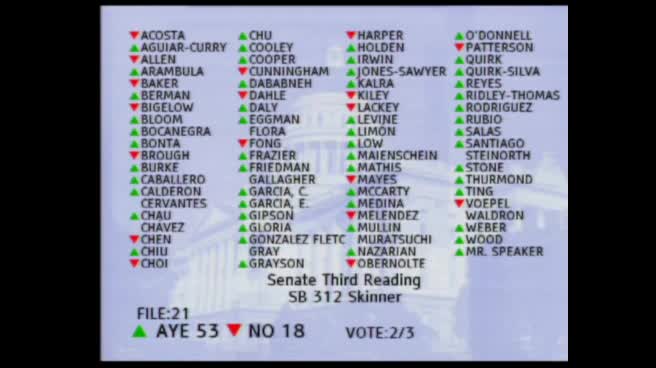 1MIN
Assembly Floor
 1H
Assembly Standing Committee on Appropriations
 15MIN
Assembly Standing Committee on Education
 4MIN
Senate Floor
 48MIN
Senate Standing Committee on Appropriations
 22MIN
Senate Standing Committee on Appropriations
 21MIN

