SB 51: Professional licensees: environmental sciences and climate change: whistleblower and data protection.
- Session Year: 2017-2018
- House: Senate
- Latest Version Date: 2017-09-07
The California Whistleblower Protection Act requires the State Auditor to administer the act and to investigate and report on improper governmental activities, as defined.
Existing law provides for the licensure and regulation of various professions and vocations by certain entities within state government. Existing law establishes various grounds upon which these entities may take disciplinary action against a licensee to suspend or revoke a license.
This bill would prohibit these licensing entities, except the State Bar of California, from taking disciplinary action, including suspension, loss of credential, registration, or other professional privilege, against a public employee, as defined to include those persons working in the environmental sciences and climate-change-related fields who are conducting scientific or technical research, in connection with actions taken by that person to report improper federal governmental activity or disclose the results of or information about scientific or technical research to the public by means that include, but are not limited to, publishing the information in a scientific or a public forum or sharing it with the media.
Existing law requires the Secretary for Environmental Protection to coordinate greenhouse gas emission reductions and climate change activity in state government.
This bill would additionally require the Secretary for Environmental Protection to make every reasonable effort to preserve and make available to the public through its Internet Web site scientific information and other data that, in the secretarys opinion, are at risk of censorship or destruction by the federal government.
This bill would include findings and declarations related to the measure, including that the purpose of these provisions is, to the maximum extent feasible under state law, to ensure those persons may report improper federal governmental activity and to continue to make scientific and other information open to the public without fear of losing their professional licenses or credentials.
The California Whistleblower Protection Act requires the State Auditor to administer the act and to investigate and report on improper governmental activities, as defined.
Existing law provides for the licensure and regulation of various professions and vocations by certain entities within state government. Existing law establishes various grounds upon which these entities may take disciplinary action against a licensee to suspend or revoke a license.
This bill would prohibit these licensing entities, except the State Bar of California, from taking disciplinary action, including suspension, loss of credential, registration, or other professional privilege, against a public employee, as defined to include those persons working in the environmental sciences and climate-change-related fields who are conducting scientific or technical research, in connection with actions taken by that person to report improper federal governmental activity or disclose the results of or information about scientific or technical research to the public by means that include, but are not limited to, publishing the information in a scientific or a public forum or sharing it with the media.
Existing law requires the Secretary for Environmental Protection to coordinate greenhouse gas emission reductions and climate change activity in state government.
This bill would additionally require the Secretary for Environmental Protection to ensure that all make every reasonable effort to preserve and make available to the public through its Internet Web site scientific information and other data otherwise in the public domain is protected against that, in the secretarys opinion, are at risk of censorship or destruction by the federal government.
This bill would include findings and declarations related to the measure, including that the purpose of these provisions is, to the maximum extent feasible under state law, to ensure those persons may report improper federal governmental activity and to continue to make scientific and other information open to the public without fear of losing their professional licenses or credentials.
The California Whistleblower Protection Act requires the State Auditor to administer the act and to investigate and report on improper governmental activities, as defined.
Existing law provides for the licensure and regulation of various professions and vocations by certain entities within state government. Existing law establishes various grounds upon which these entities may take disciplinary action against a licensee to suspend or revoke a license.
This bill would prohibit these licensing entities, except the State Bar of California, from taking disciplinary action, including suspension, loss of credential, registration, or other professional privilege, against a public employee or employee of a government contractor, subcontractor, or grantee, employee, as defined to include those persons working in the environmental sciences and climate-change-related fields, fields who are conducting scientific or technical research, in connection with actions taken by that person to report improper federal governmental action or communicate activity or disclose the results of or information about scientific or technical research to the public by means that include, but are not limited to, publishing the information in a scientific or a public forum or sharing it with the media.
Existing law requires the Secretary for Environmental Protection to coordinate greenhouse gas emission reductions and climate change activity in state government.
This bill would additionally require the Secretary for Environmental Protection to ensure that all scientific information and other data otherwise in the public domain is protected against censorship or destruction by the federal government.
This bill would include findings and declarations related to the measure, including that the purpose of these provisions is, to the maximum extent feasible under state law, to ensure those persons may report improper federal governmental activity and to continue to make scientific and other information open to the public without fear of losing their professional licenses or credentials.
The California Whistleblower Protection Act requires the State Auditor to administer the act and to investigate and report on improper governmental activities, as defined.
Existing law provides for the licensure and regulation of various professions and vocations by certain entities within state government. Existing law establishes various grounds upon which these entities may take disciplinary action against a licensee to suspend or revoke a license.
This bill would prohibit these licensing entities entities, except the State Bar of California, from taking disciplinary action, including disbarment, suspension, loss of credential, registration, or other professional privilege, against a public employee or employee of a government contractor, subcontractor, or grantee, as defined to include those persons working in the environmental sciences and climate-change-related fields, in connection with actions taken by that person to report improper governmental action or communicate the results of or information about scientific or technical research in a scientific or a public forum or with the media.
Existing law requires the Secretary for Environmental Protection to coordinate greenhouse gas emission reductions and climate change activity in state government.
This bill would additionally require the Secretary for Environmental Protection to ensure that all scientific information and other data otherwise in the public domain is protected against censorship or destruction by the federal government.
This bill would include findings and declarations related to the measure, including that the purpose of these provisions is, to the maximum extent feasible under state law, to ensure those persons may report improper governmental activity and to continue to make scientific and other information open to the public without fear of losing their professional licenses or credentials.
The California Whistleblower Protection Act requires the State Auditor to administer the act and to investigate and report on improper governmental activities, as defined.
Existing law provides for the licensure and regulation of various professions and vocations by boards within the Department of Consumer Affairs. certain entities within state government. Existing law establishes various grounds upon which these boards entities may take disciplinary action against a licensee to suspend or revoke a license.
This bill would prohibit these boards licensing entities from taking disciplinary action, including disbarment, suspension, loss of credential, registration, or other professional privilege, against a public employee or employee of a government contractor, subcontractor, or grantee, as defined to include those persons working in the environmental sciences and climate-change-related fields, in connection with actions taken by that person to report improper governmental action or communicate the results of or information about scientific or technical research in a scientific or a public forum or with the media.
Existing law requires the Secretary for Environmental Protection to coordinate greenhouse gas emission reductions and climate change activity in state government.
This bill would additionally require the Secretary for Environmental Protection to ensure that all scientific information and other data otherwise in the public domain is protected against censorship or destruction by the federal government.
This bill would include findings and declarations related to the measure, including that the purpose of these provisions is, to the maximum extent feasible under state law, to ensure those persons may report improper governmental activity and to continue to make scientific and other information open to the public without fear of losing their professional licenses or credentials.
The California Whistleblower Protection Act requires the State Auditor to administer the act and to investigate and report on improper governmental activities, as defined.
Existing law provides for the licensure and regulation of various professions and vocations by boards within the Department of Consumer Affairs. Existing law establishes various grounds upon which these boards may take disciplinary action against a licensee to suspend or revoke a license.
This bill would prohibit these boards from taking disciplinary action, including disbarment, suspension, loss of credential, registration, or other professional privilege, against a public employee or employee of a government contractor, subcontractor, or grantee, as defined to include those persons working in the environmental sciences and climate-change-related fields, in connection with actions taken by that person to report improper governmental action or communicate the results of or information about scientific or technical research in a scientific or a public forum or with the media.
Existing law requires the Secretary for Environmental Protection to coordinate greenhouse gas emission reductions and climate change activity in state government.
This bill would additionally require the Secretary for Environmental Protection to ensure that all scientific information and other data otherwise in the public domain is protected against censorship or destruction by the federal government.
This bill would include findings and declarations related to the measure, including that the purpose of these provisions is, to the maximum extent feasible under state law, to ensure those persons may report improper governmental activity and to continue to make scientific and other information open to the public without fear of losing their professional licenses or credentials.
This bill would express the intent of the Legislature to enact statutory changes relating to the Budget Act of 2016.This bill would express the intent of the Legislature to enact statutory changes relating to the Budget Act of 2016.
The Legislature finds and declares all of the following:
(a)Current law does not provide adequate guidance and clarity for persons employed by, under contract with, or representing federal governmental organizations, including, but not limited to, scientists and other professionals who work in scientific fields to determine the circumstances under which they may properly seek to protect the public interest by reporting improper governmental activity to appropriate enforcement, regulatory, and oversight bodies and make information about improper governmental activity, including, but not limited to, improper governmental activity relating to science, open to the public.
(b)There are new efforts underway to limit the freedom of scientists and other professionals working for the federal government to report improper government activity, as well as to restrict or prohibit their freedom to publish scientific information and to freely associate with other parties.
(c)The purpose of this chapter is, to the maximum extent feasible under state law, to ensure those persons may report improper federal governmental activity and to continue to make scientific and other information open to the public without fear of losing their professional licenses or credentials.
SEC. 2.Section 494.7 is added to the Business and Professions Code, to read:494.7.(a)For purposes of this section:
(1)Improper federal governmental activity means conduct by a federal governmental organization or by its employees, contractors, or agents, or that is undertaken in the performance of the employees, contractors, or agents duties inside a governmental office or conduct by an employee, contractor, or agent that directly relates to the government, whether or not that activity is within the scope of the employees, contractors, or agents duties, if undertaken outside a government office that meets one or more of the following:
(A)It is in violation of any state or federal law or regulation, including, but not limited to, corruption, malfeasance, bribery, theft of government property, fraudulent claims, fraud, coercion, conversion, malicious prosecution, misuse of government property, obstruction of justice, or willful omission to perform a duty.
(B)It is in violation of the federal Constitution, a federal rule of court, any policy or procedure mandated by the federal Contract Compliance Manual, or a federal court decision that is binding on the federal governmental organization.
(C)It is economically wasteful or involves gross misconduct, incompetency, or inefficiency.
(D)It substantially conflicts with the consensus of peer-reviewed scientific or technical research.
(2)Employee means a person on the payroll of, employed by, or working as a contractor, subcontractor, or grantee of, a government contractor, subcontractor, or grantee, including, but not limited to, an employee who works in environmental sciences or a climate-change-related field who is conducting scientific or technical research.
(3)Public employee means a person employed by any federal agency, a business or organization that is wholly funded by federal funds, or any other tax-financed entity, including, but not limited to, a person who works in environmental sciences or a climate-change-related field who is conducting scientific or technical research.
(4)Scientific or technical research means the results of scientific activities related to environmental sciences or climate change, including, but not limited to, the analysis, synthesis, compilation, or translation of scientific information and data into formats used in official decisionmaking processes or publications.
(b)A licensing entity other than the State Bar of California shall not take disciplinary action, including suspension, loss of credential, registration, or other professional privilege, against a public employee based upon actions taken by that person to do any of the following:
(1)Report improper federal governmental activity, provided that the person takes one of the following actions:
(A)Urges reconsideration of the matter while explaining its likely consequences to the organization.
(B)Refers the matter to a higher authority in the organization, including, if warranted by the seriousness of the matter, referral to the highest internal authority that can act on behalf of the organization.
(C)Refers the matter to the law enforcement agency charged with responsibility over the matter or to any other governmental agency or official charged with overseeing or regulating the matter if all of the following have occurred:
(i)The person has taken both actions described in subparagraphs (A) and (B) without the matter being resolved.
(ii)The person reasonably believes that the highest internal authority that can act on behalf of the organization has already, directly or indirectly, participated in the improper federal governmental activity.
(iii)The referral is warranted by the seriousness of the circumstances and is not otherwise prohibited by law.
(iv)Further action is required in order to prevent or rectify substantial harm to public health, safety, the environment, or the public interest or to the governmental organization resulting from the improper federal governmental activity.
(2)Disclose the results of or information about scientific or technical research to the public by means that include, but are not limited to, publishing the information in a scientific or public forum or sharing it with the media.
(3)This subdivision shall not be construed to require that the improper federal governmental activity subject to its provisions be related, directly or indirectly, to the matter for which the person makes a referral to law enforcement.
SEC. 3.Section 12812.7 is added to the Government Code, to read:12812.7.The Secretary for Environmental Protection shall make every reasonable effort to preserve and make available to the public through its Internet Web site scientific information and other data that, in the secretarys opinion, are at risk of censorship or destruction by the federal government.
The Legislature finds and declares all of the following:
(a)Current law does not provide adequate guidance and clarity for persons employed by, under contract with, or representing federal governmental organizations, including, but not limited to, scientists and other professionals who work in scientific fields to determine the circumstances under which they may properly seek to protect the public interest by reporting improper governmental activity to appropriate enforcement, regulatory, and oversight bodies and make information about improper governmental activity, including, but not limited to, improper governmental activity relating to science, open to the public.
(b)There are new efforts underway to limit the freedom of scientists and other professionals working for the federal government to report improper government activity, as well as to restrict or prohibit their freedom to publish scientific information and to freely associate with other parties.
(c)The purpose of this chapter is, to the maximum extent feasible under state law, to ensure those persons may report improper federal governmental activity and to continue to make scientific and other information open to the public without fear of losing their professional licenses or credentials.
SEC. 2.Section 494.7 is added to the Business and Professions Code, to read:494.7.(a)For purposes of this section:
(1)Improper federal governmental activity means conduct by a federal governmental organization or by its employees, contractors, or agents, or that is undertaken in the performance of the employees, contractors, or agents duties inside a governmental office or conduct by an employee, contractor, or agent that directly relates to the government, whether or not that activity is within the scope of the employees, contractors, or agents duties, if undertaken outside a government office that meets one or more of the following:
(A)It is in violation of any state or federal law or regulation, including, but not limited to, corruption, malfeasance, bribery, theft of government property, fraudulent claims, fraud, coercion, conversion, malicious prosecution, misuse of government property, obstruction of justice, or willful omission to perform a duty.
(B)It is in violation of the federal Constitution, a federal rule of court, any policy or procedure mandated by the federal Contract Compliance Manual, or a federal court decision that is binding on the federal governmental organization.
(C)It is economically wasteful or involves gross misconduct, incompetency, or inefficiency.
(D)It substantially conflicts with the consensus of peer-reviewed scientific or technical research.
(2)Employee means a person on the payroll of, employed by, or working as a contractor, subcontractor, or grantee of, a government contractor, subcontractor, or grantee, including, but not limited to, an employee who works in environmental sciences or a climate-change-related field who is conducting scientific or technical research.
(3)Public employee means a person employed by any federal agency, a business or organization that is wholly funded by federal funds, or any other tax-financed entity, including, but not limited to, a person who works in environmental sciences or a climate-change-related field who is conducting scientific or technical research.
(4)Scientific or technical research means the results of scientific activities related to environmental sciences or climate change, including, but not limited to, the analysis, synthesis, compilation, or translation of scientific information and data into formats used in official decisionmaking processes or publications.
(b)A licensing entity other than the State Bar of California shall not take disciplinary action, including suspension, loss of credential, registration, or other professional privilege, against a public employee based upon actions taken by that person to do any of the following:
(1)Report improper federal governmental activity, provided that the person takes one of the following actions:
(A)Urges reconsideration of the matter while explaining its likely consequences to the organization.
(B)Refers the matter to a higher authority in the organization, including, if warranted by the seriousness of the matter, referral to the highest internal authority that can act on behalf of the organization.
(C)Refers the matter to the law enforcement agency charged with responsibility over the matter or to any other governmental agency or official charged with overseeing or regulating the matter if all of the following have occurred:
(i)The person has taken both actions described in subparagraphs (A) and (B) without the matter being resolved.
(ii)The person reasonably believes that the highest internal authority that can act on behalf of the organization has already, directly or indirectly, participated in the improper federal governmental activity.
(iii)The referral is warranted by the seriousness of the circumstances and is not otherwise prohibited by law.
(iv)Further action is required in order to prevent or rectify substantial harm to public health, safety, the environment, or the public interest or to the governmental organization resulting from the improper federal governmental activity.
(2)Disclose the results of or information about scientific or technical research to the public by means that include, but are not limited to, publishing the information in a scientific or public forum or sharing it with the media.
(3)This subdivision shall not be construed to require that the improper federal governmental activity subject to its provisions be related, directly or indirectly, to the matter for which the person makes a referral to law enforcement.
SEC. 3.Section 12812.7 is added to the Government Code, to read:12812.7.The Secretary for Environmental Protection shall ensure that all make every reasonable effort to preserve and make available to the public through its Internet Web site scientific information and other data otherwise in the public domain is protected against that, in the secretarys opinion, are at risk of censorship or destruction by the federal government.
The Legislature finds and declares all of the following:
(a)Current law does not provide adequate guidance and clarity for persons employed by, or representing, governmental organizations under contract with, or representing federal governmental organizations, including, but not limited to, scientists and other professionals who work in scientific fields to determine the circumstances under which they may properly seek to protect the public interest by reporting improper governmental activity to appropriate enforcement, regulatory, and oversight bodies. bodies and make information about improper governmental activity, including, but not limited to, improper governmental activity relating to science, open to the public.
(b)There are new efforts underway to limit the freedom of scientists and other professionals working for the federal government to report improper government activity, as well as to restrict or prohibit their freedom to publish scientific information and to freely associate with other parties.
(c)The purpose of this chapter is, to the maximum extent feasible under state law, to ensure those persons may report improper federal governmental activity and to continue to make scientific and other information open to the public without fear of losing their professional licenses or credentials.
SEC. 2.Section 494.7 is added to the Business and Professions Code, to read:494.7.(a)For purposes of this section:
(1)Improper governmental activity means conduct by a governmental organization or by its agent that meets one or more of the following requirements:(A)It constitutes the use of the organizations official authority or influence by the agent to commit a crime, fraud, or other serious and willful violation of law.(B)It involves the agents willful misuse of public funds, willful breach of fiduciary duty, or willful or corrupt misconduct in office.(C)It involves the agents willful omission to perform his or her official duty.(1)Improper federal governmental activity means conduct by a federal governmental organization or by its employees, contractors, or agents, or that is undertaken in the performance of the employees, contractors, or agents duties inside a governmental office or conduct by an employee, contractor, or agent that directly relates to the government, whether or not that activity is within the scope of the employees, contractors, or agents duties, if undertaken outside a government office that meets one or more of the following:
(A)It is in violation of any state or federal law or regulation, including, but not limited to, corruption, malfeasance, bribery, theft of government property, fraudulent claims, fraud, coercion, conversion, malicious prosecution, misuse of government property, obstruction of justice, or willful omission to perform a duty.
(B)It is in violation of the federal Constitution, a federal rule of court, any policy or procedure mandated by the federal Contract Compliance Manual, or a federal court decision that is binding on the federal governmental organization.
(C)It is economically wasteful or involves gross misconduct, incompetency, or inefficiency.
(D)It substantially conflicts with the consensus of peer-reviewed scientific or technical research.
(2)Employee means a person on the payroll of, employed by, or working as a contractor, subcontractor, or grantee of, a government contractor, subcontractor, or grantee grantee, including, but not limited to, an employee who works in environmental sciences or a climate-change-related field. field who is conducting scientific or technical research.
(3)Public employee means a person on the payroll of any federal agency, the state, its subdivisions, special districts, or any other tax-financed entity who works in environmental sciences or a climate-change-related field.(3)Public employee means a person employed by any federal agency, a business or organization that is wholly funded by federal funds, or any other tax-financed entity, including, but not limited to, a person who works in environmental sciences or a climate-change-related field who is conducting scientific or technical research.
(4)Scientific or technical research means the results of scientific activities related to environmental sciences or climate change, including, but not limited to, the analysis, synthesis, compilation, or translation of scientific information and data into formats used in official decisionmaking processes or publications.
(b)A licensing entity other than the State Bar of California shall not take disciplinary action, including suspension, loss of credential, registration, or other professional privilege, against a public employee or employee of a government contractor, subcontractor, or grantee in connection with based upon actions taken by that person to: to do any of the following:
(1)Report improper federal governmental activity, provided that the person takes one of the following actions:
(A)Urges reconsideration of the matter while explaining its likely consequences to the organization.
(B)Refers the matter to a higher authority in the organization, including, if warranted by the seriousness of the matter, referral to the highest internal authority that can act on behalf of the organization.
(C)Refers the matter to the law enforcement agency charged with responsibility over the matter or to any other governmental agency or official charged with overseeing or regulating the matter if all of the following have occurred:
(i)The person has taken both actions described in subparagraphs (A) and (B) without the matter being resolved.
(ii)The person reasonably believes that the highest internal authority that can act on behalf of the organization has already, directly or indirectly, participated in the improper federal governmental activity.
(iii)The referral is warranted by the seriousness of the circumstances and is not otherwise prohibited by law.
(iv)Further action is required in order to prevent or rectify substantial harm to public health, safety, the environment, or the public interest or to the governmental organization resulting from the improper federal governmental activity.
(2)Communicate the results of or information about scientific or technical research in a scientific or a public forum or with the media.(2)Disclose the results of or information about scientific or technical research to the public by means that include, but are not limited to, publishing the information in a scientific or public forum or sharing it with the media.
(c)(3)This section subdivision shall not be construed to require that the improper federal governmental activity subject to its provisions be related, directly or indirectly, to the matter for which the person is making the referral. makes a referral to law enforcement.
SEC. 3.Section 12812.7 is added to the Government Code, to read:12812.7.The Secretary for Environmental Protection shall ensure that all scientific information and other data otherwise in the public domain is protected against censorship or destruction by the federal government.
The Legislature finds and declares all of the following:
(a)Current law, including the Rules of Professional Conduct, law does not provide adequate guidance and clarity for persons employed by, or representing, governmental organizations to determine the circumstances under which they may properly seek to protect the public interest by reporting improper governmental activity to appropriate enforcement, regulatory, and oversight bodies.
(b)There are new efforts underway to limit the freedom of scientists and other professionals working for the federal government to report improper government activity, as well as to restrict or prohibit their freedom to publish scientific information and to freely associate with other parties.
(c)The purpose of this chapter is, to the maximum extent feasible under state law, to ensure those persons may report improper governmental activity and to continue to make scientific and other information open to the public without fear of losing their professional licenses or credentials.
SEC. 2.Section 494.7 is added to the Business and Professions Code, to read:494.7.(a)For purposes of this section:
(1)Improper governmental activity means conduct by a governmental organization or by its agent that meets one or more of the following requirements:
(A)It constitutes the use of the organizations official authority or influence by the agent to commit a crime, fraud, or other serious and willful violation of law.
(B)It involves the agents willful misuse of public funds, willful breach of fiduciary duty, or willful or corrupt misconduct in office.
(C)It involves the agents willful omission to perform his or her official duty.
(2)Employee means a person on the payroll of, or working as a contractor, subcontractor, or grantee of, a government contractor, subcontractor, or grantee who works in environmental sciences or a climate-change-related field.
(3)Public employee means a person on the payroll of any federal agency, the state, its subdivisions, special districts, or any other tax-financed entity who works in environmental sciences or a climate-change-related field.
(4)Scientific or technical research means the results of scientific activities related to environmental sciences or climate change, including, but not limited to, the analysis, synthesis, compilation, or translation of scientific information and data into formats used in official decisionmaking processes or publications.
(b)A licensing entity other than the State Bar of California shall not take disciplinary action, including disbarment, suspension, loss of credential, registration, or other professional privilege, against a public employee or employee of a government contractor, subcontractor, or grantee in connection with actions taken by that person to:
(1)Report improper governmental activity, provided that the person takes one of the following actions:
(A)Urges reconsideration of the matter while explaining its likely consequences to the organization.
(B)Refers the matter to a higher authority in the organization, including, if warranted by the seriousness of the matter, referral to the highest internal authority that can act on behalf of the organization.
(C)Refers the matter to the law enforcement agency charged with responsibility over the matter or to any other governmental agency or official charged with overseeing or regulating the matter if all of the following have occurred:
(i)The person has taken both actions described in subparagraphs (A) and (B) without the matter being resolved.
(ii)The person reasonably believes that the highest internal authority that can act on behalf of the organization has already, directly or indirectly, participated in the improper governmental activity.
(iii)The referral is warranted by the seriousness of the circumstances and is not otherwise prohibited by law.
(iv)Further action is required in order to prevent or rectify substantial harm to public health, safety, the environment, or the public interest or to the governmental organization resulting from the improper governmental activity.
(2)Communicate the results of or information about scientific or technical research in a scientific or a public forum or with the media.
(c)This section shall not be construed to require that the improper governmental activity subject to its provisions be related, directly or indirectly, to the matter for which the person is making the referral.
SEC. 3.Section 12812.7 is added to the Government Code, to read:12812.7.The Secretary for Environmental Protection shall ensure that all scientific information and other data otherwise in the public domain is protected against censorship or destruction by the federal government.
The Legislature finds and declares all of the following:
(a)Current law, including the Rules of Professional Conduct, does not provide adequate guidance and clarity for persons employed by, or representing, governmental organizations to determine the circumstances under which they may properly seek to protect the public interest by reporting improper governmental activity to appropriate enforcement, regulatory, and oversight bodies.
(b)There are new efforts underway to limit the freedom of scientists and other professionals working for the federal government to report improper government activity, as well as to restrict or prohibit their freedom to publish scientific information and to freely associate with other parties.
(c)The purpose of this chapter is, to the maximum extent feasible under state law, to ensure those persons may report improper governmental activity and to continue to make scientific and other information open to the public without fear of losing their professional licenses or credentials.
SEC. 2.Section 494.7 is added to the Business and Professions Code, to read:494.7.(a)For purposes of this section:
(1)Improper governmental activity means conduct by a governmental organization or by its agent that meets one or more of the following requirements:
(A)It constitutes the use of the organizations official authority or influence by the agent to commit a crime, fraud, or other serious and willful violation of law.
(B)It involves the agents willful misuse of public funds, willful breach of fiduciary duty, or willful or corrupt misconduct in office.
(C)It involves the agents willful omission to perform his or her official duty.
(2)Employee means a person on the payroll of, or working as a contractor, subcontractor, or grantee of, a government contractor, subcontractor, or grantee who works in environmental sciences or a climate-change-related field.
(3)Public employee means a person on the payroll of any federal agency, the state, its subdivisions, special districts, or any other tax-financed entity who works in environmental sciences or a climate-change-related field.
(4)Scientific or technical research means the results of scientific activities related to environmental sciences or climate change, including, but not limited to, the analysis, synthesis, compilation, or translation of scientific information and data into formats used in official decisionmaking processes or publications.
(b)A board licensing entity shall not take disciplinary action, including disbarment, suspension, loss of credential, registration, or other professional privilege, against a public employee or employee of a government contractor, subcontractor, or grantee in connection with actions taken by that person to:
(1)Report improper governmental activity, provided that the person takes one of the following actions:
(A)Urges reconsideration of the matter while explaining its likely consequences to the organization.
(B)Refers the matter to a higher authority in the organization, including, if warranted by the seriousness of the matter, referral to the highest internal authority that can act on behalf of the organization.
(C)Refers the matter to the law enforcement agency charged with responsibility over the matter or to any other governmental agency or official charged with overseeing or regulating the matter if all of the following have occurred:
(i)The person has taken both actions described in subparagraphs (A) and (B) without the matter being resolved.
(ii)The person reasonably believes that the highest internal authority that can act on behalf of the organization has already, directly or indirectly, participated in the improper governmental activity.
(iii)The referral is warranted by the seriousness of the circumstances and is not otherwise prohibited by law.
(iv)Further action is required in order to prevent or rectify substantial harm to public health, safety, the environment, or the public interest or to the governmental organization resulting from the improper governmental activity.
(2)Communicate the results of or information about scientific or technical research in a scientific or a public forum or with the media.
(c)This section shall not be construed to require that the improper governmental activity subject to its provisions be related, directly or indirectly, to the matter for which the person is making the referral.
SEC. 3.Section 12812.7 is added to the Government Code, to read:12812.7.The Secretary for Environmental Protection shall ensure that all scientific information and other data otherwise in the public domain is protected against censorship or destruction by the federal government.
The Legislature finds and declares all of the following:
(a)Current law, including the Rules of Professional Conduct, does not provide adequate guidance and clarity for persons employed by, or representing, governmental organizations to determine the circumstances under which they may properly seek to protect the public interest by reporting improper governmental activity to appropriate enforcement, regulatory, and oversight bodies.
(b)There are new efforts underway to limit the freedom of scientists and other professionals working for the federal government to report improper government activity, as well as to restrict or prohibit their freedom to publish scientific information and to freely associate with other parties.
(c)The purpose of this chapter is, to the maximum extent feasible under state law, to ensure those persons may report improper governmental activity and to continue to make scientific and other information open to the public without fear of losing their professional licenses or credentials.
SEC. 2.Section 494.7 is added to the Business and Professions Code, to read:494.7.(a)For purposes of this section:
(1)Improper governmental activity means conduct by a governmental organization or by its agent that meets one or more of the following requirements:
(A)It constitutes the use of the organizations official authority or influence by the agent to commit a crime, fraud, or other serious and willful violation of law.
(B)It involves the agents willful misuse of public funds, willful breach of fiduciary duty, or willful or corrupt misconduct in office.
(C)It involves the agents willful omission to perform his or her official duty.
(2)Employee means a person on the payroll of, or working as a contractor, subcontractor, or grantee of, a government contractor, subcontractor, or grantee who works in environmental sciences or a climate-change-related field.
(3)Public employee means a person on the payroll of any federal agency, the state, its subdivisions, special districts, or any other tax-financed entity who works in environmental sciences or a climate-change-related field.
(4)Scientific or technical research means the results of scientific activities related to environmental sciences or climate change, including, but not limited to, the analysis, synthesis, compilation, or translation of scientific information and data into formats used in official decisionmaking processes or publications.
(b)A board shall not take disciplinary action, including disbarment, suspension, loss of credential, registration, or other professional privilege, against a public employee or employee of a government contractor, subcontractor, or grantee in connection with actions taken by that person to:
(1)Report improper governmental activity, provided that the person takes one of the following actions:
(A)Urges reconsideration of the matter while explaining its likely consequences to the organization.
(B)Refers the matter to a higher authority in the organization, including, if warranted by the seriousness of the matter, referral to the highest internal authority that can act on behalf of the organization.
(C)Refers the matter to the law enforcement agency charged with responsibility over the matter or to any other governmental agency or official charged with overseeing or regulating the matter if all of the following have occurred:
(i)The person has taken both actions described in subparagraphs (A) and (B) without the matter being resolved.
(ii)The person reasonably believes that the highest internal authority that can act on behalf of the organization has already, directly or indirectly, participated in the improper governmental activity.
(iii)The referral is warranted by the seriousness of the circumstances and is not otherwise prohibited by law.
(iv)Further action is required in order to prevent or rectify substantial harm to public health, safety, the environment, or the public interest or to the governmental organization resulting from the improper governmental activity.
(2)Communicate the results of or information about scientific or technical research in a scientific or a public forum or with the media.
(c)This section shall not be construed to require that the improper governmental activity subject to its provisions be related, directly or indirectly, to the matter for which the person is making the referral.
SEC. 3.Section 12812.7 is added to the Government Code, to read:12812.7.The Secretary for Environmental Protection shall ensure that all scientific information and other data otherwise in the public domain is protected against censorship or destruction by the federal government.
SECTION 1.It is the intent of the Legislature to enact statutory changes relating to the Budget Act of 2016.It is the intent of the Legislature to enact statutory changes relating to the Budget Act of 2016.
|
Date
|
Status
|
|---|---|
| Mar 3, 2018 | Last day to consider Governor’s veto pursuant to Joint Rule 58.5. |
| Oct 13, 2017 | In Senate. Consideration of Governor's veto pending. |
| Oct 13, 2017 | Vetoed by the Governor. |
| Sep 11, 2017 | Enrolled and presented to the Governor at 4 p.m. |
| Sep 6, 2017 | Assembly amendments concurred in. (Ayes 28. Noes 11.) Ordered to engrossing and enrolling. |
| Sep 5, 2017 | In Senate. Concurrence in Assembly amendments pending. |
| Sep 5, 2017 | Read third time. Passed. Ordered to the Senate. |
| Aug 31, 2017 | Read second time. Ordered to third reading. |
| Aug 30, 2017 | From committee: Do pass. (Ayes 11. Noes 4.) (August 30). |
| Jul 12, 2017 | Read second time and amended. Re-referred to Com. on APPR. |
| Jul 11, 2017 | From committee: Do pass as amended and re-refer to Com. on APPR. (Ayes 10. Noes 1.) (July 11). |
| Jul 3, 2017 | From committee with author's amendments. Read second time and amended. Re-referred to Com. on JUD. |
| Jun 27, 2017 | From committee: Do pass and re-refer to Com. on JUD. (Ayes 10. Noes 0.) (June 26). Re-referred to Com. on JUD. |
| Jun 12, 2017 | Referred to Coms. on NAT. RES. and JUD. |
| May 31, 2017 | In Assembly. Read first time. Held at Desk. |
| May 30, 2017 | Read third time. Passed. (Ayes 29. Noes 11. Page 1253.) Ordered to the Assembly. |
| May 26, 2017 | Read second time. Ordered to third reading. |
| May 25, 2017 | From committee: Do pass. (Ayes 5. Noes 2. Page 1177.) (May 25). |
| May 19, 2017 | Set for hearing May 25. |
| May 15, 2017 | May 15 hearing: Placed on APPR. suspense file. |
| May 5, 2017 | Set for hearing May 15. |
| May 3, 2017 | Read second time and amended. Re-referred to Com. on APPR. |
| May 2, 2017 | From committee: Do pass as amended and re-refer to Com. on APPR. (Ayes 5. Noes 2. Page 851.) (April 25). |
| Apr 13, 2017 | Set for hearing April 25. |
| Apr 5, 2017 | From committee: Do pass and re-refer to Com. on JUD. (Ayes 5. Noes 2. Page 622.) (April 5). Re-referred to Com. on JUD. |
| Mar 30, 2017 | Set for hearing April 5. |
| Mar 28, 2017 | Read second time and amended. Re-referred to Com. on EQ. |
| Mar 27, 2017 | From committee: Do pass as amended and re-refer to Com. on EQ. (Ayes 8. Noes 1. Page 488.) (March 27). |
| Mar 14, 2017 | Set for hearing March 27. |
| Mar 8, 2017 | Re-referred to Coms. on B., P. & E.D., EQ., and JUD. |
| Feb 22, 2017 | From committee with author's amendments. Read second time and amended. Re-referred to Com. on RLS. |
| Feb 15, 2017 | Withdrawn from committee. |
| Jan 12, 2017 | Referred to Com. on B. & F.R. |
| Dec 6, 2016 | From printer. May be acted upon on or after January 5. |
| Dec 5, 2016 | Introduced. Read first time. To Com. on RLS. for assignment. To print. |
|
Date
|
Description
|
Location
|
Votes
|
|
|---|---|---|---|---|
| Sep 6, 2017 | Unfinished Business SB51 Jackson Concurrence | Senate Floor |
Passed |
|
| Sep 5, 2017 | SB 51 Jackson Senate Third Reading By GARCIA, C. | Assembly Floor |
Passed |
|
| Aug 30, 2017 | Do pass. | Assembly Standing Committee on Appropriations |
Passed |
|
| Jul 11, 2017 | Do pass as amended and be re-referred to the Committee on [Appropriations] | Assembly Standing Committee on Judiciary |
Passed |
|
| Jun 26, 2017 | Do pass and be re-referred to the Committee on [Judiciary] | Assembly Standing Committee on Natural Resources |
Passed |
|
| May 30, 2017 | Senate 3rd Reading SB51 Jackson | Senate Floor |
Passed |
|
| May 25, 2017 | Do pass | Senate Standing Committee on Appropriations |
Passed |
|
| May 15, 2017 | Placed on suspense file | Senate Standing Committee on Appropriations |
Passed |
|
| Apr 25, 2017 | Do pass as amended, but first amend, and re-refer to the Committee on [Appropriations] | Senate Standing Committee on Judiciary |
Passed |
|
| Apr 5, 2017 | Do pass, but first be re-referred to the Committee on [Judiciary] | Senate Standing Committee on Environmental Quality |
Passed |
|
| Mar 27, 2017 | Do pass as amended, but first amend, and re-refer to the Committee on [Environmental Quality] | Senate Standing Committee on Business, Professions and Economic Development |
Passed |
This list shows positions taken on this bill by organizations on the date displayed, which is linked to the original source.
Positions by individuals are not included.
|
Organization
|
Position
|
Date
|
|---|---|---|
| California Association Of Professional Scientists | * Support | Apr 25, 2017 |
| California Coastkeeper Alliance | ** Support | Jan 2, 2018 |
| California Young Democrats | ** Support | Jan 2, 2018 |
| Center For Biological Diversity | ** Support | Jan 2, 2018 |
| City Of Los Angeles | ** Support | Jan 2, 2018 |
| City of Los Angeles - Mayor Eric Garcetti | * Support | Aug 30, 2017 |
| Engineers and Scientists of California, IFPTE Local 20 | ** Support | May 27, 2017 |
| Environment California | ** Support | Jan 2, 2018 |
| Environment Defense Fund | ** Support | Aug 30, 2017 |
| Fossil Free California | * Support | Aug 30, 2017 |
| Friends Of The Earth | * Support | May 15, 2017 |
| Heal The Bay | * Support | Aug 30, 2017 |
| Marin County Board of Supervisors | ** Support | Jan 2, 2018 |
| Marin County Council of Mayors and Councilmembers | ** Support | Jan 2, 2018 |
| Mono Lake Committee | ** Support | Jan 2, 2018 |
| National Resources Defense Council | ** Support | Jan 2, 2018 |
| Nature Conservancy | * Support | Aug 30, 2017 |
| Note: | ** Support | Mar 23, 2017 |
| Or Regulations And Taking Disciplinary Action, When Appropriate. | ** Support | Mar 23, 2017 |
| San Rafael/Marin County Council Of Mayors & Council Members, City Of | * Support | Aug 30, 2017 |
| Seventh Generation Advisors | * Support | Aug 30, 2017 |
| Sierra Club | * Support | Aug 30, 2017 |
| state strong california | ** Support | Jan 2, 2018 |
| Support And Opposition: | ** Support | Mar 23, 2017 |
| Surfrider Foundation | * Support | Aug 30, 2017 |
| Union Of Concerned Scientists | ** Support | Jan 2, 2018 |
| Wishtoyo Chumash Foundation | * Support | Aug 30, 2017 |
Office of Senate Floor Analyses (916) 651-1520 Fax: (916) 327-4478 | SB |
VETO
Bill No: SB 51
:
SENATE BUS., PROF. & ECON. DEV. COMMITTEE: 8-1, 3/27/17
AYES: Hill, Dodd, Galgiani, Glazer, Hernandez, Newman, Pan, Wilk
NOES: Bates
SENATE ENVIRONMENTAL QUALITY COMMITTEE: 5-2, 4/5/17
AYES: Wieckowski, Hill, Lara, Skinner, Stern
NOES: Stone, Bates
SENATE JUDICIARY COMMITTEE: 5-2, 4/25/17
AYES: Jackson, Hertzberg, Monning, Stern, Wieckowski
NOES: Moorlach, Anderson
SENATE APPROPRIATIONS COMMITTEE: 5-2, 5/25/17
AYES: Lara, Beall, Bradford, Hill, Wiener
NOES: Bates, Nielsen
SENATE FLOOR: 29-11, 5/30/17
AYES: Allen, Atkins, Beall, Bradford, Cannella, De León, Dodd, Galgiani, Glazer, Hernandez, Hertzberg, Hill, Hueso, Jackson, Lara, Leyva, McGuire, Mendoza, Mitchell, Monning, Newman, Pan, Portantino, Roth, Skinner, Stern, Wieckowski, Wiener, Wilk
NOES: Anderson, Bates, Berryhill, Fuller, Gaines, Moorlach, Morrell, Nguyen, Nielsen, Stone, Vidak
SENATE FLOOR: 29-11, 9/6/17
AYES: Allen, Atkins, Beall, Bradford, Cannella, De León, Dodd, Galgiani, Glazer, Hernandez, Hertzberg, Hill, Hueso, Jackson, Lara, Leyva, McGuire, Mendoza, Mitchell, Monning, Newman, Pan, Portantino, Roth, Skinner, Stern, Wieckowski, Wiener, Wilk
NOES: Anderson, Bates, Berryhill, Fuller, Gaines, Moorlach, Morrell, Nguyen, Nielsen, Stone, Vidak
ASSEMBLY FLOOR: 59-13, 9/5/17 - See last page for vote
DIGEST:
This bill prohibits a licensing entity, other than the State Bar of California, from taking disciplinary action, including suspension, loss of credential, registration, or other professional privilege against a public employee for reporting improper governmental activity or disclosing the results of or information about scientific or technical research to the public by publishing the information in a scientific or public forum or sharing it with the media among other means of sharing information. This bill also requires the Secretary for Environmental Protection to ensure that all scientific information and other data otherwise in the public domain is protected against censorship or destruction by the federal government.
Existing law:
- Establishes various practice acts in the Business and Professions Code (BPC) governed by various boards within the Department of Consumer Affairs (DCA), and other entities, which provide for professional licensing and regulation.
- Authorizes boards to suspend or revoke a license for conviction of a crime if the crime is substantially related to the qualifications, functions or duties of the business or profession for which the license was issued (BPC § 490) and for noncompliance with a child support order or judgment. (BPC § 490.5)
- Requires a state governmental licensing entity (other than the Department of Motor Vehicles) to refuse to issue, reactivate, reinstate or renew a license and requires suspension of a license if a licensee’s name is included on a certified list provided by the State Board of Equalization or Franchise Tax Board listing the 500 largest tax delinquencies. Authorizes the State Bar of California (State Bar) to recommend to refuse to issue, reactivate, reinstate or renew the license of a licensee on a certified list described above and authorizes the Department of Alcoholic Beverage Control to refuse to issue, reactivate, reinstate or renew the license of a licensee on a certified list. (BPC § 494.5)
- Specifies that a business license is subject to suspension or revocation if a current, former, or prospective employee of the licensee attempts to exercise a right related to his/her employment or any terms, conditions, or benefits protected by state law and, in reaction, the licensee threatens to retaliate or retaliates based on the employee’s citizenship or immigration status.
(BPC § 494.6) - Establishes the Whistleblower Protection Act (WPA) which requires the California State Auditor (Auditor) to administer the WPA and to investigate and report on improper governmental activities. Makes findings and declarations that state employees should be free to report waste, fraud, abuse of authority, violation of law, or threat to public health without fear of retribution and that public servants best serve the citizenry when they can be candid and honest without reservation in conducting the people’s business. Defines “improper governmental activity” as an activity by a state agency or by an employee that is undertaken in the performance of the employee’s duties, undertaken inside a state office, or if undertaken outside a state office by the employee, directly relates to state government, whether or not that activity is within the scope of his or her employment, and that is in violation of any state or federal law or regulation, as specified, or is economically wasteful, involved gross misconduct, incompetency, or inefficiency. Requires the Auditor to establish a means for employees to submit allegations of improper governmental activity, and generally requires the Auditor to keep confidential every investigation, including all investigative files and work product. Authorizes the Auditor to issue a public report of an investigation that has substantiated an improper governmental activity, keeping confidential the identity of the employee or employees involved. (Government Code § 8547 et seq.)
- Prohibits an employer from making, adopting, or enforcing any rule, regulation, or policy preventing an employee from disclosing information to a government or law enforcement agency, where the employee has a reasonable belief that the information discloses a violation of law. Prohibits an employer from retaliating against an employee for disclosing such information or for refusing to participate in unlawful or non-compliant activity. Subjects an employer who violates these provisions to civil penalties, as defined.
(Labor Code (LC) § 1102.5.) - Requires the California Attorney General to maintain a whistleblower hotline to receive calls from persons who have information regarding possible violations of state or federal statutes, rules, or regulations, or violations of fiduciary responsibility by a corporation or limited liability company to its shareholders, investors, or employees. (LC § 1102.7.)
This bill:
- Makes findings and declarations that:
- Current law does not provide adequate guidance and clarity for persons employed by, under contract with, or representing governmental organizations, such as scientists and other professionals who work in scientific fields, to determine the circumstances under which they may properly seek to protect the public interest by reporting improper governmental activity to appropriate enforcement, regulatory, and oversight bodies.
- There are new efforts underway to limit the freedom of scientists and other professionals working for the federal government to report improper government activity, as well as to restrict or prohibit their freedom to publish scientific information and to freely associate with other parties.
- The purpose of this chapter is, to the maximum extent feasible under state law, to ensure those persons may report improper federal governmental activity and to continue to make scientific and other information open to the public without fear of losing their professional licenses or credentials.
- Prohibits a licensing entity, other than the State Bar of California, from taking disciplinary action, including suspension, loss of credential, registration, or other professional privilege against a public employee for reporting improper governmental activity or disclosing the results of or information about scientific or technical research to the public by publishing the information in a scientific or public forum or sharing it with the media among other means of sharing information. so long as:
- The individual urges reconsideration of the matter and explains its likely consequences to the organization.
- The individual refers the matter to a higher authority in the organization, including, if warranted by the seriousness of the matter, referral to the highest internal authority that can act on behalf of the organization.
- The individual refers the matter to the law enforcement agency charged with responsibility for it or to any other governmental agency or official charged with overseeing or regulating the matter, if the individual has already done a) and b) above and reasonably believes the highest internal authority has participated in the governmental activity, and the referral is warranted by the seriousness of the circumstances and is not otherwise prohibited by law and action is required in order to prevent or rectify substantial harm to public health, safety, the environment, or the public interest or to the governmental organization resulting from the improper federal governmental activity.
- Requires the Secretary for Environmental Protection to ensure that all scientific information and other data otherwise in the public domain is protected against censorship or destruction by the federal government.
Comments
According to the author, despite state and federal whistleblower protections, “several actions and proposals advanced by President Donald Trump’s administration indicate that the work of federal scientists, including those who study the causes and consequences of climate change, may be subject to new political interference and suppression efforts. Indeed, one of the first actions undertaken by the new administration was to impose restrictions at multiple federal agencies on employee communications, including protected whistleblower communications with members of Congress.” The author states that this bill “ensures that federal employees do not lose their professional state licensure for revealing violations of the law and directs state agencies to protect scientific information and data from censorship or destruction by the federal government. SB 51 helps protect federal employees and other persons employed by, or who represent, governmental organizations who report improper governmental activity by specifying that protected whistleblower activities cannot result in the loss of state issued professional licenses or credentials. The bill also directs the Secretary for Environmental Protection to preserve scientific information and other data in the public domain from censorship or destruction orders from the federal government.”
This bill is one in a package of bills aimed at insulating the state from rollbacks in federal environmental regulations and public health protections, including SB 49 (de Leon and Stern), which makes current federal clean air, climate, clean water, worker safety, and endangered species standards enforceable under state law, even if the federal government rolls back and weakens those standards and directs state environmental, public health, and worker safety agencies to take all actions within their authorities to ensure standards in effect and being enforced today continue to remain in effect and SB 50 (Allen) which establishes a new state policy to discourage conveyances of federal lands to private developers for resource extraction and directs the State Lands Commission, which oversees much of the federal lands in the state, to establish a right of first refusal by the state of any federal lands proposed for sale or conveyance to other parties.
FISCAL EFFECT: Appropriation: Fiscal Com.: Local:
According to the Assembly Appropriations Committee, this bill will result in costs of approximately $125,000 (General Fund) to the California Environmental Protection Agency.
California Coastkeeper Alliance
California Young Democrats
Center for Biological Diversity
City of Los Angeles
Engineers and Scientists of California, IFPTE Local 20, AFL-CIO
Environment California
Marin County Board of Supervisors
Marin County Council of Mayors and Councilmembers
Mono Lake Committee
National Resources Defense Council
State Strong California
Union of Concerned Scientists
OPPOSITION: (Verified 10/23/17)
None received
ARGUMENTS IN SUPPORT: Supporters believe that this bill is especially timely in light of widely publicized efforts by the new federal administration to intimidate federal employees from enforcing laws related to climate change and global warming. Supporters also state that this bill will protect local communities from the impact of anticipated federal action to nullify or diminish federal environmental protections and ensure that professional licenses of whistleblowers are protected if these individuals report censorship or destruction of data on orders of the federal government.
GOVERNOR'S VETO MESSAGE:
I am returning Senate Bill 51 without my signature.
This bill requires the Secretary of the California Environmental Protection Agency to preserve and post online scientific information and data that might be censored or destroyed by the federal government. This bill also prohibits state licensing entities, except the State Bar, from taking disciplinary actions against public employees who report improper federal government activities or make scientific research public.
Action by the federal Administration to obfuscate and devalue scientific evidence by questioning, demoting, or firing federal scientists is dangerous and myopic. It would be difficult, however, to envision a scenario or even a legal basis where the whim of the federal Administration would lead to a disciplinary action in California.
When it comes to preserving scientific research we cannot be too careful. I am directing the Secretary of the California Environmental Protection Agency to collaborate with universities and non-profits to compile and preserve all important and relevant scientific federal research and data.
ASSEMBLY FLOOR: 59-13, 9/5/17
AYES: Acosta, Aguiar-Curry, Arambula, Baker, Berman, Bloom, Bocanegra, Bonta, Burke, Caballero, Calderon, Cervantes, Chau, Chávez, Chiu, Chu, Cooley, Cooper, Cunningham, Dababneh, Daly, Eggman, Flora, Frazier, Friedman, Cristina Garcia, Gipson, Gloria, Gonzalez Fletcher, Gray, Grayson, Holden, Irwin, Jones-Sawyer, Kalra, Lackey, Levine, Limón, Low, Maienschein, McCarty, Medina, Mullin, Muratsuchi, Nazarian, O'Donnell, Quirk, Quirk-Silva, Reyes, Rodriguez, Rubio, Salas, Santiago, Mark Stone, Thurmond, Ting, Weber, Wood, Rendon
NOES: Bigelow, Brough, Chen, Dahle, Fong, Gallagher, Harper, Kiley, Mathis, Obernolte, Patterson, Voepel, Waldron
NO VOTE RECORDED: Travis Allen, Choi, Eduardo Garcia, Mayes, Melendez, Ridley-Thomas, Steinorth
1/2/18 9:56:17
**** END ****
Office of Senate Floor Analyses (916) 651-1520 Fax: (916) 327-4478 | SB 51 |
UNFINISHED BUSINESS
Bill No: SB 51
Amended: 7/12/17
SENATE BUS., PROF. & ECON. DEV. COMMITTEE: 8-1, 3/27/17
AYES: Hill, Dodd, Galgiani, Glazer, Hernandez, Newman, Pan, Wilk
NOES: Bates
SENATE ENVIRONMENTAL QUALITY COMMITTEE: 5-2, 4/5/17
AYES: Wieckowski, Hill, Lara, Skinner, Stern
NOES: Stone, Bates
SENATE JUDICIARY COMMITTEE: 5-2, 4/25/17
AYES: Jackson, Hertzberg, Monning, Stern, Wieckowski
NOES: Moorlach, Anderson
SENATE APPROPRIATIONS COMMITTEE: 5-2, 5/25/17
AYES: Lara, Beall, Bradford, Hill, Wiener
NOES: Bates, Nielsen
SENATE FLOOR: 29-11, 5/30/17
AYES: Allen, Atkins, Beall, Bradford, Cannella, De León, Dodd, Galgiani, Glazer, Hernandez, Hertzberg, Hill, Hueso, Jackson, Lara, Leyva, McGuire, Mendoza, Mitchell, Monning, Newman, Pan, Portantino, Roth, Skinner, Stern, Wieckowski, Wiener, Wilk
NOES: Anderson, Bates, Berryhill, Fuller, Gaines, Moorlach, Morrell, Nguyen, Nielsen, Stone, Vidak
ASSEMBLY FLOOR: 59-13, 9/5/17 - See last page for vote
SUBJECT: Professional licensees: environmental sciences and climate change: whistleblower and data protection
DIGEST:
This bill prohibits a licensing entity, other than the State Bar of California, from taking disciplinary action, including suspension, loss of credential, registration, or other professional privilege against a public employee for reporting improper governmental activity or disclosing the results of or information about scientific or technical research to the public by publishing the information in a scientific or public forum or sharing it with the media among other means of sharing information. This bill also requires the Secretary for Environmental Protection to ensure that all scientific information and other data otherwise in the public domain is protected against censorship or destruction by the federal government.
Assembly Amendments
revise and recast provisions in this bill but keep the intent as passed by the Senate intact.
Existing law:
- Establishes various practice acts in the Business and Professions Code (BPC) governed by various boards within the Department of Consumer Affairs (DCA), and other entities, which provide for professional licensing and regulation.
- Authorizes boards to suspend or revoke a license for conviction of a crime if the crime is substantially related to the qualifications, functions or duties of the business or profession for which the license was issued (BPC § 490) and for noncompliance with a child support order or judgment. (BPC § 490.5)
- Requires a state governmental licensing entity (other than the Department of Motor Vehicles) to refuse to issue, reactivate, reinstate or renew a license and requires suspension of a license if a licensee’s name is included on a certified list provided by the State Board of Equalization or Franchise Tax Board listing the 500 largest tax delinquencies. Authorizes the State Bar of California (State Bar) to recommend to refuse to issue, reactivate, reinstate or renew the license of a licensee on a certified list described above and authorizes the Department of Alcoholic Beverage Control to refuse to issue, reactivate, reinstate or renew the license of a licensee on a certified list. (BPC § 494.5)
- Specifies that a business license is subject to suspension or revocation if a current, former, or prospective employee of the licensee attempts to exercise a right related to his/her employment or any terms, conditions, or benefits protected by state law and, in reaction, the licensee threatens to retaliate or retaliates based on the employee’s citizenship or immigration status.
(BPC § 494.6) - Establishes the Whistleblower Protection Act (WPA) which requires the California State Auditor (Auditor) to administer the WPA and to investigate and report on improper governmental activities. Makes findings and declarations that state employees should be free to report waste, fraud, abuse of authority, violation of law, or threat to public health without fear of retribution and that public servants best serve the citizenry when they can be candid and honest without reservation in conducting the people’s business. Defines “improper governmental activity” as an activity by a state agency or by an employee that is undertaken in the performance of the employee’s duties, undertaken inside a state office, or if undertaken outside a state office by the employee, directly relates to state government, whether or not that activity is within the scope of his or her employment, and that is in violation of any state or federal law or regulation, as specified, or is economically wasteful, involved gross misconduct, incompetency, or inefficiency. Requires the Auditor to establish a means for employees to submit allegations of improper governmental activity, and generally requires the Auditor to keep confidential every investigation, including all investigative files and work product. Authorizes the Auditor to issue a public report of an investigation that has substantiated an improper governmental activity, keeping confidential the identity of the employee or employees involved. (Government Code § 8547 et seq.)
- Prohibits an employer from making, adopting, or enforcing any rule, regulation, or policy preventing an employee from disclosing information to a government or law enforcement agency, where the employee has a reasonable belief that the information discloses a violation of law. Prohibits an employer from retaliating against an employee for disclosing such information or for refusing to participate in unlawful or non-compliant activity. Subjects an employer who violates these provisions to civil penalties, as defined.
(Labor Code (LC) § 1102.5.) - Requires the California Attorney General to maintain a whistleblower hotline to receive calls from persons who have information regarding possible violations of state or federal statutes, rules, or regulations, or violations of fiduciary responsibility by a corporation or limited liability company to its shareholders, investors, or employees. (LC § 1102.7.)
This bill:
- Makes findings and declarations that:
- Current law does not provide adequate guidance and clarity for persons employed by, under contract with, or representing governmental organizations, such as scientists and other professionals who work in scientific fields, to determine the circumstances under which they may properly seek to protect the public interest by reporting improper governmental activity to appropriate enforcement, regulatory, and oversight bodies.
- There are new efforts underway to limit the freedom of scientists and other professionals working for the federal government to report improper government activity, as well as to restrict or prohibit their freedom to publish scientific information and to freely associate with other parties.
- The purpose of this chapter is, to the maximum extent feasible under state law, to ensure those persons may report improper federal governmental activity and to continue to make scientific and other information open to the public without fear of losing their professional licenses or credentials.
- Prohibits a licensing entity, other than the State Bar of California, from taking disciplinary action, including suspension, loss of credential, registration, or other professional privilege against a public employee for reporting improper governmental activity or disclosing the results of or information about scientific or technical research to the public by publishing the information in a scientific or public forum or sharing it with the media among other means of sharing information. so long as:
- The individual urges reconsideration of the matter and explains its likely consequences to the organization.
- The individual refers the matter to a higher authority in the organization, including, if warranted by the seriousness of the matter, referral to the highest internal authority that can act on behalf of the organization.
- The individual refers the matter to the law enforcement agency charged with responsibility for it or to any other governmental agency or official charged with overseeing or regulating the matter, if the individual has already done a) and b) above and reasonably believes the highest internal authority has participated in the governmental activity, and the referral is warranted by the seriousness of the circumstances and is not otherwise prohibited by law and action is required in order to prevent or rectify substantial harm to public health, safety, the environment, or the public interest or to the governmental organization resulting from the improper federal governmental activity.
- Requires the Secretary for Environmental Protection to ensure that all scientific information and other data otherwise in the public domain is protected against censorship or destruction by the federal government.
Comments
According to the author, despite state and federal whistleblower protections, “several actions and proposals advanced by President Donald Trump’s administration indicate that the work of federal scientists, including those who study the causes and consequences of climate change, may be subject to new political interference and suppression efforts. Indeed, one of the first actions undertaken by the new administration was to impose restrictions at multiple federal agencies on employee communications, including protected whistleblower communications with members of Congress.” The author states that this bill “ensures that federal employees do not lose their professional state licensure for revealing violations of the law and directs state agencies to protect scientific information and data from censorship or destruction by the federal government. SB 51 helps protect federal employees and other persons employed by, or who represent, governmental organizations who report improper governmental activity by specifying that protected whistleblower activities cannot result in the loss of state issued professional licenses or credentials. The bill also directs the Secretary for Environmental Protection to preserve scientific information and other data in the public domain from censorship or destruction orders from the federal government.”
This bill is one in a package of bills aimed at insulating the state from rollbacks in federal environmental regulations and public health protections, including SB 49 (de Leon and Stern), which makes current federal clean air, climate, clean water, worker safety, and endangered species standards enforceable under state law, even if the federal government rolls back and weakens those standards and directs state environmental, public health, and worker safety agencies to take all actions within their authorities to ensure standards in effect and being enforced today continue to remain in effect and SB 50 (Allen) which establishes a new state policy to discourage conveyances of federal lands to private developers for resource extraction and directs the State Lands Commission, which oversees much of the federal lands in the state, to establish a right of first refusal by the state of any federal lands proposed for sale or conveyance to other parties).
FISCAL EFFECT: Appropriation: No Fiscal Com.: Yes Local: No
According to the Assembly Appropriations Committee, this bill will result in costs of approximately $125,000 (General Fund) to the California Environmental Protection Agency.
California Coastkeeper Alliance
California Young Democrats
Center for Biological Diversity
City of Los Angeles
Engineers and Scientists of California, IFPTE Local 20, AFL-CIO
Environment California
Marin County Board of Supervisors
Marin County Council of Mayors and Councilmembers
Mono Lake Committee
National Resources Defense Council
State Strong California
Union of Concerned Scientists
None received
ARGUMENTS IN SUPPORT: Supporters believe that this bill is especially timely in light of widely publicized efforts by the new federal administration to intimidate federal employees from enforcing laws related to climate change and global warming. Supporters also state that this bill will protect local communities from the impact of anticipated federal action to nullify or diminish federal environmental protections and ensure that professional licenses of whistleblowers are protected if these individuals report censorship or destruction of data on orders of the federal government.
ASSEMBLY FLOOR: 59-13, 9/5/17
AYES: Acosta, Aguiar-Curry, Arambula, Baker, Berman, Bloom, Bocanegra, Bonta, Burke, Caballero, Calderon, Cervantes, Chau, Chávez, Chiu, Chu, Cooley, Cooper, Cunningham, Dababneh, Daly, Eggman, Flora, Frazier, Friedman, Cristina Garcia, Gipson, Gloria, Gonzalez Fletcher, Gray, Grayson, Holden, Irwin, Jones-Sawyer, Kalra, Lackey, Levine, Limón, Low, Maienschein, McCarty, Medina, Mullin, Muratsuchi, Nazarian, O'Donnell, Quirk, Quirk-Silva, Reyes, Rodriguez, Rubio, Salas, Santiago, Mark Stone, Thurmond, Ting, Weber, Wood, Rendon
NOES: Bigelow, Brough, Chen, Dahle, Fong, Gallagher, Harper, Kiley, Mathis, Obernolte, Patterson, Voepel, Waldron
NO VOTE RECORDED: Travis Allen, Choi, Eduardo Garcia, Mayes, Melendez, Ridley-Thomas, Steinorth
Prepared by: Sarah Mason / B., P. & E.D. /
9/5/17 19:49:00
**** END ****
SENATE THIRD READING
STR Bill Id:SB 51
Author:(Jackson)
As Amended Ver:July 12, 2017
Majority vote
SENATE VOTE: 29-11
Committee | Votes | Ayes | Noes |
Natural Resources | 10-0 | Cristina Garcia, Acosta, Travis Allen, Chau, Eggman, Flora, Limón, McCarty, Muratsuchi, Mark Stone | |
Judiciary | 10-1 | Mark Stone, Cunningham, Chau, Chiu, Cristina Garcia, Holden, Kalra, Maienschein, Reyes, Ting | Kiley |
Appropriations | 11-4 | Gonzalez Fletcher, Bloom, Bocanegra, Bonta, Calderon, Chau, Eggman, Friedman, Gray, Jones-Sawyer, Reyes | Bigelow, Fong, Gallagher, Obernolte |
SUMMARY: Prohibits state professional licensing entities from taking disciplinary action against a public employee for reporting improper governmental activity or sharing information about scientific or technical research in a scientific or a public forum or with the media. Specifically, this bill:
- Prohibits a licensing entity, other than the State Bar, from taking disciplinary action, including suspension, loss of credential, registration, or other professional privilege, against a public employee or employee of a government contractor, subcontractor, or grantee in connection with actions taken by that person to:
- Report improper government activity; or,
- Communicate the results of, or information about, scientific or technical research in a scientific or a public forum or with the media.
- Requires the Secretary for Environmental Protection to make every reasonable effort to preserve and make available to the public scientific information and other data at risk of censorship or destruction by the federal government.
- Defines terms used in the bill, including:
- "Improper governmental activity" as conduct by a governmental organization or by its agent that meets one or more of the following requirements:
- It constitutes the use of the organization's official authority or influence to commit a crime, fraud, or other serious and willful violation of the law;
- It involves the agent's willful misuse of public funds, breach of fiduciary duty, or corrupt misconduct in office; or,
- It involves the agent's willful omission to perform his or her official duty.
- "Scientific or technical research" as the results of scientific activities related to environmental sciences or climate change, as specified.
- "Improper governmental activity" as conduct by a governmental organization or by its agent that meets one or more of the following requirements:
FISCAL EFFECT: According to the Assembly Appropriations Committee, this bill has costs of approximately $125,000 (General Fund) to the California Environmental Protection Agency
COMMENTS: Environmental science spans a large range of disciplines, including engineering, biology, toxicology, chemistry, geology, astronomy, physics, ecology, and medicine. Environmental scientists often work across many of these fields in order to study complex issues such as climate change and pollution control. Environmental scientists contribute to our knowledge of the environment in many different capacities: geologists are developing policy on healthy soil; ecologists and biologists and engineers are researching better technology for water and energy resources; and, toxicologists are studying pollution control technology best practices for pesticide and chemical use and disposal. This work is happening within California agencies as well as in coordination with US Environmental Protection Agency (EPA).
Two days after the inauguration of President Trump the new administration sent directives to EPA, the Department of the Interior, the Department of Agriculture, and the Department of Health and Human Services in an apparent effort to limit communications with the public. Further, the EPA was instructed further to take down its webpage dedicated to climate change. While individual pages regarding indicators and specific research is available, the main EPA page regarding climate change remains down. The actions directed at federal scientists working within federal government agencies are widely perceived as a first step to limit transparency within the federal environmental agencies and silencing their scientists. A clear, open, and transparent process for these professionals to work is the cornerstone of sound scientific research and innovation. Collaboration between scientists and publishing research is critical.
On June 20th, the Trump administration announced that 38 members of the EPA's Board of Scientific Counselors (BOSC) terms will not be renewed in August. The administration failed to renew several other members' terms earlier this year. Based on BOSC's last Internet web site update, it had 54 members; after today's announcement, there will only be five members. The BOSC is a federal advisory committee that provides advice and recommendations to EPA's Office of Research and Development on technical and management issues of its research programs. BOSC currently consists of an Executive Committee and subcommittees on air, climate, and energy; sustainable and healthy communities; safe and sustainable water resources; chemical safety for sustainability; and, homeland security. The meetings scheduled through the summer and into fall have been cancelled.
Analysis Prepared by: Elizabeth MacMillan / NAT. RES. / (916) 319-2092 FN: 0001576
Date of Hearing: August 30, 2017
ASSEMBLY COMMITTEE ON APPROPRIATIONS
Lorena Gonzalez Fletcher, Chair
SBPCA Bill Id:SB 51
Author:(Jackson) – As Amended Ver:July 12, 2017
Policy Committee: | Natural Resources | Vote: | 10 - 0 |
Judiciary | 10 - 1 | ||
|
|
Urgency: No State Mandated Local Program: No Reimbursable: No
SUMMARY:
This bill prohibits a licensing entity, other than the State Bar of California, from taking disciplinary action, including suspension, loss of credential, registration, or other professional privilege, against a public employee for:
- Reporting improper federal governmental activity, as specified;
- Disclosing to the public the results of information about scientific or technical research by any means, including, publishing information in a scientific or public forum, or sharing it with the media.
Additionally, this bill requires the Secretary for Cal EPA to make every reasonable effort to preserve and make available to the public, through its Web site, scientific information and other data that, in the Secretary’s opinion, are at risk of censorship or destruction by the federal government.
FISCAL EFFECT:
Increased annual Cal EPA costs of $125,000 (GF).
COMMENTS:
- Purpose. According to the author, “Several actions and proposals advanced by President Donald Trump’s administration indicate that the work of federal scientists, including those who study the causes and consequences of climate change, may be subject to new political interference and suppression efforts. Indeed, one of the first actions undertaken by the new administration was to impose restrictions at multiple federal agencies on employee communications, including protected whistleblower communications with members of Congress.”
This bill seeks to protect federal employees working in scientific fields from discipline from state licensing agencies on the basis of either disclosure of improper governmental activity, or disclosure of the results of or information about scientific or technical research to the public.
- Background. Environmental science spans a large range of disciplines, including: engineering, biology, toxicology, chemistry, geology, astronomy, physics, ecology, and medicine. Environmental scientists often work across many of these fields in order to study complex issues such as climate change and pollution control. Environmental scientists contribute to our knowledge of the environment in many different capacities: geologists are developing policy on healthy soil, ecologists and biologists and engineers are researching better technology for water and energy resources, toxicologists are studying pollution control technology best practices for pesticide and chemical use and disposal. This work is happening within California agencies as well as in coordination with US EPA.
The California Whistleblower Protection Act authorizes the Auditor to receive complaints from state employees and members of the public who wish to report an improper governmental activity, any action by a state agency or any action by a state employee directly related to state government that violates the law, violates an Executive Order of the Governor, violates a Rule of Court, violates the State Administrative Manual or State Contracting Manual, is economically wasteful, or involves gross misconduct, incompetency, or inefficiency.
Analysis Prepared by: Jennifer Galehouse / APPR. / (916) 319-2081
Date of Hearing: July 11, 2017
ASSEMBLY COMMITTEE ON
, Chair
SBPCA Bill Id:
Author:() – As Ver:
As Proposed to be Amended
SENATE VOTE:
SUBJECT:
KEY ISSUE: SHOULD FEDERAL EMPLOYEES BE PROTECTED FROM DISCIPLINE BY A STATE LICENSING ENTITY WHEN THE BASIS OF THEIR ALLEGED MISCONDUCT IS PROTECTED WHISTLEBLOWER ACTIVITY, AS DEFINED BY THE BILL?
SYNOPSIS
In one of its first actions after the 2016 U.S. Presidential election, the Trump transition team sought information from a number of federal agencies about programs about which the president-elect had openly criticized during his campaign. Specifically, the transition team sought names of civil servants and contractors who worked on climate change programs, as well as those who worked on, or expressed views about, the Affordable Care Act or abortion rights. In April, the Environmental Protection Agency (EPA) removed several pages – including those related to climate change – from its website as part of an update to “reflect the agency’s new direction under President Donald Trump and Administrator Scott Pruitt.” And just days ago, the Washington Post reported that EPA Administrator Pruitt is advocating a “government-wide effort to question the science of climate change, an effort that critics say is an attempt to undermine the long-established consensus human activity is fueling the Earth’s rising temperatures.” Given these developments in the past six months, as well as many others, the author and supporters reasonably argue that both scientific research and the scientists who conduct it in or for the federal government are under threat.
The federal Whistleblower Protection Act of 1989 should protect federal employees and contractors from retaliation for making disclosures—to the public, law enforcement, or the press--about improper federal governmental activity. Similar to the California Whistleblower Protection Act (CWPA), the federal Act should protect a scientist or other civil servant employed by or under contract with a federal agency who complains that a federal agency has violated a law or a regulation, for example. And because such a disclosure would be protected, it should not be grounds for any collateral consequences to the federal employee.
Nevertheless, in order to provide an extra level of protection and perhaps reassurance to federal employees and contractors working in scientific fields, this well-intentioned bill would do the following: (1) Prohibit a state licensing entity other than the State Bar of California from taking disciplinary action, including suspension, loss of credential, registration, or other professional privilege, against a public employee based upon actions taken by that person to either (a) report improper federal governmental activity, or (b) disclose the results of or information about scientific or technical research to the public; and (2) Require the Secretary for Environmental Protection to ensure that all scientific information and other data otherwise in the public domain is “protected against censorship or destruction by the federal government.”
Recent amendments to the bill resolve a number of ambiguities about if and how the bill affects state and local public employees, as well as the rights of those employees under the CWPA. The bill now clearly applies to federal employees and federal contractors who are working as scientists or other professionals in scientific fields. Those individuals may be protected by federal whistleblower protections, but this bill seeks to provide them with additional protections against discipline from a state licensing agency. The new definition of “federal governmental misconduct” is modeled on the CWPA’s definition, but tailored to the types of unlawful conduct that could occur in a federal office or workplace. The author has proposed to further clarify the duties of the Secretary for Environmental Protection to protect scientific information and other data that, in the Secretary’s opinion, are at risk of censorship or destruction by the federal government. The proposed amendment is incorporated and discussed in this analysis. The author may wish to evaluate whether the bill’s requirements for all the steps a federal employee must take are necessary to obtain the protections against discipline by a licensing agency under the bill. This author-sponsored bill was recently approved by the Assembly Natural Resources Committee by a vote of 10-0, is supported by a large number of environmental and scientific organizations. It has no opposition on file.
SUMMARY: Seeks to protect federal employees working in scientific fields from discipline from a state licensing agency on the basis of either disclosure of improper governmental activity, or disclosure of the results of or information about scientific or technical research to the public. Specifically, this bill:
- Makes legislative findings and declarations of the following:
- Current law does not provide adequate guidance and clarity for persons employed by, under contract with, or representing federal governmental organizations, including, but not limited to, scientists and other professionals who work in scientific fields to determine the circumstances under which they may properly seek to protect the public interest by reporting improper governmental activity to appropriate enforcement, regulatory, and oversight bodies and make information about improper governmental activity, including, but not limited to, improper governmental activity relating to science, open to the public.
- There are new efforts underway to limit the freedom of scientists and other professionals working for the federal government to report improper government activity, as well as to restrict or prohibit their freedom to publish scientific information and to freely associate with other parties.
- The purpose of this bill is, to the maximum extent feasible under state law, to ensure those persons may report improper federal governmental activity and to continue to make scientific and other information open to the public without fear of losing their professional licenses or credentials.
- Defines the following terms to have the following meanings:
- “Improper federal governmental activity” means conduct by a federal governmental organization or by its employees, contractors, or agents, or that is undertaken in the performance of the employee’s, contractor’s, or agent’s duties inside a governmental office or conduct by an employee, contractor, or agent that directly relates to the government, whether or not that activity is within the scope of the employee’s, contractor’s, or agent’s duties, if undertaken outside a government office that meets one or more of the following:
- It is in violation of any state or federal law or regulation, including, but not limited to, corruption, malfeasance, bribery, theft of government property, fraudulent claims, fraud, coercion, conversion, malicious prosecution, misuse of government property, obstruction of justice, or willful omission to perform a duty.
- It is in violation of the federal Constitution, a federal rule of court, any policy or procedure mandated by the federal Contract Compliance Manual, or a federal court decision that is binding on the federal governmental organization.
- It is economically wasteful or involves gross misconduct, incompetency, or inefficiency.
- It substantially conflicts with the consensus of peer-reviewed scientific or technical research.
- “Employee” means a person on the payroll of, employed by, or working as a contractor, subcontractor, or grantee of, a government contractor, subcontractor, or grantee, including, but not limited to, an employee who works in environmental sciences or a climate-change-related field who is conducting scientific or technical research.
- “Public employee” means a person employed by any federal agency, a business or organization that is wholly funded by federal funds, or any other tax-financed entity, including, but not limited to, a person who works in environmental sciences or a climate-change-related field who is conducting scientific or technical research.
- “Scientific or technical research” means the results of scientific activities related to environmental sciences or climate change, including, but not limited to, the analysis, synthesis, compilation, or translation of scientific information and data into formats used in official decisionmaking processes or publications.
- Prohibits a state licensing entity other than the State Bar of California from taking disciplinary action, including suspension, loss of credential, registration, or other professional privilege, against a public employee based upon actions taken by that person to do any of the following:
- Report improper federal governmental activity, provided that the person takes one of the following actions:
- Urges reconsideration of the matter while explaining its likely consequences to the organization.
- Refers the matter to a higher authority in the organization, including, if warranted by the seriousness of the matter, referral to the highest internal authority that can act on behalf of the organization.
- Refers the matter to the law enforcement agency charged with responsibility over the matter or to any other governmental agency or official charged with overseeing or regulating the matter if specified steps have occurred.
- Disclose the results of or information about scientific or technical research to the public by means that include, but are not limited to, publishing the information in a scientific or public forum or sharing it with the media.
- Requires the Secretary for Environmental Protection to make every reasonable effort to preserve and make available to the public through its Web site scientific information and other data that, in the Secretary’s opinion, are at risk of censorship or destruction by the federal government.
EXISTING LAW:
- Pursuant to the California Whistleblower Protection Act (CWPA), prohibits “improper governmental activities” by state agencies and employees. (Government Code Section 8547.2. All further statutory references are to the Government Code, unless otherwise indicated.)
- Declares that state employees should be free to report waste, fraud, abuse of authority, violation of law, or threat to public health without fear of retribution. (Section 8547.1.)
- Includes the following relevant definitions in the CWPA:
- “Employee” means an individual appointed by the governor, or employed or holding office in a state agency. (Section 8547.2 (a).)
- “State agency” includes every state office, officer, department, division, bureau, board, and commission other than the California State University, unless specifically provided otherwise. (Section 11000 (a).)
- “Protected disclosure” means a good faith communication that discloses or demonstrates an intention to disclose information that may show either (i) an improper governmental activity, or (ii) a condition that may threaten the health or safety of employees or the public, if the purpose of disclosing is to remedy that condition. (Section 8547.2 (e).)
- “Improper governmental activity” means an activity by a state agency or by an employee that is undertaken in performance of duties, undertaken inside a state office, or, if undertaken outside a state office by the employee, directly relates to state government, whether or not that activity is within the scope of his or her employment, and also meets at least one of the following criteria:
- It is in violation of any state or federal law or regulation, including, but not limited to, corruption, malfeasance, bribery, theft of government property, fraudulent claims, fraud, coercion, conversion, malicious prosecution, misuse of government property, or willful omission to perform duty.
- It is in violation of an Executive order of the Governor, a California Rule of Court, or any policy or procedure mandated by the State Administrative Manual or State Contracting Manual.
- It is economically wasteful, involves gross misconduct, incompetency, or inefficiency. (Section 8547.2 (c).)
- Prohibits state employees and officers from directly or indirectly using or attempting to use the official authority or influence of the employee for the purpose of intimidating, threatening, coercing, commanding, or attempting to intimidate, threaten, coerce, or command any person for the purpose of interfering with the rights conferred pursuant to the CWPA. (Section 8547.3 (a).)
- Requires the State Auditor’s Office (SAO) to accept complaints by mail and via Internet, and to conduct investigations of alleged improper governmental activities, and authorizes the SAO to issue reports of its findings including recommended corrective actions if it finds reasonable cause to believe an improper governmental activity has occurred. (Sections 8547.4, 8547.5, 8547.7.)
- Prohibits an employer from making, adopting, or enforcing any rule, regulation, or policy preventing an employee from disclosing information to a government or law enforcement agency, where the employee has a reasonable belief that the information discloses a violation of law. (Labor Code Section 1102.5 (a).)
- Prohibits an employer from retaliating against an employee for disclosing such information or for refusing to participate in unlawful or non-compliant activity and subjects an employer who violates these provisions to civil penalties, as defined. (Labor Code Section 1102.5 (b).)
- Requires the California Attorney General to maintain a whistleblower hotline to receive calls from persons who have information regarding possible violations of state or federal statutes, rules, or regulations, or violations of fiduciary responsibility by a corporation or limited liability company to its shareholders, investors, or employees. (Labor Code Section 1102.7.)
- Provides, pursuant to the federal Whistleblower Protection Act of 1989, that a federal agency violates the Act if it takes or fails to take (or threatens to take or fail to take) a personnel action with respect to any employee or applicant because of any disclosure of information by the employee or applicant that he or she reasonably believes evidences a violation of a law, rule or regulation; gross mismanagement; gross waste of funds; an abuse of authority; or a substantial and specific danger to public health or safety. (5 U.S.C. 2302 (b)(8)-(b)(9).)
FISCAL EFFECT: As currently in print this bill is keyed fiscal.
COMMENTS: In one of its first actions after the 2016 U.S. Presidential election, the Trump transition team sought information from a number of federal agencies about programs about which the president-elect had openly criticized during his campaign. Specifically, the transition team sought names of civil servants and contractors who worked on climate change programs, as well as those who worked on, or expressed views about, the Affordable Care Act or abortion rights. (Overby, Peter, Trump Administration Is Sued Over Alleged Intimidation Of Federal Workers, National Public Radio, March 27, 2017. Available at: http://www.npr.org/2017/05/01/525960279/trump-administration-is-sued-over-alleged-intimidation-of-federal-workers.) The nonprofit, United to Protect Democracy, sued the Departments of Energy and of Health and Human Services for records that would document or disprove such allegations with the goal of "protecting the civil service from purges, intimidation or politicization." (Ibid.)
In April, the Environmental Protection Agency (EPA) removed several pages – including those related to climate change – from its website as part of an update to “reflect the agency’s new direction under President Donald Trump and Administrator Scott Pruitt.”
EPA officials removed the page relating to the Obama administration’s main emissions regulation for power plants, which now directs to an article about an executive order Trump signed in March undoing Obama’s climate agenda.
The agency’s pages relating to climate change, climate science, the impacts of climate change and what readers can do about climate change are all gone from the live site, each replaced with a banner headline saying “this page is being updated.” (Henry, Devin. EPA removes climate change page from website, The Hill, April 28, 2017. Available at: http://thehill.com/policy/energy-environment/331185-epa-removes-climate-change-page-from-website-amid-updates)
And just days ago, the Washington Post reported that EPA Administrator Pruitt is advocating a “government-wide effort to question the science of climate change, an effort that critics say is an attempt to undermine the long-established consensus human activity is fueling the Earth’s rising temperatures.” (Dennis, Brady and Eilperin, Juliet, EPA chief pushing governmentwide effort to question climate change science, Washington Post, July 1, 2017. Available at: https://www.washingtonpost.com/news/energy-environment/wp/2017/07/01/epa-chief-pushing-governmentwide-effort-to-question-climate-change-science/?utm_term=.7d8c83c32527.)
Given these developments in the past six months, as well as many others, the author and supporters reasonably argue that both scientific research and the scientists who conduct it in or for the federal government are under threat. According to the author:
[S]everal actions and proposals advanced by President Donald Trump’s administration indicate that the work of federal scientists, including those who study the causes and consequences of climate change, may be subject to new political interference and suppression efforts. Indeed, one of the first actions undertaken by the new administration was to impose restrictions at multiple federal agencies on employee communications, including protected whistleblower communications with members of Congress.
Without strong protections from employer retaliation, federal employees may be reluctant to disclose violations of law or other dangers to public health or safety to appropriate enforcement, regulatory, and oversight bodies. Similarly, these employees may feel restricted from publishing information or collaborating with others to advance their scientific pursuits.
The federal Whistleblower Protection Act of 1989 should protect federal employees and contractors from retaliation for making disclosures—to the public, law enforcement, or the press--about improper federal governmental activity. Similar to the California Whistleblower Protection Act, the federal Act should protect a scientist or other civil servant employed by or under contract with a federal agency who complains that a federal agency has violated a law or a regulation, for example. And because such a disclosure would be protected, it should not be grounds for any collateral consequences to the federal employee.
Nevertheless, in order to provide an extra level of protection and perhaps reassurance to federal employees and contractors working in scientific fields, this well-intentioned bill would do the following: (1) Prohibit a state licensing entity other than the State Bar of California from taking disciplinary action, including suspension, loss of credential, registration, or other professional privilege, against a public employee based upon actions taken by that person to either (a) report improper federal governmental activity, or (b) disclose the results of or information about scientific or technical research to the public; and (2) Require the Secretary for Environmental Protection to ensure that all scientific information and other data otherwise in the public domain is “protected against censorship or destruction by the federal government.”
Recent amendments provide far more clarity about the scope of the bill’s whistleblower protections. As introduced, the bill applied to all public employees, including employees of state and local agencies (most of whom are covered by the CWPA). Therefore it was unclear if and how the bill would affect the rights of those employees under the CWPA, and which law would apply if a public employee reported misconduct by his or her employer (or another public employee). Also, the bill was not specific about the persons who are protected by its provisions (all employees, or just scientists and other professionals working for the federal government?). The bill was not specific about the type of report of improper governmental activity that it protected (all “improper governmental activity” or just activity regarding scientific or technical research?). Finally, it used the same term--improper governmental activity—that is used in the CWPA, but defined it differently than the CWPA definition.
As recently amended, the bill resolves these ambiguities. It now defines “public employee” in such a manner that the bill only applies to federal employees and contractors (not state or local employees as a general rule) and further specifies that only those who work in environmental sciences or a climate-change-related field who is conducting scientific or technical research are intended to be covered by the protections of the bill. Finally, the bill’s recent amendments define “improper federal governmental activity” in a manner that is virtually identical to the CWPA, except for the fact that it is specifically tailored to the types of improprieties and misconduct which could arise in the workplace of a federal employee or contractor who is working in environmental sciences or a climate-change-related field and would merit the whistleblower protections of the bill. As recently amended, the bill would specify the following would constitute improper federal governmental activities:
- It is in violation of any state or federal law or regulation, including, but not limited to, corruption, malfeasance, bribery, theft of government property, fraudulent claims, fraud, coercion, conversion, malicious prosecution, misuse of government property, obstruction of justice, or willful omission to perform a duty.
- It is in violation of the federal Constitution, a federal rule of court, any policy or procedure mandated by the federal Contract Compliance Manual, or a federal court decision that is binding on the federal governmental organization.
- It is economically wasteful or involves gross misconduct, incompetency, or inefficiency.
- It substantially conflicts with the consensus of peer-reviewed scientific or technical research.
The Secretary for Environmental Protection’s duties. As in print, the bill requires the Secretary for Environmental Protection to ensure that all scientific information and other data otherwise in the public domain is “protected against censorship or destruction by the federal government.” But it is unclear what type of information is intended to be covered by this requirement (all such information and other data possessed by the agency itself, or by all state agencies, or even all information and other data that is publically accessible, regardless of where and how it is retained). It is also unclear what type of acts by the federal government would constitute censorship, and what types of action by the Secretary would be necessary in order to protect information and data from such censorship.
In order to clarify at least some of these issues, the author has proposed the following amendment to Section 3 of the bill:
The Secretary for Environmental Protection shall ensure that all make every reasonable effort to preserve and make available to the public through its Internet Web site scientific information and other data otherwise in the public domain is protected against that, in the Secretary’s opinion, are at risk of censorship or destruction by the federal government.
Therefore, as proposed to be amended, the bill makes it clear that the Secretary is required to make all reasonable efforts to preserve and make available to the public all scientific information and other data that, in the opinion of the Secretary, is under threat of censorship or destruction by the federal government. More importantly, the bill reasonably provides discretion to the Secretary to determine which information and data needs protection.
Prerequisites for obtaining the whistleblower protections of the bill. In order to be granted protection against discipline by a state licensing agency, the bill would require a federal employee working in a scientific field who reported improper governmental activity or disclosed scientific research to do all of the following (and presumably prove to the licensing agency that he or she had done so):
- Urge reconsideration of the matter while explaining its likely consequences to the organization.
- Refer the matter to a higher authority in the organization, including, if warranted by the seriousness of the matter, referral to the highest internal authority that can act on behalf of the organization.
- Refer the matter to the law enforcement agency charged with responsibility over the matter or to any other governmental agency or official charged with overseeing or regulating the matter if all of the following have occurred:
- The person has taken both actions described in 1) and 2) without the matter being resolved.
- The person reasonably believes that the highest internal authority that can act on behalf of the organization has already, directly or indirectly, participated in the improper governmental activity.
- The referral is warranted by the seriousness of the circumstances and is not otherwise prohibited by law.
- Further action is required in order to prevent or rectify substantial harm to public health, safety, the environment, or the public interest or to the governmental organization resulting from the improper governmental activity.
For purposes of comparison, no such actions are required of state (and local) employees to be protected under the CWPA, or of federal employees to be protected under the federal Whistleblower Protection Act of 1989. Should a federal employee who has engaged in a protected disclosure be required to do (and prove that he or she had done) all of these things in order to avoid being disciplined by a state licensing agency? The author may wish to consider whether these requirements could be reduced or eliminated in order to further the policy goals of the bill.
Past Related Legislation: SB 37 (Maddy, Chapter 12, Statutes of 1993) created the Reporting of Improper Government Activity Act (which later became “The California Whistleblower Act”) and authorized the CWPA to be administered by the State Auditor.
AB 2452 (M. Waters, Chapter 1083, Statutes of 1984) prohibited employers from retaliating against employees for reporting violations to government agencies.
REGISTERED SUPPORT / OPPOSITION:
Support
California Coastkeeper Alliance
California Young Democrats
Center for Biological Diversity
City of Los Angeles
Engineers and Scientists of California, IFPTE Local 20, AFL-CIO
Environment California
Marin County Board of Supervisors
Marin County Council of Mayors and Councilmembers
Mono Lake Committee
National Resources Defense Council
State Strong California
Union of Concerned Scientists
Opposition
None on file
Analysis Prepared by:
Date of Hearing: June 26, 2017
ASSEMBLY COMMITTEE ON NATURAL RESOURCES
Cristina Garcia, Chair
SBPCA Bill Id:SB 51
Author:(Jackson) – As Amended Ver:May 3, 2017
SENATE VOTE: 29-11
SUBJECT: Professional licensees: environmental sciences and climate change: whistleblower and data protection
SUMMARY: Prohibits state professional licensing entities from taking disciplinary action against a public employee for reporting improper governmental activity or sharing information about scientific or technical research in a scientific or a public forum or with the media.
EXISTING LAW:
- Provides for professional licensing and regulation of various professions and vocations by entities within state government.
- Establishes a system for state employees to provide anonymous tips or to make civil complaints regarding improper governmental activity and empowers the California State Auditor (Auditor) to investigate and report on improper governmental activities.
- Defines “improper governmental activity” as an activity by a state agency or by an employee that is undertaken in the performance of the employee’s duties, undertaken inside a state office, or if undertaken outside a state office by the employee, directly relates to state government, whether or not that activity is within the scope of his or her employment, and that is in violation of any state or federal law or regulation, as specified, is economically wasteful, or involves gross misconduct, incompetency, or inefficiency.
- Prohibits state officials from interfering with a state employee’s attempt to report improper governmental activity.
- Prohibits an employer from making, adopting, or enforcing any rule, regulation, or policy preventing an employee from disclosing information to a government or law enforcement agency, where the employee has a reasonable belief that the information discloses a violation of law.
- Prohibits an employer from retaliating against an employee for disclosing such information or for refusing to participate in unlawful or non-compliant activity and subjects an employer who violates these provisions to civil penalties, as defined.
- Requires the California Attorney General to maintain a whistleblower hotline to receive calls from persons who have information regarding possible violations of state or federal statutes, rules, regulations, or violations of fiduciary responsibility by a corporation or limited liability company to its shareholders, investors, or employees.
- Establishes the Whistleblower Protection Act (WPA), which authorizes the Auditor to receive complaints from state employees and members of the public about improper governmental activity, any action by a state agency, or any action by a state employee directly related to state government that violates the law, violates an Executive Order, violates a Rule of Court, violates the State Administrative Manual or State Contracting Manual, is economically wasteful, or involves gross misconduct, incompetency, or inefficiency. Upon receiving a complaint, the Auditor may conduct an investigation into the facts alleged in the complaint to determine whether an improper governmental activity has occurred.
THIS BILL:
- Prohibits a licensing entity, other than the State Bar, from taking disciplinary action, including suspension, loss of credential, registration, or other professional privilege, against a public employee or employee of a government contractor, subcontractor, or grantee in connection with actions taken by that person to:
- Report improper government activity; or,
- Communicate the results of, or information about, scientific or technical research in a scientific or a public forum or with the media.
- Requires the Secretary for Environmental Protection to ensure that all scientific information and other data otherwise in the public domain is protected against censorship or destruction by the federal government.
- Defines terms used in the bill, including:
- "Improper governmental activity" as conduct by a governmental organization or by its agent that meets one or more of the following requirements:
- It constitutes the use of the organization's official authority or influence to commit a crime, fraud, or other serious and willful violation of the law;
- It involves the agent's willful misuse of public funds, breach of fiduciary duty, or corrupt misconduct in office; or,
- It involves the agent's willful omission to perform his or her official duty.
- "Scientific or technical research" as the results of scientific activities related to environmental sciences or climate change, as specified.
- "Improper governmental activity" as conduct by a governmental organization or by its agent that meets one or more of the following requirements:
FISCAL EFFECT: According to the Senate Appropriations Committee, this bill has unknown, potentially significant, costs (special fund) to the California Environmental Protection Agency to obtain and store data, and to enforce any violations that occur.
COMMENTS:
- This bill. According to the author:
Several actions and proposals advanced by President Donald Trump’s administration indicate that the work of federal scientists, including those who study the causes and consequences of climate change, may be subject to new political interference and suppression efforts. Indeed, one of the first actions undertaken by the new administration was to impose restrictions at multiple federal agencies on employee communications, including protected whistleblower communications with members of Congress.
- Environmental scientists. Environmental science spans a large range of disciplines, including engineering, biology, toxicology, chemistry, geology, astronomy, physics, ecology, and medicine. Environmental scientists often work across many of these fields in order to study complex issues such as climate change and pollution control. Environmental scientists contribute to our knowledge of the environment in many different capacities: geologists are developing policy on healthy soil; ecologists and biologists and engineers are researching better technology for water and energy resources; and, toxicologists are studying pollution control technology best practices for pesticide and chemical use and disposal. This work is happening within California agencies as well as in coordination with US Environmental Protection Agency (EPA).
- Preserving scientific integrity. Two days after the inauguration of President Trump the new administration sent directives to EPA, the Department of the Interior, the Department of Agriculture, and the Department of Health and Human Services in an apparent effort to limit communications with the public. Further, the EPA was instructed further to take down its webpage dedicated to climate change. While individual pages regarding indicators and specific research is available, the main EPA page regarding climate change remains down. The actions directed at federal scientists working within federal government agencies are widely perceived as a first step to limit transparency within the federal environmental agencies and silencing their scientists. A clear, open, and transparent process for these professionals to work is the cornerstone of sound scientific research and innovation. Collaboration between scientists and publishing research is critical.
On June 20th, the Trump administration announced that 38 members of the EPA's Board of Scientific Counselors (BOSC) terms will not be renewed in August. The administration failed to renew several other members' terms earlier this year. Based on BOSC's last website update, it had 54 members; after today's announcement, there will only be 5 members. The BOSC is a federal advisory committee that provides advice and recommendations to EPA's Office of Research and Development on technical and management issues of its research programs. BOSC currently consists of an Executive Committee and subcommittees on air, climate, and energy; sustainable and healthy communities; safe and sustainable water resources; chemical safety for sustainability; and, homeland security. The meetings scheduled through the summer and into fall have been cancelled.
- Related legislation. This bill is one of a package of Senate bills aimed at insulating the state from rollbacks in federal environmental regulations and public health protections. SB 49 (de León and Stern) makes current federal clean air, climate, clean water, worker safety, and endangered species standards enforceable under state law, even if the federal government weakens those standards, and directs state environmental, public health, and worker safety agencies to take all actions within their authority to ensure standards in effect and being enforced today continue to remain in effect. SB 50 (Allen) prohibits a person from knowingly filing or recording a deed, instrument, or other document related to a conveyance of federal land unless the State Lands Commission is given right of first refusal for the conveyance or the right to arrange for the transfer of the federal public land. SB 49 has been referred to the Environmental Safety and Toxic Materials Committee, Natural Resources Committee, and Judiciary Committee. It is scheduled to be heard in the Environmental Safety and Toxic Materials Committee on June 27th. SB 50 has been referred to the Natural Resources Committee and the Judiciary Committee and is scheduled to be heard in this committee on June 26th.
- Double referral. This bill has also been referred to the Assembly Judiciary Committee.
REGISTERED SUPPORT / OPPOSITION:
Support
California Coastkeeper Alliance
California Young Democrats
Engineers and Scientists of California, IFPTE Local 20, AFL-CIO
Environment California
Eric Garcetti, Mayor, Los Angeles
Marin County Council of Mayors and Councilmembers
Natural Resources Defense Council
Union of Concerned Scientists
Opposition
None on file
Analysis Prepared by: Elizabeth MacMillan / NAT. RES. /
Office of Senate Floor Analyses (916) 651-1520 Fax: (916) 327-4478 | SB |
THIRD READING
Bill No: SB 51
:
SENATE BUS., PROF. & ECON. DEV. COMMITTEE: 8-1, 3/27/17
AYES: Hill, Dodd, Galgiani, Glazer, Hernandez, Newman, Pan, Wilk
NOES: Bates
SENATE ENVIRONMENTAL QUALITY COMMITTEE: 5-2, 4/5/17
AYES: Wieckowski, Hill, Lara, Skinner, Stern
NOES: Stone, Bates
SENATE JUDICIARY COMMITTEE: 5-2, 4/25/17
AYES: Jackson, Hertzberg, Monning, Stern, Wieckowski
NOES: Moorlach, Anderson
SENATE APPROPRIATIONS COMMITTEE: 5-2, 5/25/17
AYES: Lara, Beall, Bradford, Hill, Wiener
NOES: Bates, Nielsen
DIGEST:
This bill prohibits a licensing entity, other than the State Bar of California, from taking disciplinary action, including suspension, loss of credential, registration, or other professional privilege against a public employee or employee of a government contractor, subcontractor, or grantee if that person reports improper governmental activity or communicates the results of, or information about, scientific or technical research in a scientific or a public forum or with the media. This bill also requires the Secretary for Environmental Protection to ensure that all scientific information and other data otherwise in the public domain is protected against censorship or destruction by the federal government.
Existing law:
- Establishes various practice acts in the Business and Professions Code (BPC) governed by various boards within the Department of Consumer Affairs (DCA), and other entities, which provide for professional licensing and regulation.
- Authorizes boards to suspend or revoke a license for conviction of a crime if the crime is substantially related to the qualifications, functions or duties of the business or profession for which the license was issued (BPC § 490) and for noncompliance with a child support order or judgment. (BPC § 490.5)
- Requires a state governmental licensing entity (other than the Department of Motor Vehicles) to refuse to issue, reactivate, reinstate or renew a license and requires suspension of a license if a licensee’s name is included on a certified list provided by the State Board of Equalization or Franchise Tax Board listing the 500 largest tax delinquencies. Authorizes the State Bar of California (State Bar) to recommend to refuse to issue, reactivate, reinstate or renew the license of a licensee on a certified list described above and authorizes the Department of Alcoholic Beverage Control to refuse to issue, reactivate, reinstate or renew the license of a licensee on a certified list. (BPC § 494.5)
- Specifies that a business license is subject to suspension or revocation if a current, former, or prospective employee of the licensee attempts to exercise a right related to his/her employment or any terms, conditions, or benefits protected by state law and, in reaction, the licensee threatens to retaliate or retaliates based on the employee’s citizenship or immigration status.
(BPC § 494.6) - Establishes the Whistleblower Protection Act (WPA) which requires the California State Auditor (Auditor) to administer the WPA and to investigate and report on improper governmental activities. Makes findings and declarations that state employees should be free to report waste, fraud, abuse of authority, violation of law, or threat to public health without fear of retribution and that public servants best serve the citizenry when they can be candid and honest without reservation in conducting the people’s business. Defines “improper governmental activity” as an activity by a state agency or by an employee that is undertaken in the performance of the employee’s duties, undertaken inside a state office, or if undertaken outside a state office by the employee, directly relates to state government, whether or not that activity is within the scope of his or her employment, and that is in violation of any state or federal law or regulation, as specified, or is economically wasteful, involved gross misconduct, incompetency, or inefficiency. Requires the Auditor to establish a means for employees to submit allegations of improper governmental activity, and generally requires the Auditor to keep confidential every investigation, including all investigative files and work product. Authorizes the Auditor to issue a public report of an investigation that has substantiated an improper governmental activity, keeping confidential the identity of the employee or employees involved. (Government Code § 8547 et seq.)
- Prohibits an employer from making, adopting, or enforcing any rule, regulation, or policy preventing an employee from disclosing information to a government or law enforcement agency, where the employee has a reasonable belief that the information discloses a violation of law. Prohibits an employer from retaliating against an employee for disclosing such information or for refusing to participate in unlawful or non-compliant activity. Subjects an employer who violates these provisions to civil penalties, as defined.
(Labor Code (LC) § 1102.5.) - Requires the California Attorney General to maintain a whistleblower hotline to receive calls from persons who have information regarding possible violations of state or federal statutes, rules, or regulations, or violations of fiduciary responsibility by a corporation or limited liability company to its shareholders, investors, or employees. (LC § 1102.7.)
This bill:
- Makes findings and declarations that:
- Current law does not provide adequate guidance and clarity for persons employed by, or representing, governmental organizations to determine the circumstances under which they may properly seek to protect the public interest by reporting improper governmental activity to appropriate enforcement, regulatory, and oversight bodies.
- There are new efforts underway to limit the freedom of scientists and other professionals working for the federal government to report improper government activity, as well as to restrict or prohibit their freedom to publish scientific information and to freely associate with other parties.
- The purpose of this chapter is, to the maximum extent feasible under state law, to ensure those persons may report improper governmental activity and to continue to make scientific and other information open to the public without fear of losing their professional licenses or credentials.
- Provides protections for licensees by prohibiting a licensing entity, other than the State Bar, from taking disciplinary action, including suspension, loss of credential, registration, or other professional privilege, against a public employee, as defined, or employee of a government contractor, subcontractor, or grantee working in environmental sciences or a climate-change-related field if that person reports improper governmental activity, as defined, so long as:
- The individual urges reconsideration of the matter and explains its likely consequences to the organization.
- The individual refers the matter to a higher authority in the organization, including, if warranted by the seriousness of the matter, referral to the highest internal authority that can act on behalf of the organization.
- The individual refers the matter to the law enforcement agency charged with responsibility for it or to any other governmental agency or official charged with overseeing or regulating the matter, if the individual has already done a) and b) above and reasonably believes the highest internal authority has participated in the governmental activity, and the referral is warranted by the seriousness of the circumstances and is not otherwise prohibited by law and action is required in order to prevent or rectify substantial harm to public health, safety, the environment, or the public interest or to the governmental organization resulting from the improper governmental activity.
- Prohibits a licensing entity, other than the State Bar, from taking disciplinary action, including suspension, loss of credential, registration or other professional privilege against a public employee or employee of a government contractor, subcontractor, or grantee working in environmental sciences or a climate-change-related field if that person communicates the results of, or information about, scientific or technical research, as defined, in a scientific or a public forum or with the media.
- Requires the Secretary for Environmental Protection to ensure that all scientific information and other data otherwise in the public domain is protected against censorship or destruction by the federal government.
Comments
According to the author, despite state and federal whistleblower protections, “several actions and proposals advanced by President Donald Trump’s administration indicate that the work of federal scientists, including those who study the causes and consequences of climate change, may be subject to new political interference and suppression efforts. Indeed, one of the first actions undertaken by the new administration was to impose restrictions at multiple federal agencies on employee communications, including protected whistleblower communications with members of Congress.” The author states that this bill “ensures that federal employees do not lose their professional state licensure for revealing violations of the law and directs state agencies to protect scientific information and data from censorship or destruction by the federal government. SB 51 helps protect federal employees and other persons employed by, or who represent, governmental organizations who report improper governmental activity by specifying that protected whistleblower activities cannot result in the loss of state issued professional licenses or credentials. The bill also directs the Secretary for Environmental Protection to preserve scientific information and other data in the public domain from censorship or destruction orders from the federal government.”
This bill is one in a package of bills aimed at insulating the state from rollbacks in federal environmental regulations and public health protections, including SB 49 (de Leon and Stern), which makes current federal clean air, climate, clean water, worker safety, and endangered species standards enforceable under state law, even if the federal government rolls back and weakens those standards and directs state environmental, public health, and worker safety agencies to take all actions within their authorities to ensure standards in effect and being enforced today continue to remain in effect and SB 50 (Allen) which establishes a new state policy to discourage conveyances of federal lands to private developers for resource extraction and directs the State Lands Commission, which oversees much of the federal lands in the state, to establish a right of first refusal by the state of any federal lands proposed for sale or conveyance to other parties).
FISCAL EFFECT: Appropriation: Fiscal Com.: Local:
According to the Senate Appropriations Committee, this bill will result in unknown, potentially significant, special fund costs to the California Environmental Protection Agency (CalEPA) to obtain and store date, and to enforce any violations that occur. The implementation of this bill will require CalEPA to procure the scientific information and other data protected under this bill and house that data within the agency, which would require CalEPA to procure and store a large amount of information that would likely require upgrades to the data management system, staff to input data, and staff to provide data upon request.
California Coastkeeper Alliance
City of Los Angeles
Engineers and Scientists of California, IFPTE Local 20
Environment California
Marin County Council of Mayors and Councilmembers
Union of Concerned Scientists
OPPOSITION: (Verified 5/25/17)
None received
ARGUMENTS IN SUPPORT: Supporters believe that this bill is especially timely in light of widely publicized efforts by the new federal administration to intimidate federal employees from enforcing laws related to climate change and global warming. Supporters also state that this bill will protect local communities from the impact of anticipated federal action to nullify or diminish federal environmental protections and ensure that professional licenses of whistleblowers are protected if these individuals report censorship or destruction of data on orders of the federal government.
5/27/17 17:44:41
**** END ****
SENATE COMMITTEE ON APPROPRIATIONS
Senator Ricardo Lara, Chair
2017 - 2018 Regular Session
SB 51 (Jackson) - Professional licensees: environmental sciences and climate change: whistleblower and data protection
Version: May 3, 2017 | Policy Vote: B., P. & E.D. 8 - 1, E.Q. 5 - 2, JUD. 5 - 2 |
Urgency: No | Mandate: No |
Hearing Date: May 25, 2017 | Consultant: Narisha Bonakdar |
*********** ANALYSIS ADDENDUM – SUSPENSE FILE ***********
The following information is revised to reflect amendments
adopted by the committee on May 25, 2017
Bill Summary:
SB 51 prohibits a licensing entity from taking disciplinary action against a public employee or employee of a government contractor, subcontractor, or grantee if that person reports improper governmental activity or communicates the results of, or information about, scientific or technical research in a scientific or a public forum or with the media. The bill also requires the Secretary for Environmental Protection to ensure that all scientific information and other data otherwise in the public domain is protected against censorship or destruction by the federal government.
Fiscal Impact:
Unknown, potentially significant, costs (special fund) to the California Environmental Protection Agency to obtain and store data, and to enforce any violations that occur.
-- END --
SENATE COMMITTEE ON APPROPRIATIONS
Senator Ricardo Lara, Chair
2017 - 2018 Regular Session
SB 51 (Jackson) - Professional licensees: environmental sciences and climate change: whistleblower and data protection
Version: May 3, 2017 | Policy Vote: B., P. & E.D. 8 - 1, E.Q. 5 - 2, JUD. 5 - 2 |
Urgency: No | Mandate: No |
Hearing Date: May 15, 2017 | Consultant: Narisha Bonakdar |
This bill meets the criteria for referral to the Suspense File.
Bill Summary:
SB 51 prohibits a licensing entity from taking disciplinary action against a public employee or employee of a government contractor, subcontractor, or grantee if that person reports improper governmental activity or communicates the results of, or information about, scientific or technical research in a scientific or a public forum or with the media. The bill charges the Secretary for Environmental Protection to ensure that all scientific information and other data otherwise in the public domain is protected against censorship or destruction by the federal government.
Fiscal Impact:
Unknown, potentially significant, costs (special fund) to the California Environmental Protection Agency. (See staff comments)
Background:
- Environmental Scientists. Environmental science spans a large range of disciplines, including: engineering, biology, toxicology, chemistry, geology, astronomy, physics, ecology, and medicine. Environmental scientists often work across many of these fields in order to study complex issues such as climate change and pollution control. Environmental scientists contribute to our knowledge of the environment in many different capacities: geologists are developing policy on healthy soil, ecologists and biologists and engineers are researching better technology for water and energy resources, toxicologists are studying pollution control technology best practices for pesticide and chemical use and disposal. This work is happening within California agencies as well as in coordination with US EPA.
California Whistleblower Protection Act. The WPA authorizes the Auditor to receive complaints from state employees and members of the public who wish to report an improper governmental activity, any action by a state agency or any action by a state employee directly related to state government that violates the law, violates an Executive Order of the Governor, violates a Rule of Court, violates the State Administrative Manual or State Contracting Manual, is economically wasteful, or involves gross misconduct, incompetency, or inefficiency. Upon receiving a complaint, the Auditor may conduct an investigation into the facts alleged in the complaint to determine whether an improper governmental activity has occurred. Before launching an investigation, the Auditor’s staff will conduct a careful evaluation of the complaint to determine whether it has enough potential merit to warrant the expenditure of state resources to conduct an investigation. After the Auditor receives a complaint, any investigation resulting from the complaint is confidential, so the Auditor cannot provide any updates about what is being done to investigate the complaint or what information has been uncovered. Information about the investigation will not be released unless the Auditor determines that an improper activity has occurred and he or she decides to issue a public report of an investigation that has substantiated an improper governmental activity. While the Auditor has the authority to make a public report of an investigation that has substantiated an improper governmental activity, the WPA does not require such reports to be made public. The State Auditor does make public most of its investigations that have been substantiated, especially those found to be most significant and egregious.
Proposed Law:
This bill:
Prohibits a licensing entity from taking disciplinary action, including disbarment, suspension, loss of credential, registration, or other professional privilege against a public employee or employee of a government contractor, subcontractor, or grantee if that person reports improper governmental activity or communicates the results of, or information about, scientific or technical research in a scientific or a public forum or with the media.
Requires the Secretary for Environmental Protection to ensure that all scientific information and other data otherwise in the public domain is protected against censorship or destruction by the federal government.
Related Legislation:
- Related Legislation This Year. This bill is one in a package of bills aimed at insulating the state from rollbacks in federal environmental regulations and public health protections, including SB 49 (de León and Stern), which makes current federal clean air, climate, clean water, worker safety, and endangered species standards enforceable under state law, even if the federal government rolls back and weakens those standards and directs state environmental, public health, and worker safety agencies to take all actions within their authorities to ensure standards in effect and being enforced today continue to remain in effect, and SB 50 (Allen) which establishes a new state policy to discourage conveyances of federal lands to private developers for resource extraction and directs the State Lands Commission, which oversees much of the federal lands in the state, to establish a right of first refusal by the state of any federal lands proposed for sale or conveyance to other parties. Both bills are pending hearing in Senate Appropriations.
Staff Comments:
- Purpose of Bill. According to the Author, despite state and federal whistleblower protections, “several actions and proposals advanced by President Donald Trump’s administration indicate that the work of federal scientists, including those who study the causes and consequences of climate change, may be subject to new political interference and suppression efforts. Indeed, one of the first actions undertaken by the new administration was to impose restrictions at multiple federal agencies on employee communications, including protected whistleblower communications with members of Congress.”
The Author states that this bill “ensures that federal employees do not lose their professional state licensure for revealing violations of the law and directs state agencies to protect scientific information and data from censorship or destruction by the federal government. SB 51 helps protect federal employees and other persons employed by, or who represent, governmental organizations who report improper governmental activity by specifying that protected whistleblower activities cannot result in the loss of state issued professional licenses or credentials. The bill also directs the Secretary for Environmental Protection to preserve scientific information and other data in the public domain from censorship or destruction orders from the federal government.”
Fiscal impact. According to the CalEPA, implementation of this bill will require that the CalEPA procure the scientific information and other data protected under this bill and house that data within the agency. This would require CalEPA to procure and store a large amount of information, and would likely require upgrades to the data management system, staff to input data, and staff to provide data upon request.
-- END --
Senator Hannah-Beth Jackson, Chair
2017-2018 Regular Session
Bill No: SB 51 (Author:Jackson)
Version: March 28, 2017
Hearing Date: April 25, 2017
Fiscal: Yes
Urgency: No
Consultant: TSG
SUBJECT
Professional licensees: environmental sciences and climate change: whistleblower and data protection
DESCRIPTION
This bill would prohibit state professional licensing entities from taking disciplinary action including suspension, loss of credential, registration, or other professional privilege against a public employee or employee of a government contractor, subcontractor, or grantee if that person reports improper governmental activity or communicates the results of, or information about, scientific or technical research in a scientific or a public forum or with the media. This bill would also require the Secretary for Environmental Protection to ensure that all scientific information and other data otherwise in the public domain is protected against censorship or destruction by the federal government.
[This analysis reflects author’s amendments to be taken in Committee. See Comment 2, below.]
BACKGROUND
U.S. President Donald Trump has made it clear that he does not believe in climate change. Back in 2012, he tweeted that: “The concept of global warming was created by and for the Chinese in order to make U.S. manufacturing non-competitive.”[1] In 2013, he took to that same medium to declare: “Ice storm rolls from Texas to Tennessee – I’m in Los Angeles and it’s freezing. Global warming is a total, and very expensive, hoax!”[2] In 2014, he tweeted: “Give me clean, beautiful and healthy air - not the same old climate change (global warming) bullshit! I am tired of hearing this nonsense.”[3]
Upon taking office, President Trump appointed several high-level cabinet officials who, while not denying the possibility of climate change, share his skepticism about its scale and its causes.[4] Shortly after the inauguration, several reports alleged that the new administration had ordered several federal agencies with oversight over environmental issues to limit their public communications.[5] The EPA was instructed further to take down its webpage dedicated to climate change, though the order was subsequently rescinded.[6]
All of this has led to concern about the intimidation of federal employees working on environmental issues generally. There is concern, in addition, about the suppression of climate change data and research. This bill would ensure that public employees and those working privately under government contracts would not face professional discipline in California for revealing unlawful government activity or for communicating information about scientific or technical research at conferences or with the public. This bill would also seek to safeguard all scientific data and information in the public domain against censorship or destruction by the federal government.
CHANGES TO EXISTING LAW
Existing law provides for professional licensing and regulation of various professions and vocations by entities within state government. (See, generally, Bus. & Prof. Code.)
Existing law establishes a system for state employees to provide anonymous tips or to make civil complaints regarding improper governmental activity and empowers the California State Auditor to investigate and report on improper governmental activities. (Gov. Code Sec. 8547 et seq.)
Existing law defines “improper governmental activity” as an activity by a state agency or by an employee that is undertaken in the performance of the employee’s duties, undertaken inside a state office, or if undertaken outside a state office by the employee, directly relates to state government, whether or not that activity is within the scope of his or her employment, and that is in violation of any state or federal law or regulation, as specified, or is economically wasteful, involved gross misconduct, incompetency, or inefficiency. (Gov. Code Sec. 8547.2.)
Existing law prohibits state officials from interfering with a state employee’s attempt to report improper governmental activity. (Gov. Code Sec. 8547.3.)
Existing law prohibits an employer from making, adopting, or enforcing any rule, regulation, or policy preventing an employee from disclosing information to a government or law enforcement agency, where the employee has a reasonable belief that the information discloses a violation of law. (Lab. Code Sec. 1102.5(a).)
Existing law prohibits an employer from retaliating against an employee for disclosing such information or for refusing to participate in unlawful or non-compliant activity and subjects an employer who violates these provisions to civil penalties, as defined. (Lab. Code Sec. 1102.5(b).)
Existing law requires the California Attorney General to maintain a whistleblower hotline to receive calls from persons who have information regarding possible violations of state or federal statutes, rules, or regulations, or violations of fiduciary responsibility by a corporation or limited liability company to its shareholders, investors, or employees. (Lab. Code Sec. 1102.7.)
This bill would prohibit a state licensing entity from taking professional disciplinary action against a public employee or employee of a government contractor, subcontractor, or grantee if that person reports improper governmental activity or communicates the results of, or information about, scientific or technical research in a scientific or a public forum or with the media.
This bill would require the Secretary for Environmental Protection to ensure that all scientific information and other data otherwise in the public domain is protected against censorship or destruction by the federal government.
COMMENT
1. Stated need for the bill
According to the author:
Under existing law, federal employees enjoy certain protections from employer retaliation for reporting or disclosing agency misconduct. The Federal Whistleblower Protection Act of 1989, for example, creates a process for federal employees to report violations of law or regulations, gross mismanagement, waste of funds, abuses of authority, and dangers to public health or safety. California’s Whistleblower Protection Statute (Lab. Code Sec. 1102.5) similarly protects non-federal employees for disclosing violations of state or federal statutes, as well as noncompliance with local, state, or federal regulations.
Despite these protections, several actions and proposals advanced by President Donald Trump’s administration indicate that the work of federal scientists, including those who study the causes and consequences of climate change, may be subject to new political interference and suppression efforts. Indeed, one of the first actions undertaken by the new administration was to impose restrictions at multiple federal agencies on employee communications, including protected whistleblower communications with members of Congress.
SB 51 ensures that federal employees do not lose their professional state licensure for revealing violations of the law and directs state agencies to protect scientific information and data from censorship or destruction by the federal government. SB 51 helps protect federal employees and other persons employed by, or who represent, governmental organizations who report improper governmental activity by specifying that protected whistleblower activities cannot result in the loss of state issued professional licenses or credentials. The bill also directs the Secretary of Environmental Protection to preserve scientific information and other data in the public domain from censorship or destruction orders from the federal government.
In support, California Coastkeeper Alliance writes:
Constraining the production, dissemination, and analysis of scientific data limits the rational basis of decision-making for all levels of government. It will also put significant resource burdens on communities and local governments who will have to adjust to reduced Federal research support. In turn, it will limit the effectiveness of state agencies to assess the risk, and develop solutions for, a suite of environmental threats from sea-level rise to stormwater pollution…
In further support, the Marin County Council of Mayors and Councilmembers writes:
Constraining availability of scientific data needed for evaluation of assets vulnerability to storm surge and sea level rise limits the rational basis of decision making for all levels of government, including local governments. Local governments do not have the resources to conduct needed studies in their jurisdictions, much less regionally. MCCMC supports availability of all data that provides a context for local problem solving and for efficient coordinated inter-regional approaches to decision making on these or any other issue.
2. Author’s Amendments
As introduced, this bill would have included attorneys among those who could not be disciplined professionally for blowing the whistle on unlawful government activities. Such a provision would have conflicted with attorney-client privilege, however. Attorney-client privilege is the rule that prohibits attorneys from sharing the confidences of their clients without the client’s permission. (Bus. & Prof. Code Sec. 6068(e).) Its purpose is to ensure that clients, even government clients, feel confident that they can share all relevant information with their legal counsel. (Costco Wholesale Corp. v. Superior Court (Randall) (2009), 47 Cal.4th 725, 740-741.)
In order to avoid disturbing attorney-client privilege and the purpose it serves, the author offers the following amendments. The goal of the amendments is to strike all references and application to lawyers from the bill.
Amendment 1
On Page 2, in line 3, strike out “law, including the Rules of Professional Conduct,” and insert:
law
Amendment 2
On Page 3, in line 24, after “entity” insert:
other than the State Bar of California
Amendment 3
On page 3, in line 25, strike out “disbarment,”
3. Reporting up before reporting out
This bill would shield a public employee or a private employee working under a state contract or grant, from professional licensing consequences that might otherwise result from reporting improper governmental activity. However, it includes a provision that the public employee must have taken steps to try to address the matter internally, before reporting the problem to law enforcement. The employee must first urge reconsideration internally, and then refer the matter to higher internal authorities. Only after these steps fail to resolve the problem may the employee report the matter to law enforcement. The only exceptions to this requirement are circumstances in which the employee reasonably believes that the highest internal authority is implicated in the improper activity or where the gravity of the circumstances warrant direct referral to law enforcement.
Support: California Coastkeeper Alliance; Environment California; Eric Garcetti, Mayor of the City of Los Angeles; Marin County Board of Supervisors; Marin County Council of Mayors and Councilmembers; Union of Concerned Scientists; 350 Sacramento
Opposition: None known
HISTORY
Source: Author
Related Pending Legislation:
SB 49 (De León and Stern, 2017) would establish minimum state environmental, health, and labor standards based on a baseline derived from the most stringent recent federal standards in those areas. SB 49 would also trigger private rights of action to enforce those standards, in the event that federal standards become less stringent or if the equivalent federal private right of action is eliminated. SB 49 passed out of the Senate Natural Resources and Water Committee and the Environmental Quality Committee and is currently pending before the Senate Judiciary Committee.
SB 50 (Allen, 2017) would declare any conveyance of federal public land in California void unless the State Lands Commission was provided with a right of first refusal or the option to arrange for transfer of the property to a third party. SB 50 would also prohibit county recorders from recording documentation evidencing such a conveyance unless it were accompanied by a certificate from the State Lands Commission indicating compliance with the statute. SB 50 is currently pending before the Senate Appropriations Committee.
Prior Legislation:
SB 37 (Maddy, Chapter 12, Statutes of 1993) created the Reporting of Improper Government Activity Act (which later became “The California Whistleblower Act”) and authorized its administration by the State Auditor.
AB 2452 (M. Waters, Chapter 1083, Statutes of 1984) prohibited employers from retaliating against employees for reporting legal violations to government agencies.
Prior Vote:
Senate Environmental Quality Committee (Ayes 5, Noes 2)
Senate Business, Professions and Economic Development Committee (Ayes 8, Noes 1)
**************
Trump (Nov. 6, 2012) Twitter <https://twitter.com/realdonaldtrump/status/265895292191248385?
lang=en> (as of Apr. 18, 2017). ↑
Trump (Dec. 6, 2013) Twitter <https://twitter.com/realDonaldTrump/status/408977616926830592> (as of Apr. 18, 2017). ↑
Trump (Jan. 28, 2014) Twitter <https://twitter.com/realDonaldTrump/status/428418323660165120> (as of Apr. 18, 2017) ↑
Diamond, Trump Nominees Say Climate Change Is No Hoax, But Still Invite Skepticism (Jan. 19, 2017) CNN <http://www.cnn.com/2017/01/17/politics/donald-trump-cabinet-picks-climate-change/> (as of Apr. 18, 2017). ↑
Eiperin, Dennis, Trump Administration Instructs Federal Agencies to Cease Communicating with the Public (Jan. 24, 2017) Chicago Tribune <http://www.chicagotribune.com/news/nationworld/politics/ct-trump-federal-agencies-communications-20170124-story.html> (as of Apr. 18, 2017). ↑
Kroll, EPA Reportedly Ordered To Remove Climate Change Webpage, Rescinded 24 Hours Later (Jan. 25, 2017) Forbes < https://www.forbes.com/sites/davidkroll/2017/01/25/epa-ordered-to-remove-climate-change-webpage/#104281d12263> (as of Apr. 18, 2017). ↑
SENATE COMMITTEE ON ENVIRONMENTAL QUALITY
Senator Wieckowski, Chair
2017 - 2018 Regular
Bill No: SB 51
Author: | Jackson | ||
Version: | 3/28/2017 | Hearing Date: | 4/5/2017 |
Urgency: | No | Fiscal: | Yes |
Consultant: | Rachel Machi Wagoner | ||
SUBJECT: Professional licensees: environmental sciences and climate change: whistleblower and data protection
ANALYSIS:
Existing law:
- Establishes provide for professional licensing and regulation of various professions and vocations by entities within state government.
- Requires that attorneys who wish to practice law in California generally must be admitted and licensed in this state and must be a member of the State Bar.
- Establishes the Whistleblower Protection Act (WPA) which requires the California State Auditor (Auditor) to administer the WPA and to investigate and report on improper governmental activities. Makes findings and declarations that state employees should be free to report waste, fraud, abuse of authority, violation of law, or threat to public health without fear of retribution and that public servants best serve the citizenry when they can be candid and honest without reservation in conducting the people’s business. Defines “improper governmental activity” as an activity by a state agency or by an employee that is undertaken in the performance of the employee’s duties, undertaken inside a state office, or if undertaken outside a state office by the employee, directly relates to state government, whether or not that activity is within the scope of his or her employment, and that is in violation of any state or federal law or regulation, as specified, or is economically wasteful, involved gross misconduct, incompetency, or inefficiency. Requires the Auditor to establish a means for employees to submit allegations of improper governmental activity, and generally requires the Auditor to keep confidential every investigation, including all investigative files and work product. Authorizes the Auditor to issue a public report of an investigation that has substantiated an improper governmental activity, keeping confidential the identity of the employee or employees involved. (Government Code §8547 et seq.)
- Prohibits an employer from making, adopting, or enforcing any rule, regulation, or policy preventing an employee from disclosing information to a government or law enforcement agency, where the employee has a reasonable belief that the information discloses a violation of law. Prohibits an employer from retaliating against an employee for disclosing such information or for refusing to participate in unlawful or non-compliant activity. Subjects an employer who violates these provisions to civil penalties, as defined. (Labor Code (LC) §1102.5.)
- Requires the California Attorney General to maintain a whistleblower hotline to receive calls from persons who have information regarding possible violations of state or federal statutes, rules, or regulations, or violations of fiduciary responsibility by a corporation or limited liability company to its shareholders, investors, or employees. (LC §1102.7.)
This bill:
- Prohibits a licensing entity from taking disciplinary action, including disbarment, suspension, loss of credential, registration, or other professional privilege against a public employee or employee of a government contractor, subcontractor, or grantee if that person reports improper governmental activity or communicates the results of, or information about, scientific or technical research in a scientific or a public forum or with the media.
- Requires the Secretary for Environmental Protection to ensure that all scientific information and other data otherwise in the public domain is protected against censorship or destruction by the federal government.
Background
- Environmental Scientists. Environmental science spans a large range of disciplines, including: engineering, biology, toxicology, chemistry, geology, astronomy, physics, ecology and medicine. Environmental scientists often work across many of these fields in order to study complex issues such as climate change and pollution control. Environmental scientists contribute to our knowledge of the environment in many different capacities: geologists are developing policy on healthy soil, ecologists and biologists and engineers are researching better technology for water and energy resources, toxicologists are studying pollution control technology best practices for pesticide and chemical use and disposal. This work is happening within California agencies as well as in coordination with US EPA.
- California Whistleblower Protection Act. The WPA authorizes the Auditor to receive complaints from state employees and members of the public who wish to report an improper governmental activity, any action by a state agency or any action by a state employee directly related to state government that violates the law, violates an Executive Order of the Governor, violates a Rule of Court, violates the State Administrative Manual or State Contracting Manual, is economically wasteful, or involves gross misconduct, incompetency, or inefficiency. Upon receiving a complaint, the Auditor may conduct an investigation into the facts alleged in the complaint to determine whether an improper governmental activity has occurred. Before launching an investigation, the Auditor’s staff will conduct a careful evaluation of the complaint to determine whether it has enough potential merit to warrant the expenditure of state resources to conduct an investigation. After the Auditor receives a complaint, any investigation resulting from the complaint is confidential, so the Auditor cannot provide any updates about what is being done to investigate the complaint or what information has been uncovered. Information about the investigation will not be released unless the Auditor determines that an improper activity has occurred and he or she decides to issue a public report of an investigation that has substantiated an improper governmental activity. While the Auditor has the authority to make a public report of an investigation that has substantiated an improper governmental activity, the WPA does not require such reports to be made public. With that said, the State Auditor does make public most of its investigations that have been substantiated, especially those that they find to be most significant and egregious.
However, it is important to note that for state agencies that use the WPA, the decision to make an investigation public is not determined by the state agency involved in the investigation but rather by the State Auditor. By not using the WPA, state agencies have the ability to determine whether an investigation involving their own agency can be kept private. This bill will ensure that if a state agency chooses not to use the WPA that their investigation, if found to be substantiated, shall be publicly reported.
- Related Legislation This Year. This bill is one in a package of bills aimed at insulating the state from rollbacks in federal environmental regulations and public health protections, including SB 49 (de León and Stern), which makes current federal clean air, climate, clean water, worker safety, and endangered species standards enforceable under state law, even if the federal government rolls back and weakens those standards and directs state environmental, public health, and worker safety agencies to take all actions within their authorities to ensure standards in effect and being enforced today continue to remain in effect, and SB 50 (Allen) which establishes a new state policy to discourage conveyances of federal lands to private developers for resource extraction and directs the State Lands Commission, which oversees much of the federal lands in the state, to establish a right of first refusal by the state of any federal lands proposed for sale or conveyance to other parties. (Status: SB 49 is currently pending in the Senate Committee on Environmental Quality and SB 50 is currently pending in the Senate Committee on Judiciary set for hearing on April 4, 2017.)
Comments
- Purpose of Bill. According to the Author, despite state and federal whistleblower protections, “several actions and proposals advanced by President Donald Trump’s administration indicate that the work of federal scientists, including those who study the causes and consequences of climate change, may be subject to new political interference and suppression efforts. Indeed, one of the first actions undertaken by the new administration was to impose restrictions at multiple federal agencies on employee communications, including protected whistleblower communications with members of Congress.”
The Author states that this bill “ensures that federal employees do not lose their professional state licensure for revealing violations of the law and directs state agencies to protect scientific information and data from censorship or destruction by the federal government. SB 51 helps protect federal employees and other persons employed by, or who represent, governmental organizations who report improper governmental activity by specifying that protected whistleblower activities cannot result in the loss of state issued professional licenses or credentials. The bill also directs the Secretary for Environmental Protection to preserve scientific information and other data in the public domain from censorship or destruction orders from the federal government.”
- Cause for Alarm. Two days after the inauguration of President Trump the new administration sent directives to the Environmental Protection Agency (EPA), the Department of the Interior (DOI), the Department of Agriculture (USDA), and the Department of Health and Human Services (HHS) in an apparent effort to limit communications with the public. Further, the EPA was instructed further to take down its webpage dedicated to climate change, an action that could take place as early as Wednesday.
The actions directed at federal scientists working within federal government agencies is widely perceived as a first step to prevent transparency within the federal environmental agencies and aimed at silencing and intimidating those scientists that work for those agencies.
A clear, open and transparent process for these professionals to work is the cornerstone of sound scientific research and innovation. Collaboration between scientists, publishing research and communicating studies and work, is a part of the deliberative process and the media is what brings that work to public. A threat of censorship to this professional environment perceived to be meant to intimidate those doing the work can only serve to stymie progress.
Removal of information regarding climate change sent a clear indication that the new administration is not only not supportive of climate policy and the work that had been done within US EPA on climate change, but seeks to undue progress made in this area.
On March 28, 2017, President Trump signed the “Energy Independence Executive Order,” rolling back Obama-era policies to curb planet-warming greenhouse gas emissions.
In an article published in the Guardian, an artic researcher chronicles her experience of data deletion since the inauguration of President Trump stating:
“At first, the distress flare of lost data came as a surge of defunct links on 21 January. The US National Strategy for the Arctic, the Implementation Plan for the Strategy, and the report on our progress all gone within a matter of minutes. As I watched more and more links turned red, I frantically combed the internet for archived versions of our country’s most important polar policies.
I had no idea then that this disappearing act had just begun.
Since January, the surge has transformed into a slow, incessant march of deleting datasets, webpages and policies about the Arctic. I now come to expect a weekly email request to replace invalid citations, hoping that someone had the foresight to download statistics about Arctic permafrost thaw or renewable energy in advance of the purge.”
Related/Prior Legislation
This bill is one in a package of bills aimed at insulating the state from rollbacks in federal environmental regulations and public health protections, including SB 49 (de León and Stern), which makes current federal clean air, climate, clean water, worker safety, and endangered species standards enforceable under state law, even if the federal government rolls back and weakens those standards and directs state environmental, public health, and worker safety agencies to take all actions within their authorities to ensure standards in effect and being enforced today continue to remain in effect and SB 50 (Allen) which establishes a new state policy to discourage conveyances of federal lands to private developers for resource extraction and directs the State Lands Commission, which oversees much of the federal lands in the state, to establish a right of first refusal by the state of any federal lands proposed for sale or conveyance to other parties). (Status: SB 49 is currently pending in the Senate Committee on Environmental Quality and SB 50 is currently pending in the Senate Committee on Judiciary.)
TRIPLE REFERRAL:
This measure passed the Senate Business and Professions Committee on March 27, 2017 on a vote of 8-1. If this measure is approved by the Senate Environmental Quality Committee, the do pass motion must include the action to re-refer the bill to the Senate Judiciary Committee.
SOURCE:
Author
SUPPORT:
City of Los Angeles, Mayor Eric Garcetti
Engineers and Scientists of California, IFPTE Local 20, AFL-CIO
Marin County Council of Mayors and Councilmembers
Union of Concerned Scientists
OPPOSITION:
None received
ARGUMENTS IN SUPPORT:
The Union of Concerned Scientists argues, “UCS has worked to prevent political interference in science for much of the current century. This has included protecting federal government scientists from censorship and harassment, and restoring scientific integrity to federal policy making by increasing transparency, protecting government scientists and science advocates, improving scientific advice to governments, and strengthening scientific monitoring and enforcement of science-based laws.
Many of these policy recommendations have been adopted by Congress and federal executive branch agencies. There is bipartisan support for strong scientific integrity standards in government… Today, 24 executive branch departments and agencies developed scientific integrity and related policies to guide and protect the process by which agencies utilize and publicly communicate science.”
-- END --
SENATE COMMITTEE ON
BUSINESS, PROFESSIONS AND ECONOMIC DEVELOPMENT
Senator Jerry Hill, Chair
2017 - 2018 Regular
Bill No: SB 51 Hearing Date: March 27, 2017
Author: | Jackson | ||
Version: |
| ||
Urgency: | Fiscal: | ||
Consultant: | |||
Subject: Professional licensees: environmental sciences and climate change: whistleblower and data protection
SUMMARY: Prohibits a board from taking disciplinary action, including disbarment, suspension, loss of credential, registration, or other professional privilege against a public employee or employee of a government contractor, subcontractor, or grantee if that person reports improper governmental activity or communicates the results of, or information about, scientific or technical research in a scientific or a public forum or with the media. Requires the Secretary for Environmental Protection to ensure that all scientific information and other data otherwise in the public domain is protected against censorship or destruction by the federal government.
Existing law:
- Establishes various practice acts in the Business and Professions Code (BPC) governed by various boards within the Department of Consumer Affairs (DCA), and other entities, which provide for professional licensing and regulation.
- Authorizes boards to suspend or revoke a license for conviction of a crime if the crime is substantially related to the qualifications, functions or duties of the business or profession for which the license was issued (BPC § 490) and for noncompliance with a child support order or judgment (BPC § 490.5).
- Requires a state governmental licensing entity (other than the Department of Motor Vehicles) to refuse to issue, reactivate, reinstate or renew a license and requires suspension of a license if a licensee’s name is included on a certified list provided by the State Board of Equalization or Franchise Tax Board listing the 500 largest tax delinquencies. Authorizes the State Bar of California to recommend to refuse to issue, reactivate, reinstate or renew the license of a licensee on a certified list described above and authorizes the Department of Alcoholic Beverage Control to refuse to issue, reactivate, reinstate or renew the license of a licensee on a certified list. (BPC § 494.5)
- Specifies that a business license is subject to suspension or revocation if a current, former, or prospective employee of the licensee attempts to exercise a right related to his/her employment or any terms, conditions, or benefits protected by state law and, in reaction, the licensee threatens to retaliate or retaliates based on the employee’s citizenship or immigration status. (BPC § 494.6)
- Requires that attorneys who wish to practice law in California generally must be admitted and licensed in this state and must be a member of the State Bar. (California Constitution Article VI, Section 9)
- The State Bar Act, sets forth requirements for an individual to be certified by the Supreme Court for admission and a license to practice law, including but not limited to, having to pass the general bar examination, passing an examination in professional responsibility, and having to complete certain legal education in a law school, law office, or judge’s chambers. (BPC § 6060)
- Establishes the Whistleblower Protection Act (WPA) which requires the California State Auditor (Auditor) to administer the WPA and to investigate and report on improper governmental activities. Makes findings and declarations that state employees should be free to report waste, fraud, abuse of authority, violation of law, or threat to public health without fear of retribution and that public servants best serve the citizenry when they can be candid and honest without reservation in conducting the people’s business. Defines “improper governmental activity” as an activity by a state agency or by an employee that is undertaken in the performance of the employee’s duties, undertaken inside a state office, or if undertaken outside a state office by the employee, directly relates to state government, whether or not that activity is within the scope of his or her employment, and that is in violation of any state or federal law or regulation, as specified, or is economically wasteful, involved gross misconduct, incompetency, or inefficiency. Requires the Auditor to establish a means for employees to submit allegations of improper governmental activity, and generally requires the Auditor to keep confidential every investigation, including all investigative files and work product. Authorizes the Auditor to issue a public report of an investigation that has substantiated an improper governmental activity, keeping confidential the identity of the employee or employees involved. (Government Code § 8547 et seq.)
- Prohibits an employer from making, adopting, or enforcing any rule, regulation, or policy preventing an employee from disclosing information to a government or law enforcement agency, where the employee has a reasonable belief that the information discloses a violation of law. Prohibits an employer from retaliating against an employee for disclosing such information or for refusing to participate in unlawful or non-compliant activity. Subjects an employer who violates these provisions to civil penalties, as defined. (Labor Code (LC) § 1102.5.)
- Requires the California Attorney General to maintain a whistleblower hotline to receive calls from persons who have information regarding possible violations of state or federal statutes, rules, or regulations, or violations of fiduciary responsibility by a corporation or limited liability company to its shareholders, investors, or employees. (LC § 1102.7.)
This bill:
- Makes findings and declarations that:
- Current law, including the Rules of Professional Conduct, does not provide adequate guidance and clarity for persons employed by, or representing, governmental organizations to determine the circumstances under which they may properly seek to protect the public interest by reporting improper governmental activity to appropriate enforcement, regulatory, and oversight bodies.
- There are new efforts underway to limit the freedom of scientists and other professionals working for the federal government to report improper government activity, as well as to restrict or prohibit their freedom to publish scientific information and to freely associate with other parties.
- The purpose of this chapter is, to the maximum extent feasible under state law, to ensure those persons may report improper governmental activity and to continue to make scientific and other information open to the public without fear of losing their professional licenses or credentials.
- Provides protections for licensees by prohibiting a board from taking disciplinary action, including disbarment, suspension, loss of credential, registration, or other professional privilege, against a public employee, as defined, or employee of a government contractor, subcontractor, or grantee working in environmental sciences or a climate-change-related field if that person reports improper governmental activity, as defined, so long as:
- The individual urges reconsideration of the matter and explains its likely consequences to the organization;
- The individual refers the matter to a higher authority in the organization, including, if warranted by the seriousness of the matter, referral to the highest internal authority that can act on behalf of the organization;
- The individual refers the matter to the law enforcement agency charged with responsibility for it or to any other governmental agency or official charged with overseeing or regulating the matter, if the individual has already done a) and b) above and reasonably believes the highest internal authority has participated in the governmental activity, and the referral is warranted by the seriousness of the circumstances and is not otherwise prohibited by law and action is required in order to prevent or rectify substantial harm to public health, safety, the environment, or the public interest or to the governmental organization resulting from the improper governmental activity.
- Prohibits a board from taking disciplinary action, including disbarment, suspension, loss of credential, registration or other professional privilege against a public employee or employee of a government contractor, subcontractor, or grantee working in environmental sciences or a climate-change-related field if that person communicates the results of, or information about, scientific or technical research, as defined, in a scientific or a public forum or with the media.
- Requires the Secretary for Environmental Protection to ensure that all scientific information and other data otherwise in the public domain is protected against censorship or destruction by the federal government.
FISCAL EFFECT: Unknown. This bill is keyed “fiscal” by Legislative Counsel.
COMMENTS:
- Purpose. The Author is the Sponsor of this measure. According to the Author, despite state and federal whistleblower protections, “several actions and proposals advanced by President Donald Trump’s administration indicate that the work of federal scientists, including those who study the causes and consequences of climate change, may be subject to new political interference and suppression efforts. Indeed, one of the first actions undertaken by the new administration was to impose restrictions at multiple federal agencies on employee communications, including protected whistleblower communications with members of Congress.”
The Author states that this bill “ensures that federal employees do not lose their professional state licensure for revealing violations of the law and directs state agencies to protect scientific information and data from censorship or destruction by the federal government. SB 51 helps protect federal employees and other persons employed by, or who represent, governmental organizations who report improper governmental activity by specifying that protected whistleblower activities cannot result in the loss of state issued professional licenses or credentials. The bill also directs the Secretary for Environmental Protection to preserve scientific information and other data in the public domain from censorship or destruction orders from the federal government.”
- Background. The BPC establishes 40 entities, including 26 boards, ten bureaus, two committees, one program, and one commission (hereafter “boards” unless otherwise noted) within the DCA. Collectively, these boards regulate more than 100 types of businesses and 200 different industries and professions. As regulators, these boards perform two primary functions:
- Licensing—which entails ensuring only those who meet minimum standards are issued a license to practice, and
- Enforcement—which entails investigation of alleged violations of laws and/or regulations and taking disciplinary action, when appropriate.
The BPC also establishes the State Bar Act which sets forth requirements for an individual to be certified by the Supreme Court for admission and a license to practice law in California.
- California Whistleblower Protection Act. The WPA authorizes the Auditor to receive complaints from state employees and members of the public who wish to report an improper governmental activity, any action by a state agency or any action by a state employee directly related to state government that violates the law, violates an Executive Order of the Governor, violates a Rule of Court, violates the State Administrative Manual or State Contracting Manual, is economically wasteful, or involves gross misconduct, incompetency, or inefficiency. Upon receiving a complaint, the Auditor may conduct an investigation into the facts alleged in the complaint to determine whether an improper governmental activity has occurred. Before launching an investigation, the Auditor's staff will conduct a careful evaluation of the complaint to determine whether it has enough potential merit to warrant the expenditure of state resources to conduct an investigation. After the Auditor receives a complaint, any investigation resulting from the complaint is confidential, so the Auditor cannot provide any updates about what is being done to investigate the complaint or what information has been uncovered. Information about the investigation will not be released unless the Auditor determines that an improper activity has occurred and he or she decides to issue a public report of an investigation that has substantiated an improper governmental activity. While the Auditor has the authority to make a public report of an investigation that has substantiated an improper governmental activity, the WPA does not require such reports to be made public. With that said, the State Auditor does make public most of its investigations that have been substantiated, especially those that they find to be most significant and egregious.
However, it is important to note that for state agencies that use the WPA, the decision to make an investigation public is not determined by the state agency involved in the investigation but rather by the State Auditor. By not using the WPA, state agencies have the ability to determine whether an investigation involving their own agency can be kept private. This bill will ensure that if a state agency chooses not to use the WPA that their investigation, if found to be substantiated, shall be publicly reported.
- Related Legislation This Year. This bill is one in a package of bills aimed at insulating the state from rollbacks in federal environmental regulations and public health protections, including SB 49 (de Leon and Stern), which makes current federal clean air, climate, clean water, worker safety, and endangered species standards enforceable under state law, even if the federal government rolls back and weakens those standards and directs state environmental, public health, and worker safety agencies to take all actions within their authorities to ensure standards in effect and being enforced today continue to remain in effect and SB 50 (Allen) which establishes a new state policy to discourage conveyances of federal lands to private developers for resource extraction and directs the state Lands Commission, which oversees much of the federal lands in the state, to establish a right of first refusal by the state of any federal lands proposed for sale or conveyance to other parties). (Status: SB 49 is currently pending in the Senate Committee on Environmental Quality and SB 50 is currently pending in the Senate Committee on Judiciary.)
- Prior Related Legislation. AB 2713 (Pavley) of 2004 would have established a limited exception to an attorney's ethical duty of confidentiality by permitting, but not requiring, an attorney who learns of improper governmental activity in the course of representing a governmental organization to directly refer that matter to the law enforcement agency or official charged with oversight of the governmental organization. (Status: The measure was vetoed by Governor Schwarzenegger who wrote in his veto message that “This is a well-intended bill and I applaud the efforts to expose wrongdoing within government…This bill will have a chilling effect on when government officials would have an attorney present when making decisions. It is an attorney's duty to advise the governmental officials when they are about to engage in illegal activity…Existing law already addresses the most egregious situations, which is the only time the attorney-client relationship should be breached…”)
AB 363 (Steinberg) of 2002 was almost identical to AB 2713. (Status: The measure was vetoed by Governor Davis who wrote a message similar to AB 2713 above.)
SB 783 (Escutia) of 2002 and SB 1452 (Escutia) would have amended California whistleblower protection statute to mandate reporting of improper activity to the Attorney General when companies and their management have actual knowledge of wrongdoing; would have provided top company officials to be subject to civil penalties for failing to report such wrongdoing and would have required the AG to maintain a hotline for the receipt of whistleblowing complaints. (Status: The measure was vetoed by Governor Davis who wrote in his veto message that “While the vast majority of the bill's provisions have merit, our main focus should be on punishing wrongdoers and encouraging reporting of wrongdoing. Along those lines, I would sign legislation next year that includes the important provisions of this bill that establish a whistleblower hotline at the Attorney General's Office, further protect whistleblowers against retaliation, and require employers to post notices of whistleblower rights. I would also support the provisions in Section 5(b) of this bill that pins liability on the corporation for various acts and non-acts. However, I am concerned about the provisions in Section 5(a) that would place liability on individuals who did not actually commit the wrongful act themselves…”)
- Arguments in Support. The Engineers and Scientists of California, IFPTE Local 20, AFL-CIO supports this bill, writing that it is especially timely in light of widely publicized efforts by the new federal administration to intimidate federal employees from enforcing laws related to climate change and global warming. The organization states that it represents employees of the United States Environmental Protection Agency who are being subject to harassment.
The Marin County Council of Mayors and Councilmembers supports this bill as one which will “protect our local communities from the impact of anticipated federal action to nullify or diminish federal environmental protections.” The organization notes that the bill ensures that professional licenses of whistleblowers are protected if these individuals report censorship or destruction of data on orders of the Federal government.
- Author’s Amendments. In order to clarify that the provisions of this bill apply beyond DCA boards, the Author has proposed an amendment to replace “board” with “licensing entity”.
On page 3, in line 27, strike “board” and replace with “licensing entity”.
NOTE:
Triple-referral to Environmental Quality and Senate Committee on Judiciary; second and third respectively.
SUPPORT AND OPPOSITION:
Support:
Engineers and Scientists of California, IFPTE Local 20, AFL-CIO
Marin County Council of Mayors and Councilmembers
Opposition:
None on file as of March 21, 2017.
-- END --
Discussed in Hearing
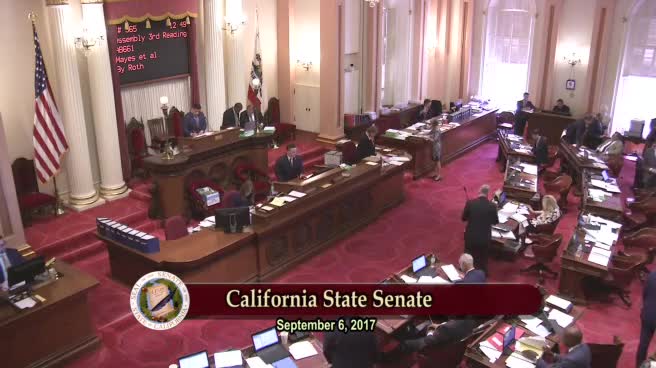 2MIN
Senate Floor
 1MIN
Assembly Floor
 5MIN
Assembly Standing Committee on Appropriations
 5MIN
Assembly Standing Committee on Judiciary
 14MIN
Assembly Standing Committee on Natural Resources
 4MIN
Senate Floor
 48MIN
Senate Standing Committee on Appropriations
 40SEC
Senate Standing Committee on Appropriations

Bill Co-Author(s):