SB 625: Juveniles: honorable discharge.
- Session Year: 2017-2018
- House: Senate
- Latest Version Date: 2017-10-11
Existing law sets forth provisions for the discharge of wards from the Department of Corrections and Rehabilitation, Division of Juvenile Facilities to the jurisdiction of the committing court. Under existing law, the department has no further jurisdiction over a ward who is discharged by the Board of Juvenile Hearings. Existing law requires the committing court to establish the conditions of the wards supervision and requires the county of commitment to supervise the reentry of the ward. Existing law authorizes the court, if it makes a finding of a serious violation or a series of repeated violations of the conditions of supervision, to order the reconfinement of the ward in a juvenile facility, a local adult facility, or the Division of Juvenile Facilities, as specified.
This bill would, among other things, confer on the board the obligation to make an honorable discharge determination for a person previously committed to the division upon his or her completion of local probation supervision, but not sooner than 18 months following the date of discharge by the board. The bill would require the board to promulgate regulations setting forth the criteria for the award of an honorable discharge. The bill would state the purposes of an honorable discharge and would require the board to promote the purposes of an honorable discharge designation and inform and assist currently committed youth with regard to obtaining an honorable discharge, as specified.
This bill would require the county of commitment to inform youth currently or previously under its supervision, who were previously under the jurisdiction of the division, about the opportunity and process of petitioning the board for an honorable discharge, as specified. The bill would require the board to request of the county, and would require the county to provide, a summary report of a petitioners performance while on probation after release from the division. The bill would also make conforming changes to provisions relating to authorization to inspect juvenile case files. By creating new duties for local officials relating to honorable discharges, the bill would impose a state-mandated local program.
Existing law sets forth provisions, inoperable under existing case law, requiring the board to grant an honorable discharge to a paroled person who has proven his or her ability for honorable self-support.
This bill would instead authorize the board to grant an honorable discharge to a person discharged from the division by the board if the person has proven his or her ability to desist from criminal behavior and to initiate a successful transition into adulthood.
Existing law requires that all persons honorably discharged from the control of the board to thereafter be released from all penalties or disabilities resulting from the offenses for which they were committed, including, but not limited to, any disqualification for any employment or occupational license, or both.
This bill would instead specify that the penalties or disabilities include, but are not limited to, those that affect access to education, employment, or occupational licenses. The bill would make conforming changes to related provisions.
Existing law prohibits a person who is under the jurisdiction of the division from being admitted to an examination for a peace officer position within the division unless and until the person has been honorably discharged.
This bill would additionally apply those provisions to a person who is under the jurisdiction of a county probation department.
This bill would also make other conforming changes and technical, nonsubstantive changes to the above provisions.
The California Constitution requires the state to reimburse local agencies and school districts for certain costs mandated by the state. Statutory provisions establish procedures for making that reimbursement.
This bill would provide that, with regard to certain mandates, no reimbursement is required by this act for a specified reason.
With regard to any other mandates, this bill would provide that, if the Commission on State Mandates determines that the bill contains costs so mandated by the state, reimbursement for those costs shall be made pursuant to the statutory provisions noted above.
This bill would incorporate additional changes to Section 827 of the Welfare and Institutions Code proposed by AB 404 to be operative only if this bill and AB 404 are enacted and this bill is enacted last.
Existing law sets forth provisions for the discharge of wards from the Department of Corrections and Rehabilitation, Division of Juvenile Facilities to the jurisdiction of the committing court. Under existing law, the department has no further jurisdiction over a ward who is discharged by the Board of Juvenile Hearings. Existing law requires the committing court to establish the conditions of the wards supervision and requires the county of commitment to supervise the reentry of the ward. Existing law authorizes the court, if it makes a finding of a serious violation or a series of repeated violations of the conditions of supervision, to order the reconfinement of the ward in a juvenile facility, a local adult facility, or the Division of Juvenile Facilities, as specified.
This bill would, among other things, confer on the board the obligation to make an honorable discharge determination for a person previously committed to the division upon his or her completion of local probation supervision, but not sooner than 18 months following the date of discharge by the board. The bill would require the board to promulgate regulations setting forth the criteria for the award of an honorable discharge. The bill would state the purposes of an honorable discharge and would require the board to promote the purposes of an honorable discharge designation and inform and assist currently committed youth with regard to obtaining an honorable discharge, as specified.
This bill would require the county of commitment to inform youth currently or previously under its supervision, who were previously under the jurisdiction of the division, about the opportunity and process of petitioning the board for an honorable discharge, as specified. The bill would require the board to request of the county, and would require the county to provide, a summary report of a petitioners performance while on probation. probation after release from the division. The bill would also make conforming changes to provisions relating to authorization to inspect juvenile case files. By creating new duties for local officials relating to honorable discharges, the bill would impose a state-mandated local program.
Existing law sets forth provisions, inoperable under existing case law, requiring the board to grant an honorable discharge to a paroled person who has proven his or her ability for honorable self-support.
This bill would instead authorize the board to grant an honorable discharge to a person discharged from the division by the board if the person has proven his or her ability to desist from criminal behavior and to initiate a successful transition into adulthood.
Existing law requires that all persons honorably discharged from the control of the board to thereafter be released from all penalties or disabilities resulting from the offenses for which they were committed, including, but not limited to, any disqualification for any employment or occupational license, or both.
This bill would instead specify that the penalties or disabilities include, but are not limited to, those that affect access to education, employment, or occupational licenses. The bill would make conforming changes to related provisions.
Existing law prohibits a person who is under the jurisdiction of the division from being admitted to an examination for a peace officer position within the division unless and until the person has been honorably discharged.
This bill would additionally apply those provisions to a person who is under the jurisdiction of a county probation department.
This bill would also make other conforming changes and technical, nonsubstantive changes to the above provisions.
The California Constitution requires the state to reimburse local agencies and school districts for certain costs mandated by the state. Statutory provisions establish procedures for making that reimbursement.
This bill would provide that, with regard to certain mandates, no reimbursement is required by this act for a specified reason.
With regard to any other mandates, this bill would provide that, if the Commission on State Mandates determines that the bill contains costs so mandated by the state, reimbursement for those costs shall be made pursuant to the statutory provisions noted above.
Existing law sets forth provisions for the discharge of wards from the Department of Corrections and Rehabilitation, Division of Juvenile Facilities to the jurisdiction of the committing court. Under existing law, the department has no further jurisdiction over a ward who is discharged by the Board of Juvenile Hearings. Existing law requires the committing court to establish the conditions of the wards supervision and requires the county of commitment to supervise the reentry of the ward. Existing law authorizes the court, if it makes a finding of a serious violation or a series of repeated violations of the conditions of supervision, to order the reconfinement of the ward in a juvenile facility, a local adult facility, or the Division of Juvenile Facilities, as specified.
This bill would authorize the department to determine if a youth previously committed to the division is eligible for an honorable discharge. The bill would also authorize the board to make honorable discharge determinations upon termination of the jurisdiction of the committing court. This bill would make conforming changes to provisions relating to the powers and duties of the division. The bill would also make conforming changes, reflecting the jurisdiction of the committing court, to provisions relating to the powers and duties of the board with regard to parole, violation of the conditions of parole, and the honorable discharge of a ward.This bill would, among other things, confer on the board the obligation to make an honorable discharge determination for a person previously committed to the division upon his or her completion of local probation supervision, but not sooner than 18 months following the date of discharge by the board. The bill would require the board to promulgate regulations setting forth the criteria for the award of an honorable discharge. The bill would state the purposes of an honorable discharge and would require the board to promote the purposes of an honorable discharge designation and inform and assist currently committed youth with regard to obtaining an honorable discharge, as specified.
This bill would require the county of commitment to inform youth currently or previously under its supervision, who were previously under the jurisdiction of the division, about the opportunity and process of petitioning the board for an honorable discharge, as specified. The bill would require the board to request of the county, and would require the county to provide, a summary report of a petitioners performance while on probation. The bill would also make conforming changes to provisions relating to authorization to inspect juvenile case files. By creating new duties for local officials relating to honorable discharges, the bill would impose a state-mandated local program.
Existing law sets forth provisions, inoperable under existing case law, requiring the board to grant an honorable discharge to a paroled person who has proven his or her ability for honorable self-support.
This bill would instead authorize the board to grant an honorable discharge to a person discharged from the division by the board if the person has proven his or her ability to desist from criminal behavior and to initiate a successful transition into adulthood.
Existing law requires that all persons honorably discharged from the control of the division board to thereafter be released from all penalties or disabilities resulting from the offense offenses for which they were committed. Existing law separately requires that every person discharged from the control of the division who has not, during the period of control, been placed in a state prison, to thereafter be released from all penalties and disabilities resulting from the offense or crime for which he or she was committed. committed, including, but not limited to, any disqualification for any employment or occupational license, or both.
This bill would specify that the honorable discharge is conducted by the Board of Juvenile Hearings. The bill would make conforming changes to those provisions to make them applicable to persons under the control of a county probation department.This bill would instead specify that the penalties or disabilities include, but are not limited to, those that affect access to education, employment, or occupational licenses. The bill would make conforming changes to related provisions.
Existing law prohibits a person who is under the jurisdiction of the division from being admitted to an examination for a peace officer position within the division unless and until the person has been honorably discharged.
This bill would additionally apply those provisions to a person who is under the jurisdiction of a county probation department.
This bill would also make other conforming changes and technical, nonsubstantive changes to the above provisions.
The California Constitution requires the state to reimburse local agencies and school districts for certain costs mandated by the state. Statutory provisions establish procedures for making that reimbursement.
This bill would provide that, with regard to certain mandates, no reimbursement is required by this act for a specified reason.
With regard to any other mandates, this bill would provide that, if the Commission on State Mandates determines that the bill contains costs so mandated by the state, reimbursement for those costs shall be made pursuant to the statutory provisions noted above.
Existing law sets forth provisions for the discharge of wards from the Department of Corrections and Rehabilitation, Division of Juvenile Facilities to the jurisdiction of the committing court. Under existing law, the department has no further jurisdiction over a ward who is discharged by the Board of Juvenile Hearings. Existing law requires the committing court to establish the conditions of the wards supervision and requires the county of commitment to supervise the reentry of the ward. Existing law authorizes the court, if it makes a finding of a serious violation or a series of repeated violations of the conditions of supervision, to order the reconfinement of the ward in a juvenile facility, a local adult facility, or the Division of Juvenile Facilities, as specified.
This bill would authorize the department to determine if a youth previously committed to the division is eligible for an honorable discharge. The bill would also authorize the board to make honorable discharge determinations upon termination of the jurisdiction of the committing court. This bill would make conforming changes to provisions relating to the powers and duties of the division. The bill would also make conforming changes, reflecting the jurisdiction of the committing court, to provisions relating to the powers and duties of the board with regard to parole, violation of the conditions of parole, and the honorable discharge of a ward.
Existing law requires that all persons honorably discharged from the control of the division to thereafter be released from all penalties or disabilities resulting from the offense for which they were committed. Existing law separately requires that every person discharged from the control of the division who has not, during the period of control, been placed in a state prison, to thereafter be released from all penalties and disabilities resulting from the offense or crime for which he or she was committed.
This bill would specify that the honorable discharge is conducted by the Board of Juvenile Hearings. The bill would make conforming changes to those provisions to make them applicable to persons under the control of a county probation department.
This bill would also make technical, nonsubstantive changes to the above provisions.
(a)(1)Except as provided in Section 828, a case file may be inspected only by the following:
(A)Court personnel.
(B)The district attorney, a city attorney, or city prosecutor authorized to prosecute criminal or juvenile cases under state law.
(C)The minor who is the subject of the proceeding.
(D)The minors parents or guardian.
(E)The attorneys for the parties, judges, referees, other hearing officers, probation officers, and law enforcement officers who are actively participating in criminal or juvenile proceedings involving the minor.
(F)The county counsel, city attorney, or any other attorney representing the petitioning agency in a dependency action.
(G)The superintendent or designee of the school district where the minor is enrolled or attending school.
(H)Members of the child protective agencies as defined in Section 11165.9 of the Penal Code.
(I)The State Department of Social Services, to carry out its duties pursuant to Division 9 (commencing with Section 10000), and Part 5 (commencing with Section 7900) of Division 12, of the Family Code to oversee and monitor county child welfare agencies, children in foster care or receiving foster care assistance, and out-of-state placements, Section 10850.4, and paragraph (2).
(J)Authorized legal staff or special investigators who are peace officers who are employed by, or who are authorized representatives of, the State Department of Social Services, as necessary to the performance of their duties to inspect, license, and investigate community care facilities, and to ensure that the standards of care and services provided in those facilities are adequate and appropriate and to ascertain compliance with the rules and regulations to which the facilities are subject. The confidential information shall remain confidential except for purposes of inspection, licensing, or investigation pursuant to Chapter 3 (commencing with Section 1500) and Chapter 3.4 (commencing with Section 1596.70) of Division 2 of the Health and Safety Code, or a criminal, civil, or administrative proceeding in relation thereto. The confidential information may be used by the State Department of Social Services in a criminal, civil, or administrative proceeding. The confidential information shall be available only to the judge or hearing officer and to the parties to the case. Names that are confidential shall be listed in attachments separate to the general pleadings. The confidential information shall be sealed after the conclusion of the criminal, civil, or administrative hearings, and may not subsequently be released except in accordance with this subdivision. If the confidential information does not result in a criminal, civil, or administrative proceeding, it shall be sealed after the State Department of Social Services decides that no further action will be taken in the matter of suspected licensing violations. Except as otherwise provided in this subdivision, confidential information in the possession of the State Department of Social Services may not contain the name of the minor.
(K)Members of childrens multidisciplinary teams, persons, or agencies providing treatment or supervision of the minor.
(L)A judge, commissioner, or other hearing officer assigned to a family law case with issues concerning custody or visitation, or both, involving the minor, and the following persons, if actively participating in the family law case: a family court mediator assigned to a case involving the minor pursuant to Article 1 (commencing with Section 3160) of Chapter 11 of Part 2 of Division 8 of the Family Code, a court-appointed evaluator or a person conducting a court-connected child custody evaluation, investigation, or assessment pursuant to Section 3111 or 3118 of the Family Code, and counsel appointed for the minor in the family law case pursuant to Section 3150 of the Family Code. Prior to allowing counsel appointed for the minor in the family law case to inspect the file, the court clerk may require counsel to provide a certified copy of the court order appointing him or her as the minors counsel.
(M)When acting within the scope of investigative duties of an active case, a statutorily authorized or court-appointed investigator who is conducting an investigation pursuant to Section 7663, 7851, or 9001 of the Family Code, or who is actively participating in a guardianship case involving a minor pursuant to Part 2 (commencing with Section 1500) of Division 4 of the Probate Code and acting within the scope of his or her duties in that case.
(N)A local child support agency for the purpose of establishing paternity and establishing and enforcing child support orders.
(O)Juvenile justice commissions as established under Section 225. The confidentiality provisions of Section 10850 shall apply to a juvenile justice commission and its members.
(P)Any other person who may be designated by court order of the judge of the juvenile court upon filing a petition.
(Q)A probation officer who is preparing a report pursuant to Section 1178 on behalf of a person who was in the custody of the Department of Corrections and Rehabilitation, Division of Juvenile Facilities and who has petitioned the Board of Juvenile Hearings for an honorable discharge.
(2)(A)Notwithstanding any other law and subject to subparagraph (A) of paragraph (3), juvenile case files, except those relating to matters within the jurisdiction of the court pursuant to Section 601 or 602, that pertain to a deceased child who was within the jurisdiction of the juvenile court pursuant to Section 300, shall be released to the public pursuant to an order by the juvenile court after a petition has been filed and interested parties have been afforded an opportunity to file an objection. Any information relating to another child or which could identify another child, except for information about the deceased, shall be redacted from the juvenile case file prior to release, unless a specific order is made by the juvenile court to the contrary. Except as provided in this paragraph, the presiding judge of the juvenile court may issue an order prohibiting or limiting access to the juvenile case file, or any portion thereof, of a deceased child only upon a showing by a preponderance of evidence that release of the juvenile case file or any portion thereof is detrimental to the safety, protection, or physical or emotional well-being of another child who is directly or indirectly connected to the juvenile case that is the subject of the petition.
(B)This paragraph represents a presumption in favor of the release of documents when a child is deceased unless the statutory reasons for confidentiality are shown to exist.
(C)If a child whose records are sought has died, and documents are sought pursuant to this paragraph, no weighing or balancing of the interests of those other than a child is permitted.
(D)A petition filed under this paragraph shall be served on interested parties by the petitioner, if the petitioner is in possession of their identity and address, and on the custodian of records. Upon receiving a petition, the custodian of records shall serve a copy of the request upon all interested parties that have not been served by the petitioner or on the interested parties served by the petitioner if the custodian of records possesses information, such as a more recent address, indicating that the service by the petitioner may have been ineffective.
(E)The custodian of records shall serve the petition within 10 calendar days of receipt. If any interested party, including the custodian of records, objects to the petition, the party shall file and serve the objection on the petitioning party no later than 15 calendar days after service of the petition.
(F)The petitioning party shall have 10 calendar days to file any reply. The juvenile court shall set the matter for hearing no more than 60 calendar days from the date the petition is served on the custodian of records. The court shall render its decision within 30 days of the hearing. The matter shall be decided solely upon the basis of the petition and supporting exhibits and declarations, if any, the objection and any supporting exhibits or declarations, if any, and the reply and any supporting declarations or exhibits thereto, and argument at hearing. The court may solely upon its own motion order the appearance of witnesses. If no objection is filed to the petition, the court shall review the petition and issue its decision within 10 calendar days of the final day for filing the objection. Any order of the court shall be immediately reviewable by petition to the appellate court for the issuance of an extraordinary writ.
(3)Access to juvenile case files pertaining to matters within the jurisdiction of the juvenile court pursuant to Section 300 shall be limited as follows:
(A)If a juvenile case file, or any portion thereof, is privileged or confidential pursuant to any other state law or federal law or regulation, the requirements of that state law or federal law or regulation prohibiting or limiting release of the juvenile case file or any portions thereof shall prevail. Unless a person is listed in subparagraphs (A) to (O), inclusive, of paragraph (1) and is entitled to access under the other state law or federal law or regulation without a court order, all those seeking access, pursuant to other authorization, to portions of, or information relating to the contents of, juvenile case files protected under another state law or federal law or regulation, shall petition the juvenile court. The juvenile court may only release the portion of, or information relating to the contents of, juvenile case files protected by another state law or federal law or regulation if disclosure is not detrimental to the safety, protection, or physical or emotional well-being of a child who is directly or indirectly connected to the juvenile case that is the subject of the petition. This paragraph shall not be construed to limit the ability of the juvenile court to carry out its duties in conducting juvenile court proceedings.
(B)Prior to the release of the juvenile case file or any portion thereof, the court shall afford due process, including a notice of and an opportunity to file an objection to the release of the record or report to all interested parties.
(4)A juvenile case file, any portion thereof, and information relating to the content of the juvenile case file, may not be disseminated by the receiving agencies to any persons or agencies, other than those persons or agencies authorized to receive documents pursuant to this section. Further, a juvenile case file, any portion thereof, and information relating to the content of the juvenile case file, may not be made as an attachment to any other documents without the prior approval of the presiding judge of the juvenile court, unless it is used in connection with and in the course of a criminal investigation or a proceeding brought to declare a person a dependent child or ward of the juvenile court.
(5)Individuals listed in subparagraphs (A), (B), (C), (D), (E), (F), (H), and (I) of paragraph (1) may also receive copies of the case file. In these circumstances, the requirements of paragraph (4) shall continue to apply to the information received.
(b)(1)While the Legislature reaffirms its belief that juvenile court records, in general, should be confidential, it is the intent of the Legislature in enacting this subdivision to provide for a limited exception to juvenile court record confidentiality to promote more effective communication among juvenile courts, family courts, law enforcement agencies, and schools to ensure the rehabilitation of juvenile criminal offenders as well as to lessen the potential for drug use, violence, other forms of delinquency, and child abuse.
(2)(A)Notwithstanding subdivision (a), written notice that a minor enrolled in a public school, kindergarten to grade 12, inclusive, has been found by a court of competent jurisdiction to have committed any felony or any misdemeanor involving curfew, gambling, alcohol, drugs, tobacco products, carrying of weapons, a sex offense listed in Section 290 of the Penal Code, assault or battery, larceny, vandalism, or graffiti shall be provided by the court, within seven days, to the superintendent of the school district of attendance. Written notice shall include only the offense found to have been committed by the minor and the disposition of the minors case. This notice shall be expeditiously transmitted by the district superintendent to the principal at the school of attendance. The principal shall expeditiously disseminate the information to those counselors directly supervising or reporting on the behavior or progress of the minor. In addition, the principal shall disseminate the information to any teacher or administrator directly supervising or reporting on the behavior or progress of the minor whom the principal believes needs the information to work with the pupil in an appropriate fashion, to avoid being needlessly vulnerable or to protect other persons from needless vulnerability.
(B)Any information received by a teacher, counselor, or administrator under this subdivision shall be received in confidence for the limited purpose of rehabilitating the minor and protecting students and staff, and shall not be further disseminated by the teacher, counselor, or administrator, except insofar as communication with the juvenile, his or her parents or guardians, law enforcement personnel, and the juveniles probation officer is necessary to effectuate the juveniles rehabilitation or to protect students and staff.
(C)An intentional violation of the confidentiality provisions of this paragraph is a misdemeanor punishable by a fine not to exceed five hundred dollars ($500).
(3)If a minor is removed from public school as a result of the courts finding described in subdivision (b), the superintendent shall maintain the information in a confidential file and shall defer transmittal of the information received from the court until the minor is returned to public school. If the minor is returned to a school district other than the one from which the minor came, the parole or probation officer having jurisdiction over the minor shall so notify the superintendent of the last district of attendance, who shall transmit the notice received from the court to the superintendent of the new district of attendance.
(c)Each probation report filed with the court concerning a minor whose record is subject to dissemination pursuant to subdivision (b) shall include on the face sheet the school at which the minor is currently enrolled. The county superintendent shall provide the court with a listing of all of the schools within each school district, within the county, along with the name and mailing address of each district superintendent.
(d)(1)Each notice sent by the court pursuant to subdivision (b) shall be stamped with the instruction: Unlawful Dissemination Of This Information Is A Misdemeanor. Any information received from the court shall be kept in a separate confidential file at the school of attendance and shall be transferred to the minors subsequent schools of attendance and maintained until the minor graduates from high school, is released from juvenile court jurisdiction, or reaches 18 years of age, whichever occurs first. After that time the confidential record shall be destroyed. At any time after the date by which a record required to be destroyed by this section should have been destroyed, the minor or his or her parent or guardian shall have the right to make a written request to the principal of the school that the minors school records be reviewed to ensure that the record has been destroyed. Upon completion of any requested review and no later than 30 days after the request for the review was received, the principal or his or her designee shall respond in writing to the written request and either shall confirm that the record has been destroyed or, if the record has not been destroyed, shall explain why destruction has not yet occurred.
(2)Except as provided in paragraph (2) of subdivision (b), no liability shall attach to any person who transmits or fails to transmit any notice or information required under subdivision (b).
(e)For purposes of this section, a juvenile case file means a petition filed in any juvenile court proceeding, reports of the probation officer, and all other documents filed in that case or made available to the probation officer in making his or her report, or to the judge, referee, or other hearing officer, and thereafter retained by the probation officer, judge, referee, or other hearing officer.
(f)The persons described in subparagraphs (A), (E), (F), (H), (K), (L), (M), and (N) of paragraph (1) of subdivision (a) include persons serving in a similar capacity for an Indian tribe, reservation, or tribal court when the case file involves a child who is a member of, or who is eligible for membership in, that tribe.
(g)A case file that is covered by, or included in, an order of the court sealing a record pursuant to Section 781 or 786 may not be inspected except as specified by Section 781 or 786.
SEC. 1.5.Section 827 of the Welfare and Institutions Code is amended to read:827.(a)(1)Except as provided in Section 828, a case file may be inspected only by the following:
(A)Court personnel.
(B)The district attorney, a city attorney, or city prosecutor authorized to prosecute criminal or juvenile cases under state law.
(C)The minor who is the subject of the proceeding.
(D)The minors parent or guardian.
(E)The attorneys for the parties, judges, referees, other hearing officers, probation officers, and law enforcement officers who are actively participating in criminal or juvenile proceedings involving the minor.
(F)The county counsel, city attorney, or any other attorney representing the petitioning agency in a dependency action.
(G)The superintendent or designee of the school district where the minor is enrolled or attending school.
(H)Members of the child protective agencies as defined in Section 11165.9 of the Penal Code.
(I)The State Department of Social Services, to carry out its duties pursuant to Division 9 (commencing with Section 10000), and Part 5 (commencing with Section 7900) of Division 12, of the Family Code to oversee and monitor county child welfare agencies, children in foster care or receiving foster care assistance, and out-of-state placements, Section 10850.4, and paragraph (2).
(J)(i)Authorized staff who are employed by, or authorized staff of entities who are licensed by, the State Department of Social Services, as necessary to the performance of their duties related to resource family approval, and authorized staff who are employed by the State Department of Social Services as necessary to inspect, approve, or license, and monitor or investigate community care facilities or resource families, and to ensure that the standards of care and services provided in those facilities are adequate and appropriate, and to ascertain compliance with the rules and regulations to which the facilities are subject.
(ii)The confidential information shall remain confidential except for purposes of inspection, approval or licensing, or monitoring or investigation pursuant to Chapter 3 (commencing with Section 1500) and Chapter 3.4 (commencing with Section 1596.70) of Division 2 of the Health and Safety Code and Article 2 (commencing with Section 16519.5) of Chapter 5 of Part 4 of Division 9. The confidential information may also be used by the State Department of Social Services in a criminal, civil, or administrative proceeding. The confidential information shall be available only to the judge or hearing officer and to the parties to the case. Names that are confidential shall be listed in attachments separate to the general pleadings. The confidential information shall be sealed after the conclusion of the criminal, civil, or administrative hearings, and may not subsequently be released except in accordance with this subdivision. If the confidential information does not result in a criminal, civil, or administrative proceeding, it shall be sealed after the State Department of Social Services determines that no further action will be taken in the matter. Except as otherwise provided in this subdivision, confidential information shall not contain the name of the minor.
(K)Members of childrens multidisciplinary teams, persons, or agencies providing treatment or supervision of the minor.
(L)A judge, commissioner, or other hearing officer assigned to a family law case with issues concerning custody or visitation, or both, involving the minor, and the following persons, if actively participating in the family law case: a family court mediator assigned to a case involving the minor pursuant to Article 1 (commencing with Section 3160) of Chapter 11 of Part 2 of Division 8 of the Family Code, a court-appointed evaluator or a person conducting a court-connected child custody evaluation, investigation, or assessment pursuant to Section 3111 or 3118 of the Family Code, and counsel appointed for the minor in the family law case pursuant to Section 3150 of the Family Code. Prior to allowing counsel appointed for the minor in the family law case to inspect the file, the court clerk may require counsel to provide a certified copy of the court order appointing him or her as the minors counsel.
(M)When acting within the scope of investigative duties of an active case, a statutorily authorized or court-appointed investigator who is conducting an investigation pursuant to Section 7663, 7851, or 9001 of the Family Code, or who is actively participating in a guardianship case involving a minor pursuant to Part 2 (commencing with Section 1500) of Division 4 of the Probate Code and acting within the scope of his or her duties in that case.
(N)A local child support agency for the purpose of establishing paternity and establishing and enforcing child support orders.
(O)Juvenile justice commissions as established under Section 225. The confidentiality provisions of Section 10850 shall apply to a juvenile justice commission and its members.
(P)Any other person who may be designated by court order of the judge of the juvenile court upon filing a petition.
(Q)A probation officer who is preparing a report pursuant to Section 1178 on behalf of a person who was in the custody of the Department of Corrections and Rehabilitation, Division of Juvenile Facilities and who has petitioned the Board of Juvenile Hearings for an honorable discharge.
(2)(A)Notwithstanding any other law and subject to subparagraph (A) of paragraph (3), juvenile case files, except those relating to matters within the jurisdiction of the court pursuant to Section 601 or 602, that pertain to a deceased child who was within the jurisdiction of the juvenile court pursuant to Section 300, shall be released to the public pursuant to an order by the juvenile court after a petition has been filed and interested parties have been afforded an opportunity to file an objection. Any information relating to another child or which could identify another child, except for information about the deceased, shall be redacted from the juvenile case file prior to release, unless a specific order is made by the juvenile court to the contrary. Except as provided in this paragraph, the presiding judge of the juvenile court may issue an order prohibiting or limiting access to the juvenile case file, or any portion thereof, of a deceased child only upon a showing by a preponderance of evidence that release of the juvenile case file or any portion thereof is detrimental to the safety, protection, or physical or emotional well-being of another child who is directly or indirectly connected to the juvenile case that is the subject of the petition.
(B)This paragraph represents a presumption in favor of the release of documents when a child is deceased unless the statutory reasons for confidentiality are shown to exist.
(C)If a child whose records are sought has died, and documents are sought pursuant to this paragraph, no weighing or balancing of the interests of those other than a child is permitted.
(D)A petition filed under this paragraph shall be served on interested parties by the petitioner, if the petitioner is in possession of their identity and address, and on the custodian of records. Upon receiving a petition, the custodian of records shall serve a copy of the request upon all interested parties that have not been served by the petitioner or on the interested parties served by the petitioner if the custodian of records possesses information, such as a more recent address, indicating that the service by the petitioner may have been ineffective.
(E)The custodian of records shall serve the petition within 10 calendar days of receipt. If any interested party, including the custodian of records, objects to the petition, the party shall file and serve the objection on the petitioning party no later than 15 calendar days after service of the petition.
(F)The petitioning party shall have 10 calendar days to file any reply. The juvenile court shall set the matter for hearing no more than 60 calendar days from the date the petition is served on the custodian of records. The court shall render its decision within 30 days of the hearing. The matter shall be decided solely upon the basis of the petition and supporting exhibits and declarations, if any, the objection and any supporting exhibits or declarations, if any, and the reply and any supporting declarations or exhibits thereto, and argument at hearing. The court may solely upon its own motion order the appearance of witnesses. If no objection is filed to the petition, the court shall review the petition and issue its decision within 10 calendar days of the final day for filing the objection. Any order of the court shall be immediately reviewable by petition to the appellate court for the issuance of an extraordinary writ.
(3)Access to juvenile case files pertaining to matters within the jurisdiction of the juvenile court pursuant to Section 300 shall be limited as follows:
(A)If a juvenile case file, or any portion thereof, is privileged or confidential pursuant to any other state law or federal law or regulation, the requirements of that state law or federal law or regulation prohibiting or limiting release of the juvenile case file or any portions thereof shall prevail. Unless a person is listed in subparagraphs (A) to (O), inclusive, of paragraph (1) and is entitled to access under the other state law or federal law or regulation without a court order, all those seeking access, pursuant to other authorization, to portions of, or information relating to the contents of, juvenile case files protected under another state law or federal law or regulation, shall petition the juvenile court. The juvenile court may only release the portion of, or information relating to the contents of, juvenile case files protected by another state law or federal law or regulation if disclosure is not detrimental to the safety, protection, or physical or emotional well-being of a child who is directly or indirectly connected to the juvenile case that is the subject of the petition. This paragraph shall not be construed to limit the ability of the juvenile court to carry out its duties in conducting juvenile court proceedings.
(B)Prior to the release of the juvenile case file or any portion thereof, the court shall afford due process, including a notice of and an opportunity to file an objection to the release of the record or report to all interested parties.
(4)A juvenile case file, any portion thereof, and information relating to the content of the juvenile case file, may not be disseminated by the receiving agencies to any persons or agencies, other than those persons or agencies authorized to receive documents pursuant to this section. Further, a juvenile case file, any portion thereof, and information relating to the content of the juvenile case file, may not be made as an attachment to any other documents without the prior approval of the presiding judge of the juvenile court, unless it is used in connection with and in the course of a criminal investigation or a proceeding brought to declare a person a dependent child or ward of the juvenile court.
(5)Individuals listed in subparagraphs (A), (B), (C), (D), (E), (F), (H), (I), and (J) of paragraph (1) may also receive copies of the case file. For authorized staff of entities who are licensed by the State Department of Social Services, the confidential information shall be obtained through a child protective agency, as defined in subparagraph (H) of paragraph (1). In these circumstances, the requirements of paragraph (4) shall continue to apply to the information received.
(b)(1)While the Legislature reaffirms its belief that juvenile court records, in general, should be confidential, it is the intent of the Legislature in enacting this subdivision to provide for a limited exception to juvenile court record confidentiality to promote more effective communication among juvenile courts, family courts, law enforcement agencies, and schools to ensure the rehabilitation of juvenile criminal offenders as well as to lessen the potential for drug use, violence, other forms of delinquency, and child abuse.
(2)(A)Notwithstanding subdivision (a), written notice that a minor enrolled in a public school, kindergarten to grade 12, inclusive, has been found by a court of competent jurisdiction to have committed any felony or any misdemeanor involving curfew, gambling, alcohol, drugs, tobacco products, carrying of weapons, a sex offense listed in Section 290 of the Penal Code, assault or battery, larceny, vandalism, or graffiti shall be provided by the court, within seven days, to the superintendent of the school district of attendance. Written notice shall include only the offense found to have been committed by the minor and the disposition of the minors case. This notice shall be expeditiously transmitted by the district superintendent to the principal at the school of attendance. The principal shall expeditiously disseminate the information to those counselors directly supervising or reporting on the behavior or progress of the minor. In addition, the principal shall disseminate the information to any teacher or administrator directly supervising or reporting on the behavior or progress of the minor whom the principal believes needs the information to work with the pupil in an appropriate fashion, to avoid being needlessly vulnerable or to protect other persons from needless vulnerability.
(B)Any information received by a teacher, counselor, or administrator under this subdivision shall be received in confidence for the limited purpose of rehabilitating the minor and protecting students and staff, and shall not be further disseminated by the teacher, counselor, or administrator, except insofar as communication with the juvenile, his or her parents or guardians, law enforcement personnel, and the juveniles probation officer is necessary to effectuate the juveniles rehabilitation or to protect students and staff.
(C)An intentional violation of the confidentiality provisions of this paragraph is a misdemeanor punishable by a fine not to exceed five hundred dollars ($500).
(3)If a minor is removed from public school as a result of the courts finding described in subdivision (b), the superintendent shall maintain the information in a confidential file and shall defer transmittal of the information received from the court until the minor is returned to public school. If the minor is returned to a school district other than the one from which the minor came, the parole or probation officer having jurisdiction over the minor shall so notify the superintendent of the last district of attendance, who shall transmit the notice received from the court to the superintendent of the new district of attendance.
(c)Each probation report filed with the court concerning a minor whose record is subject to dissemination pursuant to subdivision (b) shall include on the face sheet the school at which the minor is currently enrolled. The county superintendent shall provide the court with a listing of all of the schools within each school district, within the county, along with the name and mailing address of each district superintendent.
(d)(1)Each notice sent by the court pursuant to subdivision (b) shall be stamped with the instruction: Unlawful Dissemination Of This Information Is A Misdemeanor. Any information received from the court shall be kept in a separate confidential file at the school of attendance and shall be transferred to the minors subsequent schools of attendance and maintained until the minor graduates from high school, is released from juvenile court jurisdiction, or reaches 18 years of age, whichever occurs first. After that time the confidential record shall be destroyed. At any time after the date by which a record required to be destroyed by this section should have been destroyed, the minor or his or her parent or guardian shall have the right to make a written request to the principal of the school that the minors school records be reviewed to ensure that the record has been destroyed. Upon completion of any requested review and no later than 30 days after the request for the review was received, the principal or his or her designee shall respond in writing to the written request and either shall confirm that the record has been destroyed or, if the record has not been destroyed, shall explain why destruction has not yet occurred.
(2)Except as provided in paragraph (2) of subdivision (b), no liability shall attach to any person who transmits or fails to transmit any notice or information required under subdivision (b).
(e)For purposes of this section, a juvenile case file means a petition filed in any juvenile court proceeding, reports of the probation officer, and all other documents filed in that case or made available to the probation officer in making his or her report, or to the judge, referee, or other hearing officer, and thereafter retained by the probation officer, judge, referee, or other hearing officer.
(f)The persons described in subparagraphs (A), (E), (F), (H), (K), (L), (M), and (N) of paragraph (1) of subdivision (a) include persons serving in a similar capacity for an Indian tribe, reservation, or tribal court when the case file involves a child who is a member of, or who is eligible for membership in, that tribe.
(g)A case file that is covered by, or included in, an order of the court sealing a record pursuant to Section 781 or 786 may not be inspected except as specified by Section 781 or 786.
SEC. 2.Section 1177 of the Welfare and Institutions Code is repealed.SEC. 3.Section 1177 is added to the Welfare and Institutions Code, to read:1177.(a)Pursuant to Section 1178, if a person discharged from the Department of Corrections and Rehabilitation, Division of Juvenile Facilities by the Board of Juvenile Hearings has proven that persons ability to desist from criminal behavior and to initiate a successful transition into adulthood, the board may grant that person an honorable discharge.
(b)The purposes of an honorable discharge are to recognize and reward youth who have avoided reoffending and have pursued productive and engaged roles as members of society; to remove barriers to a youths successful integration into society and to enable the pursuit of greater opportunities; to serve as an incentive for youth to participate in treatment and training while placed in the Division of Juvenile Facilities; to connect youth with resources and opportunities upon their reentry into the community; and to inspire and motivate youth committed to the Division of Juvenile Facilities to plan and pursue a positive life.
(c)When determining whether to grant an honorable discharge to a person who petitions the board pursuant to Section 1178, the board shall consider, but is not limited to, both of the following:
(1)The petitioners offense history, if any, while the petitioner was under the jurisdiction of the Division of Juvenile Facilities, or during or after completion of local probation supervision.
(2)Efforts made by the petitioner toward successful community reintegration, including employment history, educational achievements or progress toward obtaining a degree, vocational training, volunteer work, community engagement, positive peer and familial relationships, and any other relevant indicators of successful reentry and rehabilitation.
(d)The board shall promulgate regulations setting forth the criteria for the award of an honorable discharge.
(e)The board shall promote the purposes of an honorable discharge designation and communicate the success of recipients of honorable discharge to youth currently committed to the Department of Corrections and Rehabilitation, Division of Juvenile Facilities.
(f)The board shall inform youth about the opportunity to earn an honorable discharge at initial case reviews, annual reviews, and discharge consideration hearings.
(g)The board may collaborate with public, private, and nonprofit organizations to assist youth in the fulfillment of the criteria described in subdivision (d) and in the completion of a petition for an honorable discharge.
SEC. 4.Section 1178 of the Welfare and Institutions Code is repealed.SEC. 5.Section 1178 is added to the Welfare and Institutions Code, to read:1178.(a)A person previously committed to the Department of Corrections and Rehabilitation, Division of Juvenile Facilities may petition the Board of Juvenile Hearings for an honorable discharge upon his or her completion of local probation supervision following discharge, but not sooner than 18 months following the date of discharge, by the board.
(b)(1)The county of commitment shall inform youth currently or previously under its supervision, who were previously under the jurisdiction of the division, about the opportunity and process of petitioning the board for an honorable discharge.
(2)The county of commitment shall send a letter regarding the opportunity and process of petitioning the board for an honorable discharge to the last known residence of a person previously under the supervision of the county of commitment.
(c)Upon receiving a petition for an honorable discharge, the board shall request of the county of commitment, and the county of commitment shall provide, a summary report of the petitioners performance while on probation after release from the Division of Juvenile Facilities.
SEC. 6.Section 1179 of the Welfare and Institutions Code is amended to read:1179.(a)Each person honorably discharged by the Board of Juvenile Hearings shall thereafter be released from all penalties or disabilities resulting from the offenses for which the person was committed, including, but not limited to, penalties or disabilities that affect access to education, employment, or occupational licenses. However, a release from all penalties and disabilities shall not affect a persons duty to register pursuant to Section 290.008 of the Penal Code. A person in receipt of an honorable discharge is not eligible for appointment as a peace officer employed by any public agency if that persons appointment is otherwise prohibited by Section 1029 of the Government Code.
(b)Persons who receive an honorable discharge and who petition the court for relief otherwise provided for by law may cite and the court shall recognize receipt of an honorable discharge as evidence of rehabilitation.
(c)Notwithstanding subdivision (a), a person may be appointed and employed as a peace officer by the Department of Corrections and Rehabilitation, Division of Juvenile Facilities if (1) at least five years have passed since that persons honorable discharge, and the person has had no misdemeanor or felony convictions except for traffic misdemeanors since the person was honorably discharged by the board, or (2) the person was employed as a peace officer by the department on or before January 1, 1983. A person who is under the jurisdiction of the Division of Juvenile Facilities or a county probation department shall not be admitted to an examination for a peace officer position with the Division of Juvenile Facilities unless and until the person has been honorably discharged from the jurisdiction of the Division of Juvenile Facilities pursuant to Sections 1177 and 1719.
(d)In the case of a person granted an honorable discharge, the Department of Corrections and Rehabilitation, Division of Juvenile Facilities shall immediately certify the discharge or dismissal in writing, and shall transmit the certificate to the committing court and the Department of Justice. The court shall thereupon dismiss the accusation and the action pending against that person.
SEC. 7.Section 1719 of the Welfare and Institutions Code is amended to read:1719.(a)The following powers and duties shall be exercised and performed by the Board of Juvenile Hearings: discharges of commitment, orders for discharge from the jurisdiction of the Division of Juvenile Facilities to the jurisdiction of the committing court, honorable discharge determinations, initial case reviews, and annual reviews.
(b)Any ward may appeal a decision by the Board of Juvenile Hearings to deny discharge to a panel comprised of at least two commissioners.
(c)The following powers and duties shall be exercised and performed by the Division of Juvenile Facilities: return of persons to the court of commitment for redisposition by the court or a reentry disposition, determination of offense category, setting of discharge consideration dates, developing and updating individualized treatment plans, institution placements, furlough placements, return of nonresident persons to the jurisdiction of the state of legal residence, disciplinary decisionmaking, and referrals pursuant to Section 1800.
(d)The department shall promulgate policies and regulations implementing a departmentwide system of graduated sanctions for addressing ward disciplinary matters. The disciplinary decisionmaking system shall be employed as the disciplinary system in facilities under the jurisdiction of the Division of Juvenile Facilities, and shall provide a framework for handling disciplinary matters in a manner that is consistent, timely, proportionate, and ensures the due process rights of wards. The department shall develop and implement a system of graduated sanctions that distinguishes between minor, intermediate, and serious misconduct. The department may not extend a wards discharge consideration date. The department also may promulgate regulations to establish a process for granting wards who have successfully responded to disciplinary sanctions a reduction of any time acquired for disciplinary matters.
SEC. 8.Section 1766 of the Welfare and Institutions Code is amended to read:1766.(a)Subject to Sections 733 and 1767.35, and subdivision (b) of this section, if a person has been committed to the Department of Corrections and Rehabilitation, Division of Juvenile Facilities, the Board of Juvenile Hearings, according to standardized review and appeal procedures established by the board in policy and regulation and subject to the powers and duties enumerated in subdivision (a) of Section 1719, may do any of the following:
(1)Set a date on which the ward shall be discharged from the jurisdiction of the Division of Juvenile Facilities and permitted his or her liberty under supervision of probation and subject to the jurisdiction of the committing court pursuant to subdivision (b).
(2)Deny discharge, except that a person committed to the division pursuant to Section 731 or 1731.5 shall not be held in physical confinement for a total period of time in excess of the maximum periods of time set forth in Section 731.
(b)The following provisions shall apply to any ward eligible for discharge from that wards commitment to the custody of the Department of Corrections and Rehabilitation, Division of Juvenile Facilities. Any order entered by the court pursuant to this subdivision shall be consistent with evidence-based practices and the interest of public safety.
(1)The county of commitment shall supervise the reentry of any ward still subject to the courts jurisdiction and discharged from the jurisdiction of the Division of Juvenile Facilities. The conditions of the wards supervision shall be established by the court pursuant to the provisions of this section.
(2)Not less than 60 days prior to the scheduled discharge consideration hearing of a ward described in this subdivision, the division shall provide to the probation department and the court of the committing county, and the wards counsel, if known, the most recent written review prepared pursuant to Section 1720, along with notice of the discharge consideration hearing date.
(3)(A)Not less than 30 days prior to the scheduled discharge consideration hearing, the division shall notify the ward of the date and location of the discharge consideration hearing. A ward shall have the right to contact the wards parent or guardian, if he or she can reasonably be located, to inform the parent or guardian of the date and location of the discharge consideration hearing. The division shall also allow the ward to inform other persons identified by the ward, if they can reasonably be located, and who are considered by the division as likely to contribute to a wards preparation for the discharge consideration hearing or the wards postrelease success.
(B)This paragraph shall not apply if either of the following conditions is met:
(i)A minor chooses not to contact the minors parents, guardians, or other persons and the director of the division facility determines it would be in the best interest of the minor not to contact the parents, guardians, or other persons.
(ii)A person 18 years of age or older does not consent to the contact.
(C)Upon intake of a ward committed to a division facility, and again upon attaining 18 years of age while serving the wards commitment in the custody of the division, an appropriate staff person shall explain the provisions of subparagraphs (A) and (B), using language clearly understandable to the ward.
(D)Nothing in this paragraph shall be construed to limit the right of a ward to an attorney under any other law.
(4)Not less than 30 days prior to the scheduled discharge consideration hearing of a ward described in this subdivision, the probation department of the committing county may provide the division with its written plan for the reentry supervision of the ward. At the discharge consideration hearing, the Board of Juvenile Hearings shall, in determining whether the ward is to be released, consider a reentry supervision plan submitted by the county.
(5)If the Board of Juvenile Hearings determines that a ward is ready for discharge to county supervision pursuant to subdivision (a), the board shall do both of the following:
(A)Set a date for discharge from the jurisdiction of the Division of Juvenile Facilities no less than 14 days after the date of such determination. The board shall also record any postrelease recommendations for the ward. These recommendations will be sent to the committing court responsible for setting the wards conditions of supervision no later than seven days from the date of such determination.
(B)Notify the ward that he or she may petition the board for an honorable discharge after 18 months following his or her discharge by the board, provided that he or she is not on probation.
(6)No more than four days but no less than one day prior to the scheduled date of the reentry disposition hearing before the committing court, the Division of Juvenile Facilities shall transport and deliver the ward to the custody of the probation department of the committing county. On or prior to a wards date of discharge from the Division of Juvenile Facilities, the committing court shall convene a reentry disposition hearing for the ward. The purpose of the hearing shall be for the court to identify those conditions of supervision that are appropriate under all the circumstances of the case and consistent with evidence-based practices. The court shall, to the extent it deems appropriate, incorporate postrelease recommendations made by the board as well as any reentry plan submitted by the county probation department and reviewed by the board into its disposition order. At the hearing the ward shall be fully informed of the terms and conditions of any order entered by the court, including the consequences for any violation thereof. The procedure of the reentry disposition hearing shall otherwise be consistent with the rules, rights, and procedures applicable to delinquency disposition hearings as described in Article 17 (commencing with Section 675) of Chapter 2 of Part 1 of Division 2.
(7)The Department of Corrections and Rehabilitation shall have no further jurisdiction over a ward who is discharged by the Board of Juvenile Hearings, except that the board shall make honorable discharge determinations.
(8)Notwithstanding any other law or any other provision of this section, commencing January 1, 2013, all wards who remain on parole under the jurisdiction of the Division of Juvenile Facilities shall be discharged, except for wards who are in custody pending revocation proceedings or serving a term of revocation. A ward that is pending revocation proceedings or serving a term of revocation shall be discharged after serving the wards revocation term, including any revocation extensions, or when any allegations of violating the terms and conditions of the wards parole are not sustained.
(c)Within 60 days of intake, the Division of Juvenile Facilities shall provide the court and the probation department with a treatment plan for the ward.
(d)Commencing January 1, 2013, and annually thereafter, for the preceding fiscal year, the department shall collect and make available to the public the following information:
(1)The total number of ward case reviews conducted by the division and the board, categorized by guideline category.
(2)The number of discharge consideration dates for each category set at guideline, above guideline, and below guideline.
(3)The number of ward case reviews resulting in a change to a discharge consideration date, including the category assigned to the ward and the specific reason for the change.
(4)The percentage of wards who have had a discharge consideration date changed to a later date, the percentage of wards who have had a discharge consideration date changed to an earlier date, and the average annual time added or subtracted per case.
(5)The number and percentage of wards who, while confined or on parole, are charged with a new misdemeanor or felony criminal offense.
(6)Any additional data or information identified by the department as relevant.
(e)As used in subdivision (d), the term ward case review means any review of a ward that changes, maintains, or appreciably affects the programs, treatment, or placement of a ward.
SEC. 9.Section 1772 of the Welfare and Institutions Code is amended to read:1772.(a)Subject to subdivision (b), every person discharged by the Board of Juvenile Hearings may petition the court that committed him or her, and the court may upon that petition set aside the verdict of guilty and dismiss the accusation or information against the petitioner who shall thereafter be released from all penalties and disabilities resulting from the offense or crime for which he or she was committed, including, but not limited to, penalties or disabilities that affect access to education, employment, or occupational licenses.
(b)Notwithstanding subdivision (a), all of the following shall apply to a person described in subdivision (a) or a person honorably discharged by the Board of Juvenile Hearings:
(1)The person shall not be eligible for appointment as a peace officer employed by any public agency if that persons appointment would otherwise be prohibited by Section 1029 of the Government Code. However, that person may be appointed and employed as a peace officer by the Department of Corrections and Rehabilitation, Division of Juvenile Facilities if (A) at least five years have passed since the persons honorable discharge, and the person has had no misdemeanor or felony convictions except for traffic misdemeanors since he or she was honorably discharged by the Board of Juvenile Hearings, or (B) the person was employed as a peace officer by the Division of Juvenile Facilities on or before January 1, 1983. A person who is under the jurisdiction of the Division of Juvenile Facilities or a county probation department shall not be admitted to an examination for a peace officer position with the Division of Juvenile Facilities unless and until the person has been honorably discharged from the jurisdiction of the Board of Juvenile Hearings pursuant to Sections 1177 and 1719.
(2)The person is subject to Chapter 2 (commencing with Section 29800) and Chapter 3 (commencing with Section 29900) of Division 9 of Title 4 of Part 6 of the Penal Code.
(3)The conviction of the person for an offense listed in subdivision (b) of Section 707 is admissible in a subsequent criminal, juvenile, or civil proceeding if otherwise admissible, if all of the following are true:
(A)The person was 16 years of age or older at the time he or she committed the offense.
(B)The person was found unfit to be dealt with under the juvenile court law pursuant to Section 707 because he or she was alleged to have committed an offense listed in subdivision (b) of Section 707.
(C)The person was tried as an adult and convicted of an offense listed in subdivision (b) of Section 707.
(D)The person was committed to the Department of Corrections and Rehabilitation, Division of Juvenile Facilities for the offense referred to in subparagraph (C).
(4)The conviction of the person may be used to enhance the punishment for a subsequent offense.
(5)The conviction of a person who is 18 years of age or older at the time he or she committed the offense is admissible in a subsequent civil, criminal, or juvenile proceeding, if otherwise admissible pursuant to law.
(c)Every person discharged from control by the Board of Juvenile Hearings shall be informed of the provisions of this section in writing at the time of discharge.
(d)Honorably discharged as used in this section means and includes every person who was granted an honorable discharge by the Board of Juvenile Hearings pursuant to Sections 1177 and 1719.
SEC. 10.Section 1.5 of this bill incorporates amendments to Section 827 of the Welfare and Institutions Code proposed by both this bill and Assembly Bill 404. That section shall only become operative if (1) both bills are enacted and become effective on or before January 1, 2018, (2) each bill amends Section 827 of the Welfare and Institutions Code, and (3) this bill is enacted after Assembly Bill 404, in which case Section 1 of this bill shall not become operative.
SEC. 11.To the extent that this act has an overall effect of increasing certain costs already borne by a local agency for programs or levels of service mandated by the 2011 Realignment Legislation within the meaning of Section 36 of Article XIII of the California Constitution, it shall apply to local agencies only to the extent that the state provides annual funding for the cost increase. Any new program or higher level of service provided by a local agency pursuant to this act above the level for which funding has been provided shall not require a subvention of funds by the state or otherwise be subject to Section 6 of Article XIIIB of the California Constitution.
However, if the Commission on State Mandates determines that this act contains other costs mandated by the state, reimbursement to local agencies and school districts for those costs shall be made pursuant to Part 7 (commencing with Section 17500) of Division 4 of Title 2 of the Government Code.
(a)(1)Except as provided in Section 828, a case file may be inspected only by the following:
(A)Court personnel.
(B)The district attorney, a city attorney, or city prosecutor authorized to prosecute criminal or juvenile cases under state law.
(C)The minor who is the subject of the proceeding.
(D)The minors parents or guardian.
(E)The attorneys for the parties, judges, referees, other hearing officers, probation officers, and law enforcement officers who are actively participating in criminal or juvenile proceedings involving the minor.
(F)The county counsel, city attorney, or any other attorney representing the petitioning agency in a dependency action.
(G)The superintendent or designee of the school district where the minor is enrolled or attending school.
(H)Members of the child protective agencies as defined in Section 11165.9 of the Penal Code.
(I)The State Department of Social Services, to carry out its duties pursuant to Division 9 (commencing with Section 10000), and Part 5 (commencing with Section 7900) of Division 12, of the Family Code to oversee and monitor county child welfare agencies, children in foster care or receiving foster care assistance, and out-of-state placements, Section 10850.4, and paragraph (2).
(J)Authorized legal staff or special investigators who are peace officers who are employed by, or who are authorized representatives of, the State Department of Social Services, as necessary to the performance of their duties to inspect, license, and investigate community care facilities, and to ensure that the standards of care and services provided in those facilities are adequate and appropriate and to ascertain compliance with the rules and regulations to which the facilities are subject. The confidential information shall remain confidential except for purposes of inspection, licensing, or investigation pursuant to Chapter 3 (commencing with Section 1500) and Chapter 3.4 (commencing with Section 1596.70) of Division 2 of the Health and Safety Code, or a criminal, civil, or administrative proceeding in relation thereto. The confidential information may be used by the State Department of Social Services in a criminal, civil, or administrative proceeding. The confidential information shall be available only to the judge or hearing officer and to the parties to the case. Names that are confidential shall be listed in attachments separate to the general pleadings. The confidential information shall be sealed after the conclusion of the criminal, civil, or administrative hearings, and may not subsequently be released except in accordance with this subdivision. If the confidential information does not result in a criminal, civil, or administrative proceeding, it shall be sealed after the State Department of Social Services decides that no further action will be taken in the matter of suspected licensing violations. Except as otherwise provided in this subdivision, confidential information in the possession of the State Department of Social Services may not contain the name of the minor.
(K)Members of childrens multidisciplinary teams, persons, or agencies providing treatment or supervision of the minor.
(L)A judge, commissioner, or other hearing officer assigned to a family law case with issues concerning custody or visitation, or both, involving the minor, and the following persons, if actively participating in the family law case: a family court mediator assigned to a case involving the minor pursuant to Article 1 (commencing with Section 3160) of Chapter 11 of Part 2 of Division 8 of the Family Code, a court-appointed evaluator or a person conducting a court-connected child custody evaluation, investigation, or assessment pursuant to Section 3111 or 3118 of the Family Code, and counsel appointed for the minor in the family law case pursuant to Section 3150 of the Family Code. Prior to allowing counsel appointed for the minor in the family law case to inspect the file, the court clerk may require counsel to provide a certified copy of the court order appointing him or her as the minors counsel.
(M)When acting within the scope of investigative duties of an active case, a statutorily authorized or court-appointed investigator who is conducting an investigation pursuant to Section 7663, 7851, or 9001 of the Family Code, or who is actively participating in a guardianship case involving a minor pursuant to Part 2 (commencing with Section 1500) of Division 4 of the Probate Code and acting within the scope of his or her duties in that case.
(N)A local child support agency for the purpose of establishing paternity and establishing and enforcing child support orders.
(O)Juvenile justice commissions as established under Section 225. The confidentiality provisions of Section 10850 shall apply to a juvenile justice commission and its members.
(P)Any other person who may be designated by court order of the judge of the juvenile court upon filing a petition.
(Q)A probation officer who is preparing a report pursuant to Section 1178 on behalf of a person who was in the custody of the Department of Corrections and Rehabilitation, Division of Juvenile Facilities and who has petitioned the Board of Juvenile Hearings for an honorable discharge.
(2)(A)Notwithstanding any other law and subject to subparagraph (A) of paragraph (3), juvenile case files, except those relating to matters within the jurisdiction of the court pursuant to Section 601 or 602, that pertain to a deceased child who was within the jurisdiction of the juvenile court pursuant to Section 300, shall be released to the public pursuant to an order by the juvenile court after a petition has been filed and interested parties have been afforded an opportunity to file an objection. Any information relating to another child or which could identify another child, except for information about the deceased, shall be redacted from the juvenile case file prior to release, unless a specific order is made by the juvenile court to the contrary. Except as provided in this paragraph, the presiding judge of the juvenile court may issue an order prohibiting or limiting access to the juvenile case file, or any portion thereof, of a deceased child only upon a showing by a preponderance of evidence that release of the juvenile case file or any portion thereof is detrimental to the safety, protection, or physical or emotional well-being of another child who is directly or indirectly connected to the juvenile case that is the subject of the petition.
(B)This paragraph represents a presumption in favor of the release of documents when a child is deceased unless the statutory reasons for confidentiality are shown to exist.
(C)If a child whose records are sought has died, and documents are sought pursuant to this paragraph, no weighing or balancing of the interests of those other than a child is permitted.
(D)A petition filed under this paragraph shall be served on interested parties by the petitioner, if the petitioner is in possession of their identity and address, and on the custodian of records. Upon receiving a petition, the custodian of records shall serve a copy of the request upon all interested parties that have not been served by the petitioner or on the interested parties served by the petitioner if the custodian of records possesses information, such as a more recent address, indicating that the service by the petitioner may have been ineffective.
(E)The custodian of records shall serve the petition within 10 calendar days of receipt. If any interested party, including the custodian of records, objects to the petition, the party shall file and serve the objection on the petitioning party no later than 15 calendar days after service of the petition.
(F)The petitioning party shall have 10 calendar days to file any reply. The juvenile court shall set the matter for hearing no more than 60 calendar days from the date the petition is served on the custodian of records. The court shall render its decision within 30 days of the hearing. The matter shall be decided solely upon the basis of the petition and supporting exhibits and declarations, if any, the objection and any supporting exhibits or declarations, if any, and the reply and any supporting declarations or exhibits thereto, and argument at hearing. The court may solely upon its own motion order the appearance of witnesses. If no objection is filed to the petition, the court shall review the petition and issue its decision within 10 calendar days of the final day for filing the objection. Any order of the court shall be immediately reviewable by petition to the appellate court for the issuance of an extraordinary writ.
(3)Access to juvenile case files pertaining to matters within the jurisdiction of the juvenile court pursuant to Section 300 shall be limited as follows:
(A)If a juvenile case file, or any portion thereof, is privileged or confidential pursuant to any other state law or federal law or regulation, the requirements of that state law or federal law or regulation prohibiting or limiting release of the juvenile case file or any portions thereof shall prevail. Unless a person is listed in subparagraphs (A) to (O), inclusive, of paragraph (1) and is entitled to access under the other state law or federal law or regulation without a court order, all those seeking access, pursuant to other authorization, to portions of, or information relating to the contents of, juvenile case files protected under another state law or federal law or regulation, shall petition the juvenile court. The juvenile court may only release the portion of, or information relating to the contents of, juvenile case files protected by another state law or federal law or regulation if disclosure is not detrimental to the safety, protection, or physical or emotional well-being of a child who is directly or indirectly connected to the juvenile case that is the subject of the petition. This paragraph shall not be construed to limit the ability of the juvenile court to carry out its duties in conducting juvenile court proceedings.
(B)Prior to the release of the juvenile case file or any portion thereof, the court shall afford due process, including a notice of and an opportunity to file an objection to the release of the record or report to all interested parties.
(4)A juvenile case file, any portion thereof, and information relating to the content of the juvenile case file, may not be disseminated by the receiving agencies to any persons or agencies, other than those persons or agencies authorized to receive documents pursuant to this section. Further, a juvenile case file, any portion thereof, and information relating to the content of the juvenile case file, may not be made as an attachment to any other documents without the prior approval of the presiding judge of the juvenile court, unless it is used in connection with and in the course of a criminal investigation or a proceeding brought to declare a person a dependent child or ward of the juvenile court.
(5)Individuals listed in subparagraphs (A), (B), (C), (D), (E), (F), (H), and (I) of paragraph (1) may also receive copies of the case file. In these circumstances, the requirements of paragraph (4) shall continue to apply to the information received.
(b)(1)While the Legislature reaffirms its belief that juvenile court records, in general, should be confidential, it is the intent of the Legislature in enacting this subdivision to provide for a limited exception to juvenile court record confidentiality to promote more effective communication among juvenile courts, family courts, law enforcement agencies, and schools to ensure the rehabilitation of juvenile criminal offenders as well as to lessen the potential for drug use, violence, other forms of delinquency, and child abuse.
(2)(A)Notwithstanding subdivision (a), written notice that a minor enrolled in a public school, kindergarten to grade 12, inclusive, has been found by a court of competent jurisdiction to have committed any felony or any misdemeanor involving curfew, gambling, alcohol, drugs, tobacco products, carrying of weapons, a sex offense listed in Section 290 of the Penal Code, assault or battery, larceny, vandalism, or graffiti shall be provided by the court, within seven days, to the superintendent of the school district of attendance. Written notice shall include only the offense found to have been committed by the minor and the disposition of the minors case. This notice shall be expeditiously transmitted by the district superintendent to the principal at the school of attendance. The principal shall expeditiously disseminate the information to those counselors directly supervising or reporting on the behavior or progress of the minor. In addition, the principal shall disseminate the information to any teacher or administrator directly supervising or reporting on the behavior or progress of the minor whom the principal believes needs the information to work with the pupil in an appropriate fashion, to avoid being needlessly vulnerable or to protect other persons from needless vulnerability.
(B)Any information received by a teacher, counselor, or administrator under this subdivision shall be received in confidence for the limited purpose of rehabilitating the minor and protecting students and staff, and shall not be further disseminated by the teacher, counselor, or administrator, except insofar as communication with the juvenile, his or her parents or guardians, law enforcement personnel, and the juveniles probation officer is necessary to effectuate the juveniles rehabilitation or to protect students and staff.
(C)An intentional violation of the confidentiality provisions of this paragraph is a misdemeanor punishable by a fine not to exceed five hundred dollars ($500).
(3)If a minor is removed from public school as a result of the courts finding described in subdivision (b), the superintendent shall maintain the information in a confidential file and shall defer transmittal of the information received from the court until the minor is returned to public school. If the minor is returned to a school district other than the one from which the minor came, the parole or probation officer having jurisdiction over the minor shall so notify the superintendent of the last district of attendance, who shall transmit the notice received from the court to the superintendent of the new district of attendance.
(c)Each probation report filed with the court concerning a minor whose record is subject to dissemination pursuant to subdivision (b) shall include on the face sheet the school at which the minor is currently enrolled. The county superintendent shall provide the court with a listing of all of the schools within each school district, within the county, along with the name and mailing address of each district superintendent.
(d)(1)Each notice sent by the court pursuant to subdivision (b) shall be stamped with the instruction: Unlawful Dissemination Of This Information Is A Misdemeanor. Any information received from the court shall be kept in a separate confidential file at the school of attendance and shall be transferred to the minors subsequent schools of attendance and maintained until the minor graduates from high school, is released from juvenile court jurisdiction, or reaches 18 years of age, whichever occurs first. After that time the confidential record shall be destroyed. At any time after the date by which a record required to be destroyed by this section should have been destroyed, the minor or his or her parent or guardian shall have the right to make a written request to the principal of the school that the minors school records be reviewed to ensure that the record has been destroyed. Upon completion of any requested review and no later than 30 days after the request for the review was received, the principal or his or her designee shall respond in writing to the written request and either shall confirm that the record has been destroyed or, if the record has not been destroyed, shall explain why destruction has not yet occurred.
(2)Except as provided in paragraph (2) of subdivision (b), no liability shall attach to any person who transmits or fails to transmit any notice or information required under subdivision (b).
(e)For purposes of this section, a juvenile case file means a petition filed in any juvenile court proceeding, reports of the probation officer, and all other documents filed in that case or made available to the probation officer in making his or her report, or to the judge, referee, or other hearing officer, and thereafter retained by the probation officer, judge, referee, or other hearing officer.
(f)The persons described in subparagraphs (A), (E), (F), (H), (K), (L), (M), and (N) of paragraph (1) of subdivision (a) include persons serving in a similar capacity for an Indian tribe, reservation, or tribal court when the case file involves a child who is a member of, or who is eligible for membership in, that tribe.
(g)A case file that is covered by, or included in, an order of the court sealing a record pursuant to Section 781 or 786 may not be inspected except as specified by Section 781 or 786.
SEC. 1.5.Section 827 of the Welfare and Institutions Code is amended to read:827.(a)(1)Except as provided in Section 828, a case file may be inspected only by the following:
(A)Court personnel.
(B)The district attorney, a city attorney, or city prosecutor authorized to prosecute criminal or juvenile cases under state law.
(C)The minor who is the subject of the proceeding.
(D)The minors parents parent or guardian.
(E)The attorneys for the parties, judges, referees, other hearing officers, probation officers, and law enforcement officers who are actively participating in criminal or juvenile proceedings involving the minor.
(F)The county counsel, city attorney, or any other attorney representing the petitioning agency in a dependency action.
(G)The superintendent or designee of the school district where the minor is enrolled or attending school.
(H)Members of the child protective agencies as defined in Section 11165.9 of the Penal Code.
(I)The State Department of Social Services, to carry out its duties pursuant to Division 9 (commencing with Section 10000), and Part 5 (commencing with Section 7900) of Division 12, of the Family Code to oversee and monitor county child welfare agencies, children in foster care or receiving foster care assistance, and out-of-state placements, Section 10850.4, and paragraph (2).
(J)(i)Authorized legal staff or special investigators who are peace officers who are employed by, or who are authorized representatives of, the State Department of Social Services, as necessary to the performance of their duties to inspect, license, and investigate community care facilities, staff who are employed by, or authorized staff of entities who are licensed by, the State Department of Social Services, as necessary to the performance of their duties related to resource family approval, and authorized staff who are employed by the State Department of Social Services as necessary to inspect, approve, or license, and monitor or investigate community care facilities or resource families, and to ensure that the standards of care and services provided in those facilities are adequate and appropriate appropriate, and to ascertain compliance with the rules and regulations to which the facilities are subject. The
(ii)The confidential information shall remain confidential except for purposes of inspection, approval or licensing, or monitoring or investigation pursuant to Chapter 3 (commencing with Section 1500) and Chapter 3.4 (commencing with Section 1596.70) of Division 2 of the Health and Safety Code, or a criminal, civil, or administrative proceeding in relation thereto. Code and Article 2 (commencing with Section 16519.5) of Chapter 5 of Part 4 of Division 9. The confidential information may also be used by the State Department of Social Services in a criminal, civil, or administrative proceeding. The confidential information shall be available only to the judge or hearing officer and to the parties to the case. Names that are confidential shall be listed in attachments separate to the general pleadings. The confidential information shall be sealed after the conclusion of the criminal, civil, or administrative hearings, and may not subsequently be released except in accordance with this subdivision. If the confidential information does not result in a criminal, civil, or administrative proceeding, it shall be sealed after the State Department of Social Services decides determines that no further action will be taken in the matter of suspected licensing violations. matter. Except as otherwise provided in this subdivision, confidential information in the possession of the State Department of Social Services may shall not contain the name of the minor.
(K)Members of childrens multidisciplinary teams, persons, or agencies providing treatment or supervision of the minor.
(L)A judge, commissioner, or other hearing officer assigned to a family law case with issues concerning custody or visitation, or both, involving the minor, and the following persons, if actively participating in the family law case: a family court mediator assigned to a case involving the minor pursuant to Article 1 (commencing with Section 3160) of Chapter 11 of Part 2 of Division 8 of the Family Code, a court-appointed evaluator or a person conducting a court-connected child custody evaluation, investigation, or assessment pursuant to Section 3111 or 3118 of the Family Code, and counsel appointed for the minor in the family law case pursuant to Section 3150 of the Family Code. Prior to allowing counsel appointed for the minor in the family law case to inspect the file, the court clerk may require counsel to provide a certified copy of the court order appointing him or her as the minors counsel.
(M)When acting within the scope of investigative duties of an active case, a statutorily authorized or court-appointed investigator who is conducting an investigation pursuant to Section 7663, 7851, or 9001 of the Family Code, or who is actively participating in a guardianship case involving a minor pursuant to Part 2 (commencing with Section 1500) of Division 4 of the Probate Code and acting within the scope of his or her duties in that case.
(N)A local child support agency for the purpose of establishing paternity and establishing and enforcing child support orders.
(O)Juvenile justice commissions as established under Section 225. The confidentiality provisions of Section 10850 shall apply to a juvenile justice commission and its members.
(P)Any other person who may be designated by court order of the judge of the juvenile court upon filing a petition.
(Q)A probation officer who is preparing a report pursuant to Section 1178 on behalf of a person who was in the custody of the Department of Corrections and Rehabilitation, Division of Juvenile Facilities and who has petitioned the Board of Juvenile Hearings for an honorable discharge.
(2)(A)Notwithstanding any other law and subject to subparagraph (A) of paragraph (3), juvenile case files, except those relating to matters within the jurisdiction of the court pursuant to Section 601 or 602, that pertain to a deceased child who was within the jurisdiction of the juvenile court pursuant to Section 300, shall be released to the public pursuant to an order by the juvenile court after a petition has been filed and interested parties have been afforded an opportunity to file an objection. Any information relating to another child or which could identify another child, except for information about the deceased, shall be redacted from the juvenile case file prior to release, unless a specific order is made by the juvenile court to the contrary. Except as provided in this paragraph, the presiding judge of the juvenile court may issue an order prohibiting or limiting access to the juvenile case file, or any portion thereof, of a deceased child only upon a showing by a preponderance of evidence that release of the juvenile case file or any portion thereof is detrimental to the safety, protection, or physical or emotional well-being of another child who is directly or indirectly connected to the juvenile case that is the subject of the petition.
(B)This paragraph represents a presumption in favor of the release of documents when a child is deceased unless the statutory reasons for confidentiality are shown to exist.
(C)If a child whose records are sought has died, and documents are sought pursuant to this paragraph, no weighing or balancing of the interests of those other than a child is permitted.
(D)A petition filed under this paragraph shall be served on interested parties by the petitioner, if the petitioner is in possession of their identity and address, and on the custodian of records. Upon receiving a petition, the custodian of records shall serve a copy of the request upon all interested parties that have not been served by the petitioner or on the interested parties served by the petitioner if the custodian of records possesses information, such as a more recent address, indicating that the service by the petitioner may have been ineffective.
(E)The custodian of records shall serve the petition within 10 calendar days of receipt. If any interested party, including the custodian of records, objects to the petition, the party shall file and serve the objection on the petitioning party no later than 15 calendar days after service of the petition.
(F)The petitioning party shall have 10 calendar days to file any reply. The juvenile court shall set the matter for hearing no more than 60 calendar days from the date the petition is served on the custodian of records. The court shall render its decision within 30 days of the hearing. The matter shall be decided solely upon the basis of the petition and supporting exhibits and declarations, if any, the objection and any supporting exhibits or declarations, if any, and the reply and any supporting declarations or exhibits thereto, and argument at hearing. The court may solely upon its own motion order the appearance of witnesses. If no objection is filed to the petition, the court shall review the petition and issue its decision within 10 calendar days of the final day for filing the objection. Any order of the court shall be immediately reviewable by petition to the appellate court for the issuance of an extraordinary writ.
(3)Access to juvenile case files pertaining to matters within the jurisdiction of the juvenile court pursuant to Section 300 shall be limited as follows:
(A)If a juvenile case file, or any portion thereof, is privileged or confidential pursuant to any other state law or federal law or regulation, the requirements of that state law or federal law or regulation prohibiting or limiting release of the juvenile case file or any portions thereof shall prevail. Unless a person is listed in subparagraphs (A) to (O), inclusive, of paragraph (1) and is entitled to access under the other state law or federal law or regulation without a court order, all those seeking access, pursuant to other authorization, to portions of, or information relating to the contents of, juvenile case files protected under another state law or federal law or regulation, shall petition the juvenile court. The juvenile court may only release the portion of, or information relating to the contents of, juvenile case files protected by another state law or federal law or regulation if disclosure is not detrimental to the safety, protection, or physical or emotional well-being of a child who is directly or indirectly connected to the juvenile case that is the subject of the petition. This paragraph shall not be construed to limit the ability of the juvenile court to carry out its duties in conducting juvenile court proceedings.
(B)Prior to the release of the juvenile case file or any portion thereof, the court shall afford due process, including a notice of and an opportunity to file an objection to the release of the record or report to all interested parties.
(4)A juvenile case file, any portion thereof, and information relating to the content of the juvenile case file, may not be disseminated by the receiving agencies to any persons or agencies, other than those persons or agencies authorized to receive documents pursuant to this section. Further, a juvenile case file, any portion thereof, and information relating to the content of the juvenile case file, may not be made as an attachment to any other documents without the prior approval of the presiding judge of the juvenile court, unless it is used in connection with and in the course of a criminal investigation or a proceeding brought to declare a person a dependent child or ward of the juvenile court.
(5)Individuals listed in subparagraphs (A), (B), (C), (D), (E), (F), (H), and (I) (I), and (J) of paragraph (1) may also receive copies of the case file. For authorized staff of entities who are licensed by the State Department of Social Services, the confidential information shall be obtained through a child protective agency, as defined in subparagraph (H) of paragraph (1). In these circumstances, the requirements of paragraph (4) shall continue to apply to the information received.
(b)(1)While the Legislature reaffirms its belief that juvenile court records, in general, should be confidential, it is the intent of the Legislature in enacting this subdivision to provide for a limited exception to juvenile court record confidentiality to promote more effective communication among juvenile courts, family courts, law enforcement agencies, and schools to ensure the rehabilitation of juvenile criminal offenders as well as to lessen the potential for drug use, violence, other forms of delinquency, and child abuse.
(2)(A)Notwithstanding subdivision (a), written notice that a minor enrolled in a public school, kindergarten to grade 12, inclusive, has been found by a court of competent jurisdiction to have committed any felony or any misdemeanor involving curfew, gambling, alcohol, drugs, tobacco products, carrying of weapons, a sex offense listed in Section 290 of the Penal Code, assault or battery, larceny, vandalism, or graffiti shall be provided by the court, within seven days, to the superintendent of the school district of attendance. Written notice shall include only the offense found to have been committed by the minor and the disposition of the minors case. This notice shall be expeditiously transmitted by the district superintendent to the principal at the school of attendance. The principal shall expeditiously disseminate the information to those counselors directly supervising or reporting on the behavior or progress of the minor. In addition, the principal shall disseminate the information to any teacher or administrator directly supervising or reporting on the behavior or progress of the minor whom the principal believes needs the information to work with the pupil in an appropriate fashion, to avoid being needlessly vulnerable or to protect other persons from needless vulnerability.
(B)Any information received by a teacher, counselor, or administrator under this subdivision shall be received in confidence for the limited purpose of rehabilitating the minor and protecting students and staff, and shall not be further disseminated by the teacher, counselor, or administrator, except insofar as communication with the juvenile, his or her parents or guardians, law enforcement personnel, and the juveniles probation officer is necessary to effectuate the juveniles rehabilitation or to protect students and staff.
(C)An intentional violation of the confidentiality provisions of this paragraph is a misdemeanor punishable by a fine not to exceed five hundred dollars ($500).
(3)If a minor is removed from public school as a result of the courts finding described in subdivision (b), the superintendent shall maintain the information in a confidential file and shall defer transmittal of the information received from the court until the minor is returned to public school. If the minor is returned to a school district other than the one from which the minor came, the parole or probation officer having jurisdiction over the minor shall so notify the superintendent of the last district of attendance, who shall transmit the notice received from the court to the superintendent of the new district of attendance.
(c)Each probation report filed with the court concerning a minor whose record is subject to dissemination pursuant to subdivision (b) shall include on the face sheet the school at which the minor is currently enrolled. The county superintendent shall provide the court with a listing of all of the schools within each school district, within the county, along with the name and mailing address of each district superintendent.
(d)(1)Each notice sent by the court pursuant to subdivision (b) shall be stamped with the instruction: Unlawful Dissemination Of This Information Is A Misdemeanor. Any information received from the court shall be kept in a separate confidential file at the school of attendance and shall be transferred to the minors subsequent schools of attendance and maintained until the minor graduates from high school, is released from juvenile court jurisdiction, or reaches the age of 18 years, 18 years of age, whichever occurs first. After that time the confidential record shall be destroyed. At any time after the date by which a record required to be destroyed by this section should have been destroyed, the minor or his or her parent or guardian shall have the right to make a written request to the principal of the school that the minors school records be reviewed to ensure that the record has been destroyed. Upon completion of any requested review and no later than 30 days after the request for the review was received, the principal or his or her designee shall respond in writing to the written request and either shall confirm that the record has been destroyed or, if the record has not been destroyed, shall explain why destruction has not yet occurred.
(2)Except as provided in paragraph (2) of subdivision (b), no liability shall attach to any person who transmits or fails to transmit any notice or information required under subdivision (b).
(e)For purposes of this section, a juvenile case file means a petition filed in any juvenile court proceeding, reports of the probation officer, and all other documents filed in that case or made available to the probation officer in making his or her report, or to the judge, referee, or other hearing officer, and thereafter retained by the probation officer, judge, referee, or other hearing officer.
(f)The persons described in subparagraphs (A), (E), (F), (H), (K), (L), (M), and (N) of paragraph (1) of subdivision (a) include persons serving in a similar capacity for an Indian tribe, reservation, or tribal court when the case file involves a child who is a member of, or who is eligible for membership in, that tribe.
(g)A case file that is covered by, or included in, an order of the court sealing a record pursuant to Section 781 or 786 may not be inspected except as specified by Section 781 or 786.
SEC. 2.Section 1177 of the Welfare and Institutions Code is repealed.SEC. 3.Section 1177 is added to the Welfare and Institutions Code, to read:1177.(a)Pursuant to Section 1178, if a person discharged from the Department of Corrections and Rehabilitation, Division of Juvenile Facilities by the Board of Juvenile Hearings has proven that persons ability to desist from criminal behavior and to initiate a successful transition into adulthood, the board may grant that person an honorable discharge.
(b)The purposes of an honorable discharge are to recognize and reward youth who have avoided reoffending and have pursued productive and engaged roles as members of society; to remove barriers to a youths successful integration into society and to enable the pursuit of greater opportunities; to serve as an incentive for youth to participate in treatment and training while placed in the Division of Juvenile Facilities; to connect youth with resources and opportunities upon their reentry into the community; and to inspire and motivate youth committed to the Division of Juvenile Facilities to plan and pursue a positive life.
(c)When determining whether to grant an honorable discharge to a person who petitions the board pursuant to Section 1178, the board shall consider, but is not limited to, both of the following:
(1)The petitioners offense history, if any, while the petitioner was under the jurisdiction of the Division of Juvenile Facilities, or during or after completion of local probation supervision.
(2)Efforts made by the petitioner toward successful community reintegration, including employment history, educational achievements or progress toward obtaining a degree, vocational training, volunteer work, community engagement, positive peer and familial relationships, and any other relevant indicators of successful reentry and rehabilitation.
(d)The board shall promulgate regulations setting forth the criteria for the award of an honorable discharge.
(e)The board shall promote the purposes of an honorable discharge designation and communicate the success of recipients of honorable discharge to youth currently committed to the Department of Corrections and Rehabilitation, Division of Juvenile Facilities.
(f)The board shall inform youth about the opportunity to earn an honorable discharge at initial case reviews, annual reviews, and discharge consideration hearings.
(g)The board may collaborate with public, private, and nonprofit organizations to assist youth in the fulfillment of the criteria described in subdivision (d) and in the completion of a petition for an honorable discharge.
SEC. 4.Section 1178 of the Welfare and Institutions Code is repealed.SEC. 5.Section 1178 is added to the Welfare and Institutions Code, to read:1178.(a)A person previously committed to the Department of Corrections and Rehabilitation, Division of Juvenile Facilities may petition the Board of Juvenile Hearings for an honorable discharge upon his or her completion of local probation supervision following discharge, but not sooner than 18 months following the date of discharge, by the board.
(b)(1)The county of commitment shall inform youth currently or previously under its supervision, who were previously under the jurisdiction of the division, about the opportunity and process of petitioning the board for an honorable discharge.
(2)The county of commitment shall send a letter regarding the opportunity and process of petitioning the board for an honorable discharge to the last known residence of a person previously under the supervision of the county of commitment.
(c)Upon receiving a petition for an honorable discharge, the board shall request of the county of commitment, and the county of commitment shall provide, a summary report of the petitioners performance while on probation after release from the Division of Juvenile Facilities.
SEC. 6.Section 1179 of the Welfare and Institutions Code is amended to read:1179.(a)Each person honorably discharged by the Board of Juvenile Hearings shall thereafter be released from all penalties or disabilities resulting from the offenses for which the person was committed, including, but not limited to, penalties or disabilities that affect access to education, employment, or occupational licenses. However, a release from all penalties and disabilities shall not affect a persons duty to register pursuant to Section 290.008 of the Penal Code. A person in receipt of an honorable discharge is not eligible for appointment as a peace officer employed by any public agency if that persons appointment is otherwise prohibited by Section 1029 of the Government Code.
(b)Persons who receive an honorable discharge and who petition the court for relief otherwise provided for by law may cite and the court shall recognize receipt of an honorable discharge as evidence of rehabilitation.
(c)Notwithstanding subdivision (a), a person may be appointed and employed as a peace officer by the Department of Corrections and Rehabilitation, Division of Juvenile Facilities if (1) at least five years have passed since that persons honorable discharge, and the person has had no misdemeanor or felony convictions except for traffic misdemeanors since the person was honorably discharged by the board, or (2) the person was employed as a peace officer by the department on or before January 1, 1983. A person who is under the jurisdiction of the Division of Juvenile Facilities or a county probation department shall not be admitted to an examination for a peace officer position with the Division of Juvenile Facilities unless and until the person has been honorably discharged from the jurisdiction of the Division of Juvenile Facilities pursuant to Sections 1177 and 1719.
(d)In the case of a person granted an honorable discharge, the Department of Corrections and Rehabilitation, Division of Juvenile Facilities shall immediately certify the discharge or dismissal in writing, and shall transmit the certificate to the committing court and the Department of Justice. The court shall thereupon dismiss the accusation and the action pending against that person.
SEC. 7.Section 1719 of the Welfare and Institutions Code is amended to read:1719.(a)The following powers and duties shall be exercised and performed by the Board of Juvenile Hearings: discharges of commitment, orders for discharge from the jurisdiction of the Division of Juvenile Facilities to the jurisdiction of the committing court, honorable discharge determinations, initial case reviews, and annual reviews.
(b)Any ward may appeal a decision by the Board of Juvenile Hearings to deny discharge to a panel comprised of at least two commissioners.
(c)The following powers and duties shall be exercised and performed by the Division of Juvenile Facilities: return of persons to the court of commitment for redisposition by the court or a reentry disposition, determination of offense category, setting of discharge consideration dates, developing and updating individualized treatment plans, institution placements, furlough placements, return of nonresident persons to the jurisdiction of the state of legal residence, disciplinary decisionmaking, and referrals pursuant to Section 1800.
(d)The department shall promulgate policies and regulations implementing a departmentwide system of graduated sanctions for addressing ward disciplinary matters. The disciplinary decisionmaking system shall be employed as the disciplinary system in facilities under the jurisdiction of the Division of Juvenile Facilities, and shall provide a framework for handling disciplinary matters in a manner that is consistent, timely, proportionate, and ensures the due process rights of wards. The department shall develop and implement a system of graduated sanctions that distinguishes between minor, intermediate, and serious misconduct. The department may not extend a wards discharge consideration date. The department also may promulgate regulations to establish a process for granting wards who have successfully responded to disciplinary sanctions a reduction of any time acquired for disciplinary matters.
SEC. 8.Section 1766 of the Welfare and Institutions Code is amended to read:1766.(a)Subject to Sections 733 and 1767.35, and subdivision (b) of this section, if a person has been committed to the Department of Corrections and Rehabilitation, Division of Juvenile Facilities, the Board of Juvenile Hearings, according to standardized review and appeal procedures established by the board in policy and regulation and subject to the powers and duties enumerated in subdivision (a) of Section 1719, may do any of the following:
(1)Set a date on which the ward shall be discharged from the jurisdiction of the Division of Juvenile Facilities and permitted his or her liberty under supervision of probation and subject to the jurisdiction of the committing court pursuant to subdivision (b).
(2)Deny discharge, except that a person committed to the division pursuant to Section 731 or 1731.5 shall not be held in physical confinement for a total period of time in excess of the maximum periods of time set forth in Section 731.
(b)The following provisions shall apply to any ward eligible for discharge from that wards commitment to the custody of the Department of Corrections and Rehabilitation, Division of Juvenile Facilities. Any order entered by the court pursuant to this subdivision shall be consistent with evidence-based practices and the interest of public safety.
(1)The county of commitment shall supervise the reentry of any ward still subject to the courts jurisdiction and discharged from the jurisdiction of the Division of Juvenile Facilities. The conditions of the wards supervision shall be established by the court pursuant to the provisions of this section.
(2)Not less than 60 days prior to the scheduled discharge consideration hearing of a ward described in this subdivision, the division shall provide to the probation department and the court of the committing county, and the wards counsel, if known, the most recent written review prepared pursuant to Section 1720, along with notice of the discharge consideration hearing date.
(3)(A)Not less than 30 days prior to the scheduled discharge consideration hearing, the division shall notify the ward of the date and location of the discharge consideration hearing. A ward shall have the right to contact the wards parent or guardian, if he or she can reasonably be located, to inform the parent or guardian of the date and location of the discharge consideration hearing. The division shall also allow the ward to inform other persons identified by the ward, if they can reasonably be located, and who are considered by the division as likely to contribute to a wards preparation for the discharge consideration hearing or the wards postrelease success.
(B)This paragraph shall not apply if either of the following conditions is met:
(i)A minor chooses not to contact the minors parents, guardians, or other persons and the director of the division facility determines it would be in the best interest of the minor not to contact the parents, guardians, or other persons.
(ii)A person 18 years of age or older does not consent to the contact.
(C)Upon intake of a ward committed to a division facility, and again upon attaining 18 years of age while serving the wards commitment in the custody of the division, an appropriate staff person shall explain the provisions of subparagraphs (A) and (B), using language clearly understandable to the ward.
(D)Nothing in this paragraph shall be construed to limit the right of a ward to an attorney under any other law.
(4)Not less than 30 days prior to the scheduled discharge consideration hearing of a ward described in this subdivision, the probation department of the committing county may provide the division with its written plan for the reentry supervision of the ward. At the discharge consideration hearing, the Board of Juvenile Hearings shall, in determining whether the ward is to be released, consider a reentry supervision plan submitted by the county.
(5)If the Board of Juvenile Hearings determines that a ward is ready for discharge to county supervision pursuant to subdivision (a), the board shall do both of the following:
(A)Set a date for discharge from the jurisdiction of the Division of Juvenile Facilities no less than 14 days after the date of such determination. The board shall also record any postrelease recommendations for the ward. These recommendations will be sent to the committing court responsible for setting the wards conditions of supervision no later than seven days from the date of such determination.
(B)Notify the ward that he or she may petition the board for an honorable discharge after 18 months following his or her discharge by the board, provided that he or she is not on probation.
(6)No more than four days but no less than one day prior to the scheduled date of the reentry disposition hearing before the committing court, the Division of Juvenile Facilities shall transport and deliver the ward to the custody of the probation department of the committing county. On or prior to a wards date of discharge from the Division of Juvenile Facilities, the committing court shall convene a reentry disposition hearing for the ward. The purpose of the hearing shall be for the court to identify those conditions of supervision that are appropriate under all the circumstances of the case and consistent with evidence-based practices. The court shall, to the extent it deems appropriate, incorporate postrelease recommendations made by the board as well as any reentry plan submitted by the county probation department and reviewed by the board into its disposition order. At the hearing the ward shall be fully informed of the terms and conditions of any order entered by the court, including the consequences for any violation thereof. The procedure of the reentry disposition hearing shall otherwise be consistent with the rules, rights, and procedures applicable to delinquency disposition hearings as described in Article 17 (commencing with Section 675) of Chapter 2 of Part 1 of Division 2.
(7)The Department of Corrections and Rehabilitation shall have no further jurisdiction over a ward who is discharged by the Board of Juvenile Hearings, except that the board shall make honorable discharge determinations.
(8)Notwithstanding any other law or any other provision of this section, commencing January 1, 2013, all wards who remain on parole under the jurisdiction of the Division of Juvenile Facilities shall be discharged, except for wards who are in custody pending revocation proceedings or serving a term of revocation. A ward that is pending revocation proceedings or serving a term of revocation shall be discharged after serving the wards revocation term, including any revocation extensions, or when any allegations of violating the terms and conditions of the wards parole are not sustained.
(c)Within 60 days of intake, the Division of Juvenile Facilities shall provide the court and the probation department with a treatment plan for the ward.
(d)Commencing January 1, 2013, and annually thereafter, for the preceding fiscal year, the department shall collect and make available to the public the following information:
(1)The total number of ward case reviews conducted by the division and the board, categorized by guideline category.
(2)The number of discharge consideration dates for each category set at guideline, above guideline, and below guideline.
(3)The number of ward case reviews resulting in a change to a discharge consideration date, including the category assigned to the ward and the specific reason for the change.
(4)The percentage of wards who have had a discharge consideration date changed to a later date, the percentage of wards who have had a discharge consideration date changed to an earlier date, and the average annual time added or subtracted per case.
(5)The number and percentage of wards who, while confined or on parole, are charged with a new misdemeanor or felony criminal offense.
(6)Any additional data or information identified by the department as relevant.
(e)As used in subdivision (d), the term ward case review means any review of a ward that changes, maintains, or appreciably affects the programs, treatment, or placement of a ward.
SEC. 9.Section 1772 of the Welfare and Institutions Code is amended to read:1772.(a)Subject to subdivision (b), every person discharged by the Board of Juvenile Hearings may petition the court that committed him or her, and the court may upon that petition set aside the verdict of guilty and dismiss the accusation or information against the petitioner who shall thereafter be released from all penalties and disabilities resulting from the offense or crime for which he or she was committed, including, but not limited to, penalties or disabilities that affect access to education, employment, or occupational licenses.
(b)Notwithstanding subdivision (a), all of the following shall apply to a person described in subdivision (a) or a person honorably discharged by the Board of Juvenile Hearings:
(1)The person shall not be eligible for appointment as a peace officer employed by any public agency if that persons appointment would otherwise be prohibited by Section 1029 of the Government Code. However, that person may be appointed and employed as a peace officer by the Department of Corrections and Rehabilitation, Division of Juvenile Facilities if (A) at least five years have passed since the persons honorable discharge, and the person has had no misdemeanor or felony convictions except for traffic misdemeanors since he or she was honorably discharged by the Board of Juvenile Hearings, or (B) the person was employed as a peace officer by the Division of Juvenile Facilities on or before January 1, 1983. A person who is under the jurisdiction of the Division of Juvenile Facilities or a county probation department shall not be admitted to an examination for a peace officer position with the Division of Juvenile Facilities unless and until the person has been honorably discharged from the jurisdiction of the Board of Juvenile Hearings pursuant to Sections 1177 and 1719.
(2)The person is subject to Chapter 2 (commencing with Section 29800) and Chapter 3 (commencing with Section 29900) of Division 9 of Title 4 of Part 6 of the Penal Code.
(3)The conviction of the person for an offense listed in subdivision (b) of Section 707 is admissible in a subsequent criminal, juvenile, or civil proceeding if otherwise admissible, if all of the following are true:
(A)The person was 16 years of age or older at the time he or she committed the offense.
(B)The person was found unfit to be dealt with under the juvenile court law pursuant to Section 707 because he or she was alleged to have committed an offense listed in subdivision (b) of Section 707.
(C)The person was tried as an adult and convicted of an offense listed in subdivision (b) of Section 707.
(D)The person was committed to the Department of Corrections and Rehabilitation, Division of Juvenile Facilities for the offense referred to in subparagraph (C).
(4)The conviction of the person may be used to enhance the punishment for a subsequent offense.
(5)The conviction of a person who is 18 years of age or older at the time he or she committed the offense is admissible in a subsequent civil, criminal, or juvenile proceeding, if otherwise admissible pursuant to law.
(c)Every person discharged from control by the Board of Juvenile Hearings shall be informed of the provisions of this section in writing at the time of discharge.
(d)Honorably discharged as used in this section means and includes every person who was granted an honorable discharge by the Board of Juvenile Hearings pursuant to Sections 1177 and 1719.
SEC. 10.Section 1.5 of this bill incorporates amendments to Section 827 of the Welfare and Institutions Code proposed by both this bill and Assembly Bill 404. That section shall only become operative if (1) both bills are enacted and become effective on or before January 1, 2018, (2) each bill amends Section 827 of the Welfare and Institutions Code, and (3) this bill is enacted after Assembly Bill 404, in which case Section 1 of this bill shall not become operative.
SEC. 10.SEC. 11.To the extent that this act has an overall effect of increasing certain costs already borne by a local agency for programs or levels of service mandated by the 2011 Realignment Legislation within the meaning of Section 36 of Article XIII of the California Constitution, it shall apply to local agencies only to the extent that the state provides annual funding for the cost increase. Any new program or higher level of service provided by a local agency pursuant to this act above the level for which funding has been provided shall not require a subvention of funds by the state or otherwise be subject to Section 6 of Article XIIIB of the California Constitution.
However, if the Commission on State Mandates determines that this act contains other costs mandated by the state, reimbursement to local agencies and school districts for those costs shall be made pursuant to Part 7 (commencing with Section 17500) of Division 4 of Title 2 of the Government Code.
(a)(1)Except as provided in Section 828, a case file may be inspected only by the following:
(A)Court personnel.
(B)The district attorney, a city attorney, or city prosecutor authorized to prosecute criminal or juvenile cases under state law.
(C)The minor who is the subject of the proceeding.
(D)The minors parents or guardian.
(E)The attorneys for the parties, judges, referees, other hearing officers, probation officers, and law enforcement officers who are actively participating in criminal or juvenile proceedings involving the minor.
(F)The county counsel, city attorney, or any other attorney representing the petitioning agency in a dependency action.
(G)The superintendent or designee of the school district where the minor is enrolled or attending school.
(H)Members of the child protective agencies as defined in Section 11165.9 of the Penal Code.
(I)The State Department of Social Services, to carry out its duties pursuant to Division 9 (commencing with Section 10000), and Part 5 (commencing with Section 7900) of Division 12, of the Family Code to oversee and monitor county child welfare agencies, children in foster care or receiving foster care assistance, and out-of-state placements, Section 10850.4, and paragraph (2).
(J)Authorized legal staff or special investigators who are peace officers who are employed by, or who are authorized representatives of, the State Department of Social Services, as necessary to the performance of their duties to inspect, license, and investigate community care facilities, and to ensure that the standards of care and services provided in those facilities are adequate and appropriate and to ascertain compliance with the rules and regulations to which the facilities are subject. The confidential information shall remain confidential except for purposes of inspection, licensing, or investigation pursuant to Chapter 3 (commencing with Section 1500) and Chapter 3.4 (commencing with Section 1596.70) of Division 2 of the Health and Safety Code, or a criminal, civil, or administrative proceeding in relation thereto. The confidential information may be used by the State Department of Social Services in a criminal, civil, or administrative proceeding. The confidential information shall be available only to the judge or hearing officer and to the parties to the case. Names that are confidential shall be listed in attachments separate to the general pleadings. The confidential information shall be sealed after the conclusion of the criminal, civil, or administrative hearings, and may not subsequently be released except in accordance with this subdivision. If the confidential information does not result in a criminal, civil, or administrative proceeding, it shall be sealed after the State Department of Social Services decides that no further action will be taken in the matter of suspected licensing violations. Except as otherwise provided in this subdivision, confidential information in the possession of the State Department of Social Services may not contain the name of the minor.
(K)Members of childrens multidisciplinary teams, persons, or agencies providing treatment or supervision of the minor.
(L)A judge, commissioner, or other hearing officer assigned to a family law case with issues concerning custody or visitation, or both, involving the minor, and the following persons, if actively participating in the family law case: a family court mediator assigned to a case involving the minor pursuant to Article 1 (commencing with Section 3160) of Chapter 11 of Part 2 of Division 8 of the Family Code, a court-appointed evaluator or a person conducting a court-connected child custody evaluation, investigation, or assessment pursuant to Section 3111 or 3118 of the Family Code, and counsel appointed for the minor in the family law case pursuant to Section 3150 of the Family Code. Prior to allowing counsel appointed for the minor in the family law case to inspect the file, the court clerk may require counsel to provide a certified copy of the court order appointing him or her as the minors counsel.
(M)When acting within the scope of investigative duties of an active case, a statutorily authorized or court-appointed investigator who is conducting an investigation pursuant to Section 7663, 7851, or 9001 of the Family Code, or who is actively participating in a guardianship case involving a minor pursuant to Part 2 (commencing with Section 1500) of Division 4 of the Probate Code and acting within the scope of his or her duties in that case.
(N)A local child support agency for the purpose of establishing paternity and establishing and enforcing child support orders.
(O)Juvenile justice commissions as established under Section 225. The confidentiality provisions of Section 10850 shall apply to a juvenile justice commission and its members.
(P)Any other person who may be designated by court order of the judge of the juvenile court upon filing a petition.
(Q)A probation officer who is preparing a report pursuant to Section 1178 on behalf of a person who was in the custody of the Department of Corrections and Rehabilitation, Division of Juvenile Facilities and who has petitioned the Board of Juvenile Hearings for an honorable discharge.
(2)(A)Notwithstanding any other law and subject to subparagraph (A) of paragraph (3), juvenile case files, except those relating to matters within the jurisdiction of the court pursuant to Section 601 or 602, that pertain to a deceased child who was within the jurisdiction of the juvenile court pursuant to Section 300, shall be released to the public pursuant to an order by the juvenile court after a petition has been filed and interested parties have been afforded an opportunity to file an objection. Any information relating to another child or which could identify another child, except for information about the deceased, shall be redacted from the juvenile case file prior to release, unless a specific order is made by the juvenile court to the contrary. Except as provided in this paragraph, the presiding judge of the juvenile court may issue an order prohibiting or limiting access to the juvenile case file, or any portion thereof, of a deceased child only upon a showing by a preponderance of evidence that release of the juvenile case file or any portion thereof is detrimental to the safety, protection, or physical or emotional well-being of another child who is directly or indirectly connected to the juvenile case that is the subject of the petition.
(B)This paragraph represents a presumption in favor of the release of documents when a child is deceased unless the statutory reasons for confidentiality are shown to exist.
(C)If a child whose records are sought has died, and documents are sought pursuant to this paragraph, no weighing or balancing of the interests of those other than a child is permitted.
(D)A petition filed under this paragraph shall be served on interested parties by the petitioner, if the petitioner is in possession of their identity and address, and on the custodian of records. Upon receiving a petition, the custodian of records shall serve a copy of the request upon all interested parties that have not been served by the petitioner or on the interested parties served by the petitioner if the custodian of records possesses information, such as a more recent address, indicating that the service by the petitioner may have been ineffective.
(E)The custodian of records shall serve the petition within 10 calendar days of receipt. If any interested party, including the custodian of records, objects to the petition, the party shall file and serve the objection on the petitioning party no later than 15 calendar days after service of the petition.
(F)The petitioning party shall have 10 calendar days to file any reply. The juvenile court shall set the matter for hearing no more than 60 calendar days from the date the petition is served on the custodian of records. The court shall render its decision within 30 days of the hearing. The matter shall be decided solely upon the basis of the petition and supporting exhibits and declarations, if any, the objection and any supporting exhibits or declarations, if any, and the reply and any supporting declarations or exhibits thereto, and argument at hearing. The court may solely upon its own motion order the appearance of witnesses. If no objection is filed to the petition, the court shall review the petition and issue its decision within 10 calendar days of the final day for filing the objection. Any order of the court shall be immediately reviewable by petition to the appellate court for the issuance of an extraordinary writ.
(3)Access to juvenile case files pertaining to matters within the jurisdiction of the juvenile court pursuant to Section 300 shall be limited as follows:
(A)If a juvenile case file, or any portion thereof, is privileged or confidential pursuant to any other state law or federal law or regulation, the requirements of that state law or federal law or regulation prohibiting or limiting release of the juvenile case file or any portions thereof shall prevail. Unless a person is listed in subparagraphs (A) to (O), inclusive, of paragraph (1) and is entitled to access under the other state law or federal law or regulation without a court order, all those seeking access, pursuant to other authorization, to portions of, or information relating to the contents of, juvenile case files protected under another state law or federal law or regulation, shall petition the juvenile court. The juvenile court may only release the portion of, or information relating to the contents of, juvenile case files protected by another state law or federal law or regulation if disclosure is not detrimental to the safety, protection, or physical or emotional well-being of a child who is directly or indirectly connected to the juvenile case that is the subject of the petition. This paragraph shall not be construed to limit the ability of the juvenile court to carry out its duties in conducting juvenile court proceedings.
(B)Prior to the release of the juvenile case file or any portion thereof, the court shall afford due process, including a notice of and an opportunity to file an objection to the release of the record or report to all interested parties.
(4)A juvenile case file, any portion thereof, and information relating to the content of the juvenile case file, may not be disseminated by the receiving agencies to any persons or agencies, other than those persons or agencies authorized to receive documents pursuant to this section. Further, a juvenile case file, any portion thereof, and information relating to the content of the juvenile case file, may not be made as an attachment to any other documents without the prior approval of the presiding judge of the juvenile court, unless it is used in connection with and in the course of a criminal investigation or a proceeding brought to declare a person a dependent child or ward of the juvenile court.
(5)Individuals listed in subparagraphs (A), (B), (C), (D), (E), (F), (H), and (I) of paragraph (1) may also receive copies of the case file. In these circumstances, the requirements of paragraph (4) shall continue to apply to the information received.
(b)(1)While the Legislature reaffirms its belief that juvenile court records, in general, should be confidential, it is the intent of the Legislature in enacting this subdivision to provide for a limited exception to juvenile court record confidentiality to promote more effective communication among juvenile courts, family courts, law enforcement agencies, and schools to ensure the rehabilitation of juvenile criminal offenders as well as to lessen the potential for drug use, violence, other forms of delinquency, and child abuse.
(2)(A)Notwithstanding subdivision (a), written notice that a minor enrolled in a public school, kindergarten to grade 12, inclusive, has been found by a court of competent jurisdiction to have committed any felony or any misdemeanor involving curfew, gambling, alcohol, drugs, tobacco products, carrying of weapons, a sex offense listed in Section 290 of the Penal Code, assault or battery, larceny, vandalism, or graffiti shall be provided by the court, within seven days, to the superintendent of the school district of attendance. Written notice shall include only the offense found to have been committed by the minor and the disposition of the minors case. This notice shall be expeditiously transmitted by the district superintendent to the principal at the school of attendance. The principal shall expeditiously disseminate the information to those counselors directly supervising or reporting on the behavior or progress of the minor. In addition, the principal shall disseminate the information to any teacher or administrator directly supervising or reporting on the behavior or progress of the minor whom the principal believes needs the information to work with the pupil in an appropriate fashion, to avoid being needlessly vulnerable or to protect other persons from needless vulnerability.
(B)Any information received by a teacher, counselor, or administrator under this subdivision shall be received in confidence for the limited purpose of rehabilitating the minor and protecting students and staff, and shall not be further disseminated by the teacher, counselor, or administrator, except insofar as communication with the juvenile, his or her parents or guardians, law enforcement personnel, and the juveniles probation officer is necessary to effectuate the juveniles rehabilitation or to protect students and staff.
(C)An intentional violation of the confidentiality provisions of this paragraph is a misdemeanor punishable by a fine not to exceed five hundred dollars ($500).
(3)If a minor is removed from public school as a result of the courts finding described in subdivision (b), the superintendent shall maintain the information in a confidential file and shall defer transmittal of the information received from the court until the minor is returned to public school. If the minor is returned to a school district other than the one from which the minor came, the parole or probation officer having jurisdiction over the minor shall so notify the superintendent of the last district of attendance, who shall transmit the notice received from the court to the superintendent of the new district of attendance.
(c)Each probation report filed with the court concerning a minor whose record is subject to dissemination pursuant to subdivision (b) shall include on the face sheet the school at which the minor is currently enrolled. The county superintendent shall provide the court with a listing of all of the schools within each school district, within the county, along with the name and mailing address of each district superintendent.
(d)(1)Each notice sent by the court pursuant to subdivision (b) shall be stamped with the instruction: Unlawful Dissemination Of This Information Is A Misdemeanor. Any information received from the court shall be kept in a separate confidential file at the school of attendance and shall be transferred to the minors subsequent schools of attendance and maintained until the minor graduates from high school, is released from juvenile court jurisdiction, or reaches 18 years of age, whichever occurs first. After that time the confidential record shall be destroyed. At any time after the date by which a record required to be destroyed by this section should have been destroyed, the minor or his or her parent or guardian shall have the right to make a written request to the principal of the school that the minors school records be reviewed to ensure that the record has been destroyed. Upon completion of any requested review and no later than 30 days after the request for the review was received, the principal or his or her designee shall respond in writing to the written request and either shall confirm that the record has been destroyed or, if the record has not been destroyed, shall explain why destruction has not yet occurred.
(2)Except as provided in paragraph (2) of subdivision (b), no liability shall attach to any person who transmits or fails to transmit any notice or information required under subdivision (b).
(e)For purposes of this section, a juvenile case file means a petition filed in any juvenile court proceeding, reports of the probation officer, and all other documents filed in that case or made available to the probation officer in making his or her report, or to the judge, referee, or other hearing officer, and thereafter retained by the probation officer, judge, referee, or other hearing officer.
(f)The persons described in subparagraphs (A), (E), (F), (H), (K), (L), (M), and (N) of paragraph (1) of subdivision (a) include persons serving in a similar capacity for an Indian tribe, reservation, or tribal court when the case file involves a child who is a member of, or who is eligible for membership in, that tribe.
(g)A case file that is covered by, or included in, an order of the court sealing a record pursuant to Section 781 or 786 may not be inspected except as specified by Section 781 or 786.
SEC. 2.Section 1177 of the Welfare and Institutions Code is repealed.SEC. 3.Section 1177 is added to the Welfare and Institutions Code, to read:1177.(a)Pursuant to Section 1178, if a person discharged from the Department of Corrections and Rehabilitation, Division of Juvenile Facilities by the Board of Juvenile Hearings has proven that persons ability to desist from criminal behavior and to initiate a successful transition into adulthood, the board may grant that person an honorable discharge.
(b)The purposes of an honorable discharge are to recognize and reward youth who have avoided reoffending and have pursued productive and engaged roles as members of society; to remove barriers to a youths successful integration into society and to enable the pursuit of greater opportunities; to serve as an incentive for youth to participate in treatment and training while placed in the Division of Juvenile Facilities; to connect youth with resources and opportunities upon their reentry into the community; and to inspire and motivate youth committed to the Division of Juvenile Facilities to plan and pursue a positive life.
(c)When determining whether to grant an honorable discharge to a person who petitions the board pursuant to Section 1178, the board shall consider, but is not limited to, both of the following:
(1)The petitioners offense history, if any, while the petitioner was under the jurisdiction of the Division of Juvenile Facilities, or during or after completion of local probation supervision.
(2)Efforts made by the petitioner toward successful community reintegration, including employment history, educational achievements or progress toward obtaining a degree, vocational training, volunteer work, community engagement, positive peer and familial relationships, and any other relevant indicators of successful reentry and rehabilitation.
(d)The board shall promulgate regulations setting forth the criteria for the award of an honorable discharge.
(e)The board shall promote the purposes of an honorable discharge designation and communicate the success of recipients of honorable discharge to youth currently committed to the Department of Corrections and Rehabilitation, Division of Juvenile Facilities.
(f)The board shall inform youth about the opportunity to earn an honorable discharge at initial case reviews, annual reviews, and discharge consideration hearings.
(g)The board may collaborate with public, private, and nonprofit organizations to assist youth in the fulfillment of the criteria described in subdivision (d) and in the completion of a petition for an honorable discharge.
SEC. 4.Section 1178 of the Welfare and Institutions Code is repealed.SEC. 5.Section 1178 is added to the Welfare and Institutions Code, to read:1178.(a)A person previously committed to the Department of Corrections and Rehabilitation, Division of Juvenile Facilities may petition the Board of Juvenile Hearings for an honorable discharge upon his or her completion of local probation supervision following discharge, but not sooner than 18 months following the date of discharge, by the board.
(b)(1)The county of commitment shall inform youth currently or previously under its supervision, who were previously under the jurisdiction of the division, about the opportunity and process of petitioning the board for an honorable discharge.
(2)The county of commitment shall send a letter regarding the opportunity and process of petitioning the board for an honorable discharge to the last known residence of a person previously under the supervision of the county of commitment.
(c)Upon receiving a petition for an honorable discharge, the board shall request of the county of commitment, and the county of commitment shall provide, a summary report of the petitioners performance while on probation. probation after release from the Division of Juvenile Facilities.
SEC. 6.Section 1179 of the Welfare and Institutions Code is amended to read:1179.(a)Each person honorably discharged by the Board of Juvenile Hearings shall thereafter be released from all penalties or disabilities resulting from the offenses for which the person was committed, including, but not limited to, penalties or disabilities that affect access to education, employment, or occupational licenses. However, that person a release from all penalties and disabilities shall not affect a persons duty to register pursuant to Section 290.008 of the Penal Code. A person in receipt of an honorable discharge is not eligible for appointment as a peace officer employed by any public agency if that persons appointment is otherwise prohibited by Section 1029 of the Government Code.
(b)Persons who receive an honorable discharge and who petition the court for relief otherwise provided for by law may cite and the court shall recognize receipt of an honorable discharge as evidence of rehabilitation.
(b)(c)Notwithstanding subdivision (a), a person may be appointed and employed as a peace officer by the Department of Corrections and Rehabilitation, Division of Juvenile Facilities if (1) at least five years have passed since that persons honorable discharge, and the person has had no misdemeanor or felony convictions except for traffic misdemeanors since the person was honorably discharged by the board, or (2) the person was employed as a peace officer by the department on or before January 1, 1983. A person who is under the jurisdiction of the Division of Juvenile Facilities or a county probation department shall not be admitted to an examination for a peace officer position with the Division of Juvenile Facilities unless and until the person has been honorably discharged from the jurisdiction of the Division of Juvenile Facilities pursuant to Sections 1177 and 1719.
(c)(d)In the case of a person granted an honorable discharge, the Department of Corrections and Rehabilitation, Division of Juvenile Facilities shall immediately certify the discharge or dismissal in writing, and shall transmit the certificate to the committing court and the Department of Justice. The court shall thereupon dismiss the accusation and the action pending against that person.
SEC. 7.Section 1719 of the Welfare and Institutions Code is amended to read:1719.(a)The following powers and duties shall be exercised and performed by the Board of Juvenile Hearings: discharges of commitment, orders for discharge from the jurisdiction of the Division of Juvenile Facilities to the jurisdiction of the committing court, honorable discharge determinations, initial case reviews, and annual reviews.
(b)Any ward may appeal a decision by the Board of Juvenile Hearings to deny discharge to a panel comprised of at least two commissioners.
(c)The following powers and duties shall be exercised and performed by the Division of Juvenile Facilities: return of persons to the court of commitment for redisposition by the court or a reentry disposition, determination of offense category, setting of discharge consideration dates, developing and updating individualized treatment plans, institution placements, furlough placements, return of nonresident persons to the jurisdiction of the state of legal residence, disciplinary decisionmaking, and referrals pursuant to Section 1800.
(d)The department shall promulgate policies and regulations implementing a departmentwide system of graduated sanctions for addressing ward disciplinary matters. The disciplinary decisionmaking system shall be employed as the disciplinary system in facilities under the jurisdiction of the Division of Juvenile Facilities, and shall provide a framework for handling disciplinary matters in a manner that is consistent, timely, proportionate, and ensures the due process rights of wards. The department shall develop and implement a system of graduated sanctions that distinguishes between minor, intermediate, and serious misconduct. The department may not extend a wards discharge consideration date. The department also may promulgate regulations to establish a process for granting wards who have successfully responded to disciplinary sanctions a reduction of any time acquired for disciplinary matters.
SEC. 8.Section 1766 of the Welfare and Institutions Code is amended to read:1766.(a)Subject to Sections 733 and 1767.35, and subdivision (b) of this section, if a person has been committed to the Department of Corrections and Rehabilitation, Division of Juvenile Facilities, the Board of Juvenile Hearings, according to standardized review and appeal procedures established by the board in policy and regulation and subject to the powers and duties enumerated in subdivision (a) of Section 1719, may do any of the following:
(1)Set a date on which the ward shall be discharged from the jurisdiction of the Division of Juvenile Facilities and permitted his or her liberty under supervision of probation and subject to the jurisdiction of the committing court pursuant to subdivision (b).
(2)Deny discharge, except that a person committed to the division pursuant to Section 731 or 1731.5 shall not be held in physical confinement for a total period of time in excess of the maximum periods of time set forth in Section 731.
(b)The following provisions shall apply to any ward eligible for discharge from that wards commitment to the custody of the Department of Corrections and Rehabilitation, Division of Juvenile Facilities. Any order entered by the court pursuant to this subdivision shall be consistent with evidence-based practices and the interest of public safety.
(1)The county of commitment shall supervise the reentry of any ward still subject to the courts jurisdiction and discharged from the jurisdiction of the Division of Juvenile Facilities. The conditions of the wards supervision shall be established by the court pursuant to the provisions of this section.
(2)Not less than 60 days prior to the scheduled discharge consideration hearing of a ward described in this subdivision, the division shall provide to the probation department and the court of the committing county, and the wards counsel, if known, the most recent written review prepared pursuant to Section 1720, along with notice of the discharge consideration hearing date.
(3)(A)Not less than 30 days prior to the scheduled discharge consideration hearing, the division shall notify the ward of the date and location of the discharge consideration hearing. A ward shall have the right to contact the wards parent or guardian, if he or she can reasonably be located, to inform the parent or guardian of the date and location of the discharge consideration hearing. The division shall also allow the ward to inform other persons identified by the ward, if they can reasonably be located, and who are considered by the division as likely to contribute to a wards preparation for the discharge consideration hearing or the wards postrelease success.
(B)This paragraph shall not apply if either of the following conditions is met:
(i)A minor chooses not to contact the minors parents, guardians, or other persons and the director of the division facility determines it would be in the best interest of the minor not to contact the parents, guardians, or other persons.
(ii)A person 18 years of age or older does not consent to the contact.
(C)Upon intake of a ward committed to a division facility, and again upon attaining 18 years of age while serving the wards commitment in the custody of the division, an appropriate staff person shall explain the provisions of subparagraphs (A) and (B), using language clearly understandable to the ward.
(D)Nothing in this paragraph shall be construed to limit the right of a ward to an attorney under any other law.
(4)Not less than 30 days prior to the scheduled discharge consideration hearing of a ward described in this subdivision, the probation department of the committing county may provide the division with its written plan for the reentry supervision of the ward. At the discharge consideration hearing, the Board of Juvenile Hearings shall, in determining whether the ward is to be released, consider a reentry supervision plan submitted by the county.
(5)If the Board of Juvenile Hearings determines that a ward is ready for discharge to county supervision pursuant to subdivision (a), the board shall do both of the following:
(A)Set a date for discharge from the jurisdiction of the Division of Juvenile Facilities no less than 14 days after the date of such determination. The board shall also record any postrelease recommendations for the ward. These recommendations will be sent to the committing court responsible for setting the wards conditions of supervision no later than seven days from the date of such determination.
(B)Notify the ward that he or she may petition the board for an honorable discharge after 18 months following his or her discharge by the board, provided that he or she is not on probation.
(6)No more than four days but no less than one day prior to the scheduled date of the reentry disposition hearing before the committing court, the Division of Juvenile Facilities shall transport and deliver the ward to the custody of the probation department of the committing county. On or prior to a wards date of discharge from the Division of Juvenile Facilities, the committing court shall convene a reentry disposition hearing for the ward. The purpose of the hearing shall be for the court to identify those conditions of supervision that are appropriate under all the circumstances of the case and consistent with evidence-based practices. The court shall, to the extent it deems appropriate, incorporate postrelease recommendations made by the board as well as any reentry plan submitted by the county probation department and reviewed by the board into its disposition order. At the hearing the ward shall be fully informed of the terms and conditions of any order entered by the court, including the consequences for any violation thereof. The procedure of the reentry disposition hearing shall otherwise be consistent with the rules, rights, and procedures applicable to delinquency disposition hearings as described in Article 17 (commencing with Section 675) of Chapter 2 of Part 1 of Division 2.
(7)The Department of Corrections and Rehabilitation shall have no further jurisdiction over a ward who is discharged by the Board of Juvenile Hearings, except that the board shall make honorable discharge determinations.
(8)Notwithstanding any other law or any other provision of this section, commencing January 1, 2013, all wards who remain on parole under the jurisdiction of the Division of Juvenile Facilities shall be discharged, except for wards who are in custody pending revocation proceedings or serving a term of revocation. A ward that is pending revocation proceedings or serving a term of revocation shall be discharged after serving the wards revocation term, including any revocation extensions, or when any allegations of violating the terms and conditions of the wards parole are not sustained.
(c)Within 60 days of intake, the Division of Juvenile Facilities shall provide the court and the probation department with a treatment plan for the ward.
(d)Commencing January 1, 2013, and annually thereafter, for the preceding fiscal year, the department shall collect and make available to the public the following information:
(1)The total number of ward case reviews conducted by the division and the board, categorized by guideline category.
(2)The number of discharge consideration dates for each category set at guideline, above guideline, and below guideline.
(3)The number of ward case reviews resulting in a change to a discharge consideration date, including the category assigned to the ward and the specific reason for the change.
(4)The percentage of wards who have had a discharge consideration date changed to a later date, the percentage of wards who have had a discharge consideration date changed to an earlier date, and the average annual time added or subtracted per case.
(5)The number and percentage of wards who, while confined or on parole, are charged with a new misdemeanor or felony criminal offense.
(6)Any additional data or information identified by the department as relevant.
(e)As used in subdivision (d), the term ward case review means any review of a ward that changes, maintains, or appreciably affects the programs, treatment, or placement of a ward.
SEC. 9.Section 1772 of the Welfare and Institutions Code is amended to read:1772.(a)Subject to subdivision (b), every person discharged by the Board of Juvenile Hearings may petition the court that committed him or her, and the court may upon that petition set aside the verdict of guilty and dismiss the accusation or information against the petitioner who shall thereafter be released from all penalties and disabilities resulting from the offense or crime for which he or she was committed, including, but not limited to, penalties or disabilities that affect access to education, employment, or occupational licenses.
(b)Notwithstanding subdivision (a), all of the following shall apply to a person described in subdivision (a) or a person honorably discharged by the Board of Juvenile Hearings:
(1)The person shall not be eligible for appointment as a peace officer employed by any public agency if that persons appointment would otherwise be prohibited by Section 1029 of the Government Code. However, that person may be appointed and employed as a peace officer by the Department of Corrections and Rehabilitation, Division of Juvenile Facilities if (A) at least five years have passed since the persons honorable discharge, and the person has had no misdemeanor or felony convictions except for traffic misdemeanors since he or she was honorably discharged by the Board of Juvenile Hearings, or (B) the person was employed as a peace officer by the Division of Juvenile Facilities on or before January 1, 1983. A person who is under the jurisdiction of the Division of Juvenile Facilities or a county probation department shall not be admitted to an examination for a peace officer position with the Division of Juvenile Facilities unless and until the person has been honorably discharged from the jurisdiction of the Board of Juvenile Hearings pursuant to Sections 1177 and 1719.
(2)The person is subject to Chapter 2 (commencing with Section 29800) and Chapter 3 (commencing with Section 29900) of Division 9 of Title 4 of Part 6 of the Penal Code.
(3)The conviction of the person for an offense listed in subdivision (b) of Section 707 is admissible in a subsequent criminal, juvenile, or civil proceeding if otherwise admissible, if all the following are true:
(A)The person was 16 years of age or older at the time he or she committed the offense.
(B)The person was found unfit to be dealt with under the juvenile court law pursuant to Section 707 because he or she was alleged to have committed an offense listed in subdivision (b) of Section 707.
(C)The person was tried as an adult and convicted of an offense listed in subdivision (b) of Section 707.
(D)The person was committed to the Department of Corrections and Rehabilitation, Division of Juvenile Facilities for the offense referred to in subparagraph (C).
(4)The conviction of the person may be used to enhance the punishment for a subsequent offense.
(5)The conviction of a person who is 18 years of age or older at the time he or she committed the offense is admissible in a subsequent civil, criminal, or juvenile proceeding, if otherwise admissible pursuant to law.
(c)Every person discharged from control by the Board of Juvenile Hearings shall be informed of the provisions of this section in writing at the time of discharge.
(d)Honorably discharged as used in this section means and includes every person who was granted an honorable discharge by the Board of Juvenile Hearings pursuant to Sections 1177 and 1719.
SEC. 10.To the extent that this act has an overall effect of increasing certain costs already borne by a local agency for programs or levels of service mandated by the 2011 Realignment Legislation within the meaning of Section 36 of Article XIII of the California Constitution, it shall apply to local agencies only to the extent that the state provides annual funding for the cost increase. Any new program or higher level of service provided by a local agency pursuant to this act above the level for which funding has been provided shall not require a subvention of funds by the state or otherwise be subject to Section 6 of Article XIIIB of the California Constitution.
However, if the Commission on State Mandates determines that this act contains other costs mandated by the state, reimbursement to local agencies and school districts for those costs shall be made pursuant to Part 7 (commencing with Section 17500) of Division 4 of Title 2 of the Government Code.
(a)(1)Except as provided in Section 828, a case file may be inspected only by the following:
(A)Court personnel.
(B)The district attorney, a city attorney, or city prosecutor authorized to prosecute criminal or juvenile cases under state law.
(C)The minor who is the subject of the proceeding.
(D)The minors parents or guardian.
(E)The attorneys for the parties, judges, referees, other hearing officers, probation officers, and law enforcement officers who are actively participating in criminal or juvenile proceedings involving the minor.
(F)The county counsel, city attorney, or any other attorney representing the petitioning agency in a dependency action.
(G)The superintendent or designee of the school district where the minor is enrolled or attending school.
(H)Members of the child protective agencies as defined in Section 11165.9 of the Penal Code.
(I)The State Department of Social Services, to carry out its duties pursuant to Division 9 (commencing with Section 10000), and Part 5 (commencing with Section 7900) of Division 12, of the Family Code to oversee and monitor county child welfare agencies, children in foster care or receiving foster care assistance, and out-of-state placements, Section 10850.4, and paragraph (2).
(J)Authorized legal staff or special investigators who are peace officers who are employed by, or who are authorized representatives of, the State Department of Social Services, as necessary to the performance of their duties to inspect, license, and investigate community care facilities, and to ensure that the standards of care and services provided in those facilities are adequate and appropriate and to ascertain compliance with the rules and regulations to which the facilities are subject. The confidential information shall remain confidential except for purposes of inspection, licensing, or investigation pursuant to Chapter 3 (commencing with Section 1500) and Chapter 3.4 (commencing with Section 1596.70) of Division 2 of the Health and Safety Code, or a criminal, civil, or administrative proceeding in relation thereto. The confidential information may be used by the State Department of Social Services in a criminal, civil, or administrative proceeding. The confidential information shall be available only to the judge or hearing officer and to the parties to the case. Names that are confidential shall be listed in attachments separate to the general pleadings. The confidential information shall be sealed after the conclusion of the criminal, civil, or administrative hearings, and may not subsequently be released except in accordance with this subdivision. If the confidential information does not result in a criminal, civil, or administrative proceeding, it shall be sealed after the State Department of Social Services decides that no further action will be taken in the matter of suspected licensing violations. Except as otherwise provided in this subdivision, confidential information in the possession of the State Department of Social Services may not contain the name of the minor.
(K)Members of childrens multidisciplinary teams, persons, or agencies providing treatment or supervision of the minor.
(L)A judge, commissioner, or other hearing officer assigned to a family law case with issues concerning custody or visitation, or both, involving the minor, and the following persons, if actively participating in the family law case: a family court mediator assigned to a case involving the minor pursuant to Article 1 (commencing with Section 3160) of Chapter 11 of Part 2 of Division 8 of the Family Code, a court-appointed evaluator or a person conducting a court-connected child custody evaluation, investigation, or assessment pursuant to Section 3111 or 3118 of the Family Code, and counsel appointed for the minor in the family law case pursuant to Section 3150 of the Family Code. Prior to allowing counsel appointed for the minor in the family law case to inspect the file, the court clerk may require counsel to provide a certified copy of the court order appointing him or her as the minors counsel.
(M)When acting within the scope of investigative duties of an active case, a statutorily authorized or court-appointed investigator who is conducting an investigation pursuant to Section 7663, 7851, or 9001 of the Family Code, or who is actively participating in a guardianship case involving a minor pursuant to Part 2 (commencing with Section 1500) of Division 4 of the Probate Code and acting within the scope of his or her duties in that case.
(N)A local child support agency for the purpose of establishing paternity and establishing and enforcing child support orders.
(O)Juvenile justice commissions as established under Section 225. The confidentiality provisions of Section 10850 shall apply to a juvenile justice commission and its members.
(P)Any other person who may be designated by court order of the judge of the juvenile court upon filing a petition.
(Q)A probation officer who is preparing a report pursuant to Section 1178 on behalf of a person who was in the custody of the Department of Corrections and Rehabilitation, Division of Juvenile Facilities and who has petitioned the Board of Juvenile Hearings for an honorable discharge.
(2)(A)Notwithstanding any other law and subject to subparagraph (A) of paragraph (3), juvenile case files, except those relating to matters within the jurisdiction of the court pursuant to Section 601 or 602, that pertain to a deceased child who was within the jurisdiction of the juvenile court pursuant to Section 300, shall be released to the public pursuant to an order by the juvenile court after a petition has been filed and interested parties have been afforded an opportunity to file an objection. Any information relating to another child or which could identify another child, except for information about the deceased, shall be redacted from the juvenile case file prior to release, unless a specific order is made by the juvenile court to the contrary. Except as provided in this paragraph, the presiding judge of the juvenile court may issue an order prohibiting or limiting access to the juvenile case file, or any portion thereof, of a deceased child only upon a showing by a preponderance of evidence that release of the juvenile case file or any portion thereof is detrimental to the safety, protection, or physical or emotional well-being of another child who is directly or indirectly connected to the juvenile case that is the subject of the petition.
(B)This paragraph represents a presumption in favor of the release of documents when a child is deceased unless the statutory reasons for confidentiality are shown to exist.
(C)If a child whose records are sought has died, and documents are sought pursuant to this paragraph, no weighing or balancing of the interests of those other than a child is permitted.
(D)A petition filed under this paragraph shall be served on interested parties by the petitioner, if the petitioner is in possession of their identity and address, and on the custodian of records. Upon receiving a petition, the custodian of records shall serve a copy of the request upon all interested parties that have not been served by the petitioner or on the interested parties served by the petitioner if the custodian of records possesses information, such as a more recent address, indicating that the service by the petitioner may have been ineffective.
(E)The custodian of records shall serve the petition within 10 calendar days of receipt. If any interested party, including the custodian of records, objects to the petition, the party shall file and serve the objection on the petitioning party no later than 15 calendar days after service of the petition.
(F)The petitioning party shall have 10 calendar days to file any reply. The juvenile court shall set the matter for hearing no more than 60 calendar days from the date the petition is served on the custodian of records. The court shall render its decision within 30 days of the hearing. The matter shall be decided solely upon the basis of the petition and supporting exhibits and declarations, if any, the objection and any supporting exhibits or declarations, if any, and the reply and any supporting declarations or exhibits thereto, and argument at hearing. The court may solely upon its own motion order the appearance of witnesses. If no objection is filed to the petition, the court shall review the petition and issue its decision within 10 calendar days of the final day for filing the objection. Any order of the court shall be immediately reviewable by petition to the appellate court for the issuance of an extraordinary writ.
(3)Access to juvenile case files pertaining to matters within the jurisdiction of the juvenile court pursuant to Section 300 shall be limited as follows:
(A)If a juvenile case file, or any portion thereof, is privileged or confidential pursuant to any other state law or federal law or regulation, the requirements of that state law or federal law or regulation prohibiting or limiting release of the juvenile case file or any portions thereof shall prevail. Unless a person is listed in subparagraphs (A) to (O), inclusive, of paragraph (1) and is entitled to access under the other state law or federal law or regulation without a court order, all those seeking access, pursuant to other authorization, to portions of, or information relating to the contents of, juvenile case files protected under another state law or federal law or regulation, shall petition the juvenile court. The juvenile court may only release the portion of, or information relating to the contents of, juvenile case files protected by another state law or federal law or regulation if disclosure is not detrimental to the safety, protection, or physical or emotional well-being of a child who is directly or indirectly connected to the juvenile case that is the subject of the petition. This paragraph shall not be construed to limit the ability of the juvenile court to carry out its duties in conducting juvenile court proceedings.
(B)Prior to the release of the juvenile case file or any portion thereof, the court shall afford due process, including a notice of and an opportunity to file an objection to the release of the record or report to all interested parties.
(4)A juvenile case file, any portion thereof, and information relating to the content of the juvenile case file, may not be disseminated by the receiving agencies to any persons or agencies, other than those persons or agencies authorized to receive documents pursuant to this section. Further, a juvenile case file, any portion thereof, and information relating to the content of the juvenile case file, may not be made as an attachment to any other documents without the prior approval of the presiding judge of the juvenile court, unless it is used in connection with and in the course of a criminal investigation or a proceeding brought to declare a person a dependent child or ward of the juvenile court.
(5)Individuals listed in subparagraphs (A), (B), (C), (D), (E), (F), (H), and (I) of paragraph (1) may also receive copies of the case file. In these circumstances, the requirements of paragraph (4) shall continue to apply to the information received.
(b)(1)While the Legislature reaffirms its belief that juvenile court records, in general, should be confidential, it is the intent of the Legislature in enacting this subdivision to provide for a limited exception to juvenile court record confidentiality to promote more effective communication among juvenile courts, family courts, law enforcement agencies, and schools to ensure the rehabilitation of juvenile criminal offenders as well as to lessen the potential for drug use, violence, other forms of delinquency, and child abuse.
(2)(A)Notwithstanding subdivision (a), written notice that a minor enrolled in a public school, kindergarten to grade 12, inclusive, has been found by a court of competent jurisdiction to have committed any felony or any misdemeanor involving curfew, gambling, alcohol, drugs, tobacco products, carrying of weapons, a sex offense listed in Section 290 of the Penal Code, assault or battery, larceny, vandalism, or graffiti shall be provided by the court, within seven days, to the superintendent of the school district of attendance. Written notice shall include only the offense found to have been committed by the minor and the disposition of the minors case. This notice shall be expeditiously transmitted by the district superintendent to the principal at the school of attendance. The principal shall expeditiously disseminate the information to those counselors directly supervising or reporting on the behavior or progress of the minor. In addition, the principal shall disseminate the information to any teacher or administrator directly supervising or reporting on the behavior or progress of the minor whom the principal believes needs the information to work with the pupil in an appropriate fashion, to avoid being needlessly vulnerable or to protect other persons from needless vulnerability.
(B)Any information received by a teacher, counselor, or administrator under this subdivision shall be received in confidence for the limited purpose of rehabilitating the minor and protecting students and staff, and shall not be further disseminated by the teacher, counselor, or administrator, except insofar as communication with the juvenile, his or her parents or guardians, law enforcement personnel, and the juveniles probation officer is necessary to effectuate the juveniles rehabilitation or to protect students and staff.
(C)An intentional violation of the confidentiality provisions of this paragraph is a misdemeanor punishable by a fine not to exceed five hundred dollars ($500).
(3)If a minor is removed from public school as a result of the courts finding described in subdivision (b), the superintendent shall maintain the information in a confidential file and shall defer transmittal of the information received from the court until the minor is returned to public school. If the minor is returned to a school district other than the one from which the minor came, the parole or probation officer having jurisdiction over the minor shall so notify the superintendent of the last district of attendance, who shall transmit the notice received from the court to the superintendent of the new district of attendance.
(c)Each probation report filed with the court concerning a minor whose record is subject to dissemination pursuant to subdivision (b) shall include on the face sheet the school at which the minor is currently enrolled. The county superintendent shall provide the court with a listing of all of the schools within each school district, within the county, along with the name and mailing address of each district superintendent.
(d)(1)Each notice sent by the court pursuant to subdivision (b) shall be stamped with the instruction: Unlawful Dissemination Of This Information Is A Misdemeanor. Any information received from the court shall be kept in a separate confidential file at the school of attendance and shall be transferred to the minors subsequent schools of attendance and maintained until the minor graduates from high school, is released from juvenile court jurisdiction, or reaches the age of 18 years, 18 years of age, whichever occurs first. After that time the confidential record shall be destroyed. At any time after the date by which a record required to be destroyed by this section should have been destroyed, the minor or his or her parent or guardian shall have the right to make a written request to the principal of the school that the minors school records be reviewed to ensure that the record has been destroyed. Upon completion of any requested review and no later than 30 days after the request for the review was received, the principal or his or her designee shall respond in writing to the written request and either shall confirm that the record has been destroyed or, if the record has not been destroyed, shall explain why destruction has not yet occurred.
(2)Except as provided in paragraph (2) of subdivision (b), no liability shall attach to any person who transmits or fails to transmit any notice or information required under subdivision (b).
(e)For purposes of this section, a juvenile case file means a petition filed in any juvenile court proceeding, reports of the probation officer, and all other documents filed in that case or made available to the probation officer in making his or her report, or to the judge, referee, or other hearing officer, and thereafter retained by the probation officer, judge, referee, or other hearing officer.
(f)The persons described in subparagraphs (A), (E), (F), (H), (K), (L), (M), and (N) of paragraph (1) of subdivision (a) include persons serving in a similar capacity for an Indian tribe, reservation, or tribal court when the case file involves a child who is a member of, or who is eligible for membership in, that tribe.
(g)A case file that is covered by, or included in, an order of the court sealing a record pursuant to Section 781 or 786 may not be inspected except as specified by Section 781 or 786.
SEC. 2.Section 1177 of the Welfare and Institutions Code is repealed.1177.When any person so paroled has proved his or her ability for honorable self-support, the Youth Authority Board shall give him or her honorable discharge. Any person on parole who violates the conditions of his or her parole may be returned to the Youth Authority.SEC. 3.Section 1177 is added to the Welfare and Institutions Code, to read:1177.(a)Pursuant to Section 1178, if a person discharged from the Department of Corrections and Rehabilitation, Division of Juvenile Facilities by the Board of Juvenile Hearings has proven that persons ability to desist from criminal behavior and to initiate a successful transition into adulthood, the board may grant that person an honorable discharge.
(b)The purposes of an honorable discharge are to recognize and reward youth who have avoided reoffending and have pursued productive and engaged roles as members of society; to remove barriers to a youths successful integration into society and to enable the pursuit of greater opportunities; to serve as an incentive for youth to participate in treatment and training while placed in the Division of Juvenile Facilities; to connect youth with resources and opportunities upon their reentry into the community; and to inspire and motivate youth committed to the Division of Juvenile Facilities to plan and pursue a positive life.
(c)When determining whether to grant an honorable discharge to a person who petitions the board pursuant to Section 1178, the board shall consider, but is not limited to, both of the following:
(1)The petitioners offense history, if any, while the petitioner was under the jurisdiction of the Division of Juvenile Facilities, or during or after completion of local probation supervision.
(2)Efforts made by the petitioner toward successful community reintegration, including employment history, educational achievements or progress toward obtaining a degree, vocational training, volunteer work, community engagement, positive peer and familial relationships, and any other relevant indicators of successful reentry and rehabilitation.
(d)The board shall promulgate regulations setting forth the criteria for the award of an honorable discharge.
(e)The board shall promote the purposes of an honorable discharge designation and communicate the success of recipients of honorable discharge to youth currently committed to the Department of Corrections and Rehabilitation, Division of Juvenile Facilities.
(f)The board shall inform youth about the opportunity to earn an honorable discharge at initial case reviews, annual reviews, and discharge consideration hearings.
(g)The board may collaborate with public, private, and nonprofit organizations to assist youth in the fulfillment of the criteria described in subdivision (d) and in the completion of a petition for an honorable discharge.
SEC. 4.Section 1178 of the Welfare and Institutions Code is repealed.1178.The Youth Authority Board may grant honorable discharge to any person committed to or confined in any such school. The reason for that discharge shall be entered in the records.SEC. 5.Section 1178 is added to the Welfare and Institutions Code, to read:1178.(a)A person previously committed to the Department of Corrections and Rehabilitation, Division of Juvenile Facilities may petition the Board of Juvenile Hearings for an honorable discharge upon his or her completion of local probation supervision following discharge, but not sooner than 18 months following the date of discharge, by the board.
(b)(1)The county of commitment shall inform youth currently or previously under its supervision, who were previously under the jurisdiction of the division, about the opportunity and process of petitioning the board for an honorable discharge.
(2)The county of commitment shall send a letter regarding the opportunity and process of petitioning the board for an honorable discharge to the last known residence of a person previously under the supervision of the county of commitment.
(c)Upon receiving a petition for an honorable discharge, the board shall request of the county of commitment, and the county of commitment shall provide, a summary report of the petitioners performance while on probation.
SEC. 3.SEC. 6.Section 1179 of the Welfare and Institutions Code is amended to read:1179.(a)Each person honorably discharged from the control of the Department of Corrections and Rehabilitation, Division of Juvenile Facilities by the Board of Juvenile Hearings shall thereafter be released from all penalties or disabilities resulting from the offenses for which they were the person was committed, including, but not limited to, any disqualification for any employment or occupational license, or both, created by any other law. penalties or disabilities that affect access to education, employment, or occupational licenses. However, that person is not eligible for appointment as a peace officer employed by any public agency if his or her that persons appointment is otherwise prohibited by Section 1029 of the Government Code.
(b)Notwithstanding subdivision (a), a person may be appointed and employed as a peace officer by the Department of Corrections and Rehabilitation, Division of Juvenile Facilities if (1) at least five years have passed since his or her that persons honorable discharge, and the person has had no misdemeanor or felony convictions except for traffic misdemeanors since he or she the person was honorably discharged by the board, or (2) the person was employed as a peace officer by the department on or before January 1, 1983. A person who is under the jurisdiction of the Division of Juvenile Facilities or a county probation department shall not be admitted to an examination for a peace officer position with the Division of Juvenile Facilities unless and until the person has been honorably discharged from the jurisdiction of the Division of Juvenile Facilities pursuant to subdivision (a). Sections 1177 and 1719.
(c)In the case of a person discharged from the control of granted an honorable discharge, the Department of Corrections and Rehabilitation, Division of Juvenile Facilities by the Board of Juvenile Hearings, upon the final discharge or dismissal of the person, the department shall immediately certify the discharge or dismissal in writing, and shall transmit the certificate to the committing court by which the person was committed. and the Department of Justice. The court shall thereupon dismiss the accusation and the action pending against that person.
SEC. 4.SEC. 7.Section 1719 of the Welfare and Institutions Code is amended to read:1719.(a)The following powers and duties shall be exercised and performed by the Board of Juvenile Hearings: discharges of commitment, orders for discharge from the jurisdiction of the Division of Juvenile Facilities to the jurisdiction of the committing court, honorable discharge determinations upon termination of the jurisdiction of the committing court, determinations, initial case reviews, and annual reviews.
(b)Any ward may appeal a decision by the Board of Juvenile Hearings to deny discharge to a panel comprised of at least two commissioners.
(c)The following powers and duties shall be exercised and performed by the Division of Juvenile Facilities: return of persons to the court of commitment for redisposition by the court or a reentry disposition, determination of offense category, setting of discharge consideration dates, developing and updating individualized treatment plans, institution placements, furlough placements, return of nonresident persons to the jurisdiction of the state of legal residence, disciplinary decisionmaking, honorable discharge determinations for youth previously committed to the Department of Corrections and Rehabilitation, Division of Juvenile Facilities, and referrals pursuant to Section 1800.
(d)The department shall promulgate policies and regulations implementing a departmentwide system of graduated sanctions for addressing ward disciplinary matters. The disciplinary decisionmaking system shall be employed as the disciplinary system in facilities under the jurisdiction of the Division of Juvenile Facilities, and shall provide a framework for handling disciplinary matters in a manner that is consistent, timely, proportionate, and ensures the due process rights of wards. The department shall develop and implement a system of graduated sanctions that distinguishes between minor, intermediate, and serious misconduct. The department may not extend a wards discharge consideration date. The department also may promulgate regulations to establish a process for granting wards who have successfully responded to disciplinary sanctions a reduction of any time acquired for disciplinary matters.
SEC. 5.SEC. 8.Section 1766 of the Welfare and Institutions Code is amended to read:1766.(a)Subject to Sections 733 and 1767.35, and subdivision (b) of this section, if a person has been committed to the Department of Corrections and Rehabilitation, Division of Juvenile Facilities, the Board of Juvenile Hearings, according to standardized review and appeal procedures established by the board in policy and regulation and subject to the powers and duties enumerated in subdivision (a) of Section 1719, may do any of the following:
(1)Set a date on which the ward shall be discharged from the jurisdiction of the Division of Juvenile Facilities and permitted his or her liberty under supervision of probation and subject to the jurisdiction of the committing court pursuant to subdivision (b).
(2)Deny discharge, except that a person committed to the division pursuant to Section 731 or 1731.5 shall not be held in physical confinement for a total period of time in excess of the maximum periods of time set forth in Section 731.
(b)The following provisions shall apply to any ward eligible for discharge from his or her that wards commitment to the custody of the Department of Corrections and Rehabilitation, Division of Juvenile Facilities. Any order entered by the court pursuant to this subdivision shall be consistent with evidence-based practices and the interest of public safety.
(1)The county of commitment shall supervise the reentry of any ward still subject to the courts jurisdiction and discharged from the jurisdiction of the Division of Juvenile Facilities. The conditions of the wards supervision shall be established by the court pursuant to the provisions of this section.
(2)Not less than 60 days prior to the scheduled discharge consideration hearing of a ward described in this subdivision, the division shall provide to the probation department and the court of the committing county, and the wards counsel, if known, the most recent written review prepared pursuant to Section 1720, along with notice of the discharge consideration hearing date.
(3)(A)Not less than 30 days prior to the scheduled discharge consideration hearing, the division shall notify the ward of the date and location of the discharge consideration hearing. A ward shall have the right to contact his or her the wards parent or guardian, if he or she can reasonably be located, to inform the parent or guardian of the date and location of the discharge consideration hearing. The division shall also allow the ward to inform other persons identified by the ward, if they can reasonably be located, and who are considered by the division as likely to contribute to a wards preparation for the discharge consideration hearing or the wards postrelease success.
(B)This paragraph shall not apply if either of the following conditions is met:
(i)A minor chooses not to contact his or her the minors parents, guardians, or other persons and the director of the division facility determines it would be in the best interest of the minor not to contact the parents, guardians, or other persons.
(ii)A person 18 years of age or older does not consent to the contact.
(C)Upon intake of a ward committed to a division facility, and again upon attaining 18 years of age while serving his or her the wards commitment in the custody of the division, an appropriate staff person shall explain the provisions of subparagraphs (A) and (B), using language clearly understandable to the ward.
(D)Nothing in this paragraph shall be construed to limit the right of a ward to an attorney under any other law.
(4)Not less than 30 days prior to the scheduled discharge consideration hearing of a ward described in this subdivision, the probation department of the committing county may provide the division with its written plan for the reentry supervision of the ward. At the discharge consideration hearing, the Board of Juvenile Hearings shall, in determining whether the ward is to be released, consider a reentry supervision plan submitted by the county.
(5)If the Board of Juvenile Hearings determines that a ward is ready for discharge to county supervision pursuant to subdivision (a), the board shall set do both of the following:
(A)Set a date for discharge from the jurisdiction of the Division of Juvenile Facilities no less than 14 days after the date of such determination. The board shall also record any postrelease recommendations for the ward. These recommendations will be sent to the committing court responsible for setting the wards conditions of supervision no later than seven days from the date of such determination.
(B)Notify the ward that he or she may petition the board for an honorable discharge after 18 months following his or her discharge by the board, provided that he or she is not on probation.
(6)No more than four days but no less than one day prior to the scheduled date of the reentry disposition hearing before the committing court, the Division of Juvenile Facilities shall transport and deliver the ward to the custody of the probation department of the committing county. On or prior to a wards date of discharge from the Division of Juvenile Facilities, the committing court shall convene a reentry disposition hearing for the ward. The purpose of the hearing shall be for the court to identify those conditions of supervision that are appropriate under all the circumstances of the case and consistent with evidence-based practices. The court shall, to the extent it deems appropriate, incorporate postrelease recommendations made by the board as well as any reentry plan submitted by the county probation department and reviewed by the board into its disposition order. At the hearing the ward shall be fully informed of the terms and conditions of any order entered by the court, including the consequences for any violation thereof. The procedure of the reentry disposition hearing shall otherwise be consistent with the rules, rights, and procedures applicable to delinquency disposition hearings as described in Article 17 (commencing with Section 675) of Chapter 2 of Part 1 of Division 2.
(7)The Department of Corrections and Rehabilitation shall have no further jurisdiction over a ward who is discharged by the board, except to determine if a youth previously committed to the Department of Corrections and Rehabilitation, Division of Juvenile Facilities is eligible for an honorable discharge. Board of Juvenile Hearings, except that the board shall make honorable discharge determinations.
(8)Notwithstanding any other law or any other provision of this section, commencing January 1, 2013, all wards who remain on parole under the jurisdiction of the Division of Juvenile Facilities shall be discharged, except for wards who are in custody pending revocation proceedings or serving a term of revocation. A ward that is pending revocation proceedings or serving a term of revocation shall be discharged after serving his or her the wards revocation term, including any revocation extensions, or when any allegations of violating the terms and conditions of his or her the wards parole are not sustained.
(c)Within 60 days of intake, the Division of Juvenile Facilities shall provide the court and the probation department with a treatment plan for the ward.
(d)Commencing January 1, 2013, and annually thereafter, for the preceding fiscal year, the department shall collect and make available to the public the following information:
(1)The total number of ward case reviews conducted by the division and the board, categorized by guideline category.
(2)The number of discharge consideration dates for each category set at guideline, above guideline, and below guideline.
(3)The number of ward case reviews resulting in a change to a discharge consideration date, including the category assigned to the ward and the specific reason for the change.
(4)The percentage of wards who have had a discharge consideration date changed to a later date, the percentage of wards who have had a discharge consideration date changed to an earlier date, and the average annual time added or subtracted per case.
(5)The number and percentage of wards who, while confined or on parole, are charged with a new misdemeanor or felony criminal offense.
(6)Any additional data or information identified by the department as relevant.
(e)As used in subdivision (d), the term ward case review means any review of a ward that changes, maintains, or appreciably affects the programs, treatment, or placement of a ward.
SEC. 6.SEC. 9.Section 1772 of the Welfare and Institutions Code is amended to read:1772.(a)Subject to subdivision (b), every person honorably discharged by the Board of Juvenile Hearings who has not, during the period of control by the Division of Juvenile Facilities or county probation department, been placed by the Board of Juvenile Hearings, or by a court after referral from a county probation department, in a state prison shall thereafter be released from all penalties and disabilities resulting from the offense or crime for which he or she was committed, and every person discharged by the Board of Juvenile Hearings may petition the court which that committed him or her, and the court may upon that petition set aside the verdict of guilty and dismiss the accusation or information against the petitioner who shall thereafter be released from all penalties and disabilities resulting from the offense or crime for which he or she was committed, including, but not limited to, any disqualification for any employment or occupational license, or both, created by any other provision of law. penalties or disabilities that affect access to education, employment, or occupational licenses.
(b)Notwithstanding subdivision (a), all of the following shall apply: apply to a person described in subdivision (a) or a person honorably discharged by the Board of Juvenile Hearings:
(1)A person described by subdivision (a) The person shall not be eligible for appointment as a peace officer employed by any public agency if his or her that persons appointment would otherwise be prohibited by Section 1029 of the Government Code. However, that person may be appointed and employed as a peace officer by the Department of Corrections and Rehabilitation, Division of Juvenile Facilities if (A) at least five years have passed since his or her the persons honorable discharge, and the person has had no misdemeanor or felony convictions except for traffic misdemeanors since he or she was honorably discharged by the Board of Juvenile Hearings, or (B) the person was employed as a peace officer by the Division of Juvenile Facilities on or before January 1, 1983. A person who is under the jurisdiction of the Division of Juvenile Facilities or a county probation department shall not be admitted to an examination for a peace officer position with the Division of Juvenile Facilities unless and until the person has been honorably discharged from the jurisdiction of the Board of Juvenile Hearings pursuant to subdivision (a). Sections 1177 and 1719.
(2)A person described by subdivision (a) The person is subject to Chapter 2 (commencing with Section 29800) and Chapter 3 (commencing with Section 29900) of Division 9 of Title 4 of Part 6 of the Penal Code.
(3)The conviction of a person described by subdivision (a) the person for an offense listed in subdivision (b) of Section 707 is admissible in a subsequent criminal, juvenile, or civil proceeding if otherwise admissible, if all the following are true:
(A)The person was 16 years of age or older at the time he or she committed the offense.
(B)The person was found unfit to be dealt with under the juvenile court law pursuant to Section 707 because he or she was alleged to have committed an offense listed in subdivision (b) of Section 707.
(C)The person was tried as an adult and convicted of an offense listed in subdivision (b) of Section 707.
(D)The person was committed to the Department of Corrections and Rehabilitation, Division of Juvenile Facilities for the offense referred to in subparagraph (C).
(4)The conviction of a person described by subdivision (a) the person may be used to enhance the punishment for a subsequent offense.
(5)The conviction of a person who is 18 years of age or older at the time he or she committed the offense is admissible in a subsequent civil, criminal, or juvenile proceeding, if otherwise admissible pursuant to law.
(c)Every person discharged from control by the Board of Juvenile Hearings shall be informed of the provisions of this section in writing at the time of discharge.
(d)Honorably discharged as used in this section means and includes every person whose discharge is based upon a good record after release. who was granted an honorable discharge by the Board of Juvenile Hearings pursuant to Sections 1177 and 1719.
SEC. 10.To the extent that this act has an overall effect of increasing certain costs already borne by a local agency for programs or levels of service mandated by the 2011 Realignment Legislation within the meaning of Section 36 of Article XIII of the California Constitution, it shall apply to local agencies only to the extent that the state provides annual funding for the cost increase. Any new program or higher level of service provided by a local agency pursuant to this act above the level for which funding has been provided shall not require a subvention of funds by the state or otherwise be subject to Section 6 of Article XIIIB of the California Constitution.
However, if the Commission on State Mandates determines that this act contains other costs mandated by the state, reimbursement to local agencies and school districts for those costs shall be made pursuant to Part 7 (commencing with Section 17500) of Division 4 of Title 2 of the Government Code.
When any person so paroled has proved his or her ability for honorable self-support, the Youth Authority Board of Juvenile Hearings shall give him or her honorable discharge. Any person on parole who violates the conditions of his or her parole may be returned to the Youth Authority.
SEC. 2.Section 1178 of the Welfare and Institutions Code is amended to read:1178.The Youth Authority Board of Juvenile Hearings may grant honorable discharge to any person previously committed to or confined in any such school. the Department of Corrections and Rehabilitation, Division of Juvenile Facilities. The reason for that discharge shall be entered in the records.
SEC. 3.Section 1179 of the Welfare and Institutions Code is amended to read:1179.(a)All persons Each person honorably discharged from the control of the Youth Authority Board Department of Corrections and Rehabilitation, Division of Juvenile Facilities by the Board of Juvenile Hearings shall thereafter be released from all penalties or disabilities resulting from the offenses for which they were committed, including, but not limited to, any disqualification for any employment or occupational license, or both, created by any other provision of law. However, that a person shall is not be eligible for appointment as a peace officer employed by any public agency if his or her appointment would is otherwise be prohibited by Section 1029 of the Government Code.
(b)Notwithstanding the provisions of subdivision (a), that a person may be appointed and employed as a peace officer by the Department of the Youth Authority Corrections and Rehabilitation, Division of Juvenile Facilities if (1) at least five years have passed since his or her honorable discharge, and the person has had no misdemeanor or felony convictions except for traffic misdemeanors since he or she was honorably discharged by the board, or (2) the person was employed as a peace officer by the department on or before January 1, 1983. No A person who is under the jurisdiction of the department Division of Juvenile Facilities or county probation department shall not be admitted to an examination for a peace officer position with the department Division of Juvenile Facilities unless and until the person has been honorably discharged from the jurisdiction of the department by the Youth Authority Board. Division of Juvenile Facilities pursuant to subdivision (a).
(c)Upon In the case of a person discharged from the control of Department of Corrections and Rehabilitation, Division of Juvenile Facilities by the Board of Juvenile Hearings, upon the final discharge or dismissal of any such the person, the Department of the Youth Authority department shall immediately certify the discharge or dismissal in writing, and shall transmit the certificate to the court by which the person was committed. The court shall thereupon dismiss the accusation and the action pending against that person.
SEC. 4.Section 1719 of the Welfare and Institutions Code is amended to read:1719.(a)The following powers and duties shall be exercised and performed by the Board of Juvenile Hearings: discharges of commitment, orders for discharge from the jurisdiction of the Division of Juvenile Facilities to the jurisdiction of the committing court, honorable discharge determinations upon termination of the jurisdiction of the committing court, initial case reviews, and annual reviews.
(b)Any ward may appeal a decision by the Board of Juvenile Hearings to deny discharge to a panel comprised of at least two commissioners.
(c)The following powers and duties shall be exercised and performed by the Division of Juvenile Facilities: return of persons to the court of commitment for redisposition by the court or a reentry disposition, determination of offense category, setting of discharge consideration dates, developing and updating individualized treatment plans, institution placements, furlough placements, return of nonresident persons to the jurisdiction of the state of legal residence, disciplinary decisionmaking, honorable discharge determinations for youth previously committed to the Department of Corrections and Rehabilitation, Division of Juvenile Facilities, and referrals pursuant to Section 1800.
(d)The department shall promulgate policies and regulations implementing a departmentwide system of graduated sanctions for addressing ward disciplinary matters. The disciplinary decisionmaking system shall be employed as the disciplinary system in facilities under the jurisdiction of the Division of Juvenile Facilities, and shall provide a framework for handling disciplinary matters in a manner that is consistent, timely, proportionate, and ensures the due process rights of wards. The department shall develop and implement a system of graduated sanctions that distinguishes between minor, intermediate, and serious misconduct. The department may not extend a wards discharge consideration date. The department also may promulgate regulations to establish a process for granting wards who have successfully responded to disciplinary sanctions a reduction of any time acquired for disciplinary matters.
SEC. 5.Section 1766 of the Welfare and Institutions Code is amended to read:1766.(a)Subject to Sections 733 and 1767.35, and subdivision (b) of this section, if a person has been committed to the Department of Corrections and Rehabilitation, Division of Juvenile Facilities, the Board of Juvenile Hearings, according to standardized review and appeal procedures established by the board in policy and regulation and subject to the powers and duties enumerated in subdivision (a) of Section 1719, may do any of the following:
(1)Set a date on which the ward shall be discharged from the jurisdiction of the Division of Juvenile Facilities and permitted his or her liberty under supervision of probation and subject to the jurisdiction of the committing court pursuant to subdivision (b).
(2)Deny discharge, except that a person committed to the division pursuant to Section 731 or 1731.5 shall not be held in physical confinement for a total period of time in excess of the maximum periods of time set forth in Section 731.
(b)The following provisions shall apply to any ward eligible for discharge from his or her commitment to the custody of the Department of Corrections and Rehabilitation, Division of Juvenile Facilities. Any order entered by the court pursuant to this subdivision shall be consistent with evidence-based practices and the interest of public safety.
(1)The county of commitment shall supervise the reentry of any ward still subject to the courts jurisdiction and discharged from the jurisdiction of the Division of Juvenile Facilities. The conditions of the wards supervision shall be established by the court pursuant to the provisions of this section.
(2)Not less than 60 days prior to the scheduled discharge consideration hearing of a ward described in this subdivision, the division shall provide to the probation department and the court of the committing county, and the wards counsel, if known, the most recent written review prepared pursuant to Section 1720, along with notice of the discharge consideration hearing date.
(3)(A)Not less than 30 days prior to the scheduled discharge consideration hearing, the division shall notify the ward of the date and location of the discharge consideration hearing. A ward shall have the right to contact his or her parent or guardian, if he or she can reasonably be located, to inform the parent or guardian of the date and location of the discharge consideration hearing. The division shall also allow the ward to inform other persons identified by the ward, if they can reasonably be located, and who are considered by the division as likely to contribute to a wards preparation for the discharge consideration hearing or the wards postrelease success.
(B)This paragraph shall not apply if either of the following conditions is met:
(i)A minor chooses not to contact his or her parents, guardians, or other persons and the director of the division facility determines it would be in the best interest of the minor not to contact the parents, guardians, or other persons.
(ii)A person 18 years of age or older does not consent to the contact.
(C)Upon intake of a ward committed to a division facility, and again upon attaining 18 years of age while serving his or her commitment in the custody of the division, an appropriate staff person shall explain the provisions of subparagraphs (A) and (B), using language clearly understandable to the ward.
(D)Nothing in this paragraph shall be construed to limit the right of a ward to an attorney under any other law.
(4)Not less than 30 days prior to the scheduled discharge consideration hearing of a ward described in this subdivision, the probation department of the committing county may provide the division with its written plan for the reentry supervision of the ward. At the discharge consideration hearing, the Board of Juvenile Hearings shall, in determining whether the ward is to be released, consider a reentry supervision plan submitted by the county.
(5)If the Board of Juvenile Hearings determines that a ward is ready for discharge to county supervision pursuant to subdivision (a), the board shall set a date for discharge from the jurisdiction of the Division of Juvenile Facilities no less than 14 days after the date of such determination. The board shall also record any postrelease recommendations for the ward. These recommendations will be sent to the committing court responsible for setting the wards conditions of supervision no later than seven days from the date of such determination.
(6)No more than four days but no less than one day prior to the scheduled date of the reentry disposition hearing before the committing court, the Division of Juvenile Facilities shall transport and deliver the ward to the custody of the probation department of the committing county. On or prior to a wards date of discharge from the Division of Juvenile Facilities, the committing court shall convene a reentry disposition hearing for the ward. The purpose of the hearing shall be for the court to identify those conditions of supervision that are appropriate under all the circumstances of the case and consistent with evidence-based practices. The court shall, to the extent it deems appropriate, incorporate postrelease recommendations made by the board as well as any reentry plan submitted by the county probation department and reviewed by the board into its disposition order. At the hearing the ward shall be fully informed of the terms and conditions of any order entered by the court, including the consequences for any violation thereof. The procedure of the reentry disposition hearing shall otherwise be consistent with the rules, rights, and procedures applicable to delinquency disposition hearings as described in Article 17 (commencing with Section 675) of Chapter 2 of Part 1 of Division 2.
(7)The Department of Corrections and Rehabilitation shall have no further jurisdiction over a ward who is discharged by the board. board, except to determine if a youth previously committed to the Department of Corrections and Rehabilitation, Division of Juvenile Facilities is eligible for an honorable discharge.
(8)Notwithstanding any other law or any other provision of this section, commencing January 1, 2013, all wards who remain on parole under the jurisdiction of the Division of Juvenile Facilities shall be discharged, except for wards who are in custody pending revocation proceedings or serving a term of revocation. A ward that is pending revocation proceedings or serving a term of revocation shall be discharged after serving his or her revocation term, including any revocation extensions, or when any allegations of violating the terms and conditions of his or her parole are not sustained.
(c)Within 60 days of intake, the Division of Juvenile Facilities shall provide the court and the probation department with a treatment plan for the ward.
(d)Commencing January 1, 2013, and annually thereafter, for the preceding fiscal year, the department shall collect and make available to the public the following information:
(1)The total number of ward case reviews conducted by the division and the board, categorized by guideline category.
(2)The number of discharge consideration dates for each category set at guideline, above guideline, and below guideline.
(3)The number of ward case reviews resulting in a change to a discharge consideration date, including the category assigned to the ward and the specific reason for the change.
(4)The percentage of wards who have had a discharge consideration date changed to a later date, the percentage of wards who have had a discharge consideration date changed to an earlier date, and the average annual time added or subtracted per case.
(5)The number and percentage of wards who, while confined or on parole, are charged with a new misdemeanor or felony criminal offense.
(6)Any additional data or information identified by the department as relevant.
(e)As used in subdivision (d), the term ward case review means any review of a ward that changes, maintains, or appreciably affects the programs, treatment, or placement of a ward.
SEC. 6.Section 1772 of the Welfare and Institutions Code is amended to read:1772.(a)Subject to subdivision (b), every person honorably discharged from control by the Youth Authority Board by the Board of Juvenile Hearings who has not, during the period of control by the authority, Division of Juvenile Facilities or county probation department, been placed by the authority Board of Juvenile Hearings, or by a court after referral from a county probation department, in a state prison shall thereafter be released from all penalties and disabilities resulting from the offense or crime for which he or she was committed, and every person discharged may petition the court which committed him or her, and the court may upon that petition set aside the verdict of guilty and dismiss the accusation or information against the petitioner who shall thereafter be released from all penalties and disabilities resulting from the offense or crime for which he or she was committed, including, but not limited to, any disqualification for any employment or occupational license, or both, created by any other provision of law.
(b)Notwithstanding subdivision (a): (a), all of the following shall apply:
(1)A person described by subdivision (a) shall not be eligible for appointment as a peace officer employed by any public agency if his or her appointment would otherwise be prohibited by Section 1029 of the Government Code. However, that person may be appointed and employed as a peace officer by the Department of the Youth Authority Department of Corrections and Rehabilitation, Division of Juvenile Facilities if (A) at least five years have passed since his or her honorable discharge, and the person has had no misdemeanor or felony convictions except for traffic misdemeanors since he or she was honorably discharged by the Youth Authority Board, Board of Juvenile Hearings, or (B) the person was employed as a peace officer by the Department of the Youth Authority Division of Juvenile Facilities on or before January 1, 1983. No A person who is under the jurisdiction of the Department of the Youth Authority Division of Juvenile Facilities or county probation department shall not be admitted to an examination for a peace officer position with the department Division of Juvenile Facilities unless and until the person has been honorably discharged from the jurisdiction of the Youth Authority Board. Board of Juvenile Hearings pursuant to subdivision (a).
(2)A person described by subdivision (a) is subject to Chapter 2 (commencing with Section 29800) and Chapter 3 (commencing with Section 29900) of Division 9 of Title 4 of Part 6 of the Penal Code.
(3)The conviction of a person described by subdivision (a) for an offense listed in subdivision (b) of Section 707 is admissible in a subsequent criminal, juvenile, or civil proceeding if otherwise admissible, if all the following are true:
(A)The person was 16 years of age or older at the time he or she committed the offense.
(B)The person was found unfit to be dealt with under the juvenile court law pursuant to Section 707 because he or she was alleged to have committed an offense listed in subdivision (b) of Section 707.
(C)The person was tried as an adult and convicted of an offense listed in subdivision (b) of Section 707.
(D)The person was committed to the Department of the Youth Authority Corrections and Rehabilitation, Division of Juvenile Facilities for the offense referred to in subparagraph (C).
(4)The conviction of a person described by subdivision (a) may be used to enhance the punishment for a subsequent offense.
(5)The conviction of a person who is 18 years of age or older at the time he or she committed the offense is admissible in a subsequent civil, criminal, or juvenile proceeding, if otherwise admissible pursuant to law.
(c)Every person discharged from control by the Youth Authority Board of Juvenile Hearings shall be informed of the provisions of this section in writing at the time of discharge.
(d)Honorably discharged as used in this section means and includes every person whose discharge is based upon a good record on parole. after release.
|
Date
|
Status
|
|---|---|
| Oct 11, 2017 | Chaptered by Secretary of State. Chapter 683, Statutes of 2017. |
| Oct 11, 2017 | Approved by the Governor. |
| Sep 18, 2017 | Enrolled and presented to the Governor at 3 p.m. |
| Sep 12, 2017 | Assembly amendments concurred in. (Ayes 31. Noes 9.) Ordered to engrossing and enrolling. |
| Sep 11, 2017 | In Senate. Concurrence in Assembly amendments pending. |
| Sep 11, 2017 | Read third time. Passed. Ordered to the Senate. |
| Sep 8, 2017 | Read third time and amended. |
| Aug 24, 2017 | Read second time. Ordered to third reading. |
| Aug 23, 2017 | From committee: Do pass. (Ayes 10. Noes 5.) (August 23). |
| Jul 12, 2017 | From committee: Do pass and re-refer to Com. on APPR. (Ayes 5. Noes 1.) (July 11). Re-referred to Com. on APPR. |
| Jul 5, 2017 | From committee with author's amendments. Read second time and amended. Re-referred to Com. on PUB. S. |
| Jun 15, 2017 | Referred to Com. on PUB. S. |
| Jun 1, 2017 | In Assembly. Read first time. Held at Desk. |
| May 31, 2017 | Read third time. Passed. (Ayes 29. Noes 3. Page 1333.) Ordered to the Assembly. |
| May 26, 2017 | Read second time and amended. Ordered to third reading. |
| May 25, 2017 | From committee: Do pass as amended. (Ayes 5. Noes 1. Page 1188.) (May 25). |
| May 19, 2017 | Set for hearing May 25. |
| Apr 24, 2017 | April 24 hearing: Placed on APPR. suspense file. |
| Apr 13, 2017 | Set for hearing April 24. |
| Apr 4, 2017 | From committee: Do pass and re-refer to Com. on APPR. (Ayes 5. Noes 0. Page 599.) (April 4). Re-referred to Com. on APPR. |
| Mar 9, 2017 | Set for hearing April 4. |
| Mar 2, 2017 | Referred to Com. on PUB. S. |
| Feb 21, 2017 | From printer. May be acted upon on or after March 23. |
| Feb 17, 2017 | Introduced. Read first time. To Com. on RLS. for assignment. To print. |
|
Date
|
Description
|
Location
|
Votes
|
|
|---|---|---|---|---|
| Sep 12, 2017 | Unfinished Business SB625 Atkins Concurrence | Senate Floor |
Passed |
|
| Sep 11, 2017 | SB 625 Atkins Senate Third Reading By JONES-SAWYER | Assembly Floor |
Passed |
|
| Aug 23, 2017 | Do pass. | Assembly Standing Committee on Appropriations |
Passed |
|
| Jul 11, 2017 | Do pass and be re-referred to the Committee on [Appropriations] | Assembly Standing Committee on Public Safety |
Passed |
|
| May 31, 2017 | Senate 3rd Reading SB625 Atkins | Senate Floor |
Passed |
|
| May 25, 2017 | Do pass as amended | Senate Standing Committee on Appropriations |
Passed |
|
| Apr 24, 2017 | Placed on suspense file | Senate Standing Committee on Appropriations |
Passed |
|
| Apr 4, 2017 | Do pass, but first be re-referred to the Committee on [Appropriations] | Senate Standing Committee on Public Safety |
Passed |
This list shows positions taken on this bill by organizations on the date displayed, which is linked to the original source.
Positions by individuals are not included.
|
Organization
|
Position
|
Date
|
|---|---|---|
| Advocate | * Support | Aug 23, 2017 |
| Anti-Recidivism Coalition | ** Support | Sep 11, 2017 |
| Anti-Recidivism Coalition; Commonweal Juvenile Justice Program | ** Support | Apr 3, 2017 |
| California Bar Association | * Support | Jul 11, 2017 |
| Californians for Safety and Justice | ** Support | Jul 10, 2017 |
| Common Sense Kids Action | * Support | Aug 23, 2017 |
| Commonweal | ** Support | Jul 10, 2017 |
| Commonweal Juvenile Justice Program | ** Support | Sep 11, 2017 |
| Commonwealth Juvenile Justice Program | * Support | Apr 4, 2017 |
| Conference of California Bar Associations | ** Support | Sep 11, 2017 |
| Los Angeles County Public Defender | * Support | Jul 11, 2017 |
| W. Hayward Burns Institute | * Support | Apr 4, 2017 |
Office of Senate Floor Analyses (916) 651-1520 Fax: (916) 327-4478 | SB |
UNFINISHED BUSINESS
Bill No: SB 625
Amended: 9/8/17
SENATE PUBLIC SAFETY COMMITTEE: 5-0, 4/4/17
AYES: Skinner, Bradford, Jackson, Mitchell, Wiener
NO VOTE RECORDED: Anderson, Stone
SENATE APPROPRIATIONS COMMITTEE: 5-1, 5/25/17
AYES: Lara, Beall, Bradford, Hill, Wiener
NOES: Nielsen
NO VOTE RECORDED: Bates
SENATE FLOOR: 29-3, 5/31/17
AYES: Allen, Anderson, Atkins, Beall, Cannella, De León, Dodd, Galgiani, Glazer, Hernandez, Hertzberg, Hill, Hueso, Jackson, Lara, Leyva, McGuire, Mendoza, Mitchell, Monning, Moorlach, Newman, Pan, Portantino, Roth, Skinner, Stern, Wieckowski, Wiener
NOES: Bates, Nguyen, Nielsen
NO VOTE RECORDED: Berryhill, Bradford, Fuller, Gaines, Morrell, Stone, Vidak, Wilk
ASSEMBLY FLOOR: 53-21, 9/11/17 - See last page for vote
SOURCE: Conference of California Bar Associations
DIGEST:
This bill re-establishes a mechanism for honorable discharges for persons discharged from the Division of Juvenile Facilities, as specified.
Assembly Amendments state that an honorable discharge does not affect a person’s duty to register as a sex offender, require the court to recognize receipt of an honorable discharge as evidence of rehabilitation if a person is petitioning the court for relief that is otherwise provided for by law, and include double jointing language.
Existing law:
- Authorizes the commitment of a minor adjudged a ward of the juvenile court to the Department of Corrections and Rehabilitation (CDCR), Division of Juvenile Facilities (DJF), as specified. (Welf. and Inst. Code, § 731.)
- Authorizes the Board of Juvenile Hearings (BJH) to set a date on which the ward will be discharged from the jurisdiction of DJF or to deny discharge, as specified. (Welf. and Inst. Code, § 1766, subd. (a).)
- Provides that if BJH determines that a ward is ready for discharge to county supervision, the board shall set a date for discharge from the jurisdiction of DJF no less than 14 days after the date of such determination. Requires BJH to record any postrelease recommendations for the ward, which are sent to the committing court responsible for setting the ward’s conditions of supervision no later than seven days from the date of such determination. (Welf. and Inst. Code, § 1766, subd. (b)(5).)
- Requires the committing court to convene a reentry disposition hearing for a ward once DJF has delivered the ward to the custody of the probation department of the committing county, as specified. (Welf. and Inst. Code, § 1766, subd. (b)(6).)
- Provides that the county of commitment supervise the reentry of any ward still subject to the court’s jurisdiction and discharged from the jurisdiction of DJF. The conditions of the ward’s supervision are established by the court, as specified. (Welf. and Inst. Code, § 1766, subd. (b)(1).)
- Provides that CDCR has no further jurisdiction over a ward who is discharged by the board. (Welf. and Inst. Code, § 1766, subd. (b)(7).).
- Provides that when a person is discharged from DJF and “has proved his or her ability for honorable self-support, the Youth Authority Board shall give him or her honorable discharge. Any person on parole who violates the conditions of his or her parole may be returned to the Youth Authority.” (Welf. and Inst. Code, § 1177.)
- Provides that DJF “may grant honorable discharge to any person committed to or confined in any such school. The reason for that discharge shall be entered in the records.” (Welf. and Inst. Code, § 1178.)
- Provides that all persons honorably discharged from DJF are “released from all penalties or disabilities resulting from the offenses for which they were committed, including, but not limited to, any disqualification for any employment or occupational license, or both, created by any other provision of law. However, that a person shall not be eligible for appointment as a peace officer employed by any public agency if his or her appointment would otherwise be prohibited,” as specified. (Welf. and Inst. Code, § 1179, subd. (a).)
- Provides that a person may be appointed and employed as a peace officer by DJF “if (1) at least five years have passed since his or her honorable discharge, and the person has had no misdemeanor or felony convictions except for traffic misdemeanors since he or she was honorably discharged by the board, or (2) the person was employed as a peace officer by the department on or before January 1, 1983. No person who is under the jurisdiction of the department shall be admitted to an examination for a peace officer position with the department unless and until the person has been honorably discharged from the jurisdiction of the department by the Youth Authority Board.” (Welf. and Inst. Code, § 1179, subd. (b).)
- Provides that “upon the final discharge or dismissal of any such person, [DJF] shall immediately certify the discharge or dismissal in writing, and shall transmit the certificate to the court by which the person was committed. The court shall thereupon dismiss the accusation and the action pending against that person.” (Welf. and Inst. Code, § 1179, subd. (c).)
- Provides that except as specified, every person honorably discharged from DJF who has not, during the period of control by DJF, been placed by DJF in a state prison “shall thereafter be released from all penalties and disabilities resulting from the offense or crime for which he or she was committed, and every person discharged may petition the court which committed him or her, and the court may upon that petition set aside the verdict of guilty and dismiss the accusation or information against the petitioner who shall thereafter be released from all penalties and disabilities resulting from the offense or crime for which he or she was committed, including, but not limited to, any disqualification for any employment or occupational license, or both, created by any other provision of law.” (Welf. and Inst. Code, § 1772, subd. (a).)
- Provides that a person subject to this section “shall not be eligible for appointment as a peace officer employed by any public agency if his or her appointment would otherwise be prohibited . . . . However, that person may be appointed and employed as a peace officer by the Department of the Youth Authority if (A) at least five years have passed since his or her honorable discharge, and the person has had no misdemeanor or felony convictions except for traffic misdemeanors since he or she was honorably discharged by the Youth Authority Board, or (B) the person was employed as a peace officer by the Department of the Youth Authority on or before January 1, 1983. No person who is under the jurisdiction of the Department of the Youth Authority shall be admitted to an examination for a peace officer position with the department unless and until the person has been honorably discharged from the jurisdiction of the Youth Authority Board.” (Welf. and Inst. Code, § 1772, subd. (b).)
- Provides that BJH has the following powers and duties: discharges of commitment, orders for discharge from the jurisdiction of DJF to the jurisdiction of the committing court, initial case reviews, and annual reviews. (Welf. and Inst. Code, § 1719, subd. (a).)
- Provides that DJF has the following powers and duties: return of persons to the court of commitment for redisposition by the court or a reentry disposition, determination of offense category, setting of discharge consideration dates, developing and updating individualized treatment plans, institution placements, furlough placements, return of nonresident persons to the jurisdiction of the state of legal residence, disciplinary decision-making, and referrals pursuant to Section 1800. (Welf. and Inst. Code, § 1719, subd. (c).)
This bill:
- Authorizes BJH to make honorable discharge determinations and to grant an honorable discharge to a person discharged from DJF who has proven the ability to desist from criminal behavior and to initiate a successful transition into adulthood.
- States the purposes of an honorable discharge.
- Establishes initial criteria for BJH to consider when making honorable discharge determinations.
- Directs BJH to promulgate regulations setting forth more specific criteria for the award of an honorable discharge.
- Directs BJH to promote the purposes of an honorable discharge to youth committed to DJF and to inform youth about the opportunity to earn an honorable discharge, as specified.
- Authorizes DJF to retain jurisdiction over a ward discharged by BJH for the sole purpose of making an honorable discharge determination.
- Establishes the process by which a person would petition for an honorable discharge.
- Directs the county of commitment to inform youth currently or previously under its supervision about the opportunity and process of petitioning BJH for an honorable discharge.
- Directs the county of commitment to provide a summary of the petitioner’s performance while on probation upon the request of BJH.
- Specifies some of the penalties or disabilities from which a person would be released after receiving an honorable discharge.
- Directs DJF, upon granting a person an honorable discharge, to notify the committing court and the Department of Justice.
- Permits a juvenile’s case file to be inspected by a probation officer who is preparing a report on behalf of a person who has petitioned BJH for an honorable discharge.
- Makes other technical, conforming, and non-substantive changes.
FISCAL EFFECT: Appropriation: Fiscal Com.: Local:
According to the Assembly Appropriations Committee:
- One time costs of approximately $50,000 to CDCR to update the outdated regulations to set forth the criteria for awarding an honorable discharge.
- Unknown administrative costs to County Probation Departments to review juveniles’ request for honorable discharge petitions, and prepare summary reports for BJH on these juveniles. However, to the extent these costs are already borne by local agencies as part of the 2011 Realignment, they are not reimbursable state-mandated costs.
Conference of California Bar Associations (source)
Anti-Recidivism Coalition
Commonweal Juvenile Justice Program
OPPOSITION: (Verified 9/11/17)
ASSEMBLY FLOOR: 53-21, 9/11/17
AYES: Aguiar-Curry, Arambula, Berman, Bloom, Bocanegra, Bonta, Burke, Caballero, Calderon, Chau, Chiu, Chu, Cooley, Cooper, Dababneh, Daly, Eggman, Frazier, Friedman, Cristina Garcia, Eduardo Garcia, Gipson, Gloria, Gonzalez Fletcher, Gray, Grayson, Holden, Irwin, Jones-Sawyer, Kalra, Levine, Limón, Low, Maienschein, McCarty, Medina, Mullin, Muratsuchi, Nazarian, O'Donnell, Quirk, Quirk-Silva, Reyes, Rodriguez, Rubio, Salas, Santiago, Mark Stone, Thurmond, Ting, Weber, Wood, Rendon
NOES: Acosta, Travis Allen, Baker, Bigelow, Chávez, Chen, Choi, Cunningham, Dahle, Fong, Gallagher, Harper, Kiley, Mathis, Mayes, Melendez, Obernolte, Patterson, Steinorth, Voepel, Waldron
NO VOTE RECORDED: Brough, Cervantes, Flora, Lackey, Ridley-Thomas
9/11/17 21:42:13
**** END ****
SENATE THIRD READING
STR Bill Id:SB 625
Author:(Atkins)
As Amended Ver:September 8, 2017
Majority vote
SENATE VOTE: 29-3
Committee | Votes | Ayes | Noes |
Public Safety | 5-1 | Jones-Sawyer, Gonzalez Fletcher, Quirk, Rubio, Santiago | Lackey |
Appropriations | 10-5 | Gonzalez Fletcher, Bocanegra, Bonta, Calderon, Chau, Eggman, Friedman, Gray, Jones-Sawyer, Reyes | Bigelow, Brough, Fong, Gallagher, Obernolte |
SUMMARY: Re-establishes a mechanism for honorable discharges for persons discharged from the Division of Juvenile Facilities (DJF), as specified. Specifically, this bill:
- Authorizes the Board of Juvenile Hearings (BJH) to make honorable discharge determinations and to grant an honorable discharge to a person discharged from DJF who has proven the ability to desist from criminal behavior and to initiate a successful transition into adulthood.
- States the purposes of an honorable discharge.
- Establishes initial criteria for BJH to consider when making honorable discharge determinations.
- Directs BJH to establish regulations setting forth more specific criteria for the award of an honorable discharge.
- Directs BJH to promote the purposes of an honorable discharge to youth committed to DJF and to inform youth about the opportunity to earn an honorable discharge, as specified.
- Authorizes DJF to retain jurisdiction over a ward discharged by BJH for the sole purpose of making an honorable discharge determination.
- Establishes the process by which a person would petition for an honorable discharge.
- Directs the county of commitment to inform youth currently or previously under its supervision about the opportunity and process of petitioning BJH for an honorable discharge.
- Directs the county of commitment to provide a summary of the petitioner's performance while on probation after release from DJF, upon the request of BJH.
- Specifies some of the penalties or disabilities from which a person would be released after receiving an honorable discharge.
- States that an honorable discharge does not affect a person's duty to register as a sex offender, as specified.
- Requires the court to recognize receipt of an honorable discharge as evidence of rehabilitation, if a person is petitioning the court for relief, otherwise provided for by law.
- Directs DJF, upon granting a person an honorable discharge, to notify the committing court and the Department of Justice.
- Permits a juvenile's case file to be inspected by a probation officer who is preparing a report on behalf of a person who has petitioned BJH for an honorable discharge.
- Makes other technical, conforming, and non-substantive changes.
EXISTING LAW:
- Authorizes the commitment of a minor adjudged a ward of the juvenile court to the Department of Corrections and Rehabilitation (CDCR), DJF, as specified.
- Authorizes the BJH to set a date on which the ward will be discharged from the jurisdiction of DJF or to deny discharge, as specified.
- Provides that if BJH determines that a ward is ready for discharge to county supervision, the board shall set a date for discharge from the jurisdiction of DJF no less than 14 days after the date of such determination. Requires BJH to record any postrelease recommendations for the ward, which are sent to the committing court responsible for setting the ward's conditions of supervision no later than seven days from the date of such determination.
- Requires the committing court to convene a reentry disposition hearing for a ward once DJF has delivered the ward to the custody of the probation department of the committing county, as specified.
- Provides that the county of commitment supervise the reentry of any ward still subject to the court's jurisdiction and discharged from the jurisdiction of DJF. The conditions of the ward's supervision are established by the court, as specified.
- Provides that the CDCR has no further jurisdiction over a ward who is discharged by the BJH.
- Provides that when a person is discharged from California Youth Authority (now DJF) and has proved his or her ability for honorable self-support, the Youth Authority Board (now BJH) shall give him or her honorable discharge. Any person on parole who violates the conditions of his or her parole may be returned to the Youth Authority.
- Provides that all persons honorably discharged from the Youth Authority are released from all penalties or disabilities resulting from the offenses for which they were committed, including, but not limited to, any disqualification for any employment or occupational license, or both, created by any other provision of law. However, that a person shall not be eligible for appointment as a peace officer employed by any public agency if his or her appointment would otherwise be prohibited, as otherwise specified.
- Provides that "a person may be appointed and employed as a peace officer by the Youth Authority if 1) at least five years have passed since his or her honorable discharge, and the person has had no misdemeanor or felony convictions except for traffic misdemeanors since he or she was honorably discharged by the board, or 2) the person was employed as a peace officer by the department on or before January 1, 1983. No person who is under the jurisdiction of the department shall be admitted to an examination for a peace officer position with the department unless and until the person has been honorably discharged from the jurisdiction of the department by the Youth Authority Board."
- Provides that "upon the final discharge or dismissal of any such person, the Youth Authority shall immediately certify the discharge or dismissal in writing, and shall transmit the certificate to the court by which the person was committed. The court shall thereupon dismiss the accusation and the action pending against that person."
- Provides that except as specified, every person honorably discharged from the Youth Authority who has not, during the period of control by the Youth Authority, been placed by Youth Authority in a state prison shall be released from all penalties and disabilities resulting from the offense or crime for which he or she was committed, and every person discharged may petition the court which committed him or her, and the court may upon that petition set aside the verdict of guilty and dismiss the accusation or information against the petitioner who shall thereafter be released from all penalties and disabilities resulting from the offense or crime for which he or she was committed, including, but not limited to, any disqualification for any employment or occupational license, or both, created by any other provision of law."
- Provides that a person given an honorable discharge by the Youth Authority Board shall not be eligible for appointment as a peace officer employed by any public agency if his or her appointment would otherwise be prohibited, except as specified.
- Provides that BJH has the following powers and duties: discharges of commitment, orders for discharge from the jurisdiction of the Division of Juvenile Facilities to the jurisdiction of the committing court, initial case reviews, and annual reviews.
- Provides that DJF has the following powers and duties: return of persons to the court of commitment for redisposition by the court or a reentry disposition, determination of offense category, setting of discharge consideration dates, developing and updating individualized treatment plans, institution placements, furlough placements, return of nonresident persons to the jurisdiction of the state of legal residence, disciplinary decision-making, and referrals pursuant to Welfare and Institutions Code Section 1800.
FISCAL EFFECT: According to the Assembly Appropriations Committee:
- One-time costs of approximately $50,000 to the CDCR to update the outdated regulations to set forth the criteria for awarding an honorable discharge.
- Unknown administrative costs to County Probation Departments to review juveniles' request for honorable discharge petitions, and prepare summary reports for BJH on these juveniles. However, to the extent these costs are already borne by local agencies as part of the 2011 Realignment, they are not reimbursable state-mandated costs.
COMMENTS: According to the author, "SB 625 would re-establish the 'honorable discharge' program, under the California Department of Corrections and Rehabilitation's (CDCR) Division of Juvenile Facilities, for juvenile offenders who successfully completed supervision after being under state custody. Prior to 2011, CDCR established an 'honorable discharge' program which enabled juvenile offenders who successfully completed parole after custody and demonstrated an 'ability for honorable self-support' to clear their records and qualify for employment or licensure. This program was regarded as a valuable anti-recidivism tool and incentive to keep youth crime-free while on probation. However with the passage of AB 1628 [Budget Committee, Chapter 729] in 2010, the responsibility of supervision of offenders shifted from the state Juvenile Parole Board to county probation departments.
"Although AB 1628 made no changes to the statutory language relating to honorable discharges, the amended law failed to authorize anyone at the local level to issue honorable discharges, thereby effectively eliminating the program. Courts that have confronted the issue have acknowledged that the removal of this authority was inadvertent, but have stated that the problem must be fixed by corrective statutory amendment.
"The inability to earn an honorable discharge means the criminal record of these youths stays with them, disqualifying them from certain occupational licenses. Including licenses to become a barber, a cosmetologist, a contractor, a corrections officer, a group home employee, a lawyer, a tattoo artist, a teacher, a counselor, and many others.
"Even though juveniles are not technically 'convicted,' and need not disclose their offenses during the hiring process, their criminal history may come out during interviews, from references, or from records checks. An award of honorable discharge will demonstrate rehabilitation to these employers and provide an opportunity for a second chance.
"This bill will authorize the Board of Juvenile Hearings to make honorable discharge determinations upon termination of the jurisdiction of the committing court.
"This program has the potential to be an excellent anti-recidivism tool, with juvenile offenders given the opportunity to reform and redeem themselves in light of the law, their reputation, and their identity."
Analysis Prepared by: David Billingsley / PUB. S. / (916) 319-3744 FN: 0002051
SENATE THIRD READING
STR Bill Id:SB 625
Author:(Atkins)
As Amended Ver:July 5, 2017
Majority vote
SENATE VOTE: 29-3
Committee | Votes | Ayes | Noes |
Public Safety | 5-1 | Jones-Sawyer, Gonzalez Fletcher, Quirk, Rubio, Santiago | Lackey |
Appropriations | 10-5 | Gonzalez Fletcher, Bocanegra, Bonta, Calderon, Chau, Eggman, Friedman, Gray, Jones-Sawyer, Reyes | Bigelow, Brough, Fong, Gallagher, Obernolte |
SUMMARY: Re-establishes a mechanism for honorable discharges for persons discharged from the Division of Juvenile Facilities (DJF), as specified. Specifically, this bill:
- Authorizes the Board of Juvenile Hearings (BJH) to make honorable discharge determinations and to grant an honorable discharge to a person discharged from DJF who has proven the ability to desist from criminal behavior and to initiate a successful transition into adulthood.
- States the purposes of an honorable discharge.
- Establishes initial criteria for BJH to consider when making honorable discharge determinations.
- Directs BJH to establish regulations setting forth more specific criteria for the award of an honorable discharge.
- Directs BJH to promote the purposes of an honorable discharge to youth committed to DJF and to inform youth about the opportunity to earn an honorable discharge, as specified.
- Authorizes DJF to retain jurisdiction over a ward discharged by BJH for the sole purpose of making an honorable discharge determination.
- Establishes the process by which a person would petition for an honorable discharge.
- Directs the county of commitment to inform youth currently or previously under its supervision about the opportunity and process of petitioning BJH for an honorable discharge.
- Directs the county of commitment to provide a summary of the petitioner’s performance while on probation after release from DJF, upon the request of BJH.
- Specifies some of the penalties or disabilities from which a person would be released after receiving an honorable discharge.
- States that an honorable discharge does not affect a person's duty to register as a sex offender, as specified.
- Requires the court to recognize receipt of an honorable discharge as evidence of rehabilitation, if a person is petitioning the court for relief, otherwise provided for by law.
- Directs DJF, upon granting a person an honorable discharge, to notify the committing court and the Department of Justice.
- Permits a juvenile's case file to be inspected by a probation officer who is preparing a report on behalf of a person who has petitioned BJH for an honorable discharge.
- Makes other technical, conforming, and non-substantive changes.
EXISTING LAW:
- Authorizes the commitment of a minor adjudged a ward of the juvenile court to the Department of Corrections and Rehabilitation (CDCR), DJF, as specified.
- Authorizes the BJH to set a date on which the ward will be discharged from the jurisdiction of DJF or to deny discharge, as specified.
- Provides that if BJH determines that a ward is ready for discharge to county supervision, the board shall set a date for discharge from the jurisdiction of DJF no less than 14 days after the date of such determination. Requires BJH to record any postrelease recommendations for the ward, which are sent to the committing court responsible for setting the ward's conditions of supervision no later than seven days from the date of such determination.
- Requires the committing court to convene a reentry disposition hearing for a ward once DJF has delivered the ward to the custody of the probation department of the committing county, as specified.
- Provides that the county of commitment supervise the reentry of any ward still subject to the court's jurisdiction and discharged from the jurisdiction of DJF. The conditions of the ward's supervision are established by the court, as specified.
- Provides that the CDCR has no further jurisdiction over a ward who is discharged by the BJH.
- Provides that when a person is discharged from California Youth Authority (now DJF) and has proved his or her ability for honorable self-support, the Youth Authority Board (now BJH) shall give him or her honorable discharge. Any person on parole who violates the conditions of his or her parole may be returned to the Youth Authority.
- Provides that all persons honorably discharged from the Youth Authority are released from all penalties or disabilities resulting from the offenses for which they were committed, including, but not limited to, any disqualification for any employment or occupational license, or both, created by any other provision of law. However, that a person shall not be eligible for appointment as a peace officer employed by any public agency if his or her appointment would otherwise be prohibited, as otherwise specified.
- Provides that "a person may be appointed and employed as a peace officer by the Youth Authority if 1) at least five years have passed since his or her honorable discharge, and the person has had no misdemeanor or felony convictions except for traffic misdemeanors since he or she was honorably discharged by the board, or 2) the person was employed as a peace officer by the department on or before January 1, 1983. No person who is under the jurisdiction of the department shall be admitted to an examination for a peace officer position with the department unless and until the person has been honorably discharged from the jurisdiction of the department by the Youth Authority Board."
- Provides that "upon the final discharge or dismissal of any such person, the Youth Authority shall immediately certify the discharge or dismissal in writing, and shall transmit the certificate to the court by which the person was committed. The court shall thereupon dismiss the accusation and the action pending against that person."
- Provides that except as specified, every person honorably discharged from the Youth Authority who has not, during the period of control by the Youth Authority, been placed by Youth Authority in a state prison shall be released from all penalties and disabilities resulting from the offense or crime for which he or she was committed, and every person discharged may petition the court which committed him or her, and the court may upon that petition set aside the verdict of guilty and dismiss the accusation or information against the petitioner who shall thereafter be released from all penalties and disabilities resulting from the offense or crime for which he or she was committed, including, but not limited to, any disqualification for any employment or occupational license, or both, created by any other provision of law.”
- Provides that a person given an honorable discharge by the Youth Authority Board shall not be eligible for appointment as a peace officer employed by any public agency if his or her appointment would otherwise be prohibited, except as specified.
- Provides that BJH has the following powers and duties: discharges of commitment, orders for discharge from the jurisdiction of the Division of Juvenile Facilities to the jurisdiction of the committing court, initial case reviews, and annual reviews.
- Provides that DJF has the following powers and duties: return of persons to the court of commitment for redisposition by the court or a reentry disposition, determination of offense category, setting of discharge consideration dates, developing and updating individualized treatment plans, institution placements, furlough placements, return of nonresident persons to the jurisdiction of the state of legal residence, disciplinary decision-making, and referrals pursuant to Welfare and Institutions Code Section 1800.
FISCAL EFFECT: According to the Assembly Appropriations Committee:
- One time costs of approximately $50,000 to the CDCR to update the outdated regulations to set forth the criteria for awarding an honorable discharge.
- Unknown administrative costs to County Probation Departments to review juveniles' request for honorable discharge petitions, and prepare summary reports for BJH on these juveniles. However, to the extent these costs are already borne by local agencies as part of the 2011 Realignment, they are not reimbursable state-mandated costs.
COMMENTS: According to the author, "SB 625 would re-establish the ‘honorable discharge' program, under the California Department of Corrections and Rehabilitation's (CDCR) Division of Juvenile Facilities, for juvenile offenders who successfully completed supervision after being under state custody. Prior to 2011, CDCR established an 'honorable discharge' program which enabled juvenile offenders who successfully completed parole after custody and demonstrated an 'ability for honorable self-support' to clear their records and qualify for employment or licensure. This program was regarded as a valuable anti-recidivism tool and incentive to keep youth crime-free while on probation. However with the passage of AB 1628 [Budget Committee, Chapter 729] in 2010, the responsibility of supervision of offenders shifted from the state Juvenile Parole Board to county probation departments.
"Although AB 1628 made no changes to the statutory language relating to honorable discharges, the amended law failed to authorize anyone at the local level to issue honorable discharges, thereby effectively eliminating the program. Courts that have confronted the issue have acknowledged that the removal of this authority was inadvertent, but have stated that the problem must be fixed by corrective statutory amendment.
"The inability to earn an honorable discharge means the criminal record of these youths stays with them, disqualifying them from certain occupational licenses. Including licenses to become a barber, a cosmetologist, a contractor, a corrections officer, a group home employee, a lawyer, a tattoo artist, a teacher, a counselor, and many others.
"Even though juveniles are not technically 'convicted,' and need not disclose their offenses during the hiring process, their criminal history may come out during interviews, from references, or from records checks. An award of honorable discharge will demonstrate rehabilitation to these employers and provide an opportunity for a second chance.
"This bill will authorize the Board of Juvenile Hearings to make honorable discharge determinations upon termination of the jurisdiction of the committing court.
"This program has the potential to be an excellent anti-recidivism tool, with juvenile offenders given the opportunity to reform and redeem themselves in light of the law, their reputation, and their identity."
Analysis Prepared by: David Billingsley / PUB. S. / (916) 319-3744 FN: 0001379
Date of Hearing: August 23, 2017
ASSEMBLY COMMITTEE ON APPROPRIATIONS
Lorena Gonzalez Fletcher, Chair
SBPCA Bill Id:SB 625
Author:(Atkins) – As Amended Ver:July 5, 2017
Policy Committee: | Public Safety | Vote: | 5 - 1 |
|
|
Urgency: No State Mandated Local Program: Yes Reimbursable: No
SUMMARY:
This bill re-authorizes the Board of Juvenile Hearings (BJH) to make honorable discharge determinations and to grant an honorable discharge so persons discharged from Division of Juvenile Justice (DJJ) Facilities who has proven the ability to desist from criminal behavior and to initiate successful transitions into adulthood.
FISCAL EFFECT:
- One time costs of approximately $50,000 to the California Department of Corrections and Rehabilitation (CDCR) to update the outdated regulations to set forth the criteria for awarding an honorable discharge.
- Unknown administrative costs to County Probation Departments to review juveniles’ request for honorable discharge petitions, and prepare summary reports for BJH on these juveniles. However, to the extent these costs are already borne by local agencies as part of the 2011 Realignment, they are not reimbursable state-mandated costs.
COMMENTS:
Background and Purpose. In 2007, the jurisdiction of DJJ—formerly the California Youth Authority, now technically the Department of Corrections and Rehabilitation, DJJ Facilities—was narrowed to allow DJJ commitments only for delinquent wards of the court who had been found to have committed certain serious or violent offenses. As part of the broader juvenile justice realignment in California that has occurred over the past several years, county probation departments now supervise wards of the juvenile court upon their release from DJJ. A ward discharged from DJJ is no longer subject to the jurisdiction of DJJ or CDCR. The county of commitment is required to supervise the reentry of any ward who has been discharged from the jurisdiction of DJJ and is subject to the court’s jurisdiction. However, the authority to issue honorable discharges was not transferred to the county, thereby effectively eliminating the program.
CDCR established an ‘honorable discharge’ program which enabled juvenile offenders who successfully completed parole after custody and demonstrated an ‘ability for honorable self-support’ to clear their records and qualify for employment or licensure. This program was regarded as a valuable anti-recidivism tool and incentive to keep youth crime-free while on probation.
Juveniles are not technically ‘convicted’, and need not disclose their offenses during the hiring process, however, their criminal history may come out during interviews, from references, or from records checks. The author and the Anti-Recidivism Coalition, point out that an award of honorable discharge will demonstrate rehabilitation to future employers and provide an opportunity for a second chance. Also, the inability to earn an honorable discharge means the criminal record of these youths stays with them, disqualifying them from certain occupational licenses.
SB 625 authorizes BJH to make honorable discharge determinations upon termination of the jurisdiction of the committing court.
Analysis Prepared by: Pedro Reyes / APPR. / (916) 319-2081
Date of Hearing: July 11, 2017
Counsel: David Billingsley
ASSEMBLY COMMITTEE ON PUBLIC SAFETY
Reginald Byron Jones-Sawyer, Sr., Chair
SBPCA Bill Id:SB 625
Author:(Atkins) – As Amended Ver:July 5, 2017
SUMMARY: Re-establishes a mechanism for honorable discharges for persons discharged from the Division of Juvenile Facilities (DJF), as specified. Specifically, this bill:
- Authorizes the Board of Juvenile Hearings (BJH) to make honorable discharge determinations and to grant an honorable discharge to a person discharged from DJF who has proven the ability to desist from criminal behavior and to initiate a successful transition into adulthood.
- States the purposes of an honorable discharge.
- Establishes initial criteria for BJH to consider when making honorable discharge determinations.
- Directs BJH to establish regulations setting forth more specific criteria for the award of an honorable discharge.
- Directs BJH to promote the purposes of an honorable discharge to youth committed to DJF and to inform youth about the opportunity to earn an honorable discharge, as specified.
- Authorizes DJF to retain jurisdiction over a ward discharged by BJH for the sole purpose of making an honorable discharge determination.
- Establishes the process by which a person would petition for an honorable discharge.
- Directs the county of commitment to inform youth currently or previously under its supervision about the opportunity and process of petitioning BJH for an honorable discharge.
- Directs the county of commitment to provide a summary of the petitioner’s performance while on probation after release from DJF, upon the request of BJH.
- Specifies some of the penalties or disabilities from which a person would be released after receiving an honorable discharge.
- States that an honorable discharge does not affect a person’s duty to register as a sex offender, as specified.
- Requires the court to recognize receipt of an honorable discharge as evidence of rehabilitation, if a person is petitioning the court for relief, otherwise provided for by law.
- Directs DJF, upon granting a person an honorable discharge, to notify the committing court and the Department of Justice.
- Permits a juvenile’s case file to be inspected by a probation officer who is preparing a report on behalf of a person who has petitioned BJH for an honorable discharge.
- Makes other technical, conforming, and non-substantive changes.
EXISTING LAW:
- Authorizes the commitment of a minor adjudged a ward of the juvenile court to the Department of Corrections and Rehabilitation (CDCR), Division of Juvenile Justice (DJF), as specified. (Welf. and Inst. Code, § 731.)
- Authorizes the Board of Juvenile Hearings (BJH) to set a date on which the ward will be discharged from the jurisdiction of DJF or to deny discharge, as specified. (Welf. and Inst. Code, § 1766 (a).)
- Provides that if BJH determines that a ward is ready for discharge to county supervision, the board shall set a date for discharge from the jurisdiction of DJF no less than 14 days after the date of such determination. Requires BJH to record any postrelease recommendations for the ward, which are sent to the committing court responsible for setting the ward’s conditions of supervision no later than seven days from the date of such determination. (Welf. and Inst. Code, § 1766(b)(5).)
- Requires the committing court to convene a reentry disposition hearing for a ward once DJF has delivered the ward to the custody of the probation department of the committing county, as specified. (Welf. and Inst. Code, § 1766(b)(6).)
- Provides that the county of commitment supervise the reentry of any ward still subject to the court’s jurisdiction and discharged from the jurisdiction of DJF. The conditions of the ward’s supervision are established by the court, as specified. (Welf. and Inst. Code, § 1766 (b)(1).)
- Provides that the CDCR has no further jurisdiction over a ward who is discharged by the BJH. (Welf. and Inst. Code, § 1766(b)(7).).
- Provides that when a person is discharged from California Youth Authority (now DJF) and has proved his or her ability for honorable self-support, the Youth Authority Board (now BJH) shall give him or her honorable discharge. Any person on parole who violates the conditions of his or her parole may be returned to the Youth Authority. (Welf. and Inst. Code, § 1177.)
- Provides that all persons honorably discharged from the Youth Authority are released from all penalties or disabilities resulting from the offenses for which they were committed, including, but not limited to, any disqualification for any employment or occupational license, or both, created by any other provision of law. However, that a person shall not be eligible for appointment as a peace officer employed by any public agency if his or her appointment would otherwise be prohibited, as otherwise specified. (Welf. and Inst. Code, § 1179(a).)
- Provides that a person may be appointed and employed as a peace officer by the Youth Authority if (1) at least five years have passed since his or her honorable discharge, and the person has had no misdemeanor or felony convictions except for traffic misdemeanors since he or she was honorably discharged by the board, or (2) the person was employed as a peace officer by the department on or before January 1, 1983. No person who is under the jurisdiction of the department shall be admitted to an examination for a peace officer position with the department unless and until the person has been honorably discharged from the jurisdiction of the department by the Youth Authority Board.” (Welf. and Inst. Code, § 1179(b).)
- Provides that “upon the final discharge or dismissal of any such person, the Youth Authority shall immediately certify the discharge or dismissal in writing, and shall transmit the certificate to the court by which the person was committed. The court shall thereupon dismiss the accusation and the action pending against that person.” (Welf. and Inst. Code, § 1179(c).)
- Provides that except as specified, every person honorably discharged from the Youth Authority who has not, during the period of control by the Youth Authority, been placed by Youth Authority in a state prison shall be released from all penalties and disabilities resulting from the offense or crime for which he or she was committed, and every person discharged may petition the court which committed him or her, and the court may upon that petition set aside the verdict of guilty and dismiss the accusation or information against the petitioner who shall thereafter be released from all penalties and disabilities resulting from the offense or crime for which he or she was committed, including, but not limited to, any disqualification for any employment or occupational license, or both, created by any other provision of law.” (Welf. and Inst. Code, § 1772(a).)
- Provides that a person given an honorable discharge by the Youth Authority Board shall not be eligible for appointment as a peace officer employed by any public agency if his or her appointment would otherwise be prohibited, except as specified. (Welf. and Inst. Code, § 1772(b).)
- Provides that BJH has the following powers and duties: discharges of commitment, orders for discharge from the jurisdiction of the Division of Juvenile Facilities to the jurisdiction of the committing court, initial case reviews, and annual reviews. (Welf. and Inst. Code, § 1719(a).)
- Provides that DJF has the following powers and duties: return of persons to the court of commitment for redisposition by the court or a reentry disposition, determination of offense category, setting of discharge consideration dates, developing and updating individualized treatment plans, institution placements, furlough placements, return of nonresident persons to the jurisdiction of the state of legal residence, disciplinary decision-making, and referrals pursuant to Section 1800. (Welf. and Inst. Code §, 1719(c).)
FISCAL EFFECT: Unknown
COMMENTS:
- Author's Statement: According to the author, "SB 625 would re-establish the ‘honorable discharge’ program, under the California Department of Corrections and Rehabilitation’s (CDCR) Division of Juvenile Facilities, for juvenile offenders who successfully completed supervision after being under state custody. Prior to 2011, CDCR established an ‘honorable discharge’ program which enabled juvenile offenders who successfully completed parole after custody and demonstrated an ‘ability for honorable self-support’ to clear their records and qualify for employment or licensure. This program was regarded as a valuable anti-recidivism tool and incentive to keep youth crime-free while on probation. However with the passage of AB 1628 in 2010, the responsibility of supervision of offenders shifted from the state Juvenile Parole Board to county probation departments.
“Although AB 1628 made no changes to the statutory language relating to honorable discharges, the amended law failed to authorize anyone at the local level to issue honorable discharges, thereby effectively eliminating the program. Courts that have confronted the issue have acknowledged that the removal of this authority was inadvertent, but have stated that the problem must be fixed by corrective statutory amendment.
“The inability to earn an honorable discharge means the criminal record of these youths stays with them, disqualifying them from certain occupational licenses. Including licenses to become a barber, a cosmetologist, a contractor, a corrections officer, a group home employee, a lawyer, a tattoo artist, a teacher, a counselor, and many others.
“Even though juveniles are not technically ‘convicted’, and need not disclose their offenses during the hiring process, their criminal history may come out during interviews, from references, or from records checks. An award of honorable discharge will demonstrate rehabilitation to these employers and provide an opportunity for a second chance.
“This bill will authorize the Board of Juvenile Hearings to make honorable discharge determinations upon termination of the jurisdiction of the committing court.
“This program has the potential to be an excellent anti-recidivism tool, with juvenile offenders given the opportunity to reform and redeem themselves in light of the law, their reputation, and their identity.” - Background: In 2010, most of the authority for the discharge of juveniles was transferred from DJF to local juvenile courts (AB 1628 (Committee on Budget), Chapter 729, Statutes of 2010). Local juvenile courts now release juveniles from the control of the county probation department except in the limited instances where the DJF maintains this responsibility. Either the juvenile court or DJF can find the juvenile eligible for honorable, general or dishonorable discharge, depending on their behavior while incarcerated.
Prior to DJF realignment, DJF could find the juvenile eligible for an honorable discharge, releasing the juvenile from any penalties and disabilities resulting from their conviction. Upon DJF making an honorable discharge determination, courts were required to automatically release the juvenile from the penalties and disabilities resulting from their conviction. After realignment, the court found the statutory scheme was missing a mechanism for local probation departments or the courts to make an honorable discharge finding, although the court admitted this was likely an inadvertent error by the Legislature.
Specifically, in In re J.S., 237 (2015) Cal.App.4th 452, the California Court of Appeal for the Sixth District found that courts have the discretion to release juveniles from all penalties and disabilities resulting from their conviction. As a result, the court thought the remedy of fixing the Legislature’s mistake would be improper, due to the availability of multiple mechanisms for fixing this oversight and the ability for juveniles to apply to the court for the same relief they were previously granted automatically.
This bill provides a mechanism by which an honorable discharge may be determined and then requiring the courts to once again automatically release juveniles from penalties and disabilities resulting from their conviction upon such a determination. - Argument in Support: According to Anti-Recidivism Coalition, “SB 625 aims to remove significant barriers to successful re-entry from the lives of those honorably discharged from The Department of Corrections and Rehabilitation, Division of Juvenile Justice (DJJ) by releasing them from all penalties or disabilities resulting from the offenses for which they were committed. This bill is in keeping with ‘ban the box’ efforts proliferating around the county, and would remove all collateral consequences flowing from a juvenile conviction, including crucial disqualifications from employment, licensing, and housing opportunities.
“Overwhelmingly, ex-offenders have tenuous relationships to the labor market. Approximately 70% have dropped out of high school, contributing to their unemployability. Moreover, time spent incarcerated can make the matter worse by depriving those incarcerated the chance to develop the job skills and social capital necessary for success in the labor market later in life. These existing barriers to employment and successful reintegration are further exacerbated by existing policies that automatically disqualify ex-offenders from pursuing certain positions, acquiring licenses and even obtain stable housing.
“SB 625 removes these obstacles. With these obstacles removed, ARC members and many other Californians will be able to qualify for a larger number of the type of meaningful job opportunities that we know help drive down recidivism rates. It is for these reasons that we urge your support for SB 625.”
- Related Legislation: SB 462 (Atkins), would provide access to information in a juvenile delinquency case file, including a sealed case file, as required by state or federal law or by a grant requirement or for research, provided no personally identifying information is released. SB 462 is awaiting hearing in the Assembly Appropriations Committee.
- Prior Legislation:
- SB 843 (Committee on Budget and Fiscal Review), Chapter 33, Statutes of 2016, established the Board of Juvenile Hearings to assume the powers, duties, and responsibilities of the Board of Parole Hearings as it relates to hearings by the Board of Parole Hearings on juvenile matters.
- AB 1843 (Stone), Chapter 686, Statutes of 2016, prohibits employers from asking an applicant for employment to disclose information concerning or related to an arrest, detention, processing, diversion, supervision, adjudication, or court disposition that occurred while the person was subject to the process and jurisdiction of juvenile court law, or seek or utilize any such information as a factor in determining any condition of employment.
- AB 2390 (Brown), of the 2015-2016 Legislative Session, would have provided a mechanism for honorable discharges for persons discharged from the Division of Juvenile Justice, as specified. AB 2390 was never heard in the Senate Public Safety Committee.
- AB 1628 (Committee on Budget), Chapter 729, Statutes of 2010, required that on July 1, 2014, that county probation departments take responsibility for the supervision of offenders released from state juvenile facilities. Further required that courts, rather than the Juvenile Parole Board, determine the terms and conditions of supervision, as well as make revocation decisions when these offenders violate those terms and conditions.
- SB 1021 (Committee on Budget and Fiscal Review), Chapter 41, Statutes of 2012, changed the termination date to shift responsibility for supervision of offenders released from state juvenile facilities from July 1, 2014, to January 1, 2013.
- SB 843 (Committee on Budget and Fiscal Review), Chapter 33, Statutes of 2016, established the Board of Juvenile Hearings to assume the powers, duties, and responsibilities of the Board of Parole Hearings as it relates to hearings by the Board of Parole Hearings on juvenile matters.
REGISTERED SUPPORT / OPPOSITION:
Support
Conference of California Bar Associations (Sponsor)
Anti-Recidivism Coalition
Californians for Safety and Justice
Common Sense Kid Action
Commonweal
Opposition
None
Analysis Prepared by: David Billingsley / PUB. S. / (916) 319-3744
Office of Senate Floor Analyses (916) 651-1520 Fax: (916) 327-4478 | SB |
THIRD READING
Bill No: SB 625
Amended: 5/26/17
SENATE PUBLIC SAFETY COMMITTEE: 5-0, 4/4/17
AYES: Skinner, Bradford, Jackson, Mitchell, Wiener
NO VOTE RECORDED: Anderson, Stone
SENATE APPROPRIATIONS COMMITTEE: 5-1, 5/25/17
AYES: Lara, Beall, Bradford, Hill, Wiener
NOES: Nielsen
NO VOTE RECORDED: Bates
SOURCE: Conference of California Bar Associations
DIGEST:
This bill re-establishes a mechanism for honorable discharges for persons discharged from the Division of Juvenile Justice, as specified.
Existing law:
- Authorizes the commitment of a minor adjudged a ward of the juvenile court to the Department of Corrections and Rehabilitation (CDCR), Division of Juvenile Facilities (DJJ), as specified. (Welf. and Inst. Code § 731.)
- Authorizes the Board of Juvenile Hearings (BJH) to set a date on which the ward will be discharged from the jurisdiction of DJJ or to deny discharge, as specified. (Welf. and Inst. Code § 1766 (a).)
- Provides that if BJH determines that a ward is ready for discharge to county supervision, the board shall set a date for discharge from the jurisdiction of DJJ no less than 14 days after the date of such determination. Requires BJH to record any postrelease recommendations for the ward, which are sent to the committing court responsible for setting the ward’s conditions of supervision no later than seven days from the date of such determination. (Welf. and Inst. Code § 1766(b)(5).)
- Requires the committing court to convene a reentry disposition hearing for a ward once DJJ has delivered the ward to the custody of the probation department of the committing county, as specified. (Welf. and Inst. Code § 1766(b)(6).)
- Provides that the county of commitment supervise the reentry of any ward still subject to the court’s jurisdiction and discharged from the jurisdiction of DJJ. The conditions of the ward’s supervision are established by the court, as specified. (Welf. and Inst. Code § 1766 (b)(1).)
- Provides that the CDCR has no further jurisdiction over a ward who is discharged by the BJH. (Welf. and Inst. Code § 1766(b)(7).).
- Provides that when a person is discharged from DJJ and “has proved his or her ability for honorable self-support, the Youth Authority Board shall give him or her honorable discharge. Any person on parole who violates the conditions of his or her parole may be returned to the Youth Authority.” (Welf. and Inst. Code § 1177.)
- Provides that DJJ “may grant honorable discharge to any person committed to or confined in any such school. The reason for that discharge shall be entered in the records.” (Welf. and Inst. Code § 1178.)
- Provides that all persons honorably discharged from DJJ are “released from all penalties or disabilities resulting from the offenses for which they were committed, including, but not limited to, any disqualification for any employment or occupational license, or both, created by any other provision of law. However, that a person shall not be eligible for appointment as a peace officer employed by any public agency if his or her appointment would otherwise be prohibited,” as specified. (Welf. and Inst. Code § 1179(a).)
- Provides that a person may be appointed and employed as a peace officer by DJJ “if (1) at least five years have passed since his or her honorable discharge, and the person has had no misdemeanor or felony convictions except for traffic misdemeanors since he or she was honorably discharged by the board, or (2) the person was employed as a peace officer by the department on or before January 1, 1983. No person who is under the jurisdiction of the department shall be admitted to an examination for a peace officer position with the department unless and until the person has been honorably discharged from the jurisdiction of the department by the Youth Authority Board.” (Welf. and Inst. Code § 1179(b).)
- Provides that “upon the final discharge or dismissal of any such person, [DJJ] shall immediately certify the discharge or dismissal in writing, and shall transmit the certificate to the court by which the person was committed. The court shall thereupon dismiss the accusation and the action pending against that person.” (Welf. and Inst. Code § 1179(c).)
- Provides that except as specified, every person honorably discharged from DJJ who has not, during the period of control by DJJ, been placed by DJJ in a state prison “shall thereafter be released from all penalties and disabilities resulting from the offense or crime for which he or she was committed, and every person discharged may petition the court which committed him or her, and the court may upon that petition set aside the verdict of guilty and dismiss the accusation or information against the petitioner who shall thereafter be released from all penalties and disabilities resulting from the offense or crime for which he or she was committed, including, but not limited to, any disqualification for any employment or occupational license, or both, created by any other provision of law.” (Welf. and Inst. Code § 1772(a).)
- Provides that a person subject to this section “shall not be eligible for appointment as a peace officer employed by any public agency if his or her appointment would otherwise be prohibited . . . . However, that person may be appointed and employed as a peace officer by the Department of the Youth Authority if (A) at least five years have passed since his or her honorable discharge, and the person has had no misdemeanor or felony convictions except for traffic misdemeanors since he or she was honorably discharged by the Youth Authority Board, or (B) the person was employed as a peace officer by the Department of the Youth Authority on or before January 1, 1983. No person who is under the jurisdiction of the Department of the Youth Authority shall be admitted to an examination for a peace officer position with the department unless and until the person has been honorably discharged from the jurisdiction of the Youth Authority Board.” (Welf. and Inst. Code § 1772(b).)
- Provides that BJH has the following powers and duties: discharges of commitment, orders for discharge from the jurisdiction of the Division of Juvenile Facilities to the jurisdiction of the committing court, initial case reviews, and annual reviews. (Welf. and Inst. Code § 1719(a).)
- Provides that DJJ has the following powers and duties: return of persons to the court of commitment for redisposition by the court or a reentry disposition, determination of offense category, setting of discharge consideration dates, developing and updating individualized treatment plans, institution placements, furlough placements, return of nonresident persons to the jurisdiction of the state of legal residence, disciplinary decision-making, and referrals pursuant to Section 1800. (Welf. and Inst. Code § 1719(c).)
This bill:
- Authorizes BJH to make honorable discharge determinations and to grant an honorable discharge to a person discharged from DJJ who has proven the ability to desist from criminal behavior and to initiate a successful transition into adulthood.
- Establishes the purposes of an honorable discharge.
- Establishes initial criteria for BJH to consider when making honorable discharge determinations.
- Directs BJH to promulgate regulations setting forth more specific criteria for the award of an honorable discharge.
- Directs BJH to promote the purposes of an honorable discharge to youth committed to DJJ and to inform youth about the opportunity to earn an honorable discharge, as specified.
- Authorizes DJJ to retain jurisdiction over a ward discharged by BJH for the sole purpose of making an honorable discharge determination.
- Establishes the process by which a person would petition for an honorable discharge.
- Directs the county of commitment to inform youth currently or previously under its supervision about the opportunity and process of petitioning BJH for an honorable discharge. Directs the county of commitment to provide a summary of the petitioner’s performance while on probation upon the request of BJH.
- Specifies some of the penalties or disabilities from which a person would be released after receiving an honorable discharge.
- Directs DJJ, upon granting a person an honorable discharge, to notify the committing court and the Department of Justice.
- Permits a juvenile’s case file to be inspected by a probation officer who is preparing a report pursuant to Welfare and Institutions Code Section 1178 on behalf of a person who has petitioned BJH for an honorable discharge.
- Makes other technical, conforming, and non-substantive changes.
FISCAL EFFECT: Appropriation: Fiscal Com.: Local: Yes
According to the Senate Appropriations Committee:
- Determination workload: Costs of over $100,000 annually (General Fund) for increased workload to BJH and DJJ to make honorable discharge determinations of persons upon the termination of the committing court’s jurisdiction and of a person previously committed to DJJ, respectively.
Unknown, potentially-significant possibly-reimbursable costs (local funds/General Fund) to county probation departments to provide a summary report on the person’s performance during the term of supervision so that the BJH can determine if an honorable discharge is suitable.
- Notice: Unknown, potentially-significant likely-reimbursable costs (local funds/General Fund) to counties to inform youth currently or previously under their supervision and under DJJ supervision, about the opportunity to petition for an honorable discharge.
- Regulations: One-time costs in the range of $50,000 (General Fund) to BJH for the rule making process for regulations that BJH is required to promulgate or revise due to this bill.
Conference of California Bar Associations (source)
Anti-Recidivism Coalition
Commonweal Juvenile Justice Program
OPPOSITION: (Verified 5/26/17)
None received
Prepared by: Stephanie Jordan / PUB. S. /
5/30/17 10:37:12
**** END ****
SENATE COMMITTEE ON
Senator Ricardo Lara, Chair
2017 - 2018 Regular Session
SB 625 (Atkins) - Juveniles: honorable discharge
Version: | Policy Vote: |
Urgency: | Mandate: |
Hearing Date: | Consultant: |
*********** ANALYSIS ADDENDUM – SUSPENSE FILE ***********
The following information is revised to reflect amendments
adopted by the committee on May 25, 2017
Bill Summary:
SB 625 would reestablish a mechanism for honorable discharges for persons committed to the Division of Juvenile Justice (DJJ).
Fiscal Impact:
- Determination workload: Costs of over $100,000 annually (General Fund) for increased workload to BJH and DJJ to make honorable discharge determinations of persons upon the termination of the committing court’s jurisdiction and of a person previously committed to DJJ, respectively.
Unknown, potentially-significant possibly-reimbursable costs (local funds/General Fund) to county probation departments to provide a summary report on the person’s performance during the term of supervision so that the board can determine if an honorable discharge is suitable.
- Notice: Unknown, potentially-significant likely-reimbursable costs (local funds/General Fund) to counties to inform youth currently or previously under their supervision and under DJJ supervision, about the opportunity to petition for an honorable discharge.
- Regulations: One-time costs in the range of $50,000 (General Fund) to BJH for the rule making process for regulations that BJH is required to promulgate or revise due to this bill.
Author Amendments:
Confer on BJH the obligation to make honorable discharge determinations for persons previously committed to DJJ, as specified. Require BJH to promulgate regulations for criteria to award an honorable discharge. Require counties to inform youth, as specified, of the opportunity and process to petition for an honorable discharge. Require the county to provide BJH a summary report of a person’s performance while on probation. Make technical and conforming changes. Specify from which penalties and disabilities an honorable discharge releases a person.
-- END --
SENATE COMMITTEE ON
Senator Ricardo Lara, Chair
2017 - 2018 Regular Session
SB 625 (Atkins) - Juveniles: honorable discharge
Version: | Policy Vote: |
Urgency: | Mandate: |
Hearing Date: | Consultant: |
This bill meets the criteria for referral to the Suspense File.
Bill Summary:
SB 625 would reestablish a mechanism for honorable discharges for persons committed to the Division of Juvenile Justice (DJJ).
Fiscal Impact:
- Determination workload: Costs of over $100,000 annually (General Fund) for increased workload to BJH and DJJ to make honorable discharge determinations of persons upon the termination of the committing court’s jurisdiction and of a person previously committed to DJJ, respectively. Potential unknown costs (local funds) to county probation departments to provide information to BJH on the person’s conduct during the term of supervision so that the board can determine if an honorable discharge is suitable to the extent that counties choose to provide information.
- Regulations: One-time costs in the range of $50,000 (General Fund) to the Board of Juvenile Hearings (BJH) for the rule making process for regulations that BJH is required to promulgate or revise due to this bill.
Background:
In 2007, the jurisdiction of DJJ—formerly the California Youth Authority, now technically the Department of Corrections and Rehabilitation, Division of Juvenile Facilities—was narrowed to allow DJJ commitment only for delinquent wards of the court who had been found to have committed certain serious or violent offenses. As part of the broader juvenile justice realignment in California that has occurred over the past several years, county probation departments now supervise wards of the juvenile court upon their release from DJJ. A ward discharged from DJJ is no longer subject to the jurisdiction of DJJ or the Department of Corrections and Rehabilitation (CDCR). The county of commitment is required to supervise the reentry of any ward who has been discharged from the jurisdiction of DJJ and is subject to the court’s jurisdiction. The conditions of the ward’s supervision are established by the court.
Prior to juvenile justice realignment, the Board of Parole Hearings (and before that, the Youthful Offender Parole Board) retained jurisdiction over a ward released from a DJJ institution during the period of parole. Division parole agents supervised the ward’s parole in the community. Currently, the Board of Juvenile Hearings is vested with the authority to determine a person’s release from DJJ custody.
The honorable discharge provisions that are the subject of this bill operated at a time when DJJ retained jurisdiction over a ward during both custody and parole. With the passage of AB 1628 (Committee on Budget, 2010), the jurisdiction and supervision responsibilities for wards being released from DJJ passed from the state to the counties and the courts. None of the measures enacting or revising juvenile realignment amended the DJJ honorable discharge statutes. Most of these provisions remain intact in the law, unchanged since 2004.
Proposed Law:
This bill revises existing law to specify that BJH is responsible for making honorable discharge determinations for those individuals currently committed to DJJ at the termination of the committing court’s jurisdiction and that DJJ is responsible for making those determinations for people previously committed to DJJ. It further provides that CDCR retains jurisdiction over a ward who has been discharged from DJJ for the sole purpose of making the honorable discharge determination. This bill makes other revisions to the law to reflect the role of county probation in the supervision of people discharged from DJJ’s custody.
Staff Comments:
The application of the DJJ honorable discharge provisions in statute was considered by the courts. In In re J.S. (2015) 237 Cal.App.4th 452, a DJJ ward was released after the enactment of AB 1628. As a result, the ward was supervised by the county probation department instead of by a DJJ parole agent. In that case, the ward petitioned the trial court to make the honorable discharge determination in the place of DJJ, but the trial court denied that request and the Court of Appeal agreed, noting that it is the responsibility of the Legislature to amend the statutory scheme to be consistent with juvenile justice realignment.
With the enactment of this bill, BJH would be responsible for promulgating new, or revising existing, regulations to align its current practices with the provisions of SB 625. The average cost to BJH (CDCR) for regulatory and policy additions and updates, which entails creating draft regulations, reviewing and responding to public comments, and altering the regulations when appropriate before they become final, is roughly $50,000.
Additionally, the board and DJJ would encounter an increase in workload to make honorable discharge determinations as outlined in this bill. Presumably, this determination would require the review of a probation report and other relevant materials at the very least, particularly if the determinations do not require formal in-person hearings. To the extent that BJH would be required to make honorable discharge determinations for all DJJ wards for whom jurisdiction of the committing court has terminated, the board likely would need an additional Associate Governmental Program Analyst to accommodate the additional workload.
Likewise, in order for the board to make an honorable discharge determination it would need information from the counties that supervise a person after his or her release from DJJ custody. This bill does not require counties to provide such information, so probation departments may choose to provide the requested information or to decline. The extent and cost of this workload is unknown. It could be minor depending on what information the probation department already submits to the court before the court jurisdiction terminates. Conversely, costs could be significant to the extent that probation departments create new, additional assessments to submit to BJH.
-- END --
SENATE COMMITTEE ON PUBLIC SAFETY
Senator Nancy Skinner, Chair
2017 - 2018 Regular
Bill No: SB 625 Hearing Date: April 4, 2017
Author: | Atkins | ||
Version: | February 17, 2017 | ||
Urgency: | No | Fiscal: | Yes |
Consultant: | SJ | ||
Subject: Juveniles: Honorable Discharge
HISTORY
Source: Conference of California Bar Associations
Prior Legislation: SB 843 (Committee on Budget and Fiscal Review), Ch. 33, Stats. 2016
AB 1843 (Stone), Ch. 686, Stats. 2016
AB 2390 (Brown) 2016 – Not heard, Senate Public Safety
SB 1021 (Committee on Budget and Fiscal Review), Ch. 41, Stats. 2012
AB 1628 (Committee on Budget), Ch. 729, Stats. 2010
Support: Anti-Recidivism Coalition; Commonweal Juvenile Justice Program
Opposition: None known
PURPOSE
The purpose of this bill is to establish a mechanism for honorable discharges for persons discharged from the Division of Juvenile Justice, as specified.
DJJ Discharge and Subsequent Supervision
Existing law authorizes the commitment of a minor adjudged a ward of the juvenile court to the Department of Corrections and Rehabilitation, Division of Juvenile Facilities (DJJ), as specified. (Welf. and Inst. Code § 731.)
Existing law authorizes the Board of Juvenile Hearings to do the following:
- Set a date on which the ward shall be discharged from the jurisdiction of DJJ and permitted his or her liberty under supervision of probation and subject to the jurisdiction of the committing court, as specified.
- Deny discharge, with specified exceptions. (Welf. and Inst. Code § 1766 (a).)
Existing law provides that if the Board of Juvenile Hearings determines that a ward is ready for discharge to county supervision, the board shall set a date for discharge from the jurisdiction of DJJ no less than 14 days after the date of such determination. The board is required to record any postrelease recommendations for the ward, which are sent to the committing court responsible for setting the ward’s conditions of supervision no later than seven days from the date of such determination. (Welf. and Inst. Code § 1766(b)(5).)
Existing law requires the committing court to convene a reentry disposition hearing for a ward once DJJ has delivered the ward to the custody of the probation department of the committing county, as specified. (Welf. and Inst. Code § 1766(b)(6).)
Existing law provides that the county of commitment supervise the reentry of any ward still subject to the court’s jurisdiction and discharged from the jurisdiction of DJJ. The conditions of the ward’s supervision are established by the court, as specified. (Welf. and Inst. Code § 1766 (b)(1).)
Existing law provides that the California Department of Corrections and Rehabilitation (CDCR) has no further jurisdiction over a ward who is discharged by the board. (Welf. and Inst. Code § 1766(b)(7).)
This bill provides that the CDCR has no further jurisdiction over a ward who is discharged by the board, except to determine if a youth previously committed to the CDCR, Division of Juvenile Facilities is eligible for an honorable discharge.
Honorable Discharge
Existing law provides that when a person is discharged from DJJ and “has proved his or her ability for honorable self-support, the Youth Authority Board shall give him or her honorable discharge. Any person on parole who violates the conditions of his or her parole may be returned to the Youth Authority.” (Welf. and Inst. Code § 1177.)
This bill would eliminate the provision regarding parole violations.
Existing law provides that DJJ “may grant honorable discharge to any person committed to or confined in any such school. The reason for that discharge shall be entered in the records.” (Welf. and Inst. Code § 1178.)
This bill revises this section to state “any person previously committed” to DJJ.
Existing law provides that all persons honorably discharged from DJJ are “released from all penalties or disabilities resulting from the offenses for which they were committed, including, but not limited to, any disqualification for any employment or occupational license, or both, created by any other provision of law. However, that a person shall not be eligible for appointment as a peace officer employed by any public agency if his or her appointment would otherwise be prohibited,” as specified. (Welf. and Inst. Code § 1179(a).)
Existing law provides that a person may be appointed and employed as a peace officer by DJJ “if (1) at least five years have passed since his or her honorable discharge, and the person has had no misdemeanor or felony convictions except for traffic misdemeanors since he or she was honorably discharged by the board, or (2) the person was employed as a peace officer by the department on or before January 1, 1983. No person who is under the jurisdiction of the department shall be admitted to an examination for a peace officer position with the department unless and until the person has been honorably discharged from the jurisdiction of the department by the Youth Authority Board.” (Welf. and Inst. Code § 1179(b).)
Existing law provides that “upon the final discharge or dismissal of any such person, [DJJ] shall immediately certify the discharge or dismissal in writing, and shall transmit the certificate to the court by which the person was committed. The court shall thereupon dismiss the accusation and the action pending against that person.” (Welf. and Inst. Code § 1179(c).)
Existing law provides that except as specified, every person honorably discharged from DJJ who has not, during the period of control by DJJ, been placed by DJJ in a state prison “shall thereafter be released from all penalties and disabilities resulting from the offense or crime for which he or she was committed, and every person discharged may petition the court which committed him or her, and the court may upon that petition set aside the verdict of guilty and dismiss the accusation or information against the petitioner who shall thereafter be released from all penalties and disabilities resulting from the offense or crime for which he or she was committed, including, but not limited to, any disqualification for any employment or occupational license, or both, created by any other provision of law.” (Welf. and Inst. Code § 1772(a).)
Existing law further provides that a person subject to this section “shall not be eligible for appointment as a peace officer employed by any public agency if his or her appointment would otherwise be prohibited . . . . However, that person may be appointed and employed as a peace officer by the Department of the Youth Authority if (A) at least five years have passed since his or her honorable discharge, and the person has had no misdemeanor or felony convictions except for traffic misdemeanors since he or she was honorably discharged by the Youth Authority Board, or (B) the person was employed as a peace officer by the Department of the Youth Authority on or before January 1, 1983. No person who is under the jurisdiction of the Department of the Youth Authority shall be admitted to an examination for a peace officer position with the department unless and until the person has been honorably discharged from the jurisdiction of the Youth Authority Board.” (Welf. and Inst. Code § 1772(b).)
Existing law provides that the Board of Juvenile Hearings has the following powers and duties: discharges of commitment, orders for discharge from the jurisdiction of the Division of Juvenile Facilities to the jurisdiction of the committing court, initial case reviews, and annual reviews. (Welf. and Inst. Code § 1719(a).)
This bill provides that the honorable discharge determination is conducted by the Board of Juvenile Hearings upon termination of the jurisdiction of the committing court.
Existing law provides that the Division of Juvenile Facilities has the following powers and duties: return of persons to the court of commitment for redisposition by the court or a reentry disposition, determination of offense category, setting of discharge consideration dates, developing and updating individualized treatment plans, institution placements, furlough placements, return of nonresident persons to the jurisdiction of the state of legal residence, disciplinary decision-making, and referrals pursuant to Section 1800. (Welf. and Inst. Code § 1719(c).)
This bill authorizes DJJ to conduct honorable discharge determinations for youth previously committed to the Department of Corrections and Rehabilitation, Division of Juvenile Facilities.
This bill makes other additional conforming changes to reflect institutional name changes and the role of county probation in supervising individuals released from DJJ custody.
COMMENTS
1. Need for This Bill
According to the author:
Prior to 2011, Welfare and Institutions Code §§1772 and 1179 established an “honorable discharge” program which enabled juvenile offenders who successfully completed parole after custody and demonstrated an “ability for honorable self-support” to clear their records and qualify for employment or licensure. This program was regarded as a valuable anti-recidivism tool and incentive to keep youth crime-free while on probation.
However, the Legislature enacted AB 1628 of 2010, the Corrections Budget Trailer Bill, which established “Juvenile Parole Realignment,” shifting responsibility for the supervision of offenders released from state juvenile facilities from the state Juvenile Parole Board to county probation departments. Although the bill made no changes to the statutory language relating to honorable discharges, and no mention was made in any analysis, the amended law failed to authorize anyone at the local level to issue honorable discharges, thereby effectively eliminating the program.
Courts that have confronted the issue have acknowledged that the removal of this authority was inadvertent, but have stated that the problem must be fixed by corrective statutory amendment (See In re J.S. (2015) 237 Cal.App.4th 452.)
The inability to earn an honorable discharge means these youths’ criminal record stays with them, disqualifying them from employment opportunities and occupational licensing requirements. Without honorable discharge status, the record of even rehabilitated youth will follow them as they try to successfully navigate in the outside world.
DJJ Reentry Youth who are unable to earn an honorable discharge may face barriers obtaining employment and/or CA State Licensing in Barbering and Cosmetology, Contractors, DJJ Corrections Officer, Group Home Employee, Lawyer, Tattoo Shop/Artist Agency, Teacher, Counselor. For example, if a youth wants to be a barber, the CA State Licensing Board of Barbering and Cosmetology requests details of the crime, explanation of the crime and incarceration dates, regardless of when the offense was committed. The licensing board, like other CA boards, asks for convictions only but youth are usually not savvy enough to realize they don’t need to reveal juvenile offenses as authorized in Bus. & Prof. Code §461. Information youth then provide is reviewed by a licensing board that is not trained, as is the Board of Juvenile Hearings, in adolescent risk-taking, impulsivity, peer influences and brain development.
Even though juveniles are not “convicted” and are authorized not to disclose their offenses, this information may be revealed in interviews, references, or records checks, and an honorable discharge will show rehabilitation.
DJJ Reentry Youth who are unable to earn an honorable discharge face barriers higher education and may be precluded from College Admissions. For example, if you apply to a private college, the school can review your information obtained through record checks. (Ed. Code §44237.)
DJJ Reentry Youth who are unable to earn an honorable discharge may face barriers in housing applications/rental agreements, Section 8 exclusions, and local housing opportunities. (Fin. Code, §550, 42 § U.S.C. 13661, 24 C.F.R.§§5.850, 24 C.F.R.§§5.885 and 982.553(a)(2)(ii)(2).)
An honorable discharge is not a record sealing. It can be used as a prior conviction, a strike. Juvenile offenses and arrests often turn up in record checks. Honorable Discharge will not prevent that from occurring, but youth who have been granted an Honorable Discharge will then be able to explain that a trained board of professionals determined that s/he shall not to be subject to penalties or disabilities associated with the crime and can be offered as a sign of rehabilitation. Employers will see this as a reason to give a second chance.
Additionally, there are immigration collateral consequences for DJJ reentry youth who are undocumented, legal residents, or here on a visa. (8 U.S.C. §1227(a)(2)). For example, cancellation of removal is a highly discretionary form of relief, and, if faced, an honorable discharge may improve one’s chances in immigration proceedings. And, if deported, youth who return to their home country may be prevented from licensing there without an ability to earn an honorable discharge.
This program has the potential to be an excellent anti-recidivism tool, with juvenile offenders given the opportunity to completely reform and redeem themselves in light of the law, their reputation, and their identity.
2. Honorable Discharge
In 2007, the jurisdiction of the DJJ—formerly the California Youth Authority, now technically the Department of Corrections and Rehabilitation, Division of Juvenile Facilities—was narrowed to allow DJJ commitment only for delinquent wards of the court who had been found to have committed a serious or violent offense, as specified. As part of the broader juvenile justice “realignment” in California that has occurred over the past several years, county probation departments now supervise wards of the juvenile court upon their release from DJJ. A ward discharged from DJJ is no longer subject to the jurisdiction of DJJ or CDCR. The county of commitment is required to supervise the reentry of any ward who has been discharged from the jurisdiction of DJJ and is subject to the court’s jurisdiction. The conditions of the ward’s supervision are established by the court.
Prior to juvenile realignment, the Board of Parole Hearings (and before that, the Youthful Offender Parole Board) retained jurisdiction over a ward released from a DJJ institution during the period of parole. DJJ parole agents supervised the ward’s parole in the community.
The honorable discharge provisions that are the subject of this bill operated at a time when DJJ retained jurisdiction over a ward during both custody and parole. With the passage of AB 1628 in 2010, the jurisdiction and supervision responsibilities for wards being released from DJJ passed from the state to the counties and the courts.
None of the measures enacting or revising juvenile realignment amended the DJJ honorable discharge statutes. Most of these provisions remain intact in the code, unchanged since 2004. As explained above, this bill revises these provisions to specify that the Board of Juvenile Hearings is responsible for granting honorable discharges, these determinations occur upon the termination of the committing court’s jurisdiction, and the Department of Rehabilitation and Corrections retains jurisdiction over a ward who has been discharged for the sole purpose of making the honorable discharge determination. This bill makes other revisions to these code sections to reflect the role of county probation in the supervision of people discharged from DJJ’s custody.
The application of the DJJ honorable discharge provisions in statute was considered by an appellate court decision issued in June of 2015. In In re J.S., (2015) 237 Cal.App.4th 452, a DJJ ward was released after the enactment of AB 1628 in 2010. As a result, the ward was supervised by local probation instead of DJJ parole. The court explained, “the Board of Parole Hearings (Board) did not, as they had been required to in the past, make a finding upon release as to whether his discharge from parole was honorable or otherwise.” The ward petitioned the trial court to make the honorable discharge finding in the place of DJJ, and the court of appeal affirmed the trial court’s denial of the petition, noting its (the appellate court’s) conclusion that “the Legislature should amend the statutory scheme to be consistent with Realignment . . . .”
In re J.S. lays out the issue this bill attempts to address:
Prior to Realignment, once a youth completed his commitment at the DJJ and parole period, the Board determined his eligibility for discharge. As part of this determination, the Board was required to give the youth an honorable discharge where the Board found that the “person so paroled has proved his or her ability for honorable self-support.” Otherwise, the Board could award a general or dishonorable discharge. If honorably discharged, a youth was automatically entitled to release from all penalties and disabilities resulting from the offense or crime for which he was committed. . . . (W)hether honorably discharged, generally discharged or dishonorably discharged, any youth can also petition the juvenile court to set aside the verdict of guilty and dismiss the accusation or information against the youth, and thereafter the youth would be eligible for release from all penalties and disabilities.
. . .
. . . . Because DJJ-administered parole no longer exists, the Board cannot make an honorable discharge determination prior to release, as mandated by section 1177.
The Legislature did not repeal or amend section 1177 to make it consistent with the new local procedures. Under the law as currently written, there is no other entity authorized to make the honorable discharge finding. The Legislature, in enacting Realignment, neither set up another mechanism for determining eligibility for honorable discharge, nor did it amend section 1772, subdivision (a) to remove the automatic relief provision in the statute based on such a finding. Currently, therefore, the automatic provision of section 1772, subdivision (a), which is triggered by an honorable discharge finding under section 1177, is de facto inoperable. Appellant is correct that this appears to be an oversight by the Legislature.
. . .
Even if we were inclined to intervene, we cannot presume to know how the Legislature would harmonize these statutes. In correcting this inconsistency, the Legislature could do a number of things. It could transfer the authority to make the honorable discharge finding to the trial court as appellant suggests, or it could choose to eliminate the entire concept of honorable discharge, eliminating along with it the automatic relief portion of section 1772, subdivision (a). (In re J.S., supra, (citations omitted).)
3. Considerations
Members may wish to consider the following as they relate to the honorable discharge determination process:
- Should the honorable discharge process occur automatically upon termination of the committing court?
- Should the sections addressing honorable discharge specify the criteria that the Board of Juvenile Hearings should consider when making these determinations?
- Should these decisions be made administratively?
- What role, if any, would the county probation departments play in these decisions?
4. Argument in Support
The Anti-Recidivism Coalition strongly supports this bill stating:
SB 625 aims to remove significant barriers to successful re-entry from the lives of those honorably discharged from The Department of Corrections and Rehabilitation, Division of Juvenile Justice (DJJ) by releasing them from all penalties or disabilities resulting from the offenses for which they were committed. This bill is in keeping with “ban the box” efforts proliferating around the country, and would remove all collateral consequences flowing from a juvenile conviction, including crucial disqualifications from employment, licensing, and housing opportunities.
Overwhelmingly, ex-offenders have tenuous relationships to the labor market. Approximately 70% have dropped out of high school, contributing to their unemployability. Moreover, time spent incarcerated can make the matter worse by depriving those incarcerated the chance to develop the job skills and social capital necessary for success in the labor market later in life. These existing barriers to employment and successful reintegration are further exacerbated by existing policies that automatically disqualify ex-offenders from pursuing certain positons, acquiring licenses and even obtain stable housing.
SB 625 removes these obstacles. With these obstacles removed, ARC members and many other Californians will be able to qualify for a larger number of the type of meaningful job opportunities that we know help drive down recidivism rates.
-- END –
Discussed in Hearing
 1MIN
Senate Floor
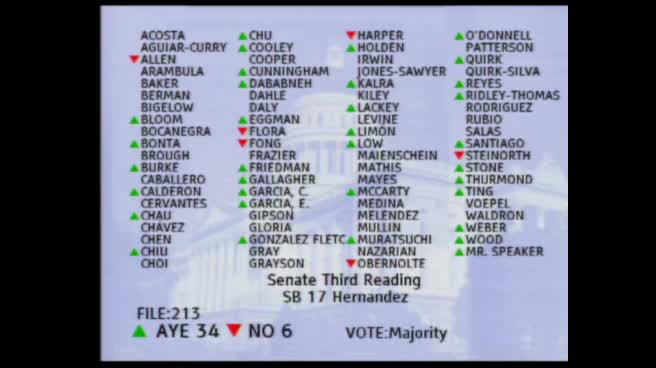 11MIN
Assembly Floor
 1MIN
Assembly Floor
 1MIN
Assembly Standing Committee on Appropriations
 7MIN
Assembly Standing Committee on Public Safety
 2MIN
Senate Floor
 48MIN
Senate Standing Committee on Appropriations
 11MIN
Senate Standing Committee on Public Safety
Bill Author

Bill Co-Author(s):