SB 687: Health facilities: emergency services: Attorney General.
- Session Year: 2017-2018
- House: Senate
- Latest Version Date: 2017-09-20
Existing law requires any nonprofit corporation, as defined, that operates or controls a health facility or operates or controls a facility that provides similar health care, to provide written notice to, and obtain the written consent of, the Attorney General prior to agreeing to sell or otherwise dispose of a material amount of its assets to a for-profit corporation or entity, a mutual benefit corporation or entity, or another nonprofit corporation or entity. Existing law authorizes the Attorney General to consider, before consenting to an agreement to sell or dispose of assets to these corporations or entities, whether the terms and conditions of the agreement or transaction are fair and reasonable to the corporation, and whether the agreement or transaction is at a fair market value, as specified.
This bill would apply the above notice and consent requirements to such a nonprofit corporation, without regard to whether it is currently operating or providing health care services or has a suspended license, prior to agreeing to sell, transfer, lease, exchange, option, convey, or otherwise dispose of the assets resulting from the reduction or elimination of emergency medical services provided at a licensed emergency center after the Attorney General gives a specified consent or conditional consent. The bill would require the Attorney General to review and consent to the sale, transfer, lease, exchange, option, conveyance, or disposal of any assets resulting from a qualifying nonprofit corporations reduction or elimination of emergency medical services that occurred on or after January 1, 2016, if the Attorney General did not already consent to the transfer, lease, exchange, option, conveyance, or disposal of those assets pursuant to specified law and those assets remain under the control of the qualifying nonprofit corporation and notwithstanding the fact that the Attorney General did not review or consent to the closure or reduction.
The bill also would require any nonprofit corporation, as defined, that operates or controls a health facility or operates or controls a facility that provides similar health care and that provides emergency medical services at a licensed emergency center to provide written notice to, and obtain written consent of, the Attorney General prior to a reduction of the level of emergency medical services provided or the elimination of those services. This bill would require the written notice to contain the information that the Attorney General determines is required to make a decision in the public interest. The bill would require the written notice be provided to the Attorney General as soon as possible, but in no case later than 135 days before the planned reduction or elimination. The bill would require the Attorney General to notify the nonprofit corporation of the decision to provide consent or conditional consent or withhold consent to the reduction in or elimination of emergency medical services within specified periods of time. The bill, among other things, would require the Attorney General to conduct one or more public hearings after providing public notice, as specified, before issuing the written notice.
Existing law requires emergency services and care to be provided to any person requesting the services or care, or for whom services or care is requested, for any condition in which the person is in danger of loss of life, or serious injury or illness, at any licensed health facility that maintains and operates an emergency department to provide emergency services to the public when the health facility has appropriate facilities and qualified personnel available to provide the services or care. Existing law authorizes the Attorney General to bring a civil action against the responsible hospital or administrative or medical personnel to enjoin the violation of various provisions of existing law regarding the provision of emergency services at a licensed health facility.
Existing law requires the State Department of Public Health, except as provided, to inspect and license health facilities, as specified. Existing law requires a hospital that provides emergency medical services to, as soon as possible, but not later than 90 days prior to a planned reduction or elimination of the level of emergency medical services, provide notice of the intended change to the State Department of Public Health, among other entities. Violation of these requirements is a crime.
This bill would prohibit the State Department of Public Health from licensing a stand-alone emergency room, freestanding emergency department, or freestanding emergency center that is not part of a general acute care hospital facility providing 24-hour inpatient care with basic services. The bill would require the above-described notice to also be given to the agency in charge of the provision of health services. By changing the definition of a crime, this bill would impose a state-mandated local program.
This bill would incorporate additional changes to Sections 5914 and 5920 of the Corporations Code proposed by AB 651 to be operative only if this bill and AB 651 are enacted and this bill is enacted last.
The California Constitution requires the state to reimburse local agencies and school districts for certain costs mandated by the state. Statutory provisions establish procedures for making that reimbursement.
This bill would provide that no reimbursement is required by this act for a specified reason.
Existing law requires any nonprofit corporation, as defined, that operates or controls a health facility or operates or controls a facility that provides similar health care, to provide written notice to, and obtain the written consent of, the Attorney General prior to agreeing to sell or otherwise dispose of a material amount of its assets to a for-profit corporation or entity, a mutual benefit corporation or entity, or another nonprofit corporation or entity. Existing law authorizes the Attorney General to consider, before consenting to an agreement to sell or dispose of assets to these corporations or entities, whether the terms and conditions of the agreement or transaction are fair and reasonable to the corporation, and whether the agreement or transaction is at a fair market value, as specified.
This bill would apply the above notice and consent requirements to such a nonprofit corporation, without regard to whether it is currently operating or providing health care services or has a suspended license, prior to agreeing to sell, transfer, lease, exchange, option, convey, or otherwise dispose of the assets resulting from the reduction or elimination of emergency medical services provided at a licensed emergency center after the Attorney General gives a specified consent or conditional consent. The bill would require the Attorney General to review and consent to the sale, transfer, lease, exchange, option, conveyance, or disposal of any assets resulting from a qualifying nonprofit corporations reduction or elimination of emergency medical services that occurred on or after January 1, 2016, if the Attorney General did not already consent to the transfer, lease, exchange, option, conveyance, or disposal of those assets pursuant to specified law and those assets remain under the control of the qualifying nonprofit corporation and notwithstanding the fact that the Attorney General did not review or consent to the closure or reduction.
The bill also would require any nonprofit corporation, as defined, that operates or controls a health facility or operates or controls a facility that provides similar health care and that provides emergency medical services at a licensed emergency center to provide written notice to, and obtain written consent of, the Attorney General prior to a reduction of the level of emergency medical services provided or the elimination of those services. This bill would require the written notice to contain the information that the Attorney General determines is required to make a decision in the public interest. The bill would require the written notice be provided to the Attorney General as soon as possible, but in no case later than 135 days before the planned reduction or elimination. The bill would require the Attorney General to notify the nonprofit corporation of the decision to provide consent or conditional consent or withhold consent to the reduction in or elimination of emergency medical services within specified periods of time. The bill, among other things, would require the Attorney General to conduct one or more public hearings after providing public notice, as specified, before issuing the written notice.
Existing law requires emergency services and care to be provided to any person requesting the services or care, or for whom services or care is requested, for any condition in which the person is in danger of loss of life, or serious injury or illness, at any licensed health facility that maintains and operates an emergency department to provide emergency services to the public when the health facility has appropriate facilities and qualified personnel available to provide the services or care. Existing law authorizes the Attorney General to bring a civil action against the responsible hospital or administrative or medical personnel to enjoin the violation of various provisions of existing law regarding the provision of emergency services at a licensed health facility.
Existing law requires the State Department of Public Health, except as provided, to inspect and license health facilities, as specified. Existing law requires a hospital that provides emergency medical services to, as soon as possible, but not later than 90 days prior to a planned reduction or elimination of the level of emergency medical services, provide notice of the intended change to the State Department of Public Health, among other entities. Violation of these requirements is a crime.
This bill would prohibit the State Department of Public Health from licensing a stand-alone emergency room, freestanding emergency department, or freestanding emergency center that is not part of a general acute care hospital facility providing 24-hour inpatient care with basic services. The bill would require the above-described notice to also be given to the agency in charge of the provision of health services. By changing the definition of a crime, this bill would impose a state-mandated local program.
This bill would incorporate additional changes to Sections 5914 and 5920 of the Corporations Code proposed by AB 651 to be operative only if this bill and AB 651 are enacted and this bill is enacted last.
The California Constitution requires the state to reimburse local agencies and school districts for certain costs mandated by the state. Statutory provisions establish procedures for making that reimbursement.
This bill would provide that no reimbursement is required by this act for a specified reason.
Existing law requires any nonprofit corporation, as defined, that operates or controls a health facility or operates or controls a facility that provides similar health care, to provide written notice to, and obtain the written consent of, the Attorney General prior to agreeing to sell or otherwise dispose of a material amount of its assets to a for-profit corporation or entity, a mutual benefit corporation or entity, or another nonprofit corporation or entity. Existing law authorizes the Attorney General to consider, before consenting to an agreement to sell or dispose of assets to these corporations or entities, whether the terms and conditions of the agreement or transaction are fair and reasonable to the corporation, and whether the agreement or transaction is at a fair market value, as specified.
This bill would apply the above notice and consent requirements to such a nonprofit corporation, as defined, without regard to whether it is currently operating or providing health care services or has a suspended license, prior to agreeing to sell, transfer, lease, exchange, option, convey, or otherwise dispose of the assets resulting from the reduction or elimination of emergency medical services provided at a licensed emergency center after the Attorney General gives a specified consent or conditional consent. The bill would apply these provisions to a nonprofit corporations reduction or elimination of emergency medical services that occurred between require the Attorney General to review and consent to the sale, transfer, lease, exchange, option, conveyance, or disposal of any assets resulting from a qualifying nonprofit corporations reduction or elimination of emergency medical services that occurred on or after January 1, 2016, and the effective date of this bill, provided that if the Attorney General did not already consent to the transfer, lease, exchange, option, conveyance, or disposal of those assets pursuant to specified law and those assets remain under the control of the qualifying nonprofit corporation and notwithstanding the fact that the Attorney General did not review or consent to the closure or reduction. The bill, if those assets are no longer in the control of the qualifying nonprofit corporation but were sold, transferred, leased, optioned, conveyed, or disposed of between January 1, 2017, and the effective date of this bill, would require the qualifying nonprofit corporation to notify the Attorney General of the details of the transaction, and would require the Attorney General to review whether the transaction, in whole or in part, was intended to avoid application of the notice requirement and, if the Attorney General makes that determination, would authorize the Attorney General to assess a civil penalty on the qualifying nonprofit corporation.
ThisThe bill also would require any nonprofit corporation, as defined, that operates or controls a health facility or operates or controls a facility that provides similar health care and that provides emergency medical services at a licensed emergency center to provide written notice to, and obtain written consent of, the Attorney General prior to a reduction of the level of emergency medical services provided or their elimination. the elimination of those services. This bill would require the written notice to contain the information that the Attorney General determines is required to make a decision in the public interest. The bill would require the written notice be provided to the Attorney General as soon as possible, but in no case later than 135 days before the planned reduction or elimination. The bill would require the Attorney General to notify the nonprofit corporation of the decision to provide consent or conditional consent or withhold consent to the reduction in or elimination of emergency medical services within specified periods of time. The bill, among other things, would require the Attorney General to conduct one or more public hearings after providing public notice, as specified, before issuing the written notice.
Existing law requires emergency services and care to be provided to any person requesting the services or care, or for whom services or care is requested, for any condition in which the person is in danger of loss of life, or serious injury or illness, at any licensed health facility that maintains and operates an emergency department to provide emergency services to the public when the health facility has appropriate facilities and qualified personnel available to provide the services or care. Existing law authorizes the Attorney General to bring a civil action against the responsible hospital or administrative or medical personnel to enjoin the violation of various provisions of existing law regarding the provision of emergency services at a licensed health facility.
Existing law requires the State Department of Public Health, except as provided, to inspect and license health facilities, as specified. Existing law requires a hospital that provides emergency medical services to, as soon as possible, but not later than 90 days prior to a planned reduction or elimination of the level of emergency medical services, provide notice of the intended change to the State Department of Public Health, among other entities. Violation of these requirements is a crime.
This bill would prohibit the State Department of Public Health from licensing a stand-alone emergency room, freestanding emergency department, or freestanding emergency center that is not part of a general acute care hospital facility providing 24-hour inpatient care with basic services. The bill would require the above-described notice to also be given to the agency in charge of the provision of health services. By changing the definition of a crime, this bill would impose a state-mandated local program.
The California Constitution requires the state to reimburse local agencies and school districts for certain costs mandated by the state. Statutory provisions establish procedures for making that reimbursement.
This bill would provide that no reimbursement is required by this act for a specified reason.
Existing law requires any nonprofit corporation, as defined, that operates or controls a health facility or operates or controls a facility that provides similar health care, to provide written notice to, and obtain the written consent of, the Attorney General prior to agreeing to sell or otherwise dispose of a material amount of its assets to a for-profit corporation or entity, a mutual benefit corporation or entity, or another nonprofit corporation or entity. Existing law authorizes the Attorney General to consider, before consenting to an agreement to sell or dispose of assets to these corporations or entities, whether the terms and conditions of the agreement or transaction are fair and reasonable to the corporation, and whether the agreement or transaction is at a fair market value, as specified.
This bill would apply the above notice and consent requirements to a nonprofit corporation, as defined, prior to agreeing to sell, transfer, lease, exchange, option, convey, or otherwise dispose of the assets resulting from the reduction or elimination of emergency medical services provided at a licensed emergency center after the Attorney General gives a specified consent or conditional consent. The bill would apply these provisions to a nonprofit corporations corporations reduction or elimination of emergency medical services that occurred between January 1, 2016, and the effective date of this bill, provided that those assets remain under the control of the qualifying nonprofit corporation and notwithstanding the fact that the Attorney General did not review or consent to the closure or reduction. The bill, if those assets are no longer in the control of the qualifying nonprofit corporation but were sold, transferred, leased, optioned, conveyed, or disposed of between January 1, 2017, and the effective date of this bill, would require the qualifying nonprofit corporation to notify the Attorney General of the details of the transaction, and would require the Attorney General to review whether the transaction, in whole or in part, was intended to avoid application of the notice requirement and, if the Attorney General makes that determination, would authorize the Attorney General to assess a civil penalty on the qualifying nonprofit corporation.
This bill also would require any nonprofit corporation, as defined, that operates or controls a health facility or operates or controls a facility that provides similar health care and that provides emergency services at a licensed emergency center to provide written notice to, and obtain written consent of, the Attorney General prior to a reduction of the level of emergency medical services provided or their elimination. This bill would require the written notice to contain the information that the Attorney General determines is required to make a decision in the public interest. The bill would require the written notice be provided to the Attorney General as soon as possible, but in no case later than 135 days before the planned reduction or elimination. The bill would require the Attorney General to notify the nonprofit corporation of the decision to provide consent or conditional consent or withhold consent to the reduction in or elimination of emergency medical services within specified periods of time. The bill, among other things, would require the Attorney General to conduct one or more public hearings after providing public notice, as specified, before issuing the written notice.
Existing law requires emergency services and care to be provided to any person requesting the services or care, or for whom services or care is requested, for any condition in which the person is in danger of loss of life, or serious injury or illness, at any licensed health facility that maintains and operates an emergency department to provide emergency services to the public when the health facility has appropriate facilities and qualified personnel available to provide the services or care. Existing law authorizes the Attorney General to bring a civil action against the responsible hospital or administrative or medical personnel to enjoin the violation of various provisions of existing law regarding the provision of emergency services at a licensed health facility.
Existing law requires the State Department of Public Health, except as provided, to inspect and license health facilities, as specified. Existing law requires a hospital that provides emergency medical services to, as soon as possible, but not later than 90 days prior to a planned reduction or elimination of the level of emergency medical services, provide notice of the intended change to the State Department of Public Health, among other entities. Violation of these requirements is a crime.
This bill would prohibit the State Department of Public Health from licensing a stand-alone emergency room, freestanding emergency department, or freestanding emergency center that is not part of a general acute care hospital facility providing 24-hour inpatient care with basic services. The bill would require the above-described notice to also be given to the agency in charge of the provision of health services. By changing the definition of a crime, this bill would impose a state-mandated local program.
The California Constitution requires the state to reimburse local agencies and school districts for certain costs mandated by the state. Statutory provisions establish procedures for making that reimbursement.
This bill would provide that no reimbursement is required by this act for a specified reason.
Existing law requires any nonprofit public benefit corporation corporation, as defined, that operates or controls a health facility or operates or controls a facility that provides similar health care, to provide written notice to, and obtain the written consent of, the Attorney General prior to agreeing to sell or otherwise dispose of a material amount of its assets to a for-profit corporation or entity, a mutual benefit corporation or entity, or another nonprofit corporation or entity. Existing law authorizes the Attorney General to consider, before consenting to an agreement to sell or dispose of assets to these corporations or entities, whether the terms and conditions of the agreement or transaction are fair and reasonable to the nonprofit public benefit corporation, and whether the agreement or transaction is at a fair market value, as specified.
This bill, on and after January 1, 2015, bill would apply the above notice and consent requirements to a nonprofit public benefit corporation corporation, as defined, prior to agreeing to sell, transfer, lease, exchange, option, convey, or otherwise dispose of the assets resulting from the reduction or elimination of emergency medical services provided at a licensed emergency center after the Attorney General gives a specified consent or conditional consent. The bill would apply these provisions to a nonprofit corporations reduction or elimination of emergency medical services that occurred between January 1, 2016, and the effective date of this bill, provided that those assets remain under the control of the qualifying nonprofit corporation and notwithstanding the fact that the Attorney General did not review or consent to the closure or reduction. The bill, if those assets are no longer in the control of the qualifying nonprofit corporation but were sold, transferred, leased, optioned, conveyed, or disposed of between January 1, 2017, and the effective date of this bill, would require the qualifying nonprofit corporation to notify the Attorney General of the details of the transaction, and would require the Attorney General to review whether the transaction, in whole or in part, was intended to avoid application of the notice requirement and, if the Attorney General makes that determination, would authorize the Attorney General to assess a civil penalty on the qualifying nonprofit corporation.
This bill, except as specified, bill also would require any nonprofit public benefit corporation corporation, as defined, that operates or controls a health facility or operates or controls a facility that provides similar health care and that provides emergency services at a licensed emergency center to provide written notice to, and obtain written consent of, the Attorney General prior to a reduction of the level of emergency medical services provided or their elimination. This bill would require the written notice to contain the information that the Attorney General determines is required to make a decision in the public interest. The bill would require the written notice be provided to the Attorney General as soon as possible, but in no case later than 135 days before the planned reduction or elimination. The bill would require the Attorney General to notify the public benefit nonprofit corporation of the decision to provide consent or conditional consent or withhold consent to the reduction in or elimination of emergency medical services within specified periods of time. The bill, among other things, would require the Attorney General to conduct one or more public hearings after providing public notice, as specified, before issuing the written notice.
Existing law requires emergency services and care to be provided to any person requesting the services or care, or for whom services or care is requested, for any condition in which the person is in danger of loss of life, or serious injury or illness, at any licensed health facility that maintains and operates an emergency department to provide emergency services to the public when the health facility has appropriate facilities and qualified personnel available to provide the services or care. Existing law authorizes the Attorney General to bring a civil action against the responsible hospital or administrative or medical personnel to enjoin the violation of various provisions of existing law regarding the provision of emergency services at a licensed health facility.
Existing law requires the State Department of Public Health, except as provided, to inspect and license health facilities, as specified. Existing law requires a hospital that provides emergency medical services to, as soon as possible, but not later than 90 days prior to a planned reduction or elimination of the level of emergency medical services, provide notice of the intended change to the State Department of Public Health, among other entities. Violation of these requirements is a crime.
This bill would prohibit the State Department of Public Health from licensing a stand-alone emergency room room, freestanding emergency department, or freestanding emergency center that is not part of a general acute care hospital facility providing 24-hour inpatient care with basic services. The bill would require the above-described notice to also be given to the agency in charge of the provision of health services. By changing the definition of a crime, this bill would impose a state-mandated local program.
The California Constitution requires the state to reimburse local agencies and school districts for certain costs mandated by the state. Statutory provisions establish procedures for making that reimbursement.
This bill would provide that no reimbursement is required by this act for a specified reason.
Existing law requires any nonprofit public benefit corporation that operates or controls a health facility or operates or controls a facility that provides similar health care, to provide written notice to, and obtain the written consent of, the Attorney General prior to selling agreeing to sell or otherwise disposing dispose of a material amount of its assets to a for-profit corporation or entity, a mutual benefit corporation or entity, or another nonprofit corporation or entity. Existing law authorizes the Attorney General to consider, before consenting to an agreement to sell or dispose of assets to these corporations or entities, whether the terms and conditions of the agreement or transaction are fair and reasonable to the nonprofit public benefit corporation, and whether the agreement or transaction is at a fair market value, as specified.
This bill, on and after January 1, 2015, would apply the above notice and consent requirements to when the a nonprofit public benefit corporation plans to prior to agreeing to sell, transfer, lease, exchange, option, convey, or otherwise dispose of the assets resulting from the reduction or elimination of emergency medical services provided at a licensed emergency center within one year after the Attorney General gives a specified consent or conditional consent.
This bill, except as specified, also would require any nonprofit public benefit corporation that operates or controls a health facility or operates or controls a facility that provides similar health care and that provides emergency services at a licensed emergency center to provide written notice to, and obtain written consent of, the Attorney General prior to a reduction of the level of emergency medical services provided or their elimination. This bill would require the written notice to contain the information that the Attorney General determines is required to make a decision in the public interest. The bill would require the Attorney General to notify the public benefit corporation of the decision to provide consent or conditional consent or withhold consent to the reduction in or elimination of emergency medical services within specified periods of time. This The bill, among other things, would require the Attorney General to conduct one or more public hearings after providing public notice, as specified, before issuing the written notice.
Existing law requires emergency services and care to be provided to any person requesting the services or care, or for whom services or care is requested, for any condition in which the person is in danger of loss of life, or serious injury or illness, at any licensed health facility licensed under this chapter that maintains and operates an emergency department to provide emergency services to the public when the health facility has appropriate facilities and qualified personnel available to provide the services or care. Existing law authorizes the Attorney General to bring a civil action against the responsible hospital or administrative or medical personnel to enjoin the violation of various provisions of existing law regarding the provision of emergency services at a licensed health facility.
Existing law requires the State Department of Public Health, except as provided, to inspect and license health facilities, as specified. Existing law requires a hospital that provides emergency medical services to, as soon as possible, but not later than 90 days prior to a planned reduction or elimination of the level of emergency medical services, provide notice of the intended change to the State Department of Public Health, among other entities. Violation of these requirements is a crime.
This bill would prohibit the State Department of Public Health from licensing a stand-alone emergency room or freestanding emergency center that is not part of a general acute care hospital facility providing 24-hour inpatient care with basic services. The bill would require the above-described notice to also be given to the Attorney General. agency in charge of the provision of health services. By changing the definition of a crime, this bill would impose a state-mandated local program.
The California Constitution requires the state to reimburse local agencies and school districts for certain costs mandated by the state. Statutory provisions establish procedures for making that reimbursement.
This bill would provide that no reimbursement is required by this act for a specified reason.
Existing law requires any nonprofit corporation that operates or controls a health facility or operates or controls a facility that provides similar health care, to provide written notice to, and obtain the written consent of, the Attorney General prior to selling or otherwise disposing of a material amount of its assets to a for-profit corporation or entity, a mutual benefit corporation or entity, or another nonprofit corporation or entity. Existing law authorizes the Attorney General to consider, before consenting to an agreement to sell or dispose of assets to these corporations or entities, whether the terms and conditions of the agreement or transaction are fair and reasonable to the nonprofit corporation, and whether the agreement or transaction is at a fair market value, as specified.
This bill would apply the above notice and consent requirements to when the nonprofit corporation plans to sell, transfer, lease, exchange, option, convey, or otherwise dispose of a licensed emergency center within one year after the Attorney General gives a specified consent or conditional consent.
This bill, except as specified, also would require any nonprofit corporation that operates or controls a health facility or operates or controls a facility that provides similar health care and that provides emergency services at a licensed emergency center to provide written notice to, and obtain written consent of, the Attorney General prior to a reduction of the level of emergency medical services provided or their elimination. This bill would require the written notice to contain the information that the Attorney General determines is required to make a decision in the public interest. The bill would require the Attorney General to notify the public benefit corporation of the decision to provide consent or conditional consent or withhold consent to the reduction in or elimination of emergency medical services within specified periods of time. This bill, among other things, would require the Attorney General to conduct one or more public hearings after providing public notice, as specified, before issuing the written notice.
Existing law requires emergency services and care to be provided to any person requesting the services or care, or for whom services or care is requested, for any condition in which the person is in danger of loss of life, or serious injury or illness, at any health facility licensed under this chapter that maintains and operates an emergency department to provide emergency services to the public when the health facility has appropriate facilities and qualified personnel available to provide the services or care. Existing law authorizes the Attorney General to bring a civil action against the responsible hospital or administrative or medical personnel to enjoin the violation of various provisions of existing law regarding the provision of emergency services at a licensed health facility.
Existing law requires a hospital that provides emergency medical services to, as soon as possible, but not later than 90 days prior to a planned reduction or elimination of the level of emergency medical services, provide notice of the intended change to the State Department of Public Health, among other entities. Violation of these requirements is a crime.
This bill would require the above-described notice to also be given to the Attorney General. By changing the definition of a crime, this bill would impose a state-mandated local program.
The California Constitution requires the state to reimburse local agencies and school districts for certain costs mandated by the state. Statutory provisions establish procedures for making that reimbursement.
This bill would provide that no reimbursement is required by this act for a specified reason.
(a)(1)Any nonprofit corporation that is defined in Section 5046 and operates or controls a health facility, as defined in Section 1250 of the Health and Safety Code, or operates or controls a facility that provides similar health care, regardless of whether it is currently operating or providing health care services or has a suspended license, shall be required to provide written notice to, and to obtain the written consent of, the Attorney General prior to entering into any agreement or transaction to do any of the following:
(A)Sell, transfer, lease, exchange, option, convey, or otherwise dispose of, its assets to a for-profit corporation or entity or to a mutual benefit corporation or entity when a material amount of the assets of the nonprofit corporation are involved in the agreement or transaction.
(B)Transfer control, responsibility, or governance of a material amount of the assets or operations of the nonprofit corporation to any for-profit corporation or entity or to any mutual benefit corporation or entity.
(C)Sell, transfer, lease, exchange, option, convey, or otherwise dispose of the assets resulting from the reduction or elimination of emergency medical services provided at an emergency center licensed pursuant to Sections 1254, 1255, and 1277 of the Health and Safety Code to a for-profit corporation or entity or to a mutual benefit corporation or entity after the Attorney General gives, pursuant to Section 5940, consent or conditional consent to the reduction or elimination of emergency medical services.
(2)The substitution of a new corporate member or members that transfers the control of, responsibility for, or governance of the nonprofit corporation shall be deemed a transfer for purposes of this article. The substitution of one or more members of the governing body, or any arrangement, written or oral, that would transfer voting control of the members of the governing body, shall also be deemed a transfer for purposes of this article.
(b)The notice to the Attorney General provided for in this section shall include and contain the information the Attorney General determines is required. The notice, including any other information provided to the Attorney General under this article, and that is in the public file, shall be made available by the Attorney General to the public in written form, as soon as is practicable after it is received by the Attorney General.
(c)(1)This section shall not apply to a nonprofit corporation if the agreement or transaction is in the usual and regular course of its activities or if the Attorney General has given the corporation a written waiver of this section as to the proposed agreement or transaction, except that this subdivision shall not apply to subparagraph (C) of paragraph (1) of subdivision (a).
(2)The Attorney General shall review and consent to the sale, transfer, lease, exchange, option, conveyance, or disposal of any assets resulting from a qualifying nonprofit corporations reduction or elimination of emergency medical services that occurred on or after January 1, 2016, provided the Attorney General did not already consent to the transfer, lease, exchange, option, conveyance, or disposal of those assets pursuant to either this section or Section 5920 and those assets remain under the control of the qualifying nonprofit corporation as of the effective date of the act adding this paragraph, notwithstanding the fact that the Attorney General did not review or consent to the closure or reduction pursuant to Section 5940.
(d)This section shall apply to any foreign nonprofit corporation that operates or controls a health facility, as defined in Section 1250 of the Health and Safety Code, or a facility that provides similar health care, regardless of whether it is operating or providing health care services or has a suspended license.
(e)This section shall not be construed to allow the Attorney General to authorize emergency medical services to be provided by a facility that does not meet the requirements of Section 1798.175 of the Health and Safety Code or is not licensed to provide emergency medical services pursuant to Sections 1254, 1255, and 1277 of the Health and Safety Code or to authorize a nonprofit general acute care hospital to reduce operations to provide emergency medical services without providing 24-hour inpatient care with basic services, including, but not limited to, medical, nursing, surgical, anesthesia, laboratory, radiology, pharmacy, and dietary services. This section shall not be construed to authorize, allow for, or permit operation of an emergency department that does not meet the definition in Section 128700 of the Health and Safety Code. This section shall not be construed to authorize, allow for, or permit emergency medical services to be provided that do not meet the requirements for standby, basic, or comprehensive emergency medical services, as defined in Article 6 (commencing with Section 70401) of Chapter 1 of Division 5 of Title 22 of the California Code of Regulations.
SEC. 1.5.Section 5914 of the Corporations Code is amended to read:5914.(a)(1)Any nonprofit corporation that is defined in Section 5046 and operates or controls a health facility, as defined in Section 1250 of the Health and Safety Code, or operates or controls a facility that provides similar health care, regardless of whether it is currently operating or providing health care services or has a suspended license, shall be required to provide written notice to, and to obtain the written consent of, the Attorney General prior to entering into any agreement or transaction to do any of the following:
(A)Sell, transfer, lease, exchange, option, convey, or otherwise dispose of, its assets to a for-profit corporation or entity or to a mutual benefit corporation or entity when a material amount of the assets of the nonprofit corporation are involved in the agreement or transaction.
(B)Transfer control, responsibility, or governance of a material amount of the assets or operations of the nonprofit corporation to any for-profit corporation or entity or to any mutual benefit corporation or entity.
(C)Sell, transfer, lease, exchange, option, convey, or otherwise dispose of the assets resulting from the reduction or elimination of emergency medical services provided at an emergency center licensed pursuant to Sections 1254, 1255, and 1277 of the Health and Safety Code to a for-profit corporation or entity or to a mutual benefit corporation or entity after the Attorney General gives, pursuant to Section 5940, consent or conditional consent to the reduction or elimination of emergency medical services.
(2)The substitution of a new corporate member or members that transfers the control of, responsibility for, or governance of the nonprofit corporation shall be deemed a transfer for purposes of this article. The substitution of one or more members of the governing body, or any arrangement, written or oral, that would transfer voting control of the members of the governing body, shall also be deemed a transfer for purposes of this article.
(b)The notice to the Attorney General provided for in this section shall include and contain the information the Attorney General determines is required. The notice, including any other information provided to the Attorney General under this article, and that is in the public file, shall be made available by the Attorney General to the public in written form, as soon as is practicable after it is received by the Attorney General. The notice shall include a list of the primary languages spoken at the facility and the threshold languages for Medi-Cal beneficiaries, as determined by the State Department of Health Care Services for the county in which the facility is located. The Attorney General may require the nonprofit corporation to provide certain components of the notice in any of these languages.
(c)(1)This section shall not apply to a nonprofit corporation if the agreement or transaction is in the usual and regular course of its activities or if the Attorney General has given the corporation a written waiver of this section as to the proposed agreement or transaction, except that this subdivision shall not apply to subparagraph (C) of paragraph (1) of subdivision (a).
(2)The Attorney General shall review and consent to the sale, transfer, lease, exchange, option, conveyance, or disposal of any assets resulting from a qualifying nonprofit corporations reduction or elimination of emergency medical services that occurred on or after January 1, 2016, provided the Attorney General did not already consent to the transfer, lease, exchange, option, conveyance, or disposal of those assets pursuant to either this section or Section 5920 and those assets remain under the control of the qualifying nonprofit corporation as of the effective date of the act adding this paragraph, notwithstanding the fact that the Attorney General did not review or consent to the closure or reduction pursuant to Section 5940.
(d)This section shall apply to any foreign nonprofit corporation that operates or controls a health facility, as defined in Section 1250 of the Health and Safety Code, or a facility that provides similar health care, regardless of whether it is currently operating or providing health care services or has a suspended license.
(e)This section shall not be construed to allow the Attorney General to authorize emergency medical services to be provided by a facility that does not meet the requirements of Section 1798.175 of the Health and Safety Code or is not licensed to provide emergency medical services pursuant to Sections 1254, 1255, and 1277 of the Health and Safety Code or to authorize a nonprofit general acute care hospital to reduce operations to provide emergency medical services without providing 24-hour inpatient care with basic services, including, but not limited to, medical, nursing, surgical, anesthesia, laboratory, radiology, pharmacy, and dietary services. This section shall not be construed to authorize, allow for, or permit operation of an emergency department that does not meet the definition in Section 128700 of the Health and Safety Code. This section shall not be construed to authorize, allow for, or permit emergency medical services to be provided that do not meet the requirements for standby, basic, or comprehensive emergency medical services, as defined in Article 6 (commencing with Section 70401) of Chapter 1 of Division 5 of Title 22 of the California Code of Regulations.
SEC. 2.Section 5920 of the Corporations Code is amended to read:5920.(a)(1)Any nonprofit corporation that is defined in Section 5046 and operates or controls a health care facility, as defined in Section 1250 of the Health and Safety Code, or operates or controls a facility that provides similar health care, regardless of whether it is currently operating or providing health care services or has a suspended license, shall be required to provide written notice to, and to obtain the written consent of, the Attorney General prior to entering into any agreement or transaction to do any of the following:
(A)Sell, transfer, lease, exchange, option, convey, or otherwise dispose of, its assets to another nonprofit corporation or entity when a material amount of the assets of the nonprofit corporation are involved in the agreement or transaction.
(B)Transfer control, responsibility, or governance of a material amount of the assets or operations of the nonprofit corporation to another nonprofit corporation or entity.
(C)Sell, transfer, lease, exchange, option, convey, or otherwise dispose of the assets resulting from the reduction or elimination of emergency medical services provided at an emergency center licensed pursuant to Sections 1254, 1255, and 1277 of the Health and Safety Code to another nonprofit corporation or entity after the Attorney General gives, pursuant to Section 5940, consent or conditional consent to the reduction or elimination of emergency medical services.
(2)The substitution of a new corporate member or members that transfers the control of, responsibility for, or governance of the nonprofit corporation, the substitution of one or more members of the governing body that would transfer voting control of the members of the governing body, or any arrangement, written or oral, that would transfer voting control of the entity shall be deemed a transfer for purposes of this article.
(b)The notice to the Attorney General provided for in this section shall contain the information the Attorney General determines is required. The notice, including any other information provided to the Attorney General under this article, and that is the public file, shall be made available by the Attorney General to the public in written form, as soon as is practicable after it is received by the Attorney General.
(c)(1)This section shall not apply to a nonprofit corporation if the agreement or transaction is in the usual and regular course of its activities or if the Attorney General has given the corporation a written waiver of this section as to the proposed agreement or transaction, except that this subdivision shall not apply to subparagraph (C) of paragraph (1) of subdivision (a).
(2)The Attorney General shall review and consent to the sale, transfer, lease, exchange, option, conveyance, or disposal of any assets resulting from a qualifying nonprofit corporations reduction or elimination of emergency medical services that occurred on or after January 1, 2016, provided the Attorney General did not already consent to the transfer, lease, exchange, option, conveyance, or disposal of those assets pursuant to either this section or Section 5914 and those assets remain under the control of the qualifying nonprofit corporation as of the effective date of the act adding this paragraph, notwithstanding the fact that the Attorney General did not review or consent to the closure or reduction pursuant to Section 5940.
(d)This section shall apply to any foreign nonprofit corporation that operates or controls a health facility, as defined in Section 1250 of the Health and Safety Code, or a facility that provides similar health care, regardless of whether it is operating or providing health care services or has a suspended license.
(e)This section shall not apply to an agreement or transaction if the other party to the agreement or transaction is an affiliate, as defined in Section 5031, of the transferring nonprofit corporation or entity, and the corporation or entity has given the Attorney General 20 days advance notice of the agreement or transaction.
(f)This section shall not be construed to allow the Attorney General to authorize emergency medical services to be provided by a facility that does not meet the requirements of Section 1798.175 of the Health and Safety Code or is not licensed to provide emergency medical services pursuant to Sections 1254, 1255, and 1277 of the Health and Safety Code or to authorize a nonprofit general acute care hospital to reduce operations to provide emergency medical services without providing 24-hour inpatient care with basic services, including, but not limited to, medical, nursing, surgical, anesthesia, laboratory, radiology, pharmacy, and dietary services. This section shall not be construed to authorize, allow for, or permit operation of an emergency department that does not meet the definition in Section 128700 of the Health and Safety Code. This section shall not be construed to authorize, allow for, or permit emergency medical services to be provided that do not meet the requirements for standby, basic, or comprehensive emergency medical services, as defined in Article 6 (commencing with Section 70401) of Chapter 1 of Division 5 of Title 22 of the California Code of Regulations.
SEC. 2.5.Section 5920 of the Corporations Code is amended to read:5920.(a)(1)Any nonprofit corporation that is defined in Section 5046 and operates or controls a health care facility, as defined in Section 1250 of the Health and Safety Code, or operates or controls a facility that provides similar health care, regardless of whether it is currently operating or providing health care services or has a suspended license, shall be required to provide written notice to, and to obtain the written consent of, the Attorney General prior to entering into any agreement or transaction to do any of the following:
(A)Sell, transfer, lease, exchange, option, convey, or otherwise dispose of, its assets to another nonprofit corporation or entity when a material amount of the assets of the nonprofit corporation are involved in the agreement or transaction.
(B)Transfer control, responsibility, or governance of a material amount of the assets or operations of the nonprofit corporation to another nonprofit corporation or entity.
(C)Sell, transfer, lease, exchange, option, convey, or otherwise dispose of the assets resulting from the reduction or elimination of emergency medical services provided at an emergency center licensed pursuant to Sections 1254, 1255, and 1277 of the Health and Safety Code to another nonprofit corporation or entity after the Attorney General gives, pursuant to Section 5940, consent or conditional consent to the reduction or elimination of emergency medical services.
(2)The substitution of a new corporate member or members that transfers the control of, responsibility for, or governance of the nonprofit corporation, the substitution of one or more members of the governing body that would transfer voting control of the members of the governing body, or any arrangement, written or oral, that would transfer voting control of the entity shall be deemed a transfer for purposes of this article.
(b)The notice to the Attorney General provided for in this section shall contain the information the Attorney General determines is required. The notice, including any other information provided to the Attorney General under this article, and that is the public file, shall be made available by the Attorney General to the public in written form, as soon as is practicable after it is received by the Attorney General. The notice to the Attorney General shall include a list of the primary languages spoken at the facility and the threshold languages for Medi-Cal beneficiaries as determined by the State Department of Health Care Services for the county in which the facility is located. The Attorney General may require the nonprofit corporation to provide certain components of the notice in any of those languages.
(c)(1)This section shall not apply to a nonprofit corporation if the agreement or transaction is in the usual and regular course of its activities or if the Attorney General has given the corporation a written waiver of this section as to the proposed agreement or transaction, except that this subdivision shall not apply to subparagraph (C) of paragraph (1) of subdivision (a).
(2)The Attorney General shall review and consent to the sale, transfer, lease, exchange, option, conveyance, or disposal of any assets resulting from a qualifying nonprofit corporations reduction or elimination of emergency medical services that occurred on or after January 1, 2016, provided the Attorney General did not already consent to the transfer, lease, exchange, option, conveyance, or disposal of those assets pursuant to either this section or Section 5914 and those assets remain under the control of the qualifying nonprofit corporation as of the effective date of the act adding this paragraph, notwithstanding the fact that the Attorney General did not review or consent to the closure or reduction pursuant to Section 5940.
(d)This section shall apply to any foreign nonprofit corporation that operates or controls a health facility, as defined in Section 1250 of the Health and Safety Code, or a facility that provides similar health care, regardless of whether it is currently operating or providing health care services or has a suspended license.
(e)This section shall not apply to an agreement or transaction if the other party to the agreement or transaction is an affiliate, as defined in Section 5031, of the transferring nonprofit corporation or entity, and the corporation or entity has given the Attorney General 20 days advance notice of the agreement or transaction.
(f)This section shall not be construed to allow the Attorney General to authorize emergency medical services to be provided by a facility that does not meet the requirements of Section 1798.175 of the Health and Safety Code or is not licensed to provide emergency medical services pursuant to Sections 1254, 1255, and 1277 of the Health and Safety Code or to authorize a nonprofit general acute care hospital to reduce operations to provide emergency medical services without providing 24-hour inpatient care with basic services, including, but not limited to, medical, nursing, surgical, anesthesia, laboratory, radiology, pharmacy, and dietary services. This section shall not be construed to authorize, allow for, or permit operation of an emergency department that does not meet the definition in Section 128700 of the Health and Safety Code. This section shall not be construed to authorize, allow for, or permit emergency medical services to be provided that do not meet the requirements for standby, basic, or comprehensive emergency medical services, as defined in Article 6 (commencing with Section 70401) of Chapter 1 of Division 5 of Title 22 of the California Code of Regulations.
SEC. 3.Chapter 9.2 (commencing with Section 5940) is added to Part 2 of Division 2 of Title 1 of the Corporations Code, to read:9.2.Emergency Center Services5940.(a)A nonprofit corporation that operates or controls a health facility, as defined in Section 1250 of the Health and Safety Code, or operates or controls a facility that provides similar health care, and that provides emergency medical services at an emergency center licensed under Sections 1254, 1255, and 1277 of the Health and Safety Code, shall provide written notice to, and to obtain the written consent of, the Attorney General prior to a planned reduction in the level of emergency medical services provided or elimination of those services. The written notice required by this section shall be provided to the Attorney General as soon as possible, but in no case later than 135 days before the planned reduction in the level of emergency medical services provided or elimination of those services.
(b)Except as provided in subdivision (j), this section shall not apply to a nonprofit corporation if the Attorney General has given the corporation a written waiver of this section as to the planned elimination or reduction of the level of emergency medical services.
(c)The notice to the Attorney General described in subdivision (a) shall include and contain the information the Attorney General determines is required to make a decision in the public interest pursuant to this section. The notice, including any other information provided to the Attorney General under this section, and that is in the public file, shall be made available by the Attorney General to the public in written form, as soon as is practicable after it is received by the Attorney General.
(d)Within 90 days of the receipt of the written notice described in subdivision (a), the Attorney General shall notify the nonprofit corporation in writing of the decision to consent to, give conditional consent to, or not consent to the reduction or elimination in emergency medical services. The Attorney General may extend this period for one additional 45-day period if either of the following conditions is satisfied:
(1)The extension is necessary to obtain information to make a determination pursuant to paragraph (1) of subdivision (f).
(2)The plan to reduce or eliminate emergency medical services is substantially modified after the first public meeting conducted by the Attorney General in accordance with subdivision (e).
(e)Prior to issuing any written decision referred to in subdivision (a), the Attorney General shall conduct one or more public meetings, one of which shall be in the county in which the facility is located, to hear comments from interested parties. At least 14 days before conducting the public meeting, the Attorney General shall provide written notice of the time and place of the meeting through publication in one or more newspapers of general circulation in the affected community and to the board of supervisors of the county in which the facility is located. If a substantive change in the plan to eliminate or reduce emergency medical services is submitted to the Attorney General after the initial public meeting, the Attorney General may conduct an additional public meeting to hear comments from interested parties with respect to that change.
(f)The Attorney General shall have discretion to consent to, give conditional consent to, or not consent to any elimination or reduction of emergency medical services described in subdivision (a). In making the determination, the Attorney General shall consider any factors that the Attorney General deems relevant, including, but not limited to, whether any of the following apply:
(1)The planned elimination or reduction in the level of emergency medical services is consistent with the charitable trust on which the assets are held by the health facility or by the affiliated nonprofit health system.
(2)The planned elimination or reduction involves or constitutes any breach of trust.
(3)The Attorney General has been provided, pursuant to Section 5250, with sufficient information and data by the nonprofit corporation to evaluate adequately the reduction or elimination of emergency medical services, or the effects thereof on the public.
(4)The reduction or elimination of emergency medical services may create a significant effect on the availability or accessibility of health care services to the affected community.
(5)The proposed reduction or elimination of emergency medical services is in the public interest.
(g)If the Attorney General gives consent or conditional consent to the reduction or elimination of emergency medical services pursuant to this section, and the assets resulting from the reduction or elimination are sold, transferred, leased, exchanged, optioned, conveyed, or otherwise disposed of, the disposal of those assets shall be subject to Sections 5914 or 5920.
(h)(1)Within the time periods designated in subdivision (d) and relating to those factors specified in subdivision (f), the Attorney General may do the following:
(A)Contract with, consult, and receive advice from any state agency on those terms and conditions that the Attorney General deems appropriate.
(B)In his or her sole discretion, contract with experts or consultants to assist in reviewing the proposed changes to the level of emergency services provided.
(2)Contract costs shall not exceed an amount that is reasonable and necessary to conduct the review and evaluation. Any contract entered into under this section shall be on a noncompetitive bid basis and shall be exempt from Chapter 2 (commencing with Section 10290) of Part 2 of Division 2 of the Public Contract Code. The nonprofit corporation, upon request, shall pay the Attorney General promptly for all contract costs.
(3)The Attorney General shall be entitled to reimbursement from the nonprofit corporation for all actual, reasonable, direct costs incurred in reviewing, evaluating, and making the determination referred to in this chapter, including administrative costs. The nonprofit corporation shall promptly pay the Attorney General, upon request, for all of those costs.
(4)In order to monitor effectively ongoing compliance with any terms and conditions that the Attorney General may impose pursuant to this section, including, but not limited to, the ongoing use of the charitable assets in a manner consistent with the trust pursuant to which they are held, the Attorney General may, in his or her sole discretion, contract with experts and consultants to assist in this regard. Contract costs shall not exceed an amount that is reasonable and necessary to conduct the review and evaluation. Any contract entered into under this section shall be on a noncompetitive bid basis and shall be exempt from Chapter 2 (commencing with Section 10290) of Part 2 of Division 2 of the Public Contract Code. The nonprofit corporation shall pay the Attorney General promptly for all contract costs. The Attorney General shall be entitled to reimbursement from the corporation for all actual, reasonable, and direct costs incurred in monitoring ongoing compliance with the terms and conditions of the reduction or elimination of emergency medical services, including contract and administrative costs. The nonprofit corporation, upon request, shall pay the Attorney General promptly for all contract costs.
(i)The Attorney General may adopt regulations implementing this section.
(j)This section shall not be construed to allow the Attorney General to authorize emergency medical services to be provided by a facility that does not meet the requirements of Section 1798.175 of the Health and Safety Code, or is not licensed to provide emergency medical services pursuant to Section 1254, 1255, and 1277 of the Health and Safety Code, or to authorize a nonprofit general acute care hospital to reduce operations to provide emergency medical services without providing 24-hour inpatient care with basic services, including, but not limited to, medical, nursing, surgical, anaesthesia, laboratory, radiology, pharmacy, and dietary services. This section shall not be construed to authorize, allow for, or permit operation of an emergency department that does not meet the definition in Section 128700 of the Health and Safety Code. This section shall not be construed to authorize, allow for, or permit emergency medical services to be provided that do not meet the requirements for standby, basic, or comprehensive emergency medical services, as defined in Article 6 (commencing with Section 70401) of Chapter 1 of Division 5 of Title 22 of the California Code of Regulations.
(k)For purposes of this section, nonprofit corporation means a corporation that is defined in Section 5046 or a foreign corporation that is defined in Section 5053.
SEC. 4.Section 1254 of the Health and Safety Code is amended to read:1254.(a)Except as provided in subdivision (e), the state department shall inspect and license health facilities. The state department shall license health facilities to provide their respective basic services specified in Section 1250. Except as provided in Section 1253, the state department shall inspect and approve a general acute care hospital to provide special services as specified in Section 1255. The state department shall not license a stand-alone emergency room, freestanding emergency department, or freestanding emergency center that is not part of a general acute care hospital facility providing 24-hour inpatient care with basic services, including, but not limited to, medical, nursing, surgical, anesthesia, laboratory, radiology, pharmacy, and dietary services. The state department shall develop and adopt regulations to implement the provisions contained in this section.
(b)Upon approval, the state department shall issue a separate license for the provision of the basic services enumerated in subdivision (c) or (d) of Section 1250 whenever these basic services are to be provided by an acute care hospital, as defined in subdivision (a), (b), or (f) of that section, where the services enumerated in subdivision (c) or (d) of Section 1250 are to be provided in any separate freestanding facility, whether or not the location of the separate freestanding facility is contiguous to the acute care hospital. The same requirement shall apply to any new freestanding facility constructed for the purpose of providing basic services, as defined in subdivision (c) or (d) of Section 1250, by any acute care hospital on or after January 1, 1984.
(c)(1)Those beds licensed to an acute care hospital which, prior to January 1, 1984, were separate freestanding beds and were not part of the physical structure licensed to provide acute care, and which beds were licensed to provide those services enumerated in subdivision (c) or (d) of Section 1250, are exempt from the requirements of subdivision (b).
(2)All beds licensed to an acute care hospital and located within the physical structure in which acute care is provided are exempt from the requirements of subdivision (b) irrespective of the date of original licensure of the beds, or the licensed category of the beds.
(3)All beds licensed to an acute care hospital owned and operated by the State of California or any other public agency are exempt from the requirements of subdivision (b).
(4)All beds licensed to an acute care hospital in a rural area as defined by Chapter 1010, of the Statutes of 1982, are exempt from the requirements of subdivision (b), except where there is a freestanding skilled nursing facility or intermediate care facility which has experienced an occupancy rate of 95 percent or less during the past 12 months within a 25-mile radius or which may be reached within 30 minutes using a motor vehicle.
(5)All beds licensed to an acute care hospital which meet the criteria for designation within peer group six or eight, as defined in the report entitled Hospital Peer Grouping for Efficiency Comparison, dated December 20, 1982, and published by the California Health Facilities Commission, and all beds in hospitals which have fewer than 76 licensed acute care beds and which are located in a census designation place of 15,000 or less population, are exempt from the requirements of subdivision (b), except where there is a freestanding skilled nursing facility or intermediate care facility which has experienced an occupancy rate of 95 percent or less during the past 12 months within a 25-mile radius or which may be reached within 30 minutes using a motor vehicle.
(6)All beds licensed to an acute care hospital which has had a certificate of need approved by a health systems agency on or before July 1, 1983, are exempt from the requirements of subdivision (b).
(7)All beds licensed to an acute care hospital are exempt from the requirements of subdivision (b), if reimbursement from the Medi-Cal program for beds licensed for the provision of services enumerated in subdivision (c) or (d) of Section 1250 and not otherwise exempt does not exceed the reimbursement which would be received if the beds were in a separately licensed facility.
(d)Except as provided in Section 1253, the state department shall inspect and approve a general acute care hospital to provide special services as specified in Section 1255. The state department shall develop and adopt regulations to implement subdivisions (a) to (d), inclusive, of this section.
(e)The State Department of Health Care Services shall inspect and license psychiatric health facilities. The State Department of Health Care Services shall license psychiatric health facilities to provide their basic services specified in Section 1250.2. The State Department of Health Care Services shall develop, adopt, or amend regulations to implement this subdivision.
SEC. 5.Section 1255.1 of the Health and Safety Code is amended to read:1255.1.(a)Any hospital that provides emergency medical services under Section 1255 shall, as soon as possible, but not later than 90 days prior to a planned reduction or elimination of the level of emergency medical services, provide notice of the intended change to the state department, the local government entity, and the agency in charge of the provision of health services, and all health care service plans or other entities under contract with the hospital to provide services to enrollees of the plan or other entity.
(b)In addition to the notice required by subdivision (a), the hospital shall, within the time limits specified in subdivision (a), provide public notice of the intended change in a manner that is likely to reach a significant number of residents of the community serviced by that facility.
(c)A hospital shall not be subject to this section or Section 1255.2 if the state department does either of the following:
(1)Determines that the use of resources to keep the emergency center open substantially threatens the stability of the hospital as a whole.
(2)Cites the emergency center for unsafe staffing practices.
SEC. 6.Section 1.5 of this bill incorporates amendments to Section 5914 of the Corporations Code proposed by both this bill and Assembly Bill 651. That section of this bill shall only become operative if (1) both bills are enacted and become effective on or before January 1, 2018, (2) each bill amends Section 5914 of the Corporations Code, and (3) this bill is enacted after Assembly Bill 651, in which case Section 1 of this bill shall not become operative.
SEC. 7.Section 2.5 of this bill incorporates amendments to Section 5920 of the Corporations Code proposed by both this bill and Assembly Bill 651. That section of this bill shall only become operative if (1) both bills are enacted and become effective on or before January 1, 2018, (2) each bill amends Section 5920 of the Corporations Code, and (3) this bill is enacted after Assembly Bill 651, in which case Section 2 of this bill shall not become operative.
SEC. 8.No reimbursement is required by this act pursuant to Section 6 of Article XIIIB of the California Constitution because the only costs that may be incurred by a local agency or school district will be incurred because this act creates a new crime or infraction, eliminates a crime or infraction, or changes the penalty for a crime or infraction, within the meaning of Section 17556 of the Government Code, or changes the definition of a crime within the meaning of Section 6 of Article XIIIB of the California Constitution.
(a)(1)Any nonprofit corporation that is defined in Section 5046 and operates or controls a health facility, as defined in Section 1250 of the Health and Safety Code, or operates or controls a facility that provides similar health care, regardless of whether it is currently operating or providing health care services or has a suspended license, shall be required to provide written notice to, and to obtain the written consent of, the Attorney General prior to entering into any agreement or transaction to do any of the following:
(A)Sell, transfer, lease, exchange, option, convey, or otherwise dispose of, its assets to a for-profit corporation or entity or to a mutual benefit corporation or entity when a material amount of the assets of the nonprofit corporation are involved in the agreement or transaction.
(B)Transfer control, responsibility, or governance of a material amount of the assets or operations of the nonprofit corporation to any for-profit corporation or entity or to any mutual benefit corporation or entity.
(C)Sell, transfer, lease, exchange, option, convey, or otherwise dispose of the assets resulting from the reduction or elimination of emergency medical services provided at an emergency center licensed pursuant to Sections 1254, 1255, and 1277 of the Health and Safety Code to a for-profit corporation or entity or to a mutual benefit corporation or entity after the Attorney General gives, pursuant to Section 5940, consent or conditional consent to the reduction or elimination of emergency medical services.
(2)The substitution of a new corporate member or members that transfers the control of, responsibility for, or governance of the nonprofit corporation shall be deemed a transfer for purposes of this article. The substitution of one or more members of the governing body, or any arrangement, written or oral, that would transfer voting control of the members of the governing body, shall also be deemed a transfer for purposes of this article.
(b)The notice to the Attorney General provided for in this section shall include and contain the information the Attorney General determines is required. The notice, including any other information provided to the Attorney General under this article, and that is in the public file, shall be made available by the Attorney General to the public in written form, as soon as is practicable after it is received by the Attorney General.
(c)(1)This section shall not apply to a nonprofit corporation if the agreement or transaction is in the usual and regular course of its activities or if the Attorney General has given the corporation a written waiver of this section as to the proposed agreement or transaction, except that this subdivision shall not apply to subparagraph (C) of paragraph (1) of subdivision (a).
(2)The Attorney General shall review and consent to the sale, transfer, lease, exchange, option, conveyance, or disposal of any assets resulting from a qualifying nonprofit corporations reduction or elimination of emergency medical services that occurred on or after January 1, 2016, provided the Attorney General did not already consent to the transfer, lease, exchange, option, conveyance, or disposal of those assets pursuant to either this section or Section 5920 and those assets remain under the control of the qualifying nonprofit corporation as of the effective date of the act adding this paragraph, notwithstanding the fact that the Attorney General did not review or consent to the closure or reduction pursuant to Section 5940.
(d)This section shall apply to any foreign nonprofit corporation that operates or controls a health facility, as defined in Section 1250 of the Health and Safety Code, or a facility that provides similar health care, regardless of whether it is operating or providing health care services or has a suspended license.
(e)This section shall not be construed to allow the Attorney General to authorize emergency medical services to be provided by a facility that does not meet the requirements of Section 1798.175 of the Health and Safety Code or is not licensed to provide emergency medical services pursuant to Sections 1254, 1255, and 1277 of the Health and Safety Code or to authorize a nonprofit general acute care hospital to reduce operations to provide emergency medical services without providing 24-hour inpatient care with basic services, including, but not limited to, medical, nursing, surgical, anesthesia, laboratory, radiology, pharmacy, and dietary services. This section shall not be construed to authorize, allow for, or permit operation of an emergency department that does not meet the definition in Section 128700 of the Health and Safety Code. This section shall not be construed to authorize, allow for, or permit emergency medical services to be provided that do not meet the requirements for standby, basic, or comprehensive emergency medical services, as defined in Article 6 (commencing with Section 70401) of Chapter 1 of Division 5 of Title 22 of the California Code of Regulations.
SEC. 1.5.Section 5914 of the Corporations Code is amended to read:5914.(a)(1)Any nonprofit corporation that is defined in Section 5046 and operates or controls a health facility, as defined in Section 1250 of the Health and Safety Code, or operates or controls a facility that provides similar health care, regardless of whether it is currently operating or providing health care services or has a suspended license, shall be required to provide written notice to, and to obtain the written consent of, the Attorney General prior to entering into any agreement or transaction to do either any of the following:
(A)Sell, transfer, lease, exchange, option, convey, or otherwise dispose of, its assets to a for-profit corporation or entity or to a mutual benefit corporation or entity when a material amount of the assets of the nonprofit corporation are involved in the agreement or transaction.
(B)Transfer control, responsibility, or governance of a material amount of the assets or operations of the nonprofit corporation to any for-profit corporation or entity or to any mutual benefit corporation or entity.
(C)Sell, transfer, lease, exchange, option, convey, or otherwise dispose of the assets resulting from the reduction or elimination of emergency medical services provided at an emergency center licensed pursuant to Sections 1254, 1255, and 1277 of the Health and Safety Code to a for-profit corporation or entity or to a mutual benefit corporation or entity after the Attorney General gives, pursuant to Section 5940, consent or conditional consent to the reduction or elimination of emergency medical services.
(2)The substitution of a new corporate member or members that transfers the control of, responsibility for, or governance of the nonprofit corporation shall be deemed a transfer for purposes of this article. The substitution of one or more members of the governing body, or any arrangement, written or oral, that would transfer voting control of the members of the governing body, shall also be deemed a transfer for purposes of this article.
(b)The notice to the Attorney General provided for in this section shall include and contain the information the Attorney General determines is required. The notice, including any other information provided to the Attorney General under this article, and that is in the public file, shall be made available by the Attorney General to the public in written form, as soon as is practicable after it is received by the Attorney General. The notice shall include a list of the primary languages spoken at the facility and the threshold languages for Medi-Cal beneficiaries, as determined by the State Department of Health Care Services for the county in which the facility is located. The Attorney General may require the nonprofit corporation to provide certain components of the notice in any of these languages.
(c)(1)This section shall not apply to a nonprofit corporation if the agreement or transaction is in the usual and regular course of its activities or if the Attorney General has given the corporation a written waiver of this section as to the proposed agreement or transaction. transaction, except that this subdivision shall not apply to subparagraph (C) of paragraph (1) of subdivision (a).
(2)The Attorney General shall review and consent to the sale, transfer, lease, exchange, option, conveyance, or disposal of any assets resulting from a qualifying nonprofit corporations reduction or elimination of emergency medical services that occurred on or after January 1, 2016, provided the Attorney General did not already consent to the transfer, lease, exchange, option, conveyance, or disposal of those assets pursuant to either this section or Section 5920 and those assets remain under the control of the qualifying nonprofit corporation as of the effective date of the act adding this paragraph, notwithstanding the fact that the Attorney General did not review or consent to the closure or reduction pursuant to Section 5940.
(d)This section shall apply to any foreign nonprofit corporation that operates or controls a health facility, as defined in Section 1250 of the Health and Safety Code, or a facility that provides similar health care. care, regardless of whether it is currently operating or providing health care services or has a suspended license.
(e)This section shall not be construed to allow the Attorney General to authorize emergency medical services to be provided by a facility that does not meet the requirements of Section 1798.175 of the Health and Safety Code or is not licensed to provide emergency medical services pursuant to Sections 1254, 1255, and 1277 of the Health and Safety Code or to authorize a nonprofit general acute care hospital to reduce operations to provide emergency medical services without providing 24-hour inpatient care with basic services, including, but not limited to, medical, nursing, surgical, anesthesia, laboratory, radiology, pharmacy, and dietary services. This section shall not be construed to authorize, allow for, or permit operation of an emergency department that does not meet the definition in Section 128700 of the Health and Safety Code. This section shall not be construed to authorize, allow for, or permit emergency medical services to be provided that do not meet the requirements for standby, basic, or comprehensive emergency medical services, as defined in Article 6 (commencing with Section 70401) of Chapter 1 of Division 5 of Title 22 of the California Code of Regulations.
SEC. 2.Section 5920 of the Corporations Code is amended to read:5920.(a)(1)Any nonprofit corporation that is defined in Section 5046 and operates or controls a health care facility, as defined in Section 1250 of the Health and Safety Code, or operates or controls a facility that provides similar health care, regardless of whether it is currently operating or providing health care services or has a suspended license, shall be required to provide written notice to, and to obtain the written consent of, the Attorney General prior to entering into any agreement or transaction to do any of the following:
(A)Sell, transfer, lease, exchange, option, convey, or otherwise dispose of, its assets to another nonprofit corporation or entity when a material amount of the assets of the nonprofit corporation are involved in the agreement or transaction.
(B)Transfer control, responsibility, or governance of a material amount of the assets or operations of the nonprofit corporation to another nonprofit corporation or entity.
(C)Sell, transfer, lease, exchange, option, convey, or otherwise dispose of the assets resulting from the reduction or elimination of emergency medical services provided at an emergency center licensed pursuant to Sections 1254, 1255, and 1277 of the Health and Safety Code to another nonprofit corporation or entity after the Attorney General gives, pursuant to Section 5940, consent or conditional consent to the reduction or elimination of emergency medical services.
(2)The substitution of a new corporate member or members that transfers the control of, responsibility for, or governance of the nonprofit corporation, the substitution of one or more members of the governing body that would transfer voting control of the members of the governing body, or any arrangement, written or oral, that would transfer voting control of the entity shall be deemed a transfer for purposes of this article.
(b)The notice to the Attorney General provided for in this section shall contain the information the Attorney General determines is required. The notice, including any other information provided to the Attorney General under this article, and that is the public file, shall be made available by the Attorney General to the public in written form, as soon as is practicable after it is received by the Attorney General.
(c)(1)This section shall not apply to a nonprofit corporation if the agreement or transaction is in the usual and regular course of its activities or if the Attorney General has given the corporation a written waiver of this section as to the proposed agreement or transaction, except that this subdivision shall not apply to subparagraph (C) of paragraph (1) of subdivision (a).
(2)The Attorney General shall review and consent to the sale, transfer, lease, exchange, option, conveyance, or disposal of any assets resulting from a qualifying nonprofit corporations reduction or elimination of emergency medical services that occurred on or after January 1, 2016, provided the Attorney General did not already consent to the transfer, lease, exchange, option, conveyance, or disposal of those assets pursuant to either this section or Section 5914 and those assets remain under the control of the qualifying nonprofit corporation as of the effective date of the act adding this paragraph, notwithstanding the fact that the Attorney General did not review or consent to the closure or reduction pursuant to Section 5940.
(d)This section shall apply to any foreign nonprofit corporation that operates or controls a health facility, as defined in Section 1250 of the Health and Safety Code, or a facility that provides similar health care, regardless of whether it is operating or providing health care services or has a suspended license.
(e)This section shall not apply to an agreement or transaction if the other party to the agreement or transaction is an affiliate, as defined in Section 5031, of the transferring nonprofit corporation or entity, and the corporation or entity has given the Attorney General 20 days advance notice of the agreement or transaction.
(f)This section shall not be construed to allow the Attorney General to authorize emergency medical services to be provided by a facility that does not meet the requirements of Section 1798.175 of the Health and Safety Code or is not licensed to provide emergency medical services pursuant to Sections 1254, 1255, and 1277 of the Health and Safety Code or to authorize a nonprofit general acute care hospital to reduce operations to provide emergency medical services without providing 24-hour inpatient care with basic services, including, but not limited to, medical, nursing, surgical, anesthesia, laboratory, radiology, pharmacy, and dietary services. This section shall not be construed to authorize, allow for, or permit operation of an emergency department that does not meet the definition in Section 128700 of the Health and Safety Code. This section shall not be construed to authorize, allow for, or permit emergency medical services to be provided that do not meet the requirements for standby, basic, or comprehensive emergency medical services, as defined in Article 6 (commencing with Section 70401) of Chapter 1 of Division 5 of Title 22 of the California Code of Regulations.
SEC. 2.5.Section 5920 of the Corporations Code is amended to read:5920.(a)(1)Any nonprofit corporation that is defined in Section 5046 and operates or controls a health care facility, as defined in Section 1250 of the Health and Safety Code, or operates or controls a facility that provides similar health care, regardless of whether it is currently operating or providing health care services or has a suspended license, shall be required to provide written notice to, and to obtain the written consent of, the Attorney General prior to entering into any agreement or transaction to do either any of the following:
(A)Sell, transfer, lease, exchange, option, convey, or otherwise dispose of, its assets to another nonprofit corporation or entity when a material amount of the assets of the nonprofit corporation are involved in the agreement or transaction.
(B)Transfer control, responsibility, or governance of a material amount of the assets or operations of the nonprofit corporation to another nonprofit corporation or entity.
(C)Sell, transfer, lease, exchange, option, convey, or otherwise dispose of the assets resulting from the reduction or elimination of emergency medical services provided at an emergency center licensed pursuant to Sections 1254, 1255, and 1277 of the Health and Safety Code to another nonprofit corporation or entity after the Attorney General gives, pursuant to Section 5940, consent or conditional consent to the reduction or elimination of emergency medical services.
(2)The substitution of a new corporate member or members that transfers the control of, responsibility for, or governance of the nonprofit corporation, the substitution of one or more members of the governing body that would transfer voting control of the members of the governing body, or any arrangement, written or oral, that would transfer voting control of the entity shall be deemed a transfer for purposes of this article.
(b)The notice to the Attorney General provided for in this section shall contain the information the Attorney General determines is required. The notice, including any other information provided to the Attorney General under this article, and that is the public file, shall be made available by the Attorney General to the public in written form, as soon as is practicable after it is received by the Attorney General. The notice to the Attorney General shall include a list of the primary languages spoken at the facility and the threshold languages for Medi-Cal beneficiaries as determined by the State Department of Health Care Services for the county in which the facility is located. The Attorney General may require the nonprofit corporation to provide certain components of the notice in any of those languages.
(c)(1)This section shall not apply to a nonprofit corporation if the agreement or transaction is in the usual and regular course of its activities or if the Attorney General has given the corporation a written waiver of this section as to the proposed agreement or transaction. transaction, except that this subdivision shall not apply to subparagraph (C) of paragraph (1) of subdivision (a).
(2)The Attorney General shall review and consent to the sale, transfer, lease, exchange, option, conveyance, or disposal of any assets resulting from a qualifying nonprofit corporations reduction or elimination of emergency medical services that occurred on or after January 1, 2016, provided the Attorney General did not already consent to the transfer, lease, exchange, option, conveyance, or disposal of those assets pursuant to either this section or Section 5914 and those assets remain under the control of the qualifying nonprofit corporation as of the effective date of the act adding this paragraph, notwithstanding the fact that the Attorney General did not review or consent to the closure or reduction pursuant to Section 5940.
(d)This section shall apply to any foreign nonprofit corporation that operates or controls a health facility, as defined in Section 1250 of the Health and Safety Code, or a facility that provides similar health care. care, regardless of whether it is currently operating or providing health care services or has a suspended license.
(e)This section shall not apply to an agreement or transaction if the other party to the agreement or transaction is an affiliate, as defined in Section 5031, of the transferring nonprofit corporation or entity, and the corporation or entity has given the Attorney General 20 days advance notice of the agreement or transaction.
(f)This section shall not be construed to allow the Attorney General to authorize emergency medical services to be provided by a facility that does not meet the requirements of Section 1798.175 of the Health and Safety Code or is not licensed to provide emergency medical services pursuant to Sections 1254, 1255, and 1277 of the Health and Safety Code or to authorize a nonprofit general acute care hospital to reduce operations to provide emergency medical services without providing 24-hour inpatient care with basic services, including, but not limited to, medical, nursing, surgical, anesthesia, laboratory, radiology, pharmacy, and dietary services. This section shall not be construed to authorize, allow for, or permit operation of an emergency department that does not meet the definition in Section 128700 of the Health and Safety Code. This section shall not be construed to authorize, allow for, or permit emergency medical services to be provided that do not meet the requirements for standby, basic, or comprehensive emergency medical services, as defined in Article 6 (commencing with Section 70401) of Chapter 1 of Division 5 of Title 22 of the California Code of Regulations.
SEC. 3.Chapter 9.2 (commencing with Section 5940) is added to Part 2 of Division 2 of Title 1 of the Corporations Code, to read:9.2.Emergency Center Services5940.(a)A nonprofit corporation that operates or controls a health facility, as defined in Section 1250 of the Health and Safety Code, or operates or controls a facility that provides similar health care, and that provides emergency medical services at an emergency center licensed under Sections 1254, 1255, and 1277 of the Health and Safety Code, shall provide written notice to, and to obtain the written consent of, the Attorney General prior to a planned reduction in the level of emergency medical services provided or elimination of those services. The written notice required by this section shall be provided to the Attorney General as soon as possible, but in no case later than 135 days before the planned reduction in the level of emergency medical services provided or elimination of those services.
(b)Except as provided in subdivision (j), this section shall not apply to a nonprofit corporation if the Attorney General has given the corporation a written waiver of this section as to the planned elimination or reduction of the level of emergency medical services.
(b)(c)The notice to the Attorney General described in subdivision (a) shall include and contain the information the Attorney General determines is required to make a decision in the public interest pursuant to this section. The notice, including any other information provided to the Attorney General under this section, and that is in the public file, shall be made available by the Attorney General to the public in written form, as soon as is practicable after it is received by the Attorney General.
(c)(d)Within 90 days of the receipt of the written notice described in subdivision (a), the Attorney General shall notify the nonprofit corporation in writing of the decision to consent to, give conditional consent to, or not consent to the reduction or elimination in emergency medical services. The Attorney General may extend this period for one additional 45-day period if either of the following conditions is satisfied:
(1)The extension is necessary to obtain information to make a determination pursuant to paragraph (1) of subdivision (e). (f).
(2)The plan to reduce or eliminate emergency medical services is substantially modified after the first public meeting conducted by the Attorney General in accordance with subdivision (d). (e).
(d)(e)Prior to issuing any written decision referred to in subdivision (a), the Attorney General shall conduct one or more public meetings, one of which shall be in the county in which the facility is located, to hear comments from interested parties. At least 14 days before conducting the public meeting, the Attorney General shall provide written notice of the time and place of the meeting through publication in one or more newspapers of general circulation in the affected community and to the board of supervisors of the county in which the facility is located. If a substantive change in the plan to eliminate or reduce emergency medical services is submitted to the Attorney General after the initial public meeting, the Attorney General may conduct an additional public meeting to hear comments from interested parties with respect to that change.
(e)(f)The Attorney General shall have discretion to consent to, give conditional consent to, or not consent to any elimination or reduction of emergency medical services described in subdivision (a). In making the determination, the Attorney General shall consider any factors that the Attorney General deems relevant, including, but not limited to, whether any of the following apply:
(1)The planned elimination or reduction in the level of emergency medical services is consistent with the charitable trust on which the assets are held by the health facility or by the affiliated nonprofit health system.
(2)The planned elimination or reduction involves or constitutes any breach of trust.
(3)The Attorney General has been provided, pursuant to Section 5250, with sufficient information and data by the nonprofit corporation to evaluate adequately the reduction or elimination of emergency medical services, or the effects thereof on the public.
(4)The reduction or elimination of emergency medical services may create a significant effect on the availability or accessibility of health care services to the affected community.
(5)The proposed reduction or elimination of emergency medical services is in the public interest.
(f)(g)If the Attorney General gives consent or conditional consent to the reduction or elimination of emergency medical services pursuant to this section, and the assets resulting from the reduction or elimination are sold, transferred, leased, exchanged, optioned, conveyed, or otherwise disposed of, the disposal of those assets shall be subject to Sections 5914 or 5920.
(g)(h)(1)Within the time periods designated in subdivision (c) (d) and relating to those factors specified in subdivision (e), (f), the Attorney General may do the following:
(A)Contract with, consult, and receive advice from any state agency on those terms and conditions that the Attorney General deems appropriate.
(B)In his or her sole discretion, contract with experts or consultants to assist in reviewing the proposed changes to the level of emergency services provided.
(2)Contract costs shall not exceed an amount that is reasonable and necessary to conduct the review and evaluation. Any contract entered into under this section shall be on a noncompetitive bid basis and shall be exempt from Chapter 2 (commencing with Section 10290) of Part 2 of Division 2 of the Public Contract Code. The nonprofit corporation, upon request, shall pay the Attorney General promptly for all contract costs.
(3)The Attorney General shall be entitled to reimbursement from the nonprofit corporation for all actual, reasonable, direct costs incurred in reviewing, evaluating, and making the determination referred to in this chapter, including administrative costs. The nonprofit corporation shall promptly pay the Attorney General, upon request, for all of those costs.
(4)In order to monitor effectively ongoing compliance with any terms and conditions that the Attorney General may impose pursuant to this section, including, but not limited to, the ongoing use of the charitable assets in a manner consistent with the trust pursuant to which they are held, the Attorney General may, in his or her sole discretion, contract with experts and consultants to assist in this regard. Contract costs shall not exceed an amount that is reasonable and necessary to conduct the review and evaluation. Any contract entered into under this section shall be on a noncompetitive bid basis and shall be exempt from Chapter 2 (commencing with Section 10290) of Part 2 of Division 2 of the Public Contract Code. The nonprofit corporation shall pay the Attorney General promptly for all contract costs. The Attorney General shall be entitled to reimbursement from the corporation for all actual, reasonable, and direct costs incurred in monitoring ongoing compliance with the terms and conditions of the reduction or elimination of emergency medical services, including contract and administrative costs. The nonprofit corporation, upon request, shall pay the Attorney General promptly for all contract costs.
(h)(i)The Attorney General may adopt regulations implementing this section.
(i)(j)This section shall not be construed to allow the Attorney General to authorize emergency medical services to be provided by a facility that does not meet the requirements of Section 1798.175 of the Health and Safety Code, or is not licensed to provide emergency medical services pursuant to Section 1254, 1255, and 1277 of the Health and Safety Code, or to authorize a nonprofit general acute care hospital to reduce operations to provide emergency medical services without providing 24-hour inpatient care with basic services, including, but not limited to, medical, nursing, surgical, anaesthesia, laboratory, radiology, pharmacy, and dietary services. This section shall not be construed to authorize, allow for, or permit operation of an emergency department that does not meet the definition in Section 128700 of the Health and Safety Code. This section shall not be construed to authorize, allow for, or permit emergency medical services to be provided that do not meet the requirements for standby, basic, or comprehensive emergency medical services, as defined in Article 6 (commencing with Section 70401) of Chapter 1 of Division 5 of Title 22 of the California Code of Regulations.
(j)(k)For purposes of this section, nonprofit corporation means a corporation that is defined in Section 5046 or a foreign corporation that is defined in Section 5053.
SEC. 4.Section 1254 of the Health and Safety Code is amended to read:1254.(a)Except as provided in subdivision (e), the state department shall inspect and license health facilities. The state department shall license health facilities to provide their respective basic services specified in Section 1250. Except as provided in Section 1253, the state department shall inspect and approve a general acute care hospital to provide special services as specified in Section 1255. The state department shall not license a stand-alone emergency room, freestanding emergency department, or freestanding emergency center that is not part of a general acute care hospital facility providing 24-hour inpatient care with basic services, including, but not limited to, medical, nursing, surgical, anesthesia, laboratory, radiology, pharmacy, and dietary services. The state department shall develop and adopt regulations to implement the provisions contained in this section.
(b)Upon approval, the state department shall issue a separate license for the provision of the basic services enumerated in subdivision (c) or (d) of Section 1250 whenever these basic services are to be provided by an acute care hospital, as defined in subdivision (a), (b), or (f) of that section, where the services enumerated in subdivision (c) or (d) of Section 1250 are to be provided in any separate freestanding facility, whether or not the location of the separate freestanding facility is contiguous to the acute care hospital. The same requirement shall apply to any new freestanding facility constructed for the purpose of providing basic services, as defined in subdivision (c) or (d) of Section 1250, by any acute care hospital on or after January 1, 1984.
(c)(1)Those beds licensed to an acute care hospital which, prior to January 1, 1984, were separate freestanding beds and were not part of the physical structure licensed to provide acute care, and which beds were licensed to provide those services enumerated in subdivision (c) or (d) of Section 1250, are exempt from the requirements of subdivision (b).
(2)All beds licensed to an acute care hospital and located within the physical structure in which acute care is provided are exempt from the requirements of subdivision (b) irrespective of the date of original licensure of the beds, or the licensed category of the beds.
(3)All beds licensed to an acute care hospital owned and operated by the State of California or any other public agency are exempt from the requirements of subdivision (b).
(4)All beds licensed to an acute care hospital in a rural area as defined by Chapter 1010, of the Statutes of 1982, are exempt from the requirements of subdivision (b), except where there is a freestanding skilled nursing facility or intermediate care facility which has experienced an occupancy rate of 95 percent or less during the past 12 months within a 25-mile radius or which may be reached within 30 minutes using a motor vehicle.
(5)All beds licensed to an acute care hospital which meet the criteria for designation within peer group six or eight, as defined in the report entitled Hospital Peer Grouping for Efficiency Comparison, dated December 20, 1982, and published by the California Health Facilities Commission, and all beds in hospitals which have fewer than 76 licensed acute care beds and which are located in a census designation place of 15,000 or less population, are exempt from the requirements of subdivision (b), except where there is a freestanding skilled nursing facility or intermediate care facility which has experienced an occupancy rate of 95 percent or less during the past 12 months within a 25-mile radius or which may be reached within 30 minutes using a motor vehicle.
(6)All beds licensed to an acute care hospital which has had a certificate of need approved by a health systems agency on or before July 1, 1983, are exempt from the requirements of subdivision (b).
(7)All beds licensed to an acute care hospital are exempt from the requirements of subdivision (b), if reimbursement from the Medi-Cal program for beds licensed for the provision of services enumerated in subdivision (c) or (d) of Section 1250 and not otherwise exempt does not exceed the reimbursement which would be received if the beds were in a separately licensed facility.
(d)Except as provided in Section 1253, the state department shall inspect and approve a general acute care hospital to provide special services as specified in Section 1255. The state department shall develop and adopt regulations to implement subdivisions (a) to (d), inclusive, of this section.
(e)The State Department of Health Care Services shall inspect and license psychiatric health facilities. The State Department of Health Care Services shall license psychiatric health facilities to provide their basic services specified in Section 1250.2. The State Department of Health Care Services shall develop, adopt, or amend regulations to implement this subdivision.
SEC. 5.Section 1255.1 of the Health and Safety Code is amended to read:1255.1.(a)Any hospital that provides emergency medical services under Section 1255 shall, as soon as possible, but not later than 90 days prior to a planned reduction or elimination of the level of emergency medical services, provide notice of the intended change to the state department, the local government entity, and the agency in charge of the provision of health services, and all health care service plans or other entities under contract with the hospital to provide services to enrollees of the plan or other entity.
(b)In addition to the notice required by subdivision (a), the hospital shall, within the time limits specified in subdivision (a), provide public notice of the intended change in a manner that is likely to reach a significant number of residents of the community serviced by that facility.
(c)A hospital shall not be subject to this section or Section 1255.2 if the state department does either of the following:
(1)Determines that the use of resources to keep the emergency center open substantially threatens the stability of the hospital as a whole.
(2)Cites the emergency center for unsafe staffing practices.
SEC. 6.Section 1.5 of this bill incorporates amendments to Section 5914 of the Corporations Code proposed by both this bill and Assembly Bill 651. That section of this bill shall only become operative if (1) both bills are enacted and become effective on or before January 1, 2018, (2) each bill amends Section 5914 of the Corporations Code, and (3) this bill is enacted after Assembly Bill 651, in which case Section 1 of this bill shall not become operative.
SEC. 7.Section 2.5 of this bill incorporates amendments to Section 5920 of the Corporations Code proposed by both this bill and Assembly Bill 651. That section of this bill shall only become operative if (1) both bills are enacted and become effective on or before January 1, 2018, (2) each bill amends Section 5920 of the Corporations Code, and (3) this bill is enacted after Assembly Bill 651, in which case Section 2 of this bill shall not become operative.
SEC. 6.SEC. 8.No reimbursement is required by this act pursuant to Section 6 of Article XIIIB of the California Constitution because the only costs that may be incurred by a local agency or school district will be incurred because this act creates a new crime or infraction, eliminates a crime or infraction, or changes the penalty for a crime or infraction, within the meaning of Section 17556 of the Government Code, or changes the definition of a crime within the meaning of Section 6 of Article XIIIB of the California Constitution.
(a)(1)Any nonprofit corporation that is defined in Section 5046 and operates or controls a health facility, as defined in Section 1250 of the Health and Safety Code, or operates or controls a facility that provides similar health care, regardless of whether it is currently operating or providing health care services or has a suspended license, shall be required to provide written notice to, and to obtain the written consent of, the Attorney General prior to entering into any agreement or transaction to do any of the following:
(A)Sell, transfer, lease, exchange, option, convey, or otherwise dispose of, its assets to a for-profit corporation or entity or to a mutual benefit corporation or entity when a material amount of the assets of the nonprofit corporation are involved in the agreement or transaction.
(B)Transfer control, responsibility, or governance of a material amount of the assets or operations of the nonprofit corporation to any for-profit corporation or entity or to any mutual benefit corporation or entity.
(C)Sell, transfer, lease, exchange, option, convey, or otherwise dispose of the assets resulting from the reduction or elimination of emergency medical services provided at an emergency center licensed pursuant to Sections 1254, 1255, and 1277 of the Health and Safety Code to a for-profit corporation or entity or to a mutual benefit corporation or entity after the Attorney General gives, pursuant to Section 5940, consent or conditional consent to the reduction or elimination of emergency medical services.
(2)The substitution of a new corporate member or members that transfers the control of, responsibility for, or governance of the nonprofit corporation shall be deemed a transfer for purposes of this article. The substitution of one or more members of the governing body, or any arrangement, written or oral, that would transfer voting control of the members of the governing body, shall also be deemed a transfer for purposes of this article.
(b)The notice to the Attorney General provided for in this section shall include and contain the information the Attorney General determines is required. The notice, including any other information provided to the Attorney General under this article, and that is in the public file, shall be made available by the Attorney General to the public in written form, as soon as is practicable after it is received by the Attorney General.
(c)(1)This section shall not apply to a nonprofit corporation if the agreement or transaction is in the usual and regular course of its activities or if the Attorney General has given the corporation a written waiver of this section as to the proposed agreement or transaction, except that this subdivision shall not apply to subparagraph (C) of paragraph (1) of subdivision (a).
(2)The changes made to this section by the act adding this paragraph shall apply Attorney General shall review and consent to the sale, transfer, lease, exchange, option, conveyance, or disposal of any assets resulting from a qualifying nonprofit corporations reduction or elimination of emergency medical services that occurred between on or after January 1, 2016, and the effective date of the act adding this paragraph, provided the Attorney General did not already consent to the transfer, lease, exchange, option, conveyance, or disposal of those assets pursuant to either this section or Section 5920 and those assets remain under the control of the qualifying nonprofit corporation as of the effective date of the act adding this paragraph, notwithstanding the fact that the Attorney General did not review or consent to the closure or reduction pursuant to Section 5940. If those assets no longer remain in the control of the qualifying nonprofit corporation, but were sold, transferred, leased, optioned, conveyed, or disposed of between January 1, 2017, and the effective date of the act adding this paragraph, the qualifying nonprofit corporation shall notify the Attorney General of the details of the transaction and the Attorney General shall review whether the transaction, in whole or in part, was intended to avoid the application of this section. If the Attorney General makes a determination that the transaction was intended to avoid application of this section, the Attorney General may assess a civil penalty upon the qualifying nonprofit corporation in an amount not to exceed the value of such assets.
(d)This section shall apply to any foreign nonprofit corporation that operates or controls a health facility, as defined in Section 1250 of the Health and Safety Code, or a facility that provides similar health care. care, regardless of whether it is operating or providing health care services or has a suspended license.
(e)This section shall not be construed to allow the Attorney General to authorize emergency medical services to be provided by a facility that does not meet the requirements of Section 1798.175 of the Health and Safety Code or is not licensed to provide emergency medical services pursuant to Sections 1254, 1255, and 1277 of the Health and Safety Code or to authorize a nonprofit general acute care hospital to reduce operations to provide emergency medical services without providing 24-hour inpatient care with basic services, including, but not limited to, medical, nursing, surgical, anesthesia, laboratory, radiology, pharmacy, and dietary services. This section shall not be construed to authorize, allow for, or permit operation of an emergency department that does not meet the definition in Section 128700 of the Health and Safety Code. This section shall not be construed to authorize, allow for, or permit emergency medical services to be provided that do not meet the requirements for standby, basic, or comprehensive emergency medical services, as defined in Article 6 (commencing with Section 70401) of Chapter 1 of Division 5 of Title 22 of the California Code of Regulations.
SEC. 2.Section 5920 of the Corporations Code is amended to read:5920.(a)(1)Any nonprofit corporation that is defined in Section 5046 and operates or controls a health care facility, as defined in Section 1250 of the Health and Safety Code, or operates or controls a facility that provides similar health care, regardless of whether it is currently operating or providing health care services or has a suspended license, shall be required to provide written notice to, and to obtain the written consent of, the Attorney General prior to entering into any agreement or transaction to do any of the following:
(A)Sell, transfer, lease, exchange, option, convey, or otherwise dispose of, its assets to another nonprofit corporation or entity when a material amount of the assets of the nonprofit corporation are involved in the agreement or transaction.
(B)Transfer control, responsibility, or governance of a material amount of the assets or operations of the nonprofit corporation to another nonprofit corporation or entity.
(C)Sell, transfer, lease, exchange, option, convey, or otherwise dispose of the assets resulting from the reduction or elimination of emergency medical services provided at an emergency center licensed pursuant to Sections 1254, 1255, and 1277 of the Health and Safety Code to another nonprofit corporation or entity after the Attorney General gives, pursuant to Section 5940, consent or conditional consent to the reduction or elimination of emergency medical services.
(2)The substitution of a new corporate member or members that transfers the control of, responsibility for, or governance of the nonprofit corporation, the substitution of one or more members of the governing body that would transfer voting control of the members of the governing body, or any arrangement, written or oral, that would transfer voting control of the entity shall be deemed a transfer for purposes of this article.
(b)The notice to the Attorney General provided for in this section shall contain the information the Attorney General determines is required. The notice, including any other information provided to the Attorney General under this article, and that is the public file, shall be made available by the Attorney General to the public in written form, as soon as is practicable after it is received by the Attorney General.
(c)(1)This section shall not apply to a nonprofit corporation if the agreement or transaction is in the usual and regular course of its activities or if the Attorney General has given the corporation a written waiver of this section as to the proposed agreement or transaction, except that this subdivision shall not apply to subparagraph (C) of paragraph (1) of subdivision (a).
(2)The changes made to this section by the act adding this paragraph shall apply Attorney General shall review and consent to the sale, transfer, lease, exchange, option, conveyance, or disposal of any assets resulting from a qualifying nonprofit corporations reduction or elimination of emergency medical services that occurred between on or after January 1, 2016, and the effective date of the act adding this paragraph, provided the Attorney General did not already consent to the transfer, lease, exchange, option, conveyance, or disposal of those assets pursuant to either this section or Section 5914 and those assets remain under the control of the qualifying nonprofit corporation as of the effective date of the act adding this paragraph, notwithstanding the fact that the Attorney General did not review or consent to the closure or reduction pursuant to Section 5940. If those assets no longer remain in the control of the qualifying nonprofit corporation, but were sold, transferred, leased, optioned, conveyed, or disposed of between January 1, 2017, and the effective date of the act adding this paragraph, the qualifying nonprofit corporation shall notify the Attorney General of the details of the transaction and the Attorney General shall review whether the transaction, in whole or in part, was intended to avoid the application of this section. If the Attorney General makes a determination that the transaction was intended to avoid the application of this section, the Attorney General may assess a civil penalty upon the qualifying nonprofit corporation in an amount not to exceed the value of such assets.
(d)This section shall apply to any foreign nonprofit corporation that operates or controls a health facility, as defined in Section 1250 of the Health and Safety Code, or a facility that provides similar health care. care, regardless of whether it is operating or providing health care services or has a suspended license.
(e)This section shall not apply to an agreement or transaction if the other party to the agreement or transaction is an affiliate, as defined in Section 5031, of the transferring nonprofit corporation or entity, and the corporation or entity has given the Attorney General 20 days advance notice of the agreement or transaction.
(f)This section shall not be construed to allow the Attorney General to authorize emergency medical services to be provided by a facility that does not meet the requirements of Section 1798.175 of the Health and Safety Code or is not licensed to provide emergency medical services pursuant to Sections 1254, 1255, and 1277 of the Health and Safety Code or to authorize a nonprofit general acute care hospital to reduce operations to provide emergency medical services without providing 24-hour inpatient care with basic services, including, but not limited to, medical, nursing, surgical, anesthesia, laboratory, radiology, pharmacy, and dietary services. This section shall not be construed to authorize, allow for, or permit operation of an emergency department that does not meet the definition in Section 128700 of the Health and Safety Code. This section shall not be construed to authorize, allow for, or permit emergency medical services to be provided that do not meet the requirements for standby, basic, or comprehensive emergency medical services, as defined in Article 6 (commencing with Section 70401) of Chapter 1 of Division 5 of Title 22 of the California Code of Regulations.
SEC. 3.Chapter 9.2 (commencing with Section 5940) is added to Part 2 of Division 2 of Title 1 of the Corporations Code, to read:9.2.Emergency Center Services5940.(a)A nonprofit corporation that operates or controls a health facility, as defined in Section 1250 of the Health and Safety Code, or operates or controls a facility that provides similar health care, and that provides emergency medical services at an emergency center licensed under Sections 1254, 1255, and 1277 of the Health and Safety Code, shall provide written notice to, and to obtain the written consent of, the Attorney General prior to a planned reduction in the level of emergency medical services provided or elimination of those services. The written notice required by this section shall be provided to the Attorney General as soon as possible, but in no case later than 135 days before the planned reduction in the level of emergency medical services provided or elimination of those services.
(b)The notice to the Attorney General described in subdivision (a) shall include and contain the information the Attorney General determines is required to make a decision in the public interest pursuant to this section. The notice, including any other information provided to the Attorney General under this section, and that is in the public file, shall be made available by the Attorney General to the public in written form, as soon as is practicable after it is received by the Attorney General.
(c)Within 90 days of the receipt of the written notice described in subdivision (a), the Attorney General shall notify the nonprofit corporation in writing of the decision to consent to, give conditional consent to, or not consent to the reduction or elimination in emergency medical services. The Attorney General may extend this period for one additional 45-day period if either of the following conditions is satisfied:
(1)The extension is necessary to obtain information to make a determination pursuant to paragraph (1) of subdivision (e).
(2)The plan to reduce or eliminate emergency medical services is substantially modified after the first public meeting conducted by the Attorney General in accordance with subdivision (d).
(d)Prior to issuing any written decision referred to in subdivision (a), the Attorney General shall conduct one or more public meetings, one of which shall be in the county in which the facility is located, to hear comments from interested parties. At least 14 days before conducting the public meeting, the Attorney General shall provide written notice of the time and place of the meeting through publication in one or more newspapers of general circulation in the affected community and to the board of supervisors of the county in which the facility is located. If a substantive change in the plan to eliminate or reduce emergency medical services is submitted to the Attorney General after the initial public meeting, the Attorney General may conduct an additional public meeting to hear comments from interested parties with respect to that change.
(e)The Attorney General shall have discretion to consent to, give conditional consent to, or not consent to any elimination or reduction of emergency medical services described in subdivision (a). In making the determination, the Attorney General shall consider any factors that the Attorney General deems relevant, including, but not limited to, whether any of the following apply:
(1)The planned elimination or reduction in the level of emergency medical services is consistent with the charitable trust on which the assets are held by the health facility or by the affiliated nonprofit health system.
(2)The planned elimination or reduction involves or constitutes any breach of trust.
(3)The Attorney General has been provided, pursuant to Section 5250, with sufficient information and data by the nonprofit corporation to evaluate adequately the reduction or elimination of emergency medical services, or the effects thereof on the public.
(4)The reduction or elimination of emergency medical services may create a significant effect on the availability or accessibility of health care services to the affected community.
(5)The proposed reduction or elimination of emergency medical services is in the public interest.
(f)If the Attorney General gives consent or conditional consent to the reduction or elimination of emergency medical services pursuant to this section, and the assets resulting from the reduction or elimination are sold, transferred, leased, exchanged, optioned, conveyed, or otherwise disposed of, the disposal of those assets shall be subject to Sections 5914 or 5920.
(g)(1)Within the time periods designated in subdivision (c) and relating to those factors specified in subdivision (e), the Attorney General may do the following:
(A)Contract with, consult, and receive advice from any state agency on those terms and conditions that the Attorney General deems appropriate.
(B)In his or her sole discretion, contract with experts or consultants to assist in reviewing the proposed changes to the level of emergency services provided.
(2)Contract costs shall not exceed an amount that is reasonable and necessary to conduct the review and evaluation. Any contract entered into under this section shall be on a noncompetitive bid basis and shall be exempt from Chapter 2 (commencing with Section 10290) of Part 2 of Division 2 of the Public Contract Code. The nonprofit corporation, upon request, shall pay the Attorney General promptly for all contract costs.
(3)The Attorney General shall be entitled to reimbursement from the nonprofit corporation for all actual, reasonable, direct costs incurred in reviewing, evaluating, and making the determination referred to in this chapter, including administrative costs. The nonprofit corporation shall promptly pay the Attorney General, upon request, for all of those costs.
(4)In order to monitor effectively ongoing compliance with any terms and conditions that the Attorney General may impose pursuant to this section, including, but not limited to, the ongoing use of the charitable assets in a manner consistent with the trust pursuant to which they are held, the Attorney General may, in his or her sole discretion, contract with experts and consultants to assist in this regard. Contract costs shall not exceed an amount that is reasonable and necessary to conduct the review and evaluation. Any contract entered into under this section shall be on a noncompetitive bid basis and shall be exempt from Chapter 2 (commencing with Section 10290) of Part 2 of Division 2 of the Public Contract Code. The nonprofit corporation shall pay the Attorney General promptly for all contract costs. The Attorney General shall be entitled to reimbursement from the corporation for all actual, reasonable, and direct costs incurred in monitoring ongoing compliance with the terms and conditions of the reduction or elimination of emergency medical services, including contract and administrative costs. The nonprofit corporation, upon request, shall pay the Attorney General promptly for all contract costs.
(h)The Attorney General may adopt regulations implementing this section.
(i)This section shall not be construed to allow the Attorney General to authorize emergency medical services to be provided by a facility that does not meet the requirements of Section 1798.175 of the Health and Safety Code, or is not licensed to provide emergency medical services pursuant to Section 1254, 1255, and 1277 of the Health and Safety Code, or to authorize a nonprofit general acute care hospital to reduce operations to provide emergency medical services without providing 24-hour inpatient care with basic services, including, but not limited to, medical, nursing, surgical, anaesthesia, laboratory, radiology, pharmacy, and dietary services. This section shall not be construed to authorize, allow for, or permit operation of an emergency department that does not meet the definition in Section 128700 of the Health and Safety Code. This section shall not be construed to authorize, allow for, or permit emergency medical services to be provided that do not meet the requirements for standby, basic, or comprehensive emergency medical services, as defined in Article 6 (commencing with Section 70401) of Chapter 1 of Division 5 of Title 22 of the California Code of Regulations.
(j)For purposes of this section, nonprofit corporation means a corporation that is defined in Section 5046 or a foreign corporation that is defined in Section 5053.
SEC. 4.Section 1254 of the Health and Safety Code is amended to read:1254.(a)Except as provided in subdivision (e), the state department shall inspect and license health facilities. The state department shall license health facilities to provide their respective basic services specified in Section 1250. Except as provided in Section 1253, the state department shall inspect and approve a general acute care hospital to provide special services as specified in Section 1255. The state department shall not license a stand-alone emergency room, freestanding emergency department, or freestanding emergency center that is not part of a general acute care hospital facility providing 24-hour inpatient care with basic services, including, but not limited to, medical, nursing, surgical, anesthesia, laboratory, radiology, pharmacy, and dietary services. The state department shall develop and adopt regulations to implement the provisions contained in this section.
(b)Upon approval, the state department shall issue a separate license for the provision of the basic services enumerated in subdivision (c) or (d) of Section 1250 whenever these basic services are to be provided by an acute care hospital, as defined in subdivision (a), (b), or (f) of that section, where the services enumerated in subdivision (c) or (d) of Section 1250 are to be provided in any separate freestanding facility, whether or not the location of the separate freestanding facility is contiguous to the acute care hospital. The same requirement shall apply to any new freestanding facility constructed for the purpose of providing basic services, as defined in subdivision (c) or (d) of Section 1250, by any acute care hospital on or after January 1, 1984.
(c)(1)Those beds licensed to an acute care hospital which, prior to January 1, 1984, were separate freestanding beds and were not part of the physical structure licensed to provide acute care, and which beds were licensed to provide those services enumerated in subdivision (c) or (d) of Section 1250, are exempt from the requirements of subdivision (b).
(2)All beds licensed to an acute care hospital and located within the physical structure in which acute care is provided are exempt from the requirements of subdivision (b) irrespective of the date of original licensure of the beds, or the licensed category of the beds.
(3)All beds licensed to an acute care hospital owned and operated by the State of California or any other public agency are exempt from the requirements of subdivision (b).
(4)All beds licensed to an acute care hospital in a rural area as defined by Chapter 1010, of the Statutes of 1982, are exempt from the requirements of subdivision (b), except where there is a freestanding skilled nursing facility or intermediate care facility which has experienced an occupancy rate of 95 percent or less during the past 12 months within a 25-mile radius or which may be reached within 30 minutes using a motor vehicle.
(5)All beds licensed to an acute care hospital which meet the criteria for designation within peer group six or eight, as defined in the report entitled Hospital Peer Grouping for Efficiency Comparison, dated December 20, 1982, and published by the California Health Facilities Commission, and all beds in hospitals which have fewer than 76 licensed acute care beds and which are located in a census designation place of 15,000 or less population, are exempt from the requirements of subdivision (b), except where there is a freestanding skilled nursing facility or intermediate care facility which has experienced an occupancy rate of 95 percent or less during the past 12 months within a 25-mile radius or which may be reached within 30 minutes using a motor vehicle.
(6)All beds licensed to an acute care hospital which has had a certificate of need approved by a health systems agency on or before July 1, 1983, are exempt from the requirements of subdivision (b).
(7)All beds licensed to an acute care hospital are exempt from the requirements of subdivision (b), if reimbursement from the Medi-Cal program for beds licensed for the provision of services enumerated in subdivision (c) or (d) of Section 1250 and not otherwise exempt does not exceed the reimbursement which would be received if the beds were in a separately licensed facility.
(d)Except as provided in Section 1253, the state department shall inspect and approve a general acute care hospital to provide special services as specified in Section 1255. The state department shall develop and adopt regulations to implement subdivisions (a) to (d), inclusive, of this section.
(e)The State Department of Health Care Services shall inspect and license psychiatric health facilities. The State Department of Health Care Services shall license psychiatric health facilities to provide their basic services specified in Section 1250.2. The State Department of Health Care Services shall develop, adopt, or amend regulations to implement this subdivision.
SEC. 5.Section 1255.1 of the Health and Safety Code is amended to read:1255.1.(a)Any hospital that provides emergency medical services under Section 1255 shall, as soon as possible, but not later than 90 days prior to a planned reduction or elimination of the level of emergency medical services, provide notice of the intended change to the state department, the local government entity, and the agency in charge of the provision of health services, and all health care service plans or other entities under contract with the hospital to provide services to enrollees of the plan or other entity.
(b) In addition to the notice required by subdivision (a), the hospital shall, within the time limits specified in subdivision (a), provide public notice of the intended change in a manner that is likely to reach a significant number of residents of the community serviced by that facility.
(c) A hospital shall not be subject to this section or Section 1255.2 if the state department does either of the following:
(1) Determines that the use of resources to keep the emergency center open substantially threatens the stability of the hospital as a whole.
(2) Cites the emergency center for unsafe staffing practices.
SEC. 6.No reimbursement is required by this act pursuant to Section 6 of Article XIIIB of the California Constitution because the only costs that may be incurred by a local agency or school district will be incurred because this act creates a new crime or infraction, eliminates a crime or infraction, or changes the penalty for a crime or infraction, within the meaning of Section 17556 of the Government Code, or changes the definition of a crime within the meaning of Section 6 of Article XIIIB of the California Constitution.
(a)(1)Any nonprofit corporation that is defined in Section 5046 and operates or controls a health facility, as defined in Section 1250 of the Health and Safety Code, or operates or controls a facility that provides similar health care, shall be required to provide written notice to, and to obtain the written consent of, the Attorney General prior to entering into any agreement or transaction to do any of the following:
(A)Sell, transfer, lease, exchange, option, convey, or otherwise dispose of, its assets to a for-profit corporation or entity or to a mutual benefit corporation or entity when a material amount of the assets of the nonprofit corporation are involved in the agreement or transaction.
(B)Transfer control, responsibility, or governance of a material amount of the assets or operations of the nonprofit corporation to any for-profit corporation or entity or to any mutual benefit corporation or entity.
(C)Sell, transfer, lease, exchange, option, convey, or otherwise dispose of the assets resulting from the reduction or elimination of emergency medical services provided at an emergency center licensed pursuant to Sections 1254, 1255, and 1277 of the Health and Safety Code to a for-profit corporation or entity or to a mutual benefit corporation or entity after the Attorney General gives, pursuant to Section 5940, consent or conditional consent to the reduction or elimination of emergency medical services.
(2)The substitution of a new corporate member or members that transfers the control of, responsibility for, or governance of the nonprofit corporation shall be deemed a transfer for purposes of this article. The substitution of one or more members of the governing body, or any arrangement, written or oral, that would transfer voting control of the members of the governing body, shall also be deemed a transfer for purposes of this article.
(b)The notice to the Attorney General provided for in this section shall include and contain the information the Attorney General determines is required. The notice, including any other information provided to the Attorney General under this article, and that is in the public file, shall be made available by the Attorney General to the public in written form, as soon as is practicable after it is received by the Attorney General.
(c)(1)This section shall not apply to a nonprofit corporation if the agreement or transaction is in the usual and regular course of its activities or if the Attorney General has given the corporation a written waiver of this section as to the proposed agreement or transaction, except that this subdivision shall not apply to subparagraph (C) of paragraph (1) of subdivision (a).
(2)The changes made to this section by the act adding this paragraph shall apply to the sale, transfer, lease, exchange, option, conveyance, or disposal of any assets resulting from a qualifying nonprofit corporations reduction or elimination of emergency medical services that occurred between January 1, 2016, and the effective date of the act adding this paragraph, provided those assets remain under the control of the qualifying nonprofit corporation as of the effective date of the act adding this paragraph, notwithstanding the fact that the Attorney General did not review or consent to the closure or reduction pursuant to Section 5940. If those assets no longer remain in the control of the qualifying nonprofit corporation, but were sold sold, transferred, leased, optioned, conveyed, or disposed of between January 1, 2017, and the effective date of the act adding this paragraph, the qualifying nonprofit corporation shall notify the Attorney General of the details of the transaction and the Attorney General shall review whether the transaction, in whole or in part, was intended to avoid the application of this section. If the Attorney General makes a determination that the transaction was intended to avoid application of this section, the Attorney General may assess a civil penalty upon the qualifying nonprofit corporation in an amount not to exceed the value of such assets.
(d)This section shall apply to any foreign nonprofit corporation that operates or controls a health facility, as defined in Section 1250 of the Health and Safety Code, or a facility that provides similar health care.
(e)This section shall not be construed to allow the Attorney General to authorize emergency medical services to be provided by a facility that does not meet the requirements of Section 1798.175 of the Health and Safety Code or is not licensed to provide emergency medical services pursuant to Sections 1254, 1255, and 1277 of the Health and Safety Code or to authorize a nonprofit general acute care hospital to reduce operations to provide emergency medical services without providing 24-hour inpatient care with basic services, including, but not limited to, medical, nursing, surgical, anesthesia, laboratory, radiology, pharmacy, and dietary services. This section shall not be construed to authorize, allow for, or permit operation of a stand-alone emergency room or freestanding emergency center, except as provided in subdivision (b) of Section 1798.101 of the Health and Safety Code. an emergency department that does not meet the definition in Section 128700 of the Health and Safety Code. This section shall not be construed to authorize, allow for, or permit emergency medical services to be provided that do not meet the requirements for standby, basic, or comprehensive emergency medical services, as defined in Article 6 (commencing with Section 70401) of Chapter 1 of Division 5 of Title 22 of the California Code of Regulations.
SEC. 2.Section 5920 of the Corporations Code is amended to read:5920.(a)(1)Any nonprofit corporation that is defined in Section 5046 and operates or controls a health care facility, as defined in Section 1250 of the Health and Safety Code, or operates or controls a facility that provides similar health care, shall be required to provide written notice to, and to obtain the written consent of, the Attorney General prior to entering into any agreement or transaction to do any of the following:
(A)Sell, transfer, lease, exchange, option, convey, or otherwise dispose of, its assets to another nonprofit corporation or entity when a material amount of the assets of the nonprofit corporation are involved in the agreement or transaction.
(B)Transfer control, responsibility, or governance of a material amount of the assets or operations of the nonprofit corporation to another nonprofit corporation or entity.
(C)Sell, transfer, lease, exchange, option, convey, or otherwise dispose of the assets resulting from the reduction or elimination of emergency medical services provided at an emergency center licensed pursuant to Sections 1254, 1255, and 1277 of the Health and Safety Code to another nonprofit corporation or entity after the Attorney General gives, pursuant to Section 5940, consent or conditional consent to the reduction or elimination of emergency medical services.
(2)The substitution of a new corporate member or members that transfers the control of, responsibility for, or governance of the nonprofit corporation, the substitution of one or more members of the governing body that would transfer voting control of the members of the governing body, or any arrangement, written or oral, that would transfer voting control of the entity shall be deemed a transfer for purposes of this article.
(b)The notice to the Attorney General provided for in this section shall contain the information the Attorney General determines is required. The notice, including any other information provided to the Attorney General under this article, and that is the public file, shall be made available by the Attorney General to the public in written form, as soon as is practicable after it is received by the Attorney General.
(c)(1)This section shall not apply to a nonprofit corporation if the agreement or transaction is in the usual and regular course of its activities or if the Attorney General has given the corporation a written waiver of this section as to the proposed agreement or transaction, except that this subdivision shall not apply to subparagraph (C) of paragraph (1) of subdivision (a).
(2)The changes made to this section by the act adding this paragraph shall apply to the sale, transfer, lease, exchange, option, conveyance, or disposal of any assets resulting from a qualifying nonprofit corporations reduction or elimination of emergency medical services that occurred between January 1, 2016, and the effective date of the act adding this paragraph, provided those assets remain under the control of the qualifying nonprofit corporation as of the effective date of the act adding this paragraph, notwithstanding the fact that the Attorney General did not review or consent to the closure or reduction pursuant to Section 5940. If those assets no longer remain in the control of the qualifying nonprofit corporation, but were sold sold, transferred, leased, optioned, conveyed, or disposed of between January 1, 2017, and the effective date of the act adding this paragraph, the qualifying nonprofit corporation shall notify the Attorney General of the details of the transaction and the Attorney General shall review whether the transaction, in whole or in part, was intended to avoid the application of this section. If the Attorney General makes a determination that the transaction was intended to avoid the application of this section, the Attorney General may assess a civil penalty upon the qualifying nonprofit corporation in an amount not to exceed the value of such assets.
(d)This section shall apply to any foreign nonprofit corporation that operates or controls a health facility, as defined in Section 1250 of the Health and Safety Code, or a facility that provides similar health care.
(e)This section shall not apply to an agreement or transaction if the other party to the agreement or transaction is an affiliate, as defined in Section 5031, of the transferring nonprofit corporation or entity, and the corporation or entity has given the Attorney General 20 days advance notice of the agreement or transaction.
(f)This section shall not be construed to allow the Attorney General to authorize emergency medical services to be provided by a facility that does not meet the requirements of Section 1798.175 of the Health and Safety Code or is not licensed to provide emergency medical services pursuant to Sections 1254, 1255, and 1277 of the Health and Safety Code or to authorize a nonprofit general acute care hospital to reduce operations to provide emergency medical services without providing 24-hour inpatient care with basic services, including, but not limited to, medical, nursing, surgical, anesthesia, laboratory, radiology, pharmacy, and dietary services. This section shall not be construed to authorize, allow for, or permit operation of a stand-alone emergency room or freestanding emergency center, except as provided in subdivision (b) of Section 1798.101 of the Health and Safety Code. an emergency department that does not meet the definition in Section 128700 of the Health and Safety Code. This section shall not be construed to authorize, allow for, or permit emergency medical services to be provided that do not meet the requirements for standby, basic, or comprehensive emergency medical services, as defined in Article 6 (commencing with Section 70401) of Chapter 1 of Division 5 of Title 22 of the California Code of Regulations.
SEC. 3.Chapter 9.2 (commencing with Section 5940) is added to Part 2 of Division 2 of Title 1 of the Corporations Code, to read:9.2.Emergency Center Services5940.(a)A nonprofit corporation that operates or controls a health facility, as defined in Section 1250 of the Health and Safety Code, or operates or controls a facility that provides similar health care, and that provides emergency medical services at an emergency center licensed under Sections 1254, 1255, and 1277 of the Health and Safety Code, shall provide written notice to, and to obtain the written consent of, the Attorney General prior to a planned reduction in the level of emergency medical services provided or elimination of those services. The written notice required by this section shall be provided to the Attorney General as soon as possible, but in no case later than 135 days before the planned reduction in the level of emergency medical services provided or elimination of those services.
(b)The notice to the Attorney General described in subdivision (a) shall include and contain the information the Attorney General determines is required to make a decision in the public interest pursuant to this section. The notice, including any other information provided to the Attorney General under this section, and that is in the public file, shall be made available by the Attorney General to the public in written form, as soon as is practicable after it is received by the Attorney General.
(c)Within 90 days of the receipt of the written notice described in subdivision (a), the Attorney General shall notify the nonprofit corporation in writing of the decision to consent to, give conditional consent to, or not consent to the reduction or elimination in emergency medical services. The Attorney General may extend this period for one additional 45-day period if either of the following conditions is satisfied:
(1)The extension is necessary to obtain information to make a determination pursuant to paragraph (1) of subdivision (e).
(2)The plan to reduce or eliminate emergency medical services is substantially modified after the first public meeting conducted by the Attorney General in accordance with subdivision (d).
(d)Prior to issuing any written decision referred to in subdivision (a), the Attorney General shall conduct one or more public meetings, one of which shall be in the county in which the facility is located, to hear comments from interested parties. At least 14 days before conducting the public meeting, the Attorney General shall provide written notice of the time and place of the meeting through publication in one or more newspapers of general circulation in the affected community and to the board of supervisors of the county in which the facility is located. If a substantive change in the plan to eliminate or reduce emergency medical services is submitted to the Attorney General after the initial public meeting, the Attorney General may conduct an additional public meeting to hear comments from interested parties with respect to that change.
(e)The Attorney General shall have discretion to consent to, give conditional consent to, or not consent to any elimination or reduction of emergency medical services described in subdivision (a). In making the determination, the Attorney General shall consider any factors that the Attorney General deems relevant, including, but not limited to, whether any of the following apply:
(1)The planned elimination or reduction in the level of emergency medical services is consistent with the charitable trust on which the assets are held by the health facility or by the affiliated nonprofit health system.
(2)The planned elimination or reduction involves or constitutes any breach of trust.
(3)The Attorney General has been provided, pursuant to Section 5250, with sufficient information and data by the nonprofit corporation to evaluate adequately the reduction or elimination of emergency medical services, or the effects thereof on the public.
(4)The reduction or elimination of emergency medical services may create a significant effect on the availability or accessibility of health care services to the affected community.
(5)The proposed reduction or elimination of emergency medical services is in the public interest.
(f)If the Attorney General gives consent or conditional consent to the reduction or elimination of emergency medical services pursuant to this section, and the assets resulting from the reduction or elimination are sold, transferred, leased, exchanged, optioned, conveyed, or otherwise disposed of, the disposal of those assets shall be subject to Sections 5914 or 5920.
(g)(1)Within the time periods designated in subdivision (c) and relating to those factors specified in subdivision (e), the Attorney General may do the following:
(A)Contract with, consult, and receive advice from any state agency on those terms and conditions that the Attorney General deems appropriate.
(B)In his or her sole discretion, contract with experts or consultants to assist in reviewing the proposed changes to the level of emergency services provided.
(2)Contract costs shall not exceed an amount that is reasonable and necessary to conduct the review and evaluation. Any contract entered into under this section shall be on a noncompetitive bid basis and shall be exempt from Chapter 2 (commencing with Section 10290) of Part 2 of Division 2 of the Public Contract Code. The nonprofit corporation, upon request, shall pay the Attorney General promptly for all contract costs.
(3)The Attorney General shall be entitled to reimbursement from the nonprofit corporation for all actual, reasonable, direct costs incurred in reviewing, evaluating, and making the determination referred to in this chapter, including administrative costs. The nonprofit corporation shall promptly pay the Attorney General, upon request, for all of those costs.
(4)In order to monitor effectively ongoing compliance with any terms and conditions that the Attorney General may impose pursuant to this section, including, but not limited to, the ongoing use of the charitable assets in a manner consistent with the trust pursuant to which they are held, the Attorney General may, in his or her sole discretion, contract with experts and consultants to assist in this regard. Contract costs shall not exceed an amount that is reasonable and necessary to conduct the review and evaluation. Any contract entered into under this section shall be on a noncompetitive bid basis and shall be exempt from Chapter 2 (commencing with Section 10290) of Part 2 of Division 2 of the Public Contract Code. The nonprofit corporation shall pay the Attorney General promptly for all contract costs. The Attorney General shall be entitled to reimbursement from the corporation for all actual, reasonable, and direct costs incurred in monitoring ongoing compliance with the terms and conditions of the reduction or elimination of emergency medical services, including contract and administrative costs. The nonprofit corporation, upon request, shall pay the Attorney General promptly for all contract costs.
(h)The Attorney General may adopt regulations implementing this section.
(i)This section shall not be construed to allow the Attorney General to authorize emergency medical services to be provided by a facility that does not meet the requirements of Section 1798.175 of the Health and Safety Code, or is not licensed to provide emergency medical services pursuant to Section 1254, 1255, and 1277 of the Health and Safety Code, or to authorize a nonprofit general acute care hospital to reduce operations to provide emergency medical services without providing 24-hour inpatient care with basic services, including, but not limited to, medical, nursing, surgical, anaesthesia, laboratory, radiology, pharmacy, and dietary services. This section shall not be construed to authorize, allow for, or permit operation of a stand-alone emergency room, freestanding emergency department, or freestanding emergency center, except as provided in subdivision (b) of Section 1798.101 of the Health and Safety Code. an emergency department that does not meet the definition in Section 128700 of the Health and Safety Code. This section shall not be construed to authorize, allow for, or permit emergency medical services to be provided that do not meet the requirements for standby, basic, or comprehensive emergency medical services, as defined in Article 6 (commencing with Section 70401) of Chapter 1 of Division 5 of Title 22 of the California Code of Regulations.
(j)For purposes of this section, nonprofit corporation means a corporation that is defined in Section 5046 or a foreign corporation that is defined in Section 5053.
SEC. 4.Section 1254 of the Health and Safety Code is amended to read:1254.(a)Except as provided in subdivision (e), the state department shall inspect and license health facilities. The state department shall license health facilities to provide their respective basic services specified in Section 1250. Except as provided in Section 1253, the state department shall inspect and approve a general acute care hospital to provide special services as specified in Section 1255. The state department shall not license a stand-alone emergency room, freestanding emergency department, or freestanding emergency center that is not part of a general acute care hospital facility providing 24-hour inpatient care with basic services, including, but not limited to, medical, nursing, surgical, anesthesia, laboratory, radiology, pharmacy, and dietary services. The state department shall develop and adopt regulations to implement the provisions contained in this section.
(b)Upon approval, the state department shall issue a separate license for the provision of the basic services enumerated in subdivision (c) or (d) of Section 1250 whenever these basic services are to be provided by an acute care hospital, as defined in subdivision (a), (b), or (f) of that section, where the services enumerated in subdivision (c) or (d) of Section 1250 are to be provided in any separate freestanding facility, whether or not the location of the separate freestanding facility is contiguous to the acute care hospital. The same requirement shall apply to any new freestanding facility constructed for the purpose of providing basic services, as defined in subdivision (c) or (d) of Section 1250, by any acute care hospital on or after January 1, 1984.
(c)(1)Those beds licensed to an acute care hospital which, prior to January 1, 1984, were separate freestanding beds and were not part of the physical structure licensed to provide acute care, and which beds were licensed to provide those services enumerated in subdivision (c) or (d) of Section 1250, are exempt from the requirements of subdivision (b).
(2)All beds licensed to an acute care hospital and located within the physical structure in which acute care is provided are exempt from the requirements of subdivision (b) irrespective of the date of original licensure of the beds, or the licensed category of the beds.
(3)All beds licensed to an acute care hospital owned and operated by the State of California or any other public agency are exempt from the requirements of subdivision (b).
(4)All beds licensed to an acute care hospital in a rural area as defined by Chapter 1010, of the Statutes of 1982, are exempt from the requirements of subdivision (b), except where there is a freestanding skilled nursing facility or intermediate care facility which has experienced an occupancy rate of 95 percent or less during the past 12 months within a 25-mile radius or which may be reached within 30 minutes using a motor vehicle.
(5)All beds licensed to an acute care hospital which meet the criteria for designation within peer group six or eight, as defined in the report entitled Hospital Peer Grouping for Efficiency Comparison, dated December 20, 1982, and published by the California Health Facilities Commission, and all beds in hospitals which have fewer than 76 licensed acute care beds and which are located in a census designation place of 15,000 or less population, are exempt from the requirements of subdivision (b), except where there is a freestanding skilled nursing facility or intermediate care facility which has experienced an occupancy rate of 95 percent or less during the past 12 months within a 25-mile radius or which may be reached within 30 minutes using a motor vehicle.
(6)All beds licensed to an acute care hospital which has had a certificate of need approved by a health systems agency on or before July 1, 1983, are exempt from the requirements of subdivision (b).
(7)All beds licensed to an acute care hospital are exempt from the requirements of subdivision (b), if reimbursement from the Medi-Cal program for beds licensed for the provision of services enumerated in subdivision (c) or (d) of Section 1250 and not otherwise exempt does not exceed the reimbursement which would be received if the beds were in a separately licensed facility.
(d)Except as provided in Section 1253, the state department shall inspect and approve a general acute care hospital to provide special services as specified in Section 1255. The state department shall develop and adopt regulations to implement subdivisions (a) to (d), inclusive, of this section.
(e)The State Department of Health Care Services shall inspect and license psychiatric health facilities. The State Department of Health Care Services shall license psychiatric health facilities to provide their basic services specified in Section 1250.2. The State Department of Health Care Services shall develop, adopt, or amend regulations to implement this subdivision.
SEC. 5.Section 1255.1 of the Health and Safety Code is amended to read:1255.1.(a)Any hospital that provides emergency medical services under Section 1255 shall, as soon as possible, but not later than 90 days prior to a planned reduction or elimination of the level of emergency medical services, provide notice of the intended change to the state department, the local government entity, and the agency in charge of the provision of health services, and all health care service plans or other entities under contract with the hospital to provide services to enrollees of the plan or other entity.
(b) In addition to the notice required by subdivision (a), the hospital shall, within the time limits specified in subdivision (a), provide public notice of the intended change in a manner that is likely to reach a significant number of residents of the community serviced by that facility.
(c) A hospital shall not be subject to this section or Section 1255.2 if the state department does either of the following:
(1) Determines that the use of resources to keep the emergency center open substantially threatens the stability of the hospital as a whole.
(2) Cites the emergency center for unsafe staffing practices.
SEC. 6.No reimbursement is required by this act pursuant to Section 6 of Article XIIIB of the California Constitution because the only costs that may be incurred by a local agency or school district will be incurred because this act creates a new crime or infraction, eliminates a crime or infraction, or changes the penalty for a crime or infraction, within the meaning of Section 17556 of the Government Code, or changes the definition of a crime within the meaning of Section 6 of Article XIIIB of the California Constitution.
(a)(1)Any nonprofit corporation that is defined in Section 5046 and operates or controls a health facility, as defined in Section 1250 of the Health and Safety Code, or operates or controls a facility that provides similar health care, shall be required to provide written notice to, and to obtain the written consent of, the Attorney General prior to entering into any agreement or transaction to do any of the following:
(A)Sell, transfer, lease, exchange, option, convey, or otherwise dispose of, its assets to a for-profit corporation or entity or to a mutual benefit corporation or entity when a material amount of the assets of the nonprofit corporation are involved in the agreement or transaction.
(B)Transfer control, responsibility, or governance of a material amount of the assets or operations of the nonprofit corporation to any for-profit corporation or entity or to any mutual benefit corporation or entity.
(C)Sell, transfer, lease, exchange, option, convey, or otherwise dispose of the assets resulting from the reduction or elimination of emergency medical services provided at an emergency center licensed pursuant to Sections 1255 1254, 1255, and 1277 of the Health and Safety Code to a for-profit corporation or entity or to a mutual benefit corporation or entity after the Attorney General gives, pursuant to Section 5940, consent or conditional consent to the reduction or elimination of emergency medical services.
(2)The substitution of a new corporate member or members that transfers the control of, responsibility for, or governance of the nonprofit corporation shall be deemed a transfer for purposes of this article. The substitution of one or more members of the governing body, or any arrangement, written or oral, that would transfer voting control of the members of the governing body, shall also be deemed a transfer for purposes of this article.
(b)The notice to the Attorney General provided for in this section shall include and contain the information the Attorney General determines is required. The notice, including any other information provided to the Attorney General under this article, and that is in the public file, shall be made available by the Attorney General to the public in written form, as soon as is practicable after it is received by the Attorney General.
(c)(1)This section shall not apply to a nonprofit corporation if the agreement or transaction is in the usual and regular course of its activities or if the Attorney General has given the corporation a written waiver of this section as to the proposed agreement or transaction. transaction, except that this subdivision shall not apply to subparagraph (C) of paragraph (1) of subdivision (a).
(2)The changes made to this section by the act adding this paragraph shall apply to the sale, transfer, lease, exchange, option, conveyance, or disposal of any assets resulting from a qualifying nonprofit corporations reduction or elimination of emergency medical services that occurred between January 1, 2016, and the effective date of the act adding this paragraph, provided those assets remain under the control of the qualifying nonprofit corporation as of the effective date of the act adding this paragraph, notwithstanding the fact that the Attorney General did not review or consent to the closure or reduction pursuant to Section 5940. If those assets no longer remain in the control of the qualifying nonprofit corporation, but were sold transferred, leased, optioned, conveyed, or disposed of between January 1, 2017, and the effective date of the act adding this paragraph, the qualifying nonprofit corporation shall notify the Attorney General of the details of the transaction and the Attorney General shall review whether the transaction, in whole or in part, was intended to avoid the application of this section. If the Attorney General makes a determination that the transaction was intended to avoid application of this section, the Attorney General may assess a civil penalty upon the qualifying nonprofit corporation in an amount not to exceed the value of such assets.
(d)This section shall apply to any foreign nonprofit corporation that operates or controls a health facility, as defined in Section 1250 of the Health and Safety Code, or a facility that provides similar health care.
(e)The changes made to this section by the act adding this subdivision shall apply on and after January 1, 2015.(e)This section shall not be construed to allow the Attorney General to authorize emergency medical services to be provided by a facility that does not meet the requirements of Section 1798.175 of the Health and Safety Code or is not licensed to provide emergency medical services pursuant to Sections 1254, 1255, and 1277 of the Health and Safety Code or to authorize a nonprofit general acute care hospital to reduce operations to provide emergency medical services without providing 24-hour inpatient care with basic services, including, but not limited to, medical, nursing, surgical, anesthesia, laboratory, radiology, pharmacy, and dietary services. This section shall not be construed to authorize, allow for, or permit operation of a stand-alone emergency room or freestanding emergency center, except as provided in subdivision (b) of Section 1798.101 of the Health and Safety Code.
SEC. 2.Section 5920 of the Corporations Code is amended to read:5920.(a)(1)Any nonprofit corporation that is defined in Section 5046 and operates or controls a health care facility, as defined in Section 1250 of the Health and Safety Code, or operates or controls a facility that provides similar health care, shall be required to provide written notice to, and to obtain the written consent of, the Attorney General prior to entering into any agreement or transaction to do any of the following:
(A)Sell, transfer, lease, exchange, option, convey, or otherwise dispose of, its assets to another nonprofit corporation or entity when a material amount of the assets of the nonprofit corporation are involved in the agreement or transaction.
(B)Transfer control, responsibility, or governance of a material amount of the assets or operations of the nonprofit corporation to another nonprofit corporation or entity.
(C)Sell, transfer, lease, exchange, option, convey, or otherwise dispose of the assets resulting from the reduction or elimination of emergency medical services provided at an emergency center licensed pursuant to Sections 1255 1254, 1255, and 1277 of the Health and Safety Code to another nonprofit corporation or entity after the Attorney General gives, pursuant to Section 5940, consent or conditional consent to the reduction or elimination of emergency medical services.
(2)The substitution of a new corporate member or members that transfers the control of, responsibility for, or governance of the nonprofit corporation, the substitution of one or more members of the governing body that would transfer voting control of the members of the governing body, or any arrangement, written or oral, that would transfer voting control of the entity shall be deemed a transfer for purposes of this article.
(b)The notice to the Attorney General provided for in this section shall contain the information the Attorney General determines is required. The notice, including any other information provided to the Attorney General under this article, and that is the public file, shall be made available by the Attorney General to the public in written form, as soon as is practicable after it is received by the Attorney General.
(c)(1)This section shall not apply to a nonprofit corporation if the agreement or transaction is in the usual and regular course of its activities or if the Attorney General has given the corporation a written waiver of this section as to the proposed agreement or transaction. transaction, except that this subdivision shall not apply to subparagraph (C) of paragraph (1) of subdivision (a).
(2)The changes made to this section by the act adding this paragraph shall apply to the sale, transfer, lease, exchange, option, conveyance, or disposal of any assets resulting from a qualifying nonprofit corporations reduction or elimination of emergency medical services that occurred between January 1, 2016, and the effective date of the act adding this paragraph, provided those assets remain under the control of the qualifying nonprofit corporation as of the effective date of the act adding this paragraph, notwithstanding the fact that the Attorney General did not review or consent to the closure or reduction pursuant to Section 5940. If those assets no longer remain in the control of the qualifying nonprofit corporation, but were sold transferred, leased, optioned, conveyed, or disposed of between January 1, 2017, and the effective date of the act adding this paragraph, the qualifying nonprofit corporation shall notify the Attorney General of the details of the transaction and the Attorney General shall review whether the transaction, in whole or in part, was intended to avoid the application of this section. If the Attorney General makes a determination that the transaction was intended to avoid the application of this section, the Attorney General may assess a civil penalty upon the qualifying nonprofit corporation in an amount not to exceed the value of such assets.
(d)This section shall apply to any foreign nonprofit corporation that operates or controls a health facility, as defined in Section 1250 of the Health and Safety Code, or a facility that provides similar health care.
(e)This section shall not apply to an agreement or transaction if the other party to the agreement or transaction is an affiliate, as defined in Section 5031, of the transferring nonprofit corporation or entity, and the corporation or entity has given the Attorney General 20 days advance notice of the agreement or transaction.
(f)The changes made to this section by the act adding this subdivision shall apply on and after January 1, 2015.(f)This section shall not be construed to allow the Attorney General to authorize emergency medical services to be provided by a facility that does not meet the requirements of Section 1798.175 of the Health and Safety Code or is not licensed to provide emergency medical services pursuant to Sections 1254, 1255, and 1277 of the Health and Safety Code or to authorize a nonprofit general acute care hospital to reduce operations to provide emergency medical services without providing 24-hour inpatient care with basic services, including, but not limited to, medical, nursing, surgical, anesthesia, laboratory, radiology, pharmacy, and dietary services. This section shall not be construed to authorize, allow for, or permit operation of a stand-alone emergency room or freestanding emergency center, except as provided in subdivision (b) of Section 1798.101 of the Health and Safety Code.
SEC. 3.Chapter 9.2 (commencing with Section 5940) is added to Part 2 of Division 2 of the Corporations Code, to read:9.2.Emergency Center Services5940.(a)Except as provided in subdivision (b), a A nonprofit corporation that operates or controls a health facility, as defined in Section 1250 of the Health and Safety Code, or operates or controls a facility that provides similar health care, and that provides emergency medical services at an emergency center licensed under Sections 1255 1254, 1255, and 1277 of the Health and Safety Code, shall provide written notice to, and to obtain the written consent of, the Attorney General prior to a planned reduction in the level of emergency medical services provided or elimination of those services. The written notice required by this section shall be provided to the Attorney General as soon as possible, but in no case later than 135 days before the planned reduction in the level of emergency medical services provided or elimination of those services.
(b)(1) This section shall not apply to a nonprofit corporation if the Attorney General has given the corporation a written waiver of this section as to the planned elimination or reduction of the level of emergency medical services.(2)A health facility shall not be subject to this section if, pursuant to subdivision (c) of Section 1255.1 of the Health and Safety Code, the State Department of Public Health determines that the use of resources to keep the emergency center open substantially threatens the stability of the hospital as a whole, or cites the emergency center for unsafe staffing practices.(c)(b)The notice to the Attorney General described in subdivision (a) shall include and contain the information the Attorney General determines is required to make a decision in the public interest pursuant to this section. The notice, including any other information provided to the Attorney General under this section, and that is in the public file, shall be made available by the Attorney General to the public in written form, as soon as is practicable after it is received by the Attorney General.
(d)(c)Within 90 days of the receipt of the written notice described in subdivision (a), the Attorney General shall notify the nonprofit corporation in writing of the decision to consent to, give conditional consent to, or not consent to the reduction or elimination in emergency medical services. The Attorney General may extend this period for one additional 45-day period if either of the following conditions is satisfied:
(1)The extension is necessary to obtain information to make a determination pursuant to paragraph (1) of subdivision (f). (e).
(2)The plan to reduce or eliminate emergency medical services is substantially modified after the first public meeting conducted by the Attorney General in accordance with subdivision (e). (d).
(e)(d)Prior to issuing any written decision referred to in subdivision (a), the Attorney General shall conduct one or more public meetings, one of which shall be in the county in which the facility is located, to hear comments from interested parties. At least 14 days before conducting the public meeting, the Attorney General shall provide written notice of the time and place of the meeting through publication in one or more newspapers of general circulation in the affected community and to the board of supervisors of the county in which the facility is located. If a substantive change in the plan to eliminate or reduce emergency medical services is submitted to the Attorney General after the initial public meeting, the Attorney General may conduct an additional public meeting to hear comments from interested parties with respect to that change.
(f)(e)The Attorney General shall have discretion to consent to, give conditional consent to, or not consent to any elimination or reduction of emergency medical services described in subdivision (a). In making the determination, the Attorney General shall consider any factors that the Attorney General deems relevant, including, but not limited to, whether any of the following apply:
(1)The planned elimination or reduction in the level of emergency medical services is consistent with the charitable trust on which the assets are held by the health facility or by the affiliated nonprofit health system.
(2)The planned elimination or reduction involves or constitutes any breach of trust.
(3)The Attorney General has been provided, pursuant to Section 5250, with sufficient information and data by the nonprofit corporation to evaluate adequately the reduction or elimination of emergency medical services, or the effects thereof on the public.
(4)The reduction or elimination of emergency medical services may create a significant effect on the availability or accessibility of health care services to the affected community.
(5)The proposed reduction or elimination of emergency medical services is in the public interest.
(g)(f)If the Attorney General gives consent or conditional consent to the reduction or elimination of emergency medical services pursuant to this section, and the assets resulting from the reduction or elimination are sold, transferred, leased, exchanged, optioned, conveyed, or otherwise disposed of, the disposal of those assets shall be subject to Sections 5914 or 5920.
(h)(g)(1)Within the time periods designated in subdivision (d) (c) and relating to those factors specified in subdivision (f), (e), the Attorney General may do the following:
(A)Contract with, consult, and receive advice from any state agency on those terms and conditions that the Attorney General deems appropriate.
(B)In his or her sole discretion, contract with experts or consultants to assist in reviewing the proposed changes to the level of emergency services provided.
(2)Contract costs shall not exceed an amount that is reasonable and necessary to conduct the review and evaluation. Any contract entered into under this section shall be on a noncompetitive bid basis and shall be exempt from Chapter 2 (commencing with Section 10290) of Part 2 of Division 2 of the Public Contract Code. The nonprofit corporation, upon request, shall pay the Attorney General promptly for all contract costs.
(3)The Attorney General shall be entitled to reimbursement from the nonprofit corporation for all actual, reasonable, direct costs incurred in reviewing, evaluating, and making the determination referred to in this chapter, including administrative costs. The nonprofit corporation shall promptly pay the Attorney General, upon request, for all of those costs.
(4)In order to monitor effectively ongoing compliance with any terms and conditions that the Attorney General may impose pursuant to this section, including, but not limited to, the ongoing use of the charitable assets in a manner consistent with the trust pursuant to which they are held, the Attorney General may, in his or her sole discretion, contract with experts and consultants to assist in this regard. Contract costs shall not exceed an amount that is reasonable and necessary to conduct the review and evaluation. Any contract entered into under this section shall be on a noncompetitive bid basis and shall be exempt from Chapter 2 (commencing with Section 10290) of Part 2 of Division 2 of the Public Contract Code. The nonprofit corporation shall pay the Attorney General promptly for all contract costs. The Attorney General shall be entitled to reimbursement from the corporation for all actual, reasonable, and direct costs incurred in monitoring ongoing compliance with the terms and conditions of the reduction or elimination of emergency medical services, including contract and administrative costs. The nonprofit corporation, upon request, shall pay the Attorney General promptly for all contract costs.
(i)(h)The Attorney General may adopt regulations implementing this section.
(j)(i)This section shall not be construed to allow the Attorney General to authorize emergency medical services to be provided by a facility that does not meet the requirements of Section 1798.175 of the Health and Safety Code Code, or is not licensed to provide emergency medical services pursuant to Section 1254, 1255, and 1277 of the Health and Safety Code, or to authorize a nonprofit general acute care hospital to reduce operations to provide emergency medical services without providing 24-hour inpatient care with basic services, including, but not limited to, medical, nursing, surgical, anaesthesia, laboratory, radiology, pharmacy, and dietary services. This section shall not be construed to authorize, allow for, or permit operation of a stand-alone emergency room room, freestanding emergency department, or freestanding emergency center, except as provided in subdivision (b) of Section 1798.101 of the Health and Safety Code.
(k)(j)For purposes of this section, nonprofit corporation means a corporation that is defined in Section 5046 or a foreign corporation that is defined in Section 5053.
SEC. 4.Section 1254 of the Health and Safety Code is amended to read:1254.(a)Except as provided in subdivision (e), the state department shall inspect and license health facilities. The state department shall license health facilities to provide their respective basic services specified in Section 1250. Except as provided in Section 1253, the state department shall inspect and approve a general acute care hospital to provide special services as specified in Section 1255. The state department shall not license a stand-alone emergency room room, freestanding emergency department, or freestanding emergency center that is not part of a general acute care hospital facility providing 24-hour inpatient care with basic services, including, but not limited to, medical, nursing, surgical, anesthesia, laboratory, radiology, pharmacy, and dietary services. The state department shall develop and adopt regulations to implement the provisions contained in this section.
(b)Upon approval, the state department shall issue a separate license for the provision of the basic services enumerated in subdivision (c) or (d) of Section 1250 whenever these basic services are to be provided by an acute care hospital, as defined in subdivision (a), (b), or (f) of that section, where the services enumerated in subdivision (c) or (d) of Section 1250 are to be provided in any separate freestanding facility, whether or not the location of the separate freestanding facility is contiguous to the acute care hospital. The same requirement shall apply to any new freestanding facility constructed for the purpose of providing basic services, as defined in subdivision (c) or (d) of Section 1250, by any acute care hospital on or after January 1, 1984.
(c)(1)Those beds licensed to an acute care hospital which, prior to January 1, 1984, were separate freestanding beds and were not part of the physical structure licensed to provide acute care, and which beds were licensed to provide those services enumerated in subdivision (c) or (d) of Section 1250, are exempt from the requirements of subdivision (b).
(2)All beds licensed to an acute care hospital and located within the physical structure in which acute care is provided are exempt from the requirements of subdivision (b) irrespective of the date of original licensure of the beds, or the licensed category of the beds.
(3)All beds licensed to an acute care hospital owned and operated by the State of California or any other public agency are exempt from the requirements of subdivision (b).
(4)All beds licensed to an acute care hospital in a rural area as defined by Chapter 1010, of the Statutes of 1982, are exempt from the requirements of subdivision (b), except where there is a freestanding skilled nursing facility or intermediate care facility which has experienced an occupancy rate of 95 percent or less during the past 12 months within a 25-mile radius or which may be reached within 30 minutes using a motor vehicle.
(5)All beds licensed to an acute care hospital which meet the criteria for designation within peer group six or eight, as defined in the report entitled Hospital Peer Grouping for Efficiency Comparison, dated December 20, 1982, and published by the California Health Facilities Commission, and all beds in hospitals which have fewer than 76 licensed acute care beds and which are located in a census designation place of 15,000 or less population, are exempt from the requirements of subdivision (b), except where there is a freestanding skilled nursing facility or intermediate care facility which has experienced an occupancy rate of 95 percent or less during the past 12 months within a 25-mile radius or which may be reached within 30 minutes using a motor vehicle.
(6)All beds licensed to an acute care hospital which has had a certificate of need approved by a health systems agency on or before July 1, 1983, are exempt from the requirements of subdivision (b).
(7)All beds licensed to an acute care hospital are exempt from the requirements of subdivision (b), if reimbursement from the Medi-Cal program for beds licensed for the provision of services enumerated in subdivision (c) or (d) of Section 1250 and not otherwise exempt does not exceed the reimbursement which would be received if the beds were in a separately licensed facility.
(d)Except as provided in Section 1253, the state department shall inspect and approve a general acute care hospital to provide special services as specified in Section 1255. The state department shall develop and adopt regulations to implement subdivisions (a) to (d), inclusive, of this section.
(e)The State Department of Health Care Services shall inspect and license psychiatric health facilities. The State Department of Health Care Services shall license psychiatric health facilities to provide their basic services specified in Section 1250.2. The State Department of Health Care Services shall develop, adopt, or amend regulations to implement this subdivision.
SEC. 5.Section 1255.1 of the Health and Safety Code is amended to read:1255.1.(a)Any hospital that provides emergency medical services under Section 1255 shall, as soon as possible, but not later than 90 days prior to a planned reduction or elimination of the level of emergency medical services, provide notice of the intended change to the state department, the local government entity, and the agency in charge of the provision of health services, and all health care service plans or other entities under contract with the hospital to provide services to enrollees of the plan or other entity.
(b) In addition to the notice required by subdivision (a), the hospital shall, within the time limits specified in subdivision (a), provide public notice of the intended change in a manner that is likely to reach a significant number of residents of the community serviced by that facility.
(c) A hospital shall not be subject to this section or Section 1255.2 if the state department does either of the following:
(1) Determines that the use of resources to keep the emergency center open substantially threatens the stability of the hospital as a whole.
(2) Cites the emergency center for unsafe staffing practices.
SEC. 6.No reimbursement is required by this act pursuant to Section 6 of Article XIIIB of the California Constitution because the only costs that may be incurred by a local agency or school district will be incurred because this act creates a new crime or infraction, eliminates a crime or infraction, or changes the penalty for a crime or infraction, within the meaning of Section 17556 of the Government Code, or changes the definition of a crime within the meaning of Section 6 of Article XIIIB of the California Constitution.
(a)(1)Any nonprofit corporation that is defined in Section 5046 and operates or controls a health facility, as defined in Section 1250 of the Health and Safety Code, or operates or controls a facility that provides similar health care, shall be required to provide written notice to, and to obtain the written consent of, the Attorney General prior to entering into any agreement or transaction to do any of the following:
(A)Sell, transfer, lease, exchange, option, convey, or otherwise dispose of, its assets to a for-profit corporation or entity or to a mutual benefit corporation or entity when a material amount of the assets of the nonprofit corporation are involved in the agreement or transaction.
(B)Transfer control, responsibility, or governance of a material amount of the assets or operations of the nonprofit corporation to any for-profit corporation or entity or to any mutual benefit corporation or entity.
(C)Sell, transfer, lease, exchange, option, convey, or otherwise dispose of the assets resulting from the reduction or elimination of emergency medical services provided at an emergency center licensed pursuant to Sections 1255 and 1277 of the Health and Safety Code to a for-profit corporation or entity or to a mutual benefit corporation or entity within one year after the Attorney General gives, pursuant to Section 5940, consent or conditional consent to the reduction or elimination of emergency medical services provided at the emergency center. services.
(2)The substitution of a new corporate member or members that transfers the control of, responsibility for, or governance of the nonprofit corporation shall be deemed a transfer for purposes of this article. The substitution of one or more members of the governing body, or any arrangement, written or oral, that would transfer voting control of the members of the governing body, shall also be deemed a transfer for purposes of this article.
(b)The notice to the Attorney General provided for in this section shall include and contain the information the Attorney General determines is required. The notice, including any other information provided to the Attorney General under this article, and that is in the public file, shall be made available by the Attorney General to the public in written form, as soon as is practicable after it is received by the Attorney General.
(c)This section shall not apply to a nonprofit corporation if the agreement or transaction is in the usual and regular course of its activities or if the Attorney General has given the corporation a written waiver of this section as to the proposed agreement or transaction.
(d)This section shall apply to any foreign nonprofit corporation that operates or controls a health facility, as defined in Section 1250 of the Health and Safety Code, or a facility that provides similar health care.
(e)The changes made to this section by the act adding this subdivision shall apply on and after January 1, 2015.
SEC. 2.Section 5920 of the Corporations Code is amended to read:5920.(a)(1)Any nonprofit corporation that is defined in Section 5046 and operates or controls a health care facility, as defined in Section 1250 of the Health and Safety Code, or operates or controls a facility that provides similar health care, shall be required to provide written notice to, and to obtain the written consent of, the Attorney General prior to entering into any agreement or transaction to do any of the following:
(A)Sell, transfer, lease, exchange, option, convey, or otherwise dispose of, its assets to another nonprofit corporation or entity when a material amount of the assets of the nonprofit corporation are involved in the agreement or transaction.
(B)Transfer control, responsibility, or governance of a material amount of the assets or operations of the nonprofit corporation to another nonprofit corporation or entity.
(C)Sell, transfer, lease, exchange, option, convey, or otherwise dispose of the assets resulting from the reduction or elimination of emergency medical services provided at an emergency center licensed pursuant to Sections 1255 and 1277 of the Health and Safety Code to another nonprofit corporation or entity within one year after the Attorney General gives, pursuant to Section 5940, consent or conditional consent to the reduction or elimination of emergency medical services provided at the emergency center. services.
(2)The substitution of a new corporate member or members that transfers the control of, responsibility for, or governance of the nonprofit corporation, the substitution of one or more members of the governing body that would transfer voting control of the members of the governing body, or any arrangement, written or oral, that would transfer voting control of the entity shall be deemed a transfer for purposes of this article.
(b)The notice to the Attorney General provided for in this section shall contain the information the Attorney General determines is required. The notice, including any other information provided to the Attorney General under this article, and that is the public file, shall be made available by the Attorney General to the public in written form, as soon as is practicable after it is received by the Attorney General.
(c)This section shall not apply to a nonprofit corporation if the agreement or transaction is in the usual and regular course of its activities or if the Attorney General has given the corporation a written waiver of this section as to the proposed agreement or transaction.
(d)This section shall apply to any foreign nonprofit corporation that operates or controls a health facility, as defined in Section 1250 of the Health and Safety Code, or a facility that provides similar health care.
(e)This section shall not apply to an agreement or transaction if the other party to the agreement or transaction is an affiliate, as defined in Section 5031, of the transferring nonprofit corporation or entity, and the corporation or entity has given the Attorney General 20 days advance notice of the agreement or transaction.
(f)The changes made to this section by the act adding this subdivision shall apply on and after January 1, 2015.
SEC. 3.Chapter 9.2 (commencing with Section 5940) is added to Part 2 of Division 2 of the Corporations Code, to read:9.2.Emergency Center Services5940.(a)Except as provided in subdivision (b), a nonprofit corporation that operates or controls a health facility, as defined in Section 1250 of the Health and Safety Code, or operates or controls a facility that provides similar health care, and that provides emergency medical services at an emergency center licensed under Sections 1255 and 1277 of the Health and Safety Code, shall provide written notice to, and to obtain the written consent of, the Attorney General as soon as possible, but not later than 90 days prior to a planned reduction in the level of emergency medical services provided or elimination of those services.
(b)(1) This section shall not apply to a nonprofit corporation if the Attorney General has given the corporation a written waiver of this section as to the planned elimination or reduction of the level of emergency medical services.
(2)A health facility shall not be subject to this section if, pursuant to subdivision (c) of Section 1255.1 of the Health and Safety Code, the State Department of Public Health determines that the use of resources to keep the emergency center open substantially threatens the stability of the hospital as a whole, or cites the emergency center for unsafe staffing practices.
(c)The notice to the Attorney General described in subdivision (a) shall include and contain the information the Attorney General determines is required to make a decision in the public interest pursuant to this section. The notice, including any other information provided to the Attorney General under this section, and that is in the public file, shall be made available by the Attorney General to the public in written form, as soon as is practicable after it is received by the Attorney General.
(d)Within 90 days of the receipt of the written notice described in subdivision (a), the Attorney General shall notify the nonprofit corporation in writing of the decision to consent to, give conditional consent to, or not consent to the reduction or elimination in emergency medical services. The Attorney General may extend this period for one additional 45-day period if either of the following conditions is satisfied:
(1)The extension is necessary to obtain information to make a determination pursuant to paragraph (1) of subdivision (f).
(2)The plan to reduce or eliminate emergency medical services is substantially modified after the first public meeting conducted by the Attorney General in accordance with subdivision (e).
(e)Prior to issuing any written decision referred to in subdivision (a), the Attorney General shall conduct one or more public meetings, one of which shall be in the county in which the facility is located, to hear comments from interested parties. At least 14 days before conducting the public meeting, the Attorney General shall provide written notice of the time and place of the meeting through publication in one or more newspapers of general circulation in the affected community and to the board of supervisors of the county in which the facility is located. If a substantive change in the plan to eliminate or reduce emergency medical services is submitted to the Attorney General after the initial public meeting, the Attorney General may conduct an additional public meeting to hear comments from interested parties with respect to that change.
(f)The Attorney General shall have discretion to consent to, give conditional consent to, or not consent to any elimination or reduction of emergency medical services described in subdivision (a). In making the determination, the Attorney General shall consider any factors that the Attorney General deems relevant, including, but not limited to, whether any of the following apply:
(1)The planned elimination or reduction in the level of emergency medical services is consistent with the charitable trust on which the assets are held by the health facility or by the affiliated nonprofit health system.
(2)The planned elimination or reduction involves or constitutes any breach of trust.
(3)The Attorney General has been provided, pursuant to Section 5250, with sufficient information and data by the nonprofit corporation to evaluate adequately the reduction or elimination of emergency medical services, or the effects thereof on the public.
(4)The reduction or elimination of emergency medical services may create a significant effect on the availability or accessibility of health care services to the affected community.
(5)The proposed reduction or elimination of emergency medical services is in the public interest.
(g)If the Attorney General gives consent or conditional consent to the reduction or elimination of emergency medical services pursuant to this section, and the assets resulting from the reduction or elimination are to be sold, transferred, leased, exchanged, optioned, conveyed, or otherwise disposed of within one year of the date the Attorney General gives consent, of, the disposal of those assets shall be subject to Sections 5914 or 5920.
(h)(1)Within the time periods designated in subdivision (d) and relating to those factors specified in subdivision (f), the Attorney General may do the following:
(A)Contract with, consult, and receive advice from any state agency on those terms and conditions that the Attorney General deems appropriate.
(B)In his or her sole discretion, contract with experts or consultants to assist in reviewing the proposed changes to the level of emergency services provided.
(2)Contract costs shall not exceed an amount that is reasonable and necessary to conduct the review and evaluation. Any contract entered into under this section shall be on a noncompetitive bid basis and shall be exempt from Chapter 2 (commencing with Section 10290) of Part 2 of Division 2 of the Public Contract Code. The nonprofit corporation, upon request, shall pay the Attorney General promptly for all contract costs.
(3)The Attorney General shall be entitled to reimbursement from the nonprofit corporation for all actual, reasonable, direct costs incurred in reviewing, evaluating, and making the determination referred to in this chapter, including administrative costs. The nonprofit corporation shall promptly pay the Attorney General, upon request, for all of those costs.
(4)In order to monitor effectively ongoing compliance with any terms and conditions that the Attorney General may impose pursuant to this section, including, but not limited to, the ongoing use of the charitable assets in a manner consistent with the trust pursuant to which they are held, the Attorney General may, in his or her sole discretion, contract with experts and consultants to assist in this regard. Contract costs shall not exceed an amount that is reasonable and necessary to conduct the review and evaluation. Any contract entered into under this section shall be on a noncompetitive bid basis and shall be exempt from Chapter 2 (commencing with Section 10290) of Part 2 of Division 2 of the Public Contract Code. The nonprofit corporation shall pay the Attorney General promptly for all contract costs. The Attorney General shall be entitled to reimbursement from the corporation for all actual, reasonable, and direct costs incurred in monitoring ongoing compliance with the terms and conditions of the reduction or elimination of emergency medical services, including contract and administrative costs. The nonprofit corporation, upon request, shall pay the Attorney General promptly for all contract costs.
(i)The Attorney General may adopt regulations implementing this section.
(j)This section shall not be construed to allow the Attorney General to authorize emergency medical services to be provided by a facility that does not meet the requirements of Section 1798.175 of the Health and Safety Code or to authorize a nonprofit general acute care hospital to reduce operations to provide emergency medical services without providing 24-hour inpatient care with basic services, including, but not limited to, medical, nursing, surgical, anaesthesia, laboratory, radiology, pharmacy, and dietary services. This section shall not be construed to authorize, allow for, or permit operation of a stand-alone emergency room or freestanding emergency center, except as provided in subdivision (b) of Section 1798.101 of the Health and Safety Code.
(j)(k)For purposes of this section, nonprofit corporation means a corporation that is defined in Section 5046 or a foreign corporation that is defined in Section 5053.
SEC. 4.Section 1254 of the Health and Safety Code is amended to read:1254.(a)Except as provided in subdivision (e), the state department shall inspect and license health facilities. The state department shall license health facilities to provide their respective basic services specified in Section 1250. Except as provided in Section 1253, the state department shall inspect and approve a general acute care hospital to provide special services as specified in Section 1255. The state department shall not license a stand-alone emergency room or freestanding emergency center that is not part of a general acute care hospital facility providing 24-hour inpatient care with basic services, including, but not limited to, medical, nursing, surgical, anesthesia, laboratory, radiology, pharmacy, and dietary services. The state department shall develop and adopt regulations to implement the provisions contained in this section.
(b)Upon approval, the state department shall issue a separate license for the provision of the basic services enumerated in subdivision (c) or (d) of Section 1250 whenever these basic services are to be provided by an acute care hospital, as defined in subdivision (a), (b), or (f) of that section, where the services enumerated in subdivision (c) or (d) of Section 1250 are to be provided in any separate freestanding facility, whether or not the location of the separate freestanding facility is contiguous to the acute care hospital. The same requirement shall apply to any new freestanding facility constructed for the purpose of providing basic services, as defined in subdivision (c) or (d) of Section 1250, by any acute care hospital on or after January 1, 1984.
(c)(1)Those beds licensed to an acute care hospital which, prior to January 1, 1984, were separate freestanding beds and were not part of the physical structure licensed to provide acute care, and which beds were licensed to provide those services enumerated in subdivision (c) or (d) of Section 1250, are exempt from the requirements of subdivision (b).
(2)All beds licensed to an acute care hospital and located within the physical structure in which acute care is provided are exempt from the requirements of subdivision (b) irrespective of the date of original licensure of the beds, or the licensed category of the beds.
(3)All beds licensed to an acute care hospital owned and operated by the State of California or any other public agency are exempt from the requirements of subdivision (b).
(4)All beds licensed to an acute care hospital in a rural area as defined by Chapter 1010, of the Statutes of 1982, are exempt from the requirements of subdivision (b), except where there is a freestanding skilled nursing facility or intermediate care facility which has experienced an occupancy rate of 95 percent or less during the past 12 months within a 25-mile radius or which may be reached within 30 minutes using a motor vehicle.
(5)All beds licensed to an acute care hospital which meet the criteria for designation within peer group six or eight, as defined in the report entitled Hospital Peer Grouping for Efficiency Comparison, dated December 20, 1982, and published by the California Health Facilities Commission, and all beds in hospitals which have fewer than 76 licensed acute care beds and which are located in a census designation place of 15,000 or less population, are exempt from the requirements of subdivision (b), except where there is a freestanding skilled nursing facility or intermediate care facility which has experienced an occupancy rate of 95 percent or less during the past 12 months within a 25-mile radius or which may be reached within 30 minutes using a motor vehicle.
(6)All beds licensed to an acute care hospital which has had a certificate of need approved by a health systems agency on or before July 1, 1983, are exempt from the requirements of subdivision (b).
(7)All beds licensed to an acute care hospital are exempt from the requirements of subdivision (b), if reimbursement from the Medi-Cal program for beds licensed for the provision of services enumerated in subdivision (c) or (d) of Section 1250 and not otherwise exempt does not exceed the reimbursement which would be received if the beds were in a separately licensed facility.
(d)Except as provided in Section 1253, the state department shall inspect and approve a general acute care hospital to provide special services as specified in Section 1255. The state department shall develop and adopt regulations to implement subdivisions (a) to (d), inclusive, of this section.
(e)The State Department of Health Care Services shall inspect and license psychiatric health facilities. The State Department of Health Care Services shall license psychiatric health facilities to provide their basic services specified in Section 1250.2. The State Department of Health Care Services shall develop, adopt, or amend regulations to implement this subdivision.
SEC. 4.SEC. 5.Section 1255.1 of the Health and Safety Code is amended to read:1255.1.(a)Any hospital that provides emergency medical services under Section 1255 shall, as soon as possible, but not later than 90 days prior to a planned reduction or elimination of the level of emergency medical services, provide notice of the intended change to the state department, the Attorney General, the local government entity entity, and the agency in charge of the provision of health services, and all health care service plans or other entities under contract with the hospital to provide services to enrollees of the plan or other entity.
(b) In addition to the notice required by subdivision (a), the hospital shall, within the time limits specified in subdivision (a), provide public notice of the intended change in a manner that is likely to reach a significant number of residents of the community serviced by that facility.
(c) A hospital shall not be subject to this section or Section 1255.2 if the state department does either of the following:
(1) Determines that the use of resources to keep the emergency center open substantially threatens the stability of the hospital as a whole.
(2) Cites the emergency center for unsafe staffing practices.
SEC. 5.SEC. 6.No reimbursement is required by this act pursuant to Section 6 of Article XIIIB of the California Constitution because the only costs that may be incurred by a local agency or school district will be incurred because this act creates a new crime or infraction, eliminates a crime or infraction, or changes the penalty for a crime or infraction, within the meaning of Section 17556 of the Government Code, or changes the definition of a crime within the meaning of Section 6 of Article XIIIB of the California Constitution.
(a)(1)Any nonprofit corporation that is defined in Section 5046 and operates or controls a health facility, as defined in Section 1250 of the Health and Safety Code, or operates or controls a facility that provides similar health care, shall be required to provide written notice to, and to obtain the written consent of, the Attorney General prior to entering into any agreement or transaction to do either any of the following:
(A)Sell, transfer, lease, exchange, option, convey, or otherwise dispose of, its assets to a for-profit corporation or entity or to a mutual benefit corporation or entity when a material amount of the assets of the nonprofit corporation are involved in the agreement or transaction.
(B)Transfer control, responsibility, or governance of a material amount of the assets or operations of the nonprofit corporation to any for-profit corporation or entity or to any mutual benefit corporation or entity.
(C)Sell, transfer, lease, exchange, option, convey, or otherwise dispose of an emergency center licensed pursuant to Sections 1255 and 1277 of the Health and Safety Code to a for-profit corporation or entity or to a mutual benefit corporation or entity within one year after the Attorney General gives, pursuant to Section 5940, consent or conditional consent to the reduction or elimination of emergency medical services provided at the emergency center.
(2)The substitution of a new corporate member or members that transfers the control of, responsibility for, or governance of the nonprofit corporation shall be deemed a transfer for purposes of this article. The substitution of one or more members of the governing body, or any arrangement, written or oral, that would transfer voting control of the members of the governing body, shall also be deemed a transfer for purposes of this article.
(b)The notice to the Attorney General provided for in this section shall include and contain the information the Attorney General determines is required. The notice, including any other information provided to the Attorney General under this article, and that is in the public file, shall be made available by the Attorney General to the public in written form, as soon as is practicable after it is received by the Attorney General.
(c)This section shall not apply to a nonprofit corporation if the agreement or transaction is in the usual and regular course of its activities or if the Attorney General has given the corporation a written waiver of this section as to the proposed agreement or transaction.
(d)This section shall apply to any foreign nonprofit corporation that operates or controls a health facility, as defined in Section 1250 of the Health and Safety Code, or a facility that provides similar health care.
SEC. 2.Section 5920 of the Corporations Code is amended to read:5920.(a)(1)Any nonprofit corporation that is defined in Section 5046 and operates or controls a health care facility, as defined in Section 1250 of the Health and Safety Code, or operates or controls a facility that provides similar health care, shall be required to provide written notice to, and to obtain the written consent of, the Attorney General prior to entering into any agreement or transaction to do either any of the following:
(A)Sell, transfer, lease, exchange, option, convey, or otherwise dispose of, its assets to another nonprofit corporation or entity when a material amount of the assets of the nonprofit corporation are involved in the agreement or transaction.
(B)Transfer control, responsibility, or governance of a material amount of the assets or operations of the nonprofit corporation to another nonprofit corporation or entity.
(C)Sell, transfer, lease, exchange, option, convey, or otherwise dispose of an emergency center licensed pursuant to Sections 1255 and 1277 of the Health and Safety Code to another nonprofit corporation or entity within one year after the Attorney General gives, pursuant to Section 5940, consent or conditional consent to the reduction or elimination of emergency medical services provided at the emergency center.
(2)The substitution of a new corporate member or members that transfers the control of, responsibility for, or governance of the nonprofit corporation, the substitution of one or more members of the governing body that would transfer voting control of the members of the governing body, or any arrangement, written or oral, that would transfer voting control of the entity shall be deemed a transfer for purposes of this article.
(b)The notice to the Attorney General provided for in this section shall contain the information the Attorney General determines is required. The notice, including any other information provided to the Attorney General under this article, and that is the public file, shall be made available by the Attorney General to the public in written form, as soon as is practicable after it is received by the Attorney General.
(c)This section shall not apply to a nonprofit corporation if the agreement or transaction is in the usual and regular course of its activities or if the Attorney General has given the corporation a written waiver of this section as to the proposed agreement or transaction.
(d)This section shall apply to any foreign nonprofit corporation that operates or controls a health facility, as defined in Section 1250 of the Health and Safety Code, or a facility that provides similar health care.
(e)This section shall not apply to an agreement or transaction if the other party to the agreement or transaction is an affiliate, as defined in Section 5031, of the transferring nonprofit corporation or entity, and the corporation or entity has given the Attorney General 20 days advance notice of the agreement or transaction.
SEC. 3.Chapter 9.2 (commencing with Section 5940) is added to Part 2 of Division 2 of the Corporations Code, to read:9.2.Emergency Center Services5940.(a)Except as provided in subdivision (b), a nonprofit corporation that operates or controls a health facility, as defined in Section 1250 of the Health and Safety Code, or operates or controls a facility that provides similar health care, and that provides emergency medical services at an emergency center licensed under Sections 1255 and 1277 of the Health and Safety Code, shall provide written notice to, and to obtain the written consent of, the Attorney General as soon as possible, but not later than 90 days prior to a planned reduction in the level of emergency medical services provided or elimination of those services.
(b)(1) This section shall not apply to a nonprofit corporation if the Attorney General has given the corporation a written waiver of this section as to the planned elimination or reduction of the level of emergency medical services.
(2)A health facility shall not be subject to this section if, pursuant to subdivision (c) of Section 1255.1 of the Health and Safety Code, the State Department of Public Health determines that the use of resources to keep the emergency center open substantially threatens the stability of the hospital as a whole, or cites the emergency center for unsafe staffing practices.
(c)The notice to the Attorney General described in subdivision (a) shall include and contain the information the Attorney General determines is required to make a decision in the public interest pursuant to this section. The notice, including any other information provided to the Attorney General under this section, and that is in the public file, shall be made available by the Attorney General to the public in written form, as soon as is practicable after it is received by the Attorney General.
(d)Within 90 days of the receipt of the written notice described in subdivision (a), the Attorney General shall notify the nonprofit corporation in writing of the decision to consent to, give conditional consent to, or not consent to the reduction or elimination in emergency medical services. The Attorney General may extend this period for one additional 45-day period if either of the following conditions is satisfied:
(1)The extension is necessary to obtain information to make a determination pursuant to paragraph (1) of subdivision (f).
(2)The plan to reduce or eliminate emergency medical services is substantially modified after the first public meeting conducted by the Attorney General in accordance with subdivision (e).
(e)Prior to issuing any written decision referred to in subdivision (a), the Attorney General shall conduct one or more public meetings, one of which shall be in the county in which the facility is located, to hear comments from interested parties. At least 14 days before conducting the public meeting, the Attorney General shall provide written notice of the time and place of the meeting through publication in one or more newspapers of general circulation in the affected community and to the board of supervisors of the county in which the facility is located. If a substantive change in the plan to eliminate or reduce emergency medical services is submitted to the Attorney General after the initial public meeting, the Attorney General may conduct an additional public meeting to hear comments from interested parties with respect to that change.
(f)The Attorney General shall have discretion to consent to, give conditional consent to, or not consent to any elimination or reduction of emergency medical services described in subdivision (a). In making the determination, the Attorney General shall consider any factors that the Attorney General deems relevant, including, but not limited to, whether any of the following apply:
(1)The planned elimination or reduction in the level of emergency medical services is consistent with the charitable trust on which the assets are held by the health facility or by the affiliated nonprofit health system.
(2)The planned elimination or reduction involves or constitutes any breach of trust.
(3)The Attorney General has been provided, pursuant to Section 5250, with sufficient information and data by the nonprofit corporation to evaluate adequately the reduction or elimination of emergency medical services, or the effects thereof on the public.
(4)The reduction or elimination of emergency medical services may create a significant effect on the availability or accessibility of health care services to the affected community.
(5)The proposed reduction or elimination of emergency medical services is in the public interest.
(g)If the Attorney General gives consent or conditional consent to the reduction or elimination of emergency medical services pursuant to this section, and the assets resulting from the reduction or elimination are to be sold, transferred, leased, exchanged, optioned, conveyed, or otherwise disposed of within one year of the date the Attorney General gives consent, the disposal of those assets shall be subject to Sections 5914 or 5920.
(h)(1)Within the time periods designated in subdivision (d) and relating to those factors specified in subdivision (f), the Attorney General may do the following:
(A)Contract with, consult, and receive advice from any state agency on those terms and conditions that the Attorney General deems appropriate.
(B)In his or her sole discretion, contract with experts or consultants to assist in reviewing the proposed changes to the level of emergency services provided.
(2)Contract costs shall not exceed an amount that is reasonable and necessary to conduct the review and evaluation. Any contract entered into under this section shall be on a noncompetitive bid basis and shall be exempt from Chapter 2 (commencing with Section 10290) of Part 2 of Division 2 of the Public Contract Code. The nonprofit corporation, upon request, shall pay the Attorney General promptly for all contract costs.
(3)The Attorney General shall be entitled to reimbursement from the nonprofit corporation for all actual, reasonable, direct costs incurred in reviewing, evaluating, and making the determination referred to in this chapter, including administrative costs. The nonprofit corporation shall promptly pay the Attorney General, upon request, for all of those costs.
(4)In order to monitor effectively ongoing compliance with any terms and conditions that the Attorney General may impose pursuant to this section, including, but not limited to, the ongoing use of the charitable assets in a manner consistent with the trust pursuant to which they are held, the Attorney General may, in his or her sole discretion, contract with experts and consultants to assist in this regard. Contract costs shall not exceed an amount that is reasonable and necessary to conduct the review and evaluation. Any contract entered into under this section shall be on a noncompetitive bid basis and shall be exempt from Chapter 2 (commencing with Section 10290) of Part 2 of Division 2 of the Public Contract Code. The nonprofit corporation shall pay the Attorney General promptly for all contract costs. The Attorney General shall be entitled to reimbursement from the corporation for all actual, reasonable, and direct costs incurred in monitoring ongoing compliance with the terms and conditions of the reduction or elimination of emergency medical services, including contract and administrative costs. The nonprofit corporation, upon request, shall pay the Attorney General promptly for all contract costs.
(i)The Attorney General may adopt regulations implementing this section.
(j)For purposes of this section, nonprofit corporation means a corporation that is defined in Section 5046 or a foreign corporation that is defined in Section 5053.
SEC. 4.Section 1255.1 of the Health and Safety Code is amended to read:1255.1.(a)Any hospital that provides emergency medical services under Section 1255 shall, as soon as possible, but not later than 90 days prior to a planned reduction or elimination of the level of emergency medical services, provide notice of the intended change to the state department, the Attorney General, the local government entity in charge of the provision of health services, and all health care service plans or other entities under contract with the hospital to provide services to enrollees of the plan or other entity.
(b) In addition to the notice required by subdivision (a), the hospital shall, within the time limits specified in subdivision (a), provide public notice of the intended change in a manner that is likely to reach a significant number of residents of the community serviced by that facility.
(c) A hospital shall not be subject to this section or Section 1255.2 if the state department does either of the following:
(1) Determines that the use of resources to keep the emergency center open substantially threatens the stability of the hospital as a whole.
(2) Cites the emergency center for unsafe staffing practices.
SEC. 5.No reimbursement is required by this act pursuant to Section 6 of Article XIIIB of the California Constitution because the only costs that may be incurred by a local agency or school district will be incurred because this act creates a new crime or infraction, eliminates a crime or infraction, or changes the penalty for a crime or infraction, within the meaning of Section 17556 of the Government Code, or changes the definition of a crime within the meaning of Section 6 of Article XIIIB of the California Constitution.
|
Date
|
Status
|
|---|---|
| Mar 3, 2018 | Last day to consider Governor’s veto pursuant to Joint Rule 58.5. |
| Oct 14, 2017 | In Senate. Consideration of Governor's veto pending. |
| Oct 14, 2017 | Vetoed by the Governor. |
| Sep 22, 2017 | Enrolled and presented to the Governor at 3 p.m. |
| Sep 15, 2017 | Assembly amendments concurred in. (Ayes 26. Noes 11.) Ordered to engrossing and enrolling. |
| Sep 15, 2017 | In Senate. Concurrence in Assembly amendments pending. |
| Sep 15, 2017 | Reconsideration granted. |
| Sep 14, 2017 | Read third time. Refused passage. |
| Sep 7, 2017 | Read third time and amended. |
| Sep 5, 2017 | Read second time. Ordered to third reading. |
| Sep 1, 2017 | From committee: Do pass. (Ayes 11. Noes 5.) (September 1). |
| Aug 23, 2017 | August 23 set for first hearing. Placed on suspense file. |
| Jul 13, 2017 | Read second time and amended. Re-referred to Com. on APPR. |
| Jul 12, 2017 | From committee: Do pass as amended and re-refer to Com. on APPR. (Ayes 8. Noes 2.) (July 11). |
| Jun 28, 2017 | From committee: Do pass and re-refer to Com. on JUD. (Ayes 11. Noes 3.) (June 27). Re-referred to Com. on JUD. |
| Jun 15, 2017 | Referred to Coms. on HEALTH and JUD. |
| Jun 1, 2017 | In Assembly. Read first time. Held at Desk. |
| May 31, 2017 | Read third time. Passed. (Ayes 27. Noes 12. Page 1343.) Ordered to the Assembly. |
| May 30, 2017 | Read second time. Ordered to third reading. |
| May 26, 2017 | Read third time and amended. |
| May 26, 2017 | Read second time. Ordered to third reading. |
| May 25, 2017 | From committee: Do pass. (Ayes 5. Noes 2. Page 1189.) (May 25). |
| May 19, 2017 | Set for hearing May 25. |
| May 15, 2017 | May 15 hearing: Placed on APPR. suspense file. |
| May 5, 2017 | Set for hearing May 15. |
| May 3, 2017 | Read second time and amended. Re-referred to Com. on APPR. |
| May 2, 2017 | From committee: Do pass as amended and re-refer to Com. on APPR. (Ayes 5. Noes 2. Page 853.) (April 25). |
| Apr 21, 2017 | Set for hearing April 25. |
| Apr 20, 2017 | From committee: Do pass and re-refer to Com. on JUD. (Ayes 6. Noes 2. Page 808.) (April 19). Re-referred to Com. on JUD. |
| Apr 6, 2017 | From committee with author's amendments. Read second time and amended. Re-referred to Com. on HEALTH. |
| Apr 4, 2017 | Set for hearing April 19. |
| Mar 9, 2017 | Referred to Coms. on HEALTH and JUD. |
| Feb 21, 2017 | From printer. May be acted upon on or after March 23. |
| Feb 17, 2017 | Introduced. Read first time. To Com. on RLS. for assignment. To print. |
|
Date
|
Description
|
Location
|
Votes
|
|
|---|---|---|---|---|
| Sep 15, 2017 | Unfinished Business SB687 Skinner Concurrence | Senate Floor |
Passed |
|
| Sep 15, 2017 | SB 687 Skinner Senate Third Reading By WOOD | Assembly Floor |
Passed |
|
| Sep 14, 2017 | SB 687 Skinner Senate Third Reading By WOOD | Assembly Floor |
Passed |
|
| Sep 1, 2017 | Do pass. | Assembly Standing Committee on Appropriations |
Passed |
|
| Jul 11, 2017 | Do pass as amended and be re-referred to the Committee on [Appropriations] | Assembly Standing Committee on Judiciary |
Passed |
|
| Jun 27, 2017 | Do pass and be re-referred to the Committee on [Judiciary] | Assembly Standing Committee on Health |
Passed |
|
| May 31, 2017 | Senate 3rd Reading SB687 Skinner | Senate Floor |
Passed |
|
| May 25, 2017 | Do pass | Senate Standing Committee on Appropriations |
Passed |
|
| May 15, 2017 | Placed on suspense file | Senate Standing Committee on Appropriations |
Passed |
|
| Apr 25, 2017 | Do pass as amended, but first amend, and re-refer to the Committee on [Appropriations] | Senate Standing Committee on Judiciary |
Passed |
|
| Apr 19, 2017 | Do pass, but first be re-referred to the Committee on [Judiciary] | Senate Standing Committee on Health |
Passed |
This list shows positions taken on this bill by organizations on the date displayed, which is linked to the original source.
Positions by individuals are not included.
|
Organization
|
Position
|
Date
|
|---|---|---|
| , Or Freestanding Emergency Department, | ** Support | Apr 24, 2017 |
| Adventist Health | * Indeterminate | Jun 27, 2017 |
| Alameda County Board of Supervisors | ** Support | Jul 8, 2017 |
| Alameda County Firefighters | ** Support | Apr 17, 2017 |
| Alliance Of Catholic Health Care | ** Against | Jul 8, 2017 |
| Alta Bates Summit Medical Center | * Support | Apr 19, 2017 |
| american academy of pediatrics, california | ** Support | May 30, 2017 |
| ARGUMENTS IN | ** Support | May 30, 2017 |
| Assembly Floor: 36-28, 9 | ** Against | Jan 2, 2018 |
| california acep | american college of emergency physicians | ** Support | Jan 2, 2018 |
| California Children'S Hospital Association | ** Against | Jul 8, 2017 |
| California Disability Rights | * Support | Apr 19, 2017 |
| California Hospital Association | ** Against | Jan 2, 2018 |
| California Labor Federation | ** Support | Jan 2, 2018 |
| California Nurses Association | ** Support | Jan 2, 2018 |
| California Professional Firefighters | ** Support | Jan 2, 2018 |
| City and County of San Francisco | ** Support | Jul 8, 2017 |
| City of Albany | ** Support | Jul 8, 2017 |
| City of Berkeley | ** Support | Apr 17, 2017 |
| City of Emeryville | ** Support | Apr 17, 2017 |
| City of Long Beach | * Support | Apr 19, 2017 |
| City Of Los Angeles | ** Support | Jul 8, 2017 |
| City of Modesto | ** Support | Jul 8, 2017 |
| City Of Oakland | ** Support | Apr 17, 2017 |
| City of Richmond, California | * Support | Apr 19, 2017 |
| City of San Clemente | ** Support | Jul 8, 2017 |
| City of San Leandro | ** Support | Jul 8, 2017 |
| City of Suisun City | ** Support | Jul 8, 2017 |
| Consumers Union | ** Support | Jul 8, 2017 |
| councilmember alex delgado, city of wasco | ** Support | Jan 2, 2018 |
| councilmember ally medina, city of emeryville | ** Support | Jan 2, 2018 |
| councilmember christian patz, city of emeryville | ** Support | Jan 2, 2018 |
| councilmember dan kalb, city of oakland | ** Support | Jan 2, 2018 |
| councilmember daniel martinez, city of sanger | ** Support | Jan 2, 2018 |
| councilmember holly andrade blair, city of lemoore | ** Support | Jan 2, 2018 |
| councilmember jose sigala, city of tulare | ** Support | Jan 2, 2018 |
| Councilmember of Long Beach, Al Austin | ** Support | Apr 17, 2017 |
| Councilmember of Watsonville, Felipe Hernandez | ** Support | Apr 17, 2017 |
| Councilmember of Watsonville, Lowell Hurst | ** Support | Apr 17, 2017 |
| County of Alameda Board of Supervisors | * Support | Apr 25, 2017 |
| County of Santa Cruz | ** Support | Jul 8, 2017 |
| Emeryville City Council | * Support | Jun 27, 2017 |
| Feinberg Jackson Worthman & Waso | * Support | Apr 25, 2017 |
| HEALTH | ** Against | May 30, 2017 |
| Health Access California | ** Support | Jan 2, 2018 |
| Health Axis | * Indeterminate | Jun 27, 2017 |
| Kaiser Permanente | * Support | Apr 19, 2017 |
| Loma Linda University Medical Center | * Indeterminate | Jun 27, 2017 |
| mayor jesse arreguin, city of berkeley | ** Support | Jan 2, 2018 |
| Mayor of Huntington Park, Marilyn Sanabria | ** Support | Apr 17, 2017 |
| mayor scott donahue, city of emeryville | ** Support | Jan 2, 2018 |
| Mercy General Hospital | * Support | Apr 19, 2017 |
| Multi-faith Action Coalition | ** Support | Apr 17, 2017 |
| Numerous individuals | ** Support | Jan 2, 2018 |
| Oakland Police Officers Association | * Support | Jun 27, 2017 |
| On Page 4, After Line 25, Insert: | ** Support | Apr 24, 2017 |
| On Page 4, Strike Line 26 Through 27. | ** Support | Apr 24, 2017 |
| On Page 6, Strike Lines 18 To 27. | ** Support | Apr 24, 2017 |
| Peace Officers Research Association Of California | ** Support | Jan 2, 2018 |
| prepared by: vince marchand | ** Against | May 30, 2017 |
| Proposed Amendments: | ** Support | Apr 24, 2017 |
| Retroactive Application | ** Support | Apr 24, 2017 |
| Santa Clara County Board of Supervisors | ** Support | Jul 8, 2017 |
| SCAU California | * Support | Jun 27, 2017 |
| SEIU California | ** Support | Jan 2, 2018 |
| Southern Medical Center | * Support | Apr 19, 2017 |
| St. Luke's Hospital | * Support | Apr 19, 2017 |
| supervisor jane parker, monterey county | ** Support | Jan 2, 2018 |
| supervisor john gioia, contra costa county | ** Support | Jan 2, 2018 |
| supervisor keith carson, alameda county | ** Support | Jan 2, 2018 |
| supervisor ken yeager, santa clara county | ** Support | Jan 2, 2018 |
| supervisor melissa hurtado, city of sanger | ** Support | Jan 2, 2018 |
| Supervisor of Contra Costa County, John Gioia | ** Support | Apr 17, 2017 |
| supervisor wilma chan, alameda county | ** Support | Jan 2, 2018 |
| Sutter Delta Medical Center | * Support | Apr 19, 2017 |
| United Hospital Association | ** Against | Jan 2, 2018 |
| Vallejo Southern Salano Medical Center | * Support | Apr 19, 2017 |
| VALLEY INDUSTRY AND COMMERCE ASSOCIATION | ** Against | Jul 8, 2017 |
| vice mayor jovanka beckles, city of richmond | ** Support | Jan 2, 2018 |
| yolo county supervisor, district 2, don saylor | ** Support | Jul 8, 2017 |
Office of Senate Floor Analyses (916) 651-1520 Fax: (916) 327-4478 | SB |
VETO
Bill No: SB 687
:
SENATE HEALTH COMMITTEE: 6-2, 4/19/17
AYES: Hernandez, Atkins, Leyva, Mitchell, Monning, Newman
NOES: Nguyen, Nielsen
NO VOTE RECORDED: Roth
SENATE JUDICIARY COMMITTEE: 5-2, 4/25/17
AYES: Jackson, Hertzberg, Monning, Stern, Wieckowski
NOES: Moorlach, Anderson
SENATE APPROPRIATIONS COMMITTEE: 5-2, 5/25/17
AYES: Lara, Beall, Bradford, Hill, Wiener
NOES: Bates, Nielsen
SENATE FLOOR: 27-12, 5/31/17
AYES: Allen, Atkins, Beall, Bradford, De León, Dodd, Galgiani, Glazer, Hernandez, Hertzberg, Hill, Hueso, Jackson, Lara, Leyva, McGuire, Mendoza, Mitchell, Monning, Newman, Pan, Portantino, Roth, Skinner, Stern, Wieckowski, Wiener
NOES: Anderson, Berryhill, Cannella, Fuller, Gaines, Moorlach, Morrell, Nguyen, Nielsen, Stone, Vidak, Wilk
NO VOTE RECORDED: Bates
SENATE FLOOR: 26-11, 9/15/17
AYES: Allen, Atkins, Beall, Bradford, De León, Dodd, Galgiani, Glazer, Hernandez, Hertzberg, Hill, Hueso, Jackson, Lara, Leyva, McGuire, Mitchell, Monning, Newman, Pan, Portantino, Roth, Skinner, Stern, Wieckowski, Wiener
NOES: Anderson, Bates, Cannella, Fuller, Moorlach, Morrell, Nguyen, Nielsen, Stone, Vidak, Wilk
NO VOTE RECORDED: Berryhill, Gaines, Mendoza
ASSEMBLY FLOOR: 36-28, 9/14/17 (FAIL) - See last page for vote
ASSEMBLY FLOOR: 46-26, 9/15/17 - See last page for vote
DIGEST:
This bill requires a non-profit corporation that operates a health facility that includes a licensed emergency center to obtain the consent of the Attorney General (AG) prior to a planned elimination or reduction in the level of emergency medical services provided.
ANALYSIS: Existing law requires any non-profit corporation that operates or controls a health facility, as defined, to provide written notice to, and obtain the written consent of, the AG prior to entering into any agreement or transaction to do either of the following:
- Sell, transfer, lease, exchange, option, convey, or otherwise dispose of, its assets to a for-profit corporation, or another non-profit corporation; or,
- Transfer control, responsibility, or governance of a material amount of the assets or operations of the non-profit corporation to any for-profit corporation or entity, or another non-profit corporation.
This bill:
- Requires a non-profit corporation that operates or controls a health facility, as defined, and that provides emergency medical services at a licensed emergency center, to provide written notice to, and to obtain the written consent of, the AG prior to a planned reduction in the level of emergency medical services provided or elimination of those services. Requires this written notice to be provided to the AG as soon as possible, but not later than 135 days before the planned reduction or elimination of emergency services.
- Requires any non-profit corporation that operates or controls a health facility, as defined, to provide written notice to, and obtain the written consent of, the AG prior to entering into any agreement or transaction to sell, transfer, lease, or otherwise dispose of the assets resulting from the reduction or elimination of emergency medical services provided at an emergency center after the AG gives consent to the reduction or elimination of emergency medical services.
- Excludes transactions involving the reduction or elimination of emergency services from a provision of law exempting agreements or transactions from AG review and consent when those transactions are in the usual and regular course of the nonprofit’s activities, and excludes transactions involving the reduction or elimination of emergency services from a provision of law giving the AG the authority to waive the requirement for AG review and consent.
- Requires the written notice to the AG specified in 1) above to include the information the AG determines is required to make a decision in the public interest, and requires the notice to be made available to the public by the AG as soon as is practicable after it is received by the AG, along with any other information provided to the AG and that is in the public file.
- Requires the AG, within 90 days of the receipt of the written notice specified in 1) above, to notify the non-profit corporation in writing of the decision to consent to, give conditional consent to, or not consent to the reduction or elimination in emergency medical services. Permits the AG to extend this period for one additional 45-day period if either of the following conditions is satisfied: (a) the extension is necessary to obtain information to make a determination; or, (b) the plan to reduce or eliminate emergency medical services is modified after the first public meeting conducted by the AG.
- Requires the AG, prior to issuing any written decision, to conduct one or more public meetings, one of which is required to be in the county in which the facility is located, to hear comments from interested parties. Requires the AG to provide written notice of the time and place of the meeting at least 14 days before conducting the meeting, through publication in one or more newspapers and to the board of supervisors of the county in which the facility is located. Permits the AG to conduct an additional public meeting if a substantive change in the plan is submitted to the AG after the initial public meeting.
- Provides the AG with the discretion to consent to, give conditional consent to, or not consent to any elimination or reduction of emergency medical services based on any factors that the AG deems relevant, including, but not limited to, whether the planned elimination or reduction in the level of emergency medical services is consistent with the charitable trust on which the assets are held; whether the reduction or elimination may create a significant effect on the availability or accessibility of health care services to the affected community; or whether it is in the public interest.
- Requires, if the AG provides consent to a reduction or elimination, that any assets resulting from the reduction or elimination that are sold transferred, leased, exchanged, optioned, conveyed, or otherwise disposed of, are subject to the AG review and approval process of existing law.
- Requires the AG to review and consent to the sale or disposal of any assets resulting from a nonprofit’s reduction or elimination of emergency services to transactions that occurred on or after January 1, 2016, provided the AG did not already consent to the transfer or disposition of those assets, and those assets remain under the control of the nonprofit corporation, notwithstanding that the AG did not review or consent to the closure or reduction of services.
- Requires the AG review of nonprofit health facility transactions, for purposes of the sale or disposition of assets under existing law, as well as the review of the elimination or reduction of emergency services as proposed by this bill, to apply regardless of whether the nonprofit is currently operating or providing health care services or has a suspended license.
- Permits the AG to contract with and receive advice from any state agency, to contract with experts, get reimbursed from the non-profit corporation for costs incurred in reviewing and making the determination referred to in this bill, and to monitor ongoing compliance with the terms and conditions that the AG may impose, in the same manner that the AG has all of these abilities under existing law in regard to the sale or transfer of non-profit health facilities.
- Prohibits anything in this bill from being construed to allow the AG to authorize emergency medical services to be provided by a facility that does not meet specified requirements of law, which include being a general acute care hospital approved to provide emergency services, or to authorize a non-profit general acute care hospital to reduce operations to provide emergency medical services without providing 24-hour inpatient care with basic services, as specified. Prohibits this bill from authorizing the operation an emergency department that is not in a hospital licensed to provide emergency services.
- Prohibits the Department of Public Health (DPH) from licensing a stand-alone emergency room or freestanding emergency center that is not part of a general acute care hospital facility providing 24-hour inpatient care with basic services, as specified.
Comments
- Author’s statement. According to the author, in recent decades, pressure has been placed on California’s emergency centers as more patients seek care in a shrinking number of available emergency centers. As the primary point of healthcare access for many patients, emergency centers are vital safety nets. Low-income communities, including Medi-Cal beneficiaries and the uninsured, are most likely to be affected by emergency center closures, particularly in rural and underserved regions. Overcrowding in emergency centers and long distances patients must travel to obtain emergency care are associated with worse patient outcomes, including higher mortality rates. Non-profit corporations that operate hospitals are subject to the oversight and enforcement authority of the AG, who ensures that charitable assets are dedicated to their intended use. Currently, AG review is triggered when a non-profit hospital’s assets change hands, but not when a non-profit hospital closes or reduces services at an emergency center. This bill closes this loophole. In determining whether to consent to the proposed reduction or elimination of emergency services by a non-profit hospital, the AG will consider whether the change is consistent with the hospital’s charitable mission and how the availability of healthcare services in the community will be impacted.
- AG review. As described in existing law above, California law requires the AG's review and consent for any sale or transfer of a health care facility owned or operated by a non-profit corporation whose assets are held in public trust. The review process includes public meetings and, when necessary, preparation of expert reports. The AG’s decision often requires the continuation of existing levels of charity care, continued operation of emergency rooms and other essential services, and other actions necessary to avoid adverse effects on healthcare in the local community. Specifically, the law provides the AG with the discretion to consent to, give conditional extent to, or not consent to any agreement or transaction involving a non-profit health facility based on the consideration of any factors that the AG deems relevant, including, but not limited to, whether the proposed use of the proceeds from the transaction is consistent with the charitable trust on which the assets are held by the health facility or by the affiliated non-profit health system, and whether the transaction is in the public interest. The law also prohibits the AG from consenting to a health facility transaction in which the seller restricts the type or level of medical services that may be provided at the health facility that is the subject of the transaction. The AG is authorized to contract with experts when deciding whether to give consent to a transaction, or to monitor ongoing compliance with the terms and conditions of any transaction, and requires the non-profit corporation to reimburse the AG for all reasonable and necessary costs to conduct the review or monitoring ongoing compliance.
- Current process for closing an emergency department requires an impact evaluation. Under existing law, hospitals are required to provide notice at least 90 days prior to a planned reduction or elimination of the level of emergency medical services to DPH, the local health department, and all health care service plans or other entities under contract with the hospital to provide services to enrollees. However, a separate provision of law, which permits a hospital to surrender a license or permit with the approval of DPH, specifies that “before approving a downgrade or closure of emergency services,” the county or the local emergency medical services agency is required to conduct an impact evaluation of the downgrade or closure upon the community, and how that downgrade or closure will affect emergency services provided by other entities. This impact evaluation is required to incorporate at least one public hearing, and must be done within 60 days of DPH receiving notice of the intent to downgrade or close emergency services. However, despite the language stating “before approving a downgrade or closure of emergency services,” DPH has not interpreted this provision of law as giving them the ability to deny a hospital the ability to close or reduce emergency services, and therefore the impact evaluation is more of a tool to help the community and the local emergency services agency prepare for the reduction or closure.
- Closing an emergency department usually means closing a hospital. Although operating an emergency department is expensive, they are also an important source of inpatient admissions to hospitals in an era where inpatient admissions have been declining. Additionally, while inpatient admissions have been going down across the state, emergency department utilization has increased, making it unlikely that hospitals will choose to eliminate an emergency room unless the hospital itself closes. Therefore, the most common situation that will trigger an AG review under the provisions of this bill is when a non-profit corporation is choosing to close a hospital entirely, when an emergency department is part of that hospital.
FISCAL EFFECT: Appropriation: Fiscal Com.: Local:
According to the Assembly Appropriations Committee, costs of $340,000 in 2017-18, and ongoing costs of $550,000 per year for the AG’s Office to research the possible impacts of planned emergency department closures, including costs to contract with expert witnesses (reimbursements from the non-profit hospitals under review, as specified).
SUPPORT: (Verified 10/27/17)
California ACEP | American College of Emergency Physicians
California Labor Federation
California Nurses Association
California Professional Firefighters
Cities of Berkeley, Emeryville, Los Angeles, Oakland, Richmond, San Clemente, and Torrance
Councilmember Alex Delgado, City of Wasco
Councilmember Ally Medina, City of Emeryville
Councilmember Christian Patz, City of Emeryville
Councilmember Dan Kalb, City of Oakland
Councilmember Daniel Martinez, City of Sanger
Councilmember Holly Andrade Blair, City of Lemoore
Councilmember Jose Sigala, City of Tulare
Health Access California
Mayor Jesse Arreguin, City of Berkeley
Mayor Scott Donahue, City of Emeryville
Peace Officers Research Association of California
SEIU California
Supervisor Jane Parker, Monterey County
Supervisor John Gioia, Contra Costa County
Supervisor Keith Carson, Alameda County
Supervisor Ken Yeager, Santa Clara County
Supervisor Melissa Hurtado, City of Sanger
Supervisor Wilma Chan, Alameda County
Vice Mayor Jovanka Beckles, City of Richmond
Numerous individuals
OPPOSE: (Verified 10/27/17)
California Hospital Association
United Hospital Association
ARGUMENTS IN SUPPORT: Health Access California states in support that under current law, non-profit health facilities are required to obtain the AG’s consent for the sale or transfer of a facility, and that this review ensures the assets of non-profit corporations are held in public trust. Health Access states that this bill will ensure that emergency medical services are accessible to communities by closing a loophole that currently allows non-profit hospitals to reduce or close emergency services without any oversight by the AG. Health Access states that emergency room closures should be subject to the same prior review and approval by the AG, consistent with other transactions involving non-profit hospitals. SEIU California states in support that California has the lowest number of emergency department beds per capita in the nation, and this lack of available emergency access has led to excessive wait times for emergency services. SEIU California states that despite the fact that emergency care services are among the most important services provided by a hospital to their community, review by the AG is not triggered when a non-profit hospital seeks to reduce or even eliminate emergency care services. The Alameda County Board of Supervisor states in support that non-profit hospitals are subsidized heavily by taxpayers and are obligated to serve and protect their communities, and that this bill will give the AG the authority to assess the community impact of planned hospital closures or reductions. The City of San Clemente states in support that on May 30, 2016, Saddleback Memorial San Clemente closed its hospital and emergency room services, which has reduced medical services and increased medical transport times for the citizens of San Clemente and surrounding communities.
ARGUMENTS IN OPPOSITION: The California Hospital Association (CHA) states in opposition that hospitals generally do not reduce emergency services or close an emergency department if the patient volume is sufficient to keep them open. CHA notes that under this bill, the AG would conduct public meetings to hear comments from interested parties and may also hire experts or consultants to assist in reviewing the proposed changes to the level of emergency services provided, with the costs being charged to the hospital. According to CHA, financially troubled hospitals may be unable to sustain continued emergency department losses during this period, and that forcing hospitals to keep emergency departments open during a review by the AG could adversely impact the entire hospital and all its services to the community. CHA states that there are existing procedures in place for hospitals to notify DPH and local county governments prior to downgrading or closing emergency services, including having the local emergency medical services agency conduct an impact evaluation to assess how the closure or reduction will affect emergency services in the community, and that adding a statutory layer of oversight for the AG is unnecessary and duplicative. In addition to concerns with the additional oversight by the AG, CHA states that this bill prohibits the licensure of a freestanding emergency room. According to CHA, this model is untested in California and could provide beneficial in some communities should a hospital need to close, and that considering of this provision should be fully vetted in separate legislation. Finally, CHA states that applying the AG-related provisions retroactively could be unconstitutional and threaten existing services in neighboring regions.
GOVERNOR'S VETO MESSAGE:
I am returning Senate Bill 687 without my signature.
This bill requires a nonprofit hospital to receive approval from the Attorney General prior to reducing or eliminating services in its emergency department.
A hospital's decision to reduce or eliminate emergency services poses real challenges for a community. This is why current law requires public notice prior to a hospital taking such an action. Removing a hospital's authority to determine emergency service needs, however, will not solve the underlying financial issues that typically force these decisions. An Attorney General decision to prohibit a reduction or elimination of these services may hasten the reduction of other services or closure of the entire hospital.
For this reason, I cannot sign this bill.
ASSEMBLY FLOOR: 36-28, 9/14/17 (FAIL)
AYES: Aguiar-Curry, Berman, Bloom, Bocanegra, Bonta, Calderon, Chau, Chiu, Chu, Friedman, Cristina Garcia, Eduardo Garcia, Gipson, Gloria, Gonzalez Fletcher, Holden, Jones-Sawyer, Kalra, Levine, Limón, Low, McCarty, Mullin, Muratsuchi, Nazarian, O'Donnell, Quirk, Reyes, Rodriguez, Santiago, Mark Stone, Thurmond, Ting, Weber, Wood, Rendon
NOES: Acosta, Travis Allen, Arambula, Baker, Bigelow, Chávez, Chen, Choi, Cooley, Cunningham, Dahle, Fong, Gallagher, Harper, Irwin, Kiley, Lackey, Maienschein, Mathis, Mayes, Melendez, Obernolte, Patterson, Quirk-Silva, Ridley-Thomas, Steinorth, Voepel, Waldron
NO VOTE RECORDED: Brough, Burke, Caballero, Cervantes, Cooper, Dababneh, Daly, Eggman, Flora, Frazier, Gray, Grayson, Medina, Rubio, Salas
ASSEMBLY FLOOR: 46-26, 9/15/17
AYES: Aguiar-Curry, Berman, Bocanegra, Bonta, Brough, Burke, Caballero, Calderon, Chau, Chiu, Chu, Cooley, Cooper, Dababneh, Eggman, Frazier, Friedman, Cristina Garcia, Eduardo Garcia, Gipson, Gloria, Gonzalez Fletcher, Holden, Jones-Sawyer, Kalra, Levine, Limón, Low, McCarty, Medina, Mullin, Muratsuchi, Nazarian, O'Donnell, Quirk, Reyes, Ridley-Thomas, Rodriguez, Salas, Santiago, Mark Stone, Thurmond, Ting, Weber, Wood, Rendon
NOES: Acosta, Travis Allen, Arambula, Baker, Bigelow, Chávez, Chen, Choi, Cunningham, Dahle, Fong, Gallagher, Harper, Irwin, Kiley, Lackey, Maienschein, Mathis, Mayes, Melendez, Obernolte, Patterson, Quirk-Silva, Steinorth, Voepel, Waldron
NO VOTE RECORDED: Bloom, Cervantes, Daly, Flora, Gray, Grayson, Rubio
1/2/18 9:55:08
**** END ****
Office of Senate Floor Analyses (916) 651-1520 Fax: (916) 327-4478 | SB |
UNFINISHED BUSINESS
Bill No: SB 687
:
SENATE HEALTH COMMITTEE: 6-2, 4/19/17
AYES: Hernandez, Atkins, Leyva, Mitchell, Monning, Newman
NOES: Nguyen, Nielsen
NO VOTE RECORDED: Roth
SENATE JUDICIARY COMMITTEE: 5-2, 4/25/17
AYES: Jackson, Hertzberg, Monning, Stern, Wieckowski
NOES: Moorlach, Anderson
SENATE APPROPRIATIONS COMMITTEE: 5-2, 5/25/17
AYES: Lara, Beall, Bradford, Hill, Wiener
NOES: Bates, Nielsen
SENATE FLOOR: 27-12, 5/31/17
AYES: Allen, Atkins, Beall, Bradford, De León, Dodd, Galgiani, Glazer, Hernandez, Hertzberg, Hill, Hueso, Jackson, Lara, Leyva, McGuire, Mendoza, Mitchell, Monning, Newman, Pan, Portantino, Roth, Skinner, Stern, Wieckowski, Wiener
NOES: Anderson, Berryhill, Cannella, Fuller, Gaines, Moorlach, Morrell, Nguyen, Nielsen, Stone, Vidak, Wilk
NO VOTE RECORDED: Bates
ASSEMBLY FLOOR: 36-28, 9/14/17 (FAIL) - See last page for vote
ASSEMBLY FLOOR: Not available
DIGEST:
This bill requires a non-profit corporation that operates a health facility that includes a licensed emergency center to obtain the consent of the AttorneyGeneral (AG) prior to a planned elimination or reduction in the level of emergency medical services provided.
Assembly Amendments delete the ability of the AG to assess a civil penalty if it found that assets were disposed of between January 1, 2017 and the effective date of this bill in order to avoid the application of this bill; add provisions requiring the AG review of nonprofit health facility transactions to apply regardless of whether the nonprofit is currently operating or providing health care services or has a suspended license; incorporate double-jointing amendments to avoid chaptering out conflicts with AB 651 (Muratsuchi); and make other technical and clarifying changes.
ANALYSIS: Existing law requires any non-profit corporation that operates or controls a health facility, as defined, to provide written notice to, and obtain the written consent of, the AG prior to entering into any agreement or transaction to do either of the following:
- Sell, transfer, lease, exchange, option, convey, or otherwise dispose of, its assets to a for-profit corporation, or another non-profit corporation; or,
- Transfer control, responsibility, or governance of a material amount of the assets or operations of the non-profit corporation to any for-profit corporation or entity, or another non-profit corporation.
This bill:
- Requires a non-profit corporation that operates or controls a health facility, as defined, and that provides emergency medical services at a licensed emergency center, to provide written notice to, and to obtain the written consent of, the AG prior to a planned reduction in the level of emergency medical services provided or elimination of those services. Requires this written notice to be provided to the AG as soon as possible, but not later than 135 days before the planned reduction or elimination of emergency services.
- Requires any non-profit corporation that operates or controls a health facility, as defined, to provide written notice to, and obtain the written consent of, the AG prior to entering into any agreement or transaction to sell, transfer, lease, or otherwise dispose of the assets resulting from the reduction or elimination of emergency medical services provided at an emergency center after the AG gives consent to the reduction or elimination of emergency medical services.
- Excludes transactions involving the reduction or elimination of emergency services from a provision of law exempting agreements or transactions from AG review and consent when those transactions are in the usual and regular course of the nonprofit’s activities, and excludes transactions involving the reduction or elimination of emergency services from a provision of law giving the AG the authority to waive the requirement for AG review and consent.
- Requires the written notice to the AG specified in 1) above to include the information the AG determines is required to make a decision in the public interest, and requires the notice to be made available to the public by the AG as soon as is practicable after it is received by the AG, along with any other information provided to the AG and that is in the public file.
- Requires the AG, within 90 days of the receipt of the written notice specified in 1) above, to notify the non-profit corporation in writing of the decision to consent to, give conditional consent to, or not consent to the reduction or elimination in emergency medical services. Permits the AG to extend this period for one additional 45-day period if either of the following conditions is satisfied: (a) the extension is necessary to obtain information to make a determination; or, (b) the plan to reduce or eliminate emergency medical services is modified after the first public meeting conducted by the AG.
- Requires the AG, prior to issuing any written decision, to conduct one or more public meetings, one of which is required to be in the county in which the facility is located, to hear comments from interested parties. Requires the AG to provide written notice of the time and place of the meeting at least 14 days before conducting the meeting, through publication in one or more newspapers and to the board of supervisors of the county in which the facility is located. Permits the AG to conduct an additional public meeting if a substantive change in the plan is submitted to the AG after the initial public meeting.
- Provides the AG with the discretion to consent to, give conditional consent to, or not consent to any elimination or reduction of emergency medical services based on any factors that the AG deems relevant, including, but not limited to, whether the planned elimination or reduction in the level of emergency medical services is consistent with the charitable trust on which the assets are held; whether the reduction or elimination may create a significant effect on the availability or accessibility of health care services to the affected community; or whether it is in the public interest.
- Requires, if the AG provides consent to a reduction or elimination, that any assets resulting from the reduction or elimination that are sold transferred, leased, exchanged, optioned, conveyed, or otherwise disposed of, are subject to the AG review and approval process of existing law.
- Requires the AG to review and consent to the sale or disposal of any assets resulting from a nonprofit’s reduction or elimination of emergency services to transactions that occurred on or after January 1, 2016, provided the AG did not already consent to the transfer or disposition of those assets, and those assets remain under the control of the nonprofit corporation, notwithstanding that the AG did not review or consent to the closure or reduction of services.
- Requires the AG review of nonprofit health facility transactions, for purposes of the sale or disposition of assets under existing law, as well as the review of the elimination or reduction of emergency services as proposed by this bill, to apply regardless of whether the nonprofit is currently operating or providing health care services or has a suspended license.
- Permits the AG to contract with and receive advice from any state agency, to contract with experts, get reimbursed from the non-profit corporation for costs incurred in reviewing and making the determination referred to in this bill, and to monitor ongoing compliance with the terms and conditions that the AG may impose, in the same manner that the AG has all of these abilities under existing law in regard to the sale or transfer of non-profit health facilities.
- Prohibits anything in this bill from being construed to allow the AG to authorize emergency medical services to be provided by a facility that does not meet specified requirements of law, which include being a general acute care hospital approved to provide emergency services, or to authorize a non-profit general acute care hospital to reduce operations to provide emergency medical services without providing 24-hour inpatient care with basic services, as specified. Prohibits this bill from authorizing the operation an emergency department that is not in a hospital licensed to provide emergency services.
- Prohibits the Department of Public Health (DPH) from licensing a stand-alone emergency room or freestanding emergency center that is not part of a general acute care hospital facility providing 24-hour inpatient care with basic services, as specified.
Comments
- Author’s statement. According to the author, in recent decades, pressure has been placed on California’s emergency centers as more patients seek care in a shrinking number of available emergency centers. As the primary point of healthcare access for many patients, emergency centers are vital safety nets. Low-income communities, including Medi-Cal beneficiaries and the uninsured, are most likely to be affected by emergency center closures, particularly in rural and underserved regions. Overcrowding in emergency centers and long distances patients must travel to obtain emergency care are associated with worse patient outcomes, including higher mortality rates. Non-profit corporations that operate hospitals are subject to the oversight and enforcement authority of the AG, who ensures that charitable assets are dedicated to their intended use. Currently, AG review is triggered when a non-profit hospital’s assets change hands, but not when a non-profit hospital closes or reduces services at an emergency center. This bill closes this loophole. In determining whether to consent to the proposed reduction or elimination of emergency services by a non-profit hospital, the AG will consider whether the change is consistent with the hospital’s charitable mission and how the availability of healthcare services in the community will be impacted.
- AG review. As described in existing law above, California law requires the AG's review and consent for any sale or transfer of a health care facility owned or operated by a non-profit corporation whose assets are held in public trust. The review process includes public meetings and, when necessary, preparation of expert reports. The AG’s decision often requires the continuation of existing levels of charity care, continued operation of emergency rooms and other essential services, and other actions necessary to avoid adverse effects on healthcare in the local community. Specifically, the law provides the AG with the discretion to consent to, give conditional extent to, or not consent to any agreement or transaction involving a non-profit health facility based on the consideration of any factors that the AG deems relevant, including, but not limited to, whether the proposed use of the proceeds from the transaction is consistent with the charitable trust on which the assets are held by the health facility or by the affiliated non-profit health system, and whether the transaction is in the public interest. The law also prohibits the AG from consenting to a health facility transaction in which the seller restricts the type or level of medical services that may be provided at the health facility that is the subject of the transaction. The AG is authorized to contract with experts when deciding whether to give consent to a transaction, or to monitor ongoing compliance with the terms and conditions of any transaction, and requires the non-profit corporation to reimburse the AG for all reasonable and necessary costs to conduct the review or monitoring ongoing compliance.
- Current process for closing an emergency department requires an impact evaluation. Under existing law, hospitals are required to provide notice at least 90 days prior to a planned reduction or elimination of the level of emergency medical services to DPH, the local health department, and all health care service plans or other entities under contract with the hospital to provide services to enrollees. However, a separate provision of law, which permits a hospital to surrender a license or permit with the approval of DPH, specifies that “before approving a downgrade or closure of emergency services,” the county or the local emergency medical services agency is required to conduct an impact evaluation of the downgrade or closure upon the community, and how that downgrade or closure will affect emergency services provided by other entities. This impact evaluation is required to incorporate at least one public hearing, and must be done within 60 days of DPH receiving notice of the intent to downgrade or close emergency services. However, despite the language stating “before approving a downgrade or closure of emergency services,” DPH has not interpreted this provision of law as giving them the ability to deny a hospital the ability to close or reduce emergency services, and therefore the impact evaluation is more of a tool to help the community and the local emergency services agency prepare for the reduction or closure.
- Closing an emergency department usually means closing a hospital. Although operating an emergency department is expensive, they are also an important source of inpatient admissions to hospitals in an era where inpatient admissions have been declining. Additionally, while inpatient admissions have been going down across the state, emergency department utilization has increased, making it unlikely that hospitals will choose to eliminate an emergency room unless the hospital itself closes. Therefore, the most common situation that will trigger an AG review under the provisions of this bill is when a non-profit corporation is choosing to close a hospital entirely, when an emergency department is part of that hospital.
FISCAL EFFECT: Appropriation: Fiscal Com.: Local:
According to the Assembly Appropriations Committee, costs of $340,000 in 2017-18, and ongoing costs of $550,000 per year for the AG’s Office to research the possible impacts of planned emergency department closures, including costs to contract with expert witnesses (reimbursements from the non-profit hospitals under review, as specified).
SUPPORT: (Verified 9/13/17)
California ACEP | American College of Emergency Physicians
California Labor Federation
California Nurses Association
California Professional Firefighters
Cities of Berkeley, Emeryville, Los Angeles, Oakland, Richmond, San Clemente, Torrance
Councilmember Alex Delgado, City of Wasco
Councilmember Ally Medina, City of Emeryville
Councilmember Christian Patz, City of Emeryville
Councilmember Dan Kalb, City of Oakland
Councilmember Daniel Martinez, City of Sanger
Councilmember Holly Andrade Blair, City of Lemoore
Councilmember Jose Sigala, City of Tulare
Health Access California
Mayor Jesse Arreguin, City of Berkeley
Mayor Scott Donahue, City of Emeryville
Peace Officers Research Association of California
SEIU California
Supervisor Jane Parker, Monterey County
Supervisor John Gioia, Contra Costa County
Supervisor Keith Carson, Alameda County
Supervisor Ken Yeager, Santa Clara County
Supervisor Melissa Hurtado, City of Sanger
Supervisor Wilma Chan, Alameda County
Vice Mayor Jovanka Beckles, City of Richmond
Numerous individuals
OPPOSE: (Verified 9/13/17)
California Hospital Association
United Hospital Association
ARGUMENTS IN SUPPORT: Health Access California states in support that under current law, non-profit health facilities are required to obtain the AG’s consent for the sale or transfer of a facility, and that this review ensures the assets of non-profit corporations are held in public trust. Health Access states that this bill will ensure that emergency medical services are accessible to communities by closing a loophole that currently allows non-profit hospitals to reduce or close emergency services without any oversight by the AG. Health Access states that emergency room closures should be subject to the same prior review and approval by the AG, consistent with other transactions involving non-profit hospitals. SEIU California states in support that California has the lowest number of emergency department beds per capita in the nation, and this lack of available emergency access has led to excessive wait times for emergency services. SEIU California states that despite the fact that emergency care services are among the most important services provided by a hospital to their community, review by the AG is not triggered when a non-profit hospital seeks to reduce or even eliminate emergency care services. The Alameda County Board of Supervisor states in support that non-profit hospitals are subsidized heavily by taxpayers and are obligated to serve and protect their communities, and that this bill will give the AG the authority to assess the community impact of planned hospital closures or reductions. The City of San Clemente states in support that on May 30, 2016, Saddleback Memorial San Clemente closed its hospital and emergency room services, which has reduced medical services and increased medical transport times for the citizens of San Clemente and surrounding communities.
ARGUMENTS IN OPPOSITION: The California Hospital Association (CHA) states in opposition that hospitals generally do not reduce emergency services or close an emergency department if the patient volume is sufficient to keep them open. CHA notes that under this bill, the AG would conduct public meetings to hear comments from interested parties and may also hire experts or consultants to assist in reviewing the proposed changes to the level of emergency services provided, with the costs being charged to the hospital. According to CHA, financially troubled hospitals may be unable to sustain continued emergency department losses during this period, and that forcing hospitals to keep emergency departments open during a review by the AG could adversely impact the entire hospital and all its services to the community. CHA states that there are existing procedures in place for hospitals to notify DPH and local county governments prior to downgrading or closing emergency services, including having the local emergency medical services agency conduct an impact evaluation to assess how the closure or reduction will affect emergency services in the community, and that adding a statutory layer of oversight for the AG is unnecessary and duplicative. In addition to concerns with the additional oversight by the AG, CHA states that this bill prohibits the licensure of a freestanding emergency room. According to CHA, this model is untested in California and could provide beneficial in some communities should a hospital need to close, and that considering of this provision should be fully vetted in separate legislation. Finally, CHA states that applying the AG-related provisions retroactively could be unconstitutional and threaten existing services in neighboring regions.
ASSEMBLY FLOOR: 36-28, 9/14/17
AYES: Aguiar-Curry, Berman, Bloom, Bocanegra, Bonta, Calderon, Chau, Chiu, Chu, Friedman, Cristina Garcia, Eduardo Garcia, Gipson, Gloria, Gonzalez Fletcher, Holden, Jones-Sawyer, Kalra, Levine, Limón, Low, McCarty, Mullin, Muratsuchi, Nazarian, O'Donnell, Quirk, Reyes, Rodriguez, Santiago, Mark Stone, Thurmond, Ting, Weber, Wood, Rendon
NOES: Acosta, Travis Allen, Arambula, Baker, Bigelow, Chávez, Chen, Choi, Cooley, Cunningham, Dahle, Fong, Gallagher, Harper, Irwin, Kiley, Lackey, Maienschein, Mathis, Mayes, Melendez, Obernolte, Patterson, Quirk-Silva, Ridley-Thomas, Steinorth, Voepel, Waldron
NO VOTE RECORDED: Brough, Burke, Caballero, Cervantes, Cooper, Dababneh, Daly, Eggman, Flora, Frazier, Gray, Grayson, Medina, Rubio, Salas
9/15/17 18:12:12
**** END ****
SENATE THIRD READING
STR Bill Id:SB 687
Author:(Skinner)
As Amended Ver:September 7, 2017
Majority vote
SENATE VOTE: 27-12
Committee | Votes | Ayes | Noes |
Health | 11-3 | Wood, Bonta, Kalra, Limón, McCarty, Nazarian, Rodriguez, Santiago, Thurmond, Waldron, Chau | Gallagher, Patterson, Ridley-Thomas |
Judiciary | 8-2 | Mark Stone, Chau, Chiu, Cristina Garcia, Holden, Kalra, Reyes, Ting | Cunningham, Kiley |
Appropriations | 11-5 | Gonzalez Fletcher, Bloom, Bocanegra, Bonta, Calderon, Chau, Eggman, Friedman, Eduardo Garcia, Jones-Sawyer, Reyes | Bigelow, Brough, Fong, Gallagher, Obernolte |
SUMMARY: Requires a nonprofit corporation that operates a health facility that includes a licensed emergency center, regardless of whether it is currently operating or providing health care services or has a suspended license, to obtain written consent from the Attorney General (AG) prior to a planned elimination or reduction in the level of emergency medical services (EMS) provided. Specifically, this bill:
- Requires the AG to review and consent to the sale, transfer, lease, exchange, option, conveyance, or disposal of any assets resulting from a reduction or elimination of EMS that occurred on or after January 1, 2016, provided the AG did not already consent to the transfer, lease, exchange, option, conveyance, or disposal of those assets, and those assets remain under the control of the nonprofit corporation as of the effective date of this bill.
- Requires a nonprofit corporation that operates or controls a health facility that provides EMS to provide written notice to, and to obtain the written consent of the AG prior to a planned reduction in the level of EMS provided or elimination of those services.
- Requires the written notice to the AG specified in 2), above, to include information the AG determines is required to make a decision in the public interest. Requires the AG to make the notice and any other information provided to the AG that is in the public file, available to the public in written form, as soon as practicable after it is received by the AG.
- Requires the AG, within 90 days of the receipt of the written notice specified in 2), above, to notify the nonprofit corporation in writing of the decision to consent to, give conditional consent to, or not consent to the reduction or elimination of EMS. Allows the AG to extend this period for an additional 45-day period if either of the following conditions is satisfied:
- The extension is necessary to obtain information to make a determination pursuant to 7), below; or,
- The plan to reduce or eliminate EMS is substantially modified after the first public meeting conducted by the AG, pursuant to 6), below.
- Requires the AG, prior to issuing any written decision, to conduct one or more public meetings, one of which must be in the county in which the facility is located, to hear comments from interested parties. Requires the AG to provide written notice of the time and place of the meeting through publication in one or more newspapers at least 14 days prior to the hearing, and to notify the board of supervisors of the county in which the facility is located. Allows the AG to conduct an additional public meeting if a substantive change in the plan to eliminate or reduce EMS is submitted after the initial public meeting.
- Provides the AG with the discretion to consent to, give conditional consent to, or not consent to any elimination or reduction of EMS. Requires the AG, in making the determination to consider any factors that the AG deems relevant, including, but not limited, whether any of the following apply:
- The planned elimination or reduction in the level of EMS is consistent with the charitable trust on which the assets are held by the health facility or by the affiliated nonprofit health system;
- The planned elimination or reduction involves or constitutes any breach of trust;
- The AG has been provided with sufficient information and data by the nonprofit corporation to adequately evaluate the reduction or elimination of EMS, or the effects thereof on the public;
- The reduction or elimination of EMS may create a significant effect on the availability or accessibility of health care services to the affected community; or,
- The proposed reduction or elimination of EMS is in the public interest.
- Requires, if the AG gives consent or conditional consent to the reduction or elimination of EMS, that the assets resulting from the reduction or elimination that are sold, transferred, leased, exchanged, optioned, conveyed, or otherwise disposed of, are subject to the AG review and approval process.
- Permits the AG to contract with, consult, and receive advice from any state agency, to contract with experts, get reimbursed from the non-profit corporation for costs incurred in reviewing and making the determination referred to in this bill, and to monitor ongoing compliance with the terms and conditions that the AG may impose, in the same manner that the AG has all of these abilities under existing law in regard to the sale or transfer of non-profit health facilities.
- Prohibits anything in this bill from being construed to allow the AG to authorize EMS to be provided by a facility that does not meet specified requirements of law, which include being a general acute care hospital (GACH) approved to provide EMS, or to authorize a non-profit GACH to reduce operations to provide EMS without providing 24-hour inpatient care with basic services, as specified. Prohibits this bill from authorizing the operation of a stand-alone emergency room (ER) or freestanding emergency department (FED), except as provided for in an existing provision of law which allows EMS to utilize rural hospitals without a basic ER under specified conditions.
- Prohibits the Department of Public Health from licensing a stand-alone ER or FED that is not part of a GACH facility providing 24-hour inpatient care with basic services, as specified.
FISCAL EFFECT: According to the Assembly Appropriations Committee, costs of $340,000 in 2017-18, and ongoing costs of $550,000 per year for the AG's Office to research the possible impacts of planned emergency department closures, including costs to contract with expert witnesses (reimbursements from the non-profit hospitals under review, as specified).
COMMENTS: According to the author, all Californians deserve access to full-service hospital care, including EMS, yet hospital closures are on the rise in many regions across the state. The author states that to help ensure that communities have access to essential hospital and EMS, this bill will require state approval before a full service non-profit hospital can be closed. The author notes that in recent decades, pressure has been placed on California's emergency centers as more patients seek care in a shrinking number of available emergency centers, and that as the primary point of healthcare access for many patients, emergency centers are vital safety nets. The author states that low-income communities, including Medi-Cal beneficiaries and the uninsured, are most likely to be affected by emergency center closures, particularly in rural and underserved regions and overcrowding in emergency centers and the long distances patients must travel to obtain emergency care are associated with worse patient outcomes, including higher mortality rates. The author notes that nonprofit corporations that operate hospitals are subject to the oversight and enforcement authority of the AG, who ensures that charitable assets are dedicated to their intended use. Currently, however, the AG's review is only triggered when a nonprofit hospital’s assets change hands, but not when a nonprofit hospital closes or reduces services at an emergency center. This bill closes this loophole. The author concludes that in determining whether to consent to the proposed reduction or elimination of EMS by a nonprofit hospital, the AG will consider whether the change is consistent with the hospital’s charitable mission and how the availability and accessibility of healthcare services in the community will be impacted.
According to a 2015 report by from the California HealthCare Foundation (CHCF), "California Hospitals: An Evolving Environment," between 2004 and 2013, the number of acute care hospitals in California declined 4%, from 401 to 386, while the number of beds remained mostly unchanged: 28 hospitals closed, for a loss of about 4,032 beds, and 20 opened with 2,487 beds. During that same timeframe ED beds increased 34% while ED visits grew by 40%. The use of EDs in California increased from 261 visits per 1,000 population in 2003 to 312 visits in 2012, a 19% rise compared to 11% for the U.S. as a whole. The majority (86%) of ED visits did not result in an admission. The CHCF report also notes that California hospitals were faring better in 2013 than 2004: 66% had positive total margins in 2013 compared to 59% in 2004. However, as of 2014, California had the lowest number of EDs per capita in the nation: 6.7 per 1 million people. As a result, California received an 'F' for lack of ER beds in a 2014 national report by the American College of Emergency Physicians.
Saddleback Memorial Medical Center San Clemente (Saddleback Memorial) and Alta Bates Summit Medical Center (Alta Bates). Supporters of this bill point to one recent closure, and a possible upcoming closure, as examples of where this bill could have, or would trigger an AG review. Saddleback Memorial was a 73 bed hospital in San Clemente that was part of MemorialCare Health System (MemorialCare), which is a non-profit health care delivery system with six hospitals, as well as a number of surgical centers and outpatient clinics in Los Angeles and Orange County. MemorialCare announced in August of 2014 that they were planning to replace Saddleback Memorial with a new facility that would offer a wide range of outpatient services, including an advanced urgent care. In response to community concerns about the loss of the ED in particular, MemorialCare sought the ability, via SB 787 (Bates) of 2015 to maintain just the ER on the hospital campus as a satellite extension of its hospital in Laguna Hills 14 miles away. SB 787 ultimately failed passage in Senate Health Committee in January of 2016, and Saddleback Memorial closed on May 30, 2016. However, in an attempt to ensure hospital and ER access for its residents, the City of San Clemente rezoned the property to require that the property be used for a hospital with an ER, which prompted MemorialCare to file a lawsuit against the city. In the meantime, the hospital buildings are fenced off and sit idle. The provisions of this bill that require the AG to consent to the disposition of assets resulting from a closure or reduction that occurred between January 1, 2015 and the effective date of this bill, provided those assets remain under the control of the non-profit corporation as of the effective date of this bill, even though the AG did not review or consent to the closure or reduction, could give the AG the ability to have a say in how the assets of Saddleback Memorial are disposed of in the future.
Alta Bates is a 347 bed hospital located in Berkeley. Alta Bates merged with Summit in 1999, which is part of Sutter Health, a non-profit hospital chain. Sutter Health has stated that it does not plan to bring the Alta Bates campus up to seismic safety standards that would be required by 2030, and therefore intends to close the Alta Bates campus sometime prior to 2030. Sutter Health states that it intends to consolidate services at its Summit campus in Oakland a few miles away, which has a new 238 bed tower that is compliant with the 2030 deadline, with future plans for another tower and upgraded and expanded EMS. However, Berkeley officials and many community members are especially concerned about the potential loss of the only ED in Berkeley, and fear increased transport time and ER overcrowding throughout the East Bay region. Should this bill become law, any closure of the Alta Bates campus would also necessitate a closure of its ER, which would trigger the AG review process.
FEDs. There are currently no FEDs licensed in California, although they do operate in other states. There are two distinct types of FEDs: those that are operated by, or licensed through, medical centers or hospital systems but are geographically separate from the hospital, and those that are independent of a hospital. CHCF published an issue brief in July of 2009, entitled "Freestanding Emergency Departments: Do They Have a Role in California" (CHCF report). According to the CHCF report, the growth of FEDs has prompted discussions regarding their regulation and effect on the health care system. The CHCF report states that these facilities differ from urgent care centers in that they can accommodate additional procedures such as defibrillation, intubation, and conscious sedation. Additionally, most FEDs are staffed by trained emergency physicians and nurses, and some have been permitted to receive ambulance patients. In California, in order to offer EMS, a facility must provide certain services, such as intensive care, radiology, and surgical services that are immediately available for life-threatening situations, which have the effect of requiring an ED to be part of a full-fledged hospital.
The California State Council of the Service Employees International Union (SEIU California) supports this bill and states that it would close a loophole in existing law by extending the AG's review and oversight of hospital transactions to include a nonprofit hospital's attempts to eliminate or reduce EMS. SEIU California states that ED closures result in overcrowding, longer waits, and diverted ambulances which, in turn, lead to delayed, lower quality patient care. SEIU concludes that this bill will prevent a nonprofit hospital from reducing EMS without prior review, and it doing so, uphold California's commitment to ensure that nonprofit hospitals' assets are held in the public trust.
Health Access California supports this bill, stating that ER closures should be subject to the same prior review and approval by the AG; consistent with other transactions involving nonprofit hospitals, and that this oversight will ensure that a closure or reduction in EMS does not adversely impact patient care. The City of Albany supports this bill, noting that Albany lacks any ED of its own and its residents must travel to nearby cities such as Berkeley and Richmond to obtain care, and that the recent closure of Doctor's Hospital in Richmond, along with the announced closure of Alta Bates in Berkeley, are matters of profound concern. Albany concludes that a careful and impartial assessment is needed before a nonprofit hospital implements a closure that could have a great potential negative impact on a community.
The California Hospital Association (CHA) opposes this bill and notes that hospitals generally do not reduce EMS or close an ED if the patient volume is sufficient to keep them open. CHA states that EDs are the most expensive setting to provide care because of the required staffing, clinical expertise, and available ancillary and other services. CHA states that financially troubled hospitals may be unable to sustain continued ED losses during the period of AG review, and this could adversely impact the entire hospital and all its services to the community. The California Children's Hospital Association (CCHA) states in opposition that when one part of a nonprofit hospital starts to draw resources away from other hospital operations, the governing board must exercise its fiduciary responsibility to protect the organization as a whole, which sometime requires the reduction or elimination of EMS. CCHA states that since the AG does not have control over hospital reimbursement rates, patient volume, patient mix or other factors that affect a hospital's financial viability, it is not clear how this bill would actually help preserve EMS for communities around the state.
Analysis Prepared by: Lara Flynn / HEALTH / (916) 319-2097 FN: 0001855
SENATE THIRD READING
STR Bill Id:SB 687
Author:(Skinner)
As Amended Ver:July 13, 2017
Majority vote
SENATE VOTE: 27-12
Committee | Votes | Ayes | Noes |
Health | 11-3 | Wood, Bonta, Kalra, Limón, McCarty, Nazarian, Rodriguez, Santiago, Thurmond, Waldron, Chau | Gallagher, Patterson, Ridley-Thomas |
Judiciary | 8-2 | Mark Stone, Chau, Chiu, Cristina Garcia, Holden, Kalra, Reyes, Ting | Cunningham, Kiley |
Appropriations | 11-5 | Gonzalez Fletcher, Bloom, Bocanegra, Bonta, Calderon, Chau, Eggman, Friedman, Eduardo Garcia, Jones-Sawyer, Reyes | Bigelow, Brough, Fong, Gallagher, Obernolte |
SUMMARY: Requires a nonprofit corporation that operates a health facility that includes a licensed emergency center, regardless of whether it is currently operating or providing health care services or has a suspended license, to obtain written consent from the Attorney General (AG) prior to a planned elimination or reduction in the level of emergency medical services (EMS) provided. Specifically, this bill:
- Requires the AG to review and consent to the sale, transfer, lease, exchange, option, conveyance, or disposal of any assets resulting from a reduction or elimination of EMS that occurred on or after January 1, 2016, provided the AG did not already consent to the transfer, lease, exchange, option, conveyance, or disposal of those assets, and those assets remain under the control of the nonprofit corporation as of the effective date of this bill.
- Requires a nonprofit corporation that operates or controls a health facility that provides EMS to provide written notice to, and to obtain the written consent of the AG prior to a planned reduction in the level of EMS provided or elimination of those services.
- Requires the written notice to the AG specified in 2) above to include information the AG determines is required to make a decision in the public interest. Requires the AG to make the notice and any other information provided to the AG that is in the public file, available to the public in written form, as soon as practicable after it is received by the AG.
- Requires the AG, within 90 days of the receipt of the written notice specified in 2) above, to notify the nonprofit corporation in writing of the decision to consent to, give conditional consent to, or not consent to the reduction or elimination of EMS. Allows the AG to extend this period for an additional 45-day period if either of the following conditions is satisfied:
- The extension is necessary to obtain information to make a determination pursuant to 7) below; or,
- The plan to reduce or eliminate EMS is substantially modified after the first public meeting conducted by the AG, pursuant to 6) below.
- Requires the AG, prior to issuing any written decision, to conduct one or more public meetings, one of which must be in the county in which the facility is located, to hear comments from interested parties. Requires the AG to provide written notice of the time and place of the meeting through publication in one or more newspapers at least 14 days prior to the hearing, and to notify the board of supervisors of the county in which the facility is located. Allows the AG to conduct an additional public meeting if a substantive change in the plan to eliminate or reduce EMS is submitted after the initial public meeting.
- Provides the AG with the discretion to consent to, give conditional consent to, or not consent to any elimination or reduction of EMS. Requires the AG, in making the determination to consider any factors that the AG deems relevant, including, but not limited, whether any of the following apply:
- The planned elimination or reduction in the level of EMS is consistent with the charitable trust on which the assets are held by the health facility or by the affiliated nonprofit health system;
- The planned elimination or reduction involves or constitutes any breach of trust;
- The AG has been provided with sufficient information and data by the nonprofit corporation to adequately evaluate the reduction or elimination of EMS, or the effects thereof on the public;
- The reduction or elimination of EMS may create a significant effect on the availability or accessibility of health care services to the affected community; or,
- The proposed reduction or elimination of EMS is in the public interest.
- Requires, if the AG gives consent or conditional consent to the reduction or elimination of EMS, that the assets resulting from the reduction or elimination that are sold, transferred, leased, exchanged, optioned, conveyed, or otherwise disposed of, are subject to the AG review and approval process.
- Permits the AG to contract with, consult, and receive advice from any state agency, to contract with experts, get reimbursed from the non-profit corporation for costs incurred in reviewing and making the determination referred to in this bill, and to monitor ongoing compliance with the terms and conditions that the AG may impose, in the same manner that the AG has all of these abilities under existing law in regard to the sale or transfer of non-profit health facilities.
- Prohibits anything in this bill from being construed to allow the AG to authorize EMS to be provided by a facility that does not meet specified requirements of law, which include being a general acute care hospital (GACH) approved to provide EMS, or to authorize a non-profit GACH to reduce operations to provide EMS without providing 24-hour inpatient care with basic services, as specified. Prohibits this bill from authorizing the operation of a stand-alone emergency room (ER) or freestanding emergency department (FED), except as provided for in an existing provision of law which allows EMS to utilize rural hospitals without a basic ER under specified conditions.
- Prohibits the Department of Public Health from licensing a stand-alone ER or FED that is not part of a GACH facility providing 24-hour inpatient care with basic services, as specified.
FISCAL EFFECT: According to the Assembly Appropriations Committee, costs of $340,000 in 2017-18, and ongoing costs of $550,000 per year for the AG's Office to research the possible impacts of planned emergency department closures, including costs to contract with expert witnesses (reimbursements from the non-profit hospitals under review, as specified).
COMMENTS: According to the author, all Californians deserve access to full-service hospital care, including EMS, yet hospital closures are on the rise in many regions across the state. The author states that to help ensure that communities have access to essential hospital and EMS, this bill will require state approval before a full service non-profit hospital can be closed. The author notes that in recent decades, pressure has been placed on California's emergency centers as more patients seek care in a shrinking number of available emergency centers, and that as the primary point of healthcare access for many patients, emergency centers are vital safety nets. The author states that low-income communities, including Medi-Cal beneficiaries and the uninsured, are most likely to be affected by emergency center closures, particularly in rural and underserved regions and overcrowding in emergency centers and the long distances patients must travel to obtain emergency care are associated with worse patient outcomes, including higher mortality rates. The author notes that nonprofit corporations that operate hospitals are subject to the oversight and enforcement authority of the AG, who ensures that charitable assets are dedicated to their intended use. Currently, however, the AG's review is only triggered when a nonprofit hospital’s assets change hands, but not when a nonprofit hospital closes or reduces services at an emergency center. This bill closes this loophole. The author concludes that in determining whether to consent to the proposed reduction or elimination of EMS by a nonprofit hospital, the AG will consider whether the change is consistent with the hospital’s charitable mission and how the availability and accessibility of healthcare services in the community will be impacted.
According to a 2015 report by from the California HealthCare Foundation (CHCF), "California Hospitals: An Evolving Environment," between 2004 and 2013, the number of acute care hospitals in California declined 4%, from 401 to 386, while the number of beds remained mostly unchanged: 28 hospitals closed, for a loss of about 4,032 beds, and 20 opened with 2,487 beds. During that same timeframe ED beds increased 34% while ED visits grew by 40%. The use of EDs in California increased from 261 visits per 1,000 population in 2003 to 312 visits in 2012, a 19% rise compared to 11% for the U.S. as a whole. The majority (86%) of ED visits did not result in an admission. The CHCF report also notes that California hospitals were faring better in 2013 than 2004: 66% had positive total margins in 2013 compared to 59% in 2004. However, as of 2014, California had the lowest number of EDs per capita in the nation: 6.7 per 1 million people. As a result, California received an 'F' for lack of ER beds in a 2014 national report by the American College of Emergency Physicians.
Saddleback Memorial Medical Center San Clemente (Saddleback Memorial) and Alta Bates Summit Medical Center (Alta Bates). Supporters of this bill point to one recent closure, and a possible upcoming closure, as examples of where this bill could have, or would trigger an AG review. Saddleback Memorial was a 73 bed hospital in San Clemente that was part of MemorialCare Health System (MemorialCare), which is a non-profit health care delivery system with six hospitals, as well as a number of surgical centers and outpatient clinics in Los Angeles and Orange County. MemorialCare announced in August of 2014 that they were planning to replace Saddleback Memorial with a new facility that would offer a wide range of outpatient services, including an advanced urgent care. In response to community concerns about the loss of the ED in particular, MemorialCare sought the ability, via SB 787 (Bates) of 2015 to maintain just the ER on the hospital campus as a satellite extension of its hospital in Laguna Hills 14 miles away. SB 787 ultimately failed passage in Senate Health Committee in January of 2016, and Saddleback Memorial closed on May 30, 2016. However, in an attempt to ensure hospital and ER access for its residents, the City of San Clemente rezoned the property to require that the property be used for a hospital with an ER, which prompted MemorialCare to file a lawsuit against the city. In the meantime, the hospital buildings are fenced off and sit idle. The provisions of this bill that require the AG to consent to the disposition of assets resulting from a closure or reduction that occurred between January 1, 2015 and the effective date of this bill, provided those assets remain under the control of the non-profit corporation as of the effective date of this bill, even though the AG did not review or consent to the closure or reduction, could give the AG the ability to have a say in how the assets of Saddleback Memorial are disposed of in the future.
Alta Bates is a 347 bed hospital located in Berkeley. Alta Bates merged with Summit in 1999, which is part of Sutter Health, a non-profit hospital chain. Sutter Health has stated that it does not plan to bring the Alta Bates campus up to seismic safety standards that would be required by 2030, and therefore intends to close the Alta Bates campus sometime prior to 2030. Sutter Health states that it intends to consolidate services at its Summit campus in Oakland a few miles away, which has a new 238 bed tower that is compliant with the 2030 deadline, with future plans for another tower and upgraded and expanded EMS. However, Berkeley officials and many community members are especially concerned about the potential loss of the only ED in Berkeley, and fear increased transport time and ER overcrowding throughout the East Bay region. Should this bill become law, any closure of the Alta Bates campus would also necessitate a closure of its ER, which would trigger the AG review process.
FEDs. There are currently no FEDs licensed in California, although they do operate in other states. There are two distinct types of FEDs: those that are operated by, or licensed through, medical centers or hospital systems but are geographically separate from the hospital, and those that are independent of a hospital. CHCF published an issue brief in July of 2009, entitled "Freestanding Emergency Departments: Do They Have a Role in California" (CHCF report). According to the CHCF report, the growth of FEDs has prompted discussions regarding their regulation and effect on the health care system. The CHCF report states that these facilities differ from urgent care centers in that they can accommodate additional procedures such as defibrillation, intubation, and conscious sedation. Additionally, most FEDs are staffed by trained emergency physicians and nurses, and some have been permitted to receive ambulance patients. In California, in order to offer EMS, a facility must provide certain services, such as intensive care, radiology, and surgical services that are immediately available for life-threatening situations, which have the effect of requiring an ED to be part of a full-fledged hospital.
The California State Council of the Service Employees International Union (SEIU California) supports this bill and states that it would close a loophole in existing law by extending the AG's review and oversight of hospital transactions to include a nonprofit hospital's attempts to eliminate or reduce EMS. SEIU California states that ED closures result in overcrowding, longer waits, and diverted ambulances which, in turn, lead to delayed, lower quality patient care. SEIU concludes that this bill will prevent a nonprofit hospital from reducing EMS without prior review, and it doing so, uphold California's commitment to ensure that nonprofit hospitals' assets are held in the public trust.
Health Access California supports this bill, stating that ER closures should be subject to the same prior review and approval by the AG; consistent with other transactions involving nonprofit hospitals, and that this oversight will ensure that a closure or reduction in EMS does not adversely impact patient care. The City of Albany supports this bill, noting that Albany lacks any ED of its own and its residents must travel to nearby cities such as Berkeley and Richmond to obtain care, and that the recent closure of Doctor's Hospital in Richmond, along with the announced closure of Alta Bates in Berkeley, are matters of profound concern. Albany concludes that a careful and impartial assessment is needed before a nonprofit hospital implements a closure that could have a great potential negative impact on a community.
The California Hospital Association (CHA) opposes this bill and notes that hospitals generally do not reduce EMS or close an ED if the patient volume is sufficient to keep them open. CHA states that EDs are the most expensive setting to provide care because of the required staffing, clinical expertise, and available ancillary and other services. CHA states that financially troubled hospitals may be unable to sustain continued ED losses during the period of AG review, and this could adversely impact the entire hospital and all its services to the community. The California Children's Hospital Association (CCHA) states in opposition that when one part of a nonprofit hospital starts to draw resources away from other hospital operations, the governing board must exercise its fiduciary responsibility to protect the organization as a whole, which sometime requires the reduction or elimination of EMS. CCHA states that since the AG does not have control over hospital reimbursement rates, patient volume, patient mix or other factors that affect a hospital's financial viability, it is not clear how this bill would actually help preserve EMS for communities around the state.
Analysis Prepared by: Lara Flynn / HEALTH / (916) 319-2097 FN: 0001741
Date of Hearing: August 23, 2017
ASSEMBLY COMMITTEE ON APPROPRIATIONS
Lorena Gonzalez Fletcher, Chair
SBPCA Bill Id:SB 687
Author:(Skinner) – As Amended Ver:July 13, 2017
Policy Committee: | Health | Vote: | 11 - 3 |
Judiciary | 8 - 2 |
Urgency: No State Mandated Local Program: Yes Reimbursable: No
SUMMARY:
This bill requires the Attorney General to review and approve reductions in, or elimination of, hospital emergency services, similar to existing procedures for hospital sales and transfers. Specifically, this bill:
- Gives the AG wide discretion to consent, to give conditional consent, or not to consent to any elimination or reduction of emergency medical services, and allows the AG to consider all factors he or she deems relevant to make this determination, including factors such as availability or accessibility of health care services.
- Clarifies the transfer of assets recovered through reducing or eliminating EMS access after January 1, 2016, are also subject to AG review.
- Allows the AG to recover all actual, reasonable, direct costs incurred in reviewing, evaluating, and making a determination from the nonprofit corporation submitting a notice to reduce or eliminate emergency medical services.
- Allows the AG to adopt regulations to implement this bill, and to contract with experts or to receive advice from other state agencies.
- Prohibits the California Department of Public Health from licensing a stand-alone emergency department.
FISCAL EFFECT:
Costs of $340,000 in 2017-18, and ongoing costs of $550,000 per year for the Attorney General’s Office to research the possible impacts of planned emergency department closures, including costs to contract with expert witnesses (reimbursements from the non-profit hospitals under review, as specified).
COMMENTS:
- Purpose. The author states concern about the potential reduction or elimination of emergency services in communities across the state. This bill will require the AG to review and approve a planned reduction of emergency services, and also subjects the transfer of emergency department assets to an AG review and approval. Supporters point to the recent closure of Saddleback General Hospital in San Clemente, which had an emergency department, as an example of the type of emergency department closure that would have been reviewed by the AG pursuant to this bill.
- Background. Existing law requires nonprofit hospitals to provide written notice to, and to obtain consent from, the AG prior to entering into any agreement or transaction that would transfer a material amount of assets. This bill builds upon and expands the existing law to apply to emergency department closures or service reductions. This review will also capture scenarios such as the closure of a hospital with an emergency department.
- Support and Opposition. This bill is supported by a large number of public health organizations, emergency room physicians, labor unions, first responders, elected officials, and local governments. Supporters argue this bill will ensure public input and a decision in the public interest. It is opposed by hospital and health care organizations, as well as one business group. The California Hospital Association argues this review is unnecessary and that nonprofit hospitals do not generally reduce emergency services access if patient volume is sufficient to keep them open.
Analysis Prepared by: Lisa Murawski / APPR. / (916) 319-2081
Date of Hearing: July 11, 2017
ASSEMBLY COMMITTEE ON JUDICIARY
Mark Stone, Chair
SBPCA Bill Id:SB 687
Author:(Skinner) – As Amended Ver:May 26, 2017
As Proposed to be Amended
SENATE VOTE: 27-12
SUBJECT: HEALTH FACILITIES: EMERGENCY CENTERS: ATTORNEY GENERAL
KEY ISSUE: SHOULD A NONPROFIT CORPORATION THAT OPERATES A HEALTH FACILITY wHICH PROVIDES EMERGENCY MEDICAL SERVICES BE REQUIRED TO OBTAIN WRITTEN CONSENT FROM THE ATTORNEY GENERAL PRIOR TO the sale or other transfer of health facility assets resulting from REDUCed OR ELIMINATed EMERGENCY SERVICES AT THE FACILITY?
SYNOPSIS
Existing law requires any nonprofit corporation that operates or controls a health facility, or operates or controls a facility that provides similar health care, to provide written notice to, and to obtain the written consent of, the Attorney General (AG) prior to entering into any agreement or transaction that would transfer a material amount of the assets. Existing law also requires the AG, within 60 days of the receipt of the written notice from the health facility, to notify the public benefit corporation in writing of his decision to consent to, give conditional consent to, or not consent to the agreement or transaction. This bill would expand this provision of existing law by requiring a nonprofit corporation that operates or controls a health facility to provide written notice to, and obtain the written consent of, the AG prior to a planned reduction or elimination of emergency services provided at the facility.
According to the author, current law is inadequate to ensure that the assets of a nonprofit corporation are dedicated to their intended public use because the AG's review is only triggered when assets are sold or transferred, not when a nonprofit retains ownership, but reduces or eliminates services provided at the nonprofit hospital. According to the author, this bill closes this loophole by having the AG consider, in determining whether to consent to the proposed reduction or elimination of emergency services by a nonprofit hospital, whether the change is consistent with the hospital’s charitable mission and how the availability and accessibility of healthcare services in the community will be impacted. The author and supporters point to a number of recent closures of emergency departments at nonprofit hospitals, as well as a possible upcoming closure, as examples of when AG review would be appropriate and the types of future closures which would be subject to the review requirement proposed by the bill.
The bill gives the AG wide discretion to consent to, give conditional consent to, or not consent to any elimination or reduction of emergency medical services. In making the decision, the bill requires the AG to consider “any factors that the Attorney General deems relevant.” As opponents point out, the bill does not require the AG to consider the financial condition of the nonprofit hospital, or whether it is feasible for the nonprofit to continue providing emergency medical services at the facility. Given the AG’s broad discretion, the AG certainly could consider those issues. Nevertheless, it is possible that the AG could conclude that reduction or elimination of emergency medical services is not in the public interest, but also necessary for the nonprofit corporation’s continued operation.
As in print, the bill would have retroactive effect in two ways. First, it would require the AG to review any reduction or elimination of emergency care services by nonprofit hospitals as of January 2016. Second, if the “assets” at issue (i.e. the emergency rooms) were no longer in the control of the qualifying nonprofit corporation, and the AG determined that the transaction, in whole or in part, was intended to avoid the application of the bill, the bill would give the AG authority to assess a civil penalty upon the nonprofit corporation in an amount not to exceed the value of the transferred assets. The second retroactive provision raises potential constitutional concerns. To address this and other issues, the Committee recommends a number of clarifying amendments to do the following: (1) Close the loophole in existing law that exempts a nonprofit corporation from the requirements of Section 5914 and 5920 if the corporation is not currently operating or providing health care services when it sells or otherwise transfers an asset, or does not have an active license; (2) Explicitly require, that the AG would review and consent to all relevant sales and other transfers of nonprofit hospital assets on or after January 1, 2016 and exempt those which the AG has already reviewed and approved; and (3) Delete the provision in the bill giving the AG authority to impose a civil penalty on a nonprofit for attempting to “avoid” the effect of this bill in the year before the bill would have taken effect. Proposed amendments are reflected in the analysis.
The bill, which was previously approved by the Assembly Health Committee by a vote of 11-3, is supported by a large number of public health organizations, emergency room physicians, labor unions, first responders, elected officials, and local governments. It is opposed by hospital and health care organizations, as well as one business group.
SUMMARY: Requires a nonprofit corporation that operates a health facility that includes a licensed emergency center to obtain written consent from the Attorney General (AG) prior to a planned elimination or reduction in the level of emergency medical services (EMS) provided at the facility. Specifically, this bill:
- Requires any nonprofit corporation that operates or controls a health facility, as defined, to provide written notice to, and obtain the written consent of, the AG prior to a planned reduction in the level of EMS provided or elimination of those services. Requires the notice to be provided to the AG as soon as possible, but in no case later than 135 days before the planned reduction in the level of EMS provided or elimination of those services.
- Requires a nonprofit corporation that operates a health facility, as defined, to provide written notice to, and to obtain the written consent of, the AG prior to entering into an agreement to sell, transfer, lease, exchange, option, convey, or otherwise dispose of the assets resulting from the reduction or elimination of EMS to a for-profit corporation or entity, nonprofit corporation, or to a mutual benefit corporation or entity after the AG gives consent or conditional consent to the reduction or elimination of EMS.
- Applies the provisions in 2) above to a reduction or elimination of EMS that occurred on or after January 1, 2016, provided those assets remain under the control of the qualifying nonprofit corporation as of the effective date of this bill, regardless of the fact that the AG did not review or consent to the closure or reduction.
- Prohibits the AG from granting a nonprofit corporation a waiver to the provisions in 2) above.
- Requires the written notice to the AG specified in 1) above to include information the AG determines is required to make a decision in the public interest. Requires the AG to make the notice and any other information provided to the AG that is in the public file, available to the public in written form, as soon as practicable after it is received by the AG.
- Requires the AG, within 90 days of the receipt of the written notice specified in 1) above, to notify the nonprofit corporation in writing of the decision to consent to, give conditional consent to, or not consent to the reduction or elimination of EMS. Allows the AG to extend this period for an additional 45-day period if specified conditions are satisfied.
- Requires the AG, prior to issuing any written decision, to conduct one or more public meetings, one of which must be in the county in which the facility is located, to hear comments from interested parties. Requires the AG to provide written notice of the time and place of the meeting through publication in one or more newspapers at least 14 days prior to the hearing, and to notify the board of supervisors of the county in which the facility is located. Allows the AG to conduct an additional public meeting if a substantive change in the plan to eliminate or reduce EMS is submitted after the initial public meeting.
- Provides the AG with the discretion to consent to, give conditional consent to, or not consent to any elimination or reduction of EMS. Requires the AG, in making the determination to consider any factors that the AG deems relevant, including, but not limited, whether any of the following apply:
- The planned elimination or reduction in the level of EMS is consistent with the charitable trust on which the assets are held by the health facility or by the affiliated nonprofit health system;
- The planned elimination or reduction involves or constitutes any breach of trust;
- The AG has been provided with sufficient information and data by the nonprofit corporation to adequately evaluate the reduction or elimination of EMS, or the effects thereof on the public;
- The reduction or elimination of EMS may create a significant effect on the availability or accessibility of health care services to the affected community; or,
- The proposed reduction or elimination of EMS is in the public interest.
- Requires, if the AG gives consent or conditional consent to the reduction or elimination of EMS, that the assets resulting from the reduction or elimination that are sold, transferred, leased, exchanged, optioned, conveyed, or otherwise disposed of, are subject to the AG review and approval process.
- Permits the AG to contract with, consult, and receive advice from any state agency, to contract with experts, get reimbursed from the nonprofit corporation for costs incurred in reviewing and making the determination referred to in this bill, and to monitor ongoing compliance with the terms and conditions that the AG may impose, in the same manner that the AG has all of these abilities under existing law in regard to the sale or transfer of nonprofit health facilities.
EXISTING LAW:
- Requires any nonprofit corporation that operates or controls a health facility, or operates or controls a facility that provides similar health care, to provide written notice to, and to obtain the written consent of, the AG prior to entering into any agreement or transaction to do either of the following:
- Sell, transfer, lease, exchange, option, convey, or otherwise dispose of, its assets to a for-profit corporation or entity or to a mutual benefit corporation or entity when a material amount of the assets of the nonprofit corporation are involved in the agreement or transaction.
- Transfer control, responsibility, or governance of a material amount of the assets or operations of the nonprofit corporation to any for-profit corporation or entity or to any mutual benefit corporation or entity. (Corporations Code Section 5914 (a). All further statutory references are to this code, unless otherwise indicated.)
- Requires the AG, within 60 days of the receipt of the written notice required by 1), above, to notify the public benefit corporation in writing of the decision to consent to, give conditional consent to, or not consent to the agreement or transaction. (Section 5915 (a).)
- Allows the AG to extend this period for one additional 45-day period under specified circumstances. (Ibid.)
- Requires the AG, prior to issuing any written decision, to conduct one or more public meetings, one of which shall be in the county in which the facility is located, to hear comments from interested parties and to provide, at least 14 days before conducting the public meeting, written notice of the time and place of the meeting through publication in one or more newspapers of general circulation in the affected community and to the board of supervisors of the county in which the facility is located. (Section 5916.)
- Provides the AG with discretion to consent to, give conditional consent to, or not consent to any agreement or transaction; requires the AG to consider any factors that he or she deems relevant, including whether specified circumstances apply, including whether the proposed agreement or transaction is in the public interest. (Section 5917.)
FISCAL EFFECT: As currently in print this bill is keyed fiscal.
COMMENTS: This bill, like similar past and pending legislation, seeks to require more state oversight of nonprofit hospital operations, including the disposition of nonprofit assets and service reductions that could adversely impact the communities that understandably rely on them. Specifically, the bill would require any nonprofit corporation that operates or controls a health facility to provide written notice to, and obtain the written consent of, the AG prior to a sale, transfer, lease, exchange, option, conveyance, or other disposal of the assets as the result of a planned reduction or elimination of emergency services provided at the facility.
Current law requires the AG to review the planned transfer of a nonprofit hospital’s charitable assets to either a for-profit corporation, or another nonprofit corporation (Sections 5914 and 5920), in order to ensure that those assets are dedicated to their intended public use. But the AG's review is not triggered when a nonprofit reduces or eliminates emergency medical services provided at the nonprofit hospital, but still retains ownership of the assets themselves. According to the author:
Nonprofit corporations that operate hospitals are subject to the oversight and enforcement authority of the Attorney General, who ensures that charitable assets are dedicated to their intended use. Currently, however, Attorney General review is triggered when a nonprofit hospital’s assets change hands, but not when a nonprofit hospital closes or reduces services at an emergency center. This bill closes this loophole. In determining whether to consent to the proposed reduction or elimination of emergency services by a nonprofit hospital, the Attorney General will consider whether the change is consistent with the hospital’s charitable mission and how the availability and accessibility of healthcare services in the community will be impacted.
Recent and threatened reductions of emergency medical services by nonprofit hospitals. The public health implications of emergency room closures, and the merits and problems of stand-alone emergency facilities (not connected to full-service hospitals) are discussed in detail by the Assembly Health Committee’s analysis of this bill. But for a brief summary of the context, supporters of this bill point to recent closures, and a possible upcoming closure, as examples of when AG review would be appropriate and the types of future closures which would be subject to the review requirement proposed by the bill.
Saddleback Memorial was a 73-bed hospital in San Clemente that was part of MemorialCare Health System, a nonprofit health care delivery system with six hospitals in Los Angeles and Orange County. MemorialCare announced in August of 2014 that it was planning to replace Saddleback Memorial with a new facility that would offer a wide range of outpatient services, including an advanced urgent care. In response to community concerns about the loss of the emergency services, MemorialCare initially proposed to maintain just the emergency room on the hospital campus as a satellite extension of its hospital in Laguna Hills, 14 miles away, but ultimately closed all services offered at Saddleback Memorial on May 30, 2016.
Alta Bates is a 347-bed hospital located in Berkeley, within the author’s district (Senate District 9). Alta Bates merged with Summit in 1999, which is part of Sutter Health, a nonprofit hospital chain. Sutter Health has stated that it does not plan to bring the Alta Bates campus up to seismic safety standards that would be required by 2030, and therefore intends to close the Alta Bates campus at some point in the future (prior to 2030). Sutter Health states that it intends to consolidate services at its Summit campus in Oakland a few miles away. However, Berkeley officials and many community members are especially concerned about the potential loss of the only emergency department in Berkeley, and fear increased transport time and ER overcrowding throughout the East Bay region. Also within the author’s district, the 2015 closure of San Pablo’s Doctors Medical left over 250,000 residents of West Contra Costa County with only one full-service hospital, the 50-bed Kaiser Richmond facility. According to the author, these closures of full service hospitals have resulted in overcrowding, longer waits, and diverted ambulances and ultimately hurt patient care and outcomes.
The bill provides wide discretion to the AG in terms of the scope and depth of the AG’s review. The bill requires a nonprofit hospital to provide notice to the AG of any proposed reduction in the level of emergency medical services provided or elimination of those services at least 135 days before the planned reduction in or elimination of those services. The notice is required to “include and contain the information the Attorney General determines is required to make a decision in the public interest pursuant to this section.” The AG is required, after holding at least one public hearing, to notify the nonprofit corporation in writing of the decision to consent to, give conditional consent to, or not consent to the reduction or elimination in emergency medical services within 90 days of the receipt of such written notice (unless an extension is necessary for a reason allowed under the bill).
The bill gives the AG wide discretion to consent to, give conditional consent to, or not consent to the sale, transfer, lease, exchange, option, conveyance, or other disposal of the assets as the result of any elimination or reduction of emergency medical services. In making the decision, the bill requires the AG to consider “any factors that the Attorney General deems relevant, including, but not limited to, whether any of the following apply:
(1) The planned elimination or reduction in the level of emergency medical services is consistent with the charitable trust on which the assets are held by the health facility or by the affiliated nonprofit health system.
(2) The planned elimination or reduction involves or constitutes any breach of trust.
(3) The Attorney General has been provided, pursuant to Section 5250, with sufficient information and data by the nonprofit corporation to evaluate adequately the reduction or elimination of emergency medical services, or the effects thereof on the public.
(4) The reduction or elimination of emergency medical services may create a significant effect on the availability or accessibility of health care services to the affected community.
(5) The proposed reduction or elimination of emergency medical services is in the public interest.”
In order to make these medical and public health decisions, the AG is authorized by the bill to do both of the following:
(A) Contract with, consult, and receive advice from any state agency on those terms and conditions that the Attorney General deems appropriate.
(B) In his or her sole discretion, contract with experts or consultants to assist in reviewing the proposed changes to the level of emergency services provided.
As opponents point out, the bill does not require the AG to consider the financial condition of the nonprofit hospital, or whether it is feasible for the nonprofit to continue providing emergency medical services at the facility. Given that the AG has broad discretion to consider “any factors that the Attorney General deems relevant,” the AG certainly could presumably consider those issues. Nevertheless, it is possible that the AG could conclude that the sale, transfer, lease, exchange, option, conveyance, or other disposal of the health facility assets as the result of reduction or elimination of emergency medical services is not in the public interest, but also necessary for the nonprofit corporation’s continued operation.
Retroactive effect of the bill: transfers made between January 1, 2016, and the effective date of the bill. The bill would require the AG to review and consent to any reduction or elimination of emergency care services by nonprofit hospitals as of January 2016, as long as those “assets” of the hospital remained in the hospital’s custody or control as of the effective date of the bill. As in print, the bill would also require, if the “assets” at issue (i.e. the emergency rooms) were no longer in the control of the qualifying nonprofit corporation, but were sold, transferred, leased, optioned, conveyed, or disposed of between January 1, 2017 and January 1, 2018, the nonprofit corporation to notify the Attorney General of the details of the transaction. The AG would then be required to determine whether the transaction, in whole or in part, was intended to avoid the application of the requirements of this bill. If the AG determined that the transaction was intended to “avoid” the application of the bill, the AG would have the authority to assess a civil penalty on the nonprofit corporation in an amount not to exceed “the value of the transferred assets.”
The retroactive application of a statute raises potential constitutional concerns. Both the California Constitution (Cal. Const., art. I, Section 9) and U.S. Constitution (U.S. Const., art. I, Section 9, cl. 3) prohibit lawmakers from enacting “ex post facto laws.” In American jurisprudence, the seminal definition of the ex post facto clause was supplied by Justice Chase in Calder v. Bull (1798) 3 U.S. 386, 390. More recently, the United States Supreme Court stated that ex post facto laws apply “only to penal statutes which disadvantage the offender affected by them.” (Collins v. Youngblood (1990) 497 U.S. 37, 41.) But “the fact that a statute is labeled as civil is not dispositive; if the effect is to impose punishment that is criminal in nature, the ex post facto law is implicated. (17 Cal. Jur. (3rd. ed. 2012) Criminal Law: Core Aspects, Section 11, p. 30.) Constitutional protections such as double jeopardy and the ex post facto clause “are intended to protect citizens against government-imposed sanctions.” (Roman Catholic Bishop of Oakland v. Superior Court (2005) 128 Cal.App.4th 1155, 1169 [emphasis added to original].)
Aside from the prohibition on ex post facto laws, common law principles disfavor the retroactive application of laws, especially when they impact vested contract or property rights, or alter substantive personal rights.
[T]he presumption against retroactive legislation is deeply rooted in our jurisprudence, and embodies a legal doctrine centuries older than our Republic. Elementary considerations of fairness dictate that individuals should have an opportunity to know what the law is and to conform their conduct accordingly; settled expectations should not be lightly disrupted. For that reason, the principle that the legal effect of conduct should ordinarily be assessed under the law that existed when the conduct took place has timeless and universal appeal. (Landgraf v. USI Film Products (1994) 511 U.S. 244, 265 [internal citations omitted].)
In order to assess whether a statute has an impermissible retroactive effect, courts broadly distinguish between substantive and procedural statutes. (13 Cal. Jur. (3rd. ed. 2012) Constitutional Law, Section 388, p. 684.) A court will look at whether a statute merely changes the procedural timelines for when claims can be filed and notices must be provided, for example, or on the other hand, “whether the new provision attaches new legal consequences to events completed before its enactment.” (Landgraf, 511 U.S. at 269-70 [internal citations omitted].)
Here, the bill in print has two different retroactive provisions, one which seems to be largely procedural, and the other which seems to be more substantive. First, the provision requiring the AG to review and consent to transfers of assets as a result of a reduction or elimination of emergency services is largely procedural. The AG is required to review transfers of assets under existing law. The bill would modestly expand and clarify those provisions and apply them to transfers made on or after January 1, 2016. The AG would be required to review such a transfer and—assuming the assets are still in the possession of the nonprofit corporation--consent to them, using procedures and considerations that are similar to those in existing law. The AG would only be required to act if the AG determined that the hospital no longer retained the assets. Because this provision seems to be largely procedural, it would appear to have a permissible retroactive effect.
Second, the bill in print authorizes the Attorney General, the “chief law officer of the state” (Cal. Const., art. V, cl. 13) to impose a civil fine up to “the value of the transferred assets (i.e., a hospital emergency room) for intending “to avoid the application of this [bill]” by selling hospital assets during the year before the bill takes effect. Even if this provision is not criminal in nature, it has elements of an ex post facto law because the AG is responsible for imposing what the appellate court in Roman Catholic Bishop described as “government-imposed sanctions.” Furthermore, the retroactive nature of this penalty provision, penalizing substantive rights of a nonprofit corporation to transfer assets that are no longer being used as health facilities, puts this proposal in the category of having at least a questionably lawful retroactive effect.
Clarifying amendments recommended by the Committee. Current law appears to have a loophole in that it exempts a nonprofit corporation from the requirements of Section 5914 and 5920 if the corporation has a suspended license, or is not currently operating, or providing health care services, when it sells or otherwise transfers an asset. Given that all of the same public policy concerns about the sale or other transfer of assets apply in these situations, the Committee recommends that the bill clarify that Sections 5914 and 5920 apply in these cases, as well.
The bill in print implies, but does not seem to require, that the AG reviews and consents to all relevant sales and other transfers of nonprofit hospital assets on or after January 1, 2016. The bill also does not acknowledge the possibility that the AG could have already reviewed and taken action on them. The Committee recommends that the bill clarify that the AG is required to review and approve these transactions and that the bill exempt those transfers that the AG has already reviewed and approved.
As explained above, the bill gives the AG authority to impose a civil penalty on a nonprofit for attempting to “avoid” the effect of this bill in the year before the bill takes effect. The Committee recommends that this provision be removed from the bill.
ARGUMENTS IN SUPPORT: Health Access writes in support of the bill that the AG review process will ensure that emergency rooms stay open to serve the public:
The AG’s review ensures the assets of nonprofit corporations are held in public trust, and the review process includes public meetings and, when necessary, preparation of expert reports. This process provides the public with an opportunity to meaningfully participate in the AG’s review process and voice any concerns about how the transaction might impact them and the local community. The AG's decision often requires the continuation of existing levels of charity care, continued operation of emergency rooms and other essential services, and other actions necessary to avoid adverse effects on healthcare in the local community.
SB 687 will ensure that emergency medical services are accessible to communities by closing a loophole that currently allows nonprofit hospitals to reduce or close emergency services without any oversight by the AG.
SEIU California points out that the trend of emergency room closures in California, endangering public health, could be prevented if SB 687 were to become law:
Between 1996 and 2009 the . . .number of emergency departments decreased by 6%. In California the rate of emergency department closures was double that of the national average, while our state saw a 27% increase in total patient visits per emergency department. In fact, California has the lowest number of emergency departments per capita (6.7 per 1 million people) in the nation. . . . Emergency department closures result in overcrowding, longer waits, and diverted ambulances which, in turn, lead to delayed, lower quality patient care. One study of almost a million admissions to 187 California hospitals found that patients were 5% more likely to die if they were admitted at a very crowded emergency room when compared with those who were admitted to less-crowded emergency rooms. SB 687 would prevent a nonprofit hospital from reducing the emergency care services without prior review and approval from the AG, consistent with other types of nonprofit hospital transactions. In doing so, this bill would uphold California’s commitment to ensure that nonprofit hospitals’ assets are held in the public trust.
ARGUMENTS IN OPPOSITION: The California Children’s Hospital Association, on the other hand, writes that, despite the bill’s good intentions, it does not deal with the underlying reasons for emergency room closures and emergency service reductions:
Importantly, the underlying issue in these cases is the financial losses incurred as a result of a change in patient volume, a reduction in reimbursement rates, a change in payer mix, none of which are under the control of the governing board. Rather than targeting these issues, though, SB 687 would instead require the AG to conduct public meetings to hear comments from interested parties, and to hire experts and consultants to help it review the proposed changes to the level of emergency services provided, all at the expense of the financially struggling hospital. In the meantime, the hospital would continue to suffer financial losses, which could adversely impact the entire hospital and all the services it provides to the community.
Finally, SB 687 does not provide any guidance to the AG about what the purpose of this investigation should be, nor does it offer any solutions to the underlying problems that lead to ED closures and service reductions. Since the AG does not have control over hospital reimbursement rates, patient volume, patient mix or other factors that affect a hospital’s financial viability, it is not clear how this legislation would actually help preserve emergency services for communities around the state. After all, even if the AG were to force a hospital to keep its ED open, who would be responsible for the hospital’s continued losses in such a situation, and who would pay the hospital’s creditors if it could not afford to do so in perpetuity?
Similarly, the California Hospital Association writes that the bill would functionally require hospitals to keep expensive emergency rooms open, leading to the possible unintended consequence of cuts to other services that hospitals now provide to communities:
Hospitals generally do not reduce emergency services or close an emergency department if the patient volume is sufficient to keep them open. Hospital emergency departments are the most expensive setting to provide care because of the required staffing, clinical expertise and available ancillary and other services. Financially troubled hospitals may be unable to sustain continued emergency department losses during this period. Forcing hospitals to keep emergency departments open during a review by the AG could adversely impact the entire hospital and all its services to the community. [Emphasis in original.]
Pending and Prior Similar Legislation: AB 651 (Muratsuchi) would extend the time that the Attorney General (AG) has to approve or reject the proposed sale of a nonprofit health facility from 60 to 90 days; requires public notice of a hearing regarding the proposed sale to be provided in additional languages; and requires the AG to consider whether the sale would have an adverse impact on the significant cultural interests in the affected community.
SB 787 (Bates) of 2015 sought to maintain just the emergency room on the Saddleback Memorial Hospital campus as a satellite extension of its hospital after the closure of the main hospital. SB 787 failed passage in the Senate Health Committee.
SB 1094 (Lara) of 2014 would have provided an additional 30 days for the AG to review proposed transactions involving nonprofit health facilities and would also have allowed the AG to enforce the conditions of an approved agreement, and to amend the conditions of an agreement or transaction involving a nonprofit health facility if a party to the transaction or agreement made material misrepresentations to the AG. SB 1094 was vetoed by the Governor who indicated that, because the AG's office was currently in the process of revising regulations pertaining to these transactions it would be better to wait until the new regulations were implemented before deciding what adjustments, if any, are needed to improve the approval process for nonprofit hospital sales.
SB 932 (Bowen), Chapter 65, Statutes of 2003, prohibits the AG from consenting to an agreement or transaction involving the sale, transfer, lease or other disposition of a health facility owned by a nonprofit corporation to a for-profit corporation, a mutual benefit corporation or another nonprofit corporation, if the seller restricts the type or level of medical services that may be provided at the facility.
AB 890 (Cedillo), Chapter 427, Statutes of 2002, subjects health facilities owned by religious corporations to the same requirements as other nonprofit hospitals with regard to obtaining the consent of the AG prior to transferring hospital ownership. AB 890 also adds to the factors that may be considered by the AG when considering transfers of a health facility from one nonprofit to another nonprofit, and clarifies that the AG may collect the costs of the review from either the transferring or receiving entity.
AB 254 (Cedillo), Chapter 850, Statutes of 1999, requires nonprofit health facilities to obtain the consent of the AG prior to the sale, transfer, or lease of a material amount of assets to another nonprofit corporation.
AB 3101 (Isenberg), Chapter 1105, Statutes of 1996, requires nonprofit health facilities that are subject to public benefit corporation law to obtain written consent from the AG prior to entering into an agreement to: 1) sell, transfer, lease, exchange, option, convey, or otherwise dispose of assets; or, 2) transfer control or governance of assets. AB 3101 requires the AG to conduct at least one public meeting in the county where the facility is located, to contract with experts, and to obtain reimbursement for the costs from health facilities being reviewed.
REGISTERED SUPPORT / OPPOSITION:
Support
Alameda County Board of Supervisors
California Chapter of the American College of Emergency Physicians
California Labor Federation
California Nurses Association
California Professional Firefighters
City and County of San Francisco
City of Albany
City of Los Angeles
City of Modesto
City of San Clemente
City of Suisun City
City of San Leandro
California Nurses Association
County of Santa Cruz
Consumers Union
Health Access California
Peace Officers Research Association of California
Santa Clara County Board of Supervisors
Service Employees International Union
Yolo County Supervisor, District 2, Don Saylor
Opposition
Alliance of Catholic Health Care
California Children’s Hospital Association
California Hospital Association
Valley Industry and Commerce Association
Analysis Prepared by: Alison Merrilees / JUD. / (916) 319-2334
Date of Hearing: June 27, 2017
ASSEMBLY COMMITTEE ON HEALTH
Jim Wood, Chair
SBPCA Bill Id:SB 687
Author:(Skinner) – As Amended Ver:May 26, 2017
SENATE VOTE: 27-12
SUBJECT: Health facilities: emergency centers: Attorney General.
SUMMARY: Requires a nonprofit corporation that operates a health facility that includes a licensed emergency center to obtain written consent from the Attorney General (AG) prior to a planned elimination or reduction in the level of emergency medical services (EMS) provided. Specifically, this bill:
- Requires any non-profit corporation that operates or controls a health facility, as defined, to provide written notice to, and obtain the written consent of, the AG prior to a planned reduction in the level of EMS provided or elimination of those services. Requires the notice to be provided to the AG as soon as possible, but in no case later than 135 days before the planned reduction in the level EMS provided or elimination of those services.
- Requires a nonprofit corporation that operates a health facility, as defined, to provide written notice to, and to obtain the written consent of, the AG prior to entering into an agreement to sell transfer, lease, exchange, option, convey, or otherwise dispose of the assets resulting from the reduction or elimination of EMS to a for-profit corporation or entity, nonprofit corporation, or to a mutual benefit corporation or entity after the AG gives consent or conditional consent to the reduction or elimination of EMS as follows:
- Applies the provisions in 2) above to a reduction or elimination of EMS that occurred between January 1, 2016, and the effective date of this bill, provided those assets remain under the control of the qualifying nonprofit corporation as of the effective date of this bill, regardless of the fact that the AG did not review or consent to the closure or reduction, or;
- Requires, if the assets no longer remain in the control of the nonprofit corporation, but were sold, transferred, leased, optioned, conveyed, or disposed of between January 1, 2017, and the effective date of this bill, the nonprofit corporation to notify the AG of the details of the transaction and the AG to review whether the transaction, in whole or in part, was intended to avoid the application of this bill. Authorizes the AG, if the AG makes a determination that the transaction was intended to avoid the application of this bill, to assess a civil penalty upon the nonprofit corporation in an amount not to exceed the value of such assets.
- Prohibits the AG from granting a nonprofit corporation a waiver to the provisions 2) above.
- Requires the written notice to the AG specified in 1) above to include information the AG determines is required to make a decision in the public interest. Requires the AG to make the notice and any other information provided to the AG that is in the public file, available to the public in written form, as soon as practicable after it is received by the AG.
- Requires the AG, within 90 days of the receipt of the written notice specified in 1) above, to notify the nonprofit corporation in writing of the decision to consent to, give conditional consent to, or not consent to the reduction or elimination of EMS. Allows the AG to extend this period for an additional 45-day period if either of the following conditions is satisfied:
- The extension is necessary to obtain information to make a determination pursuant to 7) below; or,
- The plan to reduce or eliminate EMS is substantially modified after the first public meeting conducted by the AG, pursuant to 6) below.
- Requires the AG, prior to issuing any written decision, to conduct one or more public meetings, one of which must be in the county in which the facility is located, to hear comments from interested parties. Requires the AG to provide written notice of the time and place of the meeting through publication in one or more newspapers at least 14 days prior to the hearing, and to notify the board of supervisors of the county in which the facility is located. Allows the AG to conduct an additional public meeting if a substantive change in the plan to eliminate or reduce EMS is submitted after the initial public meeting.
- Provides the AG with the discretion to consent to, give conditional consent to, or not consent to any elimination or reduction of EMS. Requires the AG, in making the determination to consider any factors that the AG deems relevant, including, but not limited, whether any of the following apply:
- The planned elimination or reduction in the level of EMS is consistent with the charitable trust on which the assets are held by the health facility or by the affiliated nonprofit health system;
- The planned elimination or reduction involves or constitutes any breach of trust;
- The AG has been provided with sufficient information and data by the nonprofit corporation to adequately evaluate the reduction or elimination of EMS, or the effects thereof on the public;
- The reduction or elimination of EMS may create a significant effect on the availability or accessibility of health care services to the affected community; or,
- The proposed reduction or elimination of EMS is in the public interest.
- Requires, if the AG gives consent or conditional consent to the reduction or elimination of EMS, that the assets resulting from the reduction or elimination that are sold, transferred, leased, exchanged, optioned, conveyed, or otherwise disposed of, are subject to the AG review and approval process.
- Permits the AG to contract with, consult, and receive advice from any state agency, to contract with experts, get reimbursed from the non-profit corporation for costs incurred in reviewing and making the determination referred to in this bill, and to monitor ongoing compliance with the terms and conditions that the AG may impose, in the same manner that the AG has all of these abilities under existing law in regard to the sale or transfer of non-profit health facilities.
- Prohibits anything in this bill from being construed to allow the AG to authorize EMS to be provided by a facility that does not meet specified requirements of law, which include being a general acute care hospital (GACH) approved to provide EMS, or to authorize a non-profit GACH to reduce operations to provide EMS without providing 24-hour inpatient care with basic services, as specified. Prohibits this bill from authorizing the operation of a stand-alone emergency room (ER) or freestanding emergency department (FED), except as provided for in an existing provision of law which allows EMS to utilize rural hospitals without a basic ER under specified conditions.
- Prohibits the Department of Public Health (DPH) from licensing a stand-alone ER or FED that is not part of a GACH facility providing 24-hour inpatient care with basic services, as specified.
EXISTING LAW:
- Requires a nonprofit corporation that operates or controls a health facility, as defined, to provide written notice to, and obtain the written consent of the AG prior to entering into any agreement or transaction to do either of the following:
- Sell, transfer, lease, exchange, option, convey, or otherwise dispose of, its assets to a for-profit corporation or entity or mutual benefit corporation; or,
- Transfer control, responsibility, or governance of a material amount of the assets or operations of the nonprofit corporation to any for-profit corporation or entity, or mutual benefit corporation.
- Requires the AG, within 60 days of receipt of a written notice of a proposed transaction involving a non-profit health facility, to notify the nonprofit corporation of its decision to consent to, give conditional consent to, or not consent to the agreement or transaction. Requires the AG, prior to issuing a decision regarding the proposed transaction, to conduct one or more public meetings, one of which must be in the county in which the facility is located.
- Permits the AG to extend this period for once for 45 days if necessary to obtain additional information, if the proposed transaction is substantially modified after the first public meeting conducted by the AG, or the proposed transaction involves a multifacility health system serving multiple communities.
- Grants the AG the discretion to consent to, give conditional consent to, or not consent to any agreement or transaction involving a non-profit health facility based on the consideration of any factors that the AG deems relevant, including, but not limited to:
- Whether or not the terms and conditions of the agreement or transaction are fair and reasonable to the nonprofit corporation;
- The agreement or transaction is at fair market value; or,
- The agreement or transaction may create a significant effect on the availability or accessibility of health care services to the affected community.
- Prohibits the AG from consenting to an agreement in which the seller restricts the type or level of medical services that may be provided.
- Licenses GACHs under the Department of Public Health (DPH). Defines GACHs as hospitals that provide 24-hour inpatient care, including the following basic services: medical, nursing, surgical, anesthesia, laboratory, radiology, pharmacy, and dietary services.
- Permits GACHs, in addition to the basic services all hospitals are required to offer, to be approved by DPH to offer special services, including, but not limited to, a radiation therapy department, a burn center, an emergency center, a hemodialysis center or unit, psychiatric services, intensive care newborn nursery, cardiac surgery, cardiac catheterization laboratory, and renal transplant.
- Requires any hospital that provides EMS to provide notice no later than 90 days prior to a planned reduction or elimination of the level of EMS of the intended change to DPH, the local EMS agency, and all health care service plans or other entities under contract with the hospital to provide services to enrollees. Additionally requires the hospital to provide notice of the intended change in a manner that is likely to reach a significant number of residents of the community served by the facility.
FISCAL EFFECT: According to the Senate Appropriations Committee, one-time costs of $340,000 and ongoing costs of $550,000 per year for the AG’s Office to research the possible impact of planned ED closures, including costs to contract with expert witnesses (reimbursements). This bill requires costs incurred by the AG to be reimbursed, upon request of the AG, by the non-profit corporation subject to review.
COMMENTS:
- PURPOSE OF THIS BILL. According to the author, all Californians deserve access to full-service hospital care, including EMS, yet hospital closures are on the rise in many regions across the state. The author states that to help ensure that communities have access to essential hospital and EMS, this bill will require state approval before a full service non-profit hospital can be closed. The author notes that in recent decades, pressure has been placed on California’s emergency centers as more patients seek care in a shrinking number of available emergency centers, and that as the primary point of healthcare access for many patients, emergency centers are vital safety nets. The author states that low-income communities, including Medi-Cal beneficiaries and the uninsured, are most likely to be affected by emergency center closures, particularly in rural and underserved regions and overcrowding in emergency centers and the long distances patients must travel to obtain emergency care are associated with worse patient outcomes, including higher mortality rates. The author notes that nonprofit corporations that operate hospitals are subject to the oversight and enforcement authority of the AG, who ensures that charitable assets are dedicated to their intended use. Currently, however, the AG's review is only triggered when a nonprofit hospital’s assets change hands, but not when a nonprofit hospital closes or reduces services at an emergency center. This bill closes this loophole. The author concludes that in determining whether to consent to the proposed reduction or elimination of EMS by a nonprofit hospital, the AG will consider whether the change is consistent with the hospital’s charitable mission and how the availability and accessibility of healthcare services in the community will be impacted.
- BACKGROUND. According to a 2015 report by from the California HealthCare Foundation (CHCF), “California Hospitals: An Evolving Environment,” between 2004 and 2013, the number of acute care hospitals in California declined 4%, from 401 to 386, while the number of beds remained mostly unchanged: 28 hospitals closed, for a loss of about 4,032 beds, and 20 opened with 2,487 beds. During that same timeframe ED beds increased 34% while ED visits grew by 40%. The use of EDs in California increased from 261 visits per 1,000 population in 2003 to 312 visits in 2012, a 19% rise compared to 11% for the U.S. as a whole. The majority (86%) of ED visits did not result in an admission. The CHCF report also notes that California hospitals were faring better in 2013 than 2004: 66% had positive total margins in 2013 compared to 59% in 2004. However, as of 2014, California had the lowest number of EDs per capita in the nation: 6.7 per 1 million people. As a result, California received an ‘F’ for lack of ER beds in a 2014 national report by the American College of Emergency Physicians.
- AG Review of nonprofit transactions. As described in existing law above, current law requires the AG's review and consent for any sale or transfer of a health care facility owned or operated by a non-profit corporation whose assets are held in public trust. The review process includes public meetings and, when necessary, preparation of expert reports. The AGs decision often requires the continuation of existing levels of charity care, continued operation of ERs and other essential services, and other actions necessary to avoid adverse effects on healthcare in the local community.
- ED closure impact evaluation. Under existing law, hospitals are also required to provide notice at least 90 days prior to a planned reduction or elimination of the level of EMS to DPH, the local health department, and all health care service plans or other entities under contract with the hospital to provide services to enrollees. However, a separate provision of law, which permits a hospital to surrender a license or permit with the approval of DPH, specifies that “before approving a downgrade or closure of emergency services,” the county or the local EMS agency is required to conduct an impact evaluation of the downgrade or closure upon the community, and how that downgrade or closure will affect EMS provided by other entities. This impact evaluation is required to incorporate at least one public hearing, and must be done within 60 days of DPH receiving notice of the intent to downgrade or close EMS. However, despite the language stating “before approving a downgrade or closure of emergency services,” DPH has not interpreted this provision of law as giving it the ability to deny a hospital the ability to close or reduce EMS, and therefore the impact evaluation is more of a tool to help the community and the local EMS agency prepare for the reduction or closure.
- Saddleback Memorial Medical Center San Clemente (Saddleback Memorial) and Alta Bates Summit Medical Center (Alta Bates). Supporters of this bill point to one recent closure, and a possible upcoming closure, as examples of where this bill could have, or would trigger an AG review. Saddleback Memorial was a 73 bed hospital in San Clemente that was part of MemorialCare Health System (MemorialCare), which is a non-profit health care delivery system with six hospitals, as well as a number of surgical centers and outpatient clinics in Los Angeles and Orange County. MemorialCare announced in August of 2014 that they were planning to replace Saddleback Memorial with a new facility that would offer a wide range of outpatient services, including an advanced urgent care. In response to community concerns about the loss of the ED in particular, MemorialCare sought the ability, via SB 787 (Bates) of 2015 to maintain just the ER on the hospital campus as a satellite extension of its hospital in Laguna Hills 14 miles away. SB 787 ultimately failed passage in Senate Health Committee in January of 2016, and Saddleback Memorial closed on May 30, 2016. However, in an attempt to ensure hospital and ER access for its residents, the City of San Clemente rezoned the property to require that the property be used for a hospital with an ER, which prompted MemorialCare to file a lawsuit against the city. In the meantime, the hospital buildings are fenced off and sit idle. The provisions of this bill that require the AG to consent to the disposition of assets resulting from a closure or reduction that occurred between January 1, 2015 and the effective date of this bill, provided those assets remain under the control of the non-profit corporation as of the effective date of this bill, even though the AG did not review or consent to the closure or reduction, could give the AG the ability to have a say in how the assets of Saddleback Memorial are disposed of in the future.
Alta Bates is a 347 bed hospital located in Berkeley. Alta Bates merged with Summit in 1999, which is part of Sutter Health, a non-profit hospital chain. Sutter Health has stated that it does not plan to bring the Alta Bates campus up to seismic safety standards that would be required by 2030, and therefore intends to close the Alta Bates campus sometime prior to 2030. Sutter Health states that it intends to consolidate services at its Summit campus in Oakland a few miles away, which has a new 238 bed tower that is compliant with the 2030 deadline, with future plans for another tower and upgraded and expanded EMS. However, Berkeley officials and many community members are especially concerned about the potential loss of the only ED in Berkeley, and fear increased transport time and ER overcrowding throughout the East Bay region. Should this bill become law, any closure of the Alta Bates campus would also necessitate a closure of its ER, which would trigger the AG review process.
- FEDs. There are currently no FEDs licensed in California, although they do operate in other states. There are two distinct types of FEDs: those that are operated by, or licensed through, medical centers or hospital systems but are geographically separate from the hospital, and those that are independent of a hospital. CHCF published an issue brief in July of 2009, entitled “Freestanding Emergency Departments: Do They Have a Role in California” (CHCF report). According to the CHCF report, the growth of FEDs has prompted discussions regarding their regulation and effect on the health care system. The CHCF report states that these facilities differ from urgent care centers in that they can accommodate additional procedures such as defibrillation, intubation, and conscious sedation. Additionally, most FEDs are staffed by trained emergency physicians and nurses, and some have been permitted to receive ambulance patients. In California, in order to offer EMS, a facility must provide certain services, such as intensive care, radiology, and surgical services that are immediately available for life-threatening situations, which have the effect of requiring an ED to be part of a full-fledged hospital.
- SUPPORT. The California State Council of the Service Employees International Union (SEIU California) supports this bill and states that it would close a loophole in existing law by extending the AG's review and oversight of hospital transactions to include a nonprofit hospital's attempts to eliminate or reduce EMS. SEIU California states that ED closures result in overcrowding, longer waits, and diverted ambulances which, in turn, lead to delayed, lower quality patient care. SEIU concludes that this bill will prevent a nonprofit hospital from reducing EMS without prior review, and it doing so, uphold California's commitment to ensure that nonprofit hospitals' assets are held in the public trust.
Health Access California supports this bill, stating that ER closures should be subject to the same prior review and approval by the AG; consistent with other transactions involving nonprofit hospitals, and that this oversight will ensure that a closure or reduction in EMS does not adversely impact patient care. The City of Albany supports this bill, noting that Albany lacks any ED of its own and its residents must travel to nearby cities such as Berkeley and Richmond to obtain care, and that the recent closure of Doctor's Hospital in Richmond, along with the announced closure of Alta Bates in Berkeley, are matters of profound concern. Albany concludes that a careful and impartial assessment is needed before a nonprofit hospital implements a closure that could have a great potential negative impact on a community. - OPPOSITION. The California Hospital Association (CHA) opposes this bill and notes that hospitals generally do not reduce EMS or close an ED if the patient volume is sufficient to keep them open. CHA states that EDs are the most expensive setting to provide care because of the required staffing, clinical expertise, and available ancillary and other services. CHA states that financially troubled hospitals may be unable to sustain continued ED losses during the period of AG review, and this could adversely impact the entire hospital and all its services to the community. The California Children's Hospital Association (CCHA) states in opposition that when one part of a nonprofit hospital starts to draw resources away from other hospital operations, the governing board must exercise its fiduciary responsibility to protect the organization as a whole, which sometime requires the reduction or elimination of EMS. CCHA states that since the AG does not have control over hospital reimbursement rates, patient volume, patient mix or other factors that affect a hospital's financial viability, it is not clear how this bill would actually help preserve EMS for communities around the state.
- RELATED LEGISLATION. AB 651 (Muratsuchi) extends the time frame that the AG has to approve or reject the proposed sale of a non-profit health facility from 60 to 90 days, requires that public notice of a hearing regarding the proposed sale be provided in English and any other language that is widely spoken in the county where the facility is located, and requires the AG to consider whether the sale will have an adverse impact on the significant cultural interests in the affected community. SB 651 is pending a hearing in the Senate Health Committee.
- PREVIOUS LEGISLATION.
- AB 911 (Brough) and SB 787 (Bates) of 2015 would have permitted Saddleback Memorial to operate an ED at its San Clemente campus, subject to DPH approval, even if the San Clemente campus stopped providing acute care services, thereby permitting a FED, subject to specified conditions. AB 911 failed passage in this Committee and SB 787 failed passage in Senate Health Committee.
- SB 1094 (Lara) of 2014 would have provided an additional 30 days for the AG to review proposed transactions involving non-profit health facilities. Would also have allowed the AG to enforce the conditions of an approved agreement, and to amend the conditions of an agreement or transaction involving a non-profit health facility if a party to the transaction or agreement made material misrepresentations to the AG. Finally, would have required the AG, prior to imposing an amended condition, to provide the parties to the agreement written notice of the proposed condition and allowed the parties 30 days to respond. SB 1094 was vetoed by the Governor who indicated that, because the AG's office was currently in the process of revising regulations pertaining to these transactions it would be better to wait until the new regulations were implemented before deciding what adjustments, if any, are needed to improve the approval process for nonprofit hospital sales.
- SB 932 (Bowen), Chapter 65, Statutes of 2003 prohibits the AG from consenting to an agreement or transaction involving the sale, transfer, lease or other disposition of a health facility owned by a non-profit corporation to a for-profit corporation, a mutual benefit corporation or another non-profit corporation, if the seller restricts the type or level of medical services that may be provided at the facility.
- AB 890 (Cedillo) Chapter 427, Statutes of 2002, subjects health facilities owned by religious corporations to the same requirements as other non-profit hospitals with regard to obtaining the consent of the AG prior to transferring hospital ownership. The bill also adds to the factors that may be considered by the AG when considering transfers of a health facility from one non-profit to another non-profit, and clarifies that the AG may collect the costs of the review from either the transferring or receiving entity.
- AB 254 (Cedillo), Chapter 850, Statutes of 1999, requires non-profit health facilities to obtain the consent of the AG prior to the sale, transfer or lease of a material amount of assets to another non-profit corporation.
- AB 3101 (Isenberg), Chapter 1105, Statutes of 1996, requires non-profit health facilities that are subject to public benefit corporation law to obtain written consent from the AG prior to entering into an agreement to: i) sell, transfer, lease, exchange, option, convey, or otherwise dispose of assets, or, ii) transfer control or governance of assets. AB 3101 requires the AG to conduct at least one public meeting in the county where the facility is located, to contract with experts, and to obtain reimbursement for the costs from health facilities being reviewed.
- DOUBLE REFERRAL. This bill is double referred; upon passage in this Committee, this bill will be referred to the Assembly Judiciary Committee.
REGISTERED SUPPORT / OPPOSITION:
Support
California Chapter of the American College of Emergency Physicians
California Labor Federation
California Professional Firefighters
California State Council of the Service Employees International Union
City of Albany
City and County of San Francisco Board of Supervisors
Health Access California
Peace Officers Research Association of California
Santa Clara County Board of Supervisors
Opposition
Adventist Health
Alliance of Catholic Health Care
California Children's Hospital Association
California Hospital Association
Loma Linda University Health
Analysis Prepared by: Lara Flynn / HEALTH / (916) 319-2097
Office of Senate Floor Analyses (916) 651-1520 Fax: (916) 327-4478 | SB |
THIRD READING
Bill No: SB 687
:
SENATE HEALTH COMMITTEE: 6-2, 4/19/17
AYES: Hernandez, Atkins, Leyva, Mitchell, Monning, Newman
NOES: Nguyen, Nielsen
NO VOTE RECORDED: Roth
SENATE JUDICIARY COMMITTEE: 5-2, 4/25/17
AYES: Jackson, Hertzberg, Monning, Stern, Wieckowski
NOES: Moorlach, Anderson
SENATE APPROPRIATIONS COMMITTEE: 5-2, 5/25/17
AYES: Lara, Beall, Bradford, Hill, Wiener
NOES: Bates, Nielsen
DIGEST:
This bill requires a non-profit corporation that operates a health facility that includes a licensed emergency center to obtain the consent of the Attorney General prior to a planned elimination or reduction in the level of emergency medical services provided.
Senate Floor Amendments of 5/26/17 revise a provision in this bill that prohibits anything in this bill from authorizing the operation of stand-alone emergency rooms or freestanding emergency centers, by striking this language and instead (1) specifying that this bill does not authorize the operation of an emergency department that does not meet a specified definition in existing law, which defines emergency departments as part of a hospital that is licensed to provide emergency services; and (2) specifying that this bill does not authorize emergency medical services to be provided that do not meet specified requirements for standby, basic, or comprehensive emergency medical services, as defined in specified regulations.
ANALYSIS: Existing law requires any non-profit corporation that operates or controls a health facility, as defined, to provide written notice to, and obtain the written consent of, the Attorney General (AG) prior to entering into any agreement or transaction to do either of the following:
- Sell, transfer, lease, exchange, option, convey, or otherwise dispose of, its assets to a for-profit corporation, or another non-profit corporation; or,
- Transfer control, responsibility, or governance of a material amount of the assets or operations of the non-profit corporation to any for-profit corporation or entity, or another non-profit corporation.
This bill:
- Requires a non-profit corporation that operates or controls a health facility, as defined, and that provides emergency medical services at a licensed emergency center, to provide written notice to, and to obtain the written consent of, the AG prior to a planned reduction in the level of emergency medical services provided or elimination of those services. Requires this written notice to be provided to the AG as soon as possible, but not later than 135 days before the planned reduction or elimination of emergency services.
- Requires any non-profit corporation that operates or controls a health facility, as defined, to provide written notice to, and obtain the written consent of, the AG prior to entering into any agreement or transaction to sell, transfer, lease, or otherwise dispose of the assets resulting from the reduction or elimination of emergency medical services provided at an emergency center after the AG gives consent to the reduction or elimination of emergency medical services.
- Excludes transactions involving the reduction or elimination of emergency services from a provision of law exempting agreements or transactions from AG review and consent when those transactions are in the usual and regular course of the nonprofit’s activities, and excludes transactions involving the reduction or elimination of emergency services from a provision of law giving the AG the authority to waive the requirement for AG review and consent.
- Requires the written notice to the AG specified in 1) above to include the information the AG determines is required to make a decision in the public interest, and requires the notice to be made available to the public by the AG as soon as is practicable after it is received by the AG, along with any other information provided to the AG and that is in the public file.
- Requires the AG, within 90 days of the receipt of the written notice specified in 1) above, to notify the non-profit corporation in writing of the decision to consent to, give conditional consent to, or not consent to the reduction or elimination in emergency medical services. Permits the AG to extend this period for one additional 45-day period if either of the following conditions is satisfied: (a) the extension is necessary to obtain information to make a determination; or, (b) the plan to reduce or eliminate emergency medical services is modified after the first public meeting conducted by the AG.
- Requires the AG, prior to issuing any written decision, to conduct one or more public meetings, one of which is required to be in the county in which the facility is located, to hear comments from interested parties. Requires the AG to provide written notice of the time and place of the meeting at least 14 days before conducting the meeting, through publication in one or more newspapers and to the board of supervisors of the county in which the facility is located. Permits the AG to conduct an additional public meeting if a substantive change in the plan is submitted to the AG after the initial public meeting.
- Provides the AG with the discretion to consent to, give conditional consent to, or not consent to any elimination or reduction of emergency medical services based on any factors that the AG deems relevant, including, but not limited to, whether any of the following apply:
- The planned elimination or reduction in the level of emergency medical services is consistent with the charitable trust on which the assets are held by the health facility or by the affiliated non-profit health system;
- The planned elimination or reduction involves any breach of trust;
- The AG has been provided with sufficient information and data by the non-profit corporation to adequately evaluate the reduction or elimination of emergency medical services, or the effects thereof on the public;
- The reduction or eliminate of emergency medical services may create a significant effect on the availability or accessibility of health care services to the affected community; or
- The proposed reduction or elimination of emergency medical services is in the public interest.
- Requires, if the AG provides consent to a reduction or elimination, that any assets resulting from the reduction or elimination that are sold transferred, leased, exchanged, optioned, conveyed, or otherwise disposed of, are subject to the AG review and approval process of existing law.
- Applies the provisions of this bill requiring the AG to review and consent to the sale or disposal of any assets resulting from a nonprofit’s reduction or elimination of emergency services to transactions occurring between January 1, 2016, and the effective date of this bill, provided those assets remain under the control of the nonprofit corporation, notwithstanding that the AG did not review or consent to the closure or reduction of services. Permits the AG to assess a civil penalty up to the value of the assets in question if it determines that the assets were disposed of between January 1, 2017, and the effective date of this bill in order to avoid the application of this bill.
- Permits the AG to contract with and receive advice from any state agency, to contract with experts, get reimbursed from the non-profit corporation for costs incurred in reviewing and making the determination referred to in this bill, and to monitor ongoing compliance with the terms and conditions that the AG may impose, in the same manner that the AG has all of these abilities under existing law in regard to the sale or transfer of non-profit health facilities.
- Prohibits anything in this bill from being construed to allow the AG to authorize emergency medical services to be provided by a facility that does not meet specified requirements of law, which include being a general acute care hospital approved to provide emergency services, or to authorize a non-profit general acute care hospital to reduce operations to provide emergency medical services without providing 24-hour inpatient care with basic services, as specified. Prohibits this bill from authorizing the operation an emergency department that is not in a hospital licensed to provide emergency services.
- Prohibits DPH from licensing a stand-alone emergency room or freestanding emergency center that is not part of a general acute care hospital facility providing 24-hour inpatient care with basic services, as specified.
Comments
- Author’s statement. According to the author, in recent decades, pressure has been placed on California’s emergency centers as more patients seek care in a shrinking number of available emergency centers. As the primary point of healthcare access for many patients, emergency centers are vital safety nets. Low-income communities, including Medi-Cal beneficiaries and the uninsured, are most likely to be affected by emergency center closures, particularly in rural and underserved regions. Overcrowding in emergency centers and long distances patients must travel to obtain emergency care are associated with worse patient outcomes, including higher mortality rates. Non-profit corporations that operate hospitals are subject to the oversight and enforcement authority of the AG, who ensures that charitable assets are dedicated to their intended use. Currently, AG review is triggered when a non-profit hospital’s assets change hands, but not when a non-profit hospital closes or reduces services at an emergency center. This bill closes this loophole. In determining whether to consent to the proposed reduction or elimination of emergency services by a non-profit hospital, the AG will consider whether the change is consistent with the hospital’s charitable mission and how the availability of healthcare services in the community will be impacted.
- AG review. As described in existing law above, California law requires the AG's review and consent for any sale or transfer of a health care facility owned or operated by a non-profit corporation whose assets are held in public trust. The review process includes public meetings and, when necessary, preparation of expert reports. The AG’s decision often requires the continuation of existing levels of charity care, continued operation of emergency rooms and other essential services, and other actions necessary to avoid adverse effects on healthcare in the local community. Specifically, the law provides the AG with the discretion to consent to, give conditional extent to, or not consent to any agreement or transaction involving a non-profit health facility based on the consideration of any factors that the AG deems relevant, including, but not limited to, whether the proposed use of the proceeds from the transaction is consistent with the charitable trust on which the assets are held by the health facility or by the affiliated non-profit health system, and whether the transaction is in the public interest. The law also prohibits the AG from consenting to a health facility transaction in which the seller restricts the type or level of medical services that may be provided at the health facility that is the subject of the transaction. The AG is authorized to contract with experts when deciding whether to give consent to a transaction, or to monitor ongoing compliance with the terms and conditions of any transaction, and requires the non-profit corporation to reimburse the AG for all reasonable and necessary costs to conduct the review or monitoring ongoing compliance.
- Current process for closing an emergency department requires an impact evaluation. Under existing law, hospitals are required to provide notice at least 90 days prior to a planned reduction or elimination of the level of emergency medical services to DPH, the local health department, and all health care service plans or other entities under contract with the hospital to provide services to enrollees. However, a separate provision of law, which permits a hospital to surrender a license or permit with the approval of DPH, specifies that “before approving a downgrade or closure of emergency services,” the county or the local emergency medical services agency is required to conduct an impact evaluation of the downgrade or closure upon the community, and how that downgrade or closure will affect emergency services provided by other entities. This impact evaluation is required to incorporate at least one public hearing, and must be done within 60 days of DPH receiving notice of the intent to downgrade or close emergency services. However, despite the language stating “before approving a downgrade or closure of emergency services,” DPH has not interpreted this provision of law as giving them the ability to deny a hospital the ability to close or reduce emergency services, and therefore the impact evaluation is more of a tool to help the community and the local emergency services agency prepare for the reduction or closure.
- Closing an emergency department usually means closing a hospital. Although operating an emergency department is expensive, they are also an important source of inpatient admissions to hospitals in an era where inpatient admissions have been declining. Additionally, while inpatient admissions have been going down across the state, emergency department utilization has increased, making it unlikely that hospitals will choose to eliminate an emergency room unless the hospital itself closes. To the extent the provisions of this bill will apply to hospitals that are not closing entirely, it will likely be when an emergency department reduces the level of services, such as going from a “comprehensive emergency department” to a “basic emergency department,” or down to a “standby emergency department.” Therefore, the most common situation that will trigger an AG review under the provisions of this bill is when a non-profit corporation is choosing to close a hospital entirely, when an emergency department is part of that hospital.
FISCAL EFFECT: Appropriation: Fiscal Com.: Local:
According to the Senate Appropriations Committee, one-time costs of $340,000 and ongoing costs of $550,000 per year for the AG’s Office to research the possible impacts of planned emergency department closures, including costs to contract with expert witnesses (reimbursements). The bill requires costs incurred by the AG to be reimbursed, upon request of the AG, by the non-profit corporation subject to review.
SUPPORT: (Verified 5/26/17)
American Academy of Pediatrics, California
California ACEP | American College of Emergency Physicians
California Labor Federation
California Nurses Association
California Professional Firefighters
Cities of Berkeley, Emeryville, Los Angeles, Oakland, Richmond, San Clemente, Torrance
Councilmember Alex Delgado, City of Wasco
Councilmember Ally Medina, City of Emeryville
Councilmember Christian Patz, City of Emeryville
Councilmember Dan Kalb, City of Oakland
Councilmember Daniel Martinez, City of Sanger
Councilmember Holly Andrade Blair, City of Lemoore
Councilmember Jose Sigala, City of Tulare
Health Access California
Mayor Jesse Arreguin, City of Berkeley
Mayor Scott Donahue, City of Emeryville
Peace Officers Research Association of California
SEIU California
Supervisor Jane Parker, Monterey County
Supervisor John Gioia, Contra Costa County
Supervisor Keith Carson, Alameda County
Supervisor Ken Yeager, Santa Clara County
Supervisor Melissa Hurtado, City of Sanger
Supervisor Wilma Chan, Alameda County
Vice Mayor Jovanka Beckles, City of Richmond
Numerous individuals
OPPOSE: (Verified 5/26/17)
California Hospital Association
United Hospital Association
ARGUMENTS IN SUPPORT: Health Access California states in support that under current law, non-profit health facilities are required to obtain the AG’s consent for the sale or transfer of a facility, and that this review ensures the assets of non-profit corporations are held in public trust. Health Access states that this bill will ensure that emergency medical services are accessible to communities by closing a loophole that currently allows non-profit hospitals to reduce or close emergency services without any oversight by the AG. Health Access states that emergency room closures should be subject to the same prior review and approval by the AG, consistent with other transactions involving non-profit hospitals. SEIU California states in support that California has the lowest number of emergency department beds per capita in the nation, and this lack of available emergency access has led to excessive wait times for emergency services. SEIU California states that despite the fact that emergency care services are among the most important services provided by a hospital to their community, review by the AG is not triggered when a non-profit hospital seeks to reduce or even eliminate emergency care services. The Alameda County Board of Supervisors states in support that non-profit hospitals are subsidized heavily by taxpayers and are obligated to serve and protect their communities, and that this bill will give the AG the authority to assess the community impact of planned hospital closures or reductions. The City of San Clemente states in support that on May 30, 2016, Saddleback Memorial San Clemente closed its hospital and emergency room services, which has reduced medical services and increased medical transport times for the citizens of San Clemente and surrounding communities.
ARGUMENTS IN OPPOSITION: The California Hospital Association (CHA) states in opposition that hospitals generally do not reduce emergency services or close an emergency department if the patient volume is sufficient to keep them open. CHA notes that under this bill, the AG would conduct public meetings to hear comments from interested parties and may also hire experts or consultants to assist in reviewing the proposed changes to the level of emergency services provided, with the costs being charged to the hospital. According to CHA, financially troubled hospitals may be unable to sustain continued emergency department losses during this period, and that forcing hospitals to keep emergency departments open during a review by the AG could adversely impact the entire hospital and all its services to the community. CHA states that there are existing procedures in place for hospitals to notify DPH and local county governments prior to downgrading or closing emergency services, including having the local emergency medical services agency conduct an impact evaluation to assess how the closure or reduction will affect emergency services in the community, and that adding a statutory layer of oversight for the AG is unnecessary and duplicative. In addition to concerns with the additional oversight by the AG, CHA states that this bill prohibits the licensure of a freestanding emergency room. According to CHA, this model is untested in California and could provide beneficial in some communities should a hospital need to close, and that considering of this provision should be fully vetted in separate legislation. Finally, CHA states that the recent amendments also apply the AG-related provisions retroactively, which could be unconstitutional and threaten existing services in neighboring regions.
5/30/17 19:36:15
**** END ****
SENATE COMMITTEE ON
Senator Ricardo Lara, Chair
2017 - 2018 Regular Session
SB 687 (Skinner) - Health facilities: emergency centers: Attorney General
Version: | Policy Vote: |
Urgency: | Mandate: |
Hearing Date: | Consultant: |
This bill meets the criteria for referral to the Suspense File.
Bill Summary:
SB 687 would require any non-profit corporation that operates a health facility that includes an emergency center to obtain the consent of the Attorney General prior to a planned elimination or reduction in the level of emergency medical services provided.
Fiscal Impact:
One-time costs of $340,000 and ongoing costs of $550,000 per year for the Attorney General’s Office to research the possible impacts of planned emergency department closures, including costs to contract with expert witnesses (reimbursements). The bill requires costs incurred by the Attorney General to be reimbursed, upon request of the Attorney General, by the non-profit corporation subject to review.
Background:
Under current law, the review and consent of the Attorney General is required for any sale or transfer of a health care facility owned or operated by a non-profit corporation whose assets are held in public trust. Current law gives the Attorney General discretion to consent to the sale, give conditional consent, or to withhold consent. Conditional consent from the Attorney General can include requirements such as requiring the continued provision of charity care by the hospital, continued operation of an emergency department, or other requirements to avoid adverse impacts on the health care system in the community. Under current law, the costs incurred by the Attorney General must be reimbursed by the non-profit corporation.
Under current law, the Department of Public Health licenses and regulates health facilities, including general acute care hospitals. In order to operate an emergency department, a hospital must have a general acute care hospital license and must be approved by the Department to provide emergency department services. Under current law and regulation, operation of an emergency department requires the availability of other inpatient services. Therefore, current law does not allow for the licensing of a free-standing emergency department.
Current law also requires a hospital to provide 90 day notice to the Department of Public Health prior to a planned reduction or elimination of the licensed level of emergency services. The Department does not interpret current law as giving it authority to reject the planned reduction or elimination of emergency services.
Proposed Law:
SB 687 would require any non-profit corporation that operates a health facility that includes an emergency center to obtain the consent of the Attorney General prior to a planned elimination or reduction in the level of emergency medical services provided.
Specific provisions of the bill would:
- Require the prior consent of the Attorney General any time a nonprofit corporation proposes to dispose of assets resulting from the reduction or elimination of emergency medical services;
- Make the above provision applicable to a transaction that occurred between January 1, 2016 and the effective date of this bill;
- Pursuant to the requirements above, if the assets were disposed of between January 1, 2017 and the effective date of this bill, require the Attorney General to review that transaction to determine if the transaction was intended to avoid the application of the above provisions. If so, authorize the Attorney General to assess a civil penalty in an amount up to the value of the dispose assets;
- Require an nonprofit corporation that owns or operates a health facility that provides emergency services to obtain the prior consent of the Attorney General prior to a planned reduction in the level of emergency services or elimination of those services;
- Provide the Attorney General with the discretion to consent to, give conditional consent to, or not consent to the planned reduction or elimination of emergency services;
- Require the nonprofit corporation to reimburse the Attorney General for incurred costs;
- Specifically prohibit the Department of Public Health from licensing a stand-alone emergency room or freestanding emergency department.
Related Legislation:
AB 651 (Muratsuchi) would make several changes to the existing process for Attorney General review of the proposed disposition of a health facility by a nonprofit corporation. That bill is pending on the Assembly Floor.
Staff Comments:
Current law provides for review of the sale or other disposition of a health facility by a nonprofit corporation. However, under current law, a nonprofit corporation can simply close a hospital without the consent of the Attorney General. Under this bill, the closure of a hospital with an emergency department would become subject to review by the Attorney General.
Due to changes in the health care marketplace and increasingly stringent seismic safety standards on hospitals, many hospitals in the state are at risk of closure in coming years. While the overall emergency department capacity of the state is likely to remain stable (because emergency departments are an important source of admissions to hospitals), there are likely to be significant localized impacts of emergency department closures.
There is one hospital in the state that closed within the window of retroactivity in this bill. Saddleback Memorial San Clemente was a general acute care hospital with an emergency department. That hospital closed in May of 2016. The hospital is still owned by MemorialCare Health System, a nonprofit health care system.
-- END --
Senator Hannah-Beth Jackson, Chair
2017-2018 Regular Session
Bill No: SB 687 (Author:Skinner)
Version: April 6, 2017
Hearing Date: April 25, 2017
Fiscal: Yes
Urgency: No
Consultant: MS
SUBJECT
Health facilities: emergency centers: Attorney General
DESCRIPTION
This bill would require any nonprofit public benefit corporation provide written notice to and obtain the written consent of the Attorney General prior to agreeing to sell, transfer, lease, exchange, option, convey, or otherwise dispose of the assets resulting from the reduction or elimination of emergency medical services provided at a licensed emergency center after the Attorney General gives a specified consent or conditional consent. This bill, except as specified, would also require any nonprofit public benefit corporation that operates or controls a health facility or operates or controls a facility that provides similar health care and that provides emergency services at a licensed emergency center to provide written notice to, and obtain written consent of, the Attorney General prior to a reduction of the level of emergency medical services provided or their elimination. This bill would require the Attorney General to notify the public benefit corporation of the decision to provide consent, or conditional consent, or withhold consent to the reduction in or elimination of emergency medical services within specified periods of time. Before the Attorney General issues written notice, this bill would require the Attorney General to conduct one or more public hearings after providing public notice.
Additionally, this bill would prohibit the State Department of Public Health from licensing a stand-alone emergency room or freestanding emergency center that is not part of a general acute care hospital facility providing 24-hour inpatient care with basic services. This bill would require the above-described notice to also be given to the agency in charge of the provision of health services. This bill would apply retroactively to decisions to close or reduce capacity of emergency rooms operated by non-profit health centers since 2015.
BACKGROUND
Since 1997, California law has required nonprofit health facilities that are subject to public benefit corporation law to obtain written consent from the Attorney General prior to entering into an agreement to sell, transfer, lease, exchange, option, convey, or otherwise dispose of assets, or transfer control or governance of assets. Additionally, the Attorney General is required to conduct at least one public meeting in the county where the health facility is located before issuing a written opinion making the determination whether to consent to, give conditional consent to, or not consent to any elimination or reduction of emergency medical services. The Attorney General has also had the ability to contract with experts regarding information needed to make this determination and obtain reimbursement for the costs of this contract from the health facilities being reviewed since 1997 (AB 3101, Isenberg, Ch. 1105, Stats. 1996).
This bill would extend these requirements to a nonprofit health facilities’ decision to close or reduce capacity of their emergency departments. In its current form, this bill is also retroactive to 2015, allowing it to potentially impact the closure of the Saddleback Memorial San Clemente Hospital and possible closure of Alta Bates Medical Center.
The Saddleback Memorial Medical Center in San Clemente was a 73 bed hospital that was part of MemorialCare Health System, which is a non-profit health care delivery system with six hospitals, as well as a number of surgical centers and outpatient services, including an advanced urgent care facility. In response to community concerns about the loss of the emergency room, in particular, MemorialCare sought the ability, via SB 787 (Bates, 2015) to maintain just the emergency room on the hospital campus as a satellite extension of its hospital in Laguna Hills which is 14 miles away. SB 787 ultimately failed passage in Senate Health Committee in January of 2016, and the San Clemente Hospital closed on May 30, 2016. However, in an attempt to ensure hospital and emergency room access for its residents, the City of San Clemente rezoned the property to require that the property be used for a hospital with an emergency room, which prompted MemorialCare to file a lawsuit against the city regarding the zoning decision. In the meantime, the hospital buildings are fenced off and sit idle. The provisions of this bill that would require the Attorney General’s consent prior to a non-profit selling or otherwise disposing of the assets resulting from the reduction or elimination of an emergency room, and making this provision retroactive to January 1, 2015, could give the Attorney General the ability to have a say in how the assets of San Clemente Hospital are used in the future.
In 2015, SB 787 (Bates) would have permitted Saddleback Memorial Medical Center to operate an emergency department at its San Clemente campus, subject to approval by the California Department of Public Health (CDPH), even if the San Clemente campus stopped providing acute care services, thereby permitting a freestanding emergency department, subject to specified conditions. This bill before this Committee, would prohibit the State Department of Public Health from licensing a stand-alone emergency room or freestanding emergency center that is not a part of a general acute care hospital facility providing 24-hour inpatient care with basic services, including, but not limited to, medical, nursing, surgical, anesthesia, laboratory, radiology, pharmacy, and dietary services. This issue is not the subject of the pending lawsuit.
CHANGES TO EXISTING LAW
Existing law provides that any nonprofit corporation that operates or controls a health facility shall be required to provide written notice to, and obtain the written consent of, the Attorney General prior to entering into any agreement or transaction to do either of the following:
- sell, transfer, lease, exchange, option, convey, or otherwise dispose of, its assets to a for-profit corporation or entity or to a mutual benefit corporation or entity when a material amount of the assets of the nonprofit corporation are involved in the agreement or transaction; and/or
- transfer control, responsibility, or governance of a material amount of the assets or operations of the nonprofit corporation to any for-profit corporation or entity or to any mutual benefit corporation or entity. (Corp. Code Sec. 5914(a)(1).)
Existing law deems the substitution of a new corporate member or members that transfers the control of, responsibility for, or governance of the nonprofit corporation a transfer for the purposes of this article. Additionally, the substitution of one or more members of the governing body, or the arrangement, written or oral, that would transfer voting control of the members of the governing body, shall also be deemed a transfer for purposes of this article. (Corp. Code Sec. 5914(a)(2).)
Existing law provides for the notice provided to the Attorney General to include and contain the information the Attorney General determines is required. The notice and any other information provided to the Attorney General, and in the public file, shall be made available to the public in written form by the Attorney General as soon as is practicable. (Corp. Code Sec. 5914(b).)
Existing law provides for the Attorney General to give a corporation a written waiver of this section as to a proposed agreement or transition and shall not apply to a nonprofit corporation if the agreement or transaction is in the usual and regular course of its activities. (Corp. Code Sec. 5914(c).)
Existing law provides for the same notice requirements that apply to any agreement or transaction regarding the transfer or sale of a nonprofit health facility’s assets also apply to the transfer or sale of a nonprofit health facility’s assets to another nonprofit corporation. (Corp. Code Sec. 5920.)
Existing law provides for an exception from these notice requirements for an agreement or transaction if the other party to the agreement or transaction is an affiliate of the transferring nonprofit corporation or entity, and the nonprofit corporation or entity has given the Attorney General 20 days of advance notice of the agreement or transaction. (Corp. Code Sec. 5920(e).)
Existing law defines “health facility” as meaning a facility, place, or building that is organized, maintained, and operated for the diagnosis, care, prevention, and treatment of human illness, physical or mental, including convalescence and rehabilitation and including care during and after pregnancy, or for any one or more of these purposes, for one or more persons, to which the persons are admitted for a 24-hour stay or longer. The following types of facilities are included:
- general acute care hospital;
- acute psychiatric hospital;
- skilled nursing facility;
- intermediate care facility;
- intermediate care facility/developmentally disabled habilitative;
- special hospital;
- intermediate care facility/developmentally disabled;
- intermediate care facility/developmentally disabled-nursing;
- congregate living health facility;
- correctional treatment center;
- nursing facility;
- intermediate care facility/developmentally disabled-continuous nursing; and
- hospice facility. (Health & Saf. Code Sec. 1250.)
Existing law defines “general acute care hospital” as meaning a health facility having a duly constituted governing body with overall administrative and professional responsibility and an organized medical staff that provides 24-hour inpatient care, including the following basic services: medical, nursing, surgical, anesthesia, laboratory, radiology, pharmacy, and dietary services. (Health & Saf. Code Sec. 1250(a).)
Existing law provides for the state department to inspect and license health facilities. The state department shall license facilities to provide their respective basic services specified in Section 1250, as well as inspecting and approving a general acute care hospital to provide special services. (Health & Saf. Code Sec. 1254(a).)
Existing law provides for the state department to issue a separate license for the provision of services, as specified, in acute care hospitals, as well as specified for requirements as to the number of beds licensed to an acute care hospital. (Health & Saf. Code Sec. 1254.)
Existing law provides for a range of additional services an acute care hospital may be licensed to provide, including an emergency center. (Health & Saf. Code Sec. 1255.)
Existing law provides that any hospital that provides emergency medical services shall, no later than 90 days prior to a planned reduction or elimination of the level of emergency medical services, provide notice of the intended change to the state department, the local government entity in charge of the provision of health services, and all health care service plans or other entities under contract with the hospital to provide services to enrollees of the plan or other entity. (Health & Saf. Code Sec. 1255.1(a).)
Existing law provides that in addition to the notice requirement, the hospital shall provide public notice of the intended change in a manner that is likely to reach a significant number of residents of the community services by that facility. (Health & Saf. Code Sec. 1255.1(b).)
Existing law exempts a hospital from providing this notice regarding a change to emergency services, if the state department does either of the following:
- determines that the use of resources to keep the emergency center open substantially threatens the stability of the hospital as a whole; or
- cites the emergency center for unsafe staffing practices. (Health & Saf. Code Sec. 1255.1(c).)
This bill would require any nonprofit corporation that operates or controls a health facility to provide written notice to, and to obtain the written consent of, the Attorney General prior to entering into any agreement or transaction to either sell, transfer, lease, exchange, option, convey, or otherwise dispose of the assets resulting from the reduction or elimination of emergency medical services provided at an emergency center licensed pursuant to Sections 1255 and 1277 of the Health and Safety Code to a for-profit corporation or entity, or to a mutual benefit corporation or entity, or to another nonprofit corporation or entity after the Attorney General gives, pursuant to Section 5940, consent or conditional consent to the reduction or elimination of emergency medical services.
This bill would provide for a nonprofit corporation that operates or controls a health facility to provide written notice to, and obtain the written consent of, the Attorney General prior to a planned reduction in the level of emergency medical services provided or elimination of those services, unless:
- the Attorney General has given the corporation a written waiver of this section as to the planned elimination or reduction of the level of emergency medical services; or
- the State Department of Public Health determines that the use of resources to keep the emergency center open substantially threatens the stability of the hospital as a whole, or cites the emergency center for unsafe staffing practices.
This bill would provide for the notice provided to the Attorney General regarding a planned reduction in the capacity of emergency medical services shall include and contain the information the Attorney General determines is required to make a decision in the public interest pursuant to this section. The notice and other information in the public file shall be made available to the public by the Attorney General as soon as practicable.
This bill would provide for the Attorney General to notify the nonprofit corporation in writing of the decision to consent to, give conditional consent to, or not consent to the reduction or elimination in emergency medical services within 90 days of the receipt of notice from the nonprofit corporation. The Attorney General may extend this period for one additional 45-day period if either of the following conditions is satisfied:
- the extension is necessary to obtain information to make a determination that the planned elimination or reduction in the level of emergency medical services is consistent with the charitable trust on which the assets are held by the health facility or by the affiliated nonprofit health system; or
- the plan to reduce or eliminate emergency medical services is substantially modified after the first public meeting conducted by the Attorney General.
This bill would provide for the Attorney General to conduct one or more public meetings, one of which shall be in the county in which the facility is located, to hear comments from interested parties, prior to issuing any written decision. The Attorney General shall provide written notice of the time and place of the public meeting at least 14 days before conducting the public meeting through publication in one or more newspapers of general circulation in the affected community and to the board of supervisors of the county in which the facility is located.
This bill would provide for the Attorney General to conduct an additional public meeting if a substantive change in the plan to eliminate or reduce emergency medical services is submitted to the Attorney General after the initial public meeting.
This bill would provide the Attorney General with the discretion to consent to, give conditional consent to, or not consent to any elimination or reduction of emergency medical services. In making the determination the Attorney General shall consider any factors that the Attorney General deems relevant, including, but not limited to, whether any of the following apply:
- the planned elimination or reduction in the level of emergency medical services is consistent with the charitable trust on which the assets are held by the health facility or by the affiliated nonprofit health system;
- the planned elimination or reduction involves or constitutes any breach of trust;
- the Attorney General has been provided, pursuant to Section 5250, with sufficient information and data by the nonprofit corporation to adequately evaluate the reduction or elimination of emergency medical services, or effect thereof on the public;
- the reduction or elimination of emergency medical services may create a significant effect on the availability or accessibility of health care services to the affected community; and
- the proposed reduction or elimination of emergency medical services to the affected community.
This bill would provide that if the Attorney General gives consent or conditional consent to the reduction or elimination of emergency medical services pursuant to this section, and the assets resulting from the reduction or elimination are sold, transferred, leased, exchanged, optioned, conveyed or otherwise disposed of, the disposal of those assets shall be subject to Sections 5914 or 5920 of the Corporations Code.
This bill would provide for the Attorney General to contract with, consult, and receive advice from any state agency on those terms and conditions that the Attorney General deems appropriate, as well as any experts or consultants to assist in reviewing the proposed changes to the level of emergency services provided to aid the Attorney General in making the determination whether to consent to, give conditional consent to, or not consent to any elimination or reduction of emergency medical services.
This bill would provide that these contract costs shall not exceed an amount that is reasonable and necessary to conduct the review and evaluation, and any contract entered into under this section shall be on a noncompetitive bid basis and shall be exempt from Chapter 2 of Part 2 of Division 2 of the Public Contract Code. The nonprofit corporation, upon request, shall pay the Attorney General promptly for all contract costs.
This bill would provide for the Attorney General to be entitled to reimbursement from the nonprofit corporation for all actual, reasonable, direct costs incurred in reviewing, evaluating, and making the determination referred to in this chapter, including administrative costs. The nonprofit corporation shall promptly pay the Attorney General, upon request, for all of those costs.
This bill would not provide a method allowing the nonprofit corporation to dispute the costs requested by the Attorney General.
This bill would provide for the Attorney General to be able to contract with experts and consultants to assist the Attorney General in monitoring effectively ongoing compliance with any terms and conditions the Attorney General may impose pursuant to decisions to consent to, give conditional consent to, or not consent to any elimination or reduction of emergency medical services. These contracts would face the same limitations as those entered into to aid the Attorney General in making a determination.
This bill would provide for the Attorney General to adopt regulations to implement this section. It would not provide for the Attorney General to be able to authorize emergency medical services be provided by a facility that does not meet the requirements of the Health and Safety Code, or to authorize a nonprofit general acute care hospital to reduce operations to provide emergency medical services without providing 24-hour inpatient care with basic services, including, but not limited to, medical, nursing, surgical, anesthesia, laboratory, radiology, pharmacy, and dietary services.
This bill would clarify that it shall not be construed to authorize, allow for, or permit operation of a stand-alone emergency room or freestanding emergency center, except as provided in subdivision (b) of Section 1798.101 of the Health and Safety Code.
This bill would provide that the state department shall not license a stand-alone emergency room or freestanding emergency center that is not part of a general acute care hospital facility providing 24-hour inpatient care with basic services, including, but not limited to, medical nursing, surgical, anesthesia, laboratory, radiology, pharmacy, and dietary services.
This bill would be retroactive, applying to closures of emergency rooms or reduction in emergency services since January 1, 2015.
COMMENT
- Stated need for this bill
According to the Author:
California experienced a 12% reduction in hospital emergency departments from 1996 to 2009 despite a 27% increase in visits. Studies evaluating the impacts of hospital closures show that loss of hospital emergency departments increases the risk of death by 15% for patients in the affected area who have a stroke or heart attack.
As of 2014, California had the lowest number of emergency departments per capita in the nation – 6.7 per 1 million people. As a result, California received an ‘F’ for lacking emergency room beds in a 2014 national report by the American College of Emergency Physicians.
Hospital and emergency department closures have had a particularly large impact on California’s rural areas. The Central Valley and rural regions north of Sacramento to the Oregon border have experienced more than a dozen hospital closures since the early 2000s. Within Senate District 9, the 2015 closure of San Pablo’s Doctors Medical left over 250,000 residents of West Contra Costa County with only one full service hospital, the 50-bed Kaiser Richmond facility. Closures of full service hospitals has resulted in overcrowding, longer waits, and diverted ambulances, which can lead to lower quality patient care and outcomes.
Under current law, the Attorney General has oversight on the sale or transfer of nonprofit hospitals. However there are currently no checks and balances in place on the closure of nonprofit hospitals. These facilities can make the decision to reduce or eliminate vital services without having to assess impacts to the community and region.
Given the statistics on California's emergency service shortage, decisions to further reduce hospital or emergency services deserve to be reviewed to ensure that necessary lifesaving services remain accessible.
Support also points to the Alta Bates Medical Center’s potential closure as a reason why this bill is needed. The Alta Bates Medical Center is a 347 bed hospital located in Berkeley. Alta Bates merged with Summit in 1999, which is part of Sutter Health, a non-profit hospital chain. Sutter has stated that it does not plan to bring the Alta Bates campus up to seismic safety standards that would be required by 2030, and therefore intends to close the Alta Bates campus sometime prior to 2030. Sutter states that it intends to consolidate services at its Summit campus in Oakland a few miles away, which has a new 238 bed tower that is compliant with the 2030 deadline, with future plans for another tower and upgraded and expanded emergency services. However, Berkeley officials and many community members are especially concerned about the potential loss of the only emergency department in Berkeley, and fear increased transport time and emergency room overcrowding throughout the East Bay region. Obviously, should this bill become law, any closure of the Alta Bates campus would also necessitate a closure of its emergency room, which would trigger the Attorney General review process.
- Existing oversight of stopping or reduction of emergency services
Writing in opposition, the California Hospital Association notes “that there are existing procedures in place for hospitals to notify the California Department of Public Health (CDPH) and local county governments prior to downgrading or closing emergency services.” They go onto state that because existing law requires this, additional oversight by the Attorney General would be unnecessary and duplicative.
The California Hospital Association appears to be referencing Section 1255.1 of the Health and Safety Code. This section does require any hospital that provides emergency medical services to notify CDPH no later than 90 days prior to a planned reduction or elimination of the level of emergency services. Additionally, this section requires the hospital to provide public notice in a manner that is likely to reach the residents of the affected community. Yet, nothing in this code section enables any oversight of this decision. Should CDPH or the residents of the affected community raise concerns regarding the closure or reduction, existing law provides no method for the hospital’s decision to be prevented or even modified.
By providing the Attorney General with the ability to make a determination whether to consent to, give conditional consent to, or not consent to any elimination or reduction of emergency medical services prior to this action taking place, the bill provides actual oversight to the reduction of these services. Additionally, the requirement for a public hearing provides a venue for the public to voice their concerns over the impact this change will have on them, rather than just provide them with notice of upcoming changes.
Writing in support, Lowell Hurst, the Mayor Pro-Tempore of the City of Watsonville, writes:
There are currently few restrictions in place on the closure of emergency services; hospitals decide to reduce or eliminate them without a robust review of the impact to the surrounding community. Nonprofit hospitals are heavily subsidized by taxpayers and have an obligation to their communities. Given the startling statistics on California's emergency service shortage, hospital decisions to further reduce emergency services should be heavily scrutinized. The Attorney General already possesses supervisory authority over nonprofit hospitals, as a matter of common law and statute. The Corporations Code provides that the Attorney General reviews and supervises nonprofit sales closely to protect the community’s interest; this bill would expand on that power. SB 687 gives the Attorney General the authority to oversee the reduction or closure of emergency services and act on the public’s behalf by assessing the impacts that a closure or reduction would have on the community, and deciding whether to approve such proposed closures or reductions.
- Retroactive application
This bill would apply the Attorney General’s oversight of the reduction or elimination of emergency medical services retroactively to changes in non-profit corporation’s operation of health facility’s emergency medical services on, and after, January 15, 2015.
“Generally, statutes operate prospectively only.” (McClung v. Employment Dev. Dept. (2004) 34 Cal.4th 467, 475.)
[T]he presumption against retroactive legislation is deeply rooted in our jurisprudence, and embodies a legal doctrine centuries older than our Republic. Elementary considerations of fairness dictate that individuals should have an opportunity to know what the law is and to conform their conduct accordingly; settled expectations should not be lightly disrupted. For that reason, the principle that the legal effect of conduct should ordinarily be assessed under the law that existed when the conduct took place has timeless and universal appeal. (Landgraf v. USI Film Products (1994) 511 U.S. 244, 265 (internal citations omitted).)
“A statute does not operate [retroactively] merely because it is applied in a case arising from conduct antedating the statute’s enactment, or upsets expectations based in prior law. Rather, the court must ask whether the new provision attaches new legal consequences to events completed before its enactment.” (Landgraf, 511 U.S. at 269-70 (internal citations omitted).) “This is not to say,” however, “that a statute may never apply retroactively.” (McClung, 34 Cal.4th at 475.) In California, “[a] statute’s retroactivity is, in the first instance, a policy determination for the Legislature and one to which courts defer absent some constitutional objection to retroactivity.” (Id., at 475.) Under California law, “a statute may be applied retroactively only if it contains express language of retroactivity or if other sources provide a clear and unavoidable implication that the Legislature intended retroactive application.” (Myers v. Philip Morris Companies, Inc. (2002) 28 Cal.4th 828, 844.)
On the other hand, legislation that merely clarifies existing law may be found not retroactive in effect. (See, e.g., Colmenares v. Braemar Country Club, Inc. (2003) 29 Cal.4th 1019, 1028). “Courts are not to infer that legislation merely clarifies existing law unless (1) the nature of the amendment clearly demonstrates such an intent or (2) the legislature has itself stated that the particular amendment is merely declaratory of existing law.” (Goldman v. Standard Ins. Co. (9th Cir. 2003) 341 F.3d 1023, 1029.)
To address concerns regarding retroactivity, the Author suggests the following amendments to narrow the retroactivity clause while still ensuring the goals of this legislation are still met:
Proposed amendments:
On page 4, strike line 26 through 27.
On page 4, between line 21 and line 22, insert:
- The changes made to this section by the act adding this subdivisions shall apply to the sale, transfer, lease, exchange, option, conveyance or disposal of any assets resulting from a qualifying nonprofit corporation’s reduction or elimination of emergency medical services that occurred between January 1, 2016 and the effective date of this section, provided those assets remain under the control of the qualifying nonprofit corporation as of the effective date of this section, notwithstanding the fact that the Attorney General did not review or consent to the closure or reduction pursuant to section 5940. If such assets no longer remain in the control of the qualifying nonprofit corporation, but were sold transferred, leased, optioned, conveyed, or disposed of between January 1, 2017 and the effective date of this section, the qualifying nonprofit corporation shall notify the Attorney General of the details of the transaction and the Attorney General shall review whether the transaction, in whole or in part, was intended to avoid the application of this section. If the Attorney General makes such a determination, the Attorney General may assess a civil penalty upon the qualifying nonprofit corporation in an amount not to exceed the value of such assets.
On page 5, between line 31 and line 32, insert:
The changes made to this section by the act adding this subdivisions shall apply to the sale, transfer, lease, exchange, option, conveyance or disposal of any assets resulting from a qualifying nonprofit corporation’s reduction or elimination of emergency medical services that occurred between January 1, 2016 and the effective date of this section, provided those assets remain under the control of the qualifying nonprofit corporation as of the effective date of this section, notwithstanding the fact that the Attorney General did not review or consent to the closure or reduction pursuant to section 5940. If such assets no longer remain in the control of the qualifying nonprofit corporation, but were sold transferred, leased, optioned, conveyed, or disposed of between January 1, 2017 and the effective date of this section, the qualifying nonprofit corporation shall notify the Attorney General of the details of the transaction and the Attorney General shall review whether the transaction, in whole or in part, was intended to avoid the application of this section. If the Attorney General makes such a determination, the Attorney General may assess a civil penalty upon the qualifying nonprofit corporation in an amount not to exceed the value of such assets.
One page 6, strike line 1 through line 2.
- Author’s Amendments
The Author has worked with the California Nurses Association (CNA) to address their concerns, as raised prior to and during the Senate Health Committee Hearing. These discussions resulted in the following proposed amendments, primarily focusing on “freestanding emergency departments.”
As discussed in Senate Health Committee, there are currently no freestanding emergency departments licensed in California, although they do operate in other states. In California, in order to offer emergency medical services, a facility must provide certain services, such as intensive care, radiology, and surgical services that are immediately available for life-threatening situations. These requirements have the effect of preventing a freestanding emergency department, because the requirements ensure the emergency department be part of a full-fledged hospital. This bill contains language highlighting that these changes do not grant the Attorney General the authority to approve a freestanding emergency department. The following amendments proposed by the author further clarify this, while addressing additional CNA concerns.
Proposed amendments:
On page 3, line 22, insert “1254,” between “Sections” and “1255”
On page 4, on line 21, after “transaction” insert:
except that this subdivision shall not apply to (a)(1)(c).
On page 4, after line 25, insert:
(e) This section shall not be construed to allow the Attorney General to authorize emergency medical services to be provided by a facility that does not meet the requirements of Section 1798.175 of the Health and Safety Code or is not licensed to provide emergency medical services pursuant to Sections 1254, 1255, and 1277 of the Health and Safety Code or to authorize a nonprofit general acute care hospital to reduce operations to provide emergency medical services without providing 24-hour inpatient care with basic services, including, but not limited to, medical, nursing, surgical, anesthesia, laboratory, radiology, pharmacy, and dietary services. This section shall not be construed to authorize, allow for, or permit operation of a stand-alone emergency room or freestanding emergency center, except as provided in subdivision (b) of Section 1798.101 of the Health and Safety Code.
On page 5, line 7, insert “1254,” between “Sections” and “1255”
On page 5, on line 31, after “transaction” insert:
except that this subdivision shall not apply to (a)(1)(c).
On page 5, after line 40, insert:
(f) This section shall not be construed to allow the Attorney General to authorize emergency medical services to be provided by a facility that does not meet the requirements of Section 1798.175 of the Health and Safety Code or is not licensed to provide emergency medical services pursuant to Sections 1254, 1255, and 1277 of the Health and Safety Code or to authorize a nonprofit general acute care hospital to reduce operations to provide emergency medical services without providing 24-hour inpatient care with basic services, including, but not limited to, medical, nursing, surgical, anesthesia, laboratory, radiology, pharmacy, and dietary services. This section shall not be construed to authorize, allow for, or permit operation of a stand-alone emergency room or freestanding emergency center, except as provided in subdivision (b) of Section 1798.101 of the Health and Safety Code.
On page 6, on line 17, after “services,” insert:
The written notice required by this section shall be provided to the Attorney General as soon as possible, but in no case later than 135 days before the planned reduction in the level of emergency medical services provided or elimination of those services.
On page 6, strike lines 18 to 27.
On page 9, on line 16, after “code” insert:
, or is not licensed to provide emergency medical services pursuant to Section 1245, 1255, and 1277 of the Health and Safety code,
On page 9, on line 23, after “emergency room” insert:
, or freestanding emergency department,
On page 9, on line 39, after “emergency room” insert:
, or freestanding emergency department,
Support: Al Austin, Council Member, Eighth District, City of Long Beach; City of Berkeley; City of Oakland; City of San Clemente; Felipe Hernandez, Council Member, District One, City of Watsonville; John Gioia, Supervisor, District One, Contra Costa County; Lowell Hurt, Mayor Pro-Tempore, City of Watsonville; Marilyn Sanabria, Mayor, City of Huntington Park; Multi-faith ACTION Coalition; Santa Clara County Board of Supervisors; SEIU California
Opposition: California Hospital Association
HISTORY
Source: Author
Related Pending Legislation:
AB 651 (Muratsuchi, 2017) extends the time frame that the AG has to approve or reject the proposed sale of a non-profit health facility from 60 to 90 days, requires that public notice of a hearing regarding the proposed sale be provided in English and any other language that is widely spoken in the county where the facility is located, and requires the AG to consider whether the sale will have an adverse impact on the significant cultural interests in the affected community. AB 651 passed the Assembly Judiciary Committee on April 18, 2017 with 10 “aye” votes.
Prior Legislation:
SB 787 (Bates, 2015) would have permitted Saddleback Memorial Medical Center to operate an emergency department at its San Clemente campus, subject to approval by the California Department of Public Health (CDPH), even if the San Clemente campus stopped providing acute care services, thereby permitting a freestanding emergency department, subject to specified conditions. SB 787 failed passage in the Senate Health Committee.
SB 1094 (Lara, 2014) would have provided an additional 30 days for the AG to review proposed transactions involving non-profit health facilities. This bill would also have allowed the AG to enforce the conditions of an approved agreement, and to amend the conditions of an agreement or transaction involving a non-profit health facility if a party to the transaction or agreement made material misrepresentations to the AG. Finally, this bill would have required the AG, prior to imposing an amended condition, to provide the parties to the agreement written notice of the proposed condition and allowed the parties 30 days to respond. SB 1094 was vetoed by the Governor.
SB 932 (Bowen, Ch. 65, Stats. 2003) prohibits the Attorney General from consenting to an agreement or transaction involving the sale, transfer, lease, or other disposition of a health facility owned by a non-profit corporation to a for-profit corporation, a mutual benefit corporation or another non-profit corporation, if the seller restricts the type or level of medical services that may be provided at the facility.
AB 890 (Cedillo, Ch. 427, Stats. 2002) subjects health facilities owned by religious corporations to the same requirements as other non-profit hospitals with regard to obtaining the consent of the Attorney General prior to transferring hospital ownership. The bill also adds to the factors that may be considered by the Attorney General when considering transfers of a health facility from one non-profit to another non-profit, and clarifies that the Attorney General may collect the costs of the review from either the transferring or receiving entity.
AB 254 (Cedillo, Ch. 850, Stats. 1999) requires non-profit health facilities to obtain the consent of the Attorney General prior to the sale, transfer, or lease of a material amount of assets to another non-profit corporation.
AB 3101 (Isenberg, Ch. 1105, Stats. 1996) requires non-profit health facilities that are subject to public benefit corporation law to obtain written consent from the Attorney General prior to entering into an agreement to (1) sell, transfer, lease, exchange, option, convey, or otherwise dispose of assets, or (2) transfer control or governance of assets. AB 3101 requires the Attorney General to conduct at least one public meeting in the county where the facility is located, to contract with experts, and to obtain reimbursement for the costs from health facilities being reviewed.
Prior Vote: Senate Health (Ayes 6, Noes 2)
**************
SENATE COMMITTEE ON HEALTH
Senator Ed Hernandez, O.D., Chair
BILL NO: SB 687
AUTHOR: | Skinner | ||
VERSION: | April 6, 2017 | ||
HEARING DATE: | April 19, 2017 | ||
CONSULTANT: | Vince Marchand | ||
SUBJECT: Health facilities: emergency centers: Attorney General
SUMMARY:
Requires a non-profit corporation that operates a health facility that includes a licensed emergency center to obtain the consent of the Attorney General prior to a planned elimination or reduction in the level of emergency medical services provided.
Existing law:
- Requires any non-profit corporation that operates or controls a health facility, as defined, to provide written notice to, and obtain the written consent of, the Attorney General (AG) prior to entering into any agreement or transaction to do either of the following:
- Sell, transfer, lease, exchange, option, convey, or otherwise dispose of, its assets to a for-profit corporation or entity, or another non-profit corporation; or,
- Transfer control, responsibility, or governance of a material amount of the assets or operations of the non-profit corporation to any for-profit corporation or entity, or another non-profit corporation.
- Requires the AG, within 60 days of the receipt of a written notice of a proposed transaction involving a non-profit health facility, to notify the non-profit corporation in writing of the decision to consent to, give conditional consent to, or not consent to the agreement or transaction.
- Permits the AG to extend the 60-day deadline described above for one additional 45-day period if any of the following conditions are satisfied: the extension is necessary to obtain specified information, the proposed transaction is substantially modified after the first public meeting conducted by the AG, or the proposed transaction involves a multifacility health system serving multiple communities.
- Licenses general acute care hospitals under the Department of Public Health (DPH). Defines general acute care hospitals as hospitals that provide 24-hour inpatient care, including the following basic services: medical, nursing, surgical, anesthesia, laboratory, radiology, pharmacy, and dietary services.
- Permits general acute care hospitals, in addition to the basic services all hospitals are required to offer, to be approved by DPH to offer special services, including, but not limited to, a radiation therapy department, a burn center, an emergency center, a hemodialysis center or unit, psychiatric services, intensive care newborn nursery, cardiac surgery, cardiac catheterization laboratory, and renal transplant.
- Requires any hospital that provides emergency medical services to provide notice no later than 90 days prior to a planned reduction or elimination of the level of emergency medical services of the intended change to DPH, the local emergency medical services agency, and all health care service plans or other entities under contract with the hospital to provide services to enrollees. Additionally requires the hospital to provide notice of the intended change in a manner that is likely to reach a significant number of residents of the community served by the facility.
This bill:
- Requires a non-profit corporation that operates or controls a health facility, as defined, and that provides emergency medical services at a licensed emergency center, to provide written notice to, and to obtain the written consent of, the AG prior to a planned reduction in the level of emergency medical services provided or elimination of those services.
- Requires any non-profit corporation that operates or controls a health facility, as defined, to provide written notice to, and obtain the written consent of, the AG prior to entering into any agreement or transaction to sell, transfer, lease, or otherwise dispose of the assets resulting from the reduction or elimination of emergency medical services provided at an emergency center after the AG gives consent to the reduction or elimination of emergency medical services. Specifies that this provision applies retroactively to January 1, 2015.
- Exempts non-profit corporations from the requirement in 1) above if the AG has given the corporation a written waiver of this requirement as to the planned elimination or reduction of emergency medical services, or if DPH determines that the use of resources to keep the emergency center open substantially threatens the stability of the hospital as a whole, or cites the emergency center for unsafe staffing practices.
- Requires the written notice to the AG specified in 1) above to include the information the AG determines is required to make a decision in the public interest, and requires the notice to be made available to the public by the AG as soon as is practicable after it is received by the AG, along with any other information provided to the AG and that is in the public file.
- Requires the AG, within 90 days of the receipt of the written notice specified in 1) above, to notify the non-profit corporation in writing of the decision to consent to, give conditional consent to, or not consent to the reduction or elimination in emergency medical services. Permits the AG to extend this period for one additional 45-day period if either of the following conditions is satisfied:
- The extension is necessary to obtain information to make a determination; or,
- The plan to reduce or eliminate emergency medical services is substantially modified after the first public meeting conducted by the AG.
- Requires the AG, prior to issuing any written decision, to conduct one or more public meetings, one of which is required to be in the county in which the facility is located, to hear comments from interested parties. Requires the AG to provide written notice of the time and place of the meeting at least 14 days before conducting the meeting, through publication in one or more newspapers and to the board of supervisors of the county in which the facility is located. Permits the AG to conduct an additional public meeting if a substantive change in the plan is submitted to the AG after the initial public meeting.
- Provides the AG with the discretion to consent to, give conditional consent to, or not consent to any elimination or reduction of emergency medical services based on any factors that the AG deems relevant, including, but not limited to, whether any of the following apply:
- The planned elimination or reduction in the level of emergency medical services is consistent with the charitable trust on which the assets are held by the health facility or by the affiliated non-profit health system;
- The planned elimination or reduction involves or constitutes any breach of trust;
- The AG has been provided with sufficient information and data by the non-profit corporation to adequately evaluate the reduction or elimination of emergency medical services, or the effects thereof on the public;
- The reduction or eliminate of emergency medical services may create a significant effect on the availability or accessibility of health care services to the affected community; or
- The proposed reduction or elimination of emergency medical services is in the public interest.
- Requires, if the AG provides consent to a reduction or elimination, that any assets resulting from the reduction or elimination that are sold transferred, leased, exchanged, optioned, conveyed, or otherwise disposed of, are subject to the AG review and approval process of existing law.
- Permits the AG to contract with, consult, and receive advice from any state agency, to contract with experts, get reimbursed from the non-profit corporation for costs incurred in reviewing and making the determination referred to in this bill, and to monitor ongoing compliance with the terms and conditions that the AG may impose, in the same manner that the AG has all of these abilities under existing law in regard to the sale or transfer of non-profit health facilities.
- Prohibits anything in this bill from being construed to allow the AG to authorize emergency medical services to be provided by a facility that does not meet specified requirements of law, which include being a general acute care hospital approved to provide emergency services, or to authorize a non-profit general acute care hospital to reduce operations to provide emergency medical services without providing 24-hour inpatient care with basic services, as specified. Prohibits this bill from authorizing the operation of a stand-alone emergency room or freestanding emergency center, except as provided for in an existing provision of law which allows emergency medical services to utilize rural hospitals without a basic emergency room under specified conditions.
- Prohibits DPH from licensing a stand-alone emergency room or freestanding emergency center that is not part of a general acute care hospital facility providing 24-hour inpatient care with basic services, as specified.
FISCAL EFFECT:
This bill has not been analyzed by a fiscal committee.
COMMENTS:
- Author’s statement. According to the author, in recent decades, pressure has been placed on California’s emergency centers as more patients seek care in a shrinking number of available emergency centers. As the primary point of healthcare access for many patients, emergency centers are vital safety nets. Low-income communities, including Medi-Cal beneficiaries and the uninsured, are most likely to be affected by emergency center closures, particularly in rural and underserved regions. Overcrowding in emergency centers and long distances patients must travel to obtain emergency care are associated with worse patient outcomes, including higher mortality rates. Non-profit corporations that operate hospitals are subject to the oversight and enforcement authority of the AG, who ensures that charitable assets are dedicated to their intended use. Currently, however, AG review is triggered when a non-profit hospital’s assets change hands, but not when a non-profit hospital closes or reduces services at an emergency center. This bill closes this loophole. In determining whether to consent to the proposed reduction or elimination of emergency services by a non-profit hospital, the AG will consider whether the change is consistent with the hospital’s charitable mission and how the availability and accessibility of healthcare services in the community will be impacted.
- AG review. As described in existing law above, California law requires the AG's review and consent for any sale or transfer of a health care facility owned or operated by a non-profit corporation whose assets are held in public trust. The review process includes public meetings and, when necessary, preparation of expert reports. The AGs decision often requires the continuation of existing levels of charity care, continued operation of emergency rooms and other essential services, and other actions necessary to avoid adverse effects on healthcare in the local community. Specifically, the law provides the AG with the discretion to consent to, give conditional extent to, or not consent to any agreement or transaction involving a non-profit health facility based on the consideration of any factors that the AG deems relevant, including but not limited to:
- Whether the agreement or transaction is at fair market value;
- Whether the proposed use of the proceeds from the transaction is consistent with the charitable trust on which the assets are held by the health facility or by the affiliated non-profit health system;
- Whether the transaction would create significant effects on the availability or accessibility of health care services to the affected community; or,
- Whether the transaction is in the public interest.
The law also prohibits the AG from consenting to a health facility transaction in which the seller restricts the type or level of medical services that may be provided at the health facility that is the subject of the transaction. The AG is authorized to contract with experts when deciding whether to give consent to a transaction, or to monitor ongoing compliance with the terms and conditions of any transaction, and requires the non-profit corporation to reimburse the AG for all reasonable and necessary costs to conduct the review or monitoring ongoing compliance.
- Current process for closing an emergency department requires an impact evaluation. Under existing law, hospitals are required to provide notice at least 90 days prior to a planned reduction or elimination of the level of emergency medical services to DPH, the local health department, and all health care service plans or other entities under contract with the hospital to provide services to enrollees. However, a separate provision of law, which permits a hospital to surrender a license or permit with the approval of DPH, specifies that “before approving a downgrade or closure of emergency services,” the county or the local emergency medical services agency is required to conduct an impact evaluation of the downgrade or closure upon the community, and how that downgrade or closure will affect emergency services provided by other entities. This impact evaluation is required to incorporate at least one public hearing, and must be done within 60 days of DPH receiving notice of the intent to downgrade or close emergency services. However, despite the language stating “before approving a downgrade or closure of emergency services,” DPH has not interpreted this provision of law as giving them the ability to deny a hospital the ability to close or reduce emergency services, and therefore the impact evaluation is more of a tool to help the community and the local emergency services agency prepare for the reduction or closure.
- Closing an emergency department usually means closing a hospital. Although operating an emergency department is expensive, they are also an important source of inpatient admissions to hospitals in an era where inpatient admissions have been declining. Additionally, while inpatient admissions have been going down across the state, emergency department utilization has increased, making it unlikely that hospitals will choose to eliminate an emergency room unless the hospital itself closes. To the extent the provisions of this bill will apply to hospitals that are not closing entirely, it will likely be when an emergency department reduces the level of services, such as going from a “comprehensive emergency department” to a “basic emergency department,” or down to a “standby emergency department.” Therefore, the most common situation that will trigger an AG review under the provisions of this bill is when a non-profit corporation is choosing to close a hospital entirely, when an emergency department is part of that hospital.
- Saddleback Memorial San Clemente and Alta Bates Medical Center. Supporters of this bill have pointed to one recent closure, and a possible upcoming closure, as examples of where this bill could have, or would trigger an AG review. Saddleback Memorial San Clemente was a 73 bed hospital that was part of MemorialCare Health System, which is a non-profit health care delivery system with six hospitals, as well as a number of surgical centers and outpatient clinics in Los Angeles and Orange County. MemorialCare Health System announced in August of 2014 that they were planning to replace San Clemente Hospital with a new facility that would offer a wide range of outpatient services, including an advanced urgent care. In response to community concerns about the loss of the emergency room in particular, MemorialCare sought the ability, via SB 787 (Bates of 2015) to maintain just the emergency room on the hospital campus as a satellite extension of its hospital in Laguna Hills 14 miles away. SB 787 ultimately failed passage in Senate Health Committee in January of 2016, and the San Clemente Hospital closed on May 30, 2016. However, in an attempt to ensure hospital and emergency room access for its residents, the City of San Clemente rezoned the property to require that the property be used for a hospital with an emergency room, which prompted MemorialCare to file a lawsuit against the city. In the meantime, the hospital buildings are fenced off and sit idle. The provisions of this bill that would require AG consent prior to a non-profit selling or otherwise disposing of the assets resulting from the reduction or elimination of an emergency room, and making this provision retroactive to January 1, 2015, could give the AG the ability to have a say in how the assets of San Clemente Hospital are used in the future.
Alta Bates Medical Center is a 347 bed hospital located in Berkeley. Alta Bates merged with Summit in 1999, which is part of Sutter Health, a non-profit hospital chain. Sutter has stated that it does not plan to bring the Alta Bates campus up to seismic safety standards that would be required by 2030, and therefore intends to close the Alta Bates campus sometime prior to 2030. Sutter states that it intends to consolidate services at its Summit campus in Oakland a few miles away, which has a new 238 bed tower that is compliant with the 2030 deadline, with future plans for another tower and upgraded and expanded emergency services. However, Berkeley officials and many community members are especially concerned about the potential loss of the only emergency department in Berkeley, and fear increased transport time and emergency room overcrowding throughout the East Bay region. Obviously, should this bill become law, any closure of the Alta Bates campus would also necessitate a closure of its emergency room, which would trigger the AG review process. - Freestanding emergency departments (EDs). There are currently no freestanding EDs licensed in California, although they do operate in other states. According to an article in Kaiser Health News in July of 2013, the number of freestanding EDs doubled to more than 400 between 2009 and 2013. According to a 2013 information paper published by the American College of Emergency Physicians, there are two distinct types of freestanding EDs: those that are operated by, or licensed through, medical centers or hospital systems but are geographically separate from the hospital, and those that are independent of a hospital. As an example of the latter, First Choice ER is a for-profit chain of freestanding, 24-hour emergency rooms that operate in Texas and Colorado. The California Health Care Foundation (CHCF) published an issue brief in July of 2009, entitled “Freestanding Emergency Departments: Do They Have a Role in California” (CHCF report). According to the CHCF report, the growth of freestanding EDs has prompted discussions regarding their regulation and effect on the health care system. The CHCF report states that these facilities differ from urgent care centers in that they can accommodate additional procedures such as defibrillation, intubation, and conscious sedation. Additionally, most freestanding EDs are staffed by trained emergency physicians and nurses, and some have been permitted to receive ambulance patients. In California, in order to offer emergency medical services, a facility must provide certain services, such as intensive care, radiology, and surgical services that are immediately available for life-threatening situations, which have the effect of requiring an ED to be part of a full-fledged hospital.
- Double referral. This bill is double referred. Should it pass out of this committee, it will be referred to Judiciary Committee.
- Related legislation. AB 651 (Muratsuchi) extends the time frame that the AG has to approve or reject the proposed sale of a non-profit health facility from 60 to 90 days, requires that public notice of a hearing regarding the proposed sale be provided in English and any other language that is widely spoken in the county where the facility is located, and requires the AG to consider whether the sale will have an adverse impact on the significant cultural interests in the affected community. AB 651 is set for hearing in the Assembly Judiciary Committee on April 18, 2017.
- Prior legislation. SB 787 (Bates, 2015) would have permitted Saddleback Memorial Medical Center to operate an emergency department at its San Clemente campus, subject to approval by the California Department of Public Health (CDPH), even if the San Clemente campus stopped providing acute care services, thereby permitting a freestanding emergency department, subject to specified conditions. SB 787 failed passage in Senate Health Committee.
SB 1094 (Lara of 2014) would have provided an additional 30 days for the AG to review proposed transactions involving non-profit health facilities. This bill would also have allowed the AG to enforce the conditions of an approved agreement, and to amend the conditions of an agreement or transaction involving a non-profit health facility if a party to the transaction or agreement made material misrepresentations to the AG. Finally, this bill would have required the AG, prior to imposing an amended condition, to provide the parties to the agreement written notice of the proposed condition and allowed the parties 30 days to respond. SB 1094 was vetoed by the Governor.
SB 932 (Bowen, Chapter 65, Statutes of 2003) prohibits the AG from consenting to an agreement or transaction involving the sale, transfer, lease or other disposition of a health facility owned by a non-profit corporation to a for-profit corporation, a mutual benefit corporation or another non-profit corporation, if the seller restricts the type or level of medical services that may be provided at the facility.
AB 890 (Cedillo, Chapter 427, Statutes of 2002) subjects health facilities owned by religious corporations to the same requirements as other non-profit hospitals with regard to obtaining the consent of the AG prior to transferring hospital ownership. The bill also adds to the factors that may be considered by the AG when considering transfers of a health facility from one non-profit to another non-profit, and clarifies that the AG may collect the costs of the review from either the transferring or receiving entity.
AB 254 (Cedillo, Chapter 850, Statutes of 1999) requires non-profit health facilities to obtain the consent of the AG prior to the sale, transfer or lease of a material amount of assets to another non-profit corporation.
AB 3101 (Isenberg, Chapter 1105, Statutes of 1996) requires profit health facilities that are subject to public benefit corporation law to obtain written consent from the AG prior to entering into an agreement to (1) sell, transfer, lease, exchange, option, convey, or otherwise dispose of assets, or (2) transfer control or governance of assets. AB 3101 requires the AG to conduct at least one public meeting in the county where the facility is located, to contract with experts, and to obtain reimbursement for the costs from health facilities being reviewed.
- Support. Health Access California states in support that under current law, non-profit health facilities are required to obtain the AG’s consent for the sale or transfer of a facility, and that this review ensures the assets of non-profit corporations are held in public trust. According to Health Access, this process provides the public with an opportunity to meaningfully participate in the AG’s review process and voice any concerns about how the transaction might impact them and the local community, and that the AG’s decision on a transaction often requires the continuation of existing levels of charity care and the continued operation of emergency rooms. Health Access states that this bill will ensure that emergency medical services are accessible to communities by closing a loophole that currently allows non-profit hospitals to reduce or close emergency services without any oversight by the AG. Health Access states that emergency room closures should be subject to the same prior review and approval by the AG, consistent with other transactions involving non-profit hospitals. SEIU California states in support that California has the lowest number of emergency department beds per capita in the nation, and this lack of available emergency access has led to excessive wait times for emergency services. SEIU California states that despite the fact that emergency care services are among the most important services provided by a hospital to their community, review by the AG is not triggered when a non-profit hospital seeks to reduce or even eliminate emergency care services. The Alameda County Board of Supervisors states in support that non-profit hospitals are subsidized heavily by taxpayers and are obligated to serve and protect their communities, and that this bill will give the AG the authority to assess the community impact of planned hospital closures or reductions. The City of San Clemente states in support that on May 30, 2016, Saddleback Memorial San Clemente closed its hospital and emergency room services, which has reduced medical services and increased medical transport times for the citizens of San Clemente and surrounding communities. The City of San Clemente states that the AG already possesses regulatory authority over non-profit sales, and this bill would expand on that power to oversee the reduction or closure of emergency services and act on the public’s behalf.
- Letter of concern. The California Nurses Association/National Nurses United (CNA) states that it has been working closely with the author to ensure that this bill does not inadvertently allow for the existing of standalone emergency rooms, and is continuing to work to address remaining concerns, including deleting language making the bill’s changes retroactive, re-inserting language deleted in the most recent amendments which require the hospital to give notice to the AG no later than 90 days prior to a planned reduction in emergency services, and deleting language providing for exemptions from the review and consent procedure in this bill when the AG has given the hospital a waiver or when the health facility’s emergency department has been cited by DPH for unsafe staffing practices.
- Opposition. The California Hospital Association (CHA) states in opposition that hospitals generally do not reduce emergency services or close an emergency department if the patient volume is sufficient to keep them open. CHA notes that under this bill, the AG would conduct public meetings to hear comments from interested parties and may also hire experts or consultants to assist in reviewing the proposed changes to the level of emergency services provided, with the costs being charged to the hospital. According to CHA, financially troubled hospitals may be unable to sustain continued emergency department losses during this period, and that forcing hospitals to keep emergency departments open during a review by the AG could adversely impact the entire hospital and all its services to the community. CHA states that there are existing procedures in place for hospitals to notify DPH and local county governments prior to downgrading or closing emergency services, including having the local emergency medical services agency conduct an impact evaluation to assess how the closure or reduction will affect emergency services in the community, and that adding a statutory layer of oversight for the AG is unnecessary and duplicative. In addition to concerns with the additional oversight by the AG, CHA states that recent amendments prohibit the licensure of a freestanding emergency room. According to CHA, this model is untested in California and could provide beneficial in some communities should a hospital need to close, and that considering of this provision should be fully vetted in separate legislation. Finally, CHA states that the recent amendments also apply the AG-related provisions retroactively, which could be unconstitutional and threaten existing services in neighboring regions.
- Amendments to be taken in next committee. The author has provided a draft of amendments that would revise the “retroactivity” language that proposes to give the AG the ability to review the disposition of assets resulting from the closure or reduction of emergency services after the AG gives consent to the reduction or elimination. The draft amendments delete the language that simply makes those provisions of the bill apply on and after January 1, 2015, and instead require the AG to consent to the disposition of assets resulting from a closure or reduction that occurred between January 1, 2015 and the effective date of this bill, provided those assets remain under the control of the non-profit corporation as of the effective date of this bill, notwithstanding that the AG did not review or consent to the closure or reduction. Further, if the assets were no longer in the control of the non-profit because they were disposed of between January 1, 2017 and the effective date of this bill, the amendments require the AG to review whether the transaction was intended to avoid the application of this bill, and if so, permits the AG to assess a civil penalty up to the value of the assets.
SUPPORT AND OPPOSITION:
Support: Alameda County Board of Supervisors
Alameda County Firefighters
City of Berkeley
City of Emeryville
City of Oakland
City of San Clemente
Consumers Union
Councilmember of Long Beach, Al Austin
Councilmember of Watsonville, Felipe Hernandez
Councilmember of Watsonville, Lowell Hurst
Health Access California
Mayor of Huntington Park, Marilyn Sanabria
Multi-faith ACTION Coalition
Santa Clara County Board of Supervisors
SEIU California
Supervisor of Contra Costa County, John Gioia
Numerous individuals
Oppose: California Hospital Association
United Hospital Association
-- END --
Discussed in Hearing
 11MIN
Assembly Floor
 1MIN
Assembly Floor
 1MIN
Assembly Floor
 1H
Assembly Standing Committee on Appropriations
 16MIN
Assembly Standing Committee on Judiciary
 12MIN
Assembly Standing Committee on Health
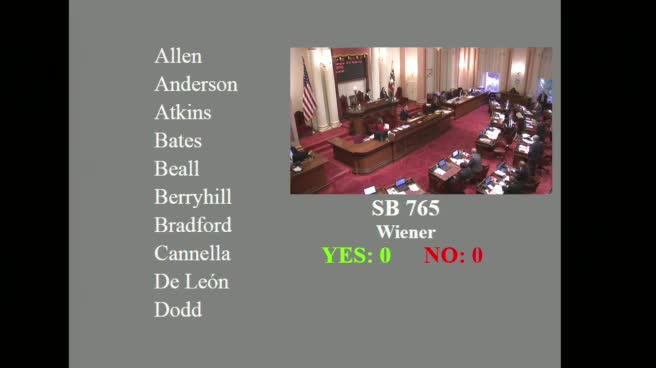 3MIN
Senate Floor
 48MIN
Senate Standing Committee on Appropriations
Bill Author

Bill Co-Author(s):