SB 694: California Community Colleges: Veteran Resource Centers.
- Session Year: 2017-2018
- House: Senate
- Latest Version Date: 2017-05-02
Existing law establishes the California Community Colleges, under the administration of the Board of Governors of the California Community Colleges, as one of the segments of public postsecondary education in this state. Existing law establishes community college districts throughout the state, and authorizes them to operate campuses and provide instruction to students. Existing law authorizes the governing board of a community college district to provide a counseling program.
This bill would require the Chancellors Office of the California Community Colleges to ensure that each of its campuses provides a dedicated on-campus Veteran Resource Center that offers services to help student veterans transition successfully from military life to educational success through the core components of academics, wellness, and camaraderie and would require those Veteran Resource Centers, at a minimum, to be open for 25 hours a week, be staffed by veterans whenever possible, be 400 square feet and fully accessible, and provide enrolled student veterans with specified services. services, except as provided. By imposing additional duties on community college districts, the bill would impose a state-mandated local program.
The California Constitution requires the state to reimburse local agencies and school districts for certain costs mandated by the state. Statutory provisions establish procedures for making that reimbursement.
This bill would provide that, if the Commission on State Mandates determines that the bill contains costs mandated by the state, reimbursement for those costs shall be made pursuant to the statutory provisions noted above.
Existing law establishes the California Community Colleges, under the administration of the Board of Governors of the California Community Colleges, as one of the segments of public postsecondary education in this state. Existing law establishes community college districts throughout the state, and authorizes them to operate campuses and provide instruction to students. Existing law authorizes the governing board of a community college district to provide a counseling program.
This bill would require the Chancellors Office of the California Community Colleges to ensure that each of its campuses provides a dedicated on-campus Veteran Resource Center that offers services to help student veterans transition successfully from military life to educational success through the core components of academics, wellness, and camaraderie and would require those Veteran Resource Centers, at a minimum, to be open for 25 hours a week, be staffed by veterans whenever possible, be 400 square feet and fully accessible, and provide enrolled student veterans with specified services. By imposing additional duties on community college districts, the bill would impose a state-mandated local program.
The California Constitution requires the state to reimburse local agencies and school districts for certain costs mandated by the state. Statutory provisions establish procedures for making that reimbursement.
This bill would provide that, if the Commission on State Mandates determines that the bill contains costs mandated by the state, reimbursement for those costs shall be made pursuant to the statutory provisions noted above.
Existing law, the Donahoe Higher Education Act, among other things, declares the policy of the Legislature that all resident applicants to California institutions of public higher education, who are determined to be qualified by law or by admission standards established by the respective governing boards, should be admitted to a district of the California Community Colleges, the California State University, or the University of California.This bill would make nonsubstantive changes to this provision relating to its references to the California Community Colleges and to community college districts and their governing boards.Existing law, the Donahoe Higher Education Act, among other things, declares the policy of the Legislature that all resident applicants to California institutions of public higher education, who are determined to be qualified by law or by admission standards established by the respective governing boards, should be admitted to a district of the California Community Colleges, the California State University, or the University of California.
This bill would make nonsubstantive changes to this provision relating to its references to the California Community Colleges and to community college districts and their governing boards.
The Legislature finds and declares all of the following:
(a)California is home to the nations largest veteran population totaling over 1.8 million veterans.
(b)The number of California veterans will continue to grow by approximately 25,000 veterans annually as post-9/11 service members transition back into the civilian population.
(c)More than 90 percent of veterans who pursue a postservice educational path will attend one of Californias 113 community colleges, with 50 percent of those veteran students applying earned educational benefits toward their college educations.
(d)Approximately 70,000 veterans and active duty service members are currently enrolled at campuses of the California Community Colleges.
(e)Student veterans face unique challenges in achieving educational and professional success, including physical and emotional disabilities and assimilation to civilian life.
(f)There is currently no consistent baseline standard across the California community college system that assures a veteran of receiving sufficient support for their educational needs at the community college of their choice.
SEC. 2.Article 3 (commencing with Section 72630) is added to Chapter 6 of Part 45 of Division 7 of Title 3 of the Education Code, to read:3.Veteran Resource Centers72630.(a)The Chancellors Office of the California Community Colleges shall ensure that each of its campuses provides a dedicated on-campus Veteran Resource Center that offers services to help student veterans transition successfully from military life to educational success through the core components of academics, wellness, and camaraderie.
(b)Each (1)Except as provided in paragraph (2), each Veteran Resource Center shall at a minimum:
(1)(A)Be open 25 hours a week.
(2)(B)Be staffed by veterans whenever possible.
(3)(C)Be 400 square feet and fully accessible.
(4)(D)Provide enrolled veteran students with all of the following:
(A)(i)Academic counseling and tutoring support.
(B)(ii)Peer support and mentoring services.
(C)(iii)Financial aid information and application assistance.
(D)(iv)Referral to on- and off-campus resources.
(E)(v)Access to computers with printing, copying, and faxing capabilities.
(F)(vi)VA certifying officials.
(G)(vii)Career counseling and placement assistance.
(2)A community college may submit justification to the Chancellors Office of the California Community Colleges of why it cannot comply with all of the requirements of paragraph (1). The community college shall demonstrate how it will serve its veteran students without complying with the specific requirements of paragraph (1).
SEC. 3.If the Commission on State Mandates determines that this act contains costs mandated by the state, reimbursement to local agencies and school districts for those costs shall be made pursuant to Part 7 (commencing with Section 17500) of Division 4 of Title 2 of the Government Code.
The Legislature finds and declares all of the following:
(a)California is home to the nations largest veteran population totaling over 1.8 million veterans.
(b)The number of California veterans will continue to grow by approximately 25,000 veterans annually as post-9/11 service members transition back into the civilian population.
(c)More than 90 percent of veterans who pursue a postservice educational path will attend one of Californias 113 community colleges, with 50 percent of those veteran students applying earned educational benefits toward their college educations.
(d)Approximately 70,000 veterans and active duty service members are currently enrolled at campuses of the California Community Colleges.
(e)Student veterans face unique challenges in achieving educational and professional success, including physical and emotional disabilities and assimilation to civilian life.
(f)There is currently no consistent baseline standard across the California community college system that assures a veteran of receiving sufficient support for their educational needs at the community college of their choice.
SEC. 2.Article 3 (commencing with Section 72630) is added to Chapter 6 of Part 45 of Division 7 of Title 3 of the Education Code, to read:3.Veteran Resource Centers72630.(a)The Chancellors Office of the California Community Colleges shall ensure that each of its campuses provides a dedicated on-campus Veteran Resource Center that offers services to help student veterans transition successfully from military life to educational success through the core components of academics, wellness, and camaraderie.
(b)Each Veteran Resource Center shall at a minimum:
(1)Be open 25 hours a week.
(2)Be staffed by veterans whenever possible.
(3)Be 400 square feet and fully accessible.
(4)Provide enrolled veteran students with all of the following:
(A)Academic counseling and tutoring support.
(B)Peer support and mentoring services.
(C)Financial aid information and application assistance.
(D)Referral to on- and off-campus resources.
(E)Access to computers with printing, copying, and faxing capabilities.
(F)VA certifying officials.
(G)Career counseling and placement assistance.
SEC. 3.If the Commission on State Mandates determines that this act contains costs mandated by the state, reimbursement to local agencies and school districts for those costs shall be made pursuant to Part 7 (commencing with Section 17500) of Division 4 of Title 2 of the Government Code.
SECTION 1.Section 66011 of the Education Code is amended to read:66011.(a)It is the policy of the Legislature that all resident applicants to California institutions of public higher education, who are determined to be qualified by law or by admission standards established by the respective governing boards, should be admitted to either (1) a community college district, in accordance with Section 76000, (2) the California State University, or (3) the University of California.(b)As used in this part, governing boards means the governing boards of community college districts and the Board of Governors of the California Community Colleges, the Trustees of the California State University, and the Regents of the University of California.(a)It is hereby declared to be the policy of the Legislature that all resident applicants to California institutions of public higher education, who are determined to be qualified by law or by admission standards established by the respective governing boards, should be admitted to either (1) a district of the California Community Colleges, community college district, in accordance with Section 76000, (2) the California State University, or (3) the University of California.
(b)As used in this part, governing boards means the local boards of trustees governing boards of community college districts and the Board of Governors of the California Community Colleges, the Trustees of the California State University, and the Regents of the University of California.
|
Date
|
Status
|
|---|---|
| Jun 27, 2017 | June 27 set for first hearing canceled at the request of author. |
| Jun 15, 2017 | Referred to Coms. on V.A. and HIGHER ED. |
| Jun 1, 2017 | In Assembly. Read first time. Held at Desk. |
| May 31, 2017 | Read third time. Passed. (Ayes 40. Noes 0. Page 1358.) Ordered to the Assembly. |
| May 26, 2017 | Ordered to special consent calendar. |
| May 26, 2017 | Read second time. Ordered to third reading. |
| May 25, 2017 | From committee: Do pass. (Ayes 7. Noes 0. Page 1189.) (May 25). |
| May 19, 2017 | Set for hearing May 25. |
| May 15, 2017 | May 15 hearing: Placed on APPR. suspense file. |
| May 4, 2017 | Set for hearing May 15. |
| May 2, 2017 | Read second time and amended. Re-referred to Com. on APPR. |
| May 1, 2017 | From committee: Do pass as amended and re-refer to Com. on APPR. (Ayes 6. Noes 0. Page 830.) (April 25). |
| Apr 21, 2017 | Set for hearing April 25. |
| Apr 20, 2017 | From committee: Do pass and re-refer to Com. on V.A. (Ayes 7. Noes 0. Page 783.) (April 19). Re-referred to Com. on V.A. |
| Apr 7, 2017 | Set for hearing April 19. |
| Apr 6, 2017 | Re-referred to Coms. on ED. and V.A. |
| Apr 5, 2017 | From committee with author's amendments. Read second time and amended. Re-referred to Com. on RLS. |
| Mar 9, 2017 | Referred to Com. on RLS. |
| Feb 21, 2017 | From printer. May be acted upon on or after March 23. |
| Feb 17, 2017 | Introduced. Read first time. To Com. on RLS. for assignment. To print. |
|
Date
|
Description
|
Location
|
Votes
|
|
|---|---|---|---|---|
| May 31, 2017 | Special Consent Calendar # SB694 | Senate Floor |
Passed |
|
| May 25, 2017 | Do pass | Senate Standing Committee on Appropriations |
Passed |
|
| May 15, 2017 | Placed on suspense file | Senate Standing Committee on Appropriations |
Passed |
|
| Apr 25, 2017 | Do pass as amended, but first amend, and re-refer to the Committee on [Appropriations] | Senate Standing Committee on Veterans Affairs |
Passed |
|
| Apr 19, 2017 | Do pass, but first be re-referred to the Committee on [Veterans Affairs] | Senate Standing Committee on Education |
Passed |
This list shows positions taken on this bill by organizations on the date displayed, which is linked to the original source.
Positions by individuals are not included.
|
Organization
|
Position
|
Date
|
|---|---|---|
| Faculty Association Of California Community Colleges | * Support | Apr 19, 2017 |
Office of Senate Floor Analyses (916) 651-1520 Fax: (916) 327-4478 | SB |
THIRD READING
Bill No: SB 694
:
SENATE EDUCATION COMMITTEE: 7-0, 4/19/17
AYES: Allen, Wilk, Galgiani, Leyva, Mendoza, Pan, Vidak
SENATE VETERANS AFFAIRS COMMITTEE: 6-0, 4/25/17
AYES: Newman, Nielsen, Dodd, Hueso, Roth, Wilk
NO VOTE RECORDED: Nguyen
SENATE APPROPRIATIONS COMMITTEE: 7-0, 5/25/17
AYES: Lara, Bates, Beall, Bradford, Hill, Nielsen, Wiener
DIGEST:
This bill requires the Chancellor’s Office of the California Community Colleges (CCC) to ensure that each of its campuses provides a dedicated on-campus Veteran Resource Center that offers services to help student veterans transition successfully from military life to educational success.
Existing law:
- Authorizes the California State University (CSU) and the CCC, and encourages the University of California (UC) to coordinate services for qualified students who are veterans or members of the military by clearly designating Military and Veterans Offices and individuals to provide specified services to qualified students. Existing law defines "qualified student" as a student who is any of the following: an active-duty member of the Armed Forces of the United States, the California National Guard, a reserve component of the Armed Forces of the Unites States, a veteran of the Armed Forces of the United States, and/or a family member of a person (as described above) who is a legal dependent under 28 years of age or living in the household of that person and eligible to be claimed as a dependent on federal or state tax returns. (Education Code § 69785)
- Authorizes CSU, CCC, and encourages UC to report annually to the California Department of Veterans Affairs the number of qualified students assisted by a Military and Veterans Office; the number of qualified students assisted who are active duty members of the Armed Forces of the United States, the California National Guard, or a reserve component of the Armed Forces of the United States, or are veterans of the Armed Forces of the United States; and the total education benefits by all qualified students assisted by an office. (EC § 69786)
This bill requires the Chancellor’s Office of the CCC to ensure that each of its campuses provides a dedicated on-campus Veteran Resource Center that offers services to help student veterans transition successfully from military life to educational success. Specifically, it;
- Requires each Veteran Resource Center to at a minimum:
- Be open 25 hours a week.
- Be staffed by veterans whenever possible.
- Be 400 square feet and fully accessible.
- Provide enrolled veteran students with all of the following:
- Academic counseling and tutoring support.
- Peer support and mentoring services.
- Financial aid information and application assistance.
- Referral to on-and off-campus resources.
- Access to computers with printing, copying and faxing capabilities.
- Veterans Affairs certifying officials.
- Provides that a community college may submit justification to the Chancellor’s Office of why it cannot comply with all of the bill’s requirements, and is required to demonstrate how it will serve its veteran students without complying with those specific requirements.
Comments
- Need for the bill. The CCC system serves 70,000 veterans and active duty services members. According to the author, some colleges have successful Veteran Resource Centers which offer a variety of services while other colleges offer rudimentary service or none at all. The author asserts, these students face unique challenges in their transition back to civilian life and services are essential to the success of veterans and every veteran should receive the same level of service no matter where they decide to attend school. This bill seeks to build on the success of existing efforts by establishing standards for Veterans Resource Centers at community colleges.
- Existing efforts to support student veterans at community colleges. There is wide acknowledgment among the CCC of the re-entry challenges many student veterans face and colleges have recognized the need to expand support services to help veterans successfully integrate into college life. The CCC Chancellor’s Office, in response to the growing number of student veterans and to provide statewide leadership and coordination to assist the colleges has led several statewide efforts that include; a) appointing a full-time Veteran Services Specialist, b) hosting an annual summit to share information and best practices for staff, faculty and administrators who work with student veteran’s services c) supporting the development and implementation of a training program for faculty and staff to increase awareness of military culture and challenges faced by many community college student veterans through the participation in the “Welcome Home Training Program,” and; d) supporting the development of Veterans Resource Center project.
Approximately 77 of 113 colleges have Veterans Resource Centers that range in space and support services but for the most part these centers help to facilitate academic success and assist in psychosocial reintegration. Although there is inconsistency in the level of support throughout the system, each community college district is required to maintain a student equity plan to ensure equal educational opportunities and to promote student success for all students with focused attention on certain categories of students that must be addressed, including veterans. This bill seeks to raise the standards for high-quality programming and services to meet the specific needs of this emerging student population.
FISCAL EFFECT: Appropriation: Fiscal Com.: Local:
According to the Senate Appropriations Committee:
- Assuming a cost of between $100,000 and $200,000 per campus, this bill would result in annual Proposition 98 General Fund costs of between $11.3 million and $22.6 million.
- Administrative costs of approximately $110,000 annually for the Chancellor’s Office to ensure campus compliance with this bill.
None received
OPPOSITION: (Verified 5/25/17)
None received
5/27/17 18:21:09
**** END ****
SENATE COMMITTEE ON
Senator Ricardo Lara, Chair
2017 - 2018 Regular Session
SB 694 (Newman) - California Community Colleges: Veteran Resource Centers
Version: | Policy Vote: |
Urgency: | Mandate: |
Hearing Date: | Consultant: |
This bill meets the criteria for referral to the Suspense File.
Bill Summary:
This bill requires the Chancellor’s Office of the California Community Colleges (CCC) to ensure that each of its campuses provide a dedicated on-campus Veteran Resource Center that offers services to help student veterans transition successfully from military life to educational success.
Fiscal Impact:
- Assuming a cost of between $100,000 and $200,000 per campus, this bill would result in annual Proposition 98 General Fund costs of between $11.3 million and $22.6 million.
- Administrative costs of approximately $110,000 annually for the Chancellor’s Office to ensure campus compliance with the bill.
Background:
Existing law authorizes the California State University (CSU) and the CCCs, and encourages the University of California (UC) to coordinate services for qualified students who are veterans or members of the military by clearly designating Military and Veterans Offices and individuals to provide specified services to qualified students. Current law defines "qualified student" as a student who is any of the following: an active-duty member of the Armed Forces of the United States, the California National Guard, a reserve component of the Armed Forces of the Unites States, a veteran of the Armed Forces of the United States, and/or a family member of a person (as described above) who is a legal dependent under 28 years of age or living in the household of that person and eligible to be claimed as a dependent on federal or state tax returns.
Existing law also authorizes CSU, CCC, and encourages UC to report annually to the California Department of Veterans Affairs the number of qualified students assisted by a Military and Veterans Office; the number of qualified students assisted who are active duty members of the Armed Forces of the United States, the California National Guard, or a reserve component of the Armed Forces of the United States, or are veterans of the Armed Forces of the United States; and the total education benefits by all qualified students assisted by an office.
Proposed Law:
This bill requires the Chancellor’s Office of the California Community Colleges to ensure that each of its campuses provides a dedicated on-campus Veteran Resource Center that offers services to help student veterans transition successfully from military life to educational success through the core components of academics, wellness, and camaraderie. Further, the bill specifies that each Veteran Resource Center shall, at a minimum, be open 25 hours a week; be staffed by veterans whenever possible; be 400 square feet and fully accessible; and provide enrolled veteran students with all of the following:
- Academic counseling and tutoring support.
- Peer support and mentoring services.
- Financial aid information and application assistance.
- Referral to on-and off-campus resources.
- Access to computers with printing, copying and faxing capabilities.
- Veterans Affairs certifying officials.
- Career counseling and placement assistance.
The bill provides that a community college may submit justification to the Chancellor’s Office of why it cannot comply with all of the bill’s requirements, and shall demonstrate how it will serve its veteran students without complying with those specific requirements.
Related Legislation:
AB 2494 (Roger Hernandez, 2016) would have established the Veteran Resource Centers Grant Program and the Veteran Resource Centers fund in the State Treasury for purposes of providing resources to veterans and active duty military enrolled at a CCC campus. AB 2494 was held on the suspense file in Senate Appropriations.
AB 393 (Roger Hernández, 2015) nearly identical to this bill, would have established a grant program to support CCC veterans' resource centers. AB 393 was held on the suspense file in the Assembly Appropriations.
Staff Comments:
Approximately 77 of 113 colleges have Veterans Resource Centers that range in space and support services but for the most part these centers help to facilitate academic success and assist in psychosocial reintegration. Although there is inconsistency in the level of support throughout the system, each community college district is required to maintain a student equity plan to ensure equal educational opportunities and to promote student success for all students with focused attention on certain categories of students that must be addressed, including veterans. While this bill could raise the level of service for the veterans student population at those colleges not already offering that level of service, it could be determined by the Commission on State Mandates to impose a reimbursable state mandate. Assuming a cost of $100,000 to $200,000 per campus, this bill would result in annual Proposition 98 General Fund costs of between $11.3 million and $22.6 million.
-- END --
SENATE COMMITTEE ON
Senator Josh Newman, Chair
2017 - 2018 Regular
Bill No: Hearing Date: 4/25/17
Author: | Newman | ||
Version: |
| ||
Urgency: | Fiscal: | ||
Consultant: | |||
Subject:
DESCRIPTION
Summary:
This bill requires the Chancellor’s Office of the California Community Colleges (CCC) to ensure that each of its campuses provides a dedicated on-campus veteran resource center (VRC) that offers services to help student veterans transition successfully from military life to educational success.
Existing law:
- Authorizes the California State University (CSU) and the CCC, and encourages the University of California (UC) to coordinate services for qualified students who are veterans or members of the military by clearly designating Military and Veterans Offices and individuals to provide specified services to qualified students. Current law defines "qualified student" as a student who is any of the following:
- An active-duty member of the Armed Forces of the United States (Armed Forces);
- A member of a federal reserve component of the Armed Forces or the National Guard;
- A veteran of the Armed Forces;
- A family member of a qualified person (as defined above), who is:
- A legal dependent under 28 years of age or living in the household of the qualified person; AND
- Eligible to be claimed as a dependent on the qualified person’s federal or state tax returns.
- Authorizes CSU, CCC, and encourages UC to report annually to the California Department of Veterans Affairs (CalVet) the number of qualified students assisted by a Military and Veterans Office; the number of qualified students assisted who are active duty members of the Armed Forces, or members of the California National Guard or a reserve component, or are veterans; and the total education benefits by all qualified students assisted by an office.
This bill:
Requires the Chancellor’s Office of CCC to ensure that each of its campuses provides a dedicated on-campus VRC that offers services to help student veterans transition successfully from military life to educational success. Specifically, it;
- Requires each VRC to at a minimum:
- Be open 25 hours a week.
- Be staffed by veterans whenever possible.
- Be 400 square feet and fully accessible.
- Provide enrolled veteran students with all of the following:
- Academic counseling and tutoring support.
- Peer support and mentoring services.
- Financial aid information and application assistance.
- Referral to on-and off-campus resources.
- Access to computers with printing, copying and faxing capabilities.
- Veterans Affairs certifying officials.
BACKGROUND
VRCs at community colleges. According to veteran advocates, the majority of veterans entering higher education in California begin at the CCCs. Although studies suggest that well-run VRCs contribute to veteran students’ academic success and their maximization of GI Bill benefits and their success in transitioning from military to civilian life, support for VRCs had not been well standardized at the system-level.
- The CCC budget has contained no funding for campus VRCs.
- Approximately 77 of 113 community colleges have VRCs, but they vary widely in space and support services.
- Some campuses engineer their own VRCs through alternative funding sources; some are well-resourced and effective, while other centers are unable to provide much support to veteran students.
- Other campuses lack the resources to establish a VRC at all.
Best practices. Among other specialized benefits, VRCs can provide these students with veteran-centric peer counseling and also serve as a culturally competent site for connecting the students with providers of other necessary veterans services (other than the GI Bill), which can be crucial to supporting the students in a holistic manner.
Some veteran advocates assert that an adequate VRC should provide a single location where military-affiliated students can go to receive assistance regarding their benefits, enrollment and connecting to broader veteran-supportive resources.
The center should have a dedicated space or terminal and, if possible, a dedicated room. Although some military-affiliated students fit the non-traditional student model and might not use a dedicated room, most such students likely would use it. Institutions able to offer a dedicated room can offer additional assistance with class work and tutoring, meeting with their peers, entering the workforce, involvement in the civilian community, etc. A dedicated space should offer:
- Information on and connection to eligible educational and veterans benefits.
- Centralized location for veterans' federal funding processing/enrollment certification.
- Assistance with continuing education and enrollment.
- Provide a comprehensive and centralized service center to connect with supportive services, including career and re-entry job placement and referral services.
CSAAVE
The State of California performs oversight of veteran education at institutions of higher education, but in the past has not focused on resources such as VRCs. The former Bureau for Private Postsecondary and Vocational Education (BPPVE) used to serve as the approval agency for California institutions attended by veterans using Title 38 monies under a contract with the USDVA. When BPPVE expired, these duties were transferred to the California Department of Veterans Affairs (CalVet) which now provides oversight of postsecondary education programs through its subsidiary, the California State Approving Agency for Veterans Education (CSAAVE). CSAAVE is federally funded and operates under an annual reimbursement contract with the USDVA. In its role as the approval agency, the primary function of CSAAVE is to review, evaluate and approve quality educational and training programs for veteran's benefits. CSAAVE is intended to approve colleges and universities, vocational schools, business schools, professional schools, and licensing and certification training and tests, all of which must lead to an educational, professional or vocational objective.
COMMENT
Committee Comments:
- Senate Education Committee approved the bill, 7-0, with an understanding that the author would accept specific amendments while the double-referred measure is in Senate Veterans Affairs Committee.
- Content of proposed amendments:
- Permit a community college to submit justification to the Community College Chancellor’s Office of why it cannot comply with all VRC components in the bill.
- Require the community college to demonstrate how it will serve its veteran students without complying with bill’s specific VRC requirements.
- Analysis of proposed amendments:
- While the amendments soften the mandate, the bill still would define in statute the resources and services capable of providing a basic, functional VRC.
- The amendments provide flexibility to colleges that are spatially and financially challenged in the short term, but still requires them demonstrate a response to the needs of its veteran students that would be left hanging by the lack of a VRC. The amendment language is vague as to whether a noncompliant college’s required “response” has any measurable standards. Or even as to what constitutes an acceptable response.
POSITIONS
Sponsor: Author.
Support: None received.
Oppose: None received.
-- END --
SENATE COMMITTEE ON EDUCATION
Senator Benjamin Allen, Chair
2017 - 2018 Regular
Bill No: SB 694 Hearing Date: April 19, 2017
Author: | Newman | ||
Version: | April 5, 2017 | ||
Urgency: | No | Fiscal: | Yes |
Consultant: | Olgalilia Ramirez | ||
Subject: California Community Colleges: Veteran Resource Centers
NOTE: This bill has been referred to the Committees on Education and Veterans Affairs. A "do pass" motion should include referral to the Committee on Veterans Affairs.
SUMMARY
This bill requires the Chancellor’s Office of the California Community Colleges (CCC) to ensure that each of its campuses provides a dedicated on-campus Veteran Resource Center that offers services to help student veterans transition successfully from military life to educational success.
BACKGROUND
Existing law:
- Authorizes the California State University (CSU) and the CCC, and encourages the University of California (UC) to coordinate services for qualified students who are veterans or members of the military by clearly designating Military and Veterans Offices and individuals to provide specified services to qualified students. Current law defines "qualified student" as a student who is any of the following: an active-duty member of the Armed Forces of the United States, the California National Guard, a reserve component of the Armed Forces of the Unites States, a veteran of the Armed Forces of the United States, and/or a family member of a person (as described above) who is a legal dependent under 28 years of age or living in the household of that person and eligible to be claimed as a dependent on federal or state tax returns. (Education Code § 69785)
- Authorizes CSU, CCC, and encourages UC to report annually to the California Department of Veterans Affairs the number of qualified students assisted by a Military and Veterans Office; the number of qualified students assisted who are active duty members of the Armed Forces of the United States, the California National Guard, or a reserve component of the Armed Forces of the United States, or are veterans of the Armed Forces of the United States; and the total education benefits by all qualified students assisted by an office. (EC § 69786)
ANALYSIS
This bill requires the Chancellor’s Office of the California Community Colleges (CCC) to ensure that each of its campuses provides a dedicated on-campus Veteran Resource Center that offers services to help student veterans transition successfully from military life to educational success. Specifically, it;
- Requires each Veteran Resource Center to at a minimum:
- Be open 25 hours a week.
- Be staffed by veterans whenever possible.
- Be 400 square feet and fully accessible.
- Provide enrolled veteran students with all of the following:
- Academic counseling and tutoring support.
- Peer support and mentoring services.
- Financial aid information and application assistance.
- Referral to on-and off-campus resources.
- Access to computers with printing, copying and faxing capabilities.
- Veterans Affairs certifying officials.
STAFF COMMENTS
- Need for the bill. The CCC system serves 70,000 veterans and active duty services members. According to the author, some colleges have successful Veteran Resource Centers which offer a variety of services while other colleges offer rudimentary service or none at all. The author asserts, these students face unique challenges in their transition back to civilian life and services are essential to the success of veterans and every veteran should receive the same level of service no matter where they decide to attend school. This bill seeks to build on the success of existing efforts by establishing standards for Veterans Resource Centers at community colleges.
- Existing efforts to support student veterans at community colleges. There is wide acknowledgment among the CCC of the re-entry challenges many student veterans face and colleges have recognized the need to expand support services to help veterans successfully integrate into college life. The Community College Chancellor’s office, in response to the growing number of student veterans and to provide statewide leadership and coordination to assist the colleges has led several statewide efforts that include; 1) appointing a full-time Veteran Services Specialist, 2) hosting an annual summit to share information and best practices for staff, faculty and administrators who work with student veteran’s services 3) supporting the development and implementation of a training program for faculty and staff to increase awareness of military culture and challenges faced by many community college student veterans through the participation in the “Welcome Home Training Program,” and; 4) supporting the development of Veterans Resource Center project.
Approximately 77 of 113 colleges have Veterans Resource Centers that range in space and support services but for the most part these centers help to facilitate academic success and assist in psychosocial reintegration. Although there is inconsistency in the level of support throughout the system, each community
college district is required to maintain a student equity plan to ensure equal educational opportunities and to promote student success for all students with focused attention on certain categories of students that must be addressed, including veterans. This bill seeks to raise the standards for high-quality programming and services to meet the specific needs of this emerging student population.
Too prescriptive? Notwithstanding the potential need for additional resources for community colleges to implement high quality services for student veterans, the proposed requirements in this bill limit campus flexibility in the delivery of such services. With 113 community colleges ranging in campus size, student enrollment and capacity the committee may want to consider whether the proposed requirements are too prescriptive for some campuses, particularly a small campus that may not have the physical space or staff capacity to fulfill this requirement and meet their local needs.
Rather than require the Chancellor’s Office to ensure that each of its campuses provides a dedicated on-campus Veteran Resource Center, staff recommends the bill be amended to require the Chancellor’s Office of the California Community Colleges (CCC) to consider establishment of a dedicated on-campus Veteran Resource Center at each of its campuses, as described in the bill. The author has agreed to accept this amendment, to be adopted when this bill is heard by the Committee on Veterans Affairs.
Prior legislation.
AB 2494 (Roger Hernandez, 2016) would have established the Veteran Resource Centers Grant Program and the Veteran Resource Centers fund in the State Treasury for purposes of providing resources to veterans and active duty military enrolled at a CCC campus. AB 2494 was held on the suspense file in Senate Appropriations.
AB 393 (Roger Hernández, 2015) nearly identical to this bill, would have established a grant program to support CCC veterans' resource centers. AB 393 was held on the suspense file in the Assembly Appropriations.
AB 421 (Calderon, 2015) would have, among others, required the governing board of a community college district to provide in each CCC within the district, a veterans counselor. AB 421 was held on the suspense file in the Assembly Appropriations Committee.
SUPPORT
None received.
OPPOSITION
None received.
-- END --
Discussed in Hearing
 48MIN
Senate Standing Committee on Appropriations
 14MIN
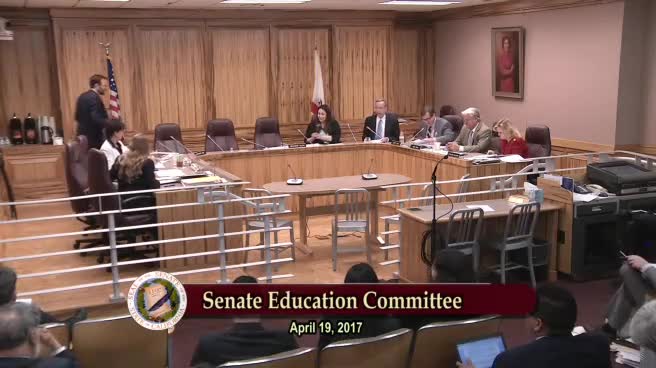
Senate Standing Committee on Education
Bill Author





