SB 80: California Environmental Quality Act: notices.
- Session Year: 2017-2018
- House: Senate
- Latest Version Date: 2017-09-13
(1)The California Environmental Quality Act (CEQA) requires a lead agency, as defined, to prepare, or cause to be prepared, and certify the completion of, an environmental impact report on a project that it proposes to carry out or approve that may have a significant effect on the environment or to adopt a negative declaration if it finds that the project will not have that effect. CEQA also requires a lead agency to prepare a mitigated negative declaration for a project that may have a significant effect on the environment if revisions in the project would avoid or mitigate that effect and there is no substantial evidence that the project, as revised, would have a significant effect on the environment. The act requires the lead agency to mail certain notices to persons who have filed a written request for notices. The act provides that if the agency offers to provide the notices by email, upon filing a written request for notices, a person may request that the notices be provided to him or her by email.
This bill would require the lead agency to post those notices on the agencys Internet Web site. The bill would require the agency to offer to provide those notices by email. Because this bill would increase the level of service provided by a local agency, this bill would impose a state-mandated local program.
(2)CEQA requires that certain notices regarding an environmental impact report be posted for a period of 30 days in the office of the county clerk of each county in which the project will be located. CEQA specifies that notices regarding a negative declaration be posted for a period of 20 days unless otherwise specified.
This bill would require the county clerk to post the notices regarding an environmental impact report or a negative declaration on the countys Internet Web site. Because the bill would require a county clerk to post those notices on the countys Internet Web site, this bill would impose a state-mandated local program.
(3)CEQA exempts certain projects from its requirements. CEQA also requires the Office of Planning and Research to develop guidelines for the implementation of CEQA to exempt classes of projects that have been determined not to have a significant effect on the environment. If a lead agency determines that the project is not subject to the requirements of CEQA and the agency approves or determines to carry out the project, CEQA authorizes the lead agency or certain persons to file a notice of the determination, as specified.
This bill would require the filing of the notice if the lead agency determines that a project falls within a class of projects that is exempted from the requirements of CEQA by the guidelines. Because the bill would increase the duties of a local agency, this bill would impose a state-mandated local program.
(4)The California Constitution requires the state to reimburse local agencies and school districts for certain costs mandated by the state. Statutory provisions establish procedures for making that reimbursement.
This bill would provide that no reimbursement is required by this act for a specified reason.
(1)The California Environmental Quality Act (CEQA) requires a lead agency, as defined, to prepare, or cause to be prepared, and certify the completion of, an environmental impact report on a project that it proposes to carry out or approve that may have a significant effect on the environment or to adopt a negative declaration if it finds that the project will not have that effect. CEQA also requires a lead agency to prepare a mitigated negative declaration for a project that may have a significant effect on the environment if revisions in the project would avoid or mitigate that effect and there is no substantial evidence that the project, as revised, would have a significant effect on the environment. The act requires the lead agency to mail certain notices to persons who have filed a written request for notices. The act provides that if the agencys offer agency offers to provide the notices by email, upon filing a written request for notices, a person may request that the notices be provided to him or her by email.
This bill would require the lead agency to post those notices on the agencys Internet Web site. The bill would require the agency to offer to provide those notices by email. Because this bill would increase the level of service provided by a local agency, this bill would impose a state-mandated local program.
(2)CEQA requires that certain notices regarding an environmental impact report be posted for a period of 30 days in the office of the county clerk of each county in which the project will be located. CEQA specifies that notices regarding a negative declaration be posted for a period of 20 days unless otherwise specified.
This bill would require the county clerk to post the notices regarding an environmental impact report or a negative declaration on the countys Internet Web site. Because the bill would require a county clerk to post those notices on the countys Internet Web site, this bill would imposed impose a state-mandated local program.
(3)CEQA exempts certain projects from its requirements. The act CEQA also requires the Office of Planning and Research to develop guidelines for the implementation of CEQA to exempt classes of projects that have been determined not to have a significant effect on the environment. If a lead agency determines that the project is not subject to the requirements of CEQA and the agency approves or determines to carry out the project, CEQA authorizes the lead agency or certain persons to file a notice of the determination, as specified.
This bill would require the filing of the notice if the lead agency determines that a project falls within a class of projects that is exempted from the requirements of CEQA by the guidelines. Because the bill would increase the duties of a local agency, this bill would impose a state-mandated local program.
(4)The California Constitution requires the state to reimburse local agencies and school districts for certain costs mandated by the state. Statutory provisions establish procedures for making that reimbursement.
This bill would provide that no reimbursement is required by this act for a specified reason.
(1)The California Environmental Quality Act requires a lead agency, as defined, to prepare, or cause to be prepared, and certify the completion of, an environmental impact report on a project that it proposes to carry out or approve that may have a significant effect on the environment or to adopt a negative declaration if it finds that the project will not have that effect. CEQA also requires a lead agency to prepare a mitigated negative declaration for a project that may have a significant effect on the environment if revisions in the project would avoid or mitigate that effect and there is no substantial evidence that the project, as revised, would have a significant effect on the environment. The act requires the lead agency to mail certain notices to persons who have filed a written request for notices. The act provides that if the agencys offer to provide the notices by email, upon filing a written request for notices, a person may request that the notices be provided to him or her by email.
This bill would require the lead agency to post those notices on the agencys Internet Web site. The bill would require the agency to offer to provide those notices by email. Because this bill would increase the level of service provided by a local agency, this bill would impose a state-mandated local program.
(2)The act CEQA requires that certain notices regarding an environmental impact report be posted for a period of 30 days in the office of the county clerk of each county in which the project will be located. The act CEQA specifies that notices regarding a negative declaration be posted for a period of 20 days unless otherwise specified.
This bill would require the county clerk to post the notices regarding an environmental impact report or a negative declaration on the countys Internet Web site. Because the bill would require a county clerk to post those notices on the countys Internet Web site, this bill would imposed a state-mandated local program.
(3)CEQA exempts certain projects from its requirements. The act also requires the Office of Planning and Research to develop guidelines for the implementation of CEQA to exempt classes of projects that have been determined not to have a significant effect on the environment. If a lead agency determines that the project is not subject to the requirements of the act CEQA and the agency approves or determines to carry out the project, the act CEQA authorizes the lead agency or certain persons to file a notice of the determination, as specified.
This bill would instead require the filing of the notice. notice if the lead agency determines that a project falls within a class of projects that is exempted from the requirements of CEQA by the guidelines. Because the bill would increase the duties of a local agency, this bill would impose a state-mandated local program. The bill would make conforming changes.
(4)The California Constitution requires the state to reimburse local agencies and school districts for certain costs mandated by the state. Statutory provisions establish procedures for making that reimbursement.
This bill would provide that no reimbursement is required by this act for a specified reason.
(1)The California Environmental Quality Act requires a lead agency, as defined, to prepare, or cause to be prepared, and certify the completion of, an environmental impact report on a project that it proposes to carry out or approve that may have a significant effect on the environment or to adopt a negative declaration if it finds that the project will not have that effect. CEQA also requires a lead agency to prepare a mitigated negative declaration for a project that may have a significant effect on the environment if revisions in the project would avoid or mitigate that effect and there is no substantial evidence that the project, as revised, would have a significant effect on the environment. The act requires the lead agency to mail certain notices to persons who have filed a written request for notices. The act provides that if the agencys offer to provide the notices by email, upon filing a written request for notices, a person may request that the notices be provided to him or her by email.
This bill would require the lead agency to post those notices on the agencys Internet Web site. The bill would require the agency to offer to provide those notices by email. Because this bill would increase the level of service provided by a local agency, this bill would impose a state-mandated local program.
(2)The act requires certain notices regarding an environmental impact report be posted for a period of 30 days in the office of the county clerk of each county in which the project will be located. The act specifies that notices regarding a negative declaration be posted for a period of 20 days unless otherwise specified.
This bill would require the county clerk to post the notices regarding an environmental impact report or a negative declaration on the countys Internet Web site. Because the bill would require a county clerk to post those notices on the countys Internet Web site, this bill would imposed a state-mandated local program.
(3)If a lead agency determines that the project is not subject to the requirements of the act and the agency approves or determines to carry out the project, the act authorizes the lead agency or certain persons to file a notice of determination, as specified.
This bill would instead require the filing of the notice. Because the bill would increase the duties of a local agency, this bill would impose a state-mandated local program. The bill would make conforming changes.
(4)The California Constitution requires the state to reimburse local agencies and school districts for certain costs mandated by the state. Statutory provisions establish procedures for making that reimbursement.
This bill would provide that no reimbursement is required by this act for a specified reason.
(a)The notices required pursuant to Sections 21080.4, 21083.9, 21092, 21108, 21152, and 21161 shall be mailed to every person who has filed a written request for notices with either the clerk of the governing body or, if there is no governing body, the director of the agency. The agency shall offer to provide the notices by email to a person requesting the notices. The request may also be filed with any other person designated by the governing body or director to receive these requests. The agency may require requests for notices to be annually renewed. The public agency may charge a fee, except to other public agencies, that is reasonably related to the costs of providing this service.
(b)Subdivision (a) shall not be construed in any manner that results in the invalidation of an action because of the failure of a person to receive a requested notice, if there has been substantial compliance with the requirements of this section.
(c)The notices required pursuant to Sections 21080.4 and 21161 shall be provided by the State Clearinghouse to any legislator in whose district the project has an environmental impact, if the legislator requests the notice and the State Clearinghouse has received it.
(d)An agency shall post the notices specified in subdivision (a) on its Internet Web site, if any.
SEC. 2.Section 21092.3 of the Public Resources Code is amended to read:21092.3.The notices required pursuant to Sections 21080.4 and 21092 for an environmental impact report shall be posted in the office of the county clerk of each county in which the project will be located and shall remain posted for a period of 30 days. The notice required pursuant to Section 21092 for a negative declaration shall be so posted for a period of 20 days, unless otherwise required by law to be posted for 30 days. The notices shall also be posted on the countys Internet Web site, if any, for a period of 30 days. The county clerk shall post the notices within 24 hours of receipt.
SEC. 3.Section 21108 of the Public Resources Code is amended to read:21108.(a)If a state agency approves or determines to carry out a project that is subject to this division, the state agency shall file notice of that approval or that determination with the Office of Planning and Research. The notice shall identify the person or persons in subdivision (b) or (c) of Section 21065, as reflected in the agencys record of proceedings, and indicate the determination of the state agency whether the project will, or will not, have a significant effect on the environment and shall indicate whether an environmental impact report has been prepared pursuant to this division.
(b)(1)If a state agency determines that a project is not subject to this division pursuant to subdivision (b) of Section 21080 or Section 21172, and the state agency approves or determines to carry out the project, the state agency or the person specified in subdivision (b) or (c) of Section 21065 may file a notice of the determination with the Office of Planning and Research.
(2)If a state agency determines that a project is not subject to this division as a categorical exemption pursuant to the guidelines developed pursuant to Section 21084, and the state agency approves or determines to carry out the project, the state agency or the person specified in subdivision (b) or (c) of Section 21065 shall file a notice of the determination with the Office of Planning and Research.
(3)A notice filed pursuant to this subdivision shall identify the person or persons in subdivision (b) or (c) of Section 21065, as reflected in the agencys record of proceedings. A notice filed pursuant to this subdivision by a person specified in subdivision (b) or (c) of Section 21065 shall have a certificate of determination attached to it issued by the state agency responsible for making the determination that the project is not subject to this division pursuant to subdivision (b) of Section 21080 or pursuant to Section 21172. The certificate of determination may be in the form of a certified copy of an existing document or record of the state agency.
(c)A state agency may electronically file the notice under this section with the Office of Planning and Research.
(d)A notice filed pursuant to this section shall be available for public inspection, and a list of these notices shall be posted on a weekly basis in the Office of Planning and Research. Each list shall remain posted for a period of 30 days. The Office of Planning and Research shall retain each notice for not less than 12 months.
SEC. 4.Section 21152 of the Public Resources Code is amended to read:21152.(a)If a local agency approves or determines to carry out a project that is subject to this division, the local agency shall file notice of the approval or the determination within five working days after the approval or determination becomes final, with the county clerk of each county in which the project will be located. The notice shall identify the person or persons in subdivision (b) or (c) of Section 21065, as reflected in the agencys record of proceedings, and indicate the determination of the local agency whether the project will, or will not, have a significant effect on the environment and shall indicate whether an environmental impact report has been prepared pursuant to this division. The notice shall also include certification that the final environmental impact report, if one was prepared, together with comments and responses, is available to the general public.
(b)(1)If a local agency determines that a project is not subject to this division pursuant to subdivision (b) of Section 21080 or pursuant to Section 21172, and the local agency approves or determines to carry out the project, the local agency or the person specified in subdivision (b) or (c) of Section 21065 may file a notice of the determination with the county clerk of each county in which the project will be located.
(2)If a local agency determines that a project is not subject to this division as a categorical exemption pursuant to the guidelines developed pursuant to Section 21084, and the local agency approves or determines to carry out the project, the local agency or the person specified in subdivision (b) or (c) of Section 21065 shall file a notice of the determination with the county clerk of each county in which the project will be located.
(3)A notice filed pursuant to this subdivision shall identify the person or persons in subdivision (b) or (c) of Section 21065, as reflected in the agencys record of proceedings. A notice filed pursuant to this subdivision by a person specified in subdivision (b) or (c) of Section 21065 shall have a certificate of determination attached to it issued by the local agency responsible for making the determination that the project is not subject to this division pursuant to subdivision (b) of Section 21080 or Section 21172. The certificate of determination may be in the form of a certified copy of an existing document or record of the local agency.
(c)A local agency may electronically file the notice under this section with the county clerk if that option is offered by the county clerk.
(d)A notice filed pursuant to this section shall be available for public inspection, and shall be posted within 24 hours of receipt in the office of the county clerk. A notice shall remain posted for a period of 30 days. Thereafter, the clerk shall return the notice to the local agency with a notation of the period it was posted. The local agency shall retain the notice for not less than 12 months.
SEC. 5.No reimbursement is required by this act pursuant to Section 6 of Article XIIIB of the California Constitution because a local agency or school district has the authority to levy service charges, fees, or assessments sufficient to pay for the program or level of service mandated by this act, within the meaning of Section 17556 of the Government Code.
(a)The notices required pursuant to Sections 21080.4, 21083.9, 21092, 21108, 21152, and 21161 shall be mailed to every person who has filed a written request for notices with either the clerk of the governing body or, if there is no governing body, the director of the agency. The agency shall offer to provide the notices by email to a person requesting the notices. The request may also be filed with any other person designated by the governing body or director to receive these requests. The agency may require requests for notices to be annually renewed. The public agency may charge a fee, except to other public agencies, that is reasonably related to the costs of providing this service.
(b)Subdivision (a) shall not be construed in any manner that results in the invalidation of an action because of the failure of a person to receive a requested notice, if there has been substantial compliance with the requirements of this section.
(c)The notices required pursuant to Sections 21080.4 and 21161 shall be provided by the State Clearinghouse to any legislator in whose district the project has an environmental impact, if the legislator requests the notice and the State Clearinghouse has received it.
(d)An agency shall post the notices specified in subdivision (a) on its Internet Web site, if any.
SEC. 2.Section 21092.3 of the Public Resources Code is amended to read:21092.3.The notices required pursuant to Sections 21080.4 and 21092 for an environmental impact report shall be posted in the office of the county clerk of each county in which the project will be located and shall remain posted for a period of 30 days. The notice required pursuant to Section 21092 for a negative declaration shall be so posted for a period of 20 days, unless otherwise required by law to be posted for 30 days. The notices shall also be posted on the countys Internet Web site, if any, for a period of 30 days. The county clerk shall post the notices within 24 hours of receipt.
SEC. 3.Section 21108 of the Public Resources Code is amended to read:21108.(a)If a state agency approves or determines to carry out a project that is subject to this division, the state agency shall file notice of that approval or that determination with the Office of Planning and Research. The notice shall identify the person or persons in subdivision (b) or (c) of Section 21065, as reflected in the agencys record of proceedings, and indicate the determination of the state agency whether the project will, or will not, have a significant effect on the environment and shall indicate whether an environmental impact report has been prepared pursuant to this division.
(b)(1)If a state agency determines that a project is not subject to this division pursuant to subdivision (b) of Section 21080 or Section 21172, and the state agency approves or determines to carry out the project, the state agency or the person specified in subdivision (b) or (c) of Section 21065 may file a notice of the determination with the Office of Planning and Research.
(2)If a state agency determines that a project is not subject to this division as a categorical exemption pursuant to the guidelines developed pursuant to Section 21084, and the state agency approves or determines to carry out the project, the state agency or the person specified in subdivision (b) or (c) of Section 21065 shall file a notice of the determination with the Office of Planning and Research.
(3)A notice filed pursuant to this subdivision shall identify the person or persons in subdivision (b) or (c) of Section 21065, as reflected in the agencys record of proceedings. A notice filed pursuant to this subdivision by a person specified in subdivision (b) or (c) of Section 21065 shall have a certificate of determination attached to it issued by the state agency responsible for making the determination that the project is not subject to this division pursuant to subdivision (b) of Section 21080 or pursuant to Section 21172. The certificate of determination may be in the form of a certified copy of an existing document or record of the state agency.
(c)A state agency may electronically file the notice under this section with the Office of Planning and Research.
(c)(d)A notice filed pursuant to this section shall be available for public inspection, and a list of these notices shall be posted on a weekly basis in the Office of Planning and Research. Each list shall remain posted for a period of 30 days. The Office of Planning and Research shall retain each notice for not less than 12 months.
SEC. 4.Section 21152 of the Public Resources Code is amended to read:21152.(a)If a local agency approves or determines to carry out a project that is subject to this division, the local agency shall file notice of the approval or the determination within five working days after the approval or determination becomes final, with the county clerk of each county in which the project will be located. The notice shall identify the person or persons in subdivision (b) or (c) of Section 21065, as reflected in the agencys record of proceedings, and indicate the determination of the local agency whether the project will, or will not, have a significant effect on the environment and shall indicate whether an environmental impact report has been prepared pursuant to this division. The notice shall also include certification that the final environmental impact report, if one was prepared, together with comments and responses, is available to the general public.
(b)(1)If a local agency determines that a project is not subject to this division pursuant to subdivision (b) of Section 21080 or pursuant to Section 21172, and the local agency approves or determines to carry out the project, the local agency or the person specified in subdivision (b) or (c) of Section 21065 may file a notice of the determination with the county clerk of each county in which the project will be located.
(2)If a local agency determines that a project is not subject to this division as a categorical exemption pursuant to the guidelines developed pursuant to Section 21084, and the local agency approves or determines to carry out the project, the local agency or the person specified in subdivision (b) or (c) of Section 21065 shall file a notice of the determination with the county clerk of each county in which the project will be located.
(3)A notice filed pursuant to this subdivision shall identify the person or persons in subdivision (b) or (c) of Section 21065, as reflected in the agencys record of proceedings. A notice filed pursuant to this subdivision by a person specified in subdivision (b) or (c) of Section 21065 shall have a certificate of determination attached to it issued by the local agency responsible for making the determination that the project is not subject to this division pursuant to subdivision (b) of Section 21080 or Section 21172. The certificate of determination may be in the form of a certified copy of an existing document or record of the local agency.
(c)A local agency may electronically file the notice under this section with the county clerk if that option is offered by the county clerk.
(c)(d)A notice filed pursuant to this section shall be available for public inspection, and shall be posted within 24 hours of receipt in the office of the county clerk. A notice shall remain posted for a period of 30 days. Thereafter, the clerk shall return the notice to the local agency with a notation of the period it was posted. The local agency shall retain the notice for not less than 12 months.
SEC. 5.No reimbursement is required by this act pursuant to Section 6 of Article XIIIB of the California Constitution because a local agency or school district has the authority to levy service charges, fees, or assessments sufficient to pay for the program or level of service mandated by this act, within the meaning of Section 17556 of the Government Code.
(a)The notices required pursuant to Sections 21080.4, 21083.9, 21092, 21108, 21152, and 21161 shall be mailed to every person who has filed a written request for notices with either the clerk of the governing body or, if there is no governing body, the director of the agency. The agency shall offer to provide the notices by email to a person requesting the notices. The request may also be filed with any other person designated by the governing body or director to receive these requests. The agency may require requests for notices to be annually renewed. The public agency may charge a fee, except to other public agencies, that is reasonably related to the costs of providing this service.
(b)Subdivision (a) shall not be construed in any manner that results in the invalidation of an action because of the failure of a person to receive a requested notice, if there has been substantial compliance with the requirements of this section.
(c)The notices required pursuant to Sections 21080.4 and 21161 shall be provided by the State Clearinghouse to any legislator in whose district the project has an environmental impact, if the legislator requests the notice and the State Clearinghouse has received it.
(d)An agency shall post the notices specified in subdivision (a) on its Internet Web site, if any.
SEC. 2.Section 21092.3 of the Public Resources Code is amended to read:21092.3.The notices required pursuant to Sections 21080.4 and 21092 for an environmental impact report shall be posted in the office of the county clerk of each county in which the project will be located and shall remain posted for a period of 30 days. The notice required pursuant to Section 21092 for a negative declaration shall be so posted for a period of 20 days, unless otherwise required by law to be posted for 30 days. The notices shall also be posted on the countys Internet Web site, if any, for a period of 30 days. The county clerk shall post the notices within 24 hours of receipt.
SEC. 3.Section 21108 of the Public Resources Code is amended to read:21108.(a)If a state agency approves or determines to carry out a project that is subject to this division, the state agency shall file notice of that approval or that determination with the Office of Planning and Research. The notice shall identify the person or persons in subdivision (b) or (c) of Section 21065, as reflected in the agencys record of proceedings, and indicate the determination of the state agency whether the project will, or will not, have a significant effect on the environment and shall indicate whether an environmental impact report has been prepared pursuant to this division.
(b)(1)If a state agency determines that a project is not subject to this division pursuant to subdivision (b) of Section 21080 or Section 21172, and the state agency approves or determines to carry out the project, the state agency or the person specified in subdivision (b) or (c) of Section 21065 shall may file a notice of the determination with the Office of Planning and Research. A
(2)If a state agency determines that a project is not subject to this division pursuant to the guidelines developed pursuant to Section 21084, and the state agency approves or determines to carry out the project, the state agency or the person specified in subdivision (b) or (c) of Section 21065 shall file a notice of the determination with the Office of Planning and Research.
(3)A notice filed pursuant to this subdivision shall identify the person or persons in subdivision (b) or (c) of Section 21065, as reflected in the agencys record of proceedings. A notice filed pursuant to this subdivision by a person specified in subdivision (b) or (c) of Section 21065 shall have a certificate of determination attached to it issued by the state agency responsible for making the determination that the project is not subject to this division pursuant to subdivision (b) of Section 21080 or pursuant to Section 21172. The certificate of determination may be in the form of a certified copy of an existing document or record of the state agency.
(c)A notice filed pursuant to this section shall be available for public inspection, and a list of these notices shall be posted on a weekly basis in the Office of Planning and Research. Each list shall remain posted for a period of 30 days. The Office of Planning and Research shall retain each notice for not less than 12 months.
SEC. 4.Section 21152 of the Public Resources Code is amended to read:21152.(a)If a local agency approves or determines to carry out a project that is subject to this division, the local agency shall file notice of the approval or the determination within five working days after the approval or determination becomes final, with the county clerk of each county in which the project will be located. The notice shall identify the person or persons in subdivision (b) or (c) of Section 21065, as reflected in the agencys record of proceedings, and indicate the determination of the local agency whether the project will, or will not, have a significant effect on the environment and shall indicate whether an environmental impact report has been prepared pursuant to this division. The notice shall also include certification that the final environmental impact report, if one was prepared, together with comments and responses, is available to the general public.
(b)(1)If a local agency determines that a project is not subject to this division pursuant to subdivision (b) of Section 21080 or pursuant to Section 21172, and the local agency approves or determines to carry out the project, the local agency or the person specified in subdivision (b) or (c) of Section 21065 shall may file a notice of the determination with the county clerk of each county in which the project will be located. A
(2)If a local agency determines that a project is not subject to this division pursuant to the guidelines developed pursuant to Section 21084, and the local agency approves or determines to carry out the project, the local agency or the person specified in subdivision (b) or (c) of Section 21065 shall file a notice of the determination with the county clerk of each county in which the project will be located.
(3)A notice filed pursuant to this subdivision shall identify the person or persons in subdivision (b) or (c) of Section 21065, as reflected in the agencys record of proceedings. A notice filed pursuant to this subdivision by a person specified in subdivision (b) or (c) of Section 21065 shall have a certificate of determination attached to it issued by the local agency responsible for making the determination that the project is not subject to this division pursuant to subdivision (b) of Section 21080 or Section 21172. The certificate of determination may be in the form of a certified copy of an existing document or record of the local agency.
(c)A notice filed pursuant to this section shall be available for public inspection, and shall be posted within 24 hours of receipt in the office of the county clerk. A notice shall remain posted for a period of 30 days. Thereafter, the clerk shall return the notice to the local agency with a notation of the period it was posted. The local agency shall retain the notice for not less than 12 months.
SEC. 5.Section 21167 of the Public Resources Code is amended to read:21167.An action or proceeding to attack, review, set aside, void, or annul the following acts or decisions of a public agency on the grounds of noncompliance with this division shall be commenced as follows:(a)An action or proceeding alleging that a public agency is carrying out or has approved a project that may have a significant effect on the environment without having determined whether the project may have a significant effect on the environment shall be commenced within 180 days from the date of the public agencys decision to carry out or approve the project, or, if a project is undertaken without a formal decision by the public agency, within 180 days from the date of commencement of the project.(b)An action or proceeding alleging that a public agency has improperly determined whether a project may have a significant effect on the environment shall be commenced within 30 days from the date of the filing of the notice required by subdivision (a) of Section 21108 or subdivision (a) of Section 21152.(c)An action or proceeding alleging that an environmental impact report does not comply with this division shall be commenced within 30 days from the date of the filing of the notice required by subdivision (a) of Section 21108 or subdivision (a) of Section 21152 by the lead agency.(d)An action or proceeding alleging that a public agency has improperly determined that a project is not subject to this division pursuant to subdivision (b) of Section 21080 or Section 21172 shall be commenced within 35 days from the date of the filing by the public agency, or person specified in subdivision (b) or (c) of Section 21065, of the notice authorized by subdivision (b) of Section 21108 or subdivision (b) of Section 21152.(e)An action or proceeding alleging that another act or omission of a public agency does not comply with this division shall be commenced within 30 days from the date of the filing of the notice required by subdivision (a) of Section 21108 or subdivision (a) of Section 21152.(f)If a person has made a written request to the public agency for a copy of the notice specified in Section 21108 or 21152 prior to the date on which the agency approves or determines to carry out the project, then not later than five days from the date of the agencys action, the public agency shall deposit a written copy of the notice addressed to that person in the United States mail, first class postage prepaid. The date upon which this notice is mailed shall not affect the time periods specified in subdivisions (b), (c), (d), and (e).SEC. 6.SEC. 5.No reimbursement is required by this act pursuant to Section 6 of Article XIIIB of the California Constitution because a local agency or school district has the authority to levy service charges, fees, or assessments sufficient to pay for the program or level of service mandated by this act, within the meaning of Section 17556 of the Government Code.
(a)The notices required pursuant to Sections 21080.4, 21083.9, 21092, 21108, 21152, and 21161 shall be mailed to every person who has filed a written request for notices with either the clerk of the governing body or, if there is no governing body, the director of the agency. If the The agency offers shall offer to provide the notices by email, upon filing a written request for notices, email to a person may request that requesting the notices be provided to him or her by email. notices. The request may also be filed with any other person designated by the governing body or director to receive these requests. The agency may require requests for notices to be annually renewed. The public agency may charge a fee, except to other public agencies, that is reasonably related to the costs of providing this service.
(b)Subdivision (a) shall not be construed in any manner that results in the invalidation of an action because of the failure of a person to receive a requested notice, if there has been substantial compliance with the requirements of this section.
(c)The notices required pursuant to Sections 21080.4 and 21161 shall be provided by the State Clearinghouse to any legislator in whose district the project has an environmental impact, if the legislator requests the notice and the State Clearinghouse has received it.
(d)An agency shall post the notices specified in subdivision (a) on its Internet Web site, if any.
SEC. 2.Section 21092.3 of the Public Resources Code is amended to read:21092.3.The notices required pursuant to Sections 21080.4 and 21092 for an environmental impact report shall be posted in the office of the county clerk of each county in which the project will be located and shall remain posted for a period of 30 days. The notice required pursuant to Section 21092 for a negative declaration shall be so posted for a period of 20 days, unless otherwise required by law to be posted for 30 days. The notices shall also be posted on the countys Internet Web site, if any, for a period of 30 days. The county clerk shall post the notices within 24 hours of receipt.
SEC. 3.Section 21108 of the Public Resources Code is amended to read:21108.(a)If a state agency approves or determines to carry out a project that is subject to this division, the state agency shall file notice of that approval or that determination with the Office of Planning and Research. The notice shall identify the person or persons in subdivision (b) or (c) of Section 21065, as reflected in the agencys record of proceedings, and indicate the determination of the state agency whether the project will, or will not, have a significant effect on the environment and shall indicate whether an environmental impact report has been prepared pursuant to this division.
(b)If a state agency determines that a project is not subject to this division pursuant to subdivision (b) of Section 21080 or Section 21172, and the state agency approves or determines to carry out the project, the state agency or the person specified in subdivision (b) or (c) of Section 21065 may shall file notice of the determination with the Office of Planning and Research. A notice filed pursuant to this subdivision shall identify the person or persons in subdivision (b) or (c) of Section 21065, as reflected in the agencys record of proceedings. A notice filed pursuant to this subdivision by a person specified in subdivision (b) or (c) of Section 21065 shall have a certificate of determination attached to it issued by the state agency responsible for making the determination that the project is not subject to this division pursuant to subdivision (b) of Section 21080 or pursuant to Section 21172. The certificate of determination may be in the form of a certified copy of an existing document or record of the state agency.
(c)A notice filed pursuant to this section shall be available for public inspection, and a list of these notices shall be posted on a weekly basis in the Office of Planning and Research. Each list shall remain posted for a period of 30 days. The Office of Planning and Research shall retain each notice for not less than 12 months.
SEC. 4.Section 21152 of the Public Resources Code is amended to read:21152.(a)If a local agency approves or determines to carry out a project that is subject to this division, the local agency shall file notice of the approval or the determination within five working days after the approval or determination becomes final, with the county clerk of each county in which the project will be located. The notice shall identify the person or persons in subdivision (b) or (c) of Section 21065, as reflected in the agencys record of proceedings, and indicate the determination of the local agency whether the project will, or will not, have a significant effect on the environment and shall indicate whether an environmental impact report has been prepared pursuant to this division. The notice shall also include certification that the final environmental impact report, if one was prepared, together with comments and responses, is available to the general public.
(b)If a local agency determines that a project is not subject to this division pursuant to subdivision (b) of Section 21080 or pursuant to Section 21172, and the local agency approves or determines to carry out the project, the local agency or the person specified in subdivision (b) or (c) of Section 21065 may shall file a notice of the determination with the county clerk of each county in which the project will be located. A notice filed pursuant to this subdivision shall identify the person or persons in subdivision (b) or (c) of Section 21065, as reflected in the agencys record of proceedings. A notice filed pursuant to this subdivision by a person specified in subdivision (b) or (c) of Section 21065 shall have a certificate of determination attached to it issued by the local agency responsible for making the determination that the project is not subject to this division pursuant to subdivision (b) of Section 21080 or Section 21172. The certificate of determination may be in the form of a certified copy of an existing document or record of the local agency.
(c)A notice filed pursuant to this section shall be available for public inspection, and shall be posted within 24 hours of receipt in the office of the county clerk. A notice shall remain posted for a period of 30 days. Thereafter, the clerk shall return the notice to the local agency with a notation of the period it was posted. The local agency shall retain the notice for not less than 12 months.
SEC. 5.Section 21167 of the Public Resources Code is amended to read:21167.An action or proceeding to attack, review, set aside, void, or annul the following acts or decisions of a public agency on the grounds of noncompliance with this division shall be commenced as follows:
(a)An action or proceeding alleging that a public agency is carrying out or has approved a project that may have a significant effect on the environment without having determined whether the project may have a significant effect on the environment shall be commenced within 180 days from the date of the public agencys decision to carry out or approve the project, or, if a project is undertaken without a formal decision by the public agency, within 180 days from the date of commencement of the project.
(b)An action or proceeding alleging that a public agency has improperly determined whether a project may have a significant effect on the environment shall be commenced within 30 days from the date of the filing of the notice required by subdivision (a) of Section 21108 or subdivision (a) of Section 21152.
(c)An action or proceeding alleging that an environmental impact report does not comply with this division shall be commenced within 30 days from the date of the filing of the notice required by subdivision (a) of Section 21108 or subdivision (a) of Section 21152 by the lead agency.
(d)An action or proceeding alleging that a public agency has improperly determined that a project is not subject to this division pursuant to subdivision (b) of Section 21080 or Section 21172 shall be commenced within 35 days from the date of the filing by the public agency, or person specified in subdivision (b) or (c) of Section 21065, of the notice authorized by subdivision (b) of Section 21108 or subdivision (b) of Section 21152. If the notice has not been filed, the action or proceeding shall be commenced within 180 days from the date of the public agencys decision to carry out or approve the project, or, if a project is undertaken without a formal decision by the public agency, within 180 days from the date of commencement of the project.
(e)An action or proceeding alleging that another act or omission of a public agency does not comply with this division shall be commenced within 30 days from the date of the filing of the notice required by subdivision (a) of Section 21108 or subdivision (a) of Section 21152.
(f)If a person has made a written request to the public agency for a copy of the notice specified in Section 21108 or 21152 prior to the date on which the agency approves or determines to carry out the project, then not later than five days from the date of the agencys action, the public agency shall deposit a written copy of the notice addressed to that person in the United States mail, first class postage prepaid. The date upon which this notice is mailed shall not affect the time periods specified in subdivisions (b), (c), (d), and (e).
SEC. 6.No reimbursement is required by this act pursuant to Section 6 of Article XIIIB of the California Constitution because a local agency or school district has the authority to levy service charges, fees, or assessments sufficient to pay for the program or level of service mandated by this act, within the meaning of Section 17556 of the Government Code.
|
Date
|
Status
|
|---|---|
| Mar 3, 2018 | Last day to consider Governor’s veto pursuant to Joint Rule 58.5. |
| Oct 15, 2017 | In Senate. Consideration of Governor's veto pending. |
| Oct 15, 2017 | Vetoed by the Governor. |
| Sep 15, 2017 | Enrolled and presented to the Governor at 3:30 p.m. |
| Sep 11, 2017 | Assembly amendments concurred in. (Ayes 29. Noes 7.) Ordered to engrossing and enrolling. |
| Sep 8, 2017 | In Senate. Concurrence in Assembly amendments pending. |
| Sep 7, 2017 | Read third time. Passed. Ordered to the Senate. |
| Jul 20, 2017 | Read second time. Ordered to third reading. |
| Jul 19, 2017 | From committee: Do pass. (Ayes 13. Noes 3.) (July 19). |
| Jun 21, 2017 | Read second time and amended. Re-referred to Com. on APPR. |
| Jun 20, 2017 | From committee: Do pass as amended and re-refer to Com. on APPR. (Ayes 6. Noes 0.) (June 19). |
| May 18, 2017 | Referred to Com. on NAT. RES. |
| Apr 24, 2017 | In Assembly. Read first time. Held at Desk. |
| Apr 24, 2017 | Read third time. Passed. (Ayes 27. Noes 7. Page 800.) Ordered to the Assembly. |
| Apr 18, 2017 | Read second time. Ordered to third reading. |
| Apr 17, 2017 | From committee: Do pass. (Ayes 5. Noes 0. Page 708.) (April 17). |
| Apr 5, 2017 | Set for hearing April 17. |
| Mar 29, 2017 | From committee: Do pass and re-refer to Com. on APPR. (Ayes 5. Noes 0. Page 536.) (March 29). Re-referred to Com. on APPR. |
| Mar 9, 2017 | Set for hearing March 29. |
| Feb 14, 2017 | From committee with author's amendments. Read second time and amended. Re-referred to Com. on EQ. |
| Jan 19, 2017 | Referred to Com. on EQ. |
| Jan 12, 2017 | From printer. May be acted upon on or after February 11. |
| Jan 11, 2017 | Introduced. Read first time. To Com. on RLS. for assignment. To print. |
|
Date
|
Description
|
Location
|
Votes
|
|
|---|---|---|---|---|
| Sep 11, 2017 | Unfinished Business SB80 Wieckowski Concurrence | Senate Floor |
Passed |
|
| Sep 7, 2017 | SB 80 Wieckowski Senate Third Reading By LIMÓN | Assembly Floor |
Passed |
|
| Jul 19, 2017 | Do pass. | Assembly Standing Committee on Appropriations |
Passed |
|
| Jun 19, 2017 | Do pass as amended and be re-referred to the Committee on [Appropriations] | Assembly Standing Committee on Natural Resources |
Passed |
|
| Apr 24, 2017 | Senate 3rd Reading SB80 Wieckowski | Senate Floor |
Passed |
|
| Apr 17, 2017 | Do pass | Senate Standing Committee on Appropriations |
Passed |
|
| Mar 29, 2017 | Do pass, but first be re-referred to the Committee on [Appropriations] | Senate Standing Committee on Environmental Quality |
Passed |
This list shows positions taken on this bill by organizations on the date displayed, which is linked to the original source.
Positions by individuals are not included.
|
Organization
|
Position
|
Date
|
|---|---|---|
| Arguments In Opposition: | ** Against | Mar 27, 2017 |
| Association Of California Water Agencies | ** Against | Jan 2, 2018 |
| California League Of Conservation Voters | ** Support | Jan 2, 2018 |
| California Municipal Utilities Association | ** Against | Jan 2, 2018 |
| California Special Districts Association | ** Against | Jan 2, 2018 |
| Costa Mesa Sanitary District | ** Against | Jan 2, 2018 |
| Inyo County Clerk | ** Support | Jan 2, 2018 |
| Metropolitan Water District Of Southern California | ** Against | Jan 2, 2018 |
| Northern California Water Association | ** Against | Jun 16, 2017 |
| Sierra Club California | ** Support | Jan 2, 2018 |
Office of Senate Floor Analyses (916) 651-1520 Fax: (916) 327-4478 | SB |
VETO
Bill No: SB 80
:
SENATE ENVIRONMENTAL QUALITY COMMITTEE: 5-0, 3/29/17
AYES: Wieckowski, Hill, Lara, Skinner, Stern
NO VOTE RECORDED: Stone, Bates
SENATE APPROPRIATIONS COMMITTEE: 5-0, 4/17/17
AYES: Lara, Beall, Bradford, Hill, Wiener
NO VOTE RECORDED: Bates, Nielsen
SENATE FLOOR: 27-7, 4/24/17
AYES: Allen, Anderson, Atkins, Beall, Bradford, Dodd, Galgiani, Glazer, Hernandez, Hertzberg, Hill, Hueso, Jackson, Lara, Leyva, McGuire, Mitchell, Monning, Moorlach, Newman, Pan, Roth, Skinner, Stern, Wieckowski, Wiener, Wilk
NOES: Bates, Fuller, Morrell, Nguyen, Nielsen, Stone, Vidak
NO VOTE RECORDED: Berryhill, Cannella, De León, Gaines, Mendoza, Portantino
SENATE FLOOR: 29-7, 9/11/17
AYES: Allen, Atkins, Beall, Bradford, De León, Dodd, Galgiani, Glazer, Hertzberg, Hill, Hueso, Jackson, Lara, Leyva, McGuire, Mendoza, Mitchell, Monning, Moorlach, Newman, Nguyen, Pan, Portantino, Roth, Skinner, Stern, Wieckowski, Wiener, Wilk
NOES: Anderson, Bates, Fuller, Gaines, Morrell, Stone, Vidak
NO VOTE RECORDED: Berryhill, Cannella, Hernandez, Nielsen
ASSEMBLY FLOOR: 57-18, 9/7/17 - See last page for vote
DIGEST:
This bill provides specified notice requirements regarding posting on Web sites and sending notices via email pursuant to the California Environmental Quality Act (CEQA) and authorizes a lead agency to electronically file a Notice of Determination (NOD). This bill also makes filing an NOD mandatory for a project subject to a categorical exemption.
Existing law, under CEQA:
- Requires lead agencies to prepare a negative declaration (ND), mitigated ND, or environmental impact report (EIR) for this action, unless the project is exempt from CEQA (CEQA includes various statutory exemptions, as well as categorical exemptions in the CEQA Guidelines). (Public Resources Code (PRC) §21000 et seq.).
- Requires the local agency, when a project is approved or carried out by a local agency that is subject to CEQA, to file an NOD within five working days after the determination becomes final, with the county clerk of each county in which the project will be located. (PRC §21152).
- Requires an NOD to include specified information.
- Requires the notice to be: (i) available for public inspection; (ii) physically posted at the office of the county clerk within 24 hours of receipt; and (iii) remain posted for 30 days.
- Provides a statute of limitations of 180 days, if an NOD is not filed for a project deemed exempt from CEQA, starting from the date of the public agency’s decision to carry out or approve the project. If an NOD is filed for an exempt project, legal challenges must occur within 35 days. (PRC §21167).
This bill:
- Requires a lead agency to post specified notices on its Web site and send them via email to recipients upon request.
- Requires specified notices be posted on the county clerk’s Web site of the county in which a proposed project is located.
- Authorizes a lead agency to electronically file an NOD.
- Makes filing an NOD mandatory for a project subject to a categorical exemption, therefore reducing the statute of limitations on all categorically exempted projects from 180 to 35 days.
Background
- What is an NOD? The goal of informing the public of environmental impacts of a project is one of the pillars of CEQA and an NOD helps serve this purpose. An NOD is a brief notice filed by a public agency after it approves or determines to carry out a project. The NOD must include the project name, description, location, lead agency’s name, and the date of project approval. For an EIR, it also must summarize the project’s significant impacts and state whether mitigation measures were made as conditions of approval, findings were prepared, a mitigation monitoring or reporting program was adopted, and a statement of overriding considerations was adopted.
Within five working days of project approval, if the lead agency is a local agency, the NOD must be filed with the county clerk (or multiple county clerks if the project is located in more than one county); and, if any state agency discretionary approval is required, with the Office of Planning and Research (OPR). The county clerk must post the NOD within 24 hours of receipt for 30 days during regular business hours and retained in the agency files for at least 12 months. The notice must also be sent to anyone previously requesting notice. After the 30 days of posting, the clerk must return the notice to the local agency with a notation of the period it was posted.
- What is a categorical exemption? A categorical exemption is different than other exemptions (e.g. statutory, ministerial, or emergency) because if an exception to a categorical exemption applies, then the project cannot be exempt. Exceptions to a categorical exemption include:
- Location: Consideration of where the project is located – a project that is ordinarily insignificant in its impact to the environment may be significant in a particularly sensitive environment.
- Cumulative impact: Although a particular project may not have a significant impact, the impact of successive projects, of the same type, in the same place, over time is significant.
- Unique circumstances: Although a project may otherwise be exempt, there is a reasonable possibility that the project will have a significant effect due to unusual circumstance (e.g. historical or scenic resources).
- Statute of limitations. According to the Judicial Council of California, “A statute of limitations is a deadline for filing a lawsuit. Most lawsuits MUST be filed within a certain amount of time. In general, once the statute of limitations on a case ‘runs out,’ the legal claim is not valid any longer.” Under CEQA, parties wishing to challenge agency approval of a project must seek court review within the following time periods:
- 30 days after an agency has filed an NOD for either a ND or an EIR.
- 35 days after an agency has filed an NOD for an exempt project.
- 180 days after an agency decides to carry out or approve a project; or 180 days from commencement of a project for those without a formal decision (when no NOD has been filed).
The statute of limitations begins to run on the date on which the notice is actually posted and made available for public review.
Comments
- Purpose of bill. The author states:
This bill modernizes CEQA notification requirements and increases transparency in the environmental review process through cost-effective means. Current law includes notification requirements such as physically posting an NOD at the county clerk’s office. However, it seems somewhat antiquated to not utilize contemporary forms of communication to provide notification. Nowadays, information is commonly conveyed through electronic means such as sending an email or posting information on a website. At the time CEQA was enacted over 40 years ago, such forms of communication did not exist. It is time to update notification requirements in CEQA utilizing current, everyday technology as a practical means for providing transparency on projects.
Also, this bill improves transparency while expediting certain projects by requiring a lead agency to file an NOD for a project that it determines to be categorically exempt from CEQA. By providing such notification, SB 80 reduces the statute of limitations for all categorically exempt projects by approximately five months from 180 to 35 days.
- Filing an NOE provides accountability and accounting. In the case of an exemption, an NOD for that project is commonly referred to as a Notice of Exemption (NOE). The following is the NOE form for agencies to fill out:
As shown above, an NOE is a simple document that requires an agency to provide basic information about a project, which the agency should have already documented and available.
- Accountability. An agency should justify why a categorical exemption applies. For a categorical exemption, a conscious decision is made that an environmental review is not needed and the reason for that decision should be known. A categorical exemption provides exceptions to the exemption so that if certain events arise related to a project, such as unique circumstances, then the lead agency may not use the categorical exemption and must do an environmental review.
If a lead agency does not file an NOE, how can the public know the project exists or make sure that an exception to the exemption does not apply? Filing an NOE for a categorical exemption help improve transparency in the environmental review process.
- Accounting. An accurate record of projects subject to CEQA does not exist. This is partly because filing an NOE is optional for exempted projects.
The discussions around CEQA always focus on EIRs, but EIRs only make up a very small portion of projects in the state. In fact, categorical exemptions make up a significant majority of projects. However, without an accurate accounting, how is it possible to fully understand the effectiveness of these categorical exemptions in protecting the environment?
In order to better understand how CEQA works, the types and volume of actions subject to the statute, it seems prudent to have a more accurate accounting of those projects. This bill assists in that effort by requiring a lead agency of a project subject to a categorical exemption to file an NOD.
- Is the possibility of increased litigation a legitimate excuse not to improve transparency through everyday methods of communication? Concerns have been raised that posting notices on Web sites may significantly increase an agency’s exposure to litigation. It is not unusual for certain interests to blame CEQA lawsuits for causing problems to a project. However, it should be noted that the only tool for enforcing CEQA is civil litigation. Those citing CEQA litigation as a problem do not indicate the result of that litigation. For example, were significant impacts that were not evaluated in the initial document ultimately addressed? What would have been the result if those impacts had not been mitigated (e.g., flooding, exposure of people to hazards, inadequate public services, congestion)?
According to the report, CEQA in the 21st Century: Environmental Quality, Economic Prosperity, and Sustainable Development in California, prepared by BAE Urban Economics (August 2016), the number of lawsuits filed under CEQA has averaged 195 per year since 2002. Fewer than one out of every 100 projects reviewed under CEQA (that were not considered exempt) were subject to litigation. The estimated rate of litigation for all CEQA projects undergoing environmental review (excluding exemptions) was 0.7% for the past few years.
Also, the total number of CEQA cases filed averages about 200 cases per year statewide and make up approximately 0.02% of 1,100,000 civil cases filed annually in California. The California Attorney General’s Office conducted a case study of CEQA challenges in the City and County of San Francisco from July 2011 through December 2011 and found that 18 lawsuits were filed out of 5,203 projects considered under CEQA. In addition, according to the Natural Resources Defense Council, a review of CEQA challenges in the City of Los Angeles from January 2011 through July 20, 2012, shows that of 1,182 projects reviewed under CEQA, 18 were challenged, which is a litigation rate of 1.5%.
Although certain interests believe CEQA litigation to be a swathing impediment to some projects, the numbers above seem to indicate otherwise. And if a project is the subject of litigation, perhaps the cause of action has merit and ensures compliance with the law. The volume of CEQA litigation is low considering the thousands of projects subject to CEQA each year as well as the volume of civil litigation in general statewide.
Transparency is a primary tenet of CEQA – Is it prudent to dissuade the use of modern, everyday forms of communication, such as providing information on a Web site, in order to assuage fears of litigation?
FISCAL EFFECT: Appropriation: Fiscal Com.: Local:
According to the Assembly Appropriations Committee, minor costs (GF or special fund) to OPR for increased filings; and, unknown, likely minor costs (GF or various special funds), to state agencies for new filing and notification requirements.
California League of Conservation Voters
Inyo County Clerk
Sierra Club California
Association of California Water Agencies
California Municipal Utilities Association
California Special Districts Association
Costa Mesa Sanitary District
Metropolitan Water District of Southern California
GOVERNOR'S VETO MESSAGE:
I am returning Senate Bill 80 without my signature.
This bill requires a lead agency to file a Notice of Determination when a project considered under the California Environmental Quality Act (CEQA) receives a categorical exemption. The bill also requires a lead agency to post certain notices on its website, and send the notices by email upon request.
While I agree with the author's desire to provide greater transparency, the current CEQA process already is very detailed, and requires an incredible amount of notice. For that reason, I am reluctant to add the additional requirements mandated by this bill.
ASSEMBLY FLOOR: 57-18, 9/7/17
AYES: Aguiar-Curry, Arambula, Baker, Berman, Bloom, Bocanegra, Bonta, Burke, Caballero, Calderon, Cervantes, Chau, Chiu, Chu, Cooley, Dababneh, Daly, Eggman, Frazier, Friedman, Cristina Garcia, Eduardo Garcia, Gipson, Gloria, Gonzalez Fletcher, Grayson, Holden, Irwin, Jones-Sawyer, Kalra, Lackey, Levine, Limón, Low, Maienschein, Mayes, McCarty, Medina, Mullin, Muratsuchi, Nazarian, Obernolte, O'Donnell, Quirk, Quirk-Silva, Reyes, Ridley-Thomas, Rodriguez, Rubio, Salas, Santiago, Mark Stone, Thurmond, Ting, Weber, Wood, Rendon
NOES: Travis Allen, Bigelow, Brough, Chávez, Chen, Choi, Cunningham, Dahle, Fong, Gallagher, Gray, Harper, Kiley, Mathis, Melendez, Patterson, Voepel, Waldron
NO VOTE RECORDED: Acosta, Cooper, Flora, Steinorth
1/2/18 9:56:16
**** END ****
Office of Senate Floor Analyses (916) 651-1520 Fax: (916) 327-4478 | SB |
UNFINISHED BUSINESS
Bill No: SB 80
:
SENATE ENVIRONMENTAL QUALITY COMMITTEE: 5-0, 3/29/17
AYES: Wieckowski, Hill, Lara, Skinner, Stern
NO VOTE RECORDED: Stone, Bates
SENATE APPROPRIATIONS COMMITTEE: 5-0, 4/17/17
AYES: Lara, Beall, Bradford, Hill, Wiener
NO VOTE RECORDED: Bates, Nielsen
SENATE FLOOR: 27-7, 4/24/17
AYES: Allen, Anderson, Atkins, Beall, Bradford, Dodd, Galgiani, Glazer, Hernandez, Hertzberg, Hill, Hueso, Jackson, Lara, Leyva, McGuire, Mitchell, Monning, Moorlach, Newman, Pan, Roth, Skinner, Stern, Wieckowski, Wiener, Wilk
NOES: Bates, Fuller, Morrell, Nguyen, Nielsen, Stone, Vidak
NO VOTE RECORDED: Berryhill, Cannella, De León, Gaines, Mendoza, Portantino
ASSEMBLY FLOOR: 57-18, 9/7/17 - See last page for vote
DIGEST:
This bill provides specified notice requirements regarding posting on Web sites and sending notices via email pursuant to the California Environmental Quality Act (CEQA). This bill also makes filing a Notice of Determination (NOD) mandatory for a project subject to a categorical exemption.
Assembly Amendments
authorize a lead agency to electronically file a NOD.
Existing law, under CEQA:
- Requires lead agencies to prepare a negative declaration (ND), mitigated negative declaration, or environmental impact report (EIR) for this action, unless the project is exempt from CEQA (CEQA includes various statutory exemptions, as well as categorical exemptions in the CEQA Guidelines). (Public Resources Code (PRC) §21000 et seq.).
- Requires the local agency, when a project is approved or carried out by a local agency that is subject to CEQA, to file an NOD within five working days after the determination becomes final, with the county clerk of each county in which the project will be located. (PRC §21152).
- Requires an NOD to include specified information.
- Requires the notice to be: i) Available for public inspection; ii) Physically posted at the office of the county clerk within 24 hours of receipt; and iii) Remain posted for 30 days.
- Provides a statute of limitations of 180 days, if an NOD is not filed for a project deemed exempt from CEQA, starting from the date of the public agency’s decision to carry out or approve the project. If an NOD is filed for an exempt project, legal challenges must occur within 35 days. (PRC §21167).
This bill:
- Requires a lead agency to post specified notices on its Web site and send them via email to recipients upon request.
- Requires specified notices be posted on the county clerk’s Web site of the county in which a proposed project is located.
- Authorizes a lead agency to electronically file an NOD.
- Makes filing an NOD mandatory for a project subject to a categorical exemption, therefore reducing the statute of limitations on all categorically exempted projects from 180 to 35 days.
Background
- Overview of CEQA process. CEQA provides a process for evaluating the environmental effects of a project, and includes statutory exemptions, as well as categorical exemptions in the CEQA guidelines. If a project is not exempt from CEQA, an initial study is prepared to determine whether a project may have a significant effect on the environment. If the initial study shows that there would not be a significant effect on the environment, the lead agency must prepare a ND. If the initial study shows that the project may have a significant effect on the environment, the lead agency must prepare an EIR.
Generally, an EIR must accurately describe the proposed project, identify and analyze each significant environmental impact expected to result from the proposed project, identify mitigation measures to reduce those impacts to the extent feasible, and evaluate a range of reasonable alternatives to the proposed project. Prior to approving any project that has received environmental review, an agency must make certain findings. If mitigation measures are required or incorporated into a project, the agency must adopt a reporting or monitoring program to ensure compliance with those measures.
If a mitigation measure would cause one or more significant effects in addition to those that would be caused by the proposed project, the effects of the mitigation measure must be discussed but in less detail than the significant effects of the proposed project.
- What is an NOD? The goal of informing the public of environmental impacts of a project is one of the pillars of CEQA and an NOD helps serve this purpose. An NOD is a brief notice filed by a public agency after it approves or determines to carry out a project. The NOD must include the project name, description, location, lead agency’s name, and the date of project approval. For an EIR, it also must summarize the project’s significant impacts and state whether mitigation measures were made as conditions of approval, findings were prepared, a mitigation monitoring or reporting program was adopted, and a statement of overriding considerations was adopted.
Within five working days of project approval, if the lead agency is a local agency, the NOD must be filed with the county clerk (or multiple county clerks if the project is located in more than one county); and, if any state agency discretionary approval is required, with the Office of Planning and Research (OPR). The county clerk must post the NOD within 24 hours of receipt for 30 days during regular business hours and retained in the agency files for at least 12 months. The notice must also be sent to anyone previously requesting notice. After the 30 days of posting, the clerk must return the notice to the local agency with a notation of the period it was posted.
- What is a categorical exemption? A categorical exemption is different than other exemptions (e.g. statutory, ministerial, or emergency) because if an exception to a categorical exemption applies, then the project cannot be exempt. Exceptions to a categorical exemption include:
- Location: Consideration of where the project is located – a project that is ordinarily insignificant in its impact to the environment may be significant in a particularly sensitive environment.
- Cumulative impact: Although a particular project may not have a significant impact, the impact of successive projects, of the same type, in the same place, over time is significant.
- Unique circumstances: Although a project may otherwise be exempt, there is a reasonable possibility that the project will have a significant effect due to unusual circumstance (e.g. historical or scenic resources).
- Statute of limitations. According to the Judicial Council of California, “A statute of limitations is a deadline for filing a lawsuit. Most lawsuits MUST be filed within a certain amount of time. In general, once the statute of limitations on a case ‘runs out,’ the legal claim is not valid any longer.” Under CEQA, parties wishing to challenge agency approval of a project must seek court review within the following time periods:
- 30 days after an agency has filed an NOD for either a ND or an EIR.
- 35 days after an agency has filed an NOD for an exempt project.
- 180 days after an agency decides to carry out or approve a project; or 180 days from commencement of a project for those without a formal decision (when no NOD has been filed).
The statute of limitations begins to run on the date on which the notice is actually posted and made available for public review.
Comments
- Purpose of bill. The author states:
This bill modernizes CEQA notification requirements and increases transparency in the environmental review process through cost-effective means. Current law includes notification requirements such as physically posting an NOD at the county clerk’s office. However, it seems somewhat antiquated to not utilize contemporary forms of communication to provide notification. Nowadays, information is commonly conveyed through electronic means such as sending an email or posting information on a website. At the time CEQA was enacted over 40 years ago, such forms of communication did not exist. It is time to update notification requirements in CEQA utilizing current, everyday technology as a practical means for providing transparency on projects.
Also, this bill improves transparency while expediting certain projects by requiring a lead agency to file an NOD for a project that it determines to be categorically exempt from CEQA. By providing such notification, SB 80 reduces the statute of limitations for all categorically exempt projects by approximately five months from 180 to 35 days.
- Filing an NOE provides accountability and accounting. In the case of an exemption, an NOD for that project is commonly referred to as a Notice of Exemption (NOE). The following is the NOE form for agencies to fill out:
As shown above, an NOE is a simple document that requires an agency to provide basic information about a project, which the agency should have already documented and available.
- Accountability. An agency should justify why a categorical exemption applies. For a categorical exemption, a conscious decision is made that an environmental review is not needed and the reason for that decision should be known. A categorical exemption provides exceptions to the exemption so that if certain events arise related to a project, such as unique circumstances, then the lead agency may not use the categorical exemption and must do an environmental review.
If a lead agency does not file an NOE, how can the public know the project exists or make sure that an exception to the exemption does not apply? Filing an NOE for a categorical exemption help improve transparency in the environmental review process.
- Accounting. An accurate record of projects subject to CEQA does not exist. This is partly because filing an NOE is optional for exempted projects.
- Accounting. An accurate record of projects subject to CEQA does not exist. This is partly because filing an NOE is optional for exempted projects.
The discussions around CEQA always focus on EIRs, but EIRs only make up a very small portion of projects in the state. In fact, categorical exemptions make up a significant majority of projects. However, without an accurate accounting, how is it possible to fully understand the effectiveness of these categorical exemptions in protecting the environment?
In order to better understand how CEQA works, the types and volume of actions subject to the statute, it seems prudent to have a more accurate accounting of those projects. This bill assists in that effort by requiring a lead agency of a project subject to a categorical exemption to file an NOD.
- Is the possibility of increased litigation a legitimate excuse not to improve transparency through everyday methods of communication? Concerns have been raised that posting notices on Web sites may significantly increase an agency’s exposure to litigation. It is not unusual for certain interests to blame CEQA lawsuits for causing problems to a project. However, it should be noted that the only tool for enforcing CEQA is civil litigation. Those citing CEQA litigation as a problem do not indicate the result of that litigation. For example, were significant impacts that were not evaluated in the initial document ultimately addressed? What would have been the result if those impacts had not been mitigated (e.g., flooding, exposure of people to hazards, inadequate public services, congestion)?
According to the report, CEQA in the 21st Century: Environmental Quality, Economic Prosperity, and Sustainable Development in California, prepared by BAE Urban Economics (August 2016), the number of lawsuits filed under CEQA has averaged 195 per year since 2002. Fewer than one out of every 100 projects reviewed under CEQA (that were not considered exempt) were subject to litigation. The estimated rate of litigation for all CEQA projects undergoing environmental review (excluding exemptions) was 0.7% for the past few years.
Also, the total number of CEQA cases filed averages about 200 cases per year statewide and make up approximately 0.02% of 1,100,000 civil cases filed annually in California. The California Attorney General’s Office conducted a case study of CEQA challenges in the City and County of San Francisco from July 2011 through December 2011 and found that 18 lawsuits were filed out of 5,203 projects considered under CEQA. In addition, according to the Natural Resources Defense Council, a review of CEQA challenges in the City of Los Angeles from January 2011 through July 20, 2012, shows that of 1,182 projects reviewed under CEQA, 18 were challenged, which is a litigation rate of 1.5%.
Although certain interests believe CEQA litigation to be a swathing impediment to some projects, the numbers above seem to indicate otherwise. And if a project is the subject of litigation, perhaps the cause of action has merit and ensures compliance with the law. The volume of CEQA litigation is low considering the thousands of projects subject to CEQA each year as well as the volume of civil litigation in general statewide.
Transparency is a primary tenet of CEQA – Is it prudent to dissuade the use of modern, everyday forms of communication, such as providing information on a Web site, in order to assuage fears of litigation?
FISCAL EFFECT: Appropriation: Fiscal Com.: Local:
According to the Assembly Appropriations Committee, minor costs (Special Fund) to the OPR for increased filings; and, unknown, likely minor costs (various special funds), to State agencies for new filing and notification requirements.
SUPPORT: (Verified 9/7/17)
California League of Conservation Voters
Inyo County Clerk
Sierra Club California
OPPOSITION: (Verified 9/7/17)
Association of California Water Agencies
California Municipal Utilities Association
California Special Districts Association
Costa Mesa Sanitary District
Metropolitan Water District of Southern California
ARGUMENTS IN SUPPORT: Inyo County Clerk states, “Current law only requires the County Clerk to post copies of CEQA notices in our offices. However, in today’s modern world, many citizens do not take the time to travel to where our offices are located to view these important documents. If these notices are not seen, then the public may not have the opportunity or sufficient time to review and comment on project impacts before it is too late to mitigate damages. The Inyo County Clerk’s office has been posting CEQA notices on our website since 2010. For the past six years members of the public and other local government agencies have had the opportunity to review projects and offer comments in a timely manner. Our office has not experienced any negative feedback nor have we incurred any increased costs associated with posting notices on our website.”
ARGUMENTS IN OPPOSITION: Opposition states, “Water projects that occur in multiple counties have unique problems under CEQA. CEQA requires that notices be posted in the office of the county clerk of ‘each county in which the project will be located.’ This is a relatively straightforward requirement for land use projects. However, for a water project, it can presumably mean all counties where the water project may have some impact – essentially, those counties through which the project’s water flows. Furthermore, water agencies approving multi-county water projects face a myriad of different local submission requirements from each county, posing substantial and unnecessary logistical burdens. For purposes of compliance, the local agency must rely on each clerk to maintain proper posting for the minimum timeframe of 30 days, creating the potential that a technical error in a single county could cause compliance issues and create additional potential liability if a CEQA lawsuit were to be filed. SB 80 could require a water agency to not only get multiple counties to post its notice but also to post the notice on each of their websites. That would seem to involve significant increase in the burden associated with posting their notices for water agencies, as well as a significant increase in their exposure to CEQA litigation, given the issues that presumably would be involved in making sure that whoever manages a county’s website handles the notice properly.”
ASSEMBLY FLOOR: 57-18, 9/7/17
AYES: Aguiar-Curry, Arambula, Baker, Berman, Bloom, Bocanegra, Bonta, Burke, Caballero, Calderon, Cervantes, Chau, Chiu, Chu, Cooley, Dababneh, Daly, Eggman, Frazier, Friedman, Cristina Garcia, Eduardo Garcia, Gipson, Gloria, Gonzalez Fletcher, Grayson, Holden, Irwin, Jones-Sawyer, Kalra, Lackey, Levine, Limón, Low, Maienschein, Mayes, McCarty, Medina, Mullin, Muratsuchi, Nazarian, Obernolte, O'Donnell, Quirk, Quirk-Silva, Reyes, Ridley-Thomas, Rodriguez, Rubio, Salas, Santiago, Mark Stone, Thurmond, Ting, Weber, Wood, Rendon
NOES: Travis Allen, Bigelow, Brough, Chávez, Chen, Choi, Cunningham, Dahle, Fong, Gallagher, Gray, Harper, Kiley, Mathis, Melendez, Patterson, Voepel, Waldron
NO VOTE RECORDED: Acosta, Cooper, Flora, Steinorth
9/8/17 15:13:48
SENATE THIRD READING
STR Bill Id:SB 80
Author:(Wieckowski)
As Amended Ver:June 21, 2017
Majority vote
SENATE VOTE: 27-7
Committee | Votes | Ayes | Noes |
Natural Resources | 6-0 | Cristina Garcia, Chau, Eggman, Limón, McCarty, Mark Stone | |
Appropriations | 13-3 | Gonzalez Fletcher, Bloom, Bocanegra, Bonta, Quirk, Chau, Eggman, Friedman, Eduardo Garcia, McCarty, Muratsuchi, Obernolte, Reyes | Bigelow, Brough, Fong |
SUMMARY: Expands California Environmental Quality Act (CEQA) notice requirements by requiring electronic posting of specified notices by lead agencies and county clerks, as well as requiring filing of a notice for every categorical exemption claimed under the CEQA Guidelines. Specifically, this bill:
- Requires a lead agency to post specified notices on its Internet Web site, if any, and offer to email notices to persons upon request.
- Requires notices for an environmental impact report (EIR) and negative declaration, currently required to be posted for 30 days in the office of the county clerk for each county in which the project will be located, to also be posted for 30 days on the county's Internet Web site, if any.
- Requires a state agency, if it approves a project following a determination that the project is not subject to CEQA pursuant to a categorical exemption, to file a notice of that determination with Office of Planning and Research (OPR).
- Requires a local agency, if it approves a project following a determination that the project is not subject to CEQA pursuant to a categorical exemption, to file a notice of that determination with the county clerk for each county in which the project will be located.
EXISTING LAW:
- Requires, under CEQA, lead agencies with the principal responsibility for approving or carrying out a proposed project to prepare a negative declaration, mitigated negative declaration, or EIR for this action, unless the project is exempt from CEQA.
- Requires the OPR to prepare and develop proposed guidelines for the implementation of CEQA by public agencies, then transmit them to the Secretary of the Natural Resources Agency, who must certify and adopt the guidelines, and update them at least once every two years. Requires the CEQA Guidelines to include a list of classes of projects that have been determined not to have a significant effect on the environment and that shall be exempt from CEQA (i.e., "categorical exemptions").
- When a project is approved or carried out by a local agency, requires the local agency to file notice of the approval or determination within five working days after the approval or determination becomes final, with the county clerk of each county in which the project will be located.
- When a project is approved or carried out by a state agency, requires the state agency to file notice of the approval or determination with the OPR.
- Authorizes judicial review of CEQA actions taken by public agencies, following the agency's decision to carry out or approve the project, subject to statutes of limitations ranging from 30 to 180 days:
- Challenges alleging improper determination that a project may have a significant effect on the environment, or alleging an EIR doesn't comply with CEQA, must be filed within 30 days of filing of the notice of determination.
- Challenges alleging improper determination that a project is exempt from CEQA must be filed within 35 days of filing of the notice of exemption, or 180 days if no notice has been filed.
- Challenges alleging an agency has failed to determine whether a project has a significant effect on the environment must be filed within 180 days.
FISCAL EFFECT: According to the Assembly Appropriations Committee:
- Minor costs (General Fund or special fund) to OPR for increased filings.
- Unknown, likely minor costs (General Fund or various special funds), to state agencies for new filing and notification requirements.
COMMENTS: CEQA provides a process for evaluating the environmental effects of applicable projects undertaken or approved by public agencies. If a project is not exempt from CEQA, an initial study is prepared to determine whether the project may have a significant effect on the environment. If the initial study shows that there would not be a significant effect on the environment, the lead agency must prepare a negative declaration. If the initial study shows that the project may have a significant effect on the environment, the lead agency must prepare an EIR.
Generally, an EIR must accurately describe the proposed project, identify and analyze each significant environmental impact expected to result from the proposed project, identify mitigation measures to reduce those impacts to the extent feasible, and evaluate a range of reasonable alternatives to the proposed project. If mitigation measures are required or incorporated into a project, the agency must adopt a reporting or monitoring program to ensure compliance with those measures.
Once a lead agency has approved a project, the agency must file a notice of determination. State agencies are required to file notice with OPR, which is then posted on OPR's CEQAnet website. Local agencies are required to file notice within five working days with the county clerk of each county in which the project will be located. These notices may be posted on the county's website, but this is not required. Depending on the county's practices, the notice may simply be posted on a bulletin board in the clerk's office. CEQA also requires notices to be sent upon request to any interested person.
When a public agency decides that a project is exempt from CEQA, and the public agency approves or determines to carry out the project, the agency may file a Notice of Exemption (NOE). The NOE is filed after approval of the project. The NOE includes:
- A brief description of the project;
- The location of the project;
- A finding that the project is exempt from CEQA, including a citation to the Guidelines section or statute under which it is found to be exempt;
- A brief statement of reasons to support the finding; and
- The applicant's name, if any.
The Guidelines encourage all public agencies to make NOEs available in electronic format on the Internet.
Generally, CEQA actions taken by local public agencies can be challenged in Superior Court once the agency approves or determines to carry out the project. CEQA appeals are subject to unusually short statutes of limitations, which are tied to the date the notice was filed. Under current law, court challenges of CEQA decisions generally must be filed within 30 to 35 days, depending on the type of decision. Failure to file a notice in time may increase the statute of limitations to 180 days.
According to the author:
Filing a notice of exemption (NOE) for a project subject to a categorical exemption (cat. ex.) is authorized but not a mandate. However, an agency should justify why a cat. ex. applies. For a cat. ex., a conscious decision is made that an environmental review is not needed and that an exception (e.g., unique circumstances) to the exemption is not applicable; the reason for that decision should be known.
If a lead agency does not file a NOE for a cat. ex., how can the public know if the project exists or make sure that an exception to the exemption does not apply?
A NOE is a simple document that requires an agency to provide basic information about a project, which the agency should have already documented and available.
To clarify, the filing requirement would not apply to the "common sense" exemption, which is not a categorical exemption. The common sense exemption provides that CEQA does not apply to a project that the lead agency determines "with certainty that there is no possibility that the activity in question may have a significant effect on the environment." (CEQA Guidelines 15061(b)(3)).
An accurate record of projects subject to CEQA does not exist. This is partly due to the fact that filing an NOE is optional for exempted projects. In order to better understand how CEQA works, the types and volume of actions subject to the statute, it seems prudent to have a more accurate accounting of those projects.
Water agencies oppose the new filing requirement for projects approved via categorical exemption. For example, Northern California Water Association claims the bill would worsen existing problems concerning CEQA noticing for "multi-county" water projects and subject even more projects to a potential risk of litigation over administrative posting issues that have little to do with ensuring appropriate environmental or public review.
Analysis Prepared by: Lawrence Lingbloom / NAT. RES. / (916) 319-2092 FN: 0001301
0Date of Hearing: July 19, 2017
ASSEMBLY COMMITTEE ON APPROPRIATIONS
Lorena Gonzalez Fletcher, Chair
SBPCA Bill Id:SB 80
Author:(Wieckowski) – As Amended Ver:June 21, 2017
Policy Committee: | Natural Resources | Vote: | 6 - 0 |
|
| ||
|
|
Urgency: No State Mandated Local Program: Yes Reimbursable: No
SUMMARY:
This bill expands California Environmental Quality Act (CEQA) notice requirements. Specifically, this bill:
- Requires a lead agency to post specified notices on its Internet Web site, if any, and offer to email notices to persons upon request.
- Requires notices for environmental impact reports (EIRs) and negative declarations, currently required to be posted for 30 days in the office of the county clerk for each county in which the project will be located, to also be posted for 30 days on the county's Internet Web site, if any.
- Requires a state agency, if it approves a project following a determination that the project is not subject to CEQA pursuant to a categorical exemption, to file a notice of that determination with the Office of Planning and Research (OPR). Allows the state agency to electronically file the notice with OPR.
- Requires a local agency, if it approves a project following a determination that the project is not subject to CEQA pursuant to a categorical exemption, to file a notice of that determination with the county clerk for each county in which the project will be located. Allows the local agency to electronically file the notice with the county clerk if that option is offered.
FISCAL EFFECT:
- Minor costs (GF or special fund) to OPR for increased filings.
- Unknown, likely minor costs (GF or various special funds), to state agencies for new filing and notification requirements.
COMMENTS:
- Purpose. According to the author, “An accurate record of projects subject to CEQA does not exist. This is partly due to the fact that filing an NOE is optional for exempted projects. In order to better understand how CEQA works, the types and volume of actions subject to the statute, it seems prudent to have a more accurate accounting of those projects.”
- Background. CEQA provides a process for evaluating the environmental effects of applicable projects undertaken or approved by public agencies. If a project is not exempt from CEQA, an initial study is prepared to determine whether the project may have a significant effect on the environment. If the initial study shows that there would not be a significant effect on the environment, the lead agency must prepare a negative declaration. If the initial study shows that the project may have a significant effect on the environment, the lead agency must prepare an EIR.
Generally, an EIR must accurately describe the proposed project, identify and analyze each significant environmental impact expected to result from the proposed project, identify mitigation measures to reduce those impacts to the extent feasible, and evaluate a range of reasonable alternatives to the proposed project. If mitigation measures are required or incorporated into a project, the agency must adopt a reporting or monitoring program to ensure compliance with those measures.
Once a lead agency has approved a project, the agency must file a notice of determination. State agencies are required to file notice with OPR, which is then posted on OPR's CEQAnet website. Local agencies are required to file notice within five working days with the county clerk of each county in which the project will be located. These notices may be posted on the county's website, but this is not required. Depending on the county's practices, the notice may simply be posted on a bulletin board in the clerk's office. CEQA also requires notices to be sent upon request to any interested person.
When a public agency decides that a project is exempt from CEQA, and the public agency approves or determines to carry out the project, the agency may file a Notice of Exemption (NOE). The NOE is filed after approval of the project. The NOE includes: 1) a brief description of the project; 2) the location of the project; 3) a finding that the project is exempt from CEQA, including a citation to the Guidelines section or statute under which it is found to be exempt; 4) a brief statement of reasons to support the finding; and 5) The applicant’s name, if any. CEQA guidelines encourage all public agencies to make NOEs available in electronic format on the Internet.
Analysis Prepared by: Jennifer Galehouse / APPR. / (916) 319-2081
Date of Hearing: June 19, 2017
ASSEMBLY COMMITTEE ON NATURAL RESOURCES
Cristina Garcia, Chair
SBPCA Bill Id:SB 80
Author:(Wieckowski) – As Amended Ver:February 14, 2017
SENATE VOTE: 27-7
SUBJECT: California Environmental Quality Act: notices
SUMMARY: Expands California Environmental Quality Act (CEQA) notice requirements by requiring electronic posting of specified notices by lead agencies and county clerks, as well as requiring filing of a notice for every categorical exemption claimed under the CEQA Guidelines.
EXISTING LAW:
- Requires, under CEQA, lead agencies with the principal responsibility for approving or carrying out a proposed project to prepare a negative declaration, mitigated negative declaration, or environmental impact report (EIR) for this action, unless the project is exempt from CEQA.
- Requires the Office of Planning and Research (OPR) to prepare and develop proposed guidelines for the implementation of CEQA by public agencies, then transmit them to the Secretary of the Natural Resources Agency, who must certify and adopt the guidelines, and update them at least once every two years. Requires the CEQA Guidelines to include a list of classes of projects that have been determined not to have a significant effect on the environment and that shall be exempt from CEQA (i.e., "categorical exemptions").
- When a project is approved or carried out by a local agency, requires the local agency to file notice of the approval or determination within five working days after the approval or determination becomes final, with the county clerk of each county in which the project will be located.
- When a project is approved or carried out by a state agency, requires the state agency to file notice of the approval or determination with the OPR.
- Authorizes judicial review of CEQA actions taken by public agencies, following the agency's decision to carry out or approve the project, subject to statutes of limitations ranging from 30 to 180 days:
- Challenges alleging improper determination that a project may have a significant effect on the environment, or alleging an EIR doesn't comply with CEQA, must be filed within 30 days of filing of the notice of determination.
- Challenges alleging improper determination that a project is exempt from CEQA must be filed within 35 days of filing of the notice of exemption, or 180 days if no notice has been filed.
- Challenges alleging an agency has failed to determine whether a project has a significant effect on the environment must be filed within 180 days.
- Challenges alleging improper determination that a project may have a significant effect on the environment, or alleging an EIR doesn't comply with CEQA, must be filed within 30 days of filing of the notice of determination.
THIS BILL:
- Requires a lead agency to post specified notices on its Internet Web site, if any, and offer to email notices to persons upon request.
- Requires notices for EIRs and negative declarations, currently required to be posted for 30 days in the office of the county clerk for each county in which the project will be located, to also be posted for 30 days on the county's Internet Web site, if any.
- Requires a state agency, if it approves a project following a determination that the project is not subject to CEQA pursuant to a categorical exemption, to file a notice of that determination with OPR.
- Requires a local agency, if it approves a project following a determination that the project is not subject to CEQA pursuant to a categorical exemption, to file a notice of that determination with the county clerk for each county in which the project will be located.
FISCAL EFFECT: According to the Senate Appropriations Committee, minor costs (Special Fund) to OPR for increased filings; and, unknown, likely minor costs (various special funds), to state agencies for new filing and notification requirements.
COMMENTS:
- Background. CEQA provides a process for evaluating the environmental effects of applicable projects undertaken or approved by public agencies. If a project is not exempt from CEQA, an initial study is prepared to determine whether the project may have a significant effect on the environment. If the initial study shows that there would not be a significant effect on the environment, the lead agency must prepare a negative declaration. If the initial study shows that the project may have a significant effect on the environment, the lead agency must prepare an EIR.
Generally, an EIR must accurately describe the proposed project, identify and analyze each significant environmental impact expected to result from the proposed project, identify mitigation measures to reduce those impacts to the extent feasible, and evaluate a range of reasonable alternatives to the proposed project. If mitigation measures are required or incorporated into a project, the agency must adopt a reporting or monitoring program to ensure compliance with those measures.
Once a lead agency has approved a project, the agency must file a notice of determination. State agencies are required to file notice with OPR, which is then posted on OPR's CEQAnet website. Local agencies are required to file notice within five working days with the county clerk of each county in which the project will be located. These notices may be posted on the county's website, but this is not required. Depending on the county's practices, the notice may simply be posted on a bulletin board in the clerk's office. CEQA also requires notices to be sent upon request to any interested person.
When a public agency decides that a project is exempt from CEQA, and the public agency approves or determines to carry out the project, the agency may file a Notice of Exemption (NOE). The NOE is filed after approval of the project. The NOE includes:
- A brief description of the project;
- The location of the project;
- A finding that the project is exempt from CEQA, including a citation to the Guidelines section or statute under which it is found to be exempt;
- A brief statement of reasons to support the finding; and
- The applicant’s name, if any.
The Guidelines encourage all public agencies to make NOEs available in electronic format on the Internet.
Generally, CEQA actions taken by local public agencies can be challenged in Superior Court once the agency approves or determines to carry out the project. CEQA appeals are subject to unusually short statutes of limitations, which are tied to the date the notice was filed. Under current law, court challenges of CEQA decisions generally must be filed within 30 to 35 days, depending on the type of decision. Failure to file a notice in time may increase the statute of limitations to 180 days.
- Author's statement:
Filing a notice of exemption (NOE) for a project subject to a categorical exemption (cat. ex.) is authorized but not a mandate. However, an agency should justify why a cat. ex. applies. For a cat. ex., a conscious decision is made that an environmental review is not needed and that an exception (e.g., unique circumstances) to the exemption is not applicable; the reason for that decision should be known.
If a lead agency does not file a NOE for a cat. ex., how can the public know if the project exists or make sure that an exception to the exemption does not apply?
A NOE is a simple document that requires an agency to provide basic information about a project, which the agency should have already documented and available.
To clarify, the filing requirement would not apply to the “common sense” exemption, which is not a categorical exemption. The common sense exemption provides that CEQA does not apply to a project that the lead agency determines “with certainty that there is no possibility that the activity in question may have a significant effect on the environment.” (CEQA Guidelines 15061(b)(3)).
An accurate record of projects subject to CEQA does not exist. This is partly due to the fact that filing an NOE is optional for exempted projects. In order to better understand how CEQA works, the types and volume of actions subject to the statute, it seems prudent to have a more accurate accounting of those projects.
- Opposition concerns. Water agencies oppose the new filing requirement for projects approved via categorical exemption. For example, Northern California Water Association claims the bill would worsen existing problems concerning CEQA noticing for "multi-county" water projects and subject even more projects to a potential risk of litigation over administrative posting issues that have little to do with ensuring appropriate environmental or public review.
- Suggested amendments. The author and the committee may wish to consider amendments to clarify that the bill's new notice requirement applies only to projects where a categorical exemption has been claimed, as well as to authorize state and local agencies to file notices electronically.
REGISTERED SUPPORT / OPPOSITION:
Support
California League of Conservation Voters
Inyo County Clerk
Sierra Club California
Opposition
Association of California Water Agencies (unless amended)
California Municipal Utilities Association
Metropolitan Water District of Southern California (unless amended)
Northern California Water Association (unless amended)
Analysis Prepared by: Lawrence Lingbloom / NAT. RES. /
Office of Senate Floor Analyses (916) 651-1520 Fax: (916) 327-4478 | SB |
THIRD READING
Bill No: SB 80
:
SENATE ENVIRONMENTAL QUALITY COMMITTEE: 5-0, 3/29/17
AYES: Wieckowski, Hill, Lara, Skinner, Stern
NO VOTE RECORDED: Stone, Bates
SENATE APPROPRIATIONS COMMITTEE: 5-0, 4/17/17
AYES: Lara, Beall, Bradford, Hill, Wiener
NO VOTE RECORDED: Bates, Nielsen
DIGEST: This bill provides specified notice requirements regarding posting on Web sites and sending notices via email pursuant to the California Environmental Quality Act (CEQA). This bill also makes filing a Notice of Determination (NOD) mandatory for a project subject to a categorical exemption.
Existing law, under CEQA:
- Requires lead agencies with the principal responsibility for carrying out or approving a proposed discretionary project to prepare a negative declaration (ND), mitigated negative declaration, or environmental impact report (EIR) for this action, unless the project is exempt from CEQA (CEQA includes various statutory exemptions, as well as categorical exemptions in the CEQA Guidelines). (Public Resources Code (PRC) §21000 et seq.).
- Requires the local agency, when a project is approved or carried out by a local agency that is subject to CEQA, to file an NOD within five working days after the determination becomes final, with the county clerk of each county in which the project will be located. (PRC §21152).
- Requires an NOD to include specified information.
- Requires the notice to be: i) Available for public inspection; ii) Physically posted at the office of the county clerk within 24 hours of receipt; and iii) Remain posted for 30 days.
- Provides a statute of limitations of 180 days, if an NOD is not filed for a project deemed exempt from CEQA, starting from the date of the public agency’s decision to carry out or approve the project. If an NOD is filed for an exempt project, legal challenges must occur within 35 days. (PRC §21167).
This bill:
- Requires a lead agency to post specified notices on its Web site and send them via email to recipients upon request.
- Requires specified notices be posted on the county clerk’s Web site of the county in which a proposed project is located.
- Makes filing an NOD mandatory for a project subject to a categorical exemption, therefore reducing the statute of limitations on all categorically exempted projects from 180 to 35 days.
Background
- Overview of CEQA process. CEQA provides a process for evaluating the environmental effects of a project, and includes statutory exemptions, as well as categorical exemptions in the CEQA guidelines. If a project is not exempt from CEQA, an initial study is prepared to determine whether a project may have a significant effect on the environment. If the initial study shows that there would not be a significant effect on the environment, the lead agency must prepare a ND. If the initial study shows that the project may have a significant effect on the environment, the lead agency must prepare an EIR.
Generally, an EIR must accurately describe the proposed project, identify and analyze each significant environmental impact expected to result from the proposed project, identify mitigation measures to reduce those impacts to the extent feasible, and evaluate a range of reasonable alternatives to the proposed project. Prior to approving any project that has received environmental review, an agency must make certain findings. If mitigation measures are required or incorporated into a project, the agency must adopt a reporting or monitoring program to ensure compliance with those measures.
If a mitigation measure would cause one or more significant effects in addition to those that would be caused by the proposed project, the effects of the mitigation measure must be discussed but in less detail than the significant effects of the proposed project.
- What is an NOD? The goal of informing the public of environmental impacts of a project is one of the pillars of CEQA and an NOD helps serve this purpose. An NOD is a brief notice filed by a public agency after it approves or determines to carry out a project. The NOD must include the project name, description, location, lead agency’s name, and the date of project approval. For an EIR, it also must summarize the project’s significant impacts and state whether mitigation measures were made as conditions of approval, findings were prepared, a mitigation monitoring or reporting program was adopted, and a statement of overriding considerations was adopted.
Within five working days of project approval, if the lead agency is a local agency, the NOD must be filed with the county clerk (or multiple county clerks if the project is located in more than one county); and, if any state agency discretionary approval is required, with the Office of Planning and Research (OPR). The county clerk must post the NOD within 24 hours of receipt for 30 days during regular business hours and retained in the agency files for at least 12 months. The notice must also be sent to anyone previously requesting notice. After the 30 days of posting, the clerk must return the notice to the local agency with a notation of the period it was posted.
- What is a categorical exemption? A categorical exemption is different than other exemptions (e.g. statutory, ministerial, or emergency) because if an exception to a categorical exemption applies, then the project cannot be exempt. Exceptions to a categorical exemption include:
- Location: Consideration of where the project is located – a project that is ordinarily insignificant in its impact to the environment may be significant in a particularly sensitive environment.
- Cumulative impact: Although a particular project may not have a significant impact, the impact of successive projects, of the same type, in the same place, over time is significant.
- Unique circumstances: Although a project may otherwise be exempt, there is a reasonable possibility that the project will have a significant effect due to unusual circumstance (e.g. historical or scenic resources).
- Statute of limitations. According to the Judicial Council of California, “A statute of limitations is a deadline for filing a lawsuit. Most lawsuits MUST be filed within a certain amount of time. In general, once the statute of limitations on a case ‘runs out,’ the legal claim is not valid any longer.”
Under CEQA, parties wishing to challenge agency approval of a project must seek court review within the following time periods:
- 30 days after an agency has filed an NOD for either a ND or an EIR.
- 35 days after an agency has filed an NOD for an exempt project.
- 180 days after an agency decides to carry out or approve a project; or 180 days from commencement of a project for those without a formal decision (when no NOD has been filed).
The statute of limitations begins to run on the date on which the notice is actually posted and made available for public review.
Comments
- Purpose of bill. The author states:
This bill modernizes CEQA notification requirements and increases transparency in the environmental review process through cost-effective means. Current law includes notification requirements such as physically posting an NOD at the county clerk’s office. However, it seems somewhat antiquated to not utilize contemporary forms of communication to provide notification. Nowadays, information is commonly conveyed through electronic means such as sending an email or posting information on a website. At the time CEQA was enacted over 40 years ago, such forms of communication did not exist. It is time to update notification requirements in CEQA utilizing current, everyday technology as a practical means for providing transparency on projects.
Also, this bill improves transparency while expediting certain projects by requiring a lead agency to file an NOD for a project that it determines to be categorically exempt from CEQA. By providing such notification, SB 80 reduces the statute of limitations for all categorically exempt projects by approximately five months from 180 to 35 days.
- Filing an NOE provides accountability and accounting. In the case of an exemption, an NOD for that project is commonly referred to as a Notice of Exemption (NOE). The following is the NOE form for agencies to fill out:
As shown above, an NOE is a simple document that requires an agency to provide basic information about a project, which the agency should have already documented and available.
- Accountability. An agency should justify why a categorical exemption applies. For a categorical exemption, a conscious decision is made that an environmental review is not needed and the reason for that decision should be known.
A categorical exemption provides exceptions to the exemption so that if certain events arise related to a project, such as unique circumstances, then the lead agency may not use the categorical exemption and must do an environmental review.
If a lead agency does not file an NOE, how can the public know it exists or make sure that an exception to the exemption does not apply? Filing a NOE for a categorical exemption help improve transparency in the environmental review process.
- Accounting. An accurate record of projects subject to CEQA does not exist. This is partly due to the fact that filing an NOE is optional for exempted projects.
The discussions around CEQA always focus on EIRs, but EIRs only make up a very small portion of projects in the state. In fact, categorical exemptions make up a significant majority of projects. However, without an accurate accounting, how is it possible to fully understand the effectiveness of these categorical exemptions in protecting the environment?
In order to better understand how CEQA works, the types and volume of actions subject to the statute, it seems prudent to have a more accurate accounting of those projects. This bill assists in that effort by requiring a lead agency of a project subject to a categorical exemption to file an NOD.
- Is the possibility of increased litigation a legitimate excuse not to improve transparency through everyday methods of communication? Concerns have been raised that posting notices on Web sites may significantly increase an agency’s exposure to litigation. It is not unusual for certain interests to blame CEQA lawsuits for causing problems to a project. However, it should be noted that the only tool for enforcing CEQA is civil litigation. Those citing CEQA litigation as a problem do not indicate the result of that litigation. For example, were significant impacts that were not evaluated in the initial document ultimately addressed? What would have been the result if those impacts had not been mitigated (e.g., flooding, exposure of people to hazards, inadequate public services, congestion)?
According to the report, CEQA in the 21st Century: Environmental Quality, Economic Prosperity, and Sustainable Development in California, prepared by BAE Urban Economics (August 2016), the number of lawsuits filed under CEQA has averaged 195 per year since 2002. Fewer than one out of every 100 projects reviewed under CEQA (that were not considered exempt) were subject to litigation. The estimated rate of litigation for all CEQA projects undergoing environmental review (excluding exemptions) was 0.7% for the past few years.
Also, the total number of CEQA cases filed averages about 200 cases per year statewide and make up approximately 0.02% of 1,100,000 civil cases filed annually in California. The California Attorney General’s Office conducted a case study of CEQA challenges in the City and County of San Francisco from July 2011 through December 2011 and found that 18 lawsuits were filed out of 5,203 projects considered under CEQA. In addition, according to the Natural Resources Defense Council, a review of CEQA challenges in the City of Los Angeles from January 2011 through July 20, 2012, shows that of 1,182 projects reviewed under CEQA, 18 were challenged, which is a litigation rate of 1.5%.
Although certain interests believe CEQA litigation to be a swathing impediment to some projects, the numbers above seem to indicate otherwise. And if a project is the subject of litigation, perhaps the cause of action has merit and ensures compliance with the law. The volume of CEQA litigation is low considering the thousands of projects subject to CEQA each year as well as the volume of civil litigation in general statewide.
Transparency is a primary tenet of CEQA – Is it prudent to dissuade the use of modern, everyday forms of communication, such as providing information on a Web site, in order to assuage fears of litigation?
FISCAL EFFECT: Appropriation: Fiscal Com.: Local:
According to the Senate Appropriations Committee, minor costs (Special Fund) to the OPR for increased filings; and, unknown, likely minor costs (various special funds), to State agencies for new filing and notification requirements.
California League of Conservation Voters
Inyo County Clerk
Sierra Club California
OPPOSITION: (Verified 4/18/17)
Association of California Water Agencies
ARGUMENTS IN SUPPORT: Inyo County Clerk states, “Current law only requires the County Clerk to post copies of CEQA notices in our offices. However, in today’s modern world, many citizens do not take the time to travel to where our offices are located to view these important documents. If these notices are not seen, then the public may not have the opportunity or sufficient time to review and comment on project impacts before it is too late to mitigate damages. The Inyo County Clerk’s office has been posting CEQA notices on our website since 2010. For the past six years members of the public and other local government agencies have had the opportunity to review projects and offer comments in a timely manner. Our office has not experienced any negative feedback nor have we incurred any increased costs associated with posting notices on our website.”
ARGUMENTS IN OPPOSITION: Opposition states, “Water projects that occur in multiple counties have unique problems under CEQA. CEQA requires that notices be posted in the office of the county clerk of ‘each county in which the project will be located.’ This is a relatively straightforward requirement for land use projects. However, for a water project, it can presumably mean all counties where the water project may have some impact – essentially, those counties through which the project’s water flows. Furthermore, water agencies approving multi-county water projects face a myriad of different local submission requirements from each county, posing substantial and unnecessary logistical burdens. For purposes of compliance, the local agency must rely on each clerk to maintain proper posting for the minimum timeframe of 30 days, creating the potential that a technical error in a single county could cause compliance issues and create additional potential liability if a CEQA lawsuit were to be filed. SB 80 could require a water agency to not only get multiple counties to post its notice but also to post the notice on each of their websites. That would seem to involve significant increase in the burden associated with posting their notices for water agencies, as well as a significant increase in their exposure to CEQA litigation, given the issues that presumably would be involved in making sure that whoever manages a county’s website handles the notice properly.”
4/19/17 14:04:36
SENATE COMMITTEE ON APPROPRIATIONS
Senator Ricardo Lara, Chair
2017 - 2018 Regular Session
SB 80 (Wieckowski) - California Environmental Quality Act: notices
Version: February 14, 2017 | Policy Vote: E.Q. 5 - 0 |
Urgency: No | Mandate: Yes |
Hearing Date: April 17, 2017 | Consultant: Narisha Bonakdar |
This bill does not meet the criteria for referral to the Suspense File.
Bill Summary:
- SB 80 makes filing a Notice of Determination (NOD) mandatory for a project subject to a categorical exemption under the California Environmental Quality Act (CEQA). The bill also requires a lead agency to post specified notices on its website and send them via email to recipients upon request, and requires specified notices be posted on the county clerk’s website of each county in which a proposed project is located.
Fiscal Impact:
- Minor costs (Special Fund) to the Office of Planning and Research (OPR) for increased filings.
- Unknown, likely minor costs (various special funds), to State agencies for new filing and notification requirements. (See staff comments)
Background:
The California Environmental Quality Act (CEQA) is a statewide environmental protection policy enacted in 1970. CEQA requires state and local agencies to analyze and publicly disclosure the environmental impacts of proposed projects, and requires that all feasible measures to mitigate those impacts are undertaken. CEQA includes various statutory exemptions, as well as categorical exemptions in the CEQA Guidelines.
Under CEQA, lead agencies (those responsible for carrying out or approving a proposed discretionary project) must prepare one of the following: (1) a negative declaration (ND) if the Initial Study determines that the project will not have a significant effect on the environment; (2) a mitigated negative declaration (MND) if the Initial Study identifies potentially significant environmental impacts and the project is revised to eliminate or mitigate impacts to less than significant levels; or (3) an environmental impact report (EIR), that identifies and analyzes each significant environmental impact and identifies mitigation measures, if the Initial Study finds that the project will have a significant impact on the environment.
When a project is approved or carried out, the local agency must file a NOD that includes specified information with the county clerk of each county in which the project will be located. NODs must be filed within five working days after the approval or determination becomes final. NODs are optional for projects exempt from CEQA.
If a NOD is not filed for an exempt project, the statute of limitations (the deadline for filing a lawsuit) is 180 days from the date the public agency decides to carry out or approve the project. However, if an NOD is filed, legal challenges must begin 35 days (for an exempt project) from the date of the NOD filing.
Within five working days of project approval, if the lead agency is a local agency, the NOD must be filed with the county clerk (or multiple county clerks if the project is located in more than one county); and, if any state agency discretionary approval is required, with the OPR. The county clerk must post the NOD within 24 hours of receipt for 30 days during regular business hours and retain it in the agency files for at least 12 months. The notice must also be sent to anyone who has previously requested the notice. After the 30 days of posting, the clerk must return the notice to the local agency with a notation of the period it was posted.
Under CEQA, parties wishing to challenge agency approval of a project must seek court review within the following time periods:
- 30 days after an agency has filed a NOD for either a negative declaration or an EIR.
- 35 days after an agency has filed an NOD for an exempt project.
- 180 days after an agency decides to carry out or approve a project; or 180 days from commencement of a project for those without a formal decision (when no NOD has been filed).
The statute of limitations begins on the date on which the notice is actually posted and made available for public review.
Proposed Law:
This bill:
- Requires a lead agency to post specified notices on its website and send them via email to recipients upon request.
- Requires specified notices be posted on the county clerk’s website of each county in which a proposed project is located.
- Makes filing a NOD mandatory for a project subject to a categorical exemption, therefore reducing the statute of limitations on all categorically exempted projects from 180 to 35 days.
Staff Comments:
Costs. Staff notes that this bill may result in significant costs to the State as a whole. However, given that Departments subject to the requirements of this bill will be supported by different funds, it is unlikely that the cost to any given fund will meet the Suspense threshold.
-- END --
SENATE COMMITTEE ON ENVIRONMENTAL QUALITY
Senator Wieckowski, Chair
2017 - 2018 Regular
Bill No: SB 80
Author: | Wieckowski | ||
Version: | 2/14/2017 | Hearing Date: | 3/29/2017 |
Urgency: | No | Fiscal: | Yes |
Consultant: | Joanne Roy | ||
SUBJECT: California Environmental Quality Act: notices.
ANALYSIS:
Existing law, under the California Environmental Quality Act (CEQA):
- Requires lead agencies with the principal responsibility for carrying out or approving a proposed discretionary project to prepare a negative declaration (ND), mitigated negative declaration (MND), or environmental impact report (EIR) for this action, unless the project is exempt from CEQA (CEQA includes various statutory exemptions, as well as categorical exemptions in the CEQA Guidelines). (Public Resources Code (PRC) §21000 et seq.).
- When a project is approved or carried out by a local agency that is subject to CEQA, requires the local agency to file a notice of approval or determination (NOD) within five working days after the approval or determination becomes final, with the county clerk of each county in which the project will be located. (PRC §21152).
- Requires the following to be included in an NOD:
- Identification of the project applicant, indication whether the project will have a significant effect on the environment; and,
- Statement on whether an EIR has been prepared.
- If an EIR has been prepared, inclusion of certification of the final EIR.
- Identification of the project applicant, indication whether the project will have a significant effect on the environment; and,
- Requires the notice to be:
- Available for public inspection;
- Physically posted at the office of the county clerk within 24 hours of receipt; and,
- Remain posted for 30 days.
- Available for public inspection;
- Requires the following to be included in an NOD:
- If an NOD is not filed for a project deemed exempt from CEQA, provides a statute of limitations of 180 days, starting from the date of the public agency’s decision to carry out or approve the project. If an NOD is filed, legal challenges must begin 35 days (for an exempt project) from the date of the NOD filing. (PRC §21167).
This bill:
- Requires a lead agency to post specified notices on its website and send them via email to recipients upon request.
- Requires specified notices be posted on the county clerk’s website of the county in which a proposed project is located.
- Makes filing an NOD mandatory for a project subject to a categorical exemption, therefore reducing the statute of limitations on all categorically exempted projects from 180 to 35 days.
Background
- Background on CEQA.
- Overview of CEQA process. CEQA provides a process for evaluating the environmental effects of a project, and includes statutory exemptions, as well as categorical exemptions in the CEQA guidelines. If a project is not exempt from CEQA, an initial study is prepared to determine whether a project may have a significant effect on the environment. If the initial study shows that there would not be a significant effect on the environment, the lead agency must prepare a negative declaration. If the initial study shows that the project may have a significant effect on the environment, the lead agency must prepare an EIR.
Generally, an EIR must accurately describe the proposed project, identify and analyze each significant environmental impact expected to result from the proposed project, identify mitigation measures to reduce those impacts to the extent feasible, and evaluate a range of reasonable alternatives to the proposed project. Prior to approving any project that has received environmental review, an agency must make certain findings. If mitigation measures are required or incorporated into a project, the agency must adopt a reporting or monitoring program to ensure compliance with those measures.
If a mitigation measure would cause one or more significant effects in addition to those that would be caused by the proposed project, the effects of the mitigation measure must be discussed but in less detail than the significant effects of the proposed project. - What is analyzed in an environmental review? Pursuant to CEQA, an environmental review analyzing the significant direct and indirect environmental impacts of a proposed project may include water quality, surface and subsurface hydrology, land use and agricultural resources, transportation and circulation, air quality and greenhouse gas emissions, terrestrial and aquatic biological resources, aesthetics, geology and soils, recreation, public services and utilities such as water supply and wastewater disposal, and cultural resources. The analysis must also evaluate the cumulative impacts of any past, present, and reasonably foreseeable projects/activities within study areas that are applicable to the resources being evaluated. A study area for a proposed project must not be limited to the footprint of the project because many environmental impacts of a development extend beyond the identified project boundary. Also, CEQA stipulates that the environmental impacts must be measured against existing physical conditions within the project area, not future, allowable conditions.
- CEQA provides hub for multi-disciplinary regulatory process. CEQA assists in moving a project through the multi-disciplinary, regulatory process because responsible agencies may rely on the lead agency’s environmental documentation in acting on the aspect of the project that requires its approval and must prepare its own findings regarding the project. A variety of issues, many of which involve permitting and/or regulatory program requirements, should be coordinated and analyzed together as a whole. CEQA provides a comprehensive analysis of a project’s impacts in those subject areas.
- Overview of CEQA process. CEQA provides a process for evaluating the environmental effects of a project, and includes statutory exemptions, as well as categorical exemptions in the CEQA guidelines. If a project is not exempt from CEQA, an initial study is prepared to determine whether a project may have a significant effect on the environment. If the initial study shows that there would not be a significant effect on the environment, the lead agency must prepare a negative declaration. If the initial study shows that the project may have a significant effect on the environment, the lead agency must prepare an EIR.
- What is a NOD? The goal of informing the public of environmental impacts of a project is one of the pillars of CEQA and a NOD helps serve this purpose. A NOD is a brief notice filed by a public agency after it approves or determines to carry out a project. The NOD must include the project name, description, location, lead agency’s name, and the date of project approval. For an EIR, it also must summarize the project’s significant impacts and state whether mitigation measures were made as conditions of approval, findings were prepared, a mitigation monitoring or reporting program was adopted, and a statement of overriding considerations was adopted.
Within five working days of project approval, if the lead agency is a local agency, the NOD must be filed with the county clerk (or multiple county clerks if the project is located in more than one county); and, if any state agency discretionary approval is required, with the Office of Planning and Research (OPR). The county clerk must post the NOD within 24 hours of receipt for 30 days during regular business hours and retained in the agency files for at least 12 months. The notice must also be sent to anyone previously requesting notice. After the 30 days of posting, the clerk must return the notice to the local agency with a notation of the period it was posted. - Statute of limitations. According to the Judicial Council of California, “A statute of limitations is a deadline for filing a lawsuit. Most lawsuits MUST be filed within a certain amount of time. In general, once the statute of limitations on a case ‘runs out,’ the legal claim is not valid any longer.” Depending on the type of lawsuit, the time period for a statute of limitations varies, e.g. injury to a person is two years from the date of injury, contracts in writing is four years from the date the contract was broken, or latent defects/unknown problems in real property improvements is 10 years from the date construction was mostly finished.
Under CEQA, parties wishing to challenge agency approval of a project must seek court review within the following time periods:
- 30 days after an agency has filed an NOD for either a negative declaration or an EIR.
- 35 days after an agency has filed an NOD for an exempt project.
- 180 days after an agency decides to carry out or approve a project; or 180 days from commencement of a project for those without a formal decision (when no NOD has been filed).
The statute of limitations begins to run on the date on which the notice is actually posted and made available for public review.
Comments
- Purpose of Bill. The author states:
This bill modernizes CEQA notification requirements and increases transparency in the environmental review process through cost-effective means. Current law includes notification requirements such as physically posting an NOD at the county clerk’s office. However, it seems somewhat antiquated to not utilize contemporary forms of communication to provide notification. Nowadays, information is commonly conveyed through electronic means such as sending an email or posting information on a website. At the time CEQA was enacted over 40 years ago, such forms of communication did not exist. It is time to update notification requirements in CEQA utilizing current, everyday technology as a practical means for providing transparency on projects.
Also, this bill improves transparency while expediting certain projects by requiring a lead agency to file an NOD for a project that it determines to be categorically exempt from CEQA. By providing such notification, SB 80 reduces the statute of limitations for all categorically exempt projects by approximately five months from 180 to 35 days.
- Is the possibility of increased litigation a legitimate excuse not to improve transparency through everyday methods of communication? Concerns have been raised that posting notices on websites may significantly increase an agency’s exposure to litigation. It is not unusual for certain interests to blame CEQA lawsuits for causing problems to a project. However, it should be noted that the only tool for enforcing CEQA is civil litigation. Those citing CEQA litigation as a problem do not indicate the result of that litigation. For example, were significant impacts that were not evaluated in the initial document ultimately addressed? What would have been the result if those impacts had not been mitigated (e.g., flooding, exposure of people to hazards, inadequate public services, congestion)?
According to the report, CEQA in the 21st Century: Environmental Quality, Economic Prosperity, and Sustainable Development in California, prepared by BAE Urban Economics (August 2016), the number of lawsuits filed under CEQA has averaged 195 per year since 2002. Fewer than 1 out of every 100 projects reviewed under CEQA (that were not considered exempt) were subject to litigation. The estimated rate of litigation for all CEQA projects undergoing environmental review (excluding exemptions) was 0.7% for the past few years.
Also, the total number of CEQA cases filed averages about 200 cases per year statewide and make up approximately 0.02% of 1,100,000 civil cases filed annually in California.
The California Attorney General’s office conducted a case study of CEQA challenges in the City and County of San Francisco from July 2011 through December 2011 and found that 18 lawsuits were filed out of 5,203 projects considered under CEQA.
According to the Natural Resources Defense Council, a review of CEQA challenges in the City of Los Angeles from January 2011 through July 20, 2012, shows that of 1,182 projects reviewed under CEQA, 18 were challenged, which is a litigation rate of 1.5%.
In addition, a question arises as to how prevalent CEQA litigation is among public works projects. For example, the Department of Transportation (Caltrans) provided the following numbers related to Caltrans projects subject to CEQA and CEQA litigation:
Number of Caltrans projects subject to CEQA:
- FY 11/12: 643 projects
- FY 12/13: 566 projects
- FY 13/14: 665 projects
- FY 14/15: 725 projects
Types of environmental review required for Caltrans projects:
- Exempted from CEQA: 90% of projects
- Negative Declaration(ND)/Mitigated ND: 8% of projects
- EIR: 2% of projects
Number of Caltrans CEQA-related cases:
- FY 11/12: 3 cases
- FY 12/13: 2 cases
- FY 13/14: 4 cases
- FY 14/15: 0 cases
Although certain interests believe CEQA litigation to be a swathing impediment to some projects, the numbers above seem to indicate otherwise. And if a project is the subject of litigation, perhaps the cause of action has merit and ensures compliance with the law. The volume of CEQA litigation is low considering the thousands of projects subject to CEQA each year as well as the volume of civil litigation in general statewide.
Transparency is a primary tenet of CEQA – Is it prudent to dissuade the use of modern, everyday forms of communication, such as providing information on a website, in order to assuage fears of litigation?
- Improving the accounting of projects subject to CEQA. Current law gives the lead agency the option to file an NOD for a project subject to a categorical exemption (more commonly referred to as a Notice of Exemption). Instead, this bill requires the lead agency to file an NOD for a project subject to a categorical exemption.
Although most people tend to equate EIRs with CEQA, EIRs only make up a small portion of all projects subject to the statute; rather, most projects are subject to either an exemption or ND/MND. For example, as noted above, 90% of Caltrans projects are subject to an exemption, 8% are subject to an ND/MND, and 2% are subject to an EIR.
In order to better understand how CEQA works, the types and volume of actions subject to the statute, it seems prudent to have a more accurate accounting of those projects. This bill assists in that effort by requiring a lead agency of a project subject to a categorical exemption to file an NOD.
SOURCE:
Author
SUPPORT:
California League of Conservation Voters
Inyo County Clerk
Sierra Club California
OPPOSITION:
Association of California Water Agencies
ARGUMENTS IN SUPPORT:
Support states, “Current law only requires the County Clerk to post copies of CEQA notices in our offices. However, in today’s modern world, many citizens do not take the time to travel to where our offices are located to view these important documents. If these notices are not seen, then the public may not have the opportunity or sufficient time to review and comment on project impacts before it is too late to mitigate damages. The Inyo County Clerk’s office has been posting CEQA notices on our website since 2010. For the past six years members of the public and other local government agencies have had the opportunity to review projects and offer comments in a timely manner. Our office has not experienced any negative feedback nor have we incurred any increased costs associated with posting notices on our website.”
In addition, support states, “CEQA currently has numerous exemptions for projects that [the Office of Planning and Research] deemed unlikely to lead to any significant environmental impacts. These categorical exemptions are frequently used throughout the state. Without data on their use, however, we do not know how effective these exemptions are at making the process less burdensome for projects that do not create impacts. Having data on exemption use is one way to show that CEQA is working as intended. It can also provide statistics to CEQA debates, rather than just relying on anecdotal evidence of one bad project as justification for weakening this vital law.”
ARGUMENTS IN OPPOSITION:
Opposition states, “Water projects that occur in multiple counties have unique problems under CEQA. CEQA requires that notices be posted in the office of the county clerk of ‘each county in which the project will be located.’ This is a relatively straightforward requirement for land use projects. However, for a water project, it can presumably mean all counties where the water project may have some impact – essentially, those counties through which the project’s water flows. Furthermore, water agencies approving multi-county water projects face a myriad of different local submission requirements from each county, posing substantial and unnecessary logistical burdens. For purposes of compliance, the local agency must rely on each clerk to maintain proper posting for the minimum timeframe of 30 days, creating the potential that a technical error in a single county could cause compliance issues and create additional potential liability if a CEQA lawsuit were to be filed. SB 80 could require a water agency to not only get multiple counties to post its notice but also to post the notice on each of their websites. That would seem to involve significant increase in the burden associated with posting their notices for water agencies, as well as a significant increase in their exposure to CEQA litigation, given the issues that presumably would be involved in making sure that whoever manages a county’s website handles the notice properly.”
-- END --
Discussed in Hearing
 2MIN
Senate Floor
 1MIN
Assembly Floor
 2MIN
Assembly Standing Committee on Appropriations
 13MIN
Assembly Standing Committee on Natural Resources
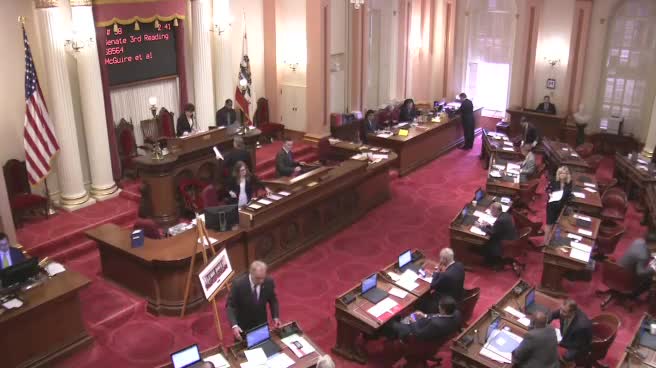 2MIN
Senate Floor
 5MIN
Senate Standing Committee on Appropriations
 4MIN
Senate Standing Committee on Environmental Quality
Bill Author
Bill Co-Author(s):