SB 937: Lactation accommodation.
- Session Year: 2017-2018
- House: Senate
- Latest Version Date: 2018-09-04
Existing law requires employers to provide a reasonable amount of break time to employees desiring to express milk for the employees infant child. Existing law also requires an employer to make reasonable efforts to provide the employee with the use of a room, or other location, other than a toilet stall, in close proximity to the employees work area, for the employee to express milk in private. Existing law exempts an employer from the break time requirement if the employers operations would be seriously disrupted by providing that time to employees desiring to express milk. Existing law subjects employers who violate these provisions to a civil penalty of $100 per violation and authorizes the Labor Commissioner to issue citations for those violations.
Existing law prohibits an employer, who is required by law to give an employee a rest period during a workday, from requiring the employee to work during the rest period. Existing law requires an employer to pay the employee one additional hour of pay, at the employees regular rate of compensation, for each rest period not provided.
This bill would require an employer to provide a lactation room or location that includes prescribed features and would require an employer, among other things, to provide access to a sink and refrigerator in close proximity to the employees workspace, as specified. The bill would require an employer to develop and implement a policy regarding lactation accommodation and make it available to employees, as specified. The bill would also require an employer to maintain records of requests for lactation accommodation for 3 years and to give the Labor Commission access to those records. The bill would provide that specified employers could seek an exemption from any of the requirements of these provisions if the employer could show that the requirement posed an undue hardship based on specified criteria.
The bill would deem denial of reasonable break time or adequate space to express milk a failure to provide a rest period in accordance with state law. The bill would prohibit an employer from discharging, or in any other manner discriminating or retaliating against, an employee for exercising or attempting to exercise rights under these provisions and would establish specific additional remedies.
The bill would require the Division of Labor Standards Enforcement to create a model lactation accommodation request form and to make it available for download from its Internet Web site by employees and employers. The bill would authorize the division to establish a model lactation accommodation policy and lactation accommodation best practices to provide guidance to employers.
Existing law requires employers to provide a reasonable amount of break time to employees desiring to express milk for the employees infant child. Existing law also requires an employer to make reasonable efforts to provide the employee with the use of a room, or other location, other than a toilet stall, in close proximity to the employees work area, for the employee to express milk in private. Existing law exempts an employer from the break time requirement if the employers operations would be seriously disrupted by providing that time to employees desiring to express milk. Existing law subjects employers who violate these provisions to a civil penalty of $100 per violation and authorizes the Labor Commissioner to issue citations for those violations.
Existing law prohibits an employer, who is required by law to give an employee a rest period during a workday, from requiring the employee to work during the rest period. Existing law requires an employer to pay the employee one additional hour of pay, at the employees regular rate of compensation, for each rest period not provided.
This bill would require an employer to provide a lactation room or location that includes prescribed features and would require an employer, among other things, to provide access to a sink and refrigerator in close proximity to the employees workspace. workspace, as specified. The bill would require an employer to develop and implement a policy regarding lactation accommodation and make it available to employees, as specified. The bill would also require an employer to maintain records of requests for lactation accommodation for 3 years and to give the Labor Commission access to those records. The bill would provide that specified employers could seek an exemption from any of the requirements of these provisions if the employer could show that the requirement posed an undue hardship based on specified criteria.
The bill would deem denial of reasonable break time or adequate space to express milk a failure to provide a rest period in accordance with state law. The bill would prohibit an employer from discharging, or in any other manner discriminating or retaliating against, an employee for exercising or attempting to exercise rights under these provisions, provisions and would establish specific additional remedies, and would authorize an employee to bring a civil action to obtain applicable remedies.
The bill would require the Division of Labor Standards Enforcement to create a model lactation accommodation policy and a model lactation accommodation request form, and make those models available request form and to make it available for download from its Internet Web site by employees and employers. The bill would require authorize the division to establish a model lactation accommodation policy and lactation accommodation best practices to provide nonmandatory guidance to employers.
The California Building Standards Law provides for the adoption of building standards by state agencies by requiring all state agencies that adopt or propose adoption of any building standard to submit the building standard to the California Building Standards Commission for approval and adoption. The commission is required to adopt specific building standards, including standards for graywater systems and electric vehicle charging infrastructure. Existing law requires the commission to publish, or cause to be published, editions of the California Building Standards Code in its entirety once every 3 years.This bill would require the commission to adopt prescribed mandatory building standards for the installation of lactation space for employees in specified buildings when there is a tenant improvement project to the building and certain criteria are met.Existing law requires employers to provide a reasonable amount of break time to employees desiring to express milk for the employees infant child. Existing law also requires an employer to make reasonable efforts to provide the employee with the use of a room, or other location, other than a toilet stall, in close proximity to the employees work area, for the employee to express milk in private. Existing law exempts an employer from the break time requirement if the employers operations would be seriously disrupted by providing that time to employees desiring to express milk. Existing law subjects employers who violate these provisions to a civil penalty of $100 per violation and authorizes the Labor Commissioner to issue citations for those violations.
Existing law prohibits an employer, who is required by law to give an employee a rest period during a workday, from requiring the employee to work during the rest period. Existing law requires an employer to pay the employee one additional hour of pay, at the employeess employees regular rate of compensation, for each rest period not provided.
This bill would require an employer to provide a lactation room or location that includes prescribed features and would require an employer, among other things, to provide access to a sink and refrigerator in close proximity to the employees work space. workspace. The bill would require an employer to develop and implement a policy regarding lactation accommodation and make it available to employees, as specified. The bill would also require an employer to maintain records of requests for lactation accommodation for 3 years and to give the Labor Commission access to those records. The bill would provide that specified employers could seek an exemption from any of the requirements of these provisions if the employer could show that the requirement posed an undue hardship based on specified criteria.
The bill would deem denial of reasonable break time or adequate space to express milk a failure to provide a rest period in accordance with state law. The bill would prohibit an employer from discharging, or in any other manner discriminating or retaliating against, an employee for exercising or attempting to exercise rights under these provisions, would establish specific additional remedies, and would authorize an employee to bring a civil action to obtain applicable remedies.
The bill would require the Division of Labor Standards Enforcement to create a model lactation accommodation policy and a model lactation accommodation request form, and make those models available for download from its Internet Web site by employees and employers. The bill would require the division to establish lactation accommodation best practices to provide nonmandatory guidance to employers.
The California Building Standards Law provides for the adoption of building standards by state agencies by requiring all state agencies that adopt or propose adoption of any building standard to submit the building standard to the California Building Standards Commission for approval and adoption. The commission is required to adopt specific building standards, including standards for graywater systems and electric vehicle charging infrastructure. Existing law requires the commission to publish, or cause to be published, editions of the California Building Standards Code in its entirety once every 3 years.
This bill would require the commission to adopt prescribed mandatory building standards for the installation of lactation space for employees in specified buildings when there is a tenant improvement project to the building and certain criteria are met.
Existing law requires employers to provide a reasonable amount of break time to employees desiring to express milk for the employees infant child. Existing law also requires an employer to make reasonable efforts to provide the employee with the use of a room, or other location, other than a toilet stall, in close proximity to the employees work area, for the employee to express milk in private. Existing law exempts an employer from the break time requirement if the employers operations would be seriously disrupted by providing that time to employees desiring to express milk. Existing law subjects employers who violate these provisions to a civil penalty of $100 per violation and authorizes the Labor Commissioner to issue citations for those violations.
Existing law prohibits an employer, who is required by law to give an employee a rest period during a workday, from requiring the employee to work during the rest period. Existing law requires an employer to pay the employee one additional hour of pay, at the employeess regular rate of compensation, for each rest period not provided.
This bill would require an employer to provide a lactation room or location to include that includes prescribed features and would require an employer employer, among other things, to provide access to a sink and refrigerator in close proximity to the employees work space. The bill would require an employer to develop and implement a policy regarding lactation accommodation and make it available to employees, as specified. The bill would also require an employer to maintain records of requests for lactation accommodation for 3 years and to give the Labor Commission access to those records. The bill would provide that specified employers could seek an exemption from any of the requirements of these provisions if the employer could show that the requirement posed an undue hardship based on specified criteria.
The bill would deem denial of reasonable break time or adequate space to express milk a failure to provide a rest period in accordance with state law. The bill would prohibit an employer from discharging, or in any other manner discriminating or retaliating against, an employee for exercising or attempting to exercise rights under these provisions, would establish specific additional remedies, and would authorize an employee to bring a civil action to obtain applicable remedies.
The bill would require the Division of Labor Standards Enforcement to create a model lactation accommodation policy and a model lactation accommodation request form, and make those models available for download from its Internet Web site by employees and employers. The bill would require the division to establish lactation accommodation best practices to provide guidance to employers.
The California Building Standards Law provides for the adoption of building standards by state agencies by requiring all state agencies that adopt or propose adoption of any building standard to submit the building standard to the California Building Standards Commission for approval and adoption. The commission is required to adopt specific building standards, including standards for graywater systems and electric vehicle charging infrastructure. Existing law requires the commission to publish, or cause to be published, editions of the California Building Standards Code in its entirety once every 3 years.
This bill would require the commission to adopt prescribed mandatory building standards for the installation of lactation space for employees in specified buildings when there is a tenant improvement project to the building and certain criteria are met.
Existing law requires employers to provide a reasonable amount of break time to employees desiring to express milk for the employees infant child. Existing law also requires an employer to make reasonable efforts to provide the employee with the use of a room, or other location, other than a toilet stall, in close proximity to the employees work area, for the employee to express milk in private. Existing law exempts an employer from the break time requirement if the employers operations would be seriously disrupted by providing that time to employees desiring to express milk. Existing law subjects employers who violate these provisions to a civil penalty of $100 per violation and authorizes the Labor Commissioner to issue citations for those violations.
Existing law prohibits an employer, who is required by law to give an employee a rest period during a workday, from requiring the employee to work during the rest period. Existing law requires an employer to pay the employee one additional hour of pay, at the employeess regular rate of compensation, for each rest period not provided.
This bill would require a lactation room or location to include prescribed features and would require an employer to provide access to a sink and refrigerator in close proximity to the employees work space. The bill would establish a procedure for an employer with fewer than 5 employees to apply to the Division of Labor Standards Enforcement for an undue hardship exemption from the lactation room or location requirement. The bill would require an employer to develop and implement a policy regarding lactation accommodation and make it available to employees, as specified. The bill would require an employer to respond to an employees request for lactation accommodation within 5 days and provide a written response to the employee if an employer cannot provide break time or a location that complies with the policy. The bill would also require an employer to maintain records of requests for lactation accommodation for 3 years and to give the Labor Commission access to those records.
The bill would deem denial of reasonable break time or adequate space to express milk a failure to provide a rest period in accordance with state law. The bill would prohibit an employer from discharging discharging, or in any other manner discriminating or retaliating against against, an employee for exercising or attempting to exercise rights under these provisions, would establish specific additional remedies, and would authorize an employee to bring a civil action to obtain applicable remedies, and would increase the civil penalty to $500 for violations. remedies.The bill would require the Division of Labor Standards Enforcement to create a model lactation accommodation policy and a model lactation accommodation request form, and make those models available for download from its Internet Web site by employees and employers. The bill would require the division to establish lactation accommodation best practices to provide guidance to employers.
The California Building Standards Law provides for the adoption of building standards by state agencies by requiring all state agencies that adopt or propose adoption of any building standard to submit the building standard to the California Building Standards Commission for approval and adoption. The commission is required to adopt specific building standards, including standards for graywater systems and electric vehicle charging infrastructure. Existing law requires the commission to publish, or cause to be published, editions of the California Building Standards Code in its entirety once every 3 years.
This bill would require the commission to adopt prescribed mandatory building standards for the installation of lactation space for employees in nonresidential buildings newly constructed or remodeled for workplace occupancy, as specified. specified buildings when there is a tenant improvement project to the building and certain criteria are met.
Existing law requires employers to provide a reasonable amount of break time to employees desiring to express milk for the employees infant child. Existing law also requires an employer to make reasonable efforts to provide the employee with the use of a room, or other location, other than a toilet stall, in close proximity to the employees work area, for the employee to express milk in private. Existing law exempts an employer from the break time requirement if the employers operations would be seriously disrupted by providing that time to employees desiring to express milk. Existing law subjects employers who violate these provisions to a civil penalty of $100 per violation and authorizes the Labor Commissioner to issue citations for those violations.
This bill would require a lactation room or location to include prescribed features and would require an employer to provide access to a sink and refrigerator in close proximity to the employees work space. The bill would establish a procedure for an employer with fewer than 5 employees to apply to the Division of Labor Standards Enforcement for an undue hardship exemption from the lactation room or location requirement. The bill would require an employer to develop and implement a policy regarding lactation accommodation and make it available to employees, as specified. The bill would require an employer to respond to an employees request for lactation accommodation within 5 days and provide a written response to the employee if an employer cannot provide break time or a location that complies with the policy. The bill would also require an employer to maintain records of requests for lactation accommodation for 3 years and to give the Labor Commission access to those records.
The bill would prohibit an employer from discharging or retaliating against an employee for exercising or attempting to exercise rights under these provisions, would establish specific additional remedies, would authorize an employee to bring a civil action to obtain applicable remedies, and would increase the civil penalty to $500 for violations.
The bill would require the Division of Labor Standards Enforcement to create a model lactation accommodation policy and a model lactation accommodation request form, and make those models available for download from its Internet Web site by employees and employers. The bill would require the division to establish lactation accommodation best practices to provide guidance to employers.
The California Building Standards Law provides for the adoption of building standards by state agencies by requiring all state agencies that adopt or propose adoption of any building standard to submit the building standard to the California Building Standards Commission for approval and adoption. The commission is required to adopt specific building standards, including standards for graywater systems and electric vehicle charging infrastructure. Existing law requires the commission to publish, or cause to be published, editions of the California Building Standards Code in its entirety once every 3 years.
This bill would require the commission to adopt prescribed mandatory building standards for the installation of lactation space for employees in nonresidential buildings newly constructed or remodeled for workplace occupancy, as specified.
Every employer, including the state and any political subdivision, shall provide a reasonable amount of break time to accommodate an employee desiring to express breast milk for the employees infant child each time such employee has need to express milk. The break time shall, if possible, run concurrently with any break time already provided to the employee. Break time for an employee that does not run concurrently with the rest time authorized for the employee by the applicable wage order of the Industrial Welfare Commission shall be unpaid.
SEC. 2.Section 1031 of the Labor Code is amended to read:1031.(a)The employer shall provide the employee with the use of a room or other location for the employee to express milk in private. The room or location may include the place where the employee normally works if it otherwise meets the requirements of this section.
(b)A lactation room or location shall not be a bathroom and shall be in close proximity to the employees work area, shielded from view, and free from intrusion while the employee is lactating.
(c)A lactation room or location shall comply with all of the following requirements:
(1)Be safe, clean, and free of toxic or hazardous materials.
(2)Contain a surface to place a breast pump and personal items.
(3)Contain a place to sit.
(4)Have access to electricity or alternative devices needed to operate an electric or battery-powered breast pump.
(d)The employer shall provide access to a sink with running water and a refrigerator suitable for storing milk in close proximity to the employees workspace. If a refrigerator cannot be provided, an employer may provide another cooling device suitable for storing milk, such as an employer-provided cooler.
(e)Where a multipurpose room is used for lactation among other uses, the use of the room for lactation shall take precedence over the other uses, but only for the time it is in use for lactation purposes.
(f)(1)An employer in a multitenant building or a multiemployer worksite may comply with this section by providing a space shared among multiple employers within the building or worksite if the employer cannot provide a lactation location within the employers own workspace.
(2)Employers or general contractors that coordinate a multiemployer worksite shall either provide lactation accommodations or provide a safe and secure location for subcontractor employers to provide lactation accommodation on the worksite, within two business days, upon written request of any subcontractor employer with an employee who requests an accommodation.
(g)An employer may comply with the requirements of this section by designating a lactation location that is temporary, due to operational, financial, or space limitations. These temporary spaces should be identified by signage, free from intrusion while an employee is expressing milk, and should remain lactation spaces for the time they are used for lactation purposes.
(h)An employer with fewer than 50 employees may establish an exemption from any requirement of this section if the employer can show that the requirement would impose an undue hardship when considered in relation to the size, nature, or structure of the employers business.
SEC. 3.Section 1033 of the Labor Code is amended to read:1033.(a)The denial of reasonable break time or adequate space to express milk in accordance with this chapter shall be deemed a failure to provide a rest period in accordance with state law for purposes of Section 226.7. An aggrieved employee may file a complaint under this subdivision with the Labor Commissioner pursuant to Section 98.
(b)An employer shall not discharge, or in any other manner discriminate or retaliate against, an employee for exercising or attempting to exercise any right protected under this chapter. This subdivision is not intended to limit or expand an employees rights pursuant to Section 98.6. An aggrieved employee may file a complaint under this subdivision with the Labor Commissioner pursuant to Section 98.7.
(c)An employee may report a violation of this chapter to the Labor Commissioners field enforcement unit. If, upon inspection or investigation, the Labor Commissioner determines that a violation of this chapter has occurred, the Labor Commissioner may issue a citation and may impose a civil penalty in the amount of one hundred dollars ($100) for each day that an employee is denied reasonable break time or adequate space to express milk in violation of this chapter. The procedures for issuing, contesting, and enforcing judgments for citations or civil penalties issued by the Labor Commissioner for violations of this chapter shall be the same as those set forth in Section 1197.1.
(d)Notwithstanding any other provision of this code, violations of this chapter shall not be misdemeanors under this code.
SEC. 4.Section 1034 is added to the Labor Code, to read:1034.(a)An employer shall develop and implement a policy regarding lactation accommodation that includes the following:
(1)A statement about an employees right to request lactation accommodation.
(2)The process by which the employee makes the request described in paragraph (1).
(3)An employers obligation to respond to the request described in paragraph (1) as outlined in subdivision (d).
(4)A statement about an employees right to file a complaint with the Labor Commissioner for any violation of a right under this chapter.
(b)The employer shall include the policy described in subdivision (a) in an employee handbook or set of policies that the employer makes available to employees.
(c)The employer shall distribute the policy described in subdivision (a) to new employees upon hiring and when an employee makes an inquiry about or requests parental leave.
(d)If an employer cannot provide break time or a location that complies with the policy described in subdivision (a), the employer shall provide a written response to the employee.
(e)An employer shall maintain a record of requests for three years from the date of request and shall allow the Labor Commissioner to access these records pursuant to Section 1174. An employer shall make these records available to an employee in the same manner as described in subdivisions (b) and (c) of Section 226. If an employer does not maintain adequate records pursuant to this section, or does not allow the Labor Commissioner reasonable access to such records, it shall be presumed that the employer has violated this chapter, absent clear and convincing evidence otherwise.
SEC. 5.Section 1035 is added to the Labor Code, to read:1035.(a)The Division of Labor Standards Enforcement shall create a model lactation accommodation request form and shall make it available for download by employees and employers from its Internet Web site.
(b)The Division of Labor Standards Enforcement may establish a model lactation accommodation policy and lactation accommodation best practices that provide guidance to employers, and a list of optional but recommended amenities that may include the following:
(1)A permanent lactation location that is suitable for the preparation and storage of food.
(2)A door that can be locked from the inside.
(3)At least one electrical outlet.
(4)A washable, comfortable chair.
(5)Adequate lighting.
(6)The ability to partition the room.
(7)A refrigerator that the employer permits employees to use for storage of breast milk.
(8)A sink with hot and cold running water.
(9)A hospital-grade breast pump.
(10)A full-length mirror.
(11)A microwave.
(12)A locker to place personal belongings.
(13)A permanent sign outside designating the room for lactation accommodation.
(c)Noncompliance with the best practices outlined in this section shall not be deemed a violation of this chapter.
Every employer, including the state and any political subdivision, shall provide a reasonable amount of break time to accommodate an employee desiring to express breast milk for the employees infant child each time such employee has need to express milk. The break time shall, if possible, run concurrently with any break time already provided to the employee. Break time for an employee that does not run concurrently with the rest time authorized for the employee by the applicable wage order of the Industrial Welfare Commission shall be unpaid.
SEC. 3.SEC. 2.Section 1031 of the Labor Code is amended to read:1031.(a)The employer shall provide the employee with the use of a room or other location for the employee to express milk in private. The room or location may include the place where the employee normally works if it otherwise meets the requirements of this section.
(b)A lactation room or location shall not be a bathroom and shall be in close proximity to the employees work area, shielded from view, and free from intrusion while the employee is lactating.
(c)A lactation room or location shall comply with all of the following requirements:
(1)Be safe, clean, and free of toxic or hazardous materials.
(2)Contain a surface to place a breast pump and personal items.
(3)Contain a place to sit.
(4)Have access to electricity. electricity or alternative devices needed to operate an electric or battery-powered breast pump.
(d)The employer shall provide access to a sink with running water and a refrigerator suitable for storing milk in close proximity to the employees workspace. If a refrigerator cannot be provided, an employer may provide another cooling device suitable for storing milk, such as an employer-provided cooler.
(e)Where a multipurpose room is used for lactation among other uses, the use of the room for lactation shall take precedence over the other uses, but only for the time it is in use for lactation purposes.
(f)(1)An employer in a multitenant building or a multiemployer worksite may comply with this section by providing a space shared among multiple employers within the building or worksite if the employer cannot provide a lactation location within the employers own workspace.
(2)Employers or general contractors that coordinate a multiemployer worksite shall either provide lactation accommodations or provide a safe and secure location for subcontractor employers to provide lactation accommodation on the worksite, within two business days, upon written request of any subcontractor employer with an employee who requests an accommodation.
(g)An employer may comply with the requirements of this section by designating a lactation location that is temporary, due to operational, financial, or space limitations. These temporary spaces should be identified by signage, free from intrusion while an employee is expressing milk, and should remain lactation spaces for the time they are used for lactation purposes.
(h)An employer with fewer than 50 employees may establish an exemption from any requirement of this section if the employer can show that the requirement would impose an undue hardship by causing the employer significant expense or operational difficulty when considered in relation to the size, financial resources, nature, or structure of the employers business.
SEC. 4.SEC. 3.Section 1033 of the Labor Code is amended to read:1033.(a)The denial of reasonable break time or adequate space to express milk in accordance with this chapter shall be deemed a failure to provide a rest period in accordance with state law for purposes of Section 226.7. An aggrieved employee may file a complaint under this subdivision with the Labor Commissioner pursuant to Section 98.
(b)An employee employer shall not discharge, or in any other manner discriminate or retaliate against, an employee for exercising or attempting to exercise any right protected under this chapter. This subdivision is not intended to limit or expand an employees rights pursuant to Section 98.6. An aggrieved employee may file a complaint under this subdivision with the Labor Commissioner pursuant to Section 98.7.
(c)An employee may report a violation of this chapter to the Labor Commissioners field enforcement unit. If, upon inspection or investigation, the Labor Commissioner determines that a violation of this chapter has occurred, the Labor Commissioner may issue a citation and may impose a civil penalty in the amount of one hundred dollars ($100) for each day that an employee is denied reasonable break time or adequate space to express milk in violation of this chapter. The procedures for issuing, contesting, and enforcing judgments for citations or civil penalties issued by the Labor Commissioner for violations of this chapter shall be the same as those set forth in Section 1197.1.
(d)As an alternative to filing a complaint with the Labor Commissioner, an employee may bring a civil action in a court of competent jurisdiction for any of the remedies provided by this section, including, but not limited to, reinstatement, actual damages, and appropriate equitable relief. If the employee prevails, the court may award reasonable attorneys fees.(e)(d)Notwithstanding any other provision of this code, violations of this chapter shall not be misdemeanors under this code.
SEC. 5.SEC. 4.Section 1034 is added to the Labor Code, to read:1034.(a)An employer shall develop and implement a policy regarding lactation accommodation that includes the following:
(1)A statement about an employees right to request lactation accommodation.
(2)The process by which the employee makes the request described in paragraph (1).
(3)An employers obligation to respond to the request described in paragraph (1) as outlined in subdivision (d).
(4)A statement about an employees right to file a complaint with the Labor Commissioner for any violation of a right under this chapter.
(b)The employer shall include the policy described in subdivision (a) in an employee handbook or set of policies that the employer makes available to employees.
(c)The employer shall distribute the policy described in subdivision (a) to new employees upon hiring and when an employee makes an inquiry about or requests parental leave.
(d)If an employer cannot provide break time or a location that complies with the policy described in subdivision (a), the employer shall provide a written response to the employee.
(e)An employer shall maintain a record of requests for three years from the date of request and shall allow the Labor Commissioner to access these records pursuant to Section 1174. An employer shall make these records available to an employee in the same manner as described in subdivisions (b) and (c) of Section 226. If an employer does not maintain adequate records pursuant to this section, or does not allow the Labor Commissioner reasonable access to such records, it shall be presumed that the employer has violated this chapter, absent clear and convincing evidence otherwise.
SEC. 6.SEC. 5.Section 1035 is added to the Labor Code, to read:1035.(a)(1)The Division of Labor Standards Enforcement shall create both of the following: a model lactation accommodation request form and shall make it available for download by employees and employers from its Internet Web site.
(A)A model lactation accommodation policy.(B)A model lactation accommodation request form.(2)The Division of Labor Standards Enforcement shall make the model policy and request form available for download from its Internet Web site by employees and employers.(b)The Division of Labor Standards Enforcement shall may establish a model lactation accommodation policy and lactation accommodation best practices that provide guidance to employers employers, and a list of optional but recommended amenities that may include the following:
(1)A permanent lactation location that is suitable for the preparation and storage of food.
(2)A door that can be locked from the inside.
(3)At least one electrical outlet.
(4)A washable, comfortable chair.
(5)Adequate lighting.
(6)The ability to partition the room.
(7)A refrigerator that the employer permits employees to use for storage of breast milk.
(8)A sink with hot and cold running water.
(9)A hospital-grade breast pump.
(10)A full-length mirror.
(11)A microwave.
(12)A locker to place personal belongings.
(13)A permanent sign outside designating the room for lactation accommodation.
(c)Noncompliance with the best practices outlined in this section shall not be deemed a violation of this chapter.
The commission, commencing with the next triennial edition of the California Building Standards Code (Title 24 of the California Code of Regulations) adopted after January 1, 2019, shall adopt, approve, codify, and publish mandatory building standards for the installation of lactation space for employees as follows:
(a)Lactation space shall be required in a building classified as Group A, B, E, F, I, M, or R-1, as defined by Chapter 3 of the California Building Code, when there is a tenant improvement project to the building that meets all of the following:
(1)The tenant improvement project is for the interior of the building.
(2)The gross square footage of the interior space of the building designated for employee-only use, and included in the tenant improvement project, is at least 15,000 square feet.
(3)The estimated cost of the project, as stated in the building application, is over one million dollars ($1,000,000).
(b)A building required to include lactation spaces pursuant to subdivision (a) shall include the following number of lactation spaces:
| Employee Occupancy Load of Building | Number of Lactation Spaces |
| 50-150 | 1 |
| 151-300 | 2 |
| 301-500 | 3 |
| 501-1,000 | 4 |
| 1,001-2,000 | 8 |
| 2,001-4,000 | 11 |
| For each additional 900 employees in excess of 4,000 | 1 |
If the building contains existing lactation spaces that comply with this section prior to the tenant improvement project, those rooms may fulfill the requirements of this subdivision.
(c)Except as otherwise provided in this subdivision, lactation spaces shall be at least 50 square feet, have at least one electrical outlet, with an additional outlet for a refrigerator, if applicable, have access to a sink with hot and cold running water, have a door that can be locked from the inside, and shall be located no more than 500 feet from the farthest employee workspace or within two adjacent floors. A project shall be exempt from including a sink if the plans do not otherwise include plumbing.
(d)The room shall meet all applicable local, state, and federal accessibility requirements, including requirements under Chapter 11B of the California Building Code and the federal Americans with Disabilities Act of 1990, Public Law 101-336 (42 U.S.C. Sec. 12102).
SEC. 2.Section 1030 of the Labor Code is amended to read:1030.Every employer, including the state and any political subdivision, shall provide a reasonable amount of break time to accommodate an employee desiring to express breast milk for the employees infant child each time such employee has need to express the milk. The break time shall, if possible, run concurrently with any break time already provided to the employee. Break time for an employee that does not run concurrently with the rest time authorized for the employee by the applicable wage order of the Industrial Welfare Commission shall be unpaid.
SEC. 3.Section 1031 of the Labor Code is amended to read:1031.(a)The employer shall provide the employee with the use of a room or other location for the employee to express milk in private. The room or location may include the place where the employee normally works if it otherwise meets the requirements of this section.
(b)A lactation room or location shall not be a bathroom and shall be in close proximity to the employees work area, shielded from view, and free from intrusion while the employee is lactating.
(c)A lactation room or location shall comply with all of the following requirements:
(1)Be safe, clean, and free of toxic or hazardous materials.
(2)Contain a surface to place a breast pump and personal items.
(3)Contain a place to sit.
(4)Have access to electricity.
(d)The employer shall provide access to a sink with running water and a refrigerator suitable for storing milk in close proximity to the employees workspace.
(e)Where a multipurpose room is used for lactation among other uses, the use of the room for lactation shall take precedence over the other uses, but only for the time it is in use for lactation purposes.
(f)An employer in a multitenant building may comply with this section by providing a space shared among multiple employers within the building if the employer cannot provide a lactation location within its the employers own workspace.
(g)An employer may comply with the requirements of this section by designating a lactation location that is temporary, due to operational, financial, or space limitations. These temporary spaces should be identified by signage, free from intrusion while an employee is expressing milk, and should remain lactation spaces for the time they are used for lactation purposes.
(h)An employer with fewer than 50 employees may establish an exemption from any requirement of this section if the employer can show that the requirement would impose an undue hardship by causing the employer significant expense or operational difficulty when considered in relation to the size, financial resources, or structure of the employers business.
SEC. 4.Section 1033 of the Labor Code is amended to read:1033.(a)The denial of reasonable break time or adequate space to express milk in accordance with this chapter shall be deemed a failure to provide a rest period in accordance with state law for purposes of Section 226.7. An aggrieved employee may file a complaint under this subdivision with the Labor Commissioner pursuant to Section 98.
(b)An employee shall not discharge, or in any other manner discriminate or retaliate against, an employee for exercising or attempting to exercise any right protected under this chapter. This subdivision is not intended to limit or expand an employees rights pursuant to Section 98.6. An aggrieved employee may file a complaint under this subdivision with the Labor Commissioner pursuant to Section 98.7.
(c)An employee may report a violation of this chapter to the Labor Commissioners field enforcement unit. If, upon inspection or investigation, the Labor Commissioner determines that a violation of this chapter has occurred, the Labor Commissioner may issue a citation and may impose a civil penalty in the amount of one hundred dollars ($100) for each day that an employee is denied reasonable break time or adequate space to express milk in violation of this chapter. The procedures for issuing, contesting, and enforcing judgments for citations or civil penalties issued by the Labor Commissioner for violations of this chapter shall be the same as those set forth in Section 1197.1.
(d)As an alternative to filing a complaint with the Labor Commissioner, an employee may bring a civil action in a court of competent jurisdiction for any of the remedies provided by this section, including, but not limited to, reinstatement, actual damages, and appropriate equitable relief. If the employee prevails, the court may award reasonable attorneys fees.
(e)Notwithstanding any other provision of this code, violations of this chapter shall not be misdemeanors under this code.
SEC. 5.Section 1034 is added to the Labor Code, to read:1034.(a)An employer shall develop and implement a policy regarding lactation accommodation that includes the following:
(1)A statement about an employees right to request lactation accommodation.
(2)The process by which the employee makes the request described in paragraph (1).
(3)An employers obligation to respond to the request described in paragraph (1) as outlined in subdivision (d).
(4)A statement about an employees right to file a complaint with the Labor Commissioner for any violation of a right under this chapter.
(b)The employer shall include the policy described in subdivision (a) in an employee handbook or set of policies that the employer makes available to employees.
(c)The employer shall distribute the policy described in subdivision (a) to new employees upon hiring and when an employee makes an inquiry about or requests parental leave.
(d)If an employer cannot provide break time or a location that complies with the policy described in subdivision (a), the employer shall provide a written response to the employee.
(e)An employer shall maintain a record of requests for three years from the date of request and shall allow the Labor Commissioner to access these records pursuant to Section 1174. An employer shall make these records available to an employee in the same manner as described in subdivisions (b) and (c) of Section 226. If an employer does not maintain adequate records pursuant to this section, or does not allow the Labor Commissioner reasonable access to such records, it shall be presumed that the employer has violated this chapter, absent clear and convincing evidence otherwise.
SEC. 6.Section 1035 is added to the Labor Code, to read:1035.(a)(1)The Division of Labor Standards Enforcement shall create both of the following:
(A)A model lactation accommodation policy.
(B)A model lactation accommodation request form.
(2)The Division of Labor Standards Enforcement shall make the model policy and request form available for download from its Internet Web site by employees and employers.
(b)The Division of Labor Standards Enforcement shall establish lactation accommodation best practices that provide guidance to employers and a list of optional but recommended amenities, including amenities that may include the following:
(1)A permanent lactation location that is suitable for the preparation and storage of food.
(2)A door that can be locked from the inside.
(3)At least one electrical outlet.
(4)A washable, comfortable chair.
(5)Adequate lighting.
(6)The ability to partition the room.
(7)A refrigerator that the employer permits employees to use for storage of breast milk.
(8)A sink with hot and cold running water.
(9)A hospital-grade breast pump.
(10)A full-length mirror.
(11)A microwave.
(12)A locker to place personal belongings.
(13)A permanent sign outside designating the room for lactation accommodation.
(c)Noncompliance with the best practices outlined in this section shall not be deemed a violation of this chapter.
The commission, commencing with the next triennial edition of the California Building Standards Code (Title 24 of the California Code of Regulations) adopted after January 1, 2019, shall adopt, approve, codify, and publish mandatory building standards for the installation of lactation space for employees as follows:
(a)Lactation space shall be required in a building classified as Group A, B, E, F, I, M, or R-1, as defined by Chapter 3 of the California Building Code, when there is a tenant improvement project to the building that meets all of the following:
(1)The tenant improvement project is for the interior of the building.
(2)The gross square footage of the interior space of the building designated for employee-only use, and included in the tenant improvement project, is at least 15,000 square feet.
(3)The estimated cost of the project, as stated in the building application, is over one million dollars ($1,000,000).
(b)A building required to include lactation spaces pursuant to subdivision (a) shall include the following number of lactation spaces:
| Employee Occupancy Load of Building | Number of Lactation Spaces |
| 50-150 | 1 |
| 151-300 | 2 |
| 301-500 | 3 |
| 501-1,000 | 4 |
| 1,001-2,000 | 8 |
| 2,001-4,000 | 11 |
| For each additional 900 employees in excess of 4,000 | 1 |
If the building contains existing lactation spaces that comply with this section prior to the tenant improvement project, those rooms may fulfill the requirements of this subdivision.
(c)Except as otherwise provided in this subdivision, lactation spaces shall be at least 50 square feet, have at least one electrical outlet, with an additional outlet for a refrigerator, if applicable, have access to a sink with hot and cold running water, have a door that can be locked from the inside, and shall be located no more than 500 feet from the farthest employee workspace or within two adjacent floors. A project shall be exempt from including a sink if the plans do not otherwise include plumbing.
(d)The room shall meet all applicable local, state, and federal accessibility requirements, including requirements under Chapter 11B of the California Building Code and the federal Americans with Disabilities Act of 1990, Public Law 101-336 (42 U.S.C. Sec. 12102).
SEC. 2.Section 1030 of the Labor Code is amended to read:1030.Every employer, including the state and any political subdivision, shall provide a reasonable amount of break time to accommodate an employee desiring to express breast milk for the employees infant child each time such employee has need to express the milk. The break time shall, if possible, run concurrently with any break time already provided to the employee. Break time for an employee that does not run concurrently with the rest time authorized for the employee by the applicable wage order of the Industrial Welfare Commission shall be unpaid.
SEC. 3.Section 1031 of the Labor Code is amended to read:1031.(a)The employer shall make reasonable efforts to provide the employee with the use of a room or other location for the employee to express milk in private. The room or location may include the place where the employee normally works if it otherwise meets the requirements of this section.
(b)A lactation room or location shall not be a bathroom and shall be in close proximity to the employees work area, shielded from view, and free from intrusion. intrusion while the employee is lactating.
(c)A lactation room or location shall comply with all of the following requirements:
(1)Be safe, clean, and free of toxic or hazardous materials.
(2)Contain a surface to place a breast pump and personal items.
(3)Contain a place to sit.
(4)Have access to electricity.
(d)The employer shall provide access to a sink with running water and a refrigerator suitable for storing milk in close proximity to the employees workspace.
(e)Where a multipurpose room is used for lactation among other uses, the use of the room for lactation shall take precedence over the other uses. uses, but only for the time it is in use for lactation purposes.
(f)An employer in a multitenant building may comply with this section by providing a space shared among multiple employers within the building if the employer cannot provide a lactation location within its own workspace.
(g)An employer may comply with the requirements of this section by designating a lactation location that is temporary, due to operational, financial, or space limitations. These temporary spaces should be identified by signage, free from intrusion while an employee is expressing milk, and should remain lactation spaces for the time they are used for lactation purposes.
(h)An employer with fewer than 50 employees may establish an exemption from any requirement of this section if the employer can show that the requirement would impose an undue hardship by causing the employer significant expense or operational difficulty when considered in relation to the size, financial resources, or structure of the employers business.
SEC. 4.Section 1033 of the Labor Code is amended to read:1033.(a)The denial of reasonable break time or adequate space to express milk in accordance with this chapter shall be deemed a failure to provide a rest period in accordance with state law for purposes of Section 226.7. An aggrieved employee may file a complaint under this subdivision with the Labor Commissioner pursuant to Section 98.
(b)An employee shall not discharge, or in any other manner discriminate or retaliate against, an employee for exercising or attempting to exercise any right protected under this chapter. This subdivision is not intended to limit or expand an employees rights pursuant to Section 98.6. An aggrieved employee may file a complaint under this subdivision with the Labor Commissioner pursuant to Section 98.7.
(c)An employee may report a violation of this chapter to the Labor Commissioners field enforcement unit. If, upon inspection or investigation, the Labor Commissioner determines that a violation of this chapter has occurred, the Labor Commissioner may issue a citation and may impose a civil penalty in the amount of one hundred dollars ($100) for each day that an employee is denied reasonable break time or adequate space to express milk in violation of this chapter. The procedures for issuing, contesting, and enforcing judgments for citations or civil penalties issued by the Labor Commissioner for violations of this chapter shall be the same as those set forth in Section 1197.1.
(d)As an alternative to filing a complaint with the Labor Commissioner, an employee may bring a civil action in a court of competent jurisdiction for any of the remedies provided by this section, including, but not limited to, reinstatement, actual damages, and appropriate equitable relief. If the employee prevails, the court may award reasonable attorneys fees.
(e)Notwithstanding any other provision of this code, violations of this chapter shall not be misdemeanors under this code.
SEC. 5.Section 1034 is added to the Labor Code, to read:1034.(a)An employer shall develop and implement a policy regarding lactation accommodation that includes the following:
(1)A statement about an employees right to request lactation accommodation.
(2)The process by which the employee makes the request described in paragraph (1).
(3)An employers obligation to respond to the request described in paragraph (1) as outlined below in subdivisions (d) and (e). in subdivision (d).
(4)A statement about an employees right to file a complaint with the Labor Commissioner for any violation of a right under this chapter.
(b)The employer shall include the policy described in subdivision (a) in an employee handbook or set of policies that the employer makes available to employees.
(c)The employer shall distribute the policy described in subdivision (a) to new employees upon hiring and when an employee makes an inquiry about or requests parental leave.
(d)If an employer cannot provide break time or a location that complies with the policy described in subdivision (a), the employer shall provide a written response to the employee.
(e)An employer shall maintain a record of requests for three years from the date of request and shall allow the Labor Commissioner to access these records pursuant to Section 1174. An employer shall make these records available to an employee in the same manner as described in subdivisions (b) and (c) of Section 226. If an employer does not maintain adequate records pursuant to this section, or does not allow the Labor Commissioner reasonable access to such records, it shall be presumed that the employer has violated this chapter, absent clear and convincing evidence otherwise.
SEC. 6.Section 1035 is added to the Labor Code, to read:1035.(a)(1)The Division of Labor Standards Enforcement shall create both of the following:
(A)A model lactation accommodation policy.
(B)A model lactation accommodation request form.
(2)The Division of Labor Standards Enforcement shall make the model policy and request form available for download from its Internet Web site by employees and employers.
(b)The Division of Labor Standards Enforcement shall establish lactation accommodation best practices that provide guidance to employers and a list of optional but recommended amenities, including the following:
(1)A permanent lactation location that is suitable for the preparation and storage of food.
(2)A door that can be locked from the inside.
(3)At least one electrical outlet.
(4)A washable, comfortable chair.
(5)A surface to place personal items.(6)(5)Adequate lighting.
(7)(6)The ability to partition the room.
(8)(7)A refrigerator that the employer permits employees to use for storage of breast milk.
(9)(8)A sink with hot and cold running water.
(10)(9)A hospital-grade breast pump.
(11)(10)A full-length mirror.
(12)(11)A microwave.
(13)(12)A locker to place personal belongings.
(14)(13)A permanent sign outside designating the room for lactation accommodation.
(c)Best practices shall state that temporary lactation spaces can be created due to operational, financial, or space limitations. These temporary spaces should be identified by signage, free from intrusion, and should remain lactation spaces for the duration of an employees need to express milk.(c)Noncompliance with the best practices outlined in this section shall not be deemed a violation of this chapter.
The commission, commencing with the next triennial edition of the California Building Standards Code (Title 24 of the California Code of Regulations) adopted after January 1, 2019, shall adopt, approve, codify, and publish mandatory building standards for the installation of lactation space for employees in nonresidential buildings newly constructed or remodeled for workplace occupancy, as follows:
(a)Lactation space shall be required in a building that has at least 15,000 square feet of employee workspace if the project costs more than five hundred thousand dollars ($500,000). classified as Group A, B, E, F, I, M, or R-1, as defined by Chapter 3 of the California Building Code, when there is a tenant improvement project to the building that meets all of the following:
(b)Additional lactation spaces shall be required based upon square footage and occupant loads in areas designated as employee workspace.(1)The tenant improvement project is for the interior of the building.
(2)The gross square footage of the interior space of the building designated for employee-only use, and included in the tenant improvement project, is at least 15,000 square feet.
(3)The estimated cost of the project, as stated in the building application, is over one million dollars ($1,000,000).
(b)A building required to include lactation spaces pursuant to subdivision (a) shall include the following number of lactation spaces:
| Employee Occupancy Load of Building | Number of Lactation Spaces |
| 50-150 | 1 |
| 151-300 | 2 |
| 301-500 | 3 |
| 501-1,000 | 4 |
| 1,001-2,000 | 8 |
| 2,001-4,000 | 11 |
| For each additional 900 employees in excess of 4,000 | 1 |
If the building contains existing lactation spaces that comply with this section prior to the tenant improvement project, those rooms may fulfill the requirements of this subdivision.
(c)Except as otherwise provided in this subdivision, lactation spaces shall be at least 50 square feet, have at least one electrical outlet, with an additional outlet for a refrigerator, if applicable, have access to a sink with hot and cold running water, have a door that can be locked from the inside, and shall be located no more than 500 feet from the farthest employee workspace or within two adjacent floors. A project shall be exempt from including a sink if the plans do not otherwise include plumbing.
(d)A new lactation room shall have a permanent sign outside the door indicating its use as a lactation room.(e)The standards adopted pursuant to this section may include an exemption for a project if the existing employee workspace is compliant with those standards.(d)The room shall meet all applicable local, state, and federal accessibility requirements, including requirements under Chapter 11B of the California Building Code and the federal Americans with Disabilities Act of 1990, Public Law 101-336 (42 U.S.C. Sec. 12102).
SEC. 2.Section 1030 of the Labor Code is amended to read:1030.Every employer, including the state and any political subdivision, shall provide a reasonable amount of break time to accommodate an employee desiring to express breast milk for the employees infant child. child each time such employee has need to express the milk. The break time shall, if possible, run concurrently with any break time already provided to the employee. Break time for an employee that does not run concurrently with the rest time authorized for the employee by the applicable wage order of the Industrial Welfare Commission shall be unpaid.
SEC. 2.SEC. 3.Section 1031 of the Labor Code is amended to read:1031.(a)The employer shall make reasonable efforts to provide the employee with the use of a room or other location for the employee to express milk in private. The room or location may include the place where the employee normally works if it otherwise meets the requirements of this section.
(b)A lactation room or location shall not be a bathroom and shall be in close proximity to the employees work area, shielded from view, and free from intrusion.
(c)A lactation room or location shall comply with all of the following requirements:
(1)Be safe, clean, and free of toxic or hazardous materials.
(2)Contain a surface to place a breast pump and personal items.
(3)Contain a place to sit.
(4)Have access to electricity.
(d)The employer shall provide access to a sink with running water and a refrigerator in close proximity to the employees workspace.
(e)Where a multipurpose room is used for lactation among other uses, the use of the room for lactation shall take precedence over the other uses.
(f)An employer in a multitenant building may comply with this section by providing a space shared among multiple employers within the building if the employer cannot provide a lactation location within its own workspace.
(g)An employer with fewer than five employees who can demonstrate that compliance with this section would impose an undue hardship may apply to the Labor Commissioner for an undue hardship exemption. The Labor Commissioner shall determine whether to approve the application for the undue hardship exemption by evaluating the difficulty or expense of compliance for the employer in comparison to the size, financial resources, nature, or structure of the employers business.SEC. 3.SEC. 4.Section 1033 of the Labor Code is amended to read:1033.(a)An employer shall not discharge or in any manner discriminate or retaliate against an employee for exercising or attempting to exercise any right protected under this chapter.(b)An employer who violates any provision of this chapter shall be subject to a civil penalty in the amount of five hundred dollars ($500) for each violation.(c)An employee aggrieved by a violation of this chapter shall be entitled to reinstatement and actual damages and to appropriate equitable relief.(d)An employee who is discharged, threatened with discharge, demoted, suspended, denied break time or adequate space to express milk, or in any manner discriminated or retaliated against in terms and conditions of employment by his or her employer because the employee has exercised the employees rights as set forth in this chapter may file a complaint with the Labor Commissioner.(e)If, upon inspection or investigation, the Labor Commissioner determines that a violation of this chapter has occurred, the Labor Commissioner may issue a citation. The procedures for issuing, contesting, and enforcing judgments for citations or civil penalties issued by the Labor Commissioner for violations of this chapter shall be the same as those set forth in Section 1197.1. Alternatively, an employee may bring a civil action for the remedies provided by this section in a court of competent jurisdiction. If the employee prevails, the court may award reasonable attorneys fees.1033.(a)The denial of reasonable break time or adequate space to express milk in accordance with this chapter shall be deemed a failure to provide a rest period in accordance with state law for purposes of Section 226.7. An aggrieved employee may file a complaint under this subdivision with the Labor Commissioner pursuant to Section 98.
(b)An employee shall not discharge, or in any other manner discriminate or retaliate against, an employee for exercising or attempting to exercise any right protected under this chapter. This subdivision is not intended to limit or expand an employees rights pursuant to Section 98.6. An aggrieved employee may file a complaint under this subdivision with the Labor Commissioner pursuant to Section 98.7.
(c)An employee may report a violation of this chapter to the Labor Commissioners field enforcement unit. If, upon inspection or investigation, the Labor Commissioner determines that a violation of this chapter has occurred, the Labor Commissioner may issue a citation and may impose a civil penalty in the amount of one hundred dollars ($100) for each day that an employee is denied reasonable break time or adequate space to express milk in violation of this chapter. The procedures for issuing, contesting, and enforcing judgments for citations or civil penalties issued by the Labor Commissioner for violations of this chapter shall be the same as those set forth in Section 1197.1.
(d)As an alternative to filing a complaint with the Labor Commissioner, an employee may bring a civil action in a court of competent jurisdiction for any of the remedies provided by this section, including, but not limited to, reinstatement, actual damages, and appropriate equitable relief. If the employee prevails, the court may award reasonable attorneys fees.
(f)(e)Notwithstanding any other provision of this code, violations of this chapter shall not be misdemeanors under this code.
SEC. 4.SEC. 5.Section 1034 is added to the Labor Code, to read:1034.(a)An employer shall develop and implement a policy regarding lactation accommodation that includes the following:
(1)A statement about an employees right to request lactation accommodation.
(2)The process by which the employee makes the request described in paragraph (1).
(3)An employers obligation to respond to the request described in paragraph (1) as outlined below in subdivisions (d) and (e).
(4)A statement about an employees right to file a complaint with the Labor Commissioner for any violation of a right under this chapter.
(b)The employer shall include the policy described in subdivision (a) in an employee handbook or set of policies that the employer makes available to employees.
(c)The employer shall distribute the policy described in subdivision (a) to new employees upon hiring and when an employee makes an inquiry about or requests parental leave.
(d)An employer shall respond to an employees request for lactation accommodation within five days. (e)(d)If an employer cannot provide break time or a location that complies with the policy described in subdivision (a), the employer shall provide a written response to the employee.
(f)(e)An employer shall maintain a record of requests for three years from the date of request and shall allow the Labor Commissioner to access these records pursuant to Section 1174. An employer shall make these records available to an employee in the same manner as described in subdivisions (b) and (c) of Section 226. If an employer does not maintain adequate records pursuant to this section, or does not allow the Labor Commissioner reasonable access to such records, it shall be presumed that the employer has violated this chapter, absent clear and convincing evidence otherwise.
SEC. 5.SEC. 6.Section 1035 is added to the Labor Code, to read:1035.(a)(1)The Division of Labor Standards Enforcement shall create both of the following:
(A)A model lactation accommodation policy.
(B)A model lactation accommodation request form.
(2)The Division of Labor Standards Enforcement shall make the model policy and request form available for download from its Internet Web site by employees and employers.
(b)The Division of Labor Standards Enforcement shall establish lactation accommodation best practices that provide guidance to employers and a list of optional but recommended amenities, including the following:
(1)A permanent lactation location that is suitable for the preparation and storage of food.
(2)A door that can be locked from the inside.
(3)At least one electrical outlet.
(4)A washable, comfortable chair.
(5)A surface to place personal items.
(6)Adequate lighting.
(7)The ability to partition the room.
(8)A refrigerator that the employer permits employees to use for storage of breast milk.
(9)A sink with hot and cold running water.
(10)A hospital-grade breast pump.
(11)A full-length mirror.
(12)A microwave.
(13)A locker to place personal belongings.
(14)A permanent sign outside designating the room for lactation accommodation.
(c)Best practices shall state that temporary lactation spaces can be created due to operational, financial, or space limitations. These temporary spaces should be identified by signage, free from intrusion, and should remain lactation spaces for the duration of an employees need to express milk.
(d)Best practices shall also include a recommendation that an employer consider flexible break times to accommodate changes in an employees need to express milk, that the lactation space be within a five-minute walk from the employees work place, and that break time not be affected by the length of time it takes to get to the dedicated lactation room or space.The commission, commencing with the next triennial edition of the California Building Standards Code (Title 24 of the California Code of Regulations) adopted after January 1, 2019, shall adopt, approve, codify, and publish mandatory building standards for the installation of lactation space for employees in nonresidential buildings newly constructed or remodeled for workplace occupancy, as follows:
(a)Lactation space shall be required in a building that has at least 15,000 square feet of employee workspace if the project costs more than five hundred thousand dollars ($500,000).
(b)Additional lactation spaces shall be required based upon square footage and occupant loads in areas designated as employee workspace.
(c)Except as otherwise provided in this subdivision, lactation spaces shall be at least 50 square feet, have at least one electrical outlet, have access to a sink with hot and cold running water, and shall be located no more than 500 feet from the farthest employee workspace or within two adjacent floors. A project shall be exempt from including a sink if the plans do not otherwise include plumbing.
(d)A new lactation room shall have a permanent sign outside the door indicating its use as a lactation room.
(e)The standards adopted pursuant to this section may include an exemption for a project if the existing employee workspace is compliant with those standards.
SEC. 2.Section 1031 of the Labor Code is amended to read:1031.(a)The employer shall make reasonable efforts to provide the employee with the use of a room or other location, other than a toilet stall, in close proximity to the employees work area, location for the employee to express milk in private. The room or location may include the place where the employee normally works if it otherwise meets the requirements of this section.
(b)A lactation room or location shall not be a bathroom and shall be in proximity to the employees work area, shielded from view, and free from intrusion.
(c)A lactation room or location shall comply with all of the following requirements:
(1)Be safe, clean, and free of toxic or hazardous materials.
(2)Contain a surface to place a breast pump and personal items.
(3)Contain a place to sit.
(4)Have access to electricity.
(d)The employer shall provide access to a sink with running water and a refrigerator in close proximity to the employees workspace.
(e)Where a multipurpose room is used for lactation among other uses, the use of the room for lactation shall take precedence over the other uses.
(f)An employer in a multitenant building may comply with this section by providing a space shared among multiple employers within the building if the employer cannot provide a lactation location within its own workspace.
(g)An employer with fewer than five employees who can demonstrate that compliance with this section would impose an undue hardship may apply to the Labor Commissioner for an undue hardship exemption. The Labor Commissioner shall determine whether to approve the application for the undue hardship exemption by evaluating the difficulty or expense of compliance for the employer in comparison to the size, financial resources, nature, or structure of the employers business.
SEC. 3.Section 1033 of the Labor Code is amended to read:1033.(a)An employer shall not discharge or in any manner discriminate or retaliate against an employee for exercising or attempting to exercise any right protected under this chapter.
(b)An employer who violates any provision of this chapter shall be subject to a civil penalty in the amount of one five hundred dollars ($100) ($500) for each violation.
(c)An employee aggrieved by a violation of this chapter shall be entitled to reinstatement and actual damages and to appropriate equitable relief.
(d)An employee who is discharged, threatened with discharge, demoted, suspended, denied break time or adequate space to express milk, or in any manner discriminated or retaliated against in terms and conditions of employment by his or her employer because the employee has exercised the employees rights as set forth in this chapter may file a complaint with the Labor Commissioner.
(b)(e)If, upon inspection or investigation, the Labor Commissioner determines that a violation of this chapter has occurred, the Labor Commissioner may issue a citation. The procedures for issuing, contesting, and enforcing judgments for citations or civil penalties issued by the Labor Commissioner for violations of this chapter shall be the same as those set forth in Section 1197.1. Alternatively, an employee may bring a civil action for the remedies provided by this section in a court of competent jurisdiction. If the employee prevails, the court may award reasonable attorneys fees.
(c)(f)Notwithstanding any other provision of this code, violations of this chapter shall not be misdemeanors under this code.
SEC. 4.Section 1034 is added to the Labor Code, to read:1034.(a)An employer shall develop and implement a policy regarding lactation accommodation that includes the following:
(1)A statement about an employees right to request lactation accommodation.
(2)The process by which the employee makes the request described in paragraph (1).
(3)An employers obligation to respond to the request described in paragraph (1) as outlined below in subdivisions (d) and (e).
(4)A statement about an employees right to file a complaint with the Labor Commissioner for any violation of a right under this chapter.
(b)The employer shall include the policy described in subdivision (a) in an employee handbook or set of policies that the employer makes available to employees.
(c)The employer shall distribute the policy described in subdivision (a) to new employees upon hiring and when an employee makes an inquiry about or requests parental leave.
(d)An employer shall respond to an employees request for lactation accommodation within five days.
(e)If an employer cannot provide break time or a location that complies with the policy described in subdivision (a), the employer shall provide a written response to the employee.
(f)An employer shall maintain a record of requests for three years from the date of request and shall allow the Labor Commissioner to access these records pursuant to Section 1174. An employer shall make these records available to an employee in the same manner as described in subdivisions (b) and (c) of Section 226. If an employer does not maintain adequate records pursuant to this section, or does not allow the Labor Commissioner reasonable access to such records, it shall be presumed that the employer has violated this chapter, absent clear and convincing evidence otherwise.
SEC. 5.Section 1035 is added to the Labor Code, to read:1035.(a)(1)The Division of Labor Standards Enforcement shall create both of the following:
(A)A model lactation accommodation policy.
(B)A model lactation accommodation request form.
(2)The Division of Labor Standards Enforcement shall make the model policy and request form available for download from its Internet Web site by employees and employers.
(b)The Division of Labor Standards Enforcement shall establish lactation accommodation best practices that provide guidance to employers and a list of optional but recommended amenities, including the following:
(1)A permanent lactation location that is suitable for the preparation and storage of food.
(2)A door that can be locked from the inside.
(3)At least one electrical outlet.
(4)A washable, comfortable chair.
(5)A surface to place personal items.
(6)Adequate lighting.
(7)The ability to partition the room.
(8)A refrigerator that the employer permits employees to use for storage of breast milk.
(9)A sink with hot and cold running water.
(10)A hospital-grade breast pump.
(11)A full-length mirror.
(12)A microwave.
(13)A locker to place personal belongings.
(14)A permanent sign outside designating the room for lactation accommodation.
(c)Best practices shall state that temporary lactation spaces can be created due to operational, financial, or space limitations. These temporary spaces should be identified by signage, free from intrusion, and should remain lactation spaces for the duration of an employees need to express milk.
(d)Best practices shall also include a recommendation that an employer consider flexible break times to accommodate changes in an employees need to express milk, that the lactation space be within a five-minute walk from the employees work place, and that break time not be affected by the length of time it takes to get to the dedicated lactation room or space.
|
Date
|
Status
|
|---|---|
| Sep 30, 2018 | In Senate. Consideration of Governor's veto pending. |
| Sep 30, 2018 | Vetoed by the Governor. |
| Sep 6, 2018 | Enrolled and presented to the Governor at 4 p.m. |
| Aug 29, 2018 | Assembly amendments concurred in. (Ayes 28. Noes 9.) Ordered to engrossing and enrolling. |
| Aug 28, 2018 | In Senate. Concurrence in Assembly amendments pending. |
| Aug 28, 2018 | Read third time. Passed. Ordered to the Senate. |
| Aug 24, 2018 | Read third time and amended. |
| Aug 20, 2018 | Read second time. Ordered to third reading. |
| Aug 16, 2018 | From committee: Do pass. (Ayes 13. Noes 3.) (August 16). |
| Aug 8, 2018 | August 8 set for first hearing. Placed on suspense file. |
| Aug 6, 2018 | From committee with author's amendments. Read second time and amended. Re-referred to Com. on APPR. |
| Jun 26, 2018 | From committee: Do pass and re-refer to Com. on APPR. (Ayes 12. Noes 4.) (June 26). Re-referred to Com. on APPR. |
| Jun 21, 2018 | From committee: Do pass and re-refer to Com. on B. & P. (Ayes 5. Noes 2.) (June 20). Re-referred to Com. on B. & P. |
| Jun 7, 2018 | Referred to Coms. on L. & E. and B. & P. |
| May 31, 2018 | In Assembly. Read first time. Held at Desk. |
| May 30, 2018 | Read third time. Passed. (Ayes 21. Noes 5.) Ordered to the Assembly. |
| May 29, 2018 | Read second time. Ordered to third reading. |
| May 25, 2018 | From committee: Do pass as amended. (Ayes 5. Noes 2.) (May 25). |
| May 18, 2018 | Set for hearing May 25. |
| May 14, 2018 | May 14 hearing: Placed on APPR. suspense file. |
| May 4, 2018 | Set for hearing May 14. |
| May 1, 2018 | Read second time and amended. Re-referred to Com. on APPR. |
| Apr 30, 2018 | From committee: Do pass as amended and re-refer to Com. on APPR. (Ayes 8. Noes 1.) (April 24). |
| Apr 19, 2018 | Set for hearing April 24. |
| Apr 18, 2018 | From committee: Do pass and re-refer to Com. on T. & H. (Ayes 5. Noes 2.) (April 17). Re-referred to Com. on T. & H. |
| Apr 13, 2018 | Set for hearing April 17. |
| Apr 11, 2018 | From committee: Do pass and re-refer to Com. on JUD. (Ayes 4. Noes 0.) (April 11). Re-referred to Com. on JUD. |
| Mar 16, 2018 | Set for hearing April 11. |
| Feb 14, 2018 | Referred to Coms. on L. & I.R., JUD., and T. & H. |
| Jan 26, 2018 | From printer. May be acted upon on or after February 25. |
| Jan 25, 2018 | Introduced. Read first time. To Com. on RLS. for assignment. To print. |
|
Date
|
Description
|
Location
|
Votes
|
|
|---|---|---|---|---|
| Aug 29, 2018 | Unfinished Business SB937 Wiener et al. Concurrence | Senate Floor |
Passed |
|
| Aug 28, 2018 | SB 937 Wiener Senate Third Reading By LIMÓN | Assembly Floor |
Passed |
|
| Aug 16, 2018 | Do pass. | Assembly Standing Committee on Appropriations |
Passed |
|
| Jun 26, 2018 | Do pass and be re-referred to the Committee on [Appropriations] | Assembly Standing Committee on Business and Professions |
Passed |
|
| Jun 20, 2018 | Do pass and be re-referred to the Committee on [Business and Professions] | Assembly Standing Committee on Labor and Employment |
Passed |
|
| May 30, 2018 | Senate 3rd Reading SB937 Wiener et al. | Senate Floor |
Passed |
|
| May 25, 2018 | Do pass as amended | Senate Standing Committee on Appropriations |
Passed |
|
| May 14, 2018 | Placed on suspense file | Senate Standing Committee on Appropriations |
Passed |
|
| Apr 24, 2018 | Do pass as amended, but first amend, and re-refer to the Committee on [Appropriations] | Senate Standing Committee on Transportation and Housing |
Passed |
|
| Apr 17, 2018 | Do pass, but first be re-referred to the Committee on [Transportation and Housing] | Senate Standing Committee on Judiciary |
Passed |
|
| Apr 11, 2018 | Do pass, but first be re-referred to the Committee on [Judiciary] | Senate Standing Committee on Labor and Industrial Relations |
Passed |
This list shows positions taken on this bill by organizations on the date displayed, which is linked to the original source.
Positions by individuals are not included.
|
Organization
|
Position
|
Date
|
|---|---|---|
| 4-Individual Letters | ** Support | Apr 10, 2018 |
| Aclu-California, Center For Advocacy And Policy | ** Support | Oct 9, 2018 |
| American College of Obstetricians and Gynecologists | * Support | Jun 20, 2018 |
| American Insurance Association | ** Against | Oct 9, 2018 |
| Antelope Valley Breastfeeding Coalition | ** Support | Jun 23, 2018 |
| Antelope Valley Hospital WIC Program | ** Support | Jun 23, 2018 |
| Association Of California School Administrators | ** Against | Oct 9, 2018 |
| Board of Supervisors | * Support | Apr 11, 2018 |
| Board Of Supervisors, County Of Santa Cruz | ** Support | Jun 23, 2018 |
| BreastfeedLA | ** Support | Jun 23, 2018 |
| Building Owners and Managers Association | ** Against | Jun 23, 2018 |
| Cal State University San Marcos | * Support | Apr 11, 2018 |
| California Ambulance Association | ** Against | Oct 9, 2018 |
| California Association For Health Services At Home | ** Against | Oct 9, 2018 |
| California Association Of Joint Powers Authorities | ** Against | Oct 9, 2018 |
| California Bankers Association | ** Against | Jun 23, 2018 |
| California Beer and Beverage Distributors | ** Against | Oct 9, 2018 |
| California Black Health Network | * Support | Apr 24, 2018 |
| California Breastfeeding Coalition | ** Support | Oct 9, 2018 |
| California Business Properties Association | * Against | Jun 26, 2018 |
| California Chamber Of Commerce | ** Against | Oct 9, 2018 |
| California Employment Lawyers Association | ** Support | Oct 9, 2018 |
| California Farm Bureau Federation | ** Against | Oct 9, 2018 |
| California Federation Of Teachers | ** Support | Oct 9, 2018 |
| California Food Policy Advocates | ** Support | Jun 23, 2018 |
| California Hotel and Lodging Association | ** Against | Jun 23, 2018 |
| California Labor Federation, Afl-Cio | ** Support | Oct 9, 2018 |
| California Latinos Reproductive Justice Group | * Support | Apr 11, 2018 |
| California Manufactures And Technology Association | ** Against | Oct 9, 2018 |
| California Restaurant Association | ** Against | Oct 9, 2018 |
| California Retailers Association | ** Against | Oct 9, 2018 |
| California State Association Of Counties | ** Against | Oct 9, 2018 |
| California Travel Association | ** Against | Jun 23, 2018 |
| California Women's Law Center | ** Support | Oct 9, 2018 |
| California Work & Family Coalition | ** Support | Jun 23, 2018 |
| Central Valley Lactation Association | ** Support | Jun 23, 2018 |
| ChangeLab Solutions | ** Support | Oct 9, 2018 |
| Child Care Law Center | ** Support | Oct 9, 2018 |
| Citizens Against Lawsuit Abuse | ** Against | Oct 9, 2018 |
| City and County of San Francisco | * Support | Apr 24, 2018 |
| City of Glendale | * Support | Jun 20, 2018 |
| City of Glendale | * Support | Apr 11, 2018 |
| City of San Francisco | * Support | Apr 17, 2018 |
| Civil Justice Association Of California | ** Against | Oct 9, 2018 |
| Commercial Real Estate Development Association - Niaop | ** Against | Jun 23, 2018 |
| Common Sense Kids Action | ** Support | Oct 9, 2018 |
| Consumer Attorneys Of California | ** Support | Oct 9, 2018 |
| Contra Costa Breastfeeding Taskforce | ** Support | Oct 9, 2018 |
| County Health Executives Association Of California | ** Support | Oct 9, 2018 |
| CRLA Foundation | * Support | Jun 20, 2018 |
| Equal Rights Advocates | ** Support | Oct 9, 2018 |
| First 5 Napa County | ** Support | Oct 9, 2018 |
| Four Individual Letters | ** Support | Oct 9, 2018 |
| four individuals | ** Support | Aug 28, 2018 |
| Healthy Horizons Corporate Lactation And Brestfeeding Centers, Inc. | ** Support | Oct 9, 2018 |
| International Council of Shopping Centers | ** Against | Jun 23, 2018 |
| League Of California Cities | ** Against | Oct 9, 2018 |
| Legal Aid At Work | ** Support | Jun 23, 2018 |
| Los Angeles Alliance for a New Economy | ** Support | Jun 23, 2018 |
| Martine Watkins, Vice Mayor City Of Santa Cruz | ** Support | Aug 28, 2018 |
| maternal mental health now | ** Support | Jun 23, 2018 |
| Mayor Mark Farrell | * Support | Apr 17, 2018 |
| Mi Familia Vota | ** Support | Oct 9, 2018 |
| National Council of Jewish Women-California | ** Support | Oct 9, 2018 |
| Nursing Mothers Counsel, Inc. | ** Support | Jun 23, 2018 |
| Our Family Coalition | ** Support | Oct 9, 2018 |
| Restaurant Opportunities Center Of California | ** Support | Oct 9, 2018 |
| rise together | ** Support | Oct 9, 2018 |
| Sacramento Breastfeeding Coalition | ** Support | Oct 9, 2018 |
| San Francisco Unified School District | ** Support | Oct 9, 2018 |
| Santa Cruz Community Health Centers | ** Support | Oct 9, 2018 |
| Santa Monica Commission On The Status Of Women | ** Support | Jun 23, 2018 |
| South Los Angeles Health Projects | ** Support | Oct 9, 2018 |
| Stronger California Advocates Network | ** Support | Jun 23, 2018 |
| Stronger California Advocates Network | * Support | Apr 17, 2018 |
| The Women's Foundation of California | ** Support | Oct 9, 2018 |
| Tricounties Breastfeeding Alliance Coalition | ** Support | Jun 23, 2018 |
| Tricounties Breastfeeding Alliance, Yuba, Sutter And Colusa Counties | ** Support | Oct 9, 2018 |
| Tuolumne County Breastfeeding Coalition | ** Support | Jun 23, 2018 |
| Vice Mayor Martine Watkins, City Of Santa Cruz | ** Support | Jun 23, 2018 |
| Wic Sonoma County Indian Health | ** Support | Oct 9, 2018 |
| YWCA San Francisco & Marin | ** Support | Oct 9, 2018 |
Office of Senate Floor Analyses (916) 651-1520 Fax: (916) 327-4478 | SB |
VETO
Bill No: SB 937
:
SENATE LABOR & IND. REL. COMMITTEE: 4-0, 4/11/18
AYES: Pan, Jackson, Mitchell, Wieckowski
NO VOTE RECORDED: Stone
SENATE JUDICIARY COMMITTEE: 5-2, 4/17/18
AYES: Jackson, Hertzberg, Monning, Stern, Wieckowski
NOES: Moorlach, Anderson
SENATE TRANS. & HOUSING COMMITTEE: 8-1, 4/24/18
AYES: Beall, Allen, Dodd, Galgiani, McGuire, Roth, Skinner, Wiener
NOES: Vidak
NO VOTE RECORDED: Cannella, Gaines, Morrell, Wieckowski
SENATE APPROPRIATIONS COMMITTEE: 5-2, 5/25/18
AYES: Lara, Beall, Bradford, Hill, Wiener
NOES: Bates, Nielsen
SENATE FLOOR: 24-6, 5/30/18
AYES: Allen, Atkins, Beall, Bradford, Dodd, Galgiani, Hernandez, Hertzberg, Hill, Hueso, Jackson, Lara, Leyva, McGuire, Mitchell, Monning, Newman, Pan, Portantino, Roth, Skinner, Stern, Wieckowski, Wiener
NOES: Anderson, Bates, Moorlach, Morrell, Nielsen, Vidak
NO VOTE RECORDED: Berryhill, Cannella, De León, Fuller, Gaines, Glazer, Nguyen, Stone, Wilk
SENATE FLOOR: 28-9, 8/29/18
AYES: Allen, Atkins, Beall, Bradford, Chang, De León, Delgado, Dodd, Galgiani, Glazer, Hernandez, Hertzberg, Hill, Hueso, Jackson, Lara, Leyva, McGuire, Mitchell, Monning, Pan, Portantino, Roth, Skinner, Stern, Wieckowski, Wiener, Wilk
NOES: Anderson, Bates, Fuller, Gaines, Moorlach, Morrell, Nielsen, Stone, Vidak
NO VOTE RECORDED: Berryhill, Cannella, Nguyen
ASSEMBLY FLOOR: 57-18, 8/28/18 - See last page for vote
DIGEST:
This bill mandates that all employers provide a space with certain technical specifications for employees with a desire to express breast milk in private.
Existing law:
- Requires that every employer provide a reasonable amount of break time to accommodate an employee desiring to express breast milk for the employee’s infant child. The break time must, if possible, run concurrently with any break time already provided to the employee and any additional break time required is unpaid. (Labor Code §1030)
- Allows an employer to withhold break time for expressing milk if allowing the employee to take a lactation break would seriously disrupt the operations of the employer. (Labor Code §1032)
- Stipulates that the employer shall make reasonable efforts to provide the employee with the use of a room or other location, other than a toilet stall, in close proximity to the employee’s work area, for the employee to express milk in private. (Labor Code §1031)
- Orders that an employer who violates any of the above provisions shall be subject to a civil penalty in the amount of $100 for each violation. (Labor Code §1033)
- Establishes the Private Attorneys General Act (PAGA) and allows an aggrieved employee to recover a civil penalty normally assessed and collected by the Labor and Workforce Development Agency through a civil action. (Labor Code §2699)
This bill:
- Mandates the construction of lactation rooms in a tenant improvement project on the interior of a building that has at least 15,000 square feet of employee workspace if the project costs more than $1 million, with additional lactation rooms required based upon square footage and occupant loads in areas designated as employee workspace.
- Specifies that newly constructed lactation spaces shall be at least 50 square feet, have at least one electrical outlet, have access to a sink with hot and cold running water, be located no more than 500 feet from the farthest employee workspace or within two adjacent floors and be able to be locked from the inside. A project may be exempted from the requirement to have a sink if the plans for that project do not otherwise include plumbing.
- Requires that a lactation room be safe and free of toxic or hazardous materials, contain a surface to place a breast pump and personal items as well as a place to sit, have access to electricity, running water and a refrigerator, not be a bathroom and be in proximity to the employee’s work area, shielded from view, and free from intrusion.
- Requires current employers to provide the employee with the use of a room or other location for the employee to express milk in private. The room or location may include the place where the employee normally works if it otherwise meets the requirements for a lactation room as specified in this bill.
- Allows an employer to designate a space as a temporary lactation location if that employer is unable to provide a permanent lactation space due to operational, financial or space limitations. These temporary spaces should be identified by signage and be free from intrusion while the employee is expressing breast milk.
- Allows an employer in a multitenant building to provide a space that is shared among multiple employers within the building if the employer cannot provide a lactation location within its own workspace.
- Allows an employer with fewer than 50 employees to apply to the Labor Commissioner for an undue hardship exemption for any section of this bill, provided they can demonstrate that compliance with that section would cause significant expense or operational difficulty, considering the size, financial resources or structure of the employer’s business.
- Instructs employers to maintain a record of lactation accommodation requests for three years from the date of request and shall allow the Labor Commissioner to access these records.
- Requires employers to develop and implement a policy that educates employees on their rights, including the process by which employees are able to request lactation accommodation, employer obligations and the right of employees to file complaints with the Labor Commissioner. The employer must make this policy available to employees upon hire and when a lactation accommodation request is made.
- Designates the denial of reasonable break time or adequate space to express milk as a failure by the employer to provide a rest period and allows an employee to file a complaint with the Labor Commissioner.
- Allows an employee to bring a civil action in a court of competent jurisdiction for any of the remedies provided by this section, including, but not limited to, reinstatement, actual damages, and appropriate equitable relief as an alternative to filing a complaint with the Labor Commissioner.
- Prohibits an employer from discharging, acting discriminatorily towards or retaliating against an employee for exercising or attempting to exercise any right protected under this bill.
- Imposes a fine of $100 on an employer for each violation of a provision of this bill, upon investigation or inspection by the Labor Commissioner.
- Requires the Division of Labor Standards Enforcement to create both a model lactation accommodation policy and a model lactation accommodation request form, which will both be available for download from its Web site by employees and employers.
- Requires these best practices to detail that employers may utilize temporary lactation spaces if they face operational, financial, or space limitations. These temporary spaces should be identified by signage, free from intrusion, and should remain lactation spaces for the duration of an employee’s need to express milk.
- Further requires that best practices include a recommendation that an employer consider flexible break times to accommodate lactation breaks, that the lactation space be within a five-minute walk from the employee’s work place, and that break time not be affected by the length of time it takes to get to the dedicated lactation room or space.
Comments
Need for this bill? Research by the United States Breastfeeding Committee suggests that approximately half of new mothers enter the workforce before their child is one year old. This causes many women to stop breastfeeding before the American Academy of Pediatrics recommended six months, at a cost to the employee, the employer and the child. The Office of the Surgeon General additionally highlights workplace concerns to be a major barrier to new mothers breastfeeding, with only 25% of surveyed employers reporting a company program to accommodate expressing breast milk. According to this body of research, increasing the amount of mothers who are able to breastfeed their children is in the interest of public health and has the potential to confer substantial savings in health care costs on both employers and the state of California.
Liability for employers. Opponents have voiced concern surrounding the broadness of these new lactation accommodation requirements. Enforcement for this bill falls under the purview of the Labor Commissioner, making its provisions actionable under PAGA. These opponents worry that a problem similar to the frivolous lawsuits brought under the Americans with Disabilities Act could develop, where a lawyer inundates businesses in an area with threats of lawsuits in order to extract a payment. Specifically, the stipulation that a lactation room be free of “toxic and hazardous” materials without a specific definition could prove problematic. PAGA could allow the pursuit of legal action for noncompliance on very specific details and many employers, including those attempting to comply, could be open to litigation for circumstances outside of their control. The author could consider a provision to limit the kind of litigation faced by employers for compliance with this bill.
Impact on small businesses. Some stakeholders note that provisions of SB 937 are especially concerning when it comes to small businesses. Small businesses, especially in more urban areas, are already facing serious space constraints and would be hard-pressed to accommodate a lactation room, given the specifications in this bill. SB 937 attempts to reconcile this by allowing businesses to designate temporary lactation locations and allowing employers with less than 50 employees to apply for an undue hardship exemption; however, it does not give specifics on this exemption process and requires small businesses to proactively apply for an exemption or face a fine. Opponents point out that small businesses struggle with time and resource availability and compliance with these provisions would prove very challenging.
Other policies of note. The Office of the Surgeon General emphasizes employment concerns as one of the major barriers new mothers’ ability to breastfeed. Lactation accommodation is among the preferred options stated to alleviate this, in addition to increased maternity and paternity leave. An expansion of new parent leave would allow new mothers to breastfeed in their own homes rather than in a workplace. Requiring lactation accommodation on a wider scale would most probably make breastfeeding more feasible for new mothers, but supplementary policy changes could offer further benefits beyond enacting stricter lactation accommodation rules.
FISCAL EFFECT: Appropriation: No Fiscal Com.: Yes Local: No
According to the Senate Appropriations Committee:
- The California Building Standards Commission (CBSC) within the Department of General Services (DGS) indicates that it would require one three-year limited term position and $202,000, beginning in 2019-20, to facilitate the development, proposal, vetting, and adoption of this bill’s lactation-space related building standards mandates. CBSC would also incur a one-time facilities reconfiguration cost of up to $50,000 (DGS Special Revolving Fund).
- The Real Estate Services Division within DGS estimates that construction cost of each additional lactation room required under this bill would range from $45,000 to $120,000 (DGS Special Revolving Fund). The number of DGS facilities that would need to undergo construction to comply with the bill’s requirements has yet to be determined. Thus, total construction cost across all DGS properties is unknown, but potentially significant.
The Department of Industrial Relations would incur first-year costs of $169,000, and ongoing annual costs of $112,000 to implement and enforce its provisions of this bill (Labor Enforcement and Compliance Fund).
ACLU-California, Center for Advocacy and Policy
California Breastfeeding Coalition
California Employment Lawyers Association
California Federation of Teachers
California Labor Federation, AFL-CIO
California Women’s Law Center
ChangeLab Solutions
Child Care Law Center
Common Sense Kids Action
Consumer Attorneys of California
Contra Costa Breastfeeding Taskforce
County Health Executives Association of California
County of Santa Cruz Board of Supervisors, John Leopold
County of Santa Cruz Board of Supervisors, Ryan Coonerty
Equal Rights Advocates
First 5 Napa County
Healthy Horizons Corporate Lactation and Brestfeeding Centers, Inc.
Mi Familia Vota
National Council of Jewish Women-California
Our Family Coalition
Restaurant Opportunities Center of California
Rise Together
Sacramento Breastfeeding Coalition
San Francisco Unified School District
Santa Cruz Community Health Centers
South Los Angeles Health Projects
The Women’s Foundation of California
Tricounties Breastfeeding Alliance, Yuba, Sutter and Colusa Counties
Vice Mayor of the City of Santa Cruz, Martine Watkins
WIC Sonoma County Indian Health
YWCA San Francisco & Marin
Four individual letters
OPPOSITION: (Verified 10/3/18)
American Insurance Association
Association of California School Administrators
California Ambulance Association
California Association for Health Services at Home
California Association of Joint Powers Authorities
California Beer and Beverage Distributors
California Chamber of Commerce
California Farm Bureau Federation
California Manufactures and Technology Association
California Restaurant Association
California Retailers Association
California State Association of Counties
Citizens Against Lawsuit Abuse
Civil Justice Association of California
League of California Cities
ARGUMENTS IN SUPPORT: Proponents argue that encouraging new mothers to breastfeed is in the best interest of the employee and the employer. According to supporters, employers actually realize a return on their investment with reduced absenteeism, increased worker retention and higher reported feelings of satisfaction and productivity. Proponents also cite the large body of medical research stressing the benefits of breastfeeding on the health of the infant and the mother. Finally, supporters point out the racial disparity present in new mothers’ ability to breastfeed, noting that women of color are far less likely to be able to breastfeed for the recommended six months and propose increased access to lactation accommodation as a solution.
ARGUMENTS IN OPPOSITION: Opponents argue that SB 937 is quite burdensome for employers and exposes employers to potential litigation traps. Opponents also point out that that the facility used as a lactation accommodation must take “precedence” over other uses of the room. Therefore, simply complying with SB 937 by denying employee access to a breakroom while it is being used as a lactation space will force an employer to violate provisions of the IWC Wage Orders. Finally SB 937 requires the employer maintain records of the requests for lactation accommodation for three years. However, the employee is not required to actually make a lactation accommodation request in writing, but the employer is required to keep a record of any request and respond in writing. Opponents argue this is an onerous and one-sided requirement that exposes employers to additional litigation risk.
GOVERNOR'S VETO MESSAGE:
I am returning Senate Bill 937 without my signature.
This bill requires employers to provide a space that meets specified standards for employees with a desire to express breast milk in private.
I have signed AB 1976 which furthers the state's ongoing efforts to support working mothers and their families. Therefore, this bill is not necessary.
ASSEMBLY FLOOR: 57-18, 8/28/18
AYES: Aguiar-Curry, Arambula, Berman, Bloom, Bonta, Burke, Caballero, Calderon, Carrillo, Cervantes, Chau, Chávez, Chiu, Chu, Cooley, Daly, Eggman, Frazier, Friedman, Gabriel, Gallagher, Cristina Garcia, Eduardo Garcia, Gipson, Gloria, Gonzalez Fletcher, Gray, Grayson, Holden, Irwin, Jones-Sawyer, Kalra, Kamlager-Dove, Lackey, Levine, Limón, Low, Maienschein, McCarty, Medina, Mullin, Muratsuchi, Nazarian, O'Donnell, Quirk, Reyes, Rivas, Rodriguez, Rubio, Santiago, Mark Stone, Thurmond, Ting, Waldron, Weber, Wood, Rendon
NOES: Travis Allen, Bigelow, Brough, Chen, Choi, Cunningham, Dahle, Fong, Harper, Kiley, Mathis, Mayes, Melendez, Obernolte, Patterson, Quirk-Silva, Steinorth, Voepel
NO VOTE RECORDED: Acosta, Baker, Cooper, Flora, Salas
10/9/18 10:57:31
**** END ****
Office of Senate Floor Analyses (916) 651-1520 Fax: (916) 327-4478 | SB |
UNFINISHED BUSINESS
Bill No: SB 937
:
SENATE LABOR & IND. REL. COMMITTEE: 4-0, 4/11/18
AYES: Pan, Jackson, Mitchell, Wieckowski
NO VOTE RECORDED: Stone
SENATE JUDICIARY COMMITTEE: 5-2, 4/17/18
AYES: Jackson, Hertzberg, Monning, Stern, Wieckowski
NOES: Moorlach, Anderson
SENATE TRANS. & HOUSING COMMITTEE: 8-1, 4/24/18
AYES: Beall, Allen, Dodd, Galgiani, McGuire, Roth, Skinner, Wiener
NOES: Vidak
NO VOTE RECORDED: Cannella, Gaines, Morrell, Wieckowski
SENATE APPROPRIATIONS COMMITTEE: 5-2, 5/25/18
AYES: Lara, Beall, Bradford, Hill, Wiener
NOES: Bates, Nielsen
SENATE FLOOR: 24-6, 5/30/18
AYES: Allen, Atkins, Beall, Bradford, Dodd, Galgiani, Hernandez, Hertzberg, Hill, Hueso, Jackson, Lara, Leyva, McGuire, Mitchell, Monning, Newman, Pan, Portantino, Roth, Skinner, Stern, Wieckowski, Wiener
NOES: Anderson, Bates, Moorlach, Morrell, Nielsen, Vidak
NO VOTE RECORDED: Berryhill, Cannella, De León, Fuller, Gaines, Glazer, Nguyen, Stone, Wilk
ASSEMBLY FLOOR: 57-18, 8/28/18 - See last page for vote
DIGEST:
This bill mandates that all employers provide a space with certain technical specifications for employees with a desire to express breast milk in private.
Assembly Amendments
(1) remove all stipulations of this bill dealing with tenant improvement projects and updates to the building code; (2) allow lactation rooms to comply with this bill by providing a cooler and alternative devices with which to power an electric breast pump, instead of requiring a refrigerator and an electrical outlet; (3) remove requirement that an employer must show that lactation accommodation causes significant expense or operational difficulty to qualify for an undue hardship exemption. Additionally remove consideration of the business’s financial resources for the purposes of determining whether a business should be exempted from the stipulations of this bill; (4) remove a section providing for a worker’s right to pursue a civil action in court as an alternative to filing a complaint with the Labor Commissioner. This does not change any worker’s right to bring a civil action to court under the Private Attorneys General Act of 2004; (5) remove a stipulation that the Department of Labor Standards Enforcement (DLSE) create a model lactation accommodation policy; (6) state that the DLSE may create a model lactation accommodation policy, a list of optional but recommended amenities; and, (7) require employers or general contractors on a multi-tenant worksite to provide lactation accommodation on the worksite within two business days, upon written request of any subcontractor employer with an employee who requests an accommodation.
Existing law:
- Requires that every employer provide a reasonable amount of break time to accommodate an employee desiring to express breast milk for the employee’s infant child. The break time must, if possible, run concurrently with any break time already provided to the employee and any additional break time required is unpaid. (Labor Code §1030)
- Allows an employer to withhold break time for expressing milk if allowing the employee to take a lactation break would seriously disrupt the operations of the employer. (Labor Code §1032)
- Stipulates that the employer shall make reasonable efforts to provide the employee with the use of a room or other location, other than a toilet stall, in close proximity to the employee’s work area, for the employee to express milk in private. (Labor Code §1031)
- Orders that an employer who violates any of the above provisions shall be subject to a civil penalty in the amount of $100 for each violation. (Labor Code §1033)
- Establishes the Private Attorneys General Act (PAGA) and allows an aggrieved employee to recover a civil penalty normally assessed and collected by the Labor and Workforce Development Agency through a civil action. (Labor Code §2699)
This bill:
- Requires that a lactation room be safe and free of toxic or hazardous materials, contain a surface to place a breast pump and personal items as well as a place to sit, have access to electricity, running water and a refrigerator, not be a bathroom and be in proximity to the employee’s work area, shielded from view, and free from intrusion.
- Requires current employers to provide the employee with the use of a room or other location for the employee to express milk in private. The room or location may include the place where the employee normally works if it otherwise meets the requirements for a lactation room as specified in this bill.
- Allows an employer to designate a space as a temporary lactation location if that employer is unable to provide a permanent lactation space due to operational, financial or space limitations. These temporary spaces should be identified by signage and be free from intrusion while the employee is expressing breast milk.
- Allows an employer in a multitenant building to provide a space that is shared among multiple employers within the building if the employer cannot provide a lactation location within its own workspace.
- Allows an employer with 50 employees or less to apply to the Labor Commissioner for an exemption for any section of this bill, provided they can demonstrate that compliance with that section would cause undue hardship considering the size, financial resources or structure of the employer’s business.
- Instructs employers to maintain a record of lactation accommodation requests for three years from the date of request and shall allow the Labor Commissioner to access these records.
- Requires employers to develop and implement a policy that educates employees on their rights, including the process by which employees are able to request lactation accommodation, employer obligations and the right of employees to file complaints with the Labor Commissioner. The employer must make this policy available to employees upon hire and when a lactation accommodation request is made.
- Designates the denial of reasonable break time or adequate space to express milk as a failure by the employer to provide a rest period and allows an employee to file a complaint with the Labor Commissioner.
- Prohibits an employer from discharging, acting discriminatorily towards or retaliating against an employee for exercising or attempting to exercise any right protected under this bill.
- Imposes a fine of $100 on an employer for each violation of a provision of this bill, upon investigation or inspection by the Labor Commissioner.
- Requires the Division of Labor Standards Enforcement to create a model lactation accommodation request form, which will be available for download from its web site by employees and employers.
Comments
Need for this bill? Research by the United States Breastfeeding Committee suggests that approximately half of new mothers enter the workforce before their child is one year old. This causes many women to stop breastfeeding before the American Academy of Pediatrics recommended six months, at a cost to the employee, the employer and the child. The Office of the Surgeon General additionally highlights workplace concerns to be a major barrier to new mothers breastfeeding, with only 25% of surveyed employers reporting a company program to accommodate expressing breast milk. According to this body of research, increasing the amount of mothers who are able to breastfeed their children is in the interest of public health and has the potential to confer substantial savings in health care costs on both employers and the state of California.
Liability for employers. Opponents have voiced concern surrounding the broadness of these new lactation accommodation requirements. Enforcement for this bill falls under the purview of the Labor Commissioner, making its provisions actionable under PAGA. These opponents worry that a problem similar to the frivolous lawsuits brought under the Americans with Disabilities Act could develop, where a lawyer inundates businesses in an area with threats of lawsuits in order to extract a payment. Specifically, the stipulation that a lactation room be free of “toxic and hazardous” materials without a specific definition could prove problematic. PAGA could allow the pursuit of legal action for noncompliance on very specific details and many employers, including those attempting to comply, could be open to litigation for circumstances outside of their control. The author could consider a provision to limit the kind of litigation faced by employers for compliance with this bill.
Impact on small businesses. Some stakeholders note that provisions of SB 937 are especially concerning when it comes to small businesses. Small businesses, especially in more urban areas, are already facing serious space constraints and would be hard-pressed to accommodate a lactation room, given the specifications in this bill. SB 937 attempts to reconcile this by allowing businesses to designate temporary lactation locations and allowing employers with 50 employees or less to apply for an undue hardship exemption; however, it does not give specifics on this exemption process and requires small businesses to proactively apply for an exemption or face a fine. Opponents point out that small businesses struggle with time and resource availability and compliance with these provisions would prove very challenging.
Other policies of note. The Office of the Surgeon General emphasizes employment concerns as one of the major barriers new mothers’ ability to breastfeed. Lactation accommodation is among the preferred options stated to alleviate this, in addition to increased maternity and paternity leave. An expansion of new parent leave would allow new mothers to breastfeed in their own homes rather than in a workplace. Requiring lactation accommodation on a wider scale would most probably make breastfeeding more feasible for new mothers, but supplementary policy changes could offer further benefits beyond enacting stricter lactation accommodation rules.
FISCAL EFFECT: Appropriation: No Fiscal Com.: Yes Local: No
According to the Assembly Appropriations Committee:
- Ongoing annual costs of approximately $200,000 for the California Building Standards Commission to facilitate the development, proposal, vetting, and adoption of this bill’s lactation-space- related building standards (DGS Special Revolving Fund).
- Additional state costs – likely in the tens of millions of dollars – to bring state-owned facilities into compliance with the provisions of this bill. The Department of General Services (DGS) indicates that for affected DGS-controlled state-owned buildings and DGS-occupied leased spaces, the total cost of construction for an estimated 233 compliant rooms is approximately $34 million. There will be additional state costs for other state buildings that are not managed by DGS, including offices for the Employment Development Department, state hospitals, and prisons.
- First-year special fund costs of $169,000 and ongoing special fund costs of $115,000 annually for DLSE to implement and enforce the provisions of SB 937. Major cost drivers include the enforcement of additional claims and the development of a model lactation policy and best practices guidelines.
ACLU-California, Center for Advocacy and Policy
California Breastfeeding Coalition
California Employment Lawyers Association
California Federation of Teachers
California Labor Federation, AFL-CIO
California Women’s Law Center
ChangeLab Solutions
Child Care Law Center
Common Sense Kids Action
Consumer Attorneys of California
Contra Costa Breastfeeding Taskforce
County Health Executives Association of California
Equal Rights Advocates
First 5 Napa County
Healthy Horizons Corporate Lactation and Brestfeeding Centers, Inc.
John Leopold, County of Santa Cruz Board of Supervisors
Martine Watkins, Vice Mayor City of Santa Cruz
Mi Familia Vota
National Council of Jewish Women-California
Our Family Coalition
Restaurant Opportunities Center of California
Rise Together
Ryan Coonerty, County of Santa Cruz Board of Supervisors
Sacramento Breastfeeding Coalition
San Francisco Unified School District
Santa Cruz Community Health Centers
South Los Angeles Health Projects
The Women’s Foundation of California
Tricounties Breastfeeding Alliance, Yuba, Sutter and Colusa Counties
Vice Mayor of the City of Santa Cruz, Martine Watkins
WIC Sonoma County Indian Health
YWCA San Francisco & Marin
Four individuals
OPPOSITION: (Verified 8/28/18)
American Insurance Association
Association of California School Administrators
California Ambulance Association
California Association for Health Services at Home
California Association of Joint Powers Authorities
California Beer and Beverage Distributors
California Chamber of Commerce
California Farm Bureau Federation
California Manufactures and Technology Association
California Restaurant Association
California Retailers Association
California State Association of Counties
Citizens Against Lawsuit Abuse
Civil Justice Association of California
League of California Cities
ARGUMENTS IN SUPPORT: Proponents argue that encouraging new mothers to breastfeed is in the best interest of the employee and the employer. According to supporters, employers actually realize a return on their investment with reduced absenteeism, increased worker retention and higher reported feelings of satisfaction and productivity. Proponents also cite the large body of medical research stressing the benefits of breastfeeding on the health of the infant and the mother. Finally, supporters point out the racial disparity present in new mothers’ ability to breastfeed, noting that women of color are far less likely to be able to breastfeed for the recommended six months and propose increased access to lactation accommodation as a solution.
ARGUMENTS IN OPPOSITION: Opponents argue that SB 937 is quite burdensome for employers and exposes employers to potential litigation traps. Opponents also point out that that the facility used as a lactation accommodation must take “precedence” over other uses of the room. Therefore, simply complying with SB 937 by denying employee access to a breakroom while it is being used as a lactation space will force an employer to violate provisions of the IWC Wage Orders. Finally SB 937 requires the employer maintain records of the requests for lactation accommodation for three years. However, the employee is not required to actually make a lactation accommodation request in writing, but the employer is required to keep a record of any request and respond in writing. Opponents argue this is an onerous and one-sided requirement that exposes employers to additional litigation risk.
ASSEMBLY FLOOR: 57-18, 8/28/18
AYES: Aguiar-Curry, Arambula, Berman, Bloom, Bonta, Burke, Caballero, Calderon, Carrillo, Cervantes, Chau, Chávez, Chiu, Chu, Cooley, Daly, Eggman, Frazier, Friedman, Gabriel, Gallagher, Cristina Garcia, Eduardo Garcia, Gipson, Gloria, Gonzalez Fletcher, Gray, Grayson, Holden, Irwin, Jones-Sawyer, Kalra, Kamlager-Dove, Lackey, Levine, Limón, Low, Maienschein, McCarty, Medina, Mullin, Muratsuchi, Nazarian, O'Donnell, Quirk, Reyes, Rivas, Rodriguez, Rubio, Santiago, Mark Stone, Thurmond, Ting, Waldron, Weber, Wood, Rendon
NOES: Travis Allen, Bigelow, Brough, Chen, Choi, Cunningham, Dahle, Fong, Harper, Kiley, Mathis, Mayes, Melendez, Obernolte, Patterson, Quirk-Silva, Steinorth, Voepel
NO VOTE RECORDED: Acosta, Baker, Cooper, Flora, Salas
8/28/18 21:36:00
**** END ****
SENATE THIRD READING
STR Bill Id:SB 937
Author:(Wiener and Leyva)
As Amended Ver:August 24, 2018
Majority vote
SENATE VOTE: 24-6
Committee | Votes | Ayes | Noes |
Labor | 5-2 | Thurmond, Gonzalez Fletcher, Jones-Sawyer, Kalra, Rivas | Flora, Steinorth |
Business & Professions | 12-4 | Low, Arambula, Bloom, Chiu, Eggman, Gipson, Holden, Irwin, McCarty, Medina, Mullin, Ting | Voepel, Chen, Fong, Obernolte |
Appropriations | 13-3 | Gonzalez Fletcher, Bloom, Bonta, Calderon, Carrillo, Chau, Eggman, Friedman, Gallagher, Eduardo Garcia, Nazarian, Quirk, Reyes | Brough, Fong, Obernolte |
SUMMARY: Mandates that all employers provide a space meeting certain specifications for employees with a desire to express breast milk in private. Specifically, this bill:
- Requires an employer to provide employees with a lactation room that meets specified standards, including a refrigerator suitable for storing milk and a sink with running water. If a refrigerator cannot be provided, an employer may provide another suitable cooling device.
- Mandates that, if a multipurpose room is used for a lactation space then the use of the room for lactation must take precedence over other uses.
- Allows for a hardship exemption for an employer with fewer than 50 employees if that employer can demonstrate it would impose an undue hardship when considered in relation to the size, nature or structure of the employer’s business.
- Permits any employer to comply with the lactation room requirements by designating temporary space.
- Requires an employer or general contractor that coordinates a multiemployer worksite to provide a safe and secure location for a subcontractor employer to provide lactation accommodation on the worksite within two business days of written request.
- Designates the denial of reasonable break time or adequate space to express milk as a failure by the employer to provide a rest period and allows an employee to file a complaint with the California Labor Commissioner's Office.
- Allows the Division of Labor Standards Enforcement (DLSE) to create a model lactation accommodation policy and best practices that includes specified recommended amenities.
EXISTING LAW:
- Requires that every employer provide a reasonable amount of break time to accommodate an employee desiring to express breast milk for the employee's infant child. The break time must, if possible, run concurrently with any break time already provided to the employee and any additional break time required is unpaid.
- Allows an employer to withhold break time for expressing milk if allowing the employee to take a lactation break would seriously disrupt the operations of the employer.
- Stipulates that the employer shall make reasonable efforts to provide the employee with the use of a room or other location, other than a toilet stall, in close proximity to the employee's work area, for the employee to express milk in private.
- Orders that an employer who violates any of the above provisions shall be subject to a civil penalty in the amount of $100 for each violation.
- Establishes the Private Attorneys General Act and allows an aggrieved employee to recover a civil penalty normally assessed and collected by the Labor and Workforce Development Agency through a civil action.
FISCAL EFFECT: According to the Assembly Appropriations Committee, ongoing special fund costs in the range of $100,000 for DLSE to enforce the provisions of the bill.
COMMENTS: According to the author, "There are well-documented health advantages for parent and child associated with breastfeeding, yet current law is insufficient to provide adequate protection to employees and guidance to employers to support breastfeeding once an employee returns to work. While existing Federal and California law generally requires employers to provide breastfeeding parents with time and space to express breastmilk, these vague requirements are insufficient to offer real support to most workers, particularly low-wage workers. For example, current State law fails to identify any minimum standards or requirements for lactation spaces, other than it be free from intrusion and not a 'toilet stall,' and there is no requirement that employers provide any written notice to their employees about their rights to lactation accommodations. These deficiencies in the law create vast disparities in the support employees receive and, in turn, breastfeeding rates among lower-income and minority parents."
Recent amendments significantly narrow the scope of the bill by, among other things, striking the requirement to develop new building code standards for the installation of lactation space for employees and by deleting the private cause of action.
Analysis Prepared by: Jennifer Richard / L. & E. / (916) 319-2091 FN: 0004784
SENATE THIRD READING
STR Bill Id:SB 937
Author:(Wiener and Leyva)
As Amended Ver:August 6, 2018
Majority vote
SENATE VOTE: 24-6
Committee | Votes | Ayes | Noes |
Labor | 5-2 | Thurmond, Gonzalez Fletcher, Jones-Sawyer, Kalra, Rivas | Flora, Steinorth |
Business & Professions | 12-4 | Low, Arambula, Bloom, Chiu, Eggman, Gipson, Holden, Irwin, McCarty, Medina, Mullin, Ting | Voepel, Chen, Fong, Obernolte |
Appropriations | 13-3 | Gonzalez Fletcher, Bloom, Bonta, Calderon, Carrillo, Chau, Eggman, Friedman, Gallagher, Eduardo Garcia, Nazarian, Quirk, Reyes | Brough, Fong, Obernolte |
SUMMARY: Mandates that all employers provide a space meeting certain specifications for employees with a desire to express breast milk in private. Specifically, this bill:
- Requires the California Building Standards Commission (CBSC) to adopt in the next building standards code adopted after January 1, 2019, mandatary building standards for the installation of lactation space for employees. Those standards will be for when there is a tenant improvement project that meets specified standards.
- Requires the Division of Labor Standards Enforcement (DLSE) to create a model lactation accommodation policy and best practices that includes specified recommended amenities.
- Requires an employer to develop a lactation accommodation policy and to provide employees with a lactation room that meets specified standards, a suitable refrigerator to store milk, and a sink with running water. If a multipurpose room is used for a lactation space then the use of the room for lactation must take precedence over other uses.
- Allows for a hardship exemption for an employer with fewer than 50 employees if that employer can demonstrate undue hardship and allows any employer to comply with the lactation room requirements by designating temporary space due to operational, financial, or space limitations.
- Designates the denial of reasonable break time or adequate space to express milk as a failure by the employer to provide a rest period and allows an employee to file a complaint with the California Labor Commissioner's Office.
EXISTING LAW:
- Requires that every employer provide a reasonable amount of break time to accommodate an employee desiring to express breast milk for the employee's infant child. The break time must, if possible, run concurrently with any break time already provided to the employee and any additional break time required is unpaid.
- Allows an employer to withhold break time for expressing milk if allowing the employee to take a lactation break would seriously disrupt the operations of the employer.
- Stipulates that the employer shall make reasonable efforts to provide the employee with the use of a room or other location, other than a toilet stall, in close proximity to the employee's work area, for the employee to express milk in private.
- Orders that an employer who violates any of the above provisions shall be subject to a civil penalty in the amount of $100 for each violation.
- Establishes the Private Attorneys General Act and allows an aggrieved employee to recover a civil penalty normally assessed and collected by the Labor and Workforce Development Agency through a civil action.
FISCAL EFFECT: According to the Assembly Appropriations Committee:
- Ongoing annual costs of approximately $200,000 for the CBSC to facilitate the development, proposal, vetting, and adoption of the bill's lactation-space- related building standards (DGS Special Revolving Fund).
- Additional state costs – likely in the tens of millions of dollars – to bring state-owned facilities into compliance with the provisions of this bill. DGS indicates that for affected DGS-controlled state-owned buildings and DGS-occupied leased spaces, the total cost of construction for an estimated 233 compliant rooms is approximately $34 million. There will be additional state costs for other state buildings that are not managed by DGS, including offices for the Employment Development Department, state hospitals, and prisons.
- First-year special fund costs of $169,000 and ongoing special fund costs of $115,000 annually for DLSE to implement and enforce the provisions of this bill. Major cost drivers include the enforcement of additional claims and the development of a model lactation policy and best practices guidelines.
COMMENTS: According to the author, "There are well-documented health advantages for parent and child associated with breastfeeding, yet current law is insufficient to provide adequate protection to employees and guidance to employers to support breastfeeding once an employee returns to work. While existing Federal and California law generally requires employers to provide breastfeeding parents with time and space to express breastmilk, these vague requirements are insufficient to offer real support to most workers, particularly low-wage workers. For example, current State law fails to identify any minimum standards or requirements for lactation spaces, other than it be free from intrusion and not a 'toilet stall,' and there is no requirement that employers provide any written notice to their employees about their rights to lactation accommodations. These deficiencies in the law create vast disparities in the support employees receive and, in turn, breastfeeding rates among lower-income and minority parents."
Analysis Prepared by: Jennifer Richard / L. & E. / (916) 319-2091 FN: 0004205
Date of Hearing: August 8, 2018
ASSEMBLY COMMITTEE ON APPROPRIATIONS
Lorena Gonzalez Fletcher, Chair
SBPCA Bill Id:SB 937
Author:(Wiener) – As Amended Ver:August 6, 2018
Policy Committee: | Labor and Employment | Vote: | 5 - 2 |
Business and Professions | 12 - 4 |
Urgency: No State Mandated Local Program: No Reimbursable: No
SUMMARY:
This bill requires employers to provide a space that meets specifications for employees with a desire to express breast milk in private. Specifically, this bill:
- Requires the California Building Standards Commission (CBSC) to adopt in the next building standards code adopted after January 1, 2019, mandatary building standards for the installation of lactation space for employees. Those standards will be for when there is a tenant improvement project that meets specified standards.
- Requires the Division of Labor Standards Enforcement (DLSE) to create a model lactation accommodation policy and best practices that includes specified recommended amenities.
- Requires an employer to develop a lactation accommodation policy and to provide employees with a lactation room that meets specified standards, a suitable refrigerator to store milk, and a sink with running water. If a multipurpose room is used for a lactation space then the use of the room for lactation must take precedence over other uses.
- Allows for a hardship exemption for an employer with fewer than 50 employees if that employer can demonstrate undue hardship and allows any employer to comply with the lactation room requirements by designating temporary space due to operational, financial, or space limitations.
- Designates the denial of reasonable break time or adequate space to express milk as a failure by the employer to provide a rest period and allows an employee to file a complaint with the California Labor Commissioner’s Office.
FISCAL EFFECT:
- Ongoing annual costs of approximately $200,000 for the CBSC to facilitate the development, proposal, vetting, and adoption of the bill’s lactation-space- related building standards (DGS Special Revolving Fund).
- Additional state costs – likely in the tens of millions of dollars – to bring state-owned facilities into compliance with the provisions of this bill. DGS indicates that for affected DGS-controlled state-owned buildings and DGS-occupied leased spaces, the total cost of construction for an estimated 233 compliant rooms is approximately $34 million. There will be additional state costs for other state buildings that are not managed by DGS, including offices for the Employment Development Department, state hospitals, and prisons.
- First-year special fund costs of $169,000 and ongoing special fund costs of $115,000 annually for DLSE to implement and enforce the provisions of SB 937. Major cost drivers include the enforcement of additional claims and the development of a model lactation policy and best practices guidelines.
COMMENTS:
- Background and purpose. Current law provides some lactation accommodations for employees. Employers must offer employees a reasonable amount of break time and requires employers to make a reasonable effort to provide the employee with the use of a room other than a toilet stall for the employee to express milk in private.
However, supporters of SB 937 argue that current protections are insufficient and vague. As a result, there are significant disparities across employers.
- San Francisco Ordinance. In 2017, the San Francisco Board of Supervisors passed the Lactation in the Workplace Ordinance. The law, which is the first of its kind in the nation, establishes new workplace and building standards around lactation spaces for employees. Employers must provide employees with breaks and a lactation location, and employers must have a communicated policy about breaks and lactation accommodation. Moreover, the ordinance defines minimum standards for lactation spaces and requires that tenant improvements in certain types of buildings include lactation spaces.
- Building standards. SB 937 requires new building standards for buildings classified in specified groups of the California Building Code. Those groups include:
- Group A, which includes buildings or structures used for the gathering of persons for purposes such as civic, social, or religious functions, recreation, food or drink consumption, or awaiting transportation.
- Group B, which includes buildings or structures used for office, professional, or service-type transactions.
- Group E, which includes buildings or structure used by more than six persons at any one time for educational purposes through the 12th grade.
- Group F, which includes, among others, the use of a building or structure for assembling, disassembling, fabricating, finishing, manufacturing, packaging, repair, or processing operations.
- Group I, which includes a building used for the care or supervision of persons who are not capable of self-preservation without physical assistance or in which persons are detained for penal or correctional purposes.
- Group M, which includes buildings or structures used for the display and sale of merchandise, such as department stores and drug stores.
- Group R-1, which includes residential occupancies for tenants who are primarily transient in nature, such as hotels or boarding houses.
- Related legislation. AB 1976 (Limon), of the 2017-18 Legislative Session, requires an employer to make reasonable efforts to provide an employee with use of a room or other location, other than a bathroom, in close proximity to the employee’s work area for the employee to express milk in private. AB 1976 is currently pending in the Senate Appropriations Committee.
Analysis Prepared by: Luke Reidenbach / APPR. / (916) 319-2081
Date of Hearing: June 26, 2018
ASSEMBLY COMMITTEE ON BUSINESS AND PROFESSIONS
Evan Low, Chair
SBPCA Bill Id:SB 937
Author:(Wiener) – As Amended Ver:May 25, 2018
SENATE VOTE: 24-6
SUBJECT: Lactation accommodation
SUMMARY: Mandates that all employers provide a space that meets certain specifications for employees with a desire to express breast milk in private.
EXISTING LAW:
- Requires that every employer provide a reasonable amount of break time to accommodate an employee desiring to express breast milk for the employee’s infant child. The break time must, if possible, run concurrently with any break time already provided to the employee and any additional break time required is unpaid. (Labor Code Section 1030)
- Allows an employer to withhold break time for expressing milk if allowing the employee to take a lactation break would seriously disrupt the operations of the employer. (Labor Code Section 1032)
- Stipulates that the employer shall make reasonable efforts to provide the employee with the use of a room or other location, other than a toilet stall, in close proximity to the employee’s work area, for the employee to express milk in private. (Labor Code Section 1031)
- Orders that an employer who violates any of the above provisions shall be subject to a civil penalty in the amount of $100 for each violation. (Labor Code Section 1033)
- Establishes the Private Attorneys General Act and allows an aggrieved employee to recover a civil penalty normally assessed and collected by the Labor and Workforce Development Agency through a civil action. (Labor Code Section 2699)
THIS BILL:
- Mandates the construction of lactation rooms in a tenant improvement project on the interior of a building that has at least 15,000 square feet of employee workspace if the project costs more than $1 million, with additional lactation rooms required based upon square footage and occupant loads in areas designated as employee workspace.
- Specifies that newly constructed lactation spaces shall be at least 50 square feet, have at least one electrical outlet, have access to a sink with hot and cold running water, be located no more than 500 feet from the farthest employee workspace or within two adjacent floors and be able to be locked from the inside. A project may be exempted from the requirement to have a sink if the plans for that project do not otherwise include plumbing.
- Requires that a lactation room be safe and free of toxic or hazardous materials, contain a surface to place a breast pump and personal items as well as a place to sit, have access to electricity, running water and a refrigerator, not be a bathroom and be in proximity to the employee’s work area, shielded from view, and free from intrusion.
- Requires current employers to provide the employee with the use of a room or other location for the employee to express milk in private. The room or location may include the place where the employee normally works if it otherwise meets the requirements for a lactation room as specified in this bill.
- Allows an employer to designate a space as a temporary lactation location if that employer is unable to provide a permanent lactation space due to operational, financial or space limitations. These temporary spaces should be identified by signage and be free from intrusion while the employee is expressing breast milk.
- Allows an employer in a multitenant building to provide a space that is shared among multiple employers within the building if the employer cannot provide a lactation location within its own workspace.
- Allows an employer with fewer than 50 employees to apply to the Labor Commissioner for an undue hardship exemption for any section of this bill, provided they can demonstrate that compliance with that section would cause significant expense or operational difficulty, considering the size, financial resources or structure of the employer’s business.
- Instructs employers to maintain a record of lactation accommodation requests for three years from the date of request and shall allow the Labor Commissioner to access these records.
- Requires employers to develop and implement a policy that educates employees on their rights, including the process by which employees are able to request lactation accommodation, employer obligations and the right of employees to file complaints with the Labor Commissioner. The employer must make this policy available to employees upon hire and when a lactation accommodation request is made.
- Designates the denial of reasonable break time or adequate space to express milk as a failure by the employer to provide a rest period and allows an employee to file a complaint with the Labor Commissioner.
- Allows an employee to bring a civil action in a court of competent jurisdiction for any of the remedies provided by this bill, including, but not limited to, reinstatement, actual damages, and appropriate equitable relief as an alternative to filing a complaint with the Labor Commissioner.
- Prohibits an employer from discharging, acting discriminatorily towards or retaliating against an employee for exercising or attempting to exercise any right protected under this bill.
- Imposes a fine of $100 on an employer for each violation of a provision of this bill, upon investigation or inspection by the Labor Commissioner.
- Requires the Division of Labor Standards Enforcement to create both a model lactation accommodation policy and a model lactation accommodation request form, which will both be available for download from its Web site by employees and employers.
- Requires these best practices to detail that employers may utilize temporary lactation spaces if they face operational, financial, or space limitations. These temporary spaces should be identified by signage, free from intrusion, and should remain lactation spaces for the duration of an employee’s need to express milk.
- Further requires that best practices include a recommendation that an employer consider flexible break times to accommodate lactation breaks, that the lactation space be within a five-minute walk from the employee’s work place, and that break time not be affected by the length of time it takes to get to the dedicated lactation room or space.
FISCAL EFFECT: According to the Senate Appropriations Committee:
The California Building Standards Commission (CBSC) within the Department of General Services (DGS) indicates that it would require one three-year limited term position and $202,000, beginning in 2019-20, to facilitate the development, proposal, vetting, and adoption of the bill’s lactation-space related building standards mandates. CBSC would also incur a one-time facilities reconfiguration cost of up to $50,000 (DGS Special Revolving Fund).
The Real Estate Services Division within DGS estimates that construction cost of each additional lactation room required under the bill would range from $45,000 to $120,000 (DGS Special Revolving Fund). The number of DGS facilities that would need to undergo construction to comply with the bill’s requirements has yet to be determined. Thus, total construction costs across all DGS properties is unknown, but potentially significant.
The Department of Industrial Relations (DIR) would incur first-year costs of $169,000, and ongoing annual costs of $112,000 to implement and enforce its provisions of this bill (Labor Enforcement and Compliance Fund).
COMMENTS:
Purpose. This bill is co-sponsored by Legal Aid at Work, the California Breastfeeding Coalition, and the California Federation of Teachers. According to the author,
There are well-documented health advantages for parent and child associated with breastfeeding, yet current law is insufficient to provide adequate protection to employees and guidance to employers to support breastfeeding once an employee returns to work. While existing Federal and California law generally requires employers to provide breastfeeding parents with time and space to express breastmilk, these vague requirements are insufficient to offer real support to most workers, particularly low-wage workers.
For example, current State law fails to identify any minimum standards or requirements for lactation spaces, other than it be free from intrusion and not a “toilet stall,” and there is no requirement that employers provide any written notice to their employees about their rights to lactation accommodations. These deficiencies in the law create vast disparities in the support employees receive and, in turn, breastfeeding rates among lower-income and minority parents.
A work environment that is supportive of a parent’s efforts to breastfeed their child will likely increase the period of time the parent breastfeeds a child. By creating requirements on employers to facilitate lactation for mothers returning to work, SB 937 will enhance employed parents’ ability to continue breastfeeding through their child’s first year and beyond.
Background.
Health Benefits of Breast Feeding for Parent and Child. Breastfeeding has many known health benefits for infants, children, and birth parents. Breastfeeding protects infants and children from a host of significant acute and chronic diseases. Breastfed infants have a reduced risk of obesity throughout the life-span. Women who breastfeed also have a reduced risk of breast cancer, ovarian cancer, type 2 diabetes, postpartum depression, and cardiovascular disease.
Background on Nursing Parents. Most pregnant people work during their pregnancy and often must return to work shortly after giving birth. Early return to work often means ending breastfeeding sooner than most parents wish to stop. Researchers have found that parents who return to work before six weeks postpartum are more than three times more likely to stop breastfeeding than parents who return later.[1] Maintaining breastfeeding while working is possible and more likely when employers provide employees with breastfeeding support policies and practices.[2]
Data from the California Department of Public Health, 2011 Maternal and Infant Health Assessment Survey, indicate that only half of working parents have workplace breastfeeding support. This data highlights disparities in which mothers/parents with lower household income are less likely to have workplace breastfeeding support than those with higher income.
In 2016, 94% of parents in California began breastfeeding.[3] However, at six months postpartum only 24.8 percent were exclusively breastfeeding[4], falling short of the American Academy of Pediatrics (AAP) recommendations that infants be exclusively breastfed for about the first six months with continued breastfeeding alongside introduction of complementary foods for at least one year.
Breastfeeding disparity gaps among racial groups in California are evident at three months postpartum. Asian/Pacific Islanders (20.1%), Hispanics (20.8%), and Blacks (25.3%) have half the exclusive breastfeeding rates than Whites (42.6%). Employment plays a key role in explaining the disparity: lower-income and African American parents tend to return to work earlier after childbirth and to work in workplaces that discourage lactation.[5] A work environment that supports breastfeeding by providing a safe and sanitary lactation room can make all the difference.[6]
San Francisco Ordinance. The San Francisco Board of Supervisors passed the Lactation in the Workplace Ordinance (Ordinance No. 131-17) on June 20, 2017 and that measure was signed by Mayor Lee on June 30, 2017. The law is the first of its kind in the country and establishes new standards to ensure employers accommodate lactation. Employers must provide employees with lactation breaks and a lactation location, and must have a policy that explains how employees will make a request for lactation accommodation. The Lactation in the Workplace Ordinance also defines minimum standards for lactation accommodation spaces, requires that tenant improvements in buildings designated for certain uses include lactation rooms, and outlines lactation accommodation best practices.
Arguments in Support. Legal Aid at Work, cosponsor of this measure argues, “SB 937 will make California infants and parents healthier.” They assert, “Breastfeeding confers important health effects on babies and new parents” and that “Workplaces without private, comfortable, and clean spaces for employees to express breastmilk at work discourage breastfeeding and depress breastfeeding rates.”
The cosponsors, including The California Breastfeeding Coalition and The California Federation of Teachers, also argue that SB 937 helps businesses’ bottom line arguing that research shows that “Workplace policies that support lactation are shown to lower employer healthcare costs, reduce employee turnover and absenteeism rates, improve productivity, and boost morale. One company found that its lactation support program resulted in yearly savings of $240,000 in healthcare costs and $60,000 in reduced rates of absenteeism. Another study found an employee retention rate of 94.2% at companies with lactation support programs, compared to the national average of only 59%.”
The sponsors also assert that SB 937 will support low-income Californians arguing that, “Lower-income parents are less likely to breastfeed than higher-income parents, and African American babies are less likely to be breastfed than white babies. Employment plays a key role in explaining the disparity: lower-income and African American parents tend to return to work earlier after childbirth and to work in workplaces that discourage lactation.”
Finally, they assert, “No Californian should have to choose between their family’s health and their family’s economic security.”
Arguments in Opposition. A coalition of organizations lead by The California Chamber of Commerce (Chamber) have an oppose unless amended position on the bill. They raise four primary concerns with the bill, which they assert would establish a burdensome mandate upon employers:
- Building Code requirements of the bill will cost employers $30,000 to $105,000 for an existing building and approximately $5,400 to $14,400 each year in ongoing maintenance and costs for this type of buildout. The cost may vary based on the market and property value, but the construction costs are real numbers based on lactation room buildouts required by a similar local ordinance.
- The measure expands employer liability through the Private Attorney General Act. They argue, “The Fair Employment and Housing Act (FEHA) regulates discrimination and retaliation issues involving lactation accommodations. Per FEHA, it is unlawful for an employer to retaliate against an employee who requests a lactation break or an accommodation. See Labor Code Sec. 98.6; Gov. Code, Sec. 12940, subd. (m)(2); Cal. Code of Regs., tit. 2, § 11035, subd. (d). However, SB 937 unnecessarily duplicates FEHA by placing lactation accommodation requirements in the Labor Code. While there is a current provision in the Labor Code regarding lactation accommodations, SB 937 is much more expansive and deals with a broader scope of issues such as document retention, employee policies and lactation room requirements.” To avoid additional litigation exposure they request that the provisions of this bill be moved to the Government Code.
- They argue the measure not only provides the Labor Commissioner with the authority to enforce SB 937, but also creates a new private right of action against employers in addition to Private Attorney General Act.
- Finally, they raise concerns that the measure imposes unnecessary documentation requirements. They assert, SB 937 requires employers to maintain records of a request for a lactation accommodation for three years and requires the employer to provide the Labor Commissioner access to those records. Thus, the employer may provide an employee a reasonable lactation accommodation but can be in violation of SB 937 if the employer simply forgets to maintain a record of the lactation accommodation request.
Prior and Related Legislation
AB 1976 (Limon) of 2018 would require an employer to make reasonable efforts to provide an employee with use of a room or other location, other than a bathroom, in close proximity to the employee’s work area for the employee to express milk in private. This bill is currently pending in the Senate.
AB 1025 (Frommer Chapter 821, Statutes of 2001) requires employers to provide reasonable unpaid break time and to make reasonable efforts to provide the use of an appropriate room for an employee to express breast milk for the employee's infant child.
REGISTERED SUPPORT / OPPOSITION:
Support
American Civil Liberties Union of California Center for Advocacy and Policy
Antelope Valley Breastfeeding Coalition
Antelope Valley Hospital WIC Program
Board of Supervisors, County of Santa Cruz
BreastfeedLA
California Breastfeeding Coalition (cosponsor)
California Employment Lawyers Association
California Federation of Teachers (cosponsor)
California Food Policy Advocates
California Labor Federation, AFL-CIO
California Women's Law Center
California Work & Family Coalition
Central Valley Lactation Association
ChangeLab Solutions
Child Care Law Center
Common Sense Kids Action
Consumer Attorneys of California
Department on the Status of Women, City and County of San Francisco
Equal Rights Advocates
First 5 California
First 5 Napa County
Legal Aid at Work (cosponsor)
Los Angeles Alliance for a New Economy
Maternal Mental Health Now
Mi Familia Vota
National Council of Jewish Women-California
Nursing Mothers counsel, Inc.
Our Family Coalition
Planned Parenthood WIC of Orange & San Bernardino Counties
Restaurant Opportunities Center of California
Rise Together
Sacramento Breastfeeding Coalition
Santa Cruz Community Health Centers
Santa Monica Commission on the Status of Women
South Los Angeles Health Projects
Stronger California Advocates Network
The Women's Foundation of California
TriCounties Breastfeeding Alliance Coalition
Tuolumne County Breastfeeding Coalition
Numerous Individuals
Vice Mayor Martine Watkins, City of Santa Cruz
WIC Sonoma County Indian Health
YWCA San Francisco & Marin
Opposition
American Insurance Association
Association of California School Administrators
Building Owners and Managers Association
California Ambulance Association
California Association for Health Services at Home
California Association of Joint Powers Authorities
California Bankers Association
California Beer and Beverage Distributors
California Business Properties Association
California Chamber of Commerce
California Farm Bureau Federation
California Hotel and Lodging Association
California Manufactures and Technology Association
California Restaurant Association
California Retailers Association
California State Association of Counties
California Travel Association
Citizens Against Lawsuit Abuse
Civil Justice Association of California
Commercial Real Estate Development Association – NIAOP
International Council of Shopping Centers
League of California Cities
Analysis Prepared by: Danielle Sires / B. & P. / (916) 319-3301
Sylvia Guendelman, Jessica Lang Kosa, Michelle Pearl, Steve Graham, Julia Goodman, and Martin Kharrazi. "Juggling work and Breastfeeding: effects of maternity leave and occupational characteristics." Pediatrics 123, no. 1 (2009): e38-e46. ↑
Lauren M Dinour and Jacalyn M Szaro. “Employer-Based Programs to Support Breastfeeding Among Working Mothers: A Systematic Review.” Breastfeeding Medicine. Volume 12, Number 3, 2017. ↑
California Department of Public Health, Center for Family Health, Genetic Disease Screening Program, Newborn Screening Data, 2016. ↑
Department of Health and Human Services, Centers for Disease Control and Prevention. "Breastfeeding Report Card--United States, 2016." https://www.cdc.gov/breastfeeding/pdf/2016breastfeedingreportcard.pdf ↑
U.S. Dep’t of Health & Human Services, The Surgeon General’s Call to Action to Support Breastfeeding, Washington, D.C.: U.S. Dep’t of Health & Human Services, Office of the Surgeon General (2011) 8-9, available at https://www.ncbi.nlm.nih.gov/books/NBK52682/pdf/Bookshelf_NBK52682.pdf (hereafter “A Call to Action.”). ↑
Id. at 8. ↑
Date of Hearing: June 20, 2018
ASSEMBLY COMMITTEE ON LABOR AND EMPLOYMENT
Tony Thurmond, Chair
SBPCA Bill Id:SB 937
Author:(Wiener) – As Amended Ver:May 25, 2018
SENATE VOTE: 24-6
SUBJECT: Lactation accommodation
SUMMARY: Mandates that all employers provide a space meeting certain specifications for employees with a desire to express breast milk in private. Specifically, this bill:
- Mandates the construction of lactation rooms in a tenant improvement project on the interior of a building that has at least 15,000 square feet of employee workspace if the project costs more than $1 million, with additional lactation rooms required based upon square footage and occupant loads in areas designated as employee workspace.
- Specifies that newly constructed lactation spaces shall be at least 50 square feet, have at least one electrical outlet, have access to a sink with hot and cold running water, be located no more than 500 feet from the farthest employee workspace or within two adjacent floors and be able to be locked from the inside. A project may be exempted from the requirement to have a sink if the plans for that project do not otherwise include plumbing.
- Requires that a lactation room be safe and free of toxic or hazardous materials, contain a surface to place a breast pump and personal items as well as a place to sit, have access to electricity, running water and a refrigerator, not be a bathroom and be in proximity to the employee’s work area, shielded from view, and free from intrusion.
- Requires current employers to provide the employee with the use of a room or other location for the employee to express milk in private. The room or location may include the place where the employee normally works if it otherwise meets the requirements for a lactation room as specified in this bill.
- Allows an employer to designate a space as a temporary lactation location if that employer is unable to provide a permanent lactation space due to operational, financial or space limitations. These temporary spaces should be identified by signage and be free from intrusion while the employee is expressing breast milk.
- Allows an employer in a multitenant building to provide a space that is shared among multiple employers within the building if the employer cannot provide a lactation location within its own workspace.
- Allows an employer with fewer than 50 employees to apply to the Labor Commissioner (LC) for an undue hardship exemption for any section of this bill, provided they can demonstrate that compliance with that section would cause significant expense or operational difficulty, considering the size, financial resources or structure of the employer’s business.
- Instructs employers to maintain a record of lactation accommodation requests for three years from the date of request and shall allow the LC to access these records.
- Requires employers to develop and implement a policy that educates employees on their rights, including the process by which employees are able to request lactation accommodation, employer obligations and the right of employees to file complaints with the LC. The employer must make this policy available to employees upon hire and when a lactation accommodation request is made.
- Designates the denial of reasonable break time or adequate space to express milk as a failure by the employer to provide a rest period and allows an employee to file a complaint with the LC.
- Allows an employee to bring a civil action in a court of competent jurisdiction for any of the remedies provided by this bill, including, but not limited to, reinstatement, actual damages, and appropriate equitable relief as an alternative to filing a complaint with the LC.
- Prohibits an employer from discharging, acting discriminatorily towards or retaliating against an employee for exercising or attempting to exercise any right protected under this bill.
- Imposes a fine of $100 on an employer for each violation of a provision of this bill, upon investigation or inspection by the LC.
- Requires the Division of Labor Standards Enforcement (DLSE) to create both a model lactation accommodation policy and a model lactation accommodation request form, which will both be available for download from its Web site by employees and employers.
- Requires these best practices to detail that employers may utilize temporary lactation spaces if they face operational, financial, or space limitations. These temporary spaces should be identified by signage, free from intrusion, and should remain lactation spaces for the duration of an employee’s need to express milk.
- Further requires that best practices include a recommendation that an employer consider flexible break times to accommodate lactation breaks, that the lactation space be within a five-minute walk from the employee’s work place, and that break time not be affected by the length of time it takes to get to the dedicated lactation room or space.
EXISTING LAW:
- Requires that every employer provide a reasonable amount of break time to accommodate an employee desiring to express breast milk for the employee’s infant child. The break time must, if possible, run concurrently with any break time already provided to the employee and any additional break time required is unpaid. (Labor Code Section 1030)
- Allows an employer to withhold break time for expressing milk if allowing the employee to take a lactation break would seriously disrupt the operations of the employer. (Labor Code Section 1032)
- Stipulates that the employer shall make reasonable efforts to provide the employee with the use of a room or other location, other than a toilet stall, in close proximity to the employee’s work area, for the employee to express milk in private. (Labor Code Section 1031)
- Orders that an employer who violates any of the above provisions shall be subject to a civil penalty in the amount of $100 for each violation. (Labor Code Section 1033)
- Establishes the Private Attorneys General Act and allows an aggrieved employee to recover a civil penalty normally assessed and collected by the Labor and Workforce Development Agency through a civil action. (Labor Code Section 2699)
FISCAL EFFECT: According to the Senate Appropriations Committee:
The California Building Standards Commission (CBSC) within the Department of General Services (DGS) indicates that it would require one three-year limited term position and $202,000, beginning in 2019-20, to facilitate the development, proposal, vetting, and adoption of the bill’s lactation-space related building standards mandates. CBSC would also incur a one-time facilities reconfiguration cost of up to $50,000 (DGS Special Revolving Fund).
The Real Estate Services Division within DGS estimates that construction cost of each additional lactation room required under the bill would range from $45,000 to $120,000 (DGS Special Revolving Fund). The number of DGS facilities that would need to undergo construction to comply with the bill’s requirements has yet to be determined. Thus, total construction costs across all DGS properties is unknown, but potentially significant.
The Department of Industrial Relations (DIR) would incur first-year costs of $169,000, and ongoing annual costs of $112,000 to implement and enforce its provisions of this bill (Labor Enforcement and Compliance Fund)
COMMENTS: Note: This bill is double referred to the Assembly Business and Professions Committee, upon passage from this Committee.
According to the author, “There are well-documented health advantages for parent and child associated with breastfeeding, yet current law is insufficient to provide adequate protection to employees and guidance to employers to support breastfeeding once an employee returns to work. While existing Federal and California law generally requires employers to provide breastfeeding parents with time and space to express breastmilk, these vague requirements are insufficient to offer real support to most workers, particularly low-wage workers. For example, current State law fails to identify any minimum standards or requirements for lactation spaces, other than it be free from intrusion and not a “toilet stall,” and there is no requirement that employers provide any written notice to their employees about their rights to lactation accommodations. These deficiencies in the law create vast disparities in the support employees receive and, in turn, breastfeeding rates among lower-income and minority parents. “
The author continues, “A work environment that is supportive of a parent’s efforts to breastfeed their child will likely increase the period of time the parent breastfeeds a child. By creating requirements on employers to facilitate lactation for mothers returning to work, this bill will enhance employed parents’ ability to continue breastfeeding through their child’s first year and beyond.”
Health Benefits of Breast Feeding for Parent and Child
Breastfeeding has many known health benefits for infants, children, and birth parents. Breastfeeding protects infants and children from a host of significant acute and chronic diseases. Breastfed infants have a reduced risk of obesity throughout the life-span. Women who breastfeed also have a reduced risk of breast cancer, ovarian cancer, type 2 diabetes, postpartum depression, and cardiovascular disease.
Background on Nursing Parents
Most pregnant people work during their pregnancy and often must return to work shortly after giving birth. Early return to work often means ending breastfeeding sooner than most parents wish to stop. Researchers have found that parents who return to work before six weeks postpartum are more than three times more likely to stop breastfeeding than parents who return later.[1] Maintaining breastfeeding while working is possible and more likely when employers provide employees with breastfeeding support policies and practices.[2]
Data from the California Department of Public Health, 2011 Maternal and Infant Health Assessment Survey, indicate that only half of working parents have workplace breastfeeding support. This data highlights disparities in which moms with lower household income are less likely to have workplace breastfeeding support than those with higher income.
In 2016, 94% of parents in California began breastfeeding.[3] However, at six months postpartum only 24.8 percent were exclusively breastfeeding[4], falling short of the American Academy of Pediatrics (AAP) recommendations that infants be exclusively breastfed for about the first six months with continued breastfeeding alongside introduction of complementary foods for at least one year.
Breastfeeding disparity gaps among racial groups in California are evident at three months postpartum. Asian/Pacific Islanders (20.1%), Hispanics (20.8%), and Blacks (25.3%) have half the exclusive breastfeeding rates than Whites (42.6%). Employment plays a key role in explaining the disparity: lower-income and African American parents tend to return to work earlier after childbirth and to work in workplaces that discourage lactation.[5] A work environment that supports breastfeeding by providing a safe and sanitary lactation room can make all the difference.[6]
San Francisco Ordinance
The San Francisco Board of Supervisors passed the Lactation in the Workplace Ordinance (Ordinance No. 131-17) on June 20, 2017 and that measure was signed by Mayor Lee on June 30, 2017. The law is the first of its kind in the country and establishes new standards to ensure employers accommodate lactation. Employers must provide employees with lactation breaks and a lactation location, and must have a policy that explains how employees will make a request for lactation accommodation. The Lactation in the Workplace Ordinance also defines minimum standards for lactation accommodation spaces, requires that tenant improvements in buildings designated for certain uses include lactation rooms, and outlines lactation accommodation best practices.
Arguments in Support
Legal Aid at Work, sponsor of this measure argues, “SB 937 will make California infants and parents healthier.” They assert, “Breastfeeding confers important health effects on babies and new parents” and that “Workplaces without private, comfortable, and clean spaces for employees to express breastmilk at work discourage breastfeeding and depress breastfeeding rates.”
The sponsors also argue that SB 937 helps businesses’ bottom line arguing that research shows that “Workplace policies that support lactation are shown to lower employer healthcare costs, reduce employee turnover and absenteeism rates, improve productivity, and boost morale. One company found that its lactation support program resulted in yearly savings of $240,000 in healthcare costs and $60,000 in reduced rates of absenteeism. Another study found an employee retention rate of 94.2% at companies with lactation support programs, compared to the national average of only 59%.
The sponsors also assert that SB 937 will support low-income Californians arguing that, “Lower-income parents are less likely to breastfeed than higher-income parents, and African American babies are less likely to be breastfed than white babies. Employment plays a key role in explaining the disparity: lower-income and African American parents tend to return to work earlier after childbirth and to work in workplaces that discourage lactation.”
Finally, they assert, “No Californian should have to choose between their family’s health and their family’s economic security.”
Arguments in Opposition
A coalition of organizations lead by the Chamber of Commerce (Chamber) have an oppose unless amended position on the bill. They raise four primary concerns with the bill, which they assert would establish a burdensome mandate upon employers:
- Building Code requirements of the bill will cost employers $30,000 to $105,000 for an existing building and approximately $5,400 to $14,400 each year in ongoing maintenance and costs for this type of buildout. The cost may vary based on the market and property value, but the construction costs are real numbers based on lactation room buildouts required by a similar local ordinance.
- The measure expands employer liability through the Private Attorney General Act (PAGA). They argue, “The Fair Employment and Housing Act (FEHA) regulates discrimination and retaliation issues involving lactation accommodations. Per FEHA, it is unlawful for an employer to retaliate against an employee who requests a lactation break or an accommodation. See Labor Code Sec. 98.6; Gov. Code, Sec. 12940, subd. (m)(2); Cal. Code of Regs., tit. 2, § 11035, subd. (d). However, SB 937 unnecessarily duplicates FEHA by placing lactation accommodation requirements in the Labor Code. While there is a current provision in the Labor Code regarding lactation accommodations, SB 937 is much more expansive and deals with a broader scope of issues such as document retention, employee policies and lactation room requirements.” To avoid additional litigation exposure they request that the provisions of this bill be moved to the Government Code.
- They argue the measure not only provides the LC with the authority to enforce SB 937, but also creates a new private right of action against employers in addition to PAGA.
- Finally, they raise concerns that the measure imposes unnecessary documentation requirements. They assert, SB 937 requires employers to maintain records of a request for a lactation accommodation for three years and requires the employer to provide the Labor Commissioner access to those records. Thus, the employer may provide an employee a reasonable lactation accommodation but can be in violation of SB 937 if the employer simply forgets to maintain a record of the lactation accommodation request.”
Prior and Related Legislation
AB 1976 (Limon) of 2018 would require an employer to make reasonable efforts to provide an employee with use of a room or other location, other than a bathroom, in close proximity to the employee’s work area for the employee to express milk in private. This bill is currently pending in the Senate.
AB 1025 (Frommer) Chapter 821, Statutes of 2001 requires employers to provide reasonable unpaid break time and to make reasonable efforts to provide the use of an appropriate room for an employee to express breast milk for the employee's infant child.
REGISTERED SUPPORT / OPPOSITION:
Support
American Civil Liberties Union of California Center for Advocacy and Policy
Antelope Valley Breastfeeding Coalition
Antelope Valley Hospital WIC Program
Board of Supervisors, County of Santa Cruz
BreastfeedLA
California Breastfeeding Coalition (cosponsor)
California Employment Lawyers Association
California Federation of Teachers
California Food Policy Advocates
California Labor Federation, AFL-CIO
California Women's Law Center
California Work & Family Coalition
Central Valley Lactation Association
ChangeLab Solutions
Child Care Law Center
Common Sense Kids Action
Consumer Attorneys of California
Department on the Status of Women, City and County of San Francisco
Equal Rights Advocates
First 5 California
First 5 Napa County
Legal Aid at Work (cosponsor)
Los Angeles Alliance for a New Economy
Maternal Mental Health Now
Mi Familia Vota
National Council of Jewish Women-California
Nursing Mothers counsel, Inc.
Our Family Coalition
Planned Parenthood WIC of Orange & San Bernardino Counties
Restaurant Opportunities Center of California
Rise Together
Sacramento Breastfeeding Coalition
Santa Cruz Community Health Centers
Santa Monica Commission on the Status of Women
South Los Angeles Health Projects
Stronger California Advocates Network
The Women's Foundation of California
TriCounties Breastfeeding Alliance Coalition
Tuolumne County Breastfeeding Coalition
Numerous Individuals
Vice Mayor Martine Watkins, City of Santa Cruz
WIC Sonoma County Indian Health
YWCA San Francisco & Marin
Opposition
American Insurance Association
Association of California School Administrators
Building Owners and Managers Association
California Ambulance Association
California Association for Health Services at Home
California Association of Joint Powers Authorities
California Bankers Association
California Beer and Beverage Distributors
California Business Properties Association
California Chamber of Commerce
California Farm Bureau Federation
California Hotel and Lodging Association
California Manufactures and Technology Association
California Restaurant Association
California Retailers Association
California State Association of Counties
California Travel Association
Citizens Against Lawsuit Abuse
Civil Justice Association of California
Commercial Real Estate Development Association – NIAOP
International Council of Shopping Centers
League of California Cities
Analysis Prepared by: Jennifer Richard / L. & E. /
Sylvia Guendelman, Jessica Lang Kosa, Michelle Pearl, Steve Graham, Julia Goodman, and Martin Kharrazi. "Juggling work and Breastfeeding: effects of maternity leave and occupational characteristics." Pediatrics 123, no. 1 (2009): e38-e46. ↑
Lauren M Dinour and Jacalyn M Szaro. “Employer-Based Programs to Support Breastfeeding Among Working Mothers: A Systematic Review.” Breastfeeding Medicine. Volume 12, Number 3, 2017. ↑
California Department of Public Health, Center for Family Health, Genetic Disease Screening Program, Newborn Screening Data, 2016. ↑
Department of Health and Human Services, Centers for Disease Control and Prevention. "Breastfeeding Report Card--United States, 2016." https://www.cdc.gov/breastfeeding/pdf/2016breastfeedingreportcard.pdf ↑
U.S. Dep’t of Health & Human Services, The Surgeon General’s Call to Action to Support Breastfeeding, Washington, D.C.: U.S. Dep’t of Health & Human Services, Office of the Surgeon General (2011) 8-9, available at https://www.ncbi.nlm.nih.gov/books/NBK52682/pdf/Bookshelf_NBK52682.pdf (hereafter “A Call to Action.”). ↑
Id. at 8. ↑
Office of Senate Floor Analyses (916) 651-1520 Fax: (916) 327-4478 | SB |
THIRD READING
Bill No: SB 937
Amended: 5/25/18
SENATE LABOR & IND. REL. COMMITTEE: 4-0, 4/11/18
AYES: Pan, Jackson, Mitchell, Wieckowski
NO VOTE RECORDED: Stone
SENATE JUDICIARY COMMITTEE: 5-2, 4/17/18
AYES: Jackson, Hertzberg, Monning, Stern, Wieckowski
NOES: Moorlach, Anderson
SENATE TRANS. & HOUSING COMMITTEE: 8-1, 4/24/18
AYES: Beall, Allen, Dodd, Galgiani, McGuire, Roth, Skinner, Wiener
NOES: Vidak
NO VOTE RECORDED: Cannella, Gaines, Morrell, Wieckowski
SENATE APPROPRIATIONS COMMITTEE: 5-2, 5/25/18
AYES: Lara, Beall, Bradford, Hill, Wiener
NOES: Bates, Nielsen
DIGEST:
This bill mandates that all employers provide a space with certain technical specifications for employees with a desire to express breast milk in private. This bill also requires tenant improvement projects costing at least $1 million on the interior of a building with at least 15,000 square feet of employee workspace to include lactation accommodation rooms, as defined.
Existing law:
- Requires that every employer provide a reasonable amount of break time to accommodate an employee desiring to express breast milk for the employee’s infant child. The break time must, if possible, run concurrently with any break time already provided to the employee and any additional break time required is unpaid. (Labor Code §1030)
- Allows an employer to withhold break time for expressing milk if allowing the employee to take a lactation break would seriously disrupt the operations of the employer. (Labor Code §1032)
- Stipulates that the employer shall make reasonable efforts to provide the employee with the use of a room or other location, other than a toilet stall, in close proximity to the employee’s work area, for the employee to express milk in private. (Labor Code §1031)
- Orders that an employer who violates any of the above provisions shall be subject to a civil penalty in the amount of $100 for each violation. (Labor Code §1033)
- Establishes the Private Attorneys General Act and allows an aggrieved employee to recover a civil penalty normally assessed and collected by the Labor and Workforce Development Agency through a civil action. (Labor Code §2699)
This bill:
- Mandates the construction of lactation rooms in a tenant improvement project on the interior of a building that has at least 15,000 square feet of employee workspace if the project costs more than $1 million, with additional lactation rooms required based upon square footage and occupant loads in areas designated as employee workspace.
- Specifies that newly constructed lactation spaces shall be at least 50 square feet, have at least one electrical outlet, have access to a sink with hot and cold running water, be located no more than 500 feet from the farthest employee workspace or within two adjacent floors and be able to be locked from the inside. A project may be exempted from the requirement to have a sink if the plans for that project do not otherwise include plumbing.
- Requires that a lactation room be safe and free of toxic or hazardous materials, contain a surface to place a breast pump and personal items as well as a place to sit, have access to electricity, running water and a refrigerator, not be a bathroom and be in proximity to the employee’s work area, shielded from view, and free from intrusion.
- Requires current employers to provide the employee with the use of a room or other location for the employee to express milk in private. The room or location may include the place where the employee normally works if it otherwise meets the requirements for a lactation room as specified in this bill.
- Allows an employer to designate a space as a temporary lactation location if that employer is unable to provide a permanent lactation space due to operational, financial or space limitations. These temporary spaces should be identified by signage and be free from intrusion while the employee is expressing breast milk.
- Allows an employer in a multitenant building to provide a space that is shared among multiple employers within the building if the employer cannot provide a lactation location within its own workspace.
- Allows an employer with fewer than 50 employees to apply to the Labor Commissioner for an undue hardship exemption for any section of this bill, provided they can demonstrate that compliance with that section would cause significant expense or operational difficulty, considering the size, financial resources or structure of the employer’s business.
- Instructs employers to maintain a record of lactation accommodation requests for three years from the date of request and shall allow the Labor Commissioner to access these records.
- Requires employers to develop and implement a policy that educates employees on their rights, including the process by which employees are able to request lactation accommodation, employer obligations and the right of employees to file complaints with the Labor Commissioner. The employer must make this policy available to employees upon hire and when a lactation accommodation request is made.
- Designates the denial of reasonable break time or adequate space to express milk as a failure by the employer to provide a rest period and allows an employee to file a complaint with the Labor Commissioner.
- Allows an employee to bring a civil action in a court of competent jurisdiction for any of the remedies provided by this bill, including, but not limited to, reinstatement, actual damages, and appropriate equitable relief as an alternative to filing a complaint with the Labor Commissioner.
- Prohibits an employer from discharging, acting discriminatorily towards or retaliating against an employee for exercising or attempting to exercise any right protected under this bill.
- Imposes a fine of $100 on an employer for each violation of a provision of this bill, upon investigation or inspection by the Labor Commissioner.
- Requires the Division of Labor Standards Enforcement to create both a model lactation accommodation policy and a model lactation accommodation request form, which will both be available for download from its Web site by employees and employers:
- Requires these best practices to detail that employers may utilize temporary lactation spaces if they face operational, financial, or space limitations. These temporary spaces should be identified by signage, free from intrusion, and should remain lactation spaces for the duration of an employee’s need to express milk.
- Further requires that best practices include a recommendation that an employer consider flexible break times to accommodate lactation breaks, that the lactation space be within a five-minute walk from the employee’s work place, and that break time not be affected by the length of time it takes to get to the dedicated lactation room or space.
Comments
Need for this bill? Research by the United States Breastfeeding Committee suggests that approximately half of new mothers enter the workforce before their child is one year old. This causes many women to stop breastfeeding before the American Academy of Pediatrics recommended six months, at a cost to the employee, the employer and the child. The Office of the Surgeon General additionally highlights workplace concerns to be a major barrier to new mothers breastfeeding, with only 25% of surveyed employers reporting a company program to accommodate expressing breast milk. According to this body of research, increasing the amount of mothers who are able to breastfeed their children is in the interest of public health and has the potential to confer substantial savings in health care costs on both employers and the State of California.
Liability for employers. Opponents have voiced concern surrounding the broadness of these new lactation accommodation requirements. Enforcement for this bill falls under the purview of the Labor Commissioner, making its provisions actionable under the Private Attorneys General Act of 2004 (PAGA). These opponents worry that a problem similar to the frivolous lawsuits brought under the Americans with Disabilities Act could develop, where a lawyer inundates businesses in an area with threats of lawsuits in order to extract a payment. Specifically, the stipulation that a lactation room be free of “toxic and hazardous” materials without a specific definition could prove problematic. PAGA could allow the pursuit of legal action for noncompliance on very specific details and many employers, including those attempting to comply, could be open to litigation for circumstances outside of their control. The author could consider a provision to limit the kind of litigation faced by employers for compliance with this bill.
Impact on small businesses. Some stakeholders note that provisions of SB 937 are especially concerning when it comes to small businesses. Small businesses, especially in more urban areas, are already facing serious space constraints and would be hard-pressed to accommodate a lactation room, given the specifications in this bill. SB 937 attempts to reconcile this by allowing businesses to designate temporary lactation locations and allowing employers with less than 50 employees to apply for an undue hardship exemption; however, it does not give specifics on this exemption process and requires small businesses to proactively apply for an exemption or face a fine. Opponents point out that small businesses struggle with time and resource availability and compliance with these provisions would prove very challenging.
Other policies of note. The Office of the Surgeon General emphasizes employment concerns as one of the major barriers new mothers’ ability to breastfeed. Lactation accommodation is among the preferred options stated to alleviate this, in addition to increased maternity and paternity leave. An expansion of new parent leave would allow new mothers to breastfeed in their own homes rather than in a workplace. Requiring lactation accommodation on a wider scale would most probably make breastfeeding more feasible for new mothers, but supplementary policy changes could offer further benefits beyond enacting stricter lactation accommodation rules.
FISCAL EFFECT: Appropriation: Fiscal Com.: Local:
According to the Senate Appropriations Committee:
- The California Building Standards Commission (CBSC) within the Department of General Services (DGS) indicates that it would require one three-year limited term position and $202,000, beginning in 2019-20, to facilitate the development, proposal, vetting, and adoption of the bill’s lactation-space related building standards mandates. CBSC would also incur a one-time facilities reconfiguration cost of up to $50,000 (DGS Special Revolving Fund).
- The Real Estate Services Division within DGS estimates that construction cost of each additional lactation room required under this bill would range from $45,000 to $120,000 (DGS Special Revolving Fund). The number of DGS facilities that would need to undergo construction to comply with the bill’s requirements has yet to be determined. Thus, total construction costs across all DGS properties is unknown, but potentially significant.
- The Department of Industrial Relations would incur first-year costs of $169,000, and ongoing annual costs of $112,000 to implement and enforce its provisions of this bill (Labor Enforcement and Compliance Fund).
ACLU-California, Center for Advocacy and Policy
California Breastfeeding Coalition
California Employment Lawyers Association
California Federation of Teachers
California Labor Federation, AFL-CIO
ChangeLab Solutions
Child Care Law Center
Common Sense Kids Action
Consumer Attorneys of California
Contra Costa Breastfeeding Taskforce
County Health Executives Association of California
Equal Rights Advocates
First 5 Napa County
Healthy Horizons Corporate Lactation and Brestfeeding Centers, Inc.
John Leopold, County of Santa Cruz Board of Supervisors
Martine Watkins, Vice Mayor City of Santa Cruz
Mi Familia Vota
National Council of Jewish Women-California
Our Family Coalition
Restaurant Opportunities Center of California
Rise Together
Ryan Coonerty, County of Santa Cruz Board of Supervisors
Sacramento Breastfeeding Coalition
San Francisco Unified School District
Santa Cruz Community Health Centers
South Los Angeles Health Projects
The Women’s Foundation of California
Tricounties Breastfeeding Alliance, Yuba, Sutter and Colusa Counties
Vice Mayor of the City of Santa Cruz, Martine Watkins
WIC Sonoma County Indian Health
YWCA San Francisco & Marin
Four individuals
OPPOSITION: (Verified 5/25/18)
American Insurance Association
Association of California School Administrators
California Ambulance Association
California Association for Health Services at Home
California Association of Joint Powers Authorities
California Beer and Beverage Distributors
California Chamber of Commerce
California Farm Bureau Federation
California Manufactures and Technology Association
California Restaurant Association
California Retailers Association
California State Association of Counties
Citizens Against Lawsuit Abuse
Civil Justice Association of California
League of California Cities
ARGUMENTS IN SUPPORT: Proponents argue that encouraging new mothers to breastfeed is in the best interest of the employee and the employer. According to supporters, employers actually realize a return on their investment with reduced absenteeism, increased worker retention and higher reported feelings of satisfaction and productivity. Proponents also cite the large body of medical research stressing the benefits of breastfeeding on the health of the infant and the mother. Finally, supporters point out the racial disparity present in new mothers’ ability to breastfeed, noting that women of color are far less likely to be able to breastfeed for the recommended six months and propose increased access to lactation accommodation as a solution.
ARGUMENTS IN OPPOSITION: Opponents argue that SB 937 is quite burdensome for employers and exposes employers to potential litigation traps. Opponents also point out that that the facility used as a lactation accommodation must take “precedence” over other uses of the room. Therefore, simply complying with SB 937 by denying employee access to a breakroom while it is being used as a lactation space will force an employer to violate provisions of the Industrial Welfare Commission Wage Orders. Finally SB 937 requires the employer maintain records of the requests for lactation accommodation for three years. However, the employee is not required to actually make a lactation accommodation request in writing, but the employer is required to keep a record of any request and respond in writing. Opponents argue this is an onerous and one-sided requirement that exposes employers to additional litigation risk.
5/29/18 8:45:45
**** END ****
SENATE COMMITTEE ON APPROPRIATIONS
Senator Ricardo Lara, Chair
2017 - 2018 Regular Session
SB 937 (Wiener) - Lactation accommodation
Version: May 1, 2018 | Policy Vote: L. & I.R. 4 - 0, JUD. 5 - 2, T. & H. 8 - 1 |
Urgency: No | Mandate: No |
Hearing Date: May 25, 2018 | Consultant: Robert Ingenito |
Bill Summary:
SB 937 would enact provisions intended to facilitate the ability of working mothers to express and store breast milk at their place of employment.
*********** ANALYSIS ADDENDUM – SUSPENSE FILE ***********
The following information is revised to reflect amendments
adopted by the committee on May 25, 2018
Fiscal Impact:
- The California Building Standards Commission (CBSC) within the Department of General Services (DGS) indicates that it would require one three-year limited term position and $202,000, beginning in 2019-20, to facilitate the development, proposal, vetting, and adoption of the bill’s lactation-space related building standards mandates. CBSC would also incur a one-time facilities reconfiguration cost of up to $50,000 (DGS Special Revolving Fund).
- The Real Estate Services Division within DGS estimates that construction cost of each additional lactation room required under the bill would range from $45,000 to $120,000 (DGS Special Revolving Fund). The number of DGS facilities that would need to undergo construction to comply with the bill’s requirements has yet to be determined. Thus, total construction costs across all DGS properties is unknown, but potentially significant.
- The Department of Industrial Relations (DIR) would incur first-year costs of $169,000, and ongoing annual costs of $112,000 to implement and enforce its provisions of this bill (Labor Enforcement and Compliance Fund)
Author Amendments:
Allow specified employers an exemption from the bill’s requirements if they can show that the requirements pose an undue hardship based on specified criteria, and make clarifying changes.
-- END --
SENATE COMMITTEE ON
Senator Ricardo Lara, Chair
2017 - 2018 Regular Session
SB 937 (Wiener) - Lactation accommodation
Version: | Policy Vote: |
Urgency: | Mandate: |
Hearing Date: | Consultant: |
This bill meets the criteria for referral to the Suspense File.
Bill Summary:
SB 937 would enact provisions intended to facilitate the ability of working mothers to express and store breast milk at their place of employment.
Fiscal Impact:
- The California Building Standards Commission (CBSC) within the Department of General Services (DGS) indicates that it would require one three-year limited term position and $202,000, beginning in 2019-20, to facilitate the development, proposal, vetting, and adoption of the bill’s lactation-space related building standards mandates. CBSC would also incur a one-time facilities reconfiguration cost of up to $50,000 (DGS Special Revolving Fund).
- The Real Estate Services Division within DGS estimates that construction cost of each additional lactation room required under the bill would range from $45,000 to $120,000 (DGS Special Revolving Fund). The number of DGS facilities that would need to undergo construction to comply with the bill’s requirements has yet to be determined. Thus, total construction costs across all DGS properties is unknown, but potentially significant.
- The Department of Industrial Relations (DIR) would incur first-year costs of $169,000, and ongoing annual costs of $112,000 to implement and enforce its provisions of this bill (Labor Enforcement and Compliance Fund)
Background:
Research indicates that about half of new mothers enter the workforce before their child is one year old. Consequently, many women stop breastfeeding before the American Academy of Pediatrics recommended 6 months of age, at a cost to the employee, the employer and the child. The Office of the Surgeon General additionally highlights workplace concerns to be a major barrier to new mothers breastfeeding, with only 25 percent of surveyed employers reporting a company program to accommodate expressing breast milk.
Proposed Law:
This bill would among other things, do the following:
- Require CBSC to adopt, in the next building standards code adopted after January 1, 2019, mandatory building standards for the installation of lactation space for employees as follows:
- Lactation space shall be required in specified buildings.
- Lactation spaces shall be at least 50 square feet, have at least one electrical outlet, with an additional outlet for a refrigerator, if applicable, have access to a sink with hot and cold running water, have a door that can be locked from the inside, and shall be located no more than 500 feet from the farthest employee workspace or within two adjacent floors.
- The lactation room shall not be a bathroom and shall be in close proximity to the employee’s work area, shielded from view and free from intrusion, and meet other specified requirements.
- Enable employees who have been denied break time or adequate space to express milk to file a complaint with the Labor Commissioner. If, upon inspection or investigation, the Labor Commissioner determines that a violation of this chapter has occurred, the Labor Commissioner may issue a citation and may impose a civil penalty in the amount of one hundred dollars ($100) for each day that an employee is denied reasonable break time or adequate space to express milk, as specified.
- Require employers to develop and implement a policy regarding lactation accommodation, as specified.
- Require the Division of Labor Standards Enforcement (DLSE) within DIR to create both a model lactation accommodation policy and accommodation request policy, as specified, and make them available for download from its Internet site.
- Require DLSE to establish lactation accommodation best practices that provide guidance to employers and a list of optional but recommended amenities, as specified.
Related Legislation:
- AB 1976 (Limon, 2018) would provide that the room or other location that employers must make available for lactation purposes cannot be a bathroom. The bill is currently in the Senate Labor and Industrial Relations Committee.
- AB 1127 (Calderon, Chapter 755, Statutes of 2017) requires state and local agencies and specified public facilities, including theaters, restaurants and sports arenas, to install and maintain at least one baby diaper changing station if the building or facility is open to the public.
- AB 1787 (Lowenthal, Chapter 634, Statutes of 2014) requires airports with more than 1 million enplanements annually to provide a private room in each terminal, behind the airport security screening area and separate from a public restroom, where women can express breast milk.
Staff Comments: In addition to one limited-term architect position, CBSC would incur a one-time facilities reconfiguration cost of up to $50,000. The Commission is presently at capacity in its current facility; consequently, a simple office reconfiguration would not accommodate the personnel needed to implement this bill, and it estimate cost in the tens of thousands of dollars to reconfigure the existing conference room space to accommodate additional cubicle space.
-- END --
SENATE COMMITTEE ON TRANSPORTATION AND HOUSING
Senator Jim Beall, Chair
2017 - 2018 Regular
Bill No: Hearing Date: 4/24/2018
Author: | Wiener | ||
Version: | 1/25/2018 | ||
Urgency: | No | Fiscal: | Yes |
Consultant: | Randy Chinn | ||
SUBJECT:
DIGEST: This bill enacts provisions intended to make it easier for working mothers to express and store breast milk at their place of employment. Specifically, this bill would: (1) direct the creation of new building codes mandating the installation, during new construction or major remodels, of lactation spaces for employees in non-residential buildings over a specified size; (2) require employers to develop and implement lactation accommodation policies with specified characteristics; (3) make explicit reference to the fact that an employer may not discriminate against or retaliate against an employee for exercising rights related to lactation; and (4) create a private right of action to enforce lactation-related workplace rights.
ANALYSIS:
Existing law:
- Requires employers to make reasonable efforts to provide employees with the use of a room or other location, other than a toilet stall, in close proximity to the employee’s work area, for the employee to express milk in private.
- The analysis below reflects the amendments agreed to in the Senate Judiciary hearing, which will be incorporated into the bill if it is passes this committee.
This bill:
- Requires the California Building Standards Commission (CBSC) to adopt, in the next building standards code adopted after January 1, 2019, mandatory building standards for the installation of lactation space for employees in newly constructed or remodeled nonresidential buildings as follows:
- Lactation space shall be required in a building that has at least 15,000 square feet of employee workspace if the project costs more than $500,000.
- Additional lactation spaces shall be required based upon square footage and occupancy loads.
- The lactation spaces shall be at least 50 square feet, have at least one electrical outlet, have access to a sink with hot and cold running water, and shall be located no more than 500 feet from the farthest employee workspace or within two adjacent floors.
- The lactation room shall not be a bathroom and shall be in close proximity to the employee’s work area, shielded from view and free from intrusion.
- Prohibits employers from discriminating against an employee for exercising their right to lactation accommodation.
- Enables employees who have been denied break time or adequate space to express milk to file a complaint with the Labor Commissioner.
- Enables employees to bring a civil action for denial of adequate break time or space to express milk. A prevailing employee would be entitled to actual damages, appropriate equitable relief, and reasonable attorney’s fees.
- Increases civil penalties for a violation of lactation accommodation laws from $100 to $500.
- Requires employers to develop and implement a policy regarding lactation accommodation, as specified.
- Requires the Division of Labor Standards Enforcement to create a model lactation accommodation policy and set of best practices, as specified.
COMMENTS
- Author’s Statement. “If we’re serious about gender equity in the workplace — as we should be — we need to make it much easier for women to return to work after having a child. When mothers are able to return to work and receive reasonable accommodations — such as lactation facilities — they advance and keep pace with their male counterparts. By contrast, when mothers are effectively discouraged from working, they fall behind, and gender inequity is the result. Family-friendly workplaces increase gender equity, improve families’ health, and are good for business. Inadequate lactation accomodations often lead parents, especially low-income parents, to make the difficult decision to leave their jobs or to pay for expensive formula. Providing a safe and comfortable place for parents to lactate will keep infants and women healthier, and keep more mothers in the workplace.”
- No Place Like Home. There appears to be clear evidence that nursing is beneficial: The American Academy of Pediatrics recommends exclusive breastfeeding for the first six months of a child's life and then continued breastfeeding for up to a year after that. Current law requires employers to make reasonable efforts to accommodate nursing mothers. This bill goes farther by requiring specific accomodations, including requiring the creation of lactation rooms of specified character and location.
- Precedent. In 2017 the San Francisco Board of Supervisors passed the Lactation in the Workplace Ordinance. Beginning in 2018, all employers, except government entities, that have employees in San Francisco, must provide a location for lactation, other than a bathroom, in close proximity to the employee’s work area that has access to a refrigerator and a sink. An exemption is permitted if the employer can show that compliance would impose an undue hardship, which could include requiring the building of a room, undertaking a construction project, removing seating from a restaurant, or removing retail floor space.
The bill is significantly more stringent than the San Francisco ordinance. The author intends that the bill be consistent with that ordinance. While that won’t remove the opposition, it will make the bill easier to understand and will alleviate at least some of the concerns. Some of the most important instances where the San Francisco ordinance and this bill differ are show in the chart below. (This deals only with the requirements surrounding the lactation room. Other differences regarding the lactation accommodation policy and labor requirements are not addressed as those are the jurisdiction of other committees.) The author and committee may wish to amend the bill to reflect the San Francisco Ordinance.
San Francisco Ordinance | SB 937 | |
Threshold to require lactation room |
| Building has at least 15,000 square feet of employee workspace and project costs more than $500,000 |
Exemptions |
| Five employees or less |
Responsible party | Employer | Building owner |
Additional lactation rooms? | Primarily dependent on number of employees | Required, but unspecified thresholds |
- Does One Size Fit All? The bill requires at least one lactation room if the building has at least 15,000 square feet of employee workspace. A 15,000 square feet office building could house about 100 employees. But for most other usages, that amount of space would hold far fewer. Think of a school, warehouse, hardware store, manufacturing plant, restaurant, movie theatre; all of these would have far fewer employees in the same amount of space. Is 15,000 square feet the appropriate threshold for all these different uses? The bill also requires a lactation station within 500 feet, or two floors, from every employee workspace. While this may be reasonable in a high rise office building, does it make sense in a large warehouse or department store? The bill also specifies that lactation rooms must be private, not be bathrooms, and have precedence over all other uses. Again, while this may be reasonable in an office setting, is it reasonable in settings where employee density is lower or floor area more valuable?
- Amendments from Prior Hearing. This bill was heard by the Senate Labor and Industrial Relations Committee on April 11, passing 4-0. The Senate Judiciary Committee heard the bill on April 17, passing it 5-2, with the understanding that the author would accept amendments relating to that committee’s jurisdiction in this committee. Those amendments do the following:
- clarify what constitutes a violation for purposes of calculating the civil penalties;
- untangle denial of rights under the section from the anti-retaliation provision and make it clear that employees can file a complaint for either with the Labor Commission;
- retain the existing requirement that the lactation accommodation location must be in “close” proximity to the employee’s work area;
- eliminate the proposed requirement that employers with fewer than five employees must apply to the Labor Commission for hardship waivers;
- remove the proposed requirement that an employer must respond to an employee’s lactation accommodation request within five days; and
- bring California law into harmony with the superseding federal law .
Related Legislation:
AB 1976 (Limon, 2018) — provides that the room or other location that employers must make available for lactation purposes cannot be a bathroom; pending assignment in the Senate Rules Committee.
AB 1127 (Calderon, Chapter 755 of 2017) — requires state and local agencies and specified public facilities, including theaters, restaurants and sports arenas, to install and maintain at least one baby diaper changing station if the building or facility is open to the public.
AB 1787 (Lowenthal, Chapter 634 of 2014) — requires airports with more than 1 million enplanements annually to provide a private room in each terminal, behind the airport security screening area and separate from a public restroom, where women can express breast milk.
FISCAL EFFECT: Appropriation: No Fiscal Com.: Yes Local: No
POSITIONS: (Communicated to the committee before noon on Wednesday,
April 18, 2018.)
SUPPORT:
ACLU
California Breastfeeding Coalition
City and County of San Francisco, Department on the Status of Women
(The Senate Judiciary Committee listed the following supporters: ACLU of California; Breastfeed LA; California Breastfeeding Coalition; The California Work & Family Coalition; Child Care Law Center; City and County of San Francisco Department on the Status of Women; Common Sense Kids Action; Ryan Coonerty, Third District Supervisor, Santa Cruz County Board of Supervisors; First Five, San Benito; Legal Aid at Work; John Leopold, First District Supervisor, Santa Cruz County Board of Supervisors; OUR Family Coalition; Mi Familia Vota; Stronger California Network)
OPPOSITION:
None received.
(The Senate Judiciary Committee listed the following opponents: American Insurance Association; Association of California School Administrators; Building Owners and Managers Association; California Ambulance Association; California Association for Health Services at Home; California Association of Joint Powers Authorities; California Bankers Association; California Beer and Beverage Distributors; California Business Properties Association; California Chamber of Commerce; California Farm Bureau Federation; California Hotel and Lodging Association; California Manufactures and Technology Association; California Restaurant Association; California Retailers Association; California State Association of Counties; California Travel Association; Citizens Against Lawsuit Abuse; Civil Justice Association of California; Commercial Real Estate Development Association – NIAOP; International Council of Shopping Centers; League of California Cities)
-- END --
Senator Hannah-Beth Jackson, Chair
2017-2018 Regular Session
Bill No: SB 937 (Author:Wiener)
Version: January 25, 2018
Hearing Date: April 17, 2018
Fiscal: Yes
Urgency: No
Consultant: TSG
SUBJECT
Lactation accommodation
DESCRIPTION
This bill would enact a series of legal changes intended to make it easier for working parents to express and store breast milk at their place of employment. Specifically, this bill would: (1) direct the creation of new building codes mandating the installation, during new construction or major remodels, of lactation spaces for employees in non-residential buildings over a specified size; (2) require employers to develop and implement lactation accommodation policies with specified characteristics; (3) make explicit reference to the fact that an employer may not discriminate against or retaliate against an employee for exercising rights related to lactation; and (4) create a private right of action to enforce lactation-related workplace rights.
BACKGROUND
There is a substantial body of evidence showing that drinking breast milk has significant benefits for human infants and the parents who nurse them. For working parents, however, “pumping” and storing breast milk can be challenging.
Existing federal and California laws already require employers to provide employees who are nursing with a “reasonable” amount of time off to express breast milk and a private location other than a bathroom in which to do it, although employers with fewer than 50 employees avoid these obligations, such as a break, if it would cause an “undue hardship” to them or “seriously disrupt” their operations. (Lab. Code Sec. 1030-1032; 29 U.S.C. 207(r).)
Beyond these generalized requirements, however, neither state nor federal law provides much in the way of details about the nature of the facilities that should be provided and what policies an employer should have in place to support employees who are feeding their infants on breast milk. Moreover, the existing laws do not explicitly reference anti-retaliation protections for employees who exercise their right to lactation accommodation, though such protections exist. Finally, the existing laws leave enforcement up to the Labor Commissioner, with arguably light penalties and no clear way for aggrieved employees to seek redress on their own.
To address these issues and provide for workplace infrastructure and policies that better support nursing mothers, this bill would direct the creation of new building codes mandating the installation of lactation spaces for employees in non-residential buildings over a specified size; (2) require employers to develop and implement lactation accommodation policies with specified characteristics; (3) explicitly reference the prohibition on discriminating against or retaliating against an employee for exercising rights related to lactation; and (4) create a private right of action to enforce lactation-related workplace rights.
CHANGES TO EXISTING LAW
Existing federal law, in the form of the Affordable Care Act, requires all U.S. employers to provide reasonable break time for an employee to express breast milk for her nursing child for 1 year after the child’s birth each time such employee has need to express the milk. (29 U.S.C. 207(r)(1)(A).)
Existing federal law, requires all U.S. employers to provide a place, other than a bathroom, that is shielded from view and free from intrusion from coworkers and the public, which may be used by an employee to express breast milk. (29 U.S.C. 207(r)(1)(B).)
Existing federal law, does not require an employer to compensate an employee for work time spent on a lactation break. (29 U.S.C. 207(r)(2).)
Existing federal law, exempts U.S. employers with less than 50 employees from providing breaks and a location for the expression of breast milk if such requirements would impose an undue hardship by causing the employer significant difficulty or expense when considered in relation to the size, financial resources, nature, or structure of the employer’s business. (29 U.S.C. 207(r)(3).)
Existing federal law explicitly provides that states are not preempted from enacting laws that provide greater lactation accommodation protections to employees than the protections provided for federally. (29 U.S.C. 207(r)(4).)
Existing state law requires every California employer, including the state and any political subdivision, to provide a reasonable amount of break time to accommodate an employee desiring to express breast milk for the employee’s infant child. The break time must, if possible, run concurrently with any break time already provided to the employee. Break time for an employee that does not run concurrently with the rest time authorized for the employee by the applicable wage order of the Industrial Welfare Commission shall be unpaid. (Lab. Code Sec. 1030.)
Existing state law provides that an employer need not provide break time under this chapter if to do so would seriously disrupt the operations of the employer. (Lab. Code Sec. 1032.)
Existing state law obligates an employer to make reasonable efforts to provide the employee with the use of a room or other location, other than a toilet stall, in close proximity to the employee’s work area, for the employee to express milk in private. The room or location may include the place where the employee normally works if it otherwise meets the requirements of this section. (Lab. Code Sec. 1031.)
Existing state law subjects employers to a civil penalty of $100 per violation for failure to provide the legally required break time for expressing breast milk or for failure to make a reasonable effort to provide a location for expressing breast milk. (Lab. Code 1033(a).)
Existing state law empowers the Labor Commissioner, under specified procedures for issuing, contesting, and enforcing them, to issue citations to an employer after determining through inspection and investigation that the employer has failed to provide the legally required break time for expressing breast milk or has failed to make a reasonable effort to provide a location for expressing breast milk. (Lab. Code Sec. 1033(b).)
Existing state law specifies that neither failure of an employer to provide the legally required break time for expressing breast milk nor the failure of an employer to make a reasonable effort to provide a location for expressing breast milk are misdemeanors. (Lab. Code Sec. 1033(c).)
Existing state law prohibits employers from retaliating against employees for exercising specified workplace rights, including the right to lactation accommodation. (Lab. Code Sec. 98.7.)
This bill would direct the California Building Standards Commission to adopt, approve, codify, and publish mandatory building standards for the installation of lactation space for employees in nonresidential buildings newly constructed or remodeled for workplace occupancy, as follows:
- lactation space shall be required in a building that has at least 15,000 square feet of employee workspace if the project costs more than $500,000;
- additional lactation spaces shall be required based upon square footage and occupant loads in areas designated as employee workspace;
- lactation spaces shall be at least 50 square feet, have at least one electrical outlet, have access to a sink with hot and cold running water, and shall be located no more than 500 feet from the farthest employee workspace or within two adjacent floors. A project shall be exempt from including a sink if the plans do not otherwise include plumbing;
- a new lactation room shall have a permanent sign outside the door indicating its use as a lactation room; and
- the standards adopted pursuant to this section may include an exemption for a project if the existing employee workspace is compliant with those standards.
This bill would specify that the lactation room or location provided by employers cannot be a bathroom and must meet all of the following requirements:
- be safe, clean, and free of toxic or hazardous materials;
- contain a surface to place a breast pump and personal items;
- contain a place to sit; and
- have access to electricity.
This bill would obligate employers to provide access to a sink with running water and a refrigerator in close proximity to the employee’s workspace.
This bill would specify that if a multipurpose room is used for lactation among other uses, the use of the room for lactation must take precedence over the other uses.
This bill would give discretion to an employer in a multitenant building to comply with this section by providing a space shared among multiple employers within the building if the employer cannot provide a lactation location within its own workspace.
This bill would permit employers with fewer than five employees to apply to the Labor Commissioner for an exemption from the requirement to provide a lactation room or location if they can demonstrate that compliance with this section would impose an undue hardship taking into consideration the size, financial resources, nature, or structure of the employer’s business.
This bill would prohibit an employer from discharging, discriminating, or retaliating against an employee for exercising or attempting to exercise the employee’s right to lactation accommodations.
This bill would enable employees who have been denied break time or adequate space to express milk, or who have been retaliated against by the employer because the employee has exercised these lactation accommodation rights, may file a complaint with the Labor Commissioner.
This bill would increase the civil penalties for a violation of the lactation accommodation laws from $100 to $500 for each violation.
This bill would enable individual employees to bring a civil action for denial of adequate break time or space to express milk, or for retaliation for the attempt to exercise those rights in a court of competent jurisdiction. A prevailing employee would be entitled to reinstatement, actual damages, appropriate equitable relief, and reasonable attorney’s fees.
This bill would require employers to develop and implement a policy regarding lactation accommodation that includes the following elements:
- a statement about an employee’s right to request lactation accommodation;
- the process by which an employee can make a lactation accommodation request;
- an employer’s obligation to respond to a lactation accommodation request; and
- a statement about an employee’s right to file a complaint with the Labor Commissioner for any violation of a right under this chapter.
This bill would obligate employers to include their lactation accommodation policy in an employee handbook or set of policies that the employer makes available to employees and to distribute the policies to new employees upon hiring and when an employee makes an inquiry about or requests parental leave.
This bill would require an employer to respond to an employee’s request for lactation accommodation within five days. If an employer cannot provide break time or a location that complies with its policy, the employer shall provide a written response to the employee.
This bill would obligate employers to maintain a record of lactation accommodation requests for three years from the date of request and to make these records available to employees and the Labor Commissioner when requested in the specified manner. The failure to maintain the required records, or to allow the Labor Commissioner reasonable access to such records, shall create a presumption that the employer has violated this chapter, absent clear and convincing evidence otherwise.
This bill would direct the Division of Labor Standards Enforcement to create a model lactation accommodation policy and lactation accommodation request form, and to make them available for download from its Internet Web site.
This bill would direct the Division of Labor Standards Enforcement to establish lactation accommodation best practices that includes the following:
- a permanent lactation location that is suitable for the preparation and storage of food;
- a door that can be locked from the inside;
- at least one electrical outlet;
- a washable, comfortable chair;
- a surface to place personal items;
- adequate lighting;
- the ability to partition the room;
- a refrigerator that the employer permits employees to use for storage of breast milk;
- a sink with hot and cold running water;
- a hospital-grade breast pump;
- a full-length mirror;
- a microwave;
- a locker to place personal belongings;
- a permanent sign outside designating the room for lactation accommodation;
- a statement that temporary lactation spaces can be created due to operational, financial, or space limitations, but such temporary spaces should be identified by signage, free from intrusion, and should remain lactation spaces for the duration of an employee’s need to express milk; and
- a recommendation that an employer consider flexible break times to accommodate changes in an employee’s need to express milk, that the lactation space be within a five-minute walk from the employee’s work place, and that break time not be affected by the length of time it takes to get to the dedicated lactation room or space.
COMMENT
1. Stated need for the bill
According to the author:
Parents are the fastest growing segment of the workforce in the United States. Even though two out of three people return to work after childbirth, only 52% of nursing parents have workplace breastfeeding support. Nursing parents with adequate break time and private space are more than two times as likely to be breastfeeding exclusively at six months as nursing parents without lactation accommodations. The American Academy of Pediatrics recommends exclusive breastfeeding for the first six months of life and to continue breastfeeding for at least the next six months, during which time appropriate complementary foods are added to the infant’s diet.
SB 937 requires businesses to provide lactation facilities for their workers, requires that lactation facilities be built in new construction, and ensures employees receive information about their rights to a safe and comfortable lactation space at work. The bill also requires the state to come up with model policies that businesses can implement to meet the requirements of SB 937.
If we’re serious about gender equity in the workplace - as we should be - we need to make it much easier for women and other nursing parents to return to work after having a child. When women and other nursing parents are able to return to work and receive reasonable accommodations - such as lactation facilities - they advance and keep pace with their non-nursing counterparts. By contrast, when nursing parents are effectively discouraged from working, they fall behind, and gender inequity is the result. Family-friendly workplaces increase gender equity, improve families’ health, and are good for business. Inadequate lactation accommodations often lead women and other nursing parents, especially low-income workers, to make the difficult decision to leave their jobs or to pay for expensive formula. Providing a safe and comfortable place for nursing parents to lactate will keep infants and nursing parents healthier, and keep more of them in the workforce
As sponsor of the bill, the California Breastfeeding Coalition writes:
[N]ew parents should not have to give up breastfeeding in order to return to work. No one who chooses to breastfeed should have to worry about access to a clean, private space to pump milk, and no one should have to fear negative consequences at work just to feed their baby.
In support, the City and County of San Francisco’s Department on the Status of Women writes:
Mothers are the fastest growing segment of the workforce and most plan to breastfeed, however, according to California Department of Public Health data, only half of working parents have workplace breastfeeding support and it is less common for hourly and low wage workers. Further, employees with support at work are two times more likely to exclusively breastfeed at three months. The benefits of breastfeeding for infant and maternal health are numerous and well-documented. A work environment that supports breastfeeding and lactation not only improves health for mothers and their babies, it also benefits employers through increased retention, boosting employee job satisfaction, morale, and productivity, and lowering annual healthcare costs.
2. Concerns expressed about the bill
In opposition to the bill, unless amended, the California Chamber of Commerce and 21 co-signatories write:
While we believe the bill is well intentioned, it is quite burdensome for employers and exposes employers to potential litigation traps. […] [S]ome employers simply do not have access to a completely private space other than a bathroom and privacy should be the most important aspect of a lactation space. For example, a stand-alone, drive-through coffee shop may not have another location besides a bathroom for the employee to express milk in private.
In other instances, the only suitable location may be the employee breakroom. However, denying other employees access to the breakroom while the space is used for lactation will put the employer in noncompliance with other labor laws. […]
SB 937 also does not provide a definition of bathrooms and may unintentionally include spaces that would likely be suitable for expressing milk. For example, some bathrooms contain a woman’s lounge area inside the bathroom itself that has couches, chairs, and other accommodations that would allow an employee to comfortably and privately express milk. Without a clear definition, these spaces could be regarded as unacceptable accommodations, placing a further burden on an employer who has provided a completely private location to express milk.
With regard to these observations on whether a bathroom should sometimes be sufficient to fulfill an employer’s obligation to provide a safe, private space for lactation, Committee staff notes that the provision of a space for lactation “other than a bathroom” is a requirement of existing federal law, below which California standards may not fall. (29 U.S.C. 207(r).) Indeed, one impact of SB 937 would be to bring California law into better alignment with that federal law, with which the vast majority of California employers are already obliged to comply.
The Chamber-led group goes on to write that SB 937’s requirement for an employer to respond to a request for lactation accommodation within 5 days, providing a written response in the case of a denial, is “onerous,” “one-sided” and “exposes employers to additional litigation risk.”
Committee staff notes that author’s amendments that the author proposes to take in committee would eliminate the five day response deadline. See Comment 9, below.
Finally, the Chamber-led group argues that SB 937 duplicates much of what is already covered by the Fair Employment and Housing Act (FEHA):
SB 937 should be placed in FEHA to prevent an employer from trying to decipher two potentially conflicting statues. SB 937 also duplicates FEHA by prohibiting an employer from discharging or retaliating against an employee for requesting a lactation accommodation. Per FEHA, it is already unlawful for an employer to retaliate against an employee who requests a lactation break or an accommodation. Therefore, this provision is completely unnecessary. [Citations omitted.]
The Chamber-led group concludes by writing that:
[w]ith clarifying amendments including, but not limited to, hardship exemptions, definition of bathroom, and removal of technical paperwork requirements, SB 937 could achieve its goal of providing suitable accommodations for employees who would like to express milk, without overburdening employers with an unreasonable mandate.
3. Summary of the benefits of breastfeeding for human infants and parents
This bill is premised on the idea that breastfeeding has important benefits for both the breastfeeding infant as well as for the nursing parent. In support of that premise, the author points to a 2011 report: The Surgeon General’s Call to Action to Support Breastfeeding. In that report, the U.S. Surgeon General highlights research showing economic, environmental, and psychosocial benefits from breastfeeding. Among the report’s key finding were:
- breastfeeding protects babies from infections and illnesses that include diarrhea, ear infections and pneumonia;
- breastfed babies are less likely to develop asthma;
- children who are breastfed for six months are less likely to become obese;
- mothers who breastfeed have a decreased risk of breast and ovarian cancers;
- families who follow optimal breastfeeding practices can save between $1,200–$1,500 in expenditures on infant formula in the first year alone; and
- for both employers and employees, better infant health means fewer health insurance claims, less employee time off to care for sick children, and higher productivity.[1]
4. Borrowing from and elaborating on related federal law provisions
California’s workplace lactation accommodation laws have been on the books since 2002. (AB 1025 Frommer, Ch. 821, Stats. 2001). In 2010, as one element in the Affordable Care Act, the federal government enacted legislation requiring employers to provide “a reasonable break time for an employee to express breast milk for her nursing child for 1 year after the child’s birth each time such employee has need to express the milk;” and “a place, other than a bathroom, that is shielded from view and free from intrusion from coworkers and the public, which may be used by an employee to express breast milk.” (29 U.S.C. 207(r)(1)(A) and (B).) All employers are covered, though employers with fewer than 50 employees need not comply “if such requirements would impose an undue hardship by causing the employer significant difficulty or expense when considered in relation to the size, financial resources, nature, or structure of the employer’s business.” (29 U.S.C. 207(r)(3).) The federal rules explicitly state that they set a floor on lactation protections, beyond which states may go. (29 U.S.C. 207(r)(4).)
This bill borrows from and elaborates on many aspects of these provisions. It also conforms California law with the federal standard that a bathroom does not qualify as an adequate “space” or “location” under the law. Since existing California law only requires something other than a toilet stall, existing California law is preempted as to that point.
5. Likely impact of penalty increase, civil action and fee shifting provisions
Existing law only provides one enforcement mechanism for the statutes governing lactation accommodation. The California Labor Commission may impose a civil penalty in the amount of $100 “for each violation.”
This bill would significantly strengthen the enforcement mechanisms for lactation accommodations. First, it would increase the penalty from $100 to $500 for each violation. Second, the bill would provide aggrieved employees with the option of pursuing remedies in court, instead of going to the Labor Commission.
Cases brought in court to enforce lactation accommodation rights would be subject to one way fee-shifting: a prevailing employee could obtain a reasonable attorneys’ fee award whereas, if the employer successfully defended itself against the lawsuit, it could not. Such one-way fee shifting statutes are used to facilitate private enforcement of public policy. The prospect of recovering attorneys’ fees incentivizes private lawyers to take on these cases, if they believe they can win, even if the client cannot pay. If the defendant could also win attorneys’ fees, however, plaintiffs with bona fide claims might be scared off by the risk of losing and facing a significant judgment against them.
Taken together, these changes would give the lactation accommodation statute substantially more “teeth.” While that is likely to result in greater compliance, it will no doubt be of concern to some employers who will worry that it could expose them to additional litigation and liability.
6. Ambiguity in the civil penalty calculation
It is not clear from the text of the existing statute what constitutes a “violation” for purposes of calculating these penalties, something the author may wish to remedy through an amendment to this bill. The existing language simply states that employers are subject to a civil penalty of $100 “for each violation.” (Lab. Code Sec. 1033(a).) Left unspecified is whether an employer faces this penalty just once for an ongoing violation, or one additional penalty for each day the employer is in violation, or, most logically, once for each lactation break that the employee is denied. Although it is a problem with the existing law, the author may wish to consider taking this opportunity to remedy the ambiguity.
7. Clarifying what complaints may be filed with the Labor Commissioner
This bill would insert anti-retaliation language into the statutes governing lactation accommodation. Substantively, as Labor Code Section 98.6 already prohibits employers from retaliating against employees for exercising certain rights under the Labor Code, including the right to lactation accommodation, this language may be somewhat duplicative. In that regard, the author may wish to consider cross referencing the existing anti-retaliation provisions so as to eliminate possible confusion.
Similarly, the bill states that employees who are retaliated against for exercising their lactation accommodation rights may file a complaint with the Labor Commissioner. Procedurally, it is already possible for an employee to file a complaint for retaliation for the exercise of lactation accommodation rights in the workplace. (Lab. Code Sec. 98.7(a)(1).) Here again, the author may wish to cross reference the existing process for filing retaliation complaints with the Labor Commissioner so as to avoid confusion.
Finally, because of the way the bill in print is drafted, it appears that aggrieved workers could only make a complaint to the Labor Commissioner on their own behalf in the case of retaliation. There is no clear mechanism for how workers could proactively file a complaint with the Labor Commissioner to enforce their rights. As a practical matter, a complaint to the Labor Commissioner might trigger a Bureau of Field Enforcement investigation or inspection, but no such pathway to enforcement is explicitly spelled out in the bill. As a result, as written, workers who want to enforce their rights through the administrative process offered by the Labor Commissioner only have a direct path for doing so by waiting for the employer to retaliate against them.
The author may wish to consider streamlining and clarifying what administrative options aggrieved workers have to enforce their rights.
8. Federal preemption may require flexible break times to accommodate lactation
This bill would instruct the Division of Labor Standards Enforcement to include a “recommendation” that employers “consider” flexible break times among the best practices guide the Division is supposed to develop under this bill.
Federal law on lactation accommodation states that employers must provide reasonable break time to nursing employees to express breast milk “each time such employee has need to express the milk.” (29 U.S.C. 207(r)(1)(A).) This language appears to suggest that flexible break time policies are not merely best practices; arguably, they are the minimum protection required by federal law, below which California’s standards may not sink. (29 U.S.C. 207(r)(4).)
9. Proposed Author Amendments
In order to address the issues set forth in the analysis, above, among other reasons, the author proposes to incorporate amendments into the bill that would:
- clarify what constitutes a violation for purposes of calculating the civil penalties;
- untangle denial of rights under the section from the anti-retaliation provision and make it clear that employees can file a complaint for either with the Labor Commission;
- retain the existing requirement that the lactation accommodation location must be in “close” proximity to the employee’s work area;
- eliminate the proposed requirement that employers with fewer than five employees must apply to the Labor Commission for hardship waivers;
- remove the proposed requirement that an employer must respond to an employee’s lactation accommodation request within five days; and
- bring California law into harmony with the superseding federal law
To facilitate orderly and timely processing of the bill, however, these amendments will not be taken in this Committee, but if the bill passes out of this Committee, they will be taken in the next committee to hear the bill.
The specific amendments are as follows:
Amendment 1
On page 3, between lines 25 and 26, insert:
SEC. 2. Section 1030 of the Labor Code is amended to read:
Every employer, including the state and any political subdivision, shall provide a reasonable amount of break time to accommodate an employee desiring to express breast milk for the employee’s infant child each time such employee has need to express the milk. The break time shall, if possible, run concurrently with any break time already provided to the employee. Break time for an employee that does not run concurrently with the rest time authorized for the employee by the applicable wage order of the Industrial Welfare Commission shall be unpaid.
Amendment 2
On page 3, in line 26, strike out “SEC. 2.” and insert:
SEC. 3.
Amendment 3
On page 3, in line 35, after “in” insert:
close
Amendment 4
On page 4, strike out lines 15 through 40, inclusive, and insert:
SEC. 4. Section 1033 of the Labor Code is amended to read:
1033. (a) The denial of reasonable break time or adequate space to express milk in accordance with this chapter shall be deemed a failure to provide a rest period in accordance with state law for purposes of section 226.7. An aggrieved employee may file a complaint under this subdivision with the Labor Commissioner pursuant to section 98.
(b) An employer shall not discharge or in any other manner discriminate or retaliate against an employee for exercising or attempting to exercise any right protected under this chapter. This subdivision is not intended to limit or expand an employee’s rights pursuant to section 98.6. An aggrieved employee may file a complaint alleging a violation under this subdivision with the Labor Commissioner pursuant to section 98.7.
(c) Any employee may report a violation of this chapter to the Labor Commissioner’s Bureau of Field Enforcement. If, upon inspection or investigation, the Labor Commissioner determines that a violation of this chapter has occurred, the Labor Commissioner may issue a citation and may impose a civil penalty in the amount of one hundred dollars ($100) for each day that an employee is denied reasonable break time or adequate space to express milk in violation of this chapter. The procedures for issuing, contesting, and enforcing judgments for citations or civil penalties issued by the Labor Commissioner for violations of this chapter shall be the same as those set forth in Section 1197.1.
(d) As an alternative to filing a complaint with the Labor Commissioner, an employee may bring a civil action in a court of competent jurisdiction for any of the remedies available under this section, including but not limited to reinstatement, actual damages, and appropriate equitable relief. If the employee prevails, the court may award reasonable attorney’s fees.
Amendment 5
On page 5, strike out lines 1 through 10, inclusive.
Amendment 6
On page 5, in line 11, strike out “(f)” and insert:
(e)
Amendment 7
On page 5, in line 13, strike out “SEC. 4.” and insert:
SEC. 5.
Amendment 8
On page 5, strike out lines 31 and 32
Amendment 9
On page 6, in line 6, strike out “SEC. 5.” and insert:
SEC. 6.
Amendment 10
On page 7, strike out lines 1 through 6 inclusive
Support: ACLU of California; Breastfeed LA; California Breastfeeding Coalition; The California Work & Family Coalition; Child Care Law Center; City and County of San Francisco Department on the Status of Women; Common Sense Kids Action; Ryan Coonerty, Third District Supervisor, Santa Cruz County Board of Supervisors; First Five, San Benito; Legal Aid at Work; John Leopold, First District Supervisor, Santa Cruz County Board of Supervisors; OUR Family Coalition; Mi Familia Vota; Stronger California Network
Opposition: American Insurance Association; Association of California School Administrators; Building Owners and Managers Association; California Ambulance Association; California Association for Health Services at Home; California Association of Joint Powers Authorities; California Bankers Association; California Beer and Beverage Distributors; California Business Properties Association; California Chamber of Commerce; California Farm Bureau Federation; California Hotel and Lodging Association; California Manufactures and Technology Association; California Restaurant Association; California Retailers Association; California State Association of Counties; California Travel Association; Citizens Against Lawsuit Abuse; Civil Justice Association of California; Commercial Real Estate Development Association – NIAOP; International Council of Shopping Centers; League of California Cities
HISTORY
Source: California Breastfeeding Coalition; Legal Aid at Work
Related Pending Legislation: AB 1976 (Limón, 2018) would provide that the room or other location that employers must make available for lactation purposes cannot be a bathroom. Existing California law only specifies that the room or other location cannot be a toilet stall.
Prior Legislation:
AB 514 (DeLeón, 2009) would have required employers to provide nursing mothers with a paid, 20-minute rest period for lactation purposes during each 4-hour work period. The 20 minute rest period for lactation would have been in addition to all other legally required breaks during each 4-hour work period. AB 514 was referred to the Senate Committee on Appropriation’s suspense file and died there.
AB 1025 (Frommer, Ch. 821, Stats 2001) enacted current California Labor Code Sections 1030-1033, which require employers, with specified exceptions, to provide nursing employees with the use of a private location and a reasonable amount of break time to express milk for the employee’s infant child.
Prior Vote: Senate Labor and Industrial Relations Committee (Ayes 4, Noes 0)
**************
The Surgeon General’s Call to Action to Support Breastfeeding (2011) U.S. Department of Health and Human Services, Office of the Surgeon General, pp. 1-4. <https://www.surgeongeneral.gov/library/
calls/breastfeeding/calltoactiontosupportbreastfeeding.pdf> (as of Mar. 31, 2018). ↑
SENATE COMMITTEE ON LABOR AND INDUSTRIAL RELATIONS
Senator Richard Pan, Chair
2017 - 2018 Regular
Bill No: SB 937 Hearing Date: April 11, 2018
Author: | Wiener | ||
Version: | January 25, 2018 | ||
Urgency: | No | Fiscal: | Yes |
Consultant: | Jake Ferrera | ||
Subject: Lactation accommodation
KEY ISSUE
Should the Legislature require newly constructed buildings with at least 15,000 square feet of employee workspace to be constructed with lactation rooms, as specified?
Should the Legislature mandate that all employers make reasonable efforts to provide a space with certain technical specifications for employees with a desire to express breast milk in private?
ANALYSIS
Existing law:
- Requires that every employer provide a reasonable amount of break time to accommodate an employee desiring to express breast milk for the employee’s infant child. The break time must, if possible, run concurrently with any break time already provided to the employee and any additional break time required is unpaid. (Labor Code §1030)
- Allows an employer to withhold break time for expressing milk if allowing the employee to take a lactation break would seriously disrupt the operations of the employer.
(Labor Code §1032)
- Stipulates that the employer shall make reasonable efforts to provide the employee with the use of a room or other location, other than a toilet stall, in close proximity to the employee’s work area, for the employee to express milk in private. (Labor Code §1031)
- Orders that an employer who violates any of the above provisions shall be subject to a civil penalty in the amount of $100 for each violation. (Labor Code §1033)
- Establishes the Private Attorneys General Act and allows an aggrieved employee to recover a civil penalty normally assessed and collected by the Labor and Workforce Development Agency through a civil action. (Labor Code §2699)
This Bill:
- Mandates the construction of lactation rooms in a building that has at least 15,000 square feet of employee workspace if the project costs more than $500,000, with additional lactation rooms required based upon square footage and occupant loads in areas designated as employee workspace.
- Specifies that newly constructed lactation spaces shall be at least 50 square feet, have at least one electrical outlet, have access to a sink with hot and cold running water, be located no more than 500 feet from the farthest employee workspace or within two adjacent floors and include a permanent sign indicating its use as a lactation room
- Requires that a lactation room be safe and free of toxic or hazardous materials, contain a surface to place a breast pump and personal items as well as a place to sit, have access to electricity, running water and a refrigerator, not be a bathroom and be in proximity to the employee’s work area, shielded from view, and free from intrusion.
- Requires current employers to respond to an employee’s request for lactation accommodation within five days and make reasonable efforts to provide the employee with the use of a room or other location for the employee to express milk in private. The room or location may include the place where the employee normally works if it otherwise meets the requirements for a lactation room as specified in this bill.
- Instructs employers to maintain a record of lactation accommodation requests for three years from the date of request and shall allow the Labor Commissioner to access these records.
- Requires employers to develop and implement a policy that educates employees on their rights, including the process by which employees are able to request lactation accommodation, employer obligations and the right of employees to file complaints with the Labor Commissioner. The employer must make this policy available to employees upon hire and when a lactation accommodation request is made.
- Allows an employer with fewer than five employees to apply to the Labor Commissioner for an undue hardship exemption, provided they can demonstrate that compliance with this law would impose a significant burden on their ability to operate their business. This evaluation process would weigh the difficulty or expense of compliance for the employer in comparison to the size, financial resources, nature, or structure of the employer’s business.
- Prohibits an employer from discharging, acting discriminatorily towards or retaliating against an employee for exercising or attempting to exercise any right protected under this bill.
- Imposes a fine of $500 on an employer for each violation of a provision of this bill.
- Requires the Division of Labor Standards Enforcement to create both a model lactation accommodation policy and a model lactation accommodation request form, which will both be available for download from its web site by employees and employers.
- Requires these best practices to detail that employers may utilize temporary lactation spaces if they face operational, financial, or space limitations. These temporary spaces should be identified by signage, free from intrusion, and should remain lactation spaces for the duration of an employee’s need to express milk.
- Further requires that best practices include a recommendation that an employer consider flexible break times to accommodate lactation breaks, that the lactation space be within a five-minute walk from the employee’s work place, and that break time not be affected by the length of time it takes to get to the dedicated lactation room or space.
COMMENTS
1. Need for this bill?
Research by the United States Breastfeeding Committee suggests that approximately half of new mothers enter the workforce before their child is one year old. This causes many women to stop breastfeeding before the American Academy of Pediatrics recommended 6 months, at a cost to the employee, the employer and the child. The Office of the Surgeon General additionally highlights workplace concerns to be a major barrier to new mothers breastfeeding, with only 25% of surveyed employers reporting a company program to accommodate expressing breast milk. According to this body of research, increasing the amount of mothers who are able to breastfeed their children is in the interest of public health and has the potential to confer substantial savings in health care costs on both employers and the state of California.
2. Staff Comments:
Liability for Employers
Opponents have voiced concern surrounding the broadness of these new lactation accommodation requirements. Enforcement for this bill falls under the purview of the Labor Commissioner, making its provisions actionable under the Private Attorneys General Act of 2004 (PAGA). These opponents worry that a problem similar to the frivolous lawsuits brought under the Americans with Disabilities Act could develop, where a lawyer inundates businesses in an area with threats of lawsuits in order to extract a payment. Specifically, the stipulation that a lactation room be free of “toxic and hazardous” materials without a specific definition could prove problematic. PAGA could allow the pursuit of legal action for noncompliance on very specific details and many employers, including those attempting to comply, could be open to litigation for circumstances outside of their control. The author could consider a provision to limit the kind of litigation faced by employers for compliance with this bill.
Impact on Small Businesses
Some stakeholders note that provisions of SB 937 are especially concerning when it comes to small businesses. Small businesses, especially in more urban areas, are already facing serious space constraints and would be hard-pressed to accommodate a lactation room, given the specifications in this bill. SB 937 attempts to reconcile this by allowing businesses with less than 5 employees to apply for an undue hardship exemption; however, it does not give specifics on how this exemption process would work and only allows 5 days to respond to an employee’s lactation accommodation request. Opponents point out that small businesses struggle with time and resource availability and compliance with these provisions would prove very challenging. The author might consider expanding the size of businesses exempted under this bill.
Other Policies of Note
The Office of the Surgeon General emphasizes employment concerns as one of the major barriers new mothers’ ability to breastfeed. Lactation accommodation is among the preferred options stated to alleviate this, in addition to increased maternity and paternity leave. An expansion of new parent leave would allow new mothers to breastfeed in their own homes rather than in a workplace. Requiring lactation accommodation on a wider scale would most probably make breastfeeding more feasible for new mothers, but supplementary policy changes could offer further benefits beyond enacting stricter lactation accommodation rules.
3. Proponent Arguments:
Proponents argue that encouraging new mothers to breastfeed is in the best interest of the employee and the employer. According to supporters, employers actually realize a return on their investment with reduced absenteeism, increased worker retention and higher reported feelings of satisfaction and productivity. Proponents also cite the large body of medical research stressing the benefits of breastfeeding on the health of the infant and the mother. Finally, supporters point out the racial disparity present in new mothers’ ability to breastfeed, noting that women of color are far less likely to be able to breastfeed for the recommended 6 months and propose increased access to lactation accommodation as a solution.
4. Opponent Arguments:
Opponents argue that SB 937 is quite burdensome for employers and exposes employers to potential litigation traps. Opponents also point out that that the facility used as a lactation accommodation must take “precedent” over other uses of the room. Therefore, simply complying with SB 937 by denying employee access to a breakroom while it is being used as a lactation space will force an employer to violate provisions of the IWC Wage Orders. Finally SB 937 requires the employer maintain records of the requests for lactation accommodation for 3 years. However, the employee is not required to actually make a lactation accommodation request in writing, but the employer is required to keep a record of any request and respond in writing. Opponents argue this is an onerous and one-sided requirement that exposes employers to additional litigation risk.
5. Triple Referral
This bill has been triple referred and, if approved by this committee, it will be sent to the Judiciary Committee and the Transportation and Housing Committee for hearings.
5. Pending Legislation:
AB 1976 (Limón) Assembly Appropriations amends the Labor Code to change “Toilet Stall” to “Bathroom” for the purposes of determining what spaces are appropriate for a lactation room.
SUPPORT
ACLU-California, Center for Advocacy and Policy
California Breastfeeding Coalition
California Employment Lawyers Association
California Federation of Teachers
California Labor Federation, AFL-CIO
CHangeLab Solutions
Child Care Law Center
Common Sense Kids Action
Consumer Attorneys of California
Contra Costa Breastfeeding Taskforce
County Health Executives Association of California
Equal Rights Advocates
First 5 Napa County
Healthy Horizons Corporate Lactation and Brestfeeding Centers, Inc.
John Leopold, County of Santa Cruz Board of Supervisors
Martine Watkins, Vice Mayor City of Santa Cruz
Mi Familia Vota
National Council of Jewish Women-California
Our Family Coalition
Restaurant Opportunities Center of California
Rise Together
Ryan Coonerty, County of Santa Cruz Board of Supervisors
Sacramento Breastfeeding Coalition
San Francisco Unified School District
Santa Cruz Community Health Centers
South Los Angeles Health Projects
The Women’s Foundation of California
Tricounties Breastfeeding Alliance, Yuba, Sutter and Colusa Counties
Vice Mayor of the City of Santa Cruz, Martine Watkins
WIC Sonoma County Indian Health
YWCA San Francisco & Marin
4-individual letters
OPPOSITION
American Insurance Association
Association of California School Administrators
California Ambulance Association
California Association for Health Services at Home
California Association of Joint Powers Authorities
California Beer and Beverage Distributors
California Chamber of Commerce
California Farm Bureau Federation
California Manufactures and Technology Association
California Restaurant Association
California Retailers Association
California State Association of Counties
Citizens Against Lawsuit Abuse
Civil Justice Association of California
League of California Cities
-- END --
Discussed in Hearing
 1MIN
Senate Floor
 3MIN
Assembly Floor
 1H
Assembly Standing Committee on Appropriations
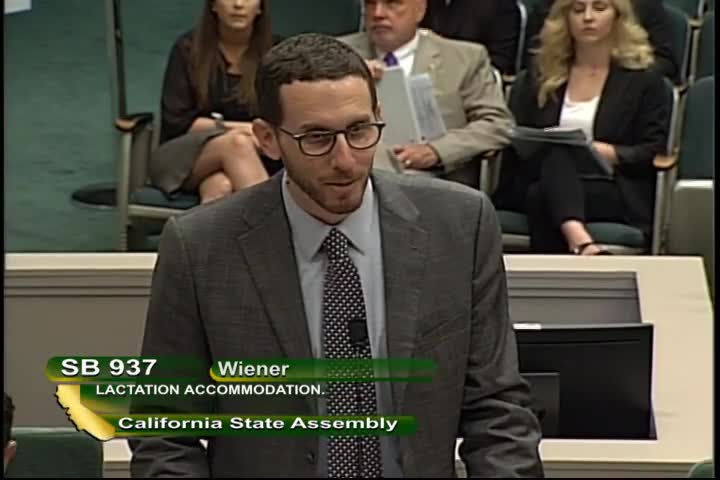 23MIN
Assembly Standing Committee on Business and Professions
 21MIN
Assembly Standing Committee on Labor and Employment
 4MIN
Senate Floor
 20MIN
Senate Standing Committee on Transportation and Housing
 20MIN






