SB 961: Enhanced infrastructure financing districts.
- Session Year: 2017-2018
- House: Senate
- Latest Version Date: 2018-09-19
(1)Existing law establishes procedures for the formation of infrastructure financing districts, enhanced infrastructure financing districts, infrastructure and revitalization financing districts, and community revitalization and investment authorities, as specified, to undertake various economic development projects, including financing public facilities and infrastructure, affordable housing, and economic revitalization. Existing law authorizes the issuance of bonds for the funding of these purposes, and, in the case of an enhanced infrastructure financing district, requires voter approval, as specified, for the issuance of those bonds. Existing law, the Neighborhood Infill Finance and Transit Improvements Act, authorizes a city, county, or city and county to adopt a resolution, at any time before or after the adoption of the infrastructure financing plan for an enhanced infrastructure financing district, to allocate, under specified circumstances, tax revenues of that entity to the district, including revenues derived from local sales and use taxes imposed pursuant to the Bradley-Burns Uniform Local Sales and Use Tax Law or transactions and use taxes imposed in accordance with the Transactions and Use Tax Law.
This bill would enact the Second Neighborhood Infill Finance and Transit Improvements Act, which would similarly authorize a city, county, or city and county to adopt a resolution, at any time before or after the adoption of the infrastructure financing plan for an enhanced infrastructure financing district, to allocate tax revenues of that entity to the district, including revenues derived from local sales and use taxes imposed pursuant to the Bradley-Burns Uniform Local Sales and Use Tax Law or transactions and use taxes imposed in accordance with the Transactions and Use Tax Law, if the area to be financed is within one-half mile of a major transit stop, as specified, and, among other things, certain conditions relating to housing and the infrastructure financing plan are or will be met. The bill would authorize bonds to be issued for the purposes of the Second Neighborhood Infill Finance and Transit Improvements Act without voter approval. The bill would require an enhanced infrastructure financing district utilizing these provisions to follow specific notice, protest, and election proceedings for the adoption of the infrastructure financing plan.
(2)Existing law, the Planning and Zoning Law, establishes the Office of Planning and Research in the Governors office to provide the Governor and his or her cabinet with long-range planning and research and to serve as the comprehensive state planning agency, and sets forth the duties of the office, as specified.
This bill would require the Office of Planning and Research, on or before January 1, 2021, to complete a study on the effectiveness of tax increment financing tools for increasing housing production, including a comparison of the relative advantages and disadvantages of infrastructure financing districts, enhanced infrastructure financing districts, affordable housing authorities, use of the Neighborhood Infill Finance and Transit Improvements Act, and use of the Second Neighborhood Infill Finance and Transit Improvements Act, as specified.
(1)Existing law establishes procedures for the formation of infrastructure financing districts, enhanced infrastructure financing districts, infrastructure and revitalization financing districts, and community revitalization and investment authorities, as specified, to undertake various economic development projects, including financing public facilities and infrastructure, affordable housing, and economic revitalization. Existing law authorizes the issuance of bonds for the funding of these purposes, and, in the case of an enhanced infrastructure financing district, requires voter approval, as specified, for the issuance of those bonds. Existing law, the Neighborhood Infill Finance and Transit Improvements Act, authorizes a city, county, or city and county to adopt a resolution, at any time before or after the adoption of the infrastructure financing plan for an enhanced infrastructure financing district, to allocate, under specified circumstances, tax revenues of that entity to the district, including revenues derived from local sales and use taxes imposed pursuant to the Bradley-Burns Uniform Local Sales and Use Tax Law or transactions and use taxes imposed in accordance with the Transactions and Use Tax Law.
This bill would enact the Second Neighborhood Infill Finance and Transit Improvements Act, which would similarly authorize a city, county, or city and county to adopt a resolution, at any time before or after the adoption of the infrastructure financing plan for an enhanced infrastructure financing district, to allocate tax revenues of that entity to the district, including revenues derived from local sales and use taxes imposed pursuant to the Bradley-Burns Uniform Local Sales and Use Tax Law or transactions and use taxes imposed in accordance with the Transactions and Use Tax Law, if the area to be financed is within one-half mile of a major transit stop, as specified, and, among other things, certain conditions relating to housing and the infrastructure financing plan are or will be met. The bill would authorize bonds to be issued for the purposes of the Second Neighborhood Infill Finance and Transit Improvements Act without voter approval. The bill would require an enhanced infrastructure financing district utilizing these provisions to follow specific notice, protest, and election proceedings for the adoption of the infrastructure financing plan.
(2)Existing law, the Planning and Zoning Law, establishes the Office of Planning and Research in the Governors office to provide the Governor and his or her cabinet with long-range planning and research and to serve as the comprehensive state planning agency, and sets forth the duties of the office, as specified.
This bill would require the Office of Planning and Research, on or before January 1, 2021, to complete a study on the effectiveness of tax increment financing tools for increasing housing production, including a comparison of the relative advantages and disadvantages of infrastructure financing districts, enhanced infrastructure financing districts, affordable housing authorities, use of the Neighborhood Infill Finance and Transit Improvements Act, and use of the Second Neighborhood Infill Finance and Transit Improvements Act, as specified.
(1)Existing law establishes procedures for the formation of infrastructure financing districts, enhanced infrastructure financing districts, infrastructure and revitalization financing districts, and community revitalization and investment authorities, as specified, to undertake various economic development projects, including financing public facilities and infrastructure, affordable housing, and economic revitalization. Existing law authorizes the issuance of bonds for the funding of these purposes, and, in the case of an enhanced infrastructure financing district, requires voter approval, as specified, for the issuance of those bonds. Existing law, the Neighborhood Infill Finance and Transit Improvements Act, authorizes a city, county, or city and county to adopt a resolution, at any time before or after the adoption of the infrastructure financing plan for an enhanced infrastructure financing district, to allocate, under specified circumstances, tax revenues of that entity to the district, including revenues derived from local sales and use taxes imposed pursuant to the Bradley-Burns Uniform Local Sales and Use Tax Law or transactions and use taxes imposed in accordance with the Transactions and Use Tax Law.
This bill would enact the Second Neighborhood Infill Finance and Transit Improvements Act, which would similarly authorize a city, county, or city and county to adopt a resolution, at any time before or after the adoption of the infrastructure financing plan for an enhanced infrastructure financing district, to allocate tax revenues of that entity to the district, including revenues derived from local sales and use taxes imposed pursuant to the Bradley-Burns Uniform Local Sales and Use Tax Law or transactions and use taxes imposed in accordance with the Transactions and Use Tax Law, if the area to be financed is within one-half mile of a major transit stop, as specified, and, among other things, certain conditions relating to housing and the infrastructure financing plan are or will be met. The bill would authorize bonds to be issued for the purposes of the Second Neighborhood Infill Finance and Transit Improvements Act without voter approval. The bill would require an enhanced infrastructure financing district utilizing these provisions to follow specific notice, protest, and election proceedings for the adoption of the infrastructure financing plan.
(2)Existing law, the Planning and Zoning Law, establishes the Office of Planning and Research in the Governors office to provide the Governor and his or her cabinet with long-range planning and research and to serve as the comprehensive state planning agency, and sets forth the duties of the office, as specified.
This bill would require the Office of Planning and Research, on or before January 1, 2021, to complete a study on the effectiveness of tax increment financing tools for increasing housing production, including a comparison of the relative advantages and disadvantages of infrastructure financing districts, enhanced infrastructure financing districts, affordable housing authorities, use of the Neighborhood Infill Finance and Transit Improvements Act, and use of the Second Neighborhood Infill Finance and Transit Improvements Act, as specified.
(1)Existing law establishes procedures for the formation of infrastructure financing districts, enhanced infrastructure financing districts, infrastructure and revitalization financing districts, and community revitalization and investment authorities, as specified, to undertake various economic development projects, including financing public facilities and infrastructure, affordable housing, and economic revitalization. Existing law authorizes the issuance of bonds for the funding of these purposes, and, in the case of an enhanced infrastructure financing district, requires voter approval, as specified, for the issuance of those bonds. Existing law, the Neighborhood Infill Finance and Transit Improvements Act, authorizes a city, county, or city and county to adopt a resolution, at any time before or after the adoption of the infrastructure financing plan for an enhanced infrastructure financing district, to allocate, under specified circumstances, tax revenues of that entity to the district, including revenues derived from local sales and use taxes imposed pursuant to the Bradley-Burns Uniform Local Sales and Use Tax Law or transactions and use taxes imposed in accordance with the Transactions and Use Tax Law.
This bill would enact the Second Neighborhood Infill Finance and Transit Improvements Act, which would similarly authorize a city, county, or city and county to adopt a resolution, at any time before or after the adoption of the infrastructure financing plan for an enhanced infrastructure financing district, to allocate tax revenues of that entity to the district, including revenues derived from local sales and use taxes imposed pursuant to the Bradley-Burns Uniform Local Sales and Use Tax Law or transactions and use taxes imposed in accordance with the Transactions and Use Tax Law, if the area to be financed is within one-half mile of a major transit stop, as specified, and, among other things, certain conditions relating to housing and the infrastructure financing plan are or will be met. The bill would authorize bonds to be issued for the purposes of the Second Neighborhood Infill Finance and Transit Improvements Act without voter approval. The bill would require an enhanced infrastructure financing district utilizing these provisions to follow specific notice, protest, and election proceedings for the adoption of the infrastructure financing plan.
(2)Existing law, the Planning and Zoning Law, establishes the Office of Planning and Research in the Governors office to provide the Governor and his or her cabinet with long-range planning and research and to serve as the comprehensive state planning agency, and sets forth the duties of the office, as specified.
This bill would require the Office of Planning and Research, on or before January 1, 2021, to complete a study on the effectiveness of tax increment financing tools for increasing housing production, including a comparison of the relative advantages and disadvantages of infrastructure financing districts, enhanced infrastructure financing districts, affordable housing authorities, use of the Neighborhood Infill Finance and Transit Improvements Act, and use of the Second Neighborhood Infill Finance and Transit Improvements Act, as specified.
(1)Existing law establishes procedures for the formation of infrastructure financing districts, enhanced infrastructure financing districts, infrastructure and revitalization financing districts, and community revitalization and investment authorities, as specified, to undertake various economic development projects, including financing public facilities and infrastructure, affordable housing, and economic revitalization. Existing law authorizes the issuance of bonds for the funding of these purposes, and, in the case of an enhanced infrastructure financing district, requires voter approval, as specified, for the issuance of those bonds. Existing law, the Neighborhood Infill Finance and Transit Improvements Act, authorizes a city, county, or city and county to adopt a resolution, at any time before or after the adoption of the infrastructure financing plan for an enhanced infrastructure financing district, to allocate, under specified circumstances, tax revenues of that entity to the district, including revenues derived from local sales and use taxes imposed pursuant to the Bradley-Burns Uniform Local Sales and Use Tax Law or transactions and use taxes imposed in accordance with the Transactions and Use Tax Law.
This bill would enact the Second Neighborhood Infill Finance and Transit Improvements Act, which would similarly authorize a city, county, or city and county to adopt a resolution, at any time before or after the adoption of the infrastructure financing plan for an enhanced infrastructure financing district, to allocate tax revenues of that entity to the district, including revenues derived from local sales and use taxes imposed pursuant to the Bradley-Burns Uniform Local Sales and Use Tax Law or transactions and use taxes imposed in accordance with the Transactions and Use Tax Law, if the area to be financed is within one-half mile of a rail transit station or within 300 feet of a transit rich boulevard served by bus rapid transit or high-frequency bus service, major transit stop, as specified, and and, among other things, certain conditions relating to housing and the infrastructure financing plan are or will be met. The bill would authorize bonds to be issued for the purposes of the Second Neighborhood Infill Finance and Transit Improvements Act without voter approval.
(2)Existing law, the Planning and Zoning Law, establishes the Office of Planning and Research in the Governors office to provide the Governor and his or her cabinet with long-range planning and research and to serve as the comprehensive state planning agency, and sets forth the duties of the office, as specified.
This bill would require the Office of Planning and Research, on or before January 1, 2021, to complete a study on the effectiveness of tax increment financing tools for increasing housing production, including a comparison of the relative advantages and disadvantages of infrastructure financing districts, enhanced infrastructure financing districts, affordable housing authorities, use of the Neighborhood Infill Finance and Transit Improvements Act, and use of the Second Neighborhood Infill Finance and Transit Improvements Act, as specified.
Existing law establishes procedures for the formation of infrastructure financing districts, enhanced infrastructure financing districts, infrastructure and revitalization financing districts, and community revitalization and investment authorities, as specified, to undertake various economic development projects, including financing public facilities and infrastructure, affordable housing, and economic revitalization. Existing law authorizes the issuance of bonds for the funding of these purposes, and, in the case of an enhanced infrastructure financing district, requires voter approval, as specified, for the issuance of those bonds. Existing law, the Neighborhood Infill Finance and Transit Improvements Act, authorizes a city, county, or city and county to adopt a resolution, at any time before or after the adoption of the infrastructure financing plan for an enhanced infrastructure financing district, to allocate, under specified circumstances, tax revenues of that entity to the district, including revenues derived from local sales and use taxes imposed pursuant to the Bradley-Burns Uniform Local Sales and Use Tax Law or transactions and use taxes imposed in accordance with the Transactions and Use Tax Law.
This bill would enact the Second Neighborhood Infill Finance and Transit Improvements Act, which would similarly authorize a city, county, or city and county to adopt a resolution, at any time before or after the adoption of the infrastructure financing plan for an enhanced infrastructure financing district, to allocate tax revenues of that entity to the district, including revenues derived from local sales and use taxes imposed pursuant to the Bradley-Burns Uniform Local Sales and Use Tax Law or transactions and use taxes imposed in accordance with the Transactions and Use Tax Law, if the area to be financed is within one-half mile of a rail transit station or within 300 feet of a transit rich boulevard served by bus rapid transit or high-frequency bus service, as specified, and among other things, certain conditions relating to housing and the infrastructure financing plan are or will be met. The bill would authorize bonds to be issued for the purposes of the Second Neighborhood Infill Finance and Transit Improvements Act without voter approval.
The Lempert-Keene-Seastrand Oil Spill Prevention and Response Act generally requires the administrator for oil spill response, acting at the direction of the Governor, to implement activities relating to oil spill response, including emergency drills and preparedness, and oil spill containment and cleanup, and to represent the state in any coordinated response efforts with the federal government. Existing law, the California Emergency Services Act, directs the Governor to require the administrator to amend, not in conflict with the National Contingency Plan, the California oil spill contingency plan to provide for the best achievable protection of waters of the state and for the plan to include specified elements.This bill would also require the plan to include a communications element to be developed by the administrator and included in the California oil spill contingency plan, as provided.The Lempert-Keene-Seastrand Oil Spill Prevention and Response Act generally requires the administrator for oil spill response, acting at the direction of the Governor, to implement activities relating to oil spill response, including emergency drills and preparedness, and oil spill containment and cleanup, and to represent the state in any coordinated response efforts with the federal government. Existing law, the California Emergency Services Act, directs the Governor to require the administrator to amend, not in conflict with the National Contingency Plan, the California oil spill contingency plan to provide for the best achievable protection of waters of the state and for the plan to include specified elements.
This bill would also require the plan to include a communications element to be developed by the administrator and included in the California oil spill contingency plan, as provided.
(a)(1)At the conclusion of the hearing, the public financing authority may adopt a resolution proposing adoption of the infrastructure financing plan, as modified, and formation of the enhanced infrastructure financing district in a manner consistent with Section 53398.68, or it may adopt a resolution abandoning the proceedings. If the proceedings are abandoned, then the public financing authority shall cease to exist by operation of this section with no further action required of the legislative body and the legislative body may not enact a resolution of intention to establish a district that includes the same geographic area within one year of the date of the resolution abandoning the proceedings.
(2)In the case of an infrastructure financing plan adopted pursuant to Section 53398.75.7, the proceedings set forth in subdivision (e) of that section shall govern the adoption of the infrastructure financing plan.
(b)The infrastructure financing plan shall take effect upon the adoption of the resolution. The infrastructure financing plan shall specify if the district shall be funded solely through the districts share of tax increment, governmental or private loans, grants, bonds, assessments, fees, or some combination thereof. However, the public financing authority shall not issue bonds or levy assessments or fees that may be included in the infrastructure financing plan before one or more of the following:
(1)An affirmative vote, pursuant to subdivision (a) of Section 53398.81 and, if applicable, subdivision (c) of Section 53398.80.5, to issue bonds to finance the infrastructure financing plan.
(2)Compliance with the procedures required in subdivision (f) of Section 53398.75, to levy assessments or fees to finance the infrastructure financing plan.
(c)In addition, the district may expend up to 10 percent of any accrued tax increment in the first two years of the effective date of the enhanced infrastructure financing district on planning and dissemination of information to the residents within the districts boundaries about the infrastructure financing plan and planned activities to be funded by the district.
SEC. 2.Section 53398.75.7 is added to the Government Code, to read:53398.75.7.(a)This section shall be known and may be cited as the Second Neighborhood Infill Finance and Transit Improvements Act, or NIFTI-2.
(b)(1)At any time before or after the adoption of the infrastructure financing plan, a city, county, or city and county may adopt a resolution to allocate tax revenues of that entity to the district, including revenues derived from local sales and use taxes imposed pursuant to the Bradley-Burns Uniform Local Sales and Use Tax Law (Part 1.5 (commencing with Section 7200) of Division 2 of the Revenue and Taxation Code), or transactions and use taxes imposed in accordance with the Transactions and Use Tax Law (Part 1.6 (commencing with Section 7251) of Division 2 of the Revenue and Taxation Code), if all of the following apply:
(A)The area to be financed with funds received pursuant to this section is within one-half mile of a major transit stop, as defined in Section 21064.3 of the Public Resources Code.
(B)The infrastructure financing plan requires that at least 40 percent of the total funds received by the district pursuant to this section be used for the acquisition, construction, or rehabilitation of housing, including the costs of predevelopment and land acquisition, for households with incomes below 60 percent of area median income for rent or purchase. Predevelopment costs include, but are not limited to, site control, engineering studies, architectural plans, application fees, legal services, permits, bonding, and site preparation.
(C)The infrastructure financing plan requires that 50 percent of the housing funds are used to develop housing affordable to and occupied by households with incomes below 60 percent and greater than 30 percent of area median income, and 50 percent of the housing funds are used for either housing affordable to and occupied by households with incomes below 30 percent of area median income or permanent supportive housing to help homeless persons get off the street.
(D)The infrastructure financing plan gives first priority for occupancy of housing funded through this plan to income-qualified households displaced from the district through no fault of their own, and secondary priority for occupancy of housing funded through this program is given to households with a member or members employed within two miles of the district.
(E)The infrastructure financing plan requires that at least 10 percent of the total funds received by the district pursuant to this section be used for investments in the capital costs of parks, urban forestry, or permanent greening improvements along boulevards, streets, or other public areas within a district, or active transportation capital projects that qualify under the Active Transportation Program (Chapter 8 (commencing with Section 2380) of Division 3 of the Streets and Highways Code), including pedestrian or bicycle facilities or supportive infrastructure, including connectivity to transit stations.
(F)The boundaries of the enhanced infrastructure financing district are coterminous with the city or county that established the district.
(G)The use of the revenues derived from the local sales and use taxes imposed under the Bradley-Burns Uniform Local Sales and Use Tax Law (Part 1.5 (commencing with Section 7200) of Division 2 of the Revenue and Taxation Code) or transactions and use taxes imposed in accordance with the Transactions and Use Tax Law (Part 1.6 (commencing with Section 7251) of Division 2 of the Revenue and Taxation Code) pursuant to the infrastructure financing plan is consistent with the purposes for which that tax is imposed.
(H)If the infrastructure financing plan proposes to allocate tax revenues of that entity to the district that are derived from the local sales and use taxes imposed pursuant to the Bradley-Burns Uniform Local Sales and Use Tax Law (Part 1.5 (commencing with Section 7200) of Division 2 of the Revenue and Taxation Code), the city, county, or city and county has received the consent of any impacted transportation agency that receives tax revenues derived from that any tax adopted pursuant to that law, and has ensured that existing or planned transportation operations and capital projects will not be negatively impacted.
(2)This section does not authorize a city, county, or city and county to allocate all, or a portion of any sales and use taxes imposed pursuant to the Bradley-Burns Uniform Local Sales and Use Tax Law (Part 1.5 (commencing with Section 7200) of Division 2 of the Revenue and Taxation Code) or transactions and use taxes imposed in accordance with the Transactions and Use Tax Law (Part 1.6 (commencing with Section 7251) of Division 2 of the Revenue and Taxation Code), that was approved by the voters for a special purpose not related to the purposes in paragraph (1).
(c)The remaining funds may be used for any of the following:
(1)Multifamily affordable housing projects or mixed-use projects with affordable multifamily housing and ground floor commercial uses that support infill and compact development.
(2)Transit capital projects, including transit stations and programs supporting transit ridership, including waterborne transit.
(3)Transit-oriented development projects, including affordable housing and infrastructure at or near transit stations or connecting those developments to transit stations.
(4)Capital projects that implement local complete streets programs.
(5)Parking, including detached and decoupled parking structures that provide parking for residents, businesses, or visitors in lieu of onsite parking for proposed developments. These parking structures should provide no more than one space for each residential unit. The ground floors in these parking structures should provide space for pedestrian-oriented commercial or public uses. Revenues from parking may be used to implement transportation demand management programs to reduce automobile trips to and from the district.
(6)Other projects or programs designed to reduce greenhouse gas emissions and other criteria air pollutants by reducing automobile trips and vehicle miles traveled within a community.
(d)The infrastructure financing plan shall ensure that the requirements of this section are met every 10 years.
(e)(1)Sections 53398.66 and 53398.67 shall not apply to the adoption of an enhanced infrastructure financing plan that includes the allocation of tax revenues pursuant to this section.
(2)(A)The public financing authority shall consider adoption of the enhanced infrastructure financing plan at three public hearings that shall take place at least 30 days apart.
(B)At the first public hearing, the public financing authority shall hear all written and oral comments, but take no action.
(C)At the second public hearing, the public financing authority shall consider any additional written and oral comments and take action to modify or reject the enhanced infrastructure financing plan. If the enhanced infrastructure financing plan is not rejected at the second public hearing, then the public financing authority shall conduct a protest proceeding at the third public hearing to consider whether the landowners and residents within the enhanced infrastructure financing plan area wish to present oral or written protests against the adoption of the enhanced infrastructure financing plan.
(3)The draft enhanced infrastructure financing plan shall be made available to the public and to each landowner within the area at a meeting held at least 30 days prior to the notice given for the first public hearing. The purposes of the meeting shall be to allow the staff of the public financing authority to present the draft enhanced infrastructure financing plan, answer questions about the enhanced infrastructure financing plan, and consider comments about the enhanced infrastructure financing plan.
(4)(A)Notice of the meeting required by paragraph (3) and the public hearings required by this paragraph shall be given in accordance with paragraph (11). The notice shall do all of the following, as applicable:
(i)Describe specifically the boundaries of the proposed area.
(ii)Describe the purpose of the enhanced infrastructure financing plan.
(iii)State the day, hour, and place when and where any and all persons having any comments on the proposed enhanced infrastructure financing plan may appear to provide written or oral comments to the enhanced infrastructure financing district.
(iv)Notice of the second public hearing shall include a summary of the changes made to the enhanced infrastructure financing plan as a result of the oral and written testimony received at or before the public hearing and shall identify a location accessible to the public where the enhanced infrastructure financing plan proposed to be presented and adopted at the second public hearing can be reviewed.
(v)Notice of the third public hearing to consider any written or oral protests shall contain a copy of the enhanced infrastructure financing plan adopted pursuant to paragraph (2), and shall inform the landowner and resident of his or her right to submit an oral or written protest before the close of the public hearing. The protest may state that the landowner or resident objects to the public financing authority taking action to implement the enhanced infrastructure financing plan.
(B)At the third public hearing, the public financing authority shall consider all written and oral protests received prior to the close of the public hearing and shall terminate the proceedings or adopt the enhanced infrastructure financing plan subject to confirmation by the voters at an election called for that purpose. The public financing authority shall terminate the proceedings if there is a majority protest. A majority protest exists if protests have been filed representing over 50 percent of the combined number of landowners and residents in the area who are at least 18 years of age. An election shall be called if between 25 percent and 50 percent of the combined number of landowners and residents in the area who are at least 18 years of age file a protest.
(5)An election required pursuant to subparagraph (B) of paragraph (4) shall be held within 90 days of the public hearing and may be held by mail-in ballot. The public financing authority shall adopt, at a duly noticed public hearing, procedures for this election.
(6)If a majority of the landowners and residents vote against the enhanced infrastructure financing plan, then the public financing authority shall not take any further action to implement the proposed enhanced infrastructure financing plan. The public financing authority shall not propose a new or revised enhanced infrastructure financing plan to the affected landowners and residents for at least one year following the date of an election in which the enhanced infrastructure financing plan was rejected.
(7)At the hour set in the notice required by paragraph (2), the public financing authority shall consider all written and oral comments.
(8)If less than 25 percent of the combined number of landowners and residents in the area who are at least 18 years of age file a protest, the public financing authority may adopt the enhanced infrastructure financing plan at the conclusion of the third public hearing by ordinance. The ordinance adopting the enhanced infrastructure financing plan shall be subject to referendum as prescribed by law.
(9)For the purposes of this chapter, the enhanced infrastructure financing plan shall be the enhanced infrastructure financing plan adopted pursuant to this section.
(10)The public financing authority shall consider and adopt an amendment or amendments to an enhanced infrastructure financing plan in accordance with the provisions of this section.
(11)The public financing authority shall post notice of each meeting or public hearing required by this section in an easily identifiable and accessible location on the enhanced infrastructure financing districts Internet Web site and shall mail a written notice of the meeting or public hearing to each landowner, each resident, and each taxing entity at least 10 days prior to the meeting or public hearing.
(A)Notice of the first public hearing shall also be published not less than once a week for four successive weeks prior to the first public hearing in a newspaper of general circulation published in the county in which the area lies. The notice shall state that the district will be used to finance public facilities or development, briefly describe the public facilities or development, briefly describe the proposed financial arrangements, including the proposed commitment of incremental tax revenue, including revenues derived from local sales and use taxes imposed pursuant to the Bradley-Burns Uniform Local Sales and Use Tax Law (Part 1.5 (commencing with Section 7200) of Division 2 of the Revenue and Taxation Code), or transactions and use taxes imposed in accordance with the Transactions and Use Tax Law (Part 1.6 (commencing with Section 7251) of Division 2 of the Revenue and Taxation Code), describe the boundaries of the proposed district, and state the day, hour, and place when and where any persons having any objections to the proposed infrastructure financing plan, or the regularity of any of the prior proceedings, may appear before the public financing authority and object to the adoption of the proposed plan by the public financing authority.
(B)Notice of the second public hearing shall also be published not less than 10 days prior to the second public hearing in a newspaper of general circulation in the county in which the area lies. The notice shall state that the district will be used to finance public facilities or development, briefly describe the public facilities or development, briefly describe the proposed financial arrangements, including the proposed commitment of incremental tax revenue, including revenues derived from local sales and use taxes imposed pursuant to the Bradley-Burns Uniform Local Sales and Use Tax Law (Part 1.5 (commencing with Section 7200) of Division 2 of the Revenue and Taxation Code), or transactions and use taxes imposed in accordance with the Transactions and Use Tax Law (Part 1.6 (commencing with Section 7251) of Division 2 of the Revenue and Taxation Code), describe the boundaries of the proposed district, and state the day, hour, and place when and where any persons having any objections to the proposed infrastructure financing plan, or the regularity of any of the prior proceedings, may appear before the public financing authority and object to the adoption of the proposed plan by the public financing authority.
(C)Notice of the third public hearing shall also be published not less than 10 days prior to the third public hearing in a newspaper of general circulation in the county in which the area lies. The notice shall state that the district will be used to finance public facilities or development, briefly describe the public facilities or development, briefly describe the proposed financial arrangements, including the proposed commitment of incremental tax revenue, including revenues derived from local sales and use taxes imposed pursuant to the Bradley-Burns Uniform Local Sales and Use Tax Law (Part 1.5 (commencing with Section 7200) of Division 2 of the Revenue and Taxation Code), or transactions and use taxes imposed in accordance with the Transactions and Use Tax Law (Part 1.6 (commencing with Section 7251) of Division 2 of the Revenue and Taxation Code), describe the boundaries of the proposed district, and state the day, hour, and place when and where any persons having any objections to the proposed infrastructure financing plan, or the regularity of any of the prior proceedings, may appear before the public financing authority and object to the adoption of the proposed plan by the public financing authority.
(f)(1)The public financing authority shall review the enhanced infrastructure financing plan at least annually and make any amendments that are necessary and appropriate in accordance with the procedures set forth in paragraph (5) and shall require the preparation of an annual independent financial audit paid for from revenues of the enhanced infrastructure financing district.
(2)A public financing authority shall adopt an annual report on or before June 30 of each year after holding a public hearing. Written copies of the draft report shall be made available to the public 30 days prior to the public hearing. The public financing authority shall cause the draft report to be posted in an easily identifiable and accessible location on the enhanced infrastructure financing districts Internet Web site and shall mail a written notice of the availability of the draft report on the Internet Web site to each owner of land and each resident within the area covered by the enhanced infrastructure financing plan and to each taxing entity that has adopted a resolution pursuant to Section 53398.68. The notice shall be mailed by first-class mail, but may be addressed to occupant.
(3)The annual report shall contain all of the following:
(A)A description of the projects undertaken in the fiscal year, including any rehabilitation of structures, and a comparison of the progress expected to be made on those projects compared to the actual progress.
(B)A chart comparing the actual revenues and expenses, including administrative costs, of the public financing authority to the budgeted revenues and expenses.
(C)The amount of tax increment revenues received.
(D)The amount of revenues expended for housing meeting the requirements of this section.
(E)An assessment of the status regarding completion of the enhanced infrastructure financing districts projects.
(F)The amount of revenues expended to assist private businesses.
(4)If the public financing authority fails to provide the annual report required by paragraph (1), the public financing authority shall not spend any funds received pursuant to a resolution adopted pursuant to this section until the public financing authority has provided the report.
(5)Every 10 years, at the public hearing held pursuant to paragraph (2), the public financing authority shall conduct a protest proceeding to consider whether the landowners and residents within the enhanced infrastructure financing district wish to present oral or written protests against the enhanced infrastructure financing district. Notice of this protest proceeding shall be included in the written notice of the hearing on the annual report and shall inform the landowner and resident of his or her right to submit an oral or written protest before the close of the public hearing. The protest may state that the landowner or resident objects to the public financing authority taking action to implement the enhanced infrastructure financing plan on and after the date of the election described in paragraph (6). The public financing authority shall consider all written and oral protests received prior to the close of the public hearing.
(6)If there is a majority protest, the public financing authority shall not take any further action to implement the enhanced infrastructure financing plan on and after the date the existence of a majority protest is determined. If between 25 percent and 50 percent of the landowners and residents file protests, then the public financing authority shall call an election of the landowners and residents in the area covered by the enhanced infrastructure financing plan, and shall not initiate or authorize any new projects until the election is held. A majority protest exists if protests have been filed representing over 50 percent of the combined number of landowners and residents at least 18 years of age or older in the area.
(7)An election required pursuant to paragraph (6) shall be held within 90 days of the public hearing and may be held by mail-in ballot. The public financing authority shall adopt, at a duly noticed public hearing, procedures for holding this election.
(8)If a majority of the landowners and residents vote against the enhanced infrastructure financing plan, then the public financing authority shall not take any further action to implement the enhanced infrastructure financing plan on and after the date of the election held pursuant to paragraph (5). This subdivision shall not prevent the public financing authority from taking any and all actions and appropriating and expending funds, including, but not limited to, any and all payments on bonded or contractual indebtedness, to carry out and complete projects for which expenditures of any kind had been made prior to the date of the election.
(g)Notwithstanding Section 53398.52, revenues collected and allocated for the purposes of this section shall not be used for highway or highway interchange improvements.
(h)The district shall require, by recorded covenants or restrictions, that affordable housing units financed pursuant to this section remain permanently available at affordable housing costs to, and occupied by, very low income households, persons and families of low income, or persons and families of low or moderate income for the longest feasible time, but for not less than 55 years for rental units and 45 years for owner-occupied units.
(i)A legislative body shall not adopt an ordinance terminating an enhanced infrastructure financing district created pursuant to this section if the district has not complied with its affordable housing obligations.
(j)Notwithstanding Article 4 (commencing with Section 53398.77), bonds issued by a district pursuant to this section may be issued without voter approval.
(k)Paragraph (1) of subdivision (c) of Section 1720 of the Labor Code shall not apply to projects financed by the enhanced infrastructure financing district.
SEC. 3.Section 65040.15 is added to the Government Code, to read:65040.15.On or before January 1, 2021, the Office of Planning and Research shall complete a study on the effectiveness of tax increment financing tools for increasing housing production, including a comparison of the relative advantages and disadvantages of infrastructure financing districts, enhanced infrastructure financing districts, affordable housing authorities, use of the Neighborhood Infill Finance and Transit Improvements Act, and use of the Second Neighborhood Infill Finance and Transit Improvements Act. The study shall also include an analysis of the impacts of extending the Second Neighborhood Infill Finance and Transit Improvements Act to areas around bus stops, including segregated bus rapid transit, and make recommendations to the Legislature.
(a)(1)At the conclusion of the hearing, the public financing authority may adopt a resolution proposing adoption of the infrastructure financing plan, as modified, and formation of the enhanced infrastructure financing district in a manner consistent with Section 53398.68, or it may adopt a resolution abandoning the proceedings. If the proceedings are abandoned, then the public financing authority shall cease to exist by operation of this section with no further action required of the legislative body and the legislative body may not enact a resolution of intention to establish a district that includes the same geographic area within one year of the date of the resolution abandoning the proceedings.
(2)In the case of an infrastructure financing plan adopted pursuant to Section 53398.75.7, the proceedings set forth in subdivision (e) of that section shall govern the adoption of the infrastructure financing plan.
(b)The infrastructure financing plan shall take effect upon the adoption of the resolution. The infrastructure financing plan shall specify if the district shall be funded solely through the districts share of tax increment, governmental or private loans, grants, bonds, assessments, fees, or some combination thereof. However, the public financing authority shall not issue bonds or levy assessments or fees that may be included in the infrastructure financing plan before one or more of the following:
(1)An affirmative vote, pursuant to subdivision (a) of Section 53398.81 and, if applicable, subdivision (c) of Section 53398.80.5, to issue bonds to finance the infrastructure financing plan.
(2)Compliance with the procedures required in subdivision (f) of Section 53398.75, to levy assessments or fees to finance the infrastructure financing plan.
(c)In addition, the district may expend up to 10 percent of any accrued tax increment in the first two years of the effective date of the enhanced infrastructure financing district on planning and dissemination of information to the residents within the districts boundaries about the infrastructure financing plan and planned activities to be funded by the district.
SEC. 2.Section 53398.75.7 is added to the Government Code, to read:53398.75.7.(a)This section shall be known and may be cited as the Second Neighborhood Infill Finance and Transit Improvements Act, or NIFTI-2.
(b)(1)At any time before or after the adoption of the infrastructure financing plan, a city, county, or city and county may adopt a resolution to allocate tax revenues of that entity to the district, including revenues derived from local sales and use taxes imposed pursuant to the Bradley-Burns Uniform Local Sales and Use Tax Law (Part 1.5 (commencing with Section 7200) of Division 2 of the Revenue and Taxation Code), or transactions and use taxes imposed in accordance with the Transactions and Use Tax Law (Part 1.6 (commencing with Section 7251) of Division 2 of the Revenue and Taxation Code), if all of the following apply:
(A)The area to be financed with funds received pursuant to this section is within one-half mile of a major transit stop, as defined in Section 21064.3 of the Public Resources Code.
(B)The infrastructure financing plan requires that at least 40 percent of the total funds received by the district pursuant to this section be used for the acquisition, construction, or rehabilitation of housing, including the costs of predevelopment and land acquisition, for households with incomes below 60 percent of area median income for rent or purchase. Predevelopment costs include, but are not limited to, site control, engineering studies, architectural plans, application fees, legal services, permits, bonding, and site preparation.
(C)The infrastructure financing plan requires that 50 percent of the housing funds are used to develop housing affordable to and occupied by households with incomes below 60 percent and greater than 30 percent of area median income, and 50 percent of the housing funds are used for either housing affordable to and occupied by households with incomes below 30 percent of area median income or permanent supportive housing to help homeless persons get off the street.
(D)The infrastructure financing plan gives first priority for occupancy of housing funded through this plan to income-qualified households displaced from the district through no fault of their own, and secondary priority for occupancy of housing funded through this program is given to households with a member or members employed within two miles of the district.
(E)The infrastructure financing plan requires that at least 10 percent of the total funds received by the district pursuant to this section be used for investments in the capital costs of parks, urban forestry, or permanent greening improvements along boulevards, streets, or other public areas within a district, or active transportation capital projects that qualify under the Active Transportation Program (Chapter 8 (commencing with Section 2380) of Division 3 of the Streets and Highways Code), including pedestrian or bicycle facilities or supportive infrastructure, including connectivity to transit stations.
(F)The boundaries of the enhanced infrastructure financing district are coterminous with the city or county that established the district.
(G)The use of the revenues derived from the local sales and use taxes imposed under the Bradley-Burns Uniform Local Sales and Use Tax Law (Part 1.5 (commencing with Section 7200) of Division 2 of the Revenue and Taxation Code) or transactions and use taxes imposed in accordance with the Transactions and Use Tax Law (Part 1.6 (commencing with Section 7251) of Division 2 of the Revenue and Taxation Code) pursuant to the infrastructure financing plan is consistent with the purposes for which that tax is imposed.
(H)If the infrastructure financing plan proposes to allocate tax revenues of that entity to the district that are derived from the local sales and use taxes imposed pursuant to the Bradley-Burns Uniform Local Sales and Use Tax Law (Part 1.5 (commencing with Section 7200) of Division 2 of the Revenue and Taxation Code), the city, county, or city and county has received the consent of any impacted transportation agency that receives tax revenues derived from that any tax adopted pursuant to that law, and has ensured that existing or planned transportation operations and capital projects will not be negatively impacted.
(2)This section does not authorize a city, county, or city and county to allocate all, or a portion of any sales and use taxes imposed pursuant to the Bradley-Burns Uniform Local Sales and Use Tax Law (Part 1.5 (commencing with Section 7200) of Division 2 of the Revenue and Taxation Code) or transactions and use taxes imposed in accordance with the Transactions and Use Tax Law (Part 1.6 (commencing with Section 7251) of Division 2 of the Revenue and Taxation Code), that was approved by the voters for a special purpose not related to the purposes in paragraph (1).
(c)The remaining funds may be used for any of the following:
(1)Multifamily affordable housing projects or mixed-use projects with affordable multifamily housing and ground floor commercial uses that support infill and compact development.
(2)Transit capital projects, including transit stations and programs supporting transit ridership, including waterborne transit.
(3)Transit-oriented development projects, including affordable housing and infrastructure at or near transit stations or connecting those developments to transit stations.
(4)Capital projects that implement local complete streets programs.
(5)Parking, including detached and decoupled parking structures that provide parking for residents, businesses, or visitors in lieu of onsite parking for proposed developments. These parking structures should provide no more than one space for each residential unit. The ground floors in these parking structures should provide space for pedestrian-oriented commercial or public uses. Revenues from parking may be used to implement transportation demand management programs to reduce automobile trips to and from the district.
(6)Other projects or programs designed to reduce greenhouse gas emissions and other criteria air pollutants by reducing automobile trips and vehicle miles traveled within a community.
(d)The infrastructure financing plan shall ensure that the requirements of this section are met every 10 years.
(e)(1)Sections 53398.66 and 53398.67 shall not apply to the adoption of an enhanced infrastructure financing plan that includes the allocation of tax revenues pursuant to this section.
(2)(A)The public financing authority shall consider adoption of the enhanced infrastructure financing plan at three public hearings that shall take place at least 30 days apart.
(B)At the first public hearing, the public financing authority shall hear all written and oral comments, but take no action.
(C)At the second public hearing, the public financing authority shall consider any additional written and oral comments and take action to modify or reject the enhanced infrastructure financing plan. If the enhanced infrastructure financing plan is not rejected at the second public hearing, then the public financing authority shall conduct a protest proceeding at the third public hearing to consider whether the landowners and residents within the enhanced infrastructure financing plan area wish to present oral or written protests against the adoption of the enhanced infrastructure financing plan.
(3)The draft enhanced infrastructure financing plan shall be made available to the public and to each landowner within the area at a meeting held at least 30 days prior to the notice given for the first public hearing. The purposes of the meeting shall be to allow the staff of the public financing authority to present the draft enhanced infrastructure financing plan, answer questions about the enhanced infrastructure financing plan, and consider comments about the enhanced infrastructure financing plan.
(4)(A)Notice of the meeting required by paragraph (3) and the public hearings required by this paragraph shall be given in accordance with paragraph (11). The notice shall do all of the following, as applicable:
(i)Describe specifically the boundaries of the proposed area.
(ii)Describe the purpose of the enhanced infrastructure financing plan.
(iii)State the day, hour, and place when and where any and all persons having any comments on the proposed enhanced infrastructure financing plan may appear to provide written or oral comments to the enhanced infrastructure financing district.
(iv)Notice of the second public hearing shall include a summary of the changes made to the enhanced infrastructure financing plan as a result of the oral and written testimony received at or before the public hearing and shall identify a location accessible to the public where the enhanced infrastructure financing plan proposed to be presented and adopted at the second public hearing can be reviewed.
(v)Notice of the third public hearing to consider any written or oral protests shall contain a copy of the enhanced infrastructure financing plan adopted pursuant to paragraph (2), and shall inform the landowner and resident of his or her right to submit an oral or written protest before the close of the public hearing. The protest may state that the landowner or resident objects to the public financing authority taking action to implement the enhanced infrastructure financing plan.
(B)At the third public hearing, the public financing authority shall consider all written and oral protests received prior to the close of the public hearing and shall terminate the proceedings or adopt the enhanced infrastructure financing plan subject to confirmation by the voters at an election called for that purpose. The public financing authority shall terminate the proceedings if there is a majority protest. A majority protest exists if protests have been filed representing over 50 percent of the combined number of landowners and residents in the area who are at least 18 years of age. An election shall be called if between 25 percent and 50 percent of the combined number of landowners and residents in the area who are at least 18 years of age file a protest.
(5)An election required pursuant to subparagraph (B) of paragraph (4) shall be held within 90 days of the public hearing and may be held by mail-in ballot. The public financing authority shall adopt, at a duly noticed public hearing, procedures for this election.
(6)If a majority of the landowners and residents vote against the enhanced infrastructure financing plan, then the public financing authority shall not take any further action to implement the proposed enhanced infrastructure financing plan. The public financing authority shall not propose a new or revised enhanced infrastructure financing plan to the affected landowners and residents for at least one year following the date of an election in which the enhanced infrastructure financing plan was rejected.
(7)At the hour set in the notice required by paragraph (2), the public financing authority shall consider all written and oral comments.
(8)If less than 25 percent of the combined number of landowners and residents in the area who are at least 18 years of age file a protest, the public financing authority may adopt the enhanced infrastructure financing plan at the conclusion of the third public hearing by ordinance. The ordinance adopting the enhanced infrastructure financing plan shall be subject to referendum as prescribed by law.
(9)For the purposes of this chapter, the enhanced infrastructure financing plan shall be the enhanced infrastructure financing plan adopted pursuant to this section.
(10)The public financing authority shall consider and adopt an amendment or amendments to an enhanced infrastructure financing plan in accordance with the provisions of this section.
(11)The public financing authority shall post notice of each meeting or public hearing required by this section in an easily identifiable and accessible location on the enhanced infrastructure financing districts Internet Web site and shall mail a written notice of the meeting or public hearing to each landowner, each resident, and each taxing entity at least 10 days prior to the meeting or public hearing.
(A)Notice of the first public hearing shall also be published not less than once a week for four successive weeks prior to the first public hearing in a newspaper of general circulation published in the county in which the area lies. The notice shall state that the district will be used to finance public facilities or development, briefly describe the public facilities or development, briefly describe the proposed financial arrangements, including the proposed commitment of incremental tax revenue, including revenues derived from local sales and use taxes imposed pursuant to the Bradley-Burns Uniform Local Sales and Use Tax Law (Part 1.5 (commencing with Section 7200) of Division 2 of the Revenue and Taxation Code), or transactions and use taxes imposed in accordance with the Transactions and Use Tax Law (Part 1.6 (commencing with Section 7251) of Division 2 of the Revenue and Taxation Code), describe the boundaries of the proposed district, and state the day, hour, and place when and where any persons having any objections to the proposed infrastructure financing plan, or the regularity of any of the prior proceedings, may appear before the public financing authority and object to the adoption of the proposed plan by the public financing authority.
(B)Notice of the second public hearing shall also be published not less than 10 days prior to the second public hearing in a newspaper of general circulation in the county in which the area lies. The notice shall state that the district will be used to finance public facilities or development, briefly describe the public facilities or development, briefly describe the proposed financial arrangements, including the proposed commitment of incremental tax revenue, including revenues derived from local sales and use taxes imposed pursuant to the Bradley-Burns Uniform Local Sales and Use Tax Law (Part 1.5 (commencing with Section 7200) of Division 2 of the Revenue and Taxation Code), or transactions and use taxes imposed in accordance with the Transactions and Use Tax Law (Part 1.6 (commencing with Section 7251) of Division 2 of the Revenue and Taxation Code), describe the boundaries of the proposed district, and state the day, hour, and place when and where any persons having any objections to the proposed infrastructure financing plan, or the regularity of any of the prior proceedings, may appear before the public financing authority and object to the adoption of the proposed plan by the public financing authority.
(C)Notice of the third public hearing shall also be published not less than 10 days prior to the third public hearing in a newspaper of general circulation in the county in which the area lies. The notice shall state that the district will be used to finance public facilities or development, briefly describe the public facilities or development, briefly describe the proposed financial arrangements, including the proposed commitment of incremental tax revenue, including revenues derived from local sales and use taxes imposed pursuant to the Bradley-Burns Uniform Local Sales and Use Tax Law (Part 1.5 (commencing with Section 7200) of Division 2 of the Revenue and Taxation Code), or transactions and use taxes imposed in accordance with the Transactions and Use Tax Law (Part 1.6 (commencing with Section 7251) of Division 2 of the Revenue and Taxation Code), describe the boundaries of the proposed district, and state the day, hour, and place when and where any persons having any objections to the proposed infrastructure financing plan, or the regularity of any of the prior proceedings, may appear before the public financing authority and object to the adoption of the proposed plan by the public financing authority.
(f)(1)The public financing authority shall review the enhanced infrastructure financing plan at least annually and make any amendments that are necessary and appropriate in accordance with the procedures set forth in paragraph (5) and shall require the preparation of an annual independent financial audit paid for from revenues of the enhanced infrastructure financing district.
(2)A public financing authority shall adopt an annual report on or before June 30 of each year after holding a public hearing. Written copies of the draft report shall be made available to the public 30 days prior to the public hearing. The public financing authority shall cause the draft report to be posted in an easily identifiable and accessible location on the enhanced infrastructure financing districts Internet Web site and shall mail a written notice of the availability of the draft report on the Internet Web site to each owner of land and each resident within the area covered by the enhanced infrastructure financing plan and to each taxing entity that has adopted a resolution pursuant to Section 53398.68. The notice shall be mailed by first-class mail, but may be addressed to occupant.
(3)The annual report shall contain all of the following:
(A)A description of the projects undertaken in the fiscal year, including any rehabilitation of structures, and a comparison of the progress expected to be made on those projects compared to the actual progress.
(B)A chart comparing the actual revenues and expenses, including administrative costs, of the public financing authority to the budgeted revenues and expenses.
(C)The amount of tax increment revenues received.
(D)The amount of revenues expended for housing meeting the requirements of this section.
(E)An assessment of the status regarding completion of the enhanced infrastructure financing districts projects.
(F)The amount of revenues expended to assist private businesses.
(4)If the public financing authority fails to provide the annual report required by paragraph (1), the public financing authority shall not spend any funds received pursuant to a resolution adopted pursuant to this section until the public financing authority has provided the report.
(5)Every 10 years, at the public hearing held pursuant to paragraph (2), the public financing authority shall conduct a protest proceeding to consider whether the landowners and residents within the enhanced infrastructure financing district wish to present oral or written protests against the enhanced infrastructure financing district. Notice of this protest proceeding shall be included in the written notice of the hearing on the annual report and shall inform the landowner and resident of his or her right to submit an oral or written protest before the close of the public hearing. The protest may state that the landowner or resident objects to the public financing authority taking action to implement the enhanced infrastructure financing plan on and after the date of the election described in paragraph (6). The public financing authority shall consider all written and oral protests received prior to the close of the public hearing.
(6)If there is a majority protest, the public financing authority shall not take any further action to implement the enhanced infrastructure financing plan on and after the date the existence of a majority protest is determined. If between 25 percent and 50 percent of the landowners and residents file protests, then the public financing authority shall call an election of the landowners and residents in the area covered by the enhanced infrastructure financing plan, and shall not initiate or authorize any new projects until the election is held. A majority protest exists if protests have been filed representing over 50 percent of the combined number of landowners and residents at least 18 years of age or older in the area.
(7)An election required pursuant to paragraph (6) shall be held within 90 days of the public hearing and may be held by mail-in ballot. The public financing authority shall adopt, at a duly noticed public hearing, procedures for holding this election.
(8)If a majority of the landowners and residents vote against the enhanced infrastructure financing plan, then the public financing authority shall not take any further action to implement the enhanced infrastructure financing plan on and after the date of the election held pursuant to paragraph (5). This subdivision shall not prevent the public financing authority from taking any and all actions and appropriating and expending funds, including, but not limited to, any and all payments on bonded or contractual indebtedness, to carry out and complete projects for which expenditures of any kind had been made prior to the date of the election.
(g)Notwithstanding Section 53398.52, revenues collected and allocated for the purposes of this section shall not be used for highway or highway interchange improvements.
(h)The district shall require, by recorded covenants or restrictions, that affordable housing units financed pursuant to this section remain permanently available at affordable housing costs to, and occupied by, very low income households, persons and families of low income, or persons and families of low or moderate income for the longest feasible time, but for not less than 55 years for rental units and 45 years for owner-occupied units.
(i)A legislative body shall not adopt an ordinance terminating an enhanced infrastructure financing district created pursuant to this section if the district has not complied with its affordable housing obligations.
(j)Notwithstanding Article 4 (commencing with Section 53398.77), bonds issued by a district pursuant to this section may be issued without voter approval.
(k)Paragraph (1) of subdivision (c) of Section 1720 of the Labor Code shall not apply to projects financed by the enhanced infrastructure financing district.
SEC. 3.Section 65040.15 is added to the Government Code, to read:65040.15.On or before January 1, 2021, the Office of Planning and Research shall complete a study on the effectiveness of tax increment financing tools for increasing housing production, including a comparison of the relative advantages and disadvantages of infrastructure financing districts, enhanced infrastructure financing districts, affordable housing authorities, use of the Neighborhood Infill Finance and Transit Improvements Act, and use of the Second Neighborhood Infill Finance and Transit Improvements Act. The study shall also include an analysis of the impacts of extending the Second Neighborhood Infill Finance and Transit Improvements Act to areas around bus stops, including segregated bus rapid transit, and make recommendations to the Legislature.
(a)(1)At the conclusion of the hearing, the public financing authority may adopt a resolution proposing adoption of the infrastructure financing plan, as modified, and formation of the enhanced infrastructure financing district in a manner consistent with Section 53398.68, or it may adopt a resolution abandoning the proceedings. If the proceedings are abandoned, then the public financing authority shall cease to exist by operation of this section with no further action required of the legislative body and the legislative body may not enact a resolution of intention to establish a district that includes the same geographic area within one year of the date of the resolution abandoning the proceedings.
(2)In the case of an infrastructure financing plan adopted pursuant to Section 53398.75.7, the proceedings set forth in subdivision (e) of that section shall govern the adoption of the infrastructure financing plan.
(b)The infrastructure financing plan shall take effect upon the adoption of the resolution. The infrastructure financing plan shall specify if the district shall be funded solely through the districts share of tax increment, governmental or private loans, grants, bonds, assessments, fees, or some combination thereof. However, the public financing authority shall not issue bonds or levy assessments or fees that may be included in the infrastructure financing plan before one or more of the following:
(1)An affirmative vote, pursuant to subdivision (a) of Section 53398.81 and, if applicable, subdivision (c) of Section 53398.80.5, to issue bonds to finance the infrastructure financing plan.
(2)Compliance with the procedures required in subdivision (f) of Section 53398.75, to levy assessments or fees to finance the infrastructure financing plan.
(c)In addition, the district may expend up to 10 percent of any accrued tax increment in the first two years of the effective date of the enhanced infrastructure financing district on planning and dissemination of information to the residents within the districts boundaries about the infrastructure financing plan and planned activities to be funded by the district.
SEC. 2.Section 53398.75.7 is added to the Government Code, to read:53398.75.7.(a)This section shall be known and may be cited as the Second Neighborhood Infill Finance and Transit Improvements Act, or NIFTI-2.
(b)(1)At any time before or after the adoption of the infrastructure financing plan, a city, county, or city and county may adopt a resolution to allocate tax revenues of that entity to the district, including revenues derived from local sales and use taxes imposed pursuant to the Bradley-Burns Uniform Local Sales and Use Tax Law (Part 1.5 (commencing with Section 7200) of Division 2 of the Revenue and Taxation Code), or transactions and use taxes imposed in accordance with the Transactions and Use Tax Law (Part 1.6 (commencing with Section 7251) of Division 2 of the Revenue and Taxation Code), if all of the following apply:
(1)(A)The area to be financed with funds received pursuant to this section is within one-half mile of a major transit stop, as defined in Section 21064.3 of the Public Resources Code.
(2)(B)The infrastructure financing plan requires that at least 40 percent of the total funds received by the district pursuant to this section be used for the acquisition, construction, or rehabilitation of housing, including the costs of predevelopment and land acquisition, for households with incomes below 60 percent of area median income for rent or purchase. Predevelopment costs include, but are not limited to, site control, engineering studies, architectural plans, application fees, legal services, permits, bonding, and site preparation.
(3)(C)The infrastructure financing plan requires that 50 percent of the housing funds are used to develop housing affordable to and occupied by households with incomes below 60 percent and greater than 30 percent of area median income, and 50 percent of the housing funds are used for either housing affordable to and occupied by households with incomes below 30 percent of area median income or permanent supportive housing to help homeless persons get off the street.
(4)(D)The infrastructure financing plan gives first priority for occupancy of housing funded through this plan to income-qualified households displaced from the district through no fault of their own, and secondary priority for occupancy of housing funded through this program is given to households with a member or members employed within two miles of the district.
(E)The infrastructure financing plan requires that at least 10 percent of the total funds received by the district pursuant to this section be used for investments in the capital costs of parks, urban forestry, or permanent greening improvements along boulevards, streets, or other public areas within a district, or active transportation capital projects that qualify under the Active Transportation Program (Chapter 8 (commencing with Section 2380) of Division 3 of the Streets and Highways Code), including pedestrian or bicycle facilities or supportive infrastructure, including connectivity to transit stations.
(5)(F)The boundaries of the enhanced infrastructure financing district are coterminous with the city or county that established the district.
(6)(G)The use of the revenues derived from the local sales and use taxes imposed under the Bradley-Burns Uniform Local Sales and Use Tax Law (Part 1.5 (commencing with Section 7200) of Division 2 of the Revenue and Taxation Code) or transactions and use taxes imposed in accordance with the Transactions and Use Tax Law (Part 1.6 (commencing with Section 7251) of Division 2 of the Revenue and Taxation Code) pursuant to the infrastructure financing plan is consistent with the purposes for which that tax is imposed.
(H)If the infrastructure financing plan proposes to allocate tax revenues of that entity to the district that are derived from the local sales and use taxes imposed pursuant to the Bradley-Burns Uniform Local Sales and Use Tax Law (Part 1.5 (commencing with Section 7200) of Division 2 of the Revenue and Taxation Code), the city, county, or city and county has received the consent of any impacted transportation agency that receives tax revenues derived from that any tax adopted pursuant to that law, and has ensured that existing or planned transportation operations and capital projects will not be negatively impacted.
(2)This section does not authorize a city, county, or city and county to allocate all, or a portion of any sales and use taxes imposed pursuant to the Bradley-Burns Uniform Local Sales and Use Tax Law (Part 1.5 (commencing with Section 7200) of Division 2 of the Revenue and Taxation Code) or transactions and use taxes imposed in accordance with the Transactions and Use Tax Law (Part 1.6 (commencing with Section 7251) of Division 2 of the Revenue and Taxation Code), that was approved by the voters for a special purpose not related to the purposes in paragraph (1).
(c)The remaining funds may be used for any of the following:
(1)Multifamily affordable housing projects or mixed-use projects with affordable multifamily housing and ground floor commercial uses that support infill and compact development.
(2)Transit capital projects, including transit stations and programs supporting transit ridership, including waterborne transit.
(3)Active transportation capital projects that qualify under the Active Transportation Program, including pedestrian and bicycle facilities and supportive infrastructure, including connectivity to transit stations. (4)(3)Transit-oriented development projects, including affordable housing and infrastructure at or near transit stations or connecting those developments to transit stations.
(5)(4)Capital projects that implement local complete streets programs.
(6)Capital costs of parks, urban forestry, and permanent greening improvements along boulevards, streets, and other public areas within a district.(7)(5)Parking, including detached and decoupled parking structures that provide parking for residents, businesses, or visitors in lieu of onsite parking for proposed developments. These parking structures should provide no more than one space for each residential unit. The ground floors in these parking structures should provide space for pedestrian-oriented commercial or public uses. Revenues from parking may be used to implement transportation demand management programs to reduce automobile trips to and from the district.
(8)(6)Other projects or programs designed to reduce greenhouse gas emissions and other criteria air pollutants by reducing automobile trips and vehicle miles traveled within a community.
(d)The infrastructure financing plan shall ensure that the requirements of this section are met every 10 years.
(e)(1)Sections 53398.66 and 53398.67 shall not apply to the adoption of an enhanced infrastructure financing plan that includes the allocation of tax revenues pursuant to this section.
(2)(A)The public financing authority shall consider adoption of the enhanced infrastructure financing plan at three public hearings that shall take place at least 30 days apart.
(B)At the first public hearing, the public financing authority shall hear all written and oral comments, but take no action.
(C)At the second public hearing, the public financing authority shall consider any additional written and oral comments and take action to modify or reject the enhanced infrastructure financing plan. If the enhanced infrastructure financing plan is not rejected at the second public hearing, then the public financing authority shall conduct a protest proceeding at the third public hearing to consider whether the landowners and residents within the enhanced infrastructure financing plan area wish to present oral or written protests against the adoption of the enhanced infrastructure financing plan.
(3)The draft enhanced infrastructure financing plan shall be made available to the public and to each landowner within the area at a meeting held at least 30 days prior to the notice given for the first public hearing. The purposes of the meeting shall be to allow the staff of the public financing authority to present the draft enhanced infrastructure financing plan, answer questions about the enhanced infrastructure financing plan, and consider comments about the enhanced infrastructure financing plan.
(4)(A)Notice of the meeting required by paragraph (3) and the public hearings required by this paragraph shall be given in accordance with paragraph (11). The notice shall do all of the following, as applicable:
(i)Describe specifically the boundaries of the proposed area.
(ii)Describe the purpose of the enhanced infrastructure financing plan.
(iii)State the day, hour, and place when and where any and all persons having any comments on the proposed enhanced infrastructure financing plan may appear to provide written or oral comments to the enhanced infrastructure financing district.
(iv)Notice of the second public hearing shall include a summary of the changes made to the enhanced infrastructure financing plan as a result of the oral and written testimony received at or before the public hearing and shall identify a location accessible to the public where the enhanced infrastructure financing plan proposed to be presented and adopted at the second public hearing can be reviewed.
(v)Notice of the third public hearing to consider any written or oral protests shall contain a copy of the enhanced infrastructure financing plan adopted pursuant to paragraph (2), and shall inform the landowner and resident of his or her right to submit an oral or written protest before the close of the public hearing. The protest may state that the landowner or resident objects to the public financing authority taking action to implement the enhanced infrastructure financing plan.
(B)At the third public hearing, the public financing authority shall consider all written and oral protests received prior to the close of the public hearing and shall terminate the proceedings or adopt the enhanced infrastructure financing plan subject to confirmation by the voters at an election called for that purpose. The public financing authority shall terminate the proceedings if there is a majority protest. A majority protest exists if protests have been filed representing over 50 percent of the combined number of landowners and residents in the area who are at least 18 years of age. An election shall be called if between 25 percent and 50 percent of the combined number of landowners and residents in the area who are at least 18 years of age file a protest.
(5)An election required pursuant to subparagraph (B) of paragraph (4) shall be held within 90 days of the public hearing and may be held by mail-in ballot. The public financing authority shall adopt, at a duly noticed public hearing, procedures for this election.
(6)If a majority of the landowners and residents vote against the enhanced infrastructure financing plan, then the public financing authority shall not take any further action to implement the proposed enhanced infrastructure financing plan. The public financing authority shall not propose a new or revised enhanced infrastructure financing plan to the affected landowners and residents for at least one year following the date of an election in which the enhanced infrastructure financing plan was rejected.
(7)At the hour set in the notice required by paragraph (2), the public financing authority shall consider all written and oral comments.
(8)If less than 25 percent of the combined number of landowners and residents in the area who are at least 18 years of age file a protest, the public financing authority may adopt the enhanced infrastructure financing plan at the conclusion of the third public hearing by ordinance. The ordinance adopting the enhanced infrastructure financing plan shall be subject to referendum as prescribed by law.
(9)For the purposes of this chapter, the enhanced infrastructure financing plan shall be the enhanced infrastructure financing plan adopted pursuant to this section.
(10)The public financing authority shall consider and adopt an amendment or amendments to an enhanced infrastructure financing plan in accordance with the provisions of this section.
(11)The public financing authority shall post notice of each meeting or public hearing required by this section in an easily identifiable and accessible location on the enhanced infrastructure financing districts Internet Web site and shall mail a written notice of the meeting or public hearing to each landowner, each resident, and each taxing entity at least 10 days prior to the meeting or public hearing.
(A)Notice of the first public hearing shall also be published not less than once a week for four successive weeks prior to the first public hearing in a newspaper of general circulation published in the county in which the area lies. The notice shall state that the district will be used to finance public facilities or development, briefly describe the public facilities or development, briefly describe the proposed financial arrangements, including the proposed commitment of incremental tax revenue, including revenues derived from local sales and use taxes imposed pursuant to the Bradley-Burns Uniform Local Sales and Use Tax Law (Part 1.5 (commencing with Section 7200) of Division 2 of the Revenue and Taxation Code), or transactions and use taxes imposed in accordance with the Transactions and Use Tax Law (Part 1.6 (commencing with Section 7251) of Division 2 of the Revenue and Taxation Code), describe the boundaries of the proposed district, and state the day, hour, and place when and where any persons having any objections to the proposed infrastructure financing plan, or the regularity of any of the prior proceedings, may appear before the public financing authority and object to the adoption of the proposed plan by the public financing authority.
(B)Notice of the second public hearing shall also be published not less than 10 days prior to the second public hearing in a newspaper of general circulation in the county in which the area lies. The notice shall state that the district will be used to finance public facilities or development, briefly describe the public facilities or development, briefly describe the proposed financial arrangements, including the proposed commitment of incremental tax revenue, including revenues derived from local sales and use taxes imposed pursuant to the Bradley-Burns Uniform Local Sales and Use Tax Law (Part 1.5 (commencing with Section 7200) of Division 2 of the Revenue and Taxation Code), or transactions and use taxes imposed in accordance with the Transactions and Use Tax Law (Part 1.6 (commencing with Section 7251) of Division 2 of the Revenue and Taxation Code), describe the boundaries of the proposed district, and state the day, hour, and place when and where any persons having any objections to the proposed infrastructure financing plan, or the regularity of any of the prior proceedings, may appear before the public financing authority and object to the adoption of the proposed plan by the public financing authority.
(C)Notice of the third public hearing shall also be published not less than 10 days prior to the third public hearing in a newspaper of general circulation in the county in which the area lies. The notice shall state that the district will be used to finance public facilities or development, briefly describe the public facilities or development, briefly describe the proposed financial arrangements, including the proposed commitment of incremental tax revenue, including revenues derived from local sales and use taxes imposed pursuant to the Bradley-Burns Uniform Local Sales and Use Tax Law (Part 1.5 (commencing with Section 7200) of Division 2 of the Revenue and Taxation Code), or transactions and use taxes imposed in accordance with the Transactions and Use Tax Law (Part 1.6 (commencing with Section 7251) of Division 2 of the Revenue and Taxation Code), describe the boundaries of the proposed district, and state the day, hour, and place when and where any persons having any objections to the proposed infrastructure financing plan, or the regularity of any of the prior proceedings, may appear before the public financing authority and object to the adoption of the proposed plan by the public financing authority.
(f)(1)The public financing authority shall review the enhanced infrastructure financing plan at least annually and make any amendments that are necessary and appropriate in accordance with the procedures set forth in paragraph (5) and shall require the preparation of an annual independent financial audit paid for from revenues of the enhanced infrastructure financing district.
(2)A public financing authority shall adopt an annual report on or before June 30 of each year after holding a public hearing. Written copies of the draft report shall be made available to the public 30 days prior to the public hearing. The public financing authority shall cause the draft report to be posted in an easily identifiable and accessible location on the enhanced infrastructure financing districts Internet Web site and shall mail a written notice of the availability of the draft report on the Internet Web site to each owner of land and each resident within the area covered by the enhanced infrastructure financing plan and to each taxing entity that has adopted a resolution pursuant to Section 53398.68. The notice shall be mailed by first-class mail, but may be addressed to occupant.
(3)The annual report shall contain all of the following:
(A)A description of the projects undertaken in the fiscal year, including any rehabilitation of structures, and a comparison of the progress expected to be made on those projects compared to the actual progress.
(B)A chart comparing the actual revenues and expenses, including administrative costs, of the public financing authority to the budgeted revenues and expenses.
(C)The amount of tax increment revenues received.
(D)The amount of revenues expended for housing meeting the requirements of this section.
(E)An assessment of the status regarding completion of the enhanced infrastructure financing districts projects.
(F)The amount of revenues expended to assist private businesses.
(4)If the public financing authority fails to provide the annual report required by paragraph (1), the public financing authority shall not spend any funds received pursuant to a resolution adopted pursuant to this section until the public financing authority has provided the report.
(5)Every 10 years, at the public hearing held pursuant to paragraph (2), the public financing authority shall conduct a protest proceeding to consider whether the landowners and residents within the enhanced infrastructure financing district wish to present oral or written protests against the enhanced infrastructure financing district. Notice of this protest proceeding shall be included in the written notice of the hearing on the annual report and shall inform the landowner and resident of his or her right to submit an oral or written protest before the close of the public hearing. The protest may state that the landowner or resident objects to the public financing authority taking action to implement the enhanced infrastructure financing plan on and after the date of the election described in paragraph (6). The public financing authority shall consider all written and oral protests received prior to the close of the public hearing.
(6)If there is a majority protest, the public financing authority shall not take any further action to implement the enhanced infrastructure financing plan on and after the date the existence of a majority protest is determined. If between 25 percent and 50 percent of the landowners and residents file protests, then the public financing authority shall call an election of the landowners and residents in the area covered by the enhanced infrastructure financing plan, and shall not initiate or authorize any new projects until the election is held. A majority protest exists if protests have been filed representing over 50 percent of the combined number of landowners and residents at least 18 years of age or older in the area.
(7)An election required pursuant to paragraph (6) shall be held within 90 days of the public hearing and may be held by mail-in ballot. The public financing authority shall adopt, at a duly noticed public hearing, procedures for holding this election.
(8)If a majority of the landowners and residents vote against the enhanced infrastructure financing plan, then the public financing authority shall not take any further action to implement the enhanced infrastructure financing plan on and after the date of the election held pursuant to paragraph (5). This subdivision shall not prevent the public financing authority from taking any and all actions and appropriating and expending funds, including, but not limited to, any and all payments on bonded or contractual indebtedness, to carry out and complete projects for which expenditures of any kind had been made prior to the date of the election.
(g)Notwithstanding Section 53398.52, revenues collected and allocated for the purposes of this section shall not be used for highway or highway interchange improvements.
(h)The district shall require, by recorded covenants or restrictions, that affordable housing units financed pursuant to this section remain permanently available at affordable housing costs to, and occupied by, very low income households, persons and families of low income, or persons and families of low or moderate income for the longest feasible time, but for not less than 55 years for rental units and 45 years for owner-occupied units.
(i)A legislative body shall not adopt an ordinance terminating an enhanced infrastructure financing district created pursuant to this section if the district has not complied with its affordable housing obligations.
(j)Notwithstanding Article 4 (commencing with Section 53398.77), bonds issued by a district pursuant to this section may be issued without voter approval.
(k)Paragraph (1) of subdivision (c) of Section 1720 of the Labor Code shall not apply to projects financed by the enhanced infrastructure financing district.
SEC. 3.Section 65040.15 is added to the Government Code, to read:65040.15.On or before January 1, 2021, the Office of Planning and Research shall complete a study on the effectiveness of tax increment financing tools for increasing housing production, including a comparison of the relative advantages and disadvantages of infrastructure financing districts, enhanced infrastructure financing districts, affordable housing authorities, use of the Neighborhood Infill Finance and Transit Improvements Act, and use of the Second Neighborhood Infill Finance and Transit Improvements Act. The study shall also include an analysis of the impacts of extending the Second Neighborhood Infill Finance and Transit Improvements Act to areas around bus stops, including segregated bus rapid transit, and make recommendations to the Legislature.
(a)(1)At the conclusion of the hearing, the public financing authority may adopt a resolution proposing adoption of the infrastructure financing plan, as modified, and formation of the enhanced infrastructure financing district in a manner consistent with Section 53398.68, or it may adopt a resolution abandoning the proceedings. If the proceedings are abandoned, then the public financing authority shall cease to exist by operation of this section with no further action required of the legislative body and the legislative body may not enact a resolution of intention to establish a district that includes the same geographic area within one year of the date of the resolution abandoning the proceedings.
(2)In the case of an infrastructure financing plan adopted pursuant to Section 53398.75.7, the proceedings set forth in subdivision (e) of that section shall govern the adoption of the infrastructure financing plan.
(b)The infrastructure financing plan shall take effect upon the adoption of the resolution. The infrastructure financing plan shall specify if the district shall be funded solely through the districts share of tax increment, governmental or private loans, grants, bonds, assessments, fees, or some combination thereof. However, the public financing authority shall not issue bonds or levy assessments or fees that may be included in the infrastructure financing plan before one or more of the following:
(1)An affirmative vote, pursuant to subdivision (a) of Section 53398.81 and, if applicable, subdivision (c) of Section 53398.80.5, to issue bonds to finance the infrastructure financing plan.
(2)Compliance with the procedures required in subdivision (f) of Section 53398.75, to levy assessments or fees to finance the infrastructure financing plan.
(c)In addition, the district may expend up to 10 percent of any accrued tax increment in the first two years of the effective date of the enhanced infrastructure financing district on planning and dissemination of information to the residents within the districts boundaries about the infrastructure financing plan and planned activities to be funded by the district.
SECTION 1.SEC. 2.Section 53398.75.7 is added to the Government Code, to read:53398.75.7.(a)This section shall be known and may be cited as the Second Neighborhood Infill Finance and Transit Improvements Act, or NIFTI-2.
(b)At any time before or after the adoption of the infrastructure financing plan, a city, county, or city and county may adopt a resolution to allocate tax revenues of that entity to the district, including revenues derived from local sales and use taxes imposed pursuant to the Bradley-Burns Uniform Local Sales and Use Tax Law (Part 1.5 (commencing with Section 7200) of Division 2 of the Revenue and Taxation Code), or transactions and use taxes imposed in accordance with the Transactions and Use Tax Law (Part 1.6 (commencing with Section 7251) of Division 2 of the Revenue and Taxation Code), if all of the following apply:
(1)The area to be financed with funds received pursuant to this section is within one-half mile of a major transit stop, as defined in Section 21064.3 of the Public Resources Code.
(2)The infrastructure financing plan requires that at least 40 percent of the total funds received by the district pursuant to this section be used for the acquisition, construction, or rehabilitation of housing, including the costs of predevelopment and land acquisition, for households with incomes below 60 percent of area median income for rent or purchase. Predevelopment costs include, but are not limited to, site control, engineering studies, architectural plans, application fees, legal services, permits, bonding, and site preparation.
(3)The infrastructure financing plan requires that 50 percent of the housing funds are used to develop housing affordable to and occupied by households with incomes below 60 percent and greater than 30 percent of area median income, and 50 percent of the housing funds are used for either housing affordable to and occupied by households with incomes below 30 percent of area median income or permanent supportive housing to help homeless persons get off the street.
(4)The infrastructure financing plan gives first priority for occupancy of housing funded through this plan to income-qualified households displaced from the district through no fault of their own, and secondary priority for occupancy of housing funded through this program is given to households with a member or members employed within two miles of the district.
(5)The boundaries of the enhanced infrastructure financing district are coterminous with the city or county that established the district.
(6)The use of the revenues derived from the local sales and use tax taxes imposed under the Bradley-Burns Uniform Local Sales and Use Tax Law (Part 1.5 (commencing with Section 7200) of Division 2 of the Revenue and Taxation Code) or transactions and use taxes imposed in accordance with the Transactions and Use Tax Law (Part 1.6 (commencing with Section 7251) of Division 2 of the Revenue and Taxation Code) pursuant to the infrastructure financing plan is consistent with the purposes for which that tax is imposed.
(c)The remaining funds may be used for any of the following:
(1)Multifamily affordable housing projects or mixed-use projects with affordable multifamily housing and ground floor commercial uses that support infill and compact development.
(2)Transit capital projects, including transit stations and programs supporting transit ridership, including waterborne transit.
(3)Active transportation capital projects that qualify under the Active Transportation Program, including pedestrian and bicycle facilities and supportive infrastructure, including connectivity to transit stations.
(4)Transit-oriented development projects, including affordable housing and infrastructure at or near transit stations or connecting those developments to transit stations.
(5)Capital projects that implement local complete streets programs.
(6)Capital costs of parks, urban forestry, and permanent greening improvements along boulevards, streets, and other public areas within a district.
(7)Parking, including detached and decoupled parking structures that provide parking for residents, businesses, or visitors in lieu of onsite parking for proposed developments. These parking structures should provide no more than one space for each residential unit. The ground floors in these parking structures should provide space for pedestrian-oriented commercial or public uses. Revenues from parking may be used to implement transportation demand management programs to reduce automobile trips to and from the district.
(8)Other projects or programs designed to reduce greenhouse gas emissions and other criteria air pollutants by reducing automobile trips and vehicle miles traveled within a community.
(d)The infrastructure financing plan shall ensure that the requirements of this section are met every 10 years.
(e)(1)Sections 53398.66 and 53398.67 shall not apply to the adoption of an enhanced infrastructure financing plan that includes the allocation of tax revenues pursuant to this section.
(2)(A) The public financing authority shall consider adoption of the enhanced infrastructure financing plan at three public hearings that shall take place at least 30 days apart.
(B)At the first public hearing, the public financing authority shall hear all written and oral comments, but take no action.
(C)At the second public hearing, the public financing authority shall consider any additional written and oral comments and take action to modify or reject the enhanced infrastructure financing plan. If the enhanced infrastructure financing plan is not rejected at the second public hearing, then the public financing authority shall conduct a protest proceeding at the third public hearing to consider whether the landowners and residents within the enhanced infrastructure financing plan area wish to present oral or written protests against the adoption of the enhanced infrastructure financing plan.
(3)The draft enhanced infrastructure financing plan shall be made available to the public and to each landowner within the area at a meeting held at least 30 days prior to the notice given for the first public hearing. The purposes of the meeting shall be to allow the staff of the public financing authority to present the draft enhanced infrastructure financing plan, answer questions about the enhanced infrastructure financing plan, and consider comments about the enhanced infrastructure financing plan.
(4)(A) Notice of the meeting required by paragraph (3) and the public hearings required by this paragraph shall be given in accordance with paragraph (11). The notice shall do all of the following, as applicable:
(i)Describe specifically the boundaries of the proposed area.
(ii)Describe the purpose of the enhanced infrastructure financing plan.
(iii)State the day, hour, and place when and where any and all persons having any comments on the proposed enhanced infrastructure financing plan may appear to provide written or oral comments to the enhanced infrastructure financing district.
(iv)Notice of the second public hearing shall include a summary of the changes made to the enhanced infrastructure financing plan as a result of the oral and written testimony received at or before the public hearing and shall identify a location accessible to the public where the enhanced infrastructure financing plan proposed to be presented and adopted at the second public hearing can be reviewed.
(v)Notice of the third public hearing to consider any written or oral protests shall contain a copy of the enhanced infrastructure financing plan adopted pursuant to paragraph (2), and shall inform the landowner and resident of his or her right to submit an oral or written protest before the close of the public hearing. The protest may state that the landowner or resident objects to the public financing authority taking action to implement the enhanced infrastructure financing plan.
(B)At the third public hearing, the public financing authority shall consider all written and oral protests received prior to the close of the public hearing and shall terminate the proceedings or adopt the enhanced infrastructure financing plan subject to confirmation by the voters at an election called for that purpose. The public financing authority shall terminate the proceedings if there is a majority protest. A majority protest exists if protests have been filed representing over 50 percent of the combined number of landowners and residents in the area who are at least 18 years of age. An election shall be called if between 25 percent and 50 percent of the combined number of landowners and residents in the area who are at least 18 years of age file a protest.
(5)An election required pursuant to subparagraph (B) of paragraph (4) shall be held within 90 days of the public hearing and may be held by mail-in ballot. The public financing authority shall adopt, at a duly noticed public hearing, procedures for this election.
(6)If a majority of the landowners and residents vote against the enhanced infrastructure financing plan, then the public financing authority shall not take any further action to implement the proposed enhanced infrastructure financing plan. The public financing authority shall not propose a new or revised enhanced infrastructure financing plan to the affected landowners and residents for at least one year following the date of an election in which the enhanced infrastructure financing plan was rejected.
(7)At the hour set in the notice required by paragraph (2), the public financing authority shall consider all written and oral comments.
(8)If less than 25 percent of the combined number of landowners and residents in the area who are at least 18 years of age file a protest, the public financing authority may adopt the enhanced infrastructure financing plan at the conclusion of the third public hearing by ordinance. The ordinance adopting the enhanced infrastructure financing plan shall be subject to referendum as prescribed by law.
(9)For the purposes of this chapter, the enhanced infrastructure financing plan shall be the enhanced infrastructure financing plan adopted pursuant to this section.
(10)The public financing authority shall consider and adopt an amendment or amendments to an enhanced infrastructure financing plan in accordance with the provisions of this section.
(11)The public financing authority shall post notice of each meeting or public hearing required by this section in an easily identifiable and accessible location on the enhanced infrastructure financing districts Internet Web site and shall mail a written notice of the meeting or public hearing to each landowner, each resident, and each taxing entity at least 10 days prior to the meeting or public hearing.
(A)Notice of the first public hearing shall also be published not less than once a week for four successive weeks prior to the first public hearing in a newspaper of general circulation published in the county in which the area lies. The notice shall state that the district will be used to finance public facilities or development, briefly describe the public facilities or development, briefly describe the proposed financial arrangements, including the proposed commitment of incremental tax revenue, including revenues derived from local sales and use taxes imposed pursuant to the Bradley-Burns Uniform Local Sales and Use Tax Law (Part 1.5 (commencing with Section 7200) of Division 2 of the Revenue and Taxation Code), or transactions and use taxes imposed in accordance with the Transactions and Use Tax Law (Part 1.6 (commencing with Section 7251) of Division 2 of the Revenue and Taxation Code), describe the boundaries of the proposed district, and state the day, hour, and place when and where any persons having any objections to the proposed infrastructure financing plan, or the regularity of any of the prior proceedings, may appear before the public financing authority and object to the adoption of the proposed plan by the public financing authority.
(B)Notice of the second public hearing shall also be published not less than 10 days prior to the second public hearing in a newspaper of general circulation in the county in which the area lies. The notice shall state that the district will be used to finance public facilities or development, briefly describe the public facilities or development, briefly describe the proposed financial arrangements, including the proposed commitment of incremental tax revenue, including revenues derived from local sales and use taxes imposed pursuant to the Bradley-Burns Uniform Local Sales and Use Tax Law (Part 1.5 (commencing with Section 7200) of Division 2 of the Revenue and Taxation Code), or transactions and use taxes imposed in accordance with the Transactions and Use Tax Law (Part 1.6 (commencing with Section 7251) of Division 2 of the Revenue and Taxation Code), describe the boundaries of the proposed district, and state the day, hour, and place when and where any persons having any objections to the proposed infrastructure financing plan, or the regularity of any of the prior proceedings, may appear before the public financing authority and object to the adoption of the proposed plan by the public financing authority.
(C)Notice of the third public hearing shall also be published not less than 10 days prior to the third public hearing in a newspaper of general circulation in the county in which the area lies. The notice shall state that the district will be used to finance public facilities or development, briefly describe the public facilities or development, briefly describe the proposed financial arrangements, including the proposed commitment of incremental tax revenue, including revenues derived from local sales and use taxes imposed pursuant to the Bradley-Burns Uniform Local Sales and Use Tax Law (Part 1.5 (commencing with Section 7200) of Division 2 of the Revenue and Taxation Code), or transactions and use taxes imposed in accordance with the Transactions and Use Tax Law (Part 1.6 (commencing with Section 7251) of Division 2 of the Revenue and Taxation Code), describe the boundaries of the proposed district, and state the day, hour, and place when and where any persons having any objections to the proposed infrastructure financing plan, or the regularity of any of the prior proceedings, may appear before the public financing authority and object to the adoption of the proposed plan by the public financing authority.
(f)(1)The public financing authority shall review the enhanced infrastructure financing plan at least annually and make any amendments that are necessary and appropriate in accordance with the procedures set forth in paragraph (5) and shall require the preparation of an annual independent financial audit paid for from revenues of the enhanced infrastructure financing district.
(2)A public financing authority shall adopt an annual report on or before June 30 of each year after holding a public hearing. Written copies of the draft report shall be made available to the public 30 days prior to the public hearing. The public financing authority shall cause the draft report to be posted in an easily identifiable and accessible location on the enhanced infrastructure financing districts Internet Web site and shall mail a written notice of the availability of the draft report on the Internet Web site to each owner of land and each resident within the area covered by the enhanced infrastructure financing plan and to each taxing entity that has adopted a resolution pursuant to Section 53398.68. The notice shall be mailed by first-class mail, but may be addressed to occupant.
(3)The annual report shall contain all of the following:
(A)A description of the projects undertaken in the fiscal year, including any rehabilitation of structures, and a comparison of the progress expected to be made on those projects compared to the actual progress.
(B)A chart comparing the actual revenues and expenses, including administrative costs, of the public financing authority to the budgeted revenues and expenses.
(C)The amount of tax increment revenues received.
(D)The amount of revenues expended for housing meeting the requirements of this section.
(E)An assessment of the status regarding completion of the enhanced infrastructure financing districts projects.
(F)The amount of revenues expended to assist private businesses.
(4)If the public financing authority fails to provide the annual report required by paragraph (1), the public financing authority shall not spend any funds received pursuant to a resolution adopted pursuant to this section until the public financing authority has provided the report.
(5)Every 10 years, at the public hearing held pursuant to paragraph (2), the public financing authority shall conduct a protest proceeding to consider whether the landowners and residents within the enhanced infrastructure financing district wish to present oral or written protests against the enhanced infrastructure financing district. Notice of this protest proceeding shall be included in the written notice of the hearing on the annual report and shall inform the landowner and resident of his or her right to submit an oral or written protest before the close of the public hearing. The protest may state that the landowner or resident objects to the public financing authority taking action to implement the enhanced infrastructure financing plan on and after the date of the election described in paragraph (6). The public financing authority shall consider all written and oral protests received prior to the close of the public hearing.
(6)If there is a majority protest, the public financing authority shall not take any further action to implement the enhanced infrastructure financing plan on and after the date the existence of a majority protest is determined. If between 25 percent and 50 percent of the landowners and residents file protests, then the public financing authority shall call an election of the landowners and residents in the area covered by the enhanced infrastructure financing plan, and shall not initiate or authorize any new projects until the election is held. A majority protest exists if protests have been filed representing over 50 percent of the combined number of landowners and residents at least 18 years of age or older in the area.
(7)An election required pursuant to paragraph (6) shall be held within 90 days of the public hearing and may be held by mail-in ballot. The public financing authority shall adopt, at a duly noticed public hearing, procedures for holding this election.
(8)If a majority of the landowners and residents vote against the enhanced infrastructure financing plan, then the public financing authority shall not take any further action to implement the enhanced infrastructure financing plan on and after the date of the election held pursuant to paragraph (5). This subdivision shall not prevent the public financing authority from taking any and all actions and appropriating and expending funds, including, but not limited to, any and all payments on bonded or contractual indebtedness, to carry out and complete projects for which expenditures of any kind had been made prior to the date of the election.
(e)(g)Notwithstanding Section 53398.52, revenues collected and allocated for the purposes of this section shall not be used for highway or highway interchange improvements.
(f)(h)The district shall require, by recorded covenants or restrictions, that affordable housing units financed pursuant to this section remain permanently available at affordable housing costs to, and occupied by, very low income households, persons and families of low income, or persons and families of low or moderate income for the longest feasible time, but for not less than 55 years for rental units and 45 years for owner-occupied units.
(g)(i)A legislative body shall not adopt an ordinance terminating an enhanced infrastructure financing district created pursuant to this section if the district has not complied with its affordable housing obligations.
(h)(j)Notwithstanding Article 4 (commencing with Section 53398.77), bonds issued by a district pursuant to this section may be issued without voter approval.
(i)(k)Paragraph (1) of subdivision (c) of Section 1720 of the Labor Code shall not apply to projects financed by the enhanced infrastructure financing district.
SEC. 2.SEC. 3.Section 65040.15 is added to the Government Code, to read:65040.15.On or before January 1, 2021, the Office of Planning and Research shall complete a study on the effectiveness of tax increment financing tools for increasing housing production, including a comparison of the relative advantages and disadvantages of infrastructure financing districts, enhanced infrastructure financing districts, affordable housing authorities, use of the Neighborhood Infill Finance and Transit Improvements Act, and use of the Second Neighborhood Infill Finance and Transit Improvements Act. The study shall also include an analysis of the impacts of extending the Second Neighborhood Infill Finance and Transit Improvements Act to areas around bus stops, including segregated bus rapid transit, and make recommendations to the Legislature.
REVISIONS: HeadingLine 2.(a)This section shall be known and may be cited as the Second Neighborhood Infill Finance and Transit Improvements Act, or NIFTI-2.
(b)At any time before or after the adoption of the infrastructure financing plan, a city, county, or city and county may adopt a resolution to allocate tax revenues of that entity to the district, including revenues derived from local sales and use taxes imposed pursuant to the Bradley-Burns Uniform Local Sales and Use Tax Law (Part 1.5 (commencing with Section 7200) of Division 2 of the Revenue and Taxation Code), or transactions and use taxes imposed in accordance with the Transactions and Use Tax Law (Part 1.6 (commencing with Section 7251) of Division 2 of the Revenue and Taxation Code), if all of the following apply:
(1)The area to be financed with funds received pursuant to this section is within one-half mile of a rail transit station, including regional commuter rail, or within 300 feet of a transit-rich boulevard served by bus rapid transit or high-frequency bus service. major transit stop, as defined in Section 21064.3 of the Public Resources Code.
(2)The infrastructure financing plan requires that at least 40 percent of the total funds received by the district pursuant to this section be used for the acquisition, construction, or rehabilitation of housing, including the costs of predevelopment and land acquisition, for persons and families of low income as defined in Section 50093 of the Health and Safety Code, or very low income households as defined in Section 50105 of the Health and Safety Code, households with incomes below 60 percent area median income for rent or purchase. Predevelopment costs include, but are not limited to, site control, engineering studies, architectural plans, application fees, legal services, permits, bonding, and site preparation.
(3)The infrastructure financing plan requires that 50 percent of the housing funds are used to develop housing affordable to and occupied by households with incomes below 60 percent and greater than 30 percent of area median income, and 50 percent of the housing funds are used for either housing affordable to and occupied by households with incomes below 30 percent of area median income or permanent supportive housing to help homeless persons get off the street.
(4)The infrastructure financing plan gives first priority for occupancy of housing funded through this plan to income-qualified households displaced from the district through no fault of their own, and secondary priority for occupancy of housing funded through this program is given to households with a member or members employed within two miles of the district.
(5)The infrastructure financing plan requires at least 50 percent of the ground floor area of developments to be occupied by pedestrian-oriented commercial uses. The remaining ground floor area may be occupied by live-work space occupied by low- or moderate-income artists with covenants that ensure public display of their art during normal business hours.(6)The infrastructure financing plan requires that, within the time limits set forth in subdivision (d) of Section 53398.63, at least 20 percent of any new housing units constructed in the district be affordable to persons and families of low or moderate income, with at least 6 percent of the new units affordable to very low income households and at least 9 percent of the new units affordable to persons and families of low income.(5)The boundaries of the enhanced infrastructure financing district are coterminous with the city or county that established the district.
(7)(6)The use of the revenues derived from the local sales and use tax imposed under the Bradley-Burns Uniform Local Sales and Use Tax Law (Part 1.5 (commencing with Section 7200) of Division 2 of the Revenue and Taxation Code) or transactions and use taxes imposed in accordance with the Transactions and Use Tax Law (Part 1.6 (commencing with Section 7251) of Division 2 of the Revenue and Taxation Code) pursuant to the infrastructure financing plan is consistent with the purposes for which that tax is imposed.
(c)The remaining tax increment funds may be used at the discretion of the district for investments to create an attractive environment for mixed-use residential development near transit or to facilitate transit including for any of the following:
(1)Station development for rail transit or bus rapid transit service.(2)Urban forestry, landscaping, and greening improvements that make the district more attractive for residential development.(3)Detached or decoupled parking in lieu of onsite parking for proposed developments.(4)First-last-mile access to transit for pedestrians and bicyclists, older adults, and people with disabilities.(5)Other infrastructure as needed for residential communities, including water infrastructure or waste water infrastructure that captures rainwater or urban runoff.(1)Multifamily affordable housing projects or mixed-use projects with affordable multifamily housing and ground floor commercial uses that support infill and compact development.
(2)Transit capital projects, including transit stations and programs supporting transit ridership, including waterborne transit.
(3)Active transportation capital projects that qualify under the Active Transportation Program, including pedestrian and bicycle facilities and supportive infrastructure, including connectivity to transit stations.
(4)Transit-oriented development projects, including affordable housing and infrastructure at or near transit stations or connecting those developments to transit stations.
(5)Capital projects that implement local complete streets programs.
(6)Capital costs of parks, urban forestry, and permanent greening improvements along boulevards, streets, and other public areas within a district.
(7)Parking, including detached and decoupled parking structures that provide parking for residents, businesses, or visitors in lieu of onsite parking for proposed developments. These parking structures should provide no more than one space for each residential unit. The ground floors in these parking structures should provide space for pedestrian-oriented commercial or public uses. Revenues from parking may be used to implement transportation demand management programs to reduce automobile trips to and from the district.
(8)Other projects or programs designed to reduce greenhouse gas emissions and other criteria air pollutants by reducing automobile trips and vehicle miles traveled within a community.
(d)The infrastructure financing plan shall ensure that the requirements of this section are met every 10 years.
(e)Notwithstanding Section 53398.52, revenues collected and allocated for the purposes of this section shall not be used for highway or highway interchange improvements.
(f)The district shall require, by recorded covenants or restrictions, that affordable housing units financed pursuant to this section remain permanently available at affordable housing costs to, and occupied by, very low income households, persons and families of low income, or persons and families of low or moderate income for the longest feasible time, but for not less than 55 years for rental units and 45 years for owner-occupied units.
(g)A legislative body shall not adopt an ordinance terminating an enhanced infrastructure financing district created pursuant to this section if the district has not complied with its affordable housing obligations.
(h)Notwithstanding Article 4 (commencing with Section 53398.77), bonds issued by a district pursuant to this section may be issued without voter approval.
(i)Paragraph (1) of subdivision (c) of Section 1720 of the Labor Code shall not apply to projects financed by the enhanced infrastructure financing district.
SEC. 2.Section 65040.15 is added to the Government Code, to read:65040.15.On or before January 1, 2021, the Office of Planning and Research shall complete a study on the effectiveness of tax increment financing tools for increasing housing production, including a comparison of the relative advantages and disadvantages of infrastructure financing districts, enhanced infrastructure financing districts, affordable housing authorities, use of the Neighborhood Infill Finance and Transit Improvements Act, and use of the Second Neighborhood Infill Finance and Transit Improvements Act. The study shall also include an analysis of the impacts of extending the Second Neighborhood Infill Finance and Transit Improvements Act to areas around bus stops, including segregated bus rapid transit, and make recommendations to the Legislature.
(a)This section shall be known and may be cited as the Second Neighborhood Infill Finance and Transit Improvements Act, or NIFTI-2.
(b)At any time before or after the adoption of the infrastructure financing plan, a city, county, or city and county may adopt a resolution to allocate tax revenues of that entity to the district, including revenues derived from local sales and use taxes imposed pursuant to the Bradley-Burns Uniform Local Sales and Use Tax Law (Part 1.5 (commencing with Section 7200) of Division 2 of the Revenue and Taxation Code), or transactions and use taxes imposed in accordance with the Transactions and Use Tax Law (Part 1.6 (commencing with Section 7251) of Division 2 of the Revenue and Taxation Code), if all of the following apply:
(1)The area to be financed with funds received pursuant to this section is within one-half mile of a rail transit station, including regional commuter rail, or within 300 feet of a transit-rich boulevard served by bus rapid transit or high-frequency bus service.
(2)The infrastructure financing plan requires that at least 40 percent of the total funds received by the district pursuant to this section be used for the acquisition, construction, or rehabilitation of housing, including the costs of predevelopment and land acquisition, for persons and families of low income as defined in Section 50093 of the Health and Safety Code, or very low income households as defined in Section 50105 of the Health and Safety Code, for rent or purchase.
(3)The infrastructure financing plan requires that 50 percent of the housing funds are used to develop housing affordable to and occupied by households with incomes below 60 percent and greater than 30 percent of area median income, and 50 percent of the housing funds are used for either housing affordable to and occupied by households with incomes below 30 percent of area median income or permanent supportive housing to help homeless persons get off the street.
(4)The infrastructure financing plan gives first priority for occupancy of housing funded through this plan to income-qualified households displaced from the district through no fault of their own, and secondary priority for occupancy of housing funded through this program is given to households with a member or members employed within two miles of the district.
(5)The infrastructure financing plan requires at least 50 percent of the ground floor area of developments to be occupied by pedestrian-oriented commercial uses. The remaining ground floor area may be occupied by live-work space occupied by low- or moderate-income artists with covenants that ensure public display of their art during normal business hours.
(6)The infrastructure financing plan requires that, within the time limits set forth in subdivision (d) of Section 53398.63, at least 20 percent of any new housing units constructed in the district be affordable to persons and families of low or moderate income, with at least 6 percent of the new units affordable to very low income households and at least 9 percent of the new units affordable to persons and families of low income.
(7)The use of the revenues derived from the local sales and use tax imposed under the Bradley-Burns Uniform Local Sales and Use Tax Law (Part 1.5 (commencing with Section 7200) of Division 2 of the Revenue and Taxation Code) or transactions and use taxes imposed in accordance with the Transactions and Use Tax Law (Part 1.6 (commencing with Section 7251) of Division 2 of the Revenue and Taxation Code) pursuant to the infrastructure financing plan is consistent with the purposes for which that tax is imposed.
(c)The remaining tax increment funds may be used at the discretion of the district for investments to create an attractive environment for mixed-use residential development near transit or to facilitate transit including any of the following:
(1)Station development for rail transit or bus rapid transit service.
(2)Urban forestry, landscaping, and greening improvements that make the district more attractive for residential development.
(3)Detached or decoupled parking in lieu of onsite parking for proposed developments.
(4)First-last-mile access to transit for pedestrians and bicyclists, older adults, and people with disabilities.
(5)Other infrastructure as needed for residential communities, including water infrastructure or waste water infrastructure that captures rainwater or urban runoff.
(d)The infrastructure financing plan shall ensure that the requirements of this section are met every 10 years.
(e)Notwithstanding Section 53398.52, revenues collected and allocated for the purposes of this section shall not be used for highway or highway interchange improvements.
(f)The district shall require, by recorded covenants or restrictions, that affordable housing units financed pursuant to this section remain permanently available at affordable housing costs to, and occupied by, very low income households, persons and families of low income, or persons and families of low or moderate income for the longest feasible time, but for not less than 55 years for rental units and 45 years for owner-occupied units.
(g)A legislative body shall not adopt an ordinance terminating an enhanced infrastructure financing district created pursuant to this section if the district has not complied with its affordable housing obligations.
(h)Notwithstanding Article 4 (commencing with Section 53398.77), bonds issued by a district pursuant to this section may be issued without voter approval.
SECTION 1.Section 8574.7 of the Government Code is amended to read:8574.7.The Governor shall require the administrator, not in conflict with the National Contingency Plan, to amend the California oil spill contingency plan to provide for the best achievable protection of waters of the state. Administrator for purposes of this section means the administrator appointed by the Governor pursuant to Section 8670.4. The plan shall consist of all of the following elements:(a)A state response element that specifies the hierarchy for state and local agency response to an oil spill. The element shall define the necessary tasks for the oversight and control of cleanup and removal activities associated with an oil spill and shall specify each agencys particular responsibility in carrying out these tasks. The element shall also include an organizational chart of the state oil spill response organization and a definition of the resources, capabilities, and response assignments of each agency involved in cleanup and removal actions in an oil spill.(b)A regional and local planning element that shall provide the framework for the involvement of regional and local agencies in the state effort to respond to an oil spill and shall ensure the effective and efficient use of regional and local resources, as appropriate, in all of the following:(1)Traffic and crowd control.(2)Firefighting.(3)Boating traffic control.(4)Radio and communications control and the provision of access to equipment.(5)Identification and use of available local and regional equipment or other resources suitable for use in cleanup and removal actions.(6)Identification of private and volunteer resources or personnel with special or unique capabilities relating to oil spill cleanup and removal actions.(7)Provision of medical emergency services.(8)Consideration of the identification and use of private working craft and mariners, including commercial fishing vessels and licensed commercial fishing men and women, in containment, cleanup, and removal actions.(c)A coastal protection element that establishes the state standards for coastline protection. The administrator, in consultation with the Coast Guard and Navy and the shipping industry, shall develop criteria for coastline protection. If appropriate, the administrator shall consult with representatives from the States of Alaska, Washington, and Oregon; the Province of British Columbia in Canada; and the Republic of Mexico. The criteria shall designate at least all of the following:(1)Appropriate shipping lanes and navigational aids for tankers, barges, and other commercial vessels to reduce the likelihood of collisions between tankers, barges, and other commercial vessels. Designated shipping lanes shall be located off the coastline at a distance sufficient to significantly reduce the likelihood that disabled vessels will run aground along the coast of the state.(2)Ship position reporting and communications requirements.(3)Required predeployment of protective equipment for sensitive environmental areas along the coastline.(4)Required emergency response vessels that are capable of preventing disabled tankers from running aground.(5)Required emergency response vessels that are capable of commencing oil cleanup operations before spilled oil can reach the shoreline.(6)An expedited decisionmaking process for dispersant use in coastal waters. Prior to adoption of the process, the administrator shall ensure that a comprehensive testing program is carried out for any dispersant proposed for use in California marine waters. The testing program shall evaluate the toxicity and effectiveness of the dispersants.(7)Required rehabilitation facilities for wildlife injured by spilled oil.(8)An assessment of how activities that usually require a permit from a state or local agency may be expedited or issued by the administrator in the event of an oil spill.(d)An environmentally and ecologically sensitive areas element that shall provide the framework for prioritizing and ensuring the protection of environmentally and ecologically sensitive areas. The environmentally and ecologically sensitive areas element shall be developed by the administrator, in conjunction with appropriate local agencies, and shall include all of the following:(1)Identification and prioritization of environmentally and ecologically sensitive areas in state waters and along the coast. The identification and prioritization of environmentally and ecologically sensitive areas shall not prevent or excuse the use of all reasonably available containment and cleanup resources from being used to protect every environmentally and ecologically sensitive area possible. Environmentally and ecologically sensitive areas shall be prioritized through the evaluation of criteria, including, but not limited to, all of the following:(A)Risk of contamination by oil after a spill.(B)Environmental, ecological, recreational, and economic importance.(C)Risk of public exposure should the area be contaminated.(2)Regional maps depicting environmentally and ecologically sensitive areas in state waters or along the coast that shall be distributed to facilities and local and state agencies. The maps shall designate those areas that have a particularly high priority for protection against oil spills.(3)A plan for protection actions required to be taken in the event of an oil spill for each of the environmentally and ecologically sensitive areas and protection priorities for the first 24 to 48 hours after an oil spill shall be specified.(4)The location of available response equipment and the availability of trained personnel to deploy the equipment to protect the priority environmentally and ecologically sensitive areas.(5)A program for systemically testing and revising, if necessary, protection strategies for each of the priority environmentally and ecologically sensitive areas.(6)Any recommendations for action that cannot be financed or implemented pursuant to existing authority of the administrator. Those recommendations shall also be reported to the Legislature along with recommendations for financing those actions.(e)A reporting element that requires the reporting of spills of any amount of oil in or on state waters.(f)(1)A communications element that shall provide the framework for efficient and timely communications within the unified command; between local, state, and federal agencies; and with the public. This element shall be developed by the administrator, with the administrator requesting input from local agencies, and shall include all of the following:(A)A process for developing and maintaining a database of local public information officers in each coastal county. (B)A mechanism to ensure critical information from local agencies or local nongovernmental organizations can be shared with relevant members of the unified command.(C)A process for early community outreach in affected areas that ensures the public has up-to-date and timely information on the oil spill, including a protocol for informing each community, city, county, and city and county of the name of the responsible party and of the right of affected parties to file claims against the responsible party.(2)The administrator shall incorporate this element within the California oil spill contingency planning framework established by federal and state law and regulation, to the extent feasible.The Governor shall require the administrator, not in conflict with the National Contingency Plan, to amend the California oil spill contingency plan to provide for the best achievable protection of waters of the state. Administrator for purposes of this section means the administrator appointed by the Governor pursuant to Section 8670.4. The plan shall consist of all of the following elements:
(a)A state response element that specifies the hierarchy for state and local agency response to an oil spill. The element shall define the necessary tasks for the oversight and control of cleanup and removal activities associated with an oil spill and shall specify each agencys particular responsibility in carrying out these tasks. The element shall also include an organizational chart of the state oil spill response organization and a definition of the resources, capabilities, and response assignments of each agency involved in cleanup and removal actions in an oil spill.
(b)A regional and local planning element that shall provide the framework for the involvement of regional and local agencies in the state effort to respond to an oil spill, spill and shall ensure the effective and efficient use of regional and local resources, as appropriate, in all of the following:
(1)Traffic and crowd control.
(2)Firefighting.
(3)Boating traffic control.
(4)Radio and communications control and the provision of access to equipment.
(5)Identification and use of available local and regional equipment or other resources suitable for use in cleanup and removal actions.
(6)Identification of private and volunteer resources or personnel with special or unique capabilities relating to oil spill cleanup and removal actions.
(7)Provision of medical emergency services.
(8)Consideration of the identification and use of private working craft and mariners, including commercial fishing vessels and licensed commercial fishing men and women, in containment, cleanup, and removal actions.
(c)A coastal protection element that establishes the state standards for coastline protection. The administrator, in consultation with the Coast Guard and Navy and the shipping industry, shall develop criteria for coastline protection. If appropriate, the administrator shall consult with representatives from the States of Alaska, Washington, and Oregon, Oregon; the Province of British Columbia in Canada, Canada; and the Republic of Mexico. The criteria shall designate at least all of the following:
(1)Appropriate shipping lanes and navigational aids for tankers, barges, and other commercial vessels to reduce the likelihood of collisions between tankers, barges, and other commercial vessels. Designated shipping lanes shall be located off the coastline at a distance sufficient to significantly reduce the likelihood that disabled vessels will run aground along the coast of the state.
(2)Ship position reporting and communications requirements.
(3)Required predeployment of protective equipment for sensitive environmental areas along the coastline.
(4)Required emergency response vessels that are capable of preventing disabled tankers from running aground.
(5)Required emergency response vessels that are capable of commencing oil cleanup operations before spilled oil can reach the shoreline.
(6)An expedited decisionmaking process for dispersant use in coastal waters. Prior to adoption of the process, the administrator shall ensure that a comprehensive testing program is carried out for any dispersant proposed for use in California marine waters. The testing program shall evaluate the toxicity and effectiveness of the dispersants.
(7)Required rehabilitation facilities for wildlife injured by spilled oil.
(8)An assessment of how activities that usually require a permit from a state or local agency may be expedited or issued by the administrator in the event of an oil spill.
(d)An environmentally and ecologically sensitive areas element that shall provide the framework for prioritizing and ensuring the protection of environmentally and ecologically sensitive areas. The environmentally and ecologically sensitive areas element shall be developed by the administrator, in conjunction with appropriate local agencies, and shall include all of the following:
(1)Identification and prioritization of environmentally and ecologically sensitive areas in state waters and along the coast. Identification The identification and prioritization of environmentally and ecologically sensitive areas shall not prevent or excuse the use of all reasonably available containment and cleanup resources from being used to protect every environmentally and ecologically sensitive area possible. Environmentally and ecologically sensitive areas shall be prioritized through the evaluation of criteria, including, but not limited to, all of the following:
(A)Risk of contamination by oil after a spill.
(B)Environmental, ecological, recreational, and economic importance.
(C)Risk of public exposure should the area be contaminated.
(2)Regional maps depicting environmentally and ecologically sensitive areas in state waters or along the coast that shall be distributed to facilities and local and state agencies. The maps shall designate those areas that have a particularly high priority for protection against oil spills.
(3)A plan for protection actions required to be taken in the event of an oil spill for each of the environmentally and ecologically sensitive areas and protection priorities for the first 24 to 48 hours after an oil spill shall be specified.
(4)The location of available response equipment and the availability of trained personnel to deploy the equipment to protect the priority environmentally and ecologically sensitive areas.
(5)A program for systemically testing and revising, if necessary, protection strategies for each of the priority environmentally and ecologically sensitive areas.
(6)Any recommendations for action that cannot be financed or implemented pursuant to existing authority of the administrator, which administrator. Those recommendations shall also be reported to the Legislature along with recommendations for financing those actions.
(e)A reporting element that requires the reporting of spills of any amount of oil in or on state waters.
(f)(1)A communications element that shall provide the framework for efficient and timely communications within the unified command; between local, state, and federal agencies; and with the public. This element shall be developed by the administrator, with the administrator requesting input from local agencies, and shall include all of the following:
(A)A process for developing and maintaining a database of local public information officers in each coastal county.
(B)A mechanism to ensure critical information from local agencies or local nongovernmental organizations can be shared with relevant members of the unified command.
(C)A process for early community outreach in affected areas that ensures the public has up-to-date and timely information on the oil spill, including a protocol for informing each community, city, county, and city and county of the name of the responsible party and of the right of affected parties to file claims against the responsible party.
(2)The administrator shall incorporate this element within the California oil spill contingency planning framework established by federal and state law and regulation, to the extent feasible.
|
Date
|
Status
|
|---|---|
| Sep 19, 2018 | Chaptered by Secretary of State. Chapter 559, Statutes of 2018. |
| Sep 19, 2018 | Approved by the Governor. |
| Sep 11, 2018 | Enrolled and presented to the Governor at 4 p.m. |
| Aug 31, 2018 | Assembly amendments concurred in. (Ayes 38. Noes 1.) Ordered to engrossing and enrolling. |
| Aug 30, 2018 | In Senate. Concurrence in Assembly amendments pending. |
| Aug 30, 2018 | Read third time. Passed. Ordered to the Senate. |
| Aug 24, 2018 | Read third time and amended. |
| Aug 20, 2018 | Read second time. Ordered to third reading. |
| Aug 16, 2018 | From committee: Do pass. (Ayes 12. Noes 4.) (August 16). |
| Aug 8, 2018 | August 8 set for first hearing. Placed on suspense file. |
| Jun 27, 2018 | From committee: Do pass and re-refer to Com. on APPR. (Ayes 6. Noes 1.) (June 27). Re-referred to Com. on APPR. |
| Jun 21, 2018 | From committee with author's amendments. Read second time and amended. Re-referred to Com. on H. & C.D. |
| Jun 21, 2018 | From committee: Do pass and re-refer to Com. on H. & C.D. (Ayes 7. Noes 0.) (June 20). Re-referred to Com. on H. & C.D. |
| Jun 14, 2018 | Referred to Coms. on L. GOV. and H. & C.D. |
| May 29, 2018 | In Assembly. Read first time. Held at Desk. |
| May 29, 2018 | Read third time. Passed. (Ayes 38. Noes 0.) Ordered to the Assembly. |
| May 25, 2018 | From committee: Do pass. (Ayes 6. Noes 1.) (May 25). |
| May 23, 2018 | Set for hearing May 25. |
| May 22, 2018 | May 22 hearing: Placed on APPR. suspense file. |
| May 14, 2018 | Set for hearing May 22. |
| May 8, 2018 | Re-referred to Com. on APPR. pursuant to Joint Rule 10.5. |
| May 7, 2018 | Read second time and amended. Ordered to third reading. |
| May 3, 2018 | From committee: Do pass as amended. (Ayes 13. Noes 0.) (May 1). |
| Apr 27, 2018 | Set for hearing May 1. |
| Apr 25, 2018 | From committee: Do pass and re-refer to Com. on T. & H. (Ayes 7. Noes 0.) (April 25). Re-referred to Com. on T. & H. |
| Apr 18, 2018 | Set for hearing April 25. |
| Apr 17, 2018 | April 18 set for first hearing canceled at the request of author. |
| Apr 6, 2018 | Set for hearing April 18. |
| Apr 4, 2018 | Re-referred to Coms. on GOV. & F. and T. & H. |
| Apr 2, 2018 | Withdrawn from committee. |
| Mar 22, 2018 | From committee with author's amendments. Read second time and amended. Re-referred to Com. on N.R. & W. |
| Feb 8, 2018 | Referred to Coms. on N.R. & W. and EQ. |
| Feb 1, 2018 | From printer. May be acted upon on or after March 3. |
| Jan 31, 2018 | Introduced. Read first time. To Com. on RLS. for assignment. To print. |
|
Date
|
Description
|
Location
|
Votes
|
|
|---|---|---|---|---|
| Aug 31, 2018 | Unfinished Business SB961 Allen et al. Concurrence | Senate Floor |
Passed |
|
| Aug 30, 2018 | SB 961 Allen Senate Third Reading By GABRIEL | Assembly Floor |
Passed |
|
| Aug 16, 2018 | Do pass. | Assembly Standing Committee on Appropriations |
Passed |
|
| Jun 27, 2018 | Do pass and be re-referred to the Committee on [Appropriations] | Assembly Standing Committee on Housing and Community Development |
Passed |
|
| Jun 20, 2018 | Do pass and be re-referred to the Committee on [Housing and Community Development] | Assembly Standing Committee on Local Government |
Passed |
|
| May 29, 2018 | Senate 3rd Reading SB961 Allen | Senate Floor |
Passed |
|
| May 25, 2018 | Do pass | Senate Standing Committee on Appropriations |
Passed |
|
| May 22, 2018 | Placed on suspense file | Senate Standing Committee on Appropriations |
Passed |
|
| May 1, 2018 | Do pass as amended | Senate Standing Committee on Transportation and Housing |
Passed |
|
| Apr 25, 2018 | Do pass, but first be re-referred to the Committee on [Transportation and Housing] | Senate Standing Committee on Governance and Finance |
Passed |
This list shows positions taken on this bill by organizations on the date displayed, which is linked to the original source.
Positions by individuals are not included.
|
Organization
|
Position
|
Date
|
|---|---|---|
| american council of engineering companies | ** Support | Jun 25, 2018 |
| American Institute Of Architects - Los Angeles | ** Support | Aug 30, 2018 |
| American Society of Civil Engineers | ** Support | Jun 25, 2018 |
| Base | ** Support | Aug 30, 2018 |
| California Association Of Realtors | ** Support | May 26, 2018 |
| California Housing Partnership Corporation | ** Support | Aug 30, 2018 |
| California Releaf | ** Support | Aug 30, 2018 |
| California Rural Legal Assistance Foundation | ** Support | Aug 30, 2018 |
| Climate Resolve | ** Support | Aug 30, 2018 |
| Coalition For Clean Air | ** Support | Aug 30, 2018 |
| Coalition for Economic Survival | ** Support | Aug 30, 2018 |
| Fixing Angelenos Stuck in Traffic | ** Support | Aug 30, 2018 |
| Housing California | ** Support | Aug 30, 2018 |
| LA County Business Federation | ** Support | Aug 30, 2018 |
| La County Economic Development Corporation | ** Support | Aug 30, 2018 |
| La County Labor Fed | ** Support | Aug 30, 2018 |
| Los Angeles County Federation of Labor | ** Support | Jun 25, 2018 |
| McCormack Baron Salazar | ** Support | Aug 30, 2018 |
| MoveLA | ** Support | Aug 30, 2018 |
| Movela . | ** Support | Apr 13, 2018 |
| Movela [Sponsor] | ** Support | Jun 19, 2018 |
| Natural Resources Defense Council | ** Support | Aug 30, 2018 |
| Oc Building & Construction Trades Council | ** Support | Aug 30, 2018 |
| Santa Monicans for Renters Rights | ** Support | Aug 30, 2018 |
| Southern Ca Association Of Non-Profit Housing | ** Support | Aug 30, 2018 |
| State Building & Construction Trades Council | ** Support | Aug 30, 2018 |
| Thomas Safran Associates | ** Support | Aug 30, 2018 |
| Transform | ** Support | Aug 30, 2018 |
| Unknown. | ** Against | Apr 23, 2018 |
| western center on law and poverty | ** Support | Aug 30, 2018 |
Office of Senate Floor Analyses (916) 651-1520 Fax: (916) 327-4478 | SB |
UNFINISHED BUSINESS
Bill No: SB 961
:
SENATE GOVERNANCE & FIN. COMMITTEE: 7-0, 4/25/18
AYES: McGuire, Nguyen, Beall, Hernandez, Hertzberg, Lara, Moorlach
SENATE TRANS. & HOUSING COMMITTEE: 13-0, 5/1/18
AYES: Beall, Cannella, Allen, Dodd, Gaines, Galgiani, McGuire, Morrell, Roth, Skinner, Vidak, Wieckowski, Wiener
SENATE APPROPRIATIONS COMMITTEE: 6-1, 5/25/18
AYES: Lara, Bates, Beall, Bradford, Hill, Wiener
NOES: Nielsen
SENATE FLOOR: 38-0, 5/29/18
AYES: Allen, Anderson, Atkins, Bates, Beall, Bradford, Cannella, De León, Dodd, Fuller, Gaines, Galgiani, Glazer, Hernandez, Hertzberg, Hill, Hueso, Jackson, Lara, Leyva, McGuire, Mitchell, Monning, Moorlach, Morrell, Newman, Nguyen, Nielsen, Pan, Portantino, Roth, Skinner, Stern, Stone, Vidak, Wieckowski, Wiener, Wilk
NO VOTE RECORDED: Berryhill
ASSEMBLY FLOOR: 53-25, 8/30/18 - See last page for vote
DIGEST:
This bill enacts the Second Neighborhood Infill Finance and Transit Improvements Act (NIFTI-2), which allows certain enhanced infrastructure financing districts (EIFDs) to issue debt for affordable housing near transit without voter approval.
Assembly Amendments
require a NIFTI-2 to follow specific notice, protest, and election proceedings for the adoption of the infrastructure financing plan, prohibit the allocation to the district of certain transportation funds without the consent of the affected transit agency, and require 10% of the funds to be used for parks, active transportation infrastructure, or other specified purposes.
Existing law:
- Allows a city or county to form an EIFD to pay for community scale public works, including: highways, transit, water systems, sewer projects, flood control, child care facilities, libraries, parks, and solid waste facilities.
- Allows EIFDs to divert property tax revenues from consenting local governments—excluding schools—to directly pay for those projects or to issue bonds to fund those projects.
- Allows certain EIFDs to form under the Neighborhood Infill Finance and Transit Improvements Act—known as “NIFTIs,” which:
- Allows NIFTIs to receive a portion of the local share of sales and use taxes (SUT) and transactions and use taxes (TUTs) contributed by participating entities in exchange for spending 20 percent of the NIFTI’s total funds on housing affordable to lower income households.
- Requires a NIFTI to also reserve 20 percent of any new housing units for persons or families of lower or moderate income, including at least six percent for very low-income households and at least nine percent for low-income households, and the infrastructure financing plan for the NIFTI must provide for a way to verify compliance with these requirements every 10 years.
- Requires a NIFTI to be coterminous with the city boundaries, but the area to be financed must be an infill site.
- Deems projects financed by the NIFTI public works, even if they are built by private developers on private property.
- Requires 55 percent voter approval to issue bonds backed by the property tax increment or other revenues.
- Distributes, pursuant to the Bradley-Burns Uniform Local Sales and Use Tax Law, 0.25% of the SUT collected to counties for use on transportation purposes.
This bill:
- Enacts the Second Neighborhood Infill Finance and Transit Improvements Act, or “NIFTI-2.”
- Allows for the formation of a NIFTI-2, which can issue bonds to finance affordable housing developments near transit stations without needing voter approval.
- Establishes procedures for the adoption of an infrastructure financing plan for expenditure of funds by the NIFTI-2, including to require a public financing authority to:
- Hold three hearings to consider the adoption of an infrastructure financing plan;
- Make available a draft infrastructure financing plan at least 30 days prior to the first hearing;
- Provide an opportunity for public comment on the plan at the first hearing;
- In response to public comment, consider changes to the infrastructure financing plan at the second hearing;
- Count protests to the infrastructure financing plan at the third hearing. The public financing authority must terminate the proceedings if there is a majority protest. A majority protest exists if protests have been filed representing over 50 percent of the combined number of landowners and residents in the area who are at least 18 years of age. An election must be called if between 25 percent and 50 percent of the combined number of landowners and residents in the area who are at least 18 years of age file a protest.
- Abandon the proceedings if a majority of voters reject the plan at the election.
- Review the enhanced infrastructure financing plan at least annually and make any amendments that are necessary and appropriate;
- Require the preparation of an annual independent financial audit paid for from revenues of the enhanced infrastructure financing district;
- Adopt an annual report on or before June 30 of each year after holding a public hearing that includes:
- A description of the projects undertaken in the fiscal year and a comparison of the progress expected to be made on those projects compared to the actual progress.
- A chart comparing the actual revenues and expenses, including administrative costs, of the public financing authority to the budgeted revenues and expenses.
- The amount of tax increment revenues received.
- The amount of revenues expended for housing meeting the requirements of this section.
- An assessment of the status regarding completion of the enhanced infrastructure financing district’s projects.
- The amount of revenues expended to assist private businesses.
- Conduct a protest process similar to that in e) every 10 years and dissolve the district upon a successful protest, or if a majority of voters vote against the plan.
- Allows a city or county to adopt a resolution to allocate its tax revenues to a NIFTI-2, including SUTs and TUTs, if all of the following apply:
- The area to be financed with funds received pursuant to this bill is within one-half mile of a major transit stop, as defined in existing law.
- At least 40% of the total funds received by the district to be used for the acquisition, construction, or rehabilitation of housing, including the costs of predevelopment and land acquisition, for households with incomes below 60% area median income for rent or purchase.
- Half of the housing funds are used to develop affordable housing for households with incomes between 30% and 60% of area median income, and the remaining half are used for either affordable housing for households with incomes below 30% of area median income or permanent supportive housing to help homeless persons.
- The infrastructure financing plan gives first priority for occupancy of housing funded through the plan to income-qualified households displaced from the district through no fault of their own, and secondary priority for occupancy of housing funded through this program is given to households with a member or members employed within two miles of the district.
- The infrastructure financing plan requires that at least 10 percent of the total funds received by the district be used for investments in the capital costs of parks, urban forestry, or permanent greening improvements along boulevards, streets, or other public areas within a district, or active transportation capital projects, as specified.
- The boundaries of the EIFD are coterminous with the associated city or county.
- The use of SUTs and TUTs received by the district are consistent with the purposes for which those taxes were imposed. A city or county may only distribute the Bradley-Burns SUT with the consent of any impacted transportation agency that receives tax revenues derived from that any tax adopted pursuant to that law and must ensure that existing or planned transportation operations and capital projects will not be negatively impacted.
- Allows the remaining tax increment funds to be used for any of the following:
- Multi-family affordable housing projects or mixed-use projects with an affordable multifamily housing and ground floor commercial uses that support infill and compact development.
- Transit capital projects, as specified.
- Transit-oriented development (TOD) projects, including affordable housing and infrastructure at or near transit stations or connecting those developments to transit stations.
- Capital projects that implement local complete streets programs.
- Parking, including detached and decoupled parking structures that provide parking for residents, businesses, or visitors in lieu of onsite parking for proposed developments.
- Other projects or programs designed to reduce greenhouse gas emissions and other criteria air pollutants by reducing automobile trips and vehicle miles traveled.
- Requires the infrastructure financing plan to ensure that the requirements in the bill are met every 10 years, and prohibits revenues that fund the EIFD from being used for highway or highway interchange improvements.
- Requires an EIFD to ensure that any affordable housing units that it funds remain permanently available at affordable housing costs to, and occupied by, very low income households, persons and families of low income, or persons and families of low or moderate income for the longest feasible time, but for not less than 55 years for rental units and 45 years for owner-occupied units. A city or county cannot terminate a NIFTI-2 before the district has complied with its affordable housing obligations.
- Deems projects financed by the NIFTI public works, even if they are built by private developers on private property.
- Requires the Office of Planning and Research (OPR), by January 1, 2021, to complete a study on the effectiveness of tax increment financing tools for increasing housing production, including a comparison of the relative advantages and disadvantages of infrastructure financing districts, EIFDs, affordable housing authorities (AHAs), use of NIFTIs, and the use of NIFTI-2s, as specified. The study must also include an analysis of the impacts of extending NIFTI-2s to areas around bus stops, including segregated bus rapid transit, and make recommendations to the Legislature.
- Includes findings and declarations to support its purposes.
Background
Redevelopment agencies. Until 2011, the Community Redevelopment Law allowed local officials to set up redevelopment agencies (RDAs), prepare and adopt redevelopment plans, and finance redevelopment activities. Citing a significant State General Fund deficit, Governor Brown’s 2011-12 Budget proposed eliminating RDAs and returning billions of dollars of property tax revenues to schools, cities, and counties to fund core services. Among the statutory changes that the Legislature adopted to implement the 2011-12 Budget, AB 26X1 (Blumenfield, Chapter 5, Statutes of 2011-12 First Extraordinary Session) dissolved all RDAs. The California Supreme Court's 2011 ruling in California Redevelopment Association v. Matosantos upheld AB 26X1, but invalidated AB 27X1 (Blumenfield, Chapter 6, Statutes of 2011-12 First Extraordinary Session), which would have allowed most RDAs to avoid dissolution.
RDAs’ dissolution deprived many local governments of the primary tool they used to eliminate physical and economic blight, finance new construction, improve public infrastructure, rehabilitate existing buildings, and increase the supply of affordable housing.
Comments
- Purpose of the bill. Eliminating RDAs did not eliminate the need for California communities to build more affordable housing. California faces a housing affordability crisis, and local governments need every tool they can get to encourage new, affordable housing development. SB 961 improves EIFDs as a tool for housing development by allowing EIFDs with an especially strong affordable housing component to bond without having to go through the costly and time-consuming process of seeking voter approval. It incentivizes good development patterns by providing a source of funds for infrastructure and other projects that make TOD attractive to developers. In exchange for an easier path to financing, SB 961 demands more spending on affordable housing than existing EIFD law, striking an appropriate balance between public benefits and an expedited process. And it provides a local solution that doesn’t rely on heavy-handed state action. Along with the other tax increment financing tools available, SB 961 allows local communities to choose the approach to providing affordable housing that is right for them.
- Sure, but will it work? RDAs were widely adopted for two reasons. First, they allowed cities and counties to take the school share of the property tax, on the state’s dime. This generated billions of dollars in additional funds that cities and counties could only access through redevelopment. Second, they allowed cities and counties to skirt voter approval requirements on debt issuance. SB 961 moves EIFDs closer to RDAs on the second consideration, but does not grant them any funds beyond what would be otherwise available, making them significantly less attractive. It is unclear whether removing the vote threshold without addressing some of the other challenges faced by EIFDs will increase their utilization.
- Alphabet soup. After the Supreme Court’s 2011 Matosantos decision dissolved all RDAs, legislators enacted a slew of measures creating new tax increment financing tools to pay for local economic development, including EIFDs, Community Revitalization and Investment Authorities (CRIAs), AHAs, and the original NIFTIs. Local governments have had less than a year to determine whether the most recently enacted frameworks will work for their purposes. In light of the recent creation of numerous other similar agencies—including two that do not require voter approval for debt—it may be premature to enact another complex set of statutes granting new tax increment financing powers to local governments.
- Sins of the father. A number of factors contributed to the downfall of redevelopment. Chief among them were fiscal concerns: by 2009-10, the state paid over $2 billion a year to backfill property taxes that RDAs captured from K-14 schools. But examples of poor spending by RDAs also figured into legislators’ decisions. Studies of redevelopment by the Legislative Analyst’s Office, the State Controller, the Public Policy Institute of California, and others found that redevelopment often subsidized private development—such as car dealerships, large retail chain stores, and bars—with dubious public benefits. Seeking to enhance public scrutiny of redevelopment-like expenditures, the Legislature affirmatively required EIFDs to seek voter approval to issue bonds. Removing the vote requirement may lead to a resurgence of questionable decisions with public funds.
Related/Prior Legislation
SB 628 (Beall, Chapter 785, Statutes of 2014) authorized the creation of EIFDs, and AB 2 (Alejo, Chapter 319, Statutes of 2015) authorized the formation of CRIAs. Similar to EIFDs, CRIAs use tax increment financing to fund infrastructure projects, with two big differences: CRIAs may only be formed in economically depressed areas, but lack the voter approval requirement.
AB 1568 (Bloom, Chapter 562, Statutes of 2017) authorized the creation of NIFTIs, and AB 1598 (Mullin, Chapter 764, Statutes of 2017) authorized the formation of AHAs, which may use tax increment financing exclusively for rehabilitating and constructing affordable housing and also do not require voter approval to issue bonds.
FISCAL EFFECT: Appropriation: Fiscal Com.: Local:
According to the Assembly Appropriations Committee, OPR anticipates one-time costs of $187,000 (GF) for staff to complete the required study.
MoveLA (source)
American Council of Engineering Companies, CA American Society of Civil Engineers, Region 9
American Institute of Architects – Los Angeles
BASE
California Housing Partnership Corporation
California ReLeaf
California Rural Legal Assistance Foundation
Climate Resolve
Coalition for Clean Air
Coalition for Economic Survival
Creative Housing Associates
Fixing Angelenos Stuck in Traffic
Housing California
LA County Business Federation
LA County Economic Development Corporation
LA County Labor Fed
LA/OC Building & Construction Trades Council
McCormack Baron Salazar
Natural Resources Defense Council
Santa Monicans For Renters Rights
Southern CA Association of Non-Profit Housing
State Building & Construction Trades Council
Thomas Safran Associates
Transform
Western Center on Law and Poverty
OPPOSITION: (Verified 8/28/18)
None received
ASSEMBLY FLOOR: 53-25, 8/30/18
AYES: Aguiar-Curry, Arambula, Berman, Bloom, Bonta, Burke, Caballero, Calderon, Carrillo, Chau, Chiu, Chu, Cooley, Cooper, Daly, Eggman, Frazier, Friedman, Gabriel, Eduardo Garcia, Gipson, Gloria, Gonzalez Fletcher, Gray, Grayson, Holden, Irwin, Jones-Sawyer, Kalra, Kamlager-Dove, Levine, Limón, Low, McCarty, Medina, Mullin, Muratsuchi, Nazarian, O'Donnell, Quirk, Reyes, Rivas, Rodriguez, Rubio, Salas, Santiago, Mark Stone, Thurmond, Ting, Waldron, Weber, Wood, Rendon
NOES: Acosta, Travis Allen, Baker, Bigelow, Brough, Cervantes, Chávez, Chen, Choi, Cunningham, Dahle, Fong, Gallagher, Cristina Garcia, Harper, Lackey, Maienschein, Mathis, Mayes, Melendez, Obernolte, Patterson, Quirk-Silva, Steinorth, Voepel
NO VOTE RECORDED: Flora, Kiley
8/30/18 20:45:45
**** END ****
SENATE THIRD READING
STR Bill Id:SB 961
Author:(Allen)
As Amended Ver:August 24, 2018
Majority vote
SENATE VOTE: 38-0
Committee | Votes | Ayes | Noes |
Local Government | 7-0 | Aguiar-Curry, Waldron, Bloom, Caballero, Gabriel, Grayson, Rivas |
|
Housing | 6-1 | Chiu, Maienschein, Chau, Gloria, Limón, Wood | Choi |
Appropriations | 12-4 | Gonzalez Fletcher, Bloom, Bonta, Calderon, Carrillo, Chau, Eggman, Friedman, Eduardo Garcia, Nazarian, Quirk, Reyes | Bigelow, Brough, Fong, Obernolte |
SUMMARY: Enacts the Second Neighborhood Infill Finance and Transit Improvement Act (NIFTI-2) in enhanced infrastructure financing district (EIFD) law, and allows a NIFTI-2 to issue bonds without voter approval. Specifically, this bill:
- Allows for the formation of a NIFTI-2, which can issue bonds to finance affordable housing developments near transit stations, without voter approval.
- Allows a city or county to adopt a resolution to allocate its tax revenues to a NIFTI-2, including Local Sales and Use Taxes (SUTs) or transactions and use taxes (TUTs), if all of the following apply:
- The area to be financed with funds received pursuant to this bill is within one-half mile of a major transit stop, as defined in existing law;
- The infrastructure financing plan requires at least 40% of the total funds received by the district to be used for the acquisition, construction, or rehabilitation of housing, including the costs of predevelopment and land acquisition, for households with incomes below 60% area median income for rent or purchase. Specifies what predevelopment costs include;
- The infrastructure financing plan requires that 50% of the housing funds are used to develop affordable housing for households with incomes between 30% and 60% of area median income, and the remaining half are used for either affordable housing for households with incomes below 30% of area median income or permanent supportive housing to help homeless persons;
- The infrastructure financing plan gives first priority for occupancy of housing funded through the plan to income-qualified households displaced from the district through no fault of their own, and secondary priority for occupancy of housing funded through this program is given to households with a member or members employed within two miles of the district;
- The infrastructure financing plan requires that at least 10% of the total funds received by the district shall be used for investments in the capital costs of parks, urban forestry, or permanent greening improvements along boulevards, streets, or other public areas within a district, or active transportation capital projects that qualify under the Active Transportation Program, as specified, including pedestrian or bicycle facilities or supportive infrastructure, including connectivity to transit stations;
- The boundaries of the EIFD are coterminous with the associated city or county; and,
- The use of SUTs and TUTs received by the district are consistent with the purposes for which those taxes were imposed; as specified.
- Specifies that the bill's provisions do not authorize a city, county, or city and county to allocate all, or a portion of any SUTs or TUTs, as specified, that was approved by the voters for a special purpose not related to the purposes of the district.
- Allows the remaining tax increment funds to be used for any of the following:
- Multi-family affordable housing projects or mixed-use projects with an affordable multifamily housing and ground floor commercial uses that support infill and compact development;
- Transit capital projects, including transit stations and programs supporting transit ridership, including waterborne transit;
- Transit-oriented development (TOD) projects, including affordable housing and infrastructure at or near transit stations or connecting those developments to transit stations;
- Capital projects that implement local complete streets programs;
- Parking, including detached and decoupled parking structures that provide parking for residents, businesses, or visitors in lieu of onsite parking for proposed developments, as specified; and,
- Other projects or programs designed to reduce greenhouse gas emissions and other criteria air pollutants by reducing automobile trips and vehicle miles traveled.
- Requires the infrastructure financing plan to ensure that the requirements in the bill are met every 10 years, and prohibits revenues that fund the EIFD from being used for highway or highway interchange improvements.
- Requires an EIFD to ensure that any affordable housing units that it funds remain permanently available at affordable housing costs to, and occupied by, very low income households, persons and families of low income, or persons and families of low or moderate income for the longest feasible time, but for not less than 55 years for rental units and 45 years for owner-occupied units. A city or county cannot terminate a NIFTI-2 before the district has complied with its affordable housing obligations.
- Deems projects financed by the NIFTI public works, even if they are built by private developers on private property.
- Requires the public financing authority to consider the adoption of the plan at three public hearings that shall take place at least 30 days apart. Requires at the first public hearing, the public financing authority to hear all written and oral comments, but take no action. Requires, at the second hearing, the public financing authority to consider any additional written and oral comments and take action to modify or reject the plan. Requires, if the plan is not rejected, that the public financing authority conduct a protest proceeding at the third public hearing to consider whether the landowners and residents within the plan area wish to present oral or written protests against the adoption of the plan.
- Requires the draft plan to be made available to the public and to each landowner within the area at a meeting held at least 30 days prior to the notice given for the first public hearing.
- Requires that notice of the meeting and the public hearings be given, as specified.
- Requires, at the third public hearing, the public financing authority to consider all written and oral protests and to terminate the proceedings or adopt the plan subject to confirmation by the voters at an election for that purpose. Requires the public financing authority to terminate the proceedings if there is a majority protest, as specified. Requires an election to be called if between 25% and 50% of the combined number of landowners and residents in the area who are at least 18 years of age file a protest. Requires the election to be held within 90 days of the public hearing, and allows the election to be held by mail-in ballot.
- Allows, if less than 25% of the combined number of landowners and residents in the area file a protest, the public financing authority to adopt the plan at the conclusion of the third public hearing by ordinance. Allows the ordinance to be subject to referendum.
- Contains other noticing procedures that are required for public hearings in a newspaper of general circulation, as specified.
- Requires the public financing authority to review the plan at least annually and make any amendments that are necessary and appropriate, as specified, and requires the preparation of an annual independent financial audit paid for from revenues of the district. Requires a public financing authority to adopt an annual report, as specified, and contains the requirements of the annual report, as specified. Prohibits the public financing authority from spending any funds received if the public financing authority fails to provide the required annual report.
- Requires, every 10 years, the public financing authority to conduct a protest proceeding at a public hearing to consider whether the landowners and residents within the district with to present oral or written protests, as specified.
- Requires the Office of Planning and Research (OPR), by January 1, 2021, to complete a study on the effectiveness of tax increment financing tools for increasing housing production, including a comparison of the relative advantages and disadvantages of infrastructure financing districts, EIFDs, affordable housing authorities (AHAs), use of NIFTIs, and the use of NIFTI-2s, as specified. The study must also include an analysis of the impacts of extending NIFTI-2s to areas around bus stops, including segregated bus rapid transit, and make recommendations to the Legislature.
EXISTING LAW:
- Allows a city or county to form an EIFD to pay for community scale public works, including: highways, transit, water systems, sewer projects, flood control, child care facilities, libraries, parks, and solid waste facilities.
- Allows EIFDs to divert property tax revenues from consenting local governments, excluding schools, to directly pay for those projects or to issue bonds to fund those projects.
- Allows certain EIFDs to form under the Neighborhood Infill Finance and Transit Improvements Act, known as "NIFTIs," which:
- Allows NIFTIs to receive a portion of the local share of sales and use taxes (SUT) and transactions and use taxes (TUTs) contributed by participating entities in exchange for spending 20% of the NIFTI's total funds on housing affordable to lower income households;
- Requires a NIFTI to also reserve 20% of any new housing units for persons or families of lower or moderate income, including at least six% for very low-income households and at least nine% for low-income households, and the infrastructure financing plan for the NIFTI must provide for a way to verify compliance with these requirements every 10 years;
- Requires a NIFTI to be coterminous with the city boundaries, but the area to be financed must be an infill site; and,
- Deems projects financed by the NIFTI public works, even if they are built by private developers on private property.
- Requires 55% voter approval to issue bonds backed by the property tax increment or other revenues.
FISCAL EFFECT: According to the Assembly Appropriations Committee, OPR anticipates one-time costs of $187,000 (General Fund) for staff to complete the required study.
COMMENTS:
- Bill Summary. This bill allows for the formation of a NIFTI-2, a type of EIFD, which can issue bonds to finance affordable housing developments near transit stations, without voter approval. Pursuant to the bill, a city or county can adopt a resolution to allocate its tax revenues to a NIFTI-2, including SUTs or TUTs, if all of the following apply:
- The area to be financed with funds received pursuant to this bill is within one-half mile of a major transit stop, as defined in existing law;
- The infrastructure financing plan requires at least 40% of the total funds received by the district to be used for the acquisition, construction, or rehabilitation of housing, including the costs of predevelopment and land acquisition, for households with incomes below 60% area median income for rent or purchase;
- The infrastructure financing plan requires that 50% of the housing funds are used to develop affordable housing for households with incomes between 30% and 60% of area median income, and the remaining half are used for either affordable housing for households with incomes below 30% of area median income or permanent supportive housing to help homeless persons;
- The infrastructure financing plan gives first priority for occupancy of housing funded through the plan to income-qualified households displaced from the district through no fault of their own, and secondary priority for occupancy of housing funded through this program is given to households with a member or members employed within two miles of the district;
- The infrastructure financing plan requires that at least 10% of the total funds received by the district shall be used for investments in the capital costs of parks, urban forestry, or permanent greening improvements along boulevards, streets, or other public areas within a district, or active transportation capital projects that qualify under the Active Transportation Program, as specified, including pedestrian or bicycle facilities or supportive infrastructure, including connectivity to transit stations;
- The boundaries of the EIFD are coterminous with the associated city or county; and,
- The use of SUTs and TUTs received by the district are consistent with the purposes for which those taxes were imposed.
This bill is sponsored by MoveLA.
- Author's Statement. According to the author, "SB 961, the Second Neighborhood Infill Finance and Transit Improvements Act, provides a voluntary tool for local governments that are committed to expediting transit improvements and incentivizing middle and low-income housing near transit. The legislation adds to the list of tax increment financing options available to local governments under California's enhanced infrastructure financing district law, most notably providing the option for a district to bond against future sales and property tax increments without necessarily requiring voter approval.
"SB 961 requires that participating districts devote at least 40% of tax increment funds they collect to building affordable housing close to transit. The bill is also focused on enhancing transit systems and service: qualifying districts are defined by immediate proximity to a transit system, including rail transit and transit-rich boulevards, and funds can be used for direct investment in rail or bus rapid transit stations. Direct investment in new transit stations will allow acceleration or extension of approved projects. Direct investments in existing transit stations will allow important station upgrades and facilitate state of good repair on older systems."
- March 2018 Informational Hearing. This Committee held a joint informational hearing on March 14, 2018, entitled "A Review and Analysis of Current Community Development Tools" with the Housing and Community Development Committee. The goal of this hearing was to review the status of current community development tools for local agencies, specifically tax-increment tools like Enhanced Infrastructure Financing Districts (EIFDs), Community Revitalization and Investment Authorities (CRIAs), Affordable Housing Authorities (AHAs), and Neighborhood Infill and Transit Improvement Act (NIFTIs), all tools that were created after redevelopment agencies (RDAs) were dissolved.
The hearing sought to answer whether the new tools were being used, and if so, where and for what types of projects. At that hearing, Committee members heard from multiple witnesses and stakeholders that these new tools have not been used very much yet and that several reasons exist for this, including that many cities no longer have knowledgeable staff on hand to help set up these new tools at the local level, and that some cities are just starting to look at these tools and figure out which one would best fit their needs.
- Background on Tax Increment Tools for Local Agencies. After the dissolution of redevelopment agencies in 2011, the Legislature worked on the creation of several new tools to help cities and counties finance infrastructure improvements, including the following:
- EIFDs. SB 628 (Beall), Chapter 785, Statutes of 2014, authorized the legislative body of a city or county to establish an EIFD to capture property tax increment, adopt an infrastructure financing plan, and issue bonds upon approval by 55% of the voters, in order to finance public capital facilities or other specified projects of communitywide significance, including, but not limited to, brownfield restoration and other environmental mitigation, the development of projects on a former military base, transit priority projects, and projects to implement a sustainable communities strategy. SB 628 also allowed other affected taxing entities to participate in the EIFD by contributing their property tax increment revenues to the EIFD, and provided the method for this division and allocation of taxes. Provisions in SB 628 specify that the allocation of tax increment revenues to an EIFD must not be construed to prevent an EIFD from using revenues authorized by other specified statutes, subject to applicable voter approval requirements. Several cities have formed EIFDS: West Sacramento, La Verne, and San Diego.
- CRIAs. AB 2 (Alejo and Garcia), Chapter 319, Statutes of 2015, allowed local government entities, excluding schools, to form a CRIA to collect tax increment and issue debt. The CRIA could use its powers to invest in disadvantaged communities with a high crime rate, high unemployment, and deteriorated and inadequate infrastructure, commercial, and residential buildings. Three of these four conditions would constitute blight. The area where the CRIA could invest would also be required to have an annual median household income that is less than 80% of the statewide annual median income. This is different from redevelopment agencies that were required to conduct a study and make a finding that blight existed in a project area before they could use their powers, like eminent domain, to eradicate blight.
Like redevelopment agencies, AB 2 allows CRIAs to freeze the property taxes at the time the plan for revitalizing the area is approved. The CRIA will collect all the tax increment or the increase in property taxes that is generated after that point and use it on specified activities. CRIA law requires the taxing entities in the area, including the county, city, special districts, or a military base, to agree to divert tax increment to the CRIA. Local government entities that initially participate can opt out by giving the auditor-controller sixty days' notice; however, the auditor controller will continue to collect the local government entities' portions of tax increment until any debts issued up until they have been repaid. No portion of the local schools' share of tax increment may go to the authority. To date, no cities have formed a CRIA.
- AHAs. AB 1598 (Mullin), Chapter 764, Statutes of 2017, authorizes a city or county to create an AHA, modeled after CRIA law, to fund activities related to the promotion and development of affordable housing. The bill's provisions specify that the AHA can capture property tax increment, or revenues from a local sales and use tax or transactions and use tax, provided that the use of those revenues by the authority is consistent with the purposes for which the tax was imposed. The bill also contains the process for forming the AHA, the governance structure of the AHA, and requires the AHA to adopt an affordable housing investment plan and what that plan must contain, as well as a requirements to comply with the Ralph M. Brown Act, Public Records Act, and the Political Reform Act. To date, no cities have formed an AHA.
- NIFTI. AB 1568 (Bloom), Chapter 764, Statues of 2017, establishes the NIFTI Act, in existing EIFD law, and specifically allows an EIFD to capture sales and use tax or transactions and use tax revenues, should a city or county decide to allocate such revenues to the EIFD. The revenues would be used specifically to fund an area that is an infill site, and the bill requires that 20% of the funds be used for housing purposes. AB 1568 specifies that only an EIFD that is coterminous with the city or county that formed the EIFD can use taxes in this manner. The bill also requires that the legislative body of the city or county that elects to make an allocation of local sales and use tax to establish the procedures that will be used to calculate the revenues, the decision process that that city or county will determine the amount that will be dedicated to the proposed district, and fix a time and place for public hearing on the proposal. To date, no cities have formed at NIFTI.
- No Voter Approval on Bonds. The author and sponsor argue that this bill should not contain a voter approval requirement to issue bond debt because redevelopment bonds were secured by a specific revenue stream, the growth in property tax increment, and these bonds were secure because over time, property values will rise. This bill, however, creates a NIFTI-2, which similarly to NIFTI-1, allows for additional revenue streams beyond just property tax increment to be used, including sales and use tax and transactions and use tax. The Legislature may wish to consider whether bonds backed by sales and use tax or transactions and use tax have the same level of security that bonds backed by property tax increment do.
- Arguments in Support. Supporters argue that this bill will enable local governments and the private sector to work together to create mixed-use, mixed-income, transit-oriented neighborhoods with both market-rate and deed-restricted affordable housing.
- Arguments in Opposition. None on file.
Analysis Prepared by: Debbie Michel / L. GOV. / (916) 319-3958 FN: 0004824
SENATE THIRD READING
STR Bill Id:SB 961
Author:(Allen)
As Amended Ver:June 21, 2018
Majority vote
SENATE VOTE: 38-0
Committee | Votes | Ayes | Noes |
Local Government | 7-0 | Aguiar-Curry, Waldron, Bloom, Caballero, Gabriel, Grayson, Rivas | |
Housing | 6-1 | Chiu, Maienschein, Chau, Gloria, Limón, Wood | Choi |
Appropriations | 12-4 | Gonzalez Fletcher, Bloom, Bonta, Calderon, Carrillo, Chau, Eggman, Friedman, Eduardo Garcia, Nazarian, Quirk, Reyes | Bigelow, Brough, Fong, Obernolte |
SUMMARY: Enacts the Second Neighborhood Infill Finance and Transit Improvement Act (NIFTI-2) in enhanced infrastructure financing district (EIFD) law, and allows a NIFTI-2 to issue bonds without voter approval. Specifically, this bill:
- Allows for the formation of a NIFTI-2, which can issue bonds to finance affordable housing developments near transit stations, without voter approval.
- Allows a city or county to adopt a resolution to allocate its tax revenues to a NIFTI-2, including Local Sales and Use Taxes (SUTs) or transactions and use taxes (TUTs), if all of the following apply:
- The area to be financed with funds received pursuant to this bill is within one-half mile of a major transit stop, as defined in existing law;
- The infrastructure financing plan requires at least 40% of the total funds received by the district to be used for the acquisition, construction, or rehabilitation of housing, including the costs of predevelopment and land acquisition, for households with incomes below 60% area median income for rent or purchase. Specifies what predevelopment costs include;
- The infrastructure financing plan requires that 50% of the housing funds are used to develop affordable housing for households with incomes between 30% and 60% of area median income, and the remaining half are used for either affordable housing for households with incomes below 30% of area median income or permanent supportive housing to help homeless persons;
- The infrastructure financing plan gives first priority for occupancy of housing funded through the plan to income-qualified households displaced from the district through no fault of their own, and secondary priority for occupancy of housing funded through this program is given to households with a member or members employed within two miles of the district;
- The boundaries of the EIFD are coterminous with the associated city or county; and,
- The use of SUTs and TUTs received by the district are consistent with the purposes for which those taxes were imposed.
- Allows the remaining tax increment funds to be used for any of the following:
- Multi-family affordable housing projects or mixed-use projects with an affordable multifamily housing and ground floor commercial uses that support infill and compact development;
- Transit capital projects, including transit stations and programs supporting transit ridership, including waterborne transit;
- Active transportation capital projects that qualify under the Active Transportation Program, including pedestrian and bicycle facilities and supportive infrastructure, including connectivity to transit stations;
- Transit-oriented development (TOD) projects, including affordable housing and infrastructure at or near transit stations or connecting those developments to transit stations;
- Capital projects that implement local complete streets programs;
- Capital costs of parks, urban forestry, and permanent greening improvements along boulevards, streets, and other public areas within a district;
- Parking, including detached and decoupled parking structures that provide parking for residents, businesses, or visitors in lieu of onsite parking for proposed developments, as specified; and,
- Other projects or programs designed to reduce greenhouse gas emissions and other criteria air pollutants by reducing automobile trips and vehicle miles traveled.
- Requires the infrastructure financing plan to ensure that the requirements in the bill are met every 10 years, and prohibits revenues that fund the EIFD from being used for highway or highway interchange improvements.
- Requires an EIFD to ensure that any affordable housing units that it funds remain permanently available at affordable housing costs to, and occupied by, very low income households, persons and families of low income, or persons and families of low or moderate income for the longest feasible time, but for not less than 55 years for rental units and 45 years for owner-occupied units. A city or county cannot terminate a NIFTI-2 before the district has complied with its affordable housing obligations.
- Deems projects financed by the NIFTI public works, even if they are built by private developers on private property.
- Requires the public financing authority to consider the adoption of the plan at three public hearings that shall take place at least 30 days apart. Requires at the first public hearing, the public financing authority to hear all written and oral comments, but take no action. Requires, at the second hearing, the public financing authority to consider any additional written and oral comments and take action to modify or reject the plan. Requires, if the plan is not rejected, that the public financing authority conduct a protest proceeding at the third public hearing to consider whether the landowners and residents within the plan area wish to present oral or written protests against the adoption of the plan.
- Requires the draft plan to be made available to the public and to each landowner within the area at a meeting held at least 30 days prior to the notice given for the first public hearing.
- Requires that notice of the meeting and the public hearings be given, as specified.
- Requires, at the third public hearing, the public financing authority to consider all written and oral protests and to terminate the proceedings or adopt the plan subject to confirmation by the voters at an election for that purpose. Requires the public financing authority to terminate the proceedings if there is a majority protest, as specified. Requires an election to be called if between 25% and 50% of the combined number of landowners and residents in the area who are at least 18 years of age file a protest. Requires the election to be held within 90 days of the public hearing, and allows the election to be held by mail-in ballot.
- Allows, if less than 25% of the combined number of landowners and residents in the area file a protest, the public financing authority to adopt the plan at the conclusion of the third public hearing by ordinance. Allows the ordinance to be subject to referendum.
- Contains other noticing procedures that are required for public hearings in a newspaper of general circulation, as specified.
- Requires the public financing authority to review the plan at least annually and make any amendments that are necessary and appropriate, as specified, and requires the preparation of an annual independent financial audit paid for from revenues of the district. Requires a public financing authority to adopt an annual report, as specified, and contains the requirements of the annual report, as specified. Prohibits the public financing authority from spending any funds received if the public financing authority fails to provide the required annual report.
- Requires, every 10 years, the public financing authority to conduct a protest proceeding at a public hearing to consider whether the landowners and residents within the district with to present oral or written protests, as specified.
- Requires the Office of Planning and Research (OPR), by January 1, 2021, to complete a study on the effectiveness of tax increment financing tools for increasing housing production, including a comparison of the relative advantages and disadvantages of infrastructure financing districts, EIFDs, affordable housing authorities (AHAs), use of NIFTIs, and the use of NIFTI-2s, as specified. The study must also include an analysis of the impacts of extending NIFTI-2s to areas around bus stops, including segregated bus rapid transit, and make recommendations to the Legislature.
EXISTING LAW:
- Allows a city or county to form an EIFD to pay for community scale public works, including: highways, transit, water systems, sewer projects, flood control, child care facilities, libraries, parks, and solid waste facilities.
- Allows EIFDs to divert property tax revenues from consenting local governments, excluding schools, to directly pay for those projects or to issue bonds to fund those projects.
- Allows certain EIFDs to form under the Neighborhood Infill Finance and Transit Improvements Act, known as "NIFTIs," which:
- Allows NIFTIs to receive a portion of the local share of sales and use taxes (SUT) and transactions and use taxes (TUTs) contributed by participating entities in exchange for spending 20% of the NIFTI's total funds on housing affordable to lower income households;
- Requires a NIFTI to also reserve 20% of any new housing units for persons or families of lower or moderate income, including at least six% for very low-income households and at least nine% for low-income households, and the infrastructure financing plan for the NIFTI must provide for a way to verify compliance with these requirements every 10 years;
- Requires a NIFTI to be coterminous with the city boundaries, but the area to be financed must be an infill site; and,
- Deems projects financed by the NIFTI public works, even if they are built by private developers on private property.
- Requires 55% voter approval to issue bonds backed by the property tax increment or other revenues.
FISCAL EFFECT: According to the Assembly Appropriations Committee, OPR anticipates one-time costs of $187,000 (General Fund) for staff to complete the required study.
COMMENTS:
- Bill Summary. This bill allows for the formation of a NIFTI-2, which can issue bonds to finance affordable housing developments near transit stations, without voter approval. Pursuant to the bill, a city or county can adopt a resolution to allocate its tax revenues to a NIFTI-2, including SUTs or TUTs, if all of the following apply:
- The area to be financed with funds received pursuant to this bill is within one-half mile of a major transit stop, as defined in existing law;
- The infrastructure financing plan requires at least 40% of the total funds received by the district to be used for the acquisition, construction, or rehabilitation of housing, including the costs of predevelopment and land acquisition, for households with incomes below 60% area median income for rent or purchase;
- The infrastructure financing plan requires that 50% of the housing funds are used to develop affordable housing for households with incomes between 30% and 60% of area median income, and the remaining half are used for either affordable housing for households with incomes below 30% of area median income or permanent supportive housing to help homeless persons;
- The infrastructure financing plan gives first priority for occupancy of housing funded through the plan to income-qualified households displaced from the district through no fault of their own, and secondary priority for occupancy of housing funded through this program is given to households with a member or members employed within two miles of the district;
- The boundaries of the EIFD are coterminous with the associated city or county; and,
- The use of SUTs and TUTs received by the district are consistent with the purposes for which those taxes were imposed.
This bill is sponsored by MoveLA.
- Author's Statement. According to the author, "SB 961, the Second Neighborhood Infill Finance and Transit Improvements Act, provides a voluntary tool for local governments that are committed to expediting transit improvements and incentivizing middle and low-income housing near transit. The legislation adds to the list of tax increment financing options available to local governments under California's enhanced infrastructure financing district law, most notably providing the option for a district to bond against future sales and property tax increments without necessarily requiring voter approval.
"SB 961 requires that participating districts devote at least 40% of tax increment funds they collect to building affordable housing close to transit. The bill is also focused on enhancing transit systems and service: qualifying districts are defined by immediate proximity to a transit system, including rail transit and transit-rich boulevards, and funds can be used for direct investment in rail or bus rapid transit stations. Direct investment in new transit stations will allow acceleration or extension of approved projects. Direct investments in existing transit stations will allow important station upgrades and facilitate state of good repair on older systems."
- March 2018 Informational Hearing. This Committee held a joint informational hearing on March 14, 2018, entitled "A Review and Analysis of Current Community Development Tools" with the Housing and Community Development Committee. The goal of this hearing was to review the status of current community development tools for local agencies, specifically tax-increment tools like Enhanced Infrastructure Financing Districts (EIFDs), Community Revitalization and Investment Authorities (CRIAs), Affordable Housing Authorities (AHAs), and Neighborhood Infill and Transit Improvement Act (NIFTIs), all tools that were created after redevelopment agencies (RDAs) were dissolved.
The hearing sought to answer whether the new tools were being used, and if so, where and for what types of projects. At that hearing, Committee members heard from multiple witnesses and stakeholders that these new tools have not been used very much yet and that several reasons exist for this, including that many cities no longer have knowledgeable staff on hand to help set up these new tools at the local level, and that some cities are just starting to look at these tools and figure out which one would best fit their needs.
- Background on Tax Increment Tools for Local Agencies. After the dissolution of redevelopment agencies in 2011, the Legislature worked on the creation of several new tools to help cities and counties finance infrastructure improvements, including the following:
- EIFDs. SB 628 (Beall), Chapter 785, Statutes of 2014, authorized the legislative body of a city or county to establish an EIFD to capture property tax increment, adopt an infrastructure financing plan, and issue bonds upon approval by 55% of the voters, in order to finance public capital facilities or other specified projects of communitywide significance, including, but not limited to, brownfield restoration and other environmental mitigation, the development of projects on a former military base, transit priority projects, and projects to implement a sustainable communities strategy. SB 628 also allowed other affected taxing entities to participate in the EIFD by contributing their property tax increment revenues to the EIFD, and provided the method for this division and allocation of taxes. Provisions in SB 628 specify that the allocation of tax increment revenues to an EIFD must not be construed to prevent an EIFD from using revenues authorized by other specified statutes, subject to applicable voter approval requirements. Several cities have formed EIFDS: West Sacramento, La Verne, and San Diego.
- CRIAs. AB 2 (Alejo and Garcia), Chapter 319, Statutes of 2015, allowed local government entities, excluding schools, to form a CRIA to collect tax increment and issue debt. The CRIA could use its powers to invest in disadvantaged communities with a high crime rate, high unemployment, and deteriorated and inadequate infrastructure, commercial, and residential buildings. Three of these four conditions would constitute blight. The area where the CRIA could invest would also be required to have an annual median household income that is less than 80% of the statewide annual median income. This is different from redevelopment agencies that were required to conduct a study and make a finding that blight existed in a project area before they could use their powers, like eminent domain, to eradicate blight.
Like redevelopment agencies, AB 2 allows CRIAs to freeze the property taxes at the time the plan for revitalizing the area is approved. The CRIA will collect all the tax increment or the increase in property taxes that is generated after that point and use it on specified activities. CRIA law requires the taxing entities in the area, including the county, city, special districts, or a military base, to agree to divert tax increment to the CRIA. Local government entities that initially participate can opt out by giving the auditor-controller sixty days' notice; however, the auditor controller will continue to collect the local government entities' portions of tax increment until any debts issued up until they have been repaid. No portion of the local schools' share of tax increment may go to the authority. To date, no cities have formed a CRIA.
- AHAs. AB 1598 (Mullin), Chapter 764, Statutes of 2017, authorizes a city or county to create an AHA, modeled after CRIA law, to fund activities related to the promotion and development of affordable housing. The bill's provisions specify that the AHA can capture property tax increment, or revenues from a local sales and use tax or transactions and use tax, provided that the use of those revenues by the authority is consistent with the purposes for which the tax was imposed. The bill also contains the process for forming the AHA, the governance structure of the AHA, and requires the AHA to adopt an affordable housing investment plan and what that plan must contain, as well as a requirements to comply with the Ralph M. Brown Act, Public Records Act, and the Political Reform Act. To date, no cities have formed an AHA.
- NIFTI. AB 1568 (Bloom), Chapter 764, Statues of 2017, establishes the NIFTI Act, in existing EIFD law, and specifically allows an EIFD to capture sales and use tax or transactions and use tax revenues, should a city or county decide to allocate such revenues to the EIFD. The revenues would be used specifically to fund an area that is an infill site, and the bill requires that 20% of the funds be used for housing purposes. AB 1568 specifies that only an EIFD that is coterminous with the city or county that formed the EIFD can use taxes in this manner. The bill also requires that the legislative body of the city or county that elects to make an allocation of local sales and use tax to establish the procedures that will be used to calculate the revenues, the decision process that that city or county will determine the amount that will be dedicated to the proposed district, and fix a time and place for public hearing on the proposal. To date, no cities have formed at NIFTI.
- Policy Considerations. The Legislature may wish to consider the following:
- No Voter Approval on Bonds. The author and sponsor argue that this bill should not contain a voter approval requirement to issue bond debt because redevelopment bonds were secured by a specific revenue stream, the growth in property tax increment, and these bonds were secure because over time, property values will rise. This bill, however, creates a NIFTI-2, which similarly to NIFTI-1, allows for additional revenue streams beyond just property tax increment to be used, including sales and use tax and transactions and use tax. The Legislature may wish to consider whether bonds backed by sales and use tax or transactions and use tax have the same level of security that bonds backed by property tax increment do.
- Arguments in Support. Supporters argue that this bill will enable local governments and the private sector to work together to create mixed-use, mixed-income, transit-oriented neighborhoods with both market-rate and deed-restricted affordable housing.
- Arguments in Opposition. None on file.
Analysis Prepared by: Debbie Michel / L. GOV. / (916) 319-3958 FN: 0004109
Date of Hearing: August 8, 2018
ASSEMBLY COMMITTEE ON APPROPRIATIONS
Lorena Gonzalez Fletcher, Chair
SBPCA Bill Id:SB 961
Author:(Allen) – As Amended Ver:June 21, 2018
Policy Committee: | Local Government | Vote: | 7 - 0 |
Housing and Community Development | 6 - 1 | ||
|
|
Urgency: No State Mandated Local Program: No Reimbursable: No
SUMMARY:
This bill enacts the Second Neighborhood Infill Finance and Transit Improvement Act (NIFTI-2) in enhanced infrastructure financing district (EIFD) law, and allows a local jurisdiction utilizing NIFTI-2 to issue bonds without voter approval. Specifically, this bill:
- Allows for the formation of a district using NIFTI-2, which can issue bonds to finance affordable housing developments near transit stations, without voter approval.
- Allows a city or county to adopt a resolution to allocate its tax revenues to a NIFTI-2, including Local Sales and Use Taxes (SUTs) or transactions and use taxes (TUTs), if specified conditions apply regarding the use of the funds for affordable housing and the requirement that the area in which the funds will be used is within one-half mile of a major transit stop.
- Allows the remaining tax increment funds to be used as specified for multi-family affordable housing projects and specified transit capital projects, transit-oriented development (TOD) projects, capital projects involving streets and parks, parking, and other projects or programs designed to reduce greenhouse gas emissions.
- Requires an EIFD using the provisions in this bill to follow specific notice, protest, and election procedures for the adoption of the infrastructure financing plan.
- Requires the Office of Planning and Research (OPR), by January 1, 2021, to complete a study on the effectiveness of tax increment financing tools for increasing housing production, including a comparison of the relative advantages and disadvantages of infrastructure financing districts, EIFDs, affordable housing authorities (AHAs), the use of NIFTIs, and the use of NIFTI-2s, as specified. The study must also include an analysis of the impacts of extending the use of NIFTI-2s to areas around bus stops and make recommendations to the Legislature.
FISCAL EFFECT:
OPR anticipates one-time costs of $187,000 (GF) for staff to complete the required study.
COMMENTS:
- Purpose. This bill seeks to provide an additional infrastructure financing tool for local agencies. According to the author:
SB 961, the Second Neighborhood Infill Finance and Transit Improvements Act, provides a voluntary tool for local governments that are committed to expediting transit improvements and incentivizing middle and low-income housing near transit. The legislation adds to the list of tax increment financing options available to local governments under California’s enhanced infrastructure financing district law, most notably providing the option for a district to bond against future sales and property tax increments without necessarily requiring voter approval.
- Background. Since the dissolution of redevelopment agencies in 2011, the Legislature has created several new tools to help cities and counties finance infrastructure improvements, including EIFDs (SB 628, Beall, Chapter 785, Statutes of 2014), Community Revitalization and Investment Authorities (CRIAs) (AB 2, Alejo and Garcia, Chapter 319, Statutes of 2015), AHAs (AB 1598, Mullin, Chapter 764, Statutes of 2017), and most recently, NIFTIs (AB 1568, Bloom, Chapter 764, Statues of 2017).
To date, three cities have formed EIFDs, but no cities have formed CRIAs, AHAs, or NIFTIs. Among the reasons these tools have not been used, as revealed at an informational hearing of the Assembly Local Government and Housing and Community Development Committees in March 2018, are that many cities no longer have staff knowledgeable in the setup of these new tools and that cities have not yet had time to understand the tools and determine which ones best fit their needs.
This bill builds upon NIFTI law by expressly stating that voter approval is not required to issue debt. Redevelopment agencies did not require voter approval to issue bonds, however this new tool allows local jurisdictions to bond against not only tax increment, but also SUTs and TUTs. Bonding against SUTs and TUTs was only recently authorized and has not been tested to determine its viability.
Analysis Prepared by: Jennifer Swenson / APPR. / (916) 319-2081
Date of Hearing: June 27, 2018
ASSEMBLY COMMITTEE ON HOUSING AND COMMUNITY DEVELOPMENT
David Chiu, Chair
SBPCA Bill Id:SB 961
Author:(Allen) – As Amended Ver:June 21, 2018
SENATE VOTE: 38-0
SUBJECT: Enhanced infrastructure financing districts
SUMMARY: Enacts the Second Neighborhood Infill Finance and Transit Improvement Act (NIFTI-2) in enhanced infrastructure financing district (EIFD) law, and allows a NIFTI-2 to issue bonds without voter approval. Specifically, this bill:
- Allows for the formation of a NIFTI-2, which can issue bonds to finance affordable housing developments near transit stations, without voter approval.
- Allows a city or county to adopt a resolution to allocate its tax revenues to a NIFTI-2, including Local Sales and Use Taxes (SUTs) or transactions and use taxes (TUTs), if all of the following apply:
- The area to be financed with funds received pursuant to this bill is within one-half mile of a major transit stop, as defined in existing law;
- The infrastructure financing plan requires at least 40% of the total funds received by the district to be used for the acquisition, construction, or rehabilitation of housing, including the costs of predevelopment and land acquisition, for households with incomes below 60% area median income for rent or purchase. Specifies what predevelopment costs include;
- The infrastructure financing plan requires that 50% of the housing funds are used to develop affordable housing for households with incomes between 30% and 60% of area median income, and the remaining half are used for either affordable housing for households with incomes below 30% of area median income or permanent supportive housing to help homeless persons;
- The infrastructure financing plan gives first priority for occupancy of housing funded through the plan to income-qualified households displaced from the district through no fault of their own, and secondary priority for occupancy of housing funded through this program is given to households with a member or members employed within two miles of the district;
- The boundaries of the EIFD are coterminous with the associated city or county; and,
- The use of SUTs and TUTs received by the district are consistent with the purposes for which those taxes were imposed.
- Allows the remaining tax increment funds to be used for any of the following:
- Multi-family affordable housing projects or mixed-use projects with an affordable multifamily housing and ground floor commercial uses that support infill and compact development;
- Transit capital projects, including transit stations and programs supporting transit ridership, including waterborne transit;
- Active transportation capital projects that qualify under the Active Transportation Program, including pedestrian and bicycle facilities and supportive infrastructure, including connectivity to transit stations;
- Transit-oriented development (TOD) projects, including affordable housing and infrastructure at or near transit stations or connecting those developments to transit stations;
- Capital projects that implement local complete streets programs;
- Capital costs of parks, urban forestry, and permanent greening improvements along boulevards, streets, and other public areas within a district;
- Parking, including detached and decoupled parking structures that provide parking for residents, businesses, or visitors in lieu of onsite parking for proposed developments, as specified; and,
- Other projects or programs designed to reduce greenhouse gas emissions and other criteria air pollutants by reducing automobile trips and vehicle miles traveled.
- Requires the infrastructure financing plan to ensure that the requirements in the bill are met every 10 years, and prohibits revenues that fund the EIFD from being used for highway or highway interchange improvements.
- Requires an EIFD to ensure that any affordable housing units that it funds remain permanently available at affordable housing costs to, and occupied by, very low income households, persons and families of low income, or persons and families of low or moderate income for the longest feasible time, but for not less than 55 years for rental units and 45 years for owner-occupied units. A city or county cannot terminate a NIFTI-2 before the district has complied with its affordable housing obligations.
- Deems projects financed by the NIFTI public works, even if they are built by private developers on private property.
- Requires the Office of Planning and Research (OPR), by January 1, 2021, to complete a study on the effectiveness of tax increment financing tools for increasing housing production, including a comparison of the relative advantages and disadvantages of infrastructure financing districts, EIFDs, affordable housing authorities (AHAs), use of NIFTIs, and the use of NIFTI-2s, as specified. The study must also include an analysis of the impacts of extending NIFTI-2s to areas around bus stops, including segregated bus rapid transit, and make recommendations to the Legislature.
EXISTING LAW:
- Allows a city or county to form an EIFD to pay for community scale public works, including: highways, transit, water systems, sewer projects, flood control, child care facilities, libraries, parks, and solid waste facilities.
- Allows EIFDs to divert property tax revenues from consenting local governments, excluding schools, to directly pay for those projects or to issue bonds to fund those projects.
- Allows certain EIFDs to form under the Neighborhood Infill Finance and Transit Improvements Act, known as “NIFTIs,” which:
- Allows NIFTIs to receive a portion of the local share of sales and use taxes (SUT) and transactions and use taxes (TUTs) contributed by participating entities in exchange for spending 20 percent of the NIFTI’s total funds on housing affordable to lower income households;
- Requires a NIFTI to also reserve 20 percent of any new housing units for persons or families of lower or moderate income, including at least six percent for very low-income households and at least nine percent for low-income households, and the infrastructure financing plan for the NIFTI must provide for a way to verify compliance with these requirements every 10 years;
- Requires a NIFTI to be coterminous with the city boundaries, but the area to be financed must be an infill site; and,
- Deems projects financed by the NIFTI public works, even if they are built by private developers on private property.
- Requires 55 percent voter approval to issue bonds backed by the property tax increment or other revenues.
FISCAL EFFECT: Unknown.
COMMENTS:
Purpose of this bill: According to the author, “SB 961, the Second Neighborhood Infill Finance and Transit Improvements Act, provides a voluntary tool for local governments that are committed to expediting transit improvements and incentivizing middle and low-income housing near transit. The legislation adds to the list of tax increment financing options available to local governments under California’s enhanced infrastructure financing district law, most notably providing the option for a district to bond against future sales and property tax increments without necessarily requiring voter approval.
“SB 961 requires that participating districts devote at least 40% of tax increment funds they collect to building affordable housing close to transit. The bill is also focused on enhancing transit systems and service: qualifying districts are defined by immediate proximity to a transit system, including rail transit and transit-rich boulevards, and funds can be used for direct investment in rail or bus rapid transit stations. Direct investment in new transit stations will allow acceleration or extension of approved projects. Direct investments in existing transit stations will allow important station upgrades and facilitate state of good repair on older systems.”
Background on Tax Increment Tools for Local Agencies. After the dissolution of redevelopment agencies in 2011, the Legislature worked on the creation of several new tools to help cities and counties finance infrastructure improvements, including the following:
EIFDs. SB 628 (Beall), Chapter 785, Statutes of 2014, authorized the legislative body of a city or county to establish an EIFD to capture property tax increment, adopt an infrastructure financing plan, and issue bonds upon approval by 55% of the voters, in order to finance public capital facilities or other specified projects of communitywide significance, including, but not limited to, brownfield restoration and other environmental mitigation, the development of projects on a former military base, transit priority projects, and projects to implement a sustainable communities strategy. SB 628 also allowed other affected taxing entities to participate in the EIFD by contributing their property tax increment revenues to the EIFD if they chose to do so. Several cities have formed EIFDS: West Sacramento, La Verne, and San Diego.
CRIAs. AB 2 (Alejo and Garcia), Chapter 319, Statutes of 2015, allowed local government entities, excluding schools, to form a CRIA to collect tax increment and issue debt. The CRIA could use its powers to invest in disadvantaged communities with a high crime rate, high unemployment, and deteriorated and inadequate infrastructure, commercial, and residential buildings. Three of these four conditions would constitute blight. The area where the CRIA could invest would also be required to have an annual median household income that is less than 80% of the statewide annual median income. This is different from redevelopment agencies that were required to conduct a study and make a finding that blight existed in a project area before they could use their powers, like eminent domain, to eradicate blight.
Like redevelopment agencies, AB 2 allows CRIAs to freeze the property taxes at the time the plan for revitalizing the area is approved. The CRIA will collect all the tax increment or the increase in property taxes that is generated after that point and use it on specified activities. CRIA law requires the taxing entities in the area, including the county, city, special districts, or a military base, to agree to divert tax increment to the CRIA. Local government entities that initially participate can opt out by giving the auditor-controller sixty days' notice; however, the auditor controller will continue to collect the local government entities' portions of tax increment until any debts issued up until they have been repaid. No portion of the local schools' share of tax increment may go to the authority. To date, no cities have formed a CRIA.
AHAs. AB 1598 (Mullin), Chapter 764, Statutes of 2017, authorizes a city or county to create an AHA, modeled after CRIA law, to fund activities related to the promotion and development of affordable housing. The bill's provisions specify that the AHA can capture property tax increment, or revenues from a local sales and use tax or transactions and use tax, provided that the use of those revenues by the authority is consistent with the purposes for which the tax was imposed. The bill also contains the process for forming the AHA, the governance structure of the AHA, and requires the AHA to adopt an affordable housing investment plan and what that plan must contain, as well as a requirements to comply with the Ralph M. Brown Act, Public Records Act, and the Political Reform Act. To date, no cities have formed an AHA.
NIFTI. AB 1568 (Bloom), Chapter 764, Statues of 2017, establishes the NIFTI Act, in existing EIFD law, and specifically allows an EIFD to capture sales and use tax or transactions and use tax revenues, should a city or county decide to allocate such revenues to the EIFD. The revenues would be used specifically to fund an area that is an infill site, and the bill requires that 20% of the funds be used for housing purposes. AB 1568 specifies that only an EIFD that is coterminous with the city or county that formed the EIFD can use taxes in this manner. The bill also requires that the legislative body of the city or county that elects to make an allocation of local sales and use tax to establish the procedures that will be used to calculate the revenues, the decision process that that city or county will determine the amount that will be dedicated to the proposed district, and fix a time and place for public hearing on the proposal. To date, no cities have formed at NIFTI.
More tools: This bill is building upon yet another new infrastructure financing tool created last year -- NIFTIs. The main advantage to this new tool is that it expressly states that voter approval is not required to issue debt. Redevelopment agencies did not require voter approval to issue bonds, however this new tool is different than RDAs because it allows local jurisdictions to bond against tax increment as well as SUTs and TUTs. This is a new funding scheme created just last year which has not been tested to determine its viability.
Double referred: This bill is double referred. It was heard in the Assembly Committee on Local Government and passed out on a vote of 7-0 on June 20, 2018.
REGISTERED SUPPORT / OPPOSITION:
Support
Move LA (sponsor)
American Council of Engineering Companies
American society of Civil Engineers
BASE
Los Angeles County Federation of Labor
State Building and Construction Trades Council
TransForm
Opposition
None on file
Analysis Prepared by: Lisa Engel / H. & C.D. / (916) 319-2085
Date of Hearing: June 20, 2018
ASSEMBLY COMMITTEE ON LOCAL GOVERNMENT
Cecilia Aguiar-Curry, Chair
SBPCA Bill Id:SB 961
Author:(Allen) – As Amended Ver:May 7, 2018
SENATE VOTE: 38-0
SUBJECT: Enhanced infrastructure financing districts.
SUMMARY: Enacts the Second Neighborhood Infill Finance and Transit Improvement Act (NIFTI-2) in enhanced infrastructure financing district (EIFD) law, and allows a NIFTI-2 to issue bonds without voter approval. Specifically, this bill:
- Allows for the formation of a NIFTI-2, which can issue bonds to finance affordable housing developments near transit stations, without voter approval.
- Allows a city or county to adopt a resolution to allocate its tax revenues to a NIFTI-2, including Local Sales and Use Taxes (SUTs) or transactions and use taxes (TUTs), if all of the following apply:
- The area to be financed with funds received pursuant to this bill is within one-half mile of a major transit stop, as defined in existing law;
- The infrastructure financing plan requires at least 40% of the total funds received by the district to be used for the acquisition, construction, or rehabilitation of housing, including the costs of predevelopment and land acquisition, for households with incomes below 60% area median income for rent or purchase. Specifies what predevelopment costs include;
- The infrastructure financing plan requires that 50% of the housing funds are used to develop affordable housing for households with incomes between 30% and 60% of area median income, and the remaining half are used for either affordable housing for households with incomes below 30% of area median income or permanent supportive housing to help homeless persons;
- The infrastructure financing plan gives first priority for occupancy of housing funded through the plan to income-qualified households displaced from the district through no fault of their own, and secondary priority for occupancy of housing funded through this program is given to households with a member or members employed within two miles of the district;
- The boundaries of the EIFD are coterminous with the associated city or county; and,
- The use of SUTs and TUTs received by the district are consistent with the purposes for which those taxes were imposed.
- Allows the remaining tax increment funds to be used for any of the following:
- Multi-family affordable housing projects or mixed-use projects with an affordable multifamily housing and ground floor commercial uses that support infill and compact development;
- Transit capital projects, including transit stations and programs supporting transit ridership, including waterborne transit;
- Active transportation capital projects that qualify under the Active Transportation Program, including pedestrian and bicycle facilities and supportive infrastructure, including connectivity to transit stations;
- Transit-oriented development (TOD) projects, including affordable housing and infrastructure at or near transit stations or connecting those developments to transit stations;
- Capital projects that implement local complete streets programs;
- Capital costs of parks, urban forestry, and permanent greening improvements along boulevards, streets, and other public areas within a district;
- Parking, including detached and decoupled parking structures that provide parking for residents, businesses, or visitors in lieu of onsite parking for proposed developments, as specified; and,
- Other projects or programs designed to reduce greenhouse gas emissions and other criteria air pollutants by reducing automobile trips and vehicle miles traveled.
- Requires the infrastructure financing plan to ensure that the requirements in the bill are met every 10 years, and prohibits revenues that fund the EIFD from being used for highway or highway interchange improvements.
- Requires an EIFD to ensure that any affordable housing units that it funds remain permanently available at affordable housing costs to, and occupied by, very low income households, persons and families of low income, or persons and families of low or moderate income for the longest feasible time, but for not less than 55 years for rental units and 45 years for owner-occupied units. A city or county cannot terminate a NIFTI-2 before the district has complied with its affordable housing obligations.
- Deems projects financed by the NIFTI public works, even if they are built by private developers on private property.
- Requires the Office of Planning and Research (OPR), by January 1, 2021, to complete a study on the effectiveness of tax increment financing tools for increasing housing production, including a comparison of the relative advantages and disadvantages of infrastructure financing districts, EIFDs, affordable housing authorities (AHAs), use of NIFTIs, and the use of NIFTI-2s, as specified. The study must also include an analysis of the impacts of extending NIFTI-2s to areas around bus stops, including segregated bus rapid transit, and make recommendations to the Legislature.
EXISTING LAW:
- Allows a city or county to form an EIFD to pay for community scale public works, including: highways, transit, water systems, sewer projects, flood control, child care facilities, libraries, parks, and solid waste facilities.
- Allows EIFDs to divert property tax revenues from consenting local governments, excluding schools, to directly pay for those projects or to issue bonds to fund those projects.
- Allows certain EIFDs to form under the Neighborhood Infill Finance and Transit Improvements Act, known as “NIFTIs,” which:
- Allows NIFTIs to receive a portion of the local share of sales and use taxes (SUT) and transactions and use taxes (TUTs) contributed by participating entities in exchange for spending 20 percent of the NIFTI’s total funds on housing affordable to lower income households;
- Requires a NIFTI to also reserve 20 percent of any new housing units for persons or families of lower or moderate income, including at least six percent for very low-income households and at least nine percent for low-income households, and the infrastructure financing plan for the NIFTI must provide for a way to verify compliance with these requirements every 10 years;
- Requires a NIFTI to be coterminous with the city boundaries, but the area to be financed must be an infill site; and,
- Deems projects financed by the NIFTI public works, even if they are built by private developers on private property.
- Requires 55 percent voter approval to issue bonds backed by the property tax increment or other revenues.
FISCAL EFFECT: According to the Senate Appropriations Committee, OPR estimates total one-time costs of approximately $185,000 to conduct the study and make recommendations to the Legislature, including $100,000 for a consultant contract, and ½ PY of staff costs. (General Fund)
COMMENTS:
- Bill Summary. This bill allows for the formation of a NIFTI-2, which can issue bonds to finance affordable housing developments near transit stations, without voter approval. Pursuant to the bill, a city or county can adopt a resolution to allocate its tax revenues to a NIFTI-2, including SUTs or TUTs, if all of the following apply:
- The area to be financed with funds received pursuant to this bill is within one-half mile of a major transit stop, as defined in existing law;
- The infrastructure financing plan requires at least 40% of the total funds received by the district to be used for the acquisition, construction, or rehabilitation of housing, including the costs of predevelopment and land acquisition, for households with incomes below 60% area median income for rent or purchase;
- The infrastructure financing plan requires that 50% of the housing funds are used to develop affordable housing for households with incomes between 30% and 60% of area median income, and the remaining half are used for either affordable housing for households with incomes below 30% of area median income or permanent supportive housing to help homeless persons;
- The infrastructure financing plan gives first priority for occupancy of housing funded through the plan to income-qualified households displaced from the district through no fault of their own, and secondary priority for occupancy of housing funded through this program is given to households with a member or members employed within two miles of the district;
- The boundaries of the EIFD are coterminous with the associated city or county; and,
- The use of SUTs and TUTs received by the district are consistent with the purposes for which those taxes were imposed.
This bill is sponsored by MoveLA.
- Author’s Statement. According to the author, “SB 961, the Second Neighborhood Infill Finance and Transit Improvements Act, provides a voluntary tool for local governments that are committed to expediting transit improvements and incentivizing middle and low-income housing near transit. The legislation adds to the list of tax increment financing options available to local governments under California’s enhanced infrastructure financing district law, most notably providing the option for a district to bond against future sales and property tax increments without necessarily requiring voter approval.
“SB 961 requires that participating districts devote at least 40% of tax increment funds they collect to building affordable housing close to transit. The bill is also focused on enhancing transit systems and service: qualifying districts are defined by immediate proximity to a transit system, including rail transit and transit-rich boulevards, and funds can be used for direct investment in rail or bus rapid transit stations. Direct investment in new transit stations will allow acceleration or extension of approved projects. Direct investments in existing transit stations will allow important station upgrades and facilitate state of good repair on older systems.”
- March 2018 Informational Hearing. This Committee held a joint informational hearing on March 14, 2018, entitled “A Review and Analysis of Current Community Development Tools” with the Housing and Community Development Committee. The goal of this hearing was to review the status of current community development tools for local agencies, specifically tax-increment tools like Enhanced Infrastructure Financing Districts (EIFDs), Community Revitalization and Investment Authorities (CRIAs), Affordable Housing Authorities (AHAs), and Neighborhood Infill and Transit Improvement Act (NIFTIs), all tools that were created after redevelopment agencies (RDAs) were dissolved.
The hearing sought to answer whether the new tools were being used, and if so, where and for what types of projects. At that hearing, Committee members heard from multiple witnesses and stakeholders that these new tools have not been used very much yet and that several reasons exist for this, including that many cities no longer have knowledgeable staff on hand to help set up these new tools at the local level, and that some cities are just starting to look at these tools and figure out which one would best fit their needs.
- Background on Tax Increment Tools for Local Agencies. After the dissolution of redevelopment agencies in 2011, the Legislature worked on the creation of several new tools to help cities and counties finance infrastructure improvements, including the following:
- EIFDs. SB 628 (Beall), Chapter 785, Statutes of 2014, authorized the legislative body of a city or county to establish an EIFD to capture property tax increment, adopt an infrastructure financing plan, and issue bonds upon approval by 55% of the voters, in order to finance public capital facilities or other specified projects of communitywide significance, including, but not limited to, brownfield restoration and other environmental mitigation, the development of projects on a former military base, transit priority projects, and projects to implement a sustainable communities strategy. SB 628 also allowed other affected taxing entities to participate in the EIFD by contributing their property tax increment revenues to the EIFD, and provided the method for this division and allocation of taxes. Provisions in SB 628 specify that the allocation of tax increment revenues to an EIFD must not be construed to prevent an EIFD from using revenues authorized by other specified statutes, subject to applicable voter approval requirements. Several cities have formed EIFDS: West Sacramento, La Verne, and San Diego.
- CRIAs. AB 2 (Alejo and Garcia), Chapter 319, Statutes of 2015, allowed local government entities, excluding schools, to form a CRIA to collect tax increment and issue debt. The CRIA could use its powers to invest in disadvantaged communities with a high crime rate, high unemployment, and deteriorated and inadequate infrastructure, commercial, and residential buildings. Three of these four conditions would constitute blight. The area where the CRIA could invest would also be required to have an annual median household income that is less than 80% of the statewide annual median income. This is different from redevelopment agencies that were required to conduct a study and make a finding that blight existed in a project area before they could use their powers, like eminent domain, to eradicate blight.
Like redevelopment agencies, AB 2 allows CRIAs to freeze the property taxes at the time the plan for revitalizing the area is approved. The CRIA will collect all the tax increment or the increase in property taxes that is generated after that point and use it on specified activities. CRIA law requires the taxing entities in the area, including the county, city, special districts, or a military base, to agree to divert tax increment to the CRIA. Local government entities that initially participate can opt out by giving the auditor-controller sixty days' notice; however, the auditor controller will continue to collect the local government entities' portions of tax increment until any debts issued up until they have been repaid. No portion of the local schools' share of tax increment may go to the authority. To date, no cities have formed a CRIA.
- AHAs. AB 1598 (Mullin), Chapter 764, Statutes of 2017, authorizes a city or county to create an AHA, modeled after CRIA law, to fund activities related to the promotion and development of affordable housing. The bill's provisions specify that the AHA can capture property tax increment, or revenues from a local sales and use tax or transactions and use tax, provided that the use of those revenues by the authority is consistent with the purposes for which the tax was imposed. The bill also contains the process for forming the AHA, the governance structure of the AHA, and requires the AHA to adopt an affordable housing investment plan and what that plan must contain, as well as a requirements to comply with the Ralph M. Brown Act, Public Records Act, and the Political Reform Act. To date, no cities have formed an AHA.
- NIFTI. AB 1568 (Bloom), Chapter 764, Statues of 2017, establishes the NIFTI Act, in existing EIFD law, and specifically allows an EIFD to capture sales and use tax or transactions and use tax revenues, should a city or county decide to allocate such revenues to the EIFD. The revenues would be used specifically to fund an area that is an infill site, and the bill requires that 20% of the funds be used for housing purposes. AB 1568 specifies that only an EIFD that is coterminous with the city or county that formed the EIFD can use taxes in this manner. The bill also requires that the legislative body of the city or county that elects to make an allocation of local sales and use tax to establish the procedures that will be used to calculate the revenues, the decision process that that city or county will determine the amount that will be dedicated to the proposed district, and fix a time and place for public hearing on the proposal. To date, no cities have formed at NIFTI.
- Policy Considerations. The Committee may wish to consider the following:
- No Voter Approval on Bonds. The author and sponsor argue that this bill should not contain a voter approval requirement to issue bond debt because redevelopment bonds were secured by a specific revenue stream, the growth in property tax increment, and these bonds were secure because over time, property values will rise. This bill, however, creates a NIFTI-2, which similarly to NIFTI-1, allows for additional revenue streams beyond just property tax increment to be used, including sales and use tax and transactions and use tax. The Committee may wish to consider whether bonds backed by sales and use tax or transactions and use tax have the same level of security that bonds backed by property tax increment do.
- Committee Amendments. The author previously agreed to adopt amendments suggested by the Senate Governance and Finance Committee that add in a protest process similar to CRIA law into the bill. Due to timing these amendments will be adopted in the Housing and Community Development Committee.
- Arguments in Support. Supporters argue that this bill will enable local governments and the private sector to work together to create mixed-use, mixed-income, transit-oriented neighborhoods with both market-rate and deed-restricted affordable housing.
- Arguments in Opposition. None on file.
- Double-referral. This bill is double-referred to the Housing and Community Development Committee.
REGISTERED SUPPORT / OPPOSITION:
Support
MoveLA [SPONSOR]
American Society of Civil Engineers, Region 9
BASE
Los Angeles Federation of Labor
Transform (if amended)
Opposition
None on file
Analysis Prepared by: Debbie Michel / L. GOV. / (916) 319-3958
Office of Senate Floor Analyses (916) 651-1520 Fax: (916) 327-4478 | SB |
THIRD READING
Bill No: SB 961
:
SENATE GOVERNANCE & FIN. COMMITTEE: 7-0, 4/25/18
AYES: McGuire, Nguyen, Beall, Hernandez, Hertzberg, Lara, Moorlach
SENATE TRANS. & HOUSING COMMITTEE: 13-0, 5/1/18
AYES: Beall, Cannella, Allen, Dodd, Gaines, Galgiani, McGuire, Morrell, Roth, Skinner, Vidak, Wieckowski, Wiener
SENATE APPROPRIATIONS COMMITTEE: 6-1, 5/25/18
AYES: Lara, Bates, Beall, Bradford, Hill, Wiener
NOES: Nielsen
DIGEST:
This bill allows certain enhanced infrastructure financing districts (EIFDs) to issue debt for affordable housing near transit without voter approval.
Existing law:
- Allows a city or county to form an EIFD to pay for community scale public works, including: highways, transit, water systems, sewer projects, flood control, child care facilities, libraries, parks, and solid waste facilities.
- Allows EIFDs to divert property tax revenues from consenting local governments—excluding schools—to directly pay for those projects or to issue bonds to fund those projects.
- Allows certain EIFDs to form under the Neighborhood Infill Finance and Transit Improvements Act—known as “NIFTIs,” which:
- Allows NIFTIs to receive a portion of the local share of sales and use taxes (SUT) and transactions and use taxes (TUTs) contributed by participating entities in exchange for spending 20 percent of the NIFTI’s total funds on housing affordable to lower income households.
- Requires a NIFTI to also reserve 20 percent of any new housing units for persons or families of lower or moderate income, including at least six percent for very low-income households and at least nine percent for low-income households, and the infrastructure financing plan for the NIFTI must provide for a way to verify compliance with these requirements every 10 years.
- Requires a NIFTI to be coterminous with the city boundaries, but the area to be financed must be an infill site.
- Deems projects financed by the NIFTI public works, even if they are built by private developers on private property.
- Requires 55 percent voter approval to issue bonds backed by the property tax increment or other revenues.
This bill:
- Enacts the Second Neighborhood Infill Finance and Transit Improvements Act, or “NIFTI-2.”
- Allows for the formation of a NIFTI-2, which can issue bonds to finance affordable housing developments near transit stations without needing voter approval. Specifically, this bill allows a city or county to adopt a resolution to allocate its tax revenues to a NIFTI-2, including SUTs and TUTs, if all of the following apply:
- The area to be financed with funds received pursuant to this bill is within one-half mile of a major transit stop, as defined in existing law.
- At least 40% of the total funds received by the district to be used for the acquisition, construction, or rehabilitation of housing, including the costs of predevelopment and land acquisition, for households with incomes below 60% area median income for rent or purchase.
- Half of the housing funds are used to develop affordable housing for households with incomes between 30% and 60% of area median income, and the remaining half are used for either affordable housing for households with incomes below 30% of area median income or permanent supportive housing to help homeless persons.
- The infrastructure financing plan gives first priority for occupancy of housing funded through the plan to income-qualified households displaced from the district through no fault of their own, and secondary priority for occupancy of housing funded through this program is given to households with a member or members employed within two miles of the district.
- The boundaries of the EIFD are coterminous with the associated city or county.
- The use of SUTs and TUTs received by the district are consistent with the purposes for which those taxes were imposed.
- Allows the remaining tax increment funds to be used for any of the following:
- Multi-family affordable housing projects or mixed-use projects with an affordable multifamily housing and ground floor commercial uses that support infill and compact development.
- Transit capital projects, as specified.
- Active transportation capital projects that qualify under the Active Transportation Program, including pedestrian and bicycle facilities and supportive infrastructure, including connectivity to transit stations.
- Transit-oriented development (TOD) projects, including affordable housing and infrastructure at or near transit stations or connecting those developments to transit stations.
- Capital projects that implement local complete streets programs.
- Capital costs of parks, urban forestry, and permanent greening improvements along boulevards, streets, and other public areas within a district.
- Parking, including detached and decoupled parking structures that provide parking for residents, businesses, or visitors in lieu of onsite parking for proposed developments.
- Other projects or programs designed to reduce greenhouse gas emissions and other criteria air pollutants by reducing automobile trips and vehicle miles traveled.
- Requires the infrastructure financing plan to ensure that the requirements in the bill are met every 10 years, and prohibits revenues that fund the EIFD from being used for highway or highway interchange improvements.
- Requires an EIFD to ensure that any affordable housing units that it funds remain permanently available at affordable housing costs to, and occupied by, very low income households, persons and families of low income, or persons and families of low or moderate income for the longest feasible time, but for not less than 55 years for rental units and 45 years for owner-occupied units. A city or county cannot terminate a NIFTI-2 before the district has complied with its affordable housing obligations.
- Deems projects financed by the NIFTI public works, even if they are built by private developers on private property.
- Requires the Office of Planning and Research (OPR), by January 1, 2021, to complete a study on the effectiveness of tax increment financing tools for increasing housing production, including a comparison of the relative advantages and disadvantages of infrastructure financing districts, EIFDs, affordable housing authorities (AHAs), use of NIFTIs, and the use of NIFTI-2s, as specified. The study must also include an analysis of the impacts of extending NIFTI-2s to areas around bus stops, including segregated bus rapid transit, and make recommendations to the Legislature.
- Includes findings and declarations to support its purposes.
Background
Redevelopment agencies. Until 2011, the Community Redevelopment Law allowed local officials to set up redevelopment agencies (RDAs), prepare and adopt redevelopment plans, and finance redevelopment activities. Citing a significant State General Fund deficit, Governor Brown’s 2011-12 Budget proposed eliminating RDAs and returning billions of dollars of property tax revenues to schools, cities, and counties to fund core services. Among the statutory changes that the Legislature adopted to implement the 2011-12 Budget, AB 26X1 (Blumenfield, Chapter 5, Statutes of 2011-12 First Extraordinary Session) dissolved all RDAs. The California Supreme Court's 2011 ruling in California Redevelopment Association v. Matosantos upheld AB 26X1, but invalidated AB 27X1 (Blumenfield, Chapter 6, Statutes of 2011-12 First Extraordinary Session), which would have allowed most RDAs to avoid dissolution.
RDAs’ dissolution deprived many local governments of the primary tool they used to eliminate physical and economic blight, finance new construction, improve public infrastructure, rehabilitate existing buildings, and increase the supply of affordable housing.
Comments
- Purpose of the bill. Eliminating RDAs did not eliminate the need for California communities to build more affordable housing. California faces a housing affordability crisis, and local governments need every tool they can get to encourage new, affordable housing development. SB 961 improves EIFDs as a tool for housing development by allowing EIFDs with an especially strong affordable housing component to bond without having to go through the costly and time-consuming process of seeking voter approval. It incentivizes good development patterns by providing a source of funds for infrastructure and other projects that make TOD attractive to developers. In exchange for an easier path to financing, SB 961 demands more spending on affordable housing than existing EIFD law, striking an appropriate balance between public benefits and an expedited process. And it provides a local solution that doesn’t rely on heavy-handed state action. Along with the other tax increment financing tools available, SB 961 allows local communities to choose the approach to providing affordable housing that is right for them.
- Sure, but will it work? RDAs were widely adopted for two reasons. First, they allowed cities and counties to take the school share of the property tax, on the state’s dime. This generated billions of dollars in additional funds that cities and counties could only access through redevelopment. Second, they allowed cities and counties to skirt voter approval requirements on debt issuance. SB 961 moves EIFDs closer to RDAs on the second consideration, but does not grant them any funds beyond what would be otherwise available, making them significantly less attractive. It is unclear whether removing the vote threshold without addressing some of the other challenges faced by EIFDs will increase their utilization.
- Alphabet soup. After the Supreme Court’s 2011 Matosantos decision dissolved all RDAs, legislators enacted a slew of measures creating new tax increment financing tools to pay for local economic development, including EIFDs, Community Revitalization and Investment Authorities (CRIAs), AHAs, and the original NIFTIs. Local governments have had less than a year to determine whether the most recently enacted frameworks will work for their purposes. In light of the recent creation of numerous other similar agencies—including two that do not require voter approval for debt—it may be premature to enact another complex set of statutes granting new tax increment financing powers to local governments.
- Sins of the father. A number of factors contributed to the downfall of redevelopment. Chief among them were fiscal concerns: by 2009-10, the state paid over $2 billion a year to backfill property taxes that RDAs captured from K-14 schools. But examples of poor spending by RDAs also figured into legislators’ decisions. Studies of redevelopment by the Legislative Analyst’s Office, the State Controller, the Public Policy Institute of California, and others found that redevelopment often subsidized private development—such as car dealerships, large retail chain stores, and bars—with dubious public benefits. Seeking to enhance public scrutiny of redevelopment-like expenditures, the Legislature affirmatively required EIFDs to seek voter approval to issue bonds. Removing the vote requirement may lead to a resurgence of questionable decisions with public funds.
Related/Prior Legislation
SB 628 (Beall, Chapter 785, Statutes of 2014) authorized the creation of EIFDs, and AB 2 (Alejo, Chapter 319, Statutes of 2015) authorized the formation of CRIAs. Similar to EIFDs, CRIAs use tax increment financing to fund infrastructure projects, with two big differences: CRIAs may only be formed in economically depressed areas, but lack the voter approval requirement.
AB 1568 (Bloom, Chapter 562, Statutes of 2017) authorized the creation of NIFTIs, and AB 1598 (Mullin, Chapter 764, Statutes of 2017) authorized the formation of AHAs, which may use tax increment financing exclusively for rehabilitating and constructing affordable housing and also do not require voter approval to issue bonds.
FISCAL EFFECT: Appropriation: Fiscal Com.: Local:
According to the Senate Appropriations Committee, OPR estimates total one-time costs of approximately $185,000 to conduct the study and make recommendations to the Legislature, including $100,000 for a consultant contract, and ½ PY of staff costs. (General Fund)
MoveLA (source)
California Association of Realtors
OPPOSITION: (Verified 5/25/18)
None received
5/26/18 15:07:20
**** END ****
SENATE COMMITTEE ON APPROPRIATIONS
Senator Ricardo Lara, Chair
2017 - 2018 Regular Session
SB 961 (Allen) - Enhanced infrastructure financing districts
Version: May 7, 2018 | Policy Vote: GOV.&F. 7 - 0, T. & H. 13 - 0 |
Urgency: No | Mandate: No |
Hearing Date: May 22, 2018 | Consultant: Mark McKenzie |
This bill meets the criteria for referral to the Suspense File.
Bill Summary:
SB 961 would establish the Second Neighborhood Infill Finance and Transit Improvements Act (NIFTI-2), which authorizes a city or county to form a NIFTI-2 and provides for the issuance of bonds to finance affordable housing and other specified capital projects near transit stops without voter approval. The bill would also require the Governor’s Office of Planning and Research (OPR) to complete a study on the effectiveness of tax increment financing tools for increasing housing production by January 1, 2021, as specified.
Fiscal Impact:
- OPR estimates total one-time costs of approximately $185,000 to conduct the study and make recommendations to the Legislature, including $100,000 for a consultant contract, and ½ PY of staff costs. (General Fund)
Background:
Historically, the Community Redevelopment Law allowed allowed a local government to establish redevelopment agencies (RDAs) and capture all of the increase in property taxes that is generated within the project area beyond the base year value (referred to as “tax increment”) over a period of decades. RDAs used tax increment financing to address issues of blight, construct affordable housing, rehabilitate existing buildings, and finance development and infrastructure projects. Citing a significant State General Fund deficit, Governor Brown’s 2011-12 budget proposed eliminating RDAs and returning billions of dollars of property tax revenues to schools, cities, and counties to fund core services. Among the statutory changes that the Legislature adopted to implement the 2011-12 budget, AB X1 26 (Blumenfield) Chap 5/2011 dissolved all RDAs and established procedures for winding down RDA activity.
After RDAs were dissolved in 2011, local officials sought other ways to use tax increment financing to raise the capital they need to fund public works projects. In response, the Legislature enacted SB 628 (Beall), Chap. 785/2014, to allow local officials to create Enhanced Infrastructure Financing Districts (EIFDs), which augment the tax increment financing powers available to local government under existing infrastructure financing district statutes. City or county officials can create an EIFD to finance public capital facilities or other specified projects of communitywide significance that provide significant benefits to the district or the surrounding community. An EIFD is governed by a public financing authority with a specified membership comprising both public members and members from the legislative body of a participating taxing entity or entities.
To create an EIFD, the legislative body of a city or county must adopt a resolution of intention to establish the financing district. The resolution must state a time and place for a hearing on the proposal, the proposed district’s boundaries, the types of facilities and development to be financed, the need for the district, the goals the district proposes to achieve, and that incremental property tax revenues may be used to finance the EIFD’s activities. The city or county must create the public financing authority at the same time it adopts the resolution of intention. The public financing authority then provides public notice, as specified, and directs an official to prepare a specified infrastructure financing plan.
Once approved by the initiating city or county, an EIFD receives funding from three revenue streams to fund its infrastructure financing plan. Similar to Redevelopment Agencies, EIFDs can use a portion of the property tax increment, if the local governments approve it. Unlike RDAs, however, EIFDs cannot access the local schools' share of tax increment, so there is no state General Fund impact to backfill school revenues. EIFDs may also use revenue that the infrastructure project generates, such as money generated from user fees, public-private partnerships, loans, and grants. Finally, an EIFD may receive the local share of sales and use taxes (SUT) and transactions and use taxes (TUTs). Like an RDA, an EIFD may issue bonds backed by these revenues to pay for projects. However, unlike an RDA, an EIFD requires 55 percent voter approval to do so.
Intending to provide additional incentives for the formation of EIFDs, the Legislature allowed certain EIFDs to form under the Neighborhood Infill Finance and Transit Improvements Act—known as “NIFTIs” (AB 1568, Bloom, Chap. 562/2017). NIFTIs may receive a portion of the SUTs and TUTs contributed by participating entities in exchange for spending 20 percent of the NIFTI’s total funds on housing affordable to lower income households. A NIFTI must also reserve 20 percent of any new housing units for persons or families of lower or moderate income, including at least 6 percent for very low-income households and at least 9 percent for low-income households, and the infrastructure financing plan for the NIFTI must provide for a way to verify compliance with these requirements every 10 years. A NIFTI must be coterminous with the city boundaries, but the area to be financed must be an infill site. The NIFTI statute also deems projects financed by the EIFD to be public works, even if they are built by private developers on private property.
Proposed Law:
SB 961 would allow a city or county to form a NIFTI-2, allocate tax revenues to the district, including SUTs and TUTs, and issue bonds to finance affordable housing and specified capital projects within ½ mile of a major transit stop. Specifically, this bill would allow a city or county to adopt a resolution to allocate its tax revenues to a NIFTI-2 if all of the following apply:
- The area to be financed with funds received pursuant to this section is within one-half mile of a major transit stop, as specified.
- At least 40% of the total funds received by the district to be used for the acquisition, construction, or rehabilitation of housing, including the costs of predevelopment and land acquisition, for households with incomes below 60% area median income for rent or purchase.
- Half of the housing funds are used to develop affordable housing for households with incomes between 30% and 60% of area median income, and the remaining half are used for either affordable housing for households with incomes below 30% of area median income or permanent supportive housing to help homeless persons.
- The infrastructure financing plan gives first priority for occupancy of housing funded through the plan to income-qualified households displaced from the district through no fault of their own, and secondary priority for occupancy of housing funded through this program is given to households with a member or members employed within two miles of the district.
- The boundaries of the EIFD are coterminous with the associated city or county.
- The use of SUTs and TUTs received by the district are consistent with the purposes for which those taxes were imposed.
SB 961 would allow the remaining funds to be used for any of the following:
- Multi-family affordable housing projects or mixed-use projects with an affordable multifamily housing and ground floor commercial uses that support infill and compact development.
- Transit capital projects, as specified.
- Active transportation capital projects that qualify under the Active Transportation Program, including pedestrian and bicycle facilities and supportive infrastructure, including connectivity to transit stations.
- Transit-oriented development projects, including affordable housing and infrastructure at or near transit stations or connecting those developments to transit stations.
- Capital projects that implement local complete streets programs.
- Capital costs of parks, urban forestry, and permanent greening improvements along boulevards, streets, and other public areas within a district.
- Parking, including detached and decoupled parking structures that provide parking for residents, businesses, or visitors in lieu of onsite parking for proposed developments.
- Other projects or programs designed to reduce greenhouse gas emissions and other criteria air pollutants by reducing automobile trips and vehicle miles traveled.
SB 961 would require the infrastructure financing plan to ensure that the requirements in the bill are met every 10 years, and prohibit revenues that fund the EIFD from being used for highway or highway interchange improvements.
SB 961 would also require an EIFD to ensure that any affordable housing units that it funds remain permanently available at affordable housing costs to, and occupied by, very low income households, persons and families of low income, or persons and families of low or moderate income for the longest feasible time, but for not less than 55 years for rental units and 45 years for owner-occupied units. A city or county cannot terminate a NIFTI-2 before the district has complied with its affordable housing obligations. Bonds issued by a district may be issued without voter approval.
The bill would require OPR, by January 1, 2021, to complete a study on the effectiveness of tax increment financing tools for increasing housing production, including a comparison of the relative advantages and disadvantages of infrastructure financing districts, EIFDs, affordable housing authorities, use of NIFTIs, and the use of NIFTI-2s, as specified. The study must also include an analysis of the impacts of extending NIFTI-2s to areas around bus stops, including segregated bus rapid transit, and make recommendations to the Legislature.
Related Legislation:
AB 1568 (Bloom), Chap. 562/2017, allowed an EIFD to allocate sales taxes for affordable housing on infill sites.
SB 628 (Beall), Chap. 785/2014, allowed local agencies to create EIFDs to finance specified infrastructure projects and facilities.
Staff Comments:
Considering the broad variety of new local tax increment financing tools enacted by the Legislature designed to finance for local low-income housing and economic development projects since the dissolution of RDAs in 2011, this bill requires OPR to conduct a study to examine how effective these tools have been for increasing housing production. OPR anticipates entering into a consulting contract to complete the study, which will be overseen by its staff.
-- END --
SENATE COMMITTEE ON TRANSPORTATION AND HOUSING
Senator Jim Beall, Chair
2017 - 2018 Regular
Bill No: Hearing Date: 5/1/2018
Author: | Allen | ||
Version: | 3/22/2018 | ||
Urgency: | No | Fiscal: | No |
Consultant: | Alison Hughes | ||
SUBJECT:
DIGEST: This bill allows certain enhanced infrastructure financing districts (EIFDs) to issue debt for affordable housing near transit without voter approval.
ANALYSIS:
Existing law:
- Allows a legislative body of a city or county to designate one or more proposed EIFDs pursuant to EIFD law, and requires the establishment of a district to be instituted by the adoption of a resolution of intention to establish the proposed district, which includes the following:
- State that an EIFD is proposed and describe the boundaries of the proposed district, as specified;
- State the type of public facilities and development proposed to be financed or assisted by the EIFD in accordance with existing EIFD law;
- State the need for the EIFD and the goals the district proposes to achieve;
- State the incremental property tax revenue from the city or county and some or all affected taxing entities within the EIFD, if approved by resolution of the affected agencies, that may be used to finance these activities; and,
- Fix a time and place for a public hearing on the proposal.
- Requires, after the resolution of intention to establish an EIFD, the designated official to prepare a proposed infrastructure financing plan, which shall be consistent with the general plan of the city or county within which the district is located. Requires the plan to include a financing section, containing the following information:
- A specification of the maximum portion of the incremental tax revenue of the city or county and of each affected taxing entity proposed to be committed to the district for each year during which the district will receive incremental tax revenue, as specified;
- A projection of the amount of tax revenues expected to be received by the district for each year during which the district will receive incremental tax revenues, including an estimate of the amount of tax revenues attributable to each affected taxing entity for each year;
- A plan for financing the public facilities to be assisted by the district, including a detailed description of any intention to incur debt;
- A limit on the total number of tax dollars that may be allocated in the district pursuant to the plan; and,
- A date on which the district will cease to exist, by which time all tax allocation to the district will end. Requires the date to not be more than 45 years from the date on which the issuance of bonds is approved or the issuance of a loan is approved by the governing board of a local agency.
3) Establishes the Neighborhood Infill and Transit Improvements Act, or NIFTI, in EIFD law and allows the infrastructure financing plan to contain a provision for the receipt of any increase of the total receipts of local sales and use taxes (SUTs) and attribute those taxes to the NIFTI if the following apply:
- The area financed is an infill site.
- The infrastructure financing plan provides for the allocation of at least 20% of the funds to be used to finance projects for the acquisition, construction, or rehabilitation of very low-, low-, and moderate-income housing.
- At least 20% of the new construction in the area shall be financed with funds for affordable housing, as follows:
- At least 6% of any new production is very low-income units.
- At least 9% of any new production is low-income units
- At least 5% affordable housing units for low-incomes at any income level, including but not limited to low- and very low-income units.
- The use of the revenues derived from local SUTs imposed pursuant to the infrastructure financing plan is consistent with the purposes for which that tax is imposed.
- The boundaries of the EIFD are coterminous with the locality that established that district.
This bill:
- Allows for the formation of a NIFTI-2, which can issue bonds to finance affordable housing developments near transit stations without needing voter approval.
- Allows a city or county to adopt a resolution to allocate its tax revenues to a NIFTI-2, including SUTs and transactions and use taxes (TUTs), if all of the following apply:
- The area to be financed with funds received pursuant to this section is within one-half mile of a rail transit station, including regional commuter rail, or within 300 feet of a transit-rich boulevard served by bus rapid transit or high-frequency bus service.
- At least 40% of the total funds received by the district is used for the acquisition, construction, or rehabilitation of housing, including the costs of predevelopment and land acquisition, for lower-income households.
- Half of the housing funds are used to develop affordable housing for households with incomes between 30% and 60% area median income (AMI) and the remaining half are used for either affordable housing for households with incomes below 30% AMI or permanent supportive housing to help homeless persons get off the street.
- The infrastructure financing plan gives first priority for occupancy of housing funded through the plan to income-qualified households displaced from the district through no fault of their own, and secondary priority to households with a member or members employed within two miles of the district.
- At least half of the ground floor area of developments are occupied by pedestrian-oriented commercial uses. Provides that the remaining ground floor area may be occupied by live-work space occupied by low- or moderate-income artists with covenants that ensure public display of their art during normal business hours.
- Prior to the district’s expiration, at least 20% of any new housing units constructed in the district are affordable to and occupied by lower or moderate income households, with at least 6% of the new units affordable to very low income households and at least 9% of the new units affordable to persons and families of low income.
- Permits the remaining tax increment funds to be used at the discretion of the district for investments to create an attractive environment for mixed-use residential development near transit or to facilitate transit including any of the following:
- Station development for rail transit or bus rapid transit service.
- Urban forestry, landscaping, and greening improvements that make the district more attractive for residential development.
- Detached or decoupled parking in lieu of onsite parking for proposed developments.
- First-last-mile access to transit for pedestrians and bicyclists, older adults, and people with disabilities.
- Other infrastructure as needed for residential communities, including water infrastructure or waste water infrastructure that captures rainwater or urban runoff.
- Requires the infrastructure financing plan to ensure that the requirements in the bill are met every 10 years, and prohibits revenues that fund the EIFD from being used for highway or highway interchange improvements.
- Requires an EIFD to ensure that any affordable housing units that it funds remain permanently available at housing costs affordable to, and occupied by, very low income households, persons and families of low income, or persons and families of low or moderate income for the longest feasible time, but for not less than 55 years for rental units and 45 years for owner-occupied units. A city or county cannot terminate a NIFTI-2 before the district has complied with its affordable housing obligations.
COMMENTS
- Purpose. According to the author, this bill provides a voluntary tool for local governments that are committed to expediting transit improvements and incentivizing middle and low-income housing near transit. The legislation adds to the list of tax increment financing options available to local governments under California’s enhanced infrastructure financing district law, most notably providing the option for a district to bond against future sales and property tax increments without voter approval. As the Senate Governance and Finance Committee analysis of the bill notes, this bill “incentivizes good development patterns by providing a source of funds for infrastructure and other projects that make transit-oriented development attractive to developers. In exchange for an easier path to financing, [it] demands more spending on affordable housing than other financing districts, striking an appropriate balance between public benefits and an expedited process.”
- IFDs, EIFDs, and NIFTIs. Cities and counties can create Infrastructure Financing Districts (IFDs) and issue bonds to pay for community scale public works: highways, transit, water systems, sewer projects, flood control, child care facilities, libraries, parks, and solid waste facilities. To repay the bonds, IFDs can divert property tax increment revenues. However, IFDs can’t divert property tax increment revenues from schools (SB 308, Seymour, 1990). In 2014, in response to redevelopment agencies’ (RDAs) dissolution, legislators enacted SB 628 (Beall) to allow local officials to create EIFDs, which augment the tax increment financing powers that are available to local government under the IFD statutes. City or county officials can create an EIFD, which is governed by a public finance authority, to finance public capital facilities or other specified projects of communitywide significance that provide significant benefits to the district or the surrounding community. Like an RDA, an EIFD may issue bonds backed by SUTs and TUTs. However, unlike RDAs, EIFDs require a 55% voter approval to do so.
Last year, the legislature passed AB 1568 (Bloom, Chapter 562), which created NIFTI districts that may be formed within EIFDs. NIFTIs finance infrastructure and affordable housing using increases in local SUTs in addition to TUTs. The NIFTI districts must be located in qualified infill locations, meeting the SB 375 definition of infill site, and 20% of the revenue is required to be spent on affordable housing.
- NIFTI v. NIFTI-2 housing provisions. NIFTI-2s under this bill have many similar characteristics to the NIFTIs enabled by last year’s AB 1568. The major differences include:
- NIFTI-2s may issue debt without voter approval.
- NIFTI-2s may only finance projects near transit stations and transit-rich boulevards.
- NIFTI-2s must spend twice as much (40% instead of 20%) on affordable housing, and that housing must be affordable to people with lower household incomes than in NIFTIs.
- NIFTI-2s require the housing to also be permanently affordable for the longest feasible time, in addition to the 45 and 55 year affordability requirements for NIFTIs.
- NIFTI-2s have a narrower set of uses for the remainder of the funds.
This bill would allow for the creation of NIFTI-2 districts, the goal of which is to incentivize more deeply targeted affordable housing construction near transit by removing the voter approval requirement for NIFTIs.
The author’s intent is for the bill to require half of the funds available for housing to be split evenly between families earning less than 30% area median income (AMI) and families earning 31% - 60% AMI, but there was an error in drafting the language. Additionally, the language in the bill carries over the affordable housing provisions from AB 1568, which would be significantly higher in this bill and therefore overridden. The committee may wish to clarify the intended split in affordable housing financing and remove the unnecessary affordable housing provisions from AB 1568.
- Providing greater certainty around transit. This bill allows for specified tax revenues to be used investments to encourage housing near transit, including near a transit-rich boulevard serviced by bus rapid transit or high frequency bus service. Unlike ferry terminals and rail stations, however, bus service is not found in fixed locations and due to varying circumstances is more likely to move around. Most transit agencies adjust their route schedules fairly regularly. The frequency of service on some routes may change every year, while others may change every five to ten years. These changes depend primarily on funding, which in some cases is regular and predictable and in other cases, irregular and unpredictable and dependent on the overall economy. Bus service may also be impacted by local demographics, both socioeconomic and geographical.
Given the potential for unpredictable bus service, the committee may wish to consider removing bus service from the bill and instead focus on ferry terminals and rail stations, which include stations on intercity, urban, and commuter rail lines. The bill could instead require the Office of Planning and Research to conduct a study of the impacts of extending NIFTI-2 to apply to areas around bus stops, including segregated bus rapid transit, and make recommendations to the Legislature.
- Housing near transit. Research has shown that encouraging more dense housing near transit serves not only as a means of increasing ridership of public transportation to reduce greenhouse gases (GHGs), but also a solution to our state’s housing crisis. As part of California’s overall strategy to combat climate change, the Legislature began the process of encouraging more transit oriented development with the passage of SB 375 (Steinberg, Chapter 728, Statutes of 2008). SB 375 is aimed at reducing the amount that people drive and associated GHGs by requiring the coordination of transportation, housing, and land use planning. The Legislature subsequently allocated 20% of the ongoing Cap and Trade Program funds to the Affordable Housing and Sustainable Communities (AHSC) Program, which funds land use, housing, transportation, and land preservation projects to support infill and compact development that reduce GHGs. At least half of the funds allocated to the AHSC program must support affordable housing projects.
Research has also demonstrated the positive relationship between income and vehicle miles traveled (VMT). A study by the Center for Neighborhood Technology, entitled Income, Location Efficiency, and VMT: Affordable housing as a Climate Strategy, created a model to isolate the relationship of income on VMT. This model found that lower-income families living near transit were likely to drive less than their wealthier neighbors. More specifically, in Metro Regions, home to two-thirds of California’s population, identically-composed and located low-income households were predicted to drive 10% less than the median, very low-income households 25% less, and extremely low-income households 33% less. This research demonstrates the value of encouraging lower-income people near transit who are more likely to increase transit ridership.
- Double-referred. This bill was heard in the Senate Governance and Finance Committee on April 25th, where it passed on a 7-0 vote. The author agreed to take amendments in that committee, and due to time constraints, was not able to process them. The amendments agreed to in the Senate Governance and Finance committee, which will be made should the bill pass out of this committee, do the following:
- Allow NIFTI-2 funds not allocated for housing to be used to facilitate access to transit similar to those permitted under the AHSC Program, which funds infill and compact development near transit. These uses include: multifamily affordable housing projects or mixed-use projects with affordable housing; transit capital projects and programs supporting transit ridership, including water-borne transit; active transportation capital projects; transit-oriented development projects, including affordable housing and infrastructure at or near transit stations or connecting those developments to transit stations; capital costs of parks and urban forestry, and permanent greening in public areas; capital projects that implement local complete streets programs; and other projects or programs designed to reduce greenhouse gas emissions and other criteria air pollutants by reducing automobile trips and vehicle miles traveled within a community.
- Require a NIFTI-2, like a NIFTI, to have boundaries coterminous with the cities or counties contributing the SUTs dedicated to the NIFTI-2.
- Direct the Office of Planning and Research to evaluate the effectiveness of the various tax increment financing authorities that have sprung up in the wake of the RDAs dissolution.
- Remove the requirement that at least half of the ground floor area of developments are occupied by pedestrian-oriented commercial uses and that the remaining ground floor area may be occupied by live-work space occupied by low- or moderate-income artists with covenants that ensure public display of their art during normal business hours.
- Provide a cross-reference that deems projects to be public works projects, consistent with NIFTIs.
- Add a similar public process to community revitalization investment authorities.
Related Legislation:
AB 1568 (Bloom, Chapter 562, Statutes of 2017) — allowed an EIFD to allocate sales taxes for affordable housing on infill sites.
SB 628 (Beall, Chapter 785, Statutes of 2014) — allowed local agencies to create EIFDs to finance specified infrastructure projects and facilities.
FISCAL EFFECT: Appropriation: No Fiscal Com.: No Local: No
POSITIONS: (Communicated to the committee before noon on Wednesday,
April 25, 2018.)
SUPPORT:
MoveLA (sponsor)
California Association of Realtors
OPPOSITION:
None received.
-- END --
SENATE COMMITTEE ON GOVERNANCE AND FINANCE
Senator Mike McGuire, Chair
2017 - 2018 Regular
Bill No: | SB 961 | Hearing Date: | 4/25/18 |
Author: | Allen | Tax Levy: | No |
Version: | 3/22/18 | Fiscal: | No |
Consultant: | Favorini-Csorba | ||
Enhanced infrastructure financing districts
Allows certain EIFDs to issue debt for affordable housing near transit without voter approval.
Background
Redevelopment agencies. From the early 1950s until they were dissolved in 2011, California redevelopment agencies (RDAs) used property tax increment financing to pay for economic development projects in blighted areas pursuant to the provisions of the Community Redevelopment Law. Generally, property tax increment financing involves a local government forming a tax increment financing district to issue bonds and use the bond proceeds to pay project costs within the boundaries of a specified project area. To repay the bonds, the district captures increased property tax revenues that are generated when projects financed by the bonds increase assessed property values within the project area. To calculate the increased property tax revenues captured by the district, the amount of property tax revenues received by any local government participating in the district is “frozen” at the amount it received from property within a project area prior to the project area’s formation. In future years, as the project area's assessed valuation grows above the frozen base, the resulting additional property tax revenues—the so-called property tax “increment” revenues—flows to the tax increment financing district instead of other local governments. After the bonds have been fully repaid using the incremental property tax revenues, the district is dissolved, ending the diversion of tax increment revenues from participating local governments.
Citing a significant State General Fund deficit, Governor Brown’s 2011-12 budget proposed eliminating RDAs and returning billions of dollars of property tax revenues to schools, cities, and counties to fund core services. Among the statutory changes that the Legislature adopted to implement the 2011-12 budget, AB X1 26 (Blumenfield, 2011) dissolved all RDAs. The California Supreme Court's 2011 ruling in California Redevelopment Association v. Matosantos upheld AB X1 26, but invalidated AB X1 27 (Blumenfield, 2011), which would have allowed most RDAs to avoid dissolution.
RDAs’ dissolution deprived many local governments of the primary tool they used to eliminate physical and economic blight, finance new construction, improve public infrastructure, rehabilitate existing buildings, and increase the supply of affordable housing.
Enhanced Infrastructure Financing Districts. After RDAs were dissolved in 2011, local officials sought other ways to use tax increment financing to raise the capital they need to fund public works projects. In response, the Legislature enacted SB 628 (Beall, 2014) to allow local officials to create Enhanced Infrastructure Financing Districts (EIFDs), which augment the tax increment financing powers available to local government under existing infrastructure financing district statutes. City or county officials can create an EIFD to finance public capital facilities or other specified projects of communitywide significance that provide significant benefits to the district or the surrounding community. An EIFD is governed by a public financing authority with a specified membership comprising both public members and members from the legislative body of a participating taxing entity or entities.
To create an EIFD, the legislative body of a city or county must adopt a resolution of intention to establish the financing district. The resolution must state a time and place for a hearing on the proposal, the proposed district’s boundaries, the types of facilities and development to be financed, the need for the district, the goals the district proposes to achieve, and that incremental property tax revenues may be used to finance the EIFD’s activities. The city or county must create the public financing authority at the same time it adopts the resolution of intention. The public financing authority then provides public notice, as specified, and directs an official to prepare an infrastructure financing plan that includes:
- A map and legal description of the proposed district;
- A description—including location, timing, and costs—of the public facilities and other forms of development or financial assistance that is proposed in the district, including those to be provided by the private sector, by governmental entities, or jointly; and
- If funding from affected taxing entities is incorporated into the financing plan, a finding that the development and financial assistance are of communitywide significance and provide significant benefits to an area larger than the area of the district.
The plan must also include a financing section that includes the following information:
- The maximum annual tax revenues contributed to the EIFD;
- A plan for financing the public facilities to be assisted by the district, including a detailed description of any intention to incur debt;
- A limit on the total amount of taxes that may be allocated to the district pursuant to the plan, and;
- A date on which the district will cease to exist, by which time all tax allocation to the district will end. This date can’t be more than 45 years from the date on which voters approve the EIFD’s bond issuance.
Voter approval of EIFD bonds. Once approved by the initiating city or county, an EIFD receives funding from three revenue streams to fund its infrastructure financing plan. Similar to Redevelopment Agencies, EIFDs can use a portion of the property tax increment, if the local governments approve it. They may also use revenue that the infrastructure project generates, such as money generated from user fees, public-private partnerships, loans, and grants. Finally, an EIFD may receive the local share of sales and use taxes (SUT) and transactions and use taxes (TUTs). Like an RDA, an EIFD may issue bonds backed by these revenues to pay for projects. However, unlike an RDA, an EIFD requires 55 percent voter approval to do so.
Intending to provide additional incentives for the formation of EIFDs, the Legislature allowed certain EIFDs to form under the Neighborhood Infill Finance and Transit Improvements Act—known as “NIFTIs” (AB 1568, Bloom, 2017). NIFTIs may receive a portion of the SUTs and TUTs contributed by participating entities in exchange for spending 20 percent of the NIFTI’s total funds on housing affordable to lower income households. A NIFTI must also reserve 20 percent of any new housing units for persons or families of lower or moderate income, including at least 6 percent for very low-income households and at least 9 percent for low-income households, and the infrastructure financing plan for the NIFTI must provide for a way to verify compliance with these requirements every 10 years. A NIFTI must be coterminous with the city boundaries, but the area to be financed must be an infill site. The NIFTI statute also deems projects financed by the EIFD public works, even if they are built by private developers on private property.
EIFD formation has been slow. Nearly four years has passed since the passage of SB 628; in that time, three EIFDs have formed. At least one other EIFD is under consideration in Mammoth Lakes. Affordable housing advocates want to incentivize additional EIFDs to form by removing the voter approval requirement in order to fund affordable housing and transit-oriented development (TOD).
Proposed Law
Senate Bill 961 enacts the Second Neighborhood Infill Finance and Transit Improvements Act, or “NIFTI-2.” The bill allows for the formation of a NIFTI-2, which can issue bonds to finance affordable housing developments near transit stations without needing voter approval. Specifically, SB 961 allows a city or county to adopt a resolution to allocate its tax revenues to a NIFTI-2, including SUTs and TUTs, if all of the following apply:
- The area to be financed with funds received pursuant to this section is within one-half mile of a rail transit station, including regional commuter rail, or within 300 feet of a transit-rich boulevard served by bus rapid transit or high-frequency bus service.
- At least 40 percent of the total funds received by the district to be used for the acquisition, construction, or rehabilitation of housing, including the costs of predevelopment and land acquisition, for lower-income households.
- Half of the housing funds are used to develop affordable housing for households with incomes between 30 percent and 60 percent of area median income, and the remaining half are used for either affordable housing for households with incomes below 30 percent of area median income or permanent supportive housing to help homeless persons get off the street.
- The infrastructure financing plan gives first priority for occupancy of housing funded through the plan to income-qualified households displaced from the district through no fault of their own, and secondary priority for occupancy of housing funded through this program is given to households with a member or members employed within two miles of the district.
- At least half of the ground floor area of developments are occupied by pedestrian-oriented commercial uses. SB 961 provides that the remaining ground floor area may be occupied by live-work space occupied by low- or moderate-income artists with covenants that ensure public display of their art during normal business hours.
- Prior to the district’s expiration, at least 20 percent of any new housing units constructed in the district are affordable to and occupied by lower or moderate income households, with at least 6 percent of the new units affordable to very low income households and at least 9 percent of the new units affordable to persons and families of low income.
- The SUTs and TUTs received by the district are spent in a way that is consistent with the purposes of those taxes.
SB 961 allows the remaining tax increment funds to be used at the discretion of the district for investments to create an attractive environment for mixed-use residential development near transit or to facilitate transit including any of the following:
- Station development for rail transit or bus rapid transit service.
- Urban forestry, landscaping, and greening improvements that make the district more attractive for residential development.
- Detached or decoupled parking in lieu of onsite parking for proposed developments.
- First-last-mile access to transit for pedestrians and bicyclists, older adults, and people with disabilities.
- Other infrastructure as needed for residential communities, including water infrastructure or waste water infrastructure that captures rainwater or urban runoff.
SB 961 requires the infrastructure financing plan to ensure that the requirements in the bill are met every 10 years, and prohibits revenues that fund the EIFD from being used for highway or highway interchange improvements.
SB 961 requires an EIFD to ensure that any affordable housing units that it funds remain permanently available at affordable housing costs to, and occupied by, very low income households, persons and families of low income, or persons and families of low or moderate income for the longest feasible time, but for not less than 55 years for rental units and 45 years for owner-occupied units. A city or county cannot terminate a NIFTI-2 before the district has complied with its affordable housing obligations.
SB 961 includes findings and declarations to support its purposes.
State Revenue Impact
No estimate.
Comments
1. Purpose of the bill. Eliminating redevelopment agencies did not eliminate the need for California communities to build more affordable housing. California faces a housing affordability crisis, and local governments need every tool they can get to encourage new, affordable housing development. SB 961 improves EIFDs as a tool for housing development by allowing EIFDs with an especially strong affordable housing component to bond without having to go through the costly and time-consuming process of seeking voter approval. It incentivizes good development patterns by providing a source of funds for infrastructure and other projects that make TOD attractive to developers. In exchange for an easier path to financing, SB 961 demands more spending on affordable housing than existing EIFD law, striking an appropriate balance between public benefits and an expedited process. And it provides a local solution that doesn’t rely on heavy-handed state action. Along with the other tax increment financing tools available, SB 961 allows local communities to choose the approach to providing affordable housing that is right for them.
2. Sure, but will it work? RDAs were widely adopted for two reasons. First, they allowed cities and counties to take the school share of the property tax, on the state’s dime. This generated billions of dollars in additional funds that cities and counties could only access through redevelopment. Second, they allowed cities and counties to skirt voter approval requirements on debt issuance. SB 961 moves EIFDs closer to RDAs on the second consideration, but does not grant them any funds beyond what would be otherwise available, making them significantly less attractive. In addition, there may be other barriers to EIFDs that SB 961 leaves untouched. Some observers suggest that EIFD formation has been slow due to legal uncertainty over their bonding capacity. They suggest that there is concern over whether making payments to an EIFD counts as a debt obligation for participating cities or counties, which would require two-thirds voter approval. Finally, tax increment financing typically relies on a partnership between a public agency and a developer: the public agency provides financial incentives to tip private projects into profitability. Yet developers often consider a 20% inclusionary housing requirement, as contained in existing NIFTIs and in the NIFTI-2s promised by SB 961, financially infeasible. It is unclear whether removing the vote threshold without addressing some of the other challenges faced by EIFDs will increase their utilization.
3. Alphabet soup. After the Supreme Court’s 2011 Matosantos decision dissolved all RDAs, legislators enacted a slew of measures creating new tax increment financing tools to pay for local economic development. In 2014, the Legislature authorized the creation of EIFDs, quickly followed by Community Revitalization and Investment Authorities (CRIAs) in 2015 (AB 2, Alejo). Similar to EIFDs, CRIAs use tax increment financing to fund infrastructure projects, with two big differences: CRIAs may only be formed in economically depressed areas, but lack the voter approval requirement. Just last year, the Legislature authorized the formation of Affordable Housing Authorities (AHAs), which may use tax increment financing exclusively for rehabilitating and constructing affordable housing and also do not require voter approval to issue bonds (AB 1598, Mullin). Finally, the Legislature also approved the NIFTI framework last year with the enactment of AB 1568. Local governments have had less than a year to determine whether the most recently enacted frameworks will work for their purposes. In light of the recent creation of numerous other similar agencies—including two that do not require voter approval for debt—it may be premature to enact another complex set of statutes granting new tax increment financing powers to local governments. In addition, it is unclear whether creating new types of public financing authorities will increase affordable housing production. The Committee may wish to consider amending SB 961 to direct the Governor’s Office of Planning and Research to evaluate the effectiveness of the various tax increment financing authorities that have sprung up in the wake of RDAs dissolution.
4. What’s new? NIFTI-2s under SB 961 have many similar characteristics to the NIFTIs enabled by last year’s AB 1568. The major differences include:
- NIFTI-2s may issue debt without voter approval.
- NIFTI-2s may only finance projects near transit stations and transit-rich boulevards.
- NIFTI-2s must spend twice as much (40 percent instead of 20 percent) on affordable housing, and that housing must be affordable to people with lower household incomes than in NIFTIs.
- NIFTI-2s require the housing to also be permanently affordable for the longest feasible time, in addition to the 45 and 55 year affordability requirements for NIFTIs.
- NIFTI-2s have a narrower set of uses for the remainder of the funds.
5. Sins of the father. A number of factors contributed to the downfall of redevelopment. Chief among them were fiscal concerns: by 2009-10, the state paid over $2 billion a year to backfill property taxes that RDAs captured from K-14 schools. But examples of poor spending by redevelopment agencies also figured into legislators’ decisions. Studies of redevelopment by the Legislative Analyst’s Office, the State Controller, the Public Policy Institute of California, and others found that redevelopment often subsidized private development—such as car dealerships, large retail chain stores, and bars—with dubious public benefits. Seeking to enhance public scrutiny of redevelopment-like expenditures, the Legislature affirmatively required EIFDs to seek voter approval to issue bonds. Removing the vote requirement may lead to a resurgence of questionable decisions with public funds. To ensure that the bonding authority of EIFDs isn’t misused the same way some redevelopment funds were, the Committee may wish to consider amending SB 961 to require a more robust process for soliciting public input.
6. Use of funds. Outside of the mandatory 40 percent of funds to be spent on affordable housing, SB 961 allows a NIFTI-2 to fund a variety of projects with the intention of promoting TOD. However, some of the eligible uses of funds could be broadly interpreted or may promote counter-productive results, such as increasing vehicle usage. State law already provides a list of eligible improvements that are intimately related to ensuring the success of TOD: the Affordable Housing and Sustainable Communities Program administered by the Strategic Growth Council, which funds infill and compact development. Section 75212 of the Public Resources Code defines eligible projects to include: affordable housing projects that support infill and compact development; transit capital projects and programs supporting transit ridership, including water-borne transit; active transportation capital projects; transit-oriented development projects, including affordable housing and infrastructure at or near transit stations or connecting those developments to transit stations; capital projects that implement local complete streets programs; and other projects or programs designed to reduce greenhouse gas emissions and other criteria air pollutants by reducing automobile trips and vehicle miles traveled within a community. The Committee may wish to consider amending SB 961 to allow NIFTI-2s to fund these projects instead of its current list of uses.
7. Let’s be clear. To ensure a nexus between the SUTs dedicated to a NIFTI and the projects funded by the NIFTI, AB 1568 required an EIFD receiving SUTs to have boundaries coterminous with the cities or counties contributing those funds. In addition, AB 1568 deemed projects funded by the NIFTI to be public works for the purposes of the Labor Code. SB 961 omits both of these requirements. To better align SB 961 with the author’s intent to replicate the authority given to EIFDs under AB 1568, the Committee may wish to consider amending SB 961 to include those provisions.
8. Double-referred. The Senate Rules Committee has ordered a double-referral of SB 961—first to the Senate Governance & Finance Committee, which has jurisdiction over bills relating to local governments’ tax increment financing powers, and then to the Senate Transportation & Housing Committee, which has jurisdiction over bills relating to housing policy.
9. Related legislation. SB 1145 (Leyva), which the Committee approved at its April 11th meeting on a vote of six to zero, allows EIFDs to pay for maintenance of the assets funded by the EIFD. SB 827 (Weiner), which the Committee will hear at its April 25th meeting, increases density and building height around certain transit stations.
Support and Opposition
(4/19/18)
Support: MoveLA (sponsor); California Association of Realtors.
Opposition: Unknown.
-- END --
SENATE COMMITTEE ON GOVERNANCE AND FINANCE
Senator Mike McGuire, Chair
2017 - 2018 Regular
Bill No: | SB 961 | Hearing Date: | 4/18/18 |
Author: | Allen | Tax Levy: | No |
Version: | 3/22/18 | Fiscal: | No |
Consultant: | Favorini-Csorba | ||
Enhanced infrastructure financing districts
Allows certain EIFDs to issue debt for affordable housing near transit without voter approval.
Background
Redevelopment agencies. From the early 1950s until they were dissolved in 2011, California redevelopment agencies (RDAs) used property tax increment financing to pay for economic development projects in blighted areas pursuant to the provisions of the Community Redevelopment Law. Generally, property tax increment financing involves a local government forming a tax increment financing district to issue bonds and use the bond proceeds to pay project costs within the boundaries of a specified project area. To repay the bonds, the district captures increased property tax revenues that are generated when projects financed by the bonds increase assessed property values within the project area. To calculate the increased property tax revenues captured by the district, the amount of property tax revenues received by any local government participating in the district is “frozen” at the amount it received from property within a project area prior to the project area’s formation. In future years, as the project area's assessed valuation grows above the frozen base, the resulting additional property tax revenues—the so-called property tax “increment” revenues—flows to the tax increment financing district instead of other local governments. After the bonds have been fully repaid using the incremental property tax revenues, the district is dissolved, ending the diversion of tax increment revenues from participating local governments.
Citing a significant State General Fund deficit, Governor Brown’s 2011-12 budget proposed eliminating RDAs and returning billions of dollars of property tax revenues to schools, cities, and counties to fund core services. Among the statutory changes that the Legislature adopted to implement the 2011-12 budget, AB X1 26 (Blumenfield, 2011) dissolved all RDAs. The California Supreme Court's 2011 ruling in California Redevelopment Association v. Matosantos upheld AB X1 26, but invalidated AB X1 27 (Blumenfield, 2011), which would have allowed most RDAs to avoid dissolution.
RDAs’ dissolution deprived many local governments of the primary tool they used to eliminate physical and economic blight, finance new construction, improve public infrastructure, rehabilitate existing buildings, and increase the supply of affordable housing.
Enhanced Infrastructure Financing Districts. After RDAs were dissolved in 2011, local officials sought other ways to use tax increment financing to raise the capital they need to fund public works projects. In response, the Legislature enacted SB 628 (Beall, 2014) to allow local officials to create Enhanced Infrastructure Financing Districts (EIFDs), which augment the tax increment financing powers available to local government under existing infrastructure financing district statutes. City or county officials can create an EIFD to finance public capital facilities or other specified projects of communitywide significance that provide significant benefits to the district or the surrounding community. An EIFD is governed by a public financing authority with a specified membership comprising both public members and members from the legislative body of a participating taxing entity or entities.
To create an EIFD, the legislative body of a city or county must adopt a resolution of intention to establish the financing district. The resolution must state a time and place for a hearing on the proposal, the proposed district’s boundaries, the types of facilities and development to be financed, the need for the district, the goals the district proposes to achieve, and that incremental property tax revenues may be used to finance the EIFD’s activities. The city or county must create the public financing authority at the same time it adopts the resolution of intention. The public financing authority then provides public notice, as specified, and directs an official to prepare an infrastructure financing plan that includes:
- A map and legal description of the proposed district;
- A description—including location, timing, and costs—of the public facilities and other forms of development or financial assistance that is proposed in the district, including those to be provided by the private sector, by governmental entities, or jointly; and
- If funding from affected taxing entities is incorporated into the financing plan, a finding that the development and financial assistance are of communitywide significance and provide significant benefits to an area larger than the area of the district.
The plan must also include a financing section that includes the following information:
- The maximum annual tax revenues contributed to the EIFD;
- A plan for financing the public facilities to be assisted by the district, including a detailed description of any intention to incur debt;
- A limit on the total amount of taxes that may be allocated to the district pursuant to the plan, and;
- A date on which the district will cease to exist, by which time all tax allocation to the district will end. This date can’t be more than 45 years from the date on which voters approve the EIFD’s bond issuance.
Voter approval of EIFD bonds. Once approved by the initiating city or county, an EIFD receives funding from three revenue streams to fund its infrastructure financing plan. Similar to Redevelopment Agencies, EIFDs can use a portion of the property tax increment, if the local governments approve it. They may also use revenue that the infrastructure project generates, such as money generated from user fees, public-private partnerships, loans, and grants. Finally, an EIFD may receive the local share of sales and use taxes (SUT) and transactions and use taxes (TUTs). Like an RDA, an EIFD may issue bonds backed by these revenues to pay for projects. However, unlike an RDA, an EIFD requires 55 percent voter approval to do so.
Intending to provide additional incentives for the formation of EIFDs, the Legislature allowed certain EIFDs to form under the Neighborhood Infill Finance and Transit Improvements Act—known as “NIFTIs” (AB 1568, Bloom, 2017). NIFTIs may receive a portion of the SUTs and TUTs contributed by participating entities in exchange for spending 20 percent of the NIFTI’s total funds on housing affordable to lower income households. A NIFTI must also reserve 20 percent of any new housing units for persons or families of lower or moderate income, including at least 6 percent for very low-income households and at least 9 percent for low-income households, and the infrastructure financing plan for the NIFTI must provide for a way to verify compliance with these requirements every 10 years. A NIFTI must be coterminous with the city boundaries, but the area to be financed must be an infill site. The NIFTI statute also deems projects financed by the EIFD public works, even if they are built by private developers on private property.
EIFD formation has been slow. Nearly four years has passed since the passage of SB 628; in that time, three EIFDs have formed. At least one other EIFD is under consideration in Mammoth Lakes. Affordable housing advocates want to incentivize additional EIFDs to form by removing the voter approval requirement in order to fund affordable housing and transit-oriented development (TOD).
Proposed Law
Senate Bill 961 enacts the Second Neighborhood Infill Finance and Transit Improvements Act, or “NIFTI-2.” The bill allows for the formation of a NIFTI-2, which can issue bonds to finance affordable housing developments near transit stations without needing voter approval. Specifically, SB 961 allows a city or county to adopt a resolution to allocate its tax revenues to a NIFTI-2, including SUTs and TUTs, if all of the following apply:
- The area to be financed with funds received pursuant to this section is within one-half mile of a rail transit station, including regional commuter rail, or within 300 feet of a transit-rich boulevard served by bus rapid transit or high-frequency bus service.
- At least 40 percent of the total funds received by the district to be used for the acquisition, construction, or rehabilitation of housing, including the costs of predevelopment and land acquisition, for lower-income households.
- Half of the housing funds are used to develop affordable housing for households with incomes between 30 percent and 60 percent of area median income, and the remaining half are used for either affordable housing for households with incomes below 30 percent of area median income or permanent supportive housing to help homeless persons get off the street.
- The infrastructure financing plan gives first priority for occupancy of housing funded through the plan to income-qualified households displaced from the district through no fault of their own, and secondary priority for occupancy of housing funded through this program is given to households with a member or members employed within two miles of the district.
- At least half of the ground floor area of developments are occupied by pedestrian-oriented commercial uses. SB 961 provides that the remaining ground floor area may be occupied by live-work space occupied by low- or moderate-income artists with covenants that ensure public display of their art during normal business hours.
- Prior to the district’s expiration, at least 20 percent of any new housing units constructed in the district are affordable to and occupied by lower or moderate income households, with at least 6 percent of the new units affordable to very low income households and at least 9 percent of the new units affordable to persons and families of low income.
- The SUTs and TUTs received by the district are spent in a way that is consistent with the purposes of those taxes.
SB 961 allows the remaining tax increment funds to be used at the discretion of the district for investments to create an attractive environment for mixed-use residential development near transit or to facilitate transit including any of the following:
- Station development for rail transit or bus rapid transit service.
- Urban forestry, landscaping, and greening improvements that make the district more attractive for residential development.
- Detached or decoupled parking in lieu of onsite parking for proposed developments.
- First-last-mile access to transit for pedestrians and bicyclists, older adults, and people with disabilities.
- Other infrastructure as needed for residential communities, including water infrastructure or waste water infrastructure that captures rainwater or urban runoff.
SB 961 requires the infrastructure financing plan to ensure that the requirements in the bill are met every 10 years, and prohibits revenues that fund the EIFD from being used for highway or highway interchange improvements.
SB 961 requires an EIFD to ensure that any affordable housing units that it funds remain permanently available at affordable housing costs to, and occupied by, very low income households, persons and families of low income, or persons and families of low or moderate income for the longest feasible time, but for not less than 55 years for rental units and 45 years for owner-occupied units. A city or county cannot terminate a NIFTI-2 before the district has complied with its affordable housing obligations.
SB 961 includes findings and declarations to support its purposes.
State Revenue Impact
No estimate.
Comments
1. Purpose of the bill. Eliminating redevelopment agencies did not eliminate the need for California communities to build more affordable housing. California faces a housing affordability crisis, and local governments need every tool they can get to encourage new, affordable housing development. SB 961 improves EIFDs as a tool for housing development by allowing EIFDs with an especially strong affordable housing component to bond without having to go through the costly and time-consuming process of seeking voter approval. It incentivizes good development patterns by providing a source of funds for infrastructure and other projects that make TOD attractive to developers. In exchange for an easier path to financing, SB 961 demands more spending on affordable housing than existing EIFD law, striking an appropriate balance between public benefits and an expedited process. And it provides a local solution that doesn’t rely on heavy-handed state action. Along with the other tax increment financing tools available, SB 961 allows local communities to choose the approach to providing affordable housing that is right for them.
2. Sure, but will it work? RDAs were widely adopted for two reasons. First, they allowed cities and counties to take the school share of the property tax, on the state’s dime. This generated billions of dollars in additional funds that cities and counties could only access through redevelopment. Second, they allowed cities and counties to skirt voter approval requirements on debt issuance. SB 961 moves EIFDs closer to RDAs on the second consideration, but does not grant them any funds beyond what would be otherwise available, making them significantly less attractive. In addition, there may be other barriers to EIFDs that SB 961 leaves untouched. Some observers suggest that EIFD formation has been slow due to legal uncertainty over their bonding capacity. They suggest that there is concern over whether making payments to an EIFD counts as a debt obligation for participating cities or counties, which would require two-thirds voter approval. Finally, tax increment financing typically relies on a partnership between a public agency and a developer: the public agency provides financial incentives to tip private projects into profitability. Yet developers often consider a 20% inclusionary housing requirement, as contained in existing NIFTIs and in the NIFTI-2s promised by SB 961, financially infeasible. It is unclear whether removing the vote threshold without addressing some of the other challenges faced by EIFDs will increase their utilization.
3. Alphabet soup. After the Supreme Court’s 2011 Matosantos decision dissolved all RDAs, legislators enacted a slew of measures creating new tax increment financing tools to pay for local economic development. In 2014, the Legislature authorized the creation of EIFDs, quickly followed by Community Revitalization and Investment Authorities (CRIAs) in 2015 (AB 2, Alejo). Similar to EIFDs, CRIAs use tax increment financing to fund infrastructure projects, with two big differences: CRIAs may only be formed in economically depressed areas, but lack the voter approval requirement. Just last year, the Legislature authorized the formation of Affordable Housing Authorities (AHAs), which may use tax increment financing exclusively for rehabilitating and constructing affordable housing and also do not require voter approval to issue bonds (AB 1598, Mullin). Finally, the Legislature also approved the NIFTI framework last year with the enactment of AB 1568. Local governments have had less than a year to determine whether the most recently enacted frameworks will work for their purposes. In light of the recent creation of numerous other similar agencies—including two that do not require voter approval for debt—it may be premature to enact another complex set of statutes granting new tax increment financing powers to local governments. In addition, it is unclear whether creating new types of public financing authorities will increase affordable housing production. The Committee may wish to consider amending SB 961 to direct the Governor’s Office of Planning and Research to evaluate the effectiveness of the various tax increment financing authorities that have sprung up in the wake of RDAs dissolution.
4. What’s new? NIFTI-2s under SB 961 have many similar characteristics to the NIFTIs enabled by last year’s AB 1568. The major differences include:
- NIFTI-2s may issue debt without voter approval.
- NIFTI-2s may only finance projects near transit stations and transit-rich boulevards.
- NIFTI-2s must spend twice as much (40 percent instead of 20 percent) on affordable housing, and that housing must be affordable to people with lower household incomes than in NIFTIs.
- NIFTI-2s require the housing to also be permanently affordable for the longest feasible time, in addition to the 45 and 55 year affordability requirements for NIFTIs.
- NIFTI-2s have a narrower set of uses for the remainder of the funds.
5. Sins of the father. A number of factors contributed to the downfall of redevelopment. Chief among them were fiscal concerns: by 2009-10, the state paid over $2 billion a year to backfill property taxes that RDAs captured from K-14 schools. But examples of poor spending by redevelopment agencies also figured into legislators’ decisions. Studies of redevelopment by the Legislative Analyst’s Office, the State Controller, the Public Policy Institute of California, and others found that redevelopment often subsidized private development—such as car dealerships, large retail chain stores, and bars—with dubious public benefits. Seeking to enhance public scrutiny of redevelopment-like expenditures, the Legislature affirmatively required EIFDs to seek voter approval to issue bonds. Removing the vote requirement may lead to a resurgence of questionable decisions with public funds. To ensure that the bonding authority of EIFDs isn’t misused the same way some redevelopment funds were, the Committee may wish to consider amending SB 961 to require a more robust process for soliciting public input.
6. Use of funds. Outside of the mandatory 40 percent of funds to be spent on affordable housing, SB 961 allows a NIFTI-2 to fund a variety of projects with the intention of promoting TOD. However, some of the eligible uses of funds could be broadly interpreted or may promote counter-productive results, such as increasing vehicle usage. State law already provides a list of eligible improvements that are intimately related to ensuring the success of TOD: the Affordable Housing and Sustainable Communities Program administered by the Strategic Growth Council, which funds infill and compact development. Section 75212 of the Public Resources Code defines eligible projects to include: affordable housing projects that support infill and compact development; transit capital projects and programs supporting transit ridership, including water-borne transit; active transportation capital projects; transit-oriented development projects, including affordable housing and infrastructure at or near transit stations or connecting those developments to transit stations; capital projects that implement local complete streets programs; and other projects or programs designed to reduce greenhouse gas emissions and other criteria air pollutants by reducing automobile trips and vehicle miles traveled within a community. The Committee may wish to consider amending SB 961 to allow NIFTI-2s to fund these projects instead of its current list of uses.
7. Let’s be clear. To ensure a nexus between the SUTs dedicated to a NIFTI and the projects funded by the NIFTI, AB 1568 required an EIFD receiving SUTs to have boundaries coterminous with the cities or counties contributing those funds. In addition, AB 1568 deemed projects funded by the NIFTI to be public works for the purposes of the Labor Code. SB 961 omits both of these requirements. To better align SB 961 with the author’s intent to replicate the authority given to EIFDs under AB 1568, the Committee may wish to consider amending SB 961 to include those provisions.
8. Double-referred. The Senate Rules Committee has ordered a double-referral of SB 961—first to the Senate Governance & Finance Committee, which has jurisdiction over bills relating to local governments’ tax increment financing powers, and then to the Senate Transportation & Housing Committee, which has jurisdiction over bills relating to housing policy.
9. Related legislation. SB 1145 (Leyva), which the Committee approved at its April 11th meeting on a vote of six to zero, allows EIFDs to pay for maintenance of the assets funded by the EIFD. SB 827 (Weiner), which the Committee will hear at its April 25th meeting, increases density and building height around certain transit stations.
Support and Opposition
(4/12/18)
Support: MoveLA (sponsor).
Opposition: Unknown.
-- END --
Discussed in Hearing
 2MIN
Senate Floor
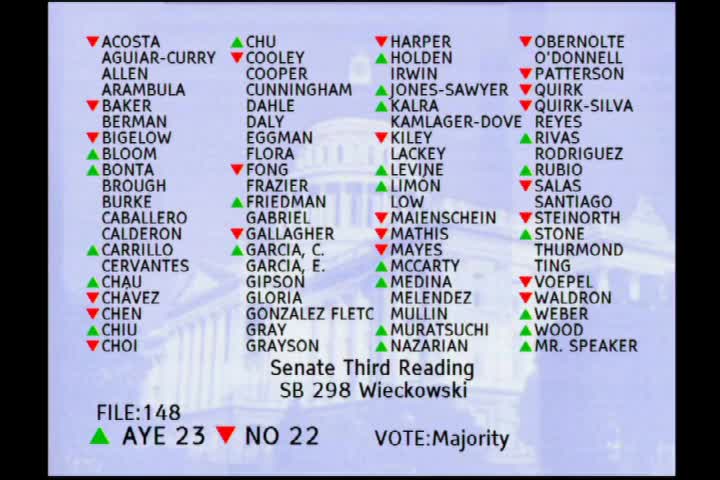 1MIN
Assembly Floor
 1H
Assembly Standing Committee on Appropriations
 9MIN
Assembly Standing Committee on Local Government
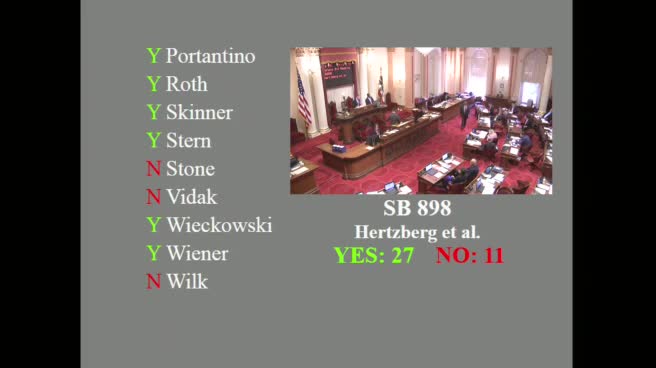 2MIN
Senate Floor
 8MIN
Senate Standing Committee on Transportation and Housing
 15MIN
Senate Standing Committee on Governance and Finance
Bill Author