SCA 2: Motor vehicle fees and taxes: restriction on expenditures: appropriations limit.
- Session Year: 2017-2018
- House: Senate
- Latest Version Date: 2017-03-30
(1)Article XIX of the California Constitution restricts the expenditure of revenues from taxes imposed by the state on fuels used in motor vehicles upon public streets and highways to street and highway and certain mass transit purposes, and restricts the expenditure of revenues from fees and taxes imposed by the state upon vehicles or their use or operation to state administration and enforcement of laws regulating the use, operation, or registration of vehicles used upon the public streets and highways, as well as to street and highway and certain mass transit purposes. These restrictions do not apply to revenues from taxes or fees imposed under the Sales and Use Tax Law or the Vehicle License Fee Law.
This measure would add Article XIXD to the California Constitution to require revenues derived from vehicle fees imposed under a specified chapter of the Vehicle License Fee Law to be used solely for transportation purposes. The measure would prohibit these revenues from being used for the payment of principal and interest on state transportation general obligation bonds that were authorized by the voters on or before November 8, 2016. The measure would prohibit the revenues from being used for the payment of principal and interest on state transportation general obligation bonds issued after that date unless the bond act submitted to the voters expressly authorizes that use. The measure would also prohibit the Legislature from borrowing these revenues, except as specified, or using them for purposes other than transportation purposes, as defined.
(2)Article XIIIB of the California Constitution prohibits the total annual appropriations subject to limitation of the state and each local government from exceeding the appropriations limit of the entity of the government for the prior year, as adjusted.
This measure would exclude appropriations of certain revenues associated with the Road Repair and Accountability Act of 2017 from the appropriations subject to constitutional limitation.
(3)Article XIXA of the California Constitution requires the deposit of a specified portion of the sales and use tax on diesel fuel in the Public Transportation Account in the State Transportation Fund, and restricts the expenditure of those revenues to certain transportation and mass transportation purposes. Article XIXA prohibits the Legislature from borrowing these revenues and from using these revenues other than as specifically permitted by Article XIXA.
This measure would restrict additional portions of the sales and use tax on diesel fuel to expenditure on certain transportation planning or mass transportation purposes and require those revenues to be deposited in the Public Transportation Account. The measure would prohibit the Legislature from temporarily or permanently diverting or appropriating these additional revenues for other than certain transportation planning or mass transportation purposes, or from borrowing, except as specified, these additional revenues.
(1)Article XIX of the California Constitution restricts the expenditure of revenues from taxes imposed by the state on fuels used in motor vehicles upon public streets and highways to street and highway and certain mass transit purposes, and restricts the expenditure of revenues from fees and taxes imposed by the state upon vehicles or their use or operation to state administration and enforcement of laws regulating the use, operation, or registration of vehicles used upon the public streets and highways, as well as to street and highway and certain mass transit purposes. These restrictions do not apply to revenues from taxes or fees imposed under the Sales and Use Tax Law or the Vehicle License Fee Law.
Article XIX prohibits the Legislature from borrowing revenues from taxes imposed by the state on fuels used in motor vehicles upon public streets and highways, and from using those revenues other than as specifically permitted by Article XIX. Article XIX provides that up to 25% of fuel tax revenues allocated to the state may be pledged or used for the payment of principal and interest on voter-approved transportation bonds issued for street and highway purposes on and after November 2, 2010, upon voter approval and appropriation by the Legislature. Article XIX provides that up to 25% of fuel tax revenues allocated to cities and counties may be pledged or used for the payment of principal and interest on voter-approved transportation bonds issued for street and highway purposes. However, in counties where voters have approved the use of fuel tax revenues for certain mass transit purposes, Article XIX provides that the Legislature may authorize any fuel tax revenues allocated to mass transit purposes to be pledged or used for payment of principal and interest on voter-approved bonds issued for those mass transit purposes.This measure would also prohibit the Legislature from borrowing revenues from fees and taxes imposed by the state on vehicles or their use or operation, and from using those revenues other than as specifically permitted by Article XIX. The measure would prohibit those vehicle revenues and fuel tax revenues from being pledged or used for the payment of principal and interest on general obligation bonds issued by the state, except that vehicle weight fee revenues would be authorized to be pledged or used for the payment of principal and interest on general obligation transportation bonds approved prior to January 1, 2017. The measure would retain existing restrictions, as described above, for use of fuel tax revenues to pay principal and interest on other transportation bonds, but would authorize the use of fuel tax revenues and vehicle fee revenues attributable to tax and fee rate increases enacted on or after January 1, 2017, to pay principal and interest on debt service for revenue bonds issued for expenditures consistent with Article XIX. The measure would repeal the authorization for fuel tax revenues allocated to mass transit purposes to be pledged or used for payment of principal and interest on voter-approved bonds issued for those mass transit purposes, and would instead subject those expenditures to the same restrictions applicable to the use of fuel tax revenues for street and highway bond purposes.This measure would add Article XIX D to the California Constitution to require revenues derived from vehicle fees imposed under a specified chapter of the Vehicle License Fee Law to be used solely for transportation purposes. The measure would prohibit these revenues from being used for the payment of principal and interest on state transportation general obligation bonds that were authorized by the voters on or before November 8, 2016. The measure would prohibit the revenues from being used for the payment of principal and interest on state transportation general obligation bonds issued after that date unless the bond act submitted to the voters expressly authorizes that use. The measure would also prohibit the Legislature from borrowing these revenues, except as specified, or using them for purposes other than transportation purposes, as defined.
(2) Article XIII B of the California Constitution prohibits the total annual appropriations subject to limitation of the state and each local government from exceeding the appropriations limit of the entity of the government for the prior year, as adjusted.
This measure would exclude appropriations of certain revenues associated with the Road Repair and Accountability Act of 2017 from the appropriations subject to constitutional limitation.
(2)(3)Article XIX A of the California Constitution requires the deposit of a specified portion of the sales and use tax on diesel fuel in the Public Transportation Account in the State Transportation Fund, and restricts the expenditure of those revenues to certain transportation and mass transportation purposes. Article XIX A prohibits the Legislature from borrowing these revenues and from using these revenues other than as specifically permitted by Article XIX A.
This measure would subject an restrict additional portion portions of the existing sales and use tax on diesel fuel to the requirements, restrictions, and prohibitions of Article XIX A. The measure would also require all revenues attributable to a future increase by the state in the sales and use tax rate on diesel fuel above the rate in effect on January 1, 2017, to be deposited in the Public Transportation Account and to be subject to Article XIX A. The measure would prohibit the pledging or use of sales and use tax revenues on diesel fuel that are dedicated to the Public Transportation Account, and any other revenues in the account, for the payment of principal and interest on general obligation bonds issued by the state. expenditure on certain transportation planning or mass transportation purposes and require those revenues to be deposited in the Public Transportation Account. The measure would prohibit the Legislature from temporarily or permanently diverting or appropriating these additional revenues for other than certain transportation planning or mass transportation purposes, or from borrowing, except as specified, these additional revenues.
(3)This measure would make other conforming changes.(1)Article XIX of the California Constitution restricts the expenditure of revenues from taxes imposed by the state on fuels used in motor vehicles upon public streets and highways to street and highway and certain mass transit purposes, and restricts the expenditure of revenues from fees and taxes imposed by the state upon vehicles or their use or operation to state administration and enforcement of laws regulating the use, operation, or registration of vehicles used upon the public streets and highways, as well as to street and highway and certain mass transit purposes. These restrictions do not apply to revenues from taxes or fees imposed under the Sales and Use Tax Law or the Vehicle License Fee Law.
Article XIX prohibits the Legislature from borrowing revenues from taxes imposed by the state on fuels used in motor vehicles upon public streets and highways, and from using those revenues other than as specifically permitted by Article XIX. Article XIX provides that up to 25% of fuel tax revenues allocated to the state may be pledged or used for the payment of principal and interest on voter-approved transportation bonds issued for street and highway purposes on and after November 2, 2010, upon voter approval and appropriation by the Legislature. Article XIX provides that up to 25% of fuel tax revenues allocated to cities and counties may be pledged or used for the payment of principal and interest on voter-approved transportation bonds issued for street and highway purposes. However, in counties where voters have approved the use of fuel tax revenues for certain mass transit purposes, Article XIX provides that the Legislature may authorize any fuel tax revenues allocated to mass transit purposes to be pledged or used for payment of principal and interest on voter-approved bonds issued for those mass transit purposes.
This measure would also prohibit the Legislature from borrowing revenues from fees and taxes imposed by the state on vehicles or their use or operation, and from using those revenues other than as specifically permitted by Article XIX. The measure would prohibit those vehicle revenues and fuel tax revenues from being pledged or used for the payment of principal and interest on general obligation bonds issued by the state, except that vehicle weight fee revenues would be authorized to be pledged or used for the payment of principal and interest on general obligation transportation bonds approved prior to January 1, 2017. The measure would retain existing restrictions, as described above, for use of fuel tax revenues to pay principal and interest on other transportation bonds, but would authorize the use of fuel tax revenues and vehicle fee revenues attributable to tax and fee rate increases enacted on or after January 1, 2017, to pay principal and interest on debt service for revenue bonds issued for expenditures consistent with Article XIX. The measure would repeal the authorization for fuel tax revenues allocated to mass transit purposes to be pledged or used for payment of principal and interest on voter-approved bonds issued for those mass transit purposes, and would instead subject those expenditures to the same restrictions applicable to the use of fuel tax revenues for street and highway bond purposes.
(2)Article XIX A of the California Constitution requires the deposit of a specified portion of the sales and use tax on diesel fuel in the Public Transportation Account in the State Transportation Fund, and restricts the expenditure of those revenues to certain transportation and mass transportation purposes. Article XIX A prohibits the Legislature from borrowing these revenues and from using these revenues other than as specifically permitted by Article XIX A.
This measure would subject an additional portion of the existing sales and use tax on diesel fuel to the requirements, restrictions, and prohibitions of Article XIX A. The measure would also require all revenues attributable to a future increase by the state in the sales and use tax rate on diesel fuel above the rate in effect on January 1, 2017, to be deposited in the Public Transportation Account and to be subject to Article XIX A. The measure would prohibit the pledging or use of sales and use tax revenues on diesel fuel that are dedicated to the Public Transportation Account, and any other revenues in the account, for the payment of principal and interest on general obligation bonds issued by the state.
(3)This measure would make other conforming changes.
WHEREAS, Transportation revenues raised by the Road Repair and Accountability Act of 2017 should be constitutionally protected for transportation purpose; purposes; and
WHEREAS, By so doing, Californians are assured revenues raised by that act are spent to repair streets and bridges, address years of deferred maintenance on highways and local roads, improve mobility and public transit, and invest in needed transportation infrastructure to benefit all Californians; now, therefore, be it
Resolved by the Senate, the Assembly concurring, That the Legislature of the State of California at its 201718 Regular Session commencing on the fifth day of December 2016, two-thirds of the membership of each house concurring, hereby proposes to the people of the State of California that the Constitution of the State be amended as follows:
Appropriations subject to limitation of each entity of government shall not include appropriations of revenues from the Road Maintenance and Rehabilitation Account created by the Road Repair and Accountability Act of 2017, or any other revenues deposited into any other funds pursuant to the act. No adjustment in the appropriations limit of any entity of government shall be required pursuant to Section 3 as a result of revenues being deposited in or appropriated from the Road Maintenance and Rehabilitation Account created by the Road Repair and Accountability Act of 2017 or any other account pursuant to the act.
(a)The Legislature shall not borrow revenues from the Public Transportation Account, or any successor account, and shall not use these revenues for purposes, or in ways, other than those specifically permitted by this article.
(b)The Public Transportation Account in the State Transportation Fund, or any successor account, is a trust fund. The Legislature may not change the status of the Public Transportation Account as a trust fund. Funds in the Public Transportation Account may not be loaned or otherwise transferred to the General Fund or any other fund or account in the State Treasury.
(c)All revenues specified in paragraphs (1) through (3), inclusive, of subdivision (a) of Section 7102 of the Revenue and Taxation Code, as that section read on June 1, 2001, shall be deposited no less than quarterly into the Public Transportation Account (Section 99310 of the Public Utilities Code), or its successor. The Legislature may not take any action which temporarily or permanently diverts or appropriates these revenues for purposes other than those described in subdivision (d), or delays, defers, suspends, or otherwise interrupts the quarterly deposit of these funds into the Public Transportation Account.
(d)Funds in the Public Transportation Account may only be used for transportation planning and mass transportation purposes. The revenues described in subdivision (c) are hereby continuously appropriated to the Controller without regard to fiscal years for allocation as follows:
(1)Fifty percent pursuant to subdivisions (a) through (f), inclusive, of Section 99315 of the Public Utilities Code, as that section read on July 30, 2009.
(2)Twenty-five percent pursuant to subdivision (b) of Section 99312 of the Public Utilities Code, as that section read on July 30, 2009.
(3)Twenty-five percent pursuant to subdivision (c) of Section 99312 of the Public Utilities Code, as that section read on July 30, 2009.
(e)For purposes of paragraph (1) of subdivision (d), transportation planning means only the purposes described in subdivisions (c) through (f), inclusive, of Section 99315 of the Public Utilities Code, as that section read on July 30, 2009.
(f)For purposes of this article, mass transportation, public transit, and mass transit have the same meaning as public transportation. Public transportation means:
(1)(A) Surface transportation service provided to the general public, complementary paratransit service provided to persons with disabilities as required by 42 U.S.C. 12143, or similar transportation provided to people with disabilities or the elderly; (B) operated by bus, rail, ferry, or other conveyance on a fixed route, demand response, or otherwise regularly available basis; (C) generally for which a fare is charged; and (D) provided by any transit district, included transit district, municipal operator, included municipal operator, eligible municipal operator, or transit development board, as those terms were defined in Article 1 of Chapter 4 of Part 11 of Division 10 of the Public Utilities Code on January 1, 2009, a joint powers authority formed to provide mass transportation services, an agency described in subdivision (f) of Section 15975 of the Government Code, as that section read on January 1, 2009, any recipient of funds under Sections 99260, 99260.7, 99275, or subdivision (c) of Section 99400 of the Public Utilities Code, as those sections read on January 1, 2009, or a consolidated agency as defined in Section 132353.1 of the Public Utilities Code, as that section read on January 1, 2009.
(2)Surface transportation service provided by the Department of Transportation pursuant to subdivision (a) of Section 99315 of the Public Utilities Code, as that section read on July 30, 2009.
(3)Public transit capital improvement projects, including those identified in subdivision (b) of Section 99315 of the Public Utilities Code, as that section read on July 30, 2009.
(g)All revenues specified in Sections 6051.8 and 6201.8 of the Revenue and Taxation Code, as those sections read on January 1, 2018, shall be deposited no less than quarterly into the Public Transportation Account, or its successor. Except as provided in Sections 16310 and 16381 of the Government Code, as those sections read on January 1, 2018, the Legislature may not take any action that temporarily or permanently diverts or appropriates these revenues for purposes other than those described in subdivision (d), or delays, defers, suspends, or otherwise interrupts the quarterly deposit of these revenues into the Public Transportation Account.
(a)Notwithstanding Section 8 of Article XIX, revenues derived from vehicle fees imposed under the Vehicle License Fee Law pursuant to Chapter 6 (commencing with Section 11050) of Part 5 of Division 2 of the Revenue and Taxation Code, or its successor, over and above the costs of collection and any refunds authorized by law, shall be used solely for transportation purposes, as defined by Section 11050 of the Revenue and Taxation Code, as that section read upon enactment of the Road Repair and Accountability Act of 2017.
(b)The revenues described in subdivision (a) shall not be used for the payment of principal and interest on state transportation general obligation bonds that were authorized by the voters on or before November 8, 2016, nor shall those revenues be used for payment of principal and interest on state transportation general obligation bond acts approved by the voters after that date, unless the bond act expressly authorizes that use.
(c)Except as provided in Sections 16310 and 16381 of the Government Code, as those sections read on January 1, 2018, the Legislature shall not borrow the revenues described in subdivision (a), and shall not use these revenues for purposes, or in ways, other than as authorized in subdivisions (a) or (b).
WHEREAS, Transportation revenues raised by the Road Repair and Accountability Act of 2017 should be constitutionally protected for transportation purpose; and
WHEREAS, By so doing, Californians are assured revenues raised by that act are spent to repair streets and bridges, address years of deferred maintenance on highways and local roads, improve mobility and public transit, and invest in needed transportation infrastructure to benefit all Californians; now, therefore, be it
Resolved by the Senate, the Assembly concurring, That the Legislature of the State of California at its 201718 Regular Session commencing on the fifth day of December 2016, two-thirds of the membership of each house concurring, hereby proposes to the people of the State of California that the Constitution of the State be amended as follows:
The Legislature shall not borrow revenues subject to Section 2 or 3, and shall not use these revenues for purposes, or in ways, other than those specifically permitted by this article.Revenues subject to Section 2 may not be expended for the purposes specified in subdivision (b) of Section 2, except for research and planning, until that use is approved by a majority of the votes cast on the proposition authorizing that use of those revenues in an election held throughout the county or counties, or a specified area of a county or counties, within which the revenues are to be expended.(a)(1)Revenues subject to Section 2 or 3 shall not be pledged or used for the payment of principal and interest on general obligation bonds issued by the State, except as specifically provided in paragraph (2).(2)Revenues subject to Section 3 derived from vehicle weight fees may be pledged or used for the payment of principal and interest on general obligation transportation bonds that were approved by the voters prior to January 1, 2017, and issued for expenditures consistent with Section 2.(b)(1)Revenues subject to Section 2 or 3 shall not be pledged or used for the payment of principal and interest on revenue bonds or other similar indebtedness, except as specifically provided in this subdivision.(2)Up to 25 percent of the revenues subject to Section 2 that are allocated to the State may be pledged or used by the State for the payment of principal and interest on voter-approved bonds subject to this subdivision issued by the State on or after November 2, 2010, for the purposes specified in Section 2, upon approval by the voters of this use of the revenues and upon appropriation of the revenues by the Legislature.(3)Up to 25 percent of the revenues subject to Section 2 that are allocated to any city or county may be pledged or used by that city or county for the payment of principal and interest on voter-approved bonds subject to this subdivision issued by that city or county for the purposes specified in Section 2, upon approval by the voters of this use of the revenues.(4)Notwithstanding paragraphs (2) and (3), the portion of revenues subject to Sections 2 or 3 that is attributable to increases in tax or fee rates enacted on or after January 1, 2017, may be pledged or used by the recipient state or local agency for the payment of principal and interest on revenue bonds or other similar indebtedness issued for expenditures consistent with Section 2 or 3, as applicable.(a)The Legislature shall not borrow revenues from the Public Transportation Account, or any successor account, and shall not use these revenues for purposes, or in ways, other than those specifically permitted by this article.(b)The Public Transportation Account in the State Transportation Fund, or any successor account, is a trust fund. The Legislature may not change the status of the Public Transportation Account as a trust fund. Funds in the Public Transportation Account may not be loaned or otherwise transferred to the General Fund or any other fund or account in the State Treasury.(c)(1)All revenues specified in paragraphs (1) through (3), inclusive, of subdivision (a) of Section 7102 of the Revenue and Taxation Code, as that section read on June 1, 2001, shall be deposited no less than quarterly into the Public Transportation Account, or its successor.(2)All revenues specified in Sections 6051.8 and 6201.8 of the Revenue and Taxation Code, as those sections read on January 1, 2017, and all revenues attributable to an increase in the sales and use tax rate on diesel fuel imposed by the State above the rate in effect on January 1, 2017, shall be deposited no less than quarterly into the Public Transportation Account, or its successor.(3)The Legislature may not take any action which temporarily or permanently diverts or appropriates the revenues described in paragraphs (1) and (2) for purposes other than those described in subdivision (d), or delays, defers, suspends, or otherwise interrupts the quarterly deposit of these funds into the Public Transportation Account.(d)Funds in the Public Transportation Account may only be used for transportation planning and mass transportation purposes.(e)(1)The revenues described in paragraph (1) of subdivision (c) are hereby continuously appropriated to the Controller without regard to fiscal years for allocation as follows:(A)Fifty percent pursuant to subdivisions (a) through (f), inclusive, of Section 99315 of the Public Utilities Code, as that section read on July 30, 2009.(B)Twenty-five percent pursuant to subdivision (b) of Section 99312 of the Public Utilities Code, as that section read on July 30, 2009.(C)Twenty-five percent pursuant to subdivision (c) of Section 99312 of the Public Utilities Code, as that section read on July 30, 2009.(2)The revenues described in paragraph (2) of subdivision (c) shall be available for allocation to mass transportation purposes consistent with this section.(f)The revenues described in subdivision (c) and any other revenues in the Public Transportation Account shall not be pledged or used for the payment of principal and interest on general obligation bonds issued by the State.(g)For purposes of subdivision (d), transportation planning means only the purposes described in subdivisions (c) through (f), inclusive, of Section 99315 of the Public Utilities Code, as that section read on July 30, 2009.(h)For purposes of this article, mass transportation, public transit, and mass transit have the same meaning as public transportation. Public transportation means:(1)(A) Surface transportation service provided to the general public, complementary paratransit service provided to persons with disabilities as required by 42 U.S.C. 12143, or similar transportation provided to people with disabilities or the elderly; (B) operated by bus, rail, ferry, or other conveyance on a fixed route, demand response, or otherwise regularly available basis; (C) generally for which a fare is charged; and (D) provided by any transit district, included transit district, municipal operator, included municipal operator, eligible municipal operator, or transit development board, as those terms were defined in Article 1 of Chapter 4 of Part 11 of Division 10 of the Public Utilities Code on January 1, 2009, a joint powers authority formed to provide mass transportation services, an agency described in subdivision (f) of Section 15975 of the Government Code, as that section read on January 1, 2009, any recipient of funds under Sections 99260, 99260.7, 99275, or subdivision (c) of Section 99400 of the Public Utilities Code, as those sections read on January 1, 2009, or a consolidated agency as defined in Section 132353.1 of the Public Utilities Code, as that section read on January 1, 2009.(2)Surface transportation service provided by the Department of Transportation pursuant to subdivision (a) of Section 99315 of the Public Utilities Code, as that section read on July 30, 2009.(3)Public transit capital improvement projects, including those identified in subdivision (b) of Section 99315 of the Public Utilities Code, as that section read on July 30, 2009.Appropriations subject to limitation of each entity of government shall not include appropriations of revenues from the Road Maintenance and Rehabilitation Account created by the Road Repair and Accountability Act of 2017, or any other revenues deposited into any other funds pursuant to the act. No adjustment in the appropriations limit of any entity of government shall be required pursuant to Section 3 as a result of revenues being deposited in or appropriated from the Road Maintenance and Rehabilitation Account created by the Road Repair and Accountability Act of 2017 or any other account pursuant to the act.
(a)The Legislature shall not borrow revenues from the Public Transportation Account, or any successor account, and shall not use these revenues for purposes, or in ways, other than those specifically permitted by this article.
(b)The Public Transportation Account in the State Transportation Fund, or any successor account, is a trust fund. The Legislature may not change the status of the Public Transportation Account as a trust fund. Funds in the Public Transportation Account may not be loaned or otherwise transferred to the General Fund or any other fund or account in the State Treasury.
(c)All revenues specified in paragraphs (1) through (3), inclusive, of subdivision (a) of Section 7102 of the Revenue and Taxation Code, as that section read on June 1, 2001, shall be deposited no less than quarterly into the Public Transportation Account (Section 99310 of the Public Utilities Code), or its successor. The Legislature may not take any action which temporarily or permanently diverts or appropriates these revenues for purposes other than those described in subdivision (d), or delays, defers, suspends, or otherwise interrupts the quarterly deposit of these funds into the Public Transportation Account.
(d)Funds in the Public Transportation Account may only be used for transportation planning and mass transportation purposes. The revenues described in subdivision (c) are hereby continuously appropriated to the Controller without regard to fiscal years for allocation as follows:
(1)Fifty percent pursuant to subdivisions (a) through (f), inclusive, of Section 99315 of the Public Utilities Code, as that section read on July 30, 2009.
(2)Twenty-five percent pursuant to subdivision (b) of Section 99312 of the Public Utilities Code, as that section read on July 30, 2009.
(3)Twenty-five percent pursuant to subdivision (c) of Section 99312 of the Public Utilities Code, as that section read on July 30, 2009.
(e)For purposes of paragraph (1) of subdivision (d), transportation planning means only the purposes described in subdivisions (c) through (f), inclusive, of Section 99315 of the Public Utilities Code, as that section read on July 30, 2009.
(f)For purposes of this article, mass transportation, public transit, and mass transit have the same meaning as public transportation. Public transportation means:
(1)(A) Surface transportation service provided to the general public, complementary paratransit service provided to persons with disabilities as required by 42 U.S.C. 12143, or similar transportation provided to people with disabilities or the elderly; (B) operated by bus, rail, ferry, or other conveyance on a fixed route, demand response, or otherwise regularly available basis; (C) generally for which a fare is charged; and (D) provided by any transit district, included transit district, municipal operator, included municipal operator, eligible municipal operator, or transit development board, as those terms were defined in Article 1 of Chapter 4 of Part 11 of Division 10 of the Public Utilities Code on January 1, 2009, a joint powers authority formed to provide mass transportation services, an agency described in subdivision (f) of Section 15975 of the Government Code, as that section read on January 1, 2009, any recipient of funds under Sections 99260, 99260.7, 99275, or subdivision (c) of Section 99400 of the Public Utilities Code, as those sections read on January 1, 2009, or a consolidated agency as defined in Section 132353.1 of the Public Utilities Code, as that section read on January 1, 2009.
(2)Surface transportation service provided by the Department of Transportation pursuant to subdivision (a) of Section 99315 of the Public Utilities Code, as that section read on July 30, 2009.
(3)Public transit capital improvement projects, including those identified in subdivision (b) of Section 99315 of the Public Utilities Code, as that section read on July 30, 2009.
(g)All revenues specified in Sections 6051.8 and 6201.8 of the Revenue and Taxation Code, as those sections read on January 1, 2018, shall be deposited no less than quarterly into the Public Transportation Account, or its successor. Except as provided in Sections 16310 and 16381 of the Government Code, as those sections read on January 1, 2018, the Legislature may not take any action that temporarily or permanently diverts or appropriates these revenues for purposes other than those described in subdivision (d), or delays, defers, suspends, or otherwise interrupts the quarterly deposit of these revenues into the Public Transportation Account.
(a)Notwithstanding Section 8 of Article XIX, revenues derived from vehicle fees imposed under the Vehicle License Fee Law pursuant to Chapter 6 (commencing with Section 11050) of Part 5 of Division 2 of the Revenue and Taxation Code, or its successor, over and above the costs of collection and any refunds authorized by law, shall be used solely for transportation purposes, as defined by Section 11050 of the Revenue and Taxation Code, as that section read upon enactment of the Road Repair and Accountability Act of 2017.
(b)The revenues described in subdivision (a) shall not be used for the payment of principal and interest on state transportation general obligation bonds that were authorized by the voters on or before November 8, 2016, nor shall those revenues be used for payment of principal and interest on state transportation general obligation bond acts approved by the voters after that date, unless the bond act expressly authorizes that use.
(c)Except as provided in Sections 16310 and 16381 of the Government Code, as those sections read on January 1, 2018, the Legislature shall not borrow the revenues described in subdivision (a), and shall not use these revenues for purposes, or in ways, other than as authorized in subdivisions (a) or (b).
Resolved by the Senate, the Assembly concurring, That the Legislature of the State of California at its 201718 Regular Session commencing on the fifth day of December 2016, two-thirds of the membership of each house concurring, hereby proposes to the people of the State of California that the Constitution of the State be amended as follows:
The Legislature shall not borrow revenue from the Highway Users Tax Account, or its successor, revenues subject to Section 2 or 3, and shall not use these revenues for purposes, or in ways, other than those specifically permitted by this article.
Revenues allocated pursuant subject to Section 4 2 may not be expended for the purposes specified in subdivision (b) of Section 2, except for research and planning, until such that use is approved by a majority of the votes cast on the proposition authorizing such that use of such those revenues in an election held throughout the county or counties, or a specified area of a county or counties, within which the revenues are to be expended. The Legislature may authorize the revenues approved for allocation or expenditure under this section to be pledged or used for the payment of principal and interest on voter-approved bonds issued for the purposes specified in subdivision (b) of Section 2.
(a)Up (1)Revenues subject to Section 2 or 3 shall not be pledged or used for the payment of principal and interest on general obligation bonds issued by the State, except as specifically provided in paragraph (2).
(2)Revenues subject to Section 3 derived from vehicle weight fees may be pledged or used for the payment of principal and interest on general obligation transportation bonds that were approved by the voters prior to January 1, 2017, and issued for expenditures consistent with Section 2.
(b)(1)Revenues subject to Section 2 or 3 shall not be pledged or used for the payment of principal and interest on revenue bonds or other similar indebtedness, except as specifically provided in this subdivision.
(2)Up to 25 percent of the revenues subject to Section 2 that are allocated to the State pursuant to Section 4 for the purposes specified in subdivision (a) of Section 2 of this article may be pledged or used by the State, upon approval by the voters and appropriation by the Legislature, State for the payment of principal and interest on voter-approved bonds subject to this subdivision issued by the State on or after November 2, 2010, for such the purposes issued by the State on and after November 2, 2010. specified in Section 2, upon approval by the voters of this use of the revenues and upon appropriation of the revenues by the Legislature.
(b)(3)Up to 25 percent of the revenues subject to Section 2 that are allocated to any city or county pursuant to Section 4 for the purposes specified in subdivision (a) of Section 2 of this article may be pledged or used only by any that city or county for the payment of principal and interest on voter-approved bonds subject to this subdivision issued by that city or county for such purposes. the purposes specified in Section 2, upon approval by the voters of this use of the revenues.
(4)Notwithstanding paragraphs (2) and (3), the portion of revenues subject to Sections 2 or 3 that is attributable to increases in tax or fee rates enacted on or after January 1, 2017, may be pledged or used by the recipient state or local agency for the payment of principal and interest on revenue bonds or other similar indebtedness issued for expenditures consistent with Section 2 or 3, as applicable.
(a)The Legislature shall not borrow revenues from the Public Transportation Account, or any successor account, and shall not use these revenues for purposes, or in ways, other than those specifically permitted by this article.
(b)The Public Transportation Account in the State Transportation Fund, or any successor account, is a trust fund. The Legislature may not change the status of the Public Transportation Account as a trust fund. Funds in the Public Transportation Account may not be loaned or otherwise transferred to the General Fund or any other fund or account in the State Treasury.
(c)(1)All revenues specified in paragraphs (1) through (3), inclusive, of subdivision (a) of Section 7102 of the Revenue and Taxation Code, as that section read on June 1, 2001, shall be deposited no less than quarterly into the Public Transportation Account (Section 99310 of the Public Utilities Code), Account, or its successor. The
(2)All revenues specified in Sections 6051.8 and 6201.8 of the Revenue and Taxation Code, as those sections read on January 1, 2017, and all revenues attributable to an increase in the sales and use tax rate on diesel fuel imposed by the State above the rate in effect on January 1, 2017, shall be deposited no less than quarterly into the Public Transportation Account, or its successor.
(3)The Legislature may not take any action which temporarily or permanently diverts or appropriates these the revenues described in paragraphs (1) and (2) for purposes other than those described in subdivision (d), or delays, defers, suspends, or otherwise interrupts the quarterly deposit of these funds into the Public Transportation Account.
(d)Funds in the Public Transportation Account may only be used for transportation planning and mass transportation purposes. The
(e)(1)The revenues described in paragraph (1) of subdivision (c) are hereby continuously appropriated to the Controller without regard to fiscal years for allocation as follows:
(1)(A)Fifty percent pursuant to subdivisions (a) through (f), inclusive, of Section 99315 of the Public Utilities Code, as that section read on July 30, 2009.
(2)(B)Twenty-five percent pursuant to subdivision (b) of Section 99312 of the Public Utilities Code, as that section read on July 30, 2009.
(3)(C)Twenty-five percent pursuant to subdivision (c) of Section 99312 of the Public Utilities Code, as that section read on July 30, 2009.
(2)The revenues described in paragraph (2) of subdivision (c) shall be available for allocation to mass transportation purposes consistent with this section.
(f)The revenues described in subdivision (c) and any other revenues in the Public Transportation Account shall not be pledged or used for the payment of principal and interest on general obligation bonds issued by the State.
(e)(g)For purposes of paragraph (1) of subdivision (d), transportation planning means only the purposes described in subdivisions (c) through (f), inclusive, of Section 99315 of the Public Utilities Code, as that section read on July 30, 2009.
(f)(h)For purposes of this article, mass transportation, public transit, and mass transit have the same meaning as public transportation. Public transportation means:
(1)(A) Surface transportation service provided to the general public, complementary paratransit service provided to persons with disabilities as required by 42 U.S.C. 12143, or similar transportation provided to people with disabilities or the elderly; (B) operated by bus, rail, ferry, or other conveyance on a fixed route, demand response, or otherwise regularly available basis; (C) generally for which a fare is charged; and (D) provided by any transit district, included transit district, municipal operator, included municipal operator, eligible municipal operator, or transit development board, as those terms were defined in Article 1 of Chapter 4 of Part 11 of Division 10 of the Public Utilities Code on January 1, 2009, a joint powers authority formed to provide mass transportation services, an agency described in subdivision (f) of Section 15975 of the Government Code, as that section read on January 1, 2009, any recipient of funds under Sections 99260, 99260.7, 99275, or subdivision (c) of Section 99400 of the Public Utilities Code, as those sections read on January 1, 2009, or a consolidated agency as defined in Section 132353.1 of the Public Utilities Code, as that section read on January 1, 2009.
(2)Surface transportation service provided by the Department of Transportation pursuant to subdivision (a) of Section 99315 of the Public Utilities Code, as that section read on July 30, 2009.
(3)Public transit capital improvement projects, including those identified in subdivision (b) of Section 99315 of the Public Utilities Code, as that section read on July 30, 2009.
|
Date
|
Status
|
|---|---|
| Apr 17, 2017 | Ordered to inactive file on request of Senator Newman. |
| Apr 4, 2017 | Read second time. Ordered to third reading. |
| Apr 3, 2017 | From committee: Be adopted. (Ayes 5. Noes 2. Page 585.) (April 3). |
| Mar 30, 2017 | From committee with author's amendments. Read second time and amended. Re-referred to Com. on APPR. |
| Mar 30, 2017 | Set for hearing April 3. |
| Mar 29, 2017 | From committee with author's amendments. Read second time and amended. Re-referred to Com. on APPR. |
| Mar 21, 2017 | From committee: Be adopted and re-refer to Com. on APPR. (Ayes 4. Noes 1. Page 428.) (March 21). Re-referred to Com. on APPR. |
| Mar 16, 2017 | Set for hearing March 21. |
| Mar 15, 2017 | From committee: Be adopted and re-refer to Com. on E. & C.A. (Ayes 9. Noes 0. Page 372.) (March 14). Re-referred to Com. on E. & C.A. |
| Mar 9, 2017 | Set for hearing March 14. |
| Jan 26, 2017 | Referred to Coms. on T. & H. and E. & C.A. |
| Jan 19, 2017 | From printer. May be acted upon on or after February 18. |
| Jan 18, 2017 | Introduced. Read first time. To Com. on RLS. for assignment. To print. |
|
Date
|
Description
|
Location
|
Votes
|
|
|---|---|---|---|---|
| Apr 3, 2017 | Be adopted | Senate Standing Committee on Appropriations |
Passed |
|
| Mar 21, 2017 | Be adopted, but first be re-referred to the Committee on [Appropriations] | Senate Standing Committee on Elections and Constitutional Amendments |
Passed |
|
| Mar 14, 2017 | Be adopted, but first be re-referred to the Committee on [Elections and Constitutional Amendments] | Senate Standing Committee on Transportation and Housing |
Passed |
This list shows positions taken on this bill by organizations on the date displayed, which is linked to the original source.
Positions by individuals are not included.
|
Organization
|
Position
|
Date
|
|---|---|---|
| California Alliance for Jobs | * Support | Apr 3, 2017 |
| California Association Councils of Government | * Support | Apr 3, 2017 |
| California State Association Of Counties | * Support | Apr 3, 2017 |
| California State Council Of Laborers | * Support | Apr 3, 2017 |
| Caterpillar | * Support | Apr 3, 2017 |
| Professional Engineers In California Government | ** Support | Apr 5, 2017 |
| Southern California Contractors Association | ** Support | Apr 5, 2017 |
| Transportation California | * Support | Apr 3, 2017 |
| United Contractors | * Support | Apr 3, 2017 |
Office of Senate Floor Analyses (916) 651-1520 Fax: (916) 327-4478 | SCA |
THIRD READING
Bill No: SCA 2
:
SENATE TRANS. & HOUSING COMMITTEE: 9-0, 3/14/17
AYES: Beall, Allen, Atkins, McGuire, Mendoza, Roth, Skinner, Wieckowski, Wiener
NO VOTE RECORDED: Cannella, Bates, Gaines, Morrell
SENATE ELECTIONS & C.A. COMMITTEE: 4-1, 3/21/17
AYES: Stern, Allen, Hertzberg, Leyva
NOES: Anderson
SENATE APPROPRIATIONS COMMITTEE: 5-2, 4/3/17
AYES: Lara, Beall, Bradford, Hill, Wiener
NOES: Bates, Nielsen
DIGEST: This constitutional amendment proposes to amend the California Constitution to prohibit the Legislature from borrowing revenues from fees and taxes imposed on vehicles or their use or operation, and from using those revenues other than as specifically permitted in the Constitution.
Existing law, pursuant to the California Constitution:
- Restricts the use of fuel excise tax revenues (from vehicles used on public streets and highways) and vehicle registration fee revenues to transportation purposes.
- Restricts the Legislature from borrowing revenues from the Highway Users Tax Account.
- Restricts fuel excise tax revenues to development and construction of roads and highways, unless a majority of voters in an election throughout a county or counties approves the use of the revenues for fixed-guideway mass transit.
- Allows the Legislature to pledge fuel excise tax revenues for payment of bonds to fund voter-approved fixed-guideway mass transit projects.
- Allows the Legislature to use up to 25% of the state’s share of fuel excise tax revenues for payment of state-issued, voter-approved bonds for transportation purposes issued after November 2010.
- Allows a city or county to use up to 25% of its share of fuel excise tax revenues for payment of locally issued, voter-approved bonds for transportation purposes.
- Specifies that the restrictions on fuel excise tax and vehicle registration fee revenues do not apply to revenues derived from sales taxes or vehicle license fees.
- Establishes the Public Transportation Account (PTA) as a trust fund and provides that revenues in the fund may only be used for specified transportation planning and mass transportation purposes. Further specifies that the Legislature is prohibited from borrowing revenues from the PTA, loaning or transferring them to the General Fund, or using the revenues for any purposes not specifically authorized.
- Imposes an appropriation limit on the state and most local governments which limits the amount of spending to a base level, adjusted annually for inflation and population growth. State appropriations from the proceeds of taxes must be made within the state appropriation limit (SAL) or Gann limit. If state appropriations subject to those restrictions exceed the SAL, any revenue in excess of the SAL over two consecutive years must be appropriated for purposes exempt from the SAL (such as debt service), or used for a combination of Proposition 98 education spending and taxpayer rebates.
This constitutional amendment:
- Requires diesel fuel sales tax revenues to be deposited into the PTA and prohibits the Legislature from diverting or appropriating those funds for purposes other than transportation planning and mass transportation.
- Requires revenues derived from a proposed Transportation Improvement Fee to be used solely for transportation purposes, prohibits those revenues from being used to pay for previously authorized transportation bond debt service, and prohibits the Legislature from borrowing or using those revenues for unauthorized purposes.
- Exempts appropriations of revenues generated as part of the proposed Road Repair and Accountability Act of 2017 (SB 1, Beall) from counting towards the state appropriation limit (Gann Limit).
- Requires the provisions specified in this measure are subject to voter approval in the 2018.
Comments
- Author’s statement. “SCA 2 will ensure that future revenues passed by the Legislature to pay for road and highway maintenance will be spent exclusively on vitally needed repairs and not on other legislative priorities.
“According to the American Society of Civil Engineers, 68% of California’s roads are considered to be in ‘poor’ or ‘mediocre’ condition. Not only does poor road quality affect individual users, it also impacts the efficient movement of goods throughout the state, which directly impacts job growth and the competitiveness of California’s ports and goods movement industries. With freight movement predicted to increase significantly, Californians will see increased deterioration of their roads due to the heavier vehicle use. Because preventative maintenance costs 10 to 12 times less than pavement and road rehabilitation, California is at an opportune moment to make needed repairs and avoid facing even higher maintenance costs down the road.
“In order to fund needed repairs to the states roads and highways, the Legislature is considering a number of options that would provide increased funding for transportation projects but provide no oversight or protection on how funds would be spent. Without the protections in SCA 2, revenues that are raised to pay for the repair and maintenance of the state’s roads and highways could be used for non-transportation related purposes. Not only would this fail to fix our roads and highways, it would also defy the intent of the Legislature and violate the public trust of our constituents.”
- Current restrictions. Most transportation revenues, including gasoline and diesel excise taxes and vehicle registration fees, are constitutionally protected from being borrowed or used for purposes other than transportation. This protection does not apply to vehicle license fees and fuel excise taxes for usage outside of public roads. While the Constitution is currently silent on the use of weight fees, there are different opinions on whether those are currently protected. However, since 2011, weight fees have been used to pay down transportation-related general obligation bonds without substantial challenges relative to the constitutionality of this practice.
- The need for new funding. The deterioration of California’s state and local streets and roads has been widely documented. For example, at the January 2017 California Transportation Commission (CTC) hearing, a local streets and roads needs assessment presented to the CTC found that the statewide average pavement condition index, which rates the condition of the surface of a road network, to be 65. This score indicates that statewide, roads on average are in “fair/at risk” condition and are becoming worn down to the point where rehabilitation, rather than routine maintenance, may be needed to prevent rapid deterioration. The needs assessment further found that in order to maintain local roads at their existing condition would require an additional $3.5 billion annually. Overall, according to the “Fix Our Roads” Coalition, total deferred maintenance shortfalls total approximately $78 billion, while the shortfall is estimated at $59 billion for the deferred maintenance backlog at the state level.
- A response to the need. Introduced in the current legislative session, SB 1 (Beall) serves the consensus transportation funding package between the Senate, Assembly, and Governor. Serving as the legislative vehicle, SB 1 proposes to increase a number of transportation-related taxes and fees to raise roughly $5.2 billion in new transportation revenues annually and makes annual inflation adjustments. SB 1 proposes the funding to be used towards deferred maintenance on the state highways and local streets and roads, improve the state’s trade corridors, and transit. SB 1 further contains a number of additional transportation-related reforms including creating a Transportation Inspector General subject to Senate confirmation within the newly created Caltrans Office of Audits and Investigations, granting CTC additional oversight over the SHOPP projects, including staffing support, and developing an Advance Mitigation Program. SCA 2 serves as the companion measure to provide constitutional protections for the revenues generated under SB 1.
FISCAL EFFECT: Appropriation: No Fiscal Com.: Yes Local: No
According to the Senate Appropriations Committee:
- One-time General Fund costs in the range of $414,000 to $552,000 to the Secretary of State, likely in 2017-18, for printing and mailing costs to place the measure on the ballot in a statewide election. Actual costs may be higher or lower, depending on the length of required elements and the overall size of the ballot.
- New constitutional protections that ensure diesel fuel sales tax revenues are deposited into the PTA and not subject to diversion or appropriation for purposes other than transportation planning and mass transportation would apply to approximately $500 million in annual revenues.
- New constitutional protections that require revenues from the proposed Transportation Improvement Fee be used solely for specified transportation purposes, and not for existing bond debt service, would apply to an estimated $1.5 billion to $1.6 billion in new annual revenues, if SB 1 is enacted.
- Exempts appropriations of approximately $2 billion in new annual revenues generated by SB 1 from counting towards the Gann Limit. Absent this provision, state spending could be constrained in future years, to the extent appropriations of SB 1 revenues result in state appropriations exceeding the Gann Limit for two consecutive years in the future.
Professional Engineers in California Government
Southern California Contractors Association
None received
4/5/17 14:44:46
**** END ****
SENATE COMMITTEE ON APPROPRIATIONS
Senator Ricardo Lara, Chair
2017 - 2018 Regular Session
SCA 2 (Newman) - Motor vehicle fees and taxes: restriction on expenditures: appropriations limit
Version: March 30, 2017 | Policy Vote: T. & H. 9 - 0, E. & C.A. 4 - 1 |
Urgency: | Mandate: No |
Hearing Date: April 3, 2017 | Consultant: Mark McKenzie |
This bill meets the criteria for referral to the Suspense File.
Bill Summary:
SCA 2, if approved by the voters, would amend the California Constitution to do the following:
- Exempt appropriations of revenues generated as part of the proposed Road Repair and Accountability Act of 2017 (SB 1) from counting towards the state appropriation limit (Gann Limit).
- Require diesel fuel sales tax revenues to be deposited into the Public Transportation Account (PTA) and prohibit the Legislature from diverting or appropriating those funds for purposes other than transportation planning and mass transportation.
- Require revenues derived from a proposed Transportation Improvement Fee to be used solely for transportation purposes, prohibit those revenues from being used to pay for previously authorized transportation bond debt service, and prohibit the Legislature from borrowing or using those revenues for unauthorized purposes.
Fiscal Impact:
- One-time General Fund costs in the range of $414,000 to $552,000 to the Secretary of State (SOS), likely in 2017-18, for printing and mailing costs to place the measure on the ballot in a statewide election. Actual costs may be higher or lower, depending on the length of required elements and the overall size of the ballot.
- New constitutional protections that ensure diesel fuel sales tax revenues are deposited into the PTA and not subject to diversion or appropriation for purposes other than transportation planning and mass transportation would apply to approximately $500 million in annual revenues.
- New constitutional protections that require revenues from the proposed Transportation Improvement Fee be used solely for specified transportation purposes, and not for existing bond debt service, would apply to an estimated $1.5 billion to $1.6 billion in new annual revenues, if SB 1 is enacted.
- Exempts appropriations of approximately $2 billion in new annual revenues generated by SB 1 from counting towards the Gann Limit. Absent this provision, state spending could be constrained in future years, to the extent appropriations of SB 1 revenues result in state appropriations exceeding the Gann Limit for two consecutive years in the future.
Background:
Existing law, Articles XIX, XIX A, and XIX B of the California Constitution, specifies the following:
- Fuel excise tax revenues (from vehicles used on public streets and highways) and vehicle registration fee revenues are solely dedicated to specified transportation purposes.
- Fuel excise tax revenues may be used for payment of bonds to fund voter approved fixed-guideway mass transit projects, and a majority of voters in an election throughout a county or counties may approved the use of these revenues for fixed-guideway mass transit.
- The Legislature is prohibited from borrowing revenues from the Highway Users Tax Account (HUTA), or using those revenues for unauthorized purposes.
- The Legislature may use up to 25% of the state’s share of fuel excise tax revenues for payment of state-issued, voter-approved bonds for transportation purposes issued after November 2010. A city or county may also use up to 25% of its share of revenues for those purposes
- Restrictions on fuel excise tax and vehicle registration fee revenues do not apply to revenues derived from sales taxes or vehicle license fees.
- The Public Transportation Account is a trust fund and revenues in the fund may only be used for specified transportation planning and mass transportation purposes. The Legislature is prohibited from borrowing revenues from the PTA, loaning or transferring them to the General Fund, or using the revenues for any purposes not specifically authorized.
- Motor vehicle fuel sales tax revenues must be deposited into the Transportation Investment Fund (TIF), a trust fund, and used solely for specified transportation purposes (40% for local streets and roads, 40% for the state highway system, and 20% for transit). The Legislature is prohibited from borrowing revenues from the TIF or using the revenues for any purpose not specifically authorized.
Existing law, Article XIII B of the California Constitution, imposes an appropriation limit on the state and most local governments which limits the amount of spending to a base level, adjusted annually for inflation and population growth. State appropriations from the proceeds of taxes must be made within the state appropriation limit, otherwise known as the SAL or Gann limit. If state appropriations subject to those restrictions exceed the SAL, any revenue in excess of the SAL over two consecutive years must be appropriated for purposes exempt from the SAL (such as debt service), or used for a combination of Proposition 98 education spending and taxpayer rebates.
Proposed Law:
SCA 2, if approved by the voters, would amend the California Constitution in the following ways:
- Add Section 15 to Article XIII B to exempt appropriations of revenues generated from the Road Maintenance and Rehabilitation Account created by SB 1, or any other revenues deposited into funds pursuant to that measure, from counting towards the state appropriation limit.
- Amend Section I of Article XIX A to require revenues derived from the sales tax on diesel fuels to be deposited into the PTA, and prohibit the Legislature from temporarily or permanently diverting or appropriating those revenues for purposes other than transportation planning and mass transportation.
- Add Article XIX D to require that revenues derived from SB 1’s proposed Transportation Improvement Fee on vehicles, except for specified administrative expenditures to collect the revenues, be used solely for transportation purposes. These revenues shall not be used for debt service on state transportation general obligation bonds authorized prior to November 8, 2016, and may only be used for future bond debt service to the extent that purpose is explicitly authorized in future bond acts. The Legislature would be prohibited from borrowing those revenues or using them for unauthorized purposes, as specified.
Related Legislation:
SB 1 (Beall), which is also on this Committee’s hearing agenda today, would enact the Road Repair and Accountability Act of 2017. The Act would increase gasoline excise taxes, diesel excise taxes, and diesel sales taxes, impose a new Transportation Improvement Fee on registered vehicles, and a new fee on zero-emission vehicles, as specified. Revenues would be dedicated to maintenance and rehabilitation of state highways and local streets and roads, transit, intercity rail, and other specified purposes.
Staff Comments:
The Gann Limit has rarely affected state budgeting since the mid-1980s, primarily because of the changes enacted by Proposition 111 in 1990, which changed the way inflation and population growth factors are calculated and required excess revenues to be determined over a two-year period. However, the difference between spending and the SAL typically shrinks as economic expansion persists, and the Legislative Analyst’s Office (LAO) estimates that the state is nearing the SAL in the budget year. According to the LAO’s recent report on the Governor’s Gann Limit Proposal in the 2017-18 Budget, the state would end the two-year period from 2015-16 through 2017-18 with between $2.8 and $3.9 billion of room under the SAL. SCA 2 would explicitly exclude appropriations from the new proceeds of taxes generated as a result of the transportation funding proposal in SB 1 (approximately $2 billion) from counting towards SAL, which would otherwise bring the state very close to the Gann Limit. Staff notes that certain revenues are not counted as “appropriations subject to limitation,” including gas and transportation tax revenues (gas taxes in excess of the 1990 level of 9 cents per gallon, and weight fees), as specified in 1990’s Proposition 111.
SOS indicates that printing and mailing costs associated with placing a measure on the statewide ballot are approximately $69,000 per page, depending on the length of the ballot. The fiscal estimates noted above reflect the addition of 6-8 pages in the Voter Information Guide. Actual costs would depend upon the length of the title and summary, analysis by the Legislative Analyst’s Office, proponent and opponent arguments, and text of the proposal.
-- END --
SENATE COMMITTEE ON
ELECTIONS AND CONSTITUTIONAL AMENDMENTS
Senator Henry Stern, Chair
2017 - 2018 Regular
Bill No: SCA Hearing Date: 3/21/17
Author: | |||
Version: | 1/18/17 | ||
Urgency: | No | Fiscal: | Yes |
Consultant: | Darren Chesin | ||
Subject: Motor vehicle fees and taxes: restriction on expenditures
DIGEST
This measure, if approved by the state’s voters, would amend the California Constitution to prohibit the Legislature from borrowing revenues from fees and taxes imposed on vehicles or their use or operation, and from using those revenues other than as specifically permitted in the Constitution.
ANALYSIS
Existing law, per the California Constitution:
- Restricts the use of fuel excise tax revenues (from vehicles used on public streets and highways) and vehicle registration fee revenues to transportation purposes.
- Restricts the Legislature from borrowing revenues from the Highway Users Tax Account (HUTA).
- Restricts fuel excise tax revenues to development and construction of roads and highways, unless a majority of voters in an election throughout a county or counties approves the use of the revenues for fixed-guideway mass transit.
- Allows the Legislature to pledge fuel excise tax revenues for payment of bonds to fund voter-approved fixed-guideway mass transit projects.
- Allows the Legislature to use up to 25% of the state’s share of fuel excise tax revenues for payment of state-issued, voter-approved bonds for transportation purposes issued after November 2010.
- Allows a city or county to use up to 25% of its share of fuel excise tax revenues for payment of locally issued, voter-approved bonds for transportation purposes.
- Specifies that the restrictions on fuel excise tax and vehicle registration fee revenues do not apply to revenues derived from sales taxes or vehicle license fees.
This bill:
- Prohibits the Legislature from borrowing revenues from fees and taxes imposed on vehicles or their use or operation, and from using those revenues other than as permitted in the Constitution, as specified.
- Authorizes the use of vehicle weight fees to be used for general obligation transportation bonds approved by the voters prior to January 1, 2017, as specified.
- Prohibits the Legislature from borrowing revenues from taxes imposed on the sale of diesel fuel on or after January 1, 2017 and from using those revenues for any other purpose than transportation planning and mass transportation purposes.
- Authorizes an unspecified portion of new increases in gasoline taxes and/or motor vehicle fees to be used by the state and local agencies to pay down revenue bonds used for transportation-related purposes as provided in Article 19 of the State Constitution.
- Repeals the requirement that Article 19 revenues used for mass transportation purposes can only be expended for the payment of voter-approved mass transportation bonds and instead allows the funds used for mass transportation expenditures to be under general Article 19 requirements.
BACKGROUND
Current restrictions. Most transportation revenues, including gasoline and diesel excise taxes and vehicle registration fees, are constitutionally protected from being borrowed or used for purposes other than transportation. This protection does not apply to vehicle license fees and fuel excise taxes for usage outside of public roads. While the Constitution is currently silent on the use of weight fees, there are different opinions on whether those are currently protected. However, since 2011, weight fees have been used to pay down transportation-related general obligation bonds without substantial challenges relative to the constitutionality of this practice.
The need for new funding. The deterioration of California’s state and local streets and roads has been widely documented. For example, at the January 2017 California Transportation Commission (CTC) hearing, a local streets and roads needs assessment presented to the CTC found that the statewide average pavement condition index (PCI), which rates the condition of the surface of a road network, to be 65. This score indicates that statewide, roads on average are in “fair/at risk” condition and are becoming worn down to the point where rehabilitation, rather than routine maintenance, may be needed to prevent rapid deterioration. The needs assessment further found that in order to maintain local roads at their existing condition would require an additional $3.5 billion annually. Overall, according to the “Fix Our Roads” Coalition, total deferred maintenance shortfalls total approximately $73 billion, while the shortfall is estimated at $59 billion for the deferred maintenance backlog at the state level.
A response to the need. SB 1 (Beall), which is pending in the Senate Appropriations Committee, proposes to increase a number of transportation-related taxes and fees to raise roughly $5.1 billion in new transportation revenues annually and makes adjustments for inflation every three years. SB 1 proposes the funding to be used towards deferred maintenance on the state highways and local streets and roads, improve the state’s trade corridors, and transit. SB 1 also includes a number of reforms such as establishing the Office of Transportation Inspector General, setting up the California Transportation Commission as an independent entity, and developing a comprehensive Advanced Mitigation Program. SCA 2 serves as the companion measure to provide constitutional protections for the revenues generated under SB 1.
General Fund impact. If approved by the voters, SCA 2 in addition to the provisions specified in SB 1 will limit the amount of weight fees that currently offset General Fund revenues, which contribute about $1 billion annually to the General Fund to pay down transportation-related bonds. SCA 2 specifically prohibits the use of vehicle weight fees to be used for general obligation transportation bonds authorized after January 1, 2017. SB 1 additionally directs 50% of all weight fees currently being used for debt service to be permanently deposited into the State Highway Account over a five-year period. As a result, if both proposals are approved, the General Fund will experience an ongoing loss of approximately $500 million after the fifth year until all existing transportation bond obligations are retired.
Starting Point. While this bill sets up the constitutional protections for revenues generated under SB 1, the ultimate transportation funding package has not been finalized, and, as a result, SCA 2 remains a work in progress. In addition to SB 1, several other transportation funding proposals have been introduced. AB 1 (Frazier), which is pending in the Assembly Transportation Committee, is a slightly different proposal but overall includes most of SB 1’s provisions and generates a similar amount of revenue. Conversely, the Governor’s transportation funding proposal would generate less annual revenue and allocates funds to programs not included in SB 1. Therefore, as discussions continue and a comprehensive funding proposal is developed, SCA 2 will need to be revised in order to set up the proper protections that reflect the final transportation funding proposal.
COMMENTS
- According to the Author: SCA 2 will ensure that any future revenues passed by the Legislature to pay for road and highway maintenance will be spent exclusively on vitally needed repairs and not on other legislative priorities.
According to the American Society of Civil Engineers, 68% of California’s roads are considered to be in “poor” or “mediocre” condition. Not only does poor road quality affect individual users, it also impacts the efficient movement of goods throughout the state, which directly impacts job growth and the competitiveness of California’s ports and goods movement industries. With freight movement predicted to increase significantly, Californians will see increased deterioration of their roads due to the heavier vehicle use. Because preventative maintenance costs 10 to 12 times less than pavement and road rehabilitation, California is at an opportune moment to make needed repairs and avoid facing even higher maintenance costs down the road.
In order to fund needed repairs to the states roads and highways, the Legislature is considering a number of options that would provide increased funding for transportation projects but provide no oversight or protection on how funds would be spent. Without the protections in SCA 2, revenues that are raised to pay for the repair and maintenance of the state’s roads and highways could be used for non-transportation related purposes. Not only would this fail to fix our roads and highways, it would also defy the intent of the Legislature and violate the public trust of our constituents.
RELATED/PRIOR LEGISLATION
SB 1 (Beall) increases several taxes and fees to raise roughly $5.1 billion in new transportation revenues annually and makes adjustments for inflation every three years. This bill proposes the funding to be used towards deferred maintenance on the state highways and local streets and roads, improve the state’s trade corridors, and transit. SB 1 passed out of Senate Governance and Finance Committee on March 8th and is now pending in the Senate Appropriations Committee.
SCAX1 1 (Huff) of 2015, would have prohibited the Legislature from borrowing revenues from fees and taxes imposed on vehicles or their use or operation, and from using those revenues other than as specifically permitted in the Constitution. This measure would have further required that revenues derived from the portion of the vehicle license fee that exceeds the current rate of 0.65% be used solely for street and highway purposes. This bill died in the Senate Appropriations Committee.
SCA 7 (Huff) of 2015, would have prohibited the Legislature from borrowing revenues from fees and taxes imposed on vehicles or their use or operation, and from using those revenues other than as specifically permitted in the Constitution, with limited exceptions. The bill further prohibited revenues derived from motor vehicle taxes, motor vehicle fees and taxes, and vehicle license fees (VLFs) from paying the principal and interest on bonds or other indebtedness, except as explicitly provided. Lastly, this measure required that revenues derived from the portion of the VLF that exceeds the current rate of 0.65% be used solely for street and highway purposes. This bill was referred, but not heard, in the Senate Transportation and Housing Committee.
PRIOR ACTION
Senate Transportation and Housing Committee: | 9-0 |
POSITIONS
Sponsor: Author
Support: None received
Oppose: None received
-- END --
SENATE COMMITTEE ON TRANSPORTATION AND HOUSING
Senator Jim Beall, Chair
2017 - 2018 Regular
Bill No: SCA 2 Hearing Date: March 14, 2017
Author: | Newman | ||
Version: | 1/18/2017 | ||
Urgency: | No | Fiscal: | Yes |
Consultant: | Manny Leon | ||
SUBJECT: Motor vehicle fees and taxes: restriction on expenditures.
DIGEST: This constitutional amendment (SCA) proposes to amend the California Constitution to prohibit the Legislature from borrowing revenues from fees and taxes imposed on vehicles or their use or operation, and from using those revenues other than as specifically permitted in the Constitution.
ANALYSIS:
The California Constitution:
- Restricts the use of fuel excise tax revenues (from vehicles used on public streets and highways) and vehicle registration fee revenues to transportation purposes.
- Restricts the Legislature from borrowing revenues from the Highway Users Tax Account (HUTA).
- Restricts fuel excise tax revenues to development and construction of roads and highways, unless a majority of voters in an election throughout a county or counties approves the use of the revenues for fixed-guideway mass transit.
- Allows the Legislature to pledge fuel excise tax revenues for payment of bonds to fund voter-approved fixed-guideway mass transit projects.
- Allows the Legislature to use up to 25% of the state’s share of fuel excise tax revenues for payment of state-issued, voter-approved bonds for transportation purposes issued after November 2010.
- Allows a city or county to use up to 25% of its share of fuel excise tax revenues for payment of locally issued, voter-approved bonds for transportation purposes.
- Specifies that the restrictions on fuel excise tax and vehicle registration fee revenues do not apply to revenues derived from sales taxes or vehicle license fees.
This bill:
- Prohibits the Legislature from borrowing revenues from fees and taxes imposed on vehicles or their use or operation, and from using those revenues other than as permitted in the Constitution, as specified.
- Authorizes the use of vehicle weight fees to be used for general obligation transportation bonds approved by the voters prior to January 1, 2017, as specified.
- Prohibits the Legislature from borrowing revenues from taxes imposed on the sale of diesel fuel on or after January 1, 2017 from using those revenues for any other purpose than transportation planning and mass transportation purposes.
- Authorizes an unspecified portion of new increases in gasoline taxes and/or motor vehicle fees to be used by the state and local agencies to pay down revenue bonds used for transportation-related purposes as provided in Article 19 of the State Constitution.
- Repeals the requirement that Article 19 revenues used for mass transportation purposes can only be expended for the payment of voter-approved mass transportation bonds and instead allows the funds used for mass transportation expenditures to be under general Article 19 requirements.
- Requires the provisions specified in this measure are subject to voter approval in the 2018.
COMMENTS:
- Author’s Statement: “SCA 2 will ensure that any future revenues passed by the Legislature to pay for road and highway maintenance will be spent exclusively on vitally needed repairs and not on other legislative priorities.
According to the American Society of Civil Engineers, 68% of California’s roads are considered to be in “poor” or “mediocre” condition. Not only does poor road quality affect individual users, it also impacts the efficient movement of goods throughout the state, which directly impacts job growth and the competitiveness of California’s ports and goods movement industries. With freight movement predicted to increase significantly, Californians will see increased deterioration of their roads due to the heavier vehicle use. Because preventative maintenance costs 10 to 12 times less than pavement and road rehabilitation, California is at an opportune moment to make needed repairs and avoid facing even higher maintenance costs down the road.
In order to fund needed repairs to the states roads and highways, the Legislature is considering a number of options that would provide increased funding for transportation projects but provide no oversight or protection on how funds would be spent. Without the protections in SCA 2, revenues that are raised to pay for the repair and maintenance of the state’s roads and highways could be used for non-transportation related purposes. Not only would this fail to fix our roads and highways, it would also defy the intent of the Legislature and violate the public trust of our constituents.”
- Current restrictions. Most transportation revenues, including gasoline and diesel excise taxes and vehicle registration fees, are constitutionally protected from being borrowed or used for purposes other than transportation. This protection does not apply to vehicle license fees and fuel excise taxes for usage outside of public roads. While the Constitution is currently silent on the use of weight fees, there are different opinions on whether those are currently protected. However, since 2011, weight fees have been used to pay down transportation-related general obligation bonds without substantial challenges relative to the constitutionality of this practice.
- The need for new funding. The deterioration of California’s state and local streets and roads has been widely documented. For example, at the January 2017 California Transportation Commission (CTC) hearing, a local streets and roads needs assessment presented to the CTC found that the statewide average pavement condition index (PCI), which rates the condition of the surface of a road network, to be 65. This score indicates that statewide, roads on average are in “fair/at risk” condition and are becoming worn down to the point where rehabilitation, rather than routine maintenance, may be needed to prevent rapid deterioration. The needs assessment further found that in order to maintain local roads at their existing condition would require an additional $3.5 billion annually. Overall, according to the “Fix Our Roads” Coalition, total deferred maintenance shortfalls total approximately $73 billion, while the shortfall is estimated at $59 billion for the deferred maintenance backlog at the state level.
A response to the need. Introduced in the current legislative session, SB 1 (Beall) proposes to increase a number of transportation-related taxes and fees to raise roughly $5.1 billion in new transportation revenues annually and makes adjustments for inflation every three years. SB 1 proposes the funding to be used towards deferred maintenance on the state highways and local streets and roads, improve the state’s trade corridors, and transit. SB 1 also includes a number of reforms such as establishing the Office of Transportation Inspector General, setting up the California Transportation Commission as an independent entity, and developing a comprehensive Advanced Mitigation Program. SCA 2 serves as the companion measure to provide constitutional protections for the revenues generated under SB 1.
- General Fund impact. If approved by the voters, SCA 2 in addition to the provisions specified in SB 1 will limit the amount of weight fees that currently offset General Fund revenues, which contribute about $1 billion annually to the General Fund to pay down transportation-related bonds. SCA 2 specifically prohibits the use of vehicle weight fees to be used for general obligation transportation bonds authorized after January 1, 2017. SB 1 additionally directs 50% of all weight fees currently being used for debt service to be permanently deposited into the State Highway Account over a five-year period. As a result, if both proposals are approved, the General Fund will experience an ongoing loss of approximately $500 million after the fifth year until all existing transportation bond obligations are retired.
- Starting Point. While this bill sets up the constitutional protections for revenues generated under SB 1, the ultimate transportation funding package has not been finalized, and, as a result, SCA 2 remains a work in progress. In addition to SB 1, several other transportation funding proposals have been introduced. AB 1 (Frazier) is a slightly different proposal but overall includes most of SB 1’s provisions and generates a similar amount of revenue. Conversely, the Governor’s transportation funding proposal would generate less annual revenue and allocates funds to programs not included in SB 1. Therefore, as discussions continue and a comprehensive funding proposal is developed, SCA 2 will need to be revised in order to set up the proper protections that reflect the final transportation funding proposal.
- Double Referral. This bill has been double referred to the Committee on Elections and Constitutional Amendments.
Related Legislation:
SB 1 (Beall, 2017) — increases several taxes and fees to raise roughly $5.1 billion in new transportation revenues annually and makes adjustments for inflation every three years. This bill proposes the funding to be used towards deferred maintenance on the state highways and local streets and roads, improve the state’s trade corridors, and transit. SB 1 passed out of Senate Governance and Finance Committee on March 8th and is referred to the Senate Appropriations Committee.
SCAX1 1 (Huff, 2015) — would have prohibited the Legislature from borrowing revenues from fees and taxes imposed on vehicles or their use or operation, and from using those revenues other than as specifically permitted in the Constitution. This measure would have further required that revenues derived from the portion of the vehicle license fee that exceeds the current rate of 0.65% be used solely for street and highway purposes. This bill died in the Senate Appropriations Committee.
SCA 7 (Huff, 2015) — would have prohibited the Legislature from borrowing revenues from fees and taxes imposed on vehicles or their use or operation, and from using those revenues other than as specifically permitted in the Constitution, with limited exceptions. Further prohibited revenues derived from motor vehicle taxes, motor vehicle fees and taxes, and vehicle license fees (VLFs) from paying the principal and interest on bonds or other indebtedness, except as explicitly provided. Lastly, this measure required that revenues derived from the portion of the VLF that exceeds the current rate of 0.65% be used solely for street and highway purposes. This bill was referred, but not heard, in the Senate Transportation and Housing Committee.
FISCAL EFFECT: Appropriation: Fiscal Com.: Local:
POSITIONS: (Communicated to the committee before noon on Wednesday, March 8, 2017.)
SUPPORT:
None received.
OPPOSITION:
None received.
-- END --
Discussed in Hearing
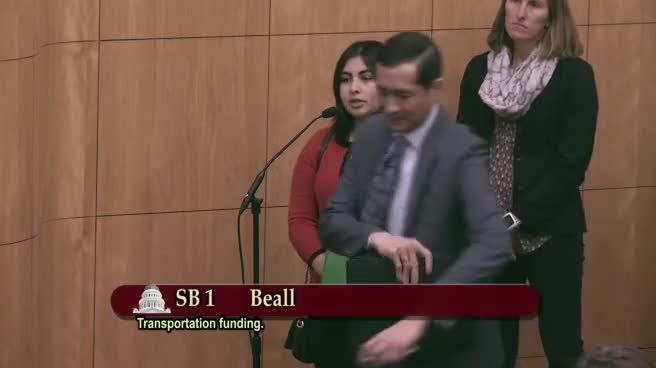 7MIN
Senate Standing Committee on Appropriations
 13MIN
Senate Standing Committee on Elections and Constitutional Amendments
Bill Author
Bill Co-Author(s):