SCR 91: California Law Revision Commission: studies.
- Session Year: 2017-2018
- House: Senate
- Latest Version Date: 2018-08-20
Existing law requires the California Law Revision Commission to study, and limits the commission to studying, topics approved by resolution of the Legislature or by statute.
This measure would grant approval to the commission to continue its study of designated topics that the Legislature previously authorized or directed the commission to study. The measure also would authorize and request the commission to study and report on topics relating to hazardous waste control and hazardous substances.
The measure would require the commission, before commencing work on any project within the calendar of topics the Legislature has authorized or directed the commission to study, to submit a detailed description of the scope of work to the chairs and vice chairs of the Assembly Committee on Judiciary and the Senate Committee on Judiciary, and any other policy committee that has jurisdiction, as specified. If a major change to the scope of work occurs during the course of the project, the measure would require the commission to submit a description of the change. The measure would invite commission staff members to appear and testify at committee hearings on bills to implement commission recommendations. The measure would request the commission to provide a copy of a commission recommendation to each member of a policy committee that is hearing a bill that would implement the recommendation.
Existing law requires the California Law Revision Commission to study, and limits the commission to studying, topics approved by resolution of the Legislature or by statute.
This measure would grant approval to the commission to continue its study of designated topics that the Legislature previously authorized or directed the commission to study.
The measure would require the commission, before commencing work on any project within the calendar of topics the Legislature has authorized or directed the commission to study, to submit a detailed description of the scope of work to the chairs and vice chairs of the Assembly Committee on Judiciary and the Senate Committee on Judiciary, and any other policy committee that has jurisdiction, as specified. If a major change to the scope of work occurs during the course of the project, the measure would require the commission to submit a description of the change. The measure would invite commission staff members to appear and testify at committee hearings on bills to implement commission recommendations. The measure would request the commission to provide a copy of a commission recommendation to each member of a policy committee that is hearing a bill that would implement the recommendation.
WHEREAS, The California Law Revision Commission is authorized to study topics set forth in the calendar contained in its report to the Governor and the Legislature that have been or are thereafter approved for study by concurrent resolution of the Legislature, and topics that have been referred to the commission for study by concurrent resolution of the Legislature or by statute; and
WHEREAS, The commission, in its annual report covering its activities for 2017 and 2018, recommends continued study of 24 topics, all of which the Legislature has previously authorized or directed the commission to study; now, therefore, be it
Resolved by the Senate of the State of California, the Assembly thereof concurring, That the Legislature approves for continued study by the California Law Revision Commission the topics listed below, all of which the Legislature has previously authorized or directed the commission to study:
(1)Whether the law should be revised that relates to creditors remedies, including, but not limited to, attachment, garnishment, execution, repossession of property (including the claim and delivery statute, self-help repossession of property, and the Commercial Code provisions on repossession of property), confession of judgment procedures, default judgment procedures, enforcement of judgments, the right of redemption, procedures under private power of sale in a trust deed or mortgage, possessory and nonpossessory liens, insolvency, and related matters.
(2)Whether the California Probate Code should be revised, including, but not limited to, the issue of whether California should adopt, in whole or in part, the Uniform Probate Code, and related matters.
(3)Whether the law should be revised that relates to real and personal property, including, but not limited to, a marketable title act, covenants, servitudes, conditions, and restrictions on land use or relating to land, powers of termination, escheat of property and the disposition of unclaimed or abandoned property, eminent domain, quiet title actions, abandonment or vacation of public streets and highways, partition, rights and duties attendant on assignment, subletting, termination, or abandonment of a lease, and related matters.
(4)Whether the law should be revised that relates to family law, including, but not limited to, community property, the adjudication of child and family civil proceedings, child custody, adoption, guardianship, freedom from parental custody and control, and related matters, including other subjects covered by the Family Code.
(5)Whether the law relating to discovery in civil cases should be revised.
(6)Whether the law relating to the rights and disabilities of minors and incompetent persons should be revised.
(7)Whether the Evidence Code should be revised.
(8)Whether the law relating to arbitration, mediation, and other alternative dispute resolution techniques should be revised.
(9)Whether there should be changes to administrative law.
(10)Whether the law relating to the payment and the shifting of attorneys fees between litigants should be revised.
(11)Whether the Uniform Unincorporated Nonprofit Association Act, or parts of that uniform act, and related provisions should be adopted in California.
(12)Recommendations to be reported pertaining to statutory changes that may be necessitated by court unification.
(13)Whether the law of contracts should be revised, including the law relating to the effect of electronic communications on the law governing contract formation, the statute of frauds, the parol evidence rule, and related matters.
(14)Whether the law governing common interest housing developments should be revised to clarify the law, eliminate unnecessary or obsolete provisions, consolidate existing statutes in one place in the codes, establish a clear, consistent, and unified policy with regard to formation and management of these developments and transaction of real property interests located within them, and to determine to what extent they should be subject to regulation.
(15)Whether the statutes of limitation for legal malpractice actions should be revised to recognize equitable tolling or other adjustment for the circumstances of simultaneous litigation, and related matters.
(16)Whether the law governing disclosure of public records and the law governing protection of privacy in public records should be revised to better coordinate them, including consolidation and clarification of the scope of required disclosure and creation of a single set of disclosure procedures, to provide appropriate enforcement mechanisms, and to ensure that the law governing disclosure of public records adequately treats electronic information, and related matters.
(17)Whether the law governing criminal sentences for enhancements relating to weapons or injuries should be revised to simplify and clarify the law and eliminate unnecessary or obsolete provisions.
(18)Whether the Subdivision Map Act (Division 2 (commencing with Section 66410) of Title 7 of the Government Code) and the Mitigation Fee Act (Chapter 5 (commencing with Section 66000), Chapter 6 (commencing with Section 66010), Chapter 7 (commencing with Section 66012), Chapter 8 (commencing with Section 66016), and Chapter 9 (commencing with Section 66020) of Division 1 of Title 7 of the Government Code) should be revised to improve their organization, resolve inconsistencies, and clarify and rationalize provisions, and related matters.
(19)Whether the Uniform Statute and Rule Construction Act (1995) should be adopted in California in whole or in part, and related matters.
(20)Whether the law governing the place of trial in a civil case should be revised.
(21)Analysis of the legal and policy implications of treating a charter school as a public entity for the purposes of Division 3.6 (commencing with Section 810) of Title 1 of the Government Code.
(22)Whether the Fish and Game Code and related statutory law should be revised to improve its organization, clarify its meaning, resolve inconsistencies, eliminate unnecessary or obsolete provisions, standardize terminology, clarify program authority and funding sources, and make other minor improvements, without making any significant substantive change to the effect of the law.
(23)(A) Analysis of the relationship under current law between mediation confidentiality and attorney malpractice and other misconduct, and the purposes for, and impact of, those laws on public protection, professional ethics, attorney discipline, client rights, the willingness of parties to participate in voluntary and mandatory mediation, and the effectiveness of mediation, as well as any other issues that the commission deems relevant. Among other matters, the commission shall consider the following:
(i)Sections 703.5, 958, and 1119 of the Evidence Code and predecessor provisions, as well as California court rulings, including, but not limited to, Cassel v. Superior Court (2011) 51 Cal.4th 113, Porter v. Wyner (2010) 183 Cal.App.4th 949, and Wimsatt v. Superior Court (2007) 152 Cal.App.4th 137.
(ii)The availability and propriety of contractual waivers.
(iii)The law in other jurisdictions, including the Uniform Mediation Act, as it has been adopted in other states, other statutory acts, scholarly commentary, judicial decisions, and any data regarding the impact of differing confidentiality rules on the use of mediation.
(B)In studying this matter, the commission shall request input from experts and interested parties, including, but not limited to, representatives from the California Supreme Court, the State Bar of California, legal malpractice defense counsel, other attorney groups and individuals, mediators, and mediation trade associations. The commission shall make any recommendations that it deems appropriate for the revision of California law to balance the competing public interests between confidentiality and accountability.
(24)The Legislature authorizes and requests that the California Law Revision Commission study, report on, and prepare recommended legislation as soon as possible, considering the commissions preexisting duties and workload demands, concerning revision of the California Public Records Act and related provisions, and that this legislation shall accomplish all of the following objectives.
(A)Reduce the length and complexity of current sections.
(B)Avoid unnecessary cross-references.
(C)Neither expand nor contract the scope of existing exemptions to the general rule that records are open to the public pursuant to the current provisions of the Public Records Act.
(D)To the extent compatible with (C), use terms with common definitions.
(E)Organize the existing provisions in such a way that similar provisions are located in close proximity to one another.
(F)Eliminate duplicative provisions.
(G)Clearly express legislative intent without any change in the substantive provisions; and be it further
Resolved, That the Legislature authorizes and requests that the California Law Revision Commission study, report on, and prepare recommended legislation to revise Chapter 6.5 (commencing with Section 25100) and Chapter 6.8 (commencing with Section 25300) of Division 20 of the Health and Safety Code, and related provisions, to improve the organization and expression of the law. Such revisions may include, but are not limited to, grouping similar provisions together, reducing the length and complexity of sections, eliminating obsolete or redundant provisions, and correcting technical errors. The recommended revisions shall not make any substantive changes to the law. The commissions report shall also include a list of substantive issues that the commission identifies in the course of its work, for possible future study; and be it further
Resolved, That before commencing work on any project within the calendar of topics the Legislature has authorized or directed the commission to study, the commission shall submit a detailed description of the scope of work to the chairs and vice chairs of the Assembly Committee on Judiciary and the Senate Committee on Judiciary, and any other policy committee that has jurisdiction over the subject matter of the study, and if during the course of the project there is a major change to the scope of work, submit a description of the change; and be it further
Resolved, That the staff of the commission is invited to appear and testify at any committee hearing of a bill to implement a commission recommendation, for the purpose of explaining the recommendation and answering questions posed by committee members, provided that the staff may not advocate for the passage or defeat of the legislation; and be it further
Resolved, That the commission is requested to provide a copy of a commission recommendation to each member of a policy committee that is hearing a bill that would implement the recommendation; and be it further
Resolved, That the Secretary of the Senate transmit copies of this resolution to the California Law Revision Commission and to the author for appropriate distribution.
WHEREAS, The California Law Revision Commission is authorized to study topics set forth in the calendar contained in its report to the Governor and the Legislature that have been or are thereafter approved for study by concurrent resolution of the Legislature, and topics that have been referred to the commission for study by concurrent resolution of the Legislature or by statute; and
WHEREAS, The commission, in its annual report covering its activities for 2017 and 2018, recommends continued study of 24 topics, all of which the Legislature has previously authorized or directed the commission to study; now, therefore, be it
Resolved by the Senate of the State of California, the Assembly thereof concurring, That the Legislature approves for continued study by the California Law Revision Commission the topics listed below, all of which the Legislature has previously authorized or directed the commission to study:
(1)Whether the law should be revised that relates to creditors remedies, including, but not limited to, attachment, garnishment, execution, repossession of property (including the claim and delivery statute, self-help repossession of property, and the Commercial Code provisions on repossession of property), confession of judgment procedures, default judgment procedures, enforcement of judgments, the right of redemption, procedures under private power of sale in a trust deed or mortgage, possessory and nonpossessory liens, insolvency, and related matters.
(2)Whether the California Probate Code should be revised, including, but not limited to, the issue of whether California should adopt, in whole or in part, the Uniform Probate Code, and related matters.
(3)Whether the law should be revised that relates to real and personal property, including, but not limited to, a marketable title act, covenants, servitudes, conditions, and restrictions on land use or relating to land, powers of termination, escheat of property and the disposition of unclaimed or abandoned property, eminent domain, quiet title actions, abandonment or vacation of public streets and highways, partition, rights and duties attendant on assignment, subletting, termination, or abandonment of a lease, and related matters.
(4)Whether the law should be revised that relates to family law, including, but not limited to, community property, the adjudication of child and family civil proceedings, child custody, adoption, guardianship, freedom from parental custody and control, and related matters, including other subjects covered by the Family Code.
(5)Whether the law relating to discovery in civil cases should be revised.
(6)Whether the law relating to the rights and disabilities of minors and incompetent persons should be revised.
(7)Whether the Evidence Code should be revised.
(8)Whether the law relating to arbitration, mediation, and other alternative dispute resolution techniques should be revised.
(9)Whether there should be changes to administrative law.
(10)Whether the law relating to the payment and the shifting of attorneys fees between litigants should be revised.
(11)Whether the Uniform Unincorporated Nonprofit Association Act, or parts of that uniform act, and related provisions should be adopted in California.
(12)Recommendations to be reported pertaining to statutory changes that may be necessitated by court unification.
(13)Whether the law of contracts should be revised, including the law relating to the effect of electronic communications on the law governing contract formation, the statute of frauds, the parol evidence rule, and related matters.
(14)Whether the law governing common interest housing developments should be revised to clarify the law, eliminate unnecessary or obsolete provisions, consolidate existing statutes in one place in the codes, establish a clear, consistent, and unified policy with regard to formation and management of these developments and transaction of real property interests located within them, and to determine to what extent they should be subject to regulation.
(15)Whether the statutes of limitation for legal malpractice actions should be revised to recognize equitable tolling or other adjustment for the circumstances of simultaneous litigation, and related matters.
(16)Whether the law governing disclosure of public records and the law governing protection of privacy in public records should be revised to better coordinate them, including consolidation and clarification of the scope of required disclosure and creation of a single set of disclosure procedures, to provide appropriate enforcement mechanisms, and to ensure that the law governing disclosure of public records adequately treats electronic information, and related matters.
(17)Whether the law governing criminal sentences for enhancements relating to weapons or injuries should be revised to simplify and clarify the law and eliminate unnecessary or obsolete provisions.
(18)Whether the Subdivision Map Act (Division 2 (commencing with Section 66410) of Title 7 of the Government Code) and the Mitigation Fee Act (Chapter 5 (commencing with Section 66000), Chapter 6 (commencing with Section 66010), Chapter 7 (commencing with Section 66012), Chapter 8 (commencing with Section 66016), and Chapter 9 (commencing with Section 66020) of Division 1 of Title 7 of the Government Code) should be revised to improve their organization, resolve inconsistencies, and clarify and rationalize provisions, and related matters.
(19)Whether the Uniform Statute and Rule Construction Act (1995) should be adopted in California in whole or in part, and related matters.
(20)Whether the law governing the place of trial in a civil case should be revised.
(21)Analysis of the legal and policy implications of treating a charter school as a public entity for the purposes of Division 3.6 (commencing with Section 810) of Title 1 of the Government Code.
(22)Whether the Fish and Game Code and related statutory law should be revised to improve its organization, clarify its meaning, resolve inconsistencies, eliminate unnecessary or obsolete provisions, standardize terminology, clarify program authority and funding sources, and make other minor improvements, without making any significant substantive change to the effect of the law.
(23)(A) Analysis of the relationship under current law between mediation confidentiality and attorney malpractice and other misconduct, and the purposes for, and impact of, those laws on public protection, professional ethics, attorney discipline, client rights, the willingness of parties to participate in voluntary and mandatory mediation, and the effectiveness of mediation, as well as any other issues that the commission deems relevant. Among other matters, the commission shall consider the following:
(i)Sections 703.5, 958, and 1119 of the Evidence Code and predecessor provisions, as well as California court rulings, including, but not limited to, Cassel v. Superior Court (2011) 51 Cal.4th 113, Porter v. Wyner (2010) 183 Cal.App.4th 949, and Wimsatt v. Superior Court (2007) 152 Cal.App.4th 137.
(ii)The availability and propriety of contractual waivers.
(iii)The law in other jurisdictions, including the Uniform Mediation Act, as it has been adopted in other states, other statutory acts, scholarly commentary, judicial decisions, and any data regarding the impact of differing confidentiality rules on the use of mediation.
(B)In studying this matter, the commission shall request input from experts and interested parties, including, but not limited to, representatives from the California Supreme Court, the State Bar of California, legal malpractice defense counsel, other attorney groups and individuals, mediators, and mediation trade associations. The commission shall make any recommendations that it deems appropriate for the revision of California law to balance the competing public interests between confidentiality and accountability; accountability.
(24)The Legislature authorizes and requests that the California Law Revision Commission study, report on, and prepare recommended legislation as soon as possible, considering the commissions preexisting duties and workload demands, concerning revision of the California Public Records Act and related provisions, and that this legislation shall accomplish all of the following objectives.
(A)Reduce the length and complexity of current sections.
(B)Avoid unnecessary cross-references.
(C)Neither expand nor contract the scope of existing exemptions to the general rule that records are open to the public pursuant to the current provisions of the Public Records Act.
(D)To the extent compatible with (C), use terms with common definitions.
(E)Organize the existing provisions in such a way that similar provisions are located in close proximity to one another.
(F)Eliminate duplicative provisions.
(G)Clearly express legislative intent without any change in the substantive provisions; and be it further
RESOLVED, That the Legislature authorizes and requests that the California Law Revision Commission study, report on, and prepare recommended legislation to revise Chapter 6.5 (commencing with Section 25100) and Chapter 6.8 (commencing with Section 25300) of Division 20 of the Health and Safety Code, and related provisions, to improve the organization and expression of the law. Such revisions may include, but are not limited to, grouping similar provisions together, reducing the length and complexity of sections, eliminating obsolete or redundant provisions, and correcting technical errors. The recommended revisions shall not make any substantive changes to the law. The commissions report shall also include a list of substantive issues that the commission identifies in the course of its work, for possible future study; and be it further
Resolved, That before commencing work on any project within the calendar of topics the Legislature has authorized or directed the commission to study, the commission shall submit a detailed description of the scope of work to the chairs and vice chairs of the Assembly Committee on Judiciary and the Senate Committee on Judiciary, and any other policy committee that has jurisdiction over the subject matter of the study, and if during the course of the project there is a major change to the scope of work, submit a description of the change; and be it further
Resolved, That the staff of the commission is invited to appear and testify at any committee hearing of a bill to implement a commission recommendation, for the purpose of explaining the recommendation and answering questions posed by committee members, provided that the staff may not advocate for the passage or defeat of the legislation; and be it further
Resolved, That the commission is requested to provide a copy of a commission recommendation to each member of a policy committee that is hearing a bill that would implement the recommendation; and be it further
Resolved, That the Secretary of the Senate transmit copies of this resolution to the California Law Revision Commission and to the author for appropriate distribution.
WHEREAS, The California Law Revision Commission is authorized to study topics set forth in the calendar contained in its report to the Governor and the Legislature that have been or are thereafter approved for study by concurrent resolution of the Legislature, and topics that have been referred to the commission for study by concurrent resolution of the Legislature or by statute; and
WHEREAS, The commission, in its annual report covering its activities for 2017 and 2018, recommends continued study of 24 topics, all of which the Legislature has previously authorized or directed the commission to study; now, therefore, be it
Resolved by the Senate of the State of California, the Assembly thereof concurring, That the Legislature approves for continued study by the California Law Revision Commission the topics listed below, all of which the Legislature has previously authorized or directed the commission to study:
(1)Whether the law should be revised that relates to creditors remedies, including, but not limited to, attachment, garnishment, execution, repossession of property (including the claim and delivery statute, self-help repossession of property, and the Commercial Code provisions on repossession of property), confession of judgment procedures, default judgment procedures, enforcement of judgments, the right of redemption, procedures under private power of sale in a trust deed or mortgage, possessory and nonpossessory liens, insolvency, and related matters.
(2)Whether the California Probate Code should be revised, including, but not limited to, the issue of whether California should adopt, in whole or in part, the Uniform Probate Code, and related matters.
(3)Whether the law should be revised that relates to real and personal property, including, but not limited to, a marketable title act, covenants, servitudes, conditions, and restrictions on land use or relating to land, powers of termination, escheat of property and the disposition of unclaimed or abandoned property, eminent domain, quiet title actions, abandonment or vacation of public streets and highways, partition, rights and duties attendant on assignment, subletting, termination, or abandonment of a lease, and related matters.
(4)Whether the law should be revised that relates to family law, including, but not limited to, community property, the adjudication of child and family civil proceedings, child custody, adoption, guardianship, freedom from parental custody and control, and related matters, including other subjects covered by the Family Code.
(5)Whether the law relating to discovery in civil cases should be revised.
(6)Whether the law relating to the rights and disabilities of minors and incompetent persons should be revised.
(7)Whether the Evidence Code should be revised.
(8)Whether the law relating to arbitration, mediation, and other alternative dispute resolution techniques should be revised.
(9)Whether there should be changes to administrative law.
(10)Whether the law relating to the payment and the shifting of attorneys fees between litigants should be revised.
(11)Whether the Uniform Unincorporated Nonprofit Association Act, or parts of that uniform act, and related provisions should be adopted in California.
(12)Recommendations to be reported pertaining to statutory changes that may be necessitated by court unification.
(13)Whether the law of contracts should be revised, including the law relating to the effect of electronic communications on the law governing contract formation, the statute of frauds, the parol evidence rule, and related matters.
(14)Whether the law governing common interest housing developments should be revised to clarify the law, eliminate unnecessary or obsolete provisions, consolidate existing statutes in one place in the codes, establish a clear, consistent, and unified policy with regard to formation and management of these developments and transaction of real property interests located within them, and to determine to what extent they should be subject to regulation.
(15)Whether the statutes of limitation for legal malpractice actions should be revised to recognize equitable tolling or other adjustment for the circumstances of simultaneous litigation, and related matters.
(16)Whether the law governing disclosure of public records and the law governing protection of privacy in public records should be revised to better coordinate them, including consolidation and clarification of the scope of required disclosure and creation of a single set of disclosure procedures, to provide appropriate enforcement mechanisms, and to ensure that the law governing disclosure of public records adequately treats electronic information, and related matters.
(17)Whether the law governing criminal sentences for enhancements relating to weapons or injuries should be revised to simplify and clarify the law and eliminate unnecessary or obsolete provisions.
(18)Whether the Subdivision Map Act (Division 2 (commencing with Section 66410) of Title 7 of the Government Code) and the Mitigation Fee Act (Chapter 5 (commencing with Section 66000), Chapter 6 (commencing with Section 66010), Chapter 7 (commencing with Section 66012), Chapter 8 (commencing with Section 66016), and Chapter 9 (commencing with Section 66020) of Division 1 of Title 7 of the Government Code) should be revised to improve their organization, resolve inconsistencies, and clarify and rationalize provisions, and related matters.
(19)Whether the Uniform Statute and Rule Construction Act (1995) should be adopted in California in whole or in part, and related matters.
(20)Whether the law governing the place of trial in a civil case should be revised.
(21)Analysis of the legal and policy implications of treating a charter school as a public entity for the purposes of Division 3.6 (commencing with Section 810) of Title 1 of the Government Code.
(22)Whether the Fish and Game Code and related statutory law should be revised to improve its organization, clarify its meaning, resolve inconsistencies, eliminate unnecessary or obsolete provisions, standardize terminology, clarify program authority and funding sources, and make other minor improvements, without making any significant substantive change to the effect of the law.
(23)(A) Analysis of the relationship under current law between mediation confidentiality and attorney malpractice and other misconduct, and the purposes for, and impact of, those laws on public protection, professional ethics, attorney discipline, client rights, the willingness of parties to participate in voluntary and mandatory mediation, and the effectiveness of mediation, as well as any other issues that the commission deems relevant. Among other matters, the commission shall consider the following:
(i)Sections 703.5, 958, and 1119 of the Evidence Code and predecessor provisions, as well as California court rulings, including, but not limited to, Cassel v. Superior Court (2011) 51 Cal.4th 113, Porter v. Wyner (2010) 183 Cal.App.4th 949, and Wimsatt v. Superior Court (2007) 152 Cal.App.4th 137.
(ii)The availability and propriety of contractual waivers.
(iii)The law in other jurisdictions, including the Uniform Mediation Act, as it has been adopted in other states, other statutory acts, scholarly commentary, judicial decisions, and any data regarding the impact of differing confidentiality rules on the use of mediation.
(B)In studying this matter, the commission shall request input from experts and interested parties, including, but not limited to, representatives from the California Supreme Court, the State Bar of California, legal malpractice defense counsel, other attorney groups and individuals, mediators, and mediation trade associations. The commission shall make any recommendations that it deems appropriate for the revision of California law to balance the competing public interests between confidentiality and accountability;
(24)The Legislature authorizes and requests that the California Law Revision Commission study, report on, and prepare recommended legislation as soon as possible, considering the commissions preexisting duties and workload demands, concerning revision of the California Public Records Act and related provisions, and that this legislation shall accomplish all of the following objectives.
(A)Reduce the length and complexity of current sections.
(B)Avoid unnecessary cross-references.
(C)Neither expand nor contract the scope of existing exemptions to the general rule that records are open to the public pursuant to the current provisions of the Public Records Act.
(D)To the extent compatible with (C), use terms with common definitions.
(E)Organize the existing provisions in such a way that similar provisions are located in close proximity to one another.
(F)Eliminate duplicative provisions.
(G)Clearly express legislative intent without any change in the substantive provisions; and be it further
Resolved, That before commencing work on any project within the calendar of topics the Legislature has authorized or directed the commission to study, the commission shall submit a detailed description of the scope of work to the chairs and vice chairs of the Assembly Committee on Judiciary and the Senate Committee on Judiciary, and any other policy committee that has jurisdiction over the subject matter of the study, and if during the course of the project there is a major change to the scope of work, submit a description of the change; and be it further
Resolved, That the staff of the commission is invited to appear and testify at any committee hearing of a bill to implement a commission recommendation, for the purpose of explaining the recommendation and answering questions posed by committee members, provided that the staff may not advocate for the passage or defeat of the legislation; and be it further
Resolved, That the commission is requested to provide a copy of a commission recommendation to each member of a policy committee that is hearing a bill that would implement the recommendation; and be it further
Resolved, That the Secretary of the Senate transmit copies of this resolution to the California Law Revision Commission and to the author for appropriate distribution.
|
Date
|
Status
|
|---|---|
| Aug 20, 2018 | Chaptered by Secretary of State. Res. Chapter 158, Statutes of 2018. |
| Aug 20, 2018 | Enrolled and filed with the Secretary of State at 2:30 p.m. |
| Aug 13, 2018 | In Senate. Ordered to engrossing and enrolling. |
| Aug 13, 2018 | Read. Adopted. Ordered to the Senate. |
| Aug 8, 2018 | From committee: Be adopted. Ordered to consent calendar. (Ayes 17. Noes 0.) (August 8). |
| Jul 3, 2018 | From committee: Be adopted and re-refer to Com. on APPR. (Ayes 10. Noes 0.) (July 3). Re-referred to Com. on APPR. |
| May 31, 2018 | Referred to Com. on JUD. |
| May 21, 2018 | In Assembly. Held at Desk. |
| May 21, 2018 | Read. Adopted. (Ayes 38. Noes 0.) Ordered to the Assembly. |
| May 8, 2018 | Read second time. Ordered to third reading. |
| May 7, 2018 | From committee: Be ordered to second reading pursuant to Senate Rule 28.8. |
| Apr 27, 2018 | Set for hearing May 7. |
| Apr 25, 2018 | From committee: Be adopted and re-refer to Com. on APPR. (Ayes 7. Noes 0.) (April 24). Re-referred to Com. on APPR. |
| Apr 5, 2018 | From committee with author's amendments. Read second time and amended. Re-referred to Com. on JUD. |
| Mar 29, 2018 | Set for hearing April 24. |
| Feb 1, 2018 | Re-referred to Com. on JUD. |
| Jan 23, 2018 | Introduced. Referred to Com. on RLS. |
|
Date
|
Description
|
Location
|
Votes
|
|
|---|---|---|---|---|
| Aug 13, 2018 | SCR 91 Roth Consent Calendar Second Day Regular Session | Assembly Floor |
Passed |
|
| Aug 8, 2018 | Be adopted. To Consent Calendar. | Assembly Standing Committee on Appropriations |
Passed |
|
| Jul 3, 2018 | Be adopted and re-referred to the Committee on [Appropriations] | Assembly Standing Committee on Judiciary |
Passed |
|
| May 21, 2018 | Senate 3rd Reading SCR91 Roth et al. | Senate Floor |
Passed |
|
| Apr 24, 2018 | Be adopted, but first be re-referred to the Committee on [Appropriations] | Senate Standing Committee on Judiciary |
Passed |
This list shows positions taken on this bill by organizations on the date displayed, which is linked to the original source.
Positions by individuals are not included.
|
Organization
|
Position
|
Date
|
|---|---|---|
| - Unless Amended | ** Against | Jun 29, 2018 |
| Advanced Mediation Study Club | ** Against | Jun 29, 2018 |
| Beverly Hills Bar Association | ** Against | Jun 29, 2018 |
| California Dispute Resolution Council | ** Against | Jun 29, 2018 |
| California Law Revision Commission | ** Support | May 9, 2018 |
| Casas Riley Simonian LLP | ** Against | Jun 29, 2018 |
| Collaborative Practice Of San Mateo | ** Against | May 9, 2018 |
| Collaborative Practice Of San Mateo County | ** Against | Jun 29, 2018 |
| Community Boards | ** Against | Jun 29, 2018 |
| Family Law Attorney Mediators Engaged In Study | ** Against | Jun 29, 2018 |
| los angeles county bar association | ** Against | Jun 29, 2018 |
| Mandell Gisnet Center For Conflict Management | ** Against | Jun 29, 2018 |
| Marin County Bar Association | ** Against | Jun 29, 2018 |
| Mediating Family Law Attorneys | ** Against | Jun 29, 2018 |
| Numerous individuals | ** Against | Jun 29, 2018 |
| Sacramento Divorce Solutions, Inc. | ** Against | Jun 29, 2018 |
| Southern California Mediation Association | ** Against | Jun 29, 2018 |
| Three individuals | ** Against | May 9, 2018 |
| West Marin Community Mediation | ** Against | Jun 29, 2018 |
| West Marin Community Mediation Board | ** Against | May 9, 2018 |
Date of Hearing: August 8, 2018
ASSEMBLY COMMITTEE ON APPROPRIATIONS
Lorena Gonzalez Fletcher, Chair
SBPCA Bill Id:SCR 91
Author:(Roth) – As Amended Ver:April 5, 2018
Policy Committee: | Judiciary | Vote: | 10 - 0 |
|
| ||
|
|
Urgency: No State Mandated Local Program: No Reimbursable: No
SUMMARY:
This resolution authorizes the California Law Revision Commission (CLRC) to continue its study of 24 topics that the Legislature previously authorized it to study, and a new topic, namely, hazardous waste control and hazardous waste substances.
FISCAL EFFECT:
Absorbable costs to the commission.
COMMENTS:
- Background and Purpose. The CLRC was created in 1953 and was given the responsibility to substantively review California's statutory and case law. The commission seeks to discover deficiencies in existing law and makes related recommendations to the Legislature for needed reforms. The commission may only study matters referred to it by concurrent resolution of the Legislature. In the past, the CLRC has provided hundreds of recommendations, ranging from the creation of entire codes to the repeal of a single section.
There is opposition to this resolution, which is unusual for resolutions to authorize the CLRC to continue its study. As described in policy committee analysis of this resolution, the opposition contends the CLRC should lose its authority to study and recommend changes to existing state law regarding mediation confidentiality because CLRC completed its study and recommended changes to the law that have not yet been adopted.
- Prior CLRC Resolutions: ACR 148 (Chau, 2015); SCR 83 (Monning, 2014); SCR 53 (Padilla, 2013); ACR 98 (Wagner, 2012); ACR 49 (Evans, 2009); ACR 35 (Evans, 2007); SCR 15 (Morrow, 2006); SCR 42 (Campbell, 2005); SCR 4 (Morrow, 2003); ACR 123 (Wayne, 2002); SCR 13 (Morrow, 2001); ACR 17 (Wayne, 1999); SCR 65 (Kopp, 1998); SCR 3 (Kopp, 1997); and SCR 43 (Kopp, 1996).
Analysis Prepared by: Jay Dickenson / APPR. / (916) 319-2081
Date of Hearing: July 3, 2018
ASSEMBLY COMMITTEE ON JUDICIARY
Mark Stone, Chair
SBPCA Bill Id:SCR 91
Author:(Roth) – As Amended Ver:April 5, 2018
SENATE VOTE: 38-0
SUBJECT: CALIFORNIA LAW REVISION COMMISSION: STUDIES
KEY ISSUE: SHOULD THE LEGISLATURE REAUTHORIZE THE CALIFORNIA LAW REVISION COMMISSION TO STUDY AND MAKe RECOMMENDATIONS FOR CHANGES TO CURRENT LAW RElatinG to THE 24 topicS THAT IT PREVIOUSLY was AUTHORIZED TO STUDY, AS WELL AS A NEW topic: hazardous waste control and hazardous substances?
SYNOPSIS
The California Law Revision Commission (CLRC) was created in 1953 and tasked with the responsibility for a continuing substantive review of California statutory and decisional law. The CLRC studies the law in order to discover defects and make related recommendations to the Legislature for needed reforms. Once the CLRC identifies a topic for study, it cannot begin to work on the topic until the Legislature, by concurrent resolution, authorizes the CLRC to conduct the study, as it does once every two-year session. This surprisingly controversial resolution, sponsored by the CLRC, is the regular resolution to authorize the CLRC’s topics of study. Like prior such resolutions, it reauthorizes the CLRC to study all of the topics that the Legislature has previously authorized it to study, a total of 24 subjects. It also provides the CLRC with authority to study, report on, and prepare recommended legislation to revise specified sections of existing law relating to a 25th topic: hazardous waste control and hazardous substances.
Opponents of the resolution do not necessarily object to the most significant provision of the resolution, authorizing the CLRC to study and report on a new topic-- hazardous waste control and hazardous substances—but rather the fact that the resolution allows CLRC to continue studying and recommending revisions to the law regarding a topic that it was previously authorized to study: the confidentiality of mediation proceedings. Opponents therefore seek an amendment to this resolution in order to remove the CLRC’s authority to study the issue; specify that the CLRC may no longer use any resources on the topic; and include a statement within this measure in which the legislature affirmatively rejects the CLRC’s proposed legislation. In response to the opposition’s request for an amendment to de-authorize CLRC’s future study and work on the topic of mediation confidentiality law, the author asserts that “it would be unprecedented to subject the CLRC to this type of censorship.” Moreover, according to the author “the goal of the amendment would ultimately fail as the current Legislature cannot tie the hands of any future Legislature.”
Indeed, it appears to be unprecedented for the Legislature to prohibit the CLRC from studying any topic, let alone one that the CLRC was previously authorized to study. Even if the CLRC lost its authority to study the topic of mediation confidentiality in the future, there is no reason that CLRC’s recommendation for changes, proposed in Study k-402, could not be introduced as legislation in the future, frustrating the opponent’s apparent desire to permanently bind any consideration of the proposal. Furthermore, such a limitation of CLRC’s future studies would appear to conflict with one of the oldest and most important responsibilities of the CLRC: to study and recommend changes to the Evidence Code. Finally, there does not appear to be any indication that the CLRC intends to take up the issue any time in the foreseeable future. The resolution has no support on file and many law firms and legal organizations, who favor maintaining strict confidentiality rules regarding mediation, oppose the resolution unless it is amended to remove CLRC’s authority to study mediation confidentiality.
SUMMARY: Reauthorizes the California Law Revision Commission (CLRC) to study and recommend changes to current law relating to 24 specified topics and provides the CLRC with new authority to study, report on, and prepare recommended legislation to revise specified sections of existing law relating to hazardous waste control and hazardous substances, to improve the organization and expression of the law. Specifically, this measure:
- Reauthorizes the CLRC’s study of 24 specified topics.
- Authorizes and requests that the CLRC study, report on, and prepare recommended legislation to revise Chapter 6.5 (commencing with Section 25100) and Chapter 6.8 (commencing with Section 25300 of Division 20 of the Health and Safety Code), and related provisions, to improve the organization and expression of the law.
- Specifies that such revisions may include, but are not limited to, grouping similar provisions together, reducing the length and complexity of sections, eliminating obsolete or redundant provisions, and correcting technical errors.
- Prohibits the recommended revisions from making any substantive changes to the law.
- Requires the CLRC’s report to include a list of substantive issues that the commission identifies in the course of its work, for possible future study.
- Requires that before commencing work on any project within the calendar of topics authorized or directed for study by the Legislature, the CLRC to submit a detailed description of the scope of work to the Chairs and Vice Chairs of the Committees on Judiciary of the Senate and Assembly, and any other policy committee that has jurisdiction over the subject matter of the study, and if during the course of the project there is a major change to the scope of work, submit a description of the change.
- Provides that CLRC staff is invited to appear and testify at any committee hearing of a bill to implement a CLRC recommendation, for the purpose of explaining the recommendation and answering questions posed by the committee members, provided that the staff do not advocate for the passage or defeat of the legislation.
- Requests that the CLRC to provide a copy of a recommendation to each member of a policy committee that is hearing a bill that would implement the recommendation.
EXISTING LAW:
- Authorizes the California Law Revision Commission (CLRC) to study topics approved by concurrent resolution of the Legislature. (Government Code Section 8293.)
- Prohibits an employee or member of the CLRC, with respect to any proposed legislation concerning matters assigned to the commission for study, to advocate for the passage or defeat of the legislation by the Legislature or the approval or veto of the legislation by the Governor or appear before any committee of the Legislature, unless requested to do so by the committee or its chairperson. (Government Code Section 8288.)
- Establishes laws regarding hazardous waste control and hazardous substances, including the Carpenter-Presley-Tanner Hazardous Substance Account Act. (Health & Safety Code Sections 25100 et seq., 25300 et seq.)
FISCAL EFFECT: As currently in print this resolution is keyed fiscal.
COMMENTS: The California Law Revision Commission (CLRC) was created in 1953 and tasked with the responsibility for a continuing substantive review of California statutory and decisional law. The CLRC studies the law in order to discover defects and make related recommendations to the Legislature for needed reforms. The CLRC’s enabling statute recognizes two types of topics the CLRC is authorized to study: (1) those that the CLRC identifies for study and lists in the Calendar of Topics that it reports to the Legislature; and (2) those that the Legislature assigns to the CLRC directly, by statute or concurrent resolution. Once the CLRC identifies a topic for study, it cannot begin to work on the topic until the Legislature, by concurrent resolution, authorizes the CLRC to conduct the study. Direct legislative assignments have become much more common in recent years, and many of the CLRC’s recent studies were directly assigned by the Legislature.
Background – Mediation Confidentiality. California law recognizes both the vital importance of full and honest disclosure of information between parties who engage in mediation, as well as the need to protect the confidentiality of such disclosures. For example, the mediation of dissolution proceedings requires the “full and accurate disclosure of all assets and liabilities” at the “early stages” of a marital dissolution proceeding to ensure fair and sufficient child and spousal support awards and to achieve a proper division of community and quasi-community assets and liabilities. (Family Code Section 2100 (c).) In order to effectuate the policy of full disclosure, state law places a “continuing duty” on the part of each spouse to “immediately, fully, and accurately update and augment that disclosure” so both will have “full and complete knowledge of the relevant underlying facts.” (Family Code Section 2100 (c).)
At the same time, state law encourages mediation and the confidentiality necessary to facilitate mediation. Section 1119 of the Evidence Code provides that, except as otherwise provided by law, no evidence of statements or admissions made “for the purpose of, in the course of, or pursuant to, a mediation or a mediation consultation is admissible or subject to discovery, and disclosure of the evidence shall not be compelled, in any arbitration, administrative adjudication, civil action, or other noncriminal proceeding in which, pursuant to law, testimony can be compelled to be given.” (Evidence Code Section 1119 (a), emphasis added.) Writings prepared for, or in the course of, mediation are subject to the privilege. (Evidence Code Section 1119 (b).) “[C]onfidentiality is essential to effective mediation … and, in some cases required by, the Legislature. . . . [T]he mediation confidentiality provisions of the Evidence Code were enacted to encourage mediation by permitting the parties to frankly exchange views, without fear that disclosures might be used against them in later proceedings.” (Lappe v. Superior Court, supra, 232 Cal.App.4th at p. 782 [citations omitted].)
The Legislature appears to have attempted to balance these competing interests, at least to some extent, by enacting both Sections 1119 and 1120 of the Evidence Code. Section 1119 protects the confidentiality of statements – both oral and written—made in, or prepared for, mediation proceedings. It provides that except as otherwise provided, no evidence of any oral statement or writing made for the purpose of, in the course of, or pursuant to, a mediation is admissible or subject to discovery in any arbitration, administrative adjudication, civil action, or other noncriminal proceeding. However, Section 1120 sets forth a number of exceptions to this rule to allow some facts about mediation, such as the fact that the parties agreed to mediate their dispute, to be admitted in other legal proceedings.
However, courts are unwilling to expand existing exceptions, or create additional exceptions to the mediation confidentiality rules, even when enforcement of those rules has dramatic and potentially unfair consequences. In Cassel v. Superior Court (2011) 51 Cal.4th 113, the California Supreme Court held that the plain language of the mediation confidentiality statute applied to all exchanges of information between an attorney and his or her client during a mediation and therefore prevented the admission of any of those statements into evidence in a subsequent malpractice action by the client against the attorney or in an attorney disciplinary proceeding. (Cassel v. Superior Court, supra, 51 Cal.4th at p. 138.) The Court hinted that the Legislature may want to amend the Evidence Code to limit the application of the privilege, but also made it clear that the Court would not go beyond the plain meaning of the statute itself:
We express no view about whether the statutory language, thus applied, ideally balances the competing concerns or represents the soundest public policy. Such is not our responsibility or our province. We simply conclude, as a matter of statutory construction, that application of the statutes' plain terms to the circumstances of this case does not produce absurd results that are clearly contrary to the Legislature's intent. Of course, the Legislature is free to reconsider whether the mediation confidentiality statutes should preclude the use of mediation-related attorney-client discussions to support a client's civil claims of malpractice against his or her attorneys. (Cassel v. Superior Court, supra, 51 Cal.4th at p. 136.)
In his concurring opinion, Justice Ming Chin went further, noting that the holding forced on the Court by the current language of the statute “will permit attorneys to commit malpractice without accountability. Interpreting the statute to require confidentiality even when everyone but the attorney has waived it might well result in absurd consequences that the Legislature did not intend.” (Id., at pp. 139-140.)
California Law Revision Commission Study of Mediation Confidentiality. In response to the Cassel decision, AB 2025 (Wagner) was introduced in 2012. As introduced, AB 2025 would have addressed the issue of attorney malpractice raised in Cassel by amending Section 1120 to exempt “in an action for legal malpractice, an action for breach of fiduciary duty, or both, or in a State Bar disciplinary action, of communications directly between the client and his or her attorney during mediation if professional negligence or misconduct forms the basis of the client’s allegations against the attorney.” AB 2025 was later amended to require the California Law Revision Commission (CLRC) to study the issue of mediation confidentiality. While AB 2025 eventually died without a hearing in the Senate, the Law Revision Commission was asked to conduct a study of the same issue by ACR 98 (Wagner & Gorrell), Res. Chapter 108, Statutes of 2012.
Over the course of nearly five years, the CLRC studied the topic, conducted multiple public hearings in which dozens of stakeholders participated, accepted written comments, and ultimately made recommendations for changes to existing law. The CLRC’s recommendation, released in December of 2017, was controversial. In the words of CLRC, “The opposition to the Commission’s tentative recommendation can only be described as overwhelming.”(CLRC Staff Memorandum 2017-52, dated September 27, 2017, at Page 33. Available here: http://www.clrc.ca.gov/pub/2017/MM17-52.pdf). Although members of the CLRC presented the recommendation to many members of the Legislature, the proposal was not introduced as legislation, likely because stakeholders vocally and repeatedly expressed their opposition to it. Needless to say, the CLRC’s recommended revisions to the law governing confidentiality of mediation have not been made.
This Resolution. This surprisingly controversial measure, sponsored by the CLRC, would continue the authorization of the CLRC’s studies on whether 24 specified laws should be revised or enacted. This measure would also authorize and request the commission to study and report on topics relating to hazardous waste control and hazardous substances. The measure would also continue the direction to the CLRC, in conjunction with its study of both previously and newly authorized topics, to provide a detailed description of any new study to the Chairs and Vice Chairs of the Assembly and Senate Judiciary Committees and any legislative policy committees that have jurisdiction over the subject matter of the study, as well as continue to provide guidance relating to the distribution of CLRC reports and the appearance of CLRC staff as witnesses at committee hearings. According to the author:
Since 1953, the California Law Revision Commission has been studying topics authorized by the legislature. At least once per regular session, the Legislature considers a concurrent resolution that sets out a calendar of topics authorized for study by the commissions. SCR 91 renews the study authority to study the calendar of topics authorized in 2016 by ACR 148 (Chau) with one additional topic requested by the DTSC’s Independent Review Panel.
Opponents of the resolution do not necessarily object to the most significant provision of the resolution, authorizing the CLRC to study and report on a new topic-- hazardous waste control and hazardous substances—but rather the fact that the resolution allows CLRC to continue studying and recommending revisions to the law regarding a topic that it was previously authorized to study: the confidentiality of mediation proceedings. Opponents therefore seek an amendment to this resolution in order to remove the CLRC’s authority to study the issue; specify that the CLRC may no longer use any resources on the topic; and include a statement within this measure in which the legislature affirmatively rejects the CLRC’s proposed legislation.
Opponents argue that the CLRC should lose its authority to study and recommend changes to existing state law regarding mediation confidentiality because CLRC completed its study and recommended changes to the law that have not yet been adopted (or even introduced) by the Legislature; the recommendation met with “overwhelming” opposition; no member of this Committee, or the Senate Judiciary Committee, agreed to introduce the CLRC proposal; “unless [the proposal] is now clearly rejected by the Legislature, the Commission’s recommended legislation will remain on record. Supporters have indicated their intent to try again and again to get it enacted in successive future legislative sessions”; and “SCR-91 is the appropriate vehicle for the Judiciary Committee to indicate that it is rejecting the Commission’s proposed legislation in Study k-402.”
In response to the opposition’s request for an amendment to de-authorize CLRC’s future study and work on the topic of mediation confidentiality law, the author asserts that “it would be unprecedented to subject the CLRC to this type of censorship.” Moreover, according to the author “the goal of the amendment would ultimately fail as the current Legislature cannot tie the hands of any future Legislature.” Further, the author notes:
Historically, the Legislature has deferred to the CLRC’s opinion on when granted authority to study a topic should be removed. For instance, the CLRC still retains authority from the 1990s to study the Probate Code, because a large scale revision was completed and issues that arise from this revision may be best resolved through additional CLRC study that draws on the institutional knowledge the CLRC has as the primary architect of the revision. . . .Finally, any substantive arguments about the policy proposed are more appropriate to be had in legislative policy committees when and if the proposal of the CLRC is introduced as a piece of legislation, rather than during a resolution that allows the CLRC to continue working. Having a policy argument about the matters already authorized for study presupposes that the policy committees of the Legislature are not adept enough to analyze the complex issues that a single proposal from the CLRC contains. If a member introduces the proposal in question, I am confident any opponents would have adequate opportunity to explain their opposition and I welcome and urge the Legislature to hear and consider their points.
Indeed, it appears to be unprecedented for the Legislature to prohibit the CLRC from studying any topic, let alone one that the CLRC was previously authorized to study. Even if the CLRC lost its authority to study the topic of mediation confidentiality in the future, there is no reason that CLRC’s recommendation for changes, proposed in Study k-402, could not be introduced as legislation in the future, frustrating the opponent’s apparent desire to permanently bind any consideration of the proposal. While as a practical matter, introduction of an overwhelmingly unpopular proposal is unlikely in the future, as a legal matter, the current Legislature cannot foreclose the right of a future Legislature to consider any legislative proposal (i.e. binding the hands of future legislatures), regardless of its unpopularity. Furthermore, such a limitation of CLRC’s future studies would appear to conflict with one of the oldest and most important responsibilities of the CLRC: to study and recommend changes to the Evidence Code. Finally, there does not appear to be any indication that the CLRC intends to take up the issue any time in the foreseeable future. In fact, given its experience with studying and recommending changes to the law regarding mediation confidentiality—including the “overwhelming” opposition to its proposal—the CLRC would seem to be unlikely to take up any new studies of the topic anytime soon.
REGISTERED SUPPORT / OPPOSITION:
Support
None on file
Opposition – unless Amended
Advanced Mediation Study Club
Beverly Hills Bar Association
California Dispute Resolution Council
Casas Riley Simonian LLP
Collaborative Practice of San Mateo County
Community Boards
Family Law Attorney Mediators Engaged in Study
Los Angeles County Bar Association
Mandell Gisnet Center for Conflict Management
Marin County Bar Association
Mediating Family Law Attorneys
Sacramento Divorce Solutions, Inc.
Southern California Mediation Association
West Marin Community Mediation
Numerous individuals
Analysis Prepared by: Alison Merrilees / JUD. / (916) 319-2334
Office of Senate Floor Analyses (916) 651-1520 Fax: (916) 327-4478 | SCR |
THIRD READING
Bill No: SCR 91
:
SENATE JUDICIARY COMMITTEE: 7-0, 4/24/18
AYES: Jackson, Moorlach, Anderson, Hertzberg, Monning, Stern, Wieckowski
SENATE APPROPRIATIONS COMMITTEE: Senate Rule 28.8
SOURCE: California Law Revision Commission
DIGEST:
This resolution, sponsored by the California Law Revision Commission (CLRC), (1) grants approval to the CLRC to continue its study of designated topics that the Legislature previously authorized or directed the CLRC to study; (2) authorizes and requests the CLRC to study and report on topics relating to hazardous waste control and hazardous substances; (3) provides that before commencing work on any project within the list of topics authorized for study by the Legislature, the CLRC shall submit a detailed description of the scope of work to the Senate and Assembly Committees on Judiciary and any legislative policy committee with jurisdiction over the study’s subject matter; and (4) expressly allows the CLRC to provide copies of its recommendations to members of a legislative policy committee and invites CLRC staff to hearings for the purpose of explaining recommendations and answering questions from committee members.
Existing law:
- Authorizes the California Law Revision Commission (CLRC) to study topics approved by concurrent resolution of the Legislature. (Gov. Code Sec. 8293.)
- Prohibits an employee or member of the CLRC, with respect to any proposed legislation concerning matters assigned to the commission for study, to advocate for the passage or defeat of the legislation by the Legislature or the approval or veto of the legislation by the Governor or appear before any committee of the Legislature unless requested to do so by the committee or its chairperson. (Gov. Code Sec. 8288.)
- Establishes hazardous waste control and hazardous substances provisions, which include the Carpenter-Presley-Tanner Hazardous Substance Account Act. (Health & Saf. Code Secs. 25100 et seq. and 25300 et seq.)
This resolution:
- Reauthorizes the CLRC’s study of 24 specified topics.
- Additionally authorizes and requests that the CLRC study, report on, and prepare recommended legislation to revise Chapter 6.5 (commencing with Section 25100) and Chapter 6.8 (commencing with Section 25300 of Division 20 of the Health and Safety Code), and related provisions, to improve the organization and expression of the law. Such revisions may include, but are not limited to, grouping similar provisions together, reducing the length and complexity of sections, eliminating obsolete or redundant provisions, and correcting technical errors. The recommended revisions shall not make any substantive changes to the law. The CLRC’s report shall also include a list of substantive issues that the commission identifies in the course of its work, for possible future study.
- Requires that before commencing work on any project within the calendar of topics authorized or directed for study by the Legislature, the CLRC shall submit a detailed description of the scope of work to the Chairs and Vice Chairs of the Committees on Judiciary of the Senate and Assembly, and any other policy committee that has jurisdiction over the subject matter of the study, and if during the course of the project there is a major change to the scope of work, submit a description of the change.
- Provides that CLRC staff is invited to appear and testify at any committee hearing of a bill to implement a CLRC recommendation, for the purpose of explaining the recommendation and answering questions posed by the committee members, provided that the staff do not advocate for the passage or defeat of the legislation.
- Further requests the CLRC to provide a copy of a recommendation to each member of a policy committee that is hearing a bill that would implement the recommendation.
Background
The CLRC was created in 1953 and tasked with the responsibility for a continuing substantive review of California statutory and decisional law. The CLRC studies the law in order to discover defects and make related recommendations to the Legislature for needed reforms.
The CLRC’s enabling statute recognizes two types of topics the CLRC is authorized to study: (1) those that the CLRC identifies for study and lists in the Calendar of Topics that it reports to the Legislature; and (2) those that the Legislature assigns to the CLRC directly, by statute or concurrent resolution. Once the CLRC identifies a topic for study, it cannot begin to work on the topic until the Legislature, by concurrent resolution, authorizes the CLRC to conduct the study. Direct legislative assignments have become much more common in recent years, and many of the CLRC’s recent studies were directly assigned by the Legislature.
This resolution, sponsored by the CLRC, continues the authorization of the CLRC’s studies on whether specified laws should be revised or enacted. This resolution also continues the direction to the CLRC to provide a detailed description of any new study to the Chairs and Vice Chairs of the Assembly and Senate Judiciary Committees and any legislative policy committees that have jurisdiction over the subject matter of the study, as well as continue to provide guidance relating to the distribution of CLRC reports and the appearance of CLRC staff as witnesses at committee hearings. This measure would also authorize and request the CLRC to study and report on topics relating to hazardous waste control and hazardous substances.
Comments
The author writes:
SCR 91 would renew, with one addition, the calendar of topics that was authorized in 2016, by ACR 148 (Chau). By law, the Commission may only study topics that have been authorized by concurrent resolution or statute. At least once per regular session, the Legislature considers a concurrent resolution that sets out a calendar of topics authorized for study by the Commission. In addition to the topics previously authorized, SCR 91 would authorize the CLRC to study Chapters 6.5 and 6.8 of Division 20 of the Health and Safety Code. This addition is necessary because in a report issued by the Department of Toxic Substance Control’s Independent Review Panel there are code sections that have led to duplication of work between state agencies, reporting requirements that refer to nonexistent code sections, and years old permissive departmental authorities that have never been implemented or funded, yet remain on the books. The report recognizes review of these sections would clarify priorities and improve transparency, and specifically requests the CLRC be the authority to complete that review. As the state has the authority and duty to Californians to ensure toxic substances are managed, treated, or disposed of, effective administration of this duty requires thoughtful study and revision. The policy committees responsible for reviewing a CLRC proposal on this area of law are aware of the IRP report and request for CLRC study, and share the IRP’s concerns. Therefore, granting this study authority to the CLRC is a common sense move toward bettering the operation of the DTSC and improving the health of Californians.
Related/Prior Legislation
ACR 148 (Chau, Resolution Chapter 150, Statutes of 2016) authorized the CLRC to continue its studies on whether specified laws should be revised; authorized an additional study of the California Public Records Act; provided that before commencing work on any project within the list of topics authorized for study by the Legislature, the CLRC shall submit a detailed description of the scope of work to the Senate and Assembly Committees on Judiciary and any legislative policy committee with jurisdiction over the study’s subject matter; and expressly allowed the CLRC to provide copies of its recommendations to members of a legislative policy committee and invite CLRC staff to hearings for the purpose of explaining recommendations and answering questions from committee members.
SCR 54 (Padilla, Resolution Chapter 115, Statutes of 2013) authorized the CLRC report on and prepare recommended legislation concerning statutes governing access by state and local government agencies to customer information from communications service providers.
AB 567 (Wagner, Chapter 15, Statutes of 2013) repealed the requirement that the CLRC make the decennial recommendations, and retained the CLRC’s general authority to study, review, and make recommendations regarding the enforcement of judgments law.
ACR 125 (Papan, Resolution Chapter 167, Statutes of 2002) authorized the CLRC to study, report on, and prepare recommended legislation concerning the issue of financial privacy to address protection and control of a consumer’s personal information and provide both administrative and civil penalties.
The following is a list of the prior annual authorizing resolutions for the CLRC:
SCR 83 (Monning, Resolution Chapter 63, Statutes of 2014)
ACR 98 (Wagner, Resolution Chapter 108, Statutes of 2012)
ACR 49 (Evans, Resolution Chapter 98 Statutes of 2009)
ACR 35 (Evans, Resolution Chapter 100, Statutes of 2007)
SCR 15 (Morrow, Resolution Chapter 1, Statutes of 2006)
SCR 42 (Campbell, Resolution Chapter 122, Statutes of 2005)
SCR 4 (Morrow, Resolution Chapter 92, Statutes of 2003)
ACR 123 (Wayne, Resolution Chapter 166, Statutes of 2002)
SCR 13 (Morrow, Resolution Chapter 78, Statutes of 2001)
ACR 17 (Wayne, Resolution Chapter 81, Statutes of 1999)
SCR 65 (Kopp, Resolution Chapter 91, Statutes of 1998)
SCR 3 (Kopp, Resolution Chapter 102, Statutes of 1997)
SCR 43 (Kopp, Resolution Chapter 38, Statutes of 1996)
FISCAL EFFECT: Appropriation: No Fiscal Com.: No Local: No
California Law Revision Commission (source)
Advanced Mediation Study Club
Beverly Hills Bar Association
California Dispute Resolution Council
Casas Riley Simonian LLP
Collaborative Practice of San Mateo
Community Boards
Family Law Attorney Mediators Engaged in Study
Los Angeles County Bar Association Family Law Executive Committee
Marin County Bar Association
Mediating Family Law Attorneys
Sacramento Divorce Solutions, Inc.
Southern California Mediation Association
West Marin Community Mediation Board
Three individuals
5/9/18 16:30:51
**** END ****
Senator Hannah-Beth Jackson, Chair
2017-2018 Regular Session
Bill No: SCR 91 (Author:Roth)
Version: April 5, 2018
Hearing Date: April 24, 2018
Fiscal: Yes
Urgency: No
Consultant: MEC
SUBJECT
California Law Revision Commission: studies
DESCRIPTION
This measure, sponsored by the California Law Revision Commission (CLRC), would grant approval to the CLRC to continue its study of designated topics that the Legislature previously authorized or directed the CLRC to study. The measure would also authorize and request the commission to study and report on topics relating to hazardous waste control and hazardous substances.
This measure would provide that before commencing work on any project within the list of topics authorized for study by the Legislature, the CLRC shall submit a detailed description of the scope of work to the Senate and Assembly Committees on Judiciary and any legislative policy committee with jurisdiction over the study’s subject matter.
The measure would also expressly allow the CLRC to provide copies of its recommendations to members of a legislative policy committee and invite CLRC staff to hearings for the purpose of explaining recommendations and answering questions from committee members.
BACKGROUND
The California Law Revision Commission (CLRC) was created in 1953 and tasked with the responsibility for a continuing substantive review of California statutory and decisional law. The CLRC studies the law in order to discover defects and make related recommendations to the Legislature for needed reforms.
The CLRC’s enabling statute recognizes two types of topics the CLRC is authorized to study: (1) those that the CLRC identifies for study and lists in the Calendar of Topics that it reports to the Legislature; and (2) those that the Legislature assigns to the CLRC directly, by statute or concurrent resolution. Once the CLRC identifies a topic for study, it cannot begin to work on the topic until the Legislature, by concurrent resolution, authorizes the CLRC to conduct the study. Direct legislative assignments have become much more common in recent years, and many of the CLRC’s recent studies were directly assigned by the Legislature.
This measure, sponsored by the CLRC, would continue the authorization of the CLRC’s studies on whether specified laws should be revised or enacted. This measure would also continue the direction to the CLRC to provide a detailed description of any new study to the Chairs and Vice Chairs of the Assembly and Senate Judiciary Committees and any legislative policy committees that have jurisdiction over the subject matter of the study, as well as continue to provide guidance relating to the distribution of CLRC reports and the appearance of CLRC staff as witnesses at committee hearings. This measure would also authorize and request the commission to study and report on topics relating to hazardous waste control and hazardous substances.
CHANGES TO EXISTING LAW
Existing law authorizes the California Law Revision Commission (CLRC) to study topics approved by concurrent resolution of the Legislature. (Gov. Code Sec. 8293.)
Existing law prohibits an employee or member of the CLRC, with respect to any proposed legislation concerning matters assigned to the commission for study, to advocate for the passage or defeat of the legislation by the Legislature or the approval or veto of the legislation by the Governor or appear before any committee of the Legislature unless requested to do so by the committee or its chairperson. (Gov. Code Sec. 8288.)
Existing law establishes hazardous waste control and hazardous substances provisions, which include the Carpenter-Presley-Tanner Hazardous Substance Account Act. (Health & Saf. Code Secs. 25100 et seq. and 25300 et seq.)
This measure would reauthorize the CLRC’s study of 24 specified topics.
This measure would additionally authorize and request that the CLRC study, report on, and prepare recommended legislation to revise Chapter 6.5 (commencing with Section 25100) and Chapter 6.8 (commencing with Section 25300 of Division 20 of the Health and Safety Code), and related provisions, to improve the organization and expression of the law. Such revisions may include, but are not limited to, grouping similar provisions together, reducing the length and complexity of sections, eliminating obsolete or redundant provisions, and correcting technical errors. The recommended revisions shall not make any substantive changes to the law. The CLRC’s report shall also include a list of substantive issues that the commission identifies in the course of its work, for possible future study.
This measure would require that before commencing work on any project within the calendar of topics authorized or directed for study by the Legislature, the CLRC shall submit a detailed description of the scope of work to the Chairs and Vice Chairs of the Committees on Judiciary of the Senate and Assembly, and any other policy committee that has jurisdiction over the subject matter of the study, and if during the course of the project there is a major change to the scope of work, submit a description of the change.
This measure would provide that CLRC staff is invited to appear and testify at any committee hearing of a bill to implement a CLRC recommendation, for the purpose of explaining the recommendation and answering questions posed by the committee members, provided that the staff do not advocate for the passage or defeat of the legislation.
This measure would further request the CLRC to provide a copy of a recommendation to each member of a policy committee that is hearing a bill that would implement the recommendation.
COMMENT
1. Stated need for the bill
According to the author:
SCR 91 would renew, with one addition, the calendar of topics that was authorized in 2016, by ACR 148 (Chau). By law, the Commission may only study topics that have been authorized by concurrent resolution or statute. At least once per regular session, the Legislature considers a concurrent resolution that sets out a calendar of topics authorized for study by the Commission. In addition to the topics previously authorized, SCR 91 would authorize the CLRC to study Chapters 6.5 and 6.8 of Division 20 of the Health and Safety Code. This addition is necessary because in a report issued by the Department of Toxic Substance Control’s Independent Review Panel there are code sections that have led to duplication of work between state agencies, reporting requirements that refer to nonexistent code sections, and years old permissive departmental authorities that have never been implemented or funded, yet remain on the books. The report recognizes review of these sections would clarify priorities and improve transparency, and specifically requests the CLRC be the authority to complete that review. As the state has the authority and duty to Californians to ensure toxic substances are managed, treated, or disposed of, effective administration of this duty requires thoughtful study and revision. The policy committees responsible for reviewing a CLRC proposal on this area of law are aware of the IRP report and request for CLRC study, and share the IRP’s concerns. Therefore, granting this study authority to the CLRC is a common sense move toward bettering the operation of the DTSC and improving the health of Californians.
- Reauthorization of topics previously authorized for study
The CLRC currently has a list of 24 topics that the Legislature has previously authorized for study. This measure would reauthorize the CLRC to study the following topics: Creditors’ Remedies; Probate Code; Real and Personal Property; Family Law; Discovery in Civil Cases; Rights and Disabilities of Minors and Incompetent Persons; Evidence; Arbitration; Administrative Law; Attorney’s Fees; Uniform Unincorporated Nonprofit Association Act; Trial Court Unification; Contract Law; Common Interest Developments; Legal Malpractice Statutes of Limitation; Coordination of Public Records Statutes; Criminal Sentencing; Subdivision Map Act and Mitigation Fee Act; Uniform Statute and Rule Construction Act; Place of Trial in Civil Cases; the legal and policy implications of treating a charter school as a public entity; the Fish and Game Code; and the relationship between mediation confidentiality and attorney malpractice.
3. Authorizing the CLRC to study topics relating to hazardous waste control and hazardous substances
This measure would add an additional topic for study, as detailed below, that was recommended as “Priority 5” in the January 8, 2018, Department of Toxic Substances Control Independent Review Panel Recommendations to the Governor and the Legislature Pursuant to Health and Safety Code (HSC) Section 57014(h):
Chapters 6.5 and 6.8 of division 20 of the HSC should be reviewed to improve their organization, eliminate unnecessary or obsolete provisions, and in some cases, strengthen provisions that are not working properly.
The gradual expansion of statutory requirements, often without clarification or necessary funding, has created a misalignment between mandated duties and resources, thus forcing DTSC at times to shift limited resources to new mandates at the expense of existing programs and clouding expectations. One prominent and relatively recent example of this is the diversion of resources from hazardous waste source reduction and pollution prevention programs to the also important Safer Consumer Products Program in recent years.
The following are several examples of code sections the IRP believes to be at least partially obsolete. One is HSC section 25197.2, which requires DTSC to establish a statewide Hazardous Waste Strike Force. The duties of this strike force are similar to those of CalEPA’s deputy secretary for law enforcement and counsel as outlined in Government Code section 12812.2.
Another is HSC section 25178, which requires the posting of numerous reports on the DTSC website that were considered important to post thirteen years ago and which, in 25178(l), refers to a non-existent code section. Still another may be various provisions of the Pollution Prevention and Hazardous Waste Source Reduction and Management Review Act. A statement in the act that “the Department’s duties to implement this article are contingent upon, and limited to, the availability of funding” as well as wording such as “the Department may establish,” ‘the Department may provide,” and “the Department may develop” suggest that some of this work may no longer be a priority.
A comprehensive review of these and other statutes would clarify priorities and expectations, improve transparency, and better align mandates with resources. That is why the IRP made two recommendations to the Legislature to direct the California Law Revision Commission to work with DTSC to review various provisions in chapters 6.5 and 6.8 and provide necessary revisions to improve organization and eliminate unnecessary or obsolete provisions.
[. . .]
A review of the governing statutes would create realistic expectations and help DTSC focus on the Mission.
4. Coordination rules
This measure would continue the existing coordination rules relating to the relationship between the CLRC and the Legislature.
a. Communication with the Legislature
ACR 49 (Evans, Res. Ch. 98, Stats. 2009) increased communication between the CLRC and the Legislature by providing that prior to commencing work on any project within the list of topics authorized or directed for study by the Legislature, the CLRC shall submit a detailed description of the scope of work to the Chairs and Vice Chairs of the Committees on Judiciary of the Senate and Assembly, and if during the course of the project there is a major change to the scope of work, submit a description of the change.
ACR 98 (Wagner, Res. Ch. 108, Stats. 2012) augmented that requirement by further requiring the CLRC to submit that description of the scope of work to any other policy committee that has jurisdiction over the subject matter of the study. That enhanced requirement for early communication further facilitates legislative input on whether a particular proposed topic is consistent with what has been authorized. This measure would maintain these communication requirements.
b. Inviting staff of the CLRC to appear and testify
ACR 98 (Wagner, Res. Ch. 108, Stats. 2012) specifically authorized the staff of the CLRC to appear and testify at any committee hearing of a bill that implements a CLRC recommendation. That formal authorization ensures that the staff of the CLRC is technically able to testify at committee hearings for the purpose of explaining the CLRC recommendation and answering questions posed by committee members. However, CLRC staff may not advocate for the passage or defeat of a commission recommendation by the Legislature. Consistent with ACR 98, this measure would maintain the authorization of and restrictions on CLRC staff testimony.
c. Copies of commission recommendations
Under existing law, the CLRC is required to distribute its reports and recommendations to the Governor, the Members of the Legislature, and the heads of all state departments. Despite that requirement, a separate code section provides that “[n]o report shall be distributed to a Member of the Legislature unless specifically requested by that member.” (Gov. Code Sec. 9795.) ACR 98 (Wagner, Res. Ch. 108, Stats. 2012) ensured that the requirement is technically met by formally requiring the CLRC to provide a copy of a recommendation to each member of a policy committee that is hearing a bill that would implement the recommendation. This provision facilitates communication between the Legislature and the CLRC by ensuring the CLRC is able to provide members of policy committees with the underlying recommendation that is the basis of legislation being heard by the committee. This measure would maintain these report and recommendation distribution requirements.
5. Opposition to reauthorizing the CLRC to study the relationship between mediation confidentiality and attorney malpractice
This measure would reauthorize the CLRC to study 24 topics, including the relationship between mediation confidentiality and attorney malpractice. This study was originally authorized through ACR 98 (Wagner, Res. Ch. 108, Stats. 2011). A study was conducted and completed by the CLRC, with participation by stakeholders.[1] This Committee has received letters of opposition to SCR 91. The opposition relates to reauthorizing the CLRC to study mediation confidentiality based on their opposition to the outcome of the CLRC’s completed study. Opponents to SCR 91 therefore seek an amendment to: remove the CLRC’s authority to study the issue; specify that the CLRC may no longer use any resources on the topic; and include a statement within this measure in which the legislature affirmatively rejects the CLRC’s proposed legislation.
In response to the opposition’s request for amendments, the author asserts that “it would be unprecedented to subject the CLRC to this type of censorship.” Moreover, according to the author “the goal of the amendment would ultimately fail as the current Legislature cannot tie the hands of any future Legislature.” Further, the author notes:
Historically, the Legislature has deferred to the CLRC’s opinion on when granted authority to study a topic should be removed. For instance, the CLRC still retains authority from the 1990s to study the Probate Code, because a large scale revision was completed and issues that arise from this revision may be best resolved through additional CLRC study that draws on the institutional knowledge the CLRC has as the primary architect of the revision. Similarly, since amending the resolution per [the opponent’s] request would not prevent a member of the Legislature from introducing the proposal, [the] requested amendment would only serve to prevent the CLRC from testifying on their five years of experience drafting the proposal or providing technical assistance to the author or policy committee reviewing the proposal. This would result in inefficient review of the proposal by the Legislature and establish the precedent that the independent CLRC is not above being subject to the policy goals and political whims of legislators and interest groups. Finally, any substantive arguments about the policy proposed are more appropriate to be had in legislative policy committees when and if the proposal of the CLRC is introduced as a piece of legislation, rather than during a resolution that allows the CLRC to continue working. Having a policy argument about the matters already authorized for study presupposes that the policy committees of the Legislature are not adept enough to analyze the complex issues that a single proposal from the CLRC contains. If a member introduces the proposal in question, I am confident any opponents would have adequate opportunity to explain their opposition and I welcome and urge the Legislature to hear and consider their points.
Support: None Known
Opposition: Beverly Hills Bar Association; Casas Riley Simonian LLP; Chuck Amital; California Dispute Resolution Council; Collaborative Practice of San Mateo; Community Boards; Family Law Attorney Mediators Engaged in Study; Los Angeles County Bar Association Family Law Executive Committee; Marin County Bar Association; Win Heiskala; Ron Kelly; Mediating Family Law Attorneys; Sacramento Divorce Solutions, Inc.; Southern California Mediation Association; West Marin Community Mediation
HISTORY
Source: California Law Revision Commission
Related Pending Legislation:
SB 954 (Wieckowski, 2018) would require an attorney representing a client in mediation to inform the client of the applicable confidentiality restrictions and obtain their written consent to those restrictions. This bill is in the Senate Committee on Judiciary.
Prior Legislation:
ACR 148 (Chau, Ch. 150, Stats. 2016) authorized the CLRC to continue its studies on whether specified laws should be revised; authorized an additional study of the California Public Records Act; provided that before commencing work on any project within the list of topics authorized for study by the Legislature, the CLRC shall submit a detailed description of the scope of work to the Senate and Assembly Committees on Judiciary and any legislative policy committee with jurisdiction over the study’s subject matter; and expressly allowed the CLRC to provide copies of its recommendations to members of a legislative policy committee and invite CLRC staff to hearings for the purpose of explaining recommendations and answering questions from committee members.
SCR 54 (Padilla, Ch. 115, Stats. 2013) authorized the CLRC report on and prepare recommended legislation concerning statutes governing access by state and local government agencies to customer information from communications service providers.
AB 567 (Wagner, Ch. 15, Stats. 2013) repealed the requirement that the CLRC make the decennial recommendations, and retained the CLRC’s general authority to study, review, and make recommendations regarding the enforcement of judgments law.
ACR 125 (Papan, Ch. 167, Stats. 2002) authorized the CLRC to study, report on, and prepare recommended legislation concerning the issue of financial privacy to address protection and control of a consumer’s personal information and provide both administrative and civil penalties.
The following is a list of the prior annual authorizing resolutions for the CLRC:
SCR 83 (Monning, Ch. 63, Stats. 2014)
ACR 98 (Wagner, Res. Ch. 108, Stats. 2012) See Comment 4a, b, and c.
ACR 49 (Evans, Res. Ch. 98, Stats. 2009) See Comment 4a.
ACR 35 (Evans, Res. Ch. 100, Stats. 2007)
SCR 15 (Morrow, Res. Ch. 1, Stats. 2006)
SCR 42 (Campbell, Res. Ch. 122, Stats. 2005)
SCR 4 (Morrow, Res. Ch. 92, Stats. 2003)
ACR 123 (Wayne, Res. Ch. 166, Stats. 2002)
SCR 13 (Morrow, Res. Ch. 78, Stats 2001)
ACR 17 (Wayne, Res. Ch. 81, Stats. 1999)
SCR 65 (Kopp, Res. Ch. 91, Stats. 1998)
SCR 3 (Kopp, Res. Ch. 102, Stats. 1997)
SCR 43 (Kopp, Res. Ch. 38, Stats. 1996)
**************
The CLRC study resulted in proposed legislation that was never introduced. ↑
Discussed in Hearing
View Older Hearings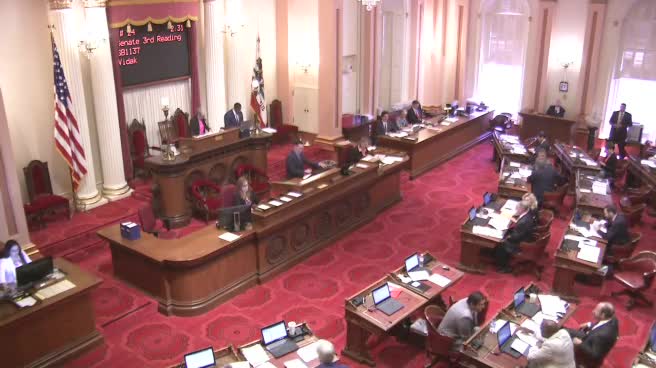
Bill Author

Bill Co-Author(s):
