AB 1042: Pesticide treated seed: labeling.
- Session Year: 2023-2024
- House: Assembly
- Latest Version Date: 2024-09-22
Current Status:
Passed
(2024-09-22: Chaptered by Secretary of State - Chapter 348, Statutes of 2024.)
Introduced
In Committee
First Chamber
In Committee
Second Chamber
Enacted
What does this bill do?
The bill strengthens seed labeling rules by requiring labels on treated agricultural and vegetable seed to list each treatment and show the hazard “signal word” for the most toxic treatment (for example, DANGER or WARNING). It also requires that seeds treated with pesticides covered by federal law include each pesticide’s EPA registration number (if any) and the amount applied by weight or per seed.
The summary is provided by generative AI which can make mistakes. For original language, please view the details in the table below.
Existing law, the California Seed Law, regulates seed sold in California. The California Seed Law prohibits any person from shipping, delivering, transporting, or selling agricultural or vegetable seed that is treated after harvest with any substance that is likely to be poisonous or toxic to human beings or animals unless it is labeled with specified information, including the chemical or generic name of the treatment material, as provided. The California Seed Law requires, when more than one substance is applied to the seed, each substance applied to the seed to be noted on the label and the seed to be labeled for the substance with the higher level of toxicity.
This bill would additionally require, when more than one substance is applied to the seed, that the seed be labeled for each substance applied with the signal word for the substance with the highest level of toxicity. The bill would, beginning January 1, 2027, require that the label for seeds treated with certain substances and packaged on or after January 1, 2027, include each pesticides registration number from the United States Environmental Protection Agency, if applicable, and the quantity applied by weight or amount per seed.
Existing law, the California Seed Law, regulates seed sold in California. The California Seed Law prohibits any person from shipping, delivering, transporting, or selling agricultural or vegetable seed that is treated after harvest with any substance that is likely to be poisonous or toxic to human beings or animals unless it is labeled with specified information, including the chemical or generic name of the treatment material, as provided. The California Seed Law requires, when more than one substance is applied to the seed, each substance applied to the seed to be noted on the label and the seed to be labeled for the substance with the higher level of toxicity.
This bill would additionally require, when more than one substance is applied to the seed, that the seed be labeled for each substance applied with the signal word for the substance with the highest level of toxicity. The bill would, beginning January 1, 2027, require that the label for seeds treated with certain substances and packaged on or after January 1, 2027, include each substances pesticides registration number from the United States Environmental Protection Agency, if applicable, and the quantity applied by weight or amount per seed.
Existing law, the California Seed Law, regulates seed sold in California. The California Seed Law prohibits any person from shipping, delivering, transporting, or selling agricultural or vegetable seed that is treated after harvest with any substance that is likely to be poisonous or toxic to human beings or animals unless it is labeled with specified information, including the chemical or generic name of the treatment material, as provided. The California Seed Law requires, when more than one substance is applied to the agricultural or vegetable seed, each substance applied to the seed to be noted on the label and the seed to be labeled for the substance with the higher level of toxicity and each substance applied to the seed to be noted on the label. toxicity.
This bill would, beginning January 1, 2027, additionally would additionally require, when more than one substance is applied to the seed, that the seed be labeled for each substance applied with the signal word for the substance with the highest level of toxicity. The bill would, beginning January 1, 2027, require that the label for certain pesticide treated seeds to treated with certain substances and packaged on or after January 1, 2027, include specified information, including the pesticides each substances registration number from the United States Environmental Protection Agency, if applicable, and the application rate quantity applied by weight of or amount per seed.
Existing law, the California Seed Law, regulates seed sold in California. The California Seed Law prohibits any person from shipping, delivering, transporting, or selling agricultural or vegetable seed that is treated after harvest with any substance that is likely to be poisonous or toxic to human beings or animals unless it is labeled with specified information, including the chemical or generic name of the treatment material, as provided. The California Seed Law requires, when more than one substance is applied to the agricultural or vegetable seed, the seed to be labeled for the substance with the higher level of toxicity and each substance applied to the seed to be noted on the label.
This bill would would, beginning January 1, 2027, additionally require the label for certain pesticide treated seeds to include the numerical amount of treatment material applied per seed. The bill would require the agricultural or vegetable seed to be labeled for each substance applied. specified information, including the pesticides registration number from the United States Environmental Protection Agency, if applicable, and the application rate by weight of seed.
Existing law, the California Seed Law, regulates seed sold in California. The California Seed Law prohibits any person from shipping, delivering, transporting, or selling agricultural or vegetable seed that is treated after harvest with any substance that is likely to be poisonous or toxic to human beings or animals unless it is labeled with specified information, including the chemical or generic name of the treatment material, as provided. The California Seed Law requires, when more than one substance is applied to the agricultural or vegetable seed, the seed to be labeled for the substance with the higher level of toxicity and each substance applied to the seed to be noted on the label.
This bill would additionally require the label to include the numerical amount of treatment material applied and whether the treated seed contains intentionally added microplastics. per seed. The bill would require the agricultural or vegetable seed to be labeled for each substance applied.
Existing law, the California Seed Law, regulates seed sold in California. The California Seed Law prohibits any person from shipping, delivering, transporting, or selling agricultural or vegetable seed that is treated after harvest with any substance that is likely to be poisonous or toxic to human beings or animals unless it is labeled with specified information, including the chemical or generic name of the treatment material, as provided. The California Seed Law requires, when more than one substance is applied to the agricultural or vegetable seed, the seed to be labeled for the substance with the higher level of toxicity and each substance applied to the seed to be noted on the label.
This bill would additionally require the label to include the amount of treatment material applied and whether the treated seed contains intentionally added microplastics. The bill would require the agricultural or vegetable seed to be labeled for each substance applied.
Existing law requires every manufacturer of, importer of, or dealer in any pesticide, as defined, to obtain a certificate of registration from the Department of Pesticide Regulation before the pesticide is offered for sale, except as specified. Under existing law, a violation of that requirement, and other provisions and regulations related to pesticides, is a misdemeanor punishable by a fine of not less than $5,000 and not more than $50,000, or by imprisonment of not more than 6 months, or by both the fine and imprisonment.This bill would require the Director of Pesticide Regulation to adopt regulations to govern the use and disposal of seeds treated with a pesticide and to prohibit the use of seeds treated with a pesticide that meets specified conditions. Because a violation of these regulations would be a crime, the bill would impose a state-mandated local program. The bill would prohibit, on and after January 1, 2026, a person from selling, delivering, or using seeds treated with a pesticide if that pesticide is not registered for use. The bill would require, on and after January 1, 2025, a use report to be submitted by, or on behalf of, a grower to the director or a county agricultural commissioner when seeds treated with a pesticide are used by the grower in the state and would require the director or commissioner, on and after January 1, 2026, to annually report to the public the pounds of pesticides applied as seed treatment in California and the cumulative acres planted with seeds treated with a pesticide in California, as specified. By imposing this reporting requirement on county agricultural commissioners, this bill would create a state-mandated local program.Existing law requires the director to endeavor to eliminate from use in the state any pesticide that endangers the agricultural or nonagricultural environment, is not beneficial for the purposes for which it is sold, or is misrepresented, as specified.This bill would require the director to endeavor to eliminate from use in the state seeds treated with a pesticide that satisfy any of those same criteria.Existing law requires the director to prohibit or regulate the use of environmentally harmful materials, as specified.This bill would expressly require the director to prohibit or regulate the use of seeds treated with a pesticide as environmentally harmful materials under that law.The California Constitution requires the state to reimburse local agencies and school districts for certain costs mandated by the state. Statutory provisions establish procedures for making that reimbursement.This bill would provide that with regard to certain mandates no reimbursement is required by this act for a specified reason.With regard to any other mandates, this bill would provide that, if the Commission on State Mandates determines that the bill contains costs so mandated by the state, reimbursement for those costs shall be made pursuant to the statutory provisions noted above.Existing law requires every manufacturer of, importer of, or dealer in any pesticide, as defined, to obtain a certificate of registration from the Department of Pesticide Regulation before the pesticide is offered for sale, except as specified. Under existing law, a violation of that requirement, and other provisions and regulations related to pesticides, is a misdemeanor punishable by a fine of not less than $5,000 and not more than $50,000, or by imprisonment of not more than 6 months, or by both the fine and imprisonment.
This bill would require the Director of Pesticide Regulation to adopt regulations to govern the use and disposal of seeds treated with a pesticide and to prohibit the use of seeds treated with a pesticide that meets specified conditions. Because a violation of these regulations would be a crime, the bill would impose a state-mandated local program. The bill would prohibit prohibit, on and after January 1, 2026, a person from selling, delivering, or using seeds treated with a pesticide if that pesticide is not registered for use. The bill would require, on and after January 1, 2025, a use report to be submitted by, or on behalf of, a grower to the director or a county agricultural commissioner when seeds treated with a pesticide are used by the grower in the state and would require the director or commissioner, on and after January 1, 2026, to annually report to the public the pounds of pesticides applied as seed treatment in California and the cumulative acres planted with seeds treated with a pesticide in California, as specified. By imposing this reporting requirement on county agricultural commissioners, this bill would create a state-mandated local program.
Existing law requires the director to endeavor to eliminate from use in the state any pesticide that endangers the agricultural or nonagricultural environment, is not beneficial for the purposes for which it is sold, or is misrepresented, as specified.
This bill would require the director to endeavor to eliminate from use in the state seeds treated with a pesticide that satisfy any of those same criteria.
Existing law requires the director to prohibit or regulate the use of environmentally harmful materials, as specified.
This bill would expressly require the director to prohibit or regulate the use of seeds treated with a pesticide as environmentally harmful materials under that law.
The California Constitution requires the state to reimburse local agencies and school districts for certain costs mandated by the state. Statutory provisions establish procedures for making that reimbursement.
This bill would provide that with regard to certain mandates no reimbursement is required by this act for a specified reason.
With regard to any other mandates, this bill would provide that, if the Commission on State Mandates determines that the bill contains costs so mandated by the state, reimbursement for those costs shall be made pursuant to the statutory provisions noted above.
Existing law requires every manufacturer of, importer of, or dealer in any pesticide, as defined, to obtain a certificate of registration from the Department of Pesticide Regulation before the pesticide is offered for sale, except as specified. Under existing law, a violation of that requirement, and other provisions and regulations related to pesticides, is a misdemeanor punishable by a fine of not less than $5,000 and not more than $50,000, or by imprisonment of not more than 6 months, or by both the fine and imprisonment.
This bill would require the Director of Pesticide Regulation to adopt regulations to govern the use and disposal of seeds treated with a pesticide and to prohibit the use of seeds treated with a pesticide that meets specified conditions. Because a violation of these regulations would be a crime, the bill would impose a state-mandated local program. The bill would prohibit a person from selling, delivering, or using seeds treated with a pesticide that is not registered for use. The bill would require, on and after January 1, 2025, a use report to be submitted by, or on behalf of, a grower to the director or a county agricultural commissioner when seeds treated with a pesticide are used by the grower in the state and would require the director or commissioner, on and after January 1, 2026, to annually report to the public the pounds of pesticides applied as seed treatment in California and the cumulative acres planted with seeds treated with a pesticide in California, as specified. By imposing this reporting requirement on county agricultural commissioners, this bill would create a state-mandated local program.
Existing law requires the director to endeavor to eliminate from use in the state any pesticide that endangers the agricultural or nonagricultural environment, is not beneficial for the purposes for which it is sold, or is misrepresented, as specified.
This bill would require the director to endeavor to eliminate from use in the state seeds treated with a pesticide that satisfy any of those same criteria.
Existing law requires the director to prohibit or regulate the use of environmentally harmful materials, as specified.
This bill would expressly require the director to prohibit or regulate the use of seeds treated with a pesticide as environmentally harmful materials under that law.
The California Constitution requires the state to reimburse local agencies and school districts for certain costs mandated by the state. Statutory provisions establish procedures for making that reimbursement.
This bill would provide that with regard to certain mandates no reimbursement is required by this act for a specified reason.
With regard to any other mandates, this bill would provide that, if the Commission on State Mandates determines that the bill contains costs so mandated by the state, reimbursement for those costs shall be made pursuant to the statutory provisions noted above.
Existing law, added by the Governors Reorganization Plan No. 1 of 1991, creates the Department of Pesticide Regulation and authorizes the Director of Pesticide Regulation, among other things, to adopt regulations for the issuance and renewal of licenses and certificates for pest control operations.This bill would require the department, by July 1, 2024, to establish a Sustainable Pest Management Workgroup that would identify pathways to minimize the use of toxic pesticides and expand the use of integrated pest management practices, among other things. The bill would repeal these provisions on January 1, 2026.Existing law, added by the Governors Reorganization Plan No. 1 of 1991, creates the Department of Pesticide Regulation and authorizes the Director of Pesticide Regulation, among other things, to adopt regulations for the issuance and renewal of licenses and certificates for pest control operations.
This bill would require the department, by July 1, 2024, to establish a Sustainable Pest Management Workgroup that would identify pathways to minimize the use of toxic pesticides and expand the use of integrated pest management practices, among other things. The bill would repeal these provisions on January 1, 2026.
(a)Except as otherwise provided in Section 52486, it is unlawful for any person to ship, deliver, transport, or sell agricultural or vegetable seed that is treated after harvest with any substance that is likely to be poisonous or toxic to human beings or animals unless there is conspicuously shown on the analysis tag or label, on a separate tag or label attached to each container, or on each container all of the following information:
(1)TREATED SEED and the signal word for the category of treatment material, all in capital letters.
(2)The chemical or generic name of the treatment material.
(3)An appropriately worded statement as to the hazards to humans and animals.
(4)An appropriately worded statement of practical treatment, if present.
(b)This information shall be derived from the technical chemical label of each substance applied to the seed.
(c)When more than one substance is applied, each substance shall be noted on the label and the seed shall be labeled for each substance applied with the signal word for the substance with the highest level of toxicity.
(d)(1)For seeds treated with substances subject to the Federal Insecticide, Fungicide, and Rodenticide Act (7 U.S.C. Sec. 136 et seq.), the label shall include, for each pesticide, the following information:
(A)The registration number from the United States Environmental Protection Agency, if applicable.
(B)The quantity applied by weight or amount per seed.
(2)This subdivision shall become operative January 1, 2027.
(3)This subdivision shall only apply to seeds shipped, delivered, transported, distributed, or sold in the state for planting within the state.
(4)The requirements of this subdivision do not apply to seeds packaged before January 1, 2027.
(a)Except as otherwise provided in Section 52486, it is unlawful for any person to ship, deliver, transport, or sell agricultural or vegetable seed that is treated after harvest with any substance that is likely to be poisonous or toxic to human beings or animals unless there is conspicuously shown on the analysis tag or label, on a separate tag or label attached to each container, or on each container all of the following information:
(1)TREATED SEED and the signal word for the category of treatment material, all in capital letters.
(2)The chemical or generic name of the treatment material.
(3)An appropriately worded statement as to the hazards to humans and animals.
(4)An appropriately worded statement of practical treatment, if present.
(b)This information shall be derived from the technical chemical label of each substance applied to the seed.
(c)When more than one substance is applied, each substance shall be noted on the label and the seed shall be labeled for each substance applied with the signal word for the substance with the highest level of toxicity.
(d)(1)For seeds treated with substances subject to the Federal Insecticide, Fungicide, and Rodenticide Act (7 U.S.C. Sec. 136 et seq.), the label shall include, for each substance, pesticide, the following information:
(A)The registration number from the United States Environmental Protection Agency, if applicable.
(B)The quantity applied by weight or amount per seed.
(2)This subdivision shall become operative January 1, 2027.
(3)This subdivision shall only apply to seeds shipped, delivered, transported, distributed, or sold in the state for planting within the state.
(4)The requirements of this subdivision do not apply to seeds packaged before January 1, 2027.
(a)Except as otherwise provided in Section 52486, it is unlawful for any person to ship, deliver, transport, or sell agricultural or vegetable seed that is treated after harvest with any substance that is likely to be poisonous or toxic to human beings or animals unless there is conspicuously shown on the analysis tag or label, on a separate tag or label attached to each container, or on each container all of the following information:
(1)TREATED SEED and the signal word for the category of treatment material, all in capital letters.
(2)The chemical or generic name of the treatment material.
(3)An appropriately worded statement as to the hazards to humans and animals.
(4)An appropriately worded statement of practical treatment, if present.
(b)This information shall be derived from the technical chemical label of each substance applied to the seed.
(c)When more than one substance is applied, each substance shall be noted on the label and the seed shall be labeled for each substance applied with the signal word for the substance with the highest level of toxicity.
(d)(1)For pesticide treated seeds, seeds treated with substances subject to the Federal Insecticide, Fungicide, and Rodenticide Act (7 U.S.C. Sec. 136 et seq.), the label shall include, for each pesticide, all of substance, the following information:
(A)The registration number from the United States Environmental Protection Agency, if applicable.
(B)The registration number from the Department of Pesticide Regulation, if available. (C)(B)The application rate quantity applied by weight of or amount per seed.
(2)This subdivision shall become effective operative January 1, 2027.
(3)This subdivision shall only apply to seeds shipped, delivered, transported, distributed, or sold in the state for planting within the state.
(4)The requirements of this subdivision do not apply to seeds packaged before January 1, 2027.
(a)Except as otherwise provided in Section 52486, it is unlawful for any person to ship, deliver, transport, or sell agricultural or vegetable seed that is treated after harvest with any substance that is likely to be poisonous or toxic to human beings or animals unless there is conspicuously shown on the analysis tag or label, on a separate tag or label attached to each container, or on each container all of the following information:
(1)TREATED SEED and the signal word for the category of treatment material, all in capital letters.
(2)The chemical or generic name of the treatment material.
(3)The numerical amount of treatment material applied per seed.(4)(3)An appropriately worded statement as to the hazards to humans and animals.
(5)(4)An appropriately worded statement of practical treatment, if present.
(b)This information shall be derived from the technical chemical label of each substance applied to the seed.
(c)When more than one substance is applied, each substance shall be noted on the label and the seed shall be labeled for each substance applied. with the signal word for the substance with the highest level of toxicity.
(d)(1)For pesticide treated seeds, the label shall include, for each pesticide, all of the following information:
(A)The registration number from the United States Environmental Protection Agency, if applicable.
(B)The registration number from the Department of Pesticide Regulation, if available.
(C)The application rate by weight of seed.
(2)This subdivision shall become effective January 1, 2027.
(3)This subdivision shall only apply to seeds shipped, delivered, transported, or sold within the state.
(a)Except as otherwise provided in Section 52486, it is unlawful for any person to ship, deliver, transport, or sell agricultural or vegetable seed that is treated after harvest with any substance that is likely to be poisonous or toxic to human beings or animals unless there is conspicuously shown on the analysis tag or label, on a separate tag or label attached to each container, or on each container all of the following information:
(1)TREATED SEED and the signal word for the category of treatment material, all in capital letters.
(2)The chemical or generic name of the treatment material.
(3)The numerical amount of treatment material applied. applied per seed.
(4)An appropriately worded statement as to the hazards to humans and animals.
(5)An appropriately worded statement of practical treatment, if present.
(b)This information shall be derived from the technical chemical label of each substance applied to the seed.
(c)When more than one substance is applied, the seed shall be labeled for each substance applied.
(d)The analysis tag, separate tag, label, or container of an agricultural or vegetable seed labeled pursuant to this section shall state whether the treated seed contains intentionally added microplastics.(a)Except as otherwise provided in Section 52486, it is unlawful for any person to ship, deliver, transport, or sell agricultural or vegetable seed that is treated after harvest with any substance that is likely to be poisonous or toxic to human beings or animals unless there is conspicuously shown on the analysis tag or label, on a separate tag or label attached to each container, or upon on each container all of the following information:
(1)TREATED SEED and the signal word for the category of treatment material material, all in capital letters.
(2)The chemical or generic name of the treatment material.
(3)The amount of treatment material applied.
(3)(4)An appropriately worded statement as to the hazards to humans and animals.
(4)(5)An appropriately worded statement of practical treatment, if present.
(b)This information shall be derived from the technical chemical label of the each substance applied to the seed.
(c)When more than one substance is applied, each substance shall be noted on the label, and the seed shall be labeled for the substance with the higher level of toxicity. each substance applied.
(d)The analysis tag, separate tag, label, or container of an agricultural or vegetable seed labeled pursuant to this section shall state whether the treated seed contains intentionally added microplastics.
SECTION 1.Section 12811.3 is added to the Food and Agricultural Code, to read:12811.3.(a)The director shall adopt regulations, consistent with Sections 12824 and 14102, to govern the use and disposal of seeds treated with a pesticide.(b)The regulations adopted pursuant to subdivision (a) shall prohibit the use of seeds treated with a pesticide that meets any of the conditions specified in subdivisions (a) to (f), inclusive, of Section 12825.(c)On and after January 1, 2026, a person shall not sell, deliver, or use seeds treated with a pesticide if that pesticide is not registered for use pursuant to this chapter.(d)(1)On and after January 1, 2025, a use report shall be submitted by, or on behalf of, a grower to the director or a commissioner, on a form and in a manner prescribed by the director, when seeds treated with a pesticide are used by the grower in the state.(2)Based on those use reports, the director or commissioner, on and after January 1, 2026, shall annually report to the public both of the following:(A)The pounds of pesticides applied as seed treatment in California, separated by crop type, active ingredient, and county of application.(B)The cumulative acres planted with seeds treated with a pesticide in California, separated by crop type, active ingredient, and county of application.SEC. 2.Section 12824 of the Food and Agricultural Code is amended to read:12824.(a)The director shall endeavor to eliminate from use in the state any pesticide, and seed treated with a pesticide, that endangers the agricultural or nonagricultural environment, is not beneficial for the purposes for which it is sold, or is misrepresented. In carrying out this responsibility, the director shall develop an orderly program for the continuous evaluation of all pesticides actually registered and seeds treated with a pesticide.(b)Before a substance is registered as a pesticide for the first time, there shall be a thorough and timely evaluation in accordance with this section. Appropriate restrictions may be placed on its use, including, but not limited to, limitations on quantity, area, and manner of application. All pesticides for which renewal of registration is sought also shall be evaluated in accordance with this section.(c)The director may establish specific criteria to evaluate a pesticide with regard to the factors listed in Section 12825. The department may establish performance standards and tests that are to be conducted or financed, or both conducted and financed, by the registrants, applicants for registration, or parties interested in the registration of those pesticides.SEC. 3.Section 14102 of the Food and Agricultural Code is amended to read:14102.The director shall prohibit or regulate the use of environmentally harmful materials, including seeds treated with a pesticide, pursuant to Chapters 2 (commencing with Section 12751) and 3 (commencing with Section 14001) of this division. In so doing, the director shall consider the effect of all such materials on the environment, and shall take whatever steps the director deems necessary to protect the environment. The director shall also continue to initiate, cooperate, and collaborate with the University of California and with other state agencies in research designed to reduce and eliminate the use of environmentally harmful materials.SEC. 4.No reimbursement is required by this act pursuant to Section 6 of Article XIIIB of the California Constitution for certain costs that may be incurred by a local agency or school district because, in that regard, this act creates a new crime or infraction, eliminates a crime or infraction, or changes the penalty for a crime or infraction, within the meaning of Section 17556 of the Government Code, or changes the definition of a crime within the meaning of Section 6 of Article XIIIB of the California Constitution.However, if the Commission on State Mandates determines that this act contains other costs mandated by the state, reimbursement to local agencies and school districts for those costs shall be made pursuant to Part 7 (commencing with Section 17500) of Division 4 of Title 2 of the Government Code.(a)The director shall adopt regulations, consistent with Sections 12824 and 14102, to govern the use and disposal of seeds treated with a pesticide.
(b)The regulations adopted pursuant to subdivision (a) shall prohibit the use of seeds treated with a pesticide that meets any of the conditions specified in subdivisions (a) to (f), inclusive, of Section 12825.
(c)A On and after January 1, 2026, a person shall not sell, deliver, or use seeds treated with a pesticide if that pesticide is not registered for that use pursuant to this chapter.
(d)(1)On and after January 1, 2025, a use report shall be submitted by, or on behalf of, a grower to the director or a commissioner, on a form and in a manner prescribed by the director, when seeds treated with a pesticide are used by the grower in the state.
(2)Based on those use reports, the director or commissioner, on and after January 1, 2026, shall annually report to the public both of the following:
(A)The pounds of pesticides applied as seed treatment in California, separated by crop type, active ingredient, and county of application.
(B)The cumulative acres planted with seeds treated with a pesticide in California, separated by crop type, active ingredient, and county of application.
SEC. 2.Section 12824 of the Food and Agricultural Code is amended to read:12824.(a)The director shall endeavor to eliminate from use in the state any pesticide, and seed treated with a pesticide, that endangers the agricultural or nonagricultural environment, is not beneficial for the purposes for which it is sold, or is misrepresented. In carrying out this responsibility, the director shall develop an orderly program for the continuous evaluation of all pesticides actually registered and seeds treated with a pesticide.
(b)Before a substance is registered as a pesticide for the first time, there shall be a thorough and timely evaluation in accordance with this section. Appropriate restrictions may be placed on its use use, including, but not limited to, limitations on quantity, area, and manner of application. All pesticides for which renewal of registration is sought also shall be evaluated in accordance with this section.
(c)The director may establish specific criteria to evaluate a pesticide with regard to the factors listed in Section 12825. The department may establish performance standards and tests that are to be conducted or financed, or both conducted and financed, by the registrants, applicants for registration, or parties interested in the registration of those pesticides.
SEC. 3.Section 14102 of the Food and Agricultural Code is amended to read:14102.The director shall prohibit or regulate the use of environmentally harmful materials, including seeds treated with a pesticide, pursuant to Chapters 2 (commencing with Section 12751) and 3 (commencing with Section 14001) of this division. In so doing, the director shall consider the effect of all such materials on the environment, and shall take whatever steps the director deems necessary to protect the environment. The director shall also continue to initiate, cooperate, and collaborate with the University of California and with other state agencies in research designed to reduce and eliminate the use of environmentally harmful materials.
SEC. 4.No reimbursement is required by this act pursuant to Section 6 of Article XIIIB of the California Constitution for certain costs that may be incurred by a local agency or school district because, in that regard, this act creates a new crime or infraction, eliminates a crime or infraction, or changes the penalty for a crime or infraction, within the meaning of Section 17556 of the Government Code, or changes the definition of a crime within the meaning of Section 6 of Article XIIIB of the California Constitution.
However, if the Commission on State Mandates determines that this act contains other costs mandated by the state, reimbursement to local agencies and school districts for those costs shall be made pursuant to Part 7 (commencing with Section 17500) of Division 4 of Title 2 of the Government Code.
(a)The director shall adopt regulations, consistent with Sections 12824 and 14102, to govern the use and disposal of seeds treated with a pesticide.
(b)The regulations adopted pursuant to subdivision (a) shall prohibit the use of seeds treated with a pesticide that meets any of the conditions specified in subdivisions (a) to (f), inclusive, of Section 12825.
(c)A person shall not sell, deliver, or use seeds treated with a pesticide that is not registered for that use pursuant to this chapter.
(d)(1)On and after January 1, 2025, a use report shall be submitted by, or on behalf of, a grower to the director or a commissioner, on a form and in a manner prescribed by the director, when seeds treated with a pesticide are used by the grower in the state.
(2)Based on those use reports, the director or commissioner, on and after January 1, 2026, shall annually report to the public both of the following:
(A)The pounds of pesticides applied as seed treatment in California, separated by crop type, active ingredient, and county of application.
(B)The cumulative acres planted with seeds treated with a pesticide in California, separated by crop type, active ingredient, and county of application.
SEC. 2.Section 12824 of the Food and Agricultural Code is amended to read:12824.(a)The director shall endeavor to eliminate from use in the state any pesticide pesticide, and seed treated with a pesticide, that endangers the agricultural or nonagricultural environment, is not beneficial for the purposes for which it is sold, or is misrepresented. In carrying out this responsibility, the director shall develop an orderly program for the continuous evaluation of all pesticides actually registered. registered and seeds treated with a pesticide.
Before(b)Before a substance is registered as a pesticide for the first time, there shall be a thorough and timely evaluation in accordance with this section. Appropriate restrictions may be placed upon on its use including, but not limited to, limitations on quantity, area, and manner of application. All pesticides for which renewal of registration is sought also shall be evaluated in accordance with this section.
The(c)The director may establish specific criteria to evaluate a pesticide with regard to the factors listed in Section 12825. The department may establish performance standards and tests that are to be conducted or financed, or both conducted and financed, by the registrants, applicants for registration, or parties interested in the registration of those pesticides.
SEC. 3.Section 14102 of the Food and Agricultural Code is amended to read:14102.The director shall prohibit or regulate the use of environmentally harmful materials, including seeds treated with a pesticide, pursuant to the provisions of Chapters 2 (commencing with Section 12751) and 3 (commencing with Section 14001) of this division. In so doing, he the director shall consider the effect of all such materials upon on the environment, and shall take whatever steps he the director deems necessary to protect the environment. He The director shall also continue to initiate, cooperate, and collaborate with the University of California and with other state agencies in research designed to reduce and eliminate the use of environmentally harmful materials.
SEC. 4.No reimbursement is required by this act pursuant to Section 6 of Article XIIIB of the California Constitution for certain costs that may be incurred by a local agency or school district because, in that regard, this act creates a new crime or infraction, eliminates a crime or infraction, or changes the penalty for a crime or infraction, within the meaning of Section 17556 of the Government Code, or changes the definition of a crime within the meaning of Section 6 of Article XIIIB of the California Constitution.
However, if the Commission on State Mandates determines that this act contains other costs mandated by the state, reimbursement to local agencies and school districts for those costs shall be made pursuant to Part 7 (commencing with Section 17500) of Division 4 of Title 2 of the Government Code.
SECTION 1.Section 11502.6 is added to the Food and Agricultural Code, to read:11502.6.(a)To protect the environment and public health from the harmful effects of pesticides, and to accelerate the systemwide adoption of safer and sustainable pest control practices, the Department of Pesticide Regulation shall establish a Sustainable Pest Management Workgroup by July 1, 2024. The department may augment an existing task force or workgroup to accomplish the requirements of this section.(b)The functions and duties of the workgroup shall include all of the following:(1)Identify pathways to minimize the use of toxic pesticides and expand the use of integrated pest management practices.(2)Better protect public and environmental health.(3)Engage, educate, and promote collaboration to achieve the goals of paragraphs (1) and (2).(c)This section shall remain in effect only until January 1, 2026, and as of that date is repealed, unless a later enacted statute that is enacted before January 1, 2026, deletes or extends that date.(a)To protect the environment and public health from the harmful effects of pesticides, and to accelerate the systemwide adoption of safer and sustainable pest control practices, the Department of Pesticide Regulation shall establish a Sustainable Pest Management Workgroup by July 1, 2024. The department may augment an existing task force or workgroup to accomplish the requirements of this section.
(b)The functions and duties of the workgroup shall include all of the following:
(1)Identify pathways to minimize the use of toxic pesticides and expand the use of integrated pest management practices.
(2)Better protect public and environmental health.
(3)Engage, educate, and promote collaboration to achieve the goals of paragraphs (1) and (2).
(c)This section shall remain in effect only until January 1, 2026, and as of that date is repealed, unless a later enacted statute that is enacted before January 1, 2026, deletes or extends that date.
|
Date
|
Status
|
|---|---|
| Sep 22, 2024 | Chaptered by Secretary of State - Chapter 348, Statutes of 2024. |
| Sep 22, 2024 | Approved by the Governor. |
| Sep 12, 2024 | Enrolled and presented to the Governor at 4 p.m. |
| Aug 31, 2024 | Senate amendments concurred in. To Engrossing and Enrolling. (Ayes 50. Noes 17.). |
| Aug 31, 2024 | In Assembly. Concurrence in Senate amendments pending. |
| Aug 31, 2024 | Read third time. Passed. Ordered to the Assembly. (Ayes 31. Noes 8.). |
| Aug 26, 2024 | Read second time. Ordered to third reading. |
| Aug 23, 2024 | Read third time and amended. Ordered to second reading. |
| Aug 20, 2024 | Read second time. Ordered to third reading. |
| Aug 19, 2024 | Read third time and amended. Ordered to second reading. |
| Aug 6, 2024 | Read second time. Ordered to third reading. |
| Aug 5, 2024 | From committee: Be ordered to second reading pursuant to Senate Rule 28.8. |
| Jul 3, 2024 | Read second time and amended. Re-referred to Com. on APPR. |
| Jul 3, 2024 | From committee: Amend, and do pass as amended and re-refer to Com. on APPR. (Ayes 4. Noes 0.) (July 3). |
| Jun 19, 2024 | Read second time and amended. Re-referred to Com. on E.Q. |
| Jun 18, 2024 | From committee: Amend, and do pass as amended and re-refer to Com. on E.Q. (Ayes 3. Noes 0.) (June 18). |
| Jun 12, 2024 | Re-referred to Coms. on AGRI and E.Q. |
| Jun 11, 2024 | Withdrawn from committee. |
| Jun 11, 2024 | Re-referred to Com. on RLS. |
| Jun 10, 2024 | From committee chair, with author's amendments: Amend, and re-refer to committee. Read second time, amended, and re-referred to Com. on AGRI. |
| Jun 30, 2023 | In committee: Set, first hearing. Hearing canceled at the request of author. |
| Jun 29, 2023 | From committee: Do pass and re-refer to Com. on AGRI. (Ayes 4. Noes 2.) (June 28). Re-referred to Com. on AGRI. |
| Jun 15, 2023 | From committee chair, with author's amendments: Amend, and re-refer to committee. Read second time, amended, and re-referred to Com. on E.Q. |
| Jun 7, 2023 | Referred to Coms. on E.Q. and AGRI. |
| May 31, 2023 | In Senate. Read first time. To Com. on RLS. for assignment. |
| May 30, 2023 | Read third time. Passed. Ordered to the Senate. (Ayes 53. Noes 19. Page 1889.) |
| May 18, 2023 | Read second time. Ordered to third reading. |
| May 18, 2023 | From committee: Do pass. (Ayes 11. Noes 4.) (May 18). |
| May 3, 2023 | In committee: Set, first hearing. Referred to APPR. suspense file. |
| Apr 19, 2023 | From committee: Do pass and re-refer to Com. on APPR. (Ayes 7. Noes 2.) (April 18). Re-referred to Com. on APPR. |
| Mar 20, 2023 | Re-referred to Com. on E.S. & T.M. |
| Mar 16, 2023 | From committee chair, with author's amendments: Amend, and re-refer to Com. on E.S. & T.M. Read second time and amended. |
| Mar 2, 2023 | Referred to Com. on E.S. & T.M. |
| Feb 16, 2023 | From printer. May be heard in committee March 18. |
| Feb 15, 2023 | Read first time. To print. |
|
Date
|
Description
|
Location
|
Votes
|
|
|---|---|---|---|---|
| Aug 31, 2024 | AB 1042 Bauer-Kahan Concurrence in Senate Amendments | Assembly Floor |
Passed |
|
| Aug 31, 2024 | Assembly 3rd Reading AB1042 Bauer-Kahan et al. By Allen | Senate Floor |
Passed |
|
| Jul 3, 2024 | Do pass as amended, but first amend, and re-refer to the Committee on [Appropriations] | Senate Standing Committee on Environmental Quality |
Passed |
|
| Jun 18, 2024 | Do pass as amended, but first amend, and re-refer to the Committee on [Environmental Quality] | Senate Standing Committee on Agriculture |
Passed |
|
| Jun 28, 2023 | Do pass, but first be re-referred to the Committee on [Agriculture] | Senate Standing Committee on Environmental Quality |
Passed |
|
| May 30, 2023 | AB 1042 Bauer-Kahan Assembly Third Reading | Assembly Floor |
Passed |
|
| May 18, 2023 | Do pass. | Assembly Standing Committee on Appropriations |
Passed |
|
| Apr 18, 2023 | Do pass and be re-referred to the Committee on [Appropriations] | Assembly Standing Committee on Environmental Safety and Toxic Materials |
Passed |
This list shows positions taken on this bill by organizations on the date displayed, which is linked to the original source.
Positions by individuals are not included.
|
Organization
|
Position
|
Date
|
|---|---|---|
| A Voice for Choice Advocacy | ** Support | |
| Agricultural Council Of California | * Against Unless Amend | Jun 18, 2024 |
| American Bird Conservancy | ** Support | |
| American Federation of State, County and Municipal Employees | * Support | Apr 22, 2024 |
| American Seed Trade Association | ** Against | |
| Association of California Healthcare Districts | * Against Unless Amend | Apr 22, 2024 |
| Association of Independent California Colleges and Universities | * Against Unless Amend | Apr 22, 2024 |
| Audubon California | ** Support | |
| Ban Single Use Plastic | ** Support | |
| Beyond Pesticides | ** Support | |
| BIO | * Against | Jul 3, 2024 |
| Biotechnology Innovation Organization | ** Against | |
| Brighter Beginnings | ** Support | |
| California Agricultural Aircraft Association | ** Against | |
| California Alfalfa & Forage Association | ** Against | |
| California Association Of Pest Control Advisers | ** Against | |
| California Association Of Professional Scientists | ** Support | |
| California Association Of Wheat Growers | ** Against | |
| California Children'S Hospital Association | * Against Unless Amend | Apr 22, 2024 |
| California Cotton Ginners and Growers Association | ** Against | |
| California Farm Bureau | * Against Unless Amend | Jun 18, 2024 |
| California Fresh Fruit Association | ** Against | |
| California Grain & Feed Association | * Against | Jun 18, 2024 |
| California Grain & Feed Association | * Against Unless Amend | Jun 18, 2024 |
| California Institute for Biodiversity | ** Support | |
| California Native Plant Society | ** Support | |
| California Nurses for Environmental Health and Justice | * Support | Apr 18, 2023 |
| California Seed Association | * Against | Jun 18, 2024 |
| California Seed Association | * Against Unless Amend | Jun 18, 2024 |
| California Teachers Association | * Support | Apr 22, 2024 |
| California Warehouse Association | ** Against | |
| Californians for Pesticide Reform | ** Support | |
| CALPERG | ** Support | Jun 18, 2024 |
| CALPERG | * Support | Jun 18, 2024 |
| CALPIRG | * Support | Jul 3, 2024 |
| Ccaej | ** Support | |
| Center for Community Action & Environmental Justice | ** Support | |
| Center For Food Safety | * Support | Jun 18, 2024 |
| Central California Environmental Justice Network | ** Support | |
| Central Valley Bird Club | ** Support | |
| Ceres Community Project | ** Support | |
| Clean Water Action | ** Support | |
| cleanearth4kids.org | ** Support | |
| Climate Reality San Francisco Bay Area Chapter | ** Support | |
| Coastwalk | ** Support | |
| Croplife America | ** Against | |
| Defenders Of Wildlife | ** Support | |
| Eco-Sustainability Peeps | * Support | Jun 18, 2024 |
| Ellison Wilson Advocacy LLC | * Support | Apr 22, 2024 |
| Endangered Habitats League | ** Support | |
| Environment America | ** Support | |
| Environment California | ** Support | |
| Environmental Justice Coalition for Water | ** Support | |
| Environmental Justice for Clean Water | ** Support | |
| Environmental Protection Information Center | ** Support | |
| Environmental Working Group | ** Support | |
| Facts | * Support | Jun 18, 2024 |
| Facts: Families Advocating for Chemical & Toxics Safety | ** Support | |
| Far West Equipment Dealers Association | ** Against | |
| Friends Committee On Legislation Of California | ** Support | |
| Friends of Harbors, Beaches and Parks | ** Support | |
| Friends Of The Earth | ** Support | |
| Grower-Shipper Association of Central California | ** Against | |
| Growing Coachella Valley | ** Against | |
| Interfaith Climate Action Network of Contra Costa County | ** Support | |
| Kahn Soares Conway LLP | * Against | Apr 18, 2023 |
| Klamath Forest Alliance | ** Support | |
| Long Beach Gray Panthers | ** Support | |
| Los Angeles Audubon Society | ** Support | |
| Made Safe | ** Support | |
| Mamavation - Non-toxic Products for Healthy Families | ** Support | |
| Midpeninsula Regional Open Space District | ** Support | |
| Moms Advocating Sustainability | * Support | Jun 18, 2024 |
| Napa Wildlife Rescue | ** Support | |
| Natural Resources Defense Council | ** Support | |
| Natural Resources Law | ** Support | |
| NCCCA | * Support | Jun 18, 2024 |
| Nisei Farmers League | ** Against | |
| Non Toxic Communities | ** Support | |
| Nontoxic Neighborhoods | ** Support | |
| Nontoxic Schools | ** Support | |
| North County Equity and Justice Coalition | ** Support | |
| NRDC | ** Support | |
| Pacific Seed Association | ** Against | |
| Parents for a Safer Environment | ** Support | |
| Peregrine Audubon Society | ** Support | |
| Pesticide Action Network | ** Support | |
| Plant California Alliance | ** Against | |
| Point Blue Conservation Science | ** Support | |
| Poison Free Malibu | ** Support | |
| Protect Our Watershed San Mateo County | ** Support | |
| Puma Springs Vineyards | ** Support | |
| Raptors Are The Solution | ** Support | |
| recolte energy | ** Support | |
| S.F. Bay Physicians for Social Responsibility | ** Support | |
| San Bernardino Valley Audubon Society | ** Support | |
| sequoia forestkeeper | ** Support | |
| Sierra Club California | ** Support | |
| SoCal 350 Climate Action | ** Support | |
| Solano County Democratic Central Committee | ** Support | |
| Sonoma County Beekeepers Association | ** Support | |
| Sonoma Safe Ag Safe Schools | * Support | Jun 18, 2024 |
| Sunflower Alliance | ** Support | |
| The Growing Solutions Fund | ** Support | |
| The Urban Wildlands Group | ** Support | |
| Urban Wildland Group, The | ** Support | |
| Various Agriculture Associations | * Support | Apr 18, 2023 |
| Western Agricultural Processors Association | ** Against | |
| Western Grow Association | * Against | Jul 3, 2024 |
| Western Growers Association | * Against | Jul 3, 2024 |
| Western Plant Health Association | ** Against | |
| Www.gmoscience.org | ** Support | |
| YardSmartMarin | * Support | Jun 18, 2024 |
CONCURRENCE IN SENATE AMENDMENTS
CSA1 Bill Id:AB 1042
Author:(Bauer-Kahan)
As Amended Ver:August 23, 2024
Majority vote
SUMMARY
Requires, as specified, the label for pesticide-treated seeds to include specified information, including the signal word, registration number, and the quantity of the pesticide applied.
Senate Amendments
- Delete the provisions of the bill as it passed the Assembly, which would have required the director of the Department of Pesticide Regulation (DPR) to adopt regulations to govern the use and disposal of seeds treated with a pesticide, and instead:
- Require that when more than one substance is applied to an agricultural or vegetable seed, the seed be labeled with the signal word for the substance with the highest level of toxicity; and,
- Require that, beginning January 1, 2027, for pesticide-treated seeds packaged after January 1, 2027, and shipped, delivered, transported, distributed, or sold in the state for planting within the state, the label include, for each pesticide, the following information
- The registration number from the United States Environmental Protection Agency (US EPA), if applicable; and,
- The quantity applied by weight or amount per seed.
COMMENTS
Pesticide treated seeds: Pesticides, such as fungicides, insecticides, bactericides, algaecides, slimicides, and nematicides, are applied to seeds prior to planting to protect them from diseases, insects, or other pests. Pesticide treatments on seeds are used for localized plant protection; to protect against soil and aboveground pests; and, as systemic pesticides that absorb into the plant and distribute throughout its tissues. Treating seeds with pesticides has become a common agricultural practice to improve seed quality by reducing soil borne diseases and by discouraging insects or other pests. In addition to agricultural use, treated seeds are used in residential gardens.
Fate of pesticide treated seeds in the environment: Ninety percent or more of pesticides applied to seeds can move offsite and leach into water or soil and be taken up by non-crop plants. Additionally, approximately 2 – 3% of the neonicotinoid pesticides on treated seeds is lost as dust at planting, and another 2 – 3 % is taken up by plants. Neonicotinoids applied to seeds protect the plant from root feeding pests for a maximum of 2 – 3 weeks. Other pesticide classes, such as fungicides, are commonly used in seed treatment products, however less is known about the environmental fate of non-neonicotinoid pesticides used in seed treatment products.
Managed pollinators, such as honey bees, and wild pollinators are exposed to pesticides applied to treated seeds through dust, agricultural soil, crop flowers, and nearby wildflowers. Birds are exposed to pesticides on seeds through the seeds themselves, such as by ingestion, and through contaminated water. Aquatic invertebrates are exposed to pesticides from treated seeds through dust, seeds, and water. Pesticides from treated seeds can be absorbed by aquatic plants. Workers at commercial seed treatment facilities can be exposed to pesticides on treated seeds, as can farm workers treating or planting treated seeds.
This bill: This bill requires that, when more than one substance is applied to an agricultural or vegetable seed, the seed be labeled with the signal word for the substance with the highest level of toxicity. Signal words describe the acute toxicity of the formulated pesticide product. This bill also requires that, beginning January 1, 2027, labels for all pesticide-treated seeds include, for each pesticide, the registration number from the US EPA, if applicable, and the quantity of the pesticide applied by weight or amount per seed. According to the author's office, there are critical gaps in the information about the substances on seeds available to researchers, farmers, and farmworkers handling treated seeds. This bill would seek to remedy that gap by providing additional information to people purchasing, handling, or studying treated seeds.
According to the Author
"The current lack of information on pesticide treated seed labels negatively affects the availability of data on the environmental impact of these treatments. More must be done to understand how treated seeds impact human health and the environment. AB 1042 creates more transparency by requiring that the amount of each pesticide treatment used on seeds is identified on the seed label."
Arguments in Support
A coalition of dozens of supporters, including environmental, environmental justice, and public health organizations, writes, "The bill requires that a key additional piece of information be communicated on existing state-regulated seed bag labels—specifically, the amount of pesticide or other treatment material used per seed. This information will: better inform growers and farmworkers as to the chemical content of treated seeds; allow for more effective comparison across seed treatment products, including their efficacy; and better enable growers and pest management professionals to make informed decisions about pesticide application and avoid duplication or unnecessary pesticide use… Because [DPR] does not currently regulate pesticide-treated seeds as pesticides, seed users and handlers often lack important chemical and dose information that would normally be included on a pesticide label. As a result, the amounts and types of chemical substances applied to seeds as a treatment remains poorly understood, although the use of seed treatments is expansive. …The use of these coatings can pose significant risks for California's environment and people. In the case of neonicotinoid or "neonic" insecticide coatings, as much as 95% or more of the coating dusts or sloughs off, impacting local wildlife, persisting in soil for years, and contaminating ground and surface water."
Arguments in Opposition
The California Seed Association writes, "We appreciate the work the author and staff have put into AB 1042 (Bauer-Kahan). This bill requires tags on seed bags for seeds treated with pesticides to include the amount of pesticide material applied. The California Seed Association worked diligently with the author and California Department of Food and Agriculture to develop bill language that could be implemented in an accurate manner. The bill has achieved this goal. However, due to the fact the bill requires seeds sold in California to have a state specific tag, unique to California, the association must remain opposed. This may increase liability for noncompliance and costs to implement. However, the bill language has been amended to address most the associations concerns."
FISCAL COMMENTS
According to the Senate Appropriations Committee, enactment of this bill would not have significant costs and therefore meets the criteria of Senate Rule 28.8.
VOTES:
ASM ENVIRONMENTAL SAFETY AND TOXIC MATERIALS: 7-2-0
YES: Lee, Arambula, Bauer-Kahan, Connolly, McKinnor, Pacheco, Zbur
NO: Hoover, Ta
ASM APPROPRIATIONS: 11-4-1
YES: Holden, Bryan, Calderon, Wendy Carrillo, Mike Fong, Hart, Lowenthal, Papan, Pellerin, Weber, Ortega
NO: Megan Dahle, Dixon, Mathis, Sanchez
ABS, ABST OR NV: Robert Rivas
ASSEMBLY FLOOR: 53-19-8
YES: Addis, Aguiar-Curry, Alvarez, Arambula, Bauer-Kahan, Bennett, Berman, Boerner, Bonta, Bryan, Calderon, Juan Carrillo, Wendy Carrillo, Cervantes, Connolly, Mike Fong, Friedman, Gabriel, Gipson, Grayson, Haney, Hart, Holden, Irwin, Jackson, Jones-Sawyer, Kalra, Lee, Low, Lowenthal, Maienschein, McCarty, McKinnor, Muratsuchi, Ortega, Papan, Pellerin, Petrie-Norris, Quirk-Silva, Ramos, Reyes, Luz Rivas, Robert Rivas, Santiago, Schiavo, Ting, Ward, Weber, Wicks, Wilson, Wood, Zbur, Rendon
NO: Alanis, Bains, Chen, Megan Dahle, Davies, Dixon, Essayli, Flora, Vince Fong, Gallagher, Hoover, Lackey, Mathis, Jim Patterson, Joe Patterson, Sanchez, Ta, Waldron, Wallis
ABS, ABST OR NV: Garcia, Stephanie Nguyen, Pacheco, Rodriguez, Blanca Rubio, Soria, Valencia, Villapudua
UPDATED
VERSION: August 23, 2024
CONSULTANT: Shannon McKinney / E.S. & T.M. / (916) 319-3965 FN: 0004932
SENATE RULES COMMITTEE Office of Senate Floor Analyses (916) 651-1520 Fax: (916) 327-4478 | AB 1042 |
THIRD READING
Bill No: AB 1042
Author: Bauer-Kahan (D), et al.
Amended: 8/23/24 in Senate
Vote: 21
SENATE ENVIRONMENTAL QUALITY COMMITTEE: 4-2, 6/28/23
AYES: Allen, Gonzalez, Menjivar, Skinner
NOES: Dahle, Nguyen
NO VOTE RECORDED: Hurtado
SENATE AGRICULTURE COMMITTEE: 3-0, 6/18/24
AYES: Hurtado, Cortese, Padilla
NO VOTE RECORDED: Grove, Alvarado-Gil
SENATE ENVIRONMENTAL QUALITY COMMITTEE: 4-0, 7/3/24
AYES: Allen, Gonzalez, Menjivar, Skinner
NO VOTE RECORDED: Dahle, Hurtado, Nguyen
SENATE APPROPRIATIONS COMMITTEE: Senate Rule 28.8
ASSEMBLY FLOOR: 53-19, 5/30/23 - See last page for vote
SUBJECT: Pesticide treated seed: labeling
SOURCE: American Bird Conservancy
Environment California
Natural Resources Defense Council
DIGEST:
This bill, beginning January 1, 2027, requires the label for certain pesticide treated seeds to include the pesticide’s registration number from the United States Environmental Protection Agency, if applicable, and the application rate by weight of seed, among other specified information.
Senate Floor Amendments of 8/23/24 clarify for seeds treated with substances subject to the Federal Insecticide, Fungicide, and Rodenticide Act (FIFRA), the label shall include, for each pesticide, the following information:
- The registration number from the United States Environmental Protection Agency, if applicable.
- The quantity applied by weight or amount per seed.
ANALYSIS:
Existing law:
- Provides that California Department of Food and Agriculture (CDFA) Seed Advisory Board advises the Secretary of CDFA and makes recommendations on all matters pertaining to California Seed Law and seed inspection regulations, the enforcement program, and the program's budget (including the State Seed Laboratory). It is comprised of eleven members, nine members from the seed industry and two from the public. (Food and Agricultural Code, Section 52291).
- Provides that Seed Services Program, administered statewide by CDFA’s Pest Exclusion Branch, the Seed Services program is a third-party seed inspection program, verifying the accuracy and accessibility of seed label statements as to variety and type, purity, and germination. (Food and Agricultural Code Section 52288).
- Provides that the California Department of Pesticide Regulation (DPR)’s mission is to protect human health and use of the environment by regulating pesticide sales and use and by fostering reduced-risk pest management.
- States it is unlawful for any person to ship, deliver, transport, or sell agricultural or vegetable seed that is treated after harvest with any substance that is likely to be poisonous or toxic to human beings or animals unless there is conspicuously shown on the analysis tag or label, on a separate tag or label attached to each container, or upon each container all of the following information. (Food & Agricultural Code Section 52484):
- “TREATED SEED” and the signal word for the category of treatment material all in capital letters. The chemical or generic name of the treatment material.
- An appropriately worded statement as to the hazards to humans and animals.
- An appropriately worded statement of practical treatment, if present.
This bill:
- States when more than one substance is applied, each substance shall be noted on the label and the seed shall be labeled with the signal word for the substance with the highest level of toxicity.
- States, beginning January 1, 2027, for seeds treated with substances subject to the Federal Insecticide, Fungicide, and Rodenticide Act, the label shall include, for each pesticide, all of the following information:
- The registration number from the United States Environmental Protection Agency, if applicable.
- The registration number from the Department of Pesticide Regulation, if available.
- The application rate by weight of seed.
- States this subdivision shall only apply to seeds shipped, delivered, transported, or sold for planting within the state.
- States that the requirements of this section shall not apply to seeds packaged before January 1, 2027.
FISCAL EFFECT: Appropriation: No Fiscal Com.: Yes Local: No
SUPPORT: (Verified 8/23/24)
American Bird Conservancy (co-source)
Environment California (co-source)
Natural Resources Defense Council (co-source)
California Association of Professional Scientists
Climate Reality San Francisco Bay Area Chapter
Solano County Democratic Central Committee
OPPOSITION: (Verified 8/23/24)
None received
ARGUMENTS IN SUPPORT: According to the author:
“One would think that the Department of Pesticide Regulation would regulate all pesticide uses – this is however not the case. DPR does not protect Californians from the pesticides used to treat seeds. As a result, a huge volume of pesticide use in California may be completely unknown. The current lack of information regarding seed treatments negatively affects the availability of data on the environmental impact of these treatments. AB 1042 creates a more transparent process by requiring that the concentration of each treatment used on a seed is identified on the label.”
A coalition letter from co-sponsors the American Bird Conservancy, Environment California, and the Natural Resources Defense Council wrote in support of the bill stating:
“AB 1042 requires that key information for growers is easily available on state-regulated seed bag labels. The bill would require disclosure of the quantity of each pesticide or other chemical substance applied to the seed on the existing state-regulated label. This additional information would better inform growers, pest management professionals, and farmworkers as to the chemical content of treated seeds, allowing them to make the most informed decision on what treatments to use, compare efficacy of different treatments, better understand what precautions may need to be taken, and avoid making unnecessary or duplicative pesticide applications.”
ASSEMBLY FLOOR: 53-19, 5/30/23
AYES: Addis, Aguiar-Curry, Alvarez, Arambula, Bauer-Kahan, Bennett, Berman, Boerner, Bonta, Bryan, Calderon, Juan Carrillo, Wendy Carrillo, Cervantes, Connolly, Mike Fong, Friedman, Gabriel, Gipson, Grayson, Haney, Hart, Holden, Irwin, Jackson, Jones-Sawyer, Kalra, Lee, Low, Lowenthal, Maienschein, McCarty, McKinnor, Muratsuchi, Ortega, Papan, Pellerin, Petrie-Norris, Quirk-Silva, Ramos, Reyes, Luz Rivas, Robert Rivas, Santiago, Schiavo, Ting, Ward, Weber, Wicks, Wilson, Wood, Zbur, Rendon
NOES: Alanis, Bains, Chen, Megan Dahle, Davies, Dixon, Essayli, Flora, Vince Fong, Gallagher, Hoover, Lackey, Mathis, Jim Patterson, Joe Patterson, Sanchez, Ta, Waldron, Wallis
NO VOTE RECORDED: Garcia, Stephanie Nguyen, Pacheco, Rodriguez, Blanca Rubio, Soria, Valencia, Villapudua
Prepared by: Reichel Everhart / AGRI. / (916) 651-1508
8/25/24 12:49:20
**** END ****
SENATE RULES COMMITTEE Office of Senate Floor Analyses (916) 651-1520 Fax: (916) 327-4478 | AB 1042 |
THIRD READING
Bill No: AB 1042
Author: Bauer-Kahan (D), et al.
Amended: 8/19/24 in Senate
Vote: 21
SENATE ENVIRONMENTAL QUAL. COMMITTEE: 4-2, 6/28/23
AYES: Allen, Gonzalez, Menjivar, Skinner
NOES: Dahle, Nguyen
NO VOTE RECORDED: Hurtado
SENATE AGRICULTURE COMMITTEE: 3-0, 6/18/24
AYES: Hurtado, Cortese, Padilla
NO VOTE RECORDED: Grove, Alvarado-Gil
SENATE ENVIRONMENTAL QUALITY COMMITTEE: 4-0, 7/3/24
AYES: Allen, Gonzalez, Menjivar, Skinner
NO VOTE RECORDED: Dahle, Hurtado, Nguyen
SENATE APPROPRIATIONS COMMITTEE: Senate Rule 28.8
ASSEMBLY FLOOR: 53-19, 5/30/23 - See last page for vote
SUBJECT: Pesticide treated seed: labeling
SOURCE: American Bird Conservancy
Environment California
Natural Resources Defense Council
DIGEST:
This bill, beginning January 1, 2027, requires the label for certain pesticide treated seeds to include the pesticide’s registration number from the United States Environmental Protection Agency, if applicable, and the application rate by weight of seed, among other specified information.
Senate Floor Amendments of 8/19/24 address the concerns of the California Seed Association and address technical amendments requested from the California Department of Food and Agriculture.
ANALYSIS:
Existing law:
- Provides that California Department of Food and Agriculture (CDFA) Seed Advisory Board advises the Secretary of CDFA and makes recommendations on all matters pertaining to California Seed Law and seed inspection regulations, the enforcement program, and the program's budget (including the State Seed Laboratory). It is comprised of eleven members, nine members from the seed industry and two from the public. (Food and Agricultural Code, Section 52291).
- Provides that Seed Services Program, administered statewide by CDFA’s Pest Exclusion Branch, the Seed Services program is a third-party seed inspection program, verifying the accuracy and accessibility of seed label statements as to variety and type, purity, and germination. (Food and Agricultural Code Section 52288).
- Provides that the California Department of Pesticide Regulation (DPR)’s mission is to protect human health and use of the environment by regulating pesticide sales and use and by fostering reduced-risk pest management.
- States it is unlawful for any person to ship, deliver, transport, or sell agricultural or vegetable seed that is treated after harvest with any substance that is likely to be poisonous or toxic to human beings or animals unless there is conspicuously shown on the analysis tag or label, on a separate tag or label attached to each container, or upon each container all of the following information. (Food & Agricultural Code Section 52484):
- “TREATED SEED” and the signal word for the category of treatment material all in capital letters. The chemical or generic name of the treatment material.
- An appropriately worded statement as to the hazards to humans and animals.
- An appropriately worded statement of practical treatment, if present.
This bill:
- States when more than one substance is applied, each substance shall be noted on the label and the seed shall be labeled with the signal word for the substance with the highest level of toxicity.
- States, beginning January 1, 2027, for pesticide treated seeds, the label shall include, for each pesticide, all of the following information:
- The registration number from the United States Environmental Protection Agency, if applicable.
- The registration number from the Department of Pesticide Regulation, if available.
- The application rate by weight of seed.
- States this subdivision shall only apply to seeds shipped, delivered, transported, or sold for planting within the state.
- States that the requirements of this section shall not apply to seeds packaged before January 1, 2027.
FISCAL EFFECT: Appropriation: No Fiscal Com.: Yes Local: No
SUPPORT: (Verified 8/16/24)
American Bird Conservancy (co-source)
Environment California (co-source)
Natural Resources Defense Council (co-source)
California Association of Professional Scientists
Climate Reality San Francisco Bay Area Chapter
Solano County Democratic Central Committee
OPPOSITION: (Verified 8/16/24)
None received
ARGUMENTS IN SUPPORT:
According to the author:
“One would think that the Department of Pesticide Regulation would regulate all pesticide uses – this is however not the case. DPR does not protect Californians from the pesticides used to treat seeds. As a result, a huge volume of pesticide use in California may be completely unknown. The current lack of information regarding seed treatments negatively affects the availability of data on the environmental impact of these treatments. AB 1042 creates a more transparent process by requiring that the concentration of each treatment used on a seed is identified on the label.”
A coalition letter from co-sponsors the American Bird Conservancy, Environment California, and the Natural Resources Defense Council wrote in support of the bill stating:
“AB 1042 requires that key information for growers is easily available on state-regulated seed bag labels. The bill would require disclosure of the quantity of each pesticide or other chemical substance applied to the seed on the existing state-regulated label. This additional information would better inform growers, pest management professionals, and farmworkers as to the chemical content of treated seeds, allowing them to make the most informed decision on what treatments to use, compare efficacy of different treatments, better understand what precautions may need to be taken, and avoid making unnecessary or duplicative pesticide applications.”
ASSEMBLY FLOOR: 53-19, 5/30/23
AYES: Addis, Aguiar-Curry, Alvarez, Arambula, Bauer-Kahan, Bennett, Berman, Boerner, Bonta, Bryan, Calderon, Juan Carrillo, Wendy Carrillo, Cervantes, Connolly, Mike Fong, Friedman, Gabriel, Gipson, Grayson, Haney, Hart, Holden, Irwin, Jackson, Jones-Sawyer, Kalra, Lee, Low, Lowenthal, Maienschein, McCarty, McKinnor, Muratsuchi, Ortega, Papan, Pellerin, Petrie-Norris, Quirk-Silva, Ramos, Reyes, Luz Rivas, Robert Rivas, Santiago, Schiavo, Ting, Ward, Weber, Wicks, Wilson, Wood, Zbur, Rendon
NOES: Alanis, Bains, Chen, Megan Dahle, Davies, Dixon, Essayli, Flora, Vince Fong, Gallagher, Hoover, Lackey, Mathis, Jim Patterson, Joe Patterson, Sanchez, Ta, Waldron, Wallis
NO VOTE RECORDED: Garcia, Stephanie Nguyen, Pacheco, Rodriguez, Blanca Rubio, Soria, Valencia, Villapudua
Prepared by: Reichel Everhart / AGRI. / (916) 651-1508
8/20/24 16:01:40
**** END ****
SENATE RULES COMMITTEE Office of Senate Floor Analyses (916) 651-1520 Fax: (916) 327-4478 | AB 1042 |
THIRD READING
Bill No: AB 1042
Author: Bauer-Kahan (D), et al.
Amended: 7/3/24 in Senate
Vote: 21
SENATE ENVIRONMENTAL QUALITY COMMITTEE: 4-2, 6/28/23
AYES: Allen, Gonzalez, Menjivar, Skinner
NOES: Dahle, Nguyen
NO VOTE RECORDED: Hurtado
SENATE AGRICULTURE COMMITTEE: 3-0, 6/18/24
AYES: Hurtado, Cortese, Padilla
NO VOTE RECORDED: Grove, Alvarado-Gil
SENATE ENVIRONMENTAL QUALITY COMMITTEE: 4-0, 7/3/24
AYES: Allen, Gonzalez, Menjivar, Skinner
NO VOTE RECORDED: Dahle, Hurtado, Nguyen
SENATE APPROPRIATIONS COMMITTEE: Senate Rule 28.8
ASSEMBLY FLOOR: 53-19, 5/30/23 - See last page for vote
SUBJECT: Pesticide treated seed: labeling
SOURCE: American Bird Conservancy
Environment California
Natural Resources Defense Council
DIGEST:
This bill, beginning January 1, 2027, requires the label for certain pesticide treated seeds to include the pesticide’s registration number from the United States Environmental Protection Agency, if applicable, and the application rate by weight of seed, among other specified information.
ANALYSIS:
Existing law:
- The California Department of Food and Agriculture (CDFA) Seed Advisory Board: Advises the Secretary of CDFA and makes recommendations on all matters pertaining to California Seed Law and seed inspection regulations, the enforcement program, and the program's budget (including the State Seed Laboratory). It is comprised of eleven members, nine members from the seed industry and two from the public (Food and Agricultural Code, Section 52291).
- Seed Services Program: Administered statewide by CDFAs Pest Exclusion Branch, the Seed Services program is a third-party seed inspection program, verifying the accuracy and accessibility of seed label statements as to variety and type, purity, and germination (Food and Agricultural Code Section 52288).
- The California Department of Pesticide Regulation (DPR): DPR’s mission is to protect human health and use of the environment by regulating pesticide sales and use and by fostering reduced-risk pest management.
- States it is unlawful for any person to ship, deliver, transport, or sell agricultural or vegetable seed that is treated after harvest with any substance that is likely to be poisonous or toxic to human beings or animals unless there is conspicuously shown on the analysis tag or label, on a separate tag or label attached to each container, or upon each container all of the following information (Food & Agricultural Code Section 52484):
- “TREATED SEED” and the signal word for the category of treatment material all in capital letters.
- The chemical or generic name of the treatment material.
- An appropriately worded statement as to the hazards to humans and animals.
- An appropriately worded statement of practical treatment, if present.
This bill:
- States when more than one substance is applied, each substance shall be noted on the label and the seed shall be labeled with the signal word for the substance with the highest level of toxicity.
- States, beginning January 1, 2027, for pesticide treated seeds, the label shall include, for each pesticide, all of the following information:
- The registration number from the United States Environmental Protection Agency, if applicable.
- The registration number from the Department of Pesticide Regulation, if available.
- The application rate by weight of seed.
- States this subdivision shall only apply to seeds shipped, delivered, transported, or sold within the state.
FISCAL EFFECT: Appropriation: No Fiscal Com.: Yes Local: No
SUPPORT: (Verified 8/6/24)
American Bird Conservancy (co-source)
Environment California (co-source)
Natural Resources Defense Council (co-source)
California Association of Professional Scientists
Climate Reality San Francisco Bay Area Chapter
Solano County Democratic Central Committee
OPPOSITION: (Verified 8/5/24)
None received
ARGUMENTS IN SUPPORT:
According to the author:
“One would think that the Department of Pesticide Regulation would regulate all pesticide uses – this is however not the case. DPR does not protect Californians from the pesticides used to treat seeds. As a result, a huge volume of pesticide use in California may be completely unknown. The current lack of information regarding seed treatments negatively affects the availability of data on the environmental impact of these treatments. AB 1042 creates a more transparent process by requiring that the concentration of each treatment used on a seed is identified on the label.”
A coalition letter from co-sponsors the American Bird Conservancy, Environment California, and the Natural Resources Defense Council wrote in support of the bill stating:
“AB 1042 requires that key information for growers is easily available on state-regulated seed bag labels. The bill would require disclosure of the quantity of each pesticide or other chemical substance applied to the seed on the existing state-regulated label. This additional information would better inform growers, pest management professionals, and farmworkers as to the chemical content of treated seeds, allowing them to make the most informed decision on what treatments to use, compare efficacy of different treatments, better understand what precautions may need to be taken, and avoid making unnecessary or duplicative pesticide applications.”
ARGUMENTS IN OPPOSITION:
None received
ASSEMBLY FLOOR: 53-19, 5/30/23
AYES: Addis, Aguiar-Curry, Alvarez, Arambula, Bauer-Kahan, Bennett, Berman, Boerner, Bonta, Bryan, Calderon, Juan Carrillo, Wendy Carrillo, Cervantes, Connolly, Mike Fong, Friedman, Gabriel, Gipson, Grayson, Haney, Hart, Holden, Irwin, Jackson, Jones-Sawyer, Kalra, Lee, Low, Lowenthal, Maienschein, McCarty, McKinnor, Muratsuchi, Ortega, Papan, Pellerin, Petrie-Norris, Quirk-Silva, Ramos, Reyes, Luz Rivas, Robert Rivas, Santiago, Schiavo, Ting, Ward, Weber, Wicks, Wilson, Wood, Zbur, Rendon
NOES: Alanis, Bains, Chen, Megan Dahle, Davies, Dixon, Essayli, Flora, Vince Fong, Gallagher, Hoover, Lackey, Mathis, Jim Patterson, Joe Patterson, Sanchez, Ta, Waldron, Wallis
NO VOTE RECORDED: Garcia, Stephanie Nguyen, Pacheco, Rodriguez, Blanca Rubio, Soria, Valencia, Villapudua
Prepared by: Reichel Everhart / AGRI. / (916) 216-1643
8/7/24 13:37:56
**** END ****
SENATE COMMITTEE ON ENVIRONMENTAL QUALITY
Senator Allen, Chair
2023 - 2024 Regular
Bill No. | AB 1042 | Hearing Date: | 7/3/2024 |
Author: | Bauer-Kahan | ||
Version: | 6/19/2024 | ||
Urgency: | No | Fiscal: | Yes |
Consultant: | Gabrielle Meindl | ||
SUBJECT: Treated seed: labeling
DIGEST: Prohibits any person from shipping, delivering, transporting, or selling agricultural or vegetable seed that is treated after harvest with any substance that is likely to be poisonous or toxic to human beings or animals unless it is additionally labeled with the amount of treatment material applied.
ANALYSIS:
Existing law:
- Establishes the state's program for the registration, sale, transportation, and use of pesticides. (Food and Agriculture Code (FAC) § 11401 et seq.)
- Provides that the purpose of California's pesticide program is to, among other things:
- Provide for the proper, safe, and efficient use of pesticides essential for the production of food and fiber and the protection of public health and safety;
- Protect the environment from environmentally harmful pesticides by prohibiting, regulating, or ensuring proper stewardship of those pesticides;
- Assure agricultural and pest control workers of safe working conditions where pesticides are present; and,
- Encourage the development and implementation of pest management systems, stressing the application of biological and cultural pest control techniques with selective pesticides when necessary to achieve acceptable levels of control with the least possible harm to nontarget organisms and the environment. (FAC § 11501)
- Establishes the California Department of Food and Agriculture (CDFA) Seed Advisory Board to advise the Secretary of CDFA and make recommendations on all matters pertaining to California Seed Law and seed inspection regulations, the enforcement program, and the program's budget. (FAC § 52291)
- Establishes the Seed Services Program, administered statewide by CDFA’s Pest Exclusion Branch, to verify the accuracy and accessibility of seed label statements as to variety and type, purity, and germination. (FAC § 52288)
- Under the California Seed Law:
- Regulates seed sold in California;
- Prohibits any person from shipping, delivering, transporting, or selling agricultural or vegetable seed that is treated after harvest with any substance that is likely to be poisonous or toxic to human beings or animals unless it is labeled with specified information, including the chemical or generic name of the treatment material, as provided.
- Requires, when more than one substance is applied to the agricultural or vegetable seed, the seed to be labeled for the substance with the higher level of toxicity, and each substance applied to the seed to be noted on the label.
This bill:
- Prohibits any person from shipping, delivering, transporting, or selling agricultural or vegetable seed that is treated after harvest with any substance that is likely to be poisonous or toxic to human beings or animals unless it is additionally labeled to include the amount of treatment material applied.
- Requires the agricultural or vegetable seed to be labeled for each substance applied.
Background
- Pesticide treated seeds. Pesticides, such as fungicides, insecticides, bactericides, algaecides, slimicides, and nematicides, are applied to seeds prior to planting to protect them from diseases, insects, or other pests. Pesticide treatments on seeds are used for localized plant protection; to protect against soil and aboveground pests; and, as systemic pesticides that absorb into the plant and distribute throughout its tissues. Treatments are made to a variety of crop seeds from grains and oilseed crops (e.g., wheat, corn, canola, etc.), to fruits and vegetables (e.g., broccoli, melons, etc.), as well as to "seed pieces" (e.g., potatoes). Treatment of seeds can occur in commercial seed treatment facilities, after which growers can purchase and plant already-treated seed or growers may choose to treat seed on their own - known as "on-farm" seed treatment - and then plant the treated seed.
According to the United States Environmental Protection Agency (US EPA), treating seeds with pesticides has become a common agricultural practice to improve seed quality by reducing soil-borne diseases and by discouraging insects or other pests. In addition to agricultural use, treated seeds can be used in residential gardens.
- Fate of pesticide treated seeds in the environment. According to a summary of the fate of neonicotinoid-treated seeds in the environment presented by the Department of Pesticide Regulation (DPR), 90% or more of pesticides applied to seeds can move offsite and leach into water or soil and be taken up by non-crop plants. Additionally, approximately 2 - 3% of the neonicotinoids on treated seeds is lost as dust at planting, and another 2 - 3 % is taken up by plants. Neonicotinoids applied to seeds protect the plant from root-feeding plants for a maximum of 2 - 3 weeks. Other pesticide classes, such as fungicides, are commonly in seed treatment products, however, less is known about the environmental fate of non-neonicotinoid pesticides used in seed treatment products.
DPR reports that managed pollinators, such as honey bees, and wild pollinators are exposed to the pesticides applied to treated seeds through dust, agricultural soil, crop flowers, and nearby wildflowers. Birds are also exposed to the pesticides on seeds through the seeds themselves, such as by ingestion, and through the water. Aquatic invertebrates are exposed to pesticides from treated seeds through dust, seeds, and water. Pesticides from treated seeds can also be absorbed by aquatic plants.
- Occupational exposure. According to the US EPA, workers at commercial seed treatment facilities can be exposed to pesticides on treated seeds when performing tasks directly associated with the seed treating and coating processes; performing tasks associated with the packaging, storing, or transporting of treated seeds; cleaning treatment machinery; and, loading and planting the seeds.
For on-farm seed treatment, workers can be exposed to the pesticides used on seeds when treating seeds prior to loading them into planters or when directly applying liquid or solid product to seeds already in planting equipment.
- Regulation of pesticide treated seeds. According to DPR's website, "Pesticide-treated seeds are exempted from review by the [US EPA] under the Federal Insecticide, Fungicide, and Rodenticide Act (FIFRA) as "treated articles." To the extent that a seed is treated to protect the seed, the seed does not fall under the state definition of "pesticide" and is excluded from review by DPR. Seed treatment products must be registered by [US EPA] and DPR when the coating process is conducted in California. However, there is limited information on which commodities utilize treated seeds, which active ingredients are used for each commodity, and the extent to which treated seeds are used in California."
California Department of Food and Agriculture seed inspection data from 2010 - 2021 show that many seed treatment products found on seeds in California are not registered for use in the state, meaning that pesticides not allowed for use in California are entering the state and planted via treated seeds.
- How much treated seed is used in California? While regulators concur that treated seed use has significantly increased over recent decades, little direct information is available to assess treated seed use in California. DPR requires reporting of all agricultural pesticide use, including the type of pesticide applied, the amount applied, the area treated, and the application method. However, DPR argues that pesticide-treated seeds do not fall under the state definition of a pesticide and are exempt from pesticide use reporting. They say that seed treatment products are considered industrial use and do not have the same reporting requirements. Therefore, publicly available pesticide use data in California does not currently account for pesticides applied as seed treatments, and little direct or detailed information is known about the amount and types of pesticides on seeds in the state.
Unfortunately, the lack of data on treated seeds is a national problem. According to a May 2020, article in BioScience, pesticide use data in the United States also does not currently account for pesticides applied as seed treatments. The article notes that while we find that seed treatment use has increased in major field crops over the last several decades, there is a high degree of uncertainty about the extent of acreage planted with treated seeds, the amount of regional variability, and the use of certain active ingredients. The article says that one reason for this uncertainty is that farmers are less likely to know what pesticides are on their seed than they know about what pesticides are applied conventionally to their crops. This lack of information affects the quality and availability of seed treatment data and also farmers' ability to tailor pesticide use to production and environmental goals.
- This bill. AB 1042 would improve pesticide seed treatment transparency by requiring disclosure of the quantity of each pesticide applied to the seed on the existing label. This additional information could help inform growers, pest management professionals, and farmworkers as to the chemical content of treated seeds, allowing them to make informed decisions on what treatments to use and better understand what precautions may need to be taken, and avoid making unnecessary or duplicative pesticide applications.
Comments
- Purpose of Bill. According to the author, “One would think that the Department of Pesticide Regulation would regulate all pesticide uses – this is however not the case. DPR does not protect Californians from the pesticides used to treat seeds. As a result, a huge volume of pesticide use in California may be completely unknown. The current lack of information regarding seed treatments negatively affects the availability of data on the environmental impact of these treatments. AB 1042 makes strides toward the regulation of pesticides used on seeds. This bill creates a more transparent process by requiring that the concentration of each treatment used on a seed is identified on the label.”
- Concerns from agricultural stakeholders. According to a coalition letter from organizations representing farmers, seed companies, researchers, distributors, and retailers, “The section of law the author has chosen to amend governs any hazardous substance on a seed, not just pesticide-treated seeds. Therefore, these new requirements in the bill need to be focused on pesticides and language needs to be clearly delineated and narrowly tailored.” Additionally, the letter requests that the bill use the DPR registration number to identify the pesticide material, extend the enforcement date to January 1, 2027, provide a sell through for products manufactured prior to the enforceability date, and stipulate the labeling is not necessary for seeds treated for transshipment to another state or country.
To address some of these concerns, the committee and author may wish to amend the bill to specify that: the new labeling provisions apply to pesticide treated seeds; require the label for each pesticide applied include the US EPA registration number if applicable, the DPR registration number if available, and the application rate; and the bill provisions take effect on January 1, 2027. Clarify that these provisions only apply to seeds shipped, delivered, transported, or sold within this state. Further, a technical correction is needed clarify an existing provision in the same Section to state that when more than one substance is applied, each substance shall be noted on the label, and the seed shall be labeled with the signal word for the substance with the highest level of toxicity.
DOUBLE REFERRAL:
This measure was heard in Senate Agriculture Committee on June 18, 2024, and passed out of committee with a vote of 3-0.
Related/Prior Legislation
AB 2146 (Bauer-Kahan) would have prohibited, beginning January 1, 2024, a person from selling, possessing, or using a neonicotinoid pesticide. This bill was vetoed.
SB 1282 (Leno and Allen, 2016) would have required all commercially available seeds and plants sold at retail establishments, excluding noxious weed seeds and plants that have been treated with a neonicotinoid pesticide to be labeled as such. This bill failed passage on the Senate floor, was granted reconsideration, and subsequently died on the inactive file.
SOURCE:
American Bird Conservancy, Environment California
SUPPORT:
American Bird Conservancy
Ban Single Use Plastic (SUP)
Beyond Pesticides
Brighter Beginnings
California Association of Professional Scientists
California Institute for Biodiversity
Californians for Pesticide Reform
Calpirg
Ceres Community Project
Clean Water Action
Cleanearth4kids.org
Climate Reality San Francisco Bay Area Chapter
Coastwalk
Defenders of Wildlife
Endangered Habitats League
Environment California
Environmental Justice Coalition for Water
Environmental Protection Information Center
Environmental Working Group
Facts: Families Advocating for Chemical & Toxics Safety
Friends Committee on Legislation of California
Friends of The Earth
Interfaith Climate Action Network of Contra Costa County
Long Beach Gray Panthers
Los Angeles Audubon Society
Made Safe
Mamavation - Non-toxic Products for Healthy Families
Midpeninsula Regional Open Space District
Napa Wildlife Rescue
National Resources Defense Council
Natural Resources Law
Non Toxic Communities
Non-toxic Neighborhoods
North County Equity and Justice Coalition
Nrdc
Parents for A Safer Environment
Pesticide Action Network
Poison Free Malibu
Protect Our Watershed San Mateo County
Puma Springs Vineyards
Raptors are The Solution
Recolte Energy
S.f. Bay Physicians for Social Responsibility
Sequoia Forestkeeper
Socal 350 Climate Action
Solano County Democratic Central Committee
Sunflower Alliance
The Urban Wildlands Group
Www.gmoscience.org
OPPOSITION:
None received
Positions reflect letters received by noon one week prior to the hearing.
-- END --
SENATE COMMITTEE ON AGRICULTURE
Senator Melissa Hurtado, Chair
2023 - 2024 Regular
Bill No: AB 1042 Hearing Date: 6/18/24
Author: | Bauer-Kahan | ||
Version: | 6/10/24 Amended | ||
Urgency: | No | Fiscal: | Yes |
Consultant: | Reichel Everhart | ||
Subject: Treated seed: labeling
SUMMARY
:
This bill would require a label of seed sold in California that has been treated after harvest with any substance likely to be poisonous or toxic to human beings or animals to include the amount of treatment material applied and whether the seed contains intentionally added microplastics. The label would require the agricultural or vegetable seed to be labeled for each substance applied.
BACKGROUND AND EXISTING LAW
:
- The California Department of Food and Agriculture (CDFA) Seed Advisory Board: Advises the Secretary of CDFA and makes recommendations on all matters pertaining to California Seed Law and seed inspection regulations, the enforcement program, and the program's budget (including the State Seed Laboratory). It is comprised of eleven members, nine members from the seed industry and two from the public (Food and Agricultural Code, Section 52291).
- Seed Services Program: Administered statewide by CDFAs Pest Exclusion Branch, the Seed Services program is a third-party seed inspection program, verifying the accuracy and accessibility of seed label statements as to variety and type, purity, and germination. (Food and Agricultural Code Section 52288).
- The California Department of Pesticide Regulation (DPR): DPRs mission is to protect human health and use of the environment by regulating pesticide sales and use and by fostering reduced-risk pest management.
PROPOSED LAW
:
This bill:
- Adds to the label of treated seed the amount of treatment material applied.
- States when more than one substance is applied, the seed shall be labeled for each substance applied.
- States the analysis tag, separate tag, label, or container of an agricultural or vegetable seed labeled pursuant to this section shall state whether the treated seed contains intentionally added microplastics.
ARGUMENTS IN SUPPORT:
According to the author:
“One would think that the Department of Pesticide Regulation would regulate all pesticide uses – this is however not the case. DPR does not protect Californians from the pesticides used to treat seeds. As a result, a huge volume of pesticide use in California may be completely unknown. The current lack of information regarding seed treatments negatively affects the availability of data on the environmental impact of these treatments. AB 1042 creates a more transparent process by requiring that the concentration of each treatment used on a seed is identified on the label. ”
The Natural Resources Defense Council (NRDC), co-sponsors of the legislation, write in support of the bill stating:
“AB 1042 requires that key information for growers is easily available on state-regulated seed bag labels. The bill would require disclosure of the quantity of each pesticide or other chemical substance applied to the seed on the existing state-regulated label. This additional information would better inform growers, pest management professionals, and farmworkers as to the chemical content of treated seeds, allowing them to make the most informed decision on what treatments to use, compare efficacy of different treatments, better understand what precautions may need to be taken, and avoid making unnecessary or duplicative pesticide applications.”
ARGUMENTS IN OPPOSITION:
None received.
COMMENTS
:
Double Referral: This bill was referred to this committee and the Senate Committee on Environmental Quality. Elements of the bill under that Committee’s jurisdiction will be discussed before that Committee and are included here for context only.
Why do farmers use treated seeds? Seed treatments serve as an effective method to deliver multiple benefits to a plant prior to planting. It protects the seed against pests and disease, it can provide nutrients to improve early-stage plant growth, it can protect the soil against pests, enhance cover cropping practices, and reduce post-emergent pesticide fertilizer applications. Although common in agriculture, some treated seeds may also be used in residential gardens.
According to the United States’ Environmental Protection Agency (US EPA), pesticides, such as fungicides, insecticides, and nematicides, are applied to seeds prior to planting to protect them from diseases, insects, or other pests. Treatments are made to a variety of crop seeds from grains and oilseed crops, to fruits and vegetables, and can occur in commercial seed treatment facilities. In other cases, growers may choose to treat seed on their own – known as “on-farm” seed treatment. Commercial seed treatment facilities are strictly dedicated to treating seed using large-scale automated machinery.
The US EPA states pesticide-treated seeds are exempt from review by the U.S. Environmental Protection Agency under the Federal Insecticide, Fungicide, and Rodenticide Act (FIFRA) as "treated articles." To the extent that a seed is treated to protect it, the seed does not fall under the state definition of "pesticide" and is excluded from review by DPR.
What is California doing? Current law states that any seed that is treated with fungicides, pesticides, and/or other hazardous chemicals is considered “treated seed” and must have the following on its label, in addition to previous label requirements (Food and Agricultural Code Section 52484):
- “TREATED SEED” and the signal word (WARNING, CAUTION, or DANGER) for the category of treatment material in all capital letters; if multiple substances are applied, the seed must be labeled for the substance with the highest level of toxicity.
- Chemical or generic name of all treatment materials.
- Appropriately worded statement as to the hazards to humans and animals.
- Appropriately worded statement of practical treatment, if present.
What about seeds purchased out-of-state or purchased online? According to DPR, there is limited information on which commodities utilize treated seeds, which active ingredients are used for each commodity, and the extent to which treated seeds are used in California.
On a side note: On February 17, 2023, the Natural Resources Defense Council (NRDC), Californians for Pesticide Reform, Center for Biological Diversity, Friends of the Earth, and Pesticide Action Network North America filed a lawsuit in California challenging DPRs policy that allows treated seeds to go unregulated. The underlying challenge is that DPR adopted and applied a policy for decades without undertaking rulemaking procedures required under California law to ensure reasoned decision-making and public input in the regulatory processes. That litigation is still pending in the courts.
Microplastics: According to the Oxford dictionary, “microplastics” are extremely small pieces of plastic debris in the environment resulting from the disposal and breakdown of consumer products and industrial waste.
The National Library of Medicine states microplastics are found in the oceans, remote islands, and polar regions and are emerging as a major threat to ecosystems due to their direct and indirect potentials as environmental pollutants. No international consensus has been reached regarding the definition of microplastics, such as the size cutoff and materials involved. Microplastics are usually produced intentionally or generated when large synthetic polymer products, such as plastic packaging, are not properly disposed of or treated. Once formed, microplastics are often exposed to the environment, where they can decompose. In general, microplastics are synthetic polymer compounds that form when large plastic materials are fragmented and micronized to a size ≤5 mm.
In California, the State Water Resources Board has codified a definition as it pertains to drinking water. On September 28, 2018, Senate Bill 1422 was filed with the Secretary of State, adding section 116376 to the Health and Safety Code, and requiring the State Water Board to adopt a definition of microplastics in drinking water on or before July 1, 2020. The final definition was adopted June 16, 2020:
“‘Microplastics in Drinking Water’ are defined as solid polymeric materials to which chemical additives or other substances may have been added, which are particles which have at least three dimensions that are greater than 1nm and less than 5,000 micrometers (µm)3. Polymers that are derived in nature that have not been chemically modified (other than by hydrolysis) are excluded.”There is currently no definition of microplastics in regards to treated seeds.
Microplastics in seed treatment: Once released into the environment, microplastics are notoriously slow to degrade, posing significant environmental and health risks. While the primary contributors to environmental microplastics include road tire wear and washing of synthetic clothes, agriculture also plays a role through the microplastics in polymers used for seed treatments.
Though currently estimated at only 1% of the total microplastics released, the seed sector is ambitiously aiming for zero contributions[1].
“The most prominent function of polymers in seed treatments is to ensure proper adherence of STPs to the seed surface,” explains Robert Gaffney, BASF director for Global Marketing and Seed Treatments – Global Key Accounts.
These polymers help reduce the risk of dust and STPs reaching non-target organisms, increasing safety for both factory workers and farmers.
Suggested amendment: To be thoughtful in ensuring the proper data is captured, and a definition is adopted by the state on microplastics as they pertain to treated seeds, the author may wish to strike from this bill the portion regarding microplastics and work on it in another vehicle.
Author’s amendment: It is this committee’s understanding the author wishes to clarify the label is required to include the numerical amount of treatment material applied per seed.
Finally, it is this committee’s understanding that the author’s office is working with stakeholders to address a few issues such as a date of enactment and a “sell-through” date for any product manufactured prior to the enactment date.
PRIOR ACTIONS
: (From 2023; the most recent amended version has not been heard in the Assembly).
Assembly Floor: | 53 - 19 |
Assembly Appropriations Committee: | 11 - 4 |
Assembly Environmental Safety and Toxic Materials Committee: | 7 - 2 |
SUPPORT
:
America Bird Association (Co-Sponsor)
Environment California (Co-Sponsor)
Natural Resource Defense Council (NRDC) (Co-Sponsor)
OPPOSITION
:
None received
-- END --
The Seed Sector’s Battle Against Microplastics https://www.seedworld.com/us/2024/04/29/the-seed-sectors-battle-against-microplastics/ ↑
SENATE COMMITTEE ON ENVIRONMENTAL QUALITY
Senator Allen, Chair
2023 - 2024 Regular
Bill No: AB 1042
Author: | Bauer-Kahan | ||
Version: | 6/15/2023 | Hearing Date: | 6/28/2023 |
Urgency: | No | Fiscal: | Yes |
Consultant: | Gabrielle Meindl | ||
SUBJECT: Pesticides: seeds
DIGEST: Requires the director of the Department of Pesticide Regulation (director) to adopt regulations to govern the use and disposal of seeds treated with a pesticide.
ANALYSIS:
Existing law:
- Establishes the state's program for the registration, sale, transportation, and use of pesticides. (Food and Agriculture Code (FAC) § 11401 et seq.)
- Provides that the purpose of California's pesticide program is to, among other things:
- Provide for the proper, safe, and efficient use of pesticides essential for the production of food and fiber and for the protection of public health and safety;
- Protect the environment from environmentally harmful pesticides by prohibiting, regulating, or ensuring proper stewardship of those pesticides;
- Assure agricultural and pest control workers of safe working conditions where pesticides are present; and,
- Encourage the development and implementation of pest management systems, stressing application of biological and cultural pest control techniques with selective pesticides when necessary to achieve acceptable levels of control with the least possible harm to nontarget organisms and the environment. (FAC § 11501)
- Requires the director, and the County Agricultural Commissioner (CAC) of each county under the direction and supervision of the director, to enforce the pesticide program and the regulations that are issued pursuant to it. (FAC § 11501.5)
- Requires the director to adopt regulations that govern the conduct of the business of pest control. (FAC § 11502)
- Defines "pesticide" as including any substance, or mixture of substances, which is intended to be used for defoliating plants, regulating plant growth, or for preventing, destroying, repelling, or mitigating any pest, as defined, which may infest or be detrimental to vegetation, man, animals, or households, or be present in any agricultural or nonagricultural environment whatsoever. (FAC § 12753)
- Requires the director to endeavor to eliminate from use in the state any pesticide that endangers the agricultural or nonagricultural environment, is not beneficial for the purposes for which it is sold, or is misrepresented. Requires, in carrying out this responsibility, the director to develop an orderly program for the continuous evaluation of all pesticides actually registered. (FAC § 12824)
- Requires, before a substance is registered as a pesticide for the first time, there to be a thorough and timely evaluation. Authorizes appropriate restrictions to be placed upon the pesticide's use, including, but not limited to, limitations on quantity, area, and manner of application. Requires that all pesticides for which renewal of registration is sought to be evaluated. (FAC § 12824)
- Authorizes the director, after hearing, to cancel the registration of, or refuse to register, any pesticide that, among other things:
- Has demonstrated serious uncontrollable adverse effects either within or outside the agricultural environment;
- The use of which is of less public value or greater detriment to the environment than the benefit received by its use;
- For which there is a reasonable, effective, and practicable alternate material or procedure that is demonstrably less destructive to the environment; and,
- That, when properly used, is detrimental to vegetation, except weeds, to domestic animals, or to the public health and safety. (FAC § 12825)
- Requires the director to prohibit or regulate the use of environmentally harmful materials, as specified. Requires the director, in so doing, to consider the effect of all such materials upon the environment, and take whatever steps the director deems necessary to protect the environment. (FAC § 14102)
This bill:
- Requires the director to adopt regulations to govern the use and disposal of seeds treated with a pesticide.
- Requires that regulations adopted to govern the use and disposal of seeds treated with a pesticide prohibit the use of such seeds that meet any of the existing statutory conditions for the cancelation of the registration of a pesticide.
- Prohibits, on or after January 1, 2026, a person from selling, delivering, or using seeds treated with a pesticide if that pesticide is not registered for use in California.
- Requires, on and after January 1, 2025, a use report to be submitted by, or on behalf of, a grower to the director or a County Agricultural Commissioner (CAC), on a form and in a manner prescribed by the director, when seeds treated with a pesticide are used by the grower in the state.
- Requires, based on those use reports, the director or CAC, on and after January 1, 2026, to annually report to the public both of the following:
- The pounds of pesticides applied as seed treatment in California, separated by crop type, active ingredient, and county of application; and,
- The cumulative acres planted with seeds treated with a pesticide in California, separated by crop type, active ingredient, and county of application.
- Requires the director to endeavor to eliminate from use in the state any seed treated with a pesticide that endangers the agricultural or nonagricultural environment, is not beneficial for the purposes for which it is sold, or is misrepresented. Requires the director, in carrying out this responsibility, to develop an orderly program for the continuous evaluation of all seeds treated with a pesticide.
- Requires the director to prohibit or regulate the use of environmentally harmful materials, including seeds treated with a pesticide.
Background
- Pesticide treated seeds. Pesticides, such as fungicides, insecticides, bactericides, algaecides, slimicides, and nematicides, are applied to seeds prior to planting to protect them from diseases, insects, or other pests. Pesticide treatments on seeds are used for localized plant protection; to protect against soil and aboveground pests; and, as systemic pesticides that absorb into the plant and distribute throughout its tissues. Treatments are made to a variety of crop seeds from grains and oilseed crops (e.g., wheat, corn, canola, etc.), to fruits and vegetables (e.g., broccoli, melons, etc.), as well as to "seed pieces" (e.g., potatoes). Treatment of seeds can occur in commercial seed treatment facilities, after which growers can purchase and plant already-treated seed, or growers may choose to treat seed on their own – known as "on-farm" seed treatment – and then plant the treated seed.
According to the United States Environmental Protection Agency (US EPA), treating seeds with pesticides has become a common agricultural practice to improve seed quality by reducing soil borne diseases and by discouraging insects or other pests.
In addition to agricultural use, treated seeds can be used in residential gardens.
- Fate of pesticide treated seeds in the environment. According to a summary of the fate of neonicotinoid-treated seeds in the environment presented by the Department of Pesticide Regulation (DPR), 90% or more of pesticides applied to seeds can move offsite and leach into water or soil and be taken up by non-crop plants. Additionally, approximately 2 – 3% of the neonicotinoids on treated seeds is lost as dust at planting, and another 2 – 3 % is taken up by plants. Neonicotinoids applied to seeds protect the plant from root feeding plants for a maximum of 2 – 3 weeks. Other pesticide classes, such as fungicides, are commonly in seed treatment products, however less is known about the environmental fate of non-neonicotinoid pesticides used in seed treatment products.
DPR reports that managed pollinators, such as honey bees, and wild pollinators are exposed to the pesticides applied to treated seeds through dust, agricultural soil, crop flowers, and nearby wildflowers. Birds are also exposed to the pesticides on seeds through the seeds themselves, such as by ingestion, and through the water. Aquatic invertebrates are exposed to pesticides from treated seeds through dust, seeds, and water. Pesticides from treated seeds can also be absorbed by aquatic plants.
- Occupational exposure. According to the US EPA, workers at commercial seed treatment facilities can be exposed to pesticides on treated seeds when performing tasks directly associated with the seed treating and coating processes; performing tasks associated with the packaging, storing, or transporting of treated seeds; cleaning treatment machinery; and, loading and planting the seeds.
For on-farm seed treatment, workers can be exposed to the pesticides used on seeds when treating seeds prior to loading them into planters or when directly applying liquid or solid product to seeds already in planting equipment.
- Regulation of pesticide treated seeds: According to DPR’s website, "Pesticide-treated seeds are exempted from review by the [US EPA] under the Federal Insecticide, Fungicide, and Rodenticide Act (FIFRA) as "treated articles." To the extent that a seed is treated to protect the seed, the seed does not fall under the state definition of "pesticide" and is excluded from review by DPR. Seed treatment products must be registered by [US EPA] and DPR when the coating process is conducted in California. However, there is limited information on which commodities utilize treated seeds, which active ingredients are used for each commodity, and the extent to which treated seeds are used in California."
California Department of Food and Agriculture seed inspection data from 2010 – 2021 show that many seed treatment products found on seeds in California are not registered for use in the state, meaning that pesticides not allowed for use in California are entering the state and planted via treated seeds.
- Statutory definition of pesticide: The California Food and Agricultural Code defines a "pesticide" as including any spray adjuvant and "any substance, or mixture of substances, which is intended to be used for defoliating plants, regulating plant growth, or for preventing, destroying, repelling, or mitigating any pest, as defined, which may infest or be detrimental to vegetation, man, animals, or households, or be present in any agricultural or nonagricultural environment whatsoever."
- How much treated seed is used in California? While regulators concur that treated seed use has significantly increased over recent decades, little direct information is available to assess treated seed use in California. DPR requires reporting of all agricultural pesticide use, including the type of pesticide applied, the amount applied, the area treated, and the application method. However, DPR argues that pesticide-treated seeds do not fall under the state definition of a pesticide and are exempt from pesticide use reporting. They say that seed treatment products are considered industrial use and do not have the same reporting requirements. Therefore, publicly available pesticide use data in California does not currently account for pesticides applied as seed treatments and little direct or detailed information is known about the amount and types of pesticides on seeds in the state.
Unfortunately, the lack of data on treated seeds is a national problem. According to a May 2020, article in BioScience, pesticide use data in the United States also does not currently account for pesticides applied as seed treatments. The article notes that while we find that seed treatment use has increased in major field crops over the last several decades, there is a high degree of uncertainty about the extent of acreage planted with treated seeds, the amount of regional variability, and the use of certain active ingredients. The article says that one reason for this uncertainty is that farmers are less likely to know what pesticides are on their seed than they know about what pesticides are applied conventionally to their crops. This lack of information affects the quality and availability of seed treatment data and also farmers’ ability to tailor pesticide use to production and environmental goals.
- DPR’s treated seed workshop: DPR held a virtual Pesticide-Treated Seed Public Workshop on November 15, 2021, to articulate the current regulatory framework surrounding pesticide-treated seeds; to characterize potential for off-site movement of seed coatings; and, to gather additional information on current use and potential impacts of pesticide-treated seeds. Some of the facts on treated seeds cited in previous sections of this analysis were presented by DPR at that workshop.
Following the workshop, DPR requested public comment, to be submitted by February 15th 2022, on specific questions about pesticide-treated seeds, including:
- What California crops are typically grown from pesticide-treated seeds? Is there any industry tracking the portion of those crops that rely on pesticide-treated seeds?
- Is there any tracking of how much (e.g., acres treated, pounds applied) total pesticide treated seed is planted in California?
- What kind of insect or other pest pressures do seeds face?
- For crops that use pesticide-treated seeds, are these primarily imported, treated in California at a treatment facility or seed retailer, or treated on site?
- Is there any industry tracking or documentation that details how much pesticide treated seed is imported into California for use in California?
- How much seed treatment product does the seed retain versus how much is lost in the treatment process? What information is available on the mass of pesticide on the seed at the time of planting?
- The peer-review literature heavily focuses on environmental impacts from neonicotinoid treated seeds. Is there information focused on other active ingredients utilized in pesticide treated seeds?
- Is there any information on the relative environmental impact of pesticide-treated seeds versus other application methods?
The types of questions posed by DPR illustrate the profound lack of, and need for, information on treated seeds used in the state.
- Litigation on pesticide-treated seeds in California: On February 17, 2023, the Natural Resources Defense Council, on behalf of Californians for Pesticide Reform, Friends of the Earth, Center for Biological Diversity, and Pesticides Action Network North America, filed a lawsuit against DPR in Alameda County Superior Court regarding the regulatory status of pesticide-treated seeds in California. This action followed a previous petition filed in 2020, which prompted the lawsuit.
Under the lawsuit, the petitioners/plaintiffs claim,
"…the failure of [DPR] to comply with their duties under California’s Administrative Procedure Act (APA), Cal. Gov’t Code §§ 11340 et seq., when developing a policy that allows one of the largest sources of pesticide contamination in California to go unregulated under state law. DPR is responsible for regulating pesticide use in California, "tak[ing] whatever steps" are "necessary to protect the environment." Cal. Food and Agric. Code (FAC) § 14102. DPR has effectively exempted from regulation all crop seeds treated with pesticides prior to planting… without following the procedures required by law, resulting in severe consequences to the environment and public health.
For decades, DPR has maintained a policy that treated seeds are not "pesticides" subject to regulation… Because DPR did not give notice to the public of this policy, allow members of the public to request hearings or comment on it, or otherwise comply with the requirements of the APA in adopting the treated-seeds policy, it constitutes an "underground regulation" in violation of the APA.
…DPR has a duty to prohibit or regulate pesticides as necessary to "protect the environment." FAC § 14102. It also must "endeavor to eliminate from use in the state any pesticide that endangers the agricultural or nonagricultural environment, is not beneficial for the purposes for which it is sold, or is misrepresented." Id. §12824. By effectively exempting treated seeds from regulation as pesticides under California law, DPR has shirked its duties, leading to environmental harms described above. Furthermore, by failing to follow APA requirements, DPR prevented those impacted by its treated-seeds policy from commenting on the policy before it was adopted."
Comments
- Purpose of Bill. According to the author, "One would think that the Department of Pesticide Regulation would regulate all pesticide uses – that is not true. DPR does not protect Californians from the pesticides used to treat seeds. As a result, a huge volume of pesticide use in California may be completely unknown. AB 1042 takes the long-overdue step of resolving this loophole by ensuring [DPR] regulates pesticide-treated seeds, consistent with its mandate."
- “Ban” of treated seeds? The opposition claims that “AB 1042 would “ban” the sale of treated seeds and the require DPR to conduct a time-intensive, extensive regulatory review across multiple products before seeds may be available again.” However, the bill does not prohibit treated seed use pending regulation by DPR. Rather, the bill prohibits the use and sale of seeds treated with a pesticide if that pesticide is not registered for use in California. Recent amendments taken by the author delay this prohibition to January 1, 2026, allowing growers a two-year grace period to use any treated seed they have on hand.
DPR has registered numerous seed-treatment products that can lawfully be used to treat crop seeds in California. AB 1042 would not disturb the use of DPR-approved seed treatments. Rather, this bill would help ensure, starting January 1, 2026, that seeds planted in California soil may only be treated with DPR-approved pesticides – thereby closing a loophole. - Register vs. regulate. AB 1042 requires DPR to adopt regulations to govern the use and disposal of seeds treated as a pesticide. Some stakeholders (i.e., the agriculture industry) interpret this to mean DPR would have to “register” treated seeds. According to DPR, that would involve DPR verifying the labeling requirements for pesticide-treated seeds, including pesticide-treated seeds in marketplace surveillances and the auditing of manufacturing facilities, increasing the evaluation of the aquatic risk of pesticide products, building upon the Pesticide Use Reports (PUR), reviewing and verifying the data entries from applicators, and creating an outreach program explaining the new processes and communicating that information to the County Agricultural Commissioners. However, the bill does not require DPR to “register” treated seeds, just regulate them, which may or may not involve registration – the decision would be left entirely up to DPR.
- Data reporting. As noted above, pesticide-treated seeds are exempt from review by the US EPA under FIFRA as "treated articles" and are excluded from review by DPR. As a result, treated seeds are not subject to the Pesticides Use Reporting system. Thus, there is limited information on which commodities utilize treated seeds, which active ingredients are used for each commodity, and the extent to which treated seeds are used in California. To fill this data gap, AB 1042 would require growers, on and after January 1, 2025, to submit a use report when treated seeds are used by the grower in the state. The bill further requires the director or commissioner, beginning January 1, 2026, to annually report to the public the pounds of pesticide applied as seed treatment and the cumulative acres planted with treated seeds, as specified.
The opposition contends that current Federal and California seed labels do not provide the necessary information to allow for the use reporting requirements called for in the bill. As drafted, staff would note that the specific reporting requirements on the grower are left to the discretion of DPR. Thus, there is no statutory requirement that growers report information that they don’t have. Further, if DPR determines that it does not have adequate information to complete the required use report, it could remedy that through its regulations.
Related/Prior Legislation
SB 1282 (Leno and Allen, 2016) would have required all commercially available seeds and plants sold at retail establishments, excluding noxious weed seeds and plants that have been treated with a neonicotinoid pesticide to be labeled as such. This bill failed passage on the Senate floor, was grated reconsideration, and subsequently died on the inactive file.
DOUBLE REFERRAL:
If this measure is approved by the Senate Environmental Quality Committee, the do pass motion must include the action to re-refer the bill to the Senate Agriculture Committee.
SOURCE:
Author
SUPPORT:
A Voice for Choice Advocacy
American Bird Conservancy
Audubon California
Ban Sup (single Use Plastic)
California Institute for Biodiversity
California Native Plant Society
California Public Interest Research Group (CALPIRG) Students
Californians for Pesticide Reform
Calpirg, California Public Interest Research Group
Ccaej
Center for Food Safety; the
Central California Environmental Justice Network
Central Valley Bird Club
Clean Earth 4 Kids
Clean Water Action
Endangered Habitats League
Environment California
Environmental Justice Coalition for Water
Environmental Protection Information Center
Environmental Working Group
Facts Families Advocating for Chemical and Toxics Safety
Friends Committee on Legislation of California
Friends of Harbors, Beaches and Parks
Friends of The Earth
Klamath Forest Alliance
Los Angeles Audubon Society
Midpeninsula Regional Open Space District
Non-toxic Neighborhoods
Nrdc
Peregrine Audubon Society
Pesticide Action Network
Point Blue Conservation Science
Raptors are The Solution
San Bernardino Valley Audubon Society
Sierra Club California
Sonoma County Beekeepers Association
The Growing Solutions Fund
The Urban Wildlands Group
OPPOSITION:
Agricultural Council of California
American Seed Trade Association
Biotechnology Innovation Organization
California Agricultural Aircraft Association
California Alfalfa & Forage Association
California Association of Pest Control Advisers
California Association of Wheat Growers
California Cotton Ginners and Growers Association
California Farm Bureau Federation
California Fresh Fruit Association
California Grain & Feed Association
California Seed Association
California Warehouse Association
Croplife America
Far West Equipment Dealers Association
Grower-shipper Association of Central California
Growing Coachella Valley
Nisei Farmers League
Pacific Seed Association
Plant California Alliance
Western Agricultural Processors Association
Western Growers Association
Western Plant Health Association
ARGUMENTS IN SUPPORT:
According to a coalition of supporters, "Seed treatments are potentially the greatest source of pesticide contamination in the United States, yet due to a gaping loophole in federal pesticide law, The Treated Article Exemption, they go unregulated. As such, they are not tracked, labeled, or regulated in the same manner as other pesticides. The Environmental Protection Agency has upheld the current classification despite repeated efforts by concerned citizens and organizations. 210 products are registered as seed treatments by CDPR, representing 68 unique active ingredients. This does not account for seeds imported from other states which may use other active ingredients or products. However, CDPR itself stated in a 2021 workshop: "…[pesticide-coated] seed does not fall under the state definition of ‘pesticide’ and is excluded from review by CDPR."
“Coated seeds are incredibly damaging to the environment. A single seed coated with a neonicotinoid insecticide can kill a songbird. There is enough active ingredient on a single seed to kill 80,000 bees. As much as 95% of the coating dusts or sloughs off, killing local wildlife, persisting in soil for up to three years, and infecting ground and surface water.
“A CDPR evaluation found 93% of urban water samples in Los Angeles, Orange, and San Diego County and 67% in urban areas of Alameda, Contra Costa, Placer, Sacramento, and Santa Clara County contained seedcoating chemicals at levels above EPA’s chronic benchmark for harm to aquatic ecosystems.
“AB 1042 is not a chemical ban; it simply clarifies CDPR’s authority to regulate pesticide-coated seeds within currently prescribed California state law. Californians and the land, water, and wildlife they steward have a right to be protected from pesticide pollution and effects, especially when current applications may have no benefit to the growers paying for them."
ARGUMENTS IN OPPOSITION:
According to a coalition of opponents, "[AB 1042] would require unnecessary and burdensome regulations of treated seeds, resulting in fewer pest and disease prevention options and specialty crop seeds available to California farmers…This additional regulatory review will add significant expense to the CDPR and County Agricultural Commissioners, whose budgets are already fiscally challenged without a viable and identified fund source.
“Treated seeds protect plants against pests, diseases, and fungi from infancy, at the most vulnerable stage. This treatment provides the best chance to develop into healthy, high-quality plants, maximizing the harvest potential. Additionally, treating the seed often reduces the need for, and/or number of foliar applications of pesticide materials, providing better environmental protection, reducing exposure opportunities for farm employees and communities, and fewer passes with equipment through the field, resulting in reduced carbon emissions.
“The US EPA regulates treated seeds as a “treated article.” Under 40 CFR §152.25(a), the seeds treated with pesticides are considered “treated articles” if, and only if:
- The article (i.e., the seed) contains or is treated with a pesticide.
- The pesticide is intended to protect the article itself.
- The pesticide itself is registered for this use, meaning the agency has already assessed whether a particular use (E.g., use as a seed treatment) meets the Federal Insecticide, Fungicide, and Rodenticide Act’s registration standard.
- The tags on a package of treated seed must include identification of what the seed has been treated with, guidance for safe handling, and other applicable labeling requirements.
“…Given the thorough review of the pesticide material, the duplicated review required by AB 1042 would have no additional benefit to health, safety, or the environment.”
-- END –
ASSEMBLY THIRD READING
ATR Bill Id:AB 1042
Author:(Bauer-Kahan)
As Amended Ver:March 16, 2023
Majority vote
SUMMARY
Requires the director of the Department of Pesticide Regulation (director) to adopt regulations to govern the use and disposal of seeds treated with a pesticide.
Major Provisions
- Requires the director to adopt regulations to govern the use and disposal of seeds treated with a pesticide.
- Requires that regulations adopted to govern the use and disposal of seeds treated with a pesticide prohibit the use of such seeds that meet any of the existing statutory conditions for the cancelation of the registration of a pesticide.
- Prohibits a person from selling, delivering, or using seeds treated with a pesticide that are not registered for that use.
- Requires, on and after January 1, 2025, a use report to be submitted by, or on behalf of, a grower to the director or a County Agricultural Commissioner (CAC), on a form and in a manner prescribed by the director, when seeds treated with a pesticide are used by the grower in the state.
- Requires the director to endeavor to eliminate from use in the state any seed treated with a pesticide that endangers the agricultural or nonagricultural environment, is not beneficial for the purposes for which it is sold, or is misrepresented. Requires the director, in carrying out this responsibility, to develop an orderly program for the continuous evaluation of all seeds treated with a pesticide.
- Requires the director to prohibit or regulate the use of seeds treated with a pesticide.
COMMENTS
Pesticide treated seeds: Pesticides, such as fungicides, insecticides, bactericides, algaecides, slimicides, and nematicides, are applied to seeds prior to planting to protect them from diseases, insects, or other pests. Pesticide treatments on seeds are used for localized plant protection; to protect against soil and aboveground pests; and, as systemic pesticides that absorb into the plant and distribute throughout its tissues. According to the United States Environmental Protection Agency (US EPA), treating seeds with pesticides has become a common agricultural practice to improve seed quality by reducing soil borne diseases and by discouraging insects or other pests. In addition to agricultural use, treated seeds are used in residential gardens.
Fate of pesticide treated seeds in the environment: According to a summary of the fate of neonicotinoid-treated seeds in the environment presented by the Department of Pesticide Regulation (DPR), 90% or more of pesticides applied to seeds can move offsite and leach into water or soil and be taken up by non-crop plants. Additionally, approximately 2 to 3% of the neonicotinoid pesticides on treated seeds is lost as dust at planting, and another 2 to 3 % is taken up by plants. Neonicotinoids applied to seeds protect the plant from root feeding pests for a maximum of two to three weeks. Other pesticide classes, such as fungicides, are commonly used in seed treatment products, however less is known about the environmental fate of non-neonicotinoid pesticides used in seed treatment products.
DPR reports that managed pollinators, such as honey bees, and wild pollinators are exposed to pesticides applied to treated seeds through dust, agricultural soil, crop flowers, and nearby wildflowers. Birds are exposed to pesticides on seeds through the seeds themselves, such as by ingestion, and through contaminated water. Aquatic invertebrates are exposed to pesticides from treated seeds through dust, seeds, and water. Pesticides from treated seeds can be absorbed by aquatic plants. According to the US EPA, workers at commercial seed treatment facilities can be exposed to pesticides on treated seeds, as can farm workers treating or planting treated seeds.
Regulation of pesticide treated seeds: According to DPR's website, "Pesticide-treated seeds are exempted from review by the [US EPA] under the Federal Insecticide, Fungicide, and Rodenticide Act (FIFRA) as "treated articles." To the extent that a seed is treated to protect the seed, the seed does not fall under the state definition of "pesticide" and is excluded from review by DPR. Seed treatment products must be registered by [US EPA] and DPR when the coating process is conducted in California. However, there is limited information on which commodities utilize treated seeds, which active ingredients are used for each commodity, and the extent to which treated seeds are used in California."
California Department of Food and Agriculture seed inspection data from 2010 to 2021 show that many seed treatment products found on seeds in California are not registered for use in the state, meaning that pesticides not allowed for use in California are entering the state and planted via treated seeds.
How much treated seed is used in California? While regulators concur that treated seed use has significantly increased over recent decades, little direct information is available to assess treated seed use in California. DPR requires reporting of all agricultural pesticide use, including the type of pesticide applied, the amount applied, the area treated, and the application method. However, DPR argues that pesticide-treated seeds do not fall under the state definition of a pesticide and are exempt from pesticide use reporting. They say that seed treatment products are considered industrial use and do not have the same reporting requirements. Therefore, publicly available pesticide use data in California does not currently account for pesticides applied as seed treatments, and little direct or detailed information is known about the amount and types of pesticides on seeds in the state.
Unfortunately, the lack of data on treated seeds is a national problem. Pesticide use data in the United States also does not currently account for pesticides applied as seed treatments; therefore, while we find that seed treatment use has increased in major field crops over the last several decades, there is a high degree of uncertainty about the extent of acreage planted with treated seeds, the amount of regional variability, and the use of certain active ingredients.
This bill: This bill sets up a regulatory program at DPR to both gather information on and regulate the use of pesticide-treated seeds using a similar structure under which DPR currently regulates other methods of pesticide use. Specifically, this bill requires the director to adopt regulations to govern the use and disposal of seeds treated with a pesticide, and requires that those regulations prohibit the use of such seeds that meet any of the existing statutory conditions for the cancelation of the registration of a pesticide. These provisions are consistent with existing statutory requirements on other uses of pesticides in the state.
According to the Author
"One would think that the Department of Pesticide Regulation would regulate all pesticide uses – that is not true. DPR does not protect Californians from the pesticides used to treat seeds. As a result, a huge volume of pesticide use in California may be completely unknown. AB 1042 takes the long-overdue step of resolving this loophole by ensuring [DPR] regulates pesticide-treated seeds, consistent with its mandate."
Arguments in Support
According to a coalition of supporters, "Seed treatments are potentially the greatest source of pesticide contamination in the United States, yet due to a gaping loophole in federal pesticide law, The Treated Article Exemption, they go unregulated. As such, they are not tracked, labeled, or regulated in the same manner as other pesticides. The [US EPA] has upheld the current classification despite repeated efforts by concerned citizens and organizations…210 products are registered as seed treatments by CDPR, representing 68 unique active ingredients. This does not account for seeds imported from other states which may use other active ingredients or products. However, CDPR itself stated in a 2021 workshop: "…[pesticide-coated] seed does not fall under the state definition of ‘pesticide’ and is excluded from review by CDPR." …Coated seeds are incredibly damaging to the environment. A single seed coated with a neonicotinoid insecticide can kill a songbird. There is enough active ingredient on a single seed to kill 80,000 bees. As much as 95% of the coating dusts or sloughs off, killing local wildlife, persisting in soil for up to three years, and infecting ground and surface water… A CDPR evaluation found 93% of urban water samples in Los Angeles, Orange, and San Diego County and 67% in urban areas of Alameda, Contra Costa, Placer, Sacramento, and Santa Clara County contained seedcoating chemicals at levels above EPA's chronic benchmark for harm to aquatic ecosystems… AB 1042 is not a chemical ban; it simply clarifies CDPR’s authority to regulate pesticide-coated seeds within currently prescribed California state law."
Arguments in Opposition
According to a coalition of opponents, "[AB 1042] would require unnecessary and burdensome regulations of treated seeds, resulting in fewer pest and disease prevention options available to California farmers. This additional regulatory review will add significant expense to the California Department of Pesticide Regulation (CDPR) and County Agricultural Commissioners, whose budgets are already fiscally challenged… Treated seeds protect plants against pests, diseases, and fungi from infancy, at the most vulnerable stage… Additionally, treating the seed often reduces the need for and or number of foliar applications of pesticide materials, providing better environmental protection and fewer passes with equipment through the field, resulting in reduced carbon emissions... Treated seeds are regulated by the US EPA and CDPR as a "treated article."… Because these products are being protected by the already regulated and approved pesticide, there is no reason to duplicate that review... The duplicated review required by AB 1042 would have no additional benefit to health, safety, or the environment… AB 1042 would "ban" the sale of treated seeds, then require timely, extensive regulatory review across multiple products, greatly reducing the availability of safe and effective crop protection tools… Until this duplicative review is accomplished, no treated seeds will be available, likely for several years. In the likely event that proponents of this measure or any other interested parties would fight budget augmentations, personnel allocations, and the regulations themselves… an effective ban would be created only in California to the detriment of California farmers."
FISCAL COMMENTS
According to the Assembly Appropriations Committee, DPR anticipates costs of an unknown but potentially significant amount, likely in the hundreds of thousands of dollars, to adopt and implement regulations governing the use and disposal of pesticide-treated seeds (DPR Fund).
VOTES
ASM ENVIRONMENTAL SAFETY AND TOXIC MATERIALS: 7-2-0
YES: Lee, Arambula, Bauer-Kahan, Connolly, McKinnor, Pacheco, Zbur
NO: Hoover, Ta
ASM APPROPRIATIONS: 11-4-1
YES: Holden, Bryan, Calderon, Wendy Carrillo, Mike Fong, Hart, Lowenthal, Papan, Pellerin, Weber, Ortega
NO: Megan Dahle, Dixon, Mathis, Sanchez
ABS, ABST OR NV: Robert Rivas
UPDATED
VERSION: March 16, 2023
CONSULTANT: Shannon McKinney / E.S. & T.M. / (916) 319-3965 FN: 0000432
Date of Hearing: May 3, 2023
ASSEMBLY COMMITTEE ON APPROPRIATIONS
Chris Holden, Chair
ABPCA Bill Id:AB 1042
Author:(Bauer-Kahan) – As Amended Ver:March 16, 2023
Policy Committee: | Environmental Safety and Toxic Materials | Vote: | 7 - 2 |
|
| ||
|
|
Urgency: No State Mandated Local Program: Yes Reimbursable: Yes
SUMMARY:
This bill requires the director of the Department of Pesticide Regulation (DPR) to adopt regulations to govern the use and disposal of seeds treated with a pesticide.
Specifically, this bill:
- Requires the director of DPR to adopt regulations to govern the use and disposal of seeds treated with a pesticide, and requires the regulations to prohibit the use of such seeds that meet any of the existing statutory conditions for the cancelation of the registration of a pesticide.
- Prohibits a person from selling, delivering, or using seeds treated with a pesticide that is not registered for that use.
- Requires, on and after January 1, 2025, a use report to be submitted by, or on behalf of, a grower to the director of DPR or a county agricultural commissioner (CAC) when seeds treated with a pesticide are used by the grower in the state.
- Requires, based on the aforementioned use reports, the director of DPR or a CAC, on and after January 1, 2026, to annually report to the public on the pounds of pesticides applied as seed treatment and the cumulative acres planted with seeds treated with a pesticide in California, separated by crop type, active ingredient, and county of application.
- Requires the director of DPR to endeavor to eliminate from use in the state any seed treated with a pesticide that endangers the agricultural or nonagricultural environment, is not beneficial for the purposes for which it is sold, or is misrepresented. Requires the director, in carrying out this responsibility, to develop an orderly program for the continuous evaluation of all seeds treated with a pesticide.
- Requires the director of DPR to prohibit or regulate the use of environmentally harmful materials, including seeds treated with a pesticide.
FISCAL EFFECT:
DPR anticipates costs of an unknown but potentially significant amount, likely in the hundreds of thousands of dollars, to adopt and implement regulations governing the use and disposal of pesticide-treated seeds (DPR Fund).
COMMENTS:
1) Purpose. According to the author:
One would think that the Department of Pesticide Regulation would regulate all pesticide uses – that is not true. DPR does not protect Californians from the pesticides used to treat seeds. As a result, a huge volume of pesticide use in California may be completely unknown. AB 1042 takes the long-overdue step of resolving this loophole by ensuring [DPR] regulates pesticide-treated seeds, consistent with its mandate.
2) Background. According to DPR, pesticide-treated seeds are exempted from review by the U.S. Environmental Protection Agency (U.S. EPA) under the Federal Insecticide, Fungicide, and Rodenticide Act (FIFRA) as "treated articles". To the extent that a seed is treated with a pesticide to protect the seed, the seed does not fall under the state definition of "pesticide" and is excluded from review by DPR and exempt from pesticide use reporting. Seed treatment products must be registered by U.S. EPA and DPR when the coating process is conducted in California. However, there is limited information on which commodities utilize treated seeds, which active ingredients are used for each commodity, and the extent to which treated seeds are used in California. California Department of Food and Agriculture (CDFA) seed inspection data from 2010 to 2021 show that many seed treatment products found on seeds in California are not registered for use in the state, meaning that pesticides not allowed for use in California are entering the state and planted via treated seeds.
In 2021, DPR held a virtual public workshop on pesticide-treated seeds to articulate the current regulatory framework surrounding pesticide-treated seeds, characterize potential for off-site movement of seed coatings, and gather additional information on current use and potential impacts of pesticide-treated seeds. This bill sets up a regulatory program at DPR to both gather information on and regulate the use of pesticide-treated seeds using a similar structure under which DPR regulates other methods of pesticide use. According to DPR, following the workshop, DPR received nearly 8,000 public comments from a variety of stakeholders. Most of the comments focused on the potential for environmental impacts associated with pesticide-treated seeds and cited a growing body of research focused on the use of pesticide-treated seeds and subsequent impacts to non-target organisms and ecosystems, including water quality, harms to birds and mammals from the consumption of seeds, and generation of dust.
Pesticide Mill Assessment. California assesses a "mill assessment" fee on sales of DPR- registered pesticides. A mill is equal to one-tenth of a cent. The maximum assessment rate is set in statute, and the director of DPR sets the actual rate by regulation. The assessment rate is currently set at 21 mills, or 2.1 cents on each dollar of sales, the statutory maximum. There is also an additional 0.75 mill assessment per dollar of sales on agricultural use pesticides. The mill assessment is collected by DPR and deposited in the DPR Fund to pay for the state’s pesticide regulatory program. DPR’s programs are funded mainly from fees on pesticide registrations, professional licenses, and from the mill assessment. The additional assessment on the sale of agricultural use pesticides goes entirely to CDFA. An amount equal to the revenue derived from 7.6 mills per dollar of sales is allocated to the CACs as reimbursement for costs incurred by CACs in the local enforcement of pesticide laws and regulations. In California, local pesticide enforcement is carried out, in large part, by the CACs in nearly all 58 counties. The CACs have joint authority with DPR in the enforcement of pesticide laws and regulations.
While not a direct cost, this bill could result in increased costs of an unknown amount to CACs for local enforcement of revised pesticide laws and regulations resulting from this bill and any subsequent regulation of pesticide-treated seeds. As noted, CAC costs are partially reimbursed by DPR via the mill assessment but the amount is set in statute and regulations and is currently at its statutory maximum. CACs also receive an Unclaimed Gas Tax subvention each year from the California Department of Food and Agriculture. Outside of these funding sources, CACs generally rely on their county general funds for support.
Assuming this bill and the subsequent regulations result in the registration of new pesticides in the state, this bill could result in increased revenues to the DPR Fund of an unknown amount from the mill assessment.
3) Support and Opposition. Writing in support, a coalition of organizations states:
Coated seeds are incredibly damaging to the environment…There is enough active ingredient on a single seed to kill 80,000 bees. As much as 95% of the coating dusts or sloughs off, killing local wildlife, persisting in soil for up to three years, and infecting ground and surface water…AB 1042 is not a chemical ban; it simply clarifies CDPR’s authority to regulate pesticide-coated seeds within currently prescribed California state law.
Writing in opposition, a coalition of agricultural organizations states:
The measure would require unnecessary and burdensome regulations of treated seeds, resulting in fewer pest and disease prevention options available to California farmers. This additional regulatory review will add significant expense to the California Department of Pesticide Regulation (CDPR) and County Agricultural Commissioners, whose budgets are already fiscally challenged.
Analysis Prepared by: Nikita Koraddi / APPR. / (916) 319-2081
Date of Hearing: April 18, 2023
ASSEMBLY COMMITTEE ON ENVIRONMENTAL SAFETY AND TOXIC MATERIALS
Alex Lee, Chair
ABPCA Bill Id:AB 1042 (
Author:Bauer-Kahan) – As Amended Ver:March 16, 2023
SUBJECT: Pesticides: seeds
SUMMARY: Requires the director of the Department of Pesticide Regulation (director) to adopt regulations to govern the use and disposal of seeds treated with a pesticide. Specifically, this bill:
- Requires the director to adopt regulations to govern the use and disposal of seeds treated with a pesticide.
- Requires that regulations adopted to govern the use and disposal of seeds treated with a pesticide prohibit the use of such seeds that meet any of the existing statutory conditions for the cancelation of the registration of a pesticide.
- Prohibits a person from selling, delivering, or using seeds treated with a pesticide that are not registered for that use.
- Requires, on and after January 1, 2025, a use report to be submitted by, or on behalf of, a grower to the director or a County Agricultural Commissioner (CAC), on a form and in a manner prescribed by the director, when seeds treated with a pesticide are used by the grower in the state.
- Requires, based on those use reports, the director or CAC, on and after January 1, 2026, to annually report to the public both of the following:
- The pounds of pesticides applied as seed treatment in California, separated by crop type, active ingredient, and county of application; and,
- The cumulative acres planted with seeds treated with a pesticide in California, separated by crop type, active ingredient, and county of application.
- Requires the director to endeavor to eliminate from use in the state any seed treated with a pesticide that endangers the agricultural or nonagricultural environment, is not beneficial for the purposes for which it is sold, or is misrepresented. Requires the director, in carrying out this responsibility, to develop an orderly program for the continuous evaluation of all seeds treated with a pesticide.
- Requires the director to prohibit or regulate the use of environmentally harmful materials, including seeds treated with a pesticide.
- Corrects dated gender references in existing statute.
EXISTING LAW:
- Establishes the state's program for the registration, sale, transportation, and use of pesticides. (Food and Agriculture Code (FAC) § 11401 et seq.)
- Provides that the purpose of California’s pesticide program is to, among other things:
- Provide for the proper, safe, and efficient use of pesticides essential for the production of food and fiber and for the protection of public health and safety;
- Protect the environment from environmentally harmful pesticides by prohibiting, regulating, or ensuring proper stewardship of those pesticides;
- Assure agricultural and pest control workers of safe working conditions where pesticides are present; and,
- Encourage the development and implementation of pest management systems, stressing application of biological and cultural pest control techniques with selective pesticides when necessary to achieve acceptable levels of control with the least possible harm to nontarget organisms and the environment. (FAC § 11501)
- Requires the director, and the CAC of each county under the direction and supervision of the director, to enforce the pesticide program and the regulations that are issued pursuant to it. (FAC § 11501.5)
- Requires the director to adopt regulations that govern the conduct of the business of pest control. (FAC § 11502)
- Defines "pesticide" as including any substance, or mixture of substances, which is intended to be used for defoliating plants, regulating plant growth, or for preventing, destroying, repelling, or mitigating any pest, as defined, which may infest or be detrimental to vegetation, man, animals, or households, or be present in any agricultural or nonagricultural environment whatsoever. (FAC § 12753)
- Requires the director to endeavor to eliminate from use in the state any pesticide that endangers the agricultural or nonagricultural environment, is not beneficial for the purposes for which it is sold, or is misrepresented. Requires, in carrying out this responsibility, the director to develop an orderly program for the continuous evaluation of all pesticides actually registered. (FAC § 12824)
- Requires, before a substance is registered as a pesticide for the first time, there to be a thorough and timely evaluation. Authorizes appropriate restrictions to be placed upon the pesticide’s use, including, but not limited to, limitations on quantity, area, and manner of application. Requires that all pesticides for which renewal of registration is sought to be evaluated. (FAC § 12824)
- Authorizes the director, after hearing, to cancel the registration of, or refuse to register, any pesticide that, among other things:
- Has demonstrated serious uncontrollable adverse effects either within or outside the agricultural environment;
- The use of which is of less public value or greater detriment to the environment than the benefit received by its use;
- For which there is a reasonable, effective, and practicable alternate material or procedure that is demonstrably less destructive to the environment; and,
- That, when properly used, is detrimental to vegetation, except weeds, to domestic animals, or to the public health and safety. (FAC § 12825)
- Requires the director to prohibit or regulate the use of environmentally harmful materials, as specified. Requires the director, in so doing, to consider the effect of all such materials upon the environment, and take whatever steps the director deems necessary to protect the environment. (FAC § 14102)
FISCAL EFFECT: Unknown.
COMMENTS:
Need for the bill: According to the author: "One would think that the Department of Pesticide Regulation would regulate all pesticide uses – that is not true. DPR does not protect Californians from the pesticides used to treat seeds. As a result, a huge volume of pesticide use in California may be completely unknown. AB 1042 takes the long-overdue step of resolving this loophole by ensuring [DPR] regulates pesticide-treated seeds, consistent with its mandate."
Pesticide treated seeds: Pesticides, such as fungicides, insecticides, bactericides, algaecides, slimicides, and nematicides, are applied to seeds prior to planting to protect them from diseases, insects, or other pests. Pesticide treatments on seeds are used for localized plant protection; to protect against soil and aboveground pests; and, as systemic pesticides that absorb into the plant and distribute throughout its tissues. Treatments are made to a variety of crop seeds from grains and oilseed crops (e.g., wheat, corn, canola, etc.), to fruits and vegetables (e.g., broccoli, melons, etc.), as well as to "seed pieces" (e.g., potatoes). Treatment of seeds can occur in commercial seed treatment facilities, after which growers can purchase and plant already-treated seed, or growers may choose to treat seed on their own – known as "on-farm" seed treatment – and then plant the treated seed.
According to the United States Environmental Protection Agency (US EPA), treating seeds with pesticides has become a common agricultural practice to improve seed quality by reducing soil borne diseases and by discouraging insects or other pests.
In addition to agricultural use, treated seeds can be used in residential gardens.
Fate of pesticide treated seeds in the environment: According to a summary of the fate of neonicotinoid-treated seeds in the environment presented by the Department of Pesticide Regulation (DPR), 90% or more of pesticides applied to seeds can move offsite and leach into water or soil and be taken up by non-crop plants. Additionally, approximately 2 – 3% of the neonicotinoids on treated seeds is lost as dust at planting, and another 2 – 3 % is taken up by plants. Neonicotinoids applied to seeds protect the plant from root feeding plants for a maximum of 2 – 3 weeks. Other pesticide classes, such as fungicides, are commonly in seed treatment products, however less is known about the environmental fate of non-neonicotinoid pesticides used in seed treatment products.
DPR reports that managed pollinators, such as honey bees, and wild pollinators are exposed to the pesticides applied to treated seeds through dust, agricultural soil, crop flowers, and nearby wildflowers. Birds are also exposed to the pesticides on seeds through the seeds themselves, such as by ingestion, and through the water. Aquatic invertebrates are exposed to pesticides from treated seeds through dust, seeds, and water. Pesticides from treated seeds can also be absorbed by aquatic plants.
Occupational exposure: According to the US EPA, workers at commercial seed treatment facilities can be exposed to pesticides on treated seeds when performing tasks directly associated with the seed treating and coating processes; performing tasks associated with the packaging, storing, or transporting of treated seeds; cleaning treatment machinery; and, loading and planting the seeds.
For on-farm seed treatment, workers can be exposed to the pesticides used on seeds when treating seeds prior to loading them into planters or when directly applying liquid or solid product to seeds already in planting equipment.
Regulation of pesticide treated seeds: According to DPR’s website, "Pesticide-treated seeds are exempted from review by the [US EPA] under the Federal Insecticide, Fungicide, and Rodenticide Act (FIFRA) as "treated articles." To the extent that a seed is treated to protect the seed, the seed does not fall under the state definition of "pesticide" and is excluded from review by DPR. Seed treatment products must be registered by [US EPA] and DPR when the coating process is conducted in California. However, there is limited information on which commodities utilize treated seeds, which active ingredients are used for each commodity, and the extent to which treated seeds are used in California."
California Department of Food and Agriculture seed inspection data from 2010 – 2021 show that many seed treatment products found on seeds in California are not registered for use in the state, meaning that pesticides not allowed for use in California are entering the state and planted via treated seeds.
Statutory definition of pesticide: The California Food and Agricultural Code (FAC) Section 12753 defines a "pesticide" as including any spray adjuvant and "any substance, or mixture of substances, which is intended to be used for defoliating plants, regulating plant growth, or for preventing, destroying, repelling, or mitigating any pest, as defined, which may infest or be detrimental to vegetation, man, animals, or households, or be present in any agricultural or nonagricultural environment whatsoever."
How much treated seed is used in California? While regulators concur that treated seed use has significantly increased over recent decades, little direct information is available to assess treated seed use in California. DPR requires reporting of all agricultural pesticide use, including the type of pesticide applied, the amount applied, the area treated, and the application method. However, DPR argues that pesticide-treated seeds do not fall under the state definition of a pesticide and are exempt from pesticide use reporting. They say that seed treatment products are considered industrial use and do not have the same reporting requirements. Therefore, publicly available pesticide use data in California does not currently account for pesticides applied as seed treatments and little direct or detailed information is known about the amount and types of pesticides on seeds in the state.
In the absence of formal tracking data on the use of treated seeds in California, the report Neonicotinoids in California: Their Use and Threats to the State’s Aquatic Ecosystems and Pollinators, with a Focus on Neonic-Treated Seeds estimates that if seed treatments were fully used on crops where they are allowed, the amount of [neonicotinoid pesticides] applied as seed treatments would equal 512,000 pounds annually. This total exceeds the 410,000 pounds of [neonicotinoid pesticides] that are applied by other means and reported through the [pesticide use report]. This potential use of [neonicotinoid]-treated seeds would cover roughly 76% of the total cropland area in California, approximately 4 million acres. Neonicotinoid pesticides are just one class of pesticides. They are known to harm pollinators and other non-target insects, and have been linked to adverse effects in other wildlife and humans.
Unfortunately, the lack of data on treated seeds is a national problem. According to a May 2020, article in BioScience, pesticide use data in the United States also does not currently account for pesticides applied as seed treatments. The article notes that while we find that seed treatment use has increased in major field crops over the last several decades, there is a high degree of uncertainty about the extent of acreage planted with treated seeds, the amount of regional variability, and the use of certain active ingredients. The article says that one reason for this uncertainty is that farmers are less likely to know what pesticides are on their seed than they know about what pesticides are applied conventionally to their crops. This lack of information affects the quality and availability of seed treatment data and also farmers’ ability to tailor pesticide use to production and environmental goals.
DPR’s treated seed workshop: DPR held a virtual Pesticide-Treated Seed Public Workshop on November 15, 2021, to articulate the current regulatory framework surrounding pesticide-treated seeds; to characterize potential for off-site movement of seed coatings; and, to gather additional information on current use and potential impacts of pesticide-treated seeds. Some of the facts on treated seeds cited in previous sections of this analysis were presented by DPR at that workshop.
Following the workshop, DPR requested public comment, to be submitted by February 15th 2022, on specific questions about pesticide-treated seeds, including:
- What California crops are typically grown from pesticide-treated seeds? Is there any industry tracking the portion of those crops that rely on pesticide-treated seeds?
- Is there any tracking of how much (e.g., acres treated, pounds applied) total pesticide treated seed is planted in California?
- What kind of insect or other pest pressures do seeds face?
- For crops that use pesticide-treated seeds, are these primarily imported, treated in California at a treatment facility or seed retailer, or treated on site?
- Is there any industry tracking or documentation that details how much pesticide treated seed is imported into California for use in California?
- How much seed treatment product does the seed retain versus how much is lost in the treatment process? What information is available on the mass of pesticide on the seed at the time of planting?
- The peer-review literature heavily focuses on environmental impacts from neonicotinoid treated seeds. Is there information focused on other active ingredients utilized in pesticide treated seeds?
- Is there any information on the relative environmental impact of pesticide-treated seeds versus other application methods?
The types of questions posed by DPR illustrate the profound lack of, and need for, information on treated seeds used in the state, as well as the need for a regulatory program governing the tracking and use of pesticide-treated seeds.
DPR’s website lists the public comment received, but there does not appear to be any additional reporting on DPR’s website on subsequent actions taken, or planned to be taken, on treated seeds since the public comment process.
This bill: This bill sets up a regulatory program at DPR to both gather information on and regulate the use of pesticide-treated seeds using a similar structure under which DPR currently regulates other methods of pesticide use. Specifically, this bill requires the director to adopt regulations to govern the use and disposal of seeds treated with a pesticide, and requires that those regulations prohibit the use of such seeds that meet any of the existing statutory conditions for the cancelation of the registration of a pesticide. These provisions are consistent with existing statutory requirements on other uses of pesticides in the state.
Litigation on pesticide-treated seeds in California: On February 17, 2023, the Natural Resources Defense Council, on behalf of Californians for Pesticide Reform, Friends of the Earth, Center for Biological Diversity, and Pesticides Action Network North America, filed a lawsuit against DPR in Alameda County Superior Court regarding the regulatory status of pesticide-treated seeds in California. This action followed a previous petition filed in 2020, which prompted the lawsuit.
Under the lawsuit, the petitioners/plaintiffs claim,
"…the failure of [DPR] to comply with their duties under California’s Administrative Procedure Act (APA), Cal. Gov’t Code §§ 11340 et seq., when developing a policy that allows one of the largest sources of pesticide contamination in California to go unregulated under state law. DPR is responsible for regulating pesticide use in California, "tak[ing] whatever steps" are "necessary to protect the environment." Cal. Food and Agric. Code (FAC) § 14102. DPR has effectively exempted from regulation all crop seeds treated with pesticides prior to planting… without following the procedures required by law, resulting in severe consequences to the environment and public health.
For decades, DPR has maintained a policy that treated seeds are not "pesticides" subject to regulation… Because DPR did not give notice to the public of this policy, allow members of the public to request hearings or comment on it, or otherwise comply with the requirements of the APA in adopting the treated-seeds policy, it constitutes an "underground regulation" in violation of the APA.
…DPR has a duty to prohibit or regulate pesticides as necessary to "protect the environment." FAC § 14102. It also must "endeavor to eliminate from use in the state any pesticide that endangers the agricultural or nonagricultural environment, is not beneficial for the purposes for which it is sold, or is misrepresented." Id. §12824. By effectively exempting treated seeds from regulation as pesticides under California law, DPR has shirked its duties, leading to environmental harms described above. Furthermore, by failing to follow APA requirements, DPR prevented those impacted by its treated-seeds policy from commenting on the policy before it was adopted."
Previous related legislation:
SB 1282 (Leno and Allen, 2016). Would have required all commercially available seeds and plants sold at retail establishments, excluding noxious weed seeds and plants that have been treated with a neonicotinoid pesticide to be labeled as such. This bill failed passage on the Senate floor, was grated reconsideration, and subsequently died on the inactive file.
Arguments in support: According to a coalition of supporters, "Seed treatments are potentially the greatest source of pesticide contamination in the United States, yet due to a gaping loophole in federal pesticide law, The Treated Article Exemption, they go unregulated. As such, they are not tracked, labeled, or regulated in the same manner as other pesticides. The Environmental Protection Agency has upheld the current classification despite repeated efforts by concerned citizens and organizations. 210 products are registered as seed treatments by CDPR, representing 68 unique active ingredients. This does not account for seeds imported from other states which may use other active ingredients or products. However, CDPR itself stated in a 2021 workshop: "…[pesticide-coated] seed does not fall under the state definition of ‘pesticide’ and is excluded from review by CDPR."
Coated seeds are incredibly damaging to the environment. A single seed coated with a neonicotinoid insecticide can kill a songbird. There is enough active ingredient on a single seed to kill 80,000 bees. As much as 95% of the coating dusts or sloughs off, killing local wildlife, persisting in soil for up to three years, and infecting ground and surface water.
A CDPR evaluation found 93% of urban water samples in Los Angeles, Orange, and San Diego County and 67% in urban areas of Alameda, Contra Costa, Placer, Sacramento, and Santa Clara County contained seedcoating chemicals at levels above EPA’s chronic benchmark for harm to aquatic ecosystems.
AB 1042 is not a chemical ban; it simply clarifies CDPR’s authority to regulate pesticide-coated seeds within currently prescribed California state law. Californians and the land, water, and wildlife they steward have a right to be protected from pesticide pollution and effects, especially when current applications may have no benefit to the growers paying for them."
Arguments in opposition: According to a coalition of opponents, "[AB 1042] would require unnecessary and burdensome regulations of treated seeds, resulting in fewer pest and disease prevention options available to California farmers. This additional regulatory review will add significant expense to the California Department of Pesticide Regulation (CDPR) and County Agricultural Commissioners, whose budgets are already fiscally challenged.
Treated seeds protect plants against pests, diseases, and fungi from infancy, at the most vulnerable stage. This treatment provides the best chance to develop into healthy, high-quality plants, maximizing the harvest potential. Additionally, treating the seed often reduces the need for and or number of foliar applications of pesticide materials, providing better environmental protection and fewer passes with equipment through the field, resulting in reduced carbon emissions.
…Treated seeds are regulated by the US EPA and CDPR as a "treated article."… Because these products are being protected by the already regulated and approved pesticide, there is no reason to duplicate that review. Similarly, the "seed" or "article" is treated with a material that appropriate regulators have already reviewed; this relieves EPA, CDPR, and County Agricultural Commissioner from duplicating efforts and allows them to focus scarce resources on regulating and enforcing the existing pesticide regulatory system. Given the thorough review of the pesticide material, the duplicated review required by AB 1042 would have no additional benefit to health, safety, or the environment.
…AB 1042 would "ban" the sale of treated seeds, then require timely, extensive regulatory review across multiple products, greatly reducing the availability of safe and effective crop protection tools… Until this duplicative review is accomplished, no treated seeds will be available, likely for several years. In the likely event that proponents of this measure or any other interested parties would fight budget augmentations, personnel allocations, and the regulations themselves (therefore further delaying and preventing treated seeds from being regulated), an effective ban would be created only in California to the detriment of California farmers."
REGISTERED SUPPORT / OPPOSITION:
Support
American Bird Conservancy
Audubon California
Ban Sup (Single Use Plastic)
California Native Plant Society
Californians for Pesticide Reform
CALPIRG, California Public Interest Research Group
Center for Community Action & Environmental Justice
Center for Food Safety; the
Clean Water Action
Endangered Habitats League
Environment America
Environment California
Environmental Justice for Clean Water
Environmental Protection Information Center
Environmental Working Group
Facts Families Advocating for Chemical and Toxics Safety
Friends Committee on Legislation of California
Friends of Harbors, Beaches and Parks
Friends of The Earth
Midpeninsula Regional Open Space District
Natural Resources Defense Council (NRDC)
Nontoxic Schools
Peregrine Audubon Society
Point Blue Conservation Science
Raptors are The Solution
Sierra Club California
The Growing Solutions Fund
Urban Wildland Group, The
Opposition
Agricultural Council of California
American Seed Trade Association
California Agricultural Aircraft Association
California Alfalfa & Forage Association
California Association of Pest Control Advisers
California Association of Wheat Growers
California Cotton Ginners and Growers Association
California Farm Bureau Federation
California Fresh Fruit Association
California Grain & Feed Association
California Seed Association
California Warehouse Association
Croplife America
Far West Equipment Dealers Association
Grower-Shipper Association of Central California
Nisei Farmers League
Pacific Seed Association
Plant California Alliance
Western Agricultural Processors Association
Western Growers Association
Western Plant Health Association
Analysis Prepared by: Shannon McKinney / E.S. & T.M. /
Discussed in Hearing
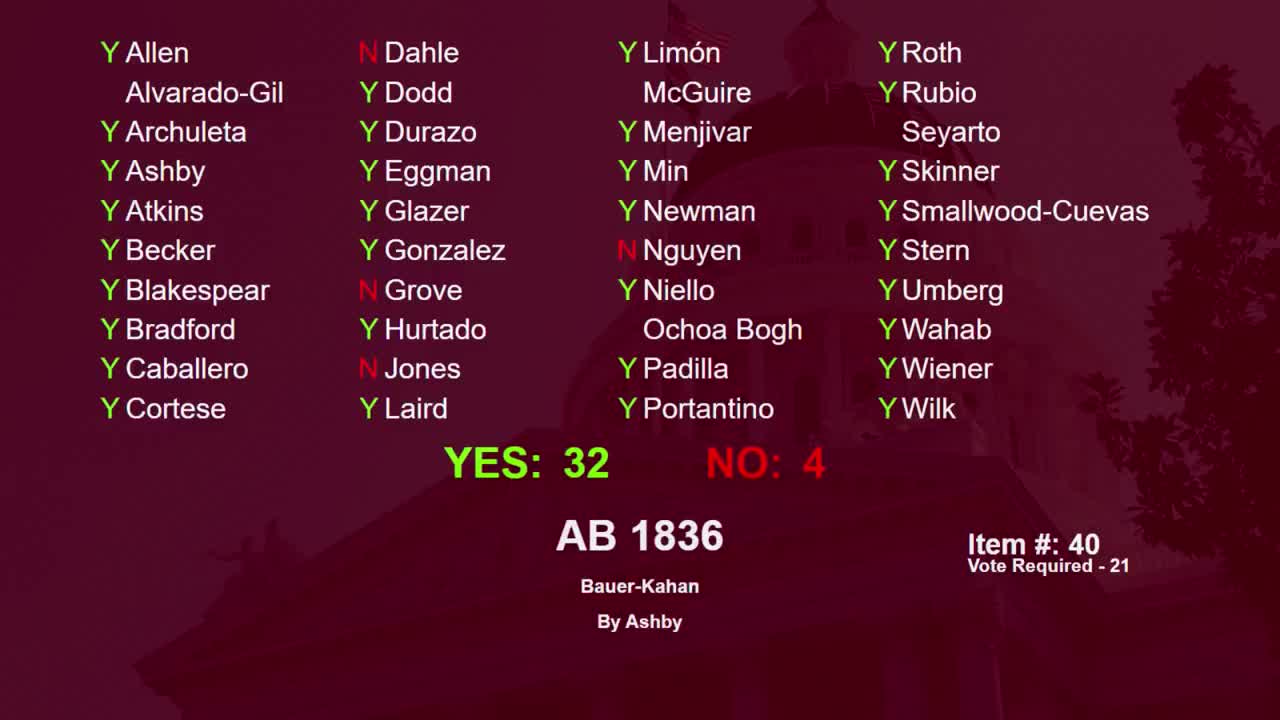 2MIN
Senate Floor
 39SEC
Assembly Floor
 14MIN
Senate Standing Committee on Environmental Quality
 25MIN
Senate Standing Committee on Agriculture
 15MIN
Senate Standing Committee on Business, Professions and Economic Development
 32MIN
Senate Standing Committee on Environmental Quality
 1MIN
Assembly Floor
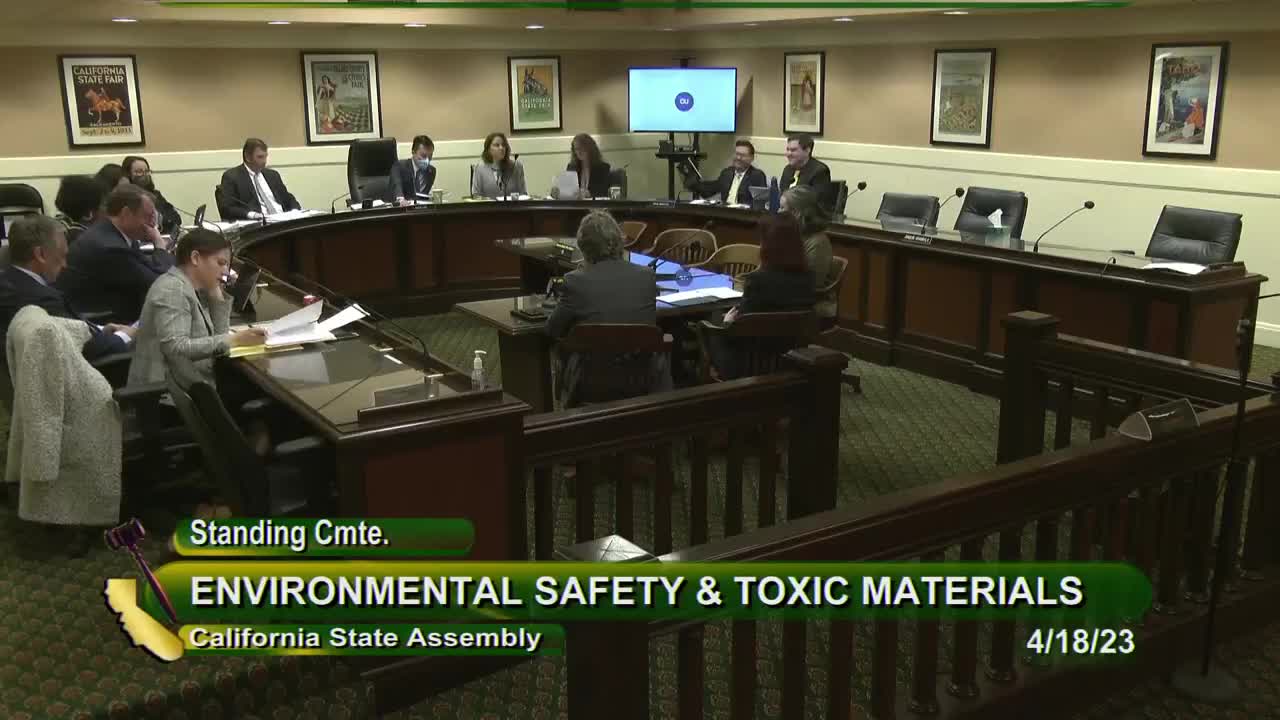 10MIN
Assembly Standing Committee on Environmental Safety and Toxic Materials
Bill Author

Bill Co-Author(s):
