AB 1059: Product safety: consumer products: textile fiberglass and covered flame retardant chemicals.
- Session Year: 2023-2024
- House: Assembly
- Latest Version Date: 2023-10-08
Current Status:
Passed
(2023-10-08: Chaptered by Secretary of State - Chapter 461, Statutes of 2023.)
Introduced
In Committee
First Chamber
In Committee
Second Chamber
Enacted
What does this bill do?
The bill bans the manufacture, sale, or distribution in California of new juvenile products, mattresses, and upholstered furniture that contain textile fiberglass and tightens limits on certain flame-retardant chemicals, affecting manufacturers, retailers, online sellers, and custom upholsterers. It ends the prior exemption that allowed most non-foam adult mattress components to contain those flame retardants starting in 2027, exempts aramid fiber used inside mattresses and modacrylic fiber without antimony trioxide, requires the mattress industry to submit a health risk study of modacrylic fiber, and lets the state toxic substances agency prioritize or set rules on flame retardants that would take precedence.
The summary is provided by generative AI which can make mistakes. For original language, please view the details in the table below.
Existing law, the Home Furnishings and Thermal Insulation Act, establishes the Bureau of Household Goods and Services to license and regulate persons engaged in businesses relating to upholstered furniture, bedding and filling materials, and insulation, including juvenile products and mattresses. A violation of the act is a misdemeanor.
Existing law prohibits a person from selling or distributing in commerce in this state any new, not previously owned juvenile products, mattresses, or upholstered furniture that contains covered flame retardant chemicals at specified levels, and prohibits a custom upholsterer from repairing, reupholstering, recovering, restoring, or renewing upholstered or reupholstered furniture using replacement components that contain covered flame retardant chemicals at specified levels. Existing law exempts from those requirements, among other things, components of adult mattresses other than foam.
This bill would make that exemption inoperative on January 1, 2027. The bill would exempt from the above-described requirements aramid fiber when used in fabric in the interior of a mattress or on a nonsleep surface of a mattress, as specified. The bill would additionally exempt modacrylic fiber without antimony trioxide or other covered flame retardant chemicals. The bill would require the International Sleep Products Association, on or before October 1, 2025, to submit to the bureau a quantitative health risk assessment of modacrylic fiber without antimony trioxide, as specified, and would require the bureau to post the assessment on its internet website.
Existing law, known as the Green Chemistry program, requires the Department of Toxic Substances Control to adopt regulations to establish a process to identify and prioritize chemicals or chemical ingredients in consumer products that may be considered as being chemicals of concern. Existing law provides that the Green Chemistry program does not authorize the department to supersede the regulatory authority of any other department or agency or duplicate or adopt conflicting regulations for product categories already regulated or subject to pending regulation, as provided. Existing law, the Safer Consumer Products Program, implements the Green Chemistry program pursuant to regulations adopted by the department.
This bill would authorize the department to prioritize or take action on a product containing a covered flame retardant chemical and would provide that if the department adopts regulations governing the use of a flame retardant chemical in a juvenile product, mattress, or upholstered furniture that those regulations adopted by the department shall prevail.
Existing law authorizes the bureau to assess a fine if a person continues to sell or distribute products in commerce in this state belonging to the same stock keeping unit as noncompliant products, as specified. Existing law requires the bureau to take specified other actions in that regard, including posting citations issued on the bureaus internet website and receiving complaints from consumers concerning juvenile products, upholstered furniture, or reupholstered furniture regulated under the act.
This bill would, on and after January 1, 2027, prohibit a person from manufacturing, selling, offering, or distributing in commerce in the state any new, not previously owned juvenile product, mattress, or upholstered furniture that contains, or a constituent component of which contains, textile fiberglass. The bill would, on and after January 1, 2027, prohibit a custom upholsterer from repairing, reupholstering, recovering, restoring, or renewing any mattress, juvenile product, upholstered furniture, or reupholstered furniture using a replacement component that contains, or a constituent component of which contains, textile fiberglass. The bill would authorize the bureau to assess a fine against a person who continues to sell or distribute noncompliant products and to take specified other actions in that regard, including posting citations issued on the bureaus internet website and receiving complaints from consumers.
Because the bill would expand the scope of a crime under the act, the bill would impose a state-mandated local program.
The California Constitution requires the state to reimburse local agencies and school districts for certain costs mandated by the state. Statutory provisions establish procedures for making that reimbursement.
This bill would provide that, if the Commission on State Mandates determines that the bill contains costs mandated by the state, reimbursement for those costs shall be made pursuant to the statutory provisions noted above.
Existing law, the Home Furnishings and Thermal Insulation Act, establishes the Bureau of Household Goods and Services to license and regulate persons engaged in businesses relating to upholstered furniture, bedding and filling materials, and insulation, including juvenile products and mattresses. A violation of the act is a misdemeanor.
Existing law prohibits a person from selling or distributing in commerce in this state any new, not previously owned juvenile products, mattresses, or upholstered furniture that contains covered flame-retardant flame retardant chemicals at specified levels, and prohibits a custom upholsterer from repairing, reupholstering, recovering, restoring, or renewing upholstered or reupholstered furniture using replacement components that contain covered flame-retardant flame retardant chemicals at specified levels. Existing law exempts from those requirements, among other things, components of adult mattresses other than foam.
This bill would make that exemption inoperative on January 1, 2027. The bill would exempt from the above-described requirements aramid fabric when used in the interior of a mattress or on a nonsleep surface of a mattress, as specified. The bill would additionally exempt, until January 1, 2027, exempt modacrylic fiber without antimony trioxide or other flame-retardant covered flame retardant chemicals. The bill would require the International Sleep Products Association, on or before October 1, 2025, to submit to the bureau a quantitative health risk assessment of modacrylic fiber without antimony trioxide, as specified, and would require the bureau to post the assessment on its internet website.
Existing law, known as the Green Chemistry program, requires the Department of Toxic Substances Control to adopt regulations to establish a process to identify and prioritize chemicals or chemical ingredients in consumer products that may be considered as being chemicals of concern. Existing law provides that the Green Chemistry program does not authorize the department to supersede the regulatory authority of any other department or agency or duplicate or adopt conflicting regulations for product categories already regulated or subject to pending regulation, as provided. Existing law, the Safer Consumer Products Program, implements the Green Chemistry program pursuant to regulations adopted by the department.
This bill would authorize the department to prioritize or take action on a product containing a covered flame retardant chemical and would provide that if the department adopts regulations governing the use of a flame retardant chemical in a juvenile product, mattress, or upholstered furniture that those regulations adopted by the department shall prevail.
Existing law authorizes the bureau to assess a fine if a person continues to sell or distribute products in commerce in this state belonging to the same stock keeping unit as noncompliant products, as specified. Existing law requires the bureau to take specified other actions in that regard, including posting citations issued on the bureaus internet website and receiving complaints from consumers concerning juvenile products, upholstered furniture, or reupholstered furniture regulated under the act.
This bill would, on and after January 1, 2027, prohibit a person from manufacturing, selling, offering, or distributing in commerce in the state any new, not previously owned juvenile product, mattress, or upholstered furniture that contains, or a constituent component of which contains, textile fiberglass. The bill would, on and after January 1, 2027, prohibit a custom upholsterer from repairing, reupholstering, recovering, restoring, or renewing any mattress, juvenile product, upholstered furniture, or reupholstered furniture using a replacement component that contains, or a constituent component of which contains, textile fiberglass. The bill would authorize the bureau to assess a fine against a person who continues to sell or distribute noncompliant products and to take specified other actions in that regard, including posting citations issued on the bureaus internet website and receiving complaints from consumers.
Because the bill would expand the scope of a crime under the act, the bill would impose a state-mandated local program.
The California Constitution requires the state to reimburse local agencies and school districts for certain costs mandated by the state. Statutory provisions establish procedures for making that reimbursement.
This bill would provide that, if the Commission on State Mandates determines that the bill contains costs mandated by the state, reimbursement for those costs shall be made pursuant to the statutory provisions noted above.
Existing law, the Home Furnishings and Thermal Insulation Act, establishes the Bureau of Household Goods and Services to license and regulate persons engaged in businesses relating to upholstered furniture, bedding and filling materials, and insulation, including juvenile products and mattresses. A violation of the act is a misdemeanor.
Existing law prohibits a person from selling or distributing in commerce in this state any new, not previously owned juvenile products, mattresses, or upholstered furniture that contains covered flame retardant flame-retardant chemicals at specified levels, and prohibits a custom upholsterer from repairing, reupholstering, recovering, restoring, or renewing upholstered or reupholstered furniture using replacement components that contain covered flame retardant flame-retardant chemicals at specified levels. Existing law exempts from those requirements requirements, among other things, components of adult mattresses other than foam.
This bill would make that exemption inoperative on January 1, 2027. The bill would exempt from the above-described requirements aramid fabric when used in the interior of a mattress or on a nonsleep surface of a mattress, as specified. The bill would additionally exempt, until January 1, 2027, modacrylic fiber without antimony trioxide or other flame-retardant chemicals.
Existing law authorizes the bureau to assess a fine if a person continues to sell or distribute products in commerce in this state belonging to the same stock keeping unit as noncompliant products, as specified. Existing law requires the bureau to take specified other actions in that regard, including posting citations issued on the bureaus internet website and receiving complaints from consumers concerning juvenile products, upholstered furniture, or reupholstered furniture regulated under the act.
This bill would, on and after January 1, 2027, prohibit a person from manufacturing, selling, offering, or distributing in commerce in the state any new, not previously owned juvenile product, mattress, or upholstered furniture that contains, or a constituent component of which contains, textile fiberglass. The bill would, on and after January 1, 2027, prohibit a custom upholsterer from repairing, reupholstering, recovering, restoring, or renewing any mattress, juvenile product, upholstered furniture, or reupholstered furniture using a replacement component that contains, or a constituent component of which contains, textile fiberglass. The bill would authorize the bureau to assess a fine against a person who continues to sell or distribute noncompliant products and to take specified other actions in that regard, including posting citations issued on the bureaus internet website and receiving complaints from consumers.
Because the bill would expand the scope of a crime under the act, the bill would impose a state-mandated local program.
The California Constitution requires the state to reimburse local agencies and school districts for certain costs mandated by the state. Statutory provisions establish procedures for making that reimbursement.
This bill would provide that, if the Commission on State Mandates determines that the bill contains costs mandated by the state, reimbursement for those costs shall be made pursuant to the statutory provisions noted above.
Existing law, the Home Furnishings and Thermal Insulation Act, establishes the Bureau of Household Goods and Services to license and regulate persons engaged in businesses relating to upholstered furniture, bedding and filling materials, and insulation, including juvenile products and mattresses. A violation of the act is a misdemeanor.
Existing law prohibits a person from selling or distributing in commerce in this state any new, not previously owned juvenile products, mattresses, or upholstered furniture that contains covered flame retardant chemicals at specified levels, and prohibits a custom upholsterer from repairing, reupholstering, recovering, restoring, or renewing upholstered or reupholstered furniture using replacement components that contain covered flame retardant chemicals at specified levels. Existing law exempts from those requirements components of adult mattresses other than foam.
This bill would make that exemption inoperative on January 1, 2027.
Existing law requires the bureau to provide the Department of Toxic Substances Control with samples from products regulated under the act to test for compliance with the provisions limiting the amount of covered flame retardant chemicals in specified products regulated under the act. Existing law authorizes the bureau to assess a fine if the departments testing shows a violation of that provision or if a person continues to sell or distribute products in commerce in this state belonging to the same stock keeping unit as noncompliant products, as specified. Existing law requires the bureau to take specified other actions in that regard, including posting citations issued on the bureaus internet website and receiving complaints from consumers concerning juvenile products, upholstered furniture, or reupholstered furniture regulated under the act.
This bill would, on and after January 1, 2027, prohibit a person from manufacturing, selling, offering, or distributing in commerce in the state any new, not previously owned juvenile product, mattress, or upholstered furniture that contains, or a constituent component of which contains, fiberglass. The bill would, on and after January 1, 2027, prohibit a custom upholsterer from repairing, reupholstering, recovering, restoring, or renewing any mattress, juvenile product, upholstered furniture, or reupholstered furniture using a replacement component that contains, or a constituent component of which contains, fiberglass. The bill would make the above-specified provisions requiring the department to test samples applicable to testing for fiberglass and for the bureau to take specified actions in that regard. authorize the bureau to assess a fine against a person who continues to sell or distribute noncompliant products and to take specified other actions in that regard, including posting citations issued on the bureaus internet website and receiving complaints from consumers.
Because the bill would expand the scope of a crime under the act, the bill would impose a state-mandated local program.
The California Constitution requires the state to reimburse local agencies and school districts for certain costs mandated by the state. Statutory provisions establish procedures for making that reimbursement.
This bill would provide that, if the Commission on State Mandates determines that the bill contains costs mandated by the state, reimbursement for those costs shall be made pursuant to the statutory provisions noted above.
Existing law, the Home Furnishings and Thermal Insulation Act, establishes the Bureau of Household Goods and Services to license and regulate persons engaged in businesses relating to upholstered furniture, bedding and filling materials, and insulation, including juvenile products and mattresses. A violation of the act is a misdemeanor.
Existing law prohibits a person from selling or distributing in commerce in this state any new, not previously owned juvenile products, mattresses, or upholstered furniture that contains covered flame retardant chemicals at specified levels, and prohibits a custom upholsterer from repairing, reupholstering, recovering, restoring, or renewing upholstered or reupholstered furniture using replacement components that contain covered flame retardant chemicals at specified levels. Existing law exempts from those requirements components of adult mattresses other than foam.
This bill would make that exemption inoperative on January 1, 2027.
Existing law requires the bureau to provide the Department of Toxic Substances Control with samples from products regulated under the act to test for compliance with the provisions limiting the amount of covered flame retardant chemicals in specified products regulated under the act. Existing law authorizes the bureau to assess a fine if the departments testing shows a violation of that provision or if a person continues to sell or distribute products in commerce in this state belonging to the same stock keeping unit as noncompliant products, as specified. Existing law requires the bureau to take specified other actions in that regard, including posting citations issued on the bureaus internet website and receiving complaints from consumers concerning juvenile products, upholstered furniture, or reupholstered furniture regulated under the act.
This bill would, on and after January 1, 2027, prohibit a person from manufacturing, selling, offering, or distributing in commerce in the state any new, not previously owned juvenile product, mattress, or upholstered furniture that contains, or a constituent component of which contains, fiberglass. The bill would, on and after January 1, 2027, prohibit a custom upholsterer from repairing, reupholstering, recovering, restoring, or renewing any mattress, juvenile product, upholstered furniture, or reupholstered furniture using a replacement component that contains, or a constituent component of which contains, fiberglass. The bill would make the above-specified provisions requiring the department to test samples applicable to testing for fiberglass and for the bureau to take specified actions in that regard.
Because the bill would expand the scope of a crime under the act, the bill would impose a state-mandated local program.
The California Constitution requires the state to reimburse local agencies and school districts for certain costs mandated by the state. Statutory provisions establish procedures for making that reimbursement.
This bill would provide that, if the Commission on State Mandates determines that the bill contains costs mandated by the state, reimbursement for those costs shall be made pursuant to the statutory provisions noted above.
Existing law prohibits a person, including a manufacturer, from selling or distributing in commerce in this state any new, not previously owned, juvenile product, as defined, that contains regulated perfluoroalkyl and polyfluoroalkyl substances, as defined.This bill would prohibit a person, including a manufacturer, from selling or distributing in commerce in this state any new juvenile product, as defined, mattress, or upholstered furniture that contains, or a constituent component of which contains, fiberglass. The bill would prohibit a custom upholsterer from repairing, reupholstering, recovering, restoring, or renewing any mattress, juvenile product, upholstered furniture, or reupholstered furniture using a replacement component that contains, or a constituent component of which contains, fiberglass.Existing law prohibits a person, including a manufacturer, from selling or distributing in commerce in this state any new, not previously owned, juvenile product, as defined, that contains regulated perfluoroalkyl and polyfluoroalkyl substances, as defined.
This bill would prohibit a person, including a manufacturer, from selling or distributing in commerce in this state any new juvenile product, as defined, mattress, or upholstered furniture that contains, or a constituent component of which contains, fiberglass. The bill would prohibit a custom upholsterer from repairing, reupholstering, recovering, restoring, or renewing any mattress, juvenile product, upholstered furniture, or reupholstered furniture using a replacement component that contains, or a constituent component of which contains, fiberglass.
(a)On or after January 1, 2020, a person, including a manufacturer, shall not sell or distribute in commerce in this state any new, not previously owned juvenile products, mattresses, or upholstered furniture that contains, or a constituent component of which contains, covered flame retardant chemicals at levels above 1,000 parts per million.
(b)On or after January 1, 2020, a custom upholsterer shall not repair, reupholster, recover, restore, or renew upholstered furniture or reupholstered furniture using replacement components that contain covered flame retardant chemicals at levels above 1,000 parts per million.
(c)The prohibitions in subdivisions (a) and (b) do not apply to the following:
(1)Electronic components of juvenile products, mattresses, reupholstered furniture, upholstered furniture, or any associated casing for those electronic components.
(2)Upholstered or reupholstered furniture components other than those identified in paragraph (1) of subdivision (a) of Section 19094.
(3)Thread or fiber when used for stitching mattress components together.
(4)Aramid fiber when used in fabric in the interior of a mattress or in fabric that covers the bottom (nonsleep surface) of a mattress that has a sleeping surface on only one side of the mattress.
(5)Modacrylic fiber without antimony trioxide or other covered flame retardant chemicals.
(6)Until January 1, 2027, components of adult mattresses other than foam. As used in this paragraph, adult mattresses means mattresses other than toddler mattresses, crib mattresses, and other infant sleep products.
(d)(1)On or before October 1, 2025, the International Sleep Products Association shall submit to the bureau a quantitative health risk assessment of modacrylic fiber without antimony trioxide that was performed by an independent toxicologist who is board-certified by the American Board of Toxicology.
(2)The bureau shall post the assessment conducted pursuant to subdivision (a) on its internet website.
(e)(1)Notwithstanding subdivisions (b) and (c) of Section 25257.1 of the Health and Safety Code, this section shall not be construed to prohibit or restrict the authority of the Department of Toxic Substances Control to prioritize or take action on any products containing a covered flame retardant chemical in order to limit exposure to or reduce the level of hazard posed by these covered flame retardant chemicals.
(2)If the Department of Toxic Substances Control adopts a regulatory response described in the Safer Consumer Products Program (Chapter 55 (commencing with Section 69501) of Division 4.5 of Title 22 of the California Code of Regulations) governing the use of a flame retardant chemical in a product covered by this section, this section shall not apply to the use of that chemical upon the date that the department posts a notice on its internet website that it has adopted the regulatory response.
SEC. 2.Section 19101.5 is added to the Business and Professions Code, to read:19101.5.(a)On and after January 1, 2027, a person, including, but not limited to, a manufacturer, retailer, importer, or online seller, shall not manufacture, sell, offer, or distribute in commerce in this state any new, not previously owned juvenile product, mattress, or upholstered furniture that contains, or a constituent component of which contains, textile fiberglass.
(b)On and after January 1, 2027, a custom upholsterer shall not repair, reupholster, recover, restore, or renew any mattress, juvenile product, upholstered furniture, or reupholstered furniture using a replacement component that contains, or a constituent component of which contains, textile fiberglass.
(c)For purposes of this section, textile fiberglass means textile yarns whose composition includes one or more continuous glass filaments in a form suitable for knitting, weaving, or otherwise intertwining to form a textile fabric, but excludes the following:
(1)Thread or fiber when used for stitching mattress components together.
(2)Yarns in which the glass filaments are corespun or sheathed by another fiber.
SEC. 3.Section 19103 of the Business and Professions Code is amended to read:19103.(a)The bureau shall enforce and ensure compliance with Sections 19101 and 19101.5.
(b)(1)The bureau shall provide the Department of Toxic Substances Control with a selection of samples from products regulated under this article to test for compliance with Section 19101. The bureau shall select samples based on consultation with the Department of Toxic Substances Control, taking into account a range of manufacturers and types of products regulated under this article. The bureau shall integrate these testing requirements into the existing testing program described in subdivision (c) of Section 19094.
(2)(A)If the Department of Toxic Substances Controls testing shows that any reupholstered furniture or new, not previously owned juvenile products, mattresses, or upholstered furniture is in violation of Section 19101, the bureau may assess fines for violations against manufacturers of the product for the violation. The bureau shall reimburse the Department of Toxic Substances Control for the cost of testing for the presence of covered flame retardant chemicals pursuant to this article.
(B)If a person continues to sell or distribute products in commerce in this state belonging to the same stock keeping unit (SKU) as products that do not comply with Sections 19101 and 19101.5, after notice of the violation is posted on the bureaus internet website, the bureau may assess fines against the person for the continued sale or distribution of those products. The bureau shall make information about any citation issued pursuant to this section available to the public on its internet website, and shall develop a process for keeping interested persons informed about updates to notices of violation posted on the bureaus internet website.
(c)A fine for a violation of this section shall be assessed in accordance with the following schedule:
(1)The fine for the first violation shall be not less than one thousand dollars ($1,000), but not more than two thousand five hundred dollars ($2,500).
(2)The fine for the second violation shall be not less than two thousand five hundred dollars ($2,500), but not more than five thousand dollars ($5,000).
(3)The fine for the third violation shall be not less than five thousand dollars ($5,000), but not more than seven thousand five hundred dollars ($7,500).
(4)The fine for any subsequent violation shall be not less than seven thousand five hundred dollars ($7,500), but not more than ten thousand dollars ($10,000).
(d)In determining the amount of the fine for a violation of this section, the bureau shall consider the following factors:
(1)The nature and severity of the violation.
(2)The good or bad faith of the cited person.
(3)The history of previous violations.
(4)Evidence that the violation was willful.
(5)The extent to which the cited person or entity has cooperated with the bureau.
(e)(1)The bureau shall adjust all minimum and maximum fines imposed by this section for inflation every five years.
(2)The adjustment shall be equivalent to the percentage, if any, that the Consumer Price Index at the time of adjustment exceeds the Consumer Price Index at the time this section goes into effect. Any increase determined under this paragraph shall be rounded as follows:
(A)In multiples of ten dollars ($10) in the case of penalties less than or equal to one hundred dollars ($100).
(B)In multiples of one hundred dollars ($100) in the case of penalties greater than one hundred dollars ($100), but less than or equal to one thousand dollars ($1,000).
(C)In multiples of one thousand dollars ($1,000) in the case of penalties greater than one thousand dollars ($1,000).
(f)The bureau shall receive complaints from consumers concerning products regulated by this article sold in this state.
SEC. 4.If the Commission on State Mandates determines that this act contains costs mandated by the state, reimbursement to local agencies and school districts for those costs shall be made pursuant to Part 7 (commencing with Section 17500) of Division 4 of Title 2 of the Government Code.
(a)On or after January 1, 2020, a person, including a manufacturer, shall not sell or distribute in commerce in this state any new, not previously owned juvenile products, mattresses, or upholstered furniture that contains, or a constituent component of which contains, covered flame-retardant flame retardant chemicals at levels above 1,000 parts per million.
(b)On or after January 1, 2020, a custom upholsterer shall not repair, reupholster, recover, restore, or renew upholstered furniture or reupholstered furniture using replacement components that contain covered flame-retardant flame retardant chemicals at levels above 1,000 parts per million.
(c)The prohibitions in subdivisions (a) and (b) do not apply to the following:
(1)Electronic components of juvenile products, mattresses, reupholstered furniture, upholstered furniture, or any associated casing for those electronic components.
(2)Upholstered or reupholstered furniture components other than those identified in paragraph (1) of subdivision (a) of Section 19094.
(3)Thread or fiber when used for stitching mattress components together.
(4)Aramid fiber when used in fabric in the interior of a mattress or in fabric that covers the bottom (nonsleep surface) of a mattress that has a sleeping surface on only one side of the mattress.
(5)Until January 1, 2027, modacrylic Modacrylic fiber without antimony trioxide or other flame-retardant covered flame retardant chemicals.
(6)Until January 1, 2027, components of adult mattresses other than foam. As used in this paragraph, adult mattresses means mattresses other than toddler mattresses, crib mattresses, and other infant sleep products.
(d)(1)On or before October 1, 2025, the International Sleep Products Association shall submit to the bureau a quantitative health risk assessment of modacrylic fiber without antimony trioxide that was performed by an independent toxicologist who is board-certified by the American Board of Toxicology.
(2)The bureau shall post the assessment conducted pursuant to subdivision (a) on its internet website.
(d)(e)(1)Notwithstanding subdivisions (b) and (c) of Section 25257.1 of the Health and Safety Code, this section shall not be construed to prohibit or restrict the authority of the Department of Toxic Substances Control to prioritize or take action on any products containing a covered flame-retardant flame retardant chemical in order to limit exposure to or reduce the level of hazard posed by these covered flame-retardant flame retardant chemicals.
(2)If the Department of Toxic Substances Control adopts a regulatory response described in the Safer Consumer Products Program (Chapter 55 (commencing with Section 69501) of Division 4.5 of Title 22 of the California Code of Regulations) governing the use of a flame retardant chemical in a product covered by this section, this section shall not apply to the use of that chemical upon the date that the department posts a notice on its internet website that it has adopted the regulatory response.
SEC. 2.Section 19101.5 is added to the Business and Professions Code, to read:19101.5.(a)On and after January 1, 2027, a person, including, but not limited to, a manufacturer, retailer, importer, or online seller, shall not manufacture, sell, offer, or distribute in commerce in this state any new, not previously owned juvenile product, mattress, or upholstered furniture that contains, or a constituent component of which contains, textile fiberglass.
(b)On and after January 1, 2027, a custom upholsterer shall not repair, reupholster, recover, restore, or renew any mattress, juvenile product, upholstered furniture, or reupholstered furniture using a replacement component that contains, or a constituent component of which contains, textile fiberglass.
(c)For purposes of this section, textile fiberglass means textile yarns whose composition includes one or more continuous glass filaments in a form suitable for knitting, weaving, or otherwise intertwining to form a textile fabric, but excludes the following:
(1)Thread or fiber when used for stitching mattress components together.
(2)Yarns in which the glass filaments are corespun or sheathed by another fiber.
SEC. 3.Section 19103 of the Business and Professions Code is amended to read:19103.(a)The bureau shall enforce and ensure compliance with Sections 19101 and 19101.5.
(b)(1)The bureau shall provide the Department of Toxic Substances Control with a selection of samples from products regulated under this article to test for compliance with Section 19101. The bureau shall select samples based on consultation with the Department of Toxic Substances Control, taking into account a range of manufacturers and types of products regulated under this article. The bureau shall integrate these testing requirements into the existing testing program described in subdivision (c) of Section 19094.
(2)(A)If the Department of Toxic Substances Controls testing shows that any reupholstered furniture or new, not previously owned juvenile products, mattresses, or upholstered furniture is in violation of Section 19101, the bureau may assess fines for violations against manufacturers of the product for the violation. The bureau shall reimburse the Department of Toxic Substances Control for the cost of testing for the presence of covered flame-retardant flame retardant chemicals pursuant to this article.
(B)If a person continues to sell or distribute products in commerce in this state belonging to the same stock keeping unit (SKU) as products that do not comply with Sections 19101 and 19101.5, after notice of the violation is posted on the bureaus internet website, the bureau may assess fines against the person for the continued sale or distribution of those products. The bureau shall make information about any citation issued pursuant to this section available to the public on its internet website, and shall develop a process for keeping interested persons informed about updates to notices of violation posted on the bureaus internet website.
(c)A fine for a violation of this section shall be assessed in accordance with the following schedule:
(1)The fine for the first violation shall be not less than one thousand dollars ($1,000), but not more than two thousand five hundred dollars ($2,500).
(2)The fine for the second violation shall be not less than two thousand five hundred dollars ($2,500), but not more than five thousand dollars ($5,000).
(3)The fine for the third violation shall be not less than five thousand dollars ($5,000), but not more than seven thousand five hundred dollars ($7,500).
(4)The fine for any subsequent violation shall be not less than seven thousand five hundred dollars ($7,500), but not more than ten thousand dollars ($10,000).
(d)In determining the amount of the fine for a violation of this section, the bureau shall consider the following factors:
(1)The nature and severity of the violation.
(2)The good or bad faith of the cited person.
(3)The history of previous violations.
(4)Evidence that the violation was willful.
(5)The extent to which the cited person or entity has cooperated with the bureau.
(e)(1)The bureau shall adjust all minimum and maximum fines imposed by this section for inflation every five years.
(2)The adjustment shall be equivalent to the percentage, if any, that the Consumer Price Index at the time of adjustment exceeds the Consumer Price Index at the time this section goes into effect. Any increase determined under this paragraph shall be rounded as follows:
(A)In multiples of ten dollars ($10) in the case of penalties less than or equal to one hundred dollars ($100).
(B)In multiples of one hundred dollars ($100) in the case of penalties greater than one hundred dollars ($100), but less than or equal to one thousand dollars ($1,000).
(C)In multiples of one thousand dollars ($1,000) in the case of penalties greater than one thousand dollars ($1,000).
(f)The bureau shall receive complaints from consumers concerning products regulated by this article sold in this state.
SEC. 4.If the Commission on State Mandates determines that this act contains costs mandated by the state, reimbursement to local agencies and school districts for those costs shall be made pursuant to Part 7 (commencing with Section 17500) of Division 4 of Title 2 of the Government Code.
(a)On or after January 1, 2020, a person, including a manufacturer, shall not sell or distribute in commerce in this state any new, not previously owned juvenile products, mattresses, or upholstered furniture that contains, or a constituent component of which contains, covered flame retardant flame-retardant chemicals at levels above 1,000 parts per million.
(b)On or after January 1, 2020, a custom upholsterer shall not repair, reupholster, recover, restore, or renew upholstered furniture or reupholstered furniture using replacement components that contain covered flame retardant flame-retardant chemicals at levels above 1,000 parts per million.
(c)The prohibitions in subdivisions (a) and (b) do not apply to the following:
(1)Electronic components of juvenile products, mattresses, reupholstered furniture, upholstered furniture, or any associated casing for those electronic components.
(2)Upholstered or reupholstered furniture components other than those identified in paragraph (1) of subdivision (a) of Section 19094.
(3)Thread or fiber when used for stitching mattress components together.
(4)Aramid fiber when used in fabric in the interior of a mattress or in fabric that covers the bottom (nonsleep surface) of a mattress that has a sleeping surface on only one side of the mattress.
(5)Until January 1, 2027, modacrylic fiber without antimony trioxide or other flame-retardant chemicals.
(4)(6)Until January 1, 2027, components of adult mattresses other than foam. As used in this paragraph, adult mattresses means mattresses other than toddler mattresses, crib mattresses, and other infant sleep products.
(d)Notwithstanding subdivisions (b) and (c) of Section 25257.1 of the Health and Safety Code, this section shall not be construed to prohibit or restrict the authority of the Department of Toxic Substances Control to prioritize or take action on any products containing a covered flame-retardant chemical in order to limit exposure to or reduce the level of hazard posed by these covered flame-retardant chemicals.
SEC. 2.Section 19101.5 is added to the Business and Professions Code, to read:19101.5.(a)On and after January 1, 2027, a person, including, but not limited to, a manufacturer, retailer, importer, or online seller, shall not manufacture, sell, offer, or distribute in commerce in this state any new, not previously owned juvenile product, mattress, or upholstered furniture that contains, or a constituent component of which contains, textile fiberglass.
(b)On and after January 1, 2027, a custom upholsterer shall not repair, reupholster, recover, restore, or renew any mattress, juvenile product, upholstered furniture, or reupholstered furniture using a replacement component that contains, or a constituent component of which contains, textile fiberglass.
(c)For purposes of this section, fiberglass textile fiberglass means textile yarns whose composition includes one or more continuous glass filaments in a form suitable for knitting, weaving, or otherwise intertwining to form a textile fabric, but excludes the following:
(1)Thread or fiber when used for stitching mattress components together.
(2)Yarns in which the glass filaments are corespun or sheathed by another fiber.
SEC. 3.Section 19103 of the Business and Professions Code is amended to read:19103.(a)The bureau shall enforce and ensure compliance with Sections 19101 and 19101.5.
(b)(1)The bureau shall provide the Department of Toxic Substances Control with a selection of samples from products regulated under this article to test for compliance with Section 19101. The bureau shall select samples based on consultation with the Department of Toxic Substances Control, taking into account a range of manufacturers and types of products regulated under this article. The bureau shall integrate these testing requirements into the existing testing program described in subdivision (c) of Section 19094.
(2)(A)If the Department of Toxic Substances Controls testing shows that any reupholstered furniture or new, not previously owned juvenile products, mattresses, or upholstered furniture is in violation of Section 19101, the bureau may assess fines for violations against manufacturers of the product for the violation. The bureau shall reimburse the Department of Toxic Substances Control for the cost of testing for the presence of covered flame retardant flame-retardant chemicals pursuant to this article.
(B)If a person continues to sell or distribute products in commerce in this state belonging to the same stock keeping unit (SKU) as products that do not comply with Sections 19101 and 19101.5, after notice of the violation is posted on the bureaus internet website, the bureau may assess fines against the person for the continued sale or distribution of those products. The bureau shall make information about any citation issued pursuant to this section available to the public on its internet website, and shall develop a process for keeping interested persons informed about updates to notices of violation posted on the bureaus internet website.
(c)A fine for a violation of this section shall be assessed in accordance with the following schedule:
(1)The fine for the first violation shall be not less than one thousand dollars ($1,000), but not more than two thousand five hundred dollars ($2,500).
(2)The fine for the second violation shall be not less than two thousand five hundred dollars ($2,500), but not more than five thousand dollars ($5,000).
(3)The fine for the third violation shall be not less than five thousand dollars ($5,000), but not more than seven thousand five hundred dollars ($7,500).
(4)The fine for any subsequent violation shall be not less than seven thousand five hundred dollars ($7,500), but not more than ten thousand dollars ($10,000).
(d)In determining the amount of the fine for a violation of this section, the bureau shall consider the following factors:
(1)The nature and severity of the violation.
(2)The good or bad faith of the cited person.
(3)The history of previous violations.
(4)Evidence that the violation was willful.
(5)The extent to which the cited person or entity has cooperated with the bureau.
(e)(1)The bureau shall adjust all minimum and maximum fines imposed by this section for inflation every five years.
(2)The adjustment shall be equivalent to the percentage, if any, that the Consumer Price Index at the time of adjustment exceeds the Consumer Price Index at the time this section goes into effect. Any increase determined under this paragraph shall be rounded as follows:
(A)In multiples of ten dollars ($10) in the case of penalties less than or equal to one hundred dollars ($100).
(B)In multiples of one hundred dollars ($100) in the case of penalties greater than one hundred dollars ($100), but less than or equal to one thousand dollars ($1,000).
(C)In multiples of one thousand dollars ($1,000) in the case of penalties greater than one thousand dollars ($1,000).
(f)The bureau shall receive complaints from consumers concerning products regulated by this article sold in this state.
SEC. 4.If the Commission on State Mandates determines that this act contains costs mandated by the state, reimbursement to local agencies and school districts for those costs shall be made pursuant to Part 7 (commencing with Section 17500) of Division 4 of Title 2 of the Government Code.
(a)On or after January 1, 2020, a person, including a manufacturer, shall not sell or distribute in commerce in this state any new, not previously owned juvenile products, mattresses, or upholstered furniture that contains, or a constituent component of which contains, covered flame retardant chemicals at levels above 1,000 parts per million.
(b)On or after January 1, 2020, a custom upholsterer shall not repair, reupholster, recover, restore, or renew upholstered furniture or reupholstered furniture using replacement components that contain covered flame retardant chemicals at levels above 1,000 parts per million.
(c)The prohibitions in subdivisions (a) and (b) do not apply to the following:
(1)Electronic components of juvenile products, mattresses, reupholstered furniture, upholstered furniture, or any associated casing for those electronic components.
(2)Upholstered or reupholstered furniture components other than those identified in paragraph (1) of subdivision (a) of Section 19094.
(3)Thread or fiber when used for stitching mattress components together.
(4)Until January 1, 2027, components of adult mattresses other than foam. As used in this paragraph, adult mattresses means mattresses other than toddler mattresses, crib mattresses, and other infant sleep products.
SEC. 2.Section 19101.5 is added to the Business and Professions Code, to read:19101.5.(a)On and after January 1, 2027, a person, including, but not limited to, a manufacturer, retailer, importer, or online seller, shall not manufacture, sell, offer, or distribute in commerce in this state any new, not previously owned juvenile product, mattress, or upholstered furniture that contains, or a constituent component of which contains, fiberglass.
(b)On and after January 1, 2027, a custom upholsterer shall not repair, reupholster, recover, restore, or renew any mattress, juvenile product, upholstered furniture, or reupholstered furniture using a replacement component that contains, or a constituent component of which contains, fiberglass.
(c)For purposes of this section, fiberglass means textile yarns whose composition includes one or more continuous glass filaments in a form suitable for knitting, weaving, or otherwise intertwining to form a textile fabric, but excludes the following:
(1)Thread or fiber when used for stitching mattress components together.
(2)Yarns in which the glass filaments are corespun or sheathed by another fiber.
SEC. 3.Section 19103 of the Business and Professions Code is amended to read:19103.(a)The bureau shall enforce and ensure compliance with Sections 19101 and 19101.5.
(b)(1)The bureau shall provide the Department of Toxic Substances Control with a selection of samples from products regulated under this article to test for compliance with Sections 19101 and 19101.5. Section 19101. The bureau shall select samples based on consultation with the Department of Toxic Substances Control, taking into account a range of manufacturers and types of products regulated under this article. The bureau shall integrate these testing requirements into the existing testing program described in subdivision (c) of Section 19094.
(2)(A)If the Department of Toxic Substances Controls testing shows that any reupholstered furniture or new, not previously owned juvenile products, mattresses, or upholstered furniture is in violation of Sections 19101 and 19101.5, Section 19101, the bureau may assess fines for violations against manufacturers of the product for the violation. The bureau shall reimburse the Department of Toxic Substances Control for the cost of testing for the presence of covered flame retardant chemicals pursuant to this article.
(B)If a person continues to sell or distribute products in commerce in this state belonging to the same stock keeping unit (SKU) as products that do not comply with Sections 19101 and 19101.5, after notice of the violation is posted on the bureaus internet website, the bureau may assess fines against the person for the continued sale or distribution of those products. The bureau shall make information about any citation issued pursuant to this section available to the public on its internet website, and shall develop a process for keeping interested persons informed about updates to notices of violation posted on the bureaus internet website.
(c)A fine for a violation of this section shall be assessed in accordance with the following schedule:
(1)The fine for the first violation shall be not less than one thousand dollars ($1,000), but not more than two thousand five hundred dollars ($2,500).
(2)The fine for the second violation shall be not less than two thousand five hundred dollars ($2,500), but not more than five thousand dollars ($5,000).
(3)The fine for the third violation shall be not less than five thousand dollars ($5,000), but not more than seven thousand five hundred dollars ($7,500).
(4)The fine for any subsequent violation shall be not less than seven thousand five hundred dollars ($7,500), but not more than ten thousand dollars ($10,000).
(d)In determining the amount of the fine for a violation of this section, the bureau shall consider the following factors:
(1)The nature and severity of the violation.
(2)The good or bad faith of the cited person.
(3)The history of previous violations.
(4)Evidence that the violation was willful.
(5)The extent to which the cited person or entity has cooperated with the bureau.
(e)(1)The bureau shall adjust all minimum and maximum fines imposed by this section for inflation every five years.
(2)The adjustment shall be equivalent to the percentage, if any, that the Consumer Price Index at the time of adjustment exceeds the Consumer Price Index at the time this section goes into effect. Any increase determined under this paragraph shall be rounded as follows:
(A)In multiples of ten dollars ($10) in the case of penalties less than or equal to one hundred dollars ($100).
(B)In multiples of one hundred dollars ($100) in the case of penalties greater than one hundred dollars ($100), but less than or equal to one thousand dollars ($1,000).
(C)In multiples of one thousand dollars ($1,000) in the case of penalties greater than one thousand dollars ($1,000).
(f)The bureau shall receive complaints from consumers concerning products regulated by this article sold in this state.
SEC. 4.If the Commission on State Mandates determines that this act contains costs mandated by the state, reimbursement to local agencies and school districts for those costs shall be made pursuant to Part 7 (commencing with Section 17500) of Division 4 of Title 2 of the Government Code.
(a)On or after January 1, 2020, a person, including a manufacturer, shall not sell or distribute in commerce in this state any new, not previously owned juvenile products, mattresses, or upholstered furniture that contains, or a constituent component of which contains, covered flame retardant chemicals at levels above 1,000 parts per million.
(b)On or after January 1, 2020, a custom upholsterer shall not repair, reupholster, recover, restore, or renew upholstered furniture or reupholstered furniture using replacement components that contain covered flame retardant chemicals at levels above 1,000 parts per million.
(c)The prohibitions in subdivisions (a) and (b) do not apply to the following:
(1)Electronic components of juvenile products, mattresses, reupholstered furniture, upholstered furniture, or any associated casing for those electronic components.
(2)Upholstered or reupholstered furniture components other than those identified in paragraph (1) of subdivision (a) of Section 19094.
(3)Thread or fiber when used for stitching mattress components together.
(4)Components Until January 1, 2027, components of adult mattresses other than foam. As used in this paragraph, adult mattresses means mattresses other than toddler mattresses, crib mattresses, and other infant sleep products.
SEC. 2.Section 19101.5 is added to the Business and Professions Code, to read:19101.5.(a)On and after January 1, 2027, a person, including, but not limited to, a manufacturer, retailer, importer, or online seller, shall not manufacture, sell, offer, or distribute in commerce in this state any new, not previously owned juvenile product, mattress, or upholstered furniture that contains, or a constituent component of which contains, fiberglass.
(b)On and after January 1, 2027, a custom upholsterer shall not repair, reupholster, recover, restore, or renew any mattress, juvenile product, upholstered furniture, or reupholstered furniture using a replacement component that contains, or a constituent component of which contains, fiberglass.
(c)For purposes of this section, fiberglass means textile yarns whose composition includes one or more continuous glass filaments in a form suitable for knitting, weaving, or otherwise intertwining to form a textile fabric, but excludes the following:
(1)Thread or fiber when used for stitching mattress components together.
(2)Yarns in which the glass filaments are corespun or sheathed by another fiber.
SEC. 3.Section 19103 of the Business and Professions Code is amended to read:19103.(a)The bureau shall enforce and ensure compliance with Section 19101. Sections 19101 and 19101.5.
(b)(1)The bureau shall provide the Department of Toxic Substances Control with a selection of samples from products regulated under this article to test for compliance with Section 19101. Sections 19101 and 19101.5. The bureau shall select samples based on consultation with the Department of Toxic Substances Control, taking into account a range of manufacturers and types of products regulated under this article. The bureau shall integrate these testing requirements into the existing testing program described in subdivision (c) of Section 19094.
(2)(A)If the Department of Toxic Substances Controls testing shows that any reupholstered furniture or new, not previously owned juvenile products, mattresses, or upholstered furniture is in violation of Section 19101, Sections 19101 and 19101.5, the bureau may assess fines for violations against manufacturers of the product for the violation. The bureau shall reimburse the Department of Toxic Substances Control for the cost of testing for the presence of covered flame retardant chemicals pursuant to this article.
(B)If a person continues to sell or distribute products in commerce in this state belonging to the same stock keeping unit (SKU) as products that do not comply with Section 19101, Sections 19101 and 19101.5, after notice of the violation is posted on the bureaus Internet Web site, internet website, the bureau may assess fines against the person for the continued sale or distribution of those products. The bureau shall make information about any citation issued pursuant to this section available to the public on its Internet Web site, internet website, and shall develop a process for keeping interested persons informed about updates to notices of violation posted on the bureaus Internet Web site. internet website.
(c)A fine for a violation of this section shall be assessed in accordance with the following schedule:
(1)The fine for the first violation shall be not less than one thousand dollars ($1,000), but not more than two thousand five hundred dollars ($2,500).
(2)The fine for the second violation shall be not less than two thousand five hundred dollars ($2,500), but not more than five thousand dollars ($5,000).
(3)The fine for the third violation shall be not less than five thousand dollars ($5,000), but not more than seven thousand five hundred dollars ($7,500).
(4)The fine for any subsequent violation shall be not less than seven thousand five hundred dollars ($7,500), but not more than ten thousand dollars ($10,000).
(d)In determining the amount of the fine for a violation of this section, the bureau shall consider the following factors:
(1)The nature and severity of the violation.
(2)The good or bad faith of the cited person.
(3)The history of previous violations.
(4)Evidence that the violation was willful.
(5)The extent to which the cited person or entity has cooperated with the bureau.
(e)(1)The bureau shall adjust all minimum and maximum fines imposed by this section for inflation every five years.
(2)The adjustment shall be equivalent to the percentage, if any, that the Consumer Price Index at the time of adjustment exceeds the Consumer Price Index at the time this section goes into effect. Any increase determined under this paragraph shall be rounded as follows:
(A)In multiples of ten dollars ($10) in the case of penalties less than or equal to one hundred dollars ($100).
(B)In multiples of one hundred dollars ($100) in the case of penalties greater than one hundred dollars ($100), but less than or equal to one thousand dollars ($1,000).
(C)In multiples of one thousand dollars ($1,000) in the case of penalties greater than one thousand dollars ($1,000).
(f)The bureau shall receive complaints from consumers concerning products regulated by this article sold in this state.
SEC. 4.If the Commission on State Mandates determines that this act contains costs mandated by the state, reimbursement to local agencies and school districts for those costs shall be made pursuant to Part 7 (commencing with Section 17500) of Division 4 of Title 2 of the Government Code.
SECTION 1.Article 6 (commencing with Section 108670) is added to Chapter 5 of Part 3 of Division 104 of the Health and Safety Code, to read:6.Consumer Products Containing Fiberglass108670.(a)For purposes of this section, juvenile product has the same meaning as in Section 108945.(b)A person, including, but not limited to, a manufacturer, shall not sell or distribute in commerce in this state any new juvenile product, mattress, or upholstered furniture that contains, or a constituent component of which contains, fiberglass.(c)A custom upholsterer shall not repair, reupholster, recover, restore, or renew any mattress, juvenile product, upholstered furniture, or reupholstered furniture using a replacement component that contains, or a constituent component of which contains, fiberglass.(a)For purposes of this section, juvenile product has the same meaning as in Section 108945.
(b)A person, including, but not limited to, a manufacturer, shall not sell or distribute in commerce in this state any new juvenile product, mattress, or upholstered furniture that contains, or a constituent component of which contains, fiberglass.
(c)A custom upholsterer shall not repair, reupholster, recover, restore, or renew any mattress, juvenile product, upholstered furniture, or reupholstered furniture using a replacement component that contains, or a constituent component of which contains, fiberglass.
|
Date
|
Status
|
|---|---|
| Oct 8, 2023 | Chaptered by Secretary of State - Chapter 461, Statutes of 2023. |
| Oct 8, 2023 | Approved by the Governor. |
| Sep 15, 2023 | Enrolled and presented to the Governor at 4 p.m. |
| Sep 11, 2023 | Senate amendments concurred in. To Engrossing and Enrolling. (Ayes 67. Noes 0. Page 3193.). |
| Sep 7, 2023 | In Assembly. Concurrence in Senate amendments pending. May be considered on or after September 9 pursuant to Assembly Rule 77. |
| Sep 7, 2023 | Read third time. Passed. Ordered to the Assembly. (Ayes 35. Noes 3. Page 2463.). |
| Sep 5, 2023 | Read second time. Ordered to third reading. |
| Sep 1, 2023 | Read second time and amended. Ordered returned to second reading. |
| Sep 1, 2023 | From committee: Amend, and do pass as amended. (Ayes 5. Noes 2.) (September 1). |
| Aug 21, 2023 | In committee: Referred to APPR suspense file. |
| Jul 10, 2023 | From committee: Do pass and re-refer to Com. on APPR. (Ayes 10. Noes 0.) (July 10). Re-referred to Com. on APPR. |
| Jun 29, 2023 | From committee: Do pass and re-refer to Com. on B., P. & E. D. (Ayes 6. Noes 0.) (June 28). Re-referred to Com. on B., P. & E. D. |
| Jun 14, 2023 | From committee chair, with author's amendments: Amend, and re-refer to committee. Read second time, amended, and re-referred to Com. on E.Q. |
| Jun 7, 2023 | Referred to Coms. on E.Q. and B., P. & E. D. |
| May 31, 2023 | In Senate. Read first time. To Com. on RLS. for assignment. |
| May 30, 2023 | Read third time. Passed. Ordered to the Senate. (Ayes 64. Noes 14. Page 1891.) |
| May 18, 2023 | Read second time. Ordered to third reading. |
| May 18, 2023 | From committee: Do pass. (Ayes 11. Noes 4.) (May 18). |
| May 3, 2023 | In committee: Set, first hearing. Referred to APPR. suspense file. |
| Apr 19, 2023 | From committee: Do pass and re-refer to Com. on APPR. (Ayes 7. Noes 1.) (April 18). Re-referred to Com. on APPR. |
| Apr 12, 2023 | Re-referred to Com. on E.S. & T.M. |
| Apr 11, 2023 | Re-referred to Com. on E.S. & T.M. |
| Apr 11, 2023 | From committee chair, with author's amendments: Amend, and re-refer to Com. on E.S. & T.M. Read second time and amended. |
| Apr 10, 2023 | From committee chair, with author's amendments: Amend, and re-refer to Com. on E.S. & T.M. Read second time and amended. |
| Mar 20, 2023 | In committee: Hearing postponed by committee. |
| Mar 2, 2023 | Referred to Com. on E.S. & T.M. |
| Feb 16, 2023 | From printer. May be heard in committee March 18. |
| Feb 15, 2023 | Read first time. To print. |
|
Date
|
Description
|
Location
|
Votes
|
|
|---|---|---|---|---|
| Sep 11, 2023 | AB 1059 Friedman Concurrence in Senate Amendments | Assembly Floor |
Passed |
|
| Sep 7, 2023 | Assembly 3rd Reading AB1059 Friedman By Dahle | Senate Floor |
Passed |
|
| Sep 1, 2023 | Do pass as amended | Senate Standing Committee on Appropriations |
Passed |
|
| Aug 21, 2023 | Placed on suspense file | Senate Standing Committee on Appropriations |
Passed |
|
| Jul 10, 2023 | Do pass, but first be re-referred to the Committee on [Appropriations] | Senate Standing Committee on Business, Professions and Economic Development |
Passed |
|
| Jun 28, 2023 | Do pass, but first be re-referred to the Committee on [Business, Professions and Economic Development] | Senate Standing Committee on Environmental Quality |
Passed |
|
| May 30, 2023 | AB 1059 Friedman Assembly Third Reading | Assembly Floor |
Passed |
|
| May 18, 2023 | Do pass. | Assembly Standing Committee on Appropriations |
Passed |
|
| Apr 18, 2023 | Do pass and be re-referred to the Committee on [Appropriations] | Assembly Standing Committee on Environmental Safety and Toxic Materials |
Passed |
This list shows positions taken on this bill by organizations on the date displayed, which is linked to the original source.
Positions by individuals are not included.
|
Organization
|
Position
|
Date
|
|---|---|---|
| California Against Waste | ** Support | |
| California Cannabis Industry Association | * Support | Apr 22, 2024 |
| California Cannabis Manufacturers Association | * Support | Apr 22, 2024 |
| California Manufacturers & Technology Association | * Against Unless Amend | Apr 18, 2023 |
| California Norml | * Support | Apr 22, 2024 |
| California Nurses for Environmental Health and Justice | * For If Amend | Apr 18, 2023 |
| California Product Stewardship Council | ** Support | |
| California Retailers Association | * Support | Apr 22, 2024 |
| Clean Water Action | * Support | Apr 18, 2023 |
| cleanearth4kids.org | ** Support | |
| Environmental Working Group | ** Support | |
| Facts: Families Advocating for Chemical & Toxics Safety | ** Support | |
| Good Farmers Great Neighbors | * Support | Apr 22, 2024 |
| Grandparents in Action | * Support | Aug 21, 2023 |
| International Sleep Products Association | ** Support | |
| Kiva Confections | * Support | Apr 22, 2024 |
| Mattress Advisory Committee | * Support | Jul 10, 2023 |
| National Resources Defense Council | * Support | Apr 18, 2023 |
| National Stewardship Action Council | ** Support | |
| Nontoxic Neighborhoods | * Support | Jun 28, 2023 |
| Nontoxic Schools | * For If Amend | Apr 18, 2023 |
| Progressives for Democracy in America | ** Support | |
| St. Vincent de Paul Society of Lane Co. Inc. | ** Support | |
| Ufcw Western States Council | * Support | Apr 22, 2024 |
| United Cannabis Business Association | * Support | Apr 22, 2024 |
| Weed Maps | * Support | Apr 22, 2024 |
| Wholly H2O | ** Support |
CONCURRENCE IN SENATE AMENDMENTS
CSA1 Bill Id:AB 1059
Author:(Friedman)
As Amended Ver:September 1, 2023
Majority vote
SUMMARY
Prohibits a person from manufacturing, selling, offering, or distributing in commerce any juvenile product, mattress, or upholstered furniture that contains textile fiberglass, and restricts the use of flame retardant chemicals in adult mattresses, as specified.
Senate Amendments
- Exempt from the statutory prohibition on flame retardant chemicals in juvenile products, mattresses, or upholstered furniture, aramid fiber when used in fabric in the interior of a mattress or in fabric that covers the bottom (nonsleep surface) of a mattress that has a sleeping surface on only one side of the mattress.
- Exempt from the statutory prohibition on flame retardant chemicals in juvenile products, mattresses, or upholstered furniture, modacrylic fiber without antimony trioxide or other covered flame retardant chemicals.
- Require, on or before October 1, 2025, the International Sleep Products Association to submit to the Bureau of Electronic and Appliance Repair, Home Furnishings (Bureau) a quantitative health risk assessment of modacrylic fiber without antimony trioxide that was performed by an independent toxicologist who is board-certified by the American Board of Toxicology.
- Require the Bureau to post the quantitative health risk assessment on its internet website.
- Provide that the provisions of this bill shall not be construed to prohibit or restrict the authority of the Department of Toxic Substances Control (DTSC) to prioritize or take action on any products containing a covered flame retardant chemical in order to limit exposure to or reduce the level of hazard posed by these covered flame retardant chemicals.
- Specify that if DTSC adopts a regulatory response as described in the Safer Consumer Products Program governing the use of a flame retardant chemical in a product covered by this bill, the restrictions enacted by this bill not apply to the use of that chemical upon the date that DTSC posts a notice on its internet website that it has adopted the regulatory response.
- Specify that the provisions of this bill restrict the use of textile fiberglass, not other types of fiberglass.
- Make other technical and conforming changes.
COMMENTS
Fiberglass: Fiberglass is a known respiratory, skin, and eye irritant and an asthmagen. In occupational settings, fiberglass exposure has been found to correlate with recurrent chest infections and pulmonary fibrosis. Common commercial uses for fiberglass include insulation and fire protection. The International Agency for Research on Cancer concluded in 2001 that the evidence for carcinogenicity from fiberglass exposure met the criteria for Group 3 (unclassifiable as to human carcinogenicity).
Flammability standards, mattresses: The inclusion of flame retardant chemicals and flame-resistant fibers in mattresses is primarily driven by California and federal flammability regulations. In the United States, all mattresses and mattress pads must meet a federal standard for flammability through a cigarette ignition resistance test, and all mattresses and mattress sets must meet a federal standard for flammability through an open flame test. California has additional flammability regulations for mattresses. While federal and state mattress flammability requirements can be met without the use of harmful compounds or flame retardant chemicals, the requirements do not prohibit their use.
Fiberglass exposure from mattresses: An International Sleep Products Association survey of mattress manufacturers, released in January 2020, found that while combinations of flame retardant fibers, fire barriers, and closing thread used to meet flammability standards are constantly changing, survey participants reported that they use fiberglass fiber in the exterior barriers of 2% of the mattresses they produced, and in 13.1% of the interior barriers of mattresses they produced.
Several anecdotal reports and numerous public complaints have raised concerns that some mattresses in the current marketplace may be potential sources of airborne fiberglass exposures, including 128 complaints from January 1 to December 31, 2020, on the Consumer Product Safety Commission website reporting fiberglass exposure from several different brands of mattresses.
This bill: This bill prohibits, on and after January 1, 2027, a person, including, but not limited to, a manufacturer, retailer, importer, or online seller, from manufacturing, selling, offering, or distributing in commerce in this state, among other products, any new, not previously owned mattresses that contains, or a constituent component of which contains, textile fiberglass.
Flame retardant chemicals. Flame retardant chemicals are chemicals added to plastic, foam, textiles, and other constituents and products to slow or prevent the start or growth of fire. Flame retardant chemicals are often added or applied to furnishings, electronics and electrical devices, building and construction materials, insulation materials, and transportation products.
Human health impacts of flame retardant chemicals: According to the National Institute of Environmental Health Sciences, a growing body of evidence shows that many flame retardant chemicals are associated with adverse health effects in animals and humans, including endocrine and thyroid disruption, impacts to the immune system, reproductive toxicity, cancer, and adverse effects on fetal and neurobehavioral function. There are currently more than a dozen flame retardant chemicals listed in California, through Proposition 65, as known to cause cancer, birth defects, or other reproductive harm.
Legislative action on flame retardants in mattresses: To reduce the use of and exposure to flame retardant chemicals, AB 2998 (Bloom), Chapter 924, Statutes of 2018 prohibits, on or after January 1, 2020, a person, including a manufacturer, from selling or distributing in commerce any new, not previously owned mattresses that contain, or a constituent component of which contains, flame retardant chemicals at levels above 1,000 parts per million. The bill exempted from the restrictions on flame retardants components of adult mattresses other than foam.
This bill: To address the potential that mattress manufacturers could replace the use of fiberglass in the component parts of their products with flame retardant chemicals, this bill additionally sunsets, on January 1, 2027, the current statutory exemption for components, other than foam, of adult mattresses from restrictions on flame retardant chemicals. This statutory change will therefore prohibit flame retardant chemicals at levels above 1,000 parts per million in all parts of adult mattresses after January 1, 2027.
Legislative action on flame retardants in upholstered furniture and juvenile products: AB 2998 prohibits, on or after January 1, 2020, a person, including a manufacturer, from selling or distributing in commerce any new, not previously-owned upholstered furniture or juvenile products that contain, or a constituent component of which contains, flame retardant chemicals at levels above 1,000 parts per million. It also prohibits, on or after January 1, 2020, a custom upholsterer from repairing, reupholstering, recovering, restoring, or renewing upholstered furniture or reupholstered furniture using replacement components that contain flame retardant chemicals at levels above 1,000 parts per million. The bill exempted from the flame retardant restrictions certain upholstered or reupholstered furniture components.
This bill: This bill additionally prohibits, on and after January 1, 2027, a person, including, but not limited to, a manufacturer, retailer, importer, or online seller, from manufacturing, selling, offering, or distributing in commerce in this state any new, not previously owned upholstered furniture or juvenile product that contains, or a constituent component of which contains, textile fiberglass. "Juvenile product" is defined in the Business and Professions Code as a product designed for residential use by infants and children under 12 years of age, including, but not limited to, a bassinet, booster seat, changing pad, floor playmat, highchair, highchair pad, infant bouncer, infant carrier, infant seat, infant swing, infant walker, nursing pad, nursing pillow, playpen side pad, playard, portable hook-on chair, stroller, and children's nap mat.
Enforcement provisions: AB 2998 requires the Bureau to enforce and ensure compliance with the juvenile products, upholstered furniture, and mattresses flame retardant restriction provisions enacted by the bill, and authorizes the director of the Bureau to adopt regulations and rules necessary or appropriate for the implementation and enforcement of these provisions. It also sets a penalty schedule for violations of the flame retardant restrictions. In alignment with current statue, AB 1059 also requires the Bureau to enforce and ensure compliance with the juvenile products, upholstered furniture, and mattresses fiberglass prohibition, and authorizes the director of the Bureau to adopt regulations and rules necessary or appropriate for the implementation and enforcement of these provisions. AB 1059 subjects violators of the fiberglass prohibition to the statutory penalty schedule laid out for violations of flame retardant restrictions.
According to the Author
"Both the federal government and the State of California have set standards that limit the flammability of mattresses and upholstered furniture…While most manufacturers altered their manufacturing methods to use naturally flame resistant materials such rayon, latex, and wool to meet the standard, some turned to fiberglass as a thermal barrier…Fiberglass can be irritating to the eyes, skin, and lungs…Long-term exposure to fiberglass is associated with lung disease, including pulmonary fibrosis. Short-term inhalational exposure to fiberglass may cause lung inflammation and bronchiolitis…Given the small amount of mattresses on the market containing fiberglass and the availability of alternatives to meet federal and state flammability standards, AB 1059 would ban the use of fiberglass to protect public health."
Arguments in Support
A coalition of supporters argues, "Due to changing flammability standards, most toxic chemicals are no longer used in mattresses and furniture. Instead naturally flame resistant materials such rayon, latex, silica, and wool are used, but fiberglass is sometimes used as a thermal barrier. When individuals unzip or open mattress covers, unintentional exposures to fiberglass can occur. In addition, there is concern that even when the mattress or couch covers are not intentionally disturbed, due to wear and tear, over time the fiberglass particles escape to the surface leading to exposures… Short-term inhalational exposure [to fiberglass] may cause lung inflammation and bronchiolitis. Long-term exposure to fiberglass is associated with lung disease, including pulmonary fibrosis… The industry acknowledges that mattresses and furniture can be constructed with thermal barriers that meet all flammability standards without using fiberglass or other toxic materials."
Arguments in Opposition
None on file.
FISCAL COMMENTS
According to the Senate Appropriations Committee, the Bureau estimates that enactment of this bill could result in ongoing costs of $157,000 annually (special fund) for one position to address increased workload associated with mattress breakdowns, including pulling mattresses from retail and importer locations and investigating, breaking down the mattresses, performing chemistry tests on the mattresses, and completing reports for recommendations, among other things. Additionally, DTSC anticipates that any costs due to enactment of this bill would be minor and absorbable.
VOTES:
ASM ENVIRONMENTAL SAFETY AND TOXIC MATERIALS: 7-1-1
YES: Lee, Arambula, Bauer-Kahan, Connolly, McKinnor, Pacheco, Zbur
NO: Ta
ABS, ABST OR NV: Hoover
ASM APPROPRIATIONS: 11-4-1
YES: Holden, Bryan, Calderon, Wendy Carrillo, Mike Fong, Hart, Lowenthal, Papan, Pellerin, Weber, Ortega
NO: Megan Dahle, Dixon, Mathis, Sanchez
ABS, ABST OR NV: Robert Rivas
ASSEMBLY FLOOR: 64-14-2
YES: Addis, Aguiar-Curry, Alvarez, Arambula, Bains, Bauer-Kahan, Bennett, Berman, Boerner, Bonta, Bryan, Calderon, Juan Carrillo, Wendy Carrillo, Cervantes, Connolly, Flora, Mike Fong, Friedman, Gabriel, Garcia, Gipson, Grayson, Haney, Hart, Holden, Irwin, Jackson, Jones-Sawyer, Kalra, Lee, Low, Lowenthal, Maienschein, McCarty, McKinnor, Muratsuchi, Stephanie Nguyen, Ortega, Pacheco, Papan, Pellerin, Petrie-Norris, Quirk-Silva, Ramos, Reyes, Luz Rivas, Robert Rivas, Rodriguez, Blanca Rubio, Santiago, Schiavo, Soria, Ting, Valencia, Villapudua, Waldron, Ward, Weber, Wicks, Wilson, Wood, Zbur, Rendon
NO: Alanis, Megan Dahle, Davies, Dixon, Vince Fong, Gallagher, Hoover, Lackey, Mathis, Jim Patterson, Joe Patterson, Sanchez, Ta, Wallis
ABS, ABST OR NV: Chen, Essayli
SENATE FLOOR: 35-3-2
YES: Allen, Alvarado-Gil, Archuleta, Ashby, Atkins, Becker, Blakespear, Bradford, Caballero, Cortese, Dahle, Dodd, Durazo, Eggman, Glazer, Gonzalez, Grove, Hurtado, Laird, Limón, McGuire, Menjivar, Min, Newman, Padilla, Portantino, Roth, Rubio, Skinner, Smallwood‑Cuevas, Stern, Umberg, Wahab, Wiener, Wilk
NO: Jones, Nguyen, Seyarto
ABS, ABST OR NV: Niello, Ochoa Bogh
UPDATED
VERSION: September 1, 2023
CONSULTANT: Shannon McKinney / E.S. & T.M. / (916) 319-3965 FN: 0001873
SENATE RULES COMMITTEE Office of Senate Floor Analyses (916) 651-1520 Fax: (916) 327-4478 | AB 1059 |
THIRD READING
Bill No: AB 1059
Author: Friedman (D)
Amended: 9/1/23 in Senate
Vote: 21
SENATE ENVIRONMENTAL QUALITY COMMITTEE: 6-0, 6/28/23
AYES: Allen, Dahle, Gonzalez, Hurtado, Menjivar, Skinner
NO VOTE RECORDED: Nguyen
SENATE BUS., PROF. & ECON. DEV. COMMITTEE: 10-0, 7/10/23
AYES: Roth, Archuleta, Ashby, Becker, Dodd, Eggman, Glazer, Smallwood-Cuevas, Wahab, Wilk
NO VOTE RECORDED: Nguyen, Alvarado-Gil, Niello
SENATE APPROPRIATIONS COMMITTEE: 5-2, 9/1/23
AYES: Portantino, Ashby, Bradford, Wahab, Wiener
NOES: Jones, Seyarto
ASSEMBLY FLOOR: 64-14, 5/30/23 - See last page for vote
SUBJECT: Product safety: consumer products: textile fiberglass and covered flame retardant chemicals
SOURCE: Author
DIGEST: This bill prohibits the manufacturing, selling, offering, or distributing in commerce any juvenile product, mattress, or upholstered furniture that contains textile fiberglass, and requires the International Sleep Products Association to submit a quantitative health risk assessment of modacrylic fiber without antimony trioxide, as specified.
ANALYSIS:
Existing law:
- Prohibits, on or after January 1, 2020, a person, including a manufacturer, from selling or distributing in commerce in this state any new, not previously owned juvenile products, mattresses, or upholstered furniture that contains, or a constituent component of which contains, covered flame retardant chemicals, as defined, at levels above 1,000 parts per million. (BPC § 19101(a))
- Prohibits, on or after January 1, 2020, a custom upholsterer from repairing, reupholstering, recovering, restoring, or renewing upholstered furniture or reupholstered furniture using replacement components that contain covered flame retardant chemicals at levels above 1,000 parts per million. (BPC § 19101(b))
- Specifies exemptions to the two flame retardant prohibitions above, including:
- Electronic components of juvenile products, mattresses, reupholstered furniture, upholstered furniture, or any associated casing for those electronic components;
- Upholstered or reupholstered furniture components, as specified;
- Thread or fiber when used for stitching mattress components together; and,
- Components of adult mattresses other than foam. (BPC § 19101(c))
- Requires the Bureau of Household Goods and Services (Bureau) within the Department of Consumer Affairs (DCA) to enforce and ensure compliance with the flame retardant restrictions in juvenile products, upholstered furniture, and mattresses. (BPC § 19103 (a))
- Requires the Bureau to provide the Department of Toxic Substances Control (DTSC) with a selection of samples from juvenile products, upholstered furniture, and mattresses subject to flame retardant restrictions. (BPC § 19103 (b)(1))
- Authorizes the Bureau, if DTSC's testing shows that any reupholstered furniture or new, not previously owned juvenile products, mattresses, or upholstered furniture is in violation of flame retardant restriction provisions, to assess fines according to a statutory schedule. (BPC § 19103 (b)(2)(A))
- Requires all mattresses and mattress sets manufactured for sale in this state to be fire retardant. Defines, for these products, "fire retardant" as a product that meets the standards for resistance to open-flame tests adopted by the United States Consumer Product Safety Commission (CPSC) and set forth in the Code of Federal Regulations. (BPC § 19161 (a))
- Requires, under the Safe Drinking Water and Toxic Enforcement Act of 1986 (Proposition 65), the Governor to cause a list to be published of those chemicals known to the state to cause cancer or reproductive toxicity, and to cause the list to be revised and republished in light of additional knowledge at least once per year. More than a dozen flame retardant chemicals are listed under Proposition 65. (Health and Safety Code (HSC) § 25249.8)
- Requires, under Safer Consumer Products (Green Chemistry) statutes, DTSC to identify and prioritize chemicals of concern and to adopt regulations to evaluate chemicals of concern in consumer products to determine how best to limit exposure or to reduce the level of hazard posed by a chemical of concern. Authorizes DTSC to take specified regulatory actions to limit exposure or to reduce the level of hazard posed by a chemical of concern. DTSC listed two flame retardant chemicals in children's foam padded sleeping products in their first actions under this law. (HSC § 25251 et. seq.)
This bill:
- Sunsets, on January 1, 2027, the current statutory exemption for components of adult mattresses (other than foam) from restrictions on flame retardant chemicals.
- Exempts aramid fabric when used in the interior of a mattress or on a nonsleep surface of a mattress and modacrylic fiber without antimony trioxide from restrictions on flame retardant chemicals.
- Requires, on or before October 1, 2025, the International Sleep Products Association to submit to the Bureau of Household Goods and Services a quantitative health risk assessment of modacrylic fiber without antimony trioxide and requires the Bureau to post the assessment on its internet website.
- Specifies that the above provisions shall not prohibit or restrict the authority of DTSC to prioritize or take action on any products containing a covered flame-retardant chemical.
- Prohibits, on and after January 1, 2027, a person from manufacturing, selling, or distributing any new juvenile product, mattress, or upholstered furniture that contains textile fiberglass.
- Prohibits, on and after January 1, 2027, a custom upholsterer from repairing, reupholstering, recovering, restoring, or renewing any mattress, juvenile product, upholstered furniture, or reupholstered furniture using a replacement component that contains textile fiberglass.
- Requires the Bureau of Household Goods and Services (Bureau) to enforce and ensure compliance with the prohibition in this bill.
- Authorizes the Bureau, under certain circumstances, to assess fines against a person for the continued sale or distribution of products that do not comply with this bill’s prohibitions.
- Requires the Bureau to make information about any citation issued pursuant to the provisions of this bill available to the public on its website, and to develop a process for keeping interested persons informed about updates to notices of violation posted on the its website.
- Subjects violators of the textile fiberglass prohibition to a statutory penalty schedule.
Background
- Fiberglass. Fiberglass is a known respiratory, skin, and eye irritant and an asthmagen. In occupational settings, fiberglass exposure has been found to correlate with recurrent chest infections and pulmonary fibrosis. Common commercial uses for fiberglass include insulation and fire protection. The International Agency for Research on Cancer (IARC) concluded in 2001 that the evidence for carcinogenicity from fiberglass exposure met the criteria for Group 3 (unclassifiable as to human carcinogenicity).
- Flammability standards, mattresses. The inclusion of flame retardant chemicals and flame-resistant fibers in mattresses is primarily driven by California and federal flammability regulations. In the United States, all mattresses and mattress pads must meet a federal standard for flammability through a cigarette ignition resistance test, and all mattresses and mattress sets must meet a federal standard for flammability through an open flame test. California has additional flammability regulations for mattresses. While federal and state mattress flammability requirements can be met without the use of harmful compounds or flame retardant chemicals, the requirements do not prohibit their use.
- Fiberglass exposure from mattresses. An International Sleep Products Association (ISPA) survey of mattress manufacturers, released in January 2020, found that while combinations of flame retardant fibers, fire barriers, and closing thread used to meet flammability standards are constantly changing, survey participants reported that they use fiberglass fiber in the exterior barriers of 2% of the mattresses they produced, and in 13.1% of the interior barriers of mattresses they produced.
Several anecdotal reports and numerous public complaints have raised concerns that some mattresses in the current marketplace may be potential sources of airborne fiberglass exposures, including 128 complaints from January 1 to December 31, 2020, on the Consumer Product Safety Commission website reporting fiberglass exposure from several different brands of mattresses.
- Flame retardant chemicals. Flame retardant chemicals are chemicals added to plastic, foam, textiles, and other constituents and products to slow or prevent the start or growth of fire. Flame retardant chemicals are often added or applied to furnishings, electronics and electrical devices, building and construction materials, insulation materials, and transportation products.
- Human health impacts of flame retardant chemicals. According to the National Institute of Environmental Health Sciences, a growing body of evidence shows that many flame retardant chemicals are associated with adverse health effects in animals and humans, including endocrine and thyroid disruption, impacts to the immune system, reproductive toxicity, cancer, and adverse effects on fetal and neurobehavioral function. There are currently more than a dozen flame retardant chemicals listed in California, through Proposition 65, as known to cause cancer, birth defects, or other reproductive harm.
Comments
Purpose of Bill. According to the author, “Both the federal government and the State of California have set standards that limit the flammability of mattresses and upholstered furniture…While most manufacturers altered their manufacturing methods to use naturally flame resistant materials such rayon, latex, and wool to meet the standard, some turned to fiberglass as a thermal barrier…Fiberglass can be irritating to the eyes, skin, and lungs…Long-term exposure to fiberglass is associated with lung disease, including pulmonary fibrosis. Short-term inhalational exposure to fiberglass may cause lung inflammation and bronchiolitis…Given the small amount of mattresses on the market containing fiberglass and the availability of alternatives to meet federal and state flammability standards, AB 1059 would ban the use of fiberglass to protect public health.”
A continuation of legislative action on flame retardants. In response to increased evidence of the health and environmental risks associated with exposure to flame retardant chemicals, AB 2998 (Bloom, Chapter 924, Statutes of 2018), among other things, restricted the use of certain flame retardant chemicals in several consumer products, including mattresses. To better understand which materials might be substituted in the manufacturing of mattresses under the new flame retardant restrictions, AB 2998 required the International Sleep Products Association (ISPA) to survey producers of new mattresses, including those registered with the Bureau, about the materials used to meet mattress flammability standards. The resulting report notes that survey participants reported they use fiberglass fiber in the exterior barriers of 2% of the mattresses they produced and in 13.1% of the interior barriers of mattresses they produced. Given the short- and long-term health risks associated with fiberglass, this bill prohibits the sale and distribution of any juvenile product, mattress, or upholstered furniture in the state that contains fiberglass.
In addition, AB 2998 exempted from the restrictions on flame retardants components of adult mattresses other than foam. To address the potential for mattress manufacturers to replace the use of fiberglass in the component parts of their products with flame retardant chemicals, AB 1059 sunsets, on January 1, 2027, the current statutory exemption for components of adult mattresses (other than foam) from restrictions on flame retardant chemicals. This change will ultimately prohibit flame retardant chemicals at levels above 1,000 parts per million in all parts of adult mattresses after January 1, 2027.
AB 2998 requires the Bureau to enforce and ensure compliance with the flame retardant restrictions, authorizes the director of the Bureau to adopt regulations and rules necessary or appropriate for the implementation and enforcement of the restrictions, and subjects violators to specified penalties. AB 1059 mirrors these provisions for the fiberglass prohibition.
Related/Prior Legislation
AB 2998 (Bloom, Chapter 924, Statutes of 2018) prohibited, on or after January 1, 2020, a person from selling or distributing in commerce any reupholstered furniture or any new juvenile products, mattresses, or upholstered furniture that contain, or a constituent component of which contains, covered flame retardant chemicals above specified levels.
SB 763 (Leno, 2015) would have required manufacturers of juvenile products manufactured on or after July 1, 2016 to indicate on a label whether or not the product contains added flame retardant chemicals. This bill was substantially amended in the Assembly Appropriations Committee, and later deleted and amended to contain provisions in an unrelated subject area.
SB 1019 (Leno, Chapter 862, Statutes of 2014) required a manufacturer of upholstered furniture to indicate on the product label whether or not a product contains added flame retardant chemicals.
FISCAL EFFECT: Appropriation: No Fiscal Com.: Yes Local: Yes
According to the Senate Appropriations Committee:
- The Bureau of Household Goods and Services (Bureau) estimates ongoing costs of $157,000 annually (special fund) for one position to address increased workload associated with mattress breakdowns, including pulling mattresses from retail and importer locations and investigating, breaking down the mattresses, performing chemistry tests on the mattresses, and completing reports for recommendations, among other things.
- The Department of Toxic Substances Control (DTSC) anticipates that any costs would be minor and absorbable.
SUPPORT: (Verified 9/1/23)
California Against Waste
California Product Stewardship Council
Cleanearth4kids.org
Environmental Working Group
Facts: Families Advocating for Chemical & Toxics Safety
International Sleep Products Association
National Stewardship Action Council
Wholly H2o
OPPOSITION: (Verified 9/1/23)
None received
ASSEMBLY FLOOR: 64-14, 5/30/23
AYES: Addis, Aguiar-Curry, Alvarez, Arambula, Bains, Bauer-Kahan, Bennett, Berman, Boerner, Bonta, Bryan, Calderon, Juan Carrillo, Wendy Carrillo, Cervantes, Connolly, Flora, Mike Fong, Friedman, Gabriel, Garcia, Gipson, Grayson, Haney, Hart, Holden, Irwin, Jackson, Jones-Sawyer, Kalra, Lee, Low, Lowenthal, Maienschein, McCarty, McKinnor, Muratsuchi, Stephanie Nguyen, Ortega, Pacheco, Papan, Pellerin, Petrie-Norris, Quirk-Silva, Ramos, Reyes, Luz Rivas, Robert Rivas, Rodriguez, Blanca Rubio, Santiago, Schiavo, Soria, Ting, Valencia, Villapudua, Waldron, Ward, Weber, Wicks, Wilson, Wood, Zbur, Rendon
NOES: Alanis, Megan Dahle, Davies, Dixon, Vince Fong, Gallagher, Hoover, Lackey, Mathis, Jim Patterson, Joe Patterson, Sanchez, Ta, Wallis
NO VOTE RECORDED: Chen, Essayli
Prepared by: Gabrielle Meindl / E.Q. / (916) 651-4108
9/5/23 12:11:37
**** END ****
SENATE COMMITTEE ON
Senator Anthony Portantino, Chair
2023 - 2024 Regular Session
AB 1059 (Friedman) - Product safety: consumer products: textile fiberglass and covered flame-retardant chemicals
Version: | Policy Vote: |
Urgency: | Mandate: |
Hearing Date: | Consultant: |
Bill Summary:
This bill would prohibit the manufacturing, selling, offering, or distributing in commerce any juvenile product, mattress, or upholstered furniture that contains textile fiberglass, and restrict the use of flame retardant chemicals in adult mattresses, as specified.
*********** ANALYSIS ADDENDUM – SUSPENSE FILE ***********
The following information is revised to reflect amendments
adopted by the committee on September 1, 2023
Fiscal Impact:
- The Bureau of Household Goods and Services (Bureau) estimates ongoing costs of $157,000 annually (special fund) for one position to address increased workload associated with mattress breakdowns, including pulling mattresses from retail and importer locations and investigating, breaking down the mattresses, performing chemistry tests on the mattresses, and completing reports for recommendations, among other things.
- The Department of Toxic Substances Control (DTSC) anticipates that any costs would be minor and absorbable.
Author Amendments:
These amendments would require the International Sleep Products Association to submit to the Bureau a quantitative health risk assessment. They would also clarify the role of the existing DTSC Safer Consumer Products program by authorizing the department to prioritize or take action on a product containing a covered flame retardant chemical and providing that if the department adopts regulations governing the use of a flame retardant chemical in a juvenile product, mattress, or upholstered furniture that those regulations adopted by the department shall prevail.
-- END --
SENATE COMMITTEE ON
Senator Anthony Portantino, Chair
2023 - 2024 Regular Session
AB 1059 (Friedman) - Product safety: consumer products: textile fiberglass and covered flame-retardant chemicals
Version: | Policy Vote: |
Urgency: | Mandate: |
Hearing Date: | Consultant: |
Bill Summary:
This bill would prohibit the manufacturing, selling, offering, or distributing in commerce any juvenile product, mattress, or upholstered furniture that contains textile fiberglass, and restrict the use of flame retardant chemicals in adult mattresses, as specified.
Fiscal Impact:
- The Bureau of Household Goods and Services (Bureau) estimates ongoing costs of $157,000 annually (special fund) for one position to address increased workload associated with mattress breakdowns, including pulling mattresses from retail and importer locations and investigating, breaking down the mattresses, performing chemistry tests on the mattresses, and completing reports for recommendations, among other things.
- The Department of Toxic Substances Control (DTSC) anticipates that any costs would be minor and absorbable.
Background:
Fiberglass. Fiberglass is a known respiratory, skin, and eye irritant and an asthmagen. In occupational settings, fiberglass exposure has been found to correlate with recurrent chest infections and pulmonary fibrosis. Common commercial uses for fiberglass include insulation and fire protection. The International Agency for Research on Cancer (IARC) concluded in 2001 that the evidence for carcinogenicity from fiberglass exposure met the criteria for Group 3 (unclassifiable as to human carcinogenicity).
Flammability standards, mattresses. The inclusion of flame retardant chemicals and flame-resistant fibers in mattresses is primarily driven by California and federal flammability regulations. In the United States, all mattresses and mattress pads must meet a federal standard for flammability through a cigarette ignition resistance test, and all mattresses and mattress sets must meet a federal standard for flammability through an open flame test. California has additional flammability regulations for mattresses. While federal and state mattress flammability requirements can be met without the use of harmful compounds or flame retardant chemicals, the requirements do not prohibit their use.
Fiberglass exposure from mattresses. An International Sleep Products Association (ISPA) survey of mattress manufacturers, released in January 2020, found that while combinations of flame retardant fibers, fire barriers, and closing thread used to meet flammability standards are constantly changing, survey participants reported that they use fiberglass fiber in the exterior barriers of 2% of the mattresses they produced, and in 13.1% of the interior barriers of mattresses they produced.
Several anecdotal reports and numerous public complaints have raised concerns that some mattresses in the current marketplace may be potential sources of airborne fiberglass exposures, including 128 complaints from January 1 to December 31, 2020, on the Consumer Product Safety Commission website reporting fiberglass exposure from several different brands of mattresses.
Flame retardant chemicals. Flame retardant chemicals are chemicals added to plastic, foam, textiles, and other constituents and products to slow or prevent the start or growth of fire. Flame retardant chemicals are often added or applied to furnishings, electronics and electrical devices, building and construction materials, insulation materials, and transportation products.
Human health impacts of flame retardant chemicals. According to the National Institute of Environmental Health Sciences, a growing body of evidence shows that many flame retardant chemicals are associated with adverse health effects in animals and humans, including endocrine and thyroid disruption, impacts to the immune system, reproductive toxicity, cancer, and adverse effects on fetal and neurobehavioral function. There are currently more than a dozen flame retardant chemicals listed in California, through Proposition 65, as known to cause cancer, birth defects, or other reproductive harm.
Proposed Law:
This bill would prohibit the manufacturing, selling, offering, or distributing in commerce any juvenile product, mattress, or upholstered furniture that contains textile fiberglass, and restrict the use of flame retardant chemicals in adult mattresses. Specifically, this bill would:
- Sunset, on January 1, 2027, the current statutory exemption for components of adult mattresses (other than foam) and the use of modacrylics from restrictions on flame retardant chemicals.
- Exempt aramid fabric when used in the interior of a mattress or on a nonsleep surface of a mattress from restrictions on flame retardant chemicals.
- Clarify that the above provisions shall not prohibit or restrict the authority of DTSC to prioritize or take action on any products containing a covered flame-retardant chemical.
- Prohibit, on and after January 1, 2027, a person from manufacturing, selling, or distributing any new juvenile product, mattress, or upholstered furniture that contains textile fiberglass.
- Prohibit, on and after January 1, 2027, a custom upholsterer from repairing, reupholstering, recovering, restoring, or renewing any mattress, juvenile product, upholstered furniture, or reupholstered furniture using a replacement component that contains textile fiberglass.
- Require the Bureau to enforce and ensure compliance with the prohibition in this bill.
- Authorize the Bureau, under certain circumstances, to assess fines against a person for the continued sale or distribution of products that do not comply with this bill’s prohibitions.
- Require the Bureau to make information about any citation issued pursuant to the provisions of this bill available to the public on its website, and to develop a process for keeping interested persons informed about updates to notices of violation posted on the its website.
- Subject violators of the textile fiberglass prohibition to a statutory penalty schedule.
Related Legislation:
AB 2998 (Bloom, Chapter 924, Statutes of 2018) prohibits, on or after January 1, 2020, a person from selling or distributing in commerce any reupholstered furniture or any new juvenile products, mattresses, or upholstered furniture that contain, or a constituent component of which contains, covered flame retardant chemicals above specified levels.
SB 763 (Leno, 2015) would have required manufacturers of juvenile products manufactured on or after July 1, 2016 to indicate on a label whether or not the product contains added flame retardant chemicals. This bill was substantially amended in the Assembly Appropriations Committee, and later deleted and amended to contain provisions in an unrelated subject area.
SB 1019 (Leno, Chapter 862, Statutes of 2014) requires a manufacturer of upholstered furniture to indicate on the product label whether or not a product contains added flame retardant chemicals.
Staff Comments:
Staff notes that the Bureau derives its funding from fees charged to licensees. Generally speaking, licensee fees can only be adjusted by legislation. Increases in operating costs resulting from the implementation of new legislative mandates may place pressure on existing fee structures that, in totality, may necessitate legislation to raise licensee fees.
-- END --
SENATE COMMITTEE ON
BUSINESS, PROFESSIONS AND ECONOMIC DEVELOPMENT
Senator Richard Roth, Chair
2023 - 2024 Regular
Bill No: Hearing Date: July 10, 2023
Author: | |||
Version: | June 14, 2023 | ||
Urgency: | No | Fiscal: | Yes |
Consultant: | Elissa Silva | ||
Subject:
SUMMARY:
Prohibits a manufacturer from manufacturing, selling, or distributing, any mattress, juvenile product, upholstered furniture product that contains fiberglass after January 1, 2027, as specified.
NOTE: This bill was double referred from the Senate Committee on Environmental Quality and passed on a 6-0 vote on June 28, 2023.
Existing law:
- Establishes the Bureau of Household Goods and Services (Bureau) within the jurisdiction of the DCA and sets the date for legislative oversight of the BHGS on January 1, 2024. (Business and Professions Code (BPC) § 9810)
- States that protection of the public is the highest priority for the Bureau when exercising its licensing, regulatory, and disciplinary functions and whenever the protection of the public is inconsistent with other interests sought to be promoted, protection of the public is paramount. (BPC § 9810.1)
- Establishes the Home Furnishing and Thermal Insulation (HFTI) Act, which requires licensure of furniture and bedding manufacturers, importers, wholesalers, retailers, supply dealers, custom upholsterers, thermal insulation manufacturers, and bedding sanitizers. (BPC § 19000 et. seq.)
- Defines “upholstered furniture” as any furniture, including children’s furniture, movable or stationary, which is made or sold with cushions or pillows, loose or attached, or is itself stuffed or filled in whole or in part with any material, is or can be stuffed or filled with any substance or material, hidden or concealed by fabric or any other covering, including cushions or pillows, filling material, coverings, as specified, but does not include furniture used exclusively for the purpose of physical fitness and exercise (BPC § 19006)
- Defines a “retailer” as a person who sells any article of upholstered furniture or bedding or filling materials to a consumer or user of the article as purchased. (BPC § 19009)
- Defines an “importer” as any person who manufactures or wholesales through employees or agents, any article if upholstered product, bedding, or filling material manufactured outside of the United States for the purpose of sale in California. (BPC § 19011.1)
- Defines a “juvenile product” to mean a product designed for residential use by infants and children under 12 years of age, including but not limited to, a bassinet, booster seat, changing pad, floor playmat, highchair, highchair pad, infant bouncer, infant carrier, infant seat, infant swing, infant walker, nursing pad, nursing pillow, playpen side pad, playard, portable hook-on chair, stroller, and children’s nap mat. (BPC § 19100(d))
- Requires every upholstered-furniture manufacturer, bedding manufacturer, upholstered-furniture and bedding manufacturer or bedding renovator, unless they hold an importer’s license to hold a furniture and bedding manufacture’s license. (BPC § 19054)
- Requires a manufacturer of covered products to indicate on a product label whether or not the product contains added flame retardant chemicals by including a “flame retardant chemical statement” on the label of covered products that specifies whether or not the upholstery materials in the product contains added flame retardant chemicals. (BPC § 19094(b)(1))
- Requires, upon request from the Bureau, a manufacturer of a covered product in California to provide within 30 days of the request, documentation establishing the accuracy of the “flame retardant chemical statement” on the label, and authorizes the Bureau to charge a specified fine for failure to maintain or provide the documentation. (BPC § 19094 (3)(A)(B))
- Requires the Bureau to provide the Department of Toxics and Substance Control (DTSC) with a selection of samples from covered products marked “contain NO added flame retardant” for testing for the presence of added flame retardants and allows the Bureau to select the items to be sampled and requires the Bureau to annually assess its resources to determine the number of products to be tested, as specified. (BPC § 19094(c)(3)(D))
- Requires all mattresses and mattress sets manufactured for sale in this state to be fire retardant, which means a product that meets the standards for resistance to open-flame test adopted by the United States Consumer Product Safety Commission and set forth in Section 1633 and following of Title 16 of the Code of Federal Regulations. (BPC § 19161(a))
- Requires all other bedding products that the bureau determines contribute to mattress bedding fires shall comply with regulations adopted by the bureau specifying that those products be resistant to open-flame ignition. (BPC § 19161(b))
- Prohibits on or after January 1, 2020 a person, including a manufacturer, from selling or distributing in commerce, in this state any new not previously owned juvenile products, mattresses, or upholstered furniture that contains, or a constituent component of which contains, covered flame retardant chemicals at levels above 1,000 parts per million.
- Prohibits on or after January 1, 2020, a custom upholsterer from repairing, reupholstering, recovering, restoring, or renewing upholstered furniture or reupholstered furniture using replacement components that contain covered flame retardant chemicals at levels above 1,000 parts per million.
- Specifies that the prohibitions in 14) and 15) above do not apply to the following:
- Electronic components of juvenile products, mattresses, reupholstered furniture, upholstered furniture, or any associated casing for those electronic components;
- Upholstered or reupholstered furniture components other than those components used for meeting flammability standards;
- Thread or fiber when used for stitching mattress components together;
- Components of adult mattresses other than foam. As used in this paragraph, “adult mattresses” means mattresses other than toddler mattresses, crib mattresses, and other infant sleep products. (BPC § 19101)
- Requires the International Sleep Products Association (ISPA) to conduct a survey of mattress producers, including those registered with the Bureau as of January 1, 2019, submit a survey report to the Bureau of mattress producers which must include the following information for each unique combination of fibers or yarns, or both, and other materials in components used for meeting flammability standards, including, but not limited to, mattress components such as fire barriers or flame retardant chemical-treated batting or ticking or closing thread, used in the manufacture of new mattresses:
- A list of the fibers or any other materials used in each component used for meeting flammability standards other than specified chemicals.
- The identity of any covered flame retardant chemical, as described, contained in each mattress component in an amount over 1000 parts per million, including, but not limited to, the Chemical Abstracts Service number, if available;
- The method for incorporating the chemical in each mattress component used for meeting flammability standards, such as additive, reactive, or other method;
- The percentage of new mattress units in the United States that use the mattress component for meeting flammability standards;
- The types of mattresses that the mattress component is used with, such as innerspring, polyurethane foam, memory foam, gel foam, latex foam, fiber, air bladders, or the combination of those materials.
- Requires all mattress producers of new mattresses that are registered with the bureau, commencing January 1, 2019, and thereafter, to respond to the survey conducted by the ISPA and further requires the ISPA shall submit to the bureau a list of any producers who fail to respond to the survey. The bureau shall post the list of nonresponders on its website. (BPC § 19104)
- Requires, under Safer Consumer Products (Green Chemistry) statutes, DTSC to identify and prioritize chemicals of concern and to adopt regulations to evaluate chemicals of concern in consumer products to determine how best to limit exposure or to reduce the level of hazard posed by a chemical of concern. Authorizes DTSC to take specified regulatory actions to limit exposure or to reduce the level of hazard posed by a chemical of concern. DTSC listed two flame retardant chemicals in children's foam padded sleeping products in their first actions under this law. (Health and Safety Code § 25251 et. seq.)
This bill:
- Prohibits a person including, but not limited to, a manufacturer, retailer, importer, or online seller, from manufacturing, selling, offering, or distributing in commerce in this state any new, not previously owned juvenile product, mattress or upholstered furniture that contains a constituent component that contains fiber glass on or after January 1, 2027.
- Prohibits a custom upholster from repairing, reupholstering, recovering, restoring, or renewing any mattress, juvenile product, upholstered furniture, or reupholstered furniture using a replacement component that contains or a constituent component that contains fiberglass on or before January 1, 2027.
- Sunsets, on January 1, 2027, the current statutory exemption for components of adult mattresses (other than foam) and the use of modacrylics from restrictions on flame retardant chemicals.
- Exempts aramid fabric when used in the interior of a mattress or on a nonsleep surface of a mattress from restrictions on flame retardant chemicals.
- Clarifies that the above provisions shall not prohibit or restrict the authority of DTSC to prioritize or take action on any products containing a covered flame-retardant chemical.
- Defines “textile fiberglass” for purposes of this bill to mean textile yarns whose composition includes one or more continuous glass filaments in a form suitable for knitting, weaving, or otherwise intertwining to form a textile fabric, but excludes the following:
- Thread or fiber when used for stitching mattress components together; or,
- Yarns in which the glass filaments are corespun or sheathed by another fiber.
- Makes other technical and conforming changes.
FISCAL EFFECT:
According to the Assembly Committee on Appropriations, the
Bureau estimates ongoing annual costs of approximately $157,000 for one new environmental scientist to test products to ensure compliance with this bill. The Bureau currently tests 24 products per year to enforce the prohibition on flame retardant chemicals and assumes it will need to test an additional 24 products as a result of this bill. The increase in workload includes, but is not limited to, pulling products from retail and importer locations, breaking down the products, performing chemistry tests, and completing compliance and enforcement reports. The Bureau also assumes approximately 20% of the 24 additional products will be out of compliance with the prohibitions in this bill, adding additional workload pressures on the Bureau’s enforcement unit.
COMMENTS:
- Purpose. The Environmental Working Group is the sponsor of this bill. According to the author, “In the negotiations on AB 2998 (Chapter 924, 2018), the worst toxic chemicals were banned from the inner part of mattresses (foam) but an exemption was granted for the exterior and liner components that surround foam. Two points: Fiberglass is not a traditional FR chemical so was not considered in the 2018 legislation; the other two chemicals/fibers at issue in AB 1059, aramids and modacrylics were exempted by AB 2998 because they were not used in the foam but the industry apparently successfully argued that they are both necessary to use in the other components of the mattress and that there is no health issue with them.”
- Background.
The Bureau of Household Goods and Services. The Bureau is responsible for the oversight and regulation of the Electronic and Appliance Repair Law (BPC §§ 9800 et seq.), the HFTI Act (BPC §§ 19000 et seq.), and the Household Movers Act (BPC §§ 19225 et seq.). Although the Bureau administers three practice acts, the Bureau’s regulatory structure is divided into four distinct areas of regulation: 1) home furnishings and thermal insulation, 2) electronic and appliance repair, 3) service contracts, and 4) household movers. This bill pertains to the Bureau’s regulatory oversight with respect to its HFTI program. As noted by the Bureau, the original Bureau of Home Furnishings and Thermal Insulation was created in 1911 in response to unscrupulous manufacturing in the mattress industry. There were no requirements at the time to disclose the materials used in the contents of the mattresses, which were widely recognized as contributors to fires following the 1906 San Francisco earthquake.
In addition to bedding and furniture manufacturers, importers, wholesalers, and retailers, the Bureau also regulates supply dealers, custom upholsterers, bedding sanitizers, and manufacturers of thermal insulation. The Bureau’s jurisdiction includes mattresses, juvenile products, and upholstered furniture, products of which this bill specifically pertains to.
Technical Bulletin 117 and Technical Bulletin 117-2013. In 1975, California adopted flammability standard TB 117, which required that each component material (such as polyurethane foam) be able to withstand a small open flame, equivalent to a candle, for at least 12 seconds. This performance-based standard did not prescribe the use of flame retardant chemicals, manufacturing methods, or specific materials to meet the standards. However, furniture manufacturers typically met TB 117 by treating materials with flame retardants comprised of halogenated compounds. At the time, California was the only state to have established such a standard and as a result, many manufacturers chose to meet the TB 117 standard in products distributed across the United States.
Significant concerns were subsequently raised related to the environmental and health impacts of the flame retardant chemicals that were used to meet the standard. In 2012, Governor Brown directed the Bureau to revise flammability standards for upholstered furniture sold in the state.
In addition to the environmental and health concerns, the Bureau concluded that the existing standard did not adequately address the flammability performance of upholstered furniture in an actual fire. As a result, the Bureau published TB 117-2013, a revised standard, to test upholstered furniture for smolder ignition, which is the predominant source of fires today. TB117-2013 is a “semi-composite” test in which components are combined with standard test materials to construct a test specimen. The standards were crafted based on a comprehensive review, statewide workshops, and public comment, which included over 30,000 comments in support, and a petition that reached over 68,000 signatures in support. Manufacturers have indicated that they can comply with TB 117-2013 without the use of flame retardant chemicals. The new TB117-2013 became effective on January 1, 2014.
In 2018, in response to safety concerns of flame retardant chemicals and increased exposures in adults and children to the dust and particles from those chemicals, which were found to have environmental and health impacts, AB 2998, (Bloom, Chapter 924, Statutes of 2018) was introduced and subsequently chaptered into law. AB 2998 specifically restricted the use of flame retardant chemicals in certain juvenile products, mattresses and upholstered products. That bill prohibited a person, including a manufacturer, from selling or distributing juvenile products, mattresses, or upholstered furniture that contains or has a constituent component containing covered flame retardant chemicals at levels above 1,000 parts per million. There were specific exemptions contained in AB 2998, which exempted from the restrictions on flame retardants those components of adult mattresses other than foam, electronic components of juvenile products, threads or fibers used to stich mattresses together and other products not covered under current law. This bill would prohibit, beginning January 1, 2027 a manufacturer from manufacturing, selling, or distributing, any mattress, juvenile product, upholstered furniture product that contains fiberglass.
Current law requires the BHGS to provide the DTSC with samples of products to ensure that products are meeting the prohibition standards pertaining to flammability standards. This bill would not change the requirement that DTSC test products. The Bureau currently has specific enforcement authority, including the assessment of fines up to $10,000 depending on the number of offences and based the severity of the violation. This bill maintains the Bureau’s fine authority and fine amounts.
Concerns with Fiberglass in Mattresses. Fiberglass is made of thin glass fiber which can break easily into tiny pieces and settle into dust. More recently, in California and across the nation, there have been concerns raised about the use of fiberglass elements used in mattresses. Once seen as an alternative fiber material to meet flammability standards, there are reports that fiberglass use in mattress manufacturing may have health related implications. According to a November 2022, alert from the California Department of Public Health, it was investigating a case where a child’s skin and breathing was harmed by fiberglass that came out of their mattress. In a USA Today news story from February 2023, it was reported that a California resident filed suit against a mattress company that reportedly used fiberglass in its mattress resulting in $20,000 in damages along with ongoing health problems and medical bills. The United States Consumer Product Safety Commission has received and posted numerous complaints on its website about adverse effects of fiberglass included in mattresses and a number of complaints about health reactions and complaints about labels not including fiberglass as a component.
Related to the use in mattresses, as noted in the 2023 ISPA Survey Report available on the Bureau’s website, “…some fire barriers contain fiberglass, a thermally stable material that will not burn or decompose if a mattress is ignited. The fiberglass provides a form of scaffolding or support for char-forming fibers used with the fiberglass. Together, the fiberglass and the char-forming materials in the fire barrier create a thermal barrier that blocks a heat source on one side of the barrier from warming the fuel on the other side of the barrier. The charred materials can also limit oxygen flow into the burning mattress.”
ISPA Survey. AB 2998 additionally required ISPA to survey mattress producers including those registered with the Bureau as of January 1, 2019, along with new mattress producers and submit a survey report to the Bureau before January 31, 2020 (and every three years after). The survey seeks to gain information about the materials used by manufacturers to meet mattress flammability standards including specific information for each unique combination of fibers or yarns and other component materials used to meet flammability standards (BPC § 19104). The survey report is required to be posted on the Bureau’s website along with non-compliant survey respondents.
The ISPA has since conduct two surrey reports, in 2020 and 2023. In the 2020 report, survey participants reported they use fiberglass fiber in the exterior barriers of 2% of the mattresses they produced and in 13.1% of the interior barriers of mattresses they produced. The 2023 survey reported they use fiberglass fiber in only 8.6% of the interior barriers of the mattresses they produced. Given the recent concerns surrounding the use of fiberglass materials in mattresses to meet certain flammability standards and the identified short- and long-term health risks associated with fiberglass, this bill prohibits the sale and distribution of any juvenile product, mattress, or upholstered furniture in the state that contains fiberglass. As provided in AB 2998, the Bureau is required to enforce and ensure compliance with the flame retardant restrictions, was authorized to adopt regulations and rules necessary or appropriate for the implementation and enforcement of the restrictions, and subject violators to specified penalties. AB 1059 mirrors these provisions for the fiberglass prohibition.
AB 1059 also sunsets the current statutory exemption for components of adult mattresses (other than foam) from restrictions on flame retardant chemicals on January 1, 2027. This change will ultimately prohibit flame retardant chemicals at levels above 1,000 parts per million in all parts of adult mattresses after January 1, 2027.
Modacrylics. Recent amendments taken by the author expand the bill to impose a broader ban on specified flame retardants which have been utilized for mattress components. AB 1059 would repeal the AB 2998 (Bloom) adult mattress components exemption based on concerns about possible material substitutions associated with health risks. This bill would also phase out the use of some flame retardant chemicals (aramids and modacrylics) in components other than foam.
- Related Legislation. AB 2998 (Bloom, Chapter 924, Statutes of 2018) prohibits the sale of specified juvenile products, mattresses, and upholstered furniture containing flame retardant chemicals beginning January 1, 2020, and further requires the Bureau to test for compliance and authorizes the Bureau to issue fines for violations, as specified.
SB 1019 (Leno, Chapter 862, Statutes of 2014), required an upholstered furniture manufacturer to indicate on the product label whether or not a product contains added flame retardant chemicals, by including a specified statement; required manufacturer to retain documentation, as specified, of whether or not flame retardant chemicals were added to the product, and provide that documentation to the Bureau; and authorized the Bureau to assess fines for violations of the above provisions, as specified.
AB 127 (Skinner, Chapter 579, Statutes of 2013), required the State Fire Marshal, in consultation with the Bureau, to review the flammability standards for building insulation materials, including whether the flammability standards for some insulation materials can only be met with the addition of chemical flame retardants and requires, if deemed appropriate by the State Fire Marshal based on this review, the State Fire Marshal to, by July 1, 2015, propose, for consideration by the Building Standards Commission, updated insulation flammability standards.
AB 2197 (Mitchell of 2012), would have required Bureau to revise regulations to require all seating furniture sold or offered for sale to meet a smolder flammability test rather than an open flame-test. (Status: This bill was held in the Assembly Committee on Environmental Safety and Toxic Materials.)
SB 147 (Leno of 2011), would have required the Bureau, on or before March 1, 2013, to modify the requirements for flammability of residential upholstered furniture to include a smolder flammability test as an alternative method of compliance. STATUS: This billed was held in the Senate Committee on Business, Professions, and Economic Development. The intent of this bill and AB 2197 of 2012 was implemented through regulation through the adoption of TB 117-2013. (Status: This bill was failed passage in the Senate Committee on Business, Professions and Economic Development.)
SB 1291 (Leno of 2010), would have required DTSC to include, as a chemical under consideration in the Green Chemistry process, any chemical that is used, or is proposed to be used, as a flame retardant. (Status: This bill was held on the Senate Floor.)
SB 772 (Leno of 2009) would have exempted “juvenile products,” as defined, from the fire retardant requirements pursuant to federal law and the regulations of the Bureau, except that the Bureau could have, by regulation modified this exemption if the Bureau determined that any juvenile products posed a serious fire hazard. (Status: This bill was held in the Assembly Committee on Appropriations.)
AB 706 (Leno of 2008), commencing July 1, 2010, would have required bedding products to comply with certain requirements, including that they not contain a chemical or component not in compliance with alternatives assessment requirements as specified, and required the DTSC to develop and adopt methodology for the coordination and conduct of an alternative assessment to review the classes of chemicals used to meet the fire retardant standards set by Bureau and to meet other requirements as specified. (Status: This bill was held on the Senate Floor.)
- Arguments in Support. Environmental Working Group, California Product Stewardship Council, Californians Against Waste, Wholly H2O, National Product Stewardship Council, St. Vincent de Paul Society of Lane Co. Inc., Progressives for Democracy in America and Families Advocating for Chemical &Toxic Safety write in support and note, “Due to changing flammability standards, most toxic chemicals are no longer used in mattresses and furniture. Instead naturally flame resistant materials such rayon, latex, silica, and wool are used, however fiberglass is sometimes used as a thermal barrier. When individuals unzip or open mattress covers, unintentional exposures to fiberglass can occur. In addition, there is concern that even when the mattress or couch covers are not intentionally disturbed, over time, the fiberglass particles escape to the surface leading to exposures.”
- Additional Comments. The International Sleep Products Association is support if amended and notes, “ISPA raised concerns with how the AB 2998 definitions will be interpreted with respect to two specific fibers that the industry has safely used in barrier fabrics for years. These fibers are not flame-retardant chemicals. Instead, the fibers themselves are inherently fire resistant. That means no chemicals need to be added to these fibers to make them resist ignition. However, these fibers contain atoms that are listed in the very broad definitions of covered flame-retardant chemicals banned by AB 2998. For example, one of them, antimony free modacrylic fiber, contains chlorine, which is included in the halogenated chemicals definition. The other, aramid fiber, contains carbon and nitrogen, which are included in the organonitrogen chemical definition.”
In discussions between the author, sponsor and the BHGS on how to interpret AB 1059’s repeal of the AB 2998 exemption for adult mattress components, the BHGS stated that unless the aramid and modacrylic fibers were explicitly exempted, the repeal could be interpreted as giving BHGS authority to ban the two fibers in question. ISPA appreciates recent amendments to AB 1059 that expressly exempt aramid fiber (subject to specified uses) from the chemical bans in AB 2998. This addresses ISPA’s concerns regarding aramid fiber. However, modacrylic fiber, even without antimony trioxide, remains banned by AB 1059 after January 1, 2027. This outcome stands in stark contrast to scientific findings reached by the CPSC, the federal regulatory agency responsible for enforcing the federal mattress flammability standards. The CPSC reviewed the published scientific data concerning modacrylic fiber and conducted its own tests. The CPSC performed what it called an “aggressive extractive procedure” to determine whether consumers might be exposed to the chlorine in the modacrylic fiber.”
The CPSC’s tests showed that detectable quantities of these materials were not released even under its aggressive testing procedures and concluded that this fiber does not pose significant health hazards to humans. ISPA continues to urge the author to be guided by the scientific evidence and the independent findings of the CPSC that modacrylic fiber does not pose significant health hazards to humans, and amend the bill to exempt modacrylic fiber, as was done for aramid fiber. To date, ISPA has provided studies from the CPSC and by the manufacturer of the modacrylic fiber, both of which confirm the safety and efficacy of its continued use. If modacrylic fiber is not exempted from the covered flame-retardant chemicals definitions in AB 2998 and is instead banned effective January 1, 2027, this will create several problems. First, mattress manufacturers who currently use that fiber will be required to develop new mattress prototypes and conduct multiple full product test burns to meet federal flammability standards, resulting in substantial wasted mattress materials and increased costs to both manufacturers and consumers.”
SUPPORT AND OPPOSITION:
Support:
Environmental Working Group (sponsor)
California Against Waste
California Product Stewardship Council
Families Advocating for Chemical & Toxics Safety
National Stewardship Action Council
Progressives for Democracy in America
St. Vincent de Paul Society of Lane Co. Inc.
Wholly H2o
Opposition:
None received
-- END --
SENATE COMMITTEE ON ENVIRONMENTAL QUALITY
Senator Allen, Chair
2023 - 2024 Regular
Bill No. | AB 1059 | Hearing Date: | 6/28/2023 |
Author: | Friedman | ||
Version: | 6/14/2023 | ||
Urgency: | No | Fiscal: | Yes |
Consultant: | Gabrielle Meindl | ||
SUBJECT: Product safety: consumer products: textile fiberglass and covered flame-retardant chemicals
DIGEST: Prohibits the manufacturing, selling, offering, or distributing in commerce any juvenile product, mattress, or upholstered furniture that contains textile fiberglass, and restricts the use of flame retardant chemicals in adult mattresses, as specified.
ANALYSIS:
Existing law:
- Prohibits, on or after January 1, 2020, a person, including a manufacturer, from selling or distributing in commerce in this state any new, not previously owned juvenile products, mattresses, or upholstered furniture that contains, or a constituent component of which contains, covered flame retardant chemicals, as defined, at levels above 1,000 parts per million. (BPC § 19101(a))
- Prohibits, on or after January 1, 2020, a custom upholsterer from repairing, reupholstering, recovering, restoring, or renewing upholstered furniture or reupholstered furniture using replacement components that contain covered flame retardant chemicals at levels above 1,000 parts per million. (BPC § 19101(b))
- Specifies exemptions to the two flame retardant prohibitions above, including:
- Electronic components of juvenile products, mattresses, reupholstered furniture, upholstered furniture, or any associated casing for those electronic components;
- Upholstered or reupholstered furniture components, as specified;
- Thread or fiber when used for stitching mattress components together; and,
- Components of adult mattresses other than foam. (BPC § 19101(c))
- Requires the Bureau of Household Goods and Services (Bureau) within the Department of Consumer Affairs (DCA) to enforce and ensure compliance with the flame retardant restrictions in juvenile products, upholstered furniture, and mattresses. (BPC § 19103 (a))
- Requires the Bureau to provide the Department of Toxic Substances Control (DTSC) with a selection of samples from juvenile products, upholstered furniture, and mattresses subject to flame retardant restrictions. (BPC § 19103 (b)(1))
- Authorizes the Bureau, if DTSC's testing shows that any reupholstered furniture or new, not previously owned juvenile products, mattresses, or upholstered furniture is in violation of flame retardant restriction provisions, to assess fines according to a statutory schedule. (BPC § 19103 (b)(2)(A))
- Requires all mattresses and mattress sets manufactured for sale in this state to be fire retardant. Defines, for these products, "fire retardant" as a product that meets the standards for resistance to open-flame tests adopted by the United States Consumer Product Safety Commission (CPSC) and set forth in the Code of Federal Regulations. (BPC § 19161 (a))
- Requires, under the Safe Drinking Water and Toxic Enforcement Act of 1986 (Proposition 65), the Governor to cause a list to be published of those chemicals known to the state to cause cancer or reproductive toxicity, and to cause the list to be revised and republished in light of additional knowledge at least once per year. More than a dozen flame retardant chemicals are listed under Proposition 65. (Health and Safety Code (HSC) § 25249.8)
- Requires, under Safer Consumer Products (Green Chemistry) statutes, DTSC to identify and prioritize chemicals of concern and to adopt regulations to evaluate chemicals of concern in consumer products to determine how best to limit exposure or to reduce the level of hazard posed by a chemical of concern. Authorizes DTSC to take specified regulatory actions to limit exposure or to reduce the level of hazard posed by a chemical of concern. DTSC listed two flame retardant chemicals in children's foam padded sleeping products in their first actions under this law. (HSC § 25251 et. seq.)
This bill:
- Sunsets, on January 1, 2027, the current statutory exemption for components of adult mattresses (other than foam) and the use of modacrylics from restrictions on flame retardant chemicals.
- Exempts aramid fabric when used in the interior of a mattress or on a nonsleep surface of a mattress from restrictions on flame retardant chemicals.
- Clarifies that the above provisions shall not prohibit or restrict the authority of DTSC to prioritize or take action on any products containing a covered flame-retardant chemical.
- Prohibits, on and after January 1, 2027, a person from manufacturing, selling, or distributing any new juvenile product, mattress, or upholstered furniture that contains textile fiberglass.
- Prohibits, on and after January 1, 2027, a custom upholsterer from repairing, reupholstering, recovering, restoring, or renewing any mattress, juvenile product, upholstered furniture, or reupholstered furniture using a replacement component that contains textile fiberglass.
- Requires the Bureau of Household Goods and Services (Bureau) to enforce and ensure compliance with the prohibition in this bill.
- Authorizes the Bureau, under certain circumstances, to assess fines against a person for the continued sale or distribution of products that do not comply with this bill’s prohibitions.
- Requires the Bureau to make information about any citation issued pursuant to the provisions of this bill available to the public on its website, and to develop a process for keeping interested persons informed about updates to notices of violation posted on the its website.
- Subjects violators of the textile fiberglass prohibition to a statutory penalty schedule.
Background
- Fiberglass. Fiberglass is a known respiratory, skin, and eye irritant and an asthmagen. In occupational settings, fiberglass exposure has been found to correlate with recurrent chest infections and pulmonary fibrosis. Common commercial uses for fiberglass include insulation and fire protection. The International Agency for Research on Cancer (IARC) concluded in 2001 that the evidence for carcinogenicity from fiberglass exposure met the criteria for Group 3 (unclassifiable as to human carcinogenicity).
- Flammability standards, mattresses. The inclusion of flame retardant chemicals and flame-resistant fibers in mattresses is primarily driven by California and federal flammability regulations. In the United States, all mattresses and mattress pads must meet a federal standard for flammability through a cigarette ignition resistance test, and all mattresses and mattress sets must meet a federal standard for flammability through an open flame test. California has additional flammability regulations for mattresses. While federal and state mattress flammability requirements can be met without the use of harmful compounds or flame retardant chemicals, the requirements do not prohibit their use.
- Fiberglass exposure from mattresses. An International Sleep Products Association (ISPA) survey of mattress manufacturers, released in January 2020, found that while combinations of flame retardant fibers, fire barriers, and closing thread used to meet flammability standards are constantly changing, survey participants reported that they use fiberglass fiber in the exterior barriers of 2% of the mattresses they produced, and in 13.1% of the interior barriers of mattresses they produced.
Several anecdotal reports and numerous public complaints have raised concerns that some mattresses in the current marketplace may be potential sources of airborne fiberglass exposures, including 128 complaints from January 1 to December 31, 2020, on the Consumer Product Safety Commission website reporting fiberglass exposure from several different brands of mattresses.
- Flame retardant chemicals. Flame retardant chemicals are chemicals added to plastic, foam, textiles, and other constituents and products to slow or prevent the start or growth of fire. Flame retardant chemicals are often added or applied to furnishings, electronics and electrical devices, building and construction materials, insulation materials, and transportation products.
- Human health impacts of flame retardant chemicals. According to the National Institute of Environmental Health Sciences, a growing body of evidence shows that many flame retardant chemicals are associated with adverse health effects in animals and humans, including endocrine and thyroid disruption, impacts to the immune system, reproductive toxicity, cancer, and adverse effects on fetal and neurobehavioral function. There are currently more than a dozen flame retardant chemicals listed in California, through Proposition 65, as known to cause cancer, birth defects, or other reproductive harm.
Comments
Purpose of Bill. According to the author, “Both the federal government and the State of California have set standards that limit the flammability of mattresses and upholstered furniture…While most manufacturers altered their manufacturing methods to use naturally flame resistant materials such rayon, latex, and wool to meet the standard, some turned to fiberglass as a thermal barrier…Fiberglass can be irritating to the eyes, skin, and lungs…Long-term exposure to fiberglass is associated with lung disease, including pulmonary fibrosis. Short-term inhalational exposure to fiberglass may cause lung inflammation and bronchiolitis…Given the small amount of mattresses on the market containing fiberglass and the availability of alternatives to meet federal and state flammability standards, AB 1059 would ban the use of fiberglass to protect public health.”
- A continuation of legislative action on flame retardants. In response to increased evidence of the health and environmental risks associated with exposure to flame retardant chemicals, AB 2998 (Bloom, Chapter 924, Statutes of 2018), among other things, restricted the use of certain flame retardant chemicals in several consumer products, including mattresses. To better understand which materials might be substituted in the manufacturing of mattresses under the new flame retardant restrictions, AB 2998 required the International Sleep Products Association (ISPA) to survey producers of new mattresses, including those registered with the Bureau, about the materials used to meet mattress flammability standards. The resulting report notes that survey participants reported they use fiberglass fiber in the exterior barriers of 2% of the mattresses they produced and in 13.1% of the interior barriers of mattresses they produced. Given the short- and long-term health risks associated with fiberglass, this bill prohibits the sale and distribution of any juvenile product, mattress, or upholstered furniture in the state that contains fiberglass.
In addition, AB 2998 exempted from the restrictions on flame retardants components of adult mattresses other than foam. To address the potential for mattress manufacturers to replace the use of fiberglass in the component parts of their products with flame retardant chemicals, AB 1059 sunsets, on January 1, 2027, the current statutory exemption for components of adult mattresses (other than foam) from restrictions on flame retardant chemicals. This change will ultimately prohibit flame retardant chemicals at levels above 1,000 parts per million in all parts of adult mattresses after January 1, 2027.
AB 2998 requires the Bureau to enforce and ensure compliance with the flame retardant restrictions, authorizes the director of the Bureau to adopt regulations and rules necessary or appropriate for the implementation and enforcement of the restrictions, and subjects violators to specified penalties. AB 1059 mirrors these provisions for the fiberglass prohibition.
- Modacrylics. Recent amendments taken by the author expand the scope of the bill to impose a broader ban on specified flame-retardants for mattress components. AB 1059 would repeal the AB 2998 (Bloom) adult mattress components exemption based on concerns about possible regrettable material substitutions.
ISPA has raised concerns about a specific fiber, modacrylics, that contain atoms that are listed in the definition of covered flame-retardant chemicals in AB 2998, which would be amended by AB 1059. Modacrylics are used outside the foam as thermal barriers to meet federal mattress flammability standards.
ISPA supports an exemption for modacrylic fibers stating:
“A ban of modacrylics after January 1, 2027, “stands in stark contrast to scientific findings reached by the CPSC [U.S. Consumer Product Safety Commission], the federal regulatory agency responsible for enforcing the federal mattress flammability standards. The CPSC reviewed the published scientific data concerning modacrylic fiber and conducted its own tests. The CPSC performed what it called an “aggressive extractive procedure” to determine whether consumers might be exposed to the chlorine in the modacrylic fiber. The CPSC’s tests showed that detectable quantities of these materials were not released even under its aggressive testing procedures and concluded that this fiber does not pose significant health hazards to humans. ISPA continues to urge the author to be guided by the scientific evidence and the independent findings of the CPSC that modacrylic fiber does not pose significant health hazards to humans, and amend the bill to exempt modacrylic fiber, as was done for aramid fiber. To date, ISPA has provided studies from the CPSC and by the manufacturer of the modacrylic fiber, both of which confirm the safety and efficacy of its continued use.”
The author counters, however, that the safety evaluation provided by ISPA is 20 years old and not fully conclusive by today's standards. “There have been a lot of strides made in analytical techniques that are helping toxicologists and chemists more thoroughly evaluate possible health impacts from chemicals used in consumer products…At a minimum, CPSC should revisit the no-detection assumption.” Further, the author maintains that there “could be a worker safety concern, particularly with vinyl chloride and inhalation - a byproduct or modacrylics.” According to the author, worker safety is a reason that the recently adopted New York law limits the use of modacrylics for two years before banning them altogether. Due to these concerns, the author maintains it may be prudent to phase out modacrylics until new testing gives an all-clear sign.
The author is continuing discussions with stakeholders, including the International Sleep Products Association (ISPA), regarding the phase out of modacrylics.
Related/Prior Legislation
AB 2998 (Bloom, Chapter 924, Statutes of 2018) prohibits, on or after January 1, 2020, a person from selling or distributing in commerce any reupholstered furniture or any new juvenile products, mattresses, or upholstered furniture that contain, or a constituent component of which contains, covered flame retardant chemicals above specified levels.
SB 763 (Leno, 2015) would have required manufacturers of juvenile products manufactured on or after July 1, 2016 to indicate on a label whether or not the product contains added flame retardant chemicals. This bill was substantially amended in the Assembly Appropriations Committee, and later deleted and amended to contain provisions in an unrelated subject area.
SB 1019 (Leno, Chapter 862, Statutes of 2014) requires a manufacturer of upholstered furniture to indicate on the product label whether or not a product contains added flame retardant chemicals.
DOUBLE REFERRAL:
If this measure is approved by the Senate Environmental Quality Committee, the do pass motion must include the action to re-refer the bill to the Senate Business, Professions and Economic Development Committee.
SOURCE:
Author
SUPPORT:
None received
OPPOSITION:
None received
-- END --
ASSEMBLY THIRD READING
ATR Bill Id:AB 1059
Author:(Friedman)
As Amended Ver:April 11, 2023
Majority vote
SUMMARY
Prohibits a person from manufacturing, selling, offering, or distributing in commerce any juvenile product, mattress, or upholstered furniture that contains fiberglass, and restricts the use of flame retardant chemicals in adult mattresses, as specified.
Major Provisions
- Sunsets, on January 1, 2027, the current statutory exemption for components of adult mattresses (other than foam) from restrictions on flame retardant chemicals, thus prohibiting flame retardant chemicals at levels above 1,000 parts per million in all parts of adult mattresses after January 1, 2027.
- Prohibits, on and after January 1, 2027, a person from manufacturing, selling, offering, or distributing in commerce any new, not previously owned juvenile product, mattress, or upholstered furniture that contains, or a constituent component of which contains, fiberglass.
- Prohibits, on and after January 1, 2027, a custom upholsterer from repairing, reupholstering, recovering, restoring, or renewing any mattress, juvenile product, upholstered furniture, or reupholstered furniture using a replacement component that contains, or a constituent component of which contains, fiberglass.
- Requires the Bureau of Household Goods and Services (Bureau) to enforce and ensure compliance with the prohibition of fiberglass in juvenile products, mattresses, and upholstered furniture. Subjects violators of the fiberglass prohibition to a statutory penalty schedule.
COMMENTS
Fiberglass: Fiberglass is a known respiratory, skin, and eye irritant and an asthmagen. In occupational settings, fiberglass exposure has been found to correlate with recurrent chest infections and pulmonary fibrosis. Common commercial uses for fiberglass include insulation and fire protection. The International Agency for Research on Cancer (IARC) concluded in 2001 that the evidence for carcinogenicity from fiberglass exposure met the criteria for Group 3 (unclassifiable as to human carcinogenicity).
Flammability standards, mattresses: The inclusion of flame retardant chemicals and flame-resistant fibers in mattresses is primarily driven by California and federal flammability regulations. In the United States, all mattresses and mattress pads must meet a federal standard for flammability through a cigarette ignition resistance test, and all mattresses and mattress sets must meet a federal standard for flammability through an open flame test. California has additional flammability regulations for mattresses. While federal and state mattress flammability requirements can be met without the use of harmful compounds or flame retardant chemicals, the requirements do not prohibit their use.
Fiberglass exposure from mattresses: A International Sleep Products Association (ISPA) survey of mattress manufacturers, released in January 2020, found that while combinations of flame retardant fibers, fire barriers, and closing thread used to meet flammability standards are constantly changing, survey participants reported that they use fiberglass fiber in the exterior barriers of 2% of the mattresses they produced, and in 13.1% of the interior barriers of mattresses they produced.
Several anecdotal reports and numerous public complaints have raised concerns that some mattresses in the current marketplace may be potential sources of airborne fiberglass exposures, including 128 complaints from January 1 to December 31, 2020, on the Consumer Product Safety Commission website reporting fiberglass exposure from several different brands of mattresses.
This bill: This bill prohibits, on and after January 1, 2027, a person, including, but not limited to, a manufacturer, retailer, importer, or online seller, from manufacturing, selling, offering, or distributing in commerce in this state, among other products, any new, not previously owned mattresses that contains, or a constituent component of which contains, fiberglass.
Flame retardant chemicals. Flame retardant chemicals are chemicals added to plastic, foam, textiles, and other constituents and products to slow or prevent the start or growth of fire. Flame retardant chemicals are often added or applied to furnishings, electronics and electrical devices, building and construction materials, insulation materials, and transportation products.
Human health impacts of flame retardant chemicals: According to the National Institute of Environmental Health Sciences, a growing body of evidence shows that many flame retardant chemicals are associated with adverse health effects in animals and humans, including endocrine and thyroid disruption, impacts to the immune system, reproductive toxicity, cancer, and adverse effects on fetal and neurobehavioral function. There are currently more than a dozen flame retardant chemicals listed in California, through Proposition 65, as known to cause cancer, birth defects, or other reproductive harm.
Legislative action on flame retardants in mattresses: To reduce the use of and exposure to flame retardant chemicals, AB 2998 (Bloom), Chapter 924, Statutes of 2018 prohibits, on or after January 1, 2020, a person, including a manufacturer, from selling or distributing in commerce any new, not previously owned mattresses that contain, or a constituent component of which contains, flame retardant chemicals at levels above 1,000 parts per million. The bill exempted from the restrictions on flame retardants components of adult mattresses other than foam.
This bill: To address the potential that mattress manufacturers could replace the use of fiberglass in the component parts of their products with flame retardant chemicals, this bill additionally sunsets, on January 1, 2027, the current statutory exemption for components of adult mattresses (other than foam) from restrictions on flame retardant chemicals. This statutory change will therefore prohibit flame retardant chemicals at levels above 1,000 parts per million in all parts of adult mattresses after January 1, 2027.
Legislative action on flame retardants in upholstered furniture and juvenile products: AB 2998 prohibits, on or after January 1, 2020, a person, including a manufacturer, from selling or distributing in commerce any new, not previously-owned upholstered furniture or juvenile products that contain, or a constituent component of which contains, flame retardant chemicals at levels above 1,000 parts per million. It also prohibits, on or after January 1, 2020, a custom upholsterer from repairing, reupholstering, recovering, restoring, or renewing upholstered furniture or reupholstered furniture using replacement components that contain flame retardant chemicals at levels above 1,000 parts per million. The bill exempted from the flame retardant restrictions certain upholstered or reupholstered furniture components.
This bill: This bill additionally prohibits, on and after January 1, 2027, a person, including, but not limited to, a manufacturer, retailer, importer, or online seller, from manufacturing, selling, offering, or distributing in commerce in this state any new, not previously owned upholstered furniture or juvenile product that contains, or a constituent component of which contains, fiberglass. "Juvenile product" is defined in the Business and Professions Code as a product designed for residential use by infants and children under 12 years of age, including, but not limited to, a bassinet, booster seat, changing pad, floor playmat, highchair, highchair pad, infant bouncer, infant carrier, infant seat, infant swing, infant walker, nursing pad, nursing pillow, playpen side pad, playard, portable hook-on chair, stroller, and children's nap mat.
Enforcement provisions: AB 2998 requires the Bureau to enforce and ensure compliance with the juvenile products, upholstered furniture, and mattresses flame retardant restriction provisions enacted by the bill, and authorizes the director of the Bureau to adopt regulations and rules necessary or appropriate for the implementation and enforcement of these provisions. It also sets a penalty schedule for violations of the flame retardant restrictions. In alignment with current statue, AB 1059 also requires the Bureau to enforce and ensure compliance with the juvenile products, upholstered furniture, and mattresses fiberglass prohibition, and authorizes the director of the Bureau to adopt regulations and rules necessary or appropriate for the implementation and enforcement of these provisions. AB 1059 subjects violators of the fiberglass prohibition to the statutory penalty schedule laid out for violations of flame retardant restrictions.
According to the Author
"Both the federal government and the State of California have set standards that limit the flammability of mattresses and upholstered furniture. These items pose a danger to a home or building if they catch on fire... While most manufacturers altered their manufacturing methods to use naturally flame resistant materials such rayon, latex, and wool to meet the standard, some turned to fiberglass as a thermal barrier… When individuals unzip or open mattress covers, unintentional exposures to fiberglass can occur. In addition, there is concern that even when the mattress or couch covers are not disturbed, the fiberglass particles escape to the surface leading to exposures… AB 2998 (Bloom, 2018) required the International Sleep Products Association to survey producers of new mattresses, including those registered with the [Bureau] concerning the materials used to meet mattress flammability standards. They found that 13.1% of mattresses contain fiberglass as a thermal barrier…. Given the small amount of mattresses on the market containing fiberglass and the availability of alternatives to meet federal and state flammability standards, AB 1059 would ban the use of fiberglass to protect public health."
Arguments in Support
According to a coalition of supporters, "Due to changing flammability standards, most toxic chemicals are no longer used in mattresses and furniture. Instead naturally flame resistant materials such rayon, latex, silica, and wool are used, however fiberglass is sometimes used as a thermal barrier. When individuals unzip or open mattress covers, unintentional exposures to fiberglass can occur. In addition, there is concern that even when the mattress or couch covers are not intentionally disturbed, over time, the fiberglass particles escape to the surface leading to exposures… Fiberglass can be irritating to the eyes, skin, and lungs. Rashes, itching, and blisters can occur when fiberglass comes into contact with human skin, even for short periods of time. Long-term exposure to fiberglass is associated with lung disease, including pulmonary fibrosis. Short-term inhalational exposure to fiberglass may cause lung inflammation and bronchiolitis. Fiberglass fibers can also cause visual changes, bleeding, and scarring if they become embedded within the eye… Mattresses and furniture can be constructed with thermal barriers that meet all standards without using fiberglass."
Arguments in Opposition
None on file.
FISCAL COMMENTS
According to the Assembly Appropriations Committee, the Bureau estimates ongoing annual costs of approximately $157,000 (special fund) for one new environmental scientist to test products to ensure compliance with this bill. The Bureau is special funded by fees charged to licensees. Licensee fees, generally, can only be adjusted by legislation. Increases in operating costs resulting from the implementation of new legislative mandates may place pressure on existing fee structures that, in totality, may necessitate legislation to raise licensee fees.
VOTES
ASM ENVIRONMENTAL SAFETY AND TOXIC MATERIALS: 7-1-1
YES: Lee, Arambula, Bauer-Kahan, Connolly, McKinnor, Pacheco, Zbur
NO: Ta
ABS, ABST OR NV: Hoover
ASM APPROPRIATIONS: 11-4-1
YES: Holden, Bryan, Calderon, Wendy Carrillo, Mike Fong, Hart, Lowenthal, Papan, Pellerin, Weber, Ortega
NO: Megan Dahle, Dixon, Mathis, Sanchez
ABS, ABST OR NV: Robert Rivas
UPDATED
VERSION: April 11, 2023
CONSULTANT: Shannon McKinney / E.S. & T.M. / (916) 319-3965 FN: 0000438
Date of Hearing: May 3, 2023
ASSEMBLY COMMITTEE ON APPROPRIATIONS
Chris Holden, Chair
ABPCA Bill Id:AB 1059
Author:(Friedman) – As Amended Ver:April 11, 2023
Policy Committee: | Environmental Safety and Toxic Materials | Vote: | 7 - 1 |
|
| ||
|
|
Urgency: No State Mandated Local Program: Yes Reimbursable: No
SUMMARY:
This bill bans the sale and distribution of fiberglass in any juvenile product, mattress, or upholstered furniture and restricts the use of flame retardant chemicals in components of adult mattresses.
Specifically, this bill:
- Sunsets, on January 1, 2027, the current statutory exemption for components of adult mattresses (other than foam) from restrictions on flame retardant chemicals.
- Prohibits, on and after January 1, 2027, a person from manufacturing, selling, or distributing any new juvenile product, mattress, or upholstered furniture that contains fiberglass.
- Prohibits, on and after January 1, 2027, a custom upholsterer from repairing, reupholstering, recovering, restoring, or renewing any mattress, juvenile product, upholstered furniture, or reupholstered furniture using a replacement component that contains fiberglass.
- Requires the Bureau of Household Goods and Services (Bureau) to enforce and ensure compliance with the prohibition in this bill.
- Authorizes the Bureau, under certain circumstances, to assess fines against a person for the continued sale or distribution of products that do not comply with this bill’s prohibitions.
- Requires the Bureau to make information about any citation issued pursuant to the provisions of this bill available to the public on its website, and to develop a process for keeping interested persons informed about updates to notices of violation posted on the its website.
- Subjects violators of the fiberglass prohibition to a statutory penalty schedule.
FISCAL EFFECT:
The Bureau estimates ongoing annual costs of approximately $157,000 (special fund) for one new environmental scientist to test products to ensure compliance with this bill. The Bureau currently tests 24 products per year to enforce the prohibition on flame retardant chemicals and assumes it will need to test an additional 24 products as a result of this bill. The increase in workload includes, but is not limited to, pulling products from retail and importer locations, breaking down the products, performing chemistry tests, and completing compliance and enforcement reports. The Bureau also assumes approximately 20% of the 24 additional products will be out of compliance with the prohibitions in this bill, adding additional workload pressures on the Bureau’s enforcement unit.
The Bureau is special funded by fees charged to licensees. Generally speaking, licensee fees can only be adjusted by legislation. Increases in operating costs resulting from the implementation of new legislative mandates may place pressure on existing fee structures that, in totality, may necessitate legislation to raise licensee fees.
COMMENTS:
1) Purpose. According to the author:
Both the federal government and the State of California have set standards that limit the flammability of mattresses and upholstered furniture…While most manufacturers altered their manufacturing methods to use naturally flame resistant materials such rayon, latex, and wool to meet the standard, some turned to fiberglass as a thermal barrier…Fiberglass can be irritating to the eyes, skin, and lungs…Long-term exposure to fiberglass is associated with lung disease, including pulmonary fibrosis. Short-term inhalational exposure to fiberglass may cause lung inflammation and bronchiolitis…Given the small amount of mattresses on the market containing fiberglass and the availability of alternatives to meet federal and state flammability standards, AB 1059 would ban the use of fiberglass to protect public health.
2) Background. In response to increased evidence of the health and environmental risks associated with exposure to flame retardant chemicals, AB 2998 (Bloom), Chapter 924, Statutes of 2018, among other things, restricted the use of certain flame retardant chemicals in several consumer products, including mattresses. To better understand which materials might be substituted in the manufacturing of mattresses under the new flame retardant restrictions, AB 2998 required the International Sleep Products Association (ISPA) to survey producers of new mattresses, including those registered with the Bureau, about the materials used to meet mattress flammability standards. The resulting report notes that survey participants reported they use fiberglass fiber in the exterior barriers of 2% of the mattresses they produced and in 13.1% of the interior barriers of mattresses they produced. Given the short- and long-term health risks associated with fiberglass, this bill prohibits the sale and distribution of any juvenile product, mattress, or upholstered furniture in the state that contains fiberglass.
In addition, AB 2998 exempted from the restrictions on flame retardants components of adult mattresses other than foam. To address the potential for mattress manufacturers to replace the use of fiberglass in the component parts of their products with flame retardant chemicals, this bill sunsets, on January 1, 2027, the current statutory exemption for components of adult mattresses (other than foam) from restrictions on flame retardant chemicals. This change will ultimately prohibit flame retardant chemicals at levels above 1,000 parts per million in all parts of adult mattresses after January 1, 2027.
AB 2998 requires the Bureau to enforce and ensure compliance with the flame retardant restrictions, authorizes the director of the Bureau to adopt regulations and rules necessary or appropriate for the implementation and enforcement of the restrictions, and subjects violators to specified penalties. This bill mirrors these provisions for the fiberglass prohibition.
Analysis Prepared by: Nikita Koraddi / APPR. / (916) 319-2081
Date of Hearing: April 18, 2023
ASSEMBLY COMMITTEE ON ENVIRONMENTAL SAFETY AND TOXIC MATERIALS
Alex Lee, Chair
ABPCA Bill Id:AB 1059 (
Author:Friedman) – As Amended Ver:April 11, 2023
SUBJECT: Product safety: consumer products: fiberglass and covered flame retardant chemicals
SUMMARY: Prohibits the manufacturing, selling, offering, or distributing in commerce any juvenile product, mattress, or upholstered furniture that contains fiberglass, and restricts the use of flame retardant chemicals in adult mattresses, as specified. Specifically, this bill:
- Sunsets, on January 1, 2027, the current statutory exemption for components of adult mattresses (other than foam) from restrictions on flame retardant chemicals, thus prohibiting flame retardant chemicals at levels above 1,000 parts per million in all parts of adult mattresses after January 1, 2027.
- Prohibits, on and after January 1, 2027, a person, including, but not limited to, a manufacturer, retailer, importer, or online seller, from manufacturing, selling, offering, or distributing in commerce in this state any new, not previously owned juvenile product, mattress, or upholstered furniture that contains, or a constituent component of which contains, fiberglass.
- Prohibits, on and after January 1, 2027, a custom upholsterer from repairing, reupholstering, recovering, restoring, or renewing any mattress, juvenile product, upholstered furniture, or reupholstered furniture using a replacement component that contains, or a constituent component of which contains, fiberglass.
- Defines "fiberglass" as textile yarns whose composition includes one or more continuous glass filaments in a form suitable for knitting, weaving, or otherwise intertwining to form a textile fabric. Excludes the following from the definition of fiberglass:
- Thread or fiber when used for stitching mattress components together; and,
- Yarns in which the glass filaments are corespun or sheathed by another fiber.
- Requires the Bureau of Household Goods and Services (Bureau) to enforce and ensure compliance with the prohibition of fiberglass in juvenile products, mattresses, and upholstered furniture.
- Provides that if a person continues to sell or distribute products in commerce in this state belonging to the same stock keeping unit (SKU) as products that do not comply with the prohibition of fiberglass in juvenile products, mattresses, and upholstered furniture, after notice of the violation is posted on the Bureau’s internet website, the Bureau may assess fines against the person for the continued sale or distribution of those products.
- Requires the Bureau to make information about any citation issued pursuant to the provisions of this bill available to the public on its internet website, and to develop a process for keeping interested persons informed about updates to notices of violation posted on the Bureau’s internet website.
- Subjects violators of the fiberglass prohibition to a statutory penalty schedule.
EXISTING LAW:
- Establishes the Home Furnishings and Thermal Insulation Act (Act) and requires it to be administered by the Bureau within the Department of Consumer Affairs (DCA). (Business and Professions Code (BPC) § 19000 et seq.)
- Requires protection of the public to be the highest priority for the Bureau in exercising its licensing, regulatory, and disciplinary functions. Requires, whenever the protection of the public is inconsistent with other interests sought to be promoted, the protection of the public to be paramount. (BPC § 19004.1)
- Specifies that the Act applies to upholstered furniture, bedding and filling materials, and insulation sold in California regardless of its point of origin. (BPC § 19070)
- Requires a manufacturer of upholstered furniture to indicate whether or not the product contains added flame retardant chemicals by including a statutorily required "flame retardant chemical statement" and an "X" indicating the presence of flame retardant chemicals on the required flame retardant label, per TB 117-2013. (BPC § 19094 (b)(1))
- Requires the Bureau to ensure compliance with the flame retardant labeling and documentation requirements for upholstered furniture. (BPC § 19094 (c)(2))
- Prohibits, on or after January 1, 2020, a person, including a manufacturer, from selling or distributing in commerce in this state any new, not previously owned juvenile products, mattresses, or upholstered furniture that contains, or a constituent component of which contains, covered flame retardant chemicals, as defined, at levels above 1,000 parts per million. (BPC § 19101(a))
- Prohibits, on or after January 1, 2020, a custom upholsterer from repairing, reupholstering, recovering, restoring, or renewing upholstered furniture or reupholstered furniture using replacement components that contain covered flame retardant chemicals at levels above 1,000 parts per million. (BPC § 19101(b))
- Specifies exemptions to the two flame retardant prohibitions above, including:
- Electronic components of juvenile products, mattresses, reupholstered furniture, upholstered furniture, or any associated casing for those electronic components;
- Upholstered or reupholstered furniture components, as specified;
- Thread or fiber when used for stitching mattress components together; and,
- Components of adult mattresses other than foam. (BPC § 19101(c))
- Authorizes the director of the Bureau to adopt regulations and rules necessary or appropriate for the implementation and enforcement of the flame retardant restrictions in juvenile products, upholstered furniture, and mattresses. (BPC § 19102)
- Requires the Bureau to enforce and ensure compliance with the flame retardant restrictions in juvenile products, upholstered furniture, and mattresses. (BPC § 19103 (a))
- Requires the Bureau to provide the Department of Toxic Substances Control (DTSC) with a selection of samples from juvenile products, upholstered furniture, and mattresses subject to flame retardant restrictions. (BPC § 19103 (b)(1))
- Authorizes the Bureau, if DTSC’s testing shows that any reupholstered furniture or new, not previously owned juvenile products, mattresses, or upholstered furniture is in violation of flame retardant restriction provisions, to assess fines according to a statutory schedule. (BPC § 19103 (b)(2)(A))
- Outlines a schedule for fines for violations of the flame retardant restrictions. (BPC § 19103 (c))
- Requires all mattresses and mattress sets manufactured for sale in this state to be fire retardant. Defines, for these products, "fire retardant" as a product that meets the standards for resistance to open-flame tests adopted by the United States Consumer Product Safety Commission (CPSC) and set forth in the Code of Federal Regulations. (BPC § 19161 (a))
- Authorizes the chief of the Bureau to, subject to the approval of DCA and in his or her discretion, exempt items of upholstered furniture which are deemed not to pose a serious fire hazard from fire retardant requirements. (BPC § 19161.5)
- Requires, under the Safe Drinking Water and Toxic Enforcement Act of 1986 (Proposition 65), the Governor to cause a list to be published of those chemicals known to the state to cause cancer or reproductive toxicity, and to cause the list to be revised and republished in light of additional knowledge at least once per year. More than a dozen flame retardant chemicals are listed under Proposition 65. (Health and Safety Code (HSC) § 25249.8)
- Requires, under Safer Consumer Products (Green Chemistry) statutes, DTSC to identify and prioritize chemicals of concern and to adopt regulations to evaluate chemicals of concern in consumer products to determine how best to limit exposure or to reduce the level of hazard posed by a chemical of concern. Authorizes DTSC to take specified regulatory actions to limit exposure or to reduce the level of hazard posed by a chemical of concern. DTSC listed two flame retardant chemicals in children's foam padded sleeping products in their first actions under this law. (HSC § 25251 et. seq.)
- Prohibits a person from manufacturing, processing, or distributing in commerce a product or part of a product that contains more than 1/10th of 1% of pentaBDE or octaBDE. (HSC § 108922)
- Requires, pursuant to Technical Bulletin (TB) 117-2013, beginning January 1, 2015, all filling materials and cover fabrics contained in any article of upholstered furniture and added to reuphosltered furniture sold in California to meet certain smolder resistant testing standards, and to be labeled as specified. (Article 13, Division 3, Title 4, California Code of Regulations (CCR) § 1374)
- Exempts from compliance with TB 117-2013 the following juvenile products: bassinets, booster seats, car seats, changing pads, floor play mats, highchairs, highchair pads, infant bouncers, infant carriers, infant seats, infant swings, infant walkers, nursing pads, nursing pillows, playpen side pads, playards, portable hook-on chairs, and strollers. (Article 13, Division 3, Title 4 , CCR § 1374.2)
- Requires mattresses and mattress pads to meet a standard for flammability through a cigarette ignition resistance test. (16 Code of Federal Regulations (CFR) 1632)
- Requires mattresses and mattress sets to meet a standard for flammability through an open flame test. (16 CFR 1633)
FISCAL EFFECT: Unknown.
COMMENTS:
Need for the bill: According to the author,
"Both the federal government and the State of California have set standards that limit the flammability of mattresses and upholstered furniture. These items pose a danger to a home or building if they catch on fire. For a long time, toxic flame retardant chemicals were used to meet these standards, but in recognition of their health impacts, the laws and regulations were changed at federal and state levels to prohibit the use of these chemicals.
While most manufacturers altered their manufacturing methods to use naturally flame resistant materials such rayon, latex, and wool to meet the standard, some turned to fiberglass as a thermal barrier. Fiberglass is a man-made mineral fiber that is composed of silica sand, limestone, recycled glass, and soda ash that has a lifespan of more than 50 years.
When individuals unzip or open mattress covers, unintentional exposures to fiberglass can occur. In addition, there is concern that even when the mattress or couch covers are not disturbed, the fiberglass particles escape to the surface leading to exposures. In one study, fiberglass was detected in the covers of mattresses manufactured by Zinus and Graco that were certified as having chemical-free foam. Since fiberglass is present in many mattresses, it can be difficult to tell whether a specific mattress contains fiberglass in the foam or cover. The mattress label, which lists the components of the mattress, may or may not contain the terms "fiberglass", "glass fiber", or "glass wool" if fiberglass is present within the mattress or its cover.
Fiberglass can be irritating to the eyes, skin, and lungs. Rashes, itching, and blisters can occur when fiberglass comes into contact with human skin, even for short periods of time. Long-term exposure to fiberglass is associated with lung disease, including pulmonary fibrosis. Short-term inhalational exposure to fiberglass may cause lung inflammation and bronchiolitis. Fiberglass fibers can also cause visual changes, bleeding, and scarring if they become embedded within the eye
AB 2998 (Bloom, 2018) required the International Sleep Products Association to survey producers of new mattresses, including those registered with the California Bureau of Electronic and Appliance Repair, Home Furnishings, and Thermal Insulation concerning the materials used to meet mattress flammability standards. They found that 13.1% of mattresses contain fiberglass as a thermal barrier.
Given the small amount of mattresses on the market containing fiberglass and the availability of alternatives to meet federal and state flammability standards, AB 1059 would ban the use of fiberglass to protect public health."
Fiberglass: According to the article, "Fiberglass and Other Flame-Resistant Fibers in Mattress Covers" published in February 2022, in the International Journal of Environmental and Public Health, fiberglass, which is sometimes also referred to as man-made vitreous fibers, is a known respiratory, skin and eye irritant and an asthmagen. In occupational settings, fiberglass exposure has been found to correlate with recurrent chest infections and pulmonary fibrosis. Fiberglass fibers can vary in diameter, length, and chemical composition, but are predominantly amorphous (non-crystalline) mixtures of oxides of silicon, calcium, and other metals. Common commercial uses for fiberglass include insulation and fire protection.
The article reports that, prompted by historical concerns that chronic inhalation of fiberglass fibers could pose lung cancer risks, the International Agency for Research on Cancer (IARC) reviewed the literature on at least two occasions, and concluded in 2001 that the evidence for carcinogenicity from fiberglass exposure met the criteria for Group 3 (unclassifiable as to human carcinogenicity). This conclusion was supported by a subsequent review of the occupational epidemiology literature, including case–control, cohort, and meta-analyses, in 2011. The carcinogenicity of a given fiberglass fiber depends on both its inhalability (aerodynamic size) and its biopersistence (durability and clearance rate from the lung).
Flammability standards, mattresses: The inclusion of flame retardant chemicals and flame-resistant fibers in mattresses is primarily driven by California and federal flammability regulations. All mattresses sold in the United States must meet the requirements of 16 CFR Parts 1632 and 1633, as regulated by the CPSC. 16 CFR 1632 requires mattresses and mattress pads to meet a standard for flammability through a cigarette ignition resistance test, and 16 CFR 1633 requires mattresses and mattress sets to meet a standard for flammability through an open flame test. California has additional regulations for mattresses. While mattress flammability requirements can be met without the use of harmful compounds or flame retardant chemicals, the requirements do not prohibit their use.
Fiberglass in mattresses: In response to increased evidence of the health and environmental risks associated with exposure to flame retardant chemicals, AB 2998 (Bloom, Chapter 924, Statutes of 2018), among other things, restricted the use of certain flame-retardant chemicals in several consumer products, including mattresses. To better understand which materials might be substituted in the manufacturing of mattresses under the new flame retardant restrictions, AB 2998 required the International Sleep Products Association (ISPA) to survey producers of new mattresses, including those registered with the Bureau, about the materials used to meet mattress flammability standards. The resultant report notes that while combinations of flame retardant fibers, fire barriers, and closing thread used to meet flammability standards are constantly changing, survey participants reported that they use fiberglass fiber in the exterior barriers of 2% of the mattresses they produced, and in 13.1% of the interior barriers of mattresses they produced.
Fiberglass exposure from mattresses: The International Journal of Environmental and Public Health article notes that several anecdotal reports and numerous public complaints have raised concerns that some mattresses in the current marketplace may be potential sources of airborne fiberglass exposures. Children and infants represent a special potential risk group, both due to their increased susceptibility and the possibility that children may play or jump on beds. In one case investigated by the California Department of Public Health in 2021, a 6-year old child was found to have persistent skin and respiratory irritation linked to the suspected leakage of fiberglass from a mattress purchased in 2018. The resulting clean-up of the home included disposal of the mattress, carpet, and clothing items from which the fiberglass fibers could not be removed by cleaning. A search of the Consumer Product Safety Commission website found 128 complaints from January 1 to December 31, 2020 linked to fiberglass exposure in several different brands of mattresses, and news media have reported on a growing number of relevant health complaints.
The authors of the International Journal of Environmental and Public Health article sampled and analyzed the covers of four newly purchased mattresses, and found that two of the mattress covers contained over 50% fiberglass in their inner sock layers. Up to 1% of the fiberglass had migrated to adjacent fabric layers, representing a potential risk of consumer exposure if the zipper on the outer cover is opened. They reported that the observed fiberglass fragments were of a size that suggested that they are potentially inhalable into the nose, mouth, and throat, but likely too large to penetrate deeper into the lungs. No fiberglass was observed on the brand new mattresses’ outer surfaces. Synthetic fibers also present in the sock layers were consistent with flame resistant modacrylic containing vinyl chloride and antimony. The authors concluded that the use of fiberglass and other chemicals in mattress covers poses a potential health risk if these materials are not adequately contained.
This bill: This bill prohibits, on and after January 1, 2027, a person, including, but not limited to, a manufacturer, retailer, importer, or online seller, from manufacturing, selling, offering, or distributing in commerce in this state, among other products, any new, not previously owned mattresses that contains, or a constituent component of which contains, fiberglass.
Flame retardant chemicals. Flame retardant chemicals are chemicals added to plastic, foam, textiles, and other constituents and products to slow or prevent the start or growth of fire. Flame retardant chemicals are often added or applied to furnishings, electronics and electrical devices, building and construction materials, insulation materials, and transportation products.
Human exposure to flame retardant chemicals: Human exposure to flame retardant chemicals occurs mainly through inhalation or ingestion of flame retardant chemical contaminated dust, which enters households and the environment when foam treated with flame retardant chemicals in upholstered furniture and other products breaks down and escapes the product. Food and water contaminated with flame retardant chemicals is another source of exposure. Exposure from dermal contact with contaminated soil and dust may also occur. Medical studies have linked flame retardant chemicals to job-related cancer and other illnesses in American firefighters, indicating heightened exposure during fires.
Human health impacts of flame retardant chemicals: According to the National Institute of Environmental Health Sciences, a growing body of evidence shows that many flame retardant chemicals are associated with adverse health effects in animals and humans, including endocrine and thyroid disruption, impacts to the immune system, reproductive toxicity, cancer, and adverse effects on fetal and neurobehavioral function. There are currently more than a dozen flame retardant chemicals listed in California, through Proposition 65, as known to cause cancer, birth defects, or other reproductive harm.
Legislative action on flame retardants in mattresses: To reduce the use of and exposure to flame retardant chemicals, AB 2998 (Bloom, 2018) prohibits, on or after January 1, 2020, a person, including a manufacturer, from selling or distributing in commerce any new, not previously owned mattresses that contain, or a constituent component of which contains, flame retardant chemicals at levels above 1,000 parts per million. The bill exempted from the restrictions on flame retardants components of adult mattresses other than foam.
This bill: To address the potential that mattress manufacturers could replace the use of fiberglass in the component parts of their products with flame retardant chemicals, this bill additionally sunsets, on January 1, 2027, the current statutory exemption for components of adult mattresses (other than foam) from restrictions on flame retardant chemicals. This statutory change will therefore prohibit flame retardant chemicals at levels above 1,000 parts per million in all parts of adult mattresses after January 1, 2027.
Flammability standards, upholstered furniture: The Bureau develops flammability standards in the form of Technical Bulletins (TBs), which are adopted through regulation. The most recent TB relating to upholstered furniture is TB 117- 2013. TB 117-2013 contains smolder tests for cover fabrics, barrier materials, filling materials, and decking materials, if used, for upholstered furniture. For fabrics that do not pass the smolder test, a compliant barrier may be used.
There are also a number of federal flammability standards overseen by the U.S. Consumer Product Safety Commission (CPSC) that are currently in effect nationwide. On December 27, 2020, H.R. 133, the "COVID–19 Regulatory Relief and Work From Home Safety Act" (Act) was signed into law by President Trump. The Act adopted California’s TB 117-2013 as a national flammability standard to be administered by the CPSC. The Act also establishes a new label requirement, which manufacturers are required to use to certify that their product complies with the federal standard. While TB 117 2013 can be met without the use of flame retardant chemicals, it does not prohibit their use.
Legislative action on flame retardants in upholstered furniture: AB 2998 prohibits, on or after January 1, 2020, a person, including a manufacturer, from selling or distributing in commerce any new, not previously owned upholstered furniture that contains, or a constituent component of which contains, covered flame retardant chemicals at levels above 1,000 parts per million. It also prohibits, on or after January 1, 2020, a custom upholsterer from repairing, reupholstering, recovering, restoring, or renewing upholstered furniture or reupholstered furniture using replacement components that contain covered flame retardant chemicals at levels above 1,000 parts per million. The bill exempted from the flame retardant restrictions certain upholstered or reupholstered furniture components.
This bill: This bill additionally prohibits, on and after January 1, 2027, a person, including, but not limited to, a manufacturer, retailer, importer, or online seller, from manufacturing, selling, offering, or distributing in commerce in this state any new, not previously owned upholstered furniture that contains, or a constituent component of which contains, fiberglass.
Policy consideration: At this time, it is unclear whether manufacturers or reupholsterers use fiberglass in upholstered furniture. If they do, to prevent a situation of regrettable substitutions in which a manufacturer replaces fiberglass in the component parts of upholstered furniture with flame retardant chemicals, the author may wish to consider deleting the current statutory exemption for upholstered or reupholstered furniture components from restrictions on flame retardant chemicals. This change would prohibit flame retardant chemicals in upholstered or reupholstered furniture components.
Juvenile products and flammability standards: In 2010, the Bureau found that some juvenile products contain a much lesser fuel load content (i.e. foam, batting) than average adult seating furniture. In addition, these products are less likely to be ignited or come in contact with an ignition source under the exercise of reasonable care and supervision of adults. Therefore, in December 2010, the Bureau exempted strollers, infant carriers, and nursing pillows from the TB 117 flammability requirements (the precursor regulation to TB 117- 2013). In November 2013, the Bureau again amended regulations to exempt fifteen additional juvenile products from meeting the flammability requirements of the now-in-effect TB 117-2013. The exempted juvenile products (total of eighteen) are: bassinets, booster seats, car seats, changing pads, floor play mats, highchairs, highchair pads, infant bouncers, infant carriers, infant seats, infant swings, infant walker, nursing pads, nursing pillows, playpen side pads, playards, portable hook-on chairs, and strollers. This full exemption became effective on January 1, 2014.
This bill: This bill additionally prohibits, on and after January 1, 2027, a person, including, but not limited to, a manufacturer, retailer, importer, or online seller, from manufacturing, selling, offering, or distributing in commerce in this state any new, not previously owned juvenile products that contains, or a constituent component of which contains, fiberglass. "Juvenile product" is defined in the Business and Professions Code § 19100 as a product designed for residential use by infants and children under 12 years of age, including, but not limited to, a bassinet, booster seat, changing pad, floor playmat, highchair, highchair pad, infant bouncer, infant carrier, infant seat, infant swing, infant walker, nursing pad, nursing pillow, playpen side pad, playard, portable hook-on chair, stroller, and children’s nap mat. At this time, it is unclear whether manufacturers use fiberglass in juvenile products.
Enforcement provisions: AB 2998 requires the Bureau to enforce and ensure compliance with the juvenile products, upholstered furniture, and mattresses flame retardant restriction provisions, and authorizes the director of the Bureau to adopt regulations and rules necessary or appropriate for the implementation and enforcement of these provisions. It also sets a penalty schedule for violations of the flame retardant restrictions. In alignment with current statue, AB 1059 also requires the Bureau to enforce and ensure compliance with the juvenile products, upholstered furniture, and mattresses fiberglass prohibition and authorizes the director of the Bureau to adopt regulations and rules necessary or appropriate for the implementation and enforcement of these provisions. AB 1059 subjects violators of the fiberglass prohibition to the statutory penalty schedule laid out for violations of flame retardant restrictions.
Arguments in support: According to a coalition of supporters, "Due to changing flammability standards, most toxic chemicals are no longer used in mattresses and furniture. Instead naturally flame resistant materials such rayon, latex, silica, and wool are used, however fiberglass is sometimes used as a thermal barrier. When individuals unzip or open mattress covers, unintentional exposures to fiberglass can occur. In addition, there is concern that even when the mattress or couch covers are not intentionally disturbed, over time, the fiberglass particles escape to the surface leading to exposures…
Fiberglass can be irritating to the eyes, skin, and lungs. Rashes, itching, and blisters can occur when fiberglass comes into contact with human skin, even for short periods of time. Long-term exposure to fiberglass is associated with lung disease, including pulmonary fibrosis. Short-term inhalational exposure to fiberglass may cause lung inflammation and bronchiolitis. Fiberglass fibers can also cause visual changes, bleeding, and scarring if they become embedded within the eye. California’s Dept. of Public Health stated in a February 2022 study, "Fiberglass was observed in two of the four [mattress] covers, including potentially inhalable fiberglass fragments that pose a health risk if the covers are opened by consumers."
…Mattresses and furniture can be constructed with thermal barriers that meet all standards without using fiberglass."
Comments in concern: The International Sleep Products Association (ISPA) writes, "to respectfully express concerns regarding AB 1059." ISPA continues, "ISPA does support the proposed changes to the fiberglass provision of this bill. Our organization appreciates the opportunity to discuss a reasonable phase out date, definition of fiberglass and enforcement to ensure a level playing field between domestic and international manufacturers. We greatly appreciated the willingness of your office and bill sponsor to consider our feedback on the bill in print and had several productive conversations around this issue. However, ISPA was only recently informed that the scope of AB 1059 will expand far beyond fiberglass to include a much broader ban on specified flame retardants for mattresses. We have strong concerns with this change.
… All mattresses and mattress pads must pass a cigarette ignition resistance test mandated by one federal flammability standard (codified at 16 CFR Part 1632), and all mattresses and mattress sets (that is, a mattress and foundation when sold together) must pass an open-flame test mandated by a second federal flammability standard (codified at 16 CFR Part 1633). California has additional, conforming flammability regulations for mattresses. These standards…are critical to helping reduce the risks of death, injury, and property damage associated with fires that result from the ignition of a mattress. It is important to note that mattresses MUST meet both federal standards to be sold in the United States.
… ISPA understands that concerns have been raised about which materials mattress manufacturers would use in place of fiberglass, if fiberglass were banned. These concerns in turn prompted the recent decision to repeal the existing exemption for adult mattress components codified at section 19001(c)(4).
If fiberglass is banned from mattresses, the mattress industry has no intention of using substitute barriers made by adding any of the chemicals described section 19000(c)(1)(B), enacted in AB 2998. Nevertheless, we have concerns with how these definitions will be interpreted with respect to two specific fibers that the industry has safely used in barrier fabrics for years. These fibers are not flame-retardant chemicals themselves. Instead, these fibers are inherently fire resistant. That means that no chemicals need to be added to these fibers to make them resist ignition.
…Nevertheless, these fibers are comprised of atoms that are listed in the section 19000 definitions of the chemicals banned by AB 2998. For example, one of them (modacrylic fiber) contains chlorine (included in the halogenated chemicals definition) and the other (aramid fiber) contains carbon and nitrogen (included in the organonitrogen definition). We are concerned that the agency with enforcement authority for AB 2998 (and now AB 1059) might conclude that these fibers are covered by the AB 2998 prohibitions. Such an interpretation would significantly disrupt the mattress industry.
…If the law were clarified to state that AB 2998 does not apply to these fibers, ISPA would not object to the repeal of section 19001(c)(4)."
Arguments in opposition:
None on file:
Related legislation:
- AB 2998 (Bloom, Chapter 924, Statutes of 2018). Prohibits, on or after January 1, 2020, a person from selling or distributing in commerce any reupholstered furniture or any new juvenile products, mattresses, or upholstered furniture that contain, or a constituent component of which contains, covered flame retardant chemicals above specified levels.
- SB 763 (Leno, 2015). Would have required manufacturers of juvenile products manufactured on or after July 1, 2016 to indicate on a label whether or not the product contains added flame retardant chemicals. This bill was substantially amended in the Assembly Appropriations Committee, and later deleted and amended to contain provisions in an unrelated subject area.
- SB 1019 (Leno, Chapter 862, Statutes of 2014). Requires a manufacturer of upholstered furniture to indicate on the product label whether or not a product contains added flame retardant chemicals.
- AB 2197 (Mitchell, 2012). Would have required the Bureau to revise regulations to require all seating furniture sold or offered for sale to meet a smolder flammability test rather than an open flame-test. This bill was not heard in the Assembly ESTM committee, at the author’s request. The provisions of this bill were largely implemented through regulation through the adoption of TB 117-2013.
- SB 147 (Leno, 2011). Would have required the Bureau, on or before March 1, 2013, to modify the requirements for flammability of upholstered furniture to include a smolder flammability test as an alternative method of compliance. This bill failed passage in the Senate Committee on Business, Professions, and Economic Development. Note: The provisions of this bill were largely implemented through regulation through the adoption of TB 117-2013.
- SB 1291 (Leno, 2010). Would have required DTSC to include, as a chemical under consideration in the Green Chemistry process, any chemical that is used, or is proposed to be used, as a flame retardant. This bill was placed on the inactive file on the Senate Floor and died on file.
- SB 772 (Leno, 2009). Would have exempted "juvenile products," as defined, from flame retardant regulations, unless the Bureau determined that the juvenile product posed a serious fire hazard. This bill was held under submission in the Assembly Appropriations Committee. Note: The provisions of this bill have been largely implemented through regulation.
- AB 706 (Leno, 2008). Would have required, commencing July 1, 2010, seating furniture and bedding products to comply with certain requirements, including that they not contain a chemical or component not in compliance with alternatives assessment requirements, and would have required DTSC to adopt methodology for an alternative assessment to review the classes of chemicals used to meet fire retardant standards. This bill failed passage on the Senate Floor.
- AB 302 (Chan, Chapter 205, Statutes of 2003). Prohibited the use of penta and octa PBDEs after January 1, 2008.
REGISTERED SUPPORT / OPPOSITION:
Support
California Against Waste
California Product Stewardship Council
Californians Against Waste
Environmental Working Group
Facts: Families Advocating for Chemical & Toxics Safety
National Stewardship Action Council
Wholly H2O
Opposition
None on file.
Analysis Prepared by: Shannon McKinney / E.S. & T.M. /
Discussed in Hearing
 16MIN
Senate Standing Committee on Business, Professions and Economic Development
 56SEC
Assembly Floor
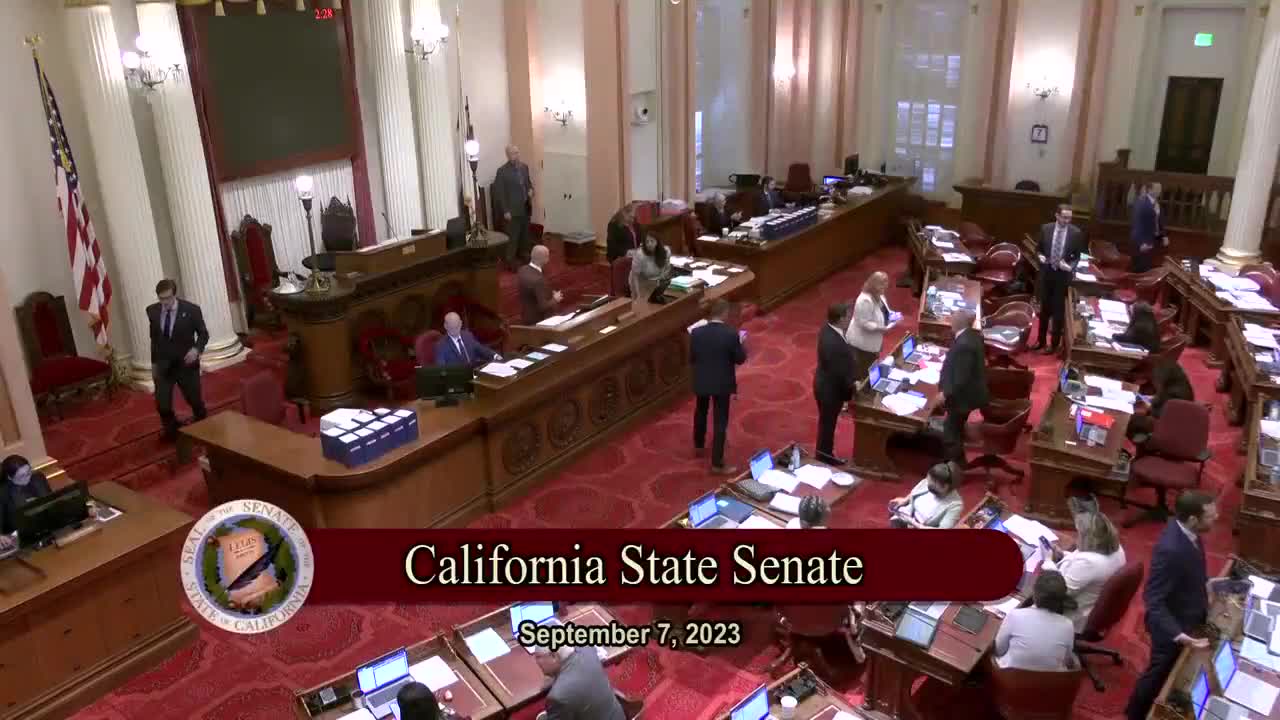 2MIN
Senate Floor
 1MIN
Senate Standing Committee on Appropriations
 10MIN
Senate Standing Committee on Business, Professions and Economic Development
 11MIN
Senate Standing Committee on Environmental Quality
 2MIN
Assembly Floor
 15MIN
Assembly Standing Committee on Environmental Safety and Toxic Materials
Bill Author

Bill Co-Author(s):