AB 1065: Communications: California Advanced Services Fund.
- Session Year: 2023-2024
- House: Assembly
- Latest Version Date: 2023-09-18
Current Status:
Failed
(2024-01-25: Consideration of Governor's veto stricken from file.)
Introduced
In Committee
First Chamber
In Committee
Second Chamber
Enacted
What does this bill do?
This bill allows eligible wireless broadband providers to apply for and receive funding from two accounts in the California Advanced Services Fund: the Broadband Infrastructure Grant Account and the Federal Funding Account. That lets wireless companies compete for state and federal-backed grants to build last-mile broadband to unserved and underserved areas, subject to the Public Utilities Commission's approval.
The summary is provided by generative AI which can make mistakes. For original language, please view the details in the table below.
Existing law vests the Public Utilities Commission with regulatory authority over public utilities, including telephone corporations. Existing law requires the commission to develop, implement, and administer the California Advanced Services Fund (CASF) to encourage deployment of high-quality advanced communications services to all Californians that will promote economic growth, job creation, and the substantial social benefits of advanced information and communications technologies. Existing law authorizes the commission to impose a surcharge, until December 31, 2032, to collect up to $150,000,000 per year for deposit into the CASF. Existing law requires the commission to establish specified accounts within the CASF, including the Broadband Infrastructure Grant Account and the Federal Funding Account, as specified.
This bill would expressly authorize otherwise eligible wireless broadband service providers to apply for and receive funding from the Broadband Infrastructure Grant Account and the Federal Funding Account, as provided. The bill would specify that the changes made by the bill do not require the commission to initiate or reopen any proceeding as a result of the bill.
Existing law vests the Public Utilities Commission with regulatory authority over public utilities, including telephone corporations. Existing law requires the commission to develop, implement, and administer the California Advanced Services Fund (CASF) to encourage deployment of high-quality advanced communications services to all Californians that will promote economic growth, job creation, and the substantial social benefits of advanced information and communications technologies. Existing law authorizes the commission to impose a surcharge, until December 31, 2032, to collect up to $150,000,000 per year for deposit into the CASF. Existing law requires the commission to establish specified accounts within the CASF, including the Broadband Infrastructure Grant Account and the Federal Funding Account, as specified.
This bill would expressly authorize otherwise eligible wireless broadband service providers to apply for and receive funding from the Broadband Infrastructure Grant Account and the Federal Funding Account. Account, as provided.
Existing law vests the Public Utilities Commission with regulatory authority over public utilities, including telephone corporations. Existing law requires the commission to develop, implement, and administer the California Advanced Services Fund (CASF) to encourage deployment of high-quality advanced communications services to all Californians that will promote economic growth, job creation, and the substantial social benefits of advanced information and communications technologies. Existing law authorizes the commission to impose a surcharge, until December 31, 2032, to collect up to $150,000,000 per year for deposit into the CASF. Existing law requires the commission to establish specified accounts within the CASF, including the Broadband Infrastructure Grant Account and the Federal Funding Account, as specified.
This bill would expressly authorize otherwise eligible wireless broadband service providers to apply for and receive funding from the Broadband Infrastructure Grant Account and the Federal Funding Account.
Existing law establishes 6 funds in the State Treasury through which the states universal service programs for communications are funded. Existing law requires moneys in the funds to be expended only for specified purposes and only upon appropriation in the annual Budget Act or upon supplemental appropriation.This bill would make a nonsubstantive change to this requirement.Existing law establishes 6 funds in the State Treasury through which the states universal service programs for communications are funded. Existing law requires moneys in the funds to be expended only for specified purposes and only upon appropriation in the annual Budget Act or upon supplemental appropriation.
This bill would make a nonsubstantive change to this requirement.
(a)The commission shall develop, implement, and administer the California Advanced Services Fund to encourage deployment of high-quality advanced communications services to all Californians that will promote economic growth, job creation, and the substantial social benefits of advanced information and communications technologies, consistent with this section and with the statements of intent in Section 2 of the Internet for All Now Act (Chapter 851 of the Statutes of 2017).
(b)(1)(A)The goal of the Broadband Infrastructure Grant Account is, no later than December 31, 2032, to approve funding for infrastructure projects that will provide broadband access to no less than 98 percent of California households in each consortia region, as identified by the commission. The commission shall be responsible for achieving the goals of the program.
(B)For purposes of the Broadband Infrastructure Grant Account, both of the following definitions apply:
(i)Mbps means megabits per second.
(ii)(I)Except as provided in subclause (II), unserved area means an area for which there is no facility-based broadband provider offering at least one tier of broadband service at speeds of at least 25 mbps downstream, 3 mbps upstream, and a latency that is sufficiently low to allow realtime interactive applications, considering updated federal and state broadband mapping data.
(II)For projects funded, in whole or in part, from moneys received from the federal Rural Digital Opportunity Fund, unserved area means an area in which no facility-based broadband provider offers broadband service at speeds consistent with the standards established by the Federal Communications Commission pursuant to In the Matter of Rural Digital Opportunity Fund, WC Docket No. 19-126, Report and Order, FCC 20-5 (adopted January 30, 2020, and released February 7, 2020), or as it may be later modified by the Federal Communications Commission.
(2)In approving infrastructure projects funded through the Broadband Infrastructure Grant Account, the commission shall do both of the following:
(A)Approve projects that provide last-mile broadband access to households that are unserved by an existing facility-based broadband provider.
(B)(i)Prioritize projects in unserved areas where internet connectivity is available only at speeds at or below 10 mbps downstream and 1 mbps upstream or areas with no internet connectivity.
(ii)This subparagraph does not prohibit the commission from approving funding for projects outside of the areas specified in clause (i).
(3)Moneys appropriated for purposes of this section may be used to match or leverage federal moneys for communications infrastructure, digital equity, and adoption, including, but not limited to, moneys from the United States Department of Commerce Economic Development Administration, the United States Department of Agriculture ReConnect Loan and Grant Program, and the Federal Communications Commission for communications infrastructure, digital equity, and adoption.
(4)The commission shall transition California Advanced Services Fund program methodologies to provide service to serviceable locations and evaluate other program changes to align with other funding sources, including, but not limited to, funding locations.
(5)The commission shall maximize investments in new, robust, and scalable infrastructure and use California Advanced Services Fund moneys to leverage federal and non-California Advanced Services Fund moneys by undertaking activities, including, but not limited to, all of the following:
(A)Providing technical assistance to local governments and providers.
(B)Assisting in developing grant applications.
(C)Assisting in preparing definitive plans for deploying necessary infrastructure in each county, including coordination across contiguous counties.
(6)Moneys appropriated for purposes of this section may be used to fund projects that deploy broadband infrastructure to unserved nonresidential facilities used for local and state emergency response activities, including, but not limited to, fairgrounds.
(c)The commission shall establish the following accounts within the fund:
(1)The Broadband Infrastructure Grant Account.
(2)The Rural and Urban Regional Broadband Consortia Grant Account.
(3)The Broadband Public Housing Account.
(4)The Broadband Adoption Account.
(5)The Federal Funding Account.
(d)(1)The commission shall transfer the moneys received by the commission from the surcharge the commission may impose pursuant to paragraph (4) to fund the accounts to the Controller for deposit into the California Advanced Services Fund.
(2)All interest earned on moneys in the fund shall be deposited into the fund.
(3)The commission may make recommendations to the Legislature regarding appropriations from the California Advanced Services Fund and the accounts established pursuant to subdivision (c).
(4)For the period described in Section 281.1, the commission may collect a sum not to exceed one hundred fifty million dollars ($150,000,000) per year.
(e)All moneys in the California Advanced Services Fund, including moneys in the accounts within the fund, shall be available, upon appropriation by the Legislature, to the commission for the California Advanced Services Fund program administered by the commission pursuant to this section, including the costs incurred by the commission in developing, implementing, and administering the program and the fund.
(f)In administering the Broadband Infrastructure Grant Account, the commission shall do all of the following:
(1)The commission shall award grants from the Broadband Infrastructure Grant Account on a technology-neutral basis, taking into account the useful economic life of capital investments, and including both wireline and wireless technology.
(2)The commission shall consult with regional consortia, stakeholders, local governments, existing facility-based broadband providers, and consumers regarding unserved areas and cost-effective strategies to achieve the broadband access goal through public workshops conducted at least annually no later than April 30 of each year.
(3)The commission shall identify unserved rural and urban areas and delineate the areas in the annual report prepared pursuant to Section 914.7.
(4)(A)An existing facility-based broadband provider may, but is not required to, apply for funding from the Broadband Infrastructure Grant Account to make an upgrade pursuant to this subdivision.
(B)An otherwise eligible wireless broadband service provider may, but is not required to, apply for and receive funding from the Broadband Infrastructure Grant Account.
(5)Projects eligible for grant awards shall deploy infrastructure capable of providing broadband access at speeds of a minimum of 100 mbps downstream and 20 mbps upstream, or the most current broadband definition speed standard set by the Federal Communications Commission from time to time, as determined appropriate by the commission, whichever broadband access speed is greater, to unserved areas or unserved households.
(6)(A)An individual household or property owner shall be eligible to apply for a grant to offset the costs of connecting the household or property to an existing or proposed facility-based broadband provider. Any infrastructure built to connect a household or property with funds provided under this paragraph shall become the property of, and part of, the network of the facility-based broadband provider to which it is connected.
(B)(i)In approving a project pursuant to this paragraph, the commission shall consider limiting funding to households based on income so that funds are provided only to households that would not otherwise be able to afford a line extension to the property, limiting the amount of grants on a per-household basis, and requiring a percentage of the project to be paid by the household or the owner of the property.
(ii)The aggregate amount of grants awarded pursuant to this paragraph shall not exceed five million dollars ($5,000,000).
(7)An entity that is not a telephone corporation shall be eligible to apply to participate in the program administered by the commission pursuant to this section to provide access to broadband to an unserved area if the entity otherwise meets the eligibility requirements and complies with program requirements established by the commission.
(8)The commission shall provide each applicant, and any party challenging an application, the opportunity to demonstrate actual levels of broadband service in the project area, which the commission shall consider in reviewing the application.
(9)The commission shall establish a service list of interested parties to be notified of any California Advanced Services Fund applications. Any application and any amendment to an application for project funding shall be served to those on the service list and posted on the commissions internet website at least 30 days before publishing the corresponding draft resolution.
(10)A grant awarded pursuant to this subdivision may include funding for the following costs consistent with paragraph (5):
(A)Costs directly related to the deployment of infrastructure.
(B)Costs to lease access to property or for internet backhaul services for a period not to exceed five years.
(C)Costs incurred by an existing facility-based broadband provider to upgrade its existing facilities to provide for interconnection.
(11)The commission may award grants to fund all or a portion of the project. The commission shall determine, on a case-by-case basis, the level of funding to be provided for a project and shall consider factors that include, but are not limited to, the location and accessibility of the area, the existence of communication facilities that may be upgraded to deploy broadband, and whether the project makes a significant contribution to achievement of the program goal.
(g)(1)Moneys in the Rural and Urban Regional Broadband Consortia Grant Account shall be available for grants to eligible consortia to facilitate deployment of broadband services by assisting infrastructure applicants in the project development or grant application process. An eligible consortium may include, as specified by the commission, representatives of organizations, including, but not limited to, local and regional government, public safety, elementary and secondary education, health care, libraries, postsecondary education, community-based organizations, tourism, parks and recreation, agricultural, business, workforce organizations, and air pollution control or air quality management districts, and is not required to have as its lead fiscal agent an entity with a certificate of public convenience and necessity.
(2)Each consortium shall conduct an annual audit of its expenditures for programs funded pursuant to this subdivision and shall submit to the commission an annual report that includes both of the following:
(A)A description of activities completed during the prior year, how each activity promotes the deployment of broadband services, and the cost associated with each activity.
(B)The number of project applications assisted.
(h)(1)All remaining moneys in the Broadband Infrastructure Revolving Loan Account that are unencumbered as of January 1, 2018, shall be transferred into the Broadband Infrastructure Grant Account.
(2)All repayments of loans funded by the former Broadband Infrastructure Revolving Loan Account shall be deposited into the Broadband Infrastructure Grant Account.
(i)(1)For purposes of this subdivision, low-income community includes, but is not limited to, publicly supported housing developments, and other housing developments or mobilehome parks with low-income residents, as determined by the commission.
(2)Moneys in the Broadband Public Housing Account shall be available for the commission to award grants and loans pursuant to this subdivision to a low-income community that otherwise meets eligibility requirements and complies with program requirements established by the commission.
(3)Moneys deposited into the Broadband Public Housing Account shall be available for grants and loans to low-income communities to finance projects to connect broadband networks that offer free broadband service that meets or exceeds state standards, as determined by the commission, for residents of the low-income communities. A low-income community may be an eligible applicant if the low-income community does not have access to any broadband service provider that offers free broadband service that meets or exceeds state standards, as determined by the commission, for the residents of the low-income community.
(4)To the extent feasible, the commission shall approve projects for funding from the Broadband Public Housing Account in a manner that reflects the statewide distribution of low-income communities.
(5)In reviewing a project application under this subdivision, the commission shall consider the availability of other funding sources for that project, any financial contribution from the broadband service provider to the project, the availability of any other public or private broadband adoption or deployment program, including tax credits and other incentives, and whether the applicant has sought funding from, or participated in, any reasonably available program. The commission may require an applicant to provide match funding, and shall not deny funding for a project solely because the applicant is receiving funding from another source.
(6)The commission shall prioritize grants pursuant to this subdivision to those existing publicly supported housing developments that have not yet received a grant pursuant to this subdivision and do not have access to free broadband internet service onsite.
(j)(1)Moneys in the Broadband Adoption Account shall be available to the commission to award grants to increase publicly available or after school broadband access and digital inclusion, such as grants for digital literacy training programs and public education to communities with limited broadband adoption, including low-income communities, senior communities, and communities facing socioeconomic barriers to broadband adoption.
(2)Eligible applicants are local governments, senior centers, schools, public libraries, nonprofit organizations, including nonprofit religious organizations, and community-based organizations with programs to increase publicly available or after school broadband access and digital inclusion, such as digital literacy training programs.
(3)Payment pursuant to a grant for digital inclusion shall be based on digital inclusion metrics established by the commission that may include the number of residents trained, the number of residents served, or the actual verification of broadband subscriptions resulting from the program funded by the grant.
(4)The commission shall give preference to programs in communities with demonstrated low broadband access, including low-income communities, senior communities, and communities facing socioeconomic barriers to broadband adoption. The commission shall determine how best to prioritize projects for funding pursuant to this paragraph.
(5)Moneys awarded pursuant to this subdivision shall not be used to subsidize the costs of providing broadband service to households.
(k)The commission shall post on the home page of the California Advanced Services Fund on its internet website a list of all pending applications, application challenge deadlines, and notices of amendments to pending applications.
(l)(1)The commission shall require each entity that receives funding or financing for a project pursuant to this section to report monthly to the commission, at minimum, all of the following information:
(A)The name and contractors license number of each licensed contractor and subcontractor undertaking a contract or subcontract in excess of twenty-five thousand dollars ($25,000) to perform work on a project funded or financed pursuant to this section.
(B)The location where a contractor or subcontractor described in subparagraph (A) will be performing that work.
(C)The anticipated dates when that work will be performed.
(2)The commission shall, on a monthly basis, post the information reported pursuant to this subdivision on the commissions California Advanced Services Fund internet website.
(m)The commission shall notify the appropriate policy committees of the Legislature on the date on which the goal specified in subparagraph (A) of paragraph (1) of subdivision (b) is achieved.
(n)(1)Upon the deposit of state or federal infrastructure moneys into the Federal Funding Account, the commission shall implement a program using those moneys to expeditiously connect unserved and underserved communities by applicable federal deadlines.
(2)Projects funded pursuant to this subdivision shall be implemented consistent with Part 35 of Title 31 of the Code of Federal Regulations and any conditions or guidelines applicable to these one-time federal infrastructure moneys.
(3)Of the two billion dollars ($2,000,000,000) appropriated to the commission to fund last-mile broadband infrastructure in the Budget Act of 2021, the commission shall allocate those moneys to applicants for the construction of last-mile broadband infrastructure as follows:
(A)The commission shall initially allocate one billion dollars ($1,000,000,000) for last-mile broadband projects in urban counties as follows:
(i)The commission shall first allocate five million dollars ($5,000,000) for last-mile broadband projects in each urban county.
(ii)The commission shall allocate the remaining moneys based on each urban countys proportionate share of the California households without access to broadband internet access service with at least 100 megabits per second download speeds, as identified and validated by the commission pursuant to the most recent broadband data collection, as of July 1, 2021, as ordered in commission Decision 16-12-025 (December 1, 2016), Decision Analyzing the California Telecommunications Market and Directing Staff to Continue Data Gathering, Monitoring and Reporting on the Market.
(B)The commission shall allocate at least one billion dollars ($1,000,000,000) for last-mile broadband projects in rural counties as follows:
(i)The commission shall first allocate five million dollars ($5,000,000) for last-mile broadband projects in each rural county.
(ii)The commission shall allocate the remaining moneys based on each rural countys proportionate share of the California households without broadband internet access service with at least 100 megabits per second download speeds, as identified and validated by the commission pursuant to the most recent broadband data collection, as of July 1, 2021, as ordered in commission Decision 16-12-025 (December 1, 2016), Decision Analyzing the California Telecommunications Market and Directing Staff to Continue Data Gathering, Monitoring and Reporting on the Market.
(4)Until September 30, 2024, applicants may apply for and encumber moneys allocated pursuant to this subdivision for last-mile broadband projects. Any moneys allocated pursuant to this subdivision that are not encumbered on or before September 30, 2024, shall be made available to the commission to allocate for the construction of last-mile broadband infrastructure anywhere in the state.
(5)An otherwise eligible wireless broadband service provider may apply for and, at the discretion of the commission, receive funding from the Federal Funding Account.
SEC. 2.Changes made by this act to Section 281 of the Public Utilities Code do not require the Public Utilities Commission to initiate or reopen any proceeding as a result of this act.
All matter omitted in this version of the bill appears in the bill as amended in the Assembly, May 18, 2023. (JR11)(a)The commission shall develop, implement, and administer the California Advanced Services Fund to encourage deployment of high-quality advanced communications services to all Californians that will promote economic growth, job creation, and the substantial social benefits of advanced information and communications technologies, consistent with this section and with the statements of intent in Section 2 of the Internet for All Now Act (Chapter 851 of the Statutes of 2017).
(b)(1)(A)The goal of the Broadband Infrastructure Grant Account is, no later than December 31, 2032, to approve funding for infrastructure projects that will provide broadband access to no less than 98 percent of California households in each consortia region, as identified by the commission. The commission shall be responsible for achieving the goals of the program.
(B)For purposes of the Broadband Infrastructure Grant Account, both of the following definitions apply:
(i)Mbps means megabits per second.
(ii)(I)Except as provided in subclause (II), unserved area means an area for which there is no facility-based broadband provider offering at least one tier of broadband service at speeds of at least 25 mbps downstream, 3 mbps upstream, and a latency that is sufficiently low to allow realtime interactive applications, considering updated federal and state broadband mapping data.
(II)For projects funded, in whole or in part, from moneys received from the federal Rural Digital Opportunity Fund, unserved area means an area in which no facility-based broadband provider offers broadband service at speeds consistent with the standards established by the Federal Communications Commission pursuant to In the Matter of Rural Digital Opportunity Fund, WC Docket No. 19-126, Report and Order, FCC 20-5 (adopted January 30, 2020, and released February 7, 2020), or as it may be later modified by the Federal Communications Commission.
(2)In approving infrastructure projects funded through the Broadband Infrastructure Grant Account, the commission shall do both of the following:
(A)Approve projects that provide last-mile broadband access to households that are unserved by an existing facility-based broadband provider.
(B)(i)Prioritize projects in unserved areas where internet connectivity is available only at speeds at or below 10 mbps downstream and 1 mbps upstream or areas with no internet connectivity.
(ii)This subparagraph does not prohibit the commission from approving funding for projects outside of the areas specified in clause (i).
(3)Moneys appropriated for purposes of this section may be used to match or leverage federal moneys for communications infrastructure, digital equity, and adoption, including, but not limited to, moneys from the United States Department of Commerce Economic Development Administration, the United States Department of Agriculture ReConnect Loan and Grant Program, and the Federal Communications Commission for communications infrastructure, digital equity, and adoption.
(4)The commission shall transition California Advanced Services Fund program methodologies to provide service to serviceable locations and evaluate other program changes to align with other funding sources, including, but not limited to, funding locations.
(5)The commission shall maximize investments in new, robust, and scalable infrastructure and use California Advanced Services Fund moneys to leverage federal and non-California Advanced Services Fund moneys by undertaking activities, including, but not limited to, all of the following:
(A)Providing technical assistance to local governments and providers.
(B)Assisting in developing grant applications.
(C)Assisting in preparing definitive plans for deploying necessary infrastructure in each county, including coordination across contiguous counties.
(6)Moneys appropriated for purposes of this section may be used to fund projects that deploy broadband infrastructure to unserved nonresidential facilities used for local and state emergency response activities, including, but not limited to, fairgrounds.
(c)The commission shall establish the following accounts within the fund:
(1)The Broadband Infrastructure Grant Account.
(2)The Rural and Urban Regional Broadband Consortia Grant Account.
(3)The Broadband Public Housing Account.
(4)The Broadband Adoption Account.
(5)The Federal Funding Account.
(d)(1)The commission shall transfer the moneys received by the commission from the surcharge the commission may impose pursuant to paragraph (4) to fund the accounts to the Controller for deposit into the California Advanced Services Fund.
(2)All interest earned on moneys in the fund shall be deposited into the fund.
(3)The commission may make recommendations to the Legislature regarding appropriations from the California Advanced Services Fund and the accounts established pursuant to subdivision (c).
(4)For the period described in Section 281.1, the commission may collect a sum not to exceed one hundred fifty million dollars ($150,000,000) per year.
(e)All moneys in the California Advanced Services Fund, including moneys in the accounts within the fund, shall be available, upon appropriation by the Legislature, to the commission for the California Advanced Services Fund program administered by the commission pursuant to this section, including the costs incurred by the commission in developing, implementing, and administering the program and the fund.
(f)In administering the Broadband Infrastructure Grant Account, the commission shall do all of the following:
(1)The commission shall award grants from the Broadband Infrastructure Grant Account on a technology-neutral basis, taking into account the useful economic life of capital investments, and including both wireline and wireless technology.
(2)The commission shall consult with regional consortia, stakeholders, local governments, existing facility-based broadband providers, and consumers regarding unserved areas and cost-effective strategies to achieve the broadband access goal through public workshops conducted at least annually no later than April 30 of each year.
(3)The commission shall identify unserved rural and urban areas and delineate the areas in the annual report prepared pursuant to Section 914.7.
(4)(A)An existing facility-based broadband provider may, but is not required to, apply for funding from the Broadband Infrastructure Grant Account to make an upgrade pursuant to this subdivision.
(B)An otherwise eligible wireless broadband service provider may, but is not required to, apply for and receive funding from the Broadband Infrastructure Grant Account.
(5)Projects eligible for grant awards shall deploy infrastructure capable of providing broadband access at speeds of a minimum of 100 mbps downstream and 20 mbps upstream, or the most current broadband definition speed standard set by the Federal Communications Commission from time to time, as determined appropriate by the commission, whichever broadband access speed is greater, to unserved areas or unserved households.
(6)(A)An individual household or property owner shall be eligible to apply for a grant to offset the costs of connecting the household or property to an existing or proposed facility-based broadband provider. Any infrastructure built to connect a household or property with funds provided under this paragraph shall become the property of, and part of, the network of the facility-based broadband provider to which it is connected.
(B)(i)In approving a project pursuant to this paragraph, the commission shall consider limiting funding to households based on income so that funds are provided only to households that would not otherwise be able to afford a line extension to the property, limiting the amount of grants on a per-household basis, and requiring a percentage of the project to be paid by the household or the owner of the property.
(ii)The aggregate amount of grants awarded pursuant to this paragraph shall not exceed five million dollars ($5,000,000).
(7)An entity that is not a telephone corporation shall be eligible to apply to participate in the program administered by the commission pursuant to this section to provide access to broadband to an unserved area if the entity otherwise meets the eligibility requirements and complies with program requirements established by the commission.
(8)The commission shall provide each applicant, and any party challenging an application, the opportunity to demonstrate actual levels of broadband service in the project area, which the commission shall consider in reviewing the application.
(9)The commission shall establish a service list of interested parties to be notified of any California Advanced Services Fund applications. Any application and any amendment to an application for project funding shall be served to those on the service list and posted on the commissions internet website at least 30 days before publishing the corresponding draft resolution.
(10)A grant awarded pursuant to this subdivision may include funding for the following costs consistent with paragraph (5):
(A)Costs directly related to the deployment of infrastructure.
(B)Costs to lease access to property or for internet backhaul services for a period not to exceed five years.
(C)Costs incurred by an existing facility-based broadband provider to upgrade its existing facilities to provide for interconnection.
(11)The commission may award grants to fund all or a portion of the project. The commission shall determine, on a case-by-case basis, the level of funding to be provided for a project and shall consider factors that include, but are not limited to, the location and accessibility of the area, the existence of communication facilities that may be upgraded to deploy broadband, and whether the project makes a significant contribution to achievement of the program goal.
(g)(1)Moneys in the Rural and Urban Regional Broadband Consortia Grant Account shall be available for grants to eligible consortia to facilitate deployment of broadband services by assisting infrastructure applicants in the project development or grant application process. An eligible consortium may include, as specified by the commission, representatives of organizations, including, but not limited to, local and regional government, public safety, elementary and secondary education, health care, libraries, postsecondary education, community-based organizations, tourism, parks and recreation, agricultural, business, workforce organizations, and air pollution control or air quality management districts, and is not required to have as its lead fiscal agent an entity with a certificate of public convenience and necessity.
(2)Each consortium shall conduct an annual audit of its expenditures for programs funded pursuant to this subdivision and shall submit to the commission an annual report that includes both of the following:
(A)A description of activities completed during the prior year, how each activity promotes the deployment of broadband services, and the cost associated with each activity.
(B)The number of project applications assisted.
(h)(1)All remaining moneys in the Broadband Infrastructure Revolving Loan Account that are unencumbered as of January 1, 2018, shall be transferred into the Broadband Infrastructure Grant Account.
(2)All repayments of loans funded by the former Broadband Infrastructure Revolving Loan Account shall be deposited into the Broadband Infrastructure Grant Account.
(i)(1)For purposes of this subdivision, low-income community includes, but is not limited to, publicly supported housing developments, and other housing developments or mobilehome parks with low-income residents, as determined by the commission.
(2)Moneys in the Broadband Public Housing Account shall be available for the commission to award grants and loans pursuant to this subdivision to a low-income community that otherwise meets eligibility requirements and complies with program requirements established by the commission.
(3)Moneys deposited into the Broadband Public Housing Account shall be available for grants and loans to low-income communities to finance projects to connect broadband networks that offer free broadband service that meets or exceeds state standards, as determined by the commission, for residents of the low-income communities. A low-income community may be an eligible applicant if the low-income community does not have access to any broadband service provider that offers free broadband service that meets or exceeds state standards, as determined by the commission, for the residents of the low-income community.
(4)To the extent feasible, the commission shall approve projects for funding from the Broadband Public Housing Account in a manner that reflects the statewide distribution of low-income communities.
(5)In reviewing a project application under this subdivision, the commission shall consider the availability of other funding sources for that project, any financial contribution from the broadband service provider to the project, the availability of any other public or private broadband adoption or deployment program, including tax credits and other incentives, and whether the applicant has sought funding from, or participated in, any reasonably available program. The commission may require an applicant to provide match funding, and shall not deny funding for a project solely because the applicant is receiving funding from another source.
(j)(1)Moneys in the Broadband Adoption Account shall be available to the commission to award grants to increase publicly available or after school broadband access and digital inclusion, such as grants for digital literacy training programs and public education to communities with limited broadband adoption, including low-income communities, senior communities, and communities facing socioeconomic barriers to broadband adoption.
(2)Eligible applicants are local governments, senior centers, schools, public libraries, nonprofit organizations, including nonprofit religious organizations, and community-based organizations with programs to increase publicly available or after school broadband access and digital inclusion, such as digital literacy training programs.
(3)Payment pursuant to a grant for digital inclusion shall be based on digital inclusion metrics established by the commission that may include the number of residents trained, the number of residents served, or the actual verification of broadband subscriptions resulting from the program funded by the grant.
(4)The commission shall give preference to programs in communities with demonstrated low broadband access, including low-income communities, senior communities, and communities facing socioeconomic barriers to broadband adoption. The commission shall determine how best to prioritize projects for funding pursuant to this paragraph.
(5)Moneys awarded pursuant to this subdivision shall not be used to subsidize the costs of providing broadband service to households.
(k)The commission shall post on the home page of the California Advanced Services Fund on its internet website a list of all pending applications, application challenge deadlines, and notices of amendments to pending applications.
(l)(1)The commission shall require each entity that receives funding or financing for a project pursuant to this section to report monthly to the commission, at minimum, all of the following information:
(A)The name and contractors license number of each licensed contractor and subcontractor undertaking a contract or subcontract in excess of twenty-five thousand dollars ($25,000) to perform work on a project funded or financed pursuant to this section.
(B)The location where a contractor or subcontractor described in subparagraph (A) will be performing that work.
(C)The anticipated dates when that work will be performed.
(2)The commission shall, on a monthly basis, post the information reported pursuant to this subdivision on the commissions California Advanced Services Fund internet website.
(m)The commission shall notify the appropriate policy committees of the Legislature on the date on which the goal specified in subparagraph (A) of paragraph (1) of subdivision (b) is achieved.
(n)(1)Upon the deposit of state or federal infrastructure moneys into the Federal Funding Account, the commission shall implement a program using those moneys to expeditiously connect unserved and underserved communities by applicable federal deadlines.
(2)Projects funded pursuant to this subdivision shall be implemented consistent with Part 35 of Title 31 of the Code of Federal Regulations and any conditions or guidelines applicable to these one-time federal infrastructure moneys.
(3)Of the two billion dollars ($2,000,000,000) appropriated to the commission to fund last-mile broadband infrastructure in the Budget Act of 2021, the commission shall allocate those moneys to applicants for the construction of last-mile broadband infrastructure as follows:
(A)The commission shall initially allocate one billion dollars ($1,000,000,000) for last-mile broadband projects in urban counties as follows:
(i)The commission shall first allocate five million dollars ($5,000,000) for last-mile broadband projects in each urban county.
(ii)The commission shall allocate the remaining moneys based on each urban countys proportionate share of the California households without access to broadband internet access service with at least 100 megabits per second download speeds, as identified and validated by the commission pursuant to the most recent broadband data collection, as of July 1, 2021, as ordered in commission Decision 16-12-025 (December 1, 2016), Decision Analyzing the California Telecommunications Market and Directing Staff to Continue Data Gathering, Monitoring and Reporting on the Market.
(B)The commission shall allocate at least one billion dollars ($1,000,000,000) for last-mile broadband projects in rural counties as follows:
(i)The commission shall first allocate five million dollars ($5,000,000) for last-mile broadband projects in each rural county.
(ii)The commission shall allocate the remaining moneys based on each rural countys proportionate share of the California households without broadband internet access service with at least 100 megabits per second download speeds, as identified and validated by the commission pursuant to the most recent broadband data collection, as of July 1, 2021, as ordered in commission Decision 16-12-025 (December 1, 2016), Decision Analyzing the California Telecommunications Market and Directing Staff to Continue Data Gathering, Monitoring and Reporting on the Market.
(4)Until June 30, 2023, applicants may apply for and encumber moneys allocated pursuant to this subdivision for last-mile broadband projects. Any moneys allocated pursuant to this subdivision that are not encumbered on or before June 30, 2023, shall be made available to the commission to allocate for the construction of last-mile broadband infrastructure anywhere in the state.
(5)An otherwise eligible wireless broadband service provider may apply for and and, at the discretion of the commission, receive funding from the Federal Funding Account.
(a)The commission shall develop, implement, and administer the California Advanced Services Fund to encourage deployment of high-quality advanced communications services to all Californians that will promote economic growth, job creation, and the substantial social benefits of advanced information and communications technologies, consistent with this section and with the statements of intent in Section 2 of the Internet for All Now Act (Chapter 851 of the Statutes of 2017).
(b)(1)(A)The goal of the Broadband Infrastructure Grant Account is, no later than December 31, 2032, to approve funding for infrastructure projects that will provide broadband access to no less than 98 percent of California households in each consortia region, as identified by the commission. The commission shall be responsible for achieving the goals of the program.
(B)For purposes of the Broadband Infrastructure Grant Account, both of the following definitions apply:
(i)Mbps means megabits per second.
(ii)(I)Except as provided in subclause (II), unserved area means an area for which there is no facility-based broadband provider offering at least one tier of broadband service at speeds of at least 25 mbps downstream, 3 mbps upstream, and a latency that is sufficiently low to allow realtime interactive applications, considering updated federal and state broadband mapping data.
(II)For projects funded, in whole or in part, from moneys received from the federal Rural Digital Opportunity Fund, unserved area means an area in which no facility-based broadband provider offers broadband service at speeds consistent with the standards established by the Federal Communications Commission pursuant to In the Matter of Rural Digital Opportunity Fund, WC Docket No. 19-126, Report and Order, FCC 20-5 (adopted January 30, 2020, and released February 7, 2020), or as it may be later modified by the Federal Communications Commission.
(2)In approving infrastructure projects funded through the Broadband Infrastructure Grant Account, the commission shall do both of the following:
(A)Approve projects that provide last-mile broadband access to households that are unserved by an existing facility-based broadband provider.
(B)(i)Prioritize projects in unserved areas where internet connectivity is available only at speeds at or below 10 mbps downstream and 1 mbps upstream or areas with no internet connectivity.
(ii)This subparagraph does not prohibit the commission from approving funding for projects outside of the areas specified in clause (i).
(3)Moneys appropriated for purposes of this section may be used to match or leverage federal moneys for communications infrastructure, digital equity, and adoption, including, but not limited to, moneys from the United States Department of Commerce Economic Development Administration, the United States Department of Agriculture ReConnect Loan and Grant Program, and the Federal Communications Commission for communications infrastructure, digital equity, and adoption.
(4)The commission shall transition California Advanced Services Fund program methodologies to provide service to serviceable locations and evaluate other program changes to align with other funding sources, including, but not limited to, funding locations.
(5)The commission shall maximize investments in new, robust, and scalable infrastructure and use California Advanced Services Fund moneys to leverage federal and non-California Advanced Services Fund moneys by undertaking activities, including, but not limited to, all of the following:
(A)Providing technical assistance to local governments and providers.
(B)Assisting in developing grant applications.
(C)Assisting in preparing definitive plans for deploying necessary infrastructure in each county, including coordination across contiguous counties.
(6)Moneys appropriated for purposes of this section may be used to fund projects that deploy broadband infrastructure to unserved nonresidential facilities used for local and state emergency response activities, including, but not limited to, fairgrounds.
(c)The commission shall establish the following accounts within the fund:
(1)The Broadband Infrastructure Grant Account.
(2)The Rural and Urban Regional Broadband Consortia Grant Account.
(3)The Broadband Public Housing Account.
(4)The Broadband Adoption Account.
(5)The Federal Funding Account.
(d)(1)The commission shall transfer the moneys received by the commission from the surcharge the commission may impose pursuant to paragraph (4) to fund the accounts to the Controller for deposit into the California Advanced Services Fund.
(2)All interest earned on moneys in the fund shall be deposited into the fund.
(3)The commission may make recommendations to the Legislature regarding appropriations from the California Advanced Services Fund and the accounts established pursuant to subdivision (c).
(4)For the period described in Section 281.1, the commission may collect a sum not to exceed one hundred fifty million dollars ($150,000,000) per year.
(e)All moneys in the California Advanced Services Fund, including moneys in the accounts within the fund, shall be available, upon appropriation by the Legislature, to the commission for the California Advanced Services Fund program administered by the commission pursuant to this section, including the costs incurred by the commission in developing, implementing, and administering the program and the fund.
(f)In administering the Broadband Infrastructure Grant Account, the commission shall do all of the following:
(1)The commission shall award grants from the Broadband Infrastructure Grant Account on a technology-neutral basis, taking into account the useful economic life of capital investments, and including both wireline and wireless technology.
(2)The commission shall consult with regional consortia, stakeholders, local governments, existing facility-based broadband providers, and consumers regarding unserved areas and cost-effective strategies to achieve the broadband access goal through public workshops conducted at least annually no later than April 30 of each year.
(3)The commission shall identify unserved rural and urban areas and delineate the areas in the annual report prepared pursuant to Section 914.7.
(4)(A)An existing facility-based broadband provider may, but is not required to, apply for funding from the Broadband Infrastructure Grant Account to make an upgrade pursuant to this subdivision.
(B)An otherwise eligible wireless broadband service provider may, but is not required to, apply for and receive funding from the Broadband Infrastructure Grant Account.
(5)Projects eligible for grant awards shall deploy infrastructure capable of providing broadband access at speeds of a minimum of 100 mbps downstream and 20 mbps upstream, or the most current broadband definition speed standard set by the Federal Communications Commission from time to time, as determined appropriate by the commission, whichever broadband access speed is greater, to unserved areas or unserved households.
(6)(A)An individual household or property owner shall be eligible to apply for a grant to offset the costs of connecting the household or property to an existing or proposed facility-based broadband provider. Any infrastructure built to connect a household or property with funds provided under this paragraph shall become the property of, and part of, the network of the facility-based broadband provider to which it is connected.
(B)(i)In approving a project pursuant to this paragraph, the commission shall consider limiting funding to households based on income so that funds are provided only to households that would not otherwise be able to afford a line extension to the property, limiting the amount of grants on a per-household basis, and requiring a percentage of the project to be paid by the household or the owner of the property.
(ii)The aggregate amount of grants awarded pursuant to this paragraph shall not exceed five million dollars ($5,000,000).
(7)An entity that is not a telephone corporation shall be eligible to apply to participate in the program administered by the commission pursuant to this section to provide access to broadband to an unserved area if the entity otherwise meets the eligibility requirements and complies with program requirements established by the commission.
(8)The commission shall provide each applicant, and any party challenging an application, the opportunity to demonstrate actual levels of broadband service in the project area, which the commission shall consider in reviewing the application.
(9)The commission shall establish a service list of interested parties to be notified of any California Advanced Services Fund applications. Any application and any amendment to an application for project funding shall be served to those on the service list and posted on the commissions internet website at least 30 days before publishing the corresponding draft resolution.
(10)A grant awarded pursuant to this subdivision may include funding for the following costs consistent with paragraph (5):
(A)Costs directly related to the deployment of infrastructure.
(B)Costs to lease access to property or for internet backhaul services for a period not to exceed five years.
(C)Costs incurred by an existing facility-based broadband provider to upgrade its existing facilities to provide for interconnection.
(11)The commission may award grants to fund all or a portion of the project. The commission shall determine, on a case-by-case basis, the level of funding to be provided for a project and shall consider factors that include, but are not limited to, the location and accessibility of the area, the existence of communication facilities that may be upgraded to deploy broadband, and whether the project makes a significant contribution to achievement of the program goal.
(g)(1)Moneys in the Rural and Urban Regional Broadband Consortia Grant Account shall be available for grants to eligible consortia to facilitate deployment of broadband services by assisting infrastructure applicants in the project development or grant application process. An eligible consortium may include, as specified by the commission, representatives of organizations, including, but not limited to, local and regional government, public safety, elementary and secondary education, health care, libraries, postsecondary education, community-based organizations, tourism, parks and recreation, agricultural, business, workforce organizations, and air pollution control or air quality management districts, and is not required to have as its lead fiscal agent an entity with a certificate of public convenience and necessity.
(2)Each consortium shall conduct an annual audit of its expenditures for programs funded pursuant to this subdivision and shall submit to the commission an annual report that includes both of the following:
(A)A description of activities completed during the prior year, how each activity promotes the deployment of broadband services, and the cost associated with each activity.
(B)The number of project applications assisted.
(h)(1)All remaining moneys in the Broadband Infrastructure Revolving Loan Account that are unencumbered as of January 1, 2018, shall be transferred into the Broadband Infrastructure Grant Account.
(2)All repayments of loans funded by the former Broadband Infrastructure Revolving Loan Account shall be deposited into the Broadband Infrastructure Grant Account.
(i)(1)For purposes of this subdivision, low-income community includes, but is not limited to, publicly supported housing developments, and other housing developments or mobilehome parks with low-income residents, as determined by the commission.
(2)Moneys in the Broadband Public Housing Account shall be available for the commission to award grants and loans pursuant to this subdivision to a low-income community that otherwise meets eligibility requirements and complies with program requirements established by the commission.
(3)Moneys deposited into the Broadband Public Housing Account shall be available for grants and loans to low-income communities to finance projects to connect broadband networks that offer free broadband service that meets or exceeds state standards, as determined by the commission, for residents of the low-income communities. A low-income community may be an eligible applicant if the low-income community does not have access to any broadband service provider that offers free broadband service that meets or exceeds state standards, as determined by the commission, for the residents of the low-income community.
(4)To the extent feasible, the commission shall approve projects for funding from the Broadband Public Housing Account in a manner that reflects the statewide distribution of low-income communities.
(5)In reviewing a project application under this subdivision, the commission shall consider the availability of other funding sources for that project, any financial contribution from the broadband service provider to the project, the availability of any other public or private broadband adoption or deployment program, including tax credits and other incentives, and whether the applicant has sought funding from, or participated in, any reasonably available program. The commission may require an applicant to provide match funding, and shall not deny funding for a project solely because the applicant is receiving funding from another source.
(j)(1)Moneys in the Broadband Adoption Account shall be available to the commission to award grants to increase publicly available or after school broadband access and digital inclusion, such as grants for digital literacy training programs and public education to communities with limited broadband adoption, including low-income communities, senior communities, and communities facing socioeconomic barriers to broadband adoption.
(2)Eligible applicants are local governments, senior centers, schools, public libraries, nonprofit organizations, including nonprofit religious organizations, and community-based organizations with programs to increase publicly available or after school broadband access and digital inclusion, such as digital literacy training programs.
(3)Payment pursuant to a grant for digital inclusion shall be based on digital inclusion metrics established by the commission that may include the number of residents trained, the number of residents served, or the actual verification of broadband subscriptions resulting from the program funded by the grant.
(4)The commission shall give preference to programs in communities with demonstrated low broadband access, including low-income communities, senior communities, and communities facing socioeconomic barriers to broadband adoption. The commission shall determine how best to prioritize projects for funding pursuant to this paragraph.
(5)Moneys awarded pursuant to this subdivision shall not be used to subsidize the costs of providing broadband service to households.
(k)The commission shall post on the home page of the California Advanced Services Fund on its internet website a list of all pending applications, application challenge deadlines, and notices of amendments to pending applications.
(l)(1)The commission shall require each entity that receives funding or financing for a project pursuant to this section to report monthly to the commission, at minimum, all of the following information:
(A)The name and contractors license number of each licensed contractor and subcontractor undertaking a contract or subcontract in excess of twenty-five thousand dollars ($25,000) to perform work on a project funded or financed pursuant to this section.
(B)The location where a contractor or subcontractor described in subparagraph (A) will be performing that work.
(C)The anticipated dates when that work will be performed.
(2)The commission shall, on a monthly basis, post the information reported pursuant to this subdivision on the commissions California Advanced Services Fund internet website.
(m)The commission shall notify the appropriate policy committees of the Legislature on the date on which the goal specified in subparagraph (A) of paragraph (1) of subdivision (b) is achieved.
(n)(1)Upon the deposit of state or federal infrastructure moneys into the Federal Funding Account, the commission shall implement a program using those moneys to expeditiously connect unserved and underserved communities by applicable federal deadlines.
(2)Projects funded pursuant to this subdivision shall be implemented consistent with Part 35 of Title 31 of the Code of Federal Regulations and any conditions or guidelines applicable to these one-time federal infrastructure moneys.
(3)Of the two billion dollars ($2,000,000,000) appropriated to the commission to fund last-mile broadband infrastructure in the Budget Act of 2021, the commission shall allocate those moneys to applicants for the construction of last-mile broadband infrastructure as follows:
(A)The commission shall initially allocate one billion dollars ($1,000,000,000) for last-mile broadband projects in urban counties as follows:
(i)The commission shall first allocate five million dollars ($5,000,000) for last-mile broadband projects in each urban county.
(ii)The commission shall allocate the remaining moneys based on each urban countys proportionate share of the California households without access to broadband internet access service with at least 100 megabits per second download speeds, as identified and validated by the commission pursuant to the most recent broadband data collection, as of July 1, 2021, as ordered in commission Decision 16-12-025 (December 1, 2016), Decision Analyzing the California Telecommunications Market and Directing Staff to Continue Data Gathering, Monitoring and Reporting on the Market.
(B)The commission shall allocate at least one billion dollars ($1,000,000,000) for last-mile broadband projects in rural counties as follows:
(i)The commission shall first allocate five million dollars ($5,000,000) for last-mile broadband projects in each rural county.
(ii)The commission shall allocate the remaining moneys based on each rural countys proportionate share of the California households without broadband internet access service with at least 100 megabits per second download speeds, as identified and validated by the commission pursuant to the most recent broadband data collection, as of July 1, 2021, as ordered in commission Decision 16-12-025 (December 1, 2016), Decision Analyzing the California Telecommunications Market and Directing Staff to Continue Data Gathering, Monitoring and Reporting on the Market.
(4)Until June 30, 2023, applicants may apply for and encumber moneys allocated pursuant to this subdivision for last-mile broadband projects. Any moneys allocated pursuant to this subdivision that are not encumbered on or before June 30, 2023, shall be made available to the commission to allocate for the construction of last-mile broadband infrastructure anywhere in the state.
(5)An otherwise eligible wireless broadband service provider may apply for and receive funding from the Federal Funding Account.
SECTION 1.Section 270 of the Public Utilities Code is amended to read:270.(a)The following funds are hereby created in the State Treasury:(1)The California High-Cost Fund-A Administrative Committee Fund.(2)The California High-Cost Fund-B Administrative Committee Fund.(3)The Universal Lifeline Telephone Service Trust Administrative Committee Fund.(4)The Deaf and Disabled Telecommunications Program Administrative Committee Fund.(5)The California Teleconnect Fund Administrative Committee Fund.(6)The California Advanced Services Fund.(b)Moneys in the funds are held in trust and shall be expended only pursuant to this chapter and upon appropriation in the annual Budget Act or upon supplemental appropriation.(c)The commission, in administering the universal service program funds listed in subdivision (a), and in administering state participation in federal universal service programs, is encouraged, consistent with the states universal service policies and goals, to maximize the amount of federal funding to California participants in the federal programs.(d)Moneys in each fund shall not be appropriated, or in any other manner transferred or otherwise diverted, to any other fund or entity, except as provided in Sections 19325 and 19325.1 of the Education Code and as provided in Section 282.(a)The following funds are hereby created in the State Treasury:
(1)The California High-Cost Fund-A Administrative Committee Fund.
(2)The California High-Cost Fund-B Administrative Committee Fund.
(3)The Universal Lifeline Telephone Service Trust Administrative Committee Fund.
(4)The Deaf and Disabled Telecommunications Program Administrative Committee Fund.
(5)The California Teleconnect Fund Administrative Committee Fund.
(6)The California Advanced Services Fund.
(b)Moneys in the funds are held in trust and may only shall be expended only pursuant to this chapter and upon appropriation in the annual Budget Act or upon supplemental appropriation.
(c)The commission, in administering the universal service program funds listed in subdivision (a), and in administering state participation in federal universal service programs, is encouraged, consistent with the states universal service policies and goals, to maximize the amount of federal funding to California participants in the federal programs.
(d)Moneys in each fund shall not be appropriated, or in any other manner transferred or otherwise diverted, to any other fund or entity, except as provided in Sections 19325 and 19325.1 of the Education Code and as provided in Section 282.
|
Date
|
Status
|
|---|---|
| Jan 25, 2024 | Consideration of Governor's veto stricken from file. |
| Jan 3, 2024 | Consideration of Governor's veto pending. |
| Oct 8, 2023 | Vetoed by Governor. |
| Sep 21, 2023 | Enrolled and presented to the Governor at 3:30 p.m. |
| Sep 14, 2023 | Senate amendments concurred in. To Engrossing and Enrolling. (Ayes 76. Noes 0. Page 3589.). |
| Sep 14, 2023 | In Assembly. Concurrence in Senate amendments pending. |
| Sep 14, 2023 | Read third time. Passed. Ordered to the Assembly. (Ayes 31. Noes 6. Page 2778.). |
| Sep 11, 2023 | Read second time. Ordered to third reading. |
| Sep 8, 2023 | Read third time and amended. Ordered to second reading. |
| Sep 5, 2023 | Read second time. Ordered to third reading. |
| Sep 1, 2023 | From committee: Do pass. (Ayes 7. Noes 0.) (September 1). |
| Jul 3, 2023 | In committee: Referred to APPR suspense file. |
| Jun 20, 2023 | From committee: Do pass and re-refer to Com. on APPR. (Ayes 13. Noes 0.) (June 20). Re-referred to Com. on APPR. |
| Jun 7, 2023 | Referred to Com. on E., U. & C. |
| May 31, 2023 | In Senate. Read first time. To Com. on RLS. for assignment. |
| May 30, 2023 | Read third time. Passed. Ordered to the Senate. (Ayes 75. Noes 0. Page 1928.) |
| May 22, 2023 | Read second time. Ordered to third reading. |
| May 18, 2023 | Read second time and amended. Ordered returned to second reading. |
| May 18, 2023 | From committee: Amend, and do pass as amended. (Ayes 15. Noes 0.) (May 18). |
| Apr 19, 2023 | In committee: Set, first hearing. Referred to APPR. suspense file. |
| Mar 29, 2023 | From committee: Do pass and re-refer to Com. on APPR. (Ayes 12. Noes 0.) (March 29). Re-referred to Com. on APPR. |
| Mar 6, 2023 | Re-referred to Com. on C. & C. |
| Mar 2, 2023 | Referred to Com. on C. & C. |
| Mar 2, 2023 | From committee chair, with author's amendments: Amend, and re-refer to Com. on C. & C. Read second time and amended. |
| Feb 16, 2023 | From printer. May be heard in committee March 18. |
| Feb 15, 2023 | Read first time. To print. |
|
Date
|
Description
|
Location
|
Votes
|
|
|---|---|---|---|---|
| Sep 14, 2023 | AB 1065 Jim Patterson Concurrence in Senate Amendments | Assembly Floor |
Passed |
|
| Sep 14, 2023 | Assembly 3rd Reading AB1065 Jim Patterson By Dodd | Senate Floor |
Passed |
|
| Sep 1, 2023 | Do pass | Senate Standing Committee on Appropriations |
Passed |
|
| Jul 3, 2023 | Placed on suspense file | Senate Standing Committee on Appropriations |
Passed |
|
| Jun 20, 2023 | Do pass, but first be re-referred to the Committee on [Appropriations] | Senate Standing Committee on Energy, Utilities and Communications |
Passed |
|
| May 30, 2023 | AB 1065 Jim Patterson Assembly Third Reading | Assembly Floor |
Passed |
|
| May 18, 2023 | Do pass as amended. | Assembly Standing Committee on Appropriations |
Passed |
|
| Mar 29, 2023 | Do pass and be re-referred to the Committee on [Appropriations] | Assembly Standing Committee on Communications and Conveyance |
Passed |
This list shows positions taken on this bill by organizations on the date displayed, which is linked to the original source.
Positions by individuals are not included.
|
Organization
|
Position
|
Date
|
|---|---|---|
| 5G Free California | ** Against | |
| Advanced Wireless | ** Support | |
| Alliance for Nurses for Healthy Environments | ** Against | |
| Altapasa Residents for Responsible Technology | ** Against | |
| As You Sow | ** Against | |
| Boyle Heights Community Garden | ** Against | |
| Breast Cancer Prevention Partners | ** Against | |
| Cal.net, Inc. | ** Support | |
| California Brain Tumor Association | ** Against | |
| California Nurses for Environmental Health & Justice | ** Against | |
| Californians for Safe Technology | ** Against | |
| CalNet | * Support | Jun 20, 2023 |
| Center For Environmental Health | ** Against | |
| Clean Earth 4 Kids | ** Against | |
| Communications Workers of America, District 9 | ** Against | |
| Competitive Carriers Association | ** Support | |
| consumers for safe cell phones | ** Against | |
| CTIA | ** Support | |
| Dietrick Institute for Applied Insect Ecology | ** Against | |
| Ecological Options Network | ** Against | |
| EMF Safety Network | * Against | Jun 20, 2023 |
| EMF Safety Network Education/Outreach | ** Against | |
| Environmental Health Trust | ** Against | |
| Environmental Working Group | ** Against | |
| Facts Families Advocating for Chemical and Toxics Safety | ** Against | |
| Feather River Action! | ** Against | |
| GMOScience | ** Against | |
| health & habitat inc. | ** Against | |
| Hoag Actuarial Consulting | * Against | Jun 20, 2023 |
| Malibu for Safe Tech | ** Against | |
| Media Alliance | ** Against | |
| moms across america | ** Against | |
| Mothers of East LA | ** Against | |
| NATE-The Communications Infrastructure Contractors Association | ** Support | |
| Neighbors for Safe Metering | ** Against | |
| OACYS | ** Support | |
| Parents for a Safer Environment | ** Against | |
| physicians for safe technology | ** Against | |
| Plumas Wired! | ** Against | |
| Preserve Rural Sonoma County | ** Against | |
| Rural Wireless Association | ** Support | |
| Safe Tech for Santa Rosa | ** Against | |
| Safer 5G Moraga | ** Against | |
| Salmon Protection and Watershed Network | ** Against | |
| Several individuals | ** Against | |
| Sonoma County Tomorrow | ** Against | |
| Sonoma Neighbors for Safe Tech | ** Against | |
| Sonoma Safe Ag Safe Schools | ** Against | |
| Stop Smart Meters | ** Against | |
| Supervisor Jaron E. Brandon, Tuolumne County- District 5 | ** Support | |
| Tarana Wireless | ** Support | |
| The Utility Reform Network | ** Against | |
| The Wireless Infrastructure Association | ** Support | |
| Topanga Peace Alliance | ** Against | |
| Toronto Wireless | * Support | Jun 20, 2023 |
| Towards an Internet of Living Beings | ** Against | |
| Wine & Water Watch | ** Against | |
| Wire California | * Support | Jun 20, 2023 |
| Wireless Radiation Education & Defense | ** Against | |
| WISPA-Broadband Without Boundaries | ** Support |
GOVERNOR'S VETO
GV Bill Id:AB 1065
Author:(Jim Patterson)
As Enrolled Ver:September 18, 2023
2/3 vote
SUMMARY
This bill clarifies that otherwise eligible wireless communications providers may receive certain broadband infrastructure grants issued by the California Public Utilities Commission (CPUC).
Senate Amendments
- Address chaptering conflicts.
- Provides that this bill does not require the CPUC to reopen an existing proceeding or initiate a new proceeding.
Governor’s Veto Message
This bill specifies that wireless internet service providers are eligible to apply for and receive funding from the California Advanced Services Fund (CASF) lastmile Broadband Infrastructure Account (BIA) and the Federal Funding Account (FFA).
The COVID-19 pandemic underscored the importance of making broadband service accessible and affordable to ALL Californians. In 2021, I signed into law Senate Bill 156, which invests $6 billion in broadband infrastructure, of which $2 billion is allocated to the streamlined last-mile FFA program to connect households and businesses with time-limited federal funds.
The goal of this last-mile grant program, administered by the California Public
Utilities Commission (CPUC), is to expeditiously connect unserved and underserved communities to future-proof broadband service.
Unfortunately, this bill would delay this effort by requiring the CPUC to halt the FFA program and modify the rules governing this program through a lengthy process. This could jeopardize the CPUC's ability to meet federal funding encumbrance deadlines and it could significantly disrupt the review of project grant applications that were recently submitted.
As I noted last year in my veto message to Assembly Bill 27 49 (Quirk-Silva), we simply cannot afford to delay the implementation of the FFA program, as investing in scalable broadband infrastructure is foundational to connecting every Californian to long-lasting economic opportunity and success.
COMMENTS
- The CPUC administers various separate funding programs for last-mile broadband infrastructure grants. The CPUC currently administers three separate pots of last-mile broadband infrastructure funding, two under the California Advanced Services Fund (CASF) Program and the recently established federal Broadband Equity, Access, and Deployment (BEAD) program. This bill applied specifically to the two accounts of the CASF: The Broadband Infrastructure Grant Account (IGA) and the Federal Funding Account (FFA). Both the FFA and IGA provide grants to fund broadband infrastructure in unserved area of the state, as defined. However, the IGA and FFA are distinct funds and grant programs with different funding sources, statutory requirements and program goals as summarized below.
The IGA, which existed since the inception of the CASF, is funded through state surcharges collected by the CPUC on telephone bills and is therefore completely state funds. The goal of the IGA is to provide broadband access to 98% of households in each consortia region by December 31, 2032. In the 2022-2023 budget year the CPUC allocated about $25-million for the IGA. The FFA was established in 2021 pursuant to SB 156 (Committee on Budget and Fiscal Review. Chapter 112 of 2021), using a mix of federal funding from the American Rescue Plan Act (ARPA) and state general fund dollars. Pursuant to that legislation and the companion budget agreement, the FFA received $2 billion over three fiscal years, starting in 2021-22, to fund grants for last-mile broadband infrastructure projects. Pursuant to state law under SB 156, the FFA must be spent corresponding with federal rules and requirements. For example, federal guidelines require FFA funds to be encumbered by December 31, 2024 and spent by December 31, 2026. Notably, SB 156 set a state requirement to encumber the funds by June 30, 2023 to ensure the funds are used by the final federal deadline. Besides a strict spending timeline, the federal government also provides guidance on use of the funds regarding eligible projects and affordability requirements.
- The CPUC has adopted inconsistent eligibility rules for wireless projects. The CPUC has adopted different program rules to govern both the IGA and the FFA, although at their essence both programs have the same purpose of encouraging the deployment of broadband infrastructure in unserved areas of the state. For example, under IGA rules a wireless project would be eligible for funding provided that the proposed system otherwise meets the technical performance standards adopted by the commission. However, under the FFA rules wireless projects are categorically ineligible to be considered for funding, regardless if that projects otherwise meets the technical performance criteria adopted in the rules. This bill would have expressly authorize otherwise eligible wireless projects to apply for and receive funds from the IGA and FFA, at the discretion of the commission. By “otherwise eligible”, this bill assumed the project otherwise meets the technical performance standards established by the CPUC.
- Recent amendments reduce the likelihood the CPUC will change their rules. Amendments adopted in the Senate clarify that this bill does not require the CPUC to reopen an existing proceeding or initiate a new proceeding. However, without reopening an existing proceeding or initiative a new proceeding it is unclear what administrative procedure would be available for the CPUC to implement the provisions of this bill. Of course, the CPUC could voluntarily choose to reopen or initiate a new proceeding to update their program rules for the FFA and IGA, but that would be a voluntary decision and not a requirement of this bill. As a result, it is not likely that the CPUC will make any changes to their existing rules for the IGA or FFA as a result of this bill.
According to the Author
"AB 1065 will allow for the greatest number of Californians to have access to the internet and other communication services at the lowest possible cost."
Arguments in Support
Supporters of this bill, Cal.net, Inc., argue that many large sections of the state would not be served well by limiting the means by which they receive communication services. In many of these cases, fixed wireless can easily meet the needs of the community and far exceed the minimum performance requirements of the grant programs, but at a much lower cost of implementation and at a much accelerated construction period.
Arguments in Opposition
The Utility Reform Network (TURN), a consumer advocacy organization, opposes this bill because they claim it seeks to expand eligibility to projects that deploy unreliable and inadequate broadband service. TURN claims that fixed wireless projects suffer from established engineering-capacity limits and are unreliable because they are easily impaired by weather. TURN argues that public investments in subpar technologies will only further exacerbate unequal access to broadband.
FISCAL COMMENTS
According to the Assembly Appropriations Committee:
- No direct state cost.
- Cost pressure because the bill expands the types of entities that might receive a CASF grant (wireless projects).
VOTES
ASM COMMUNICATIONS AND CONVEYANCE: 12-0-1
YES: Boerner Horvath, Jim Patterson, Davies, Garcia, Holden, Hoover, Low, Maienschein, Papan, Luz Rivas, Rodriguez, Weber
ABS, ABST OR NV: Bonta
ASM APPROPRIATIONS: 15-0-1
YES: Holden, Megan Dahle, Bryan, Calderon, Wendy Carrillo, Dixon, Mike Fong, Hart, Lowenthal, Mathis, Papan, Pellerin, Sanchez, Weber, Ortega
ABS, ABST OR NV: Robert Rivas
ASSEMBLY FLOOR: 75-0-5
YES: Addis, Alanis, Alvarez, Arambula, Bains, Bauer-Kahan, Bennett, Berman, Boerner, Bonta, Bryan, Calderon, Juan Carrillo, Wendy Carrillo, Cervantes, Chen, Connolly, Megan Dahle, Davies, Dixon, Essayli, Flora, Mike Fong, Vince Fong, Friedman, Gabriel, Gallagher, Garcia, Gipson, Grayson, Haney, Hart, Holden, Hoover, Irwin, Jackson, Jones‑Sawyer, Kalra, Lackey, Lee, Low, Lowenthal, Maienschein, Mathis, McCarty, McKinnor, Muratsuchi, Stephanie Nguyen, Pacheco, Papan, Jim Patterson, Joe Patterson, Pellerin, Petrie‑Norris, Quirk-Silva, Ramos, Luz Rivas, Robert Rivas, Rodriguez, Blanca Rubio, Sanchez, Santiago, Schiavo, Soria, Ta, Ting, Valencia, Villapudua, Waldron, Wallis, Ward, Weber, Wicks, Wilson, Rendon
ABS, ABST OR NV: Aguiar-Curry, Ortega, Reyes, Wood, Zbur
SENATE FLOOR: 31-6-3
YES: Allen, Alvarado-Gil, Archuleta, Atkins, Becker, Blakespear, Bradford, Cortese, Dahle, Dodd, Eggman, Glazer, Grove, Hurtado, Jones, Laird, Min, Newman, Nguyen, Niello, Ochoa Bogh, Padilla, Portantino, Roth, Rubio, Seyarto, Smallwood-Cuevas, Umberg, Wahab, Wiener, Wilk
NO: Ashby, Caballero, Durazo, Gonzalez, Menjivar, Stern
ABS, ABST OR NV: Limón, McGuire, Skinner
ASSEMBLY FLOOR: 76-0-4
YES: Addis, Alanis, Alvarez, Arambula, Bains, Bauer-Kahan, Bennett, Berman, Boerner, Bonta, Bryan, Calderon, Juan Carrillo, Wendy Carrillo, Cervantes, Chen, Connolly, Megan Dahle, Davies, Dixon, Essayli, Flora, Mike Fong, Vince Fong, Friedman, Gallagher, Garcia, Gipson, Grayson, Haney, Hart, Holden, Hoover, Irwin, Jackson, Jones-Sawyer, Kalra, Lackey, Lee, Low, Lowenthal, Maienschein, Mathis, McCarty, McKinnor, Muratsuchi, Stephanie Nguyen, Ortega, Pacheco, Papan, Jim Patterson, Joe Patterson, Pellerin, Petrie-Norris, Quirk-Silva, Ramos, Rendon, Luz Rivas, Rodriguez, Blanca Rubio, Sanchez, Santiago, Schiavo, Soria, Ta, Ting, Valencia, Villapudua, Waldron, Wallis, Ward, Weber, Wicks, Wilson, Wood, Robert Rivas
ABS, ABST OR NV: Aguiar-Curry, Gabriel, Reyes, Zbur
UPDATED
VERSION: September 18, 2023
CONSULTANT: Emilio Perez / C. & C. / (916) 319-2637 FN: 0002550
CONCURRENCE IN SENATE AMENDMENTS
CSA1 Bill Id:AB 1065
Author:(Jim Patterson)
As Amended Ver:September 8, 2023
Majority vote
SUMMARY
This bill clarifies that otherwise eligible wireless communications providers may receive certain broadband infrastructure grants issued by the California Public Utilities Commission (CPUC).
Senate Amendments
- Address chaptering conflicts.
- Provides that this bill does not require the CPUC to reopen an existing proceeding or initiate a new proceeding.
COMMENTS
- The CPUC administers various separate funding programs for last-mile broadband infrastructure grants. The CPUC currently administers three separate pots of last-mile broadband infrastructure funding, two under the California Advanced Services Fund (CASF) Program and the recently established federal Broadband Equity, Access, and Deployment (BEAD) program. This bill applies specifically to the two accounts of the CASF: The Broadband Infrastructure Grant Account (IGA) and the Federal Funding Account (FFA). Both the FFA and IGA provide grants to fund broadband infrastructure in unserved area of the state, as defined. However, the IGA and FFA are distinct funds and grant programs with different funding sources, statutory requirements and program goals as summarized below.
The IGA, which existed since the inception of the CASF, is funded through state surcharges collected by the CPUC on telephone bills and is therefore completely state funds. The goal of the IGA is to provide broadband access to 98% of households in each consortia region by December 31, 2032. In the 2022-2023 budget year the CPUC allocated about $25-million for the IGA. The FFA was established in 2021 pursuant to SB 156 (Budget and Fiscal Review Committee), Chapter 112, Statutes of 2021, using a mix of federal funding from the American Rescue Plan Act (ARPA) and state general fund dollars. Pursuant to that legislation and the companion budget agreement, the FFA received $2 billion over three fiscal years, starting in 2021-22, to fund grants for last-mile broadband infrastructure projects. Pursuant to state law under SB 156, the FFA must be spent corresponding with federal rules and requirements. For example, federal guidelines require FFA funds to be encumbered by December 31, 2024, and spent by December 31, 2026. Notably, SB 156 set a state requirement to encumber the funds by June 30, 2023 to ensure the funds are used by the final federal deadline. Besides a strict spending timeline, the federal government also provides guidance on use of the funds regarding eligible projects and affordability requirements.
- The CPUC has adopted inconsistent eligibility rules for wireless projects. The CPUC has adopted different program rules to govern both the IGA and the FFA, although at their essence both programs have the same purpose of encouraging the deployment of broadband infrastructure in unserved areas of the state. For example, under IGA rules a wireless project would be eligible for funding provided that the proposed system otherwise meets the technical performance standards adopted by the commission. However, under the FFA rules wireless projects are categorically ineligible to be considered for funding, regardless if that projects otherwise meets the technical performance criteria adopted in the rules. This bill would expressly authorize otherwise eligible wireless projects to apply for and receive funds from the IGA and FFA, at the discretion of the commission. By "otherwise eligible", this assume the project otherwise meets the technical performance standards established by the CPUC.
- Recent amendments reduce the likelihood the CPUC will change their rules. Amendments adopted in the Senate clarify that this bill does not require the CPUC to reopen an existing proceeding or initiate a new proceeding. However, without reopening an existing proceeding or initiative a new proceeding it is unclear what administrative procedure would be available for the CPUC to implement the provisions of this bill. Of course, the CPUC could voluntarily choose to reopen or initiate a new proceeding to update their program rules for the FFA and IGA, but that would be a voluntary decision and not a requirement of this bill. As a result, it is not likely that the CPUC will make any changes to their existing rules for the IGA or FFA as a result of this bill.
According to the Author
"AB 1065 will allow for the greatest number of Californians to have access to the internet and other communication services at the lowest possible cost."
Arguments in Support
Supporters of this bill, Cal.net, Inc., argue that many large sections of the state would not be served well by limiting the means by which they receive communication services. In many of these cases, fixed wireless can easily meet the needs of the community and far exceed the minimum performance requirements of the grant programs, but at a much lower cost of implementation and at a much accelerated construction period.
Arguments in Opposition
The Utility Reform Network (TURN), a consumer advocacy organization, opposes this bill because they claim it seeks to expand eligibility to projects that deploy unreliable and inadequate broadband service. TURN claims that fixed wireless projects suffer from established engineering-capacity limits and are unreliable because they are easily impaired by weather. TURN argues that public investments in subpar technologies will only further exacerbate unequal access to broadband.
FISCAL COMMENTS
According to the Assembly Appropriations Committee:
- No direct state cost.
- Cost pressure because this bill expands the types of entities that might receive a CASF grant (wireless projects).
VOTES:
ASM COMMUNICATIONS AND CONVEYANCE: 12-0-1
YES: Boerner Horvath, Jim Patterson, Davies, Garcia, Holden, Hoover, Low, Maienschein, Papan, Luz Rivas, Rodriguez, Weber
ABS, ABST OR NV: Bonta
ASM APPROPRIATIONS: 15-0-1
YES: Holden, Megan Dahle, Bryan, Calderon, Wendy Carrillo, Dixon, Mike Fong, Hart, Lowenthal, Mathis, Papan, Pellerin, Sanchez, Weber, Ortega
ABS, ABST OR NV: Robert Rivas
ASSEMBLY FLOOR: 75-0-5
YES: Addis, Alanis, Alvarez, Arambula, Bains, Bauer-Kahan, Bennett, Berman, Boerner, Bonta, Bryan, Calderon, Juan Carrillo, Wendy Carrillo, Cervantes, Chen, Connolly, Megan Dahle, Davies, Dixon, Essayli, Flora, Mike Fong, Vince Fong, Friedman, Gabriel, Gallagher, Garcia, Gipson, Grayson, Haney, Hart, Holden, Hoover, Irwin, Jackson, Jones‑Sawyer, Kalra, Lackey, Lee, Low, Lowenthal, Maienschein, Mathis, McCarty, McKinnor, Muratsuchi, Stephanie Nguyen, Pacheco, Papan, Jim Patterson, Joe Patterson, Pellerin, Petrie‑Norris, Quirk-Silva, Ramos, Luz Rivas, Robert Rivas, Rodriguez, Blanca Rubio, Sanchez, Santiago, Schiavo, Soria, Ta, Ting, Valencia, Villapudua, Waldron, Wallis, Ward, Weber, Wicks, Wilson, Rendon
ABS, ABST OR NV: Aguiar-Curry, Ortega, Reyes, Wood, Zbur
UPDATED
VERSION: September 8, 2023
CONSULTANT: Emilio Perez / C. & C. / (916) 319-2637 FN: 0002397
SENATE RULES COMMITTEE Office of Senate Floor Analyses (916) 651-1520 Fax: (916) 327-4478 | AB 1065 |
THIRD READING
Bill No: AB 1065
Author: Jim Patterson (R)
Amended: 9/8/23 in Senate
Vote: 21
SENATE ENERGY, U. & C. COMMITTEE: 13-0, 6/20/23
AYES: Bradford, Dahle, Becker, Dodd, Eggman, Grove, Min, Newman, Rubio, Seyarto, Skinner, Stern, Wilk
NO VOTE RECORDED: Ashby, Caballero, Durazo, Gonzalez, McGuire
ASSEMBLY FLOOR: 75-0, 5/30/23 - See last page for vote
SUBJECT: Communications: California Advanced Services Fund
SOURCE: Author
DIGEST:
This bill clarifies that otherwise eligible wireless communications providers may receive certain broadband infrastructure grants issued by the California Public Utilities Commission (CPUC).
Senate Floor Amendments of 9/8/23 address chaptering conflicts and clarify that this bill does not require the CPUC to reopen an existing proceeding or initiate a new proceeding.
ANALYSIS:
Existing law:
- Establishes the California Advanced Services Fund (CASF), which is administered by the CPUC to fund broadband infrastructure and adoption in unserved and underserved communities. Existing law sets eligibility criteria for CASF grants, sets speed requirements for CASF-funded infrastructure, and authorizes the collection of a surcharge to fund the CASF until 2032. (Public Utilities Code §281 and §281.1)
- Establishes various accounts within the CASF to fund broadband projects, including the Infrastructure Grant Account (IGA) and the Federal Funding Account (FFA) to fund last-mile broadband infrastructure projects. Existing law allocates surcharge funds to the IGA and allocates federal funds to the FFA to fund these broadband infrastructure projects. (Public Utilities Code §281)
This bill clarifies that otherwise eligible wireless providers may receive grants from the CASF IGA and FFA, and it specifies that this bill does not require the CPUC to reopen an existing proceeding or initiate a new proceeding.
Background
Status of CPUC broadband infrastructure funds. In 2021, the Legislature passed several bills that made a historic investment in broadband infrastructure. This legislation included SB 156 (Committee on Budget, Chapter 112, Statutes of 2021), which allocated $6 billion in federal and state funds to build a state-owned middle-mile broadband network. SB 156 also established the FFA and allocated $2 billion to the FFA to fund last-mile broadband projects in urban and rural counties. Since the passage of SB 156, the CPUC adopted rules for the FFA in in a 2022 decision (D.22-04-055). These rules established projects’ eligibility for FFA grants. Under the CPUC’s decision, wireless projects are not eligible for FFA grants.
In addition to passing SB 156, the Legislature also passed SB 4 (Gonzalez, Chapter 671, Statutes of 2021) and AB 14 (Aguiar-Curry, Chapter 658, Statutes of 2021). These measures revised and extended the CASF, including increasing program eligibility and raising speed standards for CASF-funded infrastructure. Following the passage of these measures, the CPUC adopted new rules for the CASF IGA in November 2022. Under the new CASF IGA rules, wireless infrastructure capable of meeting other CASF standards is eligible for grants from the IGA.
Funding swaps have given the CPUC more time to spend broadband monies. While the CPUC has adopted rules for its infrastructure programs, the CPUC has yet to issue grants under these revised rules. Wireless projects are eligible for CASF IGA grants, this bill would likely require the CPUC to revise its rules for the FFA. Funding swaps have provided the CPUC with more time to create and modify plans for broadband grants and evaluate applications for those monies. The FFA was originally established to fund broadband projects using allocations of Coronavirus State and Local Fiscal Recovery Funds, which must be encumbered by December 31, 2024. However, in subsequent budget actions, this funding has been swapped for a combination of General Fund monies and a grant from the federal Capital Projects Fund. As a result, the CPUC now must only encumber Capital Projects Fund monies in the FFA by December 31, 2026.
Bill clarifies that wireless infrastructure is eligible for broadband grants. Existing statutes do not exclude wireless projects from CASF grant eligibility; however, CPUC decisions regarding the FFA have specified that wireless projects are not eligible for FFA funding. In April 2022, the CPUC adopted rules governing the FFA (Decision 22-04-055). These rules defined an eligible project as one “…capable of offering wireline broadband service at or above 100/100 Mbps, or 100/20 Mbps if symmetrical service is not practicable.” The CPUC’s exclusion of wireless broadband reflected the federal Department of Treasury’s guidance to states that urged states to prioritize funding fiber optic broadband projects. This bill specifies that otherwise eligible wireless projects may receive grants from the CASF IGA and FFA, but it does not specify which wireless projects meet the federal and state standards.
Fixed wireless projects have had mixed results, but technology evolves. Historically, state and federal broadband infrastructure grants have included wireless projects; however, these projects have not always provided reliable broadband service that meets modern needs. The federal Rural Digital Opportunity Fund (RDOF) initially approved funds for multiple fixed wireless projects that were later rescinded when the Federal Communications Commission determined that the fixed wireless projects were unlikely to provide the services promised. It is possible that some fixed wireless technologies are superior to others and can provide speeds, latency, and reliability similar to those for wired broadband. These technologies may be quicker and cheaper to deploy broadband in areas where fiber installation is infeasible; however, it is unclear how the CPUC can distinguish the technical capacities of different wireless projects unless the CPUC adopts more specific criteria for wireless projects and devotes greater time to reviewing the capacity of these technologies.
Related/Prior Legislation
AB 2749 (Quirk-Silva, 2022) would have required the CPUC to take various steps regarding applications for the FFA, and the bill would have clarified that otherwise eligible wireless providers are eligible for grants from the FFA. The bill was vetoed.
SB 4 (Gonzalez, Chapter 671, Statutes of 2021) and AB 14 (Aguiar-Curry, Chapter 658, Statutes of 2021) revised and extended the CASF by increasing speed standards for CASF-funded infrastructure to 100/20 Mbps, expanded eligibility to communities that lack broadband service meeting federal standards, expanded local governments’ eligibility for CASF grants, and extended CASF’s operation and funding until 2032.
SB 156 (Committee on Budget, Chapter 112, Statutes of 2021) implemented broadband infrastructure spending approved in the 2021 Budget Act. The bill established the FFA within CASF, set forth funding allocations for the FFA, and created technical assistance and additional broadband funding opportunities for local governments. The bill also established the Office of Broadband and Digital Literacy and required the office to oversee the construction of a state-owned, open access middle mile broadband network.
FISCAL EFFECT: Appropriation: No Fiscal Com.: Yes Local: No
According to the Senate Committee on Appropriations:
- The CPUC estimates ongoing costs of about $537,000 annually and one-time costs of about $200,000 over four years (California Advanced Services Fund [CASF]) to review proposed wireless projects during the grant evaluation phase and, once the project is deployed, conduct field inspections including on-site speed and reliability testing, among other things.
- Unknown but likely significant ongoing cost pressure (CASF) for additional funding to provide grants to entities that would be made eligible by this bill.
SUPPORT: (Verified 9/8/23)
Supervisor Jaron E. Brandon, Tuolumne County- District 5
Advanced Wireless
Cal.net, Inc.
Competitive Carriers Association
CTIA
NATE-The Communications Infrastructure Contractors Association
OACYS
Rural Wireless Association
Tarana Wireless
The Wireless Infrastructure Association
WISPA-Broadband Without Boundaries
OPPOSITION: (Verified 9/8/23)
5G Free California
Alliance for Nurses for Healthy Environments
AltaPasa Residents for Responsible Technology
As You Sow
Boyle Heights Community Garden
Breast Cancer Prevention Partners
California Brain Tumor Association
California Nurses for Environmental Health & Justice
Californians for Safe Technology
Center for Environmental Health
Clean Earth 4 Kids
Communications Workers of America, District 9
Consumers for Safe Cell Phones
Dietrick Institute for Applied Insect Ecology
Ecological Options Network
EMF Safety Network Education/Outreach
Environmental Health Trust
Environmental Working Group
FACTS: Families Advocating for Chemical and Toxics Safety
Feather River Action!
GMOScience
Health & Habitat, Inc.
Malibu for Safe Tech
Media Alliance
Moms Across America
Mothers of East LA
Neighbors for Safe Metering
Parents for a Safer Environment
Physicians for Safe Technology
Plumas Wired!
Preserve Rural Sonoma County
Safe Tech for Santa Rosa
Safer 5G Moraga
Salmon Protection and Watershed Network
Sonoma County Tomorrow
Sonoma Neighbors for Safe Tech
Sonoma Safe Ag Safe Schools
Stop Smart Meters!
The Utility Reform Network
Topanga Peace Alliance
Towards an Internet of Living Beings
Wine & Water Watch
Wireless Radiation Education & Defense
Several Individuals
ARGUMENTS IN SUPPORT: According to the author:
We have the shared goal of connecting as many households as possible with broadband internet. AB 1065 supports the pursuit of that goal by making wireless broadband projects eligible for state grants that fund broadband deployment.
ARGUMENTS IN OPPOSITION: Opponents largely oppose this measure because they oppose wireless technology and the use of state grants to support the expansion of wireless broadband service. Media Alliance opposes this bill because it argues that fixed wireless technology is not sufficiently reliable. In opposition, Media Alliance states:
Federal infrastructure funding, which California is heavily relying on to supplement state funds supporting the fiber broadband middle mile project, has clearly stated that their funding policy is to explicitly prioritize and favor fiber infrastructure broadband projects. By asserting that California will not, in fact, follow the federal guidelines, the state runs the not inconsiderable risk of having allocated federal funds not disbursed or clawed back due to the state’s insistence on using inferior technology options at the behest of incumbent providers. This could be the undoing of the state’s ambitious broadband expansion.
ASSEMBLY FLOOR: 75-0, 5/30/23
AYES: Addis, Alanis, Alvarez, Arambula, Bains, Bauer-Kahan, Bennett, Berman, Boerner, Bonta, Bryan, Calderon, Juan Carrillo, Wendy Carrillo, Cervantes, Chen, Connolly, Megan Dahle, Davies, Dixon, Essayli, Flora, Mike Fong, Vince Fong, Friedman, Gabriel, Gallagher, Garcia, Gipson, Grayson, Haney, Hart, Holden, Hoover, Irwin, Jackson, Jones-Sawyer, Kalra, Lackey, Lee, Low, Lowenthal, Maienschein, Mathis, McCarty, McKinnor, Muratsuchi, Stephanie Nguyen, Pacheco, Papan, Jim Patterson, Joe Patterson, Pellerin, Petrie-Norris, Quirk-Silva, Ramos, Luz Rivas, Robert Rivas, Rodriguez, Blanca Rubio, Sanchez, Santiago, Schiavo, Soria, Ta, Ting, Valencia, Villapudua, Waldron, Wallis, Ward, Weber, Wicks, Wilson, Rendon
NO VOTE RECORDED: Aguiar-Curry, Ortega, Reyes, Wood, Zbur
Prepared by: Sarah Smith / E., U. & C. / (916) 651-4107
9/11/23 12:00:23
**** END ****
SENATE RULES COMMITTEE Office of Senate Floor Analyses (916) 651-1520 Fax: (916) 327-4478 | AB 1065 |
THIRD READING
Bill No: AB 1065
Author: Jim Patterson (R)
Amended: 5/18/23 in Assembly
Vote: 21
SENATE ENERGY, U. & C. COMMITTEE: 13-0, 6/20/23
AYES: Bradford, Dahle, Becker, Dodd, Eggman, Grove, Min, Newman, Rubio, Seyarto, Skinner, Stern, Wilk
NO VOTE RECORDED: Ashby, Caballero, Durazo, Gonzalez, McGuire
SENATE APPROPRIATIONS COMMITTEE: 7-0, 9/1/23
AYES: Portantino, Jones, Ashby, Bradford, Seyarto, Wahab, Wiener
ASSEMBLY FLOOR: 75-0, 5/30/23 - See last page for vote
SUBJECT: Communications: California Advanced Services Fund
SOURCE: Author
DIGEST:
This bill clarifies that otherwise eligible wireless communications providers may receive certain broadband infrastructure grants issued by the California Public Utilities Commission (CPUC).
ANALYSIS:
Existing law:
- Establishes the California Advanced Services Fund (CASF), which is administered by the CPUC to fund broadband infrastructure and adoption in unserved and underserved communities. Existing law sets eligibility criteria for CASF grants, sets speed requirements for CASF-funded infrastructure, and authorizes the collection of a surcharge to fund the CASF until 2032. (Public Utilities Code §281 and §281.1)
- Establishes various accounts within the CASF to fund broadband projects, including the Infrastructure Grant Account (IGA) and the Federal Funding Account (FFA) to fund last-mile broadband infrastructure projects. Existing law allocates surcharge funds to the IGA and allocates federal funds to the FFA to fund these broadband infrastructure projects. (Public Utilities Code §281)
This bill clarifies that otherwise eligible wireless providers may receive grants from the CASF IGA and FFA.
Background
Status of CPUC broadband infrastructure funds. In 2021, the Legislature passed several bills that made a historic investment in broadband infrastructure. This legislation included SB 156 (Committee on Budget, Chapter 112, Statutes of 2021), which allocated $6 billion in federal and state funds to build a state-owned middle-mile broadband network. SB 156 also established the FFA and allocated $2 billion to the FFA to fund last-mile broadband projects in urban and rural counties. Since the passage of SB 156, the CPUC adopted rules for the FFA in in a 2022 decision (D.22-04-055). These rules established projects’ eligibility for FFA grants. Under the CPUC’s decision, wireless projects are not eligible for FFA grants.
In addition to passing SB 156, the Legislature also passed SB 4 (Gonzalez, Chapter 671, Statutes of 2021) and AB 14 (Aguiar-Curry, Chapter 658, Statutes of 2021). These bills revised and extended the CASF, including increasing program eligibility and raising speed standards for CASF-funded infrastructure. Following the passage of these measures, the CPUC adopted new rules for the CASF IGA in November 2022. Under the new CASF IGA rules, wireless infrastructure capable of meeting other CASF standards is eligible for grants from the IGA.
Funding swaps have given the CPUC more time to spend broadband monies. While the CPUC has adopted rules for its infrastructure programs, the CPUC has yet to issue grants under these revised rules. Wireless projects are eligible for CASF IGA grants, this bill would likely require the CPUC to revise its rules for the FFA. Funding swaps have provided the CPUC with more time to create and modify plans for broadband grants and evaluate applications for those monies. The FFA was originally established to fund broadband projects using allocations of Coronavirus State and Local Fiscal Recovery Funds, which must be encumbered by December 31, 2024. However, in subsequent budget actions, this funding has been swapped for a combination of General Fund monies and a grant from the federal Capital Projects Fund. As a result, the CPUC now must only encumber Capital Projects Fund monies in the FFA by December 31, 2026.
Bill clarifies that wireless infrastructure is eligible for broadband grants. Existing statutes do not exclude wireless projects from CASF grant eligibility; however, CPUC decisions regarding the FFA have specified that wireless projects are not eligible for FFA funding. In April 2022, the CPUC adopted rules governing the FFA (Decision 22-04-055). These rules defined an eligible project as one “…capable of offering wireline broadband service at or above 100/100 Mbps, or 100/20 Mbps if symmetrical service is not practicable.” The CPUC’s exclusion of wireless broadband reflected the federal Department of Treasury’s guidance to states that urged states to prioritize funding fiber optic broadband projects. This bill specifies that otherwise eligible wireless projects may receive grants from the CASF IGA and FFA, but it does not specify which wireless projects meet the federal and state standards.
Fixed wireless projects have had mixed results, but technology evolves. Historically, state and federal broadband infrastructure grants have included wireless projects; however, these projects have not always provided reliable broadband service that meets modern needs. The federal Rural Digital Opportunity Fund (RDOF) initially approved funds for multiple fixed wireless projects that were later rescinded when the Federal Communications Commission determined that the fixed wireless projects were unlikely to provide the services promised. It is possible that some fixed wireless technologies are superior to others and can provide speeds, latency, and reliability similar to those for wired broadband. These technologies may be quicker and cheaper to deploy broadband in areas where fiber installation is infeasible; however, it is unclear how the CPUC can distinguish the technical capacities of different wireless projects unless the CPUC adopts more specific criteria for wireless projects and devotes greater time to reviewing the capacity of these technologies.
Related/Prior Legislation
AB 2749 (Quirk-Silva, 2022) would have required the CPUC to take various steps regarding applications for the FFA, and the bill would have clarified that otherwise eligible wireless providers are eligible for grants from the FFA. The bill was vetoed.
SB 4 (Gonzalez, Chapter 671, Statutes of 2021) and AB 14 (Aguiar-Curry, Chapter 658, Statutes of 2021) revised and extended the CASF by increasing speed standards for CASF-funded infrastructure to 100/20 Mbps, expanded eligibility to communities that lack broadband service meeting federal standards, expanded local governments’ eligibility for CASF grants, and extended CASF’s operation and funding until 2032.
SB 156 (Committee on Budget, Chapter 112, Statutes of 2021) implemented broadband infrastructure spending approved in the 2021 Budget Act. The bill established the FFA within CASF, set forth funding allocations for the FFA, and created technical assistance and additional broadband funding opportunities for local governments. The bill also established the Office of Broadband and Digital Literacy and required the office to oversee the construction of a state-owned, open access middle mile broadband network.
FISCAL EFFECT: Appropriation: No Fiscal Com.: Yes Local: No
According to the Senate Appropriations Committee:
- The CPUC estimates ongoing costs of about $537,000 annually and one-time costs of about $200,000 over four years (CASF) to review proposed wireless projects during the grant evaluation phase and, once the project is deployed, conduct field inspections including on-site speed and reliability testing, among other things.
- Unknown but likely significant ongoing cost pressure (CASF) for additional funding to provide grants to entities that would be made eligible by this bill.
SUPPORT: (Verified 9/1/23)
Cal.net, Inc.
OACYS
Supervisor Jaron E. Brandon, Tuolumne County- District 5
Advanced Wireless
Tarana Wireless
OPPOSITION: (Verified 9/1/23)
5G Free California
Alliance for Nurses for Healthy Environments
AltaPasa Residents for Responsible Technology
As You Sow
Boyle Heights Community Garden
Breast Cancer Prevention Partners
California Brain Tumor Association
California Nurses for Environmental Health & Justice
Californians for Safe Technology
Center for Environmental Health
Clean Earth 4 Kids
Communications Workers of America, District 9
Consumers for Safe Cell Phones
Dietrick Institute for Applied Insect Ecology
Ecological Options Network
EMF Safety Network Education/Outreach
Environmental Health Trust
Environmental Working Group
FACTS: Families Advocating for Chemical and Toxics Safety
Feather River Action!
GMOScience
Health & Habitat, Inc.
Malibu for Safe Tech
Media Alliance
Moms Across America
Mothers of East LA
Neighbors for Safe Metering
Parents for a Safer Environment
Physicians for Safe Technology
Plumas Wired!
Preserve Rural Sonoma County
Safe Tech for Santa Rosa
Safer 5G Moraga
Salmon Protection and Watershed Network
Sonoma County Tomorrow
Sonoma Neighbors for Safe Tech
Sonoma Safe Ag Safe Schools
Stop Smart Meters!
The Utility Reform Network
Topanga Peace Alliance
Towards an Internet of Living Beings
Wine & Water Watch
Wireless Radiation Education & Defense
Several individuals
ARGUMENTS IN SUPPORT: According to the author:
We have the shared goal of connecting as many households as possible with broadband internet. AB 1065 supports the pursuit of that goal by making wireless broadband projects eligible for state grants that fund broadband deployment.
ARGUMENTS IN OPPOSITION: Opponents largely oppose this bill because they oppose wireless technology and the use of state grants to support the expansion of wireless broadband service. Media Alliance opposes this bill because it argues that fixed wireless technology is not sufficiently reliable. In opposition, Media Alliance states:
Federal infrastructure funding, which California is heavily relying on to supplement state funds supporting the fiber broadband middle mile project, has clearly stated that their funding policy is to explicitly prioritize and favor fiber infrastructure broadband projects. By asserting that California will not, in fact, follow the federal guidelines, the state runs the not inconsiderable risk of having allocated federal funds not disbursed or clawed back due to the state’s insistence on using inferior technology options at the behest of incumbent providers. This could be the undoing of the state’s ambitious broadband expansion.
ASSEMBLY FLOOR: 75-0, 5/30/23
AYES: Addis, Alanis, Alvarez, Arambula, Bains, Bauer-Kahan, Bennett, Berman, Boerner, Bonta, Bryan, Calderon, Juan Carrillo, Wendy Carrillo, Cervantes, Chen, Connolly, Megan Dahle, Davies, Dixon, Essayli, Flora, Mike Fong, Vince Fong, Friedman, Gabriel, Gallagher, Garcia, Gipson, Grayson, Haney, Hart, Holden, Hoover, Irwin, Jackson, Jones-Sawyer, Kalra, Lackey, Lee, Low, Lowenthal, Maienschein, Mathis, McCarty, McKinnor, Muratsuchi, Stephanie Nguyen, Pacheco, Papan, Jim Patterson, Joe Patterson, Pellerin, Petrie-Norris, Quirk-Silva, Ramos, Luz Rivas, Robert Rivas, Rodriguez, Blanca Rubio, Sanchez, Santiago, Schiavo, Soria, Ta, Ting, Valencia, Villapudua, Waldron, Wallis, Ward, Weber, Wicks, Wilson, Rendon
NO VOTE RECORDED: Aguiar-Curry, Ortega, Reyes, Wood, Zbur
Prepared by: Sarah Smith / E., U. & C. / (916) 651-4107
9/2/23 15:01:39
**** END ****
SENATE COMMITTEE ON
Senator Anthony Portantino, Chair
2023 - 2024 Regular Session
AB 1065 (Jim Patterson) - Communications: California Advanced Services Fund
Version: | Policy Vote: |
Urgency: | Mandate: |
Hearing Date: | Consultant: |
Bill Summary:
This bill would expressly authorize otherwise eligible wireless communications providers to receive certain broadband infrastructure grants issued by the California Public Utilities Commission (CPUC).
Fiscal Impact:
- The CPUC estimates ongoing costs of about $537,000 annually and one-time costs of about $200,000 over four years (California Advanced Services Fund [CASF]) to review proposed wireless projects during the grant evaluation phase and, once the project is deployed, conduct field inspections including on-site speed and reliability testing, among other things.
- Unknown but likely significant ongoing cost pressure (CASF) for additional funding to provide grants to entities that would be made eligible by this bill.
Background:
State law directs the CPUC to develop, implement and administer the CASF to encourage deployment of high-quality advanced communications services to all Californians that will promote economic growth, job creation and the substantial social benefits of advanced information and communications technologies. The law creates within the CASF several accounts, monies in which the CPUC is to expend for specified purposes. Those accounts are the Broadband Infrastructure Grant Account (IGA), the Rural and Urban Regional Consortia Grant Account, the Broadband Public Housing Account, the Broadband Adoption Account and the Federal Funding Account (FFA).
Status of CPUC broadband infrastructure funds. In 2021, the Legislature passed several bills that made a historic investment in broadband infrastructure. This legislation included SB 156 (Committee on Budget, Chapter 112, Statutes of 2021), which allocated $6 billion in federal and state funds to build a state-owned middle-mile broadband network. SB 156 also established the FFA and allocated $2 billion to the FFA to fund last-mile broadband projects in urban and rural counties. Since the passage of SB 156, the CPUC adopted rules for the FFA in in a 2022 decision (D.22-04-055). These rules established projects’ eligibility for FFA grants. Under the CPUC’s decision, wireless projects are not eligible for FFA grants.
In addition to passing SB 156, the Legislature also passed SB 4 (Gonzalez, Chapter 671, Statutes of 2021) and AB 14 (Aguiar-Curry, Chapter 658, Statutes of 2021). These measures revised and extended the CASF, including increasing program eligibility and raising speed standards for CASF-funded infrastructure. Following the passage of these measures, the CPUC adopted new rules for the CASF IGA in November 2022. Under the new CASF IGA rules, wireless infrastructure capable of meeting other CASF standards is eligible for grants from the IGA.
Funding swaps have given the CPUC more time to spend broadband monies. While the CPUC has adopted rules for its infrastructure programs, the CPUC has yet to issue grants under these revised rules. Wireless projects are eligible for CASF IGA grants, this bill would likely require the CPUC to revise its rules for the FFA. Funding swaps have provided the CPUC with more time to create and modify plans for broadband grants and evaluate applications for those monies. The FFA was originally established to fund broadband projects using allocations of Coronavirus State and Local Fiscal Recovery Funds, which must be encumbered by December 31, 2024. However, in subsequent budget actions, this funding has been swapped for a combination of General Fund monies and a grant from the federal Capital Projects Fund. As a result, the CPUC now must only encumber Capital Projects Fund monies in the FFA by December 31, 2026.
Existing statutes do not exclude wireless projects from CASF grant eligibility. However, CPUC decisions regarding the FFA have specified that wireless projects are not eligible for FFA funding. In April 2022, the CPUC adopted rules governing the FFA (Decision 22-04-055). These rules defined an eligible project as one “…capable of offering wireline broadband service at or above 100/100 Mbps, or 100/20 Mbps if symmetrical service is not practicable.” The CPUC’s exclusion of wireless broadband reflected the federal Department of Treasury’s guidance to states that urged states to prioritize funding fiber optic broadband projects.
Fixed wireless projects have had mixed results, but technology evolves. Historically, state and federal broadband infrastructure grants have included wireless projects; however, these projects have not always provided reliable broadband service that meets modern needs. The federal Rural Digital Opportunity Fund (RDOF) initially approved funds for multiple fixed wireless projects that were later rescinded when the Federal Communications Commission determined that the fixed wireless projects were unlikely to provide the services promised. It is possible that some fixed wireless technologies are superior to others and can provide speeds, latency, and reliability similar to those for wired broadband. These technologies may be quicker and cheaper to deploy broadband in areas where fiber installation is infeasible; however, it is unclear how the CPUC can distinguish the technical capacities of different wireless projects unless the CPUC adopts more specific criteria for wireless projects and devotes greater time to reviewing the capacity of these technologies.
Proposed Law:
This bill would expressly authorize otherwise eligible wireless providers to receive grants from the CASF IGA and FFA.
Related Legislation:
AB 2749 (Quirk-Silva, 2022) would have required the CPUC to take various steps regarding applications for the FFA, and the bill would have clarified that otherwise eligible wireless providers are eligible for grants from the FFA. The bill was vetoed.
SB 4 (Gonzalez, Chapter 671, Statutes of 2021) and AB 14 (Aguiar-Curry, Chapter 658, Statutes of 2021) revised and extended the CASF by increasing speed standards for CASF-funded infrastructure to 100/20 Mbps, expanded eligibility to communities that lack broadband service meeting federal standards, expanded local governments’ eligibility for CASF grants, and extended CASF’s operation and funding until 2032.
SB 156 (Committee on Budget, Chapter 112, Statutes of 2021) implemented broadband infrastructure spending approved in the 2021 Budget Act. The bill established the FFA within CASF, set forth funding allocations for the FFA, and created technical assistance and additional broadband funding opportunities for local governments. The bill also established the Office of Broadband and Digital Literacy and required the office to oversee the construction of a state-owned, open access middle mile broadband network.
Staff Comments:
By expanding grant program eligibility, this bill could create cost pressure on CASF to provide additional funding for grants. Staff note funding for the CASF program is generated by a charge on consumer phone bills. This cost pressure could potentially lead to increasing the charge on some consumers, charging consumers for a longer period of time, or both.
-- END --
SENATE COMMITTEE ON ENERGY, UTILITIES AND COMMUNICATIONS
Senator Steven Bradford, Chair
2023 - 2024 Regular
Bill No: AB 1065 Hearing Date: 6/20/2023
Author: | Jim Patterson | ||
Version: | 5/18/2023 Amended | ||
Urgency: | No | Fiscal: | Yes |
Consultant: | Sarah Smith | ||
SUBJECT: Communications: California Advanced Services Fund
DIGEST: This bill clarifies that otherwise eligible wireless communications providers may receive certain broadband infrastructure grants issued by the California Public Utilities Commission (CPUC).
ANALYSIS:
Existing law:
- Establishes the California Advanced Services Fund (CASF), which is administered by the CPUC to fund broadband infrastructure and adoption in unserved and underserved communities. Existing law sets eligibility criteria for CASF grants, sets speed requirements for CASF-funded infrastructure, and authorizes the collection of a surcharge to fund the CASF until 2032. (Public Utilities Code §281 and §281.1)
- Existing law establishes various accounts within the CASF to fund broadband projects, including the Infrastructure Grant Account (IGA) and the Federal Funding Account (FFA) to fund last-mile broadband infrastructure projects. Existing law allocates surcharge funds to the IGA and allocates federal funds to the FFA to fund these broadband infrastructure projects. (Public Utilities Code §281)
This bill clarifies that otherwise eligible wireless providers may receive grants from the CASF IGA and FFA.
Background
Status of CPUC broadband infrastructure funds. In 2021, the Legislature passed several bills that made a historic investment in broadband infrastructure. This legislation included SB 156 (Committee on Budget, Chapter 112, Statutes of 2021), which allocated $6 billion in federal and state funds to build a state-owned middle-mile broadband network. SB 156 also established the FFA and allocated $2 billion to the FFA to fund last-mile broadband projects in urban and rural counties. Since the passage of SB 156, the CPUC adopted rules for the FFA in in a 2022 decision (D.22-04-055). These rules established projects’ eligibility for FFA grants. Under the CPUC’s decision, wireless projects are not eligible for FFA grants.
In addition to passing SB 156, the Legislature also passed SB 4 (Gonzalez, Chapter 671, Statutes of 2021) and AB 14 (Aguiar-Curry, Chapter 658, Statutes of 2021). These measures revised and extended the CASF, including increasing program eligibility and raising speed standards for CASF-funded infrastructure. Following the passage of these measures, the CPUC adopted new rules for the CASF IGA in November 2022. Under the new CASF IGA rules, wireless infrastructure capable of meeting other CASF standards is eligible for grants from the IGA.
Funding swaps have given the CPUC more time to spend broadband monies. While the CPUC has adopted rules for its infrastructure programs, the CPUC has yet to issue grants under these revised rules. Wireless projects are eligible for CASF IGA grants, this bill would likely require the CPUC to revise its rules for the FFA. Funding swaps have provided the CPUC with more time to create and modify plans for broadband grants and evaluate applications for those monies. The FFA was originally established to fund broadband projects using allocations of Coronavirus State and Local Fiscal Recovery Funds, which must be encumbered by December 31, 2024. However, in subsequent budget actions, this funding has been swapped for a combination of General Fund monies and a grant from the federal Capital Projects Fund. As a result, the CPUC now must only encumber Capital Projects Fund monies in the FFA by December 31, 2026.
Bill clarifies that wireless infrastructure is eligible for broadband grants. Existing statutes do not exclude wireless projects from CASF grant eligibility; however, CPUC decisions regarding the FFA have specified that wireless projects are not eligible for FFA funding. In April 2022, the CPUC adopted rules governing the FFA (Decision 22-04-055). These rules defined an eligible project as one “…capable of offering wireline broadband service at or above 100/100 Mbps, or 100/20 Mbps if symmetrical service is not practicable.” The CPUC’s exclusion of wireless broadband reflected the federal Department of Treasury’s guidance to states that urged states to prioritize funding fiber optic broadband projects. This bill specifies that otherwise eligible wireless projects may receive grants from the CASF IGA and FFA, but it does not specify which wireless projects meet the federal and state standards.
Fixed wireless projects have had mixed results, but technology evolves. Historically, state and federal broadband infrastructure grants have included wireless projects; however, these projects have not always provided reliable broadband service that meets modern needs. The federal Rural Digital Opportunity Fund (RDOF) initially approved funds for multiple fixed wireless projects that were later rescinded when the Federal Communications Commission determined that the fixed wireless projects were unlikely to provide the services promised. It is possible that some fixed wireless technologies are superior to others and can provide speeds, latency, and reliability similar to those for wired broadband. These technologies may be quicker and cheaper to deploy broadband in areas where fiber installation is infeasible; however, it is unclear how the CPUC can distinguish the technical capacities of different wireless projects unless the CPUC adopts more specific criteria for wireless projects and devotes greater time to reviewing the capacity of these technologies.
Prior/Related Legislation
AB 2749 (Quirk-Silva, 2022) would have required the CPUC to take various steps regarding applications for the FFA, and the bill would have clarified that otherwise eligible wireless providers are eligible for grants from the FFA. The bill was vetoed.
SB 4 (Gonzalez, Chapter 671, Statutes of 2021) and AB 14 (Aguiar-Curry, Chapter 658, Statutes of 2021) revised and extended the CASF by increasing speed standards for CASF-funded infrastructure to 100/20 Mbps, expanded eligibility to communities that lack broadband service meeting federal standards, expanded local governments’ eligibility for CASF grants, and extended CASF’s operation and funding until 2032.
SB 156 (Committee on Budget, Chapter 112, Statutes of 2021) implemented broadband infrastructure spending approved in the 2021 Budget Act. The bill established the FFA within CASF, set forth funding allocations for the FFA, and created technical assistance and additional broadband funding opportunities for local governments. The bill also established the Office of Broadband and Digital Literacy and required the office to oversee the construction of a state-owned, open access middle mile broadband network.
FISCAL EFFECT: Appropriation: No Fiscal Com.: Yes Local: No
SUPPORT:
Supervisor Jaron E. Brandon, Tuolumne County- District 5
Advanced Wireless
Cal.net, Inc.
OACYS
Tarana Wireless
OPPOSITION:
5G Free California
Alliance for Nurses for Healthy Environments
As You Sow
Boyle Heights Community Garden
Breast Cancer Prevention Partners
California Brain Tumor Association
California Nurses for Environmental Health & Justice
Californians for Safe Technology
Center for Environmental Health
Clean Earth 4 Kids
Consumers for Safe Cell Phones
Dietrick Institute for Applied Insect Ecology
Ecological Options Network
EMF Safety Network Education/Outreach
Environmental Health Trust
Environmental Working Group
FACTS: Families Advocating for Chemical and Toxics Safety
Feather River Action!
GMOScience
Health & Habitat, Inc.
Malibu for Safe Tech
Media Alliance
Moms Across America
Mothers of East LA
Neighbors for Safe Metering
Parents for a Safer Environment
Physicians for Safe Technology
Plumas Wired!
Preserve Rural Sonoma County
Safe Tech for Santa Rosa
Safer 5G Moraga
Sonoma County Tomorrow
Sonoma Neighbors for Safe Tech
Sonoma Safe Ag Safe Schools
Stop Smart Meters!
The Utility Reform Network
Towards an Internet of Living Beings
Wine & Water Watch
Wireless Radiation Education & Defense
Several Individuals
ARGUMENTS IN SUPPORT: According to the author:
We have the shared goal of connecting as many households as possible with broadband internet. AB 1065 supports the pursuit of that goal by making wireless broadband projects eligible for state grants that fund broadband deployment.
ARGUMENTS IN OPPOSITION: Opponents largely oppose this measure because they oppose wireless technology and the use of state grants to support the expansion of wireless broadband service. Media Alliance opposes this bill because it argues that fixed wireless technology is not sufficiently reliable. In opposition, Media Alliance states:
Federal infrastructure funding, which California is heavily relying on to supplement state funds supporting the fiber broadband middle mile project, has clearly stated that their funding policy is to explicitly prioritize and favor fiber infrastructure broadband projects. By asserting that California will not, in fact, follow the federal guidelines, the state runs the not inconsiderable risk of having allocated federal funds not disbursed or clawed back due to the state’s insistence on using inferior technology options at the behest of incumbent providers. This could be the undoing of the state’s ambitious broadband expansion.
-- END --
ASSEMBLY THIRD READING
ATR Bill Id:AB 1065
Author:(Jim Patterson)
As Amended Ver:May 18, 2023
Majority vote
SUMMARY
This bill would expressly authorize an otherwise eligible wireless broadband service provider to apply for and receive funding from two accounts of the California Advanced Services Fund (CASF) program, as provided.
Major Provisions
- Expressly provides that an otherwise eligible wireless broadband service provider may apply for and receive funding from the Broadband Infrastructure Grant Account (IGA) and Federal Funding Account (FFA). The IGA and FFA are two separate subaccounts of the CASF program.
- Clarifies that receiving funds from either account is at the discretion of the California Public Utilities Commission (CPUC).
COMMENTS
- The CASF program has two subaccounts focused on broadband infrastructure. The CASF Broadband Infrastructure Grant Account (IGA) and the Federal Funding Account (FFA) both provide grants to fund broadband infrastructure. However, the IGA and FFA are distinct funds and grant programs with different funding sources, statutory requirements and program goals as summarized below.
The IGA, which existed since the inception of the CASF, is funded through state surcharges collected by the CPUC on telephone bills. The goal of the IGA is to provide broadband access to 98% of households in each consortia region by December 31, 2032. In the 2022-2023 budget year the CPUC allocated about $25-million for the IGA.
The FFA, on the other hand, is a recently created account. The FFA was established in 2021 pursuant to SB 156 (Budget and Fiscal Review Committee), Chapter 112, Statutes of 2021. Pursuant to that legislation and the companion budget agreement, the FFA received $2 billion over three fiscal years, starting in 2021-22, to fund grants for last-mile broadband infrastructure projects. Pursuant to state law under SB 156, the FFA must be spent corresponding with federal rules and requirements. For example, federal guidelines require FFA funds to be encumbered by December 31, 2024 and spent by December 31, 2026. Notably, SB 156 set a state requirement to encumber the funds by June 30, 2023 to ensure the funds are used by the final federal deadline. Besides a strict spending timeline, the federal government also provides guidance on use of the funds regarding eligible projects and affordability requirements.
- CPUC Has Adopted Inconsistent CASF Rules for Wireless Projects. The CPUC has adopted different program rules to govern both the IGA and the FFA, although at their essence both programs have the same purpose of encouraging the deployment of broadband infrastructure in unserved areas of the state. For example, under IGA rules a wireless project would be eligible for funding provided that the proposed system otherwise meets the performance standards adopted by the commission. However, under the FFA rules wireless projects are categorically ineligible to be considered for funding, regardless if that projects otherwise meets the performance criteria adopted in the rules. Notably the funding differential between both programs is also stark – the IGA has budgeted about $25-million for projects but the FFA has budgeted $2-billion. This bill would expressly authorize wireless project eligibility for both funds.
In public statements made to the Assembly Communications & Conveyance Committee, the CPUC has defended their reasoning for excluding wireless projects from the FFA. The CPUC's rationale is that most funding should be reserved for superior technologies. For example, projects using fiber optic cables, which reliably provide greater speed capabilities and are much more likely to meet a user's technological needs in the long run. On the other hand, wireless technologies are the quickest projects to deploy and are much less expensive to build than projects that require direct physical connections to a premises. Indeed there are tradeoffs among different types of technologies: capabilities, time to deployment, cost - and the CPUC ought to exercise discretion when evaluating potential applicants. However, because the CPUC's rules for the FFA categorically exclude wireless technology, potentially worthy projects using wireless technologies cannot be considered. Ultimately, a technology-inclusive approach that allows any technology that is otherwise capable of meeting the CPUC's performance criteria to compete for funding is most likely to meet the state's broadband goals. Towards that end, this bill would make it explicitly clear that those types of projects are eligible for IGA and FFA funds.
According to the Author
"AB 1065 will allow for the greatest number of Californians to have access to the internet and other communication services at the lowest possible cost."
Arguments in Support
Supporters of this bill, Cal.net, Inc., argue that many large sections of the state would not be served well by limiting the means by which they receive communication services. In many of these cases, fixed wireless can easily meet the needs of the community and far exceed the minimum performance requirements of the grant programs, but at a much lower cost of implementation and at a much accelerated construction period.
Arguments in Opposition
The Utility Reform Network (TURN), a consumer advocacy organization, opposes this bill because they claim it seeks to expand eligibility to projects that deploy unreliable and inadequate broadband service. TURN claims that fixed wireless projects suffer from established engineering-capacity limits and are unreliable because they are easily impaired by weather. TURN argues that public investments in subpar technologies will only further exacerbate unequal access to broadband.
FISCAL COMMENTS
According to the Assembly Appropriations Committee:
- No direct state cost.
- Cost pressure because the bill expands the types of entities that might receive a CASF grant (wireless projects).
VOTES
ASM COMMUNICATIONS AND CONVEYANCE: 12-0-1
YES: Boerner Horvath, Jim Patterson, Davies, Garcia, Holden, Hoover, Low, Maienschein, Papan, Luz Rivas, Rodriguez, Weber
ABS, ABST OR NV: Bonta
ASM APPROPRIATIONS: 15-0-1
YES: Holden, Megan Dahle, Bryan, Calderon, Wendy Carrillo, Dixon, Mike Fong, Hart, Lowenthal, Mathis, Papan, Pellerin, Sanchez, Weber, Ortega
ABS, ABST OR NV: Robert Rivas
UPDATED
VERSION: May 18, 2023
CONSULTANT: Emilio Perez / C. & C. / (916) 319-2637 FN: 0000959
Date of Hearing: April 19, 2023
ASSEMBLY COMMITTEE ON APPROPRIATIONS
Chris Holden, Chair
ABPCA Bill Id:AB 1065
Author:(Jim Patterson) – As Amended Ver:March 2, 2023
Policy Committee: | Communications and Conveyance | Vote: | 12 - 0 |
|
| ||
|
|
Urgency: No State Mandated Local Program: No Reimbursable: No
SUMMARY
This bill expressly authorizes a wireless broadband service provider that is otherwise eligible for grants from the California Advanced Services Fund (CASF) program to apply for and receive funding from both the CASF Broadband Infrastructure Grant Account and the CASF Federal Funding Account.
FISCAL EFFECT:
No direct state cost.
Nonetheless, the bill is a candidate for the committee’s suspense file because the bill expands the types of entities that might receive a grant from the CASF subaccounts, which is, in itself, a significant fiscal effect.
In addition, to the extent this bill results in CASF monies going to broadband projects in rural areas of the state that, absent this bill, would have gone to broadband projects in urban areas of the state, the bill creates cost pressure to fund those urban projects.
COMMENTS:
Background. State law directs the California Public Utilities Commission (CPUC) to develop, implement and administer the CASF to encourage deployment of high-quality advanced communications services to all Californians that will promote economic growth, job creation and the substantial social benefits of advanced information and communications technologies. The law creates within the CASF several accounts, monies in which the CPUC is to expend for specified purposes. Those accounts are the Broadband Infrastructure Grant Account (IGA), the Rural and Urban Regional Consortia Grant Account, the Broadband Public Housing Account, the Broadband Adoption Account and the Federal Funding Account (FFA).
Directly of interest to this analysis are the IGA and FFA.
Statute states the goal of the IGA as, no later than December 31, 2032, to approve funding for infrastructure projects that will provide broadband access to no less than 98% of California households in each “consortia” region, and charges the CPUC with achieving this goal. In addition, statute directs the CPUC to approve IGA funding for projects that provide last-mile broadband access to households unserved by an existing facility-based broadband provider. Notably, statute directs the CPUC to award grants from the IGA on a “technology-neutral basis,” considering the useful economic life of capital investments, and including both wireline and wireless technology. The CPUC allocated about $25 million in the current fiscal year to the IGA from a portion of money collected via a surcharge on telecommunications users.
Statute also establishes within the CASF the FFA. As it does with the IGA, statute defines the goal of the FFA, in this case as “to expeditiously connect unserved and underserved communities by applicable federal deadlines.” The Budget Act of 2021 appropriated $2 billion, mainly in federal funds, to the FFA to fund last-mile broadband infrastructure, evenly split, until June 30, 2023, between urban and rural counties.
Statute does not require the CPUC allocate monies in the FFA on a technology-neutral basis, though statute does define the data speeds a project must be able to deliver to be eligible for funding from the FFA. The CPUC has adopted rules governing grants from the FFA that make ineligible wireless broadband projects, even if those wireless projects meet the data speed requirements. As related in the analysis of this bill by the Assembly Committee on Communications and Conveyance, the CPUC explained its decision to exclude wireless projects from FFA funding by asserting that most broadband infrastructure funding should be reserved for “superior technologies,” such as projects using fiber optic cables, which, the CPUC asserts, reliably provide greater speed capabilities and are much more likely to meet a user’s technological needs in the long run.
The CPUC has yet to award funding from the FFA.
Clearly, the author disagrees with the CPUC’s reasoning regarding wireless broadband. So does broadband service provider Cal.net, Inc., which writes in support of the bill:
Adopting a technology-neutral approach to technical qualifications for these grant projects would assure a significantly larger volume of applicants who would be able to serve otherwise cost-prohibitive areas, thereby increasing the likelihood of fully subscribing to the available funding.
The Utility Reform Network (TURN) supports the CPUC’s existing rules for FFA grants and opposes the bill, contending:
Taxpayer funding should be used to invest in reliable and future-proof broadband wireline technology for unserved and underserved communities. This bill would further the Digital Divide because it would divert historic broadband investments to support fixed wireless, which suffers from established engineering-capacity limits and is unreliable because it is easily impaired by weather.
Analysis Prepared by: Jay Dickenson / APPR. / (916) 319-2081
Date of Hearing: March 29, 2023
ASSEMBLY COMMITTEE ON COMMUNICATIONS AND CONVEYANCE
Tasha Boerner Horvath, Chair
ABPCA Bill Id:AB 1065 (
Author:Jim Patterson) – As Amended Ver:March 2, 2023
SUBJECT: Communications: California Advanced Services Fund
SUMMARY: This bill would expressly authorize an otherwise eligible wireless broadband service provider to apply for and receive funding from two accounts of the California Advanced Services Fund (CASF) program. Specifically, this bill:
- Expressly provides that an otherwise eligible wireless broadband service provider may, but is not required to, apply for and receive funding from the Broadband Infrastructure Grant Account (IGA) and Federal Funding Account (FFA). The IGA and FFA are two separate subaccounts of the CASF program.
EXISTING LAW:
- Establishes the CASF in the State Treasury; requires that the moneys are held in trust and may only be expended pursuant to existing law and upon appropriation in the annual Budget Act or upon supplemental appropriation. (Public Utilities Code § 270)
- Authorizes the CPUC to fund the CASF by imposing a surcharge on telecommunications users in an amount not to exceed one hundred fifty million dollars ($150,000,000) per year. (Public Utilities Code § 281 (d)(4))
- Requires the CPUC to develop, implement, and administer the CASF program to encourage deployment of high-quality advanced communications services to all Californians that will promote economic growth, job creation, and substantial social benefits of advanced information and communications technologies, as provided in specific decisions of the CPUC and in the CASF statute. (Public Utilities Code § 281(a))
- Requires the commission to establish specified accounts within the CASF (Public Utilities Code § 281(c)):
- The Broadband Infrastructure Grant Account (IGA)
- The Rural and Urban Regional Consortia Grant Account (Consortia Account)
- The Broadband Public Housing Account (PHA)
- The Broadband Adoption Account (Adoption Account)
- The Federal Funding Account (FFA)
- Establishes the goal of the IGA to, no later than December 31, 2032, approve funding for infrastructure projects that will provide broadband access to no less than 98 percent of California households in each consortia region, as identified by the commission. (Public Utilities Code §281(b)(1)(A))
- Defines an “unserved area” eligible for IGA funds as one for which there is no broadband provider offering service at a speed of at least 25 megabits per second (mbps) downstream and 3 mbps upstream. (Public Utilities Code §281(b)(1)(B))
- Requires that eligible projects for grant awards from the IGA shall deploy infrastructure capable of providing broadband access at speeds of a minimum of 100 mbps downstream and 20 mbps upstream, or the most current broadband definition standard set by the Federal Communications Commission. (Public Utilities Code §281(f))
- Appropriates two billion ($2,000,000,000) to the CASF Federal Funding Account (FFA).
- Requires the CPUC to implement the FFA account to expeditiously connect unserved and underserved communities by applicable federal deadlines. (Public Utilities Code § 281 (n))
- Provides that projects funded pursuant to the FFA shall be implemented consistent with applicable federal regulations and any condition or guidelines applicable to the one-time federal infrastructure moneys. (Public Utilities Code § 281 (n))
FISCAL EFFECT: Unknown.
COMMENTS:
- Background on CASF Program. The CASF program was first established in 2008 pursuant to SB 1193 (Padilla. Chapter 393, Statutes of 2008). That legislation authorized the CPUC to develop, implement, and administer the CASF program to encourage the deployment of high-quality advanced services to all Californians in order to promote economic growth, job creation, and societal benefits. Notably, the CASF program consists of several accounts, some of which are described below, focused on different aspects of broadband including broadband infrastructure and broadband adoption.
Since 2008, the CASF program has been revised via multiple bills and CPUC decisions. For example, prior to 2017 prior to AB 1665 (E. Garcia et al. Chapter 851, Statutes of 2017) the CPUC had a statutory $315 million cap. Pursuant to that legislation, the CPUC had authority to collect an additional amount up to $330 million for CASF, in an amount not to exceed $66 million per year, beginning with calendar year 2018 through CY 2022. Due to challenges with properly estimating the size of the billing base, the CPUC has yet to collect the full $330 million authorized in AB 1665. To address the issue the CPUC increased the surcharge rate from 0.56% to 1.019% effective December 1, 2020 to December 31, 2022. Additionally, pursuant to AB 14 (Aguiar-Curry. Chapter 658, Statutes of 2021) and SB 4 (Gonzalez. Chapter 671, Statutes of 2021) the CPUC’s surcharge collection authority and the CASF program goal was extended to December 31, 2022. The annual surcharge collection cap was also increased to $150 million per year.
- CASF has two accounts focused on broadband infrastructure. The CASF Broadband Infrastructure Grant Account (IGA) and the Federal Funding Account (FFA) both provide grants to fund broadband infrastructure. However, the IGA and FFA are distinct funds with different funding sources, statutory requirements and program goals as summarized below.
The IGA, which existed since the inception of the CASF, is funded through state surcharges collected by the CPUC on telephone bills. The goal of the IGA is to provide broadband access to 98 of households in each consortia region by December 31, 2032. In the 2022-2023 budget year the CPUC allocated about $25-million for the IGA.
The FFA, on the other hand, is a recently created account. The FFA was established in 2021 pursuant to SB 156 (Committee on Budget and Fiscal Review. Chapter 112 of 2021). Pursuant to that legislation and the companion budget agreement, the FFA received $2 billion over three fiscal years, starting in 2021-22, to fund grants for last-mile broadband infrastructure projects. Pursuant to state law under SB 156, the FFA must be spent corresponding with federal rules and requirements. For example, federal guidelines require FFA funds to be encumbered by December 31, 2024 and spent by December 31, 2026. Notably, SB 156 set a state requirement to encumber the funds by June 30, 2023 to ensure the funds are used by the final federal deadline. Besides a strict spending timeline, the federal government also provides guidance on use of the funds regarding eligible projects and affordability requirements.
- Hundreds of thousands of households are unserved and underserved by broadband service. Unserved households can be defined as areas that do not offer at least one tier of service at 25 mbps downstream and 3 mbps upstream with sufficient low latency to allow real-time interactive applications (such as video conferencing). This definition is consistent with the current federal definition of broadband Internet service set by the FCC. Definitions for underserved households vary, but typically means households that do not have access to service at 100 mbps downstream and at least 20 mbps upstream. The 100/20 threshold is consistent with guidance from the U.S. Department of the Treasury on the use of ARP fiscal relief funds for broadband infrastructure projects
According to recent analysis by the Legislative Analyst Office (LAO), based on data provided by the CPUC, there are 353,494 unserved households in California. This figure represents approximately 3% of the state’s households. Unserved households are located in every county in the state, although most unserved households are located in urban counties. As a percentage of total households though, rural counties have the highest rates of unserved households with the percentage of unserved households being significantly higher too. For example, there are 14 counties where 10% or more of the population are unserved and all are rural counties. The numbers are even worse if the standard is raised to underserved. According to the same LAO report, nearly 750,000 households in California are underserved by broadband service. That figure represents about 6% of the state’s households.
- CPUC Has Adopted Inconsistent CASF Rules for Wireless Projects. The CPUC has adopted different program rules to govern both the IGA and the FFA, although at their essence both programs have the same purpose of encouraging the deployment of broadband infrastructure in unserved areas of the state. For example, under IGA rules a wireless project would be eligible for funding provided that the proposed system otherwise meets the performance standards adopted by the commission. However, under the FFA rules wireless projects are categorically ineligible to be considered for funding, regardless if that projects otherwise meets the performance criteria adopted in the rules. Notably the funding differential between both programs is also stark – the IGA has budgeted about $25-million for projects but the FFA has budgeted $2-billion.
In public statements made to this committee, the CPUC has defended their reasoning for excluding wireless projects from the FFA. The CPUC’s rationale is that most funding should be reserved for superior technologies, such as projects using fiber optic cables, which reliably provide greater speed capabilities and are much more likely to meet a user’s technological needs in the long run. On the other hand, wireless technologies are the quickest projects to deploy and are much less expensive to build than projects that require direct physical connections to a premises. Indeed there are tradeoffs among different types of technologies: capabilities, time to deployment, cost - and the CPUC ought to exercise discretion when evaluating potential applicants. However, because the CPUC’s rules for the FFA categorically exclude wireless technology, potentially worthy projects using wireless technologies cannot be considered. Ultimately, a technology-inclusive approach that allows any technology that is otherwise capable of meeting the CPUC’s performance criteria to compete for funding is most likely to meet the state’s broadband goals. Towards that end, this bill would make it explicitly clear that those types of projects are eligible for IGA and FFA funds.
- Arguments in opposition. The Utility Reform Network (TURN), a consumer advocacy organization, opposes the bill because they claim it seeks to expand eligibility to projects that deploy unreliable and inadequate broadband service. They claim that fixed wireless projects suffer from established engineering-capacity limits and are unreliable because they are easily impaired by weather. TURN argues that public investments in subpar technologies will only further exacerbate unequal access to broadband.
- Related/prior legislation.
- AB 1461 (Patterson) strikes existing law requiring the CPUC to initially allocate specified funding levels to rural and urban counties through June 30, 2023 for purposes of administering the CASF FFA. This bill is also under consideration in this committee.
- SB 156 (Committee on Budget and Fiscal Review. Chapter 112 of 2021) established the Federal Funding Account and required the CPUC to allocate $1 billion in funding each for rural and urban counties.
REGISTERED SUPPORT / OPPOSITION:
Support
None on file
Opposition
The Utility Reform Network (TURN)
Media Alliance
Analysis Prepared by: Emilio Perez / C. & C. / (916) 319-2637
Discussed in Hearing
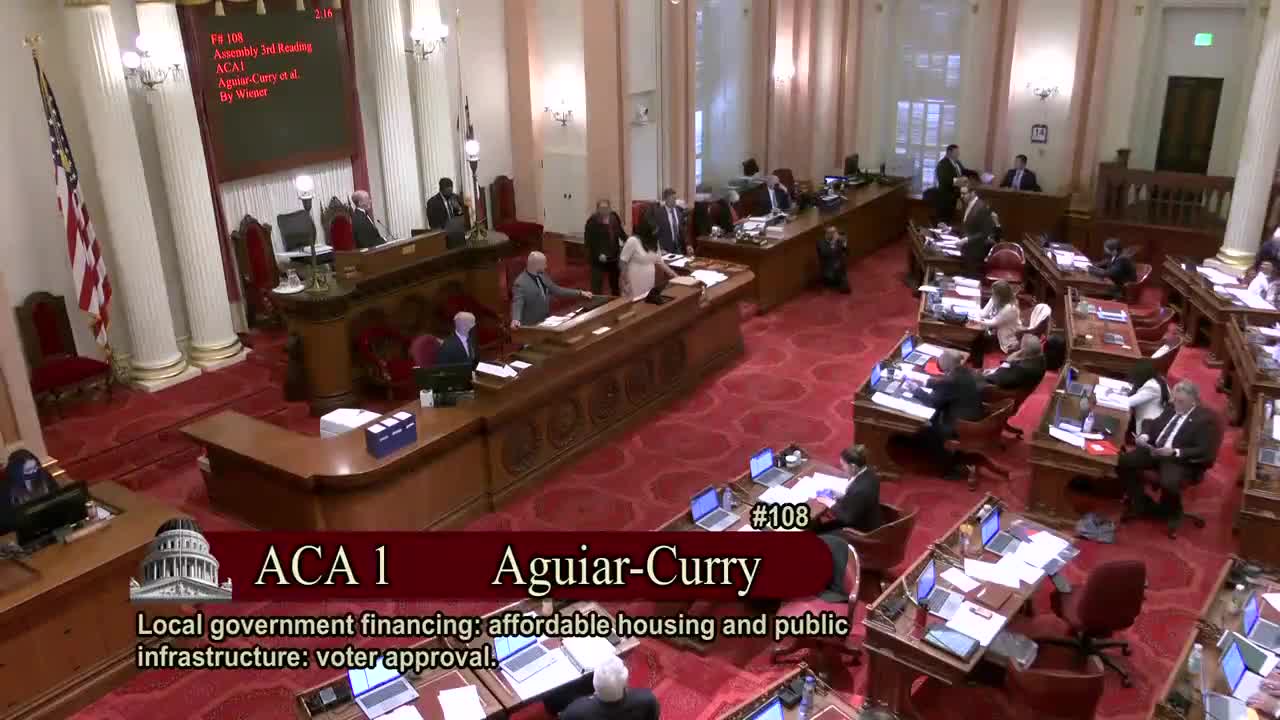 3MIN
Senate Floor
 1MIN
Assembly Floor
 29MIN
Senate Standing Committee on Energy, Utilities and Communications
 1MIN
Assembly Floor
 8MIN
Assembly Standing Committee on Communications and Conveyance
Bill Author

Bill Co-Author(s):