AB 1067: Vehicle accidents: fleeing the scene of an accident.
- Session Year: 2023-2024
- House: Assembly
- Latest Version Date: 2023-02-15
Current Status:
Failed
(2024-02-01: From committee: Filed with the Chief Clerk pursuant to Joint Rule 56.)
Introduced
In Committee
First Chamber
In Committee
Second Chamber
Enacted
Existing law requires the driver of a vehicle involved in an accident resulting in injury to a person, other than that driver, or in the death of a person to immediately stop the vehicle at the scene of the accident and provide specified personal information to the injured person or the occupants of the other vehicle and to any traffic or police officer at the scene of the accident.
Under existing law, if a vehicle accident results in permanent, serious injury or death, a person who violates the requirement to stop is subject to punishment by imprisonment in the state prison for 2, 3, or 4 years, or in a county jail for not less than 90 days nor more than one year, or by a specified fine, or both the imprisonment and fine. Existing law authorizes the court, in the interests of justice and for other reasons stated in the record, to reduce or eliminate the minimum imprisonment or fine requirements.
This bill would instead make a person who fails to immediately stop, as required, at the scene of an accident that resulted in a permanent, serious injury subject to punishment by imprisonment in the state prison for 2, 3, or 4 years, or in a county jail for not less than 90 days nor more than one year, and a specified fine, and if the accident resulted in death, the violation of those requirements would be punishable by imprisonment in the state prison for 3, 4, or 6 years, or in a county jail for not less than 90 days nor more than one year, and a specified fine.
This act shall be known, and may be cited, as Gavins Law.
SEC. 2.Section 20001 of the Vehicle Code is amended to read:20001.(a)The driver of a vehicle involved in an accident resulting in injury to a person, other than himself or herself, that driver, or in the death of a person shall immediately stop the vehicle at the scene of the accident and shall fulfill the requirements of Sections 20003 and 20004.
(b)(1)Except as provided in paragraph (2), If the accident described in subdivision (a) results in injury, other than a permanent, serious injury, a person who violates subdivision (a) shall be punished by imprisonment in the state prison, or in a county jail for not more than one year, or by a fine of not less than one thousand dollars ($1,000) nor more than ten thousand dollars ($10,000), or by both that imprisonment and fine.
(2)If the accident described in subdivision (a) results in death or permanent, serious injury, a person who violates subdivision (a) shall be punished by imprisonment in the state prison for two, three, or four years, or in a county jail for not less than 90 days nor more than one year, or year and by a fine of not less than one thousand dollars ($1,000) nor more than ten thousand dollars ($10,000), or by both that imprisonment and fine. ($10,000). However, the court, in the interests of justice and for reasons stated in the record, may reduce or eliminate the minimum imprisonment required by this paragraph.
(3)Except as provided in subdivision (c), if the accident described in subdivision (a) results in death, a person who violates subdivision (a) shall be punished by imprisonment in the state prison for three, four, or six years, or in a county jail for not less than 90 days nor more than one year, and by a fine of not less than one thousand dollars ($1,000) nor more than ten thousand dollars ($10,000). However, the court, in the interests of justice and for reasons stated in the record, may reduce or eliminate the minimum imprisonment required by this paragraph.
(3)(4)In imposing the minimum fine required by this subdivision, the court shall take into consideration the defendants ability to pay the fine and, in the interests of justice and for reasons stated in the record, may reduce the amount of that minimum fine to less than the amount otherwise required by this subdivision.
(c)A person who flees the scene of the crime after committing a violation of Section 191.5 of, or paragraph (1) of subdivision (c) of Section 192 of the Penal Code, upon conviction of any of those sections, in addition and consecutive to the punishment prescribed, shall be punished by an additional term of imprisonment of five years in the state prison. This additional term shall not be imposed unless the allegation is charged in the accusatory pleading and admitted by the defendant or found to be true by the trier of fact. The court shall not strike a finding that brings a person within the provisions of this subdivision or an allegation made pursuant to this subdivision.
(d)As used in this section, permanent, serious injury means the loss or permanent impairment of function of a bodily member or organ.
|
Date
|
Status
|
|---|---|
| Feb 1, 2024 | From committee: Filed with the Chief Clerk pursuant to Joint Rule 56. |
| Jan 31, 2024 | Died pursuant to Art. IV, Sec. 10(c) of the Constitution. |
| May 18, 2023 | In committee: Held under submission. |
| May 3, 2023 | In committee: Set, first hearing. Referred to APPR. suspense file. |
| Apr 26, 2023 | In committee: Hearing postponed by committee. |
| Mar 28, 2023 | From committee: Do pass and re-refer to Com. on APPR. (Ayes 5. Noes 0.) (March 28). Re-referred to Com. on APPR. |
| Mar 2, 2023 | Referred to Com. on PUB. S. |
| Feb 16, 2023 | From printer. May be heard in committee March 18. |
| Feb 15, 2023 | Read first time. To print. |
|
Date
|
Description
|
Location
|
Votes
|
|
|---|---|---|---|---|
| Mar 28, 2023 | Do pass and be re-referred to the Committee on [Appropriations] | Assembly Standing Committee on Public Safety |
Passed |
This list shows positions taken on this bill by organizations on the date displayed, which is linked to the original source.
Positions by individuals are not included.
|
Organization
|
Position
|
Date
|
|---|---|---|
| California District Attorneys Association | * Support | Mar 28, 2023 |
| California State Sheriffs' Association | ** Support | |
| Fresno County District Attorneys Office | ** Support | |
| Gavin Gladding Foundation | * Support | Mar 28, 2023 |
| Nisei Farmers League | ** Support | |
| San Francisco Public Defender | * Against | Mar 28, 2023 |
| Stone Advocacy | ** Support | Mar 28, 2023 |
| Tulare County Sheriff-coroner | ** Support |
Date of Hearing: May 3, 2023
ASSEMBLY COMMITTEE ON APPROPRIATIONS
Chris Holden, Chair
ABPCA Bill Id:AB 1067
Author:(Jim Patterson) – As Introduced Ver:February 15, 2023
Policy Committee: | Public Safety | Vote: | 5 - 0 |
|
| ||
|
|
Urgency: No State Mandated Local Program: No Reimbursable: No
SUMMARY:
This bill increases the penalty for fleeing the scene of an accident resulting in the death of another person from an alternate felony-misdemeanor with a maximum punishment of four years in state prison to an alternate felony-misdemeanor having a maximum punishment of six years in state prison.
FISCAL EFFECT:
Costs in the millions of dollars annually (General Fund) to the California Department of Corrections and Rehabilitation (CDCR) in increased incarceration costs. According to a 2022 estimate by the Legislative Analyst’s Office, the average annual cost per CDCR inmate is $106,000. If 10 defendants are convicted of hit and run resulting in death and sentenced to an additional two years each due to this bill, the resulting additional cost to the general fund would be $2,120,000 over two years of incarceration.
COMMENTS:
- Author’s Statement. According to the author, “AB 1067, Gavin’s Law will close the loophole in the law that inadvertently encourages drivers to flee the scene of an accident – particularly if they are under the influence – rather than stay at the scene to render aid or call 911.”
- Background. Under existing law, fleeing the scene of an accident resulting in the death of another person is an alternate felony-misdemeanor punishable by two, three, or four years in state prison. This bill would increase the punishment for fleeing the scene of an accident resulting in death to an alternate felony-misdemeanor punishable by up to six years in state prison. The driver need not have been impaired, reckless, or negligent for the increased punishment to apply.
- Deterrence. Studies have shown that, in most circumstances, lengthy criminal sentences do not effectively deter crime. According to the Committee on Revision of the Penal Code, a “major analysis of more than 100 studies concluded that it was a ‘criminological fact’ that incarceration is no better at reducing reoffending than noncustodial sanctions such as probation.” (Committee on Revision of the Penal Code, “Annual Report and Recommendations,” 2021.) In light of the growing cost of incarceration and its limited utility in deterring crime, both the Little Hoover Commission and the Committee on Revision of the Penal Code have encouraged sentencing reform in California. Additionally, in 2014, the Little Hoover Commission highlighted several evidence-based approaches to reducing crime, including programs and treatment that address underlying factors that can contribute to crime, such as poverty, homelessness, mental health issues, and substance and alcohol abuse disorders. Research has shown that, unlike lengthy prison terms, these approaches have improved public safety outcomes.
- Related Legislation. AB 1551 (Gipson) requires the court to order the defendant to pay restitution in the form of child maintenance to each of the victim’s children until each child reaches 18 years of age for specified crimes such as vehicular manslaughter while intoxicated. AB 1551 is pending in this committee.
- Prior Legislation. AB 582 (Patterson) of the 2021-2022 Legislative session, was identical to this bill and was held on this committee’s suspense file.
AB 195 (Patterson) of the 2019-2020 Legislative Session, was also identical to this bill and failed passage in the Senate Committee on Public Safety.
Analysis Prepared by: Annika Carlson / APPR. / (916) 319-2081
Date of Hearing:
Counsel: Cheryl Anderson
ASSEMBLY COMMITTEE ON PUBLIC SAFETY
Reginald Byron Jones-Sawyer, Sr., Chair
ABPCA Bill Id:AB 1067
Author:(Jim Patterson) – As Introduced Ver:February 15, 2023
SUMMARY:
Increases the penalties for fleeing the scene of an accident resulting in the death of another person from an alternate felony-misdemeanor with a maximum punishment of four years in state prison, to an alternate felony-misdemeanor having a maximum punishment of six years in the state prison. Makes the permissible fine ranging from $1,000 to $10,000 mandatory where the accident resulted in death or permanent, serious injury, except the court may reduce it based on the defendant’s ability to pay and in the interests of justice.
EXISTING LAW:
- Requires the driver of a vehicle involved in an accident resulting in injury to another person to stop at the scene of the accident and to fulfill specified requirements, including providing identifying information and rendering assistance. (Veh. Code, § 20001, subd. (a).)
- Provides that, except as specified, fleeing the scene of an accident resulting in injury to another, is punishable by 16 months, two, or three years in state prison or, by imprisonment in a county jail not to exceed one year, or by a fine of not less than $1,000 nor more than $10,000, or by both a fine and imprisonment. (Veh. Code, § 20001, subd. (b)(1).)
- Provides that fleeing the scene of an accident which results in permanent, serious injury or death to another, is punishable by imprisonment in the state prison for two, three, or four years, or in a county jail for not less than 90 days nor more than one year, or by a fine ranging between $1,000 and $10,000, or by both a fine and imprisonment. (Veh. Code, § 20001, subd. (b)(2).)
- Allows the court, in the interests of justice, to reduce or eliminate the minimum term of imprisonment required for a conviction of fleeing the scene of an accident causing death or permanent, serious injury. (Veh. Code, § 20001, subd. (b)(2).)
- Requires the court to take into consideration the defendant’s ability to pay in imposing the minimum fine required. In the interests of justice, the court may reduce the amount of the fine below the required minimum. (Veh. Code, § 20001, subd. (b)(3).)
- States that a person who flees the scene of an accident after committing gross vehicular manslaughter or gross vehicular manslaughter while intoxicated, upon conviction for that offense, shall be punished by an additional term of five years in the state prison. This additional term runs consecutive to the punishment for the vehicular manslaughter. (Veh. Code, § 20001, subd. (c).)
- Defines “permanent, serious injury” as the loss or permanent impairment of function of a bodily member or organ. (Veh. Code, § 20001, subd. (d).)
- Defines “gross vehicular manslaughter” as the unlawful killing of a human being, without malice aforethought, in driving a vehicle in the commission of an unlawful act, not amounting to a felony, and with gross negligence; or in driving a vehicle in the commission of a lawful act which might produce death, in an unlawful manner, and with gross negligence. Gross vehicular manslaughter is punishable by either imprisonment in a county jail for not more than one year, or in the state prison for two, four, or six years. (Pen. Code, §§ 192, subd. (c)(1), 193, subd. (c)(1).)
- Defines “gross vehicular manslaughter” while intoxicated as the unlawful killing of a human being without malice aforethought, in the driving of a vehicle, where the driver was under the influence of drugs or alcohol, and the killing was either the proximate result of an unlawful act not amounting to a felony, and with gross negligence, or the proximate result of a lawful act that might produce death, in an unlawful manner, and with gross negligence. Gross vehicle manslaughter while intoxicated is punishable by imprisonment in the state prison for four, six, or ten years. (Pen. Code, § 191.5, subds. (a) & (c)(1).)
- Provides that if the defendant has any prior vehicular manslaughter convictions or at least two prior driving under the influence convictions, the punishment for “gross vehicular manslaughter” while intoxicated is 15-years-to-life in state prison. (Pen. Code, § 191.5, subd. (d).)
- Provides for additional punishment of three years when great bodily injury (GBI) is inflicted during the commission of a felony not having bodily harm as an element of the offense. The additional punishment increases to five years if the victim becomes comatose due to brain injury or suffers permanent paralysis or if the victim is 70 years of age or older. The punishment is up to six years if the victim is a child under five years of age. (Pen. Code, § 12022.7, subds. (a)-(d).)
- Makes the GBI enhancement inapplicable to murder or manslaughter. (Pen. Code, § 191.5, subd. (g).)
- Provides that an act or omission that is punishable in different ways may be punished under either of such provisions, but in no case shall the act or omission be punished under more than one provision. (Pen. Code, § 654.)
FISCAL EFFECT:
Unknown
COMMENTS:
- Author's Statement: According to the author, “AB 1067, Gavin’s Law will close the loophole in the law,that inadvertently encourages drivers to flee the scene of an accident – particularly if they are under the influence – rather than stay at the scene to render aid or call 911.”
- Fleeing the Scene of an Accident Resulting in Injury: Vehicle Code section 20001 is commonly known as “hit and run.” To prove a violation of hit and run resulting in permanent, serious injury or death the prosecution must establish that: (1) the defendant was involved in a vehicle accident while driving; (2) the accident caused permanent, serious injury or death to another; (3) the defendant knew that they were involved in an accident that injured another person, or knew from the nature of the accident that it was probable that another person had been injured; and, (4) the defendant willfully failed to perform one or more duties, including immediately stopping at the scene, providing reasonable assistance to any injured person, to provide specified identifying information, and showing driver’s license upon request. (See CALCRIM No. 2140.)
“The purpose of [the statute] is to prevent the driver of an automobile from leaving the scene of an accident in which he participates or is involved without proper identification and to compel necessary assistance to those who may be injured. The requirements of the statute are operative and binding on all drivers involved in an accident regardless of any question of their negligence respectively.” (People v. Scofield (1928) 203 Cal. 703, 708.) In other words, it is not necessary to drive impaired, recklessly or negligently. These duties apply regardless of the fault of the accident.
Currently, the crime of fleeing the scene of an accident resulting in death or permanent, serious injury is an alternate felony-misdemeanor. The crime is punishable by up to one year in jail, or two, three or four years in prison. (Veh. Code, § 20001, subd. (b).) This bill would increase the punishment for fleeing the scene of an accident resulting in death to an alternate felony-misdemeanor punishable by up to of six years in the state prison. As noted above, for this increase to apply, the driver need not have been impaired, reckless, or negligent. - Increased Penalties and Lack of Deterrent Effect: According the U.S. Department of Justice, “Laws and policies designed to deter crime by focusing mainly on increasing the severity of punishment are ineffective partly because criminals know little about the sanctions for specific crimes. More severe punishments do not ‘chasten’ individuals convicted of crimes, and prisons may exacerbate recidivism.” (National Institute of Justice, U.S. Department of Justice, Five Things about Deterrence (June 5, 2016) https://nij.ojp.gov/topics/articles/five-things-about-deterrence.) Rather than penalty increases, the NIJ, advocates for polices that “increase the perception that criminals will be caught and punished” because such perception is a vastly more powerful deterrent than increasing the punishment. (Ibid.)
In a 2014 report, the Little Hoover Commission also addressed the disconnect between science and sentencing – that is, putting away offenders for increasingly longer periods of time, with no evidence that lengthy incarceration, for many, brings any additional public safety benefit. (Little Hoover Commission, Sensible Sentencing for a Safer California (2014) at p. 4 https://lhc.ca.gov/sites/lhc.ca.gov/files/Reports/219/Report219.pdf.) - Argument in Support: According to Nisei Farmers League, “The potential sentence for leaving the scene of an incident is not enough to deter drivers, especially those who may be under the influence, from leaving the scene. When these drivers leave the scene, not only are they failing to render aid to any injured victim, but they are also removing evidence from the scene of a crime. Law enforcement officials are not able to conduct field sobriety tests of the driver, document his/her statement, or collect any other pertinent information and evidence, therefore hamstringing the entire investigation.”
- Argument in Opposition: According to the San Francisco Public Defender’s Office, “The San Francisco Public Defender’s Office takes seriously the devastation caused by traffic collisions, and is committed to supporting effective, evidence-based responses to harm and trauma. Here, academic research offers no support that the threat of longer jail or prison sentences, deters people from committing crimes (“[I]ncreased incarceration rates have no demonstrated effect on violent crime and in some instances may increase crime.”) To the contrary, the data shows that enhancements increase racial disparities and drive over-incarceration, thus aggravating and exacerbating the root causes of crime.” (Footnotes omitted.)
- Related Legislation: AB 1551 (Gipson), would require the court to order the defendant to pay restitution in the form of child maintenance to each of the victim’s children until each child reaches 18 years of age for specified crimes such as vehicular manslaughter while intoxicated. AB 1551 is pending hearing in this committee.
- Prior Legislation:
- AB 582 (Patterson), of the 2021-2022 Legislative Session, was the same as this bill. AB 582 was held in the Assembly Appropriations Committee.
- AB 195 (Patterson), of the 2019-2020 Legislative Session, as amended in the Senate, was the same as this bill. AB 195 failed passage in the Senate Public Safety Committee.
- AB 2014 (E. Garcia), of the 2017-2018 Legislative Session, would have increased the penalty for fleeing the scene of an accident resulting in death or serious bodily injury from two, three, or four years in state prison to two, four, or six years in state prison. The hearing on AB 2014 was canceled in this committee at the request of the author.
- AB 582 (Patterson), of the 2021-2022 Legislative Session, was the same as this bill. AB 582 was held in the Assembly Appropriations Committee.
REGISTERED SUPPORT / OPPOSITION:
Support
California District Attorneys Association
California State Sheriffs' Association
Fresno County District Attorneys Office
Nisei Farmers League
Tulare County Sheriff-coroner
104 Private Individuals
Opposition
San Francisco Public Defender
Analysis Prepared by:
Cheryl Anderson / PUB. S. / (916) 319-3744
Discussed in Hearing
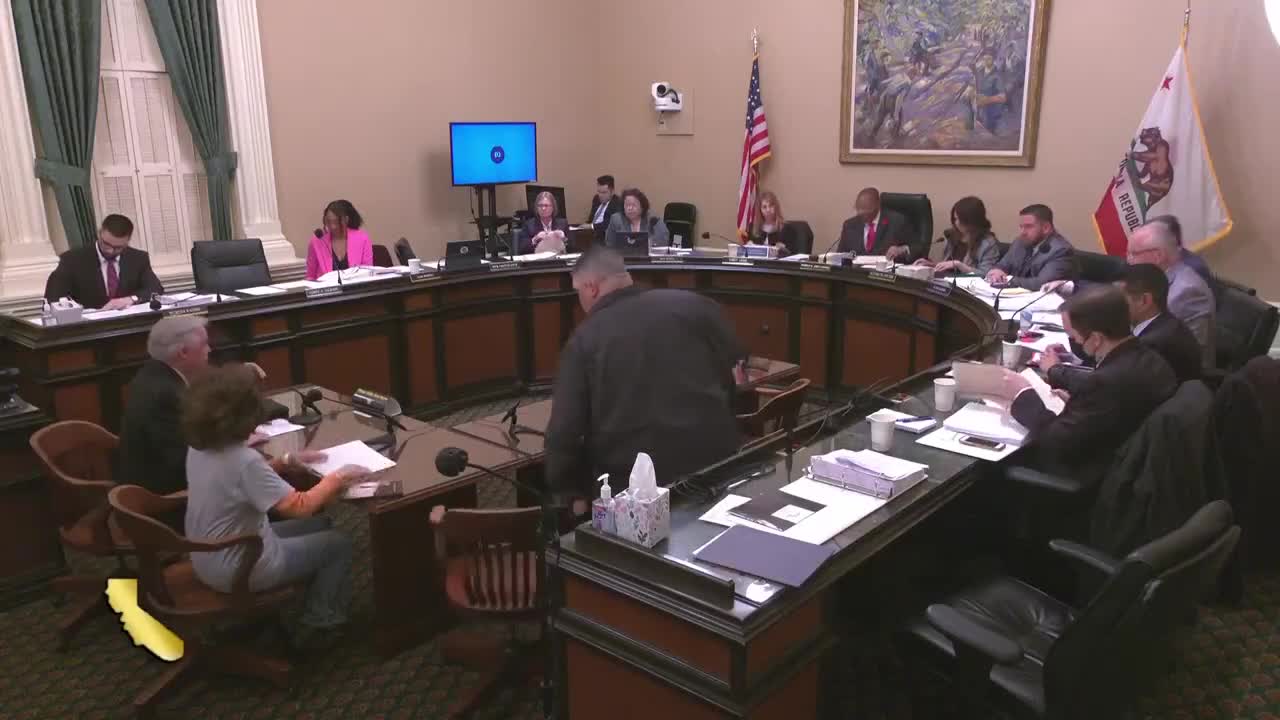 15MIN
Assembly Standing Committee on Public Safety
Bill Author

Bill Co-Author(s):