AB 1116: Money Transmission Act.
- Session Year: 2023-2024
- House: Assembly
- Latest Version Date: 2023-10-08
Current Status:
Passed
(2023-10-08: Chaptered by Secretary of State - Chapter 463, Statutes of 2023.)
Introduced
In Committee
First Chamber
In Committee
Second Chamber
Enacted
The Money Transmission Act generally provides for the regulation of money transmission, as defined, by the Commissioner of Financial Protection and Innovation. The act provides for certain exemptions from the act, including an exemption for the United States or a department, agency, or instrumentality thereof, including a federal reserve bank and a federal home loan bank.
This bill would, among other things, additionally exempt from the act a person that acts as an intermediary by processing money transmission between an entity that has directly incurred an outstanding money transmission obligation to a sender and the senders designated recipient if the entity meets certain criteria, including that the entity is properly licensed or exempt from licensing requirements under the act. The bill would also exempt a registered futures commission merchant under the federal commodities laws to the extent of its operation as such a merchant.
The act requires a licensee to, not more than 45 days after the end of each calendar year quarter, file with the commissioner a report containing certain information, including the current address of each branch office of the licensee in this state, as specified, the name of each person who acted as an agent in this state of the licensee during the calendar year quarter, and the address for each agent branch office, as specified. The act makes a person that intentionally makes a false statement, misrepresentation, or false certification in a record filed or required to be maintained under the act, or that intentionally makes a false entry or omits a material entry in such a record, guilty of a felony.
This bill would instead require the report described above to be filed through the Nationwide Multistate Licensing System and Registry, as specified. The bill would require a licensee to include in that report additional information regarding a person who acted as an agent in this state of the licensee during the calendar year quarter, including the agents telephone number and email address. By expanding the scope of the crime described above, this bill would impose a state-mandated local program.
The act requires an applicant for a license to possess, and requires a licensee to maintain at all times, tangible shareholders equity of $250,000 to $500,000 depending on estimated or actual transaction volume, as determined by the commissioner, as prescribed.
This bill would delete that provision and would instead, subject to the commissioners discretion, require a licensee to maintain at all times a tangible net worth of the greater of $100,000 or 3 percent of total assets for the first $100,000,000, 2 percent of additional assets for $100,000,000 to $1,000,000,000, and one-half of 1 percent of additional assets for over $1,000,000,000.
The act requires a licensee to, at all times, own eligible securities having an aggregate market value computed in accordance with United States generally accepted accounting principles of not less than the aggregate amount of all of its outstanding payment instruments and stored value obligations issued or sold in the United States and all outstanding money received for transmission in the United States. The act defines eligible securities to mean any United States currency eligible security or foreign currency eligible security and defines United States currency eligible security and foreign currency eligible security to mean specific securities.
This bill would make various changes related to the determination of the value of eligible securities held by a licensee, including by revising the list of those securities. Among those revisions, the bill would include in the list of United States currency eligible securities the full drawable amount of an irrevocable standby letter of credit for which the stated beneficiary is the commissioner that stipulates that the beneficiary need only draw a sight draft under the letter of credit and present it to obtain funds up to the letter of credit amount within 7 days of presentation of certain items, including the original letter of credit.
This bill would also impose certain requirements on a licensee when adding or replacing a key individual, defined to mean a natural person ultimately responsible for establishing or directing policies and procedures of the licensee, including an executive officer, manager, director, or trustee. Among those requirements, the bill would require the licensee to provide notice to the commissioner within 15 days after the effective date of the key individuals appointment, as prescribed.
This bill would provide that, before January 1, 2025, a person licensed under the act to engage in the business of money transmission is not subject to a provision of the bill to the extent that the provision conflicts with the law in effect on December 31, 2023, or to the extent the provision establishes new requirements not imposed under the law in effect on December 31, 2023.
The California Constitution requires the state to reimburse local agencies and school districts for certain costs mandated by the state. Statutory provisions establish procedures for making that reimbursement.
This bill would provide that no reimbursement is required by this act for a specified reason.
The Money Transmission Act generally provides for the regulation of money transmission, as defined, by the Commissioner of Financial Protection and Innovation. The act provides for certain exemptions from the act, including an exemption for the United States or a department, agency, or instrumentality thereof, including a federal reserve bank and a federal home loan bank.
This bill would, among other things, additionally exempt from the act a person that acts as an intermediary by processing money transmission between an entity that has directly incurred an outstanding money transmission obligation to a sender and the senders designated recipient if the entity meets certain criteria, including that the entity is properly licensed or exempt from licensing requirements under the act. The bill would also exempt a registered futures commission merchant under the federal commodities laws to the extent of its operation as such a merchant.
The act requires a licensee to, not more than 45 days after the end of each calendar year quarter, file with the commissioner a report containing certain information, including the current address of each branch office of the licensee in this state, as specified, the name of each person who acted as an agent in this state of the licensee during the calendar year quarter, and the address for each agent branch office, as specified. The act makes a person that intentionally makes a false statement, misrepresentation, or false certification in a record filed or required to be maintained under the act, or that intentionally makes a false entry or omits a material entry in such a record, guilty of a felony.
This bill would instead require the report described above to be filed through the Nationwide Multistate Licensing System and Registry, as specified. The bill would require a licensee to include in that report additional information regarding a person who acted as an agent in this state of the licensee during the calendar year quarter, including the agents telephone number and email address. By expanding the scope of the crime described above, this bill would impose a state-mandated local program.
The act requires an applicant for a license to possess, and requires a licensee to maintain at all times, tangible shareholders equity of $250,000 to $500,000 depending on estimated or actual transaction volume, as determined by the commissioner, as prescribed.
This bill would delete that provision and would instead, subject to the commissioners discretion, require a licensee to maintain at all times a tangible net worth of the greater of $100,000 or 3 percent of total assets for the first $100,000,000, 2 percent of additional assets for $100,000,000 to $1,000,000,000, and one-half of 1 percent of additional assets for over $1,000,000,000.
The act requires a licensee to, at all times, own eligible securities having an aggregate market value computed in accordance with United States generally accepted accounting principles of not less than the aggregate amount of all of its outstanding payment instruments and stored value obligations issued or sold in the United States and all outstanding money received for transmission in the United States. The act defines eligible securities to mean any United States currency eligible security or foreign currency eligible security and defines United States currency eligible security and foreign currency eligible security to mean specific securities.
This bill would make various changes related to the determination of the value of eligible securities held by a licensee, including by revising the list of those securities. Among those revisions, the bill would include in the list of United States currency eligible securities the full drawable amount of an irrevocable standby letter of credit for which the stated beneficiary is the commissioner that stipulates that the beneficiary need only draw a sight draft under the letter of credit and present it to obtain funds up to the letter of credit amount within 7 days of presentation of certain items, including the original letter of credit.
This bill would also impose certain requirements on a licensee when adding or replacing a key individual, defined to mean a natural person ultimately responsible for establishing or directing policies and procedures of the licensee, including an executive officer, manager, director, or trustee. Among those requirements, the bill would require the licensee to provide notice to the commissioner within 15 days after the effective date of the key individuals appointment, as prescribed.
This bill would provide that, before January 1, 2025, a person licensed under the act to engage in the business of money transmission is not subject to a provision of the bill to the extent that the provision conflicts with the law in effect on December 31, 2023, or to the extent the provision establishes new requirements not imposed under the law in effect on December 31, 2023.
The California Constitution requires the state to reimburse local agencies and school districts for certain costs mandated by the state. Statutory provisions establish procedures for making that reimbursement.
This bill would provide that no reimbursement is required by this act for a specified reason.
The Money Transmission Act generally provides for the regulation of money transmission, as defined, by the Commissioner of Financial Protection and Innovation. The act provides for certain exemptions from the act, including an exemption for the United States or a department, agency, or instrumentality thereof, including a federal reserve bank and a federal home loan bank.
This bill would, among other things, additionally exempt from the act a person that acts as an intermediary by processing money transmission between an entity that has directly incurred an outstanding money transmission obligation to a sender and the senders designated recipient if the entity meets certain criteria, including that the entity is properly licensed or exempt from licensing requirements under the act. The bill would also exempt a registered futures commission merchant under the federal commodities laws to the extent of its operation as such a merchant.
The act requires a licensee to, not more than 45 days after the end of each calendar year quarter, file with the commissioner a report containing certain information, including the current address of each branch office of the licensee in this state, as specified, the name of each person who acted as an agent in this state of the licensee during the calendar year quarter, and the address for each agent branch office, as specified. The act makes a person that intentionally makes a false statement, misrepresentation, or false certification in a record filed or required to be maintained under the act, or that intentionally makes a false entry or omits a material entry in such a record, guilty of a felony.
This bill would instead require the report described above to be filed through NMLS, as defined. the Nationwide Multistate Licensing System and Registry, as specified. The bill would require a licensee to include in that report additional information regarding a person who acted as an agent in this state of the licensee during the calendar year quarter, including the agents telephone number and email address. By expanding the scope of the crime described above, this bill would impose a state-mandated local program.
The act requires an applicant for a license to possess, and requires a licensee to maintain at all times, tangible shareholders equity of $250,000 to $500,000 depending on estimated or actual transaction volume, as determined by the commissioner, as prescribed.
This bill would delete that provision and would instead, subject to the commissioners discretion, require a licensee to maintain at all times a tangible net worth of the greater of $100,000 or 3 percent of total assets for the first $100,000,000, 2 percent of additional assets for $100,000,000 to $1,000,000,000, and one-half of 1 percent of additional assets for over $1,000,000,000.
The act requires a licensee to, at all times, own eligible securities having an aggregate market value computed in accordance with United States generally accepted accounting principles of not less than the aggregate amount of all of its outstanding payment instruments and stored value obligations issued or sold in the United States and all outstanding money received for transmission in the United States. The act defines eligible securities to mean any United States currency eligible security or foreign currency eligible security and defines United States currency eligible security and foreign currency eligible security to mean specific securities.
This bill would, among other would make various changes related to the determination of the value of eligible securities held by a licensee, revise and add to revising the list of those securities, including by including securities. Among those revisions, the bill would include in the list of United States currency eligible securities the full drawable amount of an irrevocable standby letter of credit for which the stated beneficiary is the commissioner that stipulates that the beneficiary need only draw a sight draft under the letter of credit and present it to obtain funds up to the letter of credit amount within 7 days of presentation of certain items, including the original letter of credit.
This bill would also require impose certain requirements on a licensee when adding or replacing a key individual, defined to mean a natural person ultimately responsible for establishing or directing policies and procedures of the licensee, including an executive officer, manager, director, or trustee, to take certain actions, including trustee. Among those requirements, the bill would require the licensee to provide notice to the commissioner within 15 days after the effective date of the key individuals appointment, as prescribed.
This bill would provide that, before January 1, 2025, a person licensed under the act to engage in the business of money transmission is not subject to a provision of the bill to the extent that the provision conflicts with the law in effect on December 31, 2023, or to the extent the provision establishes new requirements not imposed under the law in effect on December 31, 2023.
The California Constitution requires the state to reimburse local agencies and school districts for certain costs mandated by the state. Statutory provisions establish procedures for making that reimbursement.
This bill would provide that no reimbursement is required by this act for a specified reason.
The Money Transmission Act generally provides for the regulation of money transmission, as defined, by the Commissioner of Financial Protection and Innovation. The act provides for certain exemptions from the act, including an exemption for the United States or a department, agency, or instrumentality thereof, including a federal reserve bank and a federal home loan bank.
This bill would, among other things, additionally exempt from the act a person that acts as an intermediary by processing money transmission between an entity that has directly incurred an outstanding money transmission obligation to a sender and the senders designated recipient if the entity meets certain criteria, including that the entity is properly licensed or exempt from licensing requirements under the act. The bill would also exempt a registered futures commission merchant under the federal commodities laws to the extent of its operation as such a merchant.
The act requires a licensee to, not more than 45 days after the end of each calendar year quarter, file with the commissioner a report containing certain information, including the current address of each branch office of the licensee in this state, as specified, the name of each person who acted as an agent in this state of the licensee during the calendar year quarter, and the address for each agent branch office, as specified. The act makes a person that intentionally makes a false statement, misrepresentation, or false certification in a record filed or required to be maintained under the act, or that intentionally makes a false entry or omits a material entry in such a record, guilty of a felony.
This bill would instead require the report described above to be filed through NMLS, as defined. The bill would require a licensee to include in that report additional information regarding a person who acted as an agent in this state of the licensee during the calendar year quarter, including the agents telephone number and email address. By expanding the scope of the crime described above, this bill would impose a state-mandated local program.
The act requires an applicant for a license to possess, and requires a licensee to maintain at all times, tangible shareholders equity of $250,000 to $500,000 depending on estimated or actual transaction volume, as determined by the commissioner, as prescribed.
This bill would delete that provision and would instead, subject to the commissioners discretion, require a licensee to maintain at all times a tangible net worth of the greater of $100,000 or 3 percent of total assets for the first $100,000,000, 2 percent of additional assets for $100,000,000 to $1,000,000,000, and one-half of 1 percent of additional assets for over $1,000,000,000.
The act requires a licensee to, at all times, own eligible securities having an aggregate market value computed in accordance with United States generally accepted accounting principles of not less than the aggregate amount of all of its outstanding payment instruments and stored value obligations issued or sold in the United States and all outstanding money received for transmission in the United States. The act defines eligible securities to mean any United States currency eligible security or foreign currency eligible security and defines United States currency eligible security and foreign currency eligible security to mean specific securities.
This bill would, among other changes related to the determination of the value of eligible securities held by a licensee, revise and add to the list of those securities, including by including in the list of United States currency eligible securities the full drawable amount of an irrevocable standby letter of credit for which the stated beneficiary is the commissioner that stipulates that the beneficiary need only draw a sight draft under the letter of credit and present it to obtain funds up to the letter of credit amount within 7 days of presentation of certain items, including the original letter of credit.
This bill would also require a licensee adding or replacing a key individual, defined to mean a natural person ultimately responsible for establishing or directing policies and procedures of the licensee, including an executive officer, manager, director, or trustee, to take certain actions, including provide notice to the commissioner within 15 days after the effective date of the key individuals appointment, as prescribed.
This bill would provide that, before January 1, 2025, a person licensed under the act to engage in the business of money transmission is not subject to a provision of the bill to the extent that the provision conflicts with the law in effect on December 31, 2023, or to the extent the provision establishes new requirements not imposed under the law in effect on December 31, 2023.
The California Constitution requires the state to reimburse local agencies and school districts for certain costs mandated by the state. Statutory provisions establish procedures for making that reimbursement.
This bill would provide that no reimbursement is required by this act for a specified reason.
The Money Transmission Act generally provides for the regulation of money transmission, as defined, by the Commissioner of Financial Protection and Innovation. The act provides for certain exemptions from the act, including an exemption for the United States or a department, agency, or instrumentality thereof, including a federal reserve bank and a federal home loan bank.
This bill would, among other things, additionally exempt from the act a person that acts as an intermediary by processing money transmission between an entity that has directly incurred an outstanding money transmission obligation to a sender and the senders designated recipient, recipient if the entity meets certain criteria, including that the entity is properly licensed or exempt from licensing requirements under the act. The bill would also exempt a registered futures commission merchant under the federal commodities laws to the extent of its operation as such a merchant.
The act requires a licensee to, not more than 45 days after the end of each calendar year quarter, file with the commissioner a report containing certain information, including the current address of each branch office of the licensee in this state, as specified, and the name of each person who acted as an agent in this state of the licensee during the calendar year quarter quarter, and the address for each agent branch office, as specified. The act makes a person that intentionally makes a false statement, misrepresentation, or false certification in a record filed or required to be maintained under the act act, or that intentionally makes a false entry or omits a material entry in such a record record, guilty of a felony.
This bill would instead require the information regarding each branch office of the licensee report described above to be reported filed through NMLS, as defined, and not directly to the commissioner. defined. The bill would require a licensee to file include in that report additional information with the commissioner regarding a person who acted as an agent in this state of the licensee during the calendar year quarter, including the agents telephone number and email address. By expanding the scope of the crime described above, this bill would impose a state-mandated local program.
The act requires an applicant for a license to possess, and requires a licensee to maintain at all times, tangible shareholders equity of $250,000 to $500,000 depending on estimated or actual transaction volume, as determined by the commissioner, as prescribed.
This bill would delete that provision and would instead, subject to the commissioners discretion, require a licensee to maintain at all times a tangible net worth of the greater of $100,000 or 3 percent of total assets for the first $100,000,000, 2 percent of additional assets for $100,000,000 to $1,000,000,000, and one-half of 1 percent of additional assets for over $1,000,000,000.
The act requires a licensee to, at all times, own eligible securities having an aggregate market value computed in accordance with United States generally accepted accounting principles of not less than the aggregate amount of all of its outstanding payment instruments and stored value obligations issued or sold in the United States and all outstanding money received for transmission in the United States. The act defines eligible securities to mean any United States currency eligible security or foreign currency eligible security and defines United States currency eligible security and foreign currency eligible security to mean specific securities.
This bill would, among other changes related to the determination of the value of eligible securities held by a licensee, revise and add to the list of those securities, including by including in the list of United States currency eligible securities the full drawable amount of an irrevocable standby letter of credit for which the stated beneficiary is the commissioner that stipulates that the beneficiary need only draw a sight draft under the letter of credit and present it to obtain funds up to the letter of credit amount within 7 days of presentation of certain items, including the original letter of credit.
This bill would also require a licensee adding or replacing a key individual, defined to mean a natural person ultimately responsible for establishing or directing policies and procedures of the licensee, including an executive officer, manager, director, or trustee, to take certain actions, including provide notice to the commissioner within 15 days after the effective date of the key individuals appointment, as prescribed.
The This bill would provide that, before January 1, 2025, a person licensed under the act to engage in the business of money transmission is not subject to a provision of the bill to the extent that the provision conflicts with the law in effect on December 31, 2023, or to the extent the provision establishes new requirements not imposed under the law in effect on December 31, 2023.
The California Constitution requires the state to reimburse local agencies and school districts for certain costs mandated by the state. Statutory provisions establish procedures for making that reimbursement.
This bill would provide that no reimbursement is required by this act for a specified reason.
The Money Transmission Act generally provides for the regulation of money transmission, as defined, by the Commissioner of Financial Protection and Innovation. The act provides for certain exemptions from the act, including an exemption for the United States or a department, agency, or instrumentality thereof, including a federal reserve bank and a federal home loan bank.
This bill would, among other things, additionally exempt from the act a person that acts as an intermediary by processing money transmission between an entity that has directly incurred an outstanding money transmission obligation to a sender and the senders designated recipient, if the entity meets certain criteria, including that the entity is properly licensed or exempt from licensing requirements under the act. The bill would also exempt a registered futures commission merchant under the federal commodities laws to the extent of its operation as such a merchant.
The act requires a licensee to, not more than 45 days after the end of each calendar year quarter, file with the commissioner a report containing certain information, including the current address of each branch office of the licensee in this state, as specified, and the name of each person who acted as an agent in this state of the licensee during the calendar year quarter and the address for each agent branch office, as specified. The act makes a person that intentionally makes a false statement, misrepresentation, or false certification in a record filed or required to be maintained under the act or that intentionally makes a false entry or omits a material entry in such a record guilty of a felony.
This bill would instead require the information regarding each branch office of the licensee to be reported through NMLS, as defined, and not directly to the commissioner. The bill would require a licensee to file additional information with the commissioner regarding a person who acted as an agent in this state of the licensee during the calendar year quarter, including the agents telephone number and email address. By expanding the scope of the crime described above, this bill would impose a state-mandated local program.
The act requires an applicant for a license to possess, and requires a licensee to maintain at all times, tangible shareholders equity of $250,000 to $500,000 depending on estimated or actual transaction volume, as determined by the commissioner, as prescribed.
This bill would delete that provision and would instead, subject to the commissioners discretion, require a licensee to maintain at all times a tangible net worth of the greater of $100,000 or 3 percent of total assets for the first $100,000,000, 2 percent of additional assets for $100,000,000 to $1,000,000,000, and one-half of 1 percent of additional assets for over $1,000,000,000.
The act requires a licensee to, at all times, own eligible securities having an aggregate market value computed in accordance with United States generally accepted accounting principles of not less than the aggregate amount of all of its outstanding payment instruments and stored value obligations issued or sold in the United States and all outstanding money received for transmission in the United States. The act defines eligible securities to mean any United States currency eligible security or foreign currency eligible security and defines United States currency eligible security and foreign currency eligible security to mean specific securities.
This bill would, among other changes related to the determination of the value of eligible securities held by a licensee, revise and add to the list of those securities, including by including in the list of United States currency eligible securities the full drawable amount of an irrevocable standby letter of credit for which the stated beneficiary is the commissioner that stipulates that the beneficiary need only draw a sight draft under the letter of credit and present it to obtain funds up to the letter of credit amount within 7 days of presentation of certain items, including the original letter of credit.
This bill would also require a licensee adding or replacing a key individual, defined to mean a natural person ultimately responsible for establishing or directing policies and procedures of the licensee, including an executive officer, manager, director, or trustee, to take certain actions, including provide notice to the commissioner within 15 days after the effective date of the key individuals appointment, as prescribed.
The bill would provide that, before January 1, 2025, a person licensed under the act to engage in the business of money transmission is not subject to a provision of the bill to the extent that the provision conflicts with the law in effect on December 31, 2023, or to the extent the provision establishes new requirements not imposed under the law in effect on December 31, 2023.
The California Constitution requires the state to reimburse local agencies and school districts for certain costs mandated by the state. Statutory provisions establish procedures for making that reimbursement.
This bill would provide that no reimbursement is required by this act for a specified reason.
It is the intent of the Legislature that the provisions of this act accomplish all of the following:
(a)Protect the interests of persons in this state who use money transmission services.
(b)Provide for the safe and sound conduct of the business of licensees.
(c)Maintain public confidence in licensees.
(d)Ensure states can coordinate in all areas of regulation, licensing, and supervision to eliminate unnecessary regulatory burden and more effectively utilize regulator resources.
(e)Standardize the types of activities that are subject to licensing or exempt from licensing.
(f)Authorize the utilization of Nationwide Multistate Licensing System and Registry forms, processes, and functionalities in accordance with this act.
SEC. 2.Section 2003 of the Financial Code is amended to read:2003.For purposes of this division:
(a)Affiliate, when used with respect to a specified person, means any person controlling, controlled by, or under common control with, that specified person, directly or indirectly through one or more intermediaries. For purposes of subdivisions (s) and (x), a specified person is affiliated with another person if that person controls, is controlled by, or under common control through the ownership directly or indirectly of shares or equity securities possessing more than 50 percent of the voting power of that specified person.
(b)Agent means a person that is not itself licensed as a money transmitter in California and provides money transmission in California on behalf of the licensee, provided that the licensee becomes liable for the money transmission from the time money or monetary value is received by that person. However, agent does not include any officer or employee of the licensee when acting as such at an office of a licensee.
(c)Applicant means a person that files an application for a license or for acquisition of control of a licensee under this division.
(d)Average daily outstanding means the amount of outstanding money transmission obligations in California at the end of each day in a given period of time, added together, and divided by the total number of days in that period of time.
(e)Branch office means any office in this state of a licensee or agent at which the licensee receives money or monetary value to provide money transmission, either directly or through an agent.
(f)Business day means one of the following:
(1)When used with respect to any act to be performed in this state, any day other than Saturday, Sunday, or any other day that is provided for as a holiday in the Government Code.
(2)When used with respect to any act to be performed in any jurisdiction other than this state, any day other than a day that is a legal holiday under the laws of that jurisdiction.
(g)Commissioner means the Commissioner of Financial Protection and Innovation.
(h)Control has the meaning set forth in Section 1250.
(i)Day means calendar day.
(j)E-commerce means any transaction where the payment for goods or services is initiated via a mobile application or an internet website.
(k)(1)In California or in this state means physically located in California.
(2)For a transaction requested electronically or by phone, the provider of money transmission may determine if the person requesting the transaction is in this state by relying on other information provided by the person regarding the location of the individuals residential address or a business entitys principal place of business or other physical address location and any records associated with the person that the provider of money transmission may have that indicate that location, including, but not limited to, an address associated with an account.
(l)Issue and issuer mean, with regard to a payment instrument, the entity that is the maker or drawer of the instrument in accordance with the California Commercial Code and is liable for payment. With regard to stored value, issue and issuer mean the entity that is liable to the holder of stored value and has undertaken or is obligated to pay the stored value. Only a licensee may issue stored value or payment instruments.
(m)Key individual means a natural person ultimately responsible for establishing or directing policies and procedures of the licensee, including an executive officer, manager, director, or trustee.
(n)Licensee means a corporation or limited liability company licensed under this division.
(o)Material litigation means litigation that according to United States generally accepted accounting principles is significant to an applicants or a licensees financial health and would be required to be disclosed in the applicants or licensees annual audited financial statements, report to shareholders, or similar records.
(p)Monetary value means a medium of exchange, whether or not redeemable in money.
(q)Money means a medium of exchange that is authorized or adopted by the United States or a foreign government. The term includes a monetary unit of account established by an intergovernmental organization or by agreement between two or more governments.
(r)Money transmission means any of the following:
(1)Selling or issuing payment instruments to a person located in this state.
(2)Selling or issuing stored value to a person located in this state.
(3)Receiving money for transmission from a person located in this state.
(s)Multistate licensing process means an agreement entered into by and among state regulators relating to coordinated processing of applications for money transmission licenses, applications for the acquisition of control of a licensee, control determinations, or notice and information requirements for a change of key individuals.
(t)NMLS means the Nationwide Multistate Licensing System and Registry developed by the Conference of State Bank Supervisors and the American Association of Residential Mortgage Regulators and owned and operated by the State Regulatory Registry, LLC, or any successor or affiliated entity, for the licensing and registration of persons in financial services industries.
(u)Outstanding, with respect to payment instruments and stored value, means issued or sold by the licensee in the United States and not yet paid or refunded by the licensee, or issued or sold on behalf of the licensee in the United States by its agent and reported as sold, but not yet paid or refunded by the licensee. Outstanding, with respect to receiving money for transmission means all money or monetary value received in the United States for transmission by the licensee or its agents but not yet paid to the beneficiaries or refunded to the person from whom the money or monetary value was received. All outstanding money transmission of a licensee is and shall remain a liability of the licensee until it is no longer outstanding.
(v)(1)Payment instrument means a check, draft, money order, travelers check, or other instrument for the transmission or payment of money or monetary value, whether or not negotiable.
(2)Payment instrument does not include any of the following:
(A)A credit card voucher or letter of credit.
(B)An instrument that is redeemable by the issuer for goods or services provided by the issuer, an affiliate of the issuer, or a franchisee of the issuer.
(C)An instrument that is not sold to the public but issued and distributed as part of a loyalty, rewards, or promotional program.
(w)Person means an individual, corporation, business trust, estate, trust, partnership, proprietorship, syndicate, limited liability company, association, joint venture, government, governmental subdivision, agency or instrumentality, public corporation or joint stock company, or any other organization or legal or commercial entity, provided, however, that person, when used with respect to acquiring control of or controlling a specified person, includes any combination of two or more persons acting in concert.
(x)Receiving money for transmission or money received for transmission means receiving money or monetary value in the United States for transmission within or outside the United States by electronic or other means. The term does not include sale or issuance of payment instruments and stored value.
(y)Record means information that is inscribed on a tangible medium or that is stored in an electronic or other medium and is retrievable in perceivable form.
(z)State means a state of the United States, the District of Columbia, Puerto Rico, the United States Virgin Islands, or any territory or insular possession subject to the jurisdiction of the United States.
(aa)(1)Stored value means monetary value representing a claim against the issuer that is stored on an electronic or digital medium and evidenced by an electronic or digital record, and that is intended and accepted for use as a means of redemption for money or monetary value or payment for goods or services.
(2)Stored value does not include either of the following:
(A)A credit card voucher, letter of credit, or any stored value that is redeemable only by the issuer for goods or services provided by the issuer, an affiliate of the issuer, or a franchisee of the issuer, except to the extent required by applicable law to be redeemable for cash for its cash value.
(B)Stored value not sold to the public but issued and distributed as part of a loyalty, rewards, or promotional program.
(bb)Travelers check means an instrument that meets all of the following:
(1)Is designated on its face by the term travelers check or by any substantially similar term or is commonly known and marketed as a travelers check.
(2)Contains a provision for a specimen signature of the purchaser to be completed at the time of purchase.
(3)Contains a provision for a countersignature of the purchaser to be completed at the time of negotiation.
SEC. 3.Section 2010 of the Financial Code is amended to read:2010.This division does not apply to any of the following:
(a)The United States or a department, agency, or instrumentality thereof, including any federal reserve bank and any federal home loan bank.
(b)Money transmission by the United States Postal Service or by a contractor on behalf of the United States Postal Service.
(c)A state, county, city, or any other governmental agency or governmental subdivision of a state.
(d)A commercial bank or industrial bank, the deposits of which are insured by the Federal Deposit Insurance Corporation or its successor, or any foreign (other nation) bank that is licensed under Chapter 20 (commencing with Section 1750) or that is authorized under federal law to maintain a federal agency or federal branch office in this state; a trust company licensed pursuant to Section 1042 or a national association authorized under federal law to engage in a trust banking business; an association or federal association, as defined in Section 5102, the deposits of which are insured by the Federal Deposit Insurance Corporation or its successor; and any federally or state chartered credit union, with an office in California, the member accounts of which are insured or guaranteed as provided in Section 14858.
(e)Electronic funds transfer of governmental benefits for a federal, state, county, or local governmental agency by a contractor on behalf of the United States or a department, agency, or instrumentality thereof, or a state or governmental subdivision, agency, or instrumentality thereof.
(f)A board of trade designated as a contract market under the federal Commodity Exchange Act (7 U.S.C. Sec. 1 et seq.) or a person that, in the ordinary course of business, provides clearance and settlement services for a board of trade to the extent of its operation as or for such a board.
(g)A person that provides clearance or settlement services pursuant to a registration as a clearing agency or an exemption from registration granted under the federal securities laws to the extent of its operation as such a provider.
(h)An operator of a payment system to the extent that it provides processing, clearing, or settlement services, between or among persons excluded by this section, in connection with wire transfers, credit card transactions, debit card transactions, stored value transactions, automated clearing house transfers, or similar funds transfers, to the extent of its operation as such a provider.
(i)A person registered as a securities broker-dealer under federal or state securities laws to the extent of its operation as such a broker-dealer.
(j)A person that delivers wages or salaries on behalf of employers to employees or facilitates the payment of payroll taxes to state and federal agencies, makes payments relating to employee benefit plans, makes distribution of other authorized deductions from employees wages or salaries, or transmits other funds on behalf of an employer in connection with transactions related to employees. Notwithstanding this subdivision, a person described herein that offers money transmission services or provides stored value cards directly to individual customers shall comply with this division to the extent of that activity.
(k)A person listed under subdivision (d) is exempted from all the provisions of this division, except Sections 2062 and 2063.
(l)A transaction in which the recipient of the money or other monetary value is an agent of the payee pursuant to a preexisting written contract and delivery of the money or other monetary value to the agent satisfies the payors obligation to the payee.
(1)For purposes of this subdivision, agent has the same meaning as that term is defined in Section 2295 of the Civil Code.
(2)For purposes of this subdivision, payee means the provider of goods or services, who is owed payment of money or other monetary value from the payor for the goods or services.
(3)For purposes of this subdivision, payor means the recipient of goods or services, who owes payment of money or monetary value to the payee for the goods or services.
(m)A person that acts as an intermediary by processing money transmission between an entity that has directly incurred an outstanding money transmission obligation to a sender and the senders designated recipient, if the entity meets all of the following criteria:
(1)The entity is properly licensed or exempt from licensing requirements under this act.
(2)The entity provides a receipt, electronic record, or other written confirmation to the sender identifying the entity as the provider of money transmission in the transaction.
(3)The entity bears sole responsibility to satisfy the outstanding money transmission obligation to the sender, including the obligation to make the sender whole in connection with any failure to transmit the funds to the senders designated recipient.
(n)A registered futures commission merchant under the federal commodities laws to the extent of its operation as such a merchant.
SEC. 4.Section 2039 of the Financial Code is amended to read:2039.(a)The commissioner may, by order or regulation, grant exemptions from this section in cases in which the commissioner finds that the requirements of this section are not necessary or may be duplicative.
(b)In addition to any other reports as may be required pursuant to Sections 453, 454, and 455, each licensee shall, within 90 days after the end of each fiscal year, or within any extended time as the commissioner may prescribe, file with the commissioner an audit report for the fiscal year that shall comply with all of the following provisions:
(1)The audit report shall contain audited financial statements of the licensee for or as of the end of the fiscal year prepared in accordance with United States generally accepted accounting principles and any other information as the commissioner may require.
(2)The audit report shall be based upon an audit of the licensee conducted in accordance with United States generally accepted auditing standards and any other requirements as the commissioner prescribes.
(3)The audit report shall be prepared by an independent certified public accountant or independent public accountant who is not unsatisfactory to the commissioner.
(4)The audit report shall include or be accompanied by a certificate of opinion of the independent certified public accountant or independent public accountant that is satisfactory in form and content to the commissioner. If the certificate or opinion is qualified, the commissioner may order the licensee to take any action as the commissioner finds necessary to enable the independent or certified public accountant or independent public accountant to remove the qualification.
(c)Each licensee shall, not more than 45 days after the end of each calendar year quarter, or within a longer period as the commissioner, by regulation or order, specifies, file with the commissioner a report containing all of the following:
(1)Financial statements, including balance sheet, income statement, statement of changes in shareholders equity, and statement of cashflows, for, or as of the end of, that calendar year quarter, verified by two of the licensees principal officers. The verification shall state that each of the officers making the verification has a personal knowledge of the matters in the report and that each of them believes that each statement on the report is true.
(2)For issuers and sellers of payment instruments and stored value, a schedule of eligible securities owned by the licensee pursuant to Section 2081.
(3)Other information as the commissioner, by regulation or order, requires.
(d)Each licensee, not more than 45 days after the end of each calendar year quarter, shall file through the NMLS a report containing all of the following:
(1)The current address of each branch office of the licensee in this state. If a branch office was opened or closed during the calendar year quarter, the date it was opened or closed. If a branch office was relocated during the calendar year quarter, the addresses of the old and new locations and the date of relocation.
(2)All of the following information related to each agent who acted, in this state, as an agent of the licensee during the calendar year quarter:
(A)The agents name, telephone number, and email address.
(B)The agents taxpayer employer identification number.
(C)The agents principal provider identifier.
(D)The agents physical address.
(E)The agents mailing address.
(F)Any business conducted in other states by the agent on behalf of the licensee.
(G)Any fictitious or trade name used by the agent.
(H)The date of appointment or termination of the agent in the calendar year, if applicable.
(I)The addresses for the old and new locations and the date of relocation of any agent that relocated during the calendar year quarter, if applicable.
(3)The total volume of activities, number of transactions conducted, and outstanding money transmission obligations in California under this division and in the United States in the calendar year quarter categorized by type of money transmission, and, if feasible whether the transmission was conducted via a mobile application or an internet website. For money received for transmission, a report of the average daily outstanding transmission liabilities in California, and, if applicable, a schedule of each foreign country to which money was sent, along with the total amount of money sent to that foreign country in that calendar year quarter. For payment instruments and stored value, a report of the average daily outstanding payment instruments and stored value liabilities in California in that calendar year quarter.
(4)Other information as the commissioner, by regulation or order, requires.
(e)Each licensee shall file with the commissioner other reports as and when the commissioner, by regulation or order, requires.
SEC. 5.Section 2040 of the Financial Code is repealed.SEC. 6.Section 2040 is added to the Financial Code, to read:2040.(a)Subject to subdivision (b), a licensee shall maintain at all times a tangible net worth of the greater of one hundred thousand dollars ($100,000) or 3 percent of total assets for the first one hundred million dollars ($100,000,000), 2 percent of additional assets for one hundred million dollars ($100,000,000) to one billion dollars ($1,000,000,000), and one-half of 1 percent of additional assets for over one billion dollars ($1,000,000,000).
(b)(1)The commissioner shall, pursuant to paragraph (2), have the authority to exempt, in part or in whole, an applicant or licensee from the requirements of this section.
(2)The commissioner, in determining whether to exempt, in part or in whole, an applicant or licensee from the requirements of this section, shall consider all of the following factors:
(A)Whether the applicant or licensee is licensed to engage in money transmission in other states and whether the applicant or licensee has been subject to any disciplinary actions, including license revocations or suspensions.
(B)Whether the applicant or licensee is licensed to engage in money transmission in other states and the tangible net worth requirements in those other states, if applicable.
(C)The nature and magnitude of short-term fluctuations in the total assets and money transmitter liabilities of the applicant or licensee, the risks associated with those fluctuations, and how those fluctuations affect the net worth requirements of this section.
(D)Any factors that suggest that the money transmission activities of the applicant or licensee function in such a manner that a waived or modified tangible net worth requirement would not compromise the interest of persons in this state who use money transmission services, including, but not limited to, both of the following:
(i)The manner in which the applicant or licensee holds actual possession of funds from persons in this state who use money transmission services.
(ii)Whether the applicant or licensee transmits funds described in clause (i) to the intended recipient as soon as practicable following receipt.
(E)Any other factors as the commissioner deems appropriate.
(c)If a licensee is subject to an order issued under Section 580 or 581, the commissioner may require a licensee to maintain tangible net worth greater than the amount required by subdivision (a) of this section.
SEC. 7.Section 2082 of the Financial Code is amended to read:2082.(a)Eligible security means any United States currency eligible security or foreign currency eligible security.
(b)For the purposes of this division, the following are United States currency eligible securities:
(1)Cash, cash in transit via armored car, cash in smart safes, and cash in licensee-owned locations.
(2)Any deposit in an insured bank, an insured savings and loan association, or an insured credit union, including any deposit in an insured bank, an insured savings and loan association, or an insured credit union that is in an account held for the benefit of the licensees customers that is titled (name of licensee) FBO Its (licensees customers or specific group of licensees customers).
(3)Any bond, note, or other obligation that is issued or is guaranteed by the United States or any agency of the United States.
(4)Any bond, note, or other obligation that is issued or guaranteed by any state of the United States or by any governmental agency of or within any state of the United States and that is assigned an eligible rating by an eligible securities rating service.
(5)Any bankers acceptance that is eligible for discount by a federal reserve bank.
(6)Any commercial paper that is assigned an eligible rating by an eligible rating securities service.
(7)Any bond, note, or other obligation that is assigned an eligible rating by an eligible securities rating service.
(8)Any share of an investment company that is an open-end management company, that is registered under the Investment Company Act of 1940 (15 U.S.C. Sec. 80a-1 et seq.), that holds itself out to investors as a money market fund, and that operates in accordance with all provisions of the Investment Company Act of 1940, and the regulations of the Securities and Exchange Commission applicable to money market funds, including Section 270.2a-7 of the regulations of the Securities and Exchange Commission (17 C.F.R. 270.2a-7).
For purposes of this paragraph and paragraph (9), investment company, management company, and open-end have the meanings set forth in Sections 3, 4, and 5, respectively, of the Investment Company Act of 1940 (15 U.S.C. Secs. 80a-4 and 80a-5, respectively).
(9)Any share of an investment company that is an open-end management company, that is registered under the Investment Company Act of 1940 (15 U.S.C. Sec. 80a-1 et seq.), and that invests exclusively in securities that constitute eligible securities that comply with the valuation requirements of this division.
(10)Any account due to any licensee from any agent in the United States on account of the receipt of money on behalf of the licensee for money transmission by the agent, if the account is current and not past due or otherwise doubtful of collection.
(11)Any other security or class of securities that the commissioner has by regulation or order declared to be eligible securities.
(12)Any receivable owed by a bank and resulting from a debit card- or credit card-funded transmission, automated clearinghouse items in transit to the licensee, and automated clearinghouse items or international wires in transit to a payee.
(13)The full drawable amount of an irrevocable standby letter of credit for which the stated beneficiary is the commissioner that stipulates that the beneficiary need only draw a sight draft under the letter of credit and present it to obtain funds up to the letter of credit amount within seven days of presentation of the items required by subparagraph (B).
(A)The letter of credit described by this paragraph shall meet all of the following criteria:
(i)The letter of credit is issued by an insured depository financial institution, a foreign bank that is authorized under federal law to maintain a federal agency or federal branch office in any state, or a foreign bank that is authorized under state law to maintain a branch in a state that bears an eligible rating or whose parent company bears an eligible rating and that is regulated, supervised, and examined by United States federal or state authorities having regulatory authority over banks, credit unions, and trust companies.
(ii)The letter of credit is irrevocable, unconditional, and indicates that it is not subject to any condition or qualifications outside of the letter of credit.
(iii)The letter of credit does not contain reference to any other agreements, documents, or entities, or otherwise provide for any security interest in the licensee.
(iv)(I)The letter of credit contains an issue date and expiration date and expressly provides for automatic extension, without a written amendment, for an additional period of one year from the present or each future expiration date, unless the issuer of the letter of credit notifies the commissioner in writing by certified or registered mail or courier mail or other receipted means, at least 60 days before any expiration date, that the irrevocable letter of credit will not be extended.
(II)If the issuer notifies, pursuant to subclause (I), the commissioner that a letter of credit will not be extended, the licensee shall demonstrate to the satisfaction of the commissioner at least 15 days before expiration that the licensee maintains, and will maintain, permissible investments in accordance with Section 2081 upon the expiration of the letter of credit. If the licensee is not able to do so, the commissioner may draw on the letter of credit in an amount up to the amount necessary to meet the licensees requirements to maintain permissible investments in accordance with Section 2081. Any such draw shall be offset against the licensees outstanding money transmission obligations. The drawn funds shall be held in trust by the commissioner or the commissioners designated agent, to the extent authorized by law, as agent for the benefit of the purchasers and holders of the licensees outstanding money transmission obligations.
(B)The letter of credit shall provide that the issuer of the letter of credit will honor, at sight, a presentation made, on or before the expiration date of the letter of credit, by the beneficiary to the issuer of both of the following documents:
(i)The original letter of credit, including any amendments.
(ii)A written statement from the beneficiary stating that any of the following events have occurred:
(I)The filing of a petition by or against the licensee under Sections 101 to 110, inclusive, of Title 11 of the United States Code, as amended or recodified from time to time, for bankruptcy or reorganization.
(II)The filing of a petition by or against the licensee for receivership or the commencement of any other judicial or administrative proceeding for its dissolution or reorganization.
(III)The seizure of assets of a licensee by a commissioner pursuant to an emergency order issued in accordance with applicable law on the basis of an action, violation, or condition that has caused, or is likely to cause, the insolvency of the licensee.
(IV)The beneficiary has received notice of expiration or non-extension of a letter of credit, and the licensee failed to demonstrate to the satisfaction of the beneficiary that the licensee will maintain permissible investments in accordance with Section 2081 upon the expiration or non-extension of the letter of credit.
(C)(i)The letter of credit shall authorize the commissioner to designate an agent to serve on the commissioners behalf as beneficiary to a letter of credit if the agent and letter of credit meet requirements established by the commissioner.
(ii)An agent designated pursuant to this subparagraph may serve as agent for multiple licensing authorities for a single irrevocable letter of credit if the proceeds of the drawable amount for the purposes of this section are assigned to the commissioner.
(c)Foreign currency eligible security means any of the following that is denominated in a foreign currency:
(1)Cash.
(2)Any deposit, made with the prior approval of the commissioner, in an office of a bank that is located in a foreign country, if the licensee has received a satisfactory rating in its most recent examination, and the foreign depository institution meets all of the following criteria:
(A)The foreign depository institution has an eligible rating.
(B)The foreign depository institution is registered under the federal Foreign Account Tax Compliance Act.
(C)The foreign depository institution is not located in a country subject to sanctions from the federal Office of Foreign Asset Control.
(D)The foreign depository institution is not located in a high-risk or non-cooperative jurisdiction as designated by the Financial Action Task Force.
(3)Any other security or class of securities that the commissioner has by regulation or order declared to be eligible securities pursuant to Section 2086.
(d)For the purposes of this division, value means the following:
(1)When used with respect to an eligible security owned by a licensee of the type described in paragraph (10) of subdivision (b), net carrying value as determined in conformity with United States generally accepted accounting principles. However, in computing the value of the account, any amount that consists of money that has not been remitted to the licensee or refunded within 45 business days of receipt by the agent shall be excluded from the value of the account and shall be excluded from the calculation of eligible securities.
(2)Market value when used with respect to any other eligible security owned by a licensee.
SEC. 8.Section 2083 of the Financial Code is amended to read:2083.(a)In computing, for purposes of Section 2082, the aggregate value of eligible securities owned by a licensee, all of the following shall be excluded:
(1)The value of any eligible security if and to the extent that the value of the eligible security, when combined with the aggregate value of all other eligible securities owned by the licensee that are issued or guaranteed by the same person or by any affiliate of the same person by whom the eligible security is issued or guaranteed, exceeds 10 percent of the aggregate value of all eligible securities owned by the licensee.
(2)(A)Subject to subparagraph (B), the portion of the aggregate value of all eligible securities of the type described in paragraph (10) of subdivision (b) of Section 2082 that exceeds 25 percent of the aggregate value of all eligible securities owned by the licensee; and that portion of the aggregate value of agent receivables from any one person that exceeds 10 percent of the aggregate value of all eligible securities owned by the licensee, or any higher percentage that the commissioner may approve for the licensee, up to a maximum of 20 percent.
(B)If the receivable due from an agent is less than seven days old, then that portion of the aggregate value of all eligible securities of the type described in paragraph (10) of subdivision (b) of Section 2082 that exceeds 50 percent of the aggregate value of all eligible securities owned by the licensee.
(3)The portion of the aggregate value of all eligible securities of the type described in paragraph (6) of subdivision (b) of Section 2082 that exceeds 20 percent of the aggregate value of all eligible securities owned by the licensee.
(4)The portion of the aggregate value of all eligible securities of the type described in paragraph (7) of subdivision (b) of Section 2082 that exceeds 20 percent of the aggregate value of all eligible securities owned by the licensee.
(5)(A)The portion of the aggregate value of all eligible securities of the type described in paragraph (8) of subdivision (b) of Section 2082 that exceeds 20 percent of the aggregate value of all eligible securities owned by the licensee.
(B)This paragraph does not apply to either of the following:
(i)A money market fund that invests exclusively in obligations issued or guaranteed by the United States or any agency of the United States.
(ii)A money market fund rated AAA by Standard & Poors Corporation or the equivalent rating from any eligible rating service.
(6)The portion of the aggregate value of all eligible securities of the type described in paragraphs (6), (7), and (8) of subdivision (b) of Section 2082 that exceeds 50 percent of the aggregate value of all eligible securities owned by the licensee.
(7)The portion of the aggregate value of all eligible securities of the type described in paragraph (2) of subdivision (c) of Section 2082 that exceeds 10 percent of the aggregate value of all eligible securities owned by the licensee.
(b)Subdivision (a) shall not be deemed to require the exclusion of the value of any of the following eligible securities, and each of the following eligible securities shall be exempted from the limitations of subdivision (a):
(1)The following eligible securities:
(A)Cash.
(B)Any deposit in an insured bank, insured savings and loan association, or insured credit union.
(C)Any bond, note, or other obligation for the payment of which the full faith and credit of the United States are pledged.
(2)Any eligible security that the commissioner, in view of the financial condition of the obligor or issuer and such other factors as may in the opinion of the commissioner be relevant, finds to be of such quality that exclusion of the value of such eligible security pursuant to subdivision (a) is not necessary for the purposes of this division and which the commissioner by regulation or order exempts, in whole or in part, from the limitations of subdivision (a).
SEC. 9.Section 2084 of the Financial Code is amended to read:2084.(a)A licensee shall be deemed to own an eligible security only if the following apply:
(1)(A)The licensee owns the eligible security solely and exclusively in its own right, both of record and beneficially.
(B)Notwithstanding subparagraph (A), a licensee shall be deemed to own accounts held for the benefit of the licensees customers that otherwise meet the requirements of paragraph (2) of subdivision (b) of Section 2082.
(2)The eligible security is not subject to any pledge, lien, or security interest.
(3)The licensee can freely negotiate, assign, or otherwise transfer the eligible security.
(b)Notwithstanding subdivision (a), a licensee shall not be deemed not to own an eligible security solely on account of either of the following facts, provided that, but for that fact, the licensee would be deemed to own the eligible security under the provisions of subdivision (a):
(1)The fact that the eligible security is owned of record by a documented nominee of the licensee or by a securities depository.
(2)The fact that the licensee has pledged the eligible security with the United States or any state of the United States to secure payment by the licensee of transmission money.
SEC. 10.Section 2125 is added to the Financial Code, immediately following Section 2124, to read:2125.A licensee adding or replacing a key individual shall do all of the following:
(a)Provide notice to the commissioner within 15 days after the effective date of the key individuals appointment.
(1)Within 90 days of compliance with this subdivision, the commissioner may issue a notice of disapproval of a key individual if the competence, experience, character, or integrity of the individual supports a determination by the commissioner that it is not in the best interests of the public or the licensees customers to permit the individual to be a key individual of the licensee.
(2)If the notice provided pursuant to this subdivision is not disapproved within 90 days after the date on which the notice was provided, the key individual shall be deemed approved. This timeframe does not apply to applications filed pursuant to Section 2035.
(b)Provide information, as applicable, required by Sections 80.4105 and 80.4105.10 of Title 10 of the California Code of Regulations, as amended from time to time, within 45 days of the effective date.
SEC. 11.Section 2127 is added to the Financial Code, to read:2127.Before January 1, 2025, a person licensed under this division to engage in the business of money transmission shall not be subject to a provision of the act adding this section to the extent that the provision conflicts with the law in effect on December 31, 2023, or to the extent the provision establishes new requirements not imposed under the law in effect on December 31, 2023.
SEC. 12.No reimbursement is required by this act pursuant to Section 6 of Article XIIIB of the California Constitution because the only costs that may be incurred by a local agency or school district will be incurred because this act creates a new crime or infraction, eliminates a crime or infraction, or changes the penalty for a crime or infraction, within the meaning of Section 17556 of the Government Code, or changes the definition of a crime within the meaning of Section 6 of Article XIIIB of the California Constitution.
It is the intent of the Legislature that the provisions of this act accomplish all of the following:
(a)Protect the interests of persons in this state who use money transmission services.
(b)Provide for the safe and sound conduct of the business of licensees.
(c)Maintain public confidence in licensees.
(d)Ensure states can coordinate in all areas of regulation, licensing, and supervision to eliminate unnecessary regulatory burden and more effectively utilize regulator resources.
(e)Standardize the types of activities that are subject to licensing or exempt from licensing.
(f)Authorize the utilization of Nationwide Multistate Licensing System and Registry forms, processes, and functionalities in accordance with this act.
SEC. 2.Section 2003 of the Financial Code is amended to read:2003.For purposes of this division:
(a)Affiliate, when used with respect to a specified person, means any person controlling, controlled by, or under common control with, that specified person, directly or indirectly through one or more intermediaries. For purposes of subdivisions (s) and (x), a specified person is affiliated with another person if that person controls, is controlled by, or under common control through the ownership directly or indirectly of shares or equity securities possessing more than 50 percent of the voting power of that specified person.
(b)Agent means a person that is not itself licensed as a money transmitter in California and provides money transmission in California on behalf of the licensee, provided that the licensee becomes liable for the money transmission from the time money or monetary value is received by that person. However, agent does not include any officer or employee of the licensee when acting as such at an office of a licensee.
(c)Applicant means a person that files an application for a license or for acquisition of control of a licensee under this division.
(d)Average daily outstanding means the amount of outstanding money transmission obligations in California at the end of each day in a given period of time, added together, and divided by the total number of days in that period of time.
(e)Branch office means any office in this state of a licensee or agent at which the licensee receives money or monetary value to provide money transmission, either directly or through an agent.
(f)Business day means one of the following:
(1)When used with respect to any act to be performed in this state, any day other than Saturday, Sunday, or any other day that is provided for as a holiday in the Government Code.
(2)When used with respect to any act to be performed in any jurisdiction other than this state, any day other than a day that is a legal holiday under the laws of that jurisdiction.
(g)Commissioner means the Commissioner of Financial Protection and Innovation.
(h)Control has the meaning set forth in Section 1250.
(i)Day means calendar day.
(j)E-commerce means any transaction where the payment for goods or services is initiated via a mobile application or an internet website.
(k)(1)In California or in this state means physically located in California.
(2)For a transaction requested electronically or by phone, the provider of money transmission may determine if the person requesting the transaction is in this state by relying on other information provided by the person regarding the location of the individuals residential address or a business entitys principal place of business or other physical address location and any records associated with the person that the provider of money transmission may have that indicate that location, including, but not limited to, an address associated with an account.
(l)Issue and issuer mean, with regard to a payment instrument, the entity that is the maker or drawer of the instrument in accordance with the California Commercial Code and is liable for payment. With regard to stored value, issue and issuer mean the entity that is liable to the holder of stored value and has undertaken or is obligated to pay the stored value. Only a licensee may issue stored value or payment instruments.
(m)Key individual means a natural person ultimately responsible for establishing or directing policies and procedures of the licensee, including an executive officer, manager, director, or trustee.
(n)Licensee means a corporation or limited liability company licensed under this division.
(o)Material litigation means litigation that according to United States generally accepted accounting principles is significant to an applicants or a licensees financial health and would be required to be disclosed in the applicants or licensees annual audited financial statements, report to shareholders, or similar records.
(p)Monetary value means a medium of exchange, whether or not redeemable in money.
(q)Money means a medium of exchange that is authorized or adopted by the United States or a foreign government. The term includes a monetary unit of account established by an intergovernmental organization or by agreement between two or more governments.
(r)Money transmission means any of the following:
(1)Selling or issuing payment instruments to a person located in this state.
(2)Selling or issuing stored value to a person located in this state.
(3)Receiving money for transmission from a person located in this state.
(s)Multistate licensing process means an agreement entered into by and among state regulators relating to coordinated processing of applications for money transmission licenses, applications for the acquisition of control of a licensee, control determinations, or notice and information requirements for a change of key individuals.
(t)NMLS means the Nationwide Multistate Licensing System and Registry developed by the Conference of State Bank Supervisors and the American Association of Residential Mortgage Regulators and owned and operated by the State Regulatory Registry, LLC, or any successor or affiliated entity, for the licensing and registration of persons in financial services industries.
(u)Outstanding, with respect to payment instruments and stored value, means issued or sold by the licensee in the United States and not yet paid or refunded by the licensee, or issued or sold on behalf of the licensee in the United States by its agent and reported as sold, but not yet paid or refunded by the licensee. Outstanding, with respect to receiving money for transmission means all money or monetary value received in the United States for transmission by the licensee or its agents but not yet paid to the beneficiaries or refunded to the person from whom the money or monetary value was received. All outstanding money transmission of a licensee is and shall remain a liability of the licensee until it is no longer outstanding.
(v)(1)Payment instrument means a check, draft, money order, travelers check, or other instrument for the transmission or payment of money or monetary value, whether or not negotiable.
(2)Payment instrument does not include any of the following:
(A)A credit card voucher or letter of credit.
(B)An instrument that is redeemable by the issuer for goods or services provided by the issuer, an affiliate of the issuer, or a franchisee of the issuer.
(C)An instrument that is not sold to the public but issued and distributed as part of a loyalty, rewards, or promotional program.
(w)Person means an individual, corporation, business trust, estate, trust, partnership, proprietorship, syndicate, limited liability company, association, joint venture, government, governmental subdivision, agency or instrumentality, public corporation or joint stock company, or any other organization or legal or commercial entity, provided, however, that person, when used with respect to acquiring control of or controlling a specified person, includes any combination of two or more persons acting in concert.
(x)Receiving money for transmission or money received for transmission means receiving money or monetary value in the United States for transmission within or outside the United States by electronic or other means. The term does not include sale or issuance of payment instruments and stored value.
(y)Record means information that is inscribed on a tangible medium or that is stored in an electronic or other medium and is retrievable in perceivable form.
(z)State means a state of the United States, the District of Columbia, Puerto Rico, the United States Virgin Islands, or any territory or insular possession subject to the jurisdiction of the United States.
(aa)(1)Stored value means monetary value representing a claim against the issuer that is stored on an electronic or digital medium and evidenced by an electronic or digital record, and that is intended and accepted for use as a means of redemption for money or monetary value or payment for goods or services.
(2)Stored value does not include either of the following:
(A)A credit card voucher, letter of credit, or any stored value that is redeemable only by the issuer for goods or services provided by the issuer, an affiliate of the issuer, or a franchisee of the issuer, except to the extent required by applicable law to be redeemable for cash for its cash value.
(B)Stored value not sold to the public but issued and distributed as part of a loyalty, rewards, or promotional program.
(bb)Travelers check means an instrument that meets all of the following:
(1)Is designated on its face by the term travelers check or by any substantially similar term or is commonly known and marketed as a travelers check.
(2)Contains a provision for a specimen signature of the purchaser to be completed at the time of purchase.
(3)Contains a provision for a countersignature of the purchaser to be completed at the time of negotiation.
SEC. 3.Section 2010 of the Financial Code is amended to read:2010.This division does not apply to any of the following:
(a)The United States or a department, agency, or instrumentality thereof, including any federal reserve bank and any federal home loan bank.
(b)Money transmission by the United States Postal Service or by a contractor on behalf of the United States Postal Service.
(c)A state, county, city, or any other governmental agency or governmental subdivision of a state.
(d)A commercial bank or industrial bank, the deposits of which are insured by the Federal Deposit Insurance Corporation or its successor, or any foreign (other nation) bank that is licensed under Chapter 20 (commencing with Section 1750) or that is authorized under federal law to maintain a federal agency or federal branch office in this state; a trust company licensed pursuant to Section 1042 or a national association authorized under federal law to engage in a trust banking business; an association or federal association, as defined in Section 5102, the deposits of which are insured by the Federal Deposit Insurance Corporation or its successor; and any federally or state chartered credit union, with an office in California, the member accounts of which are insured or guaranteed as provided in Section 14858.
(e)Electronic funds transfer of governmental benefits for a federal, state, county, or local governmental agency by a contractor on behalf of the United States or a department, agency, or instrumentality thereof, or a state or governmental subdivision, agency, or instrumentality thereof.
(f)A board of trade designated as a contract market under the federal Commodity Exchange Act (7 U.S.C. Sec. 1 et seq.) or a person that, in the ordinary course of business, provides clearance and settlement services for a board of trade to the extent of its operation as or for such a board.
(g)A person that provides clearance or settlement services pursuant to a registration as a clearing agency or an exemption from registration granted under the federal securities laws to the extent of its operation as such a provider.
(h)An operator of a payment system to the extent that it provides processing, clearing, or settlement services, between or among persons excluded by this section, in connection with wire transfers, credit card transactions, debit card transactions, stored value transactions, automated clearing house transfers, or similar funds transfers, to the extent of its operation as such a provider.
(i)A person registered as a securities broker-dealer under federal or state securities laws to the extent of its operation as such a broker-dealer.
(j)A person that delivers wages or salaries on behalf of employers to employees or facilitates the payment of payroll taxes to state and federal agencies, makes payments relating to employee benefit plans, makes distribution of other authorized deductions from employees wages or salaries, or transmits other funds on behalf of an employer in connection with transactions related to employees. Notwithstanding this subdivision, a person described herein that offers money transmission services or provides stored value cards directly to individual customers shall comply with this division to the extent of that activity.
(k)A person listed under subdivision (d) is exempted from all the provisions of this division, except Sections 2062 and 2063.
(l)A transaction in which the recipient of the money or other monetary value is an agent of the payee pursuant to a preexisting written contract and delivery of the money or other monetary value to the agent satisfies the payors obligation to the payee.
(1)For purposes of this subdivision, agent has the same meaning as that term is defined in Section 2295 of the Civil Code.
(2)For purposes of this subdivision, payee means the provider of goods or services, who is owed payment of money or other monetary value from the payor for the goods or services.
(3)For purposes of this subdivision, payor means the recipient of goods or services, who owes payment of money or monetary value to the payee for the goods or services.
(m)A person that acts as an intermediary by processing money transmission between an entity that has directly incurred an outstanding money transmission obligation to a sender and the senders designated recipient, if the entity meets all of the following criteria:
(1)The entity is properly licensed or exempt from licensing requirements under this act.
(2)The entity provides a receipt, electronic record, or other written confirmation to the sender identifying the entity as the provider of money transmission in the transaction.
(3)The entity bears sole responsibility to satisfy the outstanding money transmission obligation to the sender, including the obligation to make the sender whole in connection with any failure to transmit the funds to the senders designated recipient.
(n)A registered futures commission merchant under the federal commodities laws to the extent of its operation as such a merchant.
SEC. 4.Section 2039 of the Financial Code is amended to read:2039.(a)The commissioner may, by order or regulation, grant exemptions from this section in cases in which the commissioner finds that the requirements of this section are not necessary or may be duplicative.
(b)In addition to any other reports as may be required pursuant to Sections 453, 454, and 455, each licensee shall, within 90 days after the end of each fiscal year, or within any extended time as the commissioner may prescribe, file with the commissioner an audit report for the fiscal year that shall comply with all of the following provisions:
(1)The audit report shall contain audited financial statements of the licensee for or as of the end of the fiscal year prepared in accordance with United States generally accepted accounting principles and any other information as the commissioner may require.
(2)The audit report shall be based upon an audit of the licensee conducted in accordance with United States generally accepted auditing standards and any other requirements as the commissioner prescribes.
(3)The audit report shall be prepared by an independent certified public accountant or independent public accountant who is not unsatisfactory to the commissioner.
(4)The audit report shall include or be accompanied by a certificate of opinion of the independent certified public accountant or independent public accountant that is satisfactory in form and content to the commissioner. If the certificate or opinion is qualified, the commissioner may order the licensee to take any action as the commissioner finds necessary to enable the independent or certified public accountant or independent public accountant to remove the qualification.
(c)Each licensee shall, not more than 45 days after the end of each calendar year quarter, or within a longer period as the commissioner, by regulation or order, specifies, file with the commissioner a report containing all of the following:
(1)Financial statements, including balance sheet, income statement, statement of changes in shareholders equity, and statement of cashflows, for, or as of the end of, that calendar year quarter, verified by two of the licensees principal officers. The verification shall state that each of the officers making the verification has a personal knowledge of the matters in the report and that each of them believes that each statement on the report is true.
(2)For issuers and sellers of payment instruments and stored value, a schedule of eligible securities owned by the licensee pursuant to Section 2081.
(3)Other information as the commissioner, by regulation or order, requires.
(d)Each licensee, not more than 45 days after the end of each calendar year quarter, shall file through the NMLS a report containing all of the following:
(1)The current address of each branch office of the licensee in this state. If a branch office was opened or closed during the calendar year quarter, the date it was opened or closed. If a branch office was relocated during the calendar year quarter, the addresses of the old and new locations and the date of relocation.
(2)All of the following information related to each agent who acted, in this state, as an agent of the licensee during the calendar year quarter:
(A)The agents name, telephone number, and email address.
(B)The agents taxpayer employer identification number.
(C)The agents principal provider identifier.
(D)The agents physical address.
(E)The agents mailing address.
(F)Any business conducted in other states by the agent on behalf of the licensee.
(G)Any fictitious or trade name used by the agent.
(H)The date of appointment or termination of the agent in the calendar year, if applicable.
(I)The addresses for the old and new locations and the date of relocation of any agent that relocated during the calendar year quarter, if applicable.
(3)The total volume of activities, number of transactions conducted, and outstanding money transmission obligations in California under this division and in the United States in the calendar year quarter categorized by type of money transmission, and, if feasible whether the transmission was conducted via a mobile application or an internet website. For money received for transmission, a report of the average daily outstanding transmission liabilities in California, and, if applicable, a schedule of each foreign country to which money was sent, along with the total amount of money sent to that foreign country in that calendar year quarter. For payment instruments and stored value, a report of the average daily outstanding payment instruments and stored value liabilities in California in that calendar year quarter.
(4)Other information as the commissioner, by regulation or order, requires.
(e)Each licensee shall file with the commissioner other reports as and when the commissioner, by regulation or order, requires.
SEC. 5.Section 2040 of the Financial Code is repealed.SEC. 6.Section 2040 is added to the Financial Code, to read:2040.(a)Subject to subdivision (b), a licensee shall maintain at all times a tangible net worth of the greater of one hundred thousand dollars ($100,000) or 3 percent of total assets for the first one hundred million dollars ($100,000,000), 2 percent of additional assets for one hundred million dollars ($100,000,000) to one billion dollars ($1,000,000,000), and one-half of 1 percent of additional assets for over one billion dollars ($1,000,000,000).
(b)(1)The commissioner shall, pursuant to paragraph (2), have the authority to exempt, in part or in whole, an applicant or licensee from the requirements of this section.
(2)The commissioner, in determining whether to exempt, in part or in whole, an applicant or licensee from the requirements of this section, shall consider all of the following factors:
(A)Whether the applicant or licensee is licensed to engage in money transmission in other states and whether the applicant or licensee has been subject to any disciplinary actions, including license revocations or suspensions.
(B)Whether the applicant or licensee is licensed to engage in money transmission in other states and the tangible net worth requirements in those other states, if applicable.
(C)The nature and magnitude of short-term fluctuations in the total assets and money transmitter liabilities of the applicant or licensee, the risks associated with those fluctuations, and how those fluctuations affect the net worth requirements of this section.
(D)Any factors that suggest that the money transmission activities of the applicant or licensee function in such a manner that a waived or modified tangible net worth requirement would not compromise the interest of persons in this state who use money transmission services, including, but not limited to, both of the following:
(i)The manner in which the applicant or licensee holds actual possession of funds from persons in this state who use money transmission services.
(ii)Whether the applicant or licensee transmits funds described in clause (i) to the intended recipient as soon as practicable following receipt.
(E)Any other factors as the commissioner deems appropriate.
(c)If a licensee is subject to an order issued under Section 580 or 581, the commissioner may require a licensee to maintain tangible net worth greater than the amount required by subdivision (a) of this section.
SEC. 7.Section 2082 of the Financial Code is amended to read:2082.(a)Eligible security means any United States currency eligible security or foreign currency eligible security.
(b)For the purposes of this division, the following are United States currency eligible securities:
(1)Cash, cash in transit via armored car, cash in smart safes, and cash in licensee-owned locations.
(2)Any deposit in an insured bank, an insured savings and loan association, or an insured credit union, including any deposit in an insured bank, an insured savings and loan association, or an insured credit union that is in an account held for the benefit of the licensees customers that is titled (name of licensee) FBO Its (licensees customers or specific group of licensees customers).
(3)Any bond, note, or other obligation that is issued or is guaranteed by the United States or any agency of the United States.
(4)Any bond, note, or other obligation that is issued or guaranteed by any state of the United States or by any governmental agency of or within any state of the United States and that is assigned an eligible rating by an eligible securities rating service.
(5)Any bankers acceptance that is eligible for discount by a federal reserve bank.
(6)Any commercial paper that is assigned an eligible rating by an eligible rating securities service.
(7)Any bond, note, or other obligation that is assigned an eligible rating by an eligible securities rating service.
(8)Any share of an investment company that is an open-end management company, that is registered under the Investment Company Act of 1940 (15 U.S.C. Sec. 80a-1 et seq.), that holds itself out to investors as a money market fund, and that operates in accordance with all provisions of the Investment Company Act of 1940, and the regulations of the Securities and Exchange Commission applicable to money market funds, including Section 270.2a-7 of the regulations of the Securities and Exchange Commission (17 C.F.R. 270.2a-7).
For purposes of this paragraph and paragraph (9), investment company, management company, and open-end have the meanings set forth in Sections 3, 4, and 5, respectively, of the Investment Company Act of 1940 (15 U.S.C. Secs. 80a-4 and 80a-5, respectively).
(9)Any share of an investment company that is an open-end management company, that is registered under the Investment Company Act of 1940 (15 U.S.C. Sec. 80a-1 et seq.), and that invests exclusively in securities that constitute eligible securities that comply with the valuation requirements of this division.
(10)Any account due to any licensee from any agent in the United States on account of the receipt of money on behalf of the licensee for money transmission by the agent, if the account is current and not past due or otherwise doubtful of collection.
(11)Any other security or class of securities that the commissioner has by regulation or order declared to be eligible securities.
(12)Any receivable owed by a bank and resulting from a debit card- or credit card-funded transmission, automated clearinghouse items in transit to the licensee, and automated clearinghouse items or international wires in transit to a payee.
(13)The full drawable amount of an irrevocable standby letter of credit for which the stated beneficiary is the commissioner that stipulates that the beneficiary need only draw a sight draft under the letter of credit and present it to obtain funds up to the letter of credit amount within seven days of presentation of the items required by subparagraph (B).
(A)The letter of credit described by this paragraph shall meet all of the following criteria:
(i)The letter of credit is issued by an insured depository financial institution, a foreign bank that is authorized under federal law to maintain a federal agency or federal branch office in any state, or a foreign bank that is authorized under state law to maintain a branch in a state that bears an eligible rating or whose parent company bears an eligible rating and that is regulated, supervised, and examined by United States federal or state authorities having regulatory authority over banks, credit unions, and trust companies.
(ii)The letter of credit is irrevocable, unconditional, and indicates that it is not subject to any condition or qualifications outside of the letter of credit.
(iii)The letter of credit does not contain reference to any other agreements, documents, or entities, or otherwise provide for any security interest in the licensee.
(iv)(I)The letter of credit contains an issue date and expiration date and expressly provides for automatic extension, without a written amendment, for an additional period of one year from the present or each future expiration date, unless the issuer of the letter of credit notifies the commissioner in writing by certified or registered mail or courier mail or other receipted means, at least 60 days before any expiration date, that the irrevocable letter of credit will not be extended.
(II)If the issuer notifies, pursuant to subclause (I), the commissioner that a letter of credit will not be extended, the licensee shall demonstrate to the satisfaction of the commissioner at least 15 days before expiration that the licensee maintains, and will maintain, permissible investments in accordance with Section 2081 upon the expiration of the letter of credit. If the licensee is not able to do so, the commissioner may draw on the letter of credit in an amount up to the amount necessary to meet the licensees requirements to maintain permissible investments in accordance with Section 2081. Any such draw shall be offset against the licensees outstanding money transmission obligations. The drawn funds shall be held in trust by the commissioner or the commissioners designated agent, to the extent authorized by law, as agent for the benefit of the purchasers and holders of the licensees outstanding money transmission obligations.
(B)The letter of credit shall provide that the issuer of the letter of credit will honor, at sight, a presentation made, on or before the expiration date of the letter of credit, by the beneficiary to the issuer of both of the following documents:
(i)The original letter of credit, including any amendments.
(ii)A written statement from the beneficiary stating that any of the following events have occurred:
(I)The filing of a petition by or against the licensee under Sections 101 to 110, inclusive, of Title 11 of the United States Code, as amended or recodified from time to time, for bankruptcy or reorganization.
(II)The filing of a petition by or against the licensee for receivership or the commencement of any other judicial or administrative proceeding for its dissolution or reorganization.
(III)The seizure of assets of a licensee by a commissioner pursuant to an emergency order issued in accordance with applicable law on the basis of an action, violation, or condition that has caused, or is likely to cause, the insolvency of the licensee.
(IV)The beneficiary has received notice of expiration or non-extension of a letter of credit, and the licensee failed to demonstrate to the satisfaction of the beneficiary that the licensee will maintain permissible investments in accordance with Section 2081 upon the expiration or non-extension of the letter of credit.
(C)(i)The letter of credit shall authorize the commissioner to designate an agent to serve on the commissioners behalf as beneficiary to a letter of credit if the agent and letter of credit meet requirements established by the commissioner.
(ii)An agent designated pursuant to this subparagraph may serve as agent for multiple licensing authorities for a single irrevocable letter of credit if the proceeds of the drawable amount for the purposes of this section are assigned to the commissioner.
(c)Foreign currency eligible security means any of the following that is denominated in a foreign currency:
(1)Cash.
(2)Any deposit, made with the prior approval of the commissioner, in an office of a bank that is located in a foreign country, if the licensee has received a satisfactory rating in its most recent examination, and the foreign depository institution meets all of the following criteria:
(A)The foreign depository institution has an eligible rating.
(B)The foreign depository institution is registered under the federal Foreign Account Tax Compliance Act.
(C)The foreign depository institution is not located in a country subject to sanctions from the federal Office of Foreign Asset Control.
(D)The foreign depository institution is not located in a high-risk or non-cooperative jurisdiction as designated by the Financial Action Task Force.
(3)Any other security or class of securities that the commissioner has by regulation or order declared to be eligible securities pursuant to Section 2086.
(d)For the purposes of this division, value means the following:
(1)When used with respect to an eligible security owned by a licensee of the type described in paragraph (10) of subdivision (b), net carrying value as determined in conformity with United States generally accepted accounting principles. However, in computing the value of the account, any amount that consists of money that has not been remitted to the licensee or refunded within 45 business days of receipt by the agent shall be excluded from the value of the account and shall be excluded from the calculation of eligible securities.
(2)Market value when used with respect to any other eligible security owned by a licensee.
SEC. 8.Section 2083 of the Financial Code is amended to read:2083.(a)In computing, for purposes of Section 2082, the aggregate value of eligible securities owned by a licensee, all of the following shall be excluded:
(1)The value of any eligible security if and to the extent that the value of the eligible security, when combined with the aggregate value of all other eligible securities owned by the licensee that are issued or guaranteed by the same person or by any affiliate of the same person by whom the eligible security is issued or guaranteed, exceeds 10 percent of the aggregate value of all eligible securities owned by the licensee.
(2)(A)Subject to subparagraph (B), the portion of the aggregate value of all eligible securities of the type described in paragraph (10) of subdivision (b) of Section 2082 that exceeds 25 percent of the aggregate value of all eligible securities owned by the licensee; and that portion of the aggregate value of agent receivables from any one person that exceeds 10 percent of the aggregate value of all eligible securities owned by the licensee, or any higher percentage that the commissioner may approve for the licensee, up to a maximum of 20 percent.
(B)If the receivable due from an agent is less than seven days old, then that portion of the aggregate value of all eligible securities of the type described in paragraph (10) of subdivision (b) of Section 2082 that exceeds 50 percent of the aggregate value of all eligible securities owned by the licensee.
(3)The portion of the aggregate value of all eligible securities of the type described in paragraph (6) of subdivision (b) of Section 2082 that exceeds 20 percent of the aggregate value of all eligible securities owned by the licensee.
(4)The portion of the aggregate value of all eligible securities of the type described in paragraph (7) of subdivision (b) of Section 2082 that exceeds 20 percent of the aggregate value of all eligible securities owned by the licensee.
(5)(A)The portion of the aggregate value of all eligible securities of the type described in paragraph (8) of subdivision (b) of Section 2082 that exceeds 20 percent of the aggregate value of all eligible securities owned by the licensee.
(B)This paragraph does not apply to either of the following:
(i)A money market fund that invests exclusively in obligations issued or guaranteed by the United States or any agency of the United States.
(ii)A money market fund rated AAA by Standard & Poors Corporation or the equivalent rating from any eligible rating service.
(6)The portion of the aggregate value of all eligible securities of the type described in paragraphs (6), (7), and (8) of subdivision (b) of Section 2082 that exceeds 50 percent of the aggregate value of all eligible securities owned by the licensee.
(7)The portion of the aggregate value of all eligible securities of the type described in paragraph (2) of subdivision (c) of Section 2082 that exceeds 10 percent of the aggregate value of all eligible securities owned by the licensee.
(b)Subdivision (a) shall not be deemed to require the exclusion of the value of any of the following eligible securities, and each of the following eligible securities shall be exempted from the limitations of subdivision (a):
(1)The following eligible securities:
(A)Cash.
(B)Any deposit in an insured bank, insured savings and loan association, or insured credit union.
(C)Any bond, note, or other obligation for the payment of which the full faith and credit of the United States are pledged.
(2)Any eligible security that the commissioner, in view of the financial condition of the obligor or issuer and such other factors as may in the opinion of the commissioner be relevant, finds to be of such quality that exclusion of the value of such eligible security pursuant to subdivision (a) is not necessary for the purposes of this division and which the commissioner by regulation or order exempts, in whole or in part, from the limitations of subdivision (a).
SEC. 9.Section 2084 of the Financial Code is amended to read:2084.(a)A licensee shall be deemed to own an eligible security only if the following apply:
(1)(A)The licensee owns the eligible security solely and exclusively in its own right, both of record and beneficially.
(B)Notwithstanding subparagraph (A), a licensee shall be deemed to own accounts held for the benefit of the licensees customers that otherwise meet the requirements of paragraph (2) of subdivision (b) of Section 2082.
(2)The eligible security is not subject to any pledge, lien, or security interest.
(3)The licensee can freely negotiate, assign, or otherwise transfer the eligible security.
(b)Notwithstanding subdivision (a), a licensee shall not be deemed not to own an eligible security solely on account of either of the following facts, provided that, but for that fact, the licensee would be deemed to own the eligible security under the provisions of subdivision (a):
(1)The fact that the eligible security is owned of record by a documented nominee of the licensee or by a securities depository.
(2)The fact that the licensee has pledged the eligible security with the United States or any state of the United States to secure payment by the licensee of transmission money.
SEC. 10.Section 2125 is added to the Financial Code, immediately following Section 2124, to read:2125.A licensee adding or replacing a key individual shall do all of the following:
(a)Provide notice to the commissioner within 15 days after the effective date of the key individuals appointment.
(1)Within 90 days of compliance with this subdivision, the commissioner may issue a notice of disapproval of a key individual if the competence, experience, character, or integrity of the individual supports a determination by the commissioner that it is not in the best interests of the public or the licensees customers to permit the individual to be a key individual of the licensee.
(2)If the notice provided pursuant to this subdivision is not disapproved within 90 days after the date on which the notice was provided, the key individual shall be deemed approved. This timeframe does not apply to applications filed pursuant to Section 2035.
(b)Provide information, as applicable, required by Sections 80.4105 and 80.4105.10 of Title 10 of the California Code of Regulations, as amended from time to time, within 45 days of the effective date.
SEC. 11.Section 2127 is added to the Financial Code, to read:2127.Before January 1, 2025, a person licensed under this division to engage in the business of money transmission shall not be subject to a provision of the act adding this section to the extent that the provision conflicts with the law in effect on December 31, 2023, or to the extent the provision establishes new requirements not imposed under the law in effect on December 31, 2023.
SEC. 12.No reimbursement is required by this act pursuant to Section 6 of Article XIIIB of the California Constitution because the only costs that may be incurred by a local agency or school district will be incurred because this act creates a new crime or infraction, eliminates a crime or infraction, or changes the penalty for a crime or infraction, within the meaning of Section 17556 of the Government Code, or changes the definition of a crime within the meaning of Section 6 of Article XIIIB of the California Constitution.
It is the intent of the Legislature that the provisions of this act accomplish all of the following:
(a)Protect the interests of persons in this state who use money transmission services.
(b)Provide for the safe and sound conduct of the business of licensees.
(c)Maintain public confidence in licensees.
(d)Ensure states can coordinate in all areas of regulation, licensing, and supervision to eliminate unnecessary regulatory burden and more effectively utilize regulator resources.
(e)Standardize the types of activities that are subject to licensing or exempt from licensing.
(f)Authorize the utilization of Nationwide Multistate Licensing System and Registry forms, processes, and functionalities in accordance with this act.
SEC. 2.Section 2003 of the Financial Code is amended to read:2003.For purposes of this division:
(a)Affiliate, when used with respect to a specified person, means any person controlling, controlled by, or under common control with, that specified person, directly or indirectly through one or more intermediaries. For purposes of subdivisions (s) and (x), a specified person is affiliated with another person if that person controls, is controlled by, or under common control through the ownership directly or indirectly of shares or equity securities possessing more than 50 percent of the voting power of that specified person.
(b)Agent means a person that is not itself licensed as a money transmitter in California and provides money transmission in California on behalf of the licensee, provided that the licensee becomes liable for the money transmission from the time money or monetary value is received by that person. However, agent does not include any officer or employee of the licensee when acting as such at an office of a licensee.
(c)Applicant means a person that files an application for a license or for acquisition of control of a licensee under this division.
(d)Average daily outstanding means the amount of outstanding money transmission obligations in California at the end of each day in a given period of time, added together, and divided by the total number of days in that period of time.
(e)Branch office means any office in this state of a licensee or agent at which the licensee receives money or monetary value to provide money transmission, either directly or through an agent.
(f)Business day means one of the following:
(1)When used with respect to any act to be performed in this state, any day other than Saturday, Sunday, or any other day that is provided for as a holiday in the Government Code.
(2)When used with respect to any act to be performed in any jurisdiction other than this state, any day other than a day that is a legal holiday under the laws of that jurisdiction.
(g)Commissioner means the Commissioner of Financial Protection and Innovation.
(h)Control has the meaning set forth in Section 1250.
(i)Day means calendar day.
(j)E-commerce means any transaction where the payment for goods or services is initiated via a mobile application or an internet website.
(k)(1)In California or in this state means physically located in California.
(2)For a transaction requested electronically or by phone, the provider of money transmission may determine if the person requesting the transaction is in this state by relying on other information provided by the person regarding the location of the individuals residential address or a business entitys principal place of business or other physical address location and any records associated with the person that the provider of money transmission may have that indicate that location, including, but not limited to, an address associated with an account.
(l)Issue and issuer mean, with regard to a payment instrument, the entity that is the maker or drawer of the instrument in accordance with the California Commercial Code and is liable for payment. With regard to stored value, issue and issuer mean the entity that is liable to the holder of stored value and has undertaken or is obligated to pay the stored value. Only a licensee may issue stored value or payment instruments.
(m)Key individual means a natural person ultimately responsible for establishing or directing policies and procedures of the licensee, including an executive officer, manager, director, or trustee.
(n)Licensee means a corporation or limited liability company licensed under this division.
(o)Material litigation means litigation that according to United States generally accepted accounting principles is significant to an applicants or a licensees financial health and would be required to be disclosed in the applicants or licensees annual audited financial statements, report to shareholders, or similar records.
(p)Monetary value means a medium of exchange, whether or not redeemable in money.
(q)Money means a medium of exchange that is authorized or adopted by the United States or a foreign government. The term includes a monetary unit of account established by an intergovernmental organization or by agreement between two or more governments.
(r)Money transmission means any of the following:
(1)Selling or issuing payment instruments to a person located in this state.
(2)Selling or issuing stored value to a person located in this state.
(3)Receiving money for transmission from a person located in this state.
(s)Multistate licensing process means an agreement entered into by and among state regulators relating to coordinated processing of applications for money transmission licenses, applications for the acquisition of control of a licensee, control determinations, or notice and information requirements for a change of key individuals.
(t)NMLS means the Nationwide Multistate Licensing System and Registry developed by the Conference of State Bank Supervisors and the American Association of Residential Mortgage Regulators and owned and operated by the State Regulatory Registry, LLC, or any successor or affiliated entity, for the licensing and registration of persons in financial services industries.
(u)Outstanding, with respect to payment instruments and stored value, means issued or sold by the licensee in the United States and not yet paid or refunded by the licensee, or issued or sold on behalf of the licensee in the United States by its agent and reported as sold, but not yet paid or refunded by the licensee. Outstanding, with respect to receiving money for transmission means all money or monetary value received in the United States for transmission by the licensee or its agents but not yet paid to the beneficiaries or refunded to the person from whom the money or monetary value was received. All outstanding money transmission of a licensee is and shall remain a liability of the licensee until it is no longer outstanding.
(v)(1)Payment instrument means a check, draft, money order, travelers check, or other instrument for the transmission or payment of money or monetary value, whether or not negotiable.
(2)Payment instrument does not include any of the following:
(A)A credit card voucher or letter of credit.
(B)An instrument that is redeemable by the issuer for goods or services provided by the issuer, an affiliate of the issuer, or a franchisee of the issuer.
(C)An instrument that is not sold to the public but issued and distributed as part of a loyalty, rewards, or promotional program.
(w)Person means an individual, corporation, business trust, estate, trust, partnership, proprietorship, syndicate, limited liability company, association, joint venture, government, governmental subdivision, agency or instrumentality, public corporation or joint stock company, or any other organization or legal or commercial entity, provided, however, that person, when used with respect to acquiring control of or controlling a specified person, includes any combination of two or more persons acting in concert.
(x)Receiving money for transmission or money received for transmission means receiving money or monetary value in the United States for transmission within or outside the United States by electronic or other means. The term does not include sale or issuance of payment instruments and stored value.
(y)Record means information that is inscribed on a tangible medium or that is stored in an electronic or other medium and is retrievable in perceivable form.
(z)State means a state of the United States, the District of Columbia, Puerto Rico, the United States Virgin Islands, or any territory or insular possession subject to the jurisdiction of the United States.
(aa)(1)Stored value means monetary value representing a claim against the issuer that is stored on an electronic or digital medium and evidenced by an electronic or digital record, and that is intended and accepted for use as a means of redemption for money or monetary value or payment for goods or services.
(2)Stored value does not include either of the following:
(A)A credit card voucher, letter of credit, or any stored value that is redeemable only by the issuer for goods or services provided by the issuer, an affiliate of the issuer, or a franchisee of the issuer, except to the extent required by applicable law to be redeemable for cash for its cash value.
(B)Stored value not sold to the public but issued and distributed as part of a loyalty, rewards, or promotional program.
(bb)Travelers check means an instrument that meets all of the following:
(1)Is designated on its face by the term travelers check or by any substantially similar term or is commonly known and marketed as a travelers check.
(2)Contains a provision for a specimen signature of the purchaser to be completed at the time of purchase.
(3)Contains a provision for a countersignature of the purchaser to be completed at the time of negotiation.
SEC. 3.Section 2010 of the Financial Code is amended to read:2010.This division does not apply to any of the following:
(a)The United States or a department, agency, or instrumentality thereof, including any federal reserve bank and any federal home loan bank.
(b)Money transmission by the United States Postal Service or by a contractor on behalf of the United States Postal Service.
(c)A state, county, city, or any other governmental agency or governmental subdivision of a state.
(d)A commercial bank or industrial bank, the deposits of which are insured by the Federal Deposit Insurance Corporation or its successor, or any foreign (other nation) bank that is licensed under Chapter 20 (commencing with Section 1750) or that is authorized under federal law to maintain a federal agency or federal branch office in this state; a trust company licensed pursuant to Section 1042 or a national association authorized under federal law to engage in a trust banking business; an association or federal association, as defined in Section 5102, the deposits of which are insured by the Federal Deposit Insurance Corporation or its successor; and any federally or state chartered credit union, with an office in California, the member accounts of which are insured or guaranteed as provided in Section 14858.
(e)Electronic funds transfer of governmental benefits for a federal, state, county, or local governmental agency by a contractor on behalf of the United States or a department, agency, or instrumentality thereof, or a state or governmental subdivision, agency, or instrumentality thereof.
(f)A board of trade designated as a contract market under the federal Commodity Exchange Act (7 U.S.C. Sec. 1 et seq.) or a person that, in the ordinary course of business, provides clearance and settlement services for a board of trade to the extent of its operation as or for such a board.
(g)A person that provides clearance or settlement services pursuant to a registration as a clearing agency or an exemption from registration granted under the federal securities laws to the extent of its operation as such a provider.
(h)An operator of a payment system to the extent that it provides processing, clearing, or settlement services, between or among persons excluded by this section, in connection with wire transfers, credit card transactions, debit card transactions, stored value transactions, automated clearing house transfers, or similar funds transfers, to the extent of its operation as such a provider.
(i)A person registered as a securities broker-dealer under federal or state securities laws to the extent of its operation as such a broker-dealer.
(j)A person that delivers wages or salaries on behalf of employers to employees or facilitates the payment of payroll taxes to state and federal agencies, makes payments relating to employee benefit plans, makes distribution of other authorized deductions from employees wages or salaries, or transmits other funds on behalf of an employer in connection with transactions related to employees. Notwithstanding this subdivision, a person described herein that offers money transmission services or provides stored value cards directly to individual customers shall comply with this division to the extent of that activity.
(k)A person listed under subdivision (d) is exempted from all the provisions of this division, except Sections 2062 and 2063.
(l)A transaction in which the recipient of the money or other monetary value is an agent of the payee pursuant to a preexisting written contract and delivery of the money or other monetary value to the agent satisfies the payors obligation to the payee.
(1)For purposes of this subdivision, agent has the same meaning as that term is defined in Section 2295 of the Civil Code.
(2)For purposes of this subdivision, payee means the provider of goods or services, who is owed payment of money or other monetary value from the payor for the goods or services.
(3)For purposes of this subdivision, payor means the recipient of goods or services, who owes payment of money or monetary value to the payee for the goods or services.
(m)A person that acts as an intermediary by processing money transmission between an entity that has directly incurred an outstanding money transmission obligation to a sender and the senders designated recipient, if the entity meets all of the following criteria:
(1)The entity is properly licensed or exempt from licensing requirements under this act.
(2)The entity provides a receipt, electronic record, or other written confirmation to the sender identifying the entity as the provider of money transmission in the transaction.
(3)The entity bears sole responsibility to satisfy the outstanding money transmission obligation to the sender, including the obligation to make the sender whole in connection with any failure to transmit the funds to the senders designated recipient.
(n)A registered futures commission merchant under the federal commodities laws to the extent of its operation as such a merchant.
SEC. 4.Section 2039 of the Financial Code is amended to read:2039.(a)The commissioner may, by order or regulation, grant exemptions from this section in cases in which the commissioner finds that the requirements of this section are not necessary or may be duplicative.
(b)In addition to any other reports as may be required pursuant to Sections 453, 454, and 455, each licensee shall, within 90 days after the end of each fiscal year, or within any extended time as the commissioner may prescribe, file with the commissioner an audit report for the fiscal year that shall comply with all of the following provisions:
(1)The audit report shall contain audited financial statements of the licensee for or as of the end of the fiscal year prepared in accordance with United States generally accepted accounting principles and any other information as the commissioner may require.
(2)The audit report shall be based upon an audit of the licensee conducted in accordance with United States generally accepted auditing standards and any other requirements as the commissioner prescribes.
(3)The audit report shall be prepared by an independent certified public accountant or independent public accountant who is not unsatisfactory to the commissioner.
(4)The audit report shall include or be accompanied by a certificate of opinion of the independent certified public accountant or independent public accountant that is satisfactory in form and content to the commissioner. If the certificate or opinion is qualified, the commissioner may order the licensee to take any action as the commissioner finds necessary to enable the independent or certified public accountant or independent public accountant to remove the qualification.
(c)Each licensee shall, not more than 45 days after the end of each calendar year quarter, or within a longer period as the commissioner, by regulation or order, specifies, file with the commissioner a report containing all of the following:
(1)Financial statements, including balance sheet, income statement, statement of changes in shareholders equity, and statement of cashflows, for, or as of the end of, that calendar year quarter, verified by two of the licensees principal officers. The verification shall state that each of the officers making the verification has a personal knowledge of the matters in the report and that each of them believes that each statement on the report is true.
(2)For issuers and sellers of payment instruments and stored value, a schedule of eligible securities owned by the licensee pursuant to Section 2081.
(3)Other information as the commissioner, by regulation or order, requires.
(d)Each licensee, not more than 45 days after the end of each calendar year quarter, shall file through the NMLS a report containing all of the following:
(1)The current address of each branch office of the licensee in this state. If a branch office was opened or closed during the calendar year quarter, the date it was opened or closed. If a branch office was relocated during the calendar year quarter, the addresses of the old and new locations and the date of relocation.
(2)All of the following information related to each agent who acted, in this state, as an agent of the licensee during the calendar year quarter:
(A)The agents name, telephone number, and email address.
(B)The agents taxpayer employer identification number.
(C)The agents principal provider identifier.
(D)The agents physical address.
(E)The agents mailing address.
(F)Any business conducted in other states by the agent on behalf of the licensee.
(G)Any fictitious or trade name used by the agent.
(H)The date of appointment or termination of the agent in the calendar year, if applicable.
(I)The addresses for the old and new locations and the date of relocation of any agent that relocated during the calendar year quarter, if applicable.
(3)The total volume of activities, number of transactions conducted, and outstanding money transmission obligations in California under this division and in the United States in the calendar year quarter categorized by type of money transmission, and, if feasible whether the transmission was conducted via a mobile application or an internet website. For money received for transmission, a report of the average daily outstanding transmission liabilities in California, and, if applicable, a schedule of each foreign country to which money was sent, along with the total amount of money sent to that foreign country in that calendar year quarter. For payment instruments and stored value, a report of the average daily outstanding payment instruments and stored value liabilities in California in that calendar year quarter.
(4)Other information as the commissioner, by regulation or order, requires.
(e)Each licensee shall file with the commissioner other reports as and when the commissioner, by regulation or order, requires.
SEC. 5.Section 2040 of the Financial Code is repealed.SEC. 6.Section 2040 is added to the Financial Code, to read:2040.(a)Subject to subdivision (b), a licensee shall maintain at all times a tangible net worth of the greater of one hundred thousand dollars ($100,000) or 3 percent of total assets for the first one hundred million dollars ($100,000,000), 2 percent of additional assets for one hundred million dollars ($100,000,000) to one billion dollars ($1,000,000,000), and one-half of 1 percent of additional assets for over one billion dollars ($1,000,000,000).
(b)(1)The commissioner shall shall, pursuant to paragraph (2), have the authority to exempt, in part or in whole, an applicant or licensee from the requirements of this section.
(2)The commissioner, in determining whether to exempt, in part or in whole, an applicant or licensee from the requirements of this section, shall consider all of the following factors:
(A)Whether the applicant or licensee is licensed to engage in money transmission in other states and whether the applicant or licensee has been subject to any disciplinary actions, including license revocations or suspensions.
(B)Whether the applicant or licensee is licensed to engage in money transmission in other states and the tangible net worth requirements in those other states, if applicable.
(C)The nature and magnitude of short-term fluctuations in the total assets and money transmitter liabilities of the applicant or licensee, the risks associated with those fluctuations, and how those fluctuations affect the net worth requirements of this section.
(D)Any factors that suggest that the money transmission activities of the applicant or licensee function in such a manner that a waived or modified tangible net worth requirement would not compromise the interest of persons in this state who use money transmission services, including, but not limited to, both of the following:
(i)The manner in which the applicant or licensee holds actual possession of funds from persons in this state who use money transmission services.
(ii)Whether the applicant or licensee transmits funds described in clause (i) to the intended recipient as soon as practicable following receipt.
(E)Any other factors as the commissioner deems appropriate.
(c)If a licensee is subject to an order issued under Section 580 or 581, the commissioner may require a licensee to maintain tangible net worth greater than the amount required by subdivision (a) of this section.
SEC. 7.Section 2082 of the Financial Code is amended to read:2082.(a)Eligible security means any United States currency eligible security or foreign currency eligible security.
(b)For the purposes of this division, the following are United States currency eligible securities:
(1)Cash, cash in transit via armored car, cash in smart safes, and cash in licensee-owned locations.
(2)Any deposit in an insured bank, an insured savings and loan association, or an insured credit union, including any deposit in an insured bank, an insured savings and loan association, or an insured credit union that is in an account held for the benefit of the licensees customers that is titled (name of licensee) FBO Its (licensees customers or specific group of licensees customers).
(3)Any bond, note, or other obligation that is issued or is guaranteed by the United States or any agency of the United States.
(4)Any bond, note, or other obligation that is issued or guaranteed by any state of the United States or by any governmental agency of or within any state of the United States and that is assigned an eligible rating by an eligible securities rating service.
(5)Any bankers acceptance that is eligible for discount by a federal reserve bank.
(6)Any commercial paper that is assigned an eligible rating by an eligible rating securities service.
(7)Any bond, note, or other obligation that is assigned an eligible rating by an eligible securities rating service.
(8)Any share of an investment company that is an open-end management company, that is registered under the Investment Company Act of 1940 (15 U.S.C. Sec. 80a-1 et seq.), that holds itself out to investors as a money market fund, and that operates in accordance with all provisions of the Investment Company Act of 1940, and the regulations of the Securities and Exchange Commission applicable to money market funds, including Section 270.2a-7 of the regulations of the Securities and Exchange Commission (17 C.F.R. 270.2a-7).
For purposes of this paragraph and paragraph (9), investment company, management company, and open-end have the meanings set forth in Sections 3, 4, and 5, respectively, of the Investment Company Act of 1940 (15 U.S.C. Secs. 80a-4 and 80a-5, respectively).
(9)Any share of an investment company that is an open-end management company, that is registered under the Investment Company Act of 1940 (15 U.S.C. Sec. 80a-1 et seq.), and that invests exclusively in securities that constitute eligible securities that comply with the valuation requirements of this division.
(10)Any account due to any licensee from any agent in the United States on account of the receipt of money on behalf of the licensee for money transmission by the agent, if the account is current and not past due or otherwise doubtful of collection.
(11)Any other security or class of securities that the commissioner has by regulation or order declared to be eligible securities.
(12)Any receivable owed by a bank and resulting from a debit card- or credit card-funded transmission, automated clearinghouse items in transit to the licensee, and automated clearinghouse items or international wires in transit to a payee.
(13)The full drawable amount of an irrevocable standby letter of credit for which the stated beneficiary is the commissioner that stipulates that the beneficiary need only draw a sight draft under the letter of credit and present it to obtain funds up to the letter of credit amount within seven days of presentation of the items required by subparagraph (B).
(A)The letter of credit described by this paragraph shall meet all of the following criteria:
(i)The letter of credit is issued by an insured depository financial institution, a foreign bank that is authorized under federal law to maintain a federal agency or federal branch office in any state, or a foreign bank that is authorized under state law to maintain a branch in a state that bears an eligible rating or whose parent company bears an eligible rating and that is regulated, supervised, and examined by United States federal or state authorities having regulatory authority over banks, credit unions, and trust companies.
(ii)The letter of credit is irrevocable, unconditional, and indicates that it is not subject to any condition or qualifications outside of the letter of credit.
(iii)The letter of credit does not contain reference to any other agreements, documents, or entities, or otherwise provide for any security interest in the licensee.
(iv)(I)The letter of credit contains an issue date and expiration date and expressly provides for automatic extension, without a written amendment, for an additional period of one year from the present or each future expiration date, unless the issuer of the letter of credit notifies the commissioner in writing by certified or registered mail or courier mail or other receipted means, at least 60 days before any expiration date, that the irrevocable letter of credit will not be extended.
(II)If the issuer notifies, pursuant to subclause (I), the commissioner that a letter of credit will not be extended, the licensee shall demonstrate to the satisfaction of the commissioner at least 15 days before expiration that the licensee maintains, and will maintain, permissible investments in accordance with Section 2081 upon the expiration of the letter of credit. If the licensee is not able to do so, the commissioner may draw on the letter of credit in an amount up to the amount necessary to meet the licensees requirements to maintain permissible investments in accordance with Section 2081. Any such draw shall be offset against the licensees outstanding money transmission obligations. The drawn funds shall be held in trust by the commissioner or the commissioners designated agent, to the extent authorized by law, as agent for the benefit of the purchasers and holders of the licensees outstanding money transmission obligations.
(B)The letter of credit shall provide that the issuer of the letter of credit will honor, at sight, a presentation made, on or before the expiration date of the letter of credit, by the beneficiary to the issuer of both of the following documents:
(i)The original letter of credit, including any amendments.
(ii)A written statement from the beneficiary stating that any of the following events have occurred:
(I)The filing of a petition by or against the licensee under Sections 101 to 110, inclusive, of Title 11 of the United States Code, as amended or recodified from time to time, for bankruptcy or reorganization.
(II)The filing of a petition by or against the licensee for receivership or the commencement of any other judicial or administrative proceeding for its dissolution or reorganization.
(III)The seizure of assets of a licensee by a commissioner pursuant to an emergency order issued in accordance with applicable law on the basis of an action, violation, or condition that has caused, or is likely to cause, the insolvency of the licensee.
(IV)The beneficiary has received notice of expiration or non-extension of a letter of credit, and the licensee failed to demonstrate to the satisfaction of the beneficiary that the licensee will maintain permissible investments in accordance with Section 2081 upon the expiration or non-extension of the letter of credit.
(C)(i)The letter of credit shall authorize the commissioner to designate an agent to serve on the commissioners behalf as beneficiary to a letter of credit if the agent and letter of credit meet requirements established by the commissioner.
(ii)An agent designated pursuant to this subparagraph may serve as agent for multiple licensing authorities for a single irrevocable letter of credit if the proceeds of the drawable amount for the purposes of this section are assigned to the commissioner.
(c)Foreign currency eligible security means any of the following that is denominated in a foreign currency:
(1)Cash.
(2)Any deposit, made with the prior approval of the commissioner, in an office of a bank that is located in a foreign country, if the licensee has received a satisfactory rating in its most recent examination, and the foreign depository institution meets all of the following criteria:
(A)The foreign depository institution has an eligible rating.
(B)The foreign depository institution is registered under the federal Foreign Account Tax Compliance Act.
(C)The foreign depository institution is not located in a country subject to sanctions from the federal Office of Foreign Asset Control.
(D)The foreign depository institution is not located in a high-risk or non-cooperative jurisdiction as designated by the Financial Action Task Force.
(3)Any other security or class of securities that the commissioner has by regulation or order declared to be eligible securities pursuant to Section 2086.
(d)For the purposes of this division, value means the following:
(1)When used with respect to an eligible security owned by a licensee of the type described in paragraph (10) of subdivision (b), net carrying value as determined in conformity with United States generally accepted accounting principles. However, in computing the value of the account, any amount that consists of money that has not been remitted to the licensee or refunded within 45 business days of receipt by the agent shall be excluded from the value of the account and shall be excluded from the calculation of eligible securities.
(2)Market value when used with respect to any other eligible security owned by a licensee.
SEC. 8.Section 2083 of the Financial Code is amended to read:2083.(a)In computing, for purposes of Section 2082, the aggregate value of eligible securities owned by a licensee, all of the following shall be excluded:
(1)The value of any eligible security if and to the extent that the value of the eligible security, when combined with the aggregate value of all other eligible securities owned by the licensee that are issued or guaranteed by the same person or by any affiliate of the same person by whom the eligible security is issued or guaranteed, exceeds 10 percent of the aggregate value of all eligible securities owned by the licensee.
(2)(A)Subject to subparagraph (B), the portion of the aggregate value of all eligible securities of the type described in paragraph (10) of subdivision (b) of Section 2082 that exceeds 25 percent of the aggregate value of all eligible securities owned by the licensee; and that portion of the aggregate value of agent receivables from any one person that exceeds 10 percent of the aggregate value of all eligible securities owned by the licensee, or any higher percentage that the commissioner may approve for the licensee, up to a maximum of 20 percent.
(B)If the receivable due from an agent is less than seven days old, then that portion of the aggregate value of all eligible securities of the type described in paragraph (10) of subdivision (b) of Section 2082 that exceeds 50 percent of the aggregate value of all eligible securities owned by the licensee.
(3)The portion of the aggregate value of all eligible securities of the type described in paragraph (6) of subdivision (b) of Section 2082 that exceeds 20 percent of the aggregate value of all eligible securities owned by the licensee.
(4)The portion of the aggregate value of all eligible securities of the type described in paragraph (7) of subdivision (b) of Section 2082 that exceeds 20 percent of the aggregate value of all eligible securities owned by the licensee.
(5)(A)The portion of the aggregate value of all eligible securities of the type described in paragraph (8) of subdivision (b) of Section 2082 that exceeds 20 percent of the aggregate value of all eligible securities owned by the licensee.
(B)This paragraph does not apply to either of the following:
(i)A money market fund that invests exclusively in obligations issued or guaranteed by the United States or any agency of the United States.
(ii)A money market fund rated AAA by Standard & Poors Corporation or the equivalent rating from any eligible rating service.
(6)The portion of the aggregate value of all eligible securities of the type described in paragraphs (6), (7), and (8) of subdivision (b) of Section 2082 that exceeds 50 percent of the aggregate value of all eligible securities owned by the licensee.
(7)The portion of the aggregate value of all eligible securities of the type described in paragraph (2) of subdivision (c) of Section 2082 that exceeds 10 percent of the aggregate value of all eligible securities owned by the licensee.
(b)Subdivision (a) shall not be deemed to require the exclusion of the value of any of the following eligible securities, and each of the following eligible securities shall be exempted from the limitations of subdivision (a):
(1)The following eligible securities:
(A)Cash.
(B)Any deposit in an insured bank, insured savings and loan association, or insured credit union.
(C)Any bond, note, or other obligation for the payment of which the full faith and credit of the United States are pledged.
(2)Any eligible security that the commissioner, in view of the financial condition of the obligor or issuer and such other factors as may in the opinion of the commissioner be relevant, finds to be of such quality that exclusion of the value of such eligible security pursuant to subdivision (a) is not necessary for the purposes of this division and which the commissioner by regulation or order exempts, in whole or in part, from the limitations of subdivision (a).
SEC. 9.Section 2084 of the Financial Code is amended to read:2084.(a)A licensee shall be deemed to own an eligible security only if the following apply:
(1)(A)The licensee owns the eligible security solely and exclusively in its own right, both of record and beneficially.
(B)Notwithstanding subparagraph (A), a licensee shall be deemed to own accounts held for the benefit of the licensees customers that otherwise meet the requirements of paragraph (2) of subdivision (b) of Section 2082.
(2)The eligible security is not subject to any pledge, lien, or security interest.
(3)The licensee can freely negotiate, assign, or otherwise transfer the eligible security.
(b)Notwithstanding subdivision (a), a licensee shall not be deemed not to own an eligible security solely on account of either of the following facts, provided that, but for that fact, the licensee would be deemed to own the eligible security under the provisions of subdivision (a):
(1)The fact that the eligible security is owned of record by a documented nominee of the licensee or by a securities depository.
(2)The fact that the licensee has pledged the eligible security with the United States or any state of the United States to secure payment by the licensee of transmission money.
SEC. 10.Section 2125 is added to the Financial Code, immediately following Section 2124, to read:2125.A licensee adding or replacing a key individual shall do all of the following:
(a)Provide notice to the commissioner within 15 days after the effective date of the key individuals appointment.
(1)Within 90 days of compliance with this subdivision, the commissioner may issue a notice of disapproval of a key individual if the competence, experience, character, or integrity of the individual supports a determination by the commissioner that it is not in the best interests of the public or the licensees customers to permit the individual to be a key individual of the licensee.
(2)If the notice provided pursuant to this subdivision is not disapproved within 90 days after the date on which the notice was provided, the key individual shall be deemed approved. This timeframe does not apply to applications filed pursuant to Section 2035.
(b)Provide information, as applicable, required by Sections 80.4105 and 80.4105.10 of Title 10 of the California Code of Regulations, as amended from time to time, within 45 days of the effective date.
SEC. 11.Section 2127 is added to the Financial Code, to read:2127.Before January 1, 2025, a person licensed under this division to engage in the business of money transmission shall not be subject to a provision of the act adding this section to the extent that the provision conflicts with the law in effect on December 31, 2023, or to the extent the provision establishes new requirements not imposed under the law in effect on December 31, 2023.
SEC. 12.No reimbursement is required by this act pursuant to Section 6 of Article XIIIB of the California Constitution because the only costs that may be incurred by a local agency or school district will be incurred because this act creates a new crime or infraction, eliminates a crime or infraction, or changes the penalty for a crime or infraction, within the meaning of Section 17556 of the Government Code, or changes the definition of a crime within the meaning of Section 6 of Article XIIIB of the California Constitution.
It is the intent of the Legislature that the provisions of this act accomplish all of the following:
(a)Protect the interests of persons in this state who use money transmission services.
(b)Provide for the safe and sound conduct of the business of licensees.
(c)Maintain public confidence in licensees.
(d)Ensure states can coordinate in all areas of regulation, licensing, and supervision to eliminate unnecessary regulatory burden and more effectively utilize regulator resources.
(e)Standardize the types of activities that are subject to licensing or exempt from licensing.
(f)Authorize the utilization of Nationwide Multistate Licensing System and Registry forms, processes, and functionalities in accordance with this act.
SEC. 2.Section 2003 of the Financial Code is amended to read:2003.For purposes of this division:
(a)Affiliate, when used with respect to a specified person, means any person controlling, controlled by, or under common control with, that specified person, directly or indirectly through one or more intermediaries. For purposes of subdivisions (s) and (x), a specified person is affiliated with another person if that person controls, is controlled by, or under common control through the ownership directly or indirectly of shares or equity securities possessing more than 50 percent of the voting power of that specified person.
(b)Agent means a person that is not itself licensed as a money transmitter in California and provides money transmission in California on behalf of the licensee, provided that the licensee becomes liable for the money transmission from the time money or monetary value is received by that person. However, agent does not include any officer or employee of the licensee when acting as such at an office of a licensee.
(c)Applicant means a person that files an application for a license or for acquisition of control of a licensee under this division.
(d)Average daily outstanding means the amount of outstanding money transmission obligations in California at the end of each day in a given period of time, added together, and divided by the total number of days in that period of time.
(e)Branch office means any office in this state of a licensee or agent at which the licensee receives money or monetary value to provide money transmission, either directly or through an agent.
(f)Business day means one of the following:
(1)When used with respect to any act to be performed in this state, any day other than Saturday, Sunday, or any other day that is provided for as a holiday in the Government Code.
(2)When used with respect to any act to be performed in any jurisdiction other than this state, any day other than a day that is a legal holiday under the laws of that jurisdiction.
(g)Commissioner means the Commissioner of Financial Protection and Innovation.
(h)Control has the meaning set forth in Section 1250.
(i)Day means calendar day.
(j)E-commerce means any transaction where the payment for goods or services is initiated via a mobile application or an internet website.
(k)(1)In California or in this state means physically located in California.
(2)For a transaction requested electronically or by phone, the provider of money transmission may determine if the person requesting the transaction is in this state by relying on other information provided by the person regarding the location of the individuals residential address or a business entitys principal place of business or other physical address location and any records associated with the person that the provider of money transmission may have that indicate that location, including, but not limited to, an address associated with an account.
(l)Issue and issuer mean, with regard to a payment instrument, the entity that is the maker or drawer of the instrument in accordance with the California Commercial Code and is liable for payment. With regard to stored value, issue and issuer mean the entity that is liable to the holder of stored value and has undertaken or is obligated to pay the stored value. Only a licensee may issue stored value or payment instruments.
(m)Key individual means a natural person ultimately responsible for establishing or directing policies and procedures of the licensee, including an executive officer, manager, director, or trustee.
(n)Licensee means a corporation or limited liability company licensed under this division.
(o)Material litigation means litigation that according to United States generally accepted accounting principles is significant to an applicants or a licensees financial health and would be required to be disclosed in the applicants or licensees annual audited financial statements, report to shareholders, or similar records.
(p)Monetary value means a medium of exchange, whether or not redeemable in money.
(q)Money means a medium of exchange that is authorized or adopted by the United States or a foreign government. The term includes a monetary unit of account established by an intergovernmental organization or by agreement between two or more governments.
(r)Money transmission means any of the following:
(1)Selling or issuing payment instruments to a person located in this state.
(2)Selling or issuing stored value to a person located in this state.
(3)Receiving money for transmission from a person located in this state.
(s)Multistate licensing process means an agreement entered into by and among state regulators relating to coordinated processing of applications for money transmission licenses, applications for the acquisition of control of a licensee, control determinations, or notice and information requirements for a change of key individuals.
(t)NMLS means the Nationwide Multistate Licensing System and Registry developed by the Conference of State Bank Supervisors and the American Association of Residential Mortgage Regulators and owned and operated by the State Regulatory Registry, LLC, or any successor or affiliated entity, for the licensing and registration of persons in financial services industries.
(u)Outstanding, with respect to payment instruments and stored value, means issued or sold by the licensee in the United States and not yet paid or refunded by the licensee, or issued or sold on behalf of the licensee in the United States by its agent and reported as sold, but not yet paid or refunded by the licensee. Outstanding, with respect to receiving money for transmission means all money or monetary value received in the United States for transmission by the licensee or its agents but not yet paid to the beneficiaries or refunded to the person from whom the money or monetary value was received. All outstanding money transmission of a licensee is and shall remain a liability of the licensee until it is no longer outstanding.
(v)(1)Payment instrument means a check, draft, money order, travelers check, or other instrument for the transmission or payment of money or monetary value, whether or not negotiable.
(2)Payment instrument does not include a credit card voucher, letter of credit, or an instrument that is redeemable by the issuer for goods or services provided by the issuer, an affiliate of the issuer, or a franchisee of the issuer or not sold to the public but issued and distributed as part of a loyalty, rewards, or promotional program. any of the following:
(A)A credit card voucher or letter of credit.
(B)An instrument that is redeemable by the issuer for goods or services provided by the issuer, an affiliate of the issuer, or a franchisee of the issuer.
(C)An instrument that is not sold to the public but issued and distributed as part of a loyalty, rewards, or promotional program.
(w)Person means an individual, corporation, business trust, estate, trust, partnership, proprietorship, syndicate, limited liability company, association, joint venture, government, governmental subdivision, agency or instrumentality, public corporation or joint stock company, or any other organization or legal or commercial entity, provided, however, that person, when used with respect to acquiring control of or controlling a specified person, includes any combination of two or more persons acting in concert.
(x)Receiving money for transmission or money received for transmission means receiving money or monetary value in the United States for transmission within or outside the United States by electronic or other means. The term does not include sale or issuance of payment instruments and stored value.
(y)Record means information that is inscribed on a tangible medium or that is stored in an electronic or other medium and is retrievable in perceivable form.
(z)State means a state of the United States, the District of Columbia, Puerto Rico, the United States Virgin Islands, or any territory or insular possession subject to the jurisdiction of the United States.
(aa)(1)Stored value means monetary value representing a claim against the issuer that is stored on an electronic or digital medium and evidenced by an electronic or digital record, and that is intended and accepted for use as a means of redemption for money or monetary value or payment for goods or services.
(2)Stored value does not include either of the following:
(A)A credit card voucher, letter of credit, or any stored value that is redeemable only by the issuer for goods or services provided by the issuer, an affiliate of the issuer, or a franchisee of the issuer, except to the extent required by applicable law to be redeemable for cash for its cash value.
(B)Stored value not sold to the public but issued and distributed as part of a loyalty, rewards, or promotional program.
(bb)Travelers check means an instrument that meets all of the following:
(1)Is designated on its face by the term travelers check or by any substantially similar term or is commonly known and marketed as a travelers check.
(2)Contains a provision for a specimen signature of the purchaser to be completed at the time of purchase.
(3)Contains a provision for a countersignature of the purchaser to be completed at the time of negotiation.
SEC. 3.Section 2010 of the Financial Code is amended to read:2010.This division does not apply to any of the following:
(a)The United States or a department, agency, or instrumentality thereof, including any federal reserve bank and any federal home loan bank.
(b)Money transmission by the United States Postal Service or by a contractor on behalf of the United States Postal Service.
(c)A state, county, city, or any other governmental agency or governmental subdivision of a state.
(d)A commercial bank or industrial bank, the deposits of which are insured by the Federal Deposit Insurance Corporation or its successor, or any foreign (other nation) bank that is licensed under Chapter 20 (commencing with Section 1750) or that is authorized under federal law to maintain a federal agency or federal branch office in this state; a trust company licensed pursuant to Section 1042 or a national association authorized under federal law to engage in a trust banking business; an association or federal association, as defined in Section 5102, the deposits of which are insured by the Federal Deposit Insurance Corporation or its successor; and any federally or state chartered credit union, with an office in California, the member accounts of which are insured or guaranteed as provided in Section 14858.
(e)Electronic funds transfer of governmental benefits for a federal, state, county, or local governmental agency by a contractor on behalf of the United States or a department, agency, or instrumentality thereof, or a state or governmental subdivision, agency, or instrumentality thereof.
(f)A board of trade designated as a contract market under the federal Commodity Exchange Act (7 U.S.C. Sec. 1 et seq.) or a person that, in the ordinary course of business, provides clearance and settlement services for a board of trade to the extent of its operation as or for such a board.
(g)A person that provides clearance or settlement services pursuant to a registration as a clearing agency or an exemption from registration granted under the federal securities laws to the extent of its operation as such a provider.
(h)An operator of a payment system to the extent that it provides processing, clearing, or settlement services, between or among persons excluded by this section, in connection with wire transfers, credit card transactions, debit card transactions, stored value transactions, automated clearing house transfers, or similar funds transfers, to the extent of its operation as such a provider.
(i)A person registered as a securities broker-dealer under federal or state securities laws to the extent of its operation as such a broker-dealer.
(j)A person that delivers wages or salaries on behalf of employers to employees or facilitates the payment of payroll taxes to state and federal agencies, makes payments relating to employee benefit plans, makes distribution of other authorized deductions from employees wages or salaries, or transmits other funds on behalf of an employer in connection with transactions related to employees. Notwithstanding this subdivision, a person described herein that offers money transmission services or provides stored value cards directly to individual customers shall comply with this division to the extent of that activity.
(k)A person listed under subdivision (d) is exempted from all the provisions of this division, except Sections 2062 and 2063.
(l)A transaction in which the recipient of the money or other monetary value is an agent of the payee pursuant to a preexisting written contract and delivery of the money or other monetary value to the agent satisfies the payors obligation to the payee.
(1)For purposes of this subdivision, agent has the same meaning as that term is defined in Section 2295 of the Civil Code.
(2)For purposes of this subdivision, payee means the provider of goods or services, who is owed payment of money or other monetary value from the payor for the goods or services.
(3)For purposes of this subdivision, payor means the recipient of goods or services, who owes payment of money or monetary value to the payee for the goods or services.
(m)A person that acts as an intermediary by processing money transmission between an entity that has directly incurred an outstanding money transmission obligation to a sender and the senders designated recipient, if the entity meets all of the following criteria:
(1)The entity is properly licensed or exempt from licensing requirements under this act.
(2)The entity provides a receipt, electronic record, or other written confirmation to the sender identifying the entity as the provider of money transmission in the transaction.
(3)The entity bears sole responsibility to satisfy the outstanding money transmission obligation to the sender, including the obligation to make the sender whole in connection with any failure to transmit the funds to the senders designated recipient.
(n)A registered futures commission merchant under the federal commodities laws to the extent of its operation as such a merchant.
SEC. 4.Section 2039 of the Financial Code is amended to read:2039.(a)The commissioner may, by order or regulation, grant exemptions from this section in cases in which the commissioner finds that the requirements of this section are not necessary or may be duplicative.
(b)In addition to any other reports as may be required pursuant to Sections 453, 454, and 455, each licensee shall, within 90 days after the end of each fiscal year, or within any extended time as the commissioner may prescribe, file with the commissioner an audit report for the fiscal year that shall comply with all of the following provisions:
(1)The audit report shall contain audited financial statements of the licensee for or as of the end of the fiscal year prepared in accordance with United States generally accepted accounting principles and any other information as the commissioner may require.
(2)The audit report shall be based upon an audit of the licensee conducted in accordance with United States generally accepted auditing standards and any other requirements as the commissioner prescribes.
(3)The audit report shall be prepared by an independent certified public accountant or independent public accountant who is not unsatisfactory to the commissioner.
(4)The audit report shall include or be accompanied by a certificate of opinion of the independent certified public accountant or independent public accountant that is satisfactory in form and content to the commissioner. If the certificate or opinion is qualified, the commissioner may order the licensee to take any action as the commissioner finds necessary to enable the independent or certified public accountant or independent public accountant to remove the qualification.
(c)Each licensee shall, not more than 45 days after the end of each calendar year quarter, or within a longer period as the commissioner, by regulation or order, specifies, file with the commissioner a report containing all of the following:
(1)Financial statements, including balance sheet, income statement, statement of changes in shareholders equity, and statement of cashflows, for, or as of the end of, that calendar year quarter, verified by two of the licensees principal officers. The verification shall state that each of the officers making the verification has a personal knowledge of the matters in the report and that each of them believes that each statement on the report is true.
(2)For issuers and sellers of payment instruments and stored value, a schedule of eligible securities owned by the licensee pursuant to Section 2081.
(3)Other information as the commissioner, by regulation or order, requires.
(d)Each licensee, not more than 45 days after the end of each calendar year quarter, shall file through the NMLS a report containing all of the following:
(1)The current address of each branch office of the licensee in this state. If a branch office was opened or closed during the calendar year quarter, the date it was opened or closed. If a branch office was relocated during the calendar year quarter, the addresses of the old and new locations and the date of relocation.
(2)All of the following information related to each agent who acted, in this state, as an agent of the licensee during the calendar year quarter:
(A)The agents name, telephone number, and email address.
(B)The agents taxpayer employer identification number.
(C)The agents principal provider identifier.
(D)The agents physical address.
(E)The agents mailing address.
(F)Any business conducted in other states by the agent on behalf of the licensee.
(G)Any fictitious or trade name used by the agent.
(H)The date of appointment or termination of the agent in the calendar year, if applicable.
(I)The addresses for the old and new locations and the date of relocation of any agent that relocated during the calendar year quarter, if applicable.
(3)The total volume of activities, number of transactions conducted, and outstanding money transmission obligations in California under this division and in the United States in the calendar year quarter categorized by type of money transmission, and, if feasible whether the transmission was conducted via a mobile application or an internet website. For money received for transmission, a report of the average daily outstanding transmission liabilities in California, and, if applicable, a schedule of each foreign country to which money was sent, along with the total amount of money sent to that foreign country in that calendar year quarter. For payment instruments and stored value, a report of the average daily outstanding payment instruments and stored value liabilities in California in that calendar year quarter.
(4)Other information as the commissioner, by regulation or order, requires.
(e)Each licensee shall file with the commissioner other reports as and when the commissioner, by regulation or order, requires.
SEC. 5.Section 2040 of the Financial Code is repealed.SEC. 6.Section 2040 is added to the Financial Code, to read:2040.(a)Subject to subdivision (b), a licensee shall maintain at all times a tangible net worth of the greater of one hundred thousand dollars ($100,000) or 3 percent of total assets for the first one hundred million dollars ($100,000,000), 2 percent of additional assets for one hundred million dollars ($100,000,000) to one billion dollars ($1,000,000,000), and one-half of 1 percent of additional assets for over one billion dollars ($1,000,000,000).
(b)The commissioner shall have the authority to exempt, in part or in whole, an applicant or licensee from the requirements of this section.
(c)If a licensee is subject to an order issued under Section 580 or 581, the commissioner may require a licensee to maintain tangible net worth greater than the amount required by subdivision (a) of this section.
SEC. 7.Section 2082 of the Financial Code is amended to read:2082.(a)Eligible security means any United States currency eligible security or foreign currency eligible security.
(b)For the purposes of this division, the following are United States currency eligible securities:
(1)Cash, cash in transit via armored car, cash in smart safes, and cash in licensee-owned locations.
(2)Any deposit in an insured bank, an insured savings and loan association, or an insured credit union, including any deposit in an insured bank, an insured savings and loan association, or an insured credit union that is in an account held for the benefit of the licensees customers that is titled (name of licensee) FBO Its (licensees customers or specific group of licensees customers). customers).
(3)Any bond, note, or other obligation that is issued or is guaranteed by the United States or any agency of the United States.
(4)Any bond, note, or other obligation that is issued or guaranteed by any state of the United States or by any governmental agency of or within any state of the United States and that is assigned an eligible rating by an eligible securities rating service.
(5)Any bankers acceptance that is eligible for discount by a federal reserve bank.
(6)Any commercial paper that is assigned an eligible rating by an eligible rating securities service.
(7)Any bond, note, or other obligation that is assigned an eligible rating by an eligible securities rating service.
(8)Any share of an investment company that is an open-end management company, that is registered under the Investment Company Act of 1940 (15 U.S.C. Sec. 80a-1 et seq.), that holds itself out to investors as a money market fund, and that operates in accordance with all provisions of the Investment Company Act of 1940, and the regulations of the Securities and Exchange Commission applicable to money market funds, including Section 270.2a-7 of the regulations of the Securities and Exchange Commission (17 C.F.R. 270.2a-7).
For purposes of this paragraph and paragraph (9), investment company, management company, and open-end have the meanings set forth in Sections 3, 4, and 5, respectively, of the Investment Company Act of 1940 (15 U.S.C. Secs. 80a-4 and 80a-5, respectively).
(9)Any share of an investment company that is an open-end management company, that is registered under the Investment Company Act of 1940 (15 U.S.C. Sec. 80a-1 et seq.), and that invests exclusively in securities that constitute eligible securities that comply with the valuation requirements of this division.
(10)Any account due to any licensee from any agent in the United States on account of the receipt of money on behalf of the licensee for money transmission by the agent, if the account is current and not past due or otherwise doubtful of collection.
(11)Any other security or class of securities that the commissioner has by regulation or order declared to be eligible securities.
(12)Any receivable owed by a bank and resulting from a debit card- or credit card-funded transmission, automated clearinghouse items in transit to the licensee, and automated clearinghouse items or international wires in transit to a payee.
(13)The full drawable amount of an irrevocable standby letter of credit for which the stated beneficiary is the commissioner that stipulates that the beneficiary need only draw a sight draft under the letter of credit and present it to obtain funds up to the letter of credit amount within seven days of presentation of the items required by subparagraph (B).
(A)The letter of credit described by this paragraph shall meet all of the following criteria:
(i)The letter of credit is issued by an insured depository financial institution, a foreign bank that is authorized under federal law to maintain a federal agency or federal branch office in any state, or a foreign bank that is authorized under state law to maintain a branch in a state that bears an eligible rating or whose parent company bears an eligible rating and that is regulated, supervised, and examined by United States federal or state authorities having regulatory authority over banks, credit unions, and trust companies.
(ii)The letter of credit is irrevocable, unconditional, and indicates that it is not subject to any condition or qualifications outside of the letter of credit.
(iii)The letter of credit does not contain reference to any other agreements, documents, or entities, or otherwise provide for any security interest in the licensee.
(iv)(I)The letter of credit contains an issue date and expiration date and expressly provides for automatic extension, without a written amendment, for an additional period of one year from the present or each future expiration date, unless the issuer of the letter of credit notifies the commissioner in writing by certified or registered mail or courier mail or other receipted means, at least 60 days before any expiration date, that the irrevocable letter of credit will not be extended.
(II)If the issuer notifies, pursuant to subclause (I), the commissioner that a letter of credit will not be extended, the licensee shall demonstrate to the satisfaction of the commissioner at least 15 days before expiration that the licensee maintains, and will maintain, permissible investments in accordance with Section 2081 upon the expiration of the letter of credit. If the licensee is not able to do so, the commissioner may draw on the letter of credit in an amount up to the amount necessary to meet the licensees requirements to maintain permissible investments in accordance with Section 2081. Any such draw shall be offset against the licensees outstanding money transmission obligations. The drawn funds shall be held in trust by the commissioner or the commissioners designated agent, to the extent authorized by law, as agent for the benefit of the purchasers and holders of the licensees outstanding money transmission obligations.
(B)The letter of credit shall provide that the issuer of the letter of credit will honor, at sight, a presentation made, on or before the expiration date of the letter of credit, by the beneficiary to the issuer of both of the following documents:
(i)The original letter of credit, including any amendments.
(ii)A written statement from the beneficiary stating that any of the following events have occurred:
(I)The filing of a petition by or against the licensee under Sections 101 to 110, inclusive, of Title 11 of the United States Code, as amended or recodified from time to time, for bankruptcy or reorganization.
(II)The filing of a petition by or against the licensee for receivership or the commencement of any other judicial or administrative proceeding for its dissolution or reorganization.
(III)The seizure of assets of a licensee by a commissioner pursuant to an emergency order issued in accordance with applicable law on the basis of an action, violation, or condition that has caused, or is likely to cause, the insolvency of the licensee.
(IV)The beneficiary has received notice of expiration or non-extension of a letter of credit, and the licensee failed to demonstrate to the satisfaction of the beneficiary that the licensee will maintain permissible investments in accordance with Section 2081 upon the expiration or non-extension of the letter of credit.
(C)(i)The letter of credit shall authorize the commissioner to designate an agent to serve on the commissioners behalf as beneficiary to a letter of credit if the agent and letter of credit meet requirements established by the commissioner.
(ii)An agent designated pursuant to this subparagraph may serve as agent for multiple licensing authorities for a single irrevocable letter of credit if the proceeds of the drawable amount for the purposes of this section are assigned to the commissioner.
(c)Foreign currency eligible security means any of the following that is denominated in a foreign currency:
(1)Cash.
(2)Any deposit, made with the prior approval of the commissioner, in an office of a bank that is located in a foreign country, if the licensee has received a satisfactory rating in its most recent examination, and the foreign depository institution meets all of the following criteria:
(A)The foreign depository institution has an eligible rating.
(B)The foreign depository institution is registered under the federal Foreign Account Tax Compliance Act.
(C)The foreign depository institution is not located in a country subject to sanctions from the federal Office of Foreign Asset Control.
(D)The foreign depository institution is not located in a high-risk or non-cooperative jurisdiction as designated by the Financial Action Task Force.
(3)Any other security or class of securities that the commissioner has by regulation or order declared to be eligible securities pursuant to Section 2086.
(d)For the purposes of this division, value means the following:
(1)When used with respect to an eligible security owned by a licensee of the type described in paragraph (10) of subdivision (b), net carrying value as determined in conformity with United States generally accepted accounting principles. However, in computing the value of the account, any amount that consists of money that has not been remitted to the licensee or refunded within 45 business days of receipt by the agent shall be excluded from the value of the account and shall be excluded from the calculation of eligible securities.
(2)Market value when used with respect to any other eligible security owned by a licensee.
SEC. 8.Section 2083 of the Financial Code is amended to read:2083.(a)In computing, for purposes of Section 2082, the aggregate value of eligible securities owned by a licensee, all of the following shall be excluded:
(1)The value of any eligible security if and to the extent that the value of the eligible security, when combined with the aggregate value of all other eligible securities owned by the licensee that are issued or guaranteed by the same person or by any affiliate of the same person by whom the eligible security is issued or guaranteed, exceeds 10 percent of the aggregate value of all eligible securities owned by the licensee.
(2)(A)Subject to subparagraph (B), the portion of the aggregate value of all eligible securities of the type described in paragraph (10) of subdivision (b) of Section 2082 that exceeds 25 percent of the aggregate value of all eligible securities owned by the licensee; and that portion of the aggregate value of agent receivables from any one person that exceeds 10 percent of the aggregate value of all eligible securities owned by the licensee, or any higher percentage that the commissioner may approve for the licensee, up to a maximum of 20 percent.
(B)If the receivable due from an agent is less than seven days old, then that portion of the aggregate value of all eligible securities of the type described in paragraph (10) of subdivision (b) of Section 2082 that exceeds 50 percent of the aggregate value of all eligible securities owned by the licensee.
(3)The portion of the aggregate value of all eligible securities of the type described in paragraph (6) of subdivision (b) of Section 2082 that exceeds 20 percent of the aggregate value of all eligible securities owned by the licensee.
(4)The portion of the aggregate value of all eligible securities of the type described in paragraph (7) of subdivision (b) of Section 2082 that exceeds 20 percent of the aggregate value of all eligible securities owned by the licensee.
(5)(A)The portion of the aggregate value of all eligible securities of the type described in paragraph (8) of subdivision (b) of Section 2082 that exceeds 20 percent of the aggregate value of all eligible securities owned by the licensee.
(B)This paragraph does not apply to either of the following:
(i)A money market fund that invests exclusively in obligations issued or guaranteed by the United States or any agency of the United States.
(ii)A money market fund rated AAA by Standard & Poors Corporation or the equivalent rating from any eligible rating service.
(6)The portion of the aggregate value of all eligible securities of the type described in paragraphs (6), (7), and (8) of subdivision (b) of Section 2082 that exceeds 50 percent of the aggregate value of all eligible securities owned by the licensee.
(7)The portion of the aggregate value of all eligible securities of the type described in paragraph (2) of subdivision (c) of Section 2082 that exceeds 10 percent of the aggregate value of all eligible securities owned by the licensee.
(b)Subdivision (a) shall not be deemed to require the exclusion of the value of any of the following eligible securities, and each of the following eligible securities shall be exempted from the limitations of subdivision (a):
(1)The following eligible securities:
(A)Cash.
(B)Any deposit in an insured bank, insured savings and loan association, or insured credit union.
(C)Any bond, note, or other obligation for the payment of which the full faith and credit of the United States are pledged.
(2)Any eligible security that the commissioner, in view of the financial condition of the obligor or issuer and such other factors as may in the opinion of the commissioner be relevant, finds to be of such quality that exclusion of the value of such eligible security pursuant to subdivision (a) is not necessary for the purposes of this division and which the commissioner by regulation or order exempts, in whole or in part, from the limitations of subdivision (a).
SEC. 9.Section 2084 of the Financial Code is amended to read:2084.(a)A licensee shall be deemed to own an eligible security only if the following apply:
(1)(A)The licensee owns the eligible security solely and exclusively in its own right, both of record and beneficially.
(B)Notwithstanding subparagraph (A), a licensee shall be deemed to own accounts held for the benefit of the licensees customers that otherwise meet the requirements of paragraph (2) of subdivision (b) of Section 2082.
(2)The eligible security is not subject to any pledge, lien, or security interest.
(3)The licensee can freely negotiate, assign, or otherwise transfer the eligible security.
(b)Notwithstanding subdivision (a), a licensee shall not be deemed not to own an eligible security solely on account of either of the following facts, provided that, but for that fact, the licensee would be deemed to own the eligible security under the provisions of subdivision (a):
(1)The fact that the eligible security is owned of record by a documented nominee of the licensee or by a securities depository.
(2)The fact that the licensee has pledged the eligible security with the United States or any state of the United States to secure payment by the licensee of transmission money.
SEC. 10.Section 2125 is added to the Financial Code, immediately following Section 2124, to read:2125.A licensee adding or replacing a key individual shall do all of the following:
(a)Provide notice to the commissioner within 15 days after the effective date of the key individuals appointment.
(1)Within 90 days of compliance with this subdivision, the commissioner may issue a notice of disapproval of a key individual if the competence, experience, character, or integrity of the individual supports a determination by the commissioner that it is not in the best interests of the public or the licensees customers to permit the individual to be a key individual of the licensee.
(2)If the notice provided pursuant to this subdivision is not disapproved within 90 days after the date on which the notice was provided, the key individual shall be deemed approved. This timeframe does not apply to applications filed pursuant to Section 2035.
(b)Provide information, as applicable, required by Sections 80.4105 and 80.4105.10 of Title 10 of the California Code of Regulations, as amended from time to time, within 45 days of the effective date.
SEC. 11.Section 2127 is added to the Financial Code, to read:2127.Before January 1, 2025, a person licensed under this division to engage in the business of money transmission shall not be subject to a provision of the act adding this section to the extent that the provision conflicts with the law in effect on December 31, 2023, or to the extent the provision establishes new requirements not imposed under the law in effect on December 31, 2023.
SEC. 12.No reimbursement is required by this act pursuant to Section 6 of Article XIIIB of the California Constitution because the only costs that may be incurred by a local agency or school district will be incurred because this act creates a new crime or infraction, eliminates a crime or infraction, or changes the penalty for a crime or infraction, within the meaning of Section 17556 of the Government Code, or changes the definition of a crime within the meaning of Section 6 of Article XIIIB of the California Constitution.
It is the intent of the Legislature that the provisions of this act accomplish all of the following:
(a)Protect the interests of persons in this state who use money transmission services.
(b)Provide for the safe and sound conduct of the business of licensees.
(c)Maintain public confidence in licensees.
(d)Ensure states can coordinate in all areas of regulation, licensing, and supervision to eliminate unnecessary regulatory burden and more effectively utilize regulator resources.
(e)Standardize the types of activities that are subject to licensing or exempt from licensing.
(f)Authorize the utilization of Nationwide Multistate Licensing System and Registry forms, processes, and functionalities in accordance with this act.
SEC. 2.Section 2003 of the Financial Code is amended to read:2003.For purposes of this division, the following definitions shall apply: division:
(a)Affiliate, when used with respect to a specified person, means any person controlling, controlled by, or under common control with, that specified person, directly or indirectly through one or more intermediaries. For purposes of subdivisions (s) and (x), a specified person is affiliated with another person if that person controls, is controlled by, or under common control through the ownership directly or indirectly of shares or equity securities possessing more than 50 percent of the voting power of that specified person.
(b)Agent means a person that is not itself licensed as a money transmitter in California and provides money transmission in California on behalf of the licensee, provided that the licensee becomes liable for the money transmission from the time money or monetary value is received by that person. However, agent does not include any officer or employee of the licensee when acting as such at an office of a licensee.
(c)Applicant means a person that files an application for a license or for acquisition of control of a licensee under this division.
(d)Average daily outstanding means the amount of outstanding money transmission obligations in California at the end of each day in a given period of time, added together, and divided by the total number of days in that period of time.
(e)Branch office means any office in this state of a licensee or agent at which the licensee receives money or monetary value to provide money transmission, either directly or through an agent.
(f)Business day means one of the following:
(1)When used with respect to any act to be performed in this state, any day other than Saturday, Sunday, or any other day that is provided for as a holiday in the Government Code.
(2)When used with respect to any act to be performed in any jurisdiction other than this state, any day other than a day that is a legal holiday under the laws of that jurisdiction.
(g)Commissioner means the Commissioner of Financial Protection and Innovation.
(h)Control has the meaning set forth in Section 1250.
(i)Day means calendar day.
(j)E-commerce means any transaction where the payment for goods or services is initiated via a mobile application or an internet website.
(k)(1)In California or in this state means physically located in California.
(2)For a transaction requested electronically or by phone, the provider of money transmission may determine if the person requesting the transaction is in this state by relying on other information provided by the person regarding the location of the individuals residential address or a business entitys principal place of business or other physical address location and any records associated with the person that the provider of money transmission may have that indicate that location, including, but not limited to, an address associated with an account.
(l)Issue and issuer mean, with regard to a payment instrument, the entity that is the maker or drawer of the instrument in accordance with the California Commercial Code and is liable for payment. With regard to stored value, issue and issuer mean the entity that is liable to the holder of stored value and has undertaken or is obligated to pay the stored value. Only a licensee may issue stored value or payment instruments.
(m)Key individual means a natural person ultimately responsible for establishing or directing policies and procedures of the licensee, including an executive officer, manager, director, or trustee.
(n)Licensee means a corporation or limited liability company licensed under this division.
(o)Material litigation means litigation that according to United States generally accepted accounting principles is significant to an applicants or a licensees financial health and would be required to be disclosed in the applicants or licensees annual audited financial statements, report to shareholders, or similar records.
(p)Monetary value means a medium of exchange, whether or not redeemable in money.
(q)Money means a medium of exchange that is authorized or adopted by the United States or a foreign government. The term includes a monetary unit of account established by an intergovernmental organization or by agreement between two or more governments.
(r)Money transmission means any of the following:
(1)Selling or issuing payment instruments to a person located in this state.
(2)Selling or issuing stored value to a person located in this state.
(3)Receiving money for transmission from a person located in this state.
(s)Multistate licensing process means an agreement entered into by and among state regulators relating to coordinated processing of applications for money transmission licenses, applications for the acquisition of control of a licensee, control determinations, or notice and information requirements for a change of key individuals.
(t)NMLS means the Nationwide Multistate Licensing System and Registry developed by the Conference of State Bank Supervisors and the American Association of Residential Mortgage Regulators and owned and operated by the State Regulatory Registry, LLC, or any successor or affiliated entity, for the licensing and registration of persons in financial services industries.
(u)Outstanding, with respect to payment instruments and stored value, means issued or sold by the licensee in the United States and not yet paid or refunded by the licensee, or issued or sold on behalf of the licensee in the United States by its agent and reported as sold, but not yet paid or refunded by the licensee. Outstanding, with respect to receiving money for transmission means all money or monetary value received in the United States for transmission by the licensee or its agents but not yet paid to the beneficiaries or refunded to the person from whom the money or monetary value was received. All outstanding money transmission of a licensee is and shall remain a liability of the licensee until it is no longer outstanding.
(v)(1)Payment instrument means a check, draft, money order, travelers check, or other instrument for the transmission or payment of money or monetary value, whether or not negotiable.
(2)Payment instrument does not include a credit card voucher, letter of credit, or an instrument that is redeemable by the issuer for goods or services provided by the issuer, an affiliate of the issuer, or a franchisee of the issuer or not sold to the public but issued and distributed as part of a loyalty, rewards, or promotional program.
(w)Person means an individual, corporation, business trust, estate, trust, partnership, proprietorship, syndicate, limited liability company, association, joint venture, government, governmental subdivision, agency or instrumentality, public corporation or joint stock company, or any other organization or legal or commercial entity, provided, however, that person, when used with respect to acquiring control of or controlling a specified person, includes any combination of two or more persons acting in concert.
(x)Receiving money for transmission or money received for transmission means receiving money or monetary value in the United States for transmission within or outside the United States by electronic or other means. The term does not include sale or issuance of payment instruments and stored value.
(y)Record means information that is inscribed on a tangible medium or that is stored in an electronic or other medium and is retrievable in perceivable form.
(z)State means a state of the United States, the District of Columbia, Puerto Rico, the United States Virgin Islands, or any territory or insular possession subject to the jurisdiction of the United States.
(aa)(1)Stored value means monetary value representing a claim against the issuer that is stored on an electronic or digital medium and evidenced by an electronic or digital record, and that is intended and accepted for use as a means of redemption for money or monetary value or payment for goods or services.
(2)Stored value does not include a credit card voucher, letter of credit, or any stored value that is redeemable only by the issuer for goods or services provided by the issuer, an affiliate of the issuer, or a franchisee of the issuer, except to the extent required by applicable law to be redeemable for either of the following: either of the following:
(A)Cash for its cash value.(A)A credit card voucher, letter of credit, or any stored value that is redeemable only by the issuer for goods or services provided by the issuer, an affiliate of the issuer, or a franchisee of the issuer, except to the extent required by applicable law to be redeemable for cash for its cash value.
(B)Stored value not sold to the public but issued and distributed as part of a loyalty, rewards, or promotional program.
(bb)Travelers check means an instrument that meets all of the following:
(1)Is designated on its face by the term travelers check or by any substantially similar term or is commonly known and marketed as a travelers check.
(2)Contains a provision for a specimen signature of the purchaser to be completed at the time of purchase.
(3)Contains a provision for a countersignature of the purchaser to be completed at the time of negotiation.
SEC. 3.Section 2010 of the Financial Code is amended to read:2010.This division does not apply to any of the following:
(a)The United States or a department, agency, or instrumentality thereof, including any federal reserve bank and any federal home loan bank.
(b)Money transmission by the United States Postal Service or by a contractor on behalf of the United States Postal Service.
(c)A state, county, city, or any other governmental agency or governmental subdivision of a state.
(d)A commercial bank or industrial bank, the deposits of which are insured by the Federal Deposit Insurance Corporation or its successor, or any foreign (other nation) bank that is licensed under Chapter 20 (commencing with Section 1750) or that is authorized under federal law to maintain a federal agency or federal branch office in this state; a trust company licensed pursuant to Section 1042 or a national association authorized under federal law to engage in a trust banking business; an association or federal association, as defined in Section 5102, the deposits of which are insured by the Federal Deposit Insurance Corporation or its successor; and any federally or state chartered credit union, with an office in California, the member accounts of which are insured or guaranteed as provided in Section 14858.
(e)Electronic funds transfer of governmental benefits for a federal, state, county, or local governmental agency by a contractor on behalf of the United States or a department, agency, or instrumentality thereof, or a state or governmental subdivision, agency, or instrumentality thereof.
(f)A board of trade designated as a contract market under the federal Commodity Exchange Act (7 U.S.C. Sec. 1 et seq.) or a person that, in the ordinary course of business, provides clearance and settlement services for a board of trade to the extent of its operation as or for such a board.
(g)A person that provides clearance or settlement services pursuant to a registration as a clearing agency or an exemption from registration granted under the federal securities laws to the extent of its operation as such a provider.
(h)An operator of a payment system to the extent that it provides processing, clearing, or settlement services, between or among persons excluded by this section, in connection with wire transfers, credit card transactions, debit card transactions, stored value transactions, automated clearing house transfers, or similar funds transfers, to the extent of its operation as such a provider.
(i)A person registered as a securities broker-dealer under federal or state securities laws to the extent of its operation as such a broker-dealer.
(j)A person that delivers wages or salaries on behalf of employers to employees or facilitates the payment of payroll taxes to state and federal agencies, makes payments relating to employee benefit plans, makes distribution of other authorized deductions from employees wages or salaries, or transmits other funds on behalf of an employer in connection with transactions related to employees. Notwithstanding this subdivision, a person described herein that offers money transmission services or provides stored value cards directly to individual customers shall comply with this division to the extent of that activity.
(k)A person listed under subdivision (d) is exempted from all the provisions of this division, except Sections 2062 and 2063.
(l)A transaction in which the recipient of the money or other monetary value is an agent of the payee pursuant to a preexisting written contract and delivery of the money or other monetary value to the agent satisfies the payors obligation to the payee.
(1)For purposes of this subdivision, agent has the same meaning as that term is defined in Section 2295 of the Civil Code.
(2)For purposes of this subdivision, payee means the provider of goods or services, who is owed payment of money or other monetary value from the payor for the goods or services.
(3)For purposes of this subdivision, payor means the recipient of goods or services, who owes payment of money or monetary value to the payee for the goods or services.
(m)A person that acts as an intermediary by processing money transmission between an entity that has directly incurred an outstanding money transmission obligation to a sender and the senders designated recipient, if the entity meets all of the following criteria:
(1)The entity is properly licensed or exempt from licensing requirements under this act.
(2)The entity provides a receipt, electronic record, or other written confirmation to the sender identifying the entity as the provider of money transmission in the transaction.
(3)The entity bears sole responsibility to satisfy the outstanding money transmission obligation to the sender, including the obligation to make the sender whole in connection with any failure to transmit the funds to the senders designated recipient.
(n)A registered futures commission merchant under the federal commodities laws to the extent of its operation as such a merchant.
SEC. 4.Section 2039 of the Financial Code is amended to read:2039.(a)The commissioner may, by order or regulation, grant exemptions from this section in cases in which the commissioner finds that the requirements of this section are not necessary or may be duplicative.
(b)In addition to any other reports as may be required pursuant to Sections 453, 454, and 455, each licensee shall, within 90 days after the end of each fiscal year, or within any extended time as the commissioner may prescribe, file with the commissioner an audit report for the fiscal year that shall comply with all of the following provisions:
(1)The audit report shall contain audited financial statements of the licensee for or as of the end of the fiscal year prepared in accordance with United States generally accepted accounting principles and any other information as the commissioner may require.
(2)The audit report shall be based upon an audit of the licensee conducted in accordance with United States generally accepted auditing standards and any other requirements as the commissioner prescribes.
(3)The audit report shall be prepared by an independent certified public accountant or independent public accountant who is not unsatisfactory to the commissioner.
(4)The audit report shall include or be accompanied by a certificate of opinion of the independent certified public accountant or independent public accountant that is satisfactory in form and content to the commissioner. If the certificate or opinion is qualified, the commissioner may order the licensee to take any action as the commissioner finds necessary to enable the independent or certified public accountant or independent public accountant to remove the qualification.
(c)Each licensee shall, not more than 45 days after the end of each calendar year quarter, or within a longer period as the commissioner, by regulation or order, specifies, file with the commissioner a report containing all of the following:
(1)Financial statements, including balance sheet, income statement, statement of changes in shareholders equity, and statement of cashflows, for, or as of the end of, that calendar year quarter, verified by two of the licensees principal officers. The verification shall state that each of the officers making the verification has a personal knowledge of the matters in the report and that each of them believes that each statement on the report is true.
(2)For issuers and sellers of payment instruments and stored value, a schedule of eligible securities owned by the licensee pursuant to Section 2081.
(3)Other information as the commissioner, by regulation or order, requires.
(d)Each licensee, not more than 45 days after the end of each calendar year quarter, shall file with the commissioner, except as provided in paragraph (1), through the NMLS a report containing all of the following:
(1)(A)The current address of each branch office of the licensee in this state. If a branch office was opened or closed during the calendar year quarter, the date it was opened or closed. If a branch office was relocated during the calendar year quarter, the addresses of the old and new locations and the date of relocation.
(B)The information described by this paragraph shall be reported through NMLS and not directly to the commissioner.(2)(A)All of the following information related to each agent who acted, in this state, as an agent of the licensee during the calendar year quarter:
(i)(A)The agents name, telephone number, and email address.
(ii)(B)The agents taxpayer employer identification number.
(iii)(C)The agents principal provider identifier.
(iv)(D)The agents physical address.
(v)(E)The agents mailing address.
(vi)(F)Any business conducted in other states by the agent on behalf of the licensee.
(vii)(G)Any fictitious or trade name used by the agent.
(viii)(H)The date of appointment or termination of the agent in the calendar year, if applicable.
(ix)(I)The addresses for the old and new locations and the date of relocation of any agent that relocated during the calendar year quarter. quarter, if applicable.
(B)The information required by this paragraph shall be reported through NMLS and not directly to the commissioner:(3)The total volume of activities, number of transactions conducted, and outstanding money transmission obligations in California under this division and in the United States in the calendar year quarter categorized by type of money transmission, and, if feasible whether the transmission was conducted via a mobile application or an internet website. For money received for transmission, a report of the average daily outstanding transmission liabilities in California, and, if applicable, a schedule of each foreign country to which money was sent, along with the total amount of money sent to that foreign country in that calendar year quarter. For payment instruments and stored value, a report of the average daily outstanding payment instruments and stored value liabilities in California in that calendar year quarter.
(4)Other information as the commissioner, by regulation or order, requires.
(e)Each licensee shall file with the commissioner other reports as and when the commissioner, by regulation or order, requires.
SEC. 5.Section 2040 of the Financial Code is repealed.SEC. 6.Section 2040 is added to the Financial Code, to read:2040.(a)Subject to subdivision (b), a licensee shall maintain at all times a tangible net worth of the greater of one hundred thousand dollars ($100,000) or 3 percent of total assets for the first one hundred million dollars ($100,000,000), 2 percent of additional assets for one hundred million dollars ($100,000,000) to one billion dollars ($1,000,000,000), and one-half of 1 percent of additional assets for over one billion dollars ($1,000,000,000).
(b)The commissioner shall have the authority to exempt, in part or in whole, an applicant or licensee from the requirements of this section.
(c)If a licensee is subject to an order issued under Section 580 or 581, the commissioner may require a licensee to maintain tangible net worth greater than the amount required by subdivision (a) of this section.
SEC. 7.Section 2082 of the Financial Code is amended to read:2082.(a)Eligible security means any United States currency eligible security or foreign currency eligible security.
(b)For the purposes of this division, the following are United States currency eligible securities:
(1)Cash, cash in transit via armored car, cash in smart safes, and cash in licensee-owned locations.
(2)Any deposit in an insured bank, an insured savings and loan association, or an insured credit union, including any deposit in an insured bank, an insured savings and loan association, or an insured credit union that is in an account held for the benefit of the licensees customers that is titled (name of licensee) FBO Its (licensees customers or specific group of licensees customers).
(3)Any bond, note, or other obligation that is issued or is guaranteed by the United States or any agency of the United States.
(4)Any bond, note, or other obligation that is issued or guaranteed by any state of the United States or by any governmental agency of or within any state of the United States and that is assigned an eligible rating by an eligible securities rating service.
(5)Any bankers acceptance that is eligible for discount by a federal reserve bank.
(6)Any commercial paper that is assigned an eligible rating by an eligible rating securities service.
(7)Any bond, note, or other obligation that is assigned an eligible rating by an eligible securities rating service.
(8)Any share of an investment company that is an open-end management company, that is registered under the Investment Company Act of 1940 (15 U.S.C. Sec. 80a-1 et seq.), that holds itself out to investors as a money market fund, and that operates in accordance with all provisions of the Investment Company Act of 1940, and the regulations of the Securities and Exchange Commission applicable to money market funds, including Section 270.2a-7 of the regulations of the Securities and Exchange Commission (17 C.F.R. 270.2a-7).
For purposes of this paragraph and paragraph (9), investment company, management company, and open-end have the meanings set forth in Sections 3, 4, and 5, respectively, of the Investment Company Act of 1940 (15 U.S.C. Secs. 80a-4 and 80a-5, respectively).
(9)Any share of an investment company that is an open-end management company, that is registered under the Investment Company Act of 1940 (15 U.S.C. Sec. 80a-1 et seq.), and that invests exclusively in securities that constitute eligible securities that comply with the valuation requirements of this division.
(10)Any account due to any licensee from any agent in the United States on account of the receipt of money on behalf of the licensee for money transmission by the agent, if the account is current and not past due or otherwise doubtful of collection.
(11)Any other security or class of securities that the commissioner has by regulation or order declared to be eligible securities.
(12)Any receivable owed by a bank and resulting from a debit card- or credit card-funded transmission, automated clearinghouse items in transit to the licensee, and automated clearinghouse items or international wires in transit to a payee.
(13)The full drawable amount of an irrevocable standby letter of credit for which the stated beneficiary is the commissioner that stipulates that the beneficiary need only draw a sight draft under the letter of credit and present it to obtain funds up to the letter of credit amount within seven days of presentation of the items required by subparagraph (B).
(A)The letter of credit described by this paragraph shall meet all of the following criteria:
(i)The letter of credit is issued by an insured depository financial institution, a foreign bank that is authorized under federal law to maintain a federal agency or federal branch office in any state, or a foreign bank that is authorized under state law to maintain a branch in a state that bears an eligible rating or whose parent company bears an eligible rating and that is regulated, supervised, and examined by United States federal or state authorities having regulatory authority over banks, credit unions, and trust companies.
(ii)The letter of credit is irrevocable, unconditional, and indicates that it is not subject to any condition or qualifications outside of the letter of credit.
(iii)The letter of credit does not contain reference to any other agreements, documents documents, or entities, or otherwise provide for any security interest in the licensee.
(iv)(I)The letter of credit contains an issue date and expiration date and expressly provides for automatic extension, without a written amendment, for an additional period of one year from the present or each future expiration date, unless the issuer of the letter of credit notifies the commissioner in writing by certified or registered mail or courier mail or other receipted means, at least 60 days before any expiration date, that the irrevocable letter of credit will not be extended.
(II)If the issuer notifies, pursuant to subclause (I), the commissioner that a letter of credit will not be extended, the licensee shall demonstrate to the satisfaction of the commissioner at least 15 days before expiration that the licensee maintains, and will maintain, permissible investments in accordance with Section 2081 upon the expiration of the letter of credit. If the licensee is not able to do so, the commissioner may draw on the letter of credit in an amount up to the amount necessary to meet the licensees requirements to maintain permissible investments in accordance with Section 2081. Any such draw shall be offset against the licensees outstanding money transmission obligations. The drawn funds shall be held in trust by the commissioner or the commissioners designated agent, to the extent authorized by law, as agent for the benefit of the purchasers and holders of the licensees outstanding money transmission obligations.
(B)The letter of credit shall provide that the issuer of the letter of credit will honor, at sight, a presentation made, on or before the expiration date of the letter of credit, by the beneficiary to the issuer of both of the following documents:
(i)The original letter of credit, including any amendments.
(ii)A written statement from the beneficiary stating that any of the following events have occurred:
(I)The filing of a petition by or against the licensee under Sections 101 to 110, inclusive, of Title 11 of the United States Code. Code, as amended or recodified from time to time, for bankruptcy or reorganization.
(II)The filing of a petition by or against the licensee for receivership or the commencement of any other judicial or administrative proceeding for its dissolution or reorganization.
(III)The seizure of assets of a licensee by a commissioner pursuant to an emergency order issued in accordance with applicable law on the basis of an action, violation, or condition that has caused, or is likely to cause, the insolvency of the licensee.
(IV)The beneficiary has received notice of expiration or non-extension of a letter of credit, and the licensee failed to demonstrate to the satisfaction of the beneficiary that the licensee will maintain permissible investments in accordance with Section 2081 upon the expiration or non-extension of the letter of credit.
(C)(i)The letter of credit shall authorize the commissioner to designate an agent to serve on the commissioners behalf as beneficiary to a letter of credit if the agent and letter of credit meet requirements established by the commissioner.
(ii)An agent designated pursuant to this subparagraph may serve as agent for multiple licensing authorities for a single irrevocable letter of credit if the proceeds of the drawable amount for the purposes of this section are assigned to the commissioner.
(c)Foreign currency eligible security means any of the following that is denominated in a foreign currency:
(1)Cash.
(2)Any deposit, made with the prior approval of the commissioner, in an office of a bank that is located in a foreign country, if the licensee has received a satisfactory rating in its most recent examination, and the foreign depository institution meets all of the following criteria:
(A)The foreign depository institution has an eligible rating.
(B)The foreign depository institution is registered under the federal Foreign Account Tax Compliance Act.
(C)The foreign depository institution is not located in a country subject to sanctions from the federal Office of Foreign Asset Control.
(D)The foreign depository institution is not located in a high-risk or non-cooperative jurisdiction as designated by the Financial Action Task Force.
(3)Any other security or class of securities that the commissioner has by regulation or order declared to be eligible securities pursuant to Section 2086.
(d)For the purposes of this division, value means the following:
(1)When used with respect to an eligible security owned by a licensee of the type described in paragraph (10) of subdivision (b), net carrying value as determined in conformity with United States generally accepted accounting principles. However, in computing the value of the account, any amount that consists of money that has not been remitted to the licensee or refunded within 45 business days of receipt by the agent shall be excluded from the value of the account and shall be excluded from the calculation of eligible securities.
(2)Market value when used with respect to any other eligible security owned by a licensee.
SEC. 8.Section 2083 of the Financial Code is amended to read:2083.(a)In computing, for purposes of Section 2082, the aggregate value of eligible securities owned by a licensee, all of the following shall be excluded:
(1)The value of any eligible security if and to the extent that the value of the eligible security, when combined with the aggregate value of all other eligible securities owned by the licensee that are issued or guaranteed by the same person or by any affiliate of the same person by whom the eligible security is issued or guaranteed, exceeds 10 percent of the aggregate value of all eligible securities owned by the licensee.
(2)(A)Subject to subparagraph (B), the portion of the aggregate value of all eligible securities of the type described in paragraph (10) of subdivision (b) of Section 2082 that exceeds 25 percent of the aggregate value of all eligible securities owned by the licensee. licensee; and that portion of the aggregate value of agent receivables from any one person that exceeds 10 percent of the aggregate value of all eligible securities owned by the licensee, or any higher percentage that the commissioner may approve for the licensee, up to a maximum of 20 percent.
(B)If the receivable due from an agent is less than seven days old, then that portion of the aggregate value of all eligible securities of the type described in paragraph (10) of subdivision (b) of Section 2082 that exceeds 50 percent of the aggregate value of all eligible securities owned by the licensee.
(3)The portion of the aggregate value of all eligible securities of the type described in paragraph (6) of subdivision (b) of Section 2082 that exceeds 20 percent of the aggregate value of all eligible securities owned by the licensee.
(4)The portion of the aggregate value of all eligible securities of the type described in paragraph (7) of subdivision (b) of Section 2082 that exceeds 20 percent of the aggregate value of all eligible securities owned by the licensee.
(5)(A)The portion of the aggregate value of all eligible securities of the type described in paragraph (8) of subdivision (b) of Section 2082 that exceeds 20 percent of the aggregate value of all eligible securities owned by the licensee.
(B)This paragraph does not apply to either of the following:
(i)A money market fund that invests exclusively in obligations issued or guaranteed by the United States or any agency of the United States.
(ii)A money market fund rated AAA by Standard & Poors Corporation or the equivalent rating from any eligible rating service.
(6)The portion of the aggregate value of all eligible securities of the type described in paragraphs (6), (7), and (8) of subdivision (b) of Section 2082 that exceeds 50 percent of the aggregate value of all eligible securities owned by the licensee.
(7)The portion of the aggregate value of agent receivables from any one person that exceeds 10 percent of the aggregate value of all eligible securities owned by the licensee or any higher percentage that the commissioner may approve for the licensee up to a maximum of 20 percent.(8)(7)The portion of the aggregate value of all eligible securities of the type described in paragraph (2) of subdivision (c) of Section 2082 that exceeds 10 percent of the aggregate value of all eligible securities owned by the licensee.
(b)Subdivision (a) shall not be deemed to require the exclusion of the value of any of the following eligible securities, and each of the following eligible securities shall be exempted from the limitations of subdivision (a):
(1)The following eligible securities:
(A)Cash.
(B)Any deposit in an insured bank, insured savings and loan association, or insured credit union.
(C)Any bond, note, or other obligation for the payment of which the full faith and credit of the United States are pledged.
(2)Any eligible security that the commissioner, in view of the financial condition of the obligor or issuer and such other factors as may in the opinion of the commissioner be relevant, finds to be of such quality that exclusion of the value of such eligible security pursuant to subdivision (a) is not necessary for the purposes of this division and which the commissioner by regulation or order exempts, in whole or in part, from the limitations of subdivision (a).
SEC. 9.Section 2084 of the Financial Code is amended to read:2084.(a)A licensee shall be deemed to own an eligible security only if the following apply:
(1)(A)The licensee owns the eligible security solely and exclusively in its own right, both of record and beneficially.
(B)Notwithstanding subparagraph (A), a licensee shall be deemed to own accounts held for the benefit of the licensees customers that otherwise meet the requirements of paragraph (2) of subdivision (b) of Section 2082.
(2)The eligible security is not subject to any pledge, lien, or security interest.
(3)The licensee can freely negotiate, assign, or otherwise transfer the eligible security.
(b)Notwithstanding subdivision (a), a licensee shall not be deemed not to own an eligible security solely on account of either of the following facts, provided that, but for that fact, the licensee would be deemed to own the eligible security under the provisions of subdivision (a):
(1)The fact that the eligible security is owned of record by a documented nominee of the licensee or by a securities depository.
(2)The fact that the licensee has pledged the eligible security with the United States or any state of the United States to secure payment by the licensee of transmission money.
SEC. 10.Section 2125 is added to the Financial Code, immediately following Section 2124, to read:2125.A licensee adding or replacing a key individual shall do all of the following:
(a)Provide notice to the commissioner within 15 days after the effective date of the key individuals appointment.
(1)Within 90 days of compliance with this subdivision, the commissioner may issue a notice of disapproval of a key individual if the competence, experience, character, or integrity of the individual supports a determination by the commissioner that it is not in the best interests of the public or the licensees customers to permit the individual to be a key individual of the licensee.
(2)If the notice provided pursuant to this subdivision is not disapproved within 90 days after the date on which the notice was provided, the key individual shall be deemed approved. This timeframe does not apply to applications filed pursuant to Section 2035.
(b)Provide information, as applicable, required by Sections 80.4105 and 80.4105.10 of Title 10 of the California Code of Regulations, as amended from time to time, within 45 days of the effective date.
SEC. 11.Section 2127 is added to the Financial Code, to read:2127.Before January 1, 2025, a person licensed under this division to engage in the business of money transmission shall not be subject to a provision of the act adding this section to the extent that the provision conflicts with the law in effect on December 31, 2023, or to the extent the provision establishes new requirements not imposed under the law in effect on December 31, 2023.
SEC. 12.No reimbursement is required by this act pursuant to Section 6 of Article XIIIB of the California Constitution because the only costs that may be incurred by a local agency or school district will be incurred because this act creates a new crime or infraction, eliminates a crime or infraction, or changes the penalty for a crime or infraction, within the meaning of Section 17556 of the Government Code, or changes the definition of a crime within the meaning of Section 6 of Article XIIIB of the California Constitution.
It is the intent of the Legislature that the provisions of this act accomplish all of the following:
(a)Protect the interests of persons in this state who use money transmission services.
(b)Provide for the safe and sound conduct of the business of licensees.
(c)Maintain public confidence in licensees.
(d)Ensure states can coordinate in all areas of regulation, licensing, and supervision to eliminate unnecessary regulatory burden and more effectively utilize regulator resources.
(e)Standardize the types of activities that are subject to licensing or exempt from licensing.
(f)Authorize the utilization of Nationwide Multistate Licensing System and Registry forms, processes, and functionalities in accordance with this act.
SEC. 2.Section 2003 of the Financial Code is amended to read:2003.For purposes of this division, the following definitions shall apply:
(a)Affiliate, when used with respect to a specified person, means any person controlling, controlled by, or under common control with, that specified person, directly or indirectly through one or more intermediaries. For purposes of subdivisions (s) and (x), a specified person is affiliated with another person if that person controls, is controlled by, or under common control through the ownership directly or indirectly of shares or equity securities possessing more than 50 percent of the voting power of that specified person.
(b)Agent means a person that is not itself licensed as a money transmitter in California and provides money transmission in California on behalf of the licensee, provided that the licensee becomes liable for the money transmission from the time money or monetary value is received by that person. However, agent does not include any officer or employee of the licensee when acting as such at an office of a licensee.
(c)Applicant means a person that files an application for a license or for acquisition of control of a licensee under this division.
(d)Average daily outstanding means the amount of outstanding money transmission obligations in California at the end of each day in a given period of time, added together, and divided by the total number of days in that period of time.
(e)Branch office means any office in this state of a licensee or agent at which the licensee receives money or monetary value to provide money transmission, either directly or through an agent.
(f)Business day means one of the following:
(1)When used with respect to any act to be performed in this state, any day other than Saturday, Sunday, or any other day that is provided for as a holiday in the Government Code.
(2)When used with respect to any act to be performed in any jurisdiction other than this state, any day other than a day that is a legal holiday under the laws of that jurisdiction.
(g)Commissioner means the Commissioner of Financial Protection and Innovation.
(h)Control has the meaning set forth in Section 1250.
(i)Day means calendar day.
(j)E-commerce means any transaction where the payment for goods or services is initiated via a mobile application or an internet website.
(k)(1)In California or in this state means physically located in California, or with, to, or from persons located in California.
(2)For a transaction requested electronically or by phone, the provider of money transmission may determine if the person requesting the transaction is in this state by relying on other information provided by the person regarding the location of the individuals residential address or a business entitys principal place of business or other physical address location and any records associated with the person that the provider of money transmission may have that indicate that location, including, but not limited to, an address associated with an account.
(l)Issue and issuer mean, with regard to a payment instrument, the entity that is the maker or drawer of the instrument in accordance with the California Commercial Code and is liable for payment. With regard to stored value, issue and issuer mean the entity that is liable to the holder of stored value and has undertaken or is obligated to pay the stored value. Only a licensee may issue stored value or payment instruments.
(m)Key individual means a natural person ultimately responsible for establishing or directing policies and procedures of the licensee, including an executive officer, manager, director, or trustee.
(m)(n)Licensee means a corporation or limited liability company licensed under this division.
(n)(o)Material litigation means litigation that according to United States generally accepted accounting principles is significant to an applicants or a licensees financial health and would be required to be disclosed in the applicants or licensees annual audited financial statements, report to shareholders, or similar records.
(o)(p)Monetary value means a medium of exchange, whether or not redeemable in money.
(p)(q)Money means a medium of exchange that is authorized or adopted by the United States or a foreign government. The term includes a monetary unit of account established by an intergovernmental organization or by agreement between two or more governments.
(q)(r)Money transmission means any of the following:
(1)Selling or issuing payment instruments to a person located in this state.
(2)Selling or issuing stored value to a person located in this state.
(3)Receiving money for transmission from a person located in this state.
(s)Multistate licensing process means an agreement entered into by and among state regulators relating to coordinated processing of applications for money transmission licenses, applications for the acquisition of control of a licensee, control determinations, or notice and information requirements for a change of key individuals.
(t)NMLS means the Nationwide Multistate Licensing System and Registry developed by the Conference of State Bank Supervisors and the American Association of Residential Mortgage Regulators and owned and operated by the State Regulatory Registry, LLC, or any successor or affiliated entity, for the licensing and registration of persons in financial services industries.
(r)(u)Outstanding, with respect to payment instruments and stored value, means issued or sold by the licensee in the United States and not yet paid or refunded by the licensee, or issued or sold on behalf of the licensee in the United States by its agent and reported as sold, but not yet paid or refunded by the licensee. Outstanding, with respect to receiving money for transmission means all money or monetary value received in the United States for transmission by the licensee or its agents but not yet paid to the beneficiaries or refunded to the person from whom the money or monetary value was received. All outstanding money transmission of a licensee is and shall remain a liability of the licensee until it is no longer outstanding.
(s)(v)(1)Payment instrument means a check, draft, money order, travelers check, or other instrument for the transmission or payment of money or monetary value, whether or not negotiable. The term does not include a credit card voucher, letter of credit, or any instrument that is redeemable by the issuer for goods or services provided by the issuer or its affiliate.
(2)Payment instrument does not include a credit card voucher, letter of credit, or an instrument that is redeemable by the issuer for goods or services provided by the issuer, an affiliate of the issuer, or a franchisee of the issuer or not sold to the public but issued and distributed as part of a loyalty, rewards, or promotional program.
(t)(w)Person means an individual, corporation, business trust, estate, trust, partnership, proprietorship, syndicate, limited liability company, association, joint venture, government, governmental subdivision, agency or instrumentality, public corporation or joint stock company, or any other organization or legal or commercial entity, provided, however, that person, when used with respect to acquiring control of or controlling a specified person, includes any combination of two or more persons acting in concert.
(u)(x)Receiving money for transmission or money received for transmission means receiving money or monetary value in the United States for transmission within or outside the United States by electronic or other means. The term does not include sale or issuance of payment instruments and stored value.
(v)(y)Record means information that is inscribed on a tangible medium or that is stored in an electronic or other medium and is retrievable in perceivable form.
(w)(z)State means a state of the United States, the District of Columbia, Puerto Rico, the United States Virgin Islands, or any territory or insular possession subject to the jurisdiction of the United States.
(x)(aa)(1)Stored value means monetary value representing a claim against the issuer that is stored on an electronic or digital medium and evidenced by an electronic or digital record, and that is intended and accepted for use as a means of redemption for money or monetary value or payment for goods or services. The term does not include a credit card voucher, letter of credit, or any stored value that is only redeemable by the issuer for goods or services provided by the issuer or its affiliate, except to the extent required by applicable law to be redeemable in cash for its cash value.
(2)Stored value does not include a credit card voucher, letter of credit, or any stored value that is redeemable only by the issuer for goods or services provided by the issuer, an affiliate of the issuer, or a franchisee of the issuer, except to the extent required by applicable law to be redeemable for either of the following:
(A)Cash for its cash value.
(B)Stored value not sold to the public but issued and distributed as part of a loyalty, rewards, or promotional program.
(y)(bb)Travelers check means an instrument that meets all of the following:
(1)Is designated on its face by the term travelers check or by any substantially similar term or is commonly known and marketed as a travelers check.
(2)Contains a provision for a specimen signature of the purchaser to be completed at the time of purchase.
(3)Contains a provision for a countersignature of the purchaser to be completed at the time of negotiation.
SEC. 3.Section 2010 of the Financial Code is amended to read:2010.This division does not apply to any of the following:
(a)The United States or a department, agency, or instrumentality thereof, including any federal reserve bank and any federal home loan bank.
(b)Money transmission by the United States Postal Service or by a contractor on behalf of the United States Postal Service.
(c)A state, county, city, or any other governmental agency or governmental subdivision of a state.
(d)A commercial bank or industrial bank, the deposits of which are insured by the Federal Deposit Insurance Corporation or its successor, or any foreign (other nation) bank that is licensed under Chapter 20 (commencing with Section 1750) or that is authorized under federal law to maintain a federal agency or federal branch office in this state; a trust company licensed pursuant to Section 1042 or a national association authorized under federal law to engage in a trust banking business; an association or federal association, as defined in Section 5102, the deposits of which are insured by the Federal Deposit Insurance Corporation or its successor; and any federally or state chartered credit union, with an office in California, the member accounts of which are insured or guaranteed as provided in Section 14858.
(e)Electronic funds transfer of governmental benefits for a federal, state, county, or local governmental agency by a contractor on behalf of the United States or a department, agency, or instrumentality thereof, or a state or governmental subdivision, agency, or instrumentality thereof.
(f)A board of trade designated as a contract market under the federal Commodity Exchange Act (7 U.S.C. Sec. 1 et seq.) or a person that, in the ordinary course of business, provides clearance and settlement services for a board of trade to the extent of its operation as or for such a board.
(g)A person that provides clearance or settlement services pursuant to a registration as a clearing agency or an exemption from registration granted under the federal securities laws to the extent of its operation as such a provider.
(h)An operator of a payment system to the extent that it provides processing, clearing, or settlement services, between or among persons excluded by this section, in connection with wire transfers, credit card transactions, debit card transactions, stored value transactions, automated clearing house transfers, or similar funds transfers, to the extent of its operation as such a provider.
(i)A person registered as a securities broker-dealer under federal or state securities laws to the extent of its operation as such a broker-dealer.
(j)A person that delivers wages or salaries on behalf of employers to employees or facilitates the payment of payroll taxes to state and federal agencies, makes payments relating to employee benefit plans, makes distribution of other authorized deductions from employees wages or salaries, or transmits other funds on behalf of an employer in connection with transactions related to employees. Notwithstanding this subdivision, a person described herein that offers money transmission services or provides stored value cards directly to individual customers shall comply with this division to the extent of that activity.
(k)A person listed under subdivision (d) is exempted from all the provisions of this division, except Sections 2062 and 2063.
(l)A transaction in which the recipient of the money or other monetary value is an agent of the payee pursuant to a preexisting written contract and delivery of the money or other monetary value to the agent satisfies the payors obligation to the payee.
(1)For purposes of this subdivision, agent has the same meaning as that term is defined in Section 2295 of the Civil Code.
(2)For purposes of this subdivision, payee means the provider of goods or services, who is owed payment of money or other monetary value from the payor for the goods or services.
(3)For purposes of this subdivision, payor means the recipient of goods or services, who owes payment of money or monetary value to the payee for the goods or services.
(m)A person that acts as an intermediary by processing money transmission between an entity that has directly incurred an outstanding money transmission obligation to a sender and the senders designated recipient, if the entity meets all of the following criteria:
(1)The entity is properly licensed or exempt from licensing requirements under this act.
(2)The entity provides a receipt, electronic record, or other written confirmation to the sender identifying the entity as the provider of money transmission in the transaction.
(3)The entity bears sole responsibility to satisfy the outstanding money transmission obligation to the sender, including the obligation to make the sender whole in connection with any failure to transmit the funds to the senders designated recipient.
(n)A registered futures commission merchant under the federal commodities laws to the extent of its operation as such a merchant.
SEC. 4.Section 2039 of the Financial Code is amended to read:2039.(a)The commissioner may may, by order or regulation regulation, grant exemptions from this section in cases where in which the commissioner finds that the requirements of this section are not necessary or may be duplicative.
(b)In addition to any other reports as may be required pursuant to Sections 453, 454, and 455, each licensee shall, within 90 days after the end of each fiscal year, or within any extended time as the commissioner may prescribe, file with the commissioner an audit report for the fiscal year that shall comply with all of the following provisions:
(1)The audit report shall contain audited financial statements of the licensee for or as of the end of the fiscal year prepared in accordance with United States generally accepted accounting principles and any other information as the commissioner may require.
(2)The audit report shall be based upon an audit of the licensee conducted in accordance with United States generally accepted auditing standards and any other requirements as the commissioner may prescribe. prescribes.
(3)The audit report shall be prepared by an independent certified public accountant or independent public accountant who is not unsatisfactory to the commissioner.
(4)The audit report shall include or be accompanied by a certificate of opinion of the independent certified public accountant or independent public accountant that is satisfactory in form and content to the commissioner. If the certificate or opinion is qualified, the commissioner may order the licensee to take any action as the commissioner may find finds necessary to enable the independent or certified public accountant or independent public accountant to remove the qualification.
(c)Each licensee shall, not more than 45 days after the end of each calendar year quarter, or within a longer period as the commissioner may commissioner, by regulation or order specify, order, specifies, file with the commissioner a report containing all of the following:
(1)Financial statements, including balance sheet, income statement, statement of changes in shareholders equity, and statement of cashflows, for, or as of the end of, that calendar year quarter, verified by two of the licensees principal officers. The verification shall state that each of the officers making the verification has a personal knowledge of the matters in the report and that each of them believes that each statement on the report is true.
(2)For issuers and sellers of payment instruments and stored value, a schedule of eligible securities owned by the licensee pursuant to Section 2081.
(3)Other information as the commissioner may commissioner, by regulation or order require. order, requires.
(d)Each licensee, not more than 45 days after the end of each calendar year quarter, shall file with the commissioner commissioner, except as provided in paragraph (1), a report containing all of the following:
(1)(A)The current address of each branch office of the licensee in this state. If a branch office was opened or closed during the calendar year quarter, the date it was opened or closed. If a branch office was relocated during the calendar year quarter, the addresses of the old and new locations and the date of relocation.
(2)The name of each person who acted as an agent in this state of the licensee during the calendar year quarter and the address for each agent branch office. If a person was appointed or terminated as an agent during the calendar year quarter, the date of appointment or termination. If an agent branch office relocated, the addresses for the old and new locations and the date of relocation.(B)The information described by this paragraph shall be reported through NMLS and not directly to the commissioner.
(2)(A)All of the following information related to each agent who acted, in this state, as an agent of the licensee during the calendar year quarter:
(i)The agents name, telephone number, and email address.
(ii)The agents taxpayer employer identification number.
(iii)The agents principal provider identifier.
(iv)The agents physical address.
(v)The agents mailing address.
(vi)Any business conducted in other states by the agent on behalf of the licensee.
(vii)Any fictitious or trade name used by the agent.
(viii)The date of appointment or termination of the agent in the calendar year, if applicable.
(ix)The addresses for the old and new locations and the date of relocation of any agent that relocated during the calendar year quarter.
(B)The information required by this paragraph shall be reported through NMLS and not directly to the commissioner:
(3)The total volume of activities, number of transactions conducted, and outstanding money transmission obligations in California under this division and in the United States in the calendar year quarter categorized by type of money transmission, and, if feasible whether the transmission was conducted via a mobile application or an Internet Web site. internet website. For money received for transmission, a report of the average daily outstanding transmission liabilities in California, and, if applicable, a schedule of each foreign country to which money was sent, along with the total amount of money sent to that foreign country in that calendar year quarter. For payment instruments and stored value, a report of the average daily outstanding payment instruments and stored value liabilities in California in that calendar year quarter.
(4)Other information as the commissioner may commissioner, by regulation or order require. order, requires.
(e)Each licensee shall file with the commissioner other reports as and when the commissioner may commissioner, by regulation or order require. order, requires.
SEC. 5.Section 2040 of the Financial Code is repealed.2040.(a)An applicant shall possess, and a licensee shall maintain at all times, tangible shareholders equity of two hundred fifty thousand dollars ($250,000) to five hundred thousand dollars ($500,000), depending on estimated or actual transaction volume, as determined by the commissioner based on the factors described in subdivision (c).(b)The commissioner may increase the amount of net worth required of an applicant or licensee if the commissioner determines, with respect to the applicant or licensee, that a higher net worth is necessary to achieve the purposes of this division based on the factors described in subdivision (c).(c)When making a determination pursuant to subdivision (a) or (b), the commissioner shall consider the following factors:(1)The nature and volume of the projected or established business.(2)The number of locations at or through which money transmission is or will be conducted.(3)The amount, nature, quality, and liquidity of its assets.(4)The amount and nature of its liabilities.(5)The history of its operations and prospects for earning and retaining income.(6)The quality of its operations.(7)The quality of its management.(8)The nature and quality of its principals.(9)The nature and quality of the persons in control.(10)The history of its compliance with applicable state and federal law.(11)Any other factor the commissioner considers relevant.(d)The commissioner at any time may require a licensee to write down any asset held by it to a valuation that will represent its then fair market value. Any receivable or debt due to a licensee that is past due and unpaid for the period of one year shall be charged off, unless it is well secured or is in process of collection.(e)The aggregate value of a licensees accounts receivable, excluding money transmission receivables, loans or extensions of credit to any one person, or that persons affiliates, cannot exceed 50 percent of the licensees tangible shareholders equity without the advanced written approval of the commissioner. Whenever such amount equals or exceeds 20 percent of the licensees tangible shareholders equity, the licensee shall maintain records evidencing such amount and any security or other source of payment for the amount owed, and such other records as the commissioner may require by order or regulation.(f)The commissioner shall adopt regulations to carry out and implement the factors described in subdivision (c).SEC. 6.Section 2040 is added to the Financial Code, to read:2040.(a)Subject to subdivision (b), a licensee shall maintain at all times a tangible net worth of the greater of one hundred thousand dollars ($100,000) or 3 percent of total assets for the first one hundred million dollars ($100,000,000), 2 percent of additional assets for one hundred million dollars ($100,000,000) to one billion dollars ($1,000,000,000), and one-half of 1 percent of additional assets for over one billion dollars ($1,000,000,000).
(b)The commissioner shall have the authority to exempt, in part or in whole, an applicant or licensee from the requirements of this section.
(c)If a licensee is subject to an order issued under Section 580 or 581, the commissioner may require a licensee to maintain tangible net worth greater than the amount required by subdivision (a) of this section.
SEC. 7.Section 2082 of the Financial Code is amended to read:2082.(a)Eligible security means any United States currency eligible security or foreign currency eligible security.
(b)For the purposes of this division, the following are United States currency eligible securities:
(1)Cash.(1)Cash, cash in transit via armored car, cash in smart safes, and cash in licensee-owned locations.
(2)Any deposit in an insured bank or bank, an insured savings and loan association association, or an insured credit union. union, including any deposit in an insured bank, an insured savings and loan association, or an insured credit union that is in an account held for the benefit of the licensees customers that is titled (name of licensee) FBO Its (licensees customers or specific group of licensees customers).
(3)Any bond, note, or other obligation that is issued or is guaranteed by the United States or any agency of the United States.
(4)Any bond, note, or other obligation that is issued or guaranteed by any state of the United States or by any governmental agency of or within any state of the United States and that is assigned an eligible rating by an eligible securities rating service.
(5)Any bankers acceptance that is eligible for discount by a federal reserve bank.
(6)Any commercial paper that is assigned an eligible rating by an eligible rating securities service.
(7)Any bond, note, or other obligation that is assigned an eligible rating by an eligible securities rating service.
(8)Any share of an investment company that is an open-end management company, that is registered under the Investment Company Act of 1940 (15 U.S.C. Sec. 80a-1 et seq.), that holds itself out to investors as a money market fund, and that operates in accordance with all provisions of the Investment Company Act of 1940, and the regulations of the Securities and Exchange Commission applicable to money market funds, including Section 270.2a-7 of the regulations of the Securities and Exchange Commission (17 C.F.R. 270.2a-7).
For purposes of this paragraph and paragraph (9), investment company, management company, and open-end have the meanings set forth in Sections 3, 4, and 5, respectively, of the Investment Company Act of 1940 (15 U.S.C. Secs. 80a-4 and 80a-5, respectively).
(9)Any share of an investment company that is an open-end management company, that is registered under the Investment Company Act of 1940 (15 U.S.C. Sec. 80a-1 et seq.), and that invests exclusively in securities that constitute eligible securities that comply with the valuation requirements of this division.
(10)Any account due to any licensee from any agent in the United States on account of the receipt of money on behalf of the licensee for money transmission by the agent, if the account is current and not past due or otherwise doubtful of collection.
(11)Any other security or class of securities that the commissioner has by regulation or order declared to be eligible securities.
(12)Any receivable owed by a bank and resulting from an automated clearinghouse, debit, or credit-funded transmission. a debit card- or credit card-funded transmission, automated clearinghouse items in transit to the licensee, and automated clearinghouse items or international wires in transit to a payee.
(13)The full drawable amount of an irrevocable standby letter of credit for which the stated beneficiary is the commissioner that stipulates that the beneficiary need only draw a sight draft under the letter of credit and present it to obtain funds up to the letter of credit amount within seven days of presentation of the items required by subparagraph (B).
(A)The letter of credit described by this paragraph shall meet all of the following criteria:
(i)The letter of credit is issued by an insured depository financial institution, a foreign bank that is authorized under federal law to maintain a federal agency or federal branch office in any state, or a foreign bank that is authorized under state law to maintain a branch in a state that bears an eligible rating or whose parent company bears an eligible rating and that is regulated, supervised, and examined by United States federal or state authorities having regulatory authority over banks, credit unions, and trust companies.
(ii)The letter of credit is irrevocable, unconditional, and indicates that it is not subject to any condition or qualifications outside of the letter of credit.
(iii)The letter of credit does not contain reference to any other agreements, documents or entities, or otherwise provide for any security interest in the licensee.
(iv)(I)The letter of credit contains an issue date and expiration date and expressly provides for automatic extension, without a written amendment, for an additional period of one year from the present or each future expiration date, unless the issuer of the letter of credit notifies the commissioner in writing by certified or registered mail or courier mail or other receipted means, at least 60 days before any expiration date, that the irrevocable letter of credit will not be extended.
(II)If the issuer notifies, pursuant to subclause (I), the commissioner that a letter of credit will not be extended, the licensee shall demonstrate to the satisfaction of the commissioner at least 15 days before expiration that the licensee maintains, and will maintain, permissible investments in accordance with Section 2081 upon the expiration of the letter of credit. If the licensee is not able to do so, the commissioner may draw on the letter of credit in an amount up to the amount necessary to meet the licensees requirements to maintain permissible investments in accordance with Section 2081. Any such draw shall be offset against the licensees outstanding money transmission obligations. The drawn funds shall be held in trust by the commissioner or the commissioners designated agent, to the extent authorized by law, as agent for the benefit of the purchasers and holders of the licensees outstanding money transmission obligations.
(B)The letter of credit shall provide that the issuer of the letter of credit will honor, at sight, a presentation made, on or before the expiration date of the letter of credit, by the beneficiary to the issuer of both of the following documents:
(i)The original letter of credit, including any amendments.
(ii)A written statement from the beneficiary stating that any of the following events have occurred:
(I)The filing of a petition by or against the licensee under Title 11 of the United States Code.
(II)The filing of a petition by or against the licensee for receivership or the commencement of any other judicial or administrative proceeding for its dissolution or reorganization.
(III)The seizure of assets of a licensee by a commissioner pursuant to an emergency order issued in accordance with applicable law on the basis of an action, violation, or condition that has caused, or is likely to cause, the insolvency of the licensee.
(IV)The beneficiary has received notice of expiration or non-extension of a letter of credit, and the licensee failed to demonstrate to the satisfaction of the beneficiary that the licensee will maintain permissible investments in accordance with Section 2081 upon the expiration or non-extension of the letter of credit.
(C)(i)The letter of credit shall authorize the commissioner to designate an agent to serve on the commissioners behalf as beneficiary to a letter of credit if the agent and letter of credit meet requirements established by the commissioner.
(ii)An agent designated pursuant to this subparagraph may serve as agent for multiple licensing authorities for a single irrevocable letter of credit if the proceeds of the drawable amount for the purposes of this section are assigned to the commissioner.
(c)Foreign currency eligible security means any of the following that is denominated in a foreign currency:
(1)Cash.
(2)Any deposit deposit, made with the prior approval of the commissioner, in an office of a bank acceptable to the commissioner that is located in a foreign country. country, if the licensee has received a satisfactory rating in its most recent examination, and the foreign depository institution meets all of the following criteria:
(A)The foreign depository institution has an eligible rating.
(B)The foreign depository institution is registered under the federal Foreign Account Tax Compliance Act.
(C)The foreign depository institution is not located in a country subject to sanctions from the federal Office of Foreign Asset Control.
(D)The foreign depository institution is not located in a high-risk or non-cooperative jurisdiction as designated by the Financial Action Task Force.
(3)Any other security or class of securities that the commissioner has by regulation or order declared to be eligible securities pursuant to Section 2086.
(d)For the purposes of this division, value means the following:
(1)When used with respect to an eligible security owned by a licensee of the type described in paragraph (10) of subdivision (b), net carrying value as determined in conformity with United States generally accepted accounting principles. However, in computing the value of the account, any amount that consists of money that has not been remitted to the licensee or refunded within 45 business days of receipt by the agent shall be excluded from the value of the account and shall be excluded from the calculation of eligible securities.
(2)Market value when used with respect to any other eligible security owned by a licensee.
SEC. 8.Section 2083 of the Financial Code is amended to read:2083.(a)In computing computing, for purposes of Section 2082 2082, the aggregate value of eligible securities owned by a licensee, all of the following shall be excluded:
(1)The value of any eligible security if and to the extent that the value of the eligible security, when combined with the aggregate value of all other eligible securities owned by the licensee that are issued or guaranteed by the same person or by any affiliate of the same person by whom the eligible security is issued or guaranteed, exceeds 10 percent of the aggregate value of all eligible securities owned by the licensee.
(2)The (A)Subject to subparagraph (B), the portion of the aggregate value of all eligible securities of the type described in paragraph (10) of subdivision (b) of Section 2082 that exceeds 25 percent of the aggregate value of all eligible securities owned by the licensee; and that portion of the aggregate value of agent receivables from any one person that exceeds 10 percent of the aggregate value of all eligible securities owned by the licensee, or any higher percentage that the commissioner may approve for the licensee, up to a maximum of 20 percent. licensee.
(B)If the receivable due from an agent is less than seven days old, then that portion of the aggregate value of all eligible securities of the type described in paragraph (10) of subdivision (b) of Section 2082 that exceeds 50 percent of the aggregate value of all eligible securities owned by the licensee.
(3)The portion of the aggregate value of all eligible securities of the type described in paragraph (6) of subdivision (b) of Section 2082 that exceeds 20 percent of the aggregate value of all eligible securities owned by the licensee.
(4)The portion of the aggregate value of all eligible securities of the type described in paragraph (7) of subdivision (b) of Section 2082 that exceeds 20 percent of the aggregate value of all eligible securities owned by the licensee.
(5)(A)The portion of the aggregate value of all eligible securities of the type described in paragraph (8) of subdivision (b) of Section 2082, except for a money market fund that invests exclusively in obligations issued or guaranteed by the United States or any agency of the United States, 2082 that exceeds 20 percent of the aggregate value of all eligible securities owned by the licensee.
(B)This paragraph does not apply to either of the following:
(i)A money market fund that invests exclusively in obligations issued or guaranteed by the United States or any agency of the United States.
(ii)A money market fund rated AAA by Standard & Poors Corporation or the equivalent rating from any eligible rating service.
(6)The portion of the aggregate value of all eligible securities of the type described in paragraphs (6), (7), and (8) of subdivision (b) of Section 2082 that exceeds 50 percent of the aggregate value of all eligible securities owned by the licensee.
(7)The portion of the aggregate value of agent receivables from any one person that exceeds 10 percent of the aggregate value of all eligible securities owned by the licensee or any higher percentage that the commissioner may approve for the licensee up to a maximum of 20 percent.
(8)The portion of the aggregate value of all eligible securities of the type described in paragraph (2) of subdivision (c) of Section 2082 that exceeds 10 percent of the aggregate value of all eligible securities owned by the licensee.
(b)Subdivision (a) shall not be deemed to require the exclusion of the value of any of the following eligible securities, and each of the following eligible securities shall be exempted from the limitations of subdivision (a):
(1)The following eligible securities:
(A)Cash.
(B)Any deposit in an insured bank, insured savings and loan association, or insured credit union.
(C)Any bond, note, or other obligation for the payment of which the full faith and credit of the United States are pledged.
(2)Any eligible security that the commissioner, in view of the financial condition of the obligor or issuer and such other factors as may in the opinion of the commissioner be relevant, finds to be of such quality that exclusion of the value of such eligible security pursuant to subdivision (a) is not necessary for the purposes of this division and which the commissioner by regulation or order exempts, in whole or in part, from the limitations of subdivision (a).
SEC. 9.Section 2084 of the Financial Code is amended to read:2084.(a)A licensee shall be deemed to own an eligible security only if the following apply:
(1)(A)The licensee owns the eligible security solely and exclusively in its own right, both of record and beneficially.
(B)Notwithstanding subparagraph (A), a licensee shall be deemed to own accounts held for the benefit of the licensees customers that otherwise meet the requirements of paragraph (2) of subdivision (b) of Section 2082.
(2)The eligible security is not subject to any pledge, lien, or security interest.
(3)The licensee can freely negotiate, assign, or otherwise transfer the eligible security.
(b)Notwithstanding subdivision (a), no a licensee shall not be deemed not to own an eligible security solely on account of any either of the following facts, provided that, but for that fact, the licensee would be deemed to own the eligible security under the provisions of subdivision (a):
(1)The fact that the eligible security is owned of record by a documented nominee of the licensee or by a securities depository.
(2)The fact that the licensee has pledged the eligible security with the United States or any state of the United States to secure payment by the licensee of transmission money.
(3)The fact that the licensee holds the eligible security in a custodial capacity as an agent of its customers in a pooled account titled in the name of the licensee for the benefit of its customers.(c)The commissioner shall make a determination of the application of paragraph (3) of subdivision (b) based on the following:(1)The amount, nature, quality, and liquidity of the licensees assets.(2)The amount and nature of the licensees liabilities.(3)The history of the licensees compliance with applicable state and federal law.SEC. 10.Section 2125 is added to the Financial Code, immediately following Section 2124, to read:2125.A licensee adding or replacing a key individual shall do all of the following:
(a)Provide notice to the commissioner within 15 days after the effective date of the key individuals appointment.
(1)Within 90 days of compliance with this subdivision, the commissioner may issue a notice of disapproval of a key individual if the competence, experience, character, or integrity of the individual supports a determination by the commissioner that it is not in the best interests of the public or the licensees customers to permit the individual to be a key individual of the licensee.
(2)If the notice provided pursuant to this subdivision is not disapproved within 90 days after the date on which the notice was provided, the key individual shall be deemed approved. This timeframe does not apply to applications filed pursuant to Section 2035.
(b)Provide information, as applicable, required by Sections 80.4105 and 80.4105.10 of Title 10 of the California Code of Regulations, as amended from time to time, within 45 days of the effective date.
SEC. 11.Section 2127 is added to the Financial Code, to read:2127.Before January 1, 2025, a person licensed under this division to engage in the business of money transmission shall not be subject to a provision of the act adding this section to the extent that the provision conflicts with the law in effect on December 31, 2023, or to the extent the provision establishes new requirements not imposed under the law in effect on December 31, 2023.
SEC. 12.No reimbursement is required by this act pursuant to Section 6 of Article XIIIB of the California Constitution because the only costs that may be incurred by a local agency or school district will be incurred because this act creates a new crime or infraction, eliminates a crime or infraction, or changes the penalty for a crime or infraction, within the meaning of Section 17556 of the Government Code, or changes the definition of a crime within the meaning of Section 6 of Article XIIIB of the California Constitution.
|
Date
|
Status
|
|---|---|
| Oct 8, 2023 | Chaptered by Secretary of State - Chapter 463, Statutes of 2023. |
| Oct 8, 2023 | Approved by the Governor. |
| Sep 14, 2023 | Enrolled and presented to the Governor at 4:30 p.m. |
| Sep 7, 2023 | Senate amendments concurred in. To Engrossing and Enrolling. (Ayes 79. Noes 0. Page 3043.). |
| Sep 7, 2023 | Assembly Rule 77 suspended. (Page 3011.) |
| Sep 6, 2023 | In Assembly. Concurrence in Senate amendments pending. May be considered on or after September 8 pursuant to Assembly Rule 77. |
| Sep 6, 2023 | Read third time. Passed. Ordered to the Assembly. (Ayes 40. Noes 0. Page 2396.). |
| Aug 21, 2023 | Read second time. Ordered to third reading. |
| Aug 17, 2023 | Read third time and amended. Ordered to second reading. |
| Aug 15, 2023 | Read second time. Ordered to third reading. |
| Aug 14, 2023 | From committee: Be ordered to second reading pursuant to Senate Rule 28.8. |
| Jun 22, 2023 | Read second time and amended. Re-referred to Com. on APPR. |
| Jun 21, 2023 | From committee: Amend, and do pass as amended and re-refer to Com. on APPR. (Ayes 7. Noes 0.) (June 21). |
| May 11, 2023 | From committee chair, with author's amendments: Amend, and re-refer to committee. Read second time, amended, and re-referred to Com. on B. & F.I. |
| May 10, 2023 | Referred to Com. on B. & F.I. |
| Apr 27, 2023 | In Senate. Read first time. To Com. on RLS. for assignment. |
| Apr 27, 2023 | Read third time. Passed. Ordered to the Senate. (Ayes 79. Noes 0. Page 1366.) |
| Apr 20, 2023 | Read second time. Ordered to Consent Calendar. |
| Apr 19, 2023 | From committee: Do pass. To Consent Calendar. (Ayes 14. Noes 0.) (April 19). |
| Mar 21, 2023 | From committee: Do pass and re-refer to Com. on APPR. (Ayes 12. Noes 0.) (March 20). Re-referred to Com. on APPR. |
| Mar 2, 2023 | Referred to Com. on B. & F. |
| Feb 16, 2023 | From printer. May be heard in committee March 18. |
| Feb 15, 2023 | Read first time. To print. |
|
Date
|
Description
|
Location
|
Votes
|
|
|---|---|---|---|---|
| Sep 7, 2023 | AB 1116 Grayson Concurrence in Senate Amendments | Assembly Floor |
Passed |
|
| Sep 6, 2023 | Assembly 3rd Reading AB1116 Grayson By Min | Senate Floor |
Passed |
|
| Jun 21, 2023 | Do pass as amended, but first amend, and re-refer to the Committee on [Appropriations] | Senate Standing Committee on Banking and Financial Institutions |
Passed |
|
| Apr 27, 2023 | AB 1116 Grayson Consent Calendar Second Day Regular Session | Assembly Floor |
Passed |
|
| Apr 19, 2023 | Do pass. To Consent Calendar. | Assembly Standing Committee on Appropriations |
Passed |
|
| Mar 20, 2023 | Do pass and be re-referred to the Committee on [Appropriations] | Assembly Standing Committee on Banking and Finance |
Passed |
This list shows positions taken on this bill by organizations on the date displayed, which is linked to the original source.
Positions by individuals are not included.
|
Organization
|
Position
|
Date
|
|---|---|---|
| Capitol Advocacy | * For If Amend | Jun 21, 2023 |
| Electronic Transactions Association | * Support | Jun 21, 2023 |
| Intuit Company | * Support | Mar 20, 2023 |
| Money Services Business Association, INC. | ** Support | |
| The Money Services Round Table | ** Support |
CONCURRENCE IN SENATE AMENDMENTS
CSA1 Bill Id:AB 1116
Author:(Grayson)
As Amended Ver:August 17, 2023
Majority vote
SUMMARY
Makes assorted changes to the California Money Transmission Act (CA MTA) and requires licensees to comply with these new or modified provisions beginning on January 1, 2025.
Senate Amendments
Specify factors that the commissioner shall consider in determining whether to exempt, in part or in whole, an applicant or licensee from the minimum net worth requirement proposed by this bill, and make other assorted technical changes.
COMMENTS
Current state law requires any entity issuing or selling payment instruments (such as a check or money order), stored value, or money to become a licensed money transmitter. Through its Money Transmitter Division, the Department of Financial Protection and Innovation (DFPI) licenses and regulates more than 100 companies, and these licensees range from brick and mortar businesses offering money transfer services, such as Intermex Wire Transfer, to online or mobile payment companies, such as Square, Inc or Apple Cash. As part of the licensure process, a money transmitter must submit an audited financial statement, an Anti-Money Laundering or Bank Secrecy Act policy that details, sample documents such as receipts for transactions, organizational charts, business plan, and a surety bond.
Historically, a typical "money transmitter" was simply a money-wiring service with physical retail locations like Western Union. However, as technology has evolved and smartphones have become more commonplace, money transmitters increasingly include non-bank mobile payment applications (apps) such as PayPal's Venmo and Square's Cash App. These mobile apps have grown in popularity and make up a rising share of money transmission licensees.
In response to changes in the money transmission industry and the challenges associated with differing state licensing laws, the Conference of State Banking Supervisors (CSBS) developed a model law to add efficiencies through common licensing and regulatory standards. This bill incorporates certain provisions in the CSBS model law that provide for administrative and regulatory efficiencies without compromising the CA MTA's consumer protection
According to the Author
AB 1116 is a good governance measure that aligns California's Money Transmission Act with model legislation developed by the Conference of State Banking Supervisors (CSBS). The CSBS model law was developed in coordination with state regulators and industry stakeholders to modernize outdated and inconsistent regulatory requirements that burden both companies and regulators. As the money transmission industry has evolved, it has become clear that conflicting requirements across the 50 states undermine efforts to consistently regulate the industry.
This bill incorporates selected provisions from this model law that will help the Department of Financial Protection and Innovation coordinate with other states and ease the compliance burden for the industry. Importantly, the strong consumer protections in California's Money Transmission Act, such as customer service requirements established in 2021, will not be affected.
Arguments in Support
The Money Services Round Table (TMSRT), a consortium of leading national non-bank money transmission companies, writes in support. TMSRT provides background on the process in developing the CSBS model law, an effort that "involved hundreds of hours of collaborative meetings among state regulators from across the country, licensed money transmitters, and industry trade groups, as well as input from a variety of consumer and financial services stakeholders." TMSRT argues that adoption of the model law "enable a more seamless approach to regulation than the status quo" and "help preserve States' limited resources with respect to licensing and supervisory efforts." While this bill does not propose wholesale adoption of the model law, TMSRT is supportive as this bill's provisions "can help further align the California money transmission law with the Model Law and, therefore, should further the goal of CSBS, regulators and industry of more consistent regulation of money transmission companies throughout the United States."
Arguments in Opposition
None received.
FISCAL COMMENTS
According to the Assembly Appropriations Committee, minor and absorbable costs to DFPI.
VOTES:
ASM BANKING AND FINANCE: 12-0-0
YES: Grayson, Chen, Bauer-Kahan, Cervantes, Dixon, Mike Fong, Gabriel, Petrie-Norris, Soria, Waldron, Wicks, Wilson
ASM APPROPRIATIONS: 14-0-2
YES: Holden, Megan Dahle, Calderon, Wendy Carrillo, Dixon, Mike Fong, Hart, Lowenthal, Mathis, Papan, Robert Rivas, Sanchez, Weber, Wilson
ABS, ABST OR NV: Bryan, Pellerin
ASSEMBLY FLOOR: 79-0-1
YES: Addis, Aguiar-Curry, Alanis, Alvarez, Arambula, Bains, Bauer-Kahan, Bennett, Berman, Boerner, Bonta, Bryan, Calderon, Juan Carrillo, Wendy Carrillo, Cervantes, Chen, Connolly, Megan Dahle, Davies, Dixon, Essayli, Flora, Mike Fong, Vince Fong, Friedman, Gabriel, Gallagher, Garcia, Gipson, Grayson, Haney, Hart, Holden, Hoover, Irwin, Jackson, Jones‑Sawyer, Kalra, Lackey, Lee, Low, Lowenthal, Maienschein, Mathis, McCarty, McKinnor, Muratsuchi, Stephanie Nguyen, Ortega, Pacheco, Papan, Joe Patterson, Pellerin, Petrie-Norris, Quirk-Silva, Ramos, Reyes, Luz Rivas, Robert Rivas, Rodriguez, Blanca Rubio, Sanchez, Santiago, Schiavo, Soria, Ta, Ting, Valencia, Villapudua, Waldron, Wallis, Ward, Weber, Wicks, Wilson, Wood, Zbur, Rendon
ABS, ABST OR NV: Jim Patterson
SENATE FLOOR: 40-0-0
YES: Allen, Alvarado-Gil, Archuleta, Ashby, Atkins, Becker, Blakespear, Bradford, Caballero, Cortese, Dahle, Dodd, Durazo, Eggman, Glazer, Gonzalez, Grove, Hurtado, Jones, Laird, Limón, McGuire, Menjivar, Min, Newman, Nguyen, Niello, Ochoa Bogh, Padilla, Portantino, Roth, Rubio, Seyarto, Skinner, Smallwood-Cuevas, Stern, Umberg, Wahab, Wiener, Wilk
UPDATED
VERSION: August 17, 2023
CONSULTANT: Luke Reidenbach / B. & F. / (916) 319-3081 FN: 0001850
SENATE RULES COMMITTEE Office of Senate Floor Analyses (916) 651-1520 Fax: (916) 327-4478 | AB 1116 |
THIRD READING
Bill No: AB 1116
Author: Grayson (D)
Amended: 8/17/23 in Senate
Vote: 21
SENATE BANKING & F.I. COMMITTEE: 7-0, 6/21/23
AYES: Limón, Niello, Bradford, Caballero, Min, Nguyen, Portantino
SENATE APPROPRIATIONS COMMITTEE: Senate Rule 28.8
ASSEMBLY FLOOR: 79-0, 4/27/23 (Consent) - See last page for vote
SUBJECT: Money Transmission Act
SOURCE: Author
DIGEST:
This bill amends various provisions of the licensing requirements for money transmitters, based on a model law recommended by the Conference of State Bank Supervisors.
Senate Floor Amendments of 8/17/23, specify factors that the commissioner shall consider in determining whether to exempt, in part or in whole, an applicant or licensee from the minimum net worth requirement proposed by this bill.
ANALYSIS:
Existing law:
- Provides the Money Transmission Act (MTA), administered by the Department of Financial Protection and Innovation (DFPI), which requires licensure of persons engaged in the business of money transmission, unless the person is exempt. (Financial Code Section 2000 et seq.)
- Defines “money transmission” as any of the following: selling or issuing payment instruments, selling or issuing stored value, or receiving money for transmission. (Financial Code Section 2003(q))
- Defines a “payment instrument” as a check, draft, money order, traveler’s check, or other instrument for the transmission or payment of money or monetary value, whether or not negotiable and provides that a “payment instrument” does not include a credit card voucher, letter of credit, or any instrument that is redeemable by the issuer for goods or services provided by the issuer or its affiliate. (Financial Code Section 2003(s))
- Defines “stored value” as monetary value representing a claim against the issuer that is stored on an electronic or digital medium and evidenced by an electronic or digital record, and that is intended and accepted for use as a means of redemption for money or monetary value or payment for goods or services. Provides that “stored value” does not include a credit card voucher, letter of credit, or any stored value that is redeemable by the issuer for goods or services provided by the issuer or its affiliate, except to the extent required by applicable law to be redeemable in cash for its cash value. (Financial Code Section 2003(x))
- Requires a licensee to file quarterly reports with DFPI containing specified information, including, but not limited to, information about any person who acted as an agent of the licensee in this state. (Financial Code Section 2039)
- Requires a licensee to possess and maintain at all times tangible shareholder’s equity of $250,000 to $500,000, depending on estimated or actual transaction volume, as determined by DFPI based on specified factors. Authorizes DFPI to increase the amount of net worth required of an applicant or licensee if the department determines that a higher net worth is necessary to protect users of money transmission services. (Financial Code Section 2040)
- Requires a licensee to at all times own eligible securities valued at no less than the aggregate amount of all of its outstanding payment instruments and stored value obligations issued or sold in the United States and all outstanding money received for transmission in the United States.
This bill:
- Provides that a licensee may rely on information provided by a person to determine whether the person is “in this state” and therefore covered by MTA.
- Defines “key individual” as a natural person ultimately responsible for establishing or directing policies and procedures of a licensed money transmitter, including an executive officer, manager, director, or trustee.
- Provides that a “payment instrument” or “stored value” does not include an instrument or stored value that is not sold to the public but issued and distributed as part of a loyalty, rewards, or promotional program.
- Provides that the MTA does not apply to the following:
- A person that acts as an intermediary by processing money transmission between an entity that has directly incurred an outstanding money transmission obligation to a sender and the sender’s designated recipient, if the entity meets all of the following criteria:
- The entity is properly licensed or exempt from licensing requirements under this Act.
- The entity provides a receipt, electronic record, or other written confirmation to the sender identifying the entity as the provider of money transmission in the transaction.
- The entity bears sole responsibility to satisfy the outstanding money transmission obligation to the sender, including the obligation to make the sender whole in connection with any failure to transmit the funds to the sender’s designated recipient.
- A registered futures commission merchant under the federal commodities laws to the extent of its operation as such a merchant.
- A person that acts as an intermediary by processing money transmission between an entity that has directly incurred an outstanding money transmission obligation to a sender and the sender’s designated recipient, if the entity meets all of the following criteria:
- Requires licensees to file quarterly reports through the Nationwide Multistate Licensing System and Registry, rather than with DFPI directly, containing specified information, and adds reporting requirements related to information about each agent who acted as an agent of licensee, including, but not limited to, the agent’s name, telephone number, email address, taxpayer identification number, physical address, any business conducted in other states by the agent on behalf of the licensee, and any fictitious or trade name used by the agent.
- Replaces the requirement in existing law related to maintaining a minimum amount of tangible shareholder’s equity with a requirement that a licensee maintain at all times a tangible net worth of the greater of $100,000 or three percent of total assets for the first $100 million, two percent of additional assets for $100 million to $1 billion, and one-half of one percent of additional assets for over $1 billion, subject to the following:
- Provides that DFPI has the authority to exempt, in part or in whole, an applicant or licensee from this requirement.
- Specifies the following factors that the commissioner shall consider in determining whether to exempt, in part or in whole, an applicant or licensee from the minimum net worth requirement proposed by the bill:
- Whether the applicant or licensee is licensed to engage in money transmission in other states and whether the applicant or licensee has been subject to any disciplinary actions.
- Whether the applicant or licensee is subject to tangible net worth requirements in other states.
- The nature and magnitude of the short-term fluctuations in the assets and liabilities of the applicant or licensee and how those fluctuations affect the net worth requirement.
- Any factors that suggest that the money transmission activities of the applicant or licensee would not compromise their customers’ interests if a waived or modified tangible net worth requirement were provided.
- Any other factors the commissioner deems appropriate.
- Authorizes DFPI to require a licensee to maintain tangible net worth greater than the specified amount if the licensee is subject to an enforcement order from DFPI relate to unsafe, unsound, or unlawful activities, as specified.
- Provides that “eligible security” includes the following:
- Cash in transit via armored car, cash in smart safes, and cash in licensee-owned locations.
- Any deposit in an insured bank, an insured savings and loan association, or an insured credit union that is in an account held for the benefit of the licensee’s customers and has a specified title.
- Automated clearinghouse items in transit to the licensee and automated clearinghouse items or international wires in transit to a payee.
- The full drawable amount of an irrevocable standby letter of credit for which the stated beneficiary is the commissioner and which meets a set of specified conditions.
- Specifies criteria required for a deposit in a bank located in a foreign country to be considered a “foreign currency eligible security” and limits this type of eligible security, for the purpose of computation for regulatory compliance, to 10% of the aggregate value of all eligible securities owned by a licensee.
- Allows for up to 50% of the aggregate value of eligible securities owned by a licensee to be comprised of receivables due from an agent in the United States if such receivables are less than seven days old.
- Removes the cap of 20% of the aggregate value of eligible securities owned by a licensee that applies to shares of money market mutual funds, if the money market fund is rated AAA by Standard & Poor’s or the equivalent rating from any eligible rating service.
- Requires a licensee, when adding or replacing a key individual, to provide notice to DFPI within 15 days after the effective date of the key individual’s appointment. Authorizes DFPI to issue a notice of disapproval if the competence, experience, character, or integrity of the individual supports a determination that it is not in the best interests of the public or the licensee’s customers to permit the individual to be a key individual of the licensee.
- Provides that the amendments to the MTA contained in this bill are not operative until January 1, 2025.
Background
MTA regulates persons who sell or issue payment instruments or stored value or who receive money for transmission. Payment instruments include checks, drafts, money orders, and traveler’s checks. Stored value includes prepaid cards and digital or mobile wallets that are used to make payments at a variety of merchants. Receiving money for transmission describes services provided by Western Union and similar remittance services companies, as well as other money transfer services, like Venmo. The MTA provides a variety of exemptions from licensure; several important exemptions include those for banks, credit unions, payroll processors, and certain payment system operators.
All U.S. states, except for Montana, have a licensing law for money transmission, and many have regulated money transmission for over 100 years. More than a century ago, telegraph networks provided a new way to send money across the country in a faster and safer manner than existing alternatives. In modern times, money transmission has evolved into a complex set of electronic payment activities that provide consumers with convenient ways to pay bills, purchase goods and services online, or send payments to friends and family, both domestically and globally.
The money transmission industry has undergone significant change over the past two decades, which has created regulatory challenges. Traditional cash-based money transmitters were practically limited in their growth trajectories, as these companies needed to build out a physical network of agents to accept and dispense cash on behalf of their customers. This slower growth plan more easily accommodated the time to apply for licenses on a state-by-state basis, compared to the technology-enabled digital money transmitters that have increasingly dominated the industry. These digital money transmitters have the ability to develop a mobile application and spin-up a product with nationwide or even global reach in a matter of months, but the company would first need to apply for and be granted licenses in 49 states and the District of Columbia in order to serve customers nationwide. Furthermore, the requirements vary among the 50 licensing laws, adding to the costs and complexity of compliance. Because of these challenges, some financial technology firms and trade associations have lobbied the federal government to create a national charter that would allow money transmitters to be regulated under one federal framework, rather than dozens of state licensing laws.
Conference of State Bank Supervisor - Money Transmission Modernization Act
In 2021 the Conference of State Bank Supervisors (CSBS) released the Uniform Money Transmission Modernization Act as part of the organization’s broader effort for modernizing the state financial regulatory system.[1] As suggested by its name, CSBS is an organization populated by and organized for the benefit of state banking regulators. Among other things, CSBS seeks to provide a forum for state regulators to coordinate oversight of financial services companies and to develop policy related to entities under their oversight. In this spirit, CSBS embarked on its so-called Vision 2020, aimed at streamlining multistate licensing and supervision for nonbank entities. One product of this effort is the proposed Uniform Money Transmission Modernization Act (“Uniform Act” or “model law”) from which the provisions of this bill were borrowed.
The Uniform Act seeks to establish a single set of nationwide standards and requirements for money transmission that would advance multistate harmonization in regulating the industry. The intended benefits of this approach include lowering compliance costs for industry participants, reducing redundant activities among state regulators, and improving state regulators’ abilities to detect risks and respond to emerging consumer protection concerns. The Uniform Act was crafted by a joint working group of state regulators and industry experts who settled on language covering activities and exemptions, control, operations, safety and soundness, supervision, and efficient use of regulatory resources. According to CSBS, a significant benefit of the Uniform Act is the opportunity for states to use technology, apply data analytics, and share resources as a networked system of state supervision.
Since it was published in 2021, about half of the states have proposed amendments based on the Uniform Act to their money transmission law, and eight have adopted the Uniform Act in full – Arizona, Indiana, Iowa, Minnesota, Nevada, North Dakota, Tennessee, and Texas, as of May 31, 2023.[2] Fifteen other states, including California, have proposed or enacted some, but not all, of the language in the Uniform Act. While CSBS and industry stakeholders have advocated for full adoption of the Uniform Act, many states appear hesitant to completely replace their existing laws with a new one.
This Bill’s Approach
The author of this bill selected particular provisions from the Uniform Act to include in this state’s Money Transmission Act, with the goal of providing for administrative and regulatory efficiencies without compromising consumer protections contained in existing law. The major provisions of this bill, as summarized by the author’s office, include:
- New rules for “key individuals.” AB 1116 establishes new rules for a “key individual,” which is a person responsible for establishing or directing policies and procedures of the licensee, including an executive officer, manager, director, or trustee. AB 1116 requires a licensee adding or replacing that individual to provide notice to DFPI within 15 days after the effective date of that individuals’ appointment and establishes a process and timeline for DFPI to approve or reject that key individual’s appointment.
- Net worth requirement. AB 1116 introduces a requirement that a licensee maintains a net worth in an amount based on total assets. Specifically, the licensee must maintain a net worth the greater of $100,000 or the greater of the following: 3% of total assets for the first $100 million, 2% of additional assets between $100 million and $1 billion, and 0.5% of assets over $1 billion. This requirement replaces the provision in existing law requiring tangible shareholder equity of $250,000 to $500,000, which is based on a range of factors. AB 1116 authorizes the commissioner to waive the net worth requirement, in part or in whole.
- Additional exemptions. This bill adds two new exemptions to the California’s Money Transmission Act (CA MTA): for payment processors, as long as specified conditions are met, and for a registered futures commission merchant under the federal commodities laws.
- Eligible securities. Under the CA MTA, a money transmitter must own eligible securities with an aggregate market value that is the same as or more than all its outstanding payment instruments, stored value obligations, and all outstanding money received for transmission. The CA MTA also provides a list of securities that are eligible to safeguard customer accounts and ensure the safety and soundness of money transmission activities. AB 1116 makes a number of changes to these provisions, including clarifying that cash can include cash in transit and cash in licensee-owned locations and allowing a licensee to use a letter of credit for which the stated beneficiary is the commissioner. This letter of credit must be issued by a specified type of institution such as an insured depository financial institution and must be irrevocable and unconditional, among other conditions.
Comments
Purpose of this bill. According to the author:
AB 1116 is a good governance measure that aligns the California’s Money Transmission Act with model legislation developed by the Conference of State Banking Supervisors (CSBS). The CSBS model law was developed in coordination with state regulators and industry stakeholders to modernize outdated and inconsistent regulatory requirements that burden both companies and regulators. As the money transmission industry has evolved, it has become clear that conflicting requirements across the 50 states undermine efforts to consistently regulate the industry.
AB 1116 incorporates selected provisions from this model law that will help the Department of Financial Protection and Innovation coordinate with other states and ease the compliance burden for industry. Importantly, the strong consumer protections in California’s Money Transmission Act, such as customer service requirements established in 2021, will not be affected.
FISCAL EFFECT: Appropriation: No Fiscal Com.: Yes Local: Yes
Money Services Business Association, Inc.
The Money Services Round Table
OPPOSITION: (Verified 8/22/23)
None received
ARGUMENTS IN SUPPORT: The Money Services Round Table (TMSRT), a consortium of leading national non-bank money transmission companies, writes in support. TMSRT provides background on the process in developing the CSBS model law, an effort that “involved hundreds of hours of collaborative meetings among state regulators from across the country, licensed money transmitters, and industry trade groups, as well as input from a variety of consumer and financial services stakeholders.” TMSRT argues that adoption of the model law “enable a more seamless approach to regulation than the status quo” and “help preserve States’ limited resources with respect to licensing and supervisory efforts.” While this bill does not propose wholesale adoption of the model law, TMSRT is supportive as this bill’s provisions “can help further align the California money transmission law with the Model Law and, therefore, should further the goal of CSBS, regulators and industry of more consistent regulation of money transmission companies throughout the United States.”
ASSEMBLY FLOOR: 79-0, 4/27/23
AYES: Addis, Aguiar-Curry, Alanis, Alvarez, Arambula, Bains, Bauer-Kahan, Bennett, Berman, Boerner, Bonta, Bryan, Calderon, Juan Carrillo, Wendy Carrillo, Cervantes, Chen, Connolly, Megan Dahle, Davies, Dixon, Essayli, Flora, Mike Fong, Vince Fong, Friedman, Gabriel, Gallagher, Garcia, Gipson, Grayson, Haney, Hart, Holden, Hoover, Irwin, Jackson, Jones-Sawyer, Kalra, Lackey, Lee, Low, Lowenthal, Maienschein, Mathis, McCarty, McKinnor, Muratsuchi, Stephanie Nguyen, Ortega, Pacheco, Papan, Joe Patterson, Pellerin, Petrie-Norris, Quirk-Silva, Ramos, Reyes, Luz Rivas, Robert Rivas, Rodriguez, Blanca Rubio, Sanchez, Santiago, Schiavo, Soria, Ta, Ting, Valencia, Villapudua, Waldron, Wallis, Ward, Weber, Wicks, Wilson, Wood, Zbur, Rendon
NO VOTE RECORDED: Jim Patterson
Prepared by: Michael Burdick / B. & F.I. /
8/23/23 15:11:24
**** END ****
SENATE COMMITTEE ON
BANKING AND FINANCIAL INSTITUTIONS
Senator Monique Limón, Chair
2023 - 2024 Regular
Bill No: AB 1116 Hearing Date: June 21, 2023
Author: | Grayson | ||
Version: | May 11, 2023 Amended | ||
Urgency: | No | Fiscal: | Yes |
Consultant: | Michael Burdick | ||
Subject: Money Transmission Act
SUMMARY
This bill amends various provisions of the licensing requirements for money transmitters, based on a model law recommended by the Conference of State Bank Supervisors.
EXISTING LAW
- Provides the Money Transmission Act, administered by the Department of Financial Protection and Innovation (DFPI), which requires licensure of persons engaged in the business of money transmission, unless the person is exempt. (Financial Code Section 2000 et seq.)
- Defines “money transmission” as any of the following: selling or issuing payment instruments, selling or issuing stored value, or receiving money for transmission. (Financial Code Section 2003(q))
- Defines a “payment instrument” as a check, draft, money order, traveler’s check, or other instrument for the transmission or payment of money or monetary value, whether or not negotiable and provides that a “payment instrument” does not include a credit card voucher, letter of credit, or any instrument that is redeemable by the issuer for goods or services provided by the issuer or its affiliate. (Financial Code Section 2003(s))
- Defines “stored value” as monetary value representing a claim against the issuer that is stored on an electronic or digital medium and evidenced by an electronic or digital record, and that is intended and accepted for use as a means of redemption for money or monetary value or payment for goods or services. Provides that “stored value” does not include a credit card voucher, letter of credit, or any stored value that is redeemable by the issuer for goods or services provided by the issuer or its affiliate, except to the extent required by applicable law to be redeemable in cash for its cash value. (Financial Code Section 2003(x))
- Requires a licensee to file quarterly reports with DFPI containing specified information, including, but not limited to, information about any person who acted as an agent of the licensee in this state. (Financial Code Section 2039)
- Requires a licensee to possess and maintain at all times tangible shareholder’s equity of $250,000 to $500,000, depending on estimated or actual transaction volume, as determined by DFPI based on specified factors. Authorizes DFPI to increase the amount of net worth required of an applicant or licensee if the department determines that a higher net worth is necessary to protect users of money transmission services. (Financial Code Section 2040)
- Requires a licensee to at all times own eligible securities valued at no less than the aggregate amount of all of its outstanding payment instruments and stored value obligations issued or sold in the United States and all outstanding money received for transmission in the United States.
THIS BILL
- Provides that a licensee may rely on information provided by a person to determine whether the person is “in this state” and therefore covered by the Money Transmission Act (MTA).
- Defines “key individual” as a natural person ultimately responsible for establishing or directing policies and procedures of a licensed money transmitter, including an executive officer, manager, director, or trustee.
- Provides that a “payment instrument” or “stored value” does not include an instrument or stored value that is not sold to the public but issued and distributed as part of a loyalty, rewards, or promotional program.
- Provides that the MTA does not apply to the following:
- A person that acts as an intermediary by processing money transmission between an entity that has directly incurred an outstanding money transmission obligation to a sender and the sender’s designated recipient, if the entity meets all of the following criteria:
- The entity is properly licensed or exempt from licensing requirements under this act.
- The entity provides a receipt, electronic record, or other written confirmation to the sender identifying the entity as the provider of money transmission in the transaction.
- The entity bears sole responsibility to satisfy the outstanding money transmission obligation to the sender, including the obligation to make the sender whole in connection with any failure to transmit the funds to the sender’s designated recipient.
- A registered futures commission merchant under the federal commodities laws to the extent of its operation as such a merchant.
- A person that acts as an intermediary by processing money transmission between an entity that has directly incurred an outstanding money transmission obligation to a sender and the sender’s designated recipient, if the entity meets all of the following criteria:
- Requires licensees to file quarterly reports through the Nationwide Multistate Licensing System and Registry, rather than with DFPI directly, containing specified information, and adds reporting requirements related to information about each agent who acted as an agent of licensee, including, but not limited to, the agent’s name, telephone number, email address, taxpayer identification number, physical address, any business conducted in other states by the agent on behalf of the licensee, and any fictitious or trade name used by the agent.
- Replaces the requirement in existing law related to maintaining a minimum amount of tangible shareholder’s equity with a requirement that a licensee maintain at all times a tangible net worth of the greater of $100,000 or 3 percent of total assets for the first $100 million, 2 percent of additional assets for $100 million to $1 billion, and one-half of 1 percent of additional assets for over $1 billion. Provides that DFPI has the authority to exempt, in part or in whole, an applicant or licensee from this requirement. Authorizes DFPI to require a licensee to maintain tangible net worth greater than the specified amount if the licensee is subject to an enforcement order from DFPI relate to unsafe, unsound, or unlawful activities, as specified.
- Provides that “eligible security” includes the following:
- Cash in transit via armored car, cash in smart safes, and cash in licensee-owned locations.
- Any deposit in an insured bank, an insured savings and loan association, or an insured credit union that is in an account held for the benefit of the licensee’s customers and has a specified title.
- Automated clearinghouse items in transit to the licensee and automated clearinghouse items or international wires in transit to a payee.
- The full drawable amount of an irrevocable standby letter of credit for which the stated beneficiary is the commissioner and which meets a set of specified conditions.
- Specifies criteria required for a deposit in a bank located in a foreign country to be considered a “foreign currency eligible security” and limits this type of eligible security, for the purpose of computation for regulatory compliance, to 10% of the aggregate value of all eligible securities owned by a licensee.
- Allows for up to 50% of the aggregate value of eligible securities owned by a licensee to be comprised of receivables due from an agent in the United States if such receivables are less than seven days old.
- Removes the cap of 20% of the aggregate value of eligible securities owned by a licensee that applies to shares of money market mutual funds, if the money market fund is rated AAA by Standard & Poor’s or the equivalent rating from any eligible rating service.
- Requires a licensee, when adding or replacing a key individual, to provide notice to DFPI within 15 days after the effective date of the key individual’s appointment. Authorizes DFPI to issue a notice of disapproval if the competence, experience, character, or integrity of the individual supports a determination that it is not in the best interests of the public or the licensee’s customers to permit the individual to be a key individual of the licensee.
- Provides that the amendments to the MTA contained in this bill are not operative until January 1, 2025.
COMMENTS
- PURPOSE
According to the author:
AB 1116 is a good governance measure that aligns the California’s Money Transmission Act with model legislation developed by the Conference of State Banking Supervisors (CSBS). The CSBS model law was developed in coordination with state regulators and industry stakeholders to modernize outdated and inconsistent regulatory requirements that burden both companies and regulators. As the money transmission industry has evolved, it has become clear that conflicting requirements across the 50 states undermine efforts to consistently regulate the industry.
AB 1116 incorporates selected provisions from this model law that will help the Department of Financial Protection and Innovation coordinate with other states and ease the compliance burden for industry. Importantly, the strong consumer protections in California’s Money Transmission Act, such as customer service requirements established in 2021, will not be affected.
- BACKGROUND
The Money Transmission Act (MTA) regulates persons who sell or issue payment instruments or stored value or who receive money for transmission. Payment instruments include checks, drafts, money orders, and traveler’s checks. Stored value includes prepaid cards and digital or mobile wallets that are used to make payments at a variety of merchants. Receiving money for transmission describes services provided by Western Union and similar remittance services companies, as well as other money transfer services, like Venmo. The MTA provides a variety of exemptions from licensure; several important exemptions include those for banks, credit unions, payroll processors, and certain payment system operators.
All U.S. states, except for Montana, have a licensing law for money transmission, and many have regulated money transmission for over 100 years. More than a century ago, telegraph networks provided a new way to send money across the country in a faster and safer manner than existing alternatives. In modern times, money transmission has evolved into a complex set of electronic payment activities that provide consumers with convenient ways to pay bills, purchase goods and services online, or send payments to friends and family, both domestically and globally.
The money transmission industry has undergone significant change over the past two decades, which has created regulatory challenges. Traditional cash-based money transmitters were practically limited in their growth trajectories, as these companies needed to build out a physical network of agents to accept and dispense cash on behalf of their customers. This slower growth plan more easily accommodated the time to apply for licenses on a state-by-state basis, compared to the technology-enabled digital money transmitters that have increasingly dominated the industry. These digital money transmitters have the ability to develop a mobile application and spin-up a product with nationwide or even global reach in a matter of months, but the company would first need to apply for and be granted licenses in 49 states and the District of Columbia in order to serve customers nationwide. Furthermore, the requirements vary among the 50 licensing laws, adding to the costs and complexity of compliance. Because of these challenges, some financial technology firms and trade associations have lobbied the federal government to create a national charter that would allow money transmitters to be regulated under one federal framework, rather than dozens of state licensing laws.
- CSBS MONEY TRANSMISSION MODERNIZATION ACT
In 2021 the Conference of State Bank Supervisors (CSBS) released the Uniform Money Transmission Modernization Act as part of the organization’s broader effort for modernizing the state financial regulatory system.[1] As suggested by its name, CSBS is an organization populated by and organized for the benefit of state banking regulators. Among other things, CSBS seeks to provide a forum for state regulators to coordinate oversight of financial services companies and to develop policy related to entities under their oversight. In this spirit, CSBS embarked on its so-called Vision 2020, aimed at streamlining multistate licensing and supervision for nonbank entities. One product of this effort is the proposed Uniform Money Transmission Modernization Act (“Uniform Act” or “model law”) from which the provisions of this bill were borrowed.
The Uniform Act seeks to establish a single set of nationwide standards and requirements for money transmission that would advance multistate harmonization in regulating the industry. The intended benefits of this approach include lowering compliance costs for industry participants, reducing redundant activities among state regulators, and improving state regulators’ abilities to detect risks and respond to emerging consumer protection concerns. The Uniform Act was crafted by a joint working group of state regulators and industry experts who settled on language covering activities and exemptions, control, operations, safety and soundness, supervision, and efficient use of regulatory resources. According to CSBS, a significant benefit of the Uniform Act is the opportunity for states to use technology, apply data analytics, and share resources as a networked system of state supervision.
Since it was published in 2021, about half of the states have proposed amendments based on the Uniform Act to their money transmission law, and eight have adopted the Uniform Act in full – Arizona, Indiana, Iowa, Minnesota, Nevada, North Dakota, Tennessee, and Texas, as of May 31, 2023.[2] Fifteen other states, including California, have proposed or enacted some, but not all, of the language in the Uniform Act. While CSBS and industry stakeholders have advocated for full adoption of the Uniform Act, many states appear hesitant to completely replace their existing laws with a new one.
- THIS BILL’S APPROACH
The author of this bill selected particular provisions from the Uniform Act to include in this state’s Money Transmission Act, with the goal of providing for administrative and regulatory efficiencies without compromising consumer protections contained in existing law. The major provisions of this bill, as summarized by the author’s office, include:
- New rules for “key individuals.” AB 1116 establishes new rules for a “key individual,” which is a person responsible for establishing or directing policies and procedures of the licensee, including an executive officer, manager, director, or trustee. AB 1116 requires a licensee adding or replacing that individual to provide notice to DFPI within 15 days after the effective date of that individuals’ appointment and establishes a process and timeline for DFPI to approve or reject that key individual’s appointment.
- Net worth requirement. AB 1116 introduces a requirement that a licensee maintains a net worth in an amount based on total assets. Specifically, the licensee must maintain a net worth the greater of $100,000 or the greater of the following: 3% of total assets for the first $100 million, 2% of additional assets between $100 million and $1 billion, and 0.5% of assets over $1 billion. This requirement replaces the provision in existing law requiring tangible shareholder equity of $250,000 to $500,000 which is based on a range of factors. AB 1116 authorizes the commissioner to waive the net worth requirement, in part or in whole.
- Additional exemptions. This bill adds two new exemptions to the CA MTA: for payment processors, as long as specified conditions are met, and for a registered futures commission merchant under the federal commodities laws.
- Eligible securities. Under the CA MTA, a money transmitter must own eligible securities with an aggregate market value that is the same as or more than all its outstanding payment instruments, stored value obligations, and all outstanding money received for transmission. The CA MTA also provides a list of securities that are eligible to safeguard customer accounts and ensure the safety and soundness of money transmission activities. AB 1116 makes a number of changes to these provisions, including clarifying that cash can include cash in transit and cash in licensee-owned locations and allowing a licensee to use a letter of credit for which the stated beneficiary is the commissioner. This letter of credit must be issued by a specified type of institution such as an insured depository financial institution and must be irrevocable and unconditional, among other conditions.
- REQUEST FOR EXEMPTION FROM NET WORTH REQUIREMENT
One licensed money transmitter – Paypool – has requested an exemption from the new net worth requirement proposed by this bill, which is described in the preceding comment. Paypool engages in a variety of business-to-business and business-to-government payment services that require the company to be licensed as a money transmitter. According to Paypool, its activities related to tax payments on behalf of its customers and remitted to California taxing jurisdictions will require the company to significantly increase its tangible net worth to stay in compliance with this provision of the money transmission licensing requirements. Paypool suggests that the purpose for which it effects payments (i.e., taxes) make it deserving of an exemption, though this argument seems to ignore the underlying purpose of the net worth requirement.
Before considering a statutory exemption requested by one company, the Committee may consider the purpose of the net worth requirement in the first place. For starters, net worth is the value above which a business’ assets (i.e., what it owns) exceed its liabilities (i.e., what it owes). While not determinative, a positive net worth suggests that a business, if forced to wind down, would be able to pay-off all of its obligations by liquidating its assets. Many licensing laws covering financial services establish a minimum net worth requirement with the purpose of protecting the licensees’ customers.
Money transmitters pose a heightened risk to customers when considering a bankruptcy or liquidation scenario. Unlike lenders or debt collectors, money transmitters owe money to their customers or to the intended recipients of their customers’ funds, rather than customers owing money to the licensee or a person on whose behalf the licensee is working. As a prominent example, PayPal, a licensed money transmitter, reported more than $40 billion of funds payable and amounts due to customers on its most recent annual financial report – an amount larger than the entire balance sheets of all but two of California’s 96 state banks. If a money transmitter were to encounter financial stress and file for bankruptcy, its customers may not be able to recover the full amount of their funds. Unlike banks who have FDIC insurance coverage of up to $250,000 per customer account, money transmitters take custody of their customers’ funds with no such guarantee to make those customers whole. Notably, money transmitters face a significantly lighter regulatory burden than banks, even though some money transmitters issue deposit-like liabilities to their customers.
Due to the risk that a money transmitter could fail to repay its customers, the Money Transmission Act establishes a higher minimum net worth requirement than other state licensing laws.[3] The law authorizes DFPI to set the requirement at $250,000 to $500,000 based on the particular business activities and risks presented by a given licensee, and it allows the department to increase the requirement above the $500,000 upper bound if those risk factors warrant a higher amount to protect a money transmitter’s customers.
The amendments proposed by this bill would strengthen the default requirements by scaling up the minimum net worth in relation to the money transmitter’s assets. But – importantly – the amendments proposed by this bill authorize DFPI to exempt, in whole or in part, any licensee from the net worth requirement, meaning DFPI maintains flexibility to analyze the particular activities and risks of a licensee (or an applicant for licensure) and to tailor the requirement based on those particular risks. Additionally, the minimum net worth provision proposed by this bill has already been enacted in 13 states, according to a CSBS update.[4] If California were to introduce a one-off statutory exemption, it would undermine the purpose of the CSBS Uniform Act and could invite other licensees or prospective licensees to seek such special treatment based on facts that are ultimately irrelevant to the underlying purpose of the net worth requirement.
- ARGUMENTS IN SUPPORT
The Money Services Round Table (“TMSRT”), a consortium of leading national non-bank money transmission companies, writes in support. TMSRT provides background on the process in developing the CSBS model law, an effort that “involved hundreds of hours of collaborative meetings among state regulators from across the country, licensed money transmitters, and industry trade groups, as well as input from a variety of consumer and financial services stakeholders.” TMSRT argues that adoption of the model law “enable a more seamless approach to regulation than the status quo” and “help preserve States’ limited resources with respect to licensing and supervisory efforts.” While this bill does not propose wholesale adoption of the model law, TMSRT is supportive as this bill’s provisions “can help further align the California money transmission law with the Model Law and, therefore, should further the goal of CSBS, regulators and industry of more consistent regulation of money transmission companies throughout the United States.”
- ARGUMENTS IN OPPOSITION
None received
- AMENDMENTS
To improve the clarity of exemptions from the definition of “payment instrument,” committee staff recommends the following replacement for paragraph (2) of subdivision (v) of Section 2003, starting on line 4 of page 7 of the bill:
(2) “Payment instrument” does not include any of the following:
(A) A credit card voucher or letter of credit.
(B) An instrument that is redeemable by the issuer for goods or services provided by the issuer, an affiliate of the issuer, or a franchisee of the issuer.
(C) An instrument that is not sold to the public but issued and distributed as part of a loyalty, rewards, or promotional program.
LIST OF REGISTERED SUPPORT/OPPOSITION
Support
Money Services Business Association, INC.
The Money Services Round Table
Opposition
None received
-- END --
https://www.csbs.org/csbs-model-money-transmission-modernization-act ↑
https://www.csbs.org/sites/default/files/2023-05/2022%20and%202023%20MTMA%20update%20for%20website%20(1).pdf ↑
Existing law establishes an upper threshold of $500,000 for money transmitters, compared to $25,000 for non-bank lenders and payday lenders and $250,000 for certain mortgage lenders and student loan servicers. ↑
Date of Hearing: April 19, 2023
ASSEMBLY COMMITTEE ON APPROPRIATIONS
Chris Holden, Chair
ABPCA Bill Id:AB 1116
Author:(Grayson) – As Introduced Ver:February 15, 2023
Policy Committee: | Banking and Finance | Vote: | 12 - 0 |
|
| ||
|
|
Urgency: No State Mandated Local Program: Yes Reimbursable: No
SUMMARY:
This bill updates the California Money Transmission Act (MTA) and requires licensees to comply with changes beginning January 1, 2025.
Specifically, this bill:
- Allows the provider of money transmission to determine if a person requesting a transaction electronically or by phone is “in this state” by relying on information provided by the person regarding their location, such as an address associated with the account, and modifies other definitions.
- Exempts specified intermediary payment processors and registered futures commission merchants from the MTA.
- Requires a licensee to report specified branch office information through the Nationwide Multistate Licensing System and Registry (NMLS), instead of directly to the Department of Financial Protection and Innovation (DFPI), and requires a licensee to also report through the NMLS additional identifying information related to each person who acted as an agent of the licensee during the calendar year quarter.
- Requires a licensee to maintain a tangible net worth of $100,000 or a specified percentage of total assets, whichever is greater, instead of maintaining tangible shareholder’s equity of $250,000 to $500,000, depending on transaction volume.
- Revises the list of eligible securities a licensee can own to meet specified investment requirements, including adding the full drawable amount of specified letters of credit, and modifies how the aggregate value of such securities is calculated.
- Requires a licensee to notify DFPI within 15 days after the effective date of a key individual’s appointment, so the DFPI commissioner may issue a notice of disapproval if the commissioner finds the key individual’s competence, experience, character, or integrity does not serve the best interests of the public. A “key individual” is a person responsible for establishing or directing policies and procedures of the licensee.
FISCAL EFFECT:
Minor and absorbable costs to DFPI.
COMMENTS:
- Purpose. According to the author:
AB 1116 is a good governance measure that aligns California’s [MTA] with model legislation developed by the Conference of State Banking Supervisors (CSBS). The CSBS model law was developed in coordination with state regulators and industry stakeholders to modernize outdated and inconsistent regulatory requirements that burden both companies and regulators. As the money transmission industry has evolved, it has become clear that conflicting requirements across the 50 states undermine efforts to consistently regulate the industry.
This bill incorporates selected provisions from this model law that will help [DFPI] coordinate with other states and ease the compliance burden for the industry.
This bill is supported by money services associations.
- MTA. The MTA requires an entity issuing or selling a payment instrument (such as a check or money order), stored value or money to become a licensed money transmitter. DFPI licenses and regulates more than 100 such entities, ranging from brick and mortar businesses, such as Intermex Wire Transfer, to online or mobile payment companies, such as Square.
- CSBS Model Law. In August 2021, after a lengthy stakeholder and state regulator input process, the CSBS board of directors approved the Model Money Transmission Modernization Act (CSBS Model Law) to allow states to leverage common practices, analysis, and data. Because each state has a different money transmission law shaped by years of legislative history, some states have proposed adopting individual components of the model law, while others have proposed adopting the model law in its entirety. As of February 2023, nine states have enacted, and 17 states have introduced, a version of the model law.
The author intends this bill to adopt provisions of the CSBS Model Law that will provide California administrative and regulatory efficiencies, but will not compromise the MTA’s consumer protections. For example, this bill requires a licensee to maintain a specified net worth amount based on the licensee’s total assets, utilizing a more predictable formula than the MTA’s existing tangible shareholder equity calculation, and revises the amount and type of eligible securities a licensee can own to meet specified investment requirements. Notably, however, this bill does not contain CSBS Model Law provisions related to virtual currency, designed for states regulating such cryptocurrency. DFPI previously concluded the MTA does not apply to virtual currencies and the author argues these riskier and more volatile financial products function more as speculative investments than money.
Analysis Prepared by: Irene Ho / APPR. / (916) 319-2081
Date of Hearing: March 20, 2023
ASSEMBLY COMMITTEE ON BANKING AND FINANCE
Timothy Grayson, Chair
ABPCA Bill Id:AB 1116 (
Author:Grayson) – As Introduced Ver:February 15, 2023
SUBJECT: Money Transmission Act
SUMMARY: Makes assorted changes to the California Money Transmission Act (CA MTA) and requires licensees to comply with these new or modified provisions beginning on January 1, 2025.
Specifically, this bill:
- Adds or modifies definitions as follows:
- “In California” or “in this state” is modified to specify that for a transaction requested electronically or by phone, the money transmission provider may determine if the person requesting the transaction is in California by relying on other specified information or documentation.
- “Key individual” is added and means a natural person who is ultimately responsible for establishing or directing policies and procedures of the licensee, such as an executive officer, manager, director, or trustee.
- “Multistate licensing process” is added and means an agreement entered into by and among state regulators related to the coordinated processing of applications or notice and information requirements for a change in key individuals.
- “NMLS” is added and means the Nationwide Multistate Licensing System and Registry developed by the Conference of State Banking Supervisors (CSBS) and the American Association of Residential Mortgage Regulators and owned and operated by the State Regulatory Registry, LLC, or any successor or affiliated entity.
- “Payment instrument” is modified to clarify that the term does not include a credit card voucher, letter of credit, or an instrument that is redeemable by the issuer of goods or services provided by a franchisee of the issuer or not sold to the public but issued and distributed as part of a loyalty rewards or promotional program.
- Exempts from the CA MTA a registered futures commission merchant under the federal commodities laws and a person that acts as an intermediary by processing money transmission between an entity that has directly incurred an outstanding money transmission obligation to a sender and the sender’s designated recipient, if that entity is properly licensed or otherwise exempt from the CA MTA and the entity bears sole responsibly to satisfy the outstanding money transmission obligation to the sender.
- Clarifies the information about a licensee’s agent that a licensee must report through NMLS, including the agent’s mailing address and other states of business.
- Replaces the CA MTA’s existing tangible shareholder’s equity requirement of between $250,000 and $500,000 (calculated based on transaction volume and specified factors) with a requirement to maintain a net worth the greater of either $100,000 or: 3.0% of total assets for the first $100 million, 2.0% of additional assets for $100 million to $1 billion, and 0.5% of additional assets for over $1 billion. The commissioner may exempt an applicant or licensee from this requirement.
- Modifies the definition of “eligible security” as follows:
- Specifies that “cash” includes cash in transit, cash in smart safes, and cash in licensee-owned facilities.
- Clarifies that a deposit in a bank, loans association, or an insured credit union can include a deposit that is in an account held for the benefit of the licensee’s customers with a specified title.
- Adds to the list of eligible securities a full drawable amount of an irrevocable standby letter of credit for which the stated beneficiary is the commissioner that stipulates that the beneficiary need only draw a sight draft under the letter of credit and present it to obtain funds up to the letter of credit within seven days of presentation of specified items. The letter of credit must:
- Be issued by an insured depository financial institution, a foreign bank that is authorized by federal or state law to maintain a regulated and supervised branch in the state that bears an eligible rating or whose parent company bears an eligible rating.
- Be irrevocable, unconditional, and be indicated that it’s not subject to any outside condition or qualifications.
- Not contain reference to any other agreements, documents, or entities, or otherwise provide for any security interest in the licensee.
- Contain an issue date and expiration date and expressly provide for an automatic extension, without a written amendment, for an additional period of one year from the present or future expiration date, unless the issuer of the letter notifies the commissioner at least 60 days before any expiration date that the letter of credit will not be extended.
- Modifies the calculation of the aggregate value of a licensee’s eligible securities as follows:
- Includes in the calculation, regardless of their relative share of total eligible securities, a money market fund that invests exclusively in obligations issued or guaranteed by the United States or any agency of the United States and a money market fund rated AAA by Standard and Poor’s Corporation or the equivalent rating from any eligible rating service.
- Excludes the portion of the aggregate value of all eligible commercial paper, bonds, notes, or other obligations, or shares of an investment company in total that exceed 50% of the aggregate value of all securities owned by the licensee.
- Requires a licensee adding or replacing a key individual to provide notice to the commissioner within 15 days after the effective date of the key individual’s appointment. The commissioner may issue an notice of disapproval of a key individual if the competence, experience, character, or integrity of the individual supports a determination by the commissioner that it is not in the best interest of the public or the licensee’s customers to permit the individual to be a key individual of the licensee.
- Specifies that before January 1, 2025, a licensee will not be subject to this bill’s changes to the CA MTA to the extent it conflicts with the law in effect on December 31, 2023.
EXISTING LAW:
- Provides the CA MTA, administered by the Department of Financial Protection and Innovation (DFPI), which requires licensure of persons engaged in the business of money transmission, as specified, unless the person is exempt (Financial Code Section 2000 et seq.).
- Defines money transmission as any of the following: selling or issuing payment instruments, selling or issuing stored value, or receiving money for transmission (Financial Code Section 2003(q)).
- Provides, in relevant part, that a money transmitter must own eligible securities with an aggregate market value that is the same as or more than all of its outstanding money received for transmission in the United States (Financial Code section 2081).
FISCAL EFFECT: Unknown. This bill is keyed Fiscal by Legislative Counsel.
COMMENTS:
- Purpose.
According to the author:
AB 1116 is a good governance measure that aligns California’s Money Transmission Act with model legislation developed by the Conference of State Banking Supervisors (CSBS). The CSBS model law was developed in coordination with state regulators and industry stakeholders to modernize outdated and inconsistent regulatory requirements that burden both companies and regulators. As the money transmission industry has evolved, it has become clear that conflicting requirements across the 50 states undermine efforts to consistently regulate the industry.
This bill incorporates selected provisions from this model law that will help the Department of Financial Protection and Innovation coordinate with other states and ease the compliance burden for the industry. Importantly, the strong consumer protections in California’s Money Transmission Act, such as customer service requirements established in 2021, will not be affected.
- Money transmission in California
Current state law requires any entity issuing or selling payment instruments (such as a check or money order), stored value, or money to become a licensed money transmitter. Through its Money Transmitter Division, DFPI licenses and regulates more than 100 companies, and these licensees range from brick and mortar businesses offering money transfer services, such as Intermex Wire Transfer, to online or mobile payment companies, such as Square, Inc or Apple Cash. As part of the licensure process, a money transmitter must submit an audited financial statement, an Anti-Money Laundering or Bank Secrecy Act policy that details, sample documents such as receipts for transactions, organizational charts, business plan, and a surety bond.
Money transmitters must also comply with a number of disclosure and transparency requirements. For example, a licensee must include a receipt with specified information informing the customer of their right to a refund and how to contact DFPI to make a complaint.
Historically, a typical “money transmitter” was simply a money-wiring service with physical retail locations like Western Union. However, as technology has evolved and smartphones have become more commonplace, money transmitters increasingly include non-bank mobile payment applications (apps) such as PayPal’s Venmo and Square’s Cash App. These mobile apps have grown in popularity and make up a rising share of money transmission licensees.
- The CSBS Model Law.
The CSBS is a national organization formed to advance the United States dual-banking system and to support state regulators in the advancement of state financial supervision. In August 2021, after a lengthy stakeholder and state regulator input process, the CSBS Board of Directors approved the Model Money Transmission Modernization Act (CSBS Model Law).[1] The CSBS describes the impetus for this model law as follows:
Changes in the money transmission industry have exposed unnecessary, outdated, and often conflicting state requirements across the 50 states and U.S. territories. These conflicting requirements have made it difficult 1) for regulators to consistently regulate money transmitters across state lines, 2) for companies to operate as state-licensed money transmitters across state lines, and 3) to defend the state regulatory system against federal preemption.
The CSBS notes on its website that common licensing and regulatory standards will add efficiencies to the multistate process, allowing states to leverage common practices, analysis, and data. For example, 50 separate set of standards and analyses exist to answer common questions like “who needs a license” and “how are permissible investments by a licensee calculated?” The CSBS Model law aims to provide common answers to these questions across states, which will make it easier for licensees as well as regulators who can share examination resources.
- Other states’ adoption of CSBS model law.
Other states have already acted to incorporate the CSBS Model Law into their money transmission licensing programs. Because each state has a different money transmission law shaped by years of legislative history, some states have proposed adopting individual components of the model law while others have proposed adopting the model law in its entirety. As of February 2023:
2023 CSBS Model Law Introductions | |
Alaska (S.B.84) | Arkansas (H.B. 1438) |
Georgia (H.B. 55) | Hawaii (S.B. 1325) |
Illinois (H.B. 3479) | Indiana (S.B. 458) |
Iowa (HSB 128, SSB 1102) | Maryland (COMAR 09.03.14) |
Massachusetts (H.D. 2543) | Missouri (S.B. 633) |
Nevada (A.B. 21) | New Hampshire (H.B. 522) |
North Dakota (S.B. 2119) | South Dakota (S.B. 43) |
Tennessee (S.B. 268) | Texas (S.B. 895) |
West Virginia (H.B. 2676) | |
CSBS Model Law Enactments (As of February 2023) | |
Arizona (Ch. 236) | Connecticut (S.B. 268) |
Georgia (Act 748) | Hawaii (S.B. 973) |
Rhode Island (Banking Bulletin 2022-1) | Rhode Island (Banking Bulletin 2022-2) |
South Dakota (S.B. 47) | Utah (S.B. 183) |
West Virginia (Ch. 181) | |
- How will the CA MTA change?
AB 1116 makes selective changes to the CA MTA. According to the author, the proposed changes are meant to identify provisions in the CSBS Model Law that provide for administrative and regulatory efficiencies without compromising the CA MTA’s consumer protections. Changes include:
- New rules for “key individuals.” AB 1116 establishes new rules for a “key individual,” which is a person responsible for establishing or directing policies and procedures of the licensee, including an executive officer, manager, director, or trustee. AB 1116 requires a licensee adding or replacing that individual to provide notice to DFPI within 15 days after the effective date of that individuals’ appointment and establishes a process and timeline for DFPI to approve or reject that key individual’s appointment.
- Net worth requirement. AB 1116 introduces a requirement that a licensee maintains a net worth in an amount based on total assets. Specifically, the licensee must maintain a net worth the greater of $100,000 or the greater of the following: 3% of total assets for the first $100 million, 2% of additional assets between $100 million and $1 billion, and 0.5% of assets over $1 billion. This requirement replaces the CA MTA’s tangible shareholder equity of $250,000 to $500,000 which is calculated based on a range of factors. Moreover, AB 1116 authorizes the commissioner to waive the net worth requirement.
- Additional exemptions. This bill adds two new exemptions to the CA MTA. The first is for payment processors, so long as specified conditions are met, and a registered futures commission merchant under the federal commodities laws.
- Eligible securities. Under the CA MTA, a money transmitter must own eligible securities with an aggregate market value that is the same as or more than all its outstanding transmission money received in the United States. The CA MTA also provides a list of what securities are allowed can be so as safeguard customer accounts and ensure the safety and soundness of money transmission activities. AB 1116 makes a number of changes to these provisions, including clarifying that cash can include cash in transit and cash in licensee-owned locations and allowing a licensee to use a letter of credit for which the state beneficiary is the commissioner. This letter of credit must be issued by a specified type of institution such as an insured depository financial institution and must be irrevocable and unconditional, among other conditions.
- Virtual Currency
The CSBS Model Law contains an additional article related to virtual currency. The provisions in this portion of the model law are intended for those states that regulate virtual currencies (otherwise called cryptocurrencies, digital financial assets, or crypto assets) through their money transmission licensing laws. The CSBS Model Law contains similar definitions of “virtual currency” as model virtual currency legislation developed by the Uniform Law Commission (ULC).[2]
AB 1116 does not contain the CSBS Model Law’s virtual currency article for a number of reasons. First, the author argues that money transmission laws are not appropriately tailored to regulate these risky and volatile financial products, which function more as speculative investments than money. The author points to AB 39 (Grayson), also pending in this committee, which adopts portions of the ULC model law and creates a separate licensing regime for these types of products. Second, DFPI has already concluded that the CA MTA does not apply to virtual currencies, and AB 1116 is consistent with that interpretation
- Other legislation
- AB 39 (Grayson), of the 2023-2024 Legislative Session, would license digital financial asset businesses. AB 39 is pending in Assembly Banking and Finance Committee.
- AB 2269 (Grayson), of the 2021-2023 Legislative Session, would have licensed and regulated digital financial asset businesses. AB 2269 was vetoed by the Governor.
- SB 1498 (Senate Committee on Banking and Financial Institutions), Chapter 452, Statutes of 2022, among other provisions clarified that “money transmission” means selling or issuing payment instruments or stored value to a person located in California and receiving money for transmission from a person located in California.
REGISTERED SUPPORT / OPPOSITION:
Support
None on file.
Opposition
None on file.
Analysis Prepared by: Luke Reidenbach / B. & F. / (916) 319-3081
Read more about the CSBS Model Law here: https://www.csbs.org/csbs-model-money-transmission-modernization-act ↑
See more about the ULC Model law here: https://www.uniformlaws.org/committees/community-home?communitykey=e104aaa8-c10f-45a7-a34a-0423c2106778 ↑
Discussed in Hearing
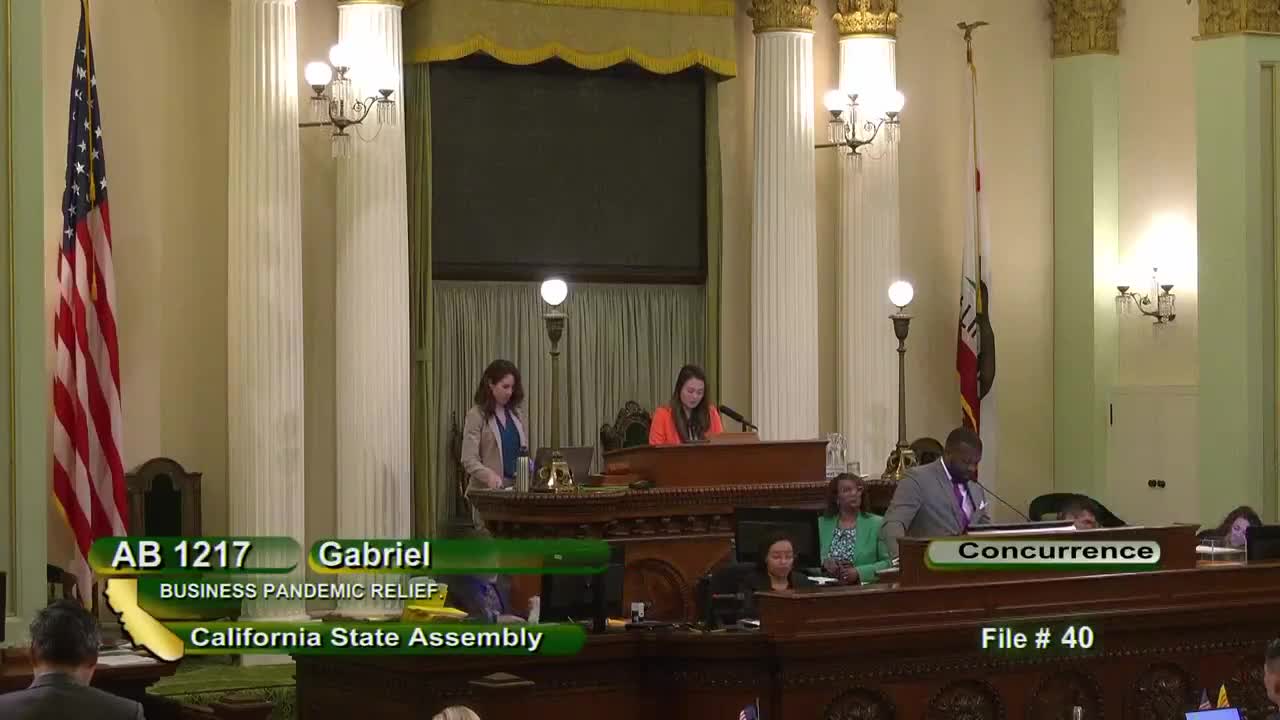 43SEC
Assembly Floor
 2MIN
Senate Floor
 1MIN
Senate Standing Committee on Appropriations
 9MIN
Senate Standing Committee on Banking and Financial Institutions
 4MIN
Assembly Standing Committee on Banking and Finance
Bill Author

Bill Co-Author(s):