AB 1148: Child support suspension.
- Session Year: 2023-2024
- House: Assembly
- Latest Version Date: 2023-10-08
Current Status:
Passed
(2023-10-08: Chaptered by Secretary of State - Chapter 565, Statutes of 2023.)
Introduced
In Committee
First Chamber
In Committee
Second Chamber
Enacted
Existing law suspends, by operation of law, a money judgment or order for support of a child for any period exceeding 90 consecutive days in which the person ordered to pay support is incarcerated or involuntarily institutionalized unless the person owing support has the means to pay while incarcerated or involuntarily institutionalized. Under existing law, the obligation resumes on the first day of the first full month after the release of the person owing support in the amount previously ordered.
This bill would instead require the child support obligation to resume on the first day of the 10th month after the release of the person from incarceration or involuntary institutionalization for persons who are released on or after January 1, 2024. The bill would authorize the person to whom the support is owed or the local child support agency to seek a court order reinstating child support obligations at the amount determined by a court.
Existing law suspends, by operation of law, a money judgment or order for support of a child for any period exceeding 90 consecutive days in which the person ordered to pay support is incarcerated or involuntarily institutionalized unless the person owing support has the means to pay while incarcerated or involuntarily institutionalized. Under existing law, the obligation resumes on the first day of the first full month after the release of the person owing support in the amount previously ordered.
This bill would instead require the child support obligation to resume on the first day of the 10th month after the release of the person from incarceration or involuntary institutionalization. The bill would require the Department of Child Support Services to notify the local child support agency and the person to whom child support is owed of the release of the person whose child support obligation has been suspended, the date that the child support obligation will resume, and, for the person to whom child support is owed, the right to seek earlier reinstatement, as specified. institutionalization for persons who are released on or after January 1, 2024. The bill would authorize the person to whom the support is owed or the local child support agency to seek a court order reinstating child support obligations at the amount determined by a court.
Existing law suspends, by operation of law, a money judgment or order for support of a child for any period exceeding 90 consecutive days in which the person ordered to pay support is incarcerated or involuntarily institutionalized unless the person owing support has the means to pay while incarcerated or involuntarily institutionalized. Under existing law, the obligation resumes on the first day of the first full month after the release of the person owing support in the amount previously ordered.
This bill would instead require the child support obligation to resume on the first day of the 10th month after the release of the person from incarceration or involuntary institutionalization. The bill would require the Department of Child Support Services to notify the local child support agency and the person to whom child support is owed of the release of the person whose child support obligation has been suspended. suspended, the date that the child support obligation will resume, and, for the person to whom child support is owed, the right to seek earlier reinstatement, as specified. The bill would authorize the person to whom the support is owed to seek a court order reinstating child support obligations at the amount previously ordered or an amount that the court deems equitable and in the best interest of the child if the person owing support obtains employment prior to the date set for reinstatement. determined by a court.
Existing law suspends, by operation of law, a money judgment or order for support of a child for any period exceeding 90 consecutive days in which the person ordered to pay support is incarcerated or involuntarily institutionalized unless the person owing support has the means to pay while incarcerated or involuntarily institutionalized. Under existing law, the obligation resumes on the first day of the first full month after the release of the person owing support in the amount previously ordered.
This bill would instead require the child support obligation to resume on the first day of the 10th month after the release of the person from incarceration or involuntary institutionalization in the amount ordered after a required administrative adjustment. institutionalization. The bill would require the Department of Child Support Services to notify the local child support agency and the person to whom child support is owed of the release of the person whose child support obligation has been suspended. The bill would require the administrative adjustment to be initiated by the local child support agency and to be conducted within 90 days before the reinstatement of the child support obligation. The bill would require the notice of the administrative adjustment process to be provided in writing by the local child support agency to the person owing support and to the person to whom the child support is owed. The bill would prohibit the imposition of a penalty or additional child support obligation if the person owing support does not participate in the administrative adjustment. By requiring a local child support agency to initiate, and provide notice for, an administrative adjustment, this bill would impose a state-mandated local program. The bill would authorize the person to whom the support is owed to seek a court order reinstating child support obligations at the amount previously ordered or an amount that the court deems equitable and in the best interest of the child if the person owing support obtains employment prior to the date set for reinstatement.
The California Constitution requires the state to reimburse local agencies and school districts for certain costs mandated by the state. Statutory provisions establish procedures for making that reimbursement.This bill would provide that, if the Commission on State Mandates determines that the bill contains costs mandated by the state, reimbursement for those costs shall be made pursuant to the statutory provisions noted above.Existing law suspends, by operation of law, a money judgment or order for support of a child for any period exceeding 90 consecutive days in which the person ordered to pay support is incarcerated or involuntarily institutionalized unless the person owing support has the means to pay while incarcerated or involuntarily institutionalized. Under existing law, the obligation resumes on the first day of the first full month after the release of the person owing support in the amount previously ordered.
This bill would instead require the child support obligation to resume on the first day of the 18th 10th month after the release of the person from incarceration or involuntary institutionalization in the amount ordered after a required modification hearing. administrative adjustment. The bill would require the Department of Child Support Services to notify the local child support agency and the person to whom child support is owed of the release of the person whose child support obligation has been suspended. The bill would require the modification hearing administrative adjustment to be initiated by the local child support agency and to be conducted within 90 days before the reinstatement of the child support obligation. The bill would require the notice of the modification hearing to be in writing and to be provided at least 30 days before the hearing. The bill would require the person owning support to owe the same amount previously ordered if the person does not attend the modification hearing and administrative adjustment process to be provided in writing by the local child support agency to the person owing support and to the person to whom the child support is owed. The bill would prohibit the imposition of a penalty or additional child support obligation if the person owing support does not participate in the modification hearing. administrative adjustment. By requiring a local child support agency to initiate, and provide notice for, an administrative adjustment, this bill would impose a state-mandated local program.
The California Constitution requires the state to reimburse local agencies and school districts for certain costs mandated by the state. Statutory provisions establish procedures for making that reimbursement.
This bill would provide that, if the Commission on State Mandates determines that the bill contains costs mandated by the state, reimbursement for those costs shall be made pursuant to the statutory provisions noted above.
Existing law suspends, by operation of law, a money judgment or order for support of a child for any period exceeding 90 consecutive days in which the person ordered to pay support is incarcerated or involuntarily institutionalized unless the person owing support has the means to pay while incarcerated or involuntarily institutionalized. Under existing law, the obligation resumes on the first day of the first full month after the release of the person owing support in the amount previously ordered.
This bill would instead require the child support obligation to resume on the first day of the 18th month after the release of the person from incarceration or involuntary institutionalization in the amount ordered after a required modification hearing. The bill would require the modification hearing to be conducted within 90 days before the reinstatement of the child support obligation. The bill would require the notice of the modification hearing to be in writing and to be provided at least 30 days before the hearing. The bill would require the person owning support to owe the same amount previously ordered if the person does not attend the modification hearing and would prohibit the imposition of a penalty or additional child support obligation if the person owing support does not participate in the modification hearing.
(a)Every money judgment or order for support of a child shall be suspended, by operation of law, for any period exceeding 90 consecutive days in which the person ordered to pay support is incarcerated or involuntarily institutionalized, unless the person owing support has the means to pay support while incarcerated or involuntarily institutionalized.
(b)(1)The child support obligation shall be suspended effective on the first day of the first full month of incarceration or involuntary institutionalization.
(2)For persons owing support who are released from incarceration or involuntary institutionalization on or after January 1, 2024, the child support obligation shall resume on the first day of the 10th month after release from incarceration or involuntary institutionalization of the person owing support.
(3)If the person owing support obtains employment prior to the date set for reinstatement, the person to whom the support is owed or the local child support agency may seek a court order reinstating child support obligations at the amount determined by the court pursuant to Article 2 (commencing with Section 4050).
(4)This section does not preclude a person owing support or the local child support agency from seeking a modification of the child support order pursuant to Section 3651, based on a change in circumstances or any other appropriate reason.
(c)(1)A local child support agency enforcing a child support order under Title IV-D of the Social Security Act (42 U.S.C. Sec. 651 et seq.) may, upon written notice of the proposed adjustment to the support obligor and obligee along with a blank form provided for the support obligor or obligee to object to the administrative adjustment to the local child support agency, administratively adjust account balances for a money judgment or order for support of a child suspended pursuant to subdivision (a) if all of the following occurs:
(A)The agency verifies that arrears and interest were accrued in violation of this section.
(B)The agency verifies that, to the extent known to the agency, the person owing support does not have the means to pay support while incarcerated or involuntarily institutionalized.
(C)Neither the support obligor nor obligee objects, within 30 days of receipt of the notice of proposed adjustment, whether in writing or by telephone, to the administrative adjustment by the local child support agency.
(2)If either the support obligor or obligee objects to the administrative adjustment set forth in this subdivision, the agency shall not adjust the order, but shall file a motion with the court to seek to adjust the arrears and shall serve copies of the motion on the parties, who may file an objection to the agencys motion with the court. The obligors arrears shall not be adjusted unless the court approves the adjustment.
(3)The agency may perform this adjustment without regard to whether it was enforcing the child support order at the time the parent owing support qualified for relief under this section.
(d)This section does not prohibit the local child support agency or a party from petitioning a court for a determination of child support or arrears amounts.
(e)For purposes of this section, the following definitions shall apply:
(1)Incarcerated or involuntarily institutionalized includes, but is not limited to, involuntary confinement to a federal or state prison, a county jail, a juvenile facility operated by the Division of Juvenile Facilities in the Department of Corrections and Rehabilitation, or a mental health facility.
(2)Suspend means that the payment due on the current child support order, an arrears payment on a preexisting arrears balance, or interest on arrears created during a qualifying period of incarceration pursuant to this section is, by operation of law, set to zero dollars ($0) for the period in which the person owing support is incarcerated or involuntarily institutionalized.
(f)This section applies to any child support obligation that accrues on or after the enactment of this section regardless of when the child support order was established.
(g)The Department of Child Support Services shall, by July 1, 2023, and in consultation with the Judicial Council, develop forms to implement this section.
(h)On or before January 1, 2026, the Department of Child Support Services, in consultation with the Judicial Council, shall conduct an evaluation of the effectiveness of the administrative adjustment process authorized by this section and shall report the results of the review, as well as any recommended changes, to the Assembly Judiciary Committee and the Senate Judiciary Committee. The evaluation shall include a review of the ease of the process to both the obligor and obligee, as well as an analysis of the number of cases administratively adjusted, the number of cases adjusted in court, and the number of cases not adjusted.
(i)It is the intent of the Legislature to ensure qualified persons are provided the support suspension by operation of law for qualified periods of incarceration or involuntary institutionalization that existed during the operative terms of the earlier versions of this statute regardless of whether the judicial or administrative determination of arrears is made before or after the repeal of the statute, if the earlier version of the statute provided for the money judgment or order for support to be suspended by operation of law. This subdivision is declarative of existing law.
(a)Every money judgment or order for support of a child shall be suspended, by operation of law, for any period exceeding 90 consecutive days in which the person ordered to pay support is incarcerated or involuntarily institutionalized, unless the person owing support has the means to pay support while incarcerated or involuntarily institutionalized.
(b)(1)The child support obligation shall be suspended effective on the first day of the first full month of incarceration or involuntary institutionalization.
(2)The For persons owing support who are released from incarceration or involuntary institutionalization on or after January 1, 2024, the child support obligation shall resume on the first day of the 10th month after release from incarceration or involuntary institutionalization of the person owing support.
(3)The Department of Child Support Services shall notify the local child support agency and the person to whom child support is owed of the release of the person whose child support obligation has been suspended pursuant to subdivision (a), the date that the child support obligation shall resume under paragraph (2), and, for the person to whom child support is owed, the right to seek earlier reinstatement pursuant to paragraph (4).(4)(3)If the person owing support obtains employment prior to the date set for reinstatement, the person to whom the support is owed or the local child support agency may seek a court order reinstating child support obligations at the amount determined by the court pursuant to Article 2 (commencing with Section 4050).
(5)(4)This section does not preclude a person owing support or the local child support agency from seeking a modification of the child support order pursuant to Section 3651, based on a change in circumstances or any other appropriate reason.
(c)(1)A local child support agency enforcing a child support order under Title IV-D of the Social Security Act (42 U.S.C. Sec. 651 et seq.) may, upon written notice of the proposed adjustment to the support obligor and obligee along with a blank form provided for the support obligor or obligee to object to the administrative adjustment to the local child support agency, administratively adjust account balances for a money judgment or order for support of a child suspended pursuant to subdivision (a) if all of the following occurs:
(A)The agency verifies that arrears and interest were accrued in violation of this section.
(B)The agency verifies that, to the extent known to the agency, the person owing support does not have the means to pay support while incarcerated or involuntarily institutionalized.
(C)Neither the support obligor nor obligee objects, within 30 days of receipt of the notice of proposed adjustment, whether in writing or by telephone, to the administrative adjustment by the local child support agency.
(2)If either the support obligor or obligee objects to the administrative adjustment set forth in this subdivision, the agency shall not adjust the order, but shall file a motion with the court to seek to adjust the arrears and shall serve copies of the motion on the parties, who may file an objection to the agencys motion with the court. The obligors arrears shall not be adjusted unless the court approves the adjustment.
(3)The agency may perform this adjustment without regard to whether it was enforcing the child support order at the time the parent owing support qualified for relief under this section.
(d)This section does not prohibit the local child support agency or a party from petitioning a court for a determination of child support or arrears amounts.
(e)For purposes of this section, the following definitions shall apply:
(1)Incarcerated or involuntarily institutionalized includes, but is not limited to, involuntary confinement to a federal or state prison, a county jail, a juvenile facility operated by the Division of Juvenile Facilities in the Department of Corrections and Rehabilitation, or a mental health facility.
(2)Suspend means that the payment due on the current child support order, an arrears payment on a preexisting arrears balance, or interest on arrears created during a qualifying period of incarceration pursuant to this section is, by operation of law, set to zero dollars ($0) for the period in which the person owing support is incarcerated or involuntarily institutionalized.
(f)This section applies to any child support obligation that accrues on or after the enactment of this section regardless of when the child support order was established.
(g)The Department of Child Support Services shall, by July 1, 2023, and in consultation with the Judicial Council, develop forms to implement this section.
(h)On or before January 1, 2026, the Department of Child Support Services, in consultation with the Judicial Council, shall conduct an evaluation of the effectiveness of the administrative adjustment process authorized by this section and shall report the results of the review, as well as any recommended changes, to the Assembly Judiciary Committee and the Senate Judiciary Committee. The evaluation shall include a review of the ease of the process to both the obligor and obligee, as well as an analysis of the number of cases administratively adjusted, the number of cases adjusted in court, and the number of cases not adjusted.
(i)It is the intent of the Legislature to ensure qualified persons are provided the support suspension by operation of law for qualified periods of incarceration or involuntary institutionalization that existed during the operative terms of the earlier versions of this statute regardless of whether the judicial or administrative determination of arrears is made before or after the repeal of the statute, if the earlier version of the statute provided for the money judgment or order for support to be suspended by operation of law. This subdivision is declarative of existing law.
(a)Every money judgment or order for support of a child shall be suspended, by operation of law, for any period exceeding 90 consecutive days in which the person ordered to pay support is incarcerated or involuntarily institutionalized, unless the person owing support has the means to pay support while incarcerated or involuntarily institutionalized.
(b)(1)The child support obligation shall be suspended effective on the first day of the first full month of incarceration or involuntary institutionalization.
(2)The child support obligation shall resume on the first day of the 10th month after release from incarceration or involuntary institutionalization of the person owing support.
(3)The Department of Child Support Services shall notify the local child support agency and the person to whom child support is owed of the release of the person whose child support obligation has been suspended pursuant to subdivision (a). (a), the date that the child support obligation shall resume under paragraph (2), and, for the person to whom child support is owed, the right to seek earlier reinstatement pursuant to paragraph (4).
(4)If the person owing support obtains employment prior to the date set for reinstatement, the person to whom the support is owed may seek a court order reinstating child support obligations at the amount previously ordered or an amount that the court deems equitable and in the best interest of the child. determined by the court pursuant to Article 2 (commencing with Section 4050).
(5)This section does not preclude a person owing support from seeking a modification of the child support order pursuant to Section 3651, based on a change in circumstances or any other appropriate reason.
(c)(1)A local child support agency enforcing a child support order under Title IV-D of the Social Security Act (42 U.S.C. Sec. 651 et seq.) may, upon written notice of the proposed adjustment to the support obligor and obligee along with a blank form provided for the support obligor or obligee to object to the administrative adjustment to the local child support agency, administratively adjust account balances for a money judgment or order for support of a child suspended pursuant to subdivision (a) if all of the following occurs:
(A)The agency verifies that arrears and interest were accrued in violation of this section.
(B)The agency verifies that, to the extent known to the agency, the person owing support does not have the means to pay support while incarcerated or involuntarily institutionalized.
(C)Neither the support obligor nor obligee objects, within 30 days of receipt of the notice of proposed adjustment, whether in writing or by telephone, to the administrative adjustment by the local child support agency.
(2)If either the support obligor or obligee objects to the administrative adjustment set forth in this subdivision, the agency shall not adjust the order, but shall file a motion with the court to seek to adjust the arrears and shall serve copies of the motion on the parties, who may file an objection to the agencys motion with the court. The obligors arrears shall not be adjusted unless the court approves the adjustment.
(3)The agency may perform this adjustment without regard to whether it was enforcing the child support order at the time the parent owing support qualified for relief under this section.
(d)This section does not prohibit the local child support agency or a party from petitioning a court for a determination of child support or arrears amounts.
(e)For purposes of this section, the following definitions shall apply:
(1)Incarcerated or involuntarily institutionalized includes, but is not limited to, involuntary confinement to a federal or state prison, a county jail, a juvenile facility operated by the Division of Juvenile Facilities in the Department of Corrections and Rehabilitation, or a mental health facility.
(2)Suspend means that the payment due on the current child support order, an arrears payment on a preexisting arrears balance, or interest on arrears created during a qualifying period of incarceration pursuant to this section is, by operation of law, set to zero dollars ($0) for the period in which the person owing support is incarcerated or involuntarily institutionalized.
(f)This section applies to any child support obligation that accrues on or after the enactment of this section regardless of when the child support order was established.
(g)The Department of Child Support Services shall, by July 1, 2023, and in consultation with the Judicial Council, develop forms to implement this section.
(h)On or before January 1, 2026, the Department of Child Support Services, in consultation with the Judicial Council, shall conduct an evaluation of the effectiveness of the administrative adjustment process authorized by this section and shall report the results of the review, as well as any recommended changes, to the Assembly Judiciary Committee and the Senate Judiciary Committee. The evaluation shall include a review of the ease of the process to both the obligor and obligee, as well as an analysis of the number of cases administratively adjusted, the number of cases adjusted in court, and the number of cases not adjusted.
(i)It is the intent of the Legislature to ensure qualified persons are provided the support suspension by operation of law for qualified periods of incarceration or involuntary institutionalization that existed during the operative terms of the earlier versions of this statute regardless of whether the judicial or administrative determination of arrears is made before or after the repeal of the statute, if the earlier version of the statute provided for the money judgment or order for support to be suspended by operation of law. This subdivision is declarative of existing law.
(a)Every money judgment or order for support of a child shall be suspended, by operation of law, for any period exceeding 90 consecutive days in which the person ordered to pay support is incarcerated or involuntarily institutionalized, unless the person owing support has the means to pay support while incarcerated or involuntarily institutionalized.
(b)(1)The child support obligation shall be suspended effective on the first day of the first full month of incarceration or involuntary institutionalization.
(2)The child support obligation shall resume on the first day of the 10th month after release from incarceration or involuntary institutionalization of the person owing support in the amount ordered following a required administrative adjustment as described in paragraph (5). support.
(3)The Department of Child Support Services shall notify the local child support agency and the person to whom child support is owed of the release of the person whose child support obligation has been suspended pursuant to subdivision (a).
(4)If the person owing support obtains employment prior to the date set for reinstatement pursuant to paragraph (2), reinstatement, the person to whom the support is owed may seek a court order reinstating child support obligations at the amount previously ordered or an amount that the court deems equitable and in the best interest of the child.
(5)(A)The administrative adjustment shall be initiated by the local child support agency, and shall be conducted within 90 days before the reinstatement of the child support obligation.(B)Notice of the administrative adjustment process shall be provided in writing by the local child support agency to the person owing support and to the person to whom the child support is owed. The written notice shall include all of the following information:(i)A list of required or useful documents and information, including, but not limited to, jail or prison status, income and expenses, childcare expenses, and current custody and visitation arrangements.(ii)Notice that the person owing child support may owe support in the amount previously ordered if the person does not complete the Judicial Council forms that were requested by the local child support agency and that may be required for purposes of the administrative adjustment process.(iii)The child support obligation amount previously ordered by the court before incarceration or involuntary institutionalization.(iv)Notice that if the person owing child support or the person to whom the child support is owed is not satisfied with the administratively adjusted child support obligation they have the right to a judicial modification hearing pursuant to Section 3651.(C)Notwithstanding any other law, the failure of the person owing child support to participate in the administrative adjustment shall not impose a penalty or additional child support obligation. If the person owing child support does not participate in the administrative adjustment, the person may owe support in the amount previously ordered. (6)(5)This section does not preclude a person owing support from seeking a modification of the child support order pursuant to Section 3651, based on a change in circumstances or any other appropriate reason.
(c)(1)A local child support agency enforcing a child support order under Title IV-D of the Social Security Act (42 U.S.C. Sec. 651 et seq.) may, upon written notice of the proposed adjustment to the support obligor and obligee along with a blank form provided for the support obligor or obligee to object to the administrative adjustment to the local child support agency, administratively adjust account balances for a money judgment or order for support of a child suspended pursuant to subdivision (a) if all of the following occurs:
(A)The agency verifies that arrears and interest were accrued in violation of this section.
(B)The agency verifies that, to the extent known to the agency, the person owing support does not have the means to pay support while incarcerated or involuntarily institutionalized.
(C)Neither the support obligor nor obligee objects, within 30 days of receipt of the notice of proposed adjustment, whether in writing or by telephone, to the administrative adjustment by the local child support agency.
(2)If either the support obligor or obligee objects to the administrative adjustment set forth in this subdivision, the agency shall not adjust the order, but shall file a motion with the court to seek to adjust the arrears and shall serve copies of the motion on the parties, who may file an objection to the agencys motion with the court. The obligors arrears shall not be adjusted unless the court approves the adjustment.
(3)The agency may perform this adjustment without regard to whether it was enforcing the child support order at the time the parent owing support qualified for relief under this section.
(d)This section does not prohibit the local child support agency or a party from petitioning a court for a determination of child support or arrears amounts.
(e)For purposes of this section, the following definitions shall apply:
(1)Incarcerated or involuntarily institutionalized includes, but is not limited to, involuntary confinement to a federal or state prison, a county jail, a juvenile facility operated by the Division of Juvenile Facilities in the Department of Corrections and Rehabilitation, or a mental health facility.
(2)Suspend means that the payment due on the current child support order, an arrears payment on a preexisting arrears balance, or interest on arrears created during a qualifying period of incarceration pursuant to this section is, by operation of law, set to zero dollars ($0) for the period in which the person owing support is incarcerated or involuntarily institutionalized.
(f)This section applies to any child support obligation that accrues on or after the enactment of this section regardless of when the child support order was established.
(g)The Department of Child Support Services shall, by July 1, 2023, and in consultation with the Judicial Council, develop forms to implement this section.
(h)On or before January 1, 2026, the Department of Child Support Services, in consultation with the Judicial Council, shall conduct an evaluation of the effectiveness of the administrative adjustment process authorized by this section and shall report the results of the review, as well as any recommended changes, to the Assembly Judiciary Committee and the Senate Judiciary Committee. The evaluation shall include a review of the ease of the process to both the obligor and obligee, as well as an analysis of the number of cases administratively adjusted, the number of cases adjusted in court, and the number of cases not adjusted.
(i)It is the intent of the Legislature to ensure qualified persons are provided the support suspension by operation of law for qualified periods of incarceration or involuntary institutionalization that existed during the operative terms of the earlier versions of this statute regardless of whether the judicial or administrative determination of arrears is made before or after the repeal of the statute, if the earlier version of the statute provided for the money judgment or order for support to be suspended by operation of law. This subdivision is declarative of existing law.
SEC. 2.If the Commission on State Mandates determines that this act contains costs mandated by the state, reimbursement to local agencies and school districts for those costs shall be made pursuant to Part 7 (commencing with Section 17500) of Division 4 of Title 2 of the Government Code.(a)Every money judgment or order for support of a child shall be suspended, by operation of law, for any period exceeding 90 consecutive days in which the person ordered to pay support is incarcerated or involuntarily institutionalized, unless the person owing support has the means to pay support while incarcerated or involuntarily institutionalized.
(b)(1)The child support obligation shall be suspended effective on the first day of the first full month of incarceration or involuntary institutionalization.
(2)The child support obligation shall resume on the first day of the 18th 10th month after release from incarceration or involuntary institutionalization of the person owing support in the amount ordered following a required modification hearing administrative adjustment as described in paragraph (3). (5).
(3)The Department of Child Support Services shall notify the local child support agency and the person to whom child support is owed of the release of the person whose child support obligation has been suspended pursuant to subdivision (a).
(4)If the person owing support obtains employment prior to the date set for reinstatement pursuant to paragraph (2), the person to whom the support is owed may seek a court order reinstating child support obligations at the amount previously ordered or an amount that the court deems equitable and in the best interest of the child.
(3)(5)(A)The modification hearing shall be administrative adjustment shall be initiated by the local child support agency, and shall be conducted within 90 days before the reinstatement of the child support obligation.
(B)Notice of the modification hearing shall be in writing and shall be provided to the person owing support at least 30 days before the hearing.(B)Notice of the administrative adjustment process shall be provided in writing by the local child support agency to the person owing support and to the person to whom the child support is owed. The written notice shall include all of the following information:
(i)A list of required or useful documents and information to bring to the modification hearing, information, including, but not limited to, jail or prison status, income and expenses, childcare expenses, and current custody and visitation arrangements.
(ii)Notice that if the person owing child support does not participate in the modification hearing that the person will owe support in the amount previously ordered.(ii)Notice that the person owing child support may owe support in the amount previously ordered if the person does not complete the Judicial Council forms that were requested by the local child support agency and that may be required for purposes of the administrative adjustment process.
(iii)The child support obligation amount previously ordered by the court before incarceration or involuntary institutionalization.
(iv)Notice that if the person owing child support or the person to whom the child support is owed is not satisfied with the administratively adjusted child support obligation they have the right to a judicial modification hearing pursuant to Section 3651.
(C)Notwithstanding any other law, the failure of the person owing child support to participate in the modification hearing administrative adjustment shall not impose a penalty or additional child support obligation. If the person owing child support does not participate in the modification hearing, administrative adjustment, the person shall may owe support in the amount previously ordered.
(4)(6)This section does not preclude a person owing support from seeking a modification of the child support order pursuant to Section 3651, based on a change in circumstances or any other appropriate reason.
(c)(1)A local child support agency enforcing a child support order under Title IV-D of the Social Security Act (42 U.S.C. Sec. 651 et seq.) may, upon written notice of the proposed adjustment to the support obligor and obligee along with a blank form provided for the support obligor or obligee to object to the administrative adjustment to the local child support agency, administratively adjust account balances for a money judgment or order for support of a child suspended pursuant to subdivision (a) if all of the following occurs:
(A)The agency verifies that arrears and interest were accrued in violation of this section.
(B)The agency verifies that, to the extent known to the agency, the person owing support does not have the means to pay support while incarcerated or involuntarily institutionalized.
(C)Neither the support obligor nor obligee objects, within 30 days of receipt of the notice of proposed adjustment, whether in writing or by telephone, to the administrative adjustment by the local child support agency.
(2)If either the support obligor or obligee objects to the administrative adjustment set forth in this subdivision, the agency shall not adjust the order, but shall file a motion with the court to seek to adjust the arrears and shall serve copies of the motion on the parties, who may file an objection to the agencys motion with the court. The obligors arrears shall not be adjusted unless the court approves the adjustment.
(3)The agency may perform this adjustment without regard to whether it was enforcing the child support order at the time the parent owing support qualified for relief under this section.
(d)This section does not prohibit the local child support agency or a party from petitioning a court for a determination of child support or arrears amounts.
(e)For purposes of this section, the following definitions shall apply:
(1)Incarcerated or involuntarily institutionalized includes, but is not limited to, involuntary confinement to a federal or state prison, a county jail, a juvenile facility operated by the Division of Juvenile Facilities in the Department of Corrections and Rehabilitation, or a mental health facility.
(2)Suspend means that the payment due on the current child support order, an arrears payment on a preexisting arrears balance, or interest on arrears created during a qualifying period of incarceration pursuant to this section is, by operation of law, set to zero dollars ($0) for the period in which the person owing support is incarcerated or involuntarily institutionalized.
(f)This section applies to any child support obligation that accrues on or after the enactment of this section regardless of when the child support order was established.
(g)The Department of Child Support Services shall, by July 1, 2023, and in consultation with the Judicial Council, develop forms to implement this section.
(h)On or before January 1, 2026, the Department of Child Support Services, in consultation with the Judicial Council, shall conduct an evaluation of the effectiveness of the administrative adjustment process authorized by this section and shall report the results of the review, as well as any recommended changes, to the Assembly Judiciary Committee and the Senate Judiciary Committee. The evaluation shall include a review of the ease of the process to both the obligor and obligee, as well as an analysis of the number of cases administratively adjusted, the number of cases adjusted in court, and the number of cases not adjusted.
(i)It is the intent of the Legislature to ensure qualified persons are provided the support suspension by operation of law for qualified periods of incarceration or involuntary institutionalization that existed during the operative terms of the earlier versions of this statute regardless of whether the judicial or administrative determination of arrears is made before or after the repeal of the statute, if the earlier version of the statute provided for the money judgment or order for support to be suspended by operation of law. This subdivision is declarative of existing law.
SEC. 2.If the Commission on State Mandates determines that this act contains costs mandated by the state, reimbursement to local agencies and school districts for those costs shall be made pursuant to Part 7 (commencing with Section 17500) of Division 4 of Title 2 of the Government Code.
(a)Every money judgment or order for support of a child shall be suspended, by operation of law, for any period exceeding 90 consecutive days in which the person ordered to pay support is incarcerated or involuntarily institutionalized, unless the person owing support has the means to pay support while incarcerated or involuntarily institutionalized.
(b)(1)The child support obligation shall be suspended effective on the first day of the first full month of incarceration or involuntary institutionalization and shall resume on the first day of the first full month after the release of the person owing support in the amount previously ordered, and that amount is presumed to be appropriate under federal and state law. This section does not preclude a person owing support from seeking a modification of the child support order pursuant to Section 3651, based on a change in circumstances or any other appropriate reason. institutionalization.
(2)The child support obligation shall resume on the first day of the 18th month after release from incarceration or involuntary institutionalization of the person owing support in the amount ordered following a required modification hearing as described in paragraph (3).
(3)(A)The modification hearing shall be conducted within 90 days before the reinstatement of the child support obligation.
(B)Notice of the modification hearing shall be in writing and shall be provided to the person owing support at least 30 days before the hearing. The written notice shall include all of the following information:
(i)A list of required or useful documents and information to bring to the modification hearing, including, but not limited to, jail or prison status, income and expenses, childcare expenses, and current custody and visitation arrangements.
(ii)Notice that if the person owing child support does not participate in the modification hearing that the person will owe support in the amount previously ordered.
(iii)The child support obligation amount previously ordered by the court before incarceration or involuntary institutionalization.
(C)Notwithstanding any other law, the failure of the person owing child support to participate in the modification hearing shall not impose a penalty or additional child support obligation. If the person owing child support does not participate in the modification hearing, the person shall owe support in the amount previously ordered.
(4)This section does not preclude a person owing support from seeking a modification of the child support order pursuant to Section 3651, based on a change in circumstances or any other appropriate reason.
(c)(1)A local child support agency enforcing a child support order under Title IV-D of the Social Security Act (42 U.S.C. Sec. 651 et seq.) may, upon written notice of the proposed adjustment to the support obligor and obligee along with a blank form provided for the support obligor or obligee to object to the administrative adjustment to the local child support agency, administratively adjust account balances for a money judgment or order for support of a child suspended pursuant to subdivision (a) if all of the following occurs:
(A)The agency verifies that arrears and interest were accrued in violation of this section.
(B)The agency verifies that, to the extent known to the agency, the person owing support does not have the means to pay support while incarcerated or involuntarily institutionalized.
(C)Neither the support obligor nor obligee objects, within 30 days of receipt of the notice of proposed adjustment, whether in writing or by telephone, to the administrative adjustment by the local child support agency.
(2)If either the support obligor or obligee objects to the administrative adjustment set forth in this subdivision, the agency shall not adjust the order, but shall file a motion with the court to seek to adjust the arrears and shall serve copies of the motion on the parties, who may file an objection to the agencys motion with the court. The obligors arrears shall not be adjusted unless the court approves the adjustment.
(3)The agency may perform this adjustment without regard to whether it was enforcing the child support order at the time the parent owing support qualified for relief under this section.
(d)This section does not prohibit the local child support agency or a party from petitioning a court for a determination of child support or arrears amounts.
(e)For purposes of this section, the following definitions shall apply:
(1)Incarcerated or involuntarily institutionalized includes, but is not limited to, involuntary confinement to a federal or state prison, a county jail, a juvenile facility operated by the Division of Juvenile Facilities in the Department of Corrections and Rehabilitation, or a mental health facility.
(2)Suspend means that the payment due on the current child support order, an arrears payment on a preexisting arrears balance, or interest on arrears created during a qualifying period of incarceration pursuant to this section is, by operation of law, set to zero dollars ($0) for the period in which the person owing support is incarcerated or involuntarily institutionalized.
(f)This section applies to any child support obligation that accrues on or after the enactment of this section regardless of when the child support order was established.
(g)The Department of Child Support Services shall, by July 1, 2023 and in consultation with the Judicial Council, develop forms to implement this section.
(h)On or before January 1, 2026, the Department of Child Support Services, in consultation with the Judicial Council, shall conduct an evaluation of the effectiveness of the administrative adjustment process authorized by this section and shall report the results of the review, as well as any recommended changes, to the Assembly Judiciary Committee and the Senate Judiciary Committee. The evaluation shall include a review of the ease of the process to both the obligor and obligee, as well as an analysis of the number of cases administratively adjusted, the number of cases adjusted in court, and the number of cases not adjusted.
(i)It is the intent of the Legislature to ensure qualified persons are provided the support suspension by operation of law for qualified periods of incarceration or involuntary institutionalization that existed during the operative terms of the earlier versions of this statute regardless of whether the judicial or administrative determination of arrears is made before or after the repeal of the statute, if the earlier version of the statute provided for the money judgment or order for support to be suspended by operation of law. This subdivision is declarative of existing law.
|
Date
|
Status
|
|---|---|
| Oct 8, 2023 | Chaptered by Secretary of State - Chapter 565, Statutes of 2023. |
| Oct 8, 2023 | Approved by the Governor. |
| Sep 21, 2023 | Enrolled and presented to the Governor at 3:30 p.m. |
| Sep 13, 2023 | Senate amendments concurred in. To Engrossing and Enrolling. (Ayes 56. Noes 14. Page 3471.). |
| Sep 13, 2023 | In Assembly. Concurrence in Senate amendments pending. |
| Sep 13, 2023 | Read third time. Passed. Ordered to the Assembly. (Ayes 28. Noes 7. Page 2704.). |
| Sep 11, 2023 | Read second time. Ordered to third reading. |
| Sep 7, 2023 | Read third time and amended. Ordered to second reading. |
| Sep 5, 2023 | Read second time. Ordered to third reading. |
| Sep 1, 2023 | From committee: Do pass. (Ayes 5. Noes 2.) (September 1). |
| Aug 14, 2023 | In committee: Referred to APPR suspense file. |
| Jul 13, 2023 | From committee: Do pass and re-refer to Com. on APPR. (Ayes 3. Noes 0.) (July 13). Re-referred to Com. on APPR. |
| Jul 3, 2023 | In committee: Hearing postponed by committee. |
| Jun 29, 2023 | Read second time and amended. Re-referred to Com. on HUMAN S. |
| Jun 28, 2023 | From committee: Amend, and do pass as amended and re-refer to Com. on HUMAN S. (Ayes 9. Noes 2.) (June 27). |
| Jun 14, 2023 | Referred to Coms. on JUD. and HUMAN S. |
| Jun 1, 2023 | In Senate. Read first time. To Com. on RLS. for assignment. |
| May 31, 2023 | Read third time. Passed. Ordered to the Senate. (Ayes 57. Noes 10. Page 2010.) |
| May 22, 2023 | Read second time. Ordered to third reading. |
| May 18, 2023 | Read second time and amended. Ordered returned to second reading. |
| May 18, 2023 | From committee: Amend, and do pass as amended. (Ayes 12. Noes 3.) (May 18). |
| May 10, 2023 | In committee: Set, first hearing. Referred to APPR. suspense file. |
| May 4, 2023 | Read second time. Ordered to third reading. |
| May 4, 2023 | Re-referred to Com. on APPR. pursuant to Joint Rule 10.5. |
| May 3, 2023 | Read second time and amended. Ordered returned to second reading. |
| May 2, 2023 | From committee: Amend, and do pass as amended. (Ayes 7. Noes 3.) (May 2). |
| Apr 12, 2023 | In committee: Hearing postponed by committee. |
| Apr 5, 2023 | In committee: Set, first hearing. Hearing canceled at the request of author. |
| Mar 23, 2023 | In committee: Hearing postponed by committee. |
| Mar 2, 2023 | Referred to Com. on JUD. |
| Feb 17, 2023 | From printer. May be heard in committee March 19. |
| Feb 16, 2023 | Read first time. To print. |
|
Date
|
Description
|
Location
|
Votes
|
|
|---|---|---|---|---|
| Sep 13, 2023 | AB 1148 Bonta Concurrence in Senate Amendments | Assembly Floor |
Passed |
|
| Sep 13, 2023 | Assembly 3rd Reading AB1148 Bonta By Ashby | Senate Floor |
Passed |
|
| Sep 1, 2023 | Do pass | Senate Standing Committee on Appropriations |
Passed |
|
| Aug 14, 2023 | Placed on suspense file | Senate Standing Committee on Appropriations |
Passed |
|
| Jul 13, 2023 | Do pass, but first be re-referred to the Committee on [Appropriations] | Senate Standing Committee on Human Services |
Passed |
|
| Jun 27, 2023 | Do pass as amended, but first amend, and re-refer to the Committee on [Human Services] | Senate Standing Committee on Judiciary |
Passed |
|
| May 31, 2023 | AB 1148 Bonta Assembly Third Reading | Assembly Floor |
Passed |
|
| May 18, 2023 | Do pass as amended. | Assembly Standing Committee on Appropriations |
Passed |
|
| May 2, 2023 | Do pass as amended. | Assembly Standing Committee on Judiciary |
Passed |
This list shows positions taken on this bill by organizations on the date displayed, which is linked to the original source.
Positions by individuals are not included.
|
Organization
|
Position
|
Date
|
|---|---|---|
| Aclu California Action | ** Support | |
| Both Sides of the Conversation | ** Support | |
| California Association Of Certified Family Law Specialists | ** Against | |
| California Association of Judgement Professionals | ** Against | |
| California Association of Judgement Professionals | * Against | Jun 27, 2023 |
| California Association of Judgment Professionals | ** Against | |
| California Families Rise | ** Support | |
| Californians United for a Responsible Budget | ** Support | |
| Child Support Directors Association | ** Against | |
| ChildrenS Institute | ** Support | |
| Coalition of California Welfare Rights Organizations | ** Support | |
| Communities United for Restorative Youth Justice | ** Support | |
| Ella Baker Center For Human Rights | ** Support | |
| End Poverty in California | ** Support | |
| Good+ Foundation | ** Support | |
| Good+ Foundation - Fatherhood Initiative | ** Support | |
| GRACE & End Child Poverty in California | ** Support | |
| Growing Greatness Now | ** Support | |
| Homeboy Industries | ** Support | |
| Initiate Justice | ** Support | |
| Legal Link | ** Support | |
| Legal Services for Prisoners with Children | ** Support | |
| Parent Voices | ** Support | |
| Root & Rebound | ** Support | |
| Rubicon Programs | ** Support | |
| San Bernardino Fatherhood | ** Support | |
| Sister Warriors Freedom Coalition | ** Support | |
| Smart Justice | ** Support | |
| The Maven Collaborative | ** Support | |
| The Maven Collective | ** Support | |
| The San Francisco Financial Justice Project | ** Support | |
| Truth and Justice in Child Support Coalition | ** Support | |
| Voices for Progress | ** Support | |
| western center on law and poverty | ** Support | |
| young community developers | ** Support | |
| Youth ALIVE! | ** Support |
CONCURRENCE IN SENATE AMENDMENTS
CSA1 Bill Id:AB 1148
Author:(Bonta)
As Amended Ver:September 7, 2023
Majority vote
SUMMARY
Extends the time for a non-custodial parent to resume child support payments after incarceration.
Major Provisions
- Provides that any child support obligations of non-custodial parent shall resume on the first day of the tenth month after the noncustodial parent's release from incarceration or involuntary institutionalization in the amount ordered after an administrative adjustment proceeding, as described.
- Specifies that child support obligations may resume before ten months if the noncustodial parent obtains employment and the custodial parent seeks a reinstatement order.
Senate Amendments
Eliminate a provision requiring the Department of Child Support Services to notify the custodial parent and the local child support agency as to when the suspension will end and the custodial parent's right to seek reinstatement under specified conditions.
COMMENTS
Compelling data from a number of studies that demonstrate that paying child support has become a steep barrier for successful reentry into the community following a period of incarceration. Not surprisingly, the lack of employment opportunity and employment discrimination against persons with a criminal record remain the key obstacles to successful reentry. Research referenced by the author shows that the unemployment rate for the formerly incarcerated is nearly five times the rate of the general population. Other studies suggest that it takes at least six months for formerly incarcerated persons to find a job; and for some, employment discrimination due to their criminal record is exacerbated by systemic racial discrimination. Moreover, another study suggests that those able to find employment earned only 53% of the median wage. These problems of unemployment, underemployment, and low pay create difficulties for any person released from jail or prison, but they are especially burdensome for those who have the additional burden of resuming child support payments only one month after their release.
This bill seeks to provide some relief to formerly incarcerated persons who are also subject to child support orders. Specifically, the bill extends the child support suspension period to ten months after release from incarceration, unless the formerly incarcerated person obtains employment prior to the expiration of the ten month period, in which case payments shall resume as specified.
Under existing law, when a person subject to a child support order is incarcerated (or involuntarily institutionalized) for a period of 90 days or longer, their child support obligation is suspended during the period of incarceration, unless the person owing support has the means to pay. The child support obligations resume on the first day of the first full month after release. Because one month is not a realistic period of time to find employment or seek a modification of the child support order, this bill provides that the resumption of child support payments will not resume until ten months after release. However, if the parent owing support obtains employment prior to scheduled resumption of child support payments, the custodial parent to whom support is owed may seek a court order reinstating the child support order at the previously ordered amount, or in an amount that the court deems equitable and in the best interest of the child.
Does this bill provide adequate consideration to the child and custodial parent? There is little question that existing law, which requires a person released from jail or prison to resume child support payments within a month of release, is too short of a period. Even though existing law would allow the person released to seek a judicial modification hearing in order to reduce or suspend child support payments, it is unrealistic to expect someone to do this immediately after their release, given the many other challenges confronting the person upon release. Therefore, a longer period, such as a three month suspension (the time period also recommended by the DCSS and the Judicial Council in the report cited above), seems prudent. This three month suspension could have coupled with a requirement that, upon release, all persons be provided clear and unambiguous notice of their existing right to seek a judicial modification and to ensure that such notice is actually received. In lieu of this approach, the bill would simply give the formerly incarcerated person an unconditional ten-month suspension.
Any period of suspension shifts the consequences of lost financial support to the child and the financial burden of support onto the custodial parent to whom support is owed. Both the author and sponsor point to the difficulties faced by the formerly incarcerated, and both contend that problems of reentry are especially difficult for formerly incarcerated women, and even more difficult still for women of color. While this is no doubt true, this should not obscure the fact that the number of women of color potentially harmed by this bill is significant and arguably much greater than the number potentially helped. The persons who have child support obligations suspended will be overwhelmingly male, while those who will endure a longer period without child support payments will be overwhelmingly children and female. According to California Department of Rehabilitation and Corrections, males make up 95.5% of the people incarcerated in the state's prisons and jails. Moreover, according to DCSS, about 85% of parents who owe child support are male. When these two statistics are combined, the number of women released from incarceration who would also be subject to a child support order would be small indeed. For the same reason, however, the parent who has already gone without child support for the period of incarceration, and will now be asked to go without payments for an additional ten months, will almost always be a single mother who disproportionately will be a woman of color. The child denied an additional ten months without child support will also disproportionally be a child of color.
To be sure, as the author persuasively contends, the existing system does not adequately serve children and custodial parents, either. If child support amounts are not realistic, and if the parent who owes child support simply falls into arrears, the child and custodial parent will see no benefit. However, existing law allows a parent to seek a judicial modification hearing to lower or suspend the amount owed where it is warranted by changed economic conditions. Ideally, this bill will allow formerly incarcerated persons to get back on their feet and, when they have achieved a degree of economic stability, resume child support payments in full. But the child and custodial parent may also be experiencing economic instability, exacerbated no doubt by the suspension of child support during the period of incarceration.
According to the Author
According to the author, the current law requiring a formerly incarcerated parent to resume paying child support only a month after release "sets parents up for failure and ignores many of the systemic barriers that formerly incarcerated people face, such as finding housing, obtaining a stable job, and reuniting with their children. Providing a parent enough time to secure stable employment and get back on their feet ensures they can adequately support themselves and their children." This bill, the author believes, "will help put parents in a better and more stable position to support their children."
Arguments in Support
The Coalition of California Welfare Rights Organizations (CCWRO) argues that the existing law which requires an incarcerated non-custodial parent to resume child support payments one month after release is so short that it "sets parents and families up for failure." This requirement, CCWRO writes, fails to take account of "the ongoing systemic barriers that formerly incarcerated people face, including hardships in finding housing, securing stable employment, navigating discrimination because of reentry status, and reuniting with their children." Extending this period, they hope, will provide they time need to find stable employment sufficient to support themselves and their families. CCWRO also argues that requiring, rather than merely permitting, a modification hearing will "afford incarcerated parents an opportunity to adjust their payments, account for the struggles they face reentering into society, and allow for individuals to cover their immediate needs." CCWRO references studies on the profoundly difficult re-entry process for formerly incarcerated persons, especially the barriers to finding employment with a criminal record. CCWRO concludes that "AB 1148 takes meaningful steps in addressing systemic barriers inflicted by our faulty child support system. This bill will ensure formerly incarcerated people find stable employment before resuming their child support obligations, require automatic modification hearings to account for reentry statuses, and most importantly, help families build towards financial stability."
Arguments in Opposition
The California Association of Certified Family Law Specialists, writing in response to the introduced version of the bill, set forth the following reasons for its opposition:
AB 1148 would suspend child support to recipients of support for 18 months following a support obligor's release from involuntary institutionalization of the person owing support. A parent caring for their child will have no child support for that lengthy period. It would not matter whether the support obligor became employed, inherited a fortune, or otherwise was able to pay support during that 18-month period. Also, this 18-month period when a child is not supported might follow any incarceration lasting 90 days or more, e.g., a parent incarcerated for 91 days will not have to pay any child support for 18 months upon release. This bill appears intended to allow the support obligor to become reestablished in society, but 1) this bill would do so to the detriment of many children and 2) existing law already allows for the court to consider circumstances upon release and appropriately modify support (a support obligor may request a hearing to modify child support after being released).
FISCAL COMMENTS
According to the Senate Appropriations Committee, the bill presents the following fiscal impact:
- Unknown, significant costs to the Department of Child Support Services (CDSS) to notify a Person Receiving Support (PRS) and the Local Child Support Agency (LCSA) of the release of the person whose child support obligation has been suspended, the date that the child support obligation will resume, and the right of the PRS to seek earlier reinstatement.
- Unknown, potentially significant reduction in child support collections as result of extending the period of suspension of payments from 90 days to ten months. To the extent that a family is receiving State aid while not receiving the child support payments, the extension could impact the General Fund until child support payments resume.
VOTES:
ASM JUDICIARY: 7-3-1
YES: Maienschein, Connolly, Haney, Kalra, Papan, Reyes, Robert Rivas
NO: Essayli, Dixon, Sanchez
ABS, ABST OR NV: Pacheco
ASM APPROPRIATIONS: 12-3-1
YES: Holden, Bryan, Calderon, Wendy Carrillo, Mike Fong, Hart, Lowenthal, Mathis, Papan, Pellerin, Weber, Ortega
NO: Megan Dahle, Dixon, Sanchez
ABS, ABST OR NV: Robert Rivas
ASSEMBLY FLOOR: 57-10-13
YES: Aguiar-Curry, Alanis, Alvarez, Arambula, Bains, Bennett, Berman, Boerner, Bonta, Bryan, Calderon, Juan Carrillo, Wendy Carrillo, Cervantes, Connolly, Mike Fong, Friedman, Garcia, Gipson, Grayson, Haney, Hart, Holden, Jackson, Jones-Sawyer, Kalra, Lee, Low, Lowenthal, Maienschein, Mathis, McCarty, McKinnor, Muratsuchi, Ortega, Papan, Pellerin, Quirk-Silva, Ramos, Reyes, Luz Rivas, Robert Rivas, Rodriguez, Santiago, Schiavo, Ting, Valencia, Villapudua, Waldron, Wallis, Ward, Weber, Wicks, Wilson, Wood, Zbur, Rendon
NO: Chen, Megan Dahle, Davies, Essayli, Vince Fong, Gallagher, Hoover, Lackey, Joe Patterson, Sanchez
ABS, ABST OR NV: Addis, Bauer-Kahan, Dixon, Flora, Gabriel, Irwin, Stephanie Nguyen, Pacheco, Jim Patterson, Petrie-Norris, Blanca Rubio, Soria, Ta
UPDATED
VERSION: September 7, 2023
CONSULTANT: Tom Clark / JUD. / (916) 319-2334 FN: 0002179
SENATE RULES COMMITTEE Office of Senate Floor Analyses (916) 651-1520 Fax: (916) 327-4478 | AB 1148 |
THIRD READING
Bill No: AB 1148
Author: Bonta (D)
Amended: 9/7/23 in Senate
Vote: 21
SENATE JUDICIARY COMMITTEE: 9-2, 6/27/23
AYES: Umberg, Allen, Ashby, Caballero, Durazo, Laird, Min, Stern, Wiener
NOES: Wilk, Niello
SENATE HUMAN SERVICES COMMITTEE: 3-0, 7/13/23
AYES: Hurtado, Menjivar, Wahab
NO VOTE RECORDED: Alvarado-Gil, Ochoa Bogh
SENATE APPROPRIATIONS COMMITTEE: 5-2, 9/1/23
AYES: Portantino, Ashby, Bradford, Wahab, Wiener
NOES: Jones, Seyarto
ASSEMBLY FLOOR: 57-10, 5/31/23 - See last page for vote
SUBJECT: Child support suspension
SOURCE: Root & Rebound
DIGEST:
This bill extends the automatic suspension of the obligation to pay child support when a person ordered to pay support is incarcerated or involuntarily institutionalized to 10 months after the person’s release, unless they have the means to pay support during that time, for persons who are released from incarceration or involuntary institutionalization on or after January 1, 2024; and permits a person to whom child support is owed, or a local child support agency, to seek a court order for reinstatement of the obligation prior to the end of the 10-month window if the obligor obtains employment, which the court shall calculate using the state’s existing child support guideline.
Senate Floor Amendments of 9/7/23 clarify that the 10-month suspension applies only to persons released from incarceration or involuntary institutionalization on or after January 1, 2024; remove the provision requiring the Department of Child Support Services (DCSS) to notify the custodial parent and relevant local child support agency of the obligor’s release from incarceration or involuntary institutionalization and related information; and clarify that a local child support agency may seek reinstatement of child support before the end of the 10-month window if the obligor obtains employment before the end of that period.
ANALYSIS:
Existing federal law:
- Requires a state, as a condition of the receipt of certain federal funds, to implement procedures for court-ordered child support orders and give full faith and credit to other states’ support orders, and that a court order for child support is not subject to retroactive modification. (42 U.S.C. § 699(a)(9).)
- Provides that incarceration may not be treated as voluntary unemployment in establishing or modifying support orders. (45 C.F.R. § 302.56(c)(3).)
Existing state law:
- Provides that each parent of a child has an equal responsibility to support their child in the manner suitable to the child’s circumstances, and that if a parent willfully fails to so provide that support, the other parent may bring an action to enforce the duty to provide support. (Fam. Code, §§ 3900, 4000.)
- Establishes DCSS as the single statewide agency responsible for the administration and management of California’s child support enforcement program and administers the state plan for securing child support and determining paternity. (Fam. Code, § 17202.)
- Requires each county to establish a local child support agency (LCSA) that has the responsibility for promptly and effectively establishing, modifying, and enforcing child support orders. (Fam. Code, § 17400(a).)
- Provides that every money judgment or order for support of a child shall be suspended, buy operation of law, for any period exceeding 90 consecutive days in which the person ordered to pay support is incarcerated or involuntarily institutionalized, unless the person owing support has the means to pay support while incarcerated or involuntarily institutionalized. (Fam. Code, § 4007.5(a).)
- “Incarcerated or involuntarily institutionalized” includes, but is not limited to, involuntary confinement to a federal or state prison, a county jail, a juvenile facility, as defined, or a mental health facility. (Fam. Code, § 4007.5(e)(1).)
- “Suspend” means that the payment due on the current child support order, an arrears payment on a preexisting arrears balance, or interest on arrears created during a qualified period of incarceration pursuant to 1) is, by operation of law, set to $0 for the period in which the person owing support is incarcerated or involuntarily institutionalized. (Fam. Code, § 4007.5(e)(2).)
- Provides that the child support obligation for a parent under 1) shall be suspended effective on the first day of the first full month of incarceration or involuntary institutionalization and shall resume on the first day of the first full month after release, in the amount previously ordered; that amount is presumed to be correct, though nothing precludes a person from seeking a modification of a support order based on a change in circumstances or other appropriate reason. (Fam. Code, § 4007.5(b).)
- Authorizes an LCSA, in specified circumstances, to administratively adjust account balances for a money judgment or order for child support suspended pursuant to 1). (Fam. Code, § 4007.5(c).)
- Provides that nothing in 4)-6) prohibits an LCSA or party from petitioning a court for a determination of child support or arrears amounts. (Fam. Code, § 4007.5(d).)
This bill:
- Provides that, when a child support order is suspended by operation of law when a support obligor is incarcerated or involuntarily institutionalized, the support obligation resumes on the first day of the tenth month after their release from incarceration or involuntary institutionalization, for persons released from incarceration or involuntary institutionalization on or after January 1, 2024.
- Provides that, if the support obligor obtains employment prior to the date set for reinstatement, the person to whom support is owed or the local child support agency may seek a court order reinstating child support, which the court shall calculate using the existing guidelines for calculating support.
Comments
Studies show that ordering a parent to pay child support that they cannot feasibly pay hurts, rather than helps, families and children. Unpayable orders frequently end up compounding into a mountain of debt the parent cannot make a dent in, particularly because of (1) California’s ten percent annual interest rate on unpaid child support, and (2) federal law prohibiting retroactive modifications of court-ordered child support. As a result, state and federal child support policies have, in recent years, increasingly focused on developing rules and regulations that will result in right-sized orders, rather than unrealistically high orders that look good on paper but do more harm than good. These recent changes include a federal requirement, implemented in this State last year, that child support obligations be automatically suspended when a support obligor is incarcerated or involuntarily institutionalized for more than 90 days, unless the support obligor has the means to pay.
In recognition of the barriers to reentry faced by recently incarcerated and institutionalized persons, this bill moves the reinstatement date for child support obligations from the first full month following the release from incarceration or institutionalization to the tenth full month, for persons who are released on or after January 1, 2024. This suspension does not apply to obligors whose support was never suspended because they have the means to pay. This bill also allows the person to whom support is owed, or the local child support agency, to seek an earlier reinstatement from the court, in cases where the support obligor gains employment prior to the tenth month; the court shall calculate the new support order using the existing statutory child support guideline framework.
FISCAL EFFECT: Appropriation: No Fiscal Com.: No Local: No
According to the Senate Appropriations Committee, the bill presents the following fiscal impact:
- Unknown, significant costs to the Department of Child Support Services (CDSS) to notify a Person Receiving Support (PRS) and the Local Child Support Agency (LCSA) of the release of the person whose child support obligation has been suspended, the date that the child support obligation will resume, and the right of the PRS to seek earlier reinstatement.
- Unknown, potentially significant reduction in child support collections as result of extending the period of suspension of payments from 90 days to ten months. To the extent that a family is receiving State aid while not receiving the child support payments, the extension could impact the General Fund until child
SUPPORT: (Verified 9/8/23)
Root & Rebound (source)
ACLU California Action
Both Sides of the Conversation
California Families Rise
Californians United for a Responsible Budget
Children’s Institute
Coalition of California Welfare Rights Organizations
Communities United for Restorative Youth Justice
Ella Baker Center for Human Rights
End Poverty in California
GRACE – End Child Poverty in California
Growing Greatness Now
Good+ Foundation
Homeboy Industries
Initiate Justice
Legal Link
Legal Services for Prisoners with Children
Parent Voices
Rubicon Programs
San Bernardino Fatherhood
Sister Warriors Freedom Coalition
Smart Justice
The Maven Collective
The San Francisco Financial Justice Project
Voices for Progress
Western Center on Law and Poverty
Young Community Developers
Youth ALIVE!
OPPOSITION: (Verified 9/8/23)
California Association of Certified Family Law Specialists
California Association of Judgment Professionals
Child Support Directors Association
ARGUMENTS IN SUPPORT: According to Root & Rebound:
AB 1148 was born out of the need to aid and empower our clients in the Central Valley, a region often overlooked in the state and which stands years behind in the area of reentry. Paying back child support has long been a reentry barrier, especially among our women clients, many of whom are coming home after years in prison to encounter a multitude of systems while also navigating family courts, reunifying with children, and becoming heads of households with financial strains. Child support has become a major roadblock for them. Employment is a key factor in the successful reentry of an incarcerated parent with a child support obligation; however, rates of employment and earnings are low among women in the Valley. When a person is unable to pay, they are punished with the suspension of their driver’s license, making it even more difficult for formerly incarcerated people and their families to obtain financial stability. For women in the Valley, being unable to drive further pushes them into poverty and elongates their reentry journeys.
Current California law requires a formerly incarcerated person to resume paying child support only a month after exiting incarceration. This short turnaround time sets families up for failure. This system ignores many of the ongoing systemic barriers that formerly incarcerated people face, including hardships in finding housing, securing stable employment, navigating discrimination because of reentry status, and reuniting with their children. Providing a parent enough time to secure stable employment and get back on their feet ensures they can adequately support themselves and their families…
AB 1148 takes meaningful steps in addressing systematic barriers inflicted by our faulty child support system. This bill will ensure formerly incarcerated people find stable employment before resuming their child support obligations…and most importantly, help families build towards financial stability.
ARGUMENTS IN OPPOSITION: According to the Child Support Directors Association:
LCSAs already take steps to help incarcerated parents get on their feet when they are released. We want parents to succeed, to reestablish relationships, to become gainfully employed, and to have a sustainable child support obligation. Caseworkers make sure released parents have a right-size child support order (modifying the order if appropriate), make sure parent’s licenses (if previously suspended) are restored, make sure they are referred to employment services, etc. LCSA caseworkers attend re-entry meetings to make sure parents have the help they need.
Enactment of AB 1148 would have a significant and negative impact on the families and children of these individuals. Child support payments are vital to these families, the majority of which are low- or very low-income. Without child support payments, these families, who have already dealt with the absence of support during the period that the obligor was incarcerated or institutionalized, will continue to struggle to meet the basic needs of their children, such as food, shelter, and clothing.
Each child support case must be considered individually. Some parents need training, treatment, or other services. Some parents return immediately to their previous employment. LCSAs now take an individual approach to each case. Legislation should support this individual approach. If a parent needs time after release, for participation in a rehabilitation program, vocational training, or workforce development, we support having the child support resume after the program is completed.
ASSEMBLY FLOOR: 57-10, 5/31/23
AYES: Aguiar-Curry, Alanis, Alvarez, Arambula, Bains, Bennett, Berman, Boerner, Bonta, Bryan, Calderon, Juan Carrillo, Wendy Carrillo, Cervantes, Connolly, Mike Fong, Friedman, Garcia, Gipson, Grayson, Haney, Hart, Holden, Jackson, Jones-Sawyer, Kalra, Lee, Low, Lowenthal, Maienschein, Mathis, McCarty, McKinnor, Muratsuchi, Ortega, Papan, Pellerin, Quirk-Silva, Ramos, Reyes, Luz Rivas, Robert Rivas, Rodriguez, Santiago, Schiavo, Ting, Valencia, Villapudua, Waldron, Wallis, Ward, Weber, Wicks, Wilson, Wood, Zbur, Rendon
NOES: Chen, Megan Dahle, Davies, Essayli, Vince Fong, Gallagher, Hoover, Lackey, Joe Patterson, Sanchez
NO VOTE RECORDED: Addis, Bauer-Kahan, Dixon, Flora, Gabriel, Irwin, Stephanie Nguyen, Pacheco, Jim Patterson, Petrie-Norris, Blanca Rubio, Soria, Ta
Prepared by: Allison Whitt Meredith / JUD. / (916) 651-4113
9/11/23 13:12:59
**** END ****
SENATE RULES COMMITTEE Office of Senate Floor Analyses (916) 651-1520 Fax: (916) 327-4478 | AB 1148 |
THIRD READING
Bill No: AB 1148
Author: Bonta (D)
Amended: 6/29/23 in Senate
Vote: 21
SENATE JUDICIARY COMMITTEE: 9-2, 6/27/23
AYES: Umberg, Allen, Ashby, Caballero, Durazo, Laird, Min, Stern, Wiener
NOES: Wilk, Niello
SENATE HUMAN SERVICES COMMITTEE: 3-0, 7/13/23
AYES: Hurtado, Menjivar, Wahab
NO VOTE RECORDED: Alvarado-Gil, Ochoa Bogh
SENATE APPROPRIATIONS COMMITTEE: 5-2, 9/1/23
AYES: Portantino, Ashby, Bradford, Wahab, Wiener
NOES: Jones, Seyarto
ASSEMBLY FLOOR: 57-10, 5/31/23 - See last page for vote
SUBJECT: Child support suspension
SOURCE: Root & Rebound
DIGEST:
This bill extends the automatic suspension of the obligation to pay child support when a person ordered to pay support is incarcerated or involuntarily institutionalized to ten months after the person’s release, unless they have the means to pay support during that time; requires the Department of Child Support Services (DCSS) to notify a person to whom support is owed and the local child support agency when the person who owes child support is released and the date that the support obligation will be suspended, and to notify the person to whom support is owed of their right to seek earlier reinstatement if the obligor obtains employment prior to the close of the ten-month window; and permits a person to whom child support is owed to seek a court order for reinstatement of the obligation prior to the end of the ten-month window if the obligor obtains employment, which the court shall calculate using the state’s existing child support guideline.
ANALYSIS:
Existing federal law:
- Require a state, as a condition of the receipt of certain federal funds, to implement procedures for court-ordered child support orders and give full faith and credit to other states’ support orders, and that a court order for child support is not subject to retroactive modification. (42 U.S.C. § 699(a)(9).)
- Provide that incarceration may not be treated as voluntary unemployment in establishing or modifying support orders. (45 C.F.R. § 302.56(c)(3).)
Existing state law:
- Provides that each parent of a child has an equal responsibility to support their child in the manner suitable to the child’s circumstances, and that if a parent willfully fails to so provide that support, the other parent may bring an action to enforce the duty to provide support. (Fam. Code, §§ 3900, 4000.)
- Establishes DCSS as the single statewide agency responsible for the administration and management of California’s child support enforcement program and administers the state plan for securing child support and determining paternity. (Fam. Code, § 17202.)
- Requires each county to establish a local child support agency (LCSA) that has the responsibility for promptly and effectively establishing, modifying, and enforcing child support orders. (Fam. Code, § 17400(a).)
- Provides that every money judgment or order for support of a child shall be suspended, buy operation of law, for any period exceeding 90 consecutive days in which the person ordered to pay support is incarcerated or involuntarily institutionalized, unless the person owing support has the means to pay support while incarcerated or involuntarily institutionalized. (Fam. Code, § 4007.5(a).)
- “Incarcerated or involuntarily institutionalized” includes, but is not limited to, involuntary confinement to a federal or state prison, a county jail, a juvenile facility, as defined, or a mental health facility. (Fam. Code, § 4007.5(e)(1).)
- “Suspend” means that the payment due on the current child support order, an arrears payment on a preexisting arrears balance, or interest on arrears created during a qualified period of incarceration pursuant to 1) is, by operation of law, set to $0 for the period in which the person owing support is incarcerated or involuntarily institutionalized. (Fam. Code, § 4007.5(e)(2).)
- Provides that the child support obligation for a parent under 1) shall be suspended effective on the first day of the first full month of incarceration or involuntary institutionalization and shall resume on the first day of the first full month after release, in the amount previously ordered; that amount is presumed to be correct, though nothing precludes a person from seeking a modification of a support order based on a change in circumstances or other appropriate reason. (Fam. Code, § 4007.5(b).)
- Authorizes an LCSA, in specified circumstances, to administratively adjust account balances for a money judgment or order for child support suspended pursuant to 1). (Fam. Code, § 4007.5(c).)
- Provides that nothing in 4)-6) prohibits an LCSA or party from petitioning a court for a determination of child support or arrears amounts. (Fam. Code, § 4007.5(d).)
This bill:
- Provides that, when a child support order is suspended by operation of law when a support obligor is incarcerated or involuntarily institutionalized, the support obligation resumes on the first day of the tenth month after their release from incarceration or involuntary institutionalization.
- Requires DCSS to notify an LCSA and the person to whom support is owed of the release of a person whose child support has been suspended due to incarceration or involuntary institutionalization, the date that the support obligation shall resume, and, for the person to whom the support is owed, the right to seek earlier reinstatement pursuant to 3).
- Provides that, if the support obligor obtains employment prior to the date set for reinstatement, the person to whom support is owed may seek a court order reinstating child support, which the court shall calculate using the existing guidelines for calculating support.
Comments
Studies show that ordering a parent to pay child support that they cannot feasibly pay hurts, rather than helps, families and children. Unpayable orders frequently end up compounding into a mountain of debt the parent cannot make a dent in, particularly because of (1) California’s ten percent annual interest rate on unpaid child support, and (2) federal law prohibiting retroactive modifications of court-ordered child support. As a result, state and federal child support policies have, in recent years, increasingly focused on developing rules and regulations that will result in right-sized orders, rather than unrealistically high orders that look good on paper but do more harm than good. These recent changes include a federal requirement, implemented in this State last year, that child support obligations be automatically suspended when a support obligor is incarcerated or involuntarily institutionalized for more than 90 days, unless the support obligor has the means to pay.
This bill, in recognition of the barriers to reentry faced by recently incarcerated and institutionalized persons, moves the reinstatement date for child support obligations from the first full month following the release from incarceration or institutionalization to the tenth full month. This suspension does not apply to obligors whose support was never suspended because they have the means to pay. The bill also allows the person to whom support is owed to seek an earlier reinstatement from the court, in cases where the support obligor gains employment prior to the tenth month; the court shall calculate the new support order using the existing statutory child support guideline framework. Additionally, the bill requires the DCSS to notify the person to whom support is owed and the local child support agency of the support obligor’s release from incarceration or institutionalization, the date that the support obligation will resume, and, for the person to whom support is owed, their right to seek reinstatement before the tenth month if the support obligor obtains employment before then.
FISCAL EFFECT: Appropriation: No Fiscal Com.: Yes Local: No
According to the Senate Appropriations Committee, the bill presents the following fiscal impact:
- Unknown, significant costs to the Department of Child Support Services (CDSS) to notify a Person Receiving Support (PRS) and the Local Child Support Agency (LCSA) of the release of the person whose child support obligation has been suspended, the date that the child support obligation will resume, and the right of the PRS to seek earlier reinstatement.
- Unknown, potentially significant reduction in child support collections as result of extending the period of suspension of payments from 90 days to ten months. To the extent that a family is receiving State aid while not receiving the child support payments, the extension could impact the General Fund until child support payments resume.
SUPPORT: (Verified 9/1/23)
Root & Rebound (source)
ACLU California Action
Both Sides of the Conversation
California Families Rise
Californians United for a Responsible Budget
Children’s Institute
Coalition of California Welfare Rights Organizations
Communities United for Restorative Youth Justice
Ella Baker Center for Human Rights
End Poverty in California
GRACE – End Child Poverty in California
Growing Greatness Now
Good+ Foundation
Homeboy Industries
Initiate Justice
Legal Link
Legal Services for Prisoners with Children
Parent Voices
Rubicon Programs
San Bernardino Fatherhood
Sister Warriors Freedom Coalition
Smart Justice
The Maven Collective
The San Francisco Financial Justice Project
Voices for Progress
Western Center on Law and Poverty
Young Community Developers
Youth ALIVE!
OPPOSITION: (Verified 9/1/23)
California Association of Certified Family Law Specialists
California Association of Judgment Professionals
Child Support Directors Association
ARGUMENTS IN SUPPORT: According to Root & Rebound:
AB 1148 was born out of the need to aid and empower our clients in the Central Valley, a region often overlooked in the state and which stands years behind in the area of reentry. Paying back child support has long been a reentry barrier, especially among our women clients, many of whom are coming home after years in prison to encounter a multitude of systems while also navigating family courts, reunifying with children, and becoming heads of households with financial strains. Child support has become a major roadblock for them. Employment is a key factor in the successful reentry of an incarcerated parent with a child support obligation; however, rates of employment and earnings are low among women in the Valley. When a person is unable to pay, they are punished with the suspension of their driver’s license, making it even more difficult for formerly incarcerated people and their families to obtain financial stability. For women in the Valley, being unable to drive further pushes them into poverty and elongates their reentry journeys.
Current California law requires a formerly incarcerated person to resume paying child support only a month after exiting incarceration. This short turnaround time sets families up for failure. This system ignores many of the ongoing systemic barriers that formerly incarcerated people face, including hardships in finding housing, securing stable employment, navigating discrimination because of reentry status, and reuniting with their children. Providing a parent enough time to secure stable employment and get back on their feet ensures they can adequately support themselves and their families…
AB 1148 takes meaningful steps in addressing systematic barriers inflicted by our faulty child support system. This bill will ensure formerly incarcerated people find stable employment before resuming their child support obligations…and most importantly, help families build towards financial stability.
ARGUMENTS IN OPPOSITION: According to the Child Support Directors Association:
LCSAs already take steps to help incarcerated parents get on their feet when they are released. We want parents to succeed, to reestablish relationships, to become gainfully employed, and to have a sustainable child support obligation. Caseworkers make sure released parents have a right-size child support order (modifying the order if appropriate), make sure parent’s licenses (if previously suspended) are restored, make sure they are referred to employment services, etc. LCSA caseworkers attend re-entry meetings to make sure parents have the help they need.
Enactment of AB 1148 would have a significant and negative impact on the families and children of these individuals. Child support payments are vital to these families, the majority of which are low- or very low-income. Without child support payments, these families, who have already dealt with the absence of support during the period that the obligor was incarcerated or institutionalized, will continue to struggle to meet the basic needs of their children, such as food, shelter, and clothing.
Each child support case must be considered individually. Some parents need training, treatment, or other services. Some parents return immediately to their previous employment. LCSAs now take an individual approach to each case. Legislation should support this individual approach. If a parent needs time after release, for participation in a rehabilitation program, vocational training, or workforce development, we support having the child support resume after the program is completed.
ASSEMBLY FLOOR: 57-10, 5/31/23
AYES: Aguiar-Curry, Alanis, Alvarez, Arambula, Bains, Bennett, Berman, Boerner, Bonta, Bryan, Calderon, Juan Carrillo, Wendy Carrillo, Cervantes, Connolly, Mike Fong, Friedman, Garcia, Gipson, Grayson, Haney, Hart, Holden, Jackson, Jones-Sawyer, Kalra, Lee, Low, Lowenthal, Maienschein, Mathis, McCarty, McKinnor, Muratsuchi, Ortega, Papan, Pellerin, Quirk-Silva, Ramos, Reyes, Luz Rivas, Robert Rivas, Rodriguez, Santiago, Schiavo, Ting, Valencia, Villapudua, Waldron, Wallis, Ward, Weber, Wicks, Wilson, Wood, Zbur, Rendon
NOES: Chen, Megan Dahle, Davies, Essayli, Vince Fong, Gallagher, Hoover, Lackey, Joe Patterson, Sanchez
NO VOTE RECORDED: Addis, Bauer-Kahan, Dixon, Flora, Gabriel, Irwin, Stephanie Nguyen, Pacheco, Jim Patterson, Petrie-Norris, Blanca Rubio, Soria, Ta
Prepared by: Allison Whitt Meredith / JUD. / (916) 651-4113
9/2/23 12:11:08
**** END ****
SENATE COMMITTEE ON
Senator Anthony Portantino, Chair
2023 - 2024 Regular Session
AB 1148 (Bonta) - Child support suspension
Version: | Policy Vote: |
Urgency: | Mandate: |
Hearing Date: | Consultant: |
Bill Summary:
AB 1148 would extend the automatic suspension of the obligation to pay child support when a person ordered to pay support is released from custody, unless they have the means to pay support during that time.
Fiscal Impact:
- Unknown, significant costs to the Department of Child Support Services (CDSS) to notify a Person Receiving Support (PRS) and the Local Child Support Agency (LCSA) of the release of the person whose child support obligation has been suspended, the date that the child support obligation will resume, and the right of the PRS to seek earlier reinstatement.
- Unknown, potentially significant reduction in child support collections as result of extending the period of suspension of payments from 90 days to ten months. To the extent that a family is receiving State aid while not receiving the child support payments, the extension could impact the General Fund until child support payments resume.
Background:
A child support order, which obligates a paying parent to provide financial support to a custodial parent, is primarily governed by the court. A court may modify or terminate a child support order at any time at the court’s discretion. When a paying parent is incarcerated for 90 days or longer, the paying parent’s child support obligation is suspended until they are released from custody. Under existing law, the paying parent’s child support obligation resumes one month after they are released from custody. In general, either the paying parent or the custodial parent may request a modification hearing if their economic situation changes, and the court can determine whether to change the terms of the child support order.
There is research that indicates much of the outstanding child support debt in California is owed by parents who could not afford to pay their original child support order. This problem is compounded by the fact that interest on past-due child support accrues at 10 percent annually, making it nearly impossible for a parent to catch up. Parents faced with insurmountable debt and significant wage garnishments (which will not make a dent in the principal) are more likely to engage in “off-the-books” work or illegal activities, increasing the likelihood of disruption to the family. Research also shows that parents who are in arrears on child support are less likely to have relationships with their children. Thus, while there might be some appeal to ordering high levels of child support for the sake of the child, orders that exceed the means of the paying parent have the potential to harm and disrupt parent-child relationships.
Proposed Law:
- Provides that, when a child support order is suspended by operation of law when a support obligor is incarcerated or involuntarily institutionalized, the support obligation resumes on the first day of the tenth month after their release from incarceration or involuntary institutionalization.
- Requires DCSS to notify an LCSA and the person to whom support is owed of the release of a person whose child support has been suspended due to incarceration or involuntary institutionalization.
- Provides that, if the support obligor obtains employment prior to the date set for reinstatement, the person to whom support is owed may seek a court order reinstating child support at the amount previously ordered or in an amount that the court deems is equitable and in the best interest of the child.
Related Legislation:
- SB 343 (Skinner, 2023) modifies the statewide uniform child support guideline and low-income adjustment, modifies certain related provisions relating to childcare costs and other aspects of calculating support, and makes changes to the procedures for court-ordered child support to bring California’s laws into conformity with federal requirements. SB 343 is pending before the Assembly Appropriations Committee.
- AB 1755 (Committee on Judiciary, 2023) would modify the statewide uniform child support guideline and low-income adjustment, modifies certain related provisions relating to childcare costs and other aspects of calculating support, and makes changes to the procedures for court-ordered child support to bring California’s laws into conformity with federal requirements. AB 1755 is pending in this Committee.
- AB 207 (Committee on Budget, Ch. 573, Stats. 2022) among other things, required that child support be suspended effective the first day of the first full month an obligor is incarcerated or involuntarily institutionalized, as provided, to bring the State into compliance with federal requirements.
- AB 2325 (Carrillo, Ch. 217, Stats. 2020) reestablished, until January 1, 2023, a program to suspend a parent’s obligation to pay child support if the parent is incarcerated or involuntarily institutionalized, unless they have the means to pay or are incarcerated for domestic violence.
Staff Comments:
DCSS reports that it currently only receives release information from California Department of Corrections and Rehabilitation (CDCR) through the Strategic Offender Management System (SOMS) that contains estimated release timeframes of individuals. This release information is not always accurate as it includes dates and timeframes of court dates, pending release dates, and inconsistent dates of court proceedings. As a result, DCSS can only comply with the provisions of this bill when DCSS is aware that the PPS has actually been released.
Furthermore, although DCSS currently contracts with, and LCSAs receive automated daily state prison data from, CDCR, there is no existing interface(s) with county jails, federal prisons, or mental health facilities that could provide DCSS with all PPS release information. Absent the ability to receive timely and accurate incarceration/involuntary institutionalization release information in an automated fashion, DCSS cannot obtain release information from county jails, federal prisons, and mental health facilitates in order to notify the LCSAs and PRS as well as the Person Paying Support (PPS) of their child support resumption date(s). AB 1148 would therefore require the creation of a communication/notification system to interface with entities such as mental health facilities, federal prisons, and county jails. Costs to establish this system could be in the millions, or more.
-- END --
SENATE COMMITTEE ON HUMAN SERVICES
Senator Alvarado-Gil, Chair
2023 - 2024 Regular
Bill No: | AB 1148 | ||
Author: | Bonta | ||
Version: | June 29, 2023 | Hearing Date: | July 13, 2023 |
Urgency: | No | Fiscal: | Yes |
Consultant: | Heather Hopkins | ||
Subject: Child support suspension
SUMMARY
This bill makes changes to when child support obligations begin when a parent is released from custody.
ABSTRACT
Existing Law:
- Provides that each parent of a child has an equal responsibility to support their child in the manner suitable to the child’s circumstances, and that if a parent willfully fails to so provide that support, the other parent may bring an action to enforce the duty to provide support. (FAM 3900, 4000)
- Establishes DCSS as the single statewide agency responsible for the administration and management of California’s child support enforcement program and administers the state plan for securing child support and determining paternity. (FAM 17202)
- Requires each county to establish a local child support agency (LCSA) that has the responsibility for promptly and effectively establishing, modifying, and enforcing child support orders. (FAM 17400(a))
- Provides that every money judgment or order for support of a child shall be suspended, buy operation of law, for any period exceeding 90 consecutive days in which the person ordered to pay support is incarcerated or involuntarily institutionalized, unless the person owing support has the means to pay support while incarcerated or involuntarily institutionalized. (FAM 4007.5(a))
- “Incarcerated or involuntarily institutionalized” includes, but is not limited to, involuntary confinement to a federal or state prison, a county jail, a juvenile facility, as defined, or a mental health facility. (FAM 4007.5(e)(1))
- “Suspend” means that the payment due on the current child support order, an arrears payment on a preexisting arrears balance, or interest on arrears created during a qualified period of incarceration pursuant to 1) is, by operation of law, set to $0 for the period in which the person owing support is incarcerated or involuntarily institutionalized. (FAM 4007.5(e)(2))
- “Incarcerated or involuntarily institutionalized” includes, but is not limited to, involuntary confinement to a federal or state prison, a county jail, a juvenile facility, as defined, or a mental health facility. (FAM 4007.5(e)(1))
- Provides that the child support obligation for a parent under 1) shall be suspended effective on the first day of the first full month of incarceration or involuntary institutionalization and shall resume on the first day of the first full month after release, in the amount previously ordered; that amount is presumed to be correct, though nothing precludes a person from seeking a modification of a support order based on a change in circumstances or other appropriate reason. (FAM 4007.5(b))
- Authorizes an LCSA, in specified circumstances, to administratively adjust account balances for a money judgment or order for child support suspended pursuant to 1). (FAM 4007.5(c))
- Provides that nothing in 4)-6) prohibits an LCSA or party from petitioning a court for a determination of child support or arrears amounts. (FAM 4007.5(d))
- Require a state, as a condition of the receipt of certain federal funds, to implement procedures for court-ordered child support orders and give full faith and credit to other states’ support orders, and that a court order for child support is not subject to retroactive modification. (42 U.S.C. 699(a)(9))
- Provide that incarceration may not be treated as voluntary unemployment in establishing or modifying support orders. (45 C.F.R. 302.56(c)(3))
This Bill:
- Provides that for incarcerated parents who have a child support order:
- The child support obligation will resume the first day of the tenth month after release from incarceration or involuntary institutionalization
- Requires CDSS to notify the location child support agency and the person to whom the child support is owed of the release of the person whose child support obligation bas been suspended pursuant to the above, the date the child support obligation shall resume, and for the person to whom child support is owed, the right to seek earlier reinstatement.
- The child support obligation will resume the first day of the tenth month after release from incarceration or involuntary institutionalization
- If the person owing child support obtains employment prior to the beginning of the tenth month, the person to whom the support is owed may seek a court order reinstating child support obligations at the amount determined by the court.
FISCAL IMPACT
The Assembly Appropriations Committee estimates costs to LCSAs (General Fund (GF), federal funds, local funds) in the millions of dollars annually. This bill requires LCSAs to conduct an administrative review and modify child support orders 90 days before a formerly incarcerated person must begin paying child support. Assuming 5,000 cases per year are eligible for these new requirements, and 8 hours of additional workload per case to establish modified orders, the Department of Child Support Services, (DCSS) estimates that LCSAs would incur approximately 40,000 new workload hours, requiring 22.5 full-time equivalent staff at an annual cost of approximately $2.9 million ($1.0 million GF). However, some of the cases that require a modification of child support order may have had a review and adjustment regardless of these new statutory requirements, so related costs cannot be attributed solely to this bill. General Fund costs for reimbursing LCSA expenses paid by local funds will depend on whether the duties imposed by this bill constitute a reimbursable state mandate, as determined by the Commission on State Mandates. Costs to CDSS (GF) and LCSAs (GF, federal funds, local funds) of an unknown but potentially significant amount to track the release of incarcerated people who have been ordered to pay child support. DCSS reports they may need new interfaces with outside agencies like federal prisons and county jails to identify when paying parents are released from custody in order to fulfill the requirements of this bill. General Fund costs for reimbursing LCSA expenses paid by local funds will depend on whether the duties imposed by this bill constitute a reimbursable state mandate, as determined by the Commission on State Mandates.
BACKGROUND AND DISCUSSION
Purpose of the Bill:
According to the author, “Currently, a formerly incarcerated parent is required to resume paying child support only a month after exiting incarceration. This sets parents up for failure and ignores many of the systemic barriers that formerly incarcerated people face, such as finding housing, obtaining a stable job, and reuniting with their children. Providing a parent enough time to secure stable employment and get back on their feet ensures they can adequately support themselves and their children. My bill, AB 1148, will help put parents in a better and more stable position to support their children.”
Unemployment of the Formerly Incarcerated
Once released from custody, people face many struggles upon reentry. Employment, and the stability that brings to many other aspects of life, is a key part of reentry, and yet remains one of the biggest struggles of the formerly incarcerated. A Prison Policy Initiative report[1] analysis shows formerly incarcerated people have an unemployment rate of 27%, a rate higher than even that of the Great Depression. The report found that unemployment levels peaked during the first two years after release at 31.6% and during that time effected black men (35.2%) and black women (43.6%) the hardest. The Bureau of Justice Statistics reports that approximately 60% of formerly incarcerated individuals struggle with unemployment.
Child Support Debt and Incarceration
Under current law, child support is suspended when an obligor is incarcerated and is reinstated the first day of the first full month after release from custody. If the non-custodial parent falls behind in their child support payments, the government imposes an interest rate of 10%, one of the highest interest rates for such debts in the country. As interest accrues on the debt, and arrears increase, if and when the non-custodial parent makes payments above the amount of the original court order, the payment goes first to the parent, then to the debt, and finally to the interest. This functionally means that very little of the interest is ever collected by the government.
Related/Prior Legislation:
SB 343 (Skinner, 2023) modifies the statewide uniform child support guideline and low-income adjustment, modifies certain related provisions relating to childcare costs and other aspects of calculating support, and makes changes to the procedures for court-ordered child support to bring California’s laws into conformity with federal requirements. SB 343 is pending before the Assembly Human Services Committee.
AB 1755 (Committee on Judiciary, 2023) is substantially similar to SB 343. AB 1755 is pending before this Committee and is set to be heard on the same day as this bill.
AB 207 (Committee on Budget, Chapter 573, Statutes 2022) among other things, required that child support be suspended effective the first day of the first full month an obligor is incarcerated or involuntarily institutionalized, as provided, to bring the State into compliance with federal requirements.
AB 2325 (Carrillo, Chapter 217, Statutes 2020) reestablished, until January 1, 2023, a program to suspend a parent’s obligation to pay child support if the parent is incarcerated or involuntarily institutionalized, unless they have the means to pay or are incarcerated for domestic violence.
PRIOR VOTES
Senate Committee: |
|
Assembly Floor: | 57 - 10 |
Assembly Appropriations Committee: | 12 - 3 |
Assembly Judiciary Committee: | 7 - 3 |
POSITIONS
Support:
Root & Rebound (Sponsor)
Both Sides of The Conversation
California Families Rise
Children's Institute
Coalition of California Welfare Rights Organizations
Communities United for Restorative Youth Justice (CURYJ)
Good+ Foundation - Fatherhood Initiative
Grace Institute - End Child Poverty in Ca
Growing Greatness Now
Homeboy Industries
Legal Link
Legal Services for Prisoners With Children
Parent Voices
Rubicon Programs
San Bernardino Fatherhood
San Francisco Financial Justice Project
Sister Warriors Freedom Coalition
Smart Justice California
The Maven Collaborative
Truth and Justice in Child Support Coalition
Western Center on Law & Poverty
Young Community Developers
Youth Alive!
Oppose:
None received
-- END --
https://www.prisonpolicy.org/reports/outofwork.html ↑
Senator Thomas Umberg, Chair
2023-2024 Regular Session
Bill No: AB 1148 (Author:Bonta)
Version: May 18, 2023
Hearing Date: June 27, 2023
Fiscal: Yes
Urgency: No
Consultant: AWM
SUBJECT
Child support suspension
DIGEST
This bill extends the automatic suspension of the obligation to pay child support when a person ordered to pay support is incarcerated or involuntarily institutionalized to ten months after the person’s release, unless they have the means to pay support during that time; requires the Department of Child Support Services (DCSS) to notify a person to whom support is owed and the local child support agency when the person who owes child support is released; and permits a person to whom child support is owed to seek a court order for reinstatement of the obligation prior to the end of the ten-month window if the obligor obtains employment, which the court shall calculate using the state’s existing child support guideline.
EXECUTIVE SUMMARY
Studies show that ordering a parent to pay child support that they cannot feasibly pay hurts, rather than helps, families and children. Unpayable orders frequently end up compounding into a mountain of debt the parent cannot make a dent in, particularly because of (1) California’s ten percent annual interest rate on unpaid child support, and (2) federal law prohibiting retroactive modifications of court-ordered child support. As a result, state and federal child support policies have, in recent years, increasingly focused on developing rules and regulations that will result in right-sized orders, rather than unrealistically high orders that look good on paper but do more harm than good. These recent changes include a federal requirement, implemented in this State last year, that child support obligations be automatically suspended when a support obligor is incarcerated or involuntarily institutionalized for more than 90 days, unless the support obligor has the means to pay.
This bill, in recognition of the barriers to reentry faced by recently incarcerated and institutionalized persons, moves the reinstatement date for child support obligations from the first full month following the release from incarceration or institutionalization to the tenth full month. This does not apply to obligors whose support was never suspended because they have the means to pay. The bill also allows the person to whom support is owed to seek an earlier reinstatement from the court, in cases where the support obligor gains employment prior to the tenth month. Additionally, the bill requires the DCSS to notify the person to whom support is owed and the local child support agency of the support obligor’s release from incarceration or institutionalization.
The author has agreed to amend the bill to ensure that a parent to whom support is owed is informed of the date child support will recommence and of their right to seek reinstatement earlier if the support obligor obtains employment before the 10-month window; and to clarify that, if a parent to whom support is owed seeks reinstatement before the 10-month window, the court must determine the reinstated amount consistent with the state’s child support guideline.
This bill is sponsored by Root & Rebound and is supported by over 20 organizations dedicated to equity in child support and reducing barriers to reentry following incarceration. This bill is opposed by the California Association of Certified Family Law Specialists and the California Association of Judgment Professionals If this Committee passes this bill, it will be heard by the Senate Human Services Committee.
PROPOSED CHANGES TO THE LAW
Existing state law:
- Provides that each parent of a child has an equal responsibility to support their child in the manner suitable to the child’s circumstances, and that if a parent willfully fails to so provide that support, the other parent may bring an action to enforce the duty to provide support. (Fam. Code, §§ 3900, 4000.)
- Establishes DCSS as the single statewide agency responsible for the administration and management of California’s child support enforcement program and administers the state plan for securing child support and determining paternity. (Fam. Code, § 17202.)
- Requires each county to establish a local child support agency (LCSA) that has the responsibility for promptly and effectively establishing, modifying, and enforcing child support orders. (Fam. Code, § 17400(a).)
- Provides that every money judgment or order for support of a child shall be suspended, buy operation of law, for any period exceeding 90 consecutive days in which the person ordered to pay support is incarcerated or involuntarily institutionalized, unless the person owing support has the means to pay support while incarcerated or involuntarily institutionalized. (Fam. Code, § 4007.5(a).)
- “Incarcerated or involuntarily institutionalized” includes, but is not limited to, involuntary confinement to a federal or state prison, a county jail, a juvenile facility, as defined, or a mental health facility. (Fam. Code, § 4007.5(e)(1).)
- “Suspend” means that the payment due on the current child support order, an arrears payment on a preexisting arrears balance, or interest on arrears created during a qualified period of incarceration pursuant to 1) is, by operation of law, set to $0 for the period in which the person owing support is incarcerated or involuntarily institutionalized. (Fam. Code, § 4007.5(e)(2).)
- Provides that the child support obligation for a parent under 1) shall be suspended effective on the first day of the first full month of incarceration or involuntary institutionalization and shall resume on the first day of the first full month after release, in the amount previously ordered; that amount is presumed to be correct, though nothing precludes a person from seeking a modification of a support order based on a change in circumstances or other appropriate reason. (Fam. Code, § 4007.5(b).)
- Authorizes an LCSA, in specified circumstances, to administratively adjust account balances for a money judgment or order for child support suspended pursuant to 1). (Fam. Code, § 4007.5(c).)
- Provides that nothing in 4)-6) prohibits an LCSA or party from petitioning a court for a determination of child support or arrears amounts. (Fam. Code, § 4007.5(d).)
Existing federal law and regulations:
- Require a state, as a condition of the receipt of certain federal funds, to implement procedures for court-ordered child support orders and give full faith and credit to other states’ support orders, and that a court order for child support is not subject to retroactive modification. (42 U.S.C. § 699(a)(9).)
- Provide that incarceration may not be treated as voluntary unemployment in establishing or modifying support orders. (45 C.F.R. § 302.56(c)(3).)
This bill:
- Provides that, when a child support order is suspended by operation of law when a support obligor is incarcerated or involuntarily institutionalized, the support obligation resumes on the first day of the tenth month after their release from incarceration or involuntary institutionalization.
- Requires DCSS to notify an LCSA and the person to whom support is owed of the release of a person whose child support has been suspended due to incarceration or involuntary institutionalization.
- Provides that, if the support obligor obtains employment prior to the date set for reinstatement, the person to whom support is owed may seek a court order reinstating child support at the amount previously ordered or in an amount that the court deems is equitable and in the best interest of the child.
COMMENTS
- Author’s comment
According to the author:
Currently, a formerly incarcerated parent is required to resume paying child support only a month after exiting incarceration. This sets parents up for failure and ignores many of the systemic barriers that formerly incarcerated people face, such as finding housing, obtaining a stable job, and reuniting with their children. Providing a parent enough time to secure stable employment and get back on their feet ensures they can adequately support themselves and their children. My bill, AB 1148, will help put parents in a better and more stable position to support their children.
2. The harm caused by unpayable child support orders and the ongoing efforts to find the right balance
Over 75 percent of outstanding child support debt in California is owed by parents who could not afford to pay their original child support order.[1] This problem is compounded by the fact that interest on past-due child support accrues at 10 percent annually,[2] so it is nearly impossible for a parent to catch up.[3] Parents faced with insurmountable debt and significant wage garnishments (which will not make a dent in the principal) are more likely to engage in “off-the-books” work or illegal activities, increasing the likelihood of disruption to the family.[4] Research also shows that parents who are in arrears on child support are less likely to have relationships with their children.[5] Thus, while there might be some facial appeal to ordering high levels of child support for the sake of the child, too-high orders can have the perverse result of harming parent-child relationships.
The federal government has also recognized that, when child support orders are set too high, it often hurts rather than helps the child. SB 343 (Skinner, 2023), which this Committee passed earlier this session, modifies the state’s guidelines for setting child support to bring them in line with new federal requirements. The summary of the new rules noted that parents’ “[c]ompliance with support orders is strongly linked to actual income and ability to pay,” and that when parents fail to meet their support obligations, it is because “they do not earn enough to pay what is ordered.”[6] The summary also explained that setting orders “beyond a noncustodial parent’s ability to pay can result in a number of deleterious effects, including unmanageable debt, reduced low-wage employment, increased underground activities, crime, incarceration, recidivism, and reduced contact with their children.”[7] The rulemaking requires the State (and all other states) to modify their child support laws to ensure that orders for low-income parents are realistic and account for the parents’ subsistence needs.
Another issue that has been the target of both State and federal action is the effect of incarceration or involuntary institutionalization on a parent’s ability to pay a support order. For obvious reasons, staying current on child support ordered prior to the parent’s incarceration or institutionalization is not possible for most support obligors. The State twice adopted legislation—the first was permitted to sunset—that suspended child support obligations while certain obligors were incarcerated or involuntarily institutionalized.[8] Subsequently, the federal government adopted requirements for an even more expansive suspension: child support must be suspended for persons who are incarcerated or involuntarily institutionalized for at least 90 days, unless the person has the means to pay while incarcerated or institutionalized, beginning on the first day of the first full month of incarceration or institutionalization and ending on the first full day of the first full month after release. This change was implemented in California law through the budget process in 2022.[9]
3. The federal Bradley Amendment constrains the State’s policy options
In the 1980s, Congress enacted the Bradley Amendment, which requires a state to treat an order for child support as a judgment by operation of law with the full force and effect of a judgment in the state, and prohibits the order from being modified retroactively.[10] The amendment was intended to prevent unfair retroactive modifications, particularly in cases where the custodial parent and child resided in a different state than the support obligor, and the support obligor brought a motion to reduce their support obligation in their own state, depriving the custodial parent (i.e., the recipient of the support) from the opportunity to contest the reduction or present evidence.
The Bradley Amendment has likely provided some benefits, for example, by preventing a parent in arrears on their support from taking advantage of a custodial parent’s financial need and getting them to agree to accept a significantly lower amount than what is owed and wiping out the rest of the debt. But the Bradley Amendment is also a blunt instrument. With narrow exceptions for orders entered by default, a court cannot reduce a child support obligation after it has come due, no matter how unrealistic the amount of the order is or how crushing the debt is. As discussed above, it is well-established that overly stringent child support orders are harmful, rather than helpful, to children and families, but the Bradley Amendment has removed one potential tool for ensuring that support orders are fair and workable. Accordingly, State policy in this space must take into account the fact that overly high orders can cause outsized damage that cannot be corrected.
4. This bill extends the automatic suspension of child support obligations for obligors who are incarcerated or involuntarily confined, and who cannot otherwise afford to pay support, for up to ten months following the obligor’s release
This bill builds on state and federal efforts to prevent incarcerated and institutionalized parents from spiraling into an insurmountable debt load from child support obligations that they cannot pay back. Specifically, the bill extends the time frame for the automatic suspension of child support for a support obligor who is incarcerated or involuntarily institutionalized until the first day of the tenth month after release from incarceration or involuntary institutionalization. The bill does not alter the existing law that child support is not suspended for an incarcerated or involuntarily institutionalized obligor who has the means to pay support while incarcerated or involuntarily institutionalized; accordingly, a person who is determined to have the means to pay support during incarceration or institutionalization will also not have their support suspended following their release.
In order to protect the parents to whom support is owed, the bill also provides a mechanism for reinstatement prior to the end of the ten-month period. If the support obligor obtains employment before the ten-month window closes, the person to whom support is owed may seek a court order reinstating the support obligation. The author has agreed to amendments to clarify that, if a court orders the reinstatement, it must do so consistent with the state child support guideline to ensure that the bill does not run afoul of federal requirements regarding the calculation of support.
The bill also requires DCSS to notify the person to whom support is owed and the LCSA when the incarcerated or institutionalized parent is released. The author has agreed to amend this provision to require DCSS also to provide notice of the date that the ten-month suspension will end and, to the person to whom support is owed, notice of their right to seek support earlier if the support obligor obtains employment. The author is continuing to work with DCSS and the staff of this Committee and the Senate Human Services Committee on the notice provision.
5. Amendments
As noted above, the author has agreed to amendments to ensure that parents to whom support is owed have sufficient information regarding the date support should resume and their right to seek it earlier, as well as to ensure that, when a court responds to a request to reinstate support before the ten-month period is over, the ensuing order is consistent with state law and federal requirements. The amendments are as follows, subject to any nonsubstantive changes the Office of Legislative Counsel may make:
Amendment 1
On page 3, in line 6, strike out “(a).” and insert “(a), the date that the child support obligation shall resume under paragraph (2), and, for the person to whom child support is owed, the right to seek earlier reinstatement pursuant to paragraph (4).”
Amendment 2
On page 3, strike out line 10 after “amount” and line 11 and insert “determined by the court pursuant to Article 2 (commencing with Section 4050).”
6. Arguments in support
According to Root & Rebound, the sponsor of the bill:
AB 1148 was born out of the need to aid and empower our clients in the Central Valley, a region often overlooked in the state and which stands years behind in the area of reentry. Paying back child support has long been a reentry barrier, especially among our women clients, many of whom are coming home after years in prison to encounter a multitude of systems while also navigating family courts, reunifying with children, and becoming heads of households with financial strains. Child support has become a major roadblock for them. Employment is a key factor in the successful reentry of an incarcerated parent with a child support obligation; however, rates of employment and earnings are low among women in the Valley. When a person is unable to pay, they are punished with the suspension of their driver’s license, making it even more difficult for formerly incarcerated people and their families to obtain financial stability. For women in the Valley, being unable to drive further pushes them into poverty and elongates their reentry journeys.
Current California law requires a formerly incarcerated person to resume paying child support only a month after exiting incarceration. This short turnaround time sets families up for failure. This system ignores many of the ongoing systemic barriers that formerly incarcerated people face, including hardships in finding housing, securing stable employment, navigating discrimination because of reentry status, and reuniting with their children. Providing a parent enough time to secure stable employment and get back on their feet ensures they can adequately support themselves and their families…
AB 1148 takes meaningful steps in addressing systematic barriers inflicted by our faulty child support system. This bill will ensure formerly incarcerated people find stable employment before resuming their child support obligations…and most importantly, help families build towards financial stability.
7. Arguments in opposition
The California Association of Judgment Professionals raises the following concerns about the bill:
- An extended suspension of child support will result in a negative fiscal impact on the State.
- DCSS will not have the necessary information to inform parents entitled to support about when the support obligor is released from incarceration or institutionalization.
- The bill improperly places the burden on the person to whom support is owed.
- The bill improperly presumes all incarcerated persons do not have the ability to pay child support.
- The bill does not require the person owing support to inform the court or DCSS of the incarceration or release from incarceration.
SUPPORT
Root & Rebound (sponsor)
ACLU California Action
Both Sides of the Conversation
California Families Rise
Californians United for a Responsible Budget
Children’s Institute
Coalition of California Welfare Rights Organizations
Communities United for Restorative Youth Justice
Ella Baker Center for Human Rights
End Poverty in California
GRACE – End Child Poverty in California
Growing Greatness Now
Good+ Foundation
Homeboy Industries
Initiate Justice
Legal Link
Legal Services for Prisoners with Children
Parent Voices
Rubicon Programs
San Bernardino Fatherhood
Sister Warriors Freedom Coalition
The Maven Collective
The San Francisco Financial Justice Project
Voices for Progress
Western Center on Law and Poverty
Young Community Developers
Youth ALIVE!
OPPOSITION
California Association of Certified Family Law Specialists
California Association of Judgment Professionals
RELATED LEGISLATION
Pending Legislation:
SB 343 (Skinner, 2023) modifies the statewide uniform child support guideline and low-income adjustment, modifies certain related provisions relating to childcare costs and other aspects of calculating support, and makes changes to the procedures for court-ordered child support to bring California’s laws into conformity with federal requirements. SB 343 is pending before the Assembly Human Services Committee.
AB 1755 (Committee on Judiciary, 2023) is substantially similar to SB 343. AB 1755 is pending before this Committee and is set to be heard on the same day as this bill.
Prior Legislation:
AB 207 (Committee on Budget, Ch. 573, Stats. 2022) among other things, required that child support be suspended effective the first day of the first full month an obligor is incarcerated or involuntarily institutionalized, as provided, to bring the State into compliance with federal requirements.
AB 2325 (Carrillo, Ch. 217, Stats. 2020) reestablished, until January 1, 2023, a program to suspend a parent’s obligation to pay child support if the parent is incarcerated or involuntarily institutionalized, unless they have the means to pay or are incarcerated for domestic violence.
PRIOR VOTES:
Assembly Floor (Ayes 57, Noes 10)
Assembly Appropriations Committee (Ayes 12, Noes 3)
Assembly Judiciary Committee (Ayes 7, Noes 3)
**************
Brown, et al., The Payback Problem: How Taking Parents’ Child Support Payments to Pay Back the Cost of Public Assistance Harms California Low-Income Children & Families (Apr. 2019), p. 21. ↑
Code Civ. Proc., § 685.010. ↑
The Payback Problem, supra, at pp. 21, 23-24. ↑
Haney & Mercier, National Institute of Justice, Report: Child Support and Reentry (Sept. 2021), p. 28, available at https://www.ojp.gov/pdffiles1/nij/300780.pdf (link current as of June 23, 2023). ↑
E.g., Turner & Waller, Indebted Relationships: Child Support Arrears and Nonresident Fathers’ Involvement With Children, Journal of Marriage and Family, Vol. 79, No. 1 (Feb. 2017) p. 24. ↑
Flexibility, Efficiency, and Modernization in Child Support Enforcement Programs, 81 Fed. Reg. 93492-93569 (Dec. 20, 2016). ↑
Ibid. (emphasis added). ↑
See AB 2325 (Carrillo, Ch. 217, Stats. 2020); SB 1355 (Wright, Ch. 495, Stats. 2010). ↑
See AB 207 (Assembly Committee on Budget, Ch. 573, Stats. 2022). ↑
42 U.S.C. § 666(a)(9). ↑
ASSEMBLY THIRD READING
ATR Bill Id:AB 1148
Author:(Bonta)
As Amended Ver:May 18, 2023
Majority vote
SUMMARY
Extends the time for a non-custodial parent to resume child support payments after incarceration.
Major Provisions
- Provides that any child support obligations of non-custodial parent shall resume on the first day of the tenth month after the noncustodial parent's release from incarceration or involuntary institutionalization in the amount ordered after an administrative adjustment proceeding, as described. The child support obligations may resume before ten months if the noncustodial parent obtains employment and the custodial parent seeks a reinstatement order.
- Requires the Department of Child Support Services (DCSS) to notify the relevant local child support agency (LCSA) and the custodial parent when a person whose child support has been suspended is released from incarceration.
COMMENTS
Compelling data from a number of studies that demonstrate that paying child support has become a steep barrier for successful reentry into the community following a period of incarceration. Not surprisingly, the lack of employment opportunity and employment discrimination against persons with a criminal record remain the key obstacles to successful reentry. Research referenced by the author shows that the unemployment rate for the formerly incarcerated is nearly five times the rate of the general population. Other studies suggest that it takes at least six months for formerly incarcerated persons to find a job; and for some, employment discrimination due to their criminal record is exacerbated by systemic racial discrimination. Moreover, another study suggests that those able to find employment earned only 53% of the median wage. These problems of unemployment, underemployment, and low pay create difficulties for any person released from jail or prison, but they are especially burdensome for those who have the additional burden of resuming child support payments only one month after their release.
This bill seeks to provide some relief to formerly incarcerated persons who are also subject to child support orders. Specifically, the bill 1) extends the child support suspension period and 2) requires the DCSS to notify the LCSA and the parent to whom child support when the parent who owes child support is released from incarceration.
First, under existing law, when a person subject to a child support order is incarcerated (or involuntarily institutionalized) for a period of 90 days or longer, their child support obligation is suspended during the period of incarceration, unless the person owing support has the means to pay. The child support obligations resume on the first day of the first full month after release. Because one month is not a realistic period of time to find employment or seek a modification of the child support order, this bill provides that the resumption of child support payments will not resume until ten months after release. However, if the parent owing support obtains employment prior to scheduled resumption of child support payments, the custodial parent to whom support is owed may seek a court order reinstating the child support order at the previously ordered amount, or in an amount that the court deems equitable and in the best interest of the child.
Second, this bill requires DCSS to notify the LCSA and the parent to whom child support is owed when a parent who owes child support is released from incarceration. This will alert LCSA and the custodial parent as to when child support payments should resume.
Does this bill provide adequate consideration to the child and custodial parent? There is little question that existing law, which requires a person released from jail or prison to resume child support payments within a month of release, is too short of a period. Even though existing law would allow the person released to seek a judicial modification hearing in order to reduce or suspend child support payments, it is unrealistic to expect someone to do this immediately after their release, given the many other challenges confronting the person upon release. Therefore, a longer period, such as a three month suspension (the time period also recommended by the DCSS and the Judicial Council in the report cited above), seems prudent. This three month suspension could have coupled with a requirement that, upon release, all persons be provided clear and unambiguous notice of their existing right to seek a judicial modification and to ensure that such notice is actually received. In lieu of this approach, the bill would simply give the formerly incarcerated person an unconditional ten-month suspension.
Any period of suspension shifts the consequences of lost financial support to the child and the financial burden of support onto the custodial parent to whom support is owed. Both the author and sponsor point to the difficulties faced by the formerly incarcerated, and both contend that problems of reentry are especially difficult for formerly incarcerated women, and even more difficult still for women of color. While this is no doubt true, this should not obscure the fact that the number of women of color potentially harmed by this bill is significant and arguably much greater than the number potentially helped. The persons who have child support obligations suspended will be overwhelmingly male, while those who will endure a longer period without child support payments will be overwhelmingly children and female. According to California Department of Rehabilitation and Corrections, males make up 95.5% of the people incarcerated in the state's prisons and jails. Moreover, according to DCSS, about 85% of parents who owe child support are male. When these two statistics are combined, the number of women released from incarceration who would also be subject to a child support order would be small indeed. For the same reason, however, the parent who has already gone without child support for the period of incarceration, and will now be asked to go without payments for an additional ten months, will almost always be a single mother who disproportionately will be a woman of color. The child denied an additional ten months without child support will also disproportionally be a child of color.
To be sure, as the author persuasively contends, the existing system does not adequately serve children and custodial parents, either. If child support amounts are not realistic, and if the parent who owes child support simply falls into arrears, the child and custodial parent will see no benefit. This is precisely why existing law already creates a mechanism to adjust the child support formula – and pending AB 1755 (Committee on Judiciary) of the current legislative session will update this formula –to consider economic realities. It is also why existing law allows a parent to seek a judicial modification hearing to lower or suspend the amount owed where it is warranted by changed economic conditions. Ideally, this bill will allow formerly incarcerated persons to get back on their feet and, when they have achieved a degree of economic stability, resume child support payments in full. But the child and custodial parent may also be experiencing economic instability, exacerbated no doubt by the suspension of child support during the period of incarceration.
According to the Author
According to the author, the current law requiring a formerly incarcerated parent to resume paying child support only a month after release "sets parents up for failure and ignores many of the systemic barriers that formerly incarcerated people face, such as finding housing, obtaining a stable job, and reuniting with their children. Providing a parent enough time to secure stable employment and get back on their feet ensures they can adequately support themselves and their children." This bill, the author believes, "will help put parents in a better and more stable position to support their children."
Arguments in Support
The Coalition of California Welfare Rights Organizations (CCWRO) argues that the existing law which requires an incarcerated non-custodial parent to resume child support payments one month after release is so short that it "sets parents and families up for failure." This requirement, CCWRO writes, fails to take account of "the ongoing systemic barriers that formerly incarcerated people face, including hardships in finding housing, securing stable employment, navigating discrimination because of reentry status, and reuniting with their children." Extending this period, they hope, will provide they time need to find stable employment sufficient to support themselves and their families. CCWRO also argues that requiring, rather than merely permitting, a modification hearing will "afford incarcerated parents an opportunity to adjust their payments, account for the struggles they face reentering into society, and allow for individuals to cover their immediate needs." CCWRO references studies on the profoundly difficult re-entry process for formerly incarcerated persons, especially the barriers to finding employment with a criminal record. CCWRO concludes that "AB 1148 takes meaningful steps in addressing systemic barriers inflicted by our faulty child support system. This bill will ensure formerly incarcerated people find stable employment before resuming their child support obligations, require automatic modification hearings to account for reentry statuses, and most importantly, help families build towards financial stability."
Arguments in Opposition
The California Association of Certified Family Law Specialists, writing in response to the introduced version of the bill, set forth the following reasons for its opposition:
AB 1148 would suspend child support to recipients of support for 18 months following a support obligor's release from involuntary institutionalization of the person owing support. A parent caring for their child will have no child support for that lengthy period. It would not matter whether the support obligor became employed, inherited a fortune, or otherwise was able to pay support during that 18-month period. Also, this 18-month period when a child is not supported might follow any incarceration lasting 90 days or more, e.g., a parent incarcerated for 91 days will not have to pay any child support for 18 months upon release. This bill appears intended to allow the support obligor to become reestablished in society, but 1) this bill would do so to the detriment of many children and 2) existing law already allows for the court to consider circumstances upon release and appropriately modify support (a support obligor may request a hearing to modify child support after being released).
FISCAL COMMENTS
According to the Assembly Appropriations Committee:
- Costs to CDSS (General Fund (GF)) and LCSAs (GF, federal funds, local funds) of an unknown but potentially significant amount to track the release of incarcerated people who have been ordered to pay child support. DCSS reports they may need new interfaces with outside agencies like federal prisons and county jails to identify when paying parents are released from custody in order to fulfill the requirements of this bill. GF costs for reimbursing LCSA expenses paid by local funds will depend on whether the duties imposed by this bill constitute a reimbursable state mandate, as determined by the Commission on State Mandates.
- Because this bill extends the period of time between a paying parent's release from custody and when their child support obligation begins, the bill will likely impact the total amount of child support collected in the state (GF), but the impact cannot currently be quantified.
VOTES
ASM JUDICIARY: 7-3-1
YES: Maienschein, Connolly, Haney, Kalra, Papan, Reyes, Robert Rivas
NO: Essayli, Dixon, Sanchez
ABS, ABST OR NV: Pacheco
ASM APPROPRIATIONS: 12-3-1
YES: Holden, Bryan, Calderon, Wendy Carrillo, Mike Fong, Hart, Lowenthal, Mathis, Papan, Pellerin, Weber, Ortega
NO: Megan Dahle, Dixon, Sanchez
ABS, ABST OR NV: Robert Rivas
UPDATED
VERSION: May 18, 2023
CONSULTANT: Tom Clark / JUD. / (916) 319-2334 FN: 0000511
Date of Hearing: May 10, 2023
ASSEMBLY COMMITTEE ON APPROPRIATIONS
Chris Holden, Chair
ABPCA Bill Id:AB 1148
Author:(Bonta) – As Amended Ver:May 3, 2023
Policy Committee: | Judiciary | Vote: | 7 - 3 |
|
| ||
|
|
Urgency: No State Mandated Local Program: Yes Reimbursable: Yes
SUMMARY:
This bill requires a non-custodial parent to resume child support payments 10 months after they are released from incarceration, instead of the current one-month period. It also requires a local child support agency (LCSA) to conduct an administrative adjustment proceeding 90 days before the child support obligation resumes.
FISCAL EFFECT:
- Costs to LCSAs (General Fund (GF), federal funds, local funds) in the millions of dollars annually. This bill requires LCSAs to conduct an administrative review and modify child support orders 90 days before a formerly incarcerated person must begin paying child support. Assuming 5,000 cases per year are eligible for these new requirements, and 8 hours of additional workload per case to establish modified orders, the Department of Child Support Services, (DCSS) estimates that LCSAs would incur approximately 40,000 new workload hours, requiring 22.5 full-time equivalent staff at an annual cost of approximately $2.9 million ($1.0 million GF). However, some of the cases that require a modification of child support order may have had a review and adjustment regardless of these new statutory requirements, so related costs cannot be attributed solely to this bill. General Fund costs for reimbursing LCSA expenses paid by local funds will depend on whether the duties imposed by this bill constitute a reimbursable state mandate, as determined by the Commission on State Mandates.
- Costs to CDSS (GF) and LCSAs (GF, federal funds, local funds) of an unknown but potentially significant amount to track the release of incarcerated people who have been ordered to pay child support. DCSS reports they may need new interfaces with outside agencies like federal prisons and county jails to identify when paying parents are released from custody in order to fulfill the requirements of this bill. General Fund costs for reimbursing LCSA expenses paid by local funds will depend on whether the duties imposed by this bill constitute a reimbursable state mandate, as determined by the Commission on State Mandates.
COMMENTS:
- Author’s statement. According to the author:
Currently, a formerly incarcerated parent is required to resume paying child support only a month after exiting incarceration. This sets parents up for failure and ignores many of the systemic barriers that formerly incarcerated people face, such as finding housing, obtaining a stable job, and reuniting with their children. Providing a parent enough time to secure stable employment and get back on their feet ensures they can adequately support themselves and their children. My bill, AB 1148, will help put parents in a better and more stable position to support their children.
- Background. A child support order, which obligates a paying parent to provide financial support to a custodial parent, is primarily governed by the court. A court may modify or terminate a child support order at any time at the court’s discretion. When a paying parent is incarcerated for 90 days or longer, the paying parent’s child support obligation is suspended until they are released from custody. Under existing law, the paying parent’s child support obligation resumes one month after they are released from custody. In general, either the paying parent or the custodial parent may request a modification hearing if their economic situation changes, and the court can determine whether to change the terms of the child support order.
This bill extends the period of time between the paying parent’s release from custody and when their child support obligation begins from one month to 10 months. On one hand, this additional time would allow the paying parent additional time to readjust to life in the community and find work so they can afford to pay their child support obligation. On the other hand, this extends the amount of time the custodial parent must wait to receive financial support for their child.
This bill also requires a local child support agency to conduct an “administrative adjustment process” ninety days before child support payments resume. Because the LCSA will not necessarily know when a person subject to a child support will be released from jail or prison, this bill requires the Department of Child Support Services (DCSS) to notify the LCSA. Existing law and regulations allow LCSAs to hold administrative reviews under limited circumstances and to recommend adjustments, but do not allow an LCSA to modify a court order. Only a court can modify a court order, so this provision of the bill may merely require an administrative process through which the LCSA makes a recommendation about a potential adjustment to a child support order.
As detailed in the analysis of this bill by the Assembly Committee on Judiciary, the current system clearly needs reform and does not serve the interests of the paying parent, the custodial parent, or the child in need of support. However, there are meaningful concerns that this bill adds costly administrative processes that provide little benefit, particularly to the custodial parent and child.
Analysis Prepared by: Annika Carlson / APPR. / (916) 319-2081
Date of Hearing: May 2, 2023
ASSEMBLY COMMITTEE ON JUDICIARY
Brian Maienschein, Chair
ABPCA Bill Id:AB 1148
Author:(Bonta) – As Introduced Ver:February 16, 2023
As Proposed to be Amended
SUBJECT: Child support suspension
KEY ISSUES:
- should the time for a non-custodial parent to resume child support obligations, after release from incarceration, be extended from one month to ten months; and DOES such an extension GIVE ADEQUATE CONSIDERATION TO THE NEEDS OF THE CHILD AND CUSTODIAL PARENT WHO WILL FOREGO CHILD SUPPORT PAYMENTS FOR AN ADDITIONAL PERIOD OF TIME?
- Should a local child support agency be required to conduct an administrative proceeding before the resumption of child support obligations, in order to consider an adjustment of the existing order?
SYNOPSIS
Under existing law, when non-custodial parents are incarcerated for a period of 90 days or more, they are released from child support obligations until the first day of the first full month after their release. As many studies demonstrate, the formerly incarcerated face employment discrimination and other challenges that make successful reentry extremely difficult. In light of this, the bill extends the time for the resumption of child support payments from one month to ten months after release, unless the parent owing support obtains employment earlier and the custodial parent seeks a reinstatement order. In addition, while current law permits either parent to seek a modification hearing when their economic situation changes, this bill requires a local child support agency to conduct an “administrative adjustment process” ninety days prior to the resumption of payments. The author believes that the time extension will make it more likely that non-custodial parents will achieve economic stability and fulfill their parental obligations. The current system, on the other hand, sets up the formerly incarcerated for failure; and because of racial disparities in incarceration rates, these difficulties fall most heavily on people of color.
While this bill seeks to ease the burden faced by the formerly incarcerated, the Committee may wish to consider whether it gives adequate consideration to the child and custodial parent. Under this bill, the child and custodial parent (disproportionately a woman of color) will be asked to shoulder an even longer period of time without financial support. An automatic extension arguably is not necessary when existing law allows a non-custodial parent to seek a modification order to better reflect their economic circumstances and the needs of the child. This bill is supported by several criminal justice reform and civil rights groups; it is opposed by certified family law specialists. The author will take substantial amendments in this Committee, which are reflected in the bill summary below and discussed in the analysis. It is unclear if the proposed amendments will change any of the support or oppose positions.
SUMMARY: Extends the time for a non-custodial parent to resume child support payments after incarceration. Specifically, this bill:
- Provides that any child support obligations of non-custodial parent shall resume on the first day of the tenth month after the noncustodial parent’s release from incarceration or involuntary institutionalization in the amount ordered after an administrative adjustment proceeding, as described. The child support obligations may resume before ten months if the noncustodial parent obtains employment and the custodial parent seeks a reinstatement order.
- Requires the local child support agency (LCSA) to conduct an administrative adjustment proceeding within 90 days before the reinstatement of the child support obligation. Requires that the parent owing child support receive a prescribed notice of the administrative adjustment proceeding and that the notice must contain prescribed information.
- Requires the Department of Child Support Services to notify the relevant LCSA and the custodial parent when a person whose child support has been suspended is released from incarceration.
- Specifies that, notwithstanding any other law, the failure of the person owing child support to participate in the administrative adjustment proceeding shall not impose a penalty or additional support obligations. If the person owing child support does not participate in the administrative adjustment proceeding, the person shall owe support in the amount previously ordered.
EXISTING LAW:
- Requires that an order to pay child support be suspended for any period exceeding 90 consecutive days in which the person ordered to pay support is incarcerated or involuntarily institutionalized, unless the person owing support has the means to pay support while incarcerated or involuntarily institutionalized. (Family Code Section 4007.5 (a).)
- Provides that the child support obligation suspended pursuant to 1) above resumes on the first day of the first full month after the release of the person owing support in the amount previously ordered. Permits the person owing child support to seek a modification hearing based on a change in circumstances or any other appropriate reason. (Family Code Section 4007.5 (b).)
- Permits a court to modify or terminate a child support order at any time as the court determines to be necessary. (Family Code Section 3651.)
FISCAL EFFECT: As currently in print this bill is keyed non-fiscal.
COMMENTS: According to the author, the current law requiring a formerly incarcerated parent to resume paying child support only a month after release “sets parents up for failure and ignores many of the systemic barriers that formerly incarcerated people face, such as finding housing, obtaining a stable job, and reuniting with their children. Providing a parent enough time to secure stable employment and get back on their feet ensures they can adequately support themselves and their children.” This bill, the author believes, “will help put parents in a better and more stable position to support their children.”
Barriers to successful reentry for the formerly incarcerated. In support of this bill, the author and sponsor, Root and Rebound, cite compelling data from a number of studies that demonstrate that paying child support has become a steep barrier for successful reentry into the community following a period of incarceration. Not surprisingly, the lack of employment opportunity and employment discrimination against persons with a criminal record remain the key obstacles to successful reentry. Research referenced by the author shows that the unemployment rate for the formerly incarcerated is nearly five times the rate of the general population. Other studies suggest that it takes at least six months for formerly incarcerated persons to find a job; and for some, employment discrimination due to their criminal record is exacerbated by systemic racial discrimination. Moreover, another study suggests that those able to find employment earned only 53% of the median wage. These problems of unemployment, underemployment, and low pay create difficulties for any person released from jail or prison, but they are especially burdensome for those who have the additional burden of resuming child support payments only one month after their release.
This bill, as proposed to be amended, seeks to provide some relief to formerly incarcerated persons who are also subject to child support orders. The bill makes several important changes to existing law, but two aspects of these changes are particularly noteworthy: (1) extending the child support suspension period and (2) requiring an administrative adjustment of the existing child support order before the child support obligation resumes.
First, under existing law, when a person subject to a child support order is incarcerated (or involuntarily institutionalized) for a period of 90 days or longer, their child support obligation is suspended during the period of incarceration, unless the person owing support has the means to pay. The child support obligations resume on the first day of the first full month after release. Because one month is not a realistic period of time to find employment or seek a modification of the child support order, this bill provides that the resumption of child support payments will not resume until ten months after release. However, if the parent owing support obtains employment prior to scheduled resumption of child support payments, the custodial parent to whom support is owed may seek a court order reinstating the child support order at the previously ordered amount, or in an amount that the court deems equitable and in the best interest of the child.
Second, this bill would require a local child support agency (LCSA) to initiate and conduct an “administrative adjustment process” within ninety days before the reinstatement of the child support obligation. Because the LCSA will not necessarily know when a person subject to a child support will be released from jail or prison, this bill would require the Department of Child Support Services (DCSS) to notify the LCSA. (The author and sponsors contend that DCSS has access to this information; however, the Committee has not confirmed this.) Once informed by DCSS, the LCSA must provide notice of the administrative adjustment process to both parents. The notice must contain certain additional information, including a list of required or useful information and documents, including any requested Judicial Council forms, that the parties should bring to the administrative proceeding. The notice must also inform both parents that, if they are not satisfied with the administratively adjusted child support rate, they have a right to a judicial modification hearing, as provided by existing law. Finally, the bill specifies that the failure to participate in the administrative adjustment process shall not result in any penalty or additional child support obligation. However, if the parent owing child support chooses not participate, they may owe child support in the amount previously ordered.
The bill as introduced, would have changed existing law, not by creating an administrative process, but by making the judicial modification hearing mandatory instead of waiting for a parent to request the judicial modification hearing, which is the practice under existing law. (See Family Code Section 3651.) Presumably, the author adopted an administrative rather than judicial proceeding because, according to the Judicial Council of California, the court would have no way of knowing when a person subject to a child support is released. Yet, the administrative process created by the proposed amendments is not without problems. Specifically, the Judicial Council has informed the Committee that an LCSA cannot administratively modify a court order, although the parents could always voluntarily consent to a different amount established by the administrative adjustment process. Existing law and regulations allow LCSAs to hold administrative reviews under limited circumstances and to recommend adjustments, but does not allow an LCSA to unilaterally modify a court order. Only a court can modify a court order. (See e.g. 22 California Code of Regulations Section 115530; see also, California Department of Child Support Services and the Judicial Council of California, Family Code Section 4007.5: An Evaluation of the Administrative Adjustment Process, December, 2012.) The Judicial Council has informed the Committee that, because any LCSA administrative adjustment can only become binding if affirmed by a court order, the author’s decision to opt for an administrative proceeding may only entail an additional and unnecessary step. If the bill passes out of this Committee, the author may wish to consider a more efficient means of modifying the child support order.
Does this bill provide adequate consideration to the child and custodial parent? There is little question that existing law, which requires a person released from jail or prison to resume child support payments within a month of release, is too short of a period. Even though existing law would allow the person released to seek a judicial modification hearing in order to reduce or suspend child support payments, it is unrealistic to expect someone to do this immediately after their release, given the many other challenges confronting the person upon release. Therefore, a longer period, such as a three month suspension (the time period also recommended by the DCSS and the Judicial Council in the report cited above), seems prudent. This three month suspension could have coupled with a requirement that, upon release, all persons be provided clear and unambiguous notice of their existing right to seek a judicial modification and to ensure that such notice is actually received. In lieu of this approach, the bill in print would simply give the formerly incarcerated person an unconditional eighteen-month suspension.
Although the bill, as proposed amended, reduces the period of suspension from 18 months to ten months, any period of suspension shifts the consequences of lost financial support to the child and the financial burden of support onto the custodial parent to whom support is owed. Both the author and sponsor point to the difficulties faced by the formerly incarcerated, and both contend that problems of reentry are especially difficult for formerly incarcerated women, and even more difficult still for women of color. While this is no doubt true, this should not obscure the fact that the number of women of color potentially harmed by this bill is significant and arguably much greater than the number potentially helped. The persons who have child support obligations suspended will be overwhelmingly male, while those who will endure a longer period without child support payments will be overwhelmingly children and female. According to California Department of Rehabilitation and Corrections, males make up 95.5% of the people incarcerated in the state’s prisons and jails. Moreover, according to DCSS, about 85% of parents who owe child support are male. When these two statistics are combined, the number of women released from incarceration who would also be subject to a child support order would be small indeed. For the same reason, however, the parent who has already gone without child support for the period of incarceration, and will now be asked to go without payments for an additional ten months, will almost always be a single mother who disproportionately will be a woman of color. The child denied an additional ten months without child support will also disproportionally be a child of color.
To be sure, as the author persuasively contends, the existing system does not adequately serve children and custodial parents, either. If child support amounts are not realistic, and if the parent who owes child support simply falls into arrears, the child and custodial parent will see no benefit. This is precisely why existing law already creates a mechanism to adjust the child support formula – and pending AB 1755 (Committee on Judiciary) will update this formula –to consider economic realities. It is also why existing law allows a parent to seek a judicial modification hearing to lower or suspend the amount owed where it is warranted by changed economic conditions. Ideally, this bill will allow formerly incarcerated persons to get back on their feet and, when they have achieved a degree of economic stability, resume child support payments in full. But the child and custodial parent may also be experiencing economic instability, exacerbated no doubt by the suspension of child support during the period of incarceration.
Alternatives to child support suspension. The problems faced by formerly incarcerated persons who owe child support are not simple and will not be resolved by simple solutions. However, there may be alternative approaches that will not force children and custodial parents to endure a prolonged period without child support payments. For example, an article that appeared in CalMatters two years ago revealed that one of the most burdensome situations faced by noncustodial parents, whether they have been incarcerated or not, is the accumulation of past child support debt. Rather than simply suspending child support obligations for formerly incarcerated persons, regardless of their economic situation, perhaps it would be better to afford them relief, if not complete forgiveness, from amounts in arrears.
The CalMatters article also highlighted existing policies that require custodial parents who apply for government benefits like CalWORKS to sign away their right to child support in order to reimburse the government for past benefits. Whether the non-custodial parent is paying for past child support obligations, or reimbursing government benefits, that is money that is not going to the child presently in need. The CalMatters article, for example, detailed the story of a man who had $500 garnished from his wages each month for child support. Of that $500, only $225 went to his children. According to CalMatters, “the rest is garnished to repay government debt he began accruing more than two decades ago when he first got behind on child support payments.” (Kate Cimini, “California keeps millions in child support while parents drown in debt,” CalMatters, May 3, 2021.) It seems unnecessarily punitive and contrary to common sense to divert child support money from children when the state is simultaneously attempting to ensure that more children receive the support to which they are entitled. If the bill moves out of this Committee, the author may wish to consider more nuanced approaches than simply suspending child support payment in all situations.
Proposed Amendments. The author has agreed to take the amendments below in this Committee as author’s amendments. The amendments do three things. First, they reduce the suspension period from 18 months to ten months. Second, they allow for the order to be reinstated, at the initiative of other parent, if the person who owes child support obtains employment before the ten months pass. Third, they replace the provisions in the bill in print that require a mandatory judicial modification hearing with the administrative adjustment process conducted by the LCSA.
Amendment 1
On page 2, line 20, strike out “18th” and insert: 10th
Amendment 2
On page 2, in line 22, strike out “modification hearing” and insert: administrative adjustment
Amendment 3
On page 2, in line 23, strike out “(3).” and insert: (5).
(3) The Department of Child Support Services shall notify the local child support agency and the person to whom child support is owed of the release of the person whose child support obligation has been suspended pursuant to subdivision (a).
(4) If the person owing support obtains employment prior to the date set for reinstatement pursuant to paragraph (2), the person to whom the support is owed may seek a court order reinstating child support obligations at the amount previously ordered or an amount that the court deems equitable and in the best interest of the child.
Amendment 4
On page 2, in line 24, strike out “(3)” and insert: (5)
Amendment 5
On page 2, in line 24, strike out “modification hearing shall be” and insert: administrative adjustment shall be initiated by the local child support agency, and shall be
Amendment 6
On page 2, strike out lines 26 and 27, in line 28, strike out “before the hearing.” and insert: (B) Notice of the administrative adjustment process shall be provided in writing by the local child support agency to the person owing support and to the person to whom the child support is owed.
Amendment 7
On page 2, in lines 30 and 31, strike out “information to bring to the modification hearing,” and insert: information
Amendment 8
On page 3, strike out lines 1-3 and insert: ii) Notice that the person owing child support may owe support in the amount previously ordered if the person does not complete the Judicial Council forms that were requested by the local child support agency and that may be required for purposes of the administrative adjustment process.
Amendment 9
On page 3, between lines 6 and 7, insert: (iv) Notice that if the person owing child support or the person to whom the child support is owed is not satisfied with the administratively adjusted child support obligation they have the right to a judicial modification hearing pursuant to Section 3651.
Amendment 10
On page 3, in line 8, strike out “modification hearing” and insert: administrative adjustment
Amendment 11
On page 3, in line 11, strike out “modification hearing,” and insert: administrative adjustment,
Amendment 12
On page 3, in line 11, strike out “shall” and insert: may
Amendment 13
On page 3, in line 13, strike out “(4)” and insert: (6)
Amendment 14
On page 5, below line 6 insert: SEC. 2. If the Commission on State Mandates determines that this act contains costs mandated by the state, reimbursement to local agencies and school districts for those costs shall be made pursuant to Part 7 (commencing with Section 17500) of Division 4 of Title 2 of the Government Code.
ARGUMENTS IN SUPPORT: The Coalition of California Welfare Rights Organizations (CCWRO) argues that the existing law which requires an incarcerated non-custodial parent to resume child support payments one month after release is so short that it “sets parents and families up for failure.” This requirement, CCWRO writes, fails to take account of “the ongoing systemic barriers that formerly incarcerated people face, including hardships in finding housing, securing stable employment, navigating discrimination because of reentry status, and reuniting with their children.” Extending this period, they hope, will provide they time need to find stable employment sufficient to support themselves and their families. CCWRO also argues that requiring, rather than merely permitting, a modification hearing will “afford incarcerated parents an opportunity to adjust their payments, account for the struggles they face reentering into society, and allow for individuals to cover their immediate needs.” CCWRO references studies on the profoundly difficult re-entry process for formerly incarcerated persons, especially the barriers to finding employment with a criminal record. CCWRO concludes that “AB 1148 takes meaningful steps in addressing systemic barriers inflicted by our faulty child support system. This bill will ensure formerly incarcerated people find stable employment before resuming their child support obligations, require automatic modification hearings to account for reentry statuses, and most importantly, help families build towards financial stability.”
Several other criminal justice reform and civil rights groups support this bill for the reasons articulated above.
ARGUMENTS IN OPPOSITION: The California Association of Certified Family Law Specialists, writing in response to the pre-amended version of the bill set forth the following reasons for its opposition:
AB 1148 would suspend child support to recipients of support for 18 months following a support obligor’s release from involuntary institutionalization of the person owing support. A parent caring for their child will have no child support for that lengthy period. It would not matter whether the support obligor became employed, inherited a fortune, or otherwise was able to pay support during that 18-month period. Also, this 18-month period when a child is not supported might follow any incarceration lasting 90 days or more, e.g., a parent incarcerated for 91 days will not have to pay any child support for 18 months upon release. This bill appears intended to allow the support obligor to become reestablished in society, but 1) this bill would do so to the detriment of many children and 2) existing law already allows for the court to consider circumstances upon release and appropriately modify support (a support obligor may request a hearing to modify child support after being released).
In addition, AB 1148 sets forth a hearing procedure that does not make practical sense. As drafted, the bill would require a modification hearing. However, hearings do not just arise in court without proper notice to all parties and opportunity to be heard. Moreover, many child support cases are not handled by local child support agencies who might have notice the obligor has been released. Support recipients in other cases (e.g., representing themselves) might have no knowledge of the release, and, even so, it is unclear if they would be required to file to set the modification hearing. The notice procedures in this bill seems to imply the court – or other governmental office/agency – would provide notice of hearing and information of what evidence is needed. As noted above, procedurally there is no mechanism for a hearing to be set without a party or a local child support agency filing a request for a hearing, and substantively this bill appears to place one party (the support obligor) in a superior position by providing that party a list of “required or useful documents and information” to bring to the hearing. The recipient of support is provided no such help in preparing for a hearing and places the recipient of child support in a further disadvantage.
REGISTERED SUPPORT / OPPOSITION:
Support (for pre-amended version)
ACLU California Action
Californians United for a Responsible Budget
Coalition of California Welfare Rights Organizations
Communities United for Restorative Youth Justice (CURYJ)
Ella Baker Center for Human Rights
End Poverty in California (EPIC)
Initiate Justice
Legal Services for Prisoners with Children
Root & Rebound
Sister Warriors Freedom Coalition
Truth and Justice in Child Support Coalition
Voices for Progress
Opposition (to pre-amended version)
Association of Certified Family Law Specialists
California Association of Judgment Professionals
Analysis Prepared by: Tom Clark / JUD. / (916) 319-2334
Discussed in Hearing
 32MIN
Senate Floor
 32SEC
Assembly Floor
 52SEC
Senate Standing Committee on Appropriations
 26MIN
Senate Standing Committee on Human Services
 10MIN
Senate Standing Committee on Judiciary
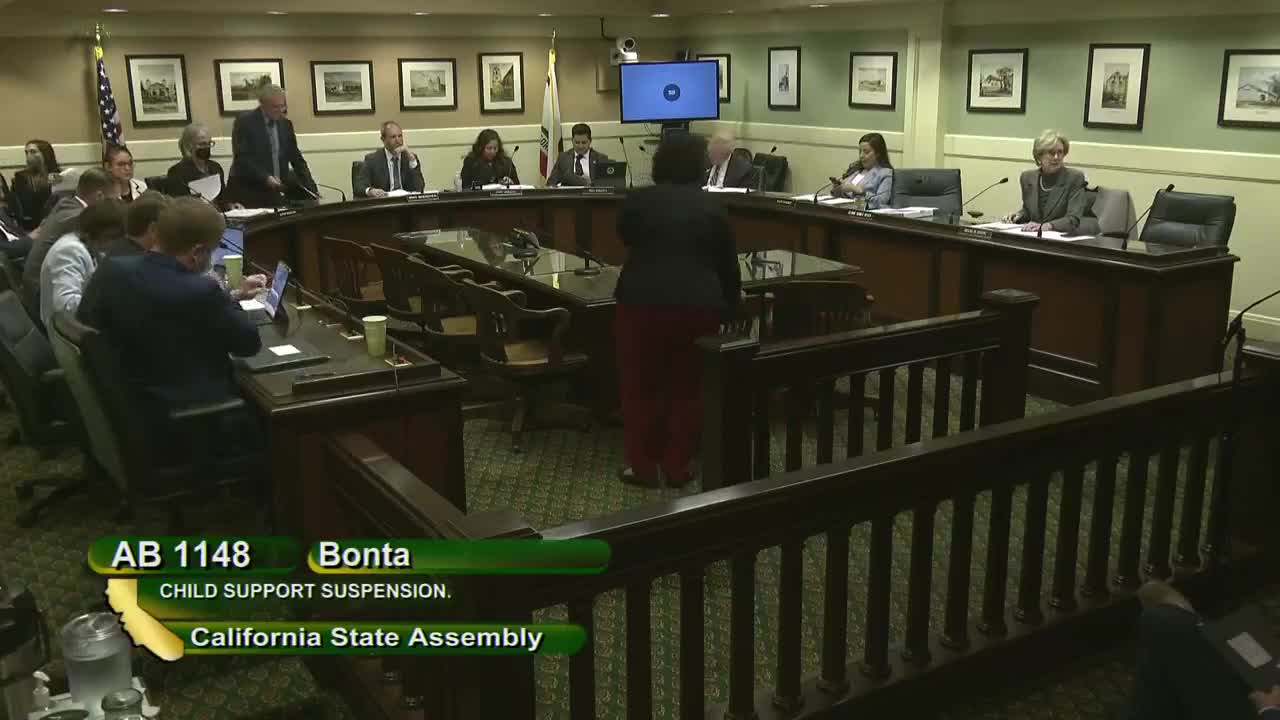 16MIN
Assembly Standing Committee on Judiciary
Bill Author

Bill Co-Author(s):