AB 1205: California State University students: California Promise: Finish in Four and Through in Two.
- Session Year: 2023-2024
- House: Assembly
- Latest Version Date: 2024-09-27
Current Status:
Passed
(2024-09-27: Chaptered by Secretary of State - Chapter 677, Statutes of 2024.)
Introduced
In Committee
First Chamber
In Committee
Second Chamber
Enacted
Existing law establishes the California Promise, which requires at least 20 campuses of the California State University to establish a California Promise program by which the campus enters into a pledge with a qualifying transfer student to support the student in earning a baccalaureate degree within 2 academic years of the students first year of enrollment to the campus, as provided. Existing law repeals these provisions on January 1, 2026.
This bill would rename the California Promise program the Finish in Four and Through in Two program, as provided. The bill would require each campus participating in the Finish in Four and Through in Two program to take specified actions to promote the program. The bill would require the Trustees of the California State University, on or before July 1, 2025, and annually thereafter, until January 1, 2034, to submit a report to the Legislature that includes specified program participation information. The bill would delete an obsolete reporting requirement. The bill would delete the January 1, 2026, program repeal date, thereby extending the program indefinitely.
Existing law declares that, because of the conditions prevailing in this state, the general welfare requires that the water resources of the state be put to beneficial use to the fullest extent of which they are capable, that the waste or unreasonable use or unreasonable method of use of water be prevented, and that the conservation of the water is to be exercised with a view to the reasonable and beneficial use of the water in the interest of the people and for the public welfare.This bill would require the State Water Resources Control Board to, on or before January 1, 2027, conduct a study and report to the Legislature and appropriate policy committees on the existence of speculation or profiteering by an investment fund in the sale, transfer, or lease of an interest in any surface water right or groundwater right previously put to beneficial use on agricultural lands, as specified. The bill would repeal this provision on January 1, 2031.Existing law declares that, because of the conditions prevailing in this state, the general welfare requires that the water resources of the state be put to beneficial use to the fullest extent of which they are capable, that the waste or unreasonable use or unreasonable method of use of water be prevented, and that the conservation of the water is to be exercised with a view to the reasonable and beneficial use of the water in the interest of the people and for the public welfare.
This bill would find and declare that speculation or profiteering by an investment fund in the sale, transfer, or lease of an interest in any surface water right or groundwater water right previously put to beneficial use on agricultural lands within the state is a waste or an unreasonable use of water.This bill would require the State Water Resources Control Board to, on or before January 1, 2027, conduct a study and report to the Legislature and appropriate policy committees on the existence of speculation or profiteering by an investment fund in the sale, transfer, or lease of an interest in any surface water right or groundwater right previously put to beneficial use on agricultural lands, as specified. The bill would repeal this provision on January 1, 2031.
Existing law declares that, because of the conditions prevailing in this state, the general welfare requires that the water resources of the state be put to beneficial use to the fullest extent of which they are capable, that the waste or unreasonable use or unreasonable method of use of water be prevented, and that the conservation of the water is to be exercised with a view to the reasonable and beneficial use of the water in the interest of the people and for the public welfare.
This bill would find and declare that speculation or profiteering by an investment fund in the sale, transfer, or lease of an interest in any surface water right or groundwater water right for profit, on or below previously put to beneficial use on agricultural lands within the state by an investment fund, shall not be considered a reasonable or beneficial use of water. is a waste or an unreasonable use of water.
Existing law declares that, because of the conditions prevailing in this state, the general welfare requires that the water resources of the state be put to beneficial use to the fullest extent of which they are capable, that the waste or unreasonable use or unreasonable method of use of water be prevented, and that the conservation of the water is to be exercised with a view to the reasonable and beneficial use of the water in the interest of the people and for the public welfare.
This bill would declare that the sale, transfer, or lease of an interest in any water right for profit, on or below agricultural lands within the state by an investment fund, shall not be considered a reasonable or beneficial use of water.
Existing law authorizes the State Water Resources Control Board to consider a petition for a long-term water or water rights transfer involving a change of point of diversion, place of use, or purpose of use. Existing law requires a long-term transfer to be for a period over one year. Existing law requires, after the expiration of that long-term transfer period, all rights to automatically revert to the original holders of the right without any action by the board.This bill would make a nonsubstantive change to that later provision.Existing law authorizes the State Water Resources Control Board to consider a petition for a long-term water or water rights transfer involving a change of point of diversion, place of use, or purpose of use. Existing law requires a long-term transfer to be for a period over one year. Existing law requires, after the expiration of that long-term transfer period, all rights to automatically revert to the original holders of the right without any action by the board.
This bill would make a nonsubstantive change to that later provision.
This part shall be known, and may be cited, as the Finish in Four and Through in Two program.
SEC. 3.Section 67432 of the Education Code is amended to read:67432.The California Promise was established to support California State University students in earning a baccalaureate degree within four academic years of the students first year of enrollment or, for transfer students, within two academic years of the students first year of enrollment to the campus and is hereby renamed and continued in existence as the Finish in Four and Through in Two program.
SEC. 4.Section 67433 of the Education Code is amended to read:67433.The Legislature finds and declares all of the following:
(a)A more concerted, statewide effort to create pathways to four-year graduation is needed at the California State University. For the 2010 cohort of full-time, first-time students at the California State University, 19 percent graduated within four academic years. According to the Legislative Analysts Office, the most recent nationally comparable data shows that the California State Universitys overall four-year graduation rate was 16 percent in 2011, below the national rate of 26 percent among similar public institutions.
(b)Impediments students face in graduating within four academic years include the inability to complete sufficient units per academic year or take courses that are part of their degree programs.
(c)New approaches are critical for the future of higher education in California. Efforts have been ongoing, though sporadic, to improve postsecondary educational institution enrollment and graduation. These efforts will need to be intensified and made more broadly systemic.
(d)Students who graduate within four academic years save tens of thousands of dollars. In addition to the direct costs of extended college and university enrollment, students miss out on earnings in the workforce while they remain in school.
(e)According to the Public Policy Institute of California, if bold measures are not taken, California will fall short of the states economic demand by 1.1 million college and university graduates by 2030. An increased demand for highly educated workers will outweigh the number of qualified applicants for available jobs, which will be exacerbated when scores of highly educated baby boomers retire. The share of workers with a baccalaureate degree will be 33 percent in 2030, below the 38 percent that will be needed.
(f)The impact of graduation rates from California State University campuses is felt not only throughout the state, but also the nation. One out of every 10 California employees is a California State University graduate, while one out of every 20 United States citizens with a college or university degree graduates from a campus of the California State University. These statistics emphasize the national importance of graduation rates at California State University campuses.
(g)It is the intent of the Legislature that the California State University system include the Finish in Four and Through in Two program as a component of the plan submitted to the Legislature and the Department of Finance to increase graduation rates at CSU campuses above those at other institutions and increase graduation rates for low-income students, first-generation students, and students from underrepresented minority groups as quickly as possible.
(h)The Finish in Four and Through in Two programs established at the California State University in accordance with this part should aim to reflect the demographics of their respective campuses and make the benefits provided available on an equitable basis considering the populations attending each campus.
SEC. 5.Section 67434 of the Education Code is amended to read:67434.(a)The trustees shall develop and implement a Finish in Four and Through in Two program that complies with this part.
(b)Commencing with the 201718 academic year, a minimum of eight campuses shall have established a Finish in Four and Through in Two program by which the campus enters into a pledge with a qualifying student who is enrolled at the campus and who is not a transfer student to support the student in earning a baccalaureate degree within four academic years of the academic year of the students first year of enrollment.
(c)Commencing with the 201718 academic year, a minimum of 15 campuses shall have established a Finish in Four and Through in Two program by which the campus enters into a pledge with a qualifying transfer student to support the student in earning a baccalaureate degree within two academic years of the students first year of enrollment to the campus, as applicable.
(d)Commencing with the 201819 academic year, a minimum of 20 campuses shall have established a Finish in Four and Through in Two program by which the campus enters into a pledge with a qualifying transfer student to support the student in earning a baccalaureate degree within two academic years of the students first year of enrollment to the campus, as applicable.
(e)To be a qualifying entering student or transfer student at the California State University, a student shall comply with both of the following:
(1)Be a California resident for purposes of in-state tuition eligibility.
(2)Commit to completing at least 30 semester units, or the quarter equivalent, per academic year. Units completed by the student during a summer term may count towards the previous or following academic year as determined by the trustees.
(f)Each Finish in Four and Through in Two program shall be reviewed by a graduation initiative advisory committee of the campus or a committee with similar functions designated by the president of the campus.
(g)(1)A campus shall guarantee participation in the program to, at a minimum, any student who is any of the following:
(A)A low-income student. For purposes of this section, low-income student shall have the same meaning as specified in Section 89295.
(B)A student who has graduated from a high school located in a community that is underrepresented in college attendance.
(C)A student who is a first-generation college student.
(D)A transfer student.
(2)It is the intent of the Legislature that the Finish in Four and Through in Two program at each campus accommodate as many students into the program as feasible and in consideration of available funding.
(h)Support provided by a California State University campus to a student who participates in the Finish in Four and Through in Two program shall include, but not be limited to, both of the following:
(1)(A)Priority registration in coursework.
(B)For purposes of this paragraph, a student shall not receive priority registration in coursework under the program if the student qualifies for priority registration under another policy or program, as determined by the campus or the office of the Chancellor of the California State University.
(C)A graduation initiative advisory committee of the campus, or a committee with similar functions designated by the president of the campus, shall consider preexisting priority registration policies when implementing this section.
(2)Academic advisement that includes monitoring the students academic progress.
(i)(1)The trustees shall develop application criteria, administrative guidelines, and additional requirements, including how campuses will measure student success, for purposes of implementing and administering the Finish in Four and Through in Two program.
(2)As a condition of continued participation in a Finish in Four and Through in Two program, a student may be required to demonstrate both of the following:
(A)Completion of at least 30 semester units, or the quarter equivalent, in each prior academic year.
(B)Attainment of a grade point average in excess of a standard established by the campus.
(3)In implementing this part, the trustees shall take into consideration the report on graduation rates required pursuant to Item 6610-001-0001 of Section 2.00 of the Budget Act of 2016.
(j)The trustees shall submit recommendations to the appropriate policy and fiscal committees of the Legislature by March 15, 2017, regarding potential financial incentives that could benefit students who participate in the Finish in Four and Through in Two program.
(k)Each campus participating in the Finish in Four and Through in Two program shall take the following actions to promote the program:
(1)Share information about the program at new student orientation.
(2)Provide information about the program during the online course registration process.
(3)Provide information about the program through an annual email to all students.
(4)Post information about the program in an easily identifiable and accessible place on the campus internet website.
(5)Post information about the program at advising offices.
(l)(1)The trustees, on or before July 1, 2025, and annually thereafter, shall submit a report to the Legislature that includes all of the following information:
(A)The program participation rate, as a percentage and number of students per campus.
(B)Program participation demographics, including all of the following:
(i)Student race and ethnicity.
(ii)Whether the student is a federal Pell Grant recipient, as available.
(iii)Whether the student is a first-generation college student.
(iv)Whether the student entered as a first-time freshman or transfer student.
(C)The amount of student success funds received and used per campus.
(2)The report submitted pursuant to this subdivision shall be submitted in compliance with Section 9795 of the Government Code.
(3)This subdivision shall become inoperative on January 1, 2034.
(m)A student who successfully completes an associate degree for transfer at a community college shall be guaranteed participation in the Finish in Four and Through in Two program at the California State University transfer campus, if established.
(n)The trustees shall make every effort to close the achievement gap and encourage broad participation in a Finish in Four and Through in Two program that reflects the demographic populations served by the campus.
SEC. 6.Section 67435 of the Education Code is repealed.This part shall be known, and may be cited, as the Finish in Four and Through in Two program.
SEC. 3.Section 67432 of the Education Code is amended to read:67432.The California Promise was established to support California State University students in earning a baccalaureate degree within four academic years of the students first year of enrollment or, for transfer students, within two academic years of the students first year of enrollment to the campus and is hereby renamed and continued in existence as the Finish in Four and Through in Two program.
SEC. 4.Section 67433 of the Education Code is amended to read:67433.The Legislature finds and declares all of the following:
(a)A more concerted, statewide effort to create pathways to four-year graduation is needed at the California State University. For the 2010 cohort of full-time, first-time students at the California State University, 19 percent graduated within four academic years. According to the Legislative Analysts Office, the most recent nationally comparable data shows that the California State Universitys overall four-year graduation rate was 16 percent in 2011, below the national rate of 26 percent among similar public institutions.
(b)Impediments students face in graduating within four academic years include the inability to complete sufficient units per academic year or take courses that are part of their degree programs.
(c)New approaches are critical for the future of higher education in California. Efforts have been ongoing, though sporadic, to improve postsecondary educational institution enrollment and graduation. These efforts will need to be intensified and made more broadly systemic.
(d)Students who graduate within four academic years save tens of thousands of dollars. In addition to the direct costs of extended college and university enrollment, students miss out on earnings in the workforce while they remain in school.
(e)According to the Public Policy Institute of California, if bold measures are not taken, California will fall short of the states economic demand by 1.1 million college and university graduates by 2030. An increased demand for highly educated workers will outweigh the number of qualified applicants for available jobs, which will be exacerbated when scores of highly educated baby boomers retire. The share of workers with a baccalaureate degree will be 33 percent in 2030, below the 38 percent that will be needed.
(f)The impact of graduation rates from California State University campuses is felt not only throughout the state, but also the nation. One out of every 10 California employees is a California State University graduate, while one out of every 20 United States citizens with a college or university degree graduates from a campus of the California State University. These statistics emphasize the national importance of graduation rates at California State University campuses.
(g)It is the intent of the Legislature that the California State University system include the Finish in Four and Through in Two program as a component of the plan submitted to the Legislature and the Department of Finance to increase graduation rates at CSU campuses above those at other institutions and increase graduation rates for low-income students, first-generation students, and students from underrepresented minority groups as quickly as possible.
(h)The Finish in Four and Through in Two programs established at the California State University in accordance with this part should aim to reflect the demographics of their respective campuses and make the benefits provided available on an equitable basis considering the populations attending each campus.
SEC. 5.Section 67434 of the Education Code is amended to read:67434.(a)The trustees shall develop and implement a Finish in Four and Through in Two program that complies with this part.
(b)Commencing with the 201718 academic year, a minimum of eight campuses shall have established a Finish in Four and Through in Two program by which the campus enters into a pledge with a qualifying student who is enrolled at the campus and who is not a transfer student to support the student in earning a baccalaureate degree within four academic years of the academic year of the students first year of enrollment.
(c)Commencing with the 201718 academic year, a minimum of 15 campuses shall have established a Finish in Four and Through in Two program by which the campus enters into a pledge with a qualifying transfer student to support the student in earning a baccalaureate degree within two academic years of the students first year of enrollment to the campus, as applicable.
(d)Commencing with the 201819 academic year, a minimum of 20 campuses shall have established a Finish in Four and Through in Two program by which the campus enters into a pledge with a qualifying transfer student to support the student in earning a baccalaureate degree within two academic years of the students first year of enrollment to the campus, as applicable.
(e)To be a qualifying entering student or transfer student at the California State University, a student shall comply with both of the following:
(1)Be a California resident for purposes of in-state tuition eligibility.
(2)Commit to completing at least 30 semester units, or the quarter equivalent, per academic year. Units completed by the student during a summer term may count towards the previous or following academic year as determined by the trustees.
(f)Each Finish in Four and Through in Two program shall be reviewed by a graduation initiative advisory committee of the campus or a committee with similar functions designated by the president of the campus.
(g)(1)A campus shall guarantee participation in the program to, at a minimum, any student who is any of the following:
(A)A low-income student. For purposes of this section, low-income student shall have the same meaning as specified in Section 89295.
(B)A student who has graduated from a high school located in a community that is underrepresented in college attendance.
(C)A student who is a first-generation college student.
(D)A transfer student.
(2)It is the intent of the Legislature that the Finish in Four and Through in Two program at each campus accommodate as many students into the program as feasible and in consideration of available funding.
(h)Support provided by a California State University campus to a student who participates in the Finish in Four and Through in Two program shall include, but not be limited to, both of the following:
(1)(A)Priority registration in coursework.
(B)For purposes of this paragraph, a student shall not receive priority registration in coursework under the program if the student qualifies for priority registration under another policy or program, as determined by the campus or the office of the Chancellor of the California State University.
(C)A graduation initiative advisory committee of the campus, or a committee with similar functions designated by the president of the campus, shall consider preexisting priority registration policies when implementing this section.
(2)Academic advisement that includes monitoring the students academic progress.
(i)(1)The trustees shall develop application criteria, administrative guidelines, and additional requirements, including how campuses will measure student success, for purposes of implementing and administering the Finish in Four and Through in Two program.
(2)As a condition of continued participation in a Finish in Four and Through in Two program, a student may be required to demonstrate both of the following:
(A)Completion of at least 30 semester units, or the quarter equivalent, in each prior academic year.
(B)Attainment of a grade point average in excess of a standard established by the campus.
(3)In implementing this part, the trustees shall take into consideration the report on graduation rates required pursuant to Item 6610-001-0001 of Section 2.00 of the Budget Act of 2016.
(j)The trustees shall submit recommendations to the appropriate policy and fiscal committees of the Legislature by March 15, 2017, regarding potential financial incentives that could benefit students who participate in the Finish in Four and Through in Two program.
(k)Each campus participating in the Finish in Four and Through in Two program shall take the following actions to promote the program:
(1)Share information about the program at new student orientation.
(2)Provide information about the program during the online course registration process.
(3)Provide information about the program through an annual email to all students.
(4)Post information about the program in an easily identifiable and accessible place on the campus internet website.
(5)Post information about the program at advising offices.
(l)(1)The trustees, on or before July 1, 2025, and annually thereafter, shall submit a report to the Legislature that includes all of the following information:
(A)The program participation rate, as a percentage and number of students per campus.
(B)Program participation demographics, including all of the following:
(i)Student race and ethnicity.
(ii)Whether the student is a federal Pell Grant recipient, as available.
(iii)Whether the student is a first-generation college student.
(iv)Whether the student entered as a first-time freshman or transfer student.
(C)The amount of student success funds received and used per campus.
(2)The report submitted pursuant to this subdivision shall be submitted in compliance with Section 9795 of the Government Code.
(3)This subdivision shall become inoperative on January 1, 2034.
(m)A student who successfully completes an associate degree for transfer at a community college shall be guaranteed participation in the Finish in Four and Through in Two program at the California State University transfer campus, if established.
(n)The trustees shall make every effort to close the achievement gap and encourage broad participation in a Finish in Four and Through in Two program that reflects the demographic populations served by the campus.
SEC. 6.Section 67435 of the Education Code is repealed.This part shall be known, and may be cited, as the California Promise. Finish in Four and Through in Two program.
SEC. 3.Section 67432 of the Education Code is amended to read:67432.The California Promise is hereby was established to support California State University students in earning a baccalaureate degree within four academic years of the students first year of enrollment or, for transfer students, within two academic years of the students first year of enrollment to the campus. campus and is hereby renamed and continued in existence as the Finish in Four and Through in Two program.
SEC. 4.Section 67433 of the Education Code is amended to read:67433.The Legislature finds and declares all of the following:
(a)A more concerted, statewide effort to create pathways to four-year graduation is needed at the California State University. For the 2010 cohort of full-time, first-time students at the California State University, 19 percent graduated within four academic years. According to the Legislative Analysts Office, the most recent nationally comparable data shows that the California State Universitys overall four-year graduation rate was 16 percent in 2011, below the national rate of 26 percent among similar public institutions.
(b)Impediments students face in graduating within four academic years include the inability to complete sufficient units per academic year or take courses that are part of their degree programs.
(c)New approaches are critical for the future of higher education in California. Efforts have been ongoing, though sporadic, to improve postsecondary educational institution enrollment and graduation. These efforts will need to be intensified and made more broadly systemic.
(d)Students who graduate within four academic years save tens of thousands of dollars. In addition to the direct costs of extended college and university enrollment, students miss out on earnings in the workforce while they remain in school.
(e)According to the Public Policy Institute of California, if bold measures are not taken, California will fall short of the states economic demand by 1.1 million college and university graduates by 2030. An increased demand for highly educated workers will outweigh the number of qualified applicants for available jobs, which will be exacerbated when scores of highly educated baby boomers retire. The share of workers with a baccalaureate degree will be 33 percent in 2030, below the 38 percent that will be needed.
(f)The impact of graduation rates from California State University campuses is felt not only throughout the state, but also the nation. One out of every 10 California employees is a California State University graduate, while one out of every 20 United States citizens with a college or university degree graduates from a campus of the California State University. These statistics emphasize the national importance of graduation rates at California State University campuses.
(g)It is the intent of the Legislature that the California State University system include the California Promise Finish in Four and Through in Two program as a component of the plan submitted to the Legislature and the Department of Finance to increase graduation rates at CSU campuses above those at other institutions and increase graduation rates for low-income students, first-generation students, and students from underrepresented minority groups as quickly as possible.
(h)The California Promise Finish in Four and Through in Two programs established at the California State University in accordance with this part should aim to reflect the demographics of their respective campuses and make the benefits provided available on an equitable basis considering the populations attending each campus.
SEC. 5.Section 67434 of the Education Code is amended to read:67434.(a)The trustees shall develop and implement a California Promise Finish in Four and Through in Two program that complies with this part.
(b)Commencing with the 201718 academic year, a minimum of eight campuses shall have established a California Promise Finish in Four and Through in Two program by which the campus enters into a pledge with a qualifying student who is enrolled at the campus and who is not a transfer student to support the student in earning a baccalaureate degree within four academic years of the academic year of the students first year of enrollment.
(c)Commencing with the 201718 academic year, a minimum of 15 campuses shall have established a California Promise Finish in Four and Through in Two program by which the campus enters into a pledge with a qualifying transfer student to support the student in earning a baccalaureate degree program within two academic years of the students first year of enrollment to the campus, as applicable.
(d)Commencing with the 201819 academic year, a minimum of 20 campuses shall have established a California Promise Finish in Four and Through in Two program by which the campus enters into a pledge with a qualifying transfer student to support the student in earning a baccalaureate degree within two academic years of the students first year of enrollment to the campus, as applicable.
(e)To be a qualifying entering student or transfer student at the California State University, a student shall comply with both of the following:
(1)Be a California resident for purposes of in-state tuition eligibility.
(2)Commit to completing at least 30 semester units units, or the quarter equivalent equivalent, per academic year. Units completed by the student during a summer term may count towards the previous or following academic year as determined by the trustees.
(f)Each College Promise Finish in Four and Through in Two program shall be reviewed by a graduation initiative advisory committee of the campus or a committee with similar functions designated by the president of the campus.
(g)(1)A campus shall guarantee participation in the program to, at a minimum, any student who is any of the following:
(A)A low-income student. For purposes of this section, low-income student shall have the same meaning as specified in Section 89295.
(B)A student who has graduated from a high school located in a community that is underrepresented in college attendance.
(C)A student who is a first-generation college student.
(D)A transfer student.
(2)It is the intent of the Legislature that the California Promise Finish in Four and Through in Two program at each campus accommodate as many students into the program as feasible and in consideration of available funding.
(h)Support provided by a California State University campus to a student who participates in the California Promise Finish in Four and Through in Two program shall include, but not necessarily be limited to, both of the following:
(1)(A)Priority registration in coursework.
(B)For purposes of this paragraph, a student shall not receive priority registration in coursework under the program if he or she the student qualifies for priority registration under another policy or program, as determined by the campus or the Office office of the Chancellor of the California State University.
(C)A graduation initiative advisory committee of the campus, or a committee with similar functions designated by the president of the campus, shall consider pre-existing preexisting priority registration policies when implementing this section.
(2)Academic advisement that includes monitoring the students academic progress.
(i)(1)The trustees shall develop application criteria, administrative guidelines, and additional requirements, including how campuses will measure student success, for purposes of implementing and administering the California Promise Finish in Four and Through in Two program.
(2)As a condition of continued participation in a California Promise Finish in Four and Through in Two program, a student may be required to demonstrate both of the following:
(A)Completion of at least 30 semester units, or the quarter equivalent, in each prior academic year.
(B)Attainment of a grade point average in excess of a standard established by the campus.
(3)In implementing this part, the trustees shall take into consideration the report on graduation rates required pursuant to Item 6610-001-0001 of Section 2.00 of the Budget Act of 2016.
(j)(1) The trustees shall submit a report recommendations to the appropriate policy and fiscal committees of the Legislature by July 1, 2021, March 15, 2017, regarding potential financial incentives that includes all of the following: could benefit students who participate in the Finish in Four and Through in Two program.
(k)Each campus participating in the Finish in Four and Through in Two program shall take the following actions to promote the program:
(1)Share information about the program at new student orientation.
(2)Provide information about the program during the online course registration process.
(3)Provide information about the program through an annual email to all students.
(4)Post information about the program in an easily identifiable and accessible place on the campus internet website.
(5)Post information about the program at advising offices.
(l)(1)The trustees, on or before July 1, 2025, and annually thereafter, shall submit a report to the Legislature that includes all of the following information:
(A)The number of students participating in the program in total, by campus, and disaggregated based on the following: program participation rate, as a percentage and number of students per campus.
(B)Program participation demographics, including all of the following:
(i)Student race and ethnicity.
(i)(ii)Whether the student entered as a first-time freshman or a transfer student. is a federal Pell Grant recipient, as available.
(ii)(iii)Whether the student is a first-generation college student.
(iii)(iv)Whether the student a recipient of financial aid under the Federal Pell Grant Program (20 U.S.C. Sec. 1070a) or the Cal Grant Program established in Chapter 1.7 (commencing with Section 69430) of Part 42. entered as a first-time freshman or transfer student.
(iv)According to the students ethnicity. (B)(C)The total number amount of students who graduated in four academic years for students who entered as first-time freshmen, student success funds received and two academic years, for students who entered as transfer students, in total, by campus, and disaggregated based on the characteristics identified in clauses (i) to (iv), inclusive, of subparagraph (A). used per campus.
(2)The report required by paragraph (1) submitted pursuant to this subdivision shall include a summary description of significant differences be submitted in the implementation compliance with Section 9795 of the California Promise program at each campus. Government Code.
(k)The trustees(3)This subdivision shall submit recommendations to the appropriate policy and fiscal committees of the Legislature by March 15, 2017, regarding potential financial incentives that could benefit students who participate in the California Promise program. become inoperative on January 1, 2034.
(l)(m)A student who successfully completes his or her an associate degree for transfer at a community college shall be guaranteed participation in the California Promise Finish in Four and Through in Two program at the California State University transfer campus, if established.
(m)(n)The trustees shall make every effort to close the achievement gap and encourage broad participation in a California Promise Finish in Four and Through in Two program that reflects the demographic populations served by the campus.
SEC. 6.Section 67435 of the Education Code is repealed.67435.This part shall remain in effect only until January 1, 2026, and as of that date is repealed, unless a later enacted statute, that is enacted before January 1, 2026, deletes or extends that date.SECTION 1.Section 100.1 is added to the Water Code, to read:100.1.(a)(1)On or before January 1, 2027, the state board shall conduct a study and report to the Legislature on the existence of speculation or profiteering by an investment fund in the sale, transfer, or lease of an interest in any surface water right or groundwater right previously put to beneficial use on agricultural lands. The state board shall provide this report to the appropriate policy committees of the Legislature.(2)The report shall include, but is not limited to, all of the following:(A)The investment funds that are buying agricultural land and where those investment funds are located.(B)Any parent companies of the investment fund.(C)The amount of agricultural land being purchased by the investment fund.(D)How often agricultural lands are being bought by investment funds.(E)What is being done with the land and any associated water right.(F)If water is being sold, the amount that is being paid for the water.(G)The extent that the actions of these investment funds are negatively impacting local communities.(b)(1)A report to be submitted pursuant to subdivision (a) shall be submitted in compliance with Section 9795 of the Government Code.(2)Pursuant to Section 10231.5 of the Government Code, this section is repealed on January 1, 2031.(a)(1)On or before January 1, 2027, the state board shall conduct a study and report to the Legislature on the existence of speculation or profiteering by an investment fund in the sale, transfer, or lease of an interest in any surface water right or groundwater right previously put to beneficial use on agricultural lands. The state board shall provide this report to the appropriate policy committees of the Legislature.
(2)The report shall include, but is not limited to, all of the following:
(A)The investment funds that are buying agricultural land and where those investment funds are located.
(B)Any parent companies of the investment fund.
(C)The amount of agricultural land being purchased by the investment fund.
(D)How often agricultural lands are being bought by investment funds.
(E)What is being done with the land and any associated water right.
(F)If water is being sold, the amount that is being paid for the water.
(G)The extent that the actions of these investment funds are negatively impacting local communities.
(b)(1)A report to be submitted pursuant to subdivision (a) shall be submitted in compliance with Section 9795 of the Government Code.
(2)Pursuant to Section 10231.5 of the Government Code, this section is repealed on January 1, 2031.
SECTION 1.Section 100.1 is added to the Water Code, to read:100.1.(a)For the purposes of this section, the following definitions apply:(1)Agricultural land has the same meaning as defined in Section 10213 of the Public Resources Code.(2)Investment fund means a private equity fund, public equity fund, venture capital fund, hedge fund, fixed income fund, real estate fund, infrastructure fund, or similar pooled investment entity that is, or holds itself out as being, engaged primarily, or proposes to engage primarily, in the business of investing, reinvesting, owning, holding, or trading securities or other assets.(3)Speculation means the sale, transfer, or lease of an interest in a water right by an investment fund to profit from an increase in the waters value in a subsequent transaction or without a plan to put the water to beneficial use.(b)The Legislature hereby finds and declares that speculation or profiteering by an investment fund in the sale, transfer, or lease of an interest in any surface water right or groundwater water right previously put to beneficial use on agricultural lands within the state is a waste or an unreasonable use of water within the meaning of Section 2 of Article X of the California Constitution.(a)For the purposes of this section, the following definitions apply:
(1)Agricultural land has the same meaning as defined in Section 3508 of Title 7 of the United States Code. 10213 of the Public Resources Code.
(2)Investment fund means a private equity fund, public equity fund, venture capital fund, hedge fund, fixed income fund, real estate fund, infrastructure fund, or similar pooled investment entity that is, or holds itself out as being, engaged primarily, or proposes to engage primarily, in the business of investing, reinvesting, owning, holding, or trading securities or other assets.
(3)Speculation means the sale, transfer, or lease of an interest in a water right by an investment fund to profit from an increase in the waters value in a subsequent transaction or without a plan to put the water to beneficial use.
(b)It is hereby declared The Legislature hereby finds and declares that speculation or profiteering by an investment fund in the sale, transfer, or lease of an interest in any surface water right or groundwater water right for profit, on or below previously put to beneficial use on agricultural lands within the state by an investment fund, shall not be considered a reasonable or beneficial use of water. is a waste or an unreasonable use of water within the meaning of Section 2 of Article X of the California Constitution.
(a)For the purposes of this section, the following definitions apply:
(1)Agricultural land has the same meaning as defined in Section 3508 of Title 7 of the United States Code.
(2)Investment fund means a private equity fund, public equity fund, venture capital fund, hedge fund, fixed income fund, real estate fund, infrastructure fund, or similar pooled investment entity that is, or holds itself out as being, engaged primarily, or proposes to engage primarily, in the business of investing, reinvesting, owning, holding, or trading securities or other assets.
(b)It is hereby declared that the sale, transfer, or lease of an interest in any water right for profit, on or below agricultural lands within the state by an investment fund, shall not be considered a reasonable or beneficial use of water.
SECTION 1.Section 1737 of the Water Code is amended to read:1737.Following the expiration of the period of the long-term transfer, all rights shall automatically revert to the original holders of the right without any action by the board.Following the expiration of the period of the long-term transfer period, transfer, all rights shall automatically revert to the original holders of the right without any action by the board.
|
Date
|
Status
|
|---|---|
| Sep 27, 2024 | Chaptered by Secretary of State - Chapter 677, Statutes of 2024. |
| Sep 27, 2024 | Approved by the Governor. |
| Sep 12, 2024 | Enrolled and presented to the Governor at 4 p.m. |
| Aug 31, 2024 | Senate amendments concurred in. To Engrossing and Enrolling. (Ayes 68. Noes 3.). |
| Aug 31, 2024 | In Assembly. Concurrence in Senate amendments pending. |
| Aug 31, 2024 | Read third time. Passed. Ordered to the Assembly. (Ayes 39. Noes 0.). |
| Aug 30, 2024 | From committee: Do pass. (Ayes 7. Noes 0.) (August 30). |
| Aug 30, 2024 | Read second time. Ordered to third reading. |
| Aug 29, 2024 | From committee: Do pass and re-refer to Com. on APPR. (Ayes 5. Noes 0.) (August 29). Re-referred to Com. on APPR. |
| Aug 28, 2024 | Read second time and amended. Ordered returned to second reading. |
| Aug 28, 2024 | Re-referred to Com. on RLS pursuant to Senate Rule 29.10(c). |
| Aug 28, 2024 | Re-referred to Com. on ED. |
| Aug 28, 2024 | Ordered to second reading. |
| Aug 28, 2024 | Joint Rules 61 and 62(a) suspended. (Ayes 31. Noes 9.) |
| Aug 28, 2024 | From inactive file. |
| Sep 11, 2023 | Ordered to inactive file at the request of Senator Hurtado. |
| Sep 5, 2023 | Read second time. Ordered to third reading. |
| Sep 1, 2023 | From committee: Do pass. (Ayes 5. Noes 2.) (September 1). |
| Aug 21, 2023 | In committee: Referred to APPR suspense file. |
| Aug 14, 2023 | Re-referred to Com. on APPR pursuant to Joint Rule 10.5. |
| Jul 13, 2023 | Read second time and amended. Ordered to third reading. |
| Jul 12, 2023 | From committee: Amend, and do pass as amended. (Ayes 6. Noes 3.) (July 10). |
| May 31, 2023 | Referred to Com. on N.R. & W. |
| May 23, 2023 | In Senate. Read first time. To Com. on RLS. for assignment. |
| May 22, 2023 | Read third time. Passed. Ordered to the Senate. (Ayes 46. Noes 17. Page 1690.) |
| May 9, 2023 | Read second time. Ordered to third reading. |
| May 8, 2023 | Read second time and amended. Ordered returned to second reading. |
| May 4, 2023 | From committee: Amend, and do pass as amended. (Ayes 11. Noes 4.) (May 2). |
| Mar 27, 2023 | Re-referred to Com. on W., P., & W. |
| Mar 23, 2023 | Referred to Com. on W., P., & W. |
| Mar 23, 2023 | From committee chair, with author's amendments: Amend, and re-refer to Com. on W., P., & W. Read second time and amended. |
| Feb 17, 2023 | From printer. May be heard in committee March 19. |
| Feb 16, 2023 | Read first time. To print. |
|
Date
|
Description
|
Location
|
Votes
|
|
|---|---|---|---|---|
| Aug 31, 2024 | AB 1205 Bauer-Kahan Concurrence in Senate Amendments | Assembly Floor |
Passed |
|
| Aug 31, 2024 | Assembly 3rd Reading AB1205 Bauer-Kahan et al. | Senate Floor |
Passed |
|
| Aug 30, 2024 | Do pass | Senate Standing Committee on Appropriations |
Passed |
|
| Aug 29, 2024 | Do pass, but first be re-referred to the Committee on [Appropriations] | Senate Standing Committee on Education |
Passed |
|
| Sep 1, 2023 | Do pass | Senate Standing Committee on Appropriations |
Passed |
|
| Aug 21, 2023 | Placed on suspense file | Senate Standing Committee on Appropriations |
Passed |
|
| Jul 10, 2023 | Do pass as amended | Senate Standing Committee on Natural Resources and Water |
Passed |
|
| May 22, 2023 | AB 1205 Bauer-Kahan Assembly Third Reading | Assembly Floor |
Passed |
|
| May 2, 2023 | Do pass as amended. | Assembly Standing Committee on Water, Parks, and Wildlife |
Passed |
This list shows positions taken on this bill by organizations on the date displayed, which is linked to the original source.
Positions by individuals are not included.
|
Organization
|
Position
|
Date
|
|---|---|---|
| Agricultural Council Of California | ** Against | |
| American Pistachio Growers | ** Against | |
| Association Of California Water Agencies | * Indeterminate | Jul 10, 2023 |
| California Apple Commission | ** Against | |
| California Association Of Winegrape Growers | * Indeterminate | Jul 10, 2023 |
| California Blueberry Association | ** Against | |
| California Blueberry Commission | ** Against | |
| California Building Industry Association | ** Against | |
| California Chamber Of Commerce | * Indeterminate | Jul 10, 2023 |
| California Cotton Ginners and Growers Association | ** Against | |
| California Farm Bureau | * Indeterminate | Jul 10, 2023 |
| California Fresh Fruit Association | ** Against | |
| California Walnut Commission | ** Against | |
| City of Ridgecrest | * Indeterminate | Jul 10, 2023 |
| cleanearth4kids.org | ** Support | |
| Community Water Center | ** Support | |
| Families Advocating for Chemical and Toxic Safety | * Support | Aug 21, 2023 |
| Grandparents in Action | * Support | Aug 21, 2023 |
| Gualco Group | * Against | May 2, 2023 |
| Homer, LLC | ** Against | |
| Kahn Soares Conway LLP | * Indeterminate | Jul 10, 2023 |
| Kern County Board of Supervisors | * Indeterminate | Jul 10, 2023 |
| Kp Public Affairs | * Against | May 2, 2023 |
| Nisei Farmers League | ** Against | |
| Northern California Water Association | * Indeterminate | Jul 10, 2023 |
| Olive Growers Council of California | ** Against | |
| Plant California Alliance | ** Against | |
| San Diego County Water Authority | ** Against | |
| San Joaquin River Exchange Contractors | * Indeterminate | Jul 10, 2023 |
| San Luis & Delta-Mendota Water Authority | * Indeterminate | Jul 10, 2023 |
| Saucelito Irrigation District | ** Against | |
| Shafter-Wasco Irrigation District | ** Against | |
| Valley Ag Water Coalition | ** Against | |
| Western Agricultural Processors Association | ** Against | |
| Western Growers Association | ** Against | |
| Wheeler Ridge Maricopa Water Storage District | ** Against |
CONCURRENCE IN SENATE AMENDMENTS
CSA1 Bill Id:AB 1205
Author:(Bauer-Kahan)
As Amended Ver:August 28, 2024
Majority vote
SUMMARY
Renames the California Promise Program (Program) established at the California State University (CSU) as the Finish in Four and Through in Two Program. It further requires CSU campuses to promote the Program and establishes an annual reporting requirement. Lastly, the measure eliminates the Program's January 1, 2026, sunset date, thereby extending the Program indefinitely at CSU campuses.
Senate Amendments
Delete the Assembly version of this measure and instead:
- Rename the California Promise Program established at the CSU as the Finish in Four and Through in Two Program.
- Require each campus participating in the Program:
- Share information about the Program at new student orientation;
- Provide information about the Program during the online course registration process;
- Provide information about the Program through an annual email to all students;
- Post information about the Program in an easily identifiable and accessible place on the campus internet website; and,
- Post information about the Program at advising offices.
- Require the CSU Trustees, by July 1, 2025, and annually thereafter, until January 1, 2034, to submit a report to the Legislature that includes all of the following information:
- The Program participation rate, as a percentage, and the number of students per campus;
- Program participation demographics, including all of the following:
- Student race and ethnicity;
- Whether the student is a federal Pell Grant recipient, as available;
- Whether the student is a first-generation college student; and,
- Whether the student entered as a first-time freshman or transfer student.
- The amount of graduation initiative funds received and used per campus.
- Eliminate the January 1, 2026 sunset date, effectively extending the Program indefinitely.
- Makes technical and conforming changes.
COMMENTS
Gut and amend. This measure previously related to the sale, transfer, or lease of an interest in surface water rights or groundwater rights on agricultural lands. However, the measure was gutted and amended on August 28, 2024, and now relates to the CSU California Promise Program.
The measure's provisions in their current form are identical to those of SB 1200 (Glazer), as amended in the Assembly on July 3, 2024. SB 1200 (Glazer) was heard and approved by the Assembly Committee on Higher Education on July 2, 2024, with a vote of 11 to 0. However, SB 1200 (Glazer), was held on the Suspense File by the Assembly Committee on Appropriations on August 15, 2024.
California Promise Program. The Program, which is voluntary or self-selected for eligible CSU students to participate, was enacted in 2016 (by SB 412 Glazer, Chapter 436, Statutes of 2016). The Program initially required eight CSU campuses to offer four-year Promise Programs and 20 CSU campuses to offer two-year Promise Programs.
Campuses of the CSU who participate in the Program enter into a pledge with a first-time freshman or with a qualifying transfer student to support the student in obtaining a baccalaureate degree within four academic years or within two for transfer students. Students who commit to enter either the four-year or two-year pledge are given priority registration and are provided with routine and thorough academic advisement.
According to CSU's 2021 report to the Legislature on the Program, participation grew from 2017, with 16 (of 23) campuses offering a four-year pledge plan and 22 campuses offering a two-year pledge plan. From 2017 to 2021, more than 30,000 CSU students participated in some variation of the four- or two-year pledge. Of those, more than 13,000 were among the first in their family to attend college. Data from the CSU 2021 report shows that 64% of community college transfer students who engaged in the two-year pledge were able to graduate within two years. This figure is significantly higher than that of the system as a whole at that time. The higher graduation rates also hold across student groups by first-generation status, Pell status, and race/ethnicity. Four-year graduation rates for first-time students were unavailable at the time the report was prepared. There is no obligation to provide a report on the Program beyond 2021.
This measure requires the submission of an annual report on student participation in the Program and makes the Program permanent. It also requires CSU campuses to promote the Program.
Graduation Initiative 2025. In 2015, CSU launched Graduation Initiative 2025 (GI 2025), its ambitious plan to increase graduation rates, eliminate equity gaps in degree completion and meet California's workforce needs.
According to the CSU Chancellor's Office, the CSU continues to experience a record-breaking rise in graduation rates systemwide, yet equity gaps are growing. The first-year class that entered in Fall 2019 represents the cohort of students in which 6-year graduation rates and equity gaps will be measured in 2025. The COVID-19 pandemic and the disparate impacts across communities of color and low-income families have created a renewed urgency to close the gaps that exists between underserved and vulnerable students and their peers. Not since GI 2025 launched almost a decade ago, has the need to marshal the CSU's collective resources been more critical to address differential patterns of student success.
The graduation rates at the CSU are at record highs, due largely in part to Graduation Initiative 2025's emphasis on equity. The Initiative is the CSU's determined effort to ensure that all students regardless of racial, ethnic, or financial background have an equal opportunity to earn a college degree.
Please refer to the Assembly Committee on Higher Education's policy analysis of SB 1200 (Glazer) for further discussion.
Related and Prior and legislation. SB 1200 (Glazer) of 2024, which was held in the Assembly Committee on Appropriations, is identical to this measure.
SB 856 (Glazer) of the 2023-24 Legislative Session, which was held on the Suspense File by the Assembly Committee on Appropriations, is similar to this measure, and would have renamed the California Promise Program at CSU as the "Finish in Four and Through in Two" Program. Unlike this measure, it would have required: (1) all incoming first-time students into the Program, with the option for students to opt out; (2) at least 5% of each incoming class of first-time freshman students and qualifying transfer students to participate in the Program at each campus of the CSU that offers the Program; and, (3) at least 70% of Program participants to be either low-income students, first-generation students, or students from underrepresented communities within postsecondary education.
SB 785 (Glazer) of the 2021-22 Legislative Session, which was vetoed by Governor Newsom, is similar to this measure, would have required at least 5% of each incoming class at each participating CSU campus to participate in the California Promise Program, and that at least 70% of those participating undergraduate students be either low-income students, first-generation, or students from communities that are underrepresented in postsecondary education. SB 785 did not automatically enroll students in the Program.
SB 1211 (Glazer) of 2020, which was not heard in the Senate Committee on Education Committee due to the shortened 2020 Legislative Calendar, was similar in nature to this measure.
SB 148 (Glazer) of 2019, which was held on the Suspense File by the Assembly Committee on Appropriations, would have established the Student Success and On-time Completion Fund in the State Treasury, and authorized the Trustees of the CSU to use money in the fund to incentivize participation in a California Promise Program through the offering of grants or tuition freeze, as specified. SB 148 also required CSU to waive systemwide tuition or fees for a participating student unable to complete their degree due to limited space or no course offerings, as specified.
SB 346 (Glazer) of 2018, which failed passage on the Assembly Floor, was virtually identical to SB 148 in its final form.
SB 803 (Glazer) of 2017, which was held on the Suspense File by the Senate Committee on Appropriations, was nearly identical to SB 346 (as described above).
SB 412 (Glazer), Chapter 436, Statues of 2016, required the CSU Board of Trustees to develop and implement a Program, known as the California Program, that authorizes a campus to enter into a pledge with qualifying students, as defined, to support completion of a baccalaureate degree within four years or for transfer students within two years, and outlines the requirements which may be included in such a Program. SB 412 also required the Board of Trustees to submit recommendations regarding potential financial incentives that could benefit students who participate in the Program.
SB 1450 (Glazer) of 2016, Both SB 1450 and SB 412 (as described above) required the CSU to develop and implement a program that authorizes a campus to enter into a pledge with qualifying students to support completion of a baccalaureate degree within four years and offer incentives to students in exchange for participation in the program. Unlike, SB 412 and similar to this measure, SB 1450 established various requirements regarding systemwide fees for California Promise students at CSU, including freezing tuition and granting tuition waivers if students were unable to complete a degree within the required timeframe due to unavailability of courses. SB 1450 also imposed these same requirements on the California Community Colleges (CCC) and required the CCC Board of Governors to establish the Promise Program as well. The CCC was removed from the scope of the bill and instead required CSU to ensure entry into a Promise Program for any CCC student who transfers with an Associate Degree for Transfer. SB 1450 failed to secure passage out of the Senate Committee on Education on April 20, 2016, by a vote of 4-2.
According to the Author
According to the Principal Co-Author of this measure, who is the author of a Senate Bill that is identical to this measure, "today, the CSU awards nearly half of California's bachelor's degrees and more than half of the CSU students are students of color. While system-wide graduation rates have steadily improved over the past five years, more must be done to increase rates of California students receiving their bachelor's degrees within four years of cumulative study."
The principal co-author contends that, "the system continues to struggle with graduation gaps for underrepresented students, and the system's graduation rates still lag behind those of similar universities nationwide. This bill will ensure the vital supports of the California Promise Program continue for future cohorts of CSU students and indefinitely extends the Program's goals of eliminating longstanding opportunity and achievement gaps between low-income or first-generation students and their peers. Improving education outcomes for young adults in California is essential to generate upward economic mobility and ensure a prosperous state."
Arguments in Support
Not relevant to the current version of the measure (August 28, 2024), which deleted the Assembly version of this measure.
Arguments in Opposition
Not relevant to the current version of the measure (August 28, 2024), which deleted the Assembly version of this measure.
FISCAL COMMENTS
According to the Senate Committee on Appropriations (based on the current version of this measure):
- The bill's removal of the sunset date would result in the continued administrative costs necessary to administer the Promise Program at CSU campuses, thereby eliminating the possibility of savings if the Program were to expire. The CSU is unsure of the systemwide costs of the Program, so the extent of the forgone savings is unknown and would likely vary by campus.
- The CSU indicates that the bill's reporting requirements will result in additional, but undefined administrative costs to gather the required information for the annual reporting. While the existing program currently requires CSU to solicit, review, admit, and advise participating students while also tracking them within its data system and ensure that they are maintaining eligibility for the Program, campuses have had to absorb this workload within existing resources.
- The CSU estimates one-time General Fund costs in the high tens of thousands of dollars for campuses to provide technical, website upgrades necessary to comply with the bill's Program outreach requirements, such as providing Program information during course registration and sending the annual email to all students. There would also be minor and absorbable ongoing costs to continue sending the annual email, ensure that the physical posting at advising offices is in place, and provide the presentation for the Program at new student orientations.
VOTES:
ASM WATER, PARKS, AND WILDLIFE: 11-4-0
YES: Bauer-Kahan, Bennett, Friedman, Hart, Kalra, Pellerin, Blanca Rubio, Schiavo, Villapudua, Ward, Weber
NO: Mathis, Alanis, Megan Dahle, Davies
ASSEMBLY FLOOR: 46-17-17
YES: Addis, Aguiar-Curry, Alvarez, Bauer-Kahan, Bennett, Berman, Boerner, Bonta, Bryan, Wendy Carrillo, Cervantes, Mike Fong, Friedman, Gabriel, Garcia, Gipson, Haney, Hart, Holden, Jackson, Jones-Sawyer, Kalra, Lee, Low, Lowenthal, Maienschein, McCarty, McKinnor, Muratsuchi, Ortega, Pacheco, Papan, Pellerin, Petrie-Norris, Reyes, Robert Rivas, Blanca Rubio, Santiago, Schiavo, Ting, Ward, Weber, Wicks, Wood, Zbur, Rendon
NO: Alanis, Bains, Megan Dahle, Davies, Dixon, Essayli, Flora, Vince Fong, Gallagher, Hoover, Mathis, Jim Patterson, Joe Patterson, Sanchez, Ta, Waldron, Wallis
ABS, ABST OR NV: Arambula, Calderon, Juan Carrillo, Chen, Connolly, Grayson, Irwin, Lackey, Stephanie Nguyen, Quirk-Silva, Ramos, Luz Rivas, Rodriguez, Soria, Valencia, Villapudua, Wilson
UPDATED
VERSION: August 28, 2024
CONSULTANT: Jeanice Warden / HIGHER ED. / (916) 319-3960 FN: 0005033
SENATE COMMITTEE ON APPROPRIATIONS
Senator Anna Caballero, Chair
2023 - 2024 Regular Session
AB 1205 (Bauer-Kahan) - California State University students: California Promise: Finish in Four and Through in Two
Version: August 28, 2024 | Policy Vote: N.R. & W. 6 - 3, ED. 5 - 0 |
Urgency: No | Mandate: No |
Hearing Date: August 30, 2024 | Consultant: Lenin Del Castillo |
Bill Summary:
This bill renames the California Promise Program established at the California State University (CSU) as the Finish in Four and Through in Two program. This bill also establishes an annual reporting requirement and eliminates the January 1, 2026 sunset date, thereby extending the program indefinitely.
Fiscal Impact:
- The bill’s removal of the sunset date would result in the continued administrative costs necessary to administer the Promise Program at CSU campuses, thereby eliminating the possibility of savings if the program were to expire. The CSU is unsure of the systemwide costs of the program, so the extent of the forgone savings is unknown and would likely vary by campus.
- The CSU indicates that the bill’s reporting requirements would result in additional, but undefined administrative costs to gather the required information for the annual reporting. While the existing program currently requires CSU to solicit, review, admit, and advise participating students while also tracking them within its data system and ensure that they are maintaining eligibility for the program, campuses have had to absorb this workload within existing resources.
- The CSU estimates one-time General Fund costs in the high tens of thousands of dollars for campuses to provide technical, website upgrades necessary to comply with the bill’s program outreach requirements, such as providing program information during course registration and sending the annual email to all students. There would also be minor and absorbable ongoing costs to continue sending the annual email, ensure that the physical posting at advising offices is in place, and provide the presentation for the program at new student orientations.
Background:
Existing law establishes the California Promise Program for the purpose of supporting CSU students in earning a baccalaureate degree within four academic years of the student’s first year of enrollment, or for transfer students, within two academic years of the student’s first year of enrollment to the campus.
Existing law requires participating campuses to provide priority registration in coursework provided that a student does not qualify for priority registration under another policy or program, as specified, and academic advisement that includes the monitoring of academic progress.
Existing law requires a student, in order to qualify for the program to be a California resident for purposes of in-state tuition eligibility and commit to completing at least 30 semester units or the quarter equivalent per academic year, including summer term units, as specified.
Existing law requires a campus to guarantee participation in the program to, at a minimum, any student who is a low-income student, as defined, a student who has graduated from a high school located in a community that is underrepresented in college attendance, a first-generation college student or a transfer student who successfully completes his or her associate degree for transfer at a community college.
As a condition of continued participation in a California Promise program, a student may be required to demonstrate both of the following: completion of at least 30 semester units, or the quarter equivalent, in each prior academic year and attainment of a grade point average in excess of a standard established by the campus.
The program sunsets on January 1, 2026.
Proposed Law:
This bill renames the California Promise Program as the Finish in Four and Through in Two Program, and requires the CSU Trustees, by July 1, 2025, and annually thereafter until January 1, 2034, to submit a report to the Legislature that includes all of the following information:
- The program participation rate, as a percentage, and the number of students per campus.
- Program participation demographics, including student race and ethnicity, whether the student is a federal Pell Grant recipient, whether the student is a first-generation college student, and whether the student entered as a first-time freshman or transfer student.
- The amount of graduation initiative funds received and used per campus.
This bill requires each campus participating in the Finish in Four and Through in Two Program to do the following:
- Share information about the program at new student orientation.
- Provide information about the program during the online course registration process.
- Provide information about the program through an annual email to all students.
- Post information about the program in an easily identifiable and accessible place on the campus internet website.
- Post information about the program at advising offices.
This bill eliminates the January 1, 2026 sunset date, effectively extending the program indefinitely.
Related Legislation:
SB 1200 (Glazer, 2024) was identical to this bill and held on the Suspense File in the Assembly Appropriations Committee.
SB 856 (Glazer, 2023), similar to this bill, would have renamed the California Promise program at CSU as the “Finish in Four and Through in Two” program. It also would have required all incoming first-time students to enroll in the program with the option for students to opt out. SB 856 was held in the Assembly Appropriations Committee.
SB 785 (Glazer, 2021) would have required at least 5 percent of each incoming class to participate in the California Promise program at each CSU campus. This bill was vetoed with the following message:
The author’s efforts to increase CSU graduation rates and close equity gaps are laudable. I too share these goals, which is why my Administration, and the CSU entered a five-year Compact aimed at increase student achievement, advancing equity, increasing affordability and meeting the State’s workforce needs. However, I am concerned that this bill is overly prescriptive and could result in diverting resources away from other student programs that may be more effective in realizing the goals of the Compact.
SB 148 (Glazer, 2019) would have established the Student Success and On-time Completion Fund in the State Treasury, and authorized the Trustees of the CSU to use money in the fund to incentivize participation in a California Promise Program through the offering of grants or tuition freeze, as specified. SB 148 also required CSU to waive systemwide tuition or fees for a participating student unable to complete their degree due to limited space or no course offerings, as specified. SB 148 was held in the Assembly Appropriations Committee.
Staff Comments:
The California Promise Program supports CSU students in earning a baccalaureate degree within four academic years, or two years for transfer students. Students who commit to either the four-year or two-year pledge with the campus receive priority registration and routine and comprehensive academic advice. California Promise students self-select into the program and must complete 30 units per academic year and maintain minimum grade point average requirements. Participation is guaranteed for students who are low-income, graduated from a local high school, transferred from a community college or, are first-generation. Not all CSU majors are eligible for this program due to the curriculum and required units, and students must meet pledge requirements to remain in the program.
The California Promise Program currently has a sunset date of January 1, 2026. This bill proposes to eliminate the sunset date, effectively extending the program indefinitely which would create ongoing, but unknown costs across the system. The CSU indicates that no money has ever been appropriated to support the program, therefore campuses have had to absorb the costs. In some cases, campuses have moved academic counselors from general counseling to only working with Promise Program participants without being able to backfill the previous general advising positions, in order to be in compliance.
-- END --
SENATE RULES COMMITTEE Office of Senate Floor Analyses (916) 651-1520 Fax: (916) 327-4478 | AB 1205 |
THIRD READING
Bill No: AB 1205
Author: Bauer-Kahan (D), et al.
Amended: 8/28/24 in Senate
Vote: 21
PURSUANT TO SR 29.10
SENATE EDUCATION COMMITTEE: 5-0, 8/29/24
AYES: Newman, Cortese, Glazer, Smallwood-Cuevas, Wilk
NO VOTE RECORDED: Ochoa Bogh, Gonzalez
SENATE APPROPRIATIONS COMMITTEE: 7-0, 8/30/24
AYES: Caballero, Jones, Ashby, Becker, Bradford, Seyarto, Wahab
SUBJECT: California State University students: California Promise: Finish in Four and Through in Two
SOURCE: Author
DIGEST:
This bill renames the California Promise Program established at the California State University (CSU) as the Finish in Four and Through in Two program. The bill further requires CSU campuses to promote the program and establishes an annual reporting requirement. Lastly, the bill eliminates the program’s January 1, 2026, sunset date, thereby extending the program indefinitely at CSU campuses.
ANALYSIS:
Existing law:
- Establishes the California Promise program for the purposes of supporting CSU students in earning a baccalaureate degree within four academic years of the student’s first year of enrollment, or for transfer students, within two academic years of the student’s first year of enrollment to the campus.
- Requires the Trustees of the CSU to:
- Develop and implement a California Promise program, beginning the 2017-18 academic year, at a minimum of eight campuses for non-transfer students and a minimum of 15 campuses (20 campuses by 2018-19) for qualifying transfer students. These campuses enter into a pledge with a first-time freshman or with a qualifying transfer student to support the student in obtaining a baccalaureate degree within a total of four academic years.
- Submit a report to Legislative policy and fiscal committees by January 1, 2021 that includes the number of students participating in the program in total, the total number of students who graduated in four academic years for students who entered as first-time freshmen and two academic years for California Community College transfer students, and a summary description of significant differences in the implementation of the California Promise program at each campus.
- Submit recommendations to the appropriate policy and fiscal committees of the Legislature, by March 15, 2017, regarding potential financial incentives that could benefit students who participate in the California Promise program.
- Requires support provided by a CSU campus for a California Promise program student to include, but not necessarily be limited to, both of the following:
- Priority registration in coursework provided that a student does not qualify for priority registration under another policy or program, as specified.
- Academic advisement that includes monitoring academic progress.
- Requires a student, in order to qualify for the program to:
- Be a California resident for purposes of in-state tuition eligibility.
- Commit to completing at least 30 semester units or the quarter equivalent per academic year, including summer term units, as specified.
- Requires a campus to guarantee participation in the program to, at a minimum, any student who is a low-income student, as defined, a student who has graduated from a high school located in a community that is underrepresented in college attendance, a first-generation college student, or a transfer student who successfully completes his or her associate degree for transfer at a community college.
- Establishes that, as a condition of continued participation in a California Promise program, a student may be required to demonstrate both of the following:
- Completion of at least 30 semester units, or the quarter equivalent, in each prior academic year.
- Attainment of a grade point average in excess of a standard established by the campus.
- Sunsets the program on January 1, 2026. (Education Code § 67430 et. seq.)
This bill:
- Renames the California Promise program established at the CSU as the Finish in Four and Through in Two program.
- Requires each campus participating in the Finish in Four and Through in Two program:
- Share information about the program at new student orientation.
- Provide information about the program during the online course registration process.
- Provide information about the program through an annual email to all students.
- Post information about the program in an easily identifiable and accessible place on the campus internet website.
- Post information about the program at advising offices.
- Requires the CSU Trustees, by July 1, 2025, and annually thereafter, until January 1, 2034, to submit a report to the Legislature that includes all of the following information:
- The program participation rate, as a percentage, and the number of students per campus.
- Program participation demographics, including all of the following:
- Student race and ethnicity.
- Whether the student is a federal Pell Grant recipient.
- Whether the student is a first-generation college student.
- Whether the student entered as a first-time freshman or transfer student.
- The amount of graduation initiative funds received and used per campus.
- Eliminates the January 1, 2026 sunset date, effectively extending the program indefinitely.
- Makes technical and conforming changes.
Comments
- Need for the bill. According to the author, “Today, the CSU awards nearly half of California’s bachelor’s degrees and more than half of the CSU students are students of color. While system-wide graduation rates have steadily improved over the past five years, more must be done to increase rates of California students receiving their bachelor’s degrees within four years of cumulative study. The system continues to struggle with graduation gaps for underrepresented students, and the system’s graduation rates still lag behind those of similar universities nationwide. This bill will ensure the vital supports of the California Promise Program continue for future cohorts of CSU students and indefinitely extends the program’s goals of eliminating longstanding opportunity and achievement gaps between low-income or first-generation students and their peers. Improving education outcomes for young adults in California is essential to generate upward economic mobility and ensure a prosperous state.”
- California Promise pledge. Existing law, established by Senate Bill 412 (Glazer, Chapter 436, Statutes of 2016), requires that the CSU Trustees develop and implement California Promise programs on at least 8 campuses for non-transfer students and at least 20 campuses for qualifying transfer students. Each participating campus commits to helping participating students finish their baccalaureate degree in four academic years, or two for transfer students. Students who commit to either the four-year or two-year pledge with the campus receive priority registration and routine and comprehensive academic advice. California Promise students self-select into the program and must complete 30 units per academic year and maintain minimum grade point average requirements. Participation is guaranteed for students who are low-income, graduated from a local high school, transferred from a community college or, are first-generation. Not all CSU majors are eligible for this program due to the curriculum and required units, and students must meet pledge requirements to remain in the program.
- Promise program participation and graduation rates. According to CSU’s 2021 report to the legislature on the program, participation grew from 2017, with 16 campuses offering a four-year pledge plan and 22 campuses offering a two-year pledge plan. From 2017 to 2021, more than 30,000 CSU students participated in some variation of the four- or two-year pledge. Of those, more than 13,000 were among the first in their family to attend college. Data from the CSU 2021 report shows that 64 percent of community college transfer students who engaged in the two-year pledge were able to graduate within two years. This figure is significantly higher than that of the system as a whole at that time. The higher graduation rates also hold across student groups by first-generation status, Pell status, and race/ethnicity. Four-year graduation rates for first-time students were unavailable at the time the report was prepared. There is no obligation to provide a report on the Promise program beyond 2021. This bill requires the submission of an annual report on student participation in the program and makes the program permanent.
- Other systemwide effort to promote timely degree completion at CSU. To address low graduation rates, CSU launched “Graduation Initiative (GI) 2025” in 2015. By 2025, CSU aims to boost the six- and four-year graduation rates for first-time freshmen to 70 percent and 40 percent, respectively, as well as the graduation rates for student transfers to 45 percent (two-year rate) and 85 percent (four-year rate). It also intends to close achievement gaps by decreasing graduation rate disparities across various student groups, particularly low-income and first-generation students. Over the last five years, the state has made significant investments; because of these investments, CSU reports that it has achieved all-time highs in graduation rates for first-time students and for transfer students and is on track to meet the GI 2025 goals. Currently, the systemwide four-year graduation rate is 33 percent (historically below 20 percent) for first-time students, and the two-year graduation rate is 44 percent (historically below 30 percent) for transfer students. Campuses may employ their own strategies to achieve goals, which include hiring faculty, adding more course sections, hiring academic advisors, and investing in student support programs and services. A campus may use California Promise to fulfill GI objectives, but it is not currently required. This bill requires CSU campuses to report annually the amount of graduation initiative funds received and used per campus.
- Addressing achievement gaps. Despite the increases in graduation rates for first-time and transfer students, the GI has struggled to meet its goals to close equity gaps for underrepresented students. In response, the CSU convened an advisory committee in 2021 to address these remaining gaps. The advisory committee submitted a report in July 2021 with a set of recommendations and strategic imperatives to address equity gaps, and the CSU subsequently adopted five recommendations and will dedicate resources to these efforts:
- Reengage and reenroll underserved students, such as students of color,
Pell Grant recipients, and first-generation students.
- Expand credit opportunities during the summer or intersession.
- Ensure “equitable access” to digital degree planners that help students
navigate the registration process, select core courses, and stay on track for timely graduation.
- Eliminate administrative barriers to graduation, such as fee assessments, registration holds, and cumbersome processes.
- Promote “equitable learning practices” and reduce non-passing (D-F-
Withdraw) rates by providing opportunities for additional learning when needed.
The California Promise program is not mentioned among the adopted strategies, but it continues to remain an option for campuses and has demonstrated positive outcomes for underrepresented groups. As described in the California Promise report of 2021, students from priority groups, including first-generation and low-income students, are well-represented among California Promise participants, and there is evidence of reduced time-to-degree across groups based on the initial cohorts of transfer students who participated in California Promise.
FISCAL EFFECT: Appropriation: No Fiscal Com.: Yes Local: No
According to the Senate Appropriations Committee analysis, this bill would have the following fiscal impact:
- The bill’s removal of the sunset date would result in the continued administrative costs necessary to administer the Promise Program at CSU campuses, thereby eliminating the possibility of savings if the program were to expire. The CSU is unsure of the systemwide costs of the program, so the extent of the forgone savings is unknown and would likely vary by campus.
- The CSU indicates that the bill’s reporting requirements will result in additional, but undefined administrative costs to gather the required information for the annual reporting. While the existing program currently requires CSU to solicit, review, admit, and advise participating students while also tracking them within its data system and ensure that they are maintaining eligibility for the program, campuses have had to absorb this workload within existing resources.
- The CSU estimates one-time General Fund costs in the high tens of thousands of dollars for campuses to provide technical, website upgrades necessary to comply with the bill’s program outreach requirements, such as providing program information during course registration and sending the annual email to all students. There would also be minor and absorbable ongoing costs to continue sending the annual email, ensure that the physical posting at advising offices is in place, and provide the presentation for the program at new student orientations.
SUPPORT: (Verified 8/30/24)
None received
OPPOSITION: (Verified 8/30/24)
None received
Prepared by: Olgalilia Ramirez / ED. / (916) 651-4105
8/30/24 17:27:00
**** END ****
SENATE COMMITTEE ON EDUCATION
Senator Josh Newman, Chair
2023 - 2024 Regular
Bill No: Hearing Date: August 29, 2024
Author: | Bauer-Kahan | ||
Version: | 4 | ||
Urgency: | Fiscal: | ||
Consultant: | |||
Subject: California State University students: California Promise: Finish in Four and Through in Two.
NOTE: This bill has been amended to replace its contents and this is the first time the bill is being heard in its current form.
SUMMARY
This bill renames the California Promise Program established at the California State University (CSU) as the Finish in Four and Through in Two program. The bill further requires CSU campuses to promote the program and establishes an annual reporting requirement. Lastly, the bill eliminates the program’s January 1, 2026, sunset date, thereby extending the program indefinitely at CSU campuses.
BACKGROUND
Existing law:
- Establishes the California Promise program for the purposes of supporting CSU students in earning a baccalaureate degree within four academic years of the student’s first year of enrollment, or for transfer students, within two academic years of the student’s first year of enrollment to the campus.
- Requires the Trustees of the CSU to:
- Develop and implement a California Promise program, beginning the
2017-18 academic year, at a minimum of eight campuses for non-transfer students and a minimum of 15 campuses (20 campuses by 2018-19) for qualifying transfer students. These campuses enter into a pledge with a first-time freshman or with a qualifying transfer student to support the student in obtaining a baccalaureate degree within a total of four academic years.
- Submit a report to Legislative policy and fiscal committees by January 1,
2021 that includes the number of students participating in the program in
total, the total number of students who graduated in four academic years for students who entered as first-time freshmen and two academic years for California Community College transfer students, and a summary description of significant differences in the implementation of the California Promise program at each campus.
- Submit recommendations to the appropriate policy and fiscal committees
of the Legislature, by March 15, 2017, regarding potential financial incentives that could benefit students who participate in the California Promise program.
- Requires support provided by a CSU campus for a California Promise program student to include, but not necessarily be limited to, both of the following:
- Priority registration in coursework provided that a student does not qualify
for priority registration under another policy or program, as specified.
- Academic advisement that includes monitoring academic progress.
- Requires a student, in order to qualify for the program to:
- Be a California resident for purposes of in-state tuition eligibility.
- Commit to completing at least 30 semester units or the quarter equivalent
per academic year, including summer term units, as specified.
- Requires a campus to guarantee participation in the program to, at a minimum, any student who is a low-income student, as defined, a student who has graduated from a high school located in a community that is underrepresented in college attendance, a first-generation college student or a transfer student who successfully completes his or her associate degree for transfer at a community college.
- Establishes that, as a condition of continued participation in a California Promise program, a student may be required to demonstrate both of the following:
- Completion of at least 30 semester units, or the quarter equivalent, in
each prior academic year.
- Attainment of a grade point average in excess of a standard established
by the campus.
- Sunsets the program on January 1, 2026. (Education Code § 67430 et. seq.)
ANALYSIS
This bill:
- Renames the California Promise program established at the CSU as the Finish in Four and Through in Two program.
- Requires each campus participating in the Finish in Four and Through in Two program:
- Share information about the program at new student orientation.
- Provide information about the program during the online course registration process.
- Provide information about the program through an annual email to all students.
- Post information about the program in an easily identifiable and accessible place on the campus internet website.
- Post information about the program at advising offices.
- Requires the CSU Trustees, by July 1, 2025, and annually thereafter, until January 1, 2034, to submit a report to the Legislature that includes all of the following information:
- The program participation rate, as a percentage, and the number of students per campus.
- Program participation demographics, including all of the following:
- Student race and ethnicity.
- Whether the student is a federal Pell Grant recipient.
- Whether the student is a first-generation college student.
- Whether the student entered as a first-time freshman or transfer student.
- The amount of graduation initiative funds received and used per campus.
- Eliminates the January 1, 2026 sunset date, effectively extending the program indefinitely.
- Makes technical and conforming changes.
STAFF COMMENTS
- Need for the bill. According to the author, “Today, the CSU awards nearly half of California’s bachelor’s degrees and more than half of the CSU students are students of color. While system-wide graduation rates have steadily improved over the past five years, more must be done to increase rates of California students receiving their bachelor’s degrees within four years of cumulative study. The system continues to struggle with graduation gaps for underrepresented students, and the system’s graduation rates still lag behind those of similar universities nationwide. This bill will ensure the vital supports of the California Promise Program continue for future cohorts of CSU students and indefinitely extends the program’s goals of eliminating longstanding opportunity and achievement gaps between low-income or first-generation students and their peers. Improving education outcomes for young adults in California is essential to generate upward economic mobility and ensure a prosperous state.”
- Gut and amend. This bill was recently gutted and amended. It previously related to the sale, transfer, or lease of an interest in surface water rights or groundwater rights on agricultural lands. This bill was subsequently gutted and amended to relate to the California State University’s California Promise program. The bill’s provisions in their current form are identical to those of SB 1200 (Glazer, 2024) as amended in the Assembly. SB 1200 (Glazer, 2024) was heard and approved by the Senate Education Committee April 10, 2024, with a vote of 7 to 0.
- California Promise pledge. Existing law, established by Senate Bill 412 (Glazer, Chapter 436, Statutes of 2016), requires that the CSU Trustees develop and implement California Promise programs on at least 8 campuses for non-transfer students and at least 20 campuses for qualifying transfer students. Each participating campus commits to helping participating students finish their baccalaureate degree in four academic years, or two for transfer students. Students who commit to either the four-year or two-year pledge with the campus receive priority registration and routine and comprehensive academic advice. California Promise students self-select into the program and must complete 30 units per academic year and maintain minimum grade point average requirements. Participation is guaranteed for students who are low-income, graduated from a local high school, transferred from a community college or, are first-generation. Not all CSU majors are eligible for this program due to the curriculum and required units, and students must meet pledge requirements to remain in the program.
- Promise program participation and graduation rates. According to CSU’s 2021 report to the Legislature on the program, participation grew from 2017, with 16 campuses offering a four-year pledge plan and 22 campuses offering a two-year pledge plan. From 2017 to 2021, more than 30,000 CSU students participated in some variation of the four- or two-year pledge. Of those, more than 13,000 were among the first in their family to attend college. Data from the CSU 2021 report shows that 64 percent of community college transfer students who engaged in the two-year pledge were able to graduate within two years. This figure is significantly higher than that of the system as a whole at that time. The higher graduation rates also hold across student groups by first-generation status, Pell status, and race/ethnicity. Four-year graduation rates for first-time students were unavailable at the time the report was prepared. There is no obligation to provide a report on the Promise program beyond 2021. This bill requires the submission of an annual report on student participation in the program and makes the program permanent. It also requires CSU campuses to promote the program.
- Other systemwide effort to promote timely degree completion at CSU. To address low graduation rates, CSU launched “Graduation Initiative (GI) 2025” in 2015. By 2025, CSU aims to boost the six- and four-year graduation rates for first-time freshmen to 70 percent and 40 percent, respectively, as well as the graduation rates for student transfers to 45 percent (two-year rate) and 85 percent (four-year rate). It also intends to close achievement gaps by decreasing graduation rate disparities across various student groups, particularly low-income and first-generation students. Over the last five years, the state has made significant investments; because of these investments, CSU reports that it has achieved all-time highs in graduation rates for first-time students and for transfer students and is on track to meet the GI 2025 goals. Currently, the systemwide four-year graduation rate is 33 percent (historically below 20 percent) for first-time students, and the two-year graduation rate is 44 percent (historically below 30 percent) for transfer students. Campuses may employ their own strategies to achieve goals, which include hiring faculty, adding more course sections, hiring academic advisors, and investing in student support programs and services. A campus may use California Promise to fulfill GI objectives, but it is not currently required. This bill requires CSU campuses to report annually the amount of graduation initiative funds received and used per campus.
- Addressing achievement gaps. Despite the increases in graduation rates for first-time and transfer students, the GI has struggled to meet its goals to close equity gaps for underrepresented students. In response, the CSU convened an advisory committee in 2021 to address these remaining gaps. The advisory committee submitted a report in July 2021 with a set of recommendations and strategic imperatives to address equity gaps, and the CSU subsequently adopted five recommendations and will dedicate resources to these efforts:
- Reengage and reenroll underserved students, such as students of color,
Pell Grant recipients, and first-generation students.
- Expand credit opportunities during the summer or intersession.
- Ensure “equitable access” to digital degree planners that help students
navigate the registration process, select core courses, and stay on track for timely graduation.
- Eliminate administrative barriers to graduation, such as fee assessments, registration holds, and cumbersome processes.
- Promote “equitable learning practices” and reduce non-passing (D-F-
Withdraw) rates by providing opportunities for additional learning when needed.
The California Promise program is not mentioned among the adopted strategies, but it continues to remain an option for campuses and has demonstrated positive outcomes for underrepresented groups. As described in the California Promise report of 2021, students from priority groups, including first-generation and low-income students, are well-represented among California Promise participants, and there is evidence of reduced time-to-degree across groups based on the initial cohorts of transfer students who participated in California Promise.
- Related and prior legislation.
SB 1200 (Glazer, 2024), identical to this bill, was held in the Assembly Appropriations Committee.
SB 856 (Glazer, 2023), similar to this bill, would have renamed the California Promise program at CSU as the “Finish in Four and Through in Two” program. Unlike this bill, it would have required: 1) all incoming first-time students into the program, with the option for students to opt out; 2) at least 5 percent of each incoming class of first-time freshman students and qualifying transfer students to participate in the program at each campus of the CSU that offers the program; and 3) at least 70 percent of program participants to be either low-income students, first-generation students, or students from underrepresented communities within postsecondary education. SB 856 was held in the Assembly Appropriations Committee.
SB 785 (Glazer, 2022) similar to this bill, would have required at least 5 percent of each incoming class at each participating CSU campus to participate in the California Promise program, and that at least 70 percent of those participating undergraduate students be either low-income students, first-generation, or students from communities that are underrepresented in postsecondary education. SB 785 did not include an opt out requirement. SB 785 was vetoed by Governor Newsom whose message, in pertinent part, read:
“The author’s efforts to increase CSU graduation rates and close equity gaps are laudable. I too share these goals, which is why my Administration, and the CSU entered a five-year Compact aimed at increase student achievement, advancing equity, increasing affordability and meeting the State’s workforce needs. However, I am concerned that this bill is overly prescriptive and could result in diverting resources away from other student programs that may be more effective in realizing the goals of the Compact.”
SB 1211 (Glazer, 2020), identical to this bill, was not heard by this committee due to the shortened 2020 Legislative Calendar.
SB 148 (Glazer, 2019) would have established the Student Success and On-time Completion Fund in the State Treasury, and authorized the Trustees of the CSU to use money in the fund to incentivize participation in a California Promise program through the offering of grants or tuition freeze, as specified. SB 148 also required CSU to waive systemwide tuition or fees for a participating student unable to complete their degree due to limited space or no course offerings, as specified. SB 148 was held in the Assembly Appropriations Committee.
SB 346 (Glazer, 2018) was nearly identical to SB 148 in its final form, and failed passage on the Assembly floor. SB 346 was not heard by this committee.
SB 803 (Glazer, 2017) was nearly identical to SB 346, was approved by this committee by a vote of 5-2 and was subsequently held on the Senate Appropriations Committee Suspense file.
SB 412 (Glazer, Chapter 436, Statues of 2016) required the CSU Board of Trustees to develop and implement a program, known as the California Program, that authorizes a campus to enter into a pledge with qualifying students, as defined, to support completion of a baccalaureate degree within four years or for transfer students within two years, and outlines the requirements which may be included in such a program. SB 412 also required the Board of Trustees to submit recommendations regarding potential financial incentives that could benefit students who participate in the program.
SB 1450 (Glazer, 2016) both SB 1450 and SB 412 required the CSU to develop and implement a program that authorizes a campus to enter into a pledge with qualifying students to support completion of a baccalaureate degree within four years and offer incentives to students in exchange for participation in the program.
Unlike SB 412 and similar to this bill, SB 1450 established various requirements regarding systemwide fees for California Promise students at CSU, including freezing tuition and granting tuition waivers if students were unable to complete a degree within the required timeframe due to unavailability of courses. SB 1450 also imposed these same requirements on the California community colleges (CCC) and required the CCC Board of Governors to establish the Promise program as well. The CCC was removed from the scope of the bill and instead required CSU to ensure entry into a Promise program for any CCC student who transfers with an Associate Degree for Transfer. SB 1450 was heard by this committee on April 20, 2016 and failed passage, by a vote of 4-2.
SUPPORT
None received on this version
OPPOSITION
None received on this version
-- END --
SENATE RULES COMMITTEE Office of Senate Floor Analyses (916) 651-1520 Fax: (916) 327-4478 | AB 1205 |
THIRD READING
Bill No: AB 1205
Author: Bauer-Kahan (D), et al.
Amended: 7/13/23 in Senate
Vote: 21
SENATE NATURAL RES. & WATER COMMITTEE: 6-3, 7/10/23
AYES: Min, Allen, Laird, Limón, Padilla, Stern
NOES: Seyarto, Dahle, Grove
NO VOTE RECORDED: Eggman, Hurtado
SENATE APPROPRIATIONS COMMITTEE: 5-2, 9/1/23
AYES: Portantino, Ashby, Bradford, Wahab, Wiener
NOES: Jones, Seyarto
ASSEMBLY FLOOR: 46-17, 5/22/23 - See last page for vote
SUBJECT: Water rights: sale, transfer, or lease: agricultural lands
SOURCE: Author
DIGEST:
This bill directs the State Water Resources Control Board (SWRCB), on or before January 1, 2027, to conduct a study and report to the Legislature on the existence of speculation or profiteering by an investment fund in the sale, transfer, or lease of an interest in any surface water right or groundwater right previously put to beneficial use on agricultural lands, as specified.
ANALYSIS:
Existing law:
- Provides that the general welfare requires that water resources of the state be put to beneficial use to the fullest extent possible and that the waste or unreasonable use of water be prevented (the “reasonable use doctrine”). (Article X § 2, California Constitution)
- Provides that all water within the state is the property of the people of the state but allows a person to acquire the right to use water through appropriation. (Water Code (Wat. C.) §102)
- Declares the established policy of the state to be that every human being has the right to safe, clean, affordable, and accessible water adequate for their basic needs. (Wat. C. §106.3)
- Declares that the use of potable domestic water for nonpotable uses such as landscape irrigation is a waste or unreasonable use per the reasonable use doctrine if recycled water is available for those purposes. (Wat. C. §13550)
This bill:
- Directs SWRCB, on or before January 1, 2027, to conduct a study and report to the Legislature on the existence of speculation or profiteering by an investment fund in the sale, transfer, or lease of an interest in any surface water right or groundwater right previously put to beneficial use on agricultural lands.
- Directs SWRCB to provide this report, in compliance with specified requirements, to the appropriate policy committees of the Legislature.
- Requires the report to include all of the following:
- The investment funds that are buying agricultural land and where those investment funds are located.
- Any parent companies of the investment fund.
- The amount of agricultural land being purchased by the investment fund.
- How often agricultural lands are being bought by investment funds.
- What is being done with the land and any associated water right.
- If water is being sold, the amount that is being paid for the water.
- The extent that the actions of these investment funds are negatively impacting local communities.
- Repeals this reporting requirement on January 1, 2031.
Background
Last winter’s rains have brought much-needed precipitation and, for the most part, have ended California’s severe three-year drought (as of April 20th the U.S. Drought Monitor shows relatively small swaths of north- and south-eastern California in “moderate drought”). The picture is more troubling, however, as California has experienced ongoing drought conditions or a “megadrought” since the turn of the century that research indicates has been exacerbated by climate change.[1] Unfortunately, this a sign of what California can expect in a climate-changed future: “There is growing scientific consensus that conditions have changed, making droughts more intense. Over the past two years, low rainfall, warming, an increasingly thirsty atmosphere, and losses in snowpack have broken two of our most important water supply systems, causing hardship across California. In 2021, all runoff in the Delta watershed was used either upstream of the Delta (85%) or within the Delta (15%), leaving nothing for managing water quality or the environment. To avert a crisis, meager supplies in state and federal reservoirs were drawn down, water quality standards were relaxed, and rock barriers were installed in the Delta to keep salinity at bay.”[2]
News reports over the past decade have highlighted different examples of hedge funds and other large institutional investors buying up agricultural land in California to market associated water resources, farm permanent crops with groundwater resources at an unsustainable rate, or grow livestock silage for export. Recent reporting in Bloomberg (“Groundwater Gold Rush,” April 11, 2023), for example, focuses on how many of these large institutional investors have bought up farmland and used diminishing groundwater supplies to irrigate nut and other permanent crops at a significant profit while drawing down groundwater levels so that nearby domestic wells can no longer produce water for households. These practices have seemingly accelerated in the midst of two of California’s worst droughts on record (2012-16 and 2020-22) when urban communities have had to cut back their usage and many rural communities lack access to safe and affordable drinking water.[3]
Water transfers in California. Under existing law, SWRCB administers a water rights program under which SWRCB grants permits and licenses to appropriate water (Wat. C. §§1200 et seq.). Under the program, a permittee or licensee is authorized to change the point of diversion, place of use, or purpose of use on a temporary (up to one year) or long-term (longer than one year) basis if certain conditions are met, including that the change would not harm any other water right holder and the change would not unreasonably affect fish, wildlife, or other instream beneficial uses (Wat. C. §§1725 et seq.). These are known as water transfers.
Each year, hundreds of water transfers occur in California, most of which involve surface water. Some groundwater trading occurs within specially managed basins; however, this is likely to increase with the implementation of the Sustainable Groundwater Management Act. As the water transfer market has matured, buyers and sellers have begun to develop mechanisms to better respond to concerns over potential transfer effects on local water users and the environment. Water transfer proposals are generally designed to avoid injuring any legal user of water; avoid unreasonably affecting fish, wildlife, or other instream beneficial uses; and avoid unreasonably affecting the overall economy or the environment of the county from which the water is being transferred.
According to a 2021 Public Policy Institute of California report, “Improving California’s Water Market”, market-based approaches can provide several advantages, including providing incentives to water users who have more readily accessible water supplies and lower-value uses of that water to sell or lease the water to those with limited supplies and higher-value uses in agriculture, cities and towns, and the environment.
Comments
Out of town investments. News articles provided by the author point to instances of large investment firms purchasing land in and reselling the water associated with that land. For example, a CNN article published earlier this year highlights the purchase of nearly 500 acres of land by Greenstone Management Partners in Cibola, Arizona. While the Greenstone website states that its “goal is to advance water transactions that benefit both the public good and private enterprise,” critics accuse Greenstone of trying to profit off of Cibola’s water. Last September, the town of Queen Creek, a Phoenix suburb, approved the transfer of Colorado River water worth $27 million from Greenstone’s properties, GSC Farm, in Cibola, to Queen Creek. La Paz, Mohave, and Yuma Counties filed a lawsuit against the U.S. Bureau of Reclamation claiming that the water transfer request did not follow all of the federal requirements and environmental checks. In April 2023, a federal judge denied a request for a preliminary injunction, allowing GSC Farm to begin water transfers.
A Bloomberg article, Groundwater Gold Rush, published April 11, 2023, explores the increase of unmarked groves of “permanent crops” (crops that need year-round irrigation), in Tulare County. According to the article, spouts for extracting water have dropped the water table in the San Joaquin Valley and the decline has deprived shallower wells belonging to small farmers and poor communities of sufficient water supplies. A Bloomberg Green investigation discovered that the unmarked permanent crops belong to investors in New York, Toronto, Zurich, and other financial capitals. According to the article, large investment banks, pension funds, and insurers have been using the state’s groundwater to grow high-value nuts, leaving less drinking water for the surrounding communities. According to Bloomberg Green’s analysis of state well completion reports, between 2019 and August 2022, one of every six of the deepest wells in the San Joaquin Valley has been drilled on land owned or managed by outside investors.
According to the Bloomberg article, over the past decade, the financier-farmers have poured millions of dollars into digging deep wells, expensive capital projects that many communities couldn’t dream of matching on their own. In a presentation to investors obtained by Bloomberg Green, one company said it will eventually have to dial back its groundwater pumping yet can still reap handsome returns before that day comes.
However, according to Valley Ag Water Coalition, “there is little, if any, empirical evidence to support the contention that investment funds are acquiring agricultural land for purposes of engaging in the sale, transfer, or lease of an interest in surface or groundwater.”
FISCAL EFFECT: Appropriation: No Fiscal Com.: Yes Local: No
According to the Senate Appropriations Committee, the SWRCB estimates costs of $450,000 per year for three years for staffing costs as well as between $6 million and $15 million over three years for contracting costs (General Fund) to prepare the study and report required by this bill.
SUPPORT: (Verified 9/1/23)
CleanEarth4Kids.org
OPPOSITION: (Verified 9/6/23)
None received
ARGUMENTS IN SUPPORT: According to the author, “The sale of water for excessive profit is unconscionable in the era of climate change and increasing water scarcity. California’s water resources are owned by the public and profiteering off of this precious resource cannot be tolerated when many of our communities and family farmers are having to cut back.”
ASSEMBLY FLOOR: 46-17, 5/22/23
AYES: Addis, Aguiar-Curry, Alvarez, Bauer-Kahan, Bennett, Berman, Boerner, Bonta, Bryan, Wendy Carrillo, Cervantes, Mike Fong, Friedman, Gabriel, Garcia, Gipson, Haney, Hart, Holden, Jackson, Jones-Sawyer, Kalra, Lee, Low, Lowenthal, Maienschein, McCarty, McKinnor, Muratsuchi, Ortega, Pacheco, Papan, Pellerin, Petrie-Norris, Reyes, Robert Rivas, Blanca Rubio, Santiago, Schiavo, Ting, Ward, Weber, Wicks, Wood, Zbur, Rendon
NOES: Alanis, Bains, Megan Dahle, Davies, Dixon, Essayli, Flora, Vince Fong, Gallagher, Hoover, Mathis, Jim Patterson, Joe Patterson, Sanchez, Ta, Waldron, Wallis
NO VOTE RECORDED: Arambula, Calderon, Juan Carrillo, Chen, Connolly, Grayson, Irwin, Lackey, Stephanie Nguyen, Quirk-Silva, Ramos, Luz Rivas, Rodriguez, Soria, Valencia, Villapudua, Wilson
Prepared by: Genevieve Wong / N.R. & W. / (916) 651-4116
9/6/23 12:17:57
**** END ****
A. Park Williams, Edward Cook, and Jason Smerdon et al., “Large contribution from anthropogenic warming to an emerging North American megadrought,” Science 368, 6488 (2020): 314-318, DOI: 10.1126/science.aaz9600. ↑
Jeffrey Mount et al., Priorities for California Water (San Francisco: Public Policy Institute of California, 2022). ↑
State Water Resources Control Board, 2022 Drinking Water Needs Assessment. ↑
SENATE COMMITTEE ON
Senator Anthony Portantino, Chair
2023 - 2024 Regular Session
AB 1205 (Bauer-Kahan) - Water rights: sale, transfer, or lease: agricultural lands
Version: | Policy Vote: |
Urgency: | Mandate: |
Hearing Date: | Consultant: |
Bill Summary:
This bill would require the State Water Resources Control Board (SWRCB) to conduct a study and report to the Legislature on the existence of speculation or profiteering by an investment fund in the sale, transfer, or lease of an interest in any surface water right or groundwater right previously put to beneficial use on agricultural lands, as specified.
Fiscal Impact:
- The SWRCB estimates costs of $450,000 per year for three years for staffing costs as well as between $6 million and $15 million over three years for contracting costs (General Fund) to prepare the study and report required by this bill.
Background:
Last winter’s rains have brought much-needed precipitation and, for the most part, have ended California’s severe three-year drought (as of April 20th the U.S. Drought Monitor shows relatively small swaths of north- and south-eastern California in “moderate drought”). The picture is more troubling, however, as California has experienced ongoing drought conditions or a “megadrought” since the turn of the century that research indicates has been exacerbated by climate change. Unfortunately, this a sign of what California can expect in a climate-changed future: “There is growing scientific consensus that conditions have changed, making droughts more intense. Over the past two years, low rainfall, warming, an increasingly thirsty atmosphere, and losses in snowpack have broken two of our most important water supply systems, causing hardship across California. In 2021, all runoff in the Delta watershed was used either upstream of the Delta (85%) or within the Delta (15%), leaving nothing for managing water quality or the environment. To avert a crisis, meager supplies in state and federal reservoirs were drawn down, water quality standards were relaxed, and rock barriers were installed in the Delta to keep salinity at bay.”
News reports over the past decade have highlighted different examples of hedge funds and other large institutional investors buying up agricultural land in California to market associated water resources, farm permanent crops with groundwater resources at an unsustainable rate, or grow livestock silage for export. Recent reporting in Bloomberg (“Groundwater Gold Rush,” April 11, 2023), for example, focuses on how many of these large institutional investors have bought up farmland and used diminishing groundwater supplies to irrigate nut and other permanent crops at a significant profit while drawing down groundwater levels so that nearby domestic wells can no longer produce water for households. These practices have seemingly accelerated in the midst of two of California’s worst droughts on record (2012-16 and 2020-22) when urban communities have had to cut back their usage and many rural communities lack access to safe and affordable drinking water.
Water transfers in California. Under existing law, SWRCB administers a water rights program under which SWRCB grants permits and licenses to appropriate water (Wat. C. §§1200 et seq.). Under the program, a permittee or licensee is authorized to change the point of diversion, place of use, or purpose of use on a temporary (up to one year) or long-term (longer than one year) basis if certain conditions are met, including that the change would not harm any other water right holder and the change would not unreasonably affect fish, wildlife, or other instream beneficial uses (Wat. C. §§1725 et seq.). These are known as water transfers.
Each year, hundreds of water transfers occur in California, most of which involve surface water. Some groundwater trading occurs within specially managed basins; however, this is likely to increase with the implementation of the Sustainable Groundwater Management Act. As the water transfer market has matured, buyers and sellers have begun to develop mechanisms to better respond to concerns over potential transfer effects on local water users and the environment. Water transfer proposals are generally designed to avoid injuring any legal user of water; avoid unreasonably affecting fish, wildlife, or other instream beneficial uses; and avoid unreasonably affecting the overall economy or the environment of the county from which the water is being transferred.
According to a 2021 Public Policy Institute of California report, “Improving California’s Water Market”, market-based approaches can provide several advantages, including providing incentives to water users who have more readily accessible water supplies and lower-value uses of that water to sell or lease the water to those with limited supplies and higher-value uses in agriculture, cities and towns, and the environment.
Proposed Law:
This bill would require the SWRCB to study and report to the Legislature on the existence of speculation or profiteering by an investment fund in the sale, transfer, or lease of an interest in any surface water right or groundwater right previously put to beneficial use on agricultural lands. Specifically, this bill would:
- Direct SWRCB, on or before January 1, 2027, to conduct a study and report to the Legislature on the existence of speculation or profiteering by an investment fund in the sale, transfer, or lease of an interest in any surface water right or groundwater right previously put to beneficial use on agricultural lands.
- Direct SWRCB to provide this report, in compliance with specified requirements, to the appropriate policy committees of the Legislature.
- Require the report to include all of the following:
- The investment funds that are buying agricultural land and where those investment funds are located.
- Any parent companies of the investment fund.
- The amount of agricultural land being purchased by the investment fund.
- How often agricultural lands are being bought by investment funds.
- What is being done with the land and any associated water right.
- If water is being sold, the amount that is being paid for the water.
- The extent that the actions of these investment funds are negatively impacting local communities.
- Repeal this reporting requirement on January 1, 2031.
-- END --
SENATE RULES COMMITTEE Office of Senate Floor Analyses (916) 651-1520 Fax: (916) 327-4478 | AB 1205 |
THIRD READING
Bill No: AB 1205
Author: Bauer-Kahan (D), et al.
Amended: 7/13/23 in Senate
Vote: 21
SENATE NATURAL RES. & WATER COMMITTEE: 6-3, 7/10/23
AYES: Min, Allen, Laird, Limón, Padilla, Stern
NOES: Seyarto, Dahle, Grove
NO VOTE RECORDED: Eggman, Hurtado
ASSEMBLY FLOOR: 46-17, 5/22/23 - See last page for vote
SUBJECT: Water rights: sale, transfer, or lease: agricultural lands
SOURCE: Author
DIGEST:
This bill directs the State Water Resources Control Board (SWRCB), on or before January 1, 2027, to conduct a study and report to the Legislature on the existence of speculation or profiteering by an investment fund in the sale, transfer, or lease of an interest in any surface water right or groundwater right previously put to beneficial use on agricultural lands, as specified.
ANALYSIS:
Existing law:
- Provides that the general welfare requires that water resources of the state be put to beneficial use to the fullest extent possible and that the waste or unreasonable use of water be prevented (the “reasonable use doctrine”). (Article X § 2, California Constitution)
- Provides that all water within the state is the property of the people of the state but allows a person to acquire the right to use water through appropriation. (Water Code (Wat. C.) §102)
- Declares the established policy of the state to be that every human being has the right to safe, clean, affordable, and accessible water adequate for their basic needs. (Wat. C. §106.3)
- Declares that the use of potable domestic water for nonpotable uses such as landscape irrigation is a waste or unreasonable use per the reasonable use doctrine if recycled water is available for those purposes. (Wat. C. §13550)
This bill:
- Directs SWRCB, on or before January 1, 2027, to conduct a study and report to the Legislature on the existence of speculation or profiteering by an investment fund in the sale, transfer, or lease of an interest in any surface water right or groundwater right previously put to beneficial use on agricultural lands.
- Directs SWRCB to provide this report, in compliance with specified requirements, to the appropriate policy committees of the Legislature.
- Requires the report to include all of the following:
- The investment funds that are buying agricultural land and where those investment funds are located.
- Any parent companies of the investment fund.
- The amount of agricultural land being purchased by the investment fund.
- How often agricultural lands are being bought by investment funds.
- What is being done with the land and any associated water right.
- If water is being sold, the amount that is being paid for the water.
- The extent that the actions of these investment funds are negatively impacting local communities.
- Repeals this reporting requirement on January 1, 2031.
Background
Last winter’s rains have brought much-needed precipitation and, for the most part, have ended California’s severe three-year drought (as of April 20th the U.S. Drought Monitor shows relatively small swaths of north- and south-eastern California in “moderate drought”). The picture is more troubling, however, as California has experienced ongoing drought conditions or a “megadrought” since the turn of the century that research indicates has been exacerbated by climate change.[1] Unfortunately, this a sign of what California can expect in a climate-changed future: “There is growing scientific consensus that conditions have changed, making droughts more intense. Over the past two years, low rainfall, warming, an increasingly thirsty atmosphere, and losses in snowpack have broken two of our most important water supply systems, causing hardship across California. In 2021, all runoff in the Delta watershed was used either upstream of the Delta (85%) or within the Delta (15%), leaving nothing for managing water quality or the environment. To avert a crisis, meager supplies in state and federal reservoirs were drawn down, water quality standards were relaxed, and rock barriers were installed in the Delta to keep salinity at bay.”[2]
News reports over the past decade have highlighted different examples of hedge funds and other large institutional investors buying up agricultural land in California to market associated water resources, farm permanent crops with groundwater resources at an unsustainable rate, or grow livestock silage for export. Recent reporting in Bloomberg (“Groundwater Gold Rush,” April 11, 2023), for example, focuses on how many of these large institutional investors have bought up farmland and used diminishing groundwater supplies to irrigate nut and other permanent crops at a significant profit while drawing down groundwater levels so that nearby domestic wells can no longer produce water for households. These practices have seemingly accelerated in the midst of two of California’s worst droughts on record (2012-16 and 2020-22) when urban communities have had to cut back their usage and many rural communities lack access to safe and affordable drinking water.[3]
Water transfers in California. Under existing law, SWRCB administers a water rights program under which SWRCB grants permits and licenses to appropriate water (Wat. C. §§1200 et seq.). Under the program, a permittee or licensee is authorized to change the point of diversion, place of use, or purpose of use on a temporary (up to one year) or long-term (longer than one year) basis if certain conditions are met, including that the change would not harm any other water right holder and the change would not unreasonably affect fish, wildlife, or other instream beneficial uses (Wat. C. §§1725 et seq.). These are known as water transfers.
Each year, hundreds of water transfers occur in California, most of which involve surface water. Some groundwater trading occurs within specially managed basins; however, this is likely to increase with the implementation of the Sustainable Groundwater Management Act. As the water transfer market has matured, buyers and sellers have begun to develop mechanisms to better respond to concerns over potential transfer effects on local water users and the environment. Water transfer proposals are generally designed to avoid injuring any legal user of water; avoid unreasonably affecting fish, wildlife, or other instream beneficial uses; and avoid unreasonably affecting the overall economy or the environment of the county from which the water is being transferred.
According to a 2021 Public Policy Institute of California report, “Improving California’s Water Market”, market-based approaches can provide several advantages, including providing incentives to water users who have more readily accessible water supplies and lower-value uses of that water to sell or lease the water to those with limited supplies and higher-value uses in agriculture, cities and towns, and the environment.
Comments
Out of town investments. News articles provided by the author point to instances of large investment firms purchasing land in and reselling the water associated with that land. For example, a CNN article published earlier this year highlights the purchase of nearly 500 acres of land by Greenstone Management Partners in Cibola, Arizona. While the Greenstone website states that its “goal is to advance water transactions that benefit both the public good and private enterprise,” critics accuse Greenstone of trying to profit off of Cibola’s water. Last September, the town of Queen Creek, a Phoenix suburb, approved the transfer of Colorado River water worth $27 million from Greenstone’s properties, GSC Farm, in Cibola, to Queen Creek. La Paz, Mohave, and Yuma Counties filed a lawsuit against the U.S. Bureau of Reclamation claiming that the water transfer request did not follow all of the federal requirements and environmental checks. In April 2023, a federal judge denied a request for a preliminary injunction, allowing GSC Farm to begin water transfers.
A Bloomberg article, Groundwater Gold Rush, published April 11, 2023, explores the increase of unmarked groves of “permanent crops” (crops that need year-round irrigation), in Tulare County. According to the article, spouts for extracting water have dropped the water table in the San Joaquin Valley and the decline has deprived shallower wells belonging to small farmers and poor communities of sufficient water supplies. A Bloomberg Green investigation discovered that the unmarked permanent crops belong to investors in New York, Toronto, Zurich, and other financial capitals. According to the article, large investment banks, pension funds, and insurers have been using the state’s groundwater to grow high-value nuts, leaving less drinking water for the surrounding communities. According to Bloomberg Green’s analysis of state well completion reports, between 2019 and August 2022, one of every six of the deepest wells in the San Joaquin Valley has been drilled on land owned or managed by outside investors.
According to the Bloomberg article, over the past decade, the financier-farmers have poured millions of dollars into digging deep wells, expensive capital projects that many communities couldn’t dream of matching on their own. In a presentation to investors obtained by Bloomberg Green, one company said it will eventually have to dial back its groundwater pumping yet can still reap handsome returns before that day comes.
However, according to Valley Ag Water Coalition, “there is little, if any, empirical evidence to support the contention that investment funds are acquiring agricultural land for purposes of engaging in the sale, transfer, or lease of an interest in surface or groundwater.”
FISCAL EFFECT: Appropriation: No Fiscal Com.: Yes Local: No
SUPPORT: (Verified 8/4/23)
None received
OPPOSITION: (Verified 8/4/23)
None received
ARGUMENTS IN SUPPORT: According to the author, “The sale of water for excessive profit is unconscionable in the era of climate change and increasing water scarcity. California’s water resources are owned by the public and profiteering off of this precious resource cannot be tolerated when many of our communities and family farmers are having to cut back.”
ASSEMBLY FLOOR: 46-17, 5/22/23
AYES: Addis, Aguiar-Curry, Alvarez, Bauer-Kahan, Bennett, Berman, Boerner, Bonta, Bryan, Wendy Carrillo, Cervantes, Mike Fong, Friedman, Gabriel, Garcia, Gipson, Haney, Hart, Holden, Jackson, Jones-Sawyer, Kalra, Lee, Low, Lowenthal, Maienschein, McCarty, McKinnor, Muratsuchi, Ortega, Pacheco, Papan, Pellerin, Petrie-Norris, Reyes, Robert Rivas, Blanca Rubio, Santiago, Schiavo, Ting, Ward, Weber, Wicks, Wood, Zbur, Rendon
NOES: Alanis, Bains, Megan Dahle, Davies, Dixon, Essayli, Flora, Vince Fong, Gallagher, Hoover, Mathis, Jim Patterson, Joe Patterson, Sanchez, Ta, Waldron, Wallis
NO VOTE RECORDED: Arambula, Calderon, Juan Carrillo, Chen, Connolly, Grayson, Irwin, Lackey, Stephanie Nguyen, Quirk-Silva, Ramos, Luz Rivas, Rodriguez, Soria, Valencia, Villapudua, Wilson
Prepared by: Genevieve Wong / N.R. & W. / (916) 651-4116
8/10/23 15:21:37
**** END ****
A. Park Williams, Edward Cook, and Jason Smerdon et al., “Large contribution from anthropogenic warming to an emerging North American megadrought,” Science 368, 6488 (2020): 314-318, DOI: 10.1126/science.aaz9600. ↑
Jeffrey Mount et al., Priorities for California Water (San Francisco: Public Policy Institute of California, 2022). ↑
State Water Resources Control Board, 2022 Drinking Water Needs Assessment. ↑
SENATE COMMITTEE ON NATURAL RESOURCES AND WATER
Senator Dave Min, Chair
2023 - 2024 Regular
Bill No: AB Hearing Date: July 10, 2023
Author: | Bauer-Kahan | ||
Version: | May 8, 2023 Amended | ||
Urgency: | No | Fiscal: | No |
Consultant: | Genevieve Wong | ||
Subject: Water rights: sale, transfer, or lease: agricultural lands
BACKGROUND AND EXISTING LAW
Last winter’s rains have brought much-needed precipitation and, for the most part, have ended California’s severe three-year drought (as of April 20th the U.S. Drought Monitor shows relatively small swaths of north- and south-eastern California in “moderate drought”). The picture is more troubling, however, as California has experienced ongoing drought conditions or a “megadrought” since the turn of the century that research indicates has been exacerbated by climate change.[1] Unfortunately, this a sign of what California can expect in a climate-changed future: “There is growing scientific consensus that conditions have changed, making droughts more intense. Over the past two years, low rainfall, warming, an increasingly thirsty atmosphere, and losses in snowpack have broken two of our most important water supply systems, causing hardship across California. In 2021, all runoff in the Delta watershed was used either upstream of the Delta (85%) or within the Delta (15%), leaving nothing for managing water quality or the environment. To avert a crisis, meager supplies in state and federal reservoirs were drawn down, water quality standards were relaxed, and rock barriers were installed in the Delta to keep salinity at bay.”[2]
News reports over the past decade have highlighted different examples of hedge funds and other large institutional investors buying up agricultural land in California to market associated water resources, farm permanent crops with groundwater resources at an unsustainable rate, or grow livestock silage for export. Recent reporting in Bloomberg (“Groundwater Gold Rush,” April 11, 2023), for example, focuses on how many of these large institutional investors have bought up farmland and used diminishing groundwater supplies to irrigate nut and other permanent crops at a significant profit while drawing down groundwater levels so that nearby domestic wells can no longer produce water for households. These practices have seemingly accelerated in the midst of two of California’s worst droughts on record (2012-16 and 2020-22) when urban communities have had to cut back their usage and many rural communities lack access to safe and affordable drinking water.[3]
Water transfers in California. Under existing law, the State Water Resources Control Board (SWRCB) administers a water rights program under which SWRCB grants permits and licenses to appropriate water (Water Code (Wat. C.) §§1200 et seq.). Under the program, a permittee or licensee is authorized to change the point of diversion, place of use, or purpose of use on a temporary (up to one year) or long-term (longer than one year) basis if certain conditions are met, including that the change would not harm any other water right holder and the change would not unreasonably affect fish, wildlife, or other instream beneficial uses (Wat. C. §§1725 et seq.). These are known as water transfers.
Each year, hundreds of water transfers occur in California, most of which involve surface water. Some groundwater trading occurs within specially managed basins; however, this is likely to increase with the implementation of the Sustainable Groundwater Management Act (SGMA). As the water transfer market has matured, buyers and sellers have begun to develop mechanisms to better respond to concerns over potential transfer effects on local water users and the environment. Water transfer proposals are generally designed to avoid injuring any legal user of water; avoid unreasonably affecting fish, wildlife, or other instream beneficial uses; and avoid unreasonably affecting the overall economy or the environment of the county from which the water is being transferred.
According to a 2021 Public Policy Institute of California report, Improving California’s Water Market, market-based approaches can provide several advantages, including providing incentives to water users who have more readily accessible water supplies and lower-value uses of that water to sell or lease the water to those with limited supplies and higher-value uses in agriculture, cities and towns, and the environment.
Existing law:
- Provides that the general welfare requires that water resources of the state be put to beneficial use to the fullest extent possible and that the waste or unreasonable use of water be prevented (the “reasonable use doctrine”). (Article X § 2, California Constitution)
- Provides that all water within the state is the property of the people of the state but allows a person to acquire the right to use water through appropriation. (Water Code (Wat. C.) §102)
- Declares the established policy of the state to be that every human being has the right to safe, clean, affordable, and accessible water adequate for their basic needs. (Wat. C. §106.3)
- Declares that the use of potable domestic water for nonpotable uses such as landscape irrigation is a waste or unreasonable use per the reasonable use doctrine if recycled water is available for those purposes. (Wat. C. §13550)
PROPOSED LAW
- This bill would find and declare that speculation or profiteering by an investment fund in the sale, transfer, or lease of an interest in any surface water right or groundwater right previously put to beneficial use on agricultural lands within the state is a waste or an unreasonable use of water within the meaning of reasonable use doctrine.
- Defines the following terms:
- “Agricultural lands” means prime farmland, farmland of statewide importance, unique farmland, farmland of local importance, and grazing land as defined in the Guidelines for the Farmland Mapping and Monitoring Program.
- “Investment fund” means a private equity fund, public entity fund, venture capital fund, hedge fund, fixed income fund, real estate fund, infrastructure fund, or similar pooled investment entity that is, or holds itself out as being, engaged primarily, or proposes to engage primarily, in the business of investing, reinvesting, owning, holding, or trading securities or other assets. (This matches the Government Code §7513.8 definition of “investment fund.”)
- “Speculation” means the sale, transfer, or lease of an interest in a water right by an investment fund to profit from an increase in the water’s value in a subsequent transaction or without a plan to put the water to beneficial use.
- “Agricultural lands” means prime farmland, farmland of statewide importance, unique farmland, farmland of local importance, and grazing land as defined in the Guidelines for the Farmland Mapping and Monitoring Program.
ARGUMENTS IN SUPPORT
According to the author, “The sale of water for excessive profit is unconscionable in the era of climate change and increasing water scarcity. California’s water resources are owned by the public and profiteering off of this precious resource cannot be tolerated when many of our communities and family farmers are having to cut back.”
According to the Community Water Center, “Large financial institutions have been taking advantage of lax groundwater management in California to purchase land with water rights for growing unsustainable permanent crops or sell the water at high rates, all while communities are losing access to water and domestic wells are going dry at rates faster than California is able to replace them. Without AB 1205, we will continue to allow large financial institutions to profit off of our public water, while harming communities and leaving taxpayers with the bill.
Further, speculation is increasing as many agencies are looking to create water markets without protections for drinking water users in place. Unregulated water trading leads to increased impacts on drinking water users while increasing the overall price of water just so existing funds can increase their profits. AB 1205 is needed to limit some of the harms from water trading.”
ARGUMENTS IN OPPOSITION
According to a coalition letter representing water agencies, agricultural groups, and business groups, “This would deprive the state of critical infrastructure investment that helps develop our water resources. It would make it harder to move water from unproductive farmland to more productive farming or urban uses. Moreover, it could strand CalPERS and state bond investments in private-public partnerships to development groundwater resources. It is the exact opposite of what the state needs to enhance our water supply.
There is no evidence that private investment in water rights has caused market manipulation [or] any other harm. There has been no analysis of the harmful and unintended consequences this bill will cause, even though they are self-evident. There is ample proof of water markets working in California. …
The legislation would undermine emerging groundwater markets since groundwater allocation owned by an “investment fund” could be characterized as a speculation in the right. This could prevent groundwater sustainability agencies (GSAs) from achieving sustainability and flexibility within their groundwater basins. Some GSAs use transferable water credits within their basins to move water between users to meet needs while maintaining sustainable use.”
According to the Indian Wells Valley Groundwater Authority (IWVGA), “the definitions of ‘profiteering,’ ‘speculation,’ ‘and ‘investment fund’ are overly broad, capturing legitimate water purchases from entities which may include securities holdings from public retirement funds, publicly traded corporations/cooperatives, limited-liability partnerships, real estate investment trusts, and public infrastructure bonds. While AB 1205’s intention is to prohibit excessive speculation by for-profit entities seeking to commoditize water in the State, it fails to establish the guardrails necessary to not impact water transactions otherwise deemed beneficial use.
AB 1205 will increase the cost of water in California. By removing significant water transactions from the marketplace, available water supplies for purchase, lease, or transfer will decrease. Transactions not covered by AB 1205 will become more expensive.”
COMMENTS
Out of town investments. News articles provided by the author point to instances of large investment firms purchasing land in and reselling the water associated with that land. For example, a CNN article published earlier this year highlights the purchase of nearly 500 acres of land by Greenstone Management Partners in Cibola, Arizona. While the Greenstone website states that its “goal is to advance water transactions that benefit both the public good and private enterprise,” critics accuse Greenstone of trying to profit off of Cibola’s water. Last September, the town of Queen Creek, a Phoenix suburb, approved the transfer of Colorado River water worth $27 million from Greenstone’s properties, GSC Farm, in Cibola, to Queen Creek. La Paz, Mohave, and Yuma counties filed a lawsuit against the U.S. Bureau of Reclamation claiming that the water transfer request did not follow all of the federal requirements and environmental checks. In April 2023, a federal judge denied a request for a preliminary injunction, allowing GSC Farm to begin water transfers.
A Bloomberg article, Groundwater Gold Rush, published April 11, 2023, explores the increase of unmarked groves of “permanent crops” (crops that need year-round irrigation), in Tulare County. According to the article, spouts for extracting water have dropped the water table in the San Joaquin Valley and the decline has deprived shallower wells belonging to small farmers and poor communities of sufficient water supplies. A Bloomberg Green investigation discovered that the unmarked permanent crops belong to investors in New York, Toronto, Zurich, and other financial capitals. According to the article, large investment banks, pension funds, and insurers have been using the state’s groundwater to grow high-value nuts, leaving less drinking water for the surrounding communities. According to Bloomberg Green’s analysis of state well completion reports, between 2019 and August 2022, one of every six of the deepest wells in the San Joaquin Valley has been drilled on land owned or managed by outside investors.
According to the Bloomberg article, over the past decade, the financier-farmers have poured millions of dollars into digging deep wells, expensive capital projects that many communities couldn’t dream of matching on their own. In a presentation to investors obtained by Bloomberg Green, one company said it will eventually have to dial back its groundwater pumping yet can still reap handsome returns before that day comes.
However, according to Valley Ag Water Coalition, “there is little, if any, empirical evidence to support the contention that investment funds are acquiring agricultural land for purposes of engaging in the sale, transfer, or lease of an interest in surface or groundwater.”
Impacted transactions. Opponents of the bill have provided various examples of how AB 1205 could have unintended consequences:
- Compliance with SGMA. According to IWVGA, many GSAs rely on imported water purchased to comply with SGMA. For IWVGA, the GSA requires 3,000 – 5,000 acre-feet per year to meet sustainability and the purchase of imported water is a main feature of IWVGA’s state-approved groundwater sustainability plan (GSP). AB 1205 harms the implementation of SGMA for those agencies that need imported water by removing available water from the marketplace and increasing costs for remaining water available for purchase.
- Multibenefit projects. RRG Capital Management (RRGCM) owns, manages, and develops water, agriculture, land, and renewable energy assets in the United States and internationally. RRGCM partners with The Nature Conservancy to administer the Sustainable Water Impact Fund (SWIF), which aims to demonstrate how water and land can be managed to better meet the needs of both people and nature. According RRGCM, one of SWIF’s projects, Capinero Creek, would not be allowed under AB 1205. The Capinero Creek project, located in Tulare County, focuses on developing a more resilient water supply for Pixley Irrigation District, while improving water supply for nearby rural communities and creating temporary wetland habitat for migratory birds.
According to SWIF’s 2022 impact report, Capinero acquired two properties that are expected to provide up to 287 acres of additional recharge basin land. Groundwater recharge at these sites is expected to raise aquifer levels overall in the area and positively contribute to municipal well levels for local communities. Additionally, these recharge basins are designed to provide valuable and regionally scarce seasonable habitat for shorebirds and waterbirds as water fills the ponds. In 2020, a pilot recharge event created 140 acres of habitat for 23 bird species of conversation importance.
- Public pension funds. According to stakeholders, the bill could impact CalPERS, CalSTRS, and other pension funds since public pensions comprise much of the institutional funding supporting investment funds with stakes in agriculture and agricultural water.
Understanding the issue. Although the author has been able to provide various articles about the potential problem of out-of-state investment firms buying agricultural land and profiting off of the state’s scarce water resources, little has been provided as to actual examples that have occurred in the state. Additionally, because of the broad nature of the bill, AB 1205, as written, could potentially prohibit the types of projects that the Legislature would normally support. Therefore, it may be better to first conduct a study to better understand the issue the author is trying to prevent.
The committee may wish to amend the bill to delete its contents and instead insert a requirement for SWRCB, by January 1, 2027, to conduct a study into the existence of speculation or profiteering by an investment fund in the sale, transfer, or lease of an interest in any surface water right or groundwater right previously put to beneficial use on agricultural lands.
SUGGESTED AMENDMENTS
AMENDMENT 1
Strike the contents of Water Code §100.1 and insert:
100.1. (a)(1) On or before January 1, 2027, the state water board shall conduct a study and report to the Legislature on the existence of speculation or profiteering by an investment fund in the sale, transfer, or lease of an interest in any surface water right or groundwater right previously put to beneficial use on agricultural lands. The state water board shall provide this report to the appropriate policy committees of the Legislature.
(2) The report shall include, but is not limited to, investment funds that are buying agricultural land and where they are located, any parent companies of the investment fund, the amount of agricultural land being purchased by the investment fund, how often agricultural lands are being bought by investment funds, what is being done with the land and any associated water right, if water is being sold the amount that is being paid for the water, and the extent the actions of these investment funds are negatively impacting our local communities.
(b) A report to be submitted to the Legislature pursuant to this section shall be submitted in compliance with Section 9795 of the Government Code.
(c) The requirement for submitting a report to the Legislature imposed by subdivision (b) is inoperative January 1, 2031, pursuant to Section 10231.5 of the Government Code.
SUPPORT
Community Water Center
OPPOSITION
Agricultural Council of California
American Pistachio Growers
Association of California Water Agencies (ACWA)
California Apple Commission
California Association of Winegrape Growers
California Blueberry Association
California Blueberry Commission
California Building Industry Association
California Chamber of Commerce
California Cotton Ginners and Growers Association
California Farm Bureau Federation
California Fresh Fruit Association
California Walnut Commission
County of Kern
Homer, LLC
Indian Wells Valley Groundwater Authority (unless amended)
Nisei Farmers League
Northern California Water Association
Olive Growers Council of California
Plant California Alliance
Ridgecrest; City of
San Diego County Water Authority
San Luis Delta-Mendota Water Authority
Saucelito Irrigation District
Shafter-Wasco Irrigation District
Valley Ag Water Coalition
Western Agricultural Processors Association
Western Growers Association
Wheeler Ridge-Maricopa Water Storage District
-- END --
A. Park Williams, Edward Cook, and Jason Smerdon et al., “Large contribution from anthropogenic warming to an emerging North American megadrought,” Science 368, 6488 (2020): 314-318, DOI: 10.1126/science.aaz9600. ↑
Jeffrey Mount et al., Priorities for California Water (San Francisco: Public Policy Institute of California, 2022). ↑
State Water Resources Control Board, 2022 Drinking Water Needs Assessment. ↑
ASSEMBLY THIRD READING
ATR Bill Id:AB 1205
Author:(Bauer-Kahan)
As Amended Ver:May 8, 2023
Majority vote
SUMMARY
Declares that speculation or profiteering by an investment fund in the sale, transfer, or lease of any surface or groundwater right previously put to use on agricultural lands within the state shall be considered a waste or unreasonable use of water within the meaning Section 2 of Article X of the California Constitution.
Major Provisions
- Declares that speculation or profiteering by an investment fund in the sale, transfer, or lease of any surface or groundwater right previously put to use on agricultural lands within the state shall be considered a waste or unreasonable use of water within the meaning Section 2 of Article X of the California Constitution.
- Defines "agricultural land," consistent with Public Resources Code, Section 10213, as prime farmland, farmland of statewide importance, unique farmland, farmland of local importance, and grazing land as defined in the guidelines for the Farmland Mapping and Monitoring Program.
- Defines "investment fund" as a private equity fund, public equity fund, venture capital fund, hedge fund, fixed income fund, real estate fund, infrastructure fund, or similar pooled investment entity that is, or holds itself out as being, engaged primarily, or proposes to engage primarily, in the business of investing, reinvesting, owning, holding, or trading securities or other assets.
- Defines "speculation" as the sale, transfer, or lease of an interest in a water right by an investment fund to profit from an increase in the water's value in a subsequent transaction or without a plan to put the water to beneficial use.
COMMENTS
This winter's rains have brought much-needed precipitation and, for the most part, have ended California's severe three-year drought (as of April 20th the U.S. Drought Monitor only shows relatively small swaths of north and south-eastern California in "moderate drought"); however, the picture is more troubling as California has experienced ongoing drought conditions or a "megadrought" since the turn of the century that research indicates has been exacerbated by climate change (Williams, Cook, and Smerdon, 2020). Unfortunately, this a sign of what California can expect in a climate-changed future: "There is growing scientific consensus that conditions have changed, making droughts more intense. Over the past two years, low rainfall, warming, an increasingly thirsty atmosphere, and losses in snowpack have broken two of our most important water supply systems, causing hardship across California. In 2021, all runoff in the Delta watershed was used either upstream of the Delta (85%) or within the Delta (15%), leaving nothing for managing water quality or the environment. To avert a crisis, meager supplies in state and federal reservoirs were drawn down, water quality standards were relaxed, and rock barriers were installed in the Delta to keep salinity at bay" (Public Policy Institute of California, 2022).
News reports over the past decade have highlighted different examples of hedge funds and other large institutional investors buying up agricultural land in California to market associated water resources, farm permanent crops with groundwater resources at an unsustainable rate, or grow livestock silage for export. Recent reporting in Bloomberg ("Groundwater Gold Rush," April 11, 2023), for example, focuses on how many of these large institutional investors have bought up farmland and used diminishing groundwater supplies to irrigate nut and other permanent crops at a significant profit while drawing down groundwater levels so that nearby domestic wells can no longer produce water for households. These practices have seemingly accelerated in the midst of two of California's worst droughts on record (2012-16 and 2020-22) when urban communities have had to cut back their usage and many rural communities lack access to safe and affordable drinking water.
Section 2, Article X of the California Constitutions enshrines the "reasonable use doctrine" which is the fundamental principle in California water law. This provision was amended into the Constitution in 1928 to clarify that "the right to water or to the use or flow of water in or from any natural stream or watercourse in this State is and shall be limited to such water as shall be reasonably required for the beneficial use to be served […]." This amendment was made in response to the 1926 California Supreme Court ruling in Herminghaus v. Southern California Edison that found that a riparian user (Herminghaus) had no obligation to use water reasonably in relation to an appropriative right holder (Southern California Edison) so long as the use by the riparian user was "beneficial." "Beneficial use" refers broadly to uses that benefit society and includes domestic use, irrigation, power generation, municipal use, industrial, fish and wildlife preservation and enhancement, recreational, and water quality, among others.
According to the Author
The author points to increasing news reports and anecdotes of large institutional investors and foreign corporations that are buying up agricultural land in California to acquire both surface water and groundwater rights in order to monetize and profit off of those rights as the reason for authoring this bill. The author maintains that this practice is not in the public's interest and is unconscionable in this era of increasing water scarcity due to drought and climate change. The author argues, "California's water resources are owned by the public and profiteering off of this precious resource cannot be tolerated when many of our communities and family farmers are having to cut back."
Arguments in Support
None on file.
Arguments in Opposition
Western Growers and a number of agricultural trade associations oppose this bill arguing that it "would prohibit a potential solution afforded by private capital invested in developing reliable supplies." Western Growers et al. maintain that private capital can help address water scarcity and "help to facilitate the conversion of unreliable, year-to-year variable, geographically diverse sources into dependable annual supplies of water to support investments in water-dependent enterprise." These entities further assert that "restricting or hindering transfers by some entities but allowing the exact same transfer activity by others is also arbitrary and sets up a standard of winners and losers" and that transfers, often involving private investment funds, "have become a normal part of modern operations for California agriculture" and that this is likely to continue to be the case in the future. Finally, Western Growers et al. point out that a water transfer is not in and of itself a beneficial use of water and that, instead, it is the recipient of the transferred water who puts it to beneficial use thus making the consequences of this bill unclear.
FISCAL COMMENTS
None. This bill is keyed non-fiscal.
VOTES
ASM WATER, PARKS, AND WILDLIFE: 11-4-0
YES: Bauer-Kahan, Bennett, Friedman, Hart, Kalra, Pellerin, Blanca Rubio, Schiavo, Villapudua, Ward, Weber
NO: Mathis, Alanis, Megan Dahle, Davies
UPDATED
VERSION: May 8, 2023
CONSULTANT: Pablo Garza / W., P., & W. / (916) 319-2096 FN: 0000339
Date of Hearing: May 2, 2023
ASSEMBLY COMMITTEE ON WATER, PARKS, AND WILDLIFE
Rebecca Bauer-Kahan, Chair
ABPCA Bill Id:AB 1205 (
Author:Bauer-Kahan) – As Amended Ver:March 23, 2023
SUBJECT: Water rights: sale, transfer, or lease: agricultural lands
SUMMARY: Declares that the marketing of groundwater or surface water tied to agricultural land by an investment fund shall not be a reasonable or beneficial use of water. Specifically, this bill:
- Declares that the sale, transfer, or lease of groundwater or surface water tied to agricultural land for profit by an investment fund shall not be considered a reasonable or beneficial use of water.
- Defines “agricultural land” as any land located in one or more states and used for agricultural, forestry, or timber production purposed as determined by the federal Secretary of Agriculture and consistent with Section 3508 of Title 7 of the United States Code.
- Defines “investment fund” as a private equity fund, public equity fund, venture capital fund, hedge fund, fixed income fund, real estate fund, infrastructure fund, or similar pooled investment entity that is, or holds itself out as being, engaged primarily, or proposes to engage primarily, in the business of investing, reinvesting, owning, holding, or trading securities or other assets.
EXISTING LAW:
- Provides that the general welfare requires that water resources of the state be put to beneficial use to the fullest extent possible and that the waste or unreasonable use of water be prevented (the “reasonable use doctrine”) (Article X § 2, California Constitution).
- Provides that all water within the state is the property of the people of the state but allows a person to acquire the right to use water through appropriation (Water Code § 102).
- Declares the established policy of the state to be that every human being has the right to safe, clean, affordable, and accessible water adequate for their basic needs (Water Code § 106.3).
- Declares that the use of potable domestic water for nonpotable uses such as landscape irrigation is a waste or unreasonable use per the reasonable use doctrine if recycled water is available for those purposes (Water Code § 13550).
- Defines “investment fund” as a private equity fund, public equity fund, venture capital fund, hedge fund, fixed income fund, real estate fund, infrastructure fund, or similar pooled investment entity that is, or holds itself out as being, engaged primarily, or proposes to engage primarily, in the business of investing, reinvesting, owning, holding, or trading securities or other assets (Government Code § 7513.8).
FISCAL EFFECT: None. This bill is keyed non-fiscal.
COMMENTS:
- Purpose of this bill. The author points to increasing news reports and anecdotes of large institutional investors and foreign corporations that are buying up agricultural land in California to acquire both surface water and groundwater rights in order to monetize and profit off of those rights as the reason for authoring this bill. The author maintains that this practice is not in the public’s interest and is unconscionable in this era of increasing water scarcity due to drought and climate change. The author argues, “California’s water resources are owned by the public and profiteering off of this precious resource cannot be tolerated when many of our communities and family farmers are having to cut back.”
- Background. This winter’s rains have brought much-needed precipitation and, for the most part, have ended California’s severe three-year drought (as of April 20th the U.S. Drought Monitor only shows relatively small swaths of north- and south-eastern California in “moderate drought”); however, the picture is more troubling as California has experienced ongoing drought conditions or a “megadrought” since the turn of the century that research indicates has been exacerbated by climate change.[1] Unfortunately, this a sign of what California can expect in a climate-changed future: “There is growing scientific consensus that conditions have changed, making droughts more intense. Over the past two years, low rainfall, warming, an increasingly thirsty atmosphere, and losses in snowpack have broken two of our most important water supply systems, causing hardship across California. In 2021, all runoff in the Delta watershed was used either upstream of the Delta (85%) or within the Delta (15%), leaving nothing for managing water quality or the environment. To avert a crisis, meager supplies in state and federal reservoirs were drawn down, water quality standards were relaxed, and rock barriers were installed in the Delta to keep salinity at bay.”[2]
News reports over the past decade have highlighted different examples of hedge funds and other large institutional investors buying up agricultural land in California to market associated water resources, farm permanent crops with groundwater resources at an unsustainable rate, or grow livestock silage for export. Recent reporting in Bloomberg (“Groundwater Gold Rush,” April 11, 2023), for example, focuses on how many of these large institutional investors have bought up farmland and used diminishing groundwater supplies to irrigate nut and other permanent crops at a significant profit while drawing down groundwater levels so that nearby domestic wells can no longer produce water for households. These practices have seemingly accelerated in the midst of two of California’s worst droughts on record (2012-16 and 2020-22) when urban communities have had to cut back their usage and many rural communities lack access to safe and affordable drinking water.[3] - Arguments in opposition. Western Growers and a number of agricultural trade associations oppose this bill arguing that it “would prohibit a potential solution afforded by private capital invested in developing reliable supplies.” Western Growers et al. maintain that private capital can help address water scarcity and “help to facilitate the conversion of unreliable, year-to-year variable, geographically diverse sources into dependable annual supplies of water to support investments in water-dependent enterprise.” These entities further assert that “restricting or hindering transfers by some entities but allowing the exact same transfer activity by others is also arbitrary and sets up a standard of winners and losers” and that transfers, often involving private investment funds, “have become a normal part of modern operations for California agriculture” and that this is likely to continue to be the case in the future. Finally, Western Growers et al. point out that a water transfer is not in and of itself a beneficial use of water and that, instead, it is the recipient of the transferred water who puts it to beneficial use thus making the consequences of this bill unclear.
- Suggested committee amendments. Various stakeholders have expressed concerns that this bill may have a chilling effect on what many would deem legitimate, or even necessary, water transfers or trades to address scarcity and provide water for communities or farms. To avoid unintended consequences and clarify that the intent of this bill is to address speculation or profiteering on precious water resources by large institutional investors, the Committee may wish to ask the author to consider amending proposed Water Code Section 100.1 as follows:
100.1. (a) For the purposes of this section, the following definitions apply:
(1) “Agricultural land” has the same meaning as defined in Section 10213 of the Public Resources3508 of Title 7 of the United StatesCode.
(2) “Investment fund” means a private equity fund, public equity fund, venture capital fund, hedge fund, fixed income fund, real estate fund, infrastructure fund, or similar pooled investment entity that is, or holds itself out as being, engaged primarily, or proposes to engage primarily, in the business of investing, reinvesting, owning, holding, or trading securities or other assets.
(3) “Speculation” means the purchase of water rights to profit from an increase in the water’s value in a subsequent transaction or without a plan to put the water to beneficial use.
(b)It isThe Legislature hereby finds anddeclareddeclares that speculation or profiteering by an investment fund in the sale, transfer, or lease of an interest in any surface water or groundwater rightfor profit,on or belowpreviously put to beneficial use on agricultural lands within the stateby an investment fund, shall not be considered a reasonable or beneficial use of wateris a waste or an unreasonable use of the water within the meaning of Section 2 of Article X of the California Constitution.
REGISTERED SUPPORT / OPPOSITION:
Support
None on file
Opposition
California Apple Commission
California Blueberry Association
California Blueberry Commission
California Building Industry Association
California Chamber of Commerce
California Cotton Ginners & Growers Association
California Farm Bureau Federation
California Fresh Fruit Association
Nisei Farmers League
Olive Growers Council of California
Plant California Alliance
Western Agricultural Processors Association
Western Growers Association
Analysis Prepared by: Pablo Garza / W., P., & W. / (916) 319-2096
A. Park Williams, Edward Cook, and Jason Smerdon et al., “Large contribution from anthropogenic warming to an emerging North American megadrought,” Science 368, 6488 (2020): 314-318, DOI: 10.1126/science.aaz9600. ↑
Jeffrey Mount et al., Priorities for California Water (San Francisco: Public Policy Institute of California, 2022). ↑
State Water Resources Control Board, 2022 Drinking Water Needs Assessment. ↑
Discussed in Hearing
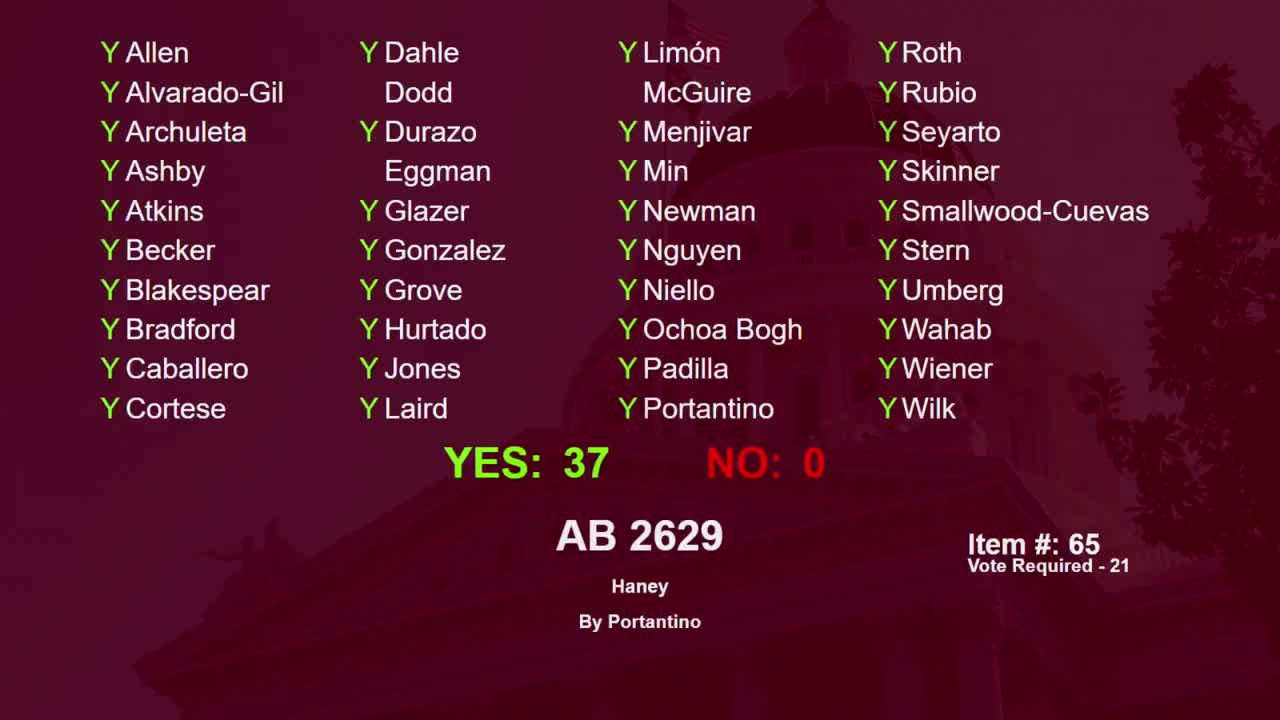 6MIN
Senate Floor
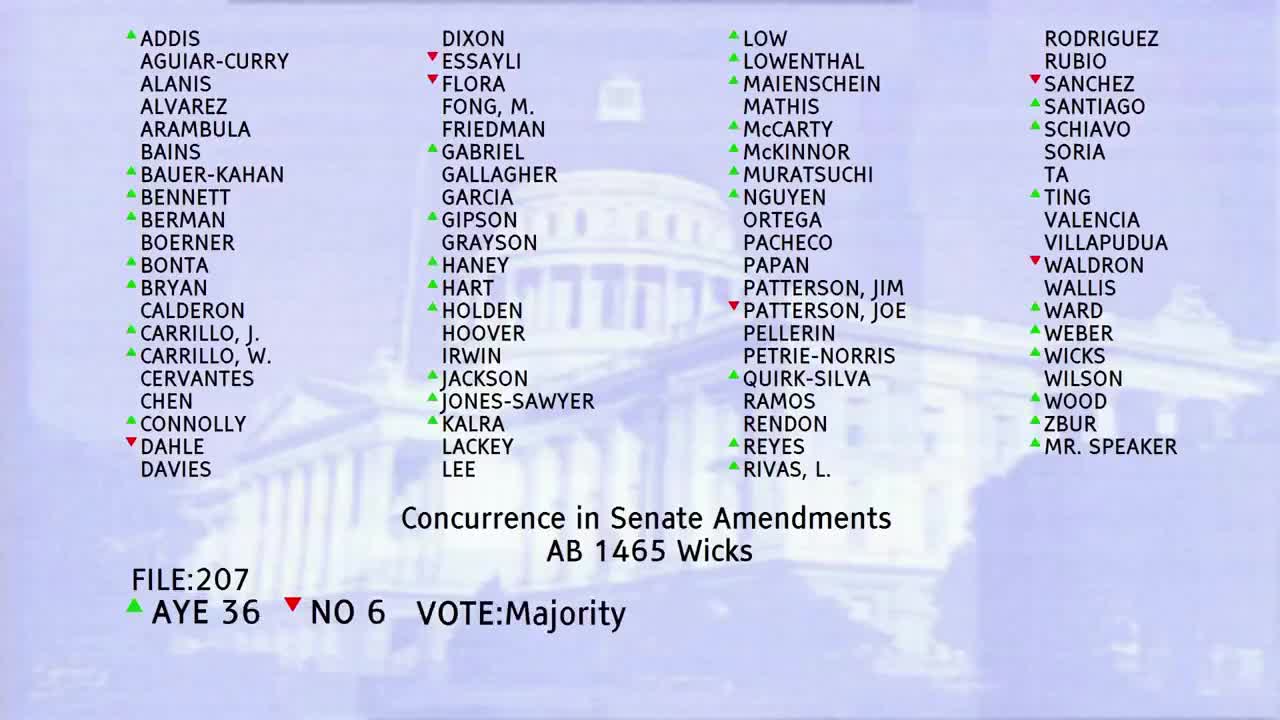 36SEC
Assembly Floor
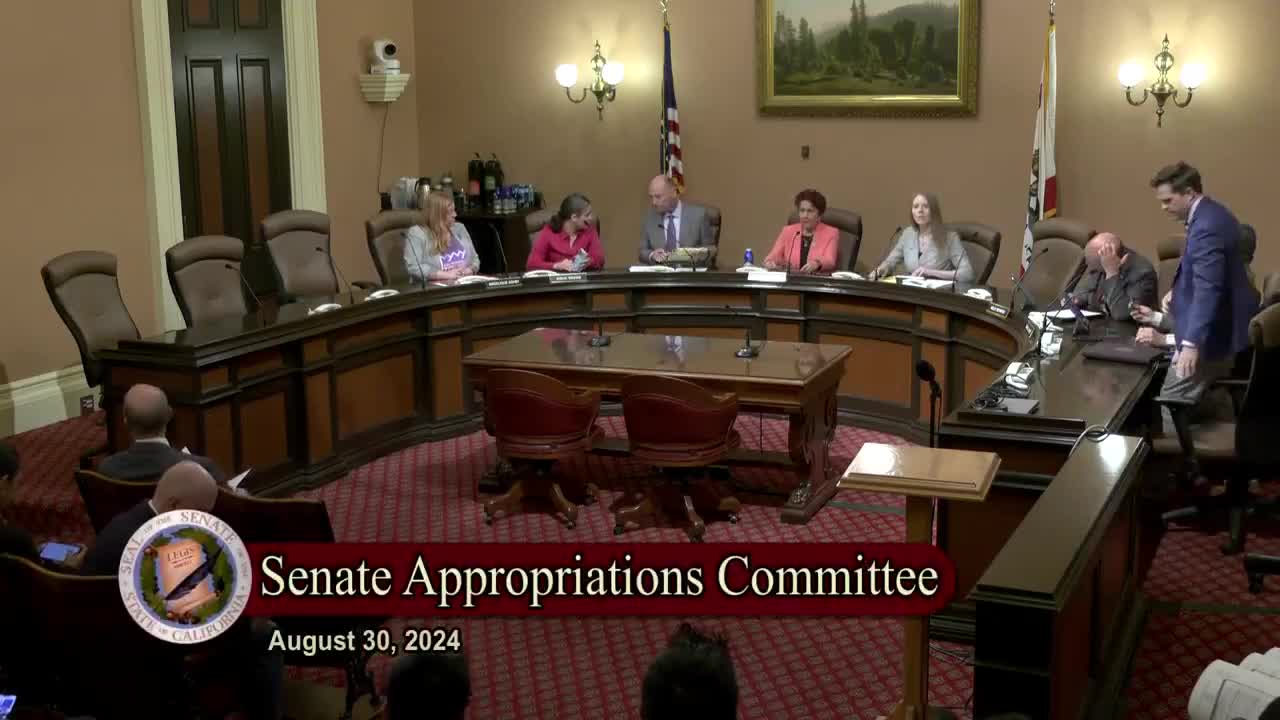 2MIN
Senate Standing Committee on Appropriations
 7MIN
Senate Standing Committee on Education
 1MIN
Senate Standing Committee on Appropriations
 4MIN
Senate Standing Committee on Natural Resources and Water
 1MIN
Assembly Floor
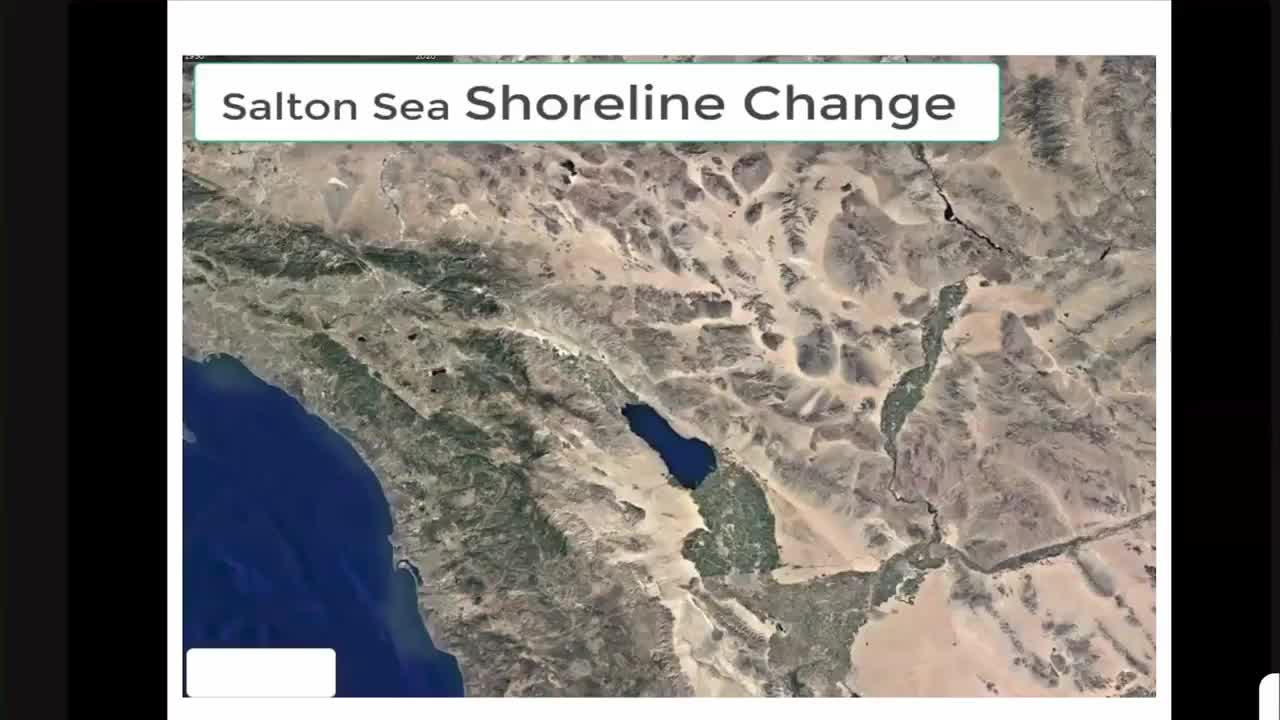 27MIN
Assembly Standing Committee on Water, Parks, and Wildlife
Bill Author