AB 1231: Telecommunications: combining lifeline, federal lifeline, and federal Affordable Connectivity Program subsidies.
- Session Year: 2023-2024
- House: Assembly
- Latest Version Date: 2023-04-26
Current Status:
Failed
(2024-02-01: From committee: Filed with the Chief Clerk pursuant to Joint Rule 56.)
Introduced
In Committee
First Chamber
In Committee
Second Chamber
Enacted
Existing law vests the Public Utilities Commission with regulatory authority over public utilities, including telephone corporations. The Moore Universal Telephone Service Act establishes the Universal Lifeline Telephone Service program in order to provide low-income households with access to affordable basic residential telephone service.
This bill would, no later than February 1, 2024, require the commission to allow every a wireline and wireless lifeline telephone service subscriber to combine California lifeline subsidies with federal low-income communications subsidies, including, but not limited to, federal lifeline and federal Affordable Connectivity Program subsidies, on the same service line to provide a more robust voice and broadband plan. The bill would prohibit the commission from disallowing any portion of payment to a telephone corporation providing lifeline telephone service based on the combination of those subsidies. The bill would, where the full specific support amount, as defined, can be claimed based on the applicable retail service offering, prohibit the commission from denying the full specific support amount for California lifeline to a service line that combines those subsidies. subsidies, except as provided.
Existing law vests the Public Utilities Commission with regulatory authority over public utilities, including telephone corporations. The Moore Universal Telephone Service Act establishes the Universal Lifeline Telephone Service program in order to provide low-income households with access to affordable basic residential telephone service.
This bill would would, no later than February 1, 2024, require the commission to allow every wireline and wireless lifeline telephone service subscriber to combine California lifeline subsidies with federal lifeline subsidies low-income communications subsidies, including, but not limited to, federal lifeline and federal Affordable Connectivity Program subsidies. subsidies, on the same service line to provide a more robust voice and broadband plan. The bill would prohibit the commission from disallowing any portion of payment to a telephone corporation providing lifeline telephone service based on the combination of those subsidies. The bill would, where the full specific support amount, as defined, can be claimed based on the applicable retail service offering, prohibit the commission from denying the full specific support amount for California lifeline to a service line that combines those subsidies.
Existing law vests the Public Utilities Commission with regulatory authority over public utilities, including telephone corporations. The Moore Universal Telephone Service Act establishes the Universal Lifeline Telephone Service program in order to provide low-income households with access to affordable basic residential telephone service.
This bill would require the commission to allow every wireline and wireless lifeline telephone service subscriber to combine lifeline subsidies with federal lifeline subsidies and federal Affordable Connectivity Program subsidies. The bill would prohibit the commission from disallowing any portion of payment to a telephone corporation providing lifeline telephone service based on the combination of those subsidies.
Existing law, the Moore Universal Telephone Service Act, establishes the Universal Lifeline Telephone Service program to provide low-income households with access to affordable basic residential telephone service. The act makes legislative findings and declarations regarding lifeline telephone service, including that the program should be implemented in a way that is equitable and nondiscriminatory.This bill would additionally include that the program should be implemented in a way that provides the most benefit to low-income Californians.Existing law, the Moore Universal Telephone Service Act, establishes the Universal Lifeline Telephone Service program to provide low-income households with access to affordable basic residential telephone service. The act makes legislative findings and declarations regarding lifeline telephone service, including that the program should be implemented in a way that is equitable and nondiscriminatory.
This bill would additionally include that the program should be implemented in a way that provides the most benefit to low-income Californians.
(a)No later than February 1, 2024, the commission shall allow every a wireline and wireless lifeline telephone service subscriber to combine California lifeline subsidies with federal low-income communications subsidies, including, but not limited to, federal lifeline and federal Affordable Connectivity Program subsidies, on the same service line to provide a more robust voice and broadband plan. The commission shall not disallow any portion of payment to a telephone corporation providing lifeline telephone service based on the combination of those subsidies. Where subsidies, except that where the full specific support amount can be claimed based on the applicable retail service offering, the commission shall not deny the full specific support amount for California lifeline to a service line that combines those subsidies. reimburse the provider based on the extent to which the provider has offered a more robust public benefit.
(b)As used in this section, specific support amount means a maximum support amount reimbursed to California lifeline service providers for the monthly recurring charge of California lifeline service to subscribers, as may be adjusted annually by the commission.
The (a)No later than February 1, 2024, the commission shall allow every wireline and wireless lifeline telephone service subscriber to combine California lifeline subsidies with federal lifeline subsidies low-income communications subsidies, including, but not limited to, federal lifeline and federal Affordable Connectivity Program subsidies. subsidies, on the same service line to provide a more robust voice and broadband plan. The commission shall not disallow any portion of payment to a telephone corporation providing lifeline telephone service based on the combination of those subsidies. Where the full specific support amount can be claimed based on the applicable retail service offering, the commission shall not deny the full specific support amount for California lifeline to a service line that combines those subsidies.
(b)As used in this section, specific support amount means a maximum support amount reimbursed to California lifeline service providers for the monthly recurring charge of California lifeline service to subscribers, as may be adjusted annually by the commission.
The commission shall allow every wireline and wireless lifeline telephone service subscriber to combine lifeline subsidies with federal lifeline subsidies and federal Affordable Connectivity Program subsidies. The commission shall not disallow any portion of payment to a telephone corporation providing lifeline telephone service based on the combination of those subsidies.
SECTION 1.Section 871.5 of the Public Utilities Code is amended to read:871.5.The Legislature finds and declares all of the following:(a)The offering of high-quality basic telephone service at affordable rates to the greatest number of citizens has been a longstanding goal of the state.(b)The Moore Universal Telephone Service Act has been, and continues to be, an important means for achieving universal service by making basic telephone service affordable to low-income households through the creation of a lifeline class of service.(c)Every means should be employed by the commission and telephone corporations to ensure that every household qualified to receive lifeline telephone service is informed of, and is afforded the opportunity to subscribe to, that service.(d)The furnishing of lifeline telephone service is in the public interest and should be supported fairly and equitably by every telephone corporation, and the commission, in administering the lifeline telephone service program, should implement the program in a way that is equitable, nondiscriminatory, provides the most benefit to low-income Californians, and does not have competitive consequences for the telecommunications industry in the state.The Legislature finds and declares all of the following:
(a)The offering of high-quality basic telephone service at affordable rates to the greatest number of citizens has been a longstanding goal of the state.
(b)The Moore Universal Telephone Service Act has been, and continues to be, an important means for achieving universal service by making basic telephone service affordable to low-income households through the creation of a lifeline class of service.
(c)Every means should be employed by the commission and telephone corporations to ensure that every household qualified to receive lifeline telephone service is informed of of, and is afforded the opportunity to subscribe to to, that service.
(d)The furnishing of lifeline telephone service is in the public interest and should be supported fairly and equitably by every telephone corporation, and the commission, in administering the lifeline telephone service program, should implement the program in a way that is equitable, nondiscriminatory, and without provides the most benefit to low-income Californians, and does not have competitive consequences for the telecommunications industry in California. the state.
|
Date
|
Status
|
|---|---|
| Feb 1, 2024 | From committee: Filed with the Chief Clerk pursuant to Joint Rule 56. |
| Jan 31, 2024 | Died pursuant to Art. IV, Sec. 10(c) of the Constitution. |
| May 18, 2023 | In committee: Held under submission. |
| May 18, 2023 | Joint Rule 62(a), file notice suspended. (Page 1580.) |
| May 17, 2023 | In committee: Set, first hearing. Referred to APPR. suspense file. |
| Apr 27, 2023 | Re-referred to Com. on APPR. |
| Apr 26, 2023 | Read second time and amended. |
| Apr 25, 2023 | From committee: Amend, and do pass as amended and re-refer to Com. on APPR. (Ayes 13. Noes 0.) (April 19). |
| Apr 10, 2023 | Re-referred to Com. on C. & C. |
| Apr 7, 2023 | From committee chair, with author's amendments: Amend, and re-refer to Com. on C. & C. Read second time and amended. |
| Mar 22, 2023 | Re-referred to Com. on C. & C. |
| Mar 21, 2023 | From committee chair, with author's amendments: Amend, and re-refer to Com. on C. & C. Read second time and amended. |
| Mar 2, 2023 | Referred to Com. on C. & C. |
| Feb 17, 2023 | From printer. May be heard in committee March 19. |
| Feb 16, 2023 | Read first time. To print. |
|
Date
|
Description
|
Location
|
Votes
|
|
|---|---|---|---|---|
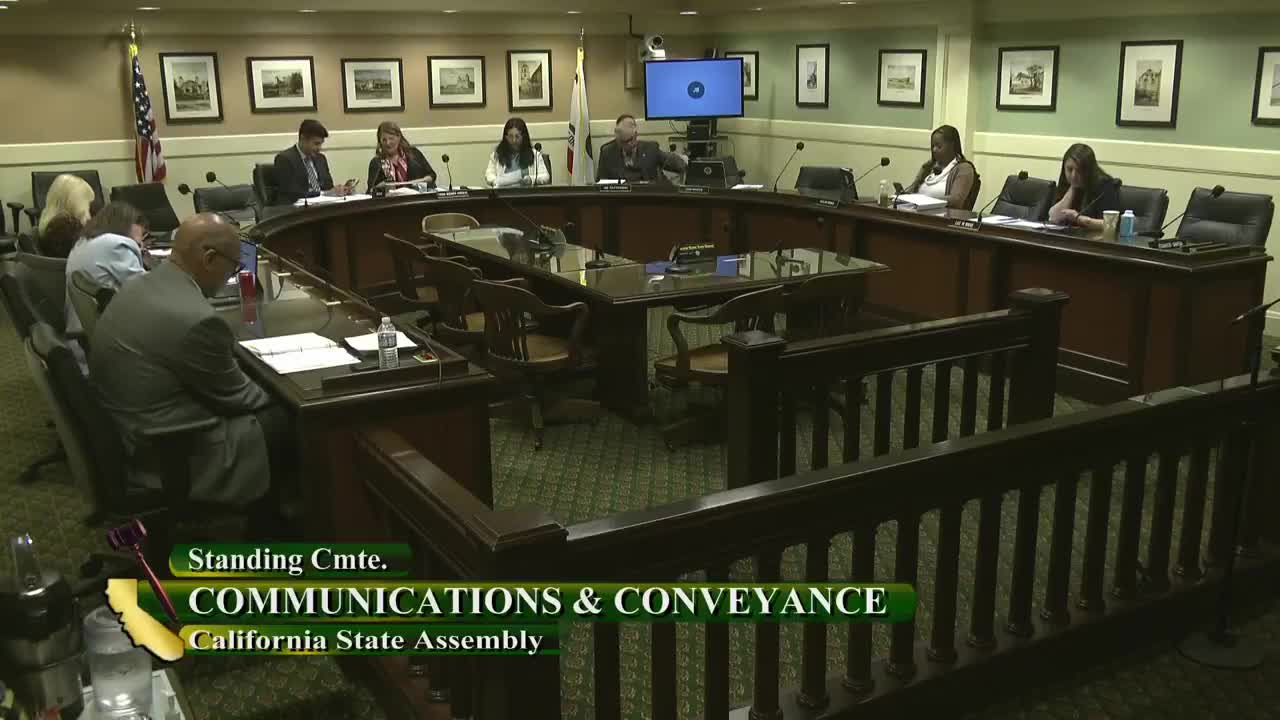
| Apr 19, 2023 | Do pass as amended and be re-referred to the Committee on [Appropriations] | Assembly Standing Committee on Communications and Conveyance |
Passed |
This list shows positions taken on this bill by organizations on the date displayed, which is linked to the original source.
Positions by individuals are not included.
|
Organization
|
Position
|
Date
|
|---|---|---|
| ACAPS | * Support | Apr 19, 2023 |
| Achievers Academy Consulting Group | * Support | Apr 19, 2023 |
| Boomerang Wireless, LLC | ** Support | |
| Global Connection INC. Of America D/b/a Standup Wireless | ** Support | |
| Infiniti Mobile | ** Support | |
| National Lifeline Association | * Support | Apr 19, 2023 |
| Sacramento Self Help Housing | * Support | Apr 19, 2023 |
| Sacramento Self Help Housing | * Support | Apr 19, 2023 |
| The Utility Reform Network (TURN) | * Against | Apr 19, 2023 |
| TruConnect | * Support | Apr 19, 2023 |
Date of Hearing: May 17, 2023
ASSEMBLY COMMITTEE ON APPROPRIATIONS
Chris Holden, Chair
ABPCA Bill Id:AB 1231
Author:(Santiago) – As Amended Ver:April 26, 2023
Policy Committee: | Communications and Conveyance | Vote: | 13 - 0 |
|
| ||
|
|
Urgency: No State Mandated Local Program: No Reimbursable: No
SUMMARY:
This bill requires the California Public Utilities Commission, no later than February 1, 2024, to allow a wireline and wireless lifeline telephone service subscriber to combine California lifeline subsidies with federal low-income communications subsidies, including, but not limited to, federal lifeline and federal Affordable Connectivity Program subsidies, on the same service line to provide a more robust voice and broadband plan.
The bill prohibits the CPUC from disallowing payment to a telephone corporation providing lifeline telephone service based on the combination of those subsidies, “except that where the full specific support amount can be claimed” based on the applicable retail service offering, the CPUC is to reimburse the provider based on the extent to which the provider has offered a more robust public benefit.
FISCAL EFFECT:
Annual costs to the CPUC, likely in the low hundreds of thousands of dollars, to review the extent to which providers offer more robust public benefits on their service plans.
The CPUC contends the bill will entail $74.2 million in annual costs as, according to the CPUC, the bill removes the CPUC discretion to disallow reimbursement claims made by service providers.
The CPUC grounds this understanding in the bill’s text that says the CPUC “shall not disallow payment to a telephone corporation providing lifeline telephone service based on the combination of those subsidies.” However, this reading seems to omit the next clause, which says “except that where the full specific support amount can be claimed based on the applicable retail service offering, the commission shall reimburse the provider based on the extent to which the provider has offered a more robust public benefit.” Read in its entirety, this sentence says that CPUC may not disallow payment to a service provider, except when the CPUC may disallow such payment. Based on this latter interpretation, the CPUC does not have full discretion to completely deny payments to service providers, but it does have discretion to disallow portions of a payment based on the CPUC’s determination of the robustness of the service provided. Therefore, it seems reasonable to expect the CPUC to allow greater amounts of California Lifeline payments to service providers than it currently does, but only to the extent the CPUC finds service providers offer their Lifeline customers more robust service.
COMMENTS:
- Purpose. The author intends this bill to allow low-income Californians to apply a greater amount of subsidies to broadband service plans to increase the availability and quality of broadband service. According to the author:
Californians cannot wait for the results of a CPUC pilot study which models a subsidized option already utilized in 2021. California consumers are in need of quality robust broadband services today. Even as our State transitions out of a state of emergency, the digital divide in our communities remain. AB 1231 would allow wireline and wireless consumers to combine all relevant subsidies as was intended by the federal government when the ACP was enacted and as was an option under the EBB Program.
- Background. The federal and state governments each subsidize the cost of communication services to low-income Californians.
Federal Lifeline—Broadband, or Broadband and Voice, but Not Standalone Wireline. The federal Lifeline program offers a qualifying customer a subsidy of $9.25 per month for a telecommunications service line. The line may be wireline or wireless, but, as of 2021, the service must include standalone broadband service or bundled broadband and voice service. This means the federal Lifeline program does not subsidize standalone wireline telephone service.
California Lifeline—Standalone Wireline, Standalone Wireless or Broadband. The California Lifeline program is administered by the CPUC. It offers a qualifying customer a subsidy of up to $17.90 for a service line, which may provide standalone wireline service, standalone wireless service or bundled broadband and voice services.
Stacking Subsidies—Federal First, Then State. Traditionally, the CPUC has allowed a customer to “stack” the California Lifeline subsidy on top the federal Lifeline subsidy, to the extent such stacking of subsidies was needed to ensure an eligible customer received wireless service at no cost. The CPUC first applied the federal lifeline subsidy to the cost of service, applying the California Lifeline subsidy only in an amount needed to provide an eligible customer with service at no cost to the customer. For this reason, the CPUC describes itself as a “good steward” of California’s resources: maximizes federal subsidies, engages California subsidies only as needed.
Two New Federal Subsidies for Broadband—EBB, then ACP. In February 2021 the Federal Communications Commission (FCC) adopted the Emergency Broadband Benefit Program (EBB) Report and Order to support broadband services and connected devices to help low-income households stay connected during the COVID-19 pandemic. The EBB was a temporary program that provided up to a $50 monthly subsidy for broadband service, either standalone or bundled with voice.
The EBB ended in at the end of 2021, when it was replaced by the federal Affordable Connectivity Program (ACP). The ACP is a permanent program to provide a discount of up to $30 per month for broadband services to qualifying households, and a discount of $75 per month for households on qualifying Tribal lands.
Californians Always Could Stack…and They Still Can. As described above, the CPUC has long allowed a California Lifeline customer to stack the California Lifeline subsidy atop federal subsidies, to the extent needed to reduce the cost of the telecommunications service to $0 to the customer. This was true when the only subsidies available to the customer were the federal Lifeline subsidy and the California Lifeline subsidy. It was also true once the federal EBB subsidy became available, too. This meant an eligible Lifeline customer could use, or stack, the federal Lifeline subsidy, $9.25, the federal EBB subsidy of $50 and then, if needed, up to $17.90 in California Lifeline subsidy.
In 2022, the federal ACP subsidy program replaced the EBB. Federal rules allow an eligible customer to combine, or stack, both the federal Lifeline subsidy of $9.25 and the federal ACP subsidy of $30 on a single eligible line, which, consistent with federal program rule, must provide broadband service. The CPUC, in a recent decision, allowed an eligible customer to also stack California Lifeline subsidy atop the federal Lifeline subsidy and the federal ACP subsidy, but only to the extent the California Lifeline subsidy is needed cover the cost of providing a minimum level of service established by the CPUC.
A prior version of this bill would have required the CPUC to allow stacking of the full California Lifeline subsidy atop the federal subsidies, regardless of the level of service provided. The CPUC objected, rightly, noting, as described above, that this would rob the CPUC of its discretion to disallow the California Lifeline subsidy to a service provider. However, as amended in the Assembly Committee on Communications and Conveyance, this bill now provides the CPUC discretion to disallow payment of California Lifeline to a service provider, based upon CPUC’s estimation of the dollar-amount worth of the robustness of the service offered.
Analysis Prepared by: Jay Dickenson / APPR. / (916) 319-2081
Date of Hearing: April 19, 2023
ASSEMBLY COMMITTEE ON COMMUNICATIONS AND CONVEYANCE
Tasha Boerner Horvath, Chair
ABPCA Bill Id:AB 1231 (
Author:Santiago) – As Amended Ver:April 7, 2023
SUBJECT: Telecommunications: combining lifeline, federal lifeline, and federal Affordable Connectivity Program subsidies
SUMMARY: This bill would require the California Public Utilities Commission (CPUC) to allow lifeline telephone service subscribers to combine Lifeline, California Lifeline, and Affordable Connectivity Program (ACP) subsidies on the same service line to provide a more robust voice and broadband plan. The bill would also prohibit the CPUC from disallowing any portion of California Lifeline payment to a service provider based on the combination of subsidies. Specifically, this bill:
EXISTING LAW:
- Establishes the California Lifeline program by requiring the CPUC to create a class of Lifeline service needed to meet basic communications needs, set rates and charges for the Lifeline program, develop eligibility criteria, and assess progress towards universal service goals, including access to telephone service by income, ethnicity, and geography. Existing law clarifies that minimum communications needs include the ability to make phone calls and access electronic information services. (Public Utilities Code §873)
- Authorizes the CPUC to establish procedures necessary to ensure that the California Lifeline program qualifies for any federal funds available for support of those programs. (Public Utilities Code § 875)
- Establishes that eligible telecommunications carriers shall be eligible to receive specific federal universal telephone service support. (47 U.S. Code § 254)
- Establishes the Affordable Connectivity Program, under the administration of the Federal Communications, which provides a $30 broadband subsidy to eligible households and a $75 broadband subsidy to eligible tribal households. (Infrastructure Investment and Jobs Act. Public Law 117–58)
FISCAL EFFECT: Unknown.
COMMENTS:
- Federal Lifeline and California Lifeline Program. The federal Lifeline program is a federal universal service program established by the Federal Communications Commission (FCC) that helps make communications services more affordable for low-income consumers. First established in 1985, the program provides subsidies to low-income households to lower the cost of service. The California Lifeline program was enacted in 1987 to “offer high quality basic telephone service at affordable rates to the greatest number of California residents.” The California Lifeline program is administered by the California Public Utilities Commission (CPUC) and funded through telephone user surcharges. California Lifeline is a state program, therefore the Legislature and CPUC have the authority to set the parameters of the program. Nonetheless, under existing law and Commission precedent, the CPUC aligns the California Lifeline program with the federal Lifeline program to maximize funding and consumer benefits.
Over time, as technologies have evolved, both the federal and state governments have expanded the purposes of the Lifeline programs to offer additional basic communications services, including basic wireless and broadband services. For example, in 2016 the FCC modified federal Lifeline support levels to shift support from voice services to broadband services. Under current FCC rules, federal Lifeline support has been eliminated as of December 1, 2021 for plans that do not meet the FCC’s broadband standards. Nonetheless, California has continued to provide subsidies for basic telephone service and the CPUC uses California Lifeline funds to backfill reduced federal support for basic telephone service.
- Affordable Connectivity Program. In February 2021 the FCC adopted the Emergency Broadband Benefit Program (EBB) Report and Order to support broadband services and connected devices to help low-income households stay connected during the COVID-19 pandemic. The EBB was a temporary program that provided up to a $50 per month subsidy for broadband service, either standalone or bundled. Standalone broadband service is a subscription type that is not tied to any other service, whereas bundled service is tied to other types of service like home telephone or wireless telephone.
The 2021 Infrastructure Investment and Jobs Act (IIJA) replaced the EBB with the permanent Affordable Connectivity Program (ACP). The ACP provides a discount of up to $30 per month for broadband services to qualifying households and a discount of $75 per month for households on qualifying Tribal lands. Californians who meet the eligibility requirements for California Lifeline and federal Lifeline are also eligible for ACP. Federal Lifeline participants may apply the ACP discount to their service plan, resulting in a total federal subsidy of $39.25 for a qualifying wireless or wireline broadband service plan.
- California consumers may utilize all three programs at the same time, but not on the same service line. Supporters of this bill purport that its provisions would enable low-income Californians to “stack”, or combine, the Lifeline programs with the ACP. However, the underlying issue is not so simple and, nonetheless, existing regulations permit eligible households to utilize all three programs concurrently. The specific exception this bill seeks to eliminate is for combining all three benefits onto the same wireless plan. Under a CPUC decision from 2022, the agency adopted regulations that prohibit provider reimbursement for Lifeline plans where the combined federal Lifeline and ACP benefit of $39.25 are sufficient to cover the cost of basic service. Described differently, the CPUC’s decision preserves California Lifeline program funds where federal funds can instead be utilized to cover the plan.
To demonstrate how the programs currently work in practice, consider these two scenarios. In Scenario 1, a Lifeline customer wishes to enroll in two separate plans: a wireless Lifeline plan (which includes a 6 gigabyte data cap) and wireline home internet. The customer in Scenario 1 would be eligible to use the federal Lifeline and California Lifeline program to cover the full cost of their Lifeline plan, and could use the $30 ACP benefit to help cover the cost of their second home internet plan. In Scenario 2, the customer only wishes to enroll in a wireless Lifeline plan. In Scenario 2, the federal Lifeline benefit and the ACP benefit would be applied to cover the full amount of that customer’s bill; the California Lifeline benefit could not be applied.
- Few states provide supplemental support, and none as generous as California. Supporters of this bill claim that California is the only state that does not allow wireline and wireless consumers to combine state Lifeline, federal Lifeline, and ACP subsidies to one service plan. First, it is important to note that few states provide supplemental Lifeline support and none are as generous. According to the CPUC, California provides the highest supplemental state subsidies for federal Lifeline services in the nation, up to $16.23 per month in supplemental support. See the table below for comparisons of California Lifeline support with additional state support offered by other states:
State | Amount |
CA | $16.23 |
ID | $2.50 |
KY | $6 |
NE | $3.50 |
PR | $0.75 |
UT | $3.50 |
WI | $0.75 |
MD | $15 (Broadband Only) |
The data in the table above is based on information provided by the National Lifeline Association. Maryland is the only state that offers supplemental support near the level of California, except that the $15 is a broadband specific benefit and not part of a state Lifeline telephone program. Nonetheless, the data demonstrate that providers offering Lifeline service in California have a significant amount of funding to gain to provide more robust service compared to other states that allow the particular type of stacking provided for under this bill. Under this bill, California would be required to reimburse the full California Lifeline support amount (up to $16.23) to every provider that offer a more “robust” plan. The extent to which the plan must be more robust than the minimum service plan, which includes a 6 gigabyte data cap, is not defined. Presumably, under the provisions of this bill, a provider could merely provide one gigabyte more data allowance per month to qualify for the full California Lifeline subsidy. Further, the CPUC would have no discretion to disallow any portion of the $16.23 California Lifeline support amount to those providers. Without defining the term “robust”, this bill potentially leaves California ratepayers, who pay to support the fund, on the hook to overpay providers for “robust” Lifeline plans that might not be worth their value. Nonetheless, supporters of this bill argue that it would provide more benefit to Lifeline customers because the additional subsidy would make it economically feasible to provide more robust plans to those customers.
- Committee Amendments. It is true that that CPUC’s current decision makes it economically infeasible for Lifeline providers to offer more robust plans that would benefit consumers; however, there is also a public interest in prudent management of California Lifeline funds. To strike a balance between the two interests, the Chair recommends the author amend their bill to authorize additional California Lifeline support based on the extent to which the plan is more robust.
REGISTERED SUPPORT / OPPOSITION:
Support
Boomerang Wireless, LLC
Global Connection INC. Of America D/b/a Standup Wireless
Infiniti Mobile
National Lifeline Association
Truconnect
Opposition
The Utility Reform Network (TURN)
Analysis Prepared by: Emilio Perez / C. & C. / (916) 319-2637
Discussed in Hearing
 14MIN
Assembly Standing Committee on Communications and Conveyance
Bill Author

Bill Co-Author(s):