AB 1237: Student financial aid: California Public Interest Veterinary Debt Relief Program.
- Session Year: 2023-2024
- House: Assembly
- Latest Version Date: 2023-02-16
Current Status:
Failed
(2024-02-01: From committee: Filed with the Chief Clerk pursuant to Joint Rule 56.)
Introduced
In Committee
First Chamber
In Committee
Second Chamber
Enacted
Existing law establishes the Student Aid Commission as the primary state agency for the administration of state-authorized student financial aid programs available to students attending all segments of postsecondary education.
This bill, upon appropriation by the Legislature, would establish the California Public Interest Veterinary Debt Relief Program under the administration of the commission to award funds to California-licensed veterinarians, in relief of their educational loan debt, as defined, who enter into a contract with the commission to provide veterinary services in eligible premises settings, as defined, on a full-time basis, as specified. The bill, upon appropriation by the Legislature, would establish the California Public Interest Veterinary Debt Relief Program Fund as the initial depository of all moneys appropriated, donated, or otherwise received for the program and would require the commission to disburse moneys in the fund for purposes of the program, as provided. The bill would require the commission, on or before March 31, 2026, and each year thereafter, to submit a report to the Legislature that includes specified information on the program, including the number of applicants and program participants and the amount of funds expended for the program.
This article shall be known, and may be cited, as the California Public Interest Veterinary Debt Relief Program.
69691.As used in this article, the following definitions apply:
(a)Applicant means an individual with an active and valid license to practice veterinary medicine in California who applies to participate in the program.
(b)Community veterinary services means veterinary services offered at prices substantially less than the prices charged for the same veterinary services by private veterinary clinics in the same local area.
(c)Educational loan debt means any student loan provided to a student to pay for the costs of tuition for veterinary school, and other necessary costs associated with this education, including the costs of books, supplies, and living expenses.
(d)Eligible premises setting is a premises setting that meets at least one of the following:
(1)Provides community veterinary services and is located in a veterinary underserved area.
(2)Provides community veterinary services and has at least 50 percent of its client population who reside in a veterinary underserved area.
(3)Is an animal shelter.
(e)Full-time basis means at least 32 hours per week, for no less than 45 weeks per year.
(f)Fund means the California Public Interest Veterinary Debt Relief Program Fund established pursuant to this article.
(g)Program means the California Public Interest Veterinary Debt Relief Program established pursuant to this article.
(h)Premises has the same meaning as subdivision (b) of Section 4853 of the Business and Professions Code.
(i)Veterinary underserved area means an area in California that meets at least one of the following:
(1)Is a veterinary services shortage situation identified by the United States Department of Agricultures National Institute of Food and Agriculture.
(2)Is a disadvantaged community identified by the California Environmental Protection Agency pursuant to Section 39711 of the Health and Safety Code.
(3)Is a disadvantaged unincorporated community, as defined in Section 65302.10 of the Government Code.
(4)Has an average household income at or below 80 percent of the statewide median income.
(5)Has an average household income at or below the threshold designated as low-income households by the Department of Housing and Community Development pursuant to Section 50093 of the Health and Safety Code.
(6)Is a rural area, as defined in Section 50101 of the Health and Safety Code.
69692.The California Public Interest Veterinary Debt Relief Program is hereby established under the administration of the commission to award funds to relieve the educational loan debt of eligible applicants who agree to work in eligible premises settings pursuant to this article. It is the intent of the Legislature that the commission implement and administer the program.
69693.(a)An applicant shall submit a completed application developed by the commission. A completed application shall include documentation detailing the applicants educational loan debt.
(b)A program participant shall sign an agreement with the commission to maintain full-time employment in an eligible premises setting and complete a minimum of 60 months of work within 72 months of employment in an eligible premises setting.
(c)A program participant shall agree to provide an annual progress report, signed by both the participant and the participants employer or the employers designee. The progress report shall verify that the participant is employed full-time in an eligible premises setting.
(d)In distributing program funds, the commission shall give priority consideration to an applicant who meets any of the following:
(1)Speaks one or more Medi-Cal threshold languages.
(2)Has worked for one or more years in a veterinary underserved area.
(3)Has received accreditation in a veterinary specialty recognized by the American Veterinary Medical Association.
(4)Has provided veterinary services to an animal shelter during or after the applicants veterinary education.
(e)A program participant shall be employed on a full-time basis in an eligible premises setting. The participant shall commit to complete a minimum of 60 months of service in an eligible premises setting within 72 months. Upon notice, the commission may grant exceptions to these requirements on a case-by-case basis to accommodate exceptional circumstances such as serious illness, pregnancy, or other reasons approved by the commission.
(f)Grant disbursements shall be deferred until the program participant is employed on a full-time basis in an eligible premises setting, and shall be suspended during periods of interruption in employment lasting more than one month.
(g)The commission may coordinate with local and statewide animal welfare and professional veterinary organizations, and educational institutions, to reach out to eligible premises settings and applicants.
(h)The commission shall develop a process for a program participant to repay any program grants disbursed if the program participant is terminated before completion of, or otherwise does not complete, 60 months of full-time work within 72 months in an eligible premises setting. Cause for termination from the program shall include, but is not limited to, a program participants failure to meet either of the following:
(1)Maintain a California veterinary license in good standing.
(2)Comply with any other term or condition established in this article or by the commission.
69694.(a)The California Public Interest Veterinary Debt Relief Program Fund is hereby established under the administration of the commission as the initial depository of all moneys appropriated, donated, or otherwise received for the program. Upon appropriation by the Legislature, the commission shall disperse moneys in the fund for purposes of this article.
(b)The cumulative total amount of grants disbursed to a program participant shall not exceed the amount of the educational loan debt owed by the participant or one hundred fifty thousand dollars ($150,000), whichever is the lesser amount.
(c)Notwithstanding Section 11005 of the Government Code, the commission may seek and receive funds from foundations and private sources to be deposited in the fund.
(d)On or after July 1, 2027, the commission shall extend the program or distribute the remaining moneys in the fund to program participants pursuant to this article until all the moneys in the fund are expended.
69695.The terms of grant disbursements under the program shall be as follows:
(a)After a program participant has entered into an agreement with the commission to participate in the program and is employed full-time in an eligible premises setting, the commission shall provide the participant thirty thousand dollars ($30,000) annually, for five years, to reach a total amount of one hundred fifty thousand dollars ($150,000) or the total amount of the participants educational loan debt, whichever is the lesser amount.
(b)The commission shall provide the initial grant disbursement to the participant within 30 days from the date in which the agreement between the commission and the participant is executed.
(c)The amount of each subsequent grant disbursement shall equal the amount of the initial disbursement. Subsequent disbursements shall be made within 30 days of months 13, 25, 37, 49 and 60 of the participants full-time work in an eligible premises setting.
(d)If the participant is terminated from the program, or another circumstance prevents the participant from actively participating in the program either temporarily or permanently, the commission shall pause or terminate grant disbursements to the participant accordingly.
(e)The commission may require the program participant to repay, in part or in full, grant disbursements provided to the participant if the participant has not complied with the participants obligations under the program.
69696.(a)On or before March 31, 2025, and on or before each March 31 thereafter, the commission shall submit a report to the Legislature, pursuant to Section 9795 of the Government Code, on the program. The report shall include all of the following information for the previous award year:
(1)The number of applicants and program participants.
(2)The number, types, and locations of each eligible premises setting that services were rendered.
(3)The amount of funds expended for the program.
(4)A summary of information included in the annual progress reports received from program participants. This summary shall protect the identity of individual program participants and shall not include personally identifiable information.
(b)(1)The report submitted on or before March 31, 2026, pursuant to subdivision (a) shall include the information submitted in the 2025 report.
(2)The report submitted on or before March 31, 2027, and each report submitted annually thereafter pursuant to subdivision (a), shall include the information submitted in each of the previous annual reports submitted pursuant to subdivision (a).
(c)Information reported pursuant to this section shall be disaggregated by year.
69697.The commission may adopt regulations to implement and administer the program. The regulations may include, but are not limited to, any standards of program participant eligibility, placement, and termination appropriate to achieve the goal of providing competent veterinary services in eligible premises settings.
69698.This article shall only become operative upon an appropriation by the Legislature in the annual Budget Act or another statute for its purposes.
|
Date
|
Status
|
|---|---|
| Feb 1, 2024 | From committee: Filed with the Chief Clerk pursuant to Joint Rule 56. |
| Jan 31, 2024 | Died pursuant to Art. IV, Sec. 10(c) of the Constitution. |
| May 18, 2023 | In committee: Held under submission. |
| May 3, 2023 | In committee: Set, first hearing. Referred to APPR. suspense file. |
| Apr 19, 2023 | From committee: Do pass and re-refer to Com. on APPR. (Ayes 12. Noes 0.) (April 18). Re-referred to Com. on APPR. |
| Mar 2, 2023 | Referred to Com. on HIGHER ED. |
| Feb 17, 2023 | From printer. May be heard in committee March 19. |
| Feb 16, 2023 | Read first time. To print. |
|
Date
|
Description
|
Location
|
Votes
|
|
|---|---|---|---|---|
| Apr 18, 2023 | Do pass and be re-referred to the Committee on [Appropriations] | Assembly Standing Committee on Higher Education |
Passed |
This list shows positions taken on this bill by organizations on the date displayed, which is linked to the original source.
Positions by individuals are not included.
|
Organization
|
Position
|
Date
|
|---|---|---|
| American Kennel Club, INC. | ** Support | |
| American Pets Alive! and Human Animal Support Services | ** Support | |
| Best Friends Animal Society | ** Support | |
| California Animal Welfare Association | ** Support | |
| California Cattlemen'S Association | ** Support | |
| California Veterinary Medical Association | ** Support | |
| Humane Society Veterinary Medical Association | ** Support | |
| San Diego Humane Society | * Support | Apr 18, 2023 |
| San Francisco Spca | * Support | Apr 18, 2023 |
| Shaw Yoder Antwih Schmelzer & Lange | * Support | Apr 18, 2023 |
| Social Compassion In Legislation | * Support | Apr 18, 2023 |
| The Humane Society of the United States; the | ** Support |
Date of Hearing: May 3, 2023
ASSEMBLY COMMITTEE ON APPROPRIATIONS
Chris Holden, Chair
ABPCA Bill Id:AB 1237
Author:(Petrie-Norris) – As Introduced Ver:February 16, 2023
Policy Committee: | Higher Education | Vote: | 12 - 0 |
|
| ||
|
|
Urgency: No State Mandated Local Program: No Reimbursable: No
SUMMARY:
This bill, subject to appropriation, creates at the California Student Aid Commission (CSAC) a student loan debt relief grant program for licensed veterinarians who agree to work full time in needy areas, such as in animal shelters, for at least five years.
Specifically, this bill:
- In distributing program funds, requires CSAC to give priority consideration to certain applicants, such as those who speaks one or more Medi-Cal threshold languages.
- Specifies that the cumulative total amount of grants disbursed to a program participant will not exceed the amount of the educational loan debt owed by the participant or $150,000, whichever is less. Specifies CSAC is to provide a participant $30,000 annually to reach a total amount of $150,000 or the total amount of the participant’s education loan debt, whichever is less.
- Requires CSAC to develop a process for a program participant to repay any program grants disbursed if the program participant is terminated before completion of, or otherwise does not complete, five years of full-time work.
- Requires CSAC, by March 31, 2025, and by each March 31 thereafter, to submit a report to the Legislature, as specified, on the program.
FISCAL EFFECT:
- One-time General Fund costs of an unspecified amount to provide grants to veterinarians.
If CSAC provided grants to 100 veterinarians at $150,000 each, costs would total $15 million.
- One-time General Fund costs of $1.4 million for CSAC to start-up the program and about $850,000 in ongoing costs to administer the program. One-time costs are higher because CSAC will need two limited-term staff to set up the IT necessary to administer the program. On an ongoing basis, CSAC indicates it will need six positions to administer the program.
COMMENTS:
- Purpose. According to the author:
Homeless pets and owned pets are going untreated for sometimes serious injury and illness because access to veterinary care is simply out of reach. This causes both animal and human suffering. AB 1237 will attract existing veterinary professionals to practice where the need is the greatest.
- Background. The American Veterinary Medical Association reports the average veterinary school graduate debt is $188,853. The US Department of Agriculture offers the Veterinary Medicine Loan Repayment Program. The program helps qualified veterinarians repay up to $75,000 of debt incurred in pursuit of their veterinary degrees in return for at least three years of service in designated veterinary shortage areas.
- Prior Legislation. AB 982 (Firebaugh), Chapter 1131, Statutes of 2002, created both the Dental Corps Loan Repayment Program and the Steven M. Thompson California Physician
Analysis Prepared by: Natasha Collins / APPR. / (916) 319-2081
Date of Hearing: April 18, 2023
ASSEMBLY COMMITTEE ON HIGHER EDUCATION
Mike Fong, Chair
ABPCA Bill Id:AB 1237 (
Author:Petrie-Norris) – As Introduced Ver:February 16, 2023
SUBJECT: Student financial aid: California Public Interest Veterinary Debt Relief Program
SUMMARY: Establishes the California Public Interest Veterinary Debt Relief Program under the administration of the California Student Aid Commission (CSAC) to award funds to California-licensed veterinarians, in relief of their educational loan debt, as defined, who enter into a contract with CSAC to provide veterinary services in eligible premises settings, as defined, on a full-time basis, as specified, Specifically, this bill:
- Declares that the provisions of this bill will be known, and may be cited, as the California Public Interest Veterinary Debt Relief Program (“program”).
- Specifies that the provisions of AB 1237 will only become operative upon an appropriation by the Legislature in the annual Budget Act or another statute for its purposes.
- Establishes that the program under the administration of CSAC to award funds to relieve the educational loan debt of eligible applicants who agree to work in eligible premises settings pursuant to this article.
- Specifies that an applicant must submit a completed application developed by CSAC. A completed application will include documentation detailing the applicant’s educational loan debt.
- Requires a program participant to sign an agreement with CSAC to maintain full-time employment in an eligible premises setting and complete a minimum of 60 months of work within 72 months of employment in an eligible premises setting.
- Establishes that a program participant must agree to provide an annual progress report, signed by both the participant and the participant’s employer or the employer’s designee. The progress report will verify that the participant is employed full-time in an eligible premises setting.
- Requires that, in distributing program funds, CSAC must give priority consideration to an applicant who meets any of the following:
- Speaks one or more Medi-Cal threshold languages;
- Has worked for one or more years in a veterinary underserved area;
- Has received accreditation in a veterinary specialty recognized by the American Veterinary Medical Association; and,
- Has provided veterinary services to an animal shelter during or after the applicant’s veterinary education.
- Specifies that a program participant must be employed on a full-time basis in an eligible premises setting. The participant will commit to complete a minimum of 60 months of service in an eligible premises setting within 72 months. Upon notice, the CSAC may grant exceptions to these requirements on a case-by-case basis to accommodate exceptional circumstances such as serious illness, pregnancy, or other reasons approved by CSAC.
- Establishes that grant disbursements will be deferred until the program participant is employed, on a full-time basis, in an eligible premises setting, and will be suspended during periods of interruption in employment lasting more than one month.
- Authorizes CSAC to coordinate with local and statewide animal welfare and professional veterinary organizations, and educational institutions, to reach out to eligible premises settings and applicants.
- Requires CSAC to develop a process for a program participant to repay any program grants disbursed if the program participant is terminated before completion of, or otherwise does not complete, 60 months of full-time work within 72 months in an eligible premises setting. Cause for termination from the program must include, but is not limited to, a program participant’s failure to meet the following:
- Maintain a California veterinary license in good standing; or,
- Comply with any other term or condition established in this article or by CSAC.
- Establishes the California Public Interest Veterinary Debt Relief Program Fund under the administration of CSAC as the initial depository of all moneys appropriated, donated, or otherwise received for the program. Upon appropriation by the Legislature, CSAC will disperse moneys in the fund for purposes of this article.
- Specifies that the cumulative total amount of grants disbursed to a program participant will not exceed the amount of the educational loan debt owed by the participant or one hundred fifty thousand dollars ($150,000), whichever is lesser.
- Specifies that, notwithstanding the Government Code as specified, CSAC may seek and receive funds from foundations and private sources to be deposited in the fund.
- Requires that on or after July 1, 2027, CSAC must extend the program or distribute the remaining moneys in the fund to program participants pursuant to this article until all the moneys in the fund are expended.
- Specifies that the terms of grant disbursements under the program must be as follows:
- After a program participant has entered into an agreement with CSAC to participate in the program and is employed full-time in an eligible premises setting, CSAC will provide the participant thirty thousand dollars ($30,000) annually, for five years, to reach a total amount of one hundred fifty thousand dollars ($150,000) or the total amount of the participant’s educational loan debt, whichever is lesser;
- CSAC will provide the initial grant disbursement to the participant within 30 days from the date in which the agreement between CSAC and the participant is executed;
- The amount of each subsequent grant disbursement will equal the amount of the initial disbursement. Subsequent disbursements will be made within 30 days of months 13, 25, 37, 49 and 60 of the participant’s full-time work in an eligible premises setting;
- If the participant is terminated from the program, or another circumstance prevents the participant from actively participating in the program either temporarily or permanently, CSAC will pause or terminate grant disbursements to the participant accordingly; and,
- CSAC may require the program participant to repay, in part or in full, grant disbursements provided to the participant if the participant has not complied with the participant’s obligations under the program.
- Requires CSAC, by March 31, 2025, and by each March 31 thereafter, to submit a report to the Legislature, as specified, on the program. The report must include all of the following information for the previous year:
- The number of applicants and program participants;
- The number, types, and locations of each eligible premises setting that services were rendered;
- The amount of funds expended for the program; and,
- A summary of information included in the annual progress reports received from program participants. This summary must protect the identity of individual program participants and will not include any personally identifiable information.
- Specifies that the report submitted by March 31, 2026, as specified, must include the information submitted in the 2025, report and that the report submitted on or before March 31, 2027, and each report submitted annually thereafter will include the information submitted in each of the previous annual reports, and requires information reported pursuant to this section will be disaggregated by year.
- Authorizes CSAC to adopt regulations to implement and administer the program. The regulations may include, but are not limited to, any standards of program participant eligibility, placement, and termination necessary to achieve the goal of providing competent veterinary services in eligible premises settings.
- Establishes the following definitions:
- “Applicant” means an individual with an active and valid license to practice veterinary medicine in California who applies to participate in the program;
- “Community veterinary services” means veterinary services offered at prices substantially less than the prices charged for the same veterinary services by private veterinary clinics in the same local area;
- “Educational loan debt” means any student loan provided to a student to pay for the costs of tuition for veterinary school, and other necessary costs associated with this education, including the costs of books, supplies, and living expenses;
- “Eligible premises setting” is a premises setting that meets at least one of the following:
- Provides community veterinary services and is located in a veterinary underserved area;
- Provides community veterinary services and has at least 50 percent of its client population who reside in a veterinary underserved area; or,
- Is an animal shelter.
- “Full-time basis” means at least 32 hours per week, for no less than 45 weeks per year;
- “Fund” means the California Public Interest Veterinary Debt Relief Program Fund established as specified;
- “Program” means the California Public Interest Veterinary Debt Relief Program established as specified;
- “Premises” has the same meaning as subdivision (b) of Section 4853 of the Business and Professions Code;
- “Veterinary underserved area” means an area in California that meets at least one of the following:
- Is a veterinary services shortage situation identified by the United States Department of Agriculture’s National Institute of Food and Agriculture;
- Is a disadvantaged community identified by the California Environmental Protection Agency as specified;
- Is a disadvantaged unincorporated community, as specified;
- Has an average household income at or below 80 percent of the statewide median income;
- Has an average household income at or below the threshold designated as low-income households by the Department of Housing and Community Development as specified; and,
- Is a rural area, as specified.
- Specifies that it is the intent of the Legislature that CSAC implement and administer the program.
EXISTING LAW:
- Establishes CSAC as the primary state agency for the administration of state-authorized student financial aid programs available to students attending all segments of postsecondary education. (Education Code Section 69510 et seq.)
FISCAL EFFECT: Unknown.
COMMENTS: Purpose. According to the author, “California is experiencing a crisis-level shortage of veterinarians. Private practice veterinarians are struggling to keep up with existing client services, in many cases resulting in weeks-long wait times for office visits. The demand from full-paying client services has nearly eliminated the supply of reduced rate services for community members living on fixed incomes and animal shelters.”
“California’s animal shelters are having challenges accessing veterinary care for their animals. Most don’t employ their own veterinarians, instead relying on contracts with private practices to perform surgeries and create medical treatment plans for shelter animals. Shelters that do have the resources to hire their own veterinarians are finding it nearly impossible to fill vacancies. An October 2022 survey of California animal shelters revealed that less than half can consistently provide treatment for non-routine illness or injury that requires a vet assessment. After-hours emergency care is extremely limited and in many cases are requiring up to a two-hour drive for care.”
“Homeless pets and owned pets are going untreated for sometimes serious injury and illness because access to veterinary care is simply out of reach. This causes both animal and human suffering. AB 1237 will attract existing veterinary professionals to practice where the need is the greatest by providing state funding to apply towards educational debt in exchange for their agreement to work for a California animal shelter or in communities in need for a minimum of five years. Funding will be distributed by the [CSAC] in grants for debt relief for practicing veterinarians who have the desire for public service.”
Arguments in support. The San Diego Humane Society, a co-sponsor of this legislation, wrote that “California is experiencing a crisis-level shortage of veterinarians and care affordability is
becoming further out of reach for California pet owners. Data from the Centers for Disease Control, U.S. Census Bureau, Ersi, and the American Veterinary Medical Association, California has a Veterinary Care Accessibility Score of 47 out of 100 – a failing grade in access to veterinary care. In nearly 50% of California Counties care is nearly inaccessible or difficult to access. Falling into these categories, the Counties of Del Norte, Fresno, Imperial, Kern, Kings,
Lassen, Madera, Merced, Tehama, Tulare and Yuba are particularly hard hit with nearly inaccessible veterinary care, followed by Alpine, Butte, Colusa, Glenn, Humbolt, Inyo, Lake, Mendocino, Modoc, San Bernadino, San Joaquin, Siskiyou, Stanislaus, Sutter, Trinity, Yolo with care that is difficult to access.
“A lack of access to basic care is leading to an increased length of stay for animals in shelters across the state. A recent survey of California animal shelters revealed that less than half can consistently provide treatment for non-routine illness or injury that requires a veterinarian’s assessment, and 40% of shelter respondents are unable to consistently perform lifesaving — and legally required — spay/neuter surgeries. 60% of open shelter veterinary positions remain vacant due to a lack of candidates. Of 111 survey respondents, 73 have full-time veterinary positions open, and 82 have full-time registered veterinary technician positions open.”
The Humane Society Veterinary Medical Association wrote in support of AB 1237 (Petrie-Norris), noting that, “related to the problems created by staffing shortages are the mounting mental health challenges facing veterinary professionals. Daily juggling of packed clinic schedules, empathy for families with limited funds for necessary care, emergency situations, and euthanasia appointments can lead to burnout and compassion fatigue. Even before the pandemic, it was well documented that
veterinarians’ mental health was suffering and national statistics from the Centers for Disease Control and Prevention show that one out of every six veterinarians has considered suicide; male vets are 1.6 times more likely and female vets are 2.4 times more likely to die by suicide than the general population.”
“In some cases, veterinary professionals can expect to be paying off their student loans for their entire career and in many other cases, this impacts their decisions about whether to practice in rural areas and other underserved communities or for shelters or nonprofits, where salary levels for staff may be lower. By offering debt relief of up to $150,000 for veterinarians who agree to practice in an underserved community or a California animal shelter for a minimum of five years, the California Public Interest Veterinary Debt Relief Program will provide critical financial support to veterinarians who have made a commitment to provide care in the areas of greatest need.”
Background. In a study conducted by The University of Tennessee, Knoxville in partnership with the Maddie’s Fund that examined access to care barriers, veterinary participants indicated that the rising cost of completing veterinary school prevents them from offering affordable care at reduced costs to vulnerable populations as compared to the past. Veterinary educational debt is growing at an unsustainable rate – 4.5 times faster than the growth of income in 2020. The American Veterinary Medical Association (AVMA) reports the average veterinary school graduate debt is $188,853 and educational debt for veterinary graduates is growing by nearly $6,000 each year. The author sponsors contend that the debt load for these graduating vets makes it difficult or impossible for them to choose to practice in the community service space.
Loan repayment. The US Department of Agriculture offers the Veterinary Medicine Loan Repayment Program (VMLRP), which was created out of concerns over shifts in the veterinary medicine workforce that have left many food and fiber livestock and poultry producers, especially those in remote locations, without access to adequate veterinary medical services. VMLRP helps qualified veterinarians repay up to $75,000 of debt incurred in pursuit of their veterinary medical degrees in return for at least three years of service in designated veterinary shortage areas.
VMLRP repays loan debt incurred in veterinary medical education to encourage veterinarians to provide food supply veterinary services in hard-to-reach areas. VMLRP is administered by the U.S. Department of Agriculture’s National Institute of Food and Agriculture (NIFA). The veterinarian is responsible for ensuring eligibility upon application of the VMLRP. Only loan debts incurred from attendance at American Veterinary Medical Association Council on Education-accredited veterinary schools are applicable for forgiveness. Minimum new service contracts are for three years and for up to $75,000 in loan repayments, dispersed in quarterly payments. Renewal contracts may be awarded and undergo the same competitive process as that of new applications.
AB 1237 (Petrie-Norris) builds on a history of successful medical loan programs, including the California Dental Corps Loan Repayment Program, The Steven M. Thompson Physician Corps Loan Repayment Program , the Health Resources and Services Administration State Loan Repayment Program, and the National Health Service Corps/Loan Repayment Program.
Committee comments. Committee Staff notes that loan repayment programs generally carry tax implications.
Given that financial aid is not considered as income in the same fashion, the author may wish to consider instead utilizing funds towards grant-based assistance for students that are pursuing an education to enter into the profession.
Committee Staff notes that other programs administered by CSAC, such as the Golden State Teacher Grant Program, determine eligible service placements for participants based on sites identified by other agencies with relevant subject matter expertise (e.g., “priority schools” for Golden State Teacher Grant program recipient service requirements are determined by the CA Department of Education).
The Committee may wish to consider if the CSAC is the appropriate entity to make determinations about which communities reflect a “veterinary underserved area”.
There are significant unmet college affordability and financial need issues amongst undergraduate students more broadly, including tens of thousands of very low-income students that are currently ineligible for the Cal Grant program due to non-financial eligibility barriers. However. Cal Grant reform as orchestrated by the Legislature last year and set to be implemented by future budget acts could remove and expand Cal Grant eligibility.
The Committee may wish to consider whether funds toward this student loan debt benefit should be prioritized given the current budget deficit while the broader reform effort for the Cal Grant program remains pending a May 2024 revenue determination.
Prior legislation. AB 982 (Firebaugh), Chapter 1131, Statutes of 2002 created both the Dental Corps Loan Repayment Program and the Steven M. Thompson California Physician
Corps Loan Repayment Program.
SB 599 (Negrete-McLeod), Chapter 642, Statutes of 2009 extended the sunset date of the
Dental Corps Loan Forgiveness Program to 2012.
SB 540 (Price), Chapter 385, Statutes of 2011 extended the Dental Corps Loan Forigveness Program until all monies are expended.
AB 920 (Aghazarian), Chapter 317, Statutes of 2005 transferred administration of the Steven M.
Thompson Physician Corps Loan Repayment Program.
AB 2485 (Santiago), Chapter 575 , Statutes of 2016, streamlined the California Dental Corps Loan Repayment Program (DCLRP), under the jurisdiction of the Dental Board of California (DBC), and expanded eligibility of applicants to the program, and rescheduled the timeline that loan repayments may be disbursed.
REGISTERED SUPPORT / OPPOSITION:
Support
American Kennel Club, INC.
American Pets Alive! and Human Animal Support Services
Best Friends Animal Society
California Animal Welfare Association
California Cattlemen's Association
California Veterinary Medical Association
The Humane Society of the United States; the
Humane Society Veterinary Medical Association
San Diego Humane Society and SPCA
Social Compassion in Legislation
Opposition
None on file
Analysis Prepared by: Kevin J. Powers / HIGHER ED. / (916) 319-3960
Discussed in Hearing
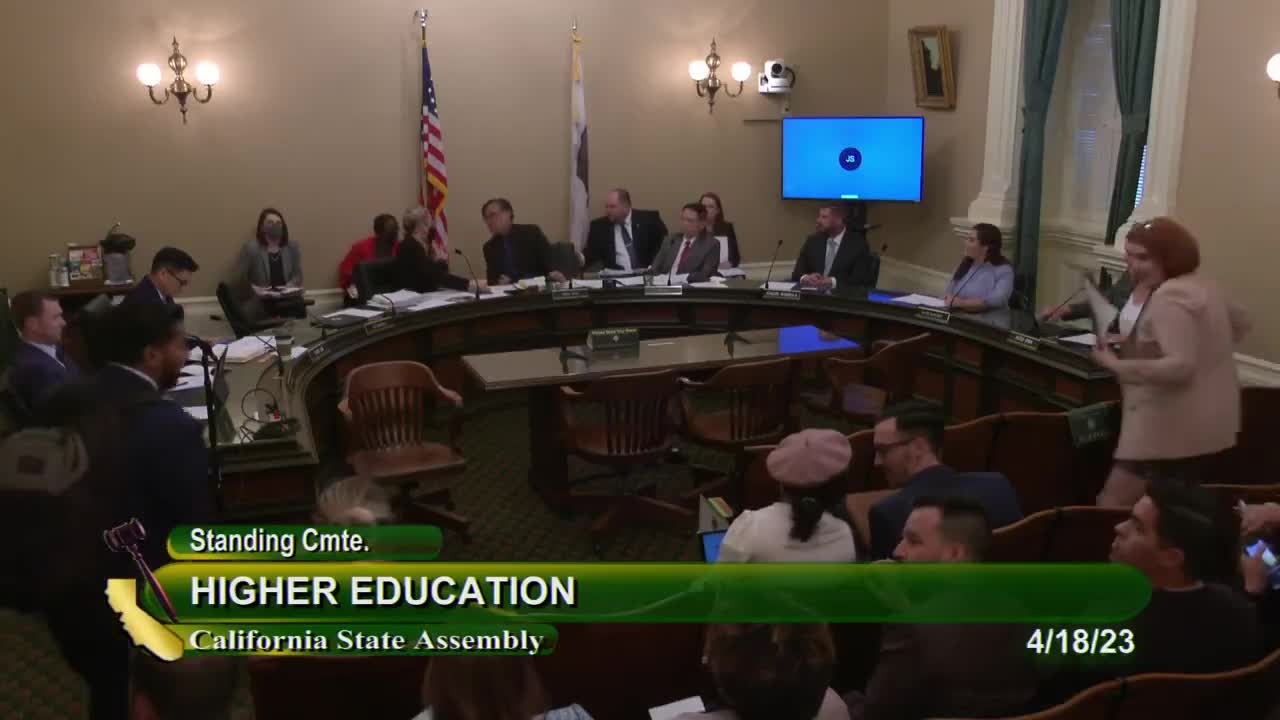 8MIN
Assembly Standing Committee on Higher Education
Bill Author

Bill Co-Author(s):