AB 1247: Consumer savings accounts.
- Session Year: 2023-2024
- House: Assembly
- Latest Version Date: 2023-03-23
Current Status:
Failed
(2024-02-01: From committee: Filed with the Chief Clerk pursuant to Joint Rule 56.)
Introduced
In Committee
First Chamber
In Committee
Second Chamber
Enacted
Existing law establishes various agencies and programs for the purpose of protecting consumers. safeguarding consumer financial protections. Existing law establishes the Department of Financial Protection and Innovation within the Business, Consumer Services, and Housing Agency and places the department under the direction of the Commissioner of Financial Protection and Innovation. Under existing law, the department has charge of the execution of specified laws relating to various financial institutions and financial products and services. Existing law, the California Public Banking Option Act, requires the Treasurer to convene the CalAccount Blue Ribbon Commission, as specified, and requires the commission to conduct, by contracting with one or more entities with appropriate expertise, and deliver, as prescribed, a market analysis to determine if it is feasible to implement a CalAccount Program, which, if implemented, would have certain characteristics, including that it would be a program established by the state for the purpose of protecting consumers who lack access to traditional banking services from predatory, discriminatory, and costly alternatives.
This bill would state the intent of the Legislature to enact legislation that would establish the Emergency Savings Account Commission for the purpose of conducting, by contracting with one or more entities with appropriate expertise, and delivering an analysis on the extent of the problem of Californians who do not have access to sufficient funds when faced with financial emergencies, causes of the problem, solutions for fixing it, and the states role in those solutions.This bill would enact The California Emergency Savings Account Option Act. The bill would require the Treasurer to convene, on or before September 1, 2024, the Emergency Savings Account Commission to be composed of certain members, including the Commissioner of Financial Protection and Innovation and the Treasurer or their respective designees. The bill would require the commission to conduct, on or before July 1, 2026, by contracting with one or more entities with appropriate expertise, and deliver, an analysis on the extent of the problem of Californians who do not have access to sufficient funds when faced with financial emergencies, as specified. The bill would condition the implementation of these provisions on an appropriation by the Legislature for this express purpose and would repeal the bills provisions on January 1, 2032.
Existing law establishes various agencies and programs for the purpose of protecting consumers.
This bill would state the intent of the Legislature to enact legislation that would establish the Emergency Savings Account Commission for the purpose of conducting, by contracting with one or more entities with appropriate expertise, and delivering an analysis on the extent of the problem of Californians who do not have access to sufficient funds when faced with financial emergencies, causes of the problem, solutions for fixing it, and the states role in those solutions.
This title shall be known, and may be cited, as the California Emergency Savings Account Option Act.
100201.On or before September 1, 2024, the Treasurer shall convene the Emergency Savings Account Commission. The commission shall be composed of all of the following members:
(a)The Treasurer or Treasurers designee.
(b)The Commissioner of Financial Protection and Innovation or that persons designee.
(c)An individual with expertise in emergency savings accounts, appointed by the Senate Committee on Rules.
(d)An advocate for emergency savings accounts, appointed by the Senate Committee on Rules.
(e)An individual with expertise in the widespread state of unpreparedness for a financial emergency that the vast majority of Californians find themselves in, appointed by the Speaker of the Assembly.
(f)A consumer representative or advocate with expertise in banking access and financial empowerment, appointed by the Speaker of the Assembly.
(g)An employer representative appointed by the Governor.
(h)An individual with expertise in financial insurance or consumer financial services affiliated with an academic institution appointed by the Governor.
(i)An individual, appointed by the Governor, with banking expertise.
100202.On or before July 1, 2026, the Emergency Savings Account Commission shall conduct, by contracting with one or more entities with appropriate expertise, and deliver an analysis on the extent of the problem of Californians who do not have access to sufficient funds when faced with financial emergencies, causes of the problem, solutions for fixing it, including whether requiring an emergency savings account is a viable solution, and the states role in those solutions.
100203.This title shall become operative only upon an appropriation by the Legislature in the Budget Act or another statute for the express purpose of implementing this title.
100204.This title shall remain in effect until January 1, 2032, and as of that date is repealed.
SECTION 1.It is the intent of the Legislature to enact legislation to establish the Emergency Savings Account Commission for the purpose of conducting, by contracting with one or more entities with appropriate expertise, and delivering an analysis on the extent of the problem of Californians who do not have access to sufficient funds when faced with financial emergencies, causes of the problem, solutions for fixing it, and the states role in those solutions.It is the intent of the Legislature to enact legislation to establish the Emergency Savings Account Commission for the purpose of conducting, by contracting with one or more entities with appropriate expertise, and delivering an analysis on the extent of the problem of Californians who do not have access to sufficient funds when faced with financial emergencies, causes of the problem, solutions for fixing it, and the states role in those solutions.
|
Date
|
Status
|
|---|---|
| Feb 1, 2024 | From committee: Filed with the Chief Clerk pursuant to Joint Rule 56. |
| Jan 31, 2024 | Died pursuant to Art. IV, Sec. 10(c) of the Constitution. |
| May 18, 2023 | In committee: Held under submission. |
| May 3, 2023 | In committee: Set, first hearing. Referred to APPR. suspense file. |
| Apr 25, 2023 | From committee: Do pass and re-refer to Com. on APPR. (Ayes 11. Noes 0.) (April 24). Re-referred to Com. on APPR. |
| Mar 27, 2023 | Re-referred to Com. on B. & F. |
| Mar 23, 2023 | From committee chair, with author's amendments: Amend, and re-refer to Com. on B. & F. Read second time and amended. |
| Mar 23, 2023 | Referred to Com. on B. & F. |
| Feb 17, 2023 | From printer. May be heard in committee March 19. |
| Feb 16, 2023 | Read first time. To print. |
|
Date
|
Description
|
Location
|
Votes
|
|
|---|---|---|---|---|
| Apr 24, 2023 | Do pass and be re-referred to the Committee on [Appropriations] | Assembly Standing Committee on Banking and Finance |
Passed |
This list shows positions taken on this bill by organizations on the date displayed, which is linked to the original source.
Positions by individuals are not included.
Date of Hearing: May 3, 2023
ASSEMBLY COMMITTEE ON APPROPRIATIONS
Chris Holden, Chair
ABPCA Bill Id:AB 1247
Author:(Alvarez) – As Amended Ver:March 23, 2023
Policy Committee: | Banking and Finance | Vote: | 11 - 0 |
|
| ||
|
|
Urgency: No State Mandated Local Program: No Reimbursable: No
SUMMARY:
This bill enacts, upon appropriation by the Legislature, the California Emergency Savings Account Option Act.
Specifically, upon appropriation, this bill:
- Requires, by September 1, 2024, the State Treasurer to convene the Emergency Savings Account Commission (ESA Commission), which must be composed of nine members, including the State Treasurer and Department of Financial Protection and Innovation (DFPI) commissioner, or their designees.
- Requires the ESA Commission to contract with one or more entities with appropriate expertise to conduct and deliver, by July 1, 2026, an analysis on the extent of the problem of Californians who do not have access to sufficient funds when faced with financial emergencies. The analysis must also include solutions for fixing the problem, including whether requiring an emergency savings account (ESA) is viable solution and the role of the state.
FISCAL EFFECT:
- Cost pressures of an unknown, but likely significant amount, in excess of $150,000, to the State Treasurer’s Office (STO) to convene and staff the ESA Commission and enter into a contract for the specified analysis. The STO notes more program details are needed to fully estimate the costs related to this bill. However, the STO received a $4 million one-time General Fund appropriation over three years to implement a similar bill requiring the State Treasurer to convene the CalAccount Blue Ribbon Commission and contract for a market analysis to determine the feasibility of creating a public bank.
- Absorbable costs to DFPI to serve on the ESA Commission.
COMMENTS:
- Purpose. According to the author:
Californians, specifically, elderly adults, people with disabilities, and low-income families are suffering the most when it comes to covering an emergency. For these individuals, the money they work is used for rent and to put food on their families table. Often times in times of emergencies people resort to using credit cards, creating debt and getting further into a financial burden.
- Background.
ESAs. Millions of households live paycheck to paycheck, limiting their ability to set aside money for future emergencies. According to a 2022 report by the Consumer Financial Protection Bureau, 60% of households with incomes of $20,000 or less have no emergency savings, and consumers who are non-white or have limited education also tend to have lower levels of emergency savings. When a sudden expense or income loss occurs, such households often take on significant debt from credit cards or costly consumer loans, such as payday loans, or draw from retirement savings accounts to cover costs.
An ESA is a specialized savings account designed to help households more proactively plan for future income disruptions and accumulate savings for use in an emergency. More than just an informal rainy day standalone account or stockpile of cash easily accessible on short notice, an ESA is typically offered through an employer as part of a benefits package. An ESA can include various features, such as employer involvement, automatic enrollment, and automatic contributions, to make it easier to save. This bill requires the STO to convene an ESA Commission to contract for an analysis identifying the extent to which Californians do not have access to sufficient funds when faced with financial emergencies and whether requiring an ESA is a viable state policy solution.
Interaction with Other STO Programs. As noted in the Assembly Banking and Finance Committee’s analysis of this bill, two STO programs could be modified or used to build out an ESA program. CalSavers is a retirement savings program managed by private sector firms with oversight from the CalSavers Retirement Savings Board. CalSavers requires an eligible employer that does not offer its own retirement plan to provide an employee the option to save by opening a CalSavers account. Since many ESA programs are envisioned to complement retirement savings accounts, a state-designed ESA could be offered through CalSavers.
Additionally, AB 1177 (Santiago), Chapter 451, Statutes of 2021, created the CalAccount Blue Ribbon Commission to conduct and deliver, by July 1, 2024, a market analysis to determine the feasibility of implementing the CalAccount program, designed to offer consumers who lack access to traditional banking services access to a voluntary, zero-fee, zero-penalty bank account. Given the potential scale of the CalAccount program, its potential linkage to workplace pay processes, and its vision to ensure widespread access to core banking services, the program could be designed to allow features similar to an ESA.
Analysis Prepared by: Irene Ho / APPR. / (916) 319-2081
Date of Hearing: April 24, 2023
ASSEMBLY COMMITTEE ON BANKING AND FINANCE
Timothy Grayson, Chair
ABPCA Bill Id:AB 1247 (
Author:Alvarez) – As Amended Ver:March 23, 2023
SUBJECT: Consumer savings accounts
SUMMARY: Establishes the California Emergency Savings Account Option Act (Emergency Savings Act) to analyze the extent of Californians’ ability to withstand financial emergencies and the role of an emergency savings account (ESA) or state program as a solution.
Specifically, this bill:
- Establishes the Emergency Savings Act and requires, by September 1, 2024, the California State Treasurer (Treasurer) to convene the Emergency Savings Account Commission (Commission).
- Requires, by July 1, 2026, the Commission to conduct, by contracting with one or more entities with appropriate expertise, and deliver an analysis on the extent of the problem of Californians who do not have access to sufficient funds when faced with financial emergencies, causes of the problem, solutions for fixing it, including whether requiring an ESA is a viable solution, and the state’s role in those solutions.
- Specifies that the Commission be composed of the following members:
- The Treasurer or the Treasurer’s designee.
- The Department of Financial Protection and Innovation (DFPI) Commissioner.
- An ESA expert appointed by Senate Rules Committee.
- An ESA advocate appointed by Senate Rules Committee.
- A person appointed by the Assembly Speaker who is an expert on the widespread state of unpreparedness for a financial emergency that the vast majority of Californians find themselves in.
- A consumer advocate appointed by the Assembly Speaker who has expertise in banking access and financial empowerment.
- A Governor-appointed employer representative.
- A Governor-appointed expert in financial insurance or consumer financial services affiliated with an academic institution.
- A Governor-appointed banking expert.
- Makes the Emergency Savings Act operative only upon an appropriation by the Legislature in the Budget Act or another statute for the express purpose of implementation, and sunsets the Emergency Savings Act on January 1, 2032.
EXISTING LAW:
- Establishes the CalAccount Blue Ribbon Commission, with the Treasurer serving as Chair, to conduct and deliver a market analysis to determine the feasibility of the CalAccount program, a program designed to protect consumers who lack access to traditional banking services through a voluntary, zero-fee, zero-penalty, federally insured transaction account (Gov. Code Sec. 100100 et seq.).
- Specifies that the market analysis delivered by the CalAccount Blue Ribbon Commission must consider how a CalAccount program could include robust and geographically diverse mechanisms for accessing account funds and account management tools that facilitate the automation of basic financial transactions designed to serve the needs of individuals with low or fluctuating income.
- Creates the CalSavers Retirement Savings Board (consisting of nine members with the Treasurer serving as chair) and requires the board to design and implement the CalSavers Retirement Savings Program, subject to its authority and fiduciary duty (Gov. Code Sec. 100002).
- Establishes a retirement savings trust known as the CalSavers Retirement Savings Trust, administered by the CalSavers board, to promote greater retirement savings for California private employees in a convenient, voluntary, low-cost, and portable manner (Gov. Code Sec.100004).
FISCAL EFFECT: Unknown. This bill is keyed Fiscal by Legislative Counsel.
COMMENTS:
- Purpose.
According to the author:
Californians, specifically, elderly adults, people with disabilities, and low-income families are suffering the most when it comes to covering an emergency. For these individuals, the money they work is used for rent and to put food on their families table. Often times in times of emergencies people resort to using credit cards, creating debt and getting further into a financial burden.
- ESAs
Millions of households live paycheck to paycheck, limiting their ability to set aside money for future emergencies. And, the lack of emergency savings disproportionally affects lower-income households. According to a 2022 report by the Consumer Financial Protection Bureau (CFPB), 60% of households with incomes of $20,000 have no emergency savings, and consumers who are more likely to be disadvantaged, including those with limited education or who are non-white, also tend to have lower levels of emergency savings.[1] This lack of savings means that households must face difficult choices when facing a sudden new expense, such as a car repair, a security deposit, or a medical card. In many cases, households take on significant debt from credit cards or costly consumer loans such as payday loans.
In other cases, a household will use its retirement savings to meet current financial needs. According to the CFPB report cited above, approximately 60% of retirement account participants who lacked emergency savings in the year studied tapped into their long-term retirement accounts.
Given the challenges faced by households who must make difficult choices when faced with a sudden expense or income shock, an ESA is a possible way to encourage households to more proactively plan for future income disruptions. An ESA is a specialized savings account designed to help households accumulate savings for use in those emergencies.
For households who struggle to set aside cash on their own, an ESA is intended to push, nudge, or otherwise incentivize them to do so. An ESA is also typically offered through an employer as part of a benefits package. For example, an employer can utilize a “sidecar savings account” as part of an employer-sponsored retirement plan, and employees can contribute to this savings account until the account reaches a certain savings goal, after which future contributions go to the retirement plan.
An ESA is not necessarily the same as a “rainy day fund.” A rainy day fund can take on many forms, including an ESA, and can be a standalone account or storage of cash that people can easily access on short notice. Many households save money through a normal checking or savings account or direct their investments, often on their own without the help of an employer or specialized product or program. For those who do not or cannot set aside their funds or direct their investments, an ESA includes various features, such as employer involvement, automatic enrollment, and automatic contributions, which aim to chip away at the obstacles to saving.
In recent years, members of Congress have introduced proposals to make ESAs more common and more effective. In 2022, a federal proposal titled Emergency Savings Act of 2022 proposed facilitating access to workplace emergency savings accounts. Under the legislation, a retirement plan sponsor can add an optional emergency savings account to a defined contribution plan, and employees can save up to $2,500 on an after-tax basis, and there would be no penalty for withdrawals. Importantly, the proposal allows for automatic enrollment of up to 3% of an employee’s salary, though an employee can opt out or adjust their contribution at any time.[2]
- Interaction with other STO programs
AB 1247 proposes to set up a Commission to evaluate the state’s role in developing an ESA program for California residents. While the proposed Emergency Savings Act is first and foremost an effort to study the scope of the problem of inadequate savings and what possible solutions could look like, AB 1247 also envisions a potential role of state government in either helping run the program or facilitating household participation. It is unclear if this program would be separate from other STO-run programs or if the proposed “state role” could be an expansion of an existing program.
Two STO programs in particular could be modified or used to build out an ESA. Those are:
- CalSavers Program: CalSavers is a retirement savings program managed by private sector firms with oversight from the CalSavers Retirement Savings Board, an oversight body chaired by the Treasurer. Created by the Legislature in 2016 and fully implemented in 2019, the CalSavers Program is the first state program of its kind that is designed to address the retirement security crisis. Under the program, an eligible employer that doesn’t offer its retirement plan must facilitate CalSavers participation and send in employee contributions. The default savings rate for a CalSavers account is 5% of the employee’s gross pay, but an employee can choose a different savings rate. Importantly, an employee who does not want to participate can opt out at any time. At the end of 2022, there were nearly 400,000 workers participating in the program.
Given that many ESA programs are envisioned to complement retirement savings accounts, it is possible that a state-designed ESA could be offered through the CalSavers program. Under such a model, participating employers would facilitate separate after-tax contributions into a CalSavers-managed ESA.
- CalAccount Commission. AB 1177 (Santiago), Chapter 451, Statutes of 2021, created the CalAccount Blue Ribbon Commission to conduct and deliver a market analysis no later than July 1, 2024, to determine if it is feasible for the state to implement a CalAccount program, which, among other specified characteristics, would be designed to protect consumers who lack access to traditional banking services from predatory, discriminatory, and costly alternatives, and to offer state residents access to a voluntary, zero-fee, zero-penalty, federally insured transaction account, and related payment services, including robust and geographically diverse mechanisms for accessing account funds and account management tools that facilitate the automation of basic financial transactions designed to serve the needs of individuals with low or fluctuating income.
Given the potential scale of the CalAccount program, its potential linkage to workplace pay processes, and its vision to ensure widespread access to core banking services, it is possible that it could allow for automatic transfers or other features to help Californians save for emergencies.
- The practical limits of policy nudges
AB 1247 strives to address the ongoing challenge faced by families who must scramble to make ends meet following an income shock or sudden expense. Such events can have long-term negative consequences for families who must then make a series of impossible choices to stay in their homes, keep their jobs, or otherwise care for their families.
But, there are practical limits to how effective any ESA can be because consumers cannot be incentivized to save money they do not have. Emergency savings accounts, like many financial products that help consumers manage their finances, likely help those households with at least some disposable income or financial wiggle room. But, these products are less likely to help those who struggle to make ends meet because of variable or low incomes. According to the CFPB:
While emergency savings is a way for consumers to weather unexpected shocks, financial constraint resulting from obligatory expenses and insufficient income can impede consumers’ ability to save for emergencies. Consumers with no savings (versus some savings) are more likely to have subprime credit scores, struggle to pay bills, and have lower financial well-being. These consumers also appear more focused on overcoming current constraints—like saving to pay off prior debts—than future focused—like saving for retirement and to be financially secure.
This dynamic doesn’t mean that ESAs are not worthy of further study, especially as a way to prevent the erosion of retirement savings. However, an ESA cannot replace other policy interventions that increase family incomes, lower their costs of living, or otherwise put families on a more direct path toward financial stability.
The experiences of the Earned Income Tax Credit (EITC) illustrate the severe challenges faced by households with very low incomes. While the EITC was not conceived as a rainy day fund, it provides a sizeable lump sum tax refund once a year, with the US Treasury acting as a bank account. Thus, the EITC offers a unique opportunity to boost emergency savings for its recipients. But, EITC recipients typically prioritize current needs, such as paying bills, or repairing their cars or home. [3] In other words, the everyday financial stresses faced by EITC recipients appropriately take priority over future savings.
REGISTERED SUPPORT / OPPOSITION:
Support
None on file.
Opposition
None on file.
Analysis Prepared by: Luke Reidenbach / B. & F. / (916) 319-3081
Caroline Ratcliffe et al., Emergency Savings and Financial Security, CFPB Office of Research Data Point No. 2022-01 (March 2022), available at https://files.consumerfinance.gov/f/documents/cfpb_mem_emergency-savings-financial-security_report_2022-3.pdf ↑
The Emergency Savings Act of 2022 Improving Financial Security by Reducing Retirement Leakage. Available at: https://www.young.senate.gov/imo/media/doc/final%20Emergency%20Savings%20One-Pager.pdf ↑
Sarah Halpern-Meekin et al, “The Rainy Day Earned Income Tax Credit: A Reform to Boost Financial Security by Helping Low-Wage Workers Build Emergency Savings,” The Russell Sage Foundation Journal of the Social Sciences February 2018. Available at: https://www.rsfjournal.org/content/4/2/161 ↑
Discussed in Hearing
 5MIN
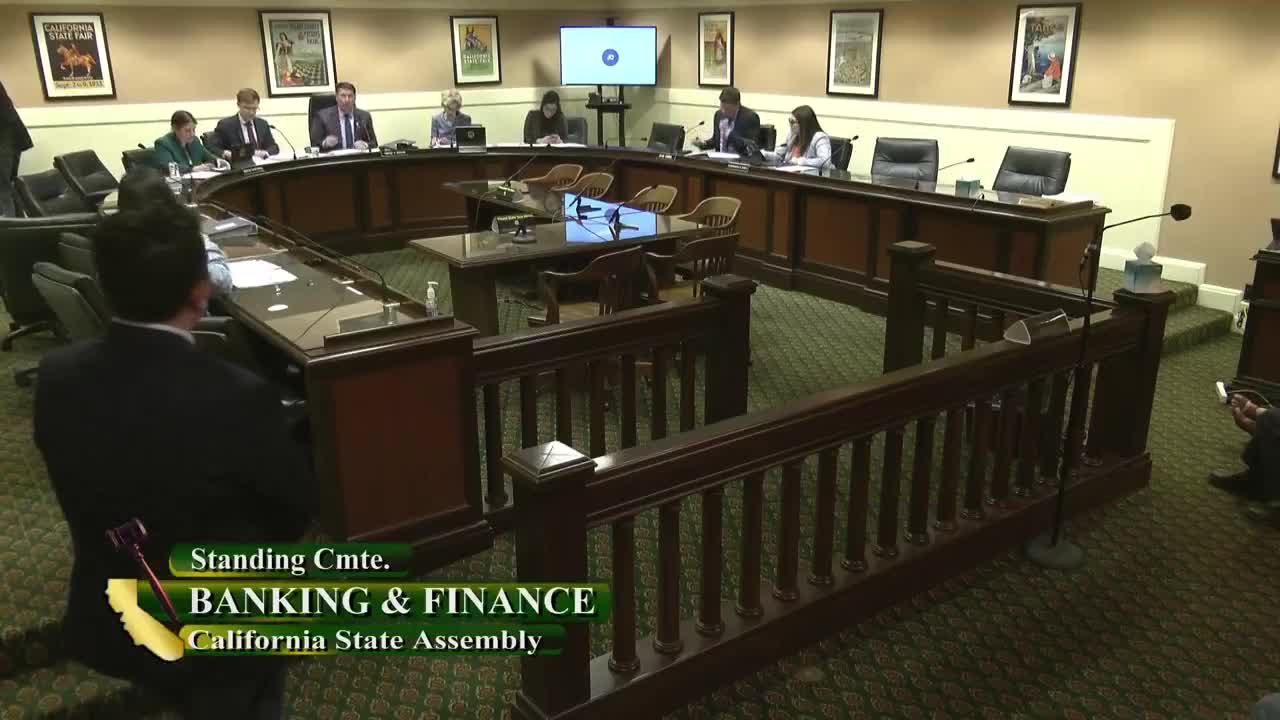
Assembly Standing Committee on Banking and Finance
Bill Author

Bill Co-Author(s):