AB 1250: Department of Transportation: low-carbon materials.
- Session Year: 2023-2024
- House: Assembly
- Latest Version Date: 2023-08-14
Current Status:
Failed
(2023-09-01: In committee: Held under submission.)
Introduced
In Committee
First Chamber
In Committee
Second Chamber
Enacted
What does this bill do?
The bill requires the California Department of Transportation to report to the Legislature on the climate‑warming impact (global warming potential) of common road materials like asphalt mixtures, cement, and concrete, identify lower‑carbon alternatives and strategies for adopting them, and then report yearly on progress. It also requires contractors bidding on eligible state transportation projects to submit a valid environmental product declaration (a standardized life‑cycle carbon report) and the quantity of asphalt mixtures and concrete used, and directs the department to define performance‑based bid specifications for lower‑carbon materials.
The summary is provided by generative AI which can make mistakes. For original language, please view the details in the table below.
(1)Existing law establishes the Transportation Agency in state government with various duties and responsibilities. The agency is under the supervision of the Secretary of Transportation, who has the power of general supervision over specified departments and offices, including the Department of Transportation.
This bill would require the Secretary of Transportation, in consultation with the Director of Transportation, to submit a report to the Legislature that discusses, among other things, the global warming potential, as defined, associated with certain materials currently used in state transportation projects, alternative and emerging materials with lower carbon emissions or net-negative carbon emissions, and benchmarks strategies for using materials with lower carbon materials. The bill would require the department to report to the Legislature annually on the departments progress in meeting the benchmarks implementing the strategies described above.
(2)Existing law vests the department with the obligation to improve and maintain state highways, including all traversable highways that have been adopted or designated as state highways by the California Transportation Commission.
This bill would require the department to, department, no later than July 1, 2025, to require bidders on specified projects to submit an environmental product declaration, as defined, for the asphalt mixtures and concrete and asphalt used in the project. The bill would require the department to, no later than July 1, 2025, develop language for a model performance-based bid specification that includes a global warming potential benchmark for concrete and asphalt used in state projects. project and to report the quantity of asphalt mixture and concrete used in the project, as specified.
(1)Existing law establishes the Transportation Agency in state government with various duties and responsibilities. The agency is under the supervision of the Secretary of Transportation, who has the power of general supervision over specified departments and offices, including the Department of Transportation.
This bill would require the Secretary of Transportation, in consultation with the Director of Transportation, to submit a report to the Legislature that discusses, among other things, the global warming potential, as defined, associated with certain materials currently used in state transportation projects, alternative and emerging materials with lower carbon emissions or net-negative carbon emissions, and benchmarks for using materials with lower carbon materials. The bill would require the department to report to the Legislature annually on the departments progress in meeting the benchmarks described above.
(2)Existing law vests the department with the obligation to improve and maintain state highways, including all traversable highways that have been adopted or designated as state highways by the California Transportation Commission.
This bill would require the department to, no later than July 1, 2024, 2025, require bidders on specified projects to submit an environmental product declaration, as defined, for the concrete and asphalt used in the project. The bill would require the department to, no later than July 1, 2024, 2025, develop language for a model performance-based bid specification that includes a global warming potential benchmark for concrete and asphalt used in state projects.
(1)Existing law establishes the Transportation Agency in state government with various duties and responsibilities. The agency is under the supervision of the Secretary of Transportation, who has the power of general supervision over specified departments and offices, including the Department of Transportation.
This bill would require the Secretary of Transportation, in consultation with the Director of Transportation, to submit a report to the Legislature that discusses, among other things, the carbon emissions global warming potential, as defined, associated with certain materials currently used in state transportation projects, alternative and emerging materials with lower carbon emissions or net-negative carbon emissions, and benchmarks for using materials with lower carbon materials. The bill would require the department to report to the Legislature annually on the departments progress in meeting the benchmarks described above.
(2)Existing law vests the department with the obligation to improve and maintain state highways, including all traversable highways that have been adopted or designated as state highways by the California Transportation Commission.
This bill would require the department to, no later than July 1, 2024, require bidders on specified projects to submit an environmental product declaration, as defined, for the cement, concrete, concrete and asphalt used in the project. The bill would require the department to, no later than July 1, 2024, develop language for a model performance-based bid specification that includes a global warming potential benchmark for cement, concrete, concrete and asphalt used in state projects.
(1)Existing law establishes the Transportation Agency in state government with various duties and responsibilities. The agency is under the supervision of the Secretary of Transportation, who has the power of general supervision over specified departments and offices, including the Department of Transportation.
This bill would require the Secretary of Transportation, in consultation with the Director of Transportation, to submit a report to the Legislature that discusses, among other things, the carbon emissions associated with certain materials currently used in state transportation projects, alternative and emerging materials with lower carbon emissions or net-negative carbon emissions, and benchmarks for using materials with lower carbon materials. The bill would require the department to report to the Legislature annually on the departments progress in meeting the benchmarks described above.
(2)Existing law vests the department with the obligation to improve and maintain state highways, including all traversable highways that have been adopted or designated as state highways by the California Transportation Commission.
This bill would require the department to, no later than July 1, 2024, require bidders on specified projects to submit an environmental product declaration, as defined, for the cement, concrete, and asphalt used in the project. The bill would require the department to, no later than July 1, 2024, develop language for a model performance-based bid specification that includes a global warming potential benchmark for cement, concrete, and asphalt used in state projects.
Existing law establishes the Transportation Agency in state government with various duties and responsibilities. The agency is under the supervision of the Secretary of Transportation, who has the power of general supervision over specified departments and offices, including the Department of Transportation.
This bill would require the Secretary of Transportation, in consultation with the Director of Transportation, to submit a report to the Legislature that discusses, among other things, the carbon emissions associated with materials currently used in state transportation projects, alternative materials with lower carbon emissions, and benchmarks for using materials with lower carbon materials. The bill would require the department to report to the Legislature annually on the departments progress in meeting the benchmarks described above.
Existing law generally regulates the formation and awarding, among other things, of a contract by a public entity and defines the term public entity for that purpose.This bill would make a nonsubstantive change to that definition.Existing law generally regulates the formation and awarding, among other things, of a contract by a public entity and defines the term public entity for that purpose.
This bill would make a nonsubstantive change to that definition.
The Legislature finds and declares all the following:
(a)The California Department of Transportation, one of the largest entity entities of its kind in the nation, is responsible for maintaining a complex transportation system that includes more than 50,000 state highway lane miles, 12,600 bridges, and thousands of related facilities.
(b)The department faces significant challenges in reducing the carbon emissions from its construction and maintenance of state transportation infrastructure.
(c)In order for the department to effectively accomplish this mission and to meet the states strategic goals on carbon reduction, carbon removal, and ultimately achieving and maintaining net-negative greenhouse gas emissions, it needs to establish public trust, which requires increased transparency, clear accountability, and effective performance measurement. measurement are essential.
(d)Therefore, it is the intent of the Legislature for the department to identify the most carbon-intensive materials used in state transportation projects, identify the level of carbon emissions from those materials, identify lower carbon materials as potential replacements for those materials, including those commercially available today and transformational ultra low-carbon or negative-carbon materials under development for future commercial deployment, set benchmarks goals for the reduction of the overall carbon performance of material used in state transportation projects, and then report this information to the Legislature each year.
SEC. 2.Section 99 is added to the Streets and Highways Code, to read:99.(a)On or before December 31, 2024, the Secretary of Transportation, in consultation with the Director of Transportation, shall submit a report to the Legislature discussing all the following:
(1)The global warming potential, as defined in Section 99.1, associated with the following typical materials and mixes currently used in state transportation projects: asphalt mixtures, cement, concrete, and asphalt. and concrete.
(2)Alternative materials commercially available or in development with lower carbon emissions.
(3)Emerging alternative technologies or materials with the potential to achieve near-zero or net-negative carbon emissions associated with state transportation projects.
(4)The durability, safety, and maintenance requirements of the lower carbon materials compared to those in current use.
(5)Benchmarks Strategies for adopting a low-carbon standard for materials used in state transportation projects.
(6)The estimated carbon emissions reduction that would result from using the low-carbon and emerging alternatives, based on comparable and consistent metrics regarding carbon emissions. emissions and performance.
(7)The steps the department is undertaking to spur the commercial availability of emerging near-zero or net-negative carbon emissions alternative technologies or materials.
(b)On or before December 31, 2025, and each year thereafter, the department shall report to the Legislature on the departments progress on meeting the benchmarks implementing the strategies described in paragraph (4) (5) of subdivision (a).
(c)A report to be submitted pursuant to subdivisions (a) and (b) shall be submitted in compliance with Section 9795 of the Government Code.
SEC. 3.Section 99.1 is added to the Streets and Highways Code, to read:99.1.(a)For purposes of this section, the following definitions apply:
(1)Eligible project means a project that meets or exceeds the size threshold determined by the department for different materials and applications. The department shall determine the project size threshold by using a number of projects and environmental product declarations that would result in a representative industrywide average. The department shall not consider emergency work in determining the project size threshold. Emergency work shall not be considered an eligible project.
(2)Facility-specific means a product-specific environmental product declaration in which the environmental impacts can be attributed to a single manufacturer and manufacturing facility. For purposes of this paragraph, if multiple manufacturing plants are located at the same location, each plant shall be considered a separate facility.
(2)(3)Global warming potential or GWP means the CO2e of a material as reported in an environmental product declaration.
(3)(4)Performance-based bid specifications means both of the following:
(A)For concrete, a specification based on clearly defined performance indicators that provide flexibility in the concrete mixture proportions and that may include greenhouse gas emissions, verified, and measured by standard test methods with defined acceptance criteria stated in contract documents.
(B)For asphalt, asphalt mixtures, an asphalt balanced mixed design (BMD) that is an asphalt mix design using performance tests on appropriately conditioned specimens that address multiple modes of distress, taking into consideration mix aging, traffic, climate, and location within the pavement structure in conformance with the American Association of State Transportation Officials (AASHTO) PP 105-20 (2022), inclusive of perpetual pavement.
(5)Product-specific means an environmental product declaration that represents the impact for a specific product and manufacturer across multiple facilities.
(4)(6)Supply chain-specific means a product-specific facility-specific environmental product declaration that uses supply chain-specific specific data in the lifecycle life-cycle assessment to model the impacts of key model for any production processes upstream in a products supply chain that contribute to 80 70 percent or more of a products cradle-to-gate global warming potential, as defined in ISO standard 21930, and reports the overall percentage of supply chain-specific data included, as available. 21930.
(5)(7)Valid environmental product declaration means all either of the following:
(A)A supply chain-specific type III environmental product declaration, as defined by International Organization for Standardization (ISO) standard 14025, or similarly robust life cycle life-cycle assessment methods that have uniform standards in data collection consistent with ISO standard 14025, industry acceptance, and integrity.
(B)A facility-specific environmental product declaration if a supply chain-specific type III environmental product declaration, as described in paragraph (A), is not feasible.
(C)A valid, current product-specific type III environmental product declaration created under a current product category rule, provided the environmental product declaration has not expired.(b)No later than July 1, 2025, consistent with the availability of two hundred fifty million dollars ($250,000,000) through the federal Inflation Reduction Act, and to support the development of environmental product declarations, the department shall require bidders to eligible projects to submit a valid environmental product declaration for the asphalt mixtures and concrete and asphalt used in the project, and the quantity of asphalt mixtures and concrete used, reported in weight for asphalt mixtures and volume and weight for concrete, where asphalt mixtures or concrete or asphalt is the end product.
(c)No later than July 1, 2025, the department shall develop language for a model performance-based bid specification that includes a global warming potential benchmark for concrete and asphalt used in state projects. The global warming potential benchmark may be based on the products region, or other appropriate distinctions and metrics for the material, as determined by the department. The department may consult publicly available data, as well as data already collected on a voluntary basis, to establish an initial global warming potential benchmark.The Legislature finds and declares all the following:
(a)The Department of Transportation, the largest entity of its kind in the nation, is responsible for maintaining a complex transportation system that includes more than 50,000 state highway lane miles, 12,600 bridges, and thousands of related facilities.
(b)The department faces significant challenges in reducing the carbon emissions from its construction and maintenance of state transportation infrastructure.
(c)In order for the department to effectively accomplish this mission and to meet the states strategic goals on carbon reduction, carbon removal, and ultimately achieving and maintaining net-negative greenhouse gas emissions, it needs to establish public trust, which requires increased transparency, clear accountability, and effective performance measurement.
(d)Therefore, it is the intent of the Legislature for the department to identify the most carbon-intensive materials used in state transportation projects, identify the level of carbon emissions from those materials, identify lower carbon materials as replacements for those materials, including those commercially available today and transformational ultra low-carbon or negative-carbon materials under development for future commercial deployment, set benchmarks for the reduction of the overall carbon performance of material used in state transportation projects, and then report this information to the Legislature each year.
SEC. 2.Section 99 is added to the Streets and Highways Code, to read:99.(a)On or before December 31, 2024, the Secretary of Transportation, in consultation with the Director of Transportation, shall submit a report to the Legislature discussing all the following:
(1)The global warming potential, as defined in Section 99.1, associated with the following typical materials and mixes currently used in state transportation projects: cement, concrete, and asphalt.
(2)Alternative materials commercially available with lower carbon emissions.
(3)Emerging alternative technologies or materials with the potential to achieve near-zero or net-negative carbon emissions associated with state transportation projects.
(4)The durability, safety, and maintenance requirements of the lower carbon materials compared to those in current use.
(5)Benchmarks for adopting a low-carbon standard for materials used in state transportation projects.
(6)The estimated carbon emissions reduction that would result from using the low-carbon and emerging alternatives, based on comparable and consistent metrics regarding carbon emissions.
(7)The steps the department is undertaking to spur the commercial availability of emerging near-zero or net-negative carbon emissions alternative technologies or materials.
(b)On or before December 31, 2025, and each year thereafter, the department shall report to the Legislature on the departments progress on meeting the benchmarks described in paragraph (4) of subdivision (a).
(c)A report to be submitted pursuant to subdivisions (a) and (b) shall be submitted in compliance with Section 9795 of the Government Code.
SEC. 3.Section 99.1 is added to the Streets and Highways Code, to read:99.1.(a)For purposes of this section, the following definitions apply:
(1)Eligible project means a project that meets or exceeds the size threshold determined by the department for different materials and applications. The department shall determine the project size threshold by using a number of projects and environmental product declarations that would result in a representative industrywide average. The department shall not consider emergency work in determining the project size threshold.
(2)Global warming potential or GWP means the CO2e of a material as reported in an environmental product declaration.
(3)Performance-based bid specifications means both of the following:
(A)For concrete, a specification based on clearly defined performance indicators that provide flexibility in the concrete mixture proportions and that may include greenhouse gas emissions, verified, and measured by standard test methods with defined acceptance criteria stated in contract documents.
(B)For asphalt, an asphalt balanced mixed design (BMD) that is an asphalt mix design using performance tests on appropriately conditioned specimens that address multiple modes of distress, taking into consideration mix aging, traffic, climate, and location within the pavement structure in conformance with the American Association of State Transportation Officials (AASHTO) PP 105-20 (2022), inclusive of perpetual pavement.
(4)Supply chain-specific means a product-specific environmental product declaration that uses supply chain-specific data in the lifecycle assessment to model the impacts of key processes upstream in a products supply chain that contribute to 80 percent or more of a products cradle-to-gate global warming potential, as defined in ISO standard 21930, and reports the overall percentage of supply chain-specific data included, as available.
(5)Valid environmental product declaration means all of the following:
(A)A supply chain-specific type III environmental product declaration, as defined by International Organization for Standardization (ISO) standard 14025, or similarly robust life cycle assessment methods that have uniform standards in data collection consistent with ISO standard 14025, industry acceptance, and integrity.
(B)A facility-specific environmental product declaration if a supply chain-specific type III environmental product declaration, as described in paragraph (A), is not feasible.
(C)A valid, current product-specific type III environmental product declaration created under a current product category rule, provided the environmental product declaration has not expired.
(b)No later than July 1, 2024, 2025, consistent with the availability of two hundred fifty million dollars ($250,000,000) through the federal Inflation Reduction Act, and to support the development of environmental product declarations, the department shall require bidders to eligible projects to submit a valid environmental product declaration for the concrete and asphalt used in the project, where concrete or asphalt is the end product.
(c)No later than July 1, 2024, 2025, the department shall develop language for a model performance-based bid specification that includes a global warming potential benchmark for concrete and asphalt used in state projects. The global warming potential benchmark may be based on the products region, or other appropriate distinctions and metrics for the material, as determined by the department. The department may consult publicly available data, as well as data already collected on a voluntary basis, to establish an initial global warming potential benchmark.
The Legislature finds and declares all the following:
(a)The Department of Transportation, the largest entity of its kind in the nation, is responsible for maintaining a complex transportation system that includes more than 50,000 state highway lane miles, 12,600 bridges, and thousands of related facilities.
(b)The department faces significant challenges in reducing the carbon emissions from its construction and maintenance of state transportation infrastructure.
(c)In order for the department to effectively accomplish this mission and to meet the states strategic goals on carbon reduction, carbon removal, and ultimately achieving and maintaining net-negative greenhouse gas emissions, it needs to establish public trust, which requires increased transparency, clear accountability, and effective performance measurement.
(d)Therefore, it is the intent of the Legislature for the department to identify the most carbon-intensive materials used in state transportation projects, identify the level of carbon emissions from those materials, identify lower carbon materials as replacements for those materials, including those commercially available today and transformational ultra low-carbon or negative-carbon materials under development for future commercial deployment, set benchmarks for the reduction of the overall carbon performance of material used in state transportation projects, and then report this information to the Legislature each year.
SEC. 2.Section 99 is added to the Streets and Highways Code, to read:99.(a)On or before December 31, 2024, the Secretary of Transportation, in consultation with the Director of Transportation, shall submit a report to the Legislature discussing all the following:
(1)The carbon emissions global warming potential, as defined in Section 99.1, associated with the following typical materials and mixes currently used in state transportation projects: cement, concrete, and asphalt.
(2)Alternative materials commercially available with lower carbon emissions.
(3)Emerging alternative technologies or materials with the potential to achieve near-zero or net-negative carbon emissions associated with state transportation projects.
(4)The durability, safety, and maintenance requirements of the lower carbon materials compared to those in current use.
(5)Benchmarks for adopting a low-carbon standard for materials used in state transportation projects.
(6)The estimated carbon emissions reduction that would result from using the low-carbon and emerging alternatives. alternatives, based on comparable and consistent metrics regarding carbon emissions.
(7)The steps the department is undertaking to spur the commercial availability of emerging near-zero or net-negative carbon emissions alternative technologies or materials.
(b)On or before December 31, 2025, and each year thereafter, the department shall report to the Legislature on the departments progress on meeting the benchmarks described in paragraph (4) of subdivision (a).
(c)A report to be submitted pursuant to subdivisions (a) and (b) shall be submitted in compliance with Section 9795 of the Government Code.
SEC. 3.Section 99.1 is added to the Streets and Highways Code, to read:99.1.(a)For purposes of this section, the following definitions apply:
(1)Eligible project means a project for which bids are requested by the department that requires at least 50 cubic yards or at least 100 metric tons of concrete. that meets or exceeds the size threshold determined by the department for different materials and applications. The department shall determine the project size threshold by using a number of projects and environmental product declarations that would result in a representative industrywide average. The department shall not consider emergency work in determining the project size threshold.
(2)Environmental product declaration means a supply chain-specific type III environmental product declaration, as defined by International Organization for Standardization (ISO) standard 14025, or similarly robust life cycle assessment methods that have uniform standards in data collection consistent with ISO standard 14025, industry acceptance, and integrity.(3)(2)Global warming potential or GWP means the CO2e of a material as reported in an environmental product declaration.
(4)(3)Performance-based bid specifications means a contract provision that requires a material to achieve specified performance outcomes from the use of the structural material, including, but not limited to, outcomes related to the strength, durability, permeability, color, texture, thermal performance, or other attributes related to the function of the structural material for applied uses over its service life, as opposed to requiring that a structural material be produced using a specified manufacturing process, technology, or proportions of constituent materials. both of the following:
(A)For concrete, a specification based on clearly defined performance indicators that provide flexibility in the concrete mixture proportions and that may include greenhouse gas emissions, verified, and measured by standard test methods with defined acceptance criteria stated in contract documents.
(B)For asphalt, an asphalt balanced mixed design (BMD) that is an asphalt mix design using performance tests on appropriately conditioned specimens that address multiple modes of distress, taking into consideration mix aging, traffic, climate, and location within the pavement structure in conformance with the American Association of State Transportation Officials (AASHTO) PP 105-20 (2022), inclusive of perpetual pavement.
(5)(4)Supply chain-specific means an a product-specific environmental product declaration that includes uses supply chain-specific data for production processes in the lifecycle assessment to model the impacts of key processes upstream in a products supply chain that contribute to 80 percent or more of a product's products cradle-to-gate global warming potential, as defined in ISO standard 21930, and reports the overall percentage of supply chain-specific data included. included, as available.
(5)Valid environmental product declaration means all of the following:
(A)A supply chain-specific type III environmental product declaration, as defined by International Organization for Standardization (ISO) standard 14025, or similarly robust life cycle assessment methods that have uniform standards in data collection consistent with ISO standard 14025, industry acceptance, and integrity.
(B)A facility-specific environmental product declaration if a supply chain-specific type III environmental product declaration, as described in paragraph (A), is not feasible.
(C)A valid, current product-specific type III environmental product declaration created under a current product category rule, provided the environmental product declaration has not expired.
(b)No later than July 1, 2024, consistent with the availability of two hundred fifty million dollars ($250,000,000) through the federal Inflation Reduction Act, and to support the development of environmental product declarations, the department shall require bidders to eligible projects to submit an a valid environmental product declaration for the cement, concrete, concrete and asphalt used in the project. project, where concrete or asphalt is the end product.
(c)No later than July 1, 2024, the department shall develop language for a model performance-based bid specification that includes a global warming potential benchmark for cement, concrete, concrete and asphalt used in state projects. The global warming potential benchmark may be based on the products region, or other appropriate distinctions and metrics for the material, as determined by the department. The department may consult publicly available data, as well as data already collected on a voluntary basis, to establish an initial global warming potential benchmark.
The Legislature finds and declares all the following:
(a)The Department of Transportation, the largest entity of its kind in the nation, is responsible for maintaining a complex transportation system that includes more than 50,000 state highway lane miles, 12,600 bridges, and thousands of related facilities.
(b)The department faces significant challenges in reducing the carbon emissions from its construction and maintenance of state transportation infrastructure.
(c)In order for the department to effectively accomplish this mission and to meet the states strategic goals on carbon reduction, carbon removal, and ultimately achieving and maintaining net-negative greenhouse gas emissions, it needs to establish public trust, which requires increased transparency, clear accountability, and effective performance measurement.
(d)Therefore, it is the intent of the Legislature for the department to identify the most carbon-intensive materials used in state transportation projects, identify the level of carbon emissions from those materials, identify lower carbon materials as replacements for those materials, including those commercially available today and transformational ultra low-carbon or negative-carbon materials under development for future commercial deployment, set benchmarks for the reduction of the overall carbon performance of material used in state transportation projects, and then report this information to the Legislature each year.
SEC. 2.Section 99 is added to the Streets and Highways Code, to read:99.(a)On or before December 31, 2024, the Secretary of Transportation, in consultation with the Director of Transportation, shall submit a report to the Legislature discussing all the following:
(1)The carbon emissions associated with the following materials currently used in state transportation projects. projects: cement, concrete, and asphalt.
(2)Alternative materials commercially available with lower carbon emissions.
(3)Emerging alternative technologies or materials with the potential to achieve near-zero or net-negative carbon emissions associated with state transportation projects.
(3)(4)The durability, safety, and maintenance requirements of the lower carbon materials compared to those in current use.
(4)(5)Benchmarks for adopting a low-carbon standard for materials used in state transportation projects.
(5)(6)The estimated carbon emissions reduction that would result from using the low-carbon and emerging alternatives.
(7)The steps the department is undertaking to spur the commercial availability of emerging near-zero or net-negative carbon emissions alternative technologies or materials.
(b)On or before December 31, 2025, and each year thereafter, the department shall report to the Legislature on the departments progress on meeting the benchmarks described in paragraph (4) of subdivision (a).
(c)A report to be submitted pursuant to subdivisions (a) and (b) shall be submitted in compliance with Section 9795 of the Government Code.
SEC. 3.Section 99.1 is added to the Streets and Highways Code, to read:99.1.(a)For purposes of this section, the following definitions apply:
(1)Eligible project means a project for which bids are requested by the department that requires at least 50 cubic yards or at least 100 metric tons of concrete.
(2)Environmental product declaration means a supply chain-specific type III environmental product declaration, as defined by International Organization for Standardization (ISO) standard 14025, or similarly robust life cycle assessment methods that have uniform standards in data collection consistent with ISO standard 14025, industry acceptance, and integrity.
(3)Global warming potential or GWP means the CO2e of a material as reported in an environmental product declaration.
(4)Performance-based specifications means a contract provision that requires a material to achieve specified performance outcomes from the use of the structural material, including, but not limited to, outcomes related to the strength, durability, permeability, color, texture, thermal performance, or other attributes related to the function of the structural material for applied uses over its service life, as opposed to requiring that a structural material be produced using a specified manufacturing process, technology, or proportions of constituent materials.
(5)Supply chain-specific means an environmental product declaration that includes supply chain-specific data for production processes that contribute to 80 percent or more of a product's cradle-to-gate global warming potential, as defined in ISO standard 21930, and reports the overall percentage of supply chain-specific data included.
(b)No later than July 1, 2024, consistent with the availability of two hundred fifty million dollars ($250,000,000) through the federal Inflation Reduction Act, and to support the development of environmental product declarations, the department shall require bidders to eligible projects to submit an environmental product declaration for the cement, concrete, and asphalt used in the project.
(c)No later than July 1, 2024, the department shall develop language for a model performance-based bid specification that includes a global warming potential benchmark for cement, concrete, and asphalt used in state projects. The department may consult publicly available data, as well as data already collected on a voluntary basis, to establish an initial global warming potential benchmark.
The Legislature finds and declares all the following:
(a)The Department of Transportation, the largest entity of its kind in the nation, is responsible for maintaining a complex transportation system that includes more than 50,000 state highway lane miles, 12,600 bridges, and thousands of related facilities.
(b)The department faces significant challenges in reducing the carbon emissions from its construction and maintenance of state transportation infrastructure.
(c)In order for the department to effectively accomplish this mission and to meet the states strategic goals on carbon reduction, it needs to establish public trust, which requires increased transparency, clear accountability, and effective performance measurement.
(d)Therefore, it is the intent of the Legislature for the department to identify the most carbon-intensive materials used in state transportation projects, identify the level of carbon emissions from those materials, identify lower carbon materials as replacements for those materials, set benchmarks for the reduction of the overall carbon performance of material used in state transportation projects, and then report this information to the Legislature each year.
SEC. 2.Section 99 is added to the Streets and Highways Code, to read:99.(a)On or before December 31, 2024, the Secretary of Transportation, in consultation with the Director of Transportation, shall submit a report to the Legislature discussing all the following:
(1)The carbon emissions associated with the materials currently used in state transportation projects.
(2)Alternative materials commercially available with lower carbon emissions.
(3)The durability, safety, and maintenance requirements of the lower carbon materials compared to those in current use.
(4)Benchmarks for adopting a low-carbon standard for materials used in state transportation projects.
(5)The estimated carbon emissions reduction that would result from using the low-carbon alternatives.
(b)On or before December 31, 2025, and each year thereafter, the department shall report to the Legislature on the departments progress on meeting the benchmarks described in paragraph (4) of subdivision (a).
(c)A report to be submitted pursuant to subdivisions (a) and (b) shall be submitted in compliance with Section 9795 of the Government Code.
SECTION 1.Section 1100 of the Public Contract Code is amended to read:1100.Public entity, as used in this part, means the state, county, city, city and county, district, public authority, public agency, municipal corporation, or any other political subdivision or public corporation in this state.Public entity, as used in this part, means the state, county, city, city and county, district, public authority, public agency, municipal corporation, or any other political subdivision or public corporation in the this state.
|
Date
|
Status
|
|---|---|
| Sep 1, 2023 | In committee: Held under submission. |
| Aug 21, 2023 | In committee: Referred to APPR suspense file. |
| Aug 14, 2023 | From committee chair, with author's amendments: Amend, and re-refer to committee. Read second time, amended, and re-referred to Com. on APPR. |
| Jul 13, 2023 | Read second time and amended. Re-referred to Com. on APPR. |
| Jul 12, 2023 | From committee: Amend, and do pass as amended and re-refer to Com. on APPR. (Ayes 12. Noes 4.) (July 11). |
| Jul 3, 2023 | From committee chair, with author's amendments: Amend, and re-refer to committee. Read second time, amended, and re-referred to Com. on TRANS. |
| Jun 15, 2023 | From committee chair, with author's amendments: Amend, and re-refer to committee. Read second time, amended, and re-referred to Com. on TRANS. |
| Jun 14, 2023 | In committee: Hearing postponed by committee. |
| Jun 7, 2023 | Referred to Com. on TRANS. |
| May 26, 2023 | In Senate. Read first time. To Com. on RLS. for assignment. |
| May 25, 2023 | Read third time. Passed. Ordered to the Senate. (Ayes 76. Noes 0. Page 1766.) |
| May 18, 2023 | Read second time. Ordered to third reading. |
| May 18, 2023 | From committee: Do pass. (Ayes 15. Noes 0.) (May 18). |
| May 10, 2023 | In committee: Set, first hearing. Referred to APPR. suspense file. |
| May 3, 2023 | In committee: Hearing postponed by committee. |
| Apr 18, 2023 | From committee: Do pass and re-refer to Com. on APPR. with recommendation: To Consent Calendar. (Ayes 15. Noes 0.) (April 17). Re-referred to Com. on APPR. |
| Mar 20, 2023 | Re-referred to Com. on TRANS. |
| Mar 16, 2023 | Referred to Com. on TRANS. |
| Mar 16, 2023 | From committee chair, with author's amendments: Amend, and re-refer to Com. on TRANS. Read second time and amended. |
| Feb 17, 2023 | From printer. May be heard in committee March 19. |
| Feb 16, 2023 | Read first time. To print. |
|
Date
|
Description
|
Location
|
Votes
|
|
|---|---|---|---|---|
| Aug 21, 2023 | Placed on suspense file | Senate Standing Committee on Appropriations |
Passed |
|
| Jul 11, 2023 | Do pass as amended, but first amend, and re-refer to the Committee on [Appropriations] | Senate Standing Committee on Transportation |
Passed |
|
| May 25, 2023 | AB 1250 Friedman Assembly Third Reading | Assembly Floor |
Passed |
|
| May 18, 2023 | Do pass. | Assembly Standing Committee on Appropriations |
Passed |
|
| Apr 17, 2023 | Do pass and be re-referred to the Committee on [Appropriations] with recommendation: To Consent Calendar | Assembly Standing Committee on Transportation |
Passed |
This list shows positions taken on this bill by organizations on the date displayed, which is linked to the original source.
Positions by individuals are not included.
|
Organization
|
Position
|
Date
|
|---|---|---|
| 350 Bay Area Action | ** Support | |
| 350 Sacramento | ** Support | |
| Ban SUP | ** Support | |
| Blue Planet Systems | * Support | Jul 11, 2023 |
| California Asphalt Pavement Association | * Against Unless Amend | Jul 11, 2023 |
| California Construction And Industrial Materials Association | * Indeterminate | Jul 11, 2023 |
| Clean Earth 4 Kids | * Support | Aug 21, 2023 |
| Climate Action California | ** Support | |
| Climate Resolve | ** Support | |
| Coalition For Clean Air | * Support | Jul 11, 2023 |
| National Stewardship Action Council | ** Support | |
| Natural Resources Defense Council | * Support | Jul 11, 2023 |
| Santa Cruz Climate Action Network | ** Support | |
| Sierra Club California | ** Support | |
| Southern California Contractors Association | * Against | Aug 21, 2023 |
SENATE COMMITTEE ON APPROPRIATIONS
Senator Anthony Portantino, Chair
2023 - 2024 Regular Session
AB 1250 (Friedman) - Department of Transportation: low-carbon materials
Version: August 14, 2023 | Policy Vote: TRANS. 12 - 4 |
Urgency: No | Mandate: No |
Hearing Date: August 21, 2023 | Consultant: Mark McKenzie |
Bill Summary:
AB 1250 would require the Secretary of Transportation, in consultation with the Department of Transportation (Caltrans) to submit a report to the Legislature by December 31, 2024 that discusses the global warming potential (GWP) of asphalt mixtures, cement, and concrete used in state transportation projects and the availability of lower carbon emission alternatives to those materials, as specified. The bill would also require Caltrans, by July 1, 2025, to require bidders on certain projects to submit valid environmental product declarations (EPDs) for the asphalt mixtures and concrete used in a project and the quantity of those materials used.
Fiscal Impact:
- Caltrans estimates first year costs of approximately $2.5 million and 9.0 PY of engineering staff to conduct research, compile data, develop specified strategies, and producing the report. These costs would be reduced to approximately $1.2 million and 2.5 PY of staff annually from years two through five to develop and implement processes for collecting information on EPDs from bidders on eligible projects. Caltrans would subsequently incur ongoing annual costs of approximately $700,000 for staff and associated costs for updating and maintaining data systems, including licensing and IT support. Caltrans notes that, due to the compressed timelines in the bill and difficulties in hiring qualified staff, it may need to contract for architecture and engineering consulting contracts to complete the implementation work on time, resulting in first year contract costs in the range of $3 million to $4 million, with costs in the range of $175,000 to $1.2 million annually in years two through five, and annual ongoing costs of approximately $700,000. (State Highway Account)
- The California Air Resources Board (CARB) estimates ongoing costs of approximately $213,000 annually for 1.0 PY of staff to consult with and advise Caltrans on the development of the report, supporting the department on gathering data and developing strategies for adopting a low-carbon standard for transportation materials, and supporting the ongoing monitoring and annual reporting to the Legislature on progress toward implementing strategies for adopting a low-carbon standard for transportation materials. (State Highway Account)
Background:
Existing law requires Caltrans to develop standards and modify all bid specifications relating to the purchase of paving materials, and base, subbase, and pervious backfill materials, using recycled materials. The standards and specifications must provide for the use of recycled materials and must not reduce the quality standards for highway and road construction.
Caltrans has policies and procedures in place to promote the use of recycled material whenever and wherever it is cost-effective, based on factors including lifespan, durability, and maintenance costs. Existing law generally requires Caltrans to ensure that not less than 50% of the asphalt it purchases every year includes a certain amount of crumb rubber from recycled tires, as specified. Existing law requires Caltrans and local agencies, to the extent possible and cost effective, and where feasible, to use advanced technologies and material recycling techniques that reduce the cost of maintaining and rehabilitating the streets and highways, and that exhibit reduced levels of greenhouse gas emissions through material choice and construction method.
Cement accounts for 1.8% of the California’s GHG emissions and 7% of CO2 emissions worldwide. It is often referred to as one of the most hard to abate industrial sectors. This is because part of the process of making cement usually requires grinding the intermediate product in a rotary kiln that is heated to about 2700 °F. Heating these kilns requires fossil fuels; full electrification is not currently feasible. Furthermore, the chemical reactions that occur in this process cause the limestone to release stored CO2. This heating step accounts for about 85% of all emissions associated with cement, which the US EPA has estimated to range from 720-880 kilograms of CO2 per metric ton of cement. Cement production accounts for 80- 90% of the life cycle CO2 emissions for the concrete. Caltrans is one of the largest consumers of cement and concrete in the state. In 2017, Caltrans projects used more than 1 million cubic yards of concrete, which involved approximately 325,000 tons of Portland cement, more than 4 million tons of hot mix asphalt, and 1 million cubic yard of aggregate.
Existing law, the Buy Clean California Act (BCCA), requires the Department of General Services (DGS) to publish acceptable maximum Global Warming Potential limits for structural steel, concrete reinforcing steel (rebar), flat glass, and mineral wool board insulation. In order to determine and compare the GWPs of different products and materials, DGS relies on EPDs. An EPD tells the life cycle story of a product in a single, comprehensive report. The EPD provides information about a product’s impact upon the environment, such as global warming potential, smog creation, ozone depletion and water pollution. With an EPD, manufacturers report comparable, objective, and third-party verified data that helps purchasers better understand a product’s sustainable qualities and environmental repercussions so they can make more informed product selections.
Even though the BCCA does not apply to asphalt, cement, or concrete Caltrans has implemented product category rules requiring EPDs for asphalt mixtures in alignment with the National Asphalt Pavement Association, and EPDs for concrete in alignment with the National Center for Sustainability standards. In January 2022, Caltrans announced it was approving the use of low-carbon cement, relying on Portland limestone cement, which the department says can cut its concrete-related carbon dioxide emissions by up to 10% a year while meeting the same high performance standards as regular concrete at a slightly lower cost. In 2010, Caltrans changed its concrete standard specification to increase the use of sustainable alternatives in transportation projects.
Proposed Law:
AB 1250 would require the Secretary of Transportation, in consultation with Caltrans, to submit a report to the Legislature by December 31, 2024 discussing all of the following:
- The GWP associated with asphalt mixtures, cement, and concrete currently used in state transportation projects, as specified.
- Alternative materials commercially available or in development with lower carbon emissions.
- Emerging alternative technologies or materials with the potential to achieve near-zero or net-negative carbon emissions associated with state transportation projects.
- The durability, safety, and maintenance requirements of the lower carbon materials compared to those in current use.
- Strategies for adopting a low-carbon standard for materials in state transportation projects.
- The estimated carbon emissions reduction that would result from using the low-carbon and emerging alternatives, as specified.
- The steps that Caltrans is undertaking to spur the commercial availability of emerging near-zero or net-negative carbon emissions alternative technologies or materials.
Caltrans would also be required to submit a report to the Legislature, by December 31, 2025 and annually thereafter, on its progress in implementing the strategies identified in the report for adopting a low-carbon standard for materials in projects.
The bill would also define various terms and require Caltrans, by July 1, 2025, to require bidders to eligible projects to submit a valid EPD for the asphalt mixtures and concrete used in the project, and the quantity of those materials used by weight and volume, respectively, where those materials are the end product. A valid EPD may be either a supply chain-specific type III EPD that uses specific data in the life-cycle assessment model for any production processes upstream, as specified, or a facility-specific EPD, if a supply chain-specific EPD is not feasible.
Related Legislation:
SB 682 (Skinner), which was held on this Committee’s Suspense File in 2023, would have made it the policy of the state to purchase or specify at least 10 percent of cement and concrete meet or exceeds a specified benchmark for low-carbon cement by 2030, and required Caltrans to develop a model advance procurement agreement for the purchase of low-carbon cement and concrete products.
SB 596 (Becker), Chap. 246/2021, required CARB, by July 1, 2023, to develop a comprehensive strategy for the state’s cement sector to achieve net-zero emissions of GHG associated with cement used within the state by December 31, 2045.
AB 966 (Bonta), which was held on the Assembly Appropriations Committee’s Suspense File in 2019, would have required each cement plant in the state to submit a facility-specific EPD to CARB and required state agencies awarding contracts to require large successful bidders to submit a product-specific EPD for projects that involve the purchase of more than 500 cubic yards of concrete.
AB 262 (Bonta), Chap. 816/2017, The Buy Clean California Act, required DGS to develop maximum acceptable global warming potential emissions for structural steel, concrete reinforcing steel, flat glass, and mineral wool board insulation used in public works projects.
-- END --
SENATE COMMITTEE ON TRANSPORTATION
Senator Lena Gonzalez, Chair
2023 - 2024 Regular
Bill No: Hearing Date: 7/11/2023
Author: | Friedman | ||
Version: | 7/03/2023 Amended | ||
Urgency: | No | Fiscal: | Yes |
Consultant: | Jacob O'Connor | ||
SUBJECT:
DIGEST: This bill requires the Secretary of Transportation to submit a report to the Legislature discussing potential lower carbon emission alternatives to the cement, concrete, and asphalt used in state transportation. Requires the Department of Transportation to require bidders to submit environmental product declarations and to develop a model performance-based bid specification that includes a global warming potential benchmark for these materials.
ANALYSIS:
Existing law:
- Requires the California Air Resources Board (CARB), by July 1, 2023, to develop a comprehensive strategy for the state’s cement sector to achieve net-zero emissions of greenhouse gases (GHG) from cement used in the state as soon as possible, but no later than December 31, 2045. (Health & Safety Code (HSC) §38561)
- Establishes the Department of Transportation (Caltrans) within the California State Transportation Agency (CalSTA) and provides that the department has full possession and control of all state highways and property and rights in property acquired for state highway purposes. (Streets and Highways Code (SHC) §90, Government Code §14001)
- Requires Caltrans to review and modify bid specifications relating to the purchase of paving materials using recycled materials, including asphalt pavement and crushed concrete. (Public Resources Code (PRC) §42700)
- Requires CalSTA to use escalating percentages of crumb rubber for state highway construction projects and to annually prepare an analysis comparing the cost differential between asphalt containing crumb rubber and conventional asphalt. (Public Resources Code §42703)
- Authorizes Caltrans to establish specifications for the use of reclaimed asphalt pavement of up to 40% for hot mix asphalt mixes. (PRC §42704)
- Requires Caltrans and local agencies, to the extent feasible, use advanced technologies and material recycling techniques that reduce the cost of maintaining and rehabilitating streets and highways and that exhibit reduced levels of greenhouse gas emissions through material choice and construction method. (PRC §42704.6)
- Requires, under the Buy Clean California Act (BCCA) the Department of General Services (DGS), in consultation with ARB, to establish and publish the maximum acceptable Global Warming Potential (GWP) limit for four eligible materials: structural steel, concrete reinforcing steel, flat glass, and mineral wool board insulation. Further states that when used in public works projects, these eligible materials must have a GWP that does not exceed the limit set by DGS. (Public Contract Code §3500-3505)
- Requires, under the BCCA, an awarding authority to require a successful bidder for a contract to submit a facility-specific environmental product declaration (EPD) for each material proposed to be used.
This bill:
- Makes Legislative findings and declarations regarding the need for Caltrans to reduce carbon emissions from transportation infrastructure and how to achieve that goal.
- Requires, by December 31, 2024, the Secretary of CalSTA, in consultation with the director of Caltrans to submit a report to the Legislature discussing:
- The global warming potential (GWP) associated with cement, concrete, and asphalt;
- Alternative materials commercially available with lower carbon emissions;
- Emerging alternative technologies or materials with the potential to achieve near-zero or net-negative emissions associated with state transportation projects;
- The durability, safety, and maintenance requirements of the lower carbon materials compared to those in current use;
- Benchmarks for adopting a low-carbon standard for materials used in state transportation projects;
- The estimated carbon emissions reduction that would result from using the low-carbon and emerging alternatives, based on comparable and consistent metrics regarding carbon emissions; and
- The steps the department is undertaking to spur the commercial availability of emerging near-zero or net-negative carbon emissions alternative technologies or materials.
- Requires Caltrans to report to the Legislature on December 31, 2025 and each year thereafter, progress on meeting the benchmarks described in the report.
- Defines, for the purposes of this legislation:
- “Eligible project” as a project that meets or exceeds a size threshold determined by Caltrans. Caltrans shall determine this threshold by using a number of projects and EPDs that would result in a representative industry wide average.
- “Global warming potential” as the carbon dioxide equivalent (CO2e) of a material as reported in an EPD.
- “Performance based bid specifications” for concrete as a specification based on clearly defined performance indicators rather than concrete mixture proportions, including greenhouse gas emissions, which have been verified and measured b standard test methods.
- “Performance based bid specifications” for asphalt as an asphalt balanced mixed design that uses performance tests on appropriately conditioned specimens that address multiple modes of distress in conformance with the American Association of State Transportation Officials.
- “Supply chain-specific” as a product-specific environmental product declaration that uses data in the lifecycle assessment to model the impacts of key processes upstream in a product’s supply chain that contribute to 80 percent or more of a product’s cradle-to-gate global warming potential and reports the overall percentage of supply chain specific data included, as available.
- A “Valid environmental product declaration” as a supply chain-specific type III EPD or similarly robust life cycle assessment, if feasible, or a facility-specific EPD if not. May also include a valid, current product-specific type III EPD created under the current product category rules.
- Requires Caltrans by July 1, 2024, and consistent with the availability of $250 million dollars through the federal Inflation Reduction Act, to require bidders to eligible projects to submit a valid environmental product declaration for the cement, concrete, and asphalt used in the project.
- Requires Caltrans, by July 1, 2024, to develop language for a model performance-based bid specification that includes a global warming potential benchmark for cement, concrete, and asphalt used in state projects. Caltrans may consult publicly available data to establish an initial benchmark.
COMMENTS:
- Purpose of bill. According to the author “The California state Transportation Agency is one of the leading purchasers of concrete in the United States. Due to its good mechanical and physical properties, concrete is one of the most important construction materials for buildings, roads, tunnels, bridges, foundations, dams and many other kinds of structures. Concrete contains cement as a binding agent, however, and the production of cement is responsible for large amounts of CO2 emissions, making it a major contributor to climate change. As concrete will continue to play an important role in the purchases by the state Transportation Agency in the future, it is imperative the Transportation Agency begin to collect the data necessary to pivot to more climate-friendly materials, such as low carbon concrete.”
- California relies on asphalt, cement, and concrete. Cement is a chemical substance, usually made out of limestone and silicate-containing minerals, used to adhere other materials together to make a new, stable, material. One of the most common uses of cement is to combine it with water, fine materials like sand, and coarse materials like gravel, in order to produce concrete. In a typical mix, the cement represents 10-15% of the material by volume. Concrete is the most common building material used in the world because it is relatively cheap, durable, and easily molded into sturdy structures. Asphalt is a concrete-like material used to pave roads, parking lots, and airports. Asphalt is produced by using a petroleum product, rather than cement, to bind the coarse materials together.
According to the United States Geological Survey, in January of 2023 California was the third largest producer and consumer of cement in the country after Texas and Florida. In the last year California consumed about 10.5 million metric tons of cement.
Caltrans is one of the largest consumers of cement and concrete in the state. In 2017, Caltrans projects used more than 1 million cubic yards of concrete, which involved approximately 325,000 tons of Portland cement, more than 4 million tons of hot mix asphalt, and 1 million cubic yard of aggregate.
- Cement is a major source of GHG emissions. Cement accounts for 1.8% of the California’s GHG emissions and 7% of CO2 emissions worldwide. It is often referred to as one of the most hard to abate industrial sectors. This is because part of the process of making cement usually requires grinding the intermediate product in a rotary kiln that is heated to about 2700 °F. Heating these kilns requires fossil fuels; full electrification is not currently feasible. Furthermore, the chemical reactions that occur in this process cause the limestone to release stored CO2. This heating step accounts for about 85% of all emissions associated with cement, which the US EPA has estimated to range from 720- 880 kilograms of CO2 per metric ton of cement. Cement production accounts for 80-90% of the life cycle CO2 emissions for the concrete.
According to a report from the climate think tank Energy Innovation, California won’t meet its 2030 GHG emission reduction goals unless industries like cement producers reduce their emissions. The report notes this would require plant retrofits, major changes to infrastructure, and would require the use of technologies that haven’t yet been deployed at scale in California, like carbon capture and storage.
- Buy Clean California Act. The Buy Clean California Act (BCCA) is an innovative program establishing limits on embodied carbon emissions and construction materials procured by the state for public construction projects. The law requires the California Department of General Services (DGS) to publish, by January 1, 2022, acceptable maximum Global Warming Potential (GWP) limits for the following eligible materials: structural steel, concrete reinforcing steel (rebar), flat glass, and mineral wool board insulation. In order to determine and compare the GWPs of different products and materials, DGS relies on Environmental Product Declarations (EPDs).
An EPD tells the life cycle story of a product in a single, comprehensive report. The EPD provides information about a product’s impact upon the environment, such as global warming potential, smog creation, ozone depletion and water pollution. With an EPD, manufacturers report comparable, objective, and third-party verified data that helps purchasers better understand a product’s sustainable qualities and environmental repercussions so they can make more informed product selections. EPDs are typically cradle-to-gate analyses, which makes sense since they are used partly to determine which products to acquire for a given project.
- Current progress by Caltrans. Per existing law, Caltrans must work with CalRecycle to review and modify bid specifications relating to the purchase of paving materials using recycled materials, including asphalt pavement and rubberized asphalt. According to Caltrans’ Greenhouse Gas Emissions and Mitigation Report 2020, the most promising additional GHG reduction opportunity for Caltrans for asphalt pavements appears to be a greater use of reclaimed asphalt pavement.
Even though the BCCA does not apply to asphalt, cement, or concrete Caltrans has implemented product category rules requiring EPDs for asphalt mixtures in alignment with the National Asphalt Pavement Association and EPDs for concrete in alignment with the National Center for Sustainability standards. In January 2022, Caltrans announced it was approving the use of low-carbon cement, relying on Portland limestone cement, which the agency says can cut its concrete-related carbon dioxide emissions by up to 10% a year while meeting the same high performance standards as regular concrete at a slightly lower cost.
This bill asks Caltrans to summarize these efforts, describe the current state of low-carbon materials technology, and set new benchmarks for the adoption of new low-carbon materials.
- Performance anxiety. When Caltrans creates a bid for a project they include in that bid provisions about the types of materials that must be used as part of the project. These provisions are composition based- describing things like the proportion of cement and fly ash used in a concrete mixture. These help ensure that the products used in the project will be long-lasting, effective at their purpose, and have a reasonable cost. However these composition based requirements may inadvertently be stifling innovation, as new chemical mixtures can create new types of concrete with lower costs, fewer greenhouse gas emissions, and similar or even better levels of durability. There has been increasing interest in moving bid specifications towards performance based metrics – where the composition of a material isn’t important, but whether or not it can effectively fulfill the necessary function in the project. For example, one key performance factor in asphalt is its stiffness and stability- if the asphalt is too stiff then under pressure it can crack but if it isn’t stiff enough then under pressure it can deform. Caltrans has been working with stakeholders in order to begin piloting ways to test the performance of asphalt and concrete as a step towards using performance-based specifications. One of the major provisions of this bill would give Caltrans a set date by which to develop at least one model bid project specification that uses performance, rather than composition based criteria. This performance based measure must also include a description of the GWP of the materials, so that in future the bid specification process can be used to encourage the development of lower GWP materials.
Opponents have raised concerns that this bills measures are premature as Caltrans is still in the early stages of working with industry to determine how to establish performance based specifications.
- What’s in an EPD? The other major provision of this bill is to require Caltrans to require EPDs for projects that produce asphalt and concrete. The bill gives Caltrans the flexibility to determine the appropriate size at which projects should be required to provide EPDs, such that the requirement will result in a representative industrywide average. Providing these EPDs will help Caltrans and the public better understand the environmental impact of the products Caltrans uses. This bill’s definition of an EPD goes beyond the current practices for EPDs established by the Buy Clean California Act by requiring the EPDs for concrete and asphalt to supply-chain specific, rather than facility-specific, if feasible. A supply-chain EPD will be costlier and more complicated to produce, but it will result in a more complete picture of the environmental impact of a product than a facility-based EPD, because it will capture upstream impacts from the production and transportation of precursor materials.
- Time to act. This bill currently requires Caltrans to develop an entirely novel type of project bid specification over the course of six months, as well as develop guidelines for the submission and evaluation of new types of EPDs. Opponents have raised concerns that both of these tasks may not be possible as Caltrans is currently in the beginning stages of developing these types of policies and it will likely take several more years of work. From a budget perspective, this goals of this bill will likely require additional staff or other financial resources which Caltrans would not be able to obtain until the next budget is passed in the summer of 2024. In order to allow time for Caltrans to meet the goals of this bill the author and committee may wish to amend the bill to delay implementation until July 1, 2025.
Related Legislation:
SB 682 (Skinner) would have made it the policy of the state to purchase or specify at least 10 percent of cement and concrete meet or exceeds a specified benchmark for low-carbon cement by 2030 and required Caltrans to develop a model advance procurement agreement for the purchase or specification of low-carbon cement and concrete products. This bill was held in the Senate Appropriations Committee on suspense.
SB 596 (Becker, Chapter 246, Statutes of 2021) requires CARB to – by July 1, 2023 – develop a comprehensive strategy for the state’s cement sector to achieve net-zero emissions of GHG associated with cement used within the state as soon as possible, but no later than December 31, 2045 AB 966
(Bonta, 2019) would have required each cement plant in the state to submit a facility-specific Environmental Product Declaration (EPD) to CARB and require state agencies awarding contracts to require large successful bidders to submit a product-specific EPD for projects that involve the purchase of more than 500 cubic yards of concrete. This bill died in the Assembly Appropriations Committee.
AB 262 (Bonta, Chapter 816, Statutes of 2017) the Buy Clean California Act, requires DGS to develop maximum acceptable global warming potential emissions for structural steel, concrete reinforcing steel, flat glass, and mineral wool board insulation used in public works projects.
AB 1452 (Skinner, 2009) would have required CARB to develop and adopt limitations on GHG emissions resulting from the production of cement sold in the state, including GHG emissions resulting from transportation, by January 1, 2011. This bill died in the Assembly Appropriations Committee.
FISCAL EFFECT: Appropriation: No Fiscal Com.: Yes Local: No
According to the Assembly Appropriations Committee, the reporting part of this bill would have likely ongoing annual staff and contract costs of an unknown but significant amount, in the hundreds of thousands to low millions of dollars, for CalSTA and Caltrans to submit the required reports. Additional ongoing costs of an unknown but very significant amount if Caltrans is to meet specific benchmarks for adopting a low-carbon standard for materials used in transportation projects (General Fund or special fund).
Since that analysis several major provisions have been added to this bill.
POSITIONS: (Communicated to the committee before noon on Wednesday,
July 5th.)
SUPPORT:
350 Bay Area Action
350 Sacramento
Ban Sup (single Use Plastic)
Blue Planet Systems
California Construction & Industrial Materials Association
Climate Action California
Climate Resolve
National Stewardship Action Council
Natural Resources Defense Council (Sponsor)
Santa Cruz Climate Action Network
Sierra Club California
OPPOSITION:
California Asphalt Pavement Association
ARGUMENTS IN SUPPORT: According to the National Resources Defense Council “A large portion of concrete, cement, and asphalt used in California goes toward transportation projects overseen by Caltrans. These materials are crucial to maintain our roads, bridges, and other infrastructure, but producing them is incredibly carbon-intensive: concrete, for example, is responsible for 8 percent of greenhouse gas emissions globally. Caltrans has taken steps to reduce the emissions associated with the materials used in their operations, including implementing Buy Clean California for some materials including carbon steel rebar; piloting environmental product declaration (EPD) collection for concrete, asphalt, and aggregate; and approving portland limestone cement which reduces emissions by around 10% compared to original portland cement. However, California must continue to make progress, and more information is needed to guide that progress.
AB 1250 would require Caltrans to report on the carbon intensity of cement, concrete, and asphalt used in state transportation projects, as well as lower emission materials commercially available and the potential emission reduction that would result from their use. To enable a broader understanding of carbon intensity of these materials, AB 1250 would also require the submission of EPDs for concrete, cement, and asphalt used in Caltrans projects. EPDs are a lifecycle assessment tool for quantifying the greenhouse gas emissions generated during the production of industrial building materials and products. The Inflation Reduction Act contains $250 million in funding to support industrial materials manufacturers of all sizes in creating EPDs through grants and technical assistance. Expanding EPD collection in California at this moment can leverage this important source of funding.
AB 1250 would also require Caltrans to develop language for a model performance-based bid specification that includes a global warming potential benchmark for concrete and asphalt used 2 in state projects. Even though numerous low-carbon concrete alternatives with similar costs, durability, and performance exist today, they are unlikely to be adopted on a widespread basis unless explicitly asked for in bid specifications. Examples from other states show us that we can reduce emissions from concrete by up to 50 percent with no green premium. Caltrans would develop language on what this bid specification might look like, to help inform how greenhouse gas emissions of materials might eventually be addressed in the bidding process.”
ARGUMENTS IN OPPOSITION: According to the California Asphalt Pavement Association “As currently written, the bill makes assumptions lacking academic and practical rigor, has the potential to disrupt the already fragile transportation construction materials supply chain in California, and will likely sow chaos and confusion, and a host of unintended consequences, while accomplishing none of the climate-change and community protection goals it purports to advance…
While the intent of the legislation to provide supply chain-specific Environmental Product Declarations (EPD), this is premature at this time for, the following reasons: ISO 14025 doesn’t define the term “supply chain-specific EPD,” nor does any other consensus standard or relevant Product Category Rule (PCR) in the asphalt mixture value chain that we are aware of…. Asphalt binder constitutes about half of the GWP impact of a typical asphalt mixture. Thus, supply chain specific EPDs for asphalt mixtures, as defined in the proposed legislation, are not possible without supply chain-specific upstream datasets for asphalt binder. Currently there are no supply chain specific upstream data for asphalt binder anywhere in the United States… While an asphalt binder supplier could potentially develop a facility- and product-specific EPDs under the core PCR for construction materials (ISO 21930), the absence of a subcategory PCR for asphalt binder means that there are likely to be significant methodological differences between EPDs developed by different companies, such as the selection of upstream datasets and co-product allocation approaches. This means the GWP data may be a function of different accounting approaches rather than actual differences in emissions…
With regard to the bill requirement in Section 99.1(c) for the California Department of Transportation (Caltrans) to develop a model-based performance specification that includes a GWP benchmark is likely to result in unintended consequences. To wit: Caltrans is currently working with our industry in the development of a “Balanced Mix Design” specification, and we are pleased that the department is taking a careful, engineering-based approach and including numerous stakeholders. Still, that deployment is many years away, which means overlaying BMD with an EPD requirement at this time is not feasible. EPDs for asphalt mixtures, as with most other construction materials, are limited to a “cradle-to-gate” scope (A1-A3). What sets asphalt mixtures apart from other construction materials, such as cement, concrete and steel, is the relatively low cradle-to-gate GWP in relation to emissions associated with transporting the finished product from the gate of the plant to the jobsite (the A4 life cycle stage)… There currently are no model procurement policies in the United States that we are aware of that account for the A4 life cycle stage, and it will take time to develop and test such policies. The impacts of aggregate transportation in the A2 stage (transport from the quarry to the asphalt plant), will likewise have a significant impact on GWP results. This means that a great deal of care and attention will be needed to develop meaningful benchmarks at the regional level, and this is not possible in the allotted timeframe in the proposed legislation.”
-- END --
ASSEMBLY THIRD READING
ATR Bill Id:AB 1250
Author:(Friedman)
As Amended Ver:March 16, 2023
Majority vote
SUMMARY
Requires the Secretary of Transportation (CalSTA), in consultation with the Director of the California Department of Transportation (Caltrans), to submit a report to the Legislature that discusses the carbon emissions associated with materials currently used in state transportation projects, alternative materials with lower carbon emissions, and benchmarks for using materials with lower carbon materials.
Major Provisions
- Requires the report to be submitted to the Legislature on or before December 31, 2024
- Requires the report to include the following:
- The carbon emissions associated with the materials currently used in state transportation projects.
- Alternative materials commercially available with lower carbon emissions.
- The durability, safety, and maintenance requirements of the lower carbon materials compared to those in current use.
- Benchmarks for adopting a low-carbon standard for materials used in state transportation projects.
- The estimated carbon emissions reduction that would result from using the low-carbon alternatives.
- Requires, on or before December 31, 2025, and each year thereafter, Caltrans to report to the Legislature on Caltrans' progress on meeting the benchmarks for using materials with lower carbon emissions.
COMMENTS
In California, there are approximately 350,000 miles of roads, 87% of which local governments such as cities and counties operate and maintain. Extensive design, engineering, and analysis goes into determining which types of materials to use in pavement. In 2017, Caltrans projects used more than 1 million cubic yards of concrete, which involved approximately 325,000 tons of Portland cement, more than 4 million tons of hot mix asphalt, and 1 million cubic yard of aggregate.
According to a recent study produced by the World Economic Forum, concrete is the second most widely used material on Earth, behind only water. But concrete has also historically been detrimental to the environment. According to a study published in 2019, the combination of the calcination during the making of concrete, which in many locations uses coal or natural gas as the primary heat source, as well as the transportation of concrete, are major reasons why concrete contributes upwards of 7% of global greenhouse gas emissions (GHG) globally per year.
Concrete's main binding ingredient, Portland cement, is a leading source of carbon dioxide pollution in concrete production. Nearly one-third of all concrete used for construction in the United States (U.S.) is procured by state and local governments. As major purchasers of concrete, state and local governments have an important role to play in accelerating sector-wide embodied carbon reduction through their procurement choices. A growing number of states and localities are focusing greater attention on concrete and its use in public projects as an element within broader climate policy and strategy.
Recycled materials benefits: According to the Department of Resources Recycling and Recovery (CalRecycle) construction and demolition materials make up approximately 29% of California's disposed waste stream, or approximately 11.6 million tons. Asphalt and concrete represent over 977,000 tons of disposal, or around 2.4%. This material, produced through road rehabilitation, maintenance, and demolition, is itself a source of recycled aggregate that can serve as new road base and subbase, the weight-bearing foundations of a road.
Aggregate consists of hard, graduated fragments of inert mineral materials, including sand, gravel, crushed stone, slag, rock dust, or powder; inert solid waste is concrete, asphalt, dirt, brick, and other rubble. Recycled aggregate is produced by crushing concrete, and sometimes asphalt, to reclaim the aggregate. Asphalt refers to the bituminous substance used to bind aggregate together to make asphalt concrete (AC). Reclaimed asphalt pavement (RAP) is used AC pavement that has been processed. Recycled asphalt concrete is the product of mixing RAP with new aggregates, asphalt and/or recycling agent. A recycling agent is used to soften and rejuvenate the existing asphalt pavement.
According to Caltrans' Greenhouse Gas Emissions and Mitigation Report 2020, the most promising additional GHG reduction opportunity for Caltrans for asphalt pavements appears to be a greater use of RAP. For concrete pavements, the greatest additional GHG reduction opportunity appears to be greater use of supplemental cementitious materials. However, the net effect of different pavement options is complex and often dependent on the project context. For example, RAP may not be advantageous if the recycled material is not locally sourced.
The National Asphalt Paving Association notes that use of RAP reduced carbon dioxide (CO2) emissions by 2.4 million metric tons in 2019 nationwide. The National Center for Asphalt Technology reports that RAP at 25% of the asphalt mix reduces CO2 emissions by 10-11% and RAP at 40% reduces CO2 emissions by 16-18%, compared to use of virgin materials. A U.S. EPA study on asphalt shingles in pavement found a 6-14% reduction of CO2, when reclaimed asphalt shingles are added to an asphalt mix, depending on different proportions. A study conducted by Climate Earth on the Environmental Impacts of Recycled Plastic Concrete shows that recycling plastic concrete results in a 15.3% reduction in carbon footprint and 16.2% reduction in embodied energy.
Current use of recycled material. Per existing law, Caltrans must work with CalRecycle to review and modify bid specifications relating to the purchase of paving materials using recycled materials. The major product categories with current or potential recycled-content products (RCP) markets in Caltrans projects are: road base, asphalt pavement, rubberized asphalt, plastic lumber bridge timbers and pilings, plastic lumber guardrail offset blocks, plastic lumber sign posts, glass in pavement delineation, sound walls, landscaping and erosion control.
Existing statute also requires Caltrans and cities and counties to use advanced technologies and material recycling techniques where possible and cost effective when maintaining and rehabilitating the streets and highways.
A recent report finds that 88% of the cities and counties in California reported using some form of sustainable pavement practices and was cited as, "very encouraging, particularly when one considers the potential cost savings involved," and "is clearly evidence of local agencies using newer technologies to stretch the dollar." The overwhelming majority also indicated that they will continue to use some form of sustainable strategy in the future.
More to ask. While much is currently required of, and implemented in, state and local governments for the use of recycled materials in transportation projects, this bill requires state transportation officials to submit a report to the Legislature that discusses the carbon emissions associated with materials currently used in state transportation projects, alternative materials with lower carbon emissions, and benchmarks for using materials with lower carbon materials, including benchmarks and durability of alterative materials.
While a review of current practices and benchmarks on low-carbon alternatives in transportation projects may be helpful, the author may wish to clarify the types of transportation projects, and suggested alternative materials for the transportation agencies to review.
It should be noted the author has a related bill this legislative session which requires Caltrans to utilize various asphalt recycling methods for a set amount of projects.
According to the Author
"The California state Transportation Agency is one of the leading purchasers of concrete in the U.S. Due to its good mechanical and physical properties, concrete is one of the most important construction materials for buildings, roads, tunnels, bridges, foundations, dams and many other kinds of structures. Concrete contains cement as a binding agent, however, and the production of cement is responsible for large amounts of CO2 emissions, making it a major contributor to climate change. As concrete will continue to play an important role in the purchases by the state Transportation Agency in the future, it is imperative the Transportation Agency begin to collect the data necessary to pivot to more climate-friendly materials, such as low carbon concrete."
Arguments in Support
California Construction & Industrial Materials Association writes, "We support the overall and practical approach AB 1250 takes to sustainability in construction materials. It requires a step-by-step approach of first an assessment of where we are; then evaluation of alternatives and their attributes; next, methods to achieve carbon reductions; and, finally, documenting the benefits. This would leverage Caltrans' expertise in essential infrastructure materials, and improve their ability to develop, implement, and manage a broadly-based framework for carbon reduction in materials."
Arguments in Opposition
None on file.
FISCAL COMMENTS
According to the Assembly Appropriations Committee, likely ongoing annual staff and contract costs of an unknown but significant amount, in the hundreds of thousands to low millions of dollars, for CalSTA and Caltrans to submit the required reports. Additional ongoing costs of an unknown but very significant amount if Caltrans is to meet specific benchmarks for adopting a low-carbon standard for materials used in transportation projects (General Fund or special fund).
VOTES
ASM TRANSPORTATION: 15-0-0
YES: Friedman, Vince Fong, Berman, Juan Carrillo, Davies, Gipson, Hart, Jackson, Kalra, Lowenthal, Stephanie Nguyen, Sanchez, Wallis, Ward, Wicks
ASM APPROPRIATIONS: 15-0-1
YES: Holden, Megan Dahle, Bryan, Calderon, Wendy Carrillo, Dixon, Mike Fong, Hart, Lowenthal, Mathis, Papan, Pellerin, Sanchez, Weber, Ortega
ABS, ABST OR NV: Robert Rivas
UPDATED
VERSION: March 16, 2023
CONSULTANT: Julia Kingsley / TRANS. / (916) 319-2093 FN: 0000614
Date of Hearing: May 10, 2023
ASSEMBLY COMMITTEE ON APPROPRIATIONS
Chris Holden, Chair
ABPCA Bill Id:AB 1250
Author:(Friedman) – As Amended Ver:March 16, 2023
Policy Committee: | Transportation | Vote: | 15 - 0 |
|
| ||
|
|
Urgency: No State Mandated Local Program: No Reimbursable: No
SUMMARY:
This bill requires the California State Transportation Agency (CalSTA), in consultation with the California Department of Transportation (Caltrans), to submit a report to the Legislature related to the carbon emissions associated with the materials used in state transportation projects.
Specifically, this bill:
- Requires, by December 31, 2024, the secretary of CalSTA, in consultation with the director of Caltrans, to submit a report to the Legislature discussing:
- The carbon emissions associated with the materials currently used in state transportation projects.
- Alternative materials commercially available with lower carbon emissions.
- The durability, safety, and maintenance requirements of the lower carbon materials compared to those in current use.
- Benchmarks for adopting a low-carbon standard for materials used in state transportation projects.
- The estimated carbon emissions reduction that would result from using the low-carbon alternatives.
2) Requires, by December 31, 2025, and each year thereafter, Caltrans to report to the Legislature on its progress on meeting the benchmarks described in 1) d) above.
FISCAL EFFECT:
Likely ongoing annual staff and contract costs of an unknown but significant amount, in the hundreds of thousands to low millions of dollars, for CalSTA and Caltrans to submit the required reports. Additional ongoing costs of an unknown but very significant amount if Caltrans is to meet specific benchmarks for adopting a low-carbon standard for materials used in transportation projects (General Fund or special fund).
COMMENTS:
1) Purpose. According to the author:
The California state Transportation Agency is one of the leading purchasers of concrete in the U.S. Due to its good mechanical and physical properties, concrete is one of the most important construction materials for buildings, roads, tunnels, bridges, foundations, dams and many other kinds of structures. Concrete contains cement as a binding agent, however, and the production of cement is responsible for large amounts of CO2 emissions, making it a major contributor to climate change. As concrete will continue to play an important role in the purchases by the state Transportation Agency in the future, it is imperative the Transportation Agency begin to collect the data necessary to pivot to more climate-friendly materials, such as low carbon concrete.
2) Background. In 2017, Caltrans projects used more than one million cubic yards of concrete, which involved approximately 325,000 tons of Portland cement, a highly greenhouse gas (GHG)-intensive material. Similarly, Caltrans projects used more than four million tons of hot mix asphalt and one million cubic yards of aggregate in 2017. Nearly one-third of all concrete used for construction in the U.S. is procured by state and local governments, and a growing number of states and localities are focusing greater attention on concrete and its use in public works projects.
In a 2020 “Caltrans Greenhouse Gas Emissions and Mitigation Report,” Caltrans noted the activities associated with the materials and equipment used for Caltrans highway construction and maintenance projects account for roughly 2.5 million metric tons of GHG emissions per year. Caltrans noted that pavement strategies appear to offer the most promising opportunities for additional GHG reductions, and that use of alternative materials and modifications to construction and maintenance practices can reduce emissions associated with asphalt and concrete pavements as well as structures. The report describes many of these pavement GHG reduction strategies.
The Buy Clean California Act (BCCA) requires the Department of General Services (DGS), in consultation with the Air Resources Board (ARB), to publish the maximum acceptable Global Warming Potential (GWP) limit for four materials. BCCA targets carbon emissions associated with the production of structural steel, concrete reinforcing steel, flat glass, and mineral wool board insulation. When used in public works projects, including by Caltrans, these eligible materials must have a GWP that does not exceed the limit set by DGS. Caltrans collects environmental product declarations (EPDs) for materials incorporated into its construction projects to help determine a material’s environmental impact over its life cycle.
In January 2022, Caltrans announced it has approved the use of low-carbon cement, which, according to the director of Caltrans, can cut the department’s concrete-related emissions annually by up to 10%. In 2010, Caltrans changed its concrete standard specifications to increase the use of sustainable alternatives in transportation projects. Caltrans notes it will continue to work with ARB to reach the state’s goal to achieve net-zero emissions from the cement sector by 2045.
Analysis Prepared by: Nikita Koraddi / APPR. / (916) 319-2081
Date of Hearing: April 17, 2023
ASSEMBLY COMMITTEE ON TRANSPORTATION
Laura Friedman, Chair
ABPCA Bill Id:AB 1250 (
Author:Friedman) – As Amended Ver:March 16, 2023
SUBJECT: Department of Transportation: low-carbon materials
SUMMARY: Requires the Secretary of Transportation (CalSTA), in consultation with the Director of the California Department of Transportation (Caltrans), to submit a report to the Legislature that discusses the carbon emissions associated with materials currently used in state transportation projects, alternative materials with lower carbon emissions, and benchmarks for using materials with lower carbon materials. Specifically, this bill:
- Requires the report to be submitted to the Legislature on or before December 31, 2024
- Requires the report to include the following:
- The carbon emissions associated with the materials currently used in state transportation projects.
- Alternative materials commercially available with lower carbon emissions.
- The durability, safety, and maintenance requirements of the lower carbon materials compared to those in current use.
- Benchmarks for adopting a low-carbon standard for materials used in state transportation projects.
- The estimated carbon emissions reduction that would result from using the low-carbon alternatives.
- Requires, on or before December 31, 2025, and each year thereafter, Caltrans to report to the Legislature on Caltrans’ progress on meeting the benchmarks for using materials with lower carbon emissions.
EXISTING LAW:
- Establishes Caltrans and provides that the department has full possession and control of all state highways and property and rights in property acquired for state highway purposes. (Streets and Highways Code (SHC) 90)
- Requires Caltrans improve and maintain the state highways, including all traversable highways which have been adopted or designated as state highways by the commission. (SHC 91)
- Establishes Caltrans within CalSTA. (Government Code Section (GOV) 14001)
- Establishes that recycling of natural resources is in the best interest of the state, and that facilitating recycling of concrete materials in concrete production reduces waste, truck trips, and emissions, while advancing sustainable practices in concrete manufacture. (Public Resources Code (PRC) 16000)
- Requires Caltrans to review and modify bid specifications relating to the purchase of paving materials using recycled materials. (PRC 42700)
- Authorizes Caltrans to establish specifications for the use of reclaimed asphalt pavement of up to 40% for hot mix asphalt mixes. (PRC 42704)
- Requires Caltrans and local agencies to use advanced technologies and material recycling techniques that reduce the cost of maintaining and rehabilitating streets and highways and that exhibit reduced levels of greenhouse gas emissions through material choice and construction method. (PRC 42704.6)
FISCAL EFFECT: Unknown
COMMENTS: In California, there are approximately 350,000 miles of roads, 87% of which local governments such as cities and counties operate and maintain. Extensive design, engineering, and analysis goes into determining which types of materials to use in pavement. In 2017, Caltrans projects used more than 1 million cubic yards of concrete, which involved approximately 325,000 tons of Portland cement, more than 4 million tons of hot mix asphalt, and 1 million cubic yard of aggregate.
According to a recent study produced by the World Economic Forum, concrete is the second most widely used material on Earth, behind only water. But concrete has also historically been detrimental to the environment. According to a study published in 2019, the combination of the calcination during the making of concrete, which in many locations uses coal or natural gas as the primary heat source, as well as the transportation of concrete, are major reasons why concrete contributes upwards of 7% of global greenhouse gas emissions (GHG) globally per year.
Concrete’s main binding ingredient, Portland cement, is a leading source of carbon dioxide pollution in concrete production. Nearly one-third of all concrete used for construction in the United States (U.S.) is procured by state and local governments. As major purchasers of concrete, state and local governments have an important role to play in accelerating sector-wide embodied carbon reduction through their procurement choices. A growing number of states and localities are focusing greater attention on concrete and its use in public projects as an element within broader climate policy and strategy.
Recycled materials benefits: According to the Department of Resources Recycling and Recovery (CalRecycle) construction and demolition materials make up approximately 29% of California's disposed waste stream, or approximately 11.6 million tons. Asphalt and concrete represent over 977,000 tons of disposal, or around 2.4%. This material, produced through road rehabilitation, maintenance, and demolition, is itself a source of recycled aggregate that can serve as new road base and subbase, the weight-bearing foundations of a road.
Aggregate consists of hard, graduated fragments of inert mineral materials, including sand, gravel, crushed stone, slag, rock dust, or powder; inert solid waste is concrete, asphalt, dirt, brick, and other rubble. Recycled aggregate is produced by crushing concrete, and sometimes asphalt, to reclaim the aggregate. Asphalt refers to the bituminous substance used to bind aggregate together to make asphalt concrete (AC). Reclaimed asphalt pavement (RAP) is used AC pavement that has been processed. Recycled asphalt concrete is the product of mixing RAP with new aggregates, asphalt and/or recycling agent. A recycling agent is used to soften and rejuvenate the existing asphalt pavement.
According to Caltrans’ Greenhouse Gas Emissions and Mitigation Report 2020, the most promising additional GHG reduction opportunity for Caltrans for asphalt pavements appears to be a greater use of RAP. For concrete pavements, the greatest additional GHG reduction opportunity appears to be greater use of supplemental cementitious materials. However, the net effect of different pavement options is complex and often dependent on the project context. For example, RAP may not be advantageous if the recycled material is not locally sourced.
The National Asphalt Paving Association notes that use of RAP reduced carbon dioxide (CO2) emissions by 2.4 million metric tons in 2019 nationwide. The National Center for Asphalt Technology reports that RAP at 25% of the asphalt mix reduces CO2 emissions by 10-11% and RAP at 40% reduces CO2 emissions by 16-18%, compared to use of virgin materials. A U.S. EPA study on asphalt shingles in pavement found a 6-14% reduction of CO2, when reclaimed asphalt shingles are added to an asphalt mix, depending on different proportions. A study conducted by Climate Earth on the Environmental Impacts of Recycled Plastic Concrete shows that recycling plastic concrete results in a 15.3% reduction in carbon footprint and 16.2% reduction in embodied energy.
Current use of recycled material. Per existing law, Caltrans must work with CalRecycle to review and modify bid specifications relating to the purchase of paving materials using recycled materials. The major product categories with current or potential recycled-content products (RCP) markets in Caltrans projects are: road base, asphalt pavement, rubberized asphalt, plastic lumber bridge timbers and pilings, plastic lumber guardrail offset blocks, plastic lumber sign posts, glass in pavement delineation, sound walls, landscaping and erosion control.
Existing statute also requires Caltrans and cities and counties to use advanced technologies and material recycling techniques where possible and cost effective when maintaining and rehabilitating the streets and highways.
A recent report finds that 88% of the cities and counties in California reported using some form of sustainable pavement practices and was cited as, “very encouraging, particularly when one considers the potential cost savings involved,” and “is clearly evidence of local agencies using newer technologies to stretch the dollar.” The overwhelming majority also indicated that they will continue to use some form of sustainable strategy in the future.
More to ask. While much is currently required of, and implemented in, state and local governments for the use of recycled materials in transportation projects, this bill requires state transportation officials to submit a report to the Legislature that discusses the carbon emissions associated with materials currently used in state transportation projects, alternative materials with lower carbon emissions, and benchmarks for using materials with lower carbon materials, including benchmarks and durability of alterative materials.
While a review of current practices and benchmarks on low-carbon alternatives in transportation projects may be helpful, the author may wish to clarify the types of transportation projects, and suggested alternative materials for the transportation agencies to review.
It should be noted the author has a related bill this legislative session which requires Caltrans to utilize various asphalt recycling methods for a set amount of projects.
According to the author, “The California state Transportation Agency is one of the leading purchasers of concrete in the U.S. Due to its good mechanical and physical properties, concrete is one of the most important construction materials for buildings, roads, tunnels, bridges, foundations, dams and many other kinds of structures. Concrete contains cement as a binding agent, however, and the production of cement is responsible for large amounts of CO2 emissions, making it a major contributor to climate change. As concrete will continue to play an important role in the purchases by the state Transportation Agency in the future, it is imperative the Transportation Agency begin to collect the data necessary to pivot to more climate-friendly materials, such as low carbon concrete.”
Previous legislation. SB 778 (Becker of 2022) would have added concrete to the Buy Clean California Act (BCCA), requiring a successful project bidder to provide the global warming potential of each concrete product used. This bill also requires the Department of General Services (DGS), in consultation with the State Air Resources Board (CARB), to establish and publish the global warming potential (GWP) benchmarks for classes of concrete in order to require, by Jan 1, 2025, awarding authorities to set acceptable levels of CO2e for projects.
AB 2953 (Salas), Chapter 872, Statutes of 2022 requires local agencies, as defined, to apply standard specifications for the use of recycled materials in streets and highways that are at or above the level allowed in the Caltrans specifications, to the extent feasible and cost effective, as specified.
AB 1035 (Salas of 2021) would have required Caltrans, cities, and counties that have jurisdiction over a street or highway to apply standard specifications that allow for the use of recycled materials when feasible and cost effective.
SB 1227 (Skinner of 2020) would have required cities and counties to allow the use of recycled materials in road maintenance and rehabilitation in order to be eligible for SB 1 funds.
SB 1238 (Hueso of 2020) would have required Caltrans to conduct a study to assess the feasibility, cost effectiveness, and life-cycle environmental benefits of including recycled plastics in asphalt used as paving materials, and, depending on the findings, authorizes Caltrans to develop specifications for the use of recycled plastics in asphalt.
SB 1 (Beall), Chapter 5, Statutes of 2017 increases several taxes and fees to raise the equivalent of roughly $52.4 billion over ten years in new transportation revenues and makes adjustments for inflation every year; directs the funding to be used towards deferred maintenance on the state highways and local streets and roads, and to improve the state's trade corridors, transit, and active transportation facilities
AB 2355 (Levine), Chapter 609, Statutes of 2014 requires by January 1, 2017, local agencies to adopt Caltrans standards on the use of recycled materials or to discuss why the standards are not being adopted at a public hearing.
AB 812 (Ma), Chapter 230, Statutes of 2012 authorizes Caltrans to establish specifications for the use of up to 40% reclaimed asphalt pavement for hot asphalt mixes on or before January 1, 2014.
AB 341 (Chesbro), Chapter 476, Statutes of 2011 establishes a state policy goal that 75% of solid waste generated be diverted from landfill disposal by 2020; requires a commercial waste generator to arrange for recycling services; and, requires local governments to implement commercial solid waste recycling programs designed to divert solid waste from businesses.
SB 1016 (Wiggins), Chapter 343, Statutes of 2008 requires that state agencies track how much waste they generate, and establish a target for recycling or diverting waste.
SB 420 (Simitian), Chapter 392, Statutes of 2006 expands the application of recycled-content requirements for road paving projects to all paving construction and repair projects.
AB 338 (Levine), Chapter 709, Statutes of 2005 requires Caltrans to make use of a specific weight of crumb rubber per metric ton of the total amount of asphalt paving materials it uses each year.
AB 574 (Wolk), Chapter 693, Statutes of 2005 encourages the use of recycled concrete. Defines “recycled concrete,” authorizes recycled concrete to be used if a user has been informed the concrete may contain recycled materials, and prohibits recycled concrete from being sold to Caltrans or the Department of General Services only when specifically requested by the department.
AB 939 (Sher), Chapter 1095, Statutes of 1989 mandates a reduction of waste being disposed: jurisdictions were required to meet diversion goals of 25% by 1995 and 50% by the year 2000. Establishes an integrated framework for program implementation, solid waste planning, and solid waste facility and landfill compliance.
REGISTERED SUPPORT / OPPOSITION:
Support
None on file
Opposition
None on file
Analysis Prepared by: Julia Kingsley / TRANS. / (916) 319-2093
Discussed in Hearing
 2MIN
Senate Standing Committee on Appropriations
 11MIN
Senate Standing Committee on Transportation
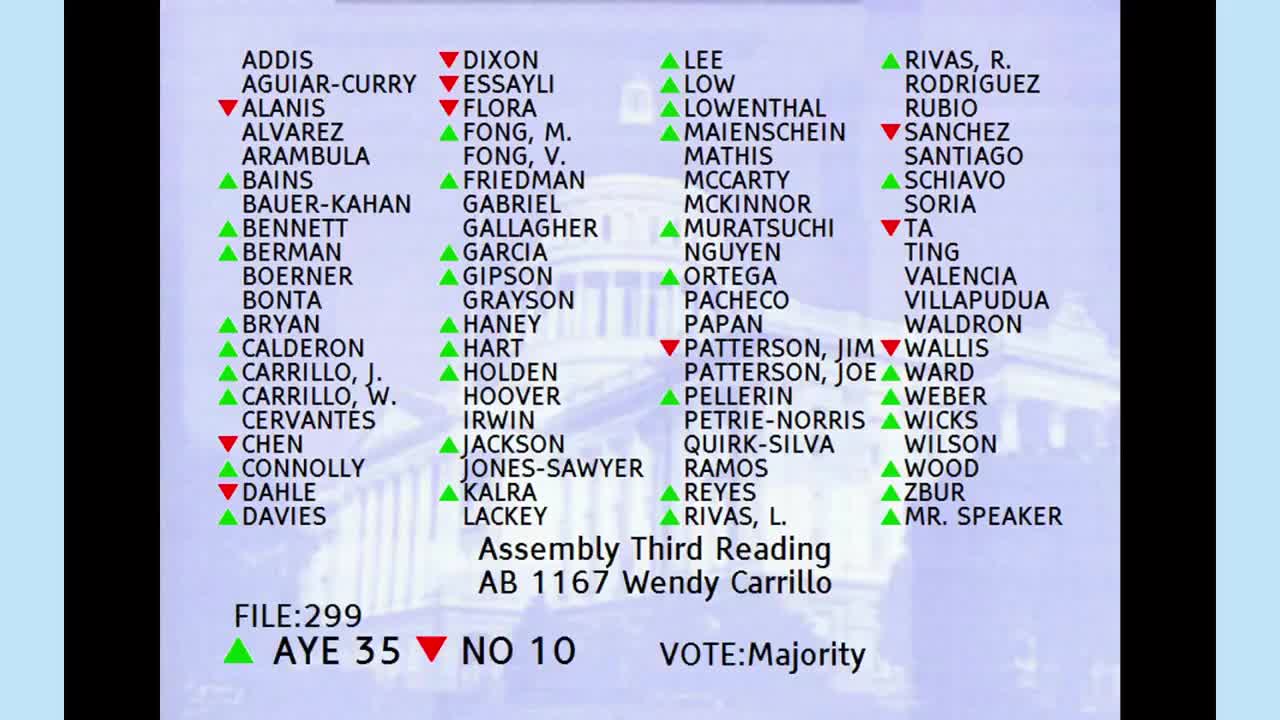 1MIN
Assembly Floor
Bill Author

Bill Co-Author(s):