AB 1279: California Conservation Corps: contracts: community conservation corps.
- Session Year: 2023-2024
- House: Assembly
- Latest Version Date: 2023-09-01
Current Status:
Passed
(2023-09-01: Chaptered by Secretary of State - Chapter 139, Statutes of 2023.)
Introduced
In Committee
First Chamber
In Committee
Second Chamber
Enacted
Existing law establishes the California Conservation Corps in the Natural Resources Agency. Existing law, until January 1, 2024, authorizes the corps to enter into a contract with an individual or collective of certified community conservation corps for a project or program that furthers certain purposes of the corps and consists of one or more specified types of projects, programs, or services, including natural resources and land management projects. Existing law requires the corps to file a report on the success of any such program or project with the Legislature, as provided, before January 1, 2023.
This bill would extend the authorization for the corps to enter into these contracts with certified community conservation corps indefinitely. The bill would require the corps, on or before January 1, 2025, January 1, 2027, and January 1, 2029, to file a report with the appropriate committees of the Legislature on the outcomes of any program or project, as provided.
Existing law establishes the California Conservation Corps in the Natural Resources Agency. Existing law, until January 1, 2024, authorizes the California Conservation Corps to enter into a contract with an individual or collective of certified community conservation corps for a project or program that furthers certain purposes of the California Conservation Corps and consists of one or more specified types of projects, programs, or services, including natural resources and land management projects. Existing law requires the corps to file a report on the success of any such program or project with the Legislature, as provided, before January 1, 2023.
This bill would extend the authorization for the California Conservation Corps to enter into these contracts with certified community conservation corps indefinitely, and would repeal language that required the California Conservation Corps to file a report with the Legislature on or before January 1, 2023, on the success of any project or program undertaken pursuant to the contracts. indefinitely. The bill would require the corps, on or before January 1, 2025, January 1, 2027, and January 1, 2029, to file a report with the appropriate committees of the Legislature on the outcomes of any program or project, as provided.
Existing law establishes the California Conservation Corps in the Natural Resources Agency. Existing law, until January 1, 2024, authorizes the California Conservation Corps to enter into a contract with an individual or collective of certified community conservation corps for a project or program that furthers certain purposes of the California Conservation Corps and consists of one or more specified types of projects, programs, or services, including natural resources and land management projects.
This bill would extend the authorization for the California Conservation Corps to enter into these contracts with certified community conservation corps indefinitely, and would repeal language that required the California Conservation Corps to file a report with the Legislature on or before January 1, 2023, on the success of any project or program undertaken pursuant to the contracts.
(a)The corps may enter into a contract with an individual or collective of community conservation corps certified pursuant to Section 14507.5 for a project or program that is in furtherance of Section 14000 and that consists of one or more of the following:
(1)Natural resources and land management projects.
(2)Energy and climate programs.
(3)Emergency response services.
(4)Educational, programming, and training services.
(5)Corpsmember services.
(6)Ancillary services.
(b)The director may establish guidelines for purposes of this section. If the director establishes guidelines for purposes of this section, a contract entered into pursuant to subdivision (a) shall adhere to those guidelines.
(c)(1)On or before January 1, 2025, January 1, 2027, and January 1, 2029, the corps shall file a report with the appropriate committees of the Legislature on the outcomes of any program or project undertaken pursuant to this section. A report filed pursuant to this subdivision shall focus on the previous two calendar years.
(2)The requirement to file a report pursuant to paragraph (1) is inoperative on January 1, 2033, pursuant to Section 10231.5 of the Government Code.
(a)The corps may enter into a contract with an individual or collective of community conservation corps certified pursuant to Section 14507.5 for a project or program that is in furtherance of Section 14000 and that consists of one or more of the following:
(1)Natural resources and land management projects.
(2)Energy and climate programs.
(3)Emergency response services.
(4)Educational, programming, and training services.
(5)Corpsmember services.
(6)Ancillary services.
(b)The director may establish guidelines for purposes of this section. If the director establishes guidelines for purposes of this section, a contract entered into pursuant to subdivision (a) shall adhere to those guidelines.
(c)The corps shall file a report on the success of any program or project undertaken pursuant to this section with the Legislature in compliance with Section 9795 of the Government Code before January 1, 2023.(d)This section shall remain in effect only until January 1, 2024, and as of that date is repealed.|
Date
|
Status
|
|---|---|
| Sep 1, 2023 | Chaptered by Secretary of State - Chapter 139, Statutes of 2023. |
| Sep 1, 2023 | Approved by the Governor. |
| Aug 29, 2023 | Enrolled and presented to the Governor at 11:30 a.m. |
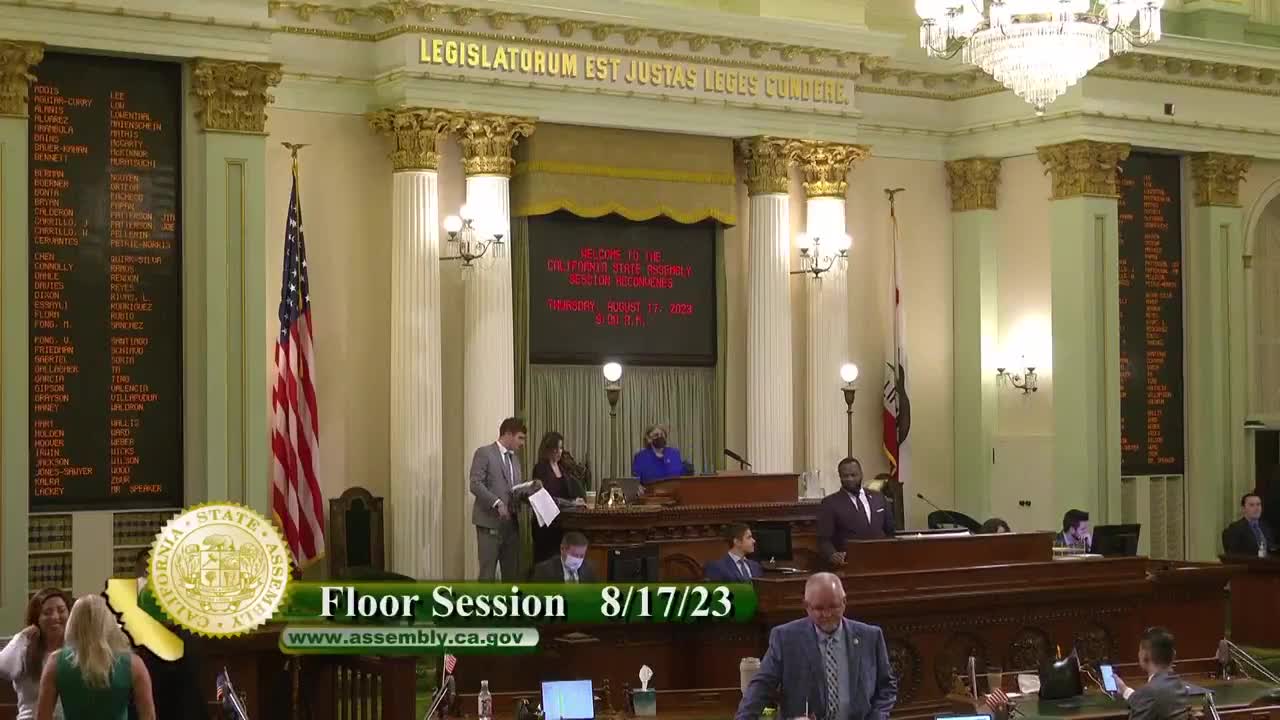
| Aug 17, 2023 | Senate amendments concurred in. To Engrossing and Enrolling. (Ayes 76. Noes 0. Page 2735.). |
| Jul 13, 2023 | In Assembly. Concurrence in Senate amendments pending. May be considered on or after August 11 pursuant to Assembly Rule 77. |
| Jul 13, 2023 | Read third time. Passed. Ordered to the Assembly. (Ayes 37. Noes 0. Page 2039.). |
| Jul 11, 2023 | Read second time. Ordered to Consent Calendar. |
| Jul 10, 2023 | From committee: Be ordered to second reading file pursuant to Senate Rule 28.8 and ordered to Consent Calendar. |
| Jun 26, 2023 | Read second time and amended. Re-referred to Com. on APPR. |
| Jun 22, 2023 | From committee: Amend, and do pass as amended and re-refer to Com. on APPR with recommendation: To Consent Calendar. (Ayes 11. Noes 0.) (June 22). |
| Jun 7, 2023 | In committee: Hearing postponed by committee. |
| May 10, 2023 | Referred to Com. on N.R. & W. |
| Apr 27, 2023 | In Senate. Read first time. To Com. on RLS. for assignment. |
| Apr 27, 2023 | Read third time. Passed. Ordered to the Senate. (Ayes 79. Noes 0. Page 1366.) |
| Apr 20, 2023 | Read second time. Ordered to Consent Calendar. |
| Apr 19, 2023 | From committee: Do pass. To Consent Calendar. (Ayes 14. Noes 0.) (April 19). |
| Mar 28, 2023 | From committee: Do pass and re-refer to Com. on APPR. with recommendation: To Consent Calendar. (Ayes 11. Noes 0.) (March 27). Re-referred to Com. on APPR. |
| Mar 2, 2023 | Referred to Com. on NAT. RES. |
| Feb 17, 2023 | From printer. May be heard in committee March 19. |
| Feb 16, 2023 | Read first time. To print. |
|
Date
|
Description
|
Location
|
Votes
|
|
|---|---|---|---|---|
| Aug 17, 2023 | AB 1279 Mike Fong Concurrence in Senate Amendments | Assembly Floor |
Passed |
|
| Jul 13, 2023 | Consent Calendar AB1279 Mike Fong et al. | Senate Floor |
Passed |
|
| Jun 22, 2023 | Do pass as amended, but first amend, and re-refer to the Committee on [Appropriations] with the recommendation: To Consent Calendar | Senate Standing Committee on Natural Resources and Water |
Passed |
|
| Apr 27, 2023 | AB 1279 Mike Fong Consent Calendar Second Day Regular Session | Assembly Floor |
Passed |
|
| Apr 19, 2023 | Do pass. To Consent Calendar. | Assembly Standing Committee on Appropriations |
Passed |
|
| Mar 27, 2023 | Do pass and be re-referred to the Committee on [Appropriations] with recommendation: To Consent Calendar | Assembly Standing Committee on Natural Resources |
Passed |
This list shows positions taken on this bill by organizations on the date displayed, which is linked to the original source.
Positions by individuals are not included.
|
Organization
|
Position
|
Date
|
|---|---|---|
| California Association Of Local Conservation Corps | ** Support | |
| Service Year Alliance | ** Support |
CONCURRENCE IN SENATE AMENDMENTS
CSA1 Bill Id:AB 1279
Author:(Mike Fong and McCarty)
As Amended Ver:June 26, 2023
Majority vote
SUMMARY
Extends the authorization for the California Conservation Corps (CCC) to enter into contracts with certified community conservation corps indefinitely.
Senate Amendments
Require the CCC, on or before January 1, 2025, January 1, 2027, and January 1, 2029, to file a report with the appropriate committees of the Legislature on the outcomes of any program or project, as provided.
COMMENTS
The CCC, established by Governor Jerry Brown during his first term in 1976, is the oldest and largest state conservation corps program in the country. It's modeled after the 1930s Civilian Conservation Corps.
Local Conservation Corps (LCCs) are non-profit or local government entities that share a similar mission as the CCC, by providing job skills training and educational opportunities while preserving and protecting the environment. The CCC has a long history of working collaboratively with LCCs through the state certification program and CCC grant programs.
The CCC certifies LCCs to ensure they are meeting statutory requirements and to make them eligible for CCC and other state grant funds. Annual certification by the CCC provides LCCs recognition that they are operating according to mandatory statutes and fulfilling the mission of what it means to be a conservation corps program.
Current law, enacted pursuant to AB 1928 (McCarty), Chapter 253, Statutes of 2018, sunsets the authorization for the CCC to enter into a contract with a LCC on January 1, 2024. This bill removes the sunset in perpetuity.
According to the Author
AB 1279 will remove the sunset on the California Conservation Corps' authority to contract directly with certified community conservation corps on critical projects across the state. Over the past five years, this contracting authority has proven to be an important tool to provide support for the state's disaster response efforts and meaningful job training opportunities for underserved youth. AB 1279 will make this critical authority permanent, allowing community conservation corps to continue their work responding to emergencies, providing green workforce development opportunities, and building more resilient communities throughout California.
Arguments in Support
According to the California Association of Local Conservation Corps, "This bill would allow local corps to continue to partner with the CCC, not only on emergency response, but also on natural resources and land management projects, climate and energy programs, and other educational services by authorizing our ability to enter into direct agreements indefinitely. Currently, local corps are bound geographically to the areas that they serve. Renewing this authority would allow local corps to join forces with the CCC to quickly and efficiently provide services throughout the state following a natural disaster. Allowing this authority to expire would not only result in less opportunities to support youth workforce development and job opportunities but also decrease the number of available corpsmembers who can readily assist communities in need of support during a state emergency."
Arguments in Opposition
None on file
FISCAL COMMENTS
According to the Senate Appropriations Committee, the CCC anticipates no new costs as a result of this bill.
VOTES:
ASM NATURAL RESOURCES: 11-0-0
YES: Luz Rivas, Flora, Addis, Friedman, Hoover, Mathis, Muratsuchi, Pellerin, Ward, Wood, Zbur
ASM APPROPRIATIONS: 14-0-2
YES: Holden, Megan Dahle, Calderon, Wendy Carrillo, Dixon, Mike Fong, Hart, Lowenthal, Mathis, Papan, Robert Rivas, Sanchez, Weber, Wilson
ABS, ABST OR NV: Bryan, Pellerin
ASSEMBLY FLOOR: 79-0-1
YES: Addis, Aguiar-Curry, Alanis, Alvarez, Arambula, Bains, Bauer-Kahan, Bennett, Berman, Boerner, Bonta, Bryan, Calderon, Juan Carrillo, Wendy Carrillo, Cervantes, Chen, Connolly, Megan Dahle, Davies, Dixon, Essayli, Flora, Mike Fong, Vince Fong, Friedman, Gabriel, Gallagher, Garcia, Gipson, Grayson, Haney, Hart, Holden, Hoover, Irwin, Jackson, Jones‑Sawyer, Kalra, Lackey, Lee, Low, Lowenthal, Maienschein, Mathis, McCarty, McKinnor, Muratsuchi, Stephanie Nguyen, Ortega, Pacheco, Papan, Joe Patterson, Pellerin, Petrie-Norris, Quirk-Silva, Ramos, Reyes, Luz Rivas, Robert Rivas, Rodriguez, Blanca Rubio, Sanchez, Santiago, Schiavo, Soria, Ta, Ting, Valencia, Villapudua, Waldron, Wallis, Ward, Weber, Wicks, Wilson, Wood, Zbur, Rendon
ABS, ABST OR NV: Jim Patterson
SENATE FLOOR: 37-0-3
YES: Allen, Alvarado-Gil, Archuleta, Ashby, Atkins, Becker, Blakespear, Bradford, Caballero, Cortese, Dahle, Durazo, Eggman, Glazer, Gonzalez, Hurtado, Jones, Laird, Limón, McGuire, Menjivar, Min, Newman, Nguyen, Niello, Ochoa Bogh, Padilla, Roth, Rubio, Seyarto, Skinner, Smallwood-Cuevas, Stern, Umberg, Wahab, Wiener, Wilk
ABS, ABST OR NV: Dodd, Grove, Portantino
UPDATED
VERSION: June 26, 2023
CONSULTANT: Paige Brokaw / NAT. RES. / (916) 319-2092 FN: 0001211
SENATE RULES COMMITTEE Office of Senate Floor Analyses (916) 651-1520 Fax: (916) 327-4478 | AB 1279 |
CONSENT
Bill No: AB 1279
Author: Mike Fong (D) and McCarty (D)
Amended: 6/26/23 in Senate
Vote: 21
SENATE NATURAL RES. & WATER COMMITTEE: 11-0, 6/22/23
AYES: Min, Seyarto, Allen, Dahle, Grove, Hurtado, Laird, Limón, McGuire, Padilla, Stern
SENATE APPROPRIATIONS COMMITTEE: Senate Rule 28.8
ASSEMBLY FLOOR: 79-0, 4/27/23 (Consent) - See last page for vote
SUBJECT: California Conservation Corps: contracts: community conservation corps
SOURCE: California Association of Local Conservation Corps
DIGEST:
This bill makes permanent the California Conservation Corps’ authority to contract with community conservation corps for specified projects or programs.
ANALYSIS:
Existing law:
- Establishes the California Conservation Corps (CCC) in the California Natural Resources Agency (CNRA) under the control of a director to enroll young adults in the state’s corps program, which engages these young adults in various projects, including projects that conserve, maintain, improve, and develop natural resources in both urban and rural areas. Public Resources Code (PRC) §§14001, 14300, and 14301.
- Provides for the formation of community conservation corps (local corps), defined to mean a nonprofit public benefit corporation, as defined, or an agency operated by a city, county, or city and county, that is certified by the CCC as meeting specified criteria. PRC §14507.5.
- Authorizes, through January 1, 2024, the CCC to enter into a contract with local corps for a project or program that furthers specified objectives for California youth and that consists of one or more of the following:
- Natural resources and land management projects
- Energy and climate programs
- Emergency response services
- Educational, programming, and training services
- Corpsmember services
- Ancillary services
Requires the CCC to file a report on the success of any program or project undertaken pursuant to this authority with the Legislature, as specified, before January 1, 2023. PRC §14318.
This bill makes permanent the CCC’s authority to contract with local corps for specified projects or programs. Further, this bill requires CCC, on or before January 1, 2025, January 1, 2027, and January 1, 2029, to file a report with the appropriate committees of the Legislature on the outcomes of any program or project undertaken pursuant to this authority, as specified.
Background
California Conservation Corps. The CCC, established by Governor Jerry Brown during his first term in 1976, is the oldest and largest state conservation corps program in the country. It is modeled after the 1930s Civilian Conservation Corps. The CCC’s motto is “Hard work, low pay, miserable conditions ... and more!” The CCC has provided more than 74 million hours of natural resource work, such as trail restoration, tree planting, habitat restoration, and more than 11.3 million hour of work on emergency response – fires, floods, and earthquakes — since 1976.
Although the CCC was originally conceived as a labor source for trail maintenance and restoration, it has since evolved to a workforce development program. Corpsmembers now learn skills such as, forestry management, energy auditing and installation, emergency services management, and firefighting. Many corpsmembers also receive their high school diplomas and industry certifications at the conclusion of their service.
The CCC is designed as a one-year program, with the possibility of extension to up to three years pending performance of the corpsmember. More than 120,000 young people have participated in the CCC over the last 40 years. There are more than 1,623 corpsmember positions available at 26 centers statewide; nine of the centers are residential with 600 beds.
Local Corps are non-profit or local government entities that share a similar mission as the CCC to preserve and protect the environment, and provide job skills training and educational opportunities to young men and women, primarily between the ages of 18-26. While the CCC generally works in more remote areas, the local corps often work in urban areas, near corpsmembers’ homes. This provides a critical opportunity to at-risk young people with family responsibilities, especially young single parents.
There are 14 state-certified local corps in California, each of which is an individual nonprofit organization serving its local region. As community-based organizations, the local corps engage young adults in service projects addressing recreation, conservation, disaster response, and community needs. Through a term of service that could last from a few months to a year, corpsmembers gain a high school diploma or GED, life skills, paid work experience, and job training. Each local corps works with or operates a charter school to provide educational services and help corpsmembers connect to college and vocational education programs.
The CCC has a long history of working collaboratively with local corps through its local corps certification program and CCC grant programs. The CCC certifies local corps to ensure they are meeting statutory requirements and to make them eligible for CCC and other state funding opportunities. Annual certification by the CCC provides local corps with recognition that they are operating according to mandatory statutes and fulfilling the mission of what it means to be a conservation corps program. AB 1928 (McCarty, Chapter 253, Statutes of 2018) also authorized the CCC to contract with local corps on projects and programs through January 1, 2024.
Comments
Sunset removal. In 2018, AB 1928 (McCarty, Chapter 253, Statutes of 2018) authorized the CCC to enter into contracts with local corps on projects or programs that further the goals of the CCC. This authority will sunset on January 1, 2024. This bill eliminates the sunset to make this authority permanent, which, according to the author, “will benefit our local communities by expanding job training opportunities for underserved youth, providing resources to assist with emergency response efforts in under-resourced communities, and maintaining programs that offer critical support for the environment.”
Outcomes. Existing law requires the CCC to file a report on the success of any program or project undertaken pursuant to the contracting authority with the Legislature, as specified, before January 1, 2023. The CCC submitted this report in 2023, reporting that the authority facilitated the CCC’s ability to explore and develop projects and programs with certified local corps. In particular, the CCC used the authority twice, noting that the pandemic and other minor issues limited its use in the last few years. That said, the CCC identified no negative impacts from the authority and instead found it to be a useful tool, especially in emergency situations, to efficiently design and facilitate novel, coordinated, programs and partnerships between the CCC and local corps.
For example, the pandemic provided the impetus for a contract with the San Jose Conservation Corps and Charter School (SJCC) that allowed the CCC and several local corps to jointly support the operations of a Bay Area food bank. In particular, during the early days of the pandemic, the CCC had been called upon to provide corpsmember crews to help meet the operational demands of food banks. However, the CCC was stretched thin by other emergency response demands and the impact of COVID outbreaks among its crews. The CCC contracted and coordinated with SJCC to ensure that the Silicon Valley Food Bank continued operations without disruption. Later, SJCC brought in five other local corps to provide further assistance. In total, local corps completed 96,785 hours of food boxing through this collaboration, assembled hundreds of thousands of food boxes for the community, and helped feed 500,000 community members a month.
Reporting requirement. Existing law sunsets the CCC’s reporting requirement for this authority on January 1, 2023. Given that this authority is still somewhat new and that it has not been used extensively, this bill instead requires the CCC to submit three biennial reports on the outcomes of this authority to facilitate additional review and oversight.
Related/Prior Legislation
AB 1928 (McCarty, Chapter 253, Statutes of 2018) authorized the CCC, through January 1, 2024, to enter into contracts with local corps on projects or programs that further the goals of the CCC.
FISCAL EFFECT: Appropriation: No Fiscal Com.: Yes Local: No
SUPPORT: (Verified 7/10/23)
California Association of Local Conservation Corps (source)
Service Year Alliance
OPPOSITION: (Verified 7/10/23)
None received
ARGUMENTS IN SUPPORT: According to the author, “AB 1279 will remove the sunset on the California Conservation Corps’ authority to contract directly with [local corps] on critical projects across the state. Over the past five years, this contracting authority has proven to be an important tool to provide support for the state’s disaster response efforts and meaningful job training opportunities for underserved youth. AB 1279 will make this critical authority permanent, allowing [local corps] to continue their work responding to emergencies, providing green workforce development opportunities, and building more resilient communities throughout California.”
According to the sponsor, the California Association of Local Conservation Corps, “The ability for the CCC to contract with local corps is currently authorized via existing law, however, it is set to expire at the beginning of next year. Before this legislation was first enacted, there was confusion about whether the CCC could enter into direct agreements. This resulted in delays and at times prevented local corps from responding to emergencies in their communities. This bill would permanently delete that sunset to ensure that local corps and the CCC can continue to enter into direct agreements to perform this critical work. Allowing this authority to expire would not only result in less opportunities to support youth workforce development and job opportunities, it would mean less boots-on-the-ground readily available to assist communities in need of support after an emergency.
“AB 1279 will enable [local corps] located in communities throughout California to respond immediately to the needs of the state. It’s been nearly five years since this statute was first enacted and in this time it has proven to be a vital tool to increase green workforce development opportunities to young adults, provide swift emergency support, and build more resilient communities across California.”
ASSEMBLY FLOOR: 79-0, 4/27/23
AYES: Addis, Aguiar-Curry, Alanis, Alvarez, Arambula, Bains, Bauer-Kahan, Bennett, Berman, Boerner, Bonta, Bryan, Calderon, Juan Carrillo, Wendy Carrillo, Cervantes, Chen, Connolly, Megan Dahle, Davies, Dixon, Essayli, Flora, Mike Fong, Vince Fong, Friedman, Gabriel, Gallagher, Garcia, Gipson, Grayson, Haney, Hart, Holden, Hoover, Irwin, Jackson, Jones-Sawyer, Kalra, Lackey, Lee, Low, Lowenthal, Maienschein, Mathis, McCarty, McKinnor, Muratsuchi, Stephanie Nguyen, Ortega, Pacheco, Papan, Joe Patterson, Pellerin, Petrie-Norris, Quirk-Silva, Ramos, Reyes, Luz Rivas, Robert Rivas, Rodriguez, Blanca Rubio, Sanchez, Santiago, Schiavo, Soria, Ta, Ting, Valencia, Villapudua, Waldron, Wallis, Ward, Weber, Wicks, Wilson, Wood, Zbur, Rendon
NO VOTE RECORDED: Jim Patterson
Prepared by: Catherine Baxter / N.R. & W. / (916) 651-4116
7/12/23 16:03:29
**** END ****
SENATE COMMITTEE ON NATURAL RESOURCES AND WATER
Senator Dave Min, Chair
2023 - 2024 Regular
Bill No: AB Hearing Date: June 22, 2023
Author: | Mike Fong | ||
Version: | February 16, 2023 Introduced | ||
Urgency: | No | Fiscal: | Yes |
Consultant: | Catherine Baxter | ||
Subject: California Conservation Corps: contracts: community conservation corps
BACKGROUND AND EXISTING LAW
Existing law:
- Establishes the California Conservation Corps (CCC) in the California Natural Resources Agency (CNRA) under the control of a director to enroll young adults in the state’s corps program, which engages these young adults in various projects, including projects that conserve, maintain, improve, and develop natural resources in both urban and rural areas. Public Resources Code (PRC) §§14001, 14300, and 14301.
- Provides for the formation of community conservation corps (local corps), defined to mean a nonprofit public benefit corporation, as defined, or an agency operated by a city, county, or city and county, that is certified by the CCC as meeting specified criteria. PRC §14507.5.
- Authorizes, through January 1, 2024, the CCC to enter into a contract with local corps for a project or program that furthers specified objectives for California youth and that consists of one or more of the following:
- Natural resources and land management projects.
- Energy and climate programs.
- Emergency response services.
- Educational, programming, and training services.
- Corpsmember services.
- Ancillary services.
Further, requires the CCC to file a report on the success of any program or project undertaken pursuant to this authority with the Legislature, as specified, before January 1, 2023. PRC §14318.
Background
California Conservation Corps. The CCC, established by Governor Jerry Brown during his first term in 1976, is the oldest and largest state conservation corps program in the country. It is modeled after the 1930s Civilian Conservation Corps. The CCC’s motto is “Hard work, low pay, miserable conditions ... and more!” The CCC has provided more than 74 million hours of natural resource work, such as trail restoration, tree planting, habitat restoration, and more than 11.3 million hour of work on emergency response – fires, floods, and earthquakes — since 1976.
Although the CCC was originally conceived as a labor source for trail maintenance and restoration, it has since evolved to a workforce development program. Corpsmembers now learn skills such as, forestry management, energy auditing and installation, emergency services management, and firefighting. Many corpsmembers also receive their high school diplomas and industry certifications at the conclusion of their service.
The CCC is designed as a one-year program, with the possibility of extension to up to three years pending performance of the corpsmember. More than 120,000 young people have participated in the CCC over the last 40 years. There are more than 1,623 corpsmember positions available at 26 centers statewide; nine of the centers are residential with 600 beds.
Local Corps are non-profit or local government entities that share a similar mission as the CCC to preserve and protect the environment and provide job skills training and educational opportunities to young men and women, primarily ages 18-26. While the CCC generally works in more remote areas, the local corps often work in urban areas, near corpsmembers’ homes. This provides a critical opportunity to at-risk young people with family responsibilities, especially young single parents.
There are 14 state-certified local corps in California, each of which is an individual nonprofit organization serving its local region. As community-based organizations, the local corps engage young adults in service projects addressing recreation, conservation, disaster response, and community needs. Through a term of service that could last from a few months to a year, corps members gain a high school diploma or GED, life skills, paid work experience, and job training. Each local corps works with or operates a charter school to provide educational services and help corps members connect to college and vocational education programs.
The CCC has a long history of working collaboratively with local corps through its local corps certification program and CCC grant programs. The CCC certifies local corps to ensure they are meeting statutory requirements and to make them eligible for CCC and other state funding opportunities. Annual certification by the CCC provides local corps with recognition that they are operating according to mandatory statutes and fulfilling the mission of what it means to be a conservation corps program. AB 1928 (McCarty, Chapter 253, Statutes of 2018) also authorized the CCC to contract with local corps on projects and programs through January 1, 2024.
PROPOSED LAW
This bill would make permanent the CCC’s authority to contract with local corps for specified projects or programs. Further, this bill would repeal language that required the CCC to file a report on the success of any program or project with the Legislature by January 1, 2023.
ARGUMENTS IN SUPPORT
According to the author, “AB 1279 will remove the sunset on the California Conservation Corps’ authority to contract directly with [local corps] on critical projects across the state. Over the past five years, this contracting authority has proven to be an important tool to provide support for the state’s disaster response efforts and meaningful job training opportunities for underserved youth. AB 1279 will make this critical authority permanent, allowing [local corps] to continue their work responding to emergencies, providing green workforce development opportunities, and building more resilient communities throughout California.”
According to the sponsor, the California Association of Local Conservation Corps, “The ability for the CCC to contract with local corps is currently authorized via existing law, however, it is set to expire at the beginning of next year. Before this legislation was first enacted, there was confusion about whether the CCC could enter into direct agreements. This resulted in delays and at times prevented local corps from responding to emergencies in their communities. This bill would permanently delete that sunset to ensure that local corps and the CCC can continue to enter into direct agreements to perform this critical work. Allowing this authority to expire would not only result in less opportunities to support youth workforce development and job opportunities, it would mean less boots-on-the-ground readily available to assist communities in need of support after an emergency.
AB 1279 will enable [local corps] located in communities throughout California to respond immediately to the needs of the state. It’s been nearly five years since this statute was first enacted and in this time it has proven to be a vital tool to increase green workforce development opportunities to young adults, provide swift emergency support, and build more resilient communities across California.”
ARGUMENTS IN OPPOSITION
None received.
COMMENTS
Sunset removal. In 2018, AB 1928 (McCarty) authorized the CCC to enter into contracts with local corps on projects or programs that further the goals of the CCC. This authority will sunset on January 1, 2024. This bill would eliminate the sunset to make this authority permanent, which, according to the author, “will benefit our local communities by expanding job training opportunities for underserved youth, providing resources to assist with emergency response efforts in under-resourced communities, and maintaining programs that offer critical support for the environment.”
Outcomes. Existing law requires the CCC to file a report on the success of any program or project undertaken pursuant to the contracting authority with the Legislature, as specified, before January 1, 2023. The CCC submitted this report in 2023, reporting that the authority facilitated the CCC’s ability to explore and develop projects and programs with certified local corps. In particular, the CCC used the authority twice, noting that the pandemic and other minor issues limited its use in the last few years. That said, the CCC identified no negative impacts from the authority and instead found it to be a useful tool, especially in emergency situations, to efficiently design and facilitate novel, coordinated, programs and partnerships between the CCC and local corps.
For example, the pandemic provided the impetus for a contract with the San Jose Conservation Corps and Charter School (SJCC) that allowed the CCC and several local corps to jointly support the operations of a Bay Area food bank. In particular, during the early days of the pandemic, the CCC had been called upon to provide corpsmember crews to help meet the operational demands of food banks. However, the CCC was stretched thin by other emergency response demands and the impact of COVID outbreaks among its crews. The CCC contracted and coordinated with SJCC to ensure that the Silicon Valley Food Bank continued operations without disruption. Later, SJCC brought in five other local corps to provide further assistance. In total, local corps completed 96,785 hours of food boxing through this collaboration, assembled hundreds of thousands of food boxes for the community, and helped feed 500,000 community members a month.
Reporting requirement. Existing law sunsets the CCC’s reporting requirement for this authority on January 1, 2023. This bill would repeal that requirement. Given that this authority is still somewhat new and that it has not been used extensively, the Committee instead may wish to consider amending the bill to require the CCC to submit three biennial reports on the outcomes of this authority to facilitate additional review and oversight. See Amendments.
Previous legislation.
AB 1928 (McCarty, Chapter 253, Statutes of 2018) authorized the CCC, through January 1, 2024, to enter into contracts with local corps on projects or programs that further the goals of the CCC.
SUGGESTED AMENDMENTS
Amend Section 14318 of the Public Resources Code as follows:
14318. (a) The corps may enter into a contract with an individual or collective of community conservation corps certified pursuant to Section 14507.5 for a project or program that is in furtherance of Section 14000 and that consists of one or more of the following:
(1) Natural resources and land management projects.
(2) Energy and climate programs.
(3) Emergency response services.
(4) Educational, programming, and training services.
(5) Corpsmember services.
(6) Ancillary services.
(b) The director may establish guidelines for purposes of this section. If the director establishes guidelines for purposes of this section, a contract entered into pursuant to subdivision (a) shall adhere to those guidelines.
(c) The corps shall file a report on the outcomes of any program or project undertaken pursuant to this section with the appropriate committees of the Legislature in compliance with Section 9795 of the Government Code on January 1, 2025, January 1, 2027, and January 1, 2029. Each report shall focus on the prior two calendar years.
SUPPORT
California Association of Local Conservation Corps (sponsor)
OPPOSITION
None received
-- END --
Date of Hearing: April 19, 2023
ASSEMBLY COMMITTEE ON APPROPRIATIONS
Chris Holden, Chair
ABPCA Bill Id:AB 1279
Author:(Mike Fong) – As Introduced Ver:February 16, 2023
Policy Committee: | Natural Resources | Vote: | 11 - 0 |
|
| ||
|
|
Urgency: No State Mandated Local Program: No Reimbursable: No
SUMMARY:
This bill extends authorization for the California Conservation Corps (CCC) to enter into contracts with certified local conservation corps (LCCs) indefinitely. In addition, this bill repeals language that requires the CCC to, or before January 1, 2023, submit a report to the Legislature on the success of any project or program undertaken pursuant to the contracts.
FISCAL EFFECT:
CCC anticipates no new costs as a result of this bill. CCC notes while there could be an impact to staff capacity to perform the contracting duties, CCC would build any funding needed for additional staff into its contracts with the LCCs.
COMMENTS:
1) Purpose. According to the author:
AB 1279 will remove the sunset on the California Conservation Corps’ authority to contract directly with certified community conservation corps on critical projects across the state. Over the past five years, this contracting authority has proven to be an important tool to provide support for the state’s disaster response efforts and meaningful job training opportunities for underserved youth. AB 1279 will make this critical authority permanent, allowing community conservation corps to continue their work responding to emergencies, providing green workforce development opportunities, and building more resilient communities throughout California
2) California Conservation Corps (CCC). The CCC, established in 1976, is the oldest and largest state conservation corps program in the country. Its 120,000 members have provided more than 74 million hours of natural resource work and more than 11.3 million hours of emergency response work since its founding. Although the CCC was originally conceived as a labor source for trail maintenance and restoration, it has since evolved into a workforce development program. Corpsmembers now learn various skills during the program and receive their high school diplomas and industry certifications at the conclusion of their service.
3) Local Conservation Corps (LCCs). LCCs are nonprofit or local government entities that are certified by and have a similar mission as the CCC. LCCs provide job skills training and educational opportunities to young people, primarily ages 18 through 26, while preserving and protecting the environment. There are 14 state-certified LCCs in California, each of which is an individual nonprofit organization serving its local region. The CCC certifies LCCs to ensure they are meeting statutory requirements and to make them eligible for CCC and other state grant funds.
Current law sunsets on January 1, 2024, authorization for the CCC to enter into a contract with an LCC. This bill removes this sunset. Current law also requires the director of the CCC to file a report on the success of any program or project undertaken through these contracts. According to CCC, this report is complete but pending final review before public release. According to the CCC, an example of a successful project is the food boxing support corpsmembers from the San Jose Conservation Corps provided to the Second Harvest of Silicon Valley food bank from August 2020 to March 2021. Corpsmembers completed over 96,000 hours of food boxing and assisted the community during the peak of the COVID-19 pandemic.
4) Funding. Public Resources Code section 17001(b) requires the California Department of Resources Recycling and Recovery (CalRecycle), upon appropriation by the Legislature, to expend, every fiscal year, $8 million from the Electronic Waste Recovery and Recycling Account, $5 million from the California Tire Recycling Management Fund, and $2 million from the California Used Oil Recycling Fund, for grants to LCCs for specified purposes. In addition, the LCCs receive annual funding – with an annual cost-of-living-adjustment – from CalRecycle’s Beverage Container Recycling Fund. The LCCs received approximately $25.9 million from these four funds in fiscal year 2022-23. The LCCs have received support from other funding sources over the years, including general obligation bonds (for example, Propositions 68 and 84) and the General Fund.
The fiscal year 2022-23 budget established two new activities for the CCCs: (1) $36 million to support nature‑based work at the 14 LCCs and (2) $13 million to establish the new Tribal NBS Corps and provide related administrative support. In response to a multibillion dollar budget problem facing the state, the Governor’s January budget for fiscal year 2023-24 proposes reducing funding for the first by $24 million (retaining $12 million) and leaving funding for the second unaffected.
Analysis Prepared by: Nikita Koraddi / APPR. / (916) 319-2081
Date of Hearing: March 27, 2023
ASSEMBLY COMMITTEE ON NATURAL RESOURCES
Luz Rivas, Chair
ABPCA Bill Id:AB 1279 (
Author:Mike Fong) – As Introduced Ver:February 16, 2023
SUBJECT: California Conservation Corps: contracts: community conservation corps.
SUMMARY: Extends the authorization for the California Conservation Corps (CCC) to enter into contracts with certified community conservation corps indefinitely, and would repeal language that required the CCC to file a report with the Legislature on or before January 1, 2023, on the success of any project or program undertaken pursuant to the contracts.
EXISTING LAW, pursuant to the California Conservation Corps governing statutes (Public Resources Code §14000-14424)
- Establishes the CCC in the Natural Resources Agency (NRA) and requires the CCC to implement and administer the conservation corps program.
- Directs CCC program activities, including the management of environmentally important lands and water, public works projects, facilitating public use of resources, assistance in emergency operations, assistance in fire prevention and suppression, energy conservation, and environmental restoration.
- Finds and declares it is in the best interest of the state that federal funds designated to be expended by federal agencies for this purpose be allocated, to the extent feasible, to the CCC and certified community conservation corps.
- Defines a “Community Conservation Corps" (also known as a local conservation corps, or LCC) as a nonprofit public benefit corporation, or an agency operated by a city, county, or city and county, that is certified by the CCC as meeting all of the specified criteria.
- Authorizes the CCC, until January 1, 2024, to enter into a contract with an individual or collective of certified community conservation corps for a specified type of project or program.
FISCAL EFFECT: Unknown.
COMMENTS:
- California Conservation Corps. The CCC, established by Governor Jerry Brown during his first term in 1976, is the oldest and largest state conservation corps program in the country. It's modeled after the 1930s Civilian Conservation Corps. The CCC’s motto is “Hard work, low pay, miserable conditions ... and more!” The CCC has provided more than 74 million hours of natural resource work, such as trail restoration, tree planting, habitat restoration, and more than 11.3 million hour of work on emergency response – fires, floods, and earthquakes — since 1976.
Although the CCC was originally conceived as a labor source for trail maintenance and restoration, it has since evolved to a workforce development program. Corpsmembers now learn skills such as, forestry management, energy auditing and installation, emergency services management, and firefighting. Many corpsmembers also receive their high school diplomas and industry certifications at the conclusion of their service. The CCC is designed as a one-year program, with the possibility of extension to up to three years pending performance of the member. More than 120,000 young people have participated in the CCC over the last 40 years. There are more than 1,623 corpsmember positions available at 26 centers statewide; nine of the centers are residential with 600 beds for the corpsmembers assigned to them.
- Local Conservation Corps. LCCs are non-profit or local government entities that share a similar mission as the CCC, by providing job skills training and educational opportunities while preserving and protecting the environment. The CCC has a long history of working collaboratively with LCCs through the state certification program and CCC grant programs.
The CCC certifies LCCs to ensure they are meeting statutory requirements and to make them eligible for CCC and other state grant funds. Annual certification by the CCC provides LCCs recognition that they are operating according to mandatory statutes and fulfilling the mission of what it means to be a conservation corps program.
While the statewide CCC generally works in more remote areas, the LCCs work in urban areas, near corpsmembers’ homes. This provides a critical opportunity to at risk young people with family responsibilities, especially young single parents.
There are 14 state-certified LCCs in California, each of which is an individual nonprofit organization serving its local region. The mission of each LCC is to preserve and protect the environment and provide job skills training and educational opportunities to young men and women, primarily ages 18-26.
Each LCC works with or operates a charter school where corpsmembers can earn their high school diploma or GED and get connected to college and vocational education programs. Corpsmembers are paid stipends and often receive scholarships upon completing their term of service. LCCs provide workforce training, on the job experience, and valuable certifications to help corpsmembers move forward in their careers and provide local businesses with a skilled, diverse, and qualified workforce.
One quarter of all corpsmembers finish their high school diploma while in the Corps, and most graduates begin college. According to a 2014 economic analysis The Economic Benefits of Bottle Bill Funding of the Local Conservation Corps, while enrolled in the LCCs, each member receives education and job training that leads to $260 million in increased lifetime earnings for each year’s class for each $20 million investment in LCCs. Finally, as more productive members of society, public finances are improved due to higher tax contributions and decreased demand for public services, generating over $14 million in revenue and savings.
- Funding the LCCs. Since the first LCC’s inception in 1982 (with the Marin County Conservation Corps), the LCCs had traditionally been funded through a variety of sources, including a mix of state and federal grants, contracts with service recipients, direct fundraising and the California Beverage Container Recycling and Litter Reduction Act (Bottle Bill). As government budgets tightened after the recession, state and federal grants decreased, making the LCCs more dependent on Bottle Bill funding to remain solvent.
Early in the LCC’s history, the Bottle Bill was passed in 1986, which including funding for a number of projects that support recycling, including the LCCs. Bottle Bill funding had increased over the years, as additional LCCs have been formed and is indexed to cost of living.
In part due to the LCCs’ efforts, in 2014, California had the highest recycling rate in the nation, with 82% of CRV eligible products being recycled. As a result, however, the program was a victim of its own success; the high consumer participation and redeemed deposits left little funding leftover for recycling programs, including the LCCs.
At the time, Bottle Bill funds were the bread and butter of the LCC’s budget, representing 75% of the LCC’s funding portfolio, and as a result of the reliance of the Bottle Bill funds, the LCCs had invested substantially in capital equipment needed for recycling, that would become obsolete without recycling-related funding.
In response, the LCCs underwent a metamorphosis to make themselves eligible for alternative state funding sources unrelated to beverage container recycling and expanded the skills training opportunities for their corpsmembers.
In order to stabilize the LCCs’ funding, the Legislature allocated additional funds from the Electronic Waste Recovery and Recycling Account, the California Tire Recycling Management Fund, and the California Used Oil Recycling Fund for activities related to each funding source, including beverage container recycling and litter abatement programs; programs relating to the collection and recovery of used oil and electronic waste; and, the clean-up and abatement of waste tires.
The LCCs have proven their ability to evolve and adapt to changing funding sources and expansions of their job skills training, which makes them a valuable partner to the CCC.
- Sunset extension. Current law, enacted pursuant to AB 1928 (McCarty, Chapter 253, Statutes of 2018), sunsets the authorization for the CCC to enter into a contract with a LCC on January 1, 2024. That bill required the director of the CCC to file a report on the success of any program or project undertaken through those contracts.
That report is complete, but pending review in the Governor’s office.
According to the author,
“AB 1279 will remove the sunset on the California Conservation Corps’ authority to contract directly with certified community conservation corps on critical projects across the state. Over the past five years, this contracting authority has proven to be an important tool to provide support for the state’s disaster response efforts and meaningful job training opportunities for underserved youth. AB 1279 will make this critical authority permanent, allowing community conservation corps to continue their work responding to emergencies, providing green workforce development opportunities, and building more resilient communities throughout California.”
REGISTERED SUPPORT / OPPOSITION:
Support
California Association of Local Conservation Corps
Opposition
None on file.
Analysis Prepared by: Paige Brokaw / NAT. RES. /

Bill Co-Author(s):