AB 1380: Crimes: disorderly conduct.
- Session Year: 2023-2024
- House: Assembly
- Latest Version Date: 2023-02-17
Current Status:
Failed
(2024-02-01: From committee: Filed with the Chief Clerk pursuant to Joint Rule 56.)
Introduced
In Committee
First Chamber
In Committee
Second Chamber
Enacted
Existing law defines specified behavior as disorderly conduct and prohibits that behavior. Under existing law, disorderly conduct includes, among other things, soliciting prostitution, prowling, peeping, surreptitious photographing or filming of an identifiable person, and the distribution of certain images of another person taken under circumstances in which the person understands that the image shall remain private, the distribution of which causes serious emotional distress.
This bill would add to the definition of disorderly conduct the distribution of those images recorded, captured, or otherwise obtained without the authorization of the person depicted or by exceeding authorized access from the property, accounts, messages, files, or resources of the person depicted. Because the bill would expand the scope of a crime, it would establish a state-mandated local program.
The California Constitution requires the state to reimburse local agencies and school districts for certain costs mandated by the state. Statutory provisions establish procedures for making that reimbursement.
This bill would provide that no reimbursement is required by this act for a specified reason.
Except as provided in paragraph (5) of subdivision (b) and subdivision (k), every person who commits any of the following acts is guilty of disorderly conduct, a misdemeanor:
(a)An individual who solicits anyone to engage in or who engages in lewd or dissolute conduct in any public place or in any place open to the public or exposed to public view.
(b)(1)An individual who solicits, or who agrees to engage in, or who engages in, any act of prostitution with the intent to receive compensation, money, or anything of value from another person. An individual agrees to engage in an act of prostitution when, with specific intent to so engage, the individual manifests an acceptance of an offer or solicitation by another person to so engage, regardless of whether the offer or solicitation was made by a person who also possessed the specific intent to engage in an act of prostitution.
(2)An individual who solicits, or who agrees to engage in, or who engages in, any act of prostitution with another person who is 18 years of age or older in exchange for the individual providing compensation, money, or anything of value to the other person. An individual agrees to engage in an act of prostitution when, with specific intent to so engage, the individual manifests an acceptance of an offer or solicitation by another person who is 18 years of age or older to so engage, regardless of whether the offer or solicitation was made by a person who also possessed the specific intent to engage in an act of prostitution.
(3)An individual who solicits, or who agrees to engage in, or who engages in, any act of prostitution with another person who is a minor in exchange for the individual providing compensation, money, or anything of value to the minor. An individual agrees to engage in an act of prostitution when, with specific intent to so engage, the individual manifests an acceptance of an offer or solicitation by someone who is a minor to so engage, regardless of whether the offer or solicitation was made by a minor who also possessed the specific intent to engage in an act of prostitution.
(4)A manifestation of acceptance of an offer or solicitation to engage in an act of prostitution does not constitute a violation of this subdivision unless some act, in addition to the manifestation of acceptance, is done within this state in furtherance of the commission of the act of prostitution by the person manifesting an acceptance of an offer or solicitation to engage in that act. As used in this subdivision, prostitution includes any lewd act between persons for money or other consideration.
(5)Notwithstanding paragraphs (1) to (3), inclusive, this subdivision does not apply to a child under 18 years of age who is alleged to have engaged in conduct to receive money or other consideration that would, if committed by an adult, violate this subdivision. A commercially exploited child under this paragraph may be adjudged a dependent child of the court pursuant to paragraph (2) of subdivision (b) of Section 300 of the Welfare and Institutions Code and may be taken into temporary custody pursuant to subdivision (a) of Section 305 of the Welfare and Institutions Code, if the conditions allowing temporary custody without warrant are met.
(c)Who accosts other persons in any public place or in any place open to the public for the purpose of begging or soliciting alms.
(d)Who loiters in or about any toilet open to the public for the purpose of engaging in or soliciting any lewd or lascivious or any unlawful act.
(e)Who lodges in any building, structure, vehicle, or place, whether public or private, without the permission of the owner or person entitled to the possession or in control of it.
(f)Who is found in any public place under the influence of intoxicating liquor, any drug, controlled substance, toluene, or any combination of any intoxicating liquor, drug, controlled substance, or toluene, in a condition that they are unable to exercise care for their own safety or the safety of others, or by reason of being under the influence of intoxicating liquor, any drug, controlled substance, toluene, or any combination of any intoxicating liquor, drug, or toluene, interferes with or obstructs or prevents the free use of any street, sidewalk, or other public way.
(g)If a person has violated subdivision (f), a peace officer, if reasonably able to do so, shall place the person, or cause the person to be placed, in civil protective custody. The person shall be taken to a facility, designated pursuant to Section 5170 of the Welfare and Institutions Code, for the 72-hour treatment and evaluation of inebriates. A peace officer may place a person in civil protective custody with that kind and degree of force authorized to effect an arrest for a misdemeanor without a warrant. A person who has been placed in civil protective custody shall not thereafter be subject to any criminal prosecution or juvenile court proceeding based on the facts giving rise to this placement. This subdivision does not apply to the following persons:
(1)A person who is under the influence of any drug, or under the combined influence of intoxicating liquor and any drug.
(2)A person who a peace officer has probable cause to believe has committed any felony, or who has committed any misdemeanor in addition to subdivision (f).
(3)A person who a peace officer in good faith believes will attempt escape or will be unreasonably difficult for medical personnel to control.
(h)Who loiters, prowls, or wanders upon the private property of another, at any time, without visible or lawful business with the owner or occupant. As used in this subdivision, loiter means to delay or linger without a lawful purpose for being on the property and for the purpose of committing a crime as opportunity may be discovered.
(i)Who, while loitering, prowling, or wandering upon the private property of another, at any time, peeks in the door or window of any inhabited building or structure, without visible or lawful business with the owner or occupant.
(j)(1)A person who looks through a hole or opening, into, or otherwise views, by means of any instrumentality, including, but not limited to, a periscope, telescope, binoculars, camera, motion picture camera, camcorder, mobile phone, electronic device, or unmanned aircraft system, the interior of a bedroom, bathroom, changing room, fitting room, dressing room, or tanning booth, or the interior of any other area in which the occupant has a reasonable expectation of privacy, with the intent to invade the privacy of a person or persons inside. This subdivision does not apply to those areas of a private business used to count currency or other negotiable instruments.
(2)A person who uses a concealed camcorder, motion picture camera, or photographic camera of any type, to secretly videotape, film, photograph, or record by electronic means, another identifiable person under or through the clothing being worn by that other person, for the purpose of viewing the body of, or the undergarments worn by, that other person, without the consent or knowledge of that other person, with the intent to arouse, appeal to, or gratify the lust, passions, or sexual desires of that person and invade the privacy of that other person, under circumstances in which the other person has a reasonable expectation of privacy. For the purposes of this paragraph, identifiable means capable of identification, or capable of being recognized, meaning that someone, including the victim, could identify or recognize the victim. It does not require the victims identity to actually be established.
(3)(A)A person who uses a concealed camcorder, motion picture camera, or photographic camera of any type, to secretly videotape, film, photograph, or record by electronic means, another identifiable person who may be in a state of full or partial undress, for the purpose of viewing the body of, or the undergarments worn by, that other person, without the consent or knowledge of that other person, in the interior of a bedroom, bathroom, changing room, fitting room, dressing room, or tanning booth, or the interior of any other area in which that other person has a reasonable expectation of privacy, with the intent to invade the privacy of that other person. For the purposes of this paragraph, identifiable means capable of identification, or capable of being recognized, meaning that someone, including the victim, could identify or recognize the victim. It does not require the victims identity to actually be established.
(B)Neither of the following is a defense to the crime specified in this paragraph:
(i)The defendant was a cohabitant, landlord, tenant, cotenant, employer, employee, or business partner or associate of the victim, or an agent of any of these.
(ii)The victim was not in a state of full or partial undress.
(4)(A)A person who intentionally distributes or causes to be distributed the image of the intimate body part or parts of another identifiable person, or an image of the person depicted engaged in an act of sexual intercourse, sodomy, oral copulation, sexual penetration, or an image of masturbation by the person depicted or in which the person depicted participates, under circumstances in which the persons agree or understand that the image shall remain private, the person distributing the image knows or should know that distribution of the image will cause serious emotional distress, and the person depicted suffers that distress. when clauses (i) to (iii) inclusive, are all true:
(i)The person distributing the image knows or should know that the distribution of the image will cause serious emotional distress.
(ii)The person depicted suffers serious emotional distress.
(iii)One of the following has occurred:
(I)The persons had agreed or had an understanding that the image shall remain private.
(II)The image was knowingly recorded, captured, or otherwise obtained without the authorization of the person depicted.
(III)The image is knowingly obtained by exceeding authorized access from the property, accounts, messages, files, or resources of the person depicted.
(B)(i)A person intentionally distributes an image described in subparagraph (A) when that person personally distributes the image.
(ii)A person intentionally causes an image described in subparagraph (A) to be distributed when that person arranges, specifically requests, or intentionally causes another person to distribute the image.
(C)As used in this paragraph, the following terms have the following meanings:
(i)Distribute includes exhibiting in public or giving possession.
(ii)Identifiable has the same meaning as in paragraphs (2) and (3).
(iii)Intimate body part means any portion of the genitals, the anus and, in the case of a female, also includes any portion of the breasts below the top of the areola, that is either uncovered or clearly visible through clothing.
(D)It shall not be a violation of this paragraph to distribute an image described in subparagraph (A) if any of the following applies:
(i)The distribution is made in the course of reporting an unlawful activity.
(ii)The distribution is made in compliance with a subpoena or other court order for use in a legal proceeding.
(iii)The distribution is made in the course of a lawful public proceeding.
(iv)The distribution is related to a matter of public concern or public interest. Distribution is not a matter of public concern or public interest solely because the depicted individual is a public figure.
(5)This subdivision does not preclude punishment under any section of law providing for greater punishment.
(k)(1)A second or subsequent violation of subdivision (j) is punishable by imprisonment in a county jail not exceeding one year, or by a fine not exceeding two thousand dollars ($2,000), or by both that fine and imprisonment.
(2)If the victim of a violation of subdivision (j) was a minor at the time of the offense, the violation is punishable by imprisonment in a county jail not exceeding one year, or by a fine not exceeding two thousand dollars ($2,000), or by both that fine and imprisonment.
(l)(1)If a crime is committed in violation of subdivision (b) and the person who was solicited was a minor at the time of the offense, and if the defendant knew or should have known that the person who was solicited was a minor at the time of the offense, the violation is punishable by imprisonment in a county jail for not less than two days and not more than one year, or by a fine not exceeding ten thousand dollars ($10,000), or by both that fine and imprisonment.
(2)The court may, in unusual cases, when the interests of justice are best served, reduce or eliminate the mandatory two days of imprisonment in a county jail required by this subdivision. If the court reduces or eliminates the mandatory two days imprisonment, the court shall specify the reason on the record.
SEC. 2.No reimbursement is required by this act pursuant to Section 6 of Article XIIIB of the California Constitution because the only costs that may be incurred by a local agency or school district will be incurred because this act creates a new crime or infraction, eliminates a crime or infraction, or changes the penalty for a crime or infraction, within the meaning of Section 17556 of the Government Code, or changes the definition of a crime within the meaning of Section 6 of Article XIIIB of the California Constitution.
|
Date
|
Status
|
|---|---|
| Feb 1, 2024 | From committee: Filed with the Chief Clerk pursuant to Joint Rule 56. |
| Jan 31, 2024 | Died pursuant to Art. IV, Sec. 10(c) of the Constitution. |
| May 18, 2023 | In committee: Held under submission. |
| May 3, 2023 | In committee: Set, first hearing. Referred to APPR. suspense file. |
| Apr 19, 2023 | From committee: Do pass and re-refer to Com. on APPR. (Ayes 7. Noes 0.) (April 18). Re-referred to Com. on APPR. |
| Apr 11, 2023 | In committee: Set, second hearing. Hearing canceled at the request of author. |
| Mar 23, 2023 | In committee: Set, first hearing. Hearing canceled at the request of author. |
| Mar 2, 2023 | Referred to Com. on PUB. S. |
| Feb 18, 2023 | From printer. May be heard in committee March 20. |
| Feb 17, 2023 | Read first time. To print. |
|
Date
|
Description
|
Location
|
Votes
|
|
|---|---|---|---|---|
| Apr 18, 2023 | Do pass and be re-referred to the Committee on [Appropriations] | Assembly Standing Committee on Public Safety |
Passed |
This list shows positions taken on this bill by organizations on the date displayed, which is linked to the original source.
Positions by individuals are not included.
|
Organization
|
Position
|
Date
|
|---|---|---|
| California District Attorneys Association | * Support | Apr 18, 2023 |
| California State Sheriffs' Association | ** Support | |
| Peace Officers Research Association Of California | ** Support | |
| Santa Clara County District Attorney's Office | ** Support | |
| Santa Clara County Office of the District Attorney | * Support | Apr 18, 2023 |
| Tulare County District Attorney's Office | * Support | Apr 18, 2023 |
Date of Hearing: May 3, 2023
ASSEMBLY COMMITTEE ON APPROPRIATIONS
Chris Holden, Chair
ABPCA Bill Id:AB 1380
Author:(Berman) – As Introduced Ver:February 17, 2023
Policy Committee: | Public Safety | Vote: | 7 - 0 |
|
| ||
|
|
Urgency: No State Mandated Local Program: Yes Reimbursable: No
SUMMARY:
This bill expands the crime of “revenge porn” to include the distribution of specified images obtained without the authorization of the person depicted or by exceeding authorized access from the property, accounts, messages, files, or resources of the person depicted.
FISCAL EFFECT:
- Potential cost pressure (Trial Court Trust Fund) in the hundreds of thousands of dollars annually to the courts in increased workload due to the new crime created by this bill. A defendant charged with a misdemeanor is entitled to no-cost legal representation and a jury trial. If 10 new crimes are filed annually statewide and proceed to trial resulting in two days of court time, at an estimated cost of approximately $8,000 for an eight-hour court day, the approximate annual cost to the courts is $160,000. Although courts are not funded on the basis of workload, increased pressure on staff may create a need for increased court funding from the General Fund to perform existing duties. The Governor’s 2023-24 state budget already proposes $109.3 million in ongoing General Fund revenue to continue backfilling the Trial Court Trust Fund for expected revenue declines.
- Potential non-reimbursable annual costs in the hundreds of thousands of dollars to low millions of dollars to counties for increased incarceration costs. The average annual cost to incarcerate a defendant in county jail is approximately $29,000. If 10 defendants statewide are sentenced annually to an average of six months in county jail for distribution of revenge pornography, the total cost to counties would be $145,000. California county jails are increasingly overcrowded – particularly since the enactment of the Realignment Act in 2011. Although new crimes are not considered reimbursable state mandates pursuant to Proposition 30 (2012), overcrowding in county jails creates cost pressure on the General Fund because the state has historically granted new funding to counties to offset overcrowding since 2011.
COMMENTS:
- Purpose. According to the author:
To ensure that victims of revenge porn are adequately protected, this bill will ensure that a person cannot distribute secretly recorded or captured image or video without the authorization of the person depicted. Additionally, it would ensure that a person cannot distribute images or videos that are stolen from the depicted person. Too often perpetrators of revenge porn leverage legal loopholes to get away with this heinous crime, leaving victims traumatized, humiliated, and without justice. AB 1380 will ensure that if you record and distribute another person’s sexually explicit images without their consent there will be legal consequences.
- Background. Current law makes it a crime for a person to intentionally distribute or cause to be distributed sexually explicit images or videos of another person, where the other person believed the images would remain private, the person who distributed the images knows that distribution will cause serious emotional distress, and the person depicted in the images does suffer distress. This is commonly known as “revenge porn” because it often occurs after two romantic partners break up and one partner publishes or distributes intimate pictures of their former partner that were taken with their permission, but distributed publicly without their consent. In addition to criminal penalties, there are specific civil remedies for revenge porn, including injunction.
This bill seeks to expand the definition of this crime to include circumstances where someone distributes an intimate or sexual image of another person that causes the depicted person emotional distress and the image was either (a) knowingly recorded or obtained without the depicted person’s knowledge; or (b) obtained by exceeding authorized access from the property, accounts, messages, files, or resources of the depicted person. Essentially, this bill removes the requirement that a sexual image must have been created with the consent of the person depicted in the image for the sharing of the image to be a crime.
As noted in the analysis of this bill by the Assembly Committee on Public Safety, existing statutes arguably criminalize the type of conduct intended to be captured by this bill. There are also concerns that the language of this bill is overly broad, and would criminalize activity that is far removed from the initial distribution of a private or unknowingly taken sexual image – for example, someone who shares a naked image of someone they don’t know on a social media site could conceivably be prosecuted under the language in the bill. The author may wish to address these concerns to minimize the risk of unintended prosecution and incarceration of this new crime.
Analysis Prepared by: Annika Carlson / APPR. / (916) 319-2081
Date of Hearing: April 18, 2023
Counsel: Liah Burnley
ASSEMBLY COMMITTEE ON
Reginald Byron Jones-Sawyer, Sr., Chair
ABPCA Bill Id:
Author:() – As Ver:
SUMMARY:
Expands the crime of “revenge porn” to include the distribution of specified images obtained without the authorization of the person depicted or by exceeding authorized access from the property, accounts, messages, files, or resources of the person depicted.
EXISTING FEDERAL LAW: Protects the freedom of speech and of the press. (U.S. Const., 1st Amend.)
EXISTING STATE LAW:
- Provides that every person may freely speak, write and publish his or her sentiments on all subjects, being responsible for the abuse of this right. A law may not restrain or abridge liberty of speech or press. (Cal. Const., art. I, § 2.)
- Makes it a misdemeanor to look through a hole or opening, into, or otherwise view, by means of any instrumentality, including, but not limited to, a camera, motion picture camera, camcorder, mobile phone, electronic device, or unmanned aircraft system, the interior of a bedroom, bathroom, changing room, fitting room, dressing room, or tanning booth, or the interior of any other area in which the occupant has a reasonable expectation of privacy, with the intent to invade the privacy of a person or persons inside. (Pen. Code, § 647, subd. (j)(1).)
- Makes it a misdemeanor to use a concealed camcorder, motion picture camera, or photographic camera of any type, to secretly videotape, film, photograph, or record by electronic means, another identifiable person under or through the clothing being worn by that other person, for the purpose of viewing the body of, or the undergarments worn by, that other person, without the consent or knowledge of that other person, with the intent to arouse, appeal to, or gratify the lust, passions, or sexual desires of that person and invade the privacy of that other person, under circumstances in which the other person has a reasonable expectation of privacy. (Pen. Code, § 647, subd. (j)(2).)
- Makes it a misdemeanor to use a concealed camcorder, motion picture camera, or photographic camera of any type, to secretly videotape, film, photograph, or record by electronic means, another identifiable person who may be in a state of full or partial undress, for the purpose of viewing the body of, or the undergarments worn by, that other person, without the consent or knowledge of that other person, in the interior of a bedroom, bathroom, changing room, fitting room, dressing room, or tanning booth, or the interior of any other area in which that other person has a reasonable expectation of privacy, with the intent to invade the privacy of that other person. (Pen. Code, § 647, subd. (j)(3).)
- Makes it a misdemeanor to intentionally distribute an image of another identifiable person’s intimate body parts or depicting the person engaged in one of several specified sex acts, under circumstances in which the persons agree or understand that the image shall remain private, when the person distributing the image knows, or should know, that its distribution will cause serious emotional distress, and where the person depicted suffers that distress. (Pen. Code, § 647, subd. (j)(4)(A).)
- Provides that a person intentionally distributes an image when that person distributes the image or arranges, specifically requests, or intentionally causes another person to distribute that image. (Pen. Code, § 647, subd. (j)(4)(B).)
- Defines “intimate body part” as any portion of the genitals, the anus, and in the case of a female, also includes any portion of the breasts below the top of the areola that is either uncovered or clearly visible through clothing. (Pen. Code, § 647, subd. (j)(4)(C).)
- Makes distribution of the image exempt from prosecution if:
- It is made in the course of reporting an unlawful activity;
- It is made in compliance with a subpoena or other court order for use in a legal proceeding;
- It is made in the course of a lawful public proceeding; or,
- It is related to a matter of public concern or public interest. (Pen. Code, § 647, subd. (j)(4)(D)(i)-(iv).)
- Specifies a second or subsequent violation of the misdemeanors described above, also known as invasion of privacy, is punishable by imprisonment in the county jail not exceeding one year, and/or a fine not exceeding $2,000. (Pen. Code, § 647, subd. (k)(1).)
- Specifies that if the victim of the invasion of privacy, as described above, was a minor at the time of the offense, the violation is punishable in a county jail not exceeding one year, and/or a fine not exceeding $2,000. (Pen. Code, § 647, subd. (k)(2).)
- States that the invasion of privacy provisions do not preclude punishment under any section of law providing for greater punishment. (Pen. Code, § 647, subd. (j)(5).)
- Provides that every person who, with intent to place another person in reasonable fear for their safety, or the safety of the other person's immediate family, by means of an electronic communication device, and without consent of the other person, and for the purpose of causing that other person unwanted physical contact, injury, or harassment, by a third party, electronically distributes, publishes, e-mails, hyperlinks, or makes available for downloading, personal identifying information, including, but not limited to, a digital image of another person, or an electronic message of a harassing nature about another person, is guilty of a misdemeanor punishable by up to one year in the county jail and/or a fine not exceeding $1,000. (Pen. Code, § 653.2, subd. (a).)
- Provides that every person who sends, brings, possesses, prepares, publishes, produces, develops, duplicates or prints any obscene matter depicting a person under the age of l8 years engaging in or simulating sexual conduct, as defined, with the intent to distribute, exhibit, or exchange such material, is guilty of either a misdemeanor punishable by imprisonment in the county jail for up to one year, and/or a fine not to exceed $1,000, or guilty of a felony punishable by imprisonment in the state prison, and/or a fine not exceeding $10,000. (Pen. Code, § 311.1, subd. (a).)
- Specifies that every person who sends, brings, possesses, prepares, publishes, produces, duplicates or prints any obscene matter depicting a person under the age of 18 years engaging in or simulating sexual conduct, as defined, for commercial purposes is guilty of a felony, punishable by imprisonment in the state prison for two, three, or six years and a fine up to $100,000. (Pen. Code, § 311.2, subd. (b).) A person convicted of this offense is subject to sex offender registration for 10 years. (Pen. Code, § 290 subds. (c) & (d)(1).)
- Provides that any person who hires or uses a minor to assist in the preparation or distribution of obscene matter is guilty of a misdemeanor, unless the person has a prior conviction, in which case the crime is a felony. (Pen. Code, §§ 311.4, subd. (a), 311.9, subd. (b).)
- Provides that any person who hires or uses a minor to assist in the possession, preparation or distribution of obscene matter for commercial purposes is guilty of a felony, punishable by imprisonment in the state prison for three, six, or eight years. (Pen. Code, § 311.4, subd. (b).)
- Makes it a misdemeanor for a person to advertise or promote the sale, distribution, or exhibition of matter represented or held out by him or her to be obscene. (Pen. Code, § 311.5.)
- Defines “obscene matter” as “matter, taken as a whole, that to the average person, applying contemporary statewide standards, appeals to the prurient interest, that, taken as a whole, depicts or describes sexual conduct in a patently offensive way, and that, taken as a whole, lacks serious literary, artistic, political, or scientific value.” (Pen. Code, § 311, subd. (a).)
- Establishes a private cause of action against a person who intentionally distributes by any means a photograph, film, videotape, recording, or any other reproduction of another, without the other’s consent when all of the following conditions are satisfied:
- The person knew that the other person had a reasonable expectation that the material would remain private;
- The distributed material exposes an intimate body part of the other person, or shows the other person engaging in an act of intercourse, oral copulation, sodomy, or other act of sexual penetration. Defines "intimate body part" to mean any portion of the genitals, and in the case of a female, any portion of the breasts below the top of the areola, that is either uncovered or visible through less than fully opaque clothing; and,
- The other person suffers general or special damages, as defined. (Civ. Code, § 1708.85, subds. (a) & (b).)
- The person knew that the other person had a reasonable expectation that the material would remain private;
- Provides that a depicted individual has a cause of action against a person who does either of the following:
- Creates and intentionally discloses sexually explicit material and the person knows or reasonably should have known the depicted individual in that material did not consent to its creation or disclosure; or,
- Intentionally discloses sexually explicit material that the person did not create, and the person knows the depicted individual in that material did not consent to the creation of the sexually explicit material. (Civ. Code, § 1708.86, subd. (b).)
- Creates and intentionally discloses sexually explicit material and the person knows or reasonably should have known the depicted individual in that material did not consent to its creation or disclosure; or,
- Defines “depicted individual” as “an individual who appears, as a result of digitization, to be giving a performance they did not actually perform or to be performing in an altered depiction.” (Civ. Code, § 1708.86, subd. (a)(4).)
FISCAL EFFECT:
Unknown
COMMENTS:
- Author's Statement: According to the author, “AB 1380 will strengthen California’s law against revenge porn by closing the loopholes in the current law used by individuals to avoid punishment for distributing private sexual images of another person without their consent. Under current law, there are circumstances where a jury cannot agree that the photo or video distributed was taken under circumstances where the parties agreed that the image shall remain private because the image or video was taken surreptitiously. If a sexually explicit image or video is secretly taken and then distributed, this circumstance should fall under California’s revenge porn laws. This bill will clarify that the existing crime of revenge porn applies when an image is knowingly obtained without the victim’s knowledge or consent.
“To ensure that victims of revenge porn are adequately protected, this bill will ensure that a person cannot distribute secretly recorded or captured image or video without the authorization of the person depicted. Additionally, it would ensure that a person cannot distribute images or videos that are stolen from the depicted person. Too often perpetrators of revenge porn leverage legal loopholes to get away with this heinous crime, leaving victims traumatized, humiliated, and without justice. AB 1380 will ensure that if you record and distribute another person’s sexually explicit images without their consent there will be legal consequences.”
- Existing Law Already Captures the Conduct this Bill Intends to Criminalize: The intent of this bill is to criminalize the situation where an “image is knowingly obtained without the victim’s knowledge or consent” and distributed. Penal Code section 647 subdivision (j) prohibits secretly filming, photographing, or recording another person who may be in a state of full or partial undress, for the purpose of viewing the body of, or the undergarments worn by, that other person, without the consent or knowledge of that other person, in any area in which that other person has a reasonable expectation of privacy, with the intent to invade the privacy of that other person. (Pen. Code, § 647, subd. (j)(3).) The act of secretly taking a picture or filming a person, with the intent to invade the privacy of that person, whether or not the image is subsequently distributed, is already criminal offense. For example, in In re M.H. (2016) Cal.App.5th 699, evidence was sufficient to find that a minor invaded the privacy of a fellow high school student when he used his smartphone to surreptitiously record another student in a school bathroom stall while he was either masturbating or jokingly pretending to do so, and had the video disseminated on social media. Similarly, in People v. Johnson (2015) Cal.App.4th 1432, the defendant was guilty of the offense for secretly photographing individuals under their skirts while shopping at Target.
In addition, Penal Code section 502 makes unauthorized access to a computer network, which includes a phone or social media profile, a crime. Under Section 502, there is protection for traditional hacking, but the statute also protects individual users from unauthorized access, and the offence is chargeable as a misdemeanor or felony. (Pen. Code, § 502.) In 2015, the Attorney General prosecuted a cyber-hacker who hacked into email accounts and stole victims’ private intimate images. The defendant pled guilty to computer intrusion. (Office of the Attorney General, Attorney General Kamala D. Harris Announces Guilty Plea of Hacker Involved in Cyber Exploitation Scheme (June 17, 2015) <https://oag.ca.gov/news/press-releases/attorney-general-kamala-d-harrisannounces-guilty-plea-hacker-involved-cyber> [as of March 30, 2023].)
- Existing Civil Remedies: There is currently a civil remedy in place for this situation. In 2014, the Legislature enacted AB 2643 (Wieckowski), Chapter 859, Statutes of 2014, creating a private right of action against a person who intentionally distributes a sexually explicit photographs or other images or recordings of another person, without the consent of that person. (Civ. Code, § 1708.85.) In cases where the person depicted has not suffered serious emotional harm, they can nonetheless get an injunction to stop distribution of the image. (Civ. Code, § 1708.85, subd. (d).) Depending on the circumstances, a civil suit stemming from revenge porn can be commenced under many other theories, such as intentional infliction of emotional distress, fraud, false light, invasion of privacy, defamation, copyright infringement, misappropriation, and civil harassment.
- Constitutional Concerns: Due process of law is based on the concepts of preventing arbitrary law enforcement and providing adequate notice to potential offenders. (People v. Iniguez (2016) 247 Cal.App.4th Supp. 1, 6 [citations omitted].) These protections are often referred to collectively as the ‘fair warning’ rule. (Ibid.) The vagueness doctrine bars enforcement of a statute, which either forbids or requires the doing of an act in terms so vague that persons of common intelligence must necessarily guess at its meaning and differ as to its application. (Ibid.) A vague law not only fails to provide adequate notice to those who must observe its strictures, but also “impermissibly delegates basic policy matters to law enforcement, judges, and juries for resolution on an ad hoc and subjective basis, with the dangers of arbitrary and discriminatory application. (Ibid.) The language used must have “reasonable specificity.”(Ibid.)
The language proposed in this bill may be considered vague because it fails to specify who must knowingly record capture or otherwise obtain an image without authorization of the person depicted. This bill provides that “the image was knowingly […] obtained without the authorization of the person depicted;” or “the image is knowing obtained by exceeding authorized access […] of the person depicted.” The bill lacks specificity as to whether a person who distributes an image is guilty of the offense, even if they did not know that the image was captured without the consent of the person depicted. Accordingly, this bill could fail to put people reasonably on notice of the conduct the law intends to prohibit.
In addition, the First Amendment to the United States Constitution provides that congress shall make no law abridging the freedom of speech. The First Amendment applies to the states under the due process clause of the Fourteenth Amendment. (Aguilar v. Avis Rent A Car System, Inc. (1999) 21 Cal.4th 121, 133–134.) To avoid being unconstitutionally overbroad, “statutes attempting to restrict or burden the exercise of First Amendment rights must be narrowly drawn and represent a considered legislative judgment that a particular mode of expression has to give way to other compelling needs of society.” (Broadrick v. Oklahoma (1973) 413 U.S. 601, 611–612.)
This bill could be unconstitutionally overbroad in violation of the First Amendment because it could arbitrarily foreclose to any person the right to distribute photographs of certain images, even if the person distributing the image does not know that the image was captured without the authorization of the person depicted. For example, a person could take a screenshot of a video posted online that was knowingly captured by a third party without the authorization of the person depicted in the images. If that person shares the video, for example by sending it in a text to a friend, they could be guilty of a misdemeanor. Such a prohibition could have a chilling effect on speech. Further, though the intent of this bill is to prevent the harms associated with “revenge porn,” the images covered by this statute may not always be obscene – in some cases, the images they may involve nudity rather than sexual acts.
- Argument in Support: According to the California District Attorneys Association (CDAA), “With the continued growth in social media use and internet accessibility, the crime of revenge porn has become an increasingly common crime with ever more devastating consequences on victims. The crime itself can often be committed within seconds, through the click of a mouse or the tap of a screen, but victims are forced to live with the consequences for years to come. Each new advancement in technology brings new ways for perpetrators to obtain and distribute revenge porn.
“The revenge porn statute, as presently written, seemingly precludes the prosecution of revenge porn when the distributed image was taken or obtained without the victim’s knowledge or consent. This ambiguity in the statute’s language impedes the prosecution of revenge porn in this specific context despite the victims still being subjected to the ugly consequences that this statute was enacted to prevent. By clarifying the revenge porn statute to explicitly include the distribution of intimate images taken without the victim’s knowledge or consent, along with accounting for advancements in technology by including images obtained by exceeding authorized access, this bill will strengthen and expand protections for victims of revenge porn.”
- Related Legislation:
- AB 1602 (Alvarez) would add to the definition of disorderly conduct the attempt to engage in the crime of soliciting prostitution, the attempt to agree to engage in prostitution, or the attempt to engage in prostitution. AB 1602 is pending hearing in this Committee.
- AB 1721 (Ta) would make it a crime to knowingly distribute deepfakes of sexual conduct without the consent of the depicted individual. AB 1721 is being heard in this Committee today.
- AB 1602 (Alvarez) would add to the definition of disorderly conduct the attempt to engage in the crime of soliciting prostitution, the attempt to agree to engage in prostitution, or the attempt to engage in prostitution. AB 1602 is pending hearing in this Committee.
- Prior Legislation:
- SB 23 (Rubio), Chapter 483, Statutes of 2021, extends the statute of limitations for the crime of revenge porn to allow prosecution to commence within one year of the discovery of the offense, but not more than four years after the image was distributed.
- AB 307 (Lackey), of the 2021-2022 Legislative Session, would have required a person convicted of revenge porn to register as a sex offender. The hearing for AB 307 in the Assembly Public Safety Committee was canceled at the request of the author.
- SB 894 (Rubio), of the 2019-2020 Legislative Session, would have allowed the prosecution for revenge porn to commence within one year of the discovery of the offense. SB 894 was never heard by the Senate Committee on Public Safety.
- AB 2065 (Lackey), of the 2019-2020 Legislative Session, would have made the distribution of an intimate image of another person a felony offense punishable in state prison and requiring registration as a sex offender, and would have created new and separate misdemeanor crimes prohibiting the distribution and threatened distribution of such images. AB 2065 was not heard in this Committee.
- AB 602 (Berman), Chapter 491, Statutes of 2019, created a private right of action for a “depicted individual” against a person who either creates or intentionally discloses sexually explicit material without the consent of the depicted person.
- AB 2643 (Wieckowski), Chapter 859, Statutes of 2014, created a private right of action against a person who intentionally or recklessly distributes a sexually explicit photograph or other image or recording of another person, without the consent of that person.
- SB 1255 (Cannella), Chapter 863, Statutes of 2014, expanded the elements of the misdemeanor offense which prohibits the unlawful distribution of a consensually-taken image of an identifiable person's intimate body parts.
- SB 255 (Cannella), Chapter 466, Statutes of 2013, created a new misdemeanor for the distribution of an image of an identifiable person's intimate body parts which had been taken with an understanding that the image would remain private.
- SB 1484 (Ackerman), Chapter 666, Statutes of 2004, expanded the crime of disorderly conduct to include the use of a concealed instrumentality to secretly videotape another fully or partially undressed person for the purpose of viewing that person’s body or undergarments without the consent while that person is inside a bedroom, bathroom, changing room, fitting room, dressing room, or tanning booth, or in any other area in which that other person has a reasonable expectation of privacy, with the intent to invade that person’s privacy.
- SB 23 (Rubio), Chapter 483, Statutes of 2021, extends the statute of limitations for the crime of revenge porn to allow prosecution to commence within one year of the discovery of the offense, but not more than four years after the image was distributed.
REGISTERED SUPPORT / OPPOSITION:
Support
Santa Clara County District Attorney's Office (Sponsor)
California District Attorneys Association
California State Sheriffs' Association
Peace Officers Research Association of California (PORAC)
Opposition
None.
Analysis Prepared by:
Date of Hearing: April 11, 2023
Counsel: Liah Burnley
ASSEMBLY COMMITTEE ON
Reginald Byron Jones-Sawyer, Sr., Chair
ABPCA Bill Id:
Author:() – As Ver:
SUMMARY:
Expands the crime of “revenge porn” to include the distribution of specified images obtained without the authorization of the person depicted or by exceeding authorized access from the property, accounts, messages, files, or resources of the person depicted.
EXISTING FEDERAL LAW: Protects the freedom of speech and of the press. (U.S. Const., 1st Amend.)
EXISTING STATE LAW:
- Provides that every person may freely speak, write and publish his or her sentiments on all subjects, being responsible for the abuse of this right. A law may not restrain or abridge liberty of speech or press. (Cal. Const., art. I, § 2.)
- Makes it a misdemeanor to look through a hole or opening, into, or otherwise view, by means of any instrumentality, including, but not limited to, a camera, motion picture camera, camcorder, mobile phone, electronic device, or unmanned aircraft system, the interior of a bedroom, bathroom, changing room, fitting room, dressing room, or tanning booth, or the interior of any other area in which the occupant has a reasonable expectation of privacy, with the intent to invade the privacy of a person or persons inside. (Pen. Code, § 647, subd. (j)(1).)
- Makes it a misdemeanor to use a concealed camcorder, motion picture camera, or photographic camera of any type, to secretly videotape, film, photograph, or record by electronic means, another identifiable person under or through the clothing being worn by that other person, for the purpose of viewing the body of, or the undergarments worn by, that other person, without the consent or knowledge of that other person, with the intent to arouse, appeal to, or gratify the lust, passions, or sexual desires of that person and invade the privacy of that other person, under circumstances in which the other person has a reasonable expectation of privacy. (Pen. Code, § 647, subd. (j)(2).)
- Makes it a misdemeanor to use a concealed camcorder, motion picture camera, or photographic camera of any type, to secretly videotape, film, photograph, or record by electronic means, another identifiable person who may be in a state of full or partial undress, for the purpose of viewing the body of, or the undergarments worn by, that other person, without the consent or knowledge of that other person, in the interior of a bedroom, bathroom, changing room, fitting room, dressing room, or tanning booth, or the interior of any other area in which that other person has a reasonable expectation of privacy, with the intent to invade the privacy of that other person. (Pen. Code, § 647, subd. (j)(3).)
- Makes it a misdemeanor to intentionally distribute an image of another identifiable person’s intimate body parts or depicting the person engaged in one of several specified sex acts, under circumstances in which the persons agree or understand that the image shall remain private, when the person distributing the image knows, or should know, that its distribution will cause serious emotional distress, and where the person depicted suffers that distress. (Pen. Code, § 647, subd. (j)(4)(A).)
- Provides that a person intentionally distributes an image when that person distributes the image or arranges, specifically requests, or intentionally causes another person to distribute that image. (Pen. Code, § 647, subd. (j)(4)(B).)
- Defines “intimate body part” as any portion of the genitals, the anus, and in the case of a female, also includes any portion of the breasts below the top of the areola that is either uncovered or clearly visible through clothing. (Pen. Code, § 647, subd. (j)(4)(C).)
- Makes distribution of the image exempt from prosecution if:
- It is made in the course of reporting an unlawful activity;
- It is made in compliance with a subpoena or other court order for use in a legal proceeding;
- It is made in the course of a lawful public proceeding; or,
- It is related to a matter of public concern or public interest. (Pen. Code, § 647, subd. (j)(4)(D)(i)-(iv).)
- Specifies a second or subsequent violation of the misdemeanors described above, also known as invasion of privacy, is punishable by imprisonment in the county jail not exceeding one year, and/or a fine not exceeding $2,000. (Pen. Code, § 647, subd. (k)(1).)
- Specifies that if the victim of the invasion of privacy, as described above, was a minor at the time of the offense, the violation is punishable in a county jail not exceeding one year, and/or a fine not exceeding $2,000. (Pen. Code, § 647, subd. (k)(2).)
- States that the invasion of privacy provisions do not preclude punishment under any section of law providing for greater punishment. (Pen. Code, § 647, subd. (j)(5).)
- Provides that every person who, with intent to place another person in reasonable fear for their safety, or the safety of the other person's immediate family, by means of an electronic communication device, and without consent of the other person, and for the purpose of causing that other person unwanted physical contact, injury, or harassment, by a third party, electronically distributes, publishes, e-mails, hyperlinks, or makes available for downloading, personal identifying information, including, but not limited to, a digital image of another person, or an electronic message of a harassing nature about another person, is guilty of a misdemeanor punishable by up to one year in the county jail and/or a fine not exceeding $1,000. (Pen. Code, § 653.2, subd. (a).)
- Provides that every person who sends, brings, possesses, prepares, publishes, produces, develops, duplicates or prints any obscene matter depicting a person under the age of l8 years engaging in or simulating sexual conduct, as defined, with the intent to distribute, exhibit, or exchange such material, is guilty of either a misdemeanor punishable by imprisonment in the county jail for up to one year, and/or a fine not to exceed $1,000, or guilty of a felony punishable by imprisonment in the state prison, and/or a fine not exceeding $10,000. (Pen. Code, § 311.1, subd. (a).)
- Specifies that every person who sends, brings, possesses, prepares, publishes, produces, duplicates or prints any obscene matter depicting a person under the age of 18 years engaging in or simulating sexual conduct, as defined, for commercial purposes is guilty of a felony, punishable by imprisonment in the state prison for two, three, or six years and a fine up to $100,000. (Pen. Code, § 311.2, subd. (b).) A person convicted of this offense is subject to sex offender registration for 10 years. (Pen. Code, § 290 subds. (c) & (d)(1).)
- Provides that any person who hires or uses a minor to assist in the preparation or distribution of obscene matter is guilty of a misdemeanor, unless the person has a prior conviction, in which case the crime is a felony. (Pen. Code, §§ 311.4, subd. (a), 311.9, subd. (b).)
- Provides that any person who hires or uses a minor to assist in the possession, preparation or distribution of obscene matter for commercial purposes is guilty of a felony, punishable by imprisonment in the state prison for three, six, or eight years. (Pen. Code, § 311.4, subd. (b).)
- Makes it a misdemeanor for a person to advertise or promote the sale, distribution, or exhibition of matter represented or held out by him or her to be obscene. (Pen. Code, § 311.5.)
- Defines “obscene matter” as “matter, taken as a whole, that to the average person, applying contemporary statewide standards, appeals to the prurient interest, that, taken as a whole, depicts or describes sexual conduct in a patently offensive way, and that, taken as a whole, lacks serious literary, artistic, political, or scientific value.” (Pen. Code, § 311, subd. (a).)
- Establishes a private cause of action against a person who intentionally distributes by any means a photograph, film, videotape, recording, or any other reproduction of another, without the other’s consent when all of the following conditions are satisfied:
- The person knew that the other person had a reasonable expectation that the material would remain private;
- The distributed material exposes an intimate body part of the other person, or shows the other person engaging in an act of intercourse, oral copulation, sodomy, or other act of sexual penetration. Defines "intimate body part" to mean any portion of the genitals, and in the case of a female, any portion of the breasts below the top of the areola, that is either uncovered or visible through less than fully opaque clothing; and,
- The other person suffers general or special damages, as defined. (Civ. Code, § 1708.85, subds. (a) & (b).)
- The person knew that the other person had a reasonable expectation that the material would remain private;
- Provides that a depicted individual has a cause of action against a person who does either of the following:
- Creates and intentionally discloses sexually explicit material and the person knows or reasonably should have known the depicted individual in that material did not consent to its creation or disclosure; or,
- Intentionally discloses sexually explicit material that the person did not create, and the person knows the depicted individual in that material did not consent to the creation of the sexually explicit material. (Civ. Code, § 1708.86, subd. (b).)
- Creates and intentionally discloses sexually explicit material and the person knows or reasonably should have known the depicted individual in that material did not consent to its creation or disclosure; or,
- Defines “depicted individual” as “an individual who appears, as a result of digitization, to be giving a performance they did not actually perform or to be performing in an altered depiction.” (Civ. Code, § 1708.86, subd. (a)(4).)
FISCAL EFFECT:
Unknown
COMMENTS:
- Author's Statement: According to the author, “AB 1380 will strengthen California’s law against revenge porn by closing the loopholes in the current law used by individuals to avoid punishment for distributing private sexual images of another person without their consent. Under current law, there are circumstances where a jury cannot agree that the photo or video distributed was taken under circumstances where the parties agreed that the image shall remain private because the image or video was taken surreptitiously. If a sexually explicit image or video is secretly taken and then distributed, this circumstance should fall under California’s revenge porn laws. This bill will clarify that the existing crime of revenge porn applies when an image is knowingly obtained without the victim’s knowledge or consent.
“To ensure that victims of revenge porn are adequately protected, this bill will ensure that a person cannot distribute secretly recorded or captured image or video without the authorization of the person depicted. Additionally, it would ensure that a person cannot distribute images or videos that are stolen from the depicted person. Too often perpetrators of revenge porn leverage legal loopholes to get away with this heinous crime, leaving victims traumatized, humiliated, and without justice. AB 1380 will ensure that if you record and distribute another person’s sexually explicit images without their consent there will be legal consequences.”
- Existing Law Already Captures the Conduct this Bill Intends to Criminalize: The intent of this bill is to criminalize the situation where an “image is knowingly obtained without the victim’s knowledge or consent” and distributed. Penal Code section 647 subdivision (j) prohibits secretly filming, photographing, or recording another person who may be in a state of full or partial undress, for the purpose of viewing the body of, or the undergarments worn by, that other person, without the consent or knowledge of that other person, in any area in which that other person has a reasonable expectation of privacy, with the intent to invade the privacy of that other person. (Pen. Code, § 647, subd. (j)(3).) The act of secretly taking a picture or filming a person, with the intent to invade the privacy of that person, whether or not the image is subsequently distributed, is already criminal offense. For example, in In re M.H. (2016) Cal.App.5th 699, evidence was sufficient to find that a minor invaded the privacy of a fellow high school student when he used his smartphone to surreptitiously record another student in a school bathroom stall while he was either masturbating or jokingly pretending to do so, and had the video disseminated on social media. Similarly, in People v. Johnson (2015) Cal.App.4th 1432, the defendant was guilty of the offense for secretly photographing individuals under their skirts while shopping at Target.
In addition, Penal Code section 502 makes unauthorized access to a computer network, which includes a phone or social media profile, a crime. Under Section 502, there is protection for traditional hacking, but the statute also protects individual users from unauthorized access, and the offence is chargeable as a misdemeanor or felony. (Pen. Code, § 502.) In 2015, the Attorney General prosecuted a cyber-hacker who hacked into email accounts and stole victims’ private intimate images. The defendant pled guilty to computer intrusion. (Office of the Attorney General, Attorney General Kamala D. Harris Announces Guilty Plea of Hacker Involved in Cyber Exploitation Scheme (June 17, 2015) <https://oag.ca.gov/news/press-releases/attorney-general-kamala-d-harrisannounces-guilty-plea-hacker-involved-cyber> [as of March 30, 2023].)
- Existing Civil Remedies: There is currently a civil remedy in place for this situation. In 2014, the Legislature enacted AB 2643 (Wieckowski), Chapter 859, Statutes of 2014, creating a private right of action against a person who intentionally distributes a sexually explicit photographs or other images or recordings of another person, without the consent of that person. (Civ. Code, § 1708.85.) In cases where the person depicted has not suffered serious emotional harm, they can nonetheless get an injunction to stop distribution of the image. (Civ. Code, § 1708.85, subd. (d).) Depending on the circumstances, a civil suit stemming from revenge porn can be commenced under many other theories, such as intentional infliction of emotional distress, fraud, false light, invasion of privacy, defamation, copyright infringement, misappropriation, and civil harassment.
- Constitutional Concerns: Due process of law is based on the concepts of preventing arbitrary law enforcement and providing adequate notice to potential offenders. (People v. Iniguez (2016) 247 Cal.App.4th Supp. 1, 6 [citations omitted].) These protections are often referred to collectively as the ‘fair warning’ rule. (Ibid.) The vagueness doctrine bars enforcement of a statute, which either forbids or requires the doing of an act in terms so vague that persons of common intelligence must necessarily guess at its meaning and differ as to its application. (Ibid.) A vague law not only fails to provide adequate notice to those who must observe its strictures, but also “impermissibly delegates basic policy matters to law enforcement, judges, and juries for resolution on an ad hoc and subjective basis, with the dangers of arbitrary and discriminatory application. (Ibid.) The language used must have “reasonable specificity.”(Ibid.)
The language proposed in this bill may be considered vague because it fails to specify who must knowingly record capture or otherwise obtain an image without authorization of the person depicted. This bill provides that “the image was knowingly […] obtained without the authorization of the person depicted;” or “the image is knowing obtained by exceeding authorized access […] of the person depicted.” The bill lacks specificity as to whether a person who distributes an image is guilty of the offense, even if they did not know that the image was captured without the consent of the person depicted. Accordingly, this bill could fail to put people reasonably on notice of the conduct the law intends to prohibit.
In addition, the First Amendment to the United States Constitution provides that congress shall make no law abridging the freedom of speech. The First Amendment applies to the states under the due process clause of the Fourteenth Amendment. (Aguilar v. Avis Rent A Car System, Inc. (1999) 21 Cal.4th 121, 133–134.) To avoid being unconstitutionally overbroad, “statutes attempting to restrict or burden the exercise of First Amendment rights must be narrowly drawn and represent a considered legislative judgment that a particular mode of expression has to give way to other compelling needs of society.” (Broadrick v. Oklahoma (1973) 413 U.S. 601, 611–612.)
This bill could be unconstitutionally overbroad in violation of the First Amendment because it could arbitrarily foreclose to any person the right to distribute photographs of certain images, even if the person distributing the image does not know that the image was captured without the authorization of the person depicted. For example, a person could take a screenshot of a video posted online that was knowingly captured by a third party without the authorization of the person depicted in the images. If that person shares the video, for example by sending it in a text to a friend, they could be guilty of a misdemeanor. Such a prohibition could have a chilling effect on speech. Further, though the intent of this bill is to prevent the harms associated with “revenge porn,” the images covered by this statute may not always be obscene – in some cases, the images they may involve nudity rather than sexual acts.
- Argument in Support: According to the California District Attorneys Association (CDAA), “With the continued growth in social media use and internet accessibility, the crime of revenge porn has become an increasingly common crime with ever more devastating consequences on victims. The crime itself can often be committed within seconds, through the click of a mouse or the tap of a screen, but victims are forced to live with the consequences for years to come. Each new advancement in technology brings new ways for perpetrators to obtain and distribute revenge porn.
“The revenge porn statute, as presently written, seemingly precludes the prosecution of revenge porn when the distributed image was taken or obtained without the victim’s knowledge or consent. This ambiguity in the statute’s language impedes the prosecution of revenge porn in this specific context despite the victims still being subjected to the ugly consequences that this statute was enacted to prevent. By clarifying the revenge porn statute to explicitly include the distribution of intimate images taken without the victim’s knowledge or consent, along with accounting for advancements in technology by including images obtained by exceeding authorized access, this bill will strengthen and expand protections for victims of revenge porn.”
- Related Legislation: AB 1602 (Alvarez), would add to the definition of disorderly conduct the attempt to engage in the crime of soliciting prostitution, the attempt to agree to engage in prostitution, or the attempt to engage in prostitution. AB 1602 is pending hearing in this Committee.
- Prior Legislation:
- SB 23 (Rubio), Chapter 483, Statutes of 2021, extends the statute of limitations for the crime of revenge porn to allow prosecution to commence within one year of the discovery of the offense, but not more than four years after the image was distributed.
- AB 307 (Lackey), of the 2021-2022 Legislative Session, would have required a person convicted of revenge porn to register as a sex offender. The hearing for AB 307 in the Assembly Public Safety Committee was canceled at the request of the author.
- SB 894 (Rubio), of the 2019-2020 Legislative Session, would have allowed the prosecution for revenge porn to commence within one year of the discovery of the offense. SB 894 was never heard by the Senate Committee on Public Safety.
- AB 2065 (Lackey), of the 2019-2020 Legislative Session, would have made the distribution of an intimate image of another person a felony offense punishable in state prison and requiring registration as a sex offender, and would have created new and separate misdemeanor crimes prohibiting the distribution and threatened distribution of such images. AB 2065 was not heard in this Committee.
- AB 602 (Berman), Chapter 491, Statutes of 2019, created a private right of action for a “depicted individual” against a person who either creates or intentionally discloses sexually explicit material without the consent of the depicted person.
- AB 2643 (Wieckowski), Chapter 859, Statutes of 2014, created a private right of action against a person who intentionally or recklessly distributes a sexually explicit photograph or other image or recording of another person, without the consent of that person.
- SB 1255 (Cannella), Chapter 863, Statutes of 2014, expanded the elements of the misdemeanor offense which prohibits the unlawful distribution of a consensually-taken image of an identifiable person's intimate body parts.
- SB 255 (Cannella), Chapter 466, Statutes of 2013, created a new misdemeanor for the distribution of an image of an identifiable person's intimate body parts which had been taken with an understanding that the image would remain private.
- SB 1484 (Ackerman), Chapter 666, Statutes of 2004, expanded the crime of disorderly conduct to include the use of a concealed instrumentality to secretly videotape another fully or partially undressed person for the purpose of viewing that person’s body or undergarments without the consent while that person is inside a bedroom, bathroom, changing room, fitting room, dressing room, or tanning booth, or in any other area in which that other person has a reasonable expectation of privacy, with the intent to invade that person’s privacy.
- SB 23 (Rubio), Chapter 483, Statutes of 2021, extends the statute of limitations for the crime of revenge porn to allow prosecution to commence within one year of the discovery of the offense, but not more than four years after the image was distributed.
REGISTERED SUPPORT / OPPOSITION:
Support
California District Attorneys Association
California State Sheriffs' Association
Opposition
None.
Analysis Prepared by:
Discussed in Hearing
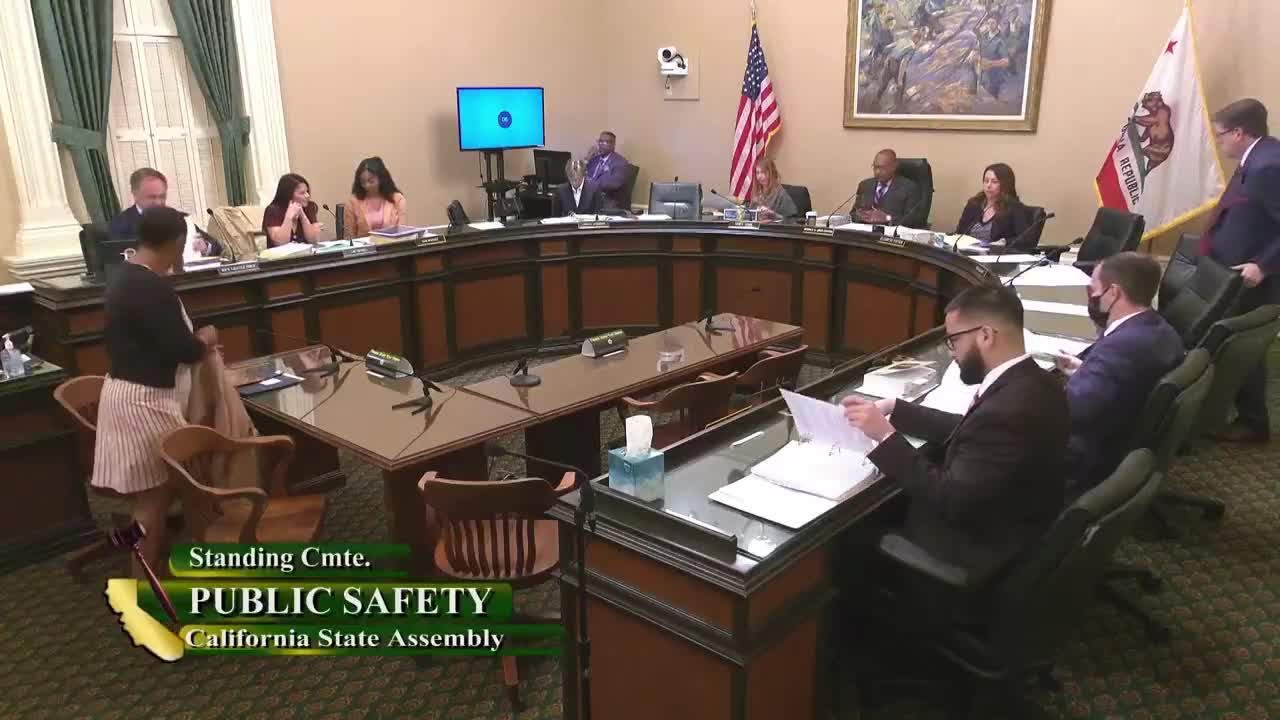 12MIN
Assembly Standing Committee on Public Safety
Bill Author

Bill Co-Author(s):
