AB 1390: California State University: University of California: graduation requirements: service learning.
- Session Year: 2023-2024
- House: Assembly
- Latest Version Date: 2023-04-27
Current Status:
Failed
(2024-02-01: From committee: Filed with the Chief Clerk pursuant to Joint Rule 56.)
Introduced
In Committee
First Chamber
In Committee
Second Chamber
Enacted
What does this bill do?
The bill makes service learning—a mix of meaningful community service, class instruction, and reflection—a required part of undergraduate graduation at California State University and University of California campuses. It also requires each campus to post information about service-learning programs and opportunities on its website starting in the 2024–25 academic year, and the graduation requirement begins for students graduating in 2032–33. Campuses may not raise the total number of degree units to enforce the rule, and students who already hold a bachelor’s degree or completed a comparable service-learning requirement at an accredited college are exempt.
The summary is provided by generative AI which can make mistakes. For original language, please view the details in the table below.
The Donahoe Higher Education Act sets forth the missions and functions of Californias public segments of higher education and their respective institutions of higher education. The California State University, under the administration of the Trustees of the California State University, and the University of California, under the administration of the Regents of the University of California, are 2 of the segments. Provisions of the act apply to the University of California only to the extent that the Regents of the University of California act, by appropriate resolution, to make them applicable.
This bill, commencing with the 202425 academic year, would require each California State University campus, and, if the Regents of the University of California adopt an appropriation resolution, each University of California campus to provide on its internet website information on service learning programs and opportunities for undergraduate students. The bill, commencing with students graduating in the 202728 203233 academic year, would require the California State University and, if the Regents of the University of California adopt an appropriate resolution, the University of California to require, as an undergraduate graduation requirement, the completion of service learning, as provided.
The Donahoe Higher Education Act sets forth the missions and functions of Californias public segments of higher education and their respective institutions of higher education. The California State University, under the administration of the Trustees of the California State University, and the University of California, under the administration of the Regents of the University of California, are 2 of the segments. Provisions of the act apply to the University of California only to the extent that the Regents of the University of California act, by appropriate resolution, to make them applicable.
This bill, commencing with the 202425 academic year, would require each California State University campus, and, if the Regents of the University of California adopt an appropriation resolution, each University of California campus to provide on its internet website information on service learning programs and opportunities for undergraduate students. The bill, commencing with students graduating in the 202728 academic year, would require the California State University and, if the Regents of the University of California adopt an appropriate resolution, the University of California to require, as an undergraduate graduation requirement, the completion of service learning, as provided.
(a)As used in this section, the following definitions apply:
(1)Postsecondary educational institution means a campus of the California State University or the University of California.
(2)Service learning means an educational approach that intentionally combines meaningful community service activities with instruction and reflection to support student progress toward academic and civic engagement learning objectives while meeting societal needs.
(b)Commencing with the 202425 academic year, each postsecondary educational institution shall, on its internet website, provide information on service learning programs and opportunities for undergraduate students.
(c)Commencing with students graduating in the 202728 203233 academic year, the California State University and the University of California shall require, as an undergraduate graduation requirement, the completion of service learning. The California State University and the University of California shall not increase the number of units required to graduate from their universities with a baccalaureate degree by the enforcement of this requirement. This graduation requirement shall not apply to a postbaccalaureate student who is enrolled in a baccalaureate degree program at a postsecondary educational institution if the student has satisfied either of the following:
(1)The student has earned a baccalaureate degree from a higher education institution accredited by a regional accrediting agency.
(2)The student has completed a service learning requirement at a higher education institution accredited by a regional accrediting agency.
(a)As used in this section, the following definitions apply:
(1)Postsecondary educational institution means a campus of the California State University or the University of California.
(2)Service learning means an educational approach that intentionally combines meaningful community service activities with instruction and reflection to support student progress toward academic and civic engagement learning objectives while meeting societal needs.
(b)Commencing with the 202425 academic year, each postsecondary educational institution shall, on its internet website, provide information on service learning programs and opportunities for undergraduate students.
(c)Commencing with students graduating in the 202728 academic year, the California State University and the University of California shall require, as an undergraduate graduation requirement, the completion of service learning. The California State University and the University of California shall not increase the number of units required to graduate from their universities with a baccalaureate degree by the enforcement of this requirement. This graduation requirement shall not apply to a postbaccalaureate student who is enrolled in a baccalaureate degree program at a postsecondary educational institution if the student has satisfied either of the following:
(1)The student has earned a baccalaureate degree from a higher education institution accredited by a regional accrediting agency.
(2)The student has completed a service learning requirement at a higher education institution accredited by a regional accrediting agency.
|
Date
|
Status
|
|---|---|
| Feb 1, 2024 | From committee: Filed with the Chief Clerk pursuant to Joint Rule 56. |
| Jan 31, 2024 | Died pursuant to Art. IV, Sec. 10(c) of the Constitution. |
| May 18, 2023 | In committee: Held under submission. |
| May 10, 2023 | In committee: Set, first hearing. Referred to APPR. suspense file. |
| May 1, 2023 | Re-referred to Com. on APPR. |
| Apr 27, 2023 | Read second time and amended. |
| Apr 26, 2023 | From committee: Amend, and do pass as amended and re-refer to Com. on APPR. (Ayes 9. Noes 2.) (April 25). |
| Apr 19, 2023 | In committee: Hearing postponed by committee. |
| Mar 2, 2023 | Referred to Com. on HIGHER ED. |
| Feb 18, 2023 | From printer. May be heard in committee March 20. |
| Feb 17, 2023 | Read first time. To print. |
|
Date
|
Description
|
Location
|
Votes
|
|
|---|---|---|---|---|
| Apr 25, 2023 | Do pass as amended and be re-referred to the Committee on [Appropriations] | Assembly Standing Committee on Higher Education |
Passed |
This list shows positions taken on this bill by organizations on the date displayed, which is linked to the original source.
Positions by individuals are not included.
|
Organization
|
Position
|
Date
|
|---|---|---|
| Cal State Student Association | * Against | Apr 25, 2023 |
| California State University | * Against | Apr 25, 2023 |
| Los Rios Community College District | * Support | Apr 25, 2023 |
| Stannis Law State University | * Against | Apr 25, 2023 |
| UC Student Association | * Against Unless Amend | Apr 25, 2023 |
Date of Hearing: May 10, 2023
ASSEMBLY COMMITTEE ON APPROPRIATIONS
Chris Holden, Chair
ABPCA Bill Id:AB 1390
Author:(McCarty) – As Amended Ver:April 27, 2023
Policy Committee: | Higher Education | Vote: | 9 - 2 |
|
| ||
|
|
Urgency: No State Mandated Local Program: No Reimbursable: No
SUMMARY:
This bill requires students of the University of California (UC) and the California State University (CSU) to complete “service learning” as a condition of graduation, commencing with students graduating in the 2032-33 academic year.
The bill specifies UC and CSU are not to increase the number of units required to graduate from their universities with a baccalaureate degree by the enforcement of this requirement. In addition, beginning in the 2024-25 academic year, the bill requires each UC and CSU to provide information on its website about service learning programs and opportunities for undergraduate students.
The bill defines services learning as, “an educational approach that intentionally combines meaningful community service activities with instruction and reflection to support student progress toward academic and civic engagement learning objectives while meeting societal needs.” The bill does not define the type or duration of the required service learning, nor does it require the service learning requirement to be a course.
FISCAL EFFECT:
- Ongoing General Fund costs, potentially in the tens of millions of dollars to the low hundreds of millions of dollars annually, to UC to implement the service learning requirement, commencing with students graduating in the 2032-33 academic year. According to UC, costs would differ from campus to campus based on existing infrastructure, but UC estimates, on average, each UC would need to spend about $2,000 per incoming undergraduate student to implement this requirement and UC has about 70,000 incoming undergraduate students annually. The main cost drivers for this bill would be related to faculty workload, program staff, outreach and program materials, and technology and other system upgrades to track completion.
- Ongoing General Fund costs, potentially in the tens of millions of dollars to the low hundreds of millions of dollars annually, to CSU to implement the service learning requirement, commencing with students graduating in the 2032-33 academic year. CSU’s estimate is based on an assumption that 25% of the student population would complete the requirement. CSU cost drivers are similar to those noted by UC.
- Potential Proposition 98 General Fund costs to California Community Colleges (CCC) to offer service learning, to the extent the UC or CSU decide to implement service learning as a lower-division graduation requirement such that CCC students who intend to transfer to UC or CSU complete the requirement at a CCC.
COMMENTS:
- Purpose. According to the author:
Students are not currently encouraged to participate in service learning within current curriculum and program requirements at the CSU and UC. Only CSU Monterey Bay requires service learning to be done both curricular (course with units) and co-curricular (hour requirement) prior to graduating…In order to encourage students to pursue service learning, there must be a requirement, similar to CSUMB’s structure, to fulfil service learning. The ideal setting for service learning is both curricular and co-curricular; particularly in a setting where the student can process the service learning experience.
- Background. CSU Monterey Bay is the only public university in California that requires students to complete service learning as a condition of graduation for all undergraduate students. Students must complete both (a) a lower division Civics/Service Learning course, complete 25 hours of community service, and complete a Civic Action project; and (b) an upper division Service Learning course and complete 30 hours of service within a field related to the student’s major. The lower division course satisfies a general education requirement for social sciences.
- Opposition. This bill is opposed by several organizations, including the Academic Senate of the CSU, the CSU Office of the Chancellor, the UC Student Association, and the CSU Student Association, who writes:
While we full heartedly believe in the concept of service learning, and in providing students across all 23 campuses access to opportunities to give back to their communities, imposing another graduation requirement on students is inequitable. Our students are working tirelessly already in their efforts to receive their degrees. Many of them are working multiple jobs, while still trying to keep up in their coursework. A new requirement is just another barrier for CSU students. This premise also contradicts the prioritization of the CSU’s, Governor’s, and Legislature’s dedication to increasing graduation rates and making it as easy as possible for students to obtain their bachelor’s degree.
- Related Legislation. AB 1460 (Weber), Chapter 32, Statutes of 2020, requires undergraduate students at the CSU to complete an ethnic studies course as a condition of graduation.
AB 506 (M. Fong) of this legislative session delays implementation of the CSU ethnic studies graduation requirement by one year. This bill is pending in this committee.
Analysis Prepared by: Natasha Collins / APPR. / (916) 319-2081
Date of Hearing: April 25, 2023
ASSEMBLY COMMITTEE ON HIGHER EDUCATION
Mike Fong, Chair
ABPCA Bill Id:AB 1390 (
Author:McCarty) – As Introduced Ver:February 17, 2023
SUBJECT: California State University: University of California: graduation requirements: service learning
SUMMARY: Requires the California State University (CSU) and, if the Regents of the University of California (UC) adopt an appropriate resolution, the UC, as an undergraduate graduation requirement, the completion of service learning commencing with students graduating in the 2027–28 academic year, as provided. Specifically, this bill:
- Establishes following definitions apply:
- “Postsecondary educational institution” means a campus of the CSU or the UC; and,
- “Service learning” means an educational approach that intentionally combines meaningful community service activities with instruction and reflection to support student progress toward academic and civic engagement learning objectives while meeting societal needs.
- Requires, commencing with the 2024–25 academic year, each postsecondary educational institution to provide, on its internet website, information on service learning programs and opportunities for undergraduate students.
- Requires, commencing with students graduating in the 2027–28 academic year, the CSU and the UC, as an undergraduate graduation requirement, the completion of service learning. The CSU and the UC will not increase the number of units required to graduate from their universities with a baccalaureate degree by the enforcement of this requirement. This graduation requirement will not apply to a postbaccalaureate student who is enrolled in a baccalaureate degree program at a postsecondary educational institution if the student has satisfied either of the following:
- The student has earned a baccalaureate degree from a higher education institution accredited by a regional accrediting agency; and,
- The student has completed a service learning requirement at a higher education institution accredited by a regional accrediting agency.
EXISTING LAW:
- Establishes the UC as a public trust to be administered by the Regents of the University of California (UC); and, grants the Regents full powers of organization and government, subject only to such legislative control as may be necessary to ensure security of its funds, compliance with the terms of its endowments, statutory requirements around competitive bidding and contracts, sales of property and the purchase of materials, goods and services (Article IX, Section (9)(a) of the California Constitution).
- Establishes the Donahoe Higher Education Act, setting forth the mission of the UC, California State University (CSU), and California Community Colleges (CCC) (Education Code (EDC) Section 66010, et seq.).
- Confers upon the CSU Trustees the powers, duties, and functions with respect to the management, administration, control of the CSU system and provides that the Trustees are responsible for the rule of government of their appointees and employees (EDC Sections 66606 and 89500, et seq.).
- Requires the CSU, commencing with the 2021-22 academic year, to 1) provide courses in ethnic studies at each CSU campus; and, 2) require, as part of the CSU graduation requirements commencing with students graduating in the 2024-25 academic year, the completion of, at a minimum, one three-unit course in ethnic studies. (EDC Section 89032)
FISCAL EFFECT: Unknown
COMMENTS: Purpose. According to the author, “students are not currently encouraged to participate in service learning within current curriculum and program requirements at the CSU and UC. Only CSU Monterey Bay (CSUMB) requires service learning to be done both curricular (course with units) and co-curricular (hour requirement) prior to graduating.”
“Service learning has been shown to have positive effects on academic performance (including GPA), values, self-efficacy, and leadership, for example, when implemented at the undergraduate level. Service learning also benefits the community that is being serviced as a result (local non-profits who take on a student for their service learning requirement, for example).”
“There are programs aimed at placing the student in service that exist, such as the College Corps, but limited slots are available to students, and the monetary incentive for students, while incredibly beneficial to the student, does not allow the state to expand this program; particularly in a tough budget year. In order to encourage students to pursue service learning, there must be a requirement, similar to CSUMB’s structure, to fulfil service learning. The ideal setting for service learning is both curricular and co-curricular; particularly in a setting where the student can process the service learning experience.”
CSUMB service learning. CSUMB is the only public university in California, and one of the few nationwide, that has made service learning a graduation requirement for all undergraduate students. Students generally complete two components of the CSUMB service learning requirement: lower division Civics/Service Learning; and, upper division Service Learning. Students entering CSUMB as lower division students will need to complete both requirements; however, students entire as upper division transfer students only need to complete the upper division requirement.
The lower division Civics/Service requirement is a three unit course that requires 25 hours of community service. This class meets the CSU general education Area D requirement for social sciences. This class is intended to provide a foundation in civic knowledge, skills, and attitudes to inform service and civic action work in the community. All Civics/Service Learning classes require students to complete 25 hours of service off-campus with a local organization. In addition, students complete a Civic Action project.
The upper division Service Learning classes require students to complete 30 hours of service off-campus with a community organization in a field related to their major. Focusing on the student’s field of study and/or professional application, upper division Service Learning is intended to help students learn firsthand about real social challenges that communities face, while also examining and learning to ways to address underlying issues of systemic inequality such as: racism, sexism, classism, heterosexism, and ableism, among others.
Each semester, the various CSUMB departments offer over 50 upper division Service Learning classes. Some fields of study, such as Liberal Studies, Environmental Studies, and Human Development & Family Studies, require two service learning classes.
Arguments in opposition. The Cal State Student Association wrote in opposition, noting that, “while we full heartedly believe in the concept of service learning, and in providing students across all 23 campuses access to opportunities to give back to their communities, imposing another graduation requirement on students is inequitable. Our students are working tirelessly already in their efforts to receive their degrees. Many of them are working multiple jobs, while still trying to keep up in their coursework. A new requirement is just another barrier for CSU students. This premise also contradicts the prioritization of the CSU’s, Governor’s, and Legislature’s dedication to increasing graduation rates and making it as easy as possible for students to obtain their bachelor’s degree.”
Segmental concerns. The CSU wrote to the Committee expressing concerns about mandating a service learning requirement. The concerns centered on three core areas:
- Curricular concerns. The CSU expressed that they strongly believe that decisions regarding curriculum and graduation requirements should remain in the purview of university faculty and administration. They note that many STEM and Business students are already tightly scheduled to complete their degrees in four years, fitting in another requirement could add more time to degree completion;
- Impact on students and graduation rates. CSU notes that most CSU students already have part- or full-time employment commitments, and that many balance jobs with family commitments, such as raising a child. CSU also suggested that AB 1390 (McCarty) will create challenges for many undocumented students, as a number of community partners require background checks.
- Costs and implementation. CSU believes that service-learning programs are very costly because they require additional faculty as well as a significant amount of administrative time to find and manage community partners. Each community partner must undergo a site assessment and enter into an agreement with each university. CSU expects that scaling this program to serve more than 450,000 students will cost tens of millions of dollars and likely require agreements with hundreds of new community partners.
CSU suggested amendments that would instead strengthen campus infrastructure for service learning while removing the system wide service learning requirement.
Academic freedom. While academic freedom may mean different things to different individuals, at the core of academic freedom is the establishment of faculty members’ right to remain true to their pedagogical philosophy and intellectual commitments; it preserves the intellectual integrity of our higher education systems. Additionally, academic freedom means that the political, religious, or philosophical beliefs of politicians, administrators, and members of the public cannot be imposed on faculty or students.
As currently drafted, this bill would require the CSU and, if the Regents of the UC adopt an appropriate resolution, require the UC to complete service learning as an undergraduate graduation requirement.
The Committee should consider the precedent that would be set with this bill and determine whether it infringes on academic freedom and, conversely, whether the decisions on curricula and graduation requirements should remain in the hands of CSU faculty and administrators.
Although this measure specifies that the amount of units to graduate shall not be increased, the
Committee should consider whether an additional course requirement would result in many degree programs having to be restructured, particularly those in high unit majors (such as
Business, Science, Technology, Engineering, and Math).
Timeline for implementation? Should this measure be enacted, developing service learning curricula; hiring qualified faculty, and implementing a requirement for graduation by the 2027-28 will likely be impossible
The author has agreed to take amendments to delay implementation of the service learning requirement in AB 1390 (McCarty) to students graduating in the 2032–33 academic year.
Related and Prior legislation. AB 506 (M. Fong), Delays implementation of the California State University’s (CSU) ethnic studies graduation requirement by one year. AB 506 (M.Fong) is scheduled to be heard in this Committee on April 25, 2023.
AB 1040 (Muratsuchi) of 2021, which was held in the Senate Committee on Education, would, in part, require, commencing with the 2022-2023 AY, each community college district to offer courses in ethnic studies at each of its campuses; and, would require, beginning with the 2024-2025 AY, each CCD to require the completion of at least one course in ethnic studies of at least three-units as a requirement for a student to obtain an associate degree.
AB 1460 (Weber), Chapter 32, Statutes of 2020, requires the CSU, commencing with the 2021-22 academic year, to 1) provide courses in ethnic studies at each CSU campus; and, 2) require, as part of the CSU graduation requirements commencing with students graduating in the 2024-25 academic year, the completion of, at a minimum, one three-unit course in ethnic studies.
AB 3310 (Muratsuchi) of 2020, which died for a lack of hearing by this Committee, was substantially similar AB 1040 (as described above).
AB 2408 (Shirley Weber) of 2018, which was held by this Committee, per the request of the author, was very similar in nature to AB 1460 (as described above).
REGISTERED SUPPORT / OPPOSITION:
Support
None on file.
Opposition
Cal State Student Association
4 Individuals
Analysis Prepared by: Kevin J. Powers / HIGHER ED. / (916) 319-3960
Discussed in Hearing
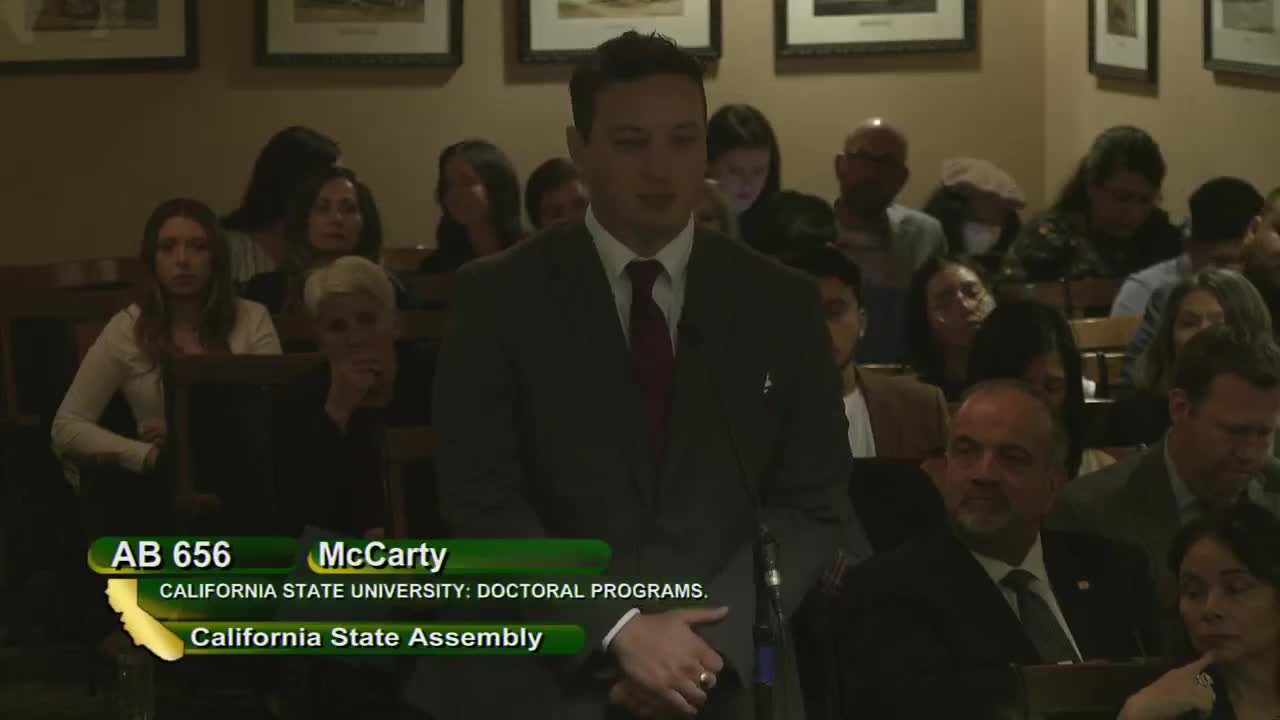 22MIN
Assembly Standing Committee on Higher Education
Bill Author

Bill Co-Author(s):
