AB 1421: The San Diego Regional Film Financial Incentive Pilot Program.
- Session Year: 2023-2024
- House: Assembly
- Latest Version Date: 2023-03-22
Current Status:
Failed
(2024-02-01: From committee: Filed with the Chief Clerk pursuant to Joint Rule 56.)
Introduced
In Committee
First Chamber
In Committee
Second Chamber
Enacted
Existing law establishes the County of San Diego and various offices within the county for administration of the county government.
The Personal Income Tax Law and the Corporation Tax Law allow various credits against the taxes imposed by those laws, including motion picture credits for taxable years beginning on or after January 1, 2020, to be allocated by the California Film Commission on or after July 1, 2020, and before July 1, 2025.
This bill would establish the San Diego Regional Film Financial Incentive Pilot Program to be administered by the San Diego Regional Film Financial Incentive Pilot Program Office within the County of San Diego for purposes of awarding grants, beginning on July 1, 2024, to qualified projects that, among other things, have a production budget with at least 70% of expenditures to laborers, retailers, or suppliers who are permanent residents of the County of San Diego. The bill would require an applicant to submit a specified application to the office, and would require the office to award grants in order of priority based on the ratio of the total moneys expected to be paid by the applicant as wages to laborers who are permanent residents of the County of San Diego divided by the total production budget. The bill would appropriate $25,000,000 to the County of San Diego over a 3-year period for purposes of the program. program, including administrative costs. The bill would require the office to submit, on or before January 1, 2027, a report to the Legislature and the California Film Commission on the results of the program. By placing new requirements on the County of San Diego, the bill would impose a state-mandated local program. The bill would repeal these provisions on January 1, 2028.
This bill would make legislative findings and declarations as to the necessity of a special statute for the County of San Diego.
The California Constitution requires the state to reimburse local agencies and school districts for certain costs mandated by the state. Statutory provisions establish procedures for making that reimbursement.
This bill would provide that, if the Commission on State Mandates determines that the bill contains costs mandated by the state, reimbursement for those costs shall be made pursuant to the statutory provisions noted above.
Existing law establishes the County of San Diego and various offices within the county for administration of the county government.
The Personal Income Tax Law and the Corporation Tax Law allow various credits against the taxes imposed by those laws, including motion picture credits for taxable years beginning on or after January 1, 2020, to be allocated by the California Film Commission on or after July 1, 2020, and before July 1, 2025.
This bill would establish the San Diego Regional Film Financial Incentive Pilot Program to be administered by the San Diego Regional Film Financial Incentive Pilot Program Office within the County of San Diego for purposes of awarding grants, beginning on July 1, 2024, to qualified projects that, among other things, have a production budget with at least 70% of expenditures to laborers, retailers, or suppliers who are permanent residents of the County of San Diego. The bill would require an applicant to submit a specified application to the office, and would require the office to award grants in order of priority based on the ratio of the total moneys expected to be paid by the applicant as wages to laborers who are permanent residents of the County of San Diego divided by the total production budget. The bill would appropriate $25,000,000 to the County of San Diego over a 3-year period for purposes of the program. The bill would require the office to submit, on or before January 1, 2027, a report to the Legislature and the California Film Commission on the results of the program. By placing new requirements on the County of San Diego, the bill would impose a state-mandated local program. The bill would repeal these provisions on January 1, 2028.
This bill would make legislative findings and declarations as to the necessity of a special statute for the County of San Diego.
The California Constitution requires the state to reimburse local agencies and school districts for certain costs mandated by the state. Statutory provisions establish procedures for making that reimbursement.
This bill would provide that, if the Commission on State Mandates determines that the bill contains costs mandated by the state, reimbursement for those costs shall be made pursuant to the statutory provisions noted above.
There is hereby established the San Diego Regional Film Financial Incentive Pilot Program to be administered by the San Diego Regional Film Financial Incentive Pilot Program Office within the County of San Diego for purposes of awarding grants to qualified projects to incentivize and attract small-budget independent film and television production to the County of San Diego.
33301.For purposes of this division, the following definitions shall apply:
(a)Jobs ratio means the San Diego qualified expenditures expected to be paid as wages to laborers who are permanent residents of the County of San Diego divided by the total production budget.
(b)Non-San Diego qualifying expenditures means amounts paid or incurred for tangible personal property purchased or leased, and used, within the County of San Diego to laborers, retailers, or suppliers who are not permanent residents of the County of San Diego but who are permanent residents of the state.
(c)Office means the San Diego Regional Film Financial Incentive Pilot Program Office within the County of San Diego.
(d)Program means the San Diego Regional Film Financial Incentive Pilot Program.
(e)Qualifying project means a motion picture, movie, or film that is produced for distribution to the general public, regardless of medium, that meets all of the following requirements:
(1)The project has a total production budget of no less than two one hundred fifty thousand dollars ($250,000) ($150,000) and no more than nine hundred ninety-nine thousand nine hundred ninety-nine dollars ($999,999).
(2)At least 70 percent of the production budget consists of San Diego qualifying expenditures.
(3)The applicant can demonstrate that the applicant has secured the appropriate financial resources required to complete the project.
(4)The applicant can demonstrate that principal photography is set to commence within 9 months of the projects application approval date and will be completed within 12 months of the commencement of filming.
(f)San Diego qualifying expenditures means amounts paid or incurred for tangible personal property purchased or leased, and used, within the County of San Diego to laborers, retailers, or suppliers who are permanent residents of the County of San Diego.
33302.(a)There is hereby established in the State Treasury the San Diego Regional Film Financial Incentive Pilot Program Fund. Notwithstanding Section 13340, moneys in the fund are hereby continuously appropriated without regard to fiscal years for purposes of this division.
(b)Notwithstanding Section 13340, the Controller shall, on January 1, 2024, transfer from the General Fund to the San Diego Regional Film Financial Incentive Pilot Program Fund the sum of twenty-five million dollars ($25,000,000).
(c)The Controller shall transfer moneys from the San Diego Regional Film Financial Incentive Pilot Program Fund to the County of San Diego for the purposes of this division as follows:
(1)Within 30 days of the transfer in subdivision (b), the Controller shall transfer from the San Diego Regional Film Financial Incentive Pilot Program Fund to the County of San Diego the sum of seven million dollars ($7,000,000).
(2)On July 1, 2025, the Controller shall transfer from the San Diego Regional Film Financial Incentive Pilot Program Fund to the County of San Diego the sum of sixteen million dollars ($16,000,000).
(3)On July 1, 2026, the Controller shall transfer from the San Diego Regional Film Financial Incentive Pilot Program Fund to the County of San Diego all remaining moneys in the San Diego Regional Film Financial Incentive Pilot Program Fund.
2.Administration33310.(a)The County of San Diego shall establish the San Diego Regional Film Financial Incentive Pilot Program Office within the County of San Diego under the direction of the Chief Administrative Officer of the County of San Diego.
(b)The office shall consist of at least the following employee positions:
(1)A general manager to oversee and coordinate marketing and operations.
(2)A director of finance and operations to manage money and operations.
(3)A director of marketing to conduct and manage a worldwide marketing campaign.
(4)A director of film production to administer film productions that qualify for a grant.
(5)Administrative staff as necessary to assist directors and to perform other operational functions.
(c)The general manager shall be appointed by the Board of Supervisors of the County of San Diego representative from District 4. Chief Administrative Office of the County of San Diego.
(d)Moneys transferred to the County of San Diego under Section 33302 may be used by the County of San Diego for administrative costs necessary to implement this division.
33311.(a)The office shall administer the program pursuant to this division.
(b)Office employees shall additionally assist grantees with all of the following:
(1)Developing the project.
(2)Meeting required deadlines.
(3)Budgeting and use of the grant funds within the guidelines required by this division and prescribed by the office.
(c)The office shall promote and market the program throughout the United States and internationally.
3.Grant Awards33320.Each applicant for a grant under this division shall submit an application to the office, in a form and manner prescribed by the office, containing all of the following information:
(a)All relevant documentation needed to establish that the project is a qualifying project.
(b)The budget for the project.
(c)The number of production days.
(d)A financing plan for the project.
(e)The diversity of the workforce employed by the applicant, including, but not limited to, the ethnic and racial makeup of the individuals employed by the applicant during the production of the qualified project, to the extent possible.
(f)Financial information, if available, including, but not limited to, the most recently produced balance sheets, annual statements of profits and losses, audited or unaudited financial statements, summary budget projections or results, or the functional equivalent of these documents of a partnership or owner of a single-member limited liability company that is disregarded pursuant to Section 23038 of the Revenue and Taxation Code. The information provided pursuant to this clause shall be confidential and shall not be subject to public disclosure.
(g)The names of all partners in a partnership not publicly traded or the names of all members of a limited liability company classified as a partnership not publicly traded for California income tax purposes that have a financial interest in the applicants qualified motion picture. The information provided pursuant to this clause shall be confidential and shall not be subject to public disclosure.
(h)The amount of wages the applicant expects to pay to employees.
(i)The amount of the grant the applicant computes the qualified motion picture expects will be allocated.
(j)A statement establishing that the grant described in this division is a significant factor in the applicants choice of location for the qualified project. The statement shall include information about whether the qualified project is at risk of not being filmed or specify the jurisdiction or jurisdictions in which the qualified project will be located in the absence of the grant. The statement shall be signed by an officer or executive of the applicant.
(k)The applicants written policy against unlawful harassment, including, but not limited to, sexual harassment, that includes procedures for reporting and investigating harassment claims, a phone number for an individual who will be responsible for receiving harassment claims, and a statement that the company will not retaliate against an individual who reports harassment. The applicant shall also indicate how the policy will be distributed to employees and include a summary of education training resources, including the prohibition against, and prevention and correction of, sexual harassment and remedies available.
(l)The ethnic and racial makeup and gender of individuals who will be paid wages by the applicant.
(m)A summary of the applicants voluntary programs to increase the representation of minorities and women.
(n)Any other information the office deems relevant or necessary for purposes of the program.
33321.(a)The office shall review applications and award grants on January 1, April 1, July 1, and October 1 of each year, beginning on July 1, 2024.
(b)The office shall award grants to qualified projects who meet the application requirements in Section 33320 beginning with the applicant with the highest job ratio, until all grant moneys are exhausted.
(c)The office shall inform applicants of whether they were awarded a grant, and of the amount of moneys awarded, within six months of submission of the application.
(d)Each grant awarded shall be in an amount equal to the sum of 30 percent of the qualified projects San Diego qualifying expenditures and 20 percent of the qualified projects non-San Diego qualifying expenditures.
(e)The office shall disperse moneys awarded under this section according to the following schedule:
(1)Ten percent of the moneys shall be dispersed 30 days before commencement of principal photography.
(2)Twenty percent of the moneys shall be dispersed upon commencement of principal photography.
(3)Twenty percent of the moneys shall be dispersed upon completion of principal photography.
(4)Ten percent of the moneys shall be dispersed 30 days after completion of principal photography.
(5)Twenty percent of the moneys shall be dispersed upon completion of the project and delivery of the final project to the office for verification.
(6)(A)Twenty percent of the moneys shall be dispersed upon verification by the office of all project expenditures.
(B)The office shall complete the final project verification within six months of receipt of all expenditure documentation.
33322.(a)A grantee shall begin principal photography within 9 months of the qualified projects application approval date and shall complete principal photography within 12 months of the commencement of filming.
(b)The office may provide extensions to the periods established in subdivision (a) at its discretion.
4.Reporting Requirements33330.On or before January 1, 2027, the office shall submit a report to the Legislature and the California Film Commission on the results of the program, and shall post a copy of the report on its internet website.
33331.This division shall remain in effect only until January 1, 2028, and as of that date is repealed.
SEC. 2.The Legislature finds and declares that the addition of Division 6 (commencing with Section 33300) to Title 3 of the Government Code by this act serves a public purpose and does not constitute a gift of public funds within the meaning of Section 6 of Article XVI of the California Constitution by incentivizing and attracting small-budget independent film and television production to the San Diego region, which will bring economic growth, jobs, and internships to San Diego residents.
SEC. 3.The Legislature finds and declares that a special statute is necessary and that a general statute cannot be made applicable within the meaning of Section 16 of Article IV of the California Constitution because of the unique experience and location of the San Diego region in film production, and the need to incentivize and attract small-budget independent film and television production to the region for economic growth.
SEC. 4.If the Commission on State Mandates determines that this act contains costs mandated by the state, reimbursement to local agencies and school districts for those costs shall be made pursuant to Part 7 (commencing with Section 17500) of Division 4 of Title 2 of the Government Code.
REVISIONS: HeadingLine 1.There is hereby established the San Diego Regional Film Financial Incentive Pilot Program to be administered by the San Diego Regional Film Financial Incentive Pilot Program Office within the County of San Diego for purposes of awarding grants to qualified projects to incentivize and attract small-budget independent film and television production to the County of San Diego.
33301.For purposes of this division, the following definitions shall apply:
(a)Jobs ratio means the San Diego qualified expenditures expected to be paid as wages to laborers who are permanent residents of the County of San Diego divided by the total production budget.
(b)Non-San Diego qualifying expenditures means amounts paid or incurred for tangible personal property purchased or leased, and used, within the County of San Diego to laborers, retailers, or suppliers who are not permanent residents of the County of San Diego but who are permanent residents of the state.
(c)Office means the San Diego Regional Film Financial Incentive Pilot Program Office within the County of San Diego.
(d)Program means the San Diego Regional Film Financial Incentive Pilot Program.
(e)Qualifying project means a motion picture, movie, or film that is produced for distribution to the general public, regardless of medium, that meets all of the following requirements:
(1)The project has a total production budget of no less than two hundred fifty thousand dollars ($250,000) and no more than nine hundred ninety-nine thousand nine hundred ninety-nine dollars ($999,999).
(2)At least 70 percent of the production budget consists of San Diego qualifying expenditures.
(3)The applicant can demonstrate that the applicant has secured the appropriate financial resources required to complete the project.
(4)The applicant can demonstrate that principal photography is set to commence within 9 months of the projects application approval date and will be completed within 12 months of the commencement of filming.
(f)San Diego qualifying expenditures means amounts paid or incurred for tangible personal property purchased or leased, and used, within the County of San Diego to laborers, retailers, or suppliers who are permanent residents of the County of San Diego.
33302.(a)There is hereby established in the State Treasury the San Diego Regional Film Financial Incentive Pilot Program Fund. Notwithstanding Section 13340, moneys in the fund are hereby continuously appropriated without regard to fiscal years for purposes of this division.
(b)Notwithstanding Section 13340, the Controller shall, on January 1, 2024, transfer from the General Fund to the San Diego Regional Film Financial Incentive Pilot Program Fund the sum of twenty-five million dollars ($25,000,000).
(c)The Controller shall transfer moneys from the San Diego Regional Film Financial Incentive Pilot Program Fund to the County of San Diego for the purposes of this division as follows:
(1)Within 30 days of the transfer in subdivision (b), the Controller shall transfer from the San Diego Regional Film Financial Incentive Pilot Program Fund to the County of San Diego the sum of seven million dollars ($7,000,000).
(2)On July 1, 2025, the Controller shall transfer from the San Diego Regional Film Financial Incentive Pilot Program Fund to the County of San Diego the sum of sixteen million dollars ($16,000,000).
(3)On July 1, 2026, the Controller shall transfer from the San Diego Regional Film Financial Incentive Pilot Program Fund to the County of San Diego all remaining moneys in the San Diego Regional Film Financial Incentive Pilot Program Fund.
2.Administration33310.(a)The County of San Diego shall establish the San Diego Regional Film Financial Incentive Pilot Program Office within the County of San Diego under the direction of the Chief Administrative Officer of the County of San Diego.
(b)The office shall consist of at least the following employee positions:
(1)A general manager to oversee and coordinate marketing and operations.
(2)A director of finance and operations to manage money and operations.
(3)A director of marketing to conduct and manage a worldwide marketing campaign.
(4)A director of film production to administer film productions that qualify for a grant.
(5)Administrative staff as necessary to assist directors and to perform other operational functions.
(c)The general manager shall be appointed by the Board of Supervisors of the County of San Diego representative from District 4.
33311.(a)The office shall administer the program pursuant to this division.
(b)Office employees shall additionally assist grantees with all of the following:
(1)Developing the project.
(2)Meeting required deadlines.
(3)Budgeting and use of the grant funds within the guidelines required by this division and prescribed by the office.
(c)The office shall promote and market the program throughout the United States and internationally.
3.Grant Awards33320.Each applicant for a grant under this division shall submit an application to the office, in a form and manner prescribed by the office, containing all of the following information:
(a)All relevant documentation needed to establish that the project is a qualifying project.
(b)The budget for the project.
(c)The number of production days.
(d)A financing plan for the project.
(e)The diversity of the workforce employed by the applicant, including, but not limited to, the ethnic and racial makeup of the individuals employed by the applicant during the production of the qualified project, to the extent possible.
(f)Financial information, if available, including, but not limited to, the most recently produced balance sheets, annual statements of profits and losses, audited or unaudited financial statements, summary budget projections or results, or the functional equivalent of these documents of a partnership or owner of a single-member limited liability company that is disregarded pursuant to Section 23038 of the Revenue and Taxation Code. The information provided pursuant to this clause shall be confidential and shall not be subject to public disclosure.
(g)The names of all partners in a partnership not publicly traded or the names of all members of a limited liability company classified as a partnership not publicly traded for California income tax purposes that have a financial interest in the applicants qualified motion picture. The information provided pursuant to this clause shall be confidential and shall not be subject to public disclosure.
(h)The amount of wages the applicant expects to pay to employees.
(i)The amount of the grant the applicant computes the qualified motion picture expects will be allocated.
(j)A statement establishing that the grant described in this division is a significant factor in the applicants choice of location for the qualified project. The statement shall include information about whether the qualified project is at risk of not being filmed or specify the jurisdiction or jurisdictions in which the qualified project will be located in the absence of the grant. The statement shall be signed by an officer or executive of the applicant.
(k)The applicants written policy against unlawful harassment, including, but not limited to, sexual harassment, that includes procedures for reporting and investigating harassment claims, a phone number for an individual who will be responsible for receiving harassment claims, and a statement that the company will not retaliate against an individual who reports harassment. The applicant shall also indicate how the policy will be distributed to employees and include a summary of education training resources, including the prohibition against, and prevention and correction of, sexual harassment and remedies available.
(l)The ethnic and racial makeup and gender of individuals who will be paid wages by the applicant.
(m)A summary of the applicants voluntary programs to increase the representation of minorities and women.
(n)Any other information the office deems relevant or necessary for purposes of the program.
33321.(a)The office shall review applications and award grants on January 1, April 1, July 1, and October 1 of each year, beginning on July 1, 2024.
(b)The office shall award grants to qualified projects who meet the application requirements in Section 33320 beginning with the applicant with the highest job ratio, until all grant moneys are exhausted.
(c)The office shall inform applicants of whether they were awarded a grant, and of the amount of moneys awarded, within six months of submission of the application.
(d)Each grant awarded shall be in an amount equal to the sum of 30 percent of the qualified projects San Diego qualifying expenditures and 20 percent of the qualified projects non-San Diego qualifying expenditures.
(e)The office shall disperse moneys awarded under this section according to the following schedule:
(1)Ten percent of the moneys shall be dispersed 30 days before commencement of principal photography.
(2)Twenty percent of the moneys shall be dispersed upon commencement of principal photography.
(3)Twenty percent of the moneys shall be dispersed upon completion of principal photography.
(4)Ten percent of the moneys shall be dispersed 30 days after completion of principal photography.
(5)Twenty percent of the moneys shall be dispersed upon completion of the project and delivery of the final project to the office for verification.
(6)(A)Twenty percent of the moneys shall be dispersed upon verification by the office of all project expenditures.
(B)The office shall complete the final project verification within six months of receipt of all expenditure documentation.
33322.(a)A grantee shall begin principal photography within 9 months of the qualified projects application approval date and shall complete principal photography within 12 months of the commencement of filming.
(b)The office may provide extensions to the periods established in subdivision (a) at its discretion.
4.Reporting Requirements33330.On or before January 1, 2027, the office shall submit a report to the Legislature and the California Film Commission on the results of the program, and shall post a copy of the report on its internet website.
33331.This division shall remain in effect only until January 1, 2028, and as of that date is repealed.
SEC. 2.The Legislature finds and declares that the addition of Division 6 (commencing with Section 33300) to Title 3 of the Government Code by this act serves a public purpose and does not constitute a gift of public funds within the meaning of Section 6 of Article XVI of the California Constitution by incentivizing and attracting small-budget independent film and television production to the San Diego region, which will bring economic growth, jobs, and internships to San Diego residents.
SEC. 3.The Legislature finds and declares that a special statute is necessary and that a general statute cannot be made applicable within the meaning of Section 16 of Article IV of the California Constitution because of the unique experience and location of the San Diego region in film production, and the need to incentivize and attract small-budget independent film and television production to the region for economic growth.
SEC. 4.If the Commission on State Mandates determines that this act contains costs mandated by the state, reimbursement to local agencies and school districts for those costs shall be made pursuant to Part 7 (commencing with Section 17500) of Division 4 of Title 2 of the Government Code.
|
Date
|
Status
|
|---|---|
| Feb 1, 2024 | From committee: Filed with the Chief Clerk pursuant to Joint Rule 56. |
| Jan 31, 2024 | Died pursuant to Art. IV, Sec. 10(c) of the Constitution. |
| May 18, 2023 | Coauthors revised. |
| May 18, 2023 | In committee: Held under submission. |
| Apr 26, 2023 | In committee: Set, first hearing. Referred to APPR. suspense file. |
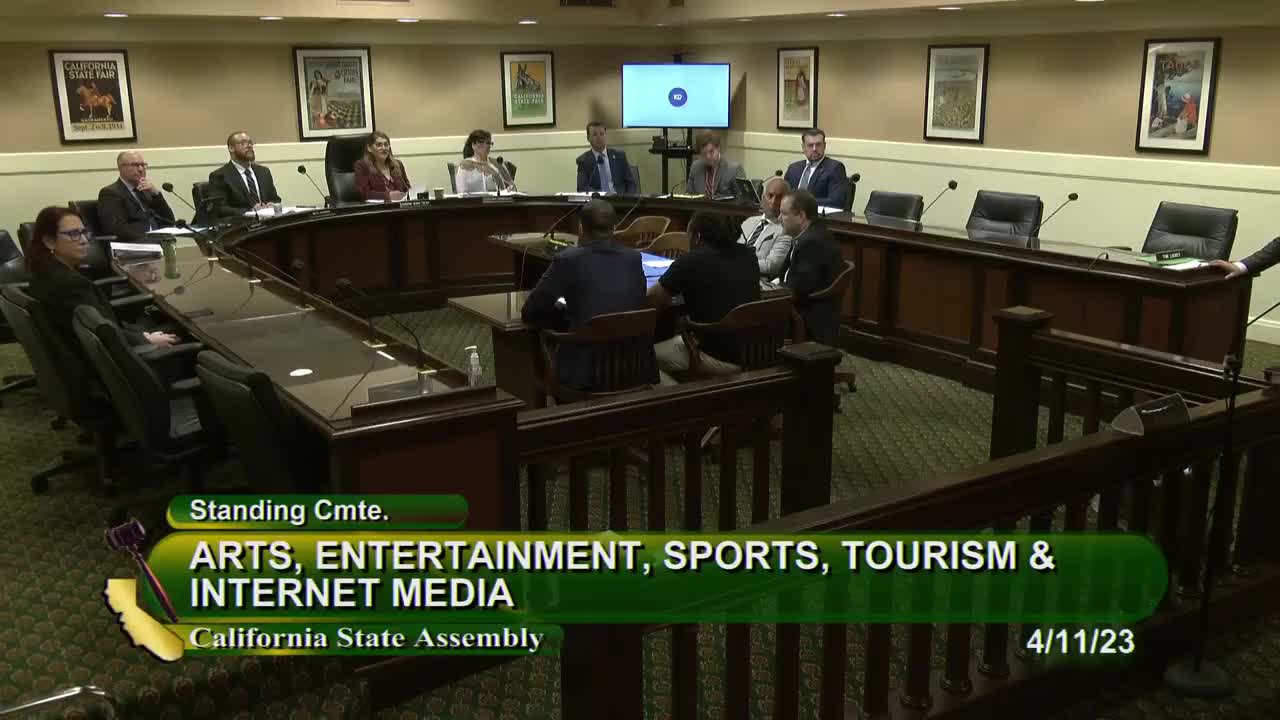
| Apr 11, 2023 | From committee: Do pass and re-refer to Com. on APPR. (Ayes 7. Noes 0.) (April 11). Re-referred to Com. on APPR. |
| Mar 23, 2023 | Re-referred to Com. on A., E., S., & T. |
| Mar 22, 2023 | From committee chair, with author's amendments: Amend, and re-refer to Com. on A., E., S., & T. Read second time and amended. |
| Mar 9, 2023 | Referred to Com. on A., E., S., & T. |
| Feb 18, 2023 | From printer. May be heard in committee March 20. |
| Feb 17, 2023 | Read first time. To print. |
|
Date
|
Description
|
Location
|
Votes
|
|
|---|---|---|---|---|
| Apr 11, 2023 | Do pass and be re-referred to the Committee on [Appropriations] | Assembly Standing Committee on Arts, Entertainment, Sports, and Tourism |
Passed |
This list shows positions taken on this bill by organizations on the date displayed, which is linked to the original source.
Positions by individuals are not included.
|
Organization
|
Position
|
Date
|
|---|---|---|
| San Diego Media Pros | * Support | Apr 11, 2023 |
| San Diego State University | * Support | Apr 11, 2023 |
Date of Hearing: April 26, 2023
ASSEMBLY COMMITTEE ON APPROPRIATIONS
Chris Holden, Chair
ABPCA Bill Id:AB 1421
Author:(Alvarez) – As Amended Ver:March 22, 2023
Policy Committee: | Arts, Entertainment, Sports, and Tourism | Vote: | 7 - 0 |
|
| ||
|
|
Urgency: No State Mandated Local Program: Yes Reimbursable: Yes
SUMMARY:
This bill establishes the San Diego Regional Film Financial Incentive Pilot Program to be administered by the San Diego Regional Film Financial Incentive Pilot Program Office within the County of San Diego. The pilot is to award grants, beginning July 1, 2024, to certain projects to incentive and attract small-budget independent film and television production in San Diego County. The bill appropriates $25 million to the County of San Diego over a three-year period for the program, including administrative costs.
Specifically, this bill:
- Defines a project as qualifying for a grant if it has a budget between $150,000 and $1 million and expends a certain amount of the funding in San Diego County and to workers who are permanent residents of San Diego County, among other variables.
- Requires an applicant to submit a grant application with specified information to the office, and requires the office to award grants in order of priority based on the ratio of the total moneys expected to be paid by the applicant as wages to workers who are permanent residents of San Diego County divided by the total production budget.
- Require the office to submit, by January 1, 2027, a report to the Legislature and the California Film Commission on the results of the program.
- Repeals the bill’s provisions on January 1, 2028.
FISCAL EFFECT:
One-time General Fund costs of $25 million, as appropriated in the bill, for the pilot program. Of this, San Diego County would require between $850,000 and $1.1 million annually for the duration of the pilot program for staff to administer the grant and develop an IT system for grant administration and reporting.
If the Commission on State Mandates determines the bill contains costs mandated by the state, reimbursement for those costs shall be made.
COMMENTS:
- Purpose. According to the author:
Through government support, California has become the world leader in film and TV production, creating a massive economic and soft-power asset to the state. Although we have continued to provide support through the California Film Tax Credit, we have yet to extend that same support to smaller independent filmmakers with budgets under $1,000,000. As a result, these filmmakers often film in other states that offer more substantial incentives. AB 1421 captures these missing filmmakers by providing grants to independent filmmakers to produce their movies in San Diego. With ideal year-round weather, stunning scenery, and proximity to Mexico's increasingly large film trade, San Diego is uniquely positioned to complement our film industry by becoming the national hub for independent film-making.
- Background. The California Film Commission administers the Film and Television Tax Credit Program, which provides tax credits based on qualified expenditures for eligible productions made in California. The program has a minimum eligibility threshold of $1 million per independent feature film, meaning that lower-budget productions are not eligible for the tax credit.
This bill seeks to provide funding to lower-budget productions in San Diego County.
- Prior Legislation. AB 3186 (Gloria), of the 2019-2020 Legislative Session, would have established the San Diego Regional Film Financial Incentive Pilot Program. The bill was held in the Assembly Rules Committee without referral to a policy committee.
Analysis Prepared by: Natasha Collins / APPR. / (916) 319-2081
Date of Hearing: April 11, 2023
ASSEMBLY COMMITTEE ON ARTS, ENTERTAINMENT, SPORTS, AND TOURISM
Sharon Quirk-Silva, Chair
ABPCA Bill Id:AB 1421 (
Author:Alvarez) – As Amended Ver:March 22, 2023
SUBJECT: The San Diego Regional Film Financial Incentive Pilot Program
SUMMARY: Establishes the San Diego Regional Film Financial Incentive Pilot Program.
Specifically, this bill:
- Establishes the San Diego Regional Film Financial Incentive Pilot Program to be administered by the San Diego Regional Film Financial Incentive Pilot Program Office within the County of San Diego for purposes of awarding grants, beginning on July 1, 2024.
- Defines a “Qualifying project” to mean a motion picture, movie, or film that is produced for distribution to the general public, regardless of medium, that meets all of the following requirements:
- The project has a total production budget of no less than one hundred fifty thousand dollars ($150,000) and more than nine hundred ninety-nine thousand nine hundred ninety-nine dollars ($999,999).
- At least 70 percent of the production budget consists of San Diego qualifying expenditures.
- The applicant can demonstrate that the applicant has secured the appropriate financial resources required to complete the project.
- The applicant can demonstrate that principal photography is set to commence within nine months of the project’s application approval date and will be completed within 12 months of the commencement of filming.
- Defines a “San Diego qualifying expenditures” to mean amounts paid or incurred for tangible personal property purchased or leased, and used, within the County of San Diego to laborers, retailers, or suppliers who are permanent residents of the County of San Diego.
- Requires an applicant to submit a specified application to the office, and would require the office to award grants in order of priority based on the ratio of the total moneys expected to be paid by the applicant as wages to laborers who are permanent residents of the County of San Diego divided by the total production budget.
- Requires applications for the grant to contain all of the following information:
- All relevant documentation needed to establish that the project is a qualifying project.
- The budget for the project.
- The number of production days.
- A financing plan for the project.
- The diversity of the workforce employed by the applicant, including, but not limited to, the ethnic and racial makeup of the individuals employed by the applicant during the production of the qualified project, to the extent possible.
- Financial information, if available, including, but not limited to, the most recently produced balance sheets, annual statements of profits and losses, audited or unaudited financial statements, summary budget projections or results, or the functional equivalent of these documents of a partnership or owner of a single-member limited liability company that is disregarded pursuant to Section 23038 of the Revenue and Taxation Code. The information provided pursuant to this clause shall be confidential and shall not be subject to public disclosure.
- The names of all partners in a partnership not publicly traded or the names of all members of a limited liability company classified as a partnership not publicly traded for California income tax purposes that have a financial interest in the applicant’s qualified motion picture. The information provided pursuant to this clause shall be confidential and shall not be subject to public disclosure.
- The amount of wages the applicant expects to pay to employees.
- The amount of the grant the applicant computes the qualified motion picture expects will be allocated.
- A statement establishing that the grant described in this division is a significant factor in the applicant’s choice of location for the qualified project. The statement shall include information about whether the qualified project is at risk of not being filmed or specify the jurisdiction or jurisdictions in which the qualified project will be located in the absence of the grant. The statement shall be signed by an officer or executive of the applicant.
- The applicant’s written policy against unlawful harassment, including, but not limited to, sexual harassment, that includes procedures for reporting and investigating harassment claims, a phone number for an individual who will be responsible for receiving harassment claims, and a statement that the company will not retaliate against an individual who reports harassment. The applicant shall also indicate how the policy will be distributed to employees and include a summary of education training resources, including the prohibition against, and prevention and correction of, sexual harassment and remedies available.
- The ethnic and racial makeup and gender of individuals who will be paid wages by the applicant.
- A summary of the applicant’s voluntary programs to increase the representation of minorities and women.
- Any other information the office deems relevant or necessary for purposes of the program.
- Appropriates $25,000,000 to the County of San Diego over a 3-year period for purposes of the program, including administrative costs.
- Require the office to submit, on or before January 1, 2027, a report to the Legislature and the California Film Commission on the results of the program. By placing new requirements on the County of San Diego, the bill would impose a state-mandated local program.
- Repeals these provisions on January 1, 2028.
EXISTING LAW:
- Allows a credit against the personal income and corporation taxes for taxpayers producing qualified motion pictures, administered and allocated by the California Film Commission (CFC). (Revenue and Taxation Code (RTC) Section 23698)
- Defines a “Qualified motion picture” to mean a motion picture that is produced for distribution to the general public, regardless of medium, that is one of the following:
- A feature with a minimum production budget of one million dollars ($1,000,000).
- A miniseries consisting of two or more episodes, each longer than 40 minutes of running time, exclusive of commercials, that is produced in California, with a minimum production budget of one million dollars ($1,000,000) per episode.
- An independent film, as defined.
- A television series that relocated to California.
- A pilot for a new television series that is longer than 40 minutes of running time, exclusive of commercials, that is produced in California, and with a minimum production budget of one million dollars ($1,000,000).
- Defines an “Independent film” means a motion picture with a minimum budget of one million dollars ($1,000,000) that is produced by a company that is not publicly traded and publicly traded companies do not own, directly or indirectly, more than 25 percent of the producing company.
FISCAL EFFECT: Unknown. This measure has been keyed fiscal by the Legislative Counsel.
COMMENTS:
- Author’s statement. According to the author, "Through government support, California has become the world leader in film and TV production, creating a massive economic and soft-power asset to the state. Although we have continued to provide support through the California Film Tax Credit, we have yet to extend that same support to smaller independent filmmakers with budgets under $1,000,000. As a result, these filmmakers often film in other states that offer more substantial incentives. AB 1421 captures these missing filmmakers by providing grants to independent filmmakers to produce their movies in San Diego. With ideal year-round weather, stunning scenery, and proximity to Mexico's increasingly large film trade, San Diego is uniquely positioned to complement our film industry by becoming the national hub for independent film-making."
- Background. Currently, the CFC administers the Film and Television Tax Credit Program, which provides tax credits based on qualified expenditures for eligible productions that are produced in California. The program has a minimum eligibility threshold of $1 million per independent feature film, meaning that lower-budget productions are not eligible for the tax credit. Financing is often the biggest challenge for independent filmmakers.
- Prior and related legislation:
- AB 3186 (Gloria), of 2020, would have establishes the San Diego Regional Film Financial Incentive Pilot Program. (Status: The bill was held in the Assembly Rules Committee without being referred to a policy committee.)
REGISTERED SUPPORT / OPPOSITION:
Support
There is no support on file.
Opposition
There is no opposition on file.
Analysis Prepared by: Brian Anderson / A.,E.,S., & T. / (916) 319-3450
Discussed in Hearing
 11MIN
Assembly Standing Committee on Arts, Entertainment, Sports, and Tourism


Bill Co-Author(s):