AB 1465: Nonvehicular air pollution: civil penalties.
- Session Year: 2023-2024
- House: Assembly
- Latest Version Date: 2024-09-20
Current Status:
Passed
(2024-09-20: Chaptered by Secretary of State - Chapter 300, Statutes of 2024.)
Introduced
In Committee
First Chamber
In Committee
Second Chamber
Enacted
Existing law prohibits a person from discharging from nonvehicular sources air contaminants or other materials that cause injury, detriment, nuisance, or annoyance to the public, or that endanger the comfort, repose, health, or safety of the public, or that cause, or have a natural tendency to cause, injury or damage to business or property, as specified. Existing law establishes maximum civil penalties for a person who violates air pollution laws from nonvehicular sources. Existing law provides that civil penalties for specified violations are to be assessed and recovered in a civil action brought by the Attorney General, by any district attorney, or by the attorney for any district in which the violation occurs.
This bill would allow specified civil penalties to be multiplied by a factor of not more than 3 if the violation results from an emission from a stationary source required by federal law to be included in an operating permit program established pursuant to specified provisions of the federal Clean Air Act, and the emission contains or includes one or more air contaminants, as specified. The bill would define source for this purpose. The bill would require, in assessing penalties, that health impacts, community disruptions, the timeliness and accuracy of the notifications from the violator, and other circumstances related to the violation be considered, as specified. The bill would also require that civil penalties for a violation be assessed and recovered in a civil action brought by the Attorney General, by any district attorney, or by the attorney for any district in which the violation occurs.
Existing law prohibits a person from discharging from nonvehicular sources air contaminants or other materials that cause injury, detriment, nuisance, or annoyance to the public, or that endanger the comfort, repose, health, or safety of the public, or that cause, or have a natural tendency to cause, injury or damage to business or property, as specified. Existing law establishes maximum civil penalties for a person who violates air pollution laws from nonvehicular sources. Existing law provides that civil penalties for specified violations are to be assessed and recovered in a civil action brought by the Attorney General, by any district attorney, or by the attorney for any district in which the violation occurs.
This bill would triple allow specified civil penalties to be multiplied by a factor of not more than 3 if the violation results from a discharge an emission from a stationary source required by federal law to be included in an operating permit program established pursuant to specified provisions of the federal Clean Air Act, and the discharge emission contains or includes one or more air contaminants, as specified. The bill would define source for this purpose. The bill would require, in assessing penalties, that health impacts, community disruptions, the timeliness and accuracy of the notifications from the violator, and other circumstances related to the violation be considered, as specified. The bill would also require that civil penalties for a violation be assessed and recovered in a civil action brought by the Attorney General, by any district attorney, or by the attorney for any district in which the violation occurs.
Existing law prohibits a person from discharging from nonvehicular sources air contaminants or other materials that cause injury, detriment, nuisance, or annoyance to the public, or that endanger the comfort, repose, health, or safety of the public, or that cause, or have a natural tendency to cause, injury or damage to business or property, as specified. Existing law establishes maximum civil penalties for a person who violates air pollution laws from nonvehicular sources. Existing law provides that civil penalties for specified violations are to be assessed and recovered in a civil action brought by the Attorney General, by any district attorney, or by the attorney for any district in which the violation occurs.
This bill would triple specified civil penalties if the violation results from a discharge from a stationary source required by federal law to be included in an operating permit program established pursuant to specified provisions of the federal Clean Air Act, and the discharge contains or includes one or more air contaminants, as specified. The bill would define source for this purpose. The bill would require, in assessing penalties, that health impacts, community disruptions, and other circumstances related to the violation be considered, as specified. The bill would also require that civil penalties for a violation be assessed and recovered in a civil action brought by the Attorney General, by any district attorney, or by the attorney for any district in which the violation occurs.
Existing law prohibits a person from discharging from nonvehicular sources air contaminants or other materials that cause injury, detriment, nuisance, or annoyance to the public, or that endanger the comfort, repose, health, or safety of the public, or that cause, or have a natural tendency to cause, injury or damage to business or property, as specified. Existing law establishes maximum civil penalties for a person who violates air pollution laws from nonvehicular sources. Existing law provides that civil penalties for specified violations are to be assessed and recovered in a civil action brought by the Attorney General, by any district attorney, or by the attorney for any district in which the violation occurs.
This bill would triple specified civil penalties, as provided, penalties if the violation results from a discharge from a stationary source required by federal law to be included in an operating permit program established pursuant to specified provisions of the federal Clean Air Act, the stationary source is a refinery, and the discharge contains or includes one or more toxic air contaminants, as identified by the State Air Resources Board. specified. The bill would define refinery source for this purpose. The bill would require, in assessing penalties, that health impacts, community disruptions, and other circumstances related to the violation be considered, as specified. The bill would also require that civil penalties for a violation be assessed and recovered in a civil action brought by the Attorney General, by any district attorney, or by the attorney for any district in which the violation occurs.
Existing law prohibits a person from discharging from nonvehicular sources air contaminants or other materials that cause injury, detriment, nuisance, or annoyance to the public, or that endanger the comfort, repose, health, or safety of the public, or that cause, or have a natural tendency to cause, injury or damage to business or property, as specified. Existing law establishes maximum civil penalties for a person who violates air pollution laws from nonvehicular sources.
This bill would triple specified civil penalties, as provided, if the violation results from a discharge from a stationary source required by federal law to be included in an operating permit program established pursuant to specified provisions of the federal Clean Air Act, the stationary source is a refinery, and the discharge contains or includes one or more toxic air contaminants, as identified by the State Air Resources Board. The bill would define refinery for this purpose.
Existing law generally designates air pollution control and air quality management districts with the primary responsibility for the control of air pollution from all sources other than vehicular sources. Existing law establishes maximum civil penalties for any person for violations of air pollution laws from nonvehicular sources. This bill would make nonsubstantive changes to the latter provision.Existing law generally designates air pollution control and air quality management districts with the primary responsibility for the control of air pollution from all sources other than vehicular sources. Existing law establishes maximum civil penalties for any person for violations of air pollution laws from nonvehicular sources.
This bill would make nonsubstantive changes to the latter provision.
(a)Penalties prescribed pursuant to Sections 42402, 42402.1, 42402.2, 42402.3, 42402.4, and 42402.5 for violations may be multiplied by a factor of not more than three if both of the following occur:
(1)The emission is from a Title V source.
(2)The emission contains or includes one or more air contaminants, as identified by the state board pursuant to Section 39657, and as defined in Section 39013, or as listed in the Table of Standards pursuant to Section 70200 of Title 17 of the California Code of Regulations.
(b)For purposes of this section, source means an establishment that is located on one or more contiguous or adjacent properties.
(c)In assessing penalties, health impacts, community disruptions, the timeliness and accuracy of the notifications from the violator, and other circumstances related to the violation shall be considered, pursuant to Section 42403.
SEC. 2.Section 42403 of the Health and Safety Code is amended to read:42403.(a) The civil penalties prescribed in Sections 39674, 42401, 42402, 42402.1, 42402.2, 42402.3, and 42402.6 shall be assessed and recovered in a civil action brought in the name of the people of the State of California by the Attorney General, by any district attorney, or by the attorney for any district in which the violation occurs in any court of competent jurisdiction.
(b) In determining the amount assessed, the court, or in reaching any settlement, the district, shall take into consideration all relevant circumstances, including, but not limited to, the following:
(1) The extent of harm caused by the violation.
(2) The nature and persistence of the violation.
(3) The length of time over which the violation occurs.
(4) The frequency of past violations.
(5) The record of maintenance.
(6) The unproven or innovative nature of the control equipment.
(7) Any action taken by the defendant, including the nature, extent, and time of response of the cleanup and construction undertaken, to mitigate the violation.
(8) The financial burden to the defendant.
(a)Penalties prescribed pursuant to Sections 42402, 42402.1, 42402.2, 42402.3, 42402.4, and 42402.5 for violations shall be tripled may be multiplied by a factor of not more than three if both of the following occur:
(1)The discharge emission is from a Title V source.
(2)The discharge emission contains or includes one or more air contaminants, as identified by the state board pursuant to Section 39657, and as defined in Section 39013, or as listed in the Table of Standards pursuant to Section 70200 of Title 17 of the California Code of Regulations.
(b)For purposes of this section, source means an establishment that is located on one or more contiguous or adjacent properties.
(c)In assessing penalties, health impacts, community disruptions, the timeliness and accuracy of the notifications from the violator, and other circumstances related to the violation shall be considered, pursuant to Section 42403.
SEC. 2.Section 42403 of the Health and Safety Code is amended to read:42403.(a) The civil penalties prescribed in Sections 39674, 42401, 42402, 42402.1, 42402.2, 42402.3, and 42402.6 shall be assessed and recovered in a civil action brought in the name of the people of the State of California by the Attorney General, by any district attorney, or by the attorney for any district in which the violation occurs in any court of competent jurisdiction.
(b) In determining the amount assessed, the court, or in reaching any settlement, the district, shall take into consideration all relevant circumstances, including, but not limited to, the following:
(1) The extent of harm caused by the violation.
(2) The nature and persistence of the violation.
(3) The length of time over which the violation occurs.
(4) The frequency of past violations.
(5) The record of maintenance.
(6) The unproven or innovative nature of the control equipment.
(7) Any action taken by the defendant, including the nature, extent, and time of response of the cleanup and construction undertaken, to mitigate the violation.
(8) The financial burden to the defendant.
(a)Penalties prescribed pursuant to Sections 42402, 42402.1, 42402.2, 42402.3, 42402.4, and 42402.5 for violations shall be tripled if both of the following occur:
(1)The discharge is from a Title V source.
(2)The discharge contains or includes one or more air contaminants, as identified by the state board pursuant to Section 39567, 39657, and as defined in Section 39013, or as listed in the Table of Standards pursuant to Section 70200 of Title 17 of the California Code of Regulations.
(b)For purposes of this section, source means an establishment that is located on one or more contiguous or adjacent properties.
(c)In assessing penalties, health impacts, community disruptions, and other circumstances related to the violation shall be considered, pursuant to Section 42403.
SEC. 2.Section 42403 of the Health and Safety Code is amended to read:42403.(a) The civil penalties prescribed in Sections 39674, 42401, 42402, 42402.1, 42402.2, 42402.3, and 42402.6 shall be assessed and recovered in a civil action brought in the name of the people of the State of California by the Attorney General, by any district attorney, or by the attorney for any district in which the violation occurs in any court of competent jurisdiction.
(b) In determining the amount assessed, the court, or in reaching any settlement, the district, shall take into consideration all relevant circumstances, including, but not limited to, the following:
(1) The extent of harm caused by the violation.
(2) The nature and persistence of the violation.
(3) The length of time over which the violation occurs.
(4) The frequency of past violations.
(5) The record of maintenance.
(6) The unproven or innovative nature of the control equipment.
(7) Any action taken by the defendant, including the nature, extent, and time of response of the cleanup and construction undertaken, to mitigate the violation.
(8) The financial burden to the defendant.
(a)Penalties prescribed pursuant to Sections 42402, 42402.1, 42402.2, 42402.3, 42402.4, and 42402.5 for violations shall be tripled if the person violates Section 41700 and both of the following occur:
(1)The discharge is from a Title V source that is a refinery. source.
(2)The discharge contains or includes one or more toxic air contaminants, as identified by the state board pursuant to Section 39657. 39567, and as defined in Section 39013, or as listed in the Table of Standards pursuant to Section 70200 of Title 17 of the California Code of Regulations.
(b)For purposes of this section, refinery source means an establishment that is located on one or more contiguous or adjacent properties that produces gasoline, diesel fuel, aviation fuel, lubricating oil, asphalt, petrochemical feedstock, or other similar product through the processing of crude oil or alternative feedstock, redistillation of unfinished petroleum derivatives, cracking, or other processes. properties.
(c)In assessing penalties, health impacts, community disruptions, and other circumstances related to the violation shall be considered, pursuant to Section 42403.
SEC. 2.Section 42403 of the Health and Safety Code is amended to read:42403.(a) The civil penalties prescribed in Sections 39674, 42401, 42402, 42402.1, 42402.2, and 42402.3 42402.3, and 42402.6 shall be assessed and recovered in a civil action brought in the name of the people of the State of California by the Attorney General, by any district attorney, or by the attorney for any district in which the violation occurs in any court of competent jurisdiction.
(b) In determining the amount assessed, the court, or in reaching any settlement, the district, shall take into consideration all relevant circumstances, including, but not limited to, the following:
(1) The extent of harm caused by the violation.
(2) The nature and persistence of the violation.
(3) The length of time over which the violation occurs.
(4) The frequency of past violations.
(5) The record of maintenance.
(6) The unproven or innovative nature of the control equipment.
(7) Any action taken by the defendant, including the nature, extent, and time of response of the cleanup and construction undertaken, to mitigate the violation.
(8) The financial burden to the defendant.
(a)Penalties prescribed pursuant to Sections 42402, 42402.1, 42402.2, 42402.3, 42402.4, and 42402.5 shall be tripled if the person violates Section 41700 and both of the following occur:
(1)The discharge is from a Title V source that is a refinery.
(2)The discharge contains or includes one or more toxic air contaminants, as identified by the state board pursuant to Section 39657.
(b)For purposes of this section, refinery means an establishment that is located on one or more contiguous or adjacent properties that produces gasoline, diesel fuel, aviation fuel, lubricating oil, asphalt, petrochemical feedstock, or other similar product through the processing of crude oil or alternative feedstock, redistillation of unfinished petroleum derivatives, cracking, or other processes.
SECTION 1.Section 42402 of the Health and Safety Code is amended to read:42402.(a)Except as provided in Sections 42402.1, 42402.2, 42402.3, and 42402.4, a person who violates this part, an order issued pursuant to Section 42316, or a rule, regulation, permit, or order of a district, including a district hearing board, or of the state board issued pursuant to Part 1 (commencing with Section 39000) to Part 4 (commencing with Section 41500), inclusive, is strictly liable for a civil penalty of not more than five thousand dollars ($5,000).(b)(1)A person who violates a provision of this part, an order issued pursuant to Section 42316, or a rule, regulation, permit or order of a district, including a district hearing board, or of the state board issued pursuant to Part 1 (commencing with Section 39000) to Part 4 (commencing with Section 41500), inclusive, is strictly liable for a civil penalty of not more than ten thousand dollars ($10,000).(2)(A)If a civil penalty in excess of five thousand dollars ($5,000) for each day in which a violation occurs is sought, there is no liability under this subdivision if the person accused of the violation alleges by affirmative defense and establishes that the violation was caused by an act that was not the result of intentional conduct or negligent conduct.(B)Subparagraph (A) does not apply to a violation of a federally enforceable requirement that occurs at a Title V source in a district in which a Title V permit program has been fully approved.(C)Subparagraph (A) does not apply to a person who is determined to have violated an annual facility emissions cap established pursuant to a market-based incentive program adopted by a district pursuant to subdivision (b) of Section 39616.(c)A person who owns or operates a source of air contaminants in violation of Section 41700 that causes actual injury, as defined in subdivision (d) of Section 42400, to the health and safety of a considerable number of persons or the public, is liable for a civil penalty of not more than fifteen thousand dollars ($15,000).(d)Each day during a portion of which a violation occurs is a separate offense.(a)Except as provided in Sections 42402.1, 42402.2, 42402.3, and 42402.4, any a person who violates this part, any an order issued pursuant to Section 42316, or any a rule, regulation, permit, or order of a district, including a district hearing board, or of the state board issued pursuant to Part 1 (commencing with Section 39000) to Part 4 (commencing with Section 41500), inclusive, is strictly liable for a civil penalty of not more than five thousand dollars ($5,000).
(b)(1)A person who violates any a provision of this part, any an order issued pursuant to Section 42316, or any a rule, regulation, permit or order of a district, including a district hearing board, or of the state board issued pursuant to Part 1 (commencing with Section 39000) to Part 4 (commencing with Section 41500), inclusive, is strictly liable for a civil penalty of not more than ten thousand dollars ($10,000).
(2)(A)If a civil penalty in excess of five thousand dollars ($5,000) for each day in which a violation occurs is sought, there is no liability under this subdivision if the person accused of the violation alleges by affirmative defense and establishes that the violation was caused by an act that was not the result of intentional conduct or negligent conduct.
(B)Subparagraph (A) does not apply to a violation of a federally enforceable requirements requirement that occur occurs at a Title V source in a district in which a Title V permit program has been fully approved.
(C)Subparagraph (A) does not apply to a person who is determined to have violated an annual facility emissions cap established pursuant to a market-based incentive program adopted by a district pursuant to subdivision (b) of Section 39616.
(c)A person who owns or operates any a source of air contaminants in violation of Section 41700 that causes actual injury, as defined in subdivision (d) of Section 42400, to the health and safety of a considerable number of persons or the public, is liable for a civil penalty of not more than fifteen thousand dollars ($15,000).
(d)Each day during any a portion of which a violation occurs is a separate offense.
|
Date
|
Status
|
|---|---|
| Sep 20, 2024 | Chaptered by Secretary of State - Chapter 300, Statutes of 2024. |
| Sep 20, 2024 | Approved by the Governor. |
| Sep 12, 2024 | Enrolled and presented to the Governor at 4 p.m. |
| Aug 31, 2024 | Senate amendments concurred in. To Engrossing and Enrolling. (Ayes 49. Noes 15.). |
| Aug 31, 2024 | In Assembly. Concurrence in Senate amendments pending. |
| Aug 31, 2024 | Read third time. Passed. Ordered to the Assembly. (Ayes 27. Noes 10.). |
| Aug 26, 2024 | Read second time. Ordered to third reading. |
| Aug 23, 2024 | Read third time and amended. Ordered to second reading. |
| Jul 2, 2024 | Read second time. Ordered to third reading. |
| Jul 1, 2024 | Ordered to second reading. |
| Jul 1, 2024 | From inactive file. |
| Sep 6, 2023 | Ordered to inactive file at the request of Senator Skinner. |
| Aug 22, 2023 | Read second time. Ordered to third reading. |
| Aug 21, 2023 | From committee: Be ordered to second reading pursuant to Senate Rule 28.8. |
| Jul 13, 2023 | Read second time and amended. Re-referred to Com. on APPR. |
| Jul 12, 2023 | From committee: Amend, and do pass as amended and re-refer to Com. on APPR. (Ayes 10. Noes 1.) (July 11). |
| Jul 5, 2023 | From committee: Do pass and re-refer to Com. on JUD. (Ayes 5. Noes 2.) (July 5). Re-referred to Com. on JUD. |
| Jun 21, 2023 | From committee chair, with author's amendments: Amend, and re-refer to committee. Read second time, amended, and re-referred to Com. on E.Q. |
| Jun 15, 2023 | In committee: Hearing postponed by committee. |
| Jun 14, 2023 | Referred to Coms. on E.Q. and JUD. |
| Jun 1, 2023 | In Senate. Read first time. To Com. on RLS. for assignment. |
| Jun 1, 2023 | Read third time. Passed. Ordered to the Senate. (Ayes 61. Noes 15. Page 2131.) |
| May 11, 2023 | Read second time. Ordered to third reading. |
| May 10, 2023 | From committee: Do pass. (Ayes 12. Noes 3.) (May 10). |
| Apr 25, 2023 | From committee: Do pass and re-refer to Com. on APPR. (Ayes 8. Noes 2.) (April 25). Re-referred to Com. on APPR. |
| Apr 18, 2023 | From committee: Do pass and re-refer to Com. on JUD. (Ayes 8. Noes 3.) (April 17). Re-referred to Com. on JUD. |
| Mar 20, 2023 | Re-referred to Com. on NAT. RES. |
| Mar 16, 2023 | Referred to Coms. on NAT. RES. and JUD. |
| Mar 16, 2023 | From committee chair, with author's amendments: Amend, and re-refer to Com. on NAT. RES. Read second time and amended. |
| Feb 18, 2023 | From printer. May be heard in committee March 20. |
| Feb 17, 2023 | Read first time. To print. |
|
Date
|
Description
|
Location
|
Votes
|
|
|---|---|---|---|---|
| Aug 31, 2024 | AB 1465 Wicks Concurrence in Senate Amendments | Assembly Floor |
Passed |
|
| Aug 31, 2024 | AB 1465 Wicks Concurrence in Senate Amendments Appeal the Decision of the Speaker By ESSAYLI | Assembly Floor |
Passed |
|
| Aug 31, 2024 | AB 1465 Wicks Concurrence in Senate Amendments Move The Previous Question By BAUER-KAHAN | Assembly Floor |
Passed |
|
| Aug 31, 2024 | AB 1465 Wicks Concurrence in Senate Amendments Motion to Suspend the Rules By AGUIAR-CURRY | Assembly Floor |
Passed |
|
| Aug 31, 2024 | Assembly 3rd Reading AB1465 Wicks By Skinner | Senate Floor |
Passed |
|
| Jul 11, 2023 | Do pass as amended, but first amend, and re-refer to the Committee on [Appropriations] | Senate Standing Committee on Judiciary |
Passed |
|
| Jul 5, 2023 | Do pass, but first be re-referred to the Committee on [Judiciary] | Senate Standing Committee on Environmental Quality |
Passed |
|
| Jun 1, 2023 | AB 1465 Wicks Assembly Third Reading | Assembly Floor |
Passed |
|
| May 10, 2023 | Do pass. | Assembly Standing Committee on Appropriations |
Passed |
|
| Apr 25, 2023 | Do pass and be re-referred to the Committee on [Appropriations] | Assembly Standing Committee on Judiciary |
Passed |
|
| Apr 17, 2023 | Do pass and be re-referred to the Committee on [Judiciary] | Assembly Standing Committee on Natural Resources |
Passed |
This list shows positions taken on this bill by organizations on the date displayed, which is linked to the original source.
Positions by individuals are not included.
|
Organization
|
Position
|
Date
|
|---|---|---|
| 1000 Grandmothers for Future Generations | ** Support | |
| 350 Bay Area Action | ** Support | |
| 350 Humboldt | ** Support | |
| 350 Sacramento | ** Support | |
| 350 Ventura County Climate Hub | ** Support | |
| Active San Gabriel Valley | ** Support | |
| American Lung Association in California | ** Support | |
| Ban SUP | ** Support | |
| Bay Area Air Quality Management District | ** Support | |
| Benicians for a Safe and Healthy Community | ** Support | |
| Breathe California | ** Support | |
| California Advanced Biofuels Alliance | * Against Unless Amend | Jul 11, 2023 |
| California Air Pollution Control Officers Association | ** Support | |
| California Association Of Sanitation Agencies | ** Against | |
| California Cotton Ginners & Growers Association | * Against Unless Amend | Jul 11, 2023 |
| California Council For Environmental & Economic Balance | ** Against | |
| California Grain and Feed Association | * Against Unless Amend | Jul 11, 2023 |
| Carson City Of | ** Support | |
| Citizen Air Monitoring Network | ** Support | |
| Clean Water Action | ** Support | |
| cleanearth4kids.org | ** Support | |
| Climate Action California | ** Support | |
| Coalition For Clean Air | ** Support | |
| Earthjustice | ** Support | |
| Good Neighbor Steering Committee of Benicia | ** Support | |
| Interfaith Climate Action Network Contra Costa County | ** Support | |
| Interfaith Climate Action Network of Contra Costa County | ** Support | |
| Natural Resources Defense Council | ** Support | |
| NextGen California | ** Support | |
| Pacific Coast Rendering Association | * Against Unless Amend | Jul 11, 2023 |
| Rodeo Citizens Association | ** Support | |
| San Diego County Air Pollution Control District | ** Support | |
| San Francisco Bay Physicians for Social Responsibility | ** Support | |
| SanDiego350 | ** Support | |
| Santa Cruz Climate Action Network | ** Support | |
| Sea Hugger | ** Support | |
| South Coast Air Quality Management District | ** Support | |
| Sunflower Alliance | ** Support | |
| Union Of Concerned Scientists | ** Support | |
| Ventura Climate Coalition | ** Support | |
| Voices for Progress | * Support | Apr 17, 2023 |
| Vote Solar | ** Support | |
| West LA Democratic Club | ** Support | |
| Western Agricultural Processors Association | * Against Unless Amend | Jul 11, 2023 |
| Western States Petroleum Association | ** Against | |
| 350 Conejo / San Fernando Valley | ** Support |
CONCURRENCE IN SENATE AMENDMENTS
CSA1 Bill Id:AB 1465
Author:(Wicks)
As Amended Ver:August 23, 2024
Majority vote
SUMMARY
Increases existing air district civil penalty limits by a factor of up to three for emissions from a Title V (i.e., major) source that contain one or more air contaminants, as defined.
Senate Amendments
- Reframe the increase in maximum civil penalties from "shall be tripled" to "may be multiplied by a factor or not more than three."
- Expand the scope of sources from only petroleum refineries to all Title V sources.
COMMENTS
California's non-vehicular air pollution statutes provide for civil penalties for violations of air pollution standards. Penalties are assessed based on the number of days of violation and the intent of the violator. In the absence of evidence to indicate negligence or worse (i.e., knowledge and failure to correct or willful and intentional behavior), civil penalties are assessed at penalty ceilings for the strict liability classification, where the violation is found to occur but districts need not establish knowledge, negligence, intent, or injury. No minimum penalty is required, leaving the amount prosecuted at the discretion of the air district. Offenses are most often prosecuted under the strict liability standard, which is generally capped at $10,000 per day. However, when districts seek more than $5,000 per day, an affirmative defense that the act was not intentional or negligent is allowed.
In 2017, AB 617 (Cristina Garcia), Chapter 136, Statutes of 2017, increased the basic strict liability penal cap from $1,000 per day to $5,000 per day (accounting for 42 years of inflation since the limits were established in 1975). AB 617 also added an inflation adjustment for all civil penalties, with the amounts in effect in 2018 as the baseline.
According to the Bay Area Air Quality Management District (BAAQMD), large facilities, by virtue of total permitted emissions of criteria and toxic pollutants, generally fall under the $10,000 penalty cap, except under certain circumstances, such as proven negligent or willful and intentional behavior. Penalties for violating air quality regulations and permits are supposed to act as a meaningful deterrent to encourage proper operation and reporting, which prevent unregulated releases of air pollutants.
For most facilities, whether they are larger Title V facilities or smaller non-Title V facilities, the $10,000 ceiling has provided credible deterrence. However, there is a small subset of violations occurring at the largest facilities, refineries, for which the $10,000 ceiling is inadequate based on the impacts that their violations can have on the surrounding community. These are events that result in "shelter in place" recommendations from local officials, public complaints of poor air quality, odors, and nuisance, cancellation of outdoor events, and upticks in visits to health care facilities by residents. In these situations, a facility can receive a $10,000 penalty, but this penalty bears no relation to the disruption caused by their activities in the nearby community. It also likely provides no real incentive to prevent similar future occurrences
According to the Author
AB 1465 triples civil penalties for Title V sources who violate air quality standards, including refineries. In the Bay Area, refineries are some of the largest sources of air pollutants, and in recent years there has been a serious decline in compliance with air quality requirements coupled with increases in flaring events that release toxic air contaminants into neighboring communities. Refinery flaring and other pollution events can result in shelter-in-place notifications, school closures, and a surge of visits to heath care facilities for medical care. In my district, increased flaring events have led to incidents that have negatively impacted health of the community, including schools in the surrounding areas. Serious disruptions caused by flaring or similar pollution discharges at these sources are occurring far too often. These emitters must be held more accountable when they pollute the air. The consequences for air quality violations must be severe enough to deter a discharge before it occurs, so emitters don't simply treat fines for causing community disruption as an acceptable cost of doing business.
Arguments in Support
According to bill sponsor Bay Area Air Quality Management District, in the Bay Area, Title V sources, and specifically refineries, are some of the largest sources of criteria pollutants and toxic air contaminants, and overall compliance with air quality permit requirements at the five Bay Area refineries has declined precipitously in recent years, with significant increases in flaring events, permit condition deviations, and Notices of Violation…This has resulted in increased exposure in refinery communities to toxic air contaminants, and increasing shelter-in-place notifications, school closures, and visits to health care facilities for medical care. Yet despite the disruption to these communities, air districts are generally limited to a penalty ceiling of $10,000 per violation, which seems to be a minor cost of doing business rather than acting as a deterrent to future violations.
AB 1465 triples the civil penalty ceiling at Title V sources for violations in which a discharge contains toxic air contaminants. In the above case under strict liability provisions, the current $10,000 penalty ceiling would rise to $30,000. AB 1465 does not mandate $30,000 civil penalties for violations meeting the above requirements but rather works in conjunction with existing state law, which provides guidance for penalties assessed by a court or through a settlement.
Arguments in Opposition
According to the California Manufacturers and Technology Association, based on a prior version of the bill, (SB 1465) will include manufacturers, food processors, and other industries operating under a Title V designation…Manufacturers and other Title V industries have drastically different operating budgets and financial considerations. A penalty ceiling of $10,000 per violation significantly deters future violations from small manufacturers and others. While some may assert that these $10,000 violations are a minor cost of doing business, the magnitude of these fines on companies will vary drastically and should not become punitive…The need for this legislation is unsubstantiated, will not improve compliance, and is punitive to California manufacturers, food processors, and our other Title V operations.
FISCAL COMMENTS
According to the Senate Appropriations Committee, negligible state costs pursuant to Senate Rule 28.8.
VOTES:
ASM NATURAL RESOURCES: 8-3-0
YES: Luz Rivas, Addis, Friedman, Muratsuchi, Pellerin, Ward, Wood, Zbur
NO: Flora, Hoover, Mathis
ASM JUDICIARY: 8-2-1
YES: Maienschein, Connolly, Haney, Kalra, Pacheco, Papan, Reyes, Robert Rivas
NO: Dixon, Sanchez
ABS, ABST OR NV: Essayli
ASM APPROPRIATIONS: 12-3-1
YES: Holden, Bryan, Calderon, Wendy Carrillo, Mike Fong, Addis, Lowenthal, Papan, Pellerin, Robert Rivas, Weber, Wilson
NO: Megan Dahle, Dixon, Sanchez
ABS, ABST OR NV: Mathis
ASSEMBLY FLOOR: 51-15-14
YES: Addis, Aguiar-Curry, Alvarez, Arambula, Bauer-Kahan, Bennett, Berman, Boerner, Bonta, Bryan, Wendy Carrillo, Connolly, Mike Fong, Friedman, Garcia, Gipson, Grayson, Haney, Hart, Holden, Irwin, Jackson, Jones-Sawyer, Kalra, Lee, Low, Lowenthal, Maienschein, McCarty, McKinnor, Muratsuchi, Ortega, Pacheco, Papan, Pellerin, Petrie-Norris, Reyes, Luz Rivas, Robert Rivas, Santiago, Schiavo, Soria, Ting, Valencia, Ward, Weber, Wicks, Wilson, Wood, Zbur, Rendon
NO: Alanis, Chen, Megan Dahle, Dixon, Flora, Vince Fong, Gallagher, Hoover, Lackey, Mathis, Jim Patterson, Joe Patterson, Sanchez, Ta, Waldron
ABS, ABST OR NV: Bains, Calderon, Juan Carrillo, Cervantes, Davies, Essayli, Gabriel, Stephanie Nguyen, Quirk-Silva, Ramos, Rodriguez, Blanca Rubio, Villapudua, Wallis
UPDATED
VERSION: August 23, 2024
CONSULTANT: Lawrence Lingbloom / NAT. RES. / (916) 319-2092 FN: 0005008
SENATE RULES COMMITTEE Office of Senate Floor Analyses (916) 651-1520 Fax: (916) 327-4478 | AB 1465 |
THIRD READING
Bill No: AB 1465
Author: Wicks (D)
Amended: 8/23/24 in Senate
Vote: 21
SENATE ENVIRONMENTAL QUALITY COMMITTEE: 5-2, 7/5/23
AYES: Allen, Gonzalez, Hurtado, Menjivar, Skinner
NOES: Dahle, Nguyen
SENATE JUDICIARY COMMITTEE: 10-1, 7/11/23
AYES: Umberg, Wilk, Allen, Ashby, Caballero, Durazo, Laird, Min, Stern, Wiener
NOES: Niello
SENATE APPROPRIATIONS COMMITTEE: Senate Rule 28.8
ASSEMBLY FLOOR: 51-15, 6/1/23 - See last page for vote
SUBJECT: Nonvehicular air pollution: civil penalties
SOURCE: Bay Area Air Quality Management District
DIGEST:
This bill as much as triples the penalties for air pollution violations if a Title V source, as defined, discharges one or more specified air contaminants.
Senate Floor Amendments of 8/23/24 make the threefold increase of penalties a maximum, and require air districts to consider the timeliness and accuracy of notifications provided by violators in assessing penalties.
ANALYSIS:
Existing federal law:
Defines, under Title V of the federal Clean Air Act, major stationary sources as those sources with a potential to emit that exceeds a specified threshold of air pollutants per year and creates an operating permits program for those sources, implemented by state and local permitting authorities.
Existing state law:
- Requires air districts to adopt and enforce rules and regulations to achieve and maintain state and federal ambient air quality standards in all areas affected by non-vehicular emission sources under their jurisdiction. (Health and Safety Code (HSC) § 40000 et seq.)
- Prohibits a person, except as specified, from discharging air contaminants or other material that cause injury, detriment, nuisance, or annoyance or endanger the comfort, repose, health or safety to any considerable number of persons, or to the public, or that cause, or have a tendency to cause, injury or damage to a business or property. (HSC § 41700)
- Defines a toxic air contaminant (TAC) as an air pollutant which may cause or contribute to an increase in mortality or in serious illness, or which may pose a present or potential hazard to human health, including a substance that is listed as a hazardous air pollutant pursuant to the federal Clean Air Act. (HSC § 39655)
- Specifies certain air contaminants, including:
- TACs, including those incorporated in the Federal Clean Air Act (FCAA) (HSC § 39657);
- “Air contaminant” or “air pollutant” means any discharge, release, or other propagation into the atmosphere and includes, but is not limited to, smoke, charred paper, dust, soot, grime, carbon, fumes, gases, odors, particulate matter, acids, or any combination thereof (HSC § 39013); and,
- Establishes ambient air quality standards for the following pollutants, pursuant to Title 17 CCR § 70200: Particulate Matter (PM10 and PM2.5), Ozone (O3), Nitrogen Dioxide (NO2), Sulfate, Carbon Monoxide (CO), Sulfur Dioxide (SO2), Visibility Reducing Particles, Lead, Hydrogen Sulfide (H2S), and Vinyl Chloride.
- Prescribes maximum civil penalty amounts for violations as follows (HSC § 42400 et seq.):
- Strict liability: $5,000, $10,000 or $15,000 per day, depending on specified circumstances. Penalties in excess of $5,000 permit an affirmative defense that the violation was caused by an act that was not intentional or negligent. The $15,000 level applies when a violation causes actual injury to a considerable numbers of persons or the public.
- Negligent: $25,000 per day, or $100,000 if the violation causes great bodily injury or death.
- Knowing: $40,000 per day, or $250,000 if the violation causes great bodily injury or death.
- Willful and intentional: $75,000 per day.
- Willful, intentional, or reckless: $125,000 per day for a person, or $500,000 for a corporation, if the violation results in an unreasonable risk great bodily injury or death. $250,000 for a person, or $1,000,000 for a corporation, if the violation causes great bodily injury or death.
- Intentional falsification of a required document: $35,000.
- Requires the maximum penalties in effect January 1, 2018 to increase annually based on the California Consumer Price Index. ( HSC § 42411)
- Requires that, in determining the amount of penalty assessed, that the extent of harm, nature and persistence of violation, length of time, frequency of past violations, the record of maintenance, the unproven nature of the control equipment, actions taken by the defendant to mitigate the violation and the financial burden to the defendant be taken into consideration. (HSC § 42400.8)
This bill:
- Increases (not exceeding a factor of three) the penalties for six specified violations if a Title V source discharges specified air contaminants.
- Directs air districts to consider health impacts, community disruptions, the timeliness and accuracy of the notifications provided by the violator and other circumstances when they assess penalties.
Background
- Title V sources. Under the FCAA, any major source of air pollution (100 tons/year, or less for certain pollutants or under certain conditions) must receive a major source permit from its local air district to be able to operate.
As an example, in the Bay Area Air Quality Management District, there are five Title V refineries, among 79 total Title V sources. These sources range from power plants and solid waste facilities to the C & H sugar factory and a Tesla Motors plant. - Living near a refinery. California is home to 19 refineries. Petroleum refineries separate crude oil into a wide array of petroleum products through a series of physical and chemical separation techniques. The refining industry supplies several widely used everyday products including petroleum gas, kerosene, diesel fuel, motor oil, asphalt, and waxes.
According to the American Lung Association’s State of the Air 2022 Report Card, all 19 of the state’s refineries are in counties with a failing grade for PM pollution, and 18 of the 19 are in counties with failing grades for ozone pollution as well. According to the US Enviornmental Protection Agency’s EJScreen tool, the communities within five miles of those refineries are on average over 70% people of color, with some being as high as 95% people of color. Taken together, these communities (according to the CalEnviroScreen 4.0 tool) are, on average, among the most pollution-burdened communities in the state. - Penalties for violating air pollution standards. California’s non-vehicular air pollution statutes provide for civil penalties for violations of air pollution standards. Penalties are assessed based on the number of days of violation and the intent of the violator. In the absence of evidence to indicate negligence or worse (i.e., knowledge and failure to correct or willful and intentional behavior), civil penalties are assessed at penalty ceilings for the strict liability classification ($10,000 per day), where the violation is found to occur but districts need not establish knowledge, negligence, intent or injury. No minimum penalty is required, leaving the amount prosecuted at the discretion of the air district.
According to the Bay Area Air Quality Management District, most large facilities, by virtue of total permitted emissions of criteria and toxic pollutants, generally fall under the $10,000 penalty cap, except under certain circumstances, such as proven negligent or willful and intentional behavior. Penalties for violating air quality regulations and permits are supposed to act as a meaningful deterrent to encourage proper operation and reporting, which prevent unregulated releases of air pollutants. For most facilities, whether they are larger Title V facilities or smaller non-Title V facilities, the $10,000 ceiling has provided credible deterrence.
Comments
- Purpose of the bill. According to the author, “AB 1465 triples civil penalties for Title V sources who violate air quality standards, including refineries. In the Bay Area, refineries are some of the largest sources of air pollutants, and in recent years there has been a serious decline in compliance with air quality requirements coupled with increases in flaring events that release toxic air contaminants into neighboring communities. Refinery flaring and other pollution events can result in shelter-in-place notifications, school closures, and a surge of visits to heath care facilities for medical care. In my district, increased flaring events have led to incidents that have negatively impacted health of the community, including schools in the surrounding areas. Serious disruptions caused by flaring or similar pollution discharges at these sources are occurring far too often. These emitters must be held more accountable when they pollute the air. The consequences for air quality violations must be severe enough to deter a discharge before it occurs, so emitters don’t simply treat fines for causing community disruption as an acceptable cost of doing business.”
- Community disruptions. Last session’s AB 1897 (Wicks, 2022) would have applied to a pollution discharge that resulted in, “a disruption to the community, including, but not limited to hospitalizations, residential displacement, shelter in place, evacuation, or destruction of property.” Subsequent amendments changed that provision to instead read, “The discharge results in a significant increase in hospitalizations, residential displacement, shelter in place, evacuation, or destruction of property.” This seemingly innocuous change considerably limited the utility of the bill, and so the author elected to not move forward with the issue altogether. Requiring “a significant increase” in those effects rather than “a disruption to the community” means that sources would be further incentivized to underreport incidents, and places a considerable burden on the air district for proving resulting impacts.
An illustrative example of why this distinction is important occurred November 2022 in Martinez, CA. On the day after Thanksgiving, 20 tons of ash were released by The Martinez Refining Co. and blanketed the surrounding neighborhoods. Initially, the company did not disclose the release. When pressed, the company assured residents the dust was non-toxic, non-hazardous and “naturally occurring” spent-catalyst dust from the refining processes and offered free car washes. However, subsequent investigation by the county public health department revealed that—bound with that non-toxic, non-hazardous dust—there was also barium and chromium in the release. This led to the department issuing an alert for residents to not eat from their gardens until the soil was fully tested. Ultimately, they announced the ash-laden soil was safe months later. Nevertheless, this entire incident was unequivocally a disruption to the community, and yet it did not result in a “significant increase in hospitalizations, residential displacement, shelter in place, evacuation, or destruction of property.” This fact underscores the need for local air districts to have discretion as to the nature of a pollution release’s impact on the community. Moreover, another release of petroleum coke from this same refinery less than nine months after last year’s release underscores the need for diligent regulation of these pollution events. - Why is this needed? Ultimately, most Title V facilities should not expect (either with or without this bill) to pay the maximum possible fine for incidental, accidental releases. However, there is a small subset of violations occurring at the largest facilities—refineries—for which the $10,000 ceiling is inadequate based on the impacts that their violations can have on the surrounding community. These are events that result in “shelter in place” recommendations from local officials, public complaints of poor air quality, odors, and nuisance, cancellation of outdoor events, and upticks in visits to health care facilities by residents. In these situations, a facility can receive a $10,000 penalty, but this penalty does not accurately reflect the disruption caused by their activities in the nearby community. In spite of repeated $10,000 penalties being assessed, some of these operators continue to do operate largely the same and enjoy near-record profits.
Taken together, this bill, as written, would allow air districts to, when necessary and appropriate, fine certain major polluters more than they are allowed to today. This could represent a helpful addition to the tools available to the regulators. Having the authority to levy a higher penalty on major polluters should help them meaningfully disincentivize major, recurring pollution releases and better protect the communities they serve.
FISCAL EFFECT: Appropriation: No Fiscal Com.: Yes Local: No
SUPPORT: (Verified 8/26/24)
Bay Area Air Quality Management District (source)
1000 Grandmothers for Future Generations
350 Bay Area Action
350 Conejo / San Fernando Valley
350 Humboldt
350 Sacramento
350 Ventura County Climate Hub
Active San Gabriel Valley
American Lung Association in California
Ban Sup (single Use Plastic)
Benecians for A Safe and Healthy Community
Breathe California
California Air Pollution Control Officers Association
Carson; City of
Citizen Air Monitoring Network
Clean Water Action
Cleanearth4kids.org
Climate Action California
Coalition for Clean Air
Earthjustice
Good Neighbor Steering Committee of Benicia
Interfaith Climate Action Network of Contra Costa County
Natural Resources Defense Council (NRDC)
Nextgen California
Rodeo Citizens Association
San Diego County Air Pollution Control District
San Francisco Bay Physicians for Social Responsibility
Sandiego350
Santa Cruz Climate Action Network
Sea Hugger
South Coast Air Quality Management District
Sunflower Alliance
Union of Concerned Scientists
Ventura Climate Coalition
Vote Solar
West LA Democratic Club
South Coast Air Quality Management District
OPPOSITION: (Verified 8/27/24)
California Association of Sanitation Agencies
California Council for Environmental & Economic Balance (CCEEB)
ARGUMENTS IN SUPPORT: According to this bill’s sponsor, Bay Area Air Quality Management District, “As an example, in the Bay Area, Title V sources, and specifically refineries, are some of the largest sources of criteria pollutants and toxic air contaminants, and overall compliance with air quality permit requirements at the five Bay Area refineries has declined precipitously in recent years, with significant increases in flaring events, permit condition deviations, and Notices of Violation (NOVs)… This has resulted in increased exposure in refinery communities to toxic air contaminants, and increasing shelter-in-place notifications, school closures, and visits to health care facilities for medical care. Yet despite the disruption to these communities, air districts are generally limited to a penalty ceiling of $10,000 per violation, which seems to be a minor cost of doing business rather than acting as a deterrent to future violations.
AB 1465 triples the civil penalty ceiling at Title V sources for violations in which a discharge contains toxic air contaminants. In the above case under strict liability provisions, the current $10,000 penalty ceiling would rise to $30,000. AB 1465 does not mandate $30,000 civil penalties for violations meeting the above requirements but rather works in conjunction with existing state law (HSC Section 42403), which provides guidance for penalties assessed by a court or through a settlement.”
ARGUMENTS IN OPPOSITION: According to the California Association of Sanitation Agencies, “We agree with what we understand to be the original intent of the bill, which was to give the Air Board discretionary authority to impose significant penalties for chronic air pollution from refineries. Unfortunately, as amended, these substantial penalties could also be levied against a Title V wastewater agency for the release of toxic air contaminants. There is a significant difference in these types of facilities. Unlike refineries which are privately held for-profit corporations, public wastewater agencies provide an essential public service and all costs to the agency, including penalties, are borne by the ratepaying public. While our facilities strive to be in good standing and full compliance with their air quality permits, we do not think they should be subject to significantly increased penalties that were originally intended to address bad actors and chronic violations from refineries. While we understand there is discretionary authority being provided, we believe the increased penalties should be limited to refineries that are not substantially similar operations.”
ASSEMBLY FLOOR: 51-15, 6/1/23
AYES: Addis, Aguiar-Curry, Alvarez, Arambula, Bauer-Kahan, Bennett, Berman, Boerner, Bonta, Bryan, Wendy Carrillo, Connolly, Mike Fong, Friedman, Garcia, Gipson, Grayson, Haney, Hart, Holden, Irwin, Jackson, Jones-Sawyer, Kalra, Lee, Low, Lowenthal, Maienschein, McCarty, McKinnor, Muratsuchi, Ortega, Pacheco, Papan, Pellerin, Petrie-Norris, Reyes, Luz Rivas, Robert Rivas, Santiago, Schiavo, Soria, Ting, Valencia, Ward, Weber, Wicks, Wilson, Wood, Zbur, Rendon
NOES: Alanis, Chen, Megan Dahle, Dixon, Flora, Vince Fong, Gallagher, Hoover, Lackey, Mathis, Jim Patterson, Joe Patterson, Sanchez, Ta, Waldron
NO VOTE RECORDED: Bains, Calderon, Juan Carrillo, Cervantes, Davies, Essayli, Gabriel, Stephanie Nguyen, Quirk-Silva, Ramos, Rodriguez, Blanca,
Rubio, Villapudua, Wallis
Prepared by: Eric Walters / E.Q. / (916) 651-4108
8/27/24 9:36:40
**** END ****
SENATE RULES COMMITTEE Office of Senate Floor Analyses (916) 651-1520 Fax: (916) 327-4478 | AB 1465 |
THIRD READING
Bill No: AB 1465
Author: Wicks (D)
Amended: 8/23/24 in Senate
Vote: 21
SENATE ENVIRONMENTAL QUALITY COMMITTEE: 5-2, 7/5/23
AYES: Allen, Gonzalez, Hurtado, Menjivar, Skinner
NOES: Dahle, Nguyen
SENATE JUDICIARY COMMITTEE: 10-1, 7/11/23
AYES: Umberg, Wilk, Allen, Ashby, Caballero, Durazo, Laird, Min, Stern, Wiener
NOES: Niello
SENATE APPROPRIATIONS COMMITTEE: Senate Rule 28.8
ASSEMBLY FLOOR: 51-15, 6/1/23 - See last page for vote
SUBJECT: Nonvehicular air pollution: civil penalties
SOURCE: Bay Area Air Quality Management District
DIGEST:
This bill as much as triples the penalties for air pollution violations if a Title V source, as defined, discharges one or more specified air contaminants.
Senate Floor Amendments of 8/23/24 make the threefold increase of penalties a maximum, and require air districts to consider the timeliness and accuracy of notifications provided by violators in assessing penalties.
ANALYSIS:
Existing federal law:
Defines, under Title V of the federal Clean Air Act, major stationary sources as those sources with a potential to emit that exceeds a specified threshold of air pollutants per year and creates an operating permits program for those sources, implemented by state and local permitting authorities.
Existing state law:
- Requires air districts to adopt and enforce rules and regulations to achieve and maintain state and federal ambient air quality standards in all areas affected by non-vehicular emission sources under their jurisdiction. (Health and Safety Code (HSC) § 40000 et seq.)
- Prohibits a person, except as specified, from discharging air contaminants or other material that cause injury, detriment, nuisance, or annoyance or endanger the comfort, repose, health or safety to any considerable number of persons, or to the public, or that cause, or have a tendency to cause, injury or damage to a business or property. (HSC § 41700)
- Defines a toxic air contaminant (TAC) as an air pollutant which may cause or contribute to an increase in mortality or in serious illness, or which may pose a present or potential hazard to human health, including a substance that is listed as a hazardous air pollutant pursuant to the federal Clean Air Act. (HSC § 39655)
- Specifies certain air contaminants, including:
- TACs, including those incorporated in the Federal Clean Air Act (FCAA) (HSC § 39657);
- “Air contaminant” or “air pollutant” means any discharge, release, or other propagation into the atmosphere and includes, but is not limited to, smoke, charred paper, dust, soot, grime, carbon, fumes, gases, odors, particulate matter, acids, or any combination thereof (HSC § 39013); and,
- Establishes ambient air quality standards for the following pollutants, pursuant to Title 17 CCR § 70200: Particulate Matter (PM10 and PM2.5), Ozone (O3), Nitrogen Dioxide (NO2), Sulfate, Carbon Monoxide (CO), Sulfur Dioxide (SO2), Visibility Reducing Particles, Lead, Hydrogen Sulfide (H2S), and Vinyl Chloride.
- Prescribes maximum civil penalty amounts for violations as follows (HSC § 42400 et seq.):
- Strict liability: $5,000, $10,000 or $15,000 per day, depending on specified circumstances. Penalties in excess of $5,000 permit an affirmative defense that the violation was caused by an act that was not intentional or negligent. The $15,000 level applies when a violation causes actual injury to a considerable numbers of persons or the public.
- Negligent: $25,000 per day, or $100,000 if the violation causes great bodily injury or death.
- Knowing: $40,000 per day, or $250,000 if the violation causes great bodily injury or death.
- Willful and intentional: $75,000 per day.
- Willful, intentional, or reckless: $125,000 per day for a person, or $500,000 for a corporation, if the violation results in an unreasonable risk great bodily injury or death. $250,000 for a person, or $1,000,000 for a corporation, if the violation causes great bodily injury or death.
- Intentional falsification of a required document: $35,000.
- Requires the maximum penalties in effect January 1, 2018 to increase annually based on the California Consumer Price Index. ( HSC § 42411)
- Requires that, in determining the amount of penalty assessed, that the extent of harm, nature and persistence of violation, length of time, frequency of past violations, the record of maintenance, the unproven nature of the control equipment, actions taken by the defendant to mitigate the violation and the financial burden to the defendant be taken into consideration. (HSC § 42400.8)
This bill:
- Increases (not exceeding a factor of three) the penalties for six specified violations if a Title V source discharges specified air contaminants.
- Directs air districts to consider health impacts, community disruptions, the timeliness and accuracy of the notifications provided by the violator and other circumstances when they assess penalties.
Background
- Title V sources. Under the FCAA, any major source of air pollution (100 tons/year, or less for certain pollutants or under certain conditions) must receive a major source permit from its local air district to be able to operate.
As an example, in the Bay Area Air Quality Management District, there are five Title V refineries, among 79 total Title V sources. These sources range from power plants and solid waste facilities to the C & H sugar factory and a Tesla Motors plant. - Living near a refinery. California is home to 19 refineries. Petroleum refineries separate crude oil into a wide array of petroleum products through a series of physical and chemical separation techniques. The refining industry supplies several widely used everyday products including petroleum gas, kerosene, diesel fuel, motor oil, asphalt, and waxes.
According to the American Lung Association’s State of the Air 2022 Report Card, all 19 of the state’s refineries are in counties with a failing grade for PM pollution, and 18 of the 19 are in counties with failing grades for ozone pollution as well. According to the US Enviornmental Protection Agency’s EJScreen tool, the communities within five miles of those refineries are on average over 70% people of color, with some being as high as 95% people of color. Taken together, these communities (according to the CalEnviroScreen 4.0 tool) are, on average, among the most pollution-burdened communities in the state. - Penalties for violating air pollution standards. California’s non-vehicular air pollution statutes provide for civil penalties for violations of air pollution standards. Penalties are assessed based on the number of days of violation and the intent of the violator. In the absence of evidence to indicate negligence or worse (i.e., knowledge and failure to correct or willful and intentional behavior), civil penalties are assessed at penalty ceilings for the strict liability classification ($10,000 per day), where the violation is found to occur but districts need not establish knowledge, negligence, intent or injury. No minimum penalty is required, leaving the amount prosecuted at the discretion of the air district.
According to the Bay Area Air Quality Management District, most large facilities, by virtue of total permitted emissions of criteria and toxic pollutants, generally fall under the $10,000 penalty cap, except under certain circumstances, such as proven negligent or willful and intentional behavior. Penalties for violating air quality regulations and permits are supposed to act as a meaningful deterrent to encourage proper operation and reporting, which prevent unregulated releases of air pollutants. For most facilities, whether they are larger Title V facilities or smaller non-Title V facilities, the $10,000 ceiling has provided credible deterrence.
Comments
- Purpose of the bill. According to the author, “AB 1465 triples civil penalties for Title V sources who violate air quality standards, including refineries. In the Bay Area, refineries are some of the largest sources of air pollutants, and in recent years there has been a serious decline in compliance with air quality requirements coupled with increases in flaring events that release toxic air contaminants into neighboring communities. Refinery flaring and other pollution events can result in shelter-in-place notifications, school closures, and a surge of visits to heath care facilities for medical care. In my district, increased flaring events have led to incidents that have negatively impacted health of the community, including schools in the surrounding areas. Serious disruptions caused by flaring or similar pollution discharges at these sources are occurring far too often. These emitters must be held more accountable when they pollute the air. The consequences for air quality violations must be severe enough to deter a discharge before it occurs, so emitters don’t simply treat fines for causing community disruption as an acceptable cost of doing business.”
- Community disruptions. Last session’s AB 1897 (Wicks, 2022) would have applied to a pollution discharge that resulted in, “a disruption to the community, including, but not limited to hospitalizations, residential displacement, shelter in place, evacuation, or destruction of property.” Subsequent amendments changed that provision to instead read, “The discharge results in a significant increase in hospitalizations, residential displacement, shelter in place, evacuation, or destruction of property.” This seemingly innocuous change considerably limited the utility of the bill, and so the author elected to not move forward with the issue altogether. Requiring “a significant increase” in those effects rather than “a disruption to the community” means that sources would be further incentivized to underreport incidents, and places a considerable burden on the air district for proving resulting impacts.
An illustrative example of why this distinction is important occurred November 2022 in Martinez, CA. On the day after Thanksgiving, 20 tons of ash were released by The Martinez Refining Co. and blanketed the surrounding neighborhoods. Initially, the company did not disclose the release. When pressed, the company assured residents the dust was non-toxic, non-hazardous and “naturally occurring” spent-catalyst dust from the refining processes and offered free car washes. However, subsequent investigation by the county public health department revealed that—bound with that non-toxic, non-hazardous dust—there was also barium and chromium in the release. This led to the department issuing an alert for residents to not eat from their gardens until the soil was fully tested. Ultimately, they announced the ash-laden soil was safe months later. Nevertheless, this entire incident was unequivocally a disruption to the community, and yet it did not result in a “significant increase in hospitalizations, residential displacement, shelter in place, evacuation, or destruction of property.” This fact underscores the need for local air districts to have discretion as to the nature of a pollution release’s impact on the community. Moreover, another release of petroleum coke from this same refinery less than nine months after last year’s release underscores the need for diligent regulation of these pollution events. - Why is this needed? Ultimately, most Title V facilities should not expect (either with or without this bill) to pay the maximum possible fine for incidental, accidental releases. However, there is a small subset of violations occurring at the largest facilities—refineries—for which the $10,000 ceiling is inadequate based on the impacts that their violations can have on the surrounding community. These are events that result in “shelter in place” recommendations from local officials, public complaints of poor air quality, odors, and nuisance, cancellation of outdoor events, and upticks in visits to health care facilities by residents. In these situations, a facility can receive a $10,000 penalty, but this penalty does not accurately reflect the disruption caused by their activities in the nearby community. In spite of repeated $10,000 penalties being assessed, some of these operators continue to do operate largely the same and enjoy near-record profits.
Taken together, this bill, as written, would allow air districts to, when necessary and appropriate, fine certain major polluters more than they are allowed to today. This could represent a helpful addition to the tools available to the regulators. Having the authority to levy a higher penalty on major polluters should help them meaningfully disincentivize major, recurring pollution releases and better protect the communities they serve.
FISCAL EFFECT: Appropriation: No Fiscal Com.: Yes Local: No
SUPPORT: (Verified 8/26/24)
Bay Area Air Quality Management District (source)
1000 Grandmothers for Future Generations
350 Bay Area Action
350 Conejo / San Fernando Valley
350 Humboldt
350 Sacramento
350 Ventura County Climate Hub
Active San Gabriel Valley
American Lung Association in California
Ban Sup (single Use Plastic)
Benecians for A Safe and Healthy Community
Breathe California
California Air Pollution Control Officers Association
Carson; City of
Citizen Air Monitoring Network
Clean Water Action
Cleanearth4kids.org
Climate Action California
Coalition for Clean Air
Earthjustice
Good Neighbor Steering Committee of Benicia
Interfaith Climate Action Network of Contra Costa County
Natural Resources Defense Council (NRDC)
Nextgen California
Rodeo Citizens Association
San Diego County Air Pollution Control District
San Francisco Bay Physicians for Social Responsibility
Sandiego350
Santa Cruz Climate Action Network
Sea Hugger
South Coast Air Quality Management District
Sunflower Alliance
Union of Concerned Scientists
Ventura Climate Coalition
Vote Solar
West LA Democratic Club
South Coast Air Quality Management District
OPPOSITION: (Verified 8/26/24)
California Association of Sanitation Agencies
California Council for Environmental & Economic Balance (CCEEB)
Western States Petroleum Association
ARGUMENTS IN SUPPORT: According to this bill’s sponsor, Bay Area Air Quality Management District, “As an example, in the Bay Area, Title V sources, and specifically refineries, are some of the largest sources of criteria pollutants and toxic air contaminants, and overall compliance with air quality permit requirements at the five Bay Area refineries has declined precipitously in recent years, with significant increases in flaring events, permit condition deviations, and Notices of Violation (NOVs)… This has resulted in increased exposure in refinery communities to toxic air contaminants, and increasing shelter-in-place notifications, school closures, and visits to health care facilities for medical care. Yet despite the disruption to these communities, air districts are generally limited to a penalty ceiling of $10,000 per violation, which seems to be a minor cost of doing business rather than acting as a deterrent to future violations.
AB 1465 triples the civil penalty ceiling at Title V sources for violations in which a discharge contains toxic air contaminants. In the above case under strict liability provisions, the current $10,000 penalty ceiling would rise to $30,000. AB 1465 does not mandate $30,000 civil penalties for violations meeting the above requirements but rather works in conjunction with existing state law (HSC Section 42403), which provides guidance for penalties assessed by a court or through a settlement.”
ARGUMENTS IN OPPOSITION: According to the California Association of Sanitation Agencies, “We agree with what we understand to be the original intent of the bill, which was to give the Air Board discretionary authority to impose significant penalties for chronic air pollution from refineries. Unfortunately, as amended, these substantial penalties could also be levied against a Title V wastewater agency for the release of toxic air contaminants. There is a significant difference in these types of facilities. Unlike refineries which are privately held for-profit corporations, public wastewater agencies provide an essential public service and all costs to the agency, including penalties, are borne by the ratepaying public. While our facilities strive to be in good standing and full compliance with their air quality permits, we do not think they should be subject to significantly increased penalties that were originally intended to address bad actors and chronic violations from refineries. While we understand there is discretionary authority being provided, we believe the increased penalties should be limited to refineries that are not substantially similar operations.”
ASSEMBLY FLOOR: 51-15, 6/1/23
AYES: Addis, Aguiar-Curry, Alvarez, Arambula, Bauer-Kahan, Bennett, Berman, Boerner, Bonta, Bryan, Wendy Carrillo, Connolly, Mike Fong, Friedman, Garcia, Gipson, Grayson, Haney, Hart, Holden, Irwin, Jackson, Jones-Sawyer, Kalra, Lee, Low, Lowenthal, Maienschein, McCarty, McKinnor, Muratsuchi, Ortega, Pacheco, Papan, Pellerin, Petrie-Norris, Reyes, Luz Rivas, Robert Rivas, Santiago, Schiavo, Soria, Ting, Valencia, Ward, Weber, Wicks, Wilson, Wood, Zbur, Rendon
NOES: Alanis, Chen, Megan Dahle, Dixon, Flora, Vince Fong, Gallagher, Hoover, Lackey, Mathis, Jim Patterson, Joe Patterson, Sanchez, Ta, Waldron
NO VOTE RECORDED: Bains, Calderon, Juan Carrillo, Cervantes, Davies, Essayli, Gabriel, Stephanie Nguyen, Quirk-Silva, Ramos, Rodriguez, Blanca,
Rubio, Villapudua, Wallis
Prepared by: Eric Walters / E.Q. / (916) 651-4108
8/26/24 13:31:16
**** END ****
SENATE RULES COMMITTEE Office of Senate Floor Analyses (916) 651-1520 Fax: (916) 327-4478 | AB 1465 |
THIRD READING
Bill No: AB 1465
Author: Wicks (D)
Amended: 8/23/24 in Senate
Vote: 21
SENATE ENVIRONMENTAL QUALITY COMMITTEE: 5-2, 7/5/23
AYES: Allen, Gonzalez, Hurtado, Menjivar, Skinner
NOES: Dahle, Nguyen
SENATE JUDICIARY COMMITTEE: 10-1, 7/11/23
AYES: Umberg, Wilk, Allen, Ashby, Caballero, Durazo, Laird, Min, Stern, Wiener
NOES: Niello
SENATE APPROPRIATIONS COMMITTEE: Senate Rule 28.8
ASSEMBLY FLOOR: 51-15, 6/1/23 - See last page for vote
SUBJECT: Nonvehicular air pollution: civil penalties
SOURCE: Bay Area Air Quality Management District
DIGEST:
This bill as much as triples the penalties for air pollution violations if a Title V source, as defined, discharges one or more specified air contaminants.
Senate Floor Amendments of 8/23/24 make the threefold increase of penalties a maximum, and require air districts to consider the timeliness and accuracy of notifications provided by violators in assessing penalties.
ANALYSIS:
Existing federal law:
Defines, under Title V of the federal Clean Air Act, major stationary sources as those sources with a potential to emit that exceeds a specified threshold of air pollutants per year and creates an operating permits program for those sources, implemented by state and local permitting authorities.
Existing state law:
- Requires air districts to adopt and enforce rules and regulations to achieve and maintain state and federal ambient air quality standards in all areas affected by non-vehicular emission sources under their jurisdiction. (Health and Safety Code (HSC) § 40000 et seq.)
- Prohibits a person, except as specified, from discharging air contaminants or other material that cause injury, detriment, nuisance, or annoyance or endanger the comfort, repose, health or safety to any considerable number of persons, or to the public, or that cause, or have a tendency to cause, injury or damage to a business or property. (HSC § 41700)
- Defines a toxic air contaminant (TAC) as an air pollutant which may cause or contribute to an increase in mortality or in serious illness, or which may pose a present or potential hazard to human health, including a substance that is listed as a hazardous air pollutant pursuant to the federal Clean Air Act. (HSC § 39655)
- Specifies certain air contaminants, including:
- TACs, including those incorporated in the Federal Clean Air Act (FCAA) (HSC § 39657);
- “Air contaminant” or “air pollutant” means any discharge, release, or other propagation into the atmosphere and includes, but is not limited to, smoke, charred paper, dust, soot, grime, carbon, fumes, gases, odors, particulate matter, acids, or any combination thereof (HSC § 39013); and,
- Establishes ambient air quality standards for the following pollutants, pursuant to Title 17 CCR § 70200: Particulate Matter (PM10 and PM2.5), Ozone (O3), Nitrogen Dioxide (NO2), Sulfate, Carbon Monoxide (CO), Sulfur Dioxide (SO2), Visibility Reducing Particles, Lead, Hydrogen Sulfide (H2S), and Vinyl Chloride.
- Prescribes maximum civil penalty amounts for violations as follows (HSC § 42400 et seq.):
- Strict liability: $5,000, $10,000 or $15,000 per day, depending on specified circumstances. Penalties in excess of $5,000 permit an affirmative defense that the violation was caused by an act that was not intentional or negligent. The $15,000 level applies when a violation causes actual injury to a considerable numbers of persons or the public.
- Negligent: $25,000 per day, or $100,000 if the violation causes great bodily injury or death.
- Knowing: $40,000 per day, or $250,000 if the violation causes great bodily injury or death.
- Willful and intentional: $75,000 per day.
- Willful, intentional, or reckless: $125,000 per day for a person, or $500,000 for a corporation, if the violation results in an unreasonable risk great bodily injury or death. $250,000 for a person, or $1,000,000 for a corporation, if the violation causes great bodily injury or death.
- Intentional falsification of a required document: $35,000.
- Requires the maximum penalties in effect January 1, 2018 to increase annually based on the California Consumer Price Index. ( HSC § 42411)
- Requires that, in determining the amount of penalty assessed, that the extent of harm, nature and persistence of violation, length of time, frequency of past violations, the record of maintenance, the unproven nature of the control equipment, actions taken by the defendant to mitigate the violation and the financial burden to the defendant be taken into consideration. (HSC § 42400.8)
This bill:
- Increases (not exceeding a factor of three) the penalties for six specified violations if a Title V source discharges specified air contaminants.
- Directs air districts to consider health impacts, community disruptions, the timeliness and accuracy of the notifications provided by the violator and other circumstances when they assess penalties.
Background
- Title V sources. Under the FCAA, any major source of air pollution (100 tons/year, or less for certain pollutants or under certain conditions) must receive a major source permit from its local air district to be able to operate.
As an example, in the Bay Area Air Quality Management District, there are five Title V refineries, among 79 total Title V sources. These sources range from power plants and solid waste facilities to the C & H sugar factory and a Tesla Motors plant. - Living near a refinery. California is home to 19 refineries. Petroleum refineries separate crude oil into a wide array of petroleum products through a series of physical and chemical separation techniques. The refining industry supplies several widely used everyday products including petroleum gas, kerosene, diesel fuel, motor oil, asphalt, and waxes.
According to the American Lung Association’s State of the Air 2022 Report Card, all 19 of the state’s refineries are in counties with a failing grade for PM pollution, and 18 of the 19 are in counties with failing grades for ozone pollution as well. According to the US Enviornmental Protection Agency’s EJScreen tool, the communities within five miles of those refineries are on average over 70% people of color, with some being as high as 95% people of color. Taken together, these communities (according to the CalEnviroScreen 4.0 tool) are, on average, among the most pollution-burdened communities in the state. - Penalties for violating air pollution standards. California’s non-vehicular air pollution statutes provide for civil penalties for violations of air pollution standards. Penalties are assessed based on the number of days of violation and the intent of the violator. In the absence of evidence to indicate negligence or worse (i.e., knowledge and failure to correct or willful and intentional behavior), civil penalties are assessed at penalty ceilings for the strict liability classification ($10,000 per day), where the violation is found to occur but districts need not establish knowledge, negligence, intent or injury. No minimum penalty is required, leaving the amount prosecuted at the discretion of the air district.
According to the Bay Area Air Quality Management District, most large facilities, by virtue of total permitted emissions of criteria and toxic pollutants, generally fall under the $10,000 penalty cap, except under certain circumstances, such as proven negligent or willful and intentional behavior. Penalties for violating air quality regulations and permits are supposed to act as a meaningful deterrent to encourage proper operation and reporting, which prevent unregulated releases of air pollutants. For most facilities, whether they are larger Title V facilities or smaller non-Title V facilities, the $10,000 ceiling has provided credible deterrence.
Comments
- Purpose of the bill. According to the author, “AB 1465 triples civil penalties for Title V sources who violate air quality standards, including refineries. In the Bay Area, refineries are some of the largest sources of air pollutants, and in recent years there has been a serious decline in compliance with air quality requirements coupled with increases in flaring events that release toxic air contaminants into neighboring communities. Refinery flaring and other pollution events can result in shelter-in-place notifications, school closures, and a surge of visits to heath care facilities for medical care. In my district, increased flaring events have led to incidents that have negatively impacted health of the community, including schools in the surrounding areas. Serious disruptions caused by flaring or similar pollution discharges at these sources are occurring far too often. These emitters must be held more accountable when they pollute the air. The consequences for air quality violations must be severe enough to deter a discharge before it occurs, so emitters don’t simply treat fines for causing community disruption as an acceptable cost of doing business.”
- Community disruptions. Last session’s AB 1897 (Wicks, 2022) would have applied to a pollution discharge that resulted in, “a disruption to the community, including, but not limited to hospitalizations, residential displacement, shelter in place, evacuation, or destruction of property.” Subsequent amendments changed that provision to instead read, “The discharge results in a significant increase in hospitalizations, residential displacement, shelter in place, evacuation, or destruction of property.” This seemingly innocuous change considerably limited the utility of the bill, and so the author elected to not move forward with the issue altogether. Requiring “a significant increase” in those effects rather than “a disruption to the community” means that sources would be further incentivized to underreport incidents, and places a considerable burden on the air district for proving resulting impacts.
An illustrative example of why this distinction is important occurred November 2022 in Martinez, CA. On the day after Thanksgiving, 20 tons of ash were released by The Martinez Refining Co. and blanketed the surrounding neighborhoods. Initially, the company did not disclose the release. When pressed, the company assured residents the dust was non-toxic, non-hazardous and “naturally occurring” spent-catalyst dust from the refining processes and offered free car washes. However, subsequent investigation by the county public health department revealed that—bound with that non-toxic, non-hazardous dust—there was also barium and chromium in the release. This led to the department issuing an alert for residents to not eat from their gardens until the soil was fully tested. Ultimately, they announced the ash-laden soil was safe months later. Nevertheless, this entire incident was unequivocally a disruption to the community, and yet it did not result in a “significant increase in hospitalizations, residential displacement, shelter in place, evacuation, or destruction of property.” This fact underscores the need for local air districts to have discretion as to the nature of a pollution release’s impact on the community. Moreover, another release of petroleum coke from this same refinery less than nine months after last year’s release underscores the need for diligent regulation of these pollution events. - Why is this needed? Ultimately, most Title V facilities should not expect (either with or without this bill) to pay the maximum possible fine for incidental, accidental releases. However, there is a small subset of violations occurring at the largest facilities—refineries—for which the $10,000 ceiling is inadequate based on the impacts that their violations can have on the surrounding community. These are events that result in “shelter in place” recommendations from local officials, public complaints of poor air quality, odors, and nuisance, cancellation of outdoor events, and upticks in visits to health care facilities by residents. In these situations, a facility can receive a $10,000 penalty, but this penalty does not accurately reflect the disruption caused by their activities in the nearby community. In spite of repeated $10,000 penalties being assessed, some of these operators continue to do operate largely the same and enjoy near-record profits.
Taken together, this bill, as written, would allow air districts to, when necessary and appropriate, fine certain major polluters more than they are allowed to today. This could represent a helpful addition to the tools available to the regulators. Having the authority to levy a higher penalty on major polluters should help them meaningfully disincentivize major, recurring pollution releases and better protect the communities they serve.
FISCAL EFFECT: Appropriation: No Fiscal Com.: Yes Local: No
SUPPORT: (Verified 8/23/23)
Bay Area Air Quality Management District (source)
American Lung Association in California
Breathe California
California Air Pollution Control Officers Association
City of Carson
Earthjustice
Interfaith Climate Action Network of Contra Costa County
San Diego County Air Pollution Control District
South Coast Air Quality Management District
OPPOSITION: (Verified 8/23/23)
California Association of Sanitation Agencies
Western States Petroleum Association
ARGUMENTS IN SUPPORT: According to this bill’s sponsor, Bay Area Air Quality Management District, “As an example, in the Bay Area, Title V sources, and specifically refineries, are some of the largest sources of criteria pollutants and toxic air contaminants, and overall compliance with air quality permit requirements at the five Bay Area refineries has declined precipitously in recent years, with significant increases in flaring events, permit condition deviations, and Notices of Violation (NOVs)… This has resulted in increased exposure in refinery communities to toxic air contaminants, and increasing shelter-in-place notifications, school closures, and visits to health care facilities for medical care. Yet despite the disruption to these communities, air districts are generally limited to a penalty ceiling of $10,000 per violation, which seems to be a minor cost of doing business rather than acting as a deterrent to future violations.
AB 1465 triples the civil penalty ceiling at Title V sources for violations in which a discharge contains toxic air contaminants. In the above case under strict liability provisions, the current $10,000 penalty ceiling would rise to $30,000. AB 1465 does not mandate $30,000 civil penalties for violations meeting the above requirements but rather works in conjunction with existing state law (HSC Section 42403), which provides guidance for penalties assessed by a court or through a settlement.”
ARGUMENTS IN OPPOSITION: According to the California Association of Sanitation Agencies, “We agree with what we understand to be the original intent of the bill, which was to give the Air Board discretionary authority to impose significant penalties for chronic air pollution from refineries. Unfortunately, as amended, these substantial penalties could also be levied against a Title V wastewater agency for the release of toxic air contaminants. There is a significant difference in these types of facilities. Unlike refineries which are privately held for-profit corporations, public wastewater agencies provide an essential public service and all costs to the agency, including penalties, are borne by the ratepaying public. While our facilities strive to be in good standing and full compliance with their air quality permits, we do not think they should be subject to significantly increased penalties that were originally intended to address bad actors and chronic violations from refineries. While we understand there is discretionary authority being provided, we believe the increased penalties should be limited to refineries that are not substantially similar operations.”
ASSEMBLY FLOOR: 51-15, 6/1/23
AYES: Addis, Aguiar-Curry, Alvarez, Arambula, Bauer-Kahan, Bennett, Berman, Boerner, Bonta, Bryan, Wendy Carrillo, Connolly, Mike Fong, Friedman, Garcia, Gipson, Grayson, Haney, Hart, Holden, Irwin, Jackson, Jones-Sawyer, Kalra, Lee, Low, Lowenthal, Maienschein, McCarty, McKinnor, Muratsuchi, Ortega, Pacheco, Papan, Pellerin, Petrie-Norris, Reyes, Luz Rivas, Robert Rivas, Santiago, Schiavo, Soria, Ting, Valencia, Ward, Weber, Wicks, Wilson, Wood, Zbur, Rendon
NOES: Alanis, Chen, Megan Dahle, Dixon, Flora, Vince Fong, Gallagher, Hoover, Lackey, Mathis, Jim Patterson, Joe Patterson, Sanchez, Ta, Waldron
NO VOTE RECORDED: Bains, Calderon, Juan Carrillo, Cervantes, Davies, Essayli, Gabriel, Stephanie Nguyen, Quirk-Silva, Ramos, Rodriguez, Blanca,
Rubio, Villapudua, Wallis
Prepared by: Eric Walters / E.Q. / (916) 651-4108
8/25/24 12:49:23
**** END ****
SENATE RULES COMMITTEE Office of Senate Floor Analyses (916) 651-1520 Fax: (916) 327-4478 | AB 1465 |
THIRD READING
Bill No: AB 1465
Author: Wicks (D)
Amended: 7/13/23 in Senate
Vote: 21
SENATE ENVIRONMENTAL QUALITY COMMITTEE: 5-2, 7/5/23
AYES: Allen, Gonzalez, Hurtado, Menjivar, Skinner
NOES: Dahle, Nguyen
SENATE JUDICIARY COMMITTEE: 10-1, 7/11/23
AYES: Umberg, Wilk, Allen, Ashby, Caballero, Durazo, Laird, Min, Stern, Wiener
NOES: Niello
SENATE APPROPRIATIONS COMMITTEE: Senate Rule 28.8
ASSEMBLY FLOOR: 51-15, 6/1/23 - See last page for vote
SUBJECT: Nonvehicular air pollution: civil penalties
SOURCE: Bay Area Air Quality Management District
DIGEST:
This bill triples the penalties for air pollution violations if a Title V source, as defined, discharges one or more specified air contaminants.
ANALYSIS: Existing federal law defines, under Title V of the federal Clean Air Act, major stationary sources as those sources with a potential to emit that exceeds a specified threshold of air pollutants per year and creates an operating permits program for those sources, to be implemented by state and local permitting authorities.
Existing state law:
- Requires air districts to adopt and enforce rules and regulations to achieve and maintain state and federal ambient air quality standards in all areas affected by non-vehicular emission sources under their jurisdiction. (Health and Safety Code (HSC) § 40000 et seq.)
- Prohibits a person, except as specified, from discharging air contaminants or other material that cause injury, detriment, nuisance, or annoyance or endanger the comfort, repose, health or safety to any considerable number of persons, or to the public, or that cause, or have a tendency to cause, injury or damage to a business or property. (HSC § 41700)
- Defines a toxic air contaminant (TAC) as an air pollutant which may cause or contribute to an increase in mortality or in serious illness, or which may pose a present or potential hazard to human health, including a substance that is listed as a hazardous air pollutant pursuant to the federal Clean Air Act. (HSC § 39655)
- Specifies certain air contaminants, including:
- TACs, including those incorporated in the Federal Clean Air Act (FCAA) (HSC § 39657);
- “Air contaminant” or “air pollutant” means any discharge, release, or other propagation into the atmosphere and includes, but is not limited to, smoke, charred paper, dust, soot, grime, carbon, fumes, gases, odors, particulate matter, acids, or any combination thereof (HSC § 39013); and,
- Establishes ambient air quality standards for the following pollutants, pursuant to Title 17 CCR § 70200: Particulate Matter (PM10 and PM2.5), Ozone (O3), Nitrogen Dioxide (NO2), Sulfate, Carbon Monoxide (CO), Sulfur Dioxide (SO2), Visibility Reducing Particles, Lead, Hydrogen Sulfide (H2S), and Vinyl Chloride.
- Prescribes maximum civil penalty amounts for violations as follows (HSC § 42400 et seq.):
- Strict liability: $5,000, $10,000 or $15,000 per day, depending on specified circumstances. Penalties in excess of $5,000 permit an affirmative defense that the violation was caused by an act that was not intentional or negligent. The $15,000 level applies when a violation causes actual injury to a considerable numbers of persons or the public.
- Negligent: $25,000 per day, or $100,000 if the violation causes great bodily injury or death.
- Knowing: $40,000 per day, or $250,000 if the violation causes great bodily injury or death.
- Willful and intentional: $75,000 per day.
- Willful, intentional, or reckless: $125,000 per day for a person, or $500,000 for a corporation, if the violation results in an unreasonable risk great bodily injury or death. $250,000 for a person, or $1,000,000 for a corporation, if the violation causes great bodily injury or death.
- Intentional falsification of a required document: $35,000.
- Requires the maximum penalties in effect January 1, 2018 to increase annually based on the California Consumer Price Index. ( HSC § 42411)
- Requires that, in determining the amount of penalty assessed, that the extent of harm, nature and persistence of violation, length of time, frequency of past violations, the record of maintenance, the unproven nature of the control equipment, actions taken by the defendant to mitigate the violation and the financial burden to the defendant be taken into consideration. (HSC § 42400.8)
This bill:
- Triples the penalties for six specified violations if a Title V source discharges specified air contaminants.
- Directs air districts to consider health impacts, community disruptions, and other circumstances when they assess penalties.
Background
- Title V sources. Under the FCAA, any major source of air pollution (100 tons/year, or less for certain pollutants or under certain conditions) must receive a major source permit from its local air district to be able to operate.
As an example, in the Bay Area Air Quality Management District, there are five Title V refineries, among 79 total Title V sources. These sources range from power plants and solid waste facilities to the C & H sugar factory and a Tesla Motors plant. - Living near a refinery. California is home to 19 refineries. Petroleum refineries separate crude oil into a wide array of petroleum products through a series of physical and chemical separation techniques. The refining industry supplies several widely used everyday products including petroleum gas, kerosene, diesel fuel, motor oil, asphalt, and waxes.
According to the American Lung Association’s State of the Air 2022 Report Card, all 19 of the state’s refineries are in counties with a failing grade for PM pollution, and 18 of the 19 are in counties with failing grades for ozone pollution as well. According to the US Enviornmental Protection Agency’s EJScreen tool, the communities within five miles of those refineries are on average over 70% people of color, with some being as high as 95% people of color. Taken together, these communities (according to the CalEnviroScreen 4.0 tool) are, on average, among the most pollution-burdened communities in the state. - Penalties for violating air pollution standards. California’s non-vehicular air pollution statutes provide for civil penalties for violations of air pollution standards. Penalties are assessed based on the number of days of violation and the intent of the violator. In the absence of evidence to indicate negligence or worse (i.e., knowledge and failure to correct or willful and intentional behavior), civil penalties are assessed at penalty ceilings for the strict liability classification ($10,000 per day), where the violation is found to occur but districts need not establish knowledge, negligence, intent or injury. No minimum penalty is required, leaving the amount prosecuted at the discretion of the air district.
According to the Bay Area Air Quality Management District, most large facilities, by virtue of total permitted emissions of criteria and toxic pollutants, generally fall under the $10,000 penalty cap, except under certain circumstances, such as proven negligent or willful and intentional behavior. Penalties for violating air quality regulations and permits are supposed to act as a meaningful deterrent to encourage proper operation and reporting, which prevent unregulated releases of air pollutants. For most facilities, whether they are larger Title V facilities or smaller non-Title V facilities, the $10,000 ceiling has provided credible deterrence.
Comments
- Purpose of Bill. According to the author, “AB 1465 triples civil penalties for Title V sources who violate air quality standards, including refineries. In the Bay Area, refineries are some of the largest sources of air pollutants, and in recent years there has been a serious decline in compliance with air quality requirements coupled with increases in flaring events that release toxic air contaminants into neighboring communities. Refinery flaring and other pollution events can result in shelter-in-place notifications, school closures, and a surge of visits to heath care facilities for medical care. In my district, increased flaring events have led to incidents that have negatively impacted health of the community, including schools in the surrounding areas. Serious disruptions caused by flaring or similar pollution discharges at these sources are occurring far too often. These emitters must be held more accountable when they pollute the air. The consequences for air quality violations must be severe enough to deter a discharge before it occurs, so emitters don’t simply treat fines for causing community disruption as an acceptable cost of doing business.”
- Community disruptions. As heard in the Senate Environmental Quality Committee last year, AB 1897 (Boerner Horvath, 2022) would have applied to a pollution discharge that resulted in, “a disruption to the community, including, but not limited to hospitalizations, residential displacement, shelter in place, evacuation, or destruction of property.” Subsequent amendments changed that provision to instead read, “The discharge results in a significant increase in hospitalizations, residential displacement, shelter in place, evacuation, or destruction of property.” This seemingly innocuous change considerably limited the utility of the bill, and so the author elected to not move forward with the issue altogether. Requiring “a significant increase” in those effects rather than “a disruption to the community” means that sources would be further incentivized to underreport incidents, and places a considerable burden on the air district for proving resulting impacts.
An illustrative example of why this distinction is important occurred last November in Martinez, CA. On the day after Thanksgiving, 20 tons of ash were released by The Martinez Refining Co. and blanketed the surrounding neighborhoods. Initially, the company did not disclose the release. When pressed, the company assured residents the dust was non-toxic, non-hazardous and “naturally occurring” spent-catalyst dust from the refining processes and offered free car washes. However, subsequent investigation by the county public health department revealed that—bound with that non-toxic, non-hazardous dust—there was also barium and chromium in the release. This led to the department issuing an alert for residents to not eat from their gardens until the soil was fully tested. Ultimately, they announced the ash-laden soil was safe months later. Nevertheless, this entire incident was unequivocally a disruption to the community, and yet it did not result in a “significant increase in hospitalizations, residential displacement, shelter in place, evacuation, or destruction of property.” This fact underscores the need for local air districts to have discretion as to the nature of a pollution release’s impact on the community. Moreover, another release of petroleum coke from this same refinery less than nine months after last year’s release underscores the need for diligent regulation of these pollution events.
As recently amended, this bill includes one reference to a similar concept in the hereby-created HSC § 42402.5(c), which reads: “In assessing penalties, health impacts, community disruptions, and other circumstances related to the violation shall be considered, pursuant to Section 42403”. Senate Environmental Quality committee staff stated their support for this implementation of considering community disruptions. According to committee staff, this seems to be an appropriate acknowledgement of the complexity of the impacts of these pollutant releases, and this language also reflects the fact that the increased penalties in this bill are a ceiling, not a floor. It seems likely that infrequent offenders will not be assessed the maximum penalty. - Why is this needed? Ultimately, most Title V facilities should not expect (either with or without this bill) to pay the maximum possible fine for incidental, accidental releases. However, there is a small subset of violations occurring at the largest facilities—refineries—for which the $10,000 ceiling is inadequate based on the impacts that their violations can have on the surrounding community. These are events that result in “shelter in place” recommendations from local officials, public complaints of poor air quality, odors, and nuisance, cancellation of outdoor events, and upticks in visits to health care facilities by residents. In these situations, a facility can receive a $10,000 penalty, but this penalty does not accurately reflect the disruption caused by their activities in the nearby community. The $10,000-capped penalty also does not appear to provide insufficient incentive to prevent similar future occurrences, particularly when levied against operators who are currently enjoying record-setting profits.
Taken together, this bill, as written, would allow air districts to, when necessary and appropriate, fine certain major polluters more than they are allowed to today. According to Senate Environmental Quality committee staff, this would represent a helpful addition to the tools available to the regulators. Having the authority to levy a higher penalty on major polluters should help them meaningfully disincentivize major, recurring pollution releases and better protect the communities they serve.
FISCAL EFFECT: Appropriation: No Fiscal Com.: Yes Local: No
SUPPORT: (Verified 8/23/23)
Bay Area Air Quality Management District (source)
American Lung Association in California
Breathe California
California Air Pollution Control Officers Association
City of Carson
Earthjustice
Interfaith Climate Action Network of Contra Costa County
San Diego County Air Pollution Control District
South Coast Air Quality Management District
OPPOSITION: (Verified 8/23/23)
California Association of Sanitation Agencies
Western States Petroleum Association
ARGUMENTS IN SUPPORT: According to this bill’s sponsor, Bay Area Air Quality Management District, “As an example, in the Bay Area, Title V sources, and specifically refineries, are some of the largest sources of criteria pollutants and toxic air contaminants, and overall compliance with air quality permit requirements at the five Bay Area refineries has declined precipitously in recent years, with significant increases in flaring events, permit condition deviations, and Notices of Violation (NOVs)… This has resulted in increased exposure in refinery communities to toxic air contaminants, and increasing shelter-in-place notifications, school closures, and visits to health care facilities for medical care. Yet despite the disruption to these communities, air districts are generally limited to a penalty ceiling of $10,000 per violation, which seems to be a minor cost of doing business rather than acting as a deterrent to future violations.
AB 1465 triples the civil penalty ceiling at Title V sources for violations in which a discharge contains toxic air contaminants. In the above case under strict liability provisions, the current $10,000 penalty ceiling would rise to $30,000. AB 1465 does not mandate $30,000 civil penalties for violations meeting the above requirements but rather works in conjunction with existing state law (HSC Section 42403), which provides guidance for penalties assessed by a court or through a settlement.”
ARGUMENTS IN OPPOSITION: According to the California Association of Sanitation Agencies, “We agree with what we understand to be the original intent of the bill, which was to give the Air Board discretionary authority to impose significant penalties for chronic air pollution from refineries. Unfortunately, as amended, these substantial penalties could also be levied against a Title V wastewater agency for the release of toxic air contaminants. There is a significant difference in these types of facilities. Unlike refineries which are privately held for-profit corporations, public wastewater agencies provide an essential public service and all costs to the agency, including penalties, are borne by the ratepaying public. While our facilities strive to be in good standing and full compliance with their air quality permits, we do not think they should be subject to significantly increased penalties that were originally intended to address bad actors and chronic violations from refineries. While we understand there is discretionary authority being provided, we believe the increased penalties should be limited to refineries that are not substantially similar operations.”
ASSEMBLY FLOOR: 51-15, 6/1/23
AYES: Addis, Aguiar-Curry, Alvarez, Arambula, Bauer-Kahan, Bennett, Berman, Boerner, Bonta, Bryan, Wendy Carrillo, Connolly, Mike Fong, Friedman, Garcia, Gipson, Grayson, Haney, Hart, Holden, Irwin, Jackson, Jones-Sawyer, Kalra, Lee, Low, Lowenthal, Maienschein, McCarty, McKinnor, Muratsuchi, Ortega, Pacheco, Papan, Pellerin, Petrie-Norris, Reyes, Luz Rivas, Robert Rivas, Santiago, Schiavo, Soria, Ting, Valencia, Ward, Weber, Wicks, Wilson, Wood, Zbur, Rendon
NOES: Alanis, Chen, Megan Dahle, Dixon, Flora, Vince Fong, Gallagher, Hoover, Lackey, Mathis, Jim Patterson, Joe Patterson, Sanchez, Ta, Waldron
NO VOTE RECORDED: Bains, Calderon, Juan Carrillo, Cervantes, Davies, Essayli, Gabriel, Stephanie Nguyen, Quirk-Silva, Ramos, Rodriguez, Blanca,
Rubio, Villapudua, Wallis
Prepared by: Eric Walters / E.Q. / (916) 651-4108
8/23/23 15:30:11
**** END ****
Senator Thomas Umberg, Chair
2023-2024 Regular Session
Bill No: AB 1465 (Author:Wicks)
Version: June 21, 2023
Hearing Date: July 11, 2023
Fiscal: Yes
Urgency: No
AMConsultant:
SUBJECT
Nonvehicular air pollution: civil penalties
DIGEST
This bill trebles certain penalties related to nonvehicular air pollution if a Title V source discharges specified air contaminants, and requires health impacts, community disruptions, and other circumstances related to the violation to be considered in assessing penalties.
EXECUTIVE SUMMARY
In an effort to increase compliance with air quality requirements and decrease flaring
events that release toxic air contaminants into local neighborhoods. The bill also provides for the trebling of existing civil penalties, and requires health impacts, community disruptions, and other circumstances related to the violation to be considered in assessing penalties. Since 2018, the Bay Area Air Quality Management District (AQMD) has issued an increasing number of NOVs to Bay Area refineries. Additionally, the Bay Area AQMD recently discovered long-term underreporting of criteria pollutant and toxic air contaminant emissions from one Bay Area refinery dating back at least fifteen years.
The bill is sponsored by the Bay Area AQMD and supported by various organizations,
local entities, and air quality districts. It is opposed by the California Association of
Sanitation Agencies and the Western States Petroleum Association. The bill passed the
Senate Environmental Quality Committee on a vote of 5 to 2.
PROPOSED CHANGES TO THE LAW
Existing law:
- Provides that in order to coordinate air pollution control activities throughout the state, and to ensure that the entire state is, or will be, in compliance with air quality standards, the Air Resources Control Board must do all of the following:
- review regional air quality management attainment plans to determine whether the plans will achieve and maintain the state’s ambient air quality standards by the earliest practicable date;
- review the rules and regulations and programs submitted by the regional air quality management districts to determine whether they are sufficiently effective to achieve and maintain the state ambient air quality standards; and
- review the enforcement practices of the regional air quality management districts and other local agencies delegated authority by regional air quality districts to determine whether reasonable action is being taken to enforce their programs, rules, and regulations. (Health and Saf. Code § 41500.)
- Provides that a regional air quality management district board may establish, by regulation, a permit system that requires, except as otherwise provided, that before any person builds, erects, alters, replaces, operates, or uses any article, machine, equipment, or other contrivance which may cause the issuance of air contaminants, the person obtain a permit to do so from the air pollution control officer of the district. (Health and Saf. Code § 42300.)
- Requires a permit system established pursuant to 2) to do all of the following:
- ensure that the article, machine, equipment, or contrivance for which the permit was issued does not prevent or interfere with the attainment or maintenance of any applicable air quality standard;
- prohibit the issuance of a permit unless the air pollution control officer is satisfied, on the basis of criteria adopted by the district board, that the article, machine, equipment, or contrivance will comply with all applicable orders, rules, and regulations of the district and of the state board in accordance with state law;
- prohibit the issuance of a permit to a Title V source if the Administrator of the Environmental Protection Agency objects to its issuance in a timely manner as provided in Title V;
- provide that the air pollution control officer may issue to a Title V source a permit to operate or use if the owner or operator of the Title V source presents a variance exempting the owner or operator from any rule or regulation of the district, or any permit condition imposed, or presents an abatement order that has the effect of a variance and that meets all of the requirements of this part pertaining to variances, and the requirements for the issuance of permits to operate are otherwise satisfied;
- require, upon annual renewal, that each permit be reviewed to determine that the permit conditions are adequate to ensure compliance with, and the enforceability of, district rules and regulations applicable to the article, machine, equipment, or contrivance for which the permit was issued which were in effect at the time the permit was issued or modified, or which have subsequently been adopted and made retroactively applicable to an existing article, machine, equipment, or contrivance, by the district board and, if the permit conditions are not consistent, require that the permit be revised to specify the permit conditions in accordance with all applicable rules and regulations; and
- provide for the reissuance or transfer of a permit to a new owner or operator of an article, machine, equipment, or contrivance, as specified. (Health and Saf. Code § 42301.)
- Provides that a person who violates the law regarding non-vehicular air pollution, or a rule, regulation, permit, or order of a district, including a district hearing board, or of the state board is strictly liable for a civil penalty of not more than $5,000, as specified. (Health and Saf. Code § 42402(a).)
- Provides that the penalties in 6) may increase to not more than $15,000 if the health and safety of a considerable number of persons or the public is at risk. (Health and Saf. Code § 42402(c).)
- Provides that a person who negligently emits an air contaminant in violation of the law regarding non-vehicular air pollution statutes or a rule, regulation, permit, or order of the state board or of a district, including a district hearing board, pertaining to emission regulations or limitations is liable for a civil penalty of not more than $25,000. (Health and Saf. Code § 42402.1(a).)
- Provides that if a negligent emission pursuant to 8) causes great bodily injury, as defined, to a person or that causes the death of a person, is liable for a civil penalty of not more than $100,000. (Health and Saf. Code § 42402.1(b).)
- Provides that a person who emits an air contaminant in violation of the law regarding non-vehicular air pollution, or a rule, regulation, permit, or order of the state board or of a district, including a district hearing board, pertaining to emission regulations or limitations, and who knew of the emission and failed to take corrective action, within a reasonable period of time under the circumstances, is liable for a civil penalty of not more than $40,000. (Health and Saf. Code § 42402.2(a).)
- Provides that a person who emits an air contaminant in violation of the law regarding non-vehicular air pollution, or a rule, regulation, permit, or order of the state board or of a district, including a district hearing board, pertaining to emission regulations or limitations that results in great bodily injury, and who knew of the emission and failed to take corrective action within a reasonable period of time under the circumstances, is liable for a civil penalty of not more than $250,000. (Health and Saf. Code § 42402.2(b).)
- Provides that a person who willfully and intentionally emits an air contaminant in violation of the law regarding non-vehicular air pollution or a rule, regulation, permit, or order of the state board, or of a district, including a district hearing board, pertaining to emission regulations or limitations, is liable for a civil penalty of not more than $75,000. (Health and Saf. Code § 42402.3(a).)
- Provides that a person who willfully and intentionally, or with reckless disregard for the risk of great bodily injury, as defined, or death of, a person, emits an air contaminant, as specified, that results in an unreasonable risk of great bodily injury to, or death of, a person, is liable for a civil penalty of not more than $125,000, and that if the violator is a corporation, the maximum penalty may be up to $500,000. (Health and Saf. Code § 42402.3(b).)
- Provides that a person who willfully and intentionally, or with reckless disregard for the risk of great bodily injury, as defined, or death of, a person, emits an air contaminant, as specified, that actually results in great bodily injury to, or death of, a person, is liable for a civil penalty of not more than $250,000, and if the violator is a corporation, the maximum penalty may be up to $1,000,000. (Health and Saf. Code § 42402.3(c).)
- Provides that the civil penalties prescribed in specified Health and Safety Code sections 39674, 42401, 42402, 42402.1, 42402.2, and 42402.3 are to be assessed and recovered in a civil action brought in the name of the people of the State of California by the Attorney General, by any district attorney, or by the attorney for any district in which the violation occurs in any court of competent jurisdiction. (Health and Saf. Code § 42403(a).)
- Provides that any person who knowingly and with intent to deceive, falsifies any document required to be kept, or any rule, regulation, permit, or order of the state board or of a district is liable for a civil penalty of not more $35,000. (Health & Saf. Code § 42402.4.)
- Requires the court, or the district in reaching any settlement, when determining the penalty amount to be assessed to take into consideration all relevant circumstances, including, but not limited to, the following:
- the extent of harm caused by the violation; the nature and persistence of the violation; the length of time over which the violation occurs;
- the frequency of past violations; the record of maintenance; the unproven or innovative nature of the control equipment; and
- any action taken by the defendant, including the nature, extent, and time of response of the cleanup and construction undertaken, to mitigate the violation, and the financial burden of the defendant. (Health and Saf. Code § 42403(a).)
- Defines “Title V source” to mean only a stationary source required by federal law to be included in an operating permit program established pursuant to Title V of the federal Clean Air Act (42 U.S.C. Secs. 7661 to 7661f, incl.) and the federal regulations adopted pursuant to Title V. (Health and Saf. Code § 39053.5.)
- Defines a toxic air contaminant (TAC) as an air pollutant which may cause or contribute to an increase in mortality or in serious illness, or which may pose a present or potential hazard to human health, including a substance that is listed as a hazardous air pollutant pursuant to the federal Clean Air Act. (Health and Saf. Code § 39655)
- Specifies certain air contaminants, including:
- TACs, including those incorporated in the Federal Clean Air Act (FCAA) (Health and Saf. Code §39657);
- “Air contaminant” or “air pollutant” means any discharge, release, or other propagation into the atmosphere and includes, but is not limited to, smoke, charred paper, dust, soot, grime, carbon, fumes, gases, odors, particulate matter, acids, or any combination thereof (Health and Saf. Code §39013); and
- Establishes pursuant to regulations ambient air quality standards for the following pollutants: Particulate Matter (PM10 and PM2.5), Ozone (O3), Nitrogen Dioxide (NO2), Sulfate, Carbon Monoxide (CO), Sulfur Dioxide (SO2), Visibility Reducing Particles, Lead, Hydrogen Sulfide (H2S), and Vinyl Chloride. (17 C.C.R. § 70200.)
This bill:
- Provides that penalties under Sections 42402, 42402.1, 42402.2, 42402.3, 42402.4, and 42402.5 of the Health and Safety Code are to be tripled if both of the following occur:
- the discharge is from a Title V source; and
- the discharge contains or includes one or more air contaminants, as identified in 17, above.
- Defines “source” as an establishment that is located on one or more contiguous or adjacent properties.
- Requires health impacts and community disruptions and other circumstances related to the violation to be considered in assessing penalties, pursuant to Section 42403 of the Health and Safety Code.
COMMENTS
- Stated need for the bill
The author writes:
AB 1465 triples civil penalties for Title V sources who violate air quality standards, including refineries. In the Bay Area, refineries are some of the largest sources of air pollutants, and in recent years there has been a serious decline in compliance with air quality requirements coupled with increases in flaring events that release toxic air contaminants into neighboring communities. Refinery flaring and other pollution events can result in shelter-in-place notifications, school closures, and a surge of visits to heath care facilities for medical care. In my district, increased flaring events have led to incidents that have negatively impacted health of the community, including schools in the surrounding areas. Serious disruptions caused by flaring or similar pollution discharges at these sources are occurring far too often. These emitters must be held more accountable when they pollute the air. The consequences for air quality violations must be severe enough to deter a discharge before it occurs, so emitters don’t simply treat fines for causing community disruption as an acceptable cost of doing business.
- Air pollution and public health
- Refineries in California
California is home to nineteen petroleum refineries, which separate crude oil into a numerous petroleum products through a series of physical and chemical separation techniques. The American Lung Association’s State of the Air 2022 Report Card[1] found that all nineteen of the state’s refineries are in counties with a failing grade for particulate matter pollution, and eighteen of those counties have failing grades for ozone pollution. The Senate Environmental Quality Committee states that according to the “US EPA’s EJScreen tool, the communities within 5 miles of those refineries are on average over 70% people of color, with some being as high as 95% people of color. Taken together, these communities (according to the CalEnviroScreen 4.0 tool) are, on average, among the most pollution-burdened communities in the state.”[2] The Senate Environmental Quality Committee analysis commented that “air pollution from refineries is predominantly harming people of color in communities that currently suffer the greatest air pollution harms in the state. The racial inequity of that pollution burden deserves particular attention when evaluating changes to pertinent laws and regulations, such as this bill.”[3]
- Civil penalties for violation non-vehicular air pollution statutes
California’s existing statutes governing non-vehicular air pollution provide for civil penalties for violations of air pollution standards. (see Health & Saf. Code § 42300 et. seq.). Assessment of the penalties are based on the number of days of violation and the intent of the violator, negligence, knowledge and failure to correct, or willful and intentional behavior. The penalties provide a maximum amount the penalty can be up to, but no specific minimums. Existing law requires the court, or the district in reaching a settlement agreement, take into consideration all relevant circumstances in determining the amount of the civil penalty assessed. These circumstances include, but are not limited to, the following: the following: the extent of harm caused by the violation; the nature and persistence of the violation; the length of time over which the violation occurs; the frequency of past violations; the record of maintenance; the unproven or innovative nature of the control equipment; action, if any, taken by the defendant, including the nature, extent, and time of response of the cleanup and construction undertaken, to mitigate the violation; and the financial burden to the defendant. (Health & Saf. Code § 42403.)
Penalties for violating air quality regulations and permits are supposed to act as a meaningful deterrent to encourage proper operation and reporting, which prevent unregulated releases of air pollutants. The Bay Area AQMD and author of the bill note that in the Bay Area refineries are some of the largest sources of criteria pollutants and toxic air contaminants in the region. According to the Bay Area AQMD, overall compliance with air quality permit requirements at the five Bay Area refineries has declined precipitously in recent years, with significant increases in flaring events, Title V permit condition deviations, and Notices of Violation (NOVs). Since 2018, the Bay Area AQMD has issued an increasing number of NOVs to Bay Area refineries. Additionally, the Bay Area AQMD recently discovered long-term underreporting of criteria pollutant and toxic air contaminant emissions from one Bay Area refinery dating back at least fifteen years.
As a result of the issues identified by the Bay Area AQMD, this bill seeks to triple the maximum allowable penalties if a discharge is from a Title V source and the discharge contains one or more air contaminants as identified by the State Air Resources Board or listed under Section 70200 of Title 17 of the California Code of Regulations. This bill is substantially similar to AB 1897 (Wicks, 2022), which passed this Committee on a vote of 9 to 1 but was ultimately amended to address a completely different subject matter.
- Proposed amendment
The Senate Environmental Quality Committee found an error in a cross-reference in the bill. Section 42402.6 of the Health and Safety Code cross references Section 39567 but it should be 39657. The author may wish to amend the bill to fix this issue.
- Statements in support
The American Lung Association writes in support stating:
The American Lung Association’s “State of the Air” 2023 report was issued on April 19, 2023 and illustrates that Californians face the most difficult air pollution burdens in the nation. Children, seniors, those with heart and lung disease and others are more vulnerable to these consequences. Further, lower-income people and people of color often bear an added, disproportionate burden due to nearby sources of harmful emissions. AB 1465 would impose higher penalties for facilities that release air contaminants that cause harm in communities affected by the release.
Specifically, AB 1465 seeks to increase the deterrent effect of fines for the release of excess air pollutants that cause injury, detriment, nuisance, or annoyance or endanger the comfort, repose, health or safety to any considerable number of persons, or to the public, or that cause, or have a tendency to cause, injury or damage to a business or property. By tripling the civil penalties imposed, AB 1465 would provide greater incentive to act appropriately and preventatively to avoid harmful releases of air contaminants into the communities nearest the pollution sources. AB 1465 would increase public health, air quality and environmental justice protections by strengthening the deterrent effect of civil penalties.
- Statements in opposition
The Western States Petroleum Association writes in opposition unless amended stating:
AB 1465 unjustifiably triples civil penalties prescribed under Health and Safety Code Sections 42402 through 42402.5 that is also a violation of Section 41700 of the California Health and Safety Code if the discharge is from a Title V source that is a refinery and contains at least one toxic air contaminant. Existing law (H&SC Section 42402 through 42402.5) already escalates penalties based on degree of impact to persons. In 2017, AB 617 (C. Garcia) was passed, raising the maximum floor for civil penalties from $1,000 to $5,000 for all types of industry and facilities and mandated annual increases for all maximum penalties based on the California Consumer Price Index. Under that bill, the maximum floor for civil penalties has cumulatively increased by another 17.1% since 2018, and will continue to increase every year. Unfortunately, AB 1465 now triples the already raised civil penalties for in-scope violations caused by refineries only without a rustication, rationale, or event that would support a need for increased penalties.
WSPA requests the bill be amended to ensure that all similar air quality violations referenced in AB 1465, regardless of facility type, are treated equally under the law and that the penalties would only be tripled if a discharge results in a significant increase in hospitalizations, residential displacement, shelter in place, evacuation, or destruction of property.
SUPPORT
Bay Area Air Quality Management District (sponsor)
American Lung Association in California
California Air Pollution Control Officers Association
Earthjustice
South Coast Air Quality Management District
OPPOSITION
California Association of Sanitation Agencies
Western States Petroleum Association
RELATED LEGISLATION
Pending Legislation: None known.
Prior Legislation:
AB 1897 (Wicks, 2022) would have increased the maximum civil penalty applicable to a refinery, as defined, for the initial date of an air pollution violation to $30,000, or $100,000 for a second violation within 12 months. It also required civil penalties above the cost of prosecution to be expended to mitigate the effect of air pollution in communities affected by the violation. AB 1897 was gut and amended to address a different subject matter.
AB 2910 (Santiago, 2022) would have increased maximum civil penalties for air pollution violations, including tripling the lowest penalty caps for strict liability. AB 2910 died on the Senate Floor.
AB 617 (Cristina Garcia, Ch. 136, Stats. 2017), among other things, increased air district criminal and civil strict liability penalty limits from $1,000 to $5,000 per day, adjusting for inflation since the limits were enacted in 1975, and required both CARB and air district maximum penalties to be inflation-adjusted annually going forward.
SB 691 (Hancock, 2013) authorized a civil penalty of up to $100,000 against a person who emits a discharge from a Title V source if the discharge results in a severe disruption to the community, the discharge contains one or more toxic air contaminants, and 100 or more people are exposed. SB 691 was held on the Assembly Floor without a vote.
PRIOR VOTES:
Senate Environmental Quality Committee (Ayes 5, Noes 2)
Assembly Floor (Ayes 51, Noes 15)
Assembly Appropriations Committee (Ayes 12, Noes 3)
Assembly Judiciary Committee (Ayes 8, Noes 2)
Assembly Natural Resources Committee (Ayes 8, Noes 3)
**************
American Lung Association, Sate of the Air, available at https://www.lung.org/research/sota. ↑
EPA, EJScren Tool, available at https://www.epa.gov/ejscreen. Cal. Office of Environmental Health and hazard Assessment, CalEnviroScreen 4.0, available at https://oehha.ca.gov/calenviroscreen/report/calenviroscreen-40. ↑
Sen. Environmental Quality Comm. analysis of AB 1465 (2023-24 Reg. Sess.) as amended June 21, 2023. ↑
SENATE COMMITTEE ON ENVIRONMENTAL QUALITY
Senator Allen, Chair
2023 - 2024 Regular
Bill No. | AB 1465 | Hearing Date: | 7/5/2023 |
Author: | Wicks | ||
Version: | 6/21/2023 | ||
Urgency: | No | Fiscal: | Yes |
Consultant: | Eric Walters | ||
SUBJECT: Nonvehicular air pollution: civil penalties
DIGEST: This bill triples the penalties for air pollution violations if a Title V source, as defined, discharges one or more specified air contaminants.
ANALYSIS:
Existing federal law:
- Defines, under Title V of the federal Clean Air Act, major stationary sources as those sources with a potential to emit that exceeds a specified threshold of air pollutants per year and creates an operating permits program for those sources, to be implemented by state and local permitting authorities.
Existing state law:
- Requires air districts to adopt and enforce rules and regulations to achieve and maintain state and federal ambient air quality standards in all areas affected by non-vehicular emission sources under their jurisdiction. (Health and Safety Code (HSC) § 40000 et seq.)
- Prohibits a person, except as specified, from discharging air contaminants or other material that cause injury, detriment, nuisance, or annoyance or endanger the comfort, repose, health or safety to any considerable number of persons, or to the public, or that cause, or have a tendency to cause, injury or damage to a business or property. (HSC § 41700)
- Defines a toxic air contaminant (TAC) as an air pollutant which may cause or contribute to an increase in mortality or in serious illness, or which may pose a present or potential hazard to human health, including a substance that is listed as a hazardous air pollutant pursuant to the federal Clean Air Act. (HSC § 39655)
- Specifies certain air contaminants, including:
- TACs, including those incorporated in the Federal Clean Air Act (FCAA) (HSC § 39657);
- “Air contaminant” or “air pollutant” means any discharge, release, or other propagation into the atmosphere and includes, but is not limited to, smoke, charred paper, dust, soot, grime, carbon, fumes, gases, odors, particulate matter, acids, or any combination thereof (HSC § 39013); and
- Establishes ambient air quality standards for the following pollutants, pursuant to Title 17 CCR § 70200: Particulate Matter (PM10 and PM2.5), Ozone (O3), Nitrogen Dioxide (NO2), Sulfate, Carbon Monoxide (CO), Sulfur Dioxide (SO2), Visibility Reducing Particles, Lead, Hydrogen Sulfide (H2S), and Vinyl Chloride.
- Prescribes maximum civil penalty amounts for violations as follows (HSC § 42400 et seq.):
- Strict liability: $5,000, $10,000 or $15,000 per day, depending on specified circumstances. Penalties in excess of $5,000 permit an affirmative defense that the violation was caused by an act that was not intentional or negligent. The $15,000 level applies when a violation causes actual injury to a considerable numbers of persons or the public.
- Negligent: $25,000 per day, or $100,000 if the violation causes great bodily injury or death.
- Knowing: $40,000 per day, or $250,000 if the violation causes great bodily injury or death.
- Willful and intentional: $75,000 per day.
- Willful, intentional, or reckless: $125,000 per day for a person, or $500,000 for a corporation, if the violation results in an unreasonable risk great bodily injury or death. $250,000 for a person, or $1,000,000 for a corporation, if the violation causes great bodily injury or death.
- Intentional falsification of a required document: $35,000.
- Requires the maximum penalties in effect January 1, 2018 to increase annually based on the California Consumer Price Index. ( HSC § 42411)
- Requires that, in determining the amount of penalty assessed, that the extent of harm, nature and persistence of violation, length of time, frequency of past violations, the record of maintenance, the unproven nature of the control equipment, actions taken by the defendant to mitigate the violation and the financial burden to the defendant be taken into consideration. (HSC § 42400.8)
This bill:
- Triples the penalties for six specified violations if a Title V source discharges specified air contaminants.
- Directs air districts to consider health impacts, community disruptions, and other circumstances when they assess penalties.
Background
- Title V sources. Under the FCAA, any major source of air pollution (100 tons/year, or less for certain pollutants or under certain conditions) must receive a major source permit from its local air district to be able to operate.
As an example, in the Bay Area Air Quality Management District (BAAQMD), there are five Title V refineries, among 79 total Title V sources. These sources range from power plants and solid waste facilities to the C & H sugar factory and a Tesla Motors plant. - Living near a refinery. California is home to nineteen refineries. Petroleum refineries separate crude oil into a wide array of petroleum products through a series of physical and chemical separation techniques. The refining industry supplies several widely used everyday products including petroleum gas, kerosene, diesel fuel, motor oil, asphalt, and waxes.
According to the American Lung Association’s State of the Air 2022 Report Card, all nineteen of the state’s refineries are in counties with a failing grade for PM pollution, and eighteen of the nineteen are in counties with failing grades for ozone pollution as well. According to the US EPA’s EJScreen tool, the communities within 5 miles of those refineries are on average over 70% people of color, with some being as high as 95% people of color. Taken together, these communities (according to the CalEnviroScreen 4.0 tool) are, on average, among the most pollution-burdened communities in the state.
In short, the air pollution from refineries is predominantly harming people of color in communities that currently suffer the greatest air pollution harms in the state. The racial inequity of that pollution burden deserves particular attention when evaluating changes to pertinent laws and regulations, such as this bill. - Penalties for violating air pollution standards. California’s non-vehicular air pollution statutes provide for civil penalties for violations of air pollution standards. Penalties are assessed based on the number of days of violation and the intent of the violator. In the absence of evidence to indicate negligence or worse (i.e., knowledge and failure to correct or willful and intentional behavior), civil penalties are assessed at penalty ceilings for the strict liability classification ($10,000 per day), where the violation is found to occur but districts need not establish knowledge, negligence, intent or injury. No minimum penalty is required, leaving the amount prosecuted at the discretion of the air district.
According to BAAQMD, most large facilities, by virtue of total permitted emissions of criteria and toxic pollutants, generally fall under the $10,000 penalty cap, except under certain circumstances, such as proven negligent or willful and intentional behavior. Penalties for violating air quality regulations and permits are supposed to act as a meaningful deterrent to encourage proper operation and reporting, which prevent unregulated releases of air pollutants. For most facilities, whether they are larger Title V facilities or smaller non-Title V facilities, the $10,000 ceiling has provided credible deterrence.
Comments
- Purpose of Bill. According to the author, “AB 1465 triples civil penalties for Title V sources who violate air quality standards, including refineries. In the Bay Area, refineries are some of the largest sources of air pollutants, and in recent years there has been a serious decline in compliance with air quality requirements coupled with increases in flaring events that release toxic air contaminants into neighboring communities. Refinery flaring and other pollution events can result in shelter-in-place notifications, school closures, and a surge of visits to heath care facilities for medical care. In my district, increased flaring events have led to incidents that have negatively impacted health of the community, including schools in the surrounding areas. Serious disruptions caused by flaring or similar pollution discharges at these sources are occurring far too often. These emitters must be held more accountable when they pollute the air. The consequences for air quality violations must be severe enough to deter a discharge before it occurs, so emitters don’t simply treat fines for causing community disruption as an acceptable cost of doing business.”
- This looks familiar. Members of this committee may recognize this bill and issue from two substantially similar measures last year: AB 1897 (Wicks) and AB 2910 (Santiago). Although this committee supported both bills, neither was ultimately taken up on the Senate floor. The reasons why—and how those relate to this bill before the committee today—merit consideration.
Amendments taken last year in the Senate Appropriations Committee to AB 1897 made two notable changes to the bill: they expanded it from just Title V refineries to all Title V sources, and they changed the community disruption standard. Because of commitments made on the Assembly floor this year, recent author’s amendments expand this bill from Title V refineries to all Title V sources, as was the case with AB 1897 last year as well. This was done in order to not specifically single out refineries (despite those being the facilities that were the subject of the author’s intent with this legislation), and mirrors last year’s amendments to AB 1897.
The community disruption piece, however, is more nuanced. - Community disruptions. As heard in this committee last year, AB 1897 would have applied to a pollution discharge that resulted in, “a disruption to the community, including, but not limited to hospitalizations, residential displacement, shelter in place, evacuation, or destruction of property.” Subsequent amendments changed that provision to instead read, “The discharge results in a significant increase in hospitalizations, residential displacement, shelter in place, evacuation, or destruction of property.” This seemingly innocuous change considerably limited the utility of the bill, and so the author elected to not move forward with the issue altogether. Requiring “a significant increase” in those effects rather than “a disruption to the community” means that sources would be further incentivized to underreport incidents, and places a considerable burden on the air district for proving resulting impacts.
An illustrative example of why this distinction is important occurred last November in Martinez, CA. On the day after Thanksgiving, 20 tons of ash were released by The Martinez Refining Co. and blanketed the surrounding neighborhoods. Initially, the company did not disclose the release. When pressed, the company assured residents the dust was non-toxic, non-hazardous and “naturally occurring” spent-catalyst dust from the refining processes and offered free car washes. However, subsequent investigation by the county public health department revealed that—bound with that non-toxic, non-hazardous dust—there was also barium and chromium in the release. This led to the department issuing an alert for residents to not eat from their gardens until the soil was fully tested. Ultimately, they announced the ash-laden soil was safe months later. Nevertheless, this entire incident was unequivocally a disruption to the community, and yet it did not result in a “significant increase in hospitalizations, residential displacement, shelter in place, evacuation, or destruction of property.” This fact underscores the need for local air districts to have discretion as to the nature of a pollution release’s impact on the community.
As recently amended, AB 1465 includes one reference to a similar concept in the hereby-created HSC § 42402.5(c), which reads: “In assessing penalties, health impacts, community disruptions, and other circumstances related to the violation shall be considered, pursuant to Section 42403”. Committee staff supports this implementation of considering community disruptions. This seems to be an appropriate acknowledgement of the complexity of the impacts of these pollutant releases, and this language also reflects the fact that the increased penalties in AB 1465 are a ceiling, not a floor. It seems likely that infrequent offenders will not be assessed the maximum penalty. - Reference typo. Recent amendments to AB 1465 appear to have inadvertently changed the code section referenced to define TACs. The code section should be HSC § 38657, not HSC § 38567 as currently drafted. The author should ensure this is remedied should this bill be amended again, or make the amendment on the Senate Floor if the opportunity does not arise earlier.
- Why is this needed? Ultimately, most Title V facilities should not expect (either with or without this bill) to pay the maximum possible fine for incidental, accidental releases. However, there is a small subset of violations occurring at the largest facilities—refineries—for which the $10,000 ceiling is inadequate based on the impacts that their violations can have on the surrounding community. These are events that result in “shelter in place” recommendations from local officials, public complaints of poor air quality, odors, and nuisance, cancellation of outdoor events, and upticks in visits to health care facilities by residents. In these situations, a facility can receive a $10,000 penalty, but this penalty does not accurately reflect the disruption caused by their activities in the nearby community. The $10,000-capped penalty also does not appear to provide insufficient incentive to prevent similar future occurrences, particularly when levied against operators who are currently enjoying record-setting profits.
Taken together, AB 1465 as written would allow air districts to, when necessary and appropriate, fine certain major polluters more than they are allowed to today. It is the opinion of committee staff that this would represent a helpful addition to the tools available to the regulators. Having the authority to levy a higher penalty on major polluters should help them meaningfully disincentivize major, recurring pollution releases and better protect the communities they serve.
DOUBLE REFERRAL:
If this measure is approved by the Senate Environmental Quality Committee, the do pass motion must include the action to re-refer the bill to the Senate Judiciary Committee.
Related/Prior Legislation
AB 1897 (Wicks, 2022) would have increased the maximum civil penalty applicable to a refinery, as defined, for the initial date of an air pollution violation to $30,000, or $100,000 for a second violation within 12 months. It also required civil penalties above the cost of prosecution to be expended to mitigate the effect of air pollution in communities affected by the violation. After this committee, AB 1897 was gutted and amended into a different bill.
AB 2910 (Santiago, 2022) would have increased maximum civil penalties for air pollution violations, including tripling the lowest penalty caps for strict liability. AB 2910 died on the Senate Floor.
AB 617 (C. Garcia, Chapter 136, Statutes of 2017), among other things, increased air district criminal and civil strict liability penalty limits from $1,000 to $5,000 per day, adjusting for inflation since the limits were enacted in 1975, and required both CARB and air district maximum penalties to be inflation-adjusted annually going forward.
SB 691 (Hancock, 2013) authorized a civil penalty of up to $100,000 against a person who emits a discharge from a Title V source if the discharge results in a severe disruption to the community, the discharge contains one or more toxic air contaminants, and 100 or more people are exposed. SB 691 was held on the Assembly Floor without a vote.
SOURCE:
Bay Area Air Quality Management District
SUPPORT:
American Lung Association in California
Bay Area Air Quality Management District
California Air Pollution Control Officers Association
Carson; City of
Earthjustice
Interfaith Climate Action Network of Contra Costa County
San Diego County Air Pollution Control District
South Coast Air Quality Management District
OPPOSITION:
California Association of Sanitation Agencies
Western States Petroleum Association
ARGUMENTS IN SUPPORT:
According to the bill’s sponsor, BAAQMD, “As an example, in the Bay Area, Title V sources, and specifically refineries, are some of the largest sources of criteria pollutants and toxic air contaminants, and overall compliance with air quality permit requirements at the five Bay Area refineries has declined precipitously in recent years, with significant increases in flaring events, permit condition deviations, and Notices of Violation (NOVs)… This has resulted in increased exposure in refinery communities to toxic air contaminants, and increasing shelter-in-place notifications, school closures, and visits to health care facilities for medical care. Yet despite the disruption to these communities, air districts are generally limited to a penalty ceiling of $10,000 per violation, which seems to be a minor cost of doing business rather than acting as a deterrent to future violations.
AB 1465 triples the civil penalty ceiling at Title V sources for violations in which a discharge contains toxic air contaminants. In the above case under strict liability provisions, the current $10,000 penalty ceiling would rise to $30,000. AB 1465 does not mandate $30,000 civil penalties for violations meeting the above requirements but rather works in conjunction with existing state law (HSC Section 42403), which provides guidance for penalties assessed by a court or through a settlement.”
ARGUMENTS IN OPPOSITION:
According to the California Association of Sanitation Agencies, “We agree with what we understand to be the original intent of the bill, which was to give the Air Board discretionary authority to impose significant penalties for chronic air pollution from refineries. Unfortunately, as amended, these substantial penalties could also be levied against a Title V wastewater agency for the release of toxic air contaminants. There is a significant difference in these types of facilities. Unlike refineries which are privately held for-profit corporations, public wastewater agencies provide an essential public service and all costs to the agency, including penalties, are borne by the ratepaying public. While our facilities strive to be in good standing and full compliance with their air quality permits, we do not think they should be subject to significantly increased penalties that were originally intended to address bad actors and chronic violations from refineries. While we understand there is discretionary authority being provided, we believe the increased penalties should be limited to refineries that are not substantially similar operations.”
-- END --
ASSEMBLY THIRD READING
ATR Bill Id:AB 1465
Author:(Wicks)
As Amended Ver:March 16, 2023
Majority vote
SUMMARY
Triples existing air district penalties for a refinery discharging air contaminants that include one or more toxic air contaminants (TACs).
Major Provisions
- Requires air district civil penalties be tripled if a refinery discharges TACs that cause injury, detriment, nuisance, or annoyance or endanger the comfort, repose, health or safety to any considerable number of persons, or to the public, or that cause, or have a tendency to cause, injury or damage to a business or property.
- Defines "refinery" as an establishment that is located on one or more contiguous or adjacent properties that produces gasoline, diesel fuel, aviation fuel, lubricating oil, asphalt, petrochemical feedstock, or other similar product through the processing of crude oil or alternative feedstock, redistillation of unfinished petroleum derivatives, cracking, or other processes.
COMMENTS
California's non-vehicular air pollution statutes provide for civil penalties for violations of air pollution standards. Penalties are assessed based on the number of days of violation and the intent of the violator. In the absence of evidence to indicate negligence or worse (i.e., knowledge and failure to correct or willful and intentional behavior), civil penalties are assessed at penalty ceilings for the strict liability classification, where the violation is found to occur but districts need not establish knowledge, negligence, intent, or injury. No minimum penalty is required, leaving the amount prosecuted at the discretion of the air district. Offenses are most often prosecuted under the strict liability standard, which is generally capped at $10,000 per day. However, when districts seek more than $5,000 per day, an affirmative defense that the act was not intentional or negligent is allowed.
In 2017, AB 617 (Cristina Garcia), Chapter 136, Statutes of 2017, increased the basic strict liability penal cap from $1,000 per day to $5,000 per day (accounting for 42 years of inflation since the limits were established in 1975). AB 617 also added an inflation adjustment for all civil penalties, with the amounts in effect in 2018 as the baseline.
According to the Bay Area Air Quality Management District (BAAQMD), large facilities, by virtue of total permitted emissions of criteria and toxic pollutants, generally fall under the $10,000 penalty cap, except under certain circumstances, such as proven negligent or willful and intentional behavior. Penalties for violating air quality regulations and permits are supposed to act as a meaningful deterrent to encourage proper operation and reporting, which prevent unregulated releases of air pollutants.
For most facilities, whether they are larger Title V facilities or smaller non-Title V facilities, the $10,000 ceiling has provided credible deterrence. However, there is a small subset of violations occurring at the largest facilities, refineries, for which the $10,000 ceiling is inadequate based on the impacts that their violations can have on the surrounding community. These are events that result in "shelter in place" recommendations from local officials, public complaints of poor air quality, odors, and nuisance, cancellation of outdoor events, and upticks in visits to health care facilities by residents. In these situations, a facility can receive a $10,000 penalty, but this penalty bears no relation to the disruption caused by their activities in the nearby community. It also likely provides no real incentive to prevent similar future occurrences.
According to the Author
AB 1465 triples civil penalties for refineries who violate air quality standards.
At oil refineries in recent years, there has been a precipitous decline in compliance with air quality requirements, coupled with increases in flaring events that release toxic air contaminants into neighboring communities. Refinery flaring can result in shelter-in-place notifications, school closures, and a surge of visits to heath care facilities for medical care.
In the Bay Area, refineries are some of the largest sources of air pollutants. Specifically in my district, increased flaring events have led to incidents that have negatively impacted health of the community, including schools in the surrounding areas.
Serious disruptions caused by flaring or similar pollution discharges at a refinery are occurring far too often. Refineries must be held more accountable when they pollute the air. The consequences for air quality violations must be severe enough to deter a discharge before it occurs, so refineries don't simply treat fines for causing community disruption as an acceptable cost of doing business.
Arguments in Support
According to the BAAQMD, overall compliance with air quality permit requirements at the five Bay Area refineries has declined precipitously in recent years, with significant increases in flaring events, Title V permit condition deviations, and Notices of Violation (NOVs). This has resulted in increased exposure in refinery communities to toxic air contaminants, and increasing shelter-in-place notifications, school closures, and visits to heath care facilities for medical care. Yet despite the disruption to these communities, air districts are generally limited to a penalty ceiling of $10,000 per violation, which seems to be a minor cost of doing business rather than acting as a deterrent to future violations.
AB 1465 triples the civil penalty ceiling at refineries for violations in which a discharge contains toxic air contaminants. In the above case under strict liability provisions, the current $10,000 penalty ceiling would rise to $30,000.
AB 1465 does not mandate $30,000 civil penalties for violations meeting the above requirements but rather works in conjunction with existing state law, which provides guidance for penalties assessed by a court or through a settlement.
Arguments in Opposition
According to the Western States Petroleum Association (WSPA), (t)here is no public policy rationale for singling out refineries, or any other Title V facility, for different treatment of identical incidents. Maintaining the existing penalty structure is important to ensure air pollution violations of similar magnitude and severity are not treated differently because of the type of facility that committed the violation. AB 1465 also raises serious legal questions of equal protection and due process especially given that impacts of an air pollution violation would likely be the same on air quality, but the treatment and penalties applied would be based off of facility type.
Existing law already escalates penalties based on degree of impact to persons…Unfortunately, AB 1465 now triples the already raised civil penalties for in-scope violations caused by refineries only without a justification, rationale, or event that would support a need for increased penalties.
WSPA requests the bill be amended to ensure that all similar air quality violations referenced in AB 1465, regardless of facility type, are treated equally under the law and that the penalties would only be tripled if a discharge results in a significant increase in hospitalizations, residential displacement, shelter in place, evacuation, or destruction of property.
FISCAL COMMENTS
According to the Assembly Appropriations Committee, minor and absorbable costs to the Department of Justice.
VOTES
ASM NATURAL RESOURCES: 8-3-0
YES: Luz Rivas, Addis, Friedman, Muratsuchi, Pellerin, Ward, Wood, Zbur
NO: Flora, Hoover, Mathis
ASM JUDICIARY: 8-2-1
YES: Maienschein, Connolly, Haney, Kalra, Pacheco, Papan, Reyes, Robert Rivas
NO: Dixon, Sanchez
ABS, ABST OR NV: Essayli
ASM APPROPRIATIONS: 12-3-1
YES: Holden, Bryan, Calderon, Wendy Carrillo, Mike Fong, Addis, Lowenthal, Papan, Pellerin, Robert Rivas, Weber, Wilson
NO: Megan Dahle, Dixon, Sanchez
ABS, ABST OR NV: Mathis
UPDATED
VERSION: March 16, 2023
CONSULTANT: Lawrence Lingbloom / NAT. RES. / (916) 319-2092 FN: 0000366
Date of Hearing: May 10, 2023
ASSEMBLY COMMITTEE ON APPROPRIATIONS
Chris Holden, Chair
ABPCA Bill Id:AB 1465
Author:(Wicks) – As Amended Ver:March 16, 2023
Policy Committee: | Natural Resources | Vote: | 8 - 3 |
Judiciary | 8 - 2 | ||
|
|
Urgency: No State Mandated Local Program: No Reimbursable: No
SUMMARY:
This bill triples certain civil penalties related to unlawful discharges of air contaminants if the discharge is from a refinery that is also deemed a Title V pollution source under federal law and the discharge contains or includes one or more toxic air contaminants, as identified by the Air Resources Board.
FISCAL EFFECT:
Minor and absorbable costs to the Department of Justice.
COMMENTS:
1) Purpose. According to the author:
At oil refineries in recent years, there has been a precipitous decline in compliance with air quality requirements, coupled with increases in flaring events that release toxic air contaminants into neighboring communities. Refinery flaring can result in shelter-in-place notifications, school closures, and a surge of visits to heath care facilities for medical care…Specifically in my district, increased flaring events have led to incidents that have negatively impacted health of the community, including schools in the surrounding areas…The consequences for air quality violations must be severe enough to deter a discharge before it occurs, so refineries don’t simply treat fines for causing community disruption as an acceptable cost of doing business.
2) Background. Current law provides three tiers of penalties for entities found to have unlawfully emitted pollutants into the air: strict liability violations, negligent violations, and violations stemming from knowing or willful violations of existing laws against unlawful emissions of pollution. According to the Assembly Judiciary Committee analysis of this bill, although several more penalties are provided by law, regulators frequently opt to utilize strict liability penalties for unlawful emissions of hazardous pollutants, which are capped at $10,000 per violation. The common utilization of the strict liability penalties stems from the difficulty in proving negligence or other intent and the fact that the regularity of occurrences of relatively minor offenses for which an operator may be held strictly liable makes utilizing this method of enforcement a more efficient use of government resources. Penalties for violating air quality regulations and permits are supposed to act as a meaningful deterrent to encourage proper operation and reporting, which prevent unregulated releases of air pollutants. The proponents of this measure note that far too many refinery operators treat current fines as little more than the cost of doing business. For example, oil refineries in the Bay Area cities of Martinez and Richmond are frequent violators of existing air quality laws. Accordingly, this bill seeks to adopt a higher refinery-specific penalty regime for unlawful emissions of toxic air contaminants.
3) Prior Legislation. AB 1897 (Wicks), of the 2021-2022 Legislative Session, increased the maximum civil penalty applicable to a refinery for the initial date of an air pollution violation to $30,000, or $100,000 for a second violation within 12 months. As passed by the Assembly, AB 1897 also required civil penalties collected above the cost of prosecution to be expended to mitigate the effects of air pollution in communities affected by the violation. AB 1897 was amended in the Senate to relate to solid waste.
Analysis Prepared by: Nikita Koraddi / APPR. / (916) 319-2081
Date of Hearing: April 25, 2023
ASSEMBLY COMMITTEE ON JUDICIARY
Brian Maienschein, Chair
ABPCA Bill Id:AB 1465
Author:(Wicks) – As Amended Ver:March 16, 2023
SUBJECT: Nonvehicular air pollution: civil penalties
KEY ISSUE: should specified civil and administrative penalties imposed on HYDROCARBON refineries, as defined, be tripled when the refinery releases toxic air contaminants?
SYNOPSIS
California has some of the most stringent air pollution laws in the nation. Nonetheless, unhealthy air quality continues to plague the state, especially in majority minority neighborhoods located near heavily industrialized areas. In recent years, it has become abundantly clear that the existing civil penalty structure designed to deter unlawful emissions of hazardous pollutants is not serving as a sufficient deterrent to unlawful releases of hazardous pollutants into the environment. This problem appears to be particularly acute as it pertains to California’s oil and gas refining industry.
Seeking to ensure that the penalties associated with unlawful emissions of air contaminants are no longer treated as the cost of doing business, this bill would triple the level of potential civil penalties imposed on refineries for violating six provisions of existing law related to air quality. Nothing in the bill would otherwise alter the existing procedural rules for seeking these civil penalties or alter the existing law related to the distribution of penalty proceeds.
This bill is sponsored by the Bay Area Air Quality Management District who note that refineries are frequent violators of existing air quality laws, and that refinery violations are often some of the most disruptive to the adjacent communities. This bill is opposed by the Western States Petroleum Association who object to singling out refineries for the enhanced penalties and not applying the bill to all potential polluters. This measure was previously heard and approved by the Committee on Natural Resources by a vote of 8-3.
SUMMARY: Provides for treble damages to be imposed on a refinery that violates the existing law’s prohibition on discharging quantities of air contaminants or other material that cause injury, detriment, nuisance, or annoyance to any considerable number of persons or to the public. Specifically, this bill:
- Defines a “refinery” to mean an establishment that is located on one or more contiguous or adjacent properties that produces gasoline, diesel fuel, aviation fuel, lubricating oil, asphalt, petrochemical feedstock, or other similar product through the processing of crude oil or alternative feedstock, redistillation of unfinished petroleum derivatives, cracking, or other processes.
- Permits the civil or administrative penalties provided for in Health and Safety Code Section 42402 through 42402.5, related to unlawful discharges or air contaminants, to be tripled if both of the following occurs:
- The discharge is from a refinery that is also deemed a Title V pollution source under federal law; and
- The discharge contains or includes one or more toxic air contaminants, as identified by the California Air Resources Control Board as a toxic air contaminant.
EXISTING LAW:
- Provides that in order to coordinate air pollution control activities throughout the state, and to ensure that the entire state is, or will be, in compliance with air quality standards, the Air Resources Control Board must do all of the following:
- Review regional air quality management attainment plans to determine whether the plans will achieve and maintain the state’s ambient air quality standards by the earliest practicable date;
- Review the rules and regulations and programs submitted by the regional air quality management districts to determine whether they are sufficiently effective to achieve and maintain the state ambient air quality standards;
- Review the enforcement practices of the regional air quality management districts and other local agencies delegated authority by regional air quality districts to determine whether reasonable action is being taken to enforce their programs, rules, and regulations. (Health and Safety Code Section 41500.)
- Provides that a regional air quality management district board may establish, by regulation, a permit system that requires, except as otherwise provided, that before any person builds, erects, alters, replaces, operates, or uses any article, machine, equipment, or other contrivance which may cause the issuance of air contaminants, the person obtain a permit to do so from the air pollution control officer of the district. (Health and Safety Code Section 42300.)
- Prohibits a person from discharging from any source whatsoever quantities of air contaminants or other material that cause injury, detriment, nuisance, or annoyance to any considerable number of persons or to the public, or that endanger the comfort, repose, health, or safety of any of those persons or the public, or that cause, or have a natural tendency to cause, injury or damage to business or property. (Health and Safety Code Section 41700.)
- Provides that any person who violates the law regarding non-vehicular air pollutants or any rule, regulation, permit, or order of the state board or of a district, including a district hearing board, inclusive, is guilty of a misdemeanor and is subject to a fine of not more than ten thousand dollars ($10,000) or imprisonment in the county jail for not more than six months, or both. (Health and Safety Code Section 42400.)
- Provides that notwithstanding 4) recovery of civil penalties pursuant to specified non-vehicular air pollution statutes precludes prosecution and that when a district refers a violation to a prosecuting agency, the filing of a criminal complaint is grounds requiring the dismissal of any civil action brought for the same offense. (Health and Safety Code Section 42400.7.)
- Provides that a person who violates the law regarding non-vehicular air pollution, or a rule, regulation, permit, or order of a district, including a district hearing board, or of the state board is strictly liable for a civil penalty of not more than ten thousand dollars ($10,000), as specified. (Health and Safety Code Section 42402 (b).)
- Provides that the penalties in 6) may increase to not more than fifteen thousand dollars ($15,000) if the health and safety of a considerable number of persons or the public is at risk. (Health and Safety Code Section 42402 (c).)
- Provides that a person who negligently emits an air contaminant in violation of the law regarding non-vehicular air pollution statutes or a rule, regulation, permit, or order of the state board or of a district, including a district hearing board, pertaining to emission regulations or limitations is liable for a civil penalty of not more than twenty-five thousand dollars ($25,000). (Health and Safety Code 42402.1 (a).)
- Provides that if a negligent emission pursuant to 8) causes great bodily injury, as defined, to a person or that causes the death of a person, is liable for a civil penalty of not more than one hundred thousand dollars ($100,000). (Health and Safety Code Section 42402.1 (b).)
- Provides that a person who emits an air contaminant in violation of the law regarding non-vehicular air pollution, or a rule, regulation, permit, or order of the state board or of a district, including a district hearing board, pertaining to emission regulations or limitations, and who knew of the emission and failed to take corrective action, within a reasonable period of time under the circumstances, is liable for a civil penalty of not more than forty thousand dollars ($40,000). (Health and Safety Code Section 42402.2 (a).)
- Provides that a person who emits an air contaminant in violation of the law regarding non-vehicular air pollution, or a rule, regulation, permit, or order of the state board or of a district, including a district hearing board, pertaining to emission regulations or limitations that results in great bodily injury, and who knew of the emission and failed to take corrective action, within a reasonable period of time under the circumstances, is liable for a civil penalty of not more than two hundred fifty thousand dollars ($250,000). (Health and Safety Section 4202.2 (b).)
- Provides that a person who willfully and intentionally emits an air contaminant in violation of the law regarding non-vehicular air pollution or a rule, regulation, permit, or order of the state board, or of a district, including a district hearing board, pertaining to emission regulations or limitations, is liable for a civil penalty of not more than seventy-five thousand dollars ($75,000). (Health and Safety Code Section 42402.3 (a).)
- Provides that a person who willfully and intentionally, or with reckless disregard for the risk of great bodily injury, as defined, or death of, a person, emits an air contaminant, as specified, that results in an unreasonable risk of great bodily injury to, or death of, a person, is liable for a civil penalty of not more than one hundred twenty-five thousand dollars ($125,000), and that if the violator is a corporation, the maximum penalty may be up to five hundred thousand dollars ($500,000). (Health and Safety Code Section 42402.3 (b).)
- Provides that a person who willfully and intentionally, or with reckless disregard for the risk of great bodily injury, as defined, or death of, a person, emits an air contaminant, as specified, that actually results in great bodily injury to, or death of, a person, is liable for a civil penalty of not more than two hundred fifty thousand dollars ($250,000), and if the violator is a corporation, the maximum penalty may be up to one million dollars ($1,000,000). (Health and Safety Code Section 42402.3 (c).)
- Provides that a person who knowingly and with intent to deceive, falsifies any document required to be kept pursuant to existing air quality laws, or any rule, regulation, permit, or order of the state board or of a district, including a district hearing board, is liable for a civil penalty of not more than thirty-five thousand dollars ($35,000). (Health and Safety Code Section 42402.4.)
- Provides that in addition to any civil and criminal penalties prescribed in the non-vehicular air pollution laws, an air district may impose administrative civil penalties, not to exceed five hundred dollars ($500) for a violation of the rules governing non-vehicular air pollution, or any order, permit, rule, or regulation of the state board or of a district, including a district hearing board inclusive, if the district board has adopted rules and regulations specifying procedures for the imposition and amounts of these penalties. (Health and Safety Code Section 42402.5.)
- Requires the California Air Resources Board to by regulation, designate any substance that is listed as a hazardous air pollutant, as specified in federal law, as a toxic air contaminant. (Health and Safety Code Section 39657 (b).)
- Specifies the allocation of recovered civil penalties for actions related to unlawful releases of air contaminants. (Health and Safety Code Section 42405.)
- Federal law, pursuant to Title V of the Clean Air Act, defines a “major source” of pollution as an stationary source that is either:
- Located within a contiguous area and under common control that emits or has the potential to emit considering controls, in the aggregate, 10 tons per year or more of any hazardous air pollutant or 25 tons per year or more of any combination of hazardous air pollutants; or
- Any stationary facility or source of air pollutants which directly emits, or has the potential to emit, one hundred tons per year or more of any air pollutant. (42 U.S C. Section 7661.)
- Federal law, pursuant to the Clean Air Act, lists several dozen chemical compounds determined to be a hazardous air pollutant. (42 U.S.C. Section 7412 (b).)
FISCAL EFFECT: As currently in print this bill is keyed fiscal.
COMMENTS: California law provides several tiers of penalties for entities found to have unlawfully emitted pollutants into the air. Despite the diversity of penalties provided by law, regulators frequently opt to utilize strict liability penalties for unlawful emissions of hazardous pollutants, which are capped at $10,000 per violation. The author and proponents of this measure note that for many large-scale industrial operations, these penalties are so low that they are now viewed as little more than the cost of doing business. The author contends that this is especially true for large hydrocarbon refineries. Accordingly, this bill seeks to adopt a refinery-specific penalty regime for unlawful emissions of toxic air contaminants. In support of the bill, the author states:
AB 1465 triples civil penalties for refineries who violate air quality standards.
At oil refineries in recent years, there has been a precipitous decline in compliance with air quality requirements, coupled with increases in flaring events that release toxic air contaminants into neighboring communities. Refinery flaring can result in shelter-in-place notifications, school closures, and a surge of visits to heath care facilities for medical care.
In the Bay Area, refineries are some of the largest sources of air pollutants. Specifically in my district, increased flaring events have led to incidents that have negatively impacted health of the community, including schools in the surrounding areas.
Serious disruptions caused by flaring or similar pollution discharges at a refinery are occurring far too often. Refineries must be held more accountable when they pollute the air. The consequences for air quality violations must be severe enough to deter a discharge before it occurs, so refineries don’t simply treat fines for causing community disruption as an acceptable cost of doing business.
Existing law provides for three tiers of penalties for unlawful air pollutant emissions from non-vehicular sources. California has some of the strictest air quality and emission rules in the nation. These rules typically break down along two types of requirements: (1) rules regarding mobile sources, like vehicles, and (2) rules regarding stationary sources of pollution including refineries, factories, and other fixed industrial sites. This bill implicates stationary sources, specifically refineries. The existing rules break down penalties for non-vehicular stationary sources into three basic categories: strict liability violations; negligent violations; and violations stemming from knowing or willful violations of existing laws against unlawful emissions of pollution. Depending on the type of violation and scope of the harm caused, existing law provides for violations between $5,000 and $1,000,000.
Despite the potential for significant penalties, in practice, most liability imposed on non-vehicular sources of pollution apply the strict-liability penalties that are capped at a $10,000 per violation. The common utilization of the strict-liability penalties stems from the difficulty in proving negligence or other intent, and the fact that the regularity of occurrences of relatively minor offenses for which an operator may be held strictly liable makes utilizing this method of enforcement a more efficient use of government resources.
Given that most air pollution penalties are strict liability violations, industrial entities too frequently treat these penalties as the cost of doing business. As noted, due to the ease of prosecution and frequency of basic violations of the existing air pollution laws, the proponents of this measure note that far too many operators treat these fines as little more than the cost of doing business. For example, oil refineries in the Bay Area cities of Martinez and Richmond are frequent violators of existing air quality laws. (Shomik Mukherjee, Air quality board requires Richmond, Martinez refineries to drastically cut air pollution, S.J Mercury News (Jul 21, 2021) available at: https://www.mercurynews.com/2021/07/21/oil-refineries-will-be-forced-to-reduce-pollution-bay-area/.) Although most of the emissions may be relatively minor, several have produced significant impacts on the local neighborhoods, and regardless of size of any individual release, the health impact to people living near these facilities compounds over time.
This bill. As noted above, many air districts seek to impose strict-liability penalties for efficiency. However, a set of six code sections dealing with unlawful emissions applies significantly higher penalties if an agency can demonstrate that the emitter acting in a knowing, willful, intentional, or reckless manner when causing a violation of the law that resulted in the omission. In order to boost enforcement of these enhanced penalties, this bill would triple the level of permissible recovery if the air district sought the civil penalties from a refinery that discharges quantities of air contaminants or other material that cause injury, detriment, nuisance, or annoyance to any considerable number of persons or to the public, in violation of existing law. This bill defines “refineries” as an entity that qualifies under Title V of the federal Clean Air Act and produces gasoline, diesel fuel, aviation fuel, lubricating oil, asphalt, petrochemical feedstock, or other similar product through the processing of crude oil or alternative feedstock, redistillation of unfinished petroleum derivatives, cracking, or other processes, as specified. This bill does not specify how penalty monies are to be distributed, thus reverting to the default allocation in existing law.
Existing law delineates the allocation of civil penalties for violations of clean air laws. Given the various state and local regulators authorized to bring legal actions to punish those who pollute California’s air quality, the existing law specifies how penalties recovered from polluters are divided. Pursuant to Health and Safety Code Section 42405 if the Attorney General brings an action on behalf of an air district the state’s General Fund and the district split the recovery. If the Attorney General files suit on behalf of the California Air Resources Board than all recoveries are sent to the General Fund. Finally, if a local public prosecutor brings the suit on behalf of the air district, the local district keeps the entirety of the recovery. Nothing in the existing law directs how local agencies are to spend the recovery. Given that this bill is silent on how the additional recoveries authorized by this measure are to be allocated, the above described scenarios will dictate.
This measure is narrower version of similar measure from last session, but lacks some very helpful penalty apportionment provisions. Last year this Committee heard and approved AB 1897 (Wicks, 2022). As it passed this Committee that bill also sought to increase penalties against air polluters, particularly large refineries in the Bay Area. However, that measure contained key provisions that this measure does not. First, that bill provided for a prevailing government agency to seek attorney’s costs and fees, thus providing more of the penalty money to be utilized to remedy harms. Secondly, that bill, in light of the cost recovery provisions, directed that the penalty revenue must be directed to the communities impacted by the emission of illegal air pollutants. Unfortunately controversy arose between the penalty revenue provisions of that bill and those contained in a companion measure AB 2910 (Santiago, 2022), and a difference of opinion within the air quality management community. While this Committee would contend that the cost recovery and penalty allocation provisions of AB 1897 are preferable, the Committee also recognizes this bill seeks to serve as a deterrent just as much as it seeks to punish bad actors. Accordingly, while the author should certainly entertain adopting provisions similar to those in AB 1897, the Committee is not requiring any amendments to this measure.
This bill is unlikely to violate the constitutional protections for due process or equal protection. This measure is opposed by the Western States Petroleum Association. Among other concerns they contend that the bill, by singling out refineries, violations both their due process and equal protection rights. As it pertains to due process, it should be noted that nothing in this changes any procedural elements of an air quality case. This bill simply increases penalties. Under this bill, refineries would still be entitled to their day in court, all evidentiary protections of existing law, and applicable provisions of the Code of Civil Procedure that guide current litigation in this area. Accordingly, there is no clear issue related to due process raised by this bill.
As it pertains to claims that this bill violates equal protection rules by singling out refineries for enhanced penalties, the argument again does not appear to hold significant legal weight. This Committee has found no case law, nor has the opposition highlighted any case law, indicating that oil refiners are a protected class. Accordingly, a rational basis analysis would apply when weighing any claims of unfair or inequitable treatment under the law. A rational basis analysis requires the government to justify a law with a, “reference to legitimate public policies which justify the incidental disadvantages they impose on certain persons” and that such policies must have, “a rational relationship to a legitimate governmental purpose." (Romer v. Evans (1996) 517 U.S. 620, 635.) Thus the Legislature must have a legitimate purpose for singling out refineries for higher penalties for violating air quality rules. Indeed, one exists. As noted above refineries, especially those in the Bay Area, are responsible for a disproportionate level of the violations of air quality laws. Given the number and continuing pattern of violations, it would appear the existing law is not sufficiently deterring misconduct. This bill would increase the penalties on refiners to enhance the deterrence to violating air quality laws and putting communities at risk, which appears to be a wholly legitimate use of legislative authority.
ARGUMENTS IN SUPPORT: This bill is sponsored by the Bay Area Air Quality Management District who notes that refineries are some of the largest sources of air pollution in the region. In support of this bill they write:
In the Bay Area, refineries are some of the largest sources of criteria pollutants and toxic air contaminants, and overall compliance with air quality permit requirements at the five Bay Area refineries has declined precipitously in recent years, with significant increases in flaring events, Title V permit condition deviations, and Notices of Violation (NOVs). This has resulted in increased exposure in refinery communities to toxic air contaminants, and increasing shelter-in-place notifications, school closures, and visits to heath care facilities for medical care. Yet despite the disruption to these communities, air districts are generally limited to a penalty ceiling of $10,000 per violation, which seems to be a minor cost of doing business rather than acting as a deterrent to future violations.
AB 1465 triples the civil penalty ceiling at refineries for violations in which a discharge contains toxic air contaminants. In the above case under strict liability provisions, the current $10,000 penalty ceiling would rise to $30,000.
AB 1465 does not mandate $30,000 civil penalties for violations meeting the above requirements but rather works in conjunction with existing state law (HSC Section 42403), which provides guidance for penalties assessed by a court or through a settlement.
ARGUMENTS IN OPPOSITION: This measure is opposed, unless amended, by the Western States Petroleum Association. The focus of their concerns on this bill’s singling out of the refining industry for enhanced penalties. They write:
Under current law, the penalty structure applies equally to all Title V sources that commit air violations. AB 1465 singles out refineries and creates a different penalty structure. This bill sets a precedent that penalties for similar air pollution violations can be differentiated simply by the facility type. Under this approach, other similarly permitted Title V facilities may likewise be singled out sector by sector. There is no public policy rationale for singling out refineries, or any other Title V facility, for different treatment of identical incidents. Maintaining the existing penalty structure is important to ensure air pollution violations of similar magnitude and severity are not treated differently because of the type of facility that committed the violation. AB 1465 also raises serious legal questions of equal protection and due process especially given that impacts of an air pollution violation would likely be the same on air quality, but the treatment and penalties applied would be based off of facility type.
REGISTERED SUPPORT / OPPOSITION:
Support
Bay Area Air Quality Management District (sponsor)
Opposition
Western States Petroleum Association (unless amended)
Analysis Prepared by: Nicholas Liedtke / JUD. / (916) 319-2334
Date of Hearing: April 17, 2023
ASSEMBLY COMMITTEE ON NATURAL RESOURCES
Luz Rivas, Chair
ABPCA Bill Id:AB 1465 (
Author:Wicks) – As Amended Ver:March 16, 2023
SUBJECT: Nonvehicular air pollution: civil penalties
SUMMARY: Triples existing air district penalties for a refinery discharging air contaminants that include one or more toxic air contaminants (TACs).
EXISTING LAW:
- Requires air districts to adopt and enforce rules and regulations to achieve and maintain state and federal ambient air quality standards in all areas affected by non-vehicular emission sources under their jurisdiction. (Health and Safety Code (HSC) 40001)
- Generally prohibits a person, except as specified, from discharging air contaminants or other material that cause injury, detriment, nuisance, or annoyance or endanger the comfort, repose, health or safety to any considerable number of persons, or to the public, or that cause, or have a tendency to cause, injury or damage to a business or property. (HSC 41700)
- Deems any person who violates air pollution laws, rules, regulations, permits, or orders of the Air Resources Board (ARB) or of a district, including a district hearing board, as specified to be guilty of a misdemeanor and subject to specified fines, imprisonment in the county jail for not more than six months, or both. (HSC 42400)
- Prescribes maximum civil penalty amounts for violations as follows:
- Strict liability: $5,000, $10,000 or $15,000 per day, depending on specified circumstances. Penalties in excess of $5,000 permit an affirmative defense that the violation was caused was not intentional or negligent. The $15,000 level applies when a violation causes actual injury to a considerable numbers of persons or the public. (HSC 42402)
- Negligent: $25,000 per day, or $100,000 if the violation causes great bodily injury or death. (HSC 42402.1)
- Knowing: $40,000 per day, or $250,000 if the violation causes great bodily injury or death. (HSC 42402.2)
- Willful and intentional: $75,000 per day. (HSC 42402.3)
- Willful, intentional, or reckless: $125,000 per day for a person, or $500,000 for a corporation, if the violation results in an unreasonable risk great bodily injury or death. $250,000 for a person, or $1,000,000 for a corporation, if the violation causes great bodily injury or death. (HSC 42402.3)
- Intentional falsification of a required document: $35,000. (HSC 42402.4)
- Requires that, in determining the amount of penalty assessed, that the extent of harm, nature and persistence of the violation, length of time, frequency of past violations, the record of maintenance, the unproven nature of the control equipment, actions taken by the defendant to mitigate the violation, and the financial burden to the defendant be taken into consideration. (HSC 42403)
- Requires the maximum penalties in effect January 1, 2018, to increase annually based on the California Consumer Price Index. (HSC 42411)
- Defines a TAC as an air pollutant which may cause or contribute to an increase in mortality or in serious illness, or which may pose a present or potential hazard to human health, including a substance that is listed as a hazardous air pollutant pursuant to the federal Clean Air Act. (HSC 39655)
- Defines, under Title V of the federal Clean Air Act, major stationary sources as those sources with a potential to emit that exceeds a specified threshold of air pollutants per year and creates an operating permits program for those sources, and specified other sources, to be implemented by state and local permitting authorities.
THIS BILL:
- Requires air district civil penalties be tripled if the person violates HSC 41700 and both of the following occur:
- The discharge is from a Title V source that is a refinery.
- The discharge contains or includes one or more TACs.
- Defines “refinery” as an establishment that is located on one or more contiguous or adjacent properties that produces gasoline, diesel fuel, aviation fuel, lubricating oil, asphalt, petrochemical feedstock, or other similar product through the processing of crude oil or alternative feedstock, redistillation of unfinished petroleum derivatives, cracking, or other processes.
FISCAL EFFECT: Unknown
COMMENTS:
- Background. California’s non-vehicular air pollution statutes provide for civil penalties for violations of air pollution standards. Penalties are assessed based on the number of days of violation and the intent of the violator. In the absence of evidence to indicate negligence or worse (i.e., knowledge and failure to correct or willful and intentional behavior), civil penalties are assessed at penalty ceilings for the strict liability classification, where the violation is found to occur but districts need not establish knowledge, negligence, intent, or injury. No minimum penalty is required, leaving the amount prosecuted at the discretion of the air district. Offenses are most often prosecuted under the strict liability standard, which is generally capped at $10,000 per day. However, when districts seek more than $5,000 per day, an affirmative defense that the act was not intentional or negligent is allowed.
In 2017, AB 617 (Cristina Garcia), Chapter 136, Statutes of 2017, increased the basic strict liability penal cap from $1,000 per day to $5,000 per day (accounting for 42 years of inflation since the limits were established in 1975). AB 617 also added an inflation adjustment for all civil penalties, with the amounts in effect in 2018 as the baseline.
According to the Bay Area Air Quality Management District (BAAQMD), large facilities, by virtue of total permitted emissions of criteria and toxic pollutants, generally fall under the $10,000 penalty cap, except under certain circumstances, such as proven negligent or willful and intentional behavior. Penalties for violating air quality regulations and permits are supposed to act as a meaningful deterrent to encourage proper operation and reporting, which prevent unregulated releases of air pollutants.
For most facilities, whether they are larger Title V facilities or smaller non-Title V facilities, the $10,000 ceiling has provided credible deterrence. However, there is a small subset of violations occurring at the largest facilities, refineries, for which the $10,000 ceiling is inadequate based on the impacts that their violations can have on the surrounding community. These are events that result in “shelter in place” recommendations from local officials, public complaints of poor air quality, odors, and nuisance, cancellation of outdoor events, and upticks in visits to health care facilities by residents. In these situations, a facility can receive a $10,000 penalty, but this penalty bears no relation to the disruption caused by their activities in the nearby community. It also likely provides no real incentive to prevent similar future occurrences.
- Author’s statement:
AB 1465 triples civil penalties for refineries who violate air quality standards.
At oil refineries in recent years, there has been a precipitous decline in compliance with air quality requirements, coupled with increases in flaring events that release toxic air contaminants into neighboring communities. Refinery flaring can result in shelter-in-place notifications, school closures, and a surge of visits to heath care facilities for medical care.
In the Bay Area, refineries are some of the largest sources of air pollutants. Specifically in my district, increased flaring events have led to incidents that have negatively impacted health of the community, including schools in the surrounding areas.
Serious disruptions caused by flaring or similar pollution discharges at a refinery are occurring far too often. Refineries must be held more accountable when they pollute the air. The consequences for air quality violations must be severe enough to deter a discharge before it occurs, so refineries don’t simply treat fines for causing community disruption as an acceptable cost of doing business.
- What are penalty funds used for? HSC 42405 prescribes where penalty funds are deposited:
- When the Attorney General brings an action on behalf of a district, the penalty collected is split 50/50 between the district and the General Fund.
- When the Attorney General brings an action on behalf of ARB, the entire penalty collected goes to the General Fund.
- When the action is brought by the district itself, or by a district attorney, the entire penalty collected goes to the district.
Under current law, penalty funds secured by a district may be used for any lawful air district expenditure. This broad discretion over penalty funds may give rise to a concern that penalty funds will not be used to redress the harms suffered by the communities affected by a violation. The author and the committee may wish to consider amending the bill to add the following provision:
(c) Civil penalties collected pursuant to this section above the costs of prosecution, if the remaining penalty exceeds $100,000, shall be expended to mitigate the effects of air pollution in the community or communities affected by the violation.
- Prior legislation. AB 1897 (Wicks, 2022) increased the maximum civil penalty applicable to a refinery for the initial date of an air pollution violation to $30,000, or $100,000 for a second violation within 12 months. As passed by the Assembly, AB 1897 required civil penalties collected above the costs of prosecution to be expended to mitigate the effects of air pollution in communities affected by the violation. The bill was later gutted and amended to relate to solid waste.
- Double referral. This bill has been double-referred to the Assembly Judiciary Committee.
REGISTERED SUPPORT / OPPOSITION:
Support
Bay Area Air Quality Management District (sponsor)
Opposition
Western States Petroleum Association
Analysis Prepared by: Lawrence Lingbloom / NAT. RES. /
Discussed in Hearing
 6MIN
Senate Floor
 7MIN
Assembly Floor
 9MIN
Senate Standing Committee on Judiciary
 8MIN
Senate Standing Committee on Environmental Quality
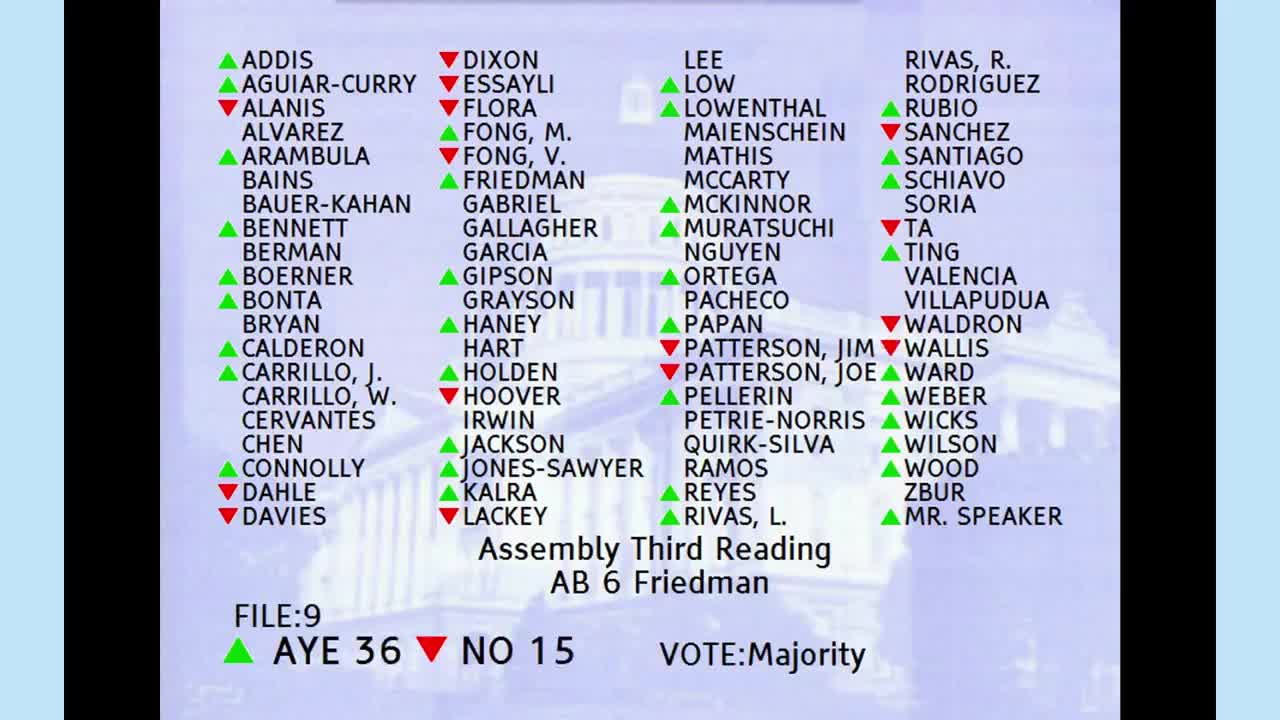 2MIN
Assembly Floor
 2MIN
Assembly Standing Committee on Appropriations
 7MIN
Assembly Standing Committee on Judiciary
 7MIN
Assembly Standing Committee on Natural Resources
Bill Author
Bill Co-Author(s):