AB 1472: City of Imperial Beach: recreational vehicle parks: registration requirements.
- Session Year: 2023-2024
- House: Assembly
- Latest Version Date: 2024-09-22
Current Status:
Passed
(2024-09-22: Chaptered by Secretary of State - Chapter 351, Statutes of 2024.)
Introduced
In Committee
First Chamber
In Committee
Second Chamber
Enacted
Existing law, the Recreational Vehicle Park Occupancy Law, prescribes various terms and conditions applicable to recreational vehicle park tenancies.
The bill would prohibit a person from requiring an occupant, tenant, or resident, as defined, in a qualified recreational vehicle park to reregister if the purpose of the reregistration requirement is to prevent the occupant, tenant, or resident from gaining or maintaining status as a resident, and would make a person who violates these provisions liable for a civil penalty of $500, as specified. The bill would define qualified recreational vehicle park as a recreational vehicle park located within the City of Imperial Beach.
This bill would make legislative findings and declarations as to the necessity of a special statute for the City of Imperial Beach.
Existing law, the Recreational Vehicle Park Occupancy Law, prescribes various terms and conditions applicable to recreational vehicle park tenancies.
The bill would prohibit a person from requiring an occupant, tenant, or resident, as defined, in a recreational vehicle park to reregister if the purpose of the reregistration requirement is to prevent the occupant, tenant, or resident from gaining or maintaining status as a resident, and would make a person who violates these provisions liable for a civil penalty of $500, as specified.
Existing law, the Recreational Vehicle Park Occupancy Law, prescribes various terms and conditions applicable to recreational vehicle park tenancies.Existing law, the Mobilehome Residency Law, prescribes various terms and conditions of tenancies to mobilehome parks. Existing law, until January 1, 2030, prohibits the management of a qualified mobilehome park, as defined, from increasing the gross rental rate for a tenancy for a mobilehome space by more than 3% plus the percentage change in the cost of living, as defined, or by 5% of the lowest gross rental rate charged at any time during the immediately preceding 12 months, whichever is lower. Existing law prohibits management of a qualified mobilehome park from increasing the gross rental rate for a tenancy in more than 2 increments over a 12-month period, after the tenant maintains a tenancy over a 12-month period.This bill would add provisions similar to the ones described above to the Recreational Vehicle Park Occupancy Law, applicable to qualified recreational vehicle parks. The bill would prohibit a person from requiring an occupant, tenant, or resident, as defined, in a qualified recreational vehicle park to reregister if the purpose of the reregistration requirement is to prevent the occupant, tenant, or resident from gaining or maintaining status as a resident, and would make a person who violates these provisions liable for a civil penalty of $500, as specified. The bill would define qualified recreational vehicle park as a recreational vehicle park located within the City of Imperial Beach. The bill would repeal these provisions on January 1, 2030.This bill would make legislative findings and declarations as to the necessity of a special statute for the City of Imperial Beach.Existing law, the Recreational Vehicle Park Occupancy Law, prescribes various terms and conditions applicable to recreational vehicle park tenancies.
Existing law, the Mobilehome Residency Law, prescribes various terms and conditions of tenancies to mobilehome parks. Existing law, until January 1, 2030, prohibits the management of a qualified mobilehome park, as defined, from increasing the gross rental rate for a tenancy for a mobilehome space by more than 3% plus the percentage change in the cost of living, as defined, or by 5% of the lowest gross rental rate charged at any time during the immediately preceding 12 months, whichever is lower. Existing law prohibits management of a qualified mobilehome park from increasing the gross rental rate for a tenancy in more than 2 increments over a 12-month period, after the tenant maintains a tenancy over a 12-month period.
This bill would add provisions similar to the ones described above to the Recreational Vehicle Park Occupancy Law, applicable to qualified recreational vehicle parks. The bill would prohibit a person from requiring an occupant, tenant, or resident, as defined, in a qualified recreational vehicle park to reregister if the purpose of the reregistration requirement is to prevent the occupant, tenant, or resident from gaining or maintaining status as a resident, and would make a person who violates these provisions liable for a civil penalty of $500, as specified. The bill would define qualified recreational vehicle park as a recreational vehicle park located within the City of National City or the City of Imperial Beach. The bill would repeal these provisions on January 1, 2030.
This bill would make legislative findings and declarations as to the necessity of a special statute for the City of National City and the City of Imperial Beach.
Existing law, the Recreational Vehicle Park Occupancy Law, prescribes various terms and conditions applicable to recreational vehicle park tenancies.
Existing law, the Mobilehome Residency Law, prescribes various terms and conditions of tenancies to mobilehome parks. Existing law, until January 1, 2030, prohibits the management of a qualified mobilehome park, as defined, from increasing the gross rental rate for a tenancy for a mobilehome space by more than 3% plus the percentage change in the cost of living, as defined, or by 5% of the lowest gross rental rate charged at any time during the immediately preceding 12 months, whichever is lower. Existing law prohibits management of a qualified mobilehome park from increasing the gross rental rate for a tenancy in more than 2 increments over a 12-month period, after the tenant maintains a tenancy over a 12-month period.
This bill would add provisions similar to the ones described above to the Recreational Vehicle Park Occupancy Law, applicable to qualified recreational vehicle parks. The bill would define qualified recreational vehicle park as a recreational vehicle park located within the City of National City or the City of Imperial Beach. The bill would repeal these provisions on January 1, 2030.
This bill would make legislative findings and declarations as to the necessity of a special statute for the City of National City and the City of Imperial Beach.
(a)A person shall not require an occupant, tenant, or resident in a qualified recreational vehicle park to reregister if the purpose of the reregistration requirement is to prevent the occupant, tenant, or resident from gaining or maintaining status as a resident.
(b)A person who violates subdivision (a) shall be liable for a civil penalty of five hundred dollars ($500).
(c)In an action brought pursuant to this section, if it is established by a preponderance of the evidence that an occupant, tenant, or resident was required to reregister, there shall be a rebuttable presumption that the purpose of that requirement was to prevent the occupant, tenant, or resident from gaining or maintaining status as a resident.
(d)In an action brought pursuant to this section, the court shall award reasonable attorneys fees and costs to the prevailing party.
(e)For the purposes of this section:
(1)Qualified recreational vehicle park means a recreational vehicle park, as defined in Section 799.30, that is located within the City of Imperial Beach.
(2)Notwithstanding Section 799.31 resident means a tenant who has occupied a lot in a park for at least 9 months in a 12-month period.
SEC. 2.The Legislature finds and declares that a special statute is necessary and that a general statute cannot be made applicable within the meaning of Section 16 of Article IV of the California Constitution because of the of the unique impact of rising rents in recreational vehicle parks in the City of Imperial Beach as compared to neighboring cities.
(a)A person shall not require an occupant, tenant, or resident in a qualified recreational vehicle park to reregister if the purpose of the reregistration requirement is to prevent the occupant, tenant, or resident from gaining or maintaining status as a resident.
(b)A person who violates subdivision (a) shall be liable for a civil penalty of five hundred dollars ($500).
(c)In an action brought pursuant to this section, if it is established by a preponderance of the evidence that an occupant, tenant, or resident was required to reregister, there shall be a rebuttable presumption that the purpose of that requirement was to prevent the occupant, tenant, or resident from gaining or maintaining status as a resident.
(d)In an action brought pursuant to this section, the court shall award reasonable attorneys fees and costs to the prevailing party.
(e)For the purposes of this section, notwithstanding Section 799.32, section:
(1)Qualified recreational vehicle park means a recreational vehicle park, as defined in Section 799.30, that is located within the City of Imperial Beach.
(2)Notwithstanding Section 799.31 resident means a tenant who has occupied a lot in a park for at least 9 months in a 12-month period.
SEC. 2.The Legislature finds and declares that a special statute is necessary and that a general statute cannot be made applicable within the meaning of Section 16 of Article IV of the California Constitution because of the of the unique impact of rising rents in recreational vehicle parks in the City of Imperial Beach as compared to neighboring cities.
(a)A person shall not require an occupant, tenant, or resident in a recreational vehicle park to reregister if the purpose of the reregistration requirement is to prevent the occupant, tenant, or resident from gaining or maintaining status as a resident.
(b)A person who violates subdivision (a) shall be liable for a civil penalty of five hundred dollars ($500).
(c)In an action brought pursuant to this section, if it is established by a preponderance of the evidence that an occupant, tenant, or resident was required to reregister, there shall be a rebuttable presumption that the purpose of that requirement was to prevent the occupant, tenant, or resident from gaining or maintaining status as a resident.
(d)In an action brought pursuant to this section, the court shall award reasonable attorneys fees and costs to the prevailing party.
(e)For the purposes of this section, notwithstanding Section 799.32, resident means a tenant who has occupied a lot in a park for at least 9 months in a 12-month period.
SECTION 1.Section 799.47 is added to the Civil Code, to read:799.47.(a)(1)Subject to subdivision (b), management shall not, over the course of any 12-month period, increase the gross rental rate for a tenancy in a qualified recreational vehicle park by more than 3 percent plus the percentage change in the cost of living, or by 5 percent, whichever is lower, of the lowest gross rental rate charged for a tenancy at any time during the 12 months prior to the effective date of the increase.(2)If the same resident maintains a tenancy over any 12-month period, the gross rental rate for the tenancy shall not be increased in more than two increments over that 12-month period, subject to the other restrictions of this subdivision governing gross rental rate increases.(b)For a new tenancy in which no resident from the prior tenancy remains in lawful possession of the recreational vehicle lot in the same recreational vehicle park, management may establish the initial rental rate not subject to subdivision (a), unless the applicable local agency or jurisdiction has adopted an ordinance, rule, regulation, or initiative measure that limits the allowable rental rate for a new tenancy, in which case that ordinance, rule, regulation, or initiative measure shall apply. Subdivision (a) shall be applicable to subsequent increases after that initial rental rate has been established, except as otherwise provided in this section.(c)(1)A person shall not require an occupant, tenant, or resident in a qualified recreational vehicle park to reregister if the purpose of the reregistration requirement is to prevent the occupant, tenant, or resident from gaining or maintaining status as a resident.(2)A person who violates paragraph (1) shall be liable for a civil penalty of five hundred dollars ($500).(3)In an action brought pursuant to this subdivision, if it is established by a preponderance of the evidence that an occupant, tenant, or resident was required to reregister, there shall be a rebuttable presumption that the purpose of that requirement was to prevent the occupant, tenant, or resident from gaining or maintaining status as a resident.(4)In an action brought pursuant to this subdivision, the court shall award reasonable attorneys fees and costs to the prevailing party.(d)A local governing body may establish inspection, reporting, or recordkeeping requirements to ensure compliance with this section.(e)For the purposes of this section:(1)(A)Percentage change in the cost of living means the percentage change in the Consumer Price Index for All Urban Consumers for All Items for the San Diego-Carlsbad metropolitan area covering the County of San Diego, or any successor metropolitan area index to that index, and computed pursuant to subparagraph (B).(B)(i)For rent increases that take effect before August 1 of any calendar year, the following shall apply:(I)The percentage change shall be the percentage change in the amount published for April of the immediately preceding calendar year and April of the year before that.(II)If there is not an amount published in April for the applicable geographic area, the percentage change shall be the percentage change in the amount published for March of the immediately preceding calendar year and March of the year before that.(ii)For rent increases that take effect on or after August 1 of any calendar year, the following shall apply:(I)The percentage change shall be the percentage change in the amount published for April of that calendar year and April of the immediately preceding calendar year.(II)If there is not an amount published in April for the applicable geographic area, the percentage change shall be the percentage change in the amount published for March of that calendar year and March of the immediately preceding calendar year.(iii)The percentage change shall be rounded to the nearest one-tenth of 1 percent.(2)Qualified recreational vehicle park means a recreational vehicle park, as defined in Section 799.30, that is located within the City of Imperial Beach.(3)Notwithstanding Section 799.32, resident means a tenant who has occupied a lot in a park for at least 9 months in a 12-month period.(f)This section shall remain in effect only until January 1, 2030, and as of that date is repealed.SEC. 2.The Legislature finds and declares that a special statute is necessary and that a general statute cannot be made applicable within the meaning of Section 16 of Article IV of the California Constitution because of the unique impact of rising rents in recreational vehicle parks in the City of Imperial Beach as compared to neighboring cities. REVISIONS: HeadingLine 2.(a)(1)Subject to subdivision (b), management shall not, over the course of any 12-month period, increase the gross rental rate for a tenancy in a qualified recreational vehicle park by more than 3 percent plus the percentage change in the cost of living, or by 5 percent, whichever is lower, of the lowest gross rental rate charged for a tenancy at any time during the 12 months prior to the effective date of the increase.
(2)If the same resident maintains a tenancy over any 12-month period, the gross rental rate for the tenancy shall not be increased in more than two increments over that 12-month period, subject to the other restrictions of this subdivision governing gross rental rate increase. increases.
(b)For a new tenancy in which no resident from the prior tenancy remains in lawful possession of the recreational vehicle lot in the same recreational vehicle park, management may establish the initial rental rate not subject to subdivision (a), unless the applicable local agency or jurisdiction has adopted an ordinance, rule, regulation, or initiative measure that limits the allowable rental rate for a new tenancy, in which case that ordinance, rule, regulation, or initiative measure shall apply. Subdivision (a) shall be applicable to subsequent increases after that initial rental rate has been established, except as otherwise provided in this section.
(c)(1)A person shall not require an occupant, tenant, or resident in a qualified recreational vehicle park to reregister if the purpose of the reregistration requirement is to prevent the occupant, tenant, or resident from gaining or maintaining status as a resident.
(2)A person who violates paragraph (1) shall be liable for a civil penalty of five hundred dollars ($500).
(3)In an action brought pursuant to this subdivision, if it is established by a preponderance of the evidence that an occupant, tenant, or resident was required to reregister, there shall be a rebuttable presumption that the purpose of that requirement was to prevent the occupant, tenant, or resident from gaining or maintaining status as a resident.
(4)In an action brought pursuant to this subdivision, the court shall award reasonable attorneys fees and costs to the prevailing party.
(d)A local governing body may establish inspection, reporting, or recordkeeping requirements to ensure compliance with this section.
(c)(e)For the purposes of this section:
(1)(A)Percentage change in the cost of living means the percentage change in the Consumer Price Index for All Urban Consumers for All Items for the San Diego-Carlsbad metropolitan area covering the County of San Diego, or any successor metropolitan area index to that index, and computed pursuant to subparagraph (B).
(B)(i)For rent increases that take effect before August 1 of any calendar year, the following shall apply:
(I)The percentage change shall be the percentage change in the amount published for April of the immediately preceding calendar year and April of the year before that.
(II)If there is not an amount published in April for the applicable geographic area, the percentage change shall be the percentage change in the amount published for March of the immediately preceding calendar year and March of the year before that.
(ii)For rent increases that take effect on or after August 1 of any calendar year, the following shall apply:
(I)The percentage change shall be the percentage change in the amount published for April of that calendar year and April of the immediately preceding calendar year.
(II)If there is not an amount published in April for the applicable geographic area, the percentage change shall be the percentage change in the amount published for March of that calendar year and March of the immediately preceding calendar year.
(iii)The percentage change shall be rounded to the nearest one-tenth of 1 percent.
(2)Qualified recreational vehicle park means a recreational vehicle park, as defined in Section 799.30, that is located within the City of National City or the City of Imperial Beach.
(3)Notwithstanding Section 799.32, resident means a tenant who has occupied a lot in a park for at least 9 months in a 12-month period.
(d)(f)This section shall remain in effect only until January 1, 2030, and as of that date is repealed.
SEC. 2.The Legislature finds and declares that a special statute is necessary and that a general statute cannot be made applicable within the meaning of Section 16 of Article IV of the California Constitution because of the unique impact of rising rents in recreational vehicle parks in the City of National City and the City of Imperial Beach as compared to neighboring cities.
(a)(1)Subject to subdivision (b), management shall not, over the course of any 12-month period, increase the gross rental rate for a tenancy in a qualified recreational vehicle park by more than 3 percent plus the percentage change in the cost of living, or by 5 percent, whichever is lower, of the lowest gross rental rate charged for a tenancy at any time during the 12 months prior to the effective date of the increase.
(2)If the same resident maintains a tenancy over any 12-month period, the gross rental rate for the tenancy shall not be increased in more than two increments over that 12-month period, subject to the other restrictions of this subdivision governing gross rental rate increase.
(b)For a new tenancy in which no resident from the prior tenancy remains in lawful possession of the recreational vehicle lot in the same recreational vehicle park, management may establish the initial rental rate not subject to subdivision (a), unless the applicable local agency or jurisdiction has adopted an ordinance, rule, regulation, or initiative measure that limits the allowable rental rate for a new tenancy, in which case that ordinance, rule, regulation, or initiative measure shall apply. Subdivision (a) shall be applicable to subsequent increases after that initial rental rate has been established, except as otherwise provided in this section.
(c)For the purposes of this section:
(1)(A)Percentage change in the cost of living means the percentage change in the Consumer Price Index for All Urban Consumers for All Items for the San Diego-Carlsbad metropolitan area covering the County of San Diego, or any successor metropolitan area index to that index, and computed pursuant to subparagraph (B).
(B)(i)For rent increases that take effect before August 1 of any calendar year, the following shall apply:
(I)The percentage change shall be the percentage change in the amount published for April of the immediately preceding calendar year and April of the year before that.
(II)If there is not an amount published in April for the applicable geographic area, the percentage change shall be the percentage change in the amount published for March of the immediately preceding calendar year and March of the year before that.
(ii)For rent increases that take effect on or after August 1 of any calendar year, the following shall apply:
(I)The percentage change shall be the percentage change in the amount published for April of that calendar year and April of the immediately preceding calendar year.
(II)If there is not an amount published in April for the applicable geographic area, the percentage change shall be the percentage change in the amount published for March of that calendar year and March of the immediately preceding calendar year.
(iii)The percentage change shall be rounded to the nearest one-tenth of 1 percent.
(2)Qualified recreational vehicle park means a recreational vehicle park, as defined in Section 799.30, that is located within the City of National City or the City of Imperial Beach.
(3)Notwithstanding Section 799.32, resident means a tenant who has occupied a lot in a park for at least 9 months in a 12-month period.
(d)This section shall remain in effect only until January 1, 2030, and as of that date is repealed.
SEC. 2.The Legislature finds and declares that a special statute is necessary and that a general statute cannot be made applicable within the meaning of Section 16 of Article IV of the California Constitution because of the unique impact of rising rents in recreational vehicle parks in the City of National City and the City of Imperial Beach as compared to neighboring cities.
|
Date
|
Status
|
|---|---|
| Sep 22, 2024 | Chaptered by Secretary of State - Chapter 351, Statutes of 2024. |
| Sep 22, 2024 | Approved by the Governor. |
| Sep 11, 2024 | Enrolled and presented to the Governor at 4 p.m. |
| Aug 30, 2024 | Senate amendments concurred in. To Engrossing and Enrolling. (Ayes 70. Noes 0.). |
| Aug 30, 2024 | In Assembly. Concurrence in Senate amendments pending. |
| Aug 29, 2024 | Read third time. Passed. Ordered to the Assembly. (Ayes 33. Noes 6.). |
| Aug 19, 2024 | Read second time. Ordered to third reading. |
| Aug 15, 2024 | From committee: Do pass. (Ayes 5. Noes 2.) (August 15). |
| Aug 5, 2024 | In committee: Referred to APPR suspense file. |
| Jul 3, 2024 | From committee: Do pass and re-refer to Com. on APPR. (Ayes 9. Noes 1.) (July 2). Re-referred to Com. on APPR. |
| Jun 24, 2024 | From committee chair, with author's amendments: Amend, and re-refer to committee. Read second time, amended, and re-referred to Com. on JUD. |
| Jul 11, 2023 | In committee: Set, final hearing. Failed passage. Reconsideration granted. |
| Jun 30, 2023 | In committee: Set, second hearing. Hearing canceled at the request of author. |
| Jun 27, 2023 | In committee: Testimony taken. Hearing postponed by committee. |
| Jun 16, 2023 | In committee: Set, first hearing. Hearing canceled at the request of author. |
| May 17, 2023 | Referred to Coms. on JUD. and APPR. |
| May 9, 2023 | In Senate. Read first time. To Com. on RLS. for assignment. |
| May 8, 2023 | Read third time. Passed. Ordered to the Senate. (Ayes 72. Noes 0. Page 1490.) |
| May 1, 2023 | Read second time. Ordered to third reading. |
| Apr 27, 2023 | From committee: Do pass. (Ayes 7. Noes 0.) (April 26). |
| Apr 27, 2023 | Coauthors revised. |
| Apr 24, 2023 | Re-referred to Com. on H. & C.D. |
| Apr 20, 2023 | From committee chair, with author's amendments: Amend, and re-refer to Com. on H. & C.D. Read second time and amended. |
| Apr 11, 2023 | Re-referred to Com. on H. & C.D. |
| Apr 10, 2023 | From committee chair, with author's amendments: Amend, and re-refer to Com. on H. & C.D. Read second time and amended. |
| Mar 9, 2023 | Referred to Com. on H. & C.D. |
| Feb 18, 2023 | From printer. May be heard in committee March 20. |
| Feb 17, 2023 | Read first time. To print. |
|
Date
|
Description
|
Location
|
Votes
|
|
|---|---|---|---|---|
| Aug 30, 2024 | AB 1472 Alvarez Concurrence in Senate Amendments | Assembly Floor |
Passed |
|
| Aug 29, 2024 | Assembly 3rd Reading AB1472 Alvarez et al. By Padilla | Senate Floor |
Passed |
|
| Aug 15, 2024 | Do pass | Senate Standing Committee on Appropriations |
Passed |
|
| Aug 5, 2024 | Placed on suspense file | Senate Standing Committee on Appropriations |
Passed |
|
| Jul 2, 2024 | Do pass, but first be re-referred to the Committee on [Appropriations] | Senate Standing Committee on Judiciary |
Passed |
|
| Jul 11, 2023 | [Final] hearing set for [07-12-2023]: Failed passage in Committee. Reconsideration granted | Senate Standing Committee on Judiciary |
Passed |
|
| Jul 11, 2023 | Do pass, but first be re-referred to the Committee on [Appropriations] | Senate Standing Committee on Judiciary |
Failed |
|
| May 8, 2023 | AB 1472 Alvarez Assembly Third Reading | Assembly Floor |
Passed |
|
| Apr 26, 2023 | Do pass. | Assembly Standing Committee on Housing and Community Development |
Passed |
This list shows positions taken on this bill by organizations on the date displayed, which is linked to the original source.
Positions by individuals are not included.
|
Organization
|
Position
|
Date
|
|---|---|---|
| Alliance Of Californians For Community Empowerment | ** Support | |
| California Outdoor Hospitality Association | ** Against | |
| City Of Imperial Beach | ** Support | |
| City of Lake Elsinore | ** Against | |
| De Anza Corporation | ** Against | |
| denza corporation | * Against | Jun 27, 2023 |
| Padre Dam Municipal Water District | ** Against | |
| Public Interest Law Project | ** Support | |
| tenant association | * Support | Jun 27, 2023 |
| University of San Diego Law School | * Support | Apr 26, 2023 |
CONCURRENCE IN SENATE AMENDMENTS
CSA1 Bill Id:AB 1472
Author:(Alvarez)
As Amended Ver:June 24, 2024
Majority vote
SUMMARY
Prohibits a person from requiring an occupant, tenant, or resident in a recreational vehicle (RV) park located in the City of Imperial Beach from reregistering if the purpose of the reregistration is to prevent the occupant, tenant, or resident from gaining or maintaining status as a resident, and creates a civil penalty for violation of this prohibition.
Senate Amendments
Re-limit the provisions of the bill prohibiting reregistration to RV parks located in the City of Imperial Beach.
COMMENTS
Background on RV Parks: The RV Park Occupancy Law was enacted in 1979, one year after the Mobilehome Residency Law (MRL) was enacted. There are some similarities and differences between RV parks and mobilehome parks. RV parks may exist solely to serve RVs and be solely governed by the RV Park Occupancy Law, or they may be designated subsections of mobilehome parks. Under the Mobilehome Parks Act, these designated RV lots are considered RV parks and are not part of the mobilehome parks. Those lots are permitted or licensed for RVs by the Department of Housing and Community Development (HCD) under a parallel statute, the Special Occupancy Parks Act. However, even though they are attached to mobilehome parks, the MRL does not apply to these designated RV lots or sections – only the RV Park Occupancy Law applies. Local mobilehome rent control provisions, if they exist, also do not apply to RV parks.
In addition, the MRL defines a "mobilehome" to include a "trailer or other recreational vehicle [that] occupies a mobilehome site in the park for nine or more continuous months commencing on or after November 15, 1992." Therefore, if a trailer or RV establishes itself on a mobilehome park lot and the owner resides there for nine months or longer, they gain mobilehome status and are subject to the MRL (and any local rent control provisions).
For RV parks, individuals who have owned an RV and occupied a lot for nine months or more are considered residents. An RV park resident who has either newly entered the park or who has bought an RV from a former park resident starts out as an occupant, then a tenant after 30 days, and does not become a resident until after nine months of occupancy.
Modeled on Residential Hotel Tenant Shuffling Protections: This bill is substantially similar to AB 2867 (Núñez), Chapter 950, Statutes of 2004, which sought to address the practice of residential hotels forcing occupants to move out before tenancy could be established by 30 days of occupancy, in what was then referred to as the "28-day shuffle." At the time, once an occupant of a residential hotel reached 30 days of occupancy, they acquired tenancy, which granted them additional protections regarding eviction procedures and habitability standards that residential hotel owners had to obey. That bill, sponsored by the Los Angeles City Attorney's office, created a rebuttable presumption that an occupant being required by an owner to check out and reregister before 30 days of occupancy is intended to deny them tenancy status and the attendant protections. According to the Senate Judiciary Committee's analysis of AB 2867 (Núñez): "Proponents also point out that many individuals seek shelter in hotels as a stopgap measure. For others less fortunate, residential hotels provide a last resort. Thus, proponents argue that AB 2867 is vitally important to protect what little stability and security that is affordable and available to these downtrodden members of society. The bitter alternative is more homelessness."
A similar situation happens when a residential hotel occupant hits 30 days of occupancy as when a RV park occupant reaches nine months of occupancy – they gain additional legal protections as a resident rather than occupant. A key additional protection is the right to just cause eviction, which means that an RV park owner must have a specific reason – like nonpayment of rent or violation of park rules – to evict an RV park resident, and cannot simply deny the renewal of their occupancy agreement without specifying a cause. The parkowner also must provide at least 60 days' notice of a termination of tenancy for cause to residents, rather than 30 days (and no cause) for RV park tenants, and 72 hours for defaulting occupants (whose RVs are generally towed and removed to storage). This just cause eviction requirement in the RV Park Occupancy Law for residents mirrors the just cause eviction requirements in the MRL for mobilehome homeowners or residents (see Civil Code Section 798.56).
This bill both creates the prohibition on forcing RV park residents to shuffle in and out of a park to deny them resident status, and establishes a rebuttable presumption that evidence that a parkowner or manager made a person leave and reregister demonstrates that the shuffle was done in order to prevent the person from gaining resident status. The rebuttable presumption shifts the burden of proof regarding the reregistration to the party that can best present evidence on the purpose of the RV parkowner's action in shuffling the RV lot occupant in and out of the park – the RV parkowner. The provisions in this bill only apply to RV parks located in the City of Imperial Beach.
This bill also reproduces the civil penalty and attorney's fees provisions in the RV Park Occupancy Law for violations, with a minor variation – specifically, a mandatory rather than discretionary $500 civil penalty for a violation. In addition, while the RV Park Occupancy Law defines a "resident" as someone who has occupied a lot in a park for nine months or more, this bill provides that a "resident" means a tenant who has occupied a park for at least nine months in a 12-month period. Given that the shuffling practice the bill seeks to prevent makes it likely that an Imperial Beach RV park tenant/occupant would be unable to demonstrate consecutive occupation of a lot for nine months, this change would allow a tenant who can demonstrate that they occupied a lot at least nine months out of a yearlong period to be covered by the protections in the bill, even if those months were nonconsecutive.
According to the Author
"Since 2022, Mobilehome and RV parks within the City of Imperial Beach have been requiring long-term residents to renew their tenant agreements every 6 or 9 months to avoid the tenants being defined as 'Resident' (CIV Code Sec. 799.31). During this renewal process, the tenants, which includes families with small children, are forced to relocate to hotels or find other housing options and move their RV, usually for a few days, and then return to the RV park with a new tenant agreement, often with an increased rental rate. Many of these families have lived in the park for more than a decade.
This 'RV Shuffle' process is repeated again and again, resulting in persistent dislocation of a disadvantaged population and causing them ongoing mental and financial hardship.
AB 1472 will discourage the RV Shuffle practice in the City of Imperial Beach by instituting a financial penalty on RV park owners that are requiring tenants to re-register if the sole purpose is to prevent tenants from gaining or maintaining status as Resident.
This bill is supported by the City of Imperial Beach and modeled after AB 2867 (2004, Núñez) that addressed a similar practice occurring at residential hotels."
Arguments in Support
According to the Public Interest Law Project, "Based on Civil Code section 1940.1 (AB 2867, Stats. 2004, Ch. 950), which made shuffling occurring at California residential hotels illegal, AB 1472 addresses the shuffle in the RV context. Currently, many RV parks require long-term RV residents to move out and reregister to avoid occupants being defined as a 'resident' which would entitle them to protections under Civ. Code § 799.31 et seq. Just as it was when residential hotel operators were doing it, it is wrong and must be stopped for those residing in RVs. AB 1472 will ensure long-term RV residents can live without fear of eviction and provide them with quality of life improvements such as having a stable place to reside as well as being able to access resources and services, which is extremely difficult to obtain with constant moving."
Arguments in Opposition
According to the California Outdoor Hospitality Association, "We can certainly appreciate one's desire to assist their constituents, but our association feels strongly that AB 1472 will have the reverse effect of what is being presented and set a precedence that could be severely detrimental to the RV park industry and local tourism economies. Current law already allows RV Park Owners to allow people to remain in the park and become permanent residents. But that is up to the discretion of the park owner and is based on many factors, including without limitation, their CUPs, locations, need, etc.... But who knows what the future holds and assuming California can achieve its goals for providing affordable housing, owners are concerned about increasing the number of permanent spaces in lieu of transient spaces. Requiring a Special Occupancy Park (SOP or RV park) to offer full time residency after a 9 month length of stay or be fined will likely result in the park requiring the guest vacate at the end of the 6-month term with no possibility of return in order to ensure they aren't in violation if AB 1472 is signed into law. The California Outdoor Hospitality Association opposes AB 1472 regardless of the locality."
FISCAL COMMENTS
According to the Senate Appropriations Committee:
- Unknown, potentially significant cost pressure to the state funded trial court system (Trial Court Trust Fund, General Fund) to adjudicate violations of this bill. The fiscal impact of this bill to the courts will depend on many unknown factors, including the numbers of violations alleged to have occurred, if parties settle the matter before the filing of an action, and the factors unique to each case. An eight-hour court day costs approximately $8,000 in staff in workload. If the bill results in only 12 or more days spent in court, trial court costs could be in the hundreds of thousands of dollars. While the courts are not funded on a workload basis, an increase in workload could result in delayed court services and would put pressure on the General Fund to fund additional staff and resources and to increase the amount appropriated to backfill for trial court operations. The Budget Act of 2024, for the fiscal year beginning July 1, 2024, includes a $97 million reduction to the trial courts, a commensurate reduction of up to 7.95 percent to the budget for the state-level judiciary, and a reduction of the trial court state-level emergency reserve in the Trial Court Trust Fund from $10 million to $5 million. The Budget Act also includes a $37.3 million General Fund backfill for the Trial Court Trust Fund to address the continued decline in civil fee and criminal fine and penalty revenues expected in fiscal year 2024‒25.
VOTES:
ASM HOUSING AND COMMUNITY DEVELOPMENT: 7-0-1
YES: Wicks, Wendy Carrillo, Gabriel, Kalra, Quirk-Silva, Sanchez, Ward
ABS, ABST OR NV: Joe Patterson
ASSEMBLY FLOOR: 72-0-8
YES: Addis, Aguiar-Curry, Alanis, Alvarez, Bains, Bauer-Kahan, Bennett, Berman, Boerner, Bonta, Bryan, Calderon, Wendy Carrillo, Chen, Connolly, Megan Dahle, Davies, Dixon, Essayli, Flora, Mike Fong, Vince Fong, Friedman, Gabriel, Gallagher, Garcia, Gipson, Grayson, Haney, Holden, Hoover, Irwin, Jackson, Jones-Sawyer, Kalra, Lackey, Low, Lowenthal, Maienschein, Mathis, McKinnor, Muratsuchi, Stephanie Nguyen, Pacheco, Papan, Jim Patterson, Joe Patterson, Pellerin, Petrie-Norris, Quirk-Silva, Ramos, Reyes, Luz Rivas, Robert Rivas, Rodriguez, Blanca Rubio, Sanchez, Santiago, Schiavo, Soria, Ta, Ting, Valencia, Villapudua, Waldron, Wallis, Weber, Wicks, Wilson, Wood, Zbur, Rendon
ABS, ABST OR NV: Arambula, Juan Carrillo, Cervantes, Hart, Lee, McCarty, Ortega, Ward
SENATE FLOOR: 33-6-1
YES: Allen, Alvarado-Gil, Archuleta, Ashby, Atkins, Becker, Blakespear, Bradford, Caballero, Cortese, Dodd, Durazo, Eggman, Glazer, Gonzalez, Hurtado, Laird, Limón, McGuire, Menjivar, Min, Newman, Padilla, Portantino, Roth, Rubio, Skinner, Smallwood-Cuevas, Stern, Umberg, Wahab, Wiener, Wilk
NO: Dahle, Grove, Jones, Nguyen, Niello, Seyarto
ABS, ABST OR NV: Ochoa Bogh
UPDATED
VERSION: June 24, 2024
CONSULTANT: Nicole Restmeyer / H. & C.D. / (916) 319-2085 FN: 0004922
SENATE RULES COMMITTEE Office of Senate Floor Analyses (916) 651-1520 Fax: (916) 327-4478 | AB 1472 |
THIRD READING
Bill No: AB 1472
Author: Alvarez (D), et al.
Amended: 6/24/24 in Senate
Vote: 21
SENATE JUDICIARY COMMITTEE: 2-6, 7/11/23
AYES: Durazo, Wiener
NOES: Umberg, Ashby, Caballero, Laird, Min, Niello
NO VOTE RECORDED: Wilk, Allen, Stern
SENATE JUDICIARY COMMITTEE: 9-1, 7/2/24
AYES: Umberg, Allen, Ashby, Caballero, Durazo, Laird, Roth, Stern, Wahab
NOES: Niello
NO VOTE RECORDED: Wilk
SENATE APPROPRIATIONS COMMITTEE: 5-2, 8/15/24
AYES: Caballero, Ashby, Becker, Bradford, Wahab
NOES: Jones, Seyarto
ASSEMBLY FLOOR: 72-0, 5/8/23 - See last page for vote
SUBJECT: City of Imperial Beach: recreational vehicle parks: registration requirements
SOURCE: Author
DIGEST:
This bill prohibits a person from requiring an occupant, tenant, or resident in a recreational vehicle (RV) park located within the City of Imperial Beach to reregister if the purpose of the reregistration requirement is to prevent the occupant, tenant, or resident from gaining or maintaining status as a resident, and provides for a rebuttable presumption that the reason for requiring reregistration is to prevent them from gaining or maintaining status as a resident. The bill makes a person who violates these provisions liable for a civil penalty of $500, and requires a court to award reasonable attorney’s fees and costs to the prevailing party.
ANALYSIS:
Existing law:
- Establishes the Special Occupancy Parks Act, which governs the construction, permitting, and oversight of maintenance and habitability in recreational vehicle (RV) parks, temporary RV parks, incidental camping areas, or tent camps that are not owned or operated by a government entity or a nonprofit entity under temporary, permanent, or emergency use. (Health & Saf. Code §§ 18860-18874.)
- “Recreational vehicle park” means any area or tract of land, or a separate designated section within a mobilehome park where two or more lots are rented, leased, or held out for rent or lease, or were formerly held out for rent or lease and later converted to a subdivision, cooperative, condominium, or other form of resident ownership, to accommodate owners or users of recreational vehicles, camping cabins, or tents. (Health & Saf. Code § 18862.39.)
- “Occupant” and “resident” are interchangeable and include “occupant,” “resident,” “tenant,” or “guest” as used in the RV Park Occupancy Law (Chapter 2.6 (commencing with Section 799.20) of the Civil Code). (Health & Saf. Code § 18862.30.)
- Establishes the RV Park Occupancy Law and defines the following terms:
- “Management” means the owner of a recreational vehicle park or an agent or representative authorized to act on their behalf in connection with matters relating to the park. (Civ. Code § 799.26.)
- “Occupant” means the owner or operator of a recreational vehicle who has occupied a lot in a park for 30 days or less. (Civ. Code § 799.28.)
- “Resident” means a tenant who has occupied a lot in a park for nine months or more. (Civ. Code § 799.31.)
- “Tenant” means the owner or operator of a recreational vehicle who has occupied a lot in a park for more than 30 consecutive days. (Civ. Code § 799.32.)
- Prohibits an occupant registration agreement or tenant rental agreement from containing a provision by which the occupant or tenant waives the tenant’s rights under the provisions of the RV Park Occupancy Law, and any waiver of these rights is deemed contrary to public policy and void. (Civ. Code § 799.42.)
- Authorizes management to terminate or refuse to renew the right of occupancy of a tenant for other than nonpayment of rent or other charges upon the giving of a written notice to the tenant upon the giving of a written notice to the tenant to remove the RV from the park. The notice is not required to state the cause for termination, but must provide not less than 30 days’ notice of termination of the tenancy. (Civ. Code § 799.66.)
- Authorizes management to terminate or refuse to renew the right of occupancy of a defaulting resident upon the giving of a written notice, in a specified manner, to the defaulting resident to remove the recreational vehicle from the park. The notice is required to provide not less than 60 days’ notice of termination of the right of occupancy and must specify one of certain reasons for the termination of the right of occupancy. (Civ. Code § 799.70.)
- Provides that in any action arising out of the provisions of the RV Park Occupancy Law, the prevailing party is entitled to reasonable attorney’s fees and costs.
A party is deemed a prevailing party if the judgment is rendered in their favor or where the litigation is dismissed in their favor prior to or during the trial, unless the parties otherwise agree in the settlement or compromise. (Civ. Code § 799.78.)
- Provides the court discretion to award additional penalty fees to a current or former occupant, tenant, or resident who is the prevailing party in a civil action against the management to enforce their rights under the RV Park Occupancy Law. In addition to damages afforded by law, the court may award the current or former occupant, tenant, or resident up to $500 for each willful violation of any provision of the RV Park Occupancy Law by management. (Civ. Code § 799.79.)
This bill:
- Prohibits a person from requiring an occupant, tenant, or resident in a RV park located in the City of Imperial Beach to reregister if the purpose of the reregistration requirement is to prevent the occupant, tenant, or resident from gaining or maintaining status as a resident.
- Provides that, if it is established by a preponderance of the evidence that an occupant, tenant, or resident was required to reregister, there will be a rebuttable presumption that the purpose of that requirement was to prevent the occupant, tenant, or resident from gaining or maintaining status as a resident.
- Makes a person who violates these provisions liable for a civil penalty of $500.
- Requires a court to award reasonable attorney’s fees and costs to the prevailing party.
- Makes Legislature finds and declarations of the Legislature that a special statute is necessary and that a general statute cannot be made applicable within the meaning of Section 16 of Article IV of the California Constitution because of the of the unique impact of rising rents in recreational vehicle parks in the City of Imperial Beach as compared to neighboring cities.
Comments
The author brings this bill in response to a situation that occurred at the Miramar Mobile Home & RV Park in Imperial Beach. Tenants staying in RVs at this park reported that they were “forced to move out every six months for at least 48 hours,” which was extremely costly for these tenants with some reporting costs of several thousand dollars.[1] The tenants believed that management was doing this to prevent them from gaining status as a resident under the RV Park Occupancy Law. The Voice of San Diego covered this issue and reported the following about one of the RV Park tenants, Rachel Orozco:
Orozco is required to pack up her stuff and leave for at least 48 hours every six months. Otherwise she could be evicted, as the park doesn’t consider its residents to be residents worthy of state protections until they’ve been there for nine months straight.
First, Orozco needed to find another place to park her trailer. She spent two nights with her family and two nights in a hotel. She had to take personal time off work in the process. The food in her fridge went bad. She came back to the property to find that the required deposit had gone up $250.
All told, the cost of temporarily vacating the park was about equal to her $740 rent, which undermined her reason for being there in the first place. She browsed apartment listings in the area but quickly concluded that the rest of Imperial Beach was too expensive.
Her last move-out was in March and she’s scheduled for another in September. “It’s just stressful to know that most likely I’m gonna have to do it again,” she told me.
In order to address this practice, the bill prohibits a person from requiring an occupant, tenant, or resident in a recreational vehicle park located in the City of Imperial Beach to reregister if the purpose of the reregistration requirement is to prevent the occupant, tenant, or resident from gaining or maintaining status as a resident. The bill provides that if it is established by a preponderance of the evidence that an occupant, tenant, or resident was required to reregister, there is a rebuttable presumption that the purpose of that requirement was to prevent the occupant, tenant, or resident from gaining or maintaining status as a resident. A person who violates these provisions is liable for a civil penalty of $500, and a court is required to award reasonable attorney’s fees and costs to the prevailing party.[2]
FISCAL EFFECT: Appropriation: No Fiscal Com.: No Local: No
According to the Senate Appropriations Committee,
Unknown, potentially significant cost pressure to the state funded trial court system (Trial Court Trust Fund, General Fund) to adjudicate violations of this bill. The fiscal impact of this bill to the courts will depend on many unknown factors, including the numbers of violations alleged to have occurred, if parties settle the matter before the filing of an action, and the factors unique to each case. An eight-hour court day costs approximately $8,000 in staff in workload. If the bill results in only 12 or more days spent in court, trial court costs could be in the hundreds of thousands of dollars. While the courts are not funded on a workload basis, an increase in workload could result in delayed court services and would put pressure on the General Fund to fund additional staff and resources and to increase the amount appropriated to backfill for trial court operations. The Budget Act of 2024, for the fiscal year beginning July 1, 2024, includes a $97 million reduction to the trial courts, a commensurate reduction of up to 7.95 percent to the budget for the state-level judiciary, and a reduction of the trial court state-level emergency reserve in the Trial Court Trust Fund from $10 million to $5 million. The Budget Act also includes a $37.3 million General Fund backfill for the Trial Court Trust Fund to address the continued decline in civil fee and criminal fine and penalty revenues expected in fiscal year 2024‒25.
SUPPORT: (Verified 8/15/24)
Alliance of Californians for Community Empowerment (ACCE Action)
City of Imperial Beach
Public Interest Law Project
OPPOSITION: (Verified 8/15/24)
California Outdoor Hospitality Association
ARGUMENTS IN SUPPORT: The author writes:
Since 2022, Mobilehome and RV parks within the City of Imperial Beach have been requiring long-term residents to renew their tenant agreements every 6 or 9 months to avoid the tenants being defined as “Resident” (CIV Code Sec. 799.31). During this renewal process, the tenants, which includes families with small children, are forced to relocate to hotels or find other housing options and move their RV, usually for a few days, and then return to the RV park with a new tenant agreement, often with an increased rental rate. Many of these families have lived in the park for more than a decade.
This ‘RV Shuffle’ process is repeated again and again, resulting in persistent dislocation of a disadvantaged population and causing them ongoing mental and financial hardship.
AB 1472 will discourage the RV Shuffle practice in the City of Imperial Beach by instituting a financial penalty on RV park owners that are requiring tenants to re-register if the sole purpose is to prevent tenants from gaining or maintaining status as Resident.
This bill is supported by the City of Imperial Beach and modeled after AB 2867 (2004, Núñez) that addressed a similar practice occurring at residential hotels.
ARGUMENTS IN OPPOSITION: The California Outdoor Hospitality Association writes in opposition stating:
[…] This is a local issue and Imperial Beach (1B) can promulgate new laws if it so desires so we are unclear why the state sees the need to intervene when 1B can make the change itself.
We can certainly appreciate one's desire to assist their constituents, but our association feels strongly that AB 1472 will have the reverse effect of what is being presented and set a precedence that could be severely detrimental to the RV park industry and local tourism economies. Current law already allows RV Park Owners to allow people to remain in the park and become permanent residents. But that is up to the discretion of the park owner and is based on many factors, including without limitation, their CUPs, locations, need, etc.... But who knows what the future holds and assuming California can achieve its goals for providing affordable housing, owners are concerned about increasing the number of permanent spaces in lieu of transient spaces.
Requiring a Special Occupancy Park (SOP or RV park) to offer full time residency after a 9 month length of stay or be fined will likely result in the park requiring the guest vacate at the end of the 6-month term with no possibility of return in order to ensure they aren't in violation if AB 1472 is signed into law. The California Outdoor Hospitality Association opposes AB 1472 regardless of the locality.
ASSEMBLY FLOOR: 72-0, 5/8/23
AYES: Addis, Aguiar-Curry, Alanis, Alvarez, Bains, Bauer-Kahan, Bennett, Berman, Boerner, Bonta, Bryan, Calderon, Wendy Carrillo, Chen, Connolly, Megan Dahle, Davies, Dixon, Essayli, Flora, Mike Fong, Vince Fong, Friedman, Gabriel, Gallagher, Garcia, Gipson, Grayson, Haney, Holden, Hoover, Irwin, Jackson, Jones-Sawyer, Kalra, Lackey, Low, Lowenthal, Maienschein, Mathis, McKinnor, Muratsuchi, Stephanie Nguyen, Pacheco, Papan, Jim Patterson, Joe Patterson, Pellerin, Petrie-Norris, Quirk-Silva, Ramos, Reyes, Luz Rivas, Robert Rivas, Rodriguez, Blanca Rubio, Sanchez, Santiago, Schiavo, Soria, Ta, Ting, Valencia, Villapudua, Waldron, Wallis, Weber, Wicks, Wilson, Wood, Zbur, Rendon
NO VOTE RECORDED: Arambula, Juan Carrillo, Cervantes, Hart, Lee, McCarty, Ortega, Ward
Prepared by: Amanda Mattson / JUD. / (916) 651-4113
8/18/24 8:50:49
**** END ****
Sheila Pell, Imperial Beach says time's up for Miramar Mobile Home & RV Park, San Diego Reader (Oct. 3, 2022), available at https://www.sandiegoreader.com/news/2022/oct/03/stringers-imperial-beach-says-times-miramar-mobile/. ↑
Jesse Marx, Mobile Homeowners at Risk of Eviction Petition Imperial Beach for Help, Voice of San Diego, (Aug. 4, 2022), available at https://voiceofsandiego.org/2022/08/04/how-rv-parks-can-elude-tenant-protections/. ↑
SENATE COMMITTEE ON
Senator Anna Caballero, Chair
2023 - 2024 Regular Session
AB 1472 (Alvarez) - City of Imperial Beach: recreational vehicle parks: registration requirements
Version: | Policy Vote: |
Urgency: | Mandate: |
Hearing Date: | Consultant: |
Bill Summary:
AB 1427 would prohibit a person from requiring an occupant, tenant, or resident in a recreational vehicle (RV) park located within the City of Imperial Beach to reregister if the purpose of the reregistration requirement is to prevent the occupant, tenant, or resident from gaining or maintaining status as a resident.
Fiscal Impact:
Unknown, potentially significant cost pressure to the state funded trial court system (Trial Court Trust Fund, General Fund) to adjudicate violations of this bill. The fiscal impact of this bill to the courts will depend on many unknown factors, including the numbers of violations alleged to have occurred, if parties settle the matter before the filing of an action, and the factors unique to each case. An eight-hour court day costs approximately $8,000 in staff in workload. If the bill results in only 12 or more days spent in court, trial court costs could be in the hundreds of thousands of dollars. While the courts are not funded on a workload basis, an increase in workload could result in delayed court services and would put pressure on the General Fund to fund additional staff and resources and to increase the amount appropriated to backfill for trial court operations. The Budget Act of 2024, for the fiscal year beginning July 1, 2024, includes a $97 million reduction to the trial courts, a commensurate reduction of up to 7.95 percent to the budget for the state-level judiciary, and a reduction of the trial court state-level emergency reserve in the Trial Court Trust Fund from $10 million to $5 million. The Budget Act also includes a $37.3 million General Fund backfill for the Trial Court Trust Fund to address the continued decline in civil fee and criminal fine and penalty revenues expected in fiscal year 2024‒25.
Background:
According to the analysis of this bill by the Senate Judiciary Committee, This bill is intended to address an issue that occurred in the author’s district. It was reported that tenants at Miramar Mobile Home & RV Park in Imperial Beach were being required to move out every six months for at least a few days or face eviction. Often their rents were increased when they returned. The Miramar Park contains both mobile home and RV spots. In response, the city council issued an emergency ordinance capping rent increases and banning evictions. In the interim, attorneys representing the park owners and tenants entered negotiations regarding these issues. This bill seeks to prevent this situation from continuing to occur.
Proposed Law:
This bill prohibits a person from requiring an occupant, tenant, or resident in a recreational vehicle RV park located within the City of Imperial Beach to reregister if the purpose of the reregistration requirement is to prevent the occupant, tenant, or resident from gaining or maintaining status as a resident, and provides for a rebuttable presumption that the reason for requiring reregistration is to prevent them from gaining or maintaining status as a resident. The bill makes a person who violates these provisions liable for a civil penalty of $500, and requires a court to award reasonable attorney’s fees and costs to the prevailing party.
-- END --
Senator Thomas Umberg, Chair
2023-2024 Regular Session
Bill No: AB 1472 (Author:Alvarez)
Version: June 24, 2024
Hearing Date: July 2, 2024
Fiscal: No
Urgency: No
Consultant: AM
SUBJECT
City of Imperial Beach: recreational vehicle parks: registration requirements
DIGEST
This bill prohibits a person from requiring an occupant, tenant, or resident in a recreational vehicle (RV) park located within the City of Imperial Beach to reregister if the purpose of the reregistration requirement is to prevent the occupant, tenant, or resident from gaining or maintaining status as a resident, and provides for a rebuttable presumption that the reason for requiring reregistration is to prevent them from gaining or maintaining status as a resident. The bill makes a person who violates these provisions liable for a civil penalty of $500, and requires a court to award reasonable attorney’s fees and costs to the prevailing party.
EXECUTIVE SUMMARY
This bill is intended to address an issue that occurred in the author’s district. It was reported that tenants at Miramar Mobile Home & RV Park in Imperial Beach were being required to move out every six months for at least a few days or face eviction.[1] Often their rents were increased when they returned. The Miramar Park contains both mobile home and RV spots. In response, the city council issued an emergency ordinance capping rent increases and banning evictions. In the interim, attorneys representing the park owners and tenants entered negotiations regarding these issues. This bill seeks to prevent this situation from continuing to occur. This bill failed passage in this Committee last year but was granted reconsideration. The author recently amended this bill to limit its provisions to apply only to RV parks located in the City of Imperial Beach and not statewide. Most of the support and opposition submitted was for the bill before it was recently amended. The only updated letter submitted was by the California Outdoor Hospitality Association—who is in opposition.
PROPOSED CHANGES TO THE LAW
Existing law:
- Establishes the Special Occupancy Parks Act, which governs the construction, permitting, and oversight of maintenance and habitability in recreational vehicle (RV) parks, temporary RV parks, incidental camping areas, or tent camps that are not owned or operated by a government entity or a nonprofit entity under temporary, permanent, or emergency use. (Health & Saf. Code §§ 18860-18874.)
- “Recreational vehicle park” means any area or tract of land, or a separate designated section within a mobilehome park where two or more lots are rented, leased, or held out for rent or lease, or were formerly held out for rent or lease and later converted to a subdivision, cooperative, condominium, or other form of resident ownership, to accommodate owners or users of recreational vehicles, camping cabins, or tents. (Health & Saf. Code § 18862.39.)
- “Occupant” and “resident” are interchangeable and include “occupant,” “resident,” “tenant,” or “guest” as used in the RV Park Occupancy Law (Chapter 2.6 (commencing with Section 799.20) of the Civil Code). (Health & Saf. Code § 18862.30.)
- Establishes the RV Park Occupancy Law and defines the following terms:
- “Management” means the owner of a recreational vehicle park or an agent or representative authorized to act on their behalf in connection with matters relating to the park. (Civ. Code § 799.26.)
- “Occupant” means the owner or operator of a recreational vehicle who has occupied a lot in a park for 30 days or less. (Civ. Code § 799.28.)
- “Resident” means a tenant who has occupied a lot in a park for nine months or more. (Civ. Code § 799.31.)
- “Tenant” means the owner or operator of a recreational vehicle who has occupied a lot in a park for more than 30 consecutive days. (Civ. Code § 799.32.)
- Prohibits an occupant registration agreement or tenant rental agreement from containing a provision by which the occupant or tenant waives the tenant’s rights under the provisions of the RV Park Occupancy Law, and any waiver of these rights is deemed contrary to public policy and void. (Civ. Code § 799.42.)
- Authorizes management to terminate or refuse to renew the right of occupancy of a tenant for other than nonpayment of rent or other charges upon the giving of a written notice to the tenant upon the giving of a written notice to the tenant to remove the RV from the park. The notice is not required to state the cause for termination, but must provide not less than 30 days’ notice of termination of the tenancy. (Civ. Code § 799.66.)
- Authorizes management to terminate or refuse to renew the right of occupancy of a defaulting resident upon the giving of a written notice, in a specified manner, to the defaulting resident to remove the recreational vehicle from the park. The notice is required to provide not less than 60 days’ notice of termination of the right of occupancy and must specify one of the following reasons for the termination of the right of occupancy:
- Nonpayment of rent, utilities, or reasonable incidental service charges, provided that the amount due has been unpaid for a period of five days from its due date, and provided that the resident is given a three-day “pay or quit” notice subsequent to that five-day period, in the manner prescribed by existing civil procedure law governing “pay or quit” notices;
- Failure of the resident to comply with a local ordinance or state law or regulation relating to the RV park or RVs within a reasonable time after the resident or the management receives a notice of noncompliance from the appropriate governmental agency and the resident has been provided with a copy of that notice;
- Conduct by the resident or guest, upon the park premises, which constitutes a substantial annoyance to other occupants, tenants, or residents;
- Conviction of the resident of prostitution, or a felony controlled substance offense, if the act resulting in the conviction was committed anywhere on the premises of the park, including, but not limited to, within the resident’s RV, unless the person convicted of the offense has permanently vacated and does not subsequently reoccupy the RV;
- Failure of the resident or a guest to comply with a rule or regulation of the park which is part of the rental agreement or any amendment, so long as the resident has been notified in writing of the violation and has failed to correct the violation within seven days;
- Condemnation of the park; or
- Change of use of the park or any portion of the park. (Civ. Code § 799.70.)
- Provides that in any action arising out of the provisions of the RV Park Occupancy Law, the prevailing party is entitled to reasonable attorney’s fees and costs.
- A party is deemed a prevailing party if the judgment is rendered in their favor or where the litigation is dismissed in their favor prior to or during the trial, unless the parties otherwise agree in the settlement or compromise. (Civ. Code § 799.78.)
- Provides the court discretion to award additional penalty fees to a current or former occupant, tenant, or resident who is the prevailing party in a civil action against the management to enforce their rights under the RV Park Occupancy Law. In addition to damages afforded by law, the court may award the current or former occupant, tenant, or resident up to $500 for each willful violation of any provision of the RV Park Occupancy Law by management. (Civ. Code § 799.79.)
This bill:
- Prohibits a person from requiring an occupant, tenant, or resident in a RV park located in the City of Imperial Beach to reregister if the purpose of the reregistration requirement is to prevent the occupant, tenant, or resident from gaining or maintaining status as a resident.
- Provides that, if it is established by a preponderance of the evidence that an occupant, tenant, or resident was required to reregister, there will be a rebuttable presumption that the purpose of that requirement was to prevent the occupant, tenant, or resident from gaining or maintaining status as a resident.
- Makes a person who violates these provisions liable for a civil penalty of $500.
- Requires a court to award reasonable attorney’s fees and costs to the prevailing party.
- Makes Legislature finds and declarations of the Legislature that a special statute is necessary and that a general statute cannot be made applicable within the meaning of Section 16 of Article IV of the California Constitution because of the of the unique impact of rising rents in recreational vehicle parks in the City of Imperial Beach as compared to neighboring cities.
COMMENTS
- Stated need for the bill
The author writes:
Since 2022, Mobilehome and RV parks within the City of Imperial Beach have been requiring long-term residents to renew their tenant agreements every 6 or 9 months to avoid the tenants being defined as “Resident” (CIV Code Sec. 799.31). During this renewal process, the tenants, which includes families with small children, are forced to relocate to hotels or find other housing options and move their RV, usually for a few days, and then return to the RV park with a new tenant agreement, often with an increased rental rate. Many of these families have lived in the park for more than a decade.
This ‘RV Shuffle’ process is repeated again and again, resulting in persistent dislocation of a disadvantaged population and causing them ongoing mental and financial hardship.
AB 1472 will discourage the RV Shuffle practice in the City of Imperial Beach by instituting a financial penalty on RV park owners that are requiring tenants to re-register if the sole purpose is to prevent tenants from gaining or maintaining status as Resident.
This bill is supported by the City of Imperial Beach and modeled after AB 2867 (2004, Núñez) that addressed a similar practice occurring at residential hotels.
- This bill seeks to prevent the “RV shuffle” in order to protect the rights of residents in RV parks
The author brings this bill in response to a situation that occurred at the Miramar Mobile Home & RV Park in Imperial Beach. Tenants staying in RVs at this park reported that they were “forced to move out every six months for at least 48 hours,” which was extremely costly for these tenants with some reporting costs of several thousand dollars.[2] The tenants believed that management was doing this to prevent them from gaining status as a resident under the RV Park Occupancy Law. The Voice of San Diego covered this issue and reported the following about one of the RV Park tenants, Rachel Orozco:
Orozco is required to pack up her stuff and leave for at least 48 hours every six months. Otherwise she could be evicted, as the park doesn’t consider its residents to be residents worthy of state protections until they’ve been there for nine months straight.
First, Orozco needed to find another place to park her trailer. She spent two nights with her family and two nights in a hotel. She had to take personal time off work in the process. The food in her fridge went bad. She came back to the property to find that the required deposit had gone up $250.
All told, the cost of temporarily vacating the park was about equal to her $740 rent, which undermined her reason for being there in the first place. She browsed apartment listings in the area but quickly concluded that the rest of Imperial Beach was too expensive.
Her last move-out was in March and she’s scheduled for another in September. “It’s just stressful to know that most likely I’m gonna have to do it again,” she told me.
In order to address this practice, the bill prohibits a person from requiring an occupant, tenant, or resident in a recreational vehicle park located in the City of Imperial Beach to reregister if the purpose of the reregistration requirement is to prevent the occupant, tenant, or resident from gaining or maintaining status as a resident. The bill provides that if it is established by a preponderance of the evidence that an occupant, tenant, or resident was required to reregister, there is a rebuttable presumption that the purpose of that requirement was to prevent the occupant, tenant, or resident from gaining or maintaining status as a resident. A person who violates these provisions is liable for a civil penalty of $500, and a court is required to award reasonable attorney’s fees and costs to the prevailing party.[3]
- Bill failed passage last year, but was granted reconsideration
Last year, this bill failed passage in this Committee because the bill’s provisions applied statewide. Opposition to the bill expressed major concerns with such a policy that they argued would essentially turn temporary recreational parks into long-term housing. The bill was granted reconsideration and the author recently amended the bill to make its provisions apply just to RV parks located in the City of Imperial Beach. It is unclear to Committee staff how many parks will be affected by this law, but research indicates it may be only one RV park—the Miramar Mobile Home & RV Park in Imperial Beach.
- Support
All of the Support this Committee has received was for the bill before it was recently amended to limit it to apply solely to RV parks in the City of Imperial Beach. As such, it is unclear if they still support the bill after it was recently amended. Since the bill is similar, though pared down, the support received is included in this analysis.
- Opposition
Most of the opposition this Committee has received for the bill pertains to the bill before it was recently amended. The only entity that has submitted an updated opposition letter is the California Outdoor Hospitality Association. It is unclear if the other opposition is still opposed now that the bill has been narrowed. Many of the concerns raised were about the effect of the bill on all RV parks in the state. Specifically, that a statewide requirement would turn every short-term stay RV park into long-term housing, effectively ending California’s RV park industry. As the bill has been significantly narrowed, many of the opposition concerns may be moot.
- Statements in support
The City of Imperial Beach writes in support, stating:
A growing population in California, especially those on fixed income, are residing in recreational vehicles (RV) within authorized RV parks, in‐part due to a shortage of affordable housing options. These tenants have been forced to relocate to hotels or find other housing options and move their RV, usually every 6‐months for 48 hours, and then return to the RV Park just so they can continue residing in their RV in an authorized RV park. This process is repeated again and again and is causing significant mental and financial hardship on tenants.
AB 1472 addresses the RV Shuffle problem which has been requiring long‐term RV residents to move out and reregister in order for the tenants to avoid being defined as “Resident” (CIV Code Sec. 799.31).
AB 1472 is based on AB 2867 passed in 2004, that discourages a similar practice occurring at California’s residential hotels. AB 1472 will ensure long‐term RV residents in good standing can live without fear of eviction and provides quality of life improvements.
- Statements in opposition
The California Outdoor Hospitality Association writes in opposition stating:
[…] This is a local issue and Imperial Beach (1B) can promulgate new laws if it so desires so we are unclear why the state sees the need to intervene when 1B can make the change itself.
We can certainly appreciate one's desire to assist their constituents, but our association feels strongly that AB 1472 will have the reverse effect of what is being presented and set a precedence that could be severely detrimental to the RV park industry and local tourism economies. Current law already allows RV Park Owners to allow people to remain in the park and become permanent residents. But that is up to the discretion of the park owner and is based on many factors, including without limitation, their CUPs, locations, need, etc.... But who knows what the future holds and assuming California can achieve its goals for providing affordable housing, owners are concerned about increasing the number of permanent spaces in lieu of transient spaces.
Requiring a Special Occupancy Park (SOP or RV park) to offer full time residency after a 9 month length of stay or be fined will likely result in the park requiring the guest vacate at the end of the 6-month term with no possibility of return in order to ensure they aren't in violation if AB 1472 is signed into law. The California Outdoor Hospitality Association opposes AB 1472 regardless of the locality.
SUPPORT
Alliance of Californians for Community Empowerment (ACCE Action)
City of Imperial Beach
Public Interest Law Project
OPPOSITION
California Outdoor Hospitality Association
City of Lake Elsinore
DeAnza Corporation
Padre Dam Municipal Water District
RELATED LEGISLATION
Pending Legislation: SB 620 (McGuire, 2023) exempts “low-impact camping areas,” as defined, from the Special Occupancy Parks Act (SOPA) and establishes minimum health and safety requirements for low-impact camping areas. SB 620 is currently pending in the Assembly Appropriations Committee.
Prior Legislation: AB 2867 (Núñez, Ch. 950, Stats. 2004) provided that evidence that an occupant of a residential hotel was required to check out and reregister creates a rebuttable presumption, solely affecting the burden of producing evidence, of the purpose of having an occupant maintain transient status, as specified.
PRIOR VOTES
Senate Judiciary Committee, vote to grant reconsideration (Ayes 11, Noes 0)
Senate Judiciary Committee (Ayes 2, Noes 6)
Assembly Floor (Ayes 72, Noes 0)
Assembly Housing and Community Development Committee (Ayes 7, Noes 0)
**************
Tammy Murga, Imperial Beach extends protections for RB/mobile home park tenants for 30 days, San Diego Union-Tribune (Apr. 20, 2023), available at https://www.sandiegouniontribune.com/communities/south-county/story/2023-04-20/imperial-beach-extends-protections-for-rv-mobile-home-park-tenants-for-30-days. ↑
Sheila Pell, Imperial Beach says time's up for Miramar Mobile Home & RV Park, San Diego Reader (Oct. 3, 2022), available at https://www.sandiegoreader.com/news/2022/oct/03/stringers-imperial-beach-says-times-miramar-mobile/. ↑
Jesse Marx, Mobile Homeowners at Risk of Eviction Petition Imperial Beach for Help, Voice of San Diego, (Aug. 4, 2022), available at https://voiceofsandiego.org/2022/08/04/how-rv-parks-can-elude-tenant-protections/. ↑
Senator Thomas Umberg, Chair
2023-2024 Regular Session
Bill No: AB 1472 (Author:Alvarez)
Version: April 20, 2023
Hearing Date: July 11, 2023
Fiscal: No
Urgency: No
Consultant: AM
SUBJECT
Recreational vehicle parks: registration requirements
DIGEST
This bill prohibits a person from requiring an occupant, tenant, or resident in a recreational vehicle park to reregister if the purpose of the reregistration requirement is to prevent the occupant, tenant, or resident from gaining or maintaining status as a resident, and provides for a rebuttable presumption that the reason for requiring reregistration is to prevent them from gaining or maintaining status as a resident. The bill makes a person who violates these provisions liable for a civil penalty of $500, and
requires a court to award reasonable attorney’s fees and costs to the prevailing party.
EXECUTIVE SUMMARY
This bill is intended to address an issue that occurred in the author’s district. It was reported that tenants at Miramar Mobile Home & RV Park in Imperial Beach were being required to move out every six months for at least a few days or face eviction.[1] Often their rents were increased when they returned. The Miramar Park contains both mobile home and RV spots. In response, the city council issued an emergency ordinance capping rent increases and banning evictions. In the interim, attorneys representing the park owners and tenants have been in negotiations regarding these issues. This bill seeks to prevent this situation from continuing to occur.
The bill is author sponsored and supported by Alliance of Californians for Community Empowerment and the City of Imperial Beach. The bill is opposed by California Outdoor Hospitality Association, De Anza Corporation, and Padre Dam Municipal Water District. This bill was already presented for testimony on June 23, 2023. It will be heard as vote only on July 11, 2023.
PROPOSED CHANGES TO THE LAW
Existing law:
- Establishes the Special Occupancy Parks Act, which governs the construction, permitting, and oversight of maintenance and habitability in recreational vehicle (RV) parks, temporary RV parks, incidental camping areas, or tent camps that are not owned or operated by a government entity or a nonprofit entity under temporary, permanent, or emergency use. (Health & Saf. Code §§ 18860-18874.)
- “Recreational vehicle park” means any area or tract of land, or a separate designated section within a mobilehome park where two or more lots are rented, leased, or held out for rent or lease, or were formerly held out for rent or lease and later converted to a subdivision, cooperative, condominium, or other form of resident ownership, to accommodate owners or users of recreational vehicles, camping cabins, or tents. (Health & Saf. Code § 18862.39.)
- “Occupant” and “resident” are interchangeable and include “occupant,” “resident,” “tenant,” or “guest” as used in the RV Park Occupancy Law (Chapter 2.6 (commencing with Section 799.20) of the Civil Code). (Health & Saf. Code § 18862.30.)
- Establishes the RV Park Occupancy Law and defines the following terms:
- “Management” means the owner of a recreational vehicle park or an agent or representative authorized to act on their behalf in connection with matters relating to the park. (Civ. Code § 799.26.)
- “Occupant” means the owner or operator of a recreational vehicle who has occupied a lot in a park for 30 days or less. (Civ. Code § 799.28.)
- “Resident” means a tenant who has occupied a lot in a park for nine months or more. (Civ. Code § 799.31.)
- “Tenant” means the owner or operator of a recreational vehicle who has occupied a lot in a park for more than 30 consecutive days. (Civ. Code § 799.32.)
- Prohibits an occupant registration agreement or tenant rental agreement from containing a provision by which the occupant or tenant waives the tenant’s rights under the provisions of the RV Park Occupancy Law, and any waiver of these rights is deemed contrary to public policy and void. (Civ. Code § 799.42.)
- Authorizes management to terminate or refuse to renew the right of occupancy of a tenant for other than nonpayment of rent or other charges upon the giving of a written notice to the tenant upon the giving of a written notice to the tenant to remove the RV from the park. The notice is not required to state the cause for termination, but must provide not less than 30 days’ notice of termination of the tenancy. (Civ. Code § 799.66.)
- Authorizes management to terminate or refuse to renew the right of occupancy of a defaulting resident upon the giving of a written notice, in a specified manner, to the defaulting resident to remove the recreational vehicle from the park. The notice is required to provide not less than 60 days’ notice of termination of the right of occupancy and must specify one of the following reasons for the termination of the right of occupancy:
- Nonpayment of rent, utilities, or reasonable incidental service charges, provided that the amount due has been unpaid for a period of five days from its due date, and provided that the resident is given a three-day “pay or quit” notice subsequent to that five-day period, in the manner prescribed by existing civil procedure law governing “pay or quit” notices;
- Failure of the resident to comply with a local ordinance or state law or regulation relating to the RV park or RVs within a reasonable time after the resident or the management receives a notice of noncompliance from the appropriate governmental agency and the resident has been provided with a copy of that notice;
- Conduct by the resident or guest, upon the park premises, which constitutes a substantial annoyance to other occupants, tenants, or residents;
- Conviction of the resident of prostitution, or a felony controlled substance offense, if the act resulting in the conviction was committed anywhere on the premises of the park, including, but not limited to, within the resident’s RV, unless the person convicted of the offense has permanently vacated and does not subsequently reoccupy the RV;
- Failure of the resident or a guest to comply with a rule or regulation of the park which is part of the rental agreement or any amendment, so long as the resident has been notified in writing of the violation and has failed to correct the violation within seven days;
- Condemnation of the park; or
- Change of use of the park or any portion of the park. (Civ. Code § 799.70.)
- Provides the court discretion to award additional penalty fees to a current or former occupant, tenant, or resident who is the prevailing party in a civil action against the management to enforce their rights under the RV Park Occupancy Law. In addition to damages afforded by law, the court may award the current or former occupant, tenant, or resident up to $500 for each willful violation of any provision of the RV Park Occupancy Law by management. (Civ. Code § 799.79)
This bill:
- Prohibits a person from requiring an occupant, tenant, or resident in a recreational vehicle park to reregister if the purpose of the reregistration requirement is to prevent the occupant, tenant, or resident from gaining or maintaining status as a resident.
- Provides that, if it is established by a preponderance of the evidence that an occupant, tenant, or resident was required to reregister, there will be a rebuttable presumption that the purpose of that requirement was to prevent the occupant, tenant, or resident from gaining or maintaining status as a resident.
- Makes a person who violates these provisions liable for a civil penalty of $500.
- Requires a court to award reasonable attorney’s fees and costs to the prevailing party.
COMMENTS
- Stated need for the bill
The author writes:
Due to the significant affordable housing shortage in California, a growing population, especially those on fixed income, have been forced to reside in Recreational Vehicles (RV) in RV parks. Some RV parks have been requiring long-term residents to renew their tenant agreements every 6 or 9 months to avoid the tenants being defined as “Resident” (CIV Code Sec. 799.31).
During this renewal process, the tenants, which includes families with small children, are forced to relocate to hotels or find other housing options and move their RV, usually for a few days, and then return to the RV park with a new tenant agreement, often with an increased rental rate. This ‘RV Shuffle’ process is repeated again and again, resulting in persistent dislocation of a disadvantaged population and causing them ongoing mental and financial hardship.
AB 1472 will discourage the RV Shuffle practice by instituting a financial penalty on RV park owners that require tenants to re-register if the purpose is to prevent tenants from gaining or maintaining status as Resident. This bill is partly modeled after AB 2867 (2004, Núñez) that addressed a similar practice occurring at residential hotels.
- This bill seeks to prevent the “RV shuffle” in order to protect the rights of residents in RV parks
Under existing law, individuals who have owned an RV and occupied a lot for nine months or more are considered residents and receive certain protections under the RV Park Occupancy Law, such as just cause eviction. (Civ. Code § 799.70.) The author’s intent with the bill is to ensure that an owner of a RV park cannot require reregistration for the purpose of preventing a person from gaining or maintaining their status as a resident, and thus all protections afforded to a resident. The author modeled the bill’s provisions on AB 2867 (Núñez, Ch. 950, Stats. 2004), which enacted similar provisions for residential hotels.
In response to the situation that occurred at the Miramar Mobile Home & RV Park in Imperial Beach, the bill prohibits a person from requiring an occupant, tenant, or resident in a recreational vehicle park to reregister if the purpose of the reregistration requirement is to prevent the occupant, tenant, or resident from gaining or maintaining status as a resident. The bill provides that if it is established by a preponderance of the evidence that an occupant, tenant, or resident was required to reregister, there will be a rebuttable presumption that the purpose of that requirement was to prevent the occupant, tenant, or resident from gaining or maintaining status as a resident. A person who violates these provisions is liable for a civil penalty of $500, and a court is required to award reasonable attorney’s fees and costs to the prevailing party.
- Opposition concerns
The opposition has several concerns. Most importantly, they believe that the bill will severely hamper, if not completely prevent, RV parks that have operated as purely short-term campsites from continuing to operate in the state. They stridently argue that the effect of the bill is to turn every short-term stay RV park in the state into long-term housing, which will effectively end California’s RV park industry. They suggest that any park that only allows short-term stays would not be allowed to let anyone who left the park return to the park for another short-term stay or they could be seen as running afoul of the bill’s provisions and would risk liability. Opposition also notes that the bill conflicts with provisions in the California Coastal Act of 1976 and many leases from cities or counties that have restrictions requiring RV parks to be short-term stay parks. The California Outdoor Hospitality Association writes that the California Coastal Commission disallows anyone to stay in an RV park for more than 270 days per year in 90-day intervals, and that the Commission has jurisdiction up to 5 miles inland. They also note that RV parks are designed and built to be transient and vacation travel properties, not permanent residences.
As the Padre Dam Municipal Water District writes:
AB 1472 does not delineate any difference in RV sites that are equipped and created for more long-term residency, and true RV recreational campsites, like Santee Lakes Recreation Preserve. Campsites like Santee Lakes are equipped and created for short-term, recreational uses, and are designed for outdoor adventures and exploring. While we understand and appreciate the need to aid the housing crisis in California, we believe this bill would severely limit our ability to continue to operate this recreational feature in San Diego County. For these reasons, we respectfully request amendments to the bill that exclude true recreational campsites, such as Santee Lakes Recreation Preserve.
The opponents also argue that this bill will reduce the amount of transient occupancy tax received by cities and counties. As noted by DeAnza Corporation, an operator of RV parks in San Diego and Orange Counties:
Under current law, for the first 30 days of each consecutive stay at the RV park, customers are paying transient occupancy taxes to the local jurisdiction. If this bill were to become law, it would limit RV parks from re-registering visitors making it more difficult to allow repeat customers even though many RV park visitors like to come back several times a year. This would prevent transient occupancy taxes from being collected from these customers who would have otherwise returned to the RV park and paid the taxes had it not been for this bill. With over 750 RV parks in the state generating hundreds of millions of dollars in transient occupancy tax revenue, local jurisdictions will be financially impacted if state law changes the rules on length of stay.
The bill on its face does not require short-term stay parks to become permanent housing. The bill just prohibits a person from being required to reregister at an RV park if the purpose is to prevent the occupant, tenant, or resident from gaining or maintaining status as a resident. Arguably, if a RV park is prohibited from allowing longer stays due to existing law, local ordinances, or leases with local entities the purpose of reregistration would not be preventing a person from gaining resident status but to comply with the law, ordinance, or lease. There would be no incentive by a party to bring a law suit in those circumstances as the bill provides that the court is to award reasonable fees and costs to the prevailing party.
- Statements in support
The Alliance of Californians for Community Empowerment San Diego write in support stating:
A growing population in California, especially those on fixed income, are residing in recreational vehicles (RV) within authorized RV parks, in-part due to a shortage of affordable housing options. These tenants have been forced to relocate to hotels or find other housing options and move their RV, usually every 6-months for 48 hours, and then return to the RV Park just so they can continue residing in their RV in an authorized RV park. This process is repeated again and again, and is causing significant mental and financial hardship on tenants.
AB 1472 addresses the RV Shuffle problem which has been requiring long-term RV residents to move out and re-register in order for the tenants to avoid being defined as “Resident” (CIV Code Sec. 799.31).
- Statements in opposition
The California Outdoor Hospitality Association writes in opposition stating:
If AB 1472 were to become law, park owners wouldn’t be able to allow RV campers back in for one year. RV parks serve as temporary lodging for teachers, traveling nurses, line workers, snowbirds from Canada, and even state legislators without the intent of gaining permanent residency. If anything, the state should eliminate the definition of resident in SOPA simply and allow owners the ability to let guests stay as long as they want without making them permanent residents. […]
Los Angeles County, Santa Clara County and City of San Diego, just to name a few, have policies stating that parks cannot allow people to stay more than a certain amount of time. Sometimes it’s 6 months, sometimes it’s 30 days, depending on each jurisdiction. AB 1472 would conflict with these jurisdictions unless they were exempted. Asm Alvarez has suggested that conflicted jurisdictions be exempt, however, the list of exemptions is enormous, covering most of the state. SB 620 by Senator Mike McGuire would place a 14-day length of stay limit on new smaller RV park/campgrounds, which is completely in conflict with AB 1472.
If the law were to pass, then overnight, every RV park space in the state would be threatened to be converted to permanent housing and therefore would be lost for the travel or transient market forever. This seems in conflict with legislation to provide access to the outdoors for all.
SUPPORT
Alliance of Californians for Community Empowerment San Diego
City of Imperial Beach
OPPOSITION
California Outdoor Hospitality Association
DeAnza Corporation
Padre Dam Municipal Water District
RELATED LEGISLATION
Pending Legislation: SB 620 (McGuire, 2023) specifies that a special occupancy park does not include a low-impact camping area, as defined. SB 620 is currently pending in the Assembly Housing and Community Development Committee.
Prior Legislation: AB 2867 (Núñez, Ch. 950, Stats. 2004) provided that evidence that an occupant of a residential hotel was required to check out and reregister creates a rebuttable presumption, solely affecting the burden of producing evidence, of the purpose of having an occupant maintain transient status, as specified.
PRIOR VOTES
Assembly Floor (Ayes 72, Noes 0)
Assembly Housing and Community Development Committee (Ayes 7, Noes 0)
**************
Tammy Murga, Imperial Beach extends protections for RB/mobile home park tenants for 30 days, San Diego Union-Tribune (Apr. 20, 2023), available at https://www.sandiegouniontribune.com/communities/south-county/story/2023-04-20/imperial-beach-extends-protections-for-rv-mobile-home-park-tenants-for-30-days. ↑
Senator Thomas Umberg, Chair
2023-2024 Regular Session
Bill No: AB 1472 (Author:Alvarez)
Version: April 20, 2023
Hearing Date: June 27, 2023
Fiscal: No
Urgency: No
Consultant: AM
SUBJECT
Recreational vehicle parks: registration requirements
DIGEST
This bill prohibits a person from requiring an occupant, tenant, or resident in a recreational vehicle park to reregister if the purpose of the reregistration requirement is to prevent the occupant, tenant, or resident from gaining or maintaining status as a resident, and provides for a rebuttable presumption that the reason for requiring reregistration is to prevent them from gaining or maintaining status as a resident. The bill makes a person who violates these provisions liable for a civil penalty of $500, and
requires a court to award reasonable attorney’s fees and costs to the prevailing party.
EXECUTIVE SUMMARY
This bill is intended to address an issue that occurred in the author’s district. It was reported that tenants at Miramar Mobile Home & RV Park in Imperial Beach were being required to move out every six months for at least a few days or face eviction.[1] Often their rents were increased when they returned. The Miramar Park contains both mobile home and RV spots. In response, the city council issued an emergency ordinance capping rent increases and banning evictions. In the interim, attorneys representing the park owners and tenants have been in negotiations regarding these issues. This bill seeks to prevent this situation from continuing to occur.
The bill is author sponsored and supported by Alliance of Californians for Community Empowerment and the City of Imperial Beach. The bill is opposed by California Outdoor Hospitality Association, De Anza Corporation, and Padre Dam Municipal Water District.
PROPOSED CHANGES TO THE LAW
Existing law:
- Establishes the Special Occupancy Parks Act, which governs the construction, permitting, and oversight of maintenance and habitability in recreational vehicle (RV) parks, temporary RV parks, incidental camping areas, or tent camps that are not owned or operated by a government entity or a nonprofit entity under temporary, permanent, or emergency use. (Health & Saf. Code §§ 18860-18874.)
- “Recreational vehicle park” means any area or tract of land, or a separate designated section within a mobilehome park where two or more lots are rented, leased, or held out for rent or lease, or were formerly held out for rent or lease and later converted to a subdivision, cooperative, condominium, or other form of resident ownership, to accommodate owners or users of recreational vehicles, camping cabins, or tents. (Health & Saf. Code § 18862.39.)
- “Occupant” and “resident” are interchangeable and include “occupant,” “resident,” “tenant,” or “guest” as used in the RV Park Occupancy Law (Chapter 2.6 (commencing with Section 799.20) of the Civil Code). (Health & Saf. Code § 18862.30.)
- Establishes the RV Park Occupancy Law and defines the following terms:
- “Management” means the owner of a recreational vehicle park or an agent or representative authorized to act on their behalf in connection with matters relating to the park. (Civ. Code § 799.26.)
- “Occupant” means the owner or operator of a recreational vehicle who has occupied a lot in a park for 30 days or less. (Civ. Code § 799.28.)
- “Resident” means a tenant who has occupied a lot in a park for nine months or more. (Civ. Code § 799.31.)
- “Tenant” means the owner or operator of a recreational vehicle who has occupied a lot in a park for more than 30 consecutive days. (Civ. Code § 799.32.)
- Prohibits an occupant registration agreement or tenant rental agreement from containing a provision by which the occupant or tenant waives the tenant’s rights under the provisions of the RV Park Occupancy Law, and any waiver of these rights is deemed contrary to public policy and void. (Civ. Code § 799.42.)
- Authorizes management to terminate or refuse to renew the right of occupancy of a tenant for other than nonpayment of rent or other charges upon the giving of a written notice to the tenant upon the giving of a written notice to the tenant to remove the RV from the park. The notice is not required to state the cause for termination, but must provide not less than 30 days’ notice of termination of the tenancy. (Civ. Code § 799.66.)
- Authorizes management to terminate or refuse to renew the right of occupancy of a defaulting resident upon the giving of a written notice, in a specified manner, to the defaulting resident to remove the recreational vehicle from the park. The notice is required to provide not less than 60 days’ notice of termination of the right of occupancy and must specify one of the following reasons for the termination of the right of occupancy:
- Nonpayment of rent, utilities, or reasonable incidental service charges, provided that the amount due has been unpaid for a period of five days from its due date, and provided that the resident is given a three-day “pay or quit” notice subsequent to that five-day period, in the manner prescribed by existing civil procedure law governing “pay or quit” notices;
- Failure of the resident to comply with a local ordinance or state law or regulation relating to the RV park or RVs within a reasonable time after the resident or the management receives a notice of noncompliance from the appropriate governmental agency and the resident has been provided with a copy of that notice;
- Conduct by the resident or guest, upon the park premises, which constitutes a substantial annoyance to other occupants, tenants, or residents;
- Conviction of the resident of prostitution, or a felony controlled substance offense, if the act resulting in the conviction was committed anywhere on the premises of the park, including, but not limited to, within the resident’s RV, unless the person convicted of the offense has permanently vacated and does not subsequently reoccupy the RV;
- Failure of the resident or a guest to comply with a rule or regulation of the park which is part of the rental agreement or any amendment, so long as the resident has been notified in writing of the violation and has failed to correct the violation within seven days;
- Condemnation of the park; or
- Change of use of the park or any portion of the park. (Civ. Code § 799.70.)
- Provides the court discretion to award additional penalty fees to a current or former occupant, tenant, or resident who is the prevailing party in a civil action against the management to enforce their rights under the RV Park Occupancy Law. In addition to damages afforded by law, the court may award the current or former occupant, tenant, or resident up to $500 for each willful violation of any provision of the RV Park Occupancy Law by management. (Civ. Code § 799.79)
This bill:
- Prohibits a person from requiring an occupant, tenant, or resident in a recreational vehicle park to reregister if the purpose of the reregistration requirement is to prevent the occupant, tenant, or resident from gaining or maintaining status as a resident.
- Provides that, if it is established by a preponderance of the evidence that an occupant, tenant, or resident was required to reregister, there will be a rebuttable presumption that the purpose of that requirement was to prevent the occupant, tenant, or resident from gaining or maintaining status as a resident.
- Makes a person who violates these provisions liable for a civil penalty of $500.
- Requires a court to award reasonable attorney’s fees and costs to the prevailing party.
COMMENTS
- Stated need for the bill
The author writes:
Due to the significant affordable housing shortage in California, a growing population, especially those on fixed income, have been forced to reside in Recreational Vehicles (RV) in RV parks. Some RV parks have been requiring long-term residents to renew their tenant agreements every 6 or 9 months to avoid the tenants being defined as “Resident” (CIV Code Sec. 799.31).
During this renewal process, the tenants, which includes families with small children, are forced to relocate to hotels or find other housing options and move their RV, usually for a few days, and then return to the RV park with a new tenant agreement, often with an increased rental rate. This ‘RV Shuffle’ process is repeated again and again, resulting in persistent dislocation of a disadvantaged population and causing them ongoing mental and financial hardship.
AB 1472 will discourage the RV Shuffle practice by instituting a financial penalty on RV park owners that require tenants to re-register if the purpose is to prevent tenants from gaining or maintaining status as Resident. This bill is partly modeled after AB 2867 (2004, Núñez) that addressed a similar practice occurring at residential hotels.
- This bill seeks to prevent the “RV shuffle” in order to protect the rights of residents in RV parks
Under existing law, individuals who have owned an RV and occupied a lot for nine months or more are considered residents and receive certain protections under the RV Park Occupancy Law, such as just cause eviction. (Civ. Code § 799.70.) The author’s intent with the bill is to ensure that an owner of a RV park cannot require reregistration for the purpose of preventing a person from gaining or maintaining their status as a resident, and thus all protections afforded to a resident. The author modeled the bill’s provisions on AB 2867 (Núñez, Ch. 950, Stats. 2004), which enacted similar provisions for residential hotels.
In response to the situation that occurred at the Miramar Mobile Home & RV Park in Imperial Beach, the bill prohibits a person from requiring an occupant, tenant, or resident in a recreational vehicle park to reregister if the purpose of the reregistration requirement is to prevent the occupant, tenant, or resident from gaining or maintaining status as a resident. The bill provides that if it is established by a preponderance of the evidence that an occupant, tenant, or resident was required to reregister, there will be a rebuttable presumption that the purpose of that requirement was to prevent the occupant, tenant, or resident from gaining or maintaining status as a resident. A person who violates these provisions is liable for a civil penalty of $500, and a court is required to award reasonable attorney’s fees and costs to the prevailing party.
- Opposition concerns
The opposition has several concerns. Most importantly, they believe that the bill will severely hamper, if not completely prevent, RV parks that have operated as purely short-term campsites from continuing to operate in the state. They stridently argue that the effect of the bill is to turn every short-term stay RV park in the state into long-term housing, which will effectively end California’s RV park industry. They suggest that any park that only allows short-term stays would not be allowed to let anyone who left the park return to the park for another short-term stay or they could be seen as running afoul of the bill’s provisions and would risk liability. Opposition also notes that the bill conflicts with provisions in the California Coastal Act of 1976 and many leases from cities or counties that have restrictions requiring RV parks to be short-term stay parks. The California Outdoor Hospitality Association writes that the California Coastal Commission disallows anyone to stay in an RV park for more than 270 days per year in 90-day intervals, and that the Commission has jurisdiction up to 5 miles inland. They also note that RV parks are designed and built to be transient and vacation travel properties, not permanent residences.
As the Padre Dam Municipal Water District writes:
AB 1472 does not delineate any difference in RV sites that are equipped and created for more long-term residency, and true RV recreational campsites, like Santee Lakes Recreation Preserve. Campsites like Santee Lakes are equipped and created for short-term, recreational uses, and are designed for outdoor adventures and exploring. While we understand and appreciate the need to aid the housing crisis in California, we believe this bill would severely limit our ability to continue to operate this recreational feature in San Diego County. For these reasons, we respectfully request amendments to the bill that exclude true recreational campsites, such as Santee Lakes Recreation Preserve.
The opponents also argue that this bill will reduce the amount of transient occupancy tax received by cities and counties. As noted by DeAnza Corporation, an operator of RV parks in San Diego and Orange Counties:
Under current law, for the first 30 days of each consecutive stay at the RV park, customers are paying transient occupancy taxes to the local jurisdiction. If this bill were to become law, it would limit RV parks from re-registering visitors making it more difficult to allow repeat customers even though many RV park visitors like to come back several times a year. This would prevent transient occupancy taxes from being collected from these customers who would have otherwise returned to the RV park and paid the taxes had it not been for this bill. With over 750 RV parks in the state generating hundreds of millions of dollars in transient occupancy tax revenue, local jurisdictions will be financially impacted if state law changes the rules on length of stay.
The bill on its face does not require short-term stay parks to become permanent housing. The bill merely prohibits a person from being required to reregister at an RV park if the purpose is to prevent the occupant, tenant, or resident from gaining or maintaining status as a resident. Arguably, if a RV park is prohibited from allowing longer stays due to existing law, local ordinances, or leases with local entities the purpose of reregistration would not be preventing a person from gaining resident status but to comply with the law, ordinance, or lease. There would be no incentive by a party to bring a law suit in those circumstances as the bill provides that the court is to award reasonable fees and costs to the prevailing party. However, given the concerns of the opposition and the fact that there is no express exception to the bill’s provisions for RV parks that are prohibited from allowing persons to stay for long periods the author has proposed amendments to narrow the scope of the bill to address this circumstance. The proposed amendments do not address the concern of the opposition regarding exempting parks that per their own rules or policies limit the length of stays of guests. The author has concerns that allowing this would essentially provide every park the ability to exempt themselves from the requirements of the bill by changing their rules, thus further exacerbating the problem the bill is intended to address.
- Proposed amendments
The specific amendments to narrow the scope of the bill are:
Amendment 1
On page 3, between lines 5 and 6, insert:
(e) This section shall not apply to either of the following:
(1) A recreational vehicle park operating pursuant to a permit issued by a local agency with a length of occupancy requirement.
(2) A recreational vehicle park operating within a state park.
Amendment 2
On page 3, in line 6, strike out “(e)” and insert:
(f)
- Statements in support
The Alliance of Californians for Community Empowerment San Diego write in support stating:
A growing population in California, especially those on fixed income, are residing in recreational vehicles (RV) within authorized RV parks, in-part due to a shortage of affordable housing options. These tenants have been forced to relocate to hotels or find other housing options and move their RV, usually every 6-months for 48 hours, and then return to the RV Park just so they can continue residing in their RV in an authorized RV park. This process is repeated again and again, and is causing significant mental and financial hardship on tenants.
AB 1472 addresses the RV Shuffle problem which has been requiring long-term RV residents to move out and re-register in order for the tenants to avoid being defined as “Resident” (CIV Code Sec. 799.31).
- Statements in opposition
The California Outdoor Hospitality Association writes in opposition stating:
If AB 1472 were to become law, park owners wouldn’t be able to allow RV campers back in for one year. RV parks serve as temporary lodging for teachers, traveling nurses, line workers, snowbirds from Canada, and even state legislators without the intent of gaining permanent residency. If anything, the state should eliminate the definition of resident in SOPA simply and allow owners the ability to let guests stay as long as they want without making them permanent residents. […]
Los Angeles County, Santa Clara County and City of San Diego, just to name a few, have policies stating that parks cannot allow people to stay more than a certain amount of time. Sometimes it’s 6 months, sometimes it’s 30 days, depending on each jurisdiction. AB 1472 would conflict with these jurisdictions unless they were exempted. Asm Alvarez has suggested that conflicted jurisdictions be exempt, however, the list of exemptions is enormous, covering most of the state. SB 620 by Senator Mike McGuire would place a 14-day length of stay limit on new smaller RV park/campgrounds, which is completely in conflict with AB 1472.
If the law were to pass, then overnight, every RV park space in the state would be threatened to be converted to permanent housing and therefore would be lost for the travel or transient market forever. This seems in conflict with legislation to provide access to the outdoors for all.
SUPPORT
Alliance of Californians for Community Empowerment San Diego
City of Imperial Beach
OPPOSITION
California Outdoor Hospitality Association
DeAnza Corporation
Padre Dam Municipal Water District
RELATED LEGISLATION
Pending Legislation: SB 620 (McGuire, 2023) specifies that a special occupancy park does not include a low-impact camping area, as defined. SB 620 is currently pending in the Assembly Housing and Community Development Committee.
Prior Legislation: AB 2867 (Núñez, Ch. 950, Stats. 2004) provided that evidence that an occupant of a residential hotel was required to check out and reregister creates a rebuttable presumption, solely affecting the burden of producing evidence, of the purpose of having an occupant maintain transient status, as specified.
PRIOR VOTES
Assembly Floor (Ayes 72, Noes 0)
Assembly Housing and Community Development Committee (Ayes 7, Noes 0)
**************
Tammy Murga, Imperial Beach extends protections for RB/mobile home park tenants for 30 days, San Diego Union-Tribune (Apr. 20, 2023), available at https://www.sandiegouniontribune.com/communities/south-county/story/2023-04-20/imperial-beach-extends-protections-for-rv-mobile-home-park-tenants-for-30-days. ↑
ASSEMBLY THIRD READING
ATR Bill Id:AB 1472
Author:(Alvarez)
As Amended Ver:April 20, 2023
Majority vote
SUMMARY
Prohibits a person from requiring an occupant, tenant, or resident in a recreational vehicle (RV) park from reregistering if the purpose of the reregistration is to prevent the occupant, tenant, or resident from gaining or maintaining status as a resident, and creates a civil penalty for violation of this prohibition.
Major Provisions
- Prohibits a person from requiring an occupant, tenant, or resident in an RV park to reregister if the purpose of the reregistration requirement is to prevent the occupant, tenant, or resident from gaining or maintaining status as a resident.
- Provides that a person who violates 1), above, is liable for a civil penalty of $500.
- Provides that in an action brought under this bill, if it is established by a preponderance of the evidence that an occupant, tenant, or resident was required to reregister, there is a rebuttable presumption that the purpose of that requirement was to prevent the occupant, tenant, or resident from gaining or maintaining status as a resident.
- Requires the court to award reasonable attorney's fees and costs to the prevailing party in an action brought under this bill.
- Defines, for purposes of the bill, notwithstanding Civil Code Section 799.32, a "resident" to mean a tenant who has occupied a lot in a park for at least nine months in a 12-month period.
COMMENTS
Background on RV Parks: The RV Park Occupancy Law was enacted in 1979, one year after the Mobilehome Residency Law (MRL) was enacted. There are some similarities and key differences between RV parks and mobilehome parks. RV parks may exist solely to serve RVs and be solely governed by the RV Park Occupancy Law, or they may be designated subsections of mobilehome parks. Under the Mobilehome Parks Act, these designated RV lots are considered RV parks and are not part of the mobilehome parks. Those lots are permitted or licensed for RVs by the Department of Housing and Community Development (HCD) under a parallel statute, the Special Occupancy Parks Act (Part 2.3 of Division 13 of the Health and Safety Code). However, even though they are attached to mobilehome parks, the MRL does not apply to these designated RV lots or sections – only the RV Park Occupancy Law applies. Local mobilehome rent control provisions, if they exist, also do not apply to these RV parks.
In addition, the MRL defines a "mobilehome" to include a "trailer or other recreational vehicle [that] occupies a mobilehome site in the park for nine or more continuous months commencing on or after November 15, 1992." Therefore, if a trailer or RV establishes itself on a mobilehome park lot and the owner resides there for nine months or longer, they gain mobilehome status and are subject to the MRL (and any local rent control provisions).
For RV parks, individuals who have owned an RV and occupied a lot for nine months or more are considered residents. An RV park resident who has either newly entered the park or who has bought an RV from a former park resident starts out as an occupant, then a tenant after 30 days, and does not become a resident until after nine months of occupancy.
Modeled on Residential Hotel Tenant Shuffling Protections: This bill is substantially similar to AB 2867 (Núñez), Chapter 950, Statutes of 2004, which sought to address the practice of residential hotels forcing occupants to move out before tenancy could be established by 30 days of occupancy, in what was then referred to as the "28-day shuffle." At the time, once an occupant of a residential hotel reached 30 days of occupancy, they acquired tenancy, which granted them additional protections regarding eviction procedures and habitability standards that residential hotel owners had to obey. That bill, sponsored by the Los Angeles City Attorney's office, created a rebuttable presumption that an occupant being required by an owner to check out and reregister before 30 days of occupancy is intended to deny them tenancy status and the attendant protections. According to the Senate Judiciary Committee's analysis of AB 2867 (Núñez): "Proponents also point out that many individuals seek shelter in hotels as a stopgap measure. For others less fortunate, residential hotels provide a last resort. Thus, proponents argue that AB 2867 is vitally important to protect what little stability and security that is affordable and available to these downtrodden members of society. The bitter alternative is more homelessness."
A similar situation happens when a residential hotel occupant hits 30 days of occupancy as when a RV park occupant reaches nine months of occupancy – they gain additional legal protections as a resident rather than occupant. A key additional protection is the right to just cause eviction, which means that an RV parkowner must have a specific reason – like nonpayment of rent or violation of park rules – to evict an RV park resident, and cannot simply deny the renewal of their occupancy agreement without specifying a cause. The parkowner also must provide at least 60 days' notice of a termination of tenancy for cause to residents, rather than 30 days (and no cause) for RV park tenants, and 72 hours for defaulting occupants (whose RVs are generally towed and removed to storage). This just cause eviction requirement in the RV Park Occupancy Law for residents mirrors the just cause eviction requirements in the Mobilehome Residency Law for mobilehome homeowners or residents (see Civil Code Section 798.56).
This bill both creates the prohibition on forcing RV park residents to shuffle in and out of a park to deny them resident status, and establishes a rebuttable presumption that evidence that a parkowner or manager made a person leave and reregister demonstrates that the shuffle was done in order to prevent the person from gaining resident status. The rebuttable presumption shifts the burden of proof regarding the reregistration to the party that can best present evidence on the purpose of the RV parkowner's action in shuffling the RV lot occupant in and out of the park – the RV parkowner.
This bill also reproduces the civil penalty and attorney's fees provisions in the RV Park Occupancy Law for violations, with a minor variation – specifically, a mandatory rather than discretionary $500 civil penalty for a violation. In addition, while the RV Park Occupancy Law defines a "resident" as someone who has occupied a lot in a park for nine months or more, this bill provides that a "resident" means a tenant who has occupied a park for at least nine months in a 12-month period. Given that the shuffling practice the bill seeks to prevent makes it likely that an RV park tenant/occupant would be unable to demonstrate consecutive occupation of a lot for nine months, this change would allow a tenant who can demonstrate that they occupied a lot at least nine months out of a yearlong period to be covered by the protections in the bill, even if those months were nonconsecutive.
According to the Author
"AB 1472 discourages the unfair business practice known as the 'RV Shuffle' where tenants are required to relocate, usually for 48-hours, every 6-months, then renew their tenant agreement, to avoid them gaining a certain tenancy status that would provide them with several tenant protections. Many individuals, especially elderly on fixed income, have resorted to RV living in-part due to California's significant affordable housing shortage. The 'RV Shuffle' has forced these residents to pay for hotel accommodation, and relocation of their RV during their 48-hour eviction, just so they can continue residing in their RV in an authorized RV park. This process is repeated again and again, resulting in persistent dislocation of a disadvantaged population and causing them ongoing mental and financial hardship.
Recognizing this reality, the State should discourage this unjust practice and allow these residents to live without fear of being evicted twice per year while also allowing them to gain substantive rights, which begin to apply after 9-months of occupancy. This bill is partly modeled after AB 2867 (2004, Núñez) that addressed a similar practice occurring at residential hotels."
Arguments in Support
None on file.
Arguments in Opposition
None on file.
FISCAL COMMENTS
None.
VOTES
ASM HOUSING AND COMMUNITY DEVELOPMENT: 7-0-1
YES: Wicks, Wendy Carrillo, Gabriel, Kalra, Quirk-Silva, Sanchez, Ward
ABS, ABST OR NV: Joe Patterson
UPDATED
VERSION: April 20, 2023
CONSULTANT: Nicole Restmeyer / H. & C.D. / (916) 319-2085 FN: 0000264
Date of Hearing: April 26, 2023
ASSEMBLY COMMITTEE ON HOUSING AND COMMUNITY DEVELOPMENT
Buffy Wicks, Chair
ABPCA Bill Id:AB 1472 (
Author:Alvarez) – As Amended Ver:April 20, 2023
SUBJECT: Recreational vehicle parks: registration requirements
SUMMARY: Prohibits a person from requiring an occupant, tenant, or resident in a recreational vehicle (RV) park from reregistering if the purpose of the reregistration is to prevent the occupant, tenant, or resident from gaining or maintaining status as a resident, and creates a civil penalty for violation of this prohibition. Specifically, this bill:
- Prohibits a person from requiring an occupant, tenant, or resident in an RV park to reregister if the purpose of the reregistration requirement is to prevent the occupant, tenant, or resident from gaining or maintaining status as a resident.
- Provides that a person who violates 1) is liable for a civil penalty of $500.
- Provides that in an action brought under this bill, if it is established by a preponderance of the evidence that an occupant, tenant, or resident was required to reregister, there is a rebuttable presumption that the purpose of that requirement was to prevent the occupant, tenant, or resident from gaining or maintaining status as a resident.
- Requires the court to award reasonable attorney’s fees and costs to the prevailing party in an action brought under this bill.
- Defines, for purposes of the bill, notwithstanding Civil Code Section 799.32, a “resident” to mean a tenant who has occupied a lot in a park for at least 9 months in a 12-month period.
EXISTING LAW:
- Establishes the Special Occupancy Parks Act, which governs the construction, permitting, and oversight of maintenance and habitability in RV parks, temporary RV parks, incidental camping areas, or tent camps that are not owned or operated by a government entity or a nonprofit entity under temporary, permanent, or emergency use. (Part 2.3 of Division 13 of the Health and Safety Code)
- Establishes the RV Park Occupancy Law, which defines the following terms:
- “Recreational vehicle park” or “park” to mean any area or tract of land, or a separate designated section within a mobilehome park where two or more lots are rented, leased, or held out for rent or lease, or were formerly held out for rent or lease and later converted to resident ownership, to accommodate owners or users of RVs, camping cabins, or tents;
- “Recreational vehicle” to mean a park trailer, or a motor home, travel trailer, truck camper, or camping trailer with or without motive power that meets specified criteria and is designed for human habitation for recreational, emergency, or other occupancy;
- “Occupant” to mean the owner or operator of an RV who has occupied a lot in a park for 30 days or less;
- “Tenant” to mean the owner or operator of an RV who has occupied a lot in a park for more than 30 consecutive days;
- “Resident” to mean a tenant who has occupied a lot in a park for nine months or more. (Civil Code (CC) Section 799.20 through 799.32)
- Prohibits an occupant registration agreement or tenant rental agreement from containing a provision requiring the occupant or tenant to waive their rights under the RV Park Occupancy Law, and declares any waiver of these rights contrary to public policy and void. (CC 799.42)
- Allows management to have a defaulting occupant’s RV removed from a lot if management provides 72-hour written notice to the defaulting occupant and to local police. A defaulting occupant may correct their payment deficiency within the 72-hour period during normal business hours. (CC 799.55-799.58)
- Allows management to terminate or refuse to renew the right of occupancy of a tenant for any reason upon the giving of a written notice to the tenant to remove the RV from the park, and does not require the notice to state the cause for termination. Management is prohibited from providing less than 30 days’ notice of termination of the tenancy. (CC 799.66)
- Provides just cause eviction protections to residents in an RV park, such that RV park management must provide at least 60 days’ notice of termination of the resident’s right of occupancy and must specify one of the following reasons for the termination:
- Nonpayment of rent, utilities, or reasonable incidental service charges, provided that the amount due has been unpaid for a period of five days from its due date, and provided that the resident is given a three-day “pay or quit” notice subsequent to that five-day period, in the manner prescribed by existing civil procedure law governing “pay or quit” notices;
- Failure of the resident to comply with a local ordinance or state law or regulation relating to the RV park or RVs within a reasonable time after the resident or the management receives a notice of noncompliance from the appropriate governmental agency and the resident has been provided with a copy of that notice;
- Conduct by the resident or guest, upon the park premises, which constitutes a substantial annoyance to other occupants, tenants, or residents;
- Conviction of the resident of prostitution, or a felony controlled substance offense, if the act resulting in the conviction was committed anywhere on the premises of the park, including, but not limited to, within the resident’s RV, unless the person convicted of the offense has permanently vacated and does not subsequently reoccupy the RV;
- Failure of the resident or a guest to comply with a rule or regulation of the park which is part of the rental agreement or any amendment, so long as the resident has been notified in writing of the violation and has failed to correct the violation within seven days;
- Condemnation of the park; or
- Change of use of the park or any portion of the park. (CC 799.70)
- Provides that in any action arising out of the provisions of the RV Park Occupancy Law, the prevailing party is entitled to reasonable attorney’s fees and costs. (CC 799.78)
- Grants the court discretion to award additional penalty fees to a current or former occupant, tenant, or resident who is the prevailing party in a civil action against the management to enforce their rights under the RV Park Occupancy Law. In addition to damages afforded by law, the court may award the current or former occupant, tenant, or resident up to $500 for each willful violation of any provision of the RV Park Occupancy Law by management. (CC 799.79)
FISCAL EFFECT: None.
COMMENTS:
Author’s Statement: According to the author, “AB 1472 discourages the unfair business practice known as the ‘RV Shuffle’ where tenants are required to relocate, usually for 48-hours, every 6-months, then renew their tenant agreement, to avoid them gaining a certain tenancy status that would provide them with several tenant protections. Many individuals, especially elderly on fixed income, have resorted to RV living in-part due to California’s significant affordable housing shortage. The ‘RV Shuffle’ has forced these residents to pay for hotel accommodation, and relocation of their RV during their 48-hour eviction, just so they can continue residing in their RV in an authorized RV park. This process is repeated again and again, resulting in persistent dislocation of a disadvantaged population and causing them ongoing mental and financial hardship.
Recognizing this reality, the State should discourage this unjust practice and allow these residents to live without fear of being evicted twice per year while also allowing them to gain substantive rights, which begin to apply after 9-months of occupancy. This bill is partly modeled after AB 2867 (2004, Núñez) that addressed a similar practice occurring at residential hotels.”
Background on RV Parks: The RV Park Occupancy Law was enacted in 1979, one year after the Mobilehome Residency Law (MRL) was enacted. There are some similarities and key differences between RV parks and mobilehome parks. RV parks may exist solely to serve RVs and be solely governed by the RV Park Occupancy Law, or they may be designated subsections of mobilehome parks. Under the Mobilehome Parks Act, these designated RV lots are considered RV parks and are not part of the mobilehome parks. Those lots are permitted or licensed for RVs by the Department of Housing and Community Development (HCD) under a parallel statute, the Special Occupancy Parks Act (Part 2.3 of Division 13 of the Health and Safety Code). However, even though they are attached to mobilehome parks, the MRL does not apply to these designated RV lots or sections – only the RV Park Occupancy Law applies. Local mobilehome rent control provisions, if they exist, also do not apply to these RV parks.
In addition, the MRL defines a “mobilehome” to include a “trailer or other recreational vehicle [that] occupies a mobilehome site in the park for nine or more continuous months commencing on or after November 15, 1992.” Therefore, if a trailer or RV establishes itself on a mobilehome park lot and the owner resides there for nine months or longer, they gain mobilehome status and are subject to the MRL (and any local rent control provisions).
For RV parks, individuals who have owned an RV and occupied a lot for nine months or more are considered residents. An RV park resident who has either newly entered the park or who has bought an RV from a former park resident starts out as an occupant, then a tenant after 30 days, and does not become a resident until after nine months of occupancy.
Modeled on Residential Hotel Tenant Shuffling Protections: This bill is substantially similar to AB 2867 (Núñez), Chapter 950, Statutes of 2004, which sought to address the practice of residential hotels forcing occupants to move out before tenancy could be established by 30 days of occupancy, in what was then referred to as the “28-day shuffle.” At the time, once an occupant of a residential hotel reached 30 days of occupancy, they acquired tenancy, which granted them additional protections regarding eviction procedures and habitability standards that residential hotel owners had to obey. That bill, sponsored by the Los Angeles City Attorney’s office, created a rebuttable presumption that an occupant being required by an owner to check out and reregister before 30 days of occupancy is intended to deny them tenancy status and the attendant protections. According to the Senate Judiciary Committee’s analysis of AB 2867 (Núñez): “Proponents also point out that many individuals seek shelter in hotels as a stopgap measure. For others less fortunate, residential hotels provide a last resort. Thus, proponents argue that AB 2867 is vitally important to protect what little stability and security that is affordable and available to these downtrodden members of society. The bitter alternative is more homelessness.”
A similar situation happens when a residential hotel occupant hits 30 days of occupancy as when a RV park occupant reaches nine months of occupancy – they gain additional legal protections as a resident rather than occupant. A key additional protection is the right to just cause eviction, which means that an RV parkowner must have a specific reason – like nonpayment of rent or violation of park rules – to evict an RV park resident, and cannot simply deny the renewal of their occupancy agreement without specifying a cause. The parkowner also must provide at least 60 days’ notice of a termination of tenancy for cause to residents, rather than 30 days (and no cause) for RV park tenants, and 72 hours for defaulting occupants (whose RVs are generally towed and removed to storage). This just cause eviction requirement in the RV Park Occupancy Law for residents mirrors the just cause eviction requirements in the Mobilehome Residency Law for mobilehome homeowners or residents (see Civil Code Section 798.56).
This bill both creates the prohibition on forcing RV park residents to shuffle in and out of a park to deny them resident status, and establishes a rebuttable presumption that evidence that a parkowner or manager made a person leave and reregister demonstrates that the shuffle was done in order to prevent the person from gaining resident status. The rebuttable presumption shifts the burden of proof regarding the reregistration to the party that can best present evidence on the purpose of the RV parkowner’s action in shuffling the RV lot occupant in and out of the park – the RV parkowner.
This bill also reproduces the civil penalty and attorney’s fees provisions in the RV Park Occupancy Law for violations, with a minor variation – specifically, a mandatory rather than discretionary $500 civil penalty for a violation. In addition, while the RV Park Occupancy Law defines a “resident” as someone who has occupied a lot in a park for nine months or more, this bill provides that a “resident” means a tenant who has occupied a park for at least nine months in a 12-month period. Given that the shuffling practice the bill seeks to prevent makes it likely that an RV park tenant/occupant would be unable to demonstrate consecutive occupation of a lot for nine months, this change would allow a tenant who can demonstrate that they occupied a lot at least nine months out of a yearlong period to be covered by the protections in the bill, even if those months were nonconsecutive.
Arguments in Support: None on file.
Arguments in Opposition: None on file.
Related Legislation:
AB 2867 (Núñez), Chapter 950, Statutes of 2004: Created a rebuttable presumption that an occupant being required by an owner to check out and reregister before 30 days of occupancy in a residential hotel is intended to deny them tenancy status and the attendant protections.
REGISTERED SUPPORT / OPPOSITION:
Support
None on file.
Opposition
None on file.
Analysis Prepared by: Nicole Restmeyer / H. & C.D. / (916) 319-2085
Discussed in Hearing
 2MIN
Assembly Floor
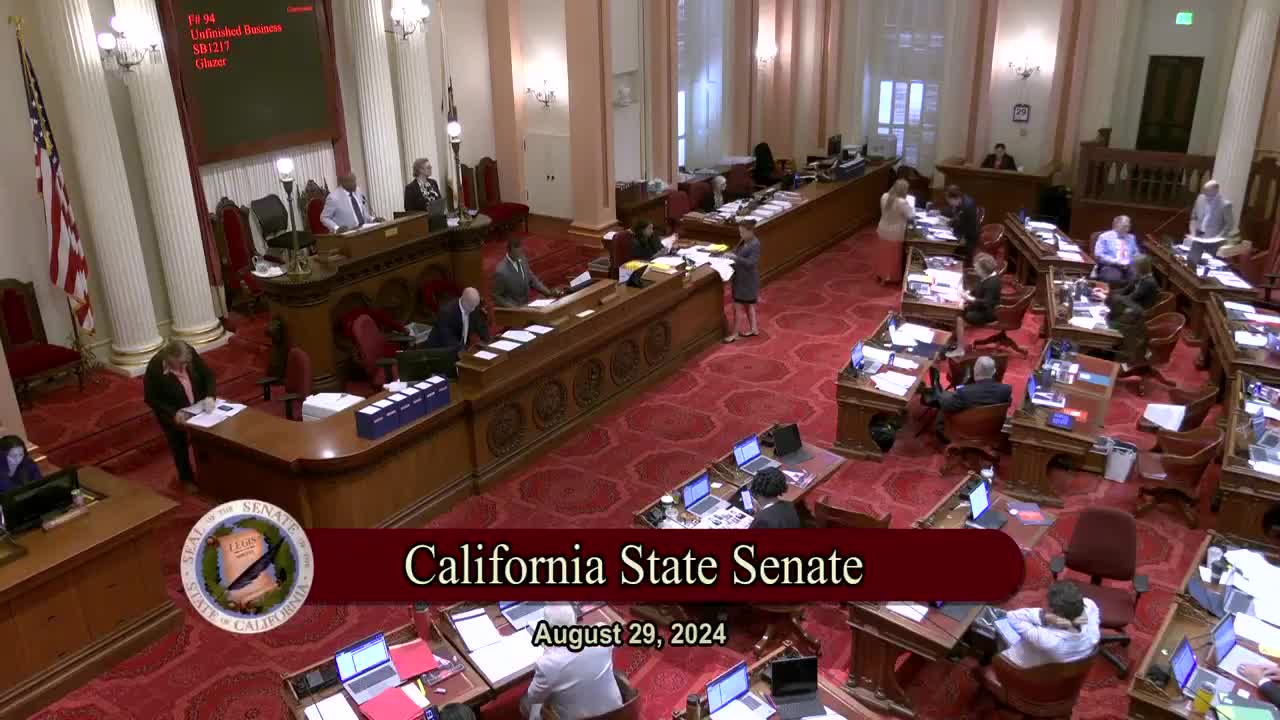 2MIN
Senate Floor
 5MIN
Senate Standing Committee on Judiciary
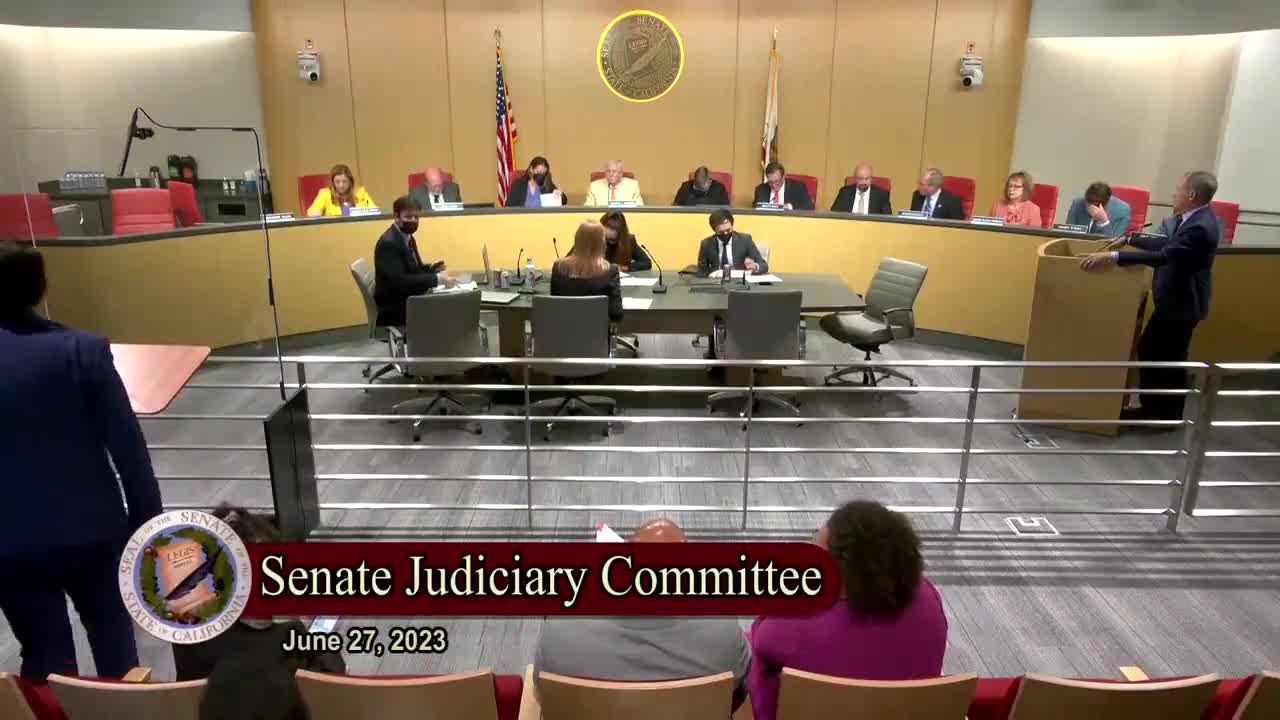 33MIN
Senate Standing Committee on Judiciary
 2MIN
Assembly Floor
 13MIN
Assembly Standing Committee on Housing and Community Development
Bill Author

Bill Co-Author(s):
