AB 1473: School curriculum: health framework: physical education framework: compression-only cardiopulmonary resuscitation: automated external defibrillators.
- Session Year: 2023-2024
- House: Assembly
- Latest Version Date: 2023-05-01
Current Status:
Failed
(2023-09-01: In committee: Held under submission.)
Introduced
In Committee
First Chamber
In Committee
Second Chamber
Enacted
Existing law establishes the Instructional Quality Commission and requires the commission to, among other things, recommend curriculum frameworks to the State Board of Education.
This bill would require the commission, when the Health Framework for California Public Schools and physical education framework are each next revised after January 1, 2024, to consider increasing and including content related to instruction in performing compression-only cardiopulmonary resuscitation (CPR) and the use of an automated external defibrillator (AED), as provided, in each of those frameworks.
Existing law requires the governing board of a school district or the governing body of a charter school that requires a course in health education for graduation from high school to include instruction in performing compression-only cardiopulmonary resuscitation (CPR), as provided. Existing law also encourages those entities to provide to pupils general information on the use and importance of an automated external defibrillator (AED). Existing law further requires the State Department of Education to provide guidance on how to implement these provisions, including, but not limited to, who may provide instruction.This bill would revise and recast these provisions by, among other things, instead requiring the governing board of a school district or the governing body of a charter school, as part of a course in health education or physical education that is required for graduation, to, commencing with the 202425 school year, provide instruction in performing compression-only CPR and the use of an AED, as provided. If the governing board of the school district or the governing body of the charter school exempts a pupil who participates in a regular school-sponsored interscholastic athletic program from physical education courses, and a health education course is not required for graduation, the bill would require the instruction in performing compression-only CPR and the use of an AED to be provided during one team practice each season. By imposing additional duties on local educational agencies, the bill would impose a state-mandated local program. The bill would require the department, commencing with the 202425 school year, to provide guidance on how to implement these requirements, including, but not limited to, who may provide instruction.The California Constitution requires the state to reimburse local agencies and school districts for certain costs mandated by the state. Statutory provisions establish procedures for making that reimbursement.This bill would provide that, if the Commission on State Mandates determines that the bill contains costs mandated by the state, reimbursement for those costs shall be made pursuant to the statutory provisions noted above.Existing law requires the governing board of a school district or the governing body of a charter school that requires a course in health education for graduation from high school to include instruction in performing compression-only cardiopulmonary resuscitation (CPR), as provided. Existing law also encourages those entities to provide to pupils general information on the use and importance of an automated external defibrillator (AED). Existing law further requires the State Department of Education to provide guidance on how to implement these provisions, including, but not limited to, who may provide instruction.
This bill would revise and recast these provisions by, among other things, instead requiring the governing board of a school district or the governing body of a charter school, as part of a course in health education or physical education that is required for graduation, to, commencing with the 202425 school year, provide instruction in performing compression-only CPR and the use of an AED, as provided. If the governing board of the school district or the governing body of the charter school exempts a pupil who participates in a regular school-sponsored interscholastic athletic program from physical education courses, and a health education course is not required for graduation, the bill would require the instruction in performing compression-only CPR and the use of an AED to be provided during one team practice each season. By imposing additional duties on local educational agencies, the bill would impose a state-mandated local program. The bill would require the department, commencing with the 202425 school year, to provide guidance on how to implement these requirements, including, but not limited to, who may provide instruction.
The California Constitution requires the state to reimburse local agencies and school districts for certain costs mandated by the state. Statutory provisions establish procedures for making that reimbursement.
This bill would provide that, if the Commission on State Mandates determines that the bill contains costs mandated by the state, reimbursement for those costs shall be made pursuant to the statutory provisions noted above.
Existing law prescribes the required courses of study for grades 1 to 12, inclusive.This bill would make a nonsubstantive change to that provision.Existing law prescribes the required courses of study for grades 1 to 12, inclusive.
This bill would make a nonsubstantive change to that provision.
When the Health Framework for California Public Schools (health framework) is next revised after January 1, 2024, the commission shall consider increasing content related to instruction in performing compression-only cardiopulmonary resuscitation (CPR) and including content related to instruction in the use of an automated external defibrillator (AED) in that health framework.
SEC. 2.Section 33549.5 is added to the Education Code, to read:33549.5.When the physical education framework is next revised after January 1, 2024, the commission shall consider including content, as it relates to safety during physical education and athletics, related to instruction in performing compression-only cardiopulmonary resuscitation (CPR) and the use of an automated external defibrillator (AED) in that physical education framework.
SECTION 1.Section 51225.6 of the Education Code is amended to read:51225.6.(a)The governing board of a school district or the governing body of a charter school, as part of a course in health education or physical education that is required for graduation, shall include, commencing with the 202425 school year, instruction in performing compression-only cardiopulmonary resuscitation (CPR) and the use of an automated external defibrillator (AED). This instruction shall include both of the following:(1)An instructional program based on national evidence-based emergency cardiovascular care guidelines for the performance of compression-only CPR, such as those developed by the American Heart Association, the American Red Cross, or a similar nationally accredited entity.(2)Instruction to pupils relative to the psychomotor skills necessary to perform compression-only CPR or use an AED. For purposes of this paragraph, psychomotor skills means skills that pupils are required to perform as hands-on practice to support cognitive learning using CPR and AED training tools associated with the instruction required pursuant to this subdivision. (b)If the governing board of the school district or the governing body of the charter school exempts a pupil who participates in a regular school-sponsored interscholastic athletic program from physical education courses pursuant to Section 51242, and a health education course is not required for graduation, the instruction in performing compression-only CPR and the use of an AED required pursuant to subdivision (a) shall be provided during one team practice each season.(c)Before the commencement of the 202425 school year, the department shall provide guidance on how to implement this section, including, but not limited to, who may provide instruction pursuant to this section.(d)The governing board of a school district or the governing body of a charter school may adopt policies to implement this section.(e)(1)The governing board of a school district or the governing body of a charter school providing instruction in performing compression-only CPR or the use of an AED pursuant to this section is encouraged to use the most cost-effective means possible to implement that requirement.(2)This section shall not be construed to require the governing board of a school district or the governing body of a charter school to make any purchases, including, but not limited to, purchasing an AED.(f)(1)A local agency, entity of state or local government, or other public or private organization that sponsors, authorizes, supports, finances, or supervises the instruction of pupils in compression-only CPR or the use of an AED pursuant to this section shall not be liable for any civil damages alleged to result from the acts or omissions of an individual who received such instruction.(2)A public employee who provides or facilitates the instruction of pupils in compression-only CPR or the use of an AED pursuant to this section shall not be liable for any civil damages alleged to result from the acts or omissions of an individual who received such instruction.(3)This subdivision shall not be construed to grant immunity from civil damages to any person who provides or facilitates the instruction of pupils in compression-only CPR or the use of an AED in a manner that constitutes gross negligence or willful or wanton misconduct.SEC. 2.If the Commission on State Mandates determines that this act contains costs mandated by the state, reimbursement to local agencies and school districts for those costs shall be made pursuant to Part 7 (commencing with Section 17500) of Division 4 of Title 2 of the Government Code.(a)If the The governing board of a school district or the governing body of a charter school requires a course in health education for graduation from high school, the governing board of a school district or the governing body of a charter school school, as part of a course in health education or physical education that is required for graduation, shall include, commencing with the 201819 202425 school year, instruction in performing compression-only cardiopulmonary resuscitation (CPR). (CPR) and the use of an automated external defibrillator (AED). This instruction shall include both of the following:
(1)An instructional program based on national evidence-based emergency cardiovascular care guidelines for the performance of compression-only CPR, such as those developed by the American Heart Association or Association, the American Red Cross. Cross, or a similar nationally accredited entity.
(2)Instruction to pupils relative to the psychomotor skills necessary to perform compression-only CPR. CPR or use an AED. For purposes of this paragraph, psychomotor skills means skills that pupils are required to perform as hands-on practice to support cognitive learning. learning using CPR and AED training tools associated with the instruction required pursuant to this subdivision.
(b)If the governing board of the school district or the governing body of the charter school exempts a pupil who participates in a regular school-sponsored interscholastic athletic program from physical education courses pursuant to Section 51242, and a health education course is not required for graduation, the instruction in performing compression-only CPR and the use of an AED required pursuant to subdivision (a) shall be provided during one team practice each season.
(b)(c)Before the commencement of the 201718 202425 school year, the department shall provide guidance on how to implement this section, including, but not limited to, who may provide instruction pursuant to this section.
(c)The governing board of a school district or the governing body of a charter school is encouraged to provide to pupils general information on the use and importance of an automated external defibrillator (AED). The physical presence of an AED in the classroom is not required.(d)The governing board of a school district or the governing body of a charter school may adopt policies to implement this section.
(e)(1)The governing board of a school district or the governing body of a charter school providing instruction in performing compression-only CPR or information on the use of an AED pursuant to this section is encouraged to use the most cost-effective means possible to implement that requirement.
(2)This section shall not be construed to require the governing board of a school district or the governing body of a charter school to make any purchases, including, but not limited to, purchasing an AED.
(f)(1)A local agency, entity of state or local government, or other public or private organization that sponsors, authorizes, supports, finances, or supervises the instruction of pupils in compression-only CPR or the use of an AED pursuant to this section shall not be liable for any civil damages alleged to result from the acts or omissions of an individual who received such instruction.
(2)A public employee who provides or facilitates the instruction of pupils in compression-only CPR or the use of an AED pursuant to this section shall not be liable for any civil damages alleged to result from the acts or omissions of an individual who received such instruction.
(3)This subdivision shall not be construed to grant immunity from civil damages to any person who provides or facilitates the instruction of pupils in compression-only CPR or the use of an AED in a manner that constitutes gross negligence or willful or wanton misconduct.
SEC. 2.If the Commission on State Mandates determines that this act contains costs mandated by the state, reimbursement to local agencies and school districts for those costs shall be made pursuant to Part 7 (commencing with Section 17500) of Division 4 of Title 2 of the Government Code.
SECTION 1.Section 51200 of the Education Code is amended to read:51200.Except as otherwise provided, the provisions contained in this chapter are the requirements for courses of study in grades 1 to 12, inclusive.Except as otherwise provided, the provisions contained in this chapter are the requirements for courses of study in grades 1 through 12. to 12, inclusive.
|
Date
|
Status
|
|---|---|
| Sep 1, 2023 | In committee: Held under submission. |
| Jul 3, 2023 | In committee: Referred to APPR suspense file. |
| Jun 21, 2023 | From committee: Do pass and re-refer to Com. on APPR. (Ayes 7. Noes 0.) (June 21). Re-referred to Com. on APPR. |
| Jun 7, 2023 | Referred to Com. on ED. |
| May 26, 2023 | In Senate. Read first time. To Com. on RLS. for assignment. |
| May 25, 2023 | Read third time. Passed. Ordered to the Senate. (Ayes 76. Noes 1. Page 1784.) |
| May 18, 2023 | Read second time. Ordered to third reading. |
| May 18, 2023 | From committee: Do pass. (Ayes 15. Noes 0.) (May 18). |
| May 10, 2023 | In committee: Set, first hearing. Referred to APPR. suspense file. |
| May 2, 2023 | Re-referred to Com. on APPR. |
| May 1, 2023 | Read second time and amended. |
| Apr 27, 2023 | From committee: Amend, and do pass as amended and re-refer to Com. on APPR. with recommendation: To Consent Calendar. (Ayes 7. Noes 0.) (April 26). |
| Mar 27, 2023 | Re-referred to Com. on ED. |
| Mar 23, 2023 | Referred to Com. on ED. |
| Mar 23, 2023 | From committee chair, with author's amendments: Amend, and re-refer to Com. on ED. Read second time and amended. |
| Feb 18, 2023 | From printer. May be heard in committee March 20. |
| Feb 17, 2023 | Read first time. To print. |
|
Date
|
Description
|
Location
|
Votes
|
|
|---|---|---|---|---|
| Jul 3, 2023 | Placed on suspense file | Senate Standing Committee on Appropriations |
Passed |
|
| Jun 21, 2023 | Do pass, but first be re-referred to the Committee on [Appropriations] | Senate Standing Committee on Education |
Passed |
|
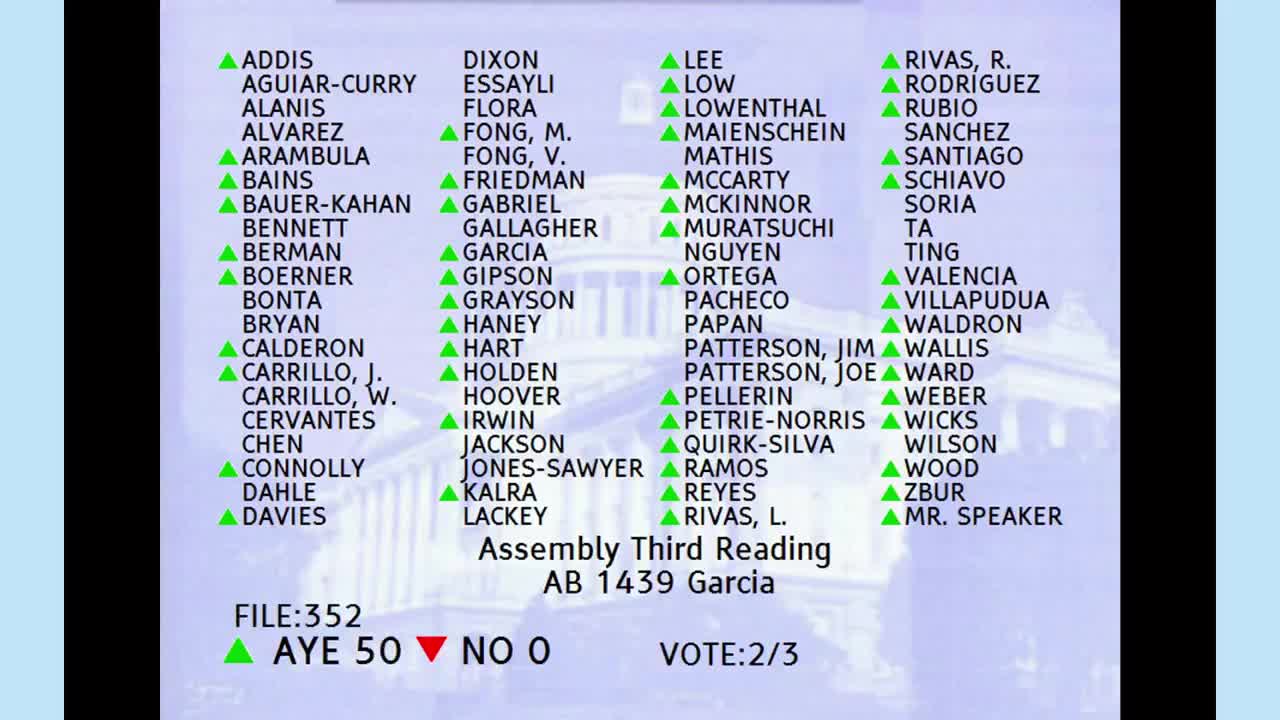
| May 25, 2023 | AB 1473 Maienschein Assembly Third Reading | Assembly Floor |
Passed |
|
| May 18, 2023 | Do pass. | Assembly Standing Committee on Appropriations |
Passed |
|
| Apr 26, 2023 | Do pass as amended, and be re-referred to the Committee on [Appropriations] with recommendation: To Consent Calendar | Assembly Standing Committee on Education |
Passed |
This list shows positions taken on this bill by organizations on the date displayed, which is linked to the original source.
Positions by individuals are not included.
|
Organization
|
Position
|
Date
|
|---|---|---|
| Aaron Reed and Associates | * Support | Jun 21, 2023 |
| American Heart Association | * Support | Jun 21, 2023 |
| Avive Solutions | ** Support | |
| California Athletic Trainers Association | ** Support | |
| California Society For Respiratory Care | * Support | Jun 21, 2023 |
| California Teachers Association | * Support | Jun 21, 2023 |
| County Of San Diego | ** Support | |
| Grossmont Healthcare District | ** Support | |
| Habematolel Pomo Of Upper Lake | ** Support | |
| Heartfelt Cardiac Connections | ** Support | |
| In a Heartbeat | ** Support | |
| Just1mike | ** Support | |
| Kyle J. Taylor Foundation | ** Support | |
| Los Angeles County Office Of Education | ** Support | |
| Philips Electronics North America | ** Support | |
| State Superintendent of Public Instruction Tony Thurmond | ** Support | |
| Sudden Arrhythmia Death Syndromes Foundation | ** Support | |
| Travis R. Roy Sudden Cardiac Arrest Fund | ** Support | |
| Via Heart Project | ** Support |
SENATE COMMITTEE ON APPROPRIATIONS
Senator Anthony Portantino, Chair
2023 - 2024 Regular Session
AB 1473 (Maienschein) - School curriculum: health framework: physical education framework: compression-only cardiopulmonary resuscitation: automated external defibrillators
Version: May 1, 2023 | Policy Vote: ED. 7 - 0 |
Urgency: No | Mandate: No |
Hearing Date: July 3, 2023 | Consultant: Lenin Del Castillo |
Bill Summary:
This bill requires the Instructional Quality Commission (IQC) when the Health and physical education framework is next revised after January 1, 2024, to consider increasing content related to instruction in performing compression-only cardiopulmonary resuscitation (CPR), including the use of an automated external defibrillator (AED).
Fiscal Impact:
The California Department of Education (CDE) indicates that the bill’s requirement for the IQC to consider increasing content for the Health and physical education framework would not result in additional costs for the state.
Local education agencies (LEAs) could incur additional local costs depending on how they choose to implement the new instruction. To the extent that LEAs elect to purchase CPR training kits to implement the instruction, statewide costs could potentially be in the millions of dollars on a one-time basis. It is unclear whether the Commission on State Mandates would deem this activity reimbursable.
Background:
Existing law provides that if the governing board of a school district or the governing body of a charter school requires a course in health education for graduation from high school, the governing board of a school district or the governing body of a charter school shall include instruction in performing compression-only CPR.
Existing law provides that the adopted course of study shall provide instruction at the appropriate elementary and secondary grade levels and subject areas in personal and public safety and accident prevention, including emergency first aid instruction, instruction in hemorrhage control, treatment for poisoning, resuscitation techniques, and CPR when appropriate equipment is available; fire prevention; the protection and conservation of resources, including the necessity for the protection of our environment; and health, including venereal disease and the effects of alcohol, narcotics, drugs, and tobacco upon the human body.
The IQC develops curriculum frameworks in each subject by convening expert panels, developing drafts, and holding public hearings to solicit input. Changes are frequently made in response to public comments. The State Board of Education (SBE) then adopts the frameworks in a public meeting. The SBE also adopts, in a public process, instructional materials aligned to those frameworks for grades K-8. School district governing boards and charter schools adopt instructional materials aligned to these standards and frameworks. This process occurs on a regular schedule, giving schools a predictable timetable to plan and budget for changes to the curriculum. Local adoption of new curricula involves significant local costs and investment of resources in professional development. These existing processes involve practitioners and experts who have an in-depth understanding of curriculum and instruction, including the full scope and sequence of the curriculum in each subject and at each grade level, constraints on instructional time and resources, and the relationship of curriculum to state assessments and other measures of student progress.
Proposed Law:
This bill requires the IQC when the Health and physical education Framework is next revised after January 1, 2024, to consider increasing content related to instruction in performing compression-only CPR, including the use of an AED.
Related Legislation:
AB 71 (Rodriguez, 2023) would require commencing with the 2025–26 school year, the governing board of a school district or the governing body of a charter school that requires a course in health education for graduation from high school to include in that course instruction in bleeding control. This bill is pending in this Committee.
AB 1719 (Rodriguez, Chapter 556, Statutes of 2016) requires school districts and charter schools that require a health course for graduation to include instruction in compression-only CPR.
Staff Comments:
The costs to implement this bill will depend upon how LEAs choose to implement this new instruction. It would be difficult for them to implement the new instruction without purchasing new instructional materials and equipment, especially instruction that includes the skills necessary to perform compression-only CPR and the use of an AED. Therefore, LEAs will likely have to purchase instructional materials and the equipment to implement a meaningful course. It is unclear whether the Commission on State Mandates would deem this activity reimbursable. To the extent that instructional programs based on certain guidelines are utilized, the bill could result in additional costs to purchase CPR training kits which can cost several hundred dollars each. Assuming one kit would be needed for each high school classroom, the statewide costs could be in the millions. This amount could be higher if additional CPR kits are purchased, and does not include any training costs for staff.
-- END --
SENATE COMMITTEE ON EDUCATION
Senator Josh Newman, Chair
2023 - 2024 Regular
Bill No: Hearing Date: June 21, 2023
Author: | Maienschein | ||
Version: |
| ||
Urgency: | Fiscal: | ||
Consultant: | |||
Subject:
SUMMARY
This bill requires the Instructional Quality Commission (IQC) when the Health and physical education Framework is next revised after January 1, 2024, to consider increasing content related to instruction in performing compression-only cardiopulmonary resuscitation (CPR), including the use of an automated external defibrillator (AED).
BACKGROUND
Existing Law:
Education Code (EC)
- If the governing board of a school district or the governing body of a charter school requires a course in health education for graduation from high school, the governing board of a school district or the governing body of a charter school shall include, commencing with the 2018–19 school year, instruction in performing compression-only CPR. (EC 51225.6 (a))
- The adopted course of study shall provide instruction at the appropriate elementary and secondary grade levels and subject areas in personal and public safety and accident prevention, including emergency first aid instruction, instruction in hemorrhage control, treatment for poisoning, resuscitation techniques, and CPR when appropriate equipment is available; fire prevention; the protection and conservation of resources, including the necessity for the protection of our environment; and health, including venereal disease and the effects of alcohol, narcotics, drugs, and tobacco upon the human body. (EC 51202)
- A public school may solicit and receive nonstate funds to acquire and maintain an AED. (EC 49417(a))
- The governing board of a school district or the governing body of a charter school is encouraged to provide to pupils general information on the use and importance of an AED. (EC 51225.6(c))
- Commencing July 1, 2019, if a school district or charter school elects to offer any interscholastic athletic program, the school district or the charter school shall acquire at least one AED for each school that participates in the program within the jurisdiction of the school district or the charter school. (EC 35179.6(b)(1))
ANALYSIS
This bill requires the IQC when the Health and physical education Framework is next revised after January 1, 2024, to consider increasing content related to instruction in performing compression-only CPR, including the use of an AED.
STAFF COMMENTS
- Need for the bill. According to the author “Sudden cardiac arrest is the number one killer of student athletes and leading cause on school campuses. Alarmingly, 70% of Americans feel helpless to act during a cardiac emergency because they do not know how to perform CPR. AB 1473 would require the IQC to consider increasing and including instruction related to the use of CPR and AED training during the next revision of Health and physical education frameworks.”
- How Curriculum, Standards, Frameworks, and Model Curricula Are Created and Adopted. The Legislature has vested the IQC and State Board of Education (SBE) with authority to develop and adopt state curricula and instructional materials. The IQC develops curriculum frameworks in each subject by convening expert panels, developing drafts, and holding public hearings to solicit input. Changes are frequently made in response to public comments. The SBE then adopts the frameworks in a public meeting. The SBE also adopts, in a public process, instructional materials aligned to those frameworks for grades K-8. School district governing boards and charter schools adopt instructional materials aligned to these standards and frameworks. This process occurs on a regular schedule, giving schools a predictable timetable to plan and budget for changes to the curriculum. Local adoption of new curricula involves significant local costs and investment of resources in professional development.
These existing processes involve practitioners and experts who have an in-depth understanding of curriculum and instruction, including the full scope and sequence of the curriculum in each subject and at each grade level, constraints on instructional time and resources, and the relationship of curriculum to state assessments and other measures of student progress.
Model curricula were first developed in the 1990s to provide educators the means to teach about a topic in an in-depth manner voluntarily. At that time, few Internet resources were available for this purpose. Until 2016, only two model curricula were required to be developed.
Recent legislation has required the development of numerous model curricula. In 2021, the state changed the process for developing model curricula through the budget. COEs are now responsible for producing model curricula through open-source, accessible resources available to California schools. The IQC and SBE no longer develop or approves model curricula.
The committee on March 15, 2023, adopted the joint Assembly and Senate curriculum policy of 2023-24 that discourages the introduction of policy bills that propose to require, or require consideration of, modifications to state curriculum frameworks to require that specified content be taught or to require the development of new model curricula. This bill does not violate the joint curriculum policy as it requires the IQC to consider including information related to CPR and the use of an AED in the next revision of the Health Framework.
- The Health Framework Mentions CPR, But Not The Use of AEDs The health education standards shape the direction of health education instruction for children and youths in California’s public schools: they provide local educational agency with fundamental tools for developing health education curricula and improving student attainment in this area, and they help ensure that all students in kindergarten through high school receive high-quality health education instruction, providing students with the knowledge, skills, and confidence to lead healthy lives. Health education has undergone a paradigm shift over the last 15 years. Data from national and state surveys, including the California Healthy Kids Survey, indicated that although youths knew what was harmful to their health, they did not have the skills to avoid risky behaviors. The current Health Education Framework, adopted by the SBE in 2019, contains numerous references to CPR, and notes in the 7th-8th grade section:
Prompt initiation of CPR by trained bystanders can double survival rates. Research confirms that schools are able to offer CPR to students despite time and budget constraints (Hoyme and Atkins, 2017). California Education Code Section 51225.6 supports students learning hands-only (chest compressions-only) CPR at the high school level, but CPR training can be provided to students in grade levels seven and eight. Schools and districts should consider providing funding for this potentially life-saving instruction.
In the 9th to 12th grade section, the Framework notes:
In districts that require students to complete a health education course to graduate from high school, student must receive CPR instruction prior to high school graduation. Districts are encouraged to provide training to all students even if the district is not required to by statute. Contact local chapters of such organizations as the American Red Cross or the American Heart Association and your local emergency medical service providers who may be able to provide CPR training at low or no cost. A credentialed school nurse or other school staff member may also be able to provide CPR training if they are certified to teach CPR.
The use of AEDs are rarely mentioned in the Health Framework. In the elementary grades, the Health Framework encourages schools to teach students where the nearest AED is located and how to retrieve it. There is no mention of AEDs or education in their use in the secondary grades.
Current law also permits school districts to establish local graduation requirements that exceed the state’s. Some school districts, like the Los Angeles Unified School District, require a course in health for graduation. No statewide data is collected on the number of school districts that require a health course.
- Related Legislation
AB 1719 (Rodriguez) Chapter 556, Statutes of 2016, required, commencing in the 2018-19 school year, school districts and charter schools that require a health course for graduation include instruction in compression-only CPR.
AB 2217 (Melendez), Chapter 812, Statutes of 2014, authorizes schools to solicit and receive non-state funds for an AED and clarifies those schools and school employees are not civilly liable when acting in good faith.
AB 71 (Rodriguez, 2023) would require commencing with the 2025–26 school year, the governing board of a school district or the governing body of a charter school that requires a course in health education for graduation from high school to include in that course instruction in bleeding control.
AB 873 (Berman, 2023) would require the IQC to consider incorporating the Model Library Standards and media literacy content at each grade level when the English language arts/English language development (ELA/ELD) curriculum framework is next revised and media literacy content into the mathematics, science, and history-social science curriculum frameworks (H-SS Framework) when those frameworks are next revised after January 1, 2024.
SUPPORT
American Heart Association
California Teachers Association
Los Angeles County Office of Education
Sudden Arrhythmia Death Syndromes Foundation
1 individual
OPPOSITION
None received
-- END --
ASSEMBLY THIRD READING
ATR Bill Id:AB 1473
Author:(Maienschein)
As Amended Ver:May 1, 2023
Majority vote
SUMMARY
Requires the Instructional Quality Commission (IQC) to consider increasing content related to compression-only cardiopulmonary resuscitation (CPR) and the use of an automated external defibrillator (AED) in the state's health curriculum framework and the physical education curriculum framework.
Major Provisions
Requires that, when the health education curriculum framework is next revised after January 1, 2024, the IQC consider increasing content related to instruction in performing compression-only CPR and including content related to instruction in the use of an AED in that framework.
Requires that when the physical education curriculum framework is next revised after January 1, 2024, the IQC consider including content related to instruction in performing compression-only CPR and the use of an AED, as it relates to safety during physical education and athletics, in that framework.
COMMENTS
CPR and AED content in state health standards and curriculum framework. CPR instruction is part of the state's health education content standards and corresponding curriculum framework. The 2008 standards include: "Describing procedures for emergency care and lifesaving, including CPR, first aid, and control of bleeding."
The current Health Education Framework, adopted by the SBE in 2019, contains numerous references to CPR, and notes in the 7th-8th grade section:
Prompt initiation of CPR by trained bystanders can double survival rates. Research confirms that schools are able to offer CPR to students despite time and budget constraints (Hoyme and Atkins 2017). California Education Code Section 51225.6 supports students learning hands-only (chest compressions-only) CPR at the high school level, but CPR training can be provided to students in grade levels seven and eight. Schools and districts should consider providing funding for this potentially life-saving instruction. Local chapters of such organizations as the American Red Cross, the American Heart Association, local emergency medical service providers, or credentialed school nurses may be able to provide hands-only CPR training at little to no cost. Students should be encouraged to obtain their First Aid/CPR or babysitting safety certification that includes CPR certification.
In the 9th to 12th grade section, the Framework notes:
In districts that require students to complete a health education course to graduate from high school, student must receive CPR instruction prior to high school graduation. Districts are encouraged to provide training to all students even if the district is not required to by statute. Contact local chapters of such organizations as the American Red Cross or the American Heart Association and your local emergency medical service providers who may be able to provide CPR training at low or no cost. A credentialed school nurse or other school staff member may also be able to provide CPR training if they are certified to teach CPR.
There are far fewer mentions of the use of AEDs in the Framework. In the elementary grades the Framework encourages schools to teach students where the nearest AED is located and how to retrieve it. There is no mention of AEDs or education in their use in the secondary grades.
According to the Author
"Sudden cardiac arrest is the number one killer of student athletes and leading cause on school campuses. Alarmingly, 70% of Americans feel helpless to act during a cardiac emergency because they do not know how to perform CPR. AB 1473 would require hands-only CPR and AED training in either health or physical education as part of the high school graduation requirements."
Arguments in Support
The Sudden Arrhythmia Death Syndromes Foundation writes, "It's long been established that in a cardiac emergency immediate bystander intervention with hands-only cardiopulmonary resuscitation (CPR) and use of an automated external defibrillator (AED) prior to EMS arrival on average increases survival up to 72%. But studies continue to show that most Americans are unprepared to use either measure. California's reporting to the Cardiac Arrest Registry to Enhance Survival shows that only ~40% of SCA victims receive bystander CPR and just ~7% a bystander-applied AED. What's more, a witnessed sudden cardiac arrest adult or child victim who is Black or Hispanic or is in a Black or Hispanic neighborhood is less likely to receive bystander CPR. Current state law for CPR training in schools applies to school districts that mandate a health class as a graduation requirement. But the majority of California school districts do not offer a health class, which not only means scores of youth are deprived of these critical life-saving skills, but also presents health equity disparities across the state's socio-economically diverse school communities. We can and should do better to equip all youth with this life-saving training so they have the power to not only save a life now, but to eliminate the tragedy of these preventable deaths in their lifetime."
Arguments in Opposition
None on file.
FISCAL COMMENTS
According to the Assembly Appropriations Committee, one-time General Fund costs of an unknown amount to the California Department of Education. Based on other, similar bills, costs could be minor or in the low hundreds of thousands of dollars.
VOTES
ASM EDUCATION: 7-0-0
YES: Muratsuchi, Megan Dahle, Juan Carrillo, Hoover, Lee, McCarty, Quirk-Silva
ASM APPROPRIATIONS: 15-0-1
YES: Holden, Megan Dahle, Bryan, Calderon, Wendy Carrillo, Dixon, Mike Fong, Hart, Lowenthal, Mathis, Papan, Pellerin, Sanchez, Weber, Ortega
ABS, ABST OR NV: Robert Rivas
UPDATED
VERSION: May 1, 2023
CONSULTANT: Tanya Lieberman / ED. / (916) 319-2087 FN: 0000868
Date of Hearing: May 10, 2023
ASSEMBLY COMMITTEE ON APPROPRIATIONS
Chris Holden, Chair
ABPCA Bill Id:AB 1473
Author:(Maienschein) – As Amended Ver:May 1, 2023
Policy Committee: | Education | Vote: | 7 - 0 |
|
| ||
|
|
Urgency: No State Mandated Local Program: No Reimbursable: No
SUMMARY:
This bill requires the Instructional Quality Commission (IQC) to consider increasing content related to compression-only cardiopulmonary resuscitation (CPR) and the use of an automated external defibrillator (AED) in the state’s health curriculum framework and the state’s physical education curriculum framework.
FISCAL EFFECT:
One-time General Fund costs of an unknown amount to the California Department of Education. Based on other, similar bills, costs could be minor or in the low hundreds of thousands of dollars.
COMMENTS:
Background. Curriculum frameworks provide guidance to schools for implementing the state’s content standards. A body under the State Board of Education, known as the IQC, periodically revises curriculum frameworks and the State Board of Education adopts the curriculum frameworks for use by schools. CPR instruction is part of the state’s health education content standards and corresponding health curriculum framework. AED is mentioned far less in the health curriculum framework. The IQC is set to revise the health curriculum framework and the physical education curriculum framework after January 1, 2024.
This bill requires the IQC to consider increasing content about CPR and AED in two curriculum frameworks.
Analysis Prepared by: Natasha Collins / APPR. / (916) 319-2081
Date of Hearing: April 26, 2023
ASSEMBLY COMMITTEE ON EDUCATION
Al Muratsuchi, Chair
ABPCA Bill Id:AB 1473 (
Author:Maienschein) – As Amended Ver:March 23, 2023
SUBJECT: Student instruction: compression-only cardiopulmonary resuscitation: automated external defibrillators
SUMMARY: Requires school districts and charter schools to include instruction in compression-only cardiopulmonary resuscitation (CPR) and the use of an automated external defibrillator (AED) in health and physical education courses required for graduation from high school. Specifically, this bill:
- Requires the governing board of a school district or the governing body of a charter school, as part of a physical education that is required for graduation to include, commencing with the 2024–25 school year, instruction in performing compression-only cardiopulmonary resuscitation CPR and the use of an AED.
- Requires a course in health education which is required for graduation to include instruction in the use of an AED, in addition to currently required instruction in performing CPR.
- Permits instruction to be based on an instructional program developed by a nationally accredited entity similar to the American Heart Association or the American Red Cross.
- Requires that this instruction include the psychomotor skills necessary to use an AED, defined to mean skills that students are required to perform as hands-on practice to support cognitive learning using CPR and AED training tools.
- Requires that if the governing board of the school district or the governing body of the charter school exempts a student who participates in a regular school-sponsored interscholastic athletic program from physical education courses, and a health education course is not required for graduation, the instruction in performing compression-only CPR and the use of an AED be provided during one team practice each season.
- Requires the California Department of Education (CDE), before the commencement of the 2024–25 school year, to provide new guidance on how to implement these requirements, including, but not limited to, who may provide this instruction.
- Encourages the governing board of a school district or the governing body of a charter school providing instruction in performing compression-only CPR and the use of an AED to use the most cost-effective means possible to implement that requirement.
EXISTING LAW:
- Requires that, if the governing board of a school district or the governing body of a charter school requires a course in health education for graduation from high school, it include, commencing with the 2018–19 school year, instruction in performing compression-only CPR, and requires that this instruction include both:
- An instructional program based on national evidence-based emergency cardiovascular care guidelines for the performance of compression-only CPR, such as those developed by the American Heart Association or the American Red Cross; and
- Instruction to students relative to the psychomotor skills necessary to perform compression-only CPR, defined to mean skills that students are required to perform as hands-on practice to support cognitive learning.
- Requires that, before the commencement of the 2017–18 school year, the CDE to provide guidance on how to implement this requirement, including who may provide instruction.
- Encourages the governing board of a school district or the governing body of a charter school to provide to students general information on the use and importance of an AED.
- States that the physical presence of an AED in the classroom is not required.
- Authorizes the governing board of a school district or the governing body of a charter school to adopt policies to implement this requirement.
- Encourages the governing board of a school district or the governing body of a charter school providing instruction in performing compression-only CPR or information on the use of an AED to use the most cost-effective means possible to implement that requirement.
- States that this requirement shall not be construed to require the governing board of a school district or the governing body of a charter school to make any purchases, including, but not limited to, purchasing an AED.
- States that a local agency, entity of state or local government, or other public or private organization that sponsors, authorizes, supports, finances, or supervises the instruction of students in compression-only CPR or the use of an AED pursuant to this requirement shall not be liable for any civil damages alleged to result from the acts or omissions of an individual who received such instruction.
- States that a public employee who provides or facilitates the instruction of students in compression-only CPR or the use of an AED pursuant to this section shall not be liable for any civil damages alleged to result from the acts or omissions of an individual who received such instruction. States that this provision shall not be construed to grant immunity from civil damages to any person who provides or facilitates the instruction of students in compression-only CPR or the use of an AED in a manner that constitutes gross negligence or willful or wanton misconduct. (Education Code (EC) 51225.6)
- Requires a coach of an athletic activity to complete the coach’s sudden cardiac arrest training course and to retake the training course every two years thereafter. States that a coach of an athletic activity shall not be eligible to coach an athletic activity until the coach completes the training course required. (Education Code (EC) 33479.6)
- Commencing July 1, 2019, for a school district or charter school that elects to offer any interscholastic athletic program:
- Requires the school district or charter school to acquire at least one automated external defibrillator (AED) for each school within the school district or the charter school;
- Requires the school district or charter school to ensure that the AED or AEDs are available to athletic trainers and coaches and authorized persons at these activities or events;
- Requires the school district or charter school to ensure that its AED or AEDs are maintained and regularly tested according to the operation and maintenance guidelines set forth by the manufacturer, the American Heart Association, or the American Red Cross, and according to any applicable rules and regulations set forth by the governmental authority under the federal Food and Drug Administration and any other applicable state and federal authority; and
- Encourages the school district or the charter school to ensure that the AED or AEDs are available for the purpose of rendering emergency care or treatment within a recommended three to five minutes of sudden cardiac arrest to pupils, spectators, and any other individuals in attendance at the athletic program’s on-campus activities or events. (EC 35179.6)
FISCAL EFFECT: This bill has been keyed a state-mandated local program by the Office of Legislative Counsel.
COMMENTS:
Need for the bill. The author states, “Sudden cardiac arrest is the number one killer of student athletes and leading cause on school campuses. Alarmingly, 70% of Americans feel helpless to act during a cardiac emergency because they do not know how to perform CPR. AB 1473 would require hands-only CPR and AED training in either health or physical education as part of the high school graduation requirements.”
Curriculum, standards, frameworks, and model curricula. California’s public school curriculum is based on content standards in various subjects, including English-Language Arts, Mathematics, Science, History-Social Science, Physical Education, English Language Development, Career Technical Education, Health Education, World Languages, and Visual and Performing Arts. These standards are developed by the Instructional Quality Commission (IQC) through a public process, and are adopted by the State Board of Education (SBE).
These standards form the basis of California’s curriculum frameworks - documents which guide the implementation of these standards. The frameworks establish criteria used to evaluate instructional materials. These criteria are used to select, through the state adoption process, instructional materials for kindergarten through grade eight. Frameworks also guide district selection of instructional materials for grades nine through twelve.
State graduation requirements. Current law establishes state minimum high school graduation requirements for students attending LEAs and charter schools, including:
- Three courses in English;
- Two courses in mathematics, including one year of Algebra I;
- Two courses in science, including biological and physical sciences;
- Three courses in social studies, including United States history and geography; world history, culture, and geography; a one-semester course in American government and civics, a one-semester course in economics, and beginning in 2029-30, a one-semester course in ethnic studies;
- One course in visual or performing arts, world language, or career technical education; and
- Two courses in physical education.
Current law also permits school districts to establish local graduation requirements which exceed those of the state. Some school districts, like the Los Angeles Unified School District, require a course in health for graduation. No statewide data is collected on the number of school districts which require a health course.
What is “hands-only” or “compression-only” CPR training? Hands-only CPR, also known as compression-only CPR, is conventional CPR without mouth-to-mouth resuscitation. According to the American Heart Association, hands-only CPR has been shown to be as effective as conventional CPR for sudden cardiac arrest at home, at work, or in public. Research indicates that this is due to a better willingness to start CPR by bystanders, a low quality of mouth-to-mouth ventilation, and a detrimental effect of too-long interruptions of chest compressions during ventilation.
Hands-only CPR involves two steps when a teen or adult collapses: 1) calling 9-1-1, and 2) pushing hard on the center of the person’s chest at the rate of 100 compressions per minute – roughly the same as the beat in the Bee Gees 1977 song “Stayin’ Alive.” For infants, children, victims of drowning or drug overdose, and people who collapse due to breathing problems, the American Heart Association still recommends CPR with compression and breaths.
Health disparities in CPR training and bystander use. A 2013 study published in the Journal of the American Medical Association found wide disparities in CPR training, and that residents of the communities most in need of training are the least likely to be trained. The study, which examined national training rates, found that counties with the lowest rates of CPR training were more likely to have a higher proportion of African American and Latino residents, more likely to have a lower median household income, and were more likely to be rural (where it may take longer for emergency personnel to arrive).
Other research has demonstrated that low income individuals and African Americans are significantly less likely to receive bystander CPR when they experience sudden cardiac arrest, and that people who experience such an event in predominantly African American, low income neighborhoods are the least likely of all groups to receive bystander CPR treatment. This study attributed this disparity in CPR use to low rates of training in those communities.
CPR high school graduation requirements in other states. According to the American Heart Association, twenty six other states have adopted CPR training as a high school graduation requirement. Among the larger states are Texas, New York, Virginia, North Carolina, Georgia, and New Jersey.
CPR training in state health standards and curriculum framework. CPR instruction is part of the state’s health education content standards and corresponding curriculum framework. The 2008 standards include: “Describing procedures for emergency care and lifesaving, including CPR, first aid, and control of bleeding.”
The current Health Education Framework, adopted by the SBE in 2019, contains numerous references to CPR, and notes in the 7th-8th grade section:
Prompt initiation of CPR by trained bystanders can double survival rates. Research confirms that schools are able to offer CPR to students despite time and budget constraints (Hoyme and Atkins 2017). California Education Code Section 51225.6 supports students learning hands-only (chest compressions-only) CPR at the high school level, but CPR training can be provided to students in grade levels seven and eight. Schools and districts should consider providing funding for this potentially life-saving instruction. Local chapters of such organizations as the American Red Cross, the American Heart Association, local emergency medical service providers, or credentialed school nurses may be able to provide hands-only CPR training at little to no cost. Students should be encouraged to obtain their First Aid/CPR or babysitting safety certification that includes CPR certification.
In the 9th to 12th grade section, the Framework notes:
In districts that require students to complete a health education course to graduate from high school, student must receive CPR instruction prior to high school graduation. Districts are encouraged to provide training to all students even if the district is not required to by statute. Contact local chapters of such organizations as the American Red Cross or the American Heart Association and your local emergency medical service providers who may be able to provide CPR training at low or no cost. A credentialed school nurse or other school staff member may also be able to provide CPR training if they are certified to teach CPR.
There are far fewer mentions of the use of AEDs in the Framework. In the elementary grades the Framework encourages schools to teach students where the nearest AED is located and how to retrieve it. There is no mention of AEDs or education in their use in the secondary grades.
Is it time for a health education graduation requirement? Numerous bills in recent years have proposed requiring instruction in health education content, including on mental health, CPR and AED use, bleeding control, fentanyl and other illegal drug abuse, teen dating violence prevention, and body shaming. Current law also requires that students receive instruction in comprehensive sexual health education and HIV prevention. As noted above, LEAs and charter schools may require a course in health as a local graduation requirement, and an unknown number do so. The Committee may wish to consider that there is considerable public interest in ensuring that students receive instruction in a wide range of topics in health education, but there is no required course in health education.
Recommended Committee amendments. To conform with this Committee’s policy on curriculum measures, which discourages the introduction of measures which mandate instruction, staff recommends that this bill be amended to: 1) require that the IQC, when it next revises the Health Education curriculum framework, consider including content on the use of compression-only CPR and the use of AEDs, and 2) that it consider, when it next revises the Physical Education curriculum framework, including the same content as it relates to student safety in physical education and athletics.
Arguments in support. The Sudden Arrhythmia Death Syndromes Foundation writes, “It’s long been established that in a cardiac emergency immediate bystander intervention with hands-only cardiopulmonary resuscitation (CPR) and use of an automated external defibrillator (AED) prior to EMS arrival on average increases survival up to 72%. But studies continue to show that most Americans are unprepared to use either measure. California’s reporting to the Cardiac Arrest Registry to Enhance Survival shows that only ~40% of SCA victims receive bystander CPR and just ~7% a bystander-applied AED. What’s more, a witnessed sudden cardiac arrest adult or child victim who is Black or Hispanic or is in a Black or Hispanic neighborhood is less likely to receive bystander CPR. Current state law for CPR training in schools applies to school districts that mandate a health class as a graduation requirement. But the majority of California school districts do not offer a health class, which not only means scores of youth are deprived of these critical life-saving skills, but also presents health equity disparities across the state’s socio-economically diverse school communities. We can and should do better to equip all youth with this life-saving training so they have the power to not only save a life now, but to eliminate the tragedy of these preventable deaths in their lifetime.”
Related legislation. AB 1719 (Maienschein), Chapter 556, Statutes of 2016, requires, if the governing board of a school district or the governing body of a charter school requires a course in health education for graduation from high school, the governing board or body to include in that course, commencing with the 2018–19 school year, instruction in performing compression-only CPR.
AB 71 (Rodriguez) of the 2023-24 Session would require a school district or charter school which requires a course in health education for graduation from high school to include instruction in the methods of bleeding control, commencing in the 2025-26 school year.
AB 1362 (Davies) of the 2023-24 Session would authorize the physical education course of study for grades 7 to 12 to include content on the physical and mental dangers associated with the use of opioids, such as fentanyl, steroids, and other harmful addictive drugs.
SB 224 (Portantino), Chapter 675, Statutes of 2022, requires schools that offer one or more courses in health education to students in middle school or high school to include in those courses instruction in mental health, as specified.
AB 1639 (Maienschein), Chapter 792, Statutes of 2016, establishes the Eric Paredes Sudden Cardiac Arrest Prevention Act; requires the CDE to make available specified guidelines and materials on sudden cardiac arrest (SCA); requires students and parents to sign informational materials before athletic participation; requires training of coaches; and sets requirements for action in the event a student experiences specified symptoms.
AB 319 (Rodriguez) of the 2015-16 Session would have required school districts and charter schools to provide instruction on performing CPR and the use of an AED to students in grades 9-12 as part of a course required for graduation. This bill was held in the Assembly Appropriations Committee.
AB 2217 (Melendez), Chapter 812, Statutes of 2014, authorizes a public school to solicit and receive non-state funds to acquire and maintain an AED, and provides that school districts and their employees are not liable for civil damages resulting from certain uses of an AED.
AB 939 (Melendez) of the 2013-14 Session would have stated the intent of the Legislature to encourage all public schools to acquire and maintain at least one AED, and would have authorized a public school to solicit and receive non-state funds to acquire and maintain an AED. This bill was held in the Senate Appropriations Committee.
SB 1346 (Lowenthal), Chapter 71, Statutes of 2012, extended indefinitely the minimum training standards and immunity from civil damages in connection with the use of AEDs. This bill was held in the Assembly Education Committee.
SB 63 (Price) of the 2011-12 Session would have required all public high schools to acquire and maintain at least one AED. This bill was held in the Senate Appropriations Committee.
REGISTERED SUPPORT / OPPOSITION:
Support
Avive Solutions
California Athletic Trainers Association
County of San Diego
Grossmont Healthcare District
Habematolel Pomo of Upper Lake
Heartfelt Cardiac Connections
In a Heartbeat
Just1mike
Kyle J. Taylor Foundation
Philips Electronics North America
State Superintendent of Public Instruction Tony Thurmond
Sudden Arrhythmia Death Syndromes Foundation
Travis R. Roy Sudden Cardiac Arrest Fund
Via Heart Project
3 individuals
Opposition
None on file
Analysis Prepared by: Tanya Lieberman / ED. / (916) 319-2087
Discussed in Hearing
 4MIN
Senate Standing Committee on Education
 3MIN
Assembly Floor
2MIN
Assembly Floor
Bill Author

Bill Co-Author(s):