AB 1524: Postsecondary education: on-campus access to drug testing devices.
- Session Year: 2023-2024
- House: Assembly
- Latest Version Date: 2024-09-27
Current Status:
Passed
(2024-09-27: Chaptered by Secretary of State - Chapter 679, Statutes of 2024.)
Introduced
In Committee
First Chamber
In Committee
Second Chamber
Enacted
What does this bill do?
The bill requires the California State University and community college districts to stock free, accessible drug‑testing devices (like test strips, stickers, and straws that can detect drugs in drinks, including ketamine and GHB) in each campus health center and to post a clear notice about their availability. It also protects those campuses from lawsuits or criminal charges over faulty or inaccurate test results, asks other public and private colleges to do the same, and requires campuses to ensure devices are not past their expiration date.
The summary is provided by generative AI which can make mistakes. For original language, please view the details in the table below.
Existing law establishes the California Community Colleges, the California State University, the University of California, independent institutions of higher education, and private postsecondary educational institutions as the segments of postsecondary education in the state.
This bill would require the California State University and community college districts to stock drug testing devices, as defined, available and accessible, free-of-charge, in the health center located on each campus and post a notice on these requirements in a prominent and conspicuous location, as specified. The bill would encourage the University of California, independent institutions of higher education, and private postsecondary educational institutions to implement these provisions. By imposing new duties on community college districts, the bill would impose a state-mandated local program.
The California Constitution requires the state to reimburse local agencies and school districts for certain costs mandated by the state. Statutory provisions establish procedures for making that reimbursement.
This bill would provide that, if the Commission on State Mandates determines that the bill contains costs mandated by the state, reimbursement for those costs shall be made pursuant to the statutory provisions noted above.
Existing law establishes the California Community Colleges, the California State University, the University of California, independent institutions of higher education, and private postsecondary educational institutions as the segments of postsecondary education in the state.
This bill would require the California State University and community college districts to stock an adequate supply of drug testing devices, as defined, available and accessible, free-of-charge, at no fewer than one designated and accessible location in the health center located on each campus and post a notice on these requirements in a prominent and conspicuous location in all restrooms, location, as specified. The bill would encourage the University of California, independent institutions of higher education, and private postsecondary educational institutions to implement these provisions. By imposing new duties on community college districts, the bill would impose a state-mandated local program.
The California Constitution requires the state to reimburse local agencies and school districts for certain costs mandated by the state. Statutory provisions establish procedures for making that reimbursement.
This bill would provide that, if the Commission on State Mandates determines that the bill contains costs mandated by the state, reimbursement for those costs shall be made pursuant to the statutory provisions noted above.
Existing law establishes the California Community Colleges, the California State University, the University of California, independent institutions of higher education, and private postsecondary educational institutions as the segments of postsecondary education in the state.
This bill would require the California State University and community college districts to stock an adequate supply of drug testing devices and antitampering devices, as defined, available and accessible, free-of-charge, at no fewer than one designated and accessible location on each campus and post a notice on these requirements in a prominent and conspicuous location in all restrooms, as specified. The bill would encourage the University of California, independent institutions of higher education, and private postsecondary educational institutions to implement these provisions. By imposing new duties on community college districts, the bill would impose a state-mandated local program.
The California Constitution requires the state to reimburse local agencies and school districts for certain costs mandated by the state. Statutory provisions establish procedures for making that reimbursement.
This bill would provide that, if the Commission on State Mandates determines that the bill contains costs mandated by the state, reimbursement for those costs shall be made pursuant to the statutory provisions noted above.
Existing law establishes the California Community Colleges, the California State University, the University of California, independent institutions of higher education, and private postsecondary educational institutions as the segments of postsecondary education in the state.
This bill would require the California State University and community college districts to stock an adequate supply of drug testing devices and antitampering devices, as defined, available and accessible, free-of-charge, at no fewer than one designated and accessible location on each campus and post a notice on these requirements in a prominent and conspicuous location in all womens restrooms and mens restrooms, as specified. The bill would encourage the University of California, independent institutions of higher education, and private postsecondary educational institutions to implement these provisions. By imposing new duties on community college districts, the bill would impose a state-mandated local program.
The California Constitution requires the state to reimburse local agencies and school districts for certain costs mandated by the state. Statutory provisions establish procedures for making that reimbursement.
This bill would provide that, if the Commission on State Mandates determines that the bill contains costs mandated by the state, reimbursement for those costs shall be made pursuant to the statutory provisions noted above.
Existing law establishes the California Community Colleges, the California State University, the University of California, independent institutions of higher education, and private postsecondary educational institutions as the segments of postsecondary education in the state.
This bill would require the California State University and community college districts to stock an adequate supply of drug testing devices, as defined, available and accessible, free-of-charge, at no fewer than one designated and accessible central location on each campus and post a notice on these requirements in a prominent and conspicuous locations on campus, location in all womens restrooms and mens restrooms, as specified. The bill would encourage the University of California, independent institutions of higher education, and private postsecondary educational institutions to implement these provisions. By imposing new duties on community college districts, the bill would impose a state-mandated local program.
The California Constitution requires the state to reimburse local agencies and school districts for certain costs mandated by the state. Statutory provisions establish procedures for making that reimbursement.
This bill would provide that, if the Commission on State Mandates determines that the bill contains costs mandated by the state, reimbursement for those costs shall be made pursuant to the statutory provisions noted above.
Existing law establishes the California Community Colleges, the California State University, the University of California, independent institutions of higher education, and private postsecondary educational institutions as the segments of postsecondary education in the state.
This bill would require the California State University and community college districts to stock an adequate supply of drug testing devices, as defined, available and accessible, free-of-charge, at no fewer than one designated and accessible central location on each campus and post a notice on these requirements in prominent and conspicuous locations on campus, as specified. The bill would encourage the University of California, independent institutions of higher education, and private postsecondary educational institutions to implement these provisions. By imposing new duties on community college districts, the bill would impose a state-mandated local program.
The California Constitution requires the state to reimburse local agencies and school districts for certain costs mandated by the state. Statutory provisions establish procedures for making that reimbursement.
This bill would provide that, if the Commission on State Mandates determines that the bill contains costs mandated by the state, reimbursement for those costs shall be made pursuant to the statutory provisions noted above.
(a)For purposes of this section, the following definitions apply:
(1)Controlled substances includes, but is not limited to, flunitrazepam, ketamine, and gamma hydroxybutyric acid, which is also known by other names, including, but not limited to, GHB, gamma hydroxyl butyrate, 4-hydroxybutyrate, 4-hydroxybutanoic acid, sodium oxybate, and sodium oxybutyrate.
(2)Drug testing devices means test strips, stickers, straws, and other devices designed to detect the presence of controlled substances in a drink.
(b)(1)The California State University and each community college district shall stock drug testing devices, available and accessible, free of cost, in the health center located on each campus.
(2)(A)Notwithstanding any other law, the California State University and each community college district shall not be liable in a civil action or be subject to criminal prosecution for a defective test or inaccurate test result, including, but not limited to, a false positive or false negative test result, from a drug testing device made available pursuant to this subdivision.
(B)The California State University and each community college district shall ensure that drug testing devices made available pursuant to this subdivision have not exceeded their expiration date or recommended period of use, according to the product label, product packaging, or as otherwise recommended by the manufacturer.
(c)The California State University and each community college district shall post a notice regarding the requirements of subdivision (b) in a prominent and conspicuous location. This location may include, but shall not be limited to, on each campus health centers internet website or in new student orientation materials.
(d)The Regents of the University of California, independent institutions of higher education, as defined in Section 66010, and private postsecondary educational institutions, as defined in Section 94858, are encouraged to stock drug testing devices, available and accessible, free of cost, in the health center located on each campus.
(e)(1)If the Regents of the University of California, independent institutions of higher education, as defined in Section 66010, and private postsecondary educational institutions, as defined in Section 94858, implement subdivision (d), the campuses are further encouraged to post a notice regarding the requirements of subdivision (d) in a prominent and conspicuous location. This location may include, but shall not be limited to, on each campus health centers internet website or in new student orientation materials.
(2)Notwithstanding any other law, if the Regents of the University of California, independent institutions of higher education, as defined in Section 66010, and private postsecondary educational institutions, as defined in Section 94858, implement subdivision (d), the campuses shall not be liable in a civil action or be subject to criminal prosecution for a defective test or inaccurate test result, including, but not limited to, a false positive or false negative test result, from a drug testing device made available pursuant to subdivision (d).
(3)If the Regents of the University of California, independent institutions of higher education, as defined in Section 66010, and private postsecondary educational institutions, as defined in Section 94858, implement subdivision (d), the campuses are further encouraged to ensure that drug testing devices made available pursuant to subdivision (d) have not exceeded their expiration date or recommended period of use, according to the product label, product packaging, or as otherwise recommended by the manufacturer.
(f)This section does not prevent a campus from providing more than one location where persons may access drug testing devices.
SEC. 2.If the Commission on State Mandates determines that this act contains costs mandated by the state, reimbursement to local agencies and school districts for those costs shall be made pursuant to Part 7 (commencing with Section 17500) of Division 4 of Title 2 of the Government Code.
(a)For purposes of this section, the following definitions apply:
(1)Controlled substances includes, but is not limited to, flunitrazepam, ketamine, and gamma hydroxybutyric acid, which is also known by other names, including, but not limited to, GHB, gamma hydroxyl butyrate, 4-hydroxybutyrate, 4-hydroxybutanoic acid, sodium oxybate, and sodium oxybutyrate.
(2)Drug testing devices means test strips, stickers, straws, and other devices designed to detect the presence of controlled substances in a drink.
(b)(1)The California State University and each community college district shall stock an adequate supply of drug testing devices, available and accessible, free of cost, at no fewer than one designated and accessible location on each campus. cost, in the health center located on each campus.
(2)(A)A locations accessibility shall be determined by considering all of, but not limited to, the following factors:(i)Hours of operation, relative to hours that students are on campus.(ii)Proximity to high-traffic areas on campus.(iii)Accessibility by students of all genders and regardless of physical ability.(iv)Privacy, including whether accessing drug testing devices would require interaction with campus staff or other students.(v)Safety.(B)A location described in this paragraph may include student centers, libraries, wellness or health centers, pantries, and study rooms. (3)(2)(A)Notwithstanding any other law, the California State University and each community college district shall not be liable in a civil action or be subject to criminal prosecution for a defective test or inaccurate test result, including, but not limited to, a false positive or false negative test result, from a drug testing device made available pursuant to this subdivision.
(B)The California State University and each community college district shall ensure that drug testing devices made available pursuant to this subdivision have not exceeded their expiration date or recommended period of use, according to the product label, product packaging, or as otherwise recommended by the manufacturer.
(c)The California State University and each community college district shall post a notice regarding the requirements of subdivision (b) in a prominent and conspicuous location in all restrooms. location. This location may include, but shall not be limited to, on each campus health centers internet website or in new student orientation materials.
(d)The Regents of the University of California, independent institutions of higher education, as defined in Section 66010, and private postsecondary educational institutions, as defined in Section 94858, are encouraged to stock an adequate supply of drug testing devices, available and accessible, free of cost, at no fewer than one designated and accessible location on each campus. cost, in the health center located on each campus.
(e)(1)If the Regents of the University of California, independent institutions of higher education, as defined in Section 66010, and private postsecondary educational institutions, as defined in Section 94858, implement subdivision (d), the campuses are further encouraged to post a notice regarding the requirements of subdivision (d) in a prominent and conspicuous location in all restrooms. location. This location may include, but shall not be limited to, on each campus health centers internet website or in new student orientation materials.
(2)Notwithstanding any other law, if the Regents of the University of California, independent institutions of higher education, as defined in Section 66010, and private postsecondary educational institutions, as defined in Section 94858, implement subdivision (d), the campuses shall not be liable in a civil action or be subject to criminal prosecution for a defective test or inaccurate test result, including, but not limited to, a false positive or false negative test result, from a drug testing device made available pursuant to subdivision (d).
(3)If the Regents of the University of California, independent institutions of higher education, as defined in Section 66010, and private postsecondary educational institutions, as defined in Section 94858, implement subdivision (d), the campuses are further encouraged to ensure that drug testing devices made available pursuant to subdivision (d) have not exceeded their expiration date or recommended period of use, according to the product label, product packaging, or as otherwise recommended by the manufacturer.
(f)This section does not prevent a campus from providing more than one location where persons may access drug testing devices.
SEC. 2.If the Commission on State Mandates determines that this act contains costs mandated by the state, reimbursement to local agencies and school districts for those costs shall be made pursuant to Part 7 (commencing with Section 17500) of Division 4 of Title 2 of the Government Code.
(a)For purposes of this section, the following definitions apply:
(1)Antitampering devices means covers, lids, and other devices designed to prevent an individual from tampering with or adding controlled substances to a drink.(2)(1)Controlled substances includes, but is not limited to, flunitrazepam, ketamine, and gamma hydroxybutyric acid, which is also known by other names, including, but not limited to, GHB, gamma hydroxyl butyrate, 4-hydroxybutyrate, 4-hydroxybutanoic acid, sodium oxybate, and sodium oxybutyrate.
(3)(2)Drug testing devices means test strips, stickers, straws, and other devices designed to detect the presence of controlled substances in a drink.
(b)(1)The California State University and each community college district shall stock an adequate supply of drug testing devices and antitampering devices, available and accessible, free of cost, at no fewer than one designated and accessible location on each campus.
(2)(A)A locations accessibility shall be determined by considering all of, but not limited to, the following factors:
(i)Hours of operation, relative to hours that students are on campus.
(ii)Proximity to high-traffic areas on campus.
(iii)Accessibility by students of all genders and regardless of physical ability.
(iv)Privacy, including whether accessing drug testing devices and antitampering devices would require interaction with campus staff or other students.
(v)Safety.
(B)A location described in this paragraph may include student centers, libraries, wellness or health centers, pantries, and study rooms.
(3)(A)Notwithstanding any other law, the California State University and each community college district shall not be liable in a civil action or be subject to criminal prosecution for a defective test or inaccurate test result, including, but not limited to, a false positive or false negative test result, from a drug testing device made available pursuant to this subdivision.
(B)The California State University and each community college district shall ensure that drug testing devices made available pursuant to this subdivision have not exceeded their expiration date or recommended period of use, according to the product label, product packaging, or as otherwise recommended by the manufacturer.
(c)The California State University and each community college district shall post a notice regarding the requirements of subdivision (b) in a prominent and conspicuous location in all restrooms.
(d)The Regents of the University of California, independent institutions of higher education, as defined in Section 66010, and private postsecondary educational institutions, as defined in Section 94858, are encouraged to stock an adequate supply of drug testing devices and antitampering devices, available and accessible, free of cost, at no fewer than one designated and accessible location on each campus.
(e)(1)If the Regents of the University of California, independent institutions of higher education, as defined in Section 66010, and private postsecondary educational institutions, as defined in Section 94858, implement subdivision (d), the campuses are further encouraged to post a notice regarding the requirements of subdivision (d) in a prominent and conspicuous location in all restrooms.
(2)Notwithstanding any other law, if the Regents of the University of California, independent institutions of higher education, as defined in Section 66010, and private postsecondary educational institutions, as defined in Section 94858, implement subdivision (d), the campuses shall not be liable in a civil action or be subject to criminal prosecution for a defective test or inaccurate test result, including, but not limited to, a false positive or false negative test result, from a drug testing device made available pursuant to subdivision (d).
(3)If the Regents of the University of California, independent institutions of higher education, as defined in Section 66010, and private postsecondary educational institutions, as defined in Section 94858, implement subdivision (d), the campuses are further encouraged to ensure that drug testing devices made available pursuant to subdivision (d) have not exceeded their expiration date or recommended period of use, according to the product label, product packaging, or as otherwise recommended by the manufacturer.
(f)This section does not prevent a campus from providing more than one location where persons may access drug testing devices and antitampering devices.
SEC. 2.If the Commission on State Mandates determines that this act contains costs mandated by the state, reimbursement to local agencies and school districts for those costs shall be made pursuant to Part 7 (commencing with Section 17500) of Division 4 of Title 2 of the Government Code.
(a)For purposes of this section, the following definitions apply:
(1)Antitampering devices means covers, lids, and other devices designed to prevent an individual from tampering with or adding controlled substances to a drink.
(2)Controlled substances includes, but is not limited to, flunitrazepam, ketamine, and gamma hydroxybutyric acid, which is also known by other names, including, but not limited to, GHB, gamma hydroxyl butyrate, 4-hydroxybutyrate, 4-hydroxybutanoic acid, sodium oxybate, and sodium oxybutyrate.
(3)Drug testing devices means test strips, stickers, straws, and other devices designed to detect the presence of controlled substances in a drink.
(b)(1)The California State University and each community college district shall stock an adequate supply of drug testing devices and antitampering devices, available and accessible, free of cost, at no fewer than one designated and accessible location on each campus.
(2)(A)A locations accessibility shall be determined by considering all of, but not limited to, the following factors:
(i)Hours of operation, relative to hours that students are on campus.
(ii)Proximity to high-traffic areas on campus.
(iii)Accessibility by students of all genders and regardless of physical ability.
(iv)Privacy, including whether accessing drug testing devices and antitampering devices would require interaction with campus staff or other students.
(v)Safety.
(B)A location described in this paragraph may include student centers, libraries, wellness or health centers, pantries, and study rooms.
(c)The California State University and each community college district shall post a notice regarding the requirements of subdivision (b) in a prominent and conspicuous location in all womens restrooms and mens restrooms.
(d)The Regents of the University of California, independent institutions of higher education, as defined in Section 66010, and private postsecondary educational institutions, as defined in Section 94858, are encouraged to stock an adequate supply of drug testing devices and antitampering devices, available and accessible, free of cost, at no fewer than one designated and accessible location on each campus.
(e)If the Regents of the University of California, independent institutions of higher education, as defined in Section 66010, and private postsecondary educational institutions, as defined in Section 94858, implement subdivision (d), the campuses are further encouraged to post a notice regarding the requirements of subdivision (d) in a prominent and conspicuous location in all womens restrooms and mens restrooms.
(f)This section does not prevent a campus from providing more than one location where persons may access drug testing devices and antitampering devices.
SEC. 2.If the Commission on State Mandates determines that this act contains costs mandated by the state, reimbursement to local agencies and school districts for those costs shall be made pursuant to Part 7 (commencing with Section 17500) of Division 4 of Title 2 of the Government Code.
(a)As used in this section, drug testing devices means devices, including, but not limited to, test strips, stickers, and straws designed to detect the presence of controlled substances, including, but not limited to, any of the following substances:
(1)Flunitrazepam.
(2)Gamma hydroxybutyric acid, which is also known by other names, including, but not limited to, GHB, gamma hydroxyl butyrate, 4-hydroxybutyrate, 4-hydroxybutanoic acid, sodium oxybate, and sodium oxybutyrate.
(3)Ketamine.
(b)(1)The California State University and each community college district shall stock an adequate supply of drug testing devices, available and accessible, free of cost, at no fewer than one designated and accessible central location on each campus.
(2)(A)A locations accessibility shall be determined by considering all of, but not limited to, the following factors:
(i)Hours of operation, relative to hours that students are on campus.
(ii)Proximity to high-traffic areas on campus.
(iii)Accessibility by students of all genders and regardless of physical ability.
(iv)Privacy, including whether accessing drug testing devices would require interaction with campus staff or other students.
(v)Safety.
(B)A location described in this paragraph may include student centers, libraries, wellness or health centers, pantries, and study rooms.
(c)The California State University and each community college district shall post a notice regarding the requirements of subdivision (b) in at least ____ prominent and conspicuous locations on each campus. a prominent and conspicuous location in all womens restrooms and mens restrooms.
(d)The Regents of the University of California, independent institutions of higher education, as defined in Section 66010, and private postsecondary educational institutions, as defined in Section 94858, are encouraged to stock an adequate supply of drug testing devices, available and accessible, free of cost, at no fewer than one designated and accessible central location on each campus.
(e)If the Regents of the University of California, independent institutions of higher education, as defined in Section 66010, and private postsecondary educational institutions, as defined in Section 94858, implement subdivision (d), the campuses are further encouraged to post a notice regarding the requirements of subdivision (d) in at least ____ prominent and conspicuous locations on each campus. a prominent and conspicuous location in all womens restrooms and mens restrooms.
(f)This section does not prevent a campus from providing more than one location where persons may access drug testing devices.
SEC. 2.If the Commission on State Mandates determines that this act contains costs mandated by the state, reimbursement to local agencies and school districts for those costs shall be made pursuant to Part 7 (commencing with Section 17500) of Division 4 of Title 2 of the Government Code.
REVISIONS: HeadingLine 2.(a)As used in this section, drug testing devices means devices, including, but not limited to, test strips, stickers, and straws designed to detect the presence of controlled substances, including, but not limited to, any of the following substances:
(1)Flunitrazepam.
(2)Gamma hydroxybutyric acid, which is also known by other names, including, but not limited to, GHB, gamma hydroxyl butyrate, 4-hydroxybutyrate, 4-hydroxybutanoic acid, sodium oxybate, and sodium oxybutyrate.
(3)Ketamine.
(b)(1)The California State University and each community college district shall stock an adequate supply of drug testing devices, available and accessible, free of cost, at no fewer than one designated and accessible central location on each campus.
(2)(A)A locations accessibility shall be determined by considering all of, but not limited to, the following factors:
(i)Hours of operation, relative to hours that students are on campus.
(ii)Proximity to high-traffic areas on campus.
(iii)Accessibility by students of all genders and regardless of physical ability.
(iv)Privacy, including whether accessing drug testing devices would require interaction with campus staff or other students.
(v)Safety.
(B)A location described in this paragraph may include student centers, libraries, wellness or health centers, pantries, and study rooms.
(c)The California State University and each community college district shall post a notice regarding the requirements of subdivision (b) in at least ____ prominent and conspicuous locations on each campus.
(d)The Regents of the University of California, independent institutions of higher education, as defined in Section 66010, and private postsecondary educational institutions, as defined in Section 94858, are encouraged to stock an adequate supply of drug testing devices, available and accessible, free of cost, at no fewer than one designated and accessible central location on each campus.
(e)If the Regents of the University of California, independent institutions of higher education, as defined in Section 66010, and private postsecondary educational institutions, as defined in Section 94858, implement subdivision (d), the campuses are further encouraged to post a notice regarding the requirements of subdivision (d) in at least ____ prominent and conspicuous locations on each campus.
(f)This section does not prevent a campus from providing more than one location where persons may access drug testing devices.
SEC. 2.If the Commission on State Mandates determines that this act contains costs mandated by the state, reimbursement to local agencies and school districts for those costs shall be made pursuant to Part 7 (commencing with Section 17500) of Division 4 of Title 2 of the Government Code.
|
Date
|
Status
|
|---|---|
| Sep 27, 2024 | Chaptered by Secretary of State - Chapter 679, Statutes of 2024. |
| Sep 27, 2024 | Approved by the Governor. |
| Sep 5, 2024 | Enrolled and presented to the Governor at 4 p.m. |
| Aug 27, 2024 | Senate amendments concurred in. To Engrossing and Enrolling. (Ayes 77. Noes 0.). |
| Aug 27, 2024 | Assembly Rule 77 suspended. |
| Aug 26, 2024 | In Assembly. Concurrence in Senate amendments pending. May be considered on or after August 28 pursuant to Assembly Rule 77. |
| Aug 26, 2024 | Read third time. Passed. Ordered to the Assembly. (Ayes 40. Noes 0.). |
| Aug 21, 2024 | Read second time. Ordered to third reading. |
| Aug 20, 2024 | Read third time and amended. Ordered to second reading. |
| Aug 12, 2024 | Read second time. Ordered to third reading. |
| Aug 8, 2024 | Ordered to second reading. |
| Aug 8, 2024 | From inactive file. |
| Sep 11, 2023 | Ordered to inactive file at the request of Senator Menjivar. |
| Sep 11, 2023 | From special consent calendar |
| Sep 8, 2023 | Ordered to special consent calendar. |
| Sep 5, 2023 | Read second time. Ordered to third reading. |
| Sep 1, 2023 | Read second time and amended. Ordered returned to second reading. |
| Sep 1, 2023 | From committee: Amend, and do pass as amended. (Ayes 7. Noes 0.) (September 1). |
| Jul 10, 2023 | In committee: Referred to APPR. suspense file. |
| Jun 28, 2023 | From committee: Do pass and re-refer to Com. on APPR with recommendation: To Consent Calendar. (Ayes 7. Noes 0.) (June 28). Re-referred to Com. on APPR. |
| Jun 19, 2023 | From committee chair, with author's amendments: Amend, and re-refer to committee. Read second time, amended, and re-referred to Com. on ED. |
| Jun 14, 2023 | Referred to Com. on ED. |
| Jun 1, 2023 | In Senate. Read first time. To Com. on RLS. for assignment. |
| Jun 1, 2023 | Read third time. Passed. Ordered to the Senate. (Ayes 77. Noes 0. Page 2133.) |
| May 18, 2023 | Read second time. Ordered to third reading. |
| May 18, 2023 | From committee: Do pass. (Ayes 15. Noes 0.) (May 18). |
| May 3, 2023 | In committee: Set, first hearing. Referred to APPR. suspense file. |
| Apr 19, 2023 | From committee: Do pass and re-refer to Com. on APPR. (Ayes 11. Noes 0.) (April 18). Re-referred to Com. on APPR. |
| Apr 19, 2023 | Coauthors revised. |
| Apr 17, 2023 | Re-referred to Com. on HIGHER ED. |
| Apr 13, 2023 | From committee chair, with author's amendments: Amend, and re-refer to Com. on HIGHER ED. Read second time and amended. |
| Mar 9, 2023 | Referred to Com. on HIGHER ED. |
| Feb 18, 2023 | From printer. May be heard in committee March 20. |
| Feb 17, 2023 | Read first time. To print. |
|
Date
|
Description
|
Location
|
Votes
|
|
|---|---|---|---|---|
| Aug 27, 2024 | AB 1524 Lowenthal Concurrence in Senate Amendments | Assembly Floor |
Passed |
|
| Aug 26, 2024 | Assembly 3rd Reading AB1524 Lowenthal et al. By Menjivar | Senate Floor |
Passed |
|
| Sep 1, 2023 | Do pass as amended | Senate Standing Committee on Appropriations |
Passed |
|
| Jul 10, 2023 | Placed on suspense file | Senate Standing Committee on Appropriations |
Passed |
|
| Jun 28, 2023 | Do pass, but first be re-referred to the Committee on [Appropriations] with the recommendation: To Consent Calendar | Senate Standing Committee on Education |
Passed |
|
| Jun 1, 2023 | AB 1524 Lowenthal Assembly Third Reading | Assembly Floor |
Passed |
|
| May 18, 2023 | Do pass. | Assembly Standing Committee on Appropriations |
Passed |
|
| Apr 18, 2023 | Do pass and be re-referred to the Committee on [Appropriations] | Assembly Standing Committee on Higher Education |
Passed |
This list shows positions taken on this bill by organizations on the date displayed, which is linked to the original source.
Positions by individuals are not included.
|
Organization
|
Position
|
Date
|
|---|---|---|
| California Academy Of Family Physicians | ** Support | |
| California Association Of Christian Colleges And Universities | ** Support | |
| California Faculty Association | ** Support | |
| Faculty Association Of California Community Colleges | ** Support |
CONCURRENCE IN SENATE AMENDMENTS
CSA1 Bill Id:AB 1524
Author:(Lowenthal)
As Amended Ver:August 20, 2024
Majority vote
SUMMARY
Requires each community college district (CCD) and each campus of California State University (CSU) to provide drug testing devices at no cost to their campus population at a location on campus. Requests the University of California (UC), independent institutions, and private postsecondary education institutions to provide drug testing devices at no cost to their campus population at a location on campus.
Senate Amendments
- Defines for purposes of the measure, controlled substances and drug testing devices;
- Requires each CCD and each CSU to stock drug testing devices free of charge in the health center located on each campus and to post a notice of the location in a prominent and conspicuous location on campus;
- Requires each CCD and each CSU to make sure the drug testing devices provided do not exceeded the expiration date or recommended period of use, as defined;
- Clarifies each CCD and each CSU is not liable in a civil action case nor subject to criminal prosecution for a defective test or inaccurate test result. Extends the exception to liability and criminal prosecution to extend to the UC, independent institutions, and the private postsecondary institutions; and,
- Should the UC, independent institutions, and the private postsecondary institutions decide to provide drug testing device, the campuses are encouraged to ensure the drug testing devices have not exceeded the expiration date or recommended period of use, as defined.
COMMENTS
What are the drugs listed in the bill and what are they used for? The United States Drug Enforcement Agency (DEA), describes the drugs as listed in the measure as depressants and hallucinogens:
- Flunitrazepam or Rohypnol– is a benzodiazepine and belongs to a group of medicines called central nervous systems depressants. The drug has never been approved for medical use in the United States by the Food and Drug Administration (FDA); however, outside the United States, the drug is used to treat insomnia. This drug is often referred to as a “date rape drug.” Rohypnol is misused to physically and psychologically incapacitate a person in order to prevent resistance to a sexual and/or physical assault.
- Gamma hydroxybutyric acid, which is also known by other names, including, but not limited to, GHB, gamma hydroxyl butyrate, 4-hydroxybutyrate, 4-hydroxybutanoic acid, sodium oxybate, and sodium oxybutyrate (GHB) – is a depressant that is approved for medical use by the FDA. GHB is authorized to be used to treat daytime sleepiness and muscle weakness associated with narcolepsy. GHB provides the user with a euphoric and calming effect and is often misused due to the side effects of increased libido, reduced cognitive thinking, and amnesia. GHB is used as a date rape drug as it takes effect within 15 to 30 minutes and makes the consumer highly suggestible to sexual activities and a person’s memory of the events is often impaired or erased.
- Ketamine – is a hallucinogen and is approved as a short-acting anesthesia used on humans and animals and as a nasal spray to treat depression. Ketamine distorts the perception of the user and makes the user feel disconnected and not in control. Ketamine is used for sedation, immobility, and sometimes, as a pain reliever. According to the DEA, Ketamine has been used to sedate victims of sexual assault.
Sexual assault on postsecondary education campuses. Since 1990, due to the Jeanne Clery Disclosure of Campus Security Policy and Campus Crime Statistics Act or Clery Act, all colleges and universities who receive any federal funding must submit a report once a year disclosing information about certain crimes, including: the prevalence of stalking, intimidation, dating violence, domestic violence, sexual assault and hate crimes that occur on or around the campus. The data provided by these reports is available to the public disaggregated by campus on the U.S. Department of Education website under the Campus and Security database. In 2021, California had 659 institutions with a total of 1,024 campuses that provided crime data to the US Department of Education. In 2021 there were 445 rapes, 404 incidents of fondling, 22 statutory rapes, 352 incidents of domestic violence, 168 incidents of dating violence, and 408 incidents of stalking reported that occurred on or near California postsecondary education campuses.
Campus safety policies. On December 12, 1989, then-President Bush signed into law the Drug-Free Schools and Communities Act of 1989. The law required universities and colleges that receive funding from the federal government to commit to maintaining a drug-and alcohol-free college environment for students and employees. Due to these provisions, many of the public and private institutions in the state of California have policies prohibiting the use of drugs on campus and limiting the use of alcohol on campus to specified events or circumstances. The 73 community college districts’ governing boards have been delegated the authority to adopt policies regarding the use of drugs and alcohol on campus. The CSU has a systemwide policy prohibiting the use of drugs and limiting the use of alcohol, which includes definitions of when a student can be expelled for having drugs on campus, and the UC has a policy in compliance with federal law.
Despite having drug and alcohol policies to limit or prevent their use on campus, college campuses are still gateways to recreational alcohol use for many students. The 2021 National Survey on Drug Use and Health found that the percentage of binge drinkers was highest among young adults ages 18 to 25. Campus policies can only monitor student behavior while they are on campus or engaging in campus-sanctioned events. Off-campus parties are not subject to the control of campus policies; however, the behavior that transpires off-campus can negatively impact a student’s educational journey.
Drug testing devices. This measure requires CCC and CSU campuses and requests the UC, independent and for-profit universities to provide drug-testing devices to students for the purpose of preventing sexual assault. The drug-testing devices cited in the measure are to detect the presence of the three most common date rape drugs. The Los Angeles Times published an article in August of 2022, on West Hollywood’s efforts to reduce rapes by providing date-rape drug testing kits to venues that serve alcohol. The kits each contained a bottle of liquid that when dropped into a drink would turn blue or red if GHB or Ketamine were present. After examining multiple pharmaceutical sites and online shopping sites, Committee staff determined the most common testing kits only provide results for GHB and Ketamine, however, to test for Rohypnol would require an additional test. The testing kits were often either a card the size of business cards that had sections for a drop of a drink to be tested or were testing strips that would be dipped into a person’s drink.
According to the Author
As expressed by the author, “the underreported epidemic of drink spiking continues to plague California and the world. Unfortunately, drink spiking is often used to facilitate the commission of other crimes, such as sexual assault and rape. While anyone can have their drink spiked, the targets of this act are all too often women. Although drink spiking can be perpetrated in almost any setting, a common location for this activity to take place is on college campuses, in settings such as parties and other events. AB 1524 is a commonsense measure to protect individuals from being unknowingly drugged by requiring Community Colleges and California State Universities and encouraging University of California campuses to offer students free drug testing devices, such as test strips, that can detect the presence of controlled substances to help prevent someone’s drink from being drugged. These devices are simple preventative measures that can protect someone from being drugged and becoming the victim of another crime, such as sexual assault or rape.”
Arguments in Support
The importance of AB 1524 (Lowenthal) is vital for promoting safety on campus as expressed by the Faculty Association of California Community Colleges, as “students are our future, and we must invest in technologies and harm reduction measures to help keep them safe and prevent unnecessary loss of life.”
Arguments in Opposition
None on file.
FISCAL COMMENTS
According to the Senate Committee on Appropriations:
- The Chancellor’s Office estimates one-time Proposition 98 General Fund costs of approximately $329,000 statewide for community college districts to update sexual assault prevention policies, including information on locating and distributing the devices, and adding notifications to bathrooms. Additionally, there could be ongoing Proposition 98 General Fund costs of about $22,000 each year to purchase drug testing and anti-tampering devices. This amount could vary depending on the exact number of drug testing devices that are needed. The Chancellor’s Office also estimates one-time General Fund costs of up to $20,000 for additional implementation guidance, support, and monitoring activities.
- The CSU estimates General Fund costs of $575,000 each year to comply with the bill’s requirements. This estimate assumes a cost of $15,000 for each campus to purchase the devices and an additional $10,000 per campus for program administration. There could also be additional, unknown costs associated with new staff or a vendor contract necessary to ensure test efficacy and approval.
- The UC estimates General Fund costs of $5,000 per campus to properly store, manage, and oversee the drug testing devices and an additional $4,000 per campus in advertisement costs and to distribute the tests. The UC also estimates General Fund costs of $5,000 per campus to ensure that the testing devices go through the proper vetting and approval processes before they are distributed at student health centers. To the extent that additional staff or a vendor would be needed to vet and manage all testing devices, there could be additional, unknown costs.
VOTES:
ASM HIGHER EDUCATION: 11-0-1
YES: Mike Fong, Ta, Addis, Arambula, Gabriel, Irwin, Ortega, Sanchez, Santiago, Wallis, Weber
ABS, ABST OR NV: Low
ASM APPROPRIATIONS: 15-0-1
YES: Holden, Megan Dahle, Bryan, Calderon, Wendy Carrillo, Dixon, Mike Fong, Hart, Lowenthal, Mathis, Papan, Pellerin, Sanchez, Weber, Ortega
ABS, ABST OR NV: Robert Rivas
ASSEMBLY FLOOR: 77-0-3
YES: Addis, Alanis, Alvarez, Arambula, Bains, Bauer-Kahan, Bennett, Berman, Boerner, Bonta, Bryan, Calderon, Juan Carrillo, Wendy Carrillo, Cervantes, Chen, Connolly, Megan Dahle, Davies, Dixon, Essayli, Flora, Mike Fong, Vince Fong, Friedman, Gallagher, Garcia, Gipson, Grayson, Haney, Hart, Holden, Hoover, Irwin, Jackson, Jones-Sawyer, Kalra, Lackey, Lee, Low, Lowenthal, Maienschein, Mathis, McCarty, McKinnor, Muratsuchi, Ortega, Pacheco, Papan, Jim Patterson, Joe Patterson, Pellerin, Petrie-Norris, Quirk-Silva, Ramos, Reyes, Luz Rivas, Robert Rivas, Rodriguez, Blanca Rubio, Sanchez, Santiago, Schiavo, Soria, Ta, Ting, Valencia, Villapudua, Waldron, Wallis, Ward, Weber, Wicks, Wilson, Wood, Zbur, Rendon
ABS, ABST OR NV: Aguiar-Curry, Gabriel, Stephanie Nguyen
SENATE FLOOR: 40-0-0
YES: Allen, Alvarado-Gil, Archuleta, Ashby, Atkins, Becker, Blakespear, Bradford, Caballero, Cortese, Dahle, Dodd, Durazo, Eggman, Glazer, Gonzalez, Grove, Hurtado, Jones, Laird, Limón, McGuire, Menjivar, Min, Newman, Nguyen, Niello, Ochoa Bogh, Padilla, Portantino, Roth, Rubio, Seyarto, Skinner, Smallwood-Cuevas, Stern, Umberg, Wahab, Wiener, Wilk
UPDATED
VERSION: August 20, 2024
CONSULTANT: Ellen Cesaretti-Monroy / HIGHER ED. / (916) 319-3960 FN: 0004586
CONCURRENCE IN SENATE AMENDMENTS
CSA1 Bill Id:AB 1524
Author:(Lowenthal)
As Amended Ver:August 20, 2024
Majority vote
SUMMARY
Requires each community college district (CCD) and each campus of California State University (CSU) to provide drug testing devices at no cost to their campus population at a location on campus. Requests the University of California (UC), independent institutions, and private postsecondary education institutions to provide drug testing devices at no cost to their campus population at a location on campus.
Senate Amendments
- Defines for purposes of the measure, controlled substances and drug testing devices;
- Requires each CCD and each CSU to stock drug testing devices free of charge in the health center located on each campus and to post a notice of the location in a prominent and conspicuous location on campus;
- Requires each CCD and each CSU to make sure the drug testing devices provided do not exceeded the expiration date or recommended period of use, as defined;
- Clarifies each CCD and each CSU is not liable in a civil action case nor subject to criminal prosecution for a defective test or inaccurate test result. Extends the exception to liability and criminal prosecution to extend to the UC, independent institutions, and the private postsecondary institutions; and,
- Should the UC, independent institutions, and the private postsecondary institutions decide to provide drug testing device, the campuses are encouraged to ensure the drug testing devices have not exceeded the expiration date or recommended period of use, as defined.
COMMENTS
What are the drugs listed in the bill and what are they used for? The United States Drug Enforcement Agency (DEA), describes the drugs as listed in the measure as depressants and hallucinogens:
- Flunitrazepam or Rohypnol– is a benzodiazepine and belongs to a group of medicines called central nervous systems depressants. The drug has never been approved for medical use in the United States by the Food and Drug Administration (FDA); however, outside the United States, the drug is used to treat insomnia. This drug is often referred to as a “date rape drug.” Rohypnol is misused to physically and psychologically incapacitate a person in order to prevent resistance to a sexual and/or physical assault.
- Gamma hydroxybutyric acid, which is also known by other names, including, but not limited to, GHB, gamma hydroxyl butyrate, 4-hydroxybutyrate, 4-hydroxybutanoic acid, sodium oxybate, and sodium oxybutyrate (GHB) – is a depressant that is approved for medical use by the FDA. GHB is authorized to be used to treat daytime sleepiness and muscle weakness associated with narcolepsy. GHB provides the user with a euphoric and calming effect and is often misused due to the side effects of increased libido, reduced cognitive thinking, and amnesia. GHB is used as a date rape drug as it takes effect within 15 to 30 minutes and makes the consumer highly suggestible to sexual activities and a person’s memory of the events is often impaired or erased.
- Ketamine – is a hallucinogen and is approved as a short-acting anesthesia used on humans and animals and as a nasal spray to treat depression. Ketamine distorts the perception of the user and makes the user feel disconnected and not in control. Ketamine is used for sedation, immobility, and sometimes, as a pain reliever. According to the DEA, Ketamine has been used to sedate victims of sexual assault.
Sexual assault on postsecondary education campuses. Since 1990, due to the Jeanne Clery Disclosure of Campus Security Policy and Campus Crime Statistics Act or Clery Act, all colleges and universities who receive any federal funding must submit a report once a year disclosing information about certain crimes, including: the prevalence of stalking, intimidation, dating violence, domestic violence, sexual assault and hate crimes that occur on or around the campus. The data provided by these reports is available to the public disaggregated by campus on the U.S. Department of Education website under the Campus and Security database. In 2021, California had 659 institutions with a total of 1,024 campuses that provided crime data to the US Department of Education. In 2021 there were 445 rapes, 404 incidents of fondling, 22 statutory rapes, 352 incidents of domestic violence, 168 incidents of dating violence, and 408 incidents of stalking reported that occurred on or near California postsecondary education campuses.
Campus safety policies. On December 12, 1989, then-President Bush signed into law the Drug-Free Schools and Communities Act of 1989. The law required universities and colleges that receive funding from the federal government to commit to maintaining a drug-and alcohol-free college environment for students and employees. Due to these provisions, many of the public and private institutions in the state of California have policies prohibiting the use of drugs on campus and limiting the use of alcohol on campus to specified events or circumstances. The 73 community college districts’ governing boards have been delegated the authority to adopt policies regarding the use of drugs and alcohol on campus. The CSU has a systemwide policy prohibiting the use of drugs and limiting the use of alcohol, which includes definitions of when a student can be expelled for having drugs on campus, and the UC has a policy in compliance with federal law.
Despite having drug and alcohol policies to limit or prevent their use on campus, college campuses are still gateways to recreational alcohol use for many students. The 2021 National Survey on Drug Use and Health found that the percentage of binge drinkers was highest among young adults ages 18 to 25. Campus policies can only monitor student behavior while they are on campus or engaging in campus-sanctioned events. Off-campus parties are not subject to the control of campus policies; however, the behavior that transpires off-campus can negatively impact a student’s educational journey.
Drug testing devices. This measure requires CCC and CSU campuses and requests the UC, independent and for-profit universities to provide drug-testing devices to students for the purpose of preventing sexual assault. The drug-testing devices cited in the measure are to detect the presence of the three most common date rape drugs. The Los Angeles Times published an article in August of 2022, on West Hollywood’s efforts to reduce rapes by providing date-rape drug testing kits to venues that serve alcohol. The kits each contained a bottle of liquid that when dropped into a drink would turn blue or red if GHB or Ketamine were present. After examining multiple pharmaceutical sites and online shopping sites, Committee staff determined the most common testing kits only provide results for GHB and Ketamine, however, to test for Rohypnol would require an additional test. The testing kits were often either a card the size of business cards that had sections for a drop of a drink to be tested or were testing strips that would be dipped into a person’s drink.
According to the Author
As expressed by the author, “the underreported epidemic of drink spiking continues to plague California and the world. Unfortunately, drink spiking is often used to facilitate the commission of other crimes, such as sexual assault and rape. While anyone can have their drink spiked, the targets of this act are all too often women. Although drink spiking can be perpetrated in almost any setting, a common location for this activity to take place is on college campuses, in settings such as parties and other events. AB 1524 is a commonsense measure to protect individuals from being unknowingly drugged by requiring Community Colleges and California State Universities and encouraging University of California campuses to offer students free drug testing devices, such as test strips, that can detect the presence of controlled substances to help prevent someone’s drink from being drugged. These devices are simple preventative measures that can protect someone from being drugged and becoming the victim of another crime, such as sexual assault or rape.”
Arguments in Support
The importance of AB 1524 (Lowenthal) is vital for promoting safety on campus as expressed by the Faculty Association of California Community Colleges, as “students are our future, and we must invest in technologies and harm reduction measures to help keep them safe and prevent unnecessary loss of life.”
Arguments in Opposition
None on file.
FISCAL COMMENTS
According to the Senate Committee on Appropriations:
- The Chancellor’s Office estimates one-time Proposition 98 General Fund costs of approximately $329,000 statewide for community college districts to update sexual assault prevention policies, including information on locating and distributing the devices, and adding notifications to bathrooms. Additionally, there could be ongoing Proposition 98 General Fund costs of about $22,000 each year to purchase drug testing and anti-tampering devices. This amount could vary depending on the exact number of drug testing devices that are needed. The Chancellor’s Office also estimates one-time General Fund costs of up to $20,000 for additional implementation guidance, support, and monitoring activities.
- The CSU estimates General Fund costs of $575,000 each year to comply with the bill’s requirements. This estimate assumes a cost of $15,000 for each campus to purchase the devices and an additional $10,000 per campus for program administration. There could also be additional, unknown costs associated with new staff or a vendor contract necessary to ensure test efficacy and approval.
- The UC estimates General Fund costs of $5,000 per campus to properly store, manage, and oversee the drug testing devices and an additional $4,000 per campus in advertisement costs and to distribute the tests. The UC also estimates General Fund costs of $5,000 per campus to ensure that the testing devices go through the proper vetting and approval processes before they are distributed at student health centers. To the extent that additional staff or a vendor would be needed to vet and manage all testing devices, there could be additional, unknown costs.
VOTES:
ASM HIGHER EDUCATION: 11-0-1
YES: Mike Fong, Ta, Addis, Arambula, Gabriel, Irwin, Ortega, Sanchez, Santiago, Wallis, Weber
ABS, ABST OR NV: Low
ASM APPROPRIATIONS: 15-0-1
YES: Holden, Megan Dahle, Bryan, Calderon, Wendy Carrillo, Dixon, Mike Fong, Hart, Lowenthal, Mathis, Papan, Pellerin, Sanchez, Weber, Ortega
ABS, ABST OR NV: Robert Rivas
ASSEMBLY FLOOR: 77-0-3
YES: Addis, Alanis, Alvarez, Arambula, Bains, Bauer-Kahan, Bennett, Berman, Boerner, Bonta, Bryan, Calderon, Juan Carrillo, Wendy Carrillo, Cervantes, Chen, Connolly, Megan Dahle, Davies, Dixon, Essayli, Flora, Mike Fong, Vince Fong, Friedman, Gallagher, Garcia, Gipson, Grayson, Haney, Hart, Holden, Hoover, Irwin, Jackson, Jones-Sawyer, Kalra, Lackey, Lee, Low, Lowenthal, Maienschein, Mathis, McCarty, McKinnor, Muratsuchi, Ortega, Pacheco, Papan, Jim Patterson, Joe Patterson, Pellerin, Petrie-Norris, Quirk-Silva, Ramos, Reyes, Luz Rivas, Robert Rivas, Rodriguez, Blanca Rubio, Sanchez, Santiago, Schiavo, Soria, Ta, Ting, Valencia, Villapudua, Waldron, Wallis, Ward, Weber, Wicks, Wilson, Wood, Zbur, Rendon
ABS, ABST OR NV: Aguiar-Curry, Gabriel, Stephanie Nguyen
UPDATED
VERSION: August 20, 2024
CONSULTANT: Ellen Cesaretti-Monroy / HIGHER ED. / (916) 319-3960 FN: 0004586
SENATE RULES COMMITTEE Office of Senate Floor Analyses (916) 651-1520 Fax: (916) 327-4478 | AB 1524 |
THIRD READING
Bill No: AB 1524
Author: Lowenthal (D), et al.
Amended: 8/20/24 in Senate
Vote: 21
SENATE EDUCATION COMMITTEE: 7-0, 6/28/23
AYES: Newman, Ochoa Bogh, Cortese, Glazer, McGuire, Smallwood-Cuevas, Wilk
SENATE APPROPRIATIONS COMMITTEE: 7-0, 9/1/23
AYES: Portantino, Jones, Ashby, Bradford, Seyarto, Wahab, Wiener
ASSEMBLY FLOOR: 77-0, 6/1/23 - See last page for vote
SUBJECT: Postsecondary education: on-campus access to drug testing devices
SOURCE: Author
DIGEST:
This bill requires the California State University (CSU) and each community college district (CCD) and encourages the University of California (UC), independent institutions, and private postsecondary education institutions, to stock drug testing devices in the health center located on each campus, free of cost.
Senate Floor amendments of 8/20/24 (a) strike reference to “an adequate supply” of drug testing devices; (b) narrow the locations where drug testing devices are to be stocked to limit locations to the health center located on each campus; and, (c) modify the requirement to post notice in all restrooms to instead simply require the location to be prominent and conspicuous, and authorize such locations to include campus health centers’ websites or in new student orientation materials.
ANALYSIS:
Existing law:
- Establishes the California Community Colleges under the administration of the Board of Governors, as one of the segments of public postsecondary education in California. Existing law provides that the community colleges be comprised of CCDs. (Education Code (EC) § 70900)
- Establishes that CCDs are under the control of a board of trustees, known as the governing board, who have the authority to establish, maintain, operate, and govern one or more community colleges, within its district as specified. Existing law authorizes CCDs to establish policies for and the approval of courses of instruction and educational programs. (EC § 70902)
- Establishes the CSU system, comprised of 23 campuses, and bestows upon the CSU Trustees the power, duties, and functions with respect to the management, administration, and control of the CSU system. (EC § 66606 and § 89000 et. seq.)
- Establishes the UC as a public trust to be administered by the Regents and grants the Regents full powers of organization and governance subject only to legislative control as necessary to ensure the security of funds, compliance with terms of its endowments, and the statutory requirements around competitive bidding and contracts, sales of property, and the purchase of materials, goods, and services. (California Constitution, Article IX, § (9))
- Provides that no provision of the Donahue Higher Education Act shall apply to the UC unless the UC Regents adopt the provision. (EC § 67400)
- Defines “pubic higher education” as each campus and branch of the California community colleges, the CSU, and the UC, and defines the “independent institutions of higher education” as those non-public higher education institutions that grant undergraduate degrees and/or graduate degrees, are identified as a nonprofit corporation in California, and are accredited by an agency recognized by the United States Department of Education. (EC § 66010 (a) and (b))
- Defines “private postsecondary education institutions” as a private entity with a physical presence in this state that offers postsecondary education to the public and charges tuition. (EC § 94858)
This bill:
- Requires the CSU and each CCD to stock drug testing devices, available and accessible, free of cost, in the health center located on each campus.
- Requires the CSU and each CCD to post a notice in a prominent and conspicuous location, and authorizes this location to include on each campus health center’s website or in new student orientation materials.
- Encourages the UC, independent institutions of higher education, and private postsecondary education institutions to stock drug testing devices, available and accessible, free of cost, in the health center located on each campus.
- Further encourages UC, independent institutions of higher education, and private postsecondary education institutions to post a notice regarding the drug testing devices in a prominent and conspicuous location, and authorizes this location to include on each campus health center’s website or in new student orientation materials.
- Exempts the UC, CSU, independent institutions of higher education, private postsecondary educational institutions, and each CCD from being liable in a civil action or subject to criminal prosecution for a defective test or inaccurate test result, including but not limited to a false positive or false negative test result, from a drug testing device made available pursuant to this bill.
- Requires the CSU and each CCD, and encourages the UC, independent institutions of higher education, and private postsecondary educational institutions, to ensure that drug testing devices made available pursuant to this bill have not exceeded their expiration date or recommended period of use, according to the product label, product packaging, or as otherwise recommended by the manufacturer.
- Specifies that this bill does not prevent a campus from providing more than one location where people may access drug testing devices.
- Defines “drug testing devices” as test strips, stickers, or straws, and other devices designed to detect the presence of controlled substances in a drink.
- Defines “controlled substances” to include, but not limited to:
- Flunitazepam;
- Ketamine; and
- Gamma hydroxybutyric acid, which is also known by other names, including, but not limited to, GHB, gamma hydroxyl butyrate, 4-hydroxybutyrate, 4-hydroxybutanoic acid, sodium oxybate, and sodium oxybutyrate.
Comments
- Need for the bill. According to the author, “The underreported epidemic of drink spiking continues to plague California and the world. Unfortunately, drink spiking is often used to facilitate the commission of other crimes, such as sexual assault and rape. While anyone can have their drink spiked, the targets of this act are all too often women. Although drink spiking can be perpetrated in almost any setting, a common location for this activity to take place is on college campuses, in settings such as parties and other events. AB 1524 is a commonsense measure to protect individuals from being unknowingly drugged by requiring Community Colleges and California State Universities and encouraging University of California campuses to offer students free drug testing and anti-tampering devices, such as test strips, that can detect the presence of controlled substances and anti-tampering devices, such as lids, that can help prevent someone’s drink from being drugged. These devices are simple, preventative measures that can protect someone from being drugged and becoming the victim of another crime, such as sexual assault or rape.”
- Drug testing devices. The drug-testing devices cited in this bill are to detect the presence in drinks of the three most common “date rape” drugs. Drug testing kits generally call for putting a drop of one’s drink on a sticker or dunking a test strip into a drink; a particular color will appear if drugs are detected. It appears to committee staff that the most common testing kits only provide results for GHB and Ketamine; a separate test is needed to test for Rohypnol. Colleges and universities may need to purchase more than one type of device to comply with this bill.
Related/Prior Legislation
AB 461 (Ramos, Chapter 525, Statutes of 2023) required the community colleges and the CSU, and request the UC, to provide fentanyl test strips through the campus health centers on campus.
FISCAL EFFECT: Appropriation: No Fiscal Com.: Yes Local: Yes
According to the Senate Appropriations Committee (based on the prior version of this bill), this bill would impose the following costs:
- The CSU Chancellor’s Office estimates one-time Proposition 98 General Fund costs of approximately $329,000 statewide for community college districts to update sexual assault prevention policies, including information on locating and distributing the devices, and adding notifications to bathrooms. Additionally, there could be ongoing Proposition 98 General Fund costs of about $22,000 each year to purchase drug testing and anti-tampering devices. This amount could vary depending on the exact number of drug testing devices that are needed.
- The CSU Chancellor’s Office also estimates one-time General Fund costs of up to $20,000 for additional implementation guidance, support, and monitoring activities.
- The CSU estimates General Fund costs of $575,000 each year to comply with the bill’s requirements. This estimate assumes a cost of $15,000 for each campus to purchase the devices and an additional $10,000 per campus for program administration. There could also be additional, unknown costs associated with new staff or a vendor contract necessary to ensure test efficacy and approval.
- The UC estimates General Fund costs of $5,000 per campus to properly store, manage, and oversee the drug testing devices and an additional $4,000 per campus in advertisement costs and to distribute the tests. The UC also estimates General Fund costs of $5,000 per campus to ensure that the testing devices go through the proper vetting and approval processes before they are distributed at student health centers. To the extent that additional staff or a vendor would be needed to vet and manage all testing devices, there could be additional, unknown costs.
SUPPORT: (Verified 8/19/24)
California Academy of Family Physicians
California Association of Christian Colleges and Universities
California Faculty Association
Faculty Association of California Community Colleges
OPPOSITION: (Verified 8/19/24)
None received
ASSEMBLY FLOOR: 77-0, 6/1/23
AYES: Addis, Alanis, Alvarez, Arambula, Bains, Bauer-Kahan, Bennett, Berman, Boerner, Bonta, Bryan, Calderon, Juan Carrillo, Wendy Carrillo, Cervantes, Chen, Connolly, Megan Dahle, Davies, Dixon, Essayli, Flora, Mike Fong, Vince Fong, Friedman, Gallagher, Garcia, Gipson, Grayson, Haney, Hart, Holden, Hoover, Irwin, Jackson, Jones-Sawyer, Kalra, Lackey, Lee, Low, Lowenthal, Maienschein, Mathis, McCarty, McKinnor, Muratsuchi, Ortega, Pacheco, Papan, Jim Patterson, Joe Patterson, Pellerin, Petrie-Norris, Quirk-Silva, Ramos, Reyes, Luz Rivas, Robert Rivas, Rodriguez, Blanca Rubio, Sanchez, Santiago, Schiavo, Soria, Ta, Ting, Valencia, Villapudua, Waldron, Wallis, Ward, Weber, Wicks, Wilson, Wood, Zbur, Rendon
NO VOTE RECORDED: Aguiar-Curry, Gabriel, Stephanie Nguyen
Prepared by: Lynn Lorber / ED. / (916) 651-4105
8/21/24 16:12:22
**** END ****
SENATE RULES COMMITTEE Office of Senate Floor Analyses (916) 651-1520 Fax: (916) 327-4478 | AB 1524 |
THIRD READING
Bill No: AB 1524
Author: Lowenthal (D), et al.
Amended: 9/1/23 in Senate
Vote: 21
SENATE EDUCATION COMMITTEE: 7-0, 6/28/23
AYES: Newman, Ochoa Bogh, Cortese, Glazer, McGuire, Smallwood-Cuevas, Wilk
SENATE APPROPRIATIONS COMMITTEE: 7-0, 9/1/23
AYES: Portantino, Jones, Ashby, Bradford, Seyarto, Wahab, Wiener
ASSEMBLY FLOOR: 77-0, 6/1/23 - See last page for vote
SUBJECT: Postsecondary education: on-campus access to drug testing devices
SOURCE: Author
DIGEST:
This bill requires the California State University (CSU) and each community college district (CCD) and encourages the University of California (UC), independent institutions, and private postsecondary education institutions, to stock an adequate supply of drug testing devices, free of cost and at least one designated location on each campus.
ANALYSIS:
Existing law:
- Establishes the California Community Colleges under the administration of the Board of Governors, as one of the segments of public postsecondary education in California. Existing law provides that the community colleges be comprised of CCDs. (Education Code (EC) § 70900)
- Establishes that CCDs are under the control of a board of trustees, known as the governing board, who have the authority to establish, maintain, operate, and govern one or more community colleges, within its district as specified. Existing law authorizes CCDs to establish policies for and the approval of courses of instruction and educational programs. (EC § 70902)
- Establishes the CSU system, comprised of 23 campuses, and bestows upon the CSU Trustees the power, duties, and functions with respect to the management, administration, and control of the CSU system. (EC § 66606 and § 89000 et. seq.)
- Establishes the UC as a public trust to be administered by the Regents and grants the Regents full powers of organization and governance subject only to legislative control as necessary to ensure the security of funds, compliance with terms of its endowments, and the statutory requirements around competitive bidding and contracts, sales of property, and the purchase of materials, goods, and services. (California Constitution, Article IX, § (9))
- Provides that no provision of the Donahue Higher Education Act shall apply to the UC unless the UC Regents adopt the provision. (EC § 67400)
- Defines “pubic higher education” as each campus and branch of the California community colleges, the CSU, and the UC, and defines the “independent institutions of higher education” as those non-public higher education institutions that grant undergraduate degrees and/or graduate degrees, are identified as a nonprofit corporation in California, and are accredited by an agency recognized by the United States Department of Education. (EC § 66010 (a) and (b))
- Defines “private postsecondary education institutions” as a private entity with a physical presence in this state that offers postsecondary education to the public and charges tuition. (EC § 94858)
This bill:
- Requires the CSU and each CCD to stock an adequate supply of drug testing devices, available and accessible, free of cost, on at least one designated and accessible location on each campus.
- Requires that a location’s accessibility be determined by considering at least all of the following factors:
- Hours of operation, relative to hours that students are on campus;
- Proximity to high-traffic areas on campus;
- Accessibility by students of all genders and regardless of physical abilities;
- Privacy, including whether accessing the drug testing devices and anti-tampering devices would require interaction with campus staff or other students; and,
- Safety.
- Authorizes a location of the supply of drug testing devices to include student centers, libraries, wellness or health centers, pantries, and study rooms.
- Requires the CSU and each CCD to post a notice in a prominent and conspicuous location in all restrooms regarding the supply of drug testing devices.
- Encourages the UC, independent institutions of higher education, and private postsecondary education institutions to stock an adequate supply of drug testing devices, available and accessible, free of cost, on at least one designated and accessible location on each campus.
- Further encourages UC, independent institutions of higher education, and private postsecondary education institutions to post a notice regarding the drug testing devices in a prominent and conspicuous location in all restrooms.
- Exempts the UC, CSU, independent institutions of higher education, private postsecondary educational institutions, and each CCD from being liable in a civil action or subject to criminal prosecution for a defective test or inaccurate test result, including but not limited to a false positive or false negative test result, from a drug testing device made available pursuant to this bill.
- Requires the CSU and each CCD, and encourages the UC, independent institutions of higher education, and private postsecondary educational institutions, to ensure that drug testing devices made available pursuant to this bill have not exceeded their expiration date or recommended period of use, according to the product label, product packaging, or as otherwise recommended by the manufacturer.
- Specifies that this bill does not prevent a campus from providing more than one location where people may access drug testing devices.
- Defines “drug testing devices” as test strips, stickers, or straws, and other devices designed to detect the presence of controlled substances in a drink.
- Defines “controlled substances” to include, but not limited to:
- Flunitazepam;
- Ketamine; and
- Gamma hydroxybutyric acid, which is also known by other names, including, but not limited to, GHB, gamma hydroxyl butyrate, 4-hydroxybutyrate, 4-hydroxybutanoic acid, sodium oxybate, and sodium oxybutyrate.
Comments
Need for the bill. According to the author, “The underreported epidemic of drink spiking continues to plague California and the world. Unfortunately, drink spiking is often used to facilitate the commission of other crimes, such as sexual assault and rape. While anyone can have their drink spiked, the targets of this act are all too often women. Although drink spiking can be perpetrated in almost any setting, a common location for this activity to take place is on college campuses, in settings such as parties and other events. AB 1524 is a commonsense measure to protect individuals from being unknowingly drugged by requiring Community Colleges and California State Universities and encouraging University of California campuses to offer students free drug testing and anti-tampering devices, such as test strips, that can detect the presence of controlled substances and anti-tampering devices, such as lids, that can help prevent someone’s drink from being drugged. These devices are simple, preventative measures that can protect someone from being drugged and becoming the victim of another crime, such as sexual assault or rape.”
Drug testing devices. The drug-testing devices cited in this bill are to detect the presence in drinks of the three most common “date rape” drugs. Drug testing kits generally call for putting a drop of one’s drink on a sticker or dunking a test strip into a drink; a particular color will appear if drugs are detected. It appears to committee staff that the most common testing kits only provide results for GHB and Ketamine; a separate test is needed to test for Rohypnol. Colleges and universities may need to purchase more than one type of device to comply with this bill.
Related/Prior Legislation
AB 461 (Ramos, 2023) requires the community colleges and the CSU, and request the UC, to provide fentanyl test strips through the campus health centers on campus. AB 461 is pending on the Senate Floor.
FISCAL EFFECT: Appropriation: No Fiscal Com.: Yes Local: Yes
According to the Senate Appropriations Committee,
- The CSU Chancellor’s Office estimates one-time Proposition 98 General Fund costs of approximately $329,000 statewide for community college districts to update sexual assault prevention policies, including information on locating and distributing the devices, and adding notifications to bathrooms. Additionally, there could be ongoing Proposition 98 General Fund costs of about $22,000 each year to purchase drug testing and anti-tampering devices. This amount could vary depending on the exact number of drug testing devices that are needed.
- The CSU Chancellor’s Office also estimates one-time General Fund costs of up to $20,000 for additional implementation guidance, support, and monitoring activities.
- The CSU estimates General Fund costs of $575,000 each year to comply with the bill’s requirements. This estimate assumes a cost of $15,000 for each campus to purchase the devices and an additional $10,000 per campus for program administration. There could also be additional, unknown costs associated with new staff or a vendor contract necessary to ensure test efficacy and approval.
- The UC estimates General Fund costs of $5,000 per campus to properly store, manage, and oversee the drug testing devices and an additional $4,000 per campus in advertisement costs and to distribute the tests. The UC also estimates General Fund costs of $5,000 per campus to ensure that the testing devices go through the proper vetting and approval processes before they are distributed at student health centers. To the extent that additional staff or a vendor would be needed to vet and manage all testing devices, there could be additional, unknown costs.
SUPPORT: (Verified 9/1/23)
California Academy of Family Physicians
California Association of Christian Colleges and Universities
California Faculty Association
Faculty Association of California Community Colleges
OPPOSITION: (Verified 9/1/23)
None received
ASSEMBLY FLOOR: 77-0, 6/1/23
AYES: Addis, Alanis, Alvarez, Arambula, Bains, Bauer-Kahan, Bennett, Berman, Boerner, Bonta, Bryan, Calderon, Juan Carrillo, Wendy Carrillo, Cervantes, Chen, Connolly, Megan Dahle, Davies, Dixon, Essayli, Flora, Mike Fong, Vince Fong, Friedman, Gallagher, Garcia, Gipson, Grayson, Haney, Hart, Holden, Hoover, Irwin, Jackson, Jones-Sawyer, Kalra, Lackey, Lee, Low, Lowenthal, Maienschein, Mathis, McCarty, McKinnor, Muratsuchi, Ortega, Pacheco, Papan, Jim Patterson, Joe Patterson, Pellerin, Petrie-Norris, Quirk-Silva, Ramos, Reyes, Luz Rivas, Robert Rivas, Rodriguez, Blanca Rubio, Sanchez, Santiago, Schiavo, Soria, Ta, Ting, Valencia, Villapudua, Waldron, Wallis, Ward, Weber, Wicks, Wilson, Wood, Zbur, Rendon
NO VOTE RECORDED: Aguiar-Curry, Gabriel, Stephanie Nguyen
Prepared by: Lynn Lorber / ED. / (916) 651-4105
9/2/23 9:51:56
**** END ****
SENATE COMMITTEE ON
Senator Anthony Portantino, Chair
2023 - 2024 Regular Session
AB 1524 (Lowenthal) - Postsecondary education: on-campus access to drug testing devices and antitampering devices
Version: | Policy Vote: |
Urgency: | Mandate: |
Hearing Date: | Consultant: |
Bill Summary:
This bill requires the California State University (CSU) and each community college district (CCD) and encourages the University of California (UC), independent institutions, and private postsecondary education institutions, to stock an adequate supply of drug testing devices and anti-tampering devices, free of cost and at least one designated location on each campus.
*********** ANALYSIS ADDENDUM – SUSPENSE FILE ***********
The following information is revised to reflect amendments
adopted by the committee on September 1, 2023
Fiscal Impact:
- The Chancellor’s Office estimates one-time Proposition 98 General Fund costs of approximately $329,000 statewide for community college districts to update sexual assault prevention policies, including information on locating and distributing the devices, and adding notifications to bathrooms. Additionally, there could be ongoing Proposition 98 General Fund costs of about $22,000 each year to purchase drug testing and anti-tampering devices. This amount could vary depending on the exact number of drug testing devices that are needed.
- The Chancellor’s Office also estimates one-time General Fund costs of up to $20,000 for additional implementation guidance, support, and monitoring activities.
- The CSU estimates General Fund costs of $575,000 each year to comply with the bill’s requirements. This estimate assumes a cost of $15,000 for each campus to purchase the devices and an additional $10,000 per campus for program administration. There could also be additional, unknown costs associated with new staff or a vendor contract necessary to ensure test efficacy and approval.
- The UC estimates General Fund costs of $5,000 per campus to properly store, manage, and oversee the drug testing devices and an additional $4,000 per campus in advertisement costs and to distribute the tests. The UC also estimates General Fund costs of $5,000 per campus to ensure that the testing devices go through the proper vetting and approval processes before they are distributed at student health centers. To the extent that additional staff or a vendor would be needed to vet and manage all testing devices, there could be additional, unknown costs.
Author Amendments:
Remove the requirement to provide anti-tampering devices and ensure that postsecondary institutions will not be liable for inaccurate test results.
-- END --
SENATE COMMITTEE ON APPROPRIATIONS
Senator Anthony Portantino, Chair
2023 - 2024 Regular Session
AB 1524 (Lowenthal) - Postsecondary education: on-campus access to drug testing devices and antitampering devices
Version: June 19, 2023 | Policy Vote: ED. 7 - 0 |
Urgency: No | Mandate: Yes |
Hearing Date: July 10, 2023 | Consultant: Lenin Del Castillo |
Bill Summary:
This bill requires the California State University (CSU) and each community college district (CCD) and encourages the University of California (UC), independent institutions, and private postsecondary education institutions, to stock an adequate supply of drug testing devices and anti-tampering devices, free of cost and at least one designated location on each campus.
Fiscal Impact:
- The Chancellor’s Office estimates one-time Proposition 98 General Fund costs of approximately $329,000 statewide for community college districts to update sexual assault prevention policies, including information on locating and distributing the devices, and adding notifications to bathrooms. Additionally, there could be ongoing Proposition 98 General Fund costs of about $22,000 each year to purchase drug testing and anti-tampering devices. This amount could vary depending on the exact number of drug testing devices that are needed.
- The Chancellor’s Office also estimates one-time General Fund costs of up to $20,000 for additional implementation guidance, support, and monitoring activities.
- The CSU estimates General Fund costs of $575,000 each year to comply with the bill’s requirements. This estimate assumes a cost of $15,000 for each campus to purchase the devices and an additional $10,000 per campus for program administration. There could also be additional, unknown costs associated with new staff or a vendor contract necessary to ensure test efficacy and approval.
- The UC estimates General Fund costs of $5,000 per campus to properly store, manage, and oversee the drug testing devices and an additional $4,000 per campus in advertisement costs and to distribute the tests. The UC also estimates General Fund costs of $5,000 per campus to ensure that the testing devices go through the proper vetting and approval processes before they are distributed at student health centers. To the extent that additional staff or a vendor would be needed to vet and manage all testing devices, there could be additional, unknown costs.
Background:
The drug-testing devices referenced in this bill are used to detect the presence of the three most common “date rape” drugs. These kits generally call for putting a drop of one’s drink on a sticker or dunking a test strip into a drink and a particular color will appear if drugs are detected. The most common testing devices test only for GHB and Ketamine while a separate test may needed to test for Rohypnol.
Proposed Law:
This bill requires the CSU and each CCD to stock an adequate supply of drug testing devices and anti-tampering devices, available and accessible, free of cost, on at least one designated and accessible location on each campus. The bill requires that a location’s accessibility be determined by considering at least all of the following factors: hours of operation, relative to hours that students are on campus; proximity to high-traffic areas on campus; accessibility by students of all genders and regardless of physical abilities; privacy, as specified; and safety.
This bill authorizes a location of the supply of drug testing devices and anti-tampering devices to include student centers, libraries, wellness or health centers, pantries, and study rooms, and requires the CSU and each CCD to post a notice in a prominent and conspicuous location in all restrooms regarding the supply of drug testing devices and anti-tampering devices.
This bill encourages the UC, independent institutions of higher education, and private postsecondary education institutions to stock an adequate supply of drug testing devices and anti-tampering devices, available and accessible, free of cost, on at least one designated and accessible location on each campus. It also encourages UC, independent institutions of higher education, and private postsecondary education institutions to post a notice regarding the drug testing devices and anti-tampering devices in a prominent and conspicuous location in all restrooms.
This bill provides that it does not prevent a campus from providing more than one location where people may access drug testing devices and anti-tampering devices.
Related Legislation:
AB 461 (Ramos, 2023) requires the community colleges and the CSU, and request the UC, to provide fentanyl test strips through the campus health centers on campus. This bill is pending in the Health Committee.
-- END --
SENATE COMMITTEE ON EDUCATION
Senator Josh Newman, Chair
2023 - 2024 Regular
Bill No: Hearing Date: June 28, 2023
Author: | Lowenthal | ||
Version: |
| ||
Urgency: | Fiscal: | ||
Consultant: | |||
Subject: .
SUMMARY
This bill requires the California State University (CSU) and each community college district (CCD) and encourages the University of California (UC), independent institutions, and private postsecondary education institutions, to stock an adequate supply of drug testing devices and anti-tampering devices, free of cost and at least one designated location on each campus.
BACKGROUND
Existing law:
- Establishes the California Community Colleges under the administration of the Board of Governors, as one of the segments of public postsecondary education in California. Existing law provides that the community colleges be comprised of CCDs. (Education Code (EC) § 70900)
- Establishes that CCDs are under the control of a board of trustees, known as the governing board, who have the authority to establish, maintain, operate, and govern one or more community colleges, within its district as specified. Existing law authorizes CCDs to establish policies for and the approval of courses of instruction and educational programs. (EC § 70902)
- Establishes the CSU system, comprised of 23 campuses, and bestows upon the CSU Trustees the power, duties, and functions with respect to the management, administration, and control of the CSU system. (EC § 66606 and § 89000 et. seq.)
- Establishes the UC as a public trust to be administered by the Regents and grants the Regents full powers of organization and governance subject only to legislative control as necessary to ensure the security of funds, compliance with terms of its endowments, and the statutory requirements around competitive bidding and contracts, sales of property, and the purchase of materials, goods, and services. (California Constitution, Article IX, § (9))
- Provides that no provision of the Donahue Higher Education Act shall apply to the UC unless the UC Regents adopt the provision. (EC § 67400)
- Defines “pubic higher education” as each campus and branch of the California community colleges, the CSU, and the UC, and defines the “independent institutions of higher education” as those non-public higher education institutions that grant undergraduate degrees and/or graduate degrees, are identified as a nonprofit corporation in California, and are accredited by an agency recognized by the United States Department of Education. (EC § 66010 (a) and (b))
- Defines “private postsecondary education institutions” as a private entity with a physical presence in this state that offers postsecondary education to the public and charges tuition. (EC § 94858)
ANALYSIS
This bill:
- Requires the CSU and each CCD to stock an adequate supply of drug testing devices and anti-tampering devices, available and accessible, free of cost, on at least one designated and accessible location on each campus.
- Requires that a location’s accessibility be determined by considering at least all of the following factors:
- Hours of operation, relative to hours that students are on campus;
- Proximity to high-traffic areas on campus;
- Accessibility by students of all genders and regardless of physical abilities;
- Privacy, including whether accessing the drug testing devices and anti-tampering devices would require interaction with campus staff or other students; and,
- Safety.
- Authorizes a location of the supply of drug testing devices and anti-tampering devices to include student centers, libraries, wellness or health centers, pantries, and study rooms.
- Requires the CSU and each CCD to post a notice in a prominent and conspicuous location in all restrooms regarding the supply of drug testing devices and anti-tampering devices.
- Encourages the UC, independent institutions of higher education, and private postsecondary education institutions to stock an adequate supply of drug testing devices and anti-tampering devices, available and accessible, free of cost, on at least one designated and accessible location on each campus.
- Further encourages UC, independent institutions of higher education, and private postsecondary education institutions to post a notice regarding the drug testing devices and anti-tampering devices in a prominent and conspicuous location in all restrooms.
- Specifies that this bill does not prevent a campus from providing more than one location where people may access drug testing devices and anti-tampering devices.
- Defines “anti-tampering devices” as covers, lids, and other devices designed to prevent an individual from tampering with or adding controlled substances to a drink.
- Defines “drug testing devices” as test strips, stickers, or straws, and other devices designed to detect the presence of controlled substances in a drink.
- Defines “controlled substances” to include, but not limited to:
- Flunitazepam;
- Ketamine; and
- Gamma hydroxybutyric acid, which is also known by other names, including, but not limited to, GHB, gamma hydroxyl butyrate, 4-hydroxybutyrate, 4-hydroxybutanoic acid, sodium oxybate, and sodium oxybutyrate.
STAFF COMMENTS
- Need for the bill. According to the author, “The underreported epidemic of drink spiking continues to plague California and the world. Unfortunately, drink spiking is often used to facilitate the commission of other crimes, such as sexual assault and rape. While anyone can have their drink spiked, the targets of this act are all too often women. Although drink spiking can be perpetrated in almost any setting, a common location for this activity to take place is on college campuses, in settings such as parties and other events. AB 1524 is a commonsense measure to protect individuals from being unknowingly drugged by requiring Community Colleges and California State Universities and encouraging University of California campuses to offer students free drug testing and anti-tampering devices, such as test strips, that can detect the presence of controlled substances and anti-tampering devices, such as lids, that can help prevent someone’s drink from being drugged. These devices are simple, preventative measures that can protect someone from being drugged and becoming the victim of another crime, such as sexual assault or rape.”
- Drug testing devices. The drug-testing devices cited in this bill are to detect the presence in drinks of the three most common “date rape” drugs. Drug testing kits generally call for putting a drop of one’s drink on a sticker or dunking a test strip into a drink; a particular color will appear if drugs are detected. It appears to committee staff that the most common testing kits only provide results for GHB and Ketamine; a separate test is needed to test for Rohypnol. Colleges and universities may need to purchase more than one type of device to comply with this bill.
- Fiscal impact. According to the Assembly Committee on Appropriations, this bill would impose:
- Ongoing General Fund costs to UC and CSU, potentially in the tens of thousands of dollars annually, to stock the drug testing devices, add notifications to bathrooms, and designate a location and distribute the devices. Costs would depend on the number of drug testing devices needed.
- Ongoing Proposition 98 General Fund costs to CCDs, likely in the low hundreds of thousands of dollars annually statewide, to stock the drug testing devices, add notifications to bathrooms, designate a location and distribute the devices. Costs would depend on the number of drug testing devices needed.
- Ongoing General Fund costs to UC and CSU, potentially in the tens of thousands of dollars annually, to stock the drug testing devices, add notifications to bathrooms, and designate a location and distribute the devices. Costs would depend on the number of drug testing devices needed.
- Related legislation
AB 461 (Ramos, 2023) requires the community colleges and the CSU, and request the UC, to provide fentanyl test strips through the campus health centers on campus. AB 461 is scheduled to be heard by this committee on June 28.
SUPPORT
California Association of Christian Colleges and Universities
California Faculty Association
Faculty Association of California Community Colleges
OPPOSITION
None received
-- END --
ASSEMBLY THIRD READING
ATR Bill Id:AB 1524
Author:(Lowenthal)
As Amended Ver:April 13, 2023
Majority vote
SUMMARY
Requires each community college district (CCD) and each campus of California State University (CSU) to provide drug testing devices at no cost to their campus population at a location on campus. Requests the University of California (UC), independent institutions, and private postsecondary education institutions to provide drug testing devices at no cost to their campus population at a location on campus.
Major Provisions
- Requires each campus of the CSU and community colleges within a CCD to provide an adequate supply of drug testing devices, available, accessible, and free of cost to the campus population. The campus will offer drug testing devices at no less than one location on campus.
- Clarifies when choosing the location of the supply of drug testing devices described in 1), the campus will consider the following factors:
- Hours of operation, relative to hours that students are on campus;
- Proximity to high-traffic areas on campus;
- Accessibility to all students regardless of physical abilities; and,
- The privacy of students and whether accessing the drug testing devices would require interaction with campus staff or other students; and,
- Safety.
- Permits the location of the supply of the drug testing devices to be located in student centers, libraries, wellness or health centers, pantries, and/or study rooms.
- Clarifies when choosing the location of the supply of drug testing devices described in 1), the campus will consider the following factors:
- Requires the CSU and each CCD to display information regarding the location of the drug testing devices specified in 1) in all women's and men's restrooms on campus.
- Request the University of California (UC), the independents of higher education, as defined, and the private postsecondary education institutions, as defined, to provide an adequate supply of drug testing devices at no less than one location on campus, free of cost to the campus population. Further, request the institutions to display information regarding the location of the drug testing devices in all women's and men's restrooms on campus.
- Clarifies this measure does not prevent a campus from providing more than one location for a person to access the drug testing devices.
- Defines drug testing devices as test strips, stickers, and straws. Stipulates the drug testing devices must at a minimum detect any of the following drugs: Flunitrazepam, Gamma Hydroxybutyrate acid, and Ketamine.
COMMENTS
What are the drugs listed in the bill and what are they used for? The United States Drug Enforcement Agency (DEA), describes the drugs as listed in the measure as depressants and hallucinogens:
- Flunitrazepam or Rohypnol– is a benzodiazepine and belongs to a group of medicines called central nervous systems depressants. The drug has never been approved for medical use in the United States by the Food and Drug Administration (FDA); however, outside the United States, the drug is used to treat insomnia. This drug is often referred to as a "date rape drug." Rohypnol is misused to physically and psychologically incapacitate a person in order to prevent resistance to a sexual and/or physical assault.
- Gamma hydroxybutyric acid, which is also known by other names, including, but not limited to, GHB, gamma hydroxyl butyrate, 4-hydroxybutyrate, 4-hydroxybutanoic acid, sodium oxybate, and sodium oxybutyrate (GHB) – is a depressant that is approved for medical use by the FDA. GHB is authorized to be used to treat daytime sleepiness and muscle weakness associated with narcolepsy. GHB provides the user with a euphoric and calming effect and is often misused due to the side effects of increased libido, reduced cognitive thinking, and amnesia. GHB is used as a date rape drug as it takes effect within 15 to 30 minutes and makes the consumer highly suggestible to sexual activities and a person's memory of the events is often impaired or erased.
- Ketamine – is a hallucinogen and is approved as a short-acting anesthesia used on humans and animals and as a nasal spray to treat depression. Ketamine distorts the perception of the user and makes the user feel disconnected and not in control. Ketamine is used for sedation, immobility, and sometimes, as a pain reliever. According to the DEA, Ketamine has been used to sedate victims of sexual assault.
Sexual assault on postsecondary education campuses. Since 1990, due to the Jeanne Clery Disclosure of Campus Security Policy and Campus Crime Statistics Act or Clery Act, all colleges and universities who receive any federal funding must submit a report once a year disclosing information about certain crimes, including: the prevalence of stalking, intimidation, dating violence, domestic violence, sexual assault and hate crimes that occur on or around the campus. The data provided by these reports is available to the public disaggregated by campus on the U.S. Department of Education website under the Campus and Security database. In 2021, California had 659 institutions with a total of 1,024 campuses that provided crime data to the US Department of Education. In 2021 there were 445 rapes, 404 incidents of fondling, 22 statutory rapes, 352 incidents of domestic violence, 168 incidents of dating violence, and 408 incidents of stalking reported that occurred on or near California postsecondary education campuses.
Campus safety policies. On December 12, 1989, then-President Bush signed into law the Drug-Free Schools and Communities Act of 1989. The law required universities and colleges that receive funding from the federal government to commit to maintaining a drug-and alcohol-free college environment for students and employees. Due to these provisions, many of the public and private institutions in the state of California have policies prohibiting the use of drugs on campus and limiting the use of alcohol on campus to specified events or circumstances. The 73 community college districts' governing boards have been delegated the authority to adopt policies regarding the use of drugs and alcohol on campus. The CSU has a systemwide policy prohibiting the use of drugs and limiting the use of alcohol, which includes definitions of when a student can be expelled for having drugs on campus, and the UC has a policy in compliance with federal law.
Despite having drug and alcohol policies to limit or prevent their use on campus, college campuses are still gateways to recreational alcohol use for many students. The 2021 National Survey on Drug Use and Health found that the percentage of binge drinkers was highest among young adults ages 18 to 25. Campus policies can only monitor student behavior while they are on campus or engaging in campus-sanctioned events. Off-campus parties are not subject to the control of campus policies; however, the behavior that transpires off-campus can negatively impact a student's educational journey.
In June 2022, the Biden Administration released new Title IX regulations, which expanded the jurisdiction of what is considered sex discrimination. Under the new regulations, a student who is harassed or assaulted off-campus can claim sex discrimination and receive assistance from the campus. Therefore, by providing date rape drug testing devices to protect students from being incapacitated when they engage in activities off-campus, This measure aligns with the intentions of the Biden Administration with regard to the duty of colleges and universities to protect students by taking additional steps to prevent sexual assault from transpiring.
Drug testing devices. This measure requires CCC and CSU campuses and requests the UC, independent and for-profit universities to provide drug-testing devices to students for the purpose of preventing sexual assault. The drug-testing devices cited in the measure are to detect the presence of the three most common date rape drugs. The Los Angeles Times published an article in August of 2022, on West Hollywood's efforts to reduce rapes by providing date-rape drug testing kits to venues that serve alcohol. The kits each contained a bottle of liquid that when dropped into a drink would turn blue or red if GHB or Ketamine were present. After examining multiple pharmaceutical sites and online shopping sites, Committee staff determined the most common testing kits only provide results for GHB and Ketamine, however, to test for Rohypnol would require an additional test. The testing kits were often either a card the size of business cards that had sections for a drop of a drink to be tested or were testing strips that would be dipped into a person's drink. In order to comply with this measure, colleges and universities might need to purchase multiple strips to comply with the testing requirements, as Committee staff could not find a testing strip that would test for all three drugs as listed by the measure.
According to the Author
As expressed by the author, "the underreported epidemic of drink spiking continues to plague California and the world. Unfortunately, drink spiking is often used to facilitate the commission of other crimes, such as sexual assault and rape. While anyone can have their drink spiked, the targets of this act are all too often women. Although drink spiking can be perpetrated in almost any setting, a common location for this activity to take place is on college campuses, in settings such as parties and other events. AB 1524 is a commonsense measure to protect individuals from being unknowingly drugged by requiring Community Colleges and California State Universities and encouraging University of California campuses to offer students free drug testing devices, such as test strips, that can detect the presence of controlled substances to help prevent someone's drink from being drugged. These devices are simple preventative measures that can protect someone from being drugged and becoming the victim of another crime, such as sexual assault or rape."
Arguments in Support
The importance of AB 1524 (Lowenthal) is vital for promoting safety on campus as expressed by the Faculty Association of California Community Colleges, as "students are our future, and we must invest in technologies and harm reduction measures to help keep them safe and prevent unnecessary loss of life."
Arguments in Opposition
None on file.
FISCAL COMMENTS
According to the Assembly Committee on Appropriations:
- Ongoing General Fund costs to UC and CSU, potentially in the tens of thousands of dollars annually, to stock the drug testing devices, add notifications to bathrooms, designate a location and distribute the devices. Costs would depend on the number of drug testing devices needed. The state has nine UC campuses and 23 CSU campuses.
- Ongoing Proposition 98 General Fund costs to CCC, likely in low hundreds of thousands of dollars annually statewide, to stock the drug testing devices, add notifications to bathrooms, designate a location and distribute the devices. Costs would depend on the number of drug testing devices needed. The state has 116 CCCs.
The state would need to reimburse these costs to CCC, if the Commission on State Mandates determines the bill's requirements to be a reimbursable state mandate.
VOTES
ASM HIGHER EDUCATION: 11-0-1
YES: Mike Fong, Ta, Addis, Arambula, Gabriel, Irwin, Ortega, Sanchez, Santiago, Wallis, Weber
ABS, ABST OR NV: Low
ASM APPROPRIATIONS: 15-0-1
YES: Holden, Megan Dahle, Bryan, Calderon, Wendy Carrillo, Dixon, Mike Fong, Hart, Lowenthal, Mathis, Papan, Pellerin, Sanchez, Weber, Ortega
ABS, ABST OR NV: Robert Rivas
UPDATED
VERSION: April 13, 2023
CONSULTANT: Ellen Cesaretti-Monroy / HIGHER ED. / (916) 319-3960 FN: 0000797
Date of Hearing: May 3, 2023
ASSEMBLY COMMITTEE ON APPROPRIATIONS
Chris Holden, Chair
ABPCA Bill Id:AB 1524
Author:(Lowenthal) – As Amended Ver:April 13, 2023
Policy Committee: | Higher Education | Vote: | 11 - 0 |
|
| ||
|
|
Urgency: No State Mandated Local Program: Yes Reimbursable: Yes
SUMMARY:
This bill requires the California State University (CSU) and each California Community College (CCC) district, and encourages the University of California (UC) and independent institutions of higher education, to stock and make available an adequate supply of drug testing devices free of cost, at no fewer than one designated and accessible location on each campus. The bill does not define “adequate supply.”
In addition, the bill requires each CSU and CCC district, and encourages each UC and independent institutions of higher education, to post a notice regarding the supply of free drug testing devices in a prominent and conspicuous location in all women’s restrooms and men’s restrooms on each campus.
This bill defines a “drug testing device” as a test strip, sticker, or straw designed to detect the presence of controlled substances, including flunitazepam, gamma hydroxyl butyrate (GHB), and ketamine.
FISCAL EFFECT:
- Ongoing General Fund costs to UC and CSU, potentially in the tens of thousands of dollars annually, to stock the drug testing devices, add notifications to bathrooms, designate a location and distribute the devices. Costs would depend on the number of drug testing devices needed. The state has nine UC campuses and 23 CSU campuses.
- Ongoing Proposition 98 General Fund costs to CCC, likely in low hundreds of thousands of dollars annually statewide, to stock the drug testing devices, add notifications to bathrooms, designate a location and distribute the devices. Costs would depend on the number of drug testing devices needed. The state has 116 CCCs.
The state would need to reimburse these costs to CCC, if the Commission on State Mandates determines the bill’s requirements to be a reimbursable state mandate.
COMMENTS:
- Purpose. According to the author:
The underreported epidemic of drink spiking continues to plague California and the world. Unfortunately, drink spiking is often used to facilitate the commission of other crimes, such as sexual assault and rape. While anyone can have their drink spiked, the targets of this act are all too often women. Although drink spiking can be perpetrated in almost any setting, a common location for this activity to take place is on college campuses, in settings such as parties and other events.
- Background. The drug-testing devices cited in the measure are to detect the presence of the three most common date rape drugs. According to the Assembly Higher Education Committee, the most common drug testing devices test only for GHB or ketamine and there is not an easily found drug testing device that can test for all three. Some drug testing devices are very inexpensive. For example, drug testing devices that test for two drugs can be bought for less than a dollar each.
- Related Legislation. AB 461 (Ramos) of this legislative session would require the community colleges and the CSU, and request the UC to provide fentanyl test strips through the campus health centers on campus. According to the Assembly Higher Education Committee, the majority of fentanyl test strips include the ability to test for GHB and ketamine. The bill is pending on this committee’s suspense file.
Analysis Prepared by: Natasha Collins / APPR. / (916) 319-2081
Date of Hearing: April 18, 2023
ASSEMBLY COMMITTEE ON HIGHER EDUCATION
Mike Fong, Chair
ABPCA Bill Id:AB 1524 (
Author:Lowenthal) – As Amended Ver:April 13, 2023
SUBJECT: Postsecondary education: on-campus access to drug testing devices
SUMMARY: Requires each community college district (CCD) and each campus of California State University (CSU) to provide date rape drug testing devices at no cost to their campus population at a location on campus. Requests the University of California (UC), independent institutions, and private postsecondary education institutions to provide date rape drug testing devices at no cost to their campus population at a location on campus. Specifically, this bill:
- Requires each campus of the CSU and community colleges within a CCD to provide an adequate supply of drug testing devices, available, accessible, and free of cost to the campus population. The campus will offer drug testing devices at no less than one location on campus.
- Clarifies when choosing the location of the supply of drug testing devices described in (1), the campus will consider the following factors:
- Hours of operation, relative to hours that students are on campus;
- Proximity to high-traffic areas on campus;
- Accessibility to all students regardless of physical abilities; and,
- The privacy of students and whether accessing the drug testing devices would require interaction with campus staff or other students; and,
- Safety.
- Permits the location of the supply of drug testing devices to be located in student centers, libraries, wellness or health centers, pantries, and/or study rooms.
- Clarifies when choosing the location of the supply of drug testing devices described in (1), the campus will consider the following factors:
- Requires the CSU and each CCD to display information regarding the location of the drug testing devices specified in (1) in all women’s and men’s restrooms on campus.
- Request the University of California (UC), the independents of higher education, as defined, and the private postsecondary education institutions, as defined, to provide an adequate supply of drug testing devices at no less than one location on campus, free of cost to the campus population. Further, request the institutions to display information regarding the location of the drug testing devices in all women’s and men’s restrooms on campus.
- Clarifies this measure does not prevent a campus from providing more than one location for a person to access the drug testing devices.
- Defines for purposes of the measure a “drug testing device” as a device, including, but not limited to, a test strip, sticker, or straw, specifically designed to detect the presence of controlled substances.
- Defines controlled substances to include, but not limited to:
- Flunitazepam;
- Gamma hydroxybutyric acid, which is also known by other names, including, but not limited to, GHB, gamma hydroxyl butyrate, 4-hydroxybutyrate, 4-hydroxybutanoic acid, sodium oxybate, and sodium oxybutyrate; and,
- Ketamine.
EXISTING LAW:
- Establishes the CCC under the administration of the BOG of the CCC, as one of the segments of public postsecondary education in California. The CCC shall be comprised of community college districts (Education Code (EDC) Section 70900).
- Establishes that CCC districts are under the control of a board of trustees, known as the governing board, who has the authority to establish, maintain, operate, and govern one or more community colleges, within its district as specified. Permits districts to establish policies for and the approval of courses of instruction and educational programs (EDC Section 70902).
- Establishes the CSU system, comprised of 23 campuses, and bestows upon the CSU Trustees, through the BOT, the power, duties, and functions with respect to the management, administration, and control of the CSU system (Education Code (EDC) Sections 66606 and 89000 et. Seq.).
- Establishes the UC as a public trust to be administered by the Regents and grants the Regents full powers of organization and governance subject only to legislative control as necessary to ensure the security of funds, compliance with terms of its endowments, and the statutory requirements around competitive bidding and contracts, sales of property, and the purchase of materials, goods, and services (Article IX, Section (9) (a) of the California Constitution).
- Stipulates no provision of the Donahue Higher Education Act shall apply to the UC unless the UC Regents adopt the provision (EDC Section 67400).
- Defines “pubic higher education” as each campus and branch of the CCC, the CSU, and the UC and defines the “independent institutions of higher education” as those nonpublic higher education institutions that grant undergraduate degrees and/or graduate degrees, are identified as a nonprofit corporation in California, and are accredited by an agency recognized by the United States Department of Education (EDC Section 66010 (a) and (b)).
- Defines “private postsecondary education institutions” as a private entity with a physical presence in this state that offers postsecondary education to the public and charges tuition (EDC Section 94858).
FISCAL EFFECT: Unknown
COMMENTS: Need for the measure. As expressed by the author, “the underreported epidemic of drink spiking continues to plague California and the world. Unfortunately, drink spiking is often used to facilitate the commission of other crimes, such as sexual assault and rape. While anyone can have their drink spiked, the targets of this act are all too often women. Although drink spiking can be perpetrated in almost any setting, a common location for this activity to take place is on college campuses, in settings such as parties and other events. AB 1524 is a commonsense measure to protect individuals from being unknowingly drugged by requiring Community Colleges and California State Universities and encouraging University of California campuses to offer students free drug testing devices, such as test strips, that can detect the presence of controlled substances to help prevent someone’s drink from being drugged. These devices are simple preventative measures that can protect someone from being drugged and becoming the victim of another crime, such as sexual assault or rape.”
What are the drugs listed in the bill and what are they used for? The United States Drug Enforcement Agency (DEA), describes the drugs as listed in AB 1524 (Lowenthal) as depressants and hallucinogens:
- Flunitrazepam or Rohypnol– is a benzodiazepine and belongs to a group of medicines called central nervous systems depressants. The drug has never been approved for medical use in the United States by the Food and Drug Administration (FDA); however, outside the United States, the drug is used to treat insomnia. This drug is often referred to as a “date rape drug.” Rohypnol is misused to physically and psychologically incapacitate a person in order to prevent resistance to a sexual and/or physical assault.
- Gamma hydroxybutyric acid, which is also known by other names, including, but not limited to, GHB, gamma hydroxyl butyrate, 4-hydroxybutyrate, 4-hydroxybutanoic acid, sodium oxybate, and sodium oxybutyrate (GHB) – is a depressant that is approved for medical use by the FDA. GHB is authorized to be used to treat daytime sleepiness and muscle weakness associated with narcolepsy. GHB provides the user with a euphoric and calming effect and is often misused due to the side effects of increased libido, reduced cognitive thinking, and amnesia. GHB is used as a date rape drug as it takes effect within 15 to 30 minutes and makes the consumer highly suggestible to sexual activities and a person’s memory of the events is often impaired or erased.
- Ketamine – is a hallucinogen and is approved as a short-acting anesthesia used on humans and animals and as a nasal spray to treat depression. Ketamine distorts the perception of the user and makes the user feel disconnected and not in control. Ketamine is used for sedation, immobility, and sometimes, as a pain reliever. According to the DEA, Ketamine has been used to sedate victims of sexual assault.
Sexual assault on postsecondary education campuses. In 2020, the Association of American Universities published the results of two surveys conducted in 2015, and 2019, which examined the prevalence of sexual assault and misconduct at colleges and universities throughout the United States. The surveys found the following:
- The rate of nonconsensual sexual contact by physical force or inability to consent for undergraduate women ranged from 14% to 32%;
- The rate of nonconsensual sexual contact by physical force or inability to consent increased by 3% from 2015 to 2019 for undergraduate women and 2.4 percentage points for undergraduate men.
- Among all students 41.8% reported experiencing at least one sexually harassing behavior since enrolling in college.
- 37.1% of students felt they were very or extremely knowledgeable about the definition of sexual assault and where to get help, but only 31.5% felt they knew how to report it.
Since 1990, due to the Jeanne Clery Disclosure of Campus Security Policy and Campus Crime Statistics Act or Clery Act, all colleges and universities who receive any federal funding must submit a report once a year disclosing information about certain crimes, including: the prevalence of stalking, intimidation, dating violence, domestic violence, sexual assault and hate crimes that occur on or around the campus. The data provided by these reports is available to the public disaggregated by campus on the U.S. Department of Education website under the Campus and Security database. In 2021, California had 659 institutions with a total of 1,024 campuses that provided crime data to the US Department of Education. In 2021 there were 445 rapes, 404 incidents of fondling, 22 statutory rapes, 352 incidents of domestic violence, 168 incidents of dating violence, and 408 incidents of stalking reported that occurred on or near California postsecondary education campuses. Committee staff notes the above figures are only reported incidents of sexual violence and sexual assault and do not account for any unreported cases which occur on college campuses throughout the state.
Campus safety policies. While the efficacies of President George H. W. Bush’s domestic agenda on drug reduction, colloquially known as the “war on drugs” are up for debate, many of the policies enacted in the winter of 1989 remain in the law today. On December 12, 1989, then-President Bush signed into law the Drug-Free Schools and Communities Act of 1989. The law required universities and colleges that receive funding from the federal government to commit to maintaining a drug-and alcohol-free college environment for students and employees. Due to these provisions, many of the public and private institutions in the state of California have policies prohibiting the use of drugs on campus and limiting the use of alcohol on campus to specified events or circumstances. The 73 community college districts’ governing boards have been delegated the authority to adopt policies regarding the use of drugs and alcohol on campus. The CSU has a systemwide policy prohibiting the use of drugs and limiting the use of alcohol, which includes definitions of when a student can be expelled for having drugs on campus, and the UC has a policy in compliance with federal law.
Despite having drug and alcohol policies to limit or prevent their use on campus, college campuses are still gateways to recreational alcohol use for many students. The 2021 National Survey on Drug Use and Health found that the percentage of binge drinkers was highest among young adults ages 18 to 25. Campus policies can only monitor student behavior while they are on campus or engaging in campus-sanctioned events. Off-campus parties are not subject to the control of campus policies; however, the behavior that transpires off-campus can negatively impact a student’s educational journey.
In June 2022, the Biden Administration released new Title IX regulations, which expanded the jurisdiction of what is considered sex discrimination. Under the new regulations, a student who is harassed or assaulted off-campus can claim sex discrimination and receive assistance from the campus. Therefore, by providing date rape drug testing devices to protect students from being incapacitated when they engage in activities off-campus, AB 1524 (Lowenthal) aligns with the intentions of the Biden Administration with regard to the duty of colleges and universities to protect students by taking additional steps to prevent sexual assault from transpiring.
Drug testing devices. AB 1524 (Lowenthal) requires CCC and CSU campuses and requests the UC, independent and for-profit universities to provide drug-testing devices to students for the purpose of preventing sexual assault. The drug-testing devices cited in the measure are to detect the presence of the three most common date rape drugs. The Los Angeles Times published an article in August of 2022, on West Hollywood’s efforts to reduce rapes by providing date-rape drug testing kits to venues that serve alcohol. The kits each contained a bottle of liquid that when dropped into a drink would turn blue or red if GHB or Ketamine were present. After examining multiple pharmaceutical sites and online shopping sites, Committee staff determined the most common testing kits only provide results for GHB and Ketamine, however, to test for Rohypnol would require an additional test. The testing kits were often either a card the size of business cards that had sections for a drop of a drink to be tested or were testing strips that would be dipped into a person’s drink. In order to comply with AB 1524 (Lowenthal), colleges and universities might need to purchase multiple strips to comply with the testing requirements, as Committee staff could not find a single testing strip that would test for all three drugs as listed by the measure.
Committee Comments. AB 461 (Ramos, 2023) is currently in the Assembly Appropriations Committee and would require the community colleges and the CSU, and request the UC to provide fentanyl test strips through the campus health centers on campus. Through research for AB 1524 (Lowenthal), Committee Staff learned the majority of fentanyl test strips include the ability to test for GHB and Ketamine. The author may wish to work with Assemblymember Ramos to combine efforts to ensure testing strips are available in the same location to remove confusion for students.
To honor students’ lived experiences and to remove any unintended exclusion, the author may wish to expand the notification in campus restrooms to include all-gender restrooms on campus.
REGISTERED SUPPORT / OPPOSITION:
Support
Faculty Association of California Community Colleges
Opposition
None on file.
Analysis Prepared by: Ellen Cesaretti-Monroy / HIGHER ED. / (916) 319-3960
Discussed in Hearing
 2MIN
Assembly Floor
 1MIN
Senate Floor
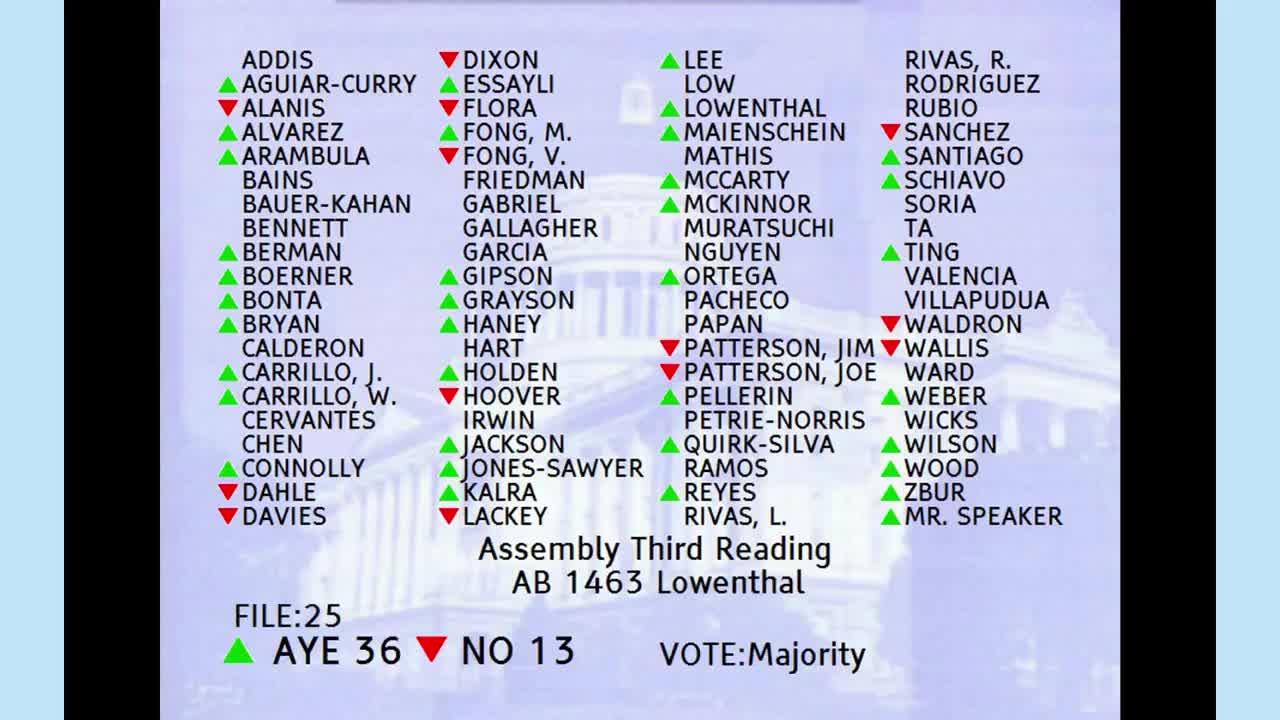 1MIN
Assembly Floor
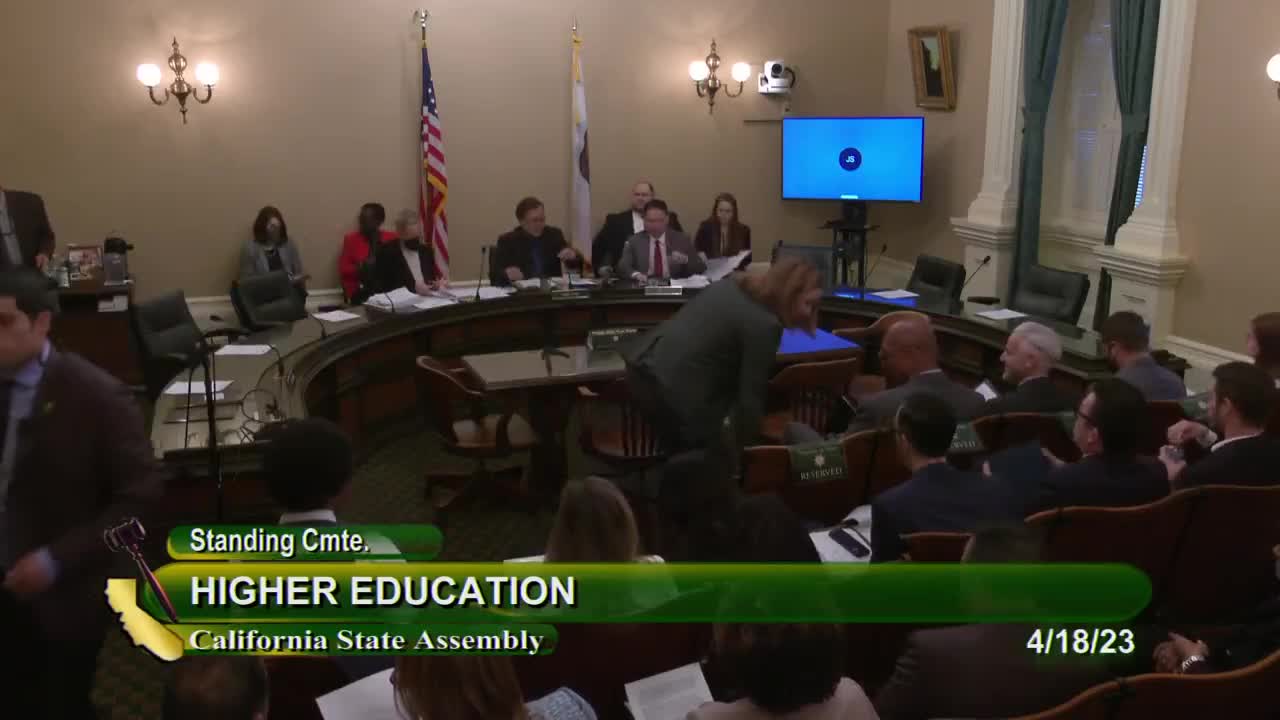 13MIN
Assembly Standing Committee on Higher Education
Bill Author