AB 1604: Charter schools: school facilities: Charter School Facility Grant Program: conduit financing.
- Session Year: 2023-2024
- House: Assembly
- Latest Version Date: 2023-09-18
Current Status:
Failed
(2024-01-29: Consideration of Governor's veto stricken from file.)
Introduced
In Committee
First Chamber
In Committee
Second Chamber
Enacted
Existing law requires the California School Finance Authority (authority) to administer the Charter School Facility Grant Program, and provides that the grant program is intended to provide assistance with facilities rent and lease costs for pupils in charter schools. Existing law requires the authority to, among other things, determine eligibility, as specified, including a requirement that the charter schoolsite either gives a preference in admission to pupils who are currently enrolled in a public elementary school in which 55% or more of the pupil enrollment is eligible for free or reduced-price meals and to pupils who reside in the elementary school attendance area where the charter schoolsite is located, or 55% or more of the pupil enrollment at the charter schoolsite is eligible for free or reduced-price meals.
This bill would clarify the above preference in admissions, including for when the charter school is a dual immersion program, and require that changes to the preference in admissions be incorporated into a charter schools charter petition during the next charter renewal cycle, as specified. The bill would also require the authority to update its regulations before opening the 202526 funding round to include specified requirements. The bill would require charter schools to identify their school type, confirm they are a classroom-based charter school, and include documentation confirming their status as nonprofit organizations in their applications.
This bill would require the sale or lease of an educational facility, as defined, other than to the charter school occupying the educational facility or a nonprofit related-party entity of the charter school, where the charter school occupying the facility has received substantial funding, as defined, from the Charter School Facility Grant Program (program) for an educational facility acquired, financed, constructed, or modernized on or after January 1, 2025, and for which the property title is held by a related-party entity, as defined, to be consistent with specified requirements, including that the educational facility is offered to certain entities in a specified order. If, within 60 days of issuing a notice, as provided, none of the entities listed has submitted an offer for the educational facility, the bill would authorize the educational facility to then be sold or leased to another entity, as specified. If a charter school occupying an educational facility has received substantial funding from the program and the title to the property is held by a related-party entity and the educational facility is sold within 10 years of the charter school last receiving program funds to any entity not listed and the proceeds are not used for capital outlay in the state, the bill would require an amount equal to the program funds received by the charter school in the previous 10 years to be returned to the authority, as specified.
This bill would require a charter school participating in a conduit financing program to notify the conduit issuer in certain situations, including, among others, when the charter school occupying the financed facility is closing. The bill would require a charter school to annually notify the conduit issuer of the status of a facility with outstanding conduit bonds when the charter school has closed or vacated the building but the building has not been sold, as provided. To the extent these provisions would impose additional duties on charter schools, the bill would impose a state-mandated local program.
The Charter Schools Act of 1992 provides for the establishment and operation of charter schools. Existing law requires a petition for the establishment of a charter school to contain comprehensive descriptions of various matters and procedures, including procedures to be used if the charter school closes, including a final audit of the charter school to determine the disposition of all assets and liabilities of the charter school, as specified.
If a charter school leases or rents its facility from a related party or subsidiary, as specified, or owns its facility, this bill would require the charter school to include a statement describing its plans for the use of the facility in its final audit.
This bill would incorporate additional changes to Section 47605 of the Education Code proposed by SB 10 and SB 671 to be operative only if this bill and either or both of those bills are enacted and this bill is enacted last.
This bill would incorporate additional changes to Section 47605.6 of the Education Code proposed by SB 10 and SB 671 to be operative only if this bill and either or both of those bills are enacted and this bill is enacted last.
The California Constitution requires the state to reimburse local agencies and school districts for certain costs mandated by the state. Statutory provisions establish procedures for making that reimbursement.
This bill would provide that, if the Commission on State Mandates determines that the bill contains costs mandated by the state, reimbursement for those costs shall be made pursuant to the statutory provisions noted above.
Existing law requires the California School Finance Authority to administer the Charter School Facility Grant Program, and provides that the grant program is intended to provide assistance with facilities rent and lease costs for pupils in charter schools. Existing law requires the authority to, among other things, determine eligibility, as specified, including a requirement that the charter schoolsite either gives a preference in admission to pupils who are currently enrolled in a public elementary school in which 55% or more of the pupil enrollment is eligible for free or reduced-price meals and to pupils who reside in the elementary school attendance area where the charter schoolsite is located or 55% or more of the pupil enrollment at the charter schoolsite is eligible for free or reduced-price meals.
This bill would clarify the above preference in admissions, including for when the charter school is a dual immersion program, and require that changes to the preference in admissions be incorporated into a charter schools charter petition during the next charter renewal cycle. cycle, as specified. The bill would also require the authority to update its regulations before opening the 202526 funding round to include specified requirements. The bill would require charter schools to identify their school type, confirm they are a classroom-based charter school, and include documentation confirming their status as nonprofit organizations in their applications.
This bill would require the sale or lease of an educational facility, as defined, other than to the charter school occupying the educational facility or a nonprofit related-party entity of the charter school, where the charter school occupying the facility has received substantial funding, as defined, from the Charter School Facility Grant Program (program) for an educational facility acquired, financed, constructed, or modernized on or after January 1, 2025, and for which the property title is held by a related-party entity, as defined, to be consistent with specified requirements, including that the educational facility is offered to certain entities in a specified order. If, within 60 days of issuing a notice, as provided, none of the entities listed has submitted a reasonable an offer for the educational facility, the bill would authorize the educational facility to then be sold or leased to another entity, as specified. If a charter school occupying an educational facility has received substantial funding from the program and the title to the property is held by a related-party entity and the educational facility is sold within 10 years of the charter school last receiving program funds to any entity not listed and the proceeds are not used for capital outlay in the state, the bill would require an amount equal to the program funds received by the charter school in the previous 10 years to be returned to the authority, as specified.
This bill would require a charter school participating in a conduit financing program to notify the conduit issuer in certain situations, including, among others, when the charter school occupying the financed facility is closing. The bill would require a charter school to annually notify the conduit issuer of the status of a facility with outstanding conduit bonds when the charter school has closed or vacated the building but the building has not been sold, as provided. To the extent these provisions would impose additional duties on charter schools, the bill would impose a state-mandated local program.
The Charter Schools Act of 1992 provides for the establishment and operation of charter schools. Existing law requires a petition for the establishment of a charter school to contain comprehensive descriptions of various matters and procedures, including procedures to be used if the charter school closes, including a final audit of the charter school to determine the disposition of all assets and liabilities of the charter school, as specified.
If a charter school leases or rents its facility from a related party or subsidiary, as specified, or owns its facility, this bill would require the charter school to include a statement describing its plans for the use of the facility in its final audit.
This bill would incorporate additional changes to Section 47605 of the Education Code proposed by SB 10 and SB 671 to be operative only if this bill and either or both of those bills are enacted and this bill is enacted last.
This bill would incorporate additional changes to Section 47605.6 of the Education Code proposed by SB 10 and SB 671 to be operative only if this bill and either or both of those bills are enacted and this bill is enacted last.
The California Constitution requires the state to reimburse local agencies and school districts for certain costs mandated by the state. Statutory provisions establish procedures for making that reimbursement.
This bill would provide that, if the Commission on State Mandates determines that the bill contains costs mandated by the state, reimbursement for those costs shall be made pursuant to the statutory provisions noted above.
Existing law requires the California School Finance Authority to administer the Charter School Facility Grant Program, and provides that the grant program is intended to provide assistance with facilities rent and lease costs for pupils in charter schools. Existing law requires the authority to, among other things, determine eligibility, as specified, including a requirement that the charter schoolsite either gives a preference in admission to pupils who are currently enrolled in a public elementary school in which 55% or more of the pupil enrollment is eligible for free or reduced-price meals and to pupils who reside in the elementary school attendance area where the charter schoolsite is located or 55% or more of the pupil enrollment at the charter schoolsite is eligible for free or reduced-price meals.
This bill would clarify the above preference in admissions, including for when the charter school is a dual immersion program, and require that changes to the preference in admissions be incorporated into a charter schools charter petition during the next charter renewal cycle. The bill would also require the authority to update its regulations before opening the 202526 funding round to include specified requirements, including the process by which the authority will evaluate applicants for conflicts of interest, as specified. requirements. The bill would require charter schools to identify their school type, confirm they are a classroom-based charter school, and include documentation confirming their status as nonprofit organizations in their applications.
This bill would require the sale or lease of an educational facility, as defined, where the charter school occupying the facility has received substantial funding, as defined, from the Charter School Facility Grant Program (program) for an educational facility acquired, financed, constructed, or modernized on or after January 1, 2025, and for which the property title is held by a related-party entity, as defined, to be consistent with specified requirements, including that the educational facility is offered to certain entities in a specified order. If, within 60 days of issuing a notice, as provided, none of the entities listed has submitted a reasonable offer for the educational facility, the bill would authorize the educational facility to then be sold or leased to another entity, as specified. If a charter school occupying an educational facility has received substantial funding from the program and the title to the property is held by a related-party entity and the educational facility is sold within 10 years of the charter school last receiving program funds to any entity not listed and the proceeds are not used for capital outlay in the state, the bill would require an amount equal to the program funds received by the charter school in the previous 10 years to be returned to the authority, as specified.
This bill would require a charter school participating in a conduit financing program to notify the conduit issuer in certain situations, including, among others, when the charter school occupying the financed facility is closing. The bill would require a charter school to annually notify the conduit issuer of the status of a facility with outstanding conduit bonds when the charter school has closed or vacated the building but the building has not been sold, as provided. To the extent these provisions would impose additional duties on charter schools, the bill would impose a state-mandated local program.
The Charter Schools Act of 1992 provides for the establishment and operation of charter schools. Existing law requires a petition for the establishment of a charter school to contain comprehensive descriptions of various matters and procedures, including procedures to be used if the charter school closes, including a final audit of the charter school to determine the disposition of all assets and liabilities of the charter school, as specified.
If a charter school leases or rents its facility from a related party or subsidiary, as specified, or owns its facility, this bill would require the charter school to include a statement describing its plans for the use of the facility in its final audit.
The California Constitution requires the state to reimburse local agencies and school districts for certain costs mandated by the state. Statutory provisions establish procedures for making that reimbursement.
This bill would provide that, if the Commission on State Mandates determines that the bill contains costs mandated by the state, reimbursement for those costs shall be made pursuant to the statutory provisions noted above.
Existing law requires the California School Finance Authority to administer the Charter School Facility Grant Program, and provides that the grant program is intended to provide assistance with facilities rent and lease costs for pupils in charter schools. Existing law requires the authority to, among other things, determine eligibility, as specified, including a requirement that the charter schoolsite either gives a preference in admission to pupils who are currently enrolled in a public elementary school in which 55% or more of the pupil enrollment is eligible for free or reduced-price meals and to pupils who reside in the elementary school attendance area where the charter schoolsite is located or 55% or more of the pupil enrollment at the charter schoolsite is eligible for free or reduced-price meals.
This bill would clarify the above preference in admissions, including for when the charter school is a dual immersion program. program, and require that changes to the preference in admissions be incorporated into a charter schools charter petition during the next charter renewal cycle. The bill would also require the authority to update its regulations before opening the 202425 202526 funding round to include specified requirements, including the process by which the authority will evaluate applicants for conflicts of interest, as specified. The bill would require charter schools to identify their school type, confirm they are a classroom-based charter school, and include documentation confirming their status as nonprofit organizations in their applications.
This bill would require the sale or lease of an educational facility, as defined, where the charter school occupying the facility has received substantial funding, as defined, from the Charter School Facility Grant Program (program) for an educational facility acquired, financed, constructed, or modernized on or after January 1, 2024, 2025, and for which the property title is held by a related-party entity, as defined, to be consistent with specified requirements, including that the educational facility is offered to certain entities in a specified order. If, within 60 days of issuing a notice, as provided, none of the entities listed has submitted a reasonable offer for the educational facility, the bill would authorize the educational facility to then be sold or leased to another entity, as specified. If a charter school occupying an educational facility has received substantial funding from the program and the title to the property is held by a related-party entity and the educational facility is sold within 10 years of the charter school last receiving program funds to any entity not listed and the proceeds are not used for capital outlay in the state, the bill would require an amount equal to the program funds received by the charter school in the previous 10 years to be returned to the authority, as specified.
This bill would require a charter school participating in a conduit financing program to notify the conduit issuer in certain situations, including, among others, when the charter school occupying the financed facility is closing. The bill would require a charter school to annually notify the conduit issuer of the status of a facility with outstanding conduit bonds when the charter school has closed or vacated the building but the building has not been sold, as provided. To the extent these provisions would impose additional duties on charter schools, the bill would impose a state-mandated local program.
The Charter Schools Act of 1992 provides for the establishment and operation of charter schools. Existing law requires a petition for the establishment of a charter school to contain comprehensive descriptions of various matters and procedures, including procedures to be used if the charter school closes, including a final audit of the charter school to determine the disposition of all assets and liabilities of the charter school, as specified.
If a charter school leases or rents its facility from a related party or subsidiary, as specified, or owns its facility, this bill would require the charter school to include a statement describing its plans for the use of the facility in its final audit.
The California Constitution requires the state to reimburse local agencies and school districts for certain costs mandated by the state. Statutory provisions establish procedures for making that reimbursement.
This bill would provide that, if the Commission on State Mandates determines that the bill contains costs mandated by the state, reimbursement for those costs shall be made pursuant to the statutory provisions noted above.
Existing law requires the California School Finance Authority to administer the Charter School Facility Grant Program, and provides that the grant program is intended to provide assistance with facilities rent and lease costs for pupils in charter schools. Existing law requires the authority to, among other things, determine eligibility, as specified, including a requirement that the charter schoolsite either gives a preference in admission to pupils who are currently enrolled in a public elementary school in which 55% or more of the pupil enrollment is eligible for free or reduced-price meals and to pupils who reside in the elementary school attendance area where the charter schoolsite is located or 55% or more of the pupil enrollment at the charter schoolsite is eligible for free or reduced-price meals.
This bill would clarify the above preference in admissions, including for when the charter school is a dual immersion program. The bill would also require the authority to update its regulations before opening the 202425 funding round to include specified requirements, including the process by which the authority will evaluate applicants for conflicts of interest, as specified. The bill would require charter schools to complete an annual survey conducted by the State Department of Education to be eligible for funding, identify their school type, confirm they are a classroom-based charter school, and to include documentation confirming their status as nonprofit organizations in their applications.
This bill would require a charter school to offer the sale or lease of an educational facility, as defined, acquired, financed, constructed, or modernized on or after January 1, 2024, that has been substantially funded, where the charter school occupying the facility has received substantial funding, as defined, with from the Charter School Facility Grant Program (program) funds and for an educational facility acquired, financed, constructed, or modernized on or after January 1, 2024, and for which the property title is held by a related-party entity, as defined, for sale or lease to be consistent with specified requirements, including that the educational facility is offered to certain entities in a specified order when choosing to sell or lease the educational facility. If order. If, within 60 days of issuing a notice, as provided, none of the entities listed are interested in has submitted a reasonable offer for the educational facility, the bill would require authorize the educational facility to then be sold or leased to another entity at fair market value, entity, as specified. If a charter school occupying an educational facility substantially funded with has received substantial funding from the program funds and the title to the property is held by a related-party entity and the educational facility is sold within 10 years of the charter school last receiving program funds to any entity not listed and the proceeds are not used for capital outlay in the state, the bill would require an amount equal to the program funds received by the charter school in the previous 10 years to be returned to the authority, as specified.
This bill would require a charter school participating in a conduit financing program to notify the conduit issuer in certain situations, including, among others, when the charter school occupying the financed facility is closing. The bill would require a charter school to annually notify the conduit issuer of the status of a facility with outstanding conduit bonds when the charter school has closed or vacated the building but the building has not been sold, as provided. To the extent these provisions would impose additional duties on charter schools, the bill would impose a state-mandated local program. The bill would require charter school conduit financing, entered into on or after January 1, 2024, to include an early repayment provision to allow repayment at any time.
The Charter Schools Act of 1992 provides for the establishment and operation of charter schools. Existing law requires a petition for the establishment of a charter school to contain comprehensive descriptions of various matters and procedures, including procedures to be used if the charter school closes, including a final audit of the charter school to determine the disposition of all assets and liabilities of the charter school, as specified.
If a charter school leases or rents its facility from a related party or subsidiary, as specified, or owns its facility, this bill would require the charter school to include a statement describing its plans for the use of the facility in its final audit.
The California Constitution requires the state to reimburse local agencies and school districts for certain costs mandated by the state. Statutory provisions establish procedures for making that reimbursement.
This bill would provide that, if the Commission on State Mandates determines that the bill contains costs mandated by the state, reimbursement for those costs shall be made pursuant to the statutory provisions noted above.
Existing law requires the California School Finance Authority to administer the Charter School Facility Grant Program, and provides that the grant program is intended to provide assistance with facilities rent and lease costs for pupils in charter schools. Existing law requires the authority to, among other things, determine eligibility, as specified, including a requirement that the charter schoolsite either gives a preference in admission to pupils who are currently enrolled in a public elementary school in which 55% or more of the pupil enrollment is eligible for free or reduced-price meals and to pupils who reside in the elementary school attendance area where the charter schoolsite is located or 55% or more of the pupil enrollment at the charter schoolsite is eligible for free or reduced-price meals.
This bill would specify that the above preference in admissions supersedes any other priority order for preference in admissions. clarify the above preference in admissions, including for when the charter school is a dual immersion program. The bill would also require the authority to update its regulations before opening the 202425 funding round to include specified requirements, including the process by which the authority will evaluate applicants for conflicts of interest, as specified, and to review a random sampling of an unspecified percentage of grant recipients for compliance with program requirements. specified. The bill would require charter schools to complete an annual survey conducted by the State Department of Education to be eligible for funding, and to include documentation confirming their status as nonprofit organizations in their applications.
This bill would require a charter school, charter management organization, subsidiary of a charter school, or the subsidiary of a charter management organization that operates or controls school to offer an educational facility, as defined, acquired, financed, constructed, or modernized on or after January 1, 2024, that has been substantially funded, as defined, with Charter School Facility Grant Program (program) funds to provide written notice to the Attorney General before entering into an agreement or transaction, as specified. The bill would require the Attorney General, within 90 days of the receipt of the written notice, to notify the educational facility owner in writing of the decision to consent to, give conditional consent to, or not consent to the agreement or transaction, and would authorize the Attorney General, in making that determination, to consider any factors the Attorney General deems relevant. The bill would require the Attorney General, before issuing any written decision, to conduct one or more public meetings, as specified. The bill would require the educational facility owner to promptly pay the Attorney General, upon request, for all actual, reasonable, and direct costs incurred in reviewing, evaluating, and making the determination required by these provisions, as specified. and held by a related-party entity, as defined, for sale or lease to certain entities in a specified order when choosing to sell or lease the educational facility. If none of the entities listed are interested in the educational facility, the bill would require the educational facility to then be sold or leased to another entity at fair market value, as specified. If a charter school educational facility substantially funded with program funds and held by a related-party entity is sold within 10 years of receiving program funds to any entity not listed and the proceeds are not used for capital outlay in the state, the bill would require program funds received by the charter school in the previous 10 years to be returned to the authority, as specified.
This bill would require a charter school participating in a conduit financing program to notify the conduit issuer in certain situations, including, among others, when the charter school occupying the financed facility is closing. The bill would require a charter school to annually notify the conduit issuer of the status of a facility with outstanding conduit bonds when the charter school has closed or vacated the building but the building has not been sold, as provided. To the extent these provisions would impose additional duties on charter schools, the bill would impose a state-mandated local program. The bill would require charter school conduit financing, entered into on or after January 1, 2024, to include an early repayment provision to allow repayment at any time.
The Charter Schools Act of 1992 provides for the establishment and operation of charter schools. Existing law requires a petition for the establishment of a charter school to contain comprehensive descriptions of various matters and procedures, including procedures to be used if the charter school closes, including a final audit of the charter school to determine the disposition of all assets and liabilities of the charter school, as specified.
If a charter school leases or rents its facility from a related party or subsidiary, as specified, or owns its facility, this bill would require the charter school to include a statement describing its plans for the use of the facility in its final audit.
The California Constitution requires the state to reimburse local agencies and school districts for certain costs mandated by the state. Statutory provisions establish procedures for making that reimbursement.
This bill would provide that, if the Commission on State Mandates determines that the bill contains costs mandated by the state, reimbursement for those costs shall be made pursuant to the statutory provisions noted above.
Existing law requires the California School Finance Authority to administer the Charter School Facility Grant Program, and provides that the grant program is intended to provide assistance with facilities rent and lease costs for pupils in charter schools. Existing law requires the authority to verify that the grant amount awarded to each charter school is consistent with eligibility requirements, as specified. Existing law requires, if it is determined that a charter school did not receive the proper grant award, either the charter school to transfer those funds back to the authority within 60 days of being notified by the authority, or the authority to provide an additional apportionment as necessary to the charter school within 60 days of notifying the charter school, as provided. to, among other things, determine eligibility, as specified, including a requirement that the charter schoolsite either gives a preference in admission to pupils who are currently enrolled in a public elementary school in which 55% or more of the pupil enrollment is eligible for free or reduced-price meals and to pupils who reside in the elementary school attendance area where the charter schoolsite is located or 55% or more of the pupil enrollment at the charter schoolsite is eligible for free or reduced-price meals.
This bill would, with respect to the latter provision, extend both the amount of time that a charter school has to transfer funds back to the authority and the amount of time that the authority has to provide an additional apportionment by an additional day to 61 days. would specify that the above preference in admissions supersedes any other priority order for preference in admissions. The bill would also require the authority to evaluate applicants for conflicts of interest, as specified, and to review a random sampling of an unspecified percentage of grant recipients for compliance with program requirements. The bill would require charter schools to complete an annual survey conducted by the State Department of Education to be eligible for funding, and to include documentation confirming their status as nonprofit organizations in their applications.
This bill would require a charter school, charter management organization, subsidiary of a charter school, or the subsidiary of a charter management organization that operates or controls an educational facility, as defined, that has been substantially funded, as defined, with Charter School Facility Grant Program funds to provide written notice to the Attorney General before entering into an agreement or transaction, as specified. The bill would require the Attorney General, within 90 days of the receipt of the written notice, to notify the educational facility owner in writing of the decision to consent to, give conditional consent to, or not consent to the agreement or transaction, and would authorize the Attorney General, in making that determination, to consider any factors the Attorney General deems relevant. The bill would require the Attorney General, before issuing any written decision, to conduct one or more public meetings, as specified. The bill would require the educational facility owner to promptly pay the Attorney General, upon request, for all actual, reasonable, and direct costs incurred in reviewing, evaluating, and making the determination required by these provisions, as specified.
The Charter Schools Act of 1992 provides for the establishment and operation of charter schools. Existing law requires a petition for the establishment of a charter school to contain comprehensive descriptions of various matters and procedures, including procedures to be used if the charter school closes, including a final audit of the charter school to determine the disposition of all assets and liabilities of the charter school, as specified.
If a charter school leases or rents its facility from a related party or subsidiary, as specified, or owns its facility, this bill would require the charter school to include a statement describing its plans for the use of the facility in its final audit.
Existing law requires the California School Finance Authority to administer the Charter School Facility Grant Program, and provides that the grant program is intended to provide assistance with facilities rent and lease costs for pupils in charter schools. Existing law requires the authority to verify that the grant amount awarded to each charter school is consistent with eligibility requirements, as specified. Existing law requires, if it is determined that a charter school did not receive the proper grant award, either the charter school to transfer those funds back to the authority within 60 days of being notified by the authority, or the authority to provide an additional apportionment as necessary to the charter school within 60 days of notifying the charter school, as provided.
This bill would, with respect to the latter provision, extend both the amount of time that a charter school has to transfer funds back to the authority and the amount of time that the authority has to provide an additional apportionment by an additional day to 61 days.
(a)(1)Except as set forth in paragraph (2), a petition for the establishment of a charter school within a school district may be circulated by one or more persons seeking to establish the charter school. A petition for the establishment of a charter school shall identify a single charter school that will operate within the geographic boundaries of that school district. A charter school may propose to operate at multiple sites within the school district if each location is identified in the charter school petition. The petition may be submitted to the governing board of the school district for review after either of the following conditions is met:
(A)The petition is signed by a number of parents or legal guardians of pupils that is equivalent to at least one-half of the number of pupils that the charter school estimates will enroll in the charter school for its first year of operation.
(B)The petition is signed by a number of teachers that is equivalent to at least one-half of the number of teachers that the charter school estimates will be employed at the charter school during its first year of operation.
(2)A petition that proposes to convert an existing public school to a charter school that would not be eligible for a loan pursuant to subdivision (c) of Section 41365 may be circulated by one or more persons seeking to establish the charter school. The petition may be submitted to the governing board of the school district for review after the petition is signed by not less than 50 percent of the permanent status teachers currently employed at the public school to be converted.
(3)A petition shall include a prominent statement that a signature on the petition means that the parent or legal guardian is meaningfully interested in having their child or ward attend the charter school, or in the case of a teachers signature, means that the teacher is meaningfully interested in teaching at the charter school. The proposed charter shall be attached to the petition.
(4)After receiving approval of its petition, a charter school that proposes to expand operations to one or more additional sites or grade levels shall request a material revision to its charter and shall notify the chartering authority of those additional locations or grade levels. The chartering authority shall consider whether to approve those additional locations or grade levels at an open, public meeting. If the additional locations or grade levels are approved pursuant to the standards and criteria described in subdivision (c), they shall be a material revision to the charter schools charter.
(5)(A)A charter school that established one site outside the boundaries of the school district, but within the county in which that school district is located before January 1, 2020, may continue to operate that site until the charter school submits a request for the renewal of its charter petition. To continue operating the site, the charter school shall do either of the following:
(i)First, before submitting the request for the renewal of the charter petition, obtain approval in writing from the school district where the site is operating.
(ii)Submit a request for the renewal of the charter petition pursuant to Section 47607 to the school district in which the charter school is located.
(B)If a Presidential declaration of a major disaster or emergency is issued in accordance with the federal Robert T. Stafford Disaster Relief and Emergency Assistance Act (42 U.S.C. Sec. 5121 et seq.) for an area in which a charter schoolsite is located and operating, the charter school, for not more than five years, may relocate that site outside the area subject to the Presidential declaration if the charter school first obtains the written approval of the school district where the site is being relocated to.
(C)Notwithstanding subparagraph (A), if a charter school was relocated from December 31, 2016, to December 31, 2019, inclusive, due to a Presidential declaration of a major disaster or emergency in accordance with the federal Robert T. Stafford Disaster Relief and Emergency Assistance Act (42 U.S.C. Sec. 5121 et seq.), that charter school shall be allowed to return to its original campus location in perpetuity.
(D)(i)A charter school in operation and providing educational services to pupils before October 1, 2019, located on a federally recognized California Indian reservation or rancheria or operated by a federally recognized California Indian tribe shall be exempt from the geographic restrictions of paragraph (1) and subparagraph (A) of this paragraph and the geographic restrictions of subdivision (a) of Section 47605.1.
(ii)The exemption to the geographic restrictions of subdivision (a) of Section 47605.1 in clause (i) does not apply to nonclassroom-based charter schools operating pursuant to Section 47612.5.
(E)The department shall regard as a continuing charter school for all purposes a charter school that was granted approval of its petition, that was providing educational services to pupils before October 1, 2019, and is authorized by a different chartering authority due to changes to this paragraph that took effect January 1, 2020. This paragraph shall be implemented only to the extent it does not conflict with federal law. In order to prevent any potential conflict with federal law, this paragraph does not apply to covered programs as identified in Section 8101(11) of the federal Elementary and Secondary Education Act of 1965 (20 U.S.C. Sec. 7801) to the extent the affected charter school is the restructured portion of a divided charter school pursuant to Section 47654.
(6)Commencing January 1, 2003, a petition to establish a charter school shall not be approved to serve pupils in a grade level that is not served by the school district of the governing board considering the petition, unless the petition proposes to serve pupils in all of the grade levels served by that school district.
(b)No later than 60 days after receiving a petition, in accordance with subdivision (a), the governing board of the school district shall hold a public hearing on the provisions of the charter, at which time the governing board of the school district shall consider the level of support for the petition by teachers employed by the school district, other employees of the school district, and parents. Following review of the petition and the public hearing, the governing board of the school district shall either grant or deny the charter within 90 days of receipt of the petition, provided, however, that the date may be extended by an additional 30 days if both parties agree to the extension. A petition is deemed received by the governing board of the school district for purposes of commencing the timelines described in this subdivision on the day the petitioner submits a petition to the district office, along with a signed certification that the petitioner deems the petition to be complete. The governing board of the school district shall publish all staff recommendations, including the recommended findings and, if applicable, the certification from the county superintendent of schools prepared pursuant to paragraph (8) of subdivision (c), regarding the petition at least 15 days before the public hearing at which the governing board of the school district will either grant or deny the charter. At the public hearing at which the governing board of the school district will either grant or deny the charter, petitioners shall have equivalent time and procedures to present evidence and testimony to respond to the staff recommendations and findings.
(c)In reviewing petitions for the establishment of charter schools pursuant to this section, the chartering authority shall be guided by the intent of the Legislature that charter schools are and should become an integral part of the California educational system and that the establishment of charter schools should be encouraged. The governing board of the school district shall grant a charter for the operation of a school under this part if it is satisfied that granting the charter is consistent with sound educational practice and with the interests of the community in which the school is proposing to locate. The governing board of the school district shall consider the academic needs of the pupils the school proposes to serve. The governing board of the school district shall not deny a petition for the establishment of a charter school unless it makes written factual findings, specific to the particular petition, setting forth specific facts to support one or more of the following findings:
(1)The charter school presents an unsound educational program for the pupils to be enrolled in the charter school.
(2)The petitioners are demonstrably unlikely to successfully implement the program set forth in the petition.
(3)The petition does not contain the number of signatures required by subdivision (a).
(4)The petition does not contain an affirmation of each of the conditions described in subdivision (e).
(5)The petition does not contain reasonably comprehensive descriptions of all of the following:
(A)(i)The educational program of the charter school, designed, among other things, to identify those whom the charter school is attempting to educate, what it means to be an educated person in the 21st century, and how learning best occurs. The goals identified in that program shall include the objective of enabling pupils to become self-motivated, competent, and lifelong learners.
(ii)The annual goals for the charter school for all pupils and for each subgroup of pupils identified pursuant to Section 52052, to be achieved in the state priorities, as described in subdivision (d) of Section 52060, that apply for the grade levels served, and specific annual actions to achieve those goals. A charter petition may identify additional school priorities, the goals for the school priorities, and the specific annual actions to achieve those goals.
(iii)If the proposed charter school will serve high school pupils, the manner in which the charter school will inform parents about the transferability of courses to other public high schools and the eligibility of courses to meet college entrance requirements. Courses offered by the charter school that are accredited by the Western Association of Schools and Colleges may be considered transferable and courses approved by the University of California or the California State University as creditable under the A to G admissions criteria may be considered to meet college entrance requirements.
(B)The measurable pupil outcomes identified for use by the charter school. Pupil outcomes, for purposes of this part, means the extent to which all pupils of the charter school demonstrate that they have attained the skills, knowledge, and attitudes specified as goals in the charter schools educational program. Pupil outcomes shall include outcomes that address increases in pupil academic achievement both schoolwide and for all pupil subgroups served by the charter school, as that term is defined in subdivision (a) of Section 52052. The pupil outcomes shall align with the state priorities, as described in subdivision (d) of Section 52060, that apply for the grade levels served by the charter school.
(C)The method by which pupil progress in meeting those pupil outcomes is to be measured. To the extent practicable, the method for measuring pupil outcomes for state priorities shall be consistent with the way information is reported on a school accountability report card.
(D)The governance structure of the charter school, including, but not limited to, the process to be followed by the charter school to ensure parental involvement.
(E)The qualifications to be met by individuals to be employed by the charter school.
(F)The procedures that the charter school will follow to ensure the health and safety of pupils and staff. These procedures shall require all of the following:
(i)That each employee of the charter school furnish the charter school with a criminal record summary as described in Section 44237.
(ii)The development of a school safety plan, which shall include the safety topics listed in subparagraphs (A) to (J), inclusive, of paragraph (2) of subdivision (a) of Section 32282.
(iii)That the school safety plan be reviewed and updated by March 1 of every year by the charter school.
(G)The means by which the charter school will achieve a balance of racial and ethnic pupils, special education pupils, and English learner pupils, including redesignated fluent English proficient pupils, as defined by the evaluation rubrics in Section 52064.5, that is reflective of the general population residing within the territorial jurisdiction of the school district to which the charter petition is submitted. Upon renewal, for a charter school not deemed to be a local educational agency for purposes of special education pursuant to Section 47641, the chartering authority may consider the effect of school placements made by the chartering authority in providing a free and appropriate public education as required by the federal Individuals with Disabilities Education Act (Public Law 101-476), on the balance of pupils with disabilities at the charter school.
(H)Admission policies and procedures, consistent with subdivision (e).
(I)The manner in which annual, independent financial audits shall be conducted, which shall employ generally accepted accounting principles, and the manner in which audit exceptions and deficiencies shall be resolved to the satisfaction of the chartering authority.
(J)The procedures by which pupils can be suspended or expelled from the charter school for disciplinary reasons or otherwise involuntarily removed from the charter school for any reason. These procedures, at a minimum, shall include an explanation of how the charter school will comply with federal and state constitutional procedural and substantive due process requirements that are consistent with all of the following:
(i)For suspensions of fewer than 10 days, provide oral or written notice of the charges against the pupil and, if the pupil denies the charges, an explanation of the evidence that supports the charges and an opportunity for the pupil to present the pupils side of the story.
(ii)For suspensions of 10 days or more and all other expulsions for disciplinary reasons, both of the following:
(I)Provide timely, written notice of the charges against the pupil and an explanation of the pupils basic rights.
(II)Provide a hearing adjudicated by a neutral officer within a reasonable number of days at which the pupil has a fair opportunity to present testimony, evidence, and witnesses and confront and cross-examine adverse witnesses, and at which the pupil has the right to bring legal counsel or an advocate.
(iii)Contain a clear statement that no pupil shall be involuntarily removed by the charter school for any reason unless the parent or guardian of the pupil has been provided written notice of intent to remove the pupil no less than five schooldays before the effective date of the action. The written notice shall be in the native language of the pupil or the pupils parent or guardian, or, if the pupil is a homeless child or youth, or a foster child or youth, in the native language of the homeless or foster childs educational rights holder. In the case of a foster child or youth, the written notice shall also be provided to the foster childs attorney and county social worker. If the pupil is an Indian child, as defined in Section 224.1 of the Welfare and Institutions Code, the written notice shall also be provided to the Indian childs tribal social worker and, if applicable, county social worker. The written notice shall inform the pupil, the pupils parent or guardian, the homeless childs educational rights holder, the foster childs educational rights holder, attorney, and county social worker, or the Indian childs tribal social worker and, if applicable, county social worker of the right to initiate the procedures specified in clause (ii) before the effective date of the action. If the pupils parent or guardian, the homeless childs educational rights holder, the foster childs educational rights holder, attorney, or county social worker, or the Indian childs tribal social worker or, if applicable, county social worker initiates the procedures specified in clause (ii), the pupil shall remain enrolled and shall not be removed until the charter school issues a final decision. For purposes of this clause, involuntarily removed includes disenrolled, dismissed, transferred, or terminated, but does not include suspensions specified in clauses (i) and (ii).
(iv)A foster childs educational rights holder, attorney, and county social worker and an Indian childs tribal social worker and, if applicable, county social worker shall have the same rights a parent or guardian of a child has to receive a suspension notice, expulsion notice, manifestation determination notice, involuntary transfer notice, and other documents and related information.
(K)The manner by which staff members of the charter schools will be covered by the State Teachers Retirement System, the Public Employees Retirement System, or federal social security.
(L)The public school attendance alternatives for pupils residing within the school district who choose not to attend charter schools.
(M)The rights of an employee of the school district upon leaving the employment of the school district to work in a charter school, and of any rights of return to the school district after employment at a charter school.
(N)The procedures to be followed by the charter school and the chartering authority to resolve disputes relating to provisions of the charter.
(O)The procedures to be used if the charter school closes. The procedures shall ensure a final audit of the charter school to determine the disposition of all assets and liabilities of the charter school, including plans for disposing of any net assets and for the maintenance and transfer of pupil records. If the charter school leases or rents its facility from a related party or subsidiary, as identified in its audited financial statements according to generally accepted accounting principles in the United States, or owns its facility, the charter school shall include a statement describing its plans for the use of the facility in its final audit.
(6)The petition does not contain a declaration of whether or not the charter school shall be deemed the exclusive public employer of the employees of the charter school for purposes of Chapter 10.7 (commencing with Section 3540) of Division 4 of Title 1 of the Government Code.
(7)The charter school is demonstrably unlikely to serve the interests of the entire community in which the school is proposing to locate. Analysis of this finding shall include consideration of the fiscal impact of the proposed charter school. A written factual finding under this paragraph shall detail specific facts and circumstances that analyze and consider the following factors:
(A)The extent to which the proposed charter school would substantially undermine existing services, academic offerings, or programmatic offerings.
(B)Whether the proposed charter school would duplicate a program currently offered within the school district and the existing program has sufficient capacity for the pupils proposed to be served within reasonable proximity to where the charter school intends to locate.
(8)The school district is not positioned to absorb the fiscal impact of the proposed charter school. A school district satisfies this paragraph if it has a qualified interim certification pursuant to Section 42131 and the county superintendent of schools, in consultation with the County Office Fiscal Crisis and Management Assistance Team, certifies that approving the charter school would result in the school district having a negative interim certification pursuant to Section 42131, has a negative interim certification pursuant to Section 42131, or is under state receivership. Charter schools proposed in a school district satisfying one of these conditions shall be subject to a rebuttable presumption of denial.
(d)(1)Charter schools shall meet all statewide standards and conduct the pupil assessments required pursuant to Section 60605 and any other statewide standards authorized in statute or pupil assessments applicable to pupils in noncharter public schools.
(2)Charter schools shall, on a regular basis, consult with their parents, legal guardians, and teachers regarding the charter schools educational programs.
(e)(1)In addition to any other requirement imposed under this part, a charter school shall be nonsectarian in its programs, admission policies, employment practices, and all other operations, shall not charge tuition, and shall not discriminate against a pupil on the basis of the characteristics listed in Section 220. Except as provided in paragraph (2), admission to a charter school shall not be determined according to the place of residence of the pupil, or of that pupils parent or legal guardian, within this state, except that an existing public school converting partially or entirely to a charter school under this part shall adopt and maintain a policy giving admission preference to pupils who reside within the former attendance area of that public school.
(2)(A)A charter school shall admit all pupils who wish to attend the charter school.
(B)If the number of pupils who wish to attend the charter school exceeds the charter schools capacity, attendance, except for existing pupils of the charter school, shall be determined by a public random drawing. Preference shall be extended to pupils currently attending the charter school and pupils who reside in the school district except as provided for in Section 47614.5. Preferences, including, but not limited to, siblings of pupils admitted or attending the charter school and children of the charter schools teachers, staff, and founders identified in the initial charter, may also be permitted by the chartering authority on an individual charter school basis. Priority order for any preference shall be determined in the charter petition in accordance with all of the following:
(i)Each type of preference shall be approved by the chartering authority at a public hearing.
(ii)Preferences shall be consistent with federal law, the California Constitution, and Section 200.
(iii)Preferences shall not result in limiting enrollment access for pupils with disabilities, academically low-achieving pupils, English learners, neglected or delinquent pupils, homeless pupils, or pupils who are economically disadvantaged, as determined by eligibility for any free or reduced-price meal program, foster youth, or pupils based on nationality, race, ethnicity, or sexual orientation.
(iv)In accordance with Section 49011, preferences shall not require mandatory parental volunteer hours as a criterion for admission or continued enrollment.
(C)In the event of a drawing, the chartering authority shall make reasonable efforts to accommodate the growth of the charter school and shall not take any action to impede the charter school from expanding enrollment to meet pupil demand.
(3)If a pupil is expelled or leaves the charter school without graduating or completing the school year for any reason, the charter school shall notify the superintendent of the school district of the pupils last known address within 30 days, and shall, upon request, provide that school district with a copy of the cumulative record of the pupil, including report cards or a transcript of grades, and health information. If the pupil is subsequently expelled or leaves the school district without graduating or completing the school year for any reason, the school district shall provide this information to the charter school within 30 days if the charter school demonstrates that the pupil had been enrolled in the charter school. This paragraph applies only to pupils subject to compulsory full-time education pursuant to Section 48200.
(4)(A)A charter school shall not discourage a pupil from enrolling or seeking to enroll in the charter school for any reason, including, but not limited to, academic performance of the pupil or because the pupil exhibits any of the characteristics described in clause (iii) of subparagraph (B) of paragraph (2).
(B)A charter school shall not request a pupils records or require a parent, guardian, or pupil to submit the pupils records to the charter school before enrollment.
(C)A charter school shall not encourage a pupil currently attending the charter school to disenroll from the charter school or transfer to another school for any reason, including, but not limited to, academic performance of the pupil or because the pupil exhibits any of the characteristics described in clause (iii) of subparagraph (B) of paragraph (2). This subparagraph shall not apply to actions taken by a charter school pursuant to the procedures described in subparagraph (J) of paragraph (5) of subdivision (c).
(D)The department shall develop a notice of the requirements of this paragraph. This notice shall be posted on a charter schools internet website. A charter school shall provide a parent or guardian, or a pupil if the pupil is 18 years of age or older, a copy of this notice at all of the following times:
(i)When a parent, guardian, or pupil inquires about enrollment.
(ii)Before conducting an enrollment lottery.
(iii)Before disenrollment of a pupil.
(E)(i)A person who suspects that a charter school has violated this paragraph may file a complaint with the chartering authority.
(ii)The department shall develop a template to be used for filing complaints pursuant to clause (i).
(5)Notwithstanding any other law, a charter school in operation as of July 1, 2019, that operates in partnership with the California National Guard may dismiss a pupil from the charter school for failing to maintain the minimum standards of conduct required by the Military Department.
(f)The governing board of a school district shall not require an employee of the school district to be employed in a charter school.
(g)The governing board of a school district shall not require a pupil enrolled in the school district to attend a charter school.
(h)The governing board of a school district shall require that the petitioner or petitioners provide information regarding the proposed operation and potential effects of the charter school, including, but not limited to, the facilities to be used by the charter school, the manner in which administrative services of the charter school are to be provided, and potential civil liability effects, if any, upon the charter school and upon the school district. The description of the facilities to be used by the charter school shall specify where the charter school intends to locate. The petitioner or petitioners also shall be required to provide financial statements that include a proposed first-year operational budget, including startup costs, and cashflow and financial projections for the first three years of operation. If the school is to be operated by, or as, a nonprofit public benefit corporation, the petitioner shall provide the names and relevant qualifications of all persons whom the petitioner nominates to serve on the governing body of the charter school.
(i)In reviewing petitions for the establishment of charter schools within the school district, the governing board of the school district shall give preference to petitions that demonstrate the capability to provide comprehensive learning experiences to pupils identified by the petitioner or petitioners as academically low achieving pursuant to the standards established by the department under Section 54032, as that section read before July 19, 2006.
(j)Upon the approval of the petition by the governing board of the school district, the petitioner or petitioners shall provide written notice of that approval, including a copy of the petition, to the applicable county superintendent of schools, the department, and the state board.
(k)(1)(A)(i)If the governing board of a school district denies a petition, the petitioner may elect to submit the petition for the establishment of a charter school to the county board of education. The petitioner shall submit the petition to the county board of education within 30 days of a denial by the governing board of the school district. At the same time the petition is submitted to the county board of education, the petitioner shall also provide a copy of the petition to the school district. The county board of education shall review the petition pursuant to subdivisions (b) and (c). If the petition submitted on appeal contains new or different material terms, the county board of education shall immediately remand the petition to the governing board of the school district for reconsideration, which shall grant or deny the petition within 30 days. If the governing board of the school district denies a petition after reconsideration, the petitioner may elect to resubmit the petition for the establishment of a charter school to the county board of education.
(ii)The county board of education shall review the appeal petition pursuant to subdivision (c). If the denial of the petition was made pursuant to paragraph (8) of subdivision (c), the county board of education shall also review the school districts findings pursuant to paragraph (8) of subdivision (c).
(iii)As used in this subdivision, material terms of the petition means the signatures, affirmations, disclosures, documents, and descriptions described in subdivisions (a), (b), (c), and (h), but shall not include minor administrative updates to the petition or related documents due to changes in circumstances based on the passage of time related to fiscal affairs, facilities arrangements, or state law, or to reflect the county board of education as the chartering authority.
(B)If the governing board of a school district denies a petition and the county board of education has jurisdiction over a single school district, the petitioner may elect to submit the petition for the establishment of a charter school to the state board. The state board shall review a petition submitted pursuant to this subparagraph pursuant to subdivision (c). If the denial of a charter petition is reversed by the state board pursuant to this subparagraph, the state board shall designate the governing board of the school district in which the charter school is located as the chartering authority.
(2)If the county board of education denies a petition, the petitioner may appeal that denial to the state board.
(A)The petitioner shall submit the petition to the state board within 30 days of a denial by the county board of education. The petitioner shall include the findings and documentary record from the governing board of the school district and the county board of education and a written submission detailing, with specific citations to the documentary record, how the governing board of the school district and the county board of education abused their discretion. The governing board of the school district and county board of education shall prepare the documentary record, including transcripts of the public hearing at which the governing board of the school district and county board of education denied the charter, at the request of the petitioner. The documentary record shall be prepared by the governing board of the school district and county board of education no later than 10 business days after the request of the petitioner is made. At the same time the petition and supporting documentation is submitted to the state board, the petitioner shall also provide a copy of the petition and supporting documentation to the school district and the county board of education.
(B)If the appeal contains new or different material terms, as defined in clause (iii) of subparagraph (A) of paragraph (1), the state board shall immediately remand the petition to the governing board of the school district to which the petition was submitted for reconsideration. The governing board of the school district shall grant or deny the petition within 30 days. If the governing board of the school district denies a petition after reconsideration, the petitioner may elect to resubmit the petition to the state board.
(C)Within 30 days of receipt of the appeal submitted to the state board, the governing board of the school district or county board of education may submit a written opposition to the state board detailing, with specific citations to the documentary record, how the governing board of the school district or the county board of education did not abuse its discretion in denying the petition. The governing board of the school district or the county board of education may submit supporting documentation or evidence from the documentary record that was considered by the governing board of the school district or the county board of education.
(D)The state boards Advisory Commission on Charter Schools shall hold a public hearing to review the appeal and documentary record. Based on its review, the Advisory Commission on Charter Schools shall submit a recommendation to the state board whether there is sufficient evidence to hear the appeal or to summarily deny review of the appeal based on the documentary record. If the Advisory Commission on Charter Schools does not submit a recommendation to the state board, the state board shall consider the appeal, and shall either hear the appeal or summarily deny review of the appeal based on the documentary record at a regular public meeting of the state board.
(E)The state board shall either hear the appeal or summarily deny review of the appeal based on the documentary record. If the state board hears the appeal, the state board may affirm the determination of the governing board of the school district or the county board of education, or both of those determinations, or may reverse only upon a determination that there was an abuse of discretion by each of the governing board of the school district and the county board of education. Abuse of discretion is the most deferential standard of review, under which the state board must give deference to the decisions of the governing board of the school district and the county board of education to deny the petition. If the denial of a charter petition is reversed by the state board, the state board shall designate, in consultation with the petitioner, either the governing board of the school district or the county board of education in which the charter school is located as the chartering authority.
(3)A charter school for which a charter is granted by either the county board of education or the state board based on an appeal pursuant to this subdivision shall qualify fully as a charter school for all funding and other purposes of this part.
(4)A charter school that receives approval of its petition from a county board of education or from the state board on appeal shall be subject to the same requirements concerning geographic location to which it would otherwise be subject if it received approval from the chartering authority to which it originally submitted its petition. A charter petition that is submitted to either a county board of education or to the state board shall meet all otherwise applicable petition requirements, including the identification of the proposed site or sites where the charter school will operate.
(5)Upon the approval of the petition by the county board of education, the petition or petitioners shall provide written notice of that approval, including a copy of the petition, to the governing board of the school district in which the charter school is located, the department, and the state board.
(6)If either the county board of education or the state board fails to act on a petition within 180 days of receipt, the decision of the governing board of the school district to deny the petition shall be subject to judicial review.
(l)(1)Teachers in charter schools shall hold the Commission on Teacher Credentialing certificate, permit, or other document required for the teachers certificated assignment. These documents shall be maintained on file at the charter school and are subject to periodic inspection by the chartering authority. A governing body of a direct-funded charter school may use local assignment options authorized in statute and regulations for the purpose of legally assigning certificated teachers, in accordance with all of the requirements of the applicable statutes or regulations in the same manner as a governing board of a school district. A charter school shall have authority to request an emergency permit or a waiver from the Commission on Teacher Credentialing for individuals in the same manner as a school district.
(2)By July 1, 2020, all teachers in charter schools shall obtain a certificate of clearance and satisfy the requirements for professional fitness pursuant to Sections 44339, 44340, and 44341.
(3)The Commission on Teacher Credentialing shall include in the bulletins it issues pursuant to subdivision (k) of Section 44237 to provide notification to local educational agencies of any adverse actions taken against the holders of any commission documents, notice of any adverse actions taken against teachers employed by charter schools, and shall make this bulletin available to all chartering authorities and charter schools in the same manner in which it is made available to local educational agencies.
(m)A charter school shall transmit a copy of its annual, independent financial audit report for the preceding fiscal year, as described in subparagraph (I) of paragraph (5) of subdivision (c), to its chartering authority, the Controller, the county superintendent of schools of the county in which the charter school is sited, unless the county board of education of the county in which the charter school is sited is the chartering authority, and the department by December 15 of each year. This subdivision does not apply if the audit of the charter school is encompassed in the audit of the chartering authority pursuant to Section 41020.
(n)A charter school may encourage parental involvement, but shall notify the parents and guardians of applicant pupils and currently enrolled pupils that parental involvement is not a requirement for acceptance to, or continued enrollment at, the charter school.
(o)The requirements of this section shall not be waived by the state board pursuant to Section 33050 or any other law.
SEC. 1.1.Section 47605 of the Education Code is amended to read:47605.(a)(1)Except as set forth in paragraph (2), a petition for the establishment of a charter school within a school district may be circulated by one or more persons seeking to establish the charter school. A petition for the establishment of a charter school shall identify a single charter school that will operate within the geographic boundaries of that school district. A charter school may propose to operate at multiple sites within the school district if each location is identified in the charter school petition. The petition may be submitted to the governing board of the school district for review after either of the following conditions is met:
(A)The petition is signed by a number of parents or legal guardians of pupils that is equivalent to at least one-half of the number of pupils that the charter school estimates will enroll in the charter school for its first year of operation.
(B)The petition is signed by a number of teachers that is equivalent to at least one-half of the number of teachers that the charter school estimates will be employed at the charter school during its first year of operation.
(2)A petition that proposes to convert an existing public school to a charter school that would not be eligible for a loan pursuant to subdivision (c) of Section 41365 may be circulated by one or more persons seeking to establish the charter school. The petition may be submitted to the governing board of the school district for review after the petition is signed by not less than 50 percent of the permanent status teachers currently employed at the public school to be converted.
(3)A petition shall include a prominent statement that a signature on the petition means that the parent or legal guardian is meaningfully interested in having their child or ward attend the charter school, or in the case of a teachers signature, means that the teacher is meaningfully interested in teaching at the charter school. The proposed charter shall be attached to the petition.
(4)After receiving approval of its petition, a charter school that proposes to expand operations to one or more additional sites or grade levels shall request a material revision to its charter and shall notify the chartering authority of those additional locations or grade levels. The chartering authority shall consider whether to approve those additional locations or grade levels at an open, public meeting. If the additional locations or grade levels are approved pursuant to the standards and criteria described in subdivision (c), they shall be a material revision to the charter schools charter.
(5)(A)A charter school that established one site outside the boundaries of the school district, but within the county in which that school district is located before January 1, 2020, may continue to operate that site until the charter school submits a request for the renewal of its charter petition. To continue operating the site, the charter school shall do either of the following:
(i)First, before submitting the request for the renewal of the charter petition, obtain approval in writing from the school district where the site is operating.
(ii)Submit a request for the renewal of the charter petition pursuant to Section 47607 to the school district in which the charter school is located.
(B)If a Presidential declaration of a major disaster or emergency is issued in accordance with the federal Robert T. Stafford Disaster Relief and Emergency Assistance Act (42 U.S.C. Sec. 5121 et seq.) for an area in which a charter schoolsite is located and operating, the charter school, for not more than five years, may relocate that site outside the area subject to the Presidential declaration if the charter school first obtains the written approval of the school district where the site is being relocated to.
(C)Notwithstanding subparagraph (A), if a charter school was relocated from December 31, 2016, to December 31, 2019, inclusive, due to a Presidential declaration of a major disaster or emergency in accordance with the federal Robert T. Stafford Disaster Relief and Emergency Assistance Act (42 U.S.C. Sec. 5121 et seq.), that charter school shall be allowed to return to its original campus location in perpetuity.
(D)(i)A charter school in operation and providing educational services to pupils before October 1, 2019, located on a federally recognized California Indian reservation or rancheria or operated by a federally recognized California Indian tribe shall be exempt from the geographic restrictions of paragraph (1) and subparagraph (A) of this paragraph and the geographic restrictions of subdivision (a) of Section 47605.1.
(ii)The exemption to the geographic restrictions of subdivision (a) of Section 47605.1 in clause (i) does not apply to nonclassroom-based charter schools operating pursuant to Section 47612.5.
(E)The department shall regard as a continuing charter school for all purposes a charter school that was granted approval of its petition, that was providing educational services to pupils before October 1, 2019, and is authorized by a different chartering authority due to changes to this paragraph that took effect January 1, 2020. This paragraph shall be implemented only to the extent it does not conflict with federal law. In order to prevent any potential conflict with federal law, this paragraph does not apply to covered programs as identified in Section 8101(11) of the federal Elementary and Secondary Education Act of 1965 (20 U.S.C. Sec. 7801) to the extent the affected charter school is the restructured portion of a divided charter school pursuant to Section 47654.
(6)Commencing January 1, 2003, a petition to establish a charter school shall not be approved to serve pupils in a grade level that is not served by the school district of the governing board considering the petition, unless the petition proposes to serve pupils in all of the grade levels served by that school district.
(b)No later than 60 days after receiving a petition, in accordance with subdivision (a), the governing board of the school district shall hold a public hearing on the provisions of the charter, at which time the governing board of the school district shall consider the level of support for the petition by teachers employed by the school district, other employees of the school district, and parents. Following review of the petition and the public hearing, the governing board of the school district shall either grant or deny the charter within 90 days of receipt of the petition, provided, however, that the date may be extended by an additional 30 days if both parties agree to the extension. A petition is deemed received by the governing board of the school district for purposes of commencing the timelines described in this subdivision on the day the petitioner submits a petition to the district office, along with a signed certification that the petitioner deems the petition to be complete. The governing board of the school district shall publish all staff recommendations, including the recommended findings and, if applicable, the certification from the county superintendent of schools prepared pursuant to paragraph (8) of subdivision (c), regarding the petition at least 15 days before the public hearing at which the governing board of the school district will either grant or deny the charter. At the public hearing at which the governing board of the school district will either grant or deny the charter, petitioners shall have equivalent time and procedures to present evidence and testimony to respond to the staff recommendations and findings.
(c)In reviewing petitions for the establishment of charter schools pursuant to this section, the chartering authority shall be guided by the intent of the Legislature that charter schools are and should become an integral part of the California educational system and that the establishment of charter schools should be encouraged. The governing board of the school district shall grant a charter for the operation of a school under this part if it is satisfied that granting the charter is consistent with sound educational practice and with the interests of the community in which the school is proposing to locate. The governing board of the school district shall consider the academic needs of the pupils the school proposes to serve. The governing board of the school district shall not deny a petition for the establishment of a charter school unless it makes written factual findings, specific to the particular petition, setting forth specific facts to support one or more of the following findings:
(1)The charter school presents an unsound educational program for the pupils to be enrolled in the charter school.
(2)The petitioners are demonstrably unlikely to successfully implement the program set forth in the petition.
(3)The petition does not contain the number of signatures required by subdivision (a).
(4)The petition does not contain an affirmation of each of the conditions described in subdivision (e).
(5)The petition does not contain reasonably comprehensive descriptions of all of the following:
(A)(i)The educational program of the charter school, designed, among other things, to identify those whom the charter school is attempting to educate, what it means to be an educated person in the 21st century, and how learning best occurs. The goals identified in that program shall include the objective of enabling pupils to become self-motivated, competent, and lifelong learners.
(ii)The annual goals for the charter school for all pupils and for each subgroup of pupils identified pursuant to Section 52052, to be achieved in the state priorities, as described in subdivision (d) of Section 52060, that apply for the grade levels served, and specific annual actions to achieve those goals. A charter petition may identify additional school priorities, the goals for the school priorities, and the specific annual actions to achieve those goals.
(iii)If the proposed charter school will serve high school pupils, the manner in which the charter school will inform parents about the transferability of courses to other public high schools and the eligibility of courses to meet college entrance requirements. Courses offered by the charter school that are accredited by the Western Association of Schools and Colleges may be considered transferable and courses approved by the University of California or the California State University as creditable under the A to G admissions criteria may be considered to meet college entrance requirements.
(B)The measurable pupil outcomes identified for use by the charter school. Pupil outcomes, for purposes of this part, means the extent to which all pupils of the charter school demonstrate that they have attained the skills, knowledge, and attitudes specified as goals in the charter schools educational program. Pupil outcomes shall include outcomes that address increases in pupil academic achievement both schoolwide and for all pupil subgroups served by the charter school, as that term is defined in subdivision (a) of Section 52052. The pupil outcomes shall align with the state priorities, as described in subdivision (d) of Section 52060, that apply for the grade levels served by the charter school.
(C)The method by which pupil progress in meeting those pupil outcomes is to be measured. To the extent practicable, the method for measuring pupil outcomes for state priorities shall be consistent with the way information is reported on a school accountability report card.
(D)The governance structure of the charter school, including, but not limited to, the process to be followed by the charter school to ensure parental involvement.
(E)The qualifications to be met by individuals to be employed by the charter school.
(F)The procedures that the charter school will follow to ensure the health and safety of pupils and staff. These procedures shall require all of the following:
(i)That each employee of the charter school furnish the charter school with a criminal record summary as described in Section 44237.
(ii)For all schools, the development of a school safety plan, which shall include the safety topics listed in subparagraphs (A) to (J), inclusive, of paragraph (2) of subdivision (a) of Section 32282. For schools serving pupils in any of grades 7 to 12, inclusive, the development of a school safety plan shall also include the safety topic listed in subparagraph (K) of paragraph (2) of subdivision (a) of Section 32282.
(iii)That the school safety plan be reviewed and updated by March 1 of every year by the charter school.
(G)The means by which the charter school will achieve a balance of racial and ethnic pupils, special education pupils, and English learner pupils, including redesignated fluent English proficient pupils, as defined by the evaluation rubrics in Section 52064.5, that is reflective of the general population residing within the territorial jurisdiction of the school district to which the charter petition is submitted. Upon renewal, for a charter school not deemed to be a local educational agency for purposes of special education pursuant to Section 47641, the chartering authority may consider the effect of school placements made by the chartering authority in providing a free and appropriate public education as required by the federal Individuals with Disabilities Education Act (Public Law 101-476), on the balance of pupils with disabilities at the charter school.
(H)Admission policies and procedures, consistent with subdivision (e).
(I)The manner in which annual, independent financial audits shall be conducted, which shall employ generally accepted accounting principles, and the manner in which audit exceptions and deficiencies shall be resolved to the satisfaction of the chartering authority.
(J)The procedures by which pupils can be suspended or expelled from the charter school for disciplinary reasons or otherwise involuntarily removed from the charter school for any reason. These procedures, at a minimum, shall include an explanation of how the charter school will comply with federal and state constitutional procedural and substantive due process requirements that are consistent with all of the following:
(i)For suspensions of fewer than 10 days, provide oral or written notice of the charges against the pupil and, if the pupil denies the charges, an explanation of the evidence that supports the charges and an opportunity for the pupil to present the pupils side of the story.
(ii)For suspensions of 10 days or more and all other expulsions for disciplinary reasons, both of the following:
(I)Provide timely, written notice of the charges against the pupil and an explanation of the pupils basic rights.
(II)Provide a hearing adjudicated by a neutral officer within a reasonable number of days at which the pupil has a fair opportunity to present testimony, evidence, and witnesses and confront and cross-examine adverse witnesses, and at which the pupil has the right to bring legal counsel or an advocate.
(iii)Contain a clear statement that no pupil shall be involuntarily removed by the charter school for any reason unless the parent or guardian of the pupil has been provided written notice of intent to remove the pupil no less than five schooldays before the effective date of the action. The written notice shall be in the native language of the pupil or the pupils parent or guardian, or, if the pupil is a homeless child or youth, or a foster child or youth, in the native language of the homeless or foster childs educational rights holder. In the case of a foster child or youth, the written notice shall also be provided to the foster childs attorney and county social worker. If the pupil is an Indian child, as defined in Section 224.1 of the Welfare and Institutions Code, the written notice shall also be provided to the Indian childs tribal social worker and, if applicable, county social worker. The written notice shall inform the pupil, the pupils parent or guardian, the homeless childs educational rights holder, the foster childs educational rights holder, attorney, and county social worker, or the Indian childs tribal social worker and, if applicable, county social worker of the right to initiate the procedures specified in clause (ii) before the effective date of the action. If the pupils parent or guardian, the homeless childs educational rights holder, the foster childs educational rights holder, attorney, or county social worker, or the Indian childs tribal social worker or, if applicable, county social worker initiates the procedures specified in clause (ii), the pupil shall remain enrolled and shall not be removed until the charter school issues a final decision. For purposes of this clause, involuntarily removed includes disenrolled, dismissed, transferred, or terminated, but does not include suspensions specified in clauses (i) and (ii).
(iv)A foster childs educational rights holder, attorney, and county social worker and an Indian childs tribal social worker and, if applicable, county social worker shall have the same rights a parent or guardian of a child has to receive a suspension notice, expulsion notice, manifestation determination notice, involuntary transfer notice, and other documents and related information.
(K)The manner by which staff members of the charter schools will be covered by the State Teachers Retirement System, the Public Employees Retirement System, or federal social security.
(L)The public school attendance alternatives for pupils residing within the school district who choose not to attend charter schools.
(M)The rights of an employee of the school district upon leaving the employment of the school district to work in a charter school, and of any rights of return to the school district after employment at a charter school.
(N)The procedures to be followed by the charter school and the chartering authority to resolve disputes relating to provisions of the charter.
(O)The procedures to be used if the charter school closes. The procedures shall ensure a final audit of the charter school to determine the disposition of all assets and liabilities of the charter school, including plans for disposing of any net assets and for the maintenance and transfer of pupil records. If the charter school leases or rents its facility from a related party or subsidiary, as identified in its audited financial statements according to generally accepted accounting principles in the United States, or owns its facility, the charter school shall include a statement describing its plans for the use of the facility in its final audit.
(6)The petition does not contain a declaration of whether or not the charter school shall be deemed the exclusive public employer of the employees of the charter school for purposes of Chapter 10.7 (commencing with Section 3540) of Division 4 of Title 1 of the Government Code.
(7)The charter school is demonstrably unlikely to serve the interests of the entire community in which the school is proposing to locate. Analysis of this finding shall include consideration of the fiscal impact of the proposed charter school. A written factual finding under this paragraph shall detail specific facts and circumstances that analyze and consider the following factors:
(A)The extent to which the proposed charter school would substantially undermine existing services, academic offerings, or programmatic offerings.
(B)Whether the proposed charter school would duplicate a program currently offered within the school district and the existing program has sufficient capacity for the pupils proposed to be served within reasonable proximity to where the charter school intends to locate.
(8)The school district is not positioned to absorb the fiscal impact of the proposed charter school. A school district satisfies this paragraph if it has a qualified interim certification pursuant to Section 42131 and the county superintendent of schools, in consultation with the County Office Fiscal Crisis and Management Assistance Team, certifies that approving the charter school would result in the school district having a negative interim certification pursuant to Section 42131, has a negative interim certification pursuant to Section 42131, or is under state receivership. Charter schools proposed in a school district satisfying one of these conditions shall be subject to a rebuttable presumption of denial.
(d)(1)Charter schools shall meet all statewide standards and conduct the pupil assessments required pursuant to Section 60605 and any other statewide standards authorized in statute or pupil assessments applicable to pupils in noncharter public schools.
(2)Charter schools shall, on a regular basis, consult with their parents, legal guardians, and teachers regarding the charter schools educational programs.
(e)(1)In addition to any other requirement imposed under this part, a charter school shall be nonsectarian in its programs, admission policies, employment practices, and all other operations, shall not charge tuition, and shall not discriminate against a pupil on the basis of the characteristics listed in Section 220. Except as provided in paragraph (2), admission to a charter school shall not be determined according to the place of residence of the pupil, or of that pupils parent or legal guardian, within this state, except that an existing public school converting partially or entirely to a charter school under this part shall adopt and maintain a policy giving admission preference to pupils who reside within the former attendance area of that public school.
(2)(A)A charter school shall admit all pupils who wish to attend the charter school.
(B)If the number of pupils who wish to attend the charter school exceeds the charter schools capacity, attendance, except for existing pupils of the charter school, shall be determined by a public random drawing. Preference shall be extended to pupils currently attending the charter school and pupils who reside in the school district except as provided for in Section 47614.5. Preferences, including, but not limited to, siblings of pupils admitted or attending the charter school and children of the charter schools teachers, staff, and founders identified in the initial charter, may also be permitted by the chartering authority on an individual charter school basis. Priority order for any preference shall be determined in the charter petition in accordance with all of the following:
(i)Each type of preference shall be approved by the chartering authority at a public hearing.
(ii)Preferences shall be consistent with federal law, the California Constitution, and Section 200.
(iii)Preferences shall not result in limiting enrollment access for pupils with disabilities, academically low-achieving pupils, English learners, neglected or delinquent pupils, homeless pupils, or pupils who are economically disadvantaged, as determined by eligibility for any free or reduced-price meal program, foster youth, or pupils based on nationality, race, ethnicity, or sexual orientation.
(iv)In accordance with Section 49011, preferences shall not require mandatory parental volunteer hours as a criterion for admission or continued enrollment.
(C)In the event of a drawing, the chartering authority shall make reasonable efforts to accommodate the growth of the charter school and shall not take any action to impede the charter school from expanding enrollment to meet pupil demand.
(3)If a pupil is expelled or leaves the charter school without graduating or completing the school year for any reason, the charter school shall notify the superintendent of the school district of the pupils last known address within 30 days, and shall, upon request, provide that school district with a copy of the cumulative record of the pupil, including report cards or a transcript of grades, and health information. If the pupil is subsequently expelled or leaves the school district without graduating or completing the school year for any reason, the school district shall provide this information to the charter school within 30 days if the charter school demonstrates that the pupil had been enrolled in the charter school. This paragraph applies only to pupils subject to compulsory full-time education pursuant to Section 48200.
(4)(A)A charter school shall not discourage a pupil from enrolling or seeking to enroll in the charter school for any reason, including, but not limited to, academic performance of the pupil or because the pupil exhibits any of the characteristics described in clause (iii) of subparagraph (B) of paragraph (2).
(B)A charter school shall not request a pupils records or require a parent, guardian, or pupil to submit the pupils records to the charter school before enrollment.
(C)A charter school shall not encourage a pupil currently attending the charter school to disenroll from the charter school or transfer to another school for any reason, including, but not limited to, academic performance of the pupil or because the pupil exhibits any of the characteristics described in clause (iii) of subparagraph (B) of paragraph (2). This subparagraph shall not apply to actions taken by a charter school pursuant to the procedures described in subparagraph (J) of paragraph (5) of subdivision (c).
(D)The department shall develop a notice of the requirements of this paragraph. This notice shall be posted on a charter schools internet website. A charter school shall provide a parent or guardian, or a pupil if the pupil is 18 years of age or older, a copy of this notice at all of the following times:
(i)When a parent, guardian, or pupil inquires about enrollment.
(ii)Before conducting an enrollment lottery.
(iii)Before disenrollment of a pupil.
(E)(i)A person who suspects that a charter school has violated this paragraph may file a complaint with the chartering authority.
(ii)The department shall develop a template to be used for filing complaints pursuant to clause (i).
(5)Notwithstanding any other law, a charter school in operation as of July 1, 2019, that operates in partnership with the California National Guard may dismiss a pupil from the charter school for failing to maintain the minimum standards of conduct required by the Military Department.
(f)The governing board of a school district shall not require an employee of the school district to be employed in a charter school.
(g)The governing board of a school district shall not require a pupil enrolled in the school district to attend a charter school.
(h)The governing board of a school district shall require that the petitioner or petitioners provide information regarding the proposed operation and potential effects of the charter school, including, but not limited to, the facilities to be used by the charter school, the manner in which administrative services of the charter school are to be provided, and potential civil liability effects, if any, upon the charter school and upon the school district. The description of the facilities to be used by the charter school shall specify where the charter school intends to locate. The petitioner or petitioners also shall be required to provide financial statements that include a proposed first-year operational budget, including startup costs, and cashflow and financial projections for the first three years of operation. If the school is to be operated by, or as, a nonprofit public benefit corporation, the petitioner shall provide the names and relevant qualifications of all persons whom the petitioner nominates to serve on the governing body of the charter school.
(i)In reviewing petitions for the establishment of charter schools within the school district, the governing board of the school district shall give preference to petitions that demonstrate the capability to provide comprehensive learning experiences to pupils identified by the petitioner or petitioners as academically low achieving pursuant to the standards established by the department under Section 54032, as that section read before July 19, 2006.
(j)Upon the approval of the petition by the governing board of the school district, the petitioner or petitioners shall provide written notice of that approval, including a copy of the petition, to the applicable county superintendent of schools, the department, and the state board.
(k)(1)(A)(i)If the governing board of a school district denies a petition, the petitioner may elect to submit the petition for the establishment of a charter school to the county board of education. The petitioner shall submit the petition to the county board of education within 30 days of a denial by the governing board of the school district. At the same time the petition is submitted to the county board of education, the petitioner shall also provide a copy of the petition to the school district. The county board of education shall review the petition pursuant to subdivisions (b) and (c). If the petition submitted on appeal contains new or different material terms, the county board of education shall immediately remand the petition to the governing board of the school district for reconsideration, which shall grant or deny the petition within 30 days. If the governing board of the school district denies a petition after reconsideration, the petitioner may elect to resubmit the petition for the establishment of a charter school to the county board of education.
(ii)The county board of education shall review the appeal petition pursuant to subdivision (c). If the denial of the petition was made pursuant to paragraph (8) of subdivision (c), the county board of education shall also review the school districts findings pursuant to paragraph (8) of subdivision (c).
(iii)As used in this subdivision, material terms of the petition means the signatures, affirmations, disclosures, documents, and descriptions described in subdivisions (a), (b), (c), and (h), but shall not include minor administrative updates to the petition or related documents due to changes in circumstances based on the passage of time related to fiscal affairs, facilities arrangements, or state law, or to reflect the county board of education as the chartering authority.
(B)If the governing board of a school district denies a petition and the county board of education has jurisdiction over a single school district, the petitioner may elect to submit the petition for the establishment of a charter school to the state board. The state board shall review a petition submitted pursuant to this subparagraph pursuant to subdivision (c). If the denial of a charter petition is reversed by the state board pursuant to this subparagraph, the state board shall designate the governing board of the school district in which the charter school is located as the chartering authority.
(2)If the county board of education denies a petition, the petitioner may appeal that denial to the state board.
(A)The petitioner shall submit the petition to the state board within 30 days of a denial by the county board of education. The petitioner shall include the findings and documentary record from the governing board of the school district and the county board of education and a written submission detailing, with specific citations to the documentary record, how the governing board of the school district and the county board of education abused their discretion. The governing board of the school district and county board of education shall prepare the documentary record, including transcripts of the public hearing at which the governing board of the school district and county board of education denied the charter, at the request of the petitioner. The documentary record shall be prepared by the governing board of the school district and county board of education no later than 10 business days after the request of the petitioner is made. At the same time the petition and supporting documentation is submitted to the state board, the petitioner shall also provide a copy of the petition and supporting documentation to the school district and the county board of education.
(B)If the appeal contains new or different material terms, as defined in clause (iii) of subparagraph (A) of paragraph (1), the state board shall immediately remand the petition to the governing board of the school district to which the petition was submitted for reconsideration. The governing board of the school district shall grant or deny the petition within 30 days. If the governing board of the school district denies a petition after reconsideration, the petitioner may elect to resubmit the petition to the state board.
(C)Within 30 days of receipt of the appeal submitted to the state board, the governing board of the school district or county board of education may submit a written opposition to the state board detailing, with specific citations to the documentary record, how the governing board of the school district or the county board of education did not abuse its discretion in denying the petition. The governing board of the school district or the county board of education may submit supporting documentation or evidence from the documentary record that was considered by the governing board of the school district or the county board of education.
(D)The state boards Advisory Commission on Charter Schools shall hold a public hearing to review the appeal and documentary record. Based on its review, the Advisory Commission on Charter Schools shall submit a recommendation to the state board whether there is sufficient evidence to hear the appeal or to summarily deny review of the appeal based on the documentary record. If the Advisory Commission on Charter Schools does not submit a recommendation to the state board, the state board shall consider the appeal, and shall either hear the appeal or summarily deny review of the appeal based on the documentary record at a regular public meeting of the state board.
(E)The state board shall either hear the appeal or summarily deny review of the appeal based on the documentary record. If the state board hears the appeal, the state board may affirm the determination of the governing board of the school district or the county board of education, or both of those determinations, or may reverse only upon a determination that there was an abuse of discretion by each of the governing board of the school district and the county board of education. Abuse of discretion is the most deferential standard of review, under which the state board must give deference to the decisions of the governing board of the school district and the county board of education to deny the petition. If the denial of a charter petition is reversed by the state board, the state board shall designate, in consultation with the petitioner, either the governing board of the school district or the county board of education in which the charter school is located as the chartering authority.
(3)A charter school for which a charter is granted by either the county board of education or the state board based on an appeal pursuant to this subdivision shall qualify fully as a charter school for all funding and other purposes of this part.
(4)A charter school that receives approval of its petition from a county board of education or from the state board on appeal shall be subject to the same requirements concerning geographic location to which it would otherwise be subject if it received approval from the chartering authority to which it originally submitted its petition. A charter petition that is submitted to either a county board of education or to the state board shall meet all otherwise applicable petition requirements, including the identification of the proposed site or sites where the charter school will operate.
(5)Upon the approval of the petition by the county board of education, the petition or petitioners shall provide written notice of that approval, including a copy of the petition, to the governing board of the school district in which the charter school is located, the department, and the state board.
(6)If either the county board of education or the state board fails to act on a petition within 180 days of receipt, the decision of the governing board of the school district to deny the petition shall be subject to judicial review.
(l)(1)Teachers in charter schools shall hold the Commission on Teacher Credentialing certificate, permit, or other document required for the teachers certificated assignment. These documents shall be maintained on file at the charter school and are subject to periodic inspection by the chartering authority. A governing body of a direct-funded charter school may use local assignment options authorized in statute and regulations for the purpose of legally assigning certificated teachers, in accordance with all of the requirements of the applicable statutes or regulations in the same manner as a governing board of a school district. A charter school shall have authority to request an emergency permit or a waiver from the Commission on Teacher Credentialing for individuals in the same manner as a school district.
(2)By July 1, 2020, all teachers in charter schools shall obtain a certificate of clearance and satisfy the requirements for professional fitness pursuant to Sections 44339, 44340, and 44341.
(3)The Commission on Teacher Credentialing shall include in the bulletins it issues pursuant to subdivision (k) of Section 44237 to provide notification to local educational agencies of any adverse actions taken against the holders of any commission documents, notice of any adverse actions taken against teachers employed by charter schools, and shall make this bulletin available to all chartering authorities and charter schools in the same manner in which it is made available to local educational agencies.
(m)A charter school shall transmit a copy of its annual, independent financial audit report for the preceding fiscal year, as described in subparagraph (I) of paragraph (5) of subdivision (c), to its chartering authority, the Controller, the county superintendent of schools of the county in which the charter school is sited, unless the county board of education of the county in which the charter school is sited is the chartering authority, and the department by December 15 of each year. This subdivision does not apply if the audit of the charter school is encompassed in the audit of the chartering authority pursuant to Section 41020.
(n)A charter school may encourage parental involvement, but shall notify the parents and guardians of applicant pupils and currently enrolled pupils that parental involvement is not a requirement for acceptance to, or continued enrollment at, the charter school.
(o)The requirements of this section shall not be waived by the state board pursuant to Section 33050 or any other law.
SEC. 1.2.Section 47605 of the Education Code is amended to read:47605.(a)(1)Except as set forth in paragraph (2), a petition for the establishment of a charter school within a school district may be circulated by one or more persons seeking to establish the charter school. A petition for the establishment of a charter school shall identify a single charter school that will operate within the geographic boundaries of that school district. A charter school may propose to operate at multiple sites within the school district if each location is identified in the charter school petition. The petition may be submitted to the governing board of the school district for review after either of the following conditions is met:
(A)The petition is signed by a number of parents or legal guardians of pupils that is equivalent to at least one-half of the number of pupils that the charter school estimates will enroll in the charter school for its first year of operation.
(B)The petition is signed by a number of teachers that is equivalent to at least one-half of the number of teachers that the charter school estimates will be employed at the charter school during its first year of operation.
(2)A petition that proposes to convert an existing public school to a charter school that would not be eligible for a loan pursuant to subdivision (c) of Section 41365 may be circulated by one or more persons seeking to establish the charter school. The petition may be submitted to the governing board of the school district for review after the petition is signed by not less than 50 percent of the permanent status teachers currently employed at the public school to be converted.
(3)A petition shall include a prominent statement that a signature on the petition means that the parent or legal guardian is meaningfully interested in having their child or ward attend the charter school, or in the case of a teachers signature, means that the teacher is meaningfully interested in teaching at the charter school. The proposed charter shall be attached to the petition.
(4)After receiving approval of its petition, a charter school that proposes to expand operations to one or more additional sites or grade levels shall request a material revision to its charter and shall notify the chartering authority of those additional locations or grade levels. The chartering authority shall consider whether to approve those additional locations or grade levels at an open, public meeting. If the additional locations or grade levels are approved pursuant to the standards and criteria described in subdivision (c), they shall be a material revision to the charter schools charter.
(5)(A)A charter school that established one site outside the boundaries of the school district, but within the county in which that school district is located before January 1, 2020, may continue to operate that site until the charter school submits a request for the renewal of its charter petition. To continue operating the site, the charter school shall do either of the following:
(i)First, before submitting the request for the renewal of the charter petition, obtain approval in writing from the school district where the site is operating.
(ii)Submit a request for the renewal of the charter petition pursuant to Section 47607 to the school district in which the charter school is located.
(B)If a Presidential declaration of a major disaster or emergency is issued in accordance with the federal Robert T. Stafford Disaster Relief and Emergency Assistance Act (42 U.S.C. Sec. 5121 et seq.) for an area in which a charter schoolsite is located and operating, the charter school, for not more than five years, may relocate that site outside the area subject to the Presidential declaration if the charter school first obtains the written approval of the school district where the site is being relocated to.
(C)Notwithstanding subparagraph (A), if a charter school was relocated from December 31, 2016, to December 31, 2019, inclusive, due to a Presidential declaration of a major disaster or emergency in accordance with the federal Robert T. Stafford Disaster Relief and Emergency Assistance Act (42 U.S.C. Sec. 5121 et seq.), that charter school shall be allowed to return to its original campus location in perpetuity.
(D)(i)A charter school in operation and providing educational services to pupils before October 1, 2019, located on a federally recognized California Indian reservation or rancheria or operated by a federally recognized California Indian tribe shall be exempt from the geographic restrictions of paragraph (1) and subparagraph (A) of this paragraph and the geographic restrictions of subdivision (a) of Section 47605.1.
(ii)The exemption to the geographic restrictions of subdivision (a) of Section 47605.1 in clause (i) does not apply to nonclassroom-based charter schools operating pursuant to Section 47612.5.
(E)The department shall regard as a continuing charter school for all purposes a charter school that was granted approval of its petition, that was providing educational services to pupils before October 1, 2019, and is authorized by a different chartering authority due to changes to this paragraph that took effect January 1, 2020. This paragraph shall be implemented only to the extent it does not conflict with federal law. In order to prevent any potential conflict with federal law, this paragraph does not apply to covered programs as identified in Section 8101(11) of the federal Elementary and Secondary Education Act of 1965 (20 U.S.C. Sec. 7801) to the extent the affected charter school is the restructured portion of a divided charter school pursuant to Section 47654.
(6)Commencing January 1, 2003, a petition to establish a charter school shall not be approved to serve pupils in a grade level that is not served by the school district of the governing board considering the petition, unless the petition proposes to serve pupils in all of the grade levels served by that school district.
(b)No later than 60 days after receiving a petition, in accordance with subdivision (a), the governing board of the school district shall hold a public hearing on the provisions of the charter, at which time the governing board of the school district shall consider the level of support for the petition by teachers employed by the school district, other employees of the school district, and parents. Following review of the petition and the public hearing, the governing board of the school district shall either grant or deny the charter within 90 days of receipt of the petition, provided, however, that the date may be extended by an additional 30 days if both parties agree to the extension. A petition is deemed received by the governing board of the school district for purposes of commencing the timelines described in this subdivision on the day the petitioner submits a petition to the district office, along with a signed certification that the petitioner deems the petition to be complete. The governing board of the school district shall publish all staff recommendations, including the recommended findings and, if applicable, the certification from the county superintendent of schools prepared pursuant to paragraph (8) of subdivision (c), regarding the petition at least 15 days before the public hearing at which the governing board of the school district will either grant or deny the charter. At the public hearing at which the governing board of the school district will either grant or deny the charter, petitioners shall have equivalent time and procedures to present evidence and testimony to respond to the staff recommendations and findings.
(c)In reviewing petitions for the establishment of charter schools pursuant to this section, the chartering authority shall be guided by the intent of the Legislature that charter schools are and should become an integral part of the California educational system and that the establishment of charter schools should be encouraged. The governing board of the school district shall grant a charter for the operation of a school under this part if it is satisfied that granting the charter is consistent with sound educational practice and with the interests of the community in which the school is proposing to locate. The governing board of the school district shall consider the academic needs of the pupils the school proposes to serve. The governing board of the school district shall not deny a petition for the establishment of a charter school unless it makes written factual findings, specific to the particular petition, setting forth specific facts to support one or more of the following findings:
(1)The charter school presents an unsound educational program for the pupils to be enrolled in the charter school.
(2)The petitioners are demonstrably unlikely to successfully implement the program set forth in the petition.
(3)The petition does not contain the number of signatures required by subdivision (a).
(4)The petition does not contain an affirmation of each of the conditions described in subdivision (e).
(5)The petition does not contain reasonably comprehensive descriptions of all of the following:
(A)(i)The educational program of the charter school, designed, among other things, to identify those whom the charter school is attempting to educate, what it means to be an educated person in the 21st century, and how learning best occurs. The goals identified in that program shall include the objective of enabling pupils to become self-motivated, competent, and lifelong learners.
(ii)The annual goals for the charter school for all pupils and for each subgroup of pupils identified pursuant to Section 52052, to be achieved in the state priorities, as described in subdivision (d) of Section 52060, that apply for the grade levels served, and specific annual actions to achieve those goals. A charter petition may identify additional school priorities, the goals for the school priorities, and the specific annual actions to achieve those goals.
(iii)If the proposed charter school will serve high school pupils, the manner in which the charter school will inform parents about the transferability of courses to other public high schools and the eligibility of courses to meet college entrance requirements. Courses offered by the charter school that are accredited by the Western Association of Schools and Colleges may be considered transferable and courses approved by the University of California or the California State University as creditable under the A to G admissions criteria may be considered to meet college entrance requirements.
(B)The measurable pupil outcomes identified for use by the charter school. Pupil outcomes, for purposes of this part, means the extent to which all pupils of the charter school demonstrate that they have attained the skills, knowledge, and attitudes specified as goals in the charter schools educational program. Pupil outcomes shall include outcomes that address increases in pupil academic achievement both schoolwide and for all pupil subgroups served by the charter school, as that term is defined in subdivision (a) of Section 52052. The pupil outcomes shall align with the state priorities, as described in subdivision (d) of Section 52060, that apply for the grade levels served by the charter school.
(C)The method by which pupil progress in meeting those pupil outcomes is to be measured. To the extent practicable, the method for measuring pupil outcomes for state priorities shall be consistent with the way information is reported on a school accountability report card.
(D)The governance structure of the charter school, including, but not limited to, the process to be followed by the charter school to ensure parental involvement.
(E)The qualifications to be met by individuals to be employed by the charter school.
(F)The procedures that the charter school will follow to ensure the health and safety of pupils and staff. These procedures shall require all of the following:
(i)That each employee of the charter school furnish the charter school with a criminal record summary as described in Section 44237.
(ii)The development of a school safety plan, which shall include the safety topics listed in subparagraphs (A) to (K), inclusive, of paragraph (2) of subdivision (a) of Section 32282.
(iii)That the school safety plan be reviewed and updated by March 1 of every year by the charter school.
(G)The means by which the charter school will achieve a balance of racial and ethnic pupils, special education pupils, and English learner pupils, including redesignated fluent English proficient pupils, as defined by the evaluation rubrics in Section 52064.5, that is reflective of the general population residing within the territorial jurisdiction of the school district to which the charter petition is submitted. Upon renewal, for a charter school not deemed to be a local educational agency for purposes of special education pursuant to Section 47641, the chartering authority may consider the effect of school placements made by the chartering authority in providing a free and appropriate public education as required by the federal Individuals with Disabilities Education Act (Public Law 101-476), on the balance of pupils with disabilities at the charter school.
(H)Admission policies and procedures, consistent with subdivision (e).
(I)The manner in which annual, independent financial audits shall be conducted, which shall employ generally accepted accounting principles, and the manner in which audit exceptions and deficiencies shall be resolved to the satisfaction of the chartering authority.
(J)The procedures by which pupils can be suspended or expelled from the charter school for disciplinary reasons or otherwise involuntarily removed from the charter school for any reason. These procedures, at a minimum, shall include an explanation of how the charter school will comply with federal and state constitutional procedural and substantive due process requirements that are consistent with all of the following:
(i)For suspensions of fewer than 10 days, provide oral or written notice of the charges against the pupil and, if the pupil denies the charges, an explanation of the evidence that supports the charges and an opportunity for the pupil to present the pupils side of the story.
(ii)For suspensions of 10 days or more and all other expulsions for disciplinary reasons, both of the following:
(I)Provide timely, written notice of the charges against the pupil and an explanation of the pupils basic rights.
(II)Provide a hearing adjudicated by a neutral officer within a reasonable number of days at which the pupil has a fair opportunity to present testimony, evidence, and witnesses and confront and cross-examine adverse witnesses, and at which the pupil has the right to bring legal counsel or an advocate.
(iii)Contain a clear statement that no pupil shall be involuntarily removed by the charter school for any reason unless the parent or guardian of the pupil has been provided written notice of intent to remove the pupil no less than five schooldays before the effective date of the action. The written notice shall be in the native language of the pupil or the pupils parent or guardian, or, if the pupil is a homeless child or youth, or a foster child or youth, in the native language of the homeless or foster childs educational rights holder. In the case of a foster child or youth, the written notice shall also be provided to the foster childs attorney and county social worker. If the pupil is an Indian child, as defined in Section 224.1 of the Welfare and Institutions Code, the written notice shall also be provided to the Indian childs tribal social worker and, if applicable, county social worker. The written notice shall inform the pupil, the pupils parent or guardian, the homeless childs educational rights holder, the foster childs educational rights holder, attorney, and county social worker, or the Indian childs tribal social worker and, if applicable, county social worker of the right to initiate the procedures specified in clause (ii) before the effective date of the action. If the pupils parent or guardian, the homeless childs educational rights holder, the foster childs educational rights holder, attorney, or county social worker, or the Indian childs tribal social worker or, if applicable, county social worker initiates the procedures specified in clause (ii), the pupil shall remain enrolled and shall not be removed until the charter school issues a final decision. For purposes of this clause, involuntarily removed includes disenrolled, dismissed, transferred, or terminated, but does not include suspensions specified in clauses (i) and (ii).
(iv)A foster childs educational rights holder, attorney, and county social worker and an Indian childs tribal social worker and, if applicable, county social worker shall have the same rights a parent or guardian of a child has to receive a suspension notice, expulsion notice, manifestation determination notice, involuntary transfer notice, and other documents and related information.
(K)The manner by which staff members of the charter schools will be covered by the State Teachers Retirement System, the Public Employees Retirement System, or federal social security.
(L)The public school attendance alternatives for pupils residing within the school district who choose not to attend charter schools.
(M)The rights of an employee of the school district upon leaving the employment of the school district to work in a charter school, and of any rights of return to the school district after employment at a charter school.
(N)The procedures to be followed by the charter school and the chartering authority to resolve disputes relating to provisions of the charter.
(O)The procedures to be used if the charter school closes. The procedures shall ensure a final audit of the charter school to determine the disposition of all assets and liabilities of the charter school, including plans for disposing of any net assets and for the maintenance and transfer of pupil records. If the charter school leases or rents its facility from a related party or subsidiary, as identified in its audited financial statements according to generally accepted accounting principles in the United States, or owns its facility, the charter school shall include a statement describing its plans for the use of the facility in its final audit.
(6)The petition does not contain a declaration of whether or not the charter school shall be deemed the exclusive public employer of the employees of the charter school for purposes of Chapter 10.7 (commencing with Section 3540) of Division 4 of Title 1 of the Government Code.
(7)The charter school is demonstrably unlikely to serve the interests of the entire community in which the school is proposing to locate. Analysis of this finding shall include consideration of the fiscal impact of the proposed charter school. A written factual finding under this paragraph shall detail specific facts and circumstances that analyze and consider the following factors:
(A)The extent to which the proposed charter school would substantially undermine existing services, academic offerings, or programmatic offerings.
(B)Whether the proposed charter school would duplicate a program currently offered within the school district and the existing program has sufficient capacity for the pupils proposed to be served within reasonable proximity to where the charter school intends to locate.
(8)The school district is not positioned to absorb the fiscal impact of the proposed charter school. A school district satisfies this paragraph if it has a qualified interim certification pursuant to Section 42131 and the county superintendent of schools, in consultation with the County Office Fiscal Crisis and Management Assistance Team, certifies that approving the charter school would result in the school district having a negative interim certification pursuant to Section 42131, has a negative interim certification pursuant to Section 42131, or is under state receivership. Charter schools proposed in a school district satisfying one of these conditions shall be subject to a rebuttable presumption of denial.
(d)(1)Charter schools shall meet all statewide standards and conduct the pupil assessments required pursuant to Section 60605 and any other statewide standards authorized in statute or pupil assessments applicable to pupils in noncharter public schools.
(2)Charter schools shall, on a regular basis, consult with their parents, legal guardians, and teachers regarding the charter schools educational programs.
(e)(1)In addition to any other requirement imposed under this part, a charter school shall be nonsectarian in its programs, admission policies, employment practices, and all other operations, shall not charge tuition, and shall not discriminate against a pupil on the basis of the characteristics listed in Section 220. Except as provided in paragraph (2), admission to a charter school shall not be determined according to the place of residence of the pupil, or of that pupils parent or legal guardian, within this state, except that an existing public school converting partially or entirely to a charter school under this part shall adopt and maintain a policy giving admission preference to pupils who reside within the former attendance area of that public school.
(2)(A)A charter school shall admit all pupils who wish to attend the charter school.
(B)If the number of pupils who wish to attend the charter school exceeds the charter schools capacity, attendance, except for existing pupils of the charter school, shall be determined by a public random drawing. Preference shall be extended to pupils currently attending the charter school and pupils who reside in the school district except as provided for in Section 47614.5. Preferences, including, but not limited to, siblings of pupils admitted or attending the charter school and children of the charter schools teachers, staff, and founders identified in the initial charter, may also be permitted by the chartering authority on an individual charter school basis. Priority order for any preference shall be determined in the charter petition in accordance with all of the following:
(i)Each type of preference shall be approved by the chartering authority at a public hearing.
(ii)Preferences shall be consistent with federal law, the California Constitution, and Section 200.
(iii)Preferences shall not result in limiting enrollment access for pupils with disabilities, academically low-achieving pupils, English learners, neglected or delinquent pupils, homeless pupils, or pupils who are economically disadvantaged, as determined by eligibility for any free or reduced-price meal program, foster youth, or pupils based on nationality, race, ethnicity, or sexual orientation.
(iv)In accordance with Section 49011, preferences shall not require mandatory parental volunteer hours as a criterion for admission or continued enrollment.
(C)In the event of a drawing, the chartering authority shall make reasonable efforts to accommodate the growth of the charter school and shall not take any action to impede the charter school from expanding enrollment to meet pupil demand.
(3)If a pupil is expelled or leaves the charter school without graduating or completing the school year for any reason, the charter school shall notify the superintendent of the school district of the pupils last known address within 30 days, and shall, upon request, provide that school district with a copy of the cumulative record of the pupil, including report cards or a transcript of grades, and health information. If the pupil is subsequently expelled or leaves the school district without graduating or completing the school year for any reason, the school district shall provide this information to the charter school within 30 days if the charter school demonstrates that the pupil had been enrolled in the charter school. This paragraph applies only to pupils subject to compulsory full-time education pursuant to Section 48200.
(4)(A)A charter school shall not discourage a pupil from enrolling or seeking to enroll in the charter school for any reason, including, but not limited to, academic performance of the pupil or because the pupil exhibits any of the characteristics described in clause (iii) of subparagraph (B) of paragraph (2).
(B)A charter school shall not request a pupils records or require a parent, guardian, or pupil to submit the pupils records to the charter school before enrollment.
(C)A charter school shall not encourage a pupil currently attending the charter school to disenroll from the charter school or transfer to another school for any reason, including, but not limited to, academic performance of the pupil or because the pupil exhibits any of the characteristics described in clause (iii) of subparagraph (B) of paragraph (2). This subparagraph shall not apply to actions taken by a charter school pursuant to the procedures described in subparagraph (J) of paragraph (5) of subdivision (c).
(D)The department shall develop a notice of the requirements of this paragraph. This notice shall be posted on a charter schools internet website. A charter school shall provide a parent or guardian, or a pupil if the pupil is 18 years of age or older, a copy of this notice at all of the following times:
(i)When a parent, guardian, or pupil inquires about enrollment.
(ii)Before conducting an enrollment lottery.
(iii)Before disenrollment of a pupil.
(E)(i)A person who suspects that a charter school has violated this paragraph may file a complaint with the chartering authority.
(ii)The department shall develop a template to be used for filing complaints pursuant to clause (i).
(5)Notwithstanding any other law, a charter school in operation as of July 1, 2019, that operates in partnership with the California National Guard may dismiss a pupil from the charter school for failing to maintain the minimum standards of conduct required by the Military Department.
(f)The governing board of a school district shall not require an employee of the school district to be employed in a charter school.
(g)The governing board of a school district shall not require a pupil enrolled in the school district to attend a charter school.
(h)The governing board of a school district shall require that the petitioner or petitioners provide information regarding the proposed operation and potential effects of the charter school, including, but not limited to, the facilities to be used by the charter school, the manner in which administrative services of the charter school are to be provided, and potential civil liability effects, if any, upon the charter school and upon the school district. The description of the facilities to be used by the charter school shall specify where the charter school intends to locate. The petitioner or petitioners also shall be required to provide financial statements that include a proposed first-year operational budget, including startup costs, and cashflow and financial projections for the first three years of operation. If the school is to be operated by, or as, a nonprofit public benefit corporation, the petitioner shall provide the names and relevant qualifications of all persons whom the petitioner nominates to serve on the governing body of the charter school.
(i)In reviewing petitions for the establishment of charter schools within the school district, the governing board of the school district shall give preference to petitions that demonstrate the capability to provide comprehensive learning experiences to pupils identified by the petitioner or petitioners as academically low achieving pursuant to the standards established by the department under Section 54032, as that section read before July 19, 2006.
(j)Upon the approval of the petition by the governing board of the school district, the petitioner or petitioners shall provide written notice of that approval, including a copy of the petition, to the applicable county superintendent of schools, the department, and the state board.
(k)(1)(A)(i)If the governing board of a school district denies a petition, the petitioner may elect to submit the petition for the establishment of a charter school to the county board of education. The petitioner shall submit the petition to the county board of education within 30 days of a denial by the governing board of the school district. At the same time the petition is submitted to the county board of education, the petitioner shall also provide a copy of the petition to the school district. The county board of education shall review the petition pursuant to subdivisions (b) and (c). If the petition submitted on appeal contains new or different material terms, the county board of education shall immediately remand the petition to the governing board of the school district for reconsideration, which shall grant or deny the petition within 30 days. If the governing board of the school district denies a petition after reconsideration, the petitioner may elect to resubmit the petition for the establishment of a charter school to the county board of education.
(ii)The county board of education shall review the appeal petition pursuant to subdivision (c). If the denial of the petition was made pursuant to paragraph (8) of subdivision (c), the county board of education shall also review the school districts findings pursuant to paragraph (8) of subdivision (c).
(iii)As used in this subdivision, material terms of the petition means the signatures, affirmations, disclosures, documents, and descriptions described in subdivisions (a), (b), (c), and (h), but shall not include minor administrative updates to the petition or related documents due to changes in circumstances based on the passage of time related to fiscal affairs, facilities arrangements, or state law, or to reflect the county board of education as the chartering authority.
(B)If the governing board of a school district denies a petition and the county board of education has jurisdiction over a single school district, the petitioner may elect to submit the petition for the establishment of a charter school to the state board. The state board shall review a petition submitted pursuant to this subparagraph pursuant to subdivision (c). If the denial of a charter petition is reversed by the state board pursuant to this subparagraph, the state board shall designate the governing board of the school district in which the charter school is located as the chartering authority.
(2)If the county board of education denies a petition, the petitioner may appeal that denial to the state board.
(A)The petitioner shall submit the petition to the state board within 30 days of a denial by the county board of education. The petitioner shall include the findings and documentary record from the governing board of the school district and the county board of education and a written submission detailing, with specific citations to the documentary record, how the governing board of the school district and the county board of education abused their discretion. The governing board of the school district and county board of education shall prepare the documentary record, including transcripts of the public hearing at which the governing board of the school district and county board of education denied the charter, at the request of the petitioner. The documentary record shall be prepared by the governing board of the school district and county board of education no later than 10 business days after the request of the petitioner is made. At the same time the petition and supporting documentation is submitted to the state board, the petitioner shall also provide a copy of the petition and supporting documentation to the school district and the county board of education.
(B)If the appeal contains new or different material terms, as defined in clause (iii) of subparagraph (A) of paragraph (1), the state board shall immediately remand the petition to the governing board of the school district to which the petition was submitted for reconsideration. The governing board of the school district shall grant or deny the petition within 30 days. If the governing board of the school district denies a petition after reconsideration, the petitioner may elect to resubmit the petition to the state board.
(C)Within 30 days of receipt of the appeal submitted to the state board, the governing board of the school district or county board of education may submit a written opposition to the state board detailing, with specific citations to the documentary record, how the governing board of the school district or the county board of education did not abuse its discretion in denying the petition. The governing board of the school district or the county board of education may submit supporting documentation or evidence from the documentary record that was considered by the governing board of the school district or the county board of education.
(D)The state boards Advisory Commission on Charter Schools shall hold a public hearing to review the appeal and documentary record. Based on its review, the Advisory Commission on Charter Schools shall submit a recommendation to the state board whether there is sufficient evidence to hear the appeal or to summarily deny review of the appeal based on the documentary record. If the Advisory Commission on Charter Schools does not submit a recommendation to the state board, the state board shall consider the appeal, and shall either hear the appeal or summarily deny review of the appeal based on the documentary record at a regular public meeting of the state board.
(E)The state board shall either hear the appeal or summarily deny review of the appeal based on the documentary record. If the state board hears the appeal, the state board may affirm the determination of the governing board of the school district or the county board of education, or both of those determinations, or may reverse only upon a determination that there was an abuse of discretion by each of the governing board of the school district and the county board of education. Abuse of discretion is the most deferential standard of review, under which the state board must give deference to the decisions of the governing board of the school district and the county board of education to deny the petition. If the denial of a charter petition is reversed by the state board, the state board shall designate, in consultation with the petitioner, either the governing board of the school district or the county board of education in which the charter school is located as the chartering authority.
(3)A charter school for which a charter is granted by either the county board of education or the state board based on an appeal pursuant to this subdivision shall qualify fully as a charter school for all funding and other purposes of this part.
(4)A charter school that receives approval of its petition from a county board of education or from the state board on appeal shall be subject to the same requirements concerning geographic location to which it would otherwise be subject if it received approval from the chartering authority to which it originally submitted its petition. A charter petition that is submitted to either a county board of education or to the state board shall meet all otherwise applicable petition requirements, including the identification of the proposed site or sites where the charter school will operate.
(5)Upon the approval of the petition by the county board of education, the petition or petitioners shall provide written notice of that approval, including a copy of the petition, to the governing board of the school district in which the charter school is located, the department, and the state board.
(6)If either the county board of education or the state board fails to act on a petition within 180 days of receipt, the decision of the governing board of the school district to deny the petition shall be subject to judicial review.
(l)(1)Teachers in charter schools shall hold the Commission on Teacher Credentialing certificate, permit, or other document required for the teachers certificated assignment. These documents shall be maintained on file at the charter school and are subject to periodic inspection by the chartering authority. A governing body of a direct-funded charter school may use local assignment options authorized in statute and regulations for the purpose of legally assigning certificated teachers, in accordance with all of the requirements of the applicable statutes or regulations in the same manner as a governing board of a school district. A charter school shall have authority to request an emergency permit or a waiver from the Commission on Teacher Credentialing for individuals in the same manner as a school district.
(2)By July 1, 2020, all teachers in charter schools shall obtain a certificate of clearance and satisfy the requirements for professional fitness pursuant to Sections 44339, 44340, and 44341.
(3)The Commission on Teacher Credentialing shall include in the bulletins it issues pursuant to subdivision (k) of Section 44237 to provide notification to local educational agencies of any adverse actions taken against the holders of any commission documents, notice of any adverse actions taken against teachers employed by charter schools, and shall make this bulletin available to all chartering authorities and charter schools in the same manner in which it is made available to local educational agencies.
(m)A charter school shall transmit a copy of its annual, independent financial audit report for the preceding fiscal year, as described in subparagraph (I) of paragraph (5) of subdivision (c), to its chartering authority, the Controller, the county superintendent of schools of the county in which the charter school is sited, unless the county board of education of the county in which the charter school is sited is the chartering authority, and the department by December 15 of each year. This subdivision does not apply if the audit of the charter school is encompassed in the audit of the chartering authority pursuant to Section 41020.
(n)A charter school may encourage parental involvement, but shall notify the parents and guardians of applicant pupils and currently enrolled pupils that parental involvement is not a requirement for acceptance to, or continued enrollment at, the charter school.
(o)The requirements of this section shall not be waived by the state board pursuant to Section 33050 or any other law.
SEC. 1.3.Section 47605 of the Education Code is amended to read:47605.(a)(1)Except as set forth in paragraph (2), a petition for the establishment of a charter school within a school district may be circulated by one or more persons seeking to establish the charter school. A petition for the establishment of a charter school shall identify a single charter school that will operate within the geographic boundaries of that school district. A charter school may propose to operate at multiple sites within the school district if each location is identified in the charter school petition. The petition may be submitted to the governing board of the school district for review after either of the following conditions is met:
(A)The petition is signed by a number of parents or legal guardians of pupils that is equivalent to at least one-half of the number of pupils that the charter school estimates will enroll in the charter school for its first year of operation.
(B)The petition is signed by a number of teachers that is equivalent to at least one-half of the number of teachers that the charter school estimates will be employed at the charter school during its first year of operation.
(2)A petition that proposes to convert an existing public school to a charter school that would not be eligible for a loan pursuant to subdivision (c) of Section 41365 may be circulated by one or more persons seeking to establish the charter school. The petition may be submitted to the governing board of the school district for review after the petition is signed by not less than 50 percent of the permanent status teachers currently employed at the public school to be converted.
(3)A petition shall include a prominent statement that a signature on the petition means that the parent or legal guardian is meaningfully interested in having their child or ward attend the charter school, or in the case of a teachers signature, means that the teacher is meaningfully interested in teaching at the charter school. The proposed charter shall be attached to the petition.
(4)After receiving approval of its petition, a charter school that proposes to expand operations to one or more additional sites or grade levels shall request a material revision to its charter and shall notify the chartering authority of those additional locations or grade levels. The chartering authority shall consider whether to approve those additional locations or grade levels at an open, public meeting. If the additional locations or grade levels are approved pursuant to the standards and criteria described in subdivision (c), they shall be a material revision to the charter schools charter.
(5)(A)A charter school that established one site outside the boundaries of the school district, but within the county in which that school district is located before January 1, 2020, may continue to operate that site until the charter school submits a request for the renewal of its charter petition. To continue operating the site, the charter school shall do either of the following:
(i)First, before submitting the request for the renewal of the charter petition, obtain approval in writing from the school district where the site is operating.
(ii)Submit a request for the renewal of the charter petition pursuant to Section 47607 to the school district in which the charter school is located.
(B)If a Presidential declaration of a major disaster or emergency is issued in accordance with the federal Robert T. Stafford Disaster Relief and Emergency Assistance Act (42 U.S.C. Sec. 5121 et seq.) for an area in which a charter schoolsite is located and operating, the charter school, for not more than five years, may relocate that site outside the area subject to the Presidential declaration if the charter school first obtains the written approval of the school district where the site is being relocated to.
(C)Notwithstanding subparagraph (A), if a charter school was relocated from December 31, 2016, to December 31, 2019, inclusive, due to a Presidential declaration of a major disaster or emergency in accordance with the federal Robert T. Stafford Disaster Relief and Emergency Assistance Act (42 U.S.C. Sec. 5121 et seq.), that charter school shall be allowed to return to its original campus location in perpetuity.
(D)(i)A charter school in operation and providing educational services to pupils before October 1, 2019, located on a federally recognized California Indian reservation or rancheria or operated by a federally recognized California Indian tribe shall be exempt from the geographic restrictions of paragraph (1) and subparagraph (A) of this paragraph and the geographic restrictions of subdivision (a) of Section 47605.1.
(ii)The exemption to the geographic restrictions of subdivision (a) of Section 47605.1 in clause (i) does not apply to nonclassroom-based charter schools operating pursuant to Section 47612.5.
(E)The department shall regard as a continuing charter school for all purposes a charter school that was granted approval of its petition, that was providing educational services to pupils before October 1, 2019, and is authorized by a different chartering authority due to changes to this paragraph that took effect January 1, 2020. This paragraph shall be implemented only to the extent it does not conflict with federal law. In order to prevent any potential conflict with federal law, this paragraph does not apply to covered programs as identified in Section 8101(11) of the federal Elementary and Secondary Education Act of 1965 (20 U.S.C. Sec. 7801) to the extent the affected charter school is the restructured portion of a divided charter school pursuant to Section 47654.
(6)Commencing January 1, 2003, a petition to establish a charter school shall not be approved to serve pupils in a grade level that is not served by the school district of the governing board considering the petition, unless the petition proposes to serve pupils in all of the grade levels served by that school district.
(b)No later than 60 days after receiving a petition, in accordance with subdivision (a), the governing board of the school district shall hold a public hearing on the provisions of the charter, at which time the governing board of the school district shall consider the level of support for the petition by teachers employed by the school district, other employees of the school district, and parents. Following review of the petition and the public hearing, the governing board of the school district shall either grant or deny the charter within 90 days of receipt of the petition, provided, however, that the date may be extended by an additional 30 days if both parties agree to the extension. A petition is deemed received by the governing board of the school district for purposes of commencing the timelines described in this subdivision on the day the petitioner submits a petition to the district office, along with a signed certification that the petitioner deems the petition to be complete. The governing board of the school district shall publish all staff recommendations, including the recommended findings and, if applicable, the certification from the county superintendent of schools prepared pursuant to paragraph (8) of subdivision (c), regarding the petition at least 15 days before the public hearing at which the governing board of the school district will either grant or deny the charter. At the public hearing at which the governing board of the school district will either grant or deny the charter, petitioners shall have equivalent time and procedures to present evidence and testimony to respond to the staff recommendations and findings.
(c)In reviewing petitions for the establishment of charter schools pursuant to this section, the chartering authority shall be guided by the intent of the Legislature that charter schools are and should become an integral part of the California educational system and that the establishment of charter schools should be encouraged. The governing board of the school district shall grant a charter for the operation of a school under this part if it is satisfied that granting the charter is consistent with sound educational practice and with the interests of the community in which the school is proposing to locate. The governing board of the school district shall consider the academic needs of the pupils the school proposes to serve. The governing board of the school district shall not deny a petition for the establishment of a charter school unless it makes written factual findings, specific to the particular petition, setting forth specific facts to support one or more of the following findings:
(1)The charter school presents an unsound educational program for the pupils to be enrolled in the charter school.
(2)The petitioners are demonstrably unlikely to successfully implement the program set forth in the petition.
(3)The petition does not contain the number of signatures required by subdivision (a).
(4)The petition does not contain an affirmation of each of the conditions described in subdivision (e).
(5)The petition does not contain reasonably comprehensive descriptions of all of the following:
(A)(i)The educational program of the charter school, designed, among other things, to identify those whom the charter school is attempting to educate, what it means to be an educated person in the 21st century, and how learning best occurs. The goals identified in that program shall include the objective of enabling pupils to become self-motivated, competent, and lifelong learners.
(ii)The annual goals for the charter school for all pupils and for each subgroup of pupils identified pursuant to Section 52052, to be achieved in the state priorities, as described in subdivision (d) of Section 52060, that apply for the grade levels served, and specific annual actions to achieve those goals. A charter petition may identify additional school priorities, the goals for the school priorities, and the specific annual actions to achieve those goals.
(iii)If the proposed charter school will serve high school pupils, the manner in which the charter school will inform parents about the transferability of courses to other public high schools and the eligibility of courses to meet college entrance requirements. Courses offered by the charter school that are accredited by the Western Association of Schools and Colleges may be considered transferable and courses approved by the University of California or the California State University as creditable under the A to G admissions criteria may be considered to meet college entrance requirements.
(B)The measurable pupil outcomes identified for use by the charter school. Pupil outcomes, for purposes of this part, means the extent to which all pupils of the charter school demonstrate that they have attained the skills, knowledge, and attitudes specified as goals in the charter schools educational program. Pupil outcomes shall include outcomes that address increases in pupil academic achievement both schoolwide and for all pupil subgroups served by the charter school, as that term is defined in subdivision (a) of Section 52052. The pupil outcomes shall align with the state priorities, as described in subdivision (d) of Section 52060, that apply for the grade levels served by the charter school.
(C)The method by which pupil progress in meeting those pupil outcomes is to be measured. To the extent practicable, the method for measuring pupil outcomes for state priorities shall be consistent with the way information is reported on a school accountability report card.
(D)The governance structure of the charter school, including, but not limited to, the process to be followed by the charter school to ensure parental involvement.
(E)The qualifications to be met by individuals to be employed by the charter school.
(F)The procedures that the charter school will follow to ensure the health and safety of pupils and staff. These procedures shall require all of the following:
(i)That each employee of the charter school furnish the charter school with a criminal record summary as described in Section 44237.
(ii)For all schools, the development of a school safety plan, which shall include the safety topics listed in subparagraphs (A) to (K), inclusive, of paragraph (2) of subdivision (a) of Section 32282. For schools serving pupils in any of grades 7 to 12, inclusive, the development of a school safety plan shall also include the safety topic listed in subparagraph (L) of paragraph (2) of subdivision (a) of Section 32282.
(iii)That the school safety plan be reviewed and updated by March 1 of every year by the charter school.
(G)The means by which the charter school will achieve a balance of racial and ethnic pupils, special education pupils, and English learner pupils, including redesignated fluent English proficient pupils, as defined by the evaluation rubrics in Section 52064.5, that is reflective of the general population residing within the territorial jurisdiction of the school district to which the charter petition is submitted. Upon renewal, for a charter school not deemed to be a local educational agency for purposes of special education pursuant to Section 47641, the chartering authority may consider the effect of school placements made by the chartering authority in providing a free and appropriate public education as required by the federal Individuals with Disabilities Education Act (Public Law 101-476), on the balance of pupils with disabilities at the charter school.
(H)Admission policies and procedures, consistent with subdivision (e).
(I)The manner in which annual, independent financial audits shall be conducted, which shall employ generally accepted accounting principles, and the manner in which audit exceptions and deficiencies shall be resolved to the satisfaction of the chartering authority.
(J)The procedures by which pupils can be suspended or expelled from the charter school for disciplinary reasons or otherwise involuntarily removed from the charter school for any reason. These procedures, at a minimum, shall include an explanation of how the charter school will comply with federal and state constitutional procedural and substantive due process requirements that are consistent with all of the following:
(i)For suspensions of fewer than 10 days, provide oral or written notice of the charges against the pupil and, if the pupil denies the charges, an explanation of the evidence that supports the charges and an opportunity for the pupil to present the pupils side of the story.
(ii)For suspensions of 10 days or more and all other expulsions for disciplinary reasons, both of the following:
(I)Provide timely, written notice of the charges against the pupil and an explanation of the pupils basic rights.
(II)Provide a hearing adjudicated by a neutral officer within a reasonable number of days at which the pupil has a fair opportunity to present testimony, evidence, and witnesses and confront and cross-examine adverse witnesses, and at which the pupil has the right to bring legal counsel or an advocate.
(iii)Contain a clear statement that no pupil shall be involuntarily removed by the charter school for any reason unless the parent or guardian of the pupil has been provided written notice of intent to remove the pupil no less than five schooldays before the effective date of the action. The written notice shall be in the native language of the pupil or the pupils parent or guardian, or, if the pupil is a homeless child or youth, or a foster child or youth, in the native language of the homeless or foster childs educational rights holder. In the case of a foster child or youth, the written notice shall also be provided to the foster childs attorney and county social worker. If the pupil is an Indian child, as defined in Section 224.1 of the Welfare and Institutions Code, the written notice shall also be provided to the Indian childs tribal social worker and, if applicable, county social worker. The written notice shall inform the pupil, the pupils parent or guardian, the homeless childs educational rights holder, the foster childs educational rights holder, attorney, and county social worker, or the Indian childs tribal social worker and, if applicable, county social worker of the right to initiate the procedures specified in clause (ii) before the effective date of the action. If the pupils parent or guardian, the homeless childs educational rights holder, the foster childs educational rights holder, attorney, or county social worker, or the Indian childs tribal social worker or, if applicable, county social worker initiates the procedures specified in clause (ii), the pupil shall remain enrolled and shall not be removed until the charter school issues a final decision. For purposes of this clause, involuntarily removed includes disenrolled, dismissed, transferred, or terminated, but does not include suspensions specified in clauses (i) and (ii).
(iv)A foster childs educational rights holder, attorney, and county social worker and an Indian childs tribal social worker and, if applicable, county social worker shall have the same rights a parent or guardian of a child has to receive a suspension notice, expulsion notice, manifestation determination notice, involuntary transfer notice, and other documents and related information.
(K)The manner by which staff members of the charter schools will be covered by the State Teachers Retirement System, the Public Employees Retirement System, or federal social security.
(L)The public school attendance alternatives for pupils residing within the school district who choose not to attend charter schools.
(M)The rights of an employee of the school district upon leaving the employment of the school district to work in a charter school, and of any rights of return to the school district after employment at a charter school.
(N)The procedures to be followed by the charter school and the chartering authority to resolve disputes relating to provisions of the charter.
(O)The procedures to be used if the charter school closes. The procedures shall ensure a final audit of the charter school to determine the disposition of all assets and liabilities of the charter school, including plans for disposing of any net assets and for the maintenance and transfer of pupil records. If the charter school leases or rents its facility from a related party or subsidiary, as identified in its audited financial statements according to generally accepted accounting principles in the United States, or owns its facility, the charter school shall include a statement describing its plans for the use of the facility in its final audit.
(6)The petition does not contain a declaration of whether or not the charter school shall be deemed the exclusive public employer of the employees of the charter school for purposes of Chapter 10.7 (commencing with Section 3540) of Division 4 of Title 1 of the Government Code.
(7)The charter school is demonstrably unlikely to serve the interests of the entire community in which the school is proposing to locate. Analysis of this finding shall include consideration of the fiscal impact of the proposed charter school. A written factual finding under this paragraph shall detail specific facts and circumstances that analyze and consider the following factors:
(A)The extent to which the proposed charter school would substantially undermine existing services, academic offerings, or programmatic offerings.
(B)Whether the proposed charter school would duplicate a program currently offered within the school district and the existing program has sufficient capacity for the pupils proposed to be served within reasonable proximity to where the charter school intends to locate.
(8)The school district is not positioned to absorb the fiscal impact of the proposed charter school. A school district satisfies this paragraph if it has a qualified interim certification pursuant to Section 42131 and the county superintendent of schools, in consultation with the County Office Fiscal Crisis and Management Assistance Team, certifies that approving the charter school would result in the school district having a negative interim certification pursuant to Section 42131, has a negative interim certification pursuant to Section 42131, or is under state receivership. Charter schools proposed in a school district satisfying one of these conditions shall be subject to a rebuttable presumption of denial.
(d)(1)Charter schools shall meet all statewide standards and conduct the pupil assessments required pursuant to Section 60605 and any other statewide standards authorized in statute or pupil assessments applicable to pupils in noncharter public schools.
(2)Charter schools shall, on a regular basis, consult with their parents, legal guardians, and teachers regarding the charter schools educational programs.
(e)(1)In addition to any other requirement imposed under this part, a charter school shall be nonsectarian in its programs, admission policies, employment practices, and all other operations, shall not charge tuition, and shall not discriminate against a pupil on the basis of the characteristics listed in Section 220. Except as provided in paragraph (2), admission to a charter school shall not be determined according to the place of residence of the pupil, or of that pupils parent or legal guardian, within this state, except that an existing public school converting partially or entirely to a charter school under this part shall adopt and maintain a policy giving admission preference to pupils who reside within the former attendance area of that public school.
(2)(A)A charter school shall admit all pupils who wish to attend the charter school.
(B)If the number of pupils who wish to attend the charter school exceeds the charter schools capacity, attendance, except for existing pupils of the charter school, shall be determined by a public random drawing. Preference shall be extended to pupils currently attending the charter school and pupils who reside in the school district except as provided for in Section 47614.5. Preferences, including, but not limited to, siblings of pupils admitted or attending the charter school and children of the charter schools teachers, staff, and founders identified in the initial charter, may also be permitted by the chartering authority on an individual charter school basis. Priority order for any preference shall be determined in the charter petition in accordance with all of the following:
(i)Each type of preference shall be approved by the chartering authority at a public hearing.
(ii)Preferences shall be consistent with federal law, the California Constitution, and Section 200.
(iii)Preferences shall not result in limiting enrollment access for pupils with disabilities, academically low-achieving pupils, English learners, neglected or delinquent pupils, homeless pupils, or pupils who are economically disadvantaged, as determined by eligibility for any free or reduced-price meal program, foster youth, or pupils based on nationality, race, ethnicity, or sexual orientation.
(iv)In accordance with Section 49011, preferences shall not require mandatory parental volunteer hours as a criterion for admission or continued enrollment.
(C)In the event of a drawing, the chartering authority shall make reasonable efforts to accommodate the growth of the charter school and shall not take any action to impede the charter school from expanding enrollment to meet pupil demand.
(3)If a pupil is expelled or leaves the charter school without graduating or completing the school year for any reason, the charter school shall notify the superintendent of the school district of the pupils last known address within 30 days, and shall, upon request, provide that school district with a copy of the cumulative record of the pupil, including report cards or a transcript of grades, and health information. If the pupil is subsequently expelled or leaves the school district without graduating or completing the school year for any reason, the school district shall provide this information to the charter school within 30 days if the charter school demonstrates that the pupil had been enrolled in the charter school. This paragraph applies only to pupils subject to compulsory full-time education pursuant to Section 48200.
(4)(A)A charter school shall not discourage a pupil from enrolling or seeking to enroll in the charter school for any reason, including, but not limited to, academic performance of the pupil or because the pupil exhibits any of the characteristics described in clause (iii) of subparagraph (B) of paragraph (2).
(B)A charter school shall not request a pupils records or require a parent, guardian, or pupil to submit the pupils records to the charter school before enrollment.
(C)A charter school shall not encourage a pupil currently attending the charter school to disenroll from the charter school or transfer to another school for any reason, including, but not limited to, academic performance of the pupil or because the pupil exhibits any of the characteristics described in clause (iii) of subparagraph (B) of paragraph (2). This subparagraph shall not apply to actions taken by a charter school pursuant to the procedures described in subparagraph (J) of paragraph (5) of subdivision (c).
(D)The department shall develop a notice of the requirements of this paragraph. This notice shall be posted on a charter schools internet website. A charter school shall provide a parent or guardian, or a pupil if the pupil is 18 years of age or older, a copy of this notice at all of the following times:
(i)When a parent, guardian, or pupil inquires about enrollment.
(ii)Before conducting an enrollment lottery.
(iii)Before disenrollment of a pupil.
(E)(i)A person who suspects that a charter school has violated this paragraph may file a complaint with the chartering authority.
(ii)The department shall develop a template to be used for filing complaints pursuant to clause (i).
(5)Notwithstanding any other law, a charter school in operation as of July 1, 2019, that operates in partnership with the California National Guard may dismiss a pupil from the charter school for failing to maintain the minimum standards of conduct required by the Military Department.
(f)The governing board of a school district shall not require an employee of the school district to be employed in a charter school.
(g)The governing board of a school district shall not require a pupil enrolled in the school district to attend a charter school.
(h)The governing board of a school district shall require that the petitioner or petitioners provide information regarding the proposed operation and potential effects of the charter school, including, but not limited to, the facilities to be used by the charter school, the manner in which administrative services of the charter school are to be provided, and potential civil liability effects, if any, upon the charter school and upon the school district. The description of the facilities to be used by the charter school shall specify where the charter school intends to locate. The petitioner or petitioners also shall be required to provide financial statements that include a proposed first-year operational budget, including startup costs, and cashflow and financial projections for the first three years of operation. If the school is to be operated by, or as, a nonprofit public benefit corporation, the petitioner shall provide the names and relevant qualifications of all persons whom the petitioner nominates to serve on the governing body of the charter school.
(i)In reviewing petitions for the establishment of charter schools within the school district, the governing board of the school district shall give preference to petitions that demonstrate the capability to provide comprehensive learning experiences to pupils identified by the petitioner or petitioners as academically low achieving pursuant to the standards established by the department under Section 54032, as that section read before July 19, 2006.
(j)Upon the approval of the petition by the governing board of the school district, the petitioner or petitioners shall provide written notice of that approval, including a copy of the petition, to the applicable county superintendent of schools, the department, and the state board.
(k)(1)(A)(i)If the governing board of a school district denies a petition, the petitioner may elect to submit the petition for the establishment of a charter school to the county board of education. The petitioner shall submit the petition to the county board of education within 30 days of a denial by the governing board of the school district. At the same time the petition is submitted to the county board of education, the petitioner shall also provide a copy of the petition to the school district. The county board of education shall review the petition pursuant to subdivisions (b) and (c). If the petition submitted on appeal contains new or different material terms, the county board of education shall immediately remand the petition to the governing board of the school district for reconsideration, which shall grant or deny the petition within 30 days. If the governing board of the school district denies a petition after reconsideration, the petitioner may elect to resubmit the petition for the establishment of a charter school to the county board of education.
(ii)The county board of education shall review the appeal petition pursuant to subdivision (c). If the denial of the petition was made pursuant to paragraph (8) of subdivision (c), the county board of education shall also review the school districts findings pursuant to paragraph (8) of subdivision (c).
(iii)As used in this subdivision, material terms of the petition means the signatures, affirmations, disclosures, documents, and descriptions described in subdivisions (a), (b), (c), and (h), but shall not include minor administrative updates to the petition or related documents due to changes in circumstances based on the passage of time related to fiscal affairs, facilities arrangements, or state law, or to reflect the county board of education as the chartering authority.
(B)If the governing board of a school district denies a petition and the county board of education has jurisdiction over a single school district, the petitioner may elect to submit the petition for the establishment of a charter school to the state board. The state board shall review a petition submitted pursuant to this subparagraph pursuant to subdivision (c). If the denial of a charter petition is reversed by the state board pursuant to this subparagraph, the state board shall designate the governing board of the school district in which the charter school is located as the chartering authority.
(2)If the county board of education denies a petition, the petitioner may appeal that denial to the state board.
(A)The petitioner shall submit the petition to the state board within 30 days of a denial by the county board of education. The petitioner shall include the findings and documentary record from the governing board of the school district and the county board of education and a written submission detailing, with specific citations to the documentary record, how the governing board of the school district and the county board of education abused their discretion. The governing board of the school district and county board of education shall prepare the documentary record, including transcripts of the public hearing at which the governing board of the school district and county board of education denied the charter, at the request of the petitioner. The documentary record shall be prepared by the governing board of the school district and county board of education no later than 10 business days after the request of the petitioner is made. At the same time the petition and supporting documentation is submitted to the state board, the petitioner shall also provide a copy of the petition and supporting documentation to the school district and the county board of education.
(B)If the appeal contains new or different material terms, as defined in clause (iii) of subparagraph (A) of paragraph (1), the state board shall immediately remand the petition to the governing board of the school district to which the petition was submitted for reconsideration. The governing board of the school district shall grant or deny the petition within 30 days. If the governing board of the school district denies a petition after reconsideration, the petitioner may elect to resubmit the petition to the state board.
(C)Within 30 days of receipt of the appeal submitted to the state board, the governing board of the school district or county board of education may submit a written opposition to the state board detailing, with specific citations to the documentary record, how the governing board of the school district or the county board of education did not abuse its discretion in denying the petition. The governing board of the school district or the county board of education may submit supporting documentation or evidence from the documentary record that was considered by the governing board of the school district or the county board of education.
(D)The state boards Advisory Commission on Charter Schools shall hold a public hearing to review the appeal and documentary record. Based on its review, the Advisory Commission on Charter Schools shall submit a recommendation to the state board whether there is sufficient evidence to hear the appeal or to summarily deny review of the appeal based on the documentary record. If the Advisory Commission on Charter Schools does not submit a recommendation to the state board, the state board shall consider the appeal, and shall either hear the appeal or summarily deny review of the appeal based on the documentary record at a regular public meeting of the state board.
(E)The state board shall either hear the appeal or summarily deny review of the appeal based on the documentary record. If the state board hears the appeal, the state board may affirm the determination of the governing board of the school district or the county board of education, or both of those determinations, or may reverse only upon a determination that there was an abuse of discretion by each of the governing board of the school district and the county board of education. Abuse of discretion is the most deferential standard of review, under which the state board must give deference to the decisions of the governing board of the school district and the county board of education to deny the petition. If the denial of a charter petition is reversed by the state board, the state board shall designate, in consultation with the petitioner, either the governing board of the school district or the county board of education in which the charter school is located as the chartering authority.
(3)A charter school for which a charter is granted by either the county board of education or the state board based on an appeal pursuant to this subdivision shall qualify fully as a charter school for all funding and other purposes of this part.
(4)A charter school that receives approval of its petition from a county board of education or from the state board on appeal shall be subject to the same requirements concerning geographic location to which it would otherwise be subject if it received approval from the chartering authority to which it originally submitted its petition. A charter petition that is submitted to either a county board of education or to the state board shall meet all otherwise applicable petition requirements, including the identification of the proposed site or sites where the charter school will operate.
(5)Upon the approval of the petition by the county board of education, the petition or petitioners shall provide written notice of that approval, including a copy of the petition, to the governing board of the school district in which the charter school is located, the department, and the state board.
(6)If either the county board of education or the state board fails to act on a petition within 180 days of receipt, the decision of the governing board of the school district to deny the petition shall be subject to judicial review.
(l)(1)Teachers in charter schools shall hold the Commission on Teacher Credentialing certificate, permit, or other document required for the teachers certificated assignment. These documents shall be maintained on file at the charter school and are subject to periodic inspection by the chartering authority. A governing body of a direct-funded charter school may use local assignment options authorized in statute and regulations for the purpose of legally assigning certificated teachers, in accordance with all of the requirements of the applicable statutes or regulations in the same manner as a governing board of a school district. A charter school shall have authority to request an emergency permit or a waiver from the Commission on Teacher Credentialing for individuals in the same manner as a school district.
(2)By July 1, 2020, all teachers in charter schools shall obtain a certificate of clearance and satisfy the requirements for professional fitness pursuant to Sections 44339, 44340, and 44341.
(3)The Commission on Teacher Credentialing shall include in the bulletins it issues pursuant to subdivision (k) of Section 44237 to provide notification to local educational agencies of any adverse actions taken against the holders of any commission documents, notice of any adverse actions taken against teachers employed by charter schools, and shall make this bulletin available to all chartering authorities and charter schools in the same manner in which it is made available to local educational agencies.
(m)A charter school shall transmit a copy of its annual, independent financial audit report for the preceding fiscal year, as described in subparagraph (I) of paragraph (5) of subdivision (c), to its chartering authority, the Controller, the county superintendent of schools of the county in which the charter school is sited, unless the county board of education of the county in which the charter school is sited is the chartering authority, and the department by December 15 of each year. This subdivision does not apply if the audit of the charter school is encompassed in the audit of the chartering authority pursuant to Section 41020.
(n)A charter school may encourage parental involvement, but shall notify the parents and guardians of applicant pupils and currently enrolled pupils that parental involvement is not a requirement for acceptance to, or continued enrollment at, the charter school.
(o)The requirements of this section shall not be waived by the state board pursuant to Section 33050 or any other law.
SEC. 2.Section 47605.6 of the Education Code is amended to read:47605.6.(a)(1)In addition to the authority provided by Section 47605.5, a county board of education may also approve a petition for the operation of a charter school that operates at one or more sites within the geographic boundaries of the county and that provides instructional services that are not generally provided by a county office of education. A county board of education may approve a countywide charter only if it finds, in addition to the other requirements of this section, that the educational services to be provided by the charter school will offer services to a pupil population that will benefit from those services and that cannot be served as well by a charter school that operates in only one school district in the county. A petition for the establishment of a countywide charter school pursuant to this subdivision may be circulated throughout the county by any one or more persons seeking to establish the charter school. The petition may be submitted to the county board of education for review after either of the following conditions is met:
(A)The petition is signed by a number of parents or guardians of pupils residing within the county that is equivalent to at least one-half of the number of pupils that the charter school estimates will enroll in the school for its first year of operation and each of the school districts where the charter school petitioner proposes to operate a facility has received at least 30 days notice of the petitioners intent to operate a charter school pursuant to this section.
(B)The petition is signed by a number of teachers that is equivalent to at least one-half of the number of teachers that the charter school estimates will be employed at the school during its first year of operation and each of the school districts where the charter school petitioner proposes to operate a facility has received at least 30 days notice of the petitioners intent to operate a charter school pursuant to this section.
(2)An existing public school shall not be converted to a charter school in accordance with this section.
(3)After receiving approval of its petition, a charter school that proposes to establish operations at additional sites within the geographic boundaries of the county board of education shall notify the school districts where those sites will be located. The charter school shall also request a material revision of its charter by the county board of education that approved its charter and the county board of education shall consider whether to approve those additional locations at an open, public meeting, held no sooner than 30 days following notification of the school districts where the sites will be located. If approved, the location of the approved sites shall be a material revision of the charter schools approved charter.
(4)A petition shall include a prominent statement indicating that a signature on the petition means that the parent or guardian is meaningfully interested in having their child or ward attend the charter school, or in the case of a teachers signature, means that the teacher is meaningfully interested in teaching at the charter school. The proposed charter shall be attached to the petition.
(b)No later than 60 days after receiving a petition, in accordance with subdivision (a), the county board of education shall hold a public hearing on the provisions of the charter, at which time the county board of education shall consider the level of support for the petition by teachers, parents or guardians, and the school districts where the charter school petitioner proposes to place school facilities. Following review of the petition and the public hearing, the county board of education shall either grant or deny the charter within 90 days of receipt of the petition. However, this date may be extended by an additional 30 days if both parties agree to the extension. A petition is deemed received by the county board of education for purposes of commencing the timelines described in this subdivision when the petitioner submits a petition, in accordance with subparagraph (A) or (B) of paragraph (1) of subdivision (a), to the county office of education. The county board of education shall publish all staff recommendations, including the recommended findings, regarding the petition at least 15 days before the public hearing at which the county board of education will either grant or deny the charter. At the public hearing at which the county board of education will either grant or deny the charter, petitioners shall have equivalent time and procedures to present evidence and testimony to respond to the staff recommendations and findings. A county board of education may impose any additional requirements beyond those required by this section that it considers necessary for the sound operation of a countywide charter school. A county board of education may grant a charter for the operation of a charter school under this part only if it is satisfied that granting the charter is consistent with sound educational practice and that the charter school has reasonable justification for why it could not be established by petition to a school district pursuant to Section 47605. The county board of education shall deny a petition for the establishment of a charter school if it finds one or more of the following:
(1)The charter school presents an unsound educational program for the pupils to be enrolled in the charter school.
(2)The petitioners are demonstrably unlikely to successfully implement the program set forth in the petition.
(3)The petition does not contain the number of signatures required by subdivision (a).
(4)The petition does not contain an affirmation of each of the conditions described in subdivision (e).
(5)The petition does not contain reasonably comprehensive descriptions of all of the following:
(A)(i)The educational program of the charter school, designed, among other things, to identify those pupils whom the charter school is attempting to educate, what it means to be an educated person in the 21st century, and how learning best occurs. The goals identified in that program shall include the objective of enabling pupils to become self-motivated, competent, and lifelong learners.
(ii)The annual goals for the charter school for all pupils and for each subgroup of pupils identified pursuant to Section 52052, to be achieved in the state priorities, as described in subdivision (d) of Section 52060, that apply for the grade levels served by the charter school, and specific annual actions to achieve those goals. A charter petition may identify additional school priorities, the goals for the school priorities, and the specific annual actions to achieve those goals.
(iii)If the proposed charter school will enroll high school pupils, the manner in which the charter school will inform parents regarding the transferability of courses to other public high schools. Courses offered by the charter school that are accredited by the Western Association of Schools and Colleges may be considered to be transferable to other public high schools.
(iv)If the proposed charter school will enroll high school pupils, information as to the manner in which the charter school will inform parents as to whether each individual course offered by the charter school meets college entrance requirements. Courses approved by the University of California or the California State University as satisfying their prerequisites for admission may be considered as meeting college entrance requirements for purposes of this clause.
(B)The measurable pupil outcomes identified for use by the charter school. Pupil outcomes, for purposes of this part, means the extent to which all pupils of the charter school demonstrate that they have attained the skills, knowledge, and aptitudes specified as goals in the charter schools educational program. Pupil outcomes shall include outcomes that address increases in pupil academic achievement both schoolwide and for all pupil subgroups served by the charter school, as that term is defined in subdivision (a) of Section 52052. The pupil outcomes shall align with the state priorities, as described in subdivision (d) of Section 52060, that apply for the grade levels served by the charter school.
(C)The method by which pupil progress in meeting those pupil outcomes is to be measured. To the extent practicable, the method for measuring pupil outcomes for state priorities shall be consistent with the way information is reported on a school accountability report card.
(D)The location of each charter school facility that the petitioner proposes to operate.
(E)The governance structure of the charter school, including, but not limited to, the process to be followed by the charter school to ensure parental involvement.
(F)The qualifications to be met by individuals to be employed by the charter school.
(G)The procedures that the charter school will follow to ensure the health and safety of pupils and staff. These procedures shall require all of the following:
(i)That each employee of the charter school furnish the charter school with a criminal record summary as described in Section 44237.
(ii)The development of a school safety plan, which shall include the safety topics listed in subparagraphs (A) to (J), inclusive, of paragraph (2) of subdivision (a) of Section 32282.
(iii)That the school safety plan be reviewed and updated by March 1 of every year by the charter school.
(H)The means by which the charter school will achieve a balance of racial and ethnic pupils, special education pupils, and English learner pupils, including redesignated fluent English proficient pupils as defined by the evaluation rubrics in Section 52064.5, that is reflective of the general population residing within the territorial jurisdiction of the county board of education to which the charter petition is submitted. Upon renewal, for a charter school not deemed to be a local educational agency for purposes of special education pursuant to Section 47641, the chartering authority may consider the effect of school placements made by the chartering authority in providing a free and appropriate public education as required by the federal Individuals with Disabilities Education Act (Public Law 101-476), on the balance of pupils with disabilities at the charter school.
(I)The manner in which annual, independent financial audits shall be conducted, in accordance with regulations established by the state board, and the manner in which audit exceptions and deficiencies shall be resolved.
(J)The procedures by which pupils can be suspended or expelled from the charter school for disciplinary reasons or otherwise involuntarily removed from the charter school for any reason. These procedures, at a minimum, shall include an explanation of how the charter school will comply with federal and state constitutional procedural and substantive due process requirements that is consistent with all of the following:
(i)For suspensions of fewer than 10 days, provide oral or written notice of the charges against the pupil and, if the pupil denies the charges, an explanation of the evidence that supports the charges and an opportunity for the pupil to present the pupils side of the story.
(ii)For suspensions of 10 days or more and all other expulsions for disciplinary reasons, both of the following:
(I)Provide timely, written notice of the charges against the pupil and an explanation of the pupils basic rights.
(II)Provide a hearing adjudicated by a neutral officer within a reasonable number of days at which the pupil has a fair opportunity to present testimony, evidence, and witnesses and confront and cross-examine adverse witnesses, and at which the pupil has the right to bring legal counsel or an advocate.
(iii)Contain a clear statement that no pupil shall be involuntarily removed by the charter school for any reason unless the parent or guardian of the pupil has been provided written notice of intent to remove the pupil no less than five schooldays before the effective date of the action. The written notice shall be in the native language of the pupil or the pupils parent or guardian, or, if the pupil is a homeless child or youth, or a foster child or youth, in the native language of the homeless or foster childs educational rights holder. In the case of a foster child or youth, the written notice shall also be provided to the foster childs attorney and county social worker. If the pupil is an Indian child, as defined in Section 224.1 of the Welfare and Institutions Code, the written notice shall also be provided to the Indian childs tribal social worker and, if applicable, county social worker. The written notice shall inform the pupil, the pupils parent or guardian, the homeless childs educational rights holder, the foster childs educational rights holder, attorney, and county social worker, or the Indian childs tribal social worker and, if applicable, county social worker of the right to initiate the procedures specified in clause (ii) before the effective date of the action. If the pupils parent or guardian, the homeless childs educational rights holder, the foster childs educational rights holder, attorney, or county social worker, or the Indian childs tribal social worker or, if applicable, county social worker initiates the procedures specified in clause (ii), the pupil shall remain enrolled and shall not be removed until the charter school issues a final decision. For purposes of this clause, involuntarily removed includes disenrolled, dismissed, transferred, or terminated, but does not include suspensions specified in clauses (i) and (ii).
(iv)A foster childs educational rights holder, attorney, and county social worker and an Indian childs tribal social worker and, if applicable, county social worker shall have the same rights a parent or guardian of a child has to receive a suspension notice, expulsion notice, manifestation determination notice, involuntary transfer notice, and other documents and related information.
(K)The manner by which staff members of the charter school will be covered by the State Teachers Retirement System, the Public Employees Retirement System, or federal social security.
(L)The procedures to be followed by the charter school and the county board of education to resolve disputes relating to provisions of the charter.
(M)Admission policy and procedures, consistent with subdivision (e).
(N)The public school attendance alternatives for pupils residing within the county who choose not to attend the charter school.
(O)The rights of an employee of the county office of education, upon leaving the employment of the county office of education, to be employed by the charter school, and any rights of return to the county office of education that an employee may have upon leaving the employment of the charter school.
(P)The procedures to be used if the charter school closes. The procedures shall ensure a final audit of the charter school to determine the disposition of all assets and liabilities of the charter school, including plans for disposing of any net assets and for the maintenance and transfer of public records. If the charter school leases or rents its facility from a related party or subsidiary, as identified in its audited financial statements according to generally accepted accounting principles in the United States, or owns its facility, the charter school shall include a statement describing its plans for the use of the facility in its final audit.
(6)A declaration of whether or not the charter school shall be deemed the exclusive public school employer of the employees of the charter school for purposes of the Educational Employment Relations Act (Chapter 10.7 (commencing with Section 3540) of Division 4 of Title 1 of the Government Code).
(7)Any other basis that the county board of education finds justifies the denial of the petition.
(c)A county board of education that approves a petition for the operation of a countywide charter may, as a condition of charter approval, enter into an agreement with a third party, at the expense of the charter school, to oversee, monitor, and report to the county board of education on the operations of the charter school. The county board of education may prescribe the aspects of the charter schools operations to be monitored by the third party and may prescribe appropriate requirements regarding the reporting of information concerning the operations of the charter school to the county board of education.
(d)(1)Charter schools shall meet all statewide standards and conduct the pupil assessments required pursuant to Section 60605 and any other statewide standards authorized in statute or pupil assessments applicable to pupils in noncharter public schools.
(2)Charter schools shall on a regular basis consult with their parents and teachers regarding the charter schools educational programs.
(e)(1)In addition to any other requirement imposed under this part, a charter school shall be nonsectarian in its programs, admission policies, employment practices, and all other operations, shall not charge tuition, and shall not discriminate against any pupil on the basis of ethnicity, national origin, gender, gender identity, gender expression, or disability. Except as provided in paragraph (2), admission to a charter school shall not be determined according to the place of residence of the pupil, or of the pupils parent or guardian, within this state.
(2)(A)A charter school shall admit all pupils who wish to attend the charter school.
(B)If the number of pupils who wish to attend the charter school exceeds the charter schools capacity, attendance, except for existing pupils of the charter school, shall be determined by a public random drawing. Preference shall be extended to pupils currently attending the charter school and pupils who reside in the county except as provided for in Section 47614.5. Preferences, including, but not limited to, siblings of pupils admitted or attending the charter school and children of the charter schools teachers, staff, and founders identified in the initial charter, may also be permitted by the chartering authority on an individual charter school basis. Priority order for any preference shall be determined in the charter petition in accordance with all of the following:
(i)Each type of preference shall be approved by the chartering authority at a public hearing.
(ii)Preferences shall be consistent with federal law, the California Constitution, and Section 200.
(iii)Preferences shall not result in limiting enrollment access for pupils with disabilities, academically low-achieving pupils, English learners, neglected or delinquent pupils, homeless pupils, or pupils who are economically disadvantaged, as determined by eligibility for any free or reduced-price meal program, foster youth, or pupils based on nationality, race, ethnicity, or sexual orientation.
(iv)In accordance with Section 49011, preferences shall not require mandatory parental volunteer hours as a criterion for admission or continued enrollment.
(C)In the event of a drawing, the county board of education shall make reasonable efforts to accommodate the growth of the charter school and in no event shall take any action to impede the charter school from expanding enrollment to meet pupil demand.
(3)If a pupil is expelled or leaves the charter school without graduating or completing the school year for any reason, the charter school shall notify the superintendent of the school district of the pupils last known address within 30 days and shall, upon request, provide that school district with a copy of the cumulative record of the pupil, including report cards or a transcript of grades, and health information. If the pupil is subsequently expelled or leaves the school district without graduating or completing the school year for any reason, the school district shall provide this information to the charter school within 30 days if the charter school demonstrates that the pupil had been enrolled in the charter school. This paragraph applies only to pupils subject to compulsory full-time education pursuant to Section 48200.
(4)(A)A charter school shall not discourage a pupil from enrolling or seeking to enroll in the charter school for any reason, including, but not limited to, academic performance of the pupil or because the pupil exhibits any of the characteristics described in clause (iii) of subparagraph (B) of paragraph (2).
(B)A charter school shall not request a pupils records or require a parent, guardian, or pupil to submit the pupils records to the charter school before enrollment.
(C)A charter school shall not encourage a pupil currently attending the charter school to disenroll from the charter school or transfer to another school for any reason, including, but not limited to, academic performance of the pupil or because the pupil exhibits any of the characteristics described in clause (iii) of subparagraph (B) of paragraph (2). This subparagraph shall not apply to actions taken by a charter school pursuant to the procedures described in subparagraph (J) of paragraph (5) of subdivision (b).
(D)The department shall develop a notice of the requirements of this paragraph. This notice shall be posted on a charter schools internet website. A charter school shall provide a parent or guardian, or a pupil if the pupil is 18 years of age or older, a copy of this notice at all of the following times:
(i)When a parent, guardian, or pupil inquires about enrollment.
(ii)Before conducting an enrollment lottery.
(iii)Before disenrollment of a pupil.
(E)(i)A person who suspects that a charter school has violated this paragraph may file a complaint with the chartering authority.
(ii)The department shall develop a template to be used for filing complaints pursuant to clause (i).
(5)Notwithstanding any other law, a charter school in operation as of July 1, 2019, that operates in partnership with the California National Guard may dismiss a pupil from the charter school for failing to maintain the minimum standards of conduct required by the Military Department.
(f)The county board of education shall not require an employee of the county or a school district to be employed in a charter school.
(g)The county board of education shall not require a pupil enrolled in a county program to attend a charter school.
(h)The county board of education shall require that the petitioner or petitioners provide information regarding the proposed operation and potential effects of the charter school, including, but not limited to, the facilities to be used by the charter school, the manner in which administrative services of the charter school are to be provided, and potential civil liability effects, if any, upon the charter school, any school district where the charter school may operate, and upon the county board of education. The petitioner or petitioners shall also be required to provide financial statements that include a proposed first-year operational budget, including startup costs, and cashflow and financial projections for the first three years of operation. If the charter school is to be operated by, or as, a nonprofit public benefit corporation, the petitioner shall provide the names and relevant qualifications of all persons whom the petitioner nominates to serve on the governing body of the charter school.
(i)In reviewing petitions for the establishment of charter schools within the county, the county board of education shall give preference to petitions that demonstrate the capability to provide comprehensive learning experiences to pupils identified by the petitioner or petitioners as academically low achieving pursuant to the standards established by the department under Section 54032, as that section read before July 19, 2006.
(j)Upon the approval of the petition by the county board of education, the petitioner or petitioners shall provide written notice of that approval, including a copy of the petition, to the school districts within the county, the Superintendent, and the state board.
(k)If a county board of education denies a petition, the petitioner shall not elect to submit the petition for the establishment of the charter school to the state board.
(l)(1)Teachers in charter schools shall be required to hold the Commission on Teacher Credentialing certificate, permit, or other document required for the teachers certificated assignment. These documents shall be maintained on file at the charter school and shall be subject to periodic inspection by the chartering authority. A governing body of a direct-funded charter school may use local assignment options authorized in statute and regulations for the purpose of legally assigning certificated teachers, in accordance with all of the requirements of the applicable statutes or regulations in the same manner as a governing board of a school district. A charter school shall have authority to request an emergency permit or a waiver from the Commission on Teacher Credentialing for individuals in the same manner as a school district.
(2)The Commission on Teacher Credentialing shall include in the bulletins it issues pursuant to subdivision (k) of Section 44237 to provide notification to local educational agencies of any adverse actions taken against the holders of any commission documents, notice of any adverse actions taken against teachers employed by charter schools. The Commission on Teacher Credentialing shall make this bulletin available to all chartering authorities and charter schools in the same manner in which it is made available to local educational agencies.
(m)A charter school shall transmit a copy of its annual, independent financial audit report for the preceding fiscal year, as described in subparagraph (I) of paragraph (5) of subdivision (b), to the county office of education, the Controller, and the department by December 15 of each year. This subdivision does not apply if the audit of the charter school is encompassed in the audit of the chartering authority pursuant to Section 41020.
(n)A charter school may encourage parental involvement but shall notify the parents and guardians of applicant pupils and currently enrolled pupils that parental involvement is not a requirement for acceptance to, or continued enrollment at, the charter school.
(o)The requirements of this section shall not be waived by the state board pursuant to Section 33050 or any other law.
SEC. 2.1.Section 47605.6 of the Education Code is amended to read:47605.6.(a)(1)In addition to the authority provided by Section 47605.5, a county board of education may also approve a petition for the operation of a charter school that operates at one or more sites within the geographic boundaries of the county and that provides instructional services that are not generally provided by a county office of education. A county board of education may approve a countywide charter only if it finds, in addition to the other requirements of this section, that the educational services to be provided by the charter school will offer services to a pupil population that will benefit from those services and that cannot be served as well by a charter school that operates in only one school district in the county. A petition for the establishment of a countywide charter school pursuant to this subdivision may be circulated throughout the county by any one or more persons seeking to establish the charter school. The petition may be submitted to the county board of education for review after either of the following conditions is met:
(A)The petition is signed by a number of parents or guardians of pupils residing within the county that is equivalent to at least one-half of the number of pupils that the charter school estimates will enroll in the school for its first year of operation and each of the school districts where the charter school petitioner proposes to operate a facility has received at least 30 days notice of the petitioners intent to operate a charter school pursuant to this section.
(B)The petition is signed by a number of teachers that is equivalent to at least one-half of the number of teachers that the charter school estimates will be employed at the school during its first year of operation and each of the school districts where the charter school petitioner proposes to operate a facility has received at least 30 days notice of the petitioners intent to operate a charter school pursuant to this section.
(2)An existing public school shall not be converted to a charter school in accordance with this section.
(3)After receiving approval of its petition, a charter school that proposes to establish operations at additional sites within the geographic boundaries of the county board of education shall notify the school districts where those sites will be located. The charter school shall also request a material revision of its charter by the county board of education that approved its charter and the county board of education shall consider whether to approve those additional locations at an open, public meeting, held no sooner than 30 days following notification of the school districts where the sites will be located. If approved, the location of the approved sites shall be a material revision of the charter schools approved charter.
(4)A petition shall include a prominent statement indicating that a signature on the petition means that the parent or guardian is meaningfully interested in having their child or ward attend the charter school, or in the case of a teachers signature, means that the teacher is meaningfully interested in teaching at the charter school. The proposed charter shall be attached to the petition.
(b)No later than 60 days after receiving a petition, in accordance with subdivision (a), the county board of education shall hold a public hearing on the provisions of the charter, at which time the county board of education shall consider the level of support for the petition by teachers, parents or guardians, and the school districts where the charter school petitioner proposes to place school facilities. Following review of the petition and the public hearing, the county board of education shall either grant or deny the charter within 90 days of receipt of the petition. However, this date may be extended by an additional 30 days if both parties agree to the extension. A petition is deemed received by the county board of education for purposes of commencing the timelines described in this subdivision when the petitioner submits a petition, in accordance with subparagraph (A) or (B) of paragraph (1) of subdivision (a), to the county office of education. The county board of education shall publish all staff recommendations, including the recommended findings, regarding the petition at least 15 days before the public hearing at which the county board of education will either grant or deny the charter. At the public hearing at which the county board of education will either grant or deny the charter, petitioners shall have equivalent time and procedures to present evidence and testimony to respond to the staff recommendations and findings. A county board of education may impose any additional requirements beyond those required by this section that it considers necessary for the sound operation of a countywide charter school. A county board of education may grant a charter for the operation of a charter school under this part only if it is satisfied that granting the charter is consistent with sound educational practice and that the charter school has reasonable justification for why it could not be established by petition to a school district pursuant to Section 47605. The county board of education shall deny a petition for the establishment of a charter school if it finds one or more of the following:
(1)The charter school presents an unsound educational program for the pupils to be enrolled in the charter school.
(2)The petitioners are demonstrably unlikely to successfully implement the program set forth in the petition.
(3)The petition does not contain the number of signatures required by subdivision (a).
(4)The petition does not contain an affirmation of each of the conditions described in subdivision (e).
(5)The petition does not contain reasonably comprehensive descriptions of all of the following:
(A)(i)The educational program of the charter school, designed, among other things, to identify those pupils whom the charter school is attempting to educate, what it means to be an educated person in the 21st century, and how learning best occurs. The goals identified in that program shall include the objective of enabling pupils to become self-motivated, competent, and lifelong learners.
(ii)The annual goals for the charter school for all pupils and for each subgroup of pupils identified pursuant to Section 52052, to be achieved in the state priorities, as described in subdivision (d) of Section 52060, that apply for the grade levels served by the charter school, and specific annual actions to achieve those goals. A charter petition may identify additional school priorities, the goals for the school priorities, and the specific annual actions to achieve those goals.
(iii)If the proposed charter school will enroll high school pupils, the manner in which the charter school will inform parents regarding the transferability of courses to other public high schools. Courses offered by the charter school that are accredited by the Western Association of Schools and Colleges may be considered to be transferable to other public high schools.
(iv)If the proposed charter school will enroll high school pupils, information as to the manner in which the charter school will inform parents as to whether each individual course offered by the charter school meets college entrance requirements. Courses approved by the University of California or the California State University as satisfying their prerequisites for admission may be considered as meeting college entrance requirements for purposes of this clause.
(B)The measurable pupil outcomes identified for use by the charter school. Pupil outcomes, for purposes of this part, means the extent to which all pupils of the charter school demonstrate that they have attained the skills, knowledge, and aptitudes specified as goals in the charter schools educational program. Pupil outcomes shall include outcomes that address increases in pupil academic achievement both schoolwide and for all pupil subgroups served by the charter school, as that term is defined in subdivision (a) of Section 52052. The pupil outcomes shall align with the state priorities, as described in subdivision (d) of Section 52060, that apply for the grade levels served by the charter school.
(C)The method by which pupil progress in meeting those pupil outcomes is to be measured. To the extent practicable, the method for measuring pupil outcomes for state priorities shall be consistent with the way information is reported on a school accountability report card.
(D)The location of each charter school facility that the petitioner proposes to operate.
(E)The governance structure of the charter school, including, but not limited to, the process to be followed by the charter school to ensure parental involvement.
(F)The qualifications to be met by individuals to be employed by the charter school.
(G)The procedures that the charter school will follow to ensure the health and safety of pupils and staff. These procedures shall require all of the following:
(i)That each employee of the charter school furnish the charter school with a criminal record summary as described in Section 44237.
(ii)For all schools, the development of a school safety plan, which shall include the safety topics listed in subparagraphs (A) to (J), inclusive, of paragraph (2) of subdivision (a) of Section 32282. For schools serving pupils in any of grades 7 to 12, inclusive, the development of a school safety plan shall also include the safety topic listed in subparagraph (K) of paragraph (2) of subdivision (a) of Section 32282.
(iii)That the school safety plan be reviewed and updated by March 1 of every year by the charter school.
(H)The means by which the charter school will achieve a balance of racial and ethnic pupils, special education pupils, and English learner pupils, including redesignated fluent English proficient pupils as defined by the evaluation rubrics in Section 52064.5, that is reflective of the general population residing within the territorial jurisdiction of the county board of education to which the charter petition is submitted. Upon renewal, for a charter school not deemed to be a local educational agency for purposes of special education pursuant to Section 47641, the chartering authority may consider the effect of school placements made by the chartering authority in providing a free and appropriate public education as required by the federal Individuals with Disabilities Education Act (Public Law 101-476), on the balance of pupils with disabilities at the charter school.
(I)The manner in which annual, independent financial audits shall be conducted, in accordance with regulations established by the state board, and the manner in which audit exceptions and deficiencies shall be resolved.
(J)The procedures by which pupils can be suspended or expelled from the charter school for disciplinary reasons or otherwise involuntarily removed from the charter school for any reason. These procedures, at a minimum, shall include an explanation of how the charter school will comply with federal and state constitutional procedural and substantive due process requirements that is consistent with all of the following:
(i)For suspensions of fewer than 10 days, provide oral or written notice of the charges against the pupil and, if the pupil denies the charges, an explanation of the evidence that supports the charges and an opportunity for the pupil to present the pupils side of the story.
(ii)For suspensions of 10 days or more and all other expulsions for disciplinary reasons, both of the following:
(I)Provide timely, written notice of the charges against the pupil and an explanation of the pupils basic rights.
(II)Provide a hearing adjudicated by a neutral officer within a reasonable number of days at which the pupil has a fair opportunity to present testimony, evidence, and witnesses and confront and cross-examine adverse witnesses, and at which the pupil has the right to bring legal counsel or an advocate.
(iii)Contain a clear statement that no pupil shall be involuntarily removed by the charter school for any reason unless the parent or guardian of the pupil has been provided written notice of intent to remove the pupil no less than five schooldays before the effective date of the action. The written notice shall be in the native language of the pupil or the pupils parent or guardian, or, if the pupil is a homeless child or youth, or a foster child or youth, in the native language of the homeless or foster childs educational rights holder. In the case of a foster child or youth, the written notice shall also be provided to the foster childs attorney and county social worker. If the pupil is an Indian child, as defined in Section 224.1 of the Welfare and Institutions Code, the written notice shall also be provided to the Indian childs tribal social worker and, if applicable, county social worker. The written notice shall inform the pupil, the pupils parent or guardian, the homeless childs educational rights holder, the foster childs educational rights holder, attorney, and county social worker, or the Indian childs tribal social worker and, if applicable, county social worker of the right to initiate the procedures specified in clause (ii) before the effective date of the action. If the pupils parent or guardian, the homeless childs educational rights holder, the foster childs educational rights holder, attorney, or county social worker, or the Indian childs tribal social worker or, if applicable, county social worker initiates the procedures specified in clause (ii), the pupil shall remain enrolled and shall not be removed until the charter school issues a final decision. For purposes of this clause, involuntarily removed includes disenrolled, dismissed, transferred, or terminated, but does not include suspensions specified in clauses (i) and (ii).
(iv)A foster childs educational rights holder, attorney, and county social worker and an Indian childs tribal social worker and, if applicable, county social worker shall have the same rights a parent or guardian of a child has to receive a suspension notice, expulsion notice, manifestation determination notice, involuntary transfer notice, and other documents and related information.
(K)The manner by which staff members of the charter school will be covered by the State Teachers Retirement System, the Public Employees Retirement System, or federal social security.
(L)The procedures to be followed by the charter school and the county board of education to resolve disputes relating to provisions of the charter.
(M)Admission policy and procedures, consistent with subdivision (e).
(N)The public school attendance alternatives for pupils residing within the county who choose not to attend the charter school.
(O)The rights of an employee of the county office of education, upon leaving the employment of the county office of education, to be employed by the charter school, and any rights of return to the county office of education that an employee may have upon leaving the employment of the charter school.
(P)The procedures to be used if the charter school closes. The procedures shall ensure a final audit of the charter school to determine the disposition of all assets and liabilities of the charter school, including plans for disposing of any net assets and for the maintenance and transfer of public records. If the charter school leases or rents its facility from a related party or subsidiary, as identified in its audited financial statements according to generally accepted accounting principles in the United States, or owns its facility, the charter school shall include a statement describing its plans for the use of the facility in its final audit.
(6)A declaration of whether or not the charter school shall be deemed the exclusive public school employer of the employees of the charter school for purposes of the Educational Employment Relations Act (Chapter 10.7 (commencing with Section 3540) of Division 4 of Title 1 of the Government Code).
(7)Any other basis that the county board of education finds justifies the denial of the petition.
(c)A county board of education that approves a petition for the operation of a countywide charter may, as a condition of charter approval, enter into an agreement with a third party, at the expense of the charter school, to oversee, monitor, and report to the county board of education on the operations of the charter school. The county board of education may prescribe the aspects of the charter schools operations to be monitored by the third party and may prescribe appropriate requirements regarding the reporting of information concerning the operations of the charter school to the county board of education.
(d)(1)Charter schools shall meet all statewide standards and conduct the pupil assessments required pursuant to Section 60605 and any other statewide standards authorized in statute or pupil assessments applicable to pupils in noncharter public schools.
(2)Charter schools shall on a regular basis consult with their parents and teachers regarding the charter schools educational programs.
(e)(1)In addition to any other requirement imposed under this part, a charter school shall be nonsectarian in its programs, admission policies, employment practices, and all other operations, shall not charge tuition, and shall not discriminate against any pupil on the basis of ethnicity, national origin, gender, gender identity, gender expression, or disability. Except as provided in paragraph (2), admission to a charter school shall not be determined according to the place of residence of the pupil, or of the pupils parent or guardian, within this state.
(2)(A)A charter school shall admit all pupils who wish to attend the charter school.
(B)If the number of pupils who wish to attend the charter school exceeds the charter schools capacity, attendance, except for existing pupils of the charter school, shall be determined by a public random drawing. Preference shall be extended to pupils currently attending the charter school and pupils who reside in the county except as provided for in Section 47614.5. Preferences, including, but not limited to, siblings of pupils admitted or attending the charter school and children of the charter schools teachers, staff, and founders identified in the initial charter, may also be permitted by the chartering authority on an individual charter school basis. Priority order for any preference shall be determined in the charter petition in accordance with all of the following:
(i)Each type of preference shall be approved by the chartering authority at a public hearing.
(ii)Preferences shall be consistent with federal law, the California Constitution, and Section 200.
(iii)Preferences shall not result in limiting enrollment access for pupils with disabilities, academically low-achieving pupils, English learners, neglected or delinquent pupils, homeless pupils, or pupils who are economically disadvantaged, as determined by eligibility for any free or reduced-price meal program, foster youth, or pupils based on nationality, race, ethnicity, or sexual orientation.
(iv)In accordance with Section 49011, preferences shall not require mandatory parental volunteer hours as a criterion for admission or continued enrollment.
(C)In the event of a drawing, the county board of education shall make reasonable efforts to accommodate the growth of the charter school and in no event shall take any action to impede the charter school from expanding enrollment to meet pupil demand.
(3)If a pupil is expelled or leaves the charter school without graduating or completing the school year for any reason, the charter school shall notify the superintendent of the school district of the pupils last known address within 30 days and shall, upon request, provide that school district with a copy of the cumulative record of the pupil, including report cards or a transcript of grades, and health information. If the pupil is subsequently expelled or leaves the school district without graduating or completing the school year for any reason, the school district shall provide this information to the charter school within 30 days if the charter school demonstrates that the pupil had been enrolled in the charter school. This paragraph applies only to pupils subject to compulsory full-time education pursuant to Section 48200.
(4)(A)A charter school shall not discourage a pupil from enrolling or seeking to enroll in the charter school for any reason, including, but not limited to, academic performance of the pupil or because the pupil exhibits any of the characteristics described in clause (iii) of subparagraph (B) of paragraph (2).
(B)A charter school shall not request a pupils records or require a parent, guardian, or pupil to submit the pupils records to the charter school before enrollment.
(C)A charter school shall not encourage a pupil currently attending the charter school to disenroll from the charter school or transfer to another school for any reason, including, but not limited to, academic performance of the pupil or because the pupil exhibits any of the characteristics described in clause (iii) of subparagraph (B) of paragraph (2). This subparagraph shall not apply to actions taken by a charter school pursuant to the procedures described in subparagraph (J) of paragraph (5) of subdivision (b).
(D)The department shall develop a notice of the requirements of this paragraph. This notice shall be posted on a charter schools internet website. A charter school shall provide a parent or guardian, or a pupil if the pupil is 18 years of age or older, a copy of this notice at all of the following times:
(i)When a parent, guardian, or pupil inquires about enrollment.
(ii)Before conducting an enrollment lottery.
(iii)Before disenrollment of a pupil.
(E)(i)A person who suspects that a charter school has violated this paragraph may file a complaint with the chartering authority.
(ii)The department shall develop a template to be used for filing complaints pursuant to clause (i).
(5)Notwithstanding any other law, a charter school in operation as of July 1, 2019, that operates in partnership with the California National Guard may dismiss a pupil from the charter school for failing to maintain the minimum standards of conduct required by the Military Department.
(f)The county board of education shall not require an employee of the county or a school district to be employed in a charter school.
(g)The county board of education shall not require a pupil enrolled in a county program to attend a charter school.
(h)The county board of education shall require that the petitioner or petitioners provide information regarding the proposed operation and potential effects of the charter school, including, but not limited to, the facilities to be used by the charter school, the manner in which administrative services of the charter school are to be provided, and potential civil liability effects, if any, upon the charter school, any school district where the charter school may operate, and upon the county board of education. The petitioner or petitioners shall also be required to provide financial statements that include a proposed first-year operational budget, including startup costs, and cashflow and financial projections for the first three years of operation. If the charter school is to be operated by, or as, a nonprofit public benefit corporation, the petitioner shall provide the names and relevant qualifications of all persons whom the petitioner nominates to serve on the governing body of the charter school.
(i)In reviewing petitions for the establishment of charter schools within the county, the county board of education shall give preference to petitions that demonstrate the capability to provide comprehensive learning experiences to pupils identified by the petitioner or petitioners as academically low achieving pursuant to the standards established by the department under Section 54032, as that section read before July 19, 2006.
(j)Upon the approval of the petition by the county board of education, the petitioner or petitioners shall provide written notice of that approval, including a copy of the petition, to the school districts within the county, the Superintendent, and the state board.
(k)If a county board of education denies a petition, the petitioner shall not elect to submit the petition for the establishment of the charter school to the state board.
(l)(1)Teachers in charter schools shall be required to hold the Commission on Teacher Credentialing certificate, permit, or other document required for the teachers certificated assignment. These documents shall be maintained on file at the charter school and shall be subject to periodic inspection by the chartering authority. A governing body of a direct-funded charter school may use local assignment options authorized in statute and regulations for the purpose of legally assigning certificated teachers, in accordance with all of the requirements of the applicable statutes or regulations in the same manner as a governing board of a school district. A charter school shall have authority to request an emergency permit or a waiver from the Commission on Teacher Credentialing for individuals in the same manner as a school district.
(2)The Commission on Teacher Credentialing shall include in the bulletins it issues pursuant to subdivision (k) of Section 44237 to provide notification to local educational agencies of any adverse actions taken against the holders of any commission documents, notice of any adverse actions taken against teachers employed by charter schools. The Commission on Teacher Credentialing shall make this bulletin available to all chartering authorities and charter schools in the same manner in which it is made available to local educational agencies.
(m)A charter school shall transmit a copy of its annual, independent financial audit report for the preceding fiscal year, as described in subparagraph (I) of paragraph (5) of subdivision (b), to the county office of education, the Controller, and the department by December 15 of each year. This subdivision does not apply if the audit of the charter school is encompassed in the audit of the chartering authority pursuant to Section 41020.
(n)A charter school may encourage parental involvement but shall notify the parents and guardians of applicant pupils and currently enrolled pupils that parental involvement is not a requirement for acceptance to, or continued enrollment at, the charter school.
(o)The requirements of this section shall not be waived by the state board pursuant to Section 33050 or any other law.
SEC. 2.2.Section 47605.6 of the Education Code is amended to read:47605.6.(a)(1)In addition to the authority provided by Section 47605.5, a county board of education may also approve a petition for the operation of a charter school that operates at one or more sites within the geographic boundaries of the county and that provides instructional services that are not generally provided by a county office of education. A county board of education may approve a countywide charter only if it finds, in addition to the other requirements of this section, that the educational services to be provided by the charter school will offer services to a pupil population that will benefit from those services and that cannot be served as well by a charter school that operates in only one school district in the county. A petition for the establishment of a countywide charter school pursuant to this subdivision may be circulated throughout the county by any one or more persons seeking to establish the charter school. The petition may be submitted to the county board of education for review after either of the following conditions is met:
(A)The petition is signed by a number of parents or guardians of pupils residing within the county that is equivalent to at least one-half of the number of pupils that the charter school estimates will enroll in the school for its first year of operation and each of the school districts where the charter school petitioner proposes to operate a facility has received at least 30 days notice of the petitioners intent to operate a charter school pursuant to this section.
(B)The petition is signed by a number of teachers that is equivalent to at least one-half of the number of teachers that the charter school estimates will be employed at the school during its first year of operation and each of the school districts where the charter school petitioner proposes to operate a facility has received at least 30 days notice of the petitioners intent to operate a charter school pursuant to this section.
(2)An existing public school shall not be converted to a charter school in accordance with this section.
(3)After receiving approval of its petition, a charter school that proposes to establish operations at additional sites within the geographic boundaries of the county board of education shall notify the school districts where those sites will be located. The charter school shall also request a material revision of its charter by the county board of education that approved its charter and the county board of education shall consider whether to approve those additional locations at an open, public meeting, held no sooner than 30 days following notification of the school districts where the sites will be located. If approved, the location of the approved sites shall be a material revision of the charter schools approved charter.
(4)A petition shall include a prominent statement indicating that a signature on the petition means that the parent or guardian is meaningfully interested in having their child or ward attend the charter school, or in the case of a teachers signature, means that the teacher is meaningfully interested in teaching at the charter school. The proposed charter shall be attached to the petition.
(b)No later than 60 days after receiving a petition, in accordance with subdivision (a), the county board of education shall hold a public hearing on the provisions of the charter, at which time the county board of education shall consider the level of support for the petition by teachers, parents or guardians, and the school districts where the charter school petitioner proposes to place school facilities. Following review of the petition and the public hearing, the county board of education shall either grant or deny the charter within 90 days of receipt of the petition. However, this date may be extended by an additional 30 days if both parties agree to the extension. A petition is deemed received by the county board of education for purposes of commencing the timelines described in this subdivision when the petitioner submits a petition, in accordance with subparagraph (A) or (B) of paragraph (1) of subdivision (a), to the county office of education. The county board of education shall publish all staff recommendations, including the recommended findings, regarding the petition at least 15 days before the public hearing at which the county board of education will either grant or deny the charter. At the public hearing at which the county board of education will either grant or deny the charter, petitioners shall have equivalent time and procedures to present evidence and testimony to respond to the staff recommendations and findings. A county board of education may impose any additional requirements beyond those required by this section that it considers necessary for the sound operation of a countywide charter school. A county board of education may grant a charter for the operation of a charter school under this part only if it is satisfied that granting the charter is consistent with sound educational practice and that the charter school has reasonable justification for why it could not be established by petition to a school district pursuant to Section 47605. The county board of education shall deny a petition for the establishment of a charter school if it finds one or more of the following:
(1)The charter school presents an unsound educational program for the pupils to be enrolled in the charter school.
(2)The petitioners are demonstrably unlikely to successfully implement the program set forth in the petition.
(3)The petition does not contain the number of signatures required by subdivision (a).
(4)The petition does not contain an affirmation of each of the conditions described in subdivision (e).
(5)The petition does not contain reasonably comprehensive descriptions of all of the following:
(A)(i)The educational program of the charter school, designed, among other things, to identify those pupils whom the charter school is attempting to educate, what it means to be an educated person in the 21st century, and how learning best occurs. The goals identified in that program shall include the objective of enabling pupils to become self-motivated, competent, and lifelong learners.
(ii)The annual goals for the charter school for all pupils and for each subgroup of pupils identified pursuant to Section 52052, to be achieved in the state priorities, as described in subdivision (d) of Section 52060, that apply for the grade levels served by the charter school, and specific annual actions to achieve those goals. A charter petition may identify additional school priorities, the goals for the school priorities, and the specific annual actions to achieve those goals.
(iii)If the proposed charter school will enroll high school pupils, the manner in which the charter school will inform parents regarding the transferability of courses to other public high schools. Courses offered by the charter school that are accredited by the Western Association of Schools and Colleges may be considered to be transferable to other public high schools.
(iv)If the proposed charter school will enroll high school pupils, information as to the manner in which the charter school will inform parents as to whether each individual course offered by the charter school meets college entrance requirements. Courses approved by the University of California or the California State University as satisfying their prerequisites for admission may be considered as meeting college entrance requirements for purposes of this clause.
(B)The measurable pupil outcomes identified for use by the charter school. Pupil outcomes, for purposes of this part, means the extent to which all pupils of the charter school demonstrate that they have attained the skills, knowledge, and aptitudes specified as goals in the charter schools educational program. Pupil outcomes shall include outcomes that address increases in pupil academic achievement both schoolwide and for all pupil subgroups served by the charter school, as that term is defined in subdivision (a) of Section 52052. The pupil outcomes shall align with the state priorities, as described in subdivision (d) of Section 52060, that apply for the grade levels served by the charter school.
(C)The method by which pupil progress in meeting those pupil outcomes is to be measured. To the extent practicable, the method for measuring pupil outcomes for state priorities shall be consistent with the way information is reported on a school accountability report card.
(D)The location of each charter school facility that the petitioner proposes to operate.
(E)The governance structure of the charter school, including, but not limited to, the process to be followed by the charter school to ensure parental involvement.
(F)The qualifications to be met by individuals to be employed by the charter school.
(G)The procedures that the charter school will follow to ensure the health and safety of pupils and staff. These procedures shall require all of the following:
(i)That each employee of the charter school furnish the charter school with a criminal record summary as described in Section 44237.
(ii)The development of a school safety plan, which shall include the safety topics listed in subparagraphs (A) to (K), inclusive, of paragraph (2) of subdivision (a) of Section 32282.
(iii)That the school safety plan be reviewed and updated by March 1 of every year by the charter school.
(H)The means by which the charter school will achieve a balance of racial and ethnic pupils, special education pupils, and English learner pupils, including redesignated fluent English proficient pupils as defined by the evaluation rubrics in Section 52064.5, that is reflective of the general population residing within the territorial jurisdiction of the county board of education to which the charter petition is submitted. Upon renewal, for a charter school not deemed to be a local educational agency for purposes of special education pursuant to Section 47641, the chartering authority may consider the effect of school placements made by the chartering authority in providing a free and appropriate public education as required by the federal Individuals with Disabilities Education Act (Public Law 101-476), on the balance of pupils with disabilities at the charter school.
(I)The manner in which annual, independent financial audits shall be conducted, in accordance with regulations established by the state board, and the manner in which audit exceptions and deficiencies shall be resolved.
(J)The procedures by which pupils can be suspended or expelled from the charter school for disciplinary reasons or otherwise involuntarily removed from the charter school for any reason. These procedures, at a minimum, shall include an explanation of how the charter school will comply with federal and state constitutional procedural and substantive due process requirements that is consistent with all of the following:
(i)For suspensions of fewer than 10 days, provide oral or written notice of the charges against the pupil and, if the pupil denies the charges, an explanation of the evidence that supports the charges and an opportunity for the pupil to present the pupils side of the story.
(ii)For suspensions of 10 days or more and all other expulsions for disciplinary reasons, both of the following:
(I)Provide timely, written notice of the charges against the pupil and an explanation of the pupils basic rights.
(II)Provide a hearing adjudicated by a neutral officer within a reasonable number of days at which the pupil has a fair opportunity to present testimony, evidence, and witnesses and confront and cross-examine adverse witnesses, and at which the pupil has the right to bring legal counsel or an advocate.
(iii)Contain a clear statement that no pupil shall be involuntarily removed by the charter school for any reason unless the parent or guardian of the pupil has been provided written notice of intent to remove the pupil no less than five schooldays before the effective date of the action. The written notice shall be in the native language of the pupil or the pupils parent or guardian, or, if the pupil is a homeless child or youth, or a foster child or youth, in the native language of the homeless or foster childs educational rights holder. In the case of a foster child or youth, the written notice shall also be provided to the foster childs attorney and county social worker. If the pupil is an Indian child, as defined in Section 224.1 of the Welfare and Institutions Code, the written notice shall also be provided to the Indian childs tribal social worker and, if applicable, county social worker. The written notice shall inform the pupil, the pupils parent or guardian, the homeless childs educational rights holder, the foster childs educational rights holder, attorney, and county social worker, or the Indian childs tribal social worker and, if applicable, county social worker of the right to initiate the procedures specified in clause (ii) before the effective date of the action. If the pupils parent or guardian, the homeless childs educational rights holder, the foster childs educational rights holder, attorney, or county social worker, or the Indian childs tribal social worker or, if applicable, county social worker initiates the procedures specified in clause (ii), the pupil shall remain enrolled and shall not be removed until the charter school issues a final decision. For purposes of this clause, involuntarily removed includes disenrolled, dismissed, transferred, or terminated, but does not include suspensions specified in clauses (i) and (ii).
(iv)A foster childs educational rights holder, attorney, and county social worker and an Indian childs tribal social worker and, if applicable, county social worker shall have the same rights a parent or guardian of a child has to receive a suspension notice, expulsion notice, manifestation determination notice, involuntary transfer notice, and other documents and related information.
(K)The manner by which staff members of the charter school will be covered by the State Teachers Retirement System, the Public Employees Retirement System, or federal social security.
(L)The procedures to be followed by the charter school and the county board of education to resolve disputes relating to provisions of the charter.
(M)Admission policy and procedures, consistent with subdivision (e).
(N)The public school attendance alternatives for pupils residing within the county who choose not to attend the charter school.
(O)The rights of an employee of the county office of education, upon leaving the employment of the county office of education, to be employed by the charter school, and any rights of return to the county office of education that an employee may have upon leaving the employment of the charter school.
(P)The procedures to be used if the charter school closes. The procedures shall ensure a final audit of the charter school to determine the disposition of all assets and liabilities of the charter school, including plans for disposing of any net assets and for the maintenance and transfer of public records. If the charter school leases or rents its facility from a related party or subsidiary, as identified in its audited financial statements according to generally accepted accounting principles in the United States, or owns its facility, the charter school shall include a statement describing its plans for the use of the facility in its final audit.
(6)A declaration of whether or not the charter school shall be deemed the exclusive public school employer of the employees of the charter school for purposes of the Educational Employment Relations Act (Chapter 10.7 (commencing with Section 3540) of Division 4 of Title 1 of the Government Code).
(7)Any other basis that the county board of education finds justifies the denial of the petition.
(c)A county board of education that approves a petition for the operation of a countywide charter may, as a condition of charter approval, enter into an agreement with a third party, at the expense of the charter school, to oversee, monitor, and report to the county board of education on the operations of the charter school. The county board of education may prescribe the aspects of the charter schools operations to be monitored by the third party and may prescribe appropriate requirements regarding the reporting of information concerning the operations of the charter school to the county board of education.
(d)(1)Charter schools shall meet all statewide standards and conduct the pupil assessments required pursuant to Section 60605 and any other statewide standards authorized in statute or pupil assessments applicable to pupils in noncharter public schools.
(2)Charter schools shall on a regular basis consult with their parents and teachers regarding the charter schools educational programs.
(e)(1)In addition to any other requirement imposed under this part, a charter school shall be nonsectarian in its programs, admission policies, employment practices, and all other operations, shall not charge tuition, and shall not discriminate against any pupil on the basis of ethnicity, national origin, gender, gender identity, gender expression, or disability. Except as provided in paragraph (2), admission to a charter school shall not be determined according to the place of residence of the pupil, or of the pupils parent or guardian, within this state.
(2)(A)A charter school shall admit all pupils who wish to attend the charter school.
(B)If the number of pupils who wish to attend the charter school exceeds the charter schools capacity, attendance, except for existing pupils of the charter school, shall be determined by a public random drawing. Preference shall be extended to pupils currently attending the charter school and pupils who reside in the county except as provided for in Section 47614.5. Preferences, including, but not limited to, siblings of pupils admitted or attending the charter school and children of the charter schools teachers, staff, and founders identified in the initial charter, may also be permitted by the chartering authority on an individual charter school basis. Priority order for any preference shall be determined in the charter petition in accordance with all of the following:
(i)Each type of preference shall be approved by the chartering authority at a public hearing.
(ii)Preferences shall be consistent with federal law, the California Constitution, and Section 200.
(iii)Preferences shall not result in limiting enrollment access for pupils with disabilities, academically low-achieving pupils, English learners, neglected or delinquent pupils, homeless pupils, or pupils who are economically disadvantaged, as determined by eligibility for any free or reduced-price meal program, foster youth, or pupils based on nationality, race, ethnicity, or sexual orientation.
(iv)In accordance with Section 49011, preferences shall not require mandatory parental volunteer hours as a criterion for admission or continued enrollment.
(C)In the event of a drawing, the county board of education shall make reasonable efforts to accommodate the growth of the charter school and in no event shall take any action to impede the charter school from expanding enrollment to meet pupil demand.
(3)If a pupil is expelled or leaves the charter school without graduating or completing the school year for any reason, the charter school shall notify the superintendent of the school district of the pupils last known address within 30 days and shall, upon request, provide that school district with a copy of the cumulative record of the pupil, including report cards or a transcript of grades, and health information. If the pupil is subsequently expelled or leaves the school district without graduating or completing the school year for any reason, the school district shall provide this information to the charter school within 30 days if the charter school demonstrates that the pupil had been enrolled in the charter school. This paragraph applies only to pupils subject to compulsory full-time education pursuant to Section 48200.
(4)(A)A charter school shall not discourage a pupil from enrolling or seeking to enroll in the charter school for any reason, including, but not limited to, academic performance of the pupil or because the pupil exhibits any of the characteristics described in clause (iii) of subparagraph (B) of paragraph (2).
(B)A charter school shall not request a pupils records or require a parent, guardian, or pupil to submit the pupils records to the charter school before enrollment.
(C)A charter school shall not encourage a pupil currently attending the charter school to disenroll from the charter school or transfer to another school for any reason, including, but not limited to, academic performance of the pupil or because the pupil exhibits any of the characteristics described in clause (iii) of subparagraph (B) of paragraph (2). This subparagraph shall not apply to actions taken by a charter school pursuant to the procedures described in subparagraph (J) of paragraph (5) of subdivision (b).
(D)The department shall develop a notice of the requirements of this paragraph. This notice shall be posted on a charter schools internet website. A charter school shall provide a parent or guardian, or a pupil if the pupil is 18 years of age or older, a copy of this notice at all of the following times:
(i)When a parent, guardian, or pupil inquires about enrollment.
(ii)Before conducting an enrollment lottery.
(iii)Before disenrollment of a pupil.
(E)(i)A person who suspects that a charter school has violated this paragraph may file a complaint with the chartering authority.
(ii)The department shall develop a template to be used for filing complaints pursuant to clause (i).
(5)Notwithstanding any other law, a charter school in operation as of July 1, 2019, that operates in partnership with the California National Guard may dismiss a pupil from the charter school for failing to maintain the minimum standards of conduct required by the Military Department.
(f)The county board of education shall not require an employee of the county or a school district to be employed in a charter school.
(g)The county board of education shall not require a pupil enrolled in a county program to attend a charter school.
(h)The county board of education shall require that the petitioner or petitioners provide information regarding the proposed operation and potential effects of the charter school, including, but not limited to, the facilities to be used by the charter school, the manner in which administrative services of the charter school are to be provided, and potential civil liability effects, if any, upon the charter school, any school district where the charter school may operate, and upon the county board of education. The petitioner or petitioners shall also be required to provide financial statements that include a proposed first-year operational budget, including startup costs, and cashflow and financial projections for the first three years of operation. If the charter school is to be operated by, or as, a nonprofit public benefit corporation, the petitioner shall provide the names and relevant qualifications of all persons whom the petitioner nominates to serve on the governing body of the charter school.
(i)In reviewing petitions for the establishment of charter schools within the county, the county board of education shall give preference to petitions that demonstrate the capability to provide comprehensive learning experiences to pupils identified by the petitioner or petitioners as academically low achieving pursuant to the standards established by the department under Section 54032, as that section read before July 19, 2006.
(j)Upon the approval of the petition by the county board of education, the petitioner or petitioners shall provide written notice of that approval, including a copy of the petition, to the school districts within the county, the Superintendent, and the state board.
(k)If a county board of education denies a petition, the petitioner shall not elect to submit the petition for the establishment of the charter school to the state board.
(l)(1)Teachers in charter schools shall be required to hold the Commission on Teacher Credentialing certificate, permit, or other document required for the teachers certificated assignment. These documents shall be maintained on file at the charter school and shall be subject to periodic inspection by the chartering authority. A governing body of a direct-funded charter school may use local assignment options authorized in statute and regulations for the purpose of legally assigning certificated teachers, in accordance with all of the requirements of the applicable statutes or regulations in the same manner as a governing board of a school district. A charter school shall have authority to request an emergency permit or a waiver from the Commission on Teacher Credentialing for individuals in the same manner as a school district.
(2)The Commission on Teacher Credentialing shall include in the bulletins it issues pursuant to subdivision (k) of Section 44237 to provide notification to local educational agencies of any adverse actions taken against the holders of any commission documents, notice of any adverse actions taken against teachers employed by charter schools. The Commission on Teacher Credentialing shall make this bulletin available to all chartering authorities and charter schools in the same manner in which it is made available to local educational agencies.
(m)A charter school shall transmit a copy of its annual, independent financial audit report for the preceding fiscal year, as described in subparagraph (I) of paragraph (5) of subdivision (b), to the county office of education, the Controller, and the department by December 15 of each year. This subdivision does not apply if the audit of the charter school is encompassed in the audit of the chartering authority pursuant to Section 41020.
(n)A charter school may encourage parental involvement but shall notify the parents and guardians of applicant pupils and currently enrolled pupils that parental involvement is not a requirement for acceptance to, or continued enrollment at, the charter school.
(o)The requirements of this section shall not be waived by the state board pursuant to Section 33050 or any other law.
SEC. 2.3.Section 47605.6 of the Education Code is amended to read:47605.6.(a)(1)In addition to the authority provided by Section 47605.5, a county board of education may also approve a petition for the operation of a charter school that operates at one or more sites within the geographic boundaries of the county and that provides instructional services that are not generally provided by a county office of education. A county board of education may approve a countywide charter only if it finds, in addition to the other requirements of this section, that the educational services to be provided by the charter school will offer services to a pupil population that will benefit from those services and that cannot be served as well by a charter school that operates in only one school district in the county. A petition for the establishment of a countywide charter school pursuant to this subdivision may be circulated throughout the county by any one or more persons seeking to establish the charter school. The petition may be submitted to the county board of education for review after either of the following conditions is met:
(A)The petition is signed by a number of parents or guardians of pupils residing within the county that is equivalent to at least one-half of the number of pupils that the charter school estimates will enroll in the school for its first year of operation and each of the school districts where the charter school petitioner proposes to operate a facility has received at least 30 days notice of the petitioners intent to operate a charter school pursuant to this section.
(B)The petition is signed by a number of teachers that is equivalent to at least one-half of the number of teachers that the charter school estimates will be employed at the school during its first year of operation and each of the school districts where the charter school petitioner proposes to operate a facility has received at least 30 days notice of the petitioners intent to operate a charter school pursuant to this section.
(2)An existing public school shall not be converted to a charter school in accordance with this section.
(3)After receiving approval of its petition, a charter school that proposes to establish operations at additional sites within the geographic boundaries of the county board of education shall notify the school districts where those sites will be located. The charter school shall also request a material revision of its charter by the county board of education that approved its charter and the county board of education shall consider whether to approve those additional locations at an open, public meeting, held no sooner than 30 days following notification of the school districts where the sites will be located. If approved, the location of the approved sites shall be a material revision of the charter schools approved charter.
(4)A petition shall include a prominent statement indicating that a signature on the petition means that the parent or guardian is meaningfully interested in having their child or ward attend the charter school, or in the case of a teachers signature, means that the teacher is meaningfully interested in teaching at the charter school. The proposed charter shall be attached to the petition.
(b)No later than 60 days after receiving a petition, in accordance with subdivision (a), the county board of education shall hold a public hearing on the provisions of the charter, at which time the county board of education shall consider the level of support for the petition by teachers, parents or guardians, and the school districts where the charter school petitioner proposes to place school facilities. Following review of the petition and the public hearing, the county board of education shall either grant or deny the charter within 90 days of receipt of the petition. However, this date may be extended by an additional 30 days if both parties agree to the extension. A petition is deemed received by the county board of education for purposes of commencing the timelines described in this subdivision when the petitioner submits a petition, in accordance with subparagraph (A) or (B) of paragraph (1) of subdivision (a), to the county office of education. The county board of education shall publish all staff recommendations, including the recommended findings, regarding the petition at least 15 days before the public hearing at which the county board of education will either grant or deny the charter. At the public hearing at which the county board of education will either grant or deny the charter, petitioners shall have equivalent time and procedures to present evidence and testimony to respond to the staff recommendations and findings. A county board of education may impose any additional requirements beyond those required by this section that it considers necessary for the sound operation of a countywide charter school. A county board of education may grant a charter for the operation of a charter school under this part only if it is satisfied that granting the charter is consistent with sound educational practice and that the charter school has reasonable justification for why it could not be established by petition to a school district pursuant to Section 47605. The county board of education shall deny a petition for the establishment of a charter school if it finds one or more of the following:
(1)The charter school presents an unsound educational program for the pupils to be enrolled in the charter school.
(2)The petitioners are demonstrably unlikely to successfully implement the program set forth in the petition.
(3)The petition does not contain the number of signatures required by subdivision (a).
(4)The petition does not contain an affirmation of each of the conditions described in subdivision (e).
(5)The petition does not contain reasonably comprehensive descriptions of all of the following:
(A)(i)The educational program of the charter school, designed, among other things, to identify those pupils whom the charter school is attempting to educate, what it means to be an educated person in the 21st century, and how learning best occurs. The goals identified in that program shall include the objective of enabling pupils to become self-motivated, competent, and lifelong learners.
(ii)The annual goals for the charter school for all pupils and for each subgroup of pupils identified pursuant to Section 52052, to be achieved in the state priorities, as described in subdivision (d) of Section 52060, that apply for the grade levels served by the charter school, and specific annual actions to achieve those goals. A charter petition may identify additional school priorities, the goals for the school priorities, and the specific annual actions to achieve those goals.
(iii)If the proposed charter school will enroll high school pupils, the manner in which the charter school will inform parents regarding the transferability of courses to other public high schools. Courses offered by the charter school that are accredited by the Western Association of Schools and Colleges may be considered to be transferable to other public high schools.
(iv)If the proposed charter school will enroll high school pupils, information as to the manner in which the charter school will inform parents as to whether each individual course offered by the charter school meets college entrance requirements. Courses approved by the University of California or the California State University as satisfying their prerequisites for admission may be considered as meeting college entrance requirements for purposes of this clause.
(B)The measurable pupil outcomes identified for use by the charter school. Pupil outcomes, for purposes of this part, means the extent to which all pupils of the charter school demonstrate that they have attained the skills, knowledge, and aptitudes specified as goals in the charter schools educational program. Pupil outcomes shall include outcomes that address increases in pupil academic achievement both schoolwide and for all pupil subgroups served by the charter school, as that term is defined in subdivision (a) of Section 52052. The pupil outcomes shall align with the state priorities, as described in subdivision (d) of Section 52060, that apply for the grade levels served by the charter school.
(C)The method by which pupil progress in meeting those pupil outcomes is to be measured. To the extent practicable, the method for measuring pupil outcomes for state priorities shall be consistent with the way information is reported on a school accountability report card.
(D)The location of each charter school facility that the petitioner proposes to operate.
(E)The governance structure of the charter school, including, but not limited to, the process to be followed by the charter school to ensure parental involvement.
(F)The qualifications to be met by individuals to be employed by the charter school.
(G)The procedures that the charter school will follow to ensure the health and safety of pupils and staff. These procedures shall require all of the following:
(i)That each employee of the charter school furnish the charter school with a criminal record summary as described in Section 44237.
(ii)For all schools, the development of a school safety plan, which shall include the safety topics listed in subparagraphs (A) to (K), inclusive, of paragraph (2) of subdivision (a) of Section 32282. For schools serving pupils in any of grades 7 to 12, inclusive, the development of a school safety plan shall also include the safety topic listed in subparagraph (L) of paragraph (2) of subdivision (a) of Section 32282.
(iii)That the school safety plan be reviewed and updated by March 1 of every year by the charter school.
(H)The means by which the charter school will achieve a balance of racial and ethnic pupils, special education pupils, and English learner pupils, including redesignated fluent English proficient pupils as defined by the evaluation rubrics in Section 52064.5, that is reflective of the general population residing within the territorial jurisdiction of the county board of education to which the charter petition is submitted. Upon renewal, for a charter school not deemed to be a local educational agency for purposes of special education pursuant to Section 47641, the chartering authority may consider the effect of school placements made by the chartering authority in providing a free and appropriate public education as required by the federal Individuals with Disabilities Education Act (Public Law 101-476), on the balance of pupils with disabilities at the charter school.
(I)The manner in which annual, independent financial audits shall be conducted, in accordance with regulations established by the state board, and the manner in which audit exceptions and deficiencies shall be resolved.
(J)The procedures by which pupils can be suspended or expelled from the charter school for disciplinary reasons or otherwise involuntarily removed from the charter school for any reason. These procedures, at a minimum, shall include an explanation of how the charter school will comply with federal and state constitutional procedural and substantive due process requirements that is consistent with all of the following:
(i)For suspensions of fewer than 10 days, provide oral or written notice of the charges against the pupil and, if the pupil denies the charges, an explanation of the evidence that supports the charges and an opportunity for the pupil to present the pupils side of the story.
(ii)For suspensions of 10 days or more and all other expulsions for disciplinary reasons, both of the following:
(I)Provide timely, written notice of the charges against the pupil and an explanation of the pupils basic rights.
(II)Provide a hearing adjudicated by a neutral officer within a reasonable number of days at which the pupil has a fair opportunity to present testimony, evidence, and witnesses and confront and cross-examine adverse witnesses, and at which the pupil has the right to bring legal counsel or an advocate.
(iii)Contain a clear statement that no pupil shall be involuntarily removed by the charter school for any reason unless the parent or guardian of the pupil has been provided written notice of intent to remove the pupil no less than five schooldays before the effective date of the action. The written notice shall be in the native language of the pupil or the pupils parent or guardian, or, if the pupil is a homeless child or youth, or a foster child or youth, in the native language of the homeless or foster childs educational rights holder. In the case of a foster child or youth, the written notice shall also be provided to the foster childs attorney and county social worker. If the pupil is a Indian child, as defined in Section 224.1 of the Welfare and Institutions Code, the written notice shall also be provided to the Indian childs tribal social worker and, if applicable, county social worker. The written notice shall inform the pupil, the pupils parent or guardian, the homeless childs educational rights holder, the foster childs educational rights holder, attorney, and county social worker, or the Indian childs tribal social worker and, if applicable, county social worker of the right to initiate the procedures specified in clause (ii) before the effective date of the action. If the pupils parent or guardian, the homeless childs educational rights holder, the foster childs educational rights holder, attorney, or county social worker, or the Indian childs tribal social worker or, if applicable, county social worker initiates the procedures specified in clause (ii), the pupil shall remain enrolled and shall not be removed until the charter school issues a final decision. For purposes of this clause, involuntarily removed includes disenrolled, dismissed, transferred, or terminated, but does not include suspensions specified in clauses (i) and (ii).
(iv)A foster childs educational rights holder, attorney, and county social worker and an Indian childs tribal social worker and, if applicable, county social worker shall have the same rights a parent or guardian of a child has to receive a suspension notice, expulsion notice, manifestation determination notice, involuntary transfer notice, and other documents and related information.
(K)The manner by which staff members of the charter school will be covered by the State Teachers Retirement System, the Public Employees Retirement System, or federal social security.
(L)The procedures to be followed by the charter school and the county board of education to resolve disputes relating to provisions of the charter.
(M)Admission policy and procedures, consistent with subdivision (e).
(N)The public school attendance alternatives for pupils residing within the county who choose not to attend the charter school.
(O)The rights of an employee of the county office of education, upon leaving the employment of the county office of education, to be employed by the charter school, and any rights of return to the county office of education that an employee may have upon leaving the employment of the charter school.
(P)The procedures to be used if the charter school closes. The procedures shall ensure a final audit of the charter school to determine the disposition of all assets and liabilities of the charter school, including plans for disposing of any net assets and for the maintenance and transfer of public records. If the charter school leases or rents its facility from a related party or subsidiary, as identified in its audited financial statements according to generally accepted accounting principles in the United States, or owns its facility, the charter school shall include a statement describing its plans for the use of the facility in its final audit.
(6)A declaration of whether or not the charter school shall be deemed the exclusive public school employer of the employees of the charter school for purposes of the Educational Employment Relations Act (Chapter 10.7 (commencing with Section 3540) of Division 4 of Title 1 of the Government Code).
(7)Any other basis that the county board of education finds justifies the denial of the petition.
(c)A county board of education that approves a petition for the operation of a countywide charter may, as a condition of charter approval, enter into an agreement with a third party, at the expense of the charter school, to oversee, monitor, and report to the county board of education on the operations of the charter school. The county board of education may prescribe the aspects of the charter schools operations to be monitored by the third party and may prescribe appropriate requirements regarding the reporting of information concerning the operations of the charter school to the county board of education.
(d)(1)Charter schools shall meet all statewide standards and conduct the pupil assessments required pursuant to Section 60605 and any other statewide standards authorized in statute or pupil assessments applicable to pupils in noncharter public schools.
(2)Charter schools shall on a regular basis consult with their parents and teachers regarding the charter schools educational programs.
(e)(1)In addition to any other requirement imposed under this part, a charter school shall be nonsectarian in its programs, admission policies, employment practices, and all other operations, shall not charge tuition, and shall not discriminate against any pupil on the basis of ethnicity, national origin, gender, gender identity, gender expression, or disability. Except as provided in paragraph (2), admission to a charter school shall not be determined according to the place of residence of the pupil, or of the pupils parent or guardian, within this state.
(2)(A)A charter school shall admit all pupils who wish to attend the charter school.
(B)If the number of pupils who wish to attend the charter school exceeds the charter schools capacity, attendance, except for existing pupils of the charter school, shall be determined by a public random drawing. Preference shall be extended to pupils currently attending the charter school and pupils who reside in the county except as provided for in Section 47614.5. Preferences, including, but not limited to, siblings of pupils admitted or attending the charter school and children of the charter schools teachers, staff, and founders identified in the initial charter, may also be permitted by the chartering authority on an individual charter school basis. Priority order for any preference shall be determined in the charter petition in accordance with all of the following:
(i)Each type of preference shall be approved by the chartering authority at a public hearing.
(ii)Preferences shall be consistent with federal law, the California Constitution, and Section 200.
(iii)Preferences shall not result in limiting enrollment access for pupils with disabilities, academically low-achieving pupils, English learners, neglected or delinquent pupils, homeless pupils, or pupils who are economically disadvantaged, as determined by eligibility for any free or reduced-price meal program, foster youth, or pupils based on nationality, race, ethnicity, or sexual orientation.
(iv)In accordance with Section 49011, preferences shall not require mandatory parental volunteer hours as a criterion for admission or continued enrollment.
(C)In the event of a drawing, the county board of education shall make reasonable efforts to accommodate the growth of the charter school and in no event shall take any action to impede the charter school from expanding enrollment to meet pupil demand.
(3)If a pupil is expelled or leaves the charter school without graduating or completing the school year for any reason, the charter school shall notify the superintendent of the school district of the pupils last known address within 30 days and shall, upon request, provide that school district with a copy of the cumulative record of the pupil, including report cards or a transcript of grades, and health information. If the pupil is subsequently expelled or leaves the school district without graduating or completing the school year for any reason, the school district shall provide this information to the charter school within 30 days if the charter school demonstrates that the pupil had been enrolled in the charter school. This paragraph applies only to pupils subject to compulsory full-time education pursuant to Section 48200.
(4)(A)A charter school shall not discourage a pupil from enrolling or seeking to enroll in the charter school for any reason, including, but not limited to, academic performance of the pupil or because the pupil exhibits any of the characteristics described in clause (iii) of subparagraph (B) of paragraph (2).
(B)A charter school shall not request a pupils records or require a parent, guardian, or pupil to submit the pupils records to the charter school before enrollment.
(C)A charter school shall not encourage a pupil currently attending the charter school to disenroll from the charter school or transfer to another school for any reason, including, but not limited to, academic performance of the pupil or because the pupil exhibits any of the characteristics described in clause (iii) of subparagraph (B) of paragraph (2). This subparagraph shall not apply to actions taken by a charter school pursuant to the procedures described in subparagraph (J) of paragraph (5) of subdivision (b).
(D)The department shall develop a notice of the requirements of this paragraph. This notice shall be posted on a charter schools internet website. A charter school shall provide a parent or guardian, or a pupil if the pupil is 18 years of age or older, a copy of this notice at all of the following times:
(i)When a parent, guardian, or pupil inquires about enrollment.
(ii)Before conducting an enrollment lottery.
(iii)Before disenrollment of a pupil.
(E)(i)A person who suspects that a charter school has violated this paragraph may file a complaint with the chartering authority.
(ii)The department shall develop a template to be used for filing complaints pursuant to clause (i).
(5)Notwithstanding any other law, a charter school in operation as of July 1, 2019, that operates in partnership with the California National Guard may dismiss a pupil from the charter school for failing to maintain the minimum standards of conduct required by the Military Department.
(f)The county board of education shall not require an employee of the county or a school district to be employed in a charter school.
(g)The county board of education shall not require a pupil enrolled in a county program to attend a charter school.
(h)The county board of education shall require that the petitioner or petitioners provide information regarding the proposed operation and potential effects of the charter school, including, but not limited to, the facilities to be used by the charter school, the manner in which administrative services of the charter school are to be provided, and potential civil liability effects, if any, upon the charter school, any school district where the charter school may operate, and upon the county board of education. The petitioner or petitioners shall also be required to provide financial statements that include a proposed first-year operational budget, including startup costs, and cashflow and financial projections for the first three years of operation. If the charter school is to be operated by, or as, a nonprofit public benefit corporation, the petitioner shall provide the names and relevant qualifications of all persons whom the petitioner nominates to serve on the governing body of the charter school.
(i)In reviewing petitions for the establishment of charter schools within the county, the county board of education shall give preference to petitions that demonstrate the capability to provide comprehensive learning experiences to pupils identified by the petitioner or petitioners as academically low achieving pursuant to the standards established by the department under Section 54032, as that section read before July 19, 2006.
(j)Upon the approval of the petition by the county board of education, the petitioner or petitioners shall provide written notice of that approval, including a copy of the petition, to the school districts within the county, the Superintendent, and the state board.
(k)If a county board of education denies a petition, the petitioner shall not elect to submit the petition for the establishment of the charter school to the state board.
(l)(1)Teachers in charter schools shall be required to hold the Commission on Teacher Credentialing certificate, permit, or other document required for the teachers certificated assignment. These documents shall be maintained on file at the charter school and shall be subject to periodic inspection by the chartering authority. A governing body of a direct-funded charter school may use local assignment options authorized in statute and regulations for the purpose of legally assigning certificated teachers, in accordance with all of the requirements of the applicable statutes or regulations in the same manner as a governing board of a school district. A charter school shall have authority to request an emergency permit or a waiver from the Commission on Teacher Credentialing for individuals in the same manner as a school district.
(2)The Commission on Teacher Credentialing shall include in the bulletins it issues pursuant to subdivision (k) of Section 44237 to provide notification to local educational agencies of any adverse actions taken against the holders of any commission documents, notice of any adverse actions taken against teachers employed by charter schools. The Commission on Teacher Credentialing shall make this bulletin available to all chartering authorities and charter schools in the same manner in which it is made available to local educational agencies.
(m)A charter school shall transmit a copy of its annual, independent financial audit report for the preceding fiscal year, as described in subparagraph (I) of paragraph (5) of subdivision (b), to the county office of education, the Controller, and the department by December 15 of each year. This subdivision does not apply if the audit of the charter school is encompassed in the audit of the chartering authority pursuant to Section 41020.
(n)A charter school may encourage parental involvement but shall notify the parents and guardians of applicant pupils and currently enrolled pupils that parental involvement is not a requirement for acceptance to, or continued enrollment at, the charter school.
(o)The requirements of this section shall not be waived by the state board pursuant to Section 33050 or any other law.
SEC. 3.Section 47614.5 of the Education Code is amended to read:47614.5.(a)The Charter School Facility Grant Program is hereby established, and shall be administered by the California School Finance Authority. The grant program is intended to provide assistance with facilities rent and lease costs for pupils in charter schools.
(b)(1)Commencing with the 201718 fiscal year, and subject to available funding in the annual Budget Act, eligible charter schools shall receive an amount equivalent to one of the following, whichever is less:
(A)Seventy-five percent of annual facilities rent and lease costs for the charter school.
(B)For the 201718 fiscal year, an amount equal to one thousand one hundred seventeen dollars ($1,117) per unit of average daily attendance, as certified at the second principal apportionment. Commencing with the 201819 fiscal year, the amount of funding provided per unit of average daily attendance in the preceding fiscal year, as adjusted by the percentage change in the annual average value of the Implicit Price Deflator for State and Local Government Purchases of Goods and Services for the United States, as published by the United States Department of Commerce for the 12-month period ending in the third quarter of the prior fiscal year. This percentage change shall be determined using the latest data available as of May 10 of the preceding fiscal year compared with the annual average value of the same deflator for the 12-month period ending in the third quarter of the second preceding fiscal year, using the latest data available as of May 10 of the preceding fiscal year, as reported by the Department of Finance.
(2)In any fiscal year, if the funds appropriated for purposes of this section by the annual Budget Act are insufficient to fully fund the approved amounts, the California School Finance Authority shall apportion the available funds on a pro rata basis.
(c)For purposes of this section, the California School Finance Authority shall do all of the following:
(1)Inform charter schools of the grant program.
(2)Upon application by a charter school, determine eligibility, based on the geographic location of the charter schoolsite, pupil eligibility for free or reduced-price meals, and a preference in admissions, as appropriate. Eligibility for funding shall not be limited to the grade level or levels served by the school whose attendance area is used to determine eligibility. A charter schoolsite is eligible for funding pursuant to this section if the charter schoolsite meets either of the following conditions:
(A)(i)The charter schoolsite is physically located in the attendance area of a public elementary school in which 55 percent or more of the pupil enrollment is eligible for free or reduced-price meals and the charter schoolsite gives a preference in admissions to pupils who are currently enrolled in that public elementary school and to pupils who reside in the elementary school attendance area where the charter schoolsite is located.
(ii)A charter school using this authority shall give preference in admissions to pupils who are currently enrolled in that public elementary school and to pupils who reside in the elementary school attendance area where the charter schoolsite is located after preferences for existing pupils and siblings of existing pupils. If the charter school is a dual immersion program, the charter school may give preference in admissions to pupils who speak specific languages among the preference in admissions to pupils who are currently enrolled in that public elementary school and to pupils who reside in the elementary school attendance area where the charter schoolsite is located. If the number of pupils admitted from that group does not meet the necessary threshold for a dual immersion program, the charter school may give a preference for admission to pupils who speak a specific language who are not currently enrolled in that public elementary school and to pupils who do not reside in the elementary school attendance area where the charter schoolsite is located above the preference in admission to pupils who are currently enrolled in that public elementary school and to pupils who reside in the elementary school attendance area where the charter schoolsite is located.
(iii)Changes to the preference in admission pursuant to this section shall be incorporated into a charter schools charter petition during the next charter renewal cycle, and shall not constitute a material revision to the schools charter.
(B)Fifty-five percent or more of the pupil enrollment at the charter schoolsite is eligible for free or reduced-price meals.
(3)Inform charter schools of their grant eligibility.
(4)Make apportionments to a charter school for eligible expenditures according to the following schedule:
(A)An initial apportionment by October 31 of each fiscal year, provided the charter school has submitted a timely application for funding, as determined by the California School Finance Authority. The initial apportionment shall be 50 percent of the charter schools estimated annual entitlement as determined by this section.
(B)A second apportionment by March 1 of each fiscal year. This apportionment shall be 75 percent of the charter schools estimated annual entitlement, as adjusted for any revisions in cost, enrollment, and other data relevant to computing the charter schools annual entitlement, less any funding already apportioned to the charter school.
(C)A third apportionment within 30 days of the end of each fiscal year or 30 days after receiving the data and documentation needed to compute the charter schools total annual entitlement, whichever is later. This apportionment shall be the charter schools total annual entitlement less any funding already apportioned to the charter school.
(D)Notwithstanding subparagraph (A), the initial apportionment in the 201314 fiscal year shall be made by October 15, 2013, or 105 days after enactment of the Budget Act of 2013, whichever is later.
(d)(1)The California School Finance Authority shall update its regulations before opening the 202526 funding round to include all of the following:
(A)The process by which the California School Finance Authority will update its definition of related parties consistent with subdivision (s).
(B)The process by which the California School Finance Authority will review a random sampling of at least 10 percent of grant recipients per year for compliance with program requirements, including proper disclosure and certifications of conflicts of interest.
(C)The process by which the California School Finance Authority may deny future funding to recipients if it determines that the applicant failed to provide complete and accurate information or provided misleading information on their application for grant funding.
(2)These regulations shall not be adopted using the California School Finance Authoritys emergency rulemaking authority.
(e)For purposes of this section:
(1)The California School Finance Authority shall use prior year data on pupil eligibility for free or reduced-price meals to determine eligibility pursuant to paragraph (2) of subdivision (c). A new charter school that was not operational in the prior year shall be eligible in the current year if it meets the free or reduced-price meal eligibility requirements specified in paragraph (2) of subdivision (c) based on current year data. Prior year rent or lease costs provided by charter schools shall be used to determine eligibility for the grant program until actual rent or lease costs become known or until June 30 of each fiscal year.
(2)If prior year rent or lease costs are unavailable, and the current year lease and rent costs are not immediately available, the California School Finance Authority shall use rent or lease cost estimates provided by the charter school.
(3)(A)The California School Finance Authority shall verify costs associated with facility rents or leases, as evidenced by an executed rental or lease agreement.
(B)The verified facility agreement shall be subject to either of the following conditions:
(i)Reimbursable facility rent or lease costs do not exceed the prior years costs on file with the authority as of the 201617 fiscal year, subject to a cost-of-living adjustment consistent with subparagraph (B) of paragraph (1) of subdivision (b).
(ii)The rent or lease costs of new facility agreements are at or below market rate based on an independent appraisal paid for by the charter school.
(4)The California School Finance Authority shall verify that the grant amount awarded to each charter school is consistent with eligibility requirements as specified in this section and in regulations adopted by the authority. If it is determined by the California School Finance Authority that a charter school did not receive the proper grant award amount, either the charter school shall transfer funds back to the authority as necessary within 60 days of being notified by the authority, or the authority shall provide an additional apportionment as necessary to the charter school within 60 days of notifying the charter school, subject to the availability of funds.
(f)Funds appropriated for purposes of this section shall not be apportioned for any of the following:
(1)Units of average daily attendance generated through nonclassroom-based instruction as defined by paragraph (2) of subdivision (e) of Section 47612.5 or that does not comply with conditions or limitations set forth in regulations adopted by the state board pursuant to this section.
(2)Charter schools occupying existing school district or county office of education facilities, except that charter schools shall be eligible for the portions of their facilities that are not existing school district or county office of education facilities.
(3)Charter schools receiving reasonably equivalent facilities from their chartering authorities pursuant to Section 47614, except that charter schools shall be eligible for the portions of their facilities that are not reasonably equivalent facilities received from their chartering authorities.
(g)Funds appropriated for purposes of this section shall first be used for costs associated with facilities rents and leases, consistent with the definitions used in the California School Accounting Manual or regulations adopted by the California School Finance Authority. These funds also may be used for costs, including, but not limited to, costs associated with remodeling buildings, deferred maintenance, initially installing or extending service systems and other built-in equipment, and improving sites.
(h)If an existing charter school located in an elementary attendance area in which less than 50 percent of pupil enrollment is eligible for free or reduced-price meals relocates to an attendance area identified in paragraph (2) of subdivision (c), admissions preference shall be given to pupils who reside in the elementary school attendance area into which the charter school is relocating.
(i)The California School Finance Authority annually shall report to the department and the Director of Finance, and post information on its internet website, regarding the use of funds that have been made available during the fiscal year to each charter school pursuant to the grant program.
(j)The California School Finance Authority shall annually allocate the facilities grants to eligible charter schools according to the schedule in paragraph (4) of subdivision (c) for the current school year rent and lease costs.
(k)It is the intent of the Legislature that the funding level for the Charter School Facility Grant Program for the 201213 fiscal year be considered the base level of funding for subsequent fiscal years.
(l)The Controller shall include instructions appropriate to the enforcement of this section in the audit guide required by subdivision (a) of Section 14502.1.
(m)The California School Finance Authority, effective with the 201314 fiscal year, shall be considered the senior creditor for purposes of satisfying audit findings pursuant to the audit instructions to be developed pursuant to subdivision (k).
(n)The California School Finance Authority may adopt regulations to implement this section. Any regulations adopted pursuant to this section may be adopted as emergency regulations in accordance with the Administrative Procedure Act (Chapter 3.5 (commencing with Section 11340) of Part 1 of Division 3 of the Title 2 of the Government Code). The adoption of these regulations shall be deemed to be an emergency and necessary for the immediate preservation of the public peace, health and safety, or general welfare.
(o)Notwithstanding any other law, a charter school shall be subject, with regard to this section, to audit conducted pursuant to Section 41020.
(p)A charter school that rents or leases its facility from a related party and receives funds from the grant program shall consent to, and comply with, the provisions of Section 47614.6.
(q)In its application for grant funding, a charter school shall identify its school type, including whether the charter school is affiliated with, or part of, an entity managing a charter school, as defined in Section 47604.1, and confirm that the school is a classroom-based charter school.
(r)In its application for grant funding, a charter school shall include documentation confirming its status as a nonprofit organization.
(s)For purposes of this section, related parties shall include, but is not limited to, a nonprofit public benefit corporation that manages a charter school, as defined in Section 47604.1, or a limited liability company of which the applicant charter school is a member.
SEC. 4.Section 47614.6 is added to the Education Code, to read:47614.6.(a)This section shall apply to the sale or lease of an educational facility, other than to the charter school occupying the educational facility or a nonprofit related-party entity of the charter school, where the charter school occupying the educational facility has received substantial funding from the Charter School Facility Grant Program, for an educational facility acquired, financed, constructed, or modernized on or after January 1, 2025, and for which the property title is held by any of the following related-party entities:
(1)A charter school.
(2)An entity managing the charter school, or a subsidiary of an entity managing the charter school occupying the educational facility.
(3)A nonprofit public benefit corporation that is an affiliated entity of, or organized solely to support the charter school occupying the educational facility.
(4)A limited liability company whose sole member is an entity described in paragraphs (1) to (3), inclusive.
(b)If an educational facility described in this section is made available for sale or lease by an entity described in subdivision (a), the sale or lease shall be consistent with the following:
(1)First, the property shall be offered for sale or lease to any interested charter school, school district, county office of education, or agency that will use the property exclusively for the delivery of subsidized childcare and development services or early education, for a period of not less than five years from the date the property is sold or leased to that entity.
(2)Second, the property shall be offered to any interested public district, public authority, public agency, public corporation, or any other political subdivision of the state, and to the federal government.
(c)(1)(A)The price at which the educational facility is sold to an entity described in subdivision (b) pursuant to this section shall not exceed the cost of acquisition of the entity described in subdivision (a), adjusted by a factor equivalent to the percentage increase or decrease in the cost of living from the date of purchase to the year in which the offer of sale is made, plus the cost of any school facilities construction, renovation, or major maintenance undertaken on the property since its acquisition, adjusted by a factor equivalent to the increase or decrease in the statewide cost index for class B construction, as annually determined by the State Allocation Board pursuant to Section 17072.10, from the year the improvement is completed to the year in which the sale is made.
(B)In the event a statewide cost index for class B construction is not available, the seller shall apply a factor equal to the average statewide cost index for class B construction for the preceding 10 calendar years.
(C)The percentage of annual increase or decrease in the cost of living shall be the amount shown for January 1 of the applicable year by the then current Bureau of Labor Statistics Consumers Price Index for the area in which the educational facility is located.
(2)In no event shall the sale price be less than either of the following:
(A)An amount equal to the amount necessary to retire the share of conduit revenue bonds or any other indebtedness relating to the property described in this section, including prepayment penalties, tax liabilities, and all other costs related to the sale of the property and the retirement of the loans or bonds.
(B)An amount equal to 25 percent of the fair market value of the property described in this section.
(3)In the event the amount in subparagraph (A) of paragraph (2) is more than 100 percent of the fair market value of the property described in this section, the sale price shall not be less than 100 percent of the fair market value of the property described in this section.
(4)In the event that the formula established in paragraph (1) yields a maximum sale price that is less than the amounts described in paragraph (2), the price at which the educational facility is sold pursuant to this section shall be the higher of subparagraph (A) or (B) of paragraph (2) or paragraph (3).
(5)If an entity described in subdivision (a) is offering the property for lease, the entity shall offer the educational facility for lease to the entities described in subdivision (b) in accordance with the terms and conditions determined by the lessor, including lease cost and durations, that shall not exceed fair market value for the monthly rent and all other additional rent costs that are to be paid under any existing lease of the property, whichever is greater.
(d)(1)(A)If, within 60 days of issuing a notice of intent to sell or lease the educational facility, no entity listed in subdivision (b) has submitted an offer for the educational facility at a price consistent with the terms established in subdivision (c) for the purchase or lease of the educational facility, or if all applicable offers have been withdrawn, the educational facility may be sold or leased to an entity not listed in subdivision (b). The offer to purchase or lease an educational facility submitted pursuant to this section shall be formally adopted by the governing board or body of the entity listed in subdivision (b).
(B)All parties shall endeavor to work in earnest to promptly execute a purchase or lease agreement after the issuance of an offer to purchase or lease.
(C)The restriction to sell or lease the educational facility to an entity listed in subdivision (b) pursuant to this section shall not expire upon the closure of the 60-day period so long as the potential buyer or lessor is working in earnest to execute a purchase or lease agreement, except in circumstances where the timeframe required to execute a purchase or lease agreement would cause the educational facility owner to fail to make prompt payments on outstanding bond debt or otherwise comply with other covenants in their financing agreements and the educational facility owner has submitted to the chartering authority of the charter school that most recently occupied the educational facility, and the entity that intends to purchase the educational facility, both of the following:
(i)A statement certifying that neither the educational facility owner nor any related-party obligor have moneys available to make prompt payments on outstanding bond debt or otherwise comply with other covenants in their financing agreements for the anticipated timeline to final closure of the sale.
(ii)Recently compiled financial statements and other documentation, if any, supporting the cause noticed in the certified statement.
(D)For the purposes of this subdivision, an offer to purchase an educational facility shall mean either a notice of intent to purchase or a purchase and sale agreement, and shall include, but is not limited to, the terms and conditions under which the buyer would be willing to purchase the property, including the purchase price, allocation of closing costs, contingencies, a list of any required inspections or other conditions necessary to close the sale, and the anticipated timeline to final closure of the sale.
(2)If an entity described in subdivision (a) receives offers from more than one entity pursuant to this subdivision, the entity described in subdivision (a) may determine which of these offers to accept consistent with the priority order established in subdivision (b).
(3)Nothing in this section shall prohibit an entity listed in subdivision (a) from concurrently soliciting sale or lease offers from entities not listed in subdivision (b), so long as the educational facility owner sells or leases the facility to an entity listed in subdivision (b) if an offer consistent with this section is presented.
(4)The notice of intent to sell or lease the educational facility shall include written notice by the entity described in subdivision (a) of its intent to sell or lease the educational facility pursuant to this section. The notice shall be provided to all of the following priority entities: the chartering authority of the charter school that most recently occupied the educational facility, charter schools operating within the school district or districts in which the educational facility is located, all school district governing boards operating schools in the community where the educational facility is located, the local county office of education, the Child Care and Development Division of the State Department of Social Services, and the Early Education Division of the State Department of Education.
(e)If a charter school occupying an educational facility has received substantial funding from the Charter School Facility Grant Program and the title to the property is held by a related-party entity described in subdivision (a), and the educational facility is sold within 10 years of the charter school last receiving Charter School Facility Grant Program funds and the property is not sold to one of the entities listed in subdivision (b), and the proceeds from the sale are not used for capital outlay in the state, an amount equal to the Charter School Facility Grant Program funds received by the charter school in the previous 10 years shall be returned to the California School Finance Authority by the entity selling the property, after first retiring any outstanding indebtedness relating to the educational facility. In no case shall the repayment amount under this subdivision exceed the amount of net sale proceeds from the sale of the property after first retiring any outstanding bonds and other outstanding indebtedness related to the property. If a portion of the real property is sold, a proportionate amount of funds received from the Charter School Facility Grant Program funds shall be returned to the California School Finance Authority based on the percentage of the real property sold, to be reallocated in accordance with Section 47614.5. Funds returned to the California School Finance Authority shall supplement and shall not supplant budget appropriations for the program.
(f)The California School Finance Authority shall supply information to the educational facility owner, the charter school, and the chartering authority on the total amount of funds received by a charter school for a given facility through the Charter School Facility Grant Program in all program years.
(g)This section shall not apply to any sale, lease, conveyance, disposition, or other transfer or lease of an educational facility in connection with, or resulting from, the default or the exercise of a remedy under a deed of trust, security agreement, or other instrument made with respect to bonds or other indebtedness the proceeds of which were used to finance or refinance the educational facility. A property subject to this subdivision shall not be sold or leased to an entity that is a related party or an affiliated entity of the entity subject to default.
(h)An educational facility that is sold or leased due to fire, flood, earthquake, or because of any order of any military officer of the United States or of the state to meet an emergency created by war, or of any civil officer of the United States, of the state, or of any county, city and county, or city authorized to issue that order to meet an emergency created by war is exempted from the requirements of this section.
(i)For purposes of this section, the following definitions apply:
(1)Educational facility means a facility that is qualified to receive rent and lease reimbursements pursuant to Section 47614.5.
(2)Educational facility owner means an entity described in subdivision (a).
(3)Entity managing a charter school has the same meaning as defined in Section 47604.1.
(4)Substantial funding means that the charter school occupying the educational facility that is being offered for sale or lease has received 51 percent or more of the propertys most recent independently assessed value, as determined by the county assessor at the time of its proposed sale or lease, in public grant funds from the Charter School Facility Grant Program. If the county assessor has not reassessed the value within one year before the educational facility being offered for sale or lease, the value may be assessed by an independent appraiser.
SEC. 5.Section 47614.7 is added to the Education Code, to read:47614.7.(a)A charter school participating in a conduit financing program shall notify the conduit issuer, in a manner prescribed by the conduit issuer, in all of the following situations:
(1)When the charter school occupying the financed facility is closing.
(2)When the charter school intends to sell or vacate a facility with outstanding conduit bonds.
(3)When the facility is sold.
(b)A charter school shall annually notify the conduit issuer, in a manner prescribed by the conduit issuer, of the status of a facility with outstanding conduit bonds when the charter school has closed or vacated the building but the building has not been sold, including, but not limited to, whether the property is continuing to be used as a school.
(c)For purposes of this section, conduit financing has the same meaning as defined in Section 5870 of the Government Code.
SEC. 6.(a)(1)Section 1.1 of this bill incorporates amendments to Section 47605 of the Education Code proposed by both this bill and Senate Bill 10. That section of this bill shall only become operative if (A) both bills are enacted and become effective on or before January 1, 2024, (B) each bill amends Section 47605 of the Education Code, (C) Senate Bill 671 is not enacted or as enacted does not amend that section, and (D) this bill is enacted after Senate Bill 10, in which case Sections 1, 1.2, and 1.3 of this bill shall not become operative.
(2)Section 1.2 of this bill incorporates amendments to Section 47605 of the Education Code proposed by both this bill and Senate Bill 671. That section of this bill shall only become operative if (A) both bills are enacted and become effective on or before January 1, 2024, (B) each bill amends Section 47605 of the Education Code, (C) Senate Bill 10 is not enacted or as enacted does not amend that section, and (D) this bill is enacted after Senate Bill 671 in which case Sections 1, 1.1, and 1.3 of this bill shall not become operative.
(3)Section 1.3 of this bill incorporates amendments to Section 47605 of the Education Code proposed by this bill, Senate Bill 10, and Senate Bill 671. That section of this bill shall only become operative if (A) all three bills are enacted and become effective on or before January 1, 2024, (B) all three bills amend Section 47605 of the Education Code, and (C) this bill is enacted after Senate Bill 10 and Senate Bill 671, in which case Sections 1, 1.1, and 1.2 of this bill shall not become operative.
(b)(1)Section 2.1 of this bill incorporates amendments to Section 47605.6 of the Education Code proposed by both this bill and Senate Bill 10. That section of this bill shall only become operative if (A) both bills are enacted and become effective on or before January 1, 2024, (B) each bill amends Section 47605.6 of the Education Code, (C) Senate Bill 671 is not enacted or as enacted does not amend that section, and (D) this bill is enacted after Senate Bill 10, in which case Sections 2, 2.2, and 2.3 of this bill shall not become operative.
(2)Section 2.2 of this bill incorporates amendments to Section 47605.6 of the Education Code proposed by both this bill and Senate Bill 671. That section of this bill shall only become operative if (A) both bills are enacted and become effective on or before January 1, 2024, (B) each bill amends Section 47605.6 of the Education Code, (C) Senate Bill 10 is not enacted or as enacted does not amend that section, and (D) this bill is enacted after Senate Bill 671 in which case Sections 2, 2.1, and 2.3 of this bill shall not become operative.
(3)Section 2.3 of this bill incorporates amendments to Section 47605.6 of the Education Code proposed by this bill, Senate Bill 10, and Senate Bill 671. That section of this bill shall only become operative if (A) all three bills are enacted and become effective on or before January 1, 2024, (B) all three bills amend Section 47605.6 of the Education Code, and (C) this bill is enacted after Senate Bill 10 and Senate Bill 671, in which case Sections 2, 2.1, and 2.2 of this bill shall not become operative.
SEC. 7.If the Commission on State Mandates determines that this act contains costs mandated by the state, reimbursement to local agencies and school districts for those costs shall be made pursuant to Part 7 (commencing with Section 17500) of Division 4 of Title 2 of the Government Code.
(a)(1)Except as set forth in paragraph (2), a petition for the establishment of a charter school within a school district may be circulated by one or more persons seeking to establish the charter school. A petition for the establishment of a charter school shall identify a single charter school that will operate within the geographic boundaries of that school district. A charter school may propose to operate at multiple sites within the school district if each location is identified in the charter school petition. The petition may be submitted to the governing board of the school district for review after either of the following conditions is met:
(A)The petition is signed by a number of parents or legal guardians of pupils that is equivalent to at least one-half of the number of pupils that the charter school estimates will enroll in the charter school for its first year of operation.
(B)The petition is signed by a number of teachers that is equivalent to at least one-half of the number of teachers that the charter school estimates will be employed at the charter school during its first year of operation.
(2)A petition that proposes to convert an existing public school to a charter school that would not be eligible for a loan pursuant to subdivision (c) of Section 41365 may be circulated by one or more persons seeking to establish the charter school. The petition may be submitted to the governing board of the school district for review after the petition is signed by not less than 50 percent of the permanent status teachers currently employed at the public school to be converted.
(3)A petition shall include a prominent statement that a signature on the petition means that the parent or legal guardian is meaningfully interested in having their child or ward attend the charter school, or in the case of a teachers signature, means that the teacher is meaningfully interested in teaching at the charter school. The proposed charter shall be attached to the petition.
(4)After receiving approval of its petition, a charter school that proposes to expand operations to one or more additional sites or grade levels shall request a material revision to its charter and shall notify the chartering authority of those additional locations or grade levels. The chartering authority shall consider whether to approve those additional locations or grade levels at an open, public meeting. If the additional locations or grade levels are approved pursuant to the standards and criteria described in subdivision (c), they shall be a material revision to the charter schools charter.
(5)(A)A charter school that established one site outside the boundaries of the school district, but within the county in which that school district is located before January 1, 2020, may continue to operate that site until the charter school submits a request for the renewal of its charter petition. To continue operating the site, the charter school shall do either of the following:
(i)First, before submitting the request for the renewal of the charter petition, obtain approval in writing from the school district where the site is operating.
(ii)Submit a request for the renewal of the charter petition pursuant to Section 47607 to the school district in which the charter school is located.
(B)If a Presidential declaration of a major disaster or emergency is issued in accordance with the federal Robert T. Stafford Disaster Relief and Emergency Assistance Act (42 U.S.C. Sec. 5121 et seq.) for an area in which a charter schoolsite is located and operating, the charter school, for not more than five years, may relocate that site outside the area subject to the Presidential declaration if the charter school first obtains the written approval of the school district where the site is being relocated to.
(C)Notwithstanding subparagraph (A), if a charter school was relocated from December 31, 2016, to December 31, 2019, inclusive, due to a Presidential declaration of a major disaster or emergency in accordance with the federal Robert T. Stafford Disaster Relief and Emergency Assistance Act (42 U.S.C. Sec. 5121 et seq.), that charter school shall be allowed to return to its original campus location in perpetuity.
(D)(i)A charter school in operation and providing educational services to pupils before October 1, 2019, located on a federally recognized California Indian reservation or rancheria or operated by a federally recognized California Indian tribe shall be exempt from the geographic restrictions of paragraph (1) and subparagraph (A) of this paragraph and the geographic restrictions of subdivision (a) of Section 47605.1.
(ii)The exemption to the geographic restrictions of subdivision (a) of Section 47605.1 in clause (i) does not apply to nonclassroom-based charter schools operating pursuant to Section 47612.5.
(E)The department shall regard as a continuing charter school for all purposes a charter school that was granted approval of its petition, that was providing educational services to pupils before October 1, 2019, and is authorized by a different chartering authority due to changes to this paragraph that took effect January 1, 2020. This paragraph shall be implemented only to the extent it does not conflict with federal law. In order to prevent any potential conflict with federal law, this paragraph does not apply to covered programs as identified in Section 8101(11) of the federal Elementary and Secondary Education Act of 1965 (20 U.S.C. Sec. 7801) to the extent the affected charter school is the restructured portion of a divided charter school pursuant to Section 47654.
(6)Commencing January 1, 2003, a petition to establish a charter school shall not be approved to serve pupils in a grade level that is not served by the school district of the governing board considering the petition, unless the petition proposes to serve pupils in all of the grade levels served by that school district.
(b)No later than 60 days after receiving a petition, in accordance with subdivision (a), the governing board of the school district shall hold a public hearing on the provisions of the charter, at which time the governing board of the school district shall consider the level of support for the petition by teachers employed by the school district, other employees of the school district, and parents. Following review of the petition and the public hearing, the governing board of the school district shall either grant or deny the charter within 90 days of receipt of the petition, provided, however, that the date may be extended by an additional 30 days if both parties agree to the extension. A petition is deemed received by the governing board of the school district for purposes of commencing the timelines described in this subdivision on the day the petitioner submits a petition to the district office, along with a signed certification that the petitioner deems the petition to be complete. The governing board of the school district shall publish all staff recommendations, including the recommended findings and, if applicable, the certification from the county superintendent of schools prepared pursuant to paragraph (8) of subdivision (c), regarding the petition at least 15 days before the public hearing at which the governing board of the school district will either grant or deny the charter. At the public hearing at which the governing board of the school district will either grant or deny the charter, petitioners shall have equivalent time and procedures to present evidence and testimony to respond to the staff recommendations and findings.
(c)In reviewing petitions for the establishment of charter schools pursuant to this section, the chartering authority shall be guided by the intent of the Legislature that charter schools are and should become an integral part of the California educational system and that the establishment of charter schools should be encouraged. The governing board of the school district shall grant a charter for the operation of a school under this part if it is satisfied that granting the charter is consistent with sound educational practice and with the interests of the community in which the school is proposing to locate. The governing board of the school district shall consider the academic needs of the pupils the school proposes to serve. The governing board of the school district shall not deny a petition for the establishment of a charter school unless it makes written factual findings, specific to the particular petition, setting forth specific facts to support one or more of the following findings:
(1)The charter school presents an unsound educational program for the pupils to be enrolled in the charter school.
(2)The petitioners are demonstrably unlikely to successfully implement the program set forth in the petition.
(3)The petition does not contain the number of signatures required by subdivision (a).
(4)The petition does not contain an affirmation of each of the conditions described in subdivision (e).
(5)The petition does not contain reasonably comprehensive descriptions of all of the following:
(A)(i)The educational program of the charter school, designed, among other things, to identify those whom the charter school is attempting to educate, what it means to be an educated person in the 21st century, and how learning best occurs. The goals identified in that program shall include the objective of enabling pupils to become self-motivated, competent, and lifelong learners.
(ii)The annual goals for the charter school for all pupils and for each subgroup of pupils identified pursuant to Section 52052, to be achieved in the state priorities, as described in subdivision (d) of Section 52060, that apply for the grade levels served, and specific annual actions to achieve those goals. A charter petition may identify additional school priorities, the goals for the school priorities, and the specific annual actions to achieve those goals.
(iii)If the proposed charter school will serve high school pupils, the manner in which the charter school will inform parents about the transferability of courses to other public high schools and the eligibility of courses to meet college entrance requirements. Courses offered by the charter school that are accredited by the Western Association of Schools and Colleges may be considered transferable and courses approved by the University of California or the California State University as creditable under the A to G admissions criteria may be considered to meet college entrance requirements.
(B)The measurable pupil outcomes identified for use by the charter school. Pupil outcomes, for purposes of this part, means the extent to which all pupils of the charter school demonstrate that they have attained the skills, knowledge, and attitudes specified as goals in the charter schools educational program. Pupil outcomes shall include outcomes that address increases in pupil academic achievement both schoolwide and for all pupil subgroups served by the charter school, as that term is defined in subdivision (a) of Section 52052. The pupil outcomes shall align with the state priorities, as described in subdivision (d) of Section 52060, that apply for the grade levels served by the charter school.
(C)The method by which pupil progress in meeting those pupil outcomes is to be measured. To the extent practicable, the method for measuring pupil outcomes for state priorities shall be consistent with the way information is reported on a school accountability report card.
(D)The governance structure of the charter school, including, but not limited to, the process to be followed by the charter school to ensure parental involvement.
(E)The qualifications to be met by individuals to be employed by the charter school.
(F)The procedures that the charter school will follow to ensure the health and safety of pupils and staff. These procedures shall require all of the following:
(i)That each employee of the charter school furnish the charter school with a criminal record summary as described in Section 44237.
(ii)The development of a school safety plan, which shall include the safety topics listed in subparagraphs (A) to (J), inclusive, of paragraph (2) of subdivision (a) of Section 32282.
(iii)That the school safety plan be reviewed and updated by March 1 of every year by the charter school.
(G)The means by which the charter school will achieve a balance of racial and ethnic pupils, special education pupils, and English learner pupils, including redesignated fluent English proficient pupils, as defined by the evaluation rubrics in Section 52064.5, that is reflective of the general population residing within the territorial jurisdiction of the school district to which the charter petition is submitted. Upon renewal, for a charter school not deemed to be a local educational agency for purposes of special education pursuant to Section 47641, the chartering authority may consider the effect of school placements made by the chartering authority in providing a free and appropriate public education as required by the federal Individuals with Disabilities Education Act (Public Law 101-476), on the balance of pupils with disabilities at the charter school.
(H)Admission policies and procedures, consistent with subdivision (e).
(I)The manner in which annual, independent financial audits shall be conducted, which shall employ generally accepted accounting principles, and the manner in which audit exceptions and deficiencies shall be resolved to the satisfaction of the chartering authority.
(J)The procedures by which pupils can be suspended or expelled from the charter school for disciplinary reasons or otherwise involuntarily removed from the charter school for any reason. These procedures, at a minimum, shall include an explanation of how the charter school will comply with federal and state constitutional procedural and substantive due process requirements that are consistent with all of the following:
(i)For suspensions of fewer than 10 days, provide oral or written notice of the charges against the pupil and, if the pupil denies the charges, an explanation of the evidence that supports the charges and an opportunity for the pupil to present the pupils side of the story.
(ii)For suspensions of 10 days or more and all other expulsions for disciplinary reasons, both of the following:
(I)Provide timely, written notice of the charges against the pupil and an explanation of the pupils basic rights.
(II)Provide a hearing adjudicated by a neutral officer within a reasonable number of days at which the pupil has a fair opportunity to present testimony, evidence, and witnesses and confront and cross-examine adverse witnesses, and at which the pupil has the right to bring legal counsel or an advocate.
(iii)Contain a clear statement that no pupil shall be involuntarily removed by the charter school for any reason unless the parent or guardian of the pupil has been provided written notice of intent to remove the pupil no less than five schooldays before the effective date of the action. The written notice shall be in the native language of the pupil or the pupils parent or guardian, or, if the pupil is a homeless child or youth, or a foster child or youth, in the native language of the homeless or foster childs educational rights holder. In the case of a foster child or youth, the written notice shall also be provided to the foster childs attorney and county social worker. If the pupil is an Indian child, as defined in Section 224.1 of the Welfare and Institutions Code, the written notice shall also be provided to the Indian childs tribal social worker and, if applicable, county social worker. The written notice shall inform the pupil, the pupils parent or guardian, the homeless childs educational rights holder, the foster childs educational rights holder, attorney, and county social worker, or the Indian childs tribal social worker and, if applicable, county social worker of the right to initiate the procedures specified in clause (ii) before the effective date of the action. If the pupils parent or guardian, the homeless childs educational rights holder, the foster childs educational rights holder, attorney, or county social worker, or the Indian childs tribal social worker or, if applicable, county social worker initiates the procedures specified in clause (ii), the pupil shall remain enrolled and shall not be removed until the charter school issues a final decision. For purposes of this clause, involuntarily removed includes disenrolled, dismissed, transferred, or terminated, but does not include suspensions specified in clauses (i) and (ii).
(iv)A foster childs educational rights holder, attorney, and county social worker and an Indian childs tribal social worker and, if applicable, county social worker shall have the same rights a parent or guardian of a child has to receive a suspension notice, expulsion notice, manifestation determination notice, involuntary transfer notice, and other documents and related information.
(K)The manner by which staff members of the charter schools will be covered by the State Teachers Retirement System, the Public Employees Retirement System, or federal social security.
(L)The public school attendance alternatives for pupils residing within the school district who choose not to attend charter schools.
(M)The rights of an employee of the school district upon leaving the employment of the school district to work in a charter school, and of any rights of return to the school district after employment at a charter school.
(N)The procedures to be followed by the charter school and the chartering authority to resolve disputes relating to provisions of the charter.
(O)The procedures to be used if the charter school closes. The procedures shall ensure a final audit of the charter school to determine the disposition of all assets and liabilities of the charter school, including plans for disposing of any net assets and for the maintenance and transfer of pupil records. If the charter school leases or rents its facility from a related party or subsidiary, as identified in its audited financial statements according to generally accepted accounting principles in the United States, or owns its facility, the charter school shall include a statement describing its plans for the use of the facility in its final audit.
(6)The petition does not contain a declaration of whether or not the charter school shall be deemed the exclusive public employer of the employees of the charter school for purposes of Chapter 10.7 (commencing with Section 3540) of Division 4 of Title 1 of the Government Code.
(7)The charter school is demonstrably unlikely to serve the interests of the entire community in which the school is proposing to locate. Analysis of this finding shall include consideration of the fiscal impact of the proposed charter school. A written factual finding under this paragraph shall detail specific facts and circumstances that analyze and consider the following factors:
(A)The extent to which the proposed charter school would substantially undermine existing services, academic offerings, or programmatic offerings.
(B)Whether the proposed charter school would duplicate a program currently offered within the school district and the existing program has sufficient capacity for the pupils proposed to be served within reasonable proximity to where the charter school intends to locate.
(8)The school district is not positioned to absorb the fiscal impact of the proposed charter school. A school district satisfies this paragraph if it has a qualified interim certification pursuant to Section 42131 and the county superintendent of schools, in consultation with the County Office Fiscal Crisis and Management Assistance Team, certifies that approving the charter school would result in the school district having a negative interim certification pursuant to Section 42131, has a negative interim certification pursuant to Section 42131, or is under state receivership. Charter schools proposed in a school district satisfying one of these conditions shall be subject to a rebuttable presumption of denial.
(d)(1)Charter schools shall meet all statewide standards and conduct the pupil assessments required pursuant to Section 60605 and any other statewide standards authorized in statute or pupil assessments applicable to pupils in noncharter public schools.
(2)Charter schools shall, on a regular basis, consult with their parents, legal guardians, and teachers regarding the charter schools educational programs.
(e)(1)In addition to any other requirement imposed under this part, a charter school shall be nonsectarian in its programs, admission policies, employment practices, and all other operations, shall not charge tuition, and shall not discriminate against a pupil on the basis of the characteristics listed in Section 220. Except as provided in paragraph (2), admission to a charter school shall not be determined according to the place of residence of the pupil, or of that pupils parent or legal guardian, within this state, except that an existing public school converting partially or entirely to a charter school under this part shall adopt and maintain a policy giving admission preference to pupils who reside within the former attendance area of that public school.
(2)(A)A charter school shall admit all pupils who wish to attend the charter school.
(B)If the number of pupils who wish to attend the charter school exceeds the charter schools capacity, attendance, except for existing pupils of the charter school, shall be determined by a public random drawing. Preference shall be extended to pupils currently attending the charter school and pupils who reside in the school district except as provided for in Section 47614.5. Preferences, including, but not limited to, siblings of pupils admitted or attending the charter school and children of the charter schools teachers, staff, and founders identified in the initial charter, may also be permitted by the chartering authority on an individual charter school basis. Priority order for any preference shall be determined in the charter petition in accordance with all of the following:
(i)Each type of preference shall be approved by the chartering authority at a public hearing.
(ii)Preferences shall be consistent with federal law, the California Constitution, and Section 200.
(iii)Preferences shall not result in limiting enrollment access for pupils with disabilities, academically low-achieving pupils, English learners, neglected or delinquent pupils, homeless pupils, or pupils who are economically disadvantaged, as determined by eligibility for any free or reduced-price meal program, foster youth, or pupils based on nationality, race, ethnicity, or sexual orientation.
(iv)In accordance with Section 49011, preferences shall not require mandatory parental volunteer hours as a criterion for admission or continued enrollment.
(C)In the event of a drawing, the chartering authority shall make reasonable efforts to accommodate the growth of the charter school and shall not take any action to impede the charter school from expanding enrollment to meet pupil demand.
(3)If a pupil is expelled or leaves the charter school without graduating or completing the school year for any reason, the charter school shall notify the superintendent of the school district of the pupils last known address within 30 days, and shall, upon request, provide that school district with a copy of the cumulative record of the pupil, including report cards or a transcript of grades, and health information. If the pupil is subsequently expelled or leaves the school district without graduating or completing the school year for any reason, the school district shall provide this information to the charter school within 30 days if the charter school demonstrates that the pupil had been enrolled in the charter school. This paragraph applies only to pupils subject to compulsory full-time education pursuant to Section 48200.
(4)(A)A charter school shall not discourage a pupil from enrolling or seeking to enroll in the charter school for any reason, including, but not limited to, academic performance of the pupil or because the pupil exhibits any of the characteristics described in clause (iii) of subparagraph (B) of paragraph (2).
(B)A charter school shall not request a pupils records or require a parent, guardian, or pupil to submit the pupils records to the charter school before enrollment.
(C)A charter school shall not encourage a pupil currently attending the charter school to disenroll from the charter school or transfer to another school for any reason, including, but not limited to, academic performance of the pupil or because the pupil exhibits any of the characteristics described in clause (iii) of subparagraph (B) of paragraph (2). This subparagraph shall not apply to actions taken by a charter school pursuant to the procedures described in subparagraph (J) of paragraph (5) of subdivision (c).
(D)The department shall develop a notice of the requirements of this paragraph. This notice shall be posted on a charter schools internet website. A charter school shall provide a parent or guardian, or a pupil if the pupil is 18 years of age or older, a copy of this notice at all of the following times:
(i)When a parent, guardian, or pupil inquires about enrollment.
(ii)Before conducting an enrollment lottery.
(iii)Before disenrollment of a pupil.
(E)(i)A person who suspects that a charter school has violated this paragraph may file a complaint with the chartering authority.
(ii)The department shall develop a template to be used for filing complaints pursuant to clause (i).
(5)Notwithstanding any other law, a charter school in operation as of July 1, 2019, that operates in partnership with the California National Guard may dismiss a pupil from the charter school for failing to maintain the minimum standards of conduct required by the Military Department.
(f)The governing board of a school district shall not require an employee of the school district to be employed in a charter school.
(g)The governing board of a school district shall not require a pupil enrolled in the school district to attend a charter school.
(h)The governing board of a school district shall require that the petitioner or petitioners provide information regarding the proposed operation and potential effects of the charter school, including, but not limited to, the facilities to be used by the charter school, the manner in which administrative services of the charter school are to be provided, and potential civil liability effects, if any, upon the charter school and upon the school district. The description of the facilities to be used by the charter school shall specify where the charter school intends to locate. The petitioner or petitioners also shall be required to provide financial statements that include a proposed first-year operational budget, including startup costs, and cashflow and financial projections for the first three years of operation. If the school is to be operated by, or as, a nonprofit public benefit corporation, the petitioner shall provide the names and relevant qualifications of all persons whom the petitioner nominates to serve on the governing body of the charter school.
(i)In reviewing petitions for the establishment of charter schools within the school district, the governing board of the school district shall give preference to petitions that demonstrate the capability to provide comprehensive learning experiences to pupils identified by the petitioner or petitioners as academically low achieving pursuant to the standards established by the department under Section 54032, as that section read before July 19, 2006.
(j)Upon the approval of the petition by the governing board of the school district, the petitioner or petitioners shall provide written notice of that approval, including a copy of the petition, to the applicable county superintendent of schools, the department, and the state board.
(k)(1)(A)(i)If the governing board of a school district denies a petition, the petitioner may elect to submit the petition for the establishment of a charter school to the county board of education. The petitioner shall submit the petition to the county board of education within 30 days of a denial by the governing board of the school district. At the same time the petition is submitted to the county board of education, the petitioner shall also provide a copy of the petition to the school district. The county board of education shall review the petition pursuant to subdivisions (b) and (c). If the petition submitted on appeal contains new or different material terms, the county board of education shall immediately remand the petition to the governing board of the school district for reconsideration, which shall grant or deny the petition within 30 days. If the governing board of the school district denies a petition after reconsideration, the petitioner may elect to resubmit the petition for the establishment of a charter school to the county board of education.
(ii)The county board of education shall review the appeal petition pursuant to subdivision (c). If the denial of the petition was made pursuant to paragraph (8) of subdivision (c), the county board of education shall also review the school districts findings pursuant to paragraph (8) of subdivision (c).
(iii)As used in this subdivision, material terms of the petition means the signatures, affirmations, disclosures, documents, and descriptions described in subdivisions (a), (b), (c), and (h), but shall not include minor administrative updates to the petition or related documents due to changes in circumstances based on the passage of time related to fiscal affairs, facilities arrangements, or state law, or to reflect the county board of education as the chartering authority.
(B)If the governing board of a school district denies a petition and the county board of education has jurisdiction over a single school district, the petitioner may elect to submit the petition for the establishment of a charter school to the state board. The state board shall review a petition submitted pursuant to this subparagraph pursuant to subdivision (c). If the denial of a charter petition is reversed by the state board pursuant to this subparagraph, the state board shall designate the governing board of the school district in which the charter school is located as the chartering authority.
(2)If the county board of education denies a petition, the petitioner may appeal that denial to the state board.
(A)The petitioner shall submit the petition to the state board within 30 days of a denial by the county board of education. The petitioner shall include the findings and documentary record from the governing board of the school district and the county board of education and a written submission detailing, with specific citations to the documentary record, how the governing board of the school district and the county board of education abused their discretion. The governing board of the school district and county board of education shall prepare the documentary record, including transcripts of the public hearing at which the governing board of the school district and county board of education denied the charter, at the request of the petitioner. The documentary record shall be prepared by the governing board of the school district and county board of education no later than 10 business days after the request of the petitioner is made. At the same time the petition and supporting documentation is submitted to the state board, the petitioner shall also provide a copy of the petition and supporting documentation to the school district and the county board of education.
(B)If the appeal contains new or different material terms, as defined in clause (iii) of subparagraph (A) of paragraph (1), the state board shall immediately remand the petition to the governing board of the school district to which the petition was submitted for reconsideration. The governing board of the school district shall grant or deny the petition within 30 days. If the governing board of the school district denies a petition after reconsideration, the petitioner may elect to resubmit the petition to the state board.
(C)Within 30 days of receipt of the appeal submitted to the state board, the governing board of the school district or county board of education may submit a written opposition to the state board detailing, with specific citations to the documentary record, how the governing board of the school district or the county board of education did not abuse its discretion in denying the petition. The governing board of the school district or the county board of education may submit supporting documentation or evidence from the documentary record that was considered by the governing board of the school district or the county board of education.
(D)The state boards Advisory Commission on Charter Schools shall hold a public hearing to review the appeal and documentary record. Based on its review, the Advisory Commission on Charter Schools shall submit a recommendation to the state board whether there is sufficient evidence to hear the appeal or to summarily deny review of the appeal based on the documentary record. If the Advisory Commission on Charter Schools does not submit a recommendation to the state board, the state board shall consider the appeal, and shall either hear the appeal or summarily deny review of the appeal based on the documentary record at a regular public meeting of the state board.
(E)The state board shall either hear the appeal or summarily deny review of the appeal based on the documentary record. If the state board hears the appeal, the state board may affirm the determination of the governing board of the school district or the county board of education, or both of those determinations, or may reverse only upon a determination that there was an abuse of discretion by each of the governing board of the school district and the county board of education. Abuse of discretion is the most deferential standard of review, under which the state board must give deference to the decisions of the governing board of the school district and the county board of education to deny the petition. If the denial of a charter petition is reversed by the state board, the state board shall designate, in consultation with the petitioner, either the governing board of the school district or the county board of education in which the charter school is located as the chartering authority.
(3)A charter school for which a charter is granted by either the county board of education or the state board based on an appeal pursuant to this subdivision shall qualify fully as a charter school for all funding and other purposes of this part.
(4)A charter school that receives approval of its petition from a county board of education or from the state board on appeal shall be subject to the same requirements concerning geographic location to which it would otherwise be subject if it received approval from the chartering authority to which it originally submitted its petition. A charter petition that is submitted to either a county board of education or to the state board shall meet all otherwise applicable petition requirements, including the identification of the proposed site or sites where the charter school will operate.
(5)Upon the approval of the petition by the county board of education, the petition or petitioners shall provide written notice of that approval, including a copy of the petition, to the governing board of the school district in which the charter school is located, the department, and the state board.
(6)If either the county board of education or the state board fails to act on a petition within 180 days of receipt, the decision of the governing board of the school district to deny the petition shall be subject to judicial review.
(l)(1)Teachers in charter schools shall hold the Commission on Teacher Credentialing certificate, permit, or other document required for the teachers certificated assignment. These documents shall be maintained on file at the charter school and are subject to periodic inspection by the chartering authority. A governing body of a direct-funded charter school may use local assignment options authorized in statute and regulations for the purpose of legally assigning certificated teachers, in accordance with all of the requirements of the applicable statutes or regulations in the same manner as a governing board of a school district. A charter school shall have authority to request an emergency permit or a waiver from the Commission on Teacher Credentialing for individuals in the same manner as a school district.
(2)By July 1, 2020, all teachers in charter schools shall obtain a certificate of clearance and satisfy the requirements for professional fitness pursuant to Sections 44339, 44340, and 44341.
(3)The Commission on Teacher Credentialing shall include in the bulletins it issues pursuant to subdivision (k) of Section 44237 to provide notification to local educational agencies of any adverse actions taken against the holders of any commission documents, notice of any adverse actions taken against teachers employed by charter schools, and shall make this bulletin available to all chartering authorities and charter schools in the same manner in which it is made available to local educational agencies.
(m)A charter school shall transmit a copy of its annual, independent financial audit report for the preceding fiscal year, as described in subparagraph (I) of paragraph (5) of subdivision (c), to its chartering authority, the Controller, the county superintendent of schools of the county in which the charter school is sited, unless the county board of education of the county in which the charter school is sited is the chartering authority, and the department by December 15 of each year. This subdivision does not apply if the audit of the charter school is encompassed in the audit of the chartering authority pursuant to Section 41020.
(n)A charter school may encourage parental involvement, but shall notify the parents and guardians of applicant pupils and currently enrolled pupils that parental involvement is not a requirement for acceptance to, or continued enrollment at, the charter school.
(o)The requirements of this section shall not be waived by the state board pursuant to Section 33050 or any other law.
SEC. 1.1.Section 47605 of the Education Code is amended to read:47605.(a)(1)Except as set forth in paragraph (2), a petition for the establishment of a charter school within a school district may be circulated by one or more persons seeking to establish the charter school. A petition for the establishment of a charter school shall identify a single charter school that will operate within the geographic boundaries of that school district. A charter school may propose to operate at multiple sites within the school district if each location is identified in the charter school petition. The petition may be submitted to the governing board of the school district for review after either of the following conditions is met:
(A)The petition is signed by a number of parents or legal guardians of pupils that is equivalent to at least one-half of the number of pupils that the charter school estimates will enroll in the charter school for its first year of operation.
(B)The petition is signed by a number of teachers that is equivalent to at least one-half of the number of teachers that the charter school estimates will be employed at the charter school during its first year of operation.
(2)A petition that proposes to convert an existing public school to a charter school that would not be eligible for a loan pursuant to subdivision (c) of Section 41365 may be circulated by one or more persons seeking to establish the charter school. The petition may be submitted to the governing board of the school district for review after the petition is signed by not less than 50 percent of the permanent status teachers currently employed at the public school to be converted.
(3)A petition shall include a prominent statement that a signature on the petition means that the parent or legal guardian is meaningfully interested in having their child or ward attend the charter school, or in the case of a teachers signature, means that the teacher is meaningfully interested in teaching at the charter school. The proposed charter shall be attached to the petition.
(4)After receiving approval of its petition, a charter school that proposes to expand operations to one or more additional sites or grade levels shall request a material revision to its charter and shall notify the chartering authority of those additional locations or grade levels. The chartering authority shall consider whether to approve those additional locations or grade levels at an open, public meeting. If the additional locations or grade levels are approved pursuant to the standards and criteria described in subdivision (c), they shall be a material revision to the charter schools charter.
(5)(A)A charter school that established one site outside the boundaries of the school district, but within the county in which that school district is located before January 1, 2020, may continue to operate that site until the charter school submits a request for the renewal of its charter petition. To continue operating the site, the charter school shall do either of the following:
(i)First, before submitting the request for the renewal of the charter petition, obtain approval in writing from the school district where the site is operating.
(ii)Submit a request for the renewal of the charter petition pursuant to Section 47607 to the school district in which the charter school is located.
(B)If a Presidential declaration of a major disaster or emergency is issued in accordance with the federal Robert T. Stafford Disaster Relief and Emergency Assistance Act (42 U.S.C. Sec. 5121 et seq.) for an area in which a charter schoolsite is located and operating, the charter school, for not more than five years, may relocate that site outside the area subject to the Presidential declaration if the charter school first obtains the written approval of the school district where the site is being relocated to.
(C)Notwithstanding subparagraph (A), if a charter school was relocated from December 31, 2016, to December 31, 2019, inclusive, due to a Presidential declaration of a major disaster or emergency in accordance with the federal Robert T. Stafford Disaster Relief and Emergency Assistance Act (42 U.S.C. Sec. 5121 et seq.), that charter school shall be allowed to return to its original campus location in perpetuity.
(D)(i)A charter school in operation and providing educational services to pupils before October 1, 2019, located on a federally recognized California Indian reservation or rancheria or operated by a federally recognized California Indian tribe shall be exempt from the geographic restrictions of paragraph (1) and subparagraph (A) of this paragraph and the geographic restrictions of subdivision (a) of Section 47605.1.
(ii)The exemption to the geographic restrictions of subdivision (a) of Section 47605.1 in clause (i) does not apply to nonclassroom-based charter schools operating pursuant to Section 47612.5.
(E)The department shall regard as a continuing charter school for all purposes a charter school that was granted approval of its petition, that was providing educational services to pupils before October 1, 2019, and is authorized by a different chartering authority due to changes to this paragraph that took effect January 1, 2020. This paragraph shall be implemented only to the extent it does not conflict with federal law. In order to prevent any potential conflict with federal law, this paragraph does not apply to covered programs as identified in Section 8101(11) of the federal Elementary and Secondary Education Act of 1965 (20 U.S.C. Sec. 7801) to the extent the affected charter school is the restructured portion of a divided charter school pursuant to Section 47654.
(6)Commencing January 1, 2003, a petition to establish a charter school shall not be approved to serve pupils in a grade level that is not served by the school district of the governing board considering the petition, unless the petition proposes to serve pupils in all of the grade levels served by that school district.
(b)No later than 60 days after receiving a petition, in accordance with subdivision (a), the governing board of the school district shall hold a public hearing on the provisions of the charter, at which time the governing board of the school district shall consider the level of support for the petition by teachers employed by the school district, other employees of the school district, and parents. Following review of the petition and the public hearing, the governing board of the school district shall either grant or deny the charter within 90 days of receipt of the petition, provided, however, that the date may be extended by an additional 30 days if both parties agree to the extension. A petition is deemed received by the governing board of the school district for purposes of commencing the timelines described in this subdivision on the day the petitioner submits a petition to the district office, along with a signed certification that the petitioner deems the petition to be complete. The governing board of the school district shall publish all staff recommendations, including the recommended findings and, if applicable, the certification from the county superintendent of schools prepared pursuant to paragraph (8) of subdivision (c), regarding the petition at least 15 days before the public hearing at which the governing board of the school district will either grant or deny the charter. At the public hearing at which the governing board of the school district will either grant or deny the charter, petitioners shall have equivalent time and procedures to present evidence and testimony to respond to the staff recommendations and findings.
(c)In reviewing petitions for the establishment of charter schools pursuant to this section, the chartering authority shall be guided by the intent of the Legislature that charter schools are and should become an integral part of the California educational system and that the establishment of charter schools should be encouraged. The governing board of the school district shall grant a charter for the operation of a school under this part if it is satisfied that granting the charter is consistent with sound educational practice and with the interests of the community in which the school is proposing to locate. The governing board of the school district shall consider the academic needs of the pupils the school proposes to serve. The governing board of the school district shall not deny a petition for the establishment of a charter school unless it makes written factual findings, specific to the particular petition, setting forth specific facts to support one or more of the following findings:
(1)The charter school presents an unsound educational program for the pupils to be enrolled in the charter school.
(2)The petitioners are demonstrably unlikely to successfully implement the program set forth in the petition.
(3)The petition does not contain the number of signatures required by subdivision (a).
(4)The petition does not contain an affirmation of each of the conditions described in subdivision (e).
(5)The petition does not contain reasonably comprehensive descriptions of all of the following:
(A)(i)The educational program of the charter school, designed, among other things, to identify those whom the charter school is attempting to educate, what it means to be an educated person in the 21st century, and how learning best occurs. The goals identified in that program shall include the objective of enabling pupils to become self-motivated, competent, and lifelong learners.
(ii)The annual goals for the charter school for all pupils and for each subgroup of pupils identified pursuant to Section 52052, to be achieved in the state priorities, as described in subdivision (d) of Section 52060, that apply for the grade levels served, and specific annual actions to achieve those goals. A charter petition may identify additional school priorities, the goals for the school priorities, and the specific annual actions to achieve those goals.
(iii)If the proposed charter school will serve high school pupils, the manner in which the charter school will inform parents about the transferability of courses to other public high schools and the eligibility of courses to meet college entrance requirements. Courses offered by the charter school that are accredited by the Western Association of Schools and Colleges may be considered transferable and courses approved by the University of California or the California State University as creditable under the A to G admissions criteria may be considered to meet college entrance requirements.
(B)The measurable pupil outcomes identified for use by the charter school. Pupil outcomes, for purposes of this part, means the extent to which all pupils of the charter school demonstrate that they have attained the skills, knowledge, and attitudes specified as goals in the charter schools educational program. Pupil outcomes shall include outcomes that address increases in pupil academic achievement both schoolwide and for all pupil subgroups served by the charter school, as that term is defined in subdivision (a) of Section 52052. The pupil outcomes shall align with the state priorities, as described in subdivision (d) of Section 52060, that apply for the grade levels served by the charter school.
(C)The method by which pupil progress in meeting those pupil outcomes is to be measured. To the extent practicable, the method for measuring pupil outcomes for state priorities shall be consistent with the way information is reported on a school accountability report card.
(D)The governance structure of the charter school, including, but not limited to, the process to be followed by the charter school to ensure parental involvement.
(E)The qualifications to be met by individuals to be employed by the charter school.
(F)The procedures that the charter school will follow to ensure the health and safety of pupils and staff. These procedures shall require all of the following:
(i)That each employee of the charter school furnish the charter school with a criminal record summary as described in Section 44237.
(ii)The For all schools, the development of a school safety plan, which shall include the safety topics listed in subparagraphs (A) to (J), inclusive, of paragraph (2) of subdivision (a) of Section 32282. For schools serving pupils in any of grades 7 to 12, inclusive, the development of a school safety plan shall also include the safety topic listed in subparagraph (K) of paragraph (2) of subdivision (a) of Section 32282.
(iii)That the school safety plan be reviewed and updated by March 1 of every year by the charter school.
(G)The means by which the charter school will achieve a balance of racial and ethnic pupils, special education pupils, and English learner pupils, including redesignated fluent English proficient pupils, as defined by the evaluation rubrics in Section 52064.5, that is reflective of the general population residing within the territorial jurisdiction of the school district to which the charter petition is submitted. Upon renewal, for a charter school not deemed to be a local educational agency for purposes of special education pursuant to Section 47641, the chartering authority may consider the effect of school placements made by the chartering authority in providing a free and appropriate public education as required by the federal Individuals with Disabilities Education Act (Public Law 101-476), on the balance of pupils with disabilities at the charter school.
(H)Admission policies and procedures, consistent with subdivision (e).
(I)The manner in which annual, independent financial audits shall be conducted, which shall employ generally accepted accounting principles, and the manner in which audit exceptions and deficiencies shall be resolved to the satisfaction of the chartering authority.
(J)The procedures by which pupils can be suspended or expelled from the charter school for disciplinary reasons or otherwise involuntarily removed from the charter school for any reason. These procedures, at a minimum, shall include an explanation of how the charter school will comply with federal and state constitutional procedural and substantive due process requirements that are consistent with all of the following:
(i)For suspensions of fewer than 10 days, provide oral or written notice of the charges against the pupil and, if the pupil denies the charges, an explanation of the evidence that supports the charges and an opportunity for the pupil to present the pupils side of the story.
(ii)For suspensions of 10 days or more and all other expulsions for disciplinary reasons, both of the following:
(I)Provide timely, written notice of the charges against the pupil and an explanation of the pupils basic rights.
(II)Provide a hearing adjudicated by a neutral officer within a reasonable number of days at which the pupil has a fair opportunity to present testimony, evidence, and witnesses and confront and cross-examine adverse witnesses, and at which the pupil has the right to bring legal counsel or an advocate.
(iii)Contain a clear statement that no pupil shall be involuntarily removed by the charter school for any reason unless the parent or guardian of the pupil has been provided written notice of intent to remove the pupil no less than five schooldays before the effective date of the action. The written notice shall be in the native language of the pupil or the pupils parent or guardian, or, if the pupil is a homeless child or youth, or a foster child or youth, in the native language of the homeless or foster childs educational rights holder. In the case of a foster child or youth, the written notice shall also be provided to the foster childs attorney and county social worker. If the pupil is a an Indian child, as defined in Section 224.1 of the Welfare and Institutions Code, the written notice shall also be provided to the Indian childs tribal social worker and, if applicable, county social worker. The written notice shall inform the pupil, the pupils parent or guardian, the homeless childs educational rights holder, the foster childs educational rights holder, attorney, and county social worker, or the Indian childs tribal social worker and, if applicable, county social worker of the right to initiate the procedures specified in clause (ii) before the effective date of the action. If the pupils parent or guardian, the homeless childs educational rights holder, the foster childs educational rights holder, attorney, or county social worker, or the Indian childs tribal social worker or, if applicable, county social worker initiates the procedures specified in clause (ii), the pupil shall remain enrolled and shall not be removed until the charter school issues a final decision. For purposes of this clause, involuntarily removed includes disenrolled, dismissed, transferred, or terminated, but does not include suspensions specified in clauses (i) and (ii).
(iv)A foster childs educational rights holder, attorney, and county social worker and an Indian childs tribal social worker and, if applicable, county social worker shall have the same rights a parent or guardian of a child has to receive a suspension notice, expulsion notice, manifestation determination notice, involuntary transfer notice, and other documents and related information.
(K)The manner by which staff members of the charter schools will be covered by the State Teachers Retirement System, the Public Employees Retirement System, or federal social security.
(L)The public school attendance alternatives for pupils residing within the school district who choose not to attend charter schools.
(M)The rights of an employee of the school district upon leaving the employment of the school district to work in a charter school, and of any rights of return to the school district after employment at a charter school.
(N)The procedures to be followed by the charter school and the chartering authority to resolve disputes relating to provisions of the charter.
(O)The procedures to be used if the charter school closes. The procedures shall ensure a final audit of the charter school to determine the disposition of all assets and liabilities of the charter school, including plans for disposing of any net assets and for the maintenance and transfer of pupil records. If the charter school leases or rents its facility from a related party or subsidiary, as identified in its audited financial statements according to generally accepted accounting principles in the United States, or owns its facility, the charter school shall include a statement describing its plans for the use of the facility in its final audit.
(6)The petition does not contain a declaration of whether or not the charter school shall be deemed the exclusive public employer of the employees of the charter school for purposes of Chapter 10.7 (commencing with Section 3540) of Division 4 of Title 1 of the Government Code.
(7)The charter school is demonstrably unlikely to serve the interests of the entire community in which the school is proposing to locate. Analysis of this finding shall include consideration of the fiscal impact of the proposed charter school. A written factual finding under this paragraph shall detail specific facts and circumstances that analyze and consider the following factors:
(A)The extent to which the proposed charter school would substantially undermine existing services, academic offerings, or programmatic offerings.
(B)Whether the proposed charter school would duplicate a program currently offered within the school district and the existing program has sufficient capacity for the pupils proposed to be served within reasonable proximity to where the charter school intends to locate.
(8)The school district is not positioned to absorb the fiscal impact of the proposed charter school. A school district satisfies this paragraph if it has a qualified interim certification pursuant to Section 42131 and the county superintendent of schools, in consultation with the County Office Fiscal Crisis and Management Assistance Team, certifies that approving the charter school would result in the school district having a negative interim certification pursuant to Section 42131, has a negative interim certification pursuant to Section 42131, or is under state receivership. Charter schools proposed in a school district satisfying one of these conditions shall be subject to a rebuttable presumption of denial.
(d)(1)Charter schools shall meet all statewide standards and conduct the pupil assessments required pursuant to Section 60605 and any other statewide standards authorized in statute or pupil assessments applicable to pupils in noncharter public schools.
(2)Charter schools shall, on a regular basis, consult with their parents, legal guardians, and teachers regarding the charter schools educational programs.
(e)(1)In addition to any other requirement imposed under this part, a charter school shall be nonsectarian in its programs, admission policies, employment practices, and all other operations, shall not charge tuition, and shall not discriminate against a pupil on the basis of the characteristics listed in Section 220. Except as provided in paragraph (2), admission to a charter school shall not be determined according to the place of residence of the pupil, or of that pupils parent or legal guardian, within this state, except that an existing public school converting partially or entirely to a charter school under this part shall adopt and maintain a policy giving admission preference to pupils who reside within the former attendance area of that public school.
(2)(A)A charter school shall admit all pupils who wish to attend the charter school.
(B)If the number of pupils who wish to attend the charter school exceeds the charter schools capacity, attendance, except for existing pupils of the charter school, shall be determined by a public random drawing. Preference shall be extended to pupils currently attending the charter school and pupils who reside in the school district except as provided for in Section 47614.5. Preferences, including, but not limited to, siblings of pupils admitted or attending the charter school and children of the charter schools teachers, staff, and founders identified in the initial charter, may also be permitted by the chartering authority on an individual charter school basis. Priority order for any preference shall be determined in the charter petition in accordance with all of the following:
(i)Each type of preference shall be approved by the chartering authority at a public hearing.
(ii)Preferences shall be consistent with federal law, the California Constitution, and Section 200.
(iii)Preferences shall not result in limiting enrollment access for pupils with disabilities, academically low-achieving pupils, English learners, neglected or delinquent pupils, homeless pupils, or pupils who are economically disadvantaged, as determined by eligibility for any free or reduced-price meal program, foster youth, or pupils based on nationality, race, ethnicity, or sexual orientation.
(iv)In accordance with Section 49011, preferences shall not require mandatory parental volunteer hours as a criterion for admission or continued enrollment.
(C)In the event of a drawing, the chartering authority shall make reasonable efforts to accommodate the growth of the charter school and shall not take any action to impede the charter school from expanding enrollment to meet pupil demand.
(3)If a pupil is expelled or leaves the charter school without graduating or completing the school year for any reason, the charter school shall notify the superintendent of the school district of the pupils last known address within 30 days, and shall, upon request, provide that school district with a copy of the cumulative record of the pupil, including report cards or a transcript of grades, and health information. If the pupil is subsequently expelled or leaves the school district without graduating or completing the school year for any reason, the school district shall provide this information to the charter school within 30 days if the charter school demonstrates that the pupil had been enrolled in the charter school. This paragraph applies only to pupils subject to compulsory full-time education pursuant to Section 48200.
(4)(A)A charter school shall not discourage a pupil from enrolling or seeking to enroll in the charter school for any reason, including, but not limited to, academic performance of the pupil or because the pupil exhibits any of the characteristics described in clause (iii) of subparagraph (B) of paragraph (2).
(B)A charter school shall not request a pupils records or require a parent, guardian, or pupil to submit the pupils records to the charter school before enrollment.
(C)A charter school shall not encourage a pupil currently attending the charter school to disenroll from the charter school or transfer to another school for any reason, including, but not limited to, academic performance of the pupil or because the pupil exhibits any of the characteristics described in clause (iii) of subparagraph (B) of paragraph (2). This subparagraph shall not apply to actions taken by a charter school pursuant to the procedures described in subparagraph (J) of paragraph (5) of subdivision (c).
(D)The department shall develop a notice of the requirements of this paragraph. This notice shall be posted on a charter schools internet website. A charter school shall provide a parent or guardian, or a pupil if the pupil is 18 years of age or older, a copy of this notice at all of the following times:
(i)When a parent, guardian, or pupil inquires about enrollment.
(ii)Before conducting an enrollment lottery.
(iii)Before disenrollment of a pupil.
(E)(i)A person who suspects that a charter school has violated this paragraph may file a complaint with the chartering authority.
(ii)The department shall develop a template to be used for filing complaints pursuant to clause (i).
(5)Notwithstanding any other law, a charter school in operation as of July 1, 2019, that operates in partnership with the California National Guard may dismiss a pupil from the charter school for failing to maintain the minimum standards of conduct required by the Military Department.
(f)The governing board of a school district shall not require an employee of the school district to be employed in a charter school.
(g)The governing board of a school district shall not require a pupil enrolled in the school district to attend a charter school.
(h)The governing board of a school district shall require that the petitioner or petitioners provide information regarding the proposed operation and potential effects of the charter school, including, but not limited to, the facilities to be used by the charter school, the manner in which administrative services of the charter school are to be provided, and potential civil liability effects, if any, upon the charter school and upon the school district. The description of the facilities to be used by the charter school shall specify where the charter school intends to locate. The petitioner or petitioners also shall be required to provide financial statements that include a proposed first-year operational budget, including startup costs, and cashflow and financial projections for the first three years of operation. If the school is to be operated by, or as, a nonprofit public benefit corporation, the petitioner shall provide the names and relevant qualifications of all persons whom the petitioner nominates to serve on the governing body of the charter school.
(i)In reviewing petitions for the establishment of charter schools within the school district, the governing board of the school district shall give preference to petitions that demonstrate the capability to provide comprehensive learning experiences to pupils identified by the petitioner or petitioners as academically low achieving pursuant to the standards established by the department under Section 54032, as that section read before July 19, 2006.
(j)Upon the approval of the petition by the governing board of the school district, the petitioner or petitioners shall provide written notice of that approval, including a copy of the petition, to the applicable county superintendent of schools, the department, and the state board.
(k)(1)(A)(i)If the governing board of a school district denies a petition, the petitioner may elect to submit the petition for the establishment of a charter school to the county board of education. The petitioner shall submit the petition to the county board of education within 30 days of a denial by the governing board of the school district. At the same time the petition is submitted to the county board of education, the petitioner shall also provide a copy of the petition to the school district. The county board of education shall review the petition pursuant to subdivisions (b) and (c). If the petition submitted on appeal contains new or different material terms, the county board of education shall immediately remand the petition to the governing board of the school district for reconsideration, which shall grant or deny the petition within 30 days. If the governing board of the school district denies a petition after reconsideration, the petitioner may elect to resubmit the petition for the establishment of a charter school to the county board of education.
(ii)The county board of education shall review the appeal petition pursuant to subdivision (c). If the denial of the petition was made pursuant to paragraph (8) of subdivision (c), the county board of education shall also review the school districts findings pursuant to paragraph (8) of subdivision (c).
(iii)As used in this subdivision, material terms of the petition means the signatures, affirmations, disclosures, documents, and descriptions described in subdivisions (a), (b), (c), and (h), but shall not include minor administrative updates to the petition or related documents due to changes in circumstances based on the passage of time related to fiscal affairs, facilities arrangements, or state law, or to reflect the county board of education as the chartering authority.
(B)If the governing board of a school district denies a petition and the county board of education has jurisdiction over a single school district, the petitioner may elect to submit the petition for the establishment of a charter school to the state board. The state board shall review a petition submitted pursuant to this subparagraph pursuant to subdivision (c). If the denial of a charter petition is reversed by the state board pursuant to this subparagraph, the state board shall designate the governing board of the school district in which the charter school is located as the chartering authority.
(2)If the county board of education denies a petition, the petitioner may appeal that denial to the state board.
(A)The petitioner shall submit the petition to the state board within 30 days of a denial by the county board of education. The petitioner shall include the findings and documentary record from the governing board of the school district and the county board of education and a written submission detailing, with specific citations to the documentary record, how the governing board of the school district and the county board of education abused their discretion. The governing board of the school district and county board of education shall prepare the documentary record, including transcripts of the public hearing at which the governing board of the school district and county board of education denied the charter, at the request of the petitioner. The documentary record shall be prepared by the governing board of the school district and county board of education no later than 10 business days after the request of the petitioner is made. At the same time the petition and supporting documentation is submitted to the state board, the petitioner shall also provide a copy of the petition and supporting documentation to the school district and the county board of education.
(B)If the appeal contains new or different material terms, as defined in clause (iii) of subparagraph (A) of paragraph (1), the state board shall immediately remand the petition to the governing board of the school district to which the petition was submitted for reconsideration. The governing board of the school district shall grant or deny the petition within 30 days. If the governing board of the school district denies a petition after reconsideration, the petitioner may elect to resubmit the petition to the state board.
(C)Within 30 days of receipt of the appeal submitted to the state board, the governing board of the school district or county board of education may submit a written opposition to the state board detailing, with specific citations to the documentary record, how the governing board of the school district or the county board of education did not abuse its discretion in denying the petition. The governing board of the school district or the county board of education may submit supporting documentation or evidence from the documentary record that was considered by the governing board of the school district or the county board of education.
(D)The state boards Advisory Commission on Charter Schools shall hold a public hearing to review the appeal and documentary record. Based on its review, the Advisory Commission on Charter Schools shall submit a recommendation to the state board whether there is sufficient evidence to hear the appeal or to summarily deny review of the appeal based on the documentary record. If the Advisory Commission on Charter Schools does not submit a recommendation to the state board, the state board shall consider the appeal, and shall either hear the appeal or summarily deny review of the appeal based on the documentary record at a regular public meeting of the state board.
(E)The state board shall either hear the appeal or summarily deny review of the appeal based on the documentary record. If the state board hears the appeal, the state board may affirm the determination of the governing board of the school district or the county board of education, or both of those determinations, or may reverse only upon a determination that there was an abuse of discretion by each of the governing board of the school district and the county board of education. Abuse of discretion is the most deferential standard of review, under which the state board must give deference to the decisions of the governing board of the school district and the county board of education to deny the petition. If the denial of a charter petition is reversed by the state board, the state board shall designate, in consultation with the petitioner, either the governing board of the school district or the county board of education in which the charter school is located as the chartering authority.
(3)A charter school for which a charter is granted by either the county board of education or the state board based on an appeal pursuant to this subdivision shall qualify fully as a charter school for all funding and other purposes of this part.
(4)A charter school that receives approval of its petition from a county board of education or from the state board on appeal shall be subject to the same requirements concerning geographic location to which it would otherwise be subject if it received approval from the chartering authority to which it originally submitted its petition. A charter petition that is submitted to either a county board of education or to the state board shall meet all otherwise applicable petition requirements, including the identification of the proposed site or sites where the charter school will operate.
(5)Upon the approval of the petition by the county board of education, the petition or petitioners shall provide written notice of that approval, including a copy of the petition, to the governing board of the school district in which the charter school is located, the department, and the state board.
(6)If either the county board of education or the state board fails to act on a petition within 180 days of receipt, the decision of the governing board of the school district to deny the petition shall be subject to judicial review.
(l)(1)Teachers in charter schools shall hold the Commission on Teacher Credentialing certificate, permit, or other document required for the teachers certificated assignment. These documents shall be maintained on file at the charter school and are subject to periodic inspection by the chartering authority. A governing body of a direct-funded charter school may use local assignment options authorized in statute and regulations for the purpose of legally assigning certificated teachers, in accordance with all of the requirements of the applicable statutes or regulations in the same manner as a governing board of a school district. A charter school shall have authority to request an emergency permit or a waiver from the Commission on Teacher Credentialing for individuals in the same manner as a school district.
(2)By July 1, 2020, all teachers in charter schools shall obtain a certificate of clearance and satisfy the requirements for professional fitness pursuant to Sections 44339, 44340, and 44341.
(3)The Commission on Teacher Credentialing shall include in the bulletins it issues pursuant to subdivision (k) of Section 44237 to provide notification to local educational agencies of any adverse actions taken against the holders of any commission documents, notice of any adverse actions taken against teachers employed by charter schools, and shall make this bulletin available to all chartering authorities and charter schools in the same manner in which it is made available to local educational agencies.
(m)A charter school shall transmit a copy of its annual, independent financial audit report for the preceding fiscal year, as described in subparagraph (I) of paragraph (5) of subdivision (c), to its chartering authority, the Controller, the county superintendent of schools of the county in which the charter school is sited, unless the county board of education of the county in which the charter school is sited is the chartering authority, and the department by December 15 of each year. This subdivision does not apply if the audit of the charter school is encompassed in the audit of the chartering authority pursuant to Section 41020.
(n)A charter school may encourage parental involvement, but shall notify the parents and guardians of applicant pupils and currently enrolled pupils that parental involvement is not a requirement for acceptance to, or continued enrollment at, the charter school.
(o)The requirements of this section shall not be waived by the state board pursuant to Section 33050 or any other law.
SEC. 1.2.Section 47605 of the Education Code is amended to read:47605.(a)(1)Except as set forth in paragraph (2), a petition for the establishment of a charter school within a school district may be circulated by one or more persons seeking to establish the charter school. A petition for the establishment of a charter school shall identify a single charter school that will operate within the geographic boundaries of that school district. A charter school may propose to operate at multiple sites within the school district if each location is identified in the charter school petition. The petition may be submitted to the governing board of the school district for review after either of the following conditions is met:
(A)The petition is signed by a number of parents or legal guardians of pupils that is equivalent to at least one-half of the number of pupils that the charter school estimates will enroll in the charter school for its first year of operation.
(B)The petition is signed by a number of teachers that is equivalent to at least one-half of the number of teachers that the charter school estimates will be employed at the charter school during its first year of operation.
(2)A petition that proposes to convert an existing public school to a charter school that would not be eligible for a loan pursuant to subdivision (c) of Section 41365 may be circulated by one or more persons seeking to establish the charter school. The petition may be submitted to the governing board of the school district for review after the petition is signed by not less than 50 percent of the permanent status teachers currently employed at the public school to be converted.
(3)A petition shall include a prominent statement that a signature on the petition means that the parent or legal guardian is meaningfully interested in having their child or ward attend the charter school, or in the case of a teachers signature, means that the teacher is meaningfully interested in teaching at the charter school. The proposed charter shall be attached to the petition.
(4)After receiving approval of its petition, a charter school that proposes to expand operations to one or more additional sites or grade levels shall request a material revision to its charter and shall notify the chartering authority of those additional locations or grade levels. The chartering authority shall consider whether to approve those additional locations or grade levels at an open, public meeting. If the additional locations or grade levels are approved pursuant to the standards and criteria described in subdivision (c), they shall be a material revision to the charter schools charter.
(5)(A)A charter school that established one site outside the boundaries of the school district, but within the county in which that school district is located before January 1, 2020, may continue to operate that site until the charter school submits a request for the renewal of its charter petition. To continue operating the site, the charter school shall do either of the following:
(i)First, before submitting the request for the renewal of the charter petition, obtain approval in writing from the school district where the site is operating.
(ii)Submit a request for the renewal of the charter petition pursuant to Section 47607 to the school district in which the charter school is located.
(B)If a Presidential declaration of a major disaster or emergency is issued in accordance with the federal Robert T. Stafford Disaster Relief and Emergency Assistance Act (42 U.S.C. Sec. 5121 et seq.) for an area in which a charter schoolsite is located and operating, the charter school, for not more than five years, may relocate that site outside the area subject to the Presidential declaration if the charter school first obtains the written approval of the school district where the site is being relocated to.
(C)Notwithstanding subparagraph (A), if a charter school was relocated from December 31, 2016, to December 31, 2019, inclusive, due to a Presidential declaration of a major disaster or emergency in accordance with the federal Robert T. Stafford Disaster Relief and Emergency Assistance Act (42 U.S.C. Sec. 5121 et seq.), that charter school shall be allowed to return to its original campus location in perpetuity.
(D)(i)A charter school in operation and providing educational services to pupils before October 1, 2019, located on a federally recognized California Indian reservation or rancheria or operated by a federally recognized California Indian tribe shall be exempt from the geographic restrictions of paragraph (1) and subparagraph (A) of this paragraph and the geographic restrictions of subdivision (a) of Section 47605.1.
(ii)The exemption to the geographic restrictions of subdivision (a) of Section 47605.1 in clause (i) does not apply to nonclassroom-based charter schools operating pursuant to Section 47612.5.
(E)The department shall regard as a continuing charter school for all purposes a charter school that was granted approval of its petition, that was providing educational services to pupils before October 1, 2019, and is authorized by a different chartering authority due to changes to this paragraph that took effect January 1, 2020. This paragraph shall be implemented only to the extent it does not conflict with federal law. In order to prevent any potential conflict with federal law, this paragraph does not apply to covered programs as identified in Section 8101(11) of the federal Elementary and Secondary Education Act of 1965 (20 U.S.C. Sec. 7801) to the extent the affected charter school is the restructured portion of a divided charter school pursuant to Section 47654.
(6)Commencing January 1, 2003, a petition to establish a charter school shall not be approved to serve pupils in a grade level that is not served by the school district of the governing board considering the petition, unless the petition proposes to serve pupils in all of the grade levels served by that school district.
(b)No later than 60 days after receiving a petition, in accordance with subdivision (a), the governing board of the school district shall hold a public hearing on the provisions of the charter, at which time the governing board of the school district shall consider the level of support for the petition by teachers employed by the school district, other employees of the school district, and parents. Following review of the petition and the public hearing, the governing board of the school district shall either grant or deny the charter within 90 days of receipt of the petition, provided, however, that the date may be extended by an additional 30 days if both parties agree to the extension. A petition is deemed received by the governing board of the school district for purposes of commencing the timelines described in this subdivision on the day the petitioner submits a petition to the district office, along with a signed certification that the petitioner deems the petition to be complete. The governing board of the school district shall publish all staff recommendations, including the recommended findings and, if applicable, the certification from the county superintendent of schools prepared pursuant to paragraph (8) of subdivision (c), regarding the petition at least 15 days before the public hearing at which the governing board of the school district will either grant or deny the charter. At the public hearing at which the governing board of the school district will either grant or deny the charter, petitioners shall have equivalent time and procedures to present evidence and testimony to respond to the staff recommendations and findings.
(c)In reviewing petitions for the establishment of charter schools pursuant to this section, the chartering authority shall be guided by the intent of the Legislature that charter schools are and should become an integral part of the California educational system and that the establishment of charter schools should be encouraged. The governing board of the school district shall grant a charter for the operation of a school under this part if it is satisfied that granting the charter is consistent with sound educational practice and with the interests of the community in which the school is proposing to locate. The governing board of the school district shall consider the academic needs of the pupils the school proposes to serve. The governing board of the school district shall not deny a petition for the establishment of a charter school unless it makes written factual findings, specific to the particular petition, setting forth specific facts to support one or more of the following findings:
(1)The charter school presents an unsound educational program for the pupils to be enrolled in the charter school.
(2)The petitioners are demonstrably unlikely to successfully implement the program set forth in the petition.
(3)The petition does not contain the number of signatures required by subdivision (a).
(4)The petition does not contain an affirmation of each of the conditions described in subdivision (e).
(5)The petition does not contain reasonably comprehensive descriptions of all of the following:
(A)(i)The educational program of the charter school, designed, among other things, to identify those whom the charter school is attempting to educate, what it means to be an educated person in the 21st century, and how learning best occurs. The goals identified in that program shall include the objective of enabling pupils to become self-motivated, competent, and lifelong learners.
(ii)The annual goals for the charter school for all pupils and for each subgroup of pupils identified pursuant to Section 52052, to be achieved in the state priorities, as described in subdivision (d) of Section 52060, that apply for the grade levels served, and specific annual actions to achieve those goals. A charter petition may identify additional school priorities, the goals for the school priorities, and the specific annual actions to achieve those goals.
(iii)If the proposed charter school will serve high school pupils, the manner in which the charter school will inform parents about the transferability of courses to other public high schools and the eligibility of courses to meet college entrance requirements. Courses offered by the charter school that are accredited by the Western Association of Schools and Colleges may be considered transferable and courses approved by the University of California or the California State University as creditable under the A to G admissions criteria may be considered to meet college entrance requirements.
(B)The measurable pupil outcomes identified for use by the charter school. Pupil outcomes, for purposes of this part, means the extent to which all pupils of the charter school demonstrate that they have attained the skills, knowledge, and attitudes specified as goals in the charter schools educational program. Pupil outcomes shall include outcomes that address increases in pupil academic achievement both schoolwide and for all pupil subgroups served by the charter school, as that term is defined in subdivision (a) of Section 52052. The pupil outcomes shall align with the state priorities, as described in subdivision (d) of Section 52060, that apply for the grade levels served by the charter school.
(C)The method by which pupil progress in meeting those pupil outcomes is to be measured. To the extent practicable, the method for measuring pupil outcomes for state priorities shall be consistent with the way information is reported on a school accountability report card.
(D)The governance structure of the charter school, including, but not limited to, the process to be followed by the charter school to ensure parental involvement.
(E)The qualifications to be met by individuals to be employed by the charter school.
(F)The procedures that the charter school will follow to ensure the health and safety of pupils and staff. These procedures shall require all of the following:
(i)That each employee of the charter school furnish the charter school with a criminal record summary as described in Section 44237.
(ii)The development of a school safety plan, which shall include the safety topics listed in subparagraphs (A) to (J), (K), inclusive, of paragraph (2) of subdivision (a) of Section 32282.
(iii)That the school safety plan be reviewed and updated by March 1 of every year by the charter school.
(G)The means by which the charter school will achieve a balance of racial and ethnic pupils, special education pupils, and English learner pupils, including redesignated fluent English proficient pupils, as defined by the evaluation rubrics in Section 52064.5, that is reflective of the general population residing within the territorial jurisdiction of the school district to which the charter petition is submitted. Upon renewal, for a charter school not deemed to be a local educational agency for purposes of special education pursuant to Section 47641, the chartering authority may consider the effect of school placements made by the chartering authority in providing a free and appropriate public education as required by the federal Individuals with Disabilities Education Act (Public Law 101-476), on the balance of pupils with disabilities at the charter school.
(H)Admission policies and procedures, consistent with subdivision (e).
(I)The manner in which annual, independent financial audits shall be conducted, which shall employ generally accepted accounting principles, and the manner in which audit exceptions and deficiencies shall be resolved to the satisfaction of the chartering authority.
(J)The procedures by which pupils can be suspended or expelled from the charter school for disciplinary reasons or otherwise involuntarily removed from the charter school for any reason. These procedures, at a minimum, shall include an explanation of how the charter school will comply with federal and state constitutional procedural and substantive due process requirements that are consistent with all of the following:
(i)For suspensions of fewer than 10 days, provide oral or written notice of the charges against the pupil and, if the pupil denies the charges, an explanation of the evidence that supports the charges and an opportunity for the pupil to present the pupils side of the story.
(ii)For suspensions of 10 days or more and all other expulsions for disciplinary reasons, both of the following:
(I)Provide timely, written notice of the charges against the pupil and an explanation of the pupils basic rights.
(II)Provide a hearing adjudicated by a neutral officer within a reasonable number of days at which the pupil has a fair opportunity to present testimony, evidence, and witnesses and confront and cross-examine adverse witnesses, and at which the pupil has the right to bring legal counsel or an advocate.
(iii)Contain a clear statement that no pupil shall be involuntarily removed by the charter school for any reason unless the parent or guardian of the pupil has been provided written notice of intent to remove the pupil no less than five schooldays before the effective date of the action. The written notice shall be in the native language of the pupil or the pupils parent or guardian, or, if the pupil is a homeless child or youth, or a foster child or youth, in the native language of the homeless or foster childs educational rights holder. In the case of a foster child or youth, the written notice shall also be provided to the foster childs attorney and county social worker. If the pupil is a an Indian child, as defined in Section 224.1 of the Welfare and Institutions Code, the written notice shall also be provided to the Indian childs tribal social worker and, if applicable, county social worker. The written notice shall inform the pupil, the pupils parent or guardian, the homeless childs educational rights holder, the foster childs educational rights holder, attorney, and county social worker, or the Indian childs tribal social worker and, if applicable, county social worker of the right to initiate the procedures specified in clause (ii) before the effective date of the action. If the pupils parent or guardian, the homeless childs educational rights holder, the foster childs educational rights holder, attorney, or county social worker, or the Indian childs tribal social worker or, if applicable, county social worker initiates the procedures specified in clause (ii), the pupil shall remain enrolled and shall not be removed until the charter school issues a final decision. For purposes of this clause, involuntarily removed includes disenrolled, dismissed, transferred, or terminated, but does not include suspensions specified in clauses (i) and (ii).
(iv)A foster childs educational rights holder, attorney, and county social worker and an Indian childs tribal social worker and, if applicable, county social worker shall have the same rights a parent or guardian of a child has to receive a suspension notice, expulsion notice, manifestation determination notice, involuntary transfer notice, and other documents and related information.
(K)The manner by which staff members of the charter schools will be covered by the State Teachers Retirement System, the Public Employees Retirement System, or federal social security.
(L)The public school attendance alternatives for pupils residing within the school district who choose not to attend charter schools.
(M)The rights of an employee of the school district upon leaving the employment of the school district to work in a charter school, and of any rights of return to the school district after employment at a charter school.
(N)The procedures to be followed by the charter school and the chartering authority to resolve disputes relating to provisions of the charter.
(O)The procedures to be used if the charter school closes. The procedures shall ensure a final audit of the charter school to determine the disposition of all assets and liabilities of the charter school, including plans for disposing of any net assets and for the maintenance and transfer of pupil records. If the charter school leases or rents its facility from a related party or subsidiary, as identified in its audited financial statements according to generally accepted accounting principles in the United States, or owns its facility, the charter school shall include a statement describing its plans for the use of the facility in its final audit.
(6)The petition does not contain a declaration of whether or not the charter school shall be deemed the exclusive public employer of the employees of the charter school for purposes of Chapter 10.7 (commencing with Section 3540) of Division 4 of Title 1 of the Government Code.
(7)The charter school is demonstrably unlikely to serve the interests of the entire community in which the school is proposing to locate. Analysis of this finding shall include consideration of the fiscal impact of the proposed charter school. A written factual finding under this paragraph shall detail specific facts and circumstances that analyze and consider the following factors:
(A)The extent to which the proposed charter school would substantially undermine existing services, academic offerings, or programmatic offerings.
(B)Whether the proposed charter school would duplicate a program currently offered within the school district and the existing program has sufficient capacity for the pupils proposed to be served within reasonable proximity to where the charter school intends to locate.
(8)The school district is not positioned to absorb the fiscal impact of the proposed charter school. A school district satisfies this paragraph if it has a qualified interim certification pursuant to Section 42131 and the county superintendent of schools, in consultation with the County Office Fiscal Crisis and Management Assistance Team, certifies that approving the charter school would result in the school district having a negative interim certification pursuant to Section 42131, has a negative interim certification pursuant to Section 42131, or is under state receivership. Charter schools proposed in a school district satisfying one of these conditions shall be subject to a rebuttable presumption of denial.
(d)(1)Charter schools shall meet all statewide standards and conduct the pupil assessments required pursuant to Section 60605 and any other statewide standards authorized in statute or pupil assessments applicable to pupils in noncharter public schools.
(2)Charter schools shall, on a regular basis, consult with their parents, legal guardians, and teachers regarding the charter schools educational programs.
(e)(1)In addition to any other requirement imposed under this part, a charter school shall be nonsectarian in its programs, admission policies, employment practices, and all other operations, shall not charge tuition, and shall not discriminate against a pupil on the basis of the characteristics listed in Section 220. Except as provided in paragraph (2), admission to a charter school shall not be determined according to the place of residence of the pupil, or of that pupils parent or legal guardian, within this state, except that an existing public school converting partially or entirely to a charter school under this part shall adopt and maintain a policy giving admission preference to pupils who reside within the former attendance area of that public school.
(2)(A)A charter school shall admit all pupils who wish to attend the charter school.
(B)If the number of pupils who wish to attend the charter school exceeds the charter schools capacity, attendance, except for existing pupils of the charter school, shall be determined by a public random drawing. Preference shall be extended to pupils currently attending the charter school and pupils who reside in the school district except as provided for in Section 47614.5. Preferences, including, but not limited to, siblings of pupils admitted or attending the charter school and children of the charter schools teachers, staff, and founders identified in the initial charter, may also be permitted by the chartering authority on an individual charter school basis. Priority order for any preference shall be determined in the charter petition in accordance with all of the following:
(i)Each type of preference shall be approved by the chartering authority at a public hearing.
(ii)Preferences shall be consistent with federal law, the California Constitution, and Section 200.
(iii)Preferences shall not result in limiting enrollment access for pupils with disabilities, academically low-achieving pupils, English learners, neglected or delinquent pupils, homeless pupils, or pupils who are economically disadvantaged, as determined by eligibility for any free or reduced-price meal program, foster youth, or pupils based on nationality, race, ethnicity, or sexual orientation.
(iv)In accordance with Section 49011, preferences shall not require mandatory parental volunteer hours as a criterion for admission or continued enrollment.
(C)In the event of a drawing, the chartering authority shall make reasonable efforts to accommodate the growth of the charter school and shall not take any action to impede the charter school from expanding enrollment to meet pupil demand.
(3)If a pupil is expelled or leaves the charter school without graduating or completing the school year for any reason, the charter school shall notify the superintendent of the school district of the pupils last known address within 30 days, and shall, upon request, provide that school district with a copy of the cumulative record of the pupil, including report cards or a transcript of grades, and health information. If the pupil is subsequently expelled or leaves the school district without graduating or completing the school year for any reason, the school district shall provide this information to the charter school within 30 days if the charter school demonstrates that the pupil had been enrolled in the charter school. This paragraph applies only to pupils subject to compulsory full-time education pursuant to Section 48200.
(4)(A)A charter school shall not discourage a pupil from enrolling or seeking to enroll in the charter school for any reason, including, but not limited to, academic performance of the pupil or because the pupil exhibits any of the characteristics described in clause (iii) of subparagraph (B) of paragraph (2).
(B)A charter school shall not request a pupils records or require a parent, guardian, or pupil to submit the pupils records to the charter school before enrollment.
(C)A charter school shall not encourage a pupil currently attending the charter school to disenroll from the charter school or transfer to another school for any reason, including, but not limited to, academic performance of the pupil or because the pupil exhibits any of the characteristics described in clause (iii) of subparagraph (B) of paragraph (2). This subparagraph shall not apply to actions taken by a charter school pursuant to the procedures described in subparagraph (J) of paragraph (5) of subdivision (c).
(D)The department shall develop a notice of the requirements of this paragraph. This notice shall be posted on a charter schools internet website. A charter school shall provide a parent or guardian, or a pupil if the pupil is 18 years of age or older, a copy of this notice at all of the following times:
(i)When a parent, guardian, or pupil inquires about enrollment.
(ii)Before conducting an enrollment lottery.
(iii)Before disenrollment of a pupil.
(E)(i)A person who suspects that a charter school has violated this paragraph may file a complaint with the chartering authority.
(ii)The department shall develop a template to be used for filing complaints pursuant to clause (i).
(5)Notwithstanding any other law, a charter school in operation as of July 1, 2019, that operates in partnership with the California National Guard may dismiss a pupil from the charter school for failing to maintain the minimum standards of conduct required by the Military Department.
(f)The governing board of a school district shall not require an employee of the school district to be employed in a charter school.
(g)The governing board of a school district shall not require a pupil enrolled in the school district to attend a charter school.
(h)The governing board of a school district shall require that the petitioner or petitioners provide information regarding the proposed operation and potential effects of the charter school, including, but not limited to, the facilities to be used by the charter school, the manner in which administrative services of the charter school are to be provided, and potential civil liability effects, if any, upon the charter school and upon the school district. The description of the facilities to be used by the charter school shall specify where the charter school intends to locate. The petitioner or petitioners also shall be required to provide financial statements that include a proposed first-year operational budget, including startup costs, and cashflow and financial projections for the first three years of operation. If the school is to be operated by, or as, a nonprofit public benefit corporation, the petitioner shall provide the names and relevant qualifications of all persons whom the petitioner nominates to serve on the governing body of the charter school.
(i)In reviewing petitions for the establishment of charter schools within the school district, the governing board of the school district shall give preference to petitions that demonstrate the capability to provide comprehensive learning experiences to pupils identified by the petitioner or petitioners as academically low achieving pursuant to the standards established by the department under Section 54032, as that section read before July 19, 2006.
(j)Upon the approval of the petition by the governing board of the school district, the petitioner or petitioners shall provide written notice of that approval, including a copy of the petition, to the applicable county superintendent of schools, the department, and the state board.
(k)(1)(A)(i)If the governing board of a school district denies a petition, the petitioner may elect to submit the petition for the establishment of a charter school to the county board of education. The petitioner shall submit the petition to the county board of education within 30 days of a denial by the governing board of the school district. At the same time the petition is submitted to the county board of education, the petitioner shall also provide a copy of the petition to the school district. The county board of education shall review the petition pursuant to subdivisions (b) and (c). If the petition submitted on appeal contains new or different material terms, the county board of education shall immediately remand the petition to the governing board of the school district for reconsideration, which shall grant or deny the petition within 30 days. If the governing board of the school district denies a petition after reconsideration, the petitioner may elect to resubmit the petition for the establishment of a charter school to the county board of education.
(ii)The county board of education shall review the appeal petition pursuant to subdivision (c). If the denial of the petition was made pursuant to paragraph (8) of subdivision (c), the county board of education shall also review the school districts findings pursuant to paragraph (8) of subdivision (c).
(iii)As used in this subdivision, material terms of the petition means the signatures, affirmations, disclosures, documents, and descriptions described in subdivisions (a), (b), (c), and (h), but shall not include minor administrative updates to the petition or related documents due to changes in circumstances based on the passage of time related to fiscal affairs, facilities arrangements, or state law, or to reflect the county board of education as the chartering authority.
(B)If the governing board of a school district denies a petition and the county board of education has jurisdiction over a single school district, the petitioner may elect to submit the petition for the establishment of a charter school to the state board. The state board shall review a petition submitted pursuant to this subparagraph pursuant to subdivision (c). If the denial of a charter petition is reversed by the state board pursuant to this subparagraph, the state board shall designate the governing board of the school district in which the charter school is located as the chartering authority.
(2)If the county board of education denies a petition, the petitioner may appeal that denial to the state board.
(A)The petitioner shall submit the petition to the state board within 30 days of a denial by the county board of education. The petitioner shall include the findings and documentary record from the governing board of the school district and the county board of education and a written submission detailing, with specific citations to the documentary record, how the governing board of the school district and the county board of education abused their discretion. The governing board of the school district and county board of education shall prepare the documentary record, including transcripts of the public hearing at which the governing board of the school district and county board of education denied the charter, at the request of the petitioner. The documentary record shall be prepared by the governing board of the school district and county board of education no later than 10 business days after the request of the petitioner is made. At the same time the petition and supporting documentation is submitted to the state board, the petitioner shall also provide a copy of the petition and supporting documentation to the school district and the county board of education.
(B)If the appeal contains new or different material terms, as defined in clause (iii) of subparagraph (A) of paragraph (1), the state board shall immediately remand the petition to the governing board of the school district to which the petition was submitted for reconsideration. The governing board of the school district shall grant or deny the petition within 30 days. If the governing board of the school district denies a petition after reconsideration, the petitioner may elect to resubmit the petition to the state board.
(C)Within 30 days of receipt of the appeal submitted to the state board, the governing board of the school district or county board of education may submit a written opposition to the state board detailing, with specific citations to the documentary record, how the governing board of the school district or the county board of education did not abuse its discretion in denying the petition. The governing board of the school district or the county board of education may submit supporting documentation or evidence from the documentary record that was considered by the governing board of the school district or the county board of education.
(D)The state boards Advisory Commission on Charter Schools shall hold a public hearing to review the appeal and documentary record. Based on its review, the Advisory Commission on Charter Schools shall submit a recommendation to the state board whether there is sufficient evidence to hear the appeal or to summarily deny review of the appeal based on the documentary record. If the Advisory Commission on Charter Schools does not submit a recommendation to the state board, the state board shall consider the appeal, and shall either hear the appeal or summarily deny review of the appeal based on the documentary record at a regular public meeting of the state board.
(E)The state board shall either hear the appeal or summarily deny review of the appeal based on the documentary record. If the state board hears the appeal, the state board may affirm the determination of the governing board of the school district or the county board of education, or both of those determinations, or may reverse only upon a determination that there was an abuse of discretion by each of the governing board of the school district and the county board of education. Abuse of discretion is the most deferential standard of review, under which the state board must give deference to the decisions of the governing board of the school district and the county board of education to deny the petition. If the denial of a charter petition is reversed by the state board, the state board shall designate, in consultation with the petitioner, either the governing board of the school district or the county board of education in which the charter school is located as the chartering authority.
(3)A charter school for which a charter is granted by either the county board of education or the state board based on an appeal pursuant to this subdivision shall qualify fully as a charter school for all funding and other purposes of this part.
(4)A charter school that receives approval of its petition from a county board of education or from the state board on appeal shall be subject to the same requirements concerning geographic location to which it would otherwise be subject if it received approval from the chartering authority to which it originally submitted its petition. A charter petition that is submitted to either a county board of education or to the state board shall meet all otherwise applicable petition requirements, including the identification of the proposed site or sites where the charter school will operate.
(5)Upon the approval of the petition by the county board of education, the petition or petitioners shall provide written notice of that approval, including a copy of the petition, to the governing board of the school district in which the charter school is located, the department, and the state board.
(6)If either the county board of education or the state board fails to act on a petition within 180 days of receipt, the decision of the governing board of the school district to deny the petition shall be subject to judicial review.
(l)(1)Teachers in charter schools shall hold the Commission on Teacher Credentialing certificate, permit, or other document required for the teachers certificated assignment. These documents shall be maintained on file at the charter school and are subject to periodic inspection by the chartering authority. A governing body of a direct-funded charter school may use local assignment options authorized in statute and regulations for the purpose of legally assigning certificated teachers, in accordance with all of the requirements of the applicable statutes or regulations in the same manner as a governing board of a school district. A charter school shall have authority to request an emergency permit or a waiver from the Commission on Teacher Credentialing for individuals in the same manner as a school district.
(2)By July 1, 2020, all teachers in charter schools shall obtain a certificate of clearance and satisfy the requirements for professional fitness pursuant to Sections 44339, 44340, and 44341.
(3)The Commission on Teacher Credentialing shall include in the bulletins it issues pursuant to subdivision (k) of Section 44237 to provide notification to local educational agencies of any adverse actions taken against the holders of any commission documents, notice of any adverse actions taken against teachers employed by charter schools, and shall make this bulletin available to all chartering authorities and charter schools in the same manner in which it is made available to local educational agencies.
(m)A charter school shall transmit a copy of its annual, independent financial audit report for the preceding fiscal year, as described in subparagraph (I) of paragraph (5) of subdivision (c), to its chartering authority, the Controller, the county superintendent of schools of the county in which the charter school is sited, unless the county board of education of the county in which the charter school is sited is the chartering authority, and the department by December 15 of each year. This subdivision does not apply if the audit of the charter school is encompassed in the audit of the chartering authority pursuant to Section 41020.
(n)A charter school may encourage parental involvement, but shall notify the parents and guardians of applicant pupils and currently enrolled pupils that parental involvement is not a requirement for acceptance to, or continued enrollment at, the charter school.
(o)The requirements of this section shall not be waived by the state board pursuant to Section 33050 or any other law.
SEC. 1.3.Section 47605 of the Education Code is amended to read:47605.(a)(1)Except as set forth in paragraph (2), a petition for the establishment of a charter school within a school district may be circulated by one or more persons seeking to establish the charter school. A petition for the establishment of a charter school shall identify a single charter school that will operate within the geographic boundaries of that school district. A charter school may propose to operate at multiple sites within the school district if each location is identified in the charter school petition. The petition may be submitted to the governing board of the school district for review after either of the following conditions is met:
(A)The petition is signed by a number of parents or legal guardians of pupils that is equivalent to at least one-half of the number of pupils that the charter school estimates will enroll in the charter school for its first year of operation.
(B)The petition is signed by a number of teachers that is equivalent to at least one-half of the number of teachers that the charter school estimates will be employed at the charter school during its first year of operation.
(2)A petition that proposes to convert an existing public school to a charter school that would not be eligible for a loan pursuant to subdivision (c) of Section 41365 may be circulated by one or more persons seeking to establish the charter school. The petition may be submitted to the governing board of the school district for review after the petition is signed by not less than 50 percent of the permanent status teachers currently employed at the public school to be converted.
(3)A petition shall include a prominent statement that a signature on the petition means that the parent or legal guardian is meaningfully interested in having their child or ward attend the charter school, or in the case of a teachers signature, means that the teacher is meaningfully interested in teaching at the charter school. The proposed charter shall be attached to the petition.
(4)After receiving approval of its petition, a charter school that proposes to expand operations to one or more additional sites or grade levels shall request a material revision to its charter and shall notify the chartering authority of those additional locations or grade levels. The chartering authority shall consider whether to approve those additional locations or grade levels at an open, public meeting. If the additional locations or grade levels are approved pursuant to the standards and criteria described in subdivision (c), they shall be a material revision to the charter schools charter.
(5)(A)A charter school that established one site outside the boundaries of the school district, but within the county in which that school district is located before January 1, 2020, may continue to operate that site until the charter school submits a request for the renewal of its charter petition. To continue operating the site, the charter school shall do either of the following:
(i)First, before submitting the request for the renewal of the charter petition, obtain approval in writing from the school district where the site is operating.
(ii)Submit a request for the renewal of the charter petition pursuant to Section 47607 to the school district in which the charter school is located.
(B)If a Presidential declaration of a major disaster or emergency is issued in accordance with the federal Robert T. Stafford Disaster Relief and Emergency Assistance Act (42 U.S.C. Sec. 5121 et seq.) for an area in which a charter schoolsite is located and operating, the charter school, for not more than five years, may relocate that site outside the area subject to the Presidential declaration if the charter school first obtains the written approval of the school district where the site is being relocated to.
(C)Notwithstanding subparagraph (A), if a charter school was relocated from December 31, 2016, to December 31, 2019, inclusive, due to a Presidential declaration of a major disaster or emergency in accordance with the federal Robert T. Stafford Disaster Relief and Emergency Assistance Act (42 U.S.C. Sec. 5121 et seq.), that charter school shall be allowed to return to its original campus location in perpetuity.
(D)(i)A charter school in operation and providing educational services to pupils before October 1, 2019, located on a federally recognized California Indian reservation or rancheria or operated by a federally recognized California Indian tribe shall be exempt from the geographic restrictions of paragraph (1) and subparagraph (A) of this paragraph and the geographic restrictions of subdivision (a) of Section 47605.1.
(ii)The exemption to the geographic restrictions of subdivision (a) of Section 47605.1 in clause (i) does not apply to nonclassroom-based charter schools operating pursuant to Section 47612.5.
(E)The department shall regard as a continuing charter school for all purposes a charter school that was granted approval of its petition, that was providing educational services to pupils before October 1, 2019, and is authorized by a different chartering authority due to changes to this paragraph that took effect January 1, 2020. This paragraph shall be implemented only to the extent it does not conflict with federal law. In order to prevent any potential conflict with federal law, this paragraph does not apply to covered programs as identified in Section 8101(11) of the federal Elementary and Secondary Education Act of 1965 (20 U.S.C. Sec. 7801) to the extent the affected charter school is the restructured portion of a divided charter school pursuant to Section 47654.
(6)Commencing January 1, 2003, a petition to establish a charter school shall not be approved to serve pupils in a grade level that is not served by the school district of the governing board considering the petition, unless the petition proposes to serve pupils in all of the grade levels served by that school district.
(b)No later than 60 days after receiving a petition, in accordance with subdivision (a), the governing board of the school district shall hold a public hearing on the provisions of the charter, at which time the governing board of the school district shall consider the level of support for the petition by teachers employed by the school district, other employees of the school district, and parents. Following review of the petition and the public hearing, the governing board of the school district shall either grant or deny the charter within 90 days of receipt of the petition, provided, however, that the date may be extended by an additional 30 days if both parties agree to the extension. A petition is deemed received by the governing board of the school district for purposes of commencing the timelines described in this subdivision on the day the petitioner submits a petition to the district office, along with a signed certification that the petitioner deems the petition to be complete. The governing board of the school district shall publish all staff recommendations, including the recommended findings and, if applicable, the certification from the county superintendent of schools prepared pursuant to paragraph (8) of subdivision (c), regarding the petition at least 15 days before the public hearing at which the governing board of the school district will either grant or deny the charter. At the public hearing at which the governing board of the school district will either grant or deny the charter, petitioners shall have equivalent time and procedures to present evidence and testimony to respond to the staff recommendations and findings.
(c)In reviewing petitions for the establishment of charter schools pursuant to this section, the chartering authority shall be guided by the intent of the Legislature that charter schools are and should become an integral part of the California educational system and that the establishment of charter schools should be encouraged. The governing board of the school district shall grant a charter for the operation of a school under this part if it is satisfied that granting the charter is consistent with sound educational practice and with the interests of the community in which the school is proposing to locate. The governing board of the school district shall consider the academic needs of the pupils the school proposes to serve. The governing board of the school district shall not deny a petition for the establishment of a charter school unless it makes written factual findings, specific to the particular petition, setting forth specific facts to support one or more of the following findings:
(1)The charter school presents an unsound educational program for the pupils to be enrolled in the charter school.
(2)The petitioners are demonstrably unlikely to successfully implement the program set forth in the petition.
(3)The petition does not contain the number of signatures required by subdivision (a).
(4)The petition does not contain an affirmation of each of the conditions described in subdivision (e).
(5)The petition does not contain reasonably comprehensive descriptions of all of the following:
(A)(i)The educational program of the charter school, designed, among other things, to identify those whom the charter school is attempting to educate, what it means to be an educated person in the 21st century, and how learning best occurs. The goals identified in that program shall include the objective of enabling pupils to become self-motivated, competent, and lifelong learners.
(ii)The annual goals for the charter school for all pupils and for each subgroup of pupils identified pursuant to Section 52052, to be achieved in the state priorities, as described in subdivision (d) of Section 52060, that apply for the grade levels served, and specific annual actions to achieve those goals. A charter petition may identify additional school priorities, the goals for the school priorities, and the specific annual actions to achieve those goals.
(iii)If the proposed charter school will serve high school pupils, the manner in which the charter school will inform parents about the transferability of courses to other public high schools and the eligibility of courses to meet college entrance requirements. Courses offered by the charter school that are accredited by the Western Association of Schools and Colleges may be considered transferable and courses approved by the University of California or the California State University as creditable under the A to G admissions criteria may be considered to meet college entrance requirements.
(B)The measurable pupil outcomes identified for use by the charter school. Pupil outcomes, for purposes of this part, means the extent to which all pupils of the charter school demonstrate that they have attained the skills, knowledge, and attitudes specified as goals in the charter schools educational program. Pupil outcomes shall include outcomes that address increases in pupil academic achievement both schoolwide and for all pupil subgroups served by the charter school, as that term is defined in subdivision (a) of Section 52052. The pupil outcomes shall align with the state priorities, as described in subdivision (d) of Section 52060, that apply for the grade levels served by the charter school.
(C)The method by which pupil progress in meeting those pupil outcomes is to be measured. To the extent practicable, the method for measuring pupil outcomes for state priorities shall be consistent with the way information is reported on a school accountability report card.
(D)The governance structure of the charter school, including, but not limited to, the process to be followed by the charter school to ensure parental involvement.
(E)The qualifications to be met by individuals to be employed by the charter school.
(F)The procedures that the charter school will follow to ensure the health and safety of pupils and staff. These procedures shall require all of the following:
(i)That each employee of the charter school furnish the charter school with a criminal record summary as described in Section 44237.
(ii)The For all schools, the development of a school safety plan, which shall include the safety topics listed in subparagraphs (A) to (J), (K), inclusive, of paragraph (2) of subdivision (a) of Section 32282. For schools serving pupils in any of grades 7 to 12, inclusive, the development of a school safety plan shall also include the safety topic listed in subparagraph (L) of paragraph (2) of subdivision (a) of Section 32282.
(iii)That the school safety plan be reviewed and updated by March 1 of every year by the charter school.
(G)The means by which the charter school will achieve a balance of racial and ethnic pupils, special education pupils, and English learner pupils, including redesignated fluent English proficient pupils, as defined by the evaluation rubrics in Section 52064.5, that is reflective of the general population residing within the territorial jurisdiction of the school district to which the charter petition is submitted. Upon renewal, for a charter school not deemed to be a local educational agency for purposes of special education pursuant to Section 47641, the chartering authority may consider the effect of school placements made by the chartering authority in providing a free and appropriate public education as required by the federal Individuals with Disabilities Education Act (Public Law 101-476), on the balance of pupils with disabilities at the charter school.
(H)Admission policies and procedures, consistent with subdivision (e).
(I)The manner in which annual, independent financial audits shall be conducted, which shall employ generally accepted accounting principles, and the manner in which audit exceptions and deficiencies shall be resolved to the satisfaction of the chartering authority.
(J)The procedures by which pupils can be suspended or expelled from the charter school for disciplinary reasons or otherwise involuntarily removed from the charter school for any reason. These procedures, at a minimum, shall include an explanation of how the charter school will comply with federal and state constitutional procedural and substantive due process requirements that are consistent with all of the following:
(i)For suspensions of fewer than 10 days, provide oral or written notice of the charges against the pupil and, if the pupil denies the charges, an explanation of the evidence that supports the charges and an opportunity for the pupil to present the pupils side of the story.
(ii)For suspensions of 10 days or more and all other expulsions for disciplinary reasons, both of the following:
(I)Provide timely, written notice of the charges against the pupil and an explanation of the pupils basic rights.
(II)Provide a hearing adjudicated by a neutral officer within a reasonable number of days at which the pupil has a fair opportunity to present testimony, evidence, and witnesses and confront and cross-examine adverse witnesses, and at which the pupil has the right to bring legal counsel or an advocate.
(iii)Contain a clear statement that no pupil shall be involuntarily removed by the charter school for any reason unless the parent or guardian of the pupil has been provided written notice of intent to remove the pupil no less than five schooldays before the effective date of the action. The written notice shall be in the native language of the pupil or the pupils parent or guardian, or, if the pupil is a homeless child or youth, or a foster child or youth, in the native language of the homeless or foster childs educational rights holder. In the case of a foster child or youth, the written notice shall also be provided to the foster childs attorney and county social worker. If the pupil is a an Indian child, as defined in Section 224.1 of the Welfare and Institutions Code, the written notice shall also be provided to the Indian childs tribal social worker and, if applicable, county social worker. The written notice shall inform the pupil, the pupils parent or guardian, the homeless childs educational rights holder, the foster childs educational rights holder, attorney, and county social worker, or the Indian childs tribal social worker and, if applicable, county social worker of the right to initiate the procedures specified in clause (ii) before the effective date of the action. If the pupils parent or guardian, the homeless childs educational rights holder, the foster childs educational rights holder, attorney, or county social worker, or the Indian childs tribal social worker or, if applicable, county social worker initiates the procedures specified in clause (ii), the pupil shall remain enrolled and shall not be removed until the charter school issues a final decision. For purposes of this clause, involuntarily removed includes disenrolled, dismissed, transferred, or terminated, but does not include suspensions specified in clauses (i) and (ii).
(iv)A foster childs educational rights holder, attorney, and county social worker and an Indian childs tribal social worker and, if applicable, county social worker shall have the same rights a parent or guardian of a child has to receive a suspension notice, expulsion notice, manifestation determination notice, involuntary transfer notice, and other documents and related information.
(K)The manner by which staff members of the charter schools will be covered by the State Teachers Retirement System, the Public Employees Retirement System, or federal social security.
(L)The public school attendance alternatives for pupils residing within the school district who choose not to attend charter schools.
(M)The rights of an employee of the school district upon leaving the employment of the school district to work in a charter school, and of any rights of return to the school district after employment at a charter school.
(N)The procedures to be followed by the charter school and the chartering authority to resolve disputes relating to provisions of the charter.
(O)The procedures to be used if the charter school closes. The procedures shall ensure a final audit of the charter school to determine the disposition of all assets and liabilities of the charter school, including plans for disposing of any net assets and for the maintenance and transfer of pupil records. If the charter school leases or rents its facility from a related party or subsidiary, as identified in its audited financial statements according to generally accepted accounting principles in the United States, or owns its facility, the charter school shall include a statement describing its plans for the use of the facility in its final audit.
(6)The petition does not contain a declaration of whether or not the charter school shall be deemed the exclusive public employer of the employees of the charter school for purposes of Chapter 10.7 (commencing with Section 3540) of Division 4 of Title 1 of the Government Code.
(7)The charter school is demonstrably unlikely to serve the interests of the entire community in which the school is proposing to locate. Analysis of this finding shall include consideration of the fiscal impact of the proposed charter school. A written factual finding under this paragraph shall detail specific facts and circumstances that analyze and consider the following factors:
(A)The extent to which the proposed charter school would substantially undermine existing services, academic offerings, or programmatic offerings.
(B)Whether the proposed charter school would duplicate a program currently offered within the school district and the existing program has sufficient capacity for the pupils proposed to be served within reasonable proximity to where the charter school intends to locate.
(8)The school district is not positioned to absorb the fiscal impact of the proposed charter school. A school district satisfies this paragraph if it has a qualified interim certification pursuant to Section 42131 and the county superintendent of schools, in consultation with the County Office Fiscal Crisis and Management Assistance Team, certifies that approving the charter school would result in the school district having a negative interim certification pursuant to Section 42131, has a negative interim certification pursuant to Section 42131, or is under state receivership. Charter schools proposed in a school district satisfying one of these conditions shall be subject to a rebuttable presumption of denial.
(d)(1)Charter schools shall meet all statewide standards and conduct the pupil assessments required pursuant to Section 60605 and any other statewide standards authorized in statute or pupil assessments applicable to pupils in noncharter public schools.
(2)Charter schools shall, on a regular basis, consult with their parents, legal guardians, and teachers regarding the charter schools educational programs.
(e)(1)In addition to any other requirement imposed under this part, a charter school shall be nonsectarian in its programs, admission policies, employment practices, and all other operations, shall not charge tuition, and shall not discriminate against a pupil on the basis of the characteristics listed in Section 220. Except as provided in paragraph (2), admission to a charter school shall not be determined according to the place of residence of the pupil, or of that pupils parent or legal guardian, within this state, except that an existing public school converting partially or entirely to a charter school under this part shall adopt and maintain a policy giving admission preference to pupils who reside within the former attendance area of that public school.
(2)(A)A charter school shall admit all pupils who wish to attend the charter school.
(B)If the number of pupils who wish to attend the charter school exceeds the charter schools capacity, attendance, except for existing pupils of the charter school, shall be determined by a public random drawing. Preference shall be extended to pupils currently attending the charter school and pupils who reside in the school district except as provided for in Section 47614.5. Preferences, including, but not limited to, siblings of pupils admitted or attending the charter school and children of the charter schools teachers, staff, and founders identified in the initial charter, may also be permitted by the chartering authority on an individual charter school basis. Priority order for any preference shall be determined in the charter petition in accordance with all of the following:
(i)Each type of preference shall be approved by the chartering authority at a public hearing.
(ii)Preferences shall be consistent with federal law, the California Constitution, and Section 200.
(iii)Preferences shall not result in limiting enrollment access for pupils with disabilities, academically low-achieving pupils, English learners, neglected or delinquent pupils, homeless pupils, or pupils who are economically disadvantaged, as determined by eligibility for any free or reduced-price meal program, foster youth, or pupils based on nationality, race, ethnicity, or sexual orientation.
(iv)In accordance with Section 49011, preferences shall not require mandatory parental volunteer hours as a criterion for admission or continued enrollment.
(C)In the event of a drawing, the chartering authority shall make reasonable efforts to accommodate the growth of the charter school and shall not take any action to impede the charter school from expanding enrollment to meet pupil demand.
(3)If a pupil is expelled or leaves the charter school without graduating or completing the school year for any reason, the charter school shall notify the superintendent of the school district of the pupils last known address within 30 days, and shall, upon request, provide that school district with a copy of the cumulative record of the pupil, including report cards or a transcript of grades, and health information. If the pupil is subsequently expelled or leaves the school district without graduating or completing the school year for any reason, the school district shall provide this information to the charter school within 30 days if the charter school demonstrates that the pupil had been enrolled in the charter school. This paragraph applies only to pupils subject to compulsory full-time education pursuant to Section 48200.
(4)(A)A charter school shall not discourage a pupil from enrolling or seeking to enroll in the charter school for any reason, including, but not limited to, academic performance of the pupil or because the pupil exhibits any of the characteristics described in clause (iii) of subparagraph (B) of paragraph (2).
(B)A charter school shall not request a pupils records or require a parent, guardian, or pupil to submit the pupils records to the charter school before enrollment.
(C)A charter school shall not encourage a pupil currently attending the charter school to disenroll from the charter school or transfer to another school for any reason, including, but not limited to, academic performance of the pupil or because the pupil exhibits any of the characteristics described in clause (iii) of subparagraph (B) of paragraph (2). This subparagraph shall not apply to actions taken by a charter school pursuant to the procedures described in subparagraph (J) of paragraph (5) of subdivision (c).
(D)The department shall develop a notice of the requirements of this paragraph. This notice shall be posted on a charter schools internet website. A charter school shall provide a parent or guardian, or a pupil if the pupil is 18 years of age or older, a copy of this notice at all of the following times:
(i)When a parent, guardian, or pupil inquires about enrollment.
(ii)Before conducting an enrollment lottery.
(iii)Before disenrollment of a pupil.
(E)(i)A person who suspects that a charter school has violated this paragraph may file a complaint with the chartering authority.
(ii)The department shall develop a template to be used for filing complaints pursuant to clause (i).
(5)Notwithstanding any other law, a charter school in operation as of July 1, 2019, that operates in partnership with the California National Guard may dismiss a pupil from the charter school for failing to maintain the minimum standards of conduct required by the Military Department.
(f)The governing board of a school district shall not require an employee of the school district to be employed in a charter school.
(g)The governing board of a school district shall not require a pupil enrolled in the school district to attend a charter school.
(h)The governing board of a school district shall require that the petitioner or petitioners provide information regarding the proposed operation and potential effects of the charter school, including, but not limited to, the facilities to be used by the charter school, the manner in which administrative services of the charter school are to be provided, and potential civil liability effects, if any, upon the charter school and upon the school district. The description of the facilities to be used by the charter school shall specify where the charter school intends to locate. The petitioner or petitioners also shall be required to provide financial statements that include a proposed first-year operational budget, including startup costs, and cashflow and financial projections for the first three years of operation. If the school is to be operated by, or as, a nonprofit public benefit corporation, the petitioner shall provide the names and relevant qualifications of all persons whom the petitioner nominates to serve on the governing body of the charter school.
(i)In reviewing petitions for the establishment of charter schools within the school district, the governing board of the school district shall give preference to petitions that demonstrate the capability to provide comprehensive learning experiences to pupils identified by the petitioner or petitioners as academically low achieving pursuant to the standards established by the department under Section 54032, as that section read before July 19, 2006.
(j)Upon the approval of the petition by the governing board of the school district, the petitioner or petitioners shall provide written notice of that approval, including a copy of the petition, to the applicable county superintendent of schools, the department, and the state board.
(k)(1)(A)(i)If the governing board of a school district denies a petition, the petitioner may elect to submit the petition for the establishment of a charter school to the county board of education. The petitioner shall submit the petition to the county board of education within 30 days of a denial by the governing board of the school district. At the same time the petition is submitted to the county board of education, the petitioner shall also provide a copy of the petition to the school district. The county board of education shall review the petition pursuant to subdivisions (b) and (c). If the petition submitted on appeal contains new or different material terms, the county board of education shall immediately remand the petition to the governing board of the school district for reconsideration, which shall grant or deny the petition within 30 days. If the governing board of the school district denies a petition after reconsideration, the petitioner may elect to resubmit the petition for the establishment of a charter school to the county board of education.
(ii)The county board of education shall review the appeal petition pursuant to subdivision (c). If the denial of the petition was made pursuant to paragraph (8) of subdivision (c), the county board of education shall also review the school districts findings pursuant to paragraph (8) of subdivision (c).
(iii)As used in this subdivision, material terms of the petition means the signatures, affirmations, disclosures, documents, and descriptions described in subdivisions (a), (b), (c), and (h), but shall not include minor administrative updates to the petition or related documents due to changes in circumstances based on the passage of time related to fiscal affairs, facilities arrangements, or state law, or to reflect the county board of education as the chartering authority.
(B)If the governing board of a school district denies a petition and the county board of education has jurisdiction over a single school district, the petitioner may elect to submit the petition for the establishment of a charter school to the state board. The state board shall review a petition submitted pursuant to this subparagraph pursuant to subdivision (c). If the denial of a charter petition is reversed by the state board pursuant to this subparagraph, the state board shall designate the governing board of the school district in which the charter school is located as the chartering authority.
(2)If the county board of education denies a petition, the petitioner may appeal that denial to the state board.
(A)The petitioner shall submit the petition to the state board within 30 days of a denial by the county board of education. The petitioner shall include the findings and documentary record from the governing board of the school district and the county board of education and a written submission detailing, with specific citations to the documentary record, how the governing board of the school district and the county board of education abused their discretion. The governing board of the school district and county board of education shall prepare the documentary record, including transcripts of the public hearing at which the governing board of the school district and county board of education denied the charter, at the request of the petitioner. The documentary record shall be prepared by the governing board of the school district and county board of education no later than 10 business days after the request of the petitioner is made. At the same time the petition and supporting documentation is submitted to the state board, the petitioner shall also provide a copy of the petition and supporting documentation to the school district and the county board of education.
(B)If the appeal contains new or different material terms, as defined in clause (iii) of subparagraph (A) of paragraph (1), the state board shall immediately remand the petition to the governing board of the school district to which the petition was submitted for reconsideration. The governing board of the school district shall grant or deny the petition within 30 days. If the governing board of the school district denies a petition after reconsideration, the petitioner may elect to resubmit the petition to the state board.
(C)Within 30 days of receipt of the appeal submitted to the state board, the governing board of the school district or county board of education may submit a written opposition to the state board detailing, with specific citations to the documentary record, how the governing board of the school district or the county board of education did not abuse its discretion in denying the petition. The governing board of the school district or the county board of education may submit supporting documentation or evidence from the documentary record that was considered by the governing board of the school district or the county board of education.
(D)The state boards Advisory Commission on Charter Schools shall hold a public hearing to review the appeal and documentary record. Based on its review, the Advisory Commission on Charter Schools shall submit a recommendation to the state board whether there is sufficient evidence to hear the appeal or to summarily deny review of the appeal based on the documentary record. If the Advisory Commission on Charter Schools does not submit a recommendation to the state board, the state board shall consider the appeal, and shall either hear the appeal or summarily deny review of the appeal based on the documentary record at a regular public meeting of the state board.
(E)The state board shall either hear the appeal or summarily deny review of the appeal based on the documentary record. If the state board hears the appeal, the state board may affirm the determination of the governing board of the school district or the county board of education, or both of those determinations, or may reverse only upon a determination that there was an abuse of discretion by each of the governing board of the school district and the county board of education. Abuse of discretion is the most deferential standard of review, under which the state board must give deference to the decisions of the governing board of the school district and the county board of education to deny the petition. If the denial of a charter petition is reversed by the state board, the state board shall designate, in consultation with the petitioner, either the governing board of the school district or the county board of education in which the charter school is located as the chartering authority.
(3)A charter school for which a charter is granted by either the county board of education or the state board based on an appeal pursuant to this subdivision shall qualify fully as a charter school for all funding and other purposes of this part.
(4)A charter school that receives approval of its petition from a county board of education or from the state board on appeal shall be subject to the same requirements concerning geographic location to which it would otherwise be subject if it received approval from the chartering authority to which it originally submitted its petition. A charter petition that is submitted to either a county board of education or to the state board shall meet all otherwise applicable petition requirements, including the identification of the proposed site or sites where the charter school will operate.
(5)Upon the approval of the petition by the county board of education, the petition or petitioners shall provide written notice of that approval, including a copy of the petition, to the governing board of the school district in which the charter school is located, the department, and the state board.
(6)If either the county board of education or the state board fails to act on a petition within 180 days of receipt, the decision of the governing board of the school district to deny the petition shall be subject to judicial review.
(l)(1)Teachers in charter schools shall hold the Commission on Teacher Credentialing certificate, permit, or other document required for the teachers certificated assignment. These documents shall be maintained on file at the charter school and are subject to periodic inspection by the chartering authority. A governing body of a direct-funded charter school may use local assignment options authorized in statute and regulations for the purpose of legally assigning certificated teachers, in accordance with all of the requirements of the applicable statutes or regulations in the same manner as a governing board of a school district. A charter school shall have authority to request an emergency permit or a waiver from the Commission on Teacher Credentialing for individuals in the same manner as a school district.
(2)By July 1, 2020, all teachers in charter schools shall obtain a certificate of clearance and satisfy the requirements for professional fitness pursuant to Sections 44339, 44340, and 44341.
(3)The Commission on Teacher Credentialing shall include in the bulletins it issues pursuant to subdivision (k) of Section 44237 to provide notification to local educational agencies of any adverse actions taken against the holders of any commission documents, notice of any adverse actions taken against teachers employed by charter schools, and shall make this bulletin available to all chartering authorities and charter schools in the same manner in which it is made available to local educational agencies.
(m)A charter school shall transmit a copy of its annual, independent financial audit report for the preceding fiscal year, as described in subparagraph (I) of paragraph (5) of subdivision (c), to its chartering authority, the Controller, the county superintendent of schools of the county in which the charter school is sited, unless the county board of education of the county in which the charter school is sited is the chartering authority, and the department by December 15 of each year. This subdivision does not apply if the audit of the charter school is encompassed in the audit of the chartering authority pursuant to Section 41020.
(n)A charter school may encourage parental involvement, but shall notify the parents and guardians of applicant pupils and currently enrolled pupils that parental involvement is not a requirement for acceptance to, or continued enrollment at, the charter school.
(o)The requirements of this section shall not be waived by the state board pursuant to Section 33050 or any other law.
SEC. 2.Section 47605.6 of the Education Code is amended to read:47605.6.(a)(1)In addition to the authority provided by Section 47605.5, a county board of education may also approve a petition for the operation of a charter school that operates at one or more sites within the geographic boundaries of the county and that provides instructional services that are not generally provided by a county office of education. A county board of education may approve a countywide charter only if it finds, in addition to the other requirements of this section, that the educational services to be provided by the charter school will offer services to a pupil population that will benefit from those services and that cannot be served as well by a charter school that operates in only one school district in the county. A petition for the establishment of a countywide charter school pursuant to this subdivision may be circulated throughout the county by any one or more persons seeking to establish the charter school. The petition may be submitted to the county board of education for review after either of the following conditions is met:
(A)The petition is signed by a number of parents or guardians of pupils residing within the county that is equivalent to at least one-half of the number of pupils that the charter school estimates will enroll in the school for its first year of operation and each of the school districts where the charter school petitioner proposes to operate a facility has received at least 30 days notice of the petitioners intent to operate a charter school pursuant to this section.
(B)The petition is signed by a number of teachers that is equivalent to at least one-half of the number of teachers that the charter school estimates will be employed at the school during its first year of operation and each of the school districts where the charter school petitioner proposes to operate a facility has received at least 30 days notice of the petitioners intent to operate a charter school pursuant to this section.
(2)An existing public school shall not be converted to a charter school in accordance with this section.
(3)After receiving approval of its petition, a charter school that proposes to establish operations at additional sites within the geographic boundaries of the county board of education shall notify the school districts where those sites will be located. The charter school shall also request a material revision of its charter by the county board of education that approved its charter and the county board of education shall consider whether to approve those additional locations at an open, public meeting, held no sooner than 30 days following notification of the school districts where the sites will be located. If approved, the location of the approved sites shall be a material revision of the charter schools approved charter.
(4)A petition shall include a prominent statement indicating that a signature on the petition means that the parent or guardian is meaningfully interested in having their child or ward attend the charter school, or in the case of a teachers signature, means that the teacher is meaningfully interested in teaching at the charter school. The proposed charter shall be attached to the petition.
(b)No later than 60 days after receiving a petition, in accordance with subdivision (a), the county board of education shall hold a public hearing on the provisions of the charter, at which time the county board of education shall consider the level of support for the petition by teachers, parents or guardians, and the school districts where the charter school petitioner proposes to place school facilities. Following review of the petition and the public hearing, the county board of education shall either grant or deny the charter within 90 days of receipt of the petition. However, this date may be extended by an additional 30 days if both parties agree to the extension. A petition is deemed received by the county board of education for purposes of commencing the timelines described in this subdivision when the petitioner submits a petition, in accordance with subparagraph (A) or (B) of paragraph (1) of subdivision (a), to the county office of education. The county board of education shall publish all staff recommendations, including the recommended findings, regarding the petition at least 15 days before the public hearing at which the county board of education will either grant or deny the charter. At the public hearing at which the county board of education will either grant or deny the charter, petitioners shall have equivalent time and procedures to present evidence and testimony to respond to the staff recommendations and findings. A county board of education may impose any additional requirements beyond those required by this section that it considers necessary for the sound operation of a countywide charter school. A county board of education may grant a charter for the operation of a charter school under this part only if it is satisfied that granting the charter is consistent with sound educational practice and that the charter school has reasonable justification for why it could not be established by petition to a school district pursuant to Section 47605. The county board of education shall deny a petition for the establishment of a charter school if it finds one or more of the following:
(1)The charter school presents an unsound educational program for the pupils to be enrolled in the charter school.
(2)The petitioners are demonstrably unlikely to successfully implement the program set forth in the petition.
(3)The petition does not contain the number of signatures required by subdivision (a).
(4)The petition does not contain an affirmation of each of the conditions described in subdivision (e).
(5)The petition does not contain reasonably comprehensive descriptions of all of the following:
(A)(i)The educational program of the charter school, designed, among other things, to identify those pupils whom the charter school is attempting to educate, what it means to be an educated person in the 21st century, and how learning best occurs. The goals identified in that program shall include the objective of enabling pupils to become self-motivated, competent, and lifelong learners.
(ii)The annual goals for the charter school for all pupils and for each subgroup of pupils identified pursuant to Section 52052, to be achieved in the state priorities, as described in subdivision (d) of Section 52060, that apply for the grade levels served by the charter school, and specific annual actions to achieve those goals. A charter petition may identify additional school priorities, the goals for the school priorities, and the specific annual actions to achieve those goals.
(iii)If the proposed charter school will enroll high school pupils, the manner in which the charter school will inform parents regarding the transferability of courses to other public high schools. Courses offered by the charter school that are accredited by the Western Association of Schools and Colleges may be considered to be transferable to other public high schools.
(iv)If the proposed charter school will enroll high school pupils, information as to the manner in which the charter school will inform parents as to whether each individual course offered by the charter school meets college entrance requirements. Courses approved by the University of California or the California State University as satisfying their prerequisites for admission may be considered as meeting college entrance requirements for purposes of this clause.
(B)The measurable pupil outcomes identified for use by the charter school. Pupil outcomes, for purposes of this part, means the extent to which all pupils of the charter school demonstrate that they have attained the skills, knowledge, and aptitudes specified as goals in the charter schools educational program. Pupil outcomes shall include outcomes that address increases in pupil academic achievement both schoolwide and for all pupil subgroups served by the charter school, as that term is defined in subdivision (a) of Section 52052. The pupil outcomes shall align with the state priorities, as described in subdivision (d) of Section 52060, that apply for the grade levels served by the charter school.
(C)The method by which pupil progress in meeting those pupil outcomes is to be measured. To the extent practicable, the method for measuring pupil outcomes for state priorities shall be consistent with the way information is reported on a school accountability report card.
(D)The location of each charter school facility that the petitioner proposes to operate.
(E)The governance structure of the charter school, including, but not limited to, the process to be followed by the charter school to ensure parental involvement.
(F)The qualifications to be met by individuals to be employed by the charter school.
(G)The procedures that the charter school will follow to ensure the health and safety of pupils and staff. These procedures shall require all of the following:
(i)That each employee of the charter school furnish the charter school with a criminal record summary as described in Section 44237.
(ii)The development of a school safety plan, which shall include the safety topics listed in subparagraphs (A) to (J), inclusive, of paragraph (2) of subdivision (a) of Section 32282.
(iii)That the school safety plan be reviewed and updated by March 1 of every year by the charter school.
(H)The means by which the charter school will achieve a balance of racial and ethnic pupils, special education pupils, and English learner pupils, including redesignated fluent English proficient pupils as defined by the evaluation rubrics in Section 52064.5, that is reflective of the general population residing within the territorial jurisdiction of the county board of education to which the charter petition is submitted. Upon renewal, for a charter school not deemed to be a local educational agency for purposes of special education pursuant to Section 47641, the chartering authority may consider the effect of school placements made by the chartering authority in providing a free and appropriate public education as required by the federal Individuals with Disabilities Education Act (Public Law 101-476), on the balance of pupils with disabilities at the charter school.
(I)The manner in which annual, independent financial audits shall be conducted, in accordance with regulations established by the state board, and the manner in which audit exceptions and deficiencies shall be resolved.
(J)The procedures by which pupils can be suspended or expelled from the charter school for disciplinary reasons or otherwise involuntarily removed from the charter school for any reason. These procedures, at a minimum, shall include an explanation of how the charter school will comply with federal and state constitutional procedural and substantive due process requirements that is consistent with all of the following:
(i)For suspensions of fewer than 10 days, provide oral or written notice of the charges against the pupil and, if the pupil denies the charges, an explanation of the evidence that supports the charges and an opportunity for the pupil to present the pupils side of the story.
(ii)For suspensions of 10 days or more and all other expulsions for disciplinary reasons, both of the following:
(I)Provide timely, written notice of the charges against the pupil and an explanation of the pupils basic rights.
(II)Provide a hearing adjudicated by a neutral officer within a reasonable number of days at which the pupil has a fair opportunity to present testimony, evidence, and witnesses and confront and cross-examine adverse witnesses, and at which the pupil has the right to bring legal counsel or an advocate.
(iii)Contain a clear statement that no pupil shall be involuntarily removed by the charter school for any reason unless the parent or guardian of the pupil has been provided written notice of intent to remove the pupil no less than five schooldays before the effective date of the action. The written notice shall be in the native language of the pupil or the pupils parent or guardian, or, if the pupil is a homeless child or youth, or a foster child or youth, in the native language of the homeless or foster childs educational rights holder. In the case of a foster child or youth, the written notice shall also be provided to the foster childs attorney and county social worker. If the pupil is an Indian child, as defined in Section 224.1 of the Welfare and Institutions Code, the written notice shall also be provided to the Indian childs tribal social worker and, if applicable, county social worker. The written notice shall inform the pupil, the pupils parent or guardian, the homeless childs educational rights holder, the foster childs educational rights holder, attorney, and county social worker, or the Indian childs tribal social worker and, if applicable, county social worker of the right to initiate the procedures specified in clause (ii) before the effective date of the action. If the pupils parent or guardian, the homeless childs educational rights holder, the foster childs educational rights holder, attorney, or county social worker, or the Indian childs tribal social worker or, if applicable, county social worker initiates the procedures specified in clause (ii), the pupil shall remain enrolled and shall not be removed until the charter school issues a final decision. For purposes of this clause, involuntarily removed includes disenrolled, dismissed, transferred, or terminated, but does not include suspensions specified in clauses (i) and (ii).
(iv)A foster childs educational rights holder, attorney, and county social worker and an Indian childs tribal social worker and, if applicable, county social worker shall have the same rights a parent or guardian of a child has to receive a suspension notice, expulsion notice, manifestation determination notice, involuntary transfer notice, and other documents and related information.
(K)The manner by which staff members of the charter school will be covered by the State Teachers Retirement System, the Public Employees Retirement System, or federal social security.
(L)The procedures to be followed by the charter school and the county board of education to resolve disputes relating to provisions of the charter.
(M)Admission policy and procedures, consistent with subdivision (e).
(N)The public school attendance alternatives for pupils residing within the county who choose not to attend the charter school.
(O)The rights of an employee of the county office of education, upon leaving the employment of the county office of education, to be employed by the charter school, and any rights of return to the county office of education that an employee may have upon leaving the employment of the charter school.
(P)The procedures to be used if the charter school closes. The procedures shall ensure a final audit of the charter school to determine the disposition of all assets and liabilities of the charter school, including plans for disposing of any net assets and for the maintenance and transfer of public records. If the charter school leases or rents its facility from a related party or subsidiary, as identified in its audited financial statements according to generally accepted accounting principles in the United States, or owns its facility, the charter school shall include a statement describing its plans for the use of the facility in its final audit.
(6)A declaration of whether or not the charter school shall be deemed the exclusive public school employer of the employees of the charter school for purposes of the Educational Employment Relations Act (Chapter 10.7 (commencing with Section 3540) of Division 4 of Title 1 of the Government Code).
(7)Any other basis that the county board of education finds justifies the denial of the petition.
(c)A county board of education that approves a petition for the operation of a countywide charter may, as a condition of charter approval, enter into an agreement with a third party, at the expense of the charter school, to oversee, monitor, and report to the county board of education on the operations of the charter school. The county board of education may prescribe the aspects of the charter schools operations to be monitored by the third party and may prescribe appropriate requirements regarding the reporting of information concerning the operations of the charter school to the county board of education.
(d)(1)Charter schools shall meet all statewide standards and conduct the pupil assessments required pursuant to Section 60605 and any other statewide standards authorized in statute or pupil assessments applicable to pupils in noncharter public schools.
(2)Charter schools shall on a regular basis consult with their parents and teachers regarding the charter schools educational programs.
(e)(1)In addition to any other requirement imposed under this part, a charter school shall be nonsectarian in its programs, admission policies, employment practices, and all other operations, shall not charge tuition, and shall not discriminate against any pupil on the basis of ethnicity, national origin, gender, gender identity, gender expression, or disability. Except as provided in paragraph (2), admission to a charter school shall not be determined according to the place of residence of the pupil, or of the pupils parent or guardian, within this state.
(2)(A)A charter school shall admit all pupils who wish to attend the charter school.
(B)If the number of pupils who wish to attend the charter school exceeds the charter schools capacity, attendance, except for existing pupils of the charter school, shall be determined by a public random drawing. Preference shall be extended to pupils currently attending the charter school and pupils who reside in the county except as provided for in Section 47614.5. Preferences, including, but not limited to, siblings of pupils admitted or attending the charter school and children of the charter schools teachers, staff, and founders identified in the initial charter, may also be permitted by the chartering authority on an individual charter school basis. Priority order for any preference shall be determined in the charter petition in accordance with all of the following:
(i)Each type of preference shall be approved by the chartering authority at a public hearing.
(ii)Preferences shall be consistent with federal law, the California Constitution, and Section 200.
(iii)Preferences shall not result in limiting enrollment access for pupils with disabilities, academically low-achieving pupils, English learners, neglected or delinquent pupils, homeless pupils, or pupils who are economically disadvantaged, as determined by eligibility for any free or reduced-price meal program, foster youth, or pupils based on nationality, race, ethnicity, or sexual orientation.
(iv)In accordance with Section 49011, preferences shall not require mandatory parental volunteer hours as a criterion for admission or continued enrollment.
(C)In the event of a drawing, the county board of education shall make reasonable efforts to accommodate the growth of the charter school and in no event shall take any action to impede the charter school from expanding enrollment to meet pupil demand.
(3)If a pupil is expelled or leaves the charter school without graduating or completing the school year for any reason, the charter school shall notify the superintendent of the school district of the pupils last known address within 30 days and shall, upon request, provide that school district with a copy of the cumulative record of the pupil, including report cards or a transcript of grades, and health information. If the pupil is subsequently expelled or leaves the school district without graduating or completing the school year for any reason, the school district shall provide this information to the charter school within 30 days if the charter school demonstrates that the pupil had been enrolled in the charter school. This paragraph applies only to pupils subject to compulsory full-time education pursuant to Section 48200.
(4)(A)A charter school shall not discourage a pupil from enrolling or seeking to enroll in the charter school for any reason, including, but not limited to, academic performance of the pupil or because the pupil exhibits any of the characteristics described in clause (iii) of subparagraph (B) of paragraph (2).
(B)A charter school shall not request a pupils records or require a parent, guardian, or pupil to submit the pupils records to the charter school before enrollment.
(C)A charter school shall not encourage a pupil currently attending the charter school to disenroll from the charter school or transfer to another school for any reason, including, but not limited to, academic performance of the pupil or because the pupil exhibits any of the characteristics described in clause (iii) of subparagraph (B) of paragraph (2). This subparagraph shall not apply to actions taken by a charter school pursuant to the procedures described in subparagraph (J) of paragraph (5) of subdivision (b).
(D)The department shall develop a notice of the requirements of this paragraph. This notice shall be posted on a charter schools internet website. A charter school shall provide a parent or guardian, or a pupil if the pupil is 18 years of age or older, a copy of this notice at all of the following times:
(i)When a parent, guardian, or pupil inquires about enrollment.
(ii)Before conducting an enrollment lottery.
(iii)Before disenrollment of a pupil.
(E)(i)A person who suspects that a charter school has violated this paragraph may file a complaint with the chartering authority.
(ii)The department shall develop a template to be used for filing complaints pursuant to clause (i).
(5)Notwithstanding any other law, a charter school in operation as of July 1, 2019, that operates in partnership with the California National Guard may dismiss a pupil from the charter school for failing to maintain the minimum standards of conduct required by the Military Department.
(f)The county board of education shall not require an employee of the county or a school district to be employed in a charter school.
(g)The county board of education shall not require a pupil enrolled in a county program to attend a charter school.
(h)The county board of education shall require that the petitioner or petitioners provide information regarding the proposed operation and potential effects of the charter school, including, but not limited to, the facilities to be used by the charter school, the manner in which administrative services of the charter school are to be provided, and potential civil liability effects, if any, upon the charter school, any school district where the charter school may operate, and upon the county board of education. The petitioner or petitioners shall also be required to provide financial statements that include a proposed first-year operational budget, including startup costs, and cashflow and financial projections for the first three years of operation. If the charter school is to be operated by, or as, a nonprofit public benefit corporation, the petitioner shall provide the names and relevant qualifications of all persons whom the petitioner nominates to serve on the governing body of the charter school.
(i)In reviewing petitions for the establishment of charter schools within the county, the county board of education shall give preference to petitions that demonstrate the capability to provide comprehensive learning experiences to pupils identified by the petitioner or petitioners as academically low achieving pursuant to the standards established by the department under Section 54032, as that section read before July 19, 2006.
(j)Upon the approval of the petition by the county board of education, the petitioner or petitioners shall provide written notice of that approval, including a copy of the petition, to the school districts within the county, the Superintendent, and the state board.
(k)If a county board of education denies a petition, the petitioner shall not elect to submit the petition for the establishment of the charter school to the state board.
(l)(1)Teachers in charter schools shall be required to hold the Commission on Teacher Credentialing certificate, permit, or other document required for the teachers certificated assignment. These documents shall be maintained on file at the charter school and shall be subject to periodic inspection by the chartering authority. A governing body of a direct-funded charter school may use local assignment options authorized in statute and regulations for the purpose of legally assigning certificated teachers, in accordance with all of the requirements of the applicable statutes or regulations in the same manner as a governing board of a school district. A charter school shall have authority to request an emergency permit or a waiver from the Commission on Teacher Credentialing for individuals in the same manner as a school district.
(2)The Commission on Teacher Credentialing shall include in the bulletins it issues pursuant to subdivision (k) of Section 44237 to provide notification to local educational agencies of any adverse actions taken against the holders of any commission documents, notice of any adverse actions taken against teachers employed by charter schools. The Commission on Teacher Credentialing shall make this bulletin available to all chartering authorities and charter schools in the same manner in which it is made available to local educational agencies.
(m)A charter school shall transmit a copy of its annual, independent financial audit report for the preceding fiscal year, as described in subparagraph (I) of paragraph (5) of subdivision (b), to the county office of education, the Controller, and the department by December 15 of each year. This subdivision does not apply if the audit of the charter school is encompassed in the audit of the chartering authority pursuant to Section 41020.
(n)A charter school may encourage parental involvement but shall notify the parents and guardians of applicant pupils and currently enrolled pupils that parental involvement is not a requirement for acceptance to, or continued enrollment at, the charter school.
(o)The requirements of this section shall not be waived by the state board pursuant to Section 33050 or any other law.
SEC. 2.1.Section 47605.6 of the Education Code is amended to read:47605.6.(a)(1)In addition to the authority provided by Section 47605.5, a county board of education may also approve a petition for the operation of a charter school that operates at one or more sites within the geographic boundaries of the county and that provides instructional services that are not generally provided by a county office of education. A county board of education may approve a countywide charter only if it finds, in addition to the other requirements of this section, that the educational services to be provided by the charter school will offer services to a pupil population that will benefit from those services and that cannot be served as well by a charter school that operates in only one school district in the county. A petition for the establishment of a countywide charter school pursuant to this subdivision may be circulated throughout the county by any one or more persons seeking to establish the charter school. The petition may be submitted to the county board of education for review after either of the following conditions is met:
(A)The petition is signed by a number of parents or guardians of pupils residing within the county that is equivalent to at least one-half of the number of pupils that the charter school estimates will enroll in the school for its first year of operation and each of the school districts where the charter school petitioner proposes to operate a facility has received at least 30 days notice of the petitioners intent to operate a charter school pursuant to this section.
(B)The petition is signed by a number of teachers that is equivalent to at least one-half of the number of teachers that the charter school estimates will be employed at the school during its first year of operation and each of the school districts where the charter school petitioner proposes to operate a facility has received at least 30 days notice of the petitioners intent to operate a charter school pursuant to this section.
(2)An existing public school shall not be converted to a charter school in accordance with this section.
(3)After receiving approval of its petition, a charter school that proposes to establish operations at additional sites within the geographic boundaries of the county board of education shall notify the school districts where those sites will be located. The charter school shall also request a material revision of its charter by the county board of education that approved its charter and the county board of education shall consider whether to approve those additional locations at an open, public meeting, held no sooner than 30 days following notification of the school districts where the sites will be located. If approved, the location of the approved sites shall be a material revision of the charter schools approved charter.
(4)A petition shall include a prominent statement indicating that a signature on the petition means that the parent or guardian is meaningfully interested in having their child or ward attend the charter school, or in the case of a teachers signature, means that the teacher is meaningfully interested in teaching at the charter school. The proposed charter shall be attached to the petition.
(b)No later than 60 days after receiving a petition, in accordance with subdivision (a), the county board of education shall hold a public hearing on the provisions of the charter, at which time the county board of education shall consider the level of support for the petition by teachers, parents or guardians, and the school districts where the charter school petitioner proposes to place school facilities. Following review of the petition and the public hearing, the county board of education shall either grant or deny the charter within 90 days of receipt of the petition. However, this date may be extended by an additional 30 days if both parties agree to the extension. A petition is deemed received by the county board of education for purposes of commencing the timelines described in this subdivision when the petitioner submits a petition, in accordance with subparagraph (A) or (B) of paragraph (1) of subdivision (a), to the county office of education. The county board of education shall publish all staff recommendations, including the recommended findings, regarding the petition at least 15 days before the public hearing at which the county board of education will either grant or deny the charter. At the public hearing at which the county board of education will either grant or deny the charter, petitioners shall have equivalent time and procedures to present evidence and testimony to respond to the staff recommendations and findings. A county board of education may impose any additional requirements beyond those required by this section that it considers necessary for the sound operation of a countywide charter school. A county board of education may grant a charter for the operation of a charter school under this part only if it is satisfied that granting the charter is consistent with sound educational practice and that the charter school has reasonable justification for why it could not be established by petition to a school district pursuant to Section 47605. The county board of education shall deny a petition for the establishment of a charter school if it finds one or more of the following:
(1)The charter school presents an unsound educational program for the pupils to be enrolled in the charter school.
(2)The petitioners are demonstrably unlikely to successfully implement the program set forth in the petition.
(3)The petition does not contain the number of signatures required by subdivision (a).
(4)The petition does not contain an affirmation of each of the conditions described in subdivision (e).
(5)The petition does not contain reasonably comprehensive descriptions of all of the following:
(A)(i)The educational program of the charter school, designed, among other things, to identify those pupils whom the charter school is attempting to educate, what it means to be an educated person in the 21st century, and how learning best occurs. The goals identified in that program shall include the objective of enabling pupils to become self-motivated, competent, and lifelong learners.
(ii)The annual goals for the charter school for all pupils and for each subgroup of pupils identified pursuant to Section 52052, to be achieved in the state priorities, as described in subdivision (d) of Section 52060, that apply for the grade levels served by the charter school, and specific annual actions to achieve those goals. A charter petition may identify additional school priorities, the goals for the school priorities, and the specific annual actions to achieve those goals.
(iii)If the proposed charter school will enroll high school pupils, the manner in which the charter school will inform parents regarding the transferability of courses to other public high schools. Courses offered by the charter school that are accredited by the Western Association of Schools and Colleges may be considered to be transferable to other public high schools.
(iv)If the proposed charter school will enroll high school pupils, information as to the manner in which the charter school will inform parents as to whether each individual course offered by the charter school meets college entrance requirements. Courses approved by the University of California or the California State University as satisfying their prerequisites for admission may be considered as meeting college entrance requirements for purposes of this clause.
(B)The measurable pupil outcomes identified for use by the charter school. Pupil outcomes, for purposes of this part, means the extent to which all pupils of the charter school demonstrate that they have attained the skills, knowledge, and aptitudes specified as goals in the charter schools educational program. Pupil outcomes shall include outcomes that address increases in pupil academic achievement both schoolwide and for all pupil subgroups served by the charter school, as that term is defined in subdivision (a) of Section 52052. The pupil outcomes shall align with the state priorities, as described in subdivision (d) of Section 52060, that apply for the grade levels served by the charter school.
(C)The method by which pupil progress in meeting those pupil outcomes is to be measured. To the extent practicable, the method for measuring pupil outcomes for state priorities shall be consistent with the way information is reported on a school accountability report card.
(D)The location of each charter school facility that the petitioner proposes to operate.
(E)The governance structure of the charter school, including, but not limited to, the process to be followed by the charter school to ensure parental involvement.
(F)The qualifications to be met by individuals to be employed by the charter school.
(G)The procedures that the charter school will follow to ensure the health and safety of pupils and staff. These procedures shall require all of the following:
(i)That each employee of the charter school furnish the charter school with a criminal record summary as described in Section 44237.
(ii)The For all schools, the development of a school safety plan, which shall include the safety topics listed in subparagraphs (A) to (J), inclusive, of paragraph (2) of subdivision (a) of Section 32282. For schools serving pupils in any of grades 7 to 12, inclusive, the development of a school safety plan shall also include the safety topic listed in subparagraph (K) of paragraph (2) of subdivision (a) of Section 32282.
(iii)That the school safety plan be reviewed and updated by March 1 of every year by the charter school.
(H)The means by which the charter school will achieve a balance of racial and ethnic pupils, special education pupils, and English learner pupils, including redesignated fluent English proficient pupils as defined by the evaluation rubrics in Section 52064.5, that is reflective of the general population residing within the territorial jurisdiction of the county board of education to which the charter petition is submitted. Upon renewal, for a charter school not deemed to be a local educational agency for purposes of special education pursuant to Section 47641, the chartering authority may consider the effect of school placements made by the chartering authority in providing a free and appropriate public education as required by the federal Individuals with Disabilities Education Act (Public Law 101-476), on the balance of pupils with disabilities at the charter school.
(I)The manner in which annual, independent financial audits shall be conducted, in accordance with regulations established by the state board, and the manner in which audit exceptions and deficiencies shall be resolved.
(J)The procedures by which pupils can be suspended or expelled from the charter school for disciplinary reasons or otherwise involuntarily removed from the charter school for any reason. These procedures, at a minimum, shall include an explanation of how the charter school will comply with federal and state constitutional procedural and substantive due process requirements that is consistent with all of the following:
(i)For suspensions of fewer than 10 days, provide oral or written notice of the charges against the pupil and, if the pupil denies the charges, an explanation of the evidence that supports the charges and an opportunity for the pupil to present the pupils side of the story.
(ii)For suspensions of 10 days or more and all other expulsions for disciplinary reasons, both of the following:
(I)Provide timely, written notice of the charges against the pupil and an explanation of the pupils basic rights.
(II)Provide a hearing adjudicated by a neutral officer within a reasonable number of days at which the pupil has a fair opportunity to present testimony, evidence, and witnesses and confront and cross-examine adverse witnesses, and at which the pupil has the right to bring legal counsel or an advocate.
(iii)Contain a clear statement that no pupil shall be involuntarily removed by the charter school for any reason unless the parent or guardian of the pupil has been provided written notice of intent to remove the pupil no less than five schooldays before the effective date of the action. The written notice shall be in the native language of the pupil or the pupils parent or guardian, or, if the pupil is a homeless child or youth, or a foster child or youth, in the native language of the homeless or foster childs educational rights holder. In the case of a foster child or youth, the written notice shall also be provided to the foster childs attorney and county social worker. If the pupil is a an Indian child, as defined in Section 224.1 of the Welfare and Institutions Code, the written notice shall also be provided to the Indian childs tribal social worker and, if applicable, county social worker. The written notice shall inform the pupil, the pupils parent or guardian, the homeless childs educational rights holder, the foster childs educational rights holder, attorney, and county social worker, or the Indian childs tribal social worker and, if applicable, county social worker of the right to initiate the procedures specified in clause (ii) before the effective date of the action. If the pupils parent or guardian, the homeless childs educational rights holder, the foster childs educational rights holder, attorney, or county social worker, or the Indian childs tribal social worker or, if applicable, county social worker initiates the procedures specified in clause (ii), the pupil shall remain enrolled and shall not be removed until the charter school issues a final decision. For purposes of this clause, involuntarily removed includes disenrolled, dismissed, transferred, or terminated, but does not include suspensions specified in clauses (i) and (ii).
(iv)A foster childs educational rights holder, attorney, and county social worker and an Indian childs tribal social worker and, if applicable, county social worker shall have the same rights a parent or guardian of a child has to receive a suspension notice, expulsion notice, manifestation determination notice, involuntary transfer notice, and other documents and related information.
(K)The manner by which staff members of the charter school will be covered by the State Teachers Retirement System, the Public Employees Retirement System, or federal social security.
(L)The procedures to be followed by the charter school and the county board of education to resolve disputes relating to provisions of the charter.
(M)Admission policy and procedures, consistent with subdivision (e).
(N)The public school attendance alternatives for pupils residing within the county who choose not to attend the charter school.
(O)The rights of an employee of the county office of education, upon leaving the employment of the county office of education, to be employed by the charter school, and any rights of return to the county office of education that an employee may have upon leaving the employment of the charter school.
(P)The procedures to be used if the charter school closes. The procedures shall ensure a final audit of the charter school to determine the disposition of all assets and liabilities of the charter school, including plans for disposing of any net assets and for the maintenance and transfer of public records. If the charter school leases or rents its facility from a related party or subsidiary, as identified in its audited financial statements according to generally accepted accounting principles in the United States, or owns its facility, the charter school shall include a statement describing its plans for the use of the facility in its final audit.
(6)A declaration of whether or not the charter school shall be deemed the exclusive public school employer of the employees of the charter school for purposes of the Educational Employment Relations Act (Chapter 10.7 (commencing with Section 3540) of Division 4 of Title 1 of the Government Code).
(7)Any other basis that the county board of education finds justifies the denial of the petition.
(c)A county board of education that approves a petition for the operation of a countywide charter may, as a condition of charter approval, enter into an agreement with a third party, at the expense of the charter school, to oversee, monitor, and report to the county board of education on the operations of the charter school. The county board of education may prescribe the aspects of the charter schools operations to be monitored by the third party and may prescribe appropriate requirements regarding the reporting of information concerning the operations of the charter school to the county board of education.
(d)(1)Charter schools shall meet all statewide standards and conduct the pupil assessments required pursuant to Section 60605 and any other statewide standards authorized in statute or pupil assessments applicable to pupils in noncharter public schools.
(2)Charter schools shall on a regular basis consult with their parents and teachers regarding the charter schools educational programs.
(e)(1)In addition to any other requirement imposed under this part, a charter school shall be nonsectarian in its programs, admission policies, employment practices, and all other operations, shall not charge tuition, and shall not discriminate against any pupil on the basis of ethnicity, national origin, gender, gender identity, gender expression, or disability. Except as provided in paragraph (2), admission to a charter school shall not be determined according to the place of residence of the pupil, or of the pupils parent or guardian, within this state.
(2)(A)A charter school shall admit all pupils who wish to attend the charter school.
(B)If the number of pupils who wish to attend the charter school exceeds the charter schools capacity, attendance, except for existing pupils of the charter school, shall be determined by a public random drawing. Preference shall be extended to pupils currently attending the charter school and pupils who reside in the county except as provided for in Section 47614.5. Preferences, including, but not limited to, siblings of pupils admitted or attending the charter school and children of the charter schools teachers, staff, and founders identified in the initial charter, may also be permitted by the chartering authority on an individual charter school basis. Priority order for any preference shall be determined in the charter petition in accordance with all of the following:
(i)Each type of preference shall be approved by the chartering authority at a public hearing.
(ii)Preferences shall be consistent with federal law, the California Constitution, and Section 200.
(iii)Preferences shall not result in limiting enrollment access for pupils with disabilities, academically low-achieving pupils, English learners, neglected or delinquent pupils, homeless pupils, or pupils who are economically disadvantaged, as determined by eligibility for any free or reduced-price meal program, foster youth, or pupils based on nationality, race, ethnicity, or sexual orientation.
(iv)In accordance with Section 49011, preferences shall not require mandatory parental volunteer hours as a criterion for admission or continued enrollment.
(C)In the event of a drawing, the county board of education shall make reasonable efforts to accommodate the growth of the charter school and in no event shall take any action to impede the charter school from expanding enrollment to meet pupil demand.
(3)If a pupil is expelled or leaves the charter school without graduating or completing the school year for any reason, the charter school shall notify the superintendent of the school district of the pupils last known address within 30 days and shall, upon request, provide that school district with a copy of the cumulative record of the pupil, including report cards or a transcript of grades, and health information. If the pupil is subsequently expelled or leaves the school district without graduating or completing the school year for any reason, the school district shall provide this information to the charter school within 30 days if the charter school demonstrates that the pupil had been enrolled in the charter school. This paragraph applies only to pupils subject to compulsory full-time education pursuant to Section 48200.
(4)(A)A charter school shall not discourage a pupil from enrolling or seeking to enroll in the charter school for any reason, including, but not limited to, academic performance of the pupil or because the pupil exhibits any of the characteristics described in clause (iii) of subparagraph (B) of paragraph (2).
(B)A charter school shall not request a pupils records or require a parent, guardian, or pupil to submit the pupils records to the charter school before enrollment.
(C)A charter school shall not encourage a pupil currently attending the charter school to disenroll from the charter school or transfer to another school for any reason, including, but not limited to, academic performance of the pupil or because the pupil exhibits any of the characteristics described in clause (iii) of subparagraph (B) of paragraph (2). This subparagraph shall not apply to actions taken by a charter school pursuant to the procedures described in subparagraph (J) of paragraph (5) of subdivision (b).
(D)The department shall develop a notice of the requirements of this paragraph. This notice shall be posted on a charter schools internet website. A charter school shall provide a parent or guardian, or a pupil if the pupil is 18 years of age or older, a copy of this notice at all of the following times:
(i)When a parent, guardian, or pupil inquires about enrollment.
(ii)Before conducting an enrollment lottery.
(iii)Before disenrollment of a pupil.
(E)(i)A person who suspects that a charter school has violated this paragraph may file a complaint with the chartering authority.
(ii)The department shall develop a template to be used for filing complaints pursuant to clause (i).
(5)Notwithstanding any other law, a charter school in operation as of July 1, 2019, that operates in partnership with the California National Guard may dismiss a pupil from the charter school for failing to maintain the minimum standards of conduct required by the Military Department.
(f)The county board of education shall not require an employee of the county or a school district to be employed in a charter school.
(g)The county board of education shall not require a pupil enrolled in a county program to attend a charter school.
(h)The county board of education shall require that the petitioner or petitioners provide information regarding the proposed operation and potential effects of the charter school, including, but not limited to, the facilities to be used by the charter school, the manner in which administrative services of the charter school are to be provided, and potential civil liability effects, if any, upon the charter school, any school district where the charter school may operate, and upon the county board of education. The petitioner or petitioners shall also be required to provide financial statements that include a proposed first-year operational budget, including startup costs, and cashflow and financial projections for the first three years of operation. If the charter school is to be operated by, or as, a nonprofit public benefit corporation, the petitioner shall provide the names and relevant qualifications of all persons whom the petitioner nominates to serve on the governing body of the charter school.
(i)In reviewing petitions for the establishment of charter schools within the county, the county board of education shall give preference to petitions that demonstrate the capability to provide comprehensive learning experiences to pupils identified by the petitioner or petitioners as academically low achieving pursuant to the standards established by the department under Section 54032, as that section read before July 19, 2006.
(j)Upon the approval of the petition by the county board of education, the petitioner or petitioners shall provide written notice of that approval, including a copy of the petition, to the school districts within the county, the Superintendent, and the state board.
(k)If a county board of education denies a petition, the petitioner shall not elect to submit the petition for the establishment of the charter school to the state board.
(l)(1)Teachers in charter schools shall be required to hold the Commission on Teacher Credentialing certificate, permit, or other document required for the teachers certificated assignment. These documents shall be maintained on file at the charter school and shall be subject to periodic inspection by the chartering authority. A governing body of a direct-funded charter school may use local assignment options authorized in statute and regulations for the purpose of legally assigning certificated teachers, in accordance with all of the requirements of the applicable statutes or regulations in the same manner as a governing board of a school district. A charter school shall have authority to request an emergency permit or a waiver from the Commission on Teacher Credentialing for individuals in the same manner as a school district.
(2)The Commission on Teacher Credentialing shall include in the bulletins it issues pursuant to subdivision (k) of Section 44237 to provide notification to local educational agencies of any adverse actions taken against the holders of any commission documents, notice of any adverse actions taken against teachers employed by charter schools. The Commission on Teacher Credentialing shall make this bulletin available to all chartering authorities and charter schools in the same manner in which it is made available to local educational agencies.
(m)A charter school shall transmit a copy of its annual, independent, independent financial audit report for the preceding fiscal year, as described in subparagraph (I) of paragraph (5) of subdivision (b), to the county office of education, the Controller, and the department by December 15 of each year. This subdivision does not apply if the audit of the charter school is encompassed in the audit of the chartering authority pursuant to Section 41020.
(n)A charter school may encourage parental involvement but shall notify the parents and guardians of applicant pupils and currently enrolled pupils that parental involvement is not a requirement for acceptance to, or continued enrollment at, the charter school.
(o)The requirements of this section shall not be waived by the state board pursuant to Section 33050 or any other law.
SEC. 2.2.Section 47605.6 of the Education Code is amended to read:47605.6.(a)(1)In addition to the authority provided by Section 47605.5, a county board of education may also approve a petition for the operation of a charter school that operates at one or more sites within the geographic boundaries of the county and that provides instructional services that are not generally provided by a county office of education. A county board of education may approve a countywide charter only if it finds, in addition to the other requirements of this section, that the educational services to be provided by the charter school will offer services to a pupil population that will benefit from those services and that cannot be served as well by a charter school that operates in only one school district in the county. A petition for the establishment of a countywide charter school pursuant to this subdivision may be circulated throughout the county by any one or more persons seeking to establish the charter school. The petition may be submitted to the county board of education for review after either of the following conditions is met:
(A)The petition is signed by a number of parents or guardians of pupils residing within the county that is equivalent to at least one-half of the number of pupils that the charter school estimates will enroll in the school for its first year of operation and each of the school districts where the charter school petitioner proposes to operate a facility has received at least 30 days notice of the petitioners intent to operate a charter school pursuant to this section.
(B)The petition is signed by a number of teachers that is equivalent to at least one-half of the number of teachers that the charter school estimates will be employed at the school during its first year of operation and each of the school districts where the charter school petitioner proposes to operate a facility has received at least 30 days notice of the petitioners intent to operate a charter school pursuant to this section.
(2)An existing public school shall not be converted to a charter school in accordance with this section.
(3)After receiving approval of its petition, a charter school that proposes to establish operations at additional sites within the geographic boundaries of the county board of education shall notify the school districts where those sites will be located. The charter school shall also request a material revision of its charter by the county board of education that approved its charter and the county board of education shall consider whether to approve those additional locations at an open, public meeting, held no sooner than 30 days following notification of the school districts where the sites will be located. If approved, the location of the approved sites shall be a material revision of the charter schools approved charter.
(4)A petition shall include a prominent statement indicating that a signature on the petition means that the parent or guardian is meaningfully interested in having their child or ward attend the charter school, or in the case of a teachers signature, means that the teacher is meaningfully interested in teaching at the charter school. The proposed charter shall be attached to the petition.
(b)No later than 60 days after receiving a petition, in accordance with subdivision (a), the county board of education shall hold a public hearing on the provisions of the charter, at which time the county board of education shall consider the level of support for the petition by teachers, parents or guardians, and the school districts where the charter school petitioner proposes to place school facilities. Following review of the petition and the public hearing, the county board of education shall either grant or deny the charter within 90 days of receipt of the petition. However, this date may be extended by an additional 30 days if both parties agree to the extension. A petition is deemed received by the county board of education for purposes of commencing the timelines described in this subdivision when the petitioner submits a petition, in accordance with subparagraph (A) or (B) of paragraph (1) of subdivision (a), to the county office of education. The county board of education shall publish all staff recommendations, including the recommended findings, regarding the petition at least 15 days before the public hearing at which the county board of education will either grant or deny the charter. At the public hearing at which the county board of education will either grant or deny the charter, petitioners shall have equivalent time and procedures to present evidence and testimony to respond to the staff recommendations and findings. A county board of education may impose any additional requirements beyond those required by this section that it considers necessary for the sound operation of a countywide charter school. A county board of education may grant a charter for the operation of a charter school under this part only if it is satisfied that granting the charter is consistent with sound educational practice and that the charter school has reasonable justification for why it could not be established by petition to a school district pursuant to Section 47605. The county board of education shall deny a petition for the establishment of a charter school if it finds one or more of the following:
(1)The charter school presents an unsound educational program for the pupils to be enrolled in the charter school.
(2)The petitioners are demonstrably unlikely to successfully implement the program set forth in the petition.
(3)The petition does not contain the number of signatures required by subdivision (a).
(4)The petition does not contain an affirmation of each of the conditions described in subdivision (e).
(5)The petition does not contain reasonably comprehensive descriptions of all of the following:
(A)(i)The educational program of the charter school, designed, among other things, to identify those pupils whom the charter school is attempting to educate, what it means to be an educated person in the 21st century, and how learning best occurs. The goals identified in that program shall include the objective of enabling pupils to become self-motivated, competent, and lifelong learners.
(ii)The annual goals for the charter school for all pupils and for each subgroup of pupils identified pursuant to Section 52052, to be achieved in the state priorities, as described in subdivision (d) of Section 52060, that apply for the grade levels served by the charter school, and specific annual actions to achieve those goals. A charter petition may identify additional school priorities, the goals for the school priorities, and the specific annual actions to achieve those goals.
(iii)If the proposed charter school will enroll high school pupils, the manner in which the charter school will inform parents regarding the transferability of courses to other public high schools. Courses offered by the charter school that are accredited by the Western Association of Schools and Colleges may be considered to be transferable to other public high schools.
(iv)If the proposed charter school will enroll high school pupils, information as to the manner in which the charter school will inform parents as to whether each individual course offered by the charter school meets college entrance requirements. Courses approved by the University of California or the California State University as satisfying their prerequisites for admission may be considered as meeting college entrance requirements for purposes of this clause.
(B)The measurable pupil outcomes identified for use by the charter school. Pupil outcomes, for purposes of this part, means the extent to which all pupils of the charter school demonstrate that they have attained the skills, knowledge, and aptitudes specified as goals in the charter schools educational program. Pupil outcomes shall include outcomes that address increases in pupil academic achievement both schoolwide and for all pupil subgroups served by the charter school, as that term is defined in subdivision (a) of Section 52052. The pupil outcomes shall align with the state priorities, as described in subdivision (d) of Section 52060, that apply for the grade levels served by the charter school.
(C)The method by which pupil progress in meeting those pupil outcomes is to be measured. To the extent practicable, the method for measuring pupil outcomes for state priorities shall be consistent with the way information is reported on a school accountability report card.
(D)The location of each charter school facility that the petitioner proposes to operate.
(E)The governance structure of the charter school, including, but not limited to, the process to be followed by the charter school to ensure parental involvement.
(F)The qualifications to be met by individuals to be employed by the charter school.
(G)The procedures that the charter school will follow to ensure the health and safety of pupils and staff. These procedures shall require all of the following:
(i)That each employee of the charter school furnish the charter school with a criminal record summary as described in Section 44237.
(ii)The development of a school safety plan, which shall include the safety topics listed in subparagraphs (A) to (J), (K), inclusive, of paragraph (2) of subdivision (a) of Section 32282.
(iii)That the school safety plan be reviewed and updated by March 1 of every year by the charter school.
(H)The means by which the charter school will achieve a balance of racial and ethnic pupils, special education pupils, and English learner pupils, including redesignated fluent English proficient pupils as defined by the evaluation rubrics in Section 52064.5, that is reflective of the general population residing within the territorial jurisdiction of the county board of education to which the charter petition is submitted. Upon renewal, for a charter school not deemed to be a local educational agency for purposes of special education pursuant to Section 47641, the chartering authority may consider the effect of school placements made by the chartering authority in providing a free and appropriate public education as required by the federal Individuals with Disabilities Education Act (Public Law 101-476), on the balance of pupils with disabilities at the charter school.
(I)The manner in which annual, independent financial audits shall be conducted, in accordance with regulations established by the state board, and the manner in which audit exceptions and deficiencies shall be resolved.
(J)The procedures by which pupils can be suspended or expelled from the charter school for disciplinary reasons or otherwise involuntarily removed from the charter school for any reason. These procedures, at a minimum, shall include an explanation of how the charter school will comply with federal and state constitutional procedural and substantive due process requirements that is consistent with all of the following:
(i)For suspensions of fewer than 10 days, provide oral or written notice of the charges against the pupil and, if the pupil denies the charges, an explanation of the evidence that supports the charges and an opportunity for the pupil to present the pupils side of the story.
(ii)For suspensions of 10 days or more and all other expulsions for disciplinary reasons, both of the following:
(I)Provide timely, written notice of the charges against the pupil and an explanation of the pupils basic rights.
(II)Provide a hearing adjudicated by a neutral officer within a reasonable number of days at which the pupil has a fair opportunity to present testimony, evidence, and witnesses and confront and cross-examine adverse witnesses, and at which the pupil has the right to bring legal counsel or an advocate.
(iii)Contain a clear statement that no pupil shall be involuntarily removed by the charter school for any reason unless the parent or guardian of the pupil has been provided written notice of intent to remove the pupil no less than five schooldays before the effective date of the action. The written notice shall be in the native language of the pupil or the pupils parent or guardian, or, if the pupil is a homeless child or youth, or a foster child or youth, in the native language of the homeless or foster childs educational rights holder. In the case of a foster child or youth, the written notice shall also be provided to the foster childs attorney and county social worker. If the pupil is a an Indian child, as defined in Section 224.1 of the Welfare and Institutions Code, the written notice shall also be provided to the Indian childs tribal social worker and, if applicable, county social worker. The written notice shall inform the pupil, the pupils parent or guardian, the homeless childs educational rights holder, the foster childs educational rights holder, attorney, and county social worker, or the Indian childs tribal social worker and, if applicable, county social worker of the right to initiate the procedures specified in clause (ii) before the effective date of the action. If the pupils parent or guardian, the homeless childs educational rights holder, the foster childs educational rights holder, attorney, or county social worker, or the Indian childs tribal social worker or, if applicable, county social worker initiates the procedures specified in clause (ii), the pupil shall remain enrolled and shall not be removed until the charter school issues a final decision. For purposes of this clause, involuntarily removed includes disenrolled, dismissed, transferred, or terminated, but does not include suspensions specified in clauses (i) and (ii).
(iv)A foster childs educational rights holder, attorney, and county social worker and an Indian childs tribal social worker and, if applicable, county social worker shall have the same rights a parent or guardian of a child has to receive a suspension notice, expulsion notice, manifestation determination notice, involuntary transfer notice, and other documents and related information.
(K)The manner by which staff members of the charter school will be covered by the State Teachers Retirement System, the Public Employees Retirement System, or federal social security.
(L)The procedures to be followed by the charter school and the county board of education to resolve disputes relating to provisions of the charter.
(M)Admission policy and procedures, consistent with subdivision (e).
(N)The public school attendance alternatives for pupils residing within the county who choose not to attend the charter school.
(O)The rights of an employee of the county office of education, upon leaving the employment of the county office of education, to be employed by the charter school, and any rights of return to the county office of education that an employee may have upon leaving the employment of the charter school.
(P)The procedures to be used if the charter school closes. The procedures shall ensure a final audit of the charter school to determine the disposition of all assets and liabilities of the charter school, including plans for disposing of any net assets and for the maintenance and transfer of public records. If the charter school leases or rents its facility from a related party or subsidiary, as identified in its audited financial statements according to generally accepted accounting principles in the United States, or owns its facility, the charter school shall include a statement describing its plans for the use of the facility in its final audit.
(6)A declaration of whether or not the charter school shall be deemed the exclusive public school employer of the employees of the charter school for purposes of the Educational Employment Relations Act (Chapter 10.7 (commencing with Section 3540) of Division 4 of Title 1 of the Government Code).
(7)Any other basis that the county board of education finds justifies the denial of the petition.
(c)A county board of education that approves a petition for the operation of a countywide charter may, as a condition of charter approval, enter into an agreement with a third party, at the expense of the charter school, to oversee, monitor, and report to the county board of education on the operations of the charter school. The county board of education may prescribe the aspects of the charter schools operations to be monitored by the third party and may prescribe appropriate requirements regarding the reporting of information concerning the operations of the charter school to the county board of education.
(d)(1)Charter schools shall meet all statewide standards and conduct the pupil assessments required pursuant to Section 60605 and any other statewide standards authorized in statute or pupil assessments applicable to pupils in noncharter public schools.
(2)Charter schools shall on a regular basis consult with their parents and teachers regarding the charter schools educational programs.
(e)(1)In addition to any other requirement imposed under this part, a charter school shall be nonsectarian in its programs, admission policies, employment practices, and all other operations, shall not charge tuition, and shall not discriminate against any pupil on the basis of ethnicity, national origin, gender, gender identity, gender expression, or disability. Except as provided in paragraph (2), admission to a charter school shall not be determined according to the place of residence of the pupil, or of the pupils parent or guardian, within this state.
(2)(A)A charter school shall admit all pupils who wish to attend the charter school.
(B)If the number of pupils who wish to attend the charter school exceeds the charter schools capacity, attendance, except for existing pupils of the charter school, shall be determined by a public random drawing. Preference shall be extended to pupils currently attending the charter school and pupils who reside in the county except as provided for in Section 47614.5. Preferences, including, but not limited to, siblings of pupils admitted or attending the charter school and children of the charter schools teachers, staff, and founders identified in the initial charter, may also be permitted by the chartering authority on an individual charter school basis. Priority order for any preference shall be determined in the charter petition in accordance with all of the following:
(i)Each type of preference shall be approved by the chartering authority at a public hearing.
(ii)Preferences shall be consistent with federal law, the California Constitution, and Section 200.
(iii)Preferences shall not result in limiting enrollment access for pupils with disabilities, academically low-achieving pupils, English learners, neglected or delinquent pupils, homeless pupils, or pupils who are economically disadvantaged, as determined by eligibility for any free or reduced-price meal program, foster youth, or pupils based on nationality, race, ethnicity, or sexual orientation.
(iv)In accordance with Section 49011, preferences shall not require mandatory parental volunteer hours as a criterion for admission or continued enrollment.
(C)In the event of a drawing, the county board of education shall make reasonable efforts to accommodate the growth of the charter school and in no event shall take any action to impede the charter school from expanding enrollment to meet pupil demand.
(3)If a pupil is expelled or leaves the charter school without graduating or completing the school year for any reason, the charter school shall notify the superintendent of the school district of the pupils last known address within 30 days and shall, upon request, provide that school district with a copy of the cumulative record of the pupil, including report cards or a transcript of grades, and health information. If the pupil is subsequently expelled or leaves the school district without graduating or completing the school year for any reason, the school district shall provide this information to the charter school within 30 days if the charter school demonstrates that the pupil had been enrolled in the charter school. This paragraph applies only to pupils subject to compulsory full-time education pursuant to Section 48200.
(4)(A)A charter school shall not discourage a pupil from enrolling or seeking to enroll in the charter school for any reason, including, but not limited to, academic performance of the pupil or because the pupil exhibits any of the characteristics described in clause (iii) of subparagraph (B) of paragraph (2).
(B)A charter school shall not request a pupils records or require a parent, guardian, or pupil to submit the pupils records to the charter school before enrollment.
(C)A charter school shall not encourage a pupil currently attending the charter school to disenroll from the charter school or transfer to another school for any reason, including, but not limited to, academic performance of the pupil or because the pupil exhibits any of the characteristics described in clause (iii) of subparagraph (B) of paragraph (2). This subparagraph shall not apply to actions taken by a charter school pursuant to the procedures described in subparagraph (J) of paragraph (5) of subdivision (b).
(D)The department shall develop a notice of the requirements of this paragraph. This notice shall be posted on a charter schools internet website. A charter school shall provide a parent or guardian, or a pupil if the pupil is 18 years of age or older, a copy of this notice at all of the following times:
(i)When a parent, guardian, or pupil inquires about enrollment.
(ii)Before conducting an enrollment lottery.
(iii)Before disenrollment of a pupil.
(E)(i)A person who suspects that a charter school has violated this paragraph may file a complaint with the chartering authority.
(ii)The department shall develop a template to be used for filing complaints pursuant to clause (i).
(5)Notwithstanding any other law, a charter school in operation as of July 1, 2019, that operates in partnership with the California National Guard may dismiss a pupil from the charter school for failing to maintain the minimum standards of conduct required by the Military Department.
(f)The county board of education shall not require an employee of the county or a school district to be employed in a charter school.
(g)The county board of education shall not require a pupil enrolled in a county program to attend a charter school.
(h)The county board of education shall require that the petitioner or petitioners provide information regarding the proposed operation and potential effects of the charter school, including, but not limited to, the facilities to be used by the charter school, the manner in which administrative services of the charter school are to be provided, and potential civil liability effects, if any, upon the charter school, any school district where the charter school may operate, and upon the county board of education. The petitioner or petitioners shall also be required to provide financial statements that include a proposed first-year operational budget, including startup costs, and cashflow and financial projections for the first three years of operation. If the charter school is to be operated by, or as, a nonprofit public benefit corporation, the petitioner shall provide the names and relevant qualifications of all persons whom the petitioner nominates to serve on the governing body of the charter school.
(i)In reviewing petitions for the establishment of charter schools within the county, the county board of education shall give preference to petitions that demonstrate the capability to provide comprehensive learning experiences to pupils identified by the petitioner or petitioners as academically low achieving pursuant to the standards established by the department under Section 54032, as that section read before July 19, 2006.
(j)Upon the approval of the petition by the county board of education, the petitioner or petitioners shall provide written notice of that approval, including a copy of the petition, to the school districts within the county, the Superintendent, and the state board.
(k)If a county board of education denies a petition, the petitioner shall not elect to submit the petition for the establishment of the charter school to the state board.
(l)(1)Teachers in charter schools shall be required to hold the Commission on Teacher Credentialing certificate, permit, or other document required for the teachers certificated assignment. These documents shall be maintained on file at the charter school and shall be subject to periodic inspection by the chartering authority. A governing body of a direct-funded charter school may use local assignment options authorized in statute and regulations for the purpose of legally assigning certificated teachers, in accordance with all of the requirements of the applicable statutes or regulations in the same manner as a governing board of a school district. A charter school shall have authority to request an emergency permit or a waiver from the Commission on Teacher Credentialing for individuals in the same manner as a school district.
(2)The Commission on Teacher Credentialing shall include in the bulletins it issues pursuant to subdivision (k) of Section 44237 to provide notification to local educational agencies of any adverse actions taken against the holders of any commission documents, notice of any adverse actions taken against teachers employed by charter schools. The Commission on Teacher Credentialing shall make this bulletin available to all chartering authorities and charter schools in the same manner in which it is made available to local educational agencies.
(m)A charter school shall transmit a copy of its annual, independent, independent financial audit report for the preceding fiscal year, as described in subparagraph (I) of paragraph (5) of subdivision (b), to the county office of education, the Controller, and the department by December 15 of each year. This subdivision does not apply if the audit of the charter school is encompassed in the audit of the chartering authority pursuant to Section 41020.
(n)A charter school may encourage parental involvement but shall notify the parents and guardians of applicant pupils and currently enrolled pupils that parental involvement is not a requirement for acceptance to, or continued enrollment at, the charter school.
(o)The requirements of this section shall not be waived by the state board pursuant to Section 33050 or any other law.
SEC. 2.3.Section 47605.6 of the Education Code is amended to read:47605.6.(a)(1)In addition to the authority provided by Section 47605.5, a county board of education may also approve a petition for the operation of a charter school that operates at one or more sites within the geographic boundaries of the county and that provides instructional services that are not generally provided by a county office of education. A county board of education may approve a countywide charter only if it finds, in addition to the other requirements of this section, that the educational services to be provided by the charter school will offer services to a pupil population that will benefit from those services and that cannot be served as well by a charter school that operates in only one school district in the county. A petition for the establishment of a countywide charter school pursuant to this subdivision may be circulated throughout the county by any one or more persons seeking to establish the charter school. The petition may be submitted to the county board of education for review after either of the following conditions is met:
(A)The petition is signed by a number of parents or guardians of pupils residing within the county that is equivalent to at least one-half of the number of pupils that the charter school estimates will enroll in the school for its first year of operation and each of the school districts where the charter school petitioner proposes to operate a facility has received at least 30 days notice of the petitioners intent to operate a charter school pursuant to this section.
(B)The petition is signed by a number of teachers that is equivalent to at least one-half of the number of teachers that the charter school estimates will be employed at the school during its first year of operation and each of the school districts where the charter school petitioner proposes to operate a facility has received at least 30 days notice of the petitioners intent to operate a charter school pursuant to this section.
(2)An existing public school shall not be converted to a charter school in accordance with this section.
(3)After receiving approval of its petition, a charter school that proposes to establish operations at additional sites within the geographic boundaries of the county board of education shall notify the school districts where those sites will be located. The charter school shall also request a material revision of its charter by the county board of education that approved its charter and the county board of education shall consider whether to approve those additional locations at an open, public meeting, held no sooner than 30 days following notification of the school districts where the sites will be located. If approved, the location of the approved sites shall be a material revision of the charter schools approved charter.
(4)A petition shall include a prominent statement indicating that a signature on the petition means that the parent or guardian is meaningfully interested in having their child or ward attend the charter school, or in the case of a teachers signature, means that the teacher is meaningfully interested in teaching at the charter school. The proposed charter shall be attached to the petition.
(b)No later than 60 days after receiving a petition, in accordance with subdivision (a), the county board of education shall hold a public hearing on the provisions of the charter, at which time the county board of education shall consider the level of support for the petition by teachers, parents or guardians, and the school districts where the charter school petitioner proposes to place school facilities. Following review of the petition and the public hearing, the county board of education shall either grant or deny the charter within 90 days of receipt of the petition. However, this date may be extended by an additional 30 days if both parties agree to the extension. A petition is deemed received by the county board of education for purposes of commencing the timelines described in this subdivision when the petitioner submits a petition, in accordance with subparagraph (A) or (B) of paragraph (1) of subdivision (a), to the county office of education. The county board of education shall publish all staff recommendations, including the recommended findings, regarding the petition at least 15 days before the public hearing at which the county board of education will either grant or deny the charter. At the public hearing at which the county board of education will either grant or deny the charter, petitioners shall have equivalent time and procedures to present evidence and testimony to respond to the staff recommendations and findings. A county board of education may impose any additional requirements beyond those required by this section that it considers necessary for the sound operation of a countywide charter school. A county board of education may grant a charter for the operation of a charter school under this part only if it is satisfied that granting the charter is consistent with sound educational practice and that the charter school has reasonable justification for why it could not be established by petition to a school district pursuant to Section 47605. The county board of education shall deny a petition for the establishment of a charter school if it finds one or more of the following:
(1)The charter school presents an unsound educational program for the pupils to be enrolled in the charter school.
(2)The petitioners are demonstrably unlikely to successfully implement the program set forth in the petition.
(3)The petition does not contain the number of signatures required by subdivision (a).
(4)The petition does not contain an affirmation of each of the conditions described in subdivision (e).
(5)The petition does not contain reasonably comprehensive descriptions of all of the following:
(A)(i)The educational program of the charter school, designed, among other things, to identify those pupils whom the charter school is attempting to educate, what it means to be an educated person in the 21st century, and how learning best occurs. The goals identified in that program shall include the objective of enabling pupils to become self-motivated, competent, and lifelong learners.
(ii)The annual goals for the charter school for all pupils and for each subgroup of pupils identified pursuant to Section 52052, to be achieved in the state priorities, as described in subdivision (d) of Section 52060, that apply for the grade levels served by the charter school, and specific annual actions to achieve those goals. A charter petition may identify additional school priorities, the goals for the school priorities, and the specific annual actions to achieve those goals.
(iii)If the proposed charter school will enroll high school pupils, the manner in which the charter school will inform parents regarding the transferability of courses to other public high schools. Courses offered by the charter school that are accredited by the Western Association of Schools and Colleges may be considered to be transferable to other public high schools.
(iv)If the proposed charter school will enroll high school pupils, information as to the manner in which the charter school will inform parents as to whether each individual course offered by the charter school meets college entrance requirements. Courses approved by the University of California or the California State University as satisfying their prerequisites for admission may be considered as meeting college entrance requirements for purposes of this clause.
(B)The measurable pupil outcomes identified for use by the charter school. Pupil outcomes, for purposes of this part, means the extent to which all pupils of the charter school demonstrate that they have attained the skills, knowledge, and aptitudes specified as goals in the charter schools educational program. Pupil outcomes shall include outcomes that address increases in pupil academic achievement both schoolwide and for all pupil subgroups served by the charter school, as that term is defined in subdivision (a) of Section 52052. The pupil outcomes shall align with the state priorities, as described in subdivision (d) of Section 52060, that apply for the grade levels served by the charter school.
(C)The method by which pupil progress in meeting those pupil outcomes is to be measured. To the extent practicable, the method for measuring pupil outcomes for state priorities shall be consistent with the way information is reported on a school accountability report card.
(D)The location of each charter school facility that the petitioner proposes to operate.
(E)The governance structure of the charter school, including, but not limited to, the process to be followed by the charter school to ensure parental involvement.
(F)The qualifications to be met by individuals to be employed by the charter school.
(G)The procedures that the charter school will follow to ensure the health and safety of pupils and staff. These procedures shall require all of the following:
(i)That each employee of the charter school furnish the charter school with a criminal record summary as described in Section 44237.
(ii)The For all schools, the development of a school safety plan, which shall include the safety topics listed in subparagraphs (A) to (J), (K), inclusive, of paragraph (2) of subdivision (a) of Section 32282. For schools serving pupils in any of grades 7 to 12, inclusive, the development of a school safety plan shall also include the safety topic listed in subparagraph (L) of paragraph (2) of subdivision (a) of Section 32282.
(iii)That the school safety plan be reviewed and updated by March 1 of every year by the charter school.
(H)The means by which the charter school will achieve a balance of racial and ethnic pupils, special education pupils, and English learner pupils, including redesignated fluent English proficient pupils as defined by the evaluation rubrics in Section 52064.5, that is reflective of the general population residing within the territorial jurisdiction of the county board of education to which the charter petition is submitted. Upon renewal, for a charter school not deemed to be a local educational agency for purposes of special education pursuant to Section 47641, the chartering authority may consider the effect of school placements made by the chartering authority in providing a free and appropriate public education as required by the federal Individuals with Disabilities Education Act (Public Law 101-476), on the balance of pupils with disabilities at the charter school.
(I)The manner in which annual, independent financial audits shall be conducted, in accordance with regulations established by the state board, and the manner in which audit exceptions and deficiencies shall be resolved.
(J)The procedures by which pupils can be suspended or expelled from the charter school for disciplinary reasons or otherwise involuntarily removed from the charter school for any reason. These procedures, at a minimum, shall include an explanation of how the charter school will comply with federal and state constitutional procedural and substantive due process requirements that is consistent with all of the following:
(i)For suspensions of fewer than 10 days, provide oral or written notice of the charges against the pupil and, if the pupil denies the charges, an explanation of the evidence that supports the charges and an opportunity for the pupil to present the pupils side of the story.
(ii)For suspensions of 10 days or more and all other expulsions for disciplinary reasons, both of the following:
(I)Provide timely, written notice of the charges against the pupil and an explanation of the pupils basic rights.
(II)Provide a hearing adjudicated by a neutral officer within a reasonable number of days at which the pupil has a fair opportunity to present testimony, evidence, and witnesses and confront and cross-examine adverse witnesses, and at which the pupil has the right to bring legal counsel or an advocate.
(iii)Contain a clear statement that no pupil shall be involuntarily removed by the charter school for any reason unless the parent or guardian of the pupil has been provided written notice of intent to remove the pupil no less than five schooldays before the effective date of the action. The written notice shall be in the native language of the pupil or the pupils parent or guardian, or, if the pupil is a homeless child or youth, or a foster child or youth, in the native language of the homeless or foster childs educational rights holder. In the case of a foster child or youth, the written notice shall also be provided to the foster childs attorney and county social worker. If the pupil is a Indian child, as defined in Section 224.1 of the Welfare and Institutions Code, the written notice shall also be provided to the Indian childs tribal social worker and, if applicable, county social worker. The written notice shall inform the pupil, the pupils parent or guardian, the homeless childs educational rights holder, the foster childs educational rights holder, attorney, and county social worker, or the Indian childs tribal social worker and, if applicable, county social worker of the right to initiate the procedures specified in clause (ii) before the effective date of the action. If the pupils parent or guardian, the homeless childs educational rights holder, the foster childs educational rights holder, attorney, or county social worker, or the Indian childs tribal social worker or, if applicable, county social worker initiates the procedures specified in clause (ii), the pupil shall remain enrolled and shall not be removed until the charter school issues a final decision. For purposes of this clause, involuntarily removed includes disenrolled, dismissed, transferred, or terminated, but does not include suspensions specified in clauses (i) and (ii).
(iv)A foster childs educational rights holder, attorney, and county social worker and an Indian childs tribal social worker and, if applicable, county social worker shall have the same rights a parent or guardian of a child has to receive a suspension notice, expulsion notice, manifestation determination notice, involuntary transfer notice, and other documents and related information.
(K)The manner by which staff members of the charter school will be covered by the State Teachers Retirement System, the Public Employees Retirement System, or federal social security.
(L)The procedures to be followed by the charter school and the county board of education to resolve disputes relating to provisions of the charter.
(M)Admission policy and procedures, consistent with subdivision (e).
(N)The public school attendance alternatives for pupils residing within the county who choose not to attend the charter school.
(O)The rights of an employee of the county office of education, upon leaving the employment of the county office of education, to be employed by the charter school, and any rights of return to the county office of education that an employee may have upon leaving the employment of the charter school.
(P)The procedures to be used if the charter school closes. The procedures shall ensure a final audit of the charter school to determine the disposition of all assets and liabilities of the charter school, including plans for disposing of any net assets and for the maintenance and transfer of public records. If the charter school leases or rents its facility from a related party or subsidiary, as identified in its audited financial statements according to generally accepted accounting principles in the United States, or owns its facility, the charter school shall include a statement describing its plans for the use of the facility in its final audit.
(6)A declaration of whether or not the charter school shall be deemed the exclusive public school employer of the employees of the charter school for purposes of the Educational Employment Relations Act (Chapter 10.7 (commencing with Section 3540) of Division 4 of Title 1 of the Government Code).
(7)Any other basis that the county board of education finds justifies the denial of the petition.
(c)A county board of education that approves a petition for the operation of a countywide charter may, as a condition of charter approval, enter into an agreement with a third party, at the expense of the charter school, to oversee, monitor, and report to the county board of education on the operations of the charter school. The county board of education may prescribe the aspects of the charter schools operations to be monitored by the third party and may prescribe appropriate requirements regarding the reporting of information concerning the operations of the charter school to the county board of education.
(d)(1)Charter schools shall meet all statewide standards and conduct the pupil assessments required pursuant to Section 60605 and any other statewide standards authorized in statute or pupil assessments applicable to pupils in noncharter public schools.
(2)Charter schools shall on a regular basis consult with their parents and teachers regarding the charter schools educational programs.
(e)(1)In addition to any other requirement imposed under this part, a charter school shall be nonsectarian in its programs, admission policies, employment practices, and all other operations, shall not charge tuition, and shall not discriminate against any pupil on the basis of ethnicity, national origin, gender, gender identity, gender expression, or disability. Except as provided in paragraph (2), admission to a charter school shall not be determined according to the place of residence of the pupil, or of the pupils parent or guardian, within this state.
(2)(A)A charter school shall admit all pupils who wish to attend the charter school.
(B)If the number of pupils who wish to attend the charter school exceeds the charter schools capacity, attendance, except for existing pupils of the charter school, shall be determined by a public random drawing. Preference shall be extended to pupils currently attending the charter school and pupils who reside in the county except as provided for in Section 47614.5. Preferences, including, but not limited to, siblings of pupils admitted or attending the charter school and children of the charter schools teachers, staff, and founders identified in the initial charter, may also be permitted by the chartering authority on an individual charter school basis. Priority order for any preference shall be determined in the charter petition in accordance with all of the following:
(i)Each type of preference shall be approved by the chartering authority at a public hearing.
(ii)Preferences shall be consistent with federal law, the California Constitution, and Section 200.
(iii)Preferences shall not result in limiting enrollment access for pupils with disabilities, academically low-achieving pupils, English learners, neglected or delinquent pupils, homeless pupils, or pupils who are economically disadvantaged, as determined by eligibility for any free or reduced-price meal program, foster youth, or pupils based on nationality, race, ethnicity, or sexual orientation.
(iv)In accordance with Section 49011, preferences shall not require mandatory parental volunteer hours as a criterion for admission or continued enrollment.
(C)In the event of a drawing, the county board of education shall make reasonable efforts to accommodate the growth of the charter school and in no event shall take any action to impede the charter school from expanding enrollment to meet pupil demand.
(3)If a pupil is expelled or leaves the charter school without graduating or completing the school year for any reason, the charter school shall notify the superintendent of the school district of the pupils last known address within 30 days and shall, upon request, provide that school district with a copy of the cumulative record of the pupil, including report cards or a transcript of grades, and health information. If the pupil is subsequently expelled or leaves the school district without graduating or completing the school year for any reason, the school district shall provide this information to the charter school within 30 days if the charter school demonstrates that the pupil had been enrolled in the charter school. This paragraph applies only to pupils subject to compulsory full-time education pursuant to Section 48200.
(4)(A)A charter school shall not discourage a pupil from enrolling or seeking to enroll in the charter school for any reason, including, but not limited to, academic performance of the pupil or because the pupil exhibits any of the characteristics described in clause (iii) of subparagraph (B) of paragraph (2).
(B)A charter school shall not request a pupils records or require a parent, guardian, or pupil to submit the pupils records to the charter school before enrollment.
(C)A charter school shall not encourage a pupil currently attending the charter school to disenroll from the charter school or transfer to another school for any reason, including, but not limited to, academic performance of the pupil or because the pupil exhibits any of the characteristics described in clause (iii) of subparagraph (B) of paragraph (2). This subparagraph shall not apply to actions taken by a charter school pursuant to the procedures described in subparagraph (J) of paragraph (5) of subdivision (b).
(D)The department shall develop a notice of the requirements of this paragraph. This notice shall be posted on a charter schools internet website. A charter school shall provide a parent or guardian, or a pupil if the pupil is 18 years of age or older, a copy of this notice at all of the following times:
(i)When a parent, guardian, or pupil inquires about enrollment.
(ii)Before conducting an enrollment lottery.
(iii)Before disenrollment of a pupil.
(E)(i)A person who suspects that a charter school has violated this paragraph may file a complaint with the chartering authority.
(ii)The department shall develop a template to be used for filing complaints pursuant to clause (i).
(5)Notwithstanding any other law, a charter school in operation as of July 1, 2019, that operates in partnership with the California National Guard may dismiss a pupil from the charter school for failing to maintain the minimum standards of conduct required by the Military Department.
(f)The county board of education shall not require an employee of the county or a school district to be employed in a charter school.
(g)The county board of education shall not require a pupil enrolled in a county program to attend a charter school.
(h)The county board of education shall require that the petitioner or petitioners provide information regarding the proposed operation and potential effects of the charter school, including, but not limited to, the facilities to be used by the charter school, the manner in which administrative services of the charter school are to be provided, and potential civil liability effects, if any, upon the charter school, any school district where the charter school may operate, and upon the county board of education. The petitioner or petitioners shall also be required to provide financial statements that include a proposed first-year operational budget, including startup costs, and cashflow and financial projections for the first three years of operation. If the charter school is to be operated by, or as, a nonprofit public benefit corporation, the petitioner shall provide the names and relevant qualifications of all persons whom the petitioner nominates to serve on the governing body of the charter school.
(i)In reviewing petitions for the establishment of charter schools within the county, the county board of education shall give preference to petitions that demonstrate the capability to provide comprehensive learning experiences to pupils identified by the petitioner or petitioners as academically low achieving pursuant to the standards established by the department under Section 54032, as that section read before July 19, 2006.
(j)Upon the approval of the petition by the county board of education, the petitioner or petitioners shall provide written notice of that approval, including a copy of the petition, to the school districts within the county, the Superintendent, and the state board.
(k)If a county board of education denies a petition, the petitioner shall not elect to submit the petition for the establishment of the charter school to the state board.
(l)(1)Teachers in charter schools shall be required to hold the Commission on Teacher Credentialing certificate, permit, or other document required for the teachers certificated assignment. These documents shall be maintained on file at the charter school and shall be subject to periodic inspection by the chartering authority. A governing body of a direct-funded charter school may use local assignment options authorized in statute and regulations for the purpose of legally assigning certificated teachers, in accordance with all of the requirements of the applicable statutes or regulations in the same manner as a governing board of a school district. A charter school shall have authority to request an emergency permit or a waiver from the Commission on Teacher Credentialing for individuals in the same manner as a school district.
(2)The Commission on Teacher Credentialing shall include in the bulletins it issues pursuant to subdivision (k) of Section 44237 to provide notification to local educational agencies of any adverse actions taken against the holders of any commission documents, notice of any adverse actions taken against teachers employed by charter schools. The Commission on Teacher Credentialing shall make this bulletin available to all chartering authorities and charter schools in the same manner in which it is made available to local educational agencies.
(m)A charter school shall transmit a copy of its annual, independent, independent financial audit report for the preceding fiscal year, as described in subparagraph (I) of paragraph (5) of subdivision (b), to the county office of education, the Controller, and the department by December 15 of each year. This subdivision does not apply if the audit of the charter school is encompassed in the audit of the chartering authority pursuant to Section 41020.
(n)A charter school may encourage parental involvement but shall notify the parents and guardians of applicant pupils and currently enrolled pupils that parental involvement is not a requirement for acceptance to, or continued enrollment at, the charter school.
(o)The requirements of this section shall not be waived by the state board pursuant to Section 33050 or any other law.
SEC. 3.Section 47614.5 of the Education Code is amended to read:47614.5.(a)The Charter School Facility Grant Program is hereby established, and shall be administered by the California School Finance Authority. The grant program is intended to provide assistance with facilities rent and lease costs for pupils in charter schools.
(b)(1)Commencing with the 201718 fiscal year, and subject to available funding in the annual Budget Act, eligible charter schools shall receive an amount equivalent to one of the following, whichever is less:
(A)Seventy-five percent of annual facilities rent and lease costs for the charter school.
(B)For the 201718 fiscal year, an amount equal to one thousand one hundred seventeen dollars ($1,117) per unit of average daily attendance, as certified at the second principal apportionment. Commencing with the 201819 fiscal year, the amount of funding provided per unit of average daily attendance in the preceding fiscal year, as adjusted by the percentage change in the annual average value of the Implicit Price Deflator for State and Local Government Purchases of Goods and Services for the United States, as published by the United States Department of Commerce for the 12-month period ending in the third quarter of the prior fiscal year. This percentage change shall be determined using the latest data available as of May 10 of the preceding fiscal year compared with the annual average value of the same deflator for the 12-month period ending in the third quarter of the second preceding fiscal year, using the latest data available as of May 10 of the preceding fiscal year, as reported by the Department of Finance.
(2)In any fiscal year, if the funds appropriated for purposes of this section by the annual Budget Act are insufficient to fully fund the approved amounts, the California School Finance Authority shall apportion the available funds on a pro rata basis.
(c)For purposes of this section, the California School Finance Authority shall do all of the following:
(1)Inform charter schools of the grant program.
(2)Upon application by a charter school, determine eligibility, based on the geographic location of the charter schoolsite, pupil eligibility for free or reduced-price meals, and a preference in admissions, as appropriate. Eligibility for funding shall not be limited to the grade level or levels served by the school whose attendance area is used to determine eligibility. A charter schoolsite is eligible for funding pursuant to this section if the charter schoolsite meets either of the following conditions:
(A)(i)The charter schoolsite is physically located in the attendance area of a public elementary school in which 55 percent or more of the pupil enrollment is eligible for free or reduced-price meals and the charter schoolsite gives a preference in admissions to pupils who are currently enrolled in that public elementary school and to pupils who reside in the elementary school attendance area where the charter schoolsite is located.
(ii)A charter school using this authority shall give preference in admissions to pupils who are currently enrolled in that public elementary school and to pupils who reside in the elementary school attendance area where the charter schoolsite is located after preferences for existing pupils and siblings of existing pupils. If the charter school is a dual immersion program, the charter school may give preference in admissions to pupils who speak specific languages among the preference in admissions to pupils who are currently enrolled in that public elementary school and to pupils who reside in the elementary school attendance area where the charter schoolsite is located. If the number of pupils admitted from that group does not meet the necessary threshold for a dual immersion program, the charter school may give a preference for admission to pupils who speak a specific language who are not currently enrolled in that public elementary school and to pupils who do not reside in the elementary school attendance area where the charter schoolsite is located above the preference in admission to pupils who are currently enrolled in that public elementary school and to pupils who reside in the elementary school attendance area where the charter schoolsite is located.
(iii)Changes to the preference in admission pursuant to this section shall be incorporated into a charter schools charter petition during the next charter renewal cycle. cycle, and shall not constitute a material revision to the schools charter.
(B)Fifty-five percent or more of the pupil enrollment at the charter schoolsite is eligible for free or reduced-price meals.
(3)Inform charter schools of their grant eligibility.
(4)Make apportionments to a charter school for eligible expenditures according to the following schedule:
(A)An initial apportionment by October 31 of each fiscal year, provided the charter school has submitted a timely application for funding, as determined by the California School Finance Authority. The initial apportionment shall be 50 percent of the charter schools estimated annual entitlement as determined by this section.
(B)A second apportionment by March 1 of each fiscal year. This apportionment shall be 75 percent of the charter schools estimated annual entitlement, as adjusted for any revisions in cost, enrollment, and other data relevant to computing the charter schools annual entitlement, less any funding already apportioned to the charter school.
(C)A third apportionment within 30 days of the end of each fiscal year or 30 days after receiving the data and documentation needed to compute the charter schools total annual entitlement, whichever is later. This apportionment shall be the charter schools total annual entitlement less any funding already apportioned to the charter school.
(D)Notwithstanding subparagraph (A), the initial apportionment in the 201314 fiscal year shall be made by October 15, 2013, or 105 days after enactment of the Budget Act of 2013, whichever is later.
(d)(1)The California School Finance Authority shall update its regulations before opening the 202526 funding round to include all of the following:
(A)The process by which the California School Finance Authority will update its definition of related parties consistent with subdivision (s).
(B)The process by which the California School Finance Authority will review a random sampling of at least 10 percent of grant recipients per year for compliance with program requirements, including proper disclosure and certifications of conflicts of interest.
(C)The process by which the California School Finance Authority may deny future funding to recipients if it determines that the applicant failed to provide complete and accurate information or provided misleading information on their application for grant funding.
(2)These regulations shall not be adopted using the California School Finance Authoritys emergency rulemaking authority.
(e)For purposes of this section:
(1)The California School Finance Authority shall use prior year data on pupil eligibility for free or reduced-price meals to determine eligibility pursuant to paragraph (2) of subdivision (c). A new charter school that was not operational in the prior year shall be eligible in the current year if it meets the free or reduced-price meal eligibility requirements specified in paragraph (2) of subdivision (c) based on current year data. Prior year rent or lease costs provided by charter schools shall be used to determine eligibility for the grant program until actual rent or lease costs become known or until June 30 of each fiscal year.
(2)If prior year rent or lease costs are unavailable, and the current year lease and rent costs are not immediately available, the California School Finance Authority shall use rent or lease cost estimates provided by the charter school.
(3)(A)The California School Finance Authority shall verify costs associated with facility rents or leases, as evidenced by an executed rental or lease agreement.
(B)The verified facility agreement shall be subject to either of the following conditions:
(i)Reimbursable facility rent or lease costs do not exceed the prior years costs on file with the authority as of the 201617 fiscal year, subject to a cost-of-living adjustment consistent with subparagraph (B) of paragraph (1) of subdivision (b).
(ii)The rent or lease costs of new facility agreements are at or below market rate based on an independent appraisal paid for by the charter school.
(4)The California School Finance Authority shall verify that the grant amount awarded to each charter school is consistent with eligibility requirements as specified in this section and in regulations adopted by the authority. If it is determined by the California School Finance Authority that a charter school did not receive the proper grant award amount, either the charter school shall transfer funds back to the authority as necessary within 60 days of being notified by the authority, or the authority shall provide an additional apportionment as necessary to the charter school within 60 days of notifying the charter school, subject to the availability of funds.
(f)Funds appropriated for purposes of this section shall not be apportioned for any of the following:
(1)Units of average daily attendance generated through nonclassroom-based instruction as defined by paragraph (2) of subdivision (e) of Section 47612.5 or that does not comply with conditions or limitations set forth in regulations adopted by the state board pursuant to this section.
(2)Charter schools occupying existing school district or county office of education facilities, except that charter schools shall be eligible for the portions of their facilities that are not existing school district or county office of education facilities.
(3)Charter schools receiving reasonably equivalent facilities from their chartering authorities pursuant to Section 47614, except that charter schools shall be eligible for the portions of their facilities that are not reasonably equivalent facilities received from their chartering authorities.
(g)Funds appropriated for purposes of this section shall first be used for costs associated with facilities rents and leases, consistent with the definitions used in the California School Accounting Manual or regulations adopted by the California School Finance Authority. These funds also may be used for costs, including, but not limited to, costs associated with remodeling buildings, deferred maintenance, initially installing or extending service systems and other built-in equipment, and improving sites.
(h)If an existing charter school located in an elementary attendance area in which less than 50 percent of pupil enrollment is eligible for free or reduced-price meals relocates to an attendance area identified in paragraph (2) of subdivision (c), admissions preference shall be given to pupils who reside in the elementary school attendance area into which the charter school is relocating.
(i)The California School Finance Authority annually shall report to the department and the Director of Finance, and post information on its internet website, regarding the use of funds that have been made available during the fiscal year to each charter school pursuant to the grant program.
(j)The California School Finance Authority shall annually allocate the facilities grants to eligible charter schools according to the schedule in paragraph (4) of subdivision (c) for the current school year rent and lease costs.
(k)It is the intent of the Legislature that the funding level for the Charter School Facility Grant Program for the 201213 fiscal year be considered the base level of funding for subsequent fiscal years.
(l)The Controller shall include instructions appropriate to the enforcement of this section in the audit guide required by subdivision (a) of Section 14502.1.
(m)The California School Finance Authority, effective with the 201314 fiscal year, shall be considered the senior creditor for purposes of satisfying audit findings pursuant to the audit instructions to be developed pursuant to subdivision (k).
(n)The California School Finance Authority may adopt regulations to implement this section. Any regulations adopted pursuant to this section may be adopted as emergency regulations in accordance with the Administrative Procedure Act (Chapter 3.5 (commencing with Section 11340) of Part 1 of Division 3 of the Title 2 of the Government Code). The adoption of these regulations shall be deemed to be an emergency and necessary for the immediate preservation of the public peace, health and safety, or general welfare.
(o)Notwithstanding any other law, a charter school shall be subject, with regard to this section, to audit conducted pursuant to Section 41020.
(p)A charter school that rents or leases its facility from a related party and receives funds from the grant program shall consent to, and comply with, the provisions of Section 47614.6.
(q)In its application for grant funding, a charter school shall identify its school type, including whether the charter school is affiliated with, or part of, an entity managing a charter school, as defined in Section 47604.1, and confirm that the school is a classroom-based charter school.
(r)In its application for grant funding, a charter school shall include documentation confirming its status as a nonprofit organization.
(s)For purposes of this section, related parties shall include, but is not limited to, a nonprofit public benefit corporation that manages a charter school, as defined in Section 47604.1, or a limited liability company of which the applicant charter school is a member.
SEC. 4.Section 47614.6 is added to the Education Code, to read:47614.6.(a)This section shall apply to the sale or lease of an educational facility facility, other than to the charter school occupying the educational facility or a nonprofit related-party entity of the charter school, where the charter school occupying the educational facility has received substantial funding from the Charter School Facility Grant Program, for an educational facility acquired, financed, constructed, or modernized on or after January 1, 2025, and for which the property title is held by any of the following related-party entities:
(1)A charter school.
(2)An entity managing the charter school, or a subsidiary of an entity managing the charter school occupying the educational facility.
(3)A nonprofit public benefit corporation that is an affiliated entity of, or organized solely to support the charter school occupying the educational facility.
(4)A limited liability company whose sole member is an entity described in paragraphs (1) to (3), inclusive.
(b)If an educational facility described in this section is made available for sale or lease by an entity described in subdivision (a), the sale or lease shall be consistent with the following:
(1)First, the property shall be offered for sale or lease to any interested charter school, school district, county office of education, or agency that will use the property exclusively for the delivery of subsidized childcare and development services or early education, for a period of not less than five years from the date the property is sold or leased to that entity.
(2)Second, the property shall be offered to any interested public district, public authority, public agency, public corporation, or any other political subdivision of the state, and to the federal government.
(c)(1)(A)The price at which the educational facility is sold to an entity described in subdivision (b) pursuant to this section shall not exceed the cost of acquisition of the entity described in subdivision (a), adjusted by a factor equivalent to the percentage increase or decrease in the cost of living from the date of purchase to the year in which the offer of sale is made, plus the cost of any school facilities construction, renovation, or major maintenance undertaken on the property since its acquisition, adjusted by a factor equivalent to the increase or decrease in the statewide cost index for class B construction, as annually determined by the State Allocation Board pursuant to Section 17072.10, from the year the improvement is completed to the year in which the sale is made.
(B)In the event a statewide cost index for class B construction is not available, the seller shall apply a factor equal to the average statewide cost index for class B construction for the preceding 10 calendar years.
(C)The percentage of annual increase or decrease in the cost of living shall be the amount shown for January 1 of the applicable year by the then current Bureau of Labor Statistics Consumers Price Index for the area in which the educational facility is located.
(2)In no event shall the sale price be less than either of the following:
(A)An amount equal to the amount necessary to retire the share of conduit revenue bonds or any other indebtedness relating to the property described in this section, including prepayment penalties, tax liabilities, and all other costs related to the sale of the property and the retirement of the loans or bonds.
(B)An amount equal to 25 percent of the fair market value of the property described in this section.
(3)In the event the amount in subparagraph (A) of paragraph (2) is more than 100 percent of the fair market value of the property described in this section, the sale price shall not be less than 100 percent of the fair market value of the property described in this section.
(4)In the event that the formula established in paragraph (1) yields a maximum sale price that is less than the amounts described in paragraph (2), the price at which the educational facility is sold pursuant to this section shall be no more than the higher of subparagraph (A) or (B) of paragraph (2) or paragraph (3).
(5)If an entity described in subdivision (a) is offering the property for lease, the entity shall offer the educational facility for lease to the entities described in subdivision (b) in accordance with the terms and conditions determined by the lessor, including lease cost and durations, that shall not exceed fair market value for the monthly rent and all other additional rent costs that are to be paid under any existing lease of the property, whichever is greater.
(d)(1)(A)If, within 60 days of issuing a notice of intent to sell or lease the educational facility, no entity listed in subdivision (b) has submitted a reasonable an offer for the educational facility at a price consistent with the terms of this section established in subdivision (c) for the sale purchase or lease of the educational facility, or if all applicable offers have been withdrawn, the educational facility may be sold or leased to an entity not listed in subdivision (b). The offer to purchase or lease an educational facility submitted pursuant to this section shall be formally adopted by the governing board or body of the entity listed in subdivision (b).
(B)All parties shall endeavor to work in earnest to promptly execute a purchase or lease agreement after the issuance of an offer to purchase or lease.
(C)The restriction to sell or lease the educational facility to an entity listed in subdivision (b) pursuant to this section shall not expire upon the closure of the 60-day period so long as the potential buyer or lessor is working in earnest to execute a purchase or lease agreement, except in circumstances where the timeframe required to execute a purchase or lease agreement would cause the educational facility owner to fail to make prompt payments on outstanding bond debt or otherwise comply with other covenants in their financing agreements and the educational facility owner has submitted to the chartering authority of the charter school that most recently occupied the educational facility, and the entity that intends to purchase the educational facility, both of the following:
(i)A statement certifying that neither the educational facility owner nor any related-party obligor have moneys available to make prompt payments on outstanding bond debt or otherwise comply with other covenants in their financing agreements for the anticipated timeline to final closure of the sale.
(ii)Recently compiled financial statements and other documentation, if any, supporting the cause noticed in the certified statement.
(D)For the purposes of this subdivision, an offer to purchase an educational facility shall mean either a notice of intent to purchase or a purchase and sale agreement, and shall include, but is not limited to, the terms and conditions under which the buyer would be willing to purchase the property, including the purchase price, allocation of closing costs, contingencies, a list of any required inspections or other conditions necessary to close the sale, and the anticipated timeline to final closure of the sale.
(2)If an entity described in subdivision (a) receives offers from more than one entity pursuant to this subdivision, the entity described in subdivision (a) may determine which of these offers to accept consistent with the priority order established in subdivision (b).
(3)Nothing in this section shall prohibit an entity listed in subdivision (a) from concurrently soliciting sale or lease offers from entities not listed in subdivision (b), so long as the educational facility owner sells or leases the facility to an entity listed in subdivision (b) if a reasonable an offer consistent with this section is presented.
(4)The notice of intent to sell or lease the educational facility shall include written notice by the entity described in subdivision (a) of its intent to sell or lease the educational facility pursuant to this section. The notice shall be provided to all of the following priority entities: the chartering authority of the charter school that most recently occupied the educational facility, nearby charter schools, schools operating within the school district or districts in which the educational facility is located, all school districts district governing boards operating schools in the jurisdiction community where the educational facility is located, and the local county office of education. education, the Child Care and Development Division of the State Department of Social Services, and the Early Education Division of the State Department of Education.
(e)If a charter school occupying an educational facility has received substantial funding from the Charter School Facility Grant Program and the title to the property is held by a related-party entity described in subdivision (a), and the educational facility is sold within 10 years of the charter school last receiving Charter School Facility Grant Program funds and the property is not sold to one of the entities listed in subdivision (b), and the proceeds from the sale are not used for capital outlay in the state, an amount equal to the Charter School Facility Grant Program funds received by the charter school in the previous 10 years shall be returned to the California School Finance Authority by the entity selling the property, after first retiring any outstanding indebtedness relating to the educational facility. In no case shall the repayment amount under this subdivision exceed the amount of net sale proceeds from the sale of the property after first retiring any outstanding bonds and other outstanding indebtedness related to the property. If a portion of the real property is sold, a proportionate amount of funds received from the Charter School Facility Grant Program funds shall be returned to the California School Finance Authority based on the percentage of the real property sold, to be reallocated in accordance with Section 47614.5. Funds returned to the California School Finance Authority shall supplement and shall not supplant budget appropriations for the program.
(f)The California School Finance Authority shall supply information to the educational facility owner, the charter school, and the chartering authority on the total amount of funds received by a charter school for a given facility through the Charter School Facility Grant Program in all program years.
(g)This section shall not apply to any sale, lease, conveyance, disposition, or other transfer or lease of an educational facility in connection with, or resulting from, the default or the exercise of a remedy under a deed of trust, security agreement, or other instrument made with respect to bonds or other indebtedness the proceeds of which were used to finance or refinance the educational facility. A property subject to this subdivision shall not be sold or leased to an entity that is a related party or an affiliated entity of the entity subject to default.
(h)An educational facility that is sold or leased due to fire, flood, earthquake, or because of any order of any military officer of the United States or of the state to meet an emergency created by war, or of any civil officer of the United States, of the state, or of any county, city and county, or city authorized to issue that order to meet an emergency created by war is exempted from the requirements of this section.
(i)For purposes of this section, the following definitions apply:
(1)Educational facility means a facility that is qualified to receive rent and lease reimbursements pursuant to Section 47614.5.
(2)Educational facility owner means an entity described in subdivision (a).
(2)(3)Entity managing a charter school has the same meaning as defined in Section 47604.1.
(3)(4)Substantial funding means that the charter school occupying the educational facility that is being offered for sale or lease has received 51 percent or more of the propertys most recent independently assessed value, as determined by the county assessor at the time of its proposed sale or lease, in public grant funds from the Charter School Facility Grant Program. If the county assessor has not reassessed the value within one year before the educational facility being offered for sale or lease, the value may be assessed by an independent appraiser.
SEC. 5.Section 47614.7 is added to the Education Code, to read:47614.7.(a)A charter school participating in a conduit financing program shall notify the conduit issuer, in a manner prescribed by the conduit issuer, in all of the following situations:
(1)When the charter school occupying the financed facility is closing.
(2)When the charter school intends to sell or vacate a facility with outstanding conduit bonds.
(3)When the facility is sold.
(b)A charter school shall annually notify the conduit issuer, in a manner prescribed by the conduit issuer, of the status of a facility with outstanding conduit bonds when the charter school has closed or vacated the building but the building has not been sold, including, but not limited to, whether the property is continuing to be used as a school.
(c)For purposes of this section, conduit financing has the same meaning as defined in Section 5870 of the Government Code.
SEC. 6.(a)(1)Section 1.1 of this bill incorporates amendments to Section 47605 of the Education Code proposed by both this bill and Senate Bill 10. That section of this bill shall only become operative if (A) both bills are enacted and become effective on or before January 1, 2024, (B) each bill amends Section 47605 of the Education Code, (C) Senate Bill 671 is not enacted or as enacted does not amend that section, and (D) this bill is enacted after Senate Bill 10, in which case Sections 1, 1.2, and 1.3 of this bill shall not become operative.
(2)Section 1.2 of this bill incorporates amendments to Section 47605 of the Education Code proposed by both this bill and Senate Bill 671. That section of this bill shall only become operative if (A) both bills are enacted and become effective on or before January 1, 2024, (B) each bill amends Section 47605 of the Education Code, (C) Senate Bill 10 is not enacted or as enacted does not amend that section, and (D) this bill is enacted after Senate Bill 671 in which case Sections 1, 1.1, and 1.3 of this bill shall not become operative.
(3)Section 1.3 of this bill incorporates amendments to Section 47605 of the Education Code proposed by this bill, Senate Bill 10, and Senate Bill 671. That section of this bill shall only become operative if (A) all three bills are enacted and become effective on or before January 1, 2024, (B) all three bills amend Section 47605 of the Education Code, and (C) this bill is enacted after Senate Bill 10 and Senate Bill 671, in which case Sections 1, 1.1, and 1.2 of this bill shall not become operative.
(b)(1)Section 2.1 of this bill incorporates amendments to Section 47605.6 of the Education Code proposed by both this bill and Senate Bill 10. That section of this bill shall only become operative if (A) both bills are enacted and become effective on or before January 1, 2024, (B) each bill amends Section 47605.6 of the Education Code, (C) Senate Bill 671 is not enacted or as enacted does not amend that section, and (D) this bill is enacted after Senate Bill 10, in which case Sections 2, 2.2, and 2.3 of this bill shall not become operative.
(2)Section 2.2 of this bill incorporates amendments to Section 47605.6 of the Education Code proposed by both this bill and Senate Bill 671. That section of this bill shall only become operative if (A) both bills are enacted and become effective on or before January 1, 2024, (B) each bill amends Section 47605.6 of the Education Code, (C) Senate Bill 10 is not enacted or as enacted does not amend that section, and (D) this bill is enacted after Senate Bill 671 in which case Sections 2, 2.1, and 2.3 of this bill shall not become operative.
(3)Section 2.3 of this bill incorporates amendments to Section 47605.6 of the Education Code proposed by this bill, Senate Bill 10, and Senate Bill 671. That section of this bill shall only become operative if (A) all three bills are enacted and become effective on or before January 1, 2024, (B) all three bills amend Section 47605.6 of the Education Code, and (C) this bill is enacted after Senate Bill 10 and Senate Bill 671, in which case Sections 2, 2.1, and 2.2 of this bill shall not become operative.
SEC. 6. SEC. 7.If the Commission on State Mandates determines that this act contains costs mandated by the state, reimbursement to local agencies and school districts for those costs shall be made pursuant to Part 7 (commencing with Section 17500) of Division 4 of Title 2 of the Government Code.
(a)(1)Except as set forth in paragraph (2), a petition for the establishment of a charter school within a school district may be circulated by one or more persons seeking to establish the charter school. A petition for the establishment of a charter school shall identify a single charter school that will operate within the geographic boundaries of that school district. A charter school may propose to operate at multiple sites within the school district if each location is identified in the charter school petition. The petition may be submitted to the governing board of the school district for review after either of the following conditions is met:
(A)The petition is signed by a number of parents or legal guardians of pupils that is equivalent to at least one-half of the number of pupils that the charter school estimates will enroll in the charter school for its first year of operation.
(B)The petition is signed by a number of teachers that is equivalent to at least one-half of the number of teachers that the charter school estimates will be employed at the charter school during its first year of operation.
(2)A petition that proposes to convert an existing public school to a charter school that would not be eligible for a loan pursuant to subdivision (c) of Section 41365 may be circulated by one or more persons seeking to establish the charter school. The petition may be submitted to the governing board of the school district for review after the petition is signed by not less than 50 percent of the permanent status teachers currently employed at the public school to be converted.
(3)A petition shall include a prominent statement that a signature on the petition means that the parent or legal guardian is meaningfully interested in having their child or ward attend the charter school, or in the case of a teachers signature, means that the teacher is meaningfully interested in teaching at the charter school. The proposed charter shall be attached to the petition.
(4)After receiving approval of its petition, a charter school that proposes to expand operations to one or more additional sites or grade levels shall request a material revision to its charter and shall notify the chartering authority of those additional locations or grade levels. The chartering authority shall consider whether to approve those additional locations or grade levels at an open, public meeting. If the additional locations or grade levels are approved pursuant to the standards and criteria described in subdivision (c), they shall be a material revision to the charter schools charter.
(5)(A)A charter school that established one site outside the boundaries of the school district, but within the county in which that school district is located before January 1, 2020, may continue to operate that site until the charter school submits a request for the renewal of its charter petition. To continue operating the site, the charter school shall do either of the following:
(i)First, before submitting the request for the renewal of the charter petition, obtain approval in writing from the school district where the site is operating.
(ii)Submit a request for the renewal of the charter petition pursuant to Section 47607 to the school district in which the charter school is located.
(B)If a Presidential declaration of a major disaster or emergency is issued in accordance with the federal Robert T. Stafford Disaster Relief and Emergency Assistance Act (42 U.S.C. Sec. 5121 et seq.) for an area in which a charter schoolsite is located and operating, the charter school, for not more than five years, may relocate that site outside the area subject to the Presidential declaration if the charter school first obtains the written approval of the school district where the site is being relocated to.
(C)Notwithstanding subparagraph (A), if a charter school was relocated from December 31, 2016, to December 31, 2019, inclusive, due to a Presidential declaration of a major disaster or emergency in accordance with the federal Robert T. Stafford Disaster Relief and Emergency Assistance Act (42 U.S.C. Sec. 5121 et seq.), that charter school shall be allowed to return to its original campus location in perpetuity.
(D)(i)A charter school in operation and providing educational services to pupils before October 1, 2019, located on a federally recognized California Indian reservation or rancheria or operated by a federally recognized California Indian tribe shall be exempt from the geographic restrictions of paragraph (1) and subparagraph (A) of this paragraph and the geographic restrictions of subdivision (a) of Section 47605.1.
(ii)The exemption to the geographic restrictions of subdivision (a) of Section 47605.1 in clause (i) does not apply to nonclassroom-based charter schools operating pursuant to Section 47612.5.
(E)The department shall regard as a continuing charter school for all purposes a charter school that was granted approval of its petition, that was providing educational services to pupils before October 1, 2019, and is authorized by a different chartering authority due to changes to this paragraph that took effect January 1, 2020. This paragraph shall be implemented only to the extent it does not conflict with federal law. In order to prevent any potential conflict with federal law, this paragraph does not apply to covered programs as identified in Section 8101(11) of the federal Elementary and Secondary Education Act of 1965 (20 U.S.C. Sec. 7801) to the extent the affected charter school is the restructured portion of a divided charter school pursuant to Section 47654.
(6)Commencing January 1, 2003, a petition to establish a charter school shall not be approved to serve pupils in a grade level that is not served by the school district of the governing board considering the petition, unless the petition proposes to serve pupils in all of the grade levels served by that school district.
(b)No later than 60 days after receiving a petition, in accordance with subdivision (a), the governing board of the school district shall hold a public hearing on the provisions of the charter, at which time the governing board of the school district shall consider the level of support for the petition by teachers employed by the school district, other employees of the school district, and parents. Following review of the petition and the public hearing, the governing board of the school district shall either grant or deny the charter within 90 days of receipt of the petition, provided, however, that the date may be extended by an additional 30 days if both parties agree to the extension. A petition is deemed received by the governing board of the school district for purposes of commencing the timelines described in this subdivision on the day the petitioner submits a petition to the district office, along with a signed certification that the petitioner deems the petition to be complete. The governing board of the school district shall publish all staff recommendations, including the recommended findings and, if applicable, the certification from the county superintendent of schools prepared pursuant to paragraph (8) of subdivision (c), regarding the petition at least 15 days before the public hearing at which the governing board of the school district will either grant or deny the charter. At the public hearing at which the governing board of the school district will either grant or deny the charter, petitioners shall have equivalent time and procedures to present evidence and testimony to respond to the staff recommendations and findings.
(c)In reviewing petitions for the establishment of charter schools pursuant to this section, the chartering authority shall be guided by the intent of the Legislature that charter schools are and should become an integral part of the California educational system and that the establishment of charter schools should be encouraged. The governing board of the school district shall grant a charter for the operation of a school under this part if it is satisfied that granting the charter is consistent with sound educational practice and with the interests of the community in which the school is proposing to locate. The governing board of the school district shall consider the academic needs of the pupils the school proposes to serve. The governing board of the school district shall not deny a petition for the establishment of a charter school unless it makes written factual findings, specific to the particular petition, setting forth specific facts to support one or more of the following findings:
(1)The charter school presents an unsound educational program for the pupils to be enrolled in the charter school.
(2)The petitioners are demonstrably unlikely to successfully implement the program set forth in the petition.
(3)The petition does not contain the number of signatures required by subdivision (a).
(4)The petition does not contain an affirmation of each of the conditions described in subdivision (e).
(5)The petition does not contain reasonably comprehensive descriptions of all of the following:
(A)(i)The educational program of the charter school, designed, among other things, to identify those whom the charter school is attempting to educate, what it means to be an educated person in the 21st century, and how learning best occurs. The goals identified in that program shall include the objective of enabling pupils to become self-motivated, competent, and lifelong learners.
(ii)The annual goals for the charter school for all pupils and for each subgroup of pupils identified pursuant to Section 52052, to be achieved in the state priorities, as described in subdivision (d) of Section 52060, that apply for the grade levels served, and specific annual actions to achieve those goals. A charter petition may identify additional school priorities, the goals for the school priorities, and the specific annual actions to achieve those goals.
(iii)If the proposed charter school will serve high school pupils, the manner in which the charter school will inform parents about the transferability of courses to other public high schools and the eligibility of courses to meet college entrance requirements. Courses offered by the charter school that are accredited by the Western Association of Schools and Colleges may be considered transferable and courses approved by the University of California or the California State University as creditable under the A to G admissions criteria may be considered to meet college entrance requirements.
(B)The measurable pupil outcomes identified for use by the charter school. Pupil outcomes, for purposes of this part, means the extent to which all pupils of the charter school demonstrate that they have attained the skills, knowledge, and attitudes specified as goals in the charter schools educational program. Pupil outcomes shall include outcomes that address increases in pupil academic achievement both schoolwide and for all pupil subgroups served by the charter school, as that term is defined in subdivision (a) of Section 52052. The pupil outcomes shall align with the state priorities, as described in subdivision (d) of Section 52060, that apply for the grade levels served by the charter school.
(C)The method by which pupil progress in meeting those pupil outcomes is to be measured. To the extent practicable, the method for measuring pupil outcomes for state priorities shall be consistent with the way information is reported on a school accountability report card.
(D)The governance structure of the charter school, including, but not limited to, the process to be followed by the charter school to ensure parental involvement.
(E)The qualifications to be met by individuals to be employed by the charter school.
(F)The procedures that the charter school will follow to ensure the health and safety of pupils and staff. These procedures shall require all of the following:
(i)That each employee of the charter school furnish the charter school with a criminal record summary as described in Section 44237.
(ii)The development of a school safety plan, which shall include the safety topics listed in subparagraphs (A) to (J), inclusive, of paragraph (2) of subdivision (a) of Section 32282.
(iii)That the school safety plan be reviewed and updated by March 1 of every year by the charter school.
(G)The means by which the charter school will achieve a balance of racial and ethnic pupils, special education pupils, and English learner pupils, including redesignated fluent English proficient pupils, as defined by the evaluation rubrics in Section 52064.5, that is reflective of the general population residing within the territorial jurisdiction of the school district to which the charter petition is submitted. Upon renewal, for a charter school not deemed to be a local educational agency for purposes of special education pursuant to Section 47641, the chartering authority may consider the effect of school placements made by the chartering authority in providing a free and appropriate public education as required by the federal Individuals with Disabilities Education Act (Public Law 101-476), on the balance of pupils with disabilities at the charter school.
(H)Admission policies and procedures, consistent with subdivision (e).
(I)The manner in which annual, independent financial audits shall be conducted, which shall employ generally accepted accounting principles, and the manner in which audit exceptions and deficiencies shall be resolved to the satisfaction of the chartering authority.
(J)The procedures by which pupils can be suspended or expelled from the charter school for disciplinary reasons or otherwise involuntarily removed from the charter school for any reason. These procedures, at a minimum, shall include an explanation of how the charter school will comply with federal and state constitutional procedural and substantive due process requirements that are consistent with all of the following:
(i)For suspensions of fewer than 10 days, provide oral or written notice of the charges against the pupil and, if the pupil denies the charges, an explanation of the evidence that supports the charges and an opportunity for the pupil to present the pupils side of the story.
(ii)For suspensions of 10 days or more and all other expulsions for disciplinary reasons, both of the following:
(I)Provide timely, written notice of the charges against the pupil and an explanation of the pupils basic rights.
(II)Provide a hearing adjudicated by a neutral officer within a reasonable number of days at which the pupil has a fair opportunity to present testimony, evidence, and witnesses and confront and cross-examine adverse witnesses, and at which the pupil has the right to bring legal counsel or an advocate.
(iii)Contain a clear statement that no pupil shall be involuntarily removed by the charter school for any reason unless the parent or guardian of the pupil has been provided written notice of intent to remove the pupil no less than five schooldays before the effective date of the action. The written notice shall be in the native language of the pupil or the pupils parent or guardian, or, if the pupil is a homeless child or youth, or a foster child or youth, in the native language of the homeless or foster childs educational rights holder. In the case of a foster child or youth, the written notice shall also be provided to the foster childs attorney and county social worker. If the pupil is a an Indian child, as defined in Section 224.1 of the Welfare and Institutions Code, the written notice shall also be provided to the Indian childs tribal social worker and, if applicable, county social worker. The written notice shall inform the pupil, the pupils parent or guardian, the homeless childs educational rights holder, the foster childs educational rights holder, attorney, and county social worker, or the Indian childs tribal social worker and, if applicable, county social worker of the right to initiate the procedures specified in clause (ii) before the effective date of the action. If the pupils parent or guardian, the homeless childs educational rights holder, the foster childs educational rights holder, attorney, or county social worker, or the Indian childs tribal social worker or, if applicable, county social worker initiates the procedures specified in clause (ii), the pupil shall remain enrolled and shall not be removed until the charter school issues a final decision. For purposes of this clause, involuntarily removed includes disenrolled, dismissed, transferred, or terminated, but does not include suspensions specified in clauses (i) and (ii).
(iv)A foster childs educational rights holder, attorney, and county social worker and an Indian childs tribal social worker and, if applicable, county social worker shall have the same rights a parent or guardian of a child has to receive a suspension notice, expulsion notice, manifestation determination notice, involuntary transfer notice, and other documents and related information.
(K)The manner by which staff members of the charter schools will be covered by the State Teachers Retirement System, the Public Employees Retirement System, or federal social security.
(L)The public school attendance alternatives for pupils residing within the school district who choose not to attend charter schools.
(M)The rights of an employee of the school district upon leaving the employment of the school district to work in a charter school, and of any rights of return to the school district after employment at a charter school.
(N)The procedures to be followed by the charter school and the chartering authority to resolve disputes relating to provisions of the charter.
(O)The procedures to be used if the charter school closes. The procedures shall ensure a final audit of the charter school to determine the disposition of all assets and liabilities of the charter school, including plans for disposing of any net assets and for the maintenance and transfer of pupil records. If the charter school leases or rents its facility from a related party or subsidiary, as identified in its audited financial statements according to generally accepted accounting principles in the United States, or owns its facility, the charter school shall include a statement describing its plans for the use of the facility in its final audit.
(6)The petition does not contain a declaration of whether or not the charter school shall be deemed the exclusive public employer of the employees of the charter school for purposes of Chapter 10.7 (commencing with Section 3540) of Division 4 of Title 1 of the Government Code.
(7)The charter school is demonstrably unlikely to serve the interests of the entire community in which the school is proposing to locate. Analysis of this finding shall include consideration of the fiscal impact of the proposed charter school. A written factual finding under this paragraph shall detail specific facts and circumstances that analyze and consider the following factors:
(A)The extent to which the proposed charter school would substantially undermine existing services, academic offerings, or programmatic offerings.
(B)Whether the proposed charter school would duplicate a program currently offered within the school district and the existing program has sufficient capacity for the pupils proposed to be served within reasonable proximity to where the charter school intends to locate.
(8)The school district is not positioned to absorb the fiscal impact of the proposed charter school. A school district satisfies this paragraph if it has a qualified interim certification pursuant to Section 42131 and the county superintendent of schools, in consultation with the County Office Fiscal Crisis and Management Assistance Team, certifies that approving the charter school would result in the school district having a negative interim certification pursuant to Section 42131, has a negative interim certification pursuant to Section 42131, or is under state receivership. Charter schools proposed in a school district satisfying one of these conditions shall be subject to a rebuttable presumption of denial.
(d)(1)Charter schools shall meet all statewide standards and conduct the pupil assessments required pursuant to Section 60605 and any other statewide standards authorized in statute or pupil assessments applicable to pupils in noncharter public schools.
(2)Charter schools shall, on a regular basis, consult with their parents, legal guardians, and teachers regarding the charter schools educational programs.
(e)(1)In addition to any other requirement imposed under this part, a charter school shall be nonsectarian in its programs, admission policies, employment practices, and all other operations, shall not charge tuition, and shall not discriminate against a pupil on the basis of the characteristics listed in Section 220. Except as provided in paragraph (2), admission to a charter school shall not be determined according to the place of residence of the pupil, or of that pupils parent or legal guardian, within this state, except that an existing public school converting partially or entirely to a charter school under this part shall adopt and maintain a policy giving admission preference to pupils who reside within the former attendance area of that public school.
(2)(A)A charter school shall admit all pupils who wish to attend the charter school.
(B)If the number of pupils who wish to attend the charter school exceeds the charter schools capacity, attendance, except for existing pupils of the charter school, shall be determined by a public random drawing. Preference shall be extended to pupils currently attending the charter school and pupils who reside in the school district except as provided for in Section 47614.5. Preferences, including, but not limited to, siblings of pupils admitted or attending the charter school and children of the charter schools teachers, staff, and founders identified in the initial charter, may also be permitted by the chartering authority on an individual charter school basis. Priority order for any preference shall be determined in the charter petition in accordance with all of the following:
(i)Each type of preference shall be approved by the chartering authority at a public hearing.
(ii)Preferences shall be consistent with federal law, the California Constitution, and Section 200.
(iii)Preferences shall not result in limiting enrollment access for pupils with disabilities, academically low-achieving pupils, English learners, neglected or delinquent pupils, homeless pupils, or pupils who are economically disadvantaged, as determined by eligibility for any free or reduced-price meal program, foster youth, or pupils based on nationality, race, ethnicity, or sexual orientation.
(iv)In accordance with Section 49011, preferences shall not require mandatory parental volunteer hours as a criterion for admission or continued enrollment.
(C)In the event of a drawing, the chartering authority shall make reasonable efforts to accommodate the growth of the charter school and shall not take any action to impede the charter school from expanding enrollment to meet pupil demand.
(3)If a pupil is expelled or leaves the charter school without graduating or completing the school year for any reason, the charter school shall notify the superintendent of the school district of the pupils last known address within 30 days, and shall, upon request, provide that school district with a copy of the cumulative record of the pupil, including report cards or a transcript of grades, and health information. If the pupil is subsequently expelled or leaves the school district without graduating or completing the school year for any reason, the school district shall provide this information to the charter school within 30 days if the charter school demonstrates that the pupil had been enrolled in the charter school. This paragraph applies only to pupils subject to compulsory full-time education pursuant to Section 48200.
(4)(A)A charter school shall not discourage a pupil from enrolling or seeking to enroll in the charter school for any reason, including, but not limited to, academic performance of the pupil or because the pupil exhibits any of the characteristics described in clause (iii) of subparagraph (B) of paragraph (2).
(B)A charter school shall not request a pupils records or require a parent, guardian, or pupil to submit the pupils records to the charter school before enrollment.
(C)A charter school shall not encourage a pupil currently attending the charter school to disenroll from the charter school or transfer to another school for any reason, including, but not limited to, academic performance of the pupil or because the pupil exhibits any of the characteristics described in clause (iii) of subparagraph (B) of paragraph (2). This subparagraph shall not apply to actions taken by a charter school pursuant to the procedures described in subparagraph (J) of paragraph (5) of subdivision (c).
(D)The department shall develop a notice of the requirements of this paragraph. This notice shall be posted on a charter schools internet website. A charter school shall provide a parent or guardian, or a pupil if the pupil is 18 years of age or older, a copy of this notice at all of the following times:
(i)When a parent, guardian, or pupil inquires about enrollment.
(ii)Before conducting an enrollment lottery.
(iii)Before disenrollment of a pupil.
(E)(i)A person who suspects that a charter school has violated this paragraph may file a complaint with the chartering authority.
(ii)The department shall develop a template to be used for filing complaints pursuant to clause (i).
(5)Notwithstanding any other law, a charter school in operation as of July 1, 2019, that operates in partnership with the California National Guard may dismiss a pupil from the charter school for failing to maintain the minimum standards of conduct required by the Military Department.
(f)The governing board of a school district shall not require an employee of the school district to be employed in a charter school.
(g)The governing board of a school district shall not require a pupil enrolled in the school district to attend a charter school.
(h)The governing board of a school district shall require that the petitioner or petitioners provide information regarding the proposed operation and potential effects of the charter school, including, but not limited to, the facilities to be used by the charter school, the manner in which administrative services of the charter school are to be provided, and potential civil liability effects, if any, upon the charter school and upon the school district. The description of the facilities to be used by the charter school shall specify where the charter school intends to locate. The petitioner or petitioners also shall be required to provide financial statements that include a proposed first-year operational budget, including startup costs, and cashflow and financial projections for the first three years of operation. If the school is to be operated by, or as, a nonprofit public benefit corporation, the petitioner shall provide the names and relevant qualifications of all persons whom the petitioner nominates to serve on the governing body of the charter school.
(i)In reviewing petitions for the establishment of charter schools within the school district, the governing board of the school district shall give preference to petitions that demonstrate the capability to provide comprehensive learning experiences to pupils identified by the petitioner or petitioners as academically low achieving pursuant to the standards established by the department under Section 54032, as that section read before July 19, 2006.
(j)Upon the approval of the petition by the governing board of the school district, the petitioner or petitioners shall provide written notice of that approval, including a copy of the petition, to the applicable county superintendent of schools, the department, and the state board.
(k)(1)(A)(i)If the governing board of a school district denies a petition, the petitioner may elect to submit the petition for the establishment of a charter school to the county board of education. The petitioner shall submit the petition to the county board of education within 30 days of a denial by the governing board of the school district. At the same time the petition is submitted to the county board of education, the petitioner shall also provide a copy of the petition to the school district. The county board of education shall review the petition pursuant to subdivisions (b) and (c). If the petition submitted on appeal contains new or different material terms, the county board of education shall immediately remand the petition to the governing board of the school district for reconsideration, which shall grant or deny the petition within 30 days. If the governing board of the school district denies a petition after reconsideration, the petitioner may elect to resubmit the petition for the establishment of a charter school to the county board of education.
(ii)The county board of education shall review the appeal petition pursuant to subdivision (c). If the denial of the petition was made pursuant to paragraph (8) of subdivision (c), the county board of education shall also review the school districts findings pursuant to paragraph (8) of subdivision (c).
(iii)As used in this subdivision, material terms of the petition means the signatures, affirmations, disclosures, documents, and descriptions described in subdivisions (a), (b), (c), and (h), but shall not include minor administrative updates to the petition or related documents due to changes in circumstances based on the passage of time related to fiscal affairs, facilities arrangements, or state law, or to reflect the county board of education as the chartering authority.
(B)If the governing board of a school district denies a petition and the county board of education has jurisdiction over a single school district, the petitioner may elect to submit the petition for the establishment of a charter school to the state board. The state board shall review a petition submitted pursuant to this subparagraph pursuant to subdivision (c). If the denial of a charter petition is reversed by the state board pursuant to this subparagraph, the state board shall designate the governing board of the school district in which the charter school is located as the chartering authority.
(2)If the county board of education denies a petition, the petitioner may appeal that denial to the state board.
(A)The petitioner shall submit the petition to the state board within 30 days of a denial by the county board of education. The petitioner shall include the findings and documentary record from the governing board of the school district and the county board of education and a written submission detailing, with specific citations to the documentary record, how the governing board of the school district and the county board of education abused their discretion. The governing board of the school district and county board of education shall prepare the documentary record, including transcripts of the public hearing at which the governing board of the school district and county board of education denied the charter, at the request of the petitioner. The documentary record shall be prepared by the governing board of the school district and county board of education no later than 10 business days after the request of the petitioner is made. At the same time the petition and supporting documentation is submitted to the state board, the petitioner shall also provide a copy of the petition and supporting documentation to the school district and the county board of education.
(B)If the appeal contains new or different material terms, as defined in clause (iii) of subparagraph (A) of paragraph (1), the state board shall immediately remand the petition to the governing board of the school district to which the petition was submitted for reconsideration. The governing board of the school district shall grant or deny the petition within 30 days. If the governing board of the school district denies a petition after reconsideration, the petitioner may elect to resubmit the petition to the state board.
(C)Within 30 days of receipt of the appeal submitted to the state board, the governing board of the school district or county board of education may submit a written opposition to the state board detailing, with specific citations to the documentary record, how the governing board of the school district or the county board of education did not abuse its discretion in denying the petition. The governing board of the school district or the county board of education may submit supporting documentation or evidence from the documentary record that was considered by the governing board of the school district or the county board of education.
(D)The state boards Advisory Commission on Charter Schools shall hold a public hearing to review the appeal and documentary record. Based on its review, the Advisory Commission on Charter Schools shall submit a recommendation to the state board whether there is sufficient evidence to hear the appeal or to summarily deny review of the appeal based on the documentary record. If the Advisory Commission on Charter Schools does not submit a recommendation to the state board, the state board shall consider the appeal, and shall either hear the appeal or summarily deny review of the appeal based on the documentary record at a regular public meeting of the state board.
(E)The state board shall either hear the appeal or summarily deny review of the appeal based on the documentary record. If the state board hears the appeal, the state board may affirm the determination of the governing board of the school district or the county board of education, or both of those determinations, or may reverse only upon a determination that there was an abuse of discretion by each of the governing board of the school district and the county board of education. Abuse of discretion is the most deferential standard of review, under which the state board must give deference to the decisions of the governing board of the school district and the county board of education to deny the petition. If the denial of a charter petition is reversed by the state board, the state board shall designate, in consultation with the petitioner, either the governing board of the school district or the county board of education in which the charter school is located as the chartering authority.
(3)A charter school for which a charter is granted by either the county board of education or the state board based on an appeal pursuant to this subdivision shall qualify fully as a charter school for all funding and other purposes of this part.
(4)A charter school that receives approval of its petition from a county board of education or from the state board on appeal shall be subject to the same requirements concerning geographic location to which it would otherwise be subject if it received approval from the chartering authority to which it originally submitted its petition. A charter petition that is submitted to either a county board of education or to the state board shall meet all otherwise applicable petition requirements, including the identification of the proposed site or sites where the charter school will operate.
(5)Upon the approval of the petition by the county board of education, the petition or petitioners shall provide written notice of that approval, including a copy of the petition, to the governing board of the school district in which the charter school is located, the department, and the state board.
(6)If either the county board of education or the state board fails to act on a petition within 180 days of receipt, the decision of the governing board of the school district to deny the petition shall be subject to judicial review.
(l)(1)Teachers in charter schools shall hold the Commission on Teacher Credentialing certificate, permit, or other document required for the teachers certificated assignment. These documents shall be maintained on file at the charter school and are subject to periodic inspection by the chartering authority. A governing body of a direct-funded charter school may use local assignment options authorized in statute and regulations for the purpose of legally assigning certificated teachers, in accordance with all of the requirements of the applicable statutes or regulations in the same manner as a governing board of a school district. A charter school shall have authority to request an emergency permit or a waiver from the Commission on Teacher Credentialing for individuals in the same manner as a school district.
(2)By July 1, 2020, all teachers in charter schools shall obtain a certificate of clearance and satisfy the requirements for professional fitness pursuant to Sections 44339, 44340, and 44341.
(3)The Commission on Teacher Credentialing shall include in the bulletins it issues pursuant to subdivision (k) of Section 44237 to provide notification to local educational agencies of any adverse actions taken against the holders of any commission documents, notice of any adverse actions taken against teachers employed by charter schools, and shall make this bulletin available to all chartering authorities and charter schools in the same manner in which it is made available to local educational agencies.
(m)A charter school shall transmit a copy of its annual, independent financial audit report for the preceding fiscal year, as described in subparagraph (I) of paragraph (5) of subdivision (c), to its chartering authority, the Controller, the county superintendent of schools of the county in which the charter school is sited, unless the county board of education of the county in which the charter school is sited is the chartering authority, and the department by December 15 of each year. This subdivision does not apply if the audit of the charter school is encompassed in the audit of the chartering authority pursuant to Section 41020.
(n)A charter school may encourage parental involvement, but shall notify the parents and guardians of applicant pupils and currently enrolled pupils that parental involvement is not a requirement for acceptance to, or continued enrollment at, the charter school.
(o)The requirements of this section shall not be waived by the state board pursuant to Section 33050 or any other law.
SECTION 1.SEC. 2.Section 47605.6 of the Education Code is amended to read:47605.6.(a)(1)In addition to the authority provided by Section 47605.5, a county board of education may also approve a petition for the operation of a charter school that operates at one or more sites within the geographic boundaries of the county and that provides instructional services that are not generally provided by a county office of education. A county board of education may approve a countywide charter only if it finds, in addition to the other requirements of this section, that the educational services to be provided by the charter school will offer services to a pupil population that will benefit from those services and that cannot be served as well by a charter school that operates in only one school district in the county. A petition for the establishment of a countywide charter school pursuant to this subdivision may be circulated throughout the county by any one or more persons seeking to establish the charter school. The petition may be submitted to the county board of education for review after either of the following conditions is met:
(A)The petition is signed by a number of parents or guardians of pupils residing within the county that is equivalent to at least one-half of the number of pupils that the charter school estimates will enroll in the school for its first year of operation and each of the school districts where the charter school petitioner proposes to operate a facility has received at least 30 days notice of the petitioners intent to operate a charter school pursuant to this section.
(B)The petition is signed by a number of teachers that is equivalent to at least one-half of the number of teachers that the charter school estimates will be employed at the school during its first year of operation and each of the school districts where the charter school petitioner proposes to operate a facility has received at least 30 days notice of the petitioners intent to operate a charter school pursuant to this section.
(2)An existing public school shall not be converted to a charter school in accordance with this section.
(3)After receiving approval of its petition, a charter school that proposes to establish operations at additional sites within the geographic boundaries of the county board of education shall notify the school districts where those sites will be located. The charter school shall also request a material revision of its charter by the county board of education that approved its charter and the county board of education shall consider whether to approve those additional locations at an open, public meeting, held no sooner than 30 days following notification of the school districts where the sites will be located. If approved, the location of the approved sites shall be a material revision of the charter schools approved charter.
(4)A petition shall include a prominent statement indicating that a signature on the petition means that the parent or guardian is meaningfully interested in having their child or ward attend the charter school, or in the case of a teachers signature, means that the teacher is meaningfully interested in teaching at the charter school. The proposed charter shall be attached to the petition.
(b)No later than 60 days after receiving a petition, in accordance with subdivision (a), the county board of education shall hold a public hearing on the provisions of the charter, at which time the county board of education shall consider the level of support for the petition by teachers, parents or guardians, and the school districts where the charter school petitioner proposes to place school facilities. Following review of the petition and the public hearing, the county board of education shall either grant or deny the charter within 90 days of receipt of the petition. However, this date may be extended by an additional 30 days if both parties agree to the extension. A petition is deemed received by the county board of education for purposes of commencing the timelines described in this subdivision when the petitioner submits a petition, in accordance with subparagraph (A) or (B) of paragraph (1) of subdivision (a), to the county office of education. The county board of education shall publish all staff recommendations, including the recommended findings, regarding the petition at least 15 days before the public hearing at which the county board of education will either grant or deny the charter. At the public hearing at which the county board of education will either grant or deny the charter, petitioners shall have equivalent time and procedures to present evidence and testimony to respond to the staff recommendations and findings. A county board of education may impose any additional requirements beyond those required by this section that it considers necessary for the sound operation of a countywide charter school. A county board of education may grant a charter for the operation of a charter school under this part only if it is satisfied that granting the charter is consistent with sound educational practice and that the charter school has reasonable justification for why it could not be established by petition to a school district pursuant to Section 47605. The county board of education shall deny a petition for the establishment of a charter school if it finds one or more of the following:
(1)The charter school presents an unsound educational program for the pupils to be enrolled in the charter school.
(2)The petitioners are demonstrably unlikely to successfully implement the program set forth in the petition.
(3)The petition does not contain the number of signatures required by subdivision (a).
(4)The petition does not contain an affirmation of each of the conditions described in subdivision (e).
(5)The petition does not contain reasonably comprehensive descriptions of all of the following:
(A)(i)The educational program of the charter school, designed, among other things, to identify those pupils whom the charter school is attempting to educate, what it means to be an educated person in the 21st century, and how learning best occurs. The goals identified in that program shall include the objective of enabling pupils to become self-motivated, competent, and lifelong learners.
(ii)The annual goals for the charter school for all pupils and for each subgroup of pupils identified pursuant to Section 52052, to be achieved in the state priorities, as described in subdivision (d) of Section 52060, that apply for the grade levels served by the charter school, and specific annual actions to achieve those goals. A charter petition may identify additional school priorities, the goals for the school priorities, and the specific annual actions to achieve those goals.
(iii)If the proposed charter school will enroll high school pupils, the manner in which the charter school will inform parents regarding the transferability of courses to other public high schools. Courses offered by the charter school that are accredited by the Western Association of Schools and Colleges may be considered to be transferable to other public high schools.
(iv)If the proposed charter school will enroll high school pupils, information as to the manner in which the charter school will inform parents as to whether each individual course offered by the charter school meets college entrance requirements. Courses approved by the University of California or the California State University as satisfying their prerequisites for admission may be considered as meeting college entrance requirements for purposes of this clause.
(B)The measurable pupil outcomes identified for use by the charter school. Pupil outcomes, for purposes of this part, means the extent to which all pupils of the charter school demonstrate that they have attained the skills, knowledge, and aptitudes specified as goals in the charter schools educational program. Pupil outcomes shall include outcomes that address increases in pupil academic achievement both schoolwide and for all pupil subgroups served by the charter school, as that term is defined in subdivision (a) of Section 52052. The pupil outcomes shall align with the state priorities, as described in subdivision (d) of Section 52060, that apply for the grade levels served by the charter school.
(C)The method by which pupil progress in meeting those pupil outcomes is to be measured. To the extent practicable, the method for measuring pupil outcomes for state priorities shall be consistent with the way information is reported on a school accountability report card.
(D)The location of each charter school facility that the petitioner proposes to operate.
(E)The governance structure of the charter school, including, but not limited to, the process to be followed by the charter school to ensure parental involvement.
(F)The qualifications to be met by individuals to be employed by the charter school.
(G)The procedures that the charter school will follow to ensure the health and safety of pupils and staff. These procedures shall require all of the following:
(i)That each employee of the charter school furnish the charter school with a criminal record summary as described in Section 44237.
(ii)The development of a school safety plan, which shall include the safety topics listed in subparagraphs (A) to (J), inclusive, of paragraph (2) of subdivision (a) of Section 32282.
(iii)That the school safety plan be reviewed and updated by March 1 of every year by the charter school.
(H)The means by which the charter school will achieve a balance of racial and ethnic pupils, special education pupils, and English learner pupils, including redesignated fluent English proficient pupils as defined by the evaluation rubrics in Section 52064.5, that is reflective of the general population residing within the territorial jurisdiction of the county board of education to which the charter petition is submitted. Upon renewal, for a charter school not deemed to be a local educational agency for purposes of special education pursuant to Section 47641, the chartering authority may consider the effect of school placements made by the chartering authority in providing a free and appropriate public education as required by the federal Individuals with Disabilities Education Act (Public Law 101-476), on the balance of pupils with disabilities at the charter school.
(I)The manner in which annual, independent financial audits shall be conducted, in accordance with regulations established by the state board, and the manner in which audit exceptions and deficiencies shall be resolved.
(J)The procedures by which pupils can be suspended or expelled from the charter school for disciplinary reasons or otherwise involuntarily removed from the charter school for any reason. These procedures, at a minimum, shall include an explanation of how the charter school will comply with federal and state constitutional procedural and substantive due process requirements that is consistent with all of the following:
(i)For suspensions of fewer than 10 days, provide oral or written notice of the charges against the pupil and, if the pupil denies the charges, an explanation of the evidence that supports the charges and an opportunity for the pupil to present the pupils side of the story.
(ii)For suspensions of 10 days or more and all other expulsions for disciplinary reasons, both of the following:
(I)Provide timely, written notice of the charges against the pupil and an explanation of the pupils basic rights.
(II)Provide a hearing adjudicated by a neutral officer within a reasonable number of days at which the pupil has a fair opportunity to present testimony, evidence, and witnesses and confront and cross-examine adverse witnesses, and at which the pupil has the right to bring legal counsel or an advocate.
(iii)Contain a clear statement that no pupil shall be involuntarily removed by the charter school for any reason unless the parent or guardian of the pupil has been provided written notice of intent to remove the pupil no less than five schooldays before the effective date of the action. The written notice shall be in the native language of the pupil or the pupils parent or guardian, or, if the pupil is a homeless child or youth, or a foster child or youth, in the native language of the homeless or foster childs educational rights holder. In the case of a foster child or youth, the written notice shall also be provided to the foster childs attorney and county social worker. If the pupil is an Indian child, as defined in Section 224.1 of the Welfare and Institutions Code, the written notice shall also be provided to the Indian childs tribal social worker and, if applicable, county social worker. The written notice shall inform the pupil, the pupils parent or guardian, the homeless childs educational rights holder, the foster childs educational rights holder, attorney, and county social worker, or the Indian childs tribal social worker and, if applicable, county social worker of the right to initiate the procedures specified in clause (ii) before the effective date of the action. If the pupils parent or guardian, the homeless childs educational rights holder, the foster childs educational rights holder, attorney, or county social worker, or the Indian childs tribal social worker or, if applicable, county social worker initiates the procedures specified in clause (ii), the pupil shall remain enrolled and shall not be removed until the charter school issues a final decision. For purposes of this clause, involuntarily removed includes disenrolled, dismissed, transferred, or terminated, but does not include suspensions specified in clauses (i) and (ii).
(iv)A foster childs educational rights holder, attorney, and county social worker and an Indian childs tribal social worker and, if applicable, county social worker shall have the same rights a parent or guardian of a child has to receive a suspension notice, expulsion notice, manifestation determination notice, involuntary transfer notice, and other documents and related information.
(K)The manner by which staff members of the charter school will be covered by the State Teachers Retirement System, the Public Employees Retirement System, or federal social security.
(L)The procedures to be followed by the charter school and the county board of education to resolve disputes relating to provisions of the charter.
(M)Admission policy and procedures, consistent with subdivision (e).
(N)The public school attendance alternatives for pupils residing within the county who choose not to attend the charter school.
(O)The rights of an employee of the county office of education, upon leaving the employment of the county office of education, to be employed by the charter school, and any rights of return to the county office of education that an employee may have upon leaving the employment of the charter school.
(P)The procedures to be used if the charter school closes. The procedures shall ensure a final audit of the charter school to determine the disposition of all assets and liabilities of the charter school, including plans for disposing of any net assets and for the maintenance and transfer of public records. If the charter school leases or rents its facility from a related party or subsidiary, as identified in its audited financial statements according to generally accepted accounting principles in the United States, or owns its facility, the charter school shall include a statement describing its plans for the use of the facility in its final audit.
(6)A declaration of whether or not the charter school shall be deemed the exclusive public school employer of the employees of the charter school for purposes of the Educational Employment Relations Act (Chapter 10.7 (commencing with Section 3540) of Division 4 of Title 1 of the Government Code).
(7)Any other basis that the county board of education finds justifies the denial of the petition.
(c)A county board of education that approves a petition for the operation of a countywide charter may, as a condition of charter approval, enter into an agreement with a third party, at the expense of the charter school, to oversee, monitor, and report to the county board of education on the operations of the charter school. The county board of education may prescribe the aspects of the charter schools operations to be monitored by the third party and may prescribe appropriate requirements regarding the reporting of information concerning the operations of the charter school to the county board of education.
(d)(1)Charter schools shall meet all statewide standards and conduct the pupil assessments required pursuant to Section 60605 and any other statewide standards authorized in statute or pupil assessments applicable to pupils in noncharter public schools.
(2)Charter schools shall on a regular basis consult with their parents and teachers regarding the charter schools educational programs.
(e)(1)In addition to any other requirement imposed under this part, a charter school shall be nonsectarian in its programs, admission policies, employment practices, and all other operations, shall not charge tuition, and shall not discriminate against any pupil on the basis of ethnicity, national origin, gender, gender identity, gender expression, or disability. Except as provided in paragraph (2), admission to a charter school shall not be determined according to the place of residence of the pupil, or of the pupils parent or guardian, within this state.
(2)(A)A charter school shall admit all pupils who wish to attend the charter school.
(B)If the number of pupils who wish to attend the charter school exceeds the charter schools capacity, attendance, except for existing pupils of the charter school, shall be determined by a public random drawing. Preference shall be extended to pupils currently attending the charter school and pupils who reside in the county except as provided for in Section 47614.5. Preferences, including, but not limited to, siblings of pupils admitted or attending the charter school and children of the charter schools teachers, staff, and founders identified in the initial charter, may also be permitted by the chartering authority on an individual charter school basis. Priority order for any preference shall be determined in the charter petition in accordance with all of the following:
(i)Each type of preference shall be approved by the chartering authority at a public hearing.
(ii)Preferences shall be consistent with federal law, the California Constitution, and Section 200.
(iii)Preferences shall not result in limiting enrollment access for pupils with disabilities, academically low-achieving pupils, English learners, neglected or delinquent pupils, homeless pupils, or pupils who are economically disadvantaged, as determined by eligibility for any free or reduced-price meal program, foster youth, or pupils based on nationality, race, ethnicity, or sexual orientation.
(iv)In accordance with Section 49011, preferences shall not require mandatory parental volunteer hours as a criterion for admission or continued enrollment.
(C)In the event of a drawing, the county board of education shall make reasonable efforts to accommodate the growth of the charter school and in no event shall take any action to impede the charter school from expanding enrollment to meet pupil demand.
(3)If a pupil is expelled or leaves the charter school without graduating or completing the school year for any reason, the charter school shall notify the superintendent of the school district of the pupils last known address within 30 days and shall, upon request, provide that school district with a copy of the cumulative record of the pupil, including report cards or a transcript of grades, and health information. If the pupil is subsequently expelled or leaves the school district without graduating or completing the school year for any reason, the school district shall provide this information to the charter school within 30 days if the charter school demonstrates that the pupil had been enrolled in the charter school. This paragraph applies only to pupils subject to compulsory full-time education pursuant to Section 48200.
(4)(A)A charter school shall not discourage a pupil from enrolling or seeking to enroll in the charter school for any reason, including, but not limited to, academic performance of the pupil or because the pupil exhibits any of the characteristics described in clause (iii) of subparagraph (B) of paragraph (2).
(B)A charter school shall not request a pupils records or require a parent, guardian, or pupil to submit the pupils records to the charter school before enrollment.
(C)A charter school shall not encourage a pupil currently attending the charter school to disenroll from the charter school or transfer to another school for any reason, including, but not limited to, academic performance of the pupil or because the pupil exhibits any of the characteristics described in clause (iii) of subparagraph (B) of paragraph (2). This subparagraph shall not apply to actions taken by a charter school pursuant to the procedures described in subparagraph (J) of paragraph (5) of subdivision (b).
(D)The department shall develop a notice of the requirements of this paragraph. This notice shall be posted on a charter schools internet website. A charter school shall provide a parent or guardian, or a pupil if the pupil is 18 years of age or older, a copy of this notice at all of the following times:
(i)When a parent, guardian, or pupil inquires about enrollment.
(ii)Before conducting an enrollment lottery.
(iii)Before disenrollment of a pupil.
(E)(i)A person who suspects that a charter school has violated this paragraph may file a complaint with the chartering authority.
(ii)The department shall develop a template to be used for filing complaints pursuant to clause (i).
(5)Notwithstanding any other law, a charter school in operation as of July 1, 2019, that operates in partnership with the California National Guard may dismiss a pupil from the charter school for failing to maintain the minimum standards of conduct required by the Military Department.
(f)The county board of education shall not require an employee of the county or a school district to be employed in a charter school.
(g)The county board of education shall not require a pupil enrolled in a county program to attend a charter school.
(h)The county board of education shall require that the petitioner or petitioners provide information regarding the proposed operation and potential effects of the charter school, including, but not limited to, the facilities to be used by the charter school, the manner in which administrative services of the charter school are to be provided, and potential civil liability effects, if any, upon the charter school, any school district where the charter school may operate, and upon the county board of education. The petitioner or petitioners shall also be required to provide financial statements that include a proposed first-year operational budget, including startup costs, and cashflow and financial projections for the first three years of operation. If the charter school is to be operated by, or as, a nonprofit public benefit corporation, the petitioner shall provide the names and relevant qualifications of all persons whom the petitioner nominates to serve on the governing body of the charter school.
(i)In reviewing petitions for the establishment of charter schools within the county, the county board of education shall give preference to petitions that demonstrate the capability to provide comprehensive learning experiences to pupils identified by the petitioner or petitioners as academically low achieving pursuant to the standards established by the department under Section 54032, as that section read before July 19, 2006.
(j)Upon the approval of the petition by the county board of education, the petitioner or petitioners shall provide written notice of that approval, including a copy of the petition, to the school districts within the county, the Superintendent, and the state board.
(k)If a county board of education denies a petition, the petitioner shall not elect to submit the petition for the establishment of the charter school to the state board.
(l)(1)Teachers in charter schools shall be required to hold the Commission on Teacher Credentialing certificate, permit, or other document required for the teachers certificated assignment. These documents shall be maintained on file at the charter school and shall be subject to periodic inspection by the chartering authority. A governing body of a direct-funded charter school may use local assignment options authorized in statute and regulations for the purpose of legally assigning certificated teachers, in accordance with all of the requirements of the applicable statutes or regulations in the same manner as a governing board of a school district. A charter school shall have authority to request an emergency permit or a waiver from the Commission on Teacher Credentialing for individuals in the same manner as a school district.
(2)The Commission on Teacher Credentialing shall include in the bulletins it issues pursuant to subdivision (k) of Section 44237 to provide notification to local educational agencies of any adverse actions taken against the holders of any commission documents, notice of any adverse actions taken against teachers employed by charter schools. The Commission on Teacher Credentialing shall make this bulletin available to all chartering authorities and charter schools in the same manner in which it is made available to local educational agencies.
(m)A charter school shall transmit a copy of its annual, independent financial audit report for the preceding fiscal year, as described in subparagraph (I) of paragraph (5) of subdivision (b), to the county office of education, the Controller, and the department by December 15 of each year. This subdivision does not apply if the audit of the charter school is encompassed in the audit of the chartering authority pursuant to Section 41020.
(n)A charter school may encourage parental involvement but shall notify the parents and guardians of applicant pupils and currently enrolled pupils that parental involvement is not a requirement for acceptance to, or continued enrollment at, the charter school.
(o)The requirements of this section shall not be waived by the state board pursuant to Section 33050 or any other law.
SEC. 2.SEC. 3.Section 47614.5 of the Education Code is amended to read:47614.5.(a)The Charter School Facility Grant Program is hereby established, and shall be administered by the California School Finance Authority. The grant program is intended to provide assistance with facilities rent and lease costs for pupils in charter schools.
(b)(1)Commencing with the 201718 fiscal year, and subject to available funding in the annual Budget Act, eligible charter schools shall receive an amount equivalent to one of the following, whichever is less:
(A)Seventy-five percent of annual facilities rent and lease costs for the charter school.
(B)For the 201718 fiscal year, an amount equal to one thousand one hundred seventeen dollars ($1,117) per unit of average daily attendance, as certified at the second principal apportionment. Commencing with the 201819 fiscal year, the amount of funding provided per unit of average daily attendance in the preceding fiscal year, as adjusted by the percentage change in the annual average value of the Implicit Price Deflator for State and Local Government Purchases of Goods and Services for the United States, as published by the United States Department of Commerce for the 12-month period ending in the third quarter of the prior fiscal year. This percentage change shall be determined using the latest data available as of May 10 of the preceding fiscal year compared with the annual average value of the same deflator for the 12-month period ending in the third quarter of the second preceding fiscal year, using the latest data available as of May 10 of the preceding fiscal year, as reported by the Department of Finance.
(2)In any fiscal year, if the funds appropriated for purposes of this section by the annual Budget Act are insufficient to fully fund the approved amounts, the California School Finance Authority shall apportion the available funds on a pro rata basis.
(c)For purposes of this section, the California School Finance Authority shall do all of the following:
(1)Inform charter schools of the grant program.
(2)Upon application by a charter school, determine eligibility, based on the geographic location of the charter schoolsite, pupil eligibility for free or reduced-price meals, and a preference in admissions, as appropriate. Eligibility for funding shall not be limited to the grade level or levels served by the school whose attendance area is used to determine eligibility. A charter schoolsite is eligible for funding pursuant to this section if the charter schoolsite meets either of the following conditions:
(A)(i)The charter schoolsite is physically located in the attendance area of a public elementary school in which 55 percent or more of the pupil enrollment is eligible for free or reduced-price meals and the charter schoolsite gives a preference in admissions to pupils who are currently enrolled in that public elementary school and to pupils who reside in the elementary school attendance area where the charter schoolsite is located.
(ii)A charter school using this authority shall give preference in admissions to pupils who are currently enrolled in that public elementary school and to pupils who reside in the elementary school attendance area where the charter schoolsite is located after preferences for existing pupils and siblings of existing pupils. If the charter school is a dual immersion program, the charter school may give preference in admissions to pupils who speak specific languages among the preference in admissions to pupils who are currently enrolled in that public elementary school and to pupils who reside in the elementary school attendance area where the charter schoolsite is located. If the number of pupils admitted from that group does not meet the necessary threshold for a dual immersion program, the charter school may give a preference for admission to pupils who speak a specific language who are not currently enrolled in that public elementary school and to pupils who do not reside in the elementary school attendance area where the charter schoolsite is located above the preference in admission to pupils who are currently enrolled in that public elementary school and to pupils who reside in the elementary school attendance area where the charter schoolsite is located.
(iii)Changes to the preference in admission pursuant to this section shall be incorporated into a charter schools charter petition during the next charter renewal cycle.
(B)Fifty-five percent or more of the pupil enrollment at the charter schoolsite is eligible for free or reduced-price meals.
(3)Inform charter schools of their grant eligibility.
(4)Make apportionments to a charter school for eligible expenditures according to the following schedule:
(A)An initial apportionment by October 31 of each fiscal year, provided the charter school has submitted a timely application for funding, as determined by the California School Finance Authority. The initial apportionment shall be 50 percent of the charter schools estimated annual entitlement as determined by this section.
(B)A second apportionment by March 1 of each fiscal year. This apportionment shall be 75 percent of the charter schools estimated annual entitlement, as adjusted for any revisions in cost, enrollment, and other data relevant to computing the charter schools annual entitlement, less any funding already apportioned to the charter school.
(C)A third apportionment within 30 days of the end of each fiscal year or 30 days after receiving the data and documentation needed to compute the charter schools total annual entitlement, whichever is later. This apportionment shall be the charter schools total annual entitlement less any funding already apportioned to the charter school.
(D)Notwithstanding subparagraph (A), the initial apportionment in the 201314 fiscal year shall be made by October 15, 2013, or 105 days after enactment of the Budget Act of 2013, whichever is later.
(d)(1)The California School Finance Authority shall update its regulations before opening the 202526 funding round to include all of the following:
(A)The process by which the California School Finance Authority will evaluate applicants for conflicts of interest in accordance with Section 1090 of the Government Code, the Political Reform Act of 1974 (Title 9 (commencing with Section 81000) of the Government Code), or any other conflict-of-interest laws that may be applicable to the applicants participation in the program.(B)(A)The process by which the California School Finance Authority will update its definition of related parties consistent with subdivision (s).
(C)(B)The process by which the California School Finance Authority will review a random sampling of at least 10 percent of grant recipients per year for compliance with program requirements, including proper disclosure and certifications of conflicts of interest.
(D)(C)The process by which the California School Finance Authority may deny future funding to recipients if it determines that the applicant failed to provide complete and accurate information or provided misleading information on their application for grant funding.
(2)These regulations shall not be adopted using the California School Finance Authoritys emergency rulemaking authority.
(e)For purposes of this section:
(1)The California School Finance Authority shall use prior year data on pupil eligibility for free or reduced-price meals to determine eligibility pursuant to paragraph (2) of subdivision (c). A new charter school that was not operational in the prior year shall be eligible in the current year if it meets the free or reduced-price meal eligibility requirements specified in paragraph (2) of subdivision (c) based on current year data. Prior year rent or lease costs provided by charter schools shall be used to determine eligibility for the grant program until actual rent or lease costs become known or until June 30 of each fiscal year.
(2)If prior year rent or lease costs are unavailable, and the current year lease and rent costs are not immediately available, the California School Finance Authority shall use rent or lease cost estimates provided by the charter school.
(3)(A)The California School Finance Authority shall verify costs associated with facility rents or leases, as evidenced by an executed rental or lease agreement.
(B)The verified facility agreement shall be subject to either of the following conditions:
(i)Reimbursable facility rent or lease costs do not exceed the prior years costs on file with the authority as of the 201617 fiscal year, subject to a cost-of-living adjustment consistent with subparagraph (B) of paragraph (1) of subdivision (b).
(ii)The rent or lease costs of new facility agreements are at or below market rate based on an independent appraisal paid for by the charter school.
(4)The California School Finance Authority shall verify that the grant amount awarded to each charter school is consistent with eligibility requirements as specified in this section and in regulations adopted by the authority. If it is determined by the California School Finance Authority that a charter school did not receive the proper grant award amount, either the charter school shall transfer funds back to the authority as necessary within 60 days of being notified by the authority, or the authority shall provide an additional apportionment as necessary to the charter school within 60 days of notifying the charter school, subject to the availability of funds.
(f)Funds appropriated for purposes of this section shall not be apportioned for any of the following:
(1)Units of average daily attendance generated through nonclassroom-based instruction as defined by paragraph (2) of subdivision (e) of Section 47612.5 or that does not comply with conditions or limitations set forth in regulations adopted by the state board pursuant to this section.
(2)Charter schools occupying existing school district or county office of education facilities, except that charter schools shall be eligible for the portions of their facilities that are not existing school district or county office of education facilities.
(3)Charter schools receiving reasonably equivalent facilities from their chartering authorities pursuant to Section 47614, except that charter schools shall be eligible for the portions of their facilities that are not reasonably equivalent facilities received from their chartering authorities.
(g)Funds appropriated for purposes of this section shall first be used for costs associated with facilities rents and leases, consistent with the definitions used in the California School Accounting Manual or regulations adopted by the California School Finance Authority. These funds also may be used for costs, including, but not limited to, costs associated with remodeling buildings, deferred maintenance, initially installing or extending service systems and other built-in equipment, and improving sites.
(h)If an existing charter school located in an elementary attendance area in which less than 50 percent of pupil enrollment is eligible for free or reduced-price meals relocates to an attendance area identified in paragraph (2) of subdivision (c), admissions preference shall be given to pupils who reside in the elementary school attendance area into which the charter school is relocating.
(i)The California School Finance Authority annually shall report to the department and the Director of Finance, and post information on its internet website, regarding the use of funds that have been made available during the fiscal year to each charter school pursuant to the grant program.
(j)The California School Finance Authority shall annually allocate the facilities grants to eligible charter schools according to the schedule in paragraph (4) of subdivision (c) for the current school year rent and lease costs.
(k)It is the intent of the Legislature that the funding level for the Charter School Facility Grant Program for the 201213 fiscal year be considered the base level of funding for subsequent fiscal years.
(l)The Controller shall include instructions appropriate to the enforcement of this section in the audit guide required by subdivision (a) of Section 14502.1.
(m)The California School Finance Authority, effective with the 201314 fiscal year, shall be considered the senior creditor for purposes of satisfying audit findings pursuant to the audit instructions to be developed pursuant to subdivision (k).
(n)The California School Finance Authority may adopt regulations to implement this section. Any regulations adopted pursuant to this section may be adopted as emergency regulations in accordance with the Administrative Procedure Act (Chapter 3.5 (commencing with Section 11340) of Part 1 of Division 3 of the Title 2 of the Government Code). The adoption of these regulations shall be deemed to be an emergency and necessary for the immediate preservation of the public peace, health and safety, or general welfare.
(o)Notwithstanding any other law, a charter school shall be subject, with regard to this section, to audit conducted pursuant to Section 41020.
(p)A charter school that rents or leases its facility from a related party and receives funds from the grant program shall consent to, and comply with, the provisions of Section 47614.6.
(q)In its application for grant funding, a charter school shall identify its school type, including whether the charter school is affiliated with, or part of, an entity managing a charter school, as defined in Section 47604.1, and confirm that the school is a classroom-based charter school.
(r)In its application for grant funding, a charter school shall include documentation confirming its status as a nonprofit organization.
(s)For purposes of this section, related parties shall include, but is not limited to, a nonprofit public benefit corporation that manages a charter school, as defined in Section 47604.1, or a limited liability company of which the applicant charter school is a member.
SEC. 3.SEC. 4.Section 47614.6 is added to the Education Code, to read:47614.6.(a)This section shall apply to the sale or lease of an educational facility where the charter school occupying the educational facility has received substantial funding from the Charter School Facility Grant Program, for an educational facility acquired, financed, constructed, or modernized on or after January 1, 2025, and for which the property title is held by any of the following related-party entities:
(1)A charter school.
(2)An entity managing the charter school, or a subsidiary of an entity managing the charter school occupying the educational facility.
(3)A nonprofit public benefit corporation that is an affiliated entity of, or organized solely to support the charter school occupying the educational facility.
(4)A limited liability company whose sole member is an entity described in paragraphs (1) to (3), inclusive.
(b)If an educational facility described in this section is made available for sale or lease by an entity described in subdivision (a), the sale or lease shall be consistent with the following:
(1)First, the property shall be offered for sale or lease to any interested charter school, school district, county office of education, or agency that will use the property exclusively for the delivery of subsidized childcare and development services or early education, for a period of not less than five years from the date the property is sold or leased to that entity.
(2)Second, the property shall be offered to any interested public district, public authority, public agency, public corporation, or any other political subdivision of the state, and to the federal government.
(c)(1)(A)The educational facility shall be offered for sale to the entities described in subdivision (b) at price at which the educational facility is sold to an entity described in subdivision (b) pursuant to this section shall not exceed the cost of acquisition of the entity described in subdivision (a), adjusted by a factor equivalent to the percentage increase or decrease in the cost of living from the date of purchase to the year in which the offer of sale is made, plus the cost of any school facilities construction, renovation, or major maintenance undertaken on the property since its acquisition, adjusted by a factor equivalent to the increase or decrease in the statewide cost index for class B construction, as annually determined by the State Allocation Board pursuant to Section 17072.10, from the year the improvement is completed to the year in which the sale is made.
(2)(B)In the event a statewide cost index for class B construction is not available, the seller shall apply a factor equal to the average statewide cost index for class B construction for the preceding 10 calendar years.
(C)The percentage of annual increase or decrease in the cost of living shall be the amount shown for January 1 of the applicable year by the then current Bureau of Labor Statistics Consumers Price Index for the area in which the educational facility is located.
(3)(2)In no event shall the sale price be less than an either of the following:
(A)An amount equal to the amount necessary to retire the share of conduit revenue bonds or any other indebtedness relating to the property described in this section, including prepayment penalties, tax liabilities, and all other costs related to the sale of the property and the retirement of the loans or bonds.
(4)In no event shall the sale price be less than(B)An amount equal to 25 percent of the fair market value of the property described in this section.
(5)(3)In the event the amount in paragraph (3) subparagraph (A) of paragraph (2) is more than 100 percent of the fair market value of the property described in this section, the sale price shall not be less than 100 percent of the fair market value of the property described in this section.
(6)The percentage of annual increase or decrease in the cost of living shall be the amount shown for January 1 of the applicable year by the then current Bureau of Labor Statistics Consumers Price Index for the area in which the educational facility is located.(4)In the event that the formula established in paragraph (1) yields a maximum sale price that is less than the amounts described in paragraph (2), the price at which the educational facility is sold pursuant to this section shall be no more than the higher of subparagraph (A) or (B) of paragraph (2) or paragraph (3).
(7)(5)If an entity described in subdivision (a) is offering the property for lease, the entity shall offer the educational facility for lease to the entities described in subdivision (b) in accordance with the terms and conditions determined by the lessor, including lease cost and durations, that shall not exceed fair market value for the monthly rent and all other additional rent costs that are to be paid under any existing lease of the property, whichever is greater.
(d)(1)If, within 60 days of issuing a notice of intent to sell or lease the educational facility, no entity listed in subdivision (b) has submitted a reasonable offer for the educational facility consistent with the terms of this section for the sale or lease of the educational facility, the educational facility may be sold or leased to an entity not listed in subdivision (b).
(2)If an entity described in subdivision (a) receives offers from more than one entity pursuant to this subdivision, the entity described in subdivision (a) may determine which of these offers to accept consistent with the priority order established in subdivision (b).
(3)Nothing in this section shall prohibit an entity listed in subdivision (a) from concurrently soliciting sale or lease offers from entities not listed in subdivision (b), so long as the educational facility owner sells or leases the facility to an entity listed in subdivision (b) if a reasonable offer consistent with this section is presented.
(4)The notice of intent to sell or lease the educational facility shall include written notice by the entity described in subdivision (a) of its intent to sell or lease the educational facility pursuant to this section. The notice shall be provided to all of the following priority entities: the chartering authority of the charter school that most recently occupied the educational facility, nearby charter schools, all school districts in the jurisdiction where the educational facility is located, and the local county office of education.
(e)If a charter school occupying an educational facility has received substantial funding from the Charter School Facility Grant Program and the title to the property is held by a related-party entity described in subdivision (a), and the educational facility is sold within 10 years of the charter school last receiving Charter School Facility Grant Program funds and the property is not sold to one of the entities listed in subdivision (b), and the proceeds from the sale are not used for capital outlay in the state, an amount equal to the Charter School Facility Grant Program funds received by the charter school in the previous 10 years shall be returned to the California School Finance Authority by the entity selling the property, after first retiring any outstanding indebtedness relating to the educational facility. In no case shall the repayment amount under this subdivision exceed the amount of net sale proceeds from the sale of the property after first retiring any outstanding bonds and other outstanding indebtedness related to the property. If a portion of the real property is sold, a proportionate amount of funds received from the Charter School Facility Grant Program funds shall be returned to the California School Finance Authority based on the percentage of the real property sold, to be reallocated in accordance with Section 47614.5. Funds returned to the California School Finance Authority shall supplement and shall not supplant budget appropriations for the program.
(f)The California School Finance Authority shall supply information to the educational facility owner, the charter school, and the chartering authority on the total amount of funds received by a charter school for a given facility through the Charter School Facility Grant Program in all program years.
(g)This section shall not apply to any sale, lease, conveyance, disposition, or other transfer or lease of an educational facility in connection with, or resulting from, the default or the exercise of a remedy under a deed of trust, security agreement, or other instrument made with respect to bonds or other indebtedness the proceeds of which were used to finance or refinance the educational facility. A property subject to this subdivision shall not be sold or leased to an entity that is a related party or an affiliated entity of the entity subject to default.
(h)An educational facility that is sold or leased due to fire, flood, earthquake, or because of any order of any military officer of the United States or of the state to meet an emergency created by war, or of any civil officer of the United States, of the state, or of any county, city and county, or city authorized to issue that order to meet an emergency created by war is exempted from the requirements of this section.
(i)For purposes of this section, the following definitions apply:
(1)Educational facility means a facility that is qualified to receive rent and lease reimbursements pursuant to Section 47614.5.
(2)Entity managing a charter school has the same meaning as defined in Section 47604.1.(3)Substantial funding means that the charter school occupying the educational facility that is being offered for sale or lease has received 51 percent or more of the propertys most recent independently assessed value, as determined by the county assessor at the time of its proposed sale or lease, in public grant funds from the Charter School Facility Grant Program. If the county assessor has not reassessed the value within one year before the educational facility being offered for sale or lease, the value may be assessed by an independent appraiser.SEC. 4.SEC. 5.Section 47614.7 is added to the Education Code, to read:47614.7.(a)A charter school participating in a conduit financing program shall notify the conduit issuer, in a manner prescribed by the conduit issuer, in all of the following situations:
(1)When the charter school occupying the financed facility is closing.
(2)When the charter school intends to sell or vacate a facility with outstanding conduit bonds.
(3)When the facility is sold.
(b)A charter school shall annually notify the conduit issuer, in a manner prescribed by the conduit issuer, of the status of a facility with outstanding conduit bonds when the charter school has closed or vacated the building but the building has not been sold, including, but not limited to, whether the property is continuing to be used as a school.
(c)For purposes of this section, conduit financing has the same meaning as defined in Section 5870 of the Government Code.
SEC. 5.SEC. 6.If the Commission on State Mandates determines that this act contains costs mandated by the state, reimbursement to local agencies and school districts for those costs shall be made pursuant to Part 7 (commencing with Section 17500) of Division 4 of Title 2 of the Government Code.
(a)(1)In addition to the authority provided by Section 47605.5, a county board of education may also approve a petition for the operation of a charter school that operates at one or more sites within the geographic boundaries of the county and that provides instructional services that are not generally provided by a county office of education. A county board of education may approve a countywide charter only if it finds, in addition to the other requirements of this section, that the educational services to be provided by the charter school will offer services to a pupil population that will benefit from those services and that cannot be served as well by a charter school that operates in only one school district in the county. A petition for the establishment of a countywide charter school pursuant to this subdivision may be circulated throughout the county by any one or more persons seeking to establish the charter school. The petition may be submitted to the county board of education for review after either of the following conditions is met:
(A)The petition is signed by a number of parents or guardians of pupils residing within the county that is equivalent to at least one-half of the number of pupils that the charter school estimates will enroll in the school for its first year of operation and each of the school districts where the charter school petitioner proposes to operate a facility has received at least 30 days notice of the petitioners intent to operate a charter school pursuant to this section.
(B)The petition is signed by a number of teachers that is equivalent to at least one-half of the number of teachers that the charter school estimates will be employed at the school during its first year of operation and each of the school districts where the charter school petitioner proposes to operate a facility has received at least 30 days notice of the petitioners intent to operate a charter school pursuant to this section.
(2)An existing public school shall not be converted to a charter school in accordance with this section.
(3)After receiving approval of its petition, a charter school that proposes to establish operations at additional sites within the geographic boundaries of the county board of education shall notify the school districts where those sites will be located. The charter school shall also request a material revision of its charter by the county board of education that approved its charter and the county board of education shall consider whether to approve those additional locations at an open, public meeting, held no sooner than 30 days following notification of the school districts where the sites will be located. If approved, the location of the approved sites shall be a material revision of the charter schools approved charter.
(4)A petition shall include a prominent statement indicating that a signature on the petition means that the parent or guardian is meaningfully interested in having their child or ward attend the charter school, or in the case of a teachers signature, means that the teacher is meaningfully interested in teaching at the charter school. The proposed charter shall be attached to the petition.
(b)No later than 60 days after receiving a petition, in accordance with subdivision (a), the county board of education shall hold a public hearing on the provisions of the charter, at which time the county board of education shall consider the level of support for the petition by teachers, parents or guardians, and the school districts where the charter school petitioner proposes to place school facilities. Following review of the petition and the public hearing, the county board of education shall either grant or deny the charter within 90 days of receipt of the petition. However, this date may be extended by an additional 30 days if both parties agree to the extension. A petition is deemed received by the county board of education for purposes of commencing the timelines described in this subdivision when the petitioner submits a petition, in accordance with subparagraph (A) or (B) of paragraph (1) of subdivision (a), to the county office of education. The county board of education shall publish all staff recommendations, including the recommended findings, regarding the petition at least 15 days before the public hearing at which the county board of education will either grant or deny the charter. At the public hearing at which the county board of education will either grant or deny the charter, petitioners shall have equivalent time and procedures to present evidence and testimony to respond to the staff recommendations and findings. A county board of education may impose any additional requirements beyond those required by this section that it considers necessary for the sound operation of a countywide charter school. A county board of education may grant a charter for the operation of a charter school under this part only if it is satisfied that granting the charter is consistent with sound educational practice and that the charter school has reasonable justification for why it could not be established by petition to a school district pursuant to Section 47605. The county board of education shall deny a petition for the establishment of a charter school if it finds one or more of the following:
(1)The charter school presents an unsound educational program for the pupils to be enrolled in the charter school.
(2)The petitioners are demonstrably unlikely to successfully implement the program set forth in the petition.
(3)The petition does not contain the number of signatures required by subdivision (a).
(4)The petition does not contain an affirmation of each of the conditions described in subdivision (e).
(5)The petition does not contain reasonably comprehensive descriptions of all of the following:
(A)(i)The educational program of the charter school, designed, among other things, to identify those pupils whom the charter school is attempting to educate, what it means to be an educated person in the 21st century, and how learning best occurs. The goals identified in that program shall include the objective of enabling pupils to become self-motivated, competent, and lifelong learners.
(ii)The annual goals for the charter school for all pupils and for each subgroup of pupils identified pursuant to Section 52052, to be achieved in the state priorities, as described in subdivision (d) of Section 52060, that apply for the grade levels served by the charter school, and specific annual actions to achieve those goals. A charter petition may identify additional school priorities, the goals for the school priorities, and the specific annual actions to achieve those goals.
(iii)If the proposed charter school will enroll high school pupils, the manner in which the charter school will inform parents regarding the transferability of courses to other public high schools. Courses offered by the charter school that are accredited by the Western Association of Schools and Colleges may be considered to be transferable to other public high schools.
(iv)If the proposed charter school will enroll high school pupils, information as to the manner in which the charter school will inform parents as to whether each individual course offered by the charter school meets college entrance requirements. Courses approved by the University of California or the California State University as satisfying their prerequisites for admission may be considered as meeting college entrance requirements for purposes of this clause.
(B)The measurable pupil outcomes identified for use by the charter school. Pupil outcomes, for purposes of this part, means the extent to which all pupils of the charter school demonstrate that they have attained the skills, knowledge, and aptitudes specified as goals in the charter schools educational program. Pupil outcomes shall include outcomes that address increases in pupil academic achievement both schoolwide and for all pupil subgroups served by the charter school, as that term is defined in subdivision (a) of Section 52052. The pupil outcomes shall align with the state priorities, as described in subdivision (d) of Section 52060, that apply for the grade levels served by the charter school.
(C)The method by which pupil progress in meeting those pupil outcomes is to be measured. To the extent practicable, the method for measuring pupil outcomes for state priorities shall be consistent with the way information is reported on a school accountability report card.
(D)The location of each charter school facility that the petitioner proposes to operate.
(E)The governance structure of the charter school, including, but not limited to, the process to be followed by the charter school to ensure parental involvement.
(F)The qualifications to be met by individuals to be employed by the charter school.
(G)The procedures that the charter school will follow to ensure the health and safety of pupils and staff. These procedures shall require all of the following:
(i)That each employee of the charter school furnish the charter school with a criminal record summary as described in Section 44237.
(ii)The development of a school safety plan, which shall include the safety topics listed in subparagraphs (A) to (J), inclusive, of paragraph (2) of subdivision (a) of Section 32282.
(iii)That the school safety plan be reviewed and updated by March 1 of every year by the charter school.
(H)The means by which the charter school will achieve a balance of racial and ethnic pupils, special education pupils, and English learner pupils, including redesignated fluent English proficient pupils as defined by the evaluation rubrics in Section 52064.5, that is reflective of the general population residing within the territorial jurisdiction of the county board of education to which the charter petition is submitted. Upon renewal, for a charter school not deemed to be a local educational agency for purposes of special education pursuant to Section 47641, the chartering authority may consider the effect of school placements made by the chartering authority in providing a free and appropriate public education as required by the federal Individuals with Disabilities Education Act (Public Law 101-476), on the balance of pupils with disabilities at the charter school.
(I)The manner in which annual, independent financial audits shall be conducted, in accordance with regulations established by the state board, and the manner in which audit exceptions and deficiencies shall be resolved.
(J)The procedures by which pupils can be suspended or expelled from the charter school for disciplinary reasons or otherwise involuntarily removed from the charter school for any reason. These procedures, at a minimum, shall include an explanation of how the charter school will comply with federal and state constitutional procedural and substantive due process requirements that is consistent with all of the following:
(i)For suspensions of fewer than 10 days, provide oral or written notice of the charges against the pupil and, if the pupil denies the charges, an explanation of the evidence that supports the charges and an opportunity for the pupil to present the pupils side of the story.
(ii)For suspensions of 10 days or more and all other expulsions for disciplinary reasons, both of the following:
(I)Provide timely, written notice of the charges against the pupil and an explanation of the pupils basic rights.
(II)Provide a hearing adjudicated by a neutral officer within a reasonable number of days at which the pupil has a fair opportunity to present testimony, evidence, and witnesses and confront and cross-examine adverse witnesses, and at which the pupil has the right to bring legal counsel or an advocate.
(iii)Contain a clear statement that no pupil shall be involuntarily removed by the charter school for any reason unless the parent or guardian of the pupil has been provided written notice of intent to remove the pupil no less than five schooldays before the effective date of the action. The written notice shall be in the native language of the pupil or the pupils parent or guardian, or, if the pupil is a homeless child or youth, or a foster child or youth, in the native language of the homeless or foster childs educational rights holder. In the case of a foster child or youth, the written notice shall also be provided to the foster childs attorney and county social worker. If the pupil is an Indian child, as defined in Section 224.1 of the Welfare and Institutions Code, the written notice shall also be provided to the Indian childs tribal social worker and, if applicable, county social worker. The written notice shall inform the pupil, the pupils parent or guardian, the homeless childs educational rights holder, the foster childs educational rights holder, attorney, and county social worker, or the Indian childs tribal social worker and, if applicable, county social worker of the right to initiate the procedures specified in clause (ii) before the effective date of the action. If the pupils parent or guardian, the homeless childs educational rights holder, the foster childs educational rights holder, attorney, or county social worker, or the Indian childs tribal social worker or, if applicable, county social worker initiates the procedures specified in clause (ii), the pupil shall remain enrolled and shall not be removed until the charter school issues a final decision. For purposes of this clause, involuntarily removed includes disenrolled, dismissed, transferred, or terminated, but does not include suspensions specified in clauses (i) and (ii).
(iv)A foster childs educational rights holder, attorney, and county social worker and an Indian childs tribal social worker and, if applicable, county social worker shall have the same rights a parent or guardian of a child has to receive a suspension notice, expulsion notice, manifestation determination notice, involuntary transfer notice, and other documents and related information.
(K)The manner by which staff members of the charter school will be covered by the State Teachers Retirement System, the Public Employees Retirement System, or federal social security.
(L)The procedures to be followed by the charter school and the county board of education to resolve disputes relating to provisions of the charter.
(M)Admission policy and procedures, consistent with subdivision (e).
(N)The public school attendance alternatives for pupils residing within the county who choose not to attend the charter school.
(O)The rights of an employee of the county office of education, upon leaving the employment of the county office of education, to be employed by the charter school, and any rights of return to the county office of education that an employee may have upon leaving the employment of the charter school.
(P)The procedures to be used if the charter school closes. The procedures shall ensure a final audit of the charter school to determine the disposition of all assets and liabilities of the charter school, including plans for disposing of any net assets and for the maintenance and transfer of public records. If the charter school leases or rents its facility from a related party or subsidiary, as identified in its audited financial statements according to generally accepted accounting principles in the United States, or owns its facility, the charter school shall include a statement describing its plans for the use of the facility in its final audit.
(6)A declaration of whether or not the charter school shall be deemed the exclusive public school employer of the employees of the charter school for purposes of the Educational Employment Relations Act (Chapter 10.7 (commencing with Section 3540) of Division 4 of Title 1 of the Government Code).
(7)Any other basis that the county board of education finds justifies the denial of the petition.
(c)A county board of education that approves a petition for the operation of a countywide charter may, as a condition of charter approval, enter into an agreement with a third party, at the expense of the charter school, to oversee, monitor, and report to the county board of education on the operations of the charter school. The county board of education may prescribe the aspects of the charter schools operations to be monitored by the third party and may prescribe appropriate requirements regarding the reporting of information concerning the operations of the charter school to the county board of education.
(d)(1)Charter schools shall meet all statewide standards and conduct the pupil assessments required pursuant to Section 60605 and any other statewide standards authorized in statute or pupil assessments applicable to pupils in noncharter public schools.
(2)Charter schools shall on a regular basis consult with their parents and teachers regarding the charter schools educational programs.
(e)(1)In addition to any other requirement imposed under this part, a charter school shall be nonsectarian in its programs, admission policies, employment practices, and all other operations, shall not charge tuition, and shall not discriminate against any pupil on the basis of ethnicity, national origin, gender, gender identity, gender expression, or disability. Except as provided in paragraph (2), admission to a charter school shall not be determined according to the place of residence of the pupil, or of the pupils parent or guardian, within this state.
(2)(A)A charter school shall admit all pupils who wish to attend the charter school.
(B)If the number of pupils who wish to attend the charter school exceeds the charter schools capacity, attendance, except for existing pupils of the charter school, shall be determined by a public random drawing. Preference shall be extended to pupils currently attending the charter school and pupils who reside in the county except as provided for in Section 47614.5. Preferences, including, but not limited to, siblings of pupils admitted or attending the charter school and children of the charter schools teachers, staff, and founders identified in the initial charter, may also be permitted by the chartering authority on an individual charter school basis. Priority order for any preference shall be determined in the charter petition in accordance with all of the following:
(i)Each type of preference shall be approved by the chartering authority at a public hearing.
(ii)Preferences shall be consistent with federal law, the California Constitution, and Section 200.
(iii)Preferences shall not result in limiting enrollment access for pupils with disabilities, academically low-achieving pupils, English learners, neglected or delinquent pupils, homeless pupils, or pupils who are economically disadvantaged, as determined by eligibility for any free or reduced-price meal program, foster youth, or pupils based on nationality, race, ethnicity, or sexual orientation.
(iv)In accordance with Section 49011, preferences shall not require mandatory parental volunteer hours as a criterion for admission or continued enrollment.
(C)In the event of a drawing, the county board of education shall make reasonable efforts to accommodate the growth of the charter school and in no event shall take any action to impede the charter school from expanding enrollment to meet pupil demand.
(3)If a pupil is expelled or leaves the charter school without graduating or completing the school year for any reason, the charter school shall notify the superintendent of the school district of the pupils last known address within 30 days and shall, upon request, provide that school district with a copy of the cumulative record of the pupil, including report cards or a transcript of grades, and health information. If the pupil is subsequently expelled or leaves the school district without graduating or completing the school year for any reason, the school district shall provide this information to the charter school within 30 days if the charter school demonstrates that the pupil had been enrolled in the charter school. This paragraph applies only to pupils subject to compulsory full-time education pursuant to Section 48200.
(4)(A)A charter school shall not discourage a pupil from enrolling or seeking to enroll in the charter school for any reason, including, but not limited to, academic performance of the pupil or because the pupil exhibits any of the characteristics described in clause (iii) of subparagraph (B) of paragraph (2).
(B)A charter school shall not request a pupils records or require a parent, guardian, or pupil to submit the pupils records to the charter school before enrollment.
(C)A charter school shall not encourage a pupil currently attending the charter school to disenroll from the charter school or transfer to another school for any reason, including, but not limited to, academic performance of the pupil or because the pupil exhibits any of the characteristics described in clause (iii) of subparagraph (B) of paragraph (2). This subparagraph shall not apply to actions taken by a charter school pursuant to the procedures described in subparagraph (J) of paragraph (5) of subdivision (b).
(D)The department shall develop a notice of the requirements of this paragraph. This notice shall be posted on a charter schools internet website. A charter school shall provide a parent or guardian, or a pupil if the pupil is 18 years of age or older, a copy of this notice at all of the following times:
(i)When a parent, guardian, or pupil inquires about enrollment.
(ii)Before conducting an enrollment lottery.
(iii)Before disenrollment of a pupil.
(E)(i)A person who suspects that a charter school has violated this paragraph may file a complaint with the chartering authority.
(ii)The department shall develop a template to be used for filing complaints pursuant to clause (i).
(5)Notwithstanding any other law, a charter school in operation as of July 1, 2019, that operates in partnership with the California National Guard may dismiss a pupil from the charter school for failing to maintain the minimum standards of conduct required by the Military Department.
(f)The county board of education shall not require an employee of the county or a school district to be employed in a charter school.
(g)The county board of education shall not require a pupil enrolled in a county program to attend a charter school.
(h)The county board of education shall require that the petitioner or petitioners provide information regarding the proposed operation and potential effects of the charter school, including, but not limited to, the facilities to be used by the charter school, the manner in which administrative services of the charter school are to be provided, and potential civil liability effects, if any, upon the charter school, any school district where the charter school may operate, and upon the county board of education. The petitioner or petitioners shall also be required to provide financial statements that include a proposed first-year operational budget, including startup costs, and cashflow and financial projections for the first three years of operation. If the charter school is to be operated by, or as, a nonprofit public benefit corporation, the petitioner shall provide the names and relevant qualifications of all persons whom the petitioner nominates to serve on the governing body of the charter school.
(i)In reviewing petitions for the establishment of charter schools within the county, the county board of education shall give preference to petitions that demonstrate the capability to provide comprehensive learning experiences to pupils identified by the petitioner or petitioners as academically low achieving pursuant to the standards established by the department under Section 54032, as that section read before July 19, 2006.
(j)Upon the approval of the petition by the county board of education, the petitioner or petitioners shall provide written notice of that approval, including a copy of the petition, to the school districts within the county, the Superintendent, and the state board.
(k)If a county board of education denies a petition, the petitioner shall not elect to submit the petition for the establishment of the charter school to the state board.
(l)(1)Teachers in charter schools shall be required to hold the Commission on Teacher Credentialing certificate, permit, or other document required for the teachers certificated assignment. These documents shall be maintained on file at the charter school and shall be subject to periodic inspection by the chartering authority. A governing body of a direct-funded charter school may use local assignment options authorized in statute and regulations for the purpose of legally assigning certificated teachers, in accordance with all of the requirements of the applicable statutes or regulations in the same manner as a governing board of a school district. A charter school shall have authority to request an emergency permit or a waiver from the Commission on Teacher Credentialing for individuals in the same manner as a school district.
(2)The Commission on Teacher Credentialing shall include in the bulletins it issues pursuant to subdivision (k) of Section 44237 to provide notification to local educational agencies of any adverse actions taken against the holders of any commission documents, notice of any adverse actions taken against teachers employed by charter schools. The Commission on Teacher Credentialing shall make this bulletin available to all chartering authorities and charter schools in the same manner in which it is made available to local educational agencies.
(m)A charter school shall transmit a copy of its annual, independent financial audit report for the preceding fiscal year, as described in subparagraph (I) of paragraph (5) of subdivision (b), to the county office of education, the Controller, and the department by December 15 of each year. This subdivision does not apply if the audit of the charter school is encompassed in the audit of the chartering authority pursuant to Section 41020.
(n)A charter school may encourage parental involvement but shall notify the parents and guardians of applicant pupils and currently enrolled pupils that parental involvement is not a requirement for acceptance to, or continued enrollment at, the charter school.
(o)The requirements of this section shall not be waived by the state board pursuant to Section 33050 or any other law.
SEC. 2.Section 47614.5 of the Education Code is amended to read:47614.5.(a)The Charter School Facility Grant Program is hereby established, and shall be administered by the California School Finance Authority. The grant program is intended to provide assistance with facilities rent and lease costs for pupils in charter schools.
(b)(1)Commencing with the 201718 fiscal year, and subject to available funding in the annual Budget Act, eligible charter schools shall receive an amount equivalent to one of the following, whichever is less:
(A)Seventy-five percent of annual facilities rent and lease costs for the charter school.
(B)For the 201718 fiscal year, an amount equal to one thousand one hundred seventeen dollars ($1,117) per unit of average daily attendance, as certified at the second principal apportionment. Commencing with the 201819 fiscal year, the amount of funding provided per unit of average daily attendance in the preceding fiscal year, as adjusted by the percentage change in the annual average value of the Implicit Price Deflator for State and Local Government Purchases of Goods and Services for the United States, as published by the United States Department of Commerce for the 12-month period ending in the third quarter of the prior fiscal year. This percentage change shall be determined using the latest data available as of May 10 of the preceding fiscal year compared with the annual average value of the same deflator for the 12-month period ending in the third quarter of the second preceding fiscal year, using the latest data available as of May 10 of the preceding fiscal year, as reported by the Department of Finance.
(2)In any fiscal year, if the funds appropriated for purposes of this section by the annual Budget Act are insufficient to fully fund the approved amounts, the California School Finance Authority shall apportion the available funds on a pro rata basis.
(c)For purposes of this section, the California School Finance Authority shall do all of the following:
(1)Inform charter schools of the grant program.
(2)Upon application by a charter school, determine eligibility, based on the geographic location of the charter schoolsite, pupil eligibility for free or reduced-price meals, and a preference in admissions, as appropriate. Eligibility for funding shall not be limited to the grade level or levels served by the school whose attendance area is used to determine eligibility. A charter schoolsite is eligible for funding pursuant to this section if the charter schoolsite meets either of the following conditions:
(A)(i)The charter schoolsite is physically located in the attendance area of a public elementary school in which 55 percent or more of the pupil enrollment is eligible for free or reduced-price meals and the charter schoolsite gives a preference in admissions to pupils who are currently enrolled in that public elementary school and to pupils who reside in the elementary school attendance area where the charter schoolsite is located.
(ii)A charter school using this authority shall give preference in admissions to pupils who are currently enrolled in that public elementary school and to pupils who reside in the elementary school attendance area where the charter schoolsite is located after preferences for existing pupils and siblings of existing pupils. If the charter school is a dual immersion program, the charter school may give preference in admissions to pupils who speak specific languages among the preference in admissions to pupils who are currently enrolled in that public elementary school and to pupils who reside in the elementary school attendance area where the charter schoolsite is located. If the number of pupils admitted from that group does not meet the necessary threshold for a dual immersion program, the charter school may give a preference for admission to pupils who speak a specific language who are not currently enrolled in that public elementary school and to pupils who do not reside in the elementary school attendance area where the charter schoolsite is located above the preference in admission to pupils who are currently enrolled in that public elementary school and to pupils who reside in the elementary school attendance area where the charter schoolsite is located.
(iii)Changes to the preference in admission pursuant to this section shall be incorporated into a charter schools charter petition during the next charter renewal cycle.
(B)Fifty-five percent or more of the pupil enrollment at the charter schoolsite is eligible for free or reduced-price meals.
(3)Inform charter schools of their grant eligibility.
(4)Make apportionments to a charter school for eligible expenditures according to the following schedule:
(A)An initial apportionment by October 31 of each fiscal year, provided the charter school has submitted a timely application for funding, as determined by the California School Finance Authority. The initial apportionment shall be 50 percent of the charter schools estimated annual entitlement as determined by this section.
(B)A second apportionment by March 1 of each fiscal year. This apportionment shall be 75 percent of the charter schools estimated annual entitlement, as adjusted for any revisions in cost, enrollment, and other data relevant to computing the charter schools annual entitlement, less any funding already apportioned to the charter school.
(C)A third apportionment within 30 days of the end of each fiscal year or 30 days after receiving the data and documentation needed to compute the charter schools total annual entitlement, whichever is later. This apportionment shall be the charter schools total annual entitlement less any funding already apportioned to the charter school.
(D)Notwithstanding subparagraph (A), the initial apportionment in the 201314 fiscal year shall be made by October 15, 2013, or 105 days after enactment of the Budget Act of 2013, whichever is later.
(d)(1)The California School Finance Authority shall update its regulations before opening the 202425 202526 funding round to include all of the following:
(A)The process by which the California School Finance Authority will evaluate applicants for conflicts of interest in accordance with Section 1090 of the Government Code, the Political Reform Act of 1974 (Title 9 (commencing with Section 81000) of the Government Code), or any other conflict-of-interest laws that may be applicable to the applicants participation in the program.
(B)The process by which the California School Finance Authority will evaluate conflicts of interest between all related parties. update its definition of related parties consistent with subdivision (s).
(C)The process by which the California School Finance Authority will review a random sampling of at least 10 percent of grant recipients per year for compliance with program requirements, including proper disclosure and certifications of conflicts of interest.
(D)The process by which the California School Finance Authority may deny future funding to recipients if it determines that the applicant failed to provide complete and accurate information or provided misleading information on their application for grant funding.
(2)These regulations shall not be adopted using the California School Finance Authoritys emergency rulemaking authority.
(e)For purposes of this section:
(1)The California School Finance Authority shall use prior year data on pupil eligibility for free or reduced-price meals to determine eligibility pursuant to paragraph (2) of subdivision (c). A new charter school that was not operational in the prior year shall be eligible in the current year if it meets the free or reduced-price meal eligibility requirements specified in paragraph (2) of subdivision (c) based on current year data. Prior year rent or lease costs provided by charter schools shall be used to determine eligibility for the grant program until actual rent or lease costs become known or until June 30 of each fiscal year.
(2)If prior year rent or lease costs are unavailable, and the current year lease and rent costs are not immediately available, the California School Finance Authority shall use rent or lease cost estimates provided by the charter school.
(3)(A)The California School Finance Authority shall verify costs associated with facility rents or leases, as evidenced by an executed rental or lease agreement.
(B)The verified facility agreement shall be subject to either of the following conditions:
(i)Reimbursable facility rent or lease costs do not exceed the prior years costs on file with the authority as of the 201617 fiscal year, subject to a cost-of-living adjustment consistent with subparagraph (B) of paragraph (1) of subdivision (b).
(ii)The rent or lease costs of new facility agreements are at or below market rate based on an independent appraisal paid for by the charter school.
(4)The California School Finance Authority shall verify that the grant amount awarded to each charter school is consistent with eligibility requirements as specified in this section and in regulations adopted by the authority. If it is determined by the California School Finance Authority that a charter school did not receive the proper grant award amount, either the charter school shall transfer funds back to the authority as necessary within 60 days of being notified by the authority, or the authority shall provide an additional apportionment as necessary to the charter school within 60 days of notifying the charter school, subject to the availability of funds.
(f)Funds appropriated for purposes of this section shall not be apportioned for any of the following:
(1)Units of average daily attendance generated through nonclassroom-based instruction as defined by paragraph (2) of subdivision (e) of Section 47612.5 or that does not comply with conditions or limitations set forth in regulations adopted by the state board pursuant to this section.
(2)Charter schools occupying existing school district or county office of education facilities, except that charter schools shall be eligible for the portions of their facilities that are not existing school district or county office of education facilities.
(3)Charter schools receiving reasonably equivalent facilities from their chartering authorities pursuant to Section 47614, except that charter schools shall be eligible for the portions of their facilities that are not reasonably equivalent facilities received from their chartering authorities.
(g)Funds appropriated for purposes of this section shall first be used for costs associated with facilities rents and leases, consistent with the definitions used in the California School Accounting Manual or regulations adopted by the California School Finance Authority. These funds also may be used for costs, including, but not limited to, costs associated with remodeling buildings, deferred maintenance, initially installing or extending service systems and other built-in equipment, and improving sites.
(h)If an existing charter school located in an elementary attendance area in which less than 50 percent of pupil enrollment is eligible for free or reduced-price meals relocates to an attendance area identified in paragraph (2) of subdivision (c), admissions preference shall be given to pupils who reside in the elementary school attendance area into which the charter school is relocating.
(i)The California School Finance Authority annually shall report to the department and the Director of Finance, and post information on its internet website, regarding the use of funds that have been made available during the fiscal year to each charter school pursuant to the grant program.
(j)The California School Finance Authority shall annually allocate the facilities grants to eligible charter schools according to the schedule in paragraph (4) of subdivision (c) for the current school year rent and lease costs.
(k)It is the intent of the Legislature that the funding level for the Charter School Facility Grant Program for the 201213 fiscal year be considered the base level of funding for subsequent fiscal years.
(l)The Controller shall include instructions appropriate to the enforcement of this section in the audit guide required by subdivision (a) of Section 14502.1.
(m)The California School Finance Authority, effective with the 201314 fiscal year, shall be considered the senior creditor for purposes of satisfying audit findings pursuant to the audit instructions to be developed pursuant to subdivision (k).
(n)The California School Finance Authority may adopt regulations to implement this section. Any regulations adopted pursuant to this section may be adopted as emergency regulations in accordance with the Administrative Procedure Act (Chapter 3.5 (commencing with Section 11340) of Part 1 of Division 3 of the Title 2 of the Government Code). The adoption of these regulations shall be deemed to be an emergency and necessary for the immediate preservation of the public peace, health and safety, or general welfare.
(o)Notwithstanding any other law, a charter school shall be subject, with regard to this section, to audit conducted pursuant to Section 41020.
(p)A charter school that rents or leases its facility from a related party and receives funds from the grant program shall consent to, and comply with, the provisions of Section 47614.6.
(q)In its application for grant funding, a charter school shall identify its school type, including whether the charter school is affiliated with, or part of, an entity managing a charter school, as defined in Section 47604.1, and confirm that the school is a classroom-based charter school.
(r)In its application for grant funding, a charter school shall include documentation confirming its status as a nonprofit organization.
(s)For purposes of this section, related parties shall include, but is not limited to, a nonprofit public benefit corporation that manages a charter school, as defined in Section 47604.1, or a limited liability company of which the applicant charter school is a member.
SEC. 3.Section 47614.6 is added to the Education Code, to read:47614.6.(a)This section shall apply to the sale or lease of an educational facility where the charter school occupying the educational facility has received substantial funding from the Charter School Facility Grant Program, for an educational facility acquired, financed, constructed, or modernized on or after January 1, 2024, 2025, and for which the property title is held by any of the following related-party entities:
(1)A charter school.
(2)An entity managing the charter school, or a subsidiary of an entity managing the charter school occupying the educational facility.
(3)A nonprofit public benefit corporation that is an affiliated entity of, or organized solely to support the charter school occupying the educational facility.
(4)A limited liability company whose sole member is an entity described in paragraphs (1) to (3), inclusive.
(b)If an educational facility described in this section is made available for sale or lease by an entity described in subdivision (a), the sale or lease shall be consistent with the following:
(1)First, the property shall be offered for sale or lease to any interested charter school, school district, county office of education, or agency that will use the property exclusively for the delivery of subsidized childcare and development services or early education, for a period of not less than five years from the date the property is sold or leased to that entity.
(2)Second, the property shall be offered to any interested public district, public authority, public agency, public corporation, or any other political subdivision of the state, and to the federal government.
(c)(1)The educational facility shall be offered for sale to the entities described in subdivision (b) at the cost of acquisition of the entity described in subdivision (a), adjusted by a factor equivalent to the percentage increase or decrease in the cost of living from the date of purchase to the year in which the offer of sale is made, plus the cost of any school facilities construction, renovation, or major maintenance undertaken on the property since its acquisition, adjusted by a factor equivalent to the increase or decrease in the statewide cost index for class B construction, as annually determined by the State Allocation Board pursuant to Section 17072.10, from the year the improvement is completed to the year in which the sale is made.
(2)In the event a statewide cost index for class B construction is not available, the seller shall apply a factor equal to the average statewide cost index for class B construction for the preceding 10 calendar years.
(3)In no event shall the sale price be less than an amount equal to the amount necessary to retire the share of conduit revenue bonds or any other indebtedness relating to the property described in this section, including prepayment penalties, tax liabilities, and all other costs related to the sale of the property and the retirement of the loans or bonds.
(4)In no event shall the sale price be less than 25 percent of the fair market value of the property described in this section.
(5)In the event the amount in paragraph (3) is more than 100 percent of the fair market value of the property described in this section, the sale price shall not be less than 100 percent of the fair market value of the property described in this section.
(6)The percentage of annual increase or decrease in the cost of living shall be the amount shown for January 1 of the applicable year by the then current Bureau of Labor Statistics Consumers Price Index for the area in which the educational facility is located.
(7) If an entity described in subdivision (a) is offering the property for lease, the entity shall offer the educational facility for lease to the entities described in subdivision (b) in accordance with the terms and conditions determined by the lessor, including lease cost and durations, that shall not exceed fair market value for the monthly rent and all other additional rent costs that are to be paid under any existing lease of the property, whichever is greater.
(d)(1)If, within 60 days of issuing a notice of intent to sell or lease the educational facility, no entity listed in subdivision (b) has submitted a reasonable offer for the educational facility consistent with the terms of this section for the sale or lease of the educational facility, the educational facility may be sold or leased to an entity not listed in subdivision (b).
(2)If an entity described in subdivision (a) receives offers from more than one entity pursuant to this subdivision, the entity described in subdivision (a) may determine which of these offers to accept consistent with the priority order established in subdivision (b).
(2)(3)Nothing in this section shall prohibit an entity listed in subdivision (a) from concurrently soliciting sale or lease offers from entities not listed in subdivision (b), so long as the educational facility owner sells or leases the facility to an entity listed in subdivision (b) if a reasonable offer consistent with this section is presented.
(3)(4)The notice of intent to sell or lease the educational facility shall include written notice by the entity described in subdivision (a) of its intent to sell or lease the educational facility pursuant to this section. The notice shall be provided to all of the following priority entities: the chartering authority of the charter school that most recently occupied the educational facility, nearby charter schools, all school districts in the jurisdiction where the educational facility is located, and the local county office of education.
(e)If a charter school occupying an educational facility has received substantial funding from the Charter School Facility Grant Program and the title to the property is held by a related-party entity described in subdivision (a), and the educational facility is sold within 10 years of the charter school last receiving Charter School Facility Grant Program funds and the property is not sold to one of the entities listed in subdivision (b), and the proceeds from the sale are not used for capital outlay in the state, an amount equal to the Charter School Facility Grant Program funds received by the charter school in the previous 10 years shall be returned to the California School Finance Authority by the entity selling the property, after first retiring any outstanding indebtedness relating to the educational facility. In no case shall the repayment amount under this subdivision exceed the amount of net sale proceeds from the sale of the property after first retiring any outstanding bonds and other outstanding indebtedness related to the property. If a portion of the real property is sold, a proportionate amount of funds received from the Charter School Facility Grant Program funds shall be returned to the California School Finance Authority based on the percentage of the real property sold, to be reallocated in accordance with Section 47614.5. Funds returned to the California School Finance Authority shall supplement and shall not supplant budget appropriations for the program.
(f)The California School Finance Authority shall supply information to the educational facility owner, the charter school, and the chartering authority on the total amount of funds received by a charter school for a given facility through the Charter School Facility Grant Program in all program years.
(g)This section shall not apply to any sale, lease, conveyance, disposition, or other transfer or lease of an educational facility in connection with, or resulting from, the default or the exercise of a remedy under a deed of trust, security agreement, or other instrument made with respect to bonds or other indebtedness the proceeds of which were used to finance or refinance the educational facility. A property subject to this subdivision shall not be sold or leased to an entity that is a related party or an affiliated entity of the entity subject to default.
(h)An educational facility that is sold or leased due fire, flood, earthquake, or because of any order of any military officer of the United States or of the state to meet an emergency created by war, or of any civil officer of the United States, of the state, or of any county, city and county, or city authorized to issue that order to meet an emergency created by war is exempted from the requirements of this section.
(h)(i)For purposes of this section, the following definitions apply:
(1)Educational facility means a facility that is qualified to receive rent and lease reimbursements pursuant to Section 47614.5.
(2)Entity managing a charter school has the same meaning as defined in Section 47604.1.
(3)Substantial funding means that the charter school occupying the educational facility that is being offered for sale or lease has received 51 percent or more of the propertys most recent independently assessed value, as determined by the county assessor at the time of its proposed sale or lease, in public grant funds from the Charter School Facility Grant Program. If the county assessor has not reassessed the value within one year before the educational facility being offered for sale or lease, the value may be assessed by an independent appraiser.
SEC. 4.Section 47614.7 is added to the Education Code, to read:47614.7.(a)A charter school participating in a conduit financing program shall notify the conduit issuer, in a manner prescribed by the conduit issuer, in all of the following situations:
(1)When the charter school occupying the financed facility is closing.
(2)When the charter school intends to sell or vacate a facility with outstanding conduit bonds.
(3)When the facility is sold.
(b)A charter school shall annually notify the conduit issuer issuer, in a manner prescribed by the conduit issuer, of the status of a facility with outstanding conduit bonds when the charter school has closed or vacated the building but the building has not been sold, including, but not limited to, whether the property is continuing to be used as a school.
(c)For purposes of this section, conduit financing has the same meaning as defined in Section 5870 of the Government Code.
SEC. 5.If the Commission on State Mandates determines that this act contains costs mandated by the state, reimbursement to local agencies and school districts for those costs shall be made pursuant to Part 7 (commencing with Section 17500) of Division 4 of Title 2 of the Government Code.
(a)(1)In addition to the authority provided by Section 47605.5, a county board of education may also approve a petition for the operation of a charter school that operates at one or more sites within the geographic boundaries of the county and that provides instructional services that are not generally provided by a county office of education. A county board of education may approve a countywide charter only if it finds, in addition to the other requirements of this section, that the educational services to be provided by the charter school will offer services to a pupil population that will benefit from those services and that cannot be served as well by a charter school that operates in only one school district in the county. A petition for the establishment of a countywide charter school pursuant to this subdivision may be circulated throughout the county by any one or more persons seeking to establish the charter school. The petition may be submitted to the county board of education for review after either of the following conditions is met:
(A)The petition is signed by a number of parents or guardians of pupils residing within the county that is equivalent to at least one-half of the number of pupils that the charter school estimates will enroll in the school for its first year of operation and each of the school districts where the charter school petitioner proposes to operate a facility has received at least 30 days notice of the petitioners intent to operate a charter school pursuant to this section.
(B)The petition is signed by a number of teachers that is equivalent to at least one-half of the number of teachers that the charter school estimates will be employed at the school during its first year of operation and each of the school districts where the charter school petitioner proposes to operate a facility has received at least 30 days notice of the petitioners intent to operate a charter school pursuant to this section.
(2)An existing public school shall not be converted to a charter school in accordance with this section.
(3)After receiving approval of its petition, a charter school that proposes to establish operations at additional sites within the geographic boundaries of the county board of education shall notify the school districts where those sites will be located. The charter school shall also request a material revision of its charter by the county board of education that approved its charter and the county board of education shall consider whether to approve those additional locations at an open, public meeting, held no sooner than 30 days following notification of the school districts where the sites will be located. If approved, the location of the approved sites shall be a material revision of the charter schools approved charter.
(4)A petition shall include a prominent statement indicating that a signature on the petition means that the parent or guardian is meaningfully interested in having their child or ward attend the charter school, or in the case of a teachers signature, means that the teacher is meaningfully interested in teaching at the charter school. The proposed charter shall be attached to the petition.
(b)No later than 60 days after receiving a petition, in accordance with subdivision (a), the county board of education shall hold a public hearing on the provisions of the charter, at which time the county board of education shall consider the level of support for the petition by teachers, parents or guardians, and the school districts where the charter school petitioner proposes to place school facilities. Following review of the petition and the public hearing, the county board of education shall either grant or deny the charter within 90 days of receipt of the petition. However, this date may be extended by an additional 30 days if both parties agree to the extension. A petition is deemed received by the county board of education for purposes of commencing the timelines described in this subdivision when the petitioner submits a petition, in accordance with subparagraph (A) or (B) of paragraph (1) of subdivision (a), to the county office of education. The county board of education shall publish all staff recommendations, including the recommended findings, regarding the petition at least 15 days before the public hearing at which the county board of education will either grant or deny the charter. At the public hearing at which the county board of education will either grant or deny the charter, petitioners shall have equivalent time and procedures to present evidence and testimony to respond to the staff recommendations and findings. A county board of education may impose any additional requirements beyond those required by this section that it considers necessary for the sound operation of a countywide charter school. A county board of education may grant a charter for the operation of a charter school under this part only if it is satisfied that granting the charter is consistent with sound educational practice and that the charter school has reasonable justification for why it could not be established by petition to a school district pursuant to Section 47605. The county board of education shall deny a petition for the establishment of a charter school if it finds one or more of the following:
(1)The charter school presents an unsound educational program for the pupils to be enrolled in the charter school.
(2)The petitioners are demonstrably unlikely to successfully implement the program set forth in the petition.
(3)The petition does not contain the number of signatures required by subdivision (a).
(4)The petition does not contain an affirmation of each of the conditions described in subdivision (e).
(5)The petition does not contain reasonably comprehensive descriptions of all of the following:
(A)(i)The educational program of the charter school, designed, among other things, to identify those pupils whom the charter school is attempting to educate, what it means to be an educated person in the 21st century, and how learning best occurs. The goals identified in that program shall include the objective of enabling pupils to become self-motivated, competent, and lifelong learners.
(ii)The annual goals for the charter school for all pupils and for each subgroup of pupils identified pursuant to Section 52052, to be achieved in the state priorities, as described in subdivision (d) of Section 52060, that apply for the grade levels served by the charter school, and specific annual actions to achieve those goals. A charter petition may identify additional school priorities, the goals for the school priorities, and the specific annual actions to achieve those goals.
(iii)If the proposed charter school will enroll high school pupils, the manner in which the charter school will inform parents regarding the transferability of courses to other public high schools. Courses offered by the charter school that are accredited by the Western Association of Schools and Colleges may be considered to be transferable to other public high schools.
(iv)If the proposed charter school will enroll high school pupils, information as to the manner in which the charter school will inform parents as to whether each individual course offered by the charter school meets college entrance requirements. Courses approved by the University of California or the California State University as satisfying their prerequisites for admission may be considered as meeting college entrance requirements for purposes of this clause.
(B)The measurable pupil outcomes identified for use by the charter school. Pupil outcomes, for purposes of this part, means the extent to which all pupils of the charter school demonstrate that they have attained the skills, knowledge, and aptitudes specified as goals in the charter schools educational program. Pupil outcomes shall include outcomes that address increases in pupil academic achievement both schoolwide and for all pupil subgroups served by the charter school, as that term is defined in subdivision (a) of Section 52052. The pupil outcomes shall align with the state priorities, as described in subdivision (d) of Section 52060, that apply for the grade levels served by the charter school.
(C)The method by which pupil progress in meeting those pupil outcomes is to be measured. To the extent practicable, the method for measuring pupil outcomes for state priorities shall be consistent with the way information is reported on a school accountability report card.
(D)The location of each charter school facility that the petitioner proposes to operate.
(E)The governance structure of the charter school, including, but not limited to, the process to be followed by the charter school to ensure parental involvement.
(F)The qualifications to be met by individuals to be employed by the charter school.
(G)The procedures that the charter school will follow to ensure the health and safety of pupils and staff. These procedures shall require all of the following:
(i)That each employee of the charter school furnish the charter school with a criminal record summary as described in Section 44237.
(ii)The development of a school safety plan, which shall include the safety topics listed in subparagraphs (A) to (J), inclusive, of paragraph (2) of subdivision (a) of Section 32282.
(iii)That the school safety plan be reviewed and updated by March 1 of every year by the charter school.
(H)The means by which the charter school will achieve a balance of racial and ethnic pupils, special education pupils, and English learner pupils, including redesignated fluent English proficient pupils as defined by the evaluation rubrics in Section 52064.5, that is reflective of the general population residing within the territorial jurisdiction of the county board of education to which the charter petition is submitted. Upon renewal, for a charter school not deemed to be a local educational agency for purposes of special education pursuant to Section 47641, the chartering authority may consider the effect of school placements made by the chartering authority in providing a free and appropriate public education as required by the federal Individuals with Disabilities Education Act (Public Law 101-476), on the balance of pupils with disabilities at the charter school.
(I)The manner in which annual, independent financial audits shall be conducted, in accordance with regulations established by the state board, and the manner in which audit exceptions and deficiencies shall be resolved.
(J)The procedures by which pupils can be suspended or expelled from the charter school for disciplinary reasons or otherwise involuntarily removed from the charter school for any reason. These procedures, at a minimum, shall include an explanation of how the charter school will comply with federal and state constitutional procedural and substantive due process requirements that is consistent with all of the following:
(i)For suspensions of fewer than 10 days, provide oral or written notice of the charges against the pupil and, if the pupil denies the charges, an explanation of the evidence that supports the charges and an opportunity for the pupil to present the pupils side of the story.
(ii)For suspensions of 10 days or more and all other expulsions for disciplinary reasons, both of the following:
(I)Provide timely, written notice of the charges against the pupil and an explanation of the pupils basic rights.
(II)Provide a hearing adjudicated by a neutral officer within a reasonable number of days at which the pupil has a fair opportunity to present testimony, evidence, and witnesses and confront and cross-examine adverse witnesses, and at which the pupil has the right to bring legal counsel or an advocate.
(iii)Contain a clear statement that no pupil shall be involuntarily removed by the charter school for any reason unless the parent or guardian of the pupil has been provided written notice of intent to remove the pupil no less than five schooldays before the effective date of the action. The written notice shall be in the native language of the pupil or the pupils parent or guardian, or, if the pupil is a homeless child or youth, or a foster child or youth, in the native language of the homeless or foster childs educational rights holder. In the case of a foster child or youth, the written notice shall also be provided to the foster childs attorney and county social worker. If the pupil is an Indian child, as defined in Section 224.1 of the Welfare and Institutions Code, the written notice shall also be provided to the Indian childs tribal social worker and, if applicable, county social worker. The written notice shall inform the pupil, the pupils parent or guardian, the homeless childs educational rights holder, the foster childs educational rights holder, attorney, and county social worker, or the Indian childs tribal social worker and, if applicable, county social worker of the right to initiate the procedures specified in clause (ii) before the effective date of the action. If the pupils parent or guardian, the homeless childs educational rights holder, the foster childs educational rights holder, attorney, or county social worker, or the Indian childs tribal social worker or, if applicable, county social worker initiates the procedures specified in clause (ii), the pupil shall remain enrolled and shall not be removed until the charter school issues a final decision. For purposes of this clause, involuntarily removed includes disenrolled, dismissed, transferred, or terminated, but does not include suspensions specified in clauses (i) and (ii).
(iv)A foster childs educational rights holder, attorney, and county social worker and an Indian childs tribal social worker and, if applicable, county social worker shall have the same rights a parent or guardian of a child has to receive a suspension notice, expulsion notice, manifestation determination notice, involuntary transfer notice, and other documents and related information.
(K)The manner by which staff members of the charter school will be covered by the State Teachers Retirement System, the Public Employees Retirement System, or federal social security.
(L)The procedures to be followed by the charter school and the county board of education to resolve disputes relating to provisions of the charter.
(M)Admission policy and procedures, consistent with subdivision (e).
(N)The public school attendance alternatives for pupils residing within the county who choose not to attend the charter school.
(O)The rights of an employee of the county office of education, upon leaving the employment of the county office of education, to be employed by the charter school, and any rights of return to the county office of education that an employee may have upon leaving the employment of the charter school.
(P)The procedures to be used if the charter school closes. The procedures shall ensure a final audit of the charter school to determine the disposition of all assets and liabilities of the charter school, including plans for disposing of any net assets and for the maintenance and transfer of public records. If the charter school leases or rents its facility from a related party or subsidiary, as identified in its audited financial statements according to generally accepted accounting principles in the United States, or owns its facility, the charter school shall include a statement describing its plans for the use of the facility in its final audit.
(6)A declaration of whether or not the charter school shall be deemed the exclusive public school employer of the employees of the charter school for purposes of the Educational Employment Relations Act (Chapter 10.7 (commencing with Section 3540) of Division 4 of Title 1 of the Government Code).
(7)Any other basis that the county board of education finds justifies the denial of the petition.
(c)A county board of education that approves a petition for the operation of a countywide charter may, as a condition of charter approval, enter into an agreement with a third party, at the expense of the charter school, to oversee, monitor, and report to the county board of education on the operations of the charter school. The county board of education may prescribe the aspects of the charter schools operations to be monitored by the third party and may prescribe appropriate requirements regarding the reporting of information concerning the operations of the charter school to the county board of education.
(d)(1)Charter schools shall meet all statewide standards and conduct the pupil assessments required pursuant to Section 60605 and any other statewide standards authorized in statute or pupil assessments applicable to pupils in noncharter public schools.
(2)Charter schools shall on a regular basis consult with their parents and teachers regarding the charter schools educational programs.
(e)(1)In addition to any other requirement imposed under this part, a charter school shall be nonsectarian in its programs, admission policies, employment practices, and all other operations, shall not charge tuition, and shall not discriminate against any pupil on the basis of ethnicity, national origin, gender, gender identity, gender expression, or disability. Except as provided in paragraph (2), admission to a charter school shall not be determined according to the place of residence of the pupil, or of the pupils parent or guardian, within this state.
(2)(A)A charter school shall admit all pupils who wish to attend the charter school.
(B)If the number of pupils who wish to attend the charter school exceeds the charter schools capacity, attendance, except for existing pupils of the charter school, shall be determined by a public random drawing. Preference shall be extended to pupils currently attending the charter school and pupils who reside in the county except as provided for in Section 47614.5. Preferences, including, but not limited to, siblings of pupils admitted or attending the charter school and children of the charter schools teachers, staff, and founders identified in the initial charter, may also be permitted by the chartering authority on an individual charter school basis. Priority order for any preference shall be determined in the charter petition in accordance with all of the following:
(i)Each type of preference shall be approved by the chartering authority at a public hearing.
(ii)Preferences shall be consistent with federal law, the California Constitution, and Section 200.
(iii)Preferences shall not result in limiting enrollment access for pupils with disabilities, academically low-achieving pupils, English learners, neglected or delinquent pupils, homeless pupils, or pupils who are economically disadvantaged, as determined by eligibility for any free or reduced-price meal program, foster youth, or pupils based on nationality, race, ethnicity, or sexual orientation.
(iv)In accordance with Section 49011, preferences shall not require mandatory parental volunteer hours as a criterion for admission or continued enrollment.
(C)In the event of a drawing, the county board of education shall make reasonable efforts to accommodate the growth of the charter school and in no event shall take any action to impede the charter school from expanding enrollment to meet pupil demand.
(3)If a pupil is expelled or leaves the charter school without graduating or completing the school year for any reason, the charter school shall notify the superintendent of the school district of the pupils last known address within 30 days and shall, upon request, provide that school district with a copy of the cumulative record of the pupil, including report cards or a transcript of grades, and health information. If the pupil is subsequently expelled or leaves the school district without graduating or completing the school year for any reason, the school district shall provide this information to the charter school within 30 days if the charter school demonstrates that the pupil had been enrolled in the charter school. This paragraph applies only to pupils subject to compulsory full-time education pursuant to Section 48200.
(4)(A)A charter school shall not discourage a pupil from enrolling or seeking to enroll in the charter school for any reason, including, but not limited to, academic performance of the pupil or because the pupil exhibits any of the characteristics described in clause (iii) of subparagraph (B) of paragraph (2).
(B)A charter school shall not request a pupils records or require a parent, guardian, or pupil to submit the pupils records to the charter school before enrollment.
(C)A charter school shall not encourage a pupil currently attending the charter school to disenroll from the charter school or transfer to another school for any reason, including, but not limited to, academic performance of the pupil or because the pupil exhibits any of the characteristics described in clause (iii) of subparagraph (B) of paragraph (2). This subparagraph shall not apply to actions taken by a charter school pursuant to the procedures described in subparagraph (J) of paragraph (5) of subdivision (b).
(D)The department shall develop a notice of the requirements of this paragraph. This notice shall be posted on a charter schools internet website. A charter school shall provide a parent or guardian, or a pupil if the pupil is 18 years of age or older, a copy of this notice at all of the following times:
(i)When a parent, guardian, or pupil inquires about enrollment.
(ii)Before conducting an enrollment lottery.
(iii)Before disenrollment of a pupil.
(E)(i)A person who suspects that a charter school has violated this paragraph may file a complaint with the chartering authority.
(ii)The department shall develop a template to be used for filing complaints pursuant to clause (i).
(5)Notwithstanding any other law, a charter school in operation as of July 1, 2019, that operates in partnership with the California National Guard may dismiss a pupil from the charter school for failing to maintain the minimum standards of conduct required by the Military Department.
(f)The county board of education shall not require an employee of the county or a school district to be employed in a charter school.
(g)The county board of education shall not require a pupil enrolled in a county program to attend a charter school.
(h)The county board of education shall require that the petitioner or petitioners provide information regarding the proposed operation and potential effects of the charter school, including, but not limited to, the facilities to be used by the charter school, the manner in which administrative services of the charter school are to be provided, and potential civil liability effects, if any, upon the charter school, any school district where the charter school may operate, and upon the county board of education. The petitioner or petitioners shall also be required to provide financial statements that include a proposed first-year operational budget, including startup costs, and cashflow and financial projections for the first three years of operation. If the charter school is to be operated by, or as, a nonprofit public benefit corporation, the petitioner shall provide the names and relevant qualifications of all persons whom the petitioner nominates to serve on the governing body of the charter school.
(i)In reviewing petitions for the establishment of charter schools within the county, the county board of education shall give preference to petitions that demonstrate the capability to provide comprehensive learning experiences to pupils identified by the petitioner or petitioners as academically low achieving pursuant to the standards established by the department under Section 54032, as that section read before July 19, 2006.
(j)Upon the approval of the petition by the county board of education, the petitioner or petitioners shall provide written notice of that approval, including a copy of the petition, to the school districts within the county, the Superintendent, and the state board.
(k)If a county board of education denies a petition, the petitioner shall not elect to submit the petition for the establishment of the charter school to the state board.
(l)(1)Teachers in charter schools shall be required to hold the Commission on Teacher Credentialing certificate, permit, or other document required for the teachers certificated assignment. These documents shall be maintained on file at the charter school and shall be subject to periodic inspection by the chartering authority. A governing body of a direct-funded charter school may use local assignment options authorized in statute and regulations for the purpose of legally assigning certificated teachers, in accordance with all of the requirements of the applicable statutes or regulations in the same manner as a governing board of a school district. A charter school shall have authority to request an emergency permit or a waiver from the Commission on Teacher Credentialing for individuals in the same manner as a school district.
(2)The Commission on Teacher Credentialing shall include in the bulletins it issues pursuant to subdivision (k) of Section 44237 to provide notification to local educational agencies of any adverse actions taken against the holders of any commission documents, notice of any adverse actions taken against teachers employed by charter schools. The Commission on Teacher Credentialing shall make this bulletin available to all chartering authorities and charter schools in the same manner in which it is made available to local educational agencies.
(m)A charter school shall transmit a copy of its annual, independent financial audit report for the preceding fiscal year, as described in subparagraph (I) of paragraph (5) of subdivision (b), to the county office of education, the Controller, and the department by December 15 of each year. This subdivision does not apply if the audit of the charter school is encompassed in the audit of the chartering authority pursuant to Section 41020.
(n)A charter school may encourage parental involvement but shall notify the parents and guardians of applicant pupils and currently enrolled pupils that parental involvement is not a requirement for acceptance to, or continued enrollment at, the charter school.
(o)The requirements of this section shall not be waived by the state board pursuant to Section 33050 or any other law.
SEC. 2.Section 47614.5 of the Education Code is amended to read:47614.5.(a)The Charter School Facility Grant Program is hereby established, and shall be administered by the California School Finance Authority. The grant program is intended to provide assistance with facilities rent and lease costs for pupils in charter schools.
(b)(1)Commencing with the 201718 fiscal year, and subject to available funding in the annual Budget Act, eligible charter schools shall receive an amount equivalent to one of the following, whichever is less:
(A)Seventy-five percent of annual facilities rent and lease costs for the charter school.
(B)For the 201718 fiscal year, an amount equal to one thousand one hundred seventeen dollars ($1,117) per unit of average daily attendance, as certified at the second principal apportionment. Commencing with the 201819 fiscal year, the amount of funding provided per unit of average daily attendance in the preceding fiscal year, as adjusted by the percentage change in the annual average value of the Implicit Price Deflator for State and Local Government Purchases of Goods and Services for the United States, as published by the United States Department of Commerce for the 12-month period ending in the third quarter of the prior fiscal year. This percentage change shall be determined using the latest data available as of May 10 of the preceding fiscal year compared with the annual average value of the same deflator for the 12-month period ending in the third quarter of the second preceding fiscal year, using the latest data available as of May 10 of the preceding fiscal year, as reported by the Department of Finance.
(2)In any fiscal year, if the funds appropriated for purposes of this section by the annual Budget Act are insufficient to fully fund the approved amounts, the California School Finance Authority shall apportion the available funds on a pro rata basis.
(c)For purposes of this section, the California School Finance Authority shall do all of the following:
(1)Inform charter schools of the grant program.
(2)Upon application by a charter school, determine eligibility, based on the geographic location of the charter schoolsite, pupil eligibility for free or reduced-price meals, and a preference in admissions, as appropriate. Eligibility for funding shall not be limited to the grade level or levels served by the school whose attendance area is used to determine eligibility. A charter schoolsite is eligible for funding pursuant to this section if the charter schoolsite meets either of the following conditions:
(A)(i)The charter schoolsite is physically located in the attendance area of a public elementary school in which 55 percent or more of the pupil enrollment is eligible for free or reduced-price meals and the charter schoolsite gives a preference in admissions to pupils who are currently enrolled in that public elementary school and to pupils who reside in the elementary school attendance area where the charter schoolsite is located.
(ii)A charter school using this authority shall give preference in admissions to pupils who are currently enrolled in that public elementary school and to pupils who reside in the elementary school attendance area where the charter schoolsite is located after preferences for existing pupils and siblings of existing pupils. If the charter school is a dual immersion program, the charter school may give preference in admissions to pupils who speak specific languages among the preference in admissions to pupils who are currently enrolled in that public elementary school and to pupils who reside in the elementary school attendance area where the charter schoolsite is located. If the number of pupils admitted from that group does not meet the necessary threshold for a dual immersion program, the charter school may give a preference for admission to pupils who speak a specific language who are not currently enrolled in that public elementary school and to pupils who do not reside in the elementary school attendance area where the charter schoolsite is located above the preference in admission to pupils who are currently enrolled in that public elementary school and to pupils who reside in the elementary school attendance area where the charter schoolsite is located.
(B)Fifty-five percent or more of the pupil enrollment at the charter schoolsite is eligible for free or reduced-price meals.
(3)Inform charter schools of their grant eligibility.
(4)Make apportionments to a charter school for eligible expenditures according to the following schedule:
(A)An initial apportionment by October 31 of each fiscal year, provided the charter school has submitted a timely application for funding, as determined by the California School Finance Authority. The initial apportionment shall be 50 percent of the charter schools estimated annual entitlement as determined by this section.
(B)A second apportionment by March 1 of each fiscal year. This apportionment shall be 75 percent of the charter schools estimated annual entitlement, as adjusted for any revisions in cost, enrollment, and other data relevant to computing the charter schools annual entitlement, less any funding already apportioned to the charter school.
(C)A third apportionment within 30 days of the end of each fiscal year or 30 days after receiving the data and documentation needed to compute the charter schools total annual entitlement, whichever is later. This apportionment shall be the charter schools total annual entitlement less any funding already apportioned to the charter school.
(D)Notwithstanding subparagraph (A), the initial apportionment in the 201314 fiscal year shall be made by October 15, 2013, or 105 days after enactment of the Budget Act of 2013, whichever is later.
(d)(1)The California School Finance Authority shall update its regulations before opening the 202425 funding round to include all of the following:
(A)The process by which the California School Finance Authority will evaluate applicants for conflicts of interest in accordance with Section 1090 of the Government Code, the Political Reform Act of 1974 (Title 9 (commencing with Section 81000) of the Government Code), or any other conflict-of-interest laws that may be applicable to the applicants participation in the program.
(B)The process by which the California School Finance Authority will evaluate conflicts of interest between all related parties.
(C)The process by which the California School Finance Authority will review a random sampling of at least 10 percent of grant recipients per year for compliance with program requirements, including proper disclosure and certifications of conflicts of interest.
(D)The process by which the California School Finance Authority may deny future funding to recipients if it determines that the applicant failed to provide complete and accurate information or provided misleading information on their application for grant funding.
(2)These regulations shall not be adopted using the California School Finance Authoritys emergency rulemaking authority.
(e)For purposes of this section:
(1)The California School Finance Authority shall use prior year data on pupil eligibility for free or reduced-price meals to determine eligibility pursuant to paragraph (2) of subdivision (c). A new charter school that was not operational in the prior year shall be eligible in the current year if it meets the free or reduced-price meal eligibility requirements specified in paragraph (2) of subdivision (c) based on current year data. Prior year rent or lease costs provided by charter schools shall be used to determine eligibility for the grant program until actual rent or lease costs become known or until June 30 of each fiscal year.
(2)If prior year rent or lease costs are unavailable, and the current year lease and rent costs are not immediately available, the California School Finance Authority shall use rent or lease cost estimates provided by the charter school.
(3)(A)The California School Finance Authority shall verify costs associated with facility rents or leases, as evidenced by an executed rental or lease agreement.
(B)The verified facility agreement shall be subject to either of the following conditions:
(i)Reimbursable facility rent or lease costs do not exceed the prior years costs on file with the authority as of the 201617 fiscal year, subject to a cost-of-living adjustment consistent with subparagraph (B) of paragraph (1) of subdivision (b).
(ii)The rent or lease costs of new facility agreements are at or below market rate based on an independent appraisal paid for by the charter school.
(4)The California School Finance Authority shall verify that the grant amount awarded to each charter school is consistent with eligibility requirements as specified in this section and in regulations adopted by the authority. If it is determined by the California School Finance Authority that a charter school did not receive the proper grant award amount, either the charter school shall transfer funds back to the authority as necessary within 60 days of being notified by the authority, or the authority shall provide an additional apportionment as necessary to the charter school within 60 days of notifying the charter school, subject to the availability of funds.
(f)Funds appropriated for purposes of this section shall not be apportioned for any of the following:
(1)Units of average daily attendance generated through nonclassroom-based instruction as defined by paragraph (2) of subdivision (e) of Section 47612.5 or that does not comply with conditions or limitations set forth in regulations adopted by the state board pursuant to this section.
(2)Charter schools occupying existing school district or county office of education facilities, except that charter schools shall be eligible for the portions of their facilities that are not existing school district or county office of education facilities.
(3)Charter schools receiving reasonably equivalent facilities from their chartering authorities pursuant to Section 47614, except that charter schools shall be eligible for the portions of their facilities that are not reasonably equivalent facilities received from their chartering authorities.
(g)Funds appropriated for purposes of this section shall first be used for costs associated with facilities rents and leases, consistent with the definitions used in the California School Accounting Manual or regulations adopted by the California School Finance Authority. These funds also may be used for costs, including, but not limited to, costs associated with remodeling buildings, deferred maintenance, initially installing or extending service systems and other built-in equipment, and improving sites.
(h)If an existing charter school located in an elementary attendance area in which less than 50 percent of pupil enrollment is eligible for free or reduced-price meals relocates to an attendance area identified in paragraph (2) of subdivision (c), admissions preference shall be given to pupils who reside in the elementary school attendance area into which the charter school is relocating.
(i)The California School Finance Authority annually shall report to the department and the Director of Finance, and post information on its internet website, regarding the use of funds that have been made available during the fiscal year to each charter school pursuant to the grant program.
(j)The California School Finance Authority shall annually allocate the facilities grants to eligible charter schools according to the schedule in paragraph (4) of subdivision (c) for the current school year rent and lease costs.
(k)It is the intent of the Legislature that the funding level for the Charter School Facility Grant Program for the 201213 fiscal year be considered the base level of funding for subsequent fiscal years.
(l)The Controller shall include instructions appropriate to the enforcement of this section in the audit guide required by subdivision (a) of Section 14502.1.
(m)The California School Finance Authority, effective with the 201314 fiscal year, shall be considered the senior creditor for purposes of satisfying audit findings pursuant to the audit instructions to be developed pursuant to subdivision (k).
(n)The California School Finance Authority may adopt regulations to implement this section. Any regulations adopted pursuant to this section may be adopted as emergency regulations in accordance with the Administrative Procedure Act (Chapter 3.5 (commencing with Section 11340) of Part 1 of Division 3 of the Title 2 of the Government Code). The adoption of these regulations shall be deemed to be an emergency and necessary for the immediate preservation of the public peace, health and safety, or general welfare.
(o)Notwithstanding any other law, a charter school shall be subject, with regard to this section, to audit conducted pursuant to Section 41020.
(p)A charter school that rents or leases its facility from a related party and receives funds from the grant program shall consent to, and comply with, the provisions of Section 47614.6.
(q)(1)To be eligible for funding pursuant to this section a charter school shall complete the Charter School Annual Information Update survey conducted by the department.(2)The department shall provide a list of charter schools that completed the survey to the California School Finance Authority for verification purposes.(q)In its application for grant funding, a charter school shall identify its school type, including whether the charter school is affiliated with, or part of, an entity managing a charter school, as defined in Section 47604.1, and confirm that the school is a classroom-based charter school.
(r)In its application for grant funding, a charter school shall include documentation confirming its status as a nonprofit organization.
(s)For purposes of this section, related parties shall include, but is not limited to, a nonprofit public benefit corporations, an entity managing a charter school, corporation that manages a charter school, as defined in Section 47604.1, and the wholly owned subsidiaries of those entities, including entities that were formed for the purpose of managing or providing support to the charter school. or a limited liability company of which the applicant charter school is a member.
SEC. 3.Section 47614.6 is added to the Education Code, to read:47614.6.(a)This section shall apply to the sale or lease of an educational facility substantially funded with where the charter school occupying the educational facility has received substantial funding from the Charter School Facility Grant Program funds and Program, for an educational facility acquired, financed, constructed, or modernized on or after January 1, 2024, and for which the property title is held by any of the following related-party entities:
(1)A charter school.
(2)An entity managing a the charter school. school, or a subsidiary of an entity managing the charter school occupying the educational facility.
(3)(A)A nonprofit corporation, including a nonprofit limited liability corporation, that is a subsidiary of an entity managing a charter school. public benefit corporation that is an affiliated entity of, or organized solely to support the charter school occupying the educational facility.
(B)Subsidiaries and nonprofit corporations may be identified in a charter schools audited financial statements according to generally accepted accounting principles recognized in the United States.(4)A limited liability company whose sole member is an entity described in paragraphs (1) to (3), inclusive.
(b)A charter school shall first offer an educational facility acquired, financed, constructed, or modernized on or after January 1, 2024, that is substantially funded with Charter School Facility Grant Program funds and held by a related-party entity, If an educational facility described in this section is made available for sale or lease by an entity described in subdivision (a), the sale or lease shall be consistent with the following:
(1)First, the property shall be offered for sale or lease to any interested charter school, school district, county office of education, or agency that will use the property exclusively for the delivery of subsidized child care childcare and development services or early education, for a period of not less than five years from the date the property is made available. sold or leased to that entity.
(2)Second, the property shall be offered to any interested public district, public authority, public agency, public corporation, or any other political subdivision of the state, and to the federal government.
(c)(1)The charter school shall offer the educational facility The educational facility shall be offered for sale to the entities described in subdivision (b) at the charter schools cost of acquisition, acquisition of the entity described in subdivision (a), adjusted by a factor equivalent to the percentage increase or decrease in the cost of living from the date of purchase to the year in which the offer of sale is made, plus the cost of any school facilities construction construction, renovation, or major maintenance undertaken on the property by the charter school since its acquisition, adjusted by a factor equivalent to the increase or decrease in the statewide cost index for class B construction, as annually determined by the State Allocation Board pursuant to Section 17072.10, from the year the improvement is completed to the year in which the sale is made.
(2)In the event a statewide cost index for class B construction is not available, the charter school seller shall use apply a factor equal to the average statewide cost index for class B construction for the preceding 10 calendar years.
(3)In no event shall the sale price be less than 25 percent of the fair market value of the property described in this section, or less than the amount necessary to retire the share of conduit revenue bonds, including prepayment penalties or any other loans. an amount equal to the amount necessary to retire the share of conduit revenue bonds or any other indebtedness relating to the property described in this section, including prepayment penalties, tax liabilities, and all other costs related to the sale of the property and the retirement of the loans or bonds.
(4)In no event shall the sale price be less than 25 percent of the fair market value of the property described in this section.
(5)In the event the amount in paragraph (3) is more than 100 percent of the fair market value of the property described in this section, the sale price shall not be less than 100 percent of the fair market value of the property described in this section.
(4)(6)The percentage of annual increase or decrease in the cost of living shall be the amount shown for January 1 of the applicable year by the then current Bureau of Labor Statistics Consumers Price Index for the area in which the educational facility is located.
(7) If an entity described in subdivision (a) is offering the property for lease, the entity shall offer the educational facility for lease to the entities described in subdivision (b) in accordance with the terms and conditions determined by the lessor, including lease cost and durations, that shall not exceed fair market value for the monthly rent and all other additional rent costs that are to be paid under any existing lease of the property, whichever is greater.
(d)If (1)If, within 60 days of issuing a notice of intent to sell or lease the educational facility, no entity listed in subdivision (b) is interested in has submitted a reasonable offer for the educational facility consistent with the terms of this section for the sale or lease of the charter school educational facility, the educational facility shall may be sold or leased for the fair market value to an entity not listed in subdivision (b).(2)Nothing in this section shall prohibit an entity listed in subdivision (a) from concurrently soliciting sale or lease offers from entities not listed in subdivision (b), so long as the educational facility owner sells or leases the facility to an entity listed in subdivision (b) if a reasonable offer consistent with this section is presented.
(3)The notice of intent to sell or lease the educational facility shall include written notice by the entity described in subdivision (a) of its intent to sell or lease the educational facility pursuant to this section. The notice shall be provided to all of the following priority entities: the chartering authority of the charter school that most recently occupied the educational facility, nearby charter schools, all school districts in the jurisdiction where the educational facility is located, and the local county office of education.
(e)If a charter school occupying an educational facility, that is substantially funded by facility has received substantial funding from the Charter School Facility Grant Program funds and and the title to the property is held by a related-party entity described in subdivision (a), and the educational facility is sold within 10 years of the charter school last receiving Charter School Facility Grant Program funds and the property is not sold to one of the entities listed in subdivision (b), and the proceeds from the sale are not used for capital outlay in the state, an amount equal to the Charter School Facility Grant Program funds received by the charter school in the previous 10 years shall be returned to the California School Finance Authority, Authority by the entity selling the property, after first retiring any outstanding bonds and other outstanding financial obligations. indebtedness relating to the educational facility. In no case shall the repayment amount under this subdivision exceed the amount of net sale proceeds from the sale of the property after first retiring any outstanding bonds and other outstanding indebtedness related to the property. If a portion of the real property is sold, a proportionate amount of funds received from the Charter School Facility Grant Program funds shall be returned to the California School Finance Authority based on the percentage of the real property sold. sold, to be reallocated in accordance with Section 47614.5. Funds returned to the California School Finance Authority shall supplement and shall not supplant budget appropriations for the program.(f)The California School Finance Authority shall supply information to the educational facility owner, the charter school, and the chartering authority on the total amount of funds received by a charter school for a given facility through the Charter School Facility Grant Program in all program years.(g)This section shall not apply to any sale, lease, conveyance, disposition, or other transfer or lease of an educational facility in connection with, or resulting from, the default or the exercise of a remedy under a deed of trust, security agreement, or other instrument made with respect to bonds or other indebtedness the proceeds of which were used to finance or refinance the educational facility. A property subject to this subdivision shall not be sold or leased to an entity that is a related party or an affiliated entity of the entity subject to default.
(g)(h)For purposes of this section, the following definitions apply:
(1)Educational facility means a facility that is qualified to receive rent and lease reimbursements pursuant to Section 47614.5.
(2)Entity managing a charter school has the same meaning as defined in Section 47604.1.
(3)Substantially funded Substantial funding means that the charter school occupying the educational facility that is being offered for sale or lease has received 51 percent or more of its the propertys most recent independently assessed value, as determined by the county assessor at the time of its proposed sale, sale or lease, in public grant funds from the Charter School Facility Grant Program. If the county assessor has not reassessed the value within one year before the educational facility being offered for sale or lease, the value may be assessed by an independent appraiser.
SEC. 4.Section 47614.7 is added to the Education Code, to read:47614.7.(a)A charter school participating in a conduit financing program shall notify the conduit issuer, in a manner prescribed by the conduit issuer, in all of the following situations:
(1)When the charter school occupying the financed facility is closing.
(2)When the charter school intends to sell or vacate a facility with outstanding conduit bonds.
(3)When the facility is sold.
(b)A charter school shall annually notify the conduit issuer of the status of a facility with outstanding conduit bonds when the charter school has closed or vacated the building but the building has not been sold, including, but not limited to, whether the property is continuing to be used as a school.
(c)(1)Charter school conduit financing shall include an early repayment provision to allow repayment at any time.(2)This subdivision shall apply only to conduit financing entered into on or after January 1, 2024.(d)(c)For purposes of this section, conduit financing has the same meaning as defined in Section 5870 of the Government Code.
SEC. 5.If the Commission on State Mandates determines that this act contains costs mandated by the state, reimbursement to local agencies and school districts for those costs shall be made pursuant to Part 7 (commencing with Section 17500) of Division 4 of Title 2 of the Government Code.
(a)(1)In addition to the authority provided by Section 47605.5, a county board of education may also approve a petition for the operation of a charter school that operates at one or more sites within the geographic boundaries of the county and that provides instructional services that are not generally provided by a county office of education. A county board of education may approve a countywide charter only if it finds, in addition to the other requirements of this section, that the educational services to be provided by the charter school will offer services to a pupil population that will benefit from those services and that cannot be served as well by a charter school that operates in only one school district in the county. A petition for the establishment of a countywide charter school pursuant to this subdivision may be circulated throughout the county by any one or more persons seeking to establish the charter school. The petition may be submitted to the county board of education for review after either of the following conditions is met:
(A)The petition is signed by a number of parents or guardians of pupils residing within the county that is equivalent to at least one-half of the number of pupils that the charter school estimates will enroll in the school for its first year of operation and each of the school districts where the charter school petitioner proposes to operate a facility has received at least 30 days notice of the petitioners intent to operate a charter school pursuant to this section.
(B)The petition is signed by a number of teachers that is equivalent to at least one-half of the number of teachers that the charter school estimates will be employed at the school during its first year of operation and each of the school districts where the charter school petitioner proposes to operate a facility has received at least 30 days notice of the petitioners intent to operate a charter school pursuant to this section.
(2)An existing public school shall not be converted to a charter school in accordance with this section.
(3)After receiving approval of its petition, a charter school that proposes to establish operations at additional sites within the geographic boundaries of the county board of education shall notify the school districts where those sites will be located. The charter school shall also request a material revision of its charter by the county board of education that approved its charter and the county board of education shall consider whether to approve those additional locations at an open, public meeting, held no sooner than 30 days following notification of the school districts where the sites will be located. If approved, the location of the approved sites shall be a material revision of the charter schools approved charter.
(4)A petition shall include a prominent statement indicating that a signature on the petition means that the parent or guardian is meaningfully interested in having their child or ward attend the charter school, or in the case of a teachers signature, means that the teacher is meaningfully interested in teaching at the charter school. The proposed charter shall be attached to the petition.
(b)No later than 60 days after receiving a petition, in accordance with subdivision (a), the county board of education shall hold a public hearing on the provisions of the charter, at which time the county board of education shall consider the level of support for the petition by teachers, parents or guardians, and the school districts where the charter school petitioner proposes to place school facilities. Following review of the petition and the public hearing, the county board of education shall either grant or deny the charter within 90 days of receipt of the petition. However, this date may be extended by an additional 30 days if both parties agree to the extension. A petition is deemed received by the county board of education for purposes of commencing the timelines described in this subdivision when the petitioner submits a petition, in accordance with subparagraph (A) or (B) of paragraph (1) of subdivision (a), to the county office of education. The county board of education shall publish all staff recommendations, including the recommended findings, regarding the petition at least 15 days before the public hearing at which the county board of education will either grant or deny the charter. At the public hearing at which the county board of education will either grant or deny the charter, petitioners shall have equivalent time and procedures to present evidence and testimony to respond to the staff recommendations and findings. A county board of education may impose any additional requirements beyond those required by this section that it considers necessary for the sound operation of a countywide charter school. A county board of education may grant a charter for the operation of a charter school under this part only if it is satisfied that granting the charter is consistent with sound educational practice and that the charter school has reasonable justification for why it could not be established by petition to a school district pursuant to Section 47605. The county board of education shall deny a petition for the establishment of a charter school if it finds one or more of the following:
(1)The charter school presents an unsound educational program for the pupils to be enrolled in the charter school.
(2)The petitioners are demonstrably unlikely to successfully implement the program set forth in the petition.
(3)The petition does not contain the number of signatures required by subdivision (a).
(4)The petition does not contain an affirmation of each of the conditions described in subdivision (e).
(5)The petition does not contain reasonably comprehensive descriptions of all of the following:
(A)(i)The educational program of the charter school, designed, among other things, to identify those pupils whom the charter school is attempting to educate, what it means to be an educated person in the 21st century, and how learning best occurs. The goals identified in that program shall include the objective of enabling pupils to become self-motivated, competent, and lifelong learners.
(ii)The annual goals for the charter school for all pupils and for each subgroup of pupils identified pursuant to Section 52052, to be achieved in the state priorities, as described in subdivision (d) of Section 52060, that apply for the grade levels served by the charter school, and specific annual actions to achieve those goals. A charter petition may identify additional school priorities, the goals for the school priorities, and the specific annual actions to achieve those goals.
(iii)If the proposed charter school will enroll high school pupils, the manner in which the charter school will inform parents regarding the transferability of courses to other public high schools. Courses offered by the charter school that are accredited by the Western Association of Schools and Colleges may be considered to be transferable to other public high schools.
(iv)If the proposed charter school will enroll high school pupils, information as to the manner in which the charter school will inform parents as to whether each individual course offered by the charter school meets college entrance requirements. Courses approved by the University of California or the California State University as satisfying their prerequisites for admission may be considered as meeting college entrance requirements for purposes of this clause.
(B)The measurable pupil outcomes identified for use by the charter school. Pupil outcomes, for purposes of this part, means the extent to which all pupils of the charter school demonstrate that they have attained the skills, knowledge, and aptitudes specified as goals in the charter schools educational program. Pupil outcomes shall include outcomes that address increases in pupil academic achievement both schoolwide and for all pupil subgroups served by the charter school, as that term is defined in subdivision (a) of Section 52052. The pupil outcomes shall align with the state priorities, as described in subdivision (d) of Section 52060, that apply for the grade levels served by the charter school.
(C)The method by which pupil progress in meeting those pupil outcomes is to be measured. To the extent practicable, the method for measuring pupil outcomes for state priorities shall be consistent with the way information is reported on a school accountability report card.
(D)The location of each charter school facility that the petitioner proposes to operate.
(E)The governance structure of the charter school, including, but not limited to, the process to be followed by the charter school to ensure parental involvement.
(F)The qualifications to be met by individuals to be employed by the charter school.
(G)The procedures that the charter school will follow to ensure the health and safety of pupils and staff. These procedures shall require all of the following:
(i)That each employee of the charter school furnish the charter school with a criminal record summary as described in Section 44237.
(ii)The development of a school safety plan, which shall include the safety topics listed in subparagraphs (A) to (J), inclusive, of paragraph (2) of subdivision (a) of Section 32282.
(iii)That the school safety plan be reviewed and updated by March 1 of every year by the charter school.
(H)The means by which the charter school will achieve a balance of racial and ethnic pupils, special education pupils, and English learner pupils, including redesignated fluent English proficient pupils as defined by the evaluation rubrics in Section 52064.5, that is reflective of the general population residing within the territorial jurisdiction of the county board of education to which the charter petition is submitted. Upon renewal, for a charter school not deemed to be a local educational agency for purposes of special education pursuant to Section 47641, the chartering authority may consider the effect of school placements made by the chartering authority in providing a free and appropriate public education as required by the federal Individuals with Disabilities Education Act (Public Law 101-476), on the balance of pupils with disabilities at the charter school.
(I)The manner in which annual, independent financial audits shall be conducted, in accordance with regulations established by the state board, and the manner in which audit exceptions and deficiencies shall be resolved.
(J)The procedures by which pupils can be suspended or expelled from the charter school for disciplinary reasons or otherwise involuntarily removed from the charter school for any reason. These procedures, at a minimum, shall include an explanation of how the charter school will comply with federal and state constitutional procedural and substantive due process requirements that is consistent with all of the following:
(i)For suspensions of fewer than 10 days, provide oral or written notice of the charges against the pupil and, if the pupil denies the charges, an explanation of the evidence that supports the charges and an opportunity for the pupil to present the pupils side of the story.
(ii)For suspensions of 10 days or more and all other expulsions for disciplinary reasons, both of the following:
(I)Provide timely, written notice of the charges against the pupil and an explanation of the pupils basic rights.
(II)Provide a hearing adjudicated by a neutral officer within a reasonable number of days at which the pupil has a fair opportunity to present testimony, evidence, and witnesses and confront and cross-examine adverse witnesses, and at which the pupil has the right to bring legal counsel or an advocate.
(iii)Contain a clear statement that no pupil shall be involuntarily removed by the charter school for any reason unless the parent or guardian of the pupil has been provided written notice of intent to remove the pupil no less than five schooldays before the effective date of the action. The written notice shall be in the native language of the pupil or the pupils parent or guardian, or, if the pupil is a homeless child or youth, or a foster child or youth, in the native language of the homeless or foster childs educational rights holder. In the case of a foster child or youth, the written notice shall also be provided to the foster childs attorney and county social worker. If the pupil is a an Indian child, as defined in Section 224.1 of the Welfare and Institutions Code, the written notice shall also be provided to the Indian childs tribal social worker and, if applicable, county social worker. The written notice shall inform the pupil, the pupils parent or guardian, the homeless childs educational rights holder, the foster childs educational rights holder, attorney, and county social worker, or the Indian childs tribal social worker and, if applicable, county social worker of the right to initiate the procedures specified in clause (ii) before the effective date of the action. If the pupils parent or guardian, the homeless childs educational rights holder, the foster childs educational rights holder, attorney, or county social worker, or the Indian childs tribal social worker or, if applicable, county social worker initiates the procedures specified in clause (ii), the pupil shall remain enrolled and shall not be removed until the charter school issues a final decision. For purposes of this clause, involuntarily removed includes disenrolled, dismissed, transferred, or terminated, but does not include suspensions specified in clauses (i) and (ii).
(iv)A foster childs educational rights holder, attorney, and county social worker and an Indian childs tribal social worker and, if applicable, county social worker shall have the same rights a parent or guardian of a child has to receive a suspension notice, expulsion notice, manifestation determination notice, involuntary transfer notice, and other documents and related information.
(K)The manner by which staff members of the charter school will be covered by the State Teachers Retirement System, the Public Employees Retirement System, or federal social security.
(L)The procedures to be followed by the charter school and the county board of education to resolve disputes relating to provisions of the charter.
(M)Admission policy and procedures, consistent with subdivision (e).
(N)The public school attendance alternatives for pupils residing within the county who choose not to attend the charter school.
(O)The rights of an employee of the county office of education, upon leaving the employment of the county office of education, to be employed by the charter school, and any rights of return to the county office of education that an employee may have upon leaving the employment of the charter school.
(P)The procedures to be used if the charter school closes. The procedures shall ensure a final audit of the charter school to determine the disposition of all assets and liabilities of the charter school, including plans for disposing of any net assets and for the maintenance and transfer of public records. If the charter school leases or rents its facility from a related party or subsidiary, as identified in its audited financial statements according to generally accepted accounting principles in the United States, or owns its facility, the charter school shall include a statement describing its plans for the use of the facility in its final audit.
(6)A declaration of whether or not the charter school shall be deemed the exclusive public school employer of the employees of the charter school for purposes of the Educational Employment Relations Act (Chapter 10.7 (commencing with Section 3540) of Division 4 of Title 1 of the Government Code).
(7)Any other basis that the county board of education finds justifies the denial of the petition.
(c)A county board of education that approves a petition for the operation of a countywide charter may, as a condition of charter approval, enter into an agreement with a third party, at the expense of the charter school, to oversee, monitor, and report to the county board of education on the operations of the charter school. The county board of education may prescribe the aspects of the charter schools operations to be monitored by the third party and may prescribe appropriate requirements regarding the reporting of information concerning the operations of the charter school to the county board of education.
(d)(1)Charter schools shall meet all statewide standards and conduct the pupil assessments required pursuant to Section 60605 and any other statewide standards authorized in statute or pupil assessments applicable to pupils in noncharter public schools.
(2)Charter schools shall on a regular basis consult with their parents and teachers regarding the charter schools educational programs.
(e)(1)In addition to any other requirement imposed under this part, a charter school shall be nonsectarian in its programs, admission policies, employment practices, and all other operations, shall not charge tuition, and shall not discriminate against any pupil on the basis of ethnicity, national origin, gender, gender identity, gender expression, or disability. Except as provided in paragraph (2), admission to a charter school shall not be determined according to the place of residence of the pupil, or of the pupils parent or guardian, within this state.
(2)(A)A charter school shall admit all pupils who wish to attend the charter school.
(B)If the number of pupils who wish to attend the charter school exceeds the charter schools capacity, attendance, except for existing pupils of the charter school, shall be determined by a public random drawing. Preference shall be extended to pupils currently attending the charter school and pupils who reside in the county except as provided for in Section 47614.5. Preferences, including, but not limited to, siblings of pupils admitted or attending the charter school and children of the charter schools teachers, staff, and founders identified in the initial charter, may also be permitted by the chartering authority on an individual charter school basis. Priority order for any preference shall be determined in the charter petition in accordance with all of the following:
(i)Each type of preference shall be approved by the chartering authority at a public hearing.
(ii)Preferences shall be consistent with federal law, the California Constitution, and Section 200.
(iii)Preferences shall not result in limiting enrollment access for pupils with disabilities, academically low-achieving pupils, English learners, neglected or delinquent pupils, homeless pupils, or pupils who are economically disadvantaged, as determined by eligibility for any free or reduced-price meal program, foster youth, or pupils based on nationality, race, ethnicity, or sexual orientation.
(iv)In accordance with Section 49011, preferences shall not require mandatory parental volunteer hours as a criterion for admission or continued enrollment.
(C)In the event of a drawing, the county board of education shall make reasonable efforts to accommodate the growth of the charter school and in no event shall take any action to impede the charter school from expanding enrollment to meet pupil demand.
(3)If a pupil is expelled or leaves the charter school without graduating or completing the school year for any reason, the charter school shall notify the superintendent of the school district of the pupils last known address within 30 days and shall, upon request, provide that school district with a copy of the cumulative record of the pupil, including report cards or a transcript of grades, and health information. If the pupil is subsequently expelled or leaves the school district without graduating or completing the school year for any reason, the school district shall provide this information to the charter school within 30 days if the charter school demonstrates that the pupil had been enrolled in the charter school. This paragraph applies only to pupils subject to compulsory full-time education pursuant to Section 48200.
(4)(A)A charter school shall not discourage a pupil from enrolling or seeking to enroll in the charter school for any reason, including, but not limited to, academic performance of the pupil or because the pupil exhibits any of the characteristics described in clause (iii) of subparagraph (B) of paragraph (2).
(B)A charter school shall not request a pupils records or require a parent, guardian, or pupil to submit the pupils records to the charter school before enrollment.
(C)A charter school shall not encourage a pupil currently attending the charter school to disenroll from the charter school or transfer to another school for any reason, including, but not limited to, academic performance of the pupil or because the pupil exhibits any of the characteristics described in clause (iii) of subparagraph (B) of paragraph (2). This subparagraph shall not apply to actions taken by a charter school pursuant to the procedures described in subparagraph (J) of paragraph (5) of subdivision (b).
(D)The department shall develop a notice of the requirements of this paragraph. This notice shall be posted on a charter schools internet website. A charter school shall provide a parent or guardian, or a pupil if the pupil is 18 years of age or older, a copy of this notice at all of the following times:
(i)When a parent, guardian, or pupil inquires about enrollment.
(ii)Before conducting an enrollment lottery.
(iii)Before disenrollment of a pupil.
(E)(i)A person who suspects that a charter school has violated this paragraph may file a complaint with the chartering authority.
(ii)The department shall develop a template to be used for filing complaints pursuant to clause (i).
(5)Notwithstanding any other law, a charter school in operation as of July 1, 2019, that operates in partnership with the California National Guard may dismiss a pupil from the charter school for failing to maintain the minimum standards of conduct required by the Military Department.
(f)The county board of education shall not require an employee of the county or a school district to be employed in a charter school.
(g)The county board of education shall not require a pupil enrolled in a county program to attend a charter school.
(h)The county board of education shall require that the petitioner or petitioners provide information regarding the proposed operation and potential effects of the charter school, including, but not limited to, the facilities to be used by the charter school, the manner in which administrative services of the charter school are to be provided, and potential civil liability effects, if any, upon the charter school, any school district where the charter school may operate, and upon the county board of education. The petitioner or petitioners shall also be required to provide financial statements that include a proposed first-year operational budget, including startup costs, and cashflow and financial projections for the first three years of operation. If the charter school is to be operated by, or as, a nonprofit public benefit corporation, the petitioner shall provide the names and relevant qualifications of all persons whom the petitioner nominates to serve on the governing body of the charter school.
(i)In reviewing petitions for the establishment of charter schools within the county, the county board of education shall give preference to petitions that demonstrate the capability to provide comprehensive learning experiences to pupils identified by the petitioner or petitioners as academically low achieving pursuant to the standards established by the department under Section 54032, as that section read before July 19, 2006.
(j)Upon the approval of the petition by the county board of education, the petitioner or petitioners shall provide written notice of that approval, including a copy of the petition, to the school districts within the county, the Superintendent, and the state board.
(k)If a county board of education denies a petition, the petitioner shall not elect to submit the petition for the establishment of the charter school to the state board.
(l)(1)Teachers in charter schools shall be required to hold the Commission on Teacher Credentialing certificate, permit, or other document required for the teachers certificated assignment. These documents shall be maintained on file at the charter school and shall be subject to periodic inspection by the chartering authority. A governing body of a direct-funded charter school may use local assignment options authorized in statute and regulations for the purpose of legally assigning certificated teachers, in accordance with all of the requirements of the applicable statutes or regulations in the same manner as a governing board of a school district. A charter school shall have authority to request an emergency permit or a waiver from the Commission on Teacher Credentialing for individuals in the same manner as a school district.
(2)The Commission on Teacher Credentialing shall include in the bulletins it issues pursuant to subdivision (k) of Section 44237 to provide notification to local educational agencies of any adverse actions taken against the holders of any commission documents, notice of any adverse actions taken against teachers employed by charter schools. The Commission on Teacher Credentialing shall make this bulletin available to all chartering authorities and charter schools in the same manner in which it is made available to local educational agencies.
(m)A charter school shall transmit a copy of its annual, independent, independent financial audit report for the preceding fiscal year, as described in subparagraph (I) of paragraph (5) of subdivision (b), to the county office of education, the Controller, and the department by December 15 of each year. This subdivision does not apply if the audit of the charter school is encompassed in the audit of the chartering authority pursuant to Section 41020.
(n)A charter school may encourage parental involvement but shall notify the parents and guardians of applicant pupils and currently enrolled pupils that parental involvement is not a requirement for acceptance to, or continued enrollment at, the charter school.
(o)The requirements of this section shall not be waived by the state board pursuant to Section 33050 or any other law.
SEC. 2.Section 47614.5 of the Education Code is amended to read:47614.5.(a)The Charter School Facility Grant Program is hereby established, and shall be administered by the California School Finance Authority. The grant program is intended to provide assistance with facilities rent and lease costs for pupils in charter schools.
(b)(1)Commencing with the 201718 fiscal year, and subject to available funding in the annual Budget Act, eligible charter schools shall receive an amount equivalent to one of the following, whichever is less:
(A)Seventy-five percent of annual facilities rent and lease costs for the charter school.
(B)For the 201718 fiscal year, an amount equal to one thousand one hundred seventeen dollars ($1,117) per unit of average daily attendance, as certified at the second principal apportionment. Commencing with the 201819 fiscal year, the amount of funding provided per unit of average daily attendance in the preceding fiscal year, as adjusted by the percentage change in the annual average value of the Implicit Price Deflator for State and Local Government Purchases of Goods and Services for the United States, as published by the United States Department of Commerce for the 12-month period ending in the third quarter of the prior fiscal year. This percentage change shall be determined using the latest data available as of May 10 of the preceding fiscal year compared with the annual average value of the same deflator for the 12-month period ending in the third quarter of the second preceding fiscal year, using the latest data available as of May 10 of the preceding fiscal year, as reported by the Department of Finance.
(2)In any fiscal year, if the funds appropriated for purposes of this section by the annual Budget Act are insufficient to fully fund the approved amounts, the California School Finance Authority shall apportion the available funds on a pro rata basis.
(c)For purposes of this section, the California School Finance Authority shall do all of the following:
(1)Inform charter schools of the grant program.
(2)Upon application by a charter school, determine eligibility, based on the geographic location of the charter schoolsite, pupil eligibility for free or reduced-price meals, and a preference in admissions, as appropriate. Eligibility for funding shall not be limited to the grade level or levels served by the school whose attendance area is used to determine eligibility. A charter schoolsite is eligible for funding pursuant to this section if the charter schoolsite meets either of the following conditions:
(A)(i)The charter schoolsite is physically located in the attendance area of a public elementary school in which 55 percent or more of the pupil enrollment is eligible for free or reduced-price meals and the charter schoolsite gives a preference in admissions to pupils who are currently enrolled in that public elementary school and to pupils who reside in the elementary school attendance area where the charter schoolsite is located. The preference in admissions under this subparagraph shall supersede any priority order for preference in admissions established pursuant to Section 47605.
(ii)A charter school using this authority shall give preference in admissions to pupils who are currently enrolled in that public elementary school and to pupils who reside in the elementary school attendance area where the charter schoolsite is located after preferences for existing pupils and siblings of existing pupils. If the charter school is a dual immersion program, the charter school may give preference in admissions to pupils who speak specific languages among the preference in admissions to pupils who are currently enrolled in that public elementary school and to pupils who reside in the elementary school attendance area where the charter schoolsite is located. If the number of pupils admitted from that group does not meet the necessary threshold for a dual immersion program, the charter school may give a preference for admission to pupils who speak a specific language who are not currently enrolled in that public elementary school and to pupils who do not reside in the elementary school attendance area where the charter schoolsite is located above the preference in admission to pupils who are currently enrolled in that public elementary school and to pupils who reside in the elementary school attendance area where the charter schoolsite is located.
(B)Fifty-five percent or more of the pupil enrollment at the charter schoolsite is eligible for free or reduced-price meals.
(3)Inform charter schools of their grant eligibility.
(4)Make apportionments to a charter school for eligible expenditures according to the following schedule:
(A)An initial apportionment by October 31 of each fiscal year, provided the charter school has submitted a timely application for funding, as determined by the California School Finance Authority. The initial apportionment shall be 50 percent of the charter schools estimated annual entitlement as determined by this section.
(B)A second apportionment by March 1 of each fiscal year. This apportionment shall be 75 percent of the charter schools estimated annual entitlement, as adjusted for any revisions in cost, enrollment, and other data relevant to computing the charter schools annual entitlement, less any funding already apportioned to the charter school.
(C)A third apportionment within 30 days of the end of each fiscal year or 30 days after receiving the data and documentation needed to compute the charter schools total annual entitlement, whichever is later. This apportionment shall be the charter schools total annual entitlement less any funding already apportioned to the charter school.
(D)Notwithstanding subparagraph (A), the initial apportionment in the 201314 fiscal year shall be made by October 15, 2013, or 105 days after enactment of the Budget Act of 2013, whichever is later.
(d)(1)The California School Finance Authority shall update its regulations before opening the 202425 funding round to include all of the following:
(5)(A)Evaluate(A)The process by which the California School Finance Authority will evaluate applicants for conflicts of interest in accordance with Section 1090 of the Government Code, the Political Reform Act of 1974 (Title 9 (commencing with Section 81000) of the Government Code), or any other conflict-of-interest laws that may be applicable to the applicants participation in the program.
(B)The process by which the California School Finance Authority shall update its regulations before opening the 202425 funding round to will evaluate conflicts of interest between all related parties. These regulations shall not be adopted using the California School Finance Authoritys emergency rulemaking authority.
(6)(A)Review(C)The process by which the California School Finance Authority will review a random sampling of at least ____ 10 percent of grant recipients per year for compliance with program requirements, including proper disclosure and certifications of conflicts of interest.
(B)(D)The process by which the California School Finance Authority may deny future funding to recipients if it determines that the applicant failed to provide complete and accurate information or provided misleading information on their application for grant funding.
(2)These regulations shall not be adopted using the California School Finance Authoritys emergency rulemaking authority.
(d)(e)For purposes of this section:
(1)The California School Finance Authority shall use prior year data on pupil eligibility for free or reduced-price meals to determine eligibility pursuant to paragraph (2) of subdivision (c). A new charter school that was not operational in the prior year shall be eligible in the current year if it meets the free or reduced-price meal eligibility requirements specified in paragraph (2) of subdivision (c) based on current year data. Prior year rent or lease costs provided by charter schools shall be used to determine eligibility for the grant program until actual rent or lease costs become known or until June 30 of each fiscal year.
(2)If prior year rent or lease costs are unavailable, and the current year lease and rent costs are not immediately available, the California School Finance Authority shall use rent or lease cost estimates provided by the charter school.
(3)(A)The California School Finance Authority shall verify costs associated with facility rents or leases, as evidenced by an executed rental or lease agreement.
(B)The verified facility agreement shall be subject to either of the following conditions:
(i)Reimbursable facility rent or lease costs do not exceed the prior years costs on file with the authority as of the 201617 fiscal year, subject to a cost-of-living adjustment consistent with subparagraph (B) of paragraph (1) of subdivision (b).
(ii)The rent or lease costs of new facility agreements are at or below market rate based on an independent appraisal paid for by the charter school.
(4)The California School Finance Authority shall verify that the grant amount awarded to each charter school is consistent with eligibility requirements as specified in this section and in regulations adopted by the authority. If it is determined by the California School Finance Authority that a charter school did not receive the proper grant award amount, either the charter school shall transfer funds back to the authority as necessary within 60 days of being notified by the authority, or the authority shall provide an additional apportionment as necessary to the charter school within 60 days of notifying the charter school, subject to the availability of funds.
(e)(f)Funds appropriated for purposes of this section shall not be apportioned for any of the following:
(1)Units of average daily attendance generated through nonclassroom-based instruction as defined by paragraph (2) of subdivision (e) of Section 47612.5 or that does not comply with conditions or limitations set forth in regulations adopted by the state board pursuant to this section.
(2)Charter schools occupying existing school district or county office of education facilities, except that charter schools shall be eligible for the portions of their facilities that are not existing school district or county office of education facilities.
(3)Charter schools receiving reasonably equivalent facilities from their chartering authorities pursuant to Section 47614, except that charter schools shall be eligible for the portions of their facilities that are not reasonably equivalent facilities received from their chartering authorities.
(f)(g)Funds appropriated for purposes of this section shall first be used for costs associated with facilities rents and leases, consistent with the definitions used in the California School Accounting Manual or regulations adopted by the California School Finance Authority. These funds also may be used for costs, including, but not limited to, costs associated with remodeling buildings, deferred maintenance, initially installing or extending service systems and other built-in equipment, and improving sites.
(g)(h)If an existing charter school located in an elementary attendance area in which less than 50 percent of pupil enrollment is eligible for free or reduced-price meals relocates to an attendance area identified in paragraph (2) of subdivision (c), admissions preference shall be given to pupils who reside in the elementary school attendance area into which the charter school is relocating.
(h)(i)The California School Finance Authority annually shall report to the department and the Director of Finance, and post information on its internet website, regarding the use of funds that have been made available during the fiscal year to each charter school pursuant to the grant program.
(i)(j)The California School Finance Authority shall annually allocate the facilities grants to eligible charter schools according to the schedule in paragraph (4) of subdivision (c) for the current school year rent and lease costs.
(j)(k)It is the intent of the Legislature that the funding level for the Charter School Facility Grant Program for the 201213 fiscal year be considered the base level of funding for subsequent fiscal years.
(k)(l)The Controller shall include instructions appropriate to the enforcement of this section in the audit guide required by subdivision (a) of Section 14502.1.
(l )(m)The California School Finance Authority, effective with the 201314 fiscal year, shall be considered the senior creditor for purposes of satisfying audit findings pursuant to the audit instructions to be developed pursuant to subdivision (k).
(m)(n)The California School Finance Authority may adopt regulations to implement this section. Any regulations adopted pursuant to this section may be adopted as emergency regulations in accordance with the Administrative Procedure Act (Chapter 3.5 (commencing with Section 11340) of Part 1 of Division 3 of the Title 2 of the Government Code). The adoption of these regulations shall be deemed to be an emergency and necessary for the immediate preservation of the public peace, health and safety, or general welfare.
(n)(o)Notwithstanding any other law, a charter school shall be subject, with regard to this section, to audit conducted pursuant to Section 41020.
(o)(p)A charter school that rents or leases its facility from a related party and receives funds from the grant program shall consent to, and comply with, the provisions of Section 47614.6.
(p)(q)(1)To be eligible for funding pursuant to this section a charter school shall complete the Charter School Annual Information Update survey conducted by the department.
(2)The department shall provide a list of charter schools that completed the survey to the California School Finance Authority for verification purposes.
(q)(r)In its application for grant funding, a charter school shall include documentation confirming its status as a nonprofit organization.
(r)(s)For purposes of this section, related parties shall include, but is not limited to, nonprofit corporate entities, nonprofit charter management organizations, benefit corporations, an entity managing a charter school, as defined in Section 47604.1, and the wholly owned subsidiaries of those entities, including entities that were formed for the purpose of managing or providing support to the charter school.
SEC. 3.Section 47614.6 is added to the Education Code, to read:47614.6.(a)This section shall apply to the sale or lease of an educational facility substantially funded with Charter School Facility Grant Program funds and held by any of the following related-party entities:(1)A charter school.(2)A charter management organization.(3)(A)A nonprofit corporation, including a nonprofit limited liability corporation, that is a subsidiary of a charter school or charter management organization.(B)Subsidiaries and nonprofit corporations may be identified in a charter schools audited financial statements according to generally accepted accounting principles recognized in the United States.(b)(1)A charter school, charter management organization, subsidiary of a charter school, or subsidiary of a charter management organization that operates or controls an educational facility described in subdivision (a), regardless of whether it is currently operating or if its charter has been revoked or nonrenewed, shall provide written notice to, and obtain the written consent of, the Attorney General before entering into any agreement or transaction to do either of the following:(A)Sell, transfer, lease, exchange, option, convey, or otherwise dispose of the educational facility.(B)Transfer control, responsibility, or governance of the educational facility.(2)The substitution of a new corporate member or members that transfers the control of, responsibility for, or governance of the educational facility shall be deemed a transfer for the purposes of this section. The substitution of one or more members of the governing body, or any arrangement, written or oral, that would transfer voting control of the members of the governing body, shall also be deemed a transfer for purposes of this section. This paragraph shall not apply to typical governing body governance changes that occur due to governing body member term limits, turnover, or decisions by individual members of the governing body.(c)The notice to the Attorney General provided for in this section shall include the information the Attorney General determines is required. The notice, including any other information provided to the Attorney General under this section, and that is in the public file, shall be made available by the Attorney General to the public in written form, as soon as is practicable after it is received by the Attorney General. The Attorney General may require the educational facility owner to provide certain components of the notice in the top three languages spoken among the community served by the school district in which the educational facility is located.(d)Within 90 days of the receipt of the written notice provided pursuant to subdivision (b), the Attorney General shall notify the educational facility owner in writing of the decision to consent to, give conditional consent to, or not consent to the agreement or transaction. The Attorney General may extend this period for one additional 45-day period if any of the following conditions is satisfied.(1)The extension is necessary to obtain information pursuant to subdivision (h).(2)The proposed agreement or transaction is substantially modified after the first public meeting conducted by the Attorney General in accordance with subdivision (e).(e)Before issuing a written decision pursuant to subdivision (d), the Attorney General shall conduct one or more public meetings, one of which shall be in the county in which the educational facility is located, to hear comments from interested parties. At least 14 days before conducting the public meeting, the Attorney General shall provide written notice of the time and place of the meeting through publication in one or more newspapers of general circulation in the affected community, to the local school district in which the educational facility is located, and to the county board of education of the county in which the facility is located. The notice shall be provided in English and in the primary languages spoken among community members. If a substantive change in the proposed agreement or transaction is submitted to the Attorney General after the initial public meeting, the Attorney General may conduct an additional public meeting to hear comments from interested parties with respect to that change.(f)The Attorney General shall have discretion to consent to, give conditional consent to, or not consent to any agreement or transaction described in subdivision (b). In making the determination, the Attorney General shall consider any factors that the Attorney General deems relevant, including, but not limited to, whether any of the following apply:(1)The terms and conditions of the agreement or transaction are fair and reasonable to the educational facility owner.(2)The agreement or transaction will result in inurement to any private person or entity.(3)Any agreement or transaction that is subject to this section is at fair market value.(4)The market value has been manipulated by the actions of the parties in a manner that causes the value of the assets to decrease.(5)The proposed use of the proceeds from the agreement or transaction is consistent with the charitable trust on which the assets are held by the educational facility owner or any related-party entity, and whether the proceeds will not be spent on operations, expansion, or other business practices outside the state.(6)The agreement or transaction involves or constitutes any breach of trust.(7)The Attorney General has been provided with sufficient information and data by the educational facility owner to adequately evaluate the agreement or transaction or the effects on the public.(8)The agreement or transaction may create a significant effect on the availability or accessibility of nonsectarian public educational facilities, services, or opportunities in the affected community.(9)The proposed agreement or transaction is in the public interest.(g)The Attorney General may adopt regulations implementing this section.(h)(1)Within the time periods designated in subdivision (d), and relating to those factors specified in subdivision (f), the Attorney General may do both of the following:(A)Contract with, consult, and receive advice from any state agency, county board of education, or school district on those terms and conditions that the Attorney General deems appropriate.(B)Contract with experts or consultants to assist in reviewing the proposed agreement or transaction.(2)Contract costs shall not exceed an amount that is reasonable and necessary to conduct the review and evaluation. Any contract entered into under this section shall be on a noncompetitive bid basis and shall be exempt from Chapter 2 (commencing with Section 10290) of Part 2 of Division 2 of the Public Contract Code.(3)The Attorney General shall be entitled to reimbursement from the educational facility owner for all actual, reasonable, direct costs incurred in reviewing, evaluating, and making the determination referred to in this section, including administrative costs. The educational facility owner shall promptly pay the Attorney General, upon request, for all of those costs.(i)(1)In order to effectively monitor ongoing compliance with the terms and conditions of any sale or transfer of assets subject to this section, including, but not limited to, the ongoing use of the charitable assets in a manner consistent with the trust pursuant to which they are held, the Attorney General may, in their sole discretion, contract with experts and consultants to assist in this regard.(2)Contract costs shall not exceed an amount that is reasonable and necessary to monitor ongoing compliance. Any contract entered into under this section shall be on a noncompetitive bid basis and shall be exempt from Chapter 2 (commencing with Section 10290) of Part 2 of Division 2 of the Public Contract Code.(3)The Attorney General shall be entitled to reimbursement from either the selling or the acquiring entity, depending upon which one the burden of compliance falls, for all actual, reasonable, and direct costs incurred in monitoring ongoing compliance with the terms and conditions of the sale or transfer of assets, including contract and administrative costs. The Attorney General may bill either the selling or the acquiring entity and the entity billed by the Attorney General shall promptly pay for all of those costs.(j)The Attorney General may enforce conditions imposed on the Attorney Generals consent to an agreement or transaction pursuant to subdivision (d) to the fullest extent provided by law. In addition to any legal remedies the Attorney General may have, the Attorney General shall be entitled to specific performance, injunctive relief, and other equitable remedies a court deems appropriate for breach of any of the conditions and shall be entitled to recover its attorneys fees and costs incurred in remedying each violation.(k)For purposes of this section, the following definitions apply:(1)Educational facility means a facility that is qualified to receive rent and lease reimbursements pursuant to Section 47614.5.(2)Fair market value means the most likely price that the assets being sold would bring in a competitive and open market under all conditions requisite to a fair sale, the buyer and the seller each acting prudently, knowledgeably, and in their own best interest, and a reasonable time being allowed for exposure in the open market.(3)(A)Substantially funded means that the educational facility has received 50 percent or more of its independently assessed value at the time of its proposed sale or lease in public grant funds from the Charter School Facility Grant Program.(B)The California School Finance Authority shall supply information to the educational facility owner, the chartering authority, and the Attorney General on the total amount of funds received by a charter school for a given facility through the Charter School Facility Grant Program in all program years.SEC. 3.Section 47614.6 is added to the Education Code, to read:47614.6.(a)This section shall apply to the sale or lease of an educational facility substantially funded with Charter School Facility Grant Program funds and held by any of the following related-party entities:
(1)A charter school.
(2)An entity managing a charter school.
(3)(A)A nonprofit corporation, including a nonprofit limited liability corporation, that is a subsidiary of an entity managing a charter school.
(B)Subsidiaries and nonprofit corporations may be identified in a charter schools audited financial statements according to generally accepted accounting principles recognized in the United States.
(b)A charter school shall first offer an educational facility acquired, financed, constructed, or modernized on or after January 1, 2024, that is substantially funded with Charter School Facility Grant Program funds and held by a related-party entity, for sale or lease consistent with the following:
(1)First, the property shall be offered for sale or lease to any interested charter school, school district, county office of education, or agency that will use the property exclusively for the delivery of subsidized child care and development services or early education, for a period of not less than five years from the date the property is made available.
(2)Second, the property shall be offered to any interested public district, public authority, public agency, public corporation, or any other political subdivision of the state, and to the federal government.
(c)(1)The charter school shall offer the educational facility for sale to the entities described in subdivision (b) at the charter schools cost of acquisition, adjusted by a factor equivalent to the percentage increase or decrease in the cost of living from the date of purchase to the year in which the offer of sale is made, plus the cost of any school facilities construction undertaken on the property by the charter school since its acquisition, adjusted by a factor equivalent to the increase or decrease in the statewide cost index for class B construction, as annually determined by the State Allocation Board pursuant to Section 17072.10, from the year the improvement is completed to the year in which the sale is made.
(2)In the event a statewide cost index for class B construction is not available, the charter school shall use a factor equal to the average statewide cost index for class B construction for the preceding 10 calendar years.
(3)In no event shall the price be less than 25 percent of the fair market value of the property described in this section, or less than the amount necessary to retire the share of conduit revenue bonds, including prepayment penalties or any other loans.
(4)The percentage of annual increase or decrease in the cost of living shall be the amount shown for January 1 of the applicable year by the then current Bureau of Labor Statistics Consumers Price Index for the area in which the educational facility is located.
(d)If no entity listed in subdivision (b) is interested in the sale or lease of the charter school educational facility, the educational facility shall be sold or leased for the fair market value to an entity not listed in subdivision (b).
(e)If a charter school educational facility, that is substantially funded by Charter School Facility Grant Program funds and held by a related-party entity described in subdivision (a), is sold within 10 years of receiving Charter School Facility Grant Program funds and the property is not sold to one of the entities listed in subdivision (b), and the proceeds from the sale are not used for capital outlay in the state, the Charter School Facility Grant Program funds received in the previous 10 years shall be returned to the California School Finance Authority, after first retiring any outstanding bonds and other outstanding financial obligations. If a portion of the real property is sold, a proportionate amount of funds received from the Charter School Facility Grant Program funds shall be returned to the California School Finance Authority based on the percentage of the real property sold.
(f)The California School Finance Authority shall supply information to the educational facility owner, the charter school, and the chartering authority on the total amount of funds received by a charter school for a given facility through the Charter School Facility Grant Program in all program years.
(g)For purposes of this section, the following definitions apply:
(1)Educational facility means a facility that is qualified to receive rent and lease reimbursements pursuant to Section 47614.5.
(2)Entity managing a charter school has the same meaning as defined in Section 47604.1.
(3)Substantially funded means that the educational facility has received 51 percent or more of its most recent independently assessed value, as determined by the county assessor at the time of its proposed sale, in public grant funds from the Charter School Facility Grant Program.
SEC. 4.Section 47614.7 is added to the Education Code, to read:47614.7.(a)A charter school participating in a conduit financing program shall notify the conduit issuer, in a manner prescribed by the conduit issuer, in all of the following situations:
(1)When the charter school occupying the financed facility is closing.
(2)When the charter school intends to sell or vacate a facility with outstanding conduit bonds.
(3)When the facility is sold.
(b)A charter school shall annually notify the conduit issuer of the status of a facility with outstanding conduit bonds when the charter school has closed or vacated the building but the building has not been sold, including, but not limited to, whether the property is continuing to be used as a school.
(c)(1)Charter school conduit financing shall include an early repayment provision to allow repayment at any time.
(2)This subdivision shall apply only to conduit financing entered into on or after January 1, 2024.
(d)For purposes of this section, conduit financing has the same meaning as defined in Section 5870 of the Government Code.
SEC. 5.If the Commission on State Mandates determines that this act contains costs mandated by the state, reimbursement to local agencies and school districts for those costs shall be made pursuant to Part 7 (commencing with Section 17500) of Division 4 of Title 2 of the Government Code.
(a)(1)In addition to the authority provided by Section 47605.5, a county board of education may also approve a petition for the operation of a charter school that operates at one or more sites within the geographic boundaries of the county and that provides instructional services that are not generally provided by a county office of education. A county board of education may approve a countywide charter only if it finds, in addition to the other requirements of this section, that the educational services to be provided by the charter school will offer services to a pupil population that will benefit from those services and that cannot be served as well by a charter school that operates in only one school district in the county. A petition for the establishment of a countywide charter school pursuant to this subdivision may be circulated throughout the county by any one or more persons seeking to establish the charter school. The petition may be submitted to the county board of education for review after either of the following conditions is met:
(A)The petition is signed by a number of parents or guardians of pupils residing within the county that is equivalent to at least one-half of the number of pupils that the charter school estimates will enroll in the school for its first year of operation and each of the school districts where the charter school petitioner proposes to operate a facility has received at least 30 days notice of the petitioners intent to operate a charter school pursuant to this section.
(B)The petition is signed by a number of teachers that is equivalent to at least one-half of the number of teachers that the charter school estimates will be employed at the school during its first year of operation and each of the school districts where the charter school petitioner proposes to operate a facility has received at least 30 days notice of the petitioners intent to operate a charter school pursuant to this section.
(2)An existing public school shall not be converted to a charter school in accordance with this section.
(3)After receiving approval of its petition, a charter school that proposes to establish operations at additional sites within the geographic boundaries of the county board of education shall notify the school districts where those sites will be located. The charter school shall also request a material revision of its charter by the county board of education that approved its charter and the county board of education shall consider whether to approve those additional locations at an open, public meeting, held no sooner than 30 days following notification of the school districts where the sites will be located. If approved, the location of the approved sites shall be a material revision of the charter schools approved charter.
(4)A petition shall include a prominent statement indicating that a signature on the petition means that the parent or guardian is meaningfully interested in having their child or ward attend the charter school, or in the case of a teachers signature, means that the teacher is meaningfully interested in teaching at the charter school. The proposed charter shall be attached to the petition.
(b)No later than 60 days after receiving a petition, in accordance with subdivision (a), the county board of education shall hold a public hearing on the provisions of the charter, at which time the county board of education shall consider the level of support for the petition by teachers, parents or guardians, and the school districts where the charter school petitioner proposes to place school facilities. Following review of the petition and the public hearing, the county board of education shall either grant or deny the charter within 90 days of receipt of the petition. However, this date may be extended by an additional 30 days if both parties agree to the extension. A petition is deemed received by the county board of education for purposes of commencing the timelines described in this subdivision when the petitioner submits a petition, in accordance with subparagraph (A) or (B) of paragraph (1) of subdivision (a), to the county office of education. The county board of education shall publish all staff recommendations, including the recommended findings, regarding the petition at least 15 days before the public hearing at which the county board of education will either grant or deny the charter. At the public hearing at which the county board of education will either grant or deny the charter, petitioners shall have equivalent time and procedures to present evidence and testimony to respond to the staff recommendations and findings. A county board of education may impose any additional requirements beyond those required by this section that it considers necessary for the sound operation of a countywide charter school. A county board of education may grant a charter for the operation of a charter school under this part only if it is satisfied that granting the charter is consistent with sound educational practice and that the charter school has reasonable justification for why it could not be established by petition to a school district pursuant to Section 47605. The county board of education shall deny a petition for the establishment of a charter school if it finds one or more of the following:
(1)The charter school presents an unsound educational program for the pupils to be enrolled in the charter school.
(2)The petitioners are demonstrably unlikely to successfully implement the program set forth in the petition.
(3)The petition does not contain the number of signatures required by subdivision (a).
(4)The petition does not contain an affirmation of each of the conditions described in subdivision (e).
(5)The petition does not contain reasonably comprehensive descriptions of all of the following:
(A)(i)The educational program of the charter school, designed, among other things, to identify those pupils whom the charter school is attempting to educate, what it means to be an educated person in the 21st century, and how learning best occurs. The goals identified in that program shall include the objective of enabling pupils to become self-motivated, competent, and lifelong learners.
(ii)The annual goals for the charter school for all pupils and for each subgroup of pupils identified pursuant to Section 52052, to be achieved in the state priorities, as described in subdivision (d) of Section 52060, that apply for the grade levels served by the charter school, and specific annual actions to achieve those goals. A charter petition may identify additional school priorities, the goals for the school priorities, and the specific annual actions to achieve those goals.
(iii)If the proposed charter school will enroll high school pupils, the manner in which the charter school will inform parents regarding the transferability of courses to other public high schools. Courses offered by the charter school that are accredited by the Western Association of Schools and Colleges may be considered to be transferable to other public high schools.
(iv)If the proposed charter school will enroll high school pupils, information as to the manner in which the charter school will inform parents as to whether each individual course offered by the charter school meets college entrance requirements. Courses approved by the University of California or the California State University as satisfying their prerequisites for admission may be considered as meeting college entrance requirements for purposes of this clause.
(B)The measurable pupil outcomes identified for use by the charter school. Pupil outcomes, for purposes of this part, means the extent to which all pupils of the charter school demonstrate that they have attained the skills, knowledge, and aptitudes specified as goals in the charter schools educational program. Pupil outcomes shall include outcomes that address increases in pupil academic achievement both schoolwide and for all pupil subgroups served by the charter school, as that term is defined in subdivision (a) of Section 52052. The pupil outcomes shall align with the state priorities, as described in subdivision (d) of Section 52060, that apply for the grade levels served by the charter school.
(C)The method by which pupil progress in meeting those pupil outcomes is to be measured. To the extent practicable, the method for measuring pupil outcomes for state priorities shall be consistent with the way information is reported on a school accountability report card.
(D)The location of each charter school facility that the petitioner proposes to operate.
(E)The governance structure of the charter school, including, but not limited to, the process to be followed by the charter school to ensure parental involvement.
(F)The qualifications to be met by individuals to be employed by the charter school.
(G)The procedures that the charter school will follow to ensure the health and safety of pupils and staff. These procedures shall require all of the following:
(i)That each employee of the charter school furnish the charter school with a criminal record summary as described in Section 44237.
(ii)The development of a school safety plan, which shall include the safety topics listed in subparagraphs (A) to (J), inclusive, of paragraph (2) of subdivision (a) of Section 32282.
(iii)That the school safety plan be reviewed and updated by March 1 of every year by the charter school.
(H)The means by which the charter school will achieve a balance of racial and ethnic pupils, special education pupils, and English learner pupils, including redesignated fluent English proficient pupils as defined by the evaluation rubrics in Section 52064.5, that is reflective of the general population residing within the territorial jurisdiction of the county board of education to which the charter petition is submitted. Upon renewal, for a charter school not deemed to be a local educational agency for purposes of special education pursuant to Section 47641, the chartering authority may consider the effect of school placements made by the chartering authority in providing a free and appropriate public education as required by the federal Individuals with Disabilities Education Act (Public Law 101-476), on the balance of pupils with disabilities at the charter school.
(I)The manner in which annual, independent financial audits shall be conducted, in accordance with regulations established by the state board, and the manner in which audit exceptions and deficiencies shall be resolved.
(J)The procedures by which pupils can be suspended or expelled from the charter school for disciplinary reasons or otherwise involuntarily removed from the charter school for any reason. These procedures, at a minimum, shall include an explanation of how the charter school will comply with federal and state constitutional procedural and substantive due process requirements that is consistent with all of the following:
(i)For suspensions of fewer than 10 days, provide oral or written notice of the charges against the pupil and, if the pupil denies the charges, an explanation of the evidence that supports the charges and an opportunity for the pupil to present the pupils side of the story.
(ii)For suspensions of 10 days or more and all other expulsions for disciplinary reasons, both of the following:
(I)Provide timely, written notice of the charges against the pupil and an explanation of the pupils basic rights.
(II)Provide a hearing adjudicated by a neutral officer within a reasonable number of days at which the pupil has a fair opportunity to present testimony, evidence, and witnesses and confront and cross-examine adverse witnesses, and at which the pupil has the right to bring legal counsel or an advocate.
(iii)Contain a clear statement that no pupil shall be involuntarily removed by the charter school for any reason unless the parent or guardian of the pupil has been provided written notice of intent to remove the pupil no less than five schooldays before the effective date of the action. The written notice shall be in the native language of the pupil or the pupils parent or guardian, or, if the pupil is a homeless child or youth, or a foster child or youth, in the native language of the homeless or foster childs educational rights holder. In the case of a foster child or youth, the written notice shall also be provided to the foster childs attorney and county social worker. If the pupil is a Indian child, as defined in Section 224.1 of the Welfare and Institutions Code, the written notice shall also be provided to the Indian childs tribal social worker and, if applicable, county social worker. The written notice shall inform the pupil, the pupils parent or guardian, the homeless childs educational rights holder, the foster childs educational rights holder, attorney, and county social worker, or the Indian childs tribal social worker and, if applicable, county social worker of the right to initiate the procedures specified in clause (ii) before the effective date of the action. If the pupils parent or guardian, the homeless childs educational rights holder, the foster childs educational rights holder, attorney, or county social worker, or the Indian childs tribal social worker or, if applicable, county social worker initiates the procedures specified in clause (ii), the pupil shall remain enrolled and shall not be removed until the charter school issues a final decision. For purposes of this clause, involuntarily removed includes disenrolled, dismissed, transferred, or terminated, but does not include suspensions specified in clauses (i) and (ii).
(iv)A foster childs educational rights holder, attorney, and county social worker and an Indian childs tribal social worker and, if applicable, county social worker shall have the same rights a parent or guardian of a child has to receive a suspension notice, expulsion notice, manifestation determination notice, involuntary transfer notice, and other documents and related information.
(K)The manner by which staff members of the charter school will be covered by the State Teachers Retirement System, the Public Employees Retirement System, or federal social security.
(L)The procedures to be followed by the charter school and the county board of education to resolve disputes relating to provisions of the charter.
(M)Admission policy and procedures, consistent with subdivision (e).
(N)The public school attendance alternatives for pupils residing within the county who choose not to attend the charter school.
(O)The rights of an employee of the county office of education, upon leaving the employment of the county office of education, to be employed by the charter school, and any rights of return to the county office of education that an employee may have upon leaving the employment of the charter school.
(P)The procedures to be used if the charter school closes. The procedures shall ensure a final audit of the charter school to determine the disposition of all assets and liabilities of the charter school, including plans for disposing of any net assets and for the maintenance and transfer of public records. If the charter school leases or rents its facility from a related party or subsidiary, as identified in its audited financial statements according to generally accepted accounting principles in the United States, or owns its facility, the charter school shall include a statement describing its plans for the use of the facility in its final audit.
(6)A declaration of whether or not the charter school shall be deemed the exclusive public school employer of the employees of the charter school for purposes of the Educational Employment Relations Act (Chapter 10.7 (commencing with Section 3540) of Division 4 of Title 1 of the Government Code).
(7)Any other basis that the county board of education finds justifies the denial of the petition.
(c)A county board of education that approves a petition for the operation of a countywide charter may, as a condition of charter approval, enter into an agreement with a third party, at the expense of the charter school, to oversee, monitor, and report to the county board of education on the operations of the charter school. The county board of education may prescribe the aspects of the charter schools operations to be monitored by the third party and may prescribe appropriate requirements regarding the reporting of information concerning the operations of the charter school to the county board of education.
(d)(1)Charter schools shall meet all statewide standards and conduct the pupil assessments required pursuant to Section 60605 and any other statewide standards authorized in statute or pupil assessments applicable to pupils in noncharter public schools.
(2)Charter schools shall on a regular basis consult with their parents and teachers regarding the charter schools educational programs.
(e)(1)In addition to any other requirement imposed under this part, a charter school shall be nonsectarian in its programs, admission policies, employment practices, and all other operations, shall not charge tuition, and shall not discriminate against any pupil on the basis of ethnicity, national origin, gender, gender identity, gender expression, or disability. Except as provided in paragraph (2), admission to a charter school shall not be determined according to the place of residence of the pupil, or of the pupils parent or guardian, within this state.
(2)(A)A charter school shall admit all pupils who wish to attend the charter school.
(B)If the number of pupils who wish to attend the charter school exceeds the charter schools capacity, attendance, except for existing pupils of the charter school, shall be determined by a public random drawing. Preference shall be extended to pupils currently attending the charter school and pupils who reside in the county except as provided for in Section 47614.5. Preferences, including, but not limited to, siblings of pupils admitted or attending the charter school and children of the charter schools teachers, staff, and founders identified in the initial charter, may also be permitted by the chartering authority on an individual charter school basis. Priority order for any preference shall be determined in the charter petition in accordance with all of the following:
(i)Each type of preference shall be approved by the chartering authority at a public hearing.
(ii)Preferences shall be consistent with federal law, the California Constitution, and Section 200.
(iii)Preferences shall not result in limiting enrollment access for pupils with disabilities, academically low-achieving pupils, English learners, neglected or delinquent pupils, homeless pupils, or pupils who are economically disadvantaged, as determined by eligibility for any free or reduced-price meal program, foster youth, or pupils based on nationality, race, ethnicity, or sexual orientation.
(iv)In accordance with Section 49011, preferences shall not require mandatory parental volunteer hours as a criterion for admission or continued enrollment.
(C)In the event of a drawing, the county board of education shall make reasonable efforts to accommodate the growth of the charter school and in no event shall take any action to impede the charter school from expanding enrollment to meet pupil demand.
(3)If a pupil is expelled or leaves the charter school without graduating or completing the school year for any reason, the charter school shall notify the superintendent of the school district of the pupils last known address within 30 days and shall, upon request, provide that school district with a copy of the cumulative record of the pupil, including report cards or a transcript of grades, and health information. If the pupil is subsequently expelled or leaves the school district without graduating or completing the school year for any reason, the school district shall provide this information to the charter school within 30 days if the charter school demonstrates that the pupil had been enrolled in the charter school. This paragraph applies only to pupils subject to compulsory full-time education pursuant to Section 48200.
(4)(A)A charter school shall not discourage a pupil from enrolling or seeking to enroll in the charter school for any reason, including, but not limited to, academic performance of the pupil or because the pupil exhibits any of the characteristics described in clause (iii) of subparagraph (B) of paragraph (2).
(B)A charter school shall not request a pupils records or require a parent, guardian, or pupil to submit the pupils records to the charter school before enrollment.
(C)A charter school shall not encourage a pupil currently attending the charter school to disenroll from the charter school or transfer to another school for any reason, including, but not limited to, academic performance of the pupil or because the pupil exhibits any of the characteristics described in clause (iii) of subparagraph (B) of paragraph (2). This subparagraph shall not apply to actions taken by a charter school pursuant to the procedures described in subparagraph (J) of paragraph (5) of subdivision (b).
(D)The department shall develop a notice of the requirements of this paragraph. This notice shall be posted on a charter schools internet website. A charter school shall provide a parent or guardian, or a pupil if the pupil is 18 years of age or older, a copy of this notice at all of the following times:
(i)When a parent, guardian, or pupil inquires about enrollment.
(ii)Before conducting an enrollment lottery.
(iii)Before disenrollment of a pupil.
(E)(i)A person who suspects that a charter school has violated this paragraph may file a complaint with the chartering authority.
(ii)The department shall develop a template to be used for filing complaints pursuant to clause (i).
(5)Notwithstanding any other law, a charter school in operation as of July 1, 2019, that operates in partnership with the California National Guard may dismiss a pupil from the charter school for failing to maintain the minimum standards of conduct required by the Military Department.
(f)The county board of education shall not require an employee of the county or a school district to be employed in a charter school.
(g)The county board of education shall not require a pupil enrolled in a county program to attend a charter school.
(h)The county board of education shall require that the petitioner or petitioners provide information regarding the proposed operation and potential effects of the charter school, including, but not limited to, the facilities to be used by the charter school, the manner in which administrative services of the charter school are to be provided, and potential civil liability effects, if any, upon the charter school, any school district where the charter school may operate, and upon the county board of education. The petitioner or petitioners shall also be required to provide financial statements that include a proposed first-year operational budget, including startup costs, and cashflow and financial projections for the first three years of operation. If the charter school is to be operated by, or as, a nonprofit public benefit corporation, the petitioner shall provide the names and relevant qualifications of all persons whom the petitioner nominates to serve on the governing body of the charter school.
(i)In reviewing petitions for the establishment of charter schools within the county, the county board of education shall give preference to petitions that demonstrate the capability to provide comprehensive learning experiences to pupils identified by the petitioner or petitioners as academically low achieving pursuant to the standards established by the department under Section 54032, as that section read before July 19, 2006.
(j)Upon the approval of the petition by the county board of education, the petitioner or petitioners shall provide written notice of that approval, including a copy of the petition, to the school districts within the county, the Superintendent, and the state board.
(k)If a county board of education denies a petition, the petitioner shall not elect to submit the petition for the establishment of the charter school to the state board.
(l)(1)Teachers in charter schools shall be required to hold the Commission on Teacher Credentialing certificate, permit, or other document required for the teachers certificated assignment. These documents shall be maintained on file at the charter school and shall be subject to periodic inspection by the chartering authority. A governing body of a direct-funded charter school may use local assignment options authorized in statute and regulations for the purpose of legally assigning certificated teachers, in accordance with all of the requirements of the applicable statutes or regulations in the same manner as a governing board of a school district. A charter school shall have authority to request an emergency permit or a waiver from the Commission on Teacher Credentialing for individuals in the same manner as a school district.
(2)The Commission on Teacher Credentialing shall include in the bulletins it issues pursuant to subdivision (k) of Section 44237 to provide notification to local educational agencies of any adverse actions taken against the holders of any commission documents, notice of any adverse actions taken against teachers employed by charter schools. The Commission on Teacher Credentialing shall make this bulletin available to all chartering authorities and charter schools in the same manner in which it is made available to local educational agencies.
(m)A charter school shall transmit a copy of its annual, independent, financial audit report for the preceding fiscal year, as described in subparagraph (I) of paragraph (5) of subdivision (b), to the county office of education, the Controller, and the department by December 15 of each year. This subdivision does not apply if the audit of the charter school is encompassed in the audit of the chartering authority pursuant to Section 41020.
(n)A charter school may encourage parental involvement but shall notify the parents and guardians of applicant pupils and currently enrolled pupils that parental involvement is not a requirement for acceptance to, or continued enrollment at, the charter school.
(o)The requirements of this section shall not be waived by the state board pursuant to Section 33050 or any other law.
SECTION 1.SEC. 2.Section 47614.5 of the Education Code is amended to read:47614.5.(a)The Charter School Facility Grant Program is hereby established, and shall be administered by the California School Finance Authority. The grant program is intended to provide assistance with facilities rent and lease costs for pupils in charter schools.
(b)(1)Commencing with the 201718 fiscal year, and subject to available funding in the annual Budget Act, eligible charter schools shall receive an amount equivalent to one of the following, whichever is less:
(A)Seventy-five percent of annual facilities rent and lease costs for the charter school.
(B)For the 201718 fiscal year, an amount equal to one thousand one hundred seventeen dollars ($1,117) per unit of average daily attendance, as certified at the second principal apportionment. Commencing with the 201819 fiscal year, the amount of funding provided per unit of average daily attendance in the preceding fiscal year, as adjusted by the percentage change in the annual average value of the Implicit Price Deflator for State and Local Government Purchases of Goods and Services for the United States, as published by the United States Department of Commerce for the 12-month period ending in the third quarter of the prior fiscal year. This percentage change shall be determined using the latest data available as of May 10 of the preceding fiscal year compared with the annual average value of the same deflator for the 12-month period ending in the third quarter of the second preceding fiscal year, using the latest data available as of May 10 of the preceding fiscal year, as reported by the Department of Finance.
(2)In any fiscal year, if the funds appropriated for purposes of this section by the annual Budget Act are insufficient to fully fund the approved amounts, the California School Finance Authority shall apportion the available funds on a pro rata basis.
(c)For purposes of this section, the California School Finance Authority shall do all of the following:
(1)Inform charter schools of the grant program.
(2)Upon application by a charter school, determine eligibility, based on the geographic location of the charter schoolsite, pupil eligibility for free or reduced-price meals, and a preference in admissions, as appropriate. Eligibility for funding shall not be limited to the grade level or levels served by the school whose attendance area is used to determine eligibility. A charter schoolsite is eligible for funding pursuant to this section if the charter schoolsite meets either of the following conditions:
(A)The charter schoolsite is physically located in the attendance area of a public elementary school in which 55 percent or more of the pupil enrollment is eligible for free or reduced-price meals and the charter schoolsite gives a preference in admissions to pupils who are currently enrolled in that public elementary school and to pupils who reside in the elementary school attendance area where the charter schoolsite is located. The preference in admissions under this subparagraph shall supersede any priority order for preference in admissions established pursuant to Section 47605.
(B)Fifty-five percent or more of the pupil enrollment at the charter schoolsite is eligible for free or reduced-price meals.
(3)Inform charter schools of their grant eligibility.
(4)Make apportionments to a charter school for eligible expenditures according to the following schedule:
(A)An initial apportionment by October 31 of each fiscal year, provided the charter school has submitted a timely application for funding, as determined by the California School Finance Authority. The initial apportionment shall be 50 percent of the charter schools estimated annual entitlement as determined by this section.
(B)A second apportionment by March 1 of each fiscal year. This apportionment shall be 75 percent of the charter schools estimated annual entitlement, as adjusted for any revisions in cost, enrollment, and other data relevant to computing the charter schools annual entitlement, less any funding already apportioned to the charter school.
(C)A third apportionment within 30 days of the end of each fiscal year or 30 days after receiving the data and documentation needed to compute the charter schools total annual entitlement, whichever is later. This apportionment shall be the charter schools total annual entitlement less any funding already apportioned to the charter school.
(D)Notwithstanding subparagraph (A), the initial apportionment in the 201314 fiscal year shall be made by October 15, 2013, or 105 days after enactment of the Budget Act of 2013, whichever is later.
(5)(A)Evaluate applicants for conflicts of interest in accordance with Section 1090 of the Government Code, the Political Reform Act of 1974 (Title 9 (commencing with Section 81000) of the Government Code), or any other conflict-of-interest laws that may be applicable to the applicants participation in the program.
(B)The California School Finance Authority shall update its regulations before opening the 202425 funding round to evaluate conflicts of interest between all related parties. These regulations shall not be adopted using the California School Finance Authoritys emergency rulemaking authority.
(6)(A)Review a random sampling of at least ____ percent of grant recipients per year for compliance with program requirements, including proper disclosure and certifications of conflicts of interest.
(B)The California School Finance Authority may deny future funding to recipients if it determines that the applicant failed to provide complete and accurate information or provided misleading information on their application for grant funding.
(d)For purposes of this section:
(1)The California School Finance Authority shall use prior year data on pupil eligibility for free or reduced-price meals to determine eligibility pursuant to paragraph (2) of subdivision (c). A new charter school that was not operational in the prior year shall be eligible in the current year if it meets the free or reduced-price meal eligibility requirements specified in paragraph (2) of subdivision (c) based on current year data. Prior year rent or lease costs provided by charter schools shall be used to determine eligibility for the grant program until actual rent or lease costs become known or until June 30 of each fiscal year.
(2)If prior year rent or lease costs are unavailable, and the current year lease and rent costs are not immediately available, the California School Finance Authority shall use rent or lease cost estimates provided by the charter school.
(3)(A)The California School Finance Authority shall verify costs associated with facility rents or leases, as evidenced by an executed rental or lease agreement.
(B)The verified facility agreement shall be subject to either of the following conditions:
(i)Reimbursable facility rent or lease costs do not exceed the prior years costs on file with the authority as of the 201617 fiscal year, subject to a cost-of-living adjustment consistent with subparagraph (B) of paragraph (1) of subdivision (b).
(ii)The rent or lease costs of new facility agreements are at or below market rate based on an independent appraisal paid for by the charter school.
(4)The California School Finance Authority shall verify that the grant amount awarded to each charter school is consistent with eligibility requirements as specified in this section and in regulations adopted by the authority. If it is determined by the California School Finance Authority that a charter school did not receive the proper grant award amount, either the charter school shall transfer funds back to the authority as necessary within 61 60 days of being notified by the authority, or the authority shall provide an additional apportionment as necessary to the charter school within 61 60 days of notifying the charter school, subject to the availability of funds.
(e)Funds appropriated for purposes of this section shall not be apportioned for any of the following:
(1)Units of average daily attendance generated through nonclassroom-based instruction as defined by paragraph (2) of subdivision (e) of Section 47612.5 or that does not comply with conditions or limitations set forth in regulations adopted by the state board pursuant to this section.
(2)Charter schools occupying existing school district or county office of education facilities, except that charter schools shall be eligible for the portions of their facilities that are not existing school district or county office of education facilities.
(3)Charter schools receiving reasonably equivalent facilities from their chartering authorities pursuant to Section 47614, except that charter schools shall be eligible for the portions of their facilities that are not reasonably equivalent facilities received from their chartering authorities.
(f)Funds appropriated for purposes of this section shall first be used for costs associated with facilities rents and leases, consistent with the definitions used in the California School Accounting Manual or regulations adopted by the California School Finance Authority. These funds also may be used for costs, including, but not limited to, costs associated with remodeling buildings, deferred maintenance, initially installing or extending service systems and other built-in equipment, and improving sites.
(g)If an existing charter school located in an elementary attendance area in which less than 50 percent of pupil enrollment is eligible for free or reduced-price meals relocates to an attendance area identified in paragraph (2) of subdivision (c), admissions preference shall be given to pupils who reside in the elementary school attendance area into which the charter school is relocating.
(h)The California School Finance Authority annually shall report to the department and the Director of Finance, and post information on its internet website, regarding the use of funds that have been made available during the fiscal year to each charter school pursuant to the grant program.
(i)The California School Finance Authority shall annually allocate the facilities grants to eligible charter schools according to the schedule in paragraph (4) of subdivision (c) for the current school year rent and lease costs.
(j)It is the intent of the Legislature that the funding level for the Charter School Facility Grant Program for the 201213 fiscal year be considered the base level of funding for subsequent fiscal years.
(k)The Controller shall include instructions appropriate to the enforcement of this section in the audit guide required by subdivision (a) of Section 14502.1.
(l)The California School Finance Authority, effective with the 201314 fiscal year, shall be considered the senior creditor for purposes of satisfying audit findings pursuant to the audit instructions to be developed pursuant to subdivision (k).
(m)The California School Finance Authority may adopt regulations to implement this section. Any regulations adopted pursuant to this section may be adopted as emergency regulations in accordance with the Administrative Procedure Act (Chapter 3.5 (commencing with Section 11340) of Part 1 of Division 3 of the Title 2 of the Government Code). The adoption of these regulations shall be deemed to be an emergency and necessary for the immediate preservation of the public peace, health and safety, or general welfare.
(n)Notwithstanding any other law, a charter school shall be subject, with regard to this section, to audit conducted pursuant to Section 41020.
(o)A charter school that rents or leases its facility from a related party and receives funds from the grant program shall consent to, and comply with, the provisions of Section 47614.6.
(p)(1)To be eligible for funding pursuant to this section a charter school shall complete the Charter School Annual Information Update survey conducted by the department.
(2)The department shall provide a list of charter schools that completed the survey to the California School Finance Authority for verification purposes.
(q)In its application for grant funding, a charter school shall include documentation confirming its status as a nonprofit organization.
(r)For purposes of this section, related parties shall include, but is not limited to, nonprofit corporate entities, nonprofit charter management organizations, and the wholly owned subsidiaries of those entities, including entities that were formed for the purpose of managing or providing support to the charter school.
SEC. 3.Section 47614.6 is added to the Education Code, to read:47614.6.(a)This section shall apply to the sale or lease of an educational facility substantially funded with Charter School Facility Grant Program funds and held by any of the following related-party entities:
(1)A charter school.
(2)A charter management organization.
(3)(A)A nonprofit corporation, including a nonprofit limited liability corporation, that is a subsidiary of a charter school or charter management organization.
(B)Subsidiaries and nonprofit corporations may be identified in a charter schools audited financial statements according to generally accepted accounting principles recognized in the United States.
(b)(1)A charter school, charter management organization, subsidiary of a charter school, or subsidiary of a charter management organization that operates or controls an educational facility described in subdivision (a), regardless of whether it is currently operating or if its charter has been revoked or nonrenewed, shall provide written notice to, and obtain the written consent of, the Attorney General before entering into any agreement or transaction to do either of the following:
(A)Sell, transfer, lease, exchange, option, convey, or otherwise dispose of the educational facility.
(B)Transfer control, responsibility, or governance of the educational facility.
(2)The substitution of a new corporate member or members that transfers the control of, responsibility for, or governance of the educational facility shall be deemed a transfer for the purposes of this section. The substitution of one or more members of the governing body, or any arrangement, written or oral, that would transfer voting control of the members of the governing body, shall also be deemed a transfer for purposes of this section. This paragraph shall not apply to typical governing body governance changes that occur due to governing body member term limits, turnover, or decisions by individual members of the governing body.
(c)The notice to the Attorney General provided for in this section shall include the information the Attorney General determines is required. The notice, including any other information provided to the Attorney General under this section, and that is in the public file, shall be made available by the Attorney General to the public in written form, as soon as is practicable after it is received by the Attorney General. The Attorney General may require the educational facility owner to provide certain components of the notice in the top three languages spoken among the community served by the school district in which the educational facility is located.
(d)Within 90 days of the receipt of the written notice provided pursuant to subdivision (b), the Attorney General shall notify the educational facility owner in writing of the decision to consent to, give conditional consent to, or not consent to the agreement or transaction. The Attorney General may extend this period for one additional 45-day period if any of the following conditions is satisfied.
(1)The extension is necessary to obtain information pursuant to subdivision (h).
(2)The proposed agreement or transaction is substantially modified after the first public meeting conducted by the Attorney General in accordance with subdivision (e).
(e)Before issuing a written decision pursuant to subdivision (d), the Attorney General shall conduct one or more public meetings, one of which shall be in the county in which the educational facility is located, to hear comments from interested parties. At least 14 days before conducting the public meeting, the Attorney General shall provide written notice of the time and place of the meeting through publication in one or more newspapers of general circulation in the affected community, to the local school district in which the educational facility is located, and to the county board of education of the county in which the facility is located. The notice shall be provided in English and in the primary languages spoken among community members. If a substantive change in the proposed agreement or transaction is submitted to the Attorney General after the initial public meeting, the Attorney General may conduct an additional public meeting to hear comments from interested parties with respect to that change.
(f)The Attorney General shall have discretion to consent to, give conditional consent to, or not consent to any agreement or transaction described in subdivision (b). In making the determination, the Attorney General shall consider any factors that the Attorney General deems relevant, including, but not limited to, whether any of the following apply:
(1)The terms and conditions of the agreement or transaction are fair and reasonable to the educational facility owner.
(2)The agreement or transaction will result in inurement to any private person or entity.
(3)Any agreement or transaction that is subject to this section is at fair market value.
(4)The market value has been manipulated by the actions of the parties in a manner that causes the value of the assets to decrease.
(5)The proposed use of the proceeds from the agreement or transaction is consistent with the charitable trust on which the assets are held by the educational facility owner or any related-party entity, and whether the proceeds will not be spent on operations, expansion, or other business practices outside the state.
(6)The agreement or transaction involves or constitutes any breach of trust.
(7)The Attorney General has been provided with sufficient information and data by the educational facility owner to adequately evaluate the agreement or transaction or the effects on the public.
(8)The agreement or transaction may create a significant effect on the availability or accessibility of nonsectarian public educational facilities, services, or opportunities in the affected community.
(9)The proposed agreement or transaction is in the public interest.
(g)The Attorney General may adopt regulations implementing this section.
(h)(1)Within the time periods designated in subdivision (d), and relating to those factors specified in subdivision (f), the Attorney General may do both of the following:
(A)Contract with, consult, and receive advice from any state agency, county board of education, or school district on those terms and conditions that the Attorney General deems appropriate.
(B)Contract with experts or consultants to assist in reviewing the proposed agreement or transaction.
(2)Contract costs shall not exceed an amount that is reasonable and necessary to conduct the review and evaluation. Any contract entered into under this section shall be on a noncompetitive bid basis and shall be exempt from Chapter 2 (commencing with Section 10290) of Part 2 of Division 2 of the Public Contract Code.
(3)The Attorney General shall be entitled to reimbursement from the educational facility owner for all actual, reasonable, direct costs incurred in reviewing, evaluating, and making the determination referred to in this section, including administrative costs. The educational facility owner shall promptly pay the Attorney General, upon request, for all of those costs.
(i)(1)In order to effectively monitor ongoing compliance with the terms and conditions of any sale or transfer of assets subject to this section, including, but not limited to, the ongoing use of the charitable assets in a manner consistent with the trust pursuant to which they are held, the Attorney General may, in their sole discretion, contract with experts and consultants to assist in this regard.
(2)Contract costs shall not exceed an amount that is reasonable and necessary to monitor ongoing compliance. Any contract entered into under this section shall be on a noncompetitive bid basis and shall be exempt from Chapter 2 (commencing with Section 10290) of Part 2 of Division 2 of the Public Contract Code.
(3)The Attorney General shall be entitled to reimbursement from either the selling or the acquiring entity, depending upon which one the burden of compliance falls, for all actual, reasonable, and direct costs incurred in monitoring ongoing compliance with the terms and conditions of the sale or transfer of assets, including contract and administrative costs. The Attorney General may bill either the selling or the acquiring entity and the entity billed by the Attorney General shall promptly pay for all of those costs.
(j)The Attorney General may enforce conditions imposed on the Attorney Generals consent to an agreement or transaction pursuant to subdivision (d) to the fullest extent provided by law. In addition to any legal remedies the Attorney General may have, the Attorney General shall be entitled to specific performance, injunctive relief, and other equitable remedies a court deems appropriate for breach of any of the conditions and shall be entitled to recover its attorneys fees and costs incurred in remedying each violation.
(k)For purposes of this section, the following definitions apply:
(1)Educational facility means a facility that is qualified to receive rent and lease reimbursements pursuant to Section 47614.5.
(2)Fair market value means the most likely price that the assets being sold would bring in a competitive and open market under all conditions requisite to a fair sale, the buyer and the seller each acting prudently, knowledgeably, and in their own best interest, and a reasonable time being allowed for exposure in the open market.
(3)(A)Substantially funded means that the educational facility has received 50 percent or more of its independently assessed value at the time of its proposed sale or lease in public grant funds from the Charter School Facility Grant Program.
(B)The California School Finance Authority shall supply information to the educational facility owner, the chartering authority, and the Attorney General on the total amount of funds received by a charter school for a given facility through the Charter School Facility Grant Program in all program years.
(a)The Charter School Facility Grant Program is hereby established, and shall be administered by the California School Finance Authority. The grant program is intended to provide assistance with facilities rent and lease costs for pupils in charter schools.
(b)(1)Commencing with the 201718 fiscal year, and subject to available funding in the annual Budget Act, eligible charter schools shall receive an amount equivalent to one of the following, whichever is less:
(A)Seventy-five percent of annual facilities rent and lease costs for the charter school.
(B)For the 201718 fiscal year, an amount equal to one thousand one hundred seventeen dollars ($1,117) per unit of average daily attendance, as certified at the second principal apportionment. Commencing with the 201819 fiscal year, the amount of funding provided per unit of average daily attendance in the preceding fiscal year, as adjusted by the percentage change in the annual average value of the Implicit Price Deflator for State and Local Government Purchases of Goods and Services for the United States, as published by the United States Department of Commerce for the 12-month period ending in the third quarter of the prior fiscal year. This percentage change shall be determined using the latest data available as of May 10 of the preceding fiscal year compared with the annual average value of the same deflator for the 12-month period ending in the third quarter of the second preceding fiscal year, using the latest data available as of May 10 of the preceding fiscal year, as reported by the Department of Finance.
(2)In any fiscal year, if the funds appropriated for purposes of this section by the annual Budget Act are insufficient to fully fund the approved amounts, the California School Finance Authority shall apportion the available funds on a pro rata basis.
(c)For purposes of this section, the California School Finance Authority shall do all of the following:
(1)Inform charter schools of the grant program.
(2)Upon application by a charter school, determine eligibility, based on the geographic location of the charter schoolsite, pupil eligibility for free or reduced-price meals, and a preference in admissions, as appropriate. Eligibility for funding shall not be limited to the grade level or levels served by the school whose attendance area is used to determine eligibility. A charter schoolsite is eligible for funding pursuant to this section if the charter schoolsite meets either of the following conditions:
(A)The charter schoolsite is physically located in the attendance area of a public elementary school in which 55 percent or more of the pupil enrollment is eligible for free or reduced-price meals and the charter schoolsite gives a preference in admissions to pupils who are currently enrolled in that public elementary school and to pupils who reside in the elementary school attendance area where the charter schoolsite is located.
(B)Fifty-five percent or more of the pupil enrollment at the charter schoolsite is eligible for free or reduced-price meals.
(3)Inform charter schools of their grant eligibility.
(4)Make apportionments to a charter school for eligible expenditures according to the following schedule:
(A)An initial apportionment by October 31 of each fiscal year, provided the charter school has submitted a timely application for funding, as determined by the California School Finance Authority. The initial apportionment shall be 50 percent of the charter schools estimated annual entitlement as determined by this section.
(B)A second apportionment by March 1 of each fiscal year. This apportionment shall be 75 percent of the charter schools estimated annual entitlement, as adjusted for any revisions in cost, enrollment, and other data relevant to computing the charter schools annual entitlement, less any funding already apportioned to the charter school.
(C)A third apportionment within 30 days of the end of each fiscal year or 30 days after receiving the data and documentation needed to compute the charter schools total annual entitlement, whichever is later. This apportionment shall be the charter schools total annual entitlement less any funding already apportioned to the charter school.
(D)Notwithstanding subparagraph (A), the initial apportionment in the 201314 fiscal year shall be made by October 15, 2013, or 105 days after enactment of the Budget Act of 2013, whichever is later.
(d)For purposes of this section:
(1)The California School Finance Authority shall use prior year data on pupil eligibility for free or reduced-price meals to determine eligibility pursuant to paragraph (2) of subdivision (c). A new charter school that was not operational in the prior year shall be eligible in the current year if it meets the free or reduced-price meal eligibility requirements specified in paragraph (2) of subdivision (c) based on current year data. Prior year rent or lease costs provided by charter schools shall be used to determine eligibility for the grant program until actual rent or lease costs become known or until June 30 of each fiscal year.
(2)If prior year rent or lease costs are unavailable, and the current year lease and rent costs are not immediately available, the California School Finance Authority shall use rent or lease cost estimates provided by the charter school.
(3)(A)The California School Finance Authority shall verify costs associated with facility rents or leases, as evidenced by an executed rental or lease agreement.
(B)The verified facility agreement shall be subject to either of the following conditions:
(i)Reimbursable facility rent or lease costs do not exceed the prior years costs on file with the authority as of the 201617 fiscal year, subject to a cost-of-living adjustment consistent with subparagraph (B) of paragraph (1) of subdivision (b).
(ii)The rent or lease costs of new facility agreements are at or below market rate based on an independent appraisal paid for by the charter school.
(4)The California School Finance Authority shall verify that the grant amount awarded to each charter school is consistent with eligibility requirements as specified in this section and in regulations adopted by the authority. If it is determined by the California School Finance Authority that a charter school did not receive the proper grant award amount, either the charter school shall transfer funds back to the authority as necessary within 60 61 days of being notified by the authority, or the authority shall provide an additional apportionment as necessary to the charter school within 60 61 days of notifying the charter school, subject to the availability of funds.
(e)Funds appropriated for purposes of this section shall not be apportioned for any of the following:
(1)Units of average daily attendance generated through nonclassroom-based instruction as defined by paragraph (2) of subdivision (e) of Section 47612.5 or that does not comply with conditions or limitations set forth in regulations adopted by the state board pursuant to this section.
(2)Charter schools occupying existing school district or county office of education facilities, except that charter schools shall be eligible for the portions of their facilities that are not existing school district or county office of education facilities.
(3)Charter schools receiving reasonably equivalent facilities from their chartering authorities pursuant to Section 47614, except that charter schools shall be eligible for the portions of their facilities that are not reasonably equivalent facilities received from their chartering authorities.
(f)Funds appropriated for purposes of this section shall first be used for costs associated with facilities rents and leases, consistent with the definitions used in the California School Accounting Manual or regulations adopted by the California School Finance Authority. These funds also may be used for costs, including, but not limited to, costs associated with remodeling buildings, deferred maintenance, initially installing or extending service systems and other built-in equipment, and improving sites.
(g)If an existing charter school located in an elementary attendance area in which less than 50 percent of pupil enrollment is eligible for free or reduced-price meals relocates to an attendance area identified in paragraph (2) of subdivision (c), admissions preference shall be given to pupils who reside in the elementary school attendance area into which the charter school is relocating.
(h)The California School Finance Authority annually shall report to the department and the Director of Finance, and post information on its Internet Web site, internet website, regarding the use of funds that have been made available during the fiscal year to each charter school pursuant to the grant program.
(i)The California School Finance Authority shall annually allocate the facilities grants to eligible charter schools according to the schedule in paragraph (4) of subdivision (c) for the current school year rent and lease costs.
(j)It is the intent of the Legislature that the funding level for the Charter School Facility Grant Program for the 201213 fiscal year be considered the base level of funding for subsequent fiscal years.
(k)The Controller shall include instructions appropriate to the enforcement of this section in the audit guide required by subdivision (a) of Section 14502.1.
(l)The California School Finance Authority, effective with the 201314 fiscal year, shall be considered the senior creditor for purposes of satisfying audit findings pursuant to the audit instructions to be developed pursuant to subdivision (k).
(m)The California School Finance Authority may adopt regulations to implement this section. Any regulations adopted pursuant to this section may be adopted as emergency regulations in accordance with the Administrative Procedure Act (Chapter 3.5 (commencing with Section 11340) of Part 1 of Division 3 of the Title 2 of the Government Code). The adoption of these regulations shall be deemed to be an emergency and necessary for the immediate preservation of the public peace, health and safety, or general welfare.
(n)Notwithstanding any other law, a charter school shall be subject, with regard to this section, to audit conducted pursuant to Section 41020.
|
Date
|
Status
|
|---|---|
| Jan 29, 2024 | Consideration of Governor's veto stricken from file. |
| Jan 3, 2024 | Consideration of Governor's veto pending. |
| Oct 7, 2023 | Vetoed by Governor. |
| Sep 22, 2023 | Enrolled and presented to the Governor at 11:30 a.m. |
| Sep 14, 2023 | Senate amendments concurred in. To Engrossing and Enrolling. (Ayes 46. Noes 18. Page 3573.). |
| Sep 13, 2023 | In Assembly. Concurrence in Senate amendments pending. |
| Sep 13, 2023 | Read third time. Passed. Ordered to the Assembly. (Ayes 26. Noes 10. Page 2732.). |
| Sep 11, 2023 | Read second time. Ordered to third reading. |
| Sep 8, 2023 | Read third time and amended. Ordered to second reading. |
| Sep 5, 2023 | Read second time. Ordered to third reading. |
| Sep 1, 2023 | Read second time and amended. Ordered returned to second reading. |
| Sep 1, 2023 | From committee: Amend, and do pass as amended. (Ayes 5. Noes 2.) (September 1). |
| Aug 14, 2023 | In committee: Referred to APPR suspense file. |
| Jul 13, 2023 | Read second time and amended. Re-referred to Com. on APPR. |
| Jul 13, 2023 | From committee: Amend, and do pass as amended and re-refer to Com. on APPR. (Ayes 4. Noes 2.) (July 12). |
| Jun 14, 2023 | Referred to Com. on ED. |
| Jun 1, 2023 | In Senate. Read first time. To Com. on RLS. for assignment. |
| Jun 1, 2023 | Read third time. Passed. Ordered to the Senate. (Ayes 51. Noes 18. Page 2143.) |
| May 30, 2023 | Read third time and amended. Ordered to third reading. (Page 1934.) |
| May 18, 2023 | Read second time. Ordered to third reading. |
| May 18, 2023 | Joint Rule 62(a), file notice suspended. (Page 1580.) |
| May 18, 2023 | From committee: Do pass. (Ayes 11. Noes 4.) (May 18). |
| May 17, 2023 | In committee: Set, first hearing. Referred to APPR. suspense file. |
| May 3, 2023 | Re-referred to Com. on APPR. |
| May 2, 2023 | Read second time and amended. |
| May 1, 2023 | From committee: Amend, and do pass as amended and re-refer to Com. on APPR. (Ayes 5. Noes 2.) (April 26). |
| Apr 17, 2023 | In committee: Hearing postponed by committee. |
| Apr 3, 2023 | Re-referred to Com. on ED. |
| Mar 30, 2023 | From committee chair, with author's amendments: Amend, and re-refer to Com. on ED. Read second time and amended. |
| Mar 9, 2023 | Referred to Com. on ED. |
| Feb 18, 2023 | From printer. May be heard in committee March 20. |
| Feb 17, 2023 | Read first time. To print. |
|
Date
|
Description
|
Location
|
Votes
|
|
|---|---|---|---|---|
| Sep 14, 2023 | AB 1604 Bonta Concurrence in Senate Amendments | Assembly Floor |
Passed |
|
| Sep 13, 2023 | Assembly 3rd Reading AB1604 Bonta By Newman | Senate Floor |
Passed |
|
| Sep 1, 2023 | Do pass as amended | Senate Standing Committee on Appropriations |
Passed |
|
| Aug 14, 2023 | Placed on suspense file | Senate Standing Committee on Appropriations |
Passed |
|
| Jul 12, 2023 | Do pass as amended, but first amend, and re-refer to the Committee on [Appropriations] | Senate Standing Committee on Education |
Passed |
|
| Jun 1, 2023 | AB 1604 Bonta Assembly Third Reading | Assembly Floor |
Passed |
|
| May 18, 2023 | Do pass. | Assembly Standing Committee on Appropriations |
Passed |
|
| Apr 26, 2023 | Do pass as amended and be re-referred to the Committee on [Appropriations] | Assembly Standing Committee on Education |
Passed |
This list shows positions taken on this bill by organizations on the date displayed, which is linked to the original source.
Positions by individuals are not included.
|
Organization
|
Position
|
Date
|
|---|---|---|
| ABLE Charter Schools | ** Against | |
| Academia Avance | ** Against | |
| Ace Charter Schools | ** Against | |
| Alliance College-Ready Public Schools | * Against | Apr 26, 2023 |
| Alpha Public Schools | ** Against | |
| Alta Public Schools | ** Against | |
| Aspire Public Schools | ** Against | |
| Azusa Unified School District | * Support | Apr 26, 2023 |
| Baytech Charter School | ** Against | |
| Bright Star Schools | ** Against | |
| California Charter Schools Association | ** Against | |
| California Creative Learning Academy | ** Against | |
| California Federation Of Teachers | ** Support | |
| California Labor Federation | ** Support | |
| California Policy Center | * Against | Apr 26, 2023 |
| California School Boards Association | ** Support | |
| California School Employees Association | ** Support | |
| California Teachers Association | ** Support | |
| Camino Nuevo Charter Academy | ** Against | |
| Castro Valley Unified School District | * Support | Apr 26, 2023 |
| Ceiba College Preparatory Academy | ** Against | |
| Century Community Charter School | ** Against | |
| Charter Schools Development Center | ** Against | |
| Chino Valley Unified School District | * Support | Apr 26, 2023 |
| Classical Academies | ** Against | |
| Delta Elementary Charter School | ** Against | |
| Dual Language Immersion North County | ** Against | |
| East Side Union High School District | * Support | Apr 26, 2023 |
| Ednovate | ** Against | |
| Education for Change | ** Against | |
| Environmental Charter Schools | ** Against | |
| Equitas Academy Charter Schools | ** Against | |
| Escondido Charter High School | ** Against | |
| Gabriella Charter Schools | ** Against | |
| Gateway Community Charters | ** Against | |
| Girls Athletic Leadership School Los Angeles | ** Against | |
| Goethe International Charter School | ** Against | |
| Granada Hills Charter High School | ** Against | |
| Green Dot Public Schools California | ** Against | |
| Hawking Steam Charter School | ** Against | |
| Hesperia Unified School District | * Support | Apr 26, 2023 |
| Highlands Community Charter And Technical Schools | ** Against | |
| Holtville Unified School District | * Support | Apr 26, 2023 |
| Imagine Schools | ** Against | |
| Integrity Charter School | ** Against | |
| Intellectual Virtues Academy of Long Beach | ** Against | |
| Ivy Bound Academy Charter Middle School | ** Against | |
| James Jordan Middle School | ** Against | |
| John Muir Charter Schools | ** Against | |
| Julia Lee Performing Arts Academy | ** Against | |
| Kairos Public Schools | ** Against | |
| KIPP Norcal | ** Against | |
| Larchmont Charter School | ** Against | |
| Lewis Center for Educational Research | ** Against | |
| Lighthouse Community Public Schools | ** Against | |
| Literacy First Charter Schools | ** Against | |
| Lodi Unified School District | * Support | Apr 26, 2023 |
| Long Valley Charter School | ** Against | |
| Los Angeles Coalition for Excellent Public Schools | ** Against | |
| Los Angeles Leadership Academy | ** Against | |
| Los Angeles Unified School District | * Support | Apr 26, 2023 |
| Magnolia Public Schools | ** Against | |
| Multicultural Learning Center | ** Against | |
| Navigator Schools | ** Against | |
| New Horizons Charter Academy | ** Against | |
| New Los Angeles Charter Schools | ** Against | |
| New Village Girls Academy | ** Against | |
| North Valley Military Institute | ** Against | |
| Oceano, California | * Support | Apr 26, 2023 |
| Para Los Niños | ** Against | |
| Pathways to College K8 | ** Against | |
| Phoenix Charter Academy | ** Against | |
| Public Safety Academy Of San Bernardino | ** Against | |
| Reach Leadership Steam Academy | ** Against | |
| Redwood Coast Montessori | ** Against | |
| Renaissance Art Academy | ** Against | |
| River Charter Schools | ** Against | |
| Robert W Naylor Advocacy | * Against | Jul 12, 2023 |
| Scholarship Prep Charter School | ** Against | |
| Summit Denali Middle School | * Support | Apr 26, 2023 |
| Summit Public Schools | ** Against | |
| Sycamore Academy of Science and Cultural Arts | ** Against | |
| The Grove School | ** Against | |
| The Language Academy of Sacramento | ** Against | |
| Tierra Del Sol Continuation High School | * Support | Apr 26, 2023 |
| Tree Of Life Charter School | ** Against | |
| Tustin Unified School District | * Support | Apr 26, 2023 |
| Twin Rivers Unified School District | * Support | Apr 26, 2023 |
| Vibrant Minds Charter School | ** Against | |
| Vista Charter Public Schools | ** Against | |
| Voices College-Bound Language Academies | ** Against | |
| Ypi Charter Schools | ** Against |
GOVERNOR'S VETO
GV Bill Id:AB 1604
Author:(Bonta)
As Enrolled Ver:September 18, 2023
2/3 vote
SUMMARY
Makes changes to the Charter School Facility Grant program (CSFGP) administered by the California School Finance Authority (CSFA) with regard to required admissions preferences, requirements for related parties, declaring nonprofit status, and how charter school properties are sold and leased.
Senate Amendments
- Remove the requirement for CSFA to update its regulations to evaluate conflicts of interest, and instead requires CSFA to update its definition of related parties.
- Change the implementation date regarding how charter school properties are sold and leased to January 1, 2025.
- Exempt charter school properties from the sale and lease provisions in this bill, in the event of natural disaster or war.
- Authorize a charter school facility owner to determine which sale or lease offer to accept, when there is more than one offer from a public agency.
- Clarify the sale price at which a public agency can purchase a charter school facility.
- Clarify the process for public agencies to submit an offer to purchase or lease a charter school facility as follows:
- Clarify that the offer shall not expire upon the closure of the 60-day period unless the charter school facility owner would fail to make payments on their outstanding bond debt due to the timeframe required to execute a purchase or lease agreement.
- State that a charter school facility owner shall submit to the charter school authorizer and the public agency intending to purchase the property a statement certifying that monies are not available to make prompt payments on outstanding bond debt due to the timeframe required to execute a purchase or lease agreement, along with compiled financial statements.
- Require a notice of intent to sell or lease a charter school educational facility be provided to the California Department of Social Services Child Care and Development Division and the California Department of Education Early Education Division.
Governor's Veto Message
This bill would make changes to the Charter School Facility Grant program (CSFGP) administered by the California School Finance Authority (CSFA) with regard to required admissions preferences, requirements for related parties, declaring nonprofit status, and how charter school properties are sold and leased.
The California State Auditor's report from earlier this year showed that the CSFGP program was being administered in a manner consistent with the law. It also showed that charter schools that receive the CSFGP grant funds closed less often and were located in areas that needed additional classroom space. Unfortunately, provisions of this bill could have unintended consequences, including increasing facility costs or limiting financing options for charter schools. Furthermore, the potential benefits of the bill are limited and do not outweigh the potential risks to charter school facilities.
Finally, while the report did find areas for improved transparency, those areas can and should be addressed administratively by the CSFA through the regulatory process rather than by legislation.
COMMENTS
State Auditor's 2023 report. In May 2022, Assemblymembers Mia Bonta and Patrick O'Donnell submitted a request to the Joint Legislative Audit Committee to conduct an audit of the CSFGP and conduit bond program to "determine whether program oversight is sufficient to prevent taxpayer dollars from financing private acquisition of school facilities, to determine the scope of such acquisition to date, and to determine the effectiveness of the program's goals to provide high quality school facilities to low-income charter school students."
The State Auditor released their report on the CSFGP and Conduit Financing Program on February 14, 2023. The audit identified several issues that should be addressed through legislative and regulatory reform, as noted below:
Tax-exempt LLCs that often hold title to publicly funded charter school properties are not subject to existing law requiring AG for the sale of assets.
- Existing law imposes safeguards for transactions involving charter schools or CMO subsidiaries that are nonprofit public benefit corporations. Those safeguards include requiring that the nonprofit public benefit corporation provide notice to the AG if it seeks to sell or lease its corporate assets and obtain a written waiver of objections if it seeks to dissolve. However, these safeguards do not exist for tax-exempt LLCs, which commonly hold title to charter school facilities. On this, the auditor wrote, "Thus, a charter school subsidiary that is an LLC may sell or lease a school facility without notifying the AG of the transaction. Although state law grants the AG the authority to investigate transactions involving charitable assets, including those owned by tax-exempt LLCs, we question the effectiveness of this provision if there is no mandate that tax-exempt LLCs notify the AG of these transactions."
CSFA does not identify possible conflicts of interest involving nonprofit CMOs and subsidiaries.
- CSFA has promogulated regulations to address and examine conflicts of interest affecting rent or lease agreements for grant program recipients. Those regulations defined the term "related parties" to include school officials and their close family members, as well as certain corporate entities affiliated with those officials or family members. The regulations impose additional requirements on agreements and transactions between those parties to ensure compliance with Government Code 1090 and the Political Reform Act of 1974.
- Notably, however, CSFA's definition of "related parties" excludes agreements between charter schools and nonprofit CMOs or their subsidiaries, even when the nonprofit CMOs or subsidiaries employ school officials or their family members. At least half of all CSFGP recipients engage in agreements with their closely associated CMOs and subsidiaries. The lack of scrutiny around these agreements leaves open the possibility that schools out of compliance with Government Code 1090 and the Political Reform Act of 1974 will improperly receive grant program funds. "In implementing the Facility Grant Program, CSFA has established a narrow definition of related parties that excludes nonprofit CMOs and the subsidiaries of those CMOs and charter schools. As a result, CSFA does not apply the same scrutiny to lease and rental agreements involving these entities as landlords."
CSFA relies on CSFGP applicants to self-certify their program eligibility.
- CSFA staff has established robust procedures to review any related parties reported by a charter school program applicant for compliance with program regulations. However, staff does not review assertions by CSFGP applicants that no related-party conflicts exist. Staff are directed to "identify a charter school as eligible for the Facility Grant Program if the charter school reports no related parties."
- The auditor states that this practice risks CSFA improperly funding or not appropriately vetting its grant program applicants. In fact, the auditor reviewed 11 applications in which charter schools reported they had no relationship with their landlord and found that in three of those 11 cases, "there was a heightened risk that the applicant and landlord were closely associated despite the charter school not saying so on its application."
The state collects insufficient data on the organizational types of charter schools.
- The state auditor was unable to determine the type of charter school organization (CMO, single management, none, or other) for 35% of CSFGP recipients during their review period in part because the California Department of Education's annual survey on charter school information is not mandatory. The absence of this crucial information undermines oversight and accountability work by CSFA and charter authorizers.
The state loses track of publicly funded charter school facilities after charter schools close.
- Existing law requires a charter school to complete an independent final close-out audit after a charter school closes, including in cases where a school closes voluntarily or when its charter is revoked or nonrenewed (EC 47605.6 (b)(5)(P)). However, in the auditor's review of 10 close-out audits of schools that received funding from the CSFGP, none identified how the facilities they had occupied were used after their closure. In cases where a facility is owned by a charter school, CMO, or one of its closely associated entities, it's vital that authorizers retain a record of this information as it relates to educational facility space capacity. (Source: State Auditor, 2023)
There is no consistency among CSFGP recipients in the degree to which charter schools prioritize admissions for nearby students.
- Charter schools qualify for grant funds from the CSFGP by one of two methods: either a) serving 55% or more of pupils eligible for free or reduced price meals (FRPM), or b) physically locating in the attendance area of a public elementary school in which 55% or more of pupil enrollment is eligible for FRPMs and the school site gives a preference in admissions to pupils who are currently enrolled in that public elementary school and to pupils who reside in the elementary school attendance area where the charter school site is located (EC 47614.5 (c)(2)).
- In a review of just four charter schools that qualify for CSFGP funds (under method b above), the auditor found that "each established a different priority level for the admission of nearby students." This means that the nearby FRPM students the program is meant to serve may receive fourth or fifth priority for admissions preference if charter interest exceeds enrollment capacity, behind the children of teachers and administrators or siblings of current students. The auditor wrote, "under the current law, nearby students are not necessarily a highly preferred admission group, which could undermine the purpose of the program."
According to the Author
"Last year, I asked the State Auditor to look into the Charter School Facilities Grant Program and Conduit Financing Program to see if there were opportunities to strengthen outcomes in favor of our students. The Auditor found that the Legislature could adopt safeguards to better ensure that when a charter school closes and its facilities, that have benefitted from Facility Grant Program funds, are sold and leased, that they continue to be used for public education. Further, the audit provided a number of recommendations to strengthen the administration of the Charter Schools Facilities Grant Program. AB 1604 incorporates the auditor's recommendations. In this historic crisis, it is crucial that the state establish strong safeguards to protect limited Proposition 98 dollars from waste and ensure the long-term retention of capital investments within our public education system."
Arguments in Support
The California School Employees Association states, "AB 1604 increases transparency and accountability when it comes to the closure and subsequent sale or lease of publicly funded charter school facilities. This February, the State Auditor validated what we already knew: the California School Finance Authority (CSFA) is administering the CSFGP with fidelity to existing law, but the law and current program regulations contain inadequate safeguards to adequately protect public funds. The substantive recommendations included in the audit report will help ensure that facilities that have been significantly funded with taxpayer dollars continue to support public education and will better ensure compliance with California's robust conflict of interest laws. This bill would implement the auditor's recommendations through the following provisions:
- To address the lack of consistency among grant program recipients in the degree to which charter schools prioritize admission for nearby students, this bill would specify that preferences for local students supersede any other priority order (Audit Report 2022-110, 15-16).
- To ensure that grant program applicants are being appropriately vetted for conflicts of interest involving nonprofit Charter Management Organizations (CMOs) and subsidiaries, this bill would require CSFA to update their regulations to evaluate these conflicts before opening the 2024-25 funding round (Audit Report 2022-110, 29-32).
- To conform with best practices for verifying that statements made by grant program applicants are true, this bill would require that CSFA spot check a certain percentage of grant recipients each year for compliance with program requirements and regulations (Audit Report 2022-110, 32-34).
CSEA believes that this legislation takes an even-keeled approach in balancing the interests of both charter schools and the taxpayers who finance these facilities."
Arguments in Opposition
The California Charter School Association states, "AB 1604 has been described by the author as simply implementing the recommendations in the above-cited report. However, despite the State Auditor's warning, AB 1604 misses the mark! The provisions of the bill go far beyond the recommendations in the BSA report. Program changes to the CSFGP under AB 1604 risks increasing costs or eliminating financing options for high-quality facility arrangements, with potentially disastrous results for the most high-need communities in the state.
Even with recent amendments, we remain concerned that AB 1604 would result in a negative impact for the charter schools who access bond financing, by imposing terms that would be unacceptable to the bond market. This could drive more charter schools into private leases with for profit owners, which provide no long-term public benefit. Even a one-percent interest rate increase could raise annual bond payments nearly $100,000- enough to pay for an additional teacher at the charter school!
The circumstances of charter school facility sales are much different than school districts because such facilities are financed by private bonds and subject to the specific terms of the bond agreements. When a charter school closes, there is no longer a revenue stream to pay the debt service on the bond. If the owner of a charter school facility is unable to timely refinance a debt secured by the facility, as a result of delay in a sale or lease, the owner could incur substantial late charges due to default or lose the facility altogether as a result of foreclosure."
FISCAL COMMENTS
According to the Senate Appropriations Committee,
- This bill could result in significant administrative costs to the California School Finance Authority (CSFA) for workload associated with the bill's requirements. A precise estimate is unknown as it would depend on how the CSFA elects to implement this bill's provisions, but it could potentially be in the low millions of dollars in Proposition 98 General Fund each year. These costs would include additional staff to preemptively reviewing submitted agreements and contracts for possible conflicts of interest and outside legal counsel as necessary.
- The State Treasurer's Office (STO) indicates that this bill will likely increase the cost of borrowing to secure permanent school facilities by eroding investor protections, narrowing program eligibility, and delaying the sale of a charter school asset while sale requirements are met. Since potential bond investors may view this process as onerous and risky, they may require a higher interest rate to compensate the investors for the risk of delay or a shortfall in sale or lease proceeds. However, due to this bill's complexities, it is difficult to determine the exact costs of implementing these provisions.
- This bill requires the reimbursement of all grant program funds for facilities funded by the program and subsequently sold or leased (not for a public, nonsectarian educational use). While this could result in additional, unknown revenues for the CSFGP, it could also result in potentially significant local costs for charter schools to repay the funds.
- There could be additional Proposition 98 General Fund costs to charter school authorizers to make material revisions to the charters of the charter schools they authorize, such as providing preference to students in the attendance area of the school where the charter school is located.
VOTES
ASM EDUCATION: 5-2-0
YES: Muratsuchi, Juan Carrillo, Lee, McCarty, Quirk-Silva
NO: Megan Dahle, Hoover
ASM APPROPRIATIONS: 11-4-1
YES: Holden, Bryan, Calderon, Wendy Carrillo, Mike Fong, Hart, Lowenthal, Papan, Pellerin, Weber, Ortega
NO: Megan Dahle, Dixon, Mathis, Sanchez
ABS, ABST OR NV: Robert Rivas
ASSEMBLY FLOOR: 51-18-11
YES: Addis, Aguiar-Curry, Alvarez, Arambula, Bains, Bauer-Kahan, Berman, Boerner, Bonta, Bryan, Calderon, Wendy Carrillo, Cervantes, Connolly, Mike Fong, Friedman, Garcia, Gipson, Haney, Hart, Holden, Irwin, Jones-Sawyer, Kalra, Lee, Lowenthal, Maienschein, McCarty, McKinnor, Muratsuchi, Stephanie Nguyen, Ortega, Pellerin, Petrie-Norris, Quirk-Silva, Ramos, Reyes, Luz Rivas, Robert Rivas, Rodriguez, Santiago, Schiavo, Soria, Ting, Valencia, Ward, Wicks, Wilson, Wood, Zbur, Rendon
NO: Alanis, Chen, Megan Dahle, Davies, Dixon, Essayli, Flora, Vince Fong, Gallagher, Hoover, Lackey, Mathis, Jim Patterson, Joe Patterson, Sanchez, Ta, Waldron, Wallis
ABS, ABST OR NV: Bennett, Juan Carrillo, Gabriel, Grayson, Jackson, Low, Pacheco, Papan, Blanca Rubio, Villapudua, Weber
SENATE FLOOR: 26-10-4
YES: Allen, Archuleta, Atkins, Becker, Blakespear, Bradford, Cortese, Durazo, Eggman, Gonzalez, Hurtado, Laird, McGuire, Menjivar, Min, Newman, Padilla, Portantino, Roth, Rubio, Skinner, Smallwood-Cuevas, Stern, Umberg, Wahab, Wiener
NO: Alvarado-Gil, Dahle, Glazer, Grove, Jones, Nguyen, Niello, Ochoa Bogh, Seyarto, Wilk
ABS, ABST OR NV: Ashby, Caballero, Dodd, Limón
ASSEMBLY FLOOR: 46-18-16
YES: Addis, Aguiar-Curry, Arambula, Bains, Bauer-Kahan, Bennett, Boerner, Bonta, Bryan, Calderon, Wendy Carrillo, Connolly, Mike Fong, Friedman, Garcia, Gipson, Haney, Hart, Holden, Irwin, Jones-Sawyer, Kalra, Lee, Lowenthal, Maienschein, McCarty, McKinnor, Muratsuchi, Ortega, Pellerin, Petrie-Norris, Quirk-Silva, Rendon, Reyes, Luz Rivas, Rodriguez, Santiago, Schiavo, Soria, Ting, Valencia, Ward, Wicks, Wood, Zbur, Robert Rivas
NO: Alanis, Chen, Megan Dahle, Davies, Dixon, Essayli, Flora, Vince Fong, Gallagher, Hoover, Lackey, Mathis, Jim Patterson, Joe Patterson, Sanchez, Ta, Waldron, Wallis
ABS, ABST OR NV: Alvarez, Berman, Juan Carrillo, Cervantes, Gabriel, Grayson, Jackson, Low, Stephanie Nguyen, Pacheco, Papan, Ramos, Blanca Rubio, Villapudua, Weber, Wilson
UPDATED
VERSION: September 18, 2023
CONSULTANT: Chelsea Kelley / ED. / (916) 319-2087 FN: 0002552
CONCURRENCE IN SENATE AMENDMENTS
CSA1 Bill Id:AB 1604
Author:(Bonta)
As Amended Ver:September 8, 2023
Majority vote
SUMMARY
Makes changes to the Charter School Facility Grant program (CSFGP) administered by the California School Finance Authority (CSFA) with regard to required admissions preferences, requirements for related parties, declaring nonprofit status, and how charter school properties are sold and leased.
Senate Amendments
- Remove the requirement for CSFA to update its regulations to evaluate conflicts of interest, and instead requires CSFA to update its definition of related parties.
- Change the implementation date regarding how charter school properties are sold and leased to January 1, 2025.
- Exempt charter school properties from the sale and lease provisions in this bill, in the event of natural disaster or war.
- Authorize a charter school facility owner to determine which sale or lease offer to accept, when there is more than one offer from a public agency.
- Clarify the sale price at which a public agency can purchase a charter school facility.
- Clarify the process for public agencies to submit an offer to purchase or lease a charter school facility as follows:
- Clarify that the offer shall not expire upon the closure of the 60-day period unless the charter school facility owner would fail to make payments on their outstanding bond debt due to the timeframe required to execute a purchase or lease agreement.
- State that a charter school facility owner shall submit to the charter school authorizer and the public agency intending to purchase the property a statement certifying that monies are not available to make prompt payments on outstanding bond debt due to the timeframe required to execute a purchase or lease agreement, along with compiled financial statements.
- Require a notice of intent to sell or lease a charter school educational facility be provided to the California Department of Social Services Child Care and Development Division and the California Department of Education Early Education Division.
COMMENTS
State Auditor's 2023 report. In May 2022, Assemblymembers Mia Bonta and Patrick O'Donnell submitted a request to the Joint Legislative Audit Committee to conduct an audit of the CSFGP and conduit bond program to "determine whether program oversight is sufficient to prevent taxpayer dollars from financing private acquisition of school facilities, to determine the scope of such acquisition to date, and to determine the effectiveness of the program's goals to provide high quality school facilities to low-income charter school students."
The State Auditor released their report on the CSFGP and Conduit Financing Program on February 14, 2023. The audit identified several issues that should be addressed through legislative and regulatory reform, as noted below:
Tax-exempt LLCs that often hold title to publicly funded charter school properties are not subject to existing law requiring AG for the sale of assets.
- Existing law imposes safeguards for transactions involving charter schools or CMO subsidiaries that are nonprofit public benefit corporations. Those safeguards include requiring that the nonprofit public benefit corporation provide notice to the AG if it seeks to sell or lease its corporate assets and obtain a written waiver of objections if it seeks to dissolve. However, these safeguards do not exist for tax-exempt LLCs, which commonly hold title to charter school facilities. On this, the auditor wrote, "Thus, a charter school subsidiary that is an LLC may sell or lease a school facility without notifying the AG of the transaction. Although state law grants the AG the authority to investigate transactions involving charitable assets, including those owned by tax-exempt LLCs, we question the effectiveness of this provision if there is no mandate that tax-exempt LLCs notify the AG of these transactions."
CSFA does not identify possible conflicts of interest involving nonprofit CMOs and subsidiaries.
- CSFA has promogulated regulations to address and examine conflicts of interest affecting rent or lease agreements for grant program recipients. Those regulations defined the term "related parties" to include school officials and their close family members, as well as certain corporate entities affiliated with those officials or family members. The regulations impose additional requirements on agreements and transactions between those parties to ensure compliance with Government Code 1090 and the Political Reform Act of 1974.
- Notably, however, CSFA's definition of "related parties" excludes agreements between charter schools and nonprofit CMOs or their subsidiaries, even when the nonprofit CMOs or subsidiaries employ school officials or their family members. At least half of all CSFGP recipients engage in agreements with their closely associated CMOs and subsidiaries. The lack of scrutiny around these agreements leaves open the possibility that schools out of compliance with Government Code 1090 and the Political Reform Act of 1974 will improperly receive grant program funds. "In implementing the Facility Grant Program, CSFA has established a narrow definition of related parties that excludes nonprofit CMOs and the subsidiaries of those CMOs and charter schools. As a result, CSFA does not apply the same scrutiny to lease and rental agreements involving these entities as landlords."
CSFA relies on CSFGP applicants to self-certify their program eligibility.
- CSFA staff has established robust procedures to review any related parties reported by a charter school program applicant for compliance with program regulations. However, staff does not review assertions by CSFGP applicants that no related-party conflicts exist. Staff are directed to "identify a charter school as eligible for the Facility Grant Program if the charter school reports no related parties."
- The auditor states that this practice risks CSFA improperly funding or not appropriately vetting its grant program applicants. In fact, the auditor reviewed 11 applications in which charter schools reported they had no relationship with their landlord and found that in three of those 11 cases, "there was a heightened risk that the applicant and landlord were closely associated despite the charter school not saying so on its application."
The state collects insufficient data on the organizational types of charter schools.
- The state auditor was unable to determine the type of charter school organization (CMO, single management, none, or other) for 35% of CSFGP recipients during their review period in part because the California Department of Education's annual survey on charter school information is not mandatory. The absence of this crucial information undermines oversight and accountability work by CSFA and charter authorizers.
The state loses track of publicly funded charter school facilities after charter schools close.
- Existing law requires a charter school to complete an independent final close-out audit after a charter school closes, including in cases where a school closes voluntarily or when its charter is revoked or nonrenewed (EC 47605.6 (b)(5)(P)). However, in the auditor's review of 10 close-out audits of schools that received funding from the CSFGP, none identified how the facilities they had occupied were used after their closure. In cases where a facility is owned by a charter school, CMO, or one of its closely associated entities, it's vital that authorizers retain a record of this information as it relates to educational facility space capacity. (Source: State Auditor, 2023)
There is no consistency among CSFGP recipients in the degree to which charter schools prioritize admissions for nearby students.
- Charter schools qualify for grant funds from the CSFGP by one of two methods: either a) serving 55% or more of pupils eligible for free or reduced price meals (FRPM), or b) physically locating in the attendance area of a public elementary school in which 55% or more of pupil enrollment is eligible for FRPMs and the school site gives a preference in admissions to pupils who are currently enrolled in that public elementary school and to pupils who reside in the elementary school attendance area where the charter school site is located (EC 47614.5 (c)(2)).
- In a review of just four charter schools that qualify for CSFGP funds (under method b above), the auditor found that "each established a different priority level for the admission of nearby students." This means that the nearby FRPM students the program is meant to serve may receive fourth or fifth priority for admissions preference if charter interest exceeds enrollment capacity, behind the children of teachers and administrators or siblings of current students. The auditor wrote, "under the current law, nearby students are not necessarily a highly preferred admission group, which could undermine the purpose of the program."
According to the Author
"Last year, I asked the State Auditor to look into the Charter School Facilities Grant Program and Conduit Financing Program to see if there were opportunities to strengthen outcomes in favor of our students. The Auditor found that the Legislature could adopt safeguards to better ensure that when a charter school closes and its facilities, that have benefitted from Facility Grant Program funds, are sold and leased, that they continue to be used for public education. Further, the audit provided a number of recommendations to strengthen the administration of the Charter Schools Facilities Grant Program. AB 1604 incorporates the auditor's recommendations. In this historic crisis, it is crucial that the state establish strong safeguards to protect limited Proposition 98 dollars from waste and ensure the long-term retention of capital investments within our public education system."
Arguments in Support
The California School Employees Association states, "AB 1604 increases transparency and accountability when it comes to the closure and subsequent sale or lease of publicly funded charter school facilities. This February, the State Auditor validated what we already knew: the California School Finance Authority (CSFA) is administering the CSFGP with fidelity to existing law, but the law and current program regulations contain inadequate safeguards to adequately protect public funds. The substantive recommendations included in the audit report will help ensure that facilities that have been significantly funded with taxpayer dollars continue to support public education and will better ensure compliance with California's robust conflict of interest laws. This bill would implement the auditor's recommendations through the following provisions:
1) To address the lack of consistency among grant program recipients in the degree to which charter schools prioritize admission for nearby students, this bill would specify that preferences for local students supersede any other priority order (Audit Report 2022-110, 15-16).
2) To ensure that grant program applicants are being appropriately vetted for conflicts of interest involving nonprofit Charter Management Organizations (CMOs) and subsidiaries, this bill would require CSFA to update their regulations to evaluate these conflicts before opening the 2024-25 funding round (Audit Report 2022-110, 29-32).
3) To conform with best practices for verifying that statements made by grant program applicants are true, this bill would require that CSFA spot check a certain percentage of grant recipients each year for compliance with program requirements and regulations (Audit Report 2022-110, 32-34).
CSEA believes that this legislation takes an even-keeled approach in balancing the interests of both charter schools and the taxpayers who finance these facilities."
Arguments in Opposition
The California Charter School Association states, "AB 1604 has been described by the author as simply implementing the recommendations in the above-cited report. However, despite the State Auditor's warning, AB 1604 misses the mark! The provisions of the bill go far beyond the recommendations in the BSA report. Program changes to the CSFGP under AB 1604 risks increasing costs or eliminating financing options for high-quality facility arrangements, with potentially disastrous results for the most high-need communities in the state.
Even with recent amendments, we remain concerned that AB 1604 would result in a negative impact for the charter schools who access bond financing, by imposing terms that would be unacceptable to the bond market. This could drive more charter schools into private leases with for profit owners, which provide no long-term public benefit. Even a one-percent interest rate increase could raise annual bond payments nearly $100,000- enough to pay for an additional teacher at the charter school!
The circumstances of charter school facility sales are much different than school districts because such facilities are financed by private bonds and subject to the specific terms of the bond agreements. When a charter school closes, there is no longer a revenue stream to pay the debt service on the bond. If the owner of a charter school facility is unable to timely refinance a debt secured by the facility, as a result of delay in a sale or lease, the owner could incur substantial late charges due to default or lose the facility altogether as a result of foreclosure."
FISCAL COMMENTS
According to the Senate Appropriations Committee,
- This bill could result in significant administrative costs to the California School Finance Authority (CSFA) for workload associated with the bill's requirements. A precise estimate is unknown as it would depend on how the CSFA elects to implement the bill's provisions, but it could potentially be in the low millions of dollars in Proposition 98 General Fund each year. These costs would include additional staff to preemptively reviewing submitted agreements and contracts for possible conflicts of interest and outside legal counsel as necessary.
- The State Treasurer's Office (STO) indicates that the bill will likely increase the cost of borrowing to secure permanent school facilities by eroding investor protections, narrowing program eligibility, and delaying the sale of a charter school asset while sale requirements are met. Since potential bond investors may view this process as onerous and risky, they may require a higher interest rate to compensate the investors for the risk of delay or a shortfall in sale or lease proceeds. However, due to the bill's complexities, it is difficult to determine the exact costs of implementing these provisions.
- This bill requires the reimbursement of all grant program funds for facilities funded by the program and subsequently sold or leased (not for a public, nonsectarian educational use). While this could result in additional, unknown revenues for the CSFGP, it could also result in potentially significant local costs for charter schools to repay the funds.
- There could be additional Proposition 98 General Fund costs to charter school authorizers to make material revisions to the charters of the charter schools they authorize, such as providing preference to students in the attendance area of the school where the charter school is located.
VOTES:
ASM EDUCATION: 5-2-0
YES: Muratsuchi, Juan Carrillo, Lee, McCarty, Quirk-Silva
NO: Megan Dahle, Hoover
ASM APPROPRIATIONS: 11-4-1
YES: Holden, Bryan, Calderon, Wendy Carrillo, Mike Fong, Hart, Lowenthal, Papan, Pellerin, Weber, Ortega
NO: Megan Dahle, Dixon, Mathis, Sanchez
ABS, ABST OR NV: Robert Rivas
ASSEMBLY FLOOR: 51-18-11
YES: Addis, Aguiar-Curry, Alvarez, Arambula, Bains, Bauer-Kahan, Berman, Boerner, Bonta, Bryan, Calderon, Wendy Carrillo, Cervantes, Connolly, Mike Fong, Friedman, Garcia, Gipson, Haney, Hart, Holden, Irwin, Jones-Sawyer, Kalra, Lee, Lowenthal, Maienschein, McCarty, McKinnor, Muratsuchi, Stephanie Nguyen, Ortega, Pellerin, Petrie-Norris, Quirk-Silva, Ramos, Reyes, Luz Rivas, Robert Rivas, Rodriguez, Santiago, Schiavo, Soria, Ting, Valencia, Ward, Wicks, Wilson, Wood, Zbur, Rendon
NO: Alanis, Chen, Megan Dahle, Davies, Dixon, Essayli, Flora, Vince Fong, Gallagher, Hoover, Lackey, Mathis, Jim Patterson, Joe Patterson, Sanchez, Ta, Waldron, Wallis
ABS, ABST OR NV: Bennett, Juan Carrillo, Gabriel, Grayson, Jackson, Low, Pacheco, Papan, Blanca Rubio, Villapudua, Weber
SENATE FLOOR: 26-10-4
YES: Allen, Archuleta, Atkins, Becker, Blakespear, Bradford, Cortese, Durazo, Eggman, Gonzalez, Hurtado, Laird, McGuire, Menjivar, Min, Newman, Padilla, Portantino, Roth, Rubio, Skinner, Smallwood-Cuevas, Stern, Umberg, Wahab, Wiener
NO: Alvarado-Gil, Dahle, Glazer, Grove, Jones, Nguyen, Niello, Ochoa Bogh, Seyarto, Wilk
ABS, ABST OR NV: Ashby, Caballero, Dodd, Limón
UPDATED
VERSION: September 8, 2023
CONSULTANT: Chelsea Kelley / ED. / (916) 319-2087 FN: 0002335
SENATE RULES COMMITTEE Office of Senate Floor Analyses (916) 651-1520 Fax: (916) 327-4478 | AB 1604 |
THIRD READING
Bill No: AB 1604
Author: Bonta (D)
Amended: 9/8/23 in Senate
Vote: 21
SENATE EDUCATION COMMITTEE: 4-2, 7/12/23
AYES: Newman, Cortese, McGuire, Smallwood-Cuevas
NOES: Ochoa Bogh, Wilk
NO VOTE RECORDED: Glazer
SENATE APPROPRIATIONS COMMITTEE: 5-2, 9/1/23
AYES: Portantino, Ashby, Bradford, Wahab, Wiener
NOES: Jones, Seyarto
ASSEMBLY FLOOR: 51-18, 6/1/23 - See last page for vote
SUBJECT: Charter schools: school facilities: Charter School Facility Grant Program: conduit financing
SOURCE: California School Employees Association
DIGEST:
This bill changes the required admissions preferences, requirements for related parties and conflicts of interest, and how charter school properties are sold and leased under the Charter School Facility Grant program (CSFGP).
Senate Floor Amendments of 9/8/23 (1) clarify which facility transactions are subject to the bill’s provisions, (2) require offers to purchase or lease a charter facility to be formally adopted by the governing board or body of the designated entity, (3) specify that a charter school may reject offers with anticipated timelines that would cause the charter school to fail to make prompt payments or comply with their facility financing covenants, (4) clarify the information that must be included in an offer to purchase or lease a charter school facility, and (5) address numerous chaptering issues with other legislation.
ANALYSIS:
Existing law:
- Establishes the CSFGP (also known as the SB 740 Program), which provides assistance with facilities rent and lease costs for pupils in charter schools. (Education Code (EC) 47614.5)
- Implements the California School Finance Authority’s (CSFA’s) administration of the CSFGP intended to provide assistance with facilities rent and lease costs for pupils in charter schools. (CCR Title 4, Division 15, Article 1.5, Sections 10170.1 – 10170.15)
- Specifies that eligibility is based on the geographic location of the charter schoolsite, pupil eligibility for free or reduced price meals, and a preference in admissions, as appropriate.
- Establishes the procedures for charter school closure including, but not limited to, transfer of student and employee records, completion of final audit, and the disposal of net assets. (CCR Title 5, Section 11962)
- Governs the dissolution of a nonprofit public benefit corporation and requires the AG to issue a written waiver of objections to the distribution of the corporation’s assets. (Corporations Code 6615)
This bill:
- Requires an entity that sells or leases a specified charter school facility to offer that facility to a local educational agency or another public agency for 60 days prior to selling the facility in the public real estate market. Requires the facilities be sold to public agencies at a reduced cost, but not less than the amount necessary to retire the conduit financing and any other loans.
- Specifies that the 60-day first right of refusal process shall not expire upon the closure of the 60-day period so long as the potential buyer or lessor is working in earnest to execute a purchase or lease agreement, except in circumstances where the timeframe required to execute a purchase or lease agreement would cause the facility owner to fail to make prompt payments on outstanding bond debt or otherwise comply with other covenants in their financing agreements.
- States that the sale and lease provisions of this bill do not apply to the sale, lease, conveyance, disposition or other transfer or lease of an educational facility in connection with or resulting from a loan default or natural or manmade disaster.
- Requires that, if an entity sells a specified charter school facility to an entity other than a local educational agency and the proceeds from the sale are not used for capital outlay in California, CSFGP funds received in the previous 10 years are to be returned to the CSFA, after first retiring any outstanding conduit financing and then retiring other financial obligations.
- Requires CSFA to update their regulations before opening the 2025-26 funding cycle to review a random sampling of at least 10% of grant recipients per year for compliance with program requirements.
- Requires a charter school that qualifies for CSFGP, based on the free and reduced priced eligibility of the public school where the charter school is physically located, to give preference to students who reside in the attendance area of the school where the charter school is physically located, after preference for existing students and siblings of existing students.
Comments
- Need for this bill. According to the author, “Last year, I asked the State Auditor to look into the Charter School Facilities Grant Program and Conduit Financing Program to see if there were opportunities to strengthen outcomes in favor of our students. The Auditor found that the Legislature could adopt safeguards to better ensure that when a charter school closes and its facilities, that have benefitted from Facility Grant Program funds, are sold and leased, that they continue to be used for public education. Further, the audit provided a number of recommendations to strengthen the administration of the Charter Schools Facilities Grant Program. AB 1604 incorporates the auditor’s recommendations.”
- Charter School Facility Grant Program. The CSFGP was established by SB 740 (O’Connell, Chapter 892, Statutes of 2001) to provide charter schools serving low-income areas with assistance in rent and lease payments. Eligible charter schools may receive up to $1,117 per unit of ADA (adjusted annually), but may not receive more than 75% of the school’s annual rent or lease costs. Eligibility is limited to:
- A charter school physically located in the attendance area of a public school with at least 55% of its students eligible for free or reduced price meals, and the school gives preference in admissions to pupils who are currently enrolled in that public elementary school and to pupils who reside in the attendance area where the charter school is located (called the Expanded Eligibility criterion); or
- A charter school in which 55% or more of its pupil enrollment is eligible for free or reduced price meals. Funds may be used for costs associated with facilities rents and leases, but may also include remodeling, deferred maintenance, initially installing or extending service systems and other built-in equipment, and improving sites.
The program was administered by California Department of Education until 2013 and is now administered by the CSFA under the California State Treasurer. Beginning with the 2018-19 fiscal year, the funding provided per ADA is adjusted by a cost inflator index.
- Conduit bonds and CSFGP. Under existing law, the Treasurer’s Office is authorized to issue conduit revenue bonds for K-12 schools, including charter schools. Conduit bond financing is a mechanism of borrowing whereby a conduit issuer, typically a governmental agency, acts as a bridge between investors and the borrower. Interest received by investors that provide the funds for a project enjoy higher yields than general obligation bonds and are tax free. In return, the borrower benefits by paying lower interest rates. According to the 2020 report by the Treasurer’s Office, between 2010 and 2020, almost $2 billion in authority was issued, predominantly on behalf of charter schools.
CSFGP funds have been used to help charter schools pay for conduit bond financing. When CSFGP is used to pay for conduit bond financing, the state is paying to purchase a facility that is wholly owned by a related party that owns the facilities used by the charter school.
- State Auditor's 2023 report. In May 2022, Assemblymembers Mia Bonta and Patrick O'Donnell submitted a request to the Joint Legislative Audit Committee to conduct an audit of the CSFGP and conduit bond program to "determine whether program oversight is sufficient to prevent taxpayer dollars from financing private acquisition of school facilities, to determine the scope of such acquisition to date, and to determine the effectiveness of the program's goals to provide high quality school facilities to low-income charter school students."
The State Auditor released their report on the CSFGP and Conduit Financing Program on February 14, 2023. The audit identified several issues that should be addressed through legislative and regulatory reform, as noted below:
- Tax-exempt LLCs that often hold title to publicly funded charter school properties are not subject to existing law requiring AG for the sale of assets. Existing law imposes safeguards for transactions involving charter schools or CMO subsidiaries that are nonprofit public benefit corporations. However, these safeguards do not exist for tax-exempt LLCs, which commonly hold title to charter school facilities. On this, the auditor wrote, "Thus, a charter school subsidiary that is an LLC may sell or lease a school facility without notifying the AG of the transaction."
- The state collects insufficient data on the organizational types of charter schools. The state auditor was unable to determine the type of charter school organization (CMO, single management, none, or other) for 35% of CSFGP recipients during their review period in part because the California Department of Education's annual survey on charter school information is not mandatory.
- The state loses track of publicly funded charter school facilities after charter schools close. Existing law requires a charter school to complete an independent final close-out audit after a charter school closes, including in cases where a school closes voluntarily or when its charter is revoked or nonrenewed (EC 47605.6 (b)(5)(P)). However, in the auditor's review of 10 close-out audits of schools that received funding from the CSFGP, none identified how the facilities they had occupied were used after their closure.
- There is no consistency among CSFGP recipients in the degree to which charter schools prioritize admissions for nearby students. In a review of just four charter schools that qualify for CSFGP funds (under method b above), the auditor found that "each established a different priority level for the admission of nearby students." The auditor wrote, "under the current law, nearby students are not necessarily a highly preferred admission group, which could undermine the purpose of the program."
FISCAL EFFECT: Appropriation: No Fiscal Com.: Yes Local: Yes
According to the Senate Appropriations Committee:
- This bill could result in significant administrative costs to the California School Finance Authority (CSFA) for workload associated with this bill’s requirements. A precise estimate is unknown as it would depend on how the CSFA elects to implement this bill’s provisions, but it could potentially be in the low millions of dollars in Proposition 98 General Fund each year. These costs would include additional staff to preemptively reviewing submitted agreements and contracts for possible conflicts of interest and outside legal counsel as necessary.
- The Treasurer’s Office indicates that this bill will likely increase the cost of borrowing to secure permanent school facilities by eroding investor protections, narrowing program eligibility, and delaying the sale of a charter school asset while sale requirements are met. Since potential bond investors may view this process as onerous and risky, they may require a higher interest rate to compensate the investors for the risk of delay or a shortfall in sale or lease proceeds. However, due to this bill’s complexities, it is difficult to determine the exact costs of implementing these provisions.
- This bill requires the reimbursement of all grant program funds for facilities funded by the program and subsequently sold or leased (not for a public, nonsectarian educational use). While this could result in additional, unknown revenues for the CSFGP, it could also result in potentially significant local costs for charter schools to repay the funds.
- There could be additional Proposition 98 General Fund costs to charter school authorizers to make material revisions to the charters of the charter schools they authorize, such as providing preference to students in the attendance area of the school where the charter school is located.
SUPPORT: (Verified 9/11/23)
California School Employees Association (source)
California Federation of Teachers
California Labor Federation
California School Boards Association
California Teachers Association
OPPOSITION: (Verified 9/11/23)
Able Charter Schools
Academia Avance
Ace Charter Schools
Alpha Public Schools
Alta Public Schools
Aspire Public Schools
Baytech Charter School
Bright STAR Schools
California Charter Schools Association
California Creative Learning Academy
Camino Nuevo Charter Academy
Ceiba College Preparatory Academy
Century Community Charter School
Charter Schools Development Center
Classical Academies
Dual Language Immersion North County
EdNovate
Education for Change
Environmental Charter Schools
Equitas Academy Charter Schools
Escondido Charter High School
Gabriella Charter Schools
Girls Athletic Leadership Schools Los Angeles
Goethe International Charter School
Granada Hills Charter High School
Green DOT Public Schools California
Hawking Steam Charter School
Highlands Community Charter and Technical Schools
Imagine Schools
Integrity Charter School
Intellectual Virtues Academy of Long Beach
Ivy Bound Academy Charter Middle School
James Jordan Middle School
John Muir Charter Schools
Julia Lee Performing Arts Academy
KIPP NorCal
Larchmont Charter School
Lewis Center for Educational Research
Lighthouse Community Public Schools
Literacy First Charter Schools
Los Angeles Coalition for Excellent Public Schools
Los Angeles Leadership Academy
Magnolia Public Schools
Multicultural Learning Center
Navigator Schools
New Horizons Charter Academy
New Los Angeles Charter Schools
New Village Girls Academy
North Valley Military Institute
Para Los Niños
Pathways to College K8
Public Safety Academy of San Bernardino
Reach Leadership Steam Academy
Redwood Coast Montessori
Renaissance Arts Academy
River Charter School
Scholarship Prep Charter School
Summit Public Schools
Sycamore Academy of Science and Cultural Arts
The Grove School
Tree of Life Charter School
Vibrant Minds Charter School
Vista Charter Public Schools
Voices College Bound Language Academies
YPI Charter Schools
ARGUMENTS IN SUPPORT: The California School Employees Association writes, “AB 1604 increases transparency and accountability when it comes to the closure and subsequent sale or lease of publicly funded charter school facilities. This February, the State Auditor validated what we already knew: the California School Finance Authority (CSFA) is administering the CSFGP with fidelity to existing law, but the law and current program regulations contain inadequate safeguards to protect public funds and capital outlay investments.”
ARGUMENTS IN OPPOSITION: The California Charter Schools Association (CCSA) writes, “Facilities access is the greatest barrier to successful charter schools in low-income communities. While we appreciate the author’s recent efforts in offering floor amendments that address many of our technical concerns, AB 1604 will still result in a negative impact on bond financing, by imposing terms which increase the cost of borrowing for charter schools. AB 1604 will limit access to quality school facilities in low-income communities.
“AB 1604 undermines the CSFGP, which provides high-quality school facilities for charter schools in low-income communities. By imposing excessive requirements and restrictions on the disposition of charter school facilities, AB 1604 would increase the cost of borrowing, or make low-cost, tax-exempt borrowing unavailable.”
ASSEMBLY FLOOR: 51-18, 6/1/23
AYES: Addis, Aguiar-Curry, Alvarez, Arambula, Bains, Bauer-Kahan, Berman, Boerner, Bonta, Bryan, Calderon, Wendy Carrillo, Cervantes, Connolly, Mike Fong, Friedman, Garcia, Gipson, Haney, Hart, Holden, Irwin, Jones-Sawyer, Kalra, Lee, Lowenthal, Maienschein, McCarty, McKinnor, Muratsuchi, Stephanie Nguyen, Ortega, Pellerin, Petrie-Norris, Quirk-Silva, Ramos, Reyes, Luz Rivas, Robert Rivas, Rodriguez, Santiago, Schiavo, Soria, Ting, Valencia, Ward, Wicks, Wilson, Wood, Zbur, Rendon
NOES: Alanis, Chen, Megan Dahle, Davies, Dixon, Essayli, Flora, Vince Fong, Gallagher, Hoover, Lackey, Mathis, Jim Patterson, Joe Patterson, Sanchez, Ta, Waldron, Wallis
NO VOTE RECORDED: Bennett, Juan Carrillo, Gabriel, Grayson, Jackson, Low, Pacheco, Papan, Blanca Rubio, Villapudua, Weber
Prepared by: Ian Johnson / ED. / (916) 651-4105
9/11/23 17:51:57
**** END ****
SENATE RULES COMMITTEE Office of Senate Floor Analyses (916) 651-1520 Fax: (916) 327-4478 | AB 1604 |
THIRD READING
Bill No: AB 1604
Author: Bonta (D)
Amended: 9/1/23 in Senate
Vote: 21
SENATE EDUCATION COMMITTEE: 4-2, 7/12/23
AYES: Newman, Cortese, McGuire, Smallwood-Cuevas
NOES: Ochoa Bogh, Wilk
NO VOTE RECORDED: Glazer
SENATE APPROPRIATIONS COMMITTEE: 5-2, 9/1/23
AYES: Portantino, Ashby, Bradford, Wahab, Wiener
NOES: Jones, Seyarto
ASSEMBLY FLOOR: 51-18, 6/1/23 - See last page for vote
SUBJECT: Charter schools: school facilities: Charter School Facility Grant Program: conduit financing
SOURCE: California School Employees Association
DIGEST:
This bill changes the required admissions preferences, requirements for related parties and conflicts of interest, and how charter school properties are sold and leased under the Charter School Facility Grant program (CSFGP).
ANALYSIS:
Existing law:
- Establishes the CSFGP (also known as the SB 740 Program), which provides assistance with facilities rent and lease costs for pupils in charter schools. (Education Code (EC) 47614.5)
- Implements the California School Finance Authority’s (CSFA’s) administration of the CSFGP intended to provide assistance with facilities rent and lease costs for pupils in charter schools. (CCR Title 4, Division 15, Article 1.5, Sections 10170.1 – 10170.15)
- Specifies that eligibility is based on the geographic location of the charter schoolsite, pupil eligibility for free or reduced price meals, and a preference in admissions, as appropriate.
- Establishes the procedures for charter school closure including, but not limited to, transfer of student and employee records, completion of final audit, and the disposal of net assets. (CCR Title 5, Section 11962)
- Governs the dissolution of a nonprofit public benefit corporation and requires the AG to issue a written waiver of objections to the distribution of the corporation’s assets. (Corporations Code 6615)
This bill:
- Requires an entity that sells or leases a specified charter school facility to offer that facility to a local educational agency or another public agency for 60 days prior to selling the facility in the public real estate market. Requires the facilities be sold to public agencies at a reduced cost, but not less than the amount necessary to retire the conduit financing and any other loans.
- States that the sale and lease provisions of this bill do not apply to the sale, lease, conveyance, disposition or other transfer or lease of an educational facility in connection with or resulting from a loan default or natural or manmade disaster.
- Requires that, if an entity sells a specified charter school facility to an entity other than a local educational agency and the proceeds from the sale are not used for capital outlay in California, CSFGP funds received in the previous 10 years are to be returned to the CSFA, after first retiring any outstanding conduit financing and then retiring other financial obligations.
- Requires CSFA to update their regulations before opening the 2025-26 funding cycle to review a random sampling of at least 10% of grant recipients per year for compliance with program requirements.
- Requires a charter school that qualifies for CSFGP, based on the free and reduced priced eligibility of the public school where the charter school is physically located, to give preference to students who reside in the attendance area of the school where the charter school is physically located, after preference for existing students and siblings of existing students.
Comments
- Need for this bill. According to the author, “Last year, I asked the State Auditor to look into the Charter School Facilities Grant Program and Conduit Financing Program to see if there were opportunities to strengthen outcomes in favor of our students. The Auditor found that the Legislature could adopt safeguards to better ensure that when a charter school closes and its facilities, that have benefitted from Facility Grant Program funds, are sold and leased, that they continue to be used for public education. Further, the audit provided a number of recommendations to strengthen the administration of the Charter Schools Facilities Grant Program. AB 1604 incorporates the auditor’s recommendations.”
- Charter School Facility Grant Program. The CSFGP was established by SB 740 (O’Connell, Chapter 892, Statutes of 2001) to provide charter schools serving low-income areas with assistance in rent and lease payments. Eligible charter schools may receive up to $1,117 per unit of ADA (adjusted annually), but may not receive more than 75% of the school’s annual rent or lease costs. Eligibility is limited to:
- A charter school physically located in the attendance area of a public school with at least 55% of its students eligible for free or reduced price meals, and the school gives preference in admissions to pupils who are currently enrolled in that public elementary school and to pupils who reside in the attendance area where the charter school is located (called the Expanded Eligibility criterion); or
- A charter school in which 55% or more of its pupil enrollment is eligible for free or reduced price meals. Funds may be used for costs associated with facilities rents and leases, but may also include remodeling, deferred maintenance, initially installing or extending service systems and other built-in equipment, and improving sites.
The program was administered by CDE until 2013 and is now administered by the CSFA under the California State Treasurer. Beginning with the 2018-19 fiscal year, the funding provided per ADA is adjusted by a cost inflator index.
- Conduit bonds and CSFGP. Under existing law, the Treasurer’s Office is authorized to issue conduit revenue bonds for K-12 schools, including charter schools. Conduit bond financing is a mechanism of borrowing whereby a conduit issuer, typically a governmental agency, acts as a bridge between investors and the borrower. Interest received by investors that provide the funds for a project enjoy higher yields than general obligation bonds and are tax free. In return, the borrower benefits by paying lower interest rates. According to the 2020 report by the Treasurer’s Office, between 2010 and 2020, almost $2 billion in authority was issued, predominantly on behalf of charter schools.
CSFGP funds have been used to help charter schools pay for conduit bond financing. When CSFGP is used to pay for conduit bond financing, the State is paying to purchase a facility that is wholly owned by a related party that owns the facilities used by the charter school.
- State Auditor's 2023 report. In May 2022, Assemblymembers Mia Bonta and Patrick O'Donnell submitted a request to the Joint Legislative Audit Committee to conduct an audit of the CSFGP and conduit bond program to "determine whether program oversight is sufficient to prevent taxpayer dollars from financing private acquisition of school facilities, to determine the scope of such acquisition to date, and to determine the effectiveness of the program's goals to provide high quality school facilities to low-income charter school students."
The State Auditor released their report on the CSFGP and Conduit Financing Program on February 14, 2023. The audit identified several issues that should be addressed through legislative and regulatory reform, as noted below:
- Tax-exempt LLCs that often hold title to publicly funded charter school properties are not subject to existing law requiring AG for the sale of assets. Existing law imposes safeguards for transactions involving charter schools or CMO subsidiaries that are nonprofit public benefit corporations. However, these safeguards do not exist for tax-exempt LLCs, which commonly hold title to charter school facilities. On this, the auditor wrote, "Thus, a charter school subsidiary that is an LLC may sell or lease a school facility without notifying the AG of the transaction."
- The state collects insufficient data on the organizational types of charter schools. The state auditor was unable to determine the type of charter school organization (CMO, single management, none, or other) for 35% of CSFGP recipients during their review period in part because the California Department of Education's annual survey on charter school information is not mandatory.
- The state loses track of publicly funded charter school facilities after charter schools close. Existing law requires a charter school to complete an independent final close-out audit after a charter school closes, including in cases where a school closes voluntarily or when its charter is revoked or nonrenewed (EC 47605.6 (b)(5)(P)). However, in the auditor's review of 10 close-out audits of schools that received funding from the CSFGP, none identified how the facilities they had occupied were used after their closure.
- There is no consistency among CSFGP recipients in the degree to which charter schools prioritize admissions for nearby students. In a review of just four charter schools that qualify for CSFGP funds (under method b above), the auditor found that "each established a different priority level for the admission of nearby students." The auditor wrote, "under the current law, nearby students are not necessarily a highly preferred admission group, which could undermine the purpose of the program."
FISCAL EFFECT: Appropriation: No Fiscal Com.: Yes Local: Yes
According to the Senate Appropriations Committee:
- This bill could result in significant administrative costs to the California School Finance Authority (CSFA) for workload associated with this bill’s requirements. A precise estimate is unknown as it would depend on how the CSFA elects to implement this bill’s provisions, but it could potentially be in the low millions of dollars in Proposition 98 General Fund each year. These costs would include additional staff to preemptively reviewing submitted agreements and contracts for possible conflicts of interest and outside legal counsel as necessary.
- The State Treasurer’s Office indicates that this bill will likely increase the cost of borrowing to secure permanent school facilities by eroding investor protections, narrowing program eligibility, and delaying the sale of a charter school asset while sale requirements are met. Since potential bond investors may view this process as onerous and risky, they may require a higher interest rate to compensate the investors for the risk of delay or a shortfall in sale or lease proceeds. However, due to this bill’s complexities, it is difficult to determine the exact costs of implementing these provisions.
- This bill requires the reimbursement of all grant program funds for facilities funded by the program and subsequently sold or leased (not for a public, nonsectarian educational use). While this could result in additional, unknown revenues for the CSFGP, it could also result in potentially significant local costs for charter schools to repay the funds.
- There could be additional Proposition 98 General Fund costs to charter school authorizers to make material revisions to the charters of the charter schools they authorize, such as providing preference to students in the attendance area of the school where the charter school is located.
SUPPORT: (Verified 9/1/23)
California School Employees Association (source)
California Federation of Teachers
California Labor Federation
California School Boards Association
California Teachers Association
OPPOSITION: (Verified 9/1/23)
Able Charter Schools
Academia Avance
Ace Charter Schools
Alpha Public Schools
Alta Public Schools
Aspire Public Schools
Baytech Charter School
Bright STAR Schools
California Charter Schools Association
California Creative Learning Academy
Camino Nuevo Charter Academy
Ceiba College Preparatory Academy
Century Community Charter School
Charter Schools Development Center
Classical Academies
Dual Language Immersion North County
EdNovate
Education for Change
Environmental Charter Schools
Equitas Academy Charter Schools
Escondido Charter High School
Gabriella Charter Schools
Girls Athletic Leadership Schools Los Angeles
Goethe International Charter School
Granada Hills Charter High School
Green DOT Public Schools California
Hawking Steam Charter School
Highlands Community Charter and Technical Schools
Imagine Schools
Integrity Charter School
Intellectual Virtues Academy of Long Beach
Ivy Bound Academy Charter Middle School
James Jordan Middle School
John Muir Charter Schools
Julia Lee Performing Arts Academy
KIPP NorCal
Larchmont Charter School
Lewis Center for Educational Research
Lighthouse Community Public Schools
Literacy First Charter Schools
Los Angeles Coalition for Excellent Public Schools
Los Angeles Leadership Academy
Magnolia Public Schools
Multicultural Learning Center
Navigator Schools
New Horizons Charter Academy
New Los Angeles Charter Schools
New Village Girls Academy
North Valley Military Institute
Para Los Niños
Pathways to College K8
Public Safety Academy of San Bernardino
Reach Leadership Steam Academy
Redwood Coast Montessori
Renaissance Arts Academy
River Charter School
Scholarship Prep Charter School
Summit Public Schools
Sycamore Academy of Science and Cultural Arts
The Grove School
Tree of Life Charter School
Vibrant Minds Charter School
Vista Charter Public Schools
Voices College Bound Language Academies
YPI Charter Schools
ARGUMENTS IN SUPPORT: The California School Employees Association writes, “AB 1604 increases transparency and accountability when it comes to the closure and subsequent sale or lease of publicly funded charter school facilities. This February, the State Auditor validated what we already knew: the California School Finance Authority (CSFA) is administering the CSFGP with fidelity to existing law, but the law and current program regulations contain inadequate safeguards to protect public funds and capital outlay investments.”
ARGUMENTS IN OPPOSITION: The California Charter Schools Association (CCSA) writes, “Facilities access is the greatest barrier to successful charter schools in low-income communities. While we appreciate the author’s recent efforts in offering floor amendments that address many of our technical concerns, AB 1604 will still result in a negative impact on bond financing, by imposing terms which increase the cost of borrowing for charter schools. AB 1604 will limit access to quality school facilities in low-income communities.
“AB 1604 undermines the CSFGP, which provides high-quality school facilities for charter schools in low-income communities. By imposing excessive requirements and restrictions on the disposition of charter school facilities, AB 1604 would increase the cost of borrowing, or make low-cost, tax-exempt borrowing unavailable.”
ASSEMBLY FLOOR: 51-18, 6/1/23
AYES: Addis, Aguiar-Curry, Alvarez, Arambula, Bains, Bauer-Kahan, Berman, Boerner, Bonta, Bryan, Calderon, Wendy Carrillo, Cervantes, Connolly, Mike Fong, Friedman, Garcia, Gipson, Haney, Hart, Holden, Irwin, Jones-Sawyer, Kalra, Lee, Lowenthal, Maienschein, McCarty, McKinnor, Muratsuchi, Stephanie Nguyen, Ortega, Pellerin, Petrie-Norris, Quirk-Silva, Ramos, Reyes, Luz Rivas, Robert Rivas, Rodriguez, Santiago, Schiavo, Soria, Ting, Valencia, Ward, Wicks, Wilson, Wood, Zbur, Rendon
NOES: Alanis, Chen, Megan Dahle, Davies, Dixon, Essayli, Flora, Vince Fong, Gallagher, Hoover, Lackey, Mathis, Jim Patterson, Joe Patterson, Sanchez, Ta, Waldron, Wallis
NO VOTE RECORDED: Bennett, Juan Carrillo, Gabriel, Grayson, Jackson, Low, Pacheco, Papan, Blanca Rubio, Villapudua, Weber
Prepared by: Ian Johnson / ED. / (916) 651-4105
9/4/23 9:19:25
**** END ****
SENATE COMMITTEE ON
Senator Anthony Portantino, Chair
2023 - 2024 Regular Session
AB 1604 (Bonta) - Charter schools: school facilities: Charter School Facility Grant Program: conduit financing
Version: | Policy Vote: |
Urgency: | Mandate: |
Hearing Date: | Consultant: |
Bill Summary:
This bill establishes new requirements on how charter school properties are sold and leased under the Charter School Facility Grant program (CSFGP), and also makes other programmatic changes.
*********** ANALYSIS ADDENDUM – SUSPENSE FILE ***********
The following information is revised to reflect amendments
adopted by the committee on September 1, 2023
Fiscal Impact:
- This bill could result in significant administrative costs to the California School Finance Authority (CSFA) for workload associated with the bill’s requirements. A precise estimate is unknown as it would depend on how the CSFA elects to implement the bill’s provisions, but it could potentially be in the low millions of dollars in Proposition 98 General Fund each year. These costs would include additional staff to preemptively reviewing submitted agreements and contracts for possible conflicts of interest and outside legal counsel as necessary.
- The State Treasurer’s Office (STO) indicates that the bill will likely increase the cost of borrowing to secure permanent school facilities by eroding investor protections, narrowing program eligibility, and delaying the sale of a charter school asset while sale requirements are met. Since potential bond investors may view this process as onerous and risky, they may require a higher interest rate to compensate the investors for the risk of delay or a shortfall in sale or lease proceeds. However, due to the bill’s complexities, it is difficult to determine the exact costs of implementing these provisions.
- This bill requires the reimbursement of all grant program funds for facilities funded by the program and subsequently sold or leased (not for a public, nonsectarian educational use). While this could result in additional, unknown revenues for the CSFGP, it could also result in potentially significant local costs for charter schools to repay the funds.
- There could be additional Proposition 98 General Fund costs to charter school authorizers to make material revisions to the charters of the charter schools they authorize, such as providing preference to students in the attendance area of the school where the charter school is located.
Author Amendments:
Modifies the provisions for which the CSFA shall update its regulations and make clarifying changes.
-- END --
SENATE COMMITTEE ON APPROPRIATIONS
Senator Anthony Portantino, Chair
2023 - 2024 Regular Session
AB 1604 (Bonta) - Charter schools: school facilities: Charter School Facility Grant Program: conduit financing
Version: July 13, 2023 | Policy Vote: ED. 4 - 2 |
Urgency: No | Mandate: Yes |
Hearing Date: August 14, 2023 | Consultant: Lenin Del Castillo |
Bill Summary:
This bill establishes new requirements on how charter school properties are sold and leased under the Charter School Facility Grant program (CSFGP), and also makes other programmatic changes.
Fiscal Impact:
- The State Treasurer’s Office (STO) estimates ongoing administrative costs of approximately $7.7 million in Proposition 98 General Fund to comply with the bill’s requirements. Of this amount, $6.4 million would be to fund 37.0 positions at the California School Finance Authority (CSFA) for workload associated with the bill’s requirement to preemptively review submitted agreements and contracts for possible conflicts of interest, as specified. This estimate was developed using the 2023-24 State budget allocation for the Fair Political Practices Commission (FPPC) and adjusting these figures to a workload of conflict of interest adjacent cases. The STO indicates that for 2021 and 2022, 34 percent of the FPPC resolved cases were conflict of interest adjacent cases that could reasonably affect SB 740 determinations. This estimate also includes funding for outside counsel related to various aspects of municipal financing and outsight and legal actions surrounding the educational facility disposition provisions in the bill.
- The STO indicates that the bill will likely increase the cost of borrowing to secure permanent school facilities by eroding investor protections, narrowing program eligibility, and delaying the sale of a charter school asset while sale requirements are met. Since potential bond investors may view this process as onerous and risky, they may require a higher interest rate to compensate the investors for the risk of delay or a shortfall in sale or lease proceeds. However, due to the bill’s complexities, it is difficult to determine the exact costs of implementing these provisions.
- This bill requires the reimbursement of all grant program funds for facilities funded by the program and subsequently sold or leased (not for a public, nonsectarian educational use). While this could result in additional, unknown revenues for the CSFGP, it could also result in potentially significant local costs for charter schools to repay the funds.
- There could be additional Proposition 98 General Fund costs to charter school authorizers to make material revisions to the charters of the charter schools they authorize, such as providing preference to students in the attendance area of the school where the charter school is located.
Background:
Existing law establishes the SB 740 Program, which provides assistance with facilities rent and lease costs for pupils in charter schools and administered by the CSFA. Existing law specifies that, subject to the annual Budget Act, commencing with the 2017-18 fiscal year, eligible charter schools shall receive an amount equivalent to one of the following, whichever is less: seventy-five percent of annual facilities rent and lease costs for the charter school; or for the 2017-19 fiscal year, an amount equal to $1,117 per unit of average daily attendance (ADA). Beginning in the 2018-19 fiscal year, the amount of funding provided per ADA in the preceding fiscal year, adjusted by the percentage change in the annual average value of the Implicit Price Deflator for State and Local Government Purchases of Goods and Services for the United States, as published by the United States Department of Commerce for the 12-month period ending in the third quarter of the prior fiscal year.
Existing law specifies that grant funds shall be used for costs associated with facilities rents and leases and may also be used for costs associated with remodeling of a building, deferred maintenance, initially installing or extending service systems and other built-in equipment, and improving sites.
Existing law authorizes the State Treasurer’s Office to issue conduit revenue bonds for K-12 schools, including charter schools. Conduit bond financing is a mechanism of borrowing whereby a conduit issuer, typically a governmental agency, acts as a bridge between investors and the borrower. Interest received by investors that provide the funds for a project enjoy higher yields than general obligation bonds and are tax free. In return, the borrower benefits by paying lower interest rates. According to the 2020 report by the Treasurer’s Office, between 2010 and 2020, almost $2 billion in authority was issued, predominantly on behalf of charter schools.
Proposed Law:
This bill establishes new requirements regarding how charter school properties are sold and leased under the CSFGP, and changes the required admissions preferences and requirements for related parties and conflicts of interest. Notable provisions of the bill include:
- Requires an entity that sells or leases a charter school facility that was acquired, financed, constructed, or modernized after January 1, 2024, with funding that came primarily from the CSFGP to offer that facility to a local educational agency, an agency that will use the property exclusively for subsidized child care or early education for a period of not less than five years from the date the property is made available, or another public agency prior to selling the facility in the public real estate market. Requires the facilities be sold to public agencies at a reduced cost, but not less than the amount necessary to retire the conduit financing and any other loans. States that in the event that the value of a charter school facility is less than the amount necessary to retire the conduit financing, the sale price shall not be less than 100% of the fair market value of the property.
- Provides that if, within 60 days of issuing a notice of intent to sell or lease a charter school facility, a public agency has not submitted a reasonable offer, the educational facility may be sold or leased to an entity that is not a public agency. States that a charter school facility owner may concurrently solicit sale or lease offers from the public agencies and private entities, so long as the facility owner sells or leases the facility to a public agency if a reasonable offer is presented.
- Requires the written notice of intent to sell or lease the charter school facility be provided to the following entities: the authorizer of the charter school that most recently occupied the facility, nearby charter schools, all school districts in the jurisdiction where the facility is located, and the local county office of education.
- Provides that the sale and lease provisions of this bill do not apply to the sale, lease, conveyance, disposition or other transfer or lease of an educational facility in connection with or resulting from the default or the exercise of a remedy under a deed of trust, security agreement or other instrument made with respect to bonds or other indebtedness the proceeds of which were used to finance or refinance the educational facility. It prohibits the property from being sold or leased to an entity that is a related party or an affiliated entity of the entity subject to default.
- Requires that, if an entity sells a charter school facility that was funded primarily from CSFGP within 10 years of receiving CSFGP funds for the facility to an entity other than a local educational agency or childcare or early education entity and the proceeds from the sale are not used for capital outlay in California, CSFGP funds received in the previous 10 years are to be returned to the CSFA, after first retiring any outstanding conduit financing and then retiring other financial obligations.
- Requires CSFA to update their regulations before opening the 2025-26 funding cycle to review a random sampling of at least 10% of grant recipients per year for compliance with program requirements, including proper disclosure and certifications of conflicts of interest.
- Requires, in its application for grant funding, a charter school to include information regarding its status as a nonprofit organization, its status as a classroom based charter school, and whether the school is managed by a charter management organization; and, authorizes CSFA to deny funding to recipients found to have lied or willfully omitted information on their grant program application.
- Requires a charter school that qualifies for CSFGP, based on the free and reduced priced eligibility of the public school where the charter school is physically located, to give preference to students who reside in the attendance area of the school where the charter school is physically located, after preference for existing students and siblings of existing students. These changes shall be incorporated into a charter school’s petition during the next charter renewal cycle.
- Clarifies that dual immersion charter schools may have an admission preference for students who speak specific languages among the students who reside within the attendance area of the neighborhood school. States that if the number of students admitted from that group does not meet the necessary threshold for a dual immersion program, the charter school may have a preference for students who speak a specific language who do not reside within the attendance boundary, above the students who reside within the attendance area of the neighborhood school.
Related Legislation:
AB 2484 (Bonta, 2022), similar to this bill, would have established new requirements for the SB 740 program when the facilities used by charter schools are owned by related parties and modifies the procedures for any remaining net assets after a charter school closes. This bill was held on the Suspense File in this committee.
Staff Comments:
The CSFGP enacting legislation stated the Legislature’s intent to appropriate $10 million for the program for the 2001-02, 2002-03, and 2003-04 fiscal years. Funds for this program have increased over time, with the bulk of the funding coming from the transfer of funds from the phase out of the Year-Round School Grant Program. The program received $92 million in 2012-13. Up until FY 2010-11, the CSFGP was a reimbursement-based program. The program was administered by CDE until 2013 and is now administered by the CSFA.
-- END --
SENATE COMMITTEE ON EDUCATION
Senator Josh Newman, Chair
2023 - 2024 Regular
Bill No: AB 1604 Hearing Date: July 12, 2023
Author: | |||
Version: | May 30, 2023 | ||
Urgency: | No | Fiscal: | Yes |
Consultant: | Ian Johnson | ||
Subject: Charter schools: school facilities: Charter School Facility Grant Program: conduit financing
SUMMARY
This bill changes the required admissions preferences, requirements for related parties and conflicts of interest, and how charter school properties are sold and leased under the Charter School Facility Grant program (CSFGP).
BACKGROUND
Existing law:
- Establishes the CSFGP (also known as the SB 740 Program), which provides assistance with facilities rent and lease costs for pupils in charter schools. (Education Code (EC) 47614.5)
- Implements the California School Finance Authority’s (CSFA’s) administration of the CSFGP intended to provide assistance with facilities rent and lease costs for pupils in charter schools. (CCR Title 4, Division 15, Article 1.5, Sections 10170.1 – 10170.15)
- Specifies that, subject to the annual Budget Act, commencing with the 2017-18 fiscal year, eligible charter schools shall receive an amount equivalent to one of the following, whichever is less:
- 75% of annual facilities rent and lease costs for the charter school; or
- For the 2017-19 fiscal year, an amount equal to $1,117 per unit of average daily attendance (ADA). Beginning in the 2018-19 fiscal year, the amount of funding provided per ADA in the preceding fiscal year, adjusted by the percentage change in the annual average value of the Implicit Price Deflator for State and Local Government Purchases of Goods and Services for the United States, as published by the United States Department of Commerce for the 12-month period ending in the third quarter of the prior fiscal year.
- Specifies that in any fiscal year in which there are insufficient funds to fully fund the approved amounts, the CSFA shall apportion the available funds on a pro rata basis. (EC 47614.5)
- Specifies that eligibility is based on the geographic location of the charter schoolsite, pupil eligibility for free or reduced price meals, and a preference in admissions, as appropriate. Specifies that charter schoolsites are eligible for funding if the charter schoolsite meets either of the following conditions:
- The charter schoolsite is physically located in the attendance area of a public elementary school in which 55% or more of the pupil enrollment is eligible for free or reduced price meals and the schoolsite gives preference in admissions to pupils who are currently enrolled in or reside in the attendance area where the charter schoolsite is located.
- 55% or more of the pupil enrollment at the charter schoolsite is eligible for free or reduced price meals. (EC 47614.5)
- Prohibits grant funds to be apportioned for any of the following:
- Units of ADA generated through nonclassroom-based instruction, except as specified;
- Charter schools occupying existing school district or county office of education (COE) facilities; or
- Charter schools receiving reasonably equivalent facilities from their chartering authority. (EC 47614.5)
- Specifies that grant funds must be used for costs associated with facilities rents and leases and may also be used for costs associated with remodeling of a building, deferred maintenance, initially installing or extending service systems and other built-in equipment, and improving sites. (EC 47614.5)
- Authorizes the State Allocation Board (SAB) to establish a program that requires a school district, COEs, or charter school that sells real property that was purchased with or modernized with, or on which improvements were constructed that were funded with, any moneys from state bond funds, to return to the SAB the moneys received for the purchase, modernization or construction, if the property is sold within 10 years of receipt of those funds and the proceeds from the sale are not used for capital outlay, education or child care purposes. (EC 17462.3)
- Establishes, under the CSFGP, a process for disposal of a charter school facility when a charter school ceases to utilize the facility for charter school purposes. (EC Section 17078.62)
- States that charter schools and an “entity managing a charter school” are subject to Article 4 (commencing with Section 1090) of Chapter 1 of Division 4 of Title 1 of the Government Code as well as the Political Reform Act of 1974. (EC 47604.1)
- Establishes the procedures for charter school closure including, but not limited to, transfer of student and employee records, completion of final audit, and the disposal of net assets. (CCR Title 5, Section 11962)
- Requires the following information to be transmitted to CDE when a charter school closes:
- The effective date of the closure;
- The name(s) of and contact information for the person(s) to whom reasonable inquiries may be made regarding the closure;
- The pupils' school districts of residence; and
- The manner in which parents (guardians) may obtain copies of pupil records, including specific information on completed courses and credits that meet graduation requirements. (CCR Title 5, Section 11962)
- Requires specified charter school closure information be transmitted to CDE. (CCR Title 5, 11962.1)
- Establishes the process for sale of assets by a nonprofit corporation that operates or controls a health facility. (Corporations Code 5914-5930)
- Requires a nonprofit public benefit corporation to provide written notice to the AG 20 days before it sells, leases, conveys, exchanges, transfers, or otherwise disposes of all or substantially all of its assets. (Corporations Code 5913)
- Governs the dissolution of a nonprofit public benefit corporation and requires the AG to issue a written waiver of objections to the distribution of the corporation’s assets. (Corporations Code 6615)
ANALYSIS
This bill:
- Requires an entity that sells or leases a charter school facility that was acquired, financed, constructed, or modernized after January 1, 2024, with funding that came primarily from CSFGP to offer that facility to a local educational agency, an agency that will use the property exclusively for subsidized child care or early education for a period of not less than five years from the date the property is made available, or another public agency prior to selling the facility in the public real estate market. Requires the facilities be sold to public agencies at a reduced cost, but not less than the amount necessary to retire the conduit financing and any other loans. States that in the event that the value of a charter school facility is less than the amount necessary to retire the conduit financing, the sale price shall not be less than 100% of the fair market value of the property.
- States that if, within 60 days of issuing a notice of intent to sell or lease a charter school facility, a public agency has not submitted a reasonable offer, the educational facility may be sold or leased to an entity that is not a public agency.
- States that a charter school facility owner may concurrently solicit sale or lease offers from the public agencies and private entities, so long as the facility owner sells or leases the facility to a public agency if a reasonable offer is presented.
- Requires the written notice of intent to sell or lease the charter school facility be provided to the following entities: the authorizer of the charter school that most recently occupied the facility, nearby charter schools, all school districts in the jurisdiction where the facility is located, and the local county office of education.
- States that the sale and lease provisions of this bill do not apply to the sale, lease, conveyance, disposition or other transfer or lease of an educational facility in connection with or resulting from the default or the exercise of a remedy under a deed of trust, security agreement or other instrument made with respect to bonds or other indebtedness the proceeds of which were used to finance or refinance the educational facility. Prohibits the property from being sold or leased to an entity that is a related party or an affiliated entity of the entity subject to default.
- States that if the county assessor has not assessed the value of the charter school facility within one year prior to the facility being offered for sale or lease, the value may be assessed by an independent appraiser.
- Requires that, if an entity sells a charter school facility that was funded primarily from CSFGP within 10 years of receiving CSFGP funds for the facility to an entity other than a local educational agency or childcare or early education entity and the proceeds from the sale are not used for capital outlay in California, CSFGP funds received in the previous 10 years are to be returned to the California School Finance Authority (CSFA), after first retiring any outstanding conduit financing and then retiring other financial obligations.
- Requires CSFA to update their regulations before opening the 2024-25 funding cycle to review a random sampling of at least 10% of grant recipients per year for compliance with program requirements, including proper disclosure and certifications of conflicts of interest.
- Requires, in its application for grant funding, a charter school to include information regarding its status as a nonprofit organization, its status as a classroom based charter school, and whether the school is managed by a charter management organization; and, authorizes CSFA to deny funding to recipients found to have lied or willfully omitted information on their grant program application.
- Requires a charter school that qualifies for CSFGP, based on the free and reduced priced eligibility of the public school where the charter school is physically located, to give preference to students who reside in the attendance area of the school where the charter school is physically located, after preference for existing students and siblings of existing students.
- Clarifies that dual immersion charter schools may have an admission preference for students who speak specific languages among the students who reside within the attendance area of the neighborhood school. States that if the number of students admitted from that group does not meet the necessary threshold for a dual immersion program, the charter school may have a preference for students who speak a specific language who do not reside within the attendance boundary, above the students who reside within the attendance area of the neighborhood school.
STAFF COMMENTS
- Need for the bill. According to the author, “In recent years, the Legislature has worked hard to raise standards for charter schools so that students can learn in safe environments under the oversight of a local authorizer. However, additional reforms are needed to guarantee accountability in the event that a charter school closes. Last year, I asked the State Auditor to look into the Charter School Facilities Grant Program and Conduit Financing Program to see if there were opportunities to strengthen outcomes in favor of our students. The Auditor found that the Legislature could adopt safeguards to better ensure that when a charter school closes and its facilities, that have benefitted from Facility Grant Program funds, are sold and leased, that they continue to be used for public education. Further, the audit provided a number of recommendations to strengthen the administration of the Charter Schools Facilities Grant Program. AB 1604 incorporates the auditor’s recommendations. In this historic crisis, it is crucial that the state establish strong safeguards to protect limited Proposition 98 dollars from waste and ensure the long-term retention of capital investments within our public education system.”
- Charter School Facility Grant Program (CSFGP). The CSFGP was established by SB 740 (O’Connell), Chapter 892, Statutes of 2001, to provide charter schools serving low-income areas with assistance in rent and lease payments. Eligible charter schools may receive up to $1,117 per unit of ADA (adjusted annually), but may not receive more than 75% of the school’s annual rent or lease costs. If the program is oversubscribed, the funds would be distributed on a pro-rata basis. Eligibility is limited to:
- A charter school physically located in the attendance area of a public school with at least 55% of its students eligible for free or reduced price meals, and the school gives preference in admissions to pupils who are currently enrolled in that public elementary school and to pupils who reside in the attendance area where the charter school is located (called the Expanded Eligibility criterion); or
- A charter school in which 55% or more of its pupil enrollment is eligible for free or reduced price meals. Funds may be used for costs associated with facilities rents and leases, but may also include remodeling, deferred maintenance, initially installing or extending service systems and other built-in equipment, and improving sites.
The enacting legislation stated the Legislature’s intent to appropriate $10 million for the program for the 2001-02, 2002-03, and 2003-04 fiscal years (FY). Funds for this program have increased substantially over time, with the bulk of the funding coming from the transfer of funds from the phase out of the Year-Round Operational Grant Program.
The program was administered by CDE until 2013 and is now administered by the CSFA under the California State Treasurer. Beginning with the 2018-19 fiscal year, the funding provided per ADA is adjusted by a cost inflator index. Funding for this program in FY 2021-22 is $152 million. The Governor’s 2022-23 budget proposes to provide an additional $30 million ongoing increase to the program for remodeling, deferred maintenance, initially installing or extending service systems and other built-in equipment, improving sites, and facility modifications to mitigate the spread of COVID-19.
- Conduit bonds and CSFGP. Under existing law, the Treasurer’s office is authorized to issue conduit revenue bonds for K-12 schools, including charter schools. Conduit bond financing is a mechanism of borrowing whereby a conduit issuer, typically a governmental agency, acts as a bridge between investors and the borrower. Interest received by investors that provide the funds for a project enjoy higher yields than general obligation bonds and are tax free. In return, the borrower benefits by paying lower interest rates. According to the 2020 report by the Treasurer’s Office, between 2010 and 2020, almost $2 billion in authority was issued, predominantly on behalf of charter schools.
CSFGP funds have been used to help charter schools pay for conduit bond financing. The CSFGP was established to help charter schools with leases, not to purchase facilities. When CSFGP is used to pay for conduit bond financing, the State is paying to purchase a facility that is wholly owned by a related party that owns the facilities used by the charter school, which is a private entity, and therefore it could be considered a gift of public funds. There is another program through state bonds funds for the acquisition and construction of charter school facilities. Purchase and paying debt service should remain with state bond funds. Allowing the CSFGP, funded by state general funds, to pay for the purchase and debt service of charter school facilities raises issues of concerns. Under the bond program, a charter is reviewed to ensure that it is "financially sound" and to ensure it has the ability to incur such debt.
- State Auditor's 2023 report. In May 2022, Assemblymembers Mia Bonta and Patrick O'Donnell submitted a request to the Joint Legislative Audit Committee to conduct an audit of the CSFGP and conduit bond program to "determine whether program oversight is sufficient to prevent taxpayer dollars from financing private acquisition of school facilities, to determine the scope of such acquisition to date, and to determine the effectiveness of the program's goals to provide high quality school facilities to low-income charter school students."
The State Auditor released their report on the CSFGP and Conduit Financing Program on February 14, 2023. The audit identified several issues that should be addressed through legislative and regulatory reform, as noted below:
- Tax-exempt LLCs that often hold title to publicly funded charter school properties are not subject to existing law requiring AG for the sale of assets. Existing law imposes safeguards for transactions involving charter schools or CMO subsidiaries that are nonprofit public benefit corporations. Those safeguards include requiring that the nonprofit public benefit corporation provide notice to the AG if it seeks to sell or lease its corporate assets and obtain a written waiver of objections if it seeks to dissolve. However, these safeguards do not exist for tax-exempt LLCs, which commonly hold title to charter school facilities. On this, the auditor wrote, "Thus, a charter school subsidiary that is an LLC may sell or lease a school facility without notifying the AG of the transaction. Although state law grants the AG the authority to investigate transactions involving charitable assets, including those owned by tax-exempt LLCs, we question the effectiveness of this provision if there is no mandate that tax-exempt LLCs notify the AG of these transactions."
- The state collects insufficient data on the organizational types of charter schools. The state auditor was unable to determine the type of charter school organization (CMO, single management, none, or other) for 35% of CSFGP recipients during their review period in part because the California Department of Education's annual survey on charter school information is not mandatory. The absence of this crucial information undermines oversight and accountability work by CSFA and charter authorizers.
- The state loses track of publicly funded charter school facilities after charter schools close. Existing law requires a charter school to complete an independent final close-out audit after a charter school closes, including in cases where a school closes voluntarily or when its charter is revoked or nonrenewed (EC 47605.6 (b)(5)(P)). However, in the auditor's review of 10 close-out audits of schools that received funding from the CSFGP, none identified how the facilities they had occupied were used after their closure. In cases where a facility is owned by a charter school, CMO, or one of its closely associated entities, it's vital that authorizers retain a record of this information as it relates to educational facility space capacity.
- There is no consistency among CSFGP recipients in the degree to which charter schools prioritize admissions for nearby students. In a review of just four charter schools that qualify for CSFGP funds (under method b above), the auditor found that "each established a different priority level for the admission of nearby students." This means that the nearby FRPM students the program is meant to serve may receive fourth or fifth priority for admissions preference if charter interest exceeds enrollment capacity, behind the children of teachers and administrators or siblings of current students. The auditor wrote, "under the current law, nearby students are not necessarily a highly preferred admission group, which could undermine the purpose of the program."
- Arguments in support. The California School Employees Association writes, “AB 1604 increases transparency and accountability when it comes to the closure and subsequent sale or lease of publicly funded charter school facilities. This February, the State Auditor validated what we already knew: the California School Finance Authority (CSFA) is administering the CSFGP with fidelity to existing law, but the law and current program regulations contain inadequate safeguards to protect public funds and capital outlay investments. The substantive recommendations included in the audit report will help ensure that facilities that have been significantly funded with taxpayer dollars continue to support public education and will better ensure compliance with California’s robust conflict of interest laws.”
- Arguments in opposition. The California Charter Schools Association (CCSA) writes, “Facilities access is the greatest barrier to successful charter schools in low-income communities. While we appreciate the author’s recent efforts in offering floor amendments that address many of our technical concerns, AB 1604 will still result in a negative impact on bond financing, by imposing terms which increase the cost of borrowing for charter schools. AB 1604 will limit access to quality school facilities in low-income communities.
AB 1604 undermines the CSFGP, which provides high-quality school facilities for charter schools in low-income communities. By imposing excessive requirements and restrictions on the disposition of charter school facilities, AB 1604 would increase the cost of borrowing, or make low-cost, tax-exempt borrowing unavailable. AB 1604 would require charter schools to offer “right of first refusal” for school districts to lease or purchase school facilities when a charter school closes, however the bill fails to provide parity to allow charter schools to similar priority to access district surplus property.”
- Committee Amendments. The CSFA cited the following concerns with this bill as currently drafted:
- Changing priority enrollment requirements immediately would require all charter schools to seek a material revision from their authorizers.
- Revising CSFA’s regulations related to conflicts of interest will require additional time to work with the Fair Political Practices Commission (FPPC) and others.
- Revising CSFA’s processes to incorporate the possibility of charter school facility sale proceeds returning to the CSFGP will require additional time.
- It may be burdensome for a charter school that closes its facility due to a natural disaster to comply with this bill.
- The bill’s notification requirements should be satisfied in a manner prescribed by the conduit issuer.
Additionally, the CCSA cited concerns that the bill does not specify how a charter school with multiple offers from designated entities should execute a sale or lease.
To address these concerns, staff recommends amending the bill as follows:
- Specify that changes to preference in admission shall be incorporated into a charter school’s charter petition during the next charter renewal cycle.
- Delay the date by which CSFA must update its regulations by one year, before opening the 2025-26 funding round.
- Replace the requirement for CSFA to include in its revised regulations the process by which it will “…evaluate conflicts of interests between all related parties” with the process by which it will “…update its definition of related parties…” consistent with the definition included in the bill.
- Delay the operative date of specified charter schools being required to give LEAs and other public agencies first right of refusal of their facilities, and returning a portion of their proceeds to the CSFGP, until January 1, 2025.
- Clarify that if a charter school receives offers from more than one designated entity, the charter school may determine which offer to accept, consistent with the priority order established in the bill.
- Specify that a charter school facility that is sold or leased due fire, flood, earthquake or because of any order of any military officer of the United States or of the state to meet an emergency created by war, or of any civil officer of the United States, of the state, or of any county, city and county, or city authorized to issue that order to meet an emergency created by war is exempted from the requirements of this bill.
- Clarify that a charter school participating in a conduit financing program shall annually notify the conduit issuer, in a manner prescribed by the conduit issuer, of the status of a facility with outstanding conduit bonds when the charter school has closed or vacated the building but the building has not been sold, including, but not limited to, whether the property is continuing to be used as a school.
SUPPORT
California School Employees Association (Sponsor)
California Labor Federation
California Teachers Association
OPPOSITION
Able Charter Schools
Academia Avance
Ace Charter Schools
Alpha Public Schools
Alta Public Schools
Aspire Public Schools
Baytech Charter School
Bright STAR Schools
California Charter Schools Association
California Creative Learning Academy
Camino Nuevo Charter Academy
Ceiba College Preparatory Academy
Century Community Charter School
Charter Schools Development Center
Classical Academies
Dual Language Immersion North County
EdNovate
Education for Change
Environmental Charter Schools
Equitas Academy Charter Schools
Escondido Charter High School
Gabriella Charter Schools
Girls Athletic Leadership Schools Los Angeles
Goethe International Charter School
Granada Hills Charter High School
Green DOT Public Schools California
Hawking Steam Charter School
Highlands Community Charter and Technical Schools
Imagine Schools
Integrity Charter School
Intellectual Virtues Academy of Long Beach
Ivy Bound Academy Charter Middle School
James Jordan Middle School
John Muir Charter Schools
Julia Lee Performing Arts Academy
Kipp Norcal
Larchmont Charter School
Lewis Center for Educational Research
Lighthouse Community Public Schools
Literacy First Charter Schools
Los Angeles Coalition for Excellent Public Schools
Los Angeles Leadership Academy
Magnolia Public Schools
Multicultural Learning Center
Navigator Schools
New Horizons Charter Academy
New Los Angeles Charter Schools
New Village Girls Academy
North Valley Military Institute
Para Los Niños
Pathways to College K8
Public Safety Academy of San Bernardino
Reach Leadership Steam Academy
Redwood Coast Montessori
Renaissance Arts Academy
River Charter School
Scholarship Prep Charter School
Summit Public Schools
Sycamore Academy of Science and Cultural Arts
The Grove School
Tree of Life Charter School
Vibrant Minds Charter School
Vista Charter Public Schools
Voices College Bound Language Academies
YPI Charter Schools
-- END --
ASSEMBLY THIRD READING
ATR Bill Id:AB 1604
Author:(Bonta)
As Amended Ver:May 30, 2023
Majority vote
SUMMARY
Makes changes to the Charter School Facility Grant program (CSFGP) administered by the California School Finance Authority (CSFA) with regard to required admissions preferences, requirements for related parties and conflicts of interest, declaring nonprofit status, and how charter school properties are sold and leased.
Major Provisions
- Requires an entity that sells or leases a charter school facility that was acquired, financed, constructed, or modernized after January 1, 2024, with funding that came primarily from CSFGP to offer that facility to a local educational agency, an agency that will use the property exclusively for subsidized child care or early education for a period of not less than five years from the date the property is made available, or another public agency prior to selling the facility in the public real estate market. Requires the facilities be sold to public agencies at a reduced cost, but not less than the amount necessary to retire the conduit financing and any other loans. States that in the event that the value of a charter school facility is less than the amount necessary to retire the conduit financing, the sale price shall not be less than 100% of the fair market value of the property.
- States that if, within 60 days of issuing a notice of intent to sell or lease a charter school facility, a public agency has not submitted a reasonable offer, the educational facility may be sold or leased to an entity that is not a public agency.
- States that a charter school facility owner may concurrently solicit sale or lease offers from the public agencies and private entities, so long as the facility owner sells or leases the facility to a public agency if a reasonable offer is presented.
- Requires the written notice of intent to sell or lease the charter school facility be provided to the following entities: the authorizer of the charter school that most recently occupied the facility, nearby charter schools, all school districts in the jurisdiction where the facility is located, and the local county office of education.
- States that the sale and lease provisions of this bill do not apply to the sale, lease, conveyance, disposition or other transfer or lease of an educational facility in connection with or resulting from the default or the exercise of a remedy under a deed of trust, security agreement or other instrument made with respect to bonds or other indebtedness the proceeds of which were used to finance or refinance the educational facility. Prohibits the property from being sold or leased to an entity that is a related party or an affiliated entity of the entity subject to default.
- States that if the county assessor has not assessed the value of the charter school facility within one year prior to the facility being offered for sale or lease, the value may be assessed by an independent appraiser.
- Requires that, if an entity sells a charter school facility that was funded primarily from CSFGP within 10 years of receiving CSFGP funds for the facility to an entity other than a local educational agency or childcare or early education entity and the proceeds from the sale are not used for capital outlay in California, CSFGP funds received in the previous 10 years are to be returned to the California School Finance Authority (CSFA), after first retiring any outstanding conduit financing and then retiring other financial obligations.
- Requires CSFA to update their regulations before opening the 2024-25 funding cycle to review a random sampling of at least 10% of grant recipients per year for compliance with program requirements, including proper disclosure and certifications of conflicts of interest.
- Requires, in its application for grant funding, a charter school to include information regarding its status as a nonprofit organization, its status as a classroom based charter school, and whether the school is managed by a charter management organization; and, authorizes CSFA to deny funding to recipients found to have lied or willfully omitted information on their grant program application.
- Requires a charter school that qualifies for CSFGP, based on the free and reduced priced eligibility of the public school where the charter school is physically located, to give preference to students who reside in the attendance area of the school where the charter school is physically located, after preference for existing students and siblings of existing students.
- Clarifies that dual immersion charter schools may have an admission preference for students who speak specific languages among the students who reside within the attendance area of the neighborhood school. States that if the number of students admitted from that group does not meet the necessary threshold for a dual immersion program, the charter school may have a preference for students who speak a specific language who do not reside within the attendance boundary, above the students who reside within the attendance area of the neighborhood school.
COMMENTS
State Auditor's 2023 report. In May 2022, Assemblymembers Mia Bonta and Patrick O'Donnell submitted a request to the Joint Legislative Audit Committee to conduct an audit of the CSFGP and conduit bond program to "determine whether program oversight is sufficient to prevent taxpayer dollars from financing private acquisition of school facilities, to determine the scope of such acquisition to date, and to determine the effectiveness of the program's goals to provide high quality school facilities to low-income charter school students."
The State Auditor released their report on the CSFGP and Conduit Financing Program on February 14, 2023. The audit identified several issues that should be addressed through legislative and regulatory reform, as noted below:
Tax-exempt LLCs that often hold title to publicly funded charter school properties are not subject to existing law requiring AG for the sale of assets.
- Existing law imposes safeguards for transactions involving charter schools or CMO subsidiaries that are nonprofit public benefit corporations. Those safeguards include requiring that the nonprofit public benefit corporation provide notice to the AG if it seeks to sell or lease its corporate assets and obtain a written waiver of objections if it seeks to dissolve. However, these safeguards do not exist for tax-exempt LLCs, which commonly hold title to charter school facilities. On this, the auditor wrote, "Thus, a charter school subsidiary that is an LLC may sell or lease a school facility without notifying the AG of the transaction. Although state law grants the AG the authority to investigate transactions involving charitable assets, including those owned by tax-exempt LLCs, we question the effectiveness of this provision if there is no mandate that tax-exempt LLCs notify the AG of these transactions."
CSFA does not identify possible conflicts of interest involving nonprofit CMOs and subsidiaries.
- CSFA has promogulated regulations to address and examine conflicts of interest affecting rent or lease agreements for grant program recipients. Those regulations defined the term "related parties" to include school officials and their close family members, as well as certain corporate entities affiliated with those officials or family members. The regulations impose additional requirements on agreements and transactions between those parties to ensure compliance with Government Code 1090 and the Political Reform Act of 1974.
- Notably, however, CSFA's definition of "related parties" excludes agreements between charter schools and nonprofit CMOs or their subsidiaries, even when the nonprofit CMOs or subsidiaries employ school officials or their family members. At least half of all CSFGP recipients engage in agreements with their closely associated CMOs and subsidiaries. The lack of scrutiny around these agreements leaves open the possibility that schools out of compliance with Government Code 1090 and the Political Reform Act of 1974 will improperly receive grant program funds. "In implementing the Facility Grant Program, CSFA has established a narrow definition of related parties that excludes nonprofit CMOs and the subsidiaries of those CMOs and charter schools. As a result, CSFA does not apply the same scrutiny to lease and rental agreements involving these entities as landlords."
CSFA relies on CSFGP applicants to self-certify their program eligibility.
- CSFA staff has established robust procedures to review any related parties reported by a charter school program applicant for compliance with program regulations. However, staff does not review assertions by CSFGP applicants that no related-party conflicts exist. Staff are directed to "identify a charter school as eligible for the Facility Grant Program if the charter school reports no related parties."
- The auditor states that this practice risks CSFA improperly funding or not appropriately vetting its grant program applicants. In fact, the auditor reviewed 11 applications in which charter schools reported they had no relationship with their landlord and found that in three of those 11 cases, "there was a heightened risk that the applicant and landlord were closely associated despite the charter school not saying so on its application."
The state collects insufficient data on the organizational types of charter schools.
- The state auditor was unable to determine the type of charter school organization (CMO, single management, none, or other) for 35% of CSFGP recipients during their review period in part because the California Department of Education's annual survey on charter school information is not mandatory. The absence of this crucial information undermines oversight and accountability work by CSFA and charter authorizers.
The state loses track of publicly funded charter school facilities after charter schools close.
- Existing law requires a charter school to complete an independent final close-out audit after a charter school closes, including in cases where a school closes voluntarily or when its charter is revoked or nonrenewed (EC 47605.6 (b)(5)(P)). However, in the auditor's review of 10 close-out audits of schools that received funding from the CSFGP, none identified how the facilities they had occupied were used after their closure. In cases where a facility is owned by a charter school, CMO, or one of its closely associated entities, it's vital that authorizers retain a record of this information as it relates to educational facility space capacity. (Source: State Auditor, 2023)
There is no consistency among CSFGP recipients in the degree to which charter schools prioritize admissions for nearby students.
- Charter schools qualify for grant funds from the CSFGP by one of two methods: either a) serving 55% or more of pupils eligible for free or reduced price meals (FRPM), or b) physically locating in the attendance area of a public elementary school in which 55% or more of pupil enrollment is eligible for FRPMs and the school site gives a preference in admissions to pupils who are currently enrolled in that public elementary school and to pupils who reside in the elementary school attendance area where the charter school site is located (EC 47614.5 (c)(2)).
- In a review of just four charter schools that qualify for CSFGP funds (under method b above), the auditor found that "each established a different priority level for the admission of nearby students." This means that the nearby FRPM students the program is meant to serve may receive fourth or fifth priority for admissions preference if charter interest exceeds enrollment capacity, behind the children of teachers and administrators or siblings of current students. The auditor wrote, "under the current law, nearby students are not necessarily a highly preferred admission group, which could undermine the purpose of the program."
According to the Author
"Last year, I asked the State Auditor to look into the Charter School Facilities Grant Program and Conduit Financing Program to see if there were opportunities to strengthen outcomes in favor of our students. The Auditor found that the Legislature could adopt safeguards to better ensure that when a charter school closes and its facilities, that have benefitted from Facility Grant Program funds, are sold and leased, that they continue to be used for public education. Further, the audit provided a number of recommendations to strengthen the administration of the Charter Schools Facilities Grant Program. AB 1604 incorporates the auditor's recommendations. In this historic crisis, it is crucial that the state establish strong safeguards to protect limited Proposition 98 dollars from waste and ensure the long-term retention of capital investments within our public education system."
Arguments in Support
The California School Employees Association states, "AB 1604 increases transparency and accountability when it comes to the closure and subsequent sale or lease of publicly funded charter school facilities. This February, the State Auditor validated what we already knew: the California School Finance Authority (CSFA) is administering the CSFGP with fidelity to existing law, but the law and current program regulations contain inadequate safeguards to adequately protect public funds. The substantive recommendations included in the audit report will help ensure that facilities that have been significantly funded with taxpayer dollars continue to support public education and will better ensure compliance with California's robust conflict of interest laws. This bill would implement the auditor's recommendations through the following provisions:
- To address the lack of consistency among grant program recipients in the degree to which charter schools prioritize admission for nearby students, this bill would specify that preferences for local students supersede any other priority order (Audit Report 2022-110, 15-16).
- To ensure that grant program applicants are being appropriately vetted for conflicts of interest involving nonprofit Charter Management Organizations (CMOs) and subsidiaries, this bill would require CSFA to update their regulations to evaluate these conflicts before opening the 2024-25 funding round (Audit Report 2022-110, 29-32).
- To conform with best practices for verifying that statements made by grant program applicants are true, this bill would require that CSFA spot check a certain percentage of grant recipients each year for compliance with program requirements and regulations (Audit Report 2022-110, 32-34).
CSEA believes that this legislation takes an even-keeled approach in balancing the interests of both charter schools and the taxpayers who finance these facilities."
Arguments in Opposition
The California Charter School Association states, "AB 1604 has been described by the author as simply implementing the recommendations in the above-cited report. However, despite the State Auditor's warning, AB 1604 misses the mark! The provisions of the bill go far beyond the recommendations in the BSA report. Program changes to the CSFGP under AB 1604 risks increasing costs or eliminating financing options for high-quality facility arrangements, with potentially disastrous results for the most high-need communities in the state.
Even with recent amendments, we remain concerned that AB 1604 would result in a negative impact for the charter schools who access bond financing, by imposing terms that would be unacceptable to the bond market. This could drive more charter schools into private leases with for profit owners, which provide no long-term public benefit. Even a one-percent interest rate increase could raise annual bond payments nearly $100,000- enough to pay for an additional teacher at the charter school!
The circumstances of charter school facility sales are much different than school districts because such facilities are financed by private bonds and subject to the specific terms of the bond agreements. When a charter school closes, there is no longer a revenue stream to pay the debt service on the bond. If the owner of a charter school facility is unable to timely refinance a debt secured by the facility, as a result of delay in a sale or lease, the owner could incur substantial late charges due to default or lose the facility altogether as a result of foreclosure."
FISCAL COMMENTS
According to the Assembly Appropriations Committee,
- Ongoing General Fund costs to the State Treasurer's Office (STO), potentially of $200,000, for administrative costs to CSFA to comply with the requirements of this bill, according to STO. Specifically, for staff to review samples of at least 10% of applicants, additional vetting required by the bill, and other activities.
- Ongoing General Fund costs to CDE of about $33,000 annually for a portion of a staff person to revise information it collects to include the information CSFA needs for the grant program and to provide more guidance with administering the Annual Information Update.
- Potential Proposition 98 General Fund costs to charter school authorizers, typically school districts, to make material revisions to the charters of the charter schools they authorize. Specifically, the material revisions would relate to providing preference to students in the attendance area of the school where the charter school is located.
If the Commission on State Mandates determines this bill's requirements to be a reimbursable state mandate, the state would need to reimburse these costs to local educational agencies or provide funding through the K-12 Mandate Block Grant.
- Various Proposition 98 General Fund costs to charter schools receiving CSFGP funding to comply with the requirements of this bill. These costs are not reimbursable.
VOTES
ASM EDUCATION: 5-2-0
YES: Muratsuchi, Juan Carrillo, Lee, McCarty, Quirk-Silva
NO: Megan Dahle, Hoover
ASM APPROPRIATIONS: 11-4-1
YES: Holden, Bryan, Calderon, Wendy Carrillo, Mike Fong, Hart, Lowenthal, Papan, Pellerin, Weber, Ortega
NO: Megan Dahle, Dixon, Mathis, Sanchez
ABS, ABST OR NV: Robert Rivas
UPDATED
VERSION: May 30, 2023
CONSULTANT: Chelsea Kelley / ED. / (916) 319-2087 FN: 0001045
ASSEMBLY THIRD READING
ATR Bill Id:AB 1604
Author:(Bonta)
As Amended Ver:May 2, 2023
Majority vote
SUMMARY
Makes changes to the Charter School Facility Grant program (CSFGP) administered by the California School Finance Authority (CSFA) with regard to required admissions preferences, requirements for related parties and conflicts of interest, declaring nonprofit status, and how charter school properties are sold and leased.
Major Provisions
- Requires an entity that sells or leases a charter school facility that was acquired, financed, constructed, or modernized after January 1, 2024, with funding that came primarily from CSFGP to offer that facility to a local educational agency or an agency that will use the property exclusively for subsidized child care or early education for a period of not less than five years from the date the property is made available, prior to selling the facility in the public real estate market. Requires the facilities be sold to public agencies and the federal government at a reduced cost, but not less than the amount necessary to retire the conduit financing and any other loans.
- Requires that, if an entity sells a charter school facility that was funded primarily from CSFGP within 10 years of receiving CSFGP funds for the facility to an entity other than a local educational agency or childcare or early education entity and the proceeds from the sale are not used for capital outlay in California, CSFGP funds received in the previous 10 years are to be returned to the California School Finance Authority (CSFA), after first retiring any outstanding bonds and then retiring other financial obligations.
- Requires a charter school participating in a conduit financing program to notify the conduit issuer when the charter school is closing; when the charter school intends to sell or vacate a facility with outstanding conduit bonds; when the facility is sold; and annually notify the conduit issuer of the status of facilities that have been vacated with outstanding conduit bonds.
- Requires CSFA to update their regulations before opening the 2024-25 funding cycle to review a random sampling of at least 10% of grant recipients per year for compliance with program requirements, including proper disclosure and certifications of conflicts of interest. States that only charter schools that complete the annual Charter School Information Update survey conducted by the California Department of Education (CDE) are to be eligible for grant funding.
- Requires CDE to provide a list of schools that completed the survey to CSFA for verification purposes. Requires, in its application for grant funding, a charter school to include documentation confirming its status as a nonprofit organization, and authorizes CSFA to deny funding to recipients found to have lied or willfully omitted information on their grant program application.
- Requires a charter school that qualifies for CSFGP, based on the free and reduced priced eligibility of the public school where the charter school is physically located, to give preference to students who reside in the attendance area of the school where the charter school is physically located, after preference for existing students and siblings of existing students.
- Clarifies that dual immersion charter schools may have an admission preference for students who speak specific languages among the students who reside within the attendance area of the neighborhood school. States that if the number of students admitted from that group does not meet the necessary threshold for a dual immersion program, the charter school may have a preference for students who speak a specific language who do not reside within the attendance boundary, above the students who reside within the attendance area of the neighborhood school.
COMMENTS
State Auditor's 2023 report. In May 2022, Assemblymembers Mia Bonta and Patrick O'Donnell submitted a request to the Joint Legislative Audit Committee to conduct an audit of the CSFGP and conduit bond program to "determine whether program oversight is sufficient to prevent taxpayer dollars from financing private acquisition of school facilities, to determine the scope of such acquisition to date, and to determine the effectiveness of the program's goals to provide high quality school facilities to low-income charter school students."
The State Auditor released their report on the CSFGP and Conduit Financing Program on February 14, 2023. The audit identified several issues that should be addressed through legislative and regulatory reform, as noted below:
Tax-exempt LLCs that often hold title to publicly funded charter school properties are not subject to existing law requiring AG for the sale of assets.
- Existing law imposes safeguards for transactions involving charter schools or CMO subsidiaries that are nonprofit public benefit corporations. Those safeguards include requiring that the nonprofit public benefit corporation provide notice to the AG if it seeks to sell or lease its corporate assets and obtain a written waiver of objections if it seeks to dissolve. However, these safeguards do not exist for tax-exempt LLCs, which commonly hold title to charter school facilities. On this, the auditor wrote, "Thus, a charter school subsidiary that is an LLC may sell or lease a school facility without notifying the AG of the transaction. Although state law grants the AG the authority to investigate transactions involving charitable assets, including those owned by tax-exempt LLCs, we question the effectiveness of this provision if there is no mandate that tax-exempt LLCs notify the AG of these transactions."
CSFA does not identify possible conflicts of interest involving nonprofit CMOs and subsidiaries.
- CSFA has promogulated regulations to address and examine conflicts of interest affecting rent or lease agreements for grant program recipients. Those regulations defined the term "related parties" to include school officials and their close family members, as well as certain corporate entities affiliated with those officials or family members. The regulations impose additional requirements on agreements and transactions between those parties to ensure compliance with Government Code 1090 and the Political Reform Act of 1974.
- Notably, however, CSFA's definition of "related parties" excludes agreements between charter schools and nonprofit CMOs or their subsidiaries, even when the nonprofit CMOs or subsidiaries employ school officials or their family members. At least half of all CSFGP recipients engage in agreements with their closely associated CMOs and subsidiaries. The lack of scrutiny around these agreements leaves open the possibility that schools out of compliance with Government Code 1090 and the Political Reform Act of 1974 will improperly receive grant program funds. "In implementing the Facility Grant Program, CSFA has established a narrow definition of related parties that excludes nonprofit CMOs and the subsidiaries of those CMOs and charter schools. As a result, CSFA does not apply the same scrutiny to lease and rental agreements involving these entities as landlords."
CSFA relies on CSFGP applicants to self-certify their program eligibility.
- CSFA staff has established robust procedures to review any related parties reported by a charter school program applicant for compliance with program regulations. However, staff does not review assertions by CSFGP applicants that no related-party conflicts exist. Staff are directed to "identify a charter school as eligible for the Facility Grant Program if the charter school reports no related parties."
- The auditor states that this practice risks CSFA improperly funding or not appropriately vetting its grant program applicants. In fact, the auditor reviewed 11 applications in which charter schools reported they had no relationship with their landlord and found that in three of those 11 cases, "there was a heightened risk that the applicant and landlord were closely associated despite the charter school not saying so on its application."
The state collects insufficient data on the organizational types of charter schools.
- The state auditor was unable to determine the type of charter school organization (CMO, single management, none, or other) for 35% of CSFGP recipients during their review period in part because the California Department of Education's annual survey on charter school information is not mandatory. The absence of this crucial information undermines oversight and accountability work by CSFA and charter authorizers.
The state loses track of publicly funded charter school facilities after charter schools close.
- Existing law requires a charter school to complete an independent final close-out audit after a charter school closes, including in cases where a school closes voluntarily or when its charter is revoked or nonrenewed (EC 47605.6 (b)(5)(P)). However, in the auditor's review of 10 close-out audits of schools that received funding from the CSFGP, none identified how the facilities they had occupied were used after their closure. In cases where a facility is owned by a charter school, CMO, or one of its closely associated entities, it's vital that authorizers retain a record of this information as it relates to educational facility space capacity. (Source: State Auditor, 2023)
There is no consistency among CSFGP recipients in the degree to which charter schools prioritize admissions for nearby students.
- Charter schools qualify for grant funds from the CSFGP by one of two methods: either a) serving 55% or more of pupils eligible for free or reduced price meals (FRPM), or b) physically locating in the attendance area of a public elementary school in which 55% or more of pupil enrollment is eligible for FRPMs and the school site gives a preference in admissions to pupils who are currently enrolled in that public elementary school and to pupils who reside in the elementary school attendance area where the charter school site is located (EC 47614.5 (c)(2)).
- In a review of just four charter schools that qualify for CSFGP funds (under method b above), the auditor found that "each established a different priority level for the admission of nearby students." This means that the nearby FRPM students the program is meant to serve may receive fourth or fifth priority for admissions preference if charter interest exceeds enrollment capacity, behind the children of teachers and administrators or siblings of current students. The auditor wrote, "under the current law, nearby students are not necessarily a highly preferred admission group, which could undermine the purpose of the program."
According to the Author
"Last year, I asked the State Auditor to look into the Charter School Facilities Grant Program and Conduit Financing Program to see if there were opportunities to strengthen outcomes in favor of our students. The Auditor found that the Legislature could adopt safeguards to better ensure that when a charter school closes and its facilities, that have benefitted from Facility Grant Program funds, are sold and leased, that they continue to be used for public education. Further, the audit provided a number of recommendations to strengthen the administration of the Charter Schools Facilities Grant Program. AB 1604 incorporates the auditor's recommendations. In this historic crisis, it is crucial that the state establish strong safeguards to protect limited Proposition 98 dollars from waste and ensure the long-term retention of capital investments within our public education system."
Arguments in Support
The California School Employees Association states, "AB 1604 increases transparency and accountability when it comes to the closure and subsequent sale or lease of publicly funded charter school facilities. This February, the State Auditor validated what we already knew: the California School Finance Authority (CSFA) is administering the CSFGP with fidelity to existing law, but the law and current program regulations contain inadequate safeguards to adequately protect public funds. The substantive recommendations included in the audit report will help ensure that facilities that have been significantly funded with taxpayer dollars continue to support public education and will better ensure compliance with California's robust conflict of interest laws. This bill would implement the auditor's recommendations through the following provisions:
- To address the lack of consistency among grant program recipients in the degree to which charter schools prioritize admission for nearby students, this bill would specify that preferences for local students supersede any other priority order (Audit Report 2022-110, 15-16).
- To ensure that grant program applicants are being appropriately vetted for conflicts of interest involving nonprofit Charter Management Organizations (CMOs) and subsidiaries, this bill would require CSFA to update their regulations to evaluate these conflicts before opening the 2024-25 funding round (Audit Report 2022-110, 29-32).
- To conform with best practices for verifying that statements made by grant program applicants are true, this bill would require that CSFA spot check a certain percentage of grant recipients each year for compliance with program requirements and regulations (Audit Report 2022-110, 32-34).
CSEA believes that this legislation takes an even-keeled approach in balancing the interests of both charter schools and the taxpayers who finance these facilities."
Arguments in Opposition
The California Charter School Association states, "AB 1604 has been described by the author as simply implementing the recommendations in the above-cited report. However, despite the State Auditor's warning, AB 1604 misses the mark! The provisions of the bill go far beyond the recommendations in the BSA report. Program changes to the CSFGP under AB 1604 risks increasing costs or eliminating financing options for high-quality facility arrangements, with potentially disastrous results for the most high-need communities in the state.
Even with recent amendments, we remain concerned that AB 1604 would result in a negative impact for the charter schools who access bond financing, by imposing terms that would be unacceptable to the bond market. This could drive more charter schools into private leases with for profit owners, which provide no long-term public benefit. Even a one-percent interest rate increase could raise annual bond payments nearly $100,000- enough to pay for an additional teacher at the charter school!
The circumstances of charter school facility sales are much different than school districts because such facilities are financed by private bonds and subject to the specific terms of the bond agreements. When a charter school closes, there is no longer a revenue stream to pay the debt service on the bond. If the owner of a charter school facility is unable to timely refinance a debt secured by the facility, as a result of delay in a sale or lease, the owner could incur substantial late charges due to default or lose the facility altogether as a result of foreclosure."
FISCAL COMMENTS
According to the Assembly Appropriations Committee,
- Ongoing General Fund costs to the State Treasurer's Office (STO), potentially of $200,000, for administrative costs to CSFA to comply with the requirements of this bill, according to STO. Specifically, for staff to review samples of at least 10% of applicants, additional vetting required by the bill, and other activities.
- Ongoing General Fund costs to CDE of about $33,000 annually for a portion of a staff person to revise information it collects to include the information CSFA needs for the grant program and to provide more guidance with administering the Annual Information Update.
- Potential Proposition 98 General Fund costs to charter school authorizers, typically school districts, to make material revisions to the charters of the charter schools they authorize. Specifically, the material revisions would relate to providing preference to students in the attendance area of the school where the charter school is located.
If the Commission on State Mandates determines the bill's requirements to be a reimbursable state mandate, the state would need to reimburse these costs to local educational agencies or provide funding through the K-12 Mandate Block Grant.
- Various Proposition 98 General Fund costs to charter schools receiving CSFGP funding to comply with the requirements of this bill. These costs are not reimbursable.
VOTES
ASM EDUCATION: 5-2-0
YES: Muratsuchi, Juan Carrillo, Lee, McCarty, Quirk-Silva
NO: Megan Dahle, Hoover
ASM APPROPRIATIONS: 11-4-1
YES: Holden, Bryan, Calderon, Wendy Carrillo, Mike Fong, Hart, Lowenthal, Papan, Pellerin, Weber, Ortega
NO: Megan Dahle, Dixon, Mathis, Sanchez
ABS, ABST OR NV: Robert Rivas
UPDATED
VERSION: May 2, 2023
CONSULTANT: Chelsea Kelley / ED. / (916) 319-2087 FN: 0000807
Date of Hearing: May 17, 2023
ASSEMBLY COMMITTEE ON APPROPRIATIONS
Chris Holden, Chair
ABPCA Bill Id:AB 1604
Author:(Bonta) – As Amended Ver:May 2, 2023
Policy Committee: | Education | Vote: | 5 - 2 |
|
| ||
|
|
Urgency: No State Mandated Local Program: Yes Reimbursable: Yes
SUMMARY:
This bill establishes new requirements regarding the disposition of facilities and other matters upon the closing of a charter school and makes other changes to the oversight and administration of the Charter Schools Facility Grant Program (CSFGP).
Specifically, this bill:
- Requires an entity that sells or leases a charter school facility that was acquired, financed, constructed, or modernized after January 1, 2024, with funding that came primarily from CSFGP to offer that facility only to a local educational agency or an agency that will use the property exclusively for subsidized child care or early education for a period of not less than five years from the date the property is made available, prior to selling the facility in the public real estate market. The bill further requires the facilities be sold to public agencies and the federal government at a reduced cost, but not less than the amount necessary to retire the conduit financing and any other loans.
- Requires that, if an entity sells a charter school facility that was funded primarily from CSFGP within 10 years of receiving CSFGP funds for the facility to an entity other than an local educational agency or childcare or early education entity and the proceeds from the sale are not used for capital outlay in California, CSFGP funds received in the previous 10 years are to be returned to the California School Finance Authority (CSFA), after first retiring any outstanding bonds and then retiring other financial obligations.
- Requires a charter school participating in a conduit financing program to notify the conduit issuer when the charter school is closing; when the charter school intends to sell or vacate a facility with outstanding conduit bonds; when the facility is sold; and annually notify the conduit issuer of the status of facilities that have been vacated with outstanding conduit bonds.
- Requires CSFA to update their regulations before opening the 2024-25 funding cycle to review a random sampling of at least 10% of grant recipients per year for compliance with program requirements, including proper disclosure and certifications of conflicts of interest. The bill states that only charter schools that complete the annual Charter School Information Update survey conducted by the California Department of Education (CDE) are to be eligible for grant funding.
- Requires CDE to provide a list of schools that completed the survey to CSFA for verification purposes. The bill also requires, in its application for grant funding, a charter school to include documentation confirming its status as a nonprofit organization, and authorizes CSFA to deny funding to recipients found to have lied or willfully omitted information on their grant program application.
- Requires a charter school that qualifies for CSFGP, based on the free and reduced priced eligibility of the public school where the charter school is physically located, to give preference to students who reside in the attendance area of the school where the charter school is physically located, after preference for existing students and siblings of existing students.
- Clarifies that dual immersion charter schools may have an admission preference for students who speak specific languages among the students who reside within the attendance area of the neighborhood school. If the number of students admitted from that group does not meet the necessary threshold for a dual immersion program, the charter school may have a preference for students who speak a specific language who do not reside within the attendance boundary, above the students who reside within the attendance area of the neighborhood school.
FISCAL EFFECT:
- Ongoing General Fund costs to the State Treasurer’s Office (STO), potentially of $200,000, for administrative costs to CSFA to comply with the requirements of this bill, according to STO. Specifically, for staff to review samples of at least 10% of applicants, additional vetting required by the bill, and other activities.
- Ongoing General Fund costs to CDE of about $33,000 annually for a portion of a staff person to revise information it collects to include the information CSFA needs for the grant program and to provide more guidance with administering the Annual Information Update.
- Potential Proposition 98 General Fund costs to charter school authorizers, typically school districts, to make material revisions to the charters of the charter schools they authorize. Specifically, the material revisions would relate to providing preference to students in the attendance area of the school where the charter school is located.
If the Commission on State Mandates determines the bill’s requirements to be a reimbursable state mandate, the state would need to reimburse these costs to local educational agencies or provide funding through the K-12 Mandate Block Grant.
- Various Proposition 98 General Fund costs to charter schools receiving CSFGP funding to comply with the requirements of this bill. These costs are not reimbursable, as described in Comment 3.
COMMENTS:
- Charter Schools Facilities Grant Program. The CSFA at STO administers CSFGP, which was established in 2001 to provide charter schools serving low-income areas with assistance in rent and lease payments. The program receives about $150 million annually, and the Governor proposes an additional $30 million for the 2023-24 fiscal year. In addition, the Governor proposes to add two ongoing positions to STO for administration of the CSFGP beginning in the 2023-24 fiscal year.
STO also operates the Conduit Financing Program, which issues conduit revenue bonds for K-12 schools, including charter schools. Conduit bond financing is a mechanism of borrowing whereby a conduit issuer, typically a governmental agency, acts as a bridge between investors and the borrower. Interest received by investors is higher than for general obligation bonds and is tax free. According to the treasurer’s office, between 2010 and 2020, almost $2 billion in authority was issued, predominantly on behalf of charter schools.
- CSFGP and Conduit Bond Financing Program Audit. On February 14, 2023, the State Auditor released an audit of two programs administered by the CSFA: CSFGP and Conduit Financing Program. The audit identified several issues to be addressed through legislative and regulatory reform. This bill seeks to address some of these recommendations, including prioritization for nearby students, identification of conflicts of interest, and tracking of charter school facility use after a charter school closes.
- State Mandates and Charter Schools. The California Constitution requires the state to reimburse local governments for the cost of new programs and higher levels of service it imposes upon them. Under a process subsequently established in state law, the Commission on State Mandates determines if a new law constitutes a reimbursable state mandate for local governments. In the area of K-12 education, school districts and county office of education are considered local governments. Although some state-mandated activities also apply to charter schools, the Commission on State Mandates deemed charter schools ineligible for reimbursement beginning in 2006.
- Support and Opposition. This bill is sponsored by the California School Employees Association, which writes:
This bill will ensure that districts can acquire the former charter property to house displaced students. It is only fair that the public be presented with an opportunity to purchase properties that it has invested millions of dollars in acquiring and constructing.
This bill is opposed by the California Charter Schools Association, which writes:
AB 1604 undermines the CSFGP, which provides high-quality school facilities for charter schools in low-income communities, by imposing excessive requirements and restrictions which would increase costs, or make low-cost, tax-exempt borrowing unavailable.
STO has concerns with this bill, and writes:
AB 1604 would impose additional program vetting provisions on CSFA under the SB 740 Program and CSFA’s conduit financing program. Both programs were recently subject to a Joint Legislative Audit Committee audit. Given that CSFA is still working through implementing audit recommendations, the bill seems premature…It also could have costly effects on existing debt financing structures and very likely affect the State Treasurer's Office, local education agencies, municipal investors, and other conduit issuers.
- Prior Legislation. AB 2484 (Bonta), of the 2021-22 Legislative Session, would have made changes to the grant amounts awarded to charter schools as part of the CSFGP when the facilities used by charter schools are owned by related parties, and made changes to the procedures for any remaining net assets after a charter school closes. This bill was held in the Senate Appropriations Committee.
Analysis Prepared by: Natasha Collins / APPR. / (916) 319-2081
Date of Hearing: April 26, 2023
ASSEMBLY COMMITTEE ON EDUCATION
Al Muratsuchi, Chair
ABPCA Bill Id:AB 1604 (
Author:Bonta) – As Amended Ver:March 30, 2023
SUBJECT: Charter schools: school facilities: Charter School Facility Grant Program
SUMMARY: Makes changes to the Charter School Facility Grant program (CSFGP) administered by the California School Finance Authority (CSFA) with regard to required admissions preferences, requirements for related parties and conflicts of interest, declaring nonprofit status, and how charter school properties are sold. Specifically, this bill:
Admissions preference
- Requires a charter school that qualifies for the CSFGP, based on the free and reduced priced eligibility of the public school where the charter school is physically located, to give first preference to students who reside in the attendance area of the school where the charter school is physically located.
Related parties, conflicts of interest and nonprofit status
- Requires, as part of Charter School Facility Grant program, the CSFA to:
- Evaluate applicants for conflicts of interest in accordance with Government Code Section 1090, the Political Reform Act, or any other conflict of interest laws that may be applicable to the applicant or charter school’s participation in the program;
- Revise their regulations prior to opening the 2024-25 funding round to evaluate for conflicts of interest between all related parties. Specifies that these regulations must not be adopted using the Authority’s rulemaking authority. States that related parties must include, but are not limited to, nonprofit corporate entities, nonprofit Charter Management Organizations (CMOs), and the wholly owned subsidiaries of such entities, including those entities that were formed for the purpose of managing or providing support to the charter school; and
- Review a random sampling of at least ___ percent of grant recipients per year for compliance with program requirements, including proper disclosure and certifications of conflicts of interest.
- Authorizes CSFA to deny funding to recipients found to have lied or willfully omitted information on their grant program application.
- States that only charter schools that complete the annual Charter School Information Update survey conducted by the California Department of Education (CDE) shall be eligible for grant funding. Requires the CDE to provide a list of schools that completed the survey to the Authority for verification purposes. Requires, in their application for grant funding, charter schools to include documentation confirming their status as a nonprofit organization.
- Requires a charter school, if the charter school leases or rents its facility from a related-party or subsidiary as identified in its audited financial statements according to generally accepted accounting principles in the United States, or owns its facility, to include a statement describing its plans for use of the facility in its final audit.
Sale or transfer of property
- Requires any charter school, charter management organization, subsidiary of a charter school, or subsidiary of a charter management organization that operates or controls an educational facility, substantially funded with CSFGP funds and held by related-party entities, regardless of whether it is currently operating or if its charter has been revoked or nonrenewed, to be required to provide written notice to, and to obtain the written consent of, the Attorney General (AG) prior to entering into any agreement or transaction to do either of the following:
- Sell, transfer, lease, exchange, option, convey, or otherwise dispose of the educational facility; or
- Transfer control, responsibility, or governance of the educational facility.
- Defines the following as related-party entities:
- A charter school;
- A charter management organization; or
- A nonprofit corporation, including a nonprofit limited liability corporation, that is a subsidiary of a charter school or charter management organization.
- Defines substantially funded to mean that the educational facility has received 50% or more of its independently assessed value at the time of its proposed sale or lease in public grant funds from the CSFGP. Requires the CSFA to supply information to the educational facility owner, the school’s authorizer, and the AG on the total amount of funds received by a charter school for a given facility through the CSFGP in all program years.
- States that the substitution of a new corporate member or members that transfers the control of, responsibility for, or governance of the educational facility shall be deemed a transfer. States that the substitution of one or more members of the governing body, or any arrangement, written or oral, that would transfer voting control of the members of the governing body, shall also be deemed a transfer. States that this does not apply to typical governing body changes due to term limits, turnover, or decisions by individual governing body members.
- Requires, the AG to conduct one or more public meetings and, within 90 days of the receipt of the written notice provided, the AG to notify the educational facility owner in writing of the decision to consent to, give conditional consent to, or not consent to the agreement or transaction. The AG may extend this period for one additional 45-day period if any of the following conditions are satisfied:
- The extension is necessary to obtain information, or
- The proposed agreement or transaction is substantially modified after the first public meeting conducted by the AG.
- Requires, in making the determination, the AG to consider any factors that the AG deems relevant, including, but not limited to, assessing whether the sale will affect the availability of public education facilities, the market value, whether the transaction is consistent with the charitable trust, whether the proceeds will be spent on operations outside the state, among others.
- Authorizes the AG to contract with, consult, and receive advice from any state agency, county board of education, or with experts or consultants to assist in reviewing the proposed agreement or transaction, and receive reimbursement from the educational facility for these costs.
EXISTING LAW:
- Establishes the CSFGP (also known as the SB 740 Program), which provides assistance with facilities rent and lease costs for pupils in charter schools. (Education Code (EC) 47614.5)
- Implements the CSFA’s administration of the CSFGP intended to provide assistance with facilities rent and lease costs for pupils in charter schools. (CCR Title 4, Division 15, Article 1.5, Sections 10170.1 – 10170.15)
- Specifies that, subject to the annual Budget Act, commencing with the 2017-18 fiscal year, eligible charter schools shall receive an amount equivalent to one of the following, whichever is less:
- 75% of annual facilities rent and lease costs for the charter school; or
- For the 2017-19 fiscal year, an amount equal to $1,117 per unit of average daily attendance (ADA). Beginning in the 2018-19 fiscal year, the amount of funding provided per ADA in the preceding fiscal year, adjusted by the percentage change in the annual average value of the Implicit Price Deflator for State and Local Government Purchases of Goods and Services for the United States, as published by the United States Department of Commerce for the 12-month period ending in the third quarter of the prior fiscal year.
- Specifies that in any fiscal year in which there are insufficient funds to fully fund the approved amounts, the CSFA shall apportion the available funds on a pro rata basis. (EC 47614.5)
- Specifies that eligibility is based on the geographic location of the charter schoolsite, pupil eligibility for free or reduced price meals, and a preference in admissions, as appropriate. Specifies that charter schoolsites are eligible for funding if the charter schoolsite meets either of the following conditions:
- The charter schoolsite is physically located in the attendance area of a public elementary school in which 55% or more of the pupil enrollment is eligible for free or reduced price meals and the schoolsite gives preference in admissions to pupils who are currently enrolled in or reside in the attendance area where the charter schoolsite is located.
- 55% or more of the pupil enrollment at the charter schoolsite is eligible for free or reduced price meals. (EC 47614.5)
- Prohibits grant funds to be apportioned for any of the following:
- Units of ADA generated through nonclassroom-based instruction, except as specified;
- Charter schools occupying existing school district or county office of education (COE) facilities; or
- Charter schools receiving reasonably equivalent facilities from their chartering authority. (EC 47614.5)
- Specifies that grant funds must be used for costs associated with facilities rents and leases and may also be used for costs associated with remodeling of a building, deferred maintenance, initially installing or extending service systems and other built-in equipment, and improving sites. (EC 47614.5)
- Authorizes the State Allocation Board (SAB) to establish a program that requires a school district, COEs, or charter school that sells real property that was purchased with or modernized with, or on which improvements were constructed that were funded with, any moneys from state bond funds, to return to the SAB the moneys received for the purchase, modernization or construction, if the property is sold within 10 years of receipt of those funds and the proceeds from the sale are not used for capital outlay, education or child care purposes. (EC 17462.3)
- Establishes, under the CSFGP, a process for disposal of a charter school facility when a charter school ceases to utilize the facility for charter school purposes. (EC Section 17078.62)
- States that charter schools and an “entity managing a charter school” are subject to Article 4 (commencing with Section 1090) of Chapter 1 of Division 4 of Title 1 of the Government Code as well as the Political Reform Act of 1974. (EC 47604.1)
- Establishes the procedures for charter school closure including, but not limited to, transfer of student and employee records, completion of final audit, and the disposal of net assets. (CCR Title 5, Section 11962)
- Requires the following information to be transmitted to CDE when a charter school closes:
- The effective date of the closure;
- The name(s) of and contact information for the person(s) to whom reasonable inquiries may be made regarding the closure;
- The pupils' school districts of residence; and
- The manner in which parents (guardians) may obtain copies of pupil records, including specific information on completed courses and credits that meet graduation requirements. (CCR Title 5, Section 11962)
- Requires specified charter school closure information be transmitted to CDE. (CCR Title 5, 11962.1)
- Establishes the process for sale of assets by a nonprofit corporation that operates or controls a health facility. (Corporations Code 5914-5930)
- Requires a nonprofit public benefit corporation to provide written notice to the AG 20 days before it sells, leases, conveys, exchanges, transfers, or otherwise disposes of all or substantially all of its assets. (Corporations Code 5913)
- Governs the dissolution of a nonprofit public benefit corporation and requires the AG to issue a written waiver of objections to the distribution of the corporation’s assets. (Corporations Code 6615)
FISCAL EFFECT: Unknown
COMMENTS:
Need for the bill. According to the author, “In recent years, the Legislature has worked hard to raise standards for charter schools so that students can learn in safe environments under the oversight of a local authorizer. However, additional reforms are needed to guarantee accountability in the event that a charter school closes. Last year, I asked the State Auditor to look into the Charter School Facilities Grant Program and Conduit Financing Program to see if there were opportunities to strengthen outcomes in favor of our students. The Auditor found that the Legislature could adopt safeguards to better ensure that when a charter school closes and its facilities, that have benefitted from Facility Grant Program funds, are sold and leased, that they continue to be used for public education. Further, the audit provided a number of recommendations to strengthen the administration of the Charter Schools Facilities Grant Program. AB 1604 incorporates the auditor’s recommendations. In this historic crisis, it is crucial that the state establish strong safeguards to protect limited Proposition 98 dollars from waste and ensure the long-term retention of capital investments within our public education system.”
Charter School Facility Grant Program (CSFGP). The CSFGP was established by SB 740 (O’Connell), Chapter 892, Statutes of 2001, to provide charter schools serving low-income areas with assistance in rent and lease payments. Eligible charter schools may receive up to $1,117 per unit of ADA (adjusted annually), but may not receive more than 75% of the school’s annual rent or lease costs. If the program is oversubscribed, the funds would be distributed on a pro-rata basis. Eligibility is limited to:
- A charter school physically located in the attendance area of a public school with at least 55% of its students eligible for free or reduced price meals, and the school gives preference in admissions to pupils who are currently enrolled in that public elementary school and to pupils who reside in the attendance area where the charter school is located (called the Expanded Eligibility criterion); or
- A charter school in which 55% or more of its pupil enrollment is eligible for free or reduced price meals. Funds may be used for costs associated with facilities rents and leases, but may also include remodeling, deferred maintenance, initially installing or extending service systems and other built-in equipment, and improving sites.
The enacting legislation stated the Legislature’s intent to appropriate $10 million for the program for the 2001-02, 2002-03, and 2003-04 fiscal years (FY). Funds for this program have increased substantially over time, with the bulk of the funding coming from the transfer of funds from the phase out of the Year-Round Operational Grant Program. SB 658 (Romero), Chapter 271, Statutes of 2008, required all funds appropriated for the Year-Round School Grant Program at the FY 2007-08 level, which, at the time, was $97 million, to be transferred to the CSFGP at a rate of 20% each year. The FY 2009-10 budget reduced allocations to categorical programs, including this program, by approximately 35%. The program received $92 million in FY 2012-13. Up until FY 2010-11, the CSFGP was a reimbursement-based program. The FY 2010-11 budget contained language authorizing charters to receive grants at the beginning of the fiscal year based on prior year ADA and estimated costs. The program was administered by CDE until 2013 and is now administered by the CSFA under the California State Treasurer. Beginning with the 2018-29 fiscal year, the funding provided per ADA is adjusted by a cost inflator index. Funding for this program in FY 2021-22 is $152 million. The Governor’s 2022-23 budget proposes to provide an additional $30 million ongoing increase to the program for remodeling, deferred maintenance, initially installing or extending service systems and other built-in equipment, improving sites, and facility modifications to mitigate the spread of COVID-19.
Conduit bonds and CSFGP. Under existing law, the Treasurer’s office is authorized to issue conduit revenue bonds for K-12 schools, including charter schools. Conduit bond financing is a mechanism of borrowing whereby a conduit issuer, typically a governmental agency, acts as a bridge between investors and the borrower. Interest received by investors that provide the funds for a project enjoy higher yields than general obligation bonds and are tax free. In return, the borrower benefits by paying lower interest rates. According to the 2020 report by the Treasurer’s Office, between 2010 and 2020, almost $2 billion in authority was issued, predominantly on behalf of charter schools.
CSFGP funds have been used to help charter schools pay for conduit bond financing. The CSFGP was established to help charter schools with leases, not to purchase facilities. When CSFGP is used to pay for conduit bond financing, the State is paying to purchase a facility that is wholly owned by a related party that owns the facilities used by the charter school, which is a private entity, and therefore it could be considered a gift of public funds. There is another program through state bonds funds for the acquisition and construction of charter school facilities. Purchase and paying debt service should remain with state bond funds. Allowing the CSFGP, funded by state general funds, to pay for the purchase and debt service of charter school facilities raises issues of concerns. Under the bond program, a charter is reviewed to ensure that it is "financially sound" and to ensure it has the ability to incur such debt.

(
(Source: State Auditor, 2023)
State Auditor’s 2023 report. In May 2022, Assemblymembers Mia Bonta and Patrick O’Donnell submitted a request to the Joint Legislative Audit Committee to conduct an audit of the CSFGP and conduit bond program to “determine whether program oversight is sufficient to prevent taxpayer dollars from financing private acquisition of school facilities, to determine the scope of such acquisition to date, and to determine the effectiveness of the program’s goals to provide high quality school facilities to low-income charter school students.”
The State Auditor released their report on the CSFGP and Conduit Financing Program on February 14, 2023. The audit identified several issues that should be addressed through legislative and regulatory reform, as noted below:
There is no consistency among CSFGP recipients in the degree to which charter schools prioritize admissions for nearby students.
- Charter schools qualify for grant funds from the CSFGP by one of two methods: either a) serving 55% or more of pupils eligible for free or reduced price meals (FRPM), or b) physically locating in the attendance area of a public elementary school in which 55% or more of pupil enrollment is eligible for FRPMs and the school site gives a preference in admissions to pupils who are currently enrolled in that public elementary school and to pupils who reside in the elementary school attendance area where the charter school site is located (EC 47614.5 (c)(2)).
- In a review of just four charter schools that qualify for CSFGP funds (under method b above), the auditor found that “each established a different priority level for the admission of nearby students.” This means that the nearby FRPM students the program is meant to serve may receive fourth or fifth priority for admissions preference if charter interest exceeds enrollment capacity, behind the children of teachers and administrators or siblings of current students. The auditor wrote, “under the current law, nearby students are not necessarily a highly preferred admission group, which could undermine the purpose of the program.”
Tax-exempt LLCs that often hold title to publicly funded charter school properties are not subject to existing law requiring AG for the sale of assets.
- Existing law imposes safeguards for transactions involving charter schools or CMO subsidiaries that are nonprofit public benefit corporations. Those safeguards include requiring that the nonprofit public benefit corporation provide notice to the AG if it seeks to sell or lease its corporate assets and obtain a written waiver of objections if it seeks to dissolve. However, these safeguards do not exist for tax-exempt LLCs, which commonly hold title to charter school facilities. On this, the auditor wrote, “Thus, a charter school subsidiary that is an LLC may sell or lease a school facility without notifying the AG of the transaction. Although state law grants the AG the authority to investigate transactions involving charitable assets, including those owned by tax-exempt LLCs, we question the effectiveness of this provision if there is no mandate that tax-exempt LLCs notify the AG of these transactions.”
Charter school closures contribute to classroom overcrowding in nearby schools.
- Although it is not an explicit goal of the program, the auditor found that CSFGP recipients operate in areas of the state where classroom space is needed. In reviewing a selection of 20 CSFGP recipients, the auditor found that 60% of those schools were located in areas where the Office of Public School Construction identified a need for additional classroom space.
- Therefore, should a charter school that paid CSFGP funds to a wholly-owned subsidiary close, existing public schools would need to find space to accommodate those students in a short timeframe and the closed charter facility that had been funded through public grant would not automatically be available option to the district, as it is not a public property.
CSFA does not identify possible conflicts of interest involving nonprofit CMOs and subsidiaries.
- CSFA has promogulated regulations to address and examine conflicts of interest affecting rent or lease agreements for grant program recipients. Those regulations defined the term “related parties” to include school officials and their close family members, as well as certain corporate entities affiliated with those officials or family members. The regulations impose additional requirements on agreements and transactions between those parties to ensure compliance with Government Code 1090 and the Political Reform Act of 1974.
- Notably, however, CSFA’s definition of “related parties” excludes agreements between charter schools and nonprofit CMOs or their subsidiaries, even when the nonprofit CMOs or subsidiaries employ school officials or their family members. At least half of all CSFGP recipients engage in agreements with their closely associated CMOs and subsidiaries. The lack of scrutiny around these agreements leaves open the possibility that schools out of compliance with Government Code 1090 and the Political Reform Act of 1974 will improperly receive grant program funds. “In implementing the Facility Grant Program, CSFA has established a narrow definition of related parties that excludes nonprofit CMOs and the subsidiaries of those CMOs and charter schools. As a result, CSFA does not apply the same scrutiny to lease and rental agreements involving these entities as landlords.”
CSFA relies on CSFGP applicants to self-certify their program eligibility.
- CSFA staff has established robust procedures to review any related parties reported by a charter school program applicant for compliance with program regulations. However, staff does not review assertions by CSFGP applicants that no related-party conflicts exist. Staff are directed to “identify a charter school as eligible for the Facility Grant Program if the charter school reports no related parties.”
- The auditor states that this practice risks CSFA improperly funding or not appropriately vetting its grant program applicants. In fact, the auditor reviewed 11 applications in which charter schools reported they had no relationship with their landlord and found that in three of those 11 cases, “there was a heightened risk that the applicant and landlord were closely associated despite the charter school not saying so on its application.”
The state collects insufficient data on the organizational types of charter schools.
- The state auditor was unable to determine the type of charter school organization (CMO, single management, none, or other) for 35% of CSFGP recipients during their review period in part because the California Department of Education’s annual survey on charter school information is not mandatory. The absence of this crucial information undermines oversight and accountability work by CSFA and charter authorizers.
The state loses track of publicly funded charter school facilities after charter schools close.
- Existing law requires a charter school to complete an independent final close-out audit after a charter school closes, including in cases where a school closes voluntarily or when its charter is revoked or nonrenewed (EC 47605.6 (b)(5)(P)). However, in the auditor’s review of 10 close-out audits of schools that received funding from the CSFGP, none identified how the facilities they had occupied were used after their closure. In cases where a facility is owned by a charter school, CMO, or one of its closely associated entities, it’s vital that authorizers retain a record of this information as it relates to educational facility space capacity. (Source: State Auditor, 2023)
Arguments in support. The California School Employees Association states, “AB 1604 increases transparency and accountability when it comes to the closure and subsequent sale or lease of publicly funded charter school facilities. This February, the State Auditor validated what we already knew: the California School Finance Authority (CSFA) is administering the CSFGP with fidelity to existing law, but the law and current program regulations contain inadequate safeguards to adequately protect public funds. The substantive recommendations included in the audit report will help ensure that facilities that have been significantly funded with taxpayer dollars continue to support public education and will better ensure compliance with California’s robust conflict of interest laws.
This bill would implement the auditor’s recommendations through the following provisions:
1. To address the lack of consistency among grant program recipients in the degree to which charter schools prioritize admission for nearby students, this bill would specify that preferences for local students supersede any other priority order (Audit Report 2022-110, 15-16).
2. To ensure that grant program applicants are being appropriately vetted for conflicts of interest involving nonprofit Charter Management Organizations (CMOs) and subsidiaries, this bill would require CSFA to update their regulations to evaluate these conflicts before opening the 2024-25 funding round (Audit Report 2022-110, 29-32).
3. To conform with best practices for verifying that statements made by grant program applicants are true, this bill would require that CSFA spot check a certain percentage of grant recipients each year for compliance with program requirements and regulations (Audit Report 2022-110, 32-34).
4. To prevent the loss of crucial public educational facility space, this bill would require that charter schools substantially funded with grant program dollars have the sale or lease of their school facility, if it is owned by a related-party or the school themselves, reviewed and approved, conditionally approved, or denied by the Attorney General after a local public hearing on the proposed lease or sale (Audit Report 2022-110, 27-28).
CSEA believes that this legislation takes an even-keeled approach in balancing the interests of both charter schools and the taxpayers who finance these facilities. By requiring a third-party to review and approve sale or lease agreements of facilities that have received 50% or more of their funding through Proposition 98, the community’s interests are preserved and accounted for in decisions about these publicly funded facilities. Because charter schools leveraging the grant program often open in areas of the state where more educational facility space is needed, this process will ensure that districts, students, staff, and community members can have their voices heard when classroom space capacity is impacted. Ultimately, this legislation will finally give the community a voice in how their publicly funded facilities are used after a charter school closes.”
Arguments in opposition. The California Charter School Association states, “While AB 1604 has been described by the author as simply implementing the recommendations in the above-cited report, the provisions of the bill go far beyond the recommendations in the BSA report, and confer broad authority to the Attorney General to approve, conditionally approve or deny the disposition of a charter school facility leased with partial funding through the CSFGP. It is also important to note that BSA made no findings or identified any evidence to substantiate its recommendations, and relied on conjecture and speculation in making the recommendations concerning the CSFGP. Any proposed changes to the CSFGP under AB 1604 creates the risk of increasing costs for and undermining the high-quality facility arrangements that charter schools and their low-income students are currently accessing, with potentially disastrous results for the most high-need communities in the state.
Requires Advance Notice to and Consent from the Attorney General Concerning the Disposition of a Charter School Facility Which Will Substantially Impair Financing
Under subdivisions (b) and (c) of the new proposed Education Code section 47614.6 (Section 47614.6), a charter school, charter management organization, subsidiary of a charter school, or subsidiary of a charter management organization must provide advance notice to the Attorney General before entering into any agreement or transaction to dispose of the charter school facility leased through partial funding through the CSFGP. Under subdivision (d) of the proposed Section 47614.6, the Attorney General will have at least 90 days to make its determination to consent to, give conditional consent to, or deny consent to an agreement or transaction concerning a charter school facility, and can extend this time period for an additional 45 days for a total of 135 days or 4½ months.
Application of Section 1090 of the Government Code and the Political Act of 1974 by the CSFA Is Inconsistent with Its Expertise
Under proposed subparagraphs (A) and (B) of paragraph (5) of subdivision (c) of Section 47614.5, CSFA is directed to evaluate applicants to the CSFGP for conflicts of interests under Section 1090 of the Government Code and the Political Reform Act of 1974 (Political Reform Act), and to update its regulations before the opening of the 2024-25 funding round to evaluate conflicts of interests between all related parties…. CSFA lacks the investigatory powers, experience, staff and budget to make these sorts of determinations. Additionally, requiring CSFA to make conflict of interest determinations or regulations may result in regulations, rulings or decisions in conflict with those of the Fair Political Practices Commission, which is charged with the primary responsibility for enforcing California’s conflict of interest laws.
Imposes a Charter School Admission Priority that May Be Inconsistent with the Charter School’s Educational Program As Reviewed by the Authorizer
In 2017, CCSA supported AB 1360 (Bonta), which required charter schools to have their preferences and priority order approved by their authorizer at a public hearing. AB 1360 also reinforced that preferences shall not result in limiting enrollment access for pupils who are economically disadvantaged, as determined by eligibility for any free or reduced-price meal program…. While CCSA strongly supports the requirement for charter schools participating in the CSFGP to give students an admission preference if they are eligible for free or reduced-price meals, and reside in the elementary school attendance area where the charter school facility is located, we believe the priority order of the admission preference should be determined by the charter school authorizer based on the individualized review of a school’s program.”
Recommended Committee amendments. Staff recommends the bill be amended to:
- Delete the provisions of the bill that require the AG to approve the sale of a charter school property. Instead, require the sale or lease of charter school facilities, acquired, financed, constructed or modernized after January 1, 2024, that are substantially funded by the CSFGP and held by related party entities to do the following, which substantially mirrors the process for the sale of school district surplus property:
- Require a charter school to offer the facility for sale or lease to the following organizations in priority order:
- Another charter school, a school district, a COE, or an agency that will use the property exclusively for the delivery of subsidized child care and development services or early education, for a period of not less than five years from the date the property is made available.
- Any public district, public authority, public agency, public corporation, or any other political subdivision of the state, and to the federal government.
- Specify that “substantially funded” means that the educational facility has received 51% of its most recently assessed value as determined by the county assessor at the time of its proposed sale in public grant funds from the CSFGP.
- Require the charter school to offer the facility for sale to the priority entities at the charter school’s cost of acquisition, adjusted by a factor equivalent to the percentage increase or decrease in the cost of living from the date of purchase to the year in which the offer of sale is made, plus the cost of any school facilities construction undertaken on the property by the charter school since its acquisition, adjusted by a factor equivalent to the increase or decrease in the statewide cost index for class B construction, as annually determined by the State Allocation Board pursuant to Section 17072.10, from the year the improvement is completed to the year in which the sale is made. In the event that a statewide cost index for class B construction is not available, the charter school shall use a factor equal to the average statewide cost index for class B construction for the preceding 10 calendar years. In no event shall the price be less than 25% of the fair market value of the property described in this section or less than the amount necessary to retire the share of conduit revenue bonds including early repayment penalty fees or any other loans. The percentage of annual increase or decrease in the cost of living shall be the amount shown for January 1 of the applicable year by the then current Bureau of Labor Statistics Consumers Price Index for the area in which the schoolsite is located.
- Require that, if a charter school facility is substantially funded by the CSFGP and held by a related party, is sold within 10 years of receiving CSFGP funds, the property is not sold to one of the priority entities and the proceeds from the sale are not used for capital outlay in California, the CSFGP funds received in the previous 10 years be returned to the CSFA, after first retiring any outstanding bonds and second retiring other financial obligations.
- Require a charter school to offer the facility for sale or lease to the following organizations in priority order:
- Require a charter school participating in a conduit financing program to notify the conduit issuer of the following:
- When a charter school is closing;
- When the charter school intends to sell or vacate a facility with outstanding conduit bonds;
- When the facility is sold; and
- Annually notify the conduit issuer of the status of facilities that have been vacated with outstanding conduit bonds.
- Require the CSFA to update their regulations before opening the 2024-25 funding cycle to review a random sampling of at least 10% of grant recipients per year for compliance with program requirements, including proper disclosure and certifications of conflicts of interest and the process to evaluate conflicts of interest between all related parties.
- Require a charter school that qualifies for the CSFGP, based on the free and reduced priced eligibility of the public school where the charter school is physically located, to give preference to students who reside in the attendance area of the school where the charter school is physically located, after preferences for existing students and siblings of existing students. Further clarify that dual immersion charter schools may have an admission preference for students who speak specific languages among the students who reside within the attendance area of the neighborhood school. If the number of students admitted from that group does not meet the necessary threshold for a dual immersion program, the charter school may have a preference for students who speak a specific language who do not reside within the attendance boundary, above the students who reside within the attendance area of the neighborhood school.
- Clarify that the term “charter management organization” as used in Section 47614.5 and 47614.6 has the same meaning as an “entity managing a charter school” pursuant to Section 47604.1.
- Clarify that charter school bond agreements shall include an extraordinary call feature to allow repayment at anytime.
Related legislation. AB 2484 (Bonta) of the 2021-22 Session would have made changes to the grant amounts awarded to charter schools as part of the CSFGP when the facilities used by charter schools are owned by related parties, and made changes to the procedures for any remaining net assets after a charter school closes. This bill was held in the Senate Appropriations Committee.
SB 645 (Simitian) of the 2011-12 Session would have created charter school academic accountability measures for renewal; expanded eligibility for CSFGP; and, authorized the CSFA to refinance working capital for charter schools. This bill was held in the Assembly Appropriations Committee.
SB 765 (Weiner) of the 2017-18 Session would have re-established provisions requiring the governing board of a school district seeking to sell or lease surplus property to first offer that property to a charter school and authorizes a school district to use the proceeds from the lease or sale of surplus real property for any one-time general fund purpose. The bill was amended to address an issue outside the jurisdiction of this committee.
SB 1016 (Budget Committee), Chapter 38, Statutes of 2012, requires school districts, until June 30, 2013, seeking to sell surplus property used for instructional purposes to first offer the property to a charter school to be used for direct instruction or instructional support.
AB 86 (Committee on Budget), Chapter 48, Statutes of 2013, extends the SB 1016 sunset to July 1, 2016, specified that the charter must have a projected 80 units of in-district ADA the following year, and established a process for disposal of the property if the charter school did not use the property for instructional purposes or no longer needed the property.
AB 948 (Olsen), Chapter 871, Statutes of 2014, requires the CSFA to expand eligibility under the CSFGP by reducing the free and reduced-price meals threshold one percentage point at a time, but in no case below 60%, for charter schools that meet eligibility based on the school's enrollment of pupils that are eligible for free and reduced-price meals, in any year in which additional funds remain after state and federal funds have been allocated to applicants. Requires a charter school that receives CSFGP funds to be subject to audits conducted pursuant to the audit guide.
AB 2047 (Huff) of the 2005-06 Session would have deleted the provision of law stating the intent of the Legislature to appropriate $10 million for the CSFGP for the 2001-02, 2002-03, and 2003-04 fiscal years, and specified that for the 2006-07 fiscal year and each fiscal year thereafter, the program shall be funded at the level appropriate in the annual Budget Act, or other statute. This bill was held in the Assembly Appropriations Committee.
AB 2323 (Huff) of the 2005-06 Session would have expanded eligibility to charter schools located in attendance areas of public schools where 50% or more but less than 70% pupils are eligible for free and reduced-price meals and the charter school gives preference to students enrolled in the public school or the charter school enrolls 50% or more but less than 70% of pupils enrolled at the charter school are eligible for free and reduced-price meals. This bill was held in the Assembly Appropriations Committee.
REGISTERED SUPPORT / OPPOSITION:
Support
California Federation of Teachers Afl-cio
California Labor Federation, Afl-cio
California School Employees Association
California Teachers Association
Opposition
Able Charter Schools
Academia Avance
Ace Charter Schools
Alta Public Schools
Aspire Public Schools
Baytech Charter School
Bright STAR Schools
California Charter Schools Association
California Creative Learning Academy
Camino Nuevo Charter Academy
Ceiba College Preparatory Academy
Century Community Charter School
Charter Schools Development Center
Delta Elementary Charter School
Dual Language Immersion North County
Ednovate
Education for Change
Environmental Charter Schools
Equitas Academy Charter Schools
Escondido Charter High School
Gabriella Charter Schools
Gateway Community Charters
Girls Athletic Leadership Schools Los Angeles
Goethe International Charter School
Granada Hills Charter High School
Hawking Steam Charter School
Imagine Schools
Integrity Charter School
Intellectual Virtues Academy of Long Beach
Ivy Bound Academy Charter Middle School
James Jordan Middle School
John Muir Charter Schools
Julia Lee Performing Arts Academy
Kairos Public Schools
Kipp Bay Area Public Schools
Kipp Norcal
Larchmont Charter School
Lighthouse Community Public Schools
Literacy First Charter Schools
Long Valley Charter School
Los Angeles Leadership Academy
Magnolia Public Schools
Multicultural Learning Center
Navigator Schools
New Horizons Charter Academy
New Los Angeles Charter Schools
Phoenix Charter Academy
Public Safety Academy of San Bernardino
Reach Leadership Steam Academy
Redwood Coast Montessori
Renaissance Arts Academy
River Charter School
Scholarship Prep Charter School
Summit Public Schools
Sycamore Academy of Science and Cultural Arts
The Grove School
The Language Academy of Sacramento
Tree of Life Charter School
Vibrant Minds Charter School
Vista Charter Public Schools
Voices College Bound Language Academies
Ypi Charter Schools
Analysis Prepared by: Chelsea Kelley / ED. / (916) 319-2087
Discussed in Hearing
 6MIN
Assembly Floor
 9MIN
Senate Floor
 1MIN
Senate Standing Committee on Appropriations
 32MIN
Senate Standing Committee on Education
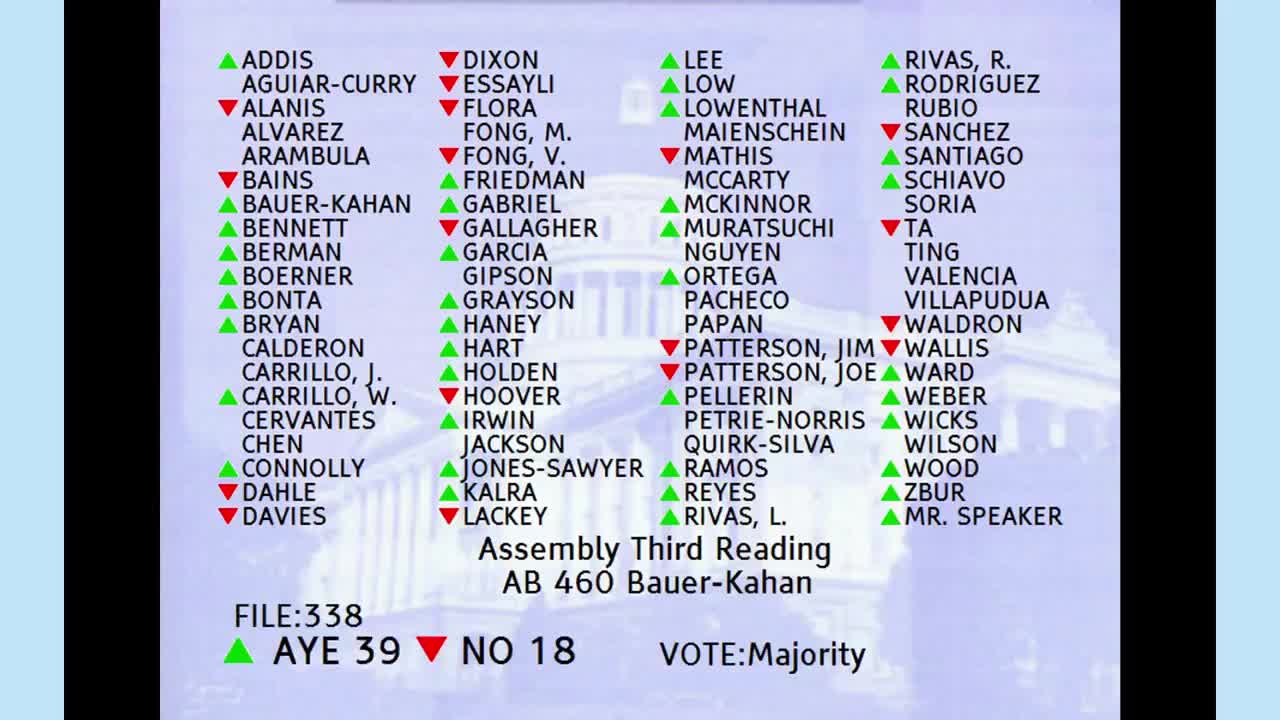 19SEC
Assembly Floor
 38MIN
Assembly Standing Committee on Education
Bill Author

Bill Co-Author(s):