AB 1614: Retail gasoline fueling stations: alternative fuels transition: study.
- Session Year: 2023-2024
- House: Assembly
- Latest Version Date: 2023-09-14
Current Status:
Failed
(2024-01-29: Consideration of Governor's veto stricken from file.)
Introduced
In Committee
First Chamber
In Committee
Second Chamber
Enacted
What does this bill do?
The bill requires the California Energy Commission, working with state and local agencies, to study how retail gasoline stations could transition to offering alternative fuels—electricity and hydrogen. The study must convene stakeholders to set its scope, assess opportunities and barriers, and identify possible financial incentives and rules that would help or block stations from installing or replacing fueling equipment, and must be delivered to the Legislature by January 1, 2027.
The summary is provided by generative AI which can make mistakes. For original language, please view the details in the table below.
Existing law requires the State Energy Resources Conservation and Development Commission (Energy Commission), in partnership with the State Air Resources Board, and in consultation with the State Water Resources Control Board, the Department of Food and Agriculture, and other relevant state agencies, to develop and adopt a state plan to increase the use of alternative transportation fuels, which include hydrogen and electricity.
This bill would require the Energy Commission, in coordination with the state board and the Governors Office of Business and Economic Development, and in consultation with local air districts and local governments, to, upon appropriation by the Legislature, conduct a study on the transitioning of retail gasoline fueling stations to provide alternative fuels, as defined, by a specified date and to convene, before initiating the study, specified state and local agencies, and other relevant stakeholders, to determine the scope of the study. The bill would require the study to include an assessment of opportunities for, and barriers to, deploying alternative fueling infrastructure at retail gasoline fueling stations and identify the potential financial incentives and regulatory barriers for retail gasoline fueling stations to install, or replace gasoline fueling infrastructure with, alternative fueling infrastructure. The bill would require the Energy Commission to deliver the study to the Legislature no later than January 1, 2027. The bill would repeal its provisions on January 1, 2030.
Existing law requires the State Energy Resources Conservation and Development Commission (Energy Commission), in partnership with the State Air Resources Board, and in consultation with the State Water Resources Control Board, the Department of Food and Agriculture, and other relevant state agencies, to develop and adopt a state plan to increase the use of alternative transportation fuels, which include hydrogen and electricity.
This bill would require the Energy Commission, in coordination with the state board and the Governors Office of Business and Economic Development, and in consultation with local air districts and local governments, to to, upon appropriation by the Legislature, conduct a study on the transitioning of retail gasoline fueling stations to provide alternative fuels, as defined, by a specified date and to convene, before initiating the study, specified state and local agencies, and other relevant stakeholders, to determine the scope of the study. The bill would require the study to include an assessment of opportunities for, and barriers to, deploying alternative fueling infrastructure at retail gasoline fueling stations and identify the potential financial incentives and regulatory barriers for retail gasoline fueling stations to install, or replace gasoline fueling infrastructure with, alternative fueling infrastructure. The bill would require the Energy Commission to deliver the study to the Legislature no later than January 1, 2027. The bill would repeal its provisions on January 1, 2030.
Existing law requires the State Energy Resources Conservation and Development Commission, Commission (Energy Commission), in partnership with the State Air Resources Board, and in consultation with the State Water Resources Control Board, the Department of Food and Agriculture, and other relevant state agencies, to develop and adopt a state plan to increase the use of alternative transportation fuels, which include hydrogen and electricity.
This bill would require the Energy Commission, in coordination with the state board and the Governors Office of Business and Economic Development, and in consultation with local air districts and local governments, to conduct a study on the feasibility of phasing out the existence transitioning of retail gasoline fueling stations to provide alternative fuels, as defined, by a specified date, as specified. date and to convene, before initiating the study, specified state and local agencies, and other relevant stakeholders, to determine the scope of the study. The bill would require the study to include an assessment by the Energy Commission that identifies of opportunities for, and barriers to, deploying alternative fueling infrastructure at retail gasoline fueling stations and identify the potential financial incentives and regulatory barriers for retail gasoline fueling stations to convert to electric vehicle charging stations. install, or replace gasoline fueling infrastructure with, alternative fueling infrastructure. The bill would require the Energy Commission to deliver the study to the Legislature no later than June 30, 2026. January 1, 2027. The bill would repeal its provisions on January 1, 2030.
Existing law requires the State Energy Resources Conservation and Development Commission, in partnership with the State Air Resources Board, and in consultation with the State Water Resources Control Board, the Department of Food and Agriculture, and other relevant state agencies, to develop and adopt a state plan to increase the use of alternative transportation fuels, which include electricity.
This bill would require the state board Energy Commission, in coordination with the state board and the Governors Office of Business and Economic Development, and in consultation with local air districts and local governments, to conduct a study on how to phase the feasibility of phasing out the existence of gasoline fueling stations by a specified date and date, as specified. The bill would require the study to include an assessment by the Energy Commission that identifies the potential incentives that may be required in order to transition those stations into and regulatory barriers for gasoline fueling stations to convert to electric vehicle charging stations. The bill would require the Energy Commission to deliver the study to the Legislature no later than June 30, 2026.
Existing law requires the State Energy Resources Conservation and Development Commission, in partnership with the State Air Resources Board, and in consultation with the State Water Resources Control Board, the Department of Food and Agriculture, and other relevant state agencies, to develop and adopt a state plan to increase the use of alternative transportation fuels, which include electricity.
This bill would require the state board to conduct a study on how to phase out the existence of gasoline fueling stations by a specified date and the potential incentives that may be required in order to transition those stations into electric vehicle charging stations.
(a)The State Energy Resources Conservation and Development Commission, in coordination with the state board and the Governors Office of Business and Economic Development, and in consultation with local air districts and local governments, upon appropriation by the Legislature, shall conduct a study on the transitioning of retail gasoline fueling stations from providing gasoline to providing alternative fuels by a specified date.
(b)Before initiating the study, the State Energy Resources Conservation and Development Commission shall convene the participating state and local agencies identified in this section, and other relevant stakeholders, to determine the scope of the study.
(c)The study shall include an assessment of opportunities for, and barriers to, deploying alternative fueling infrastructure at retail gasoline fueling stations and identify potential financial incentives and regulatory barriers for retail gasoline fueling stations to install, or replace gasoline fueling infrastructure with, alternative fueling infrastructure.
(d)For purposes of this section, alternative fuels means electricity and hydrogen.
(e)The State Energy Resources Conservation and Development Commission shall deliver the study to the Legislature, in compliance with Section 9795 of the Government Code, no later than January 1, 2027.
(f)Pursuant to Section 10231.5 of the Government Code, this section is repealed on January 1, 2030.
(a)The State Energy Resources Conservation and Development Commission, in coordination with the state board and the Governors Office of Business and Economic Development, and in consultation with local air districts and local governments, shall conduct a study on the feasibility of phasing out the existence of the transitioning of retail gasoline fueling stations from providing gasoline fueling stations to providing alternative fuels by a specified date.
(b)Prior to Before initiating the study, the state board State Energy Resources Conservation and Development Commission shall convene the participating state and participating local agencies identified in this section, and other relevant stakeholders, to determine the scope of the study. The scope of the study may be expanded to include consideration of items that are necessary to study the feasibility of phasing out gasoline fueling stations.
(c)The study shall include an assessment by the State Energy Resources Conservation and Development Commission on the suitability of gasoline fueling stations for conversion into electric vehicle charging stations of opportunities for, and barriers to, deploying alternative fueling infrastructure at retail gasoline fueling stations and that identifies identify potential financial incentives and regulatory barriers for retail gasoline fueling stations to convert to electric vehicle charging stations. install, or replace gasoline fueling infrastructure with, alternative fueling infrastructure.
(d)For purposes of this section, gasoline fueling station means an establishment that offers for sale or sells only gasoline or gasoline and diesel fuel to the public. alternative fuels means electricity and hydrogen.
(e) The State Energy Resources Conservation and Development Commission shall deliver the study to the Legislature, in compliance with Section 9795 of the Government Code, no later than June 30, 2026. January 1, 2027.
(f) Pursuant to Section 10231.5 of the Government Code, this section is repealed on January 1, 2030.
(a)The State Energy Resources Conservation and Development Commission, in coordination with the state board and the Governors Office of Business and Economic Development, and in consultation with local air districts and local governments, shall conduct a study on the feasibility of phasing out the existence of gasoline fueling stations by a specified date.
(b)Prior to initiating the study, the state board shall convene the state and participating local agencies identified in this section, and other relevant stakeholders, to determine the scope of the study. The scope of the study may be expanded to include consideration of items that are necessary to study the feasibility of phasing out gasoline fueling stations.
(c)The study shall include an assessment by the State Energy Resources Conservation and Development Commission on the suitability of gasoline fueling stations for conversion into electric vehicle charging stations and that identifies potential financial incentives and regulatory barriers for gasoline stations to convert to electric vehicle charging stations.
(d)For purposes of this section, gasoline fueling station means an establishment that offers for sale or sells only gasoline or gasoline and diesel fuel to the public.
(e)The State Energy Resources Conservation and Development Commission shall deliver the study to the Legislature, in compliance with Section 9795 of the Government Code, no later than June 30, 2026.
(f)Pursuant to Section 10231.5 of the Government Code, this section is repealed on January 1, 2030.
The state board shall conduct a study on how to phase out the existence of gasoline fueling stations by a specified date and the potential incentives that may be required in order to transition those stations into electric vehicle charging stations.
|
Date
|
Status
|
|---|---|
| Jan 29, 2024 | Consideration of Governor's veto stricken from file. |
| Jan 3, 2024 | Consideration of Governor's veto pending. |
| Oct 8, 2023 | Vetoed by Governor. |
| Sep 20, 2023 | Enrolled and presented to the Governor at 4 p.m. |
| Sep 12, 2023 | Senate amendments concurred in. To Engrossing and Enrolling. (Ayes 61. Noes 17. Page 3273.). |
| Sep 12, 2023 | Assembly Rule 77 suspended. (Page 3228.) |
| Sep 11, 2023 | In Assembly. Concurrence in Senate amendments pending. May be considered on or after September 13 pursuant to Assembly Rule 77. |
| Sep 11, 2023 | Read third time. Passed. Ordered to the Assembly. (Ayes 30. Noes 9. Page 2563.). |
| Sep 5, 2023 | Read second time. Ordered to third reading. |
| Sep 1, 2023 | Read second time and amended. Ordered returned to second reading. |
| Sep 1, 2023 | From committee: Amend, and do pass as amended. (Ayes 5. Noes 2.) (September 1). |
| Aug 14, 2023 | In committee: Referred to APPR suspense file. |
| Jul 13, 2023 | Read second time and amended. Re-referred to Com. on APPR. |
| Jul 12, 2023 | From committee: Amend, and do pass as amended and re-refer to Com. on APPR. (Ayes 12. Noes 3.) (July 11). |
| Jul 5, 2023 | From committee: Do pass and re-refer to Com. on TRANS. (Ayes 12. Noes 1.) (July 3). Re-referred to Com. on TRANS. |
| Jun 14, 2023 | Referred to Coms. on E., U. & C. and TRANS. |
| Jun 1, 2023 | In Senate. Read first time. To Com. on RLS. for assignment. |
| May 31, 2023 | Read third time. Passed. Ordered to the Senate. (Ayes 59. Noes 18. Page 2036.) |
| May 18, 2023 | Read second time. Ordered to third reading. |
| May 18, 2023 | From committee: Do pass. (Ayes 11. Noes 4.) (May 18). |
| May 10, 2023 | In committee: Set, first hearing. Referred to APPR. suspense file. |
| Apr 27, 2023 | Re-referred to Com. on APPR. |
| Apr 26, 2023 | Read second time and amended. |
| Apr 25, 2023 | From committee: Amend, and do pass as amended and re-refer to Com. on APPR. (Ayes 11. Noes 4.) (April 24). |
| Mar 23, 2023 | In committee: Hearing postponed by committee. |
| Mar 9, 2023 | Referred to Com. on TRANS. |
| Feb 18, 2023 | From printer. May be heard in committee March 20. |
| Feb 17, 2023 | Read first time. To print. |
|
Date
|
Description
|
Location
|
Votes
|
|
|---|---|---|---|---|
| Sep 12, 2023 | AB 1614 Gabriel Concurrence in Senate Amendments | Assembly Floor |
Passed |
|
| Sep 11, 2023 | Assembly 3rd Reading AB1614 Gabriel et al. By Stern | Senate Floor |
Passed |
|
| Sep 1, 2023 | Do pass as amended | Senate Standing Committee on Appropriations |
Passed |
|
| Aug 14, 2023 | Placed on suspense file | Senate Standing Committee on Appropriations |
Passed |
|
| Jul 11, 2023 | Do pass as amended, but first amend, and re-refer to the Committee on [Appropriations] | Senate Standing Committee on Transportation |
Passed |
|
| Jul 3, 2023 | Do pass, but first be re-referred to the Committee on [Transportation] | Senate Standing Committee on Energy, Utilities and Communications |
Passed |
|
| May 31, 2023 | AB 1614 Gabriel Assembly Third Reading | Assembly Floor |
Passed |
|
| May 18, 2023 | Do pass. | Assembly Standing Committee on Appropriations |
Passed |
|
| Apr 24, 2023 | Do pass as amended and be re-referred to the Committee on [Appropriations] | Assembly Standing Committee on Transportation |
Passed |
This list shows positions taken on this bill by organizations on the date displayed, which is linked to the original source.
Positions by individuals are not included.
|
Organization
|
Position
|
Date
|
|---|---|---|
| California Builders Alliance | ** Against | |
| California Environmental Voters | ** Support | |
| California Fuels And Convenience Alliance | ** Against | |
| Los Angeles County Business Federation | ** Against | |
| Sacramento Regional Builders Exchange | ** Against | |
| The Climate Reality Project, Los Angeles Chapter | ** Support | |
| The Climate Reality Project, San Fernando Valley, CA Chapter | ** Support |
GOVERNOR'S VETO
GV Bill Id:AB 1614
Author:(Gabriel)
As Enrolled Ver:September 14, 2023
2/3 vote
SUMMARY
Requires the Energy Resources Conservation and Development Commission (California Energy Commission, CEC), in coordination with the California Air Resources Board (CARB) and the Governor's Office of Business and Economic Development (GO-Biz), and in consultation with local air districts and local governments to, upon appropriation by the Legislature, conduct a study on the transitioning of retail gasoline fueling stations from providing gasoline to providing alternative fuels by January 1, 2027.
Major Provisions
- Require, prior to initiating the study, CEC to convene the participating state and local agencies identified in this section, and other relevant stakeholders, to determine the scope of the study.
- Require the study to include an assessment of opportunities for, and barriers to, deploying alternative fueling infrastructure at retail gasoline fueling stations and identify potential financial incentives and regulatory barriers for retail gasoline fueling stations to install, or replace gasoline fueling infrastructure with, alternative fueling infrastructure.
- Define "alternative fuels" for purposes of this bill to mean electricity and hydrogen.
- Require CEC to deliver the study to the Legislature no later than January 1, 2027.
Senate Amendments
- Make the study contingent upon an appropriation by the Legislature.
- Shift duties to establish the scope of the study from CARB to the CEC
- Remove references to "stations" and instead align provisions to the CEC's existing assessments of fuel demand and supply.
- Extend reporting deadline to January 1, 2027, to align with the CEC's first transportation fuel assessment under SBX1-2 (Skinner), Chapter 1, Statutes of 2023.
Governor's Veto Message
"This bill will result in additional costs to the General Fund and the CEC's primary operating fund, which is currently facing an ongoing structural deficit. This bill exacerbates the CEC's operating funds structural imbalance. Additionally, many provisions of this bill are duplicative of existing law, which requires the CEC, in consultation with various state entities, to prepare a transportation fuels transition plan by December 31, 2024.
In partnership with the Legislature, we enacted a budget that closed a shortfall of more than $30 billion through balanced solutions that avoided deep program cuts and protected education, health care, climate, public safety, and social service programs that are relied on by millions of Californians. This year, however, the Legislature sent me bills outside of this budget process that, if all enacted, would add nearly $19 billion of unaccounted costs in the budget, of which $11 billion would be ongoing. With our state facing continuing economic risk and revenue uncertainty, it is important to remain disciplined when considering bills with significant fiscal implications, such as this measure.
With our state facing continuing economic risk and revenue uncertainty, it is important to remain disciplined when considering bills with significant fiscal implications, such as this measure."
COMMENTS
In 2021, there were about 8,000 gasoline stations in California, selling gasoline, diesel, and other transportation fuels, as shown in the figure below. To achieve California's air quality and climate goals, the state aims to end its dependence on petroleum. On April 23, 2021, Governor Newsom directed CARB to evaluate the phase-out of oil and gas extraction no later than 2045 as part of CARB's Scoping Plan. There are about 28 million combustion engine heavy- and light-duty trucks and passenger vehicles in California. The ZEV Executive Order (EO N-79-20) calls for 100% new car sales to be ZEV beginning in 2035 and 100% medium- and heavy-duty fleet sales to be ZEV by 2045 where feasible. The result is an ongoing, albeit shrinking, pool of vehicles that will continue to require petroleum fuels.
Reporting Year | Gasoline Stations |
|---|---|
2010 | 7,707 |
2011 | 8,036 |
2012 | 7,748 |
2013 | 7,044 |
2014 | 6,369 |
2015 | 7,240 |
2016 | 8,456 |
2017 | 8,353 |
2018 | 8,256 |
2019 | 8,269 |
2020 | 8,492 |
2021 | 7,997 |
CARB's 2022 Scoping Plan still has some California demand for finished fossil fuels (gasoline, diesel, and jet fuel) in 2045 that makes it infeasible to phase-out oil and gas production fully by 2045. This demand is primarily for transportation, including for sectors that are directly regulated by the state and some that are subject to federal jurisdiction, such as interstate locomotives, marine, and aviation. Therefore, CARB’s latest Scoping Plan assumes a phase-down in both oil and gas extraction as well as petroleum refining in line with the reduction in demand for in-state on-road petroleum fuel demand. Since the transportation sector is the largest source of GHG emissions and harmful local air pollution, the state must continue to research and invest in efforts to deploy zero emission technologies and clean fuels, and to reduce vehicle miles traveled.
As long as demand for transportation fuels continues, the need for gasoline stations will continue. However, new CARB ZEV regulations and increasingly efficient gas-powered hybrid vehicles decrease gasoline usage and raise the question of what is to be done with gasoline stations as the demand for them declines.
State needs more charging stations. To support the rapid deployment of ZEVs, in 2018, Governor Brown set a goal of having 250,000 chargers, including 10,000 direct current fast chargers (DCFC), operating in California by 2025. The CEC projects a need of over 700,000 public and shared private chargers to support charging 5 million ZEVs, and nearly 1.2 million chargers would be required to support 8 million ZEVs in 2030. An additional 157,000 chargers are needed to support 180,000 medium- and heavy-duty vehicles anticipated for 2030. As of January 2021, California has installed more than 70,000 public and shared chargers, including nearly 6,000 DCFC. The CEC’s 2021 EV Charging Infrastructure Assessment found that an additional 123,000 are planned, approximately 3,600 of which are fast chargers, which leaves a gap of about 57,000 installations from the goal of 250,000 chargers.
Could gasoline stations transition to alternative fuels in the future? According to a recent L.A. Times article, some independent owners have tried to keep up with the changing times. One independent gas station owner said that he had considered adding EV chargers at his station, but that a quote for the work was not economical. Adding a high-powered DCFC can cost from $70,000 to $100,000 for the equipment, and an additional $30,000 to $100,000 for the construction, depending on existing infrastructure.
Because stations are typically in high-traffic areas, many are situated on parcels that would be coveted by real estate developers should owners decide to sell. Station owners see the development potential, but sometimes cannot move until their contract with gasoline distributors expires, or perhaps they only lease the property. Converting stations for alternative use also may encounter environmental hurdles. Environmental contamination on gas station sites is not uncommon and there may be a need to go through a remediation process to clean up the site and make it habitable for future businesses.
According to the Author
"The State of California is in the process of electrifying its transportation sector in order to meet our ambitious climate goals. The writing is on the walls that the need for gas stations will become obsolete. California needs to begin studying how we will transition these properties, complete necessary environmental remediation and enable them to become a symbol of the transition to a green energy future. California is nowhere close to having enough public EV chargers. Gas stations are located in prime locations for EV charging. The state should be actively looking at what we can do to incentivize gas stations to install EV charging and transition to EV charging stations in order to decrease range anxiety and enable individuals to charge their cars at convenient locations while on road trips or driving long distances when charging at home may not be an option."
Arguments in Support
The Climate Reality Project, Los Angeles and San Fernando Valley Chapters, writes, "By understanding potential financial and regulatory incentives, [this bill] could increase the EV charging infrastructure to help gasoline stations convert to EV charging stations and assist the station owners' transition to a new business model. These conversions will continue to meet the expanding number of EVs on the road and also will benefit customers who are already familiar with these locations in their communities. The EV charging infrastructure must be ready for a rapid increase in EV sales. [This bill] will provide recommendations that would help grow the necessary infrastructure."
Arguments in Opposition
California Fuels and Convenience Alliance writes, "The bill should be amended to remove the focus on phasing out gas stations and instead consider a more holistic approach to fueling the California of tomorrow. Additionally, the bill should revise the scope of the study to also examine the barriers gas stations face in installing EV charging equipment."
FISCAL COMMENTS
According to the Senate Appropriations Committee:
- The CEC estimates one-time costs of about $1 million (Energy Resources Program Account [ERPA]) for a contract to conduct the study. The CEC notes that if the study submission date were aligned with its existing triennial fuels assessment, due on January 2, 2027, some of the same analysis could be integrated into this study, thereby reducing costs by about $150,000. Staff note that ERPA has a significant structural deficit.
- GO-Biz estimates one-time costs of approximately $200,000 to $300,000 (General Fund) for outside expertise as well as adding capacity for stakeholder engagement and convening large meetings, among other things.
- CARB anticipates any costs would be minor and absorbable.
VOTES
ASM TRANSPORTATION: 11-4-0
YES: Friedman, Berman, Juan Carrillo, Gipson, Hart, Jackson, Kalra, Lowenthal, Stephanie Nguyen, Ward, Wicks
NO: Vince Fong, Davies, Sanchez, Wallis
ASM APPROPRIATIONS: 11-4-1
YES: Holden, Bryan, Calderon, Wendy Carrillo, Mike Fong, Hart, Lowenthal, Papan, Pellerin, Weber, Ortega
NO: Megan Dahle, Dixon, Mathis, Sanchez
ABS, ABST OR NV: Robert Rivas
ASSEMBLY FLOOR: 59-18-3
YES: Addis, Aguiar-Curry, Alvarez, Arambula, Bauer-Kahan, Bennett, Berman, Boerner, Bonta, Bryan, Calderon, Juan Carrillo, Wendy Carrillo, Cervantes, Connolly, Mike Fong, Friedman, Gabriel, Garcia, Gipson, Grayson, Haney, Holden, Irwin, Jackson, Jones-Sawyer, Kalra, Lee, Low, Lowenthal, Maienschein, McCarty, McKinnor, Muratsuchi, Stephanie Nguyen, Ortega, Pacheco, Papan, Pellerin, Petrie-Norris, Quirk-Silva, Ramos, Reyes, Luz Rivas, Robert Rivas, Blanca Rubio, Santiago, Schiavo, Soria, Ting, Valencia, Villapudua, Ward, Weber, Wicks, Wilson, Wood, Zbur, Rendon
NO: Alanis, Bains, Chen, Megan Dahle, Davies, Dixon, Essayli, Flora, Vince Fong, Gallagher, Hoover, Mathis, Jim Patterson, Joe Patterson, Sanchez, Ta, Waldron, Wallis
ABS, ABST OR NV: Hart, Lackey, Rodriguez
SENATE FLOOR: 30-9-1
YES: Allen, Archuleta, Ashby, Atkins, Becker, Blakespear, Bradford, Cortese, Dodd, Durazo, Eggman, Glazer, Gonzalez, Hurtado, Laird, Limón, McGuire, Menjivar, Min, Newman, Padilla, Portantino, Roth, Rubio, Skinner, Smallwood-Cuevas, Stern, Umberg, Wahab, Wiener
NO: Alvarado-Gil, Dahle, Grove, Jones, Nguyen, Niello, Ochoa Bogh, Seyarto, Wilk
ABS, ABST OR NV: Caballero
ASSEMBLY FLOOR: 61-17-2
YES: Addis, Aguiar-Curry, Alvarez, Arambula, Bauer-Kahan, Bennett, Berman, Boerner, Bonta, Bryan, Calderon, Juan Carrillo, Wendy Carrillo, Cervantes, Connolly, Mike Fong, Friedman, Gabriel, Garcia, Gipson, Grayson, Haney, Hart, Holden, Irwin, Jackson, Jones‑Sawyer, Kalra, Lee, Low, Lowenthal, Maienschein, McCarty, McKinnor, Muratsuchi, Stephanie Nguyen, Ortega, Pacheco, Papan, Pellerin, Petrie-Norris, Quirk-Silva, Ramos, Rendon, Reyes, Luz Rivas, Rodriguez, Blanca Rubio, Santiago, Schiavo, Soria, Ting, Valencia, Villapudua, Ward, Weber, Wicks, Wilson, Wood, Zbur, Robert Rivas
NO: Bains, Chen, Megan Dahle, Davies, Dixon, Essayli, Flora, Vince Fong, Gallagher, Hoover, Mathis, Jim Patterson, Joe Patterson, Sanchez, Ta, Waldron, Wallis
ABS, ABST OR NV: Alanis, Lackey
UPDATED
VERSION: September 14, 2023
CONSULTANT: Christine Casey / TRANS. / (916) 319-2093 FN: 0002472
CONCURRENCE IN SENATE AMENDMENTS
CSA1 Bill Id:AB 1614
Author:(Gabriel)
As Amended Ver:September 1, 2023
Majority vote
SUMMARY
Requires the Energy Resources Conservation and Development Commission (California Energy Commission, CEC), in coordination with the California Air Resources Board (CARB) and the Governor's Office of Business and Economic Development (GO-Biz), and in consultation with local air districts and local governments to, upon appropriation by the Legislature, conduct a study on the transitioning of retail gasoline fueling stations from providing gasoline to providing alternative fuels by January 1, 2027.
Major Provisions
- Require, prior to initiating the study, CEC to convene the participating state and local agencies identified in this section, and other relevant stakeholders, to determine the scope of the study.
- Require the study to include an assessment of opportunities for, and barriers to, deploying alternative fueling infrastructure at retail gasoline fueling stations and identify potential financial incentives and regulatory barriers for retail gasoline fueling stations to install, or replace gasoline fueling infrastructure with, alternative fueling infrastructure.
- Define "alternative fuels" for purposes of this bill to mean electricity and hydrogen.
- Require CEC to deliver the study to the Legislature no later than January 1, 2027.
Senate Amendments
- Make the study contingent upon an appropriation by the Legislature.
- Shift duties to establish the scope of the study from CARB to the CEC
- Remove references to "stations" and instead align provisions to the CEC's existing assessments of fuel demand and supply.
- Extend reporting deadline to January 1, 2027 to align with the CEC's first transportation fuel assessment under SBX1-2 (Skinner), Chapter 1, Statutes of 2023.
COMMENTS
In 2021, there were about 8,000 gasoline stations in California, selling gasoline, diesel, and other transportation fuels, as shown in the figure below. To achieve California's air quality and climate goals, the state aims to end its dependence on petroleum. On April 23, 2021, Governor Newsom directed CARB to evaluate the phase-out of oil and gas extraction no later than 2045 as part of CARB's Scoping Plan. There are about 28 million combustion engine heavy- and light-duty trucks and passenger vehicles in California. The ZEV Executive Order (EO N-79-20) calls for 100% new car sales to be ZEV beginning in 2035 and 100% medium- and heavy-duty fleet sales to be ZEV by 2045 where feasible. The result is an ongoing, albeit shrinking, pool of vehicles that will continue to require petroleum fuels.
Reporting Year | Gasoline Stations |
|---|---|
2010 | 7,707 |
2011 | 8,036 |
2012 | 7,748 |
2013 | 7,044 |
2014 | 6,369 |
2015 | 7,240 |
2016 | 8,456 |
2017 | 8,353 |
2018 | 8,256 |
2019 | 8,269 |
2020 | 8,492 |
2021 | 7,997 |
CARB's 2022 Scoping Plan still has some California demand for finished fossil fuels (gasoline, diesel, and jet fuel) in 2045 that makes it infeasible to phase-out oil and gas production fully by 2045. This demand is primarily for transportation, including for sectors that are directly regulated by the state and some that are subject to federal jurisdiction, such as interstate locomotives, marine, and aviation. Therefore, CARB's latest Scoping Plan assumes a phase-down in both oil and gas extraction as well as petroleum refining in line with the reduction in demand for in-state on-road petroleum fuel demand. Since the transportation sector is the largest source of GHG emissions and harmful local air pollution, the state must continue to research and invest in efforts to deploy zero emission technologies and clean fuels, and to reduce vehicle miles traveled.
As long as demand for transportation fuels continues, the need for gasoline stations will continue. However, new CARB ZEV regulations and increasingly efficient gas-powered hybrid vehicles decrease gasoline usage and raise the question of what is to be done with gasoline stations as the demand for them declines.
State needs more charging stations. To support the rapid deployment of ZEVs, in 2018, Governor Brown set a goal of having 250,000 chargers, including 10,000 direct current fast chargers (DCFC), operating in California by 2025. The CEC projects a need of over 700,000 public and shared private chargers to support charging 5 million ZEVs, and nearly 1.2 million chargers would be required to support 8 million ZEVs in 2030. An additional 157,000 chargers are needed to support 180,000 medium- and heavy-duty vehicles anticipated for 2030. As of January 2021, California has installed more than 70,000 public and shared chargers, including nearly 6,000 DCFC. The CEC's 2021 EV Charging Infrastructure Assessment found that an additional 123,000 are planned, approximately 3,600 of which are fast chargers, which leaves a gap of about 57,000 installations from the goal of 250,000 chargers.
Could gasoline stations transition to alternative fuels in the future? According to a recent L.A. Times article, some independent owners have tried to keep up with the changing times. One independent gas station owner said that he had considered adding EV chargers at his station, but that a quote for the work was not economical. Adding a high-powered DCFC can cost from $70,000 to $100,000 for the equipment, and an additional $30,000 to $100,000 for the construction, depending on existing infrastructure.
Because stations are typically in high-traffic areas, many are situated on parcels that would be coveted by real estate developers should owners decide to sell. Station owners see the development potential, but sometimes cannot move until their contract with gasoline distributors expires, or perhaps they only lease the property. Converting stations for alternative use also may encounter environmental hurdles. Environmental contamination on gas station sites is not uncommon and there may be a need to go through a remediation process to clean up the site and make it habitable for future businesses.
According to the Author
"The State of California is in the process of electrifying its transportation sector in order to meet our ambitious climate goals. The writing is on the walls that the need for gas stations will become obsolete. California needs to begin studying how we will transition these properties, complete necessary environmental remediation and enable them to become a symbol of the transition to a green energy future. California is nowhere close to having enough public EV chargers. Gas stations are located in prime locations for EV charging. The state should be actively looking at what we can do to incentivize gas stations to install EV charging and transition to EV charging stations in order to decrease range anxiety and enable individuals to charge their cars at convenient locations while on road trips or driving long distances when charging at home may not be an option."
Arguments in Support
The Climate Reality Project, Los Angeles and San Fernando Valley Chapters, writes, "By understanding potential financial and regulatory incentives, [this bill] could increase the EV charging infrastructure to help gasoline stations convert to EV charging stations and assist the station owners' transition to a new business model. These conversions will continue to meet the expanding number of EVs on the road and also will benefit customers who are already familiar with these locations in their communities. The EV charging infrastructure must be ready for a rapid increase in EV sales. [This bill] will provide recommendations that would help grow the necessary infrastructure."
Arguments in Opposition
California Fuels and Convenience Alliance writes, "The bill should be amended to remove the focus on phasing out gas stations and instead consider a more holistic approach to fueling the California of tomorrow. Additionally, the bill should revise the scope of the study to also examine the barriers gas stations face in installing EV charging equipment."
FISCAL COMMENTS
According to the Senate Appropriations Committee:
- The CEC estimates one-time costs of about $1 million (Energy Resources Program Account [ERPA]) for a contract to conduct the study. The CEC notes that if the study submission date were aligned with its existing triennial fuels assessment, due on January 2, 2027, some of the same analysis could be integrated into this study, thereby reducing costs by about $150,000. Staff note that ERPA has a significant structural deficit.
- GO-Biz estimates one-time costs of approximately $200,000 to $300,000 (General Fund) for outside expertise as well as adding capacity for stakeholder engagement and convening large meetings, among other things.
- CARB anticipates any costs would be minor and absorbable.
VOTES:
ASM TRANSPORTATION: 11-4-0
YES: Friedman, Berman, Juan Carrillo, Gipson, Hart, Jackson, Kalra, Lowenthal, Stephanie Nguyen, Ward, Wicks
NO: Vince Fong, Davies, Sanchez, Wallis
ASM APPROPRIATIONS: 11-4-1
YES: Holden, Bryan, Calderon, Wendy Carrillo, Mike Fong, Hart, Lowenthal, Papan, Pellerin, Weber, Ortega
NO: Megan Dahle, Dixon, Mathis, Sanchez
ABS, ABST OR NV: Robert Rivas
ASSEMBLY FLOOR: 59-18-3
YES: Addis, Aguiar-Curry, Alvarez, Arambula, Bauer-Kahan, Bennett, Berman, Boerner, Bonta, Bryan, Calderon, Juan Carrillo, Wendy Carrillo, Cervantes, Connolly, Mike Fong, Friedman, Gabriel, Garcia, Gipson, Grayson, Haney, Holden, Irwin, Jackson, Jones-Sawyer, Kalra, Lee, Low, Lowenthal, Maienschein, McCarty, McKinnor, Muratsuchi, Stephanie Nguyen, Ortega, Pacheco, Papan, Pellerin, Petrie-Norris, Quirk-Silva, Ramos, Reyes, Luz Rivas, Robert Rivas, Blanca Rubio, Santiago, Schiavo, Soria, Ting, Valencia, Villapudua, Ward, Weber, Wicks, Wilson, Wood, Zbur, Rendon
NO: Alanis, Bains, Chen, Megan Dahle, Davies, Dixon, Essayli, Flora, Vince Fong, Gallagher, Hoover, Mathis, Jim Patterson, Joe Patterson, Sanchez, Ta, Waldron, Wallis
ABS, ABST OR NV: Hart, Lackey, Rodriguez
SENATE FLOOR: 30-9-1
YES: Allen, Archuleta, Ashby, Atkins, Becker, Blakespear, Bradford, Cortese, Dodd, Durazo, Eggman, Glazer, Gonzalez, Hurtado, Laird, Limón, McGuire, Menjivar, Min, Newman, Padilla, Portantino, Roth, Rubio, Skinner, Smallwood-Cuevas, Stern, Umberg, Wahab, Wiener
NO: Alvarado-Gil, Dahle, Grove, Jones, Nguyen, Niello, Ochoa Bogh, Seyarto, Wilk
ABS, ABST OR NV: Caballero
UPDATED
VERSION: September 1, 2023
CONSULTANT: Christine Casey / TRANS. / (916) 319-2093 FN: 0001689
SENATE RULES COMMITTEE Office of Senate Floor Analyses (916) 651-1520 Fax: (916) 327-4478 | AB 1614 |
THIRD READING
Bill No: AB 1614
Author: Gabriel (D), et al.
Amended: 9/1/23 in Senate
Vote: 21
SENATE ENERGY, U. & C. COMMITTEE: 12-1, 7/3/23
AYES: Bradford, Ashby, Becker, Durazo, Eggman, Gonzalez, McGuire, Min, Newman, Rubio, Skinner, Stern
NOES: Seyarto
NO VOTE RECORDED: Dahle, Caballero, Dodd, Grove, Wilk
SENATE TRANSPORTATION COMMITTEE: 12-3, 7/11/23
AYES: Gonzalez, Allen, Archuleta, Becker, Cortese, Dahle, Durazo, Laird, Limón, McGuire, Newman, Umberg
NOES: Niello, Nguyen, Seyarto
NO VOTE RECORDED: Blakespear
SENATE APPROPRIATIONS COMMITTEE: 5-2, 9/1/23
AYES: Portantino, Ashby, Bradford, Wahab, Wiener
NOES: Jones, Seyarto
ASSEMBLY FLOOR: 59-18, 5/31/23 - See last page for vote
SUBJECT: Retail gasoline fueling stations: alternative fuels transition: study
SOURCE: Author
DIGEST:
This bill requires the California Energy Commission (CEC) to conduct a study on transitioning gas stations from petroleum to alternative fuels upon appropriation by the Legislature.
ANALYSIS:
Existing law:
- Establishes the CEC as a five-member commission within the Natural Resources Agency and tasks the CEC with monitoring, analyzing, and making recommendations on statewide trends in the energy sector, including fuel supply and demand. (Public Resources Code §25200 et. seq.)
- Establishes the Petroleum Industry Information Reporting Act of 1980 (PIIRA), which establishes requirements for oil refiners and marketers to submit specified data to the CEC and requires the CEC to analyze this data to identify trends in demand and supply for petroleum, including factors influencing gasoline price changes. Existing law requires retail transportation fueling stations to report specified information about their sales of gasoline, diesel, and other fuels to the CEC. (Public Resources Code §25350 et. seq.)
- Requires the CEC to submit a report to the Legislature by January 1, 2024, assessing the reliability and pricing of transportation fuels, including transportation. Existing law requires this report to include an assessment of the availability of fuel retail outlets. Existing law requires the CEC to update this assessment every three years. (Public Resources Code §25371)
- Requires the CEC to conduct a statewide assessment every two years of electric vehicle (EV) charging infrastructure needed to support the levels of EV adoption required for the state to meet its goals of putting at least five million zero-emission vehicles (ZEVs) on California roads by 2030, and of reducing emissions of greenhouse gases (GHG) to 40 percent below 1990 levels by 2030. (Public Resources Code §25229)
This bill:
- Defines alternative fuels for the purposes of this bill as electricity and hydrogen.
- Requires the CEC to, upon receipt of an appropriation by the Legislature, work with specified stakeholders to study barriers and opportunities to transitioning gas stations’ petroleum refueling to alternative fuels. This bill requires the CEC to submit this study to the Legislature by January 1, 2027.
- Specifies that this bill’s study must identify potential financial incentives and regulatory barriers for gas stations to transition to alternative fuels.
Background
Bill seeks to support the transition from petroleum to cleaner refueling options. In August 2022, California Air Resources Board (CARB) approved its Advanced Clean Cars II rule, which requires all new cars and light-duty trucks sold in California to be ZEVs by 2035. CARB has adopted interim goals to increase the sale of ZEVs. To the extent that ZEVs supplant petroleum-fueled cars, consumer demand for EV charging and clean fuels will increase as demand for petroleum declines. Gas station owners and operators are one segment of the economy that will face significant disruption as this transition occurs. Several cities have already adopted restrictions on permitting new gas stations within their jurisdictions. Without a plan to install EV charging or deploy clean fuels, gas stations may face difficulty transitioning to new business models and local governments may lose opportunities to deploy more clean refueling options at locations that already serve drivers.
Other state agencies and local governments exercise much greater authority than the CEC over the extent to which gas stations receive permits, retain business licenses, and the extent to which gas station facilities can be converted into other uses. However, to the extent that this bill provides those agencies with more information about opportunities to better deploy new infrastructure to match drivers’ needs, this bill may improve access to information needed to help plan the transition to cleaner fuels.
CEC’s ability to analyze the economic performance of gas stations is limited. Existing law tasks the CEC with a number of duties to monitor and analyze fuel markets, including gasoline demand, supply, and pricing trends. Under existing law, gas stations must report certain information about their sales to the CEC. This data is intended to help the CEC monitor supply, demand, and pricing for transportation fuels. Existing law already requires the CEC to assess the reliability of California’s transportation fuel supply and the availability of retail outlets for transportation fuel. This bill requires the CEC to assess the opportunities and barriers that gas stations face when attempting to transition their facilities to clean refueling options. The extent to which a gas station owner decides to transition to new fueling options will likely depend upon the gas station’s economic performance. While the CEC has substantial information about fuel supply and demand, the CEC does not currently collect data about the economic performance of gas stations. Many gas stations offer services, including convenience stores, which provide revenue streams outside of gasoline sales. Additionally, not all gas stations serve the same types of customers, vehicles, and fuels. As a result, declining statewide petroleum sales may not be the determining factor in a gas station’s owner’s decision to modify its refueling options.
Prior/Related Legislation
AB 1529 (Gabriel, 2023) contained provisions similar to this bill. The bill requires the CEC to study gas stations’ ability to convert into EV charging stations and identify incentives for and barriers to that conversion. The bill requires the CEC to submit a report on its findings to the Legislature by July 1, 2025. The bill is currently in the Assembly Committee on Transportation.
SBX1 2 (Skinner, Chapter 1, Statutes of 2023) modified PIIRA to require refineries to submit specified data regarding their economic performance to the CEC. The bill also required the CEC to assess the reliability of transportation fuels and retail outlets for those fuels.
SB 1322 (Allen, Chapter, Statutes of 2022) modified PIIRA to require refiners with multiple refineries operating in the state to submit certain data about their economic performance to the CEC. The bill also increased public access to data about refiners.
FISCAL EFFECT: Appropriation: No Fiscal Com.: Yes Local: No
According to the Senate Committee on Appropriations:
- The CEC estimates one-time costs of about $1 million (Energy Resources Program Account [ERPA]) for a contract to conduct the study. The CEC notes that if the study submission date were aligned with its existing triennial fuels assessment, due on January 2, 2027, some of the same analysis could be integrated into this study, thereby reducing costs by about $150,000. Staff note that ERPA has a significant structural deficit.
- The Governor’s Office of Business Development (GO-Biz) estimates one-time costs of approximately $200,000 to $300,000 (General Fund) for outside expertise as well as adding capacity for stakeholder engagement and convening large meetings, among other things.
- The California Air Resources Board (CARB) anticipates any costs would be minor and absorbable.
SUPPORT: (Verified 9/1/23)
None received
OPPOSITION: (Verified 9/1/23)
California Builders Alliance
California Fuels and Convenience Alliance
Los Angeles County Business Federation
Sacramento Regional Builders Exchange
ARGUMENTS IN SUPPORT: According to the author:
Access to electric vehicle chargers and range anxiety are still major barriers to purchasing an electric vehicle. In order to incentivize EV adoption, EV charging infrastructure must be readily available to the public. As the demand for gasoline decreases, gasoline stations will have to gradually adopt a new business model. By installing EV chargers, gas stations can help California meet its’ climate goals. The state should be actively looking at ways to find financial and regulatory incentives in order to support a smooth transition to electrifying our transportation sector by making charging for long trips more accessible.
ARGUMENTS IN OPPOSITION: Opponents largely oppose this bill unless it is amended to eliminate provisions that require an analysis of gasoline station phase-outs. Additionally, opponents argue that the bill should include provisions that address barriers facing gas station owners who want to transition to cleaner fuels. In opposition, the Los Angeles County Business Federation states:
While the bill would only authorize a study, the scope of the study does not explicitly state it should assess the economic impacts a transition would have on convenience store owners, convenience store employees, and goods provided to the surrounding communities and commuters, and other economic impacts. Further, the study does not include biofuels, hydrogen, and other potential clean fuels that can help California reach our clean air goals.
ASSEMBLY FLOOR: 59-18, 5/31/23
AYES: Addis, Aguiar-Curry, Alvarez, Arambula, Bauer-Kahan, Bennett, Berman, Boerner, Bonta, Bryan, Calderon, Juan Carrillo, Wendy Carrillo, Cervantes, Connolly, Mike Fong, Friedman, Gabriel, Garcia, Gipson, Grayson, Haney, Holden, Irwin, Jackson, Jones-Sawyer, Kalra, Lee, Low, Lowenthal, Maienschein, McCarty, McKinnor, Muratsuchi, Stephanie Nguyen, Ortega, Pacheco, Papan, Pellerin, Petrie-Norris, Quirk-Silva, Ramos, Reyes, Luz Rivas, Robert Rivas, Blanca Rubio, Santiago, Schiavo, Soria, Ting, Valencia, Villapudua, Ward, Weber, Wicks, Wilson, Wood, Zbur, Rendon
NOES: Alanis, Bains, Chen, Megan Dahle, Davies, Dixon, Essayli, Flora, Vince Fong, Gallagher, Hoover, Mathis, Jim Patterson, Joe Patterson, Sanchez, Ta, Waldron, Wallis
NO VOTE RECORDED: Hart, Lackey, Rodriguez
Prepared by: Sarah Smith / E., U. & C. / (916) 651-4107
9/4/23 10:27:45
**** END ****
SENATE COMMITTEE ON
Senator Anthony Portantino, Chair
2023 - 2024 Regular Session
AB 1614 (Gabriel) - Retail gasoline fueling stations: alternative fuels transition: study
Version: | Policy Vote: |
Urgency: | Mandate: |
Hearing Date: | Consultant: |
Bill Summary:
This bill would require the California Energy Commission (CEC) to study and report to the Legislature on the transitioning of retail gas stations to provide alternative fuels.
*********** ANALYSIS ADDENDUM – SUSPENSE FILE ***********
The following information is revised to reflect amendments
adopted by the committee on September 1, 2023
Fiscal Impact:
- The CEC estimates one-time costs of about $1 million (Energy Resources Program Account [ERPA]) for a contract to conduct the study. The CEC notes that if the study submission date were aligned with its existing triennial fuels assessment, due on January 2, 2027, some of the same analysis could be integrated into this study, thereby reducing costs by about $150,000. Staff note that ERPA has a significant structural deficit.
- The Governor’s Office of Business Development (GO-Biz) estimates one-time costs of approximately $200,000 to $300,000 (General Fund) for outside expertise as well as adding capacity for stakeholder engagement and convening large meetings, among other things.
- The California Air Resources Board (CARB) anticipates any costs would be minor and absorbable.
Committee Amendments:
These amendments would make the study and report contingent upon an appropriation.
-- END --
SENATE COMMITTEE ON APPROPRIATIONS
Senator Anthony Portantino, Chair
2023 - 2024 Regular Session
AB 1614 (Gabriel) - Retail gasoline fueling stations: alternative fuels transition: study
Version: July 13, 2023 | Policy Vote: E.,U.&C. 12-1, TRANS. 12-3 |
Urgency: No | Mandate: No |
Hearing Date: August 14, 2023 | Consultant: Ashley Ames |
Bill Summary:
This bill would require the California Energy Commission (CEC) to study and report to the Legislature on the transitioning of retail gas stations to provide alternative fuels.
Fiscal Impact:
- The CEC estimates one-time costs of about $1 million (Energy Resources Program Account [ERPA]) for a contract to conduct the study. The CEC notes that if the study submission date were aligned with its existing triennial fuels assessment, due on January 2, 2027, some of the same analysis could be integrated into this study, thereby reducing costs by about $150,000. Staff note that ERPA has a significant structural deficit.
- The Governor’s Office of Business Development (GO-Biz) estimates one-time costs of approximately $200,000 to $300,000 (General Fund) for outside expertise as well as adding capacity for stakeholder engagement and convening large meetings, among other things.
- The California Air Resources Board (CARB) anticipates any costs would be minor and absorbable.
Background:
In August 2022, CARB approved its Advanced Clean Cars II rule, which requires all new cars and light-duty trucks sold in California to be ZEVs by 2035. CARB has adopted interim goals to increase the sale of ZEVs. To the extent that ZEVs supplant petroleum-fueled cars, consumer demand for EV charging and clean fuels will increase as demand for petroleum declines. Gas station owners and operators are one segment of the economy that will face significant disruption as this transition occurs. Several cities have already adopted restrictions on permitting new gas stations within their jurisdictions. Without a plan to install EV charging or deploy clean fuels, gas stations may face difficulty transitioning to new business models and local governments may lose opportunities to deploy more clean refueling options at locations that already serve drivers.
Proposed Law:
This bill would require the CEC to study and report to the Legislature on the transitioning of retail gas stations to provide alternative fuels. Specifically, this bill would:
- Require the CEC, in coordination with CARB and Go-BIZ and in consultation with local air districts and local governments, to conduct a study on the transitioning of retail gasoline fueling stations from providing gasoline to providing alternative fuels by a specified date.
- Require the CEC, before initiating the study, to convene specified stakeholders to determine the scope of the study.
- Require the study to include an assessment of opportunities for, and barriers to, deploying alternative fueling infrastructure at retail gasoline fueling stations and identify potential financial incentives and regulatory barriers for retail gasoline fueling stations to install, or replace gasoline fueling infrastructure with, alternative fueling infrastructure.
- Define “alternative fuels” to mean electricity and hydrogen.
- Require the CEC to submit the report to the Legislature no later than January 1, 2027.
Related Legislation:
SBX1-2 (Skinner) Chapter 1, Statutes of 2023 mandates that specified entities along California's oil and gasoline supply chain report extensive data to the CEC and authorizes the CEC to establish a maximum gross gasoline refining margin and penalty on gasoline sold by refiners in the state, pursuant to certain findings, and requires various reports and assessments by the CEC to be submitted to the Legislature regarding the current status and future managed decline of transportation fuels.
SB 493 (Min, 2023) would require the CEC to assess the energy resources needed to meet state goals to transition medium- and heavy-duty vehicles to ZEVs, and it requires CARB to use the CEC’s assessment to create a strategic plan to achieve this transition.
AB 2127 (Ting), Chapter 365, Statutes of 2017 requires the CEC to conduct a statewide assessment of the EV charging infrastructure needed to support the levels of EV adoption required for the state to meet its goals of putting at least five million ZEVs on California roads by 2030 and of reducing emissions of GHGs to 40% below 1990 levels by 2030.
Staff Comments:
ERPA, the CEC’s main funding source, has a significant structural deficit. ERPA was established to provide funds for ongoing energy programs and energy projects, including the operations of the CEC. ERPA is supported by a statutory surcharge on electricity consumption. According to the CEC, as building and appliance energy efficiency and the increase of behind-the-meter solar produce customer savings and flatten statewide electricity consumption, ERPA revenues have decreased, and the costs have been borne by fewer and fewer customers. Even as revenues drop, ERPA is repeatedly tapped to support new programs and must cover increases in employee compensation and benefit contributions.
The CEC’s building and appliance standards have led to decreased energy consumption and reduced ratepayer bills, saving California consumers well over $100 billion over the last 40 years. However, these electricity reductions and consumer savings also reduce ERPA revenues. The CEC’s standards continue to save Californians more money than they pay through the ERPA surcharge.
In addition, behind-the-meter rooftop solar, wind, and non-utility generation are exempt from the ERPA surcharge. As behind-the-meter capacity grows, ERPA revenues decline correspondingly.
The surcharge generated approximately $69.1 million in 2020-21 and currently costs the average household about $2.13 annually (larger customers pay the same rate but pay more based on volume). Despite CEC efforts to reduce ERPA spending by more than $37 million over four years, a structural deficit remains and ERPA’s fund balance is projected to be in the red in 2024-25.
As part of the 2022-23 budget, the Legislature passed trailer bill language that raised the statutory cap on the ERPA surcharge, tied the statutory cap to the Consumer Price Index, and extended the surcharge to behind-the-meter electricity consumption.
-- END --
SENATE COMMITTEE ON TRANSPORTATION
Senator Lena Gonzalez, Chair
2023 - 2024 Regular
Bill No: Hearing Date: 7/11/23
Author: | Gabriel | ||
Version: | 4/26/2023 amended | ||
Urgency: | No | Fiscal: | Yes |
Consultant: | Randy Chinn | ||
SUBJECT:
DIGEST: This bill requires the California Energy Commission to submit to the Legislature by July 1, 2025 a report assessing the suitability of gasoline stations for conversion into electric vehicle charging stations and identifying potential financial incentives and regulatory barriers for gasoline stations to convert to electric vehicle charging stations.
ANALYSIS:
Existing law:
- Establishes the Petroleum Industry Information Reporting Act of 1980 (PIIRA), which establishes requirements for oil refiners and marketers to submit specified data to the California Energy Commission (CEC) and requires the CEC to analyze this data to identify trends in demand and supply for petroleum, including factors influencing gasoline price changes. Existing law requires retail transportation fueling stations to report specified information about their sales of gasoline, diesel, and other fuels to the CEC. (Public Resources Code §25350 et. seq.)
- Requires the CEC to submit a report to the Legislature by January 1, 2024, assessing the reliability and pricing of transportation fuels, including transportation. Existing law requires this report to include an assessment of the availability of fuel retail outlets. Existing law requires the CEC to update this assessment every three years. (Public Resources Code §25371)
- Requires the CEC to conduct a statewide assessment every two years of electric vehicle (EV) charging infrastructure needed to support the levels of EV adoption required for the state to meet its goals of putting at least five million zero-emission vehicles (ZEVs) on California roads by 2030, and of reducing emissions of greenhouse gases (GHG) to 40 percent below 1990 levels by 2030. (Public Resources Code §25229)
This bill:
(Note this description includes amendments that the author agreed to in the Senate Energy, Utilities and Communications hearing, but because of time constraints those amendments will be accepted in this committee.)
- Defines a “gasoline fueling station” as an establishment that sells only gasoline or gasoline and diesel fuel to the public.
- Requires the CEC to work with specified stakeholders to study the feasibility of phasing out the existence of gas stations by a specified date. This bill requires the CEC to report its findings to the Legislature by January 1, 2027.
- Requires the CEC to convene stakeholders, including state agencies, to determine the scope of the assessment.
- Requires the gas station phase out study to include an assessment on the suitability of gas stations for conversion into EV charging stations and identify incentives and barriers for gas stations to convert to EV charging.
COMMENTS:
- Author’s Statement. “Access to electric vehicle chargers and range anxiety are still major barriers to purchasing an electric vehicle. In order to incentivize EV adoption, EV charging infrastructure must be readily available to the public. As the demand for gasoline decreases, gasoline stations will have to gradually adopt a new business model. By installing EV chargers, gas stations can help California meet its climate goals. The state should be actively looking at ways to find financial and regulatory incentives in order to support a smooth transition to electrifying our transportation sector by making charging for long trips more accessible.”
- Phase Out. The bill has two parts. The first is to study the feasibility of phasing out gas stations. The second is assessing how to encourage gas stations to install EV charging or clean fuels infrastructure. Studying the phase out of gas stations may be premature and unnecessary. While California has a goal of having all new vehicles sold by 2035 be zero emission, even at that time there will still be an installed base of millions of cars which need gasoline. Whether a gas station stays in business or not will be determined by the economics of that particular gas station, and the transition to ZEVs will play a part. But figuring out ways to encourage gas stations to transition to EV charging or hydrogen fueling may be helpful in supporting an alternative fueling market and providing a path for profitability reusing those assets. The author may wish to consider amending the bill to focus on that transition.
- More Competition. With recent announcements by GM, Ford and Rivian, Tesla’s fast charging platform is increasingly becoming the industry standard. But as more EV drivers rely on Tesla for fast charging, the potential for Tesla to wield its market power to increase prices becomes more worrisome. Gas stations may be viable competition as they are ubiquitous, located conveniently to where people drive and have space. Expanding public charging availability will be especially important for EV adoption in multi-family and lower-income communities.
- Transitioning. This bill deals with the transition from petroleum-based fuels to electricity. While much attention has been paid to ensuring adequate charging infrastructure, it is as important to ensure adequate supplies of, and affordable prices for, petroleum-based fuels during that transition. California drivers have recent painful experience about the consequence of gasoline supply constraints. As increased EV adoption starts to shrink California’s demand for gasoline how will California refiners respond? Will they continue to invest in their refineries? California’s unique gasoline formulation makes it difficult to import additional supplies, removing a critical market factor that can keep prices reasonable. A tight supply/demand balance may mean higher and more volatile prices. Under SBX1-2 (Skinner), enacted early this year, the CEC and CARB will, by December 31, 2024, report on how to ensure that transportation fuels are affordable and available.
- Double Referral. This bill was heard in the Senate Energy, Utilities and Communications Committee on July 3, 2023 and approved 12 - 1.
Related Legislation:
SBX1-2 (Skinner) Chapter 1, Statutes of 2023 mandates that specified entities along California's oil and gasoline supply chain report extensive data to the CEC and authorizes the CEC to establish a maximum gross gasoline refining margin and penalty on gasoline sold by refiners in the state, pursuant to certain findings, and requires various reports and assessments by the CEC to be submitted to the Legislature regarding the current status and future managed decline of transportation fuels.
SB 493 (Min) of this Session requires CEC to assess the energy resources needed to meet state goals to transition medium- and heavy-duty vehicles to ZEVs, and it requires CARB to use the CEC’s assessment to create a strategic plan to achieve this transition. This bill is pending in the Assembly Transportation Committee.
AB 2127 (Ting), Chapter 365, Statutes of 2017 requires CEC to conduct a statewide assessment of the EV charging infrastructure needed to support the levels of EV adoption required for the state to meet its goals of putting at least five million ZEVs on California roads by 2030 and of reducing emissions of GHGs to 40% below 1990 levels by 2030.
FISCAL EFFECT: Appropriation: No Fiscal Com.: Yes Local: No
From the Assembly Appropriations Committee:
Costs to CEC to conduct the study will likely be in the mid to high hundreds of thousands of dollars, one time.
POSITIONS: (Communicated to the committee before noon on Wednesday,
July 6, 2023.)
SUPPORT:
California Environmental Voters
OPPOSITION:
California Builders Alliance
Sacramento Regional Builders Exchange
California Fuels and Convenience Alliance
-- END --
SENATE COMMITTEE ON ENERGY, UTILITIES AND COMMUNICATIONS
Senator Steven Bradford, Chair
2023 - 2024 Regular
Bill No: AB 1614 Hearing Date: 7/3/2023
Author: | Gabriel | ||
Version: | 4/26/2023 Amended | ||
Urgency: | No | Fiscal: | Yes |
Consultant: | Sarah Smith | ||
SUBJECT: Gasoline fueling stations: phaseout: study
DIGEST: This bill requires the California Energy Commission (CEC) to study and report to the Legislature on the feasibility of phasing out the existence of gas stations.
ANALYSIS:
Existing law:
- Establishes the CEC as a five-member commission within the Natural Resources Agency and tasks the CEC with monitoring, analyzing, and making recommendations on statewide trends in the energy sector, including fuel supply and demand. (Public Resources Code §25200 et. seq.)
- Establishes the Petroleum Industry Information Reporting Act of 1980 (PIIRA), which establishes requirements for oil refiners and marketers to submit specified data to the CEC and requires the CEC to analyze this data to identify trends in demand and supply for petroleum, including factors influencing gasoline price changes. Existing law requires retail transportation fueling stations to report specified information about their sales of gasoline, diesel, and other fuels to the CEC. (Public Resources Code §25350 et. seq.)
- Requires the CEC to submit a report to the Legislature by January 1, 2024, assessing the reliability and pricing of transportation fuels, including transportation. Existing law requires this report to include an assessment of the availability of fuel retail outlets. Existing law requires the CEC to update this assessment every three years. (Public Resources Code §25371)
- Requires the CEC to conduct a statewide assessment every two years of electric vehicle (EV) charging infrastructure needed to support the levels of EV adoption required for the state to meet its goals of putting at least five million zero-emission vehicles (ZEVs) on California roads by 2030, and of reducing emissions of greenhouse gases (GHG) to 40 percent below 1990 levels by 2030. (Public Resources Code §25229)
This bill:
- Defines a “gasoline fueling station” as an establishment that sells only gasoline or gasoline and diesel fuel to the public.
- Requires the CEC to work with specified stakeholders to study the feasibility of phasing out the existence of gas stations by a specified date. This bill requires the CEC to report its findings to the Legislature by June 30, 2026.
- Requires the California Air Resources Board (CARB) to convene stakeholders, including state agencies, to determine the scope of the CEC assessment.
- Requires the gas station phase out study to include an assessment on the suitability of gas stations for conversion into EV charging stations and identify incentives and barriers for gas stations to convert to EV charging.
Background
Phase out or transition? That is the question for gas stations. In August 2022, CARB approved its Advanced Clean Cars II rule, which requires all new cars and light-duty trucks sold in California to be ZEVs by 2035. CARB has adopted interim goals to increase the sale of ZEVs. To the extent that ZEVs supplant petroleum-fueled cars, consumer demand for EV charging and clean fuels will increase as demand for petroleum declines. Gas station owners and operators are one segment of the economy that will face significant disruption as this transition occurs. Several cities have already adopted restrictions on permitting new gas stations within their jurisdictions. Without a plan to install EV charging or deploy clean fuels, gas stations may face difficulty transitioning to new business models and local governments may lose opportunities to deploy more clean refueling options at locations that already serve drivers.
Other state agencies and local governments exercise much greater authority than the CEC over the extent to which gas stations receive permits, retain business licenses, and the extent to which gas station facilities can be converted into other uses. However, to the extent that this bill provides those agencies with more information about opportunities to better deploy new infrastructure to match drivers’ needs, this bill may improve access to information needed to help plan the transition to cleaner fuels.
CEC’s ability to analyze the economic performance of gas stations is limited. Existing law tasks the CEC with a number of duties to monitor and analyze fuel markets, including gasoline demand, supply, and pricing trends. Under existing law, gas stations must report certain information about their sales to the CEC. This data is intended to help the CEC monitor supply, demand, and pricing for transportation fuels. Existing law already requires the CEC to assess the reliability of California’s transportation fuel supply and the availability of retail outlets for transportation fuel. This bill requires the CEC to conduct a feasibility analysis for phasing out the existence of gas stations. The bill also requires the CEC to analyze the barriers to and incentives for gas stations to convert to EV charging stations. The extent to which a gas station owner decides to cease operations or transition to new fueling options will likely depend upon the gas station’s economic performance. While the CEC has substantial information about fuel supply and demand, the CEC does not currently collect data about the economic performance of gas stations. Many gas stations offer services, including convenience stores that provide revenue streams outside of gasoline sales. As a result, declining gasoline sales may not be the determining factor in a gas station’s owner’s decision to cease operations.
Need for amendments. As currently written, this bill does not distinguish between the cessation of gasoline refueling and gas stations ceasing to exist. This bill also does not modify the CEC’s ability to collect data regarding gas stations. Additionally, this bill requires both CARB and CEC to facilitate the study required by this bill; however, it is not clear which agency is responsible for leading the study. For these reasons, the author and committee may wish to amend this bill to do the following:
- Shift duties to establish the scope of the bill’s report from CARB to the CEC.
- Remove references to “stations” in the bill and instead align the bill to the CEC’s existing assessments of fuel demand and supply.
- Extend the bill’s reporting deadline to the January 1, 2027, to align this bill’s report with the CEC’s first transportation fuel assessment under SBX1 2 (Skinner, Chapter 1, Statutes of 2023)
Double Referral. Should this bill be approved by this committee, it will be re-referred to the Senate Committee on Transportation.
Prior/Related Legislation
AB 1529 (Gabriel, 2023) contained provisions substantially similar to this bill. The bill requires the CEC to study gas stations’ ability to convert into EV charging stations and identify incentives for and barriers to that conversion. The bill requires the CEC to submit a report on its findings to the Legislature by July 1, 2025. The bill is currently in the Assembly Committee on Transportation.
SBX1 2 (Skinner, Chapter 1, Statutes of 2023) modified PIIRA to require refineries to submit specified data regarding their economic performance to the CEC. The bill also required the CEC to assess the reliability of transportation fuels and retail outlets for those fuels.
SB 1322 (Allen, Chapter, Statutes of 2022) modified PIIRA to require refiners with multiple refineries operating in the state to submit certain data about their economic performance to the CEC. The bill also increased public access to data about refiners.
FISCAL EFFECT: Appropriation: No Fiscal Com.: Yes Local: No
SUPPORT:
None received
OPPOSITION:
California Builders Alliance
California Fuels and Convenience Alliance
Sacramento Regional Builders Exchange
ARGUMENTS IN SUPPORT: According to the author:
Access to electric vehicle chargers and range anxiety are still major barriers to purchasing an electric vehicle. In order to incentivize EV adoption, EV charging infrastructure must be readily available to the public. As the demand for gasoline decreases, gasoline stations will have to gradually adopt a new business model. By installing EV chargers, gas stations can help California meet its’ climate goals. The state should be actively looking at ways to find financial and regulatory incentives in order to support a smooth transition to electrifying our transportation sector by making charging for long trips more accessible.
ARGUMENTS IN OPPOSITION: Opponents largely object to the provisions of this bill that require the CEC to study ending the existence of gas stations. The California Fuels and Convenience Alliance (CFCA) opposes this bill unless it is amended to focus the bills’ study on barriers to deploying cleaner refueling options at gas stations. In opposition CFCA states:
The bill would require CARB to only consider how gas stations can be phased out and subsequently replaced by electric charging stations. By default, this would ignore all other alternative fuels, limiting consumer options. Rather, the bill should be amended to direct the CEC to study how the State can best deploy a full complement of alternative fuels, in addition to EV charging, to ensure that every tool in the toolbox is available to help power our transportation system and reduce emissions.
-- END --
ASSEMBLY THIRD READING
ATR Bill Id:AB 1614
Author:(Gabriel)
As Amended Ver:April 26, 2023
Majority vote
SUMMARY
Requires the Energy Resources Conservation and Development Commission (California Energy Commission, CEC), in coordination with the California Air Resources Board (CARB) and the Governor's Office of Business and Economic Development (GO-Biz), and in consultation with local air districts and local governments, to conduct a study on the feasibility of phasing out the existence of gasoline fueling stations by a specified date.
Major Provisions
- Requires, prior to initiating the study, CARB to convene the state and participating local agencies identified in this section, and other relevant stakeholders, to determine the scope of the study.
- Authorizes the scope of the study to be expanded to include consideration of items that are necessary to study the feasibility of phasing out gasoline fueling stations.
- Requires the study to include an assessment by CEC on the suitability of gasoline fueling stations for conversion into electric vehicle charging stations and that identifies potential financial incentives and regulatory barriers for gasoline stations to convert to electric vehicle (EV) charging stations.
- Defines "gasoline fueling station" as an establishment that offers for sale or sells only gasoline or gasoline and diesel fuel to the public.
- Requires CEC to deliver the study to the Legislature no later than June 30, 2026.
COMMENTS
The Petroleum Industry Information Reporting Act (PIIRA) requires all retail transportation fueling stations in California to file a Retail Fuel Outlet Annual Report (CEC-A15) with the CEC. These stations report retail sales of gasoline, diesel, and other transportation fuels. In 2021, there were about 8,000 gasoline stations in California.
Reporting Year | Gasoline Stations |
|---|---|
2010 | 7,707 |
2011 | 8,036 |
2012 | 7,748 |
2013 | 7,044 |
2014 | 6,369 |
2015 | 7,240 |
2016 | 8,456 |
2017 | 8,353 |
2018 | 8,256 |
2019 | 8,269 |
2020 | 8,492 |
2021 | 7,997 |
Phase-out of oil and gas extraction. To achieve California's air quality and climate goals, the state aims to end its dependence on petroleum. This will not happen overnight. On April 23, 2021, Governor Newsom directed CARB to evaluate the phase-out of oil and gas extraction no later than 2045 as part of CARB's Scoping Plan. There are about 28 million combustion engine heavy- and light-duty trucks and passenger vehicles in California, and these are almost always replaced at their end of life. The ZEV Executive Order (EO N-79-20) calls for 100% new car sales to be ZEV car sales beginning in 2035 and 100% medium- and heavy-duty fleet sales to be ZEV by 2045 where feasible. The result is an ongoing, albeit shrinking, pool of vehicles that will continue to require petroleum fuels.
CARB determined that to meet the remaining demand for petroleum fuel, a complete phase-out of oil and gas extraction and refining is not possible by 2045. The 2022 Scoping Plan still has some California demand for finished fossil fuels (gasoline, diesel, and jet fuel) in 2045 that makes it infeasible to phase-out oil and gas production fully by 2045. This demand is primarily for transportation, including for sectors that are directly regulated by the state and some that are subject to federal jurisdiction, such as interstate locomotives, marine, and aviation. Therefore, CARB's latest Scoping Plan assumes a phase-down in both oil and gas extraction as well as petroleum refining in line with the reduction in demand for in-state on-road petroleum fuel demand. Since the transportation sector is the largest source of GHG emissions and harmful local air pollution, the state must continue to research and invest in efforts to deploy zero emission technologies and clean fuels, and to reduce vehicle miles traveled.
As long as demand for transportation fuels continues, the need for gasoline stations will continue. However, new CARB ZEV regulations and increasingly efficient gas-powered hybrid vehicles decrease gasoline usage and raise the question of what is to be done with gasoline stations as the demand for them declines.
State needs more charging stations. To support the rapid deployment of ZEVs, in 2018, Governor Brown set a goal of having 250,000 chargers, including 10,000 direct current fast chargers (DCFC), operating in California by 2025. The CEC projects a need of over 700,000 public and shared private chargers to support charging 5 million ZEVs, and nearly 1.2 million chargers would be required to support 8 million ZEVs in 2030. An additional 157,000 chargers are needed to support 180,000 medium- and heavy-duty vehicles anticipated for 2030. As of January 2021, California has installed more than 70,000 public and shared chargers, including nearly 6,000 DCFC. The CEC's 2021 EV Charging Infrastructure Assessment found that an additional 123,000 are planned, approximately 3,600 of which are fast chargers, which leaves a gap of about 57,000 installations from the goal of 250,000 chargers.
Could gasoline stations transition to alternative fuels in the future? According to a recent L.A. Times article, some independent owners have tried to keep up with the changing times. One independent gas station owner said that he had considered adding EV chargers at his station, but that a quote for the work was not economical. Adding a high-powered DCFC can cost from $70,000 to $100,000 for the equipment, and an additional $30,000 to $100,000 for the construction, depending on existing infrastructure.
Because stations are typically in high-traffic areas, many are situated on parcels that would be coveted by real estate developers should owners decide to sell. Station owners see the development potential, but sometimes cannot move until their contract with gasoline distributors expires, or perhaps they only lease the property. Converting stations for alternative use also may encounter environmental hurdles. Environmental contamination on gas station sites is not uncommon and there may be a need to go through a remediation process to clean up the site and make it habitable for future businesses.
According to the Author
"The State of California is in the process of electrifying its transportation sector in order to meet our ambitious climate goals. The writing is on the walls that the need for gas stations will become obsolete. California needs to begin studying how we will transition these properties, complete necessary environmental remediation and enable them to become a symbol of the transition to a green energy future. California is nowhere close to having enough public EV chargers. Gas stations are located in prime locations for EV charging. The state should be actively looking at what we can do to incentivize gas stations to install EV charging and transition to EV charging stations in order to decrease range anxiety and enable individuals to charge their cars at convenient locations while on road trips or driving long distances when charging at home may not be an option."
Arguments in Support
The Climate Reality Project, Los Angeles and San Fernando Valley Chapters, writes, "By understanding potential financial and regulatory incentives, [this bill] could increase the EV charging infrastructure to help gasoline stations convert to EV charging stations and assist the station owners' transition to a new business model. These conversions will continue to meet the expanding number of EVs on the road and also will benefit customers who are already familiar with these locations in their communities. The EV charging infrastructure must be ready for a rapid increase in EV sales. [This bill] will provide recommendations that would help grow the necessary infrastructure."
Arguments in Opposition
California Fuels and Convenience Alliance writes, "The bill should be amended to remove the focus on phasing out gas stations and instead consider a more holistic approach to fueling the California of tomorrow. Additionally, the bill should revise the scope of the study to also examine the barriers gas stations face in installing EV charging equipment."
FISCAL COMMENTS
According to the Assembly Appropriations Committee, costs to CEC to conduct the study will likely be in the mid to high hundreds of thousands of dollars, one time. CARB and GO-Biz will likely experience minor, absorbable costs.
VOTES
ASM TRANSPORTATION: 11-4-0
YES: Friedman, Berman, Juan Carrillo, Gipson, Hart, Jackson, Kalra, Lowenthal, Stephanie Nguyen, Ward, Wicks
NO: Vince Fong, Davies, Sanchez, Wallis
ASM APPROPRIATIONS: 11-4-1
YES: Holden, Bryan, Calderon, Wendy Carrillo, Mike Fong, Hart, Lowenthal, Papan, Pellerin, Weber, Ortega
NO: Megan Dahle, Dixon, Mathis, Sanchez
ABS, ABST OR NV: Robert Rivas
UPDATED
VERSION: April 26, 2023
CONSULTANT: Christine Casey / TRANS. / (916) 319-2093 FN: 0000542
Date of Hearing: May 10, 2023
ASSEMBLY COMMITTEE ON APPROPRIATIONS
Chris Holden, Chair
ABPCA Bill Id:AB 1614
Author:(Gabriel) – As Amended Ver:April 26, 2023
Policy Committee: | Transportation | Vote: | 11 - 4 |
|
| ||
|
|
Urgency: No State Mandated Local Program: No Reimbursable: No
SUMMARY:
This bill requires the California Energy Commission (CEC), in coordination with the Air Resources Board (ARB) and the Governor’s Office of Business and Economic Development (Go-Biz), and in consultation with local air districts and local governments, conduct a study on the feasibility of phasing out the existence of gasoline fueling stations by “a specified date.”
FISCAL EFFECT:
Costs to CEC to conduct the study will likely be in the mid to high hundreds of thousands of dollars, one time. ARB and Go-Biz will likely experience minor, absorbable costs.
In any case, because the bill, in the committee’s estimation, has as its primary purpose the creation of a study, the bill is a candidate for the suspense file, consistent with committee rules.
COMMENTS:
- Background. The state has ambitious clean energy goals: a reduction of statewide greenhouse emissions to 40% below the 1990 level by 2030, and carbon neutrality as soon as possible, but no later than 2045.
100% Zero Emission. To these ends, in September of 2020, the Governor issued Executive Order (EO) N-79-20, which proclaims the following goals:
- 100% of in-state sales of new passenger cars and trucks be zero-emission by 2035.
- 100% of medium- and heavy-duty vehicles in the state be zero-emission by 2045 for all operations where feasible and by 2035 for drayage trucks.
- 100% of off-road vehicles and equipment zero-emission by 2035, where feasible.
The ARB is working on regulations to realize the goals of EO N-79-20.
State-level Clean Transportation Regulation and Planning—ARB, CEC and Go-Biz. To increase the number of zero-emission vehicles operating in California, both ARB and CEC administer clean transportation programs. ARB develops, adopts and periodically updates the “scoping plan” that lays out a path to achieve targets for carbon neutrality and reduce anthropogenic GHG emissions in keeping with California law. In addition, ARB administers regulatory programs to control and reduce the emission of GHGs by vehicles and equipment. Finally, ARB offers several incentive programs to subsidize the cost of zero-emission vehicles and to encourage the removal of higher-polluting cars from the roadways.
CEC administers a complementary program, known as the Clean Transportation Program, which provides funding to support innovation and accelerate the development and deployment of advanced transportation and fuel technologies. The types of projects funded by CEC’s program are varied, but include electric vehicle charging infrastructure and hydrogen fuel cell vehicle fueling stations. In addition, CEC regularly produces and updates the Integrated Energy Policy Report (IEPR), which, as required by statute, assesses and forecasts all aspects of energy industry supply, production, transportation, delivery and distribution, demand and prices with the goals of conserving resources, protecting the environment, ensuring energy reliability, enhancing the state's economy and protecting public health and safety.
Go-Biz generally supports the adoption, deployment and development of clean vehicles and the industries and infrastructure needed to support them. Go-Biz published the Zero-emission Vehicle Market Development Strategy—a document that lays out four pillars—vehicles, infrastructure, end users and workforce—supported by five core principles—equity in every decision, embracing all zero-emission pathways, collective problem-solving, public actions drive greater private investment, and designing for system resilience and adaptability.
Analysis Prepared by: Jay Dickenson / APPR. / (916) 319-2081
Discussed in Hearing
 29SEC
Assembly Floor
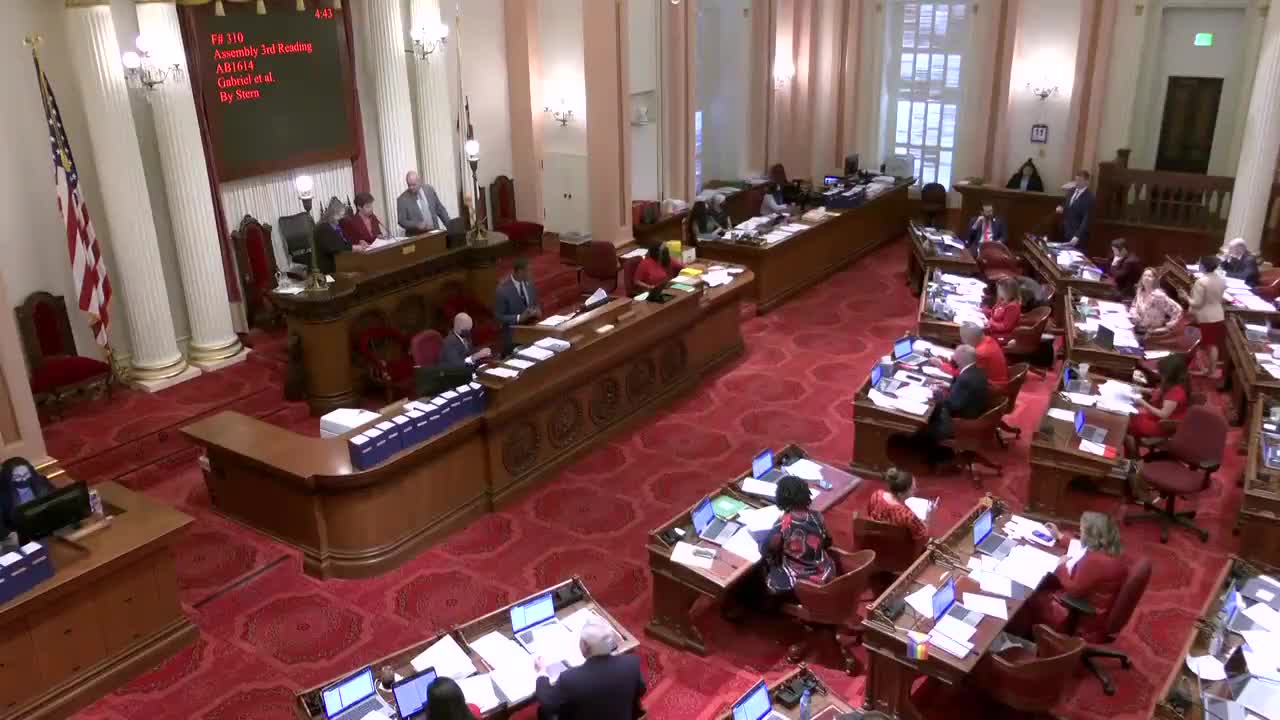 6MIN
Senate Floor
 1MIN
Senate Standing Committee on Appropriations
 5MIN
Senate Standing Committee on Transportation
 11MIN
Senate Standing Committee on Energy, Utilities and Communications
 3MIN
Assembly Standing Committee on Transportation
Bill Author
Bill Co-Author(s):
