AB 1623: Electricity: resource adequacy requirements: energy storage.
- Session Year: 2023-2024
- House: Assembly
- Latest Version Date: 2023-05-01
Current Status:
Failed
(2024-02-01: From committee: Filed with the Chief Clerk pursuant to Joint Rule 56.)
Introduced
In Committee
First Chamber
In Committee
Second Chamber
Enacted
What does this bill do?
The bill requires the California Public Utilities Commission, working with the state grid operator, to report to the Legislature on regulatory barriers to rapidly deploying energy storage and to evaluate how current capacity rules — including deliverability ratings, net qualifying capacity, and effective flexible capacity tests — treat storage. The report must recommend changes to speed storage deployment while preserving or improving electric grid reliability; it affects energy storage developers, utilities, and grid planners.
The summary is provided by generative AI which can make mistakes. For original language, please view the details in the table below.
Existing law requires the Public Utilities Commission, in consultation with the Independent System Operator, to establish resource adequacy requirements for all load-serving entities, as defined. In establishing the resource adequacy requirements, existing law requires the commission to ensure the reliability of electrical service in the state while advancing, to the extent possible, the states goals for clean energy, reducing air pollution, and reducing emissions of greenhouse gases. Existing law requires that the resource adequacy program achieve specified objectives, including to establish new, or maintain existing, demand response products and tariffs that facilitate the economic dispatch and use of demand response that can either meet or reduce an electrical corporations resource adequacy requirements, as determined by the commission.
This bill would require the commission, or before June 30, 2024, and as part of a new or existing proceeding, to revise the net qualifying capacity and effective flexible capacity methodologies for energy storage resources, as specified. to submit to the Legislature a report assessing the regulatory barriers, if any, to the rapid deployment of energy storage resources in California, as specified.
Under existing law, a violation of the Public Utilities Act or any order, decision, rule, direction, demand, or requirement of the commission is a crime.To the extent that the provisions of this bill would require an order, decision, rule, direction, demand, or requirement of the commission to implement, the bill would impose a state-mandated local program by creating a new crime.The California Constitution requires the state to reimburse local agencies and school districts for certain costs mandated by the state. Statutory provisions establish procedures for making that reimbursement.This bill would provide that no reimbursement is required by this act for a specified reason.Existing law requires the Public Utilities Commission, in consultation with the Independent System Operator, to establish resource adequacy requirements for all load-serving entities, as defined. In establishing the resource adequacy requirements, existing law requires the commission to ensure the reliability of electrical service in the state while advancing, to the extent possible, the states goals for clean energy, reducing air pollution, and reducing emissions of greenhouse gases. Existing law requires that the resource adequacy program achieve specified objectives, including to establish new, or maintain existing, demand response products and tariffs that facilitate the economic dispatch and use of demand response that can either meet or reduce an electrical corporations resource adequacy requirements, as determined by the commission.
This bill would require the commission, or before June 30, 2024, and as part of a new or existing proceeding, to revise the net qualifying capacity and effective flexible capacity methodologies for energy storage resources, as specified.
Under existing law, a violation of the Public Utilities Act or any order, decision, rule, direction, demand, or requirement of the commission is a crime.
To the extent that the provisions of this bill would require an order, decision, rule, direction, demand, or requirement of the commission to implement, the bill would impose a state-mandated local program by creating a new crime.
The California Constitution requires the state to reimburse local agencies and school districts for certain costs mandated by the state. Statutory provisions establish procedures for making that reimbursement.
This bill would provide that no reimbursement is required by this act for a specified reason.
Existing law requires the Public Utilities Commission, in consultation with the Independent System Operator, to establish resource adequacy requirements for all load-serving entities, as defined. In establishing the resource adequacy requirements, existing law requires the commission to ensure the reliability of electrical service in the state while advancing, to the extent possible, the states goals for clean energy, reducing air pollution, and reducing emissions of greenhouse gases.This bill would state the intent of the Legislature to enact future legislation to accelerate deployment of clean energy resources, bolster electrical grid reliability, and support achievement of the states clean energy and climate change goals by taking specified actions.Existing law requires the Public Utilities Commission, in consultation with the Independent System Operator, to establish resource adequacy requirements for all load-serving entities, as defined. In establishing the resource adequacy requirements, existing law requires the commission to ensure the reliability of electrical service in the state while advancing, to the extent possible, the states goals for clean energy, reducing air pollution, and reducing emissions of greenhouse gases.
This bill would state the intent of the Legislature to enact future legislation to accelerate deployment of clean energy resources, bolster electrical grid reliability, and support achievement of the states clean energy and climate change goals by taking specified actions.
The Legislature finds and declares all of the following:
(a)California is facing electrical grid reliability challenges due to a number of factors, including the impacts of climate change.
(b)California is a global leader in clean energy deployment, and the state has added significant levels of solar and wind energy generation, and is increasingly adding new electrical loads from transportation and building electrification.
(c)California is also a leader in developing and deploying energy storage, which can help to smooth intermittent renewable resources and better align the availability of renewable energy with evolving energy demand profiles.
(d)In order to support Californias clean energy transition, there is a need to deploy energy storage resources more quickly.
(e)Tens of thousands of megawatts of energy storage are in various stages of planning in California, and many of these projects could be brought online more quickly if they were able to more quickly access capacity market products, specifically resource adequacy.
(f)Accelerating additional energy storage resources into operations will accelerate the states transition to clean energy and support additional electrical grid reliability.
SEC. 2.Section 380.6 is added to the Public Utilities Code, to read:380.6.(a)On or before June 30, 2024, as part of a new or existing proceeding, the commission shall revise the net qualifying capacity and effective flexible capacity methodologies for energy storage resources.(b)The revisions made pursuant to subdivision (a) shall do all of the following:(1)Aim to accelerate the deployment of energy storage resources in a manner that preserves or enhances electrical grid reliability during net peak demand periods.(2)Remove the downrating of qualifying capacity due to a lack of full capacity deliverability status.(3)Develop an alternative net qualifying capacity test for energy storage resources. The test shall do all of the following:(A)Ensure that energy storage resources are available during the highest system need periods of summer months.(B)Maintain requirements for incremental, effective, and flexible capacity requirements.(C)Ensure energy resources are available during highly constrained electrical grid conditions, including one-in-five-years peak demand levels, conditions under which nonintermittent generators are simultaneously operating at a maximum level as averaged over summer months during the previous three years, and N-1 transmission conditions.(4)Resources receiving net qualifying capacity under the alternative test pursuant to paragraph (3) shall only be eligible for local and flexible resource adequacy, and shall not be eligible for system resource adequacy.SEC. 3.No reimbursement is required by this act pursuant to Section 6 of Article XIIIB of the California Constitution because the only costs that may be incurred by a local agency or school district will be incurred because this act creates a new crime or infraction, eliminates a crime or infraction, or changes the penalty for a crime or infraction, within the meaning of Section 17556 of the Government Code, or changes the definition of a crime within the meaning of Section 6 of Article XIIIB of the California Constitution.SEC. 2.Section 913.19 is added to the Public Utilities Code, to read:913.19.(a)For the purposes of this section, energy storage resources means energy resources that are capable of both charging and discharging, including, but not limited to, battery storage, pumped hydroelectric, and the energy storage portion of a colocated hybrid renewable and storage resource.
(b)On or before June 30, 2024, the commission, in consultation with the Independent System Operator, shall submit to the Legislature a report assessing the regulatory barriers, if any, to the rapid deployment of energy storage resources in California that includes all of the following:
(1)An evaluation of the role of deliverability rating in the calculation of net qualifying capacity for energy storage resources.
(2)An assessment of the suitability of the currently used net qualifying capacity and effective flexible capacity methodologies for energy storage resources.
(3)Recommendations for potential changes or alternatives to the methodologies specified in paragraph (2).
(c)The recommendations made pursuant to subdivision (b) shall do both of the following:
(1)Aim to accelerate the deployment of energy storage resources.
(2)Ensure that any recommended changes would, if implemented, preserve or enhance electrical grid reliability during net peak demand periods.
(d)Pursuant to Section 10231.5 of the Government Code, this section shall become inoperative on July 1, 2028, and is repealed on January 1, 2029.
The Legislature finds and declares all of the following:
(a)California is facing electrical grid reliability challenges due to a number of factors, including the impacts of climate change.
(b)California is a global leader in clean energy deployment, and the state has added significant levels of solar and wind energy generation, and is increasingly adding new electrical loads from transportation and building electrification.
(c)California is also a leader in developing and deploying energy storage, which can help to smooth intermittent renewable resources and better align the availability of renewable energy with evolving energy demand profiles.
(d)In order to support Californias clean energy transition, there is a need to deploy energy storage resources more quickly.
(e)Tens of thousands of megawatts of energy storage are in various stages of planning in California, and many of these projects could be brought online more quickly if they were able to more quickly access capacity market products, specifically resource adequacy.
(f)Accelerating additional energy storage resources into operations will accelerate the states transition to clean energy and support additional electrical grid reliability.
SEC. 2.Section 380.6 is added to the Public Utilities Code, to read:380.6.(a)On or before June 30, 2024, as part of a new or existing proceeding, the commission shall revise the net qualifying capacity and effective flexible capacity methodologies for energy storage resources.
(b)The revisions made pursuant to subdivision (a) shall do all of the following:
(1)Aim to accelerate the deployment of energy storage resources in a manner that preserves or enhances electrical grid reliability during net peak demand periods.
(2)Remove the downrating of qualifying capacity due to a lack of full capacity deliverability status.
(3)Develop an alternative net qualifying capacity test for energy storage resources. The test shall do all of the following:
(A)Ensure that energy storage resources are available during the highest system need periods of summer months.
(B)Maintain requirements for incremental, effective, and flexible capacity requirements.
(C)Ensure energy resources are available during highly constrained electrical grid conditions, including one-in-five-years peak demand levels, conditions under which nonintermittent generators are simultaneously operating at a maximum level as averaged over summer months during the previous three years, and N-1 transmission conditions.
(4)Resources receiving net qualifying capacity under the alternative test pursuant to paragraph (3) shall only be eligible for local and flexible resource adequacy, and shall not be eligible for system resource adequacy.
SEC. 3.No reimbursement is required by this act pursuant to Section 6 of Article XIIIB of the California Constitution because the only costs that may be incurred by a local agency or school district will be incurred because this act creates a new crime or infraction, eliminates a crime or infraction, or changes the penalty for a crime or infraction, within the meaning of Section 17556 of the Government Code, or changes the definition of a crime within the meaning of Section 6 of Article XIIIB of the California Constitution.
SECTION 1.It is the intent of the Legislature to enact future legislation to accelerate deployment of clean energy resources, bolster electrical grid reliability, and support achievement of the states clean energy and climate change goals by doing all of the following:(a)Accelerating interconnection and timelines to access resource adequacy markets for clean energy resources.(b)Accelerating electrical network upgrades to accommodate growing levels of clean energy.(c)Continuing to streamline permitting processes while supporting state and local priorities.It is the intent of the Legislature to enact future legislation to accelerate deployment of clean energy resources, bolster electrical grid reliability, and support achievement of the states clean energy and climate change goals by doing all of the following:
(a)Accelerating interconnection and timelines to access resource adequacy markets for clean energy resources.
(b)Accelerating electrical network upgrades to accommodate growing levels of clean energy.
(c)Continuing to streamline permitting processes while supporting state and local priorities.
|
Date
|
Status
|
|---|---|
| Feb 1, 2024 | From committee: Filed with the Chief Clerk pursuant to Joint Rule 56. |
| Jan 31, 2024 | Died pursuant to Art. IV, Sec. 10(c) of the Constitution. |
| May 18, 2023 | In committee: Held under submission. |
| May 18, 2023 | Joint Rule 62(a), file notice suspended. (Page 1580.) |
| May 17, 2023 | In committee: Set, first hearing. Referred to APPR. suspense file. |
| May 2, 2023 | Re-referred to Com. on APPR. |
| May 1, 2023 | Read second time and amended. |
| Apr 27, 2023 | From committee: Amend, and do pass as amended and re-refer to Com. on APPR. (Ayes 12. Noes 0.) (April 26). |
| Mar 27, 2023 | Re-referred to Com. on U. & E. |
| Mar 23, 2023 | From committee chair, with author's amendments: Amend, and re-refer to Com. on U. & E. Read second time and amended. |
| Mar 23, 2023 | Referred to Com. on U. & E. |
| Feb 18, 2023 | From printer. May be heard in committee March 20. |
| Feb 17, 2023 | Read first time. To print. |
|
Date
|
Description
|
Location
|
Votes
|
|
|---|---|---|---|---|
| Apr 26, 2023 | Do pass as amended and be re-referred to the Committee on [Appropriations] | Assembly Standing Committee on Utilities and Energy |
Passed |
This list shows positions taken on this bill by organizations on the date displayed, which is linked to the original source.
Positions by individuals are not included.
|
Organization
|
Position
|
Date
|
|---|---|---|
| California Edison | * Support | Apr 26, 2023 |
| Clean Power Campaign | ** Support | |
| Independent Energy Producers Association | ** Against | |
| Pacific Gas And Electric Company And Its Affiliated Entities | ** Against | |
| SB Energy | * Support | Apr 26, 2023 |
| Sempra Energy And Its Affiliates: San Diego Gas & Electric Company And Southern California Gas Company | ** Against |
Date of Hearing: May 17, 2023
ASSEMBLY COMMITTEE ON APPROPRIATIONS
Chris Holden, Chair
ABPCA Bill Id:AB 1623
Author:(Muratsuchi) – As Amended Ver:May 1, 2023
Policy Committee: | Utilities and Energy | Vote: | 12 - 0 |
|
| ||
|
|
Urgency: No State Mandated Local Program: No Reimbursable: No
SUMMARY:
This bill requires the California Public Utilities Commission (CPUC), in consultation with the California Independent System Operator (CAISO), to produce a report that assesses the regulatory barriers, if any, to the rapid deployment of energy storage resources in California. The CPUC is to submit the report to the Legislature by June 30, 2024.
The report is to include:
- An evaluation of the role of deliverability rating in the calculation of net qualifying capacity for energy storage resources.
- An assessment of the suitability of the currently used net qualifying capacity and effective flexible capacity methodologies for energy storage resources.
- Recommendations for potential changes or alternatives to the methodologies.
FISCAL EFFECT:
The CPUC anticipates one-time costs of $1 million for a contract with a consultant to analyze the current net qualifying capacity methodologies and alternatives, evaluate current interconnection and permitting frameworks and develop recommendations to update those frameworks.
COMMENTS:
- Purpose. The author intends this bill lead to changes in how the state’s energy agencies determine the deliverability of energy storage projects, thereby accelerating the deployment of energy storage on the electrical grid. According to the author:
Energy transmission projects, whether they are generating facilities or storage facilities, are evaluated by their “deliverability” which ensures that a facility can provide electricity to the grid in times of peak demand. Storage facilities are often unable to meet that threshold and therefore do not get approved as quickly as other projects. The California Energy Commission projects that 49,000 megawatts of storage will be needed by 2045 to meet the clean energy goals of SB 100. At the end of 2022, California had only installed 4,600 megawatts of energy storage.
- Background. The CPUC requires load-serving entities (LSEs)—a catchall term to describe the entities, other than municipal utilities, that, in the context of this bill, procure electricity on behalf of end-use customers—have energy resources sufficient to meet anticipated customer demand. The process by which the CPUC achieves this goal, known as resource adequacy, is complex, but key to it is assignment of a net qualifying capacity (NQC) to each resource that an LSE may count towards its resource adequacy. In short, NQC is a numerical value that represents an energy resource’s ability to deliver its electrical output to the grid during periods of high demand and, relatedly, grid constraint. For most resource types, NQC is an appropriate representation of a resource’s value as a source of electricity when that electricity is needed. However, there is concern NQC is a poor representation of the value provided by energy storage resources, such as batteries. This is because storage resources act differently than do electricity generation resources, in that storage resources tend to draw electricity from the grid when supply is great and demand is low and discharge to the grid when demand is high and supply is waning, such as on a hot day when the sun approaches the horizon.
Bill proponents contend there needs be a different standard for determining the value of storage resources, or that NQC needs be calculated differently for storage resources.
Analysis Prepared by: Jay Dickenson / APPR. / (916) 319-2081
Date of Hearing: April 26, 2023
ASSEMBLY COMMITTEE ON UTILITIES AND ENERGY
Eduardo Garcia, Chair
ABPCA Bill Id:AB 1623 (
Author:Muratsuchi) – As Amended Ver:March 23, 2023
SUBJECT: Electricity: resource adequacy requirements: energy storage
SUMMARY: Requires the California Public Utilities Commission (CPUC), on or before June 30, 2024, and as part of a new or existing proceeding, to revise the net qualifying capacity (NQC) and effective flexible capacity methodologies for energy storage resources.
Specifically, this bill:
- Requires the CPUC to, on or before June 30, 2024, as part of a new or existing proceeding, revise the NQC and effective flexible capacity methodologies for energy storage resources. The revisions must:
- Aim to accelerate the deployment of energy storage resources in a manner that preserves or enhances electrical grid reliability during net peak demand periods.
- Remove the downrating of qualifying capacity due to a lack of full capacity deliverability status.
- Develop an alternative NQC test for energy storage resources that does the following:
- Ensures that energy storage resources are available during the highest system need periods of summer months.
- Maintains requirements for incremental, effective, and flexible capacity requirements.
- Ensures energy resources are available during highly constrained electrical grid conditions, as specified.
- Specifies that resources receiving NQC under the alternative test shall only be eligible for local and flexible resource adequacy, and shall not be eligible for system resource adequacy.
EXISTING LAW:
- Establishes the policy that all of the state's retail electricity be supplied with a mix of RPS-eligible and zero-carbon resources by December 31, 2045, for a total of 100% clean energy. Requires the CPUC, in consultation with the California Energy Commission (CEC), California Air Resources Board (CARB), and all California balancing authorities, to issue a joint report to the Legislature by January 1, 2021, reviewing and evaluating the 100% clean energy policy. (Public Utilities Code § 454.53)
- Requires the CPUC to work with the California Independent System Operator (CAISO) to establish Resource Adequacy (RA) requirements for Load Serving Entities (LSEs). Existing law specifies the criteria the CPUC must consider when establishing RA requirements and specifies that an electrical corporation’s reasonable costs for meeting RA are recoverable from customers through non-bypassable charges. (Public Utilities Code § 380)
FISCAL EFFECT: Unknown. This bill is keyed fiscal and will be referred to the Committee on Appropriations for its review.
BACKGROUND:
Making Room for Storage – As California accelerates its transition to a carbon-free electric grid by 2045, there is a growing role for energy storage. The mechanisms used to store energy for later use include lithium-ion batteries, compressed air, pumping water uphill, or a variety of other means. The majority of energy storage resources in the U.S. operate through pumped hydroelectric storage in which electricity is used to pump water up to a reservoir and when later released from the reservoir, flows downward through a turbine to generate electricity.[1] However, battery storage projects have proliferated throughout California in recent years. In 2022, Pacific Gas & Electric (PG&E), in collaboration with Tesla, opened a 182.5 megawatt (MW) battery energy storage site at Moss Landing, near Monterey Bay. The facility, which can provide enough electricity for about 275,000 homes for up to four hours, is part of a dramatic ramping up of battery resources on the California grid as it continues to transition from fossil fuels to more renewable power.[2] The site is one of the latest in a set of new battery installations connected to the grid in recent years.
CAISO now has more than 3,160 MW of battery storage connected to the grid and that number is expected to grow in the coming years.[3] In January, the CPUC approved seven energy project contracts that will collectively provide more than 800 MW of new solar and storage capacity to help ensure the reliability of the state’s electric grid.[4] These projects highlight the unique appeal of energy storage: electricity generated by lithium-ion batteries, charged during the day when solar energy is usually cheap and abundant, can then be dispatched after the sun has set and solar is not available. In addition to helping integrate more renewable energy into the electricity grid, storage can provide indirect environmental benefits. Electricity storage can reduce use of less efficient generating units that would otherwise run only at peak times, and the added capacity provided by electricity storage can delay or reduce the need to build additional transmission and distribution infrastructure.[5]
Resource Adequacy (RA) – The RA process, overseen by the CPUC and CAISO, is designed to identify resources needed to ensure reliability. Following the California energy crisis of 2000-01, the California Legislature enacted AB 380 (Nunez, Chapter 367, Statutes of 2005) to prevent future incidents of widespread blackouts and rolling brownouts due to lack of electricity. This statute established the RA program at the CPUC, which must work in consultation with the CAISO to establish RA requirements for all Load Serving Entities (LSEs). The current RA program consists of system, local, and flexible requirements for each month of a compliance year. System requirements are determined for each LSE based on the CEC’s integrated energy policy report (IEPR) electricity forecast plus a 15% planning reserve margin.[6] Local requirements are determined based on an annual CAISO study using a 1-10 (once in ten years) weather year and an N-1-1 contingency.[7] Flexible requirements are based on an annual CAISO study that currently looks at the largest three-hour ramp for each month needed to run the system reliably. In October, LSEs must demonstrate that they have procured 90% of their system RA obligations for the five summer months (May-September) of the following year, as well as 100% of their local requirements, and 90% of their flexible requirements for each month of the coming compliance year. There is an additional monthly reporting requirement for RA, where LSEs must demonstrate they have procured 100% of their monthly system and flexible RA obligation.
The RA market has experienced significant constraint recently, largely driven by resource retirements across the western U.S. as well as extreme weather events causing California energy agencies to increase RA obligations for LSEs, such as the PRM adjusting from 15% to an “effective” 20-22.5% for the three large IOUs for summers 2022 and 2023.[8] These changes have led to a market rush, practically at any cost, to buy resources needed to meet RA obligations for the next few summers. Energy sellers have seemingly taken note. As shown in Figures 1 and 2 below, both system and local RA prices have been increasing significantly over the last few years, and are projected to be even higher for the coming summers.
Figure 1: Weighted Average Price of Figure 2: Weighted Average Prices for
System RA ($/kW-month)[9] Local RA ($/kW-month)[10]
These RA requirements, matched with utilities’ desire to meet them and the resultant highly lucrative prices for RA, are critical factors in determining the market values of individual resources, to the point that the expectation that a resource would not be counted toward RA may severely disincentivize its development.
RA is calculated from a variety of supporting metrics. A resource’s Qualifying Capacity (QC) is the number of Megawatts eligible to be counted towards meeting an LSE’s system and local RA requirements, subject to deliverability constraints. The revised QC that incorporates deliverability constraints is called the NQC.[11] Deliverability, in turn, is the ability of the output of a generating resource to be delivered via the electrical grid to aggregate load. If a resource’s QC exceeds its deliverable capacity as determined by CAISO Deliverability Assessments, its NQC is adjusted downwards.[12] Through this tabulation, a generation resource with high QC but low deliverability can have a low RA value. CPUC staff work with CAISO annually to publish an NQC list describing the amount of capacity from each resource that can be counted towards meeting RA requirements in the CPUC’s RA program.[13] Storage resources currently range in NQC values from 0 – 230 for lithium-ion batteries to 0 – 407 for pumped hydroelectric storage.
COMMENTS:
- Author’s Statement. According to the author, “Energy transmission projects, whether they are generating facilities or storage facilities, are evaluated by their “deliverability” which ensures that a facility can provide electricity to the grid in times of peak demand. Storage facilities are often unable to meet that threshold and therefore do not get approved as quickly as other projects. The California Energy Commission projects that 49,000 megawatts of storage will be needed by 2045 to meet the clean energy goals of SB 100. At the end of 2022, California had only installed 4,600 megawatts of energy storage. AB 1623 changes the methodology by which energy storage projects are evaluated. The new methodology would evaluate based on availability during the evening net peak rather than the daily peak. In the evening net peak, electricity use is still very high but generation has declined, leaving a need for energy storage. By changing the methodology of evaluating energy storage facilities, AB 1623 accelerates the development of these necessary projects.”
- Reliability and Ratepayer Impacts. Past legislation, including AB 2868 (Gatto, Chapter 681, Statutes of 2016) and SB 801 (Stern, Chapter 814, Statutes of 2017), as well as CPUC decisions, has incentivized and accelerated the deployment of energy storage.[14] However, these actions did so through investment and procurement, rather than altering the RA framework. The RA system was developed to secure the electrical grid against shortfalls, which, if effectuated, could lead to system-wide power outages or catastrophic failure of grid infrastructure. In general, the loosening of RA standards, however, justified, risks grid reliability. Further, if CAISO determines that the grid is not sufficiently reliable—as might be the case if energy storage resources that are not fully deliverable suddenly count toward RA obligations as put forward by this measure—the CAISO will likely respond by moving to secure additional backup capacity through its expensive reliability must-run procurement process. This mechanism forces CAISO to bid on additional resources, often fossil fuel-based, and leads to a higher price than in more regular methods of resource acquisition; these costs are ultimately passed on to ratepayers. This bill, in proposing to change the RA calculation for energy storage, will likely lead to the additional development of needed storage, but may inadvertently cause more expensive—and dirtier—resources to be procured, all at ratepayer expense.
- The Case for Changing the Test. The deliverability rating of an energy resource is incorporated into the NQC, which affects the RA eligibility of the resource and therefore much of its market value. CAISO’s methodology for assessing deliverability is structured to measure the risk of curtailment during times of the day when renewable generation is operating at maximum capacity. The test is intentionally designed to simulate potential transmission constraints during high-generation hours, essentially a high-traffic rush hour scenario on transmission lines which can prevent generated electricity from moving to where it is needed. Proponents of this bill argue that this test, while suitable for most generation methods, is inappropriate for energy storage as storage facilities can draw energy from the grid when supply is high (most often on sunny summer afternoons) and discharge it when supply is low and demand is high.[15] Even the CPUC, in a 2021 reliability decision, seemed to acknowledge this ability of energy storage by permitting procurement of storage resources that “need not be fully deliverable in 2022 or 2023, as long as they provide peak and net peak grid reliability benefits in summer 2022 or 2023.”[16] This action was contingent upon the energy storage being interconnected to the local distribution system and operating outside the CAISO market; whereas this bill seeks a broad exception for transmission-level energy storage. The CPUC cautioned that while they were making an exception to address summer grid reliability, that generally “resources procured for IRP and RA purposes must be formally interconnected to the CAISO system and fully deliverable.”[17]
While the temporal flexibility possible with energy storage seems a reasonable justification for evaluating an alternative methodology for calculating its NQC, the committee is unaware of any binding constraints on storage technologies that require them to behave in such a manner. Rather, this behavior of energy storage facilities to follow renewable generation production is largely driven by pricing arbitrage, so storage resources can most efficiently sell into the CAISO market.[18] It may be premature to require, as this bill does, adjusting the NQC methodology for all storage resources until and unless the energy storage is required to operate with temporal flexibility to complement renewable generation and mechanisms are developed for that temporal complementarity to be appropriately monitored and verified by the CPUC and CAISO.
- Federal Energy Regulatory Commission (FERC) Jurisdiction. While this bill requires adjustments to the RA methodology for energy storage solely at the CPUC, the effort of assigning QC and NQC for resources are intertwined between the CPUC and CAISO, as described above. Therefore changing the methodology at the CPUC would seemingly lead to a review and necessitate a potential change of deliverability designations at the CAISO. Concerns have been raised about the legal ability of the CPUC to modify NQC, as proposed by this bill. The Federal Power Act gives CAISO jurisdiction to operate in California under rules assigned by the Federal Energy Regulatory Commission (FERC) and established through a tariff. CAISO, therefore, has jurisdiction to modify NQC, but only under the parameters of the FERC tariff. The CPUC establishes qualifying capacity (QC), but it is the role of CAISO to adjust that value, using a variety of tests, deliverability assessments, and other considerations, to produce a final NQC metric. In essence, the CPUC has the ability to change QC methodology, but NQC is firmly within the jurisdiction of CAISO and, by extension, FERC.
- A Study in Storage. The rapid deployment of energy storage resources will be an important piece of achieving California’s goal of 100% clean energy by 2045. However, any changes to the RA framework which may compromise grid reliability or increase costs to ratepayers should be rigorously evaluated prior to implementation. As such, the author and committee may wish to consider amendments to refocus the bill to instead require the CPUC to study and report on the barriers to energy storage development, including the role of CAISO’s deliverability rating and the net qualifying capacity metric, as well as make recommendations for potential changes to, or alternatives metrics to, the existing metrics.
- Prior Legislation.
SB 1158 (Becker) requires that every retail supplier to annually report to the CEC the retail supplier’s sources of electricity used to serve loss-adjusted load for each hour during the previous calendar year and the emissions of greenhouse gases associated with those sources of electricity. Status: Chapter 367, Statutes of 2022.
SB 801 (Stern, 2017) requested that the Los Angeles Department of Water and Power in coordination with the City of Los Angeles consider cost-effective and feasible solutions to procure a minimum of 100 MW of energy storage. It also requested the CPUC to direct an electrical corporation serving the Los Angeles Basin to procure through a competitive solicitation a minimum of 20 MW. Status: Chapter 814, Statutes of 2017.
AB 2868 (Gatto, 2016) requires the CPUC to direct the state’s three largest IOUs to file applications for programs and investments to accelerate widespread deployment of distributed energy storage systems, not exceed 500 megawatts, and authorize the CPUC to approve, or modify and approve, programs and investments in distributed energy storage systems. Status: Chapter 681, Statutes of 2016.
AB 2514 (Skinner) requires the CPUC to open a proceeding to determine appropriate targets, if any, for each load-serving entity to procure viable and cost-effective energy storage systems and to adopt an energy storage system procurement target, if determined to be appropriate, to be achieved by each load-serving entity, and require the governing board of a local publicly owned electric utility to open a proceeding to determine appropriate targets, if any, for the utility to procure viable and cost-effective energy storage systems and to adopt an energy storage system procurement target, if determined to be appropriate, to be achieved by the utility. Status: Chapter 469, Statutes of 2010.
REGISTERED SUPPORT / OPPOSITION:
Support
Clean Power Campaign
Opposition
Independent Energy Producers Association
Pacific Gas and Electric Company and Its Affiliated Entities
Sempra Energy and Its Affiliates: San Diego Gas & Electric Company and Southern California Gas Company
Analysis Prepared by: Samuel Mahanes / U. & E. / (916) 319-2083
U.S. EPA; “Electricity Storage”; https://www.epa.gov/energy/electricity-storage ↑
CAISO; “A golden age of energy storage”; June 2022; http://www.caiso.com/about/Pages/Blog/Posts/A-golden-age-of-energy-storage.aspx ↑
CAISO; “A golden age of energy storage”; June 2022; http://www.caiso.com/about/Pages/Blog/Posts/A-golden-age-of-energy-storage.aspx ↑
Utility Dive; “California greenlights more than 800 MW of storage and solar to bolster power grid reliability”; January 2023; https://www.utilitydive.com/news/california-puc-storage-solar-san-diego-gas-southern-california-edison/640450/ ↑
U.S. EPA; “Electricity Storage”; https://www.epa.gov/energy/electricity-storage ↑
The CPUC has recently adopted changes to RA, including increasing the planning reserve margin from 15% to 17.5% and in some cases to 20-22%. ↑
N-1-1 Contingency: A sequence of events consisting of the initial loss of a single generator or transmission component (Primary Contingency), followed by system adjustments, followed by another loss of a single generator, or transmission component (Secondary Contingency). ↑
D. 21-12-015, CPUC, Phase 2 Decision Directing PG&E, SCE, and SDG&E to Take Actions to Prepare for Potential Extreme Weather in the Summers of 2022 and 2023, R. 20-11-003, December 2, 2021. ↑
Figure 4, pg. 29, CPUC, 2021 Resource Adequacy Report, April 2023; https://www.cpuc.ca.gov/-/media/cpuc-website/divisions/energy-division/documents/resource-adequacy-homepage/2021_ra_report_040523.pdf ↑
Figure 5, pg. 31, 2021 Resource Adequacy Report, Ibid. ↑
CPUC; “Qualifying Capacity and Effective Flexible Capacity Calculation Methodologies for Energy Storage and Supply Side Demand Response Resources, Draft Staff Proposal, Resource Adequacy Proceeding R.11-10-023”; September 2013 ↑
CPUC; “2020 Qualifying Capacity Methodology Manual”; November 2020 ↑
CAISO; “2023 Net Qualifying Capacity Values for Resource Adequacy Resources”; August 2022; https://www.caiso.com/Documents/2023-net-qualifying-capacity-values-for-resource-adequacy-resources.html ↑
D.18-01-003 ↑
During summer evenings, when energy use is high but renewable generation is decreasing from its midday peak. ↑
Pg. 107, D. 21-12-015, CPUC, Phase 2 Decision Direction PG&E, SCE, and SDG&E to Take Actions to Prepare for Potential Extreme Weather in the Summers of 2022 and 2023, R. 20-11-003; December 2, 2021. ↑
Pg. 107, D. 21-12-015, Ibid. ↑
Independent Energy Producers Association; “Future of Resource Adequacy Working Group Report”; February 2022 ↑
Discussed in Hearing
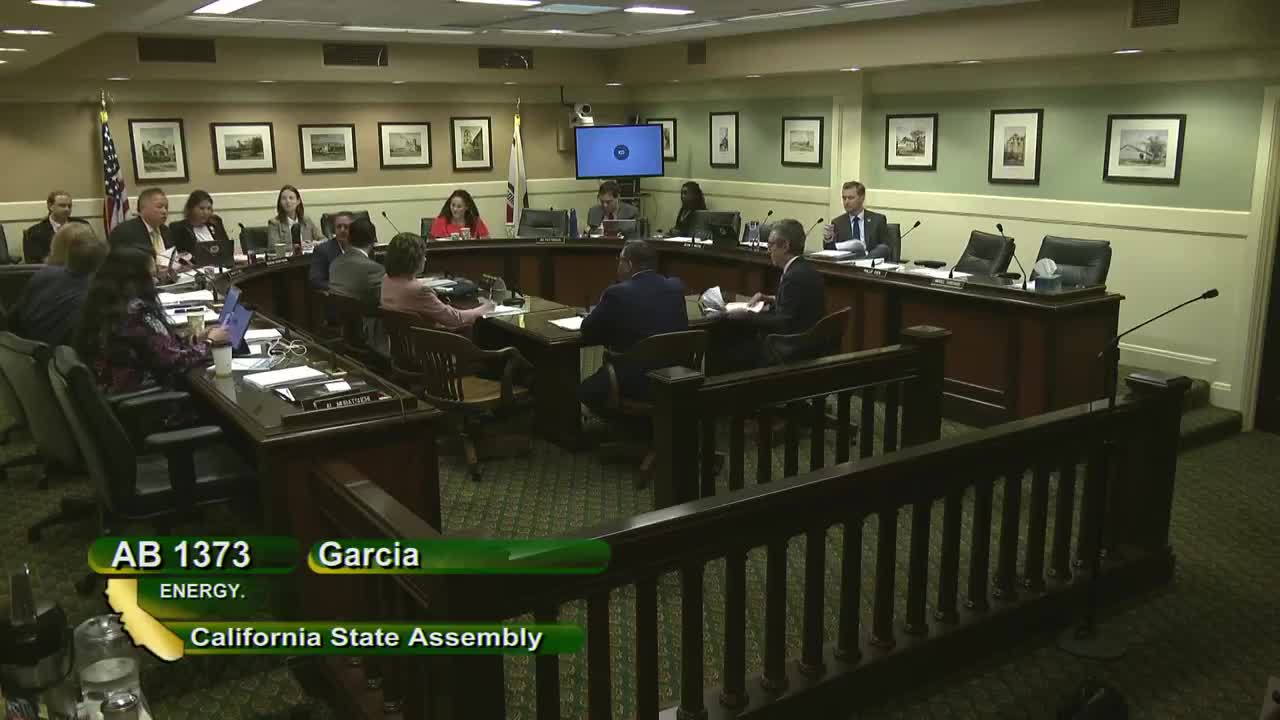 5MIN
Assembly Standing Committee on Utilities and Energy
Bill Author

Bill Co-Author(s):