AB 1631: Water resources: permit to appropriate: application procedure: mining use.
- Session Year: 2023-2024
- House: Assembly
- Latest Version Date: 2023-09-08
Current Status:
Failed
(2024-01-29: Consideration of Governor's veto stricken from file.)
Introduced
In Committee
First Chamber
In Committee
Second Chamber
Enacted
Under existing law, the State Water Resources Control Board administers a water rights program pursuant to which the board grants permits and licenses to appropriate water. Existing law requires an application for a permit to appropriate water to include, among other things, sufficient information to demonstrate a reasonable likelihood that unappropriated water is available for the proposed appropriation. Existing law requires the board to issue and deliver a notice of an application as soon as practicable after the receipt of an application for a permit to appropriate water that conforms to the law. Existing law allows interested persons to file a written protest against the approval of an application to appropriate water and requires the protestant to set forth the objections to the approval of the application. Existing law declares that no hearing is necessary to issue a permit in connection with an unprotested application, or if the undisputed facts support the issuance of the permit and there is no disputed issue of material fact, unless the board elects to hold a hearing.
This bill, if the board has not rendered a final determination on an application for a permit to appropriate water for a beneficial use or uses that include mining use within 30 years from the date the application was filed, would require the board to issue a new notice and provide an opportunity for protests before rendering a final determination, with specified exceptions.
Under existing law, the State Water Resources Control Board administers a water rights program pursuant to which the board grants permits and licenses to appropriate water. Existing law requires an application for a permit to appropriate water to include, among other things, sufficient information to demonstrate a reasonable likelihood that unappropriated water is available for the proposed appropriation. Existing law requires the board to issue and deliver a notice of an application as soon as practicable after the receipt of an application for a permit to appropriate water that conforms to the law. Existing law allows interested persons to file a written protest with regard to an application to appropriate water and requires the protestant to set forth the objections to the application. Existing law declares that no hearing is necessary to issue a permit in connection with an unprotested application, or if the undisputed facts support the issuance of the permit and there is no disputed issue of material fact, unless the board elects to hold a hearing.
This bill, if the board has not rendered a final determination on an application for a permit to appropriate water for a beneficial use or uses that include mining use within 30 years from the date the application was filed, would require the board to issue a new notice and provide an opportunity for protests before rendering a final determination, with specified exceptions.
(a)If the board has not rendered a final determination on an application for a permit to appropriate water for a beneficial use or uses that include mining use within 30 years from the date the application was filed, the board shall issue a new notice and provide an opportunity for protests under Chapter 4 (commencing with Section 1330) before rendering a final determination.
(b)A notice and opportunity for protests pursuant to subdivision (a) is not required if any of the following apply:
(1)The application is canceled or denied.
(2)A notice and opportunity for protests has been provided within five years prior to the board rendering a final approval.
(3)The board holds a hearing or conducts proceedings under Article 1.5 (commencing with Section 1345) of Chapter 5, after public notice of the hearing or proceedings, and allows any person requesting notice of the hearing or proceedings to participate as a party in the hearing or proceedings, including the presentation of evidence, without having to have filed protests. The board shall provide not less than 45 days written notice, in the same manner as would be provided to an unresolved protestant, to any person requesting the notice.
(4)The applicant is a public entity.
(c)This section is not a limitation on the authority of the board to issue a notice or direct the applicant to issue a notice if, because of changes in the project or other circumstances, the issuance of a notice is necessary to provide a fair opportunity for interested persons to file protests or is in the public interest.
|
Date
|
Status
|
|---|---|
| Jan 29, 2024 | Consideration of Governor's veto stricken from file. |
| Jan 3, 2024 | Consideration of Governor's veto pending. |
| Sep 30, 2023 | Vetoed by Governor. |
| Sep 13, 2023 | Enrolled and presented to the Governor at 3 p.m. |
| Sep 6, 2023 | In Assembly. Ordered to Engrossing and Enrolling. |
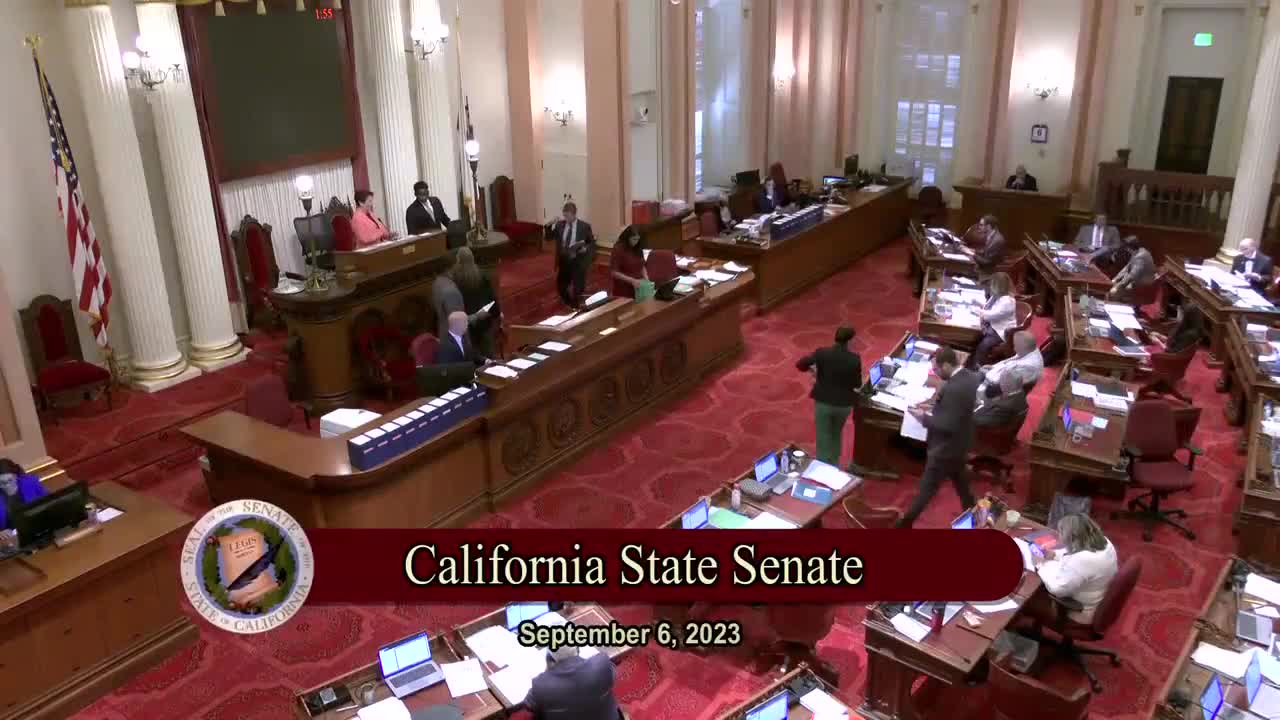
| Sep 6, 2023 | Read third time. Passed. Ordered to the Assembly. (Ayes 30. Noes 2. Page 2428.). |
| Aug 15, 2023 | Read second time. Ordered to third reading. |
| Aug 14, 2023 | From committee: Be ordered to second reading pursuant to Senate Rule 28.8. |
| Jul 11, 2023 | From committee: Do pass and re-refer to Com. on APPR. (Ayes 7. Noes 0.) (July 10). Re-referred to Com. on APPR. |
| Jun 7, 2023 | Referred to Com. on N.R. & W. |
| May 31, 2023 | In Senate. Read first time. To Com. on RLS. for assignment. |
| May 30, 2023 | Read third time. Passed. Ordered to the Senate. (Ayes 49. Noes 17. Page 1917.) |
| May 11, 2023 | Read second time. Ordered to third reading. |
| May 10, 2023 | From committee: Do pass. (Ayes 12. Noes 3.) (May 10). |
| May 3, 2023 | In committee: Hearing postponed by committee. |
| Apr 19, 2023 | From committee: Do pass and re-refer to Com. on APPR. (Ayes 8. Noes 3.) (April 18). Re-referred to Com. on APPR. |
| Mar 9, 2023 | Referred to Com. on W., P., & W. |
| Feb 18, 2023 | From printer. May be heard in committee March 20. |
| Feb 17, 2023 | Read first time. To print. |
|
Date
|
Description
|
Location
|
Votes
|
|
|---|---|---|---|---|
| Sep 6, 2023 | Assembly 3rd Reading AB1631 Schiavo et al. By Wilk | Senate Floor |
Passed |
|
| Jul 10, 2023 | Do pass, but first be re-referred to the Committee on [Appropriations] | Senate Standing Committee on Natural Resources and Water |
Passed |
|
| May 30, 2023 | AB 1631 Schiavo Assembly Third Reading | Assembly Floor |
Passed |
|
| May 10, 2023 | Do pass. | Assembly Standing Committee on Appropriations |
Passed |
|
| Apr 18, 2023 | Do pass and be re-referred to the Committee on [Appropriations] | Assembly Standing Committee on Water, Parks, and Wildlife |
Passed |
This list shows positions taken on this bill by organizations on the date displayed, which is linked to the original source.
Positions by individuals are not included.
|
Organization
|
Position
|
Date
|
|---|---|---|
| California Building Industry Association | ** Against | |
| CALIFORNIA CONSTRUCTION & INDUSTRIAL MATERIALS ASSOCIATION | ** Against | |
| California Manufacturers And Technology Association | ** Against | |
| Cemex California Cement LLC | * Against | Apr 18, 2023 |
| Cemex, Inc. | ** Against | |
| City of Santa Clarita | ** Support | |
| Construction Employers' Association | ** Against | |
| Santa Clarita Valley Chamber of Commerce | ** Support | |
| Santa Clarita Valley Water Agency | ** Support | |
| Southern California Contractors Association | ** Against | |
| United Contractors | ** Against |
GOVERNOR'S VETO
GV Bill Id:AB 1631
Author:(Schiavo)
As Enrolled Ver:September 8, 2023
2/3 vote
SUMMARY
Requires the State Water Resources Control Board (State Water Board) to issue a new notice of application and provide an opportunity for protest on any water right application for a mining operation that has been pending for more than 30 years.
- Requires the State Water Board to issue a new notice of application and provide an opportunity for protest on any water right application for a mining operation that has been pending for more than 30 years.
- Provides the notice and opportunity for protest on applications described in 1), above, is not required if any of the following apply:
- The application is denied or canceled;
- A notice and opportunity for protest has been provided within five years of final approval;
- The State Water Board follows procedures for a protest to a minor application to appropriate water and allows any person to participate in such procedures without having filed a protest on the application; or
- The applicant is a public entity.
- Clarifies that this bill is not a limitation on the State Water Board's authority to issue a notice on a water right application but necessary to allow interested parties to protest the application or if issuing a notice is in the public interest.
Governor's Veto Message
"This bill requires the [State Water Board] to issue a notice for public participation for certain water right applications if it has not rendered a final determination within 30 years from the date the permit was filed. This would impact a single, current application for a project in the author's district that is long delayed.
While I appreciate the author's attempt to provide an opportunity to comment on the water right application in question, the State Water Board formally stated its intent to re-notice the application by the end of this year, rendering this bill unnecessary.
COMMENTS
The State Water Board permit and protest process allows for members of the public to raise concerns about an application after submission of the application or permit. Although the State Water Board processes water rights applications or petitions for permit approval as they are submitted, the increase in water rights applications and petitions has necessitated that the State Water Board give priority to projects that meet specific criteria relating to the "importance" of the application and whether the applicant is showing "demonstrated progress" towards resolving issues relating to its application. Currently, protests and petitions against the applications may be submitted within 40 to 60 days of the notice of application.
Soledad Canyon project. This project is the sole existing project that will be affected by this bill at present. The project has a long history. In 1990, the Bureau of Land Management (BLM) awarded Transit Mixed Concrete Company (CEMEX’s predecessor on the project) two back-to-back 10-year contracts (from 2000-2010 and 2010-2020) to mine up to 56 million tons of sand and gravel, also known as aggregate, on 490 acres of land in Soledad Canyon, located in Los Angeles County between the cities of Palmdale and Santa Clarita.
Following the BLM contract, the federal government approved an environmental review in August 2000. The federal Interior Board of Land Appeals (IBLA) – an appellate review body that reviews Department of Interior decisions – affirmed the findings in January 2002, and Los Angeles County completed its review in 2004. The Transit Mixed Concrete Company was then purchased by CEMEX, a large mining company based in Mexico. A water right application for the project has been pending at the State Water Board for over 30 years and the City of Santa Clarita requested the project to cease.
In August 2015, BLM canceled both mining contracts for Soledad Canyon based on its view that the first contract (for the period 2000-2010) had begun in 2000 and had since expired and that the second contract (for the period 2011-2020) would expire in 2020 and that CEMEX had failed to make “reasonable progress toward commencement of production.” CEMEX appealed BLM’s decision to IBLA arguing that BLM’s decision to cancel the contracts was “arbitrary and capricious.” IBLA ruled in March 2019 that the first contract had expired and that CEMEX had violated the terms of the second contract. CEMEX challenged IBLA’s ruling in U.S. District Court and received a favorable ruling in September 2021. More recently, in May 2022, the Court vacated the BLM and IBLA decisions regarding the mining contracts, effectively reinstating CEMEX’s mining rights at Soledad Canyon. Given that these contracts have both expired as of 2010 and 2020, it is unclear if CEMEX still has mining rights for Soledad Canyon.
Need for aggregate material. Aggregate mining is an essential process to supply concrete to new construction. A 2012 report from the California state geologist estimates that quarries in Los Angeles County and the Bay Area have permits to produce less than one-third of the aggregate that will be needed over the next 50 years. San Diego, which already imports aggregate from Mexico, is in even worse shape. Increased distance between the mining and construction site adds to the cost of construction, due to the cost of transporting the material, and can increase greenhouse gas emissions.
Related legislation. This bill is similar to previous bills that have been considered by the Legislature: SB 520 (Wilk) of 2021 failed passage in the Assembly Water, Parks, and Wildlife Committee and SB 797 (Wilk) of 2019 failed passage in the Senate Natural Resources and Water Committee.
According to the Author
"Conservation of land and water is an issue that we can all agree on. [This bill] provides an opportunity for members of the public to highlight new concerns regarding a projects' impacts on local water supply, habitat species, environment, and quality of life if the projects' water appropriation applications have been pending with the State Water Resources Control Board for over 30 years."
Arguments in Support
The City of Santa Clarita has been opposed to the CEMEX project from the beginning. Residents in the City of Santa Clarita are concerned about the increase in mining-truck associated traffic, noise, and particulate and diesel emissions.
Arguments in Opposition
CEMEX opposes this bill arguing that it is a "'not in my backyard bill'" to stop a state-recognized mining project that "sets a dangerous land use precedent and stands in direct conflict with the state's greenhouse gas emissions goals." CEMEX points to 2018 analysis by the California Geological Society that indicates the San Fernando Valley-Saugus-Newhall region that would be served by the Soledad Canyon project has a less than 10-year supply of aggregate to meet demand. CEMEX contends that by stopping or slowing down the Soledad Canyon project, this bill will increase costs by denying necessary aggregate supplies for critically needed housing and infrastructure. CEMEX maintains that over the past 20 years it has met all challenges to this project, negotiated in good faith with the City of Santa Clarita, and made several concessions to address concerns with the project. Finally, CEMEX asserts this bill will subject the project to "yet another multi-year long delay for no good reason other than to throw another roadblock in front of this much-needed aggregate site" and sets a dangerous precedent that could stymie future mining projects.
FISCAL COMMENTS
According to the Assembly Appropriations Committee, "the State Water Board anticipates minor and absorbable costs" to implement this bill.
VOTES
ASM WATER, PARKS, AND WILDLIFE: 8-3-4
YES: Bauer-Kahan, Bennett, Friedman, Hart, Kalra, Pellerin, Schiavo, Weber
NO: Mathis, Alanis, Megan Dahle
ABS, ABST OR NV: Davies, Blanca Rubio, Villapudua, Ward
ASM APPROPRIATIONS: 12-3-1
YES: Holden, Bryan, Calderon, Wendy Carrillo, Mike Fong, Addis, Lowenthal, Papan, Pellerin, Robert Rivas, Weber, Wilson
NO: Megan Dahle, Dixon, Sanchez
ABS, ABST OR NV: Mathis
ASSEMBLY FLOOR: 49-17-14
YES: Addis, Aguiar-Curry, Alvarez, Arambula, Bauer-Kahan, Bennett, Berman, Boerner, Bonta, Bryan, Calderon, Wendy Carrillo, Cervantes, Connolly, Mike Fong, Friedman, Gabriel, Garcia, Gipson, Haney, Hart, Holden, Jackson, Jones-Sawyer, Kalra, Lee, Low, Lowenthal, Maienschein, McCarty, McKinnor, Muratsuchi, Ortega, Papan, Pellerin, Petrie-Norris, Reyes, Luz Rivas, Robert Rivas, Santiago, Schiavo, Ting, Wallis, Weber, Wicks, Wilson, Wood, Zbur, Rendon
NO: Alanis, Juan Carrillo, Chen, Megan Dahle, Davies, Dixon, Essayli, Flora, Vince Fong, Gallagher, Hoover, Mathis, Jim Patterson, Joe Patterson, Sanchez, Ta, Waldron
ABS, ABST OR NV: Bains, Grayson, Irwin, Lackey, Stephanie Nguyen, Pacheco, Quirk-Silva, Ramos, Rodriguez, Blanca Rubio, Soria, Valencia, Villapudua, Ward
SENATE FLOOR: 30-2-8
YES: Allen, Archuleta, Ashby, Atkins, Becker, Blakespear, Bradford, Cortese, Dodd, Durazo, Eggman, Gonzalez, Jones, Laird, Limón, McGuire, Menjivar, Min, Nguyen, Padilla, Portantino, Roth, Rubio, Skinner, Smallwood-Cuevas, Stern, Umberg, Wahab, Wiener, Wilk
NO: Alvarado-Gil, Grove
ABS, ABST OR NV: Caballero, Dahle, Glazer, Hurtado, Newman, Niello, Ochoa Bogh, Seyarto
UPDATED
VERSION: September 8, 2023
CONSULTANT: Pablo Garza / W., P., & W. / (916) 319-2096 FN: 0002477
SENATE RULES COMMITTEE Office of Senate Floor Analyses (916) 651-1520 Fax: (916) 327-4478 | AB 1631 |
THIRD READING
Bill No: AB 1631
Author: Schiavo (D), et al.
Introduced: 2/17/23
Vote: 21
SENATE NATURAL RES. & WATER COMMITTEE: 7-0, 7/10/23
AYES: Min, Allen, Eggman, Laird, Limón, Padilla, Stern
NO VOTE RECORDED: Seyarto, Dahle, Grove, Hurtado
SENATE APPROPRIATIONS COMMITTEE: Senate Rule 28.8
ASSEMBLY FLOOR: 49-17, 5/30/23 - See last page for vote
SUBJECT: Water resources: permit to appropriate: application procedure: mining use
SOURCE: City of Santa Clarita
DIGEST:
This bill requires the State Water Resources Control Board (SWRCB) to issue a new notice of application and provide an opportunity for protest on any water rights application for a mining operation that has been pending for more than 30 years.
ANALYSIS:
Existing law:
- Establishes a process for publication, posting and mailing of public notices of applications to appropriate water. Requires that notices be published and posted, as specified, and mailed to interested persons. Authorizes SWRCB to cancel an application for failure to comply with notice publication and posting requirements. (Water Code (Wat. C.) §§1300 - 1324)
- Authorizes any interested person to file a written protest to an application to appropriate water within the time allowed in the notice of application, or within such further time as SWRCB for good cause shown may allow. (Wat. C. §1330)
- Requires a protestant and the applicant to make a good faith effort to resolve the protest within 180 days from the date on which protests are required to be filed, or within such additional time as SWRCB for good cause may allow. Authorizes SWRCB to request additional information and to cancel a protest if the information is not provided. (Wat. C. §§1333, 1334, 1335)
- Sets forth procedures for hearings on protested applications for appropriation. Authorizes SWRCB to grant or refuse to grant a permit and reject an application after a hearing. No hearing is necessary on an unprotested application, or if undisputed facts support the permit and there is no disputed issue of material fact, unless the board elects to hold a hearing. (Wat. C. §§1340 – 1353).
This bill:
- Requires SWRCB to issue a new notice and provide an opportunity for protests before rendering a final determination if the board has not rendered a final determination on an application for a permit to appropriate water for beneficial use or uses that include mining use within 30 years from the date the application was filed.
- Provides, however, that the notice and opportunity for protests is not required if any of the following apply:
- The application has been cancelled or denied.
- The notice and opportunity for protests has been provided within five years before SWRCB rendering a final approval.
- The applicant is a public entity.
Background
- Current SWRCB process. Generally, SWRCB processes water right applications or petitions based on the date they were received. However, given the large number of pending water right applications and petitions, SWRCB gives priority to projects that meet specific “importance” and “demonstrated progress” criteria.
The importance criteria include such things as the proposed application is for a project that:
- Is of regional or statewide significance.
- Assists a community in obtaining safe, clean, affordable, and accessible water.
- Addresses critical aquifer overdraft or subsidence, or other undesirable results identified by the Sustainable Groundwater Management Act.
- Will enhance conditions for fish and wildlife, etc.
The demonstrated progress criteria include such things as:
- The applicant has consulted with the California Department of Fish and Wildlife, National Marine Fisheries Service, the Regional Water Quality Control Boards, and other agencies with permitting or jurisdictional authority, and the Division of Water Rights has documentation of the agencies’ approval or support for the proposed application or petition.
- The proposed application is consistent with the principles of the Policy for Maintaining Instream Flows in Northern California Coastal Streams.
- Review under the California Environmental Quality Act is substantially completed and the applicant has agreed to proposed mitigation measures or project modifications.
- CEMEX mining projects. CEMEX, Inc. is a large mining company headquartered in Mexico. In 1990, the Bureau of Land Management (BLM) awarded CEMEX predecessor Transit Mixed Concrete Co. a pair of back-to-back 10-year contracts allowing the company to mine up to 56 million tons of sand and gravel, also known as aggregate, on 490 acres near the junction of Agua Dulce Canyon Road and Soledad Canyon Road, located in the County of Los Angeles between the Cities of Palmdale and Santa Clarita (Soledad Canyon).
A formal mining plan had to be prepared and subjected to federal and county environmental review. The process took a decade, during which time Transit Mixed Concrete Co. was acquired by a bigger company, Houston-based Southdown Inc., which in turn was acquired by an even bigger company, the large Mexican mining company CEMEX.
The federal government signed off on its environmental review in August 2000, and the Interior Board of Land Appeals (IBLA) affirmed the findings in January 2002. Los Angeles County completed its review in 2004.
The two mining contracts were to run from 2000 to 2010, and from 2011 to 2020. The mining never started. Instead, CEMEX has been battling the City of Santa Clarita, BLM, and others in the courts, Congress, and other venues.
In August 2015, BLM cancelled both mining contracts for Soledad Canyon based on its view that the first contract (for the period 2000-2010) had begun in 2000 and had since expired and that the second contract (for the period 2011-2020) would expire in 2020 and that CEMEX had failed to make “reasonable progress toward commencement of production.” CEMEX appealed BLM’s decision to IBLA, arguing that BLM’s decision to cancel the contracts was “arbitrary and capricious.” IBLA ruled in March 2019 that the first contract had expired and that CEMEX had violated the terms of the second contract. CEMEX challenged IBLA’s ruling in U.S. District Court and received a favorable ruling in September 2021. More recently, in May 2022, the Court vacated the BLM and IBLA decisions regarding the mining contracts, effectively reinstating CEMEX’s mining rights at the project site.
The two mining contracts have since expired.
- Need for aggregate material. Aggregate mining is an essential process to supply concrete to new construction. A 2012 report from the California State Geologist estimates that quarries in Los Angeles County and the Bay Area have permits to produce less than one-third of the aggregate that will be needed over the next 50 years. San Diego, which already imports aggregate from Mexico, is in even worse shape. Increased distance between the mining and construction site adds to the cost of construction, due to the cost of transporting the material, and can increase greenhouse gas emissions.
Although the CEMEX project would provide nearby aggregate material for construction local to Southern California in land that has already been zoned for mining for nearly 50 years, the City of Santa Clarita has been opposed to the project from the beginning. Many in the City of Santa Clarita are concerned about the increase in mining-truck associated traffic, noise, and particulate and diesel emissions.
Comments
- This bill only applies to CEMEX. Opponents of this bill have suggested that it is inappropriate to single out CEMEX because its application includes the use of water for mining use. Instead, it is argued that the provisions should be applied to all pending SWRCB water rights applications where a final determination has not been made within 30 years. However, the introduced version of SB 520 (Wilk, 2021) would have applied to pending applications more than 30 years old; the Senate Natural Resources and Water Committee analysis of that bill revealed that a broader application would have drastically increased SWRCB’s workload, requiring SWRCB to re-notice 104 applications by 2031. Because SB 520 was focused on CEMEX’s water rights application, committee amendments narrowed the bill’s scope such that it only applied to CEMEX.
- Current Status of CEMEX Application. In a letter dated November 20, 2019, SWRCB Division of Water Rights (Division) notified CEMEX that its application would be put on hold until a final decision was reached on CEMEX’s federal contracts for mineral materials, the decision of which was made May 2022 (referenced above).
In a subsequent letter dated June 1, 2023, SWRCB informed CEMEX that the Division decided that the application will be re-noticed. According to the letter, “The application was originally noticed on May 7, 1993 and a decision on the application has been delayed for nearly thirty years. Since that time, the circumstances of affected downstream water users and other interested persons have changed. For example, many of the entities that have filed protests against the application no longer exist due to changes in property ownership and other factors. In addition, multiple entities which did not file protests in response to the 1993 notice have contacted the Division to request that the application be re-noticed so that they have an opportunity to file a protest and participate in the proceedings related to the application.” The Division concluded that the record did not reflect up-to-date circumstances and re-noticing of the application is necessary.
On June 28, 2023, CEMEX sent to SWRCB a petition for reconsideration of its decision to re-notice the CEMEX application, essentially requesting that SWRCB cancel the new review of the permit application. The letter argues that the decision to re-notice is improper because criteria for re-noticing an application under Section 684(b) of Title 23 of the California Code of Regulations have not been met. Specifically, the letter argues that there have been no changes in either CEMEX’s application or project, and there are no changes, related to the application, in the circumstances of any affected downstream water users or interested persons.
Section 684(b) provides, “If a hearing on an application is delayed for more than one year after the close of the protest period, the board may issue a new notice and direct the applicant to post or publish it. The board will take such action when, in its judgment, the record does not reflect up-to-date circumstances because of changes in the project or in the circumstances of affected downstream water users or other interested persons.”
Related/Prior Legislation
SB 520 (Wilk, 2021) was identical to this bill. The bill did not get out of the Assembly Water, Parks, and Wildlife Committee.
SB 797 (Wilk, 2020) was identical to SB 520 (Wilk, 2021), as it was introduced. The bill was referred to the Senate Natural Resources and Water Committee, but not heard at the author’s request due to the COVID-19 pandemic.
SR 96 (Wilk, Enrolled 2018) declared the intent of the Senate to enact legislation to prevent the further development of the proposed CEMEX mining project in the Soledad Canyon area of the County of Los Angeles.
SB 146 (Wilk, 2017) would have prohibited the SWRCB from issuing, on or after January 1, 2018, a new permit to appropriate water from any river or stream that has, or is reasonably expected to have, a population of unarmored threespine stickleback. The bill was referred to the Senate Natural Resources and Water Committee, but not heard at the author’s request.
AB 1986 (Wilk, 2016) would have required SWRCB, if SWRCB had not rendered a final determination on an application for a permit to appropriate water within 20 years from the date the application was filed, to issue a notice and provide an opportunity for protests before final determination. AB 1986 was held on the Assembly Appropriations Committee’s suspense file.
FISCAL EFFECT: Appropriation: No Fiscal Com.: Yes Local: No
SUPPORT: (Verified 8/15/23)
City of Santa Clarita (source)
Santa Clarita Valley Water Agency
OPPOSITION: (Verified 8/15/23)
California Building Industry Association
California Construction & Industrial Materials Association
California Manufacturers and Technology Association
CEMEX, Inc.
ARGUMENTS IN SUPPORT: According to the City of Santa Clarita, “This critical piece of legislation is thoughtfully designed to ensure that the SWRCB has accurate and current environmental records and allows for an opportunity for members of the public, community stakeholders, and interested parties to engage with the SWRCB on severely outdated water appropriation application.
“Our community has experienced a significant amount of growth in the last three decades, more than doubling in population to over 230,000 residents. With such rapid growth, the City of Santa Clarita has worked diligently and methodically to ensure that development planning and standards recognize the unique community needs, topography, and natural resources, including water availability, in the Santa Clarita Valley.
“Assembly Bill 1631 is most welcomed and appreciated as this important legislation will allow the SWRCB to have a solid foundation upon which to base a credible decision regarding water appropriation applications that have been pending for more than 30 years.”
ARGUMENTS IN OPPOSITION: According to CEMEX, Inc., “Beyond the discriminatory nature of the measure, AB 1631 directly undermines the state’s greenhouse gas emission goals. As noted in the Department of Conservation – California Geological Survey – Aggregate Sustainability in California – 2018, the San Fernando Valley-Saugus Newhall area, which is what the Soledad mine is intended to serve, has less than a 10-year supply of permitted aggregate reserves. The study states that “Aggregate is a low-unit-value, high-build-weight commodity, and it must be obtained from nearby sources to minimize both the dollar cost of the aggregate consumer and other environmental and economic costs associated with transportation.” Further, “In addition to the greater economic costs, there are often increased environmental and societal costs associated with the import of aggregate when compared to local production. The environmental impacts include higher emissions of greenhouse gases, such as CO2, and air pollution. The societal impacts include increased traffic congestion and road wear and maintenance due to increased truck traffic. In the case of imports, these environmental and societal impacts occur both within the importing region and in the neighboring regions that supply the material and through which the material is transported.”
ASSEMBLY FLOOR: 49-17, 5/30/23
AYES: Addis, Aguiar-Curry, Alvarez, Arambula, Bauer-Kahan, Bennett, Berman, Boerner, Bonta, Bryan, Calderon, Wendy Carrillo, Cervantes, Connolly, Mike Fong, Friedman, Gabriel, Garcia, Gipson, Haney, Hart, Holden, Jackson, Jones-Sawyer, Kalra, Lee, Low, Lowenthal, Maienschein, McCarty, McKinnor, Muratsuchi, Ortega, Papan, Pellerin, Petrie-Norris, Reyes, Luz Rivas, Robert Rivas, Santiago, Schiavo, Ting, Wallis, Weber, Wicks, Wilson, Wood, Zbur, Rendon
NOES: Alanis, Juan Carrillo, Chen, Megan Dahle, Davies, Dixon, Essayli, Flora, Vince Fong, Gallagher, Hoover, Mathis, Jim Patterson, Joe Patterson, Sanchez, Ta, Waldron
NO VOTE RECORDED: Bains, Grayson, Irwin, Lackey, Stephanie Nguyen, Pacheco, Quirk-Silva, Ramos, Rodriguez, Blanca Rubio, Soria, Valencia, Villapudua, Ward
Prepared by: Genevieve Wong / N.R. & W. / (916) 651-4116
8/16/23 16:42:01
**** END ****
SENATE COMMITTEE ON NATURAL RESOURCES AND WATER
Senator Dave Min, Chair
2023 - 2024 Regular
Bill No: AB Hearing Date: July 10, 2023
Author: | Schiavo | ||
Version: | February 17, 2023 Introduced | ||
Urgency: | No | Fiscal: | Yes |
Consultant: | Genevieve Wong | ||
Subject: Water resources: permit to appropriate: application procedure: mining use
BACKGROUND AND EXISTING LAW
Existing law:
- Establishes a process for publication, posting and mailing of public notices of applications to appropriate water. Requires that notices be published and posted, as specified, and mailed to interested persons. Authorizes the State Water Resources Control Board (SWRCB) to cancel an application for failure to comply with notice publication and posting requirements. (Water Code (Wat. C.) §§1300 - 1324)
- Authorizes any interested person to file a written protest to an application to appropriate water within the time allowed in the notice of application, or within such further time as SWRCB for good cause shown may allow. (Wat. C. §1330)
- Requires a protestant and the applicant to make a good faith effort to resolve the protest within 180 days from the date on which protests are required to be filed, or within such additional time as SWRCB for good cause may allow. Authorizes SWRCB to request additional information and to cancel a protest if the information is not provided. (Wat. C. §§1333, 1334, 1335)
- Sets forth procedures for hearings on protested applications for appropriation. Authorizes SWRCB to grant or refuse to grant a permit and reject an application after a hearing. No hearing is necessary on an unprotested application, or if undisputed facts support the permit and there is no disputed issue of material fact, unless the board elects to hold a hearing. (Wat. C. §§1340 – 1353).
Current SWRCB process. Generally, SWRCB processes water right applications or petitions based on the date they were received. However, given the large number of pending water right applications and petitions, SWRCB gives priority to projects that meet specific “importance” and “demonstrated progress” criteria.
The importance criteria include such things as the proposed application is for a project that:
- Is of regional or statewide significance.
- Assists a community in obtaining safe, clean, affordable, and accessible water.
- Addresses critical aquifer overdraft or subsidence, or other undesirable results identified by the Sustainable Groundwater Management Act.
- Will enhance conditions for fish and wildlife, etc.
The demonstrated progress criteria include such things as:
- The applicant has consulted with the California Department of Fish and Wildlife, National Marine Fisheries Service, the Regional Water Quality Control Boards, and other agencies with permitting or jurisdictional authority, and the Division of Water Rights (Division) has documentation of the agencies’ approval or support for the proposed application or petition.
- The proposed application is consistent with the principles of the Policy for Maintaining Instream Flows in Northern California Coastal Streams.
- Review under the California Environmental Quality Act is substantially completed and the applicant has agreed to proposed mitigation measures or project modifications.
CEMEX mining projects. CEMEX is a large mining company headquartered in Mexico. In 1990, the Bureau of Land Management (BLM) awarded CEMEX predecessor Transit Mixed Concrete Co. a pair of back-to-back 10-year contracts allowing the company to mine up to 56 million tons of sand and gravel, also known as aggregate, on 490 acres near the junction of Agua Dulce Canyon Road and Soledad Canyon Road, located in the County of Los Angeles between the cities of Palmdale and Santa Clarita (Soledad Canyon).
A formal mining plan had to be prepared and subjected to federal and county environmental review. The process took a decade, during which time Transit Mixed Concrete Co. was acquired by a bigger company, Houston-based Southdown Inc., which in turn was acquired by an even bigger company, the large Mexican mining company CEMEX.
The federal government signed off on its environmental review in August 2000, and the Interior Board of Land Appeals (IBLA) affirmed the findings in January 2002. Los Angeles County completed its review in 2004.
The two mining contracts were to run from 2000 to 2010, and from 2010 to 2020. The mining never started. Instead, CEMEX has been battling the City of Santa Clarita, BLM, and others in the courts, Congress, and other venues.
In August 2015, BLM cancelled both mining contracts for Soledad Canyon based on its view that the first contract (for the period 2000-2010) had begun in 2000 and had since expired and that the second contract (for the period 2011-2020) would expire in 2020 and that CEMEX had failed to make “reasonable progress toward commencement of production.” CEMEX appealed BLM’s decision to IBLA, arguing that BLM’s decision to cancel the contracts was “arbitrary and capricious.” IBLA ruled in March 2019 that the first contract had expired and that CEMEX had violated the terms of the second contract. CEMEX challenged IBLA’s ruling in U.S. District Court and received a favorable ruling in September 2021. More recently, in May 2022, the Court vacated the BLM and IBLA decisions regarding the mining contracts, effectively reinstating CEMEX’s mining rights at the project site.
The two mining contracts have since expired.
Need for aggregate material. Aggregate mining is an essential process to supply concrete to new construction. A 2012 report from the California state geologist estimates that quarries in Los Angeles County and the Bay Area have permits to produce less than one-third of the aggregate that will be needed over the next 50 years. San Diego, which already imports aggregate from Mexico, is in even worse shape. Increased distance between the mining and construction site adds to the cost of construction, due to the cost of transporting the material, and can increase greenhouse gas emissions.
Although the CEMEX project would provide nearby aggregate material for construction local to Southern California in land that has already been zoned for mining for nearly 50 years, the City of Santa Clarita has been opposed to the project from the beginning. Many in the City of Santa Clarita are concerned about the increase in mining-truck associated traffic, noise, and particulate and diesel emissions.
PROPOSED LAW
This bill:
- Requires SWRCB to issue a new notice and provide an opportunity for protests before rendering a final determination if the board has not rendered a final determination on an application for a permit to appropriate water for beneficial use or uses that include mining use within 30 years from the date the application was filed.
- Provides, however, that the notice and opportunity for protests is not required if any of the following apply:
- The application has been cancelled or denied.
- The notice and opportunity for protests has been provided within five years before SWRCB rendering a final approval.
- The applicant is a public entity.
- The application has been cancelled or denied.
ARGUMENTS IN SUPPORT
According to the author, “Conservation of land and water is an issue that we can all agree on. AB 1631 provides an opportunity for members of the public to highlight new concerns regarding a project’s impacts on local water supply, habitat species, environment, and quality of life if the water appropriation application for the project has been pending with the State Water Resources Control Board for over 30 years.”
According to the City of Santa Clarita, “This critical piece of legislation is thoughtfully designed to ensure that the SWRCB has accurate and current environmental records and allows for an opportunity for members of the public, community stakeholders, and interested parties to engage with the SWRCB on severely outdated water appropriation applications. … Our community has experienced a significant growth in the last three decades, more than doubling in population to over 230,000 residents. With such rapid growth, the City of Santa Clarita has worked diligently and methodically to ensure that development planning and standards recognize the unique community needs, topography, and natural resources, including water availability, in the Santa Clarita Valley.”
ARGUMENTS IN OPPOSITION
According to CEMEX, “If SWRCB has the authority to reopen applications today, …, why direct their attention specifically to mining, versus all applications that are 30 years or older? Shouldn’t SWRCB be able to determine which applications warrant reopening, versus just mining? In fact, in light of SWRCB’s letter, the measure remains an unconstitutional bill of attainder as it legislatively imposes a penalty on a single entity and subjects one entity to different approval standards as compared to every other similarly situated entity. … Beyond the discriminatory nature of the measure, AB 1631 directly undermines the state’s greenhouse gas emission goals. …Due to a demonstrated absence of local supplies, if aggregates have to trucked, railed or shipped in from longer distances, there will in fact be a marked increase in GHG emissions.”
COMMENTS
Take two. This bill is identical to SB 520 (Wilk, 2021), as it passed out of this committee. After passing this committee (9-0-0), SB 520 failed to get enough votes to pass the Assembly Water, Parks, and Wildlife Committee.
This bill only applies to CEMEX. Opponents of the bill have suggested that it is inappropriate to single out CEMEX because its application includes the use of water for mining use. Instead, it is argued that the provisions should be applied to all pending SWRCB water rights applications where a final determination has not been made within 30 years. However, the introduced version of SB 520 (Wilk, 2021) did apply to pending applications more than 30 years old; this committee’s analysis of that bill revealed that a broader application would have drastically increased SWRCB’s workload, requiring SWRCB to re-notice 104 applications by 2031. Because SB 520 was focused on CEMEX’s water rights application, committee amendments narrowed the bill’s scope such that it only applied to CEMEX.
Current Status of CEMEX Application. In a letter dated November 20, 2019, SWRCB Division of Water Rights (Division) notified CEMEX that its application would be put on hold until a final decision was reached on CEMEX’s federal contracts for mineral materials, the decision of which was made May 2022 (referenced above).
In a subsequent letter dated June 1, 2023, SWRCB informed CEMEX that the Division decided that the application will be re-noticed. According to the letter, “The application was originally noticed on May 7, 1993 and a decision on the application has been delayed for nearly thirty years. Since that time, the circumstances of affected downstream water users and other interested persons have changed. For example, many of the entities that have filed protests against the application no longer exist due to changes in property ownership and other factors. In addition, multiple entities which did not file protests in response to the 1993 notice have contacted the Division to request that the application be re-noticed so that they have an opportunity to file a protest and participate in the proceedings related to the application.” The Division concluded that the record did not reflect up-to-date circumstances and re-noticing of the application is necessary.
On June 28, 2023, CEMEX sent to SWRCB a petition for reconsideration of its decision to re-notice the CEMEX application, essentially requesting that SWRCB cancel the new review of the permit application. The letter argues that the decision to re-notice is improper because criteria for re-noticing an application under Section §684(b) of Title 23 of the California Code of Regulations have not been met. Specifically, the letter argues that there have been no changes in either CEMEX’s application or project, and there are no changes, related to the application, in the circumstances of any affected downstream water users or interested persons.
Section 684(b) provides, “If a hearing on an application is delayed for more than one year after the close of the protest period, the board may issue a new notice and direct the applicant to post or publish it. The board will take such action when, in its judgment, the record does not reflect up-to-date circumstances because of changes in the project or in the circumstances of affected downstream water users or other interested persons.”
Does focusing on “mining use” now direct SWRCB to not reopen other 30-year old applications later? No, it does not.
Related legislation
SB 520 (Wilk, 2021), as amended by this committee, is identical to this bill. That bill did not get out of the Assembly Water, Parks, and Wildlife Committee.
SB 797 (Wilk, 2020) is identical to SB 520 (Wilk, 2021), as it was introduced. That bill was referred to this committee, but not heard at the author’s request due to the COVID-19 pandemic.
SR 96 (Wilk, Stern, 2018) declared the intent of the Senate to enact legislation to prevent the further development of the proposed CEMEX mining project in the Soledad Canyon area of the County of Los Angeles.
SB 146 (Wilk, 2017) would have prohibited the SWRCB from issuing, on or after January 1, 2018, a new permit to appropriate water from any river or stream that has, or is reasonably expected to have, a population of unarmored threespine stickleback. That bill was referred to the Senate Natural Resources and Water Committee, but not heard at the author’s request.
AB 1986 (Wilk, 2016) would have required SWRCB, if SWRCB had not rendered a final determination on an application for a permit to appropriate water within 20 years from the date the application was filed, to issue a notice and provide an opportunity for protests before final determination. AB 1986 was held on the Assembly Appropriations Committee’s suspense file.
SUPPORT
City of Santa Clarita
OPPOSITION
California Building Industry Association
California Construction & Industrial Materials Association
CEMEX, INC.
-- END --
ASSEMBLY THIRD READING
ATR Bill Id:AB 1631
Author:(Schiavo)
As Introduced Ver:February 17, 2023
Majority vote
SUMMARY
Requires the State Water Resources Control Board (State Water Board) to issue a new notice of application and provide an opportunity for protest on any water right application for a mining operation that has been pending for more than 30 years.
Major Provisions
- Requires the State Water Board to issue a new notice of application and provide an opportunity for protest on any water right application for a mining operation that has been pending for more than 30 years.
- Provides the notice and opportunity for protest on applications described in 1), above, is not required if any of the following apply:
- The application is denied or canceled;
- A notice and opportunity for protest has been provided within five years of final approval;
- The State Water Board follows procedures for a protest to a minor application to appropriate water and allows any person to participate in such procedures without having filed a protest on the application; or
- The applicant is a public entity.
- Clarifies that this bill is not a limitation on the State Water Board's authority to issue a notice on a water right application but necessary to allow interested parties to protest the application or if issuing a notice is in the public interest.
COMMENTS
The State Water Board permit and protest process allows for members of the public to raise concerns about an application after submission of the application or permit. Although the State Water Board processes water rights applications or petitions for permit approval as they are submitted, the increase in water rights applications and petitions has necessitated that the State Water Board give priority to projects that meet specific criteria relating to the "importance" of the application and whether the applicant is showing "demonstrated progress" towards resolving issues relating to its application. Currently, protests and petitions against the applications may be submitted within 40 to 60 days of the notice of application.
Soledad Canyon project. This project is the sole existing project that will be affected by this bill at present. The project has a long history. In 1990, the Bureau of Land Management (BLM) awarded Transit Mixed Concrete Company (CEMEX's predecessor on the project) two back-to-back 10-year contracts (from 2000-2010 and 2010-2020) to mine up to 56 million tons of sand and gravel, also known as aggregate, on 490 acres of land in Soledad Canyon, located in Los Angeles County between the cities of Palmdale and Santa Clarita.
Following the BLM contract, the federal government approved an environmental review in August 2000. The federal Interior Board of Land Appeals (IBLA) – an appellate review body that reviews Department of Interior decisions – affirmed the findings in January 2002, and Los Angeles County completed its review in 2004. The Transit Mixed Concrete Company was then purchased by CEMEX, a large mining company based in Mexico. A water right application for the project has been pending at the State Water Board for over 30 years and the City of Santa Clarita requested the project to cease.
In August 2015, BLM canceled both mining contracts for Soledad Canyon based on its view that the first contract (for the period 2000-2010) had begun in 2000 and had since expired and that the second contract (for the period 2011-2020) would expire in 2020 and that CEMEX had failed to make "reasonable progress toward commencement of production." CEMEX appealed BLM's decision to IBLA arguing that BLM's decision to cancel the contracts was "arbitrary and capricious." IBLA ruled in March 2019 that the first contract had expired and that CEMEX had violated the terms of the second contract. CEMEX challenged IBLA's ruling in U.S. District Court and received a favorable ruling in September 2021. More recently, in May 2022, the Court vacated the BLM and IBLA decisions regarding the mining contracts, effectively reinstating CEMEX's mining rights at Soledad Canyon. Given that these contracts have both expired as of 2010 and 2020, it is unclear if CEMEX still has mining rights for Soledad Canyon.
Need for aggregate material. Aggregate mining is an essential process to supply concrete to new construction. A 2012 report from the California state geologist estimates that quarries in Los Angeles County and the Bay Area have permits to produce less than one-third of the aggregate that will be needed over the next 50 years. San Diego, which already imports aggregate from Mexico, is in even worse shape. Increased distance between the mining and construction site adds to the cost of construction, due to the cost of transporting the material, and can increase greenhouse gas emissions.
Related legislation. This bill is similar to previous bills that have been considered by the Legislature: SB 520 (Wilk) of 2021 failed passage in the Assembly Water, Parks, and Wildlife Committee and SB 797 (Wilk) of 2019 failed passage in the Senate Natural Resources and Water Committee.
According to the Author
"Conservation of land and water is an issue that we can all agree on. [This bill] provides an opportunity for members of the public to highlight new concerns regarding a projects' impacts on local water supply, habitat species, environment, and quality of life if the projects' water appropriation applications have been pending with the State Water Resources Control Board for over 30 years."
Arguments in Support
The City of Santa Clarita has been opposed to the CEMEX project from the beginning. Residents in the City of Santa Clarita are concerned about the increase in mining-truck associated traffic, noise, and particulate and diesel emissions.
Arguments in Opposition
CEMEX opposes this bill arguing that it is a "not in my backyard bill" to stop a state-recognized mining project that "sets a dangerous land use precedent and stands in direct conflict with the state's greenhouse gas emissions goals." CEMEX points to 2018 analysis by the California Geological Society that indicates the San Fernando Valley-Saugus-Newhall region that would be served by the Soledad Canyon project has a less than 10-year supply of aggregate to meet demand. CEMEX contends that by stopping or slowing down the Soledad Canyon project, this bill will increase costs by denying necessary aggregate supplies for critically needed housing and infrastructure. CEMEX maintains that over the past 20 years it has met all challenges to this project, negotiated in good faith with the City of Santa Clarita, and made several concessions to address concerns with the project. Finally, CEMEX asserts this bill will subject the project to "yet another multi-year long delay for no good reason other than to throw another roadblock in front of this much-needed aggregate site" and sets a dangerous precedent that could stymie future mining projects.
FISCAL COMMENTS
According to the Assembly Appropriations Committee, "the State Water Board anticipates minor and absorbable costs" to implement this bill.
VOTES
ASM WATER, PARKS, AND WILDLIFE: 8-3-4
YES: Bauer-Kahan, Bennett, Friedman, Hart, Kalra, Pellerin, Schiavo, Weber
NO: Mathis, Alanis, Megan Dahle
ABS, ABST OR NV: Davies, Blanca Rubio, Villapudua, Ward
ASM APPROPRIATIONS: 12-3-1
YES: Holden, Bryan, Calderon, Wendy Carrillo, Mike Fong, Addis, Lowenthal, Papan, Pellerin, Robert Rivas, Weber, Wilson
NO: Megan Dahle, Dixon, Sanchez
ABS, ABST OR NV: Mathis
UPDATED
VERSION: February 17, 2023
CONSULTANT: Pablo Garza / W., P., & W. / (916) 319-2096 FN: 0000376
Date of Hearing: May 10, 2023
ASSEMBLY COMMITTEE ON APPROPRIATIONS
Chris Holden, Chair
ABPCA Bill Id:AB 1631
Author:(Schiavo) – As Introduced Ver:February 17, 2023
Policy Committee: | Water, Parks and Wildlife | Vote: | 8 - 3 |
|
| ||
|
|
Urgency: No State Mandated Local Program: No Reimbursable: No
SUMMARY:
This bill requires the State Water Resources Control Board (State Water Board) to issue a new notice of a water right application and provide an opportunity for protest on any pending water right application for a mining operation where more than 30 years have passed since the initial application.
Specifically, this bill:
- Requires the State Water Board to issue a new notice and provide an opportunity for protest, unless specified conditions apply, on any application before rendering a final determination for a permit to appropriate water for a beneficial use that includes mining use if the State Water Board has not rendered a final determination within 30 years from the date the application was filed.
- Clarifies that this bill is not a limitation on the State Water Board’s authority to issue a notice or direct the applicant to issue a notice if, because of changes in the project or other circumstances, the issuance of a notice is necessary to provide a fair opportunity for interested persons to file protests or is in the public interest.
FISCAL EFFECT:
The State Water Board anticipates minor and absorbable costs.
COMMENTS:
1) Purpose. According to the author:
Conservation of land and water is an issue that we can all agree on. [This bill] provides an opportunity for members of the public to highlight new concerns regarding a projects’ impacts on local water supply, habitat species, environment, and quality of life if the projects’ water appropriation applications have been pending with the State Water Resources Control Board for over 30 years.
- Background. The State Water notes the Soledad Canyon project is the sole existing project that will be affected by this bill. The project has a long history. In 1990, the Bureau of Land Management (BLM) awarded Transit Mixed Concrete Company (CEMEX’s predecessor on the project) two back-to-back 10-year contracts (from 2000 to 2010 and 2010 to 2020) to mine up to 56 million tons of sand and gravel, also known as aggregate, on 490 acres of land in Soledad Canyon, located in Los Angeles County between the cities of Palmdale and Santa Clarita. CEMEX, a large mining company based in Mexico, has since purchased the Transit Mixed Concrete Company. A water rights application for the project has been pending at the State Water Board for over 30 years and the City of Santa Clarita has requested the project to cease.
In August 2015, BLM cancelled both mining contracts for Soledad Canyon based on its view that the first contract (for the period 2000 to 2010) had begun in 2000 and had since expired, that the second contract (for the period 2011 to 2020) would expire in 2020, and that CEMEX had failed to make “reasonable progress toward commencement of production.” CEMEX appealed BLM’s decision to the federal Interior Board of Land Appeals (IBLA) – an appellate review body that reviews Department of Interior decisions – arguing that BLM’s decision to cancel the contracts was “arbitrary and capricious.” IBLA ruled in March 2019 that the first contract had expired and that CEMEX had violated the terms of the second contract. CEMEX challenged IBLA’s ruling in a district court and received a favorable ruling in September 2021. More recently, in May 2022, the court vacated the BLM and IBLA decisions regarding the mining contracts, effectively reinstating CEMEX’s mining rights at Soledad Canyon. Given these contracts have both expired, one as of 2010 and the other as of 2020, it is unclear if CEMEX still has mining rights for Soledad Canyon.
The City of Santa Clarita contends this bill is designed to ensure the State Water Board has accurate and current environmental records and stakeholders have an opportunity to engage with the State Water Board on “severely outdated water appropriation applications.”
Writing in an oppose-unless-amended position, the California Building Industry Association states:
AB 1631 seeks to amend the State Water Resources Control Board application process for obtaining a permit to appropriate water in such a way that would create greater regulatory uncertainty in obtaining approval for projects in California by establishing a dangerous precedent of retroactively invalidating a water rights permit application. If the goal of the bill is to provide an opportunity for public input, CBIA believes the bill could be amended in such a way that would allow for public input without having the permit applicant restart the entire application process. AB 1631 specifically targets a pending application for a permit to appropriate water that is tied specifically to a mining use. Aggregate is necessary in building material in California that is used for infrastructure and housing projects. California is facing a daunting and seemingly insurmountable housing supply and affordability crisis. CBIA is concerned that legislative measures that would add unnecessary delays and costs to a permit process will only exacerbate the current housing crisis.
Analysis Prepared by: Nikita Koraddi / APPR. / (916) 319-2081
Date of Hearing: April 18, 2023
ASSEMBLY COMMITTEE ON WATER, PARKS, AND WILDLIFE
Rebecca Bauer-Kahan, Chair
ABPCA Bill Id:AB 1631 (
Author:Schiavo) – As Introduced Ver:February 17, 2023
SUBJECT: Water resources: permit to appropriate: application procedure: mining use
SUMMARY: Requires the State Water Resources Control Board (State Water Board) to issue a new notice of a water right application and provide an opportunity for protest on any pending water right application for a mining operation where more than 30 years have passed since the initial application. Specifically, this bill:
- Requires the State Water Board to issue a new notice of a water right application and provide an opportunity for protest on any water right application for a mining operation where more than 30 years have passed since the application was first submitted and the application is still pending.
- Provides the notice and opportunity for protests on applications described in #1, above, is not required if any of the following apply:
- The application is denied or canceled;
- A notice and opportunity for protests has been provided within five years of final approval;
- The State Water Board follows procedures for a protest to a minor application to appropriate water and allows any person to participate in such procedures without having filed a protest on the application; or
- The applicant is a public entity.
- Clarifies that this bill is not a limitation on the State Water Board’s authority to issue a notice on a water right application if necessary to allow interested parties to protest the application or if issuing a notice is in the public interest.
EXISTING LAW:
- Establishes a process for publication, posting, and mailing of public notices of water right applications so that potentially affected parties or the general public may have the opportunity to protest the water right application within 40 to 60 days. Requires that notices of a water right application be published and posted, as specified, and mailed to interested persons. Authorizes the State Water Board to cancel an application for failure to comply with notice publication and posting requirements (Water Code § 1300 et seq.).
- Authorizes any interested person to file a written protest to a water right application within the time allowed in the notice of application (i.e., 40 to 60 days) (Water Code § 1330 et seq.).
- Requires a protestant and the applicant to make a good faith effort to resolve the protest within 180 days from the date on which protests are required to be filed, or within such additional time as the State Water Board for good cause may allow (Water Code § 1333).
- Specifies procedures that include a field investigation and hearing for minor applications to appropriate water. Defines a “minor application” as an application that either (a) does not involve direct diversion in excess of three cubic-feet per second or storage in excess of 200 acre-feet annually; or (b) an application by a groundwater sustainability agency for a diversion of water that was previously authorized by a temporary groundwater recharge permit (Water Code § 1345 et seq.).
- Authorizes the State Water Board to grant or refuse to grant a permit and reject an application after a hearing and provides that no hearing is necessary on an unprotested application, or if undisputed facts support the permit and there is no disputed issue of material fact, unless the board elects to hold a hearing (Water Code §§ 1350 and 1351).
FISCAL EFFECT: Unknown. This bill is keyed fiscal.
COMMENTS:
- Purpose of this bill. According to the author, “Conservation of land and water is an issue that we can all agree on. [This bill] provides an opportunity for members of the public to highlight new concerns regarding a projects’ impacts on local water supply, habitat species, environment, and quality of life if the projects’ water appropriation applications have been pending with the State Water Resources Control Board for over 30 years.”
- Background. The State Water Board permit and protest process allows for members of the public to raise concerns about an application after submission of the application or permit. Although the State Water Board processes water rights applications or petitions for permit approval as they are submitted, the increase in water rights applications and petitions has necessitated that the State Water Board give priority to projects that meet specific criteria relating to the “importance” of the application and whether the applicant is showing “demonstrated progress” towards resolving issues relating to its application. Currently, protests and petitions against the applications may be submitted within 40 to 60 days of the notice of application.
Soledad Canyon project. This project is the sole existing project that will be affected by this bill. The project has a long history. In 1990, the Bureau of Land Management (BLM) awarded Transit Mixed Concrete Company (CEMEX’s predecessor on the project) two back-to-back 10-year contracts (from 2000-2010 and 2010-2020) to mine up to 56 million tons of sand and gravel, also known as aggregate, on 490 acres of land in Soledad Canyon, located in Los Angeles County between the cities of Palmdale and Santa Clarita.
Following the BLM contract, the federal government approved an environmental review in August 2000. The federal Interior Board of Land Appeals (IBLA) – an appellate review body that reviews Department of Interior decisions – affirmed the findings in January 2002, and Los Angeles County completed its review in 2004. The Transit Mixed Concrete Company was then purchased by CEMEX, a large mining company based in Mexico. A water right application for the project has been pending at the State Water Board for over 30 years and the City of Santa Clarita requested the project to cease.
In August 2015, BLM cancelled both mining contracts for Soledad Canyon based on its view that the first contract (for the period 2000-2010) had begun in 2000 and had since expired and that the second contract (for the period 2011-2020) would expire in 2020 and that CEMEX had failed to make “reasonable progress toward commencement of production.” CEMEX appealed BLM’s decision to IBLA arguing that BLM’s decision to cancel the contracts was “arbitrary and capricious.” IBLA ruled in March 2019 that the first contract had expired and that CEMEX had violated the terms of the second contract. CEMEX challenged IBLA’s ruling in U.S. District Court and received a favorable ruling in September 2021. More recently, in May 2022, the Court vacated the BLM and IBLA decisions regarding the mining contracts, effectively reinstating CEMEX’s mining rights at Soledad Canyon. Given that these contracts have both expired as of 2010 and 2020, it is unclear if CEMEX still has mining rights for Soledad Canyon.
Need for aggregate material. Aggregate mining is an essential process to supply concrete to new construction. A 2012 report from the California state geologist estimates that quarries in Los Angeles County and the Bay Area have permits to produce less than one-third of the aggregate that will be needed over the next 50 years. San Diego, which already imports aggregate from Mexico, is in even worse shape. Increased distance between the mining and construction site adds to the cost of construction, due to the cost of transporting the material, and can increase greenhouse gas emissions. - Arguments in support. The City of Santa Clarita has been opposed to the CEMEX project from the beginning. Residents in the City of Santa Clarita are concerned about the increase in mining-truck associated traffic, noise, and particulate and diesel emissions.
- Arguments in opposition. CEMEX opposes this bill arguing that it is a “’not in my backyard bill’” to stop a state-recognized mining project that “sets a dangerous land use precedent and stands in direct conflict with the state’s greenhouse gas emissions goals.” CEMEX points to 2018 analysis by the California Geological Society that indicates the San Fernando Valley-Saugus-Newhall region that would be served by the Soledad Canyon project has a less than 10-year supply of aggregate to meet demand. CEMEX contends that by stopping or slowing down the Soledad Canyon project, this bill will increase costs by denying necessary aggregate supplies for critically needed housing and infrastructure. CEMEX maintains that over the past 20 years it has met all challenges to this project, negotiated in good faith with the City of Santa Clarita, and made several concessions to address concerns with the project. Finally, CEMEX asserts this bill will subject the project to “yet another multi-year long delay for no good reason other than to throw another roadblock in front of this much-needed aggregate site” and sets a dangerous precedent that could stymie future mining projects.
- Related legislation. SB 520 (Wilk) of 2021 was substantially similar to this bill. SB 520 died in this Committee.
SB 797 (Wilk) of 2019 was substantially similar to this bill. SB 797 died in the Senate Natural Resources and Water Committee.
SB 146 (Wilk) of 2017 would have prohibited the State Water Board from issuing a new permit to appropriate water from any river or stream that has a population of the unarmored three-spined stickleback fish. SB 146 died in the Senate Natural Resources and Water Committee.
AB 1986 (Wilk) of 2016 would have required the State Water Board to provide a new opportunity for protests if a permit for water appropriation was not given a final determination within 20 years from the date it was filed. AB 1986 died in the Senate Appropriations Committee.
REGISTERED SUPPORT / OPPOSITION:
Support
City of Santa Clarita
Santa Clarita Valley Chamber of Commerce
Opposition
CEMEX, Inc.
Oppose Unless Amended
California Building Industry Association
Construction Employers' Association
Southern California Contractors Association
United Contractors
Analysis Prepared by: Pablo Garza / W., P., & W. / (916) 319-2096
Discussed in Hearing
 3MIN
Senate Floor
 15MIN
Senate Standing Committee on Natural Resources and Water
 59SEC
Assembly Floor
 2MIN
Assembly Standing Committee on Appropriations
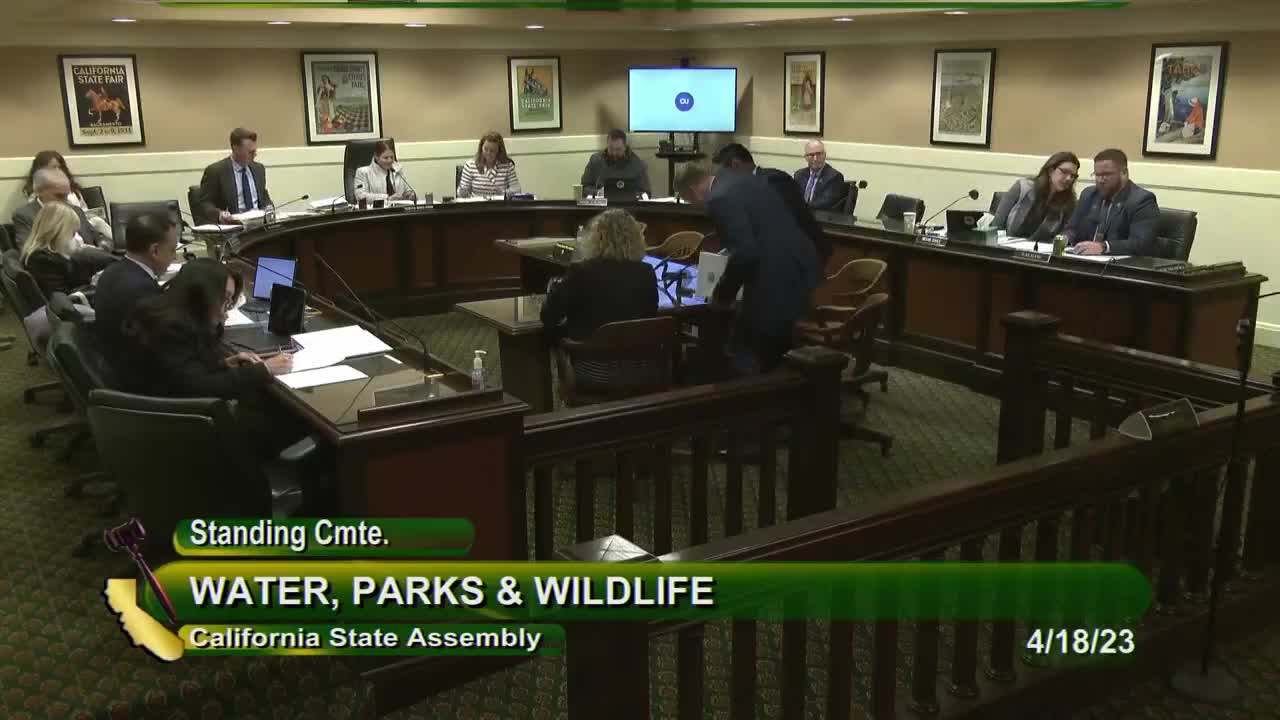 28MIN
Assembly Standing Committee on Water, Parks, and Wildlife
Bill Author

Bill Co-Author(s):
