AB 1669: California Historically Significant Commercial District Act.
- Session Year: 2023-2024
- House: Assembly
- Latest Version Date: 2023-02-17
Current Status:
Failed
(2024-02-01: From committee: Filed with the Chief Clerk pursuant to Joint Rule 56.)
Introduced
In Committee
First Chamber
In Committee
Second Chamber
Enacted
Existing law establishes the California Business Investment Service Program within the Governors Office of Business and Economic Development (GO-Biz) for the purpose of serving employers, corporate executives, business owners, investors, and site location consultants who are considering California for business investment and expansion. Existing law provides that the program is under the authority of the director, who is required, among other things, to work cooperatively with local, regional, federal, and other state public and private marketing institutions, economic developers, workforce training partners, and trade organizations in attracting, retaining, and helping businesses and investments grow and be successful in California.
This bill, upon appropriation by the Legislature, would establish the California Historically Significant District Program for the purpose of revitalizing and maintaining historically and culturally significant commercial corridors throughout the state by funding technical assistance, training, and other activities that increase the capacity of revitalization entities to provide business assistance programs and services that meet the unique needs of small businesses that operate within historic commercial districts. The bill would provide that the program be administered by the California Business Investment Service Unit within GO-Biz, in consultation with the Community and Placed-Based Solutions Unit. The bill would require the program to award grants to eligible grantees, as defined, who submit an application meeting certain requirements, including, among other things, documentation that the applicant has the experience and capacity to provide technical assistance, training, and other services that increase the capacity of revitalization entities to use place-based tools to improve the entrepreneurial ecosystem to meet the needs of small businesses that operate within historic districts. The bill would require training and education topics and uses of the grant by the grantee to include, but not be limited to, among other things, onsite assessment and training of revitalization entities to develop capacity for implementation of commercial district revitalization plans. The bill would require that grant funds be used by the grantee consistent with certain requirements, including that at least 40% of the total amount of the grant be used by the grantee to provide capacity-building programs and services to eligible historic commercial corridor revitalization entities throughout the state, as specified.
The bill would require a grantee, as a condition of receiving the grant, to report on the performance annually. The bill would require that this reporting include, among other things, outcomes from the training and technical assistance provided, including, among other things, the number of training events. The bill would also require a subgrantee to report on program performance quarterly and annually. The bill would require this reporting to include, but not be limited to, quarterly outcomes from the subgrants provided, including, among other things, the number of businesses reached in person. This bill would require a grantee, 6 months following the completion of the grant, to submit a final outcomes report which includes, among other things, a detailed narrative description of how the funds awarded were used to expand the capacity of the statewide network of historic commercial corridor revitalization entities and to help underserved business owners and entrepreneurs within those districts to adapt new, place-based business strategies.
This bill would require a grantee and any subgrantee to provide matching funds of at least one dollar for each dollar of state funds received. The bill would authorize up to 50% of the match to be in the form of in-kind services or resources. The bill would require that grant funding be available to the grantee for a 3-year period. The bill would authorize up to 5% of any program appropriation to be used by the Governors Office of Business and Economic Development for administrative costs, including reporting. The bill would authorize up to 5% of a grant to be used by the grantee for administrative costs related to the organization of the training, technical assistance, and program delivery, including travel and technology.
The bill would authorize the Director of GO-Biz to assign one or more of the duties or authorities provided by this bill to another unit within the office or another state agency. This bill would also make related findings and declarations.
The Legislature finds and declares all of the following:
(a)Small businesses experienced some of the most severe economic impacts from the COVID-19 pandemic, particularly small businesses owned by women, people of color, and other marginalized groups. While it is estimated that over 2,000 businesses in California closed during the early months of the pandemic, new business formation rose dramatically, with California experiencing a 21.7-percent increase in new businesses in 2020. After subsequent years of challenges, including lost revenue, pandemic adaptation, and staffing issues, entrepreneurs in 2023 face slowing economic growth and a possible recession. Supporting existing and new small businesses can bolster Californias economy during this economic downturn, as 48.2 percent of California workers are employed in small businesses, with 88.7 percent of all workers employed in businesses with 20 or fewer employees.
(b)To remediate pandemic impacts, the federal government created resources to support small businesses with a particular focus on expanding opportunity for underserved small businesses and deploying capital. The United States Treasury approved a formula-based award of up to $1,100,000,000 and a performance-based award of up to $200,000,000 in State Small Business Credit Initiative (SSBCI) funds to the State of California. As such, the 202324 fiscal year becomes a particularly important year to redouble efforts to adopt strategic approaches to meet niche small business capital needs. One of the first SSBCI hurdles California faces is having a sufficient number of finance-ready small businesses to meet performance-based awards, which require 49 percent of first tranche funding going to businesses owned by socially and economically disadvantaged individuals (SEDI).
(c)Specific measures are needed to support outreach to small businesses with fewer than 20 employees and SEDI-owned small businesses. Based on Small Business Administration data for businesses participating in the federal Paycheck Protection Program, these businesses cluster in historically significant business corridors, with a 10-percent higher concentration of businesses owned by underrepresented groups in these districts than minority ownership statewide. It is in the states interest to utilize and enhance existing economic and community development capacity to meet the states performance-based goals and accelerate the states draw down of federal SSBCI funds.
(d)Historically significant commercial districts, including Main Streets and cultural districts, are drivers of local economic impact through property and sales tax, private returns on public investment, and the advancement of quality of life. These districts were originally developed as centers of commerce, and they continue to play that role, with specific utility for emerging entrepreneurs and small, local businesses. Local commercial district organizations spur the revitalization of these districts by fostering place-based entrepreneurial ecosystems to power local wealth generation.
(e)Small businesses located within historically significant business districts benefit from tailored, ongoing support to help them adapt their businesses to new economic conditions. Specialized small business technical assistance can build local economic development capacity, activate disinvested community spaces, and fill a missing link in the small business support ecosystem. Support for small businesses, particularly BIPOC-owned and women-owned businesses create a wealth-building path for marginalized groups who are often displaced and priced out from communities in transition which contributes to gentrification.
(f)Locally organized public and private entities committed and designated by their local governments to improve the economic, physical, and social health of their Main Streets and neighborhood districts need additional training and guidance to implement revitalization plans attuned to the current challenges of the marketplace.
(g)California currently offers separate programs to enhance the states cultural districts and individualized technical assistance to small businesses. There is not a program covering Californias Main Street communities, nor a program that links the ongoing work of historic and cultural districts that are providing place-based support for revitalization and maintenance of commercial districts with the existing network of over 100 small business technical assistance providers. Leveraging the preexisting relationships of historic and cultural districts with their small businesses provides a unique opportunity to aggregate potential borrowers and enhance SSBCI deal flow, while also strengthening local commercial corridors.
(h)It is the intent of the Legislature to establish a program within the California Business Investment Service Unit within the Governors Office of Business and Economic Development to expand the capacity of the network of historically and culturally significant commercial district entities, including Main Street communities and cultural districts, to provide place-based support to disadvantaged small business owners.
SEC. 2.Article 4.2 (commencing with Section 12096.540) is added to Chapter 1.6 of Part 2 of Division 3 of Title 2 of the Government Code, to read:4.2.The California Historically Significant Commercial District Act12096.540.This article shall be known, and may be cited, as the California Historically Significant Commercial District Act.
12096.541.For purposes of this article:
(a)Capacity-building services means services that enhance the capacity of historic commercial corridor revitalization entities to design and implement commercial corridor revitalization plans, including, but not limited to:
(1)Onsite assessments of program delivery capacity, deployment of current resources, and opportunities for leveraging other public and private programs to meet small business development needs and improve the overall entrepreneurial ecosystem within the historic commercial corridor.
(2)Training to increase the capacity of revitalization entities to provide small business training, counseling, and assistance that addresses the unique challenges and opportunities of being located within historic commercial corridors.
(3)Training on how to coordinate and partner with other public and private programs to enhance access to these resources for small businesses located in historic commercial corridors, including, but not limited to, the Small Business Technical Assistance Program (Article 7 (commencing with Section 12100.60)) and the State Small Business Credit Initiative.
(b)Commercial district revitalization plan means an economic strategy that includes economic development and small business assistance programs and services implemented by an eligible historic commercial district revitalization entity that includes all of the following:
(1)An assessment of the entrepreneurial ecosystem and prioritization of the needs and opportunities for small business development within the historic commercial district. This shall include specific data and information relative to historically underserved small business owner groups, including the capital needs of businesses owned by socially and economically disadvantaged individuals.
(2)Recommendations, where appropriate, for place-based improvements that are essential for a comprehensive assessment and strategy for the revitalization of the historically significant commercial district.
(3)A set of actions that can be implemented within the next two years by the revitalization entity to address those needs and priorities, including facilitating small business access to other public and private resources that enhance the entrepreneurial ecosystem within the historic commercial corridor. This shall include a specific set of place-based tools and assistance geared toward the needs of historically underserved business owners.
(c)Cultural district means a geographical area that is certified as a state-designated cultural district by the Arts Council to Chapter 9.2 (commencing with Section 8758) of Division 1. The cultural district shall be in active status pursuant to subdivision (c) of Section 8758, as determined by the Arts Council.
(d)Eligible applicant means a statewide nonprofit organization that specializes in the revitalization of historic commercial districts, including Main Street communities, and has the demonstrated ability to provide capacity-building services to eligible historic commercial corridor revitalization entities.
(e)Eligible subgrantee means as an eligible historic commercial district revitalization entity that successfully completes the capacity-building training and has a commercial corridor revitalization plan approved by the grantee, as authorized by this article.
(f)Eligible historic commercial district revitalization entity or revitalization entity means an entity that meets either of the following criteria:
(1)The entity is any of the following:
(A)A cultural district.
(B)A Main Street community.
(C)Interested in, or in the process of, being designated as a cultural district or a Main Street community.
(2)The entity meets both of the following criteria:
(A)The entity is a locally based nonprofit or division of a local government organized to conduct revitalization of a historic commercial district.
(B)The entity has a demonstrated history of conducting revitalization planning activities within a historic commercial district.
(g)Entrepreneurial ecosystem means policies, structures, and approaches to investment that play a role in supporting economic activity and business enterprise throughout the business lifecycle. Entrepreneurial ecosystems are distinct within the range of business development models due to the central role location and the physical environment play within the approach. Place-based entrepreneurial ecosystems refer to the strategic alignment of a variety of public and private efforts, including, but not limited to, education and training, funding and finance, human capital, community culture, and regulatory frameworks.
(h)Historic commercial district and historically and culturally significant commercial corridor mean a geographic area within this state that is a mixed-use, compact, walkable district and characterized by all of the following:
(1)Dense settlement.
(2)Contiguous blocks of zero-lot-line buildings.
(3)Buildings of varied ages.
(4)A predominance of large ground-floor storefront display windows.
(5)Multiple property ownership structures.
(6)Significant public and private capital investment.
(i)Historically underserved business owners mean businesses owned by women, people of color, individuals that identify as LGBTQ, and individuals who qualify as socially and economically disadvantaged individuals as defined in Section 5701(15) of Title 12 of the United States Code, and other business owners that have historically and systematically been disenfranchised from accessing public small business programs.
(j)Main Street community is defined as a public or nonprofit entity formed to support the revitalization and maintenance of a historic commercial district that has demonstrated a commitment to the following:
(1)Broad-based community commitment to the revitalization project, including municipal support.
(2)Inclusive leadership and organizational capacity.
(3)Diversified funding sources and sustainable program operations.
(4)Programming driven by a locally organized commercial district revitalization plan.
(5)Preservation of historic and cultural assets as part of the commercial district revitalization plan.
(6)Quantifiable impact assessment to demonstrate results.
12096.542.(a)Upon appropriation by the Legislature for the purposes of this article, the California Historically Significant Commercial District Program is hereby established for the purpose of revitalizing and maintaining historically and culturally significant commercial corridors throughout the state by funding technical assistance, training, and other activities that increase the capacity of revitalization entities to provide business assistance programs and services that meet the unique needs of small businesses that operate within historic commercial districts. The program shall be administered by the California Business Investment Services Unit within the office, in consultation with the Community and Placed-Based Solutions Unit.
(b)(1)One or more grants shall be awarded to eligible grantees who submit an application meeting the requirements of paragraph (2).
(2)An eligible applicant shall submit an application to the California Business Investment Services Unit that includes all of the following:
(A)Documentation that the applicant has the experience and capacity to provide technical assistance, training, and other services that increase the capacity of revitalization entities to use place-based tools to improve the entrepreneurial ecosystem to meet the needs of small businesses that operate within historic districts.
(B)An outline, including timelines, on how the funding will be used to meet the requirements and purposes of this article.
(C)Documentation that the applicant has the organizational capacity to monitor and report on the use of grant funds, including subgrants to eligible subgrantees.
(D)Other information, as required by the California Business Investment Services Unit.
(3)Training and education topics and uses of the grant by the grantee shall include, but are not limited to, all of the following:
(A)Onsite assessment and training of revitalization entities to develop capacity for implementation of commercial district revitalization plans.
(B)Facilitation of education to revitalization entities to increase local capacity to provide small business training and assistance. Educational topics may include any of the following:
(i)Connectivity to other state and local small business support resources and technical assistance, including, but not limited to, awardees of funds through the Small Business Technical Assistance Program (Article 7 (commencing with Section 12100.60)) and the Accelerate California: Inclusive Innovation Hub Program (Article 6.2 (commencing with Section 12099.1)).
(ii)Community engagement and community wealth-building to mitigate the potential negative impacts of gentrification.
(iii)Any of the following:
(I)Place-based business support services, including online marketing and e-commerce for businesses with physical storefronts.
(II)Enhancing physical environments of small businesses.
(III)Districtwide solutions, including promotions, shared-asset management, and public space activation.
(IV)Other training specific to the needs identified by small businesses within the historic commercial district.
(4)Grant funds shall be used by the grantee consistent with the requirements of this article, including both of the following:
(A)At least 40 percent of the total amount of the grant shall be used to provide capacity-building programs and services to eligible historic commercial corridor revitalization entities throughout the state. The grantee may, subject to limitations set forth in this article, use a portion of these funds to provide staff and other resources that support the grantees ability to organize training, technical assistance, and program expansion to communities interested in commercial corridor revitalization programs.
(B)At least 50 percent of the total amount of the grant shall be used for the provision of subgrants to eligible historic commercial corridor revitalization entities to implement actions in their approved commercial corridor revitalization plan.
(c)(1)The grantee, as a condition of receiving the grant, shall report on the performance annually. Reporting shall include, but not be limited to, outcomes from the training and technical assistance provided, including all of the following:
(A)The number of training events.
(B)The number of participants at training events.
(C)The number of unique community-based revitalization organizations trained.
(D)The number of new community-based revitalization organizations trained.
(E)The number of unique communities counseled.
(F)The number of subgrants awarded.
(G)The number of new or expanded partnerships and collaborations between revitalization entities and other resource providers during the report period. This shall include, but not be limited to, information provided by the subgrantees on other public and private resources that were accessed through the subgrantees activities.
(H)A narrative on how the funding enhanced the existing statewide network of organizations committed to the revitalization of historically significant commercial districts and the underserved small businesses located within these districts.
(I)A summary of the proposed and completed actions identified in the approved commercial corridor revitalization plans. This information shall begin to be reported in the first annual report following the approval of a plan.
(J)An aggregation of information provided by the subgrantees. This information shall begin to be reported in the first annual report following the first submittal of quarterly information from the subgrantees.
(K)Other information required by the office, consistent with this article.
(2)The subgrantees shall report on program performance quarterly and annually. Reporting shall include, but not be limited to, quarterly outcomes from the subgrants provided, including, but not limited to, all of the following:
(A)The number of businesses reached in person.
(B)The number of new businesses located within the commercial district.
(C)The number of hours of business counseling conducted.
(D)The number of referrals to other small business technical assistance providers.
(E)The number of full-time and part-time jobs created.
(F)The number of full-time and part-time jobs retained.
(G)The value of marketing assistance consistent with location in historic commercial district.
(H)The value of new technology adopted.
(I)The number, type, and value of other public and private resources accessed by small businesses through the activities of the subgrantee.
(3)No later than six months following the completion of the grant, the grantee shall submit a final outcomes report that shall include, but not be limited to, a detailed narrative description of how the funds awarded were used to expand the capacity of the statewide network of historic commercial corridor revitalization entities and to help underserved business owners and entrepreneurs within those districts to adapt new, place-based business strategies.
(d)(1)The grantee and any subgrantees shall provide matching funds of at least one dollar for each dollar of state funds received. Up to 50 percent of the match may be in in-kind services or resources.
(2)Grant funding shall be available to the grantee for a three-year period.
(3)Up to 5 percent of any program appropriation may be used by the office for administrative costs, including reporting.
(4)Up to 5 percent of a grant may be used by the grantee for administrative costs related to the organization of the training, technical assistance, and program delivery, including travel and technology.
(e)The Director of the Governors Office of Business and Economic Development may assign one or more of the duties or authorities provided in this article to another unit within the office or another state agency. Should any duties or authorities be assigned pursuant to this subdivision, as a condition of the assignment, all provisions of this article shall apply to the new entity.
REVISIONS: HeadingLine 3.|
Date
|
Status
|
|---|---|
| Feb 1, 2024 | From committee: Filed with the Chief Clerk pursuant to Joint Rule 56. |
| Jan 31, 2024 | Died pursuant to Art. IV, Sec. 10(c) of the Constitution. |
| May 18, 2023 | In committee: Held under submission. |
| May 10, 2023 | In committee: Set, first hearing. Referred to APPR. suspense file. |
| Apr 25, 2023 | From committee: Do pass and re-refer to Com. on APPR. with recommendation: To Consent Calendar. (Ayes 7. Noes 0.) (April 25). Re-referred to Com. on APPR. |
| Apr 11, 2023 | Coauthors revised. |
| Apr 11, 2023 | From committee: Do pass and re-refer to Com. on J., E.D., & E. (Ayes 7. Noes 0.) (April 11). Re-referred to Com. on J., E.D., & E. |
| Mar 9, 2023 | Referred to Coms. on A., E., S., & T. and J., E.D., & E. |
| Feb 18, 2023 | From printer. May be heard in committee March 20. |
| Feb 17, 2023 | Read first time. To print. |
|
Date
|
Description
|
Location
|
Votes
|
|
|---|---|---|---|---|
| Apr 25, 2023 | Do pass and be re-referred to the Committee on [Appropriations] with recommendation: To Consent Calendar | Assembly Standing Committee on Jobs, Economic Development, and the Economy |
Passed |
|
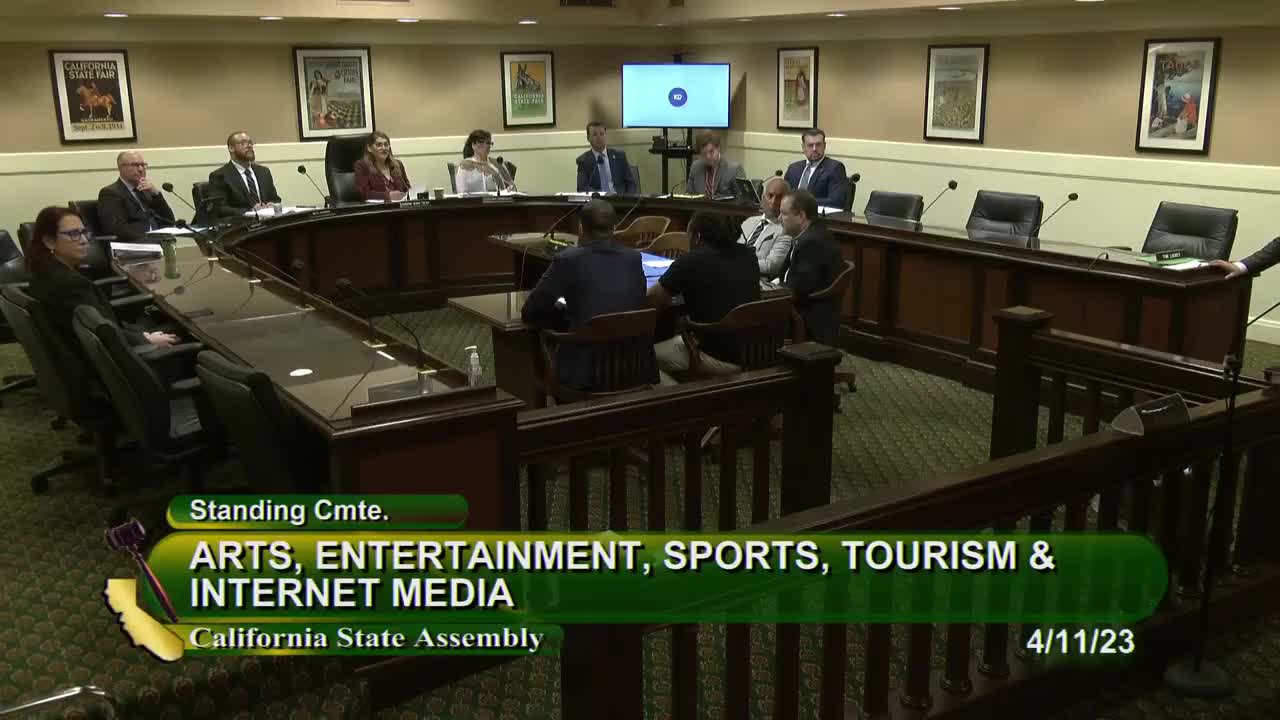
| Apr 11, 2023 | Do pass and be re-referred to the Committee on [Jobs, Economic Development, and the Economy] | Assembly Standing Committee on Arts, Entertainment, Sports, and Tourism |
Passed |
This list shows positions taken on this bill by organizations on the date displayed, which is linked to the original source.
Positions by individuals are not included.
|
Organization
|
Position
|
Date
|
|---|---|---|
| Anaheim Chamber Of Commerce | ** Support | |
| Bellflower City Of | ** Support | |
| California Director for Small Business Majority | * Support | Apr 11, 2023 |
| California Main Street | ** Support | |
| California Main Streets Programs | * Support | Apr 11, 2023 |
| Cameo - California Association for Micro Enterprise Opportunity | ** Support | |
| Cardiff by the Sea Chamber of Commerce | ** Support | |
| Carlsbad Village Business Association | ** Support | |
| City of Bellflower | ** Support | |
| City of Brentwood | ** Support | |
| City Of Livermore | ** Support | |
| Downtown Brentwood Coalition | ** Support | |
| Lisc San Diego | ** Support | |
| Livermore Downtown INC | ** Support | |
| Main Street America | ** Support | |
| Main Street Oceanside, INC. | ** Support | |
| Mainstreet Coronado, Ltd. | ** Support | |
| Making Hope Happen Foundation | ** Support | |
| MicroEnterprise Collaborative of Inland Southern California | ** Support | |
| National Main Street Center | ** Support | |
| Ocean Beach Mainstreet Association | ** Support | |
| Park Street Business Association | ** Support | |
| Redwood Region Economic Development Commission | ** Support | |
| Santa Paula Chamber of Commerce | ** Support | |
| Small Business Majority | ** Support | |
| The Leucadia 101 Main Street Association | ** Support | |
| The Unity Council | ** Support | |
| Uptown Fox, LLC | ** Support | |
| Viva Downtown Redding | ** Support |
Date of Hearing: May 10, 2023
ASSEMBLY COMMITTEE ON APPROPRIATIONS
Chris Holden, Chair
ABPCA Bill Id:AB 1669
Author:(Quirk-Silva) – As Introduced Ver:February 17, 2023
Policy Committee: | Arts, Entertainment, Sports, and Tourism | Vote: | 7 - 0 |
Jobs, Economic Development, and the Economy | 7 - 0 | ||
|
|
Urgency: No State Mandated Local Program: No Reimbursable: No
SUMMARY:
This bill, upon appropriation, establishes the California Historically Significant District Program within the Community-Based Solutions Team at the Governor’s Office of Business and Economic Development (GO-Biz) to provide grants to enhance “historic commercial districts.”
Specifically, the program is to provide grants to entities that provide business services to small businesses within historic commercial districts. The grants are to be awarded to grantees and subgrantees. Specifically, the bill requires at least 40% of grant funds be provided to grantees. To be an eligible grantee, an entity must be a statewide nonprofit organization that specializes in the revitalization of historic commercial districts, such as a “Main Street” community. A grantee is to use its funding to offer historic commercial corridor revitalization entities technical assistance, training, and other assistance related to community revitalization. The bill requires 50% of the total grant amount go to “subgrantees.” To be an eligible subgrantee, an entity must successfully complete a grantee’s training and have a revitalization plan approved by the grantee. Subgrantees are to use grant funds to implement actions in their approved commercial corridor revitalization plan. Grantees and subgrantees are to provide a dollar-for-dollar match for all state funds received. In addition, 5% of any program appropriation may be used by GO-Biz for administrative costs and 5% may be used by a grantee for administrative costs.
Grantees are to annually report on their use of grant funds and subgrantees are to report both quarterly and annually on the use of grant funds. In addition, grantees are to submit a final outcome report following the completion of a grant.
FISCAL EFFECT:
- Ongoing General Fund costs, potentially in the low millions of dollars, to GO-Biz to administer this program. According to GO-Biz, this bill references a team, the Community-Based Solutions Team, which is not permanently established within GO-Biz. In order to permanently establish the team and administer the grant program required by this bill, GO-Biz would need at least 10 positions.
- One-time or ongoing General Fund costs, of an undesignated amount, to fund the grant program established by this bill. Costs could be in the millions of dollars to tens of millions of dollars, depending on the appropriation for the program.
COMMENTS:
- Purpose. According to the California Main Street program, an organization in support of this bill:
Since 1986, [California Main Street program] has provided dedicated assistance to organizations formed to revitalize California’s downtowns and neighborhood commercial corridors. These corridors are places of historical and cultural significance and hubs of small business activity. To thrive in a historically significant commercial corridor, businesses need specific technical assistance and help navigating resources. Further, the entities working to support underserved small businesses in these districts can deepen their impact through training, networks, and funding opportunities. We are pleased to support the California Historically Significant Commercial District Program, which will help Main Street and Cultural district entities to be effective conduits of support and resources for underserved entrepreneurs while activating our state’s historic districts.
- Prior Legislation. AB 2226 (Cervantes), of the 2021-22 Legislative Session, would have required GO-Biz to include the California Main Street Program, cultural districts certified by the California Arts Council, Promise Zones, and Opportunity Zones into the public content GO-Biz provides about place-based and other specified geographically targeted economic development programs. The bill was held in this committee.
AB 742 (Cervantes), of the 2019-20 Legislative Session, would have established a new unit, the Office of Place-Based Economic Strategies, within GO-Biz to assist communities who have been federally designated as Opportunity Zones, Promise Zones, or other geographically targeted economic development areas. The bill was held in this committee.
Analysis Prepared by: Natasha Collins / APPR. / (916) 319-2081
Date of Hearing: April 25, 2023
ASSEMBLY COMMITTEE ON JOBS, ECONOMIC DEVELOPMENT, AND THE ECONOMY
Carlos Villapudua, Chair
ABPCA Bill Id:AB 1669 (
Author:Quirk-Silva) – As Introduced Ver:February 17, 2023
SUBJECT: California Historically Significant Commercial District Act
SUMMARY: This bill would establish the California Historically Significant District Program for the purpose of revitalizing and maintaining historically and culturally significant commercial corridors throughout the state by funding technical assistance, training, and other activities that increase the capacity of revitalization entities to provide business assistance programs and services that meet the unique needs of small businesses that operate within historic commercial districts.
Specifically, this bill:
- The bill would require the program to award grants to eligible grantees, as defined, who submit an application meeting certain requirements, including, among other things, documentation that the applicant has the experience and capacity to provide technical assistance, training, and other services that increase the capacity of revitalization entities to use place-based tools to improve the entrepreneurial ecosystem to meet the needs of small businesses that operate within historic districts.
- The bill would require training and education topics and uses of the grant by the grantee to include, but not be limited to, among other things, onsite assessment and training of revitalization entities to develop capacity for implementation of commercial district revitalization plans.
- The bill would require that grant funds be used by the grantee consistent with certain requirements, including that at least 40% of the total amount of the grant be used by the grantee to provide capacity-building programs and services to eligible historic commercial corridor revitalization entities throughout the state, as specified.
- The bill would require a grantee, as a condition of receiving the grant, to report on the performance annually.
- The bill would require that this reporting include, among other things, outcomes from the training and technical assistance provided, including, among other things, the number of training events.
- The bill would also require a subgrantee to report on program performance quarterly and annually. The bill would require this reporting to include, but not be limited to, quarterly outcomes from the subgrants provided, including, among other things, the number of businesses reached in person.
- This bill would require a grantee, 6 months following the completion of the grant, to submit a final outcomes report which includes, among other things, a detailed narrative description of how the funds awarded were used to expand the capacity of the statewide network of historic commercial corridor revitalization entities and to help underserved business owners and entrepreneurs within those districts to adapt new, place-based business strategies.
- This bill would require a grantee and any subgrantee to provide matching funds of at least one dollar for each dollar of state funds received.
EXISTING LAW:
- Existing law establishes the California Business Investment Service Program within the Governor’s Office of Business and Economic Development (GO-Biz) for the purpose of serving employers, corporate executives, business owners, investors, and site location consultants who are considering California for business investment and expansion.
- Existing law provides that the program is under the authority of the director, who is required, among other things, to work cooperatively with local, regional, federal, and other state public and private marketing institutions, economic developers, workforce training partners, and trade organizations in attracting, retaining, and helping businesses and investments grow and be successful in California.
FISCAL EFFECT: This bill is expected to have an anticipated cost.
COMMENTS:
The California Historically Significant Commercial District Program (CHSCD Program) would fund a comprehensive technical assistance program for Main Street communities, Cultural Districts, and other areas interested in enhancing the viability of their commercial neighborhoods.
• The CHSCD will be administered by the Governor’s Office of Business and Economic Development.
Investments in Historically/Culturally Significant Commercial Districts and underserved small businesses create resilient local economies.
• Underserved small businesses continue to face the impacts of the pandemic and a slowing economy. Assisting these small businesses is key to the state’s continued economic growth and deployment of over $1 billion in federal funds received by California through the State Small Business Credit Initiative (SSBCI).
• SEDI-owned small businesses cluster in Historically Significant Commercial Districts. Most commercial districts are home to 100+ local businesses and support thousands of jobs in diverse industry sectors. AB 1669 benefits these businesses by providing them with access to enhanced place-based technical assistance which enables them to more successfully respond to economic shifts and consumer trends.
• Historically/Culturally Significant Commercial Districts are drivers of local economic impact through higher property and sales tax revenues, private returns on public investment, and enhancement in the area's quality of life. These districts serve as hubs of cultural, economic, and social life.
• Capacity building support for commercial district revitalization organizations will create thriving entrepreneurial ecosystems. These local organizations need targeted and updated training, assessment, and technical assistance to successfully leverage the unique value of historic and cultural districts into thriving commercial districts. Expanding support for the network of these organizations will fill a gap in California’s economic development toolbox.
Primary Objectives of the CHSCD Initiative
1. Strengthen and expand current statewide efforts to revitalize historically/culturally significant commercial districts.
2. Support SEDI-owned small businesses located in historic/cultural commercial districts with place-based tools and other resources, including SSBCI capital.
Deployment of Capacity-Building Funds
CHSCD Program funds will be deployed in two ways:
• A grant to an experienced nonprofit to train and mentor local organizations managing historic/culturally significant commercial corridors in California.
• Subgrants to local organizations that complete the training and who commit to using the funds to assist SEDI-owned small businesses.
The grantee and any subgrantees will provide a 100% match, cash or in-kind, to state funding.
REGISTERED SUPPORT / OPPOSITION:
Support
Anaheim Chamber of Commerce
Bellflower; City of
California Main Street
Cameo - California Association for Micro Enterprise Opportunity
Cardiff by The Sea Chamber of Commerce
Carlsbad Village Business Association
City of Bellflower
City of Brentwood
City of Livermore
Downtown Brentwood Coalition
Livermore Downtown INC
Main Street Oceanside, INC.
Mainstreet Coronado, Ltd.
Making Hope Happen Foundation
Microenterprise Collaborative of Inland Southern California
National Main Street Center
Ocean Beach Mainstreet Association
Park Street Business Association
Redwood Region Economic Development Commission
Small Business Majority
The Leucadia 101 Main Street Association
The Unity Council
Uptown Fox, LLC
Viva Downtown Redding
Opposition
None on file
Analysis Prepared by: Carla Castilla / J., E.D., & E. / (916) 319-2090
Date of Hearing: April 11, 2023
ASSEMBLY COMMITTEE ON ARTS, ENTERTAINMENT, SPORTS, AND TOURISM
Sharon Quirk-Silva, Chair
ABPCA Bill Id:AB 1669 (
Author:Quirk-Silva) – As Introduced Ver:February 17, 2023
SUBJECT: California Historically Significant Commercial District Act
SUMMARY: Authorize the establishment of the California Historically Significant Commercial District Program to fund a comprehensive technical assistance program for Main Street communities, Cultural Districts, and other areas interested in enhancing the viability and resiliency of their commercial neighborhoods.
Specifically, this bill:
- Upon appropriation by the Legislature, establishes the California Historically Significant Commercial District Program for the purpose of revitalizing and maintaining historically and culturally significant commercial corridors throughout the state by funding technical assistance, training, and other activities that increase the capacity of revitalization entities to provide business assistance programs and services that meet the unique needs of small businesses that operate within historic commercial districts.
- Requires the program to be administered by the California Business Investment Services Unit within the Governor’s Office of Business and Economic Development (GO-Biz), in consultation with the Community and Placed-Based Solutions Unit.
- Defines “historic commercial district” and “historically and culturally significant commercial corridor” to mean a geographic area within this state that is a mixed-use, compact, walkable district and characterized by all of the following:
- Dense settlement.
- Contiguous blocks of zero-lot-line buildings.
- Buildings of varied ages.
- A predominance of large ground-floor storefront display windows.
- Multiple property ownership structures.
- Significant public and private capital investment.
- Defines “Main Street community” as a public or nonprofit entity formed to support the revitalization and maintenance of a historic commercial district that has demonstrated a commitment to the following:
- Broad-based community commitment to the revitalization project, including municipal support.
- Inclusive leadership and organizational capacity.
- Diversified funding sources and sustainable program operations.
- Programming driven by a locally organized commercial district revitalization plan.
- Preservation of historic and cultural assets as part of the commercial district revitalization plan.
- Quantifiable impact assessment to demonstrate results.
- Defines “Cultural district” to mean a geographical area that is certified as a state-designated cultural district by the California Arts Council.
- Defines “Capacity-building services” to mean services that enhance the capacity of historic commercial corridor revitalization entities to design and implement commercial corridor revitalization plans, including, but not limited to:
- Onsite assessments of program delivery capacity, deployment of current resources, and opportunities for leveraging other public and private programs to meet small business development needs and improve the overall entrepreneurial ecosystem within the historic commercial corridor.
- Training to increase the capacity of revitalization entities to provide small business training, counseling, and assistance that addresses the unique challenges and opportunities of being located within historic commercial corridors.
- Training on how to coordinate and partner with other public and private programs to enhance access to these resources for small businesses located in historic commercial corridors, including, but not limited to, the Small Business Technical Assistance Program and the State Small Business Credit Initiative.
- Requires the program to award grants to eligible statewide nonprofit organizations that specializes in the revitalization of historic commercial districts, including Main Street communities, and have the demonstrated ability to provide capacity-building services to eligible historic commercial corridor revitalization entities. Applications for the grants are required to include all of the following:
- Documentation that the applicant has the experience and capacity to provide technical assistance, training, and other services that increase the capacity of revitalization entities to use place-based tools to improve the entrepreneurial ecosystem to meet the needs of small businesses that operate within historic districts.
- An outline, including timelines, on how the funding will be used to meet the requirements and purposes of this article.
- Documentation that the applicant has the organizational capacity to monitor and report on the use of grant funds, including subgrants to eligible subgrantees.
- Other information, as required by the California Business Investment Services Unit.
- Requires grantees to report annually on the performance and outcomes from the training and technical assistance provided, the number of training events, and six months following the completion of the grant to submit a final outcomes report which includes, among other things, a detailed narrative description of how the funds awarded were used to expand the capacity of the statewide network of historic commercial corridor revitalization entities and to help underserved business owners and entrepreneurs within those districts to adapt new, place-based business strategies.
- Provides additional conditions and requirements on the use of grant funds, including that grantees and any subgrantees will provide matching funds of at least one dollar for each dollar of state funds received. Up to 50 percent of the match may be in in-kind services or resources.
EXISTING LAW:
- Establishes GO-Biz to serve the Governor as the lead entity for economic strategy and the marketing of California on issues relating to business development, private sector investment, international trade, and economic growth. Among other duties, GO-Biz is authorized to make recommendations to the Governor and Legislature on new state policies, programs, and actions, or amendments to existing programs to advance statewide economic goals, respond to emerging economic problems, and ensure that state policies and programs conform to the state’s economic and business development goals. (Government Code (GOV) Section 12096-12100.110)
- Establishes the California Business Investment Services Program within GO-Biz to serve business owners, employers, corporate executives, investors, and site location consultants who are considering California for business investment and expansion. (GOV 12096.5)
- Requires GO-Biz to work cooperatively with local, regional, federal, and other public and private marketing institutions, economic developers, workforce training partners, and trade organizations in attracting, retaining, and helping businesses and investments grow and be successful in California.
- Requires GO-Biz, to encourage activities that support the upward mobility of existing small businesses and residents.
- Requires GO-Biz to work with partners and other stakeholders to moderate the impacts of gentrification that may lead to the displacement of residents and small businesses.
- Finds and declares that small businesses form the core of the California economy and that it is in the interest of the state to increase opportunities and improve access to business and technical resources for entrepreneurs, the self-employed, and microbusiness and small business owners, particularly underserved business groups, including women, minority, and veteran-owned businesses, and businesses in low-wealth, rural, and disaster-impacted communities. (GOV 12100.61)
- Establishes the California Main Street Program within the State Office of Historic Preservation and requires the program, upon sufficient funding being available, to provide technical assistance and training to governments of small cities, business organizations, merchants, and property owners to accomplish community and economic revitalization and development of older central and historic business districts and neighborhoods. (Public Resources Code (PRC) Section 5079.70-5079.74)
- Authorizes the California Arts Council to establish criteria and guidelines for certifying state-designated cultural districts for five years. A district is authorized to renew certification every three years. (GOV 8758)
- In executing its powers and duties under this chapter, the council shall do all of the following:
- Establish a competitive application system by which a community may apply for certification as a state-designated cultural district.
- Provide technical assistance for state-designated cultural districts from, among others, artists who have experience with cultural districts and provide promotional support for state-designated cultural districts.
- Collaborate with other public agencies and private entities to maximize the benefits of state-designated cultural districts.
- Authorizes the California Arts Council to solicit and receive gifts, donations, bequests, grants of funds, or any other revenues, from public or private sources and expend those moneys, upon appropriation by the Legislature, for a state-designated cultural district program, as specified. (GOV 8753)
- Defines a “state-designated cultural district” to mean a geographical area certified pursuant to this chapter with a concentration of cultural facilities, creative enterprises, or art venues that does any of the following: (GOV 8758)
- Attracts artists, creative entrepreneurs, and cultural enterprises.
- Encourages economic development and supports entrepreneurship in the creative community.
- Encourages preserving and reusing of historic buildings and other artistic and culturally significant structures.
- Fosters local cultural development.
- Provides a focal point for celebrating and strengthening the community’s unique cultural identity.
- Promotes opportunity without generating displacement or expanding inequality.
- In executing its powers and duties under this chapter, the council shall do all of the following:
FISCAL EFFECT: Unknown. This measure has been keyed fiscal by the Legislative Counsel.
COMMENTS:
- Author’s Statement. According to the author, “At the heart of California’s communities, historically and culturally significant commercial corridors are places where diverse small businesses can thrive. We recognize that these businesses face specific challenges to succeed. Through place-based strategies and tailored support services, we can help local small businesses grow and connect to broader networks of support.”
- Background. Historically significant commercial districts are essential for small business activity, housing diverse industries, and fostering new start-up businesses. Business ownership within these districts is also diverse: 36% of owners in Main Street districts are racial minorities, compared to 27% ownership statewide.
However, entrepreneurs within these districts face unique challenges in launching, marketing, and scaling their businesses. Place-based techniques and innovative technologies can help transform these challenges into resilient business opportunities.
California currently supports cultural districts, in general, and small businesses, individually. The program provides services that fill a key gap in the state’s entrepreneurial support system for the revitalization of commercial districts that are also places of historical significance and incubators of small businesses and economic activity.
- California Main Street Program. The Office of the Historical Preservation, led by the State Historic Preservation Officer, plays a vital role in preserving historic and cultural resources in California. One component of their activities is assisting local communities in integrating preservation into the broader context of overall community land-use planning and economic development activities.
The Office of Historic Preservation is statutorily tasked, pending receipt of funding, with overseeing the California Main Street Program, which provides technical assistance and training for governments of small cities, business organizations, merchants, and property owners to help them successfully undertake community and economic revitalization and development of older central and historic business districts and neighborhoods. Due to budgetary constraints, the Office currently has limited capacity to provide local assistance. Where possible, however, the Office of Historic Preservation co-sponsors conferences and other training opportunities.
At the core of the Main Street Program is the “Main Street Approach” which combines community and economic development with historic preservation and cultural respect. The Main Street Approach is a comprehensive and integrated framework communities can use to identify their assets, competitive advantages, and build from those strengths. The Main Street Approach is organized around four pillars from which communities create their own transformational strategies. Those four pillars include economic vitality, design, promotion, and organization.
There are 31 California Main Street communities who are members of the California Main Street Alliance, including: Arcata, Bellflower, Benicia, Brentwood, Cardiff-by-the-Sea, Carlsbad, Chico, Coachella, Coronado, East Oakland, Encinitas, Eureka, Fremont, Fruitvale Village (Oakland), Grass Valley, Gilroy, Hanford, Hollister, Leucadia, Livermore, Mariposa, Martinez, Oakley, Ocean Beach (San Diego), Oceanside, Paso Robles, Pleasanton, Redding, Richmond, San Luis Obispo, and San Jacinto.
- Impacts of COVID-19. Small businesses experienced some of the most severe economic impacts from the COVID-19 pandemic, particularly small businesses owned by women, people of color, and other marginalized groups.
- While it is estimated that over 2,000 businesses in California closed during the early months of the pandemic, new business formation rose dramatically, with California experiencing a 21.7% increase in new businesses in 2020.
- After subsequent years of challenges including lost revenue, pandemic adaptation, and staffing issues, entrepreneurs in 2023 face slowing economic growth and possible recession.
- Supporting existing and new small businesses can bolster California’s economy during this economic downturn, as 48.2% of California workers are employed in small businesses, with 88.7% of all workers employed in businesses with 20 or fewer employees.
To remediate pandemic impacts, the federal government approved billions of new infrastructure spending and created new resources to support small businesses focusing on expanding opportunities for underserved small businesses and deploying capital.
- The US Treasury approved a formula-based award to California of up to $1.1 billion and a performance-based award of up to $200 million in State Small Business Credit Initiative (SSBCI) funds.
- Given these uncertain economic times with rising interest rates and energy costs, California should leverage these federal dollars to help sustain local economies.
- One of the first SSBCI hurdles California faces is having a sufficient number of finance-ready small businesses to access the performance-based awards, which requires 49% of first-tranche funding to go to businesses owned by socially and economically disadvantaged individuals (SEDI).
- Arguments in support. According to the bill’s sponsor, the California Main Street Association (CAMS), “Since 1986, CAMS has provided dedicated assistance to organizations formed to revitalize California’s downtowns and neighborhood commercial corridors. These corridors are places of historical and cultural significance and hubs of small business activity. To thrive in a historically significant commercial corridor, businesses need specific technical assistance and help navigating resources. Further, the entities working to support underserved small businesses in these districts can deepen their impact through training, networks, and funding opportunities. We are pleased to support the California Historically Significant Commercial District Program, which will help Main Street and Cultural district entities to be effective conduits of support and resources for underserved entrepreneurs while activating our state’s historic districts.”
- Double-referral. Should this bill pass out of this committee, it will be re-referred to the Assembly Committee on Jobs, Economic Development, and the Economy.
- Prior and related legislation:
- AB 2226 (Cervantes), of 2022, would have required GO-Biz to include the California Main Street Program, cultural districts certified by the California Arts Council, Promise Zones, and Opportunity Zones into the public content GO-Biz provides about place-based and other specified geographically targeted economic development programs. (Status: The bill was held in the Assembly Committee on Appropriations.)
- AB 742 (Cervantes), of 2019, would have established a new unit, the Office of Place-Based Economic Strategies, within GO-Biz to assist communities who have been federally designated as Opportunity Zones, Promise Zones, or other geographically targeted economic development areas. (Status: The bill was held in the Assembly Committee on Appropriations.)
- SB 635 (Hueso), Chapter 888, Statutes of 2018, authorized GO-Biz to develop and post information on its website, as well as undertake other outreach activities, which support Promise Zones and Opportunity Zones, as specified. The bill also required GO-Biz to convene representatives from various state and federal programs to discuss how California can leverage the federal Promise Zones or Opportunity Zones to meet state and local community and economic development needs, as specified.
- AB 1178 (Bocanegra), of 2014, would have established the California Promise Neighborhood Initiative to develop a system of 40 promise neighborhoods throughout California to support children's development from cradle to career. (Status: The bill was held in the Assembly Committee on Appropriations.)
REGISTERED SUPPORT / OPPOSITION:
Support
California Main Street
Cameo - California Association for Micro Enterprise Opportunity
Cardiff by the Sea Chamber of Commerce
City of Bellflower
City of Brentwood
City of Livermore
Lisc San Diego
Livermore Downtown INC
Main Street America
Main Street Oceanside, INC.
Making Hope Happen Foundation
Microenterprise Collaborative of Inland Southern California
National Main Street Center
Ocean Beach Mainstreet Association
Santa Paula Chamber of Commerce
The Leucadia 101 Main Street Association
The Unity Council
Uptown Fox, LLC
Viva Downtown Redding
Opposition
There is no opposition on file.
Analysis Prepared by: Brian Anderson / A.,E.,S., & T. / (916) 319-3450
Discussed in Hearing
 9MIN
Assembly Standing Committee on Arts, Entertainment, Sports, and Tourism
Bill Author


