AB 1684: Local ordinances: fines and penalties: cannabis.
- Session Year: 2023-2024
- House: Assembly
- Latest Version Date: 2023-10-08
Current Status:
Passed
(2023-10-08: Chaptered by Secretary of State - Chapter 477, Statutes of 2023.)
Introduced
In Committee
First Chamber
In Committee
Second Chamber
Enacted
Existing law authorizes the legislative body of a local agency, as defined, to make, by ordinance, any violation of an ordinance subject to an administrative fine or penalty, as specified. Existing law requires the ordinance adopted by the local agency to provide for a reasonable period of time, as specified in the ordinance, for a person responsible for a continuing violation to correct or otherwise remedy the violation prior to the imposition of administrative fines or penalties, when the violation pertains to building, plumbing, electrical, or other similar structural or zoning issues that do not create an immediate danger to health or safety. Existing law authorizes the ordinance to provide for the immediate imposition of administrative fines or penalties for the violation of building, plumbing, electrical, or other similar structural, health and safety, or zoning requirements if the violation exists as a result of, or to facilitate, the illegal cultivation of cannabis, except as specified.
This bill would expand the authorization for an ordinance providing for the immediate imposition of administrative fines or penalties to include all unlicensed commercial cannabis activity, including cultivation, manufacturing, processing, distribution, or retail sale of cannabis, and would authorize the ordinance to declare unlicensed commercial cannabis activity a public nuisance. The bill would prohibit the ordinance from imposing an administrative fine or penalty exceeding $1,000 per violation or $10,000 per day. The bill would authorize the ordinance to impose the administrative fine or penalty on the property owner and each owner of the occupant business entity engaging in unlicensed commercial cannabis activity and to hold them jointly and severally liable. The bill would authorize a local agency that adopts an ordinance authorized by this provision to refer a case involving unlicensed commercial cannabis activity to the Attorney General, as specified.
Existing law authorizes the legislative body of a local agency, as defined, to make, by ordinance, any violation of an ordinance subject to an administrative fine or penalty, as specified. Existing law requires the ordinance adopted by the local agency to provide for a reasonable period of time, as specified in the ordinance, for a person responsible for a continuing violation to correct or otherwise remedy the violation prior to the imposition of administrative fines or penalties, when the violation pertains to building, plumbing, electrical, or other similar structural or zoning issues that do not create an immediate danger to health or safety. Existing law authorizes the ordinance to provide for the immediate imposition of administrative fines or penalties for the violation of building, plumbing, electrical, or other similar structural, health and safety, or zoning requirements if the violation exists as a result of, or to facilitate, the illegal cultivation of cannabis, except as specified.
This bill would expand the authorization for an ordinance providing for the immediate imposition of administrative fines or penalties to include all unlicensed commercial cannabis activity, including cultivation, manufacturing, processing, distribution, or retail sale and would authorize the ordinance to declare unlicensed commercial cannabis activity a public nuisance. The bill would prohibit the ordinance from imposing an administrative fine or penalty exceeding $1,000 per violation or $10,000 per day. The bill would authorize the ordinance to impose the administrative fine or penalty on the property owner and each owner of the occupant business entity and to hold them jointly and severally liable. The bill would authorize a local agency that adopts an ordinance authorized by this provision to refer a case involving unlawful unlicensed commercial cannabis activity to the Attorney General, as specified.
Existing law authorizes the legislative body of a local agency, as defined, to make, by ordinance, any violation of an ordinance subject to an administrative fine or penalty, as specified. Existing law requires the ordinance adopted by the local agency to provide for a reasonable period of time, as specified in the ordinance, for a person responsible for a continuing violation to correct or otherwise remedy the violation prior to the imposition of administrative fines or penalties, when the violation pertains to building, plumbing, electrical, or other similar structural or zoning issues that do not create an immediate danger to health or safety. Existing law authorizes the ordinance to provide for the immediate imposition of administrative fines or penalties for the violation of building, plumbing, electrical, or other similar structural, health and safety, or zoning requirements if the violation exists as a result of, or to facilitate, the illegal cultivation of cannabis, except as specified.
This bill would expand the authorization for an ordinance providing for the immediate imposition of administrative fines or penalties to include all unlicensed commercial cannabis activity, including cultivation, manufacturing, processing, distribution, or retail sale and would authorize the ordinance to declare unlicensed commercial cannabis activity a public nuisance. The bill would prohibit the ordinance from imposing an administrative fine or penalty exceeding $1,000 per violation or $10,000 per day. The bill would authorize the ordinance to impose the administrative fine or penalty on the property owner and each owner of the occupant business entity and to hold them jointly and severally liable. The bill would authorize a local agency that adopts an ordinance authorized by this provision to refer a case involving unlawful commercial cannabis activity to the Attorney General, as specified.
Existing law, the California Safe Drinking Water Act, provides for the operation of public water systems, as defined, and imposes on the State Water Resources Control Board various responsibilities and duties. The act prohibits a person from operating a public water system without a permit from the state board. The act exempts from its provisions a public water system that meets specified conditions, including, but not limited to, a public water system that obtains all of its water from, but is not owned or operated by, a public water system subject to the act. This bill would make nonsubstantive changes to the provision exempting certain public water systems from the act.Existing law, the California Safe Drinking Water Act, provides for the operation of public water systems, as defined, and imposes on the State Water Resources Control Board various responsibilities and duties. The act prohibits a person from operating a public water system without a permit from the state board. The act exempts from its provisions a public water system that meets specified conditions, including, but not limited to, a public water system that obtains all of its water from, but is not owned or operated by, a public water system subject to the act.
This bill would make nonsubstantive changes to the provision exempting certain public water systems from the act.
(a)(1)The legislative body of a local agency, as the term local agency is defined in Section 54951, may by ordinance make any violation of any ordinance enacted by the local agency subject to an administrative fine or penalty. The local agency shall set forth by ordinance the administrative procedures that shall govern the imposition, enforcement, collection, and administrative review by the local agency of those administrative fines or penalties. Where the violation would otherwise be an infraction, the administrative fine or penalty shall not exceed the maximum fine or penalty amounts for infractions set forth in Section 25132 and subdivision (b) of Section 36900.
(2)(A)The administrative procedures set forth by ordinance adopted by the local agency pursuant to this subdivision shall provide for a reasonable period of time, as specified in the ordinance, for a person responsible for a continuing violation to correct or otherwise remedy the violation prior to the imposition of administrative fines or penalties, when the violation pertains to building, plumbing, electrical, or other similar structural or zoning issues, that do not create an immediate danger to health or safety.
(B)Notwithstanding subparagraph (A), the ordinance adopted by the local agency pursuant to this subdivision may declare commercial cannabis activity undertaken without a license as required by Division 10 (commencing with Section 26000) of the Business and Professions Code to be a public nuisance and provide for the immediate imposition of administrative fines or penalties for the violation of local zoning restrictions or building, plumbing, electrical, or other similar structural, or health and safety requirements if the violation exists as a result of, or to facilitate, the unlicensed cultivation, manufacturing, processing, distribution, or retail sale of cannabis for which a license is required. This subparagraph shall not be construed to apply to cannabis cultivation or activity that is lawfully undertaken pursuant to Section 11362.1 or 11362.5 of the Health and Safety Code, to commercial cannabis activity undertaken pursuant to a license under Division 10 (commencing with Section 26000) of the Business and Professions Code and applicable state regulations, or to a person exempt from licensure pursuant to Section 26033 of the Business and Professions Code.
(C)If a local agency adopts an ordinance that provides for the immediate imposition of administrative fines or penalties as allowed in subparagraph (B), that ordinance may impose the administrative fines and penalties upon the property owner and upon each owner of the occupant business entity engaging in unlicensed commercial cannabis activity and may hold them jointly and severally liable for the administrative fines and penalties.
(D)Administrative fines or penalties that are immediately imposed pursuant to an ordinance adopted under subparagraph (B) shall not exceed one thousand dollars ($1,000) per violation and shall not exceed ten thousand dollars ($10,000) per day. This subparagraph shall not be construed to limit the immediate imposition of larger fines that are otherwise authorized by applicable law and shall not be construed to limit administrative fines or penalties that are imposed after notice and a reasonable time to correct pursuant to subparagraph (A).
(E)An ordinance adopted pursuant to subparagraph (B) shall provide for a reasonable period of time for the correction or remedy of the violation prior to the imposition of administrative fines or penalties as required in subparagraph (A) if all of the following are true:
(i)A tenant is in possession of the property that is the subject of the administrative action.
(ii)The rental property owner or agent can provide evidence that the rental or lease agreement prohibits the commercial cannabis activity.
(iii)The rental property owner or agent did not know the tenant was engaging in unlicensed commercial cannabis activity for which a license was required and no complaint, property inspection, or other information caused the rental property owner or agent to have actual notice of the unlicensed commercial cannabis activity.
(F)A local agency that passes an ordinance pursuant to subparagraph (B) may refer cases involving unlicensed commercial cannabis activity to the Attorney General to undertake civil enforcement action pursuant to Chapter 5 (commencing with Section 17200) of Part 2 of Division 7 of, or Section 26038 of, the Business and Professions Code or any other applicable law.
(b)(1)Notwithstanding Section 1094.5 or 1094.6 of the Code of Civil Procedure, within 20 days after service of the final administrative order or decision of the local agency is made pursuant to an ordinance enacted in accordance with this section regarding the imposition, enforcement, or collection of the administrative fines or penalties, a person contesting that final administrative order or decision may seek review by filing an appeal to be heard by the superior court, where the same shall be heard de novo, except that the contents of the local agencys file in the case shall be received in evidence. A proceeding under this subdivision is a limited civil case. A copy of the document or instrument of the local agency providing notice of the violation and imposition of the administrative fine or penalty shall be admitted into evidence as prima facie evidence of the facts stated therein. A copy of the notice of appeal shall be served in person or by first-class mail upon the local agency by the contestant.
(2)The fee for filing the notice of appeal shall be as specified in Section 70615. The court shall request that the local agencys file on the case be forwarded to the court, to be received within 15 days of the request. The court shall retain the fee specified in Section 70615 regardless of the outcome of the appeal. If the court finds in favor of the contestant, the amount of the fee shall be reimbursed to the contestant by the local agency. Any deposit of the fine or penalty shall be refunded by the local agency in accordance with the judgment of the court.
(3)The conduct of the appeal under this section is a subordinate judicial duty that may be performed by traffic trial commissioners and other subordinate judicial officials at the direction of the presiding judge of the court.
(c)If no notice of appeal of the local agencys final administrative order or decision is filed within the period set forth in this section, the order or decision shall be deemed confirmed.
(d)If the fine or penalty has not been deposited and the decision of the court is against the contestant, the local agency may proceed to collect the penalty pursuant to the procedures set forth in its ordinance.
(a)(1)The legislative body of a local agency, as the term local agency is defined in Section 54951, may by ordinance make any violation of any ordinance enacted by the local agency subject to an administrative fine or penalty. The local agency shall set forth by ordinance the administrative procedures that shall govern the imposition, enforcement, collection, and administrative review by the local agency of those administrative fines or penalties. Where the violation would otherwise be an infraction, the administrative fine or penalty shall not exceed the maximum fine or penalty amounts for infractions set forth in Section 25132 and subdivision (b) of Section 36900.
(2)(A)The administrative procedures set forth by ordinance adopted by the local agency pursuant to this subdivision shall provide for a reasonable period of time, as specified in the ordinance, for a person responsible for a continuing violation to correct or otherwise remedy the violation prior to the imposition of administrative fines or penalties, when the violation pertains to building, plumbing, electrical, or other similar structural or zoning issues, that do not create an immediate danger to health or safety.
(B)Notwithstanding subparagraph (A), the ordinance adopted by the local agency pursuant to this subdivision may declare commercial cannabis activity undertaken without a license as required by Division 10 (commencing with Section 26000) of the Business and Professions Code to be a public nuisance and provide for the immediate imposition of administrative fines or penalties for the violation of local zoning restrictions or building, plumbing, electrical, or other similar structural, or health and safety requirements if the violation exists as a result of, or to facilitate, the unlicensed cultivation, manufacturing, processing, distribution, or retail sale of cannabis. cannabis for which a license is required. This subparagraph shall not be construed to apply to cannabis cultivation or activity that is lawfully undertaken pursuant to Section 11362.1 or 11362.5 of the Health and Safety Code or Code, to commercial cannabis activity undertaken pursuant to a license under Division 10 (commencing with Section 26000) of the Business and Professions Code and applicable state regulations. regulations, or to a person exempt from licensure pursuant to Section 26033 of the Business and Professions Code.
(C)If a local agency adopts an ordinance that provides for the immediate imposition of administrative fines or penalties as allowed in subparagraph (B), that ordinance may impose the administrative fines and penalties upon the property owner and upon each owner of the occupant business entity engaging in unlicensed commercial cannabis activity and may hold them jointly and severally liable for the administrative fines and penalties.
(D)Administrative fines or penalties that are immediately imposed pursuant to an ordinance adopted under subparagraph (B) shall not exceed one thousand dollars ($1,000) per violation and shall not exceed ten thousand dollars ($10,000) per day. This subparagraph shall not be construed to limit the immediate imposition of larger fines that are otherwise authorized by applicable law and shall not be construed to limit administrative fines or penalties that are imposed after notice and a reasonable time to correct pursuant to subparagraph (A).
(E)An ordinance adopted pursuant to subparagraph (B) shall provide for a reasonable period of time for the correction or remedy of the violation prior to the imposition of administrative fines or penalties as required in subparagraph (A) if all of the following are true:
(i)A tenant is in possession of the property that is the subject of the administrative action.
(ii)The rental property owner or agent can provide evidence that the rental or lease agreement prohibits the commercial cannabis activity.
(iii)The rental property owner or agent did not know the tenant was illegally engaging in unlicensed commercial cannabis activity for which a license was required and no complaint, property inspection, or other information caused the rental property owner or agent to have actual notice of the unlicensed commercial cannabis activity.
(F)A local agency that passes an ordinance pursuant to subparagraph (B) may refer cases involving unlicensed commercial cannabis activity to the Attorney General to undertake civil enforcement action pursuant to Chapter 5 (commencing with Section 17200) of Part 2 of Division 7 of, or Section 26038 of, the Business and Professions Code or any other applicable law.
(b)(1)Notwithstanding Section 1094.5 or 1094.6 of the Code of Civil Procedure, within 20 days after service of the final administrative order or decision of the local agency is made pursuant to an ordinance enacted in accordance with this section regarding the imposition, enforcement, or collection of the administrative fines or penalties, a person contesting that final administrative order or decision may seek review by filing an appeal to be heard by the superior court, where the same shall be heard de novo, except that the contents of the local agencys file in the case shall be received in evidence. A proceeding under this subdivision is a limited civil case. A copy of the document or instrument of the local agency providing notice of the violation and imposition of the administrative fine or penalty shall be admitted into evidence as prima facie evidence of the facts stated therein. A copy of the notice of appeal shall be served in person or by first-class mail upon the local agency by the contestant.
(2)The fee for filing the notice of appeal shall be as specified in Section 70615. The court shall request that the local agencys file on the case be forwarded to the court, to be received within 15 days of the request. The court shall retain the fee specified in Section 70615 regardless of the outcome of the appeal. If the court finds in favor of the contestant, the amount of the fee shall be reimbursed to the contestant by the local agency. Any deposit of the fine or penalty shall be refunded by the local agency in accordance with the judgment of the court.
(3)The conduct of the appeal under this section is a subordinate judicial duty that may be performed by traffic trial commissioners and other subordinate judicial officials at the direction of the presiding judge of the court.
(c)If no notice of appeal of the local agencys final administrative order or decision is filed within the period set forth in this section, the order or decision shall be deemed confirmed.
(d)If the fine or penalty has not been deposited and the decision of the court is against the contestant, the local agency may proceed to collect the penalty pursuant to the procedures set forth in its ordinance.
(a)(1)The legislative body of a local agency, as the term local agency is defined in Section 54951, may by ordinance make any violation of any ordinance enacted by the local agency subject to an administrative fine or penalty. The local agency shall set forth by ordinance the administrative procedures that shall govern the imposition, enforcement, collection, and administrative review by the local agency of those administrative fines or penalties. Where the violation would otherwise be an infraction, the administrative fine or penalty shall not exceed the maximum fine or penalty amounts for infractions set forth in Section 25132 and subdivision (b) of Section 36900.
(2)(A)The administrative procedures set forth by ordinance adopted by the local agency pursuant to this subdivision shall provide for a reasonable period of time, as specified in the ordinance, for a person responsible for a continuing violation to correct or otherwise remedy the violation prior to the imposition of administrative fines or penalties, when the violation pertains to building, plumbing, electrical, or other similar structural or zoning issues, that do not create an immediate danger to health or safety.
(B)Notwithstanding subparagraph (A), the ordinance adopted by the local agency pursuant to this subdivision may declare commercial cannabis activity undertaken without a license as required by Division 10 (commencing with Section 26000) of the Business and Professions Code to be a public nuisance and provide for the immediate imposition of administrative fines or penalties for the violation of local zoning restrictions or building, plumbing, electrical, or other similar structural, or health and safety requirements if the violation exists as a result of, or to facilitate, the illegal unlicensed cultivation, manufacturing, processing, distribution, or retail sale of cannabis. This subparagraph shall not be construed to apply to cannabis cultivation that is lawfully undertaken pursuant to Section 11362.1 of the Health and Safety Code or to commercial cannabis activity undertaken pursuant to a license under Division 10 (commencing with Section 26000) of the Business and Professions Code and applicable state regulations.
(C)If a local agency adopts an ordinance that provides for the immediate imposition of administrative fines or penalties as allowed in subparagraph (B), that ordinance may impose the administrative fines and penalties upon the property owner and upon each owner of the occupant business entity engaging in unlicensed commercial cannabis activity and may hold them jointly and severally liable for the administrative fines and penalties.
(D)Administrative fines or penalties that are immediately imposed pursuant to an ordinance adopted under subparagraph (B) shall not exceed one thousand dollars ($1,000) per violation and shall not exceed ten thousand dollars ($10,000) per day. This subparagraph shall not be construed to limit the immediate imposition of larger fines that are otherwise authorized by applicable law and shall not be construed to limit administrative fines or penalties that are imposed after notice and a reasonable time to correct pursuant to subparagraph (A).
(E)An ordinance adopted pursuant to subparagraph (B) shall provide for a reasonable period of time for the correction or remedy of the violation prior to the imposition of administrative fines or penalties as required in subparagraph (A) if all of the following are true:
(i)A tenant is in possession of the property that is the subject of the administrative action.
(ii)The rental property owner or agent can provide evidence that the rental or lease agreement prohibits the commercial cannabis activity.
(iii)The rental property owner or agent did not know the tenant was illegally engaging in commercial cannabis activity and no complaint, property inspection, or other information caused the rental property owner or agent to have actual notice of the illegal unlicensed commercial cannabis activity.
(F)A local agency that passes an ordinance pursuant to subparagraph (B) may refer cases involving unlicensed commercial cannabis activity to the Attorney General to undertake civil enforcement action pursuant to Chapter 5 (commencing with Section 17200) of Part 2 of Division 7 of, or Section 26038 of, the Business and Professions Code or any other applicable law.
(b)(1)Notwithstanding Section 1094.5 or 1094.6 of the Code of Civil Procedure, within 20 days after service of the final administrative order or decision of the local agency is made pursuant to an ordinance enacted in accordance with this section regarding the imposition, enforcement, or collection of the administrative fines or penalties, a person contesting that final administrative order or decision may seek review by filing an appeal to be heard by the superior court, where the same shall be heard de novo, except that the contents of the local agencys file in the case shall be received in evidence. A proceeding under this subdivision is a limited civil case. A copy of the document or instrument of the local agency providing notice of the violation and imposition of the administrative fine or penalty shall be admitted into evidence as prima facie evidence of the facts stated therein. A copy of the notice of appeal shall be served in person or by first-class mail upon the local agency by the contestant.
(2)The fee for filing the notice of appeal shall be as specified in Section 70615. The court shall request that the local agencys file on the case be forwarded to the court, to be received within 15 days of the request. The court shall retain the fee specified in Section 70615 regardless of the outcome of the appeal. If the court finds in favor of the contestant, the amount of the fee shall be reimbursed to the contestant by the local agency. Any deposit of the fine or penalty shall be refunded by the local agency in accordance with the judgment of the court.
(3)The conduct of the appeal under this section is a subordinate judicial duty that may be performed by traffic trial commissioners and other subordinate judicial officials at the direction of the presiding judge of the court.
(c)If no notice of appeal of the local agencys final administrative order or decision is filed within the period set forth in this section, the order or decision shall be deemed confirmed.
(d)If the fine or penalty has not been deposited and the decision of the court is against the contestant, the local agency may proceed to collect the penalty pursuant to the procedures set forth in its ordinance.
(a)(1)The legislative body of a local agency, as the term local agency is defined in Section 54951, may by ordinance make any violation of any ordinance enacted by the local agency subject to an administrative fine or penalty. The local agency shall set forth by ordinance the administrative procedures that shall govern the imposition, enforcement, collection, and administrative review by the local agency of those administrative fines or penalties. Where the violation would otherwise be an infraction, the administrative fine or penalty shall not exceed the maximum fine or penalty amounts for infractions set forth in Section 25132 and subdivision (b) of Section 36900.
(2)(A)The administrative procedures set forth by ordinance adopted by the local agency pursuant to this subdivision shall provide for a reasonable period of time, as specified in the ordinance, for a person responsible for a continuing violation to correct or otherwise remedy the violation prior to the imposition of administrative fines or penalties, when the violation pertains to building, plumbing, electrical, or other similar structural or zoning issues, that do not create an immediate danger to health or safety.
(B)Notwithstanding subparagraph (A), the ordinance adopted by the local agency pursuant to this subdivision may declare commercial cannabis activity undertaken without a license as required by Division 10 (commencing with Section 26000) of the Business and Professions Code to be a public nuisance and provide for the immediate imposition of administrative fines or penalties for the violation of local zoning restrictions or building, plumbing, electrical, or other similar structural, or health and safety, or zoning safety requirements if the violation exists as a result of, or to facilitate, the illegal cultivation cultivation, manufacturing, processing, distribution, or retail sale of cannabis. This subparagraph shall not be construed to apply to cannabis cultivation that is lawfully undertaken pursuant to Section 11362.1 of the Health and Safety Code. Code or to commercial cannabis activity undertaken pursuant to a license under Division 10 (commencing with Section 26000) of the Business and Professions Code and applicable state regulations.
(C)If a local agency adopts an ordinance that provides for the immediate imposition of administrative fines or penalties as allowed in subparagraph (B), that ordinance may impose the administrative fines and penalties upon the property owner and upon each owner of the occupant business entity engaging in unlicensed commercial cannabis activity and may hold them jointly and severally liable for the administrative fines and penalties.
(D)Administrative fines or penalties that are immediately imposed pursuant to an ordinance adopted under subparagraph (B) shall not exceed one thousand dollars ($1,000) per violation and shall not exceed ten thousand dollars ($10,000) per day. This subparagraph shall not be construed to limit the immediate imposition of larger fines that are otherwise authorized by applicable law and shall not be construed to limit administrative fines or penalties that are imposed after notice and a reasonable time to correct pursuant to subparagraph (A).
(C) If a local agency adopts an(E)An ordinance that provides for the immediate imposition of administrative fines or penalties as allowed in adopted pursuant to subparagraph (B), that ordinance (B) shall provide for a reasonable period of time for the correction or remedy of the violation prior to the imposition of administrative fines or penalties as required in subparagraph (A) if all of the following are true:
(i)A tenant is in possession of the property that is the subject of the administrative action.
(ii)The rental property owner or agent can provide evidence that the rental or lease agreement prohibits the cultivation of cannabis. commercial cannabis activity.
(iii)The rental property owner or agent did not know the tenant was illegally cultivating engaging in commercial cannabis activity and no complaint, property inspection, or other information caused the rental property owner or agent to have actual notice of the illegal commercial cannabis cultivation. activity.
(F)A local agency that passes an ordinance pursuant to subparagraph (B) may refer cases involving unlicensed commercial cannabis activity to the Attorney General to undertake civil enforcement action pursuant to Chapter 5 (commencing with Section 17200) of Part 2 of Division 7 of, or Section 26038 of, the Business and Professions Code or any other applicable law.
(b)(1)Notwithstanding Section 1094.5 or 1094.6 of the Code of Civil Procedure, within 20 days after service of the final administrative order or decision of the local agency is made pursuant to an ordinance enacted in accordance with this section regarding the imposition, enforcement, or collection of the administrative fines or penalties, a person contesting that final administrative order or decision may seek review by filing an appeal to be heard by the superior court, where the same shall be heard de novo, except that the contents of the local agencys file in the case shall be received in evidence. A proceeding under this subdivision is a limited civil case. A copy of the document or instrument of the local agency providing notice of the violation and imposition of the administrative fine or penalty shall be admitted into evidence as prima facie evidence of the facts stated therein. A copy of the notice of appeal shall be served in person or by first-class mail upon the local agency by the contestant.
(2)The fee for filing the notice of appeal shall be as specified in Section 70615. The court shall request that the local agencys file on the case be forwarded to the court, to be received within 15 days of the request. The court shall retain the fee specified in Section 70615 regardless of the outcome of the appeal. If the court finds in favor of the contestant, the amount of the fee shall be reimbursed to the contestant by the local agency. Any deposit of the fine or penalty shall be refunded by the local agency in accordance with the judgment of the court.
(3)The conduct of the appeal under this section is a subordinate judicial duty that may be performed by traffic trial commissioners and other subordinate judicial officials at the direction of the presiding judge of the court.
(c)If no notice of appeal of the local agencys final administrative order or decision is filed within the period set forth in this section, the order or decision shall be deemed confirmed.
(d)If the fine or penalty has not been deposited and the decision of the court is against the contestant, the local agency may proceed to collect the penalty pursuant to the procedures set forth in its ordinance.
SECTION 1.Section 116280 of the Health and Safety Code is amended to read:116280.This chapter does not apply to a public water system that meets all of the following conditions:(a)The public water system consists only of distribution and storage facilities and does not have any collection and treatment facilities.(b)The public water system obtains all of its water from, but is not owned or operated by, a public water system to which this chapter applies.(c)(1)The public water system does not sell water to any person or user. For purposes of this subdivision, sale of water shall not include the sale of water, obtained from a public water system that is subject to this chapter, through a submetered distribution system if each user of the system is charged no more than the rate the user would be charged by the public water system.(2)By enacting this subdivision, it is not the intent of the Legislature to change existing law as to responsibility or liability for distribution systems beyond the mastermeter.This chapter does not apply to a public water system that meets all of the following conditions:
(a)Consists The public water system consists only of distribution and storage facilities and does not have any collection and treatment facilities.
(b)Obtains The public water system obtains all of its water from, but is not owned or operated by, a public water system to which this chapter applies.
(c)Does (1)The public water system does not sell water to any person or user. For purposes of this subdivision, sale of water shall not include the sale of water, obtained from a public water system that is subject to this chapter, through a submetered distribution system if each user of the system is charged no more than the rate the user would be charged by the public water system.
By(2)By enacting this subdivision, it is not the intent of the Legislature to change existing law as to responsibility or liability for distribution systems beyond the mastermeter.
|
Date
|
Status
|
|---|---|
| Oct 8, 2023 | Chaptered by Secretary of State - Chapter 477, Statutes of 2023. |
| Oct 8, 2023 | Approved by the Governor. |
| Sep 20, 2023 | Enrolled and presented to the Governor at 4 p.m. |
| Sep 12, 2023 | Senate amendments concurred in. To Engrossing and Enrolling. (Ayes 79. Noes 0. Page 3242.). |
| Sep 12, 2023 | Assembly Rule 77 suspended. (Page 3228.) |
| Sep 11, 2023 | In Assembly. Concurrence in Senate amendments pending. May be considered on or after September 13 pursuant to Assembly Rule 77. |
| Sep 11, 2023 | Read third time. Passed. Ordered to the Assembly. (Ayes 39. Noes 0. Page 2549.). |
| Jul 13, 2023 | Read second time and amended. Ordered to third reading. |
| Jul 12, 2023 | From committee: Amend, and do pass as amended. (Ayes 11. Noes 0.) (July 11). |
| Jun 15, 2023 | Read second time and amended. Re-referred to Com. on JUD. |
| Jun 14, 2023 | From committee: Amend, and do pass as amended and re-refer to Com. on JUD. (Ayes 8. Noes 0.) (June 14). |
| May 17, 2023 | Referred to Coms. on GOV. & F. and JUD. |
| May 9, 2023 | In Senate. Read first time. To Com. on RLS. for assignment. |
| May 8, 2023 | Read third time. Passed. Ordered to the Senate. (Ayes 71. Noes 0. Page 1491.) |
| May 4, 2023 | Read second time. Ordered to third reading. |
| May 3, 2023 | From committee: Do pass. (Ayes 8. Noes 0.) (May 3). |
| Mar 13, 2023 | Re-referred to Com. on L. GOV. |
| Mar 9, 2023 | Referred to Com. on L. GOV. |
| Mar 9, 2023 | From committee chair, with author's amendments: Amend, and re-refer to Com. on L. GOV. Read second time and amended. |
| Feb 18, 2023 | From printer. May be heard in committee March 20. |
| Feb 17, 2023 | Read first time. To print. |
|
Date
|
Description
|
Location
|
Votes
|
|
|---|---|---|---|---|
| Sep 12, 2023 | AB 1684 Maienschein Concurrence in Senate Amendments | Assembly Floor |
Passed |
|
| Sep 11, 2023 | Assembly 3rd Reading AB1684 Maienschein By Umberg | Senate Floor |
Passed |
|
| Jul 11, 2023 | Do pass as amended | Senate Standing Committee on Judiciary |
Passed |
|
| Jun 14, 2023 | Do pass as amended, but first amend, and re-refer to the Committee on [Judiciary] | Senate Standing Committee on Governance and Finance |
Passed |
|
| May 8, 2023 | AB 1684 Maienschein Assembly Third Reading | Assembly Floor |
Passed |
|
| May 3, 2023 | Do pass. | Assembly Standing Committee on Local Government |
Passed |
This list shows positions taken on this bill by organizations on the date displayed, which is linked to the original source.
Positions by individuals are not included.
|
Organization
|
Position
|
Date
|
|---|---|---|
| California Attorney General Rob Bonta | ** Support | |
| California Cannabis Industries Association | * Support | Jun 14, 2023 |
| California NORML | ** Against |
CONCURRENCE IN SENATE AMENDMENTS
CSA1 Bill Id:AB 1684
Author:(Maienschein)
As Amended Ver:July 13, 2023
Majority vote
SUMMARY
Expands existing law that allows local agencies to immediately impose administrative fines or penalties for specified violations that exist as a result of the unlicensed cultivation of cannabis to also include the unlicensed manufacturing, processing, distribution, or retail sale of cannabis.
Senate Amendments
- Clarify that this bill applies to "unlicensed" commercial cannabis activities for which a license is required, rather than "illegal" commercial cannabis activity.
- Provide that this bill does not apply to qualified patients and primary caregivers who are exempt from licensure pursuant to the Medicinal and Adult-Use Cannabis Regulation and Safety Act, as specified.
COMMENTS
A county or city may make and enforce within its limits all local, police, sanitary, and other ordinances and regulations not in conflict with general laws. This "police power" provides the right to adopt and enforce zoning regulations, as long as they do not conflict with state laws. Current law allows counties and cities to establish ordinances, and makes violations of ordinances misdemeanors, unless the county or city makes them infractions. The violation of an ordinance may be prosecuted by county or city authorities in the name of the people of the State of California, or redressed by civil action.
As an alternative to the court process, a local agency can make any violation of any of its ordinances subject to an administrative fine or penalty. This provision was enacted in 1995 to relieve the courts of some of these cases and offer local governments a faster, easier, and less costly means of pursuing remedies for ordinance violations. In order to make an ordinance violation subject to an administrative fine or penalty, the local agency must adopt an ordinance specifying the administrative procedures that govern the imposition, enforcement, collection, and administrative review of the fines or penalties. A person may appeal such fines or penalties in Superior Court within 20 days after service of a final administrative order or decision. Local agencies must pursue a civil court proceeding to collect fines and penalties that are not secured via the administrative process.
Current law requires these administrative procedures to grant a person responsible for a continuing violation a reasonable time to remedy the violation before the local agency may impose fines or penalties when the violation pertains to building, plumbing, electrical, or other similar structural and zoning issues that do not create an immediate danger to health or safety.
Both cities and counties are allowed, via ordinance, to establish administrative procedures for abating nuisances that include the ability to recover abatement costs via special assessments and abatement liens. A public nuisance is generally defined as "Anything which is injurious to health, or is indecent, or offensive to the senses, or an obstruction to the free use of property, so as to interfere with the comfortable enjoyment of life or property by an entire community or neighborhood, or by any considerable number of persons, or unlawfully obstructs the free passage or use, in the customary manner, of any navigable lake, or river, bay, stream, canal, or basin, or any public park, square, street, or highway." In addition, a city's legislative body may declare what constitutes a nuisance via ordinance.
In response to illegal cannabis growing operations around the state, the Legislature approved AB 2164 (Cooley), Chapter 316, Statutes of 2018. AB 2164 allowed local agencies, via ordinance, to immediately impose administrative fines or penalties for the violation of building, plumbing, electrical, or other similar structural, health and safety, or zoning requirements if the violation exists as a result of, or to facilitate, the illegal cultivation of cannabis. The bill required such an ordinance to provide for a reasonable period of time for the correction or remedy of the violation before imposing administrative fines or penalties if all of the following are true:
- A tenant is in possession of the property that is the subject of the administrative action.
- The rental property owner or agent can provide evidence that the rental or lease agreement prohibits the cultivation of cannabis.
- The rental property owner or agent did not know the tenant was illegally cultivating cannabis and no complaint, property inspection, or other information caused the rental property owner or agent to have actual notice of the illegal cannabis cultivation.
According to the Author
The overwhelming majority of all cannabis cultivation, manufacturing, and retail sales in the state remains unlicensed. Cannabis goods that make their way to consumers through illegal channels come from businesses that do not comply with applicable cannabis safety and testing requirements, environmental laws, labor and employment laws, building and fire code requirements, or pay applicable taxes and license fees. Unlicensed commercial cannabis activity poses significant danger to the public, to the environment, and to the viability of the legal marketplace.
AB 1684 allows for increased administrative enforcement against unlicensed commercial cannabis activities at the local (level) and (creates) opportunities for greater cooperation between local jurisdictions and the Office of the Attorney General in reducing and eliminating unlicensed commercial cannabis activities. Encouraging an administrative enforcement approach will create a more efficient means to discourage and eradicate unlicensed commercial cannabis activities, while avoiding many of the harms inherent in traditional criminal enforcement against illegal cannabis activities.
Arguments in Support
Attorney General Rob Bonta writes, "Existing law allows local jurisdictions, by the adoption of an ordinance, to declare what constitutes a nuisance1 and to determine what violations of local law may be subject to abatement and administrative fines or penalties. In most jurisdictions, the very existence of an illegal, non-conforming use, including any illegal commercial cannabis operation, is a per se public nuisance that may be subject to enforcement action. While existing law authorizes the immediate imposition of fines for illegal cannabis cultivation, AB 1684 would expand the power of local jurisdictions to immediately impose fines against any type of unlicensed commercial cannabis activity. This will have a greater deterrent effect against those who might otherwise use or allow their property to be used for unlicensed cannabis activity. This proposal is designed to encourage local enforcement agencies to undertake more efficient enforcement strategies and to leverage existing administrative enforcement and cost recovery mechanisms to combat illegal cannabis.
"AB 1684 also encourages communication between local jurisdictions and the Attorney General's Office to create additional opportunities for civil enforcement action under Business and Professions Code section 26038 and/or section 17200. It does this by expressly stating that cities and counties can refer cases directly to the Office of the Attorney General for civil enforcement actions, strengthening collaboration as an effective approach towards combatting the illicit cannabis market.
"Additionally, AB 1684 places a limit on fines that may be immediately imposed to ensure that fines are applied uniformly across the state. While the Government Code places no express cap on fines that may be imposed by county ordinances, there are limits on the amounts of fines that may be imposed by cities and for misdemeanors generally (a violation of a city or county ordinance is a misdemeanor unless made an infraction by local ordinance). Fairness and the principles of substantive due process require that fines imposed for misdemeanor violations of a county ordinance should be subject to the same limitations. This is particularly the case where fines are immediately imposed. The overwhelming majority of counties have limits on fines that may be imposed pursuant to Government Code section 53069.4 that are more stringent than the cap on immediately imposed fines contained in this bill. Finally, AB 1684 would not restrict the amount of fines that a local jurisdiction could impose after providing an opportunity to correct the violation and where the period for voluntary compliance has passed. Ultimately, this provision of the bill is intended to assist local jurisdictions in achieving expedited enforcement against unlicensed commercial cannabis operators, and at the same time, protect against the imposition of excessive fines.
"California has the largest safe, legal, and regulated cannabis market in the world, but, unfortunately, illegal and unlicensed cannabis operations continue to proliferate. This important bill will encourage an administrative enforcement approach that will create a more efficient means to discourage and eradicate unlicensed commercial cannabis activities, while avoiding many of the harms inherent in traditional criminal enforcement."
Arguments in Opposition
California NORML writes, "We remain concerned about AB 1684, which amends an objectionable statute allowing cannabis cultivation fines fines to be assessed with no abatement period, as is required for every other crime. AB 1684 would expand this loosening of the law to extend to manufacturing, processing, distribution, or retail sale of cannabis. We would like to see the bill and statute aimed at large-scale operations which are the true problem, and insure that small personal or medical marijuana gardens don't become the target…
"Since AB 2164 passed, our legal committee attorneys have reported numerous cases of small-time growers being fined hundreds of thousands of dollars, with the fines beginning on the day of notice, rather than the violators being given a period of time in which to abate the violation. In some cases, innocent owners unaware of illegal activity happening on their property are subjected to such fines.
"AB 1684 would continue to allow local governments to fine immediately for cannabis cultivation, while limiting fines to $1000 or $10,000 per day. We have seen numerous instances where such fines are imposed per cannabis plant, so that a 10-plant garden in violation of a local ordinance could be charged $1000 per plant and $10,000 per day, starting on the day notice is issued. Although Prop. 64 protected people's right to grow 6-plant cannabis gardens and did not intend to interfere with our state's medical marijuana law, local ordinances throughout the state have severely limited where personal or medical gardens could be grown, leaving people with only a single plant in violation of local ordinances and subject to fines.
"AB 1684 is one of numerous bills this year seeing to give law enforcement and local governments more tools to prosecute and fine unlicensed cannabis activities, on top of the many that already exist. I think everyone agrees that the real problem, as described in the press accounts cited in the rationale for these bills, are grows with thousands of plants on acres of property that are breaking environmental and worker protection laws, as well as being in violation of laws requiring licensing of cannabis cultivation. The problem with this bill is that it isn't directed at such large operations, and rather is likely to be applied to personal gardens, small-time operators including equity applicants who can't afford to get licensed in our current overregulated scheme, those who may be growing for their or others' medical use, which local governments have sought to clamp down on despite existing protections in state law for medical gardens."
FISCAL COMMENTS
None.
VOTES:
ASM LOCAL GOVERNMENT: 8-0-0
YES: Aguiar-Curry, Dixon, Boerner, Pacheco, Ramos, Robert Rivas, Waldron, Wilson
ASSEMBLY FLOOR: 71-0-9
YES: Addis, Aguiar-Curry, Alanis, Alvarez, Bains, Bauer-Kahan, Bennett, Berman, Boerner, Bonta, Bryan, Calderon, Wendy Carrillo, Chen, Connolly, Megan Dahle, Davies, Dixon, Essayli, Flora, Mike Fong, Vince Fong, Friedman, Gabriel, Gallagher, Garcia, Gipson, Grayson, Haney, Holden, Hoover, Jackson, Jones-Sawyer, Kalra, Lackey, Low, Lowenthal, Maienschein, Mathis, McKinnor, Muratsuchi, Stephanie Nguyen, Pacheco, Papan, Jim Patterson, Joe Patterson, Pellerin, Petrie-Norris, Quirk-Silva, Ramos, Reyes, Luz Rivas, Robert Rivas, Rodriguez, Blanca Rubio, Sanchez, Santiago, Schiavo, Soria, Ta, Ting, Valencia, Villapudua, Waldron, Wallis, Weber, Wicks, Wilson, Wood, Zbur, Rendon
ABS, ABST OR NV: Arambula, Juan Carrillo, Cervantes, Hart, Irwin, Lee, McCarty, Ortega, Ward
SENATE FLOOR: 39-0-1
YES: Allen, Alvarado-Gil, Archuleta, Ashby, Atkins, Becker, Blakespear, Bradford, Cortese, Dahle, Dodd, Durazo, Eggman, Glazer, Gonzalez, Grove, Hurtado, Jones, Laird, Limón, McGuire, Menjivar, Min, Newman, Nguyen, Niello, Ochoa Bogh, Padilla, Portantino, Roth, Rubio, Seyarto, Skinner, Smallwood-Cuevas, Stern, Umberg, Wahab, Wiener, Wilk
ABS, ABST OR NV: Caballero
UPDATED
VERSION: July 13, 2023
CONSULTANT: Angela Mapp / L. GOV. / (916) 319-3958 FN: 0001370
SENATE RULES COMMITTEE Office of Senate Floor Analyses (916) 651-1520 Fax: (916) 327-4478 | AB 1684 |
THIRD READING
Bill No: AB 1684
Author: Maienschein (D)
Amended: 7/13/23 in Senate
Vote: 21
SENATE GOVERNANCE & FIN. COMMITTEE: 8-0, 6/14/23
AYES: Caballero, Seyarto, Blakespear, Dahle, Durazo, Glazer, Skinner, Wiener
SENATE JUDICIARY COMMITTEE: 11-0, 7/11/23
AYES: Umberg, Wilk, Allen, Ashby, Caballero, Durazo, Laird, Min, Niello, Stern, Wiener
ASSEMBLY FLOOR: 71-0, 5/8/23 - See last page for vote
SUBJECT: Local ordinances: fines and penalties: cannabis
SOURCE: Author
DIGEST:
This bill allows local governments to immediately impose administrative fines or penalties for all unlicensed commercial cannabis activity, not just cannabis cultivation activity.
ANALYSIS:
Existing law:
- Authorizes the legislative body of a local agency, as defined, to make, by ordinance, any violation of an ordinance subject to an administrative fine or penalty, as specified.
- Requires the ordinance adopted by the local agency to provide for a reasonable period of time, as specified in the ordinance, for a person responsible for a continuing violation to correct or otherwise remedy the violation prior to the imposition of administrative fines or penalties, when the violation pertains to building, plumbing, electrical, or other similar structural or zoning issues that do not create an immediate danger to health or safety.
- Authorizes the ordinance to provide for the immediate imposition of administrative fines or penalties for the violation of building, plumbing, electrical, or other similar structural, health and safety, or zoning requirements if the violation exists as a result of, or to facilitate, the illegal cultivation of cannabis, except as specified.
This bill:
- Expands the authorization for local agencies to immediately impose any administrative fines or penalties if the violation is the result of – or was designed to facilitate – the unlicense cultivation of cannabis to also include the unlicensed manufacturing, processing, distribution, or retail sale of cannabis.
- Allows the ordinance adopted by the local agency to declare commercial cannabis activity undertaken without a license to be a public nuisance, and authorizes the local agency to assess these fines and penalties on the property owner and on each owner of the business entity engaging in unlicensed commercial cannabis activity. The agency can hold them jointly and severally liable for the administrative fines and penalties.
- Caps the fines and penalties at $1,000 per violation and $10,000 per day, but does not preclude larger fines permitted elsewhere in law from being imposed after notice and a reasonable time to correct any violation.
- Requires any ordinance adopted under this bill to provide for a reasonable amount of time for a person to correct or remedy the violation before any fines or penalties are imposed if:
- The rental property owner or agent can show the rental or lease agreement prohibits the commercial cannabis activity (not just the cultivation activities noted in current law); and,
- The rental property owner or agent did not know the tenant was engaging in unlicensed commercial cannabis activity for which a license was required and no complaint, property inspection, or other information alerted the rental property owner or agent to the illegal commercial cannabis activity (not just the cultivation activities noted in current law).
- Allows a local agency that adopts an ordinance to refer cases to the Attorney General for prosecution.
Background
Cities and counties can adopt ordinances to make any violation of any other ordinance the agency has adopted subject to an administrative fine or penalty, instead of having to ask a court to impose a fine or penalty.
A person subject to an administrative fine or penalty must be given a reasonable amount of time to correct the violation when it pertains to building, plumbing, electrical, or other similar structural or zoning issue – provided there is not an immediate danger to a person’s health or safety.
Typically, these violations are discovered by local code enforcement officers who, in turn, can issue administrative fines and penalties. The fines and penalties that can be imposed are set by statute and range from $100 to $5,000, depending on the nature of the violation and whether it was a first, second, third, or subsequent offense.
As a result of AB 2164 (Cooley, Chapter 316, Statutes of 2018), an ordinance can require any administrative fines or penalties to be immediately imposed if the building, plumbing, electrical, or other similar structural or zoning violation is the result of – or was designed to facilitate – the illegal cultivation of cannabis. However, the ordinance must give a person a reasonable amount of time to remedy any violation if:
- The legal tenant of the property is the one subject to the enforcement action.
- The rental property owner or agent can show the rental or lease agreement prohibits the cultivation of cannabis.
- The rental property owner or agent did not know the tenant was illegally cultivating cannabis and no complaint, property inspection, or other information alerted the rental property owner or agent to the illegal cannabis cultivation.
When a local agency imposes an administrative fine or penalty, the person must exhaust all available administrative remedies first before taking the matter to superior court. How the administrative appeals process operates varies by county. Some may have a zoning administrator hear appeals, while others may have a county hearing officer to handle appeals.
Once the administrative appeals process concludes and a final order has been issued, a person has 20 days to appeal an adverse action to the county superior court. Unlike traditional court hearings that allow for the introduction of new evidence, the writ process used here simply reviews the administrative agency decision to determine if it was supported by the evidence. A person appealing an administrative agency decision does not need an attorney, and the judicial duties may be performed by traffic trial commissioner or other subordinate judicial official at the direction of the presiding judge of the court.
Comments
- Purpose of the bill. According to the author, “The overwhelming majority of all cannabis cultivation, manufacturing, and retail sales in the state remains unlicensed. Cannabis goods that make their way to consumers through illegal channels come from businesses that do not comply with applicable cannabis safety and testing requirements, environmental laws, labor and employment laws, building and fire code requirements, or pay applicable taxes and license fees. Unlicensed commercial cannabis activity poses significant danger to the public, to the environment, and to the viability of the legal marketplace.
“AB 1684 allows for increased administrative enforcement against unlicensed commercial cannabis activities at the local and to create opportunities for greater cooperation between local jurisdictions and the Office of the Attorney General in reducing and eliminating unlicensed commercial cannabis activities. Encouraging an administrative enforcement approach will create a more efficient means to discourage and eradicate unlicensed commercial cannabis activities, while avoiding many of the harms inherent in traditional criminal enforcement against illegal cannabis activities.”
- Legalized cannabis – a (very) brief history. On November 8, 2016, California voters approved Proposition 64 – the Control, Regulate and Tax Adult Use of Marijuana Act (AUMA) – to legalize the recreational use of cannabis by adults age 21 and older. AUMA set up a state licensing and regulatory scheme, and local agencies can also require commercial cannabis businesses to obtain a local license and comply with local zoning and other regulatory requirements.
AUMA makes unlicensed commercial cannabis activity a crime punishable by civil penalties of up to three times the cost of a license – which can cost tens of thousands of dollars – per violation, per day. State regulations provide a tiered system of penalty assessment, but fines imposed for illegal cultivation can exceed $210,000 per day. Even the smallest operations can be assessed over $3,600 per day. These fines are in addition to any criminal prosecution that may also take place.
- Local fines, imposed immediately. Under AB 2164, local government code enforcement officers can immediately impose penalties for violations of local ordinances associated with illegal cannabis cultivation up to $1,000 per violation.
This bill expands current law, allowing local governments to also immediately impose administrative fines and penalties not just for unlicensed cannabis cultivation, but also on the unlicensed manufacturing, processing, distribution, or retail sale of cannabis. It also caps the fines and penalties at $1,000 per violation and $10,000 per day, and makes it clear larger fines permitted elsewhere in law can still be imposed.
- How exactly does/will this work? Under existing law, the ability to issue administrative fines and penalties is triggered by a violation of building, plumbing, electrical, other similar structural, health and safety, or zoning requirements. These local zoning laws are enforced by designees of the local building inspector, who are traditionally (though not exclusively) building code inspectors. This involves cases of, for example, people operating a business out of their home or apartment which is not zoned for business activity, or more commonly when it comes to cannabis, “pop-up” retailers that begin operating in places which, again, have not been zoned to permit that type of activity.
As it pertains to unlicensed cannabis cultivation activities, current law allows code enforcement officers to impose penalties administratively. For the unlicensed manufacturing, processing, distribution, or retail sale of cannabis, the code enforcement officer must refer the violation to the local prosecutor who must go to court to attempt to collect fines and penalties.
This bill extends the ability to impose administrative fines and penalties from unlicensed cannabis cultivation to also include the unlicensed manufacturing, processing, distribution, or retail sale of cannabis. The rationale is this will allow local authorities to better enforce existing law, while at the same time retaining a person’s ability to challenge any administrative fine or penalty through the county’s administrative appeals process (usually by appealing to a hearing officer or zoning administrator) and, if that is unsuccessful, filing an appeal in county superior court.
- Will these administrative penalties actually deter illegal behavior? The goal of this bill is, in part, to discourage unlicensed cannabis activity by giving local agencies the ability to immediately impose administrative fines and penalties. However, given the fines permitted are significantly lower than the fines that can be imposed under AUMA, will this change the behavior of those operating in the unlicensed cannabis market?
On the one hand, it could be argued that anyone willing to risk being ordered by a court to pay an AUMA-related fine well above $1,000 per violation would certainly be willing to risk an administrative fine or penalty that’s capped at $1,000 per violation.
On the other hand, the administrative fines and penalties can be imposed immediately, whereas for AUMA-related violations, a prosecutor must agree to take a case, then pursue it through the court system and win it. Depending on the size of the unlicensed operation, a prosecutor may not be willing to pursue a case, thus ensuring no penalty would be imposed. Allowing fines and penalties to be imposed administratively – while retaining a person’s right to appeal the fine or penalty to court – increases the likelihood violators will be punished.
FISCAL EFFECT: Appropriation: No Fiscal Com.: No Local: No
SUPPORT: (Verified 8/7/23)
California Attorney General Rob Bonta
OPPOSITION: (Verified 8/7/23)
California NORML
ARGUMENTS IN SUPPORT: California Attorney General Rob Bonta writes in support of this bill, “While existing law authorizes the immediate imposition of fines for illegal cannabis cultivation, AB 1684 would expand the power of local jurisdictions to immediately impose fines against any type of unlicensed commercial cannabis activity. This will have a greater deterrent effect against those who might otherwise use or allow their property to be used for unlicensed cannabis activity. This proposal is designed to encourage local enforcement agencies to undertake more efficient enforcement strategies and to leverage existing administrative enforcement and cost recovery mechanisms to combat illegal cannabis.”
ARGUMENTS IN OPPOSITION: California NORML writes in opposition to this bill, “AB 1684 is one of numerous bills this year seeing to give law enforcement and local governments more tools to prosecute and fine unlicensed cannabis activities, on top of the many that already exist. I think everyone agrees that the real problem, as described in the press accounts cited in the rationale for these bills, are grows with thousands of plants on acres of property that are breaking environmental and worker protection laws, as well as being in violation of laws requiring licensing of cannabis cultivation. The problem with this bill is that it isn’t directed at such large grows, and rather is likely to be applied to personal gardens, small-time operators including equity applicants who can’t afford to get licensed in our current overregulated scheme, those who may be growing for their or others’ medical use, which local governments have sought to clamp down on despite existing protections in state law for medical gardens.”
ASSEMBLY FLOOR: 71-0, 5/8/23
AYES: Addis, Aguiar-Curry, Alanis, Alvarez, Bains, Bauer-Kahan, Bennett, Berman, Boerner, Bonta, Bryan, Calderon, Wendy Carrillo, Chen, Connolly, Megan Dahle, Davies, Dixon, Essayli, Flora, Mike Fong, Vince Fong, Friedman, Gabriel, Gallagher, Garcia, Gipson, Grayson, Haney, Holden, Hoover, Jackson, Jones-Sawyer, Kalra, Lackey, Low, Lowenthal, Maienschein, Mathis, McKinnor, Muratsuchi, Stephanie Nguyen, Pacheco, Papan, Jim Patterson, Joe Patterson, Pellerin, Petrie-Norris, Quirk-Silva, Ramos, Reyes, Luz Rivas, Robert Rivas, Rodriguez, Blanca Rubio, Sanchez, Santiago, Schiavo, Soria, Ta, Ting, Valencia, Villapudua, Waldron, Wallis, Weber, Wicks, Wilson, Wood, Zbur, Rendon
NO VOTE RECORDED: Arambula, Juan Carrillo, Cervantes, Hart, Irwin, Lee, McCarty, Ortega, Ward
Prepared by: Evan Goldberg / GOV. & F. / (916) 651-4119
8/7/23 13:32:20
**** END ****
Senator Thomas Umberg, Chair
2023-2024 Regular Session
Bill No: AB 1684 (Author:Maienschein)
Version: June 15, 2023
Hearing Date: July 11, 2023
Fiscal: No
Urgency: No
Consultant: AWM
SUBJECT
Local ordinances: fines and penalties: cannabis
DIGEST
This bill expands the authorization for a local ordinance providing for the immediate imposition of administrative fines or penalties to include all unlicensed commercial cannabis activity, including cultivation, manufacturing, processing, distribution, or retail sale, and would authorize the ordinance to declare unlicensed commercial cannabis activity a public nuisance, provided that certain conditions are met.
EXECUTIVE SUMMARY
Californians voted to legalize the adult use and sale of recreational cannabis in 2016, and the Legislature subsequently implemented a licensing regime for the cultivation, manufacture, testing, and sale of cannabis products. Despite the state’s efforts to permit and regulate cannabis activities, illicit cannabis activities still remain a substantial portion of the cannabis industry. These unlicensed businesses can undercut legal businesses because they do not have to pay licensing, testing, and other state-mandated costs, deny the state millions in tax dollars each year, and put consumers at risk by selling untested cannabis products.
This bill is intended to provide local agencies a broader enforcement mechanism against unlicensed cannabis activities. The bill permits a local agency to adopt an ordinance to declare commercial cannabis activity undertaken without a license to be a public nuisance, and authorizes the local agency to assess these fines and penalties on the property owner and on each owner of the business entity engaging in unlicensed commercial cannabis activity if it results in certain zoning or building violations. The fines or penalties may be imposed jointly and severally upon a property owner and the person engaging in the unlicensed commercial cannabis activity in certain circumstances; the fines shall not exceed $1,000 per violation and not more than $10,000 per day. The author has agreed to amendments to clarify that the maximum penalty or fine that may be imposed per day, in total, is $10,000. Finally, the bill permits the local agency to refer cases involving unlicensed cannabis activity to the Attorney General, who may undertake any enforcement mechanisms provided by law. The author has agreed to amend the bill to ensure that penalties are not imposed for lawful medical cannabis activity.
This bill is sponsored by the author and is supported by Attorney General Rob Bonta. This bill is opposed by California NORML. The Senate Governance and Finance Committee passed this bill with a vote of 8-0.
PROPOSED CHANGES TO THE LAW
Existing law:
- Establishes the Medicinal and Adult-Use Cannabis Regulation and Safety Act (MAUCRSA), which establishes a comprehensive system to control and regulate the cultivation, distribution, transport, storage, manufacturing, processing, and sale of medical cannabis and recreational cannabis for adults aged 21 years and older. (Bus. & Prof. Code, div. 10, §§ 26000 et seq.)
- Establishes the Department of Cannabis Control, under the supervision and control of a director, who is tasked with administering and enforcing the provisions of MAUCRSA. (Bus. & Prof. Code, § 26010.)
- Provides that, with specified exceptions for medical cannabis, MAUCRSA does not supersede or limit local authority:
- To adopt and enforce local ordinances to regulate licensed cannabis businesses, including, but not limited to, local zoning and land use requirements, business license requirements, and requirements related to reducing exposure to secondhand smoke, or to completely prohibit the establishment or operation of one or more types of cannabis business types authorized by MAUCRSA.
- To undertake local law enforcement responsibilities, including zoning requirements, or enforce local licensing, permitting, or other authorization requirements. (Bus. & Prof. Code, § 26200.)
- Defines a “local agency” as a county, city, whether general law or chartered, city and county, town, school district, municipal corporation, district, political subdivision, or any board, commission or agency thereof, or other local public agency. (Gov. Code, § 54951.)
- Authorizes the legislative body of a local agency to make any violation of any ordinance enacted by the local agency subject to an administrative fine or penalty, and set forth by ordinance the administrative procedures that govern the imposition, enforcement, collection, and administrative review by the local agencies of those fines or penalties. The administrative procedures must provide a reasonable period of time for a person to correct or remedy a violation prior to the imposition of fines or penalties, when the violation pertains to building, plumbing, electrical, or other similar structural or zoning issues that do not create an immediate danger to health or safety. (Gov. Code, § 53069.4(a).)
- Provides, notwithstanding 6), that a local ordinance may provide for the immediate imposition of administrative fines or penalties for the violation of building, plumbing, electrical, or other similar structural, health and safety, or zoning requirements if the violation exists as a result of, or to facilitate, the illegal cultivation of cannabis. (Gov. Code, § 53069.4(a)(2)(B).)
- Requires, if a local agency adopts an ordinance for the immediate imposition of penalties for unlicensed cannabis activities under 6), the ordinance must provide a reasonable time for correction or remedy of the violation prior to the imposition of administrative fines or penalties if all of the following are true:
- A tenant is in possession of the property that is the subject of the administrative action.
- The real property owner or agent can provide evidence that the rental or lease agreement prohibits the cultivation of cannabis.
- The rental property owner or agent did not know the tenant was illegally cultivating cannabis and no complaint, property inspection, or other information caused the rental property owner or agent to have actual notice of the illegal cannabis cultivation. (Gov. Code, § 53069.4(a)(2)(C).)
This bill:
- Authorizes a local agency to adopt an ordinance declaring unlicensed commercial activity to be a public nuisance, and to provide for the immediate imposition of administrative fines or penalties for the violation of various local zoning restrictions or safety requirements if the violation exists as a result of, or to facilitate, the unlicensed cultivation, manufacturing, processing, distribution, or retail sale of cannabis.
- The ordinance may impose the administrative fines and penalties upon the property owner and upon each owner of the occupant business entity engaging in unlicensed commercial cannabis activity and may hold them jointly and severally liable for the administrative fines and penalties.
- The administrative fines or penalties immediately imposed shall not exceed $1,000 per violation and $10,000 per day. This limitation does not apply to fines or penalties that are imposed after notice and a reasonable time to correct the violation.
- Requires a local ordinance adopted pursuant to 1) to provide a reasonable amount of time for the correction or remedy of the violation prior to the imposition of the fines or penalties if all of the following are true:
- A tenant is in possession of the property that is the subject of the action.
- The rental property owner or agent can provide evidence that the rental or lease agreement prohibits commercial cannabis activity.
- The rental property owner or agent did not know that the tenant was engaging in unlicensed commercial cannabis activity and nothing put the rental property owner or agent on notice of the unlicensed activity.
- Authorizes a local agency that passes an ordinance pursuant to 1) to refer cases involving unlicensed commercial cannabis activity to the Attorney General to undertake civil enforcement action.
COMMENTS
- Author’s comment
According to the author:
The overwhelming majority of all cannabis cultivation, manufacturing, and retail sales in the state remains unlicensed. Cannabis goods that make their way to consumers through illegal channels come from businesses that do not comply with applicable cannabis safety and testing requirements, environmental laws, labor and employment laws, building and fire code requirements, or pay applicable taxes and license fees. Unlicensed commercial cannabis activity poses significant danger to the public, to the environment, and to the viability of the legal marketplace.
AB 1684 allows for increased administrative enforcement against unlicensed commercial cannabis activities at the local level and to create opportunities for greater cooperation between local jurisdictions and the Office of the Attorney General in reducing and eliminating unlicensed commercial cannabis activities. Encouraging an administrative enforcement approach will create a more efficient means to discourage and eradicate unlicensed commercial cannabis activities, while avoiding many of the harms inherent in traditional criminal enforcement against illegal cannabis activities.
2. MAUCRSA imposes a legal cannabis regime that provides for both state-level and local-level control
While cannabis remains a Schedule I narcotic under federal law,[1] California has permitted medical cannabis use since 1996.[2] Adult recreational cannabis use was approved by the voters in 2016,[3] and the Legislature subsequently enacted MAUCRSA to streamline and synthesize the licensing and regulatory regimes for medical and recreational cannabis.[4] Consistent with the ballot measure approved by the voters, MAUCRSA allows local governments to adopt and enforce local ordinances to regulate cannabis businesses licensed by the State, including imposing local zoning and land use requirements or completely prohibiting the establishment or operation of licensed cannabis businesses.[5]
In 2018, the Legislature enacted AB 2164 (Cooley, Ch. 316, Stats. 2018), a measure sponsored by the California State Sheriffs Association that authorized a local agency to adopt an ordinance allowing for the immediate imposition of administrative fines or penalties for the violation of building, plumbing, electrical, or other similar structural, health and safety, or zoning requirements if the violation was the result of, or was to facilitate, the illegal cultivation of cannabis.[6] The bill created an exception to the general rule that, before a fine could be imposed pursuant to a local agency’s administrative procedure, the person responsible for the violation had to be provided with an opportunity to cure the violation if it did not create an immediate danger to health or safety.[7] The bill also created an exception to the exception: a landlord whose tenant was responsible for the unlicensed cannabis cultivation and violation does have the opportunity to cure the violation, if the rental agreement prohibited the cultivation of cannabis and the landlord was unaware that the cannabis cultivation was occurring.[8] According to the Senate Governance and Finance Committee’s analysis of AB 2164, the bill was needed because, under the current law requiring an opportunity to cure a violation, unlicensed cultivators could evade administrative penalties simply by moving locations.[9] The fines can range from $100 to $2,500, depending on how many prior violations the violator has committed and whether the violation poses a threat to public health or safety.[10]
3. This bill gives local agencies the authority to impose immediate fines or penalties, of up to $10,000 daily, for zoning and building violations that arise from unlicensed commercial cannabis activity
This bill expands the provisions of AB 2164 in several ways. First, this bill expands the scope of the cannabis-related activity which, if it gives rise to a zoning or structural violations, may be punishable by the imposition of an immediate fine. Current law allows such immediate penalties only for such violations arising from unlicensed cannabis cultivation; this bill allows a local agency to declare unlicensed cannabis to be a public nuisance and impose immediate fines for local zoning or structural violations arising from any unlicensed cannabis activity. The bill also specifies that its provisions shall not be construed to apply to cannabis cultivation that is lawfully undertaken pursuant to existing law or to commercial cannabis activity undertaken pursuant to a license. The bill retains the existing right to cure for landlords who were unaware of the unlicensed cannabis activity on their property and meet specified criteria, but permits in other cases the fines to be imposed jointly and severally on a property owner and each owner of the occupant unlicensed cannabis activity.
Additionally, this bill increases the amount of the administrative fines or penalties that the local agency may immediately impose for zoning or building-related violations arising from commercial cannabis activity. The bill provides that the fines or penalties shall not exceed $1,000 per violation and that the aggregate daily fines or penalties max out at $10,000 per day, even if the combined violations would otherwise exceed $10,000. These limits do not apply to administrative fines or penalties imposed after notice and a reasonable time to cure.
Finally, the bill clarifies that a local agency that passes an ordinance authorized under the bill may refer cases involving unlicensed commercial cannabis activity to the Attorney General to take undertake civil enforcement actions authorized under MAUCRSA or other applicable law. As explained further below by the Attorney General, the intent of this provision is to allow greater collaboration between local governments and the Office of the Attorney General on enforcement efforts. The author has agreed to amendments to ensure that lawful medical cannabis activities are not inadvertently included within the scope of conduct that may be subject to penalties.
As with other bills that increase penalties for unlicensed cannabis activity,[11] this bill some poses some risk that local agencies will impose high penalties on low-level actors who are not meaningfully contributing to the unlicensed cannabis industry. The pre-legalization era (and, at the federal level, the pre-forbearance era) was marked by harsh punishments for individual dealers and persons in possession of small amounts of cannabis;[12] these penalties were overwhelmingly meted out to people of color, particularly Black people.[13] While this bill provides for civil penalties or fines, not incarceration, it is worth noting that a $10,000 penalty would be crushing for many people who are not at the top of the large-scale unlicensed cannabis operations. While the unlicensed cannabis industry is unquestionably harming the State’s legal cannabis businesses, not all unlicensed activity is created equal; this bill gives local agencies broad discretion to decide which unlicensed businesses to punish and which to let slide, which may give rise to the same type of inequitable enforcement that characterized drug policy prior to legalization.
4. Amendments
As noted above, the author has agreed to amend the bill to ensure that legal medical cannabis activity authorized under the Compassionate Use Act cannot be the basis for local penalties. The amendments are as follows subject to any nonsubstantive changes the Office of Legislative Counsel may make:
Amendment 1
On page 3, in line 11, after “retail sale of cannabis” add “for which a license is required”
Amendment 2
On page 3, in line 13, make “Section” plural and add “or 11362.5” after “11362.1”.
Amendment 3
On page 3, in line 16, after “regulations” add “or to persons exempt from licensure under Section 26033 of the Business and Professions Code”
Amendment 4
On page 4, in lines 4-8, modify clause (iii) to read (additions in bold/underline, deletions in strikethrough):
“The rental property owner or agent did not know the tenant was illegally engaging in unlicensed commercial cannabis activity for which a license was required and no complaint, property inspection, or other information caused the rental property owner or agent to have actual notice of unlicensed commercial cannabis activity.”
5. Arguments in support
According to Attorney General Rob Bonta:
Existing law allows local jurisdictions, by the adoption of an ordinance, to declare what constitutes a nuisance and to determine what violations of local law may be subject to abatement and administrative fines or penalties. In most jurisdictions, the very existence of an illegal, non-conforming use, including any illegal commercial cannabis operation, is a per se public nuisance that may be subject to enforcement action. While existing law authorizes the immediate imposition of fines for illegal cannabis cultivation, AB 1684 would expand the power of local jurisdictions to immediately impose fines against any type of unlicensed commercial cannabis activity. This will have a greater deterrent effect against those who might otherwise use or allow their property to be used for unlicensed cannabis activity. This proposal is designed to encourage local enforcement agencies to undertake more efficient enforcement strategies and to leverage existing administrative enforcement and cost recovery mechanisms to combat illegal cannabis.
AB 1684 also encourages communication between local jurisdictions and the Attorney General’s Office to create additional opportunities for civil enforcement action under Business and Professions Code section 26038 and/or section 17200. It does this by expressly stating that cities and counties can refer cases directly to the Office of the Attorney General for civil enforcement actions, strengthening collaboration as an effective approach towards combatting the illicit cannabis market…
California has the largest safe, legal, and regulated cannabis market in the world, but, unfortunately, illegal and unlicensed cannabis operations continue to proliferate. This important bill will encourage an administrative enforcement approach that will create a more efficient means to discourage and eradicate unlicensed commercial cannabis activities, while avoiding many of the harms inherent in traditional criminal enforcement. For these reasons, Attorney General Bonta respectfully requests your Aye vote on AB 1684.
6. Arguments in opposition
According to California NORML
AB 1684 would continue to allow local governments to fine immediately for cannabis cultivation, while limiting fines to $1000 or $10,000 per day. We have seen numerous instances where such fines are imposed per cannabis plant, so that a 10-plant garden in violation of a local ordinance could be charged $1000 per plant and $10,000 per day, starting on the day notice is issued. Although Prop. 64 protected people’s right to grow 6-plant cannabis gardens and did not intend to interfere with our state’s medical marijuana law, local ordinances throughout the state have severely limited where personal or medical gardens could be grown, leaving people with only a single plant in violation of local ordinances and subject to fines.
AB 1684 is one of numerous bills this year seeing to give law enforcement and local governments more tools to prosecute and fine unlicensed cannabis activities, on top of the many that already exist. I think everyone agrees that the real problem, as described in the press accounts cited in the rationale for these bills, are grows with thousands of plants on acres of property that are breaking environmental and worker protection laws, as well as being in violation of laws requiring licensing of cannabis cultivation. The problem with this bill is that it isn’t directed at such large operations, and rather is likely to be applied to personal gardens, small-time operators including equity applicants who can’t afford to get licensed in our current overregulated scheme, those who may be growing for their or others’ medical use, which local governments have sought to clamp down on despite existing protections in state law for medical gardens.
SUPPORT
Attorney General Rob Bonta
OPPOSITION
California NORML
RELATED LEGISLATION
Pending Legislation:
SB 820 (Alvarado-Gil, 2023) allows the DCC or a local jurisdiction to seize specified property where unlicensed commercial cannabis activity is being conducted and vehicles used to conduct unlicensed cannabis activity, as specified. SB 820 is pending before the Senate Appropriations Committee.
AB 1601 (Alvarez, 2023) authorizes a local jurisdiction to take any disciplinary action authorized by law by the local jurisdiction against a licensee for illegal business activities by the licensee or concealment of such activities, as specified. AB 1601 is pending before the Assembly Business and Professions Committee.
AB 1448 (Wallis, 2023) redirects specified portions of civil penalties collected for unlicensed commercial cannabis activity from the General Fund to the treasurers of localities that brought the action for the penalties. AB 1448 is pending before this Committee and is set to be heard on the same day as this bill.
AB 1171 (Blanca Rubio, 2023) authorizes a cannabis licensee to bring an action against a person engaging in commercial cannabis activity, when the licensee has been damaged by the unlicensed activity, for an injunction and actual and statutory damages as specified. AB 1171 is pending before this Committee and is set to be heard on the same day as this bill.
Prior Legislation:
AB 1138 (Blanca Rubio, Ch. 530, Stats. 2021) created a civil enforcement action for aiding and abetting unlicensed cannabis activity, with a civil penalty of up to $30,000 per violation.
AB 1530 (Cooley, 2019) would have authorized a local jurisdiction to adopt an ordinance or resolution that permits, restricts, limits, or bans the delivery of cannabis or cannabis products to a location within its jurisdictional boundaries. AB 1530 failed passage in the Assembly Business and Professions Committee.
SB 2164 (Cooley, Ch. 316, Stats. 2018) added the provisions authorizing a local agency to adopt an ordinance to provide for the immediate imposition of administrative fines or penalties for the violation of building, plumbing, electrical, or other similar structural, health and safety, or zoning requirements if the violation exists as a result of, or to facilitate, the illegal cultivation of cannabis, except as specified.
SB 1302 (Lara, 2018) would have prohibited a local government from adopting or enforcing any ordinance that would prohibit a licensee from delivering cannabis within or outside of the jurisdictional boundaries of the local jurisdiction. SB 1203 died on the Senate Floor.
PRIOR VOTES:
Senate Governance and Finance Committee (Ayes 8, Noes 0)
Assembly Floor (Ayes 71, Noes 0)
Assembly Local Government Committee (Ayes 8, Noes 0)
**************
21 U.S.C. § 812. Drugs designated as Schedule I ostensibly have a high potential for abuse, no currently accepted medical use in treatment in the United States, and a lack of accepted safety for use of the drug or other substance under medical supervision. (Id., § 812(b)(1).) Opium and fentanyl, by contrast, are designated as Schedule II. (Id., § 812, Schedule II.) ↑
Compassionate Use Act (Prop. 215), as approved by voters, Gen. Elec. (Nov. 5, 1996). ↑
The Control, Regulate, and Tax Adult Use of Marijuana Act (Prop. 64), as approved by voters, Gen. Elec. (Nov. 8, 20216). ↑
SB 94 (Senate Committee on Budget and Fiscal Review, Ch. 27, Stats. 2017). ↑
Bus. & Prof. Code, § 26200. ↑
See Gov. Code, § 53069.4(a)(2)(B). ↑
Id., § 53069.4(a)(2)(A). ↑
Id., § 53069.3(a)(2)(C). ↑
Sen. Com. on Gov. & Fin., Analysis of Assem. Bill No. 2164 (2017-2018 Reg. Sess.), as amended May 29, 2018, p. 4. ↑
Gov. Code, §§ 25132, 36900. ↑
E.g., AB 1138 (Blanca Rubio, Ch. 530, Stats. 2021). ↑
E.g., King & Mauer, The war on marijuana: The transformation of the war on drugs in the 1990s, Harm Reduction Journal, 3:6 (2006). ↑
Ibid. ↑
SENATE COMMITTEE ON GOVERNANCE AND FINANCE
Senator Anna M. Caballero, Chair
2023 - 2024 Regular
Bill No: | AB 1684 | Hearing Date: | 6/14/23 |
Author: | Maienschein | Tax Levy: | No |
Version: | 3/9/23 | Fiscal: | No |
Consultant: | Goldberg | ||
Local ordinances: fines and penalties: cannabis
Allows local governments to immediately impose administrative fines or penalties for all unlicensed commercial cannabis activity, not just cannabis cultivation activity.
Background
Cities and counties can adopt ordinances to make any violation of any other ordinance the agency has adopted subject to an administrative fine or penalty, instead of having to ask a court to impose a fine or penalty. A person subject to an administrative fine or penalty must be given a reasonable amount of time to correct the violation when it pertains to building, plumbing, electrical, or other similar structural or zoning issue – provided there is not an immediate danger to a person’s health or safety.
Typically, these violations are discovered by local code enforcement officers who, in turn, can issue administrative fines and penalties. The fines and penalties that can be imposed are set by statute and range from $100 to $5,000, depending on the nature of the violation and whether it was a first, second, third, or subsequent offense.
As a result of AB 2164 (Cooley, 2018), an ordinance can require any administrative fines or penalties to be immediately imposed if the building, plumbing, electrical, or other similar structural or zoning violation is the result of – or was designed to facilitate – the illegal cultivation of cannabis. However, the ordinance must give a person a reasonable amount of time to remedy any violation if:
- The legal tenant of the property is the one subject to the enforcement action;
- The rental property owner or agent can show the rental or lease agreement prohibits the cultivation of cannabis.
- The rental property owner or agent did not know the tenant was illegally cultivating cannabis and no complaint, property inspection, or other information alerted the rental property owner or agent to the illegal cannabis cultivation.
When a local agency imposes an administrative fine or penalty, the person must exhaust all available administrative remedies first before taking the matter to superior court. How the administrative appeals process operates varies by county. Some may have a zoning administrator hear appeals, while others may have a county hearing officer to handle appeals.
Once the administrative appeals process concludes and a final order has been issued, a person has 20 days to appeal an adverse action to the county superior court. Unlike traditional court hearings that allow for the introduction of new evidence, the writ process used here simply reviews the administrative agency decision to determine if it was supported by the evidence. A person appealing an administrative agency decision does not need an attorney, and the judicial duties may be performed by traffic trial commissioner or other subordinate judicial official at the direction of the presiding judge of the court.
The author and the Attorney General want to allow local governments to administratively enforce local zoning ordinances that apply to certain illegal cannabis activities rather than having to go to court to enforce the law to result in greater compliance.
Proposed Law
Assembly Bill 1684 expands the authorization for local agencies to immediately impose any administrative fines or penalties if the violation is the result of – or was designed to facilitate – the illegal cultivation of cannabis to also include the illegal manufacturing, processing, distribution, or retail sale of cannabis.
The bill allows the ordinance adopted by the local agency to declare commercial cannabis activity undertaken without a license to be a public nuisance, and authorizes the local agency to assess these fines and penalties on the property owner and on each owner of the business entity engaging in unlicensed commercial cannabis activity. The agency can hold them jointly and severally liable for the administrative fines and penalties.
AB 1684 caps the fines and penalties at $1,000 per violation and $10,000 per day, but does not preclude larger fines permitted elsewhere in law from being imposed after notice and a reasonable time to correct any violation.
The bill also requires any ordinance adopted under this bill to provide for a reasonable amount of time for a person to correct or remedy the violation before any fines or penalties are imposed if:
- The rental property owner or agent can show the rental or lease agreement prohibits the commercial cannabis activity (not just the cultivation activities noted in current law); and,
- The rental property owner or agent did not know the tenant was illegally engaging in commercial cannabis activity and no complaint, property inspection, or other information alerted the rental property owner or agent to the illegal commercial cannabis activity (not just the cultivation activities noted in current law).
Lastly, the measure allows a local agency that adopts an ordinance to refer cases to the Attorney General for prosecution.
.
State Revenue Impact
No estimate.
Comments
1. Purpose of the bill. According to the author, “The overwhelming majority of all cannabis cultivation, manufacturing, and retail sales in the state remains unlicensed. Cannabis goods that make their way to consumers through illegal channels come from businesses that do not comply with applicable cannabis safety and testing requirements, environmental laws, labor and employment laws, building and fire code requirements, or pay applicable taxes and license fees. Unlicensed commercial cannabis activity poses significant danger to the public, to the environment, and to the viability of the legal marketplace.
“AB 1684 allows for increased administrative enforcement against unlicensed commercial cannabis activities at the local and to create opportunities for greater cooperation between local jurisdictions and the Office of the Attorney General in reducing and eliminating unlicensed commercial cannabis activities. Encouraging an administrative enforcement approach will create a more efficient means to discourage and eradicate unlicensed commercial cannabis activities, while avoiding many of the harms inherent in traditional criminal enforcement against illegal cannabis activities.”
2. Legalized cannabis – a (very) brief history. On November 8, 2016, California voters approved Proposition 64 – The Control, Regulate and Tax Adult Use of Marijuana Act (AUMA) – to legalize the recreational use of cannabis by adults age 21 and older. AUMA set up a state licensing and regulatory scheme, and local agencies can also require commercial cannabis businesses to obtain a local license and comply with local zoning and other regulatory requirements.
AUMA makes unlicensed commercial cannabis activity a crime punishable by civil penalties of up to three times the cost of a license – which can cost tens of thousands of dollars – per violation, per day. State regulations provide a tiered system of penalty assessment, but fines imposed for illegal cultivation can exceed $210,000 per day. Even the smallest operations can be assessed over $3,600 per day. These fines are in addition to any criminal prosecution that may also take place.
3. Local fines, imposed immediately. Under AB 2164, local government code enforcement officers can immediately impose penalties for violations of local ordinances associated with illegal cannabis cultivation up to $1,000 per violation.
This bill expands current law, allowing local governments to also immediately impose administrative fines and penalties not just for illegal cannabis cultivation, but also on the illegal manufacturing, processing, distribution, or retail sale of cannabis. It also caps the fines and penalties at $1,000 per violation and $10,000 per day, and makes it clear larger fines permitted elsewhere in law can still be imposed.
4. How exactly does/will this work? Under existing law, the ability to issue administrative fines and penalties is triggered by a violation of building, plumbing, electrical, other similar structural, health and safety, or zoning requirements. These local zoning laws are enforced by designees of the local building inspector, who are traditionally (though not exclusively) building code inspectors. This involves cases of, for example, people operating a business out of their home or apartment which is not zoned for business activity, or more commonly when it comes to cannabis, “pop-up” retailers that begin operating in places which, again, have not been zoned to permit that type of activity.
As it pertains to illegal cannabis cultivation activities, current law allows code enforcement officers to impose penalties administratively. For the illegal manufacturing, processing, distribution, or retail sale of cannabis, the code enforcement officer must refer the violation to the local prosecutor who must go to court to attempt to collect fines and penalties.
This bill extends the ability to impose administrative fines and penalties from illegal cannabis cultivation to also include the illegal manufacturing, processing, distribution, or retail sale of cannabis. The rationale is this will allow local authorities to better enforce existing law, while at the same time retaining a person’s ability to challenge any administrative fine or penalty through the county’s administrative appeals process (usually by appealing to a hearing officer or zoning administrator) and, if that is unsuccessful, filing an appeal in county superior court.
5. Will these administrative penalties actually deter illegal behavior? The goal of the bill is, in part, to discourage illegal cannabis activity by giving local agencies the ability to immediately impose administrative fines and penalties. However, given the fines permitted are significantly lower than the fines that can be imposed under AUMA, will this change the behavior of those operating in the illegal cannabis market?
On the one hand, it could be argued that anyone willing to risk being ordered by a court to pay an AUMA-related fine well above $1,000 per violation would certainly be willing to risk an administrative fine or penalty that’s capped at $1,000 per violation.
On the other hand, the administrative fines and penalties can be imposed immediately, whereas for AUMA-related violations, a prosecutor must agree to take a case, then pursue it through the court system and win it. Depending on the size of the illegal operation, a prosecutor may not be willing to pursue a case, thus ensuring no penalty would be imposed. Allowing fines and penalties to be imposed administratively – while retaining a person’s right to appeal the fine or penalty to court – increases the likelihood violators will be punished.
5. Illegal vs. unlicensed. Current law uses the term “illegal” when referring to the types of cannabis cultivation it seeks to penalize and this bill leaves that term in place in the course of expanding the law to include the unauthorized manufacturing, processing, distribution, or retail sale of cannabis.
Because AUMA decriminalized the cultivation, manufacturing, processing, distribution, and retail sale of cannabis if certain licensing requirements were met, the Committee may wish to consider if it would be more appropriate to change the term “illegal” to the term “unlicensed” on Page 3, Line 20, and Page 4, Line 20 of the bill.
5. Coming and going. The Senate Rules Committee has double referred AB 1684, first to the Senate Governance and Finance Committee and then to the Senate Judiciary Committee.
Assembly Actions
Assembly Local Government Committee: 8-0
Assembly Floor: 71-0
Support and Opposition
(6/9/23)
Support: Attorney General Rob Bonta
Opposition: California NORML
-- END --
ASSEMBLY THIRD READING
ATR Bill Id:AB 1684
Author:(Maienschein)
As Amended Ver:March 9, 2023
Majority vote
SUMMARY
Expands existing law that allows local agencies to immediately impose administrative fines or penalties for specified violations that exist as a result of the illegal cultivation of cannabis to also include the illegal manufacturing, processing, distribution, or retail sale of cannabis.
Major Provisions
- Revises and recasts existing provisions of law that allow local agencies to immediately impose administrative fines or penalties for specified violations that exist as a result of the illegal cultivation of cannabis to allow a local agency to adopt an ordinance that may declare commercial cannabis activity undertaken without a license as required by Division 10 (commencing with Section 26000) of the Business and Professions Code to be a public nuisance and provide for the immediate imposition of administrative fines or penalties for the violation of local zoning restrictions or building, plumbing, electrical, or other similar structural, or health and safety requirements if the violation exists as a result of, or to facilitate, the illegal cultivation, manufacturing, processing, distribution, or retail sale of cannabis.
- Provides that the provisions above shall not be construed to apply to cannabis cultivation that is lawfully undertaken pursuant to of the Health and Safety Code Section 11362.1 or to commercial cannabis activity undertaken pursuant to a license under Division 10 (commencing with Section 26000) of the Business and Professions Code and applicable state regulations.
- Allows, if a local agency adopts an ordinance that provides for the immediate imposition of administrative fines or penalties as outlined above, the ordinance to impose the administrative fines and penalties upon the property owner and upon each owner of the occupant business entity engaging in unlicensed commercial cannabis activity and may hold them jointly and severally liable for the administrative fines and penalties.
- Prohibits administrative fines or penalties that are immediately imposed pursuant to an ordinance adopted under the provisions outlined above from exceeding $1,000 per violation and $10,000 per day. This provision shall not be construed to limit the immediate imposition of larger fines that are otherwise authorized by applicable law or to limit administrative fines or penalties that are imposed after notice and a reasonable time to correct pursuant to existing law, as specified.
- Requires an ordinance adopted pursuant to the provisions outlined above to provide for a reasonable period of time for the correction or remedy of the violation prior to the imposition of administrative fines or penalties, as specified, if all of the following are true:
- A tenant is in possession of the property that is the subject of the administrative action.
- The rental property owner or agent can provide evidence that the rental or lease agreement prohibits the commercial cannabis activity.
- The rental property owner or agent did not know the tenant was illegally engaging in commercial cannabis activity and no complaint, property inspection, or other information caused the rental property owner or agent to have actual notice of the illegal commercial cannabis activity.
- Allows a local agency that passes an ordinance pursuant to the provisions outlined above to refer cases involving unlicensed commercial cannabis activity to the Attorney General to undertake civil enforcement action pursuant to Chapter five (commencing with Section 17200) of Part 2 of Division 7 of, or Section 26038 of, the Business and Professions Code or any other applicable law.
COMMENTS
A county or city may make and enforce within its limits all local, police, sanitary, and other ordinances and regulations not in conflict with general laws. This "police power" provides the right to adopt and enforce zoning regulations, as long as they do not conflict with state laws. Current law allows counties and cities to establish ordinances, and makes violations of ordinances misdemeanors, unless the county or city makes them infractions. The violation of an ordinance may be prosecuted by county or city authorities in the name of the people of the State of California, or redressed by civil action.
As an alternative to the court process, a local agency can make any violation of any of its ordinances subject to an administrative fine or penalty. This provision was enacted in 1995 to relieve the courts of some of these cases and offer local governments a faster, easier, and less costly means of pursuing remedies for ordinance violations. In order to make an ordinance violation subject to an administrative fine or penalty, the local agency must adopt an ordinance specifying the administrative procedures that govern the imposition, enforcement, collection, and administrative review of the fines or penalties. A person may appeal such fines or penalties in Superior Court within 20 days after service of a final administrative order or decision. Local agencies must pursue a civil court proceeding to collect fines and penalties that are not secured via the administrative process.
Current law requires these administrative procedures to grant a person responsible for a continuing violation a reasonable time to remedy the violation before the local agency may impose fines or penalties when the violation pertains to building, plumbing, electrical, or other similar structural and zoning issues that do not create an immediate danger to health or safety.
Both cities and counties are allowed, via ordinance, to establish administrative procedures for abating nuisances that include the ability to recover abatement costs via special assessments and abatement liens. A public nuisance is generally defined as "Anything which is injurious to health, or is indecent, or offensive to the senses, or an obstruction to the free use of property, so as to interfere with the comfortable enjoyment of life or property by an entire community or neighborhood, or by any considerable number of persons, or unlawfully obstructs the free passage or use, in the customary manner, of any navigable lake, or river, bay, stream, canal, or basin, or any public park, square, street, or highway." In addition, a city's legislative body may declare what constitutes a nuisance via ordinance.
In response to illegal cannabis growing operations around the state, the Legislature approved AB 2164 (Cooley), Chapter 316, Statutes of 2018. AB 2164 allowed local agencies, via ordinance, to immediately impose administrative fines or penalties for the violation of building, plumbing, electrical, or other similar structural, health and safety, or zoning requirements if the violation exists as a result of, or to facilitate, the illegal cultivation of cannabis. The bill required such an ordinance to provide for a reasonable period of time for the correction or remedy of the violation before imposing administrative fines or penalties if all of the following are true:
- A tenant is in possession of the property that is the subject of the administrative action.
- The rental property owner or agent can provide evidence that the rental or lease agreement prohibits the cultivation of cannabis.
- The rental property owner or agent did not know the tenant was illegally cultivating cannabis and no complaint, property inspection, or other information caused the rental property owner or agent to have actual notice of the illegal cannabis cultivation.
According to the Author
The overwhelming majority of all cannabis cultivation, manufacturing, and retail sales in the state remains unlicensed. Cannabis goods that make their way to consumers through illegal channels come from businesses that do not comply with applicable cannabis safety and testing requirements, environmental laws, labor and employment laws, building and fire code requirements, or pay applicable taxes and license fees. Unlicensed commercial cannabis activity poses significant danger to the public, to the environment, and to the viability of the legal marketplace.
AB 1684 allows for increased administrative enforcement against unlicensed commercial cannabis activities at the local (level) and (creates) opportunities for greater cooperation between local jurisdictions and the Office of the Attorney General in reducing and eliminating unlicensed commercial cannabis activities. Encouraging an administrative enforcement approach will create a more efficient means to discourage and eradicate unlicensed commercial cannabis activities, while avoiding many of the harms inherent in traditional criminal enforcement against illegal cannabis activities.
Arguments in Support
Attorney General Rob Bonta writes, "While existing law authorizes the immediate imposition of fines for illegal cannabis cultivation, AB 1684 would expand the power of local jurisdictions to immediately impose fines against any type of unlicensed commercial cannabis activity. This will have a greater deterrent effect against those who might otherwise use or allow their property to be used for unlicensed cannabis activity. This proposal is designed to encourage local enforcement agencies to undertake more efficient enforcement strategies and to leverage existing administrative enforcement and cost recovery mechanisms to combat illegal cannabis.
"AB 1684 also encourages communication between local jurisdictions and the Attorney General's Office to create additional opportunities for civil enforcement action under Business and Professions Code section 26038 and/or section 17200. It does this by expressly stating that cities and counties can refer cases directly to the Office of the Attorney General for civil enforcement actions, strengthening collaboration as an effective approach towards combatting the illicit cannabis market.
"Additionally, AB 1684 places a limit on fines that may be immediately imposed to ensure that fines are applied uniformly across the state…Ultimately, this provision of the bill is intended to assist local jurisdictions in achieving expedited enforcement against unlicensed commercial cannabis operators, and at the same time, protect against the imposition of excessive fines. California has the largest safe, legal, and regulated cannabis market in the world, but, unfortunately, illegal and unlicensed cannabis operations continue to proliferate. This important bill will encourage an administrative enforcement approach that will create a more efficient means to discourage and eradicate unlicensed commercial cannabis activities, while avoiding many of the harms inherent in traditional criminal enforcement." (citations omitted)
Arguments in Opposition
California NORML writes, "We write in opposition to AB 1864 (Maienschein). This bill seeks to broaden a bill that should never have become law, AB 2164 (2017/18)…For every other crime, the law requires administrative procedures to grant a person responsible for a continuing violation a reasonable time to remedy the violation before the local agency may impose fines or penalties when the violation pertains to building, plumbing, electrical, or other similar structural and zoning issues that do not create an immediate danger to health or safety. However, AB 2164 erased those procedures for the crime of cannabis cultivation only. Since the law passed, our legal committee attorneys have reported numerous cases of small-time growers being fined hundreds of thousands of dollars, with the fines beginning on the day of notice, rather than the violators being given a period of time in which to abate the violation.
"AB 1684 would continue to allow local governments to fine immediately for cannabis cultivation, while limiting fines to $1000 or $10,000 per day. We have seen numerous instances where such fines are imposed per cannabis plant, so that a 10-plant garden in violation of a local ordinance could be charged $1000 per plant and $10,000 per day, starting on the day notice is issued. Although Prop. 64 protected people's right to grow 6-plant cannabis gardens, local ordinances throughout the state have severely limited where those plants could be grown, leaving people with only a single plant in violation of local ordinances and subject to fines.
"AB 1684 is one of numerous bills this year seeking to give law enforcement and local governments more tools to prosecute and fine unlicensed cannabis activities, on top of the many that already exist. I think everyone agrees that the real problem, as described in the press accounts cited in the rationale for these bills, are grows with thousands of plants on acres of property that are breaking environmental and worker protection laws, as well as being in violation of laws requiring licensing of cannabis cultivation. The problem with this bill is that it isn't directed at such large grows, and rather is likely to be applied to personal gardens, small-time operators who can't afford to get licensed in our current overregulated scheme, those who may be growing for their or others' medical use, which local governments have sought to clamp down on despite existing protections in state law for medical gardens."
FISCAL COMMENTS
None
VOTES
ASM LOCAL GOVERNMENT: 8-0-0
YES: Aguiar-Curry, Dixon, Boerner, Pacheco, Ramos, Robert Rivas, Waldron, Wilson
UPDATED
VERSION: March 9, 2023
CONSULTANT: Angela Mapp / L. GOV. / (916) 319-3958 FN: 0000307
Date of Hearing: May 3, 2023
ASSEMBLY COMMITTEE ON LOCAL GOVERNMENT
Cecilia Aguiar-Curry, Chair
ABPCA Bill Id:AB 1684 (
Author:Maienschein) – As Amended Ver:March 9, 2023
SUBJECT: Local ordinances: fines and penalties: cannabis.
SUMMARY: Expands existing law that allows local agencies to immediately impose administrative fines or penalties for specified violations that exist as a result of the illegal cultivation of cannabis to also include the illegal manufacturing, processing, distribution, or retail sale of cannabis. Specifically, this bill:
- Revises and recasts existing provisions of law that allow local agencies to immediately impose administrative fines or penalties for specified violations that exist as a result of the illegal cultivation of cannabis to allow a local agency to adopt an ordinance that may declare commercial cannabis activity undertaken without a license as required by Division 10 (commencing with Section 26000) of the Business and Professions Code to be a public nuisance and provide for the immediate imposition of administrative fines or penalties for the violation of local zoning restrictions or building, plumbing, electrical, or other similar structural, or health and safety requirements if the violation exists as a result of, or to facilitate, the illegal cultivation, manufacturing, processing, distribution, or retail sale of cannabis.
- Provides that the provisions above shall not be construed to apply to cannabis cultivation that is lawfully undertaken pursuant to Section 11362.1 of the Health and Safety Code or to commercial cannabis activity undertaken pursuant to a license under Division 10 (commencing with Section 26000) of the Business and Professions Code and applicable state regulations.
- Allows, if a local agency adopts an ordinance that provides for the immediate imposition of administrative fines or penalties as outlined above, the ordinance to impose the administrative fines and penalties upon the property owner and upon each owner of the occupant business entity engaging in unlicensed commercial cannabis activity and may hold them jointly and severally liable for the administrative fines and penalties.
- Prohibits administrative fines or penalties that are immediately imposed pursuant to an ordinance adopted under the provisions outlined above from exceeding $1,000 per violation and $10,000 per day. This provision shall not be construed to limit the immediate imposition of larger fines that are otherwise authorized by applicable law or to limit administrative fines or penalties that are imposed after notice and a reasonable time to correct pursuant to existing law, as specified.
- Requires an ordinance adopted pursuant to the provisions outlined above to provide for a reasonable period of time for the correction or remedy of the violation prior to the imposition of administrative fines or penalties, as specified, if all of the following are true:
- A tenant is in possession of the property that is the subject of the administrative action.
- The rental property owner or agent can provide evidence that the rental or lease agreement prohibits the commercial cannabis activity.
- The rental property owner or agent did not know the tenant was illegally engaging in commercial cannabis activity and no complaint, property inspection, or other information caused the rental property owner or agent to have actual notice of the illegal commercial cannabis activity.
- Allows a local agency that passes an ordinance pursuant to the provisions outlined above to refer cases involving unlicensed commercial cannabis activity to the Attorney General to undertake civil enforcement action pursuant to Chapter 5 (commencing with Section 17200) of Part 2 of Division 7 of, or Section 26038 of, the Business and Professions Code or any other applicable law.
FISCAL EFFECT: None.
COMMENTS:
- Author’s Statement. According to the author, “The overwhelming majority of all cannabis cultivation, manufacturing, and retail sales in the state remains unlicensed. Cannabis goods that make their way to consumers through illegal channels come from businesses that do not comply with applicable cannabis safety and testing requirements, environmental laws, labor and employment laws, building and fire code requirements, or pay applicable taxes and license fees. Unlicensed commercial cannabis activity poses significant danger to the public, to the environment, and to the viability of the legal marketplace.
“AB 1684 allows for increased administrative enforcement against unlicensed commercial cannabis activities at the local (level) and (creates) opportunities for greater cooperation between local jurisdictions and the Office of the Attorney General in reducing and eliminating unlicensed commercial cannabis activities. Encouraging an administrative enforcement approach will create a more efficient means to discourage and eradicate unlicensed commercial cannabis activities, while avoiding many of the harms inherent in traditional criminal enforcement against illegal cannabis activities.”
- Background. A county or city may make and enforce within its limits all local, police, sanitary, and other ordinances and regulations not in conflict with general laws. This “police power” provides the right to adopt and enforce zoning regulations, as long as they do not conflict with state laws.
Current law allows counties and cities to establish ordinances, and makes violations of ordinances misdemeanors, unless the county or city makes them infractions. The violation of an ordinance may be prosecuted by county or city authorities in the name of the people of the State of California, or redressed by civil action. Current law outlines the following fine structure for ordinance violations, and for building and safety code violations, that are determined to be infractions:
Number of violations within specified time periods | Amount of fine for ordinance violations that are infractions | Amount of fine for building and safety code violations that are infractions |
First violation | Fine does not exceed $100 | Fine does not exceed $100 |
Second violation within one year of first violation | Fine does not exceed $200 | Fine does not exceed $500 |
Third violation within one year of first violation | Fine does not exceed $500 | Fine does not exceed $1,000 |
- Administrative Alternative. As an alternative to the court process, a local agency can make any violation of any of its ordinances subject to an administrative fine or penalty. This provision was enacted in 1995 to relieve the courts of some of these cases and offer local governments a faster, easier, and less costly means of pursuing remedies for ordinance violations.
In order to make an ordinance violation subject to an administrative fine or penalty, the local agency must adopt an ordinance specifying the administrative procedures that govern the imposition, enforcement, collection, and administrative review of the fines or penalties. A person may appeal such fines or penalties in Superior Court within 20 days after service of a final administrative order or decision. Local agencies must pursue a civil court proceeding to collect fines and penalties that are not secured via the administrative process.
Current law requires these administrative procedures to grant a person responsible for a continuing violation a reasonable time to remedy the violation before the local agency may impose fines or penalties when the violation pertains to building, plumbing, electrical, or other similar structural and zoning issues that do not create an immediate danger to health or safety.
- Nuisance Abatement. Both cities and counties are allowed, via ordinance, to establish administrative procedures for abating nuisances that include the ability to recover abatement costs via special assessments and abatement liens. A public nuisance is generally defined
as “Anything which is injurious to health, or is indecent, or offensive to the senses, or an obstruction to the free use of property, so as to interfere with the comfortable enjoyment of life or property by an entire community or neighborhood, or by any considerable number of persons, or unlawfully obstructs the free passage or use, in the customary manner, of any navigable lake, or river, bay, stream, canal, or basin, or any public park, square, street, or highway.” In addition, a city’s legislative body may declare what constitutes a nuisance via ordinance. - Fines and Penalties for Cannabis Cultivation. In response to illegal cannabis growing operations around the state, the Legislature approved AB 2164 (Cooley), Chapter 316, Statutes of 2018. AB 2164 allowed local agencies, via ordinance, to immediately impose administrative fines or penalties for the violation of building, plumbing, electrical, or other similar structural, health and safety, or zoning requirements if the violation exists as a result of, or to facilitate, the illegal cultivation of cannabis. The bill required such an ordinance to provide for a reasonable period of time for the correction or remedy of the violation before imposing administrative fines or penalties if all of the following are true:
- A tenant is in possession of the property that is the subject of the administrative action.
- The rental property owner or agent can provide evidence that the rental or lease agreement prohibits the cultivation of cannabis.
- The rental property owner or agent did not know the tenant was illegally cultivating cannabis and no complaint, property inspection, or other information caused the rental property owner or agent to have actual notice of the illegal cannabis cultivation.
- Bill Summary. This bill expands the provisions of AB 2164 by allowing local agencies, via ordinance, to immediately impose administrative fines or penalties for the violation of local zoning restrictions or building, plumbing, electrical, or other similar structural, or health and safety requirements if the violation exists exist as a result of the illegal manufacturing, processing, distribution, or retail sale of cannabis. The bill specifies that such an ordinance may declare commercial cannabis activity undertaken without a license pursuant to existing law to be a public nuisance. The bill specifies that its provisions shall not be construed to apply to cannabis cultivation that is lawfully undertaken pursuant to existing law or to commercial cannabis activity undertaken pursuant to a license.
This bill allows such an ordinance to impose the administrative fines and penalties upon the property owner, and upon each owner of the occupant business entity engaging in unlicensed commercial cannabis activity. The bill prohibits the fines and penalties from exceeding $1,000 per violation and $10,000 per day.
This bill maintains the existing requirement to provide for a reasonable period of time for the correction or remedy of a violation before fines or penalties are imposed, if all of the following are true:
- A tenant is in possession of the property that is the subject of the administrative action.
- The rental property owner or agent can provide evidence that the rental or lease agreement prohibits the commercial cannabis activity.
- The rental property owner or agent did not know the tenant was illegally engaging in commercial cannabis activity and no complaint, property inspection, or other information caused the rental property owner or agent to have actual notice of the illegal commercial cannabis activity.
This bill allows a local agency that passes such an ordinance to refer cases involving unlicensed commercial cannabis activity to the Attorney General to undertake civil enforcement action.
This bill is sponsored by the author.
- Arguments in Support. Attorney General Rob Bonta, in support, writes, “Existing law allows local jurisdictions, by the adoption of an ordinance, to declare what constitutes a nuisance and to determine what violations of local law may be subject to abatement and administrative fines or penalties. In most jurisdictions, the very existence of an illegal, non-conforming use, including any illegal commercial cannabis operation, is a per se public nuisance that may be subject to enforcement action. While existing law authorizes the immediate imposition of fines for illegal cannabis cultivation, AB 1684 would expand the power of local jurisdictions to immediately impose fines against any type of unlicensed commercial cannabis activity. This will have a greater deterrent effect against those who might otherwise use or allow their property to be used for unlicensed cannabis activity. This proposal is designed to encourage local enforcement agencies to undertake more efficient enforcement strategies and to leverage existing administrative enforcement and cost recovery mechanisms to combat illegal cannabis.
“AB 1684 also encourages communication between local jurisdictions and the Attorney General’s Office to create additional opportunities for civil enforcement action under Business and Professions Code section 26038 and/or section 17200. It does this by expressly stating that cities and counties can refer cases directly to the Office of the Attorney General for civil enforcement actions, strengthening collaboration as an effective approach towards combatting the illicit cannabis market.
“Additionally, AB 1684 places a limit on fines that may be immediately imposed to ensure that fines are applied uniformly across the state. While the Government Code places no express cap on fines that may be imposed by county ordinances, there are limits on the amounts of fines that may be imposed by cities and for misdemeanors generally (a violation of a city or county ordinance is a misdemeanor unless made an infraction by local ordinance). Fairness and the principles of substantive due process require that fines imposed for misdemeanor violations of a county ordinance should be subject to the same limitations. This is particularly the case where fines are immediately imposed. The overwhelming majority of counties have limits on fines that may be imposed pursuant to Government Code section 53069.4 that are more stringent than the cap on immediately imposed fines contained in this bill. Finally, AB 1684 would not restrict the amount of fines that a local jurisdiction could impose after providing an opportunity to correct the violation and where the period for voluntary compliance has passed. Ultimately, this provision of the bill is intended to assist local jurisdictions in achieving expedited enforcement against unlicensed commercial cannabis operators, and at the same time, protect against the imposition of excessive fines.
“California has the largest safe, legal, and regulated cannabis market in the world, but, unfortunately, illegal and unlicensed cannabis operations continue to proliferate. This important bill will encourage an administrative enforcement approach that will create a more efficient means to discourage and eradicate unlicensed commercial cannabis activities, while avoiding many of the harms inherent in traditional criminal enforcement.” (citations omitted)
- Arguments in Opposition. California NORML writes, “We write in opposition to AB 1864 (Maienschein). This bill seeks to broaden a bill that should never have become law, AB 2164 (2017/18). As the Senate Floor analysis for that bill stated:
‘AUMA makes unlicensed commercial cannabis activity a crime punishable by civil penalties of up to three times the cost of a license per day of violation. State regulations provide a tiered system of penalty assessment that take into account multiple factors when accessing fines such as the nature and severity of the criminal act, prior disciplinary record, and actual or potential harm to the public, among others. However, fines can be imposed above these amounts up to the maximum under the law, allowing for fines for illegal cultivation to be assessed at over $210,000 per day. Even the smallest operations can be assessed over $3,600 per day. These fines are in addition to criminal prosecution, if necessary… It is unclear whether the extra fines authorized by this bill will significantly change the behavior of scofflaws. In addition, it is unclear why violations associated with illegal cannabis cultivation should be treated differently from the same violations that stem from another cause. Is the additional authority in AB 2164 needed?’
“For every other crime, the law requires administrative procedures to grant a person responsible for a continuing violation a reasonable time to remedy the violation before the local agency may impose fines or penalties when the violation pertains to building, plumbing, electrical, or other similar structural and zoning issues that do not create an immediate danger to health or safety. However, AB 2164 erased those procedures for the crime of cannabis cultivation only. Since the law passed, our legal committee attorneys have reported numerous cases of small-time growers being fined hundreds of thousands of dollars, with the fines beginning on the day of notice, rather than the violators being given a period of time in which to abate the violation.
“AB 1684 would continue to allow local governments to fine immediately for cannabis cultivation, while limiting fines to $1000 or $10,000 per day. We have seen numerous instances where such fines are imposed per cannabis plant, so that a 10-plant garden in violation of a local ordinance could be charged $1000 per plant and $10,000 per day, starting on the day notice is issued. Although Prop. 64 protected people’s right to grow 6-plant cannabis gardens, local ordinances throughout the state have severely limited where those plants could be grown, leaving people with only a single plant in violation of local ordinances and subject to fines.
“AB 1684 is one of numerous bills this year seeking to give law enforcement and local governments more tools to prosecute and fine unlicensed cannabis activities, on top of the many that already exist. I think everyone agrees that the real problem, as described in the press accounts cited in the rationale for these bills, are grows with thousands of plants on acres of property that are breaking environmental and worker protection laws, as well as being in violation of laws requiring licensing of cannabis cultivation. The problem with this bill is that it isn’t directed at such large grows, and rather is likely to be applied to personal gardens, small-time operators who can’t afford to get licensed in our current overregulated scheme, those who may be growing for their or others’ medical use, which local governments have sought to clamp down on despite existing protections in state law for medical gardens.
“One concern we have would be addressed by adding the word ‘unlicensed’ or ‘illegal’ before ‘commercial cannabis activity’ in (E)(ii):
(E) An ordinance that provides for the immediate imposition of administrative fines or penalties as allowed in adopted pursuant to subparagraph (B), that ordinance (B) shall provide for a reasonable period of time for the correction or remedy of the violation prior to the imposition of administrative fines or penalties as required in subparagraph (A) if all of the following are true:
(i) A tenant is in possession of the property that is the subject of the administrative action.
(ii) The rental property owner or agent can provide evidence that the rental or lease agreement prohibits the cultivation of cannabis. [UNLICENSED / ILLEGAL] commercial cannabis activity.
“This would help insure that licensed cannabis activities and innocent landowners are not affected.”
REGISTERED SUPPORT / OPPOSITION:
Support
Attorney General Rob Bonta
Opposition
California NORML
Analysis Prepared by: Angela Mapp / L. GOV. / (916) 319-3958
Discussed in Hearing
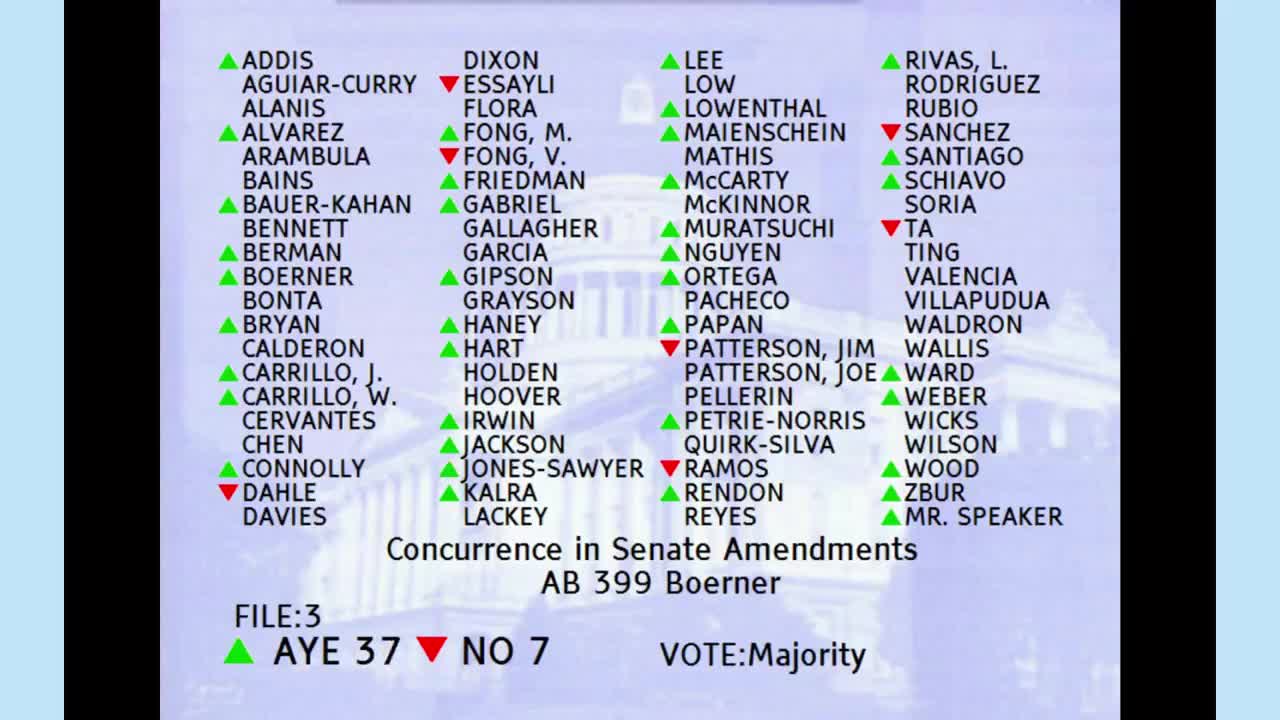 50SEC
Assembly Floor
 2MIN
Senate Floor
 5MIN
Senate Standing Committee on Judiciary
 11MIN
Senate Standing Committee on Governance and Finance
 2MIN
Assembly Floor
 4MIN
Assembly Standing Committee on Local Government
Bill Author

Bill Co-Author(s):